Article

Evolution of a Multilayer Gradient Microstructure in 32CrNi3MoV Steel Under Extreme Thermochemical Cycling


Materials Science and Engineering, Nanjing University of Science and Technology, Nanjing 210094, China
*
Author to whom correspondence should be addressed.
Crystals 2026, 16(6), 362; https://doi.org/10.3390/cryst16060362
Submission received: 2 May 2026 / Revised: 25 May 2026 / Accepted: 27 May 2026 / Published: 29 May 2026
(This article belongs to the Special Issue Investigation of Microstructural and Properties of Steels and Alloys)

Abstract

To address the erosion-induced failure of large-caliber gun barrels under extreme thermochemical coupling, this study systematically investigates the microstructural evolution of multi-layered gradient regions along the radial direction of 32CrNi3MoV steel under extreme thermochemical cycling. Leveraging SEM, EBSD, TKD, and double-beam aberration-corrected TEM, combined with JMatPro thermodynamic simulations, the phase transitions, crystallographic characteristics, and substructural evolution spanning from the bore surface to the matrix are elucidated. The results demonstrate that a three-layer gradient structure forms along the radial direction. The topmost layer is a chemically stabilized metastable austenite diffusion layer with a thickness of 1.5–4.0 μm. which is attributed to the suppression of martensitic transformation due to C/N interstitial diffusion lowering the MS temperature. The observed high-density dislocation tangles and stacking faults within this austenite diffusion layer result from thermal mismatch stresses during rapid thermal cycling. The subsurface region is a martensitic transformation layer with a thickness of 70–97 μm, exhibiting a substructural gradient from nanostructured high-density twinned martensite to refined lath martensite. Thermodynamic analysis indicates that rapid heating (≈105 °C/s) facilitates significant austenite nucleation and growth during the reverse phase transformation, subsequently forming nanostructured martensitic grains via non-equilibrium transformation during rapid cooling. Adjacent to this is a matrix tempering layer extending approximately 160 μm. Nanoindentation hardness profiling reveals that the peak radial hardness (≈1000 HV) occurs within the fine-grained martensitic zone approximately 40 μm from the surface. In contrast, the tempered layer exhibits reduced hardness (≈400 HV) compared to the original matrix (≈500 HV). This is primarily attributed to transient high-temperature over-tempering effects, which induces carbide coarsening and the loss of solid solution strengthening, alongside the softening of prior austenite grain boundaries. This study clarifies the micro-to-nanoscale evolution of the barrel microstructure, providing critical theoretical insights for understanding erosion mechanisms and improving lifetime predictions.

1. Introduction

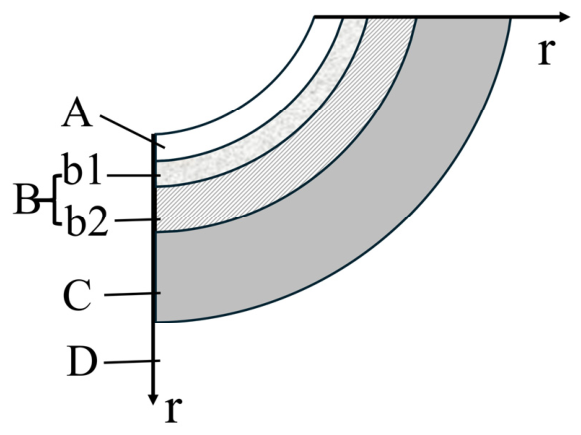
On the modern battlefield, artillery remains a cornerstone of military operations, maintaining a pivotal role in long-range engagement. During the firing sequence, the bore surface material is subjected to extreme temperature spikes exceeding 1000 °C followed by rapid quenching, all occurring on a millisecond timescale under the influence of high-pressure propellant gases [1,2,3]. This process is further complicated by the transient infiltration of interstitial atoms, such as carbon and nitrogen, from the combustion products [2]. This multifaceted coupling subjects the surface layer to cyclic thermal fatigue and severe thermochemical erosion, resulting in coupled thermochemical degradation and macro-scale bore wear, as macroscopically evaluated and modeled by Sopok [4,5] and Lawton [6]. Consequently, the subsurface microstructure undergoes recurrent phase transitions and severe solute redistribution, ultimately leading to the evolutionary formation of a complex multi-layered gradient microstructure along the radial direction of the barrel. Figure 1 presents a schematic of this radial gradient structure on the bore surface. In Figure 1, the “white layer” is divided into outer and inner white layers, All layers shown originate from the same matrix, collectively representing a microstructural gradient that constitutes the central physical substrate for erosion failure.
It is recognized that the thermochemical–mechanical effect caused by the interaction between the propellant gas and the driving belt during gun firing forms a complex gradient structure on the bore surface of the barrel. However, a unified consensus regarding the specific phase distribution and formation mechanism of this multilayer structure has yet to be reached. Regarding the outer white layer, the research consensus is relatively unified: it forms low-strength, low-melting-point compounds via the reaction between high-temperature combustion gases and the chamber surface [6,7,8,9,10]. Ahmad [7] first confirmed that the outer white layer contains carbides, nitrides, and a small amount of oxides. Subsequent studies found that the carbide composition is not limited to a single Fe3C but includes complex phases such as Fe2C and Fe5C2 [8]. Furthermore, the outer white layer is mainly composed of corrosion products enriched with carbon, oxygen, and sulfur [9,10]. Due to its low melting point and low strength, the outer white layer is prone to exfoliation under high-velocity gas scouring [8,11,12,13,14]. After the outer white layer exfoliates, the inner white layer becomes the primary front of the interaction between the barrel steel and the high-temperature, high-activity propellant gas. Therefore, the phase stability, interface bonding strength, and crack initiation behavior of the inner white layer are key to understanding the barrel ablation mechanism. However, the phase composition of the inner white layer remains controversial. Some studies report that it consists of austenite with supersaturated carbon and nitrogen [6,7]; others propose a mixture of martensite and retained austenite [9,10,15]; still others describe it as a mixture of high-carbon austenite and cementite [14]. In addition, a matrix tempering layer has been observed as a transition structure between the inner white layer and the base matrix [16]; however, its continuous phase evolution remains clarified only at a macroscopic level.
Several previous studies have laid the foundation for understanding barrel erosion through different computational or scale regimes. For instance, macro-scale empirical formulas and multi-physics numerical configurations were developed by Lawton [6] and Sopok [4,5] to predict the general bore wear and transient temperature fluctuations, treating the barrel material as an isotropic continuum while screening the underlying microstructural details. From a metallurgical perspective, pioneering studies by Turley [17], Ahmad [7], and Botstein [8] identified the correlation between gas–metal interactions and sub-surface cracking, which was heavily ascribed to macroscopic thermal mismatch stresses and aggressive C/N/O/S interstitial infiltration. More recently, Yang [13], Ji [14], and Chen [16] conducted comprehensive forensic failure analyses on decommissioned barrels utilizing standard optical microscopy (OM) and low-magnification scanning electron microscopy (SEM) to outline the boundary macro-morphology, paired with conventional X-ray diffraction (XRD) to detect the average phase constituent of the mixed degraded zones. Furthermore, via simulated ballistic environments in vented vessels, Zhang et al. [9,10] identified a bilayer white etching structure on the surface of 32CrNi3MoV steel, confirming that the outer layer undergoes severe low-hardness corrosion while the inner layer experiences thermal-induced martensitic transformation.
Despite these efforts, critical gaps remain. Most existing studies treat the degraded regions as discrete, isolated blocks, thereby missing the continuous chemical–structural evolution and localized strain gradients between adjacent sublayers. Moreover, due to the millisecond-scale duration of the thermal impulse, the subsurface phase transition zones are typically too narrow to be fully resolved by standard microscopy or bulk XRD. Our previous work [18] identified a tripartite macro-gradient architecture and noted the presence of flake and equiaxed macro-zones within the martensite region. Nevertheless, that study was limited to micro-scale morphology and did not resolve nanoscale substructures such as transformation twins or lath boundaries. To date, no study has systematically tracked the continuous radial evolution from transformation twins to lath martensite at the nanoscale, nor quantitatively correlated nanoscale grain size and low-angle grain boundary distribution with the hardness profile across the entire gradient layer sequence.
To achieve this, the present study establishes an integrated cross-scale characterization and thermodynamic simulation framework to systematically investigate the radial multi-layered gradient evolution in 32CrNi3MoV steel. By pairing advanced transmission electron microscopy (TEM) with high-resolution transmission Kikuchi diffraction (TKD), we aim to resolve the highly localized nanoscale substructural transition spanning from the twin-dominated to the lath-dominated martensite regions. Concurrently, electron backscatter diffraction (EBSD) and cross-interface continuous nanoindentation micro-profiling are deployed to quantitatively correlate the spatial distribution of grain sizes and low-angle grain boundaries with the continuous radial hardness devolution—capturing nanostructured features typically obscured under standard microscopy. Finally, by coupling these multi-scale microstructural observations with JMatPro thermodynamic tracking, the transient formation and stabilization mechanisms of the gradient microstructure are systematically elucidated. Ultimately, this comprehensive diagnostic baseline provides the necessary theoretical and physical support required for cross-scale damage prediction and lifecycle modeling of gun barrel erosion.

2. Experimental Materials and Methods

2.1. Experimental Materials

The research was conducted on a large-caliber 32CrNi3MoV steel gun barrel that was retired from active service. The barrel has a caliber of 155 mm and a wall thickness of 86 mm in the chamber region from which the samples were extracted. The propellant gas, regardless of single-base, double-base, or triple-base composition, consists of carbon, nitrogen, hydrogen, and oxygen, with major combustion products including CO, CO2, H2O, N2, and O2 [19,20]. These gases contain active carbon and nitrogen species that diffuse into the bore surface during transient thermal pulses. The primary objective was to investigate the microstructural morphology and its evolution at various radial positions under the extreme thermochemical coupling effects inherent in the erosion process. The chemical composition of the 32CrNi3MoV steel was measured by optical emission spectrometry, and the average values of three measurements are summarized in Table 1.

2.2. Experimental Method

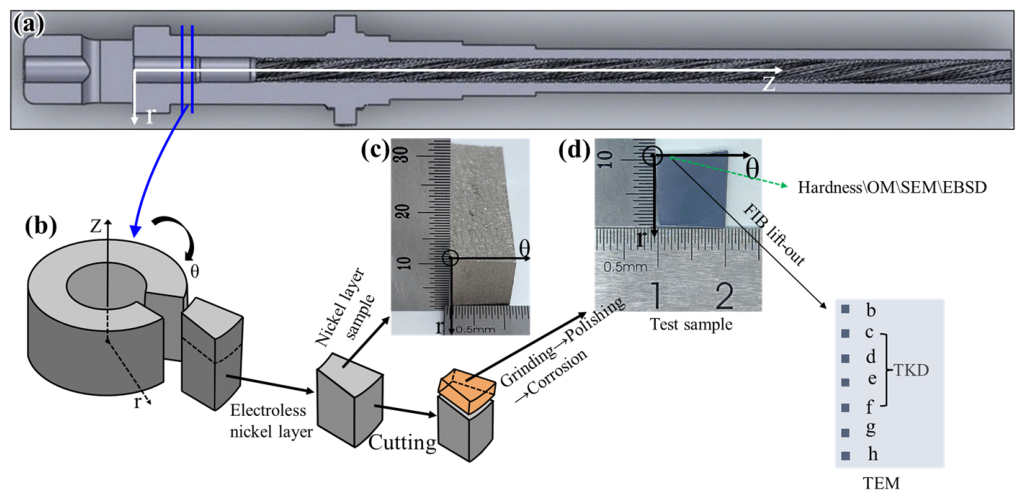
Specimens were extracted from the chamber region of the retired large-caliber thick-walled barrel. To preserve surface integrity, a protective nickel layer was electroplated onto the bore surface before cutting, grinding, and polishing. Metallographic sections were etched with 4% nital solution to reveal microstructural features. Radial hardness profiles were obtained using an Agilent Nano Indenter G200, with loading/unloading times of 15 s, a strain rate of 10−2 s−1, a holding time of 10 s, and a maximum load of 100 mN. A total of 23 indents were placed from the bore surface inward at intervals of 10–20 μm. After indentation, local microstructures were examined using an Olympus BX51 confocal laser scanning microscope. A Zeiss Auriga dual-beam scanning electron microscope, equipped with energy-dispersive X-ray spectroscopy and electron backscatter diffraction (EBSD), was employed to characterize the radial morphological evolution and gradient structure. For EBSD, the sample was tilted to 70° with a working distance of 15 mm and an accelerating voltage of 20 kV. A step size of 0.1 μm was used for large-area mapping to capture the overall phase distribution across the gradient layers, while a finer step size of 0.02 μm was adopted for selected regions to resolve fine substructures. EBSD data were analyzed using Aztec software (version 6.3). To further resolve micro-to-nanoscale features of the gradient layers, high-resolution transmission electron microscopy (TEM) was performed. Given the micrometer-scale thickness of the inner white layer, conventional electropolishing was unsuitable for targeted specimen preparation. Instead, TEM lamellae were precisely extracted from specific gradient zones using focused ion beam (FIB) milling in the Zeiss Auriga system. The lamellae were examined with an FEI Themis Z (60–300 kV) double-beam aberration-corrected TEM. Transmission Kikuchi diffraction (TKD) was additionally applied to characterize ultrafine-grained regions beyond the EBSD resolution limit. The complete sampling workflow is schematically illustrated in Figure 2.
The complete sampling and multi-scale characterization workflow is schematically illustrated in Figure 2. In parallel, the continuous cooling transformation (CCT) behavior of 32CrNi3MoV steel was simulated using JMatPro software (Version 7.0) to provide a thermodynamic basis for interpreting the observed non-equilibrium phase transformations.

3. Results

3.1. Thermodynamic Analysis of 32CrNi3MoV Steel

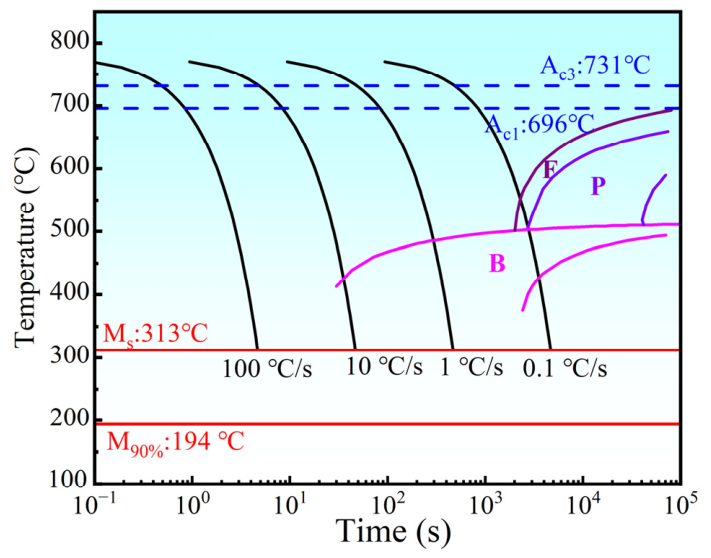
Utilizing the chemical composition of 32CrNi3MoV steel listed in Table 1, the CCT curves are calculated for various cooling rates, as illustrated in Figure 3. The thermodynamic equilibrium temperatures are determined as AC1 = 696 °C and AC3 = 731 °C. As the cooling rate increases from 0.1 °C/s to 100 °C/s, the transformation temperature range systematically shifts toward the lower temperature region. At lower cooling rates of 0.1 °C/s and 1 °C/s, diffusional transformations occur within an elevated temperature range, corresponding to ferritic or pearlitic reactions. When the cooling rate reaches 10 °C/s, the transformation onset temperature drops below 500 °C, indicating the predominance of bainitic transformation. For the pristine alloy matrix, the martensite start (MS) temperature is identified at approximately 313 °C. Higher cooling rates (≥100 °C/s) significantly suppress high-temperature diffusional transformations, promoting a fully martensitic microstructure.
Crucially, this calculated CCT diagram establishes a near-equilibrium thermodynamic baseline for the unaffected pristine matrix. However, the actual service environment at the innermost bore surface deviates fundamentally from these baseline conditions. During explosive firing sequences, the local cooling rate is estimated to exceed 105 °C/s, forcing the steel to undergo ultra-fast non-equilibrium austenitization and quenching. From an energetic perspective, such extreme thermal shocks drastically increase the thermodynamic driving force for phase transformation, thereby depressing the effective bainite and martensite start temperatures. Furthermore, because the CCT calculation assumes a homogeneous matrix composition, it serves as a comparative reference to isolate two additional effects investigated in subsequent sections: (i) chemical stabilization—suppression of MS via gas-phase C/N interstitial enrichment from propellant combustion products, and (ii) thermal over-tempering—local softening of prior martensite under extreme thermal cycles. The combination of these kinetic deviations provides a fundamental thermodynamic basis for the formation of the abnormal gradient microstructures observed on the eroded bore surface.

3.2. Radial Nanoindentation Hardness Profiling Across the Erosion-Affected Gradient Layers

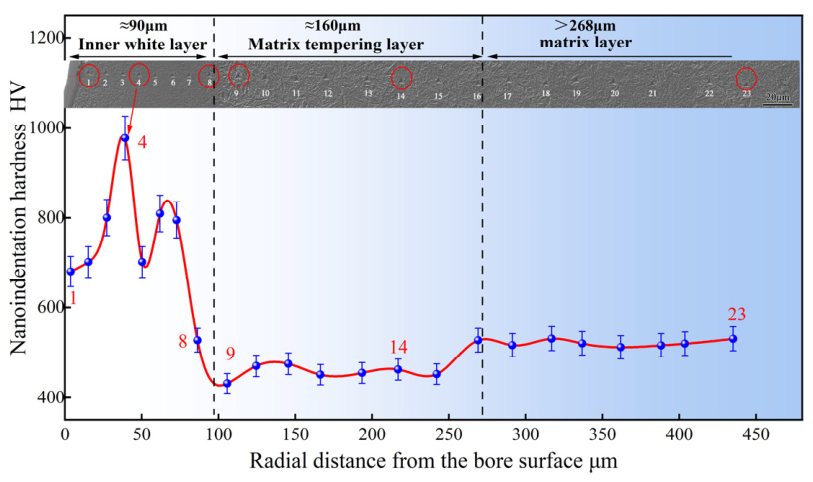
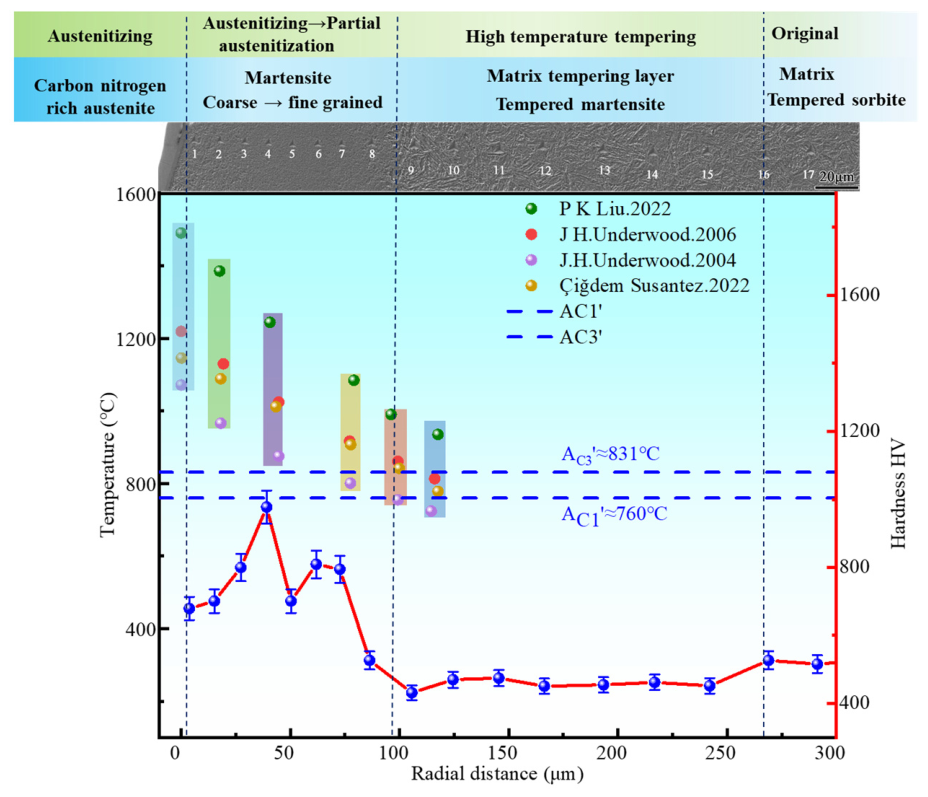
To macroscopically quantify the structural modifications induced by the gradient thermal and chemical fields, continuous radial nanoindentation was performed from the bore surface toward the pristine matrix, as presented in Figure 4. Given an average indentation size of approximately 3.0 μm, the first valid indentation point was positioned at 3.70 μm from the innermost bore surface to avoid geometric edge effects. The hardness profile exhibits a distinct multi-stage spatial trend: an initial augmentation, a sharp reduction, and a final stabilization. Notably, the material immediately adjacent to the bore surface (at 3.70 μm) does not exhibit the maximum hardness, despite experiencing the highest thermal quenching rate. Instead, the hardness increases progressively with radial distance, reaching a peak value of nearly 1000 HV at a distance of ≈40 μm. This non-monotonic profile suggests that the outermost boundary layer possesses a unique phase configuration—potentially involving retained austenite stabilized by C/N interstitials, non-equilibrium carbides, or incompletely transformed regions—that suppresses martensitic transformation during rapid cooling, whereas the subsurface region at 40 μm has undergone complete martensitic transformation accompanied by severe grain refinement and dislocation strengthening. Although C/N interstitial infiltration from propellant combustion occurs primarily at the innermost surface, its strengthening contribution appears to be offset locally by competing mechanisms, resulting in a subsurface hardness maximum. As the radial distance advances from 40 μm to 90 μm, the hardness undergoes a precipitous decline, dropping from the 1000 HV peak to a minimum of approximately 400 HV. Notably, this valley is significantly softer than the pristine matrix (≈500 HV), serving as a mechanical signature of localized over-tempering. Under repeated thermal loading, the transient thermal wave in this radial range peaked below the AC1 temperature, triggering massive carbide coarsening and dislocation recovery—a cyclic tempering effect that drives pronounced softening without re-austenitization. Beyond a radial distance of 245 μm, the thermal influence gradually weakens. The microstructure transitions from the over-tempered soft zone to the stable matrix layer, and the hardness gradually recovers and stabilizes at approximately 500 HV, marking the return to the unaffected pristine matrix state. This continuous mechanical gradient serves as a direct macroscopic mirror of the underlying structural transitions. To decode the precise physical origins of the anomalous hardness peak and the softening valley—particularly the competing mechanisms at the outermost surface and the carbide evolution in the over-tempered zone—a multi-scale crystallographic and substructural characterization (EBSD, TKD, and TEM) is systematically presented in the subsequent sections.

3.3. Distribution Law of Microstructure

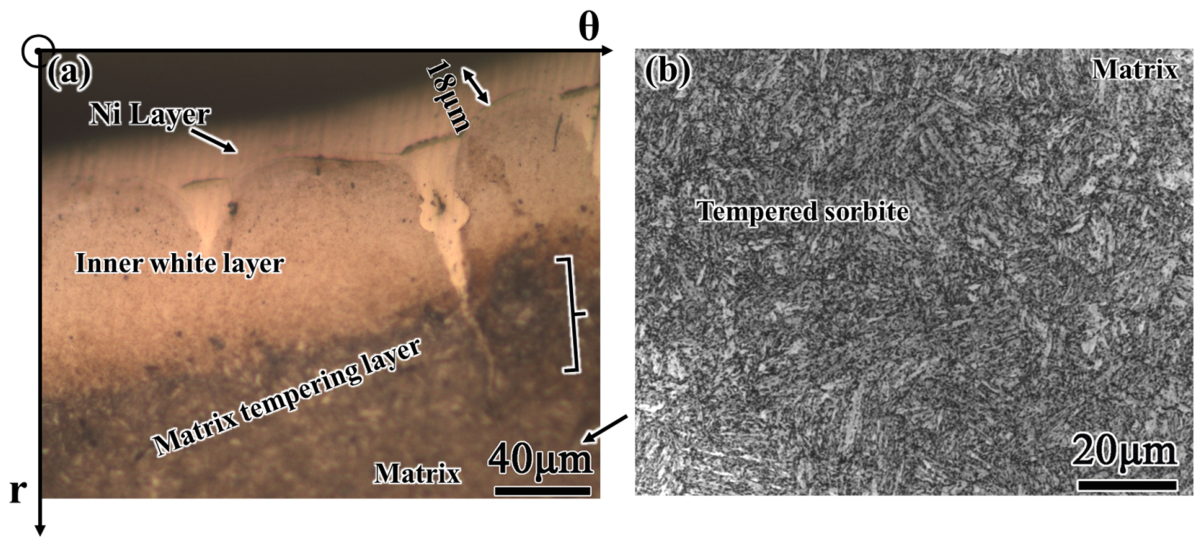
Figure 5 shows the radial optical micrographs of the barrel bore after service failure. As shown in Figure 5a, the bore surface is encapsulated by an electroplated nickel protective layer approximately 18 μm thick. Immediately adjacent to the coating, an etch-resistant white layer is observed. Progressing radially inward, a gray transition zone appears between the white layer and the base matrix, which eventually merges into the base matrix. The barrel was subjected to quenching and high-temperature tempering (590–605 °C) during manufacturing [21,22,23], resulting in a matrix composed of typical tempered sorbite, as shown in Figure 5b. Consequently, the ablated inner surface exhibits a clear radial gradient architecture comprising an etch-resistant white layer, a transition zone, and the unaffected base matrix. Although these primary zones are distinguishable under optical microscopy, the intricate substructural features and precise phase boundaries require further high-resolution elucidation via SEM.
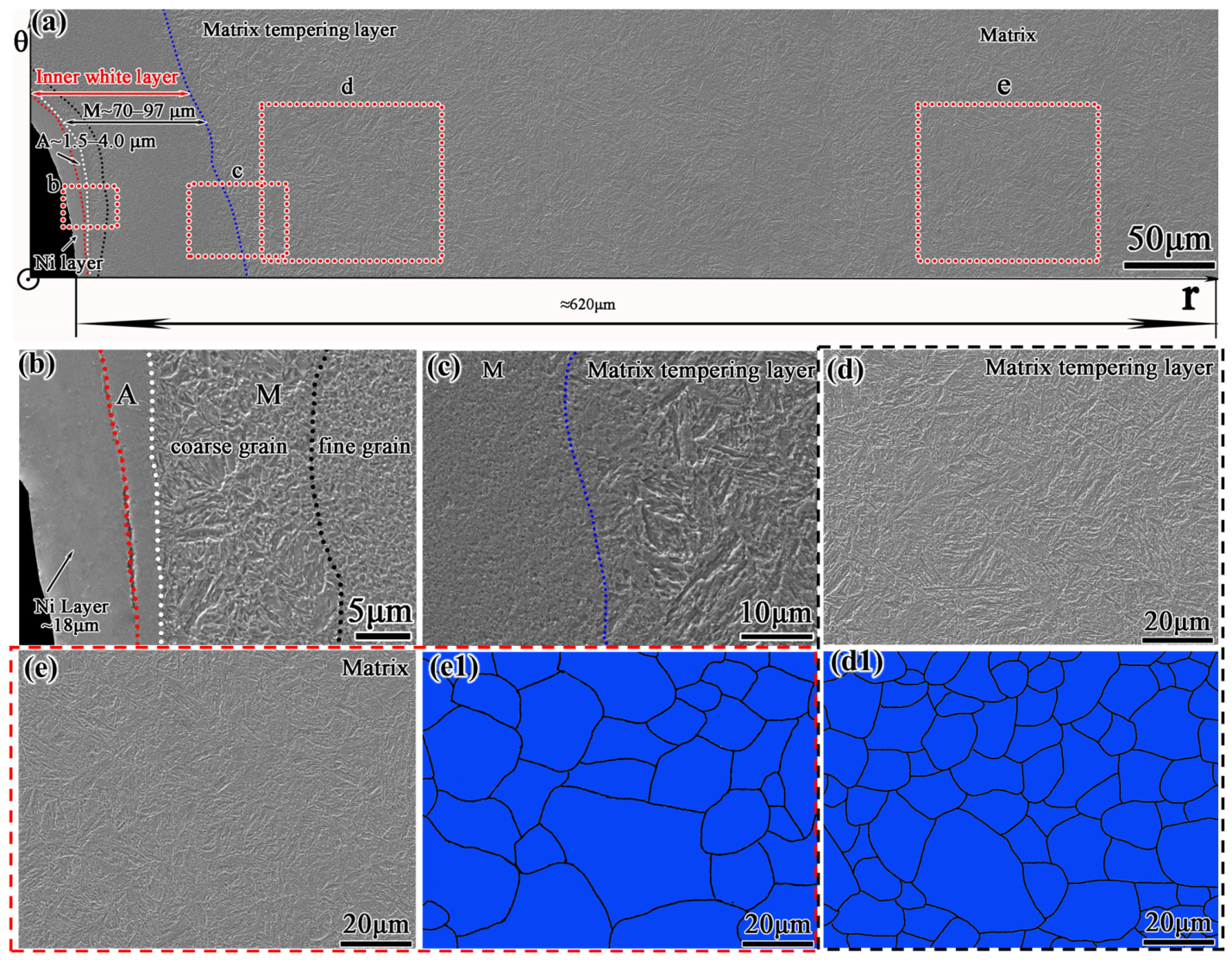
Figure 6 illustrates the radial microstructural distribution of the inner bore surface under extreme thermochemical cycling, as revealed by scanning electron microscopy (SEM). The conventionally reported outer white layer [6,7,23] is absent in this specimen, which is attributed to complete exfoliation under high-velocity gas erosion. As shown in Figure 6a, the radial microstructure exhibits a distinct four-tier architecture from the bore surface inward: an austenite layer (A), a martensitic transformation layer (M), a matrix tempering layer, and the unaffected base matrix. The red line marks the interface between the Ni layer and the austenite layer, the white dashed line denotes the interface between the austenite layer and the martensitic transformation layer, the black dashed line separates the coarse-grained region from the fine-grained region within the martensitic transformation layer, and the blue dashed line indicates the boundary between the martensitic transformation layer and the matrix tempering layer. The thickness of the austenite layer ranges from 1.5 to 4.0 μm, and that of the martensitic transformation layer ranges from 70 to 97 μm. The red dashed boxes outline the locations of the regions enlarged in Figure 6b–e. Under SEM observation, the morphology of the matrix tempering layer appears nearly indistinguishable from the base matrix. However, corroborated by the 160 μm hardness plateau identified in Figure 4, the boundary of the tempered zone is demarcated at approximately 160 μm from the martensitic transformation layer.
Within the martensitic transformation layer, a significant morphological transition is observed as the radial distance increases: the structure evolves from coarse plate-like martensite near the austenite layer to refined martensite with equiaxed prior austenite grains in the region approaching the hardness peak (≈40 μm), as highlighted by the black line in Figure 6b. This grain refinement is attributed to the cumulative effect of cyclic reverse transformation (martensite → austenite) during repeated firing. In each thermal cycle, the reverse transformation nucleates at multiple defect sites (e.g., lath boundaries and dislocations), and the subsequent rapid quenching produces finer martensite. The progressive refinement observed near the peak hardness region is the net result of this cyclic phase transformation mechanism. Quantitative analysis of prior austenite grain boundaries, delineated in both the tempered zone and the base matrix (Figure 6d–e,d1,e1), reveals that the mean prior austenite grain size in the matrix tempering layer is 14.54 ± 1.3 μm, which is slightly smaller than that of the base matrix (16.43 ± 1.0 μm). This counterintuitive observation indicates that the transient thermal loads in this region remain below the AC1 temperature, causing mild microstructural recovery without triggering austenitization or subsequent grain coarsening, whereas the base matrix grain size reflects the original manufacturing heat treatment. Collectively, the optical and SEM observations presented in Figure 5 and Figure 6 establish the overall gradient distribution characteristics. To further elucidate the crystallographic features and nanoscale substructures—particularly the nature of the austenite layer and the dislocation configurations within the refined martensite—multi-scale characterization via EBSD, TEM, and TKD is systematically presented in the following sections.
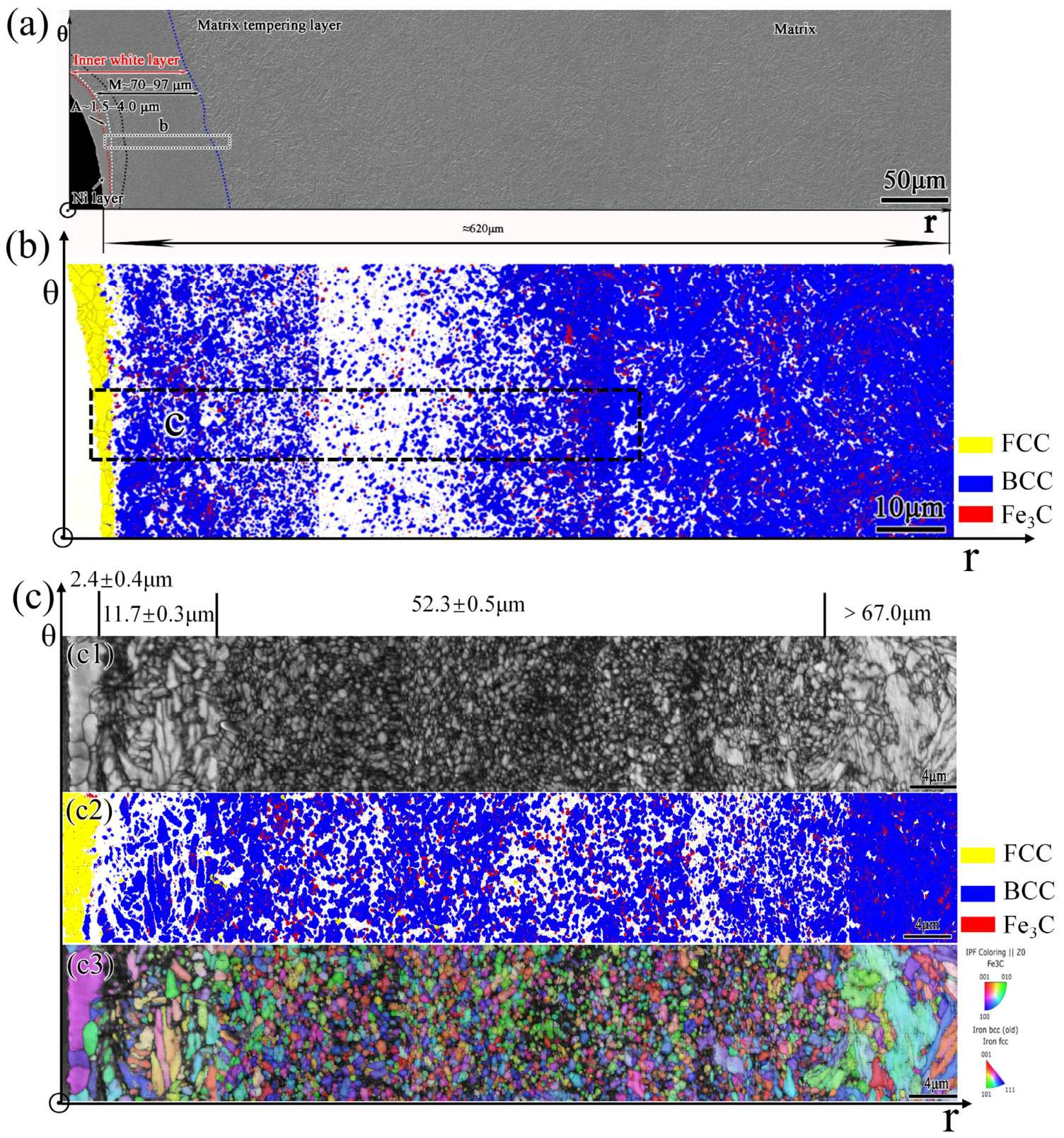
Figure 7 presents cross-sectional EBSD analyses of the bore surface after extreme thermochemical cycling. Figure 7a is a low-magnification SEM image showing the overall radial architecture. Figure 7b is the corresponding phase map of the region marked ‘b’ in Figure 7a, where yellow denotes FCC austenite, blue denotes BCC martensite, and red pixels represent Fe3C precipitates. Figure 7c provides higher-resolution EBSD maps for a representative area within the white layer and adjacent martensitic zone. Directly adjacent to this austenite layer (radially inward), the phase map shows an abrupt transition to a BCC martensitic structure, with fine Fe3C particles distributed both intragranularly and along grain boundaries. The band contrast (BC) map in Figure 7(c1) shows that the austenite zone has relatively coarse grains with sizes ranging from 1.8 to 2.4 μm. Progressing radially inward from the austenite/martensite interface, the martensitic microstructure initially consists of coarse martensitic grains. With a further increase in radial distance, these coarse grains gradually transform into a refined, equiaxed ultrafine-grained structure. However, approaching the boundary with the matrix tempering layer (≈65–70 μm from the surface), the grain size increases again, transitioning to a coarser martensitic morphology. Due to the nanometric grain size within the severely refined martensitic zone and the inherent spatial resolution limit of conventional EBSD, certain regions within this ultrafine-grained zone appear as non-indexed white pixels in Figure 7(c2). These regions are not amorphous or second phases but are predominantly ultrafine martensitic grains and subgrain boundaries that fall below the reliable indexing capability of EBSD. At a radial distance of approximately 65–70 μm from the bore surface, a sharp transition in both grain size and morphology is observed: the ultrafine equiaxed martensite gives way to a coarser, more heterogeneous structure. This transition distance is consistent with the boundary between the martensitic transformation layer and the matrix tempering layer identified in Figure 6c (blue dashed line in Figure 6a). At a radial distance of approximately 65–70 μm from the bore surface, a sharp transition in both grain size and morphology is observed: the ultrafine equiaxed martensite gives way to a coarser structure. This transition distance is consistent with the boundary between the martensitic transformation layer and the matrix tempering layer identified in Figure 6c (blue dashed line in Figure 6a).
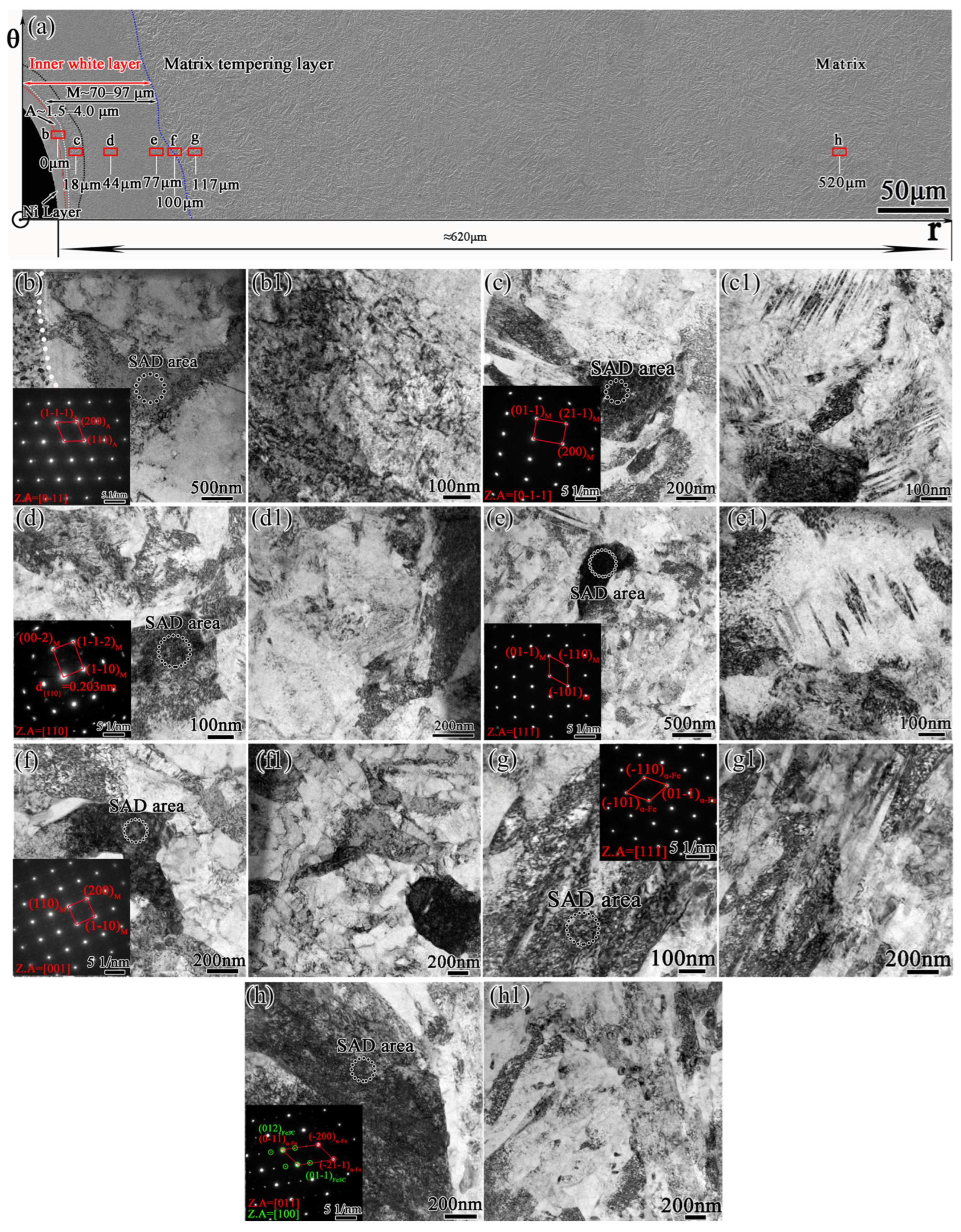
To further resolve nanoscale features within each gradient layer, TEM lamellae were extracted by FIB milling from specific radial positions indicated in Figure 8a. Figure 8b–h present indexed SAED patterns, and Figure 8b1–h1 show the corresponding bright-field micrographs. Austenite layer at the bore surface. The SAED pattern in Figure 8b confirms an FCC austenite structure, consistent with the EBSD results in Figure 7. The bright-field image in Figure 8(b1) reveals high-density dislocation tangles and stacking faults within the austenite grains, reflecting the severe plastic deformation induced by repeated rapid heating and cooling at the bore surface. Coarse-grained martensite at a depth of approximately 18 μm. Beneath the austenite layer, the diffraction pattern in Figure 8c identifies a BCC martensitic structure. Bright-field imaging reveals high-density, parallel transformation nano-twins, with twin lamellae lengths ranging from approximately 45 to 240 nm and an inter-lamellar spacing of approximately 3 to 26 nm. This dense twin substructure is a hallmark of non-equilibrium martensitic transformation under extreme cooling rates, indicating a high transformation driving force near the surface. The martensite grains at this depth are relatively coarse. Fine-grained martensite at a depth of approximately 44 μm. At this depth, the SAED pattern in Figure 8d confirms a BCC martensitic structure. As shown in the bright-field image Figure 8(d1), the twin density is markedly reduced compared to the shallower depth. The substructure becomes predominantly lath-like, with lath lengths of approximately 360 nm and widths of approximately 20 nm. The grains are significantly refined relative to the overlying coarse-grained zone. This depth coincides with the peak hardness of nearly 1000 HV in Figure 4. The transition from coarse-grained, twin-dominated martensite to fine-grained, lath-dominated martensite suggests a gradual decrease in transformation driving force with increasing radial distance, reaching an optimum at this depth for grain refinement hardening. Martensite approaching the tempered zone at a depth of approximately 77 μm. Further inward, the SAED pattern in Figure 8e continues to index to BCC martensite. The bright-field image Figure 8(e1) shows that the lath width increases considerably compared to the fine-grained zone, with only remnant fine substructures visible. The martensite here approaches the boundary of the matrix tempering layer. Martensite/tempered zone interface at a depth of approximately 100 μm. At this interface, as shown in the bright-field image Figure 8f, the laths appear shortened and further widened. This location corresponds to the minimum hardness of approximately 400 HV in Figure 4, identifying it as a transition zone where microstructural coarsening occurs under repeated high-temperature pulses below the AC1 temperature. Matrix tempering layer at a depth of approximately 117 μm. The diffraction pattern in Figure 8g identifies the α-Fe phase, with a lath width of approximately 1.05 μm. Figure 8h confirms that the matrix consists of typical tempered martensite characterized by high-density dislocation tangles within an equilibrated microstructure.
From the bore surface inward, the observed substructures follow a continuous spatial sequence: austenite at the surface (Figure 8b) → coarse-grained, twin-dominated martensite at 18 μm (Figure 8c) → fine-grained, lath-dominated martensite at 44 μm, which coincides with the peak hardness (Figure 8d) → coarsening martensite at 77 μm (Figure 8e) → severely coarsened martensite at the martensite/tempered zone interface at 100 μm, which coincides with the hardness minimum (Figure 8f) → α-Fe lath structure in the matrix tempering layer at 117 μm (Figure 8g) → unaffected tempered martensite matrix at 520 μm (Figure 8h). This sequence demonstrates that the radial hardness gradient is a direct manifestation of the progressive substructural evolution from twin-dominated, coarse-grained martensite near the surface to fine-grained, lath-dominated martensite at the peak, and finally to coarsened, over-tempered structures at greater depths.
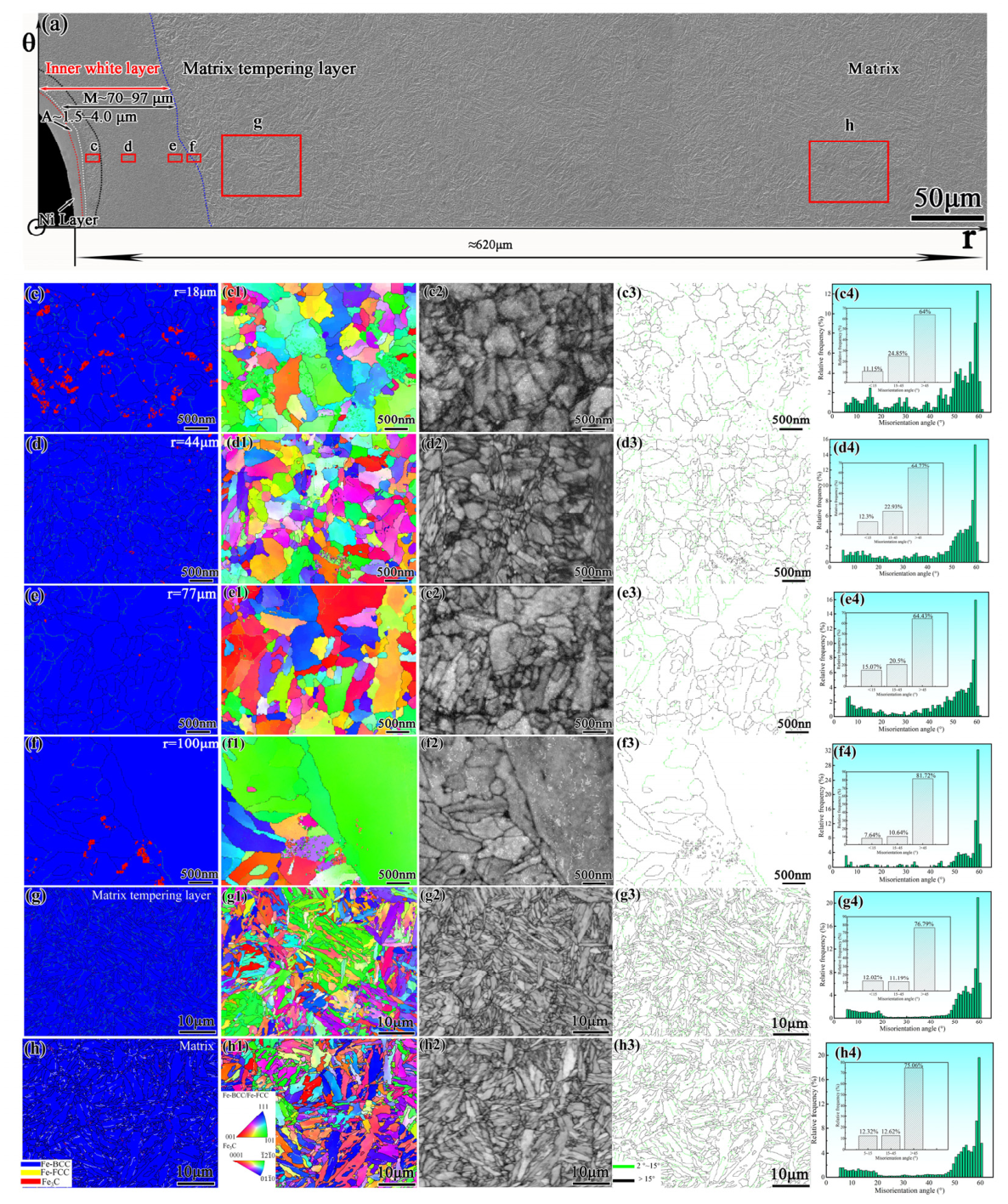
To overcome the resolution limit of EBSD and to quantitatively characterize the grain size and grain boundary characteristics in the ultrafine-grained martensitic zone, TKD analysis was performed on the FIB sampling positions c, d, e, and f in Figure 8a. In addition, EBSD testing was performed on the matrix tempering layer and the matrix. The results are shown in Figure 9. In the phase maps, blue represents the BCC phase, red represents the Fe3C phase, yellow represents the FCC phase, and white regions remain unindexed. The microstructure of each layer consists of the BCC phase and the Fe3C phase, with no FCC phase detected. The IPF maps show that the crystallographic orientation of each region along the radial direction is random, with no obvious texture. As shown in the BC maps (Figure 9(c2–h2)), with increasing radial distance, the martensitic grain size initially decreases and then increases. In the coarse-grained region (position c in Figure 9a), the average grain size is 174 ± 158 nm. This decreases to 152 ± 126 nm in the fine-grained region (position d in Figure 9a, ≈40 µm from the surface, corresponding to the hardness peak), before increasing to 260 ± 226 nm adjacent to the matrix tempering layer. All three regions show a highly heterogeneous grain size distribution, with large standard deviations and numerous grains smaller than 50 nm. In the transition area between the martensitic transformation layer and the matrix tempering layer, only complete grains were counted, while coarse incomplete grains were excluded from the analysis. The average grain size in this transition area is 273 ± 113 nm. The smallest average grain size (152 nm) is observed at approximately 40 μm from the surface, which corresponds precisely to the hardness peak (≈1000 HV) in Figure 4, confirming that fine-grain strengthening is a key mechanism underlying the abrupt hardness increase in this region. When the radial distance further increases to the matrix tempering layer, the microstructural morphology transitions from nanoscale equiaxed grains to microscale lath structures. However, no obvious difference exists between the matrix tempering layer and the matrix structure. Both consist of lath martensite exhibiting a typical hierarchical structure of prior austenite grains, packets, blocks, and laths. The lath is the smallest structural unit of lath martensite. A packet is composed of a group of laths sharing the same habit plane, and a block is composed of a group of laths with the same or similar crystallographic orientation [24,25,26]. The grain size (equivalent circle diameter) of the matrix tempering layer is 1.10 ± 1.0 μm, while that of the matrix structure is 1.30 ± 1.1 μm. Figure 9(g2–h2) show that the grains exhibit short rod or needle-like morphologies, resulting in a large standard deviation due to the large grain size. Figure 9(c3–h3) present the grain boundary distribution maps corresponding to each position, where cyan lines represent low-angle grain boundaries (LAGBs, 2–15°) and black lines represent high-angle grain boundaries (HAGBs, >15°). Figure 9(c3–h3) also show the misorientation distribution histograms and provide the statistical results for HAGBs and LAGBs. In the coarse-grain region (position c) of the martensite layer, the misorientation exhibits a single-peak distribution, with a pronounced peak at >45°, and HAGBs account for 88.85%. In the fine-grain zone (position d), the proportion of LAGBs increases to 12.3%, corresponding to the hardness peak position (Figure 4, approximately 40 μm from the surface). The formation of LAGBs and subgrain boundaries constitutes an effective barrier that hinders dislocation movement, which, together with the Hall–Petch effect from grain refinement, is the primary reason for the anomalous abrupt hardness increase in this region [27,28,29,30]. The proportion of LAGBs is the lowest in the transition area. Given the presence of coarse incomplete grains in the transition area, the statistical error is likely substantial. The grain boundary characteristics of the matrix and the tempered layer are essentially the same: LAGBs account for approximately 12% (12.32% in the matrix and 12.02% in the tempered layer), while HAGBs account for approximately 88–90%. The misorientation distributions are bimodal, with peaks mainly in the ranges of 2–15° and >45°. The grain size variation and LAGBs proportion along the radial direction show a consistent trend with the hardness profile, further confirming the structure–property relationship established by the radial gradient microstructure.

4. Analysis of the Multi-Layered Radial Gradient Microstructure

4.1. Alignment of Microstructural Findings with Identified Research Gaps

The multi-scale characterization results presented in Section 3 directly address the key controversies and knowledge gaps outlined in the introduction. Drawing upon the thermodynamic baseline established by JMatPro simulations, which quantifies the equilibrium transformation temperatures and the strong cooling-rate dependence of phase formation in 32CrNi3MoV steel, the subsequent experimental analyses reveal how extreme thermochemical cycling drives the material far from equilibrium. Specifically, OM and SEM observations resolve the radial gradient architecture, identifying an austenite diffusion layer (1.5–4.0 μm), a martensitic transformation layer (70–97 μm), and a matrix tempering layer (~160 μm). These findings directly settle the long-standing dispute over the phase composition of the inner white layer, confirming that the outermost etch-resistant region is a monophasic FCC austenite rather than a mixture of martensite and retained austenite or a carbide-rich compound as previously speculated [9,10]. Furthermore, EBSD phase mapping corroborates this assignment while revealing the absence of FCC phase elsewhere, thereby clarifying the spatial phase distribution across the gradient. To address the unresolved substructural evolution within the martensitic transformation layer, TEM and TKD analyses disclose, for the first time, a continuous radial transition from high-density transformation nano-twins (twin spacing 3–26 nm) to refined lath martensite, and ultimately to over-tempered lath structures. This nanoscale evidence fills the mechanistic void left by prior studies that only identified morphological changes at the micron scale [18]. Meanwhile, TKD-derived grain boundary maps quantify the evolution of low-angle grain boundaries (LAGBs), which peak at ≈12% within the ultrafine-grained zone (~152 nm) and correlate directly with the observed hardness maximum. Complementing these microstructural observations, nanoindentation hardness profiling establishes the radial structure–property relationship: a peak hardness of ≈1000 HV at ~40 μm from the surface, a drop to ≈400 HV in the tempered layer (below the matrix value of ≈500 HV), and eventual recovery to the matrix level. This quantitative profile directly validates that grain refinement and LAGB strengthening dominate near the bore surface, while carbide coarsening and loss of solid solution strengthening govern the softened zone. Together, these multi-scale experimental findings directly resolve each of the key controversies outlined in the introduction—namely the phase composition of the inner white layer, the substructural evolution within the martensitic transformation layer, the nature of the matrix tempering layer, and the corresponding structure–property relationship. Having established what the gradient architecture comprises, the following section addresses the underlying non-equilibrium mechanisms that govern its formation under extreme thermochemical cycling.

4.2. Mechanistic Genesis of the Radial Gradient Architecture Under Extreme Thermochemical Coupling

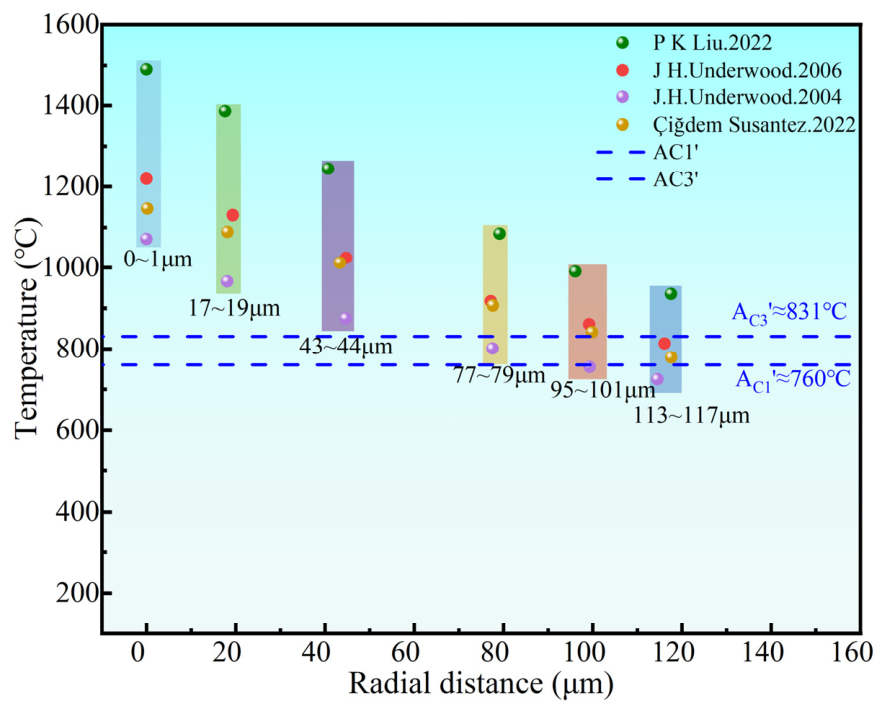
During the service of 32CrNi3MoV large-caliber barrels, the bore surface is subjected to complex multi-physics transient loading. This includes extreme temperatures, high pressures, high-velocity and chemically active propellant gases, and cyclic thermal pulses generated by projectile acceleration and friction [31,32,33,34]. Under such violent and repetitive thermal cycling, the surface material undergoes solid-state phase transformations, leading to the marked deterioration of its microstructural and mechanical properties. This microstructural evolution, driven by thermochemical coupling, is the primary driver of erosion and wear. The radial temperature distribution illustrated in Figure 10 is derived from literature data [35,36,37,38] for barrels of the same caliber as the current study. According to references [39,40,41,42], the rapid heating rates encountered in service induce a pronounced thermal hysteresis in phase transformation, shifting the transformation temperatures upward. Consequently, based on the influence of heating rates detailed in reference [42], the thermodynamic AC1 and AC3 temperatures from Figure 3 are recalibrated to determine the effective Ac1′ and AC3′ under actual service conditions. The radial distance ranges depicted in the figure correspond to the FIB-TEM sampling positions (Figure 8a), providing a theoretical framework for the subsequent mechanistic analysis of the phase transformation processes.
During ballistic firing, the intense thermal flux acts as the predominant driver for the structural evolution of the barrel bore. Within a millisecond timescale, the bore surface experiences ultra-rapid heating exceeding 1000 °C followed by instantaneous quenching. This extreme transient thermal cycle subjects the material to a thermal history that is fundamentally distinct from conventional heat treatment conditions.
Under service conditions, the peak surface temperature surpasses 1000 °C [35,36,37,38], significantly exceeding the AC3′. Simultaneously, chemically active carbon and nitrogen atoms from the high-temperature, high-pressure propellant gas diffuse into the matrix. This thermochemical coupling induces two critical effects: first, the infiltration of interstitial atoms drastically depresses the MS temperature, leading to pronounced chemical stabilization; second, the extreme heating rates (105 °C/s) and cooling rates (104 °C/s) [35,36,43,44,45,46,47,48,49,50] drive the phase transformation far from thermodynamic equilibrium. Upon the dissipation of the propellant gas and subsequent extreme quenching, the MS temperature of the enriched surface layer remains below ambient temperature. Consequently, the athermal martensitic transformation is completely suppressed, allowing the chemically stabilized austenite to remain metastable at room temperature, ultimately forming a distinct austenite diffusion layer approximately 2.4 μm in thickness.
As the radial distance increases, the thermal effect gradually diminishes. According to the temperature field, the peak temperature remains above the AC3′ within approximately 80 μm of the surface. In this region, the extremely high heating rate causes the reverse transformation (martensite → austenite) to exhibit pronounced non-equilibrium characteristics: austenite exhibits explosive nucleation at abundant defect sites, such as prior martensitic lath boundaries, dislocation cells, and carbide interfaces. This multi-site independent nucleation mechanism effectively refines the prior coarse grains into numerous ultrafine austenite nuclei, significantly increasing the nucleation rate [51]. Due to the millisecond-scale duration of the thermal pulse, grain boundary migration is severely restricted, and dispersed nanoprecipitates exert a potent Zener pinning effect on the boundaries, effectively suppressing austenite grain coarsening. During the subsequent rapid quenching, these ultrafine austenite grains transform into refined martensite. Repeated firing cycles further drive this continuous refinement, ultimately forming the nanostructured martensitic transformation layer. TKD analysis and nanoindentation hardness profiling confirm that the hardness peak (≈1000 HV) is located precisely within this refined martensitic zone, significantly exceeding the matrix (≈500 HV) due to the synergistic effect of grain refinement and low-angle grain boundary strengthening.
At the boundary between the martensitic transformation layer and the tempered zone (radial distance 100~110 μm), the peak temperature drops to approximately 800 °C (situated between AC1′ and AC3′), resulting in partial austenitization during the heating pulse. Upon cooling, the newly formed austenite transforms into martensite, which subsequently undergoes cyclic transformation during repeated firing. Further along the radial direction, the temperature in the matrix tempering layer falls approximately 50 °C below the AC1′ threshold, subjecting the microstructure to transient high-temperature tempering. Although the morphology remains similar to the matrix under SEM, this over-tempering induces the precipitation of supersaturated carbon and the coarsening of carbides, thereby attenuating solid solution strengthening and degrading the prior austenite grain boundaries. Hardness testing reveals a distinct softening phenomenon in this region, with values dropping below those of the original matrix. This softening is primarily attributed to the loss of solid solution strengthening and the degradation of grain boundary strengthening. In summary, the formation of the austenite diffusion layer, the martensitic transformation layer, the matrix tempering layer, and the matrix is the definitive result of non-equilibrium microstructural evolution under the extreme thermochemical coupling field.
Figure 11 presents a schematic of the phase transformation along the radial direction during the barrel erosion process. During erosion, the material along the radial direction transitions from complete to partial austenitization, and further inward, only high-temperature tempering occurs in the matrix tempering layer. Thus, the austenite diffusion layer, martensitic transformation layer, and matrix tempering layer formed along the radial direction are essentially the result of non-equilibrium microstructural evolution under the extreme thermochemical coupling field.

5. Conclusions

Through multi-scale characterization and thermodynamic simulations, the evolution of the multi-layered radial gradient microstructure in a 32CrNi3MoV steel barrel under extreme thermochemical coupling was systematically elucidated. The primary conclusions are as follows:
(1)
A distinct four-tier radial gradient architecture is identified following erosion. Driven by thermochemical coupling, the 32CrNi3MoV steel bore surface forms a gradient structure comprising an austenite diffusion layer (1.5–4.0 μm), a martensitic transformation layer (70–97 μm), a matrix tempering layer (~160 μm), and the matrix.
(2)
The substructural evolution within the martensitic transformation layer exhibits a continuous transition from high-density transformation nano-twins to lath martensite along the radial direction. Simultaneously, the grain size undergoes an initial refinement followed by subsequent coarsening, with a mean grain size of approximately 152 nm in the ultra-fine region. This gradient evolution is a direct consequence of non-equilibrium transformation under extreme thermal cycling.
(3)
The mechanism governing radial hardness variation is clarified. The hardness peak occurs within the refined martensitic zone (~40 μm from the surface), which is attributed to the synergistic effects of grain refinement and low-angle grain boundary strengthening. Conversely, the hardness of the tempered zone drops to ≈400 HV—lower than the matrix (≈500 HV)—owing to the precipitation of supersaturated carbon, carbide coarsening, and the softening of prior austenite grain boundaries, before gradually recovering to the matrix level (~500 HV) with increasing radial distance.s

Author Contributions

J.C.: Conceptualization, Methodology, Validation, Formal analysis, Writing—Original Draft, Visualization; Y.L. (Yiming Liu): Investigation, Data Curation, Visualization; M.Z.: Investigation, Data Curation; Y.J.: Conceptualization, Investigation, Resources, Supervision, Project administration; Z.L.: Conceptualization, Investigation, Resources, Supervision, Project administration; Y.L. (Ying Liu): Conceptualization, Investigation, Resources, Supervision; J.W.: Conceptualization, Methodology, Resources, Writing—Review & Editing, Visualization, Supervision, Project administration, Funding acquisition. All authors have read and agreed to the published version of the manuscript.

Funding

This work was supported by the Natural Science Foundation of China (Grant No. U25A20209) and the Fundamental Research Funds for the Central Universities (Grant No. 30925020229).

Data Availability Statement

The raw data supporting the conclusions of this article will be made available by the authors on request.

Conflicts of Interest

The authors declare no conflict of interest.

References

  1. Li, X.L.; Zang, Y.; Mu, L.; Lian, Y.; Qin, Q. Erosion analysis of machine gun barrel and lifespan prediction under typical shooting conditions. Wear 2020, 444–445, 203177. [Google Scholar] [CrossRef]
  2. Ongaro, F.; Robbe, C.; Papy, A.; Stirbu, B.; Chabotier, A. Modelling of internal ballistics of gun systems: A review. Def. Technol. 2024, 41, 35–58. [Google Scholar] [CrossRef]
  3. Geng, X.; Li, H.; Liu, F.; Gao, T.; Yang, R.; Zhao, Z.; Yu, B. Life test and inner bore damage analysis of high chamber pressure gun barrel. J. Phys. Conf. Ser. 2024, 2891, 142001. [Google Scholar] [CrossRef]
  4. Sopok, S.; Rickard, C.; Dunn, S. Thermal–chemical–mechanical gun bore erosion of an advanced artillery system part one: Theories and mechanisms. Wear 2005, 258, 659–670. [Google Scholar] [CrossRef]
  5. Sopok, S.; Rickard, C.; Dunn, S. Thermal–chemical–mechanical gun bore erosion of an advanced artillery system part two: Modeling and predictions. Wear 2005, 258, 671–683. [Google Scholar] [CrossRef]
  6. Lawton, B. Thermo-chemical erosion in gun barrels. Wear 2001, 251, 827–838. [Google Scholar] [CrossRef]
  7. Ahmad, I. The problem of gun barrel erosion: An overview in gun propulsion technology. In Progress in Astronautics and Aeronautics; Summerfield, M., Ed.; AIAA: Reston, VA, USA, 1988; p. 109. [Google Scholar]
  8. Botstein, O.; Arone, R. The microstructural changes in the surface layer of gun barrels. Wear 1991, 142, 87–95. [Google Scholar] [CrossRef]
  9. Zhang, W.; Chen, A.; Yu, Y. Surface layer evolution and damage mechanisms of gun steel in ballistic environments. J. Mater. Sci. 2025, 60, 11171–11190. [Google Scholar] [CrossRef]
  10. Zhang, W.; Chen, A.; Yu, Y.; Li, J. Investigation into the erosion damage mechanism of High-Temperature, High-Pressure, and High-Speed gas flow on metal surfaces. Eng. Fail. Anal. 2025, 167, 108976. [Google Scholar] [CrossRef]
  11. Hou, Z.; Peng, S.; Yu, Q.; Shao, X. Interface crack behavior of thermal protection coating of gun bores under transient convective cooling. Eng. Fail. Anal. 2022, 137, 106411. [Google Scholar] [CrossRef]
  12. Wu, B.; Liu, B.J.; Zheng, J.; Wang, T.; Chen, X.L.; Zhang, K.S.; Zou, Z.Q. Strain-based health monitoring and remaining life prediction of large caliber gun barrel. Measurement 2018, 122, 297–311. [Google Scholar] [CrossRef]
  13. Yang, C.; Ji, Y.; Xu, T.; Cui, X.; Hu, C.; Dong, H. Analyzing barrel surface damage in failed large caliber cannons. Eng. Fail. Anal. 2024, 162, 108399. [Google Scholar] [CrossRef]
  14. Ji, Y.; Yang, C.; Xue, J.; Cao, X.; Hu, C.; Dong, H. Gradient microstructure characteristics of a bore damage large-caliber machine gun barrel. Eng. Fail. Anal. 2025, 182, 110020. [Google Scholar] [CrossRef]
  15. Gong, S.H.Y.; Wan, Y.; Jiang, J.W. A Study on the Burnout Layer of Gun Barrel. Phys. Exam. Test. 1986, 4, 3–6. [Google Scholar]
  16. Chen, J.; Wang, W.; Jin, P.; Dou, C.; Zhao, C.; Li, Q.; Zhang, C.; Huang, J. Thermo-mechanical analysis of strength degradation of 30SiMn2MoVA gun barrel material during continuous shooting. Eng. Fail. Anal. 2022, 139, 106438. [Google Scholar] [CrossRef]
  17. Turley, D.M.; Gumming, G.; Gunner, A.; Mcdermott, I. A metallurgical study of erosive wear in a 105 mm tank gun barrel. Wear 1994, 176, 9–17. [Google Scholar] [CrossRef]
  18. Xian, H.; Cao, J.H.; Li, Z.; Jiang, Y.; Liu, Y.; Fu, J.W.; Chen, L.M.; Wang, J.T. Study on Microstructure and Property of Ablation Affected Layer of 32CrNi3MoV Thick walled Steel Pipe. Ordnance Mater. Sci. Eng. 2023, 46, 7–11. [Google Scholar] [CrossRef]
  19. Işik, H.; Göktaş, F. Cook-off analysis of a propellant in a 7.62 mm barrel by experimental and numerical methods. Appl. Therm. Eng. 2017, 112, 484–496. [Google Scholar] [CrossRef]
  20. Liu, J.; Huang, Z.Y.; Wang, J.J.; He, F. Experimental study on influence factors of triple base propellant erosion. Chin. J. Energ. Mater. 2014, 22, 392–396. [Google Scholar] [CrossRef]
  21. Wang, M.Q.; Dong, H.; Wang, Q.; Li, J.X.; Zhao, L. Microstructures and mechanical properties of high strength gun steels. Ordnance Mater. Sci. Eng. 2003, 26, 7–10+18. [Google Scholar] [CrossRef]
  22. Liu, C.M. Research and Application about the Mechanical Property of Steel 32CrNi3MoVE. J. Baotou Vocat. Tech. Coll. 2008, 9, 1–2+4. [Google Scholar] [CrossRef]
  23. Majumdar, A.; Sadhukhan, S. Improvement in properties of Ni-Cr-Mo-V steel through process control. Int. J. Mater. Metall. Eng. 2016, 10, 743–752. [Google Scholar]
  24. Morito, S.; Tanaka, H.; Konishi, R.; Furuhara, T.; Maki, T. The morphology and crystallography of lath martensite in Fe-C alloys. Acta Mater. 2003, 51, 1789–1799. [Google Scholar] [CrossRef]
  25. Morito, S.; Nishikawa, J.; Maki, T. Dislocation Density within Lath Martensite in Fe-C and Fe-Ni Alloys. ISIJ Int. 2003, 43, 1475–1477. [Google Scholar] [CrossRef]
  26. Hutchinson, B.; Hagström, J.; Karlsson, O.; Lindell, D.; Tornberg, M.; Lindberg, F.; Thuvander, M. Microstructures and hardness of as-quenched martensites (0.1–0.5%C). Acta Mater. 2011, 59, 5845–5858. [Google Scholar] [CrossRef]
  27. Ohmura, T.; Hara, T.; Tsuzaki, K. Evaluation of temper softening behavior of Fe–C binary martensitic steels by nanoindentation. Scr. Mater. 2003, 49, 1157–1162. [Google Scholar] [CrossRef]
  28. Morito, S.; Yoshida, H.; Maki, T.; Huang, X. Effect of block size on the strength of lath martensite in low carbon steels. Mater. Sci. Eng. A 2006, 438–440, 237–240. [Google Scholar] [CrossRef]
  29. Zhang, C.; Wang, Q.; Ren, J.; Li, R.; Wang, M.; Zhang, F.; Sun, K. Effect of martensitic morphology on mechanical properties of an as-quenched and tempered 25CrMo48V steel. Mater. Sci. Eng. A 2012, 534, 339–346. [Google Scholar] [CrossRef]
  30. Shibata, A.; Nagoshi, T.; Sone, M.; Morito, S.; Higo, Y. Evaluation of the block boundary and sub-block boundary strengths of ferrous lath martensite using a micro-bending test. Mater. Sci. Eng. A 2010, 527, 7538–7544. [Google Scholar] [CrossRef]
  31. Li, X.; Mu, L.; Zang, Y.; Qin, Q. Study on performance degradation and failure analysis of machine gun barrel. Def. Technol. 2020, 16, 362–373. [Google Scholar] [CrossRef]
  32. Yang, D.; Yan, B.; Xu, Y.; Liu, P.; Deng, H.; Yang, H. Mechanism of initiation and propagation of surface cracks in gun bore under thermomechanical coupling impact. Case Stud. Therm. Eng. 2024, 62, 105194. [Google Scholar] [CrossRef]
  33. Guo, J.H.; Zhang, H.; Zhang, X.D. Effect of Rifling Height on Convective Heat Transfer Flux and Erosion for Cannon Barrel. J. Phys. Conf. Ser. 2023, 2460, 012109. [Google Scholar] [CrossRef]
  34. Hill, R.D.; Conner, J.M. Transient Heat Transfer Model of Machine Gun Barrels. Adv. Manuf. Process. 2012, 27, 840–845. [Google Scholar] [CrossRef]
  35. Susantez, C.; Caldeira, A.B. Heat Transfer Modelling and Simulation of a 120 mm Smoothbore Gun Barrel During Interior Ballistics. Def. Sci. J. 2022, 72, 30–39. [Google Scholar] [CrossRef]
  36. Underwood, J.H.; Witherell, M.D.; Sopok, S.; Mulligan, P.J. Thermomechanical modeling of transient thermal damage in cannon bore materials. Wear 2004, 257, 992–998. [Google Scholar] [CrossRef]
  37. Liu, P.K.; Yang, D.; Xu, Y.F.; Ning, B.F.; Wang, J.; Liu, H. Surface temperature and its gradient of gun barrel bore. Acta Armamentarii 2022, 43, 1225–1232. [Google Scholar] [CrossRef]
  38. Underwood, J.H.; Vigilante, G.N.; Mulligan, C.P.; Todaro, M.E. Thermomechanically controlled erosion in army cannons: A review. J. Press. Vessel Technol. 2006, 128, 168–172. [Google Scholar] [CrossRef]
  39. Liu, C.; Fang, Q.; Wang, J.; Li, H.; Wang, X.; Sun, D.; Yang, Z.; Zhang, F. Evolution of ultrafine bainite microstructure during rapid heating process and the role of retained austenite. J. Mater. Res. Technol. 2023, 27, 6924–6935. [Google Scholar] [CrossRef]
  40. Zhang, Y.; Li, S.; Zhang, Z.; Li, Y.; Lv, B.; Zheng, C.; Zhang, P.; Zhang, F. A review of heat treatment processes for bainitic steel. J. Mater. Res. Technol. 2025, 37, 279–307. [Google Scholar] [CrossRef]
  41. Yuan, Q.; Mo, J.; Ren, J.; Liang, W.; Xu, G. A detailed exploration of microstructure evolution in a novel Ti–Mo martensitic steel through in-situ observation: The effect of heating rate. J. Mater. Res. Technol. 2024, 31, 264–275. [Google Scholar] [CrossRef]
  42. Solina, A.; De Sanctis, M.; Paganini, L.; Blarasin, A.; Quaranta, S. Origin and development of residual stresses induced by laser surface-hardening treatments. J. Heat. Treat. 1984, 3, 193–204. [Google Scholar] [CrossRef]
  43. Wu, F.; Zheng, Z.H.; Zu, C. Thermo-mechanical Coupling Analysis for a Large Calibre Gun Multiround Continuous Firing Process. China Mech. Eng. 2012, 23, 1056–1059. [Google Scholar] [CrossRef]
  44. Mishra, A.; Hameed, A.; Lawton, B. A Novel Scheme for Computing Gun Barrel Temperature History and Its Experimental Validation. J. Press. Vessel Technol. 2010, 132, 061202-1–061202-6. [Google Scholar] [CrossRef]
  45. Mishra, A.; Hameed, A.; Lawton, B. Transient Thermal Analyses of Midwall Cooling and External Cooling Methods for a Gun Barrel. J. Heat. Transf. 2010, 132, 091901-1–091901-8. [Google Scholar] [CrossRef]
  46. Suyadnya, K.A.; Tarwidi, D.; Setiawan, E.B.; Umbara, R.F. Numerical Modeling of Heat Transfer in Gun Barrel with Experimental Validation. Int. J. Eng. Technol. 2019, 8, 62–66. [Google Scholar] [CrossRef]
  47. Conroy, P.J.; Weinacht, P.; Nusca, M.J. 120-mm Gun Tube Erosion Including Surface Chemistry Effects; Report No. ARL-TR-1526; U.S. Army Research Laboratory: Aberdeen Proving Ground, MD, USA, 1997. [Google Scholar] [CrossRef]
  48. Underwood, J.H.; Vigilante, G.N.; Mulligan, C.P. Review of thermo-mechanical cracking and wear mechanisms in large caliber guns. Wear 2007, 263, 1616–1621. [Google Scholar] [CrossRef]
  49. Qu, P.; Li, Q.; Yang, S.F. Temperature Field and Thermal Stress Analysis of Large Caliber Gun Barrel. Appl. Mech. Mater. 2014, 518, 150–154. [Google Scholar] [CrossRef]
  50. Lawton, B. The Influence of Additives on the Temperature, Heat Transfer, Wear, Fatigue Life, and Self Ignition Characteristics of a 155 mm Gun. J. Press. Vessel Technol. 2003, 125, 315–320. [Google Scholar] [CrossRef]
  51. Wu, B.B.; Wang, Z.Q.; Zhou, T.Y.; Li, Y.W.; Wang, Z.Q. Flash annealing yields a 1.5 GPa low-carbon martensitic/bainitic steel with high ductility and toughness. Scr. Mater. 2026, 278, 117281. [Google Scholar] [CrossRef]
Figure 1. Radial microstructural gradient across the gun barrel bore surface under extreme thermochemical cycling. A: outer white layer (reaction compound layer); B: inner white layer (phase-transformed layer), consisting of (b1: diffusion layer, b2: phase transformation layer); C: matrix tempering layer; D: matrix. All layers originate from the 32CrNi3MoV steel matrix.
Crystals 16 00362 g001
Figure 2. Schematic illustration of the experimental sampling procedure: (a) Cross-sectional view of the barrel; (b) Sampling scheme; (c) Nickel plated sample; (d) Specimens for hardness testing and microstructural observation. Note: The coordinate system is defined as follows. z-axis: axial direction, positive along the propellant gas flow. r-axis: radial direction. θ-axis: circumferential direction, positive clockwise. The r–θ plane (normal to z) corresponds to the transverse cross-section of the barrel. These axes are consistently marked in each subfigure (ad) according to the orientation of the sample.
Crystals 16 00362 g002
Figure 3. Calculated CCT diagram of 32CrNi3MoV steel using JMatPro based on Table 1.
Crystals 16 00362 g003
Figure 4. Radial nanoindentation hardness profile of the inner bore surface of a large-caliber barrel under extreme thermochemical cycling.
Crystals 16 00362 g004
Figure 5. Metallographic structure: (a) Radial distribution of the metallographic microstructure of the barrel bore under extreme thermochemical cycling, (b) Matrix structure.
Crystals 16 00362 g005
Figure 6. SEM micrographs of the radial microstructure on the inner surface of the 32CrNi3MoV steel barrel under extreme thermochemical cycling. (a) Overall morphology; (b) Microstructure at the inner white layer boundary; (c) Interface between the inner white layer and the matrix tempering layer; (d) Microstructure of the matrix tempering layer; (d1) Prior austenite structure derived from the base matrix tempering layer shown in (d); (e) Microstructure of the matrix; (e1) Prior austenite structure derived from the matrix shown in (e).
Crystals 16 00362 g006
Figure 7. Radial EBSD analysis of the inner barrel surface under extreme thermochemical cycling. (a) SEM image; (b) Phase map of area b in (a); (c) Higher-magnification EBSD map of area b; (c1) Band Contrast (BC) map; (c2) Phase (PH) map; (c3) Inverse Pole Figure (IPF) maps.
Crystals 16 00362 g007
Figure 8. TEM bright-field images and selected-area electron diffraction (SAED) patterns of the multi-layer gradient microstructure. (a) Schematic of the sampling locations; (bh) Electron diffraction pattern indexing for each region; (b1h1) Corresponding bright-field microstructures within each region.
Crystals 16 00362 g008
Figure 9. TKD and EBSD test results: (a) Schematic illustrating the specific testing locations ((cf): martensitic layer analyzed by TKD; (g): matrix tempering layer; (h): matrix; both analyzed by EBSD); (ch) PH maps; (c1h1) IPF maps corresponding to regions (ch); (c2h2) BC maps; (c3h3) Grain boundary character distribution maps (highlighting low- and high-angle boundaries); (c4h4) Histograms of the misorientation angle distributions corresponding to maps (c3h3). Note: It should be noted that position b in Figure 8a (austenite layer) was not analyzed by TKD, as its grain information had already been clearly resolved by EBSD in Figure 7. Therefore, panel (b) is omitted in Figure 9, while the labeling remains consistent with the FIB sampling positions in Figure 8a.
Crystals 16 00362 g009
Figure 10. Radial temperature distribution in the gun barrel under extreme thermochemical cycling [35,36,37,38].
Crystals 16 00362 g010
Figure 11. Schematic diagram of radial phase transition during a barrel under extreme thermochemical cycling [35,36,37,38].
Crystals 16 00362 g011
Table 1. Average chemical composition of 32CrNi3MoV steel (wt.%).
ElementCSiMnCrCuNiMoVFe
32CrNi3MoV0.350.160.620.680.033.260.550.20Bal.
Disclaimer/Publisher’s Note: The statements, opinions and data contained in all publications are solely those of the individual author(s) and contributor(s) and not of MDPI and/or the editor(s). MDPI and/or the editor(s) disclaim responsibility for any injury to people or property resulting from any ideas, methods, instructions or products referred to in the content.