Article

A Novel Cutting Force Prediction Model and Damage Analysis of Laser-Assisted Cutting CFRP at 135° Cutting Angle

1
School of Mechatronics Engineering, Shenyang Aerospace University, Shenyang 110136, China
2
Key Laboratory of Rapid Development & Manufacturing Technology for Aircraft, Shenyang Aerospace University, Shenyang 110136, China
*
Author to whom correspondence should be addressed.
Crystals 2026, 16(5), 354; https://doi.org/10.3390/cryst16050354
Submission received: 7 April 2026 / Revised: 12 May 2026 / Accepted: 18 May 2026 / Published: 21 May 2026
(This article belongs to the Section Crystalline Metals and Alloys)

Abstract

Carbon fiber-reinforced polymer (CFRP) composites are widely employed in the aerospace industry due to their excellent properties such as high specific strength and corrosion resistance. However, the delamination and tearing of composites are prone to occur in the machining of CFRP, which significantly affect its performance. The existing laser-assisted cutting model generally simplifies the machining process into high-temperature conventional cutting, and only reflects the thermal effect by modifying the material parameters. The core selective ablation characteristics of laser–CFRP interaction are completely ignored, and the unique mechanical behavior of bare fiber under a large cutting angle is not modeled, and the quantitative correlation between cutting force evolution and machining damage is lacking. In this study, an innovative method of partially exposing fibers is proposed to simulate laser-assisted machining. A micromechanical model is developed to analyze the removal mechanisms of different phases during CFRP processing, and a cutting force prediction model from the micro to macro scale is also established. At the micro-scale, a micromechanical model for fiber cutting in orthogonal machining of CFRP is constructed based on the elastic foundation beam theory. The results show that the proposed cutting force prediction model has high reliability, and the relative error between the predicted value and the experimental measured value is only 7.81%~8.99%. All experiments were repeated three times. Statistical analysis showed that the repeatability of the results was excellent. Compared with conventional cutting, laser-assisted cutting fundamentally changed the failure mode of the fiber from matrix-constrained crushing fracture to controllable free-end large-deflection bending fracture. This transformation leads to a smoother and more regular fiber fracture surface, which effectively inhibits fiber breakage, matrix tearing, and fiber–matrix interface debonding. Quantitative analysis confirms that under laser-assisted processing conditions, the matrix tearing length is positively linearly correlated with the cutting depth, cutting speed, and bare fiber length.

1. Introduction

Carbon fiber-reinforced plastic (CFRP) composites are widely employed in aerospace applications, owing to their exceptional properties, including low density, high specific stiffness, superior damping capacity, and extended fatigue life [1]. Currently, CFRP components are predominantly machined via conventional drilling techniques. However, the inherent heterogeneity and anisotropic nature of CFRP composites [2] induce significant challenges during drilling, such as rapid tool wear and inconsistent material removal behavior. Excessive cutting forces generated during drilling may initiate critical defects, including matrix cracking, fiber–matrix debonding, fiber pull-out, and burr formation [3]. These defects significantly compromise the dimensional accuracy and fatigue resistance of machined components. To achieve the desired surface quality and mitigate defect formation, a fundamental understanding of the material removal mechanism is imperative. Furthermore, accurate prediction of key process parameters, such as cutting forces [4,5], is essential for optimizing drilling performance.
The fiber cutting angle (θ) is recognized as a critical parameter that influences the material removal mechanism of carbon fiber-reinforced polymer (CFRP) composites [6,7,8]. Additionally, cutting forces are identified as a dominant factor governing hole quality and tool wear during CFRP machining [9]. The fiber cutting angle θ is defined as the angle between the cutting speed direction and the carbon fiber orientation (pointing toward the uncut material layer). According to existing research [10], variations in the fiber cutting angle θ cause significant changes in cutting force and torque; this further induces large fluctuations in cutting force due to the anisotropy of internal forces across individual layers, ultimately affecting machining quality [11]. To elucidate the fundamental mechanisms of CFRP machining, orthogonal cutting experiments on unidirectional CFRP (UD-CFRP) have been extensively adopted in previous studies. Orthogonal cutting refers to a cutting process where the tool’s cutting edge is perpendicular to the tool feed direction. Although this configuration is less common in industrial applications, it serves as a foundational methodology for analyzing deformation mechanisms during CFRP machining [12]. Koplev et al. [13] conducted one of the earliest studies on the orthogonal cutting of UD-CFRP, observing significant fractures induced by the tool’s extrusion of the composite material. They further noted that crack depth and surface quality depend on whether the composite is machined parallel or perpendicular to its fiber direction. Arola et al. [14] investigated the effect of fiber orientation on chip formation and surface morphology during the orthogonal cutting of unidirectional composites. Qi et al. [15] derived the critical force causing representative volume element (RVE) fracture at the cutting edge based on the bending deflection equation of RVE, and established an orthogonal cutting force prediction model for UD-CFRP with fiber orientations ranging from 0° to 180°. Yan et al. [16] proposed a microscopic model consisting of fibers, matrix, and fiber–matrix interfaces to simulate the orthogonal cutting behavior across the entire fiber orientation range. They also developed a mechanical model to predict the thrust force and torque during UD-CFRP drilling under fluctuating cutting force conditions. Based on support vector regression (SVR) theory, Xu et al. [9] established a drilling force prediction model for internal chip removal machining of CFRP, and introduced appropriate kernel functions and loss functions into the model to improve its prediction accuracy. Wang et al. [17] integrated an artificial neural network (ANN) with a genetic algorithm (GA) (denoted as ANN-GA) to generate cutting force coefficients covering the entire fiber orientation range. They further proposed a mechanical prediction model for instantaneous cutting force during CFRP drilling, which incorporates variations in rake angle along the cutting lip. Song and Jin [18] developed a novel mechanical model for analyzing the orthogonal cutting of UD-CFRP, which is applicable to predicting cutting force and chip length based on the material shear buckling deformation mechanism. Shen et al. [19] employed the representative volume element (RVE) method to establish a deflection curve equation for cutting fibers, considering the thickness of the uncut material. They also proposed a cutting force prediction model based on three regions: the rake face chip zone, the flank face boundary zone, and the tool tip shear zone, and analyzed the deformation process of cutting fibers under different cutting depths. Sahraie Jahromi and Bahr [20] used the energy method to predict the orthogonal cutting force of unidirectional polymer matrix composites (PMCs) within the fiber orientation range of 90°~180°, and verified the model’s validity through experiments using tools with rake angles of 5°, 10°, 15°, and 20°. Li et al. [21] compared the differences between single-pass and multi-pass cutting strategies, and found that the multi-pass strategy increases fiber fracture length by 40%, fiber pull-out depth by 63%, and fiber–matrix interface debonding by 25%. Li et al. [22] developed a new energy-based analytical method to predict the cutting force during the orthogonal machining of UD-CFRP with fiber orientations ranging from 0° to 75°, which also accounts for subsurface damage during cutting. Hou et al. [23] conducted temperature-controlled orthogonal cutting experiments and found that the region with a fiber cutting angle of approximately 150° is a thermal damage-intensive zone. Typical defects (including loose surfaces, matrix cracking, and fiber pull-out) occurred in the area near the cutting zone, which severely degraded the surface integrity and subsurface integrity of the machined region. Based on basic elasticity theory and the minimum potential energy principle (MPEP), Chen et al. [24] constructed a beam-based force prediction model for the orthogonal cutting of UD-CFRP with fiber orientations (θ) ranging from 0° to 180°. An et al. [25] investigated the stress state of carbon fiber and resin micro-elements, as well as the formation mechanism of machined surface defects, from a microscopic perspective. They further analyzed the fracture mechanism of carbon fibers under different fiber orientation angles (θ) during machining and its influence on machined surface morphology. Abena et al. [26] observed bending-dominated fracture in conventional cutting of large-angle (90–180°) CFRP but provided only qualitative analysis. The transformation of 135° fiber failure mode induced by laser selective ablation, and its effects on chip formation and machining damage, have not been reported. Abena and Essa [26] adopted a micro-scale smoothed particle hydrodynamics (SPH) method to develop a comprehensive three-dimensional numerical model for the orthogonal cutting of UD-CFRP under different fiber orientations.
Various assisted machining methods have been developed for carbon fiber-reinforced polymer (CFRP) drilling, including ultrasonic vibration-assisted machining [27] and laser-assisted processing [28]. Notably, laser-assisted processing employs a high energy laser beam to thermally ablate CFRP within a localized heat-affected zone (HAZ), followed by mechanical removal of the HAZ material to enable precise hole drilling. This hybrid approach reduces cutting forces through localized thermal softening of the matrix and minimizes tool wear by reducing mechanical interaction stresses.
Most of the existing studies simplify laser-assisted cutting into conventional cutting at high temperature, which only reflects the thermal effect by modifying the mechanical parameters of the matrix material at room temperature, and completely ignores the core feature of the interaction between laser and CFRP-selective ablation. Due to the order of magnitude difference in thermal stability between epoxy resin and carbon fiber, the laser will preferentially remove the matrix and retain the fiber to form an exposed fiber segment without matrix constraints. This structural change completely changes the stress boundary conditions of the fiber, so that the failure mode of the fiber at a large angle of 135° changes from “crushing under the constraint of the matrix “ to “large-deflection bending fracture at the free end,“ while the existing models do not model this unique mechanical behavior. In addition, the existing research pays more attention to the prediction accuracy of cutting force, and fails to establish a quantitative correlation between cutting force and machining damage, which cannot provide a theoretical basis for damage control for process optimization.
In this study, a cutting force prediction model for unidirectional CFRP (UD-CFRP) under laser-assisted machining was developed, with a specific focus on the 135° fiber orientation angle. The core scientific and engineering basis for selecting this specific angle is as follows: For the large fiber cutting angle range of 90°~180°, 135° is the critical transition angle where the fiber failure mode shifts from “matrix-constrained crushing fracture” in conventional cutting to “large-deflection bending fracture at the free end” in laser-assisted cutting, which is the unique mechanical behavior ignored by existing models and the core innovation of this work; The 150° angle reported in the existing literature is a thermal damage-intensive zone dominated by laser thermal ablation, while 135° can effectively avoid the dominant effect of pure thermal damage, and accurately focus on the coupling mechanism of laser selective ablation and mechanical cutting, which is more consistent with the core research objective of establishing a cutting force prediction model.
In the conventional machining of aerospace CFRP components, 135° fiber orientation is one of the angles with the most severe machining defects (including matrix tearing, fiber pull-out and subsurface delamination), and the research on this angle has the most direct engineering application value for improving the machining quality of aerospace structural parts. The model integrates three distinct phases of carbon fiber deformation and accounts for cutting forces induced by the resin matrix.

2. The Simulation and Experiment

2.1. Establishment of Micro Simulation Model

In this paper, the partially exposed fiber method is used to simulate laser-assisted cutting. The physical basis is the selective ablation characteristics of CFRP by laser: epoxy resin pyrolyzes and vaporizes at about 400 °C, while the sublimation temperature of carbon fiber exceeds 3000 °C. Under the optimized laser process parameters, the laser energy can only completely remove the resin matrix within a certain depth of the surface layer, so that the internal carbon fiber is exposed, while the deeper matrix only undergoes thermal softening and is not completely removed. This simulation method can accurately reflect the unique process of matrix removal first, fiber cutting later‘ in laser-assisted cutting, which is more in line with the actual physical mechanism than the method of simply introducing the temperature softening coefficient.
Using the finite element software 2022 ABAQUS, an orthogonal cutting model for carbon fiber-reinforced polymer (CFRP) composites was established and numerically simulated. Since a purely continuous finite element model cannot predict damage modes such as matrix cracking or fiber–matrix debonding, a three-dimensional micro-scale finite element model combining continuous and discrete elements was adopted. In this model, fiber elements, matrix elements, and cohesive elements were included, with the cohesive elements specifically placed along the fiber–matrix interfaces. The micro-element method was used to simulate and analyze the micro-cutting process of unidirectional laminate CFRP (UD-CFRP) under a 135° angle between the tool movement direction and the fiber orientation.
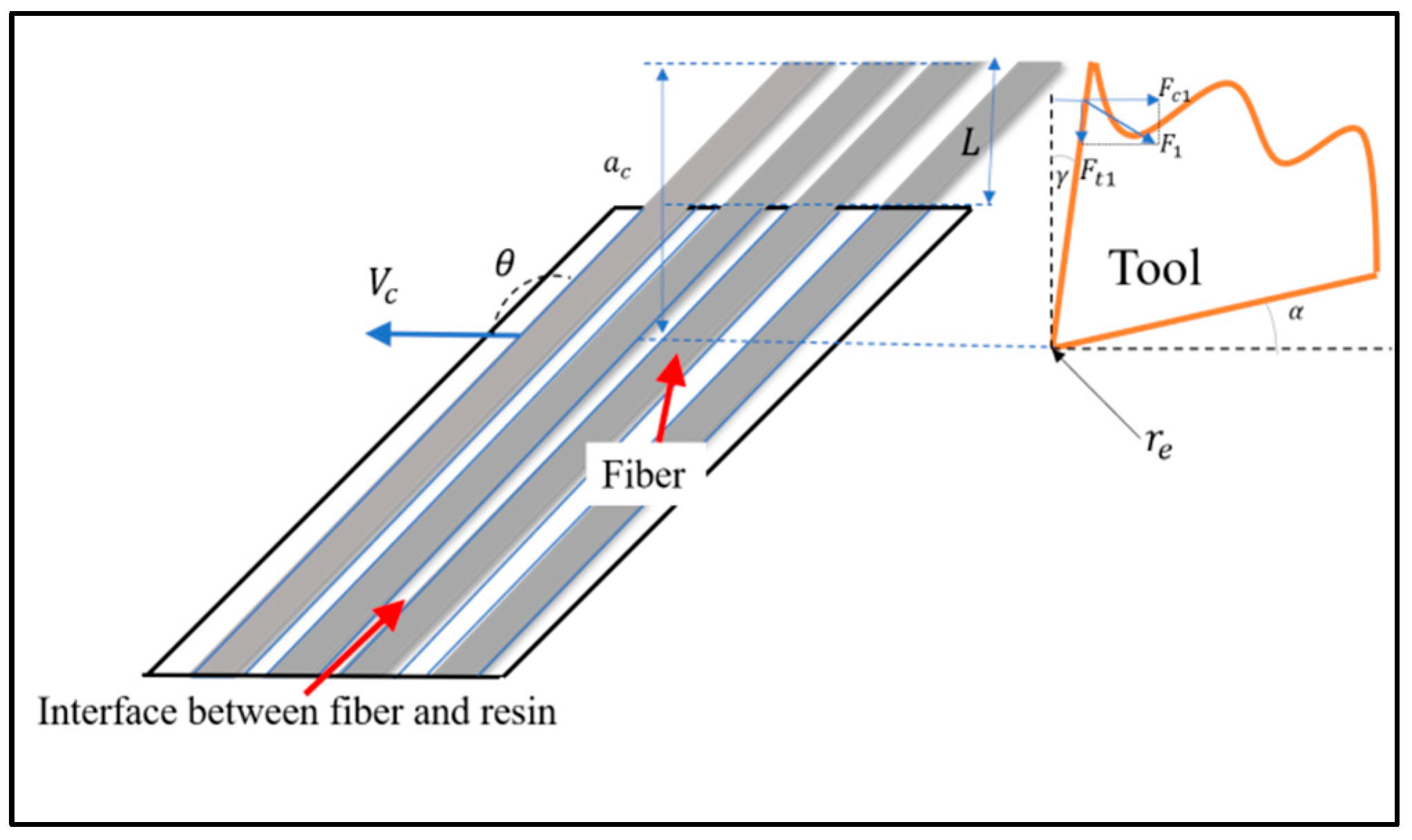
As illustrated in Figure 1, laser-assisted cutting was simulated by partially exposing carbon fibers. When a laser acts on CFRP, the epoxy resin matrix undergoes pyrolysis at approximately 400 °C, whereas carbon fibers require temperatures above 3000 °C for removal. Therefore, in the finite element simulation, partial removal of the resin matrix was implemented to expose carbon fibers externally, thereby simulating the effect of laser processing. The angle between the cutting direction and the fiber axis is defined as θ. The tool geometric parameters used in the model include the rake angle (γ), relief angle (α), tool tip radius (r), and tool width (w); the workpiece dimensions are defined as l × h × t. To simulate the mechanical interaction between the tool and workpiece, the “penalty contact” algorithm with Coulomb friction built into ABAQUS was employed. The penalty contact algorithm was applied to all elements within the workpiece to prevent inter-element penetration. For all fiber orientations, the friction coefficient between the tool and workpiece (μ1) and the friction coefficient between fibers and matrix (μ2) were set to 0.2 and 0.5, respectively. In the model, the fiber diameter was set to d, and the fiber volume fraction was 60%. The three-dimensional Hashin fracture criterion was implemented in a user subroutine to characterize fiber failure. ABAQUS’ built-in Johnson–Cook model was used to characterize the yield behavior of the epoxy resin matrix. The fiber–matrix interface employed zero-thickness cohesive elements governed by the traction–separation law. The material properties of each constituent are presented in Table 1. The cutting speed for orthogonal cutting was determined based on prior experimental experience.
It should be noted that the finite element model established in this paper is not used to predict the cutting force independently, but as an observation tool for the microscopic mechanical mechanism, which provides verification for the core assumptions of the analytical model. By extracting the fiber deformation morphology, interface stress distribution and force component changes at different cutting times, we can intuitively verify the rationality of the three-stage force division in the analytical model, the derivation logic of the debonding length and the proportion of each force component, so as to make up for the deficiency that the experiment cannot observe the internal micro-deformation process. The mutual confirmation of finite element simulation and analytical model constitutes the theoretical basis of this paper.

2.2. Experimental Condition

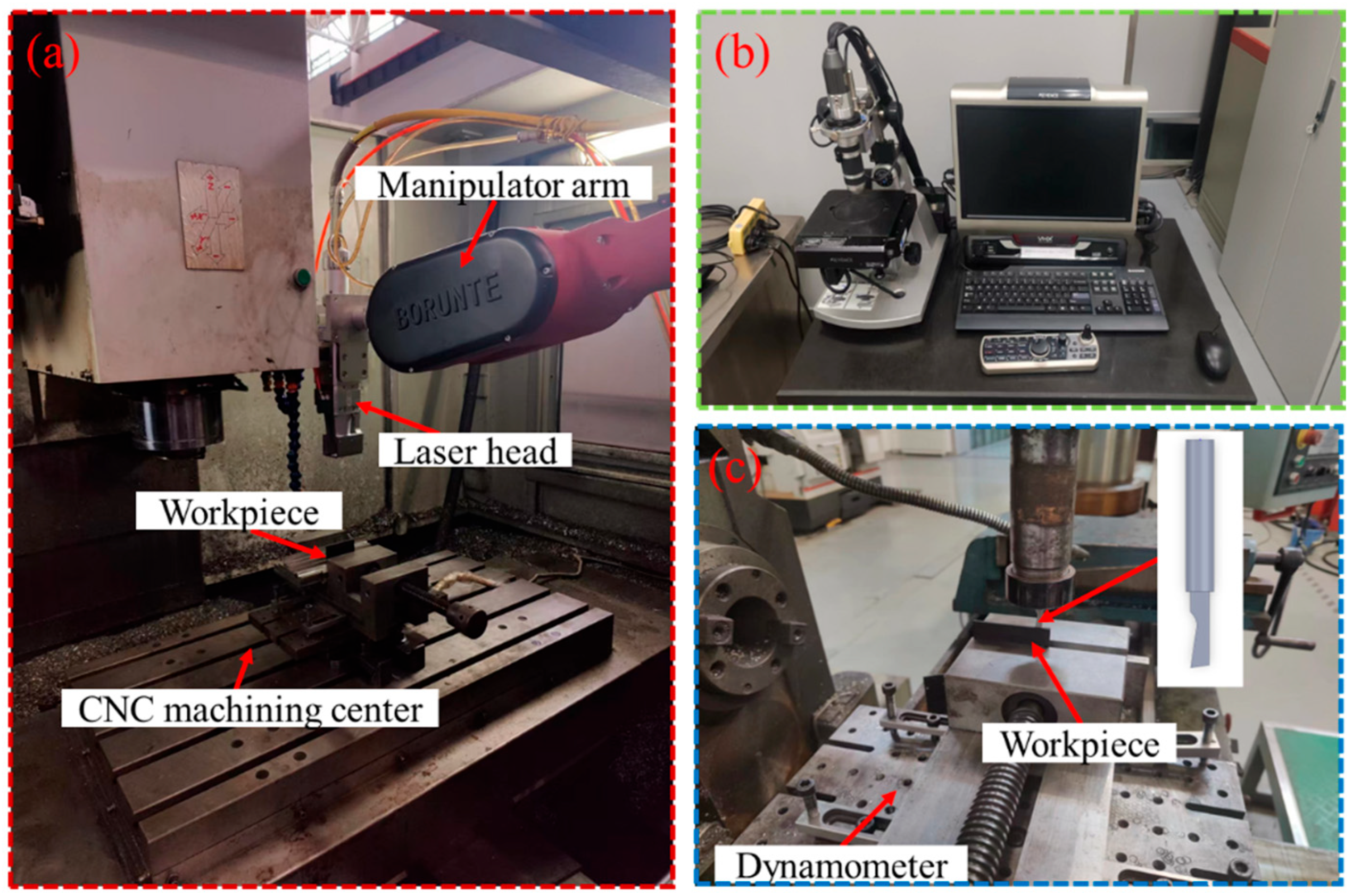
To validate the microscopic simulation results, orthogonal cutting experiments were conducted on CFRP using the laser-assisted machining system illustrated in Figure 2. The laser scanning system comprises a six-degree-of-freedom (6-DOF) manipulator, a laser head, an optical fiber, an IPG laser system, and an operation control system. The laser is generated by the IPG laser generator and then transmitted to the laser head via the optical fiber, which focuses the laser energy onto the workpiece surface. To prevent high-temperature damage to the laser head, water-cooling and air-cooling systems were incorporated into its design. Specifically, cooling water from a water chiller flows into the laser head, while high-pressure air for air cooling is blown across the laser head’s internal lenses via an air valve—this ensures lens cleanliness and prevents debris or dust from interfering with the laser head’s normal light output. The 6-DOF manipulator enables precise control of the laser incidence angle, spot position, and focal diameter. For laser pretreatment, unidirectional CFRP (UD-CFRP) plates were vertically clamped in a fixture (Figure 2), with the laser beam aligned to the midpoint of the workpiece cross-section. To achieve uniform ablation, the laser spot diameter was set to 1.2 times the workpiece width. Laser parameters were optimized to selectively ablate the resin matrix while preserving fiber integrity. After the experiments, the depth of the heat-affected zone (HAZ) was measured using a VHX-2000C ultra-depth-of-field optical microscope, confirming a HAZ depth of 200 μm.
The 200 μm macroscopic heat-affected zone measured in the experiment contains three temperature gradient regions: the complete ablation zone, thermal softening zone and unaffected zone. Among them, only the resin in the surface layer of 10–20 μm was completely removed, and the fibers were completely exposed. This length is the length of the exposed fibers in the analytical model. The value is obtained by observing the cross section of the sample after laser pretreatment by scanning electron microscopy, which is consistent with the parameters set in the finite element simulation. The matrix modulus and interfacial strength in the thermal softening zone decrease with the increase in temperature, and this change has been introduced into the analytical model and the finite element model through temperature-dependent material parameters.
Orthogonal cutting experiments were conducted on laser-pretreated unidirectional CFRP (UD-CFRP) plates using the experimental setup illustrated in Figure 2. The experimental equipment primarily included a vertical CNC milling machine (with the spindle’s rotational motion fully constrained), a FLIR T630sc thermal imager, a Kistler (Winterthur, Switzerland) force sensor, and Dynoware data acquisition software. For the force measurement setup: a dynamometer adapter plate was installed on the milling machine’s worktable; the Kistler force sensor was mounted between the adapter plate and the workpiece; and the cutting tool was installed on the CNC milling machine’s spindle. During the experiment, the cutting force signal is transmitted from the force sensor to the dynamometer system for data acquisition. The T700 S carbon fiber/epoxy resin unidirectional laminate was used, the fiber volume fraction was 60%, and the number of layers was 10 layers. The thickness of the single layer is 10 mm, the size is 1 × w × t (such as 100 mm × 50 mm × 5 mm), and the fiber direction is 135° (consistent with the simulation in Section 3). The geometric parameters and machining parameters of the tool are shown in Table 2. Each experiment was repeated three times to ensure the repeatability and reliability of the results. After the experiment, the matrix damage morphology and fiber fracture mode were observed and characterized by VHX-2000 C ultra-depth-of-field optical microscope (Keyence, Osaka, Japan) and Zeiss Sigma 300 scanning electron microscope (SEM, Zeiss, Oberkochen, Germany). Each group of experiments was repeated three times, and the results were averaged to minimize random errors.
The cutting speed range of 500–3000 mm/min selected in this experiment is consistent with the most widely used parameter range in the published fundamental research on CFRP orthogonal cutting [13,15,24], which can ensure the comparability of the research results with the existing classical literature, and accurately reveal the fundamental evolution law of the cutting mechanism and damage behavior in laser-assisted orthogonal cutting of CFRP.

3. Establishment of Cutting Force Prediction Model

Table 3 lists the symbols and meanings used in the cutting force prediction model.

3.1. Fiber Cutting Force

The friction coefficient used in this paper is from the published authoritative literature: the friction coefficient between the tool and the carbon fiber is 0.2, which is consistent with the results measured by Arola et al. [14] in the CFRP orthogonal cutting experiment; the friction coefficient between carbon fiber and epoxy resin matrix is 0.5, which is consistent with the interfacial friction characteristics measured by Hobbiebrunken et al. [29] through micromechanical experiments. All the material performance parameters involved in the model are from the standard test data of T700S carbon fiber [30] and corresponding epoxy resin system, which ensures the physical consistency of the model.
Laser irradiation of CFRP induces localized ablation of the resin matrix, leading to partial matrix removal and exposure of the embedded carbon fibers. During mechanical cutting, the tool first engages with the exposed fibers; as the tool feeds progressively, it induces bending deformation in the fibers, which ultimately fail via a combination of elastic buckling and interfacial shear fracture. To analyze this deformation mechanism, a two-dimensional micromechanical model based on the representative volume element (RVE) framework was developed. This model specifically targets unidirectional CFRP (UD-CFRP) laminates with a 135° fiber orientation angle—consistent with the experimental and simulation conditions described in previous sections. The fiber deflection behavior was modeled using the two-parameter elastic foundation beam theory, which quantifies the constraining effects exerted by the surrounding composite matrix on individual fibers. Exposed fibers are subjected to two types of forces: bonding forces from the matrix and cutting forces from the tool. Under these combined forces, tensile stresses may develop at the fiber–matrix interface, potentially causing interfacial debonding.
(1) The first stage of cutting force
When the fiber cutting angle (θ) is 135°, it is assumed that the fiber and matrix in the chip slide along the tool’s rake face subsequent to chip formation. Based on the geometric relationships illustrated in Figure 3, the slope of the fiber’s free end is expressed as:
x = L :   d w d x = θ π 2 γ
It is assumed that the resin matrix exhibits elastoplastic behavior [29]; consequently, fracture stress is not suitable for calculating the matrix damage length and cutting force. For quantifying matrix damage, fracture strain is employed instead. The energy balance of a single carbon fiber embedded in the matrix comprises three components: the work performed by the external lateral force, the fiber strain energy induced by bending deformation, and the matrix shear strain energy generated by shear deformation. The energy balance relationship can be mathematically expressed as:
U = 0 L S b e n d d w d x d x + 1 2 0 L E f I f d 2 x d x 2 2 d x + 1 2 L A m G m θ π 2 γ 2 = 0
The boundary conditions are:
x = 0 :   w = 0   d w d x = 0
x = L :   d w d x = θ π 2 γ
The equation of fiber can be obtained by using the principle of virtual work. After applying the boundary conditions, the fiber deflection can be expressed as:
w = 1 12 x 2 L E f I f 2 S b e n d x L + 6 θ π 2 γ E f I f + 3 S b e n d L 2
The critical transverse force S b e n d for fiber bending is:
S b e n d = 2 E f I f x θ π 2 γ + γ m a x L c r + c x L x L
Carbon fiber-reinforced polymer (CFRP) composites may fail in the form of fiber bending and fracture. If the normal stress induced by bending in a single carbon fiber exceeds the fiber’s bending strength, the fiber breaks and forms fragments. The normal stress in the fiber can be calculated using the previously derived fiber deflection equation. Within the fiber, the maximum stress occurs at the fiber’s fixed end (the end bonded to the surrounding resin matrix. ( x = 0 ).
σ = M r I f   M = E f I f d 2 w d x 2
Therefore, the maximum normal stress of the fiber cross section along its axis can be determined as:
σ f m a x = r · S b e n d x I f θ π 2 γ E f L S b e n d L I f
Therefore, the fiber deflection is constrained by both sides, and the lateral force required to break the fiber at the fixed end can be written by substituting x = 0 and σ f m a x = X f c :
S b e n d = 2 r E f θ π 2 γ + X f c L I f L 2 r
Equations (2) and (9) can be used to calculate the material failure caused by fiber breakage.
2 r E f θ π 2 γ + X f c L I f L 2 r 0 L d w d x d x + 1 2 0 L E f I f d 2 w d x 2 + 1 2 L A m G m θ π 2 γ 2 = 0
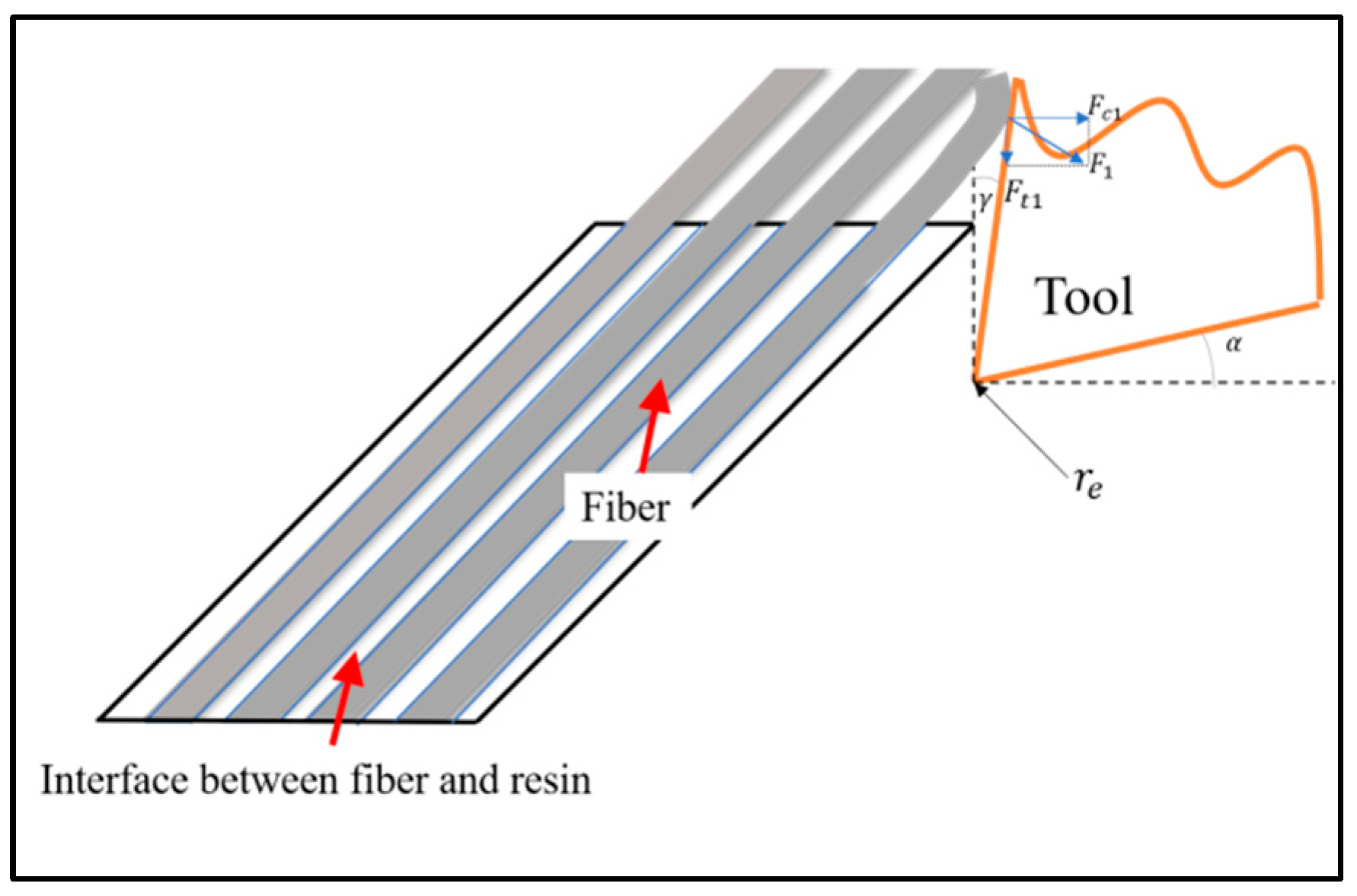
The damage length L is determined using the derived equation, and the corresponding lateral force is calculated via Equation (10). To determine the contribution of fiber bending and fiber–matrix debonding to the total cutting force, the cutting force must be projected onto the cutting direction. The concept of material failure differs from that of cutting-induced material removal: if the minimum failure criterion is satisfied at any point, the material will fail. In contrast, during cutting, chips are formed only when all active failure mechanisms satisfy their respective failure criteria simultaneously. As depicted in Figure 4, one of the chip formation mechanisms for fiber orientations greater than 90° (relative to the cutting direction) is fiber micro-buckling. It is assumed that all fibers undergo micro-buckling, which generates a thrust force and a portion of the cutting force. If the critical stress inducing fiber micro-buckling is known, the thrust force and cutting force components corresponding to micro-buckling can be calculated by decomposing the buckling force into the thrust direction and cutting direction. The most suitable model for this purpose is the wave fiber model, which assumes that fibers exhibit an initial degree of waviness. According to this model, fibers may fail due to excessive normal stress in the fibers or shear stress in the matrix. Equations (11) and (12) are used to express the critical stress values corresponding to each failure criterion [31].
σ c s h e a r = G L T 1 + π B 0 L G L T τ c
σ c b e n d = G L T 1 + π 2 B 0 2 L 2 2 r E f X f c
where B 0 is the maximum deflection of the initial deformed fiber, and G L T is the shear modulus of the circular fiber-reinforced composite material, which can be calculated using the following formula:
G L T = E f V f 2 2 r L 2 1 + 2 r L 2 E f 4 G f
For the case of zero initial fiber waviness ( B 0 = 0 ):
σ c s h e a r = σ c b e n d = G L T
The critical stress is multiplied by the affected area and the thrust and the buckling force in the cutting direction are decomposed.
F c 1 = G L T π d f 2 4 t 2 c + d f cos θ
F t 1 = G L T π d f 2 4 t 2 c + d f sin θ
where t 2 c + d f is the number of fibers cut at the cutting width. The first stage cutting force can be expressed as:
F x 1 = G L T π d f 2 4 t 2 c + d f cos θ + m a x S b e n d , S s h e a r cos γ n R V E

3.1.1. The Second Stage of Cutting Force

The debonding length is a key parameter to divide the two stress regions of the fiber. It is not used as an arbitrary input parameter in this paper, but is derived by the interface shear strength criterion. When the shear stress of the fiber–matrix interface reaches the interface shear strength, the interface debonding occurs, and the corresponding position is the boundary of the debonding length. The derived results have been verified by the finite element simulation of the interface stress distribution and the actual debonding length observed by the scanning electron microscope. The relative errors under different cutting conditions are less than 12%.
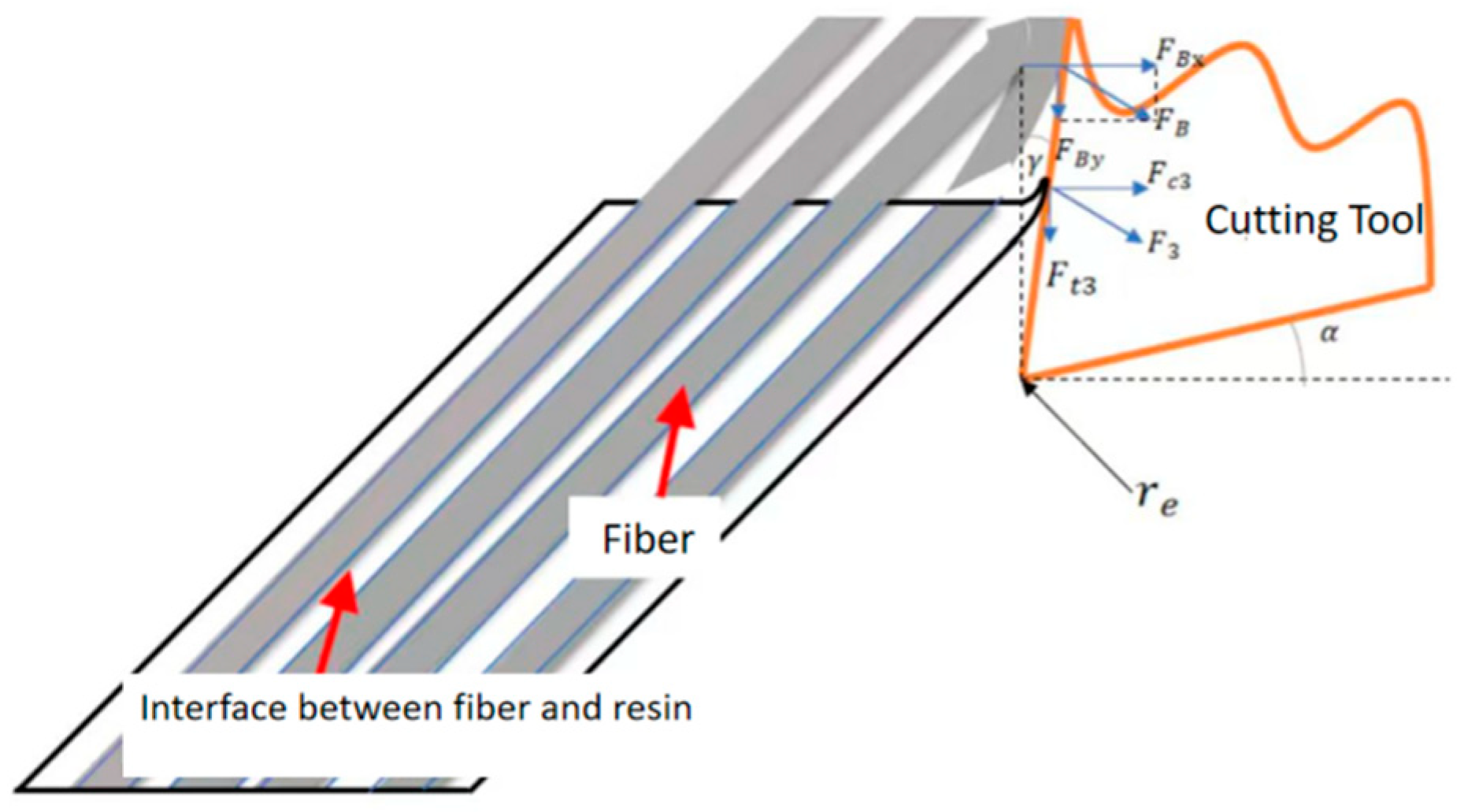
After the first stage, the fractured fiber segment slides progressively along the tool’s rake face as the tool advances further, ultimately leading to chip formation. Figure 5 illustrates the schematic of the cutting force distribution mechanism. The fiber segment above the debonding interface obtains mechanical support only from the uncut composite material. In contrast, the debonded fiber segment below this interface receives combined support from both the uncut material and residual fiber–matrix adhesive forces. The uncut material is analogous to an elastic foundation, while the fractured fiber segment is treated as an Euler–Bernoulli beam. This analogy enables the elastic foundation beam theory to be applied for quantifying cutting forces based on fiber deflection and interface stress distributions. The mechanical reaction forces exerted by the elastic foundation on the fiber can be derived from the two-parameter model [32], which can be expressed as:
P x = k m w k n d 2 w x d x 2
where k m and k n are the first and second coefficients of the beam on elastic foundation, respectively:
k m = 1.23 E m * d f 4 C 1 v 2 E f I f 0.11 · E m * C 1 v 2
k n = E m * d f 4 1 + v 2 E f I f 1 v 2 E m * d f 1 3
In the formula, E m * is the equivalent elastic modulus of the composite material, E m is the Young modulus of the matrix, and the calculation formula of E m * is:
E m * = E f E m E f + E m
Similarly, the strength of the binding force q b between the fiber and the matrix is expressed as:
q b = k b w
The symbol k b is the equivalent modulus of the fiber–matrix adhesive layer. At the starting point of debonding between the fiber and the matrix, the strength of the bonding force is equal to the bonding strength between the fiber and the matrix. The governing equation of fiber deformation is:
E f I f d 4 w d x 4 + k m + k b w k n d 2 w d x 2 = 0
In which:
k n < 4 k E f I f 1 2
The Euler formula is used to simplify the fourth-order differential equation into a hyperbolic function in the form of:
w x = e B x D 1 cos A x + D 2 sin A x + e B x D 3 cos A x + D 4 sin A x
When x > a c + l , the fibers are supported by support and adhesion below the debonding point.
w 1 x = e B 1 x D 1 cos A 1 x + D 2 sin A 1 x + e B 1 x D 3 cos A 1 x + D 4 sin A 1 x
A 1 = k b + k m E f I f 4 sin 1 2 cos k n 2 4 k b + k m E f I f
B 1 = k b + k m E f I f 4 cos 1 2 cos k n 2 4 k b + k m E f I f
where D 1 , D 2 , D 3 , and D 4 are integral coefficients.
When L x a c + l , above the debonding point, the cutting fiber is only supported by the uncut material, and the deflection curve equation of the fiber is calculated by the following formula:
w 2 x = e B 2 x D 5 cos A 2 x + D 6 sin A 2 x + e B 2 x D 7 cos A 2 x + D 8 sin A 2 x
A 2 = k m E f I f 4 sin 1 2 cos k n 2 4 k m E f I f
B 2 = k m E f I f 4 cos 1 2 cos k n 2 4 k m E f I f
where D 5 , D 6 , D 7 , and D 8 are integral coefficients.
Based on the two-parameter elastic foundation model, the cutting force calculation formula of a single fiber is:
F a x = L a c + l k m w 2 d x L a c + l k n w 2 d x + a c + l k m w 1 d x a c + l k n w 1 d x
According to the research of Zhang et al. [33], the tool cuts a series of fibers at the same time. Therefore, the instantaneous cutting area can be calculated by the following formula:
S = t 1 h c
h c = 0.25 a c
t 1 is the workpiece thickness; h c is the chip thickness.
The number of fibers under the cutting tool is obtained by the following formula:
n f = t l r + l h V f sin θ π r f 2
The cutting force in the shear zone can be calculated by the following formula:
F A x = μ · F a y · sin θ
F A y = μ · F a y · cos θ
where μ is the friction coefficient between the tip and the fiber. The rebound force of fiber rebound on the flank face of the tool is:
F B x = τ 2 t 1 a c cos tan + β γ sin sin φ · n f
F B y = τ 2 t 1 a c sin τ 1 tan + β γ + cos sin φ · n f
β is the friction angle between the rake face and the workpiece, τ 1 and τ 2 are the shear strength perpendicular to the fiber direction and parallel to the fiber direction, respectively. The shear angle can be expressed as:
= π 4 β 2 + γ 2
β = tan 1 F t cos γ + F f sin γ F t cos γ F f sin γ
Then the cutting force of the second stage can be expressed as:
F x 2 = F A x + F B x
F y 2 = F A y + F B y

3.1.2. The Third Stage Cutting Force

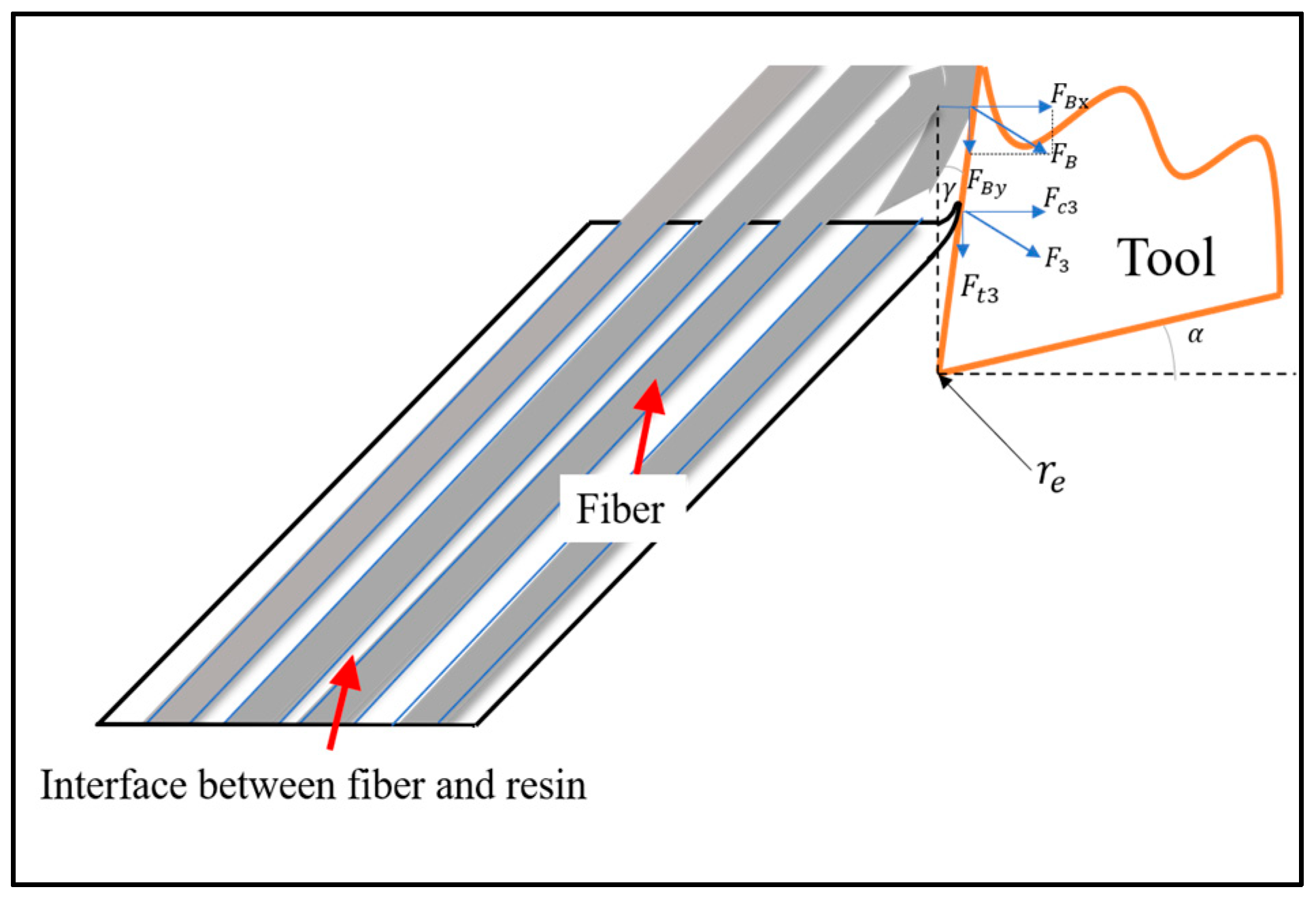
When the slope of the cutting fiber’s free end equals the slope of the tool’s rake face k tool , the cutting fiber enters the third stage. With progressive tool feed, the contact length between the fiber and rake face increases continuously. During this phase, the fiber deflection profile maintains continuity with the second-stage deformation pattern, which is governed by equivalent boundary conditions. The onset of line contact is determined computationally by calculating the slope of the free end of the cutting fiber. The critical contact initiation point x 1 is derived from the governing equation under prescribed boundary conditions:
w 2 ( x 1 ) = k t o o l
In the third stage (as illustrated in the Figure 6), due to fiber bending and extrusion from the tool tip corner, the portion of the fiber below the tool tip corner remains undamaged but is squeezed by the tool, resulting in excessive bending. After the tool has advanced past the fiber, the fiber rebounds and scrapes the lower end of the tool tip corner and the tool’s flank, thereby generating transient cutting forces as described by Equations (38) and (39).
Regarding the force of the broken fiber on the adjacent intact fiber, it needs to be explained that the broken fiber segment will have a short surface contact with the adjacent unbroken fiber before it is discharged along the rake face of the tool, resulting in instantaneous compressive stress. This pre-compression stress will cause small pre-bending deformation of adjacent fibers, thereby reducing the critical force required for subsequent fracture. This mechanism is an important reason why the fiber can break continuously and smoothly in laser-assisted cutting, and also explains why the cutting force fluctuation of laser-assisted cutting is smaller. The contact stress cloud diagram between fibers in the finite element simulation clearly shows this stress transfer process.

3.2. Matrix Cutting Force

The Johnson–Cook material model is an ideal rigid-plastic strengthening model which can reflect the strain rate strengthening effect and temperature softening effect [34]. This model can describe the work hardening effect, strain rate effect and temperature softening effect of the material well [35]. Therefore, the cutting force of the resin matrix is constructed by the Johnson–Cook constitutive model. The formula is:
σ = A + B ε n 1 + C ln ε ˙ ε 0 ˙ 1 T T 0 T m T 0 m  
The first term describes the strain strengthening effect of the material, the second term reflects the relationship between the flow stress and the logarithmic strain rate, and the third term reflects the relationship between the flow stress and the exponential decrease with the increase in temperature. In the formula, σ is Von-Mises equivalent flow stress; A is the yield strength of the material at room temperature; B is the work hardening modulus; n is the strain hardening coefficient; m is the temperature softening coefficient; c is the strain rate strengthening coefficient; ε is the equivalent plastic strain; ε ˙ is the equivalent plastic strain rate; ε 0 ˙ is the reference value of strain rate; T is the material deformation temperature; T 0 is the ambient temperature (take 25 °C); and T m is the melting point temperature of the material.

3.3. Total Cutting Force

The cutting process involves four distinct force components:
F 1 : Cutting force during the initial stage of fiber exposure, F 2 : Point-contact cutting force between the tool rake face and unexposed fiber tip during the second stage, F 3 Line-contact cutting force between the tool rake face and unexposed fiber segment during the third stage, and F r : Resin matrix cutting force induced by tool–matrix interaction. Therefore, the total cutting force F t o t a l is expressed as:
F t o t a l = F 1 + F 2 + F 3 + F r

4. Discussion

4.1. Comparison of Cutting Mechanism

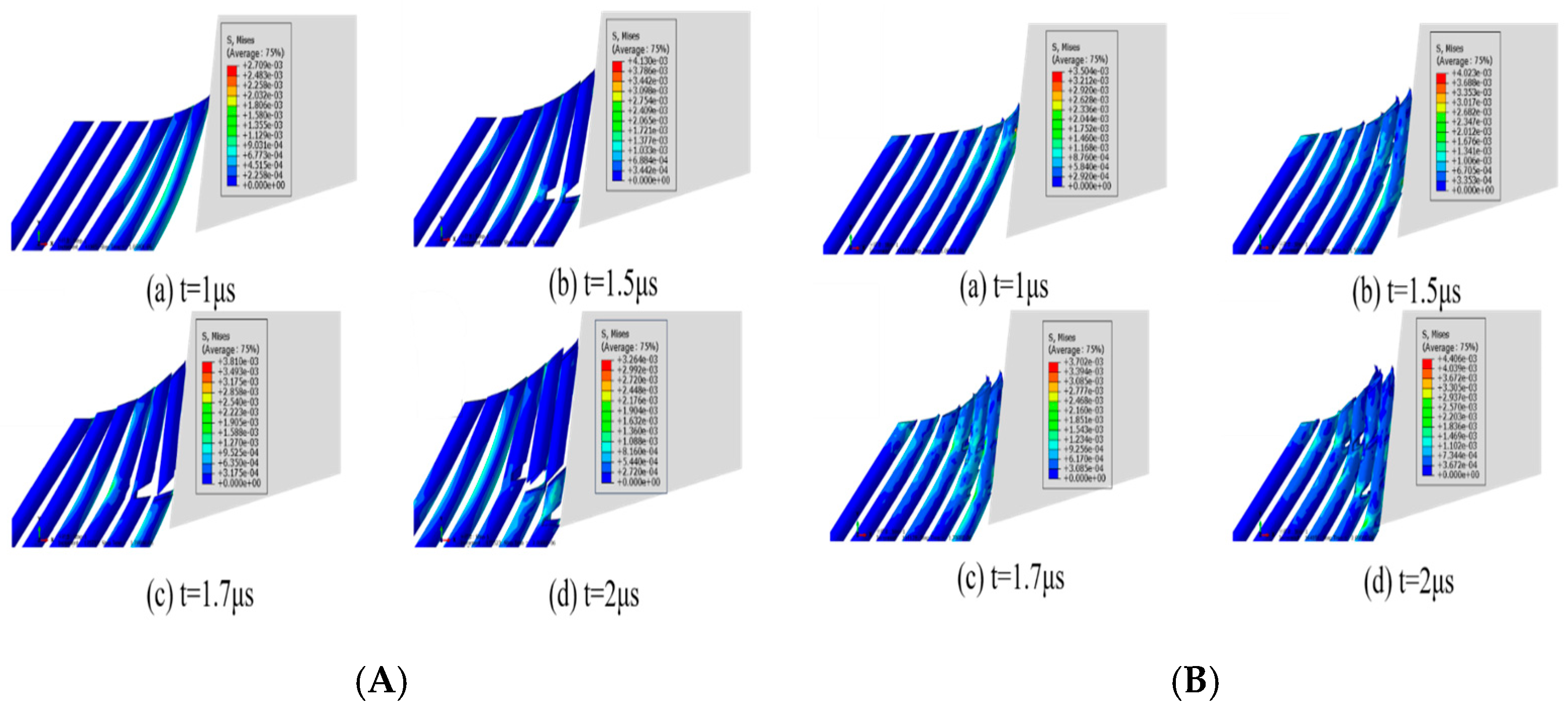
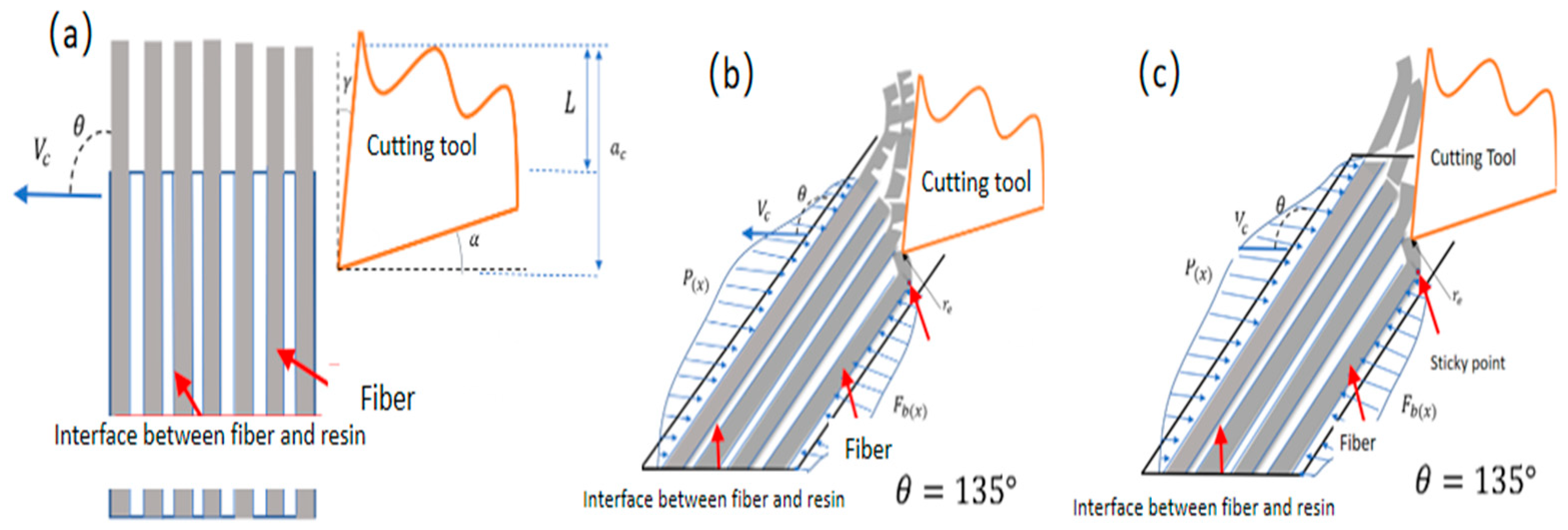
The comparative simulation processes of laser-assisted composite cutting and conventional CFRP machining are illustrated in Figure 7 and Figure 8. To further clarify the fundamental difference in stress boundary conditions between the two machining methods, the fiber force models at 135° fiber orientation are compared in Figure 8.
As shown in Figure 7, in conventional orthogonal cutting, fibers are completely constrained by the intact resin matrix. Under the extrusion of the tool tip, fibers are subjected to compressive shear stress and fail via matrix-constrained crushing fracture. In contrast, laser-assisted orthogonal cutting selectively ablates the surface resin matrix, forming a free end of the fiber without matrix constraints. The fiber then behaves as a cantilever beam supported by the underlying elastic matrix, and fails via large-deflection bending fracture at the fixed end under the tool pushing force. This fundamental transformation of stress boundary conditions is the core reason for the reduction in cutting force and machining damage in LAC.
Critical time instances were selected for mechanistic analysis. During tool advancement, the exposed fiber initially contacts the upper extremity of the tool’s rake face. Progressive tool feed expands the tool–fiber contact area, inducing an asymmetric stress state: compressive stresses dominate the fiber’s inner surface, while tensile stresses develop on its outer surface. This stress gradient drives sequential elastic–plastic bending deformation until fiber fracture occurs. Laser ablation selectively removes the resin matrix, enabling direct fiber-to-fiber contact. Since there is no resin-borne conductive force in the rear fibers, only the fibers in direct contact with the front fibers provide elastic support. When fiber bending remains within the elastic regime, interfacial support forces are insufficient to counteract tool-induced stresses, resulting in directional bending aligned with the cutting velocity. When the fiber’s bending strength is exceeded, the fiber fractures, with the fracture occurring a few microns above the cutting plane. The fractured fiber segment exerts downward pressure on adjacent intact fibers, initiating subsurface cracks at elevated positions. Consequently, the cracks propagate perpendicular to the free surface along the sample’s fiber axial direction. Laser-assisted cutting produces elongated fiber fragments and regular chip morphology, attributed to minimized resin constraints on exposed fibers. In contrast, Figure 9 shows that conventional machining induces severe fiber fragmentation and irregular chips. The intact resin matrix restricts fiber bending, promoting compressive fracture modes and resulting in a smaller chip volume compared to that of laser-assisted cutting at the same cutting time instant.
At 1.0 × 10 6   s , distinct deformation behaviors emerge between laser-assisted and conventional cutting. In laser-assisted cutting, the absence of resin bonding enables significant elastic bending of the exposed fiber’s free end. In contrast, conventional cutting restricts fiber bending due to intact resin–fiber adhesion, with initial tool contact inducing localized bending at the fiber’s top. At 1.5 × 10 6   s , laser-assisted cutting initiates fiber fracture (with relatively flat fracture surfaces), while fibers in conventional cutting remain unbroken—owing to constraints from the unprocessed side material—though they are significantly affected by tool extrusion. Due to matrix compression failure, two adjacent continuous fibers come into contact. At 1.7 × 10 6   s , the first fiber of laser-assisted cutting is broken, the uncut fiber is squeezed and bent, and the conventional cutting fiber continues to be squeezed and deformed. At 2.0 × 10 6   s , the fracture of laser-assisted cutting fiber is relatively flat, and the extrusion of conventional cutting fiber is serious.
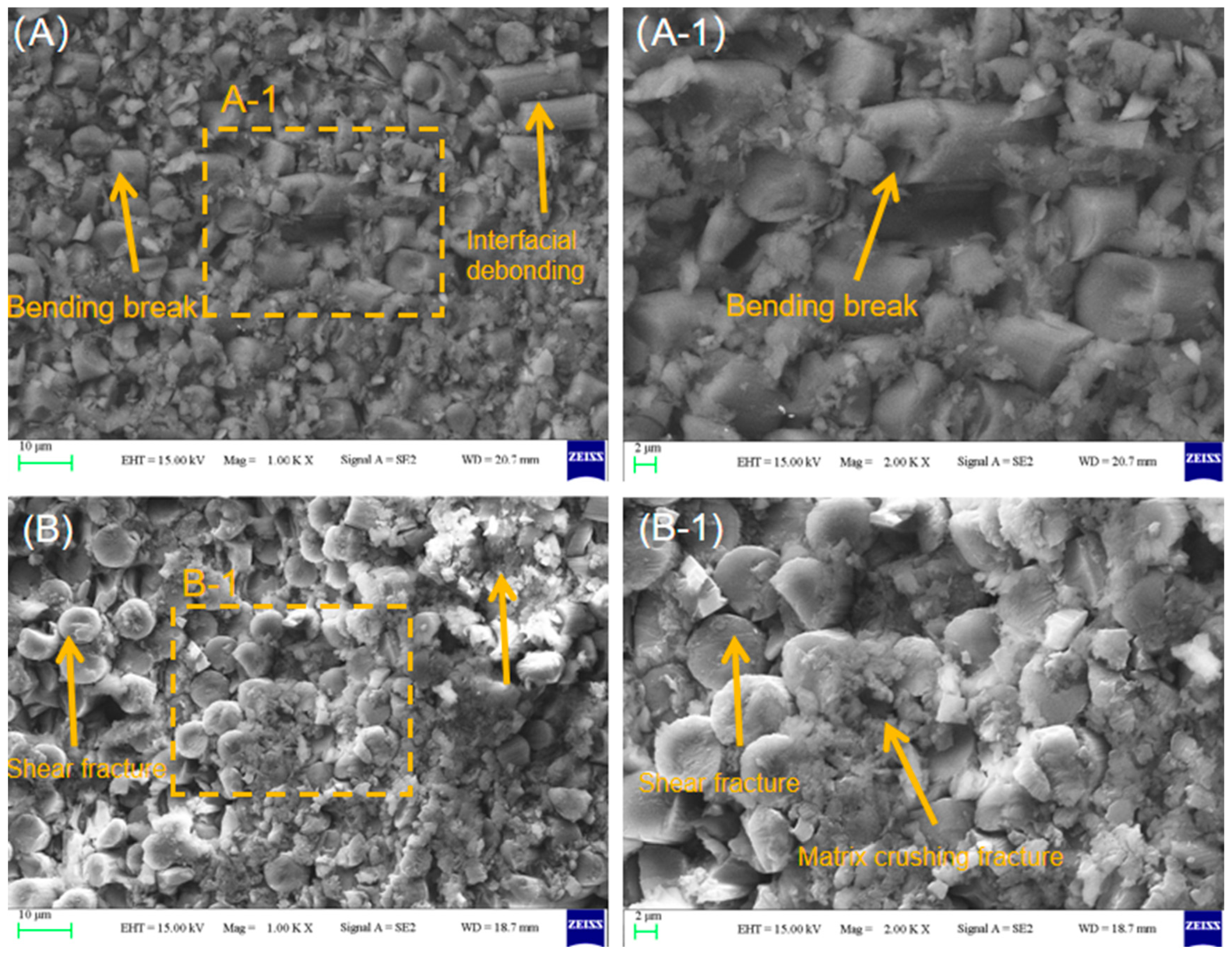
From the post-experiment electron micrographs (Figure 9 and Figure 14), it is observed that at a fiber cutting angle of 135°, the fiber failure modes include bending-induced fracture and interfacial debonding; chips are generated via interlaminar deformation caused by bending and out-of-plane shear under severe compressive loads [12]. During laser-assisted cutting of CFRP, fibers are more prone to bending due to the lack of resin matrix elastic support. This bending-dominated deformation concentrates tensile stresses along the fiber axis until the critical shear strength is exceeded, triggering a transition to shear fracture modes. Numerical simulation results show strong consistency with experimental observations.

4.2. Cutting Force Verification

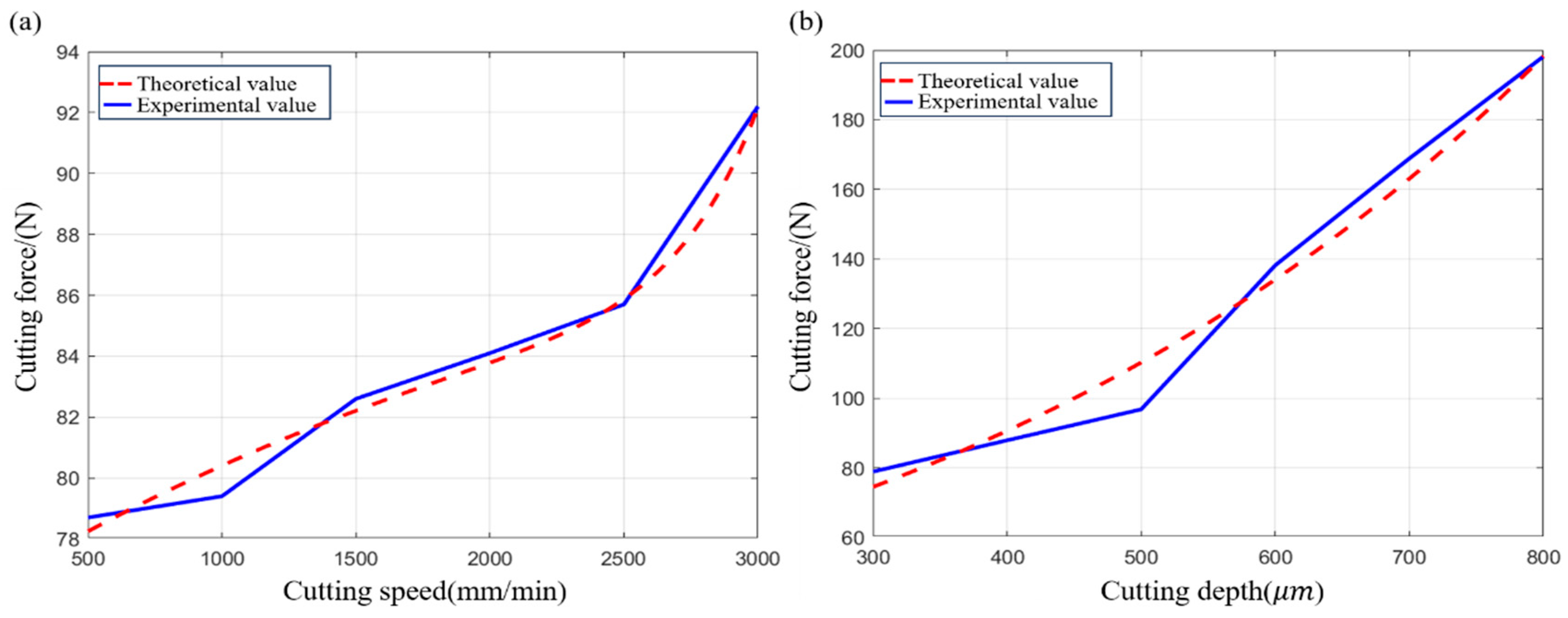
In order to ensure the reliability of the experimental results, all the cutting experiments in this paper are repeated three times. For the cutting force data of each group of experiments, we calculated the mean, standard deviation. The experimental data points shown in Figure 10 are the average of three repeated experiments, and the error bar represents the standard deviation of the data. The statistical analysis results show that the discreteness of the experimental data is small, and the standard deviation is less than 5% of the average value, indicating that the experimental results have good repeatability and reliability.
Figure 10 presents a comparison between the predicted and experimental cutting forces derived from the simulation analysis method, demonstrating a strong correlation with relative errors of 7.81% and 8.99%—values that fall within the acceptable tolerance range. Discrepancies between the predicted and experimental results stem from three key factors: (1) Deviations exist in the material properties adopted in the simulation model. The theoretical prediction of cutting force relies on the macroscopic mechanical properties of fibers and the matrix. However, in small deformation regions, fiber strength is higher, as the probability and quantity of defects in smaller regions are lower. (2) During the workpiece manufacturing process, fiber distribution within the material is non-uniform, which alters the fiber volume fraction and thereby induces variations in cutting force. (3) The assumptions and boundary conditions in the model fail to perfectly align with actual cutting scenarios. Figure 10 further reveals the parametric sensitivity of cutting forces. An increase in cutting speed raises the volume of material removed by the tool per unit time, which initially increases the cutting force. With a further increase in cutting speed, the epoxy resin exhibits strain rate-dependent strengthening behavior; this enhances the supportive effect of the resin on fibers, reducing fiber bending and promoting fiber fracture. Although fiber fracture tends to lower the cutting force, the magnitude of this reduction is far smaller than the force increase caused by the elevated material removal rate under the studied cutting conditions. Consequently, the overall cutting force increases. Similarly, as cutting depth increases, the tool must remove a greater volume of material, consequently leading to a higher cutting force.
Further error analysis shows that the prediction error mainly comes from three aspects: first, the performance dispersion of CFRP material itself, which contributes about 30% of the total error; secondly, the inhomogeneity of fiber distribution leads to the deviation between the local fiber volume fraction and the theoretical value, which contributes about 40% of the total error. The third is the idealized assumption of laser energy distribution and interface contact state in the model, which contributes about 30% of the total error. In general, the prediction error of 7.81%~8.99% is acceptable in engineering applications.

4.3. Damage Analysis

The matrix tearing length is a key index to evaluate the surface quality of CFRP processing. In this paper, it is defined as the maximum length of the matrix crack extending from the cutting plane along the fiber axis to the unprocessed area. In order to accurately measure this parameter, we adopted a standardized measurement process: First, the cross-section sample after cutting was prepared, and five different fields of view were randomly selected using an ultra-depth-of-field optical microscope at a magnification of 1000 times; then, the matrix tearing length corresponding to five fibers was measured in each field of view. Finally, the average of 25 measured values is taken as the matrix tearing length under this cutting condition, and the standard deviation is calculated to reflect the discreteness of the data. All measurements were performed using ImageJ software J2 to ensure the objectivity and repeatability of the measurement results.
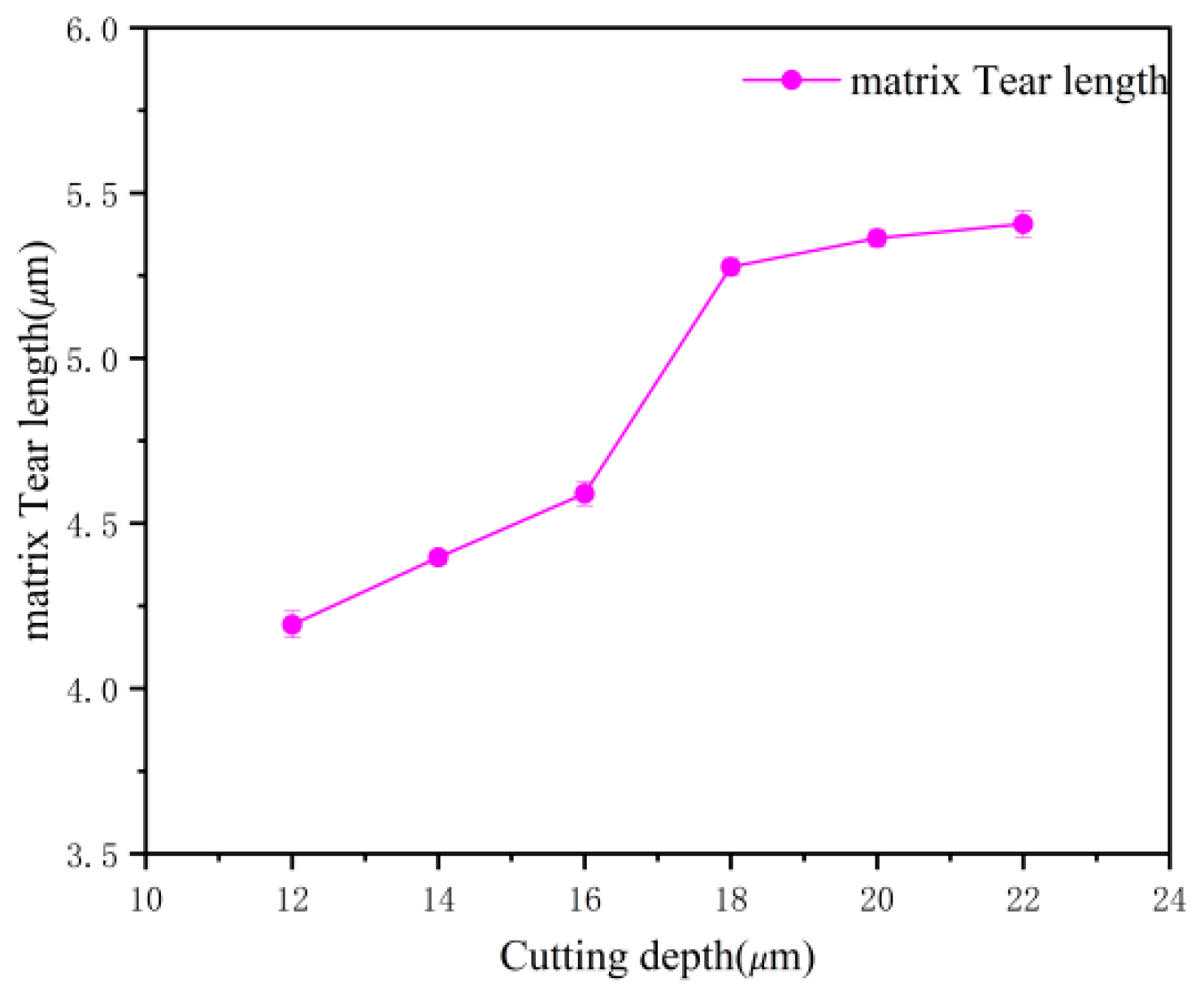
Figure 11 illustrates the variation in matrix tearing length with cutting depth at constant cutting speed. As the depth increases from 12 μ m to 22 μ m , the tearing length progressively increases from 4.2 μ m to 5.4 μ m , exhibiting a near-linear correlation The reason is that the exposed length of the fiber is fixed at 10 μ m . When the cutting depth approaches the exposed length of the fiber, the adhesion between the resin matrix and the fiber diminishes. This results in a relatively easy severing of the fiber by the cutting edge, leading to a reduced matrix tear length. The reason for the matrix tearing is that during the CFRP cutting process, cut fibers are subjected to the multidirectional constraint of the surrounding support material while being squeezed by the tool. These constraints mainly include normal constraints from the unprocessed side material along the direction perpendicular to the fiber, the bonding effect of the resin and the interface, and the tangential constraint of the surrounding supporting material. Furthermore, during the cutting process of CFRP, the high wear resistance of fibers can lead to significant heat generation due to prolonged contact with the cutting tool. Due to the low thermal conductivity of the resin and interface in CFRP, the cutting heat generated is difficult to effectively dissipate, resulting in the cutting zone temperature is much higher than room temperature, resulting in softening of the resin and interface and performance degradation. When the fiber is pushed by the rake face, the resin in contact with the uncut fiber will be torn. A greater cutting depth makes the supporting effect of the fiber in the cutting area stronger. When the tool overcomes this supporting effect, generating extended tearing lengths.
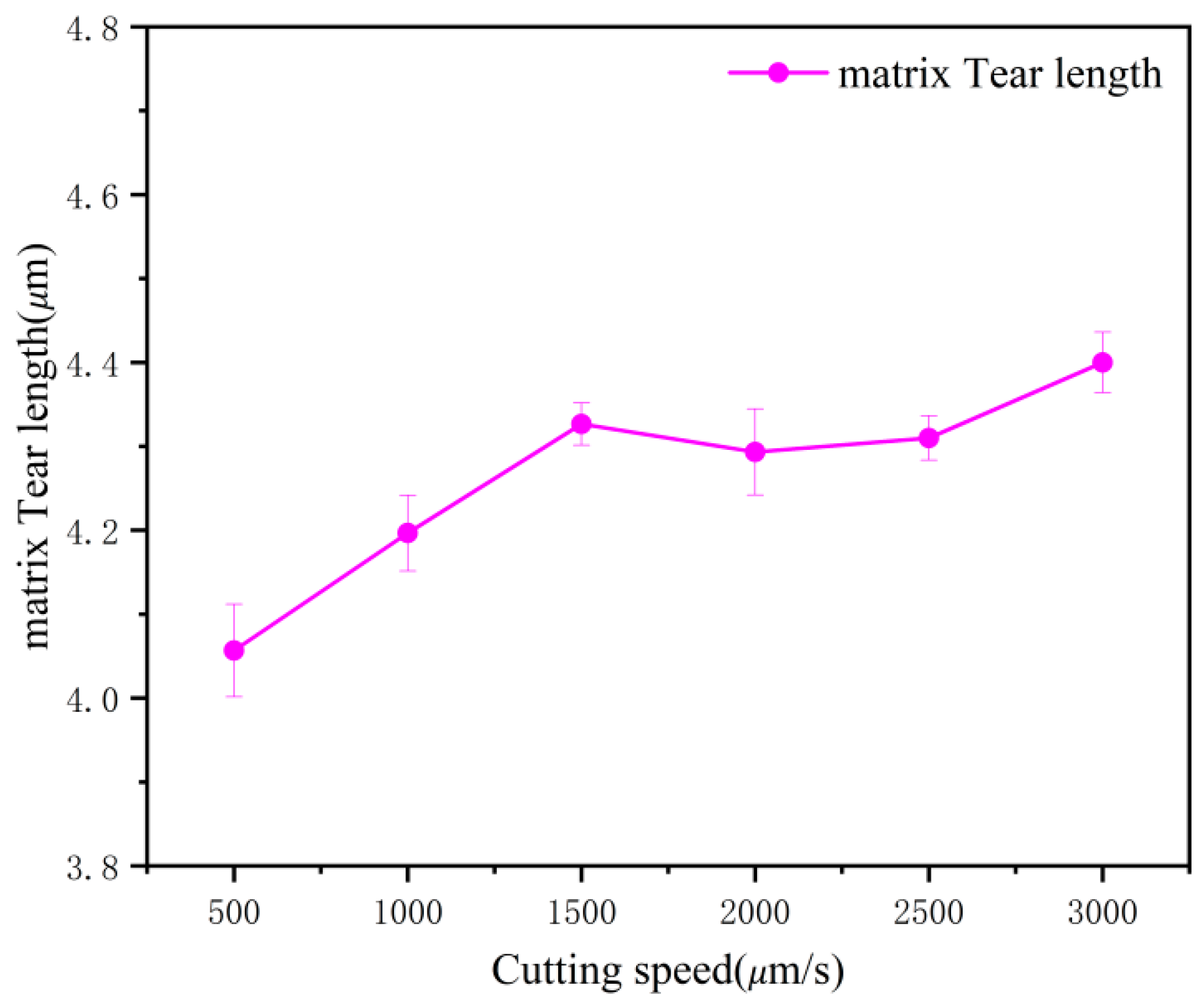
Figure 12 illustrates the variation in matrix tearing length with cutting speed under fixed machining parameters (cutting depth: 20 μ m , exposed fiber length: 10 μ m ). Across the tested cutting speed range, matrix tearing lengths increase with cutting velocity, exhibiting a positive correlation. Elevated cutting speeds intensify tool–fiber contact stresses, inducing premature fiber bending. This bending phenomenon concentrates tensile stresses at the fiber–matrix interface, initiating cracks that propagate toward uncut material regions. This process ultimately results in the formation of larger cracks and tear pits. In the study conducted by Criado et al. [36], it was observed that an increase in cutting speed did not alleviate the issue of fiber spalling, and the influence of cutting speed on damage was found to be insignificant.
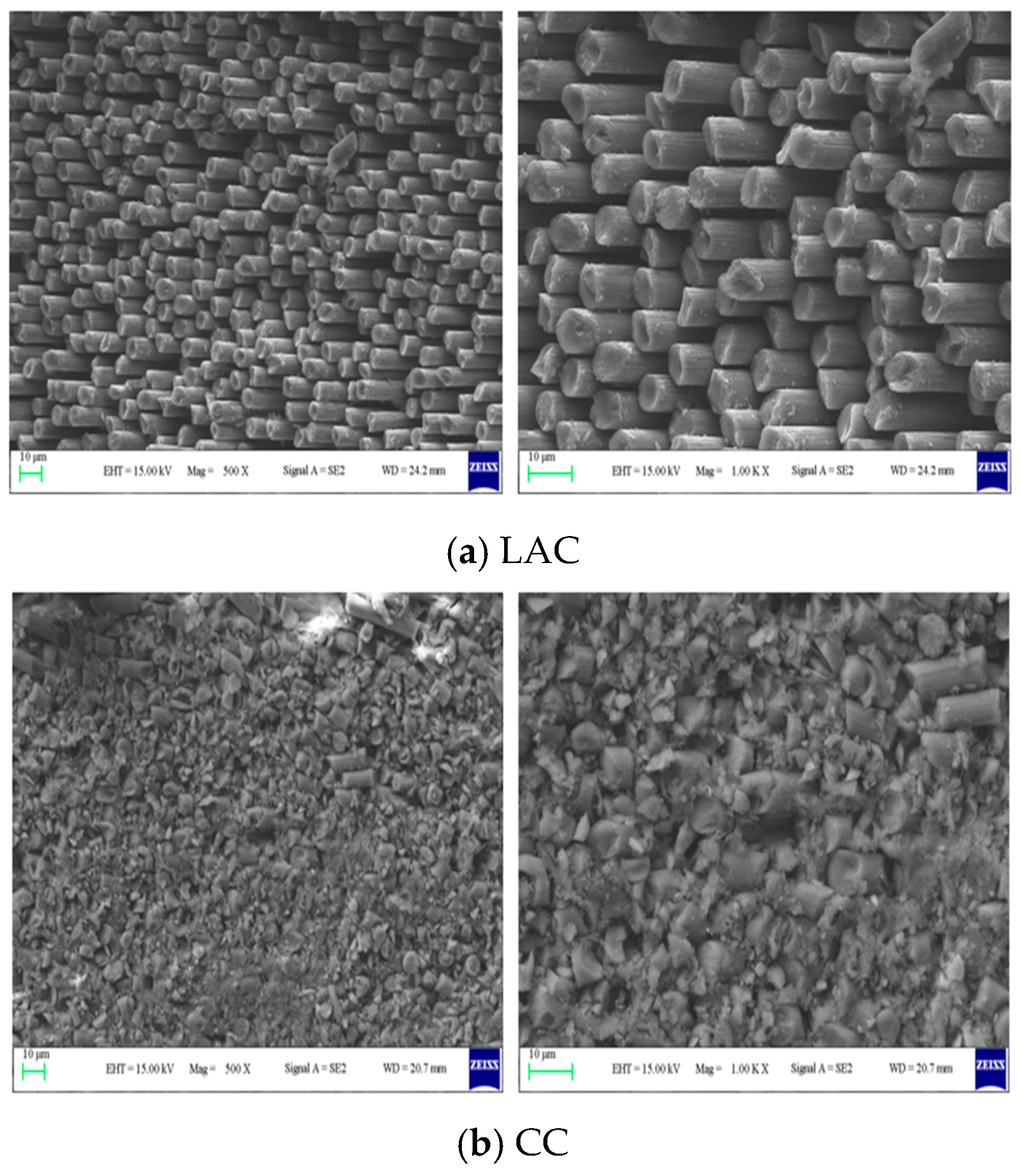
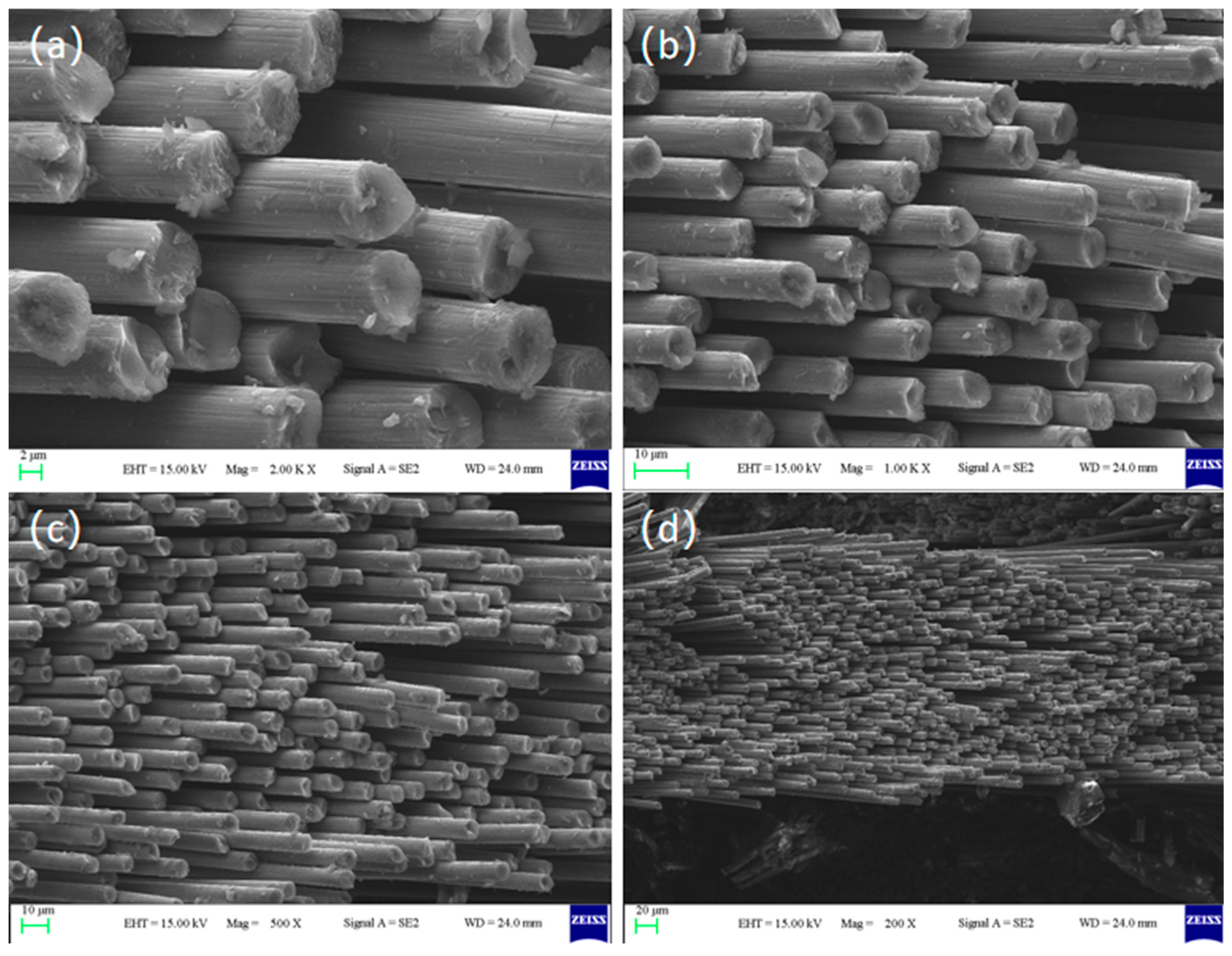
The micrograph of the exposed length of fibers is illustrated in the Figure 13, In LAC (Figure 14A,(A-1)), the surface resin matrix was selectively ablated by laser pretreatment, and the fiber changed from a constrained state to a partially exposed state. Under the action of the tool, the carbon fiber mainly undergoes bending fracture, the fracture surface is flat and regular, and no extrusion or shear deformation occurs. Only slight interfacial debonding occurred at the fiber–matrix boundary, and the matrix remained intact without crushing or large-area cracking. This damage characteristic is consistent with the theoretical model: the exposed fiber undergoes large-deflection bending fracture at the free end, which reduces the compressive stress and inhibits the expansion of damage [37].
In CC (Figure 14B,(B-1)), the fibers are completely constrained by the intact matrix. Under the strong extrusion and shear force of the tool, the fiber presents typical shear fracture, and the fracture surface is irregular and broken. Severe matrix crushing fracture and large-scale interfacial debonding were observed, and a large amount of matrix debris filled the fiber gap. The fiber failure mode is controlled by extrusion crushing under matrix constraints, resulting in serious processing damage and poor surface quality.
The above comparison proves that LAC transforms the fiber failure mode from shear fracture and matrix fracture (CC) to controllable bending fracture (LAC), which effectively inhibits interface debonding and matrix damage. Combined with the cutting force model, the reduction in machining damage is attributed to the reduction in cutting force and the optimization of stress state caused by selective laser ablation. The quantitative results show that the matrix tearing length of LAC is significantly lower than that of CC, and the damage inhibition effect is obvious.
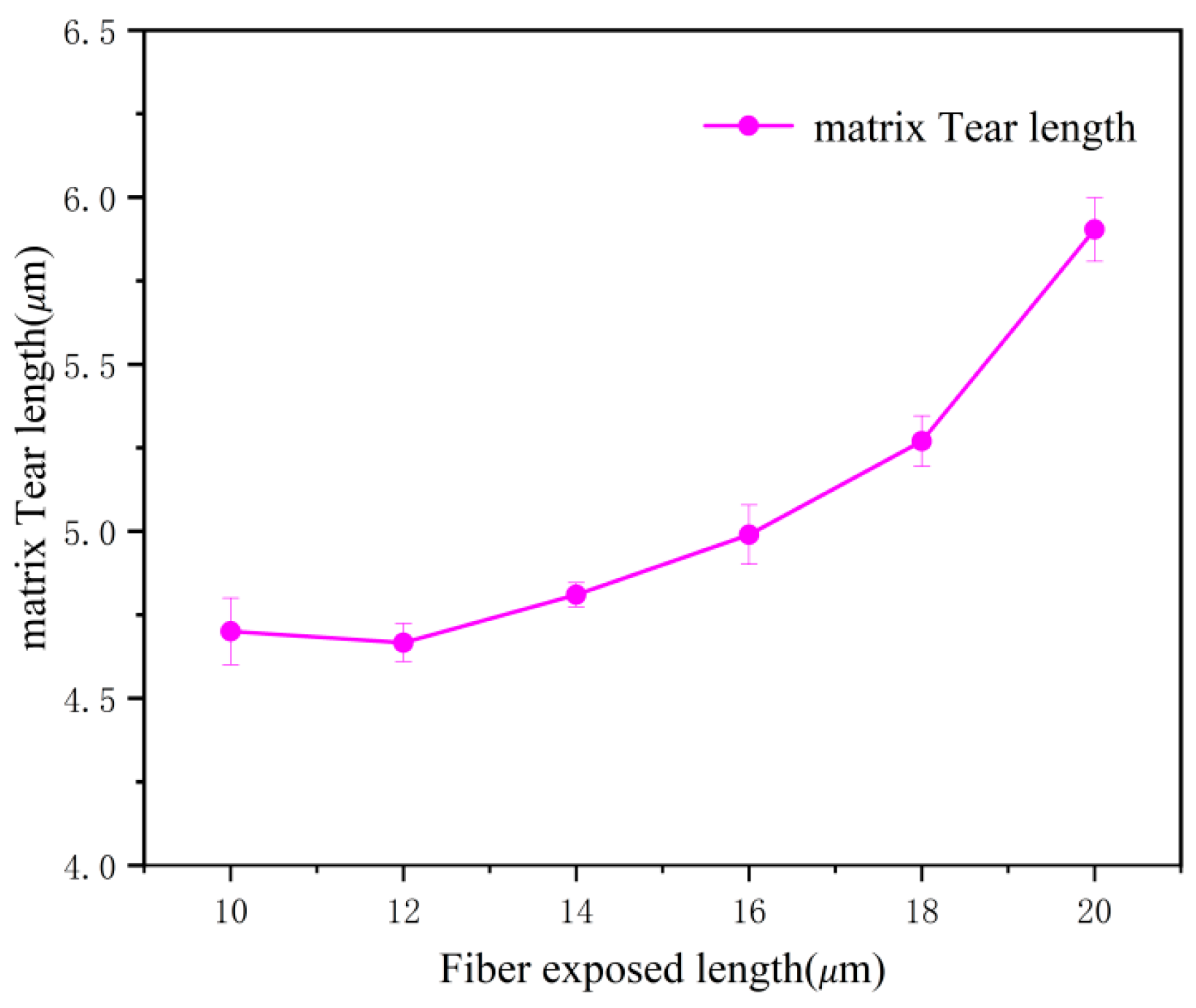
Figure 15 illustrates the variation in matrix tearing length under fixed machining parameters (cutting speed: 2500 mm/min, depth: 20 μ m ) as a function of exposed fiber length. For short exposed fiber lengths, with the feed movement of the tool, the uncut layer material is strongly squeezed by the tool on the rake face rather than the cutting edge due to the small rake angle of the tool. The exposed fiber is in contact with the rake face of the tool rather than its tip. Consequently, fibers with a shorter exposed length are subjected to compression and subsequently break, resulting in a reduced tearing length of the matrix. Long exposed fiber lengths enable significant bending deformation under tool loading. Due to the absence of resin bonding and external support, the fiber often produces a large bending with the action of the tool. Because cracks and tears tend to propagate to the workpiece when carbon fiber is bent or fractured, this can lead to more severe matrix damage to the matrix and result in increased matrix tearing [38].

5. Conclusions

In this study, based on the two-parameter elastic foundation beam theory, a micro–macro cross-scale cutting force prediction model of unidirectional carbon fiber-reinforced resin matrix composites (UD-CFRP) laser-assisted orthogonal cutting at 135° fiber cutting angle was established. The accuracy of the model was verified by orthogonal cutting test and finite element numerical simulation system. Combined with the comparative analysis of laser-assisted cutting and conventional cutting, the fiber removal mechanism, cutting force evolution law and processing damage formation mechanism of CFRP under 135° fiber orientation were clarified. The core research conclusions and key factors affecting the results are summarized as follows.
(1)
Combined with stress analysis of the resin matrix, the complete cutting force model was constructed and validated via orthogonal cutting experiments and finite element simulations. The model demonstrates high reliability, with a relative error of only 7.81–8.99% between predicted and experimental cutting forces.
(2)
A comparative analysis between LAC and conventional cutting (CC) revealed fundamental differences in material removal mechanisms, driven by the effect of laser selective ablation. Laser treatment removes the surface resin matrix, transitioning fibers from a fully constrained state to a partially exposed state. In LAC, exposed fibers undergo large-deflection bending fracture at the free end, resulting in flat, regular fracture surfaces with minimal interfacial debonding and no severe matrix crushing. In contrast, fibers in CC remain fully constrained by the intact matrix, exhibiting shear fracture with irregular, broken surfaces, accompanied by severe matrix crushing and extensive interfacial debonding. These differences are further reflected in chip morphology: LAC produces regular, elongated fiber fragments with larger chip volumes, while CC generates fragmented, irregular chips, confirming that LAC optimizes fiber failure modes and material removal behavior.
(3)
Systematic investigation of machining damage evolution identified key influencing factors and the superior performance of LAC. Matrix tearing length is positively correlated with cutting depth, cutting speed, and exposed fiber length. Increased cutting depth enhances the matrix’s supporting effect on fibers, leading to longer matrix tearing; higher cutting speed intensifies tool–fiber contact stress and accelerates interface crack propagation; and longer exposed fiber length exacerbates fiber bending deformation and matrix damage. Compared with CC, LAC significantly suppresses fiber crushing, matrix tearing, and interfacial debonding, thereby reducing machining damage and improving the surface integrity of processed components.
This study provides a robust theoretical foundation for cutting force prediction and damage control in laser-assisted machining of CFRP, with direct engineering guidance for low-damage machining of aerospace CFRP components with large fiber orientation angles. The established model and revealed mechanisms of material removal and damage evolution can support the optimization of process parameters and the improvement of machining quality for critical aerospace CFRP structural parts.

Author Contributions

Conceptualization, X.L.; Methodology, X.L.; Software, X.L.; Validation, X.K.; Formal analysis, X.K. and J.L.; Investigation, X.K.; Resources, H.C. and M.W.; Data curation, H.C. and J.L.; Writing—original draft, X.L.; Visualization, M.W.; Supervision, X.Z.; Project administration, X.Z. All authors have read and agreed to the published version of the manuscript.

Funding

This research was funded by Liaoning Provincial Natural Science Foundation (No. 2024-MS-134); Foundation of Key Laboratory of Rapid Development & Manufacturing Technology for Aircraft (No. 20240224, 20240270); Liaoning Provincial Department of Education Project (No. JYTMS20230255) and Project for Top-notch Young Talents of Liaoning Province (No. XLYC2503024).

Data Availability Statement

The raw data supporting the conclusions of this article will be made available by the authors on request.

Conflicts of Interest

The authors declare no conflict of interest.

References

  1. Anand, R.S.; Patra, K. Mechanistic cutting force modelling for micro-drilling of CFRP composite laminates. CIRP J. Manuf. Sci. Technol. 2017, 16, 55–63. [Google Scholar] [CrossRef]
  2. Geier, N.; Davim, J.P.; Szalay, T. Advanced cutting tools and technologies for drilling carbon fibre reinforced polymer (CFRP) composites: A review. Compos. Part A Appl. Sci. Manuf. 2019, 125, 105552. [Google Scholar] [CrossRef]
  3. Geier, N.; Xu, J.; Poór, D.I.; Dege, J.H.; Davim, J.P. A review on advanced cutting tools and technologies for edge trimming of carbon fibre reinforced polymer (CFRP) composites. Compos. Part B Eng. 2023, 266, 111037. [Google Scholar] [CrossRef]
  4. Kahwash, F.; Shyha, I.; Maheri, A. Meshfree formulation for modelling of orthogonal cutting of composites. Compos. Struct. 2017, 166, 193–201. [Google Scholar] [CrossRef]
  5. Merino-Pérez, J.L.; Royer, R.; Merson, E.; Lockwood, A.; Ayvar-Soberanis, S.; Marshall, M.B. Influence of workpiece constituents and cutting speed on the cutting forces developed in the conventional drilling of CFRP composites. Compos. Struct. 2016, 140, 621–629. [Google Scholar] [CrossRef]
  6. Liu, C.; Ren, J.; Shi, K.; Zhang, Y. Investigation of fracture mechanism evolution model for UD-CFRP and MD-CFRP during the milling process. Compos. Struct. 2023, 306, 116585. [Google Scholar] [CrossRef]
  7. Song, C.; Jin, X. Analytical modeling of chip formation mechanism in cutting unidirectional carbon fiber reinforced polymer. Compos. Part B Eng. 2022, 239, 109983. [Google Scholar] [CrossRef]
  8. Wang, C.; Liu, G.; An, Q.; Chen, M. Occurrence and formation mechanism of surface cavity defects during orthogonal milling of CFRP laminates. Compos. Part B Eng. 2017, 109, 10–22. [Google Scholar] [CrossRef]
  9. Xu, C.; Yao, S.; Wang, G.; Wang, Y.; Xu, J. A prediction model of drilling force in CFRP internal chip removal hole drilling based on support vector regression. Int. J. Adv. Manuf. Technol. 2021, 117, 1505–1516. [Google Scholar] [CrossRef]
  10. Hintze, W.; Clausen, R.; Schütte, C.; Kroll, K. Evaluation of the total cutting force in drilling of CFRP: A novel experimental method for the analysis of the cutting mechanism. Prod. Eng. 2018, 12, 431–440. [Google Scholar] [CrossRef]
  11. Qiu, K.X.; Bie, Y.X.; Qin, S.; An, Q.L.; Chen, M. A Study of Cutting Force and Force Coefficients in Orthogonal Cutting of High-Strength CFRP T700 Laminates. Key Eng. Mater. 2016, 693, 704–709. [Google Scholar] [CrossRef]
  12. Li, H.; Qin, X.; He, G.; Jin, Y.; Sun, D.; Price, M. Investigation of chip formation and fracture toughness in orthogonal cutting of UD-CFRP. Int. J. Adv. Manuf. Technol. 2016, 82, 1079–1088. [Google Scholar] [CrossRef]
  13. Koplev, A.; Lystrup, A.; Vorm, T. The cutting process, chips, and cutting forces in machining CFRP. Composites 1983, 14, 371–376. [Google Scholar] [CrossRef]
  14. Arola, D.; Ramulu, M.; Wang, D.H. Chip formation in orthogonal trimming of graphite/epoxy composite. Compos. Part A Appl. Sci. Manuf. 1996, 27, 121–133. [Google Scholar] [CrossRef]
  15. Qi, Z.; Zhang, K.; Cheng, H.; Wang, D.; Meng, Q. Microscopic mechanism based force prediction in orthogonal cutting of unidirectional CFRP. Int. J. Adv. Manuf. Technol. 2015, 79, 1209–1219. [Google Scholar] [CrossRef]
  16. Yan, X.; Zhang, K.; Cheng, H.; Luo, B.; Hou, G. Force coefficient prediction for drilling of UD-CFRP based on FEM simulation of orthogonal cutting. Int. J. Adv. Manuf. Technol. 2019, 104, 3695–3716. [Google Scholar] [CrossRef]
  17. Wang, Q.; Jia, X.; Hu, B.; Xia, W. A mechanistic prediction model of instantaneous cutting forces in drilling of carbon fiber-reinforced polymer. Int. J. Adv. Manuf. Technol. 2019, 103, 1977–1988. [Google Scholar] [CrossRef]
  18. Song, C.; Jin, X. Shearing-buckling mechanism in orthogonal cutting of unidirectional carbon fiber reinforced polymer. J. Mater. Process. Technol. 2020, 280, 116612. [Google Scholar] [CrossRef]
  19. Shen, Y.; Yang, T.; Liu, C.; Liu, S.; Du, Y. Cutting force modeling in orthogonal cutting of UD-CFRP considering the variable thickness of uncut material. Int. J. Adv. Manuf. Technol. 2021, 114, 1623–1634. [Google Scholar] [CrossRef]
  20. Sahraie Jahromi, A.; Bahr, B. An analytical method for predicting cutting forces in orthogonal machining of unidirectional composites. Compos. Sci. Technol. 2010, 70, 2290–2297. [Google Scholar] [CrossRef]
  21. Li, H.N.; Wang, J.P.; Wu, C.Q.; Zhao, Y.J.; Xu, J.; Liu, X.; Zhu, W.Q. Damage behaviors of unidirectional CFRP in orthogonal cutting: A comparison between single- and multiple-pass strategies. Compos. Part B Eng. 2020, 185, 107774. [Google Scholar] [CrossRef]
  22. Li, H.; Qin, X.; He, G.; Price, M.A.; Jin, Y.; Sun, D. An energy based force prediction method for UD-CFRP orthogonal machining. Compos. Struct. 2017, 159, 34–43. [Google Scholar] [CrossRef]
  23. Hou, G.; Luo, B.; Zhang, K.; Luo, Y.; Cheng, H.; Cao, S.; Li, Y. Investigation of high temperature effect on CFRP cutting mechanism based on a temperature controlled orthogonal cutting experiment. Compos. Struct. 2021, 268, 113967. [Google Scholar] [CrossRef]
  24. Chen, L.; Zhang, K.; Cheng, H.; Qi, Z.; Meng, Q. A cutting force predicting model in orthogonal machining of unidirectional CFRP for entire range of fiber orientation. Int. J. Adv. Manuf. Technol. 2017, 89, 833–846. [Google Scholar] [CrossRef]
  25. An, Q.; Cai, C.; Cai, X.; Chen, M. Experimental investigation on the cutting mechanism and surface generation in orthogonal cutting of UD-CFRP laminates. Compos. Struct. 2019, 230, 111441. [Google Scholar] [CrossRef]
  26. Abena, A.; Essa, K. 3D micro-mechanical modelling of orthogonal cutting of UD-CFRP using smoothed particle hydrodynamics and finite element methods. Compos. Struct. 2019, 218, 174–192. [Google Scholar] [CrossRef]
  27. Lv, D.; Chen, M.; Yao, Y.; Yan, C.; Chen, G.; Zhu, Y. High-frequency vibration effects on the hole integrity in rotary ultrasonic drilling of carbon fiber-reinforced plastic composites. Ultrasonics 2021, 115, 106448. [Google Scholar] [CrossRef]
  28. Ahmad Sobri, S.; Heinemann, R.; Whitehead, D. Sequential Laser-Mechanical Drilling of Thick Carbon Fibre Reinforced Polymer Composites (CFRP) for Industrial Applications. Polymers 2021, 13, 2136. [Google Scholar] [CrossRef]
  29. Hobbiebrunken, T.; Fiedler, B.; Hojo, M.; Ochiai, S.; Schulte, K. Microscopic yielding of CF/epoxy composites and the effect on the formation of thermal residual stresses. Compos. Sci. Technol. 2005, 65, 1626–1635. [Google Scholar] [CrossRef]
  30. ISO 11566:1996; Carbon Fibre—Determination of the Tensile Properties of Single-Filament Specimens. International Organization for Standardization: Geneva, Switzerland, 1996.
  31. Reifsnider, K.L.; Case, S.W. Damage Tolerance and Durability of Material Systems; Wiley-VCH: Weinheim, Germany, 2002. [Google Scholar]
  32. Zhaohua, F.; Cook, R.D. Beam Elements on Two-Parameter Elastic Foundations. J. Eng. Mech. 1983, 109, 1390–1402. [Google Scholar] [CrossRef]
  33. Zhang, L.C.; Zhang, H.J.; Wang, X.M. A Force Prediction Model for Cutting Unidirectional Fibre-Reinforced Plastics. Mach. Sci. Technol. 2001, 5, 293–305. [Google Scholar] [CrossRef]
  34. Johnson, G.R.; Cook, W.H. Fracture characteristics of three metals subjected to various strains, strain rates, temperatures and pressures. Eng. Fract. Mech. 1985, 21, 31–48. [Google Scholar] [CrossRef]
  35. Johnson, G.R.; Cook, W.H. A Constitutive Model and Data for Metals Subjected to Large Strains, High Strain Rates and High Temperatures. In Proceedings of the 7th International Symposium on Ballistics, Hague, The Netherlands, 19–21 April 1983. [Google Scholar]
  36. Criado, V.; Feito, N.; Cantero Guisández, J.L.; Díaz-Álvarez, J. A New Cutting Device Design to Study the Orthogonal Cutting of CFRP Laminates at Different Cutting Speeds. Materials 2019, 12, 4074. [Google Scholar] [CrossRef]
  37. Xu, J.; Samsudeensadham, S.; Jaiswal, A.P.; Magyar, G.; Lukács, T.; Geier, N.; Krishnaraj, V.; Shen, J.; Shi, Z.; Chen, M. A critical review on numerical modeling of cutting-induced damage for CFRP composites. Compos. Struct. 2026, 378, 119839. [Google Scholar] [CrossRef]
  38. Gaetano, D.; Greco, F.; Leonetti, L.; Pascuzzo, A. Investigation of failure in anisotropic composite structures via an efficient data-driven multiscale strategy. Meccanica 2025, 60, 3235–3256. [Google Scholar] [CrossRef]
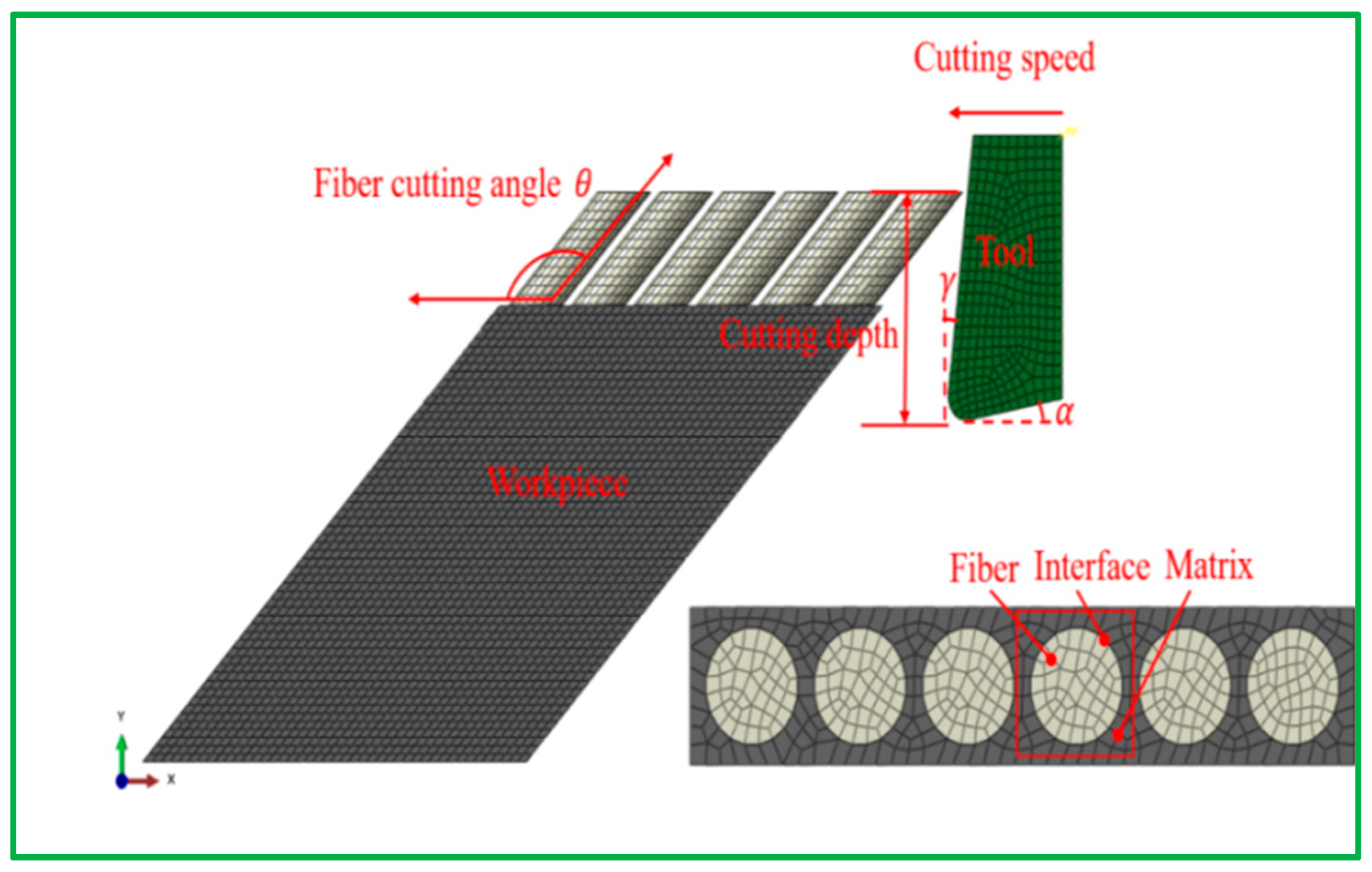
Figure 1. Three-dimensional microscopic simulation model.
Crystals 16 00354 g001
Figure 2. Laser-assisted orthogonal cutting experimental setup. (a) Experimental equipment, (b) Optical microscope, (c) Orthogonal cutting experimental setup.
Crystals 16 00354 g002
Figure 3. The contact model of tool and fiber.
Crystals 16 00354 g003
Figure 4. The first stage of the fiber cutting force model.
Crystals 16 00354 g004
Figure 5. The second stage of the fiber cutting force model.
Crystals 16 00354 g005
Figure 6. The third stage of the fiber cutting force model.
Crystals 16 00354 g006
Figure 7. The fiber fracture process of laser-assisted and conventional cutting. (A) Laser-assisted cutting (LAC); (B) Conventional cutting (CC).
Crystals 16 00354 g007
Figure 8. Schematic diagram of fiber force and failure mode in orthogonal cutting of UD-CFRP at 135° fiber orientation: (a) Basic orthogonal cutting model; (b) conventional orthogonal cutting (CC); (c) laser-assisted orthogonal cutting (LAC).
Crystals 16 00354 g008
Figure 9. The surface morphology of laser-assisted cutting and conventional cutting.
Crystals 16 00354 g009
Figure 10. Predicted and experimental cutting forces with different cutting parameters. (a) Cutting Speed; (b) Cutting depth.
Crystals 16 00354 g010
Figure 11. Variation in matrix tearing length with cutting depth.
Crystals 16 00354 g011
Figure 12. Variation in matrix tearing length with cutting speed.
Crystals 16 00354 g012
Figure 13. (ad) The SEM micrograph of the exposed length of fibers.
Crystals 16 00354 g013
Figure 14. The microstructural morphology of LAC and CC fiber processing damage. (A): Fiber fracture and interfacial behavior; (A-1): Fiber bending break; (B): Fiber shear fracure; (B-1): Fiber and matrix fracture.
Crystals 16 00354 g014
Figure 15. Variation in matrix tearing length with fiber exposed length.
Crystals 16 00354 g015
Table 1. Simulation parameters.
ParametersValuesParametersValues
a × b × c36 × 18 × 106 μmγ
α10°re2 μm
ht30 μmac12, 14, 16, 18, 20, 22 μm
l10, 12, 14, 16, 18, 20 μmVc500, 1000, 1500, 2000, 2500, 3000 mm/min
Table 2. Experimental parameters.
ParameterValue
cutting speed (mm/min)500, 1000, 1500, 2000, 2500, 3000
cutting depth ( μ m )300, 400, 500, 600, 700, 800
rake angle
back angle10°
Table 3. Symbols and meanings.
SymbolImplicationSymbolImplication
F A y The component of the cutting force perpendicular to the fiber r f Fiber radius
F A x The component of the cutting force in the direction of the fiber d f Fiber diameter
P m The reaction of the surrounding material against the fiber K m First parameter
a c Depth of cutting K n Second parameter
l Length of desticking point K b Interface equivalent modulus
Cut fiber rebound height E f Young’s modulus of fiber longitudinal
r e Tip radius I f Fiber moment of inertia
V c Cutting speed E m * Transverse elastic modulus of composite material
X Coordinates along the fiber direction G f Fiber shear modulus
W Fiber deflection E m Matrix Young’s modulus
A m Single fiber–matrix cross-sectional area n R E V Number of representative volume units
F c 1 Fiber micro-buckling cutting force S b e n d Critical transverse force for fiber bending
F c 2 Fiber bending cutting force V f Fiber volume fraction
L Bare fiber length θ Fiber cutting Angle
U Total energy of a single fiber and surrounding matrix Shear Angle
X f c Fiber bending strength μ Friction coefficient
σ c b e n d Critical stress for fiber bending failure V s Shear velocity
σ c s h e a r Critical stress of matrix shear failure F c Tangential force in the direction of cutting speed
τ c Matrix shear strength F f Feed force in the direction of cutting thickness
γ Rake Angle τ s Shear flow stress
t b Cutting width β 1 Friction Angle
V q Chip flow velocity α Posterior Angle
t Cutting time A l Matrix yield strength
ε Equivalent plastic strain of matrix ε . Matrix equivalent strain rate
ε 0 . Matrix reference strain rate T Matrix cutting temperature
T m Matrix melting point T r Normal temperature
B l Matrix hardening modulus C l Matrix strain rate induction coefficient
N l Strain hardening coefficient M l Thermal softening coefficient
Disclaimer/Publisher’s Note: The statements, opinions and data contained in all publications are solely those of the individual author(s) and contributor(s) and not of MDPI and/or the editor(s). MDPI and/or the editor(s) disclaim responsibility for any injury to people or property resulting from any ideas, methods, instructions or products referred to in the content.