Article

Supramolecular Interactions and Hirshfeld Surface Analysis of Three 3-Carboxamidecoumarin Derivatives


by
José L. Madrigal-Angulo
1,
María de J. Flores-Pérez
1,
Jesús Rodríguez-Romero
2,
Juan Saulo González-González
3,
Kayim Pineda-Urbina
1,
Efrén V. García-Baez
4,
Itzia I. Padilla-Martínez
4,* and
Francisco J. Martínez-Martínez
1,*
1
Facultad de Ciencias Químicas, Universidad de Colima, km 9 Carretera Colima-Coquimatlán, Coquimatlán 28400, Mexico
2
Facultad de Química, Universidad Nacional Autónoma de México, Ciudad Universitaria, Mexico City 04510, Mexico
3
Instituto de Farmacobiología, Universidad de la Cañada, Carretera Teotitlán-San Antonio Nanahuatipán, km 1.7 s/n, Teotitlán de Flores Magón, Oaxaca 68540, Mexico
4
Laboratorio de Química Supramolecular y Nanociencias, Unidad Profesional Interdisciplinaria de Biotecnología, Instituto Politécnico Nacional, Avenida Acueducto s/n, Barrio La Laguna Ticomán, Mexico City 07340, Mexico
*
Authors to whom correspondence should be addressed.
Crystals 2026, 16(6), 355; https://doi.org/10.3390/cryst16060355
Submission received: 28 April 2026 / Revised: 15 May 2026 / Accepted: 19 May 2026 / Published: 22 May 2026
(This article belongs to the Special Issue Structure-Based Drug Design and New Methodologies)

Abstract

In this work, three 3-carboxamidecoumarin derivatives (3b, 3c, and 4) were synthesized and characterized by NMR, IR, and single-crystal X-ray. All compounds maintain an essentially planar coumarin scaffold stabilized by an intramolecular N–H⋯O hydrogen bond (S(6) motif), though compound 4 exhibits a more complex bifurcated S32(11)[S(6)S(6)S(5)] network that enhances its conformational rigidity. The crystal packing analysis reveals that while all derivatives form one-dimensional (1D) supramolecular tapes through C–H⋯O interactions, their 3D architectures differ significantly: 3b and 3c rely on a diverse combination of π⋯π stacking and lone pair⋯π contacts, whereas 4 is governed by highly directional stacking between the pyran and pyridine rings. Hirshfeld surface analysis and CE-B3LYP energy framework calculations quantified the balance between intermolecular forces, showing that 3b is dispersion-dominated (H⋯H, 43.5%), while 3c achieves a balanced electrostatic–dispersion regime due to the nitro group, which increases O⋯H/H⋯O contacts to 37.1% and yields the highest stabilization energy (−69.1 kJ/mol). These results demonstrate that the electronic nature of the substituents at the 3- and 6-positions drastically modulates the hierarchy of non-covalent interactions, providing key insights for the crystal engineering of coumarin-based supramolecular systems.

1. Introduction

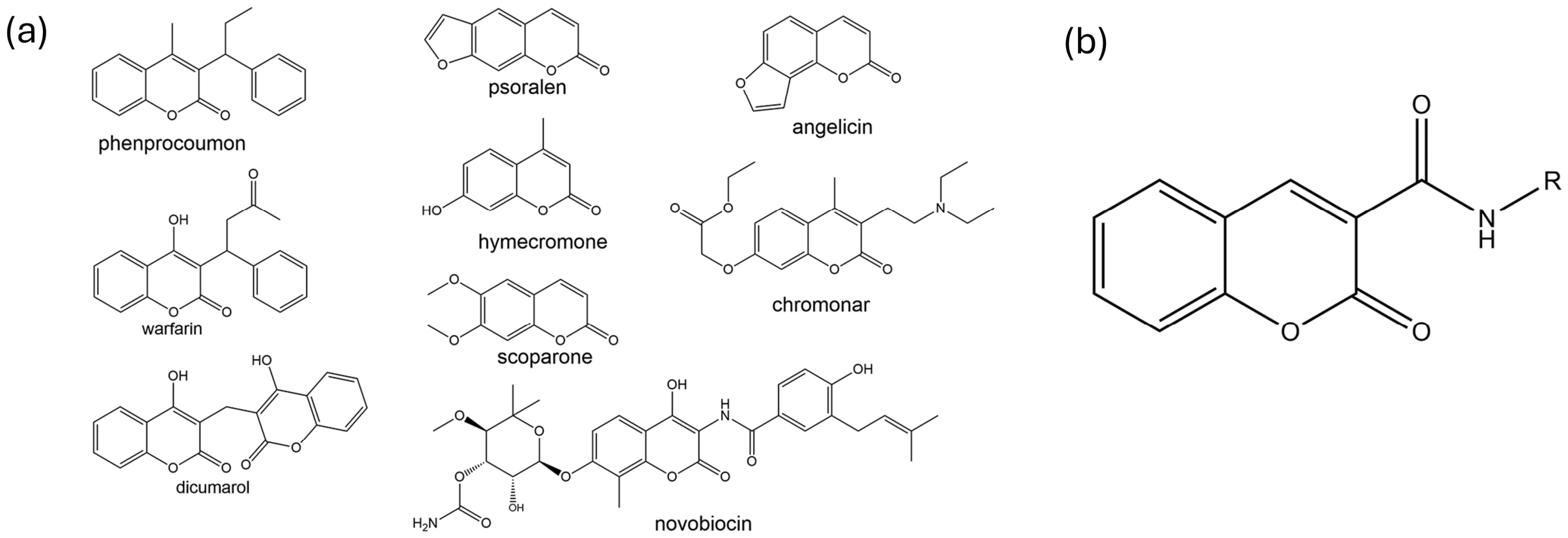
Coumarin (1,2-benzopyrone) derivatives are a highly studied family of compounds due to their multiple biological activities, such as anticoagulant, anti-inflammatory, antioxidant, antidiabetic, enzyme inhibition, anticancer, antiviral, antimicrobial, and antifungal activities. These studies have enabled the development of commercial drugs (Figure 1a) such as phenprocoumon, warfarin, and dicoumarol (anticoagulants); angelicin (anticancer); psoralen (psoriasis treatment); hymecromone (antispasmodic); chromonar (vasodilator); scoparone (immunosuppressant); and novobiocin (antibacterial) [1,2], among others. The variations in the substituents at different positions of the coumarin nucleus are responsible for this wide range of biological activities.
Among these structural possibilities, the coumarin 3-carboxamide derivatives (Figure 1b) have attracted our attention because they can be easily prepared by reacting a coumarin 3-carboxylate with amines [3,4] and because of their broad potential for biological activities, such as antibacterial, carbonic anhydrase inhibition, anticoagulant, anticancer, and antifungal properties [5,6,7,8,9].
Another highlight of coumarin derivatives is their capacity to form non-covalent interactions, mainly hydrogen bonds and π interactions. The study of these interactions helps in the understanding of how these compounds activate their biological receptors [10,11] as well as in the development of supramolecular systems such as sensors [12,13], host–guest complexes [14], and gels [15,16].
The synthesis of coumarin derivatives remains a topic of interest due to their diverse biological and supramolecular applications. For this reason, herein, we report the synthesis of three 3-carboxamide coumarin compounds (3b, 3c, 4), characterized by 1H and 13C NMR, IR, and single-crystal X-ray diffraction. A study of the Hirshfeld surfaces was performed to obtain information about the intermolecular interactions that sustain the crystal structures.

2. Materials and Methods

2.1. General Methods

All reagents were purchased from Sigma-Aldrich (St. Louis, MO, USA). The 1H and 13C spectra were collected in a Bruker Ultrashield plus (Bruker, Billerica, MA, USA) at 400 MHz instrument (400 and 100 MHz, respectively) using CDCl3 as the solvent and TMS as a reference. Chemical shifts (δ) were reported in ppm and coupling constants nJ in Hertz. All reactions were monitored by TLC. IR spectra were collected using a Varian 3100 FT-IR EXCALIBUR series spectrophotometer (Varian Inc., Palo Alto, CA, USA). Melting points were measured on an Electrothermal Mel-Temp 1201D apparatus (Electrothermal Engineering Ltd., Staffordshire, UK).
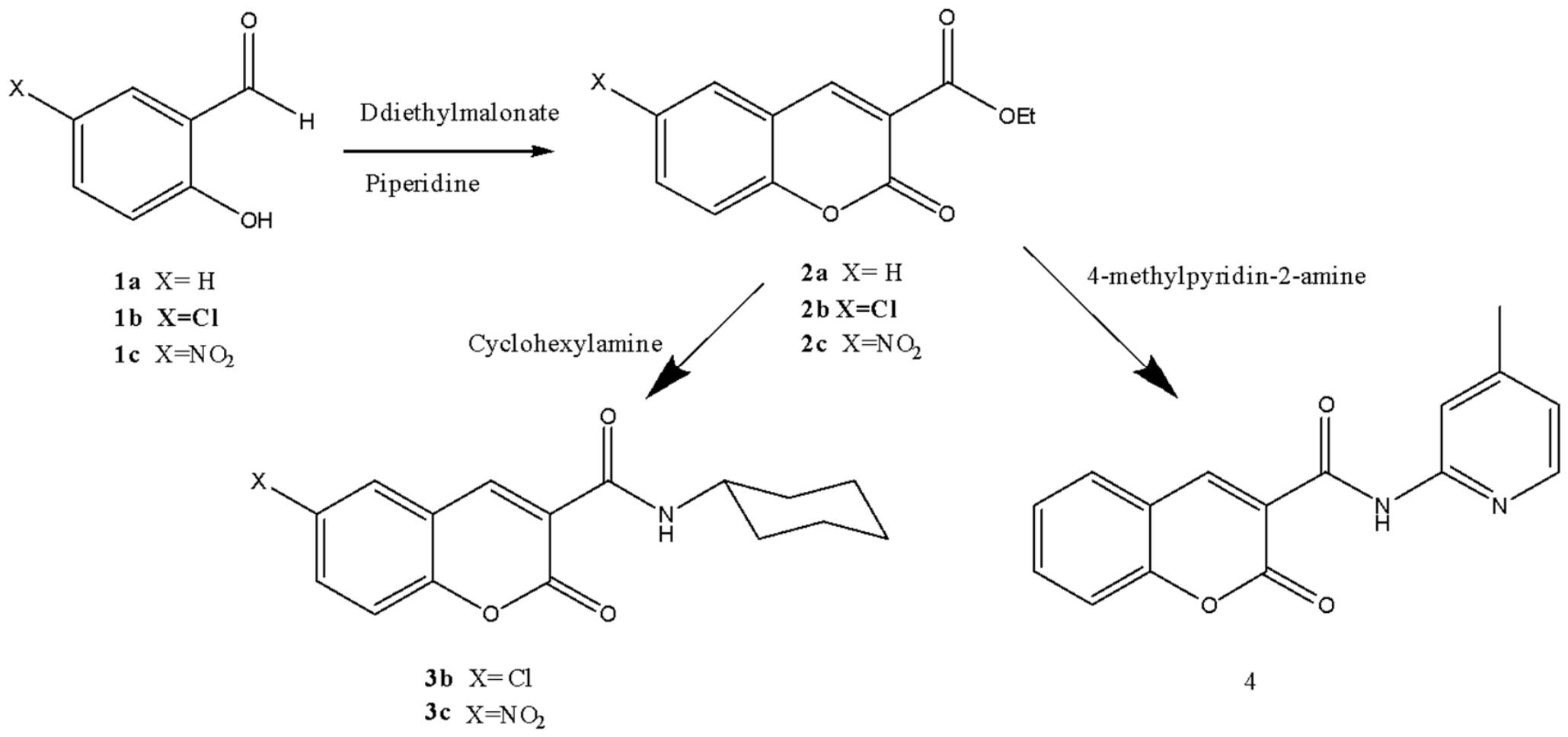
Ethyl coumarin carboxylate (2a), ethyl 6-chlorocoumarin carboxylate (2b) and ethyl 6-nitrocoumarin carboxylate (2c) were synthesized following a reported method [17] as shown in Scheme 1 and characterized by NMR and IR. Compounds 3b, 3c and 4 were prepared following reported synthetic procedure [4], Scheme 1.
N-Cyclohexyl-6-chloro-2-oxo-2H-1-benzopyran-3-carboxamide 3b was obtained by the reaction of ethyl 6-chlorocoumarin carboxylate (0.5 g, 1.9 mmol) with 0.22 mL of cyclohexylamine (1.9 mmol) (1:1) at reflux in 10 mL of ethanol for 24 h. The product crystallized from the reaction mixture as a white solid. Colorless crystals suitable for X-ray analysis were obtained after recrystallization in 85% yield, from ethanol. m. p. 245–246 °C, FT–IR (ν, cm−1): 3314 (N–H), 1743, 1700 (C=O);1H NMR (CDCl3):δ 8.82 (s, 1H, H4), 7.64 (d, 1H, 4J 2.8, H5), 7.58 (dd, 1H, 3J 9.0, 4J 2.8, H7), 7.35 (d, 1H, 3J 9.0, H–8), 4.00 (m, 1H, N–CH–), 1.24–1.97 (m, 10H, -CH2-). 13C NMR (CDCl3): δ 160.0 (C2), 118.2 (C3), 147.0 (C4), 128.9 (C5), 130.9 (C6), 133.9 (C7), 120.0 (C8), 152.8 (C9), 119.9 (C10), 161.0 (C11), 48.8 (C13), 32.9 (C14), 24.8 (C15) 25.7 (C16).
N-Cyclohexyl-6-nitro-2-oxo-2H-1-benzopyran-3-carboxamide 3c was obtained by the reaction of ethyl 6-nitrocoumarin carboxylate (0.5 g, 1.9 mmol) with 0.22 mL of cyclohexylamine (1.9 mmol) (1:1) at reflux in 10 mL of ethanol for 24 h. The product crystallized from the reaction mixture as a white solid. Colorless crystals suitable for X-ray analysis were obtained after recrystallization in 45% yield, from ethanol. m. p. 262–263 °C, FT–IR (ν, cm−1): 3487 (N–H), 1740, 1700 (C=O);1H NMR (CDCl3): δ 8.60 (NH), 8.98 (s, 1H, H4), 8.64 (d, 1H, 4J 2.6, H–5), 8.50 (dd, 1H, 3J 9.1, 4J 2.6, H7), 7.57 (d, 1H, 3J 9.1, H8), 4.00 (m, 1H, N–CH–), 1.34–1.97 (m, 10H, -CH2-). 13C NMR (CDCl3): δ 159.3 (C2), 118.7 (C3), 146.7 (C4), 125.3 (C5), 144.5 (C6), 128.1 (C7), 117.8 (C8), 157.3 (C9), 120.0 (C10), 159.9 (C11), 48.8 (C13), 32.6 (C14), 24.6 (C15) 25.4 (C16).
N-(4-Methylpyridin-2-yl)-2-oxo-2H-1-benzopyran-3-carboxamide 4 was obtained by the reaction of ethyl 2-oxo-2H-1-benzopyran-3-carboxylate (2a, 0.5 g, 2.291 mmol) with 0.297 g of 2-amino-4-methylpyridine (2.75 mmol) and 0.390 mL of triethylamine (2.75 mmol) under reflux in 20 mL of dioxane for 24 h. The product was purified by column chromatography using ethyl acetate:methanol (8:2) as the mobile phase. White crystals suitable for X-ray analysis were obtained in 35% yield. m. p. 225–228 °C. FT–IR (ν, cm−1): 3232 (N–H), 1697, 1674 (C=O); 1H NMR (CDCl3): δ: 11.23 (s, 1H, N–H), 8.99 (s, 1H, H–4), 8.24 (d, 1H, 3J 5.0, H15), 8.19 (s, 1H, H18) 7.74 (dd, 1H, 3J 7.9, H5), 7.70 (dd, 1H, 3J 7.6, H7), 7.44 (d, 1H, 3J 8.9, H8) 7.40 (dd, 1H, 3J 8.3, H6), 6.92 (d, 1H, 3J 5.0, H16). 13C NMR (CDCl3): δ 161.1 (C11), 159.7 (C2), 154.7 (C9), 149.1 (C4), 134.5 (C7), 129.9 (C5), 125.4 (C6), 118.6 (C10), 115.4 (C3), 116.8 (C8), 21.4 (C19).

2.2. Computational Details

All intermolecular interaction analyses were performed with CrystalExplorer 21.5 [18]. The crystal structures of compounds 3b, 3c and 4 were taken directly from their single-crystal X-ray diffraction (CIF) data, using the as-measured atomic coordinates without further geometry optimization.

2.2.1. Hirshfeld Surfaces and 2D Fingerprint Plots

Hirshfeld surfaces (HSs) were generated for each unique molecule in the asymmetric unit using the high-resolution setting in Surface Controller [19]. The surfaces were mapped over the normalized contact distance within the range of −0.20 to +1.00 a.u., where red, white, and blue regions correspond respectively to intermolecular contacts shorter, equal to, and longer than the sum of van der Waals radii.
Associated two-dimensional fingerprint plots (de vs. di) [20,21] were obtained from the same surface to quantify the contributions of different contact types (H⋯H, O⋯H/H⋯O, Cl⋯H/H⋯Cl, etc.).

2.2.2. Pair-Wise Interaction-Energy Calculations

Intermolecular interaction energies were evaluated using the CrystalExplorer model energies protocol, specifically the CE-B3LYP/6-31G(d,p) model [22]. In this method, a cluster of symmetry-unique neighboring molecules is generated within a 3.8 Å radius around the reference molecule, and four unscaled energy components are computed: electrostatic (Eele), polarization (Epol), dispersion (Edis), and exchange–repulsion (Erep).
The components are then multiplied by empirically derived scale factors to reproduce benchmark ab initio energies, giving a total interaction energy (Etot):
Etot = keleEele + kpolEpol + kdisEdis + krepErep
with
kele = 1.057, kpol = 0.740, kdis = 0.871, and krep = 0.618.
The CE-B3LYP/6-31G(d,p) model uses molecular electron densities computed internally with the Tonto engine.
All reported energies are expressed in kJ·mol−1. Only symmetry-unique dimers with |Etot| ≥ 20 kJ·mol−1 are discussed in the text.

2.2.3. Energy-Framework Analysis

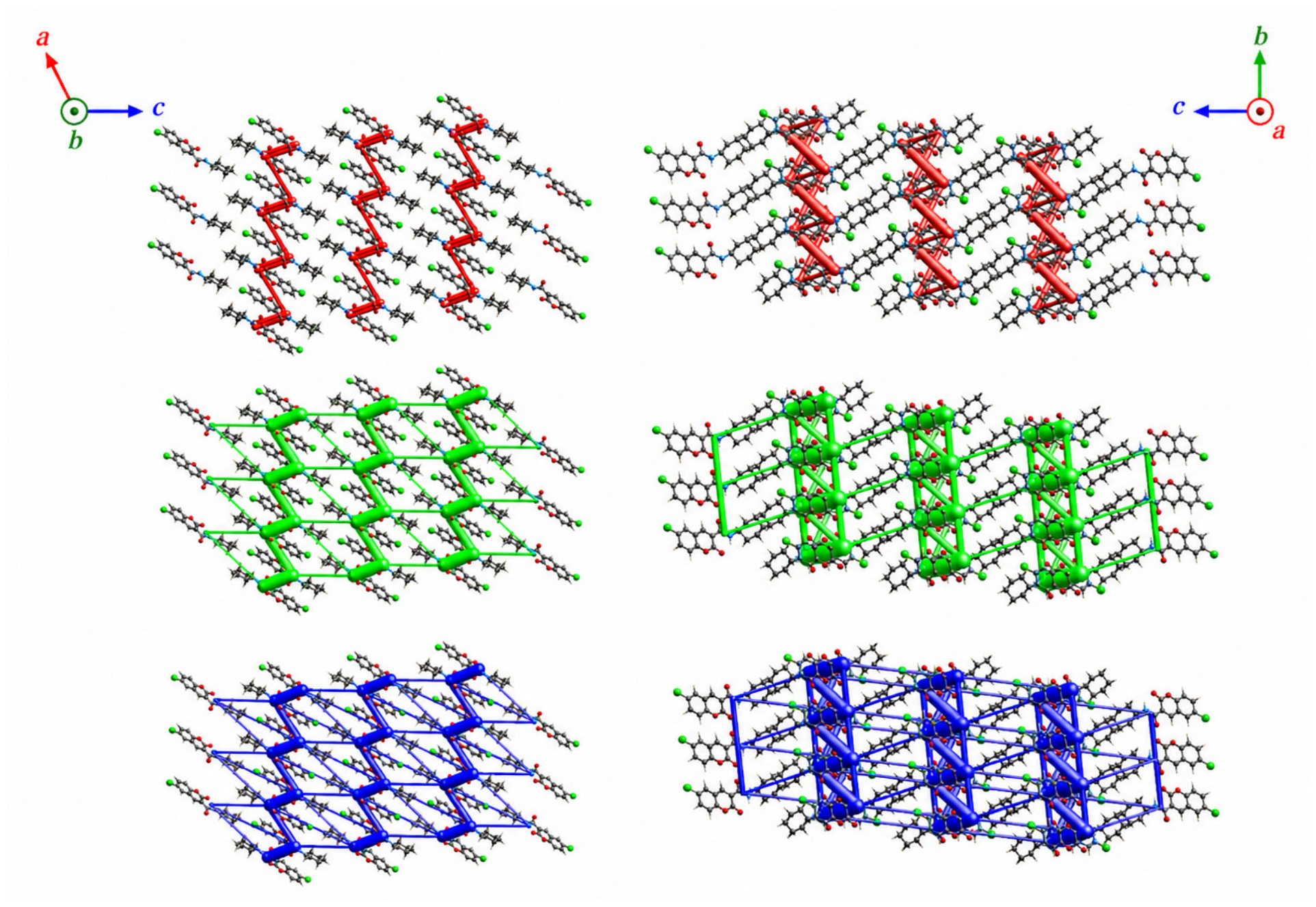
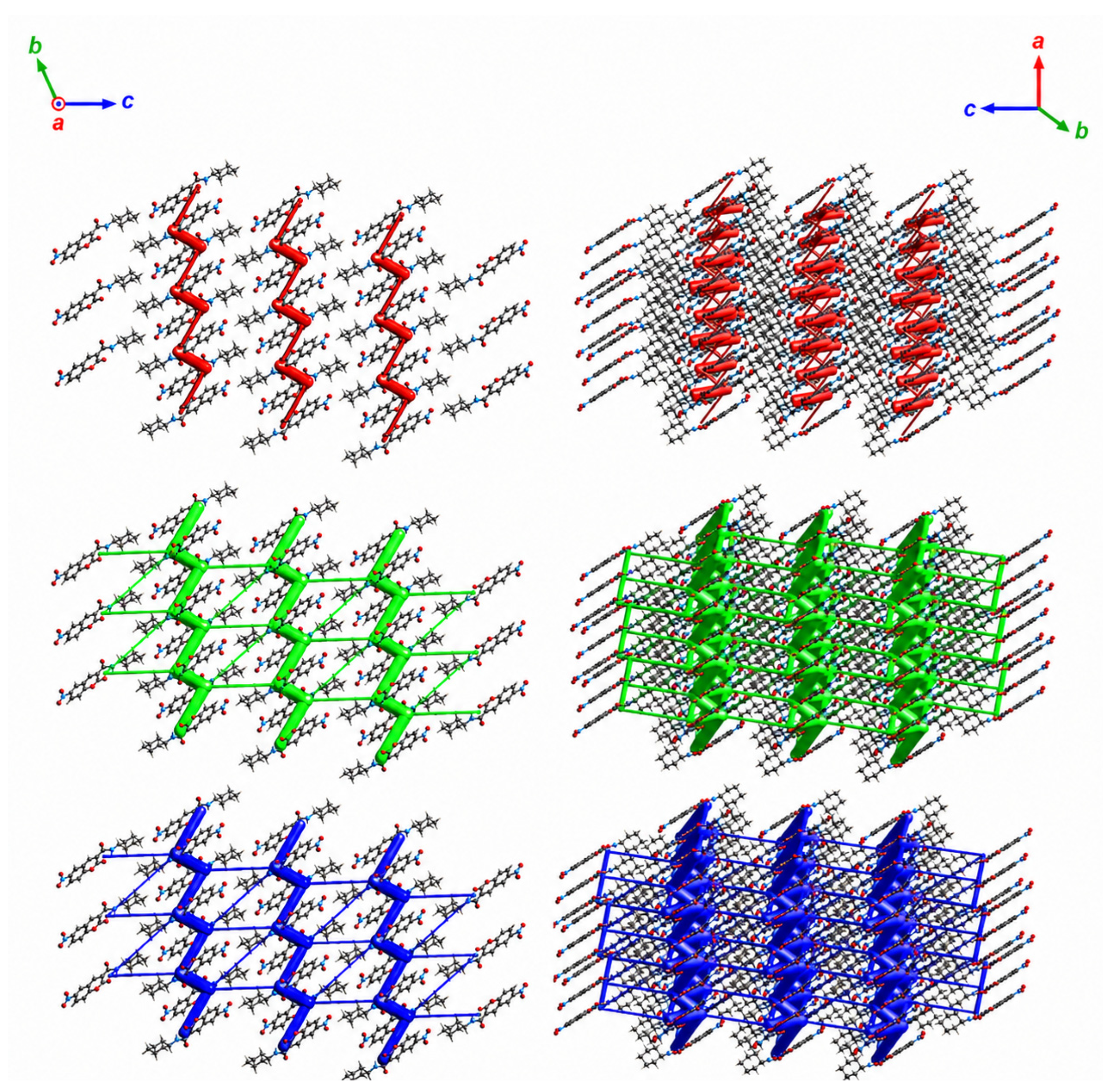
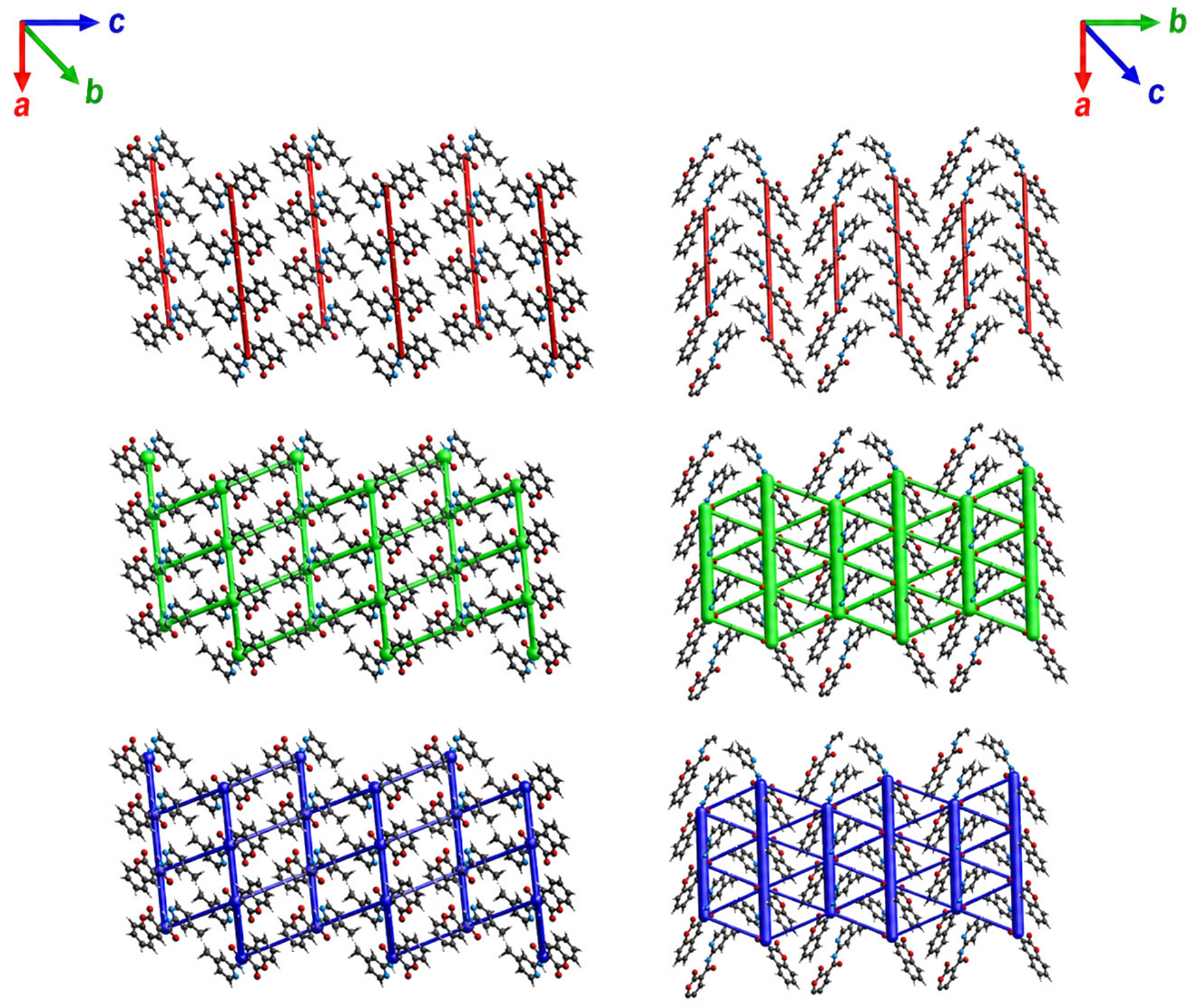
Three-dimensional energy frameworks were constructed from the calculated pair energies to visualize the topology and anisotropy of lattice cohesion [22,23]. Frameworks were generated for the electrostatic (Eele, red), dispersion (Edis, green), and total (Etot, blue) components using a tube-size scaling factor of 150 kJ·mol−1 and a cut-off threshold of 10 kJ·mol−1. The parameter R denotes the distance between molecular centroids, calculated as the mean atomic positions of the interacting molecular pair in CrystalExplorer. A 3 × 3 × 3 unit-cell replication was applied uniformly to all three crystals to facilitate direct visual comparison. Cylinder radii are proportional to |E|, allowing the dominant interaction type to be recognized by color and thickness.

2.3. Crystal Structure Determination and Refinement

General crystallographic data for the structures in this paper have been deposited in the Cambridge Crystallographic Data Centre as supplementary publication numbers CCDC (2353877 3b, 1987600 3c, 2516914 4). Single-crystal X-ray diffraction data of 3b, 3c and 4 were collected on a Bruker AXS D8 QUEST diffractometer with Mo radiation (kα, λ = 0.71073 Å) at 293.15 (2) K. The cell refinement and data reduction of 3b, 3c and 4 were carried out with the SAINT V8.34A (Bruker, Madison, WI, USA) [24,25,26], SORTAV (University of Glasgow, Glasgow, UK) [27] and WinGX v2023.1 [28] software. The structures were solved by SHELXT 2018/2 [29]. The final refinement was performed by full-matrix least-squares methods using the SHELX 2018/3 program [30]. All heavy atoms (C, O and N) were anisotropically refined, and the hydrogen atoms on C were geometrically positioned and treated as riding atoms or directly with C−H 0.95−0.99 Å, and Uiso(H) = 1.2 eq(C) or 1.5 eq(C). Platon version 230523 [31] and Mercury v4.2.0 [32] software were used to prepare the material for publication.

3. Results and Discussion

3.1. X-Ray Crystal Structure Determination of 3b, 3c and 4

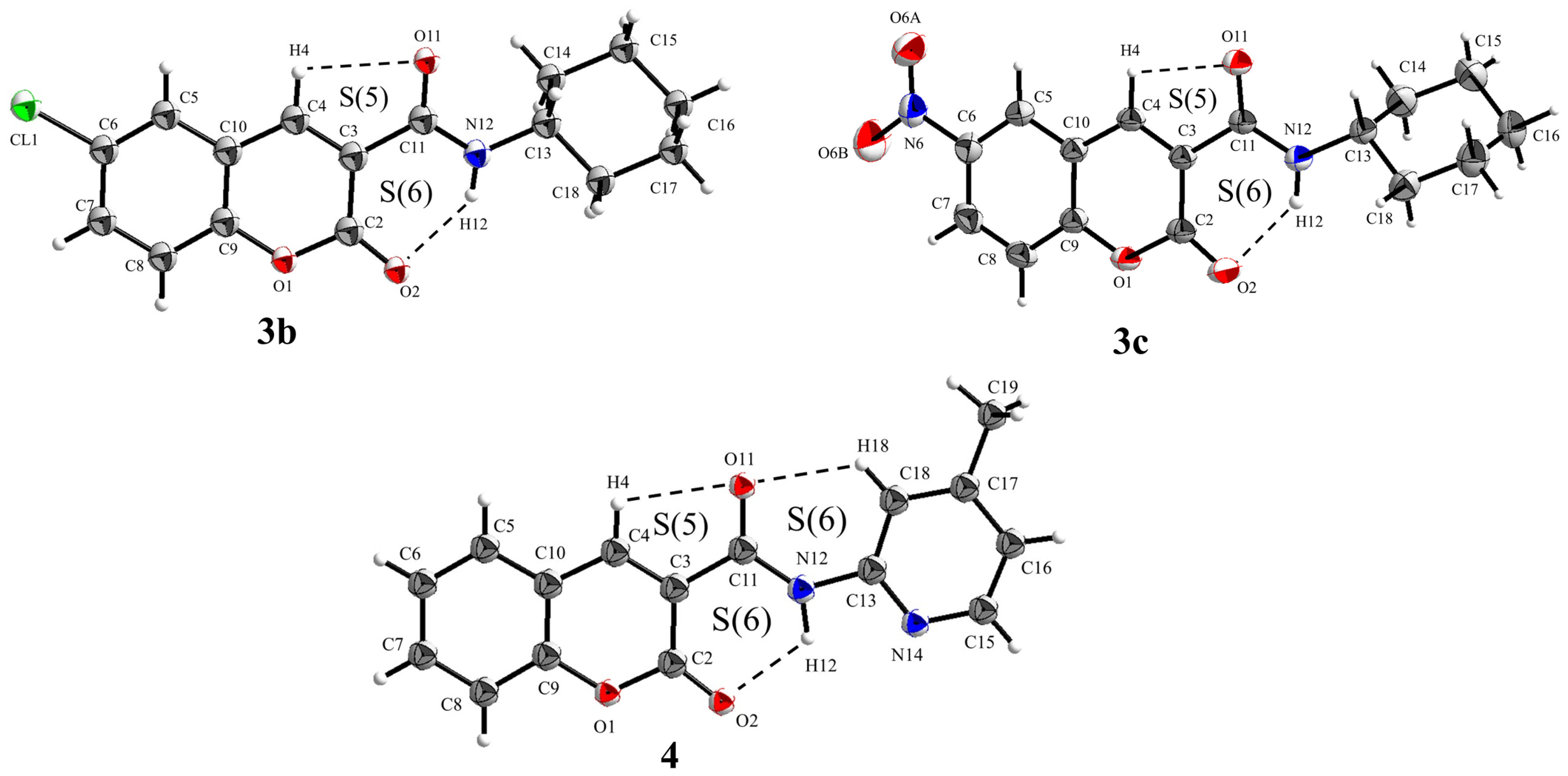
Crystallographic data for compounds 3b, 3c and 4 are listed in Table 1, and the ORTEP diagrams at 50% probability are shown in Figure 2. Compounds 3b and 3c consist of a coumarin ring with an amide group at position 3 and Cl and NO2 at the C6 position, respectively (Figure 2). The X-ray diffraction analyses showed that compounds 3b and 3c exhibit highly similar molecular geometries and crystal packing features and are in close relation to the structure of the unsubstituted compound N-cyclohexyl-2-oxo-2H-1-benzopyran-3-carboxyamide [4], as well as the previously reported 6-substituted 2-oxo-2H-chromene-3-carboxylic acid (2-hydroxyethyl) amides [33]. Compound 4 displays notable differences attributable to its distinct crystallographic symmetry and intramolecular organization.
Compounds 3b and 3c crystallize in the Triclinic system, space group P-1, with two molecules per unit cell, and 4 crystallizes in the Monoclinic system, space group P21, with two molecules in the unit cell. The molecular structures of 3b, 3c, and 4 are characterized by an essentially planar coumarin/chromene core, as evidenced by the small deviations in torsion angles along the conjugated backbone. In particular, the torsion angles C2–C3–C11–O11 in 3b (−169.1°) and 3c (−167.68°) indicate that the amide substituent is nearly coplanar with the heteroaromatic system and are very close to the reported value for the unsubstituted compound (−170.59) [4]. A similar trend is observed in compound 4 (177.19°), confirming effective π-conjugation across the molecular framework. However, the torsion angle C2–C3–C11–N12 reveals a key difference: while 3b and 3c exhibit slight deviations from planarity (~12–13°), compound 4 adopts an almost fully planar conformation (−3.23°), suggesting enhanced electronic delocalization. Additionally, the lengths of the single bond C11–N12 for 3b, 3c and 4 are 1.331(3) Å, 1.333(2) and 1.338(3).
In all three compounds, the H atom of the amide group (H12) is periplanar to the carbonyl O11 atom (O11-C11-N12-H12 = −171.0(2), −175.5(18) and −173°, respectively) and displays a characteristic intramolecular hydrogen bond between the amide NH and the lactone carbonyl oxygen (N12–H12⋯O2), generating an S(6) motif according to graph-set notation. Nevertheless, compound 4 also exhibits bifurcated hydrogen-bonding interactions, resulting in a combined S32(11)[S(6)S(6)S(5)] motif. This network reinforces the molecular rigidity and stabilizes the nearly coplanar arrangement of the molecular backbone. In contrast, 3b and 3c rely primarily on a single intramolecular hydrogen bond, resulting in comparatively greater conformational flexibility. This structural behavior contrasts with the 6-substituted 2-hydroxyethyl amides [33], where the terminal hydroxyl group induces a three-centered hydrogen bond (THB) forming an S(6)S(5) intramolecular motif. Selected bond lengths and torsion angles of compounds 3b, 3c and 4 are listed in Table 2. The complete data can be found in the Supplementary Materials (Tables S1–S9).

3.2. Crystal Packing of Compounds 3b, 3c and 4

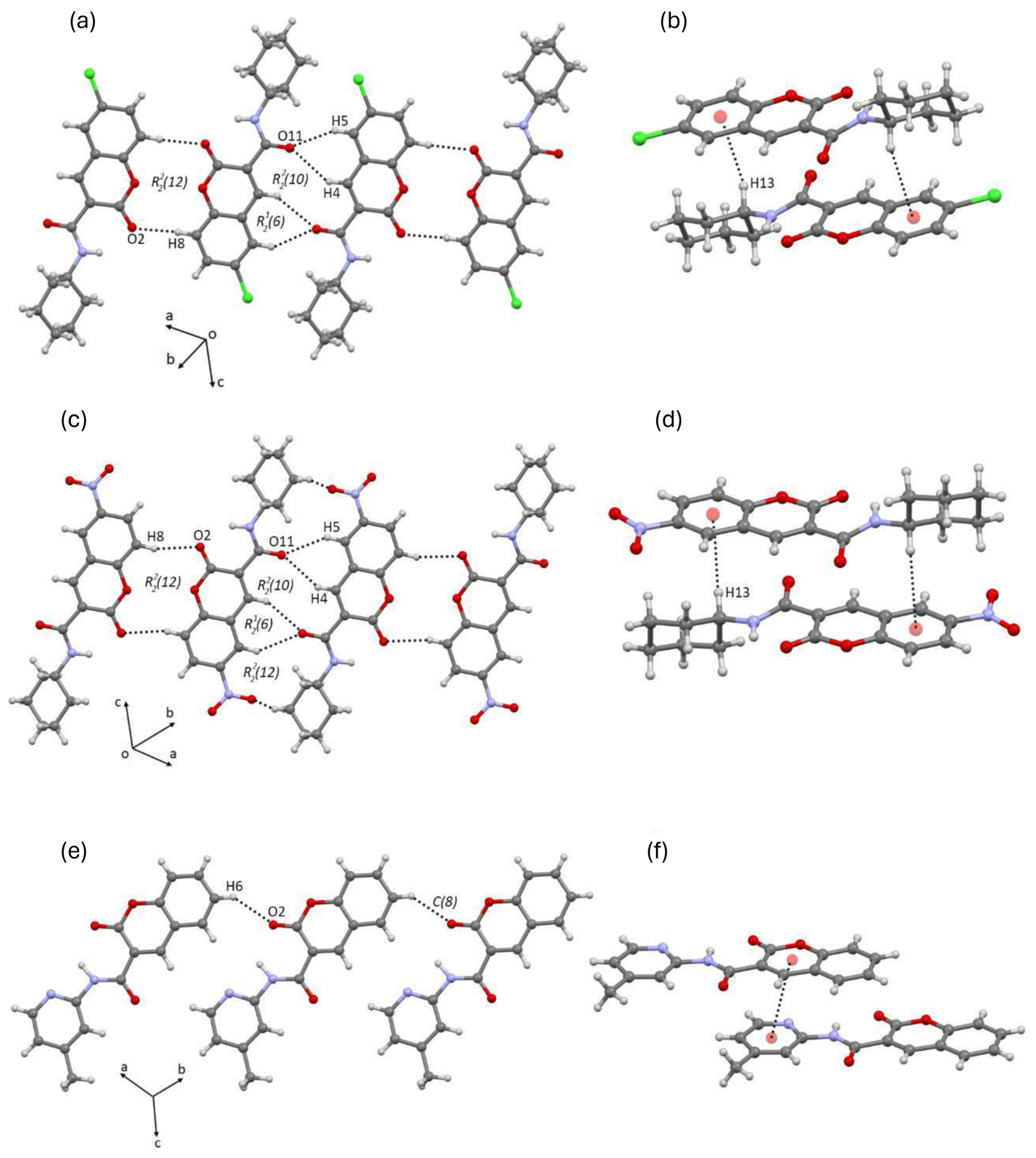
The supramolecular assembly of 3b and 3c is governed predominantly by weak intermolecular C–H⋯O hydrogen bond interactions, as observed in the related unsubstituted N-cyclohexyl coumarin carboxamide reported previously [4], which drive the formation of one-dimensional (1D) supramolecular tapes. These tapes are characterized by recurring ring motifs for compound 3b, such as R22(12), R12(6), and R22(10), and 3c forms rings [R22(12), R12(6), R22(10), R12(6), R22(12)] that develop into a tape through the C8–H8∙∙∙O2 interaction extended along the b-axis and contained within the (2 -4 5) plane [13] (Figure 3), consistent with Kitaigorodskii’s close-packing principles [34]. The extension into two-dimensional (2D) architectures is facilitated by C–H⋯π interactions (C13-H13⋯Cg(X) = 3.173 Å for 3b) (along the b-axis) and 3.303 Å for 3c (along the c-axis), while the three-dimensional (3D) network is stabilized through π–π stacking between aromatic rings (Table S10) and additional lone pair⋯π interactions (Table 3) involving carbonyl oxygen atoms. In contrast, compound 4 forms 1D supramolecular tapes extended along the b-axis primarily through C–H⋯O interactions; however, its higher-dimensional assembly is dominated by π–π stacking interactions between the pyran and pyridine rings. This results in a more directional and less diversified supramolecular architecture compared to 3b and 3c, where multiple interaction types coexist.
The π–π interactions in 3b and 3c involve centroid-to-centroid distances between the lactone and the benzenoid rings oriented in a head-to-tail alignment, with interplanar centroid-to-centroid Cg(1)∙∙∙Cg(2) distances of 3.604 (2) Å (3b) and 3.576 (3) Å (3c), with moderate slippage of 0.922 Å and 0.9838 Å, respectively, indicative of parallel-displaced stacking [6]. In the same way, Cg(1)∙∙∙Cg(1) of the lactone rings, which also contributes to the stability of the network, was found in the title compounds with intercentroid distances of 4.029 Å (3b) and 4.144 Å (3c).
These interactions, together with lone pair⋯π contacts, contribute to the formation of layered structures along the crystallographic axes (3D). In compound 4, π–π interactions play a more prominent role in defining the 2D architecture, reflecting a shift toward stronger and more directional intermolecular forces.
Overall, compounds 3b and 3c exhibit closely related structural and supramolecular features, with minor variations arising from substituent effects (Cl vs. NO2), which do not significantly alter the global packing arrangement. Conversely, compound 4 exhibits a more rigid, planar molecular structure, a distinct crystallographic system, and a supramolecular organization more strongly governed by π–π interactions.

3.3. Hirshfeld Surface and 2D Fingerprint Plots

The crystallographic analysis and Hirshfeld surface study provide complementary insights into the intermolecular interactions that govern the solid-state organization of the compounds studied. While single-crystal X-ray diffraction precisely defines the molecular geometry and the spatial arrangement of functional groups, the Hirshfeld surface analysis offers a quantitative visualization of these interactions within the crystal lattice. In this sense, the geometric parameters obtained from the crystallography of compounds 3b, 3c and 4, such as the planarity of the coumarin core, the orientation of substituents, and the distances and angles associated with the C–H⋯π, X–H⋯O and π⋯π interactions, directly explain the relative contributions observed in the Hirshfeld fingerprint plot analysis.
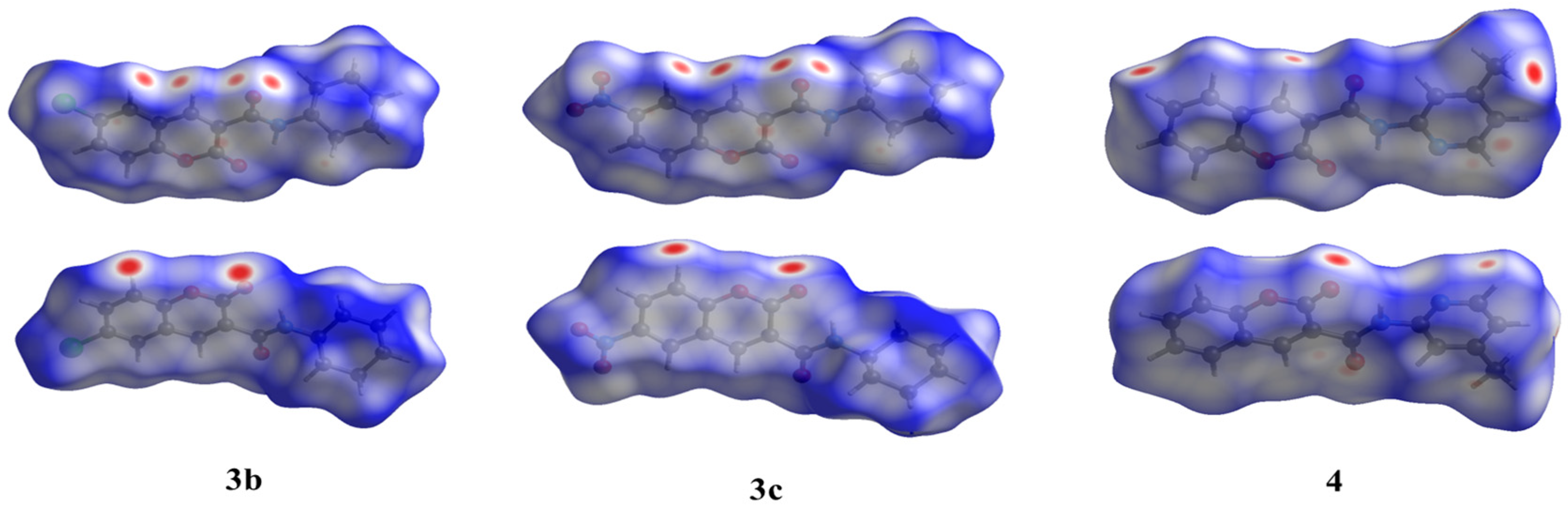
In this context, the Hirshfeld surface of compound 3b (Figure 4) displays red spots around the oxygen and hydrogen atoms, confirming the prevalence of strong O⋯H interactions. The fingerprint plots reveal that H⋯H contacts (43.5%) dominate the surface, followed by O⋯H/H⋯O (15.9%), Cl⋯H/H⋯Cl (15.7%), and C⋯H/H⋯C (10.5%). These percentages (Figure S1) show that dispersion-driven hydrogen contacts control the packing, while C⋯C (5.8%) and O⋯O (2.5%) contributions play a minor role. Although H⋯H contacts represent the largest contribution to the Hirshfeld surface of 3b, these contacts should not be interpreted as individually strong interactions. Rather, their importance arises from their abundance over the molecular surface, producing a cumulative contribution to the dispersion component of the lattice energy. The large dispersion terms observed for the most stabilizing dimers therefore arise from the combined effect of multiple weak H⋯H contacts together with C⋯H/CH⋯π and C⋯C/π⋯π interactions. In addition, the Cl⋯H/H⋯Cl contacts account for 15.7% of the surface, indicating that the chlorine atom participates significantly in the packing through weak polarizable contacts. No classical directional halogen bond is proposed; instead, the chlorine substituent contributes to surface complementarity and dispersion-assisted stabilization.
Five symmetry-unique dimers exceed |Etot| ≥ 20 kJ mol−1 (Table S11). Their total energies range from −23 to −62 kJ mol−1, evidencing both strong and secondary contacts. The most stabilizing dimer (Etot = −61.7 kJ mol−1, R = 4.03 Å) is dominated by dispersion (Edis = −83.0 kJ mol−1) and corresponds to multiple C–H⋯π and π⋯π approaches between adjacent aromatic rings. The second (Etot = −56.9 kJ mol−1) features two O11⋯H4/H5 hydrogen bonds, explaining its large electrostatic term (Etot = −41.4 kJ mol−1). A third stacking dimer (Etot = −45.7 kJ mol−1) involves offset π⋯π overlap. Two weaker O⋯H pairs (−24.8 and −23.3 kJ mol−1) interlink these stacks into a 3D network.
In the frameworks (Figure 5), green dispersion cylinders are thicker and more numerous than the red electrostatic ones, confirming a dispersion-dominated lattice. The blue total-energy network forms columns along the stacking axis, while thinner cross-links correspond to the weaker hydrogen bonds. The resulting anisotropy explains the robust yet layered cohesion of 3b.
The Hirshfeld surface of 3c (Figure 4) shows widespread red areas around donor/acceptor atoms, consistent with extensive hydrogen bonding. Contact contributions (Figure S2) reveal O⋯H/H⋯O = 37.1% and H⋯H = 36.7% as the main components, while C⋯H (9.3%) and C⋯C (5.3%) indicate secondary π interactions. Compared with 3b, the hydrogen-bond contribution increases markedly. In 3c, the increased O⋯H/H⋯O contribution reflects the presence of the nitro group, which introduces additional oxygen acceptor sites and enhances the electrostatic character of the packing. However, the strong dispersion terms associated with the π⋯π and CH⋯π dimers show that dispersion remains essential to the stabilization of the crystal. Thus, the dominant dispersion energy in 3c is not attributable to a single contact type, but rather, to the cooperative contribution of H⋯H, C⋯H/CH⋯π, C⋯C/π⋯π, and nitro-group-assisted O⋯H contacts.
The most stabilizing interaction (Etot = −69.1 kJ mol−1) arises from a C–H⋯O trimeric motif involving O11⋯H4 (2.49 Å), O11⋯H5 (2.53 Å), and O6⋯H13 (2.81 Å). Its large electrostatic (Eele = −52.4 kJ mol−1) and polarization (Epot = −12.3 kJ mol−1) components confirm a hydrogen-bond-dominated character (Table S12). The second-most stabilizing dimer (Etot = −65.7 kJ mol−1) corresponds to a π⋯π stacking reinforced by CH⋯π (2.83–3.01 Å) interactions, yielding an exceptionally high dispersion term (Edis = −79.8 kJ mol−1).
An additional offset π⋯π/π –lone-pair arrangement (Etot = −53.7 kJ mol−1, C6⋯O2 = 2.46 Å) exhibits mixed dispersion and polarization contributions. Weaker contacts include a C–H⋯O hydrogen bond (Etot = −27.3 kJ mol−1) and an O6⋯π interaction (Etot = −24.4 kJ mol−1) that laterally connect molecular columns.
In the framework view (Figure 6), both the red (electrostatic) and green (dispersion) cylinders are thick, demonstrating a more balanced network than 3b. The strong H-bonds define vertical chains, while π interactions provide lateral cohesion, producing an interdigitated 3D structure stabilized by comparable electrostatic and dispersive forces.
Compound 4 (Figure 4 and Figure S3) displays a fingerprint dominated by H⋯H (34.9%), O⋯H (24.2%), and C⋯H (21.7%) contacts, with minor contributions from heavier atoms (<8%). The prevalence of O⋯H and C⋯H interactions indicates a less polar yet moderately hydrogen-bonded environment, intermediate between the dispersion-rich 3b and the highly polar 3c.
Only two dimers exceed the 20 kJ mol−1 threshold (Table S13). The first (Etot = −49.4 kJ mol−1) corresponds to C⋯C/C⋯H stacking around 3.3–3.5 Å and an O11⋯H19B hydrogen bond (2.87 Å), showing a strong dispersion component (Edis = −66.1 kJ mol−1). The second (Etot = −26.6 kJ mol−1) includes O2⋯H6, N14⋯H5, and O11⋯H15 contacts, characterized by mixed electrostatic and dispersive contributions. Together they form a loosely interconnected lattice stabilized mainly by van der Waals forces.
Energy frameworks (Figure 7) display thinner red electrostatic tubes and dominant green dispersion ones, evidencing that compound 4 is primarily stabilized by dispersion interactions, with localized polar reinforcement. The overall cohesion is weaker and more isotropic than in 3c.
Across the three crystals, the balance between dispersion and electrostatic stabilization is strongly modulated by the substituent pattern. Compound 3b is mainly dispersion-dominated, with stabilization arising from multiple H⋯H, C⋯H/CH⋯π, C⋯C/π⋯π, and Cl⋯H contacts. Compound 3c shows a more balanced electrostatic–dispersion regime because the nitro group increases the O⋯H/H⋯O contribution and strengthens hydrogen-bonding interactions, while the π⋯π and CH⋯π contacts remain important. Compound 4, bearing a pyridyl substituent instead of the cyclohexyl group present in 3b and 3c, displays fewer high-energy dimers and a more isotropic framework. The pyridine ring introduces a more rigid, polar, and electron-deficient aromatic unit, promoting localized O⋯H and N⋯H contacts but reducing the efficiency of compact dispersion-driven packing. These results demonstrate that both the 6-substituent of the coumarin core and the nature of the amide substituent control the balance between electrostatic and dispersive forces in the solid state.

4. Conclusions

In the present work, the synthesis and structural characterization of three 3-carboxamidecoumarin derivatives were reported, with a detailed analysis of the role of substituents in their supramolecular organization. The crystallographic study revealed that all three compounds maintain an essentially planar coumarin scaffold, which favors effective π-conjugation along the molecular skeleton. While compounds 3b and 3c, bearing a cyclohexyl substituent, exhibit slight deviations from planarity in the amide group (12–13°), compound 4, bearing a pyridine substituent, adopts an almost entirely planar conformation. This suggests greater electronic delocalization and structural rigidity in the pyridinic derivative due to a bifurcated hydrogen-bonding system.
The presence of an intramolecular hydrogen bond (N12–H12⋯O2) was confirmed in all compounds, forming an S(6) motif that stabilizes the syn conformation of the amide group relative to the lactone carbonyl. However, compound 4 exhibits a more complex S32(11)[S(6)S(6)S(5)] network, which increases its conformational stability compared to 3b and 3c.
Fingerprint plots quantified that the packing of 3b is dominated by dispersive interactions (H⋯H, 43.5%). In contrast, compound 3c shows a more pronounced balance with electrostatic interactions due to the nitro group, where O⋯H/H⋯O contacts are significantly increased to 37.1%. Interaction energy calculations (CE-B3LYP) demonstrated that 3c possesses the highest stabilization energy in its dimers (−69.1 kJ/mol), driven by a trimeric hydrogen-bonding motif. On the other hand, the packing of 3b is fundamentally dependent on dispersion forces associated with multiple C–H⋯π and π⋯π contacts.
All three compounds form one-dimensional (1D) supramolecular tapes through C–H⋯O interactions. Nonetheless, the transition to 3D structures in 3b and 3c is achieved through a diverse combination of π⋯π stacking and lone pair π⋯π contacts, whereas in 4, the assembly is more directional and predominantly governed by stacking interactions between the pyran and pyridine rings.
In summary, these results demonstrate that modifying the substituent at the 3-position and the presence of electron-withdrawing groups at the 6-position drastically modulate the balance between electrostatic and dispersion forces, dictating the final crystal architecture and providing valuable information for the design of new coumarin-based compounds.

Supplementary Materials

The following supporting information can be downloaded at: https://www.mdpi.com/article/10.3390/cryst16060355/s1, Tables S1–S9: Bond lengths, bond angles, and torsion angles of compounds 3b, 3c and 4. Table S10. Geometric parameters of π →π interactions. Figures S1–S3: Atomic contact contributions to Hirshfeld surface. Tables S11–S13: Interaction energies (kJ/mol) calculated for the 3b, 3c and 4 crystals.

Author Contributions

F.J.M.-M. and I.I.P.-M. conceptualized the study. J.L.M.-A. and M.d.J.F.-P. synthesized and characterized the compounds. E.V.G.-B. collected X-ray diffraction and performed the refinement. K.P.-U. provided Hirshfeld surface analysis. F.J.M.-M., I.I.P.-M., J.S.G.-G., J.R.-R. and J.L.M.-A. wrote, reviewed and edited the manuscript. F.J.M.-M. and I.I.P.-M. supervised the study. F.J.M.-M. and I.I.P.-M. confirm the authenticity of all the raw data. All authors have read and agreed to the published version of the manuscript.

Funding

The present study was supported by the Secretaría de Ciencia, Humanidades, Tecnología e Innovación (SECIHTI) [grant CBF-2025-I-1827], the Instituto Politécnico Nacional (IPN) [grant SIP-20260062], and the Universidad de Colima.

Data Availability Statement

The original contributions presented in this study are included in the article. Further inquiries can be directed to the corresponding authors.

Acknowledgments

The present study was supported by SIP-IPN and Universidad de Colima.

Conflicts of Interest

The authors declare no conflicts of interest.

References

  1. Dharavath, R.; Nagaraju, N.; Reddy, M.R.; Ashok, D.; Sarasija, M.; Vijjulatha, M.; Vani, T.; Jyothi, K.; Prashanthi, G. Microwave-Assisted Synthesis, Biological Evaluation and Molecular Docking Studies of New Coumarin-Based 1,2,3-Triazoles. RSC Adv. 2020, 10, 11615–11623. [Google Scholar] [CrossRef]
  2. Irfan, A.; Rubab, L.; Rehman, M.U.; Anjum, R.; Ullah, S.; Marjana, M.; Qadeer, S.; Sana, S. Coumarin Sulfonamide Derivatives: An Emerging Class of Therapeutic Agents. Heterocycl. Commun. 2020, 26, 46–59. [Google Scholar] [CrossRef]
  3. García-Báez, E.V.; Martínez-Martínez, F.J.; Höpfl, H.; Padilla-Martínez, I.I. π-Stacking Interactions and CH···X (X = O, Aryl) Hydrogen Bonding as Directing Features of the Supramolecular Self-Association in 3-Carboxy and 3-Amido Coumarin Derivatives. Cryst. Growth Des. 2003, 3, 35–45. [Google Scholar] [CrossRef]
  4. Magaña-Vergara, N.E.; Martínez-Martínez, F.J.; Padilla-Martínez, I.I.; Höpfl, H.; García-Báez, E.V. N-Cyclo­hexyl-2-Oxo-2H-1-Benzo­pyran-3-Carbox­amide. Acta Crystallogr. E Struct. Rep. Online 2004, 60, o2306–o2308. [Google Scholar] [CrossRef]
  5. Chimenti, F.; Bizzarri, B.; Bolasco, A.; Secci, D.; Chimenti, P.; Granese, A.; Carradori, S.; Rivanera, D.; Zicari, A.; Scaltrito, M.M.; et al. Synthesis, Selective Anti-Helicobacter Pylori Activity, and Cytotoxicity of Novel N-Substituted-2-Oxo-2H-1-Benzopyran-3-Carboxamides. Bioorg. Med. Chem. Lett. 2010, 20, 4922–4926. [Google Scholar] [CrossRef]
  6. Thacker, P.S.; Alvala, M.; Arifuddin, M.; Angeli, A.; Supuran, C.T. Design, Synthesis and Biological Evaluation of Coumarin-3-Carboxamides as Selective Carbonic Anhydrase IX and XII Inhibitors. Bioorg. Chem. 2019, 86, 386–392. [Google Scholar] [CrossRef]
  7. Robert, S.; Bertolla, C.; Masereel, B.; Dogné, J.-M.; Pochet, L. Novel 3-Carboxamide-Coumarins as Potent and Selective FXIIa Inhibitors. J. Med. Chem. 2008, 51, 3077–3080. [Google Scholar] [CrossRef]
  8. Phutdhawong, W.; Chuenchid, A.; Taechowisan, T.; Sirirak, J.; Phutdhawong, W.S. Synthesis and Biological Activity Evaluation of Coumarin-3-Carboxamide Derivatives. Molecules 2021, 26, 1653. [Google Scholar] [CrossRef]
  9. Yu, X.; Teng, P.; Zhang, Y.-L.; Xu, Z.-J.; Zhang, M.-Z.; Zhang, W.-H. Design, Synthesis and Antifungal Activity Evaluation of Coumarin-3-Carboxamide Derivatives. Fitoterapia 2018, 127, 387–395. [Google Scholar] [CrossRef]
  10. Abdizadeh, R.; Hadizadeh, F.; Abdizadeh, T. In Silico Analysis and Identification of Antiviral Coumarin Derivatives against 3-Chymotrypsin-like Main Protease of the Novel Coronavirus SARS-CoV-2. Mol. Divers. 2022, 26, 1053–1076. [Google Scholar] [CrossRef]
  11. El-Haggar, R.; Al-Wabli, R. Anti-Inflammatory Screening and Molecular Modeling of Some Novel Coumarin Derivatives. Molecules 2015, 20, 5374–5391. [Google Scholar] [CrossRef]
  12. Tian, G.; Zhang, Z.; Li, H.; Li, D.; Wang, X.; Qin, C. Design, Synthesis and Application in Analytical Chemistry of Photo-Sensitive Probes Based on Coumarin. Crit. Rev. Anal. Chem. 2020, 51, 565–581. [Google Scholar] [CrossRef]
  13. Cao, D.; Liu, Z.; Verwilst, P.; Koo, S.; Jangjili, P.; Kim, J.S.; Lin, W. Coumarin-Based Small-Molecule Fluorescent Chemosensors. Chem. Rev. 2019, 119, 10403–10519. [Google Scholar] [CrossRef]
  14. Gayathry, T.C.; Gaur, M.; Mishra, L.; Mishra, M.; Barooah, N.; Bhasikuttan, A.C.; Mohanty, J. Supramolecular Assembly of Coumarin 7 with Sulfobutylether-β-Cyclodextrin for Biomolecular Applications. Front. Chem. 2023, 11, 1245518. [Google Scholar] [CrossRef]
  15. Yabuuchi, K.; Matsuo, N.; Maeda, H.; Moriyama, M. Photoinduced Reinforcement of Supramolecular Gels Based on a Coumarin-Containing Gelator. Polym. J. 2018, 50, 1093–1097. [Google Scholar] [CrossRef]
  16. Ji, W.; Yuan, C.; Wang, F.; Liu, J.; Qin, M.; Yan, X.; Feng, C. Deciphering the Structure-Property Relationship in Coumarin-Based Supramolecular Organogel Materials. Colloids Surf. A Physicochem. Eng. Asp. 2020, 597, 124744. [Google Scholar] [CrossRef]
  17. Flores-Larios, I.Y.; López-Garrido, L.; Martínez-Martínez, F.J.; González, J.; García-Báez, E.V.; Cruz, A.; Padilla-Martínez, I.I. Thermal [4 + 2] Cycloadditions of 3-Acetyl-, 3-Carbamoyl-, and 3-Ethoxycarbonyl-Coumarins with 2,3-Dimethyl-1,3-Butadiene under Solventless Conditions: A Structural Study. Molecules 2010, 15, 1513–1530. [Google Scholar] [CrossRef]
  18. Spackman, P.R.; Turner, M.J.; McKinnon, J.J.; Wolff, S.K.; Grimwood, D.J.; Jayatilaka, D.; Spackman, M.A. CrystalExplorer: A Program for Hirshfeld Surface Analysis, Visualization and Quantitative Analysis of Molecular Crystals. J. Appl. Crystallogr. 2021, 54, 1006–1011. [Google Scholar] [CrossRef]
  19. Spackman, M.A.; Jayatilaka, D. Hirshfeld Surface Analysis. CrystEngComm 2009, 11, 19–32. [Google Scholar] [CrossRef]
  20. Spackman, M.A.; McKinnon, J.J. Fingerprinting Intermolecular Interactions in Molecular Crystals. CrystEngComm 2002, 4, 378–392. [Google Scholar] [CrossRef]
  21. McKinnon, J.J.; Jayatilaka, D.; Spackman, M.A. Towards Quantitative Analysis of Intermolecular Interactions with Hirshfeld Surfaces. Chem. Commun. 2007, 7, 3814–3816. [Google Scholar] [CrossRef]
  22. Mackenzie, C.F.; Spackman, P.R.; Jayatilaka, D.; Spackman, M.A. CrystalExplorer Model Energies and Energy Frameworks: Extension to Metal Coordination Compounds, Organic Salts, Solvates and Open-Shell Systems. IUCrJ 2017, 4, 575–587. [Google Scholar] [CrossRef]
  23. Turner, M.J.; Thomas, S.P.; Shi, M.W.; Jayatilaka, D.; Spackman, M.A. Energy Frameworks: Insights into Interaction Anisotropy and the Mechanical Properties of Molecular Crystals. Chem. Commun. 2015, 51, 3735–3738. [Google Scholar] [CrossRef]
  24. Bruker APEX2, version 2012.10-0; Bruker AXS, Inc.: Madison, WI, USA, 2012.
  25. SAINT, version 8.27B; Bruker AXS, Inc.: Madison, WI, USA, 2012.
  26. SADABS, version 8.27B; Bruker AXS, Inc.: Madison, WI, USA, 2012.
  27. Blessing, R.H. An Empirical Correction for Absorption Anisotropy. Acta Crystallogr. A 1995, 51, 33–38. [Google Scholar] [CrossRef]
  28. Farrugia, L.J. WinGX and ORTEP for Windows: An Update. J. Appl. Cryst. 2012, 45, 849–854. [Google Scholar] [CrossRef]
  29. Sheldrick, G. SHELXT: Integrated space-group and crystal-structure determination. Acta Crystallogr. A 2015, 71, 3–8. [Google Scholar] [CrossRef]
  30. Sheldrick, G.M. A Short History of SHELX. Acta Crystallogr. A 2008, 64, 112–122. [Google Scholar] [CrossRef]
  31. Spek, A.L. Structure Validation in Chemical Crystallography. Acta Crystallogr. D Biol. Crystallogr. 2009, 65, 148–155. [Google Scholar] [CrossRef]
  32. Macrae, C.F.; Bruno, I.J.; Chisholm, J.A.; Edgington, P.R.; McCabe, P.; Pidcock, E.; Rodriguez-Monge, L.; Taylor, R.; van de Streek, J.; Wood, P.A. Mercury CSD 2.0–New Features for the Visualization and Investigation of Crystal Structures. J. Appl. Cryst. 2008, 41, 466–470. [Google Scholar] [CrossRef]
  33. Santos-Contreras, R.J.; Martínez-Martínez, F.J.; Mancilla-Margalli, N.A.; Peraza-Campos, A.L.; Morín-Sanchez, L.M.; García-Baez, E.V.; Padilla-Martínez, I.I. Formation of Intramolecular Three-Centred Hydrogen Bond in 3-Acyl Coumarins. CrystEngComm 2009, 11, 1451–1461. [Google Scholar] [CrossRef]
  34. Bernstein, J.; Davis, R.E.; Shimoni, L.; Chang, N.-L. Patterns in hydrogen bonding: Functionality and graph set analysis. Angew. Chem. Int. Ed. 1995, 34, 1555–1573. [Google Scholar] [CrossRef]
Figure 1. (a) Coumarin commercial drugs, (b) 3-carboxamide coumarin base structure.
Crystals 16 00355 g001
Scheme 1. Synthesis of 3-carboxamidecoumarins 2, 3 and 4.
Crystals 16 00355 sch001
Figure 2. The crystal structures of 3b, 3c and 4 showing the intramolecular hydrogen-bonding interactions. Ellipsoids are drawn at 50% probability.
Crystals 16 00355 g002
Figure 3. (a,c) Supramolecular tapes of 3b and 3c formed by C–H⋯O=C interactions; (b,d) C–H⋯π interactions in 3b and 3c; (e) supramolecular tape of 4 formed by C–H⋯O=C interactions; (f) π⋯π interactions in 4.
Crystals 16 00355 g003
Figure 4. Hirshfeld surface of compounds 3b, 3c and 4. Red, white, and blue regions indicate contacts shorter than, equal to, and longer than the sum of the van der Waals radii, respectively.
Crystals 16 00355 g004
Figure 5. Energy frameworks of compound 3b in two crystallographic views. Red, green, and blue cylinders correspond to electrostatic, dispersion, and scaled total energy, respectively; unit-cell axes are shown for orientation. Tube size is set at 150 and cut-off at 10 kJ/mol.
Crystals 16 00355 g005
Figure 6. Energy frameworks of compound 3c in two crystallographic views. Red, green, and blue cylinders correspond to electrostatic, dispersion, and scaled total energy, respectively; unit-cell axes are shown for orientation. Tube size is set at 150 and cut-off at 10 kJ/mol.
Crystals 16 00355 g006
Figure 7. Energy frameworks of compound 4 in two crystallographic views. Red, green, and blue cylinders correspond to electrostatic, dispersion, and scaled total energy, respectively; unit-cell axes are shown for orientation. Tube size is set at 150 and cut-off at 10 kJ/mol.
Crystals 16 00355 g007
Table 1. Crystallographic parameters for compounds 3b, 3c and 4 at 293 K.
3b3c4
Chemical formulaC16H16ClNO3C16H16N2O5C16H12N2O3
Mr305.75316.31279.27
Crystal system, space groupTriclinic, P-1Triclinic, P-1Monoclinic P21
a, b, c (Å)6.068(2), 8.595(3), 14.642(6)5.984(4), 8.760(7), 14.763(2)6.135(13), 6.453(12), 16.382(3)
α, β, γ (°)97.464(7), 100.590(6), 101.315(7)97.930(18), 100.847(19), 100.13(2)90, 95.800(7), 90
V3)725.1 (5)736.4 (9)645.3 (2)
Z222
Dx, g cm−31.4011.4261.44
µ (mm−1)0.270.110.10
Crystal size (mm)0.3 × 0.2 × 0.10.26 × 0.18 × 0.090.3 × 0.2 × 0.1
Data collection
DiffractometerBruker APEXII
Diffractometer (Madison, WI, USA)
Bruker APEXII
Diffractometer
Bruker APEXII
diffractometer
Radiation typeMo Kα
(λ = 0.71073)
Mo Kα
(λ = 0.71073)
Mo Kα
(λ = 0.71073)
No. of measured, independent and
observed [I > 2σ(I)] reflections
7126, 2554, 192026718, 3516, 276823748, 2462, 2170
Rint0.0310.0620.128
Index ranges −7 ≤ h ≤ 7, −10 ≤ k ≤ 10, −17 ≤ l ≤ 17−7 ≤ h ≤ 7, −11 ≤ k ≤ 11, −19 ≤ l ≤ 19−7 ≤ h ≤ 7, −7 ≤ k ≤ 7, −20 ≤ l ≤ 20
Refinement
R[F2 > 2σ(F2)], wR(F2), S0.057, 0.143, 1.040.061, 0.174, 1.050.095, 0.255, 1.17
No. of reflections255435162462
No. of parameters194213190
No. of restraints001
Δρmax, Δρmin (e Å−3)0.42, −0.17 0.38, −0.290.86, −0.74
Table 2. Representative geometric parameters for 3b, 3c and 4.
Bond lengths (Å)
3b3c4
O1–C21.362(3)1.371(2)1.360(3)
C2–O21.204(3)1.211(2)1.202(3)
C3–C41.340(2)1.346(2)1.329(3)
C11–O111.217(3)1.2257(19)1.231(3)
C11–N121.331(3)1.333(2)1.338(3)
N12–C131.449(3)1.460(2)1.407(3)
Torsion angles (°)
O1–C9–C10–C4−0.6(3)−0.3(2)0.04(1)
C2–C3–C11–N1212.8(3)13.1(2)−3.23(1)
C2–C3–C11–O11−169.1(2)−167.68(15)177.19(1)
C4–C3–C11–O1112.5(4)15.0(2)−2.01(1)
C4–C3–C11–N12−165.5(2)−164.23(15)177.58(1)
O11–C11–N12–H12−171.0(2)−175.5(18)−173
Table 3. Geometric parameters of intermolecular interactions.
Comp.InteractionLengths/ÅAngle/deg
D–H⋯AD–HH⋯AD⋯AD–H⋯A
Hydrogen-bonding interactions
3bC4–H4∙∙∙O11 i0.932.553.358(3)146
C5–H5∙∙∙O11 ii0.932.513.329(3)146
C8–H8∙∙∙O2 iii0.932.443.333(3)161
C13–H13⋯Cg(2) iv0.933.1733.857128
3cC4–H4∙∙∙O11 v0.932.493.315(3)148
C5–H5∙∙∙O11 vi0.932.533.344(3)146
C8–H8∙∙∙O2 vii0.932.463.351(3)161
C13–H13⋯Cg(2) viii0.933.3033.955125
C15–H15B∙∙∙O6A ix0.932.7103.586150
4C6–H6∙∙∙O2 x0.932.473.229(7)139
O11⋯H19B xi0.932.87- -120
N14⋯H5 xii0.932.80- -123
O11⋯H15 xiii0.932.92- -135
Lone pair → π interactions
3bC2–O2∙∙∙Cg (2) xiv 3.837(3)65.34(15)
C(11)–O(11)∙∙∙Cg(1) xv 3.215(2)85.15(15)
3cC11–O11∙∙∙Cg(1) xvi 3.119(3)89.46(11)
4C7–H7∙∙∙Cg(3) xvii 3.597(8)137
Symmetry codes: i 1 − x, −y, 1 − z. ii 1 − x, −y, 1 − z. iii 3 − x, 1 − y, 1 − z. iv −x + 2, −y + 2, −z + 1 v −x, 1 − y, 1 − z. vi −x, 1 − y, 1 − z. vii 2 − x, 2 − y, 1 − z. viii −x + 1, −y + 1, −z + 1. ix −x + 2, −y + 1, −z + 1. x x − 1, y + 1, z. xi x, 1 + y, z. xii −1 + x, 1 + y, z. xiii −1 + x, 1 + y, z. xiv 2 − x, 1 − y, 1 − z. xv 2 − x, −y, 1 − z. xvi 1 − x, 1 − y, 1 − z. xvii 1 − x, 1 − y, 1 − z. xvii −x, 1/2 + y, −z. Cg(1) = lactone ring; Cg(2) = benzenoid ring; Cg(3) = pyridine ring.
Disclaimer/Publisher’s Note: The statements, opinions and data contained in all publications are solely those of the individual author(s) and contributor(s) and not of MDPI and/or the editor(s). MDPI and/or the editor(s) disclaim responsibility for any injury to people or property resulting from any ideas, methods, instructions or products referred to in the content.