Article

Sn-Coated Cu Solder Paste for Power Devices Based on Transient Liquid Phase Bonding

1
Guangxi Key Laboratory of Advanced Packaging and System Integration, School of Mechanical & Electrical Engineering, Guilin University of Electronic Technology, Guilin 541004, China
2
College of Electrical Engineering, Zhejiang University, Hangzhou 311200, China
3
Techshine Electronics Co., Ltd., Qinzhou 535400, China
4
Research Institute of Sun Yat-sen University in Huizhou, Huizhou 516081, China
*
Author to whom correspondence should be addressed.
These authors contributed equally to this work and should be considered co-first authors.
Crystals 2026, 16(5), 353; https://doi.org/10.3390/cryst16050353
Submission received: 19 April 2026 / Revised: 8 May 2026 / Accepted: 19 May 2026 / Published: 21 May 2026
(This article belongs to the Section Hybrid and Composite Crystalline Materials)

Abstract

Cu is widely employed in power device packaging materials owing to its excellent electrical and thermal conductivity, coupled with economic viability. Sintered Cu currently stands as one of the representative interconnect materials in power device packaging. However, it is prone to oxidation during bonding, requires extended bonding times, and needs considerable pressure. Transient liquid phase bonding (TLPB) technology is regarded as a viable solution for power device packaging, enabling high-melting-point, high-strength, and thermally stable connections at low temperatures. Cu and Sn are widely employed metallic materials in common TLP systems. The Sn-coated Cu particle increases the effective reaction area between Cu and Sn, accelerating the formation of intermetallic compounds (IMCs) and reducing bonding time. Sn-coated Cu particles were produced in this study by chemically plating Sn onto micron-sized Cu powder surfaces. The effects of flux content, bonding time, and applied pressure on joint shear strength were investigated. Results indicate that as flux content increases, the shear strength of the solder joints initially increases and then decreases. The shear strength of the solder joint gradually decreased with increasing bonding time, but no significant change was observed when the time exceeded 20 min. Increasing the applied pressure significantly enhanced the shear strength of the solder joint. The shear strength of the solder joint at 10 MPa is 90.2% higher than at 5 MPa.

1. Introduction

In recent years, the rapid advancement of power devices has enabled their widespread application in automotive electronics, aerospace, photovoltaic power generation, and other fields. As the integration level of power devices continues to increase, the current density and heat generated per unit volume gradually rise, demanding that these devices maintain stable operation under high-temperature and high-pressure conditions. However, traditional silicon-based chips are constrained by their inherent physical properties, making it difficult for them to operate stably in environments exceeding 150 °C [1,2,3,4]. Consequently, third-generation wide bandgap semiconductors, which far surpass traditional silicon-based chips in high-temperature and high-voltage tolerance, are attracting sustained attention from researchers. Represented by SiC and GaN, these third-generation semiconductors are gradually replacing silicon-based chips as the primary material for power device chips due to their advantages of wide bandgap, high breakdown voltage, and high thermal conductivity [5,6,7,8].
Soldering is a critical technology determining the long-term stable operation of power devices [9]. The operating temperature of Ga2O3-based power devices has already exceeded 200 °C [10], while traditional lead-free solders such as Sn-Ag-Cu have a melting point of about 217 °C. Traditional lead-free solders with low melting points no longer meet the requirements for power devices operating under high-temperature conditions. Currently, to fully leverage the superior performance of third-generation semiconductors, researchers are exploring high-temperature-resistant solders compatible with third-generation semiconductors, such as Au, Zn, and Bi-based alloy solder paste, sintered Ag, and sintered Cu. However, the adoption of these solder pastes is constrained by their inherent limitations: Zn-based alloys exhibit poor corrosion resistance [11,12]. In acidic corrosive environments, the corrosion rate of Zn-based solder is 15.5–80.8 mm/year, and the susceptibility increases with increasing Zn content [13]. Bi-based alloys have low thermal conductivity. According to reports, SnBi eutectic solder has a low thermal conductivity, with a thermal conductivity of 21.81 W·m−1·K−1 [14], lower than that of Sn-Ag-Cu (55 W·m−1·K−1) [15]. Au-based alloys like Au80Sn20 have excellent reliability, but the cost is prohibitively high, limiting their widespread use [16]. Meanwhile, sintered Ag can form interconnect structures with excellent electrical and thermal conductivity. However, Ag is costly too and prone to electromigration [17,18]. Under high current densities (1.0 × 10⁴ A/cm2 at 150 °C), electromigration induces severe delamination at the cathode, degrading long-term reliability [19]. Cu exhibits excellent electrical and thermal conductivity, coupled with economic viability. But sintered Cu oxidizes easily during the bonding process, preventing the formation of robust interconnect structures [20,21]. Prolonged oxidation during high-temperature aging induces particle coarsening that transforms the deformable sintered Cu matrix into a brittle structure, severely degrading its long-term reliability [21].
In recent years, transient liquid phase (TLP) bonding has been regarded as a viable solution for power device packaging [22,23,24]. TLP enables the formation of high-melting-point intermetallic compounds between high-melting-point metals and low-melting-point metals, thereby creating robust, high-temperature-resistant interconnect structures. This effectively resolves the process conflict between temperature-sensitive devices and highly reliable packaging. However, the TLP bonding process occurs only at the interface between the high-melting-point and low-melting-point metals. A drawback is the extended time required for the IMC to grow to an adequate thickness within the interconnect structure. In common TLP systems, Cu and Sn are widely used metallic materials [25,26,27,28,29]. Conventional Cu/Sn/Cu TLP bonding has been reported to require up to 120 min at 250 °C to achieve complete IMCs conversion, highlighting the slow IMCs growth in standard sandwich structures [30].
To further leverage the advantages of TLP bonding technology while addressing oxidation issues during Cu sintering and the prolonged processing time of traditional TLP bonding, this study employed chemical Sn plating to prepare Sn-coated Cu particles. The Sn shell effectively prevents oxidation of the inner Cu core, while the core–shell structure increases the effective reaction area between Sn and Cu. This promotes the consumption of liquid Sn and shortens the time for liquid Sn to completely transform into IMCs, achieving solder joints with shear strength exceeding 30 MPa in just 10 min of bonding time—far shorter than the 30–120 min typically required for traditional Cu/Sn TLP joints. This study mixed the Sn-coated Cu particles with flux to form solder paste, investigating the effects of flux content, bonding time, and external pressure on the shear strength of the joints.

2. Materials and Methods

2.1. Preparation of the Sn-Coated Cu Solder Paste

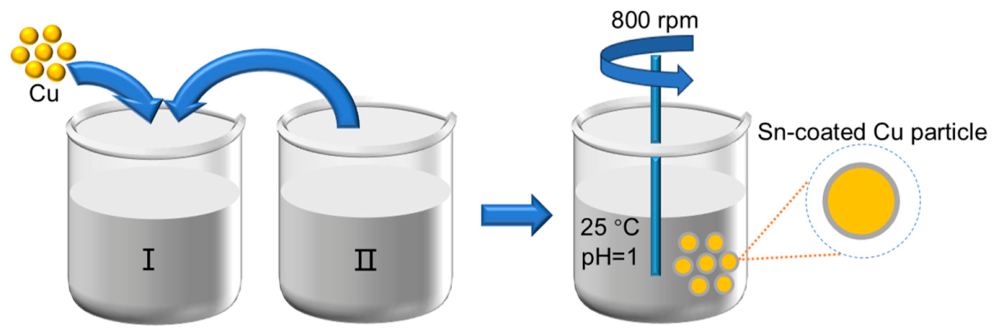
In order to achieve the aforementioned core–shell design, Sn-coated Cu particles were prepared using the chemical Sn-plating method through the following steps. The preparation of Sn-coated Cu particles requires two solutions: the plating solution (Solution I) and the stannous chloride solution (Solution II). The plating solution was composed of CH4N2S (100 g/L), C6H8O7 (30 g/L), C6H6O2 (2.5 g/L), HO(CH2CH2O)nH (2.5 g/L), NaH2PO2·H2O (40 g/L), and EDTA (0.5 g/L) in specific proportions. The stannous chloride (SnCl2) solution was prepared by uniformly dissolving SnCl2 powder (15 g/L) in 10% HCl. Prior to plating, the Cu particles underwent surface treatment with 10% HCl to remove oxides and organic contaminants from their surface, ensuring plating compatibility.
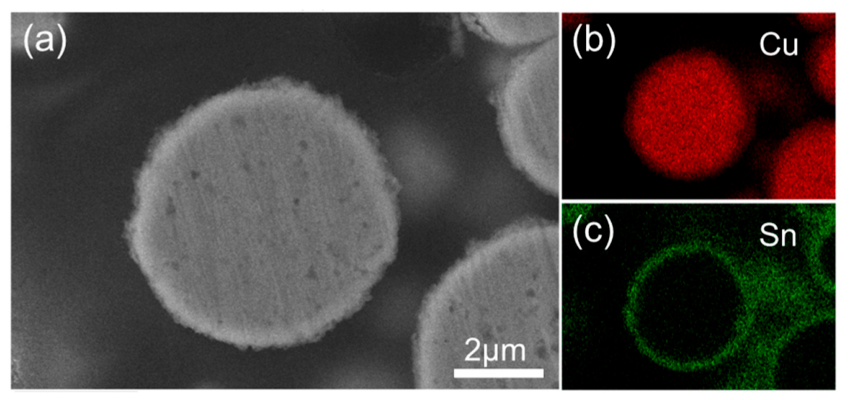
The preparation process of Sn-coated Cu particles is shown in Figure 1. Solution II was poured into Solution I. 10% HCl was added to adjust the pH to 1. Clean Cu particles were then added to Solution I. Magnetic stirring at 25 °C for 1 h yields the Sn-coated Cu particles. The cross-sectional view of the Sn-coated Cu particles and corresponding energy dispersive spectroscopy (EDS) analysis are shown in Figure 2. After drying, Sn-coated Cu particles were mixed with flux (Senju Co., Ltd., Tokyo, Japan) at a mass ratio of 2:1. Stirring at 800 rpm for 2 min yields the Sn-coated Cu solder paste. Flux (Senju Co., Ltd.) was selected because it is a commercially available, no-clean, halogen-free flux with good cost-effectiveness. Using a single flux also enables systematic investigation of other key parameters on solder joint performance.

2.2. Bonding Process

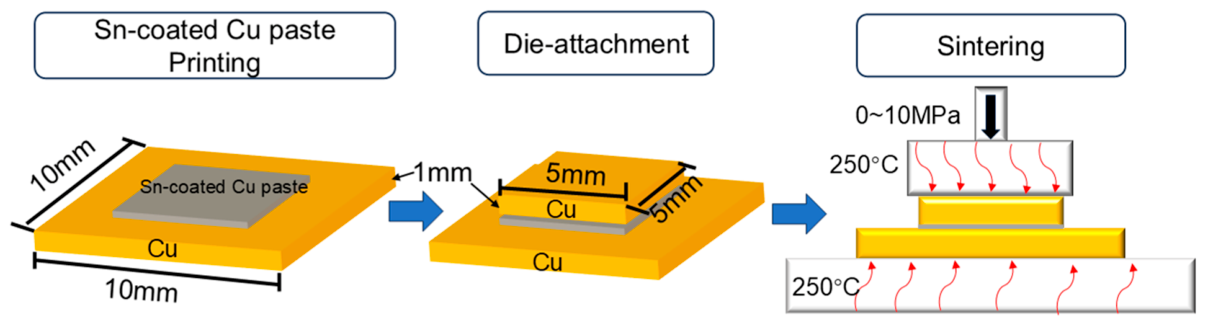
The dimensions of the Cu substrates used were 5 mm × 5 mm × 1 mm and 10 mm × 10 mm × 1 mm. The interconnection process is illustrated in Figure 3. Both surfaces of the upper and lower Cu substrates were cleaned with 10% HCl. Sn-coated Cu solder paste was printed onto the surface of the lower Cu substrate using a 100 μm thick mask. The upper Cu substrate was then placed on top to form a Cu/Sn-coated Cu solder paste/Cu structure. The bonding process was conducted in a nitrogen atmosphere. The bonding temperature was 250 °C, the bonding time ranged from 10 to 30 min, and the bonding pressure varied from 0 to 10 MPa. Table 1 details the specific experimental parameters for each sample. For each bonding condition, three identical samples were prepared and tested to ensure the repeatability of the experiments. The shear strength values reported in this work were presented as the average of the three parallel measurements. The error bars represent the corresponding standard deviation. Using a reference sample bonded at 250 °C with 10 MPa pressure and a 10 min bonding time, the effects of flux content, different bonding times, and varying external pressures on the shear strength of the solder joints were investigated.

2.3. Shear Test

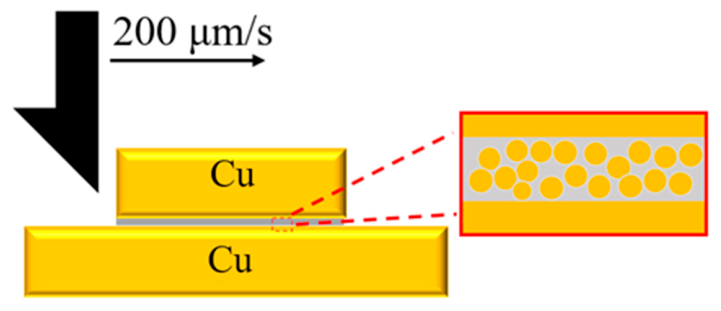
To test the shear strength of experimental samples, shear testing is required. This study employed a shear testing machine (MFM1200, Shenzhen Try Precision Technology Co., Ltd. Shenzhen, China) to conduct shear experiments at a shear rate of 200 μm/s. The shear testing machine provides the shear force required to fracture the experimental samples. By knowing the shear force the joint can withstand and the joint area, the shear strength of the joint can be calculated. Figure 4 illustrates the shear testing process.

3. Results and Discussion

3.1. Effect of Flux Content on the Shear Strength and Microstructure of Joints

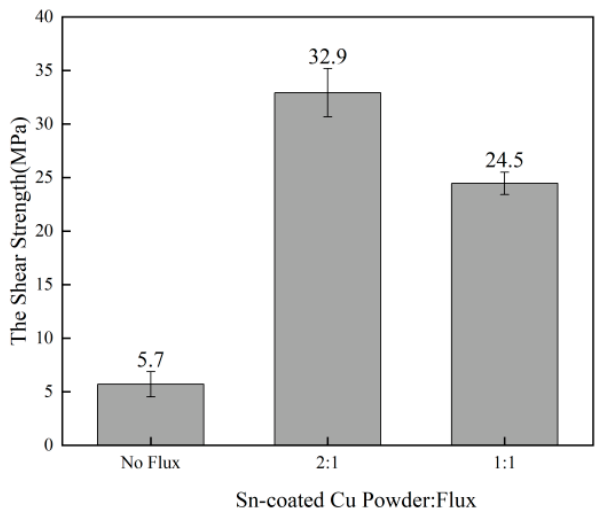
Using the as-prepared Sn-coated Cu solder paste, we first investigated the influence of flux content on the shear strength of solder joints, and then examined the effects of bonding time and applied pressure. Figure 5 shows the shear strength of joints obtained at different flux content. As the flux content increases, the joint shear strength first exhibits a significant increase, followed by a slight decrease. Bonding performance was unsatisfactory without added flux, with joint strength reaching only 5.7 MPa. Appropriate flux addition markedly improved joint shear strength to 32.9 MPa (2:1). However, further increasing flux content caused joint shear strength to decrease to 24.5 MPa (1:1).
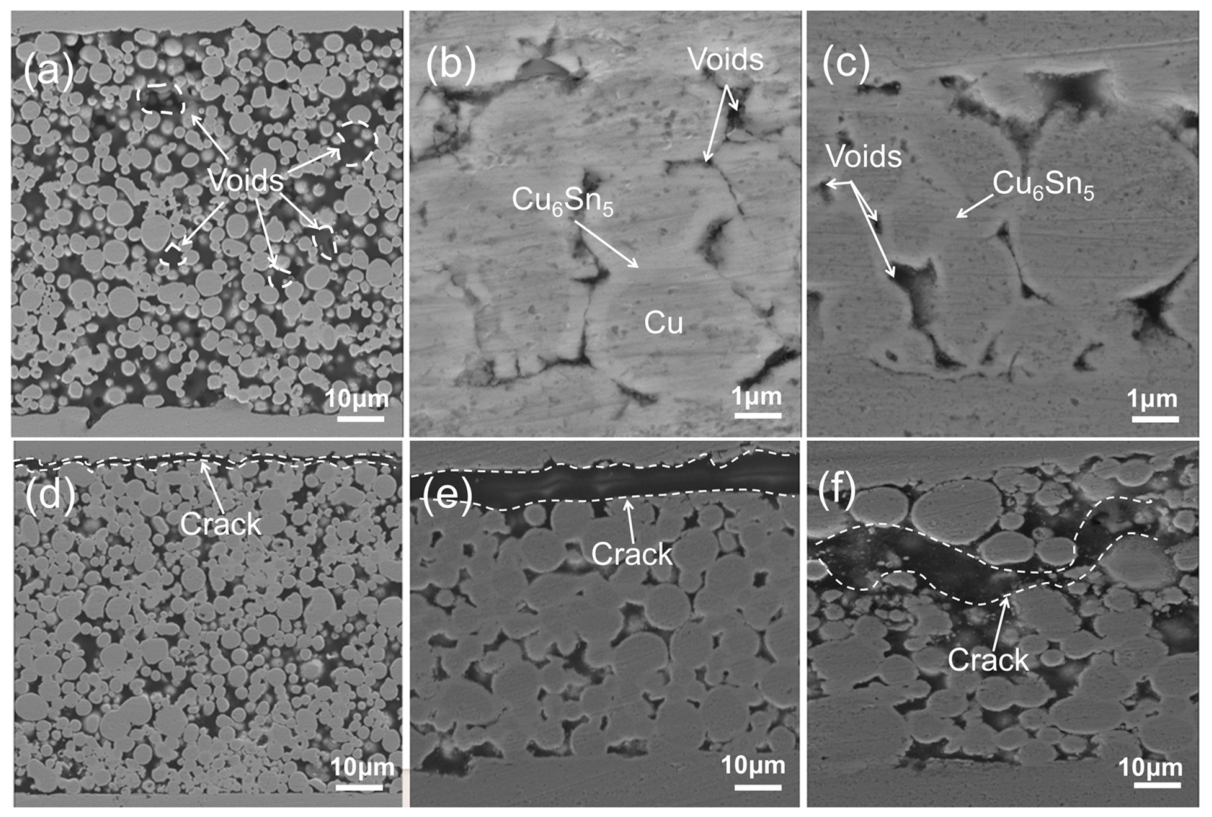
Figure 6 shows cross-sectional views of joints obtained through bonding at different flux contents. As seen in Figure 6, increasing flux content initially reduces internal voids within the joint and then increases them. Figure 6a shows that without flux, oxidation occurs on the surfaces of the solder and Cu substrate during bonding, hindering the reaction between Sn-coated Cu particles. This results in numerous voids forming inside the joint. Figure 6b demonstrates that with appropriate flux addition, the internal voids in the joint are significantly reduced. This is because the active ingredients in flux (such as rosin and organic acids) react with metal oxides of Sn and Cu to form soluble salts or water, exposing fresh metal surfaces. The molten flux covers the liquid Sn surface to form a protective layer, preventing Sn from re-oxidation. The surfactant in the flux reduces the surface tension of liquid Sn, lowering the contact angle between liquid Sn and the Cu to improve wettability. The molten liquid Sn flows between Cu particles, filling the gaps. Simultaneously, the liquid Sn makes close contact with the Cu core and Cu substrate, forming an appropriate thickness of Cu6Sn5 at the interface. This significantly enhances the overall shear strength of the joint. Figure 6c shows that when excess flux is applied, multiple factors contribute to increased internal voids. On the one hand, excess liquid flux displaces the contact between Sn-coated Cu particles under applied pressure, causing displacement and entrapment that lead to incomplete contact and gaps that cannot be fully filled by molten Sn. On the other hand, the organic components in excess flux may volatilize at the bonding temperature of 250 °C, forming entrapped gas bubbles that remain as voids after solidification. Both mechanisms lead to increased internal voids and, consequently, reduced strength.
Figure 6d–f show the fracture interfaces of joints at different flux contents. Figure 6d,e reveal that both the joint fracture at zero flux content and that at a 2:1 mass ratio occur at the solder-substrate interface. The primary reason for the former is the near absence of IMC formation at this interface compared to the joint interior. In the latter case, Cu particles within the joint are embedded within the Cu6Sn5-dominated IMCs network structure, demonstrating greater resistance to shear stress internally than at the interface. Under shear stress, a fracture tends to occur at the interface. As shown in Figure 6f, at a mass ratio of 1:1, the presence of Cu6Sn5 at the interface between Sn-coated Cu particles provides some shear resistance. When subjected to shear stress, cracks initiate at larger voids within the joint and propagate along other voids, ultimately leading to fracture.

3.2. Effect of Bonding Time on the Shear Strength and Microstructure of Joints

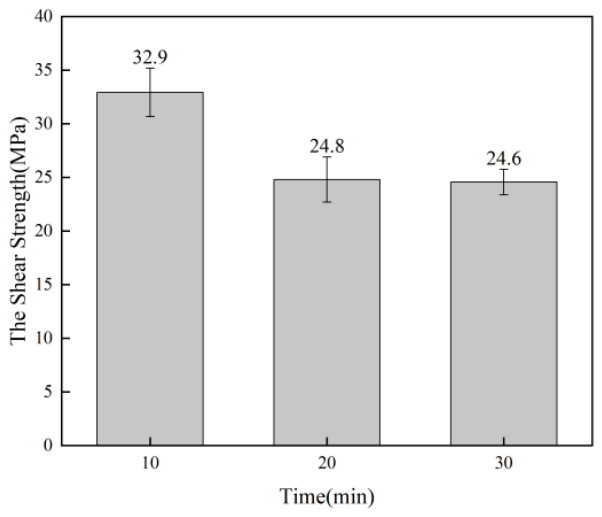
Having established that a Sn-coated Cu particles-to-flux ratio of 2:1 gives the highest strength, we next examined the effect of bonding time under this fixed ratio. Figure 7 illustrates the effect of varying bonding time on the shear strength of joints at a bonding temperature of 250 °C. The shear strength of the joints gradually decreases with increasing bonding time. The maximum shear strength is achieved at a bonding time of 10 min. When the time increases to 20 min, the shear strength decreases from 32.9 MPa to 24.8 MPa, representing a 24.6% reduction in strength. However, when the bonding time is extended to 30 min, the shear strength remains at 24.6 MPa, showing no significant further decrease compared to the 20 min time point. The strength plateau observed between 20 min and 30 min indicates that the microstructure has reached a steady state, where grain coarsening is not yet significant enough to further degrade the interface.
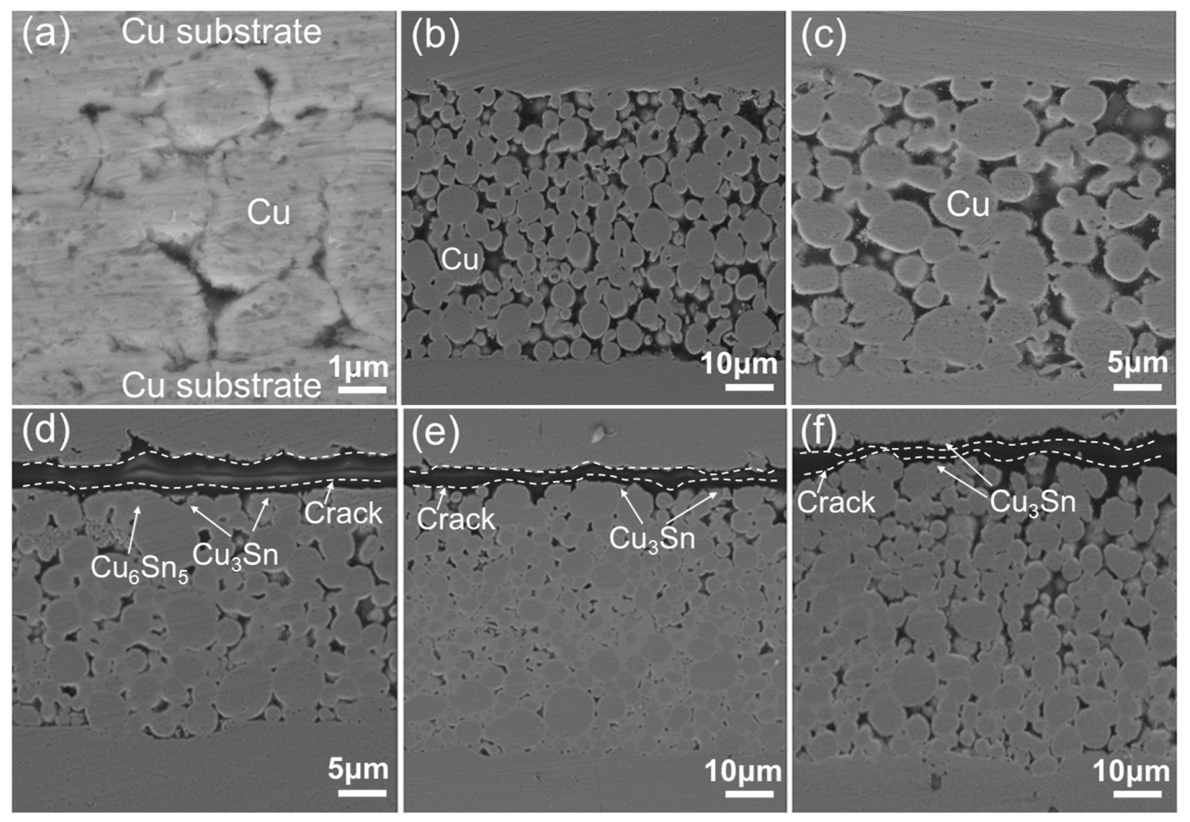
Figure 8a–c show cross-sectional views of joints at different bonding times. Comparing Figure 8a,b reveals that the number of voids within the joint at a bonding time of 20 min is greater than that at 10 min. Comparing Figure 8b,c, it is observed that the cross-sectional morphologies of the joints at bonding times of 20 min and 30 min exhibit similar characteristics. Figure 8d–f display the fracture locations of joints after shear testing at different bonding times. The failure locations for all three bonding times occur at the interface between the Sn-coated Cu particles and the Cu substrate, with Cu3Sn present at each failure site. At a bonding time of 10 min, the thin Sn layer on the Cu particle surface had fully reacted with both the Cu substrate and the Cu particle to form Cu6Sn5. Subsequently, part of the Cu6Sn5 began transforming into Cu3Sn, increasing brittleness at the Cu3Sn formation site. As bonding times reached 20 min and 30 min, Cu6Sn5 had completely transformed into Cu3Sn, resulting in even greater brittleness at the interface. Although no Kirkendall voids were clearly resolved by SEM due to their sub-micron size at the early nucleation stage, the unequal interdiffusion of Cu and Sn is known to promote the nucleation of nanoscale Kirkendall voids at the Cu3Sn/Cu interface [31]. Recent molecular dynamics simulations have further demonstrated that even voids with radii as small as 1 nm cause interfacial collapse and reduce ultimate stress [32]. Therefore, incipient Kirkendall voids can contribute to the degradation of shear strength with prolonged bonding time, even when not directly observable. Moreover, the phase transformation from Cu6Sn5 to Cu3Sn is accompanied by volume contraction, which introduces residual stress at the interface, further promoting crack initiation and propagation. Similar volume shrinkage and residual stress generation induced by IMC growth have been reported at the Cu/solder interface [33]. In addition to these interfacial defects, process-induced voids also exist inside the joint. These internal voids lower shear strength by reducing the effective load-bearing area and acting as stress concentrators that initiate microcracks propagating to the interface. The joint shear strength degradation after 10 min is attributed to the combined effects of the brittle nature of the Cu3Sn phase, the formation of incipient Kirkendall voids, the residual stress induced by phase transformation, and process-induced voids. Nevertheless, the interface between the Cu substrate and Sn-coated Cu particles is a heterogeneous interface prone to stress concentration. Combined with the brittleness of Cu3Sn, residual stress, and incipient Kirkendall voids, this interface remains the weakest link, and the final fracture still occurs at this interface.

3.3. Effect of Pressure on the Shear Strength and Microstructure of Joints

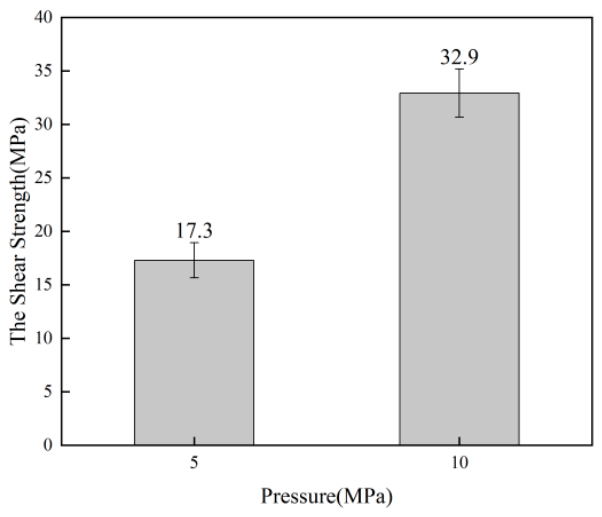
To evaluate the influence of external pressure, bonding time was fixed at 10 min, which was the optimal duration for strength. Figure 9 illustrates the effect of external pressure on the shear strength of joints. The shear strength of the joint increases with rising external pressure. At 5 MPa pressure, the joint exhibits a shear strength of 17.3 MPa. When pressure reaches 10 MPa, the shear strength significantly increases to 32.9 MPa, representing a 90.2% improvement. Notably, under no pressure condition, the joint’s shear strength is so minimal that it cannot be detected during shear testing.
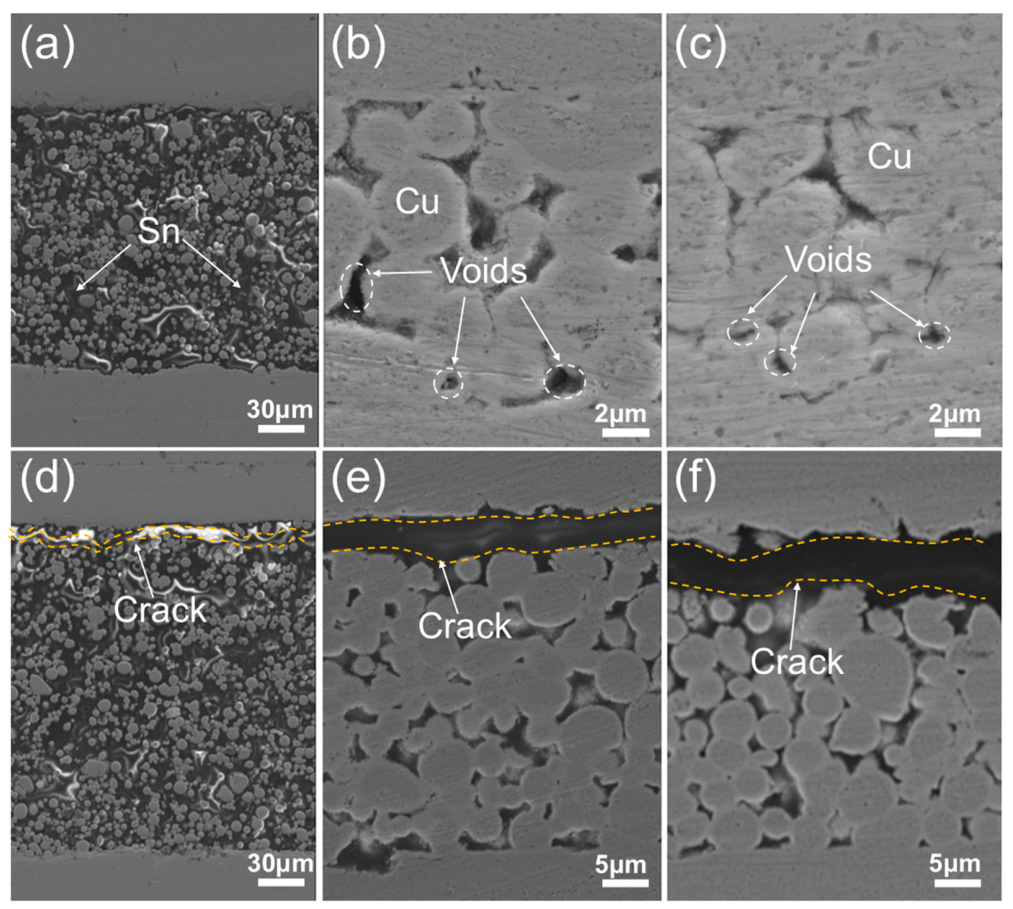
As shown in Figure 10a, without pressure application, the distribution of Sn-coated Cu particles is relatively loose. Without external pressure, the continuous oxide films on the surfaces of the Sn-coated Cu particles and Cu substrate cannot be effectively broken down, severely hindering the atomic diffusion and interfacial reactions required for TLP bonding. As a result, essentially no continuous IMCs are formed across the joint. The Sn-coated Cu particles and Cu substrate cannot fully consume all the Sn within 10 min, resulting in a large amount of unconsumed Sn being trapped between the particles. Thus, the joint fell apart during sample handling, and no measurable shear strength could be recorded—not because the strength was below the load cell resolution, but because no effective bonding was achieved. This explains why the shear strength of the solder joint is undetectable without pressure. Figure 10b,c demonstrate that applying pressure significantly increases the compactness of the Sn-coated Cu particles. This facilitates the filling of inter-particle voids with liquid Sn and accelerates its consumption, resulting in smaller voids or even reduced void formation after reaction. This phenomenon becomes more pronounced with increased pressure. Figure 10d–f present cross-sectional views of fractured joints under varying pressures. The fracture surfaces still originate at the interface between the solder and substrate. However, in Figure 10d, the crack initiates near the substrate at the intergranular Sn and propagates along the interfacial Sn. The fracture patterns in Figure 10e,f resemble those in Figure 8d.

4. Conclusions

In this study, Sn-coated Cu particles were prepared by depositing a layer of Sn onto Cu particles via chemical Sn plating. The Sn-coated Cu particles were then mixed with flux to form solder paste. Molten liquid Sn diffused and reacted on the surfaces of the Cu particles and Cu substrate, forming intermetallic compounds to create robust joints. The effects of flux content, bonding time, and soldering pressure on the shear strength of the joints were investigated. Key findings are summarized as follows:
(a)
Increasing flux content causes joint strength to first increase and then decrease. This may be because an appropriate amount of flux primarily removes oxides from the solder and Cu substrate, facilitating metallurgical reactions. However, excessive flux leads to greater solder flowability, resulting in increased voids between particles when pressure is applied.
(b)
The shear strength of the joint gradually decreases with increasing bonding time, primarily due to the transformation of Cu6Sn5 into Cu3Sn within the joint. At a bonding time of 10 min, partial conversion of Cu6Sn5 to Cu3Sn occurs. When the bonding time reaches 20 min, all Cu6Sn5 is converted to Cu3Sn, leading to increased brittleness in the joint and greater susceptibility to fracture under shear stress.
(c)
Applied pressure significantly affects the shear strength of joints. Without pressure, the shear strength is too low to be detected in shear tests. After pressure application, the shear strength increases markedly, rising by 90.2% at 10 MPa compared to 5 MPa. Increased applied pressure promotes a denser structure within the joint, reducing porosity and even minimizing its formation.
We recognize that the 2:1 powder-to-flux ratio is higher than commercial norms. Future work may explore strategies such as particle morphology optimization, surface passivation of the Sn shell, or bonding in a reducing atmosphere. We also note that other flux types may lead to different void or IMC morphologies, which warrants further investigation.

Supplementary Materials

The following supporting information can be downloaded at: https://www.mdpi.com/article/10.3390/cryst16050353/s1, Figure S1: Comparison between Sn-coated Cu, mixed Cu-Sn and sintered Cu through molecular dynamics.

Author Contributions

Conceptualization, S.H.; Investigation, X.Q., Z.Y. and D.Y.; Resources, S.H.; Data curation, X.Q., Z.Y. and D.Y.; Writing—original draft preparation, X.Q.; Writing—review and editing, S.H., H.Q., H.Y., J.W. and J.L.; Supervision, S.H.; Funding acquisition, S.H. All authors have read and agreed to the published version of the manuscript.

Funding

This research was financially supported by the Guangxi Science and Technology Program (No. Guike JF2504850030), the Huizhou Outstanding Young Project of Science and Technology (No. 2025EQ050017), the National Natural Science Foundation of China (No. 52465037), Innovation Project of GUET Graduate Education (No. 2025YCXS018, No. 2025YCXS024), and College Students’ Innovation and Entrepreneurship Training Program of GUET (No. S202510595175).

Data Availability Statement

The data presented in this study are available on request from the corresponding author/Supplementary Materials.

Acknowledgments

The authors gratefully acknowledge Pan Zhiliang for his guidance on molecular dynamics simulations. During the preparation of this manuscript, the authors used DeepSeek for language polishing and grammatical refinement. The authors bear full responsibility for the final content of the publication.

Conflicts of Interest

Jian Li was employed by the Techshine Electronics Co., Ltd. The remaining authors declare that the research was conducted in the absence of any commercial or financial relationships that could be construed as a potential conflict of interest.

References

  1. Buttay, C.; Planson, D.; Allard, B.; Bergogne, D.; Bevilacqua, P.; Joubert, C.; Lazar, M.; Martin, C.; Morel, H.; Tournier, D.; et al. State of the art of high temperature power electronics. Mater. Sci. Eng. B 2011, 176, 283–288. [Google Scholar] [CrossRef]
  2. Ma, K.; Liserre, M.; Blaabjerg, F.; Kerekes, T. Thermal Loading and Lifetime Estimation for Power Device Considering Mission Profiles in Wind Power Converter. IEEE Trans. Power Electron. 2015, 30, 590–602. [Google Scholar] [CrossRef]
  3. Zeng, Z.; Shao, W.; Chen, H.; Hu, B.; Chen, W.; Li, H.; Ran, L. Changes and challenges of photovoltaic inverter with silicon carbide device. Renew. Sustain. Energy Rev. 2017, 78, 624–639. [Google Scholar] [CrossRef]
  4. Ju, Y.; Kim, T.; Lee, S.; Lee, H.; Ahn, J.; Kim, H. Advanced WBG power semiconductor packaging: Nanomaterials and nanotechnologies for high-performance die attach paste. Nano Converg. 2025, 12, 38. [Google Scholar] [CrossRef]
  5. Chin, H.; Cheong, K.; Ismail, A. A Review on Die Attach Materials for SiC-Based High-Temperature Power Devices. Metall. Mater. Trans. B 2010, 41, 824–832. [Google Scholar] [CrossRef]
  6. Varley, J.; Shen, B.; Higashiwaki, M. Wide bandgap semiconductor materials and devices. J. Appl. Phys. 2022, 131, 230401. [Google Scholar] [CrossRef]
  7. Gui, Q.; Wang, Z.; Cheng, C.; Zha, X.; Robertson, J.; Liu, S.; Zhang, Z.; Guo, Y. Theoretical study of the interface engineering for H-diamond field effect transistors with h-BN gate dielectric and graphite gate. Appl. Phys. Lett. 2022, 121, 211601. [Google Scholar] [CrossRef]
  8. Qu, G.; Guo, W.; Zhang, C.; Xue, J.; Peng, Z.; Yin, C.; He, S.; Zou, G.; Jia, Q.; Zhang, H. Improving thermal stability and reliability of power chips by sintering foam structure layer. Appl. Mater. Today 2024, 40, 102397. [Google Scholar] [CrossRef]
  9. Liu, X.; He, S.; Nishikawa, H. Low temperature solid-state bonding using Sn-coated Cu particles for high temperature die attach. J. Alloys Compd. 2017, 695, 2165–2172. [Google Scholar] [CrossRef]
  10. Zhou, J.; Zhong, L.; Feng, X.; Zhang, W.; Liu, X.; Zhou, H.; Liu, Z.; Hao, Y.; Zhang, J. Recent Advances in Device-Level Thermal Management Technologies for Wide Bandgap Semiconductor: A Review. IEEE Trans. Electron Devices 2025, 72, 2769–2782. [Google Scholar] [CrossRef]
  11. Suganuma, K.; Kim, K. Sn-Zn low temperature solder. J. Mater. Sci.—Mater. Electron. 2007, 18, 121–127. [Google Scholar] [CrossRef]
  12. Chidambaram, V.; Hattel, J.; Hald, J. High-temperature lead-free solder alternatives. Microelectron. Eng. 2011, 88, 981–989. [Google Scholar] [CrossRef]
  13. Gerhátová, Z.; Babincová, P.; Drienovsky, M.; Pasák, M.; Cernicková, I.; Duriska, L.; Havlík, R.; Palcut, M. Microstructure and Corrosion Behavior of Sn-Zn Alloys. Materials 2022, 15, 7210. [Google Scholar] [CrossRef] [PubMed]
  14. Li, S.; Li, Q.; Cao, H.; Zheng, X.; Zhang, Z. Significant enhancement of comprehensive properties of SnBi solder through the addition of Cu@Ag core-shell particles. Mater. Sci. Eng. A 2023, 881, 145392. [Google Scholar] [CrossRef]
  15. Martin, H.; Libon, S.; Smits, E.; Poelma, R.; van Driel, W.; Zhang, G. Thermal characterization methodology for thin bond-line interfaces with conductive materials. Therm. Sci. Eng. Prog. 2024, 53, 102754. [Google Scholar] [CrossRef]
  16. Schwan, H.; Mohan, N.; Schmid, M.; Saha, R.; Klassen, H.; Müller, K.; Elger, G. Sintering for High Power Optoelectronic Devices. Micromachines 2025, 16, 1164. [Google Scholar] [CrossRef] [PubMed]
  17. Zhang, B.; Wang, L.; Xie, Y.; Liu, Y.; Wang, Y.; Liu, Y.; Mei, Y. Simultaneous Enhancement of Electrochemical Migration Lifetime and Reliability of Sintered Silver. IEEE Trans. Device Mater. Reliab. 2025, 25, 535–544. [Google Scholar] [CrossRef]
  18. Kim, K.; Bang, J.; Jung, S. Electrochemical migration behavior of silver nanopaste screen-printed for flexible and printable electronics. Curr. Appl. Phys. 2013, 13, S190–S194. [Google Scholar] [CrossRef]
  19. Jin, Z.; Huo, F.; Wang, J.; Liu, X.; Chan, Y.; Nishikawa, H. Electromigration-induced microstructure evolution and failure mechanism of sintered nano-Ag joint. Mater. Charact. 2023, 205, 113309. [Google Scholar] [CrossRef]
  20. Matsuda, T.; Okubo, S.; Kambara, M.; Hirose, A. Enhancing post-bonding oxidation resistance of low-pressure Cu sintered joints via residual reductant retention. J. Mater. Sci. 2025, 60, 19236–19248. [Google Scholar] [CrossRef]
  21. Zuo, Y.; Robador, A.; Wickham, M.; Mannan, S. Unraveling the complex oxidation effect in sintered Cu nanoparticle interconnects during high temperature aging. Corros. Sci. 2022, 209, 110713. [Google Scholar] [CrossRef]
  22. Zhang, B.; Xie, Y.; Wang, L.; Liu, Y.; Wang, Y.; Niu, P.; Mei, Y. Pulsed electric current-assisted transient liquid phase sintering for extremely reliable Cu-Cu direct bonding. Mater. Sci. Eng. A 2025, 943, 148766. [Google Scholar] [CrossRef]
  23. Heo, M.; Seo, Y.; Yoon, J. Transient liquid phase bonding using Cu foam and Cu-Sn paste for high-temperature applications. J. Mater. Res. Technol. 2023, 27, 2856–2867. [Google Scholar] [CrossRef]
  24. Xiong, B.; Luo, C.; Li, X.; Hu, L.; Dong, H.; He, S.; Liang, Z.; Zhang, N.; Qin, H.; Nishikawa, H. Cu/Sn-58Bi/Microporous-Cu Composite Joint Formation via Capillary-Driven Transient Liquid-Phase Bonding Under Air Atmosphere. J. Electron. Mater. 2026, 55, 1595–1606. [Google Scholar] [CrossRef]
  25. Yoon, J.; Bae, S.; Lee, B.; Jung, S. Bonding of power device to ceramic substrate using Sn-coated Cu micro paste for high-temperature applications. Appl. Surf. Sci. 2020, 515, 146060. [Google Scholar] [CrossRef]
  26. Chen, H.; Hu, T.; Li, M.; Zhao, Z. Cu@Sn Core-Shell Structure Powder Preform for High-Temperature Applications Based on Transient Liquid Phase Bonding. IEEE Trans. Power Electron. 2017, 32, 441–451. [Google Scholar] [CrossRef]
  27. Lin, K.; Ling, H.; Hu, A.; Wu, Y.; Gao, L.; Hang, T.; Li, M. Growth behavior and formation mechanism of porous Cu3Sn in Cu/Sn solder system. Mater. Charact. 2021, 178, 111271. [Google Scholar] [CrossRef]
  28. Zhang, Q.; Zhang, Z.; Zeng, F.; Li, W.; Liu, J.; Ai, S.; Zheng, Y.; Li, Z.; Shao, H.; Liu, Z.Q. Revealing crystal defects induced Kirkendall voiding in Cu/Sn solder joints. Rare Met. 2025, 44, 6643–6660. [Google Scholar] [CrossRef]
  29. He, S.; Liu, X.; Pan, Z.; Gao, S.; Zuo, Y.; Nishikawa, H. Tailored microstructure and enhanced bonding strength of in-situ surface modified Cu flakes via oxidation-reduction bonding. Mater. Des. 2025, 254, 114048. [Google Scholar] [CrossRef]
  30. Li, M.; Zhang, L.; Gao, L.; Wang, X.; Chen, C.; Lu, X. Interfacial structures and mechanical properties of Cu/Sn/Cu containing SiC nanowires under transient liquid phase bonding. Intermetallics 2022, 148, 107641. [Google Scholar] [CrossRef]
  31. Weinberg, K.; Böhme, T. Condensation and Growth of Kirkendall Voids in Intermetallic Compounds. IEEE Trans. Compon. Packag. Technol. 2009, 32, 684–692. [Google Scholar] [CrossRef]
  32. Wu, C.; Liu, K. Effects of location and size of Kirkendall voids on mechanical response of Cu/Sn solder joint under tension. Mol. Simul. 2023, 49, 885–892. [Google Scholar] [CrossRef]
  33. Tian, R.; Hang, C.; Tian, Y.; Wu, B.; Liu, Y.; Zhao, J. Interfacial intermetallic compound growth in Sn-3Ag-0.5Cu/Cu solder joints induced by stress gradient at cryogenic temperatures. J. Alloys Compd. 2019, 800, 180–190. [Google Scholar] [CrossRef]
Figure 1. Preparation of Sn-coated Cu particles.
Crystals 16 00353 g001
Figure 2. Cross-section and corresponding EDS mapping of Sn-coated Cu particles: (a) cross-section of Sn-coated Cu particles; (b) the distribution of Cu atoms; (c) the distribution of Sn atoms.
Crystals 16 00353 g002
Figure 3. Procedure steps of the bonding process.
Crystals 16 00353 g003
Figure 4. Shear test process.
Crystals 16 00353 g004
Figure 5. Shear strength of joints obtained at different mass ratios of Sn-coated Cu particles and flux.
Crystals 16 00353 g005
Figure 6. Cross-sectional views of joints obtained through bonding at different flux contents: (a) Joint obtained without flux; (b) Joint obtained with the mass ratio of 2:1; (c) Joint obtained with the mass ratio of 1:1; (d) Fracture joint obtained without flux; (e) Fracture joint obtained with the mass ratio of 2:1; (f) Fracture joint obtained with the mass ratio of 1:1.
Crystals 16 00353 g006
Figure 7. Shear strength of joints obtained at different times.
Crystals 16 00353 g007
Figure 8. Cross-sectional views of joints obtained through bonding at different times: (a) Joint obtained at 10 min; (b) Joint obtained at 20 min; (c) Joint obtained at 30 min; (d) Fracture joint obtained at 10 min; (e) Fracture joint obtained at 20 min; (f) Fracture joint obtained at 30 min.
Crystals 16 00353 g008
Figure 9. Shear strength of joints obtained under different pressures.
Crystals 16 00353 g009
Figure 10. Cross-sectional views of joints obtained through bonding at different pressures: (a) Joint obtained with no pressure; (b) Joint obtained at 5 MPa; (c) Joint obtained at 10 MPa; (d) Fracture joint obtained with no pressure; (e) Fracture joint obtained at 5 MPa; (f) Fracture joint obtained at 10 MPa.
Crystals 16 00353 g010
Table 1. Experimental parameters for each sample.
Temperature (°C)Time (min)Pressure (MPa)Mass Ratio (Sn-Coated Cu Particles:Flux)
2501010Sn-coated Cu particles (100%)
2501010 2:1
25010101:1
25020102:1
25030102:1
25010No2:1
2501052:1
Disclaimer/Publisher’s Note: The statements, opinions and data contained in all publications are solely those of the individual author(s) and contributor(s) and not of MDPI and/or the editor(s). MDPI and/or the editor(s) disclaim responsibility for any injury to people or property resulting from any ideas, methods, instructions or products referred to in the content.