Review

Impact of Advanced Ceramic-Based Structures on the Design and Technology of Receiving Antennas for Global Navigation Satellite System


by
Romeo Cristian Ciobanu
1,*,
Alina Ruxandra Caramitu
2,*,
Magdalena Valentina Lungu
2,
Ioana Ion
2,
Mircea Popescu
2,
Adrian Parfeni
1 and
Răducu Machidon
1
1
Department of Electrical Measurements and Materials, Gheorghe Asachi Technical University, Bdul. D. Mangeron 71, 700050 Iasi, Romania
2
National Institute for Research and Development in Electrical Engineering (ICPE-CA), 030138 Bucharest, Romania
*
Authors to whom correspondence should be addressed.
Crystals 2026, 16(5), 348; https://doi.org/10.3390/cryst16050348
Submission received: 2 March 2026 / Revised: 13 May 2026 / Accepted: 15 May 2026 / Published: 19 May 2026
(This article belongs to the Section Polycrystalline Ceramics)

Abstract

This study emphasizes how the Global Navigation Satellite System (GNSS) receiving antenna technology transcends the boundaries of traditional ceramics manufacturing techniques, expanding their design options and improving the functional attributes of ceramic components for GPS, Galileo, GLONASS, and BeiDou applications. Ceramics exhibit exceptional material characteristics, such as excellent thermal resistance, outstanding electrical insulation, considerable hardness, and notable wear resistance, making them suitable for GNSS technology, due to their capacity to form intricate shapes and microstructures for applications in aerospace, electronics, and automotive sectors. The research systematically outlines the impact of advanced ceramic-based structures upon various antenna design, technology and types, relevant to their particular applications: antennas with alumina substrates, antennas that use FR4 substrate, antennas that use a PCB substrate, antennas with a dielectric ceramic backing, and antennas employing different concepts of Rogers substrates. This study also highlights temperature-stable ceramics, which represent a novel development in research, crucial for improving GNSS technology due to their ability to retain a consistent dielectric constant over a broad temperature range; these ceramics eliminate frequency variations in patch and dielectric resonator antennas, guaranteeing precise signal reception, even in extreme outdoor and satellite conditions.

1. Introduction

Advanced ceramic-based structures are insulators with high permittivity (ε), low dielectric loss (tgδ), and high breakdown strength, crucial for microelectronics, high-power electronics, power grids, and military applications [1,2]. Due to the high demand in modern society for advanced dielectrics, the development of materials with high energy storage capacity has received increased attention [3,4,5]. Common materials have included assemblies of high-k ceramic composites (e.g., BNT-7BT-BMN), specialized polymers (e.g., PVDF), and low-k materials (e.g., Black Diamond™, Black Diamond Equipment, Salt Lake City, UT, USA), designed to improve the performance of RF applications [6,7].
In 2025, the world market for the Global Navigation Satellite System (GNSS) receivers and antennas was valued at USD 5.12 billion. The market is expected to increase from USD 5.45 billion in 2026 to USD 8.15 billion by 2034, demonstrating a CAGR of 5.2% throughout the forecast period [8].
GNSS antennas and receivers are essential elements for capturing and interpreting signals from satellite networks such as GPS, GLONASS, Galileo, and BeiDou. These systems offer accurate positioning, navigation, and timing (PNT) information and are distinguished by their multi-constellation, multi-frequency tracking abilities. They usually include adaptable, energy-efficient designs, software that can be updated in the field, and strong data logging capabilities. A crucial characteristic is their robust design, which makes them ideal for use in tough environments for a range of challenging applications. The growth of the market is mainly fueled by the rising need for accurate location data in various industries. Major applications driving this growth comprise precision agriculture, self-driving cars, and drones (UAVs), in addition to essential infrastructure and surveying. Nonetheless, the market faces difficulties such as signal susceptibility to jamming and spoofing, which has driven considerable investment in robust PNT technologies, mainly in ceramic technologies used in the GNSS antennas. Moreover, the continual upgrade of worldwide satellite constellations and the fusion of GNSS with additional sensors, such as inertial navigation systems (INSs), are opening new paths for innovation, guaranteeing ongoing improvements in precision and dependability [8,9].
Our interest in the intersection of advanced ceramic materials and GNSS receiving antenna technology did not arise from a single moment of insight, but rather from a cumulative frustration encountered repeatedly across research projects, literature surveys, and design exercises. The frustration can be stated simply: the two communities that should be in constant dialogue—materials scientists working on microwave dielectrics, and antenna engineers designing receivers for satellite navigation—have developed largely parallel, self-referential bodies of literature that rarely speak to each other in a direct and actionable way. On the materials side, the literature is rich and technically impressive. Researchers have systematically explored families of microwave dielectric ceramics with precisely tuned permittivity values, ultra-low dielectric loss tangents, and temperature coefficients of resonant frequency that approach zero across wide thermal ranges. Compounds such as BaTiO3—based nanocrystalline ceramics, Ba4.5(Sm0.8La0.2)9Ti18O54, NaSrYb(Mo1−xWxO4)3, and Li2MoO4–BaV2O6 systems have been synthesized, characterized, and reported with meticulous attention to microstructural detail, crystallographic phase composition, and dielectric performance across frequency ranges extending from the sub-gigahertz regime to well into the millimeter-wave region. The performance of a GNSS receiving antenna is governed by a set of specific and stringent requirements that directly determine the quality of the navigation solution. First, right-hand circular polarization (RHCP) is mandatory, as all GNSS constellations transmit circularly polarized signals; the axial ratio—a measure of polarization purity—must be maintained below 3 dB across the operational bandwidth to ensure efficient signal capture and rejection of multipath-reflected signals, which are predominantly left-hand circularly polarized (LHCP). Second, multipath behavior is a critical design consideration: ceramic substrates must support antenna radiation patterns with low back-lobe radiation and high front-to-back ratios to suppress signals arriving at low elevation angles, which are the primary source of multipath errors in urban and constrained environments. Third, phase-center stability is essential for high-accuracy applications such as real-time kinematic (RTK) positioning and geodetic surveying; any variation in the electrical phase center with frequency or azimuth translates directly into positioning errors at the centimeter level. Fourth, temperature stability of the dielectric substrate must be ensured across a wide operating range, typically from −40 °C to +85 °C, to prevent resonant frequency drift that would compromise signal reception reliability in aerospace, automotive, and outdoor applications. Fifth, the trade-off between miniaturization and radiation efficiency represents a fundamental engineering challenge: while high-permittivity ceramics (εr = 20–100) enable significant reductions in patch antenna dimensions—down to 10 × 10 mm at L1/L5 frequencies—increasing εr also narrows the radiation bandwidth and reduces efficiency, requiring careful material selection and design optimization. Finally, environmental robustness—including resistance to moisture, thermal cycling, mechanical shock, and vibration—is indispensable for deployment in aerospace and industrial platforms [8,9].
The advancement of technology for advanced ceramic materials used in GNSS receiving antennas is closely linked to the mandatory requirements for specific applications: 1. miniaturization: high permittivity (typically 20–100) allows patch antennas to shrink to sizes as small as 10 × 10 mm while operating at L1/L5 frequencies; 2. minimal loss vs. maximum gain: materials exhibit extremely low loss (10−5), ensuring that the feeble GNSS signal stays preserved; 3. temperature stability: the materials must ensure the antenna’s phase center stays stable, which is crucial for precise (RTK) positioning in drones, vehicles, and wearable devices; 4. strength: they need to offer remarkable mechanical toughness, resisting environmental stresses in industrial and aerospace environments.
In this paper, the most relevant ceramic-based structures used in recent years as substrates for the realization of GNSS antennas technology have been analyzed. The review is organized following two interconnected chains: (i) material family—dielectric properties (permittivity, dielectric loss, temperature coefficient of resonant frequency)—GNSS-relevant antenna consequences, and (ii) processing route/crystallinity/microstructure—dielectric loss/temperature stability. The literature survey draws on five key categories: MWDC, LTCC, other low-loss dielectric systems, review articles on GNSS antennas, and DRA technologies [10,11,12,13,14,15,16,17,18,19,20,21,22,23,24,25,26,27,28,29].
Our interest in the intersection of advanced ceramic materials and GNSS receiving antenna technology grew out of a recurring practical observation: although the literature on microwave dielectric materials is exceptionally rich, it remains largely disconnected from the concrete requirements of satellite reception systems. Materials studies report outstanding properties—high permittivity, elevated Q-factor, and near-zero temperature coefficient—without explicitly drawing the link to antenna performance in the L1, L2, or L5 bands, to phase center stability, or to behavior under multipath conditions. The research systematically showcases the support materials linked to various antenna types, design and technology, relevant to their particular applications. Finally, the viewpoints on the development of advanced ceramic materials for GNSS receiving antenna technology are detailed.

2. Utility of This Study and Potential Beneficiaries

In constructing this review, we deliberately prioritized papers that made the connection between material properties and antenna performance explicit, even when the antenna application was not GNSS-specific. We included work on patch antennas, dielectric resonator antennas (DRAs), chip antennas, and LTCC-based multilayer structures, organized not by antenna type alone but by the material logic that connects them. We also included work on laminate substrates—Rogers, RT/Duroid, FR-4—not because these are ceramic in the strict sense, but because they constitute the practical baseline against which ceramic substrates are evaluated in the antenna engineering community, and because understanding their limitations is essential to motivating the turn toward more advanced materials. The current technological context provides particular justification for a systematic review dedicated to advanced ceramics in GNSS antennas. Three converging trends are placing unprecedented pressure on antenna design:
  • The transition to the L5 signal (1176.45 MHz), which offers significantly better accuracy than L1 and L2 but imposes stricter requirements on the antenna’s resonant frequency stability—a domain in which zero-TTC ceramics (near-zero temperature coefficient of resonant frequency) become essential.
  • Accelerated miniaturization demanded by UAV drones, autonomous vehicles, and wearable devices, requiring high-permittivity substrates (εr = 20–100) to reduce patch dimensions to 10 × 10 mm or less, without degrading gain or circular polarization performance.
  • The intensification of jamming and spoofing threats, which necessitates high-Q antennas capable of rejecting out-of-band interference, and the adoption of Controlled Reception Pattern Antenna (CRPA) technology—both critically dependent on substrate dielectric properties.
At the same time, the specialist literature has become considerably fragmented: materials studies on LTCC ceramics, DRA resonators, ceramic–metal composites, and 3D-printed ceramics evolve in parallel with the antenna design literature, with insufficient bridging between the two. The present review addresses this need for synthesis.
Furthermore, the emergence of additive manufacturing techniques—binder jet 3D printing, aerosol jet printing on Kapton or ceramic substrates—opens new possibilities for complex geometries and custom substrates that have not yet been sufficiently systematized. Recent studies [14,19,29] demonstrate that 3D-printed ceramic patch antennas can match or exceed the performance of those on conventional laminate substrates.
The utility of this review thus lies in: (1) mapping the current state of thermally stable ceramics for GNSS applications; (2) correlating dielectric properties (εr, tgδ, τf) with their functional consequences in satellite receiving antennas; and (3) identifying research gaps and priority directions for the 2025–2034 decade.
The present review addresses a diverse audience, each segment benefiting from it in a distinct way:
-
Materials science researchers
For those working on new ceramic formulations—zero-TTC ceramics, doped LTCC systems, Ba1−xSrxZn2Si2O7 composites, Li6B4O9 or NaSrYb(Mo,W)O4 systems—the review provides a functional evaluation framework: it is not sufficient to report εr and Q × f; one must demonstrate that the material satisfies the specific constraints of a GNSS system (thermal stability in ppm/°C, compatibility with silver co-firing, and processability at low sintering temperatures). This review supplies these evaluation criteria explicitly and systematically.
-
Antenna and RF engineers
Designers of patch, DRA, or chip antennas for GNSS receivers will find in this review a map of available substrate strategies, with their key properties and references to experimentally validated designs. From Rogers/RT-Duroid substrates for rapid prototyping, to high-permittivity ceramics for extreme miniaturization, to flexible polymer substrates for wearables—the systematic classification significantly reduces the effort of material selection in the design phase.
-
GNSS industry and antenna manufacturers
Companies producing ceramic GNSS antennas—active patch modules, chip antennas, or DRA configurations—can use the review as a reference document for orienting their technology roadmap. The anticipated market growth (from USD 5.45 billion in 2026 to USD 8.15 billion by 2034) implies intensifying competition, and the competitive advantage will be determined by the ability to integrate zero-TTC ceramics into compact modules compatible with mass manufacturing processes: co-firing with silver electrodes, additive printing, and multi-layer LTCC integration.
-
Critical applications community
System designers for precision agriculture, autonomous vehicles, UAV drones, aerospace applications, and critical infrastructure benefit from a clear perspective on technical trade-offs: miniaturization vs. gain, bandwidth vs. thermal stability, cost vs. accuracy. The review emphasizes that thermally stable ceramics are not a luxury but a necessary condition for sub-centimeter RTK positioning under severe thermal variation—a standard requirement in the applications listed above.
-
Early-career researchers
Not least, this review constitutes a structured entry point for doctoral students and young researchers seeking to familiarize themselves with the field of ceramics for microwave GNSS applications. The organization by material family, the correlation with antenna type and specific application, and the identification of research gaps represent a valuable guide for formulating research topics that are both relevant and well-anchored in the current state of the art.

3. Overview on the Essential Advanced Ceramic-Based Structures, Typical Ceramic-Based Antenna Designs, Benefits of GNSS Technology and Role of Advanced Ceramic-Based Structures in GNSS Antenna Technology

Ceramic-based structures play a key role in antenna construction, offering high dielectric constants, minimal signal loss, and high-frequency stability, characteristics that are essential for capturing weak satellite signals. These materials allow the size of antenna components (such as patches and chips) to be reduced, while maintaining performance. The most important classes of materials are the following:
-
High-dielectric constant ceramics such as ZTA (zirconium-tempered alumina, ZrO2-TiO2-Al2O3) and magnesium titanate (MgTiO3), generally having a dielectric constant (εr) of 9–11, with sophisticated designs reaching 15 or more.
-
Low-temperature co-fired ceramics (LTCC)—materials that facilitate 3D packaging and multilayer integration, crucial for minimizing antenna size—microwave dielectric ceramics—which exhibit a low dielectric loss (tgδ), ensuring minimal signal degradation.
-
Ferroelectric ceramics, both in bulk and thin film form, are widely used to improve the performance of GNSS antennas, particularly by enabling miniaturization. These materials, such as BST, ZA, and BT, possess high dielectric constants and ferroelectric properties that allow antennas to be significantly smaller while maintaining high sensitivity in the L1, L2, and L5 bands [5].
The main function is performed by dielectric ceramics, (BST or MT), chosen for their performance in maintaining stable electrical properties over a wide temperature range, properties crucial for reliable navigation. LTCC ceramics are also used to create compact, multilayer antennas that offer excellent performance at high frequency (≥5 GHz). Microwave ceramics (AlN, SiC) are used for their outstanding thermal conductivity, advantageous in high power or high temperature situations. Glass ceramics are used to create extremely compact DRAs for multi-band GNSS applications. Finally, 3D-printed ceramics use additive manufacturing methods that allow the production of GPS L1/Galileo E1 antennas. Another class of materials is represented by ceramic–metal composites designed to improve structural integrity and reduce signal losses, whereas silver plating is used due to its excellent conductivity.
The classes of antenna designs are ceramic patch antennas; layered ceramic patch antennas; DRA antennas; chip antennas; compact, surface mount antennas.
The use of advanced ceramic-based structures in the design and technology of receiving antennas for GNSS systems presents the following benefits:
-
Miniaturization—high permittivity allows for smaller patch sizes.
-
Anti-multipath and high accuracy ensure right circular polarization (RHCP) and maintain high phase center stability, minimizing errors in environments with high multipath density.
-
Durability—ceramics exhibit thermal stability and resistance to corrosion, humidity, and vibration, making them ideal for aerospace and industrial environments.
-
Active integration—ceramic antennas combine a low noise amplifier (LNA) and filters (SAW/BAW) in a single module to amplify weak satellite signals.
The role of advanced ceramic-based structures in GNSS antenna technology is very important because they possess two chains of interconnected properties that govern material selection and ultimately determine antenna performance.
Chain I—material family → dielectric properties → GNSS antenna consequences. Each ceramic material family is characterized by three key dielectric parameters: εr, tgδ, and τf. High εr (20–100) reduces the guided wavelength, allowing patch miniaturization [27,29]. Ultra-low tgδ (<10−3) preserves the amplitude of weak GNSS signals—received power down to −130 dBm—maintaining the signal-to-noise ratio required for reliable positioning [13,18]. Near-zero τf (≈0 ppm/°C) prevents resonant frequency drift, ensuring phase center stability—a prerequisite for centimeter-level RTK accuracy—over the entire operating range from −40 °C to +85 °C [22,24,30].
Chain II—processing route/crystallinity/microstructure → dielectric loss/thermal stability. The synthesis method determines the phase purity, crystallite size and grain boundary density. High crystallinity and controlled grain size minimize grain boundary scattering and reduce tgδ [14,18]. Substitutional doping [18,24] modifies the ionic polarizability, allowing simultaneous optimization of tgδ and τf. Nanocrystalline processing routes, such as binder jet 3D printing [15], introduce porosity effects that must be controlled to preserve dielectric performance at the target GNSS frequencies.
This review draws systematically on five categories of literature—(1) MWDC [10,13,14,18,21,24]; (2) LTCC and low-loss dielectric systems [16,17,22,26]; (3) review articles on GNSS antennas [27,28,29,31,32,33]; (4) patch antennas [14,15,16,23,25,34]; and (5) DRA [12,13,18,20,22,25,26,34]—to ensure comprehensive and GNSS-focused coverage. The ceramic families analyzed include high-εr perovskites (BaTiO3, Ba4.5(Sm,La)9Ti18O54), medium—εr titanate and vanadate systems (MgTiO3, Zn2V2O7, Sr3−xCaxV2O8), low-εr molybdate and tungstate ceramics (Li2MoO4-BaV2O6, NaSrYb(Mo,W)O4), and LTCC composite systems (cordierite, Li6B4O9). The exact formulation and design for the ceramic substrate depend on the target application: a smartphone antenna requires a compact, low-cost solution, whereas a geodetic surveying instrument demands an ultra-stable, high-accuracy substrate.

4. Laminated Substrates Based on Advanced Ceramics

4.1. Antennas with Rogers—RT/Duroid vs. FR4 Substrates

Ceramic materials are increasingly valued for their exceptional reliability in harsh environments and their high potential for specialized sensing applications, driven by their superior thermal, chemical, and structural stability. While traditionally associated with brittleness, advances in nanotechnology, composite fabrication, and additive manufacturing (3D printing) have enhanced their sensing capabilities and mechanical durability [35,36].
Rogers substrates are a family of high-performance PCB materials manufactured by Rogers Corporation (Chandler, AZ, USA) [37]. Unlike the standard FR-4 material, which has the advantage of low cost but high frequency losses, Rogers substrates are composed of ceramic-filled hydrocarbons or PTFE-based composites. RT/Duroid is a Rogers substrate consisting of a PTFE composite laminate reinforced with ceramic and glass microfibers. It offers low εr and tgδ values, ensuring minimal attenuation and high signal stability [38]. The advantages of using these materials are low εr (2.2–3.7) and tgδ < 0.004, resulting in low signal attenuation and high frequency stability, making the material ideal for Ku-band, Ka-band, and satellite communications, 5G and radar applications. At the same time, these materials are often used to achieve high-speed data antennas (MIMO, beam-steering antennas and DRAs, with gains up to ~19 dBi, efficiencies > 95–99%, and VSWR < 2. Numerous researchers have designed beam-steering antennas [39,40] with a gain of 9.5 dBi, a return loss of S11 < −14 dB, and suitability for 5G applications. The proposed elements consisted of a layered structure made of three layers of Rogers 4003 with εr = 3.55 and tgδ = 0.002, operating in the frequency band from 20.5 GHz to 30 GHz.
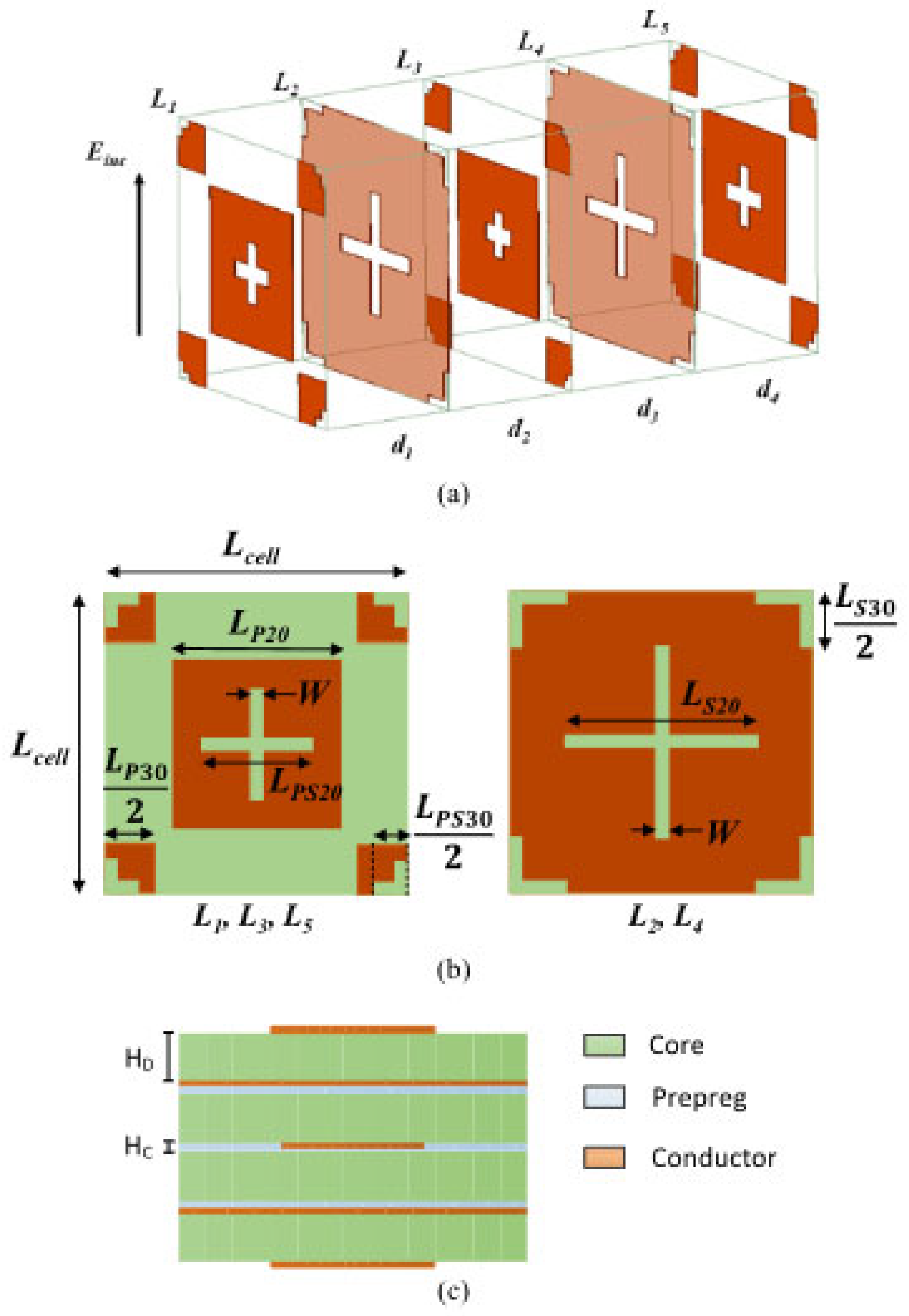
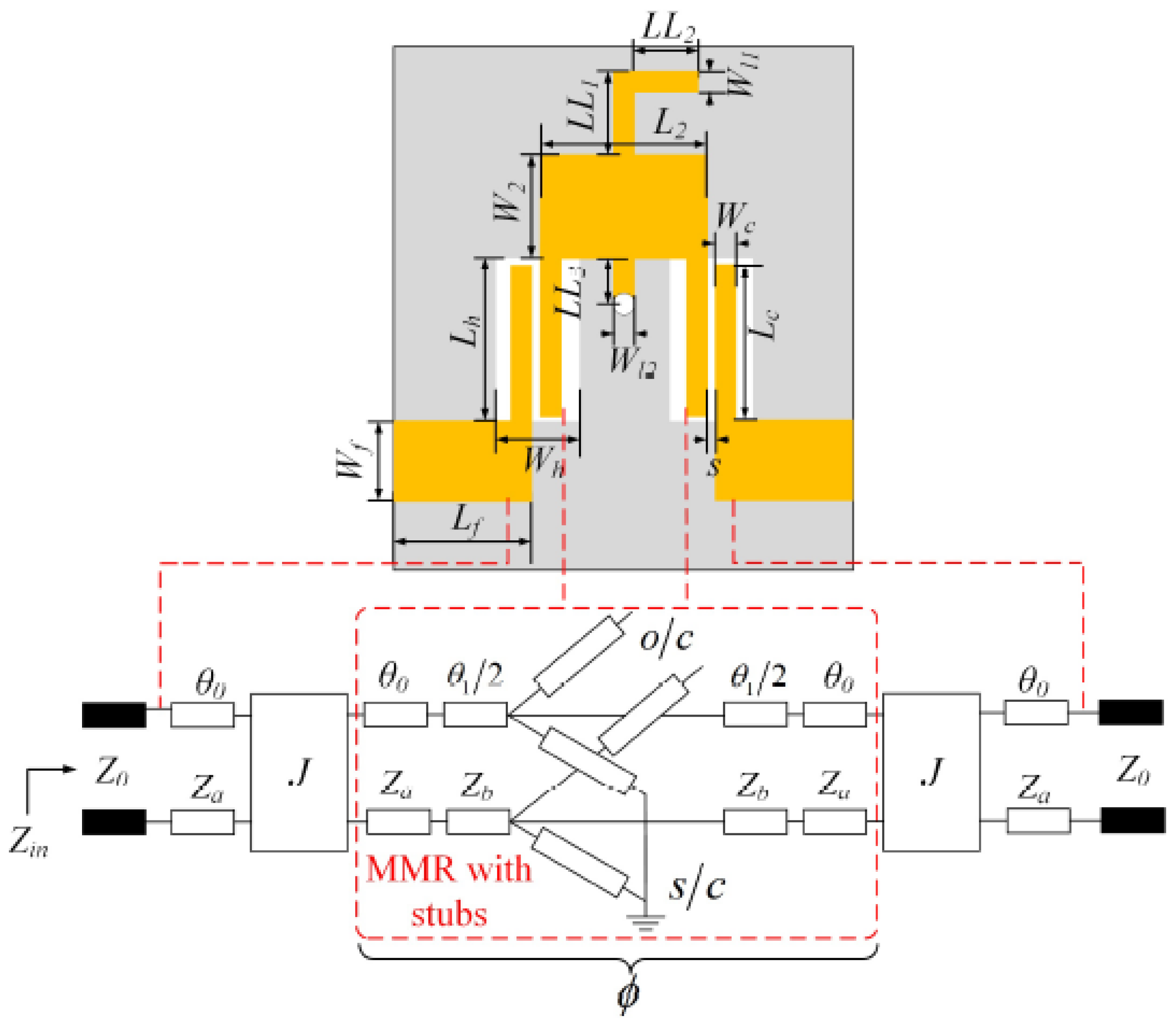
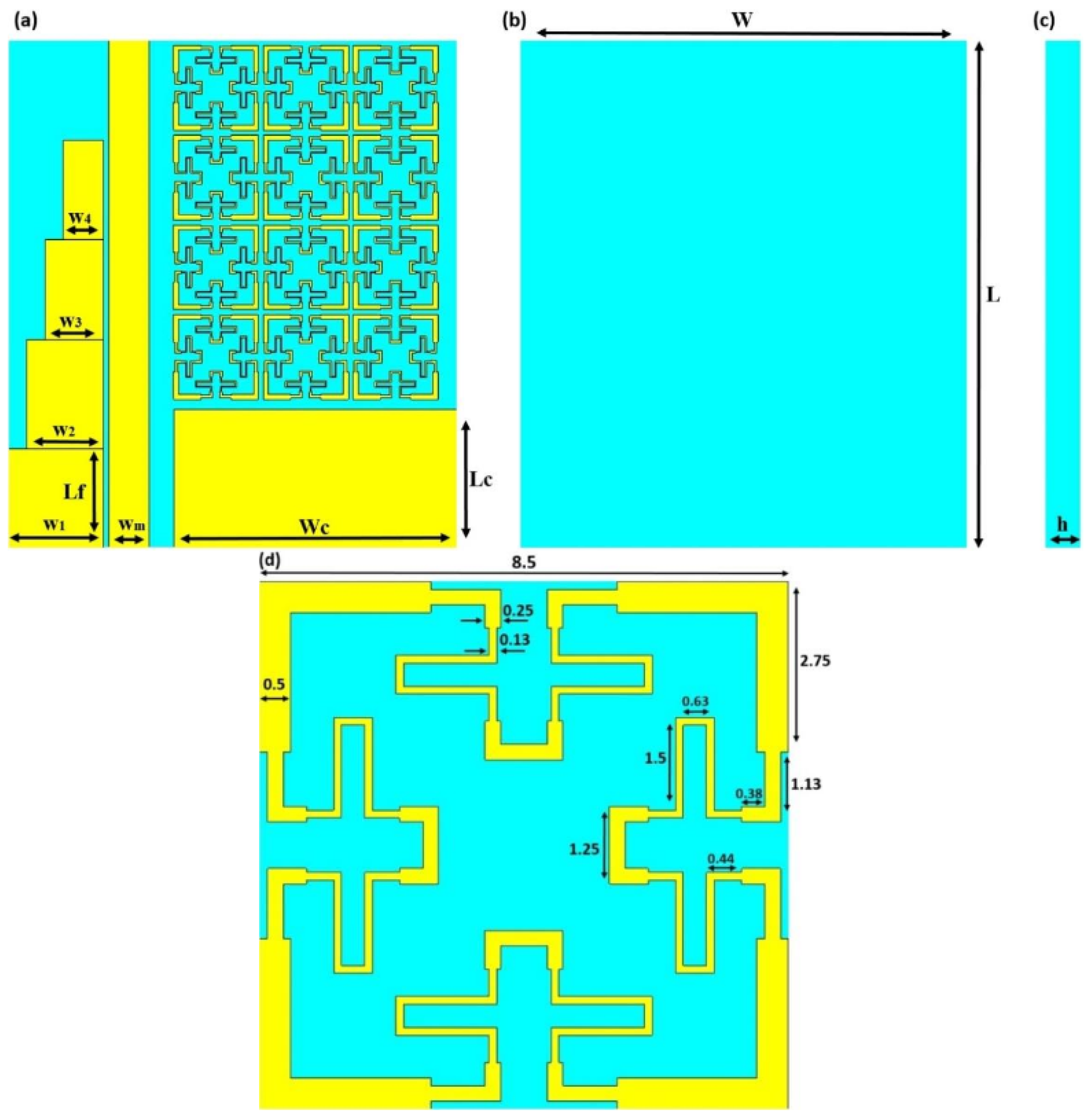
Marco et al. [41] (Figure 1) investigated M-FSS cells for dual-polarization dual-band operation at 20 and 30 GHz. This design is unique from existing solutions, as it is the first dual-polarization dual-band M-FSS that does not require air gaps or thick substrates. The authors fabricated a layered configuration of five metal layers and four identical Rogers RO4350 dielectric substrates that has applications in K/Ka satellite communications.
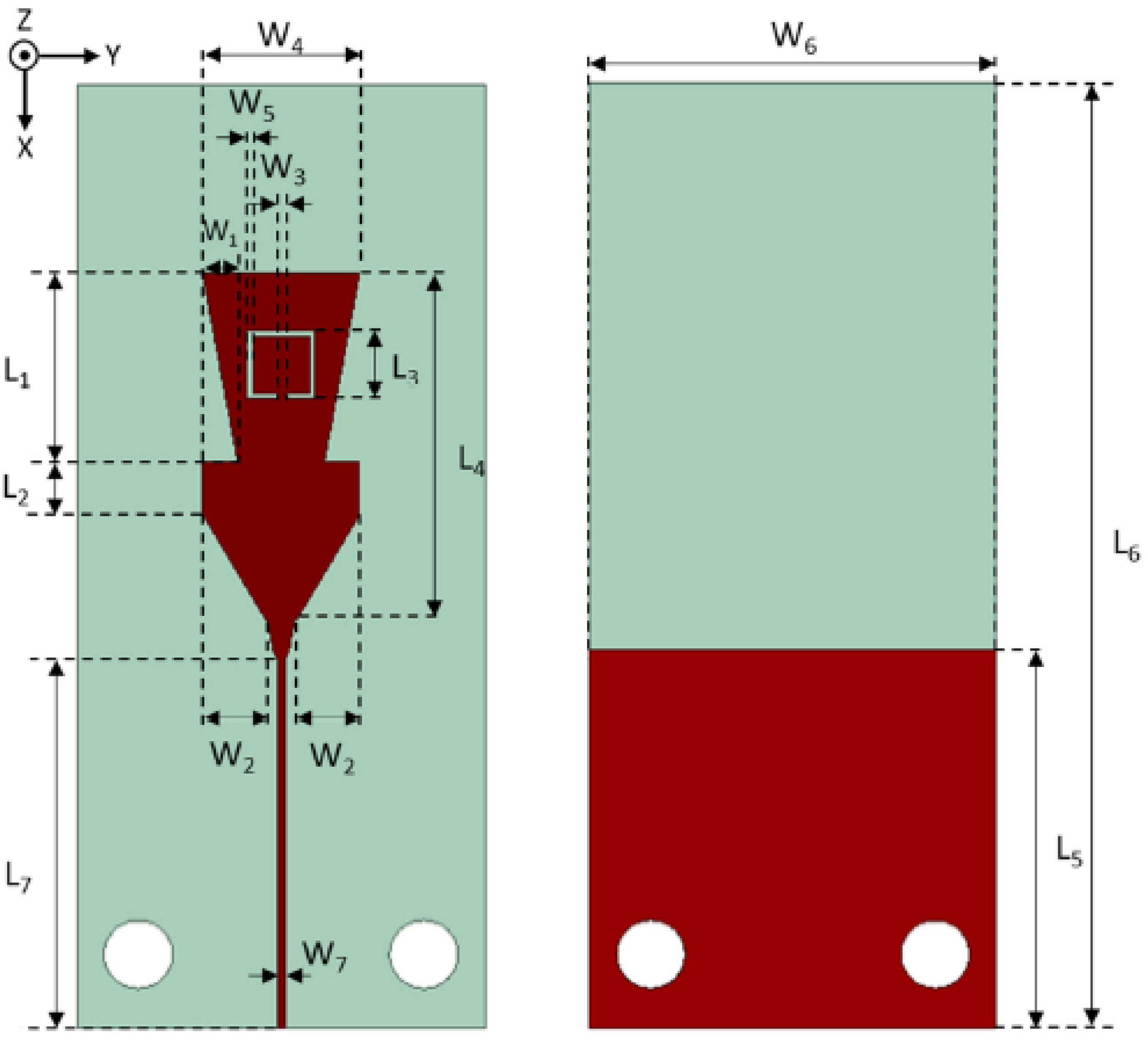
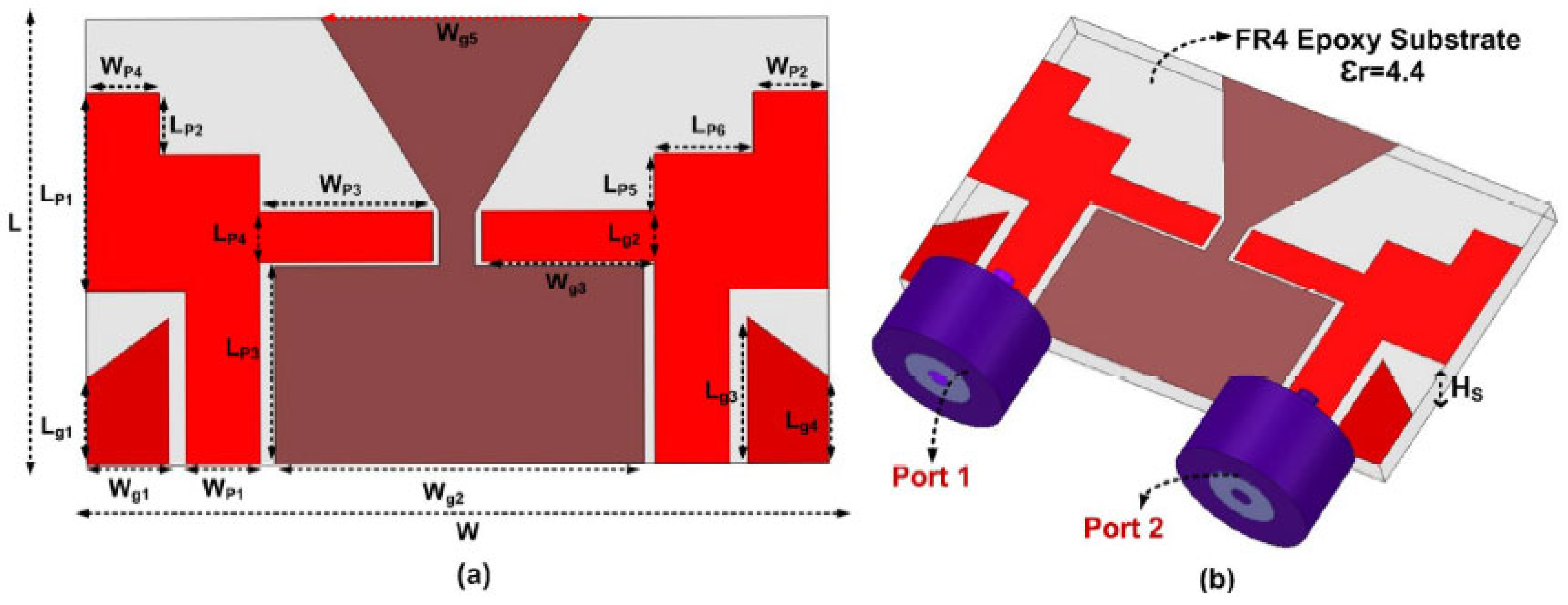
Paul et al. [42] studied a novel microstrip patch antenna (Figure 2) for high-speed data transmission from small satellites. The antenna was designed for Ku-band, and a peak gain of 18.0 dBi was achieved in the frequency range 11.75–12.75 GHz. The proposed antenna (7.8 × 6.4 × 0.3 cm) can effectively operate with a data rate of up to 4.6 Gbps for small satellites.
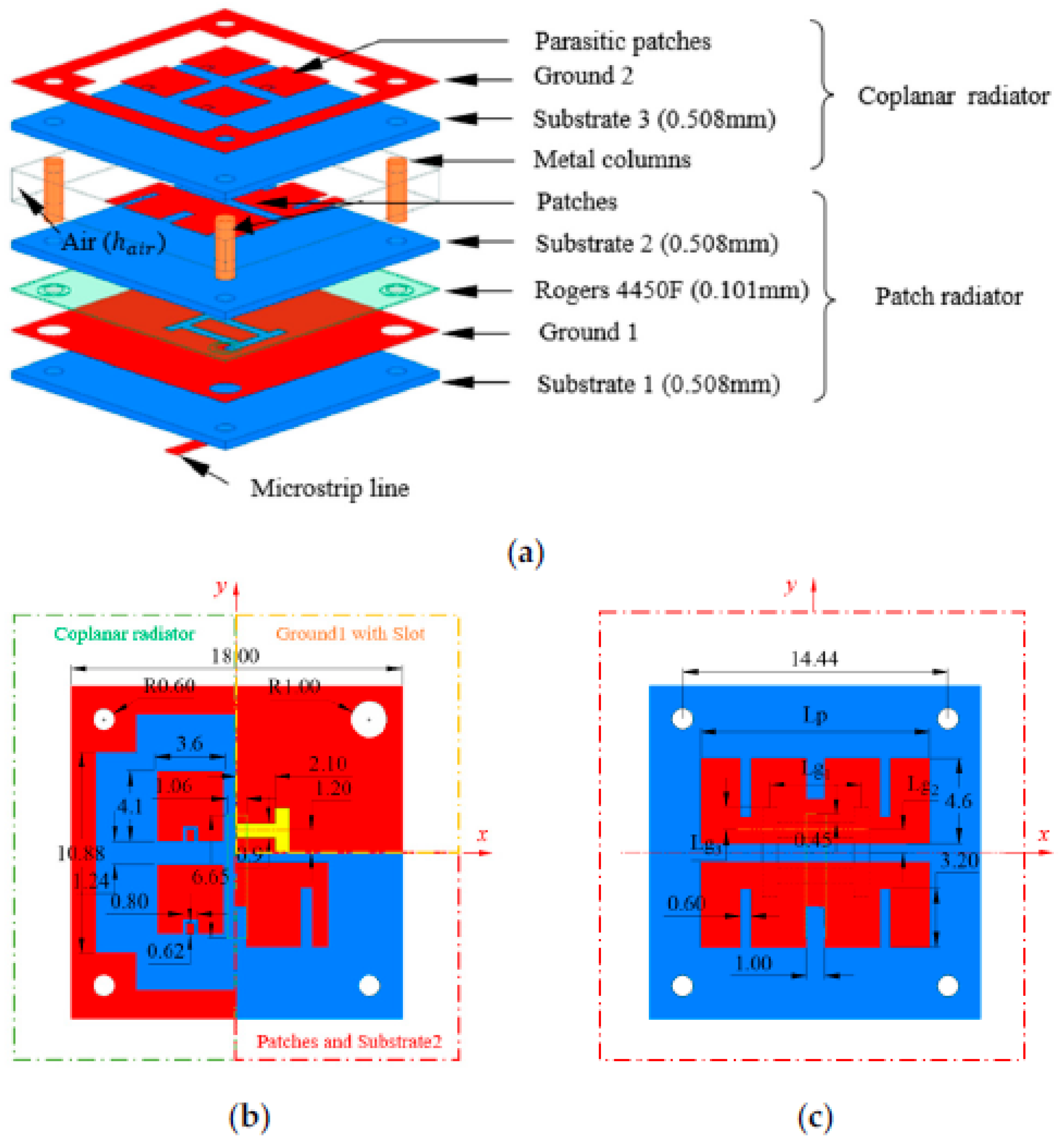
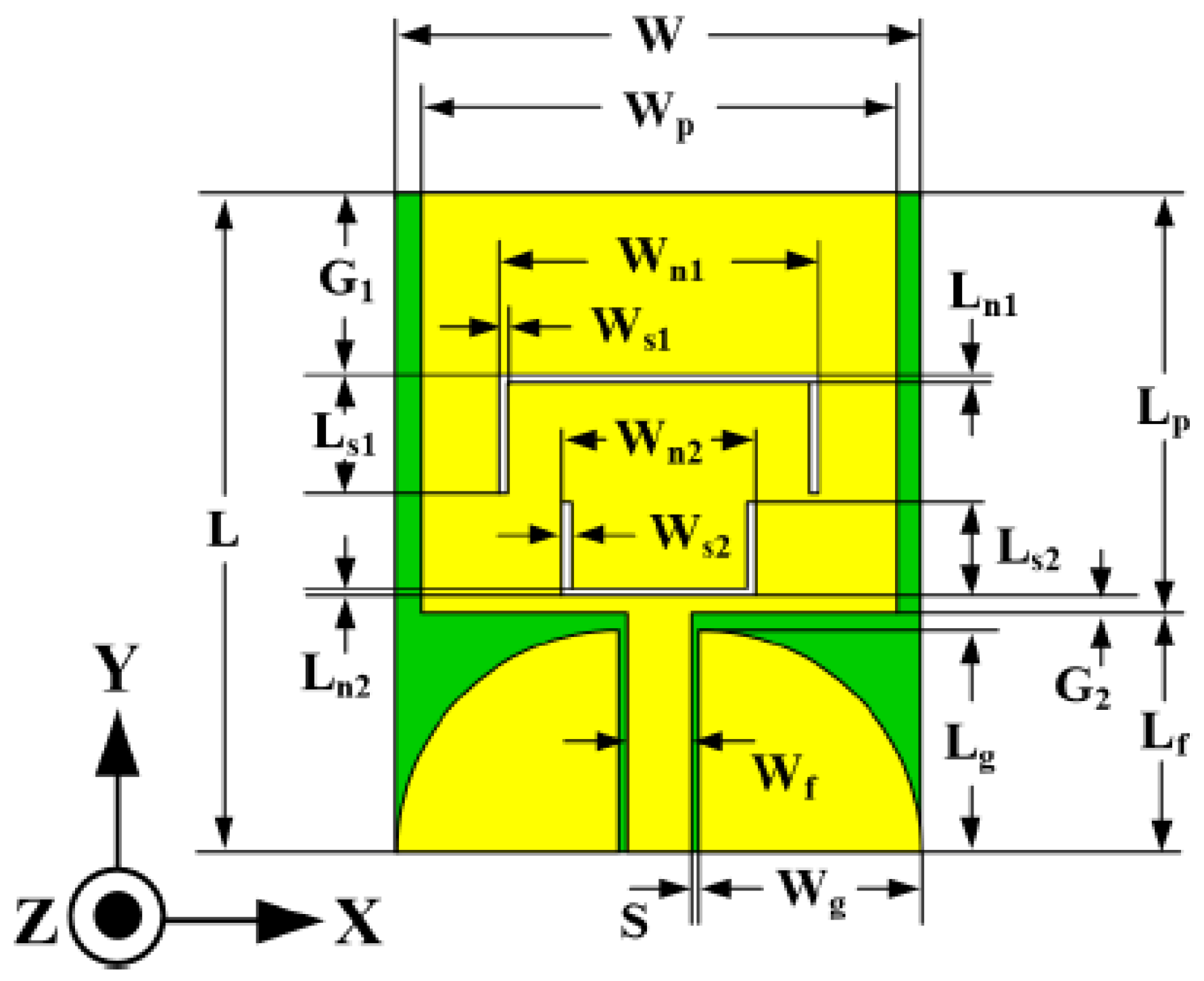
Li et al. [43] (Figure 3) proposed an antenna element consisting of three parts: (1) a patch radiator, (2) a coplanar radiator, and (3) a component that fills the space between the two radiators and is made of air or foam. The antenna element was designed to operate in the frequency range 12–18.25 GHz, with a fractional bandwidth (FBW) of 41.3% and a peak gain of 10.2 dBi. This high-gain broadband patch antenna array is suitable for use at high temperatures.
Zhang et al. [44] proposed a UWB antenna with an integrated filter (Figure 4) with a Rogers Kappa-438 substrate (εr = 4.38, thickness = 1.0 mm and tgδ = 0.005).
Chung et al. [45] proposed a small-sized antenna with X-band and Ku-band applications for satellite systems (Figure 5). The antenna geometry is an inverted triangle and an inverted U-shaped slot. The substrate used was Arlon DiClad 880 (Arlon Electronic Materials (Arlon EMD), Rancho Cucamonga, CA, USA) [45]. The reflection coefficient of the antenna shows that the working frequency band can cover the X-band (10.87–12.76 GHz) and Ku-band (15.19–16.02 GHz). The antenna efficiency in the X-band is about 50–74%. The antenna gains are about 3.34–6.08 dBi in the X-band and Ku-band, respectively. The gain is 6.08 dB.
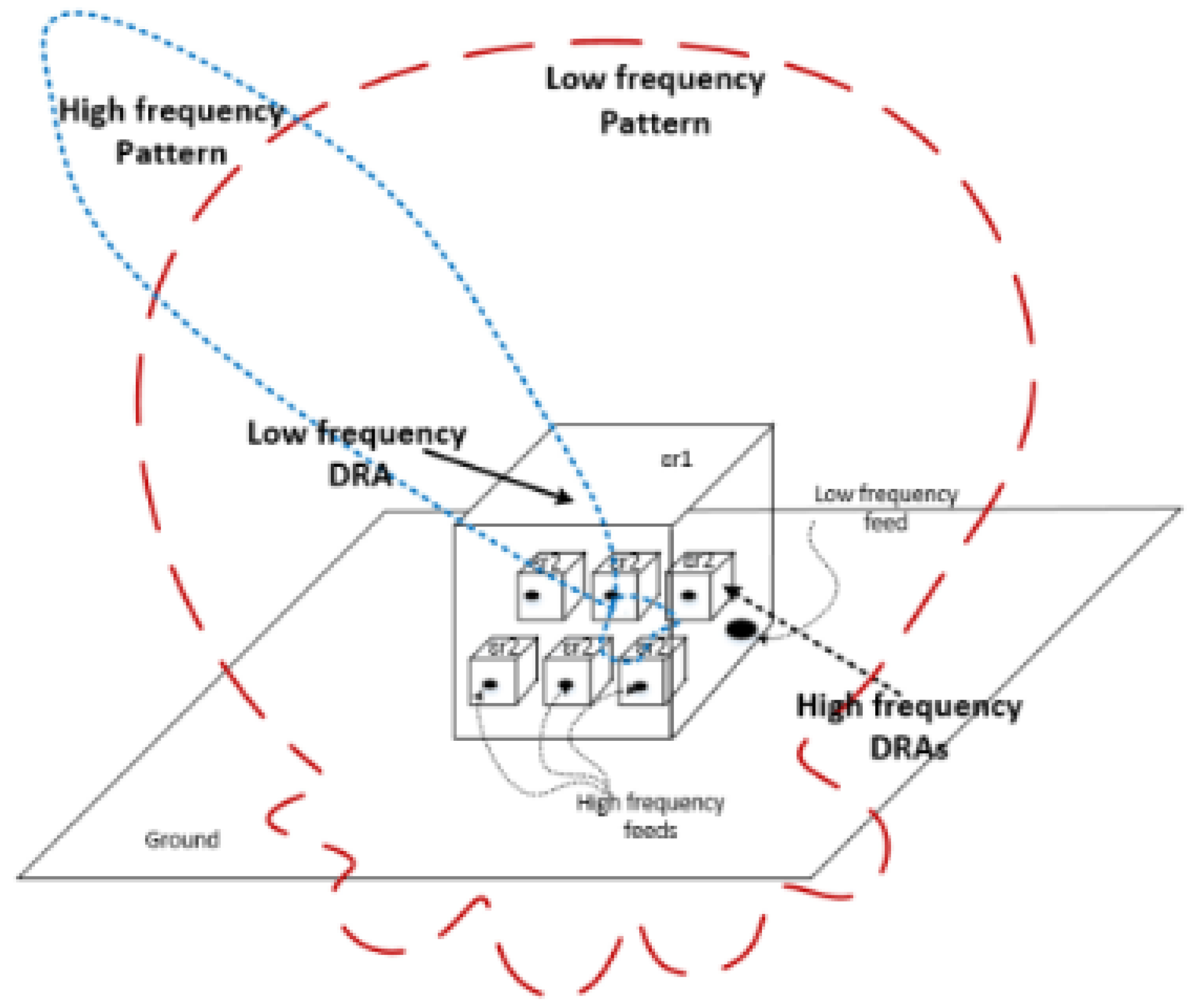
Chittimoju et al. [46] designed a broadband circularly polarized DRA antenna for millimeter-wave applications using the Rogers RT/Duroid® 5880 substrate (Rogers Corporation). Mal-fajani et al. [47] proposed an encapsulated DRA antenna (E-DRA) (Figure 6), which allows efficient radiation over two widely separated frequency bands. The proposed E-DRAs cover both the sub-6 GHz band and the mm-wave band for 5G applications and beyond.
Other researchers using Roger-RT/5880 as a substrate [48,49] developed a dual-port printed MIMO antenna with multiple inputs and outputs, with dimensions of 12 × 8.5 × 0.8 mm3 and 5G applications. Shaikh et al. [50] obtained antennas with good return losses ranging from −27.84 dB to −39.64 dB and wide coverage. The antenna can focus and transmit energy efficiently, with a total gain of 4.3317 dB. These antennas can be wearable.
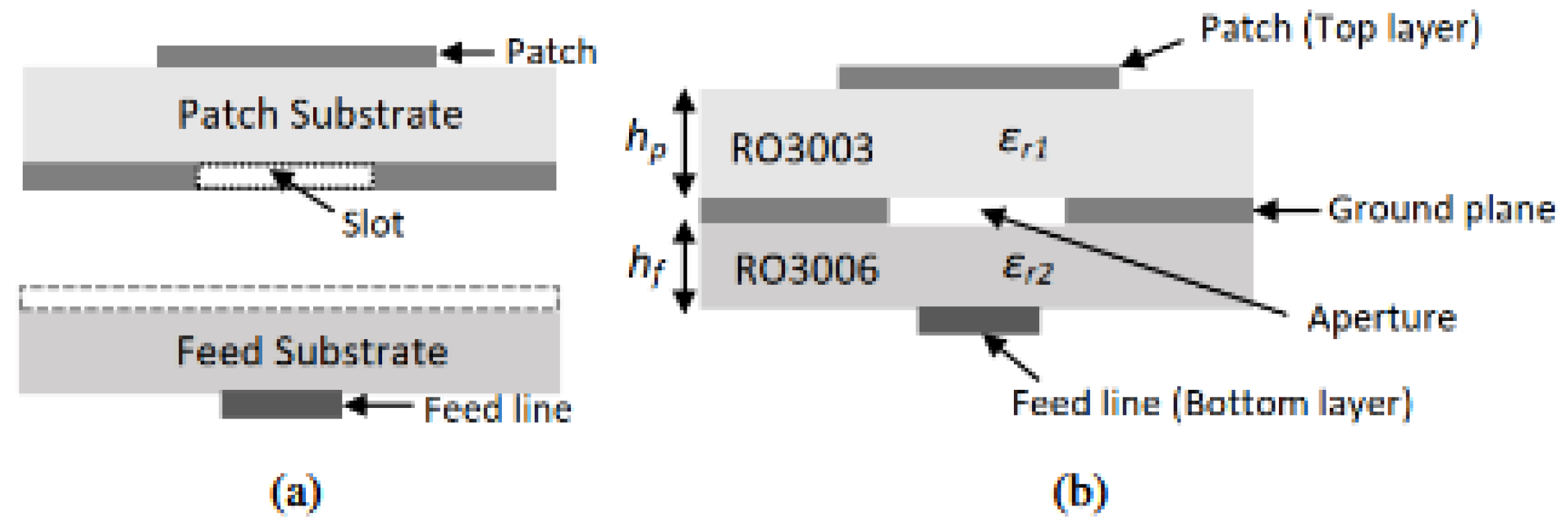
Zebiri et al. [51] used alumina, Mg2SiO4, Rogers RO3003, and RT Duroid 5880 as substrates to create microstrip patch antennas for UWB applications. They offer exceptional dielectric stability over temperature in the range of 3–10 GHz, low dielectric loss and superior dimensional stability. Their dielectric characteristics, as well as bandwidths, were presented in Table 1. The authors developed a methodology for selecting the appropriate substrate, maintaining a fixed thickness for various materials.
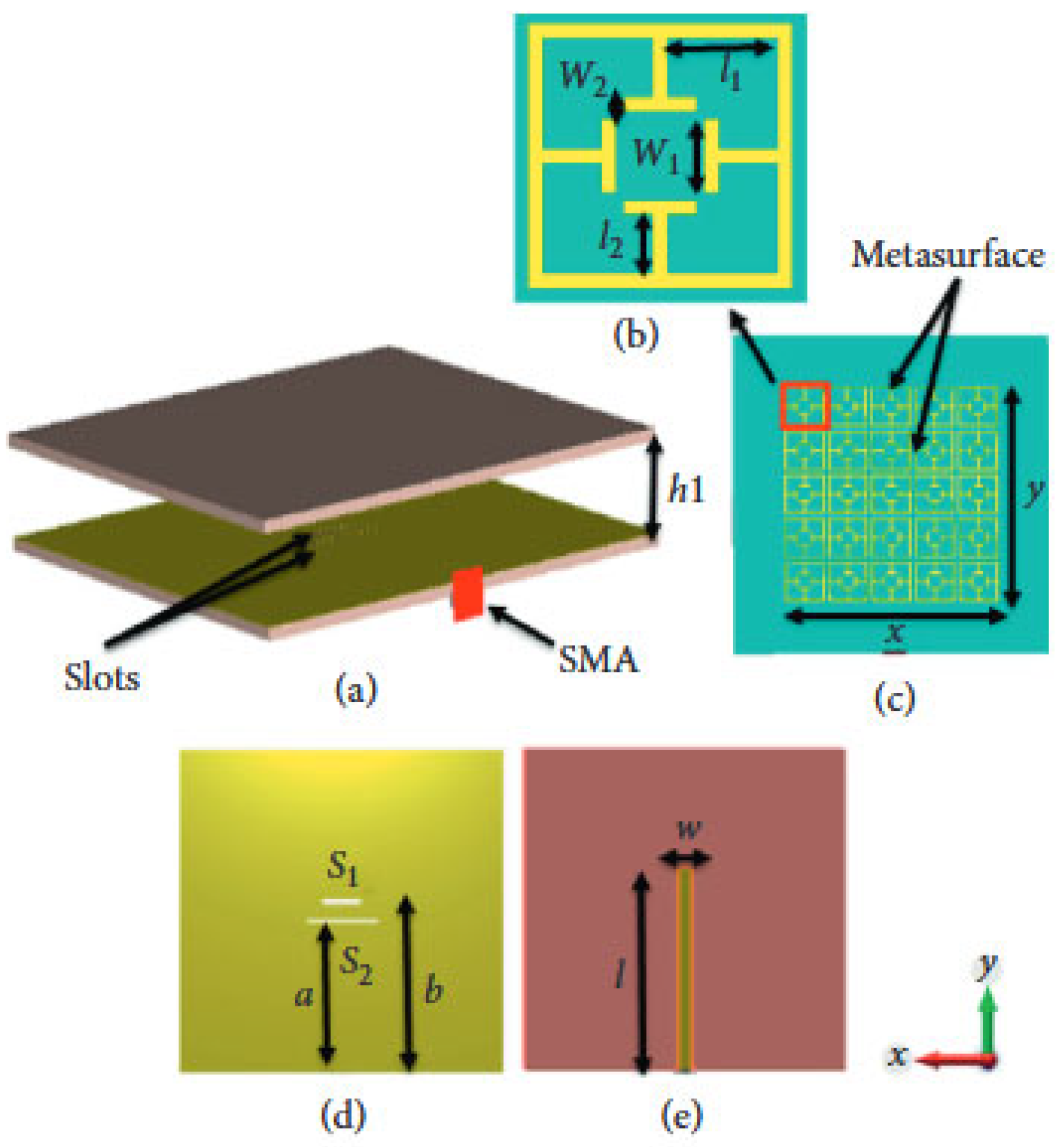
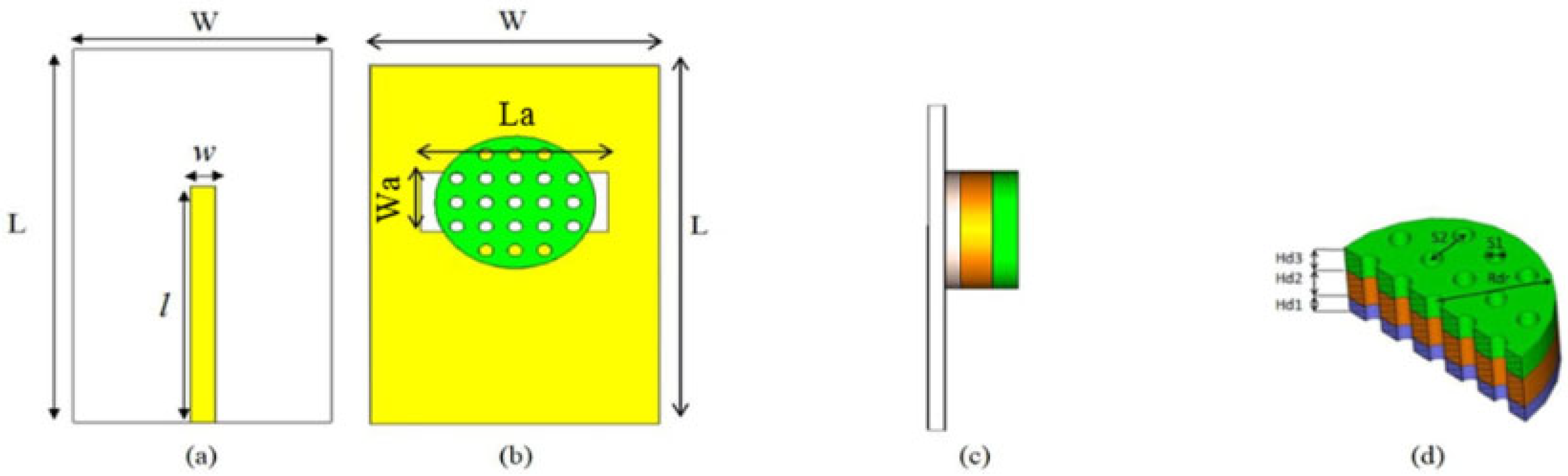
Zubir et al. [52] proposed a broadband DRA antenna consisting of a rectangular slot patch and a perforated and offset cylindrical dielectric resonator (DR). The substrate used was RT/Duroid RO4003C. These antennas find their applicability for Ku and K bands (Figure 7).
Gopalan et al. [53] developed a hybrid material-based MIMO antenna with an RT Duroid substrate and applications in 5G communications. The proposed antenna design was evaluated using a high-frequency structured simulator (HFSS). Alboum et al. [54] studied a microstrip patch antenna with applications in WBAN networks using the professional software CST Studio Suite 2020. The antenna operating frequency was 2.5 GHz, and its substrate was made of FR-4 materials and Rogers RT/Duroid 5880 PCB. Carvalho et al. [55] conducted a comparative study between 3D-printed rectangular patch antennas and laminate-based ones, specifically designed to operate at 4.7 GHz. Baliyan et al. [56] designed and characterized a 4 Å~4 multicircularly polarized antenna with multiple inputs and outputs, adapted for 5G applications. All antennas were modeled and investigated by full-wave simulations using the ANSYS high-frequency structure simulator, with a uniform substrate thickness of 0.8 mm.
Bangash et al. [57] presented a comparative analysis of six microstrip patch (MPA) antennas designed for 5G applications. The antennas were designed using three substrates1: FR-4, 2-Rogers RT5880 and 3-Taconic RF-35TC and two feed techniques: microstrip line and coaxial probe. It was found that the use of Rogers RT Duroid 5880 substrate provides the highest gain, while the highest bandwidth is achieved using coaxial feed with FR4 substrate.
Addepalli et al. [58] presented a compact hexa-band quad-patch MIMO antenna designed for 5G millimeter wave systems. The antenna, built on a Rogers RT/Duroid 5880 substrate, generates six important frequency bands at 21.5 GHz, 28 GHz, 32 GHz, 34.5 GHz, 44 GHz, and 49.5 GHz, with a maximum reflection coefficient of −36 dB and a transmission coefficient (isolation) greater than 22.5 dB in all bands. The developed antenna has a high peak gain of 10.73 dBi, a radiation efficiency of 98.3%, and consistent radiation patterns. In addition, the antenna offers acceptable gain.
Bhushan et al. [59] proposed two ultra-high gain circularly polarized (CP) antenna structures for drone jamming applications. Al-Gburi et al. [60] designed a compact antenna for RFID and IoT applications using a 1.6 mm thick FR4 substrate and copper for the radiating part. Khalid et al. [61] obtained a circular patch antenna with a dipole-like radiation pattern from 3–11 GHz, with industrial, scientific and medical applications. The substrate was FR4 with a thickness of 1.5 mm (εr = 4.3).
Agarwal et al. [62] studied a 4 × 4 MIMO antenna operating in the frequency range 3.3–16.5 GHz (Figure 8). The average gain did not exceed 3.5 dBi, due to the small size. The proposed antenna is designed on a low-cost FR-4 substrate with a thickness of 1.6 mm, with εr = 4.3 and tgδ = 0.025 and has applications in UWB.
Gburi et al. [63] presented a wearable antenna (Figure 9) based on metamaterials for industrial, scientific and medical (ISM) applications. The antenna substrate was made of FR4. The antenna dimensions were 51 × 45 × 1.6 mm and fed by a 50 Ω port. The antenna performance was numerically analyzed using CST Microwave Studio (CSTMWS).
Mehta et al. [64] studied the influence of the sintering process behavior on the properties of ceramic compositions over a frequency range of 20 Hz–20 GHz. The samples were prepared using Al2O3 mass concentrations ranging from 25 to 45%, by replacing with a silica (SiO2) content ranging from 0 to 20% in the base composition. For the design of the DRA antenna, a composite material (X3) was used, with Roger FR4 substrate, which increases the antenna bandwidth by 101%.
Algburi et al. [65] studied a small-sized multilayer patch antenna for satellite communication applications in X-band, Ku-band and K-band. The antenna consists of two layered rectangular patches driven by H-shaped slots. The multilayer structure uses RT/Duroid®5880 and FR4 substrates, and simulation results show that the operating bandwidth is 15 GHz with a reflection coefficient less than −10 dB. The proposed design exhibits a peak gain of 8.3 dB and excellent VSWR over the entire operating band.
Rengarajan et al. [66] developed an antenna (Figure 10) that operates in the ISM band for industrial, scientific and medical applications at frequencies of 2.5 GHz, 3.5 GHz, 4.5 GHz and 5.5 GHz. The antenna has a maximum reflection coefficient of −2.72 dB and a minimum reflection coefficient of −18.78 dB, with a maximum gain of 7.8 dB and a minimum of 4.2 dB, with a VSWR of 1.75.
Rai et al. [67] (Figure 11) studied, using machine learning (ML) optimization, the realization of a compact dual-port, multiple-input, multiple-output (MIMO) UWB antenna with applications in wireless communications. It uses a 16 × 30 mm2 FR4 substrate with a thickness of 1.6 mm.
Rybin et al. [68] presented an algorithm for determining the linear dimensions of compact antennas on high-εr metamaterial substrates. The proposed approach achieves up to 80% reduction in the antenna volume and does not impose any restrictions on the geometry of the unit cell or the metamaterials used for the antenna substrate, except for the case of positive values of the effective relative permittivity and permeability. In addition, it does not require substantial software resources for designing the linear dimensions of patch antennas.
Merino-Fernandez et al. [69] (Figure 12) presented a methodology for optimizing the design of rectangular patch antennas by integrating electromagnetic (EM) simulations, machine learning (ML) techniques, and dielectric material analysis. The machine learning-assisted approach proposed here produces an antenna and its parameters in seconds, while requiring minimal computational resources.
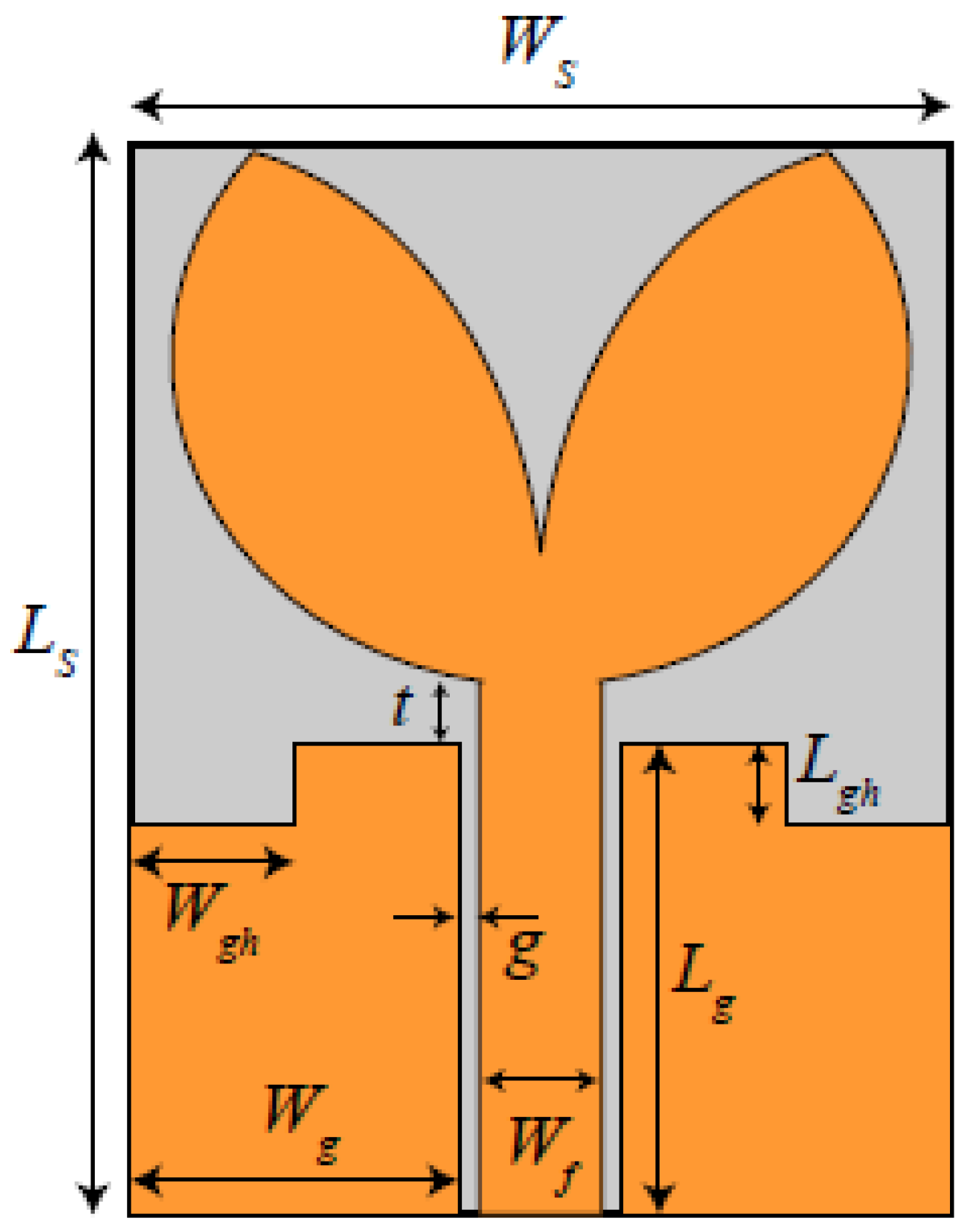
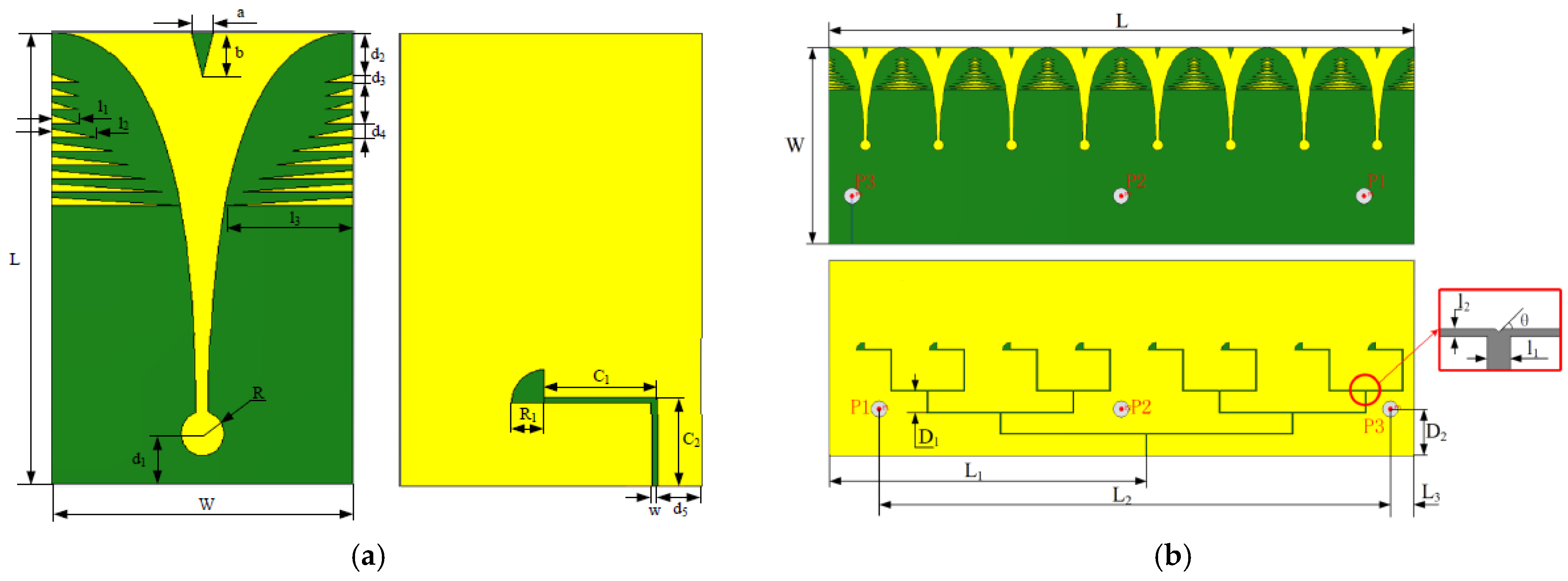
Ren et.al. [70] studied the Vivaldi antenna, which is an example of a UWB coplanar antenna, with applications in long-range electromagnetic sensing. The substrate used was FP4. To improve the antenna’s radiation characteristics and bandwidth, a series of symmetrical slots was installed at the antenna ends (Figure 13).
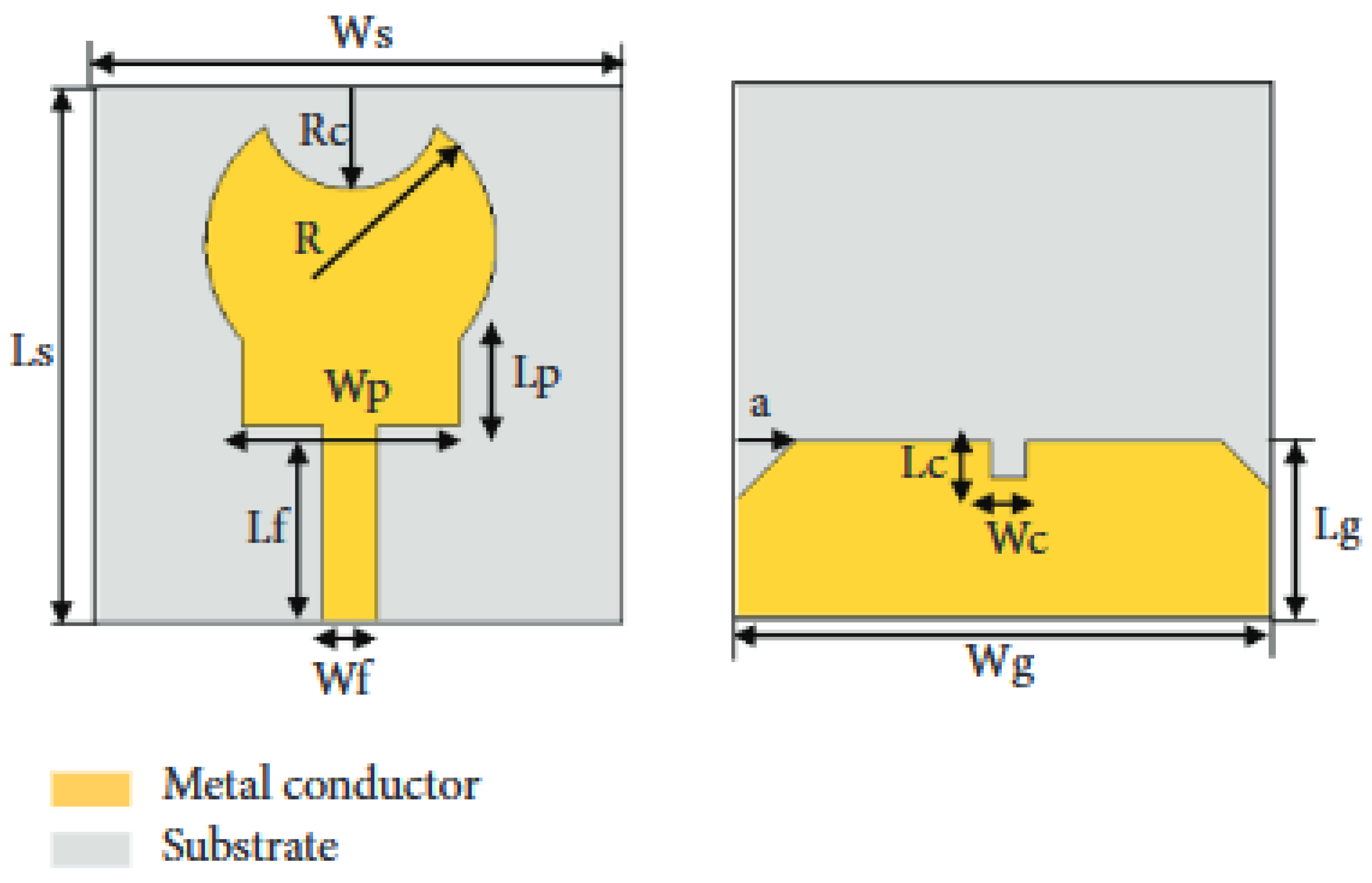
Din et al. [71] studied a semicircular UWB monopole antenna (Figure 14) fabricated on an FP4 substrate for GPR applications.
Mushin et al. [72] designed compact MIMO antenna systems on FR4 substrates based on hybrid fractal geometry for 5G smartphone applications, and Salim et al. [73] proposed an array of 5 multiband antennas printed on a FR-4 substrate and dimensions of 50 × 50 mm for wireless communication applications. This antenna covers three frequency bands: 1.6–2.8 GHz, 3.38–3.6 GHz, and 2.4–5.8 GHz. Salimitorkamani et al. [74] developed a miniaturized broadband sinusoidal antenna for brain imaging systems. The antenna consists of a sinusoidal radiating patch printed on an FR4 substrate. Fonseca et al. [75] studied the utility of combining dielectric and conductive materials with various geometries to build resonators and improve the performance of the patch antenna. The substrate used was FP4. Yogeshwaran et al. [76] studied the design of an S-slot microstrip patch antenna operating at 13.7 GHz for satellite applications. The antenna was designed using Ansys HFSS - 3D High Frequency Structure Simulation Software 2025 and an FR4 substrate as the substrate. The antenna has a bandwidth of 1.14 GHz, a return loss of −14 dB, gains of 6.31 dB, and a directivity of 3.544 dB. Rani et al. examined the effect of filling patterns (triangular and grid) and novel structures (with and without top layers) to achieve different dielectric constants. It was observed that the dielectric constant of a single polymer-based material can be modified simply by changing the internal structure of the substrate.
In recent years, a shift in antenna design preferences has been observed. Polymer substrates are increasingly replacing conventional PCBs. Although previous studies have explored biocompatible polylactic acid (PLA) substrates, limited attention has been paid to the use of 3D-printed metastructured (PLA) substrates for patch antennas. Rani et al. [77] examined the effect of filling patterns and novel structures to achieve different dielectric constants. It was observed that the εr of a single polymer-based material can be modified simply by changing the internal structure of the substrate.
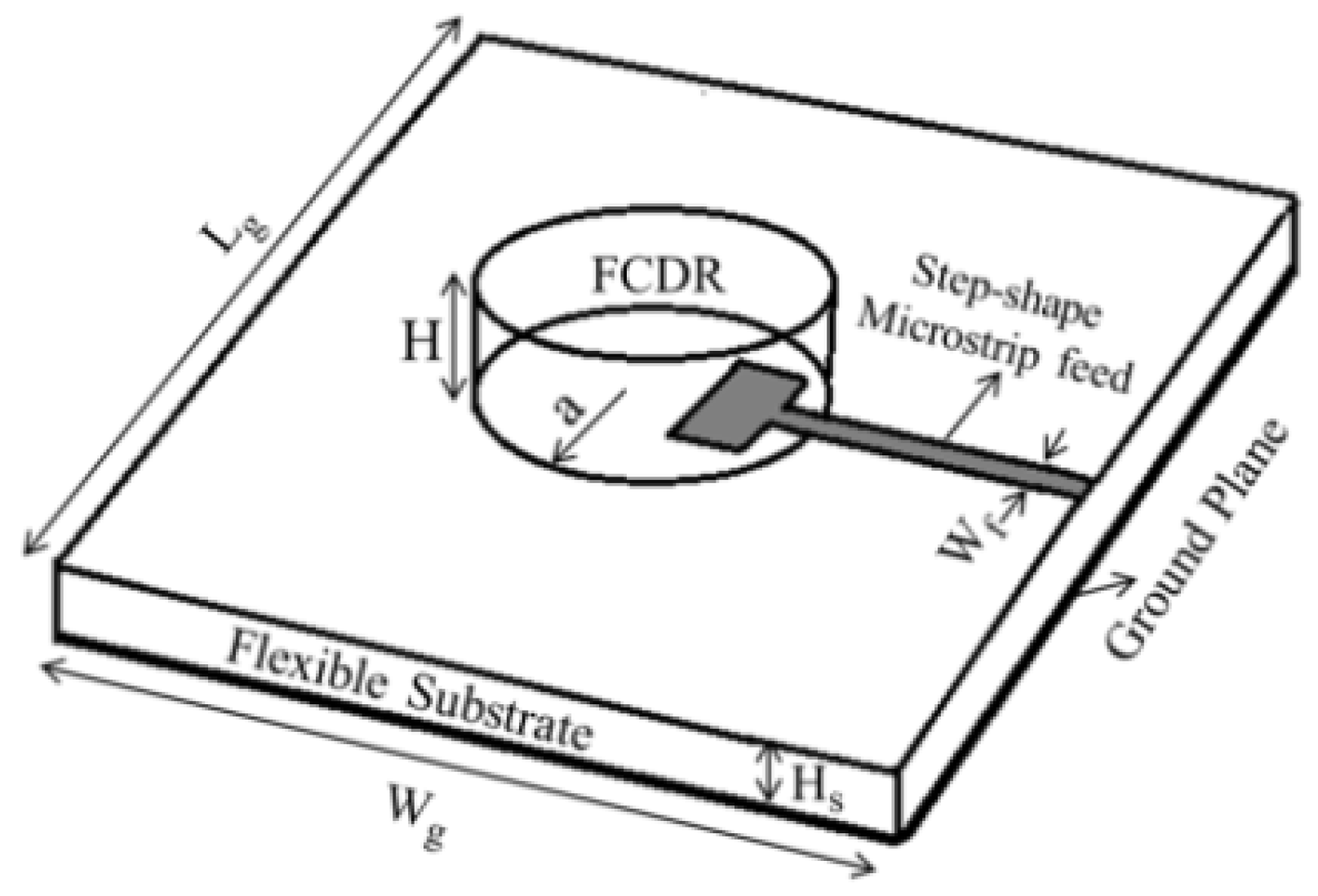
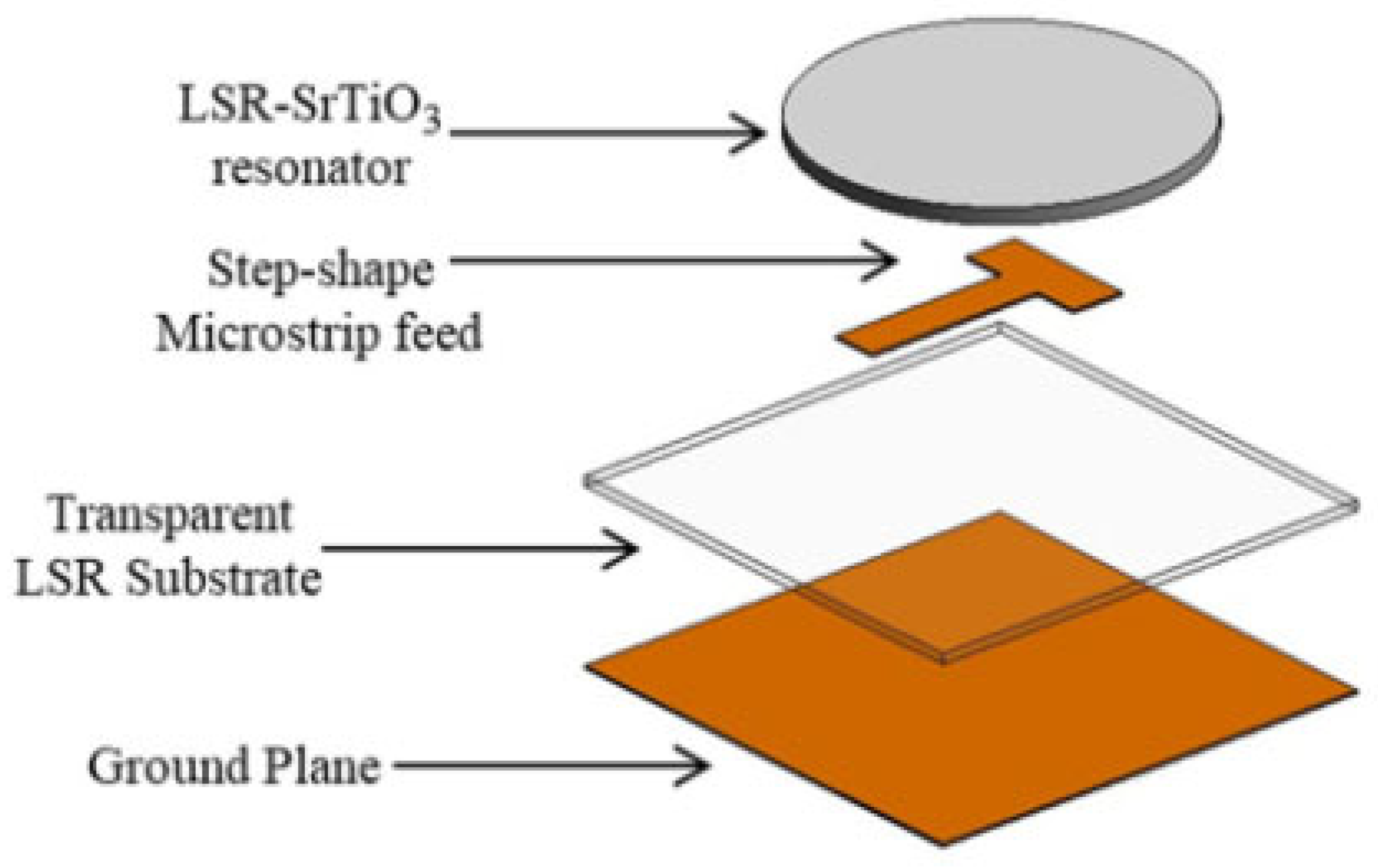
The increasing demand for flexible electronics has led to the development of mechanically stable antennas. Thus, Anjum et al. [78] studied a fully flexible cylindrical DRA antenna (FCDRA) for industrial, scientific, and medical applications (Figure 15 and Figure 16), with an elastomeric substrate for operation in the X-band (near 10 GHz). The antenna was composed of a nanocomposite resonator made of liquid silicone rubber—strontium titanate (SrTiO3), integrated on a liquid silicone rubber substrate.
Ramyea et al. [79] characterized and analyzed a UWB radio antenna using a composite substrate of polyvinyl alcohol and graphite. A UWB antenna with an operating frequency band in the range of 2.37–1.66 GHz was obtained. Sivan et al. [80] investigated the fabrication of a flexible, low-loss dielectric substrate for flexible microwave antennas, consisting of butyl rubber reinforced with amorphous silica. Dielectric measurements indicated εr = 2.7 and tgδ = 0.002 in the frequency range from 900 MHz to 4.5 GHz, confirming the adaptability for microwave applications.
Small, simple-design, and high-performance UWB MIMO antennas were also obtained by Chutchavong et al. [81] (Figure 17). The antenna structure includes two radiating elements with dimensions of 85 × 45 mm2, and a Mylar® polyester foil substrate with a thickness of 0.3 mm and an εr of 3.2 was used (Mylar Specialty Films, Chester, VA, USA). According to the measurement results, the antenna operates in the frequency range from 2.29–20 GHz. In addition, it provides dual coverage at 3.08–3.8 GHz for WiMAX and 4.98–5.89 GHz for WLAN.
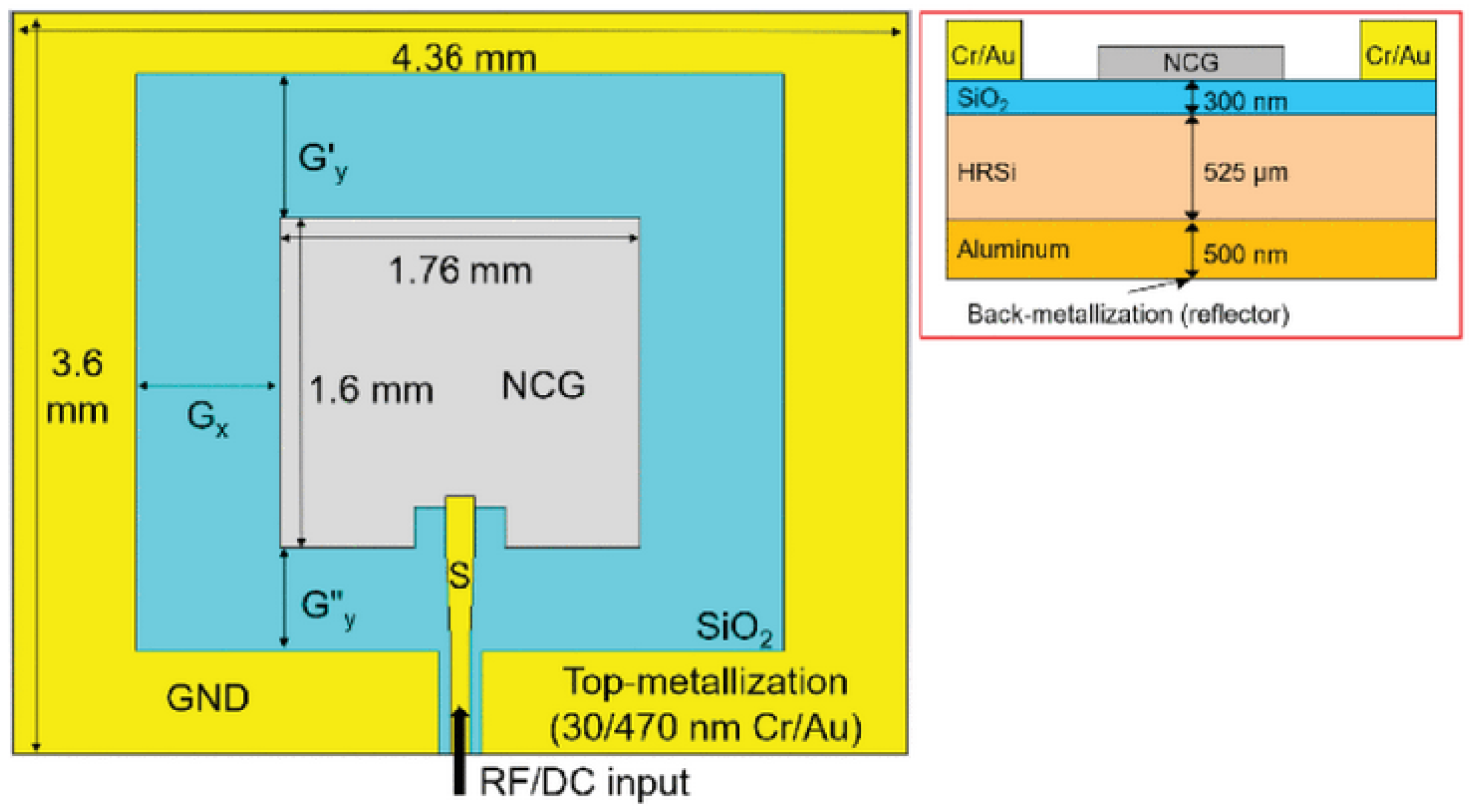
Zou et al. [82] studied a compact and flexible UWB antenna printed on a 12.5 μm flexible polyimide substrate, and the impedance bandwidth is 15.48 GHz (3.6–19.08 GHz). The total size of the antenna is 20.5 × 13.9 mm2. The average gain can reach 3 dBi, while the gain in the notch band is considerably reduced below 0 dBi. Compared with existing structures, the antenna has a larger bandwidth and a smaller size. The test results show that this antenna can be used for integration on flexible electronic devices. Aldrigo et al. [83] (Figure 18) fabricated a 24 GHz tunable antenna array based on a 110 nm CMOS-compatible nanocrystalline graphite film grown by CVP. The film has a nominal bulk conductivity exceeding 16,000 S/m but is capable of exhibiting remarkable carrier density modulation in the upper microwave spectrum. The results demonstrate performance for next-generation high-capacity communications.
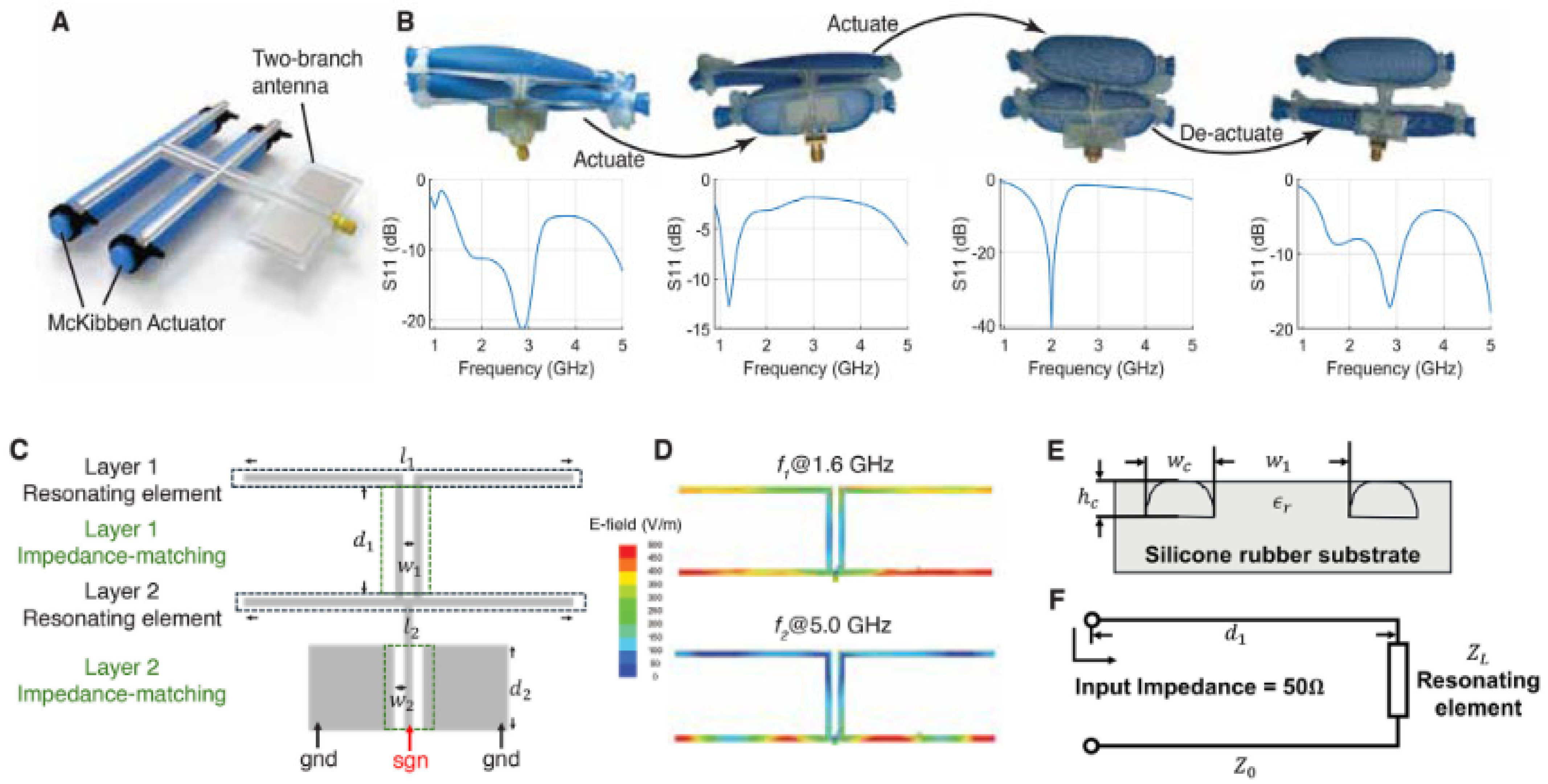
Paracha et al. [84] reviewed the fabrication and applications of liquid metal antennas (Figure 19), highlighting their adaptability and versatility for modern wireless communications. Their study explored innovative fabrication techniques and the advantages of conductive fluids for creating flexible and reconfigurable antennas, such as 3D printing, injection, or spraying of conductive fluid onto rigid/flexible substrates.
Song et al. [85] (Figure 20) described an omnidirectional, soft, elastic, and compact liquid metal composite antenna system that enables high radiation efficiency at various frequencies over a wide band. The silicone rubber substrate is treated as an incompressible material. Experimental characterization demonstrates that PASTA reduces radiation loss by 10–20 dB over the operating frequency range, compared to state-of-the-art rigid and flexible antennas.
Li and Luk [86] investigated the use of water as a dense dielectric patch antenna (DDPA). The substrate used was Plexiglas. The water patch worked, achieving a bandwidth of 8%, a maximum gain of 7.3 dBi, and a radiation efficiency of up to 70%.
Lu et al. [87] designed an antenna operating at 12 GHz. The antenna is composed of six Chebyshev linear antennas (CLAA). Liquid metal is used to print the antenna pattern on the flexible dielectric PDMS substrate to adapt to different radii. A single row of antennas can achieve a maximum measured gain of 14.8 dBi. Jain et al. [88] proposed a semitransparent and washable flexible monopole antenna made of carbonized electrospun polyacrylonitrile fiber (CB-CNF) embedded in carbon black (CB) on a polydimethylsiloxane (PDMS) substrate, which makes it flexible and hydrophobic. The incorporation of CB with CNF results in the formation of a 3D network with high electrical conductivity, 1.2 S cm−1. The PDMS substrate provides the antenna with mechanical flexibility and transparency. The CB-CNF antenna is designed to operate in the frequency range of 3.6–8.2 GHz, exhibiting an omnidirectional radiation pattern and a measured peak gain of 4.8 dBi. This antenna has applications in wearable medical devices.
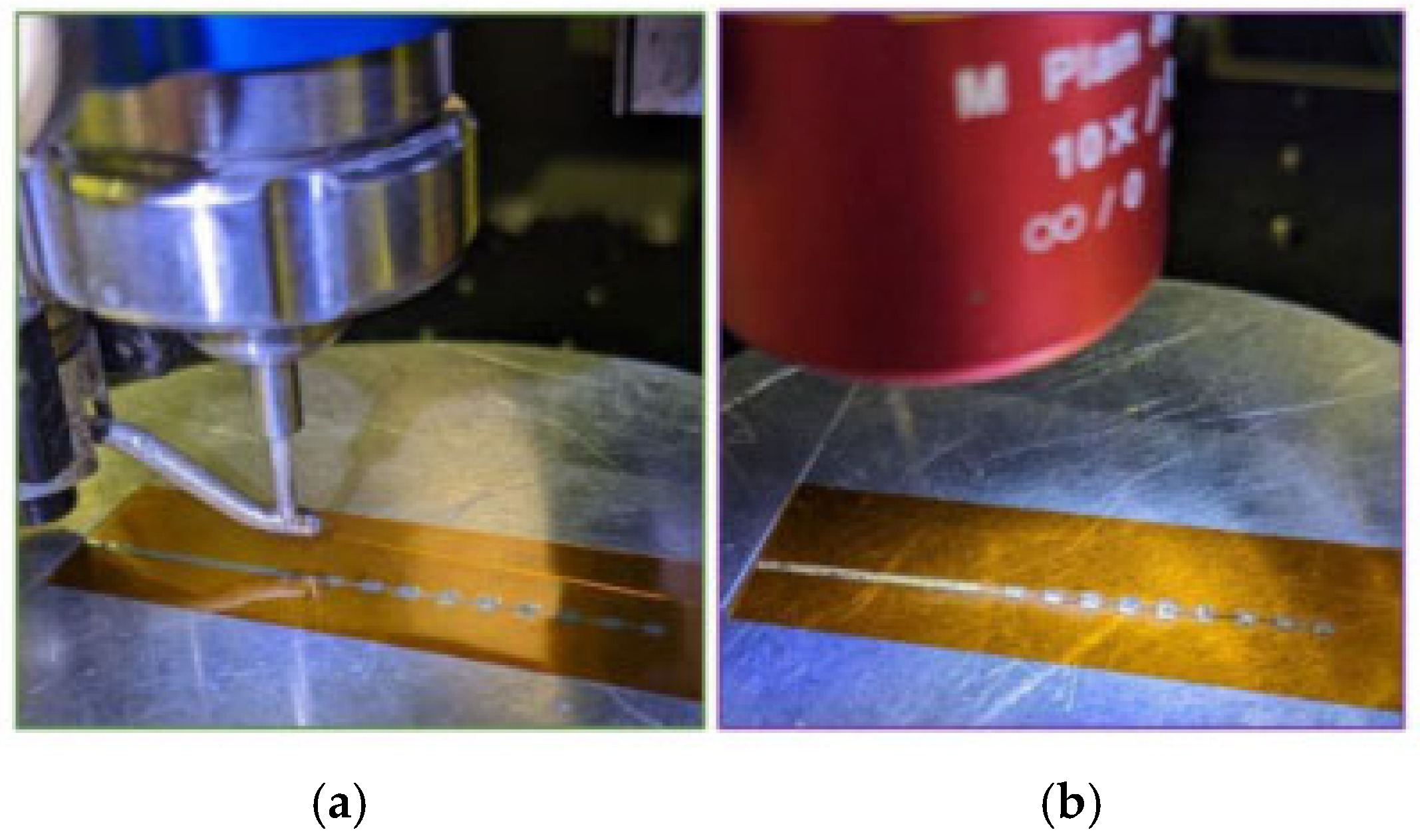
David et al. [89] (Figure 21) studied the potential of aerosol jet printing for rapid prototyping of millimeter wave antennas. The substrates used were Rogers and Kapton strips. A nine-element series-fed patch array was designed. The antennas were tested at 46 GHz and compared to PCB-etched antennas. The results showed that aerosol jet printing on Kapton is an effective method for rapid prototyping of test antennas, while the reuse of substrates minimizes material waste and production costs, providing a sustainable and efficient solution for future antenna development.

4.2. Hybrid Structures Based on Ceramic Substrates—Microwave Dielectric Ceramics

Microwave dielectric ceramics provide εr = 5–90, low loss (tgδ ≈ 10−4–10−3), and high stability. Major examples are BaTiO3, Li6B4O6, Sm(Nb,P)O4, Zn2V2O7, Li2MoO4–BaV2O6, BSLT, and cordierite. They lean towards a broad application in dielectric resonator antennas (DRAs) and dielectric patch antennas (DPAs), showing a high gain (up to 12 dBi), efficiency (>90%), and potential for the 5G/X-band.
Kumar et al. [90] investigated the development of an antenna with a hybrid structure, in which the antenna radiator is designed on an alumina (Al2O3) substrate with εr = 9.8. This antenna finds its application in the wireless field. Sun et al. [91] proposed a five-substrate layered antenna array, with dual frequency and shared aperture containing Ku and E bands with a frequency ratio of 4.9:1. The Ku-band antenna element is composed of a circular microstrip patch and an oval microstrip patch, printed on a Taconic TSM-DS3 substrate with a thickness of 1.524 mm and εr = 3.
All antenna elements are connected to the active T/R modules. The Ku-band elements are interconnected via SMP connectors, but their use leads to higher losses in the E-band. In addition, due to dimensional restrictions, there is not enough space to accommodate the dual-band active modules. Therefore, the 16-channel T/R chips are placed on the back of the multilayer PCB and are connected to the antenna elements via CPWG transmission lines. The chips allow control of the gain and phase of each channel to enable beam scanning.
Abdulkarim et al. [92] aimed to improve the antenna gain, which is usually achieved at the expense of bandwidth and vice versa (Figure 22). The proposed antenna was simulated and fabricated to validate the results in the operating frequency range from 10 MHz to 43.5 GHz. Microwave software (CST) was used to design and simulate the proposed antenna, while the LPKF PCB prototyping machine was used to fabricate the antenna. The results showed that the antenna generated a gain and bandwidth of 14.2 dB and 2.13 GHz, respectively. Given the good agreement between the numerical results and those obtained through measurements, it is considered that the proposed antenna may be potentially attractive for applications in Ku-band satellite communications involving electromagnetic waves.
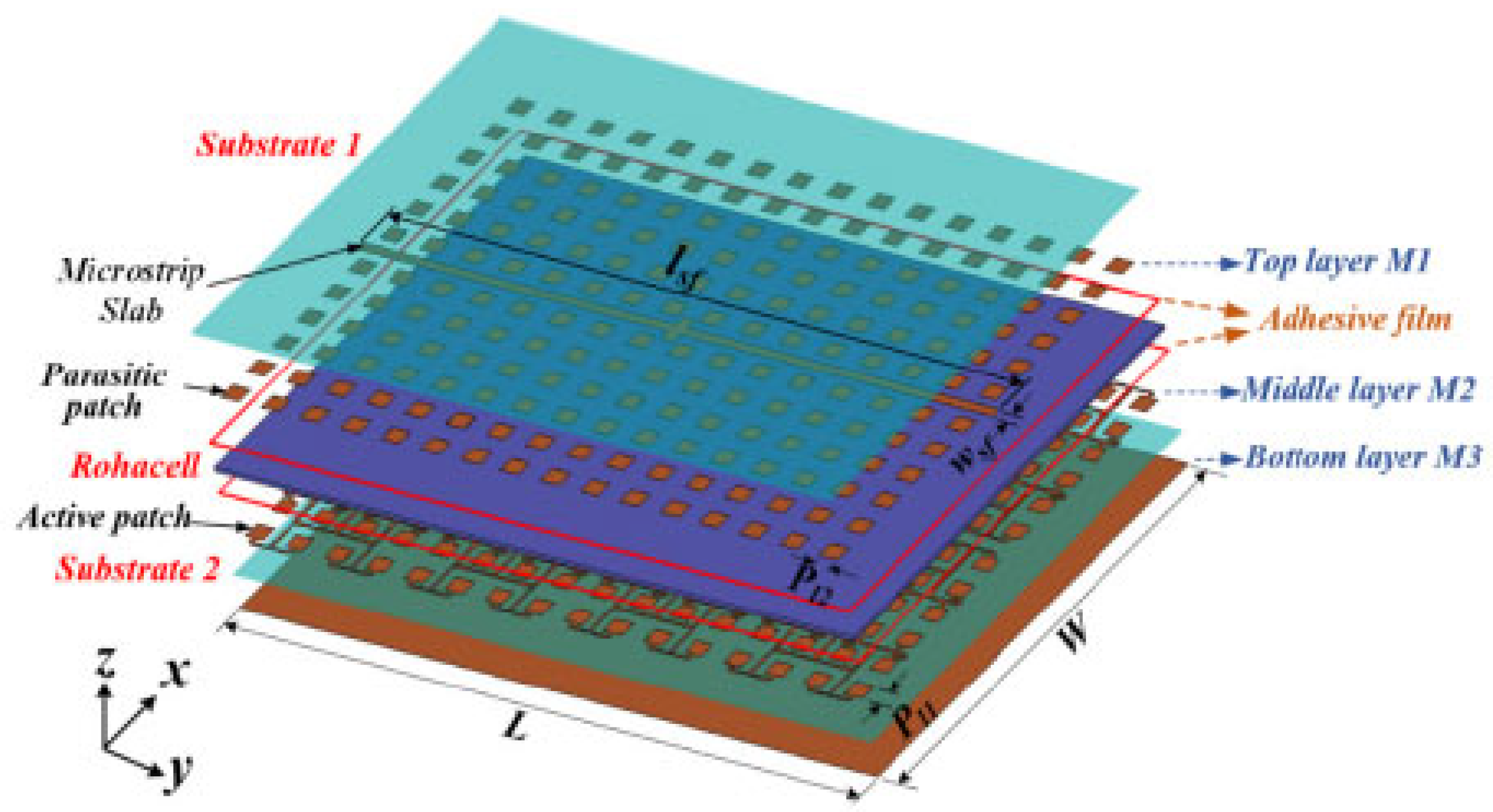
Anim et al. [93] developed a broadband antenna array (Figure 23) for X-band applications. The antenna consisted of several layers: three copper layers and two Taconic TLY-5 insulating substrates. The antenna had a large size of 371 × 276 mm2. Rohacell foam material was used to separate the layers. The results show that the maximum bandwidth was 12.4% (9.01–10.20) GHz.
Among the most widely used materials for wireless communication systems is microwave dielectric ceramic (MWDC). The emergence of this material was in the late 1930s. Depending on the different parameters, microwave dielectric ceramics can be divided into microwave dielectric ceramics with small, medium and large eps. Thus, Kui et al. [94] conducted a study on the history of MWDC development, as well as the current situation and future prospects. The final results show that, in the context of the new 5G era, the MWDC industry has entered a completely new stage of development and presents a huge potential for innovation and development.
In line with the development of miniaturized and low-cost microwave devices for next-generation communication systems, Patel et al. [95] proposed a compact and reconfigurable antenna adaptable to 2.5 GHz UWB. The antenna has a directivity of 5.58 dB, a minimum reflectance coefficient of −17.27 dB, and a total gain of 3.87 dB. This design provides an electric field of 46.558 V/m. Shehbaz et al. [96,97] conducted a comprehensive and up-to-date review of research in the field of DRA technology and also designed a broadband DRA antenna using high-quality, ultra-low-temperature, low-loss Li6B4O6 ceramics. Li6B4O6 ceramics demonstrated excellent microwave properties, with εr = 5.95, a Q × f coefficient = 38,700 raised to 12.4 GHz, and a thermal coefficient of resonance frequency (TCF ≈ −68.6 ppm/°C).
High εr MWDCs are ideal for designing low-profile, compact, and miniaturized antenna units. However, digital array antennas (DRAs) based on high εr materials have narrow bandwidths, and it is extremely difficult to achieve broadband performance using high εr dielectric materials.
Kerai et al. [98] obtained nanocrystalline BaTiO3 by grinding, followed by calcination at 1200 °C and sintering at 1300 °C. From XRD analyses, this nanocrystallite exhibits a unique tetragonal perovskite structure, with an average crystallite size of 95.63 nm. FESEM micrographs revealed a grain size of 2.73 μm. The microstrip patch antenna operating in the X-band based on BT ceramics has an excellent simulated return loss of −44.48 dB (9.91 GHz) and a measured return loss of −34.94 dB (9.95 GHz). Using CST Microwave Studio v. 2019, the antenna also demonstrated a simulated bandwidth of 361.19 MHz and a measured bandwidth of 366.8 GHz, a directivity of 7.13 dB, a gain of 6.26 dB, and a VSWR < 2. The broadband and high-gain microstrip patch antenna is a suitable dielectric material for microwave applications in 5G technologies.
The demand for compact components in telecommunication systems, especially for 5G networks, has driven the development of 3.5 GHz microstrip patch antennas (MPAs) using 3D jet printing (BJ3DP). Thus Mali et al. [99] focused their study on the fabrication of ceramic substrates by BJ3DP, evaluation of microwave dielectric properties and evaluation of MPA performance. The design and simulation of the 3.5 GHz MPAs were performed using CST software, where antenna parameters such as return loss, impedance and voltage standing wave ratio (VSWR) were examined. The simulation results showed an S11 of −37.16 dB at 3.5 GHz, a VSWR close to 1, a gain of 2.405 dBi, and an overall antenna efficiency of 74%. The results indicate that the smaller substrate, 19 × 19 × 2.1 mm3, offered superior miniaturization without compromising performance, with a resonant frequency of 3.70–3.78 GHz, return loss in the range of −18 to −23 dB, impedance of nearly 50 Ω, and VSWR close to 1. This demonstrates the feasibility of BJ3DP for reproducible, compact, and high-performance ceramic MPAs with potential for 5G applications.

4.3. Low-Temperature Co-Fired Ceramics—LTCC

The integration of advanced ceramic-based structures has revolutionized the design of Global Navigation Satellite System (GNSS) receiving antennas by leveraging high-permittivity materials, low-loss dielectrics, and advanced fabrication techniques such as LTCC and recently ULTCC (ultra-low-temperature co-fired ceramics). Primarily, the advancement of ULTCC is significantly advantageous, because it allows the use of Aluminum internal electrodes (cheap and abundant) instead of the Silver or Gold required by standard LTCC [10,14]. Engineers can now produce antennas that are significantly smaller, more thermally stable, and highly efficient. LTCC materials dominate high-frequency (Ku–mmWave) and 5G applications.
The development of LTCC and ULTCC (sintering 400–600 pieces/circuit) allows for the integration of the antenna directly into the multi-layer ceramic package [15,18,20]. Emerging “cold sintering” techniques [11,19] significantly reduce the carbon footprint of manufacturing while maintaining the high quality factor necessary for low-noise GNSS reception. 3D integration enables “Antenna-in-Package” (AiP) designs, where the antenna, filters, and RF front-end are housed in a single, robust ceramic block, reducing signal loss from interconnects [7,100].
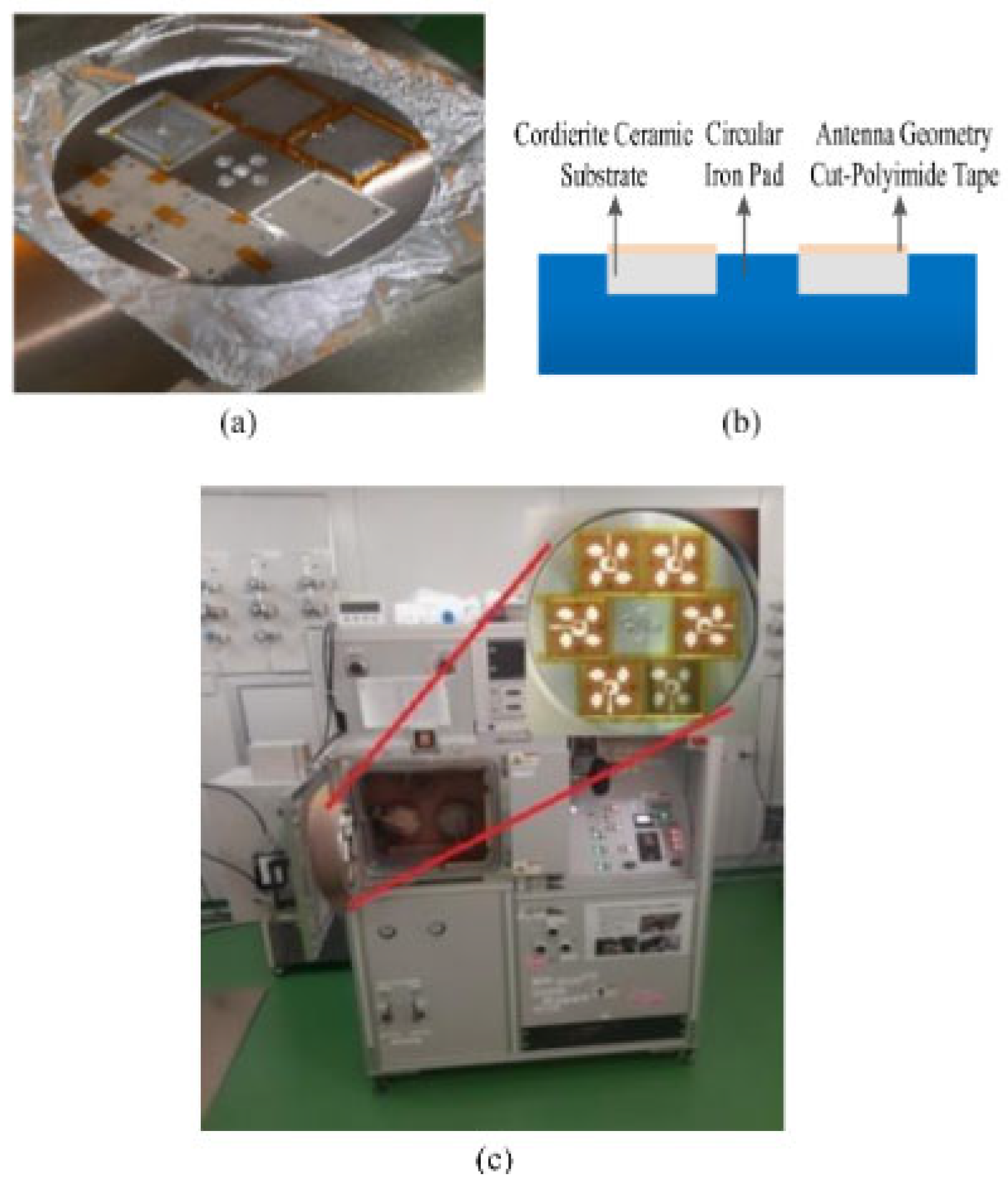
Pramono et al. [100] (Figure 24) proposed an innovative antenna substrate based on low-temperature fired ceramic (LTCC) technology using cordierite ceramic (2MgO2Al2O35SiO2). Compared to other existing ceramics, it has εr = 4.674 and tgδ = 0.0723 at 5.3 GHz, making it ideal for creating an ultra-wideband (UWB) circularly polarized (CP) array antenna. This ceramic is suitable for high-temperature environments. The conductive material used is platinum, which is deposited by a sputtering process. Based on the measured results, the proposed 2 × 2 CP antennas have an ultra-wide impedance bandwidth (IBW) of 1.74 GHz (32.83%), an axial ratio bandwidth (ARBW) of 1.26 GHz (23.77%), and a maximum gain of 12.2 dB.
Lakshmi et al. [101] prepared a hard substrate using low sintering temperature Zn2V2O7 ceramic and investigated its feasibility as a substrate material for a microstrip patch antenna. Structural characterization tests showed that the proposed ceramic has a crystalline structure. Microhardness analysis indicated good indentation and deformation resistance. The Zn2V2O7 substrates exhibited a thermal expansion coefficient of 2.6 ppm °C−1, a thermal conductivity of 0.65 Wm−1K−1 at room temperature, εr = 7.1, and a tgδ = 8.754 × 10⁻⁴. A microstrip patch antenna was designed with a copper strip as the ground plane and the radiating patch on the opposite sides of the substrate. The fabricated antenna had a return loss of −13.01 dB at 2.45 GHz. The three-dimensional radiation pattern of the antenna at 2.44 GHz indicated that the radiation efficiency was −3.255 dB and the total efficiency was −4.762 dB, representing moderate efficiency. These results qualify Zn2V2O7 as a substrate material for microstrip patch antennas.
High efficiency, high frequency, high selectivity and low latency characteristics of high frequency dielectric resonator antennas (DRA) are challenges that need to be addressed simultaneously in 5G communications. Thus, Wu et al. [102] prepared novel Sm(Nb1−xPx)O4 (SNP@x, 0.1 ≤ x ≤0.4) ceramics and demonstrated that P5+ effectively improves the dielectric properties at microwaves. The reduction of εr was dominated by the ionic polarizability of P5+ and the secondary phase SmPO4 with low εr. First, the secondary phase limits the generation and propagation of microcracks, hinders electron migration, and reduces conduction losses through leakage. Second, the increased binding energy of P2p enhances electron binding by the nucleus, reducing the mechanism. A cylindrical dielectric resonator antenna (CDRA) operating in the X-band was designed using ceramics with ultra-low SNP@0.3, achieving high gain (4.8–6.0 dBi) and efficiency (>90%) in the bandwidth region of 10.903–11.482 GHz, thereby improving transmission and communication quality in the communication system.
Yang et al. [103] extended the cavity model to consider microstrip patch antennas with a time-periodic substrate permittivity, where εr (t) = εr (t + T). It is important to note that the modulation of the time-periodic permittivity allows for precise control over the harmonic response of the antenna. Using this approach, we show, for example, that it is theoretically possible to achieve a fractional bandwidth of 40%, significantly exceeding the typical 1–2% bandwidth of conventional designs. This innovation demonstrates the potential of time-modulated substrate permittivity to revolutionize the performance of microstrip patch antennas.
Kumar et al. [104] designed a broadband dielectric resonator antenna with two hollow cylindrical tubes. Belous et al. [105] reviewed the main trends in the development of microwave dielectric materials for cellular communication devices. Zeng et al. [30] studied and prepared (1 − x) Li2MoO4−xBaV2O6 ceramics (LM-xBV, x = 0.7, 0.78, 0.8, 0.9), and the microstructures, microwave dielectric properties, and antenna simulation were investigated by XRD and Raman spectroscopy. The LM-0.8BV ceramic was obtained with excellent microwave dielectric properties of εr = 9.32, Q × f = 11,246.3 GHz and τf = 2.8 ppm/°C. The designed DRA based on the Li2MoO4−0.8BaV2O6 ceramic demonstrated excellent performance at 7.88 GHz, including a return loss of ~−33.51 dB, high efficiency (~95%), a peak gain of ~7.3 dB, and a bandwidth of 500 MHz. These results indicate that the material has promising potential for applications in microwave devices within the framework of low-temperature co-fired ceramic (LTCC) technology.
Shehbaz et al. [106] studied an all-ceramic broadband ceramic DPA using Ba4.5(Sm0.8La0.2)9Ti18O54 (BSLT) microwave dielectric ceramic with high permittivity, temperature stability and low loss, prepared by solid-state reaction method at a sintering temperature of 1380 °C. The fabricated ceramic has excellent microwave dielectric properties, with εr ≈ 90.0, Qf value ≈ 8230 at 3.54 GHz, and temperature coefficient of resonance frequency (TCF) ≈ τ2.8 ppm °C−1. The main feature of the designed DPA is its unique structure and design, in which both the patch and the ground plane are made of microwave dielectric ceramic. The broadband performance is achieved by using an air substrate and a disk-loaded probe between the ground and the radiating patch. The fabricated DPA has a broadband bandwidth of 46.8% and a measured realized gain of 6.5 dBi. Due to its excellent microwave properties and radiation performance, the proposed DPA is expected to have applications for 5G communication systems.
Xu et al. [107] synthesized a series of W6+—substituted NaSrYb(Mo1−xWxO4)3 (NM1–xWx, x = 0.02–0.10) ceramics via a conventional solid-state reaction route. Among the investigated samples, the composition x = 0.06 exhibited superior dielectric performance, characterized by εr = 10.12, Q × f = 98,018 GHz, and τf = −8.67 ppm/°C. The materials maintained low loss characteristics even in the terahertz regime, and a microstrip patch antenna built on a NM0.94W0.06 ceramic substrate successfully operated in the 5G Sub-6 GHz frequency range, thus validating its strong applicability in next-generation communication technologies.
Due to the advantages of low profile, high gain, and high radiation efficiency, many functional DPAs have been reported in the literature. Thus, Tang et al. [30,108] developed a frequency-reconfigurable dielectric patch antenna with bandwidth enhancement, as well as a low-profile, broadband dielectric patch antenna and array with anisotropic properties. Yin et al. [33] developed a high-efficiency dielectric patch antenna made of Sr3−xCaxV2O8 ceramic with temperature stability. To demonstrate its potential for application in wireless communications, a patch antenna made of x = 0.3 ceramic was fabricated based on the simulated result by CST Microwave Studio software, which demonstrated high simulated radiation efficiency (99.7%) and gain (5.35 dBi) at 3.421 GHz.

5. Technological Perspectives on the Development of Advanced Ceramic-Based Structures for GNSS Technology

5.1. Most Relevant Advanced Ceramic-Based Structures

Based on the cited references, the advanced ceramic-based structures fall into three major chemical families:
-
Molybdate-based systems
Molybdates are the “stars” of the ULTCC world [14,21,23,24,30,107] because they possess inherently low melting points due to the weak Mo-O bonds in their crystal lattices. Key compositions are: NaxAg2−xMoO4 [14] and Li2Mg2Mo3O12 [21,22]. By substituting Na+ for Li+ or Zn2+ for Mg2+, researchers tune the temperature coefficient. When adding Ag, it helps densify the ceramic at lower temperatures, making it highly stable for outdoor GNSS antennas [14].
-
Borates and phosphates
These systems are used when a low permittivity < 10 is required to increase antenna bandwidth. Key compositions are Li6B4O9 [13,97] and LiMgPO4 [19]. Lithium-borate ceramics have an ultra-low density, ideal for drone-mounted GNSS receivers [56] where weight is a critical constraint.
-
Vanadates and complex titanates
They are recommended for high-permittivity applications >30, where extreme miniaturization is the priority. Key compositions are Zn2V2O7 [101] and Ba5Sm0.8La0.2Ti18O54 [106]. They may include heavy rare-earth elements (Sm, La, Nd) to “clog” the crystal lattice, which increases the dielectric constant but requires careful doping [99,108].
The main manufacturing challenge is related to the battle against shrinkage. The most notorious challenge in ceramic manufacturing is anisotropic shrinkage. As the organic binders burn off and the ceramic particles fuse (sinter), the structure typically shrinks by 15–25%. For a high-precision GNSS antenna, even a 1% deviation in final dimensions can shift the resonant frequency out of the required band. Strategies to control shrinkage are in principle:
-
Zero-shrinkage (constraint) sintering: To keep the X-Y dimensions stable, researchers use “sacrificial” layers or rigid substrates that do not shrink at the same temperature. This forces all volume reduction into the Z-axis (thickness), preserving the antenna’s surface geometry [25].
-
Cold sintering process (CSP): By applying high pressure (up to 500 MPa) and a small amount of liquid transient phase (like water or an acid solution), ceramics like LiMgPO4 can be densified at lower temperatures [11,19]. Because the temperature is so low, the thermal expansion and subsequent contraction are minimized, leading to much higher dimensional accuracy.
-
Sintering aids and glass frits: Adding low-melting-point glasses (like Bi-B-Si systems) allows the ceramic particles to “rearrange” more efficiently. This promotes liquid-phase sintering, which can be controlled more predictably than solid-state diffusion [16,17].

5.2. Specific Improvements in GNSS Technology Offered by the Advanced Ceramic Features

As GNSS technology becomes increasingly essential to critical infrastructure, it encounters a rising and sophisticated risk from deliberate interference, specifically jamming and spoofing. Jamming, which obscures weak satellite signals with radio frequency interference, can lead to a straightforward loss of positioning. Spoofing, on the other hand, represents a more treacherous danger where fake signals deceive a receiver into determining an inaccurate position and time. The challenge requires ongoing investment in cutting-edge anti-jam and anti-spoofing technologies, like controlled reception pattern antennas (CRPAs) and advanced signal processing algorithms, which may raise the cost and complexity of systems. Advanced ceramics provide specific improvements in three key areas:
-
Axial ratio (AR) and circular polarization
GNSS signals (GPS, Galileo) are right-hand circularly polarized (RHCP). The axial ratio measures how perfectly “circular” the signal is; an AR of 0 dB is a perfect circle, while values above 3 dB indicate the signal is becoming elliptical, leading to power loss. The impact of advanced ceramics lies in the following aspects: 1. High-permittivity ceramics allow for complex “cross-slot” or “fractal” designs [73,82] that excite multiple modes simultaneously. This broadens the 3-dB AR bandwidth, ensuring the antenna stays circular even when the satellite is near the horizon. 2. Modern ULTCC antennas often achieve a 3-dB AR bandwidth of >10%, covering both the L1 and E1 bands with a single feed point [101,107].
-
Realized gain and efficiency
Gain describes how much signal the antenna can receive in a specific direction. Since GNSS signals are circularly polarized, the antenna must be able to “spin” with the incoming wave. A perfect antenna theoretically must have an AR of 0 dB. Because ceramics can be 3D-shaped [106], they maintain an AR < 3 across a much wider angle. The impact of advanced ceramics lies in the following aspects: 1. low dielectric loss (low tgδ); for example, in standard FR4, energy is lost as heat within the substrate, and advanced ceramics like Li6B4O9 have a tgδ near 0.0001. 2. Efficiency, related to low loss, translates into radiation efficiency, often exceeding 80–90%. Achieved metrics: For compact ceramic patch antennas, realized gains of +3 to +5 dB are common. High-gain arrays for drone or satellite applications can reach >10 dB using “higher-order mode” excitation [27,43].
-
Multi-path rejection
In urban areas, signals bounce off buildings (“multi-path”). A high-quality ceramic antenna has a sharp phase center stability. Because the ceramic material is so homogeneous, the electrical center of the antenna does not shift, which allows the receiver to better distinguish between the “direct” satellite signal and a “reflected” one [109].

5.3. Concept of Zero TTC (Temperature Coefficient) Ceramics

Additionally, in GNSS antenna technology, the latest research direction is focused on “Zero TTC (Temperature Coefficient) Ceramics”, which denotes ceramics that exhibit a nearly zero temperature coefficient of resonant frequency (τf). Within the realm of GNSS receiving antennas, “Zero TTC” (also known as zero-length baseline or zero-elevation/zero-center calibration) is not a label for consumer products; rather, it is a precise calibration and testing approach employed to remove systemic errors and separate receiver noise. The ceramic materials intended for this application are crucial for maintaining the antenna’s precision and signal reliability amid the drastic temperature fluctuations common in satellite and outdoor settings, which current ceramic materials fail to address, as GNSS technology currently offers precise positioning data when the receiver operates in an open, clear environment. The primary functions of Zero TTC ceramics involve: achieving frequency stability (GNSS signals function within precise, narrow frequency ranges—for instance, L1 at 1.575 GHz, with high stability ceramics ensuring the antenna resonance frequency stays consistent as the device heats or cools); miniaturization (ceramics with high dielectric constants (εr) enable a notable reduction in the size of patch antennas while still preserving electrical performance); high accuracy (submillimeter precision necessary for geodetic and high-precision monitoring); reliability in extreme environments (in aerospace and military applications); and a high quality factor (High-Q): These materials must typically display low dielectric loss, leading to a high quality factor (Q). This leads to “sharper” filtering, aiding the antenna in dismissing out-of-band interference and jamming signals [29,110,111,112,113,114,115,116].
The main advantages of zero-TTC ceramics for further development consist of: excellent thermal stability (prevents frequency drift in harsh conditions, ensuring consistent signal reception without requiring complex active tuning); low dielectric loss (generally shows high quality factors, often surpassing 100,000 GHz, which reduces energy loss and enhances signal amplification); compact size (the ability to achieve zero-TTC with high permittivity enables antenna designs that can be up to 100 times smaller than the operating wavelength); manufacturing compatibility (contemporary zero-TTC ceramics can be co-fired with silver electrodes, which simplifies the production of integrated RF components affordably and in large quantities) [108,113,114,115,116,117,118,119,120].
Common materials currently utilized for GNSS antennas that could be improved towards “Zero TTC” encompass different ceramic formulations, such as low-temperature co-fired ceramics (LTCC), which are popular due to their suitability for multilayer integration and superior high-frequency performance while facilitating miniaturization; cordierite-based ceramics, which have attracted recent research attention, through doping strategies (for example, with magnesium, or nickel) to attain “near-zero” dielectric loss for high-efficiency 5G/GNSS patch antennas; selected high-permittivity dielectric ceramics, such as alumina (AlN) or silicon carbide (SiC), which are recommended for their additional thermal conductivity and capability to reduce the antenna size to roughly 1/100 of a square wavelength; and composite ceramics, including configurations employing mixtures, e.g., Ba1−xSrxZn2Si2O7, integrated to reduce weight while preserving dielectric properties for circular polarization and high-volume applications [113,120,121]. With the shift to L5 frequency signals (that offer significantly enhanced precision), producers are eager to produce zero-TTC ceramics, which guarantee that the antenna’s resonant frequency stays consistent within ppm/°C [122,123]. Temperature-stable ceramics are crucial materials for advancing GNSS technology, by preserving a consistent dielectric constant over a broad temperature range; these ceramics inhibit frequency drift in patch and dielectric resonator antennas, guaranteeing precise signal reception for GPS, Galileo, GLONASS, and BeiDou, under satellite and outdoor harsh conditions [124]. Conversely, the association of ferroelectricity of tailored ceramics and the zero-TTC concept led to advancement in millimeter-wave telecommunication, offering many advantages for GPS patch antenna development. By modifying, e.g., the ferroelectric ZnAl2O4 compound, it exhibits a high quality factor (Q > 5000), a low dielectric constant (εr < 20), and a near-zero temperature coefficient of resonant frequency (τf0), allowing the construction of a successful microstrip patch antenna [125,126].
We were particularly motivated by the problem of thermal stability. In precision GNSS applications—real-time kinematic (RTK) positioning for autonomous vehicles, geodetic monitoring of infrastructure deformation, timing receivers for critical telecommunications networks—the antenna is expected to maintain its resonant frequency, its radiation pattern, and its phase center location within very tight tolerances across the full operating temperature range of the deployment environment. This is a materials problem as much as it is an antenna design problem, and it requires a level of integration between the two disciplines that the existing literature does not adequately provide.
The emergence of so-called zero-TTC ceramics—materials engineered to exhibit a near-zero temperature coefficient of resonant frequency by compositional tuning, typically through the combination of phases with positive and negative τf values—continues to represent one of the most promising directions for addressing this challenge. Yet, the translation of zero-TTC performance from resonator-level characterization to antenna-level behavior in a GNSS context has received surprisingly little systematic attention.

5.4. Technological Impact of Defects in Crystal Structures and Defect Regulation Strategies

Point defects (especially oxygen vacancies) and grain size are critical factors influencing dielectric losses in the microwave range (300 MHz–300 GHz), having a direct impact on the quality factor (Qxf = f/tgδ) of ceramic materials [127].
Oxygen vacancies (VO**) act as the most prevalent intrinsic defects that significantly increase dielectric losses (Q) in the microwave range, especially in metal oxides [128]. In the microwave frequency range, oxygen vacancies act as mobile charged entities that contribute to dielectric relaxation [129]. Under an alternating electric field, the migration of these vacancies or the reorientation of dipoles formed by vacancy-cation clusters (e.g., VO**—Ti’) dissipates energy as heat, significantly lowering the Q factor [130]. The localized pairing of vacancies with aliovalent dopants (e.g., VO**—acceptors) forms defect dipoles. Under an alternating microwave electric field, these dipoles reorient, consuming electromagnetic energy and increasing dielectric loss. Optimizing sintering atmospheres (e.g., in oxygen-rich environments) suppresses the formation of and restores lattice symmetry. To minimize dielectric losses, it is often desirable to achieve high material density (low porosity) and tight control of the sintering atmosphere to avoid the formation of oxygen vacancies [131].
Grain size influences dielectric losses through the density of grain boundaries, which are generally regions with defects and losses [132]. Grain boundaries represent regions of high-energy disorder and act as extrinsic sources of loss. They facilitate the accumulation of impurities and secondary phases that can have higher conductivity than the bulk grain, leading to Maxwell–Wagner–Sillars interfacial polarization [133]. Furthermore, grain size affects loss: smaller grains increase the density of grain boundaries, which increases phonon scattering and energy dissipation [134].
Defect regulation strategies to maximize the Q x f value are primarily employed through aliovalent doping and sintering atmosphere control. Aliovalent substitution is achieved by substituting a host ion with an ion of higher valence (e.g., W6+ for Ti4+), which introduces excess positive charge, suppressing the formation of oxygen vacancies to maintain electrical neutrality [131]. This reduces the concentration of relaxation units and effectively lowers tanδ. In addition, microstructural homogenization techniques such as mechanical alloying or high-entropy design promote grain refinement and chemical homogeneity, which minimizes lattice distortion and suppresses the extrinsic damping of lattice vibrations [132].
At microwave frequencies (GHz range), the dielectric response is dominated by ionic polarization and lattice vibrations (phonons) [133]. The thermodynamic mechanism of loss is primarily driven by phonon anharmonicity. In a perfectly harmonic crystal, phonons do not interact, and energy is not dissipated. However, real crystals exhibit anharmonicity—the deviation from a simple harmonic potential—which allows for phonon-phonon scattering [134], which converts organized electromagnetic energy into disorganized thermal energy (entropy). The “intrinsic limit” of Q is thus determined by the damping factors of these phonon modes, which are sensitive to temperature and the crystal’s symmetry [135].
Compensating phases (such as in phase change materials or structural transitions) suppress frequency drift by manipulating the underlying energy landscape and internal entropy, rather than simply correcting the output error, effectively stabilizing the structural state of the material at the atomic level against temperature fluctuations. This thermodynamic approach shifts the mechanism from reactive, macroscopic data stacking (e.g., typical PLL correction) to proactive microscopic stability (e.g., state-dependent structural design) [136]. Compensating phases may involve creating a compound of two ceramic phases with opposite temperature coefficients of resonant frequency. By adjusting the volume fractions based on a mixing rule (such as the Lichtenecker rule or Maxwell’s relation), the total temperature coefficient of resonant frequency of the structure can be tailored to zero. Such thermodynamic balancing ensures that the increase in size (lowering f0) is perfectly offset by the change in the medium’s effective permittivity, suppressing frequency drift in the GNSS device [137].

5.5. The Potential of Employing AI to Correlate the Intrinsic Properties of the Advanced Ceramic Structures with the Performance of GNSS Antennas

The integration of Artificial Intelligence (AI) in the development of advanced ceramics for the Global Navigation Satellite System (GNSS) addresses the non-linear complexity of correlating atomic-scale defects with macro-scale antenna performance. By leveraging machine learning (ML) and deep learning (DL), researchers can navigate the “materials genome” to optimize signal selectivity and thermal stability. Deep Neural Networks (DNNs) can be trained on large datasets of impedance spectroscopy to correlate the concentration of oxygen vacancies and their activation energies with dielectric loss at GHz frequencies [138]. This allows AI to predict the “intrinsic limit” of Q for new ceramic formulations before physical synthesis. Machine learning models, such as Random Forests, are applied to 3D modeling tools to design microstructures that maximize field confinement and minimize energy dissipation at grain boundaries [139,140]. AI can quantify how variations in grain size or impurity clusters across a ceramic batch will affect the antenna’s signal-to-noise ratio (SNR), facilitating more robust manufacturing [141].
High-fidelity electromagnetic simulations are computationally expensive. AI-based surrogate models (such as Gaussian process regression) learn the relationship between a ceramic’s substrate properties and the antenna’s final S-parameters (return loss) and radiation patterns [139].
The most potent application of AI is inverse design, where the desired antenna performance is the input, and the AI determines the necessary ceramic composition and defect regulation strategy: 1. AI algorithms can optimize the volume fractions of compensating phases to suppress frequency drift [140]; 2. AI can optimize the sintering process (temperature, atmosphere, and cooling rate) to regulate defect chemistry (grain boundary engineering) [141].
Finally, physics-informed neural networks (PINNs) incorporate thermodynamic laws directly into the loss function of the neural network [142], which guarantees that the AI’s recommendations are physically coherent, enabling it to precisely forecast, for instance, how thermal expansion will offset across extreme temperature variations in outer space or elevated altitudes.

6. Conclusions

The global market for GNSS receivers and antennas is projected to grow from USD 5.45 billion in 2026 to USD 8.15 billion by 2034, showing a CAGR of 5.2% during the forecast period. In line with this trend, the task of creating advanced ceramic materials for the technology of GNSS receiving antennas is a reality.
Ceramics have demonstrated remarkable material properties, including high thermal resistance, excellent electrical insulation, significant hardness, and impressive wear resistance, enabling their successful use in GNSS technology.
This study highlights how this technology goes beyond the limits of conventional ceramics production methods, broadening design possibilities and enhancing the functional properties of ceramic parts for GNSS receiving antennas. The ability to create complex shapes and microstructures that were previously unachievable through traditional methods signals a new age of opportunities for GNSS receiving antennas applications, especially in aerospace, healthcare, electronics, and automotive fields.
This study methodically presents the ceramic materials associated with different antenna types and designs, pertinent to their specific uses. This study discloses the technology, characteristics, and uses of various ceramics for antennas featuring alumina and RT/Duroid substrates, antennas utilizing FR4 substrates, antennas employing PCB substrates, antennas consisting of polymer substrates, antennas with dielectric ceramic backing, and antennas using Rogers substrates, correlating the substrate type with the ceramics utilized and their applications.
Temperature-stable ceramics are essential for enhancing GNSS technology and continue to represent one of the most promising directions for antennas development, as they maintain a steady dielectric constant across a wide temperature spectrum; these ceramics prevent frequency shifts in patch and dielectric resonator antennas, ensuring accurate signal reception for GPS, Galileo, GLONASS, and BeiDou, even in harsh outdoor and satellite environments.

Author Contributions

Conceptualization, R.C.C., A.R.C., M.V.L., I.I., M.P., A.P. and R.M.; methodology, R.C.C. and A.R.C.; writing—original draft, R.C.C. and A.R.C.; writing—review and editing, R.C.C. All authors have read and agreed to the published version of the manuscript.

Funding

This research was supported by the Romanian Ministry of Research, Innovation and Digitalization, project number AIR-NAVY-SYS (SMIS 331874), and by the Institutional Doctoral Grant/2025 of Technical University Iasi, Romania.

Data Availability Statement

The data are presented in this study.

Conflicts of Interest

The authors declare no conflicts of interest.

Abbreviations

The following symbols and abbreviations used in the manuscript have been presented in the table below.
Symbols and abbreviationsName
AlNaluminum nitride
BSTbarium strontium titanate- Ba1−xSrxTio3
BTbarium titanate
BMNbismuth magnesium niobium titanate
BNTbismuth sodium titanate
BAW Acousticbulk acoustic wave
FR4 substratecomposite material made of fiberglass fabric impregnated with an epoxy resin
CAGRcompound annual growth rate
tgδdielectric loss tangent
GNSSglobal navigation satellite system
GPSglobal positioning system
BeiDou applicationsGNSS used for positioning, navigation, and timing (BDS—China) applications
GLONASS applicationsGNSS used for positioning, navigation, and timing (Russia) applications
high-khigh dielectric constant
Rogers RT/Duroidhigh-performance circuit materials made from PTFE-filled composites
INSinertial navigation systems
BNT-7BT-BMNlead-free ferroelectric ceramic system based on BNT, BT and BMN
LHCPleft-hand circularly polarized
LTCClow-temperature co-fired ceramics
LNAlow-noise amplifier
MTmagnesium titanate mgtio3
MLmachine learning
MWDCmicrowave dielectric ceramics
MIMOmultiple-input multiple-output
PCB substratenon-conductive layer of a printed circuit board, used to provide mechanical support for components and to provide electrical insulation between copper layers
DRApatch and dielectric resonator antenna
PTFE polytetrafluoroethylene
PVDFpolyvinylidene fluoride
PNTpositioning, navigation, and timing
Q-factor (Qxf)quality factor
RTKreal-time kinematic
εrrelative permittivity
RHCPright-hand circular polarization
SiCsilicon carbide
SAW Acousticsurface acoustic wave
τftemperature coefficient of resonant frequency
3Dthree dimensional
UAVsunmanned aerial vehicles
ZAzinc aluminate znal2o4
ZTA zirconia-toughened alumina ZrO2-TiO2-Al2O3

References

  1. Vimukthi, D.; Jayamani, E.; Soon, K.; Subramanian, J.; Ravi Sankar, R. Analysis of Dielectric Resonator Antenna Using Natural Fiber Reinforced Polymer Composites. Mater. Today Proc. 2024, 103, 346–351. [Google Scholar] [CrossRef]
  2. Ward, A.A. Dielectric Materials for Advanced Applications. State Art 2016, 10, 1–65. [Google Scholar] [CrossRef]
  3. Tan, D.Q. Review of Polymer-Based Nanodielectric Exploration and Film Scale-Up for Advanced Capacitors. Adv. Funct. Mater. 2020, 30, 1808567. [Google Scholar] [CrossRef]
  4. Li, H.; Zhou, Y.; Liu, Y.; Li, L.; Liu, Y.; Wang, Q. Dielectric Polymers for High-Temperature Capacitive Energy Storage. Chem. Soc. Rev. 2021, 50, 6369–6400. [Google Scholar] [CrossRef]
  5. Zhang, H.; Wei, T.; Zhang, Q.; Ma, W.; Fan, P.; Salamon, D.; Zhang, S.-T.; Nan, B.; Tan, H.; Ye, Z.-G. A Review on the Development of Lead-Free Ferroelectric Energy-Storage Ceramics and Multilayer Capacitors. J. Mater. Chem. C 2020, 8, 16648–16667. [Google Scholar] [CrossRef]
  6. Li, Z.; Zhang, D.; Wang, C.; Zhang, J.; Wang, Z.; Wang, Z.; Yan, X.; Ai, T.; Wang, D.; Lu, Z.; et al. The Influence of BaTiO3 Content on the Energy Storage Properties of Bi0.5Na0.5TiO3-Bi(Mg2/3Nb1/3)O3 Lead-Free Ceramics. Crystals 2023, 13, 733. [Google Scholar] [CrossRef]
  7. Kanno, K.; Ito, H.; Ogawa, T.; Tatara, R.; Hasegawa, K.; Watanabe, A.; Kumar, L.N.V.; Swaminathan, M. Advanced Low-Loss Photo-Imageable Dielectric Material for RF/Millimeter-Wave Applications and Demonstration of High-Density Interconnect. In 2021 IEEE 71st Electronic Components and Technology Conference (ECTC); IEEE: San Diego, CA, USA, 2021; pp. 544–549. [Google Scholar] [CrossRef]
  8. Available online: https://www.statsmarketresearch.com/Global-Gnss-Receivers-Antennas-Market-8072445 (accessed on 1 March 2026).
  9. Jin, S.; Meng, X.; Dardanelli, G.; Zhu, Y. Multi-Global Navigation Satellite System for Earth Observation: Recent Developments and New Progress. Remote Sens. 2024, 16, 4800. [Google Scholar] [CrossRef]
  10. Ibn-Mohammed, T.; Randall, C.A.; Mustapha, K.B.; Guo, J.; Walker, J.; Berbano, S.; Koh, S.C.L.; Wang, D.; Sinclair, D.C.; Reaney, I.M. Decarbonising Ceramic Manufacturing: A Techno-Economic Analysis of Energy Efficient Sintering Technologies in the Functional Materials Sector. J. Eur. Ceram. Soc. 2019, 39, 5213–5235. [Google Scholar] [CrossRef]
  11. Wang, D.; Zhang, S.; Zhou, D.; Song, K.; Feteira, A.; Vardaxoglou, Y.; Whittow, W.; Cadman, D.; Reaney, I.M. Temperature Stable Cold Sintered (Bi0.95Li0.05)(V0.9Mo0.1)O4-Na2Mo2O7 Microwave Dielectric Composites. Materials 2019, 12, 1370. [Google Scholar] [CrossRef] [PubMed]
  12. Pang, L.; Zhou, D.; Wang, D.; Zhao, J.; Liu, W.; Yue, Z.; Reaney, I.M. Temperature Stable K0.5 (Nd 1−xBix)0.5 MoO4 Microwave Dielectrics Ceramics with Ultra-low Sintering Temperature. J. Am. Ceram. Soc. 2018, 101, 1806–1810. [Google Scholar] [CrossRef]
  13. Zhou, D.; Pang, L.-X.; Wang, D.-W.; Qi, Z.-M.; Reaney, I.M. High Quality Factor, Ultralow Sintering Temperature Li6B4O9 Microwave Dielectric Ceramics with Ultralow Density for Antenna Substrates. ACS Sustain. Chem. Eng. 2018, 6, 11138–11143. [Google Scholar] [CrossRef]
  14. Zhou, D.; Li, J.; Pang, L.-X.; Wang, D.-W.; Reaney, I.M. Novel Water Insoluble (NaxAg2−x)MoO4 (0 ≤ x ≤ 2) Microwave Dielectric Ceramics with Spinel Structure Sintered at 410 Degrees. J. Mater. Chem. C 2017, 5, 6086–6091. [Google Scholar] [CrossRef]
  15. Varghese, J.; Ramachandran, P.; Sobocinski, M.; Vahera, T.; Jantunen, H. ULTCC Glass Composites Based on Rutile and Anatase with Cofiring at 400 °C for High Frequency Applications. ACS Sustain. Chem. Eng. 2019, 7, 4274–4283. [Google Scholar] [CrossRef]
  16. Induja, I.J.; Sebastian, M.T. Microwave Dielectric Properties of SnO-SnF2-P2O5 Glass and Its Composite with Alumina for ULTCC Applications. J. Am. Ceram. Soc. 2017, 100, 2632–2640. [Google Scholar] [CrossRef]
  17. Wang, K.; Yin, T.; Zhou, H.; Liu, X.; Deng, J.; Li, S.; Lu, C.; Chen, X. Bismuth Borate Composite Microwave Ceramics Synthesised by Different Ratios of H3BO3 for ULTCC Technology. J. Eur. Ceram. Soc. 2020, 40, 381–385. [Google Scholar] [CrossRef]
  18. Szwagierczak, D.; Synkiewicz-Musialska, B.; Kulawik, J.; Czerwińska, E.; Pałka, N. Ultra-Low Temperature Cofired Ceramics Based on Li2WO4 as Perspective Substrate Materials for Terahertz Frequencies. J. Adv. Ceram. 2023, 12, 526–538. [Google Scholar] [CrossRef]
  19. Wang, D.; Chen, J.; Wang, G.; Lu, Z.; Sun, S.; Li, J.; Jiang, J.; Zhou, D.; Song, K.; Reaney, I.M. Cold Sintered LiMgPO4 Based Composites for Low Temperature Co-fired Ceramic (LTCC) Applications. J. Am. Ceram. Soc. 2020, 103, 6237–6244. [Google Scholar] [CrossRef]
  20. Nelo, M.; Vahera, T.; Siponkoski, T.; Juuti, J.; Jantunen, H. Ultra-Low Permittivity ULTCC Composite Materials. Appl. Phys. Lett. 2021, 118, 142901. [Google Scholar] [CrossRef]
  21. Bian, W.; Zhou, G.; Dong, Y.; Lu, X.; Zhu, H.; Ta, S.; Wang, L.; Zhang, Q. Structural Analysis and Microwave Dielectric Properties of a Novel Li2Mg2Mo3O12 Ceramic with Ultra-Low Sintering Temperature. Ceram. Int. 2021, 47, 7081–7087. [Google Scholar] [CrossRef]
  22. Li, F.; Li, Y.; Li, Y.; Feng, X.; Zhang, J.; Liu, X.; Lu, Y.; Wang, S.; Liao, Y.; Tang, T.; et al. Enhanced Na+-Substituted Li2Mg2Mo3O12 Ceramic Substrate Based on Ultra-Low Temperature Co-Fired Ceramic Technology for Microwave and Terahertz Polarization-Selective Functions. J. Eur. Ceram. Soc. 2023, 43, 384–391. [Google Scholar] [CrossRef]
  23. Huang, C.-L.; Huang, J.-L.; Hsu, T.-H. Microwave Dielectric Properties of Novel Na2Mg5-xZnx(MoO4)6 (x = 0–0.09) Ceramics for ULTCC Applications. Mater. Res. Bull. 2021, 141, 111355. [Google Scholar] [CrossRef]
  24. Bao, J.; Zhang, Y.; Wu, H.; Zhou, Y.; Yue, Z. Sintering Characteristics, Crystal Structure and Dielectric Properties of Cobalt-Tungsten Doped Molybdate-Based Ceramics at Microwave Frequency. J. Mater. 2022, 8, 949–957. [Google Scholar] [CrossRef]
  25. Wang, K.; Zhou, H.; Liu, X.; Sun, W.; Chen, X.; Ruan, H. A Lithium Aluminium Borate Composite Microwave Dielectric Ceramic with Low Permittivity, near-Zero Shrinkage, and Low Sintering Temperature. J. Eur. Ceram. Soc. 2019, 39, 1122–1126. [Google Scholar] [CrossRef]
  26. Guo, H.; Fang, L.; Jiang, X.; Li, J.; Lu, F.; Li, C. A Novel Low-Firing and Low Loss Microwave Dielectric Ceramic Li2Mg2W2O9 with Corundum Structure. J. Am. Ceram. Soc. 2015, 98, 3863–3868. [Google Scholar] [CrossRef]
  27. Wang, X.-Y.; Tang, S.-C.; Yang, L.-L.; Chen, J.-X. Differential-Fed Dual-Polarized Dielectric Patch Antenna with Gain Enhancement Based on Higher Order Modes. Antennas Wirel. Propag. Lett. 2020, 19, 502–506. [Google Scholar] [CrossRef]
  28. Xu, K.; Jin, L.; Tang, H.; Yang, W.-W.; Shi, J. A High-Efficiency Dual-Band Self-Filtering Antenna Based on Three Dense Dielectric Strip Resonators. Antennas Wirel. Propag. Lett. 2022, 21, 1532–1536. [Google Scholar] [CrossRef]
  29. Chen, Y.-B.; Peng, J. Zero-Temperature Coefficient of Resonant Frequency in [(Mg0.6Zn0.4)0.95Co0.05]1.02TiO3.02-Ca0.6(La0.9Y0.1)0.2667TiO3 Ultra-Low-Loss Composite Dielectrics. Ceramics 2024, 7, 466–477. [Google Scholar] [CrossRef]
  30. Zeng, F.; Meng, L.; Yuan, C.; Zhu, B.; Liu, X.; Xiao, H.; Wu, J.; Zhou, C.; Chen, G. Microwave Dielectric Properties and Antenna Simulation of Li2MoO4-BaV2O6 Ceramics with Low Sintering Temperature. J. Mater. Sci. Mater. Electron. 2025, 36, 2137. [Google Scholar] [CrossRef]
  31. Tang, S.-C.; Wang, X.-Y.; Yang, W.-W.; Chen, J.-X. Wideband Low-Profile Dielectric Patch Antenna and Array with Anisotropic Property. IEEE Trans. Antennas Propagat. 2020, 68, 4091–4096. [Google Scholar] [CrossRef]
  32. Yin, C.; Yin, Y.; Du, K.; Song, X.; Guo, H.; Xiong, Y.; Cheng, M.; Yang, J.; Luo, W.; Lu, W.; et al. Fabrication of High-Efficiency Dielectric Patch Antennas from Temperature-Stable Sr3−xCaxV2O8 Microwave Dielectric Ceramic. J. Eur. Ceram. Soc. 2023, 43, 1492–1499. [Google Scholar] [CrossRef]
  33. Zhang, X.-K.; Wang, X.-Y.; Tang, S.-C.; Chen, J.-X.; Yang, Y.-J. A Wideband Filtering Dielectric Patch Antenna with Reconfigurable Bandwidth Using Dual-Slot Feeding Scheme. IEEE Access 2021, 9, 96345–96352. [Google Scholar] [CrossRef]
  34. Saâdaoui, M. Mechanical Behavior and Reliability of Engineering Ceramics. Ceramics 2026, 9, 41. [Google Scholar] [CrossRef]
  35. Krishna Prasad, N.V.; Venkata Prasad, K.; Ramesh, S.; Phanidhar, S.V.; Venkata Ratnam, K.; Janardhan, S.; Manjunatha, H.; Sarma, M.S.S.R.K.N.; Srinivas, K. Ceramic Sensors: A Mini-Review of Their Applications. Front. Mater. 2020, 7, 593342. [Google Scholar] [CrossRef]
  36. Zheng, K.; Xie, N.; Deng, Y.; Febbo, M.; Broeckmann, C.; Liu, P. A Review on Lead-Free Piezoelectric Ceramic Sensors for Sustainable and Intelligent Applications. Chem. Eng. J. 2026, 528, 172363. [Google Scholar] [CrossRef]
  37. Available online: https://pcbsync.com (accessed on 1 March 2026).
  38. Available online: https://www.rogerscorp.com (accessed on 1 March 2026).
  39. Available online: https://www.pcbmaster.com (accessed on 1 March 2026).
  40. Sharifi, G.; Zehforoosh, Y.; Sedghi, T.; Takrimi, M. A High Gain Pattern Stabilized Array Antenna Fed by Modified Butler Matrix for 5G Applications. AEU—Int. J. Electron. Commun. 2020, 122, 153237. [Google Scholar] [CrossRef]
  41. De Marco, R.; Arnieri, E.; Greco, F.; Bordbar, A.; Amendola, G.; Boccia, L. Low-Profile Dual-Band Dual-Polarized Transmitarray Antenna Based on Multilayer Frequency Selective Surfaces. IEEE Trans. Antennas Propag. 2023, 71, 7354–7362. [Google Scholar] [CrossRef]
  42. Paul, K.C.; Ahmed, A. E-shaped Aperture Coupled Microstrip Patch Array Antenna for High Speed Downlink Applications in Small Satellites. Int. J. Electron. Telecommun. 2022, 68, 47–56. [Google Scholar] [CrossRef]
  43. Li, R.; Li, P.; Rocca, P.; Salas Sánchez, A.Á.; Song, L.; Li, X.; Xu, W.; Fan, Z. Design of Wideband High-Gain Patch Antenna Array for High-Temperature Applications. Sensors 2023, 23, 3821. [Google Scholar] [CrossRef]
  44. Zhang, M.; Lei, P.; Zhang, C.; Zou, Z.; Yang, J.; Yin, C.; Wang, X.; Lu, W.; Lei, W. An Ultra-Wideband Integrated Filtering Antenna with Improved Band-Edge Selectivity Using Multimode Resonator. Electronics 2023, 12, 3264. [Google Scholar] [CrossRef]
  45. Chung, M.-A.; Tseng, K.-C.; Meiy, I.-P. Antennas in the Internet of Vehicles: Application for X Band and Ku Band in Low-Earth-Orbiting Satellites. Vehicles 2023, 5, 55–74. [Google Scholar] [CrossRef]
  46. Available online: https://www.Rogerscorp.Com/Advanced-Electronics-Solutions/Diclad-Series-Laminates/Diclad-870_880-Laminates (accessed on 1 March 2026).
  47. Chittimoju, G.; Sambana, B.; Ravali, J.S.; Vamsi, M.; Syamundar, P. Design of Circularly Polarized Wideband Dielectric Resonator Antenna for Millimeter Wave Applications. SN Comput. Sci. 2023, 4, 585. [Google Scholar] [CrossRef]
  48. Shamsaee Malfajani, R.; Niknam, H.; Bodkhe, S.; Therriault, D.; Laurin, J.-J.; Sharawi, M.S. A 3D-Printed Encapsulated Dual Wide-Band Dielectric Resonator Antenna with Beam Switching Capability. IEEE Open J. Antennas Propag. 2023, 4, 492–505. [Google Scholar] [CrossRef]
  49. Dwivedi, A.K.; Singh, S.K.; Ranjan, P.; Sharma, A.; Singh, V. Machine Learning Assisted Dual Port Metasurface Loaded MIMO Antenna with Linearly Polarized to Circularly Polarized Conversion Features for N257 Band of 5G Mm-wave Applications. Int. J. Commun. 2024, 37, e5737. [Google Scholar] [CrossRef]
  50. Shaikh, T.; Sankhe, M. Design of Flexible Textile-Based UWB Antenna for Microwave Breast Tumor Detection. Res. Sq. 2025. [Google Scholar] [CrossRef]
  51. Zebiri, C.; Bouknia, M.; Zegadi, R.; Sayad, D.; Rania, M.; Asma, S. The Impact of Different Ceramic Substrate Materials on the Performance of UWB Antennas. In Proceedings of the 3rd International Multi-Disciplinary Conference: “Integrated Sciences and Technologies”, IMDC-IST 2023, Yola, Nigeria, 25–27 October 2023; EAI: Yola, Nigeria, 2024. [Google Scholar] [CrossRef]
  52. Zubir, I.A.; Othman, M.; Ullah, U.; Kamal, S.; Rahman, M.F.A.; Hussin, R.; Mohamed Omar, M.F.B.; Mohammed, A.S.B.; Bin Ain, M.F.; Ahmad, Z.A.; et al. A Low-Profile Hybrid Multi-Permittivity Dielectric Resonator Antenna with Perforated Structure for Ku and K Band Applications. IEEE Access 2020, 8, 151219–151228. [Google Scholar] [CrossRef]
  53. Gopalan, R.; P, S.; S, S. A Novel Hybrid Semiconductor Antenna Model With RT- Duroid Substrate for 5G Communication. Microw. Opt. Technol. Lett. 2025, 67, e70249. [Google Scholar] [CrossRef]
  54. Alboum, R.F.; Albishti, A.; Ayad, H. Designing, Simulating and Analyzing of Microstrip Antenna for Wireless Body Network Using Two Different Types of Substrates. Dokl. Beloruss. Gos. Univ. Inform. I Radioèlektroniki 2025, 23, 46–53. [Google Scholar] [CrossRef]
  55. Carvalho, S.S.; Reis, J.R.; Caldeirinha, R.F.S. A Comparative Analysis of 3D Printed Substrate and Laminate-Based Rectangular Patch Antennas at C-Band. RoE 2025, 4, 1–11. [Google Scholar] [CrossRef]
  56. Baliyan, A.; Siddiqui, M.G.; Kharb, K.S.; Singh, A. Quad-Port Circularly Polarized Ring Slot Multiple-Input Multiple- Output Antenna for 5G UWB Wireless Communication Systems. Electrica 2026, 26, 1–13. [Google Scholar] [CrossRef]
  57. Bangash, K.U.; Arshad, M.; Ur Rehman, B.; Kashif, M.; Amir, M.; Shahid, H. Comparative Analysis of Different Feeding Techniques and Different Substrates on the Performance of 5G Micro-Strip Patch Antenna. Int. J. Innov. Sci. Technol. 2025, 7, 1281–1289. [Google Scholar] [CrossRef]
  58. Addepalli, T.; Vidyavathi, T.; Sudhakar, M.V.; Jetti, C.R.; Swamy, C.K.N.; Medasani, S.; Badugu, P.; Al-Gburi, A.J.A. A Novel Isolation-Enhanced Four-Element High-Gain Hexa-Band MIMO Antenna for 5G mmWave Systems. Wirel. Pers. Commun. 2026, 146, 663–683. [Google Scholar] [CrossRef]
  59. Bhushan, S.; Yaduvanshi, R.S. Ultra-High Gain Ceramic Passive Antenna for Drone Jamming and Communication. Opt. Quantum Electron. 2025, 58, 7. [Google Scholar] [CrossRef]
  60. Al-Gburi, H.Q.; Algburi, M.; Al-Saedi, H. Compact Antenna Design for RFID and IoT Applications. In 2022 2nd International Conference on Computing and Machine Intelligence (ICMI); IEEE: San Diego, CA, USA, 2022; pp. 1–4. [Google Scholar] [CrossRef]
  61. Khalid Nghaimesh, A.; Khalid Jassim, A. Triple-Band Circular Patch Microstrip Antenna for Wireless Communication. J. Eng. Sustain. Dev. 2024, 28, 64–74. [Google Scholar] [CrossRef]
  62. Agarwal, S.; Rafique, U.; Ullah, R.; Ullah, S.; Khan, S.; Donelli, M. Double Overt-Leaf Shaped CPW-Fed Four Port UWB MIMO Antenna. Electronics 2021, 10, 3140. [Google Scholar] [CrossRef]
  63. Gburi, M.A.; Ilyas, M. A Novel Design Reconfigurable Antenna Based on the Metamaterial for Wearable Applications. J. Phys. Conf. Ser. 2021, 1973, 012042. [Google Scholar] [CrossRef]
  64. Mehta, N.S.; Acharya, U.K.; Dey, S.; Kumar, S.; Majhi, M.R. Investigation of Dielectric Activities on Ceramic Material with Frequency Variation in Microwave Application for Antenna. J. Mater. Sci. Mater. Electron. 2025, 36, 1325. [Google Scholar] [CrossRef]
  65. Algburi, M.Q.; Muhi, A.N.; Ghanim, M.; Shah, N.S.M. A Compact Ultra-Wideband Antenna Design for Satellite Communication Systems. J. Eng. Sustain. Dev. 2026, 30, 41–48. [Google Scholar] [CrossRef]
  66. Rengarajan, G.; Ramalingam, N.; Suriyan, K. Advanced T-Shaped Smart Antenna Architecture for Improved Mobile Network Efficiency. J. Ind. Text. 2025, 55, 15280837251351190. [Google Scholar] [CrossRef]
  67. Rai, J.K.; Yadav, S.; Dwivedi, A.K.; Singh, V.; Ranjan, P.; Sharma, A.; Kumar, S.; Pandey, S. Machine Learning Driven Design and Optimization of a Compact Dual Port CPW Fed UWB MIMO Antenna for Wireless Communication. Sci. Rep. 2025, 15, 13885. [Google Scholar] [CrossRef]
  68. Rybin, O.; Raza, M.; Shevchenko, A.; Shulga, S. An Advanced Miniaturization Approach for Designing Compact Rectangular Microwave Patch Antennas with Metamaterial Substrates. J. Comput. Electron. 2025, 24, 125. [Google Scholar] [CrossRef]
  69. Merino-Fernandez, I.; Del Pino, J.; Khemchandani, S. Design of Rectangular Patch Antennas through Machine Learning. Sci. Rep. 2025, 15, 33605. [Google Scholar] [CrossRef] [PubMed]
  70. Ren, J.; Fan, H.; Tang, Q.; Yu, Z.; Xiao, Y.; Zhou, X. An Ultra-Wideband Vivaldi Antenna System for Long-Distance Electromagnetic Detection. Appl. Sci. 2022, 12, 528. [Google Scholar] [CrossRef]
  71. Din, I.U.; Ullah, S.; Naqvi, S.I.; Ullah, R.; Ullah, S.; Ali, E.M.; Alibakhshikenari, M. Improvement in the Gain of UWB Antenna for GPR Applications by Using Frequency-Selective Surface. Int. J. Antennas Propag. 2022, 2022, 2002552. [Google Scholar] [CrossRef]
  72. Muhsin, M.Y.; Salim, A.J.; Ali, J.K. Compact MIMO Antenna Designs Based on Hybrid Fractal Geometry for 5G Smartphone Applications. Prog. Electromagn. Res. C 2022, 118, 247–262. [Google Scholar] [CrossRef]
  73. Salim, A.J.; Mohammed, J.K.; Al-Saedi, H.; Ali, J.K. A Proximity-Fed Multi-Band Printed Antenna for Wireless Communication Applications. Prog. Electromagn. Res. C 2024, 145, 153–165. [Google Scholar] [CrossRef]
  74. Salimitorkamani, M.; Mehranpour, M.; Odabasi, H. A Miniaturized Wideband Sinuous Antenna for Microwave Brain Imaging Systems. IEEE Trans. Antennas Propag. 2024, 72, 2228–2240. [Google Scholar] [CrossRef]
  75. Fonseca, C.M.S.; Adetonah, C.M.M.; Costa, L.G.S.; Díaz, B.R.; Schroeder, M.A.O.; Ramos, G.L.; Ribeiro, M.V. Improving Patch Antenna Performance Through Resonators: Insights into and Benefits of Dielectric and Conductive Materials and Geometric Shapes. Electronics 2025, 14, 1521. [Google Scholar] [CrossRef]
  76. Yogeshwaran, A.; Noorjahan, M.; Denceli, D.; Mary, S.P. Design And Parametric Analysis of Microstrip S-Slot Antenna for Satellite Applications. In Proceedings of International Conference on Computer Science and Communication Engineering (ICCSCE 2025); Katiyar, J.K., Yellampalli, D.S.R., Chandra Mohan, D., Singh, K.K., Venkata Ramana, B., Dinesh Kumar, N., Eds.; Advances in Computer Science Research; Atlantis Press International BV: Dordrecht, The Netherlands, 2025; Volume 124, pp. 1747–1765. [Google Scholar] [CrossRef]
  77. Rani, P.; Dhaliwal, B.S.; Kumar, A. Analysis of 3-D Printed Meta-Structure Substrates for Microstrip Patch Antenna Design. Discov. Sens. 2025, 1, 30. [Google Scholar] [CrossRef]
  78. Anjum, A.; Mudiganti, J.C. Flexible Cylindrical Dielectric Resonator Antenna for X-Band Satellite, Space, Wireless Sensor Networks, and Flexible Applications. IEEE Access 2026, 14, 3216–3228. [Google Scholar] [CrossRef]
  79. Ramyea, R.; Kasthuri, N.; Senthil, K. Characterization and Conformal Analysis of Ultrawideband Cognitive Radio Antenna Using Polyvinyl Alcohol and Graphite Composite Substrate. Wirel. Netw. 2025, 31, 4563–4573. [Google Scholar] [CrossRef]
  80. Sivan, A.; Muhammed Azeem, V.; Kumar, N.; Murali, K.M.P. Design and Fabrication of a Microstrip Patch Antenna Using a Flexible Low-Dielectric, Low-Loss Substrate. Phys. Status Solidi (A) 2025, 222, e202500550. [Google Scholar] [CrossRef]
  81. Chutchavong, V.; Chanwattanapong, W.; Wongsin, N.; Rakluea, P.; Tangjitjetsada, M.; Rakluea, C.; Mahatthanajatuphat, C.; Akkaraekthalin, P. A Flexible and Compact UWB MIMO Antenna with Dual-Band-Notched Double U-Shaped Slot on Mylar® Polyester Film. Electronics 2025, 14, 3363. [Google Scholar] [CrossRef]
  82. Zou, Q.; Jiang, S. A Compact Flexible Fractal Ultra-wideband Antenna with Band Notch Characteristic. Micro Opt. Technol. Lett. 2021, 63, 895–901. [Google Scholar] [CrossRef]
  83. Aldrigo, M.; Dragoman, M.; Iordanescu, S.; Avram, A.; Simionescu, O.-G.; Parvulescu, C.; El Ghannudi, H.; Montori, S.; Nicchi, L.; Xavier, S.; et al. Tunable 24-GHz Antenna Arrays Based on Nanocrystalline Graphite. IEEE Access 2021, 9, 122443–122456. [Google Scholar] [CrossRef]
  84. Paracha, K.N.; Butt, A.D.; Alghamdi, A.S.; Babale, S.A.; Soh, P.J. Liquid Metal Antennas: Materials, Fabrication and Applications. Sensors 2019, 20, 177. [Google Scholar] [CrossRef]
  85. Song, Y.; Bharambe, A.; Patel, D.K.; Zhuo, B.; Zadan, M.; Majidi, C.; Kumar, S. Pneumatically-Actuated Liquid Metal-Based Frequency Reconfigurable Antenna. Adv. Sci. 2026, 13, e12996. [Google Scholar] [CrossRef] [PubMed]
  86. Li, Y.; Luk, K.-M. A Water Dense Dielectric Patch Antenna. IEEE Access 2015, 3, 274–280. [Google Scholar] [CrossRef]
  87. Lu, D.; Zhang, C.; Wang, Z.; Li, R.-Z.; Yan, J.; Yu, Y. Design of Multibeam Conformal Antenna Based on Liquid Metal. Antennas Wirel. Propag. Lett. 2024, 23, 960–964. [Google Scholar] [CrossRef]
  88. Jain, S.; Sharma, G.K.; James, N.R.; Saha, C. Carbon Black-Incorporated Carbon Nanofiber for Flexible and Washable Monopole Antenna. Adv. Eng. Mater. 2026, 28, e202500757. [Google Scholar] [CrossRef]
  89. David Joseph, S.; Davies, B.; Davies, M.; Ball, E.A.; Willmott, J.R. Additive Manufacturing on Kapton Substrate for Rapid Prototyping of Low-Cost mmWave Antennas. IEEE Open J. Antennas Propag. 2025, 6, 1717–1727. [Google Scholar] [CrossRef]
  90. Kumar Rai, J.; Ranjan, P.; Chowdhury, R. Machine Learning Enabled Al2O3 Ceramic Based Dual Band Frequency Reconfigurable Dielectric Antenna for Wireless Application. IEEE Trans. Dielect. Electr. Insul. 2024, 31, 2840–2849. [Google Scholar] [CrossRef]
  91. Sun, S.; Zhao, Y.; Zheng, Y.; Zhou, N.; Ban, Y.; Zhu, W.; Guo, L. Ku/E Dual-band Shared-aperture Antenna Array for Phased Array Applications. Int. J. RF Microw. Comput. Eng. 2022, 32, 12. [Google Scholar] [CrossRef]
  92. Abdulkarim, Y.I.; Awl, H.N.; Muhammadsharif, F.F.; Karaaslan, M.; Mahmud, R.H.; Hasan, S.O.; Işık, Ö.; Luo, H.; Huang, S. A Low-Profile Antenna Based on Single-Layer Metasurface for Ku-Band Applications. Int. J. Antennas Propag. 2020, 2020, 8813951. [Google Scholar] [CrossRef]
  93. Anim, K.; Danuor, P.; Park, S.-O.; Jung, Y.-B. High-Efficiency Broadband Planar Array Antenna with Suspended Microstrip Slab for X-Band SAR Onboard Small Satellites. Sensors 2021, 22, 252. [Google Scholar] [CrossRef] [PubMed]
  94. Kui, J. Microwave Dielectric Ceramic Materials and Their Industry Development Overview and Future Prospects. J. Phys. Conf. Ser. 2021, 1885, 032034. [Google Scholar] [CrossRef]
  95. Patel, S.K.; Lavadiya, S.P.; Parmar, J.; Das, S.; Ahmed, K.; Taya, S.A. Low-Cost, Compact, and Reconfigurable Antennas Using Complementary Split-Ring Resonator Metasurface for next-Generation Communication Systems. Int. J. Microw. Wirel. Technol. 2023, 15, 860–870. [Google Scholar] [CrossRef]
  96. Shehbaz, M.; Du, C.; Zhou, D.; Xia, S.; Xu, Z. Recent Progress in Dielectric Resonator Antenna: Materials, Designs, Fabrications, and Their Performance. Appl. Phys. Rev. 2023, 10, 021303. [Google Scholar] [CrossRef]
  97. Shehbaz, M.; Du, C.; Alzakree, A.R.H.; Wang, W.; Xia, S.; Shi, Z.; Zhou, T.; Liang, Q.; Zhang, M.; Zhou, D. Design and Fabrication of Wideband Dielectric Resonator Antenna Using Low Loss Ultra-Low Sintering Temperature Li6B4O9 Microwave Dielectric Ceramic for Wireless Communication Applications. Adv. Mater. Technol. 2023, 8, 2301060. [Google Scholar] [CrossRef]
  98. Kerai, S.; Das, D.; Majhi, S.; Panda, S.; Nayak, M.; Parashar, S.K.S. Structural, Dielectric, and Microwave Study of Nanocrystalline Barium Titanate for a Microstrip Patch Antenna. ChemistrySelect 2026, 11, e05977. [Google Scholar] [CrossRef]
  99. Mali, D.N.; Shinde, M.D.; Vehale, R.; Umarji, G.G.; Deore, N.R.; Rane, S.B. Binder Jet 3D Printed Ceramic Substrate for 5G Patch Antenna. Adv. Mater. Technol. 2026, 11, 1. [Google Scholar] [CrossRef]
  100. Pramono, S.; Sumantyo, J.T.S.; Ibrahim, M.H.; Takahashi, A.; Yoshimoto, Y.; Kashihara, H.; Santosa, C.E.; Gao, S.; Ito, K. A Novel Low Temperature Cofired-Cordierite Ceramic Substrate-Based Compact Ultra-Wideband Circularly Polarized Array Antenna for C-Band Remote Sensing Application. IEEE Open J. Antennas Propag. 2025, 6, 715–725. [Google Scholar] [CrossRef]
  101. Lakshmi, J.S.; Palukuru, V.K.; Jose, S.M.; Varghese, R.; Thomas, J.K.; Rajesh, S. 5G WLAN Antenna Fabricated on Low Loss Zn2V2O7 Ceramic Substrate with Low Sintering Temperature. Int. J. Appl. Ceram. Technol. 2026, 23, e70123. [Google Scholar] [CrossRef]
  102. Wu, F.; Sun, R.; Du, C.; Xu, D.; Jin, B.; Li, C.; Jantunen, H.; Zhou, D. P5+-Enhanced Novel Samarium Niobate Ultralow-Loss Microwave Ceramics as Dielectric Resonator for X-Band Antenna Applications. Adv. Funct. Mater. 2025, 35, 2421225. [Google Scholar] [CrossRef]
  103. Yang, D.; Campbell, S.D.; Werner, P.L.; Werner, D.H. Microstrip Patch Antenna with Time-Periodic Modulation of Substrate Permittivity. In 2025 IEEE International Symposium on Antennas and Propagation and North American Radio Science Meeting (AP-S/CNC-USNC-URSI); IEEE: Ottawa, ON, Canada, 2025; pp. 816–819. [Google Scholar] [CrossRef]
  104. Kumar, G.; Yaduvanshi, R.S. Design of a Dielectric Resonator Antenna with Two Drilled Hollow Cylinders for Wide Bandwidth. In Communication, Networks and Computing; Tomar, R.S., Verma, S., Chaurasia, B.K., Singh, V., Abawajy, J.H., Akashe, S., Hsiung, P.-A., Prasad, R., Eds.; Communications in Computer and Information Science; Springer Nature: Cham, Switzerland, 2023; Volume 1893, pp. 215–225. [Google Scholar] [CrossRef]
  105. Belous, A.G.; V’yunov, O.I. Main Trends in the Development of Microwave Dielectric Materials for Cellular Communication Devices: A Review. Theor. Exp. Chem. 2023, 59, 1–16. [Google Scholar] [CrossRef]
  106. Shehbaz, M.; Du, C.; Niaz, M.W.; Yao, X.; Peng, H.; Lin, H.; Shi, Z.; Xu, D.; Xia, S.; Pang, Y.; et al. All Ceramic Wideband Dielectric Patch Antenna Using Temperature-Stable High-Permittivity Ba4.5(Sm0.8La0.2)9Ti18O54 Microwave Dielectric Ceramic for 5G Applications. Adv. Eng. Mater. 2025, 27, 2402519. [Google Scholar] [CrossRef]
  107. Xu, X.; Xu, K.; Yuan, C.; Wu, H.; Feng, Z. High-Q and Near-zero τf of Low-temperature Sintered NaSrYb(Mo1−xWxO4)3 Microwave Dielectric Ceramics and Patch Antennas. J. Am. Ceram. Soc. 2026, 109, e70475. [Google Scholar] [CrossRef]
  108. Tang, S.-C.; Wang, X.-Y.; Zheng, S.Y.; Pan, Y.M.; Chen, J.-X. Frequency-Reconfigurable Dielectric Patch Antenna with Bandwidth Enhancement. IEEE Trans. Antennas Propagat. 2022, 70, 2510–2519. [Google Scholar] [CrossRef]
  109. Zhu, F.; Zhang, H.; Huang, L.; Li, X.; Feng, P. Research on Absolute Calibration of GNSS Receiver Delay through Clock-Steering Characterization. Sensors 2020, 20, 6063. [Google Scholar] [CrossRef]
  110. Samal, R.R.; Das, D.; Priyadarsini Dikhsit, A.; Parashar, K.; Parashar, S.K.S. Development of New Lead Free Ceramic Substrate for Rectangular Patch Antenna Application in X-Band Communication. Mater. Today Commun. 2024, 40, 109436. [Google Scholar] [CrossRef]
  111. Wang, R.; Su, Y.; Wang, Z.; Chen, Y.; Liu, D.; Chen, S.; Wu, H.; Shi, Y.; Zhou, X.; Zhang, Y. Near-Zero τf Ge-Cordierite-Based Microwave Dielectric Ceramics for Dielectric Resonator Antennas. J. Alloys Compd. 2026, 1050, 185690. [Google Scholar] [CrossRef]
  112. Zou, Z.; Lou, Y.; Song, X.; Jiang, H.; Du, K.; Yin, C.; Lu, W.; Wang, X.; Wang, X.; Fu, M.; et al. Near-Zero Thermal Expansion Ba1−xSrxZn2Si2O7-Based Microwave Dielectric Ceramics for 3D Printed Dielectric Resonator Antenna with Integrative Lens. Adv. Mater. Inter. 2021, 8, 2100584. [Google Scholar] [CrossRef]
  113. Available online: https://www.vlg-solution.com/high_frequency_radio_antenna/GNSS_active_ceramic_antenna_1071.html (accessed on 9 March 2026).
  114. Shi, L.; Wang, X.; Peng, R.; Lu, Y.; Liu, C.; Zhang, D.; Zhang, H. Effect of Mn2+ Doping on the Lattice and the Microwave Dielectric Properties of MgTa2O6 Ceramics. Ceram. Int. 2022, 48, 20096–20101. [Google Scholar] [CrossRef]
  115. Hamza, V.; Stopar, B.; Sterle, O. Testing the Performance of Multi-Frequency Low-Cost GNSS Receivers and Antennas. Sensors 2021, 21, 2029. [Google Scholar] [CrossRef] [PubMed]
  116. Jalal, W.N.W.; Abdullah, H.; Zulfakar, M.S.; Islam, M.T.; Bais, B.; Shaari, S. GPS Patch Antenna Performance by Modification of Zn(1−x)CaxAl2O4-Based Microwave Dielectric Ceramics. J. Sol-Gel Sci. Technol. 2014, 71, 477–489. [Google Scholar] [CrossRef]
  117. Wang, R.; Zheng, C.; Tao, Q.; Hu, J. A Review of the Structure, Performance, Fabrication, and Impacts of Application Conditions on Wearable Textile GNSS Antennas. Textiles 2025, 5, 35. [Google Scholar] [CrossRef]
  118. Kula, J.; Psychoudakis, D.; Liao, W.-J.; Chen, C.-C.; Volakis, J.; Halloran, J. Patch-Antenna Miniaturization Using Recently Available Ceramic Substrates. IEEE Antennas Propag. Mag. 2006, 48, 13–20. [Google Scholar] [CrossRef]
  119. Huang, C.-Y.; Lin, M.-H. Ceramic GPS Antenna for Remote Sensing. In IGARSS 2000. IEEE 2000 International Geoscience and Remote Sensing Symposium. Taking the Pulse of the Planet: The Role of Remote Sensing in Managing the Environment. Proceedings (Cat. No.00CH37120); IEEE: Honolulu, HI, USA, 2002. [Google Scholar] [CrossRef]
  120. Available online: https://eu.mouser.com (accessed on 1 March 2026).
  121. Tupek, A.; Zrinjski, M.; Špoljar, K.; Stipetić, K. Experimental Validation of a GNSS Receiver Antenna Absolute Field Calibration System. Remote Sens. 2024, 17, 64. [Google Scholar] [CrossRef]
  122. Available online: https://passive-components.eu (accessed on 1 March 2026).
  123. Liu, Y.-D.; Du, K.; Song, X.-Q.; Yin, C.-Z.; Yang, J.-Q.; Cai, Y.-Y.; Chen, M.-F.; Lei, W.-C.; Hu, Y.-Q.; Zhang, G.-X.; et al. Near-Zero Temperature Coefficient of Resonant Frequency of Low-Permittivity CaY2Ge3−xSixO10 Microwave Dielectric Ceramics. J. Alloys Compd. 2026, 1058, 186739. [Google Scholar] [CrossRef]
  124. Ramachandran, P.; Kähäri, H.; Juuti, J.; Jantunen, H. Room Temperature Densified Ceramics for Weight Optimized Circular Polarized GPS Antenna Design. Micro Opt. Technol. Lett. 2018, 60, 1061–1066. [Google Scholar] [CrossRef]
  125. Wan Jalal, W.N.; Abdullah, H.; Zulfakar, M.S.; Bais, B.; Shaari, S.; Islam, M.T. ZnAl2O4-Based Microwave Dielectric Ceramics as GPS Patch Antenna: A Review. Trans. Indian Ceram. Soc. 2013, 72, 215–224. [Google Scholar] [CrossRef]
  126. Yieng, N.; Jizat, N.M.; Sin, Y.-K.; Lo, Y.C.; Yusoff, Z.; Jamlos, M.F. Investigation on the Thin Film Nanocomposite Ceramic-Polymer to Patch Antenna. J. Telecommun. Electron. Comput. Eng. 2018, 10, 3. [Google Scholar]
  127. Pullar, R.C.; Penn, S.J.; Wang, X.; Reaney, I.M.; Alford, N.M. Dielectric Loss Caused by Oxygen Vacancies in Titania Ceramics. J. Eur. Ceram. Soc. 2009, 29, 419–424. [Google Scholar] [CrossRef]
  128. Zhang, C.; Gao, S.; Zhu, M.; Shao, Z.; Nie, L.; Wang, H.; Jia, Y.; Fu, B. Microwave Dielectric Properties and Defect Behavior of xTiO2-(1-x)SiO2 Glass. Materials 2025, 18, 320. [Google Scholar] [CrossRef]
  129. Wang, X.; Lu, X.; Zhang, C.; Wu, X.; Cai, W.; Peng, S.; Bo, H.; Kan, Y.; Huang, F.; Zhu, J. Oxygen-vacancy-related high-temperature dielectric relaxation in SrTiO3 ceramics. J. Appl. Phys. 2010, 107, 114101. [Google Scholar] [CrossRef]
  130. Zhang, M.; Zhai, J.; Shen, B.; Yao, X. Microwave dielectric properties of low loss and highly tunable Ba0.5Sr0.5Ti1−3y/2WyO3 ceramics. J. Mater. Res. 2012, 27, 910–914. [Google Scholar] [CrossRef]
  131. Penn, S.J.; Alford, N.M.; Templeton, A.; Wang, X.; Xu, M.; Reece, M.; Schrapel, K. Effect of Porosity and Grain Size on the Microwave Dielectric Properties of Sintered Alumina. J. Am. Ceram. Soc. 1997, 80, 1885–1888. [Google Scholar] [CrossRef]
  132. Breeze, J.D.; Perkins, J.M.; McComb, D.W.; Alford, N.M. Do Grain Boundaries Affect Microwave Dielectric Loss in Oxides? J. Am. Ceram. Soc. 2009, 92, 671–674. [Google Scholar] [CrossRef]
  133. Ohsato, H.; Varghese, J.; Jantunen, H. Dielectric Losses of Microwave Ceramics Based on Crystal Structure. In Electromagnetic Materials and Devices; Han, M.-G., Ed.; IntechOpen: London, UK, 2020. [Google Scholar] [CrossRef]
  134. Wang, C.; Zhu, X.; Fan, Y.; Liu, J.; Xie, L.; Jiang, C.; Xiao, X.; Wu, P.; You, X. Microstructure and Properties of Aluminum–Graphene–SiC Matrix Composites after Friction Stir Processing. Materials 2024, 17, 979. [Google Scholar] [CrossRef]
  135. Petzelt, J.; Kamba, S.; Hlinka, J. Ferroelectric Soft Modes in Ceramics and Films. arXiv 2006. [Google Scholar] [CrossRef]
  136. Bhatnagar, V.; Kumar, A. The Profound Influence of Temperature on Phase Change Memory: Challenges and Research Breakthroughs. Next Energy 2026, 12, 100614. [Google Scholar] [CrossRef]
  137. Wang, D.; Li, L.; Jiang, J.; Lu, Z.; Wang, G.; Song, K.; Zhou, D.; Reaney, I.M. Cold sintering of microwave dielectric ceramics and devices. J. Mater. Res. 2021, 36, 333–349. [Google Scholar] [CrossRef]
  138. Martin, A.; Webber, K.G.; Kakimoto, K. Influence of Oxygen Vacancies on the Impedance Spectrum of Al2O3–Na0.5K0.5NbO3 Composites. Crystals 2023, 13, 463. [Google Scholar] [CrossRef]
  139. Murphy, E.K.; Yakovlev, V.V. Neural network optimization of complex microwave structures with a reduced number of full-wave analyses. Int. J. RF Microw. Comput.-Aided Eng. 2011, 21, 279–287. [Google Scholar] [CrossRef]
  140. Noh, Y.; Park, S.; Lee, S. AI-Assisted 3D Modeling Strategy for Microstructure-Based Functional Surfaces Using ChatGPT and Random Forest. Machines 2024, 12, 930. [Google Scholar] [CrossRef]
  141. Boulaich, M.H.; Ohamouddou, S.; Ennasar, M.A.; El Afia, A. AI-Assisted Metasurface Antennas Design/Optimization and Performance Enhancement Techniques: A Comprehensive Survey. IEEE Access 2026, 14, 29803–29835. Available online: https://ieeexplore.ieee.org/document/11408793 (accessed on 1 March 2026). [CrossRef]
  142. Lu, L.; Pestourie, R.; Yao, W.; Wang, Z.; Verdugo, F.; Johnson, S.G. Physics-informed neural networks with hard constraints for inverse design. SIAM J. Sci. Comput. 2021, 43, B1105–B1132. [Google Scholar] [CrossRef]
Figure 1. (a) Architecture of the dual-band TA unit cell, (b) geometric parameters, and (c) layering. Reprinted from De Marco et al. [41]. Copyright: © 2020, the authors. This article is openly licensed via Creative Commons CC-BY-4.0 (https://creativecommons.org/licenses/by/4.0/, accessed on 1 March 2026).
Crystals 16 00348 g001
Figure 2. (a) Patch substrates and (b) cross-sectional view of the patch antenna. Reprinted from Paul et al. [42], distributed under the terms of the Creative Commons Attribution (CC BY 4.0) license (https://creativecommons.org/licenses/by/4.0/, accessed on 1 March 2026).
Crystals 16 00348 g002
Figure 3. Antenna element structure: (a) 3D layout; (b,c) parameter dimensions; (b) ground patches 1 (patch radiator) and parasitic patches (coplanar radiator); (c) patches (patch radiator). Reprinted from Li et al. [43], distributed under the terms of the Creative Commons Attribution (CC BY) license (https://creativecommons.org/licenses/by/4.0/, accessed on 1 March 2026).
Crystals 16 00348 g003
Figure 4. General structure and filter circuit. Reprinted from Zhang et al. [44]. Copyright: © 2023 by the authors. This article is an open access article distributed under the terms and conditions of the Creative Commons Attribution (CC BY) license (https://creativecommons.org/licenses/by/4.0/, accessed on 1 March 2026).
Crystals 16 00348 g004
Figure 5. Proposed geometry of the patch antenna. Reprinted from Chung et al. [45]. Copyright: © 2023 by the authors. This article is an open access article distributed under the terms and conditions of the Creative Commons Attribution (CC BY) license (https://creativecommons.org/licenses/by/4.0 accessed on 1 March 2026).
Crystals 16 00348 g005
Figure 6. The concept of encapsulated DRA. Reprinted from Chittimoju et al. [48]. This article is an open access article distributed under the terms and conditions of the Creative Commons Attribution (CC BY) license (https://creativecommons.org/licenses/by/4.0, accessed on 1 March 2026).
Crystals 16 00348 g006
Figure 7. Hybrid DRA shape views: (a) front, (b) rear, (c) side, and (d) isometric. Reprinted from Zubir et al. [52]. This article is an open access article distributed under the terms and conditions of the Creative Commons Attribution (CC BY) license (https://creativecommons.org/licenses/by/4.0/, accessed on 1 March 2026).
Crystals 16 00348 g007
Figure 8. Design of UWB antenna in the shape of a double open leaf. Reprinted from Agarwal et al. [62]. Copyright: © 2021 by the authors. This article is distributed under the terms and conditions of the Creative Commons Attribution (CC BY) license (https://creativecommons.org/licenses/by/4.0/, accessed on 1 March 2026).
Crystals 16 00348 g008
Figure 9. (a) front, (b) rear, (c) side and (d) unit cell structure view. Reprinted from Gburi et al. [63]. Content from this work may be used under the terms of the Creative Commons Attribution 3.0 license.
Crystals 16 00348 g009
Figure 10. Proposed structure of MSPA using HFSS. Reprinted from Rengarajan et al. [66] This article is distributed under the terms and conditions of the Creative Commons Attribution (CC BY) license (https://creativecommons.org/licenses/by-nc/4.0/, accessed on 1 March 2026).
Crystals 16 00348 g010
Figure 11. MIMO Antenna configuration, (a) General design of the substrate; (b) Compact dual-port functionality. Reprinted from Rai et al. [67]. The images or other third party material in this article are included in the article’s Creative Commons license, unless indicated otherwise in a credit line to the material (http://creativecommons.org/licenses/by/4.0/, accessed on 1 March 2026).
Crystals 16 00348 g011
Figure 12. Patch antenna feeding methodologies: (a) microstrip line and (b) feed point. Reprinted from Merino-Fernandez et al. [69]. Distributed under the terms and conditions of the Creative Commons Attribution (CC BY) license (https://creativecommons.org/licenses/by-nc/4.0/, accessed on 1 March 2026).
Crystals 16 00348 g012
Figure 13. (a) Vivaldi antenna structure (front and back) and (b) Vivaldi antenna model and size with 8-element array. Reprinted from Ren et al. [70]. Copyright: © 2022 by the authors. This article is an open access article distributed under the terms and conditions of the Creative Commons Attribution (CC BY) license (https://creativecommons.org/licenses/by/4.0 accessed on 1 March 2026).
Crystals 16 00348 g013
Figure 14. Schematic of the proposed antenna. Reprinted from Din et al. [71]. This article is an open access article distributed under the terms and conditions of the Creative Commons Attribution (CC BY) license (https://creativecommons.org/licenses/by/4.0/, accessed on 1 March 2026).
Crystals 16 00348 g014
Figure 15. FCDRA scheme. Reprinted from Anjum et al. [78]. This article is an open access article distributed under the terms and conditions of the Creative Commons Attribution (CC BY) license (https://creativecommons.org/licenses/by/4.0/, accessed on 1 March 2026).
Crystals 16 00348 g015
Figure 16. 3D view of the proposed FCDRA. Reprinted from Anjum et al. [78]. This article is an open access article distributed under the terms and conditions of the Creative Commons Attribution (CC BY) license (https://creativecommons.org/licenses/by/4.0/, accessed on 1 March 2026).
Crystals 16 00348 g016
Figure 17. UWB antenna architecture. Reprinted from Chutchavong et al. [81]. Copyright: © 2025 by the authors. This article is an open access article distributed under the terms and conditions of the Creative Commons Attribution (CC BY) license (https://creativecommons.org/licenses/by/4.0/, accessed on 1 March 2026).
Crystals 16 00348 g017
Figure 18. Top view of the final NCG-CPA antenna with the NCG layer as the radiating element. Inset: cross-section of the antenna. Reprinted from Aldrigo et al. [83]. This article is an open access article distributed under the terms and conditions of the Creative Commons Attribution (CC BY) license (https://creativecommons.org/licenses/by/4.0/, accessed on 1 March 2026).
Crystals 16 00348 g018
Figure 19. Lithography. (a) 3D printing technique for the substrate; (b) Front view. (c) Radiation efficiency. PET (polyethylene terephthalate). Reprinted from Paracha et al. [84]. © 2019 by the authors. Article distributed under the terms and conditions of the Creative Commons Attribution (CC BY) license (http://creativecommons.org/licenses/by/4.0/, accessed on 1 March 2026).
Crystals 16 00348 g019
Figure 20. Flexible antenna. (A) Two-branch antenna. (B) Actuation of the antenna branches. (C) Impedance matching. (D) Electric field strength of the branches. (E) Impedance matching. (F) Characteristic impedance. Reprinted from Song et al. [85]. © 2025 by the authors. Article distributed under the terms and conditions of the Creative Commons Attribution (CC BY) license (https://creativecommons.org/licenses/by/4.0/, accessed on 1 March 2026).
Crystals 16 00348 g020
Figure 21. (a) Antenna printing using silver nanoparticle ink. (b) Laser sintering of the ink to produce a conductive pattern. Reprinted from David et al. [89]. This is an open access article under the terms of the Creative Commons Attribution license (https://creativecommons.org/licenses/by/4.0/, accessed on 1 March 2026).
Crystals 16 00348 g021
Figure 22. View (a) front (b) metasurface layer (c) back (d) and with microstrip line (e). Reprinted from Abdulkarim et al. [92]. This is an open access article under the terms of the Creative Commons Attribution license (https://creativecommons.org/licenses/by/4.0/, accessed on 1 March 2026).
Crystals 16 00348 g022
Figure 23. 3D model of the antenna (Pl1 = 10.23 mm, Pl2 = 10.4 mm, lsf = 371 mm, wsf = 6 mm, L = 371 mm and W = 276 mm). Reprinted from Anim et al. [93] Copyright: © 2021 by the authors. This article is an open access article distributed under the terms and conditions of the Creative Commons Attribution (CC BY) license (https://creativecommons.org/licenses/by/4.0/, accessed on 1 March 2026).
Crystals 16 00348 g023
Figure 24. (a) Preparation of an antenna set composed of an iron disk, cordierite ceramic, and polyimide tape. (b) Side view of the set and (c) the set attached in the sputtering machine. Reprinted from Pramono et al. [100]. This article is an open access article distributed under the terms and conditions of the Creative Commons Attribution (CC BY) license (https://creativecommons.org/licenses/by/4.0/, accessed on 1 March 2026).
Crystals 16 00348 g024
Table 1. Design parameters of the proposed antenna [51].
MaterialDielectric ConstantLoss TangentBand Width (GHz)
Alumina 96%9.40.00045.96 (2.69–8.65)
Mg2SiO44.50.00129.05 (2.95–12)
Rogers RO300330.0018.9 (3.1–12)
RT Duroid 58802.20.00098.85 (3.15–12)
Disclaimer/Publisher’s Note: The statements, opinions and data contained in all publications are solely those of the individual author(s) and contributor(s) and not of MDPI and/or the editor(s). MDPI and/or the editor(s) disclaim responsibility for any injury to people or property resulting from any ideas, methods, instructions or products referred to in the content.