Article

Crystal Packing of Protomers Provides a Valuable Structural Insight into Protein Structure

1
Department of Biological Sciences, Konkuk University, 120 Neungdong-ro, Gwangjin-gu, Seoul 05029, Republic of Korea
2
Institute of Biotechnology and Food Technology, Industrial University of Ho Chi Minh City, No. 12 Nguyen Van Bao Street, Hanh Thong Ward, Ho Chi Minh City 700000, Vietnam
3
Division of Integrative Bioscience and Biotechnology, College of Life Sciences, Sejong University, Seoul 05006, Republic of Korea
*
Author to whom correspondence should be addressed.
Crystals 2026, 16(4), 221; https://doi.org/10.3390/cryst16040221
Submission received: 4 March 2026 / Revised: 21 March 2026 / Accepted: 23 March 2026 / Published: 26 March 2026
(This article belongs to the Special Issue Crystallography of Enzymes (2nd Edition))

Abstract

The crystal structure of proteins is generally considered static due to the constraints imposed by crystal packing. We determined the crystal structure of rice NADP-malic enzyme 2 (OsNADP-ME2), an oxidative decarboxylase that converts malic acid to pyruvate and provides NADPH to generate reactive oxygen species. The OsNADP-ME2 is crystallized as a tetramer in the space group of P21. In the crystal, all the crystal packing interactions are made through the NADP-binding domain of the enzyme. Interestingly, a protomer shows a conformational change, with a 7.4° tilt in the NADP-binding domain. Basically, the crystal packing consists of a horizontal arrangement of vertically parallel P21 screw axes. In the vertical direction, a protomer (Mol A) is tightly sandwiched by two protomers (Mol C) of nearby tetramers and vice versa. In the horizontal direction, two protomers (Mol B and D) of a tetramer are parallelly bound to nearby tetramers, of which one protomer (Mol B) has tighter interactions than the other protomer (Mol D). The protomer Mol D, with the least interaction surface in the crystal packing, adopts an open conformation of the NADP-binding domain, which may be the flexible part of the enzyme for NADP+ cofactor binding. Crystallization can provide valuable information for protein structure.

1. Introduction

The structure of proteins is essential to understanding their function. Although protein structures are often represented as static three-dimensional structures, they are highly dynamic, and conformational changes are important for activity [1]. The active and inactive states of proteins are closely linked to conformational changes, which are commonly regulated by diverse cellular signaling pathways, including ligand binding and post-translational modifications [2].
The binding of substrates or allosteric ligands can induce structural changes in enzymes, known as induced fit. Structural changes in the active site directly affect enzyme activity. The chemical addition of functional groups, such as phosphate, is an essential cellular mechanism that drives protein conformational changes to control their activity. Structural changes in enzymes or proteins are a major mechanism for regulating cellular functions [3,4,5,6,7,8], and understanding the rigidity and flexibility of their constituent parts is also important.
Crystallization is often considered a passive way to study the structure of proteins, as it is constrained by crystal packing. Only an average structure is determined from trillions of proteins in a crystal. Different crystallization conditions or stabilization of a specific protein state are required to study conformational changes. In this study, we determined the crystal structure of the tetrameric enzyme NADP-dependent malic enzyme 2 (OsNADP-ME2) from rice. There is a tetramer in the symmetric unit in the crystal, in which a protomer shows a conformational change of the outer NADP-binding domain. Protomers in the tetramer structure of OsNADP-ME2 show two different structures due to different crystal packing environments in a crystal.
The NADP-ME enzyme is widely distributed across bacteria, plants, and animals [9]. NADP-ME catalyzes the oxidative decarboxylation of malate to pyruvate and simultaneously generates NADPH, an essential reducing cofactor required for biosynthetic pathways and redox homeostasis. In plants, the NADP-ME2 isoform is strongly induced by abiotic stresses, including salinity, osmotic stress, and drought. It is also involved in enhanced tolerance to various biotic stresses via ROS signaling [10,11]. The sustained ROS signaling requires a continuous supply of NADPH. In rice, cytosolic OsNADP-ME2 plays a major role in innate immune responses via the ROS signaling [12].
NADPH, consisting of an adenosine phosphate and a nicotinamide moiety, functions as a universal redox cofactor that alternates between oxidized (NADP+) and reduced (NADPH) forms. In rice, the phosphorylated serine/threonine kinase RIPK directly activates OsNADP-ME2 by phosphorylation, thereby supplying NADPH required to sustain the ROS burst [13,14].
Thus far, no structural information is available for rice NADP-MEs. Crystal structure of OsNADP-ME2 shows the conformational change of the cofactor NADP-binding domain, having the activity-regulating phosphorylation site by the serine/threonine kinase RIPK [13]. The OsNADP-ME2 structure provides structural insight into the catalytic mechanism during plant immune signaling.

2. Materials and Methods

2.1. Purification of OsNADP-ME2

Briefly, E. coli Rosetta cells expressing OsNADP-ME2 1-593 (accession no.: NP_001411177) were grown at 310 K to an OD600 of 0.6 in Luria–Bertani medium supplemented with 50 µg mL−1 kanamycin. Protein expression was induced by the addition of 0.5 mM isopropyl β-D-1-thiogalactopyranoside (IPTG) at 288 K. Overnight-grown cells were harvested in ice-cold lysis buffer (25 mM Tris-HCl pH 7.5, 300 mM NaCl, 15 mM imidazole, 10% glycerol and 3 mM β-mercaptoethanol), homogenized using ultrasonication, and clarified via centrifugation at 20,000× g. The lysate was applied onto Ni–NTA His-Bind resin (Novagen, Madison, WI, USA), washed using lysis buffer including 40 mM imidazole, and eluted using lysis buffer containing 250 mM imidazole. In the elution solution, the His-affinity purification tag of purified protein was cleaved by thrombin protease and the resulting affinity-tag free OsNADP-ME2 proteins were applied onto a Hiload® 16/600 Superdex® 200 pg gel filtration column (GE Healthcare, Chicago, IL, USA) at 277 K, performed with a buffer containing 25 mM Tris pH 7.5, 10% glycerol (v/v), 150 mM NaCl and 3 mM β-mercaptoethanol at a flow rate of 0.5 mL min−1 for further purification. The homogeneity of the purified protein was analyzed via SDS–PAGE. For crystallization, the protein solution was concentrated using Amicon® Ultra Centrifugal Filter (Millipore, 30 kDa MWCO, Burlington, MA, USA) to a final concentration of 10 mg mL−1 in a buffer consisting of 25 mM Tris–HCl pH 7.5, 15 mM NaCl, 10% glycerol and 3 mM β-mercaptoethanol.

2.2. Crystallization and Structure Determination

Initial crystallization was carried out at 287 K by the sitting-drop vapor diffusion method in 96-well Intelli Plates (Art Robbins, Sunnyvale, CA, USA) using a Hydra II e-drop automated pipetting system (Matrix, Waltham, MA, USA) and screening kits from Hampton Research (Aliso Viejo, CA, USA). First, 0.5 µL of protein solution was mixed with 0.5 µL of the reservoir solution and subsequently equilibrated with 70 µL of the reservoir solution. Thin plate-shaped crystals at 287 K were improved in a solution containing 12% PEG20000 and 0.1 M imidazole pH 6.5 (PEG RX, Hampton, Aliso Viejo, USA) and grown to a full size of 0.25 × 0.08 × 0.001 mm. For the X-ray diffraction analysis, a crystal was flash-frozen in liquid nitrogen using 12% PEG20000 (w/v), 0.1 M imidazole pH 6.5, and 20% (v/v) glycerol as a cryoprotectant. X-ray diffraction data were collected from the cryoprotected crystal (at 100 K) using 1° oscillations with a crystal-to-detector distance of 400 mm, using an ADSC Q315r detector (Area Detector Systems Corporation, Poway, CA, USA) at the beamline 11C of Pohang Light Source (PLS) in South Korea. The data set was integrated and scaled up to 2.77 Å by considering CC1/2 and sigma cutoff values using the HKL-2000 program package version 712 [15].
Phases of OsNADP-ME2 were obtained by molecular replacement (MR) in the CCP4 software package version 8.0 [16], using pigeon liver malic enzyme structure (PDB ID: 1gq2) [17], having 53.2% sequence identity as the search model. In the initial MR solution using NCS, the electron density of the outer NADP-binding domain of an OsNADP-ME2 protomer was missing. The structure of the missing domain was separately determined by additional MR with the model structure of the only missing domain. All model building and electron density interpretations were performed using the COOT program [18]. Structures were refined using the CCP4 program Refmac5 [19]. All structures were validated using WHATIF [20] and SFCheck [21]. The final data collection and refinement statistics are shown in Table 1.

2.3. Solvent-Accessible Surface Area (SASA) Analysis

SASA analysis was performed using AreaIMol from CCP4 [22]. The probe radius was set to 1.4 Å to approximate the size of a water molecule, thereby simulating physiologically relevant solvent exposure. The SASA of each protein and complex was measured separately to determine the binding area between two interacting proteins. Graphic presentations were created using PyMOL software version 2.5 (Schrödinger, LLC, New York, NY, USA) [23].

3. Results

3.1. Overall Crystal Structure of OsNADP-ME2

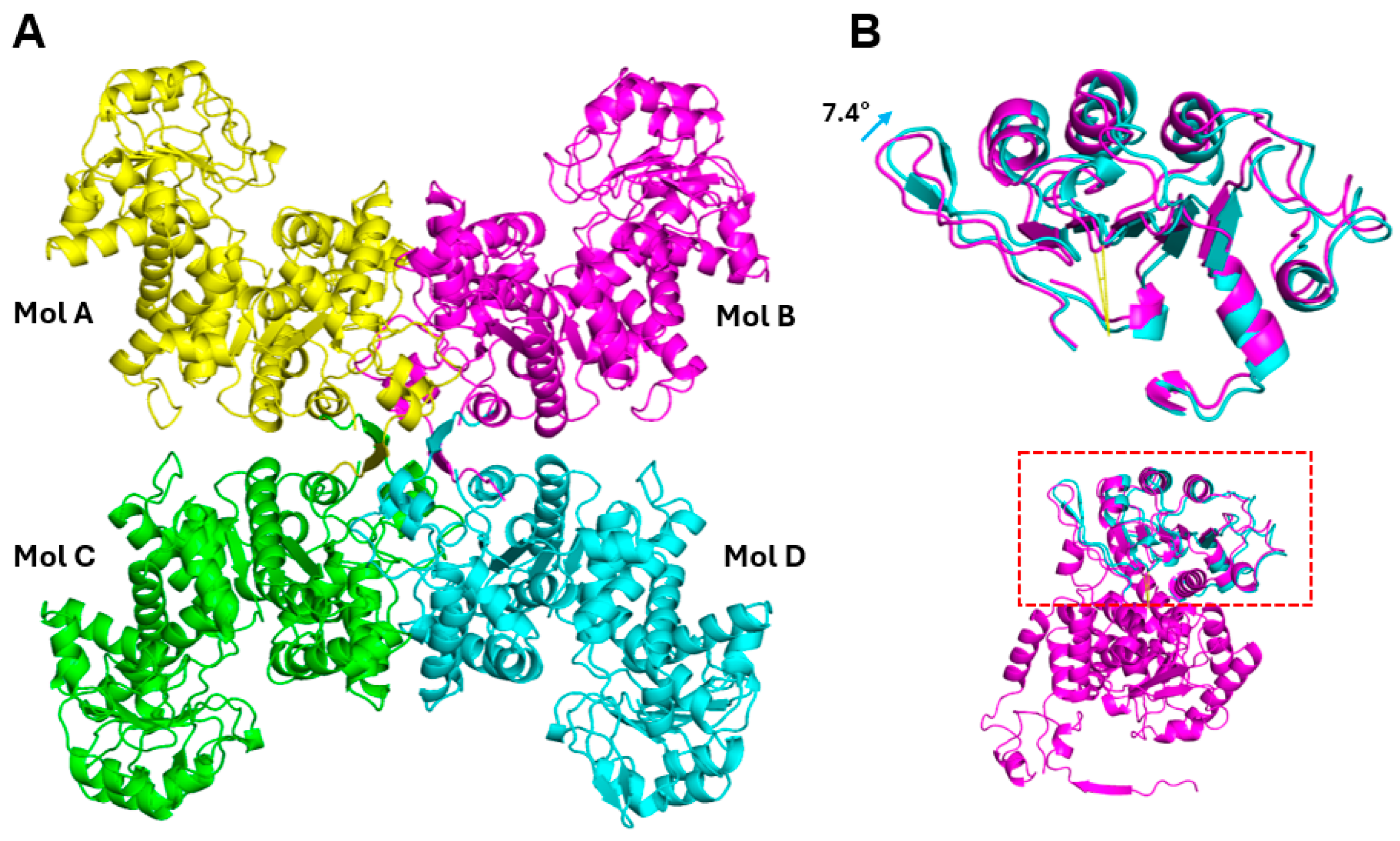
The crystal structure of OsNADP-ME2 was determined at a resolution of 2.77 Å, in which four protomers exist as a tetramer in the asymmetric unit (Figure 1A and Table 1). In the full length of OsNADP-ME2 protein, the sequence of 43–593 amino acids is shown in the electron density. A protomer Mol D in the tetramer shows a 7.4° tilted angle of the outer NADP-binding domain of residues 328–342 and 358–494, implying structural flexibility (Figure 1B).

3.2. Crystal Packing of OsNADP-ME2 Tetramer in P21 Space Group

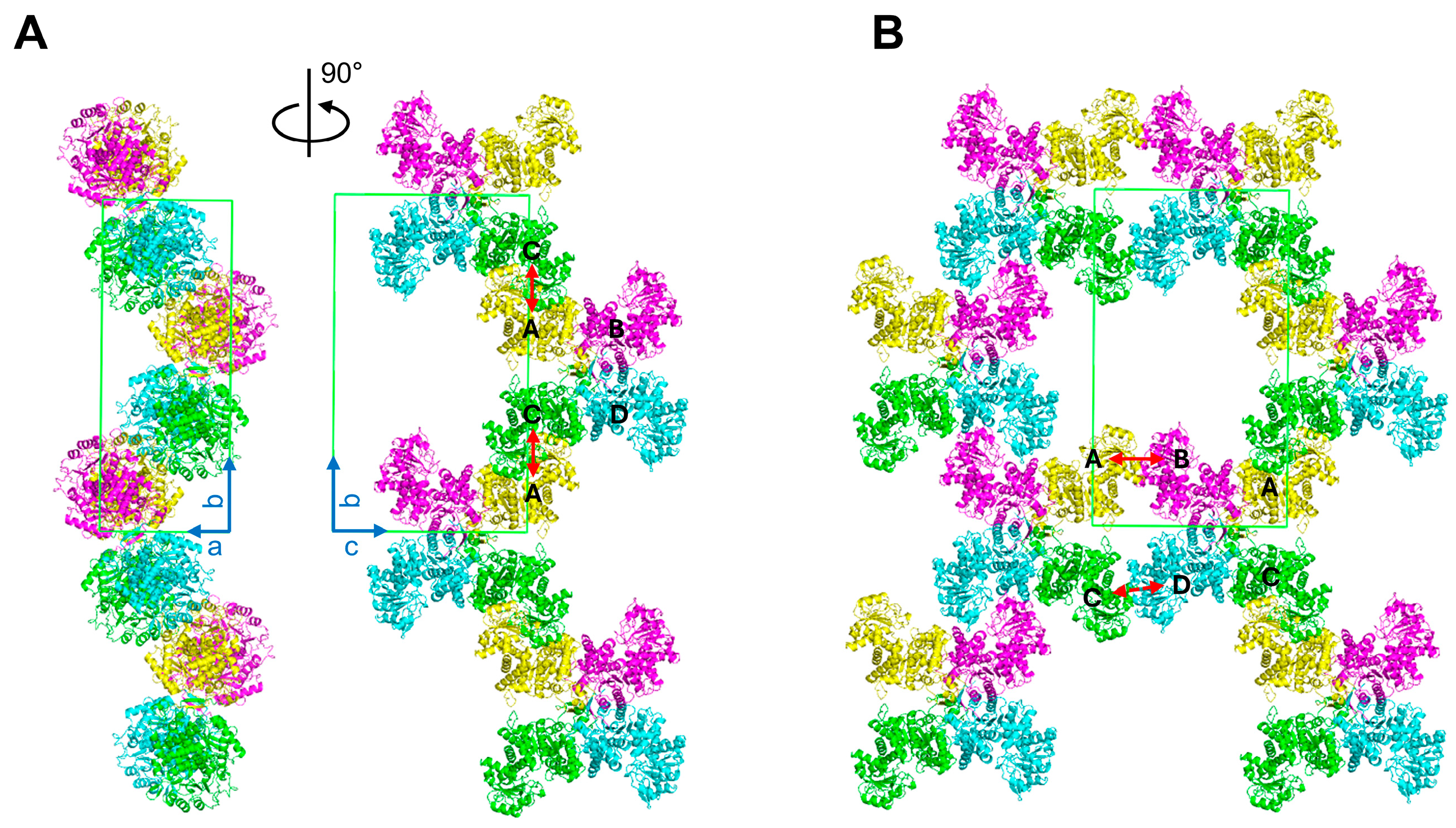
The OsNADP-ME2 tetramer was crystallized in the space group of P21 in the unit cell of a = 72.9, b = 186.8, and c = 108.1 Å. The two-fold vertical screw axis is parallel with the b axis (Figure 2A and Figure S1). In the vertical direction of crystal packing, a protomer of Mol A (yellow) of the tetramer is tightly bound to two protomers of Mol C (green) of two different tetramers in the vertical direction. In the same way, a protomer of Mol C is bound to two protomers of Mol A. The interacting surface area between Mol A and Mol C is 852.6 Å2. Because each Mol A is bound by two molecules of Mol C, the interaction area is as large as 1705.2 Å2, which is approximately 7% of the total surface area of a protomer (Table 2).
Horizontally, a tetramer of a vertical screw axis is bound to that of a nearby vertical axis (Figure 2B and Figure S2). A protomer Mol B (purple) is bound by two protomers of Mol A and C, with an interaction surface of 105.1 and 169.2 Å2, respectively, which is weaker than that of the vertical direction. A protomer Mol D (cyan) is bound by two protomers of Mol C and A with an interaction surface of 40.9 and 36.7 Å2, respectively, which is the smallest interaction area in the crystal packing. Smaller interaction areas can lead to weaker intermolecular interactions, allowing a conformational change in the NADP-binding domain of Mol D.

3.3. Conformation-Changing NADP-Binding Domain of OsNADP-ME2

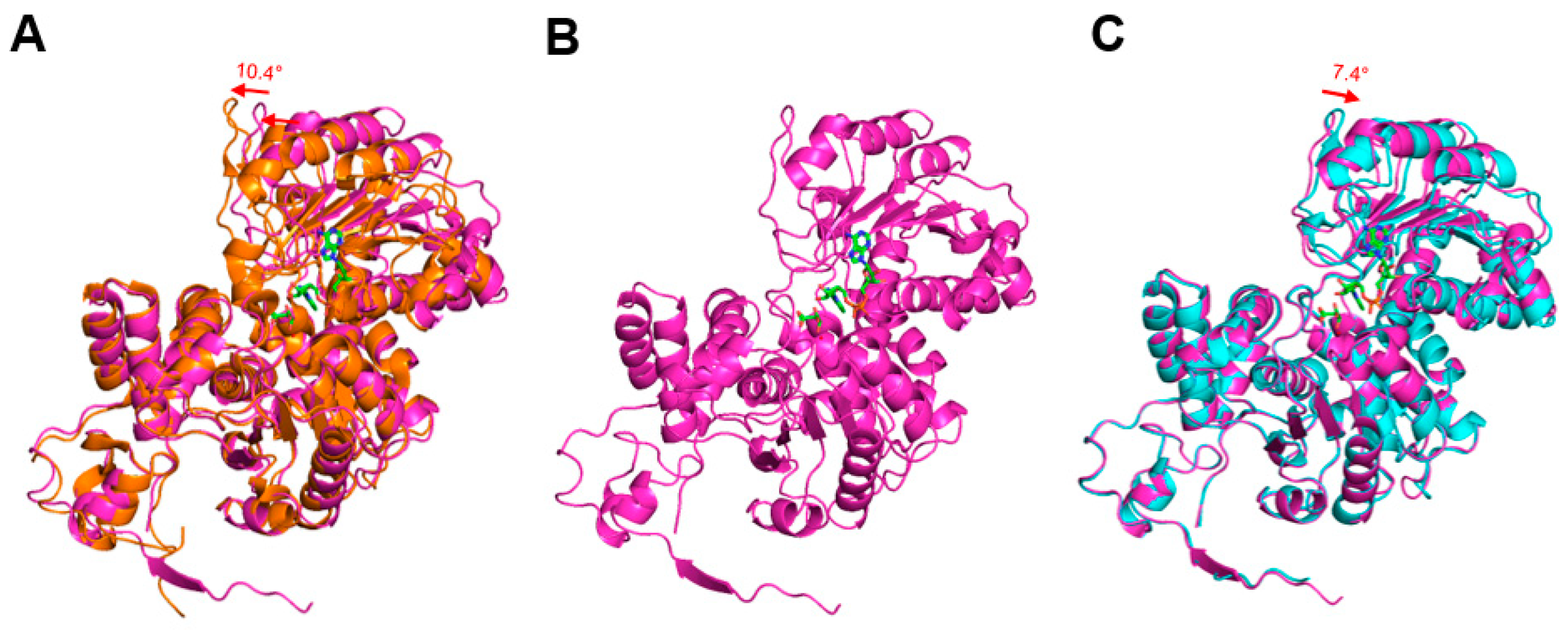
The NADP-ME enzymes bind malate and NADP+ as substrates and cofactors, respectively, and produce pyruvate and NADPH as products. We superimposed the structure of Mol B onto the NAD-bound structure of human mitochondrial NAD(P)-ME (PDB ID: 1PJ2) [24] and compared the amino acid sequences (Figure 3A and Figure S3). The RMSD value is 1.6 Å in superimposed 491 amino acids between OsNADP-ME2 and human NAD(P)-ME enzyme. When we compare the structures without the mobile part, the RMSD is as small as 0.86 in 264 amino acids.
Although the overall tetramer scaffold is conserved between OsNADP-ME2 and human NAD(P)-ME, the tetramer-forming interactions among protomers are different. The OsNADP-ME2 structure has a longer N-terminal loop with extra residues, which is closely involved in the tetramer formation. On the contrary, the human NAD(P)-ME structure has a longer C-terminal loop, which is also involved in the tetramer formation.
Compared to the apo structure of OsNADP-ME2, the NAD-bound human NAD(P)-ME showed a conformation change in the flexible NAD-binding domain. With NAD binding, the NAD-binding domain showed a closed conformation by 10.4° (Figure 3A). In the superimposed structure of Mol B, NAD is well bound in the proposed cofactor-binding pocket (Figure 3B and Figure S4). In the superimposed Mol D structure, the flexible outer NADP-binding domain was further opened by 7.4° (Figure 3C, Figures S5 and S6), and the flexibility was well correlated with that of the human NAD(P)-ME structure [25].

4. Discussion

Enzymes catalyze reactions with conformation changes [3,4,5,6,7,8]. The flexible structures of enzymes often complicate structural studies. The tetramer structure of OsNADP-ME2 indicates that the NADP-binding domain is flexible. Human NAD(P)-ME also showed a conformational flexibility of the NAD-binding domain [25].
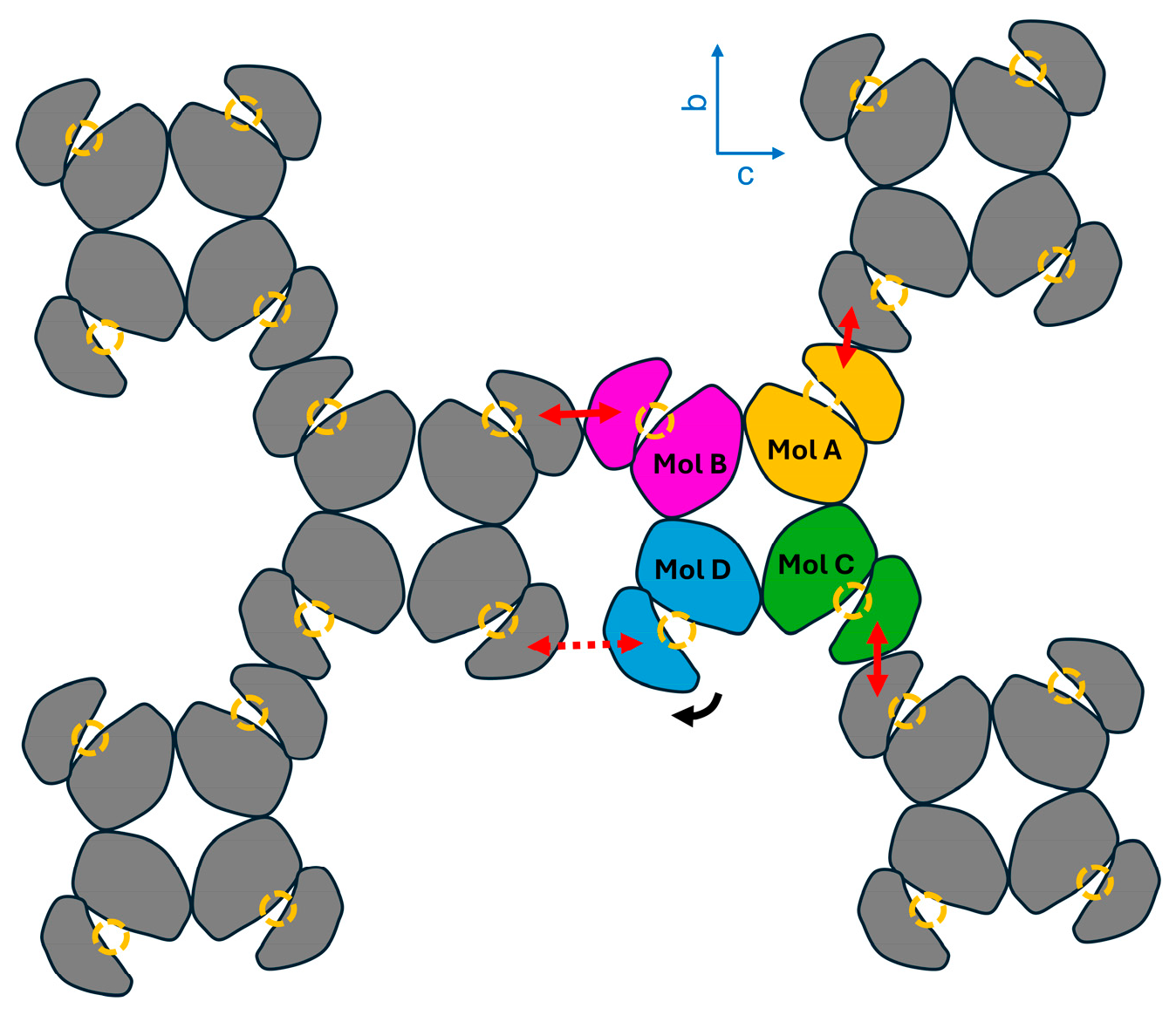
In a single crystal, each protomer of the tetramer shares the same chemical environment. Only the crystal packing of the P21 space group can influence the conformation of protomers. The intermolecular interaction area along the vertical screw axis (1705.2 Å2) is approximately five times larger than that of horizontal interaction (351.9 Å2). Tight vertical interactions occur between Mol A and Mol C, forming a sandwich. Horizontally, parallelly located tetramers interact with each other between Mol A and Mol B and between Mol C and Mol D. Among the horizontal interactions, the interaction between Mol A and B is stronger than that between Mol C and D (Table 2). Due to weaker crystal-packing interactions of Mol D, the flexible NAD-binding domain of Mol D has greater structural freedom than others, and an open conformation was revealed (Figure 4).
In NADP-ME enzymes, the open and closed conformational change of the NADP-binding domain is complicatedly controlled by the binding of the substrate malate, the product pyruvate, the cofactor NAD(P), the divalent cation, and the allosteric modulators like fumarate and ATP [25,26]. Even the oligomerization state of the human NADP-ME enzyme can be varied from tetramer to dimer under the same conditions, and allosteric regulators bind to the tetramer and dimer interfaces [27]. The structural flexibility of the NADP-binding domain of OsNADP-ME2, revealed by the crystal packing in the study, is well correlated with the previously reported characteristics of NADP-ME enzymes.
All key components of substrate, cofactor, and cation are bound into the crevice formed by the mobile NADP-binding domain. In the tetramer structure of OsNADP-ME2, a protomer can have a different conformation of the NADP-binding domain from the others, which proposes that a catalytic state of a protomer can be independent from other protomers. The enzyme kinetics study of OsNADP-ME2 will help understand the connectivity of the catalytic mechanism within the tetramer. Allosteric regulators or specific cellular conditions could affect the concerted or independent activity of the enzyme. In plants, the production of NADPH, a product of OsNADP-ME2 enzyme, is essential to immune responses against pathogens [11,28,29]. The catalytic activity and regulation of OsNADP-ME2 are closely related to the fitness of rice.
The crystal structure of OsNADP-ME2 tetramer shows how crystal packing can provide structural insight into the flexibility and stability of a specific domain of enzymes. Even in a crystal, crystal packing can create different environments for protein folding, which can influence different conformations. The structural flexibility of the NADP-binding domain of OsNADP-ME2 could be an important regulatory site for its activity and for immune responses in rice.

Supplementary Materials

The following supporting information can be downloaded at https://www.mdpi.com/article/10.3390/cryst16040221/s1. Figure S1: Vertical interactions between protomers along the P21 screw axis. The vertical interactions between protomer Mol A and Mol C along the P21 axis are represented. Each protomer of Mol A is bound by two protomers of Mol C, and each protomer of Mol C by two protomers of Mol; Figure S2: Horizontal interactions between protomers perpendicular to the P21 screw axis. The horizontal interactions between protomer Mol A and Mol B are represented. A protomer of Mol B is bound by two protomers of Mol A and C, and a protomer of Mol D is bound by two protomers of Mol A and C. The interactions of Mol B are stronger than those of Mol D; Figure S3: Sequence alignment of OsNADP-ME2 and human NAD(P)-ME. The amino acid sequences of OsNADP-ME2 (gene ID: LOC_Os01g52500.3) and human NAD(P)-ME (gene ID: NP_002387.1) are aligned with the secondary structures of OsNADP-ME2; Figure S4: The electron density map of the NADP-binding site of OsNADP-ME2. (A) The refined electron density map of the NADP-binding site of the OsNADP-ME2 structure (purple color). The 2Fo-Fc electron density map (contoured at 1.0 σ, blue mesh) is shown with the NAD ligand (orange color) superimposed from the human NAD(P)-ME structure (PDB ID: 1PJ2). (B) The unbiased Fo-Fc map of the same residues in the NADP-binding site of the OsNADP-ME2 structure is shown as a green mesh; Figure S5: The electron density map of the mobile NADP-binding domain of OsNADP-ME2. (A) The structure of OsNADP-ME2 Mol B with the 2Fo-Fc electron density map of the mobile NADP-binding domain. (B) The structure of OsNADP-ME2 Mol D with the 2Fo-Fc electron density map of the mobile NADP-binding domain. (C) The superimposed structures of OsNADP-ME2 (Mol B, purple) and NAD-bound human NAD(P)-ME (shown in orange) with the electron density map of OsNADP-ME2 Mol B. (D) The superimposed structures of OsNADP-ME2 Mol B (shown in purple) and Mol D (cyan) with the electron density map of OsNADP-ME2 Mol B; Figure S6: The unbiased Fo-Fc map of the mobile NADP-binding domain of OsNADP-ME2. (A) The structure of OsNADP-ME2 Mol B with the unbiased Fo-Fc electron density map of the mobile NADP-binding domain. (B) The enlarged structure of the mobile NADP-binding domain in Mol B with the same unbiased Fo-Fc electron density map. The residues in the black dashed square are additionally shown in the upright position. (C) The structure of OsNADP-ME2 Mol D with the unbiased Fo-Fc electron density map of the mobile NADP-binding domain. (D) The enlarged structure of the mobile NADP-binding domain in Mol D with the same unbiased Fo-Fc electron density map. The residues in the black dashed square are additionally shown in the upright position.

Author Contributions

Investigation, D.-H.L., H.-P.-T.N., T.-H.H., J.Y., B.-J.L., Y.-S.P., N.-S.J. and L.-W.K.; writing, D.-H.L., H.-P.-T.N., T.-H.H. and L.-W.K.; methodology, D.-H.L., H.-P.-T.N., T.-H.H. and L.-W.K.; funding acquisition, H.-P.-T.N., T.-H.H. and L.-W.K. All authors have read and agreed to the published version of the manuscript.

Funding

We are grateful to the staff members of Beamline 11C at PAL, Republic of Korea. This work was supported by the Science Research Center (SRC) of the National Research Foundation of Korea (NRF) grant funded by the Korean government (MSIT) (RS-2024-00407469) and by the National Research Foundation of Korea (NRF) grant funded by the Korean government (MSIT) (no. RS-2025-16066670).

Data Availability Statement

The data presented in this study are openly available in the Protein Data Bank at http://www.rcsb.org under the accession code 23PJ (accessed on 22 March 2026).

Acknowledgments

During the preparation of this manuscript, the authors used ChatGPT (OpenAI, GPT-4) for language editing. The authors have reviewed and edited the output and take full responsibility for the content of this publication.

Conflicts of Interest

The authors declare no conflicts of interest.

References

  1. Dokholyan, N.V. Controlling Allosteric Networks in Proteins. Chem. Rev. 2016, 116, 6463–6487. [Google Scholar] [CrossRef]
  2. Xu, L.; Nagai, Y.; Kajihara, Y.; Ito, G.; Tomita, T. The Regulation of Rab GTPases by Phosphorylation. Biomolecules 2021, 11, 1340. [Google Scholar] [CrossRef]
  3. Park, H.; Park, Y.S.; Kwak, K.; Yun, J.; Lee, H.; Lee, C.E.; Lee, D.; Lee, K.W.; An, Y.J.; Yim, H.S.; et al. N-terminal helix formation and dimer-monomer transition of FGF10 in specific recognition of FGFR2b. FEBS J. 2025, 292, 6735–6746. [Google Scholar] [CrossRef] [PubMed]
  4. Lee, H.; Park, H.; Kwak, K.; Lee, C.E.; Yun, J.; Lee, D.; Lee, J.H.; Lee, S.H.; Kang, L.W. Structural comparison of substrate-binding pockets of serine beta-lactamases in classes A, C, and D. J. Enzym. Inhib. Med. Chem. 2025, 40, 2435365. [Google Scholar] [CrossRef]
  5. Lee, C.E.; Park, Y.; Park, H.; Kwak, K.; Lee, H.; Yun, J.; Lee, D.; Lee, J.H.; Lee, S.H.; Kang, L.W. Structural insights into alterations in the substrate spectrum of serine-beta-lactamase OXA-10 from Pseudomonas aeruginosa by single amino acid substitutions. Emerg. Microbes Infect. 2024, 13, 2412631. [Google Scholar] [CrossRef]
  6. Song, S.; Kim, Y.; Kwak, K.; Lee, H.; Park, H.; Kim, Y.B.; Lee, H.J.; Kang, L.W. The N-terminal peptide of the main protease of SARS-CoV-2, targeting dimer interface, inhibits its proteolytic activity. BMB Rep. 2023, 56, 606–611. [Google Scholar] [CrossRef] [PubMed]
  7. Ngo, H.P.; Nguyen, D.Q.; Park, H.; Park, Y.S.; Kwak, K.; Kim, T.; Lee, J.H.; Cho, K.S.; Kang, L.W. Conformational change of organic cofactor PLP is essential for catalysis in PLP-dependent enzymes. BMB Rep. 2022, 55, 439–446. [Google Scholar] [CrossRef]
  8. Yun, Y.; Han, S.; Park, Y.S.; Park, H.; Kim, D.; Kim, Y.; Kwon, Y.; Kim, S.; Lee, J.H.; Jeon, J.H.; et al. Structural Insights for Core Scaffold and Substrate Specificity of B1, B2, and B3 Metallo-beta-Lactamases. Front. Microbiol. 2021, 12, 752535. [Google Scholar] [CrossRef]
  9. Drincovich, M.a.F.; Casati, P.; Andreo, C.S. NADP-malic enzyme from plants: A ubiquitous enzyme involved in different metabolic pathways. FEBS Lett. 2001, 490, 1–6. [Google Scholar] [CrossRef]
  10. Gerrard Wheeler, M.C.; Arias, C.L.; e Mello, J.d.F.R.; Cirauqui Diaz, N.; Rodrigues, C.R.; Drincovich, M.F.; de Souza, A.M.T.; Alvarez, C.E. Structural insights into the allosteric site of Arabidopsis NADP-malic enzyme 2: Role of the second sphere residues in the regulatory signal transmission. Plant Mol. Biol. 2021, 107, 37–48. [Google Scholar] [CrossRef]
  11. Dangol, S.; Chen, Y.; Hwang, B.K.; Jwa, N.-S. Iron-and reactive oxygen species-dependent ferroptotic cell death in rice-Magnaporthe oryzae interactions. Plant Cell 2019, 31, 189–209. [Google Scholar] [CrossRef]
  12. Singh, R.; Dangol, S.; Chen, Y.; Choi, J.; Cho, Y.S.; Lee, J.E.; Choi, M.O.; Jwa, N.S. Magnaporthe oryzae Effector AVR-Pii Helps to Establish Compatibility by Inhibition of the Rice NADP-Malic Enzyme Resulting in Disruption of Oxidative Burst and Host Innate Immunity. Mol. Cells 2016, 39, 426–438. [Google Scholar] [CrossRef]
  13. Wu, B.; Li, P.; Hong, X.; Xu, C.; Wang, R.; Liang, Y. The receptor-like cytosolic kinase RIPK activates NADP-malic enzyme 2 to generate NADPH for fueling ROS production. Mol. Plant 2022, 15, 887–903. [Google Scholar] [CrossRef]
  14. Li, P.; Zhao, L.; Qi, F.; Htwe, N.; Li, Q.; Zhang, D.; Lin, F.; Shang-Guan, K.; Liang, Y. The receptor-like cytoplasmic kinase RIPK regulates broad-spectrum ROS signaling in multiple layers of plant immune system. Mol. Plant 2021, 14, 1652–1667. [Google Scholar] [CrossRef]
  15. Otwinowski, Z.; Minor, W. [20] Processing of X-ray diffraction data collected in oscillation mode. In Methods in Enzymology; Elsevier: Amsterdam, The Netherlands, 1997; Volume 276, pp. 307–326. [Google Scholar]
  16. Keegan, R.M.; Winn, M.D. MrBUMP: An automated pipeline for molecular replacement. Biol. Crystallogr. 2008, 64, 119–124. [Google Scholar] [CrossRef] [PubMed]
  17. Yang, Z.; Zhang, H.; Hung, H.C.; Kuo, C.C.; Tsai, L.C.; Yuan, H.S.; Chou, W.Y.; Chang, G.G.; Tong, L. Structural studies of the pigeon cytosolic NADP+-dependent malic enzyme. Protein Sci. 2002, 11, 332–341. [Google Scholar] [CrossRef] [PubMed]
  18. Emsley, P.; Lohkamp, B.; Scott, W.G.; Cowtan, K. Features and development of Coot. Biol. Crystallogr. 2010, 66, 486–501. [Google Scholar] [CrossRef]
  19. Murshudov, G.N.; Skubák, P.; Lebedev, A.A.; Pannu, N.S.; Steiner, R.A.; Nicholls, R.A.; Winn, M.D.; Long, F.; Vagin, A.A. REFMAC5 for the refinement of macromolecular crystal structures. Biol. Crystallogr. 2011, 67, 355–367. [Google Scholar] [CrossRef] [PubMed]
  20. Vriend, G. WHAT IF: A molecular modeling and drug design program. J. Mol. Graph. 1990, 8, 52–56. [Google Scholar] [CrossRef] [PubMed]
  21. Vaguine, A.A.; Richelle, J.; Wodak, S. SFCHECK: A unified set of procedures for evaluating the quality of macromolecular structure-factor data and their agreement with the atomic model. Biol. Crystallogr. 1999, 55, 191–205. [Google Scholar]
  22. Potterton, E.; Briggs, P.; Turkenburg, M.; Dodson, E. A graphical user interface to the CCP4 program suite. Acta Crystallogr. D Biol. Crystallogr. 2003, 59, 1131–1137. [Google Scholar] [CrossRef] [PubMed]
  23. Schrodinger, L. The PyMOL Molecular Graphics System, Version 1.3r1; Scientific Research Publishing Inc.: Wuhan, China, 2010.
  24. Tao, X.; Yang, Z.; Tong, L. Crystal structures of substrate complexes of malic enzyme and insights into the catalytic mechanism. Structure 2003, 11, 1141–1150. [Google Scholar] [CrossRef] [PubMed]
  25. Yang, Z.; Floyd, D.L.; Loeber, G.; Tong, L. Structure of a closed form of human malic enzyme and implications for catalytic mechanism. Nat. Struct. Biol. 2000, 7, 251–257. [Google Scholar] [CrossRef]
  26. Kuo, C.W.; Hung, H.C.; Tong, L.; Chang, G.G. Metal-Induced reversible structural interconversion of human mitochondrial NAD(P)+-dependent malic enzyme. Proteins 2004, 54, 404–411. [Google Scholar] [CrossRef]
  27. Chang, G.G.; Tong, L. Structure and function of malic enzymes, a new class of oxidative decarboxylases. Biochemistry 2003, 42, 12721–12733. [Google Scholar] [CrossRef]
  28. Hassinen, I.E. Signaling and Regulation Through the NAD(+) and NADP(+) Networks. Antioxid. Redox Signal. 2019, 30, 857–874. [Google Scholar] [CrossRef]
  29. Shang-Guan, K.; Wang, M.; Htwe, N.; Li, P.; Li, Y.; Qi, F.; Zhang, D.; Cao, M.; Kim, C.; Weng, H.; et al. Lipopolysaccharides Trigger Two Successive Bursts of Reactive Oxygen Species at Distinct Cellular Locations. Plant Physiol. 2018, 176, 2543–2556. [Google Scholar] [CrossRef] [PubMed]
Figure 1. Overall tetramer structure of OsNADP-ME2. (A) Four protomers in the tetramer structure of OsNADP-ME2 are represented in different colors. The tetramer is formed as a dimer of dimers. The protomer of Mol D shows a conformational change of the NADP-binding domain. (B) The 7.4° tilted conformation of the outer NADP-binding domain of Mol D. The structures of Mol B and D are superimposed. The tilted domain is represented in the red dashed lines in the superimposed structures.
Crystals 16 00221 g001
Figure 2. Crystal packing of OsNADP-ME2. Intermolecular interactions among OsNADP-ME2 tetramers in crystal packing are shown in different directions. (A) Intermolecular interactions in the vertical direction along with P21 screw axis are shown. The unit cell of a crystal is shown in a green rectangle with the directions of the a, b, and c axes. Protomers of Mol A, B, C, and D are labeled in black bold letters. (B) Intermolecular interactions in the horizontal direction perpendicular to the P21 screw axis are shown.
Crystals 16 00221 g002
Figure 3. Superimposed structures of OsNADP-ME2 and NAD-bound human NAD(P)-ME. (A) Superimposed structures of OsNADP-ME2 (Mol B, purple) and NAD-bound human NAD(P)-ME (orange). The bound NAD molecule is shown in green. (B) The NAD-bound model of OsNADP-ME2 (Mol B, purple). (C) The superimposed structures of OsNADP-ME2 Mol B (purple) and Mol D (cyan). The NAD-bound model structure of OsNADP-ME2 was prepared from the superimposed structure of the NAD-bound human NAD(P)-ME.
Crystals 16 00221 g003
Figure 4. Schematic representation of conformational change of the NADP-binding domain of OsNADP-ME2. Crystal packing provides a different environment for each protomer. The NADP-binding domain of Mol D shows an open conformation in the open space of the crystal packing. The NADP-binding site is shown as dashed yellow circles. Tight protomer–protomer binding interaction is represented as red arrows, and weak interaction as a dashed red arrow. The directions of unit-cell axes are shown in blue arrows.
Crystals 16 00221 g004
Table 1. Data collection and refinement statistics.
Data CollectionOsNADP-ME2 (PDB ID: 23PJ)
X-ray sourcePAL5C
Space groupP21
Unit-cell parameters
a, b, c (Å)72.9, 186.8, 108.1
α, β, γ (°)90.0, 91.8, 90.0
Resolution range (Å)50.0–2.77
No. of observed reflections325,766
(unique)(71,382)
Completeness (%)97.6 (89.1)
Rmerge (%) 11.9 (42.8)
Average I/σ (I)14.6 (2.5)
CC1/20.93 (0.54)
Refinement
Resolution (Å)2.77 (43.70)
R/Rfree (%)19.2/25.0
Protein atom number17,235
RMS bond lengths (Å)0.007
RMS bond angles (°)1.36
Mean B factors (Å2)59.85
Macromolecules59.76
Water atoms62.09
Ramachandran plot (%)
Favored regions 96.26%
Allowed regions 3.60%
Outlier regions 0.14%
Values in parentheses are for the highest resolution shell. Rmerge = h k l i I i h k l I h k l / h k l i I i h k l , where I i h k l is the mean intensity of i th observation of symmetry-related reflections hkl. Rfree = h k l F o b s F c a l c / h k l F o b s , where F c a l c is the calculated protein structure factor from the atomic model (Rfree was calculated with randomly selected 5% of the reflections).
Table 2. Interaction surface area of OsNADP-ME2 protomers.
Surface Area
2)
Interaction Area (Å2)Percentage of Interaction Area (%)
ProtomerMol A (yellow)24,549.6
Mol B (Magenta)24,273.9
Mol C (Green)24,420.4
Mol D (Cyan)24,496.4
Vertical
interactions
Mol A with Mol C 852.63.47
Mol A with Mol C’ 853.93.48
Mol C with Mol A 852.63.50
Mol C with Mol A’ 853.93.51
Horizontal
interactions
Mol B with Mol A 105.10.43
Mol B with Mol C’ 169.20.70
Mol D with Mol C 40.90.17
Mol D with Mol A’ 36.70.15
Disclaimer/Publisher’s Note: The statements, opinions and data contained in all publications are solely those of the individual author(s) and contributor(s) and not of MDPI and/or the editor(s). MDPI and/or the editor(s) disclaim responsibility for any injury to people or property resulting from any ideas, methods, instructions or products referred to in the content.