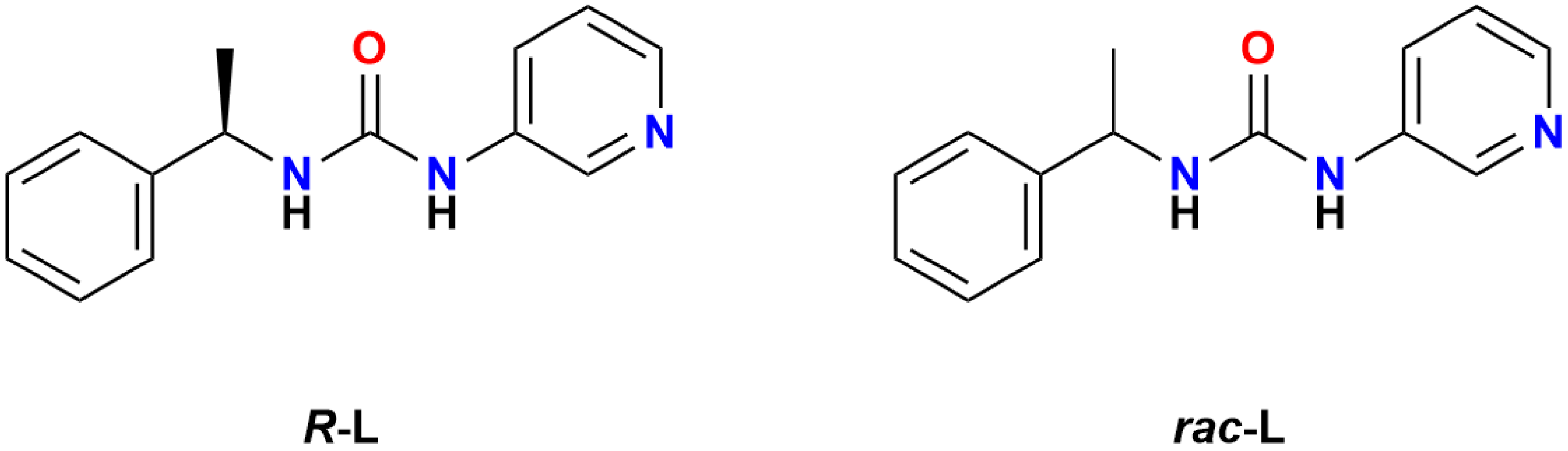
Influence of Chirality and Anions on the Structure of Dipyridyl Ag(I) Complexes and Coordination Polymers



Abstract
1. Introduction
2. Materials and Methods
2.1. General Synthetic and Instrumentation Details
2.2. Syntheses
2.3. Crystallographic Details
3. Results
3.1. Synthesis
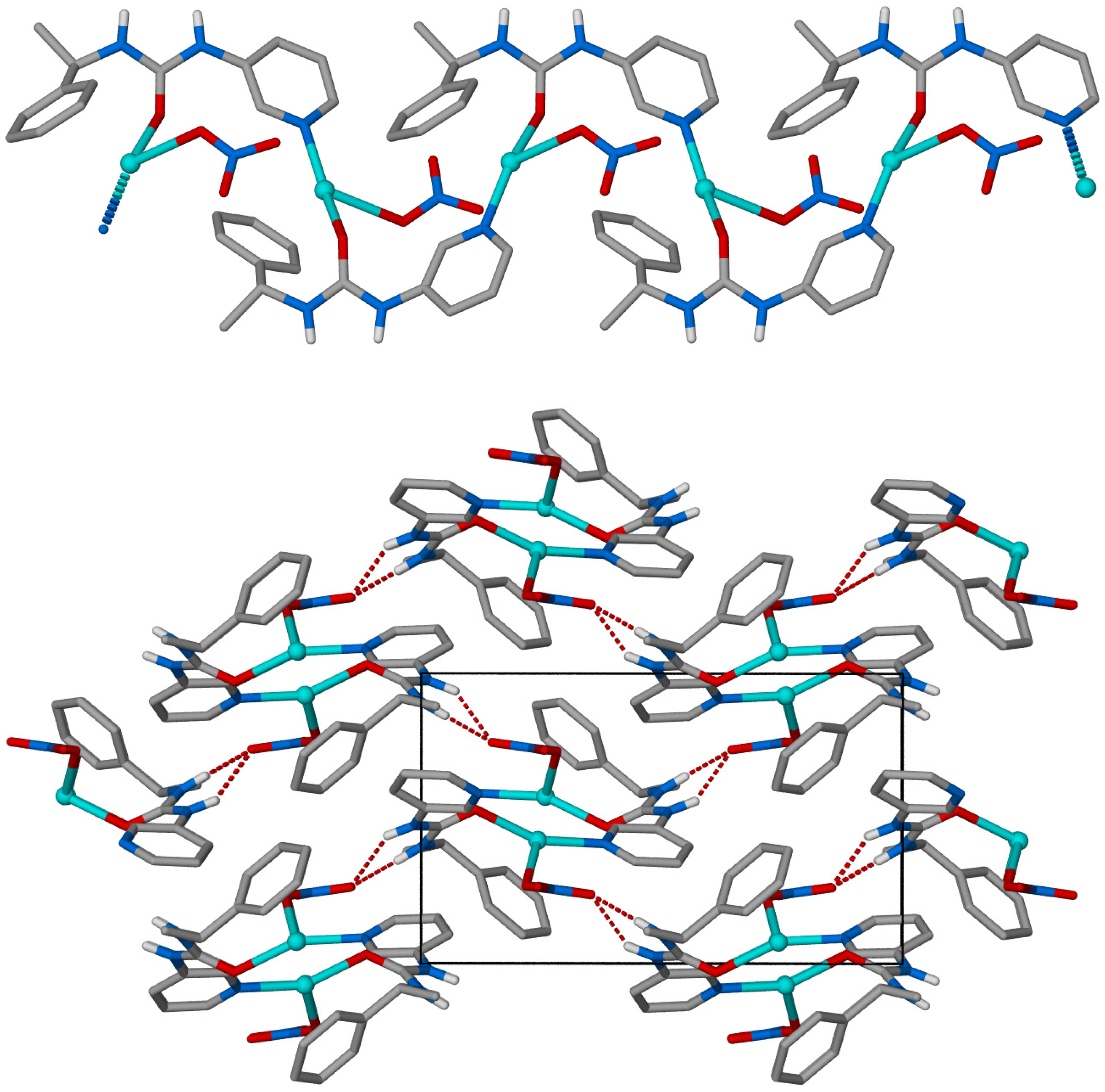
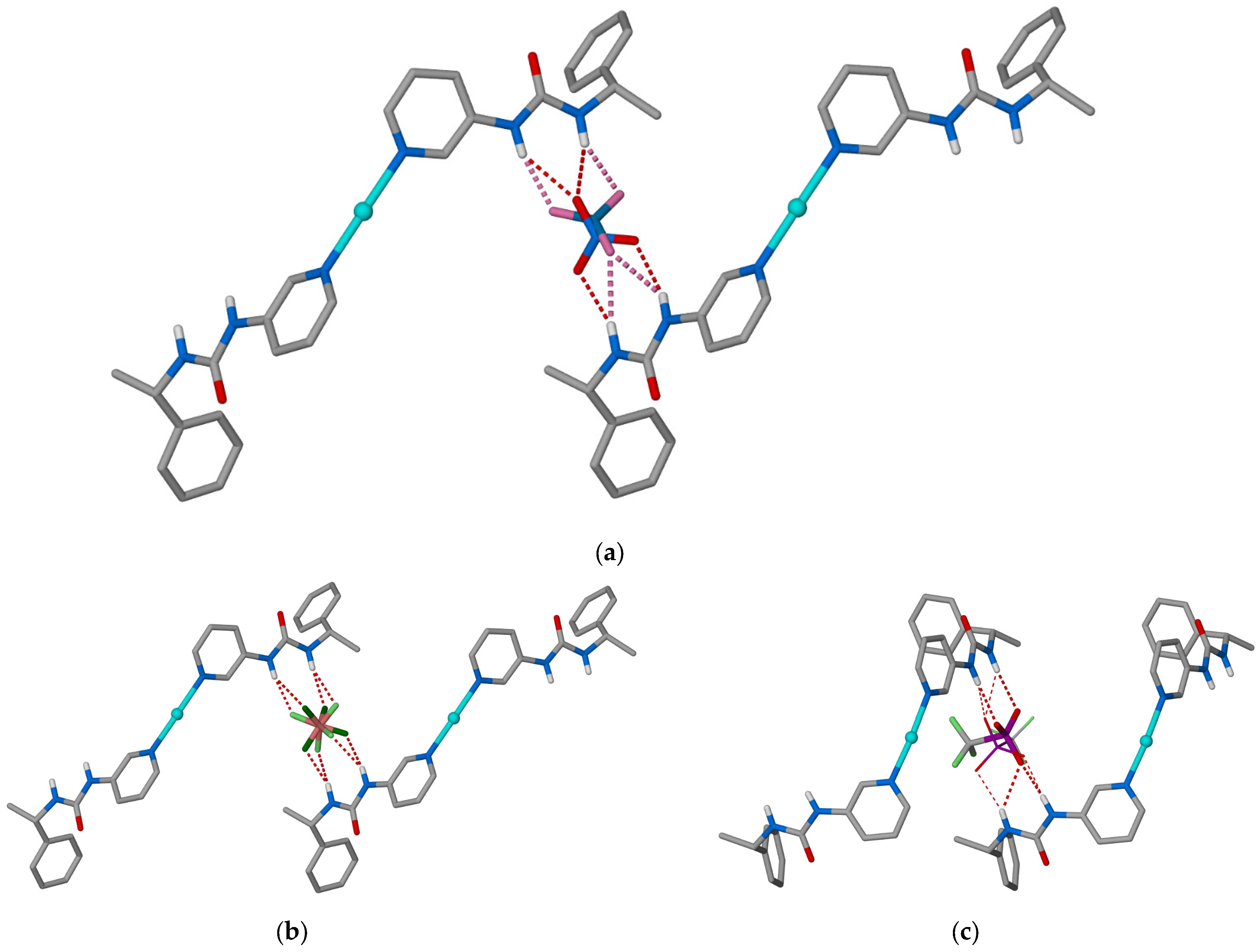
3.2. Structures Containing R-L (1a–1d)
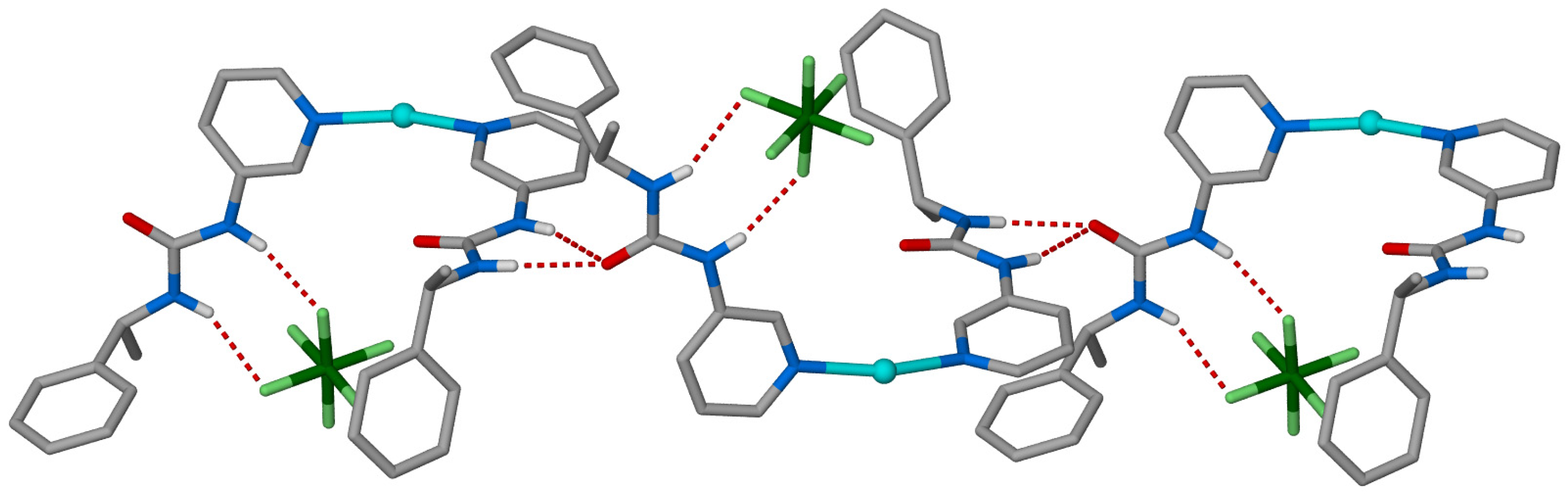
3.3. Structures Containing rac-L
4. Discussion
Supplementary Materials
Author Contributions
Funding
Data Availability Statement
Acknowledgments
Conflicts of Interest
Appendix A

References
- Lee, C.J.; Qiu, T.A.; Sweeldler, J.V. d-Alanine: Distribution, origin, physiological relevance, and implications in disease. Biochim. Biophys. Acta-Proteins Proteom. 2020, 1868, 140482. [Google Scholar] [CrossRef] [PubMed]
- Wang, Y.; Fang, H.; Tranca, I.; Qu, H.; Wang, X.; Markvoort, A.J.; Tian, Z.; Cao, X. Elucidation of the origin of chiral amplification in discrete molecular polyhedral. Nat. Commun. 2018, 9, 488. [Google Scholar] [CrossRef] [PubMed]
- Hong, J.; Chen, K.-J.; Zheng, F.-F.; Chen, X.; Liu, Y.; Cui, Y. A supermolecular building block approach for construction of chiral metal–organic frameworks. Chem. Commun. 2019, 55, 8639–8642. [Google Scholar] [CrossRef] [PubMed]
- Tan, C.; Chu, D.; Tang, X.; Liu, Y.; Xuan, W.; Cui, Y. Supramolecular coordination cages for asymmetric catalysis. Chem. Eur. J. 2018, 25, 662–672. [Google Scholar] [CrossRef]
- Tay, H.M.; Kyratzis, N.; Thoonen, S.; Boer, S.A.; Turner, D.R.; Hua, C. Synthetic strategies towards chiral coordination polymers. Coord. Chem. Rev. 2021, 435, 213763. [Google Scholar] [CrossRef]
- Pan, M.; Wu, K.; Zhang, J.-H.; Su, C.-Y. Chiral metal–organic cages/containers (MOCs): From structural and stereochemical design to applications. Coord. Chem. Rev. 2019, 378, 333–349. [Google Scholar] [CrossRef]
- Zor, E.; Bingol, H.; Ersoz, M. Chiral sensors. TrAC Trends Anal. Chem. 2019, 121, 115662. [Google Scholar] [CrossRef]
- Putman, J.I.; Armstrong, D.W. Recent advances in the field of chiral crystallization. Chirality 2022, 34, 1338–1354. [Google Scholar] [CrossRef]
- Vogl, O. Chiral crystallization and the origin of chiral life on earth. J. Polym. Sci. Part A Polym. Chem. 2011, 49, 1299–1308. [Google Scholar] [CrossRef]
- Bishop, R. Aspects of crystallization and chirality. In Chirality in Supramolecular Assemblies; Keene, F.R., Ed.; John Wiley & Sons: Chichester, UK, 2017; pp. 65–93. [Google Scholar]
- Amendola, V.; Fabbrizzi, L.; Mosca, L. Anion recognition by hydrogen bonding: Urea-based receptors. Chem. Soc. Rev. 2010, 39, 3889–3915. [Google Scholar] [CrossRef]
- Mohammed, F.A.; Xiao, T.; Wang, L.; Elmes, R.B.P. Macrocyclic receptors for anion recognition. Chem. Commun. 2024, 60, 11812–11836. [Google Scholar] [CrossRef]
- McVey, B.M.; Rumble, J.; Nathan, C.E.V.; Gass, I.A.; Sambrook, M.R.; Cragg, P.J. Asymmetric urea, thiourea and squaramide receptors as minimal-anion binding motifs. Supramol. Chem. 2024, 34, 208–222. [Google Scholar] [CrossRef]
- Kundu, S.; Egboluche, T.K.; Hossain, M.A. Urea- and thiourea-based receptors for anion binding. Acc. Chem. Res. 2023, 56, 1320–1329. [Google Scholar] [CrossRef] [PubMed]
- Paderni, D.; Formica, M.; Macedi, E.; Giorgi, L.; Rossi, P.; Retini, M.; De Cata, N.; Zappia, G.; Piersanti, G.; Fusi, V. A new bis-urea based cage receptor for anions: Synthesis, solid state structures and binding studies. Chem. Asian J. 2025, 20, e202401258. [Google Scholar] [CrossRef] [PubMed]
- Surina, A.; Čejka, J.; Salvadori, K.; Lhoták, P. Anion recognition using meta-substituted ureidocalix[4]arene receptors. Org. Biomol. Chem. 2024, 22, 8669–8678. [Google Scholar] [CrossRef]
- Paradine, S.M. Ureas and their derivatives as ligands in transition metal catalysis. Tetrahedron 2025, 184, 134781. [Google Scholar] [CrossRef]
- Holakovský, R.; Just, D.; Eigner, V.; Jakubec, M.; Cuřínová, P. Binaphthalene-based cyclic homochiral ureas and their structure-related properties. New J. Chem. 2023, 47, 8515–8523. [Google Scholar] [CrossRef]
- Lee, N.T.X.; Hicks, J.; Wallace, K.J.; Turner, D.R. Binding of mono- and dianions within silver thiazolylurea tweezers and capsules. Inorg. Chem. 2017, 56, 12535–12541. [Google Scholar] [CrossRef]
- Sawant, D.U.; Halat, P.; MacKay, A.I.; Izgorodina, E.I.; Turner, D.R. Dependence of an anion template on amino acid binding in DMSO/H2O by a chiral Ag/urea-based tweezer. Chem. Commun. 2025, 61, 18846–18849. [Google Scholar] [CrossRef]
- Sawant, D.U.; Turner, D.R. Influence of anion on the solid-state assembly of dimeric tweezer complexes. Inorg. Chim. Acta 2026, 595, 123075. [Google Scholar] [CrossRef]
- Turner, D.R.; Spencer, E.C.; Howard, J.A.K.; Tocher, D.A.; Steed, J.W. A modular, self-assembled, separated ion pair binding system. Chem. Commun. 2004, 1352–1353. [Google Scholar] [CrossRef] [PubMed]
- Turner, D.R.; Smith, B.; Goeta, A.E.; Radosavljevic-Evans, I.; Tocher, D.A.; Howard, J.A.K.; Steed, J.W. The R21(6) hydrogen-bonded synthon in neutral urea and metal-bound halide systems. CrystEngComm 2004, 6, 633–641. [Google Scholar] [CrossRef]
- Turner, D.R.; Smith, B.; Spencer, E.C.; Goeta, A.E.; Radosavljevic-Evans, I.; Tocher, D.A.; Howard, J.A.K.; Steed, J.W. Anion binding by Ag(I) complexes of urea-substituted pyridyl ligands. New J. Chem. 2005, 29, 90–98. [Google Scholar] [CrossRef]
- Agilent. CrysAlis PRO v. 43; Agilent Technologies Ltd.: Yarnton, UK, 2014. [Google Scholar]
- Aragao, D.; Aishima, J.; Cherukuvada, H.; Clarken, R.; Clift, M.; Cowieson, N.P.; Ericsson, D.J.; Gee, C.L.; Macedo, S.; Mudie, N.; et al. MX2: A high-flux undulator microfocus beamline serving both the chemical and macromolecular crystallography communities at the Australian Synchrotron. J. Synchrotron Radiat. 2018, 25, 885–891. [Google Scholar] [CrossRef]
- Kabsch, W. XDS. Acta Crystallogr. Sect. D 2010, 66, 125–132. [Google Scholar] [CrossRef]
- Thompson, A.J.; Smith, K.M.L.; Clegg, J.K.; Price, J.R. CX-ASAP: A high-throughput tool for the serial refinement and analysis of crystallographic data collected under varying conditions. J. Appl. Crystallogr. 2023, 56, 558–564. [Google Scholar] [CrossRef]
- Sheldrick, G.M. SHELXT—Integrated space-group and crystal-structure determination. Acta Crystallogr. Sect. A 2015, 71, 3–8. [Google Scholar] [CrossRef]
- Sheldrick, G.M. Crystal structure refinement with SHELXL. Acta Crystallogr. Sect. C 2015, 71, 3–8. [Google Scholar] [CrossRef]
- Dolomanov, O.V.; Bourhis, L.J.; Gildea, R.J.; Howard, J.A.K.; Puschmann, H. OLEX2: A complete structure solution, refinement and analysis program. J. Appl. Crystallogr. 2009, 42, 339–341. [Google Scholar] [CrossRef]
- Barbour, L.J. X-Seed—A software tool for supramolecular chemistry. J. Supramol. Chem. 2001, 1, 189–191. [Google Scholar] [CrossRef]
- Smith, G.; Cloutt, B.A.; Byriel, K.A.; Kennard, C.H.L. Preparation and crystal structures of the urea adducts of silver (I) perchlorate and silver (I) p-toluenesulfonate. Aust. J. Chem. 1997, 50, 741–746. [Google Scholar] [CrossRef]
- Banti, C.N.; Kapetana, M.; Papachristodoulou, C.; Raptopoulou, C.P.; Psycharis, V.; Zoumpoulakis, P.; Mavromoustakos, T.; Hadjikakou, S.K. Hydrogels containing water soluble conjugates of silver(i) ions with amino acids, metabolites or natural products for non infectious contact lenses. Dalton Trans. 2021, 50, 13712–13727. [Google Scholar] [CrossRef]
- Sagatys, D.S.; Bott, R.C.; Smith, G.; Byriel, K.A.; Kennard, C.H.L. The preparation and crystal structure of a polymeric (1:1)-silver nitrate-urea complex, [(AgNO3)2(CH4N2O)2]n. Polyhedron 1992, 11, 49–52. [Google Scholar] [CrossRef]
- Groom, C.R.; Bruno, I.J.; Lightfoot, M.P.; Ward, S.C. The Cambridge Structural Database. Acta Crystallogr. Sect. B 2016, 72, 171–179. [Google Scholar] [CrossRef] [PubMed]
- Qureshi, N.; Lloyd, G.O.; Yufit, D.S.; Howard, J.A.K. CCDC 2298230: Experimental Crystal Structure Determination. 2023. Available online: https://www.ccdc.cam.ac.uk/structures/search?id=doi:10.5517/ccdc.csd.cc2h4hgm&sid=DataCite (accessed on 5 March 2026).
- Etter, M.C. Encoding and decoding hydrogen-bond patterns of organic compounds. Acc. Chem. Res. 1990, 23, 120–126. [Google Scholar] [CrossRef]
- Etter, M.C.; Macdonald, J.C.; Bernstein, J. Graph-set analysis of hydrogen-bond patterns in organic crystals. Acta Crystallogr. Sect. B 1990, 46, 256–262. [Google Scholar] [CrossRef] [PubMed]
- Custelcean, R. Crystal engineering with urea and thiourea hydrogen-bonding groups. Chem. Commun. 2008, 295–307. [Google Scholar] [CrossRef]



| [Ag(R-L)(NO3)]n | {[Ag(R-L)](CF3SO3)}n | {[Ag(R-L)](BF4)}n | {[Ag(R-L)](PF6)}n | |
|---|---|---|---|---|
| Compound | 1a | 1b | 1c | 1d |
| Formula | C14H15AgN4O4 | C15H15AgF3N3O4S | C14H15AgBF4N3O | C14H15AgF6N3OP |
| Formula Mass | 411.17 | 498.23 | 435.97 | 494.13 |
| Crystal System | Orthorhombic | Orthorhombic | Orthorhombic | Orthorhombic |
| Space Group | P212121 | P212121 | P212121 | P212121 |
| a/Å | 9.0278 (1) | 10.7274 (1) | 9.7060 (19) | 10.66208 (7) |
| b/Å | 10.8279 (1) | 10.7872 (1) | 10.589 (2) | 10.66996 (10) |
| c/Å | 15.0008 (2) | 16.1256 (2) | 15.142 (3) | 15.18109 (11) |
| α/° | 90 | 90 | 90 | 90 |
| β/° | 90 | 90 | 90 | 90 |
| γ/° | 90 | 90 | 90 | 90 |
| V/Å3 | 1466.36 (3) | 1866.03 (3) | 1556.2 (5) | 1727.06 (2) |
| Z | 4 | 4 | 4 | 4 |
| ρcalc/g cm−3 | 1.862 | 1.773 | 1.861 | 1.900 |
| Instrument | Synergy S | Synergy S | MX2 Beamline | Synergy S |
| μ/mm−1 | 11.287 | 10.237 | 1.342 | 10.922 |
| F(000) | 824 | 992 | 864 | 976 |
| θ range/° | 5.038–79.802 | 4.952–80.437 | 2.347–32.213 | 5.067–80.235 |
| Refs. Measured | 9742 | 18951 | 28780 | 18479 |
| Unique Refs. | 3125 | 3901 | 4825 | 3628 |
| Refs. I > 2σI | 3098 | 3856 | 4793 | 3566 |
| Param./Restr. | 216/2 | 251/2 | 224/2 | 279/2 |
| GooF on F2 | 1.089 | 1.057 | 1.101 | 1.096 |
| Rint | 0.0269 | 0.0563 | 0.0389 | 0.0510 |
| R1 (I > 2σI) | 0.0199 | 0.0413 | 0.0191 | 0.0270 |
| wR2 (I > 2σI) | 0.0537 | 0.1098 | 0.0466 | 0.0698 |
| R1 (all data) | 0.0200 | 0.0417 | 0.0194 | 0.0279 |
| wR2 (all data) | 0.0538 | 0.1105 | 0.0480 | 0.0777 |
| Flack | 0.005 (3) | −0.012 (6) | 0.015 (5) | −0.018 (5) |
| CCDC No. | 2531257 | 2531260 | 2531258 | 2531259 |
| [Ag(rac-L)2](NO3) | [Ag(rac-L)2](CF3SO3) | [Ag(rac-L)2](BF4) | [Ag(rac-L)2](PF6) ·½MeOH·½MeCN | |
|---|---|---|---|---|
| Compound | 2a | 2b | 2c | 2d |
| Formula | C28H30AgN7O5 | C29H30AgF3N6O5S | C28H30AgBF4N6O2 | C29.5H33.5AgF6N6.5O2.5P |
| Formula Mass | 652.46 | 739.52 | 677.26 | 771.97 |
| Crystal System | Triclinic | Monoclinic | Monoclinic | Orthorhombic |
| Space Group | P-1 | P2/c | C2/c | Pbcn |
| a/Å | 10.6434 (3) | 11.255 (2) | 13.170 (3) | 27.4990 (4) |
| b/Å | 10.6755 (3) | 10.517 (2) | 17.170 (3) | 11.0370 (2) |
| c/Å | 13.6844 (4) | 13.204 (3) | 13.870 (3) | 21.3148 (3) |
| α/° | 104.634 (2) | 90 | 90 | 90 |
| β/° | 103.028 (2) | 103.54 (3) | 113.25 (3) | 90 |
| γ/° | 103.523 (2) | 90 | 90 | 90 |
| V/Å3 | 1394.23 (8) | 1519.5 (6) | 2881.7 (12) | 6469.18 (15) |
| Z | 2 | 2 | 4 | 8 |
| ρcalc/g cm−3 | 1.554 | 1.616 | 1.561 | 1.585 |
| Instrument | Synergy S | MX2 Beamline | MX2 Beamline | Synergy S |
| μ/mm−1 | 6.235 | 0.798 | 0.763 | 6.137 |
| F(000) | 668 | 752 | 1376 | 3136 |
| θ range/° | 4.483–80.551 | 1.861–32.209 | 2.059–32.071 | 4.148–79.913 |
| Refs. Measured | 23916 | 24860 | 49543 | 30735 |
| Unique Refs. | 5840 | 4441 | 4451 | 6915 |
| Refs. I > 2σI | 5582 | 3903 | 4043 | 6068 |
| Param./Restr. | 421/25 | 247/2 | 217/2 | 454/8 |
| GooF on F2 | 1.084 | 1.138 | 1.062 | 1.058 |
| Rint | 0.0595 | 0.0617 | 0.0456 | 0.0993 |
| R1 (I > 2σI) | 0.0710 | 0.0592 | 0.0634 | 0.0772 |
| wR2 (I > 2σI) | 0.1777 | 0.1691 | 0.1776 | 0.2129 |
| R1 (all data) | 0.0731 | 0.0637 | 0.0677 | 0.0830 |
| wR2 (all data) | 0.1792 | 0.1801 | 0.1822 | 0.2182 |
| Flack | - | - | - | - |
| CCDC No. | 2531261 | 2531264 | 2531262 | 2531263 |
| Interaction | D-H (Å) | H···A (Å) | D···A (Å) | D-H···A (°) |
|---|---|---|---|---|
| [Ag(R-L)(NO3)]n (1a) | ||||
| N1-H1···O4 | 0.878 (13) | 2.10 (3) | 2.889 (4) | 150 (4) |
| N2-H2···O4 | 0.883 (13) | 2.13 (3) | 2.898 (4) | 145 (4) |
| [Ag(R-L)(CF3SO3)]n (1b) | ||||
| N1-H1···O3 | 0.876 (14) | 2.07 (3) | 2.921 (6) | 164 (7) |
| N2-H2···O4 | 0.877 (14) | 2.097 (18) | 2.969 (6) | 173 (7) |
| {[Ag(R-L)](BF4)}n (1c) | ||||
| N1-H1···B4 | 0.876 (13) | 2.089 (19) | 2.893 (3) | 152 (3) |
| N2-H2···B4 | 0.875 (13) | 2.08 (2) | 2.847 (2) | 145 (3) |
| {[Ag(R-L)](PF6)}n (1d) | ||||
| N1-H1···F3A * | 0.877 (14) | 2.14 (2) | 3.001 (8) | 168 (6) |
| N1-H1···F3B * | 0.877 (14) | 2.06 (3) | 2.894 (11) | 158 (5) |
| N2-H2···F1 | 0.878 (14) | 2.26 (3) | 3.029 (5) | 146 (5) |
| Interaction | D-H (Å) | H···A (Å) | D···A (Å) | D-H···A (°) |
|---|---|---|---|---|
| [Ag(rac-L)2](NO3) (2a) * | ||||
| N1-H1···O5A | 0.881 (10) | 2.27 (6) | 2.947 (9) | 134 (7) |
| N2-H2···O5A | 0.878 (10) | 2.19 (5) | 2.938 (10) | 143 (6) |
| N4-H4···O3A | 0.880 (10) | 2.04 (3) | 2.884 (8) | 161 (7) |
| N5-H5···O4A | 0.879 (10) | 2.02 (3) | 2.864 (8) | 159 (6) |
| [Ag(rac-L)2](CF3SO3) (2b) | ||||
| N1-H1···O2 | 0.874 (10) | 2.174 (16) | 3.022 (5) | 164 (4) |
| N1-H1···O4 | 0.874 (10) | 2.35 (3) | 3.069 (5) | 139 (3) |
| N2-H2···O3 | 0.874 (10) | 2.071 (12) | 2.940 (4) | 172 (4) |
| N2-H2···O4 | 0.874 (10) | 1.970 (17) | 2.807 (5) | 160 (4) |
| [Ag(rac-L)2](BF4) (2c) | ||||
| N1-H1···F1 | 0.882 (10) | 2.038 (19) | 2.896 (7) | 164 (5) |
| N1-H1···F3 | 0.882 (10) | 2.12 (2) | 2.965 (7) | 161 (5) |
| N2-H2···F2 | 0.876 (10) | 2.18 (3) | 2.948 (6) | 146 (5) |
| N2-H2···F4 | 0.876 (10) | 2.006 (15) | 2.874 (6) | 171 (5) |
| [Ag(rac-L)2](PF6) (2d) | ||||
| N1-H1···F1 | 0.878 (10) | 2.34 (3) | 3.157 (7) | 156 (6) |
| N1-H1···F5 | 0.878 (10) | 2.26 (4) | 3.023 (7) | 145 (6) |
| N2-H2···F4 | 0.877 (10) | 2.11 (2) | 2.969 (6) | 164 (6) |
| N4-H4···O1 | 0.877 (10) | 2.20 (4) | 2.954 (6) | 144 (6) |
| N5-H5···O1 | 0.877 (10) | 2.01 (2) | 2.864 (5) | 165 (6) |
Disclaimer/Publisher’s Note: The statements, opinions and data contained in all publications are solely those of the individual author(s) and contributor(s) and not of MDPI and/or the editor(s). MDPI and/or the editor(s) disclaim responsibility for any injury to people or property resulting from any ideas, methods, instructions or products referred to in the content. |
© 2026 by the authors. Licensee MDPI, Basel, Switzerland. This article is an open access article distributed under the terms and conditions of the Creative Commons Attribution (CC BY) license.
Share and Cite
Sawant, D.U.; Turner, D.R. Influence of Chirality and Anions on the Structure of Dipyridyl Ag(I) Complexes and Coordination Polymers. Crystals 2026, 16, 181. https://doi.org/10.3390/cryst16030181
Sawant DU, Turner DR. Influence of Chirality and Anions on the Structure of Dipyridyl Ag(I) Complexes and Coordination Polymers. Crystals. 2026; 16(3):181. https://doi.org/10.3390/cryst16030181
Chicago/Turabian StyleSawant, Diksha U., and David R. Turner. 2026. "Influence of Chirality and Anions on the Structure of Dipyridyl Ag(I) Complexes and Coordination Polymers" Crystals 16, no. 3: 181. https://doi.org/10.3390/cryst16030181
APA StyleSawant, D. U., & Turner, D. R. (2026). Influence of Chirality and Anions on the Structure of Dipyridyl Ag(I) Complexes and Coordination Polymers. Crystals, 16(3), 181. https://doi.org/10.3390/cryst16030181