Article

Influence of Chirality and Anions on the Structure of Dipyridyl Ag(I) Complexes and Coordination Polymers


School of Chemistry, Monash University, Clayton, VIC 3800, Australia
*
Author to whom correspondence should be addressed.
Crystals 2026, 16(3), 181; https://doi.org/10.3390/cryst16030181
Submission received: 18 February 2026 / Revised: 4 March 2026 / Accepted: 7 March 2026 / Published: 9 March 2026

Abstract

Chiral and racemic forms of a pyridyl ligand (R-L and rac-L, respectively), containing urea groups at their core and synthesised by the condensation of 3-aminopyridine and α-methylbenzylisocyante, were incorporated into silver complexes. The resulting species depend on the enantiopurity of the ligand alongside an influence from the counter-anion. The enantiopure ligand generated isomorphous, one-dimensional polymeric compounds [Ag(R-L)X] (where X = NO3, CF3SO3) or [Ag(R-L)]X (where X = BF4, PF6). The polymeric chains, connected by N and O coordination of the ligands, have outwards facing urea groups that form hydrogen bonds to the counter-anions, which play little role in determining the overall structure. Despite all syntheses containing an excess of Ag(I) salt, the racemic ligand formed only discrete complexes of [Ag(rac-L)2]+ in the presence of each of the above anions. Three of these complexes contain ligands of the same chirality (i.e., complexes with R,R and S,S ligand pairs within the centrosymmetric structures) with only the PF6-containing compound being different. The anions play a role in dictating the structure of hydrogen-bonded chains, although PF6 is unique with urea···urea interactions present between complexes. Overall, this system highlights the nuances associated with predicting the structure, and even speciation, of related chiral/achiral systems in addition to influences of counter-anions on structural motifs.

1. Introduction

Chirality is an essential molecular property with well-known biological implications on life as we know it. Molecules with opposing handedness retain all of the same physical properties yet interact with opposing effects with plane-polarised light. Of chemical and biological importance is the difference in the interaction of chiral molecules with other chiral species, leading to very specific (bio)chemical interactions [1]. These interactions between chiral species can change the way in which they interact in either solution or the solid state. In recent years there has been much research in metallo-supramolecular systems in regard to chiral recognition and catalysis [2,3,4,5,6,7]. With a focus on the latter, there can be differences in crystallisation and packing between chiral molecules and their racemates.
Selective crystallisation from racemic samples can be an important chiral purification strategy following asymmetric syntheses and has been suggested as a mechanism for the introduction of the origin of chiral life [8,9]. Whilst enantiomeric molecules may be identical in many physical properties, the differences in spatial arrangement often manifest with different solid-state structures between enantiopure compounds and their corresponding racemates [10]. As such, it is of interest and importance to understand how these differences may arise.
Substituted urea has a rich history in anion recognition, either as part of an organic receptor or included within a coordination complex [11,12,13,14,15,16]. Their ability to interact through hydrogen bonds also has broader context in catalysis and materials science [17,18]. We have previously explored silver complexes of urea-containing ligands that coordinate through thiazolyl groups, including chiral complexes that act as host species toward amino acid guests [19,20,21]. Recently, we reported chiral and racemic versions of this type containing terminal α-methylbenzyl units with structural differences seeming to arise due to the presence or absence of enantiopurity [21]. To investigate whether this is a more general phenomenon for (a)chiral silver complexes, we extended our studies to the analogous pyridyl-based ligands, which are known to form complexes closely related to the thiazolyl systems [22,23,24]. Herein, we report the stark structural contrast between racemic and enantiopure compounds containing these ligands.

2. Materials and Methods

2.1. General Synthetic and Instrumentation Details

Reagents and solvents were purchased from commercial suppliers and used without purification. 1H and 13C NMR spectra were collected using Bruker Avance Neo nanobay (Billerica, MA, USA) or Avance III NMR spectrometers equipped with a 9.4 T magnet and 5 mm BBOF probe, operating at 400 MHz (1H) and 100.6 MHz (13C). Mass spectrometry was conducted using an Agilent 6540 UHD Accurate Mass Q-TOF fitted with an Agilent Jet Stream Source (Santa Clara, CA, USA). PXRD data were collected at room temperature using a Bruker D8 diffractometer or Rigaku Miniflex 600 powder diffractometer (Rigaku Corporation, Tokyo, Japan), both equipped with Cu-Kα radiation (λ = 1.5418 Å). Samples were mounted on a zero-background silicon single-crystal stage. Data were collected with a step size of 0.01° in the angle interval 2θ = 5–55°. FT-IR spectra were obtained on an Agilent Cary 630 ATR spectrometer using Micro-Lab 5 software to process the data.

2.2. Syntheses

Synthesis of R-L: 3-Aminopyridine (0.64 g, 6.79 mmol) and R-α-methylbenzylisocyanate (1.00 g, 6.79 mmol) were dissolved in dichloromethane (30 mL). The reaction mixture was heated at reflux overnight. After cooling, the solvent was removed under vacuum to yield a brownish-red oil (1.52 g, 94%). 1H NMR (400 MHz, DMSO-d6): δ 1.39 (d, J = 7.0 Hz, 3H, CH3), 4.83 (m, 1H, CH), 6.80 (d, J = 7.8 Hz, 1H, NH), 7.18–7.29 (m, 2H, ArH), 7.29–7.38 (m, 4H, ArH), 7.87 (ddd, J = 8.3, 2.6, 1.4 Hz, 1H, ArH), 8.10 (dd, J = 4.6, 1.5 Hz, 1H, ArH), 8.52 (d, J = 2.0 Hz, 2H, ArH), 8.61 (s, 1H, NH). 13C NMR (101 MHz, DMSO-d6): δ 23.01, 48.72, 123.52, 124.42, 125.84, 126.72, 128.36, 137.07, 139.40, 142.11, 145.02, 154.33. ESI-MS: m/z = 242.1296, calculated 242.1293 for [M + H]+.
Synthesis of rac-L: 3-Aminopyridine (0.64 g, 6.79 mmol) and rac-α-methylbenzyl isocyanate (1.00 g, 6.79 mmol) were dissolved in dichloromethane (30 mL), and the reaction mixture was heated at reflux overnight. Upon cooling to room temperature, the solvent was removed under reduced pressure to yield a brownish-red oil (1.47 g, 90%). 1H NMR (400 MHz, DMSO-d6): δ 1.39 (d, J = 7.0 Hz, 3H, CH3), 4.83 (m, 1H, CH), 6.81 (d, J = 7.8 Hz, NH), 7.18–7.29 (m, 2H, ArH), 7.31–7.39 (m, 4H, ArH), 7.87 (ddd, J = 8.4, 2.7, 1.5 Hz, 1H, ArH), 8.11 (dd, J = 4.7, 1.5 Hz, 1H, ArH), 8.52 (d, 2H, ArH), 8.61 (s, 1H, NH). 13C NMR (101 MHz, DMSO-d6): δ 23.01, 48.72, 123.52, 124.41, 125.84, 126.71, 128.35, 137.08, 139.38, 142.09, 145.02, 154.33. ESI-MS: m/z = 242.1295, calculated 242.1293 for [M + H]+.
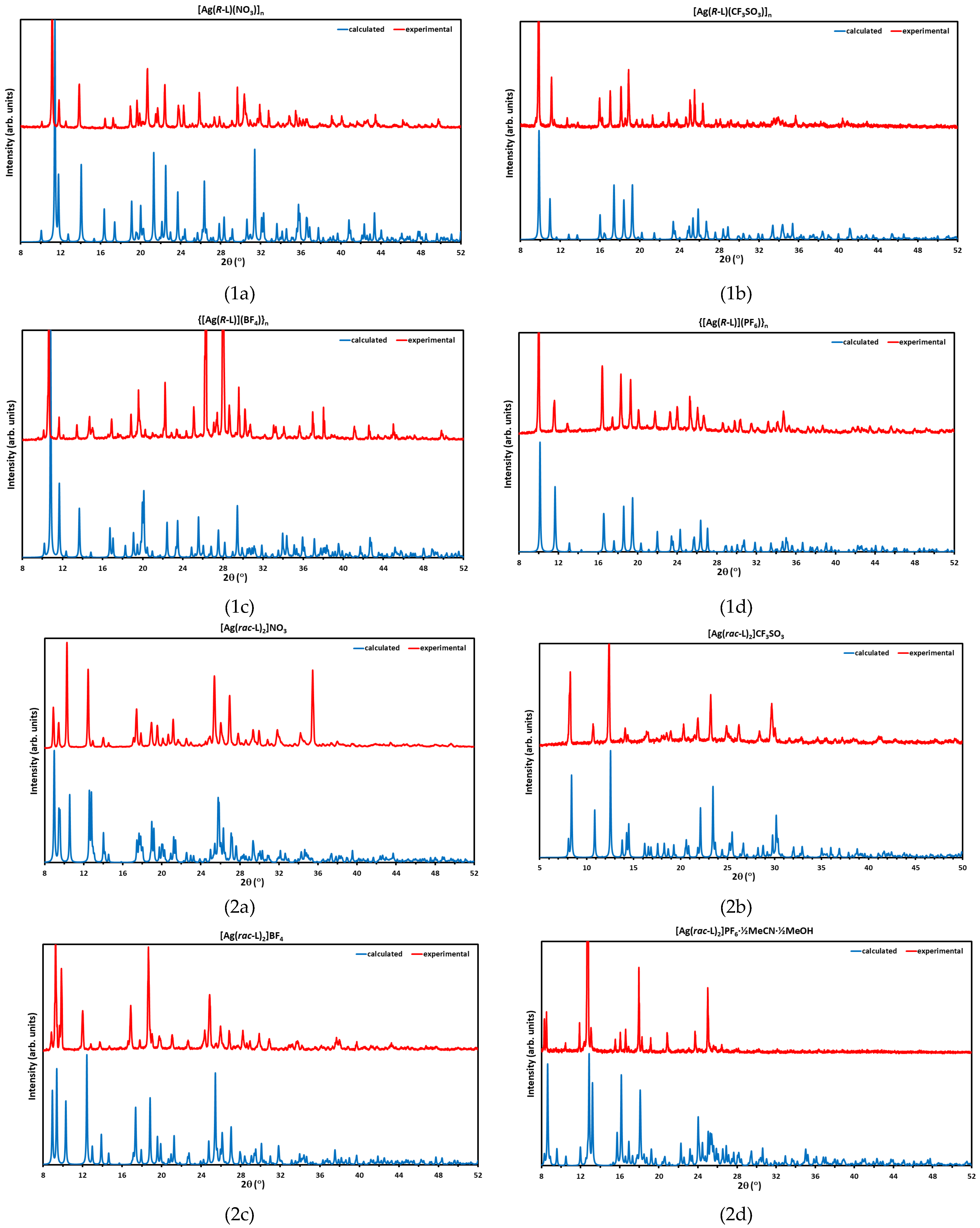
Synthesis of Ag(I) Complexes: The silver complexes were synthesised by combination of the ligand and a silver salt in a solvent mixture and leaving the solution to crystallise over a period of time, after which the crystalline product was recovered by filtration. PXRD confirms that the majority of samples have bulk purity or, in instances of discrepancies, that the reported compound is the majority product (see Supporting Information).
Poly-[Ag(R-L)(NO3)] (1a): R-L (10 mg, 42 µmol) and Ag(NO3) (18 mg, 104 µmol) in 1:1 (v/v) toluene:methanol (2 mL) for 7 days. Yield 10 mg (59%).
Poly-[Ag(R-L)(CF3SO3)] (1b): R-L (10 mg, 42 µmol) and Ag(CF3SO3) (27 mg, 104 µmol) in 1:1 (v/v) toluene:methanol (2 mL) for 7 days. Yield 12 mg (58%).
Poly-{[Ag(R-L)](BF4)} (1c): R-L (10 mg, 42 µmol) and Ag(BF4) (21 mg, 104 µmol) in 1:1 (v/v) water:acetonitrile (2 mL) for 7 days. Yield 11 mg (61%).
Poly-{[Ag(R-L)](PF6)} (1d): R-L (10 mg, 42 µmol) and Ag(PF6) (26 mg, 104 µmol) in 1:1 cyclohexane:methanol (2 mL) for 7 days. Yield 9 mg (44%).
[Ag(rac-L)2]NO3 (2a): rac-L (10 mg, 42 µmol) and Ag(NO3) (18 mg, 104 µmol) in 1:1 (v/v) water:acetonitrile (2 mL) for 7 days. Yield 10 mg (63%).
[Ag(rac-L)2]CF3SO3 (2b): rac-L (10 mg, 42 µmol) and Ag(CF3SO3) (27 mg, 104 µmol) in 1:1 (v/v) toluene:methanol (2 mL) for 7 days. Yield 12 mg (68%).
[Ag(rac-L)2]BF4 (2c): rac-L (10 mg, 42 µmol) and Ag(BF4) (21 mg, 104 µmol) in 1:1 (v/v) water:acetonitrile (2 mL) for 7 days. Yield 9 mg (55%).
[Ag(rac-L)2]PF6·0.5MeCN·0.5MeOH (2d): rac-L (10 mg, 42 µmol) and Ag(PF6) (26 mg, 104 µmol) in 1:1 (v/v) acetonitrile:methanol (2 mL) for 7 days. Yield 11 mg (59%).

2.3. Crystallographic Details

Single crystals were isolated and mounted on nylon loops using viscous hydrocarbon oil. Diffraction data were collected using either a Synergy-S diffractometer (Rigaku Corporation, Tokyo, Japan) or using the MX2 beamline at the Australian Synchrotron, part of ANSTO. The Synergy-S operated using a microfocus Cu-Kα source (λ = 1.54184 Å) and collection temperatures were maintained at 123 K using an open-flow N2 cryostream; data collection and processing was carried out using the CrysAlisPro software [25]. The MX2 beamline used an incident radiation of 0.7108 Å and collection temperatures were maintained at 100 K using an open-flow N2 cryostream; data collection was controlled using in-house software with data processing conducted using the XDS software suite and CX-ASAP [26,27,28]. All datasets were solved using SHELXT and refined by conventional least squares cycles against F2 using SHELXL [29,30]. The programs Olex2 and X-Seed were used as graphical interfaces to the SHELX suite [31,32]. All non-hydrogen atoms were refined using an anisotropic model. Hydrogen atoms attached to carbon were refined using a riding model with displacement parameters 1.2 or 1.5 times that of the carrier atom. Hydrogen atoms attached to nitrogen or oxygen were located from the Fourier difference map and refined using an X-H (X = O or N) distance restraint to normalise these distances for comparison.
All crystallographic and refinement parameters are given in Table 1 and Table 2. Detailed, non-standard refinement and modelling information is given below. All data have been deposited in the Cambridge Crystallographic Data Centre (www.ccdc.cam.ac.uk).
Poly-{[Ag(R-L)](PF6)} (1d): The PF6 anion is disordered with rotation around a F-P-F axis. The four equatorial fluorine atoms are modelled over two sites (refined to 58:42 occupancies) and are modelled with large, unrestrained displacement ellipsoids that reflect the extent of the disorder.
[Ag(rac-L)2]NO3 (2a): SADI restraints applied to the N-O bonds of the disordered nitrate. Nitrate modelled over two positions (69:31). ISOR restraint used on one oxygen atom of the nitrate (O3B—the smaller component between the two NH donors).
[Ag(rac-L)2]CF3SO3 (2b): Anion is disordered across a symmetry site and therefore has partial occupancy within the ASU. Refined with fixed 50% occupancy using PART -1 and no restraints.
[Ag(rac-L)2]BF4 (2c): Anion sits in symmetry site (coincidental with B atom) and therefore has partial occupancy within the ASU. Refined as 50% occupancy using PART -1 and no restraints.
[Ag(rac-L)2]PF6·0.5MeCN·0.5MeOH (2d): Disordered solvent modelled as 50% MeCN and 50% MeOH (disordered across symmetry position therefore modelled with fixed occupancies and negative PART commands). Distance restraints used on bonds in the solvent.

3. Results

3.1. Synthesis

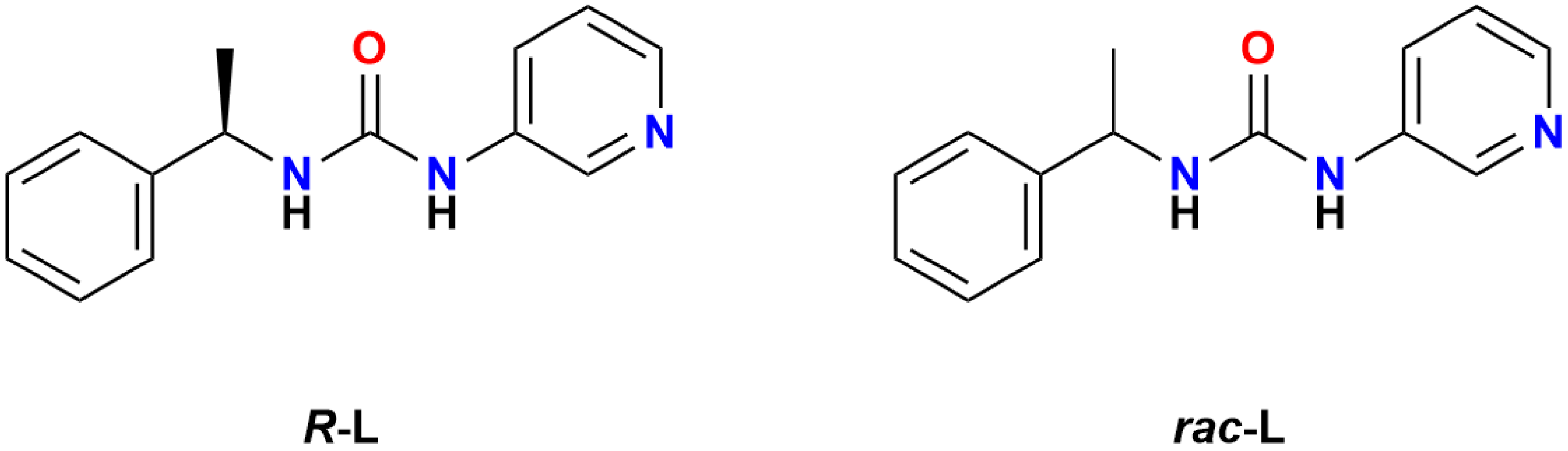
The racemic and enantiopure versions of the ligand, rac-L and R-L, respectively, were synthesised in good yields by a single step by reaction of 3-aminopyridine with the corresponding form of α-methylbenzylisocyanate (see Section 2 and Figure 1). These ligands were then placed to crystallise with a two-fold excess of various silver salts (nitrate, tetrafluoroborate, hexafluorophosphate and trifluoromethylsulfonate). Despite all metal–ligand reactions using the same ratio of reagents, the chiral R-L ligand exclusively formed crystalline products with a 1:1 metal-to-ligand ratio whilst rac-L only formed crystalline products with a 1:2 ratio; the former are coordination polymers, whereas the latter are discrete complexes. These two classes of structure are discussed in turn below. Powder X-ray diffraction (PXRD) indicated the formation of pure crystalline compounds in all cases (see Appendix A).

3.2. Structures Containing R-L (1a1d)

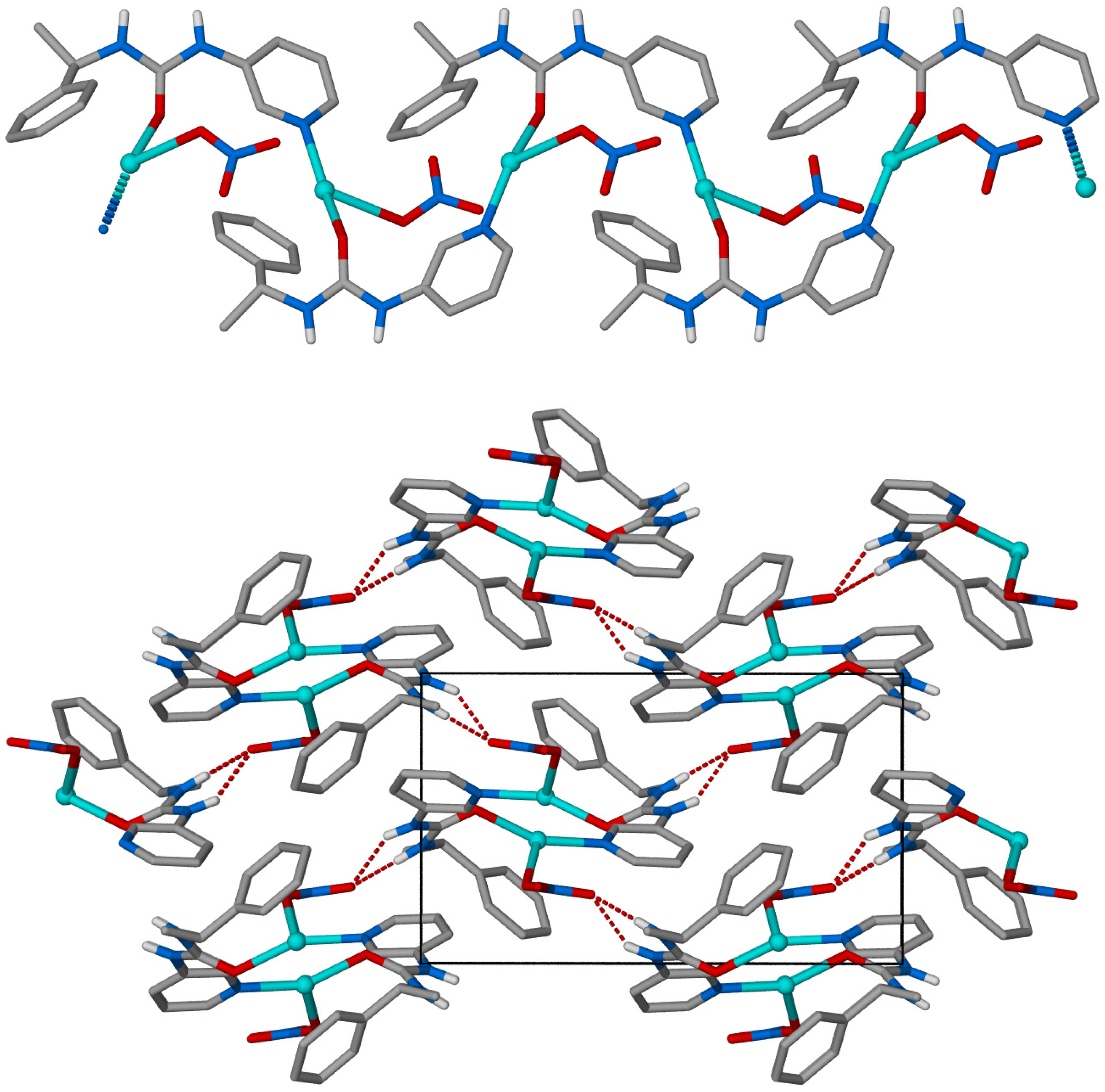
The compounds containing R-L with all four counter-anions are isomorphous one-dimensional coordination polymers of the form poly-[Ag(R-L)(X)], where X = NO3 (1a) or CF3SO3 (1b), or poly-[Ag(R-L)]X, where X = BF4 (1c) or PF6 (1d) (Figure 2). All structures are modelled in the orthorhombic system P212121 and the asymmetric unit contains a single formula unit. The ligand coordinates through both the pyridyl nitrogen atom (Ag-N in the range 2.168(4)–2.198(3) Å) and the carbonyl oxygen atom (Ag-O in the range 2.189(4)–2.261(2) Å). The silver ion has non-linear coordination between these two donor atoms (O-Ag-N in the range 157.53(15)–163.78(12)°) in all cases. For context, there are only three reported crystal structures containing unsubstituted urea coordinated to silver and these have Ag-O bonds of 2.34–2.55 Å [33,34,35]. A search of the Cambridge Structural Database (CSD) was undertaken with the parameters requiring N,N’-disubstituted ureas with an Ag···O distance in the range 2.0–3.5 Å; the search revealed only fifteen unique structures, with the shortest distance being 2.37 Å, making the interactions in this current report, to the best of our knowledge, the shortest observed [36,37].
In the nitrate- and trifluoromethylsulfonate-containing structures (1a and 1b, respectively), the anion coordinates to give a T-shaped coordination environment (Ag-ONO2 = 2.584(3) Å and Ag-OSO2CF3 = 2.669(4) Å). The other anions have longer distances to the silver ion and are not considered to be coordinating (ca. 2.94 Å for BF4 and 2.81 Å for PF6). The separation between the silver ions along the polymeric chain is slightly longer in the instances where the counter-anion is coordinating (Ag···Ag distances of 5.59, 5.55, 5.45 and 5.43 Å for NO3, CF3SO3, BF4 and PF6, respectively).
The one-dimensional coordination polymer has the ligands oriented such that the urea NH groups point away from the chain, alternating the direction in which they face (i.e., the ligands are coordinated on opposing sides of the Ag···Ag vector). The urea groups form hydrogen bonds with the anions associated with neighbouring chains. In the cases of nitrate (1a) and tetrafluoroborate (1c), the urea forms an R 1 2 ( 6 ) motif to a single acceptor atom of the anion (Figure 2, Table 1) [38,39]. In the cases of trifluoromethylsulfonate (1b) and hexafluorophosphate (1d), the urea forms an R 2 2 ( 8 ) motif to a pair of acceptor atoms of the anion. The interaction to the PF6 anion is somewhat unusual as the anion is disordered in the structure; the hydrogen bonding motif involves one of the fully-ordered fluorine positions and one disordered site (Table 3). Despite the presence of both pyridyl and benzyl groups, there are no significant π···π interactions in the structures.

3.3. Structures Containing rac-L

Reaction of the racemic mixture rac-L with the silver salts yields discrete complexes in all cases, of the form [AgL2]+. These crystallise alongside the counter-anion that was present as non-solvated structures in all cases except [Ag(rac-L)2]PF6·0.5MeCN·0.5MeOH (2d). There is more structural and conformational variety in these complexes than in the enantiopure series; each structure is modelled in a different centrosymmetric space group. Perhaps the most notable difference amongst these structures is that, in all cases bar the PF6-containing compound, the [AgL2]+ complexes contain two ligands of the same handedness (i.e., the crystal is composed of equal amounts of R,R and S,S complexes). The structure of [Ag(rac-L)2]PF6·0.5MeCN·0.5MeOH is different and has an R,S pair of ligands in each complex (see below).
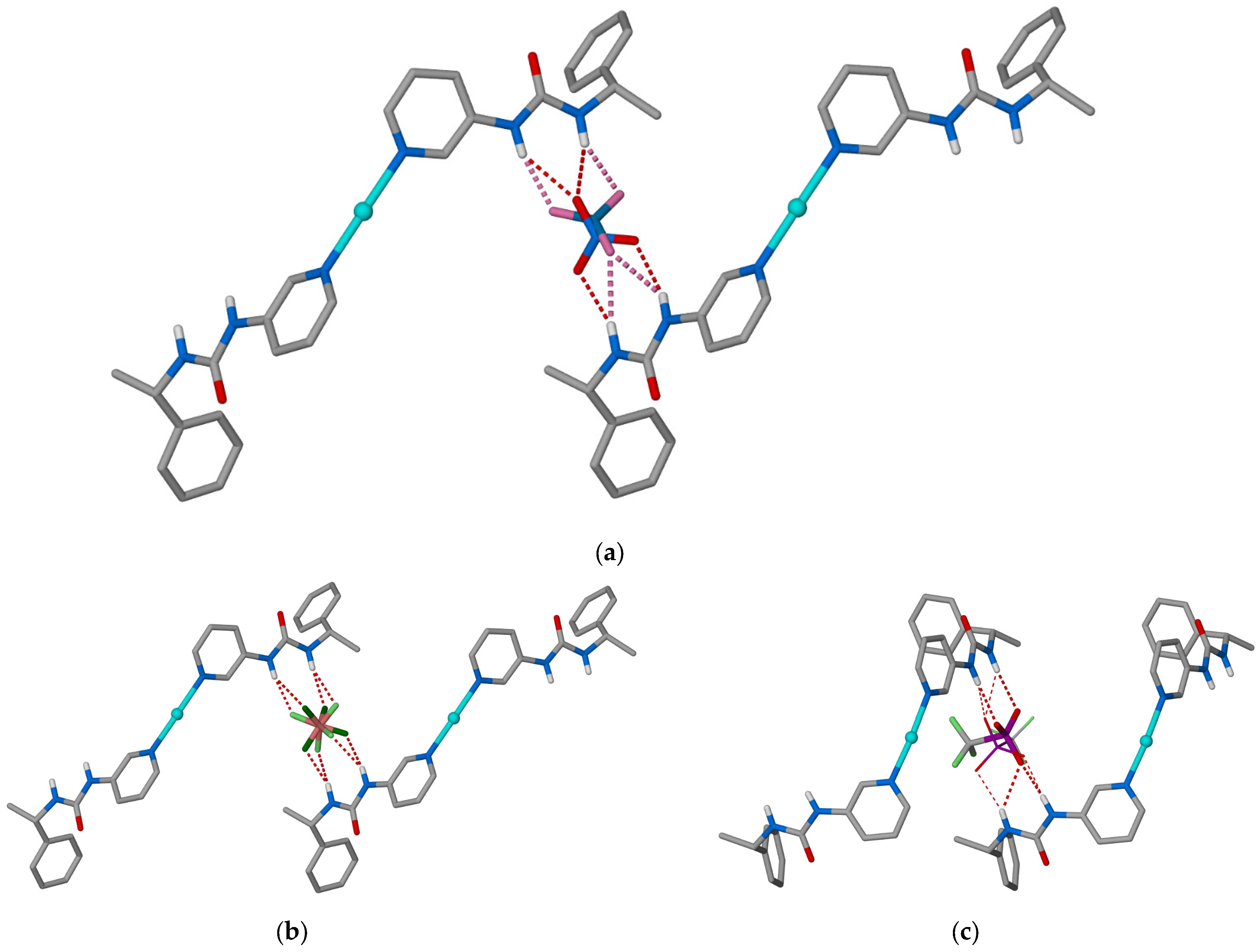
The structure of [Ag(rac-L)2]NO3 (2a), modelled in P-1, contains a complete complex and counter-anion in the asymmetric unit. The anticipation was that the nitrate anion would template the formation of a tweezer-like complex with the anion held in place by hydrogen bonding from the urea groups, as has been previously observed for related compounds; however, this was not the case [19,21,22]. In [Ag(rac-L)2]NO3 (2a), the complex adopts a splayed conformation, although both arms are pointing in roughly the same direction with respect to the near-linearly coordinated silver ion (N-Ag-N = 177.88(16)°). The nitrate anion lies between two adjacent complexes, held in place by both R 1 2 ( 6 ) and R 2 2 ( 8 ) hydrogen bonding motifs (Figure 3, Table 4). The anion is disordered across two well-defined positions with identical interactions present for both orientations. This hydrogen bonding motif forms a one-dimensional chain propagating through the structure; these chains each contain only one handedness of ligand. Between these chains there are long Ag···O contacts (ca. 2.75 Å, outside of a bonding distance, see above), parallel face-to-face π-interactions between adjacent pyridyl groups (interplanar distance of 3.41 Å) and non-parallel π-interactions between the phenyl and pyridyl groups (closest C···C distance 3.36 Å).
The structure of [Ag(rac-L)2]BF4 (2c) was modelled in the space group C2/c and contains only half of the formula unit in the asymmetric unit. The structure is essentially the same as that of the nitrate analogue and is therefore not discussed here in detail. There is a disordered BF4 anion templating the one-dimensional hydrogen-bonded chain through R 2 2 ( 8 ) interactions with the urea groups (Figure 3); other intermolecular interactions are similar to those discussed above.
The structure of [Ag(rac-L)2]CF3SO3 (2b) is subtly different to the nitrate and tetrafluoroborate analogues. Modelled in P2/c, the asymmetric unit contains half of the formula unit, as per the BF4 compound, with the anion disordered across a symmetry position. The two positions of the anion form both R 1 2 ( 6 ) and R 2 2 ( 8 ) hydrogen bonding motifs, similar to the nitrate-containing compound. Whilst the same one-dimensional hydrogen-bonding chain is formed, there is a distinct change in its conformation with the complexes being less “open” than in the two analogues discussed above (Figure 3). The urea groups on either side of the CF3SO3 anion are almost perpendicular to each other—87° between mean planes—which is a substantially larger angle than in the other two cases (ca. 70°) and serves to compress the hydrogen-bonding chain.
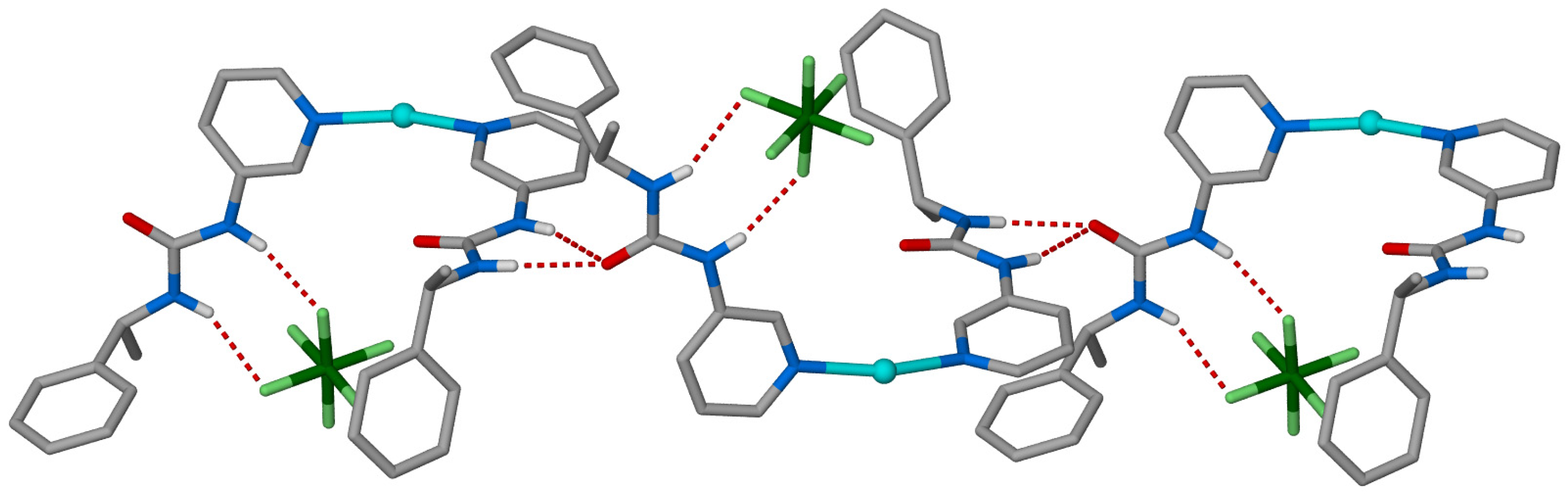
The structure of [Ag(rac-L)2]PF6·0.5MeCN·0.5MeOH (2d) is entirely different from those containing NO3, BF4 and CF3SO3. Modelled in Pbcn, the structure contains a complete formula unit in the asymmetric unit. Whilst the complex has a similar splayed conformation to those discussed above, it contains a racemic pair of ligands rather than a homochiral pair. The result of this difference is that the urea NH groups are oriented in a more similar direction to each other in the PF6-based structure, which affects the hydrogen-bonding network. The hexafluorophosphate anion forms hydrogen bonds to only one urea group (in contrast to the previously discussed structures); the remainder of the interaction sphere of the anion is only occupied by long aromatic CH···F interactions (C···F ca. 3.3–3.7 Å). The second urea of the [Ag(rac-L)2]+ complex forms an R 1 2 ( 6 ) motif to an adjacent complex and a one-dimensional chain of complexes is formed solely through this well-known motif (Figure 4) [40]. The partial occupancy solvent atoms do not participate in the extended hydrogen-bonding network and only form interactions with the “interior” of the complex and with each other. It is possible that the synthetic solvent composition, which differs from those used for compounds 2a2c, may have some bearing on the product being markedly different. However, crystalline materials could not be obtained from the alternative syntheses despite multiple attempts.

4. Discussion

Four silver(I) complexes of a chiral pyridyl–urea ligand have been isolated, with different counter-anions, for both the racemic and enantiomerically pure forms of the molecule (rac-L and R-L, respectively). The structures are, largely, not dependent upon the anion that is present. Instead, there is a distinct change in the structural behaviour depending upon the enantiopurity of the ligand that is used. Unlike related complexes, none of the materials reported here possess a cavity in which an anion can be bound in a host–guest scenario.
The enantiomerically pure form yields isomorphous materials regardless of the counter-anion (nitrate, trifluoromethylsulfonate, tetrafluoroborate or hexafluorophosphate, 1a1d, respectively). There are minor differences between these structures—the specific hydrogen bonding motifs and whether the anion is coordinated to the silver ion or merely close by—but the overall structures are the same. It is particularly interesting to note that the stoichiometry of the reaction is not reflected in the metal:ligand ratio of the products. Our previous works with similar ligands have sought to isolate cationic [ML2]+ complexes that possess a discrete anion-binding cavity, and these attempts have, by and large, been successful. However, the AgI/R-L system yields only polymeric 1:1 species.
The racemic ligand, rac-L, did yield the anticipated [Ag(rac-L)2]+ complexes. However, the conformation of these species is more open than other related complexes and they do not possess the anticipated binding cavity. In three of the structures (those containing NO3, CF3SO3 or BF4, 2a2c, respectively), the urea groups are “outwards” facing and therefore are able to form hydrogen-bonding chains using the anion as a linking unit. The PF6containing structure (2d) features urea···urea interactions to form a one-dimensional chain due to the orientation of the ligands, which are an R,S pair within the complex (unlike the other complexes, which contain two ligands of the same handedness). Despite the silver salt being present in excess in all reactions, the prevalence of the 1:2 complex suggests that, as a general design strategy, there is a driving force towards this type of complex.
Despite the thiazolyl analogues of L forming complexes suitable for anion binding, the pyridyl systems presented above do not appear to have the same capacity. Although this is judged solely by the solid-state results, all related systems have shown consistency between their solution and solid-state behaviour, and we have reasonable confidence in making this assessment. Whilst thiazolyl- and pyridyl-derived urea ligands have shown similar behaviour for simple N’-tolyl derivatives, the introduction of a stereogenic centre adds complexity to the system that warrants deeper investigation.

Supplementary Materials

The following supporting information can be downloaded at: https://www.mdpi.com/article/10.3390/cryst16030181/s1, Figures S1–S10: NMR spectra of R-L and rac-L; Figure S11–S12: Crystal structures of compounds 1b1d.

Author Contributions

Conceptualisation, D.U.S. and D.R.T.; formal analysis, D.U.S. and D.R.T.; investigation, D.U.S.; writing—original draft preparation, D.U.S. and D.R.T.; writing—review and editing, D.U.S. and D.R.T. All authors have read and agreed to the published version of the manuscript.

Funding

This research was funded by the Australian Research Council, grant number DP210100374.

Data Availability Statement

All crystallographic data is deposited with the Cambridge Crystallographic Data Centre (CCDC, see Table 1 and Table 2). PXRD data are available in Appendix A. NMR data and additional structural diagrams are available in the Supporting Information.

Acknowledgments

Part of this work was conducted using the MX2 beamline at the Australian Synchrotron, part of ANSTO, and made use of the ACRF detector. The authors acknowledge the use of facilities within the Monash X-ray Platform.

Conflicts of Interest

The authors declare no conflicts of interest. The funders had no role in the design of the study; in the collection, analyses, or interpretation of data; in the writing of the manuscript; or in the decision to publish the results.

Appendix A

Figure A1. Powder X-ray diffraction (PXRD) traces for all compounds, collected at room temperature (in red), compared against the predicted PXRD patterns from low-temperature single-crystal structural determinations (in blue); (1a) = [Ag(R-L)(NO3)]n, (1b) = [Ag(R-L)(CF3SO3)]n, (1c) = {[Ag(R-L)](BF4)}n, (1d) = {[Ag(R-L)](PF6)}n, (2a) = [Ag(rac-L)2]NO3, (2b) = [Ag(rac-L)2]CF3SO3, (2c) = [Ag(rac-L)2]BF4, and (2d) = [Ag(rac-L)2]PF6·0.5MeCN·0.5MeOH.
Crystals 16 00181 g0a1

References

  1. Lee, C.J.; Qiu, T.A.; Sweeldler, J.V. d-Alanine: Distribution, origin, physiological relevance, and implications in disease. Biochim. Biophys. Acta-Proteins Proteom. 2020, 1868, 140482. [Google Scholar] [CrossRef] [PubMed]
  2. Wang, Y.; Fang, H.; Tranca, I.; Qu, H.; Wang, X.; Markvoort, A.J.; Tian, Z.; Cao, X. Elucidation of the origin of chiral amplification in discrete molecular polyhedral. Nat. Commun. 2018, 9, 488. [Google Scholar] [CrossRef] [PubMed]
  3. Hong, J.; Chen, K.-J.; Zheng, F.-F.; Chen, X.; Liu, Y.; Cui, Y. A supermolecular building block approach for construction of chiral metal–organic frameworks. Chem. Commun. 2019, 55, 8639–8642. [Google Scholar] [CrossRef] [PubMed]
  4. Tan, C.; Chu, D.; Tang, X.; Liu, Y.; Xuan, W.; Cui, Y. Supramolecular coordination cages for asymmetric catalysis. Chem. Eur. J. 2018, 25, 662–672. [Google Scholar] [CrossRef]
  5. Tay, H.M.; Kyratzis, N.; Thoonen, S.; Boer, S.A.; Turner, D.R.; Hua, C. Synthetic strategies towards chiral coordination polymers. Coord. Chem. Rev. 2021, 435, 213763. [Google Scholar] [CrossRef]
  6. Pan, M.; Wu, K.; Zhang, J.-H.; Su, C.-Y. Chiral metal–organic cages/containers (MOCs): From structural and stereochemical design to applications. Coord. Chem. Rev. 2019, 378, 333–349. [Google Scholar] [CrossRef]
  7. Zor, E.; Bingol, H.; Ersoz, M. Chiral sensors. TrAC Trends Anal. Chem. 2019, 121, 115662. [Google Scholar] [CrossRef]
  8. Putman, J.I.; Armstrong, D.W. Recent advances in the field of chiral crystallization. Chirality 2022, 34, 1338–1354. [Google Scholar] [CrossRef]
  9. Vogl, O. Chiral crystallization and the origin of chiral life on earth. J. Polym. Sci. Part A Polym. Chem. 2011, 49, 1299–1308. [Google Scholar] [CrossRef]
  10. Bishop, R. Aspects of crystallization and chirality. In Chirality in Supramolecular Assemblies; Keene, F.R., Ed.; John Wiley & Sons: Chichester, UK, 2017; pp. 65–93. [Google Scholar]
  11. Amendola, V.; Fabbrizzi, L.; Mosca, L. Anion recognition by hydrogen bonding: Urea-based receptors. Chem. Soc. Rev. 2010, 39, 3889–3915. [Google Scholar] [CrossRef]
  12. Mohammed, F.A.; Xiao, T.; Wang, L.; Elmes, R.B.P. Macrocyclic receptors for anion recognition. Chem. Commun. 2024, 60, 11812–11836. [Google Scholar] [CrossRef]
  13. McVey, B.M.; Rumble, J.; Nathan, C.E.V.; Gass, I.A.; Sambrook, M.R.; Cragg, P.J. Asymmetric urea, thiourea and squaramide receptors as minimal-anion binding motifs. Supramol. Chem. 2024, 34, 208–222. [Google Scholar] [CrossRef]
  14. Kundu, S.; Egboluche, T.K.; Hossain, M.A. Urea- and thiourea-based receptors for anion binding. Acc. Chem. Res. 2023, 56, 1320–1329. [Google Scholar] [CrossRef] [PubMed]
  15. Paderni, D.; Formica, M.; Macedi, E.; Giorgi, L.; Rossi, P.; Retini, M.; De Cata, N.; Zappia, G.; Piersanti, G.; Fusi, V. A new bis-urea based cage receptor for anions: Synthesis, solid state structures and binding studies. Chem. Asian J. 2025, 20, e202401258. [Google Scholar] [CrossRef] [PubMed]
  16. Surina, A.; Čejka, J.; Salvadori, K.; Lhoták, P. Anion recognition using meta-substituted ureidocalix[4]arene receptors. Org. Biomol. Chem. 2024, 22, 8669–8678. [Google Scholar] [CrossRef]
  17. Paradine, S.M. Ureas and their derivatives as ligands in transition metal catalysis. Tetrahedron 2025, 184, 134781. [Google Scholar] [CrossRef]
  18. Holakovský, R.; Just, D.; Eigner, V.; Jakubec, M.; Cuřínová, P. Binaphthalene-based cyclic homochiral ureas and their structure-related properties. New J. Chem. 2023, 47, 8515–8523. [Google Scholar] [CrossRef]
  19. Lee, N.T.X.; Hicks, J.; Wallace, K.J.; Turner, D.R. Binding of mono- and dianions within silver thiazolylurea tweezers and capsules. Inorg. Chem. 2017, 56, 12535–12541. [Google Scholar] [CrossRef]
  20. Sawant, D.U.; Halat, P.; MacKay, A.I.; Izgorodina, E.I.; Turner, D.R. Dependence of an anion template on amino acid binding in DMSO/H2O by a chiral Ag/urea-based tweezer. Chem. Commun. 2025, 61, 18846–18849. [Google Scholar] [CrossRef]
  21. Sawant, D.U.; Turner, D.R. Influence of anion on the solid-state assembly of dimeric tweezer complexes. Inorg. Chim. Acta 2026, 595, 123075. [Google Scholar] [CrossRef]
  22. Turner, D.R.; Spencer, E.C.; Howard, J.A.K.; Tocher, D.A.; Steed, J.W. A modular, self-assembled, separated ion pair binding system. Chem. Commun. 2004, 1352–1353. [Google Scholar] [CrossRef] [PubMed]
  23. Turner, D.R.; Smith, B.; Goeta, A.E.; Radosavljevic-Evans, I.; Tocher, D.A.; Howard, J.A.K.; Steed, J.W. The R21(6) hydrogen-bonded synthon in neutral urea and metal-bound halide systems. CrystEngComm 2004, 6, 633–641. [Google Scholar] [CrossRef]
  24. Turner, D.R.; Smith, B.; Spencer, E.C.; Goeta, A.E.; Radosavljevic-Evans, I.; Tocher, D.A.; Howard, J.A.K.; Steed, J.W. Anion binding by Ag(I) complexes of urea-substituted pyridyl ligands. New J. Chem. 2005, 29, 90–98. [Google Scholar] [CrossRef]
  25. Agilent. CrysAlis PRO v. 43; Agilent Technologies Ltd.: Yarnton, UK, 2014. [Google Scholar]
  26. Aragao, D.; Aishima, J.; Cherukuvada, H.; Clarken, R.; Clift, M.; Cowieson, N.P.; Ericsson, D.J.; Gee, C.L.; Macedo, S.; Mudie, N.; et al. MX2: A high-flux undulator microfocus beamline serving both the chemical and macromolecular crystallography communities at the Australian Synchrotron. J. Synchrotron Radiat. 2018, 25, 885–891. [Google Scholar] [CrossRef]
  27. Kabsch, W. XDS. Acta Crystallogr. Sect. D 2010, 66, 125–132. [Google Scholar] [CrossRef]
  28. Thompson, A.J.; Smith, K.M.L.; Clegg, J.K.; Price, J.R. CX-ASAP: A high-throughput tool for the serial refinement and analysis of crystallographic data collected under varying conditions. J. Appl. Crystallogr. 2023, 56, 558–564. [Google Scholar] [CrossRef]
  29. Sheldrick, G.M. SHELXT—Integrated space-group and crystal-structure determination. Acta Crystallogr. Sect. A 2015, 71, 3–8. [Google Scholar] [CrossRef]
  30. Sheldrick, G.M. Crystal structure refinement with SHELXL. Acta Crystallogr. Sect. C 2015, 71, 3–8. [Google Scholar] [CrossRef]
  31. Dolomanov, O.V.; Bourhis, L.J.; Gildea, R.J.; Howard, J.A.K.; Puschmann, H. OLEX2: A complete structure solution, refinement and analysis program. J. Appl. Crystallogr. 2009, 42, 339–341. [Google Scholar] [CrossRef]
  32. Barbour, L.J. X-Seed—A software tool for supramolecular chemistry. J. Supramol. Chem. 2001, 1, 189–191. [Google Scholar] [CrossRef]
  33. Smith, G.; Cloutt, B.A.; Byriel, K.A.; Kennard, C.H.L. Preparation and crystal structures of the urea adducts of silver (I) perchlorate and silver (I) p-toluenesulfonate. Aust. J. Chem. 1997, 50, 741–746. [Google Scholar] [CrossRef]
  34. Banti, C.N.; Kapetana, M.; Papachristodoulou, C.; Raptopoulou, C.P.; Psycharis, V.; Zoumpoulakis, P.; Mavromoustakos, T.; Hadjikakou, S.K. Hydrogels containing water soluble conjugates of silver(i) ions with amino acids, metabolites or natural products for non infectious contact lenses. Dalton Trans. 2021, 50, 13712–13727. [Google Scholar] [CrossRef]
  35. Sagatys, D.S.; Bott, R.C.; Smith, G.; Byriel, K.A.; Kennard, C.H.L. The preparation and crystal structure of a polymeric (1:1)-silver nitrate-urea complex, [(AgNO3)2(CH4N2O)2]n. Polyhedron 1992, 11, 49–52. [Google Scholar] [CrossRef]
  36. Groom, C.R.; Bruno, I.J.; Lightfoot, M.P.; Ward, S.C. The Cambridge Structural Database. Acta Crystallogr. Sect. B 2016, 72, 171–179. [Google Scholar] [CrossRef] [PubMed]
  37. Qureshi, N.; Lloyd, G.O.; Yufit, D.S.; Howard, J.A.K. CCDC 2298230: Experimental Crystal Structure Determination. 2023. Available online: https://www.ccdc.cam.ac.uk/structures/search?id=doi:10.5517/ccdc.csd.cc2h4hgm&sid=DataCite (accessed on 5 March 2026).
  38. Etter, M.C. Encoding and decoding hydrogen-bond patterns of organic compounds. Acc. Chem. Res. 1990, 23, 120–126. [Google Scholar] [CrossRef]
  39. Etter, M.C.; Macdonald, J.C.; Bernstein, J. Graph-set analysis of hydrogen-bond patterns in organic crystals. Acta Crystallogr. Sect. B 1990, 46, 256–262. [Google Scholar] [CrossRef] [PubMed]
  40. Custelcean, R. Crystal engineering with urea and thiourea hydrogen-bonding groups. Chem. Commun. 2008, 295–307. [Google Scholar] [CrossRef]
Figure 1. The ligand L is used herein as both its enantiopure (left) and racemic (right) form.
Crystals 16 00181 g001
Figure 2. (Top) Part of the one-dimensional coordination polymer in the structure of [Ag(R-L)(NO3)] (1a), an example of the isomorphous series. (Bottom) Hydrogen bonding between the chains viewed along the crystallographic b axis. For clarity, only the NH hydrogen atoms are shown. Analogous packing figures for the CF3SO3, BF4 and PF6 analogues (1b1d, respectively) are provided in the Supporting Information (Figures S11 and S12).
Crystals 16 00181 g002
Figure 3. The (a) nitrate, (b) tetrafluoroborate and (c) trifluoromethylsulfonate anions in the structures of [Ag(rac-L)2]NO3 (2a), [Ag(rac-L)2]BF4 (2c) and [Ag(rac-L)2]CF3SO3 (2b) are disordered over two positions and are held between two adjacent complexes by hydrogen bonds to form a continuous one-dimensional chain. Hydrogen atoms bound to carbon are omitted for clarity. Hydrogen bonding parameters are given in Table 4.
Crystals 16 00181 g003
Figure 4. The structure of [Ag(rac-L)2]PF6·0.5MeCN·0.5MeOH (2d) contains a one-dimensional hydrogen-bonded chain that is held together through urea···urea interactions. Hydrogen atoms bound to carbon and partial occupancy solvent molecules are omitted for clarity.
Crystals 16 00181 g004
Table 1. Crystallographic and refinement parameters for structures containing the chiral ligand R-L.
[Ag(R-L)(NO3)]n{[Ag(R-L)](CF3SO3)}n{[Ag(R-L)](BF4)}n{[Ag(R-L)](PF6)}n
Compound1a1b1c1d
FormulaC14H15AgN4O4C15H15AgF3N3O4SC14H15AgBF4N3OC14H15AgF6N3OP
Formula Mass411.17498.23435.97494.13
Crystal SystemOrthorhombicOrthorhombicOrthorhombicOrthorhombic
Space GroupP212121P212121P212121P212121
a9.0278 (1)10.7274 (1)9.7060 (19)10.66208 (7)
b10.8279 (1)10.7872 (1)10.589 (2)10.66996 (10)
c15.0008 (2)16.1256 (2)15.142 (3)15.18109 (11)
α/°90909090
β/°90909090
γ/°90909090
V/Å31466.36 (3)1866.03 (3)1556.2 (5)1727.06 (2)
Z4444
ρcalc/g cm−31.8621.7731.8611.900
InstrumentSynergy SSynergy SMX2 BeamlineSynergy S
μ/mm−111.28710.2371.34210.922
F(000)824992864976
θ range/°5.038–79.8024.952–80.4372.347–32.2135.067–80.235
Refs. Measured9742189512878018479
Unique Refs.3125390148253628
Refs. I > 2σI3098385647933566
Param./Restr.216/2251/2224/2279/2
GooF on F21.0891.0571.1011.096
Rint0.02690.05630.03890.0510
R1 (I > 2σI)0.01990.04130.01910.0270
wR2 (I > 2σI)0.05370.10980.04660.0698
R1 (all data)0.02000.04170.01940.0279
wR2 (all data)0.05380.11050.04800.0777
Flack0.005 (3)−0.012 (6)0.015 (5)−0.018 (5)
CCDC No.2531257253126025312582531259
Table 2. Crystallographic and refinement parameters for structures containing the racemic ligand rac-L.
[Ag(rac-L)2](NO3)[Ag(rac-L)2](CF3SO3)[Ag(rac-L)2](BF4)[Ag(rac-L)2](PF6) ·½MeOH·½MeCN
Compound2a2b2c2d
FormulaC28H30AgN7O5C29H30AgF3N6O5SC28H30AgBF4N6O2C29.5H33.5AgF6N6.5O2.5P
Formula Mass652.46739.52677.26771.97
Crystal SystemTriclinicMonoclinicMonoclinicOrthorhombic
Space GroupP-1P2/cC2/cPbcn
a10.6434 (3)11.255 (2)13.170 (3)27.4990 (4)
b10.6755 (3)10.517 (2)17.170 (3)11.0370 (2)
c13.6844 (4)13.204 (3)13.870 (3)21.3148 (3)
α/°104.634 (2)909090
β/°103.028 (2)103.54 (3)113.25 (3)90
γ/°103.523 (2)909090
V/Å31394.23 (8)1519.5 (6)2881.7 (12)6469.18 (15)
Z2248
ρcalc/g cm−31.5541.6161.5611.585
InstrumentSynergy SMX2 BeamlineMX2 BeamlineSynergy S
μ/mm−16.2350.7980.7636.137
F(000)66875213763136
θ range/°4.483–80.5511.861–32.2092.059–32.0714.148–79.913
Refs. Measured23916248604954330735
Unique Refs.5840444144516915
Refs. I > 2σI5582390340436068
Param./Restr.421/25247/2217/2454/8
GooF on F21.0841.1381.0621.058
Rint0.05950.06170.04560.0993
R1 (I > 2σI)0.07100.05920.06340.0772
wR2 (I > 2σI)0.17770.16910.17760.2129
R1 (all data)0.07310.06370.06770.0830
wR2 (all data)0.17920.18010.18220.2182
Flack----
CCDC No.2531261253126425312622531263
Table 3. Hydrogen bonding parameters for silver coordination polymers containing R-L (1a1d).
InteractionD-H (Å)H···A (Å)D···A (Å)D-H···A (°)
[Ag(R-L)(NO3)]n (1a)
N1-H1···O40.878 (13)2.10 (3)2.889 (4)150 (4)
N2-H2···O40.883 (13)2.13 (3)2.898 (4)145 (4)
[Ag(R-L)(CF3SO3)]n (1b)
N1-H1···O30.876 (14)2.07 (3)2.921 (6)164 (7)
N2-H2···O40.877 (14)2.097 (18)2.969 (6)173 (7)
{[Ag(R-L)](BF4)}n (1c)
N1-H1···B40.876 (13)2.089 (19)2.893 (3)152 (3)
N2-H2···B40.875 (13)2.08 (2)2.847 (2)145 (3)
{[Ag(R-L)](PF6)}n (1d)
N1-H1···F3A *0.877 (14)2.14 (2)3.001 (8)168 (6)
N1-H1···F3B *0.877 (14)2.06 (3)2.894 (11)158 (5)
N2-H2···F10.878 (14)2.26 (3)3.029 (5)146 (5)
* These fluorine atoms are part of the disordered equatorial positions that are modelled as being disordered over two sites but are likely disordered over more.
Table 4. Hydrogen bonding parameters for complexes containing the discrete [Ag(rac-L)2]+ complex (2a2d).
InteractionD-H (Å)H···A (Å)D···A (Å)D-H···A (°)
[Ag(rac-L)2](NO3) (2a) *
N1-H1···O5A0.881 (10)2.27 (6)2.947 (9)134 (7)
N2-H2···O5A0.878 (10)2.19 (5)2.938 (10)143 (6)
N4-H4···O3A0.880 (10)2.04 (3)2.884 (8)161 (7)
N5-H5···O4A0.879 (10)2.02 (3)2.864 (8)159 (6)
[Ag(rac-L)2](CF3SO3) (2b)
N1-H1···O20.874 (10)2.174 (16)3.022 (5)164 (4)
N1-H1···O40.874 (10)2.35 (3)3.069 (5)139 (3)
N2-H2···O30.874 (10)2.071 (12)2.940 (4)172 (4)
N2-H2···O40.874 (10)1.970 (17)2.807 (5)160 (4)
[Ag(rac-L)2](BF4) (2c)
N1-H1···F10.882 (10)2.038 (19)2.896 (7)164 (5)
N1-H1···F30.882 (10)2.12 (2)2.965 (7)161 (5)
N2-H2···F20.876 (10)2.18 (3)2.948 (6)146 (5)
N2-H2···F40.876 (10)2.006 (15)2.874 (6)171 (5)
[Ag(rac-L)2](PF6) (2d)
N1-H1···F10.878 (10)2.34 (3)3.157 (7)156 (6)
N1-H1···F50.878 (10)2.26 (4)3.023 (7)145 (6)
N2-H2···F40.877 (10)2.11 (2)2.969 (6)164 (6)
N4-H4···O10.877 (10)2.20 (4)2.954 (6)144 (6)
N5-H5···O10.877 (10)2.01 (2)2.864 (5)165 (6)
* Only parameters for one position of the anion are provided for comparison; parameters for the second position are very similar.
Disclaimer/Publisher’s Note: The statements, opinions and data contained in all publications are solely those of the individual author(s) and contributor(s) and not of MDPI and/or the editor(s). MDPI and/or the editor(s) disclaim responsibility for any injury to people or property resulting from any ideas, methods, instructions or products referred to in the content.