Article

Growth and Characterization of Multicomponent, Equimolar Cubic Solid-Solution Crystals in the CaF2–SrF2–BaF2–NdF3 System †

by
Irina I. Buchinskaya
1,*,
Nikolay I. Sorokin
1,
Pavel A. Popov
2 and
Denis N. Karimov
1,*
1
Shubnikov Institute of Crystallography, Kurchatov Complex of Crystallography and Photonics, National Research Center «Kurchatov Institute», Leninskii Prospekt, 59, Moscow 119333, Russia
2
Department of Experimental and Theoretical Physics, Faculty of Physics and Mathematics, Petrovsky Bryansk State University, Bezhitskaya Str. 14, Bryansk 241036, Russia
*
Authors to whom correspondence should be addressed.
Dedicated to the 90th anniversary of Professor Boris Pavlovich Sobolev, an outstanding scientist in the field of fluoride materials science.
Crystals 2026, 16(2), 140; https://doi.org/10.3390/cryst16020140
Submission received: 27 January 2026 / Revised: 9 February 2026 / Accepted: 13 February 2026 / Published: 15 February 2026
(This article belongs to the Special Issue Polymorphism and Phase Transitions in Crystal Materials)

Abstract

Equimolar crystals of a high-entropy Ca0.25Sr0.25Ba0.25Nd0.25F2.25 (CaSrBaNdF9) fluoride solid solution were grown from a melt by the Bridgman technique, and their optical, electrical, and thermal properties were studied for the first time. This solid solution crystallizes in a fluorite-type structure (space group Fm-3m with lattice parameter a = 5.807 Å), is transparent over a wide spectral range, and has a refractive index of nD = 1.5035(5). In terms of ionic conductivity (σdc increases monotonically from 3.7 × 10⁻⁵ to 3.9 × 10⁻⁴ S/cm in the studied temperature range of 643–810 K), it significantly exceeds the parameters of binary and ternary NdF3-based single crystals, such as M1−xNdxF2+x (M = Ca, Sr, Ba; x = 0.24–0.25) and Ca0.58Sr0.21Nd0.21F2.21. The grown multicomponent material is a hard (HV~3.6 GPa) isomorphic-capacious crystalline matrix for various applications in solid-state ionics, optics and photonics, and opens up prospects for the development of new functional isotropic optical crystalline materials in quaternary CaF2–SrF2–BaF2RF3 and higher-order complex fluoride systems nMF2–mRF3, where n + m ≥ 4, M and R are ions of alkaline earth and rare earth elements, respectively.

1. Introduction

Modern fluoride materials science urgently requires intensified research efforts to transfer from single-component crystals (or polycrystals) to multicomponent solid solutions (SSs), including medium- and high-entropy ones, to extend the present selection of crystalline materials with unique and superior performance characteristics for specific applications [1,2,3,4,5,6,7,8,9,10].
Among the variety of fluorides, the family of widely used crystals MF2 (M = Ca, Sr, Ba, Cd), with a fluorite-type structure, stands out [11,12,13,14]. These simple one- and two-component fluorides M1−xRxF2+x (R is rare earth ions) possess several key favorable features (optical transparency, radiation resistance, thermal stability, and spectroscopic properties), and are indispensable in the development of various advanced precision photonic systems for both research and industrial applications. Methods for melt growth or ceramic synthesis of such materials have already been sufficiently developed at present [15,16,17,18,19,20]. It can be noted that active research is carried out on the synthesis of materials in the form of transparent optical multicomponent ceramics [3,4,21,22], while single crystal engineering is hampered by significant technological melt growth difficulties (high temperatures, aggressiveness of fluoride melts, pyrohydrolysis processes, and composition heterogeneity due to morphological instability of the solid–liquid interface) [15,16,23,24,25,26,27,28,29]. Achieving chemical homogeneity of a ceramic material is a simpler process.
In any case, individual compounds of MF2 can be modified by designing complex (ternary, quaternary) iso- and aliovalent multicomponent SSs (in single-crystal or ceramic form) based on them, which can be considered a novel class of promising functional materials. These highly concentrated materials can offer unique optical and other physical properties that are very different or unattainable for simple fluoride MF2.
The difficulty of growing chemically and, as a consequence, optically uniform multicomponent SSs by melt directional crystallization is usually associated with incongruent solidification. In rare exceptions, there are compositions that correspond to specific (stationary) points (minima, maxima, and saddles) in the SS melting surfaces that melt/solidify congruently [1]. Thus, the development of methods for growing multicomponent (ternary and more complex) crystals is very limited, and the search for compositions of congruent points is extremely relevant in multicomponent systems.
Of particular interest from the perspective of ternary materials is the fluorite-structured isovalent SS in the CaF2–SrF2–BaF2 system. There is probably no ternary stationary point on the melting surfaces in this system, but the sloping liquidus and small temperature difference between the liquidus and solidus of the SS allow growing single crystals with a high degree of optical homogeneity. The equimolar SS Ca0.33(3)Sr0.33(3)Ba0.33(3)F2 (CaSrBaF6) has an incongruent melting character with a small difference (~50 °K) between melting and solidification temperatures [30], and this type of single crystal was successfully grown from the melt (by the Bridgman technique) and tested by doping with active rare earth ions as a laser media [31,32].
In a number of ternary systems, such as CaF2–SrF2RF3 (R = La–Lu), SrF2–BaF2RF3 (R = La–Yb), and PbF2–CdF2–RF3 (R = Tb, Ho, Er, Tm, Yb, Lu), there are special points that correspond to congruent melting compositions [1,30,33,34,35,36,37,38,39,40,41]. The assumption about the existence of a quaternary fluorite-type SS with a congruent crystallization behavior in the CaF2–SrF2–BaF2–LaF3 system was made in [1]. Note that a similar liquidus topology is also possible with some other RF3. However, this has not been experimentally confirmed to date.
For the first time, cubic laser-quality crystals in the quinary system CaF2–SrF2–BaF2–YF3–LaF3 were grown by the Bridgman technique and studied in Russia in the 1960s [42,43]. Any additional information on the synthesis from the melt of concentrated four- and five-component fluoride crystals is currently unavailable.
Scientific interest in multicomponent high-entropy materials (HEMs) has grown rapidly in recent years [3,6,44], while fluoride HEMs remain poorly studied. The criteria for the formation of high-entropy phases and the prediction of their properties are currently controversial [44,45]. Previously studied multicomponent crystal compositions (except for Ca0.33(3)Sr0.33(3)Ba0.33(3)F2 [30,37] and Sr0.35Ba0.35La0.30F2.30 [41]) have far from equimolar component ratios, which can provide the maximum entropy of mixing and determine the highest disorder degree.
A fluorite-structured SS from MF2 and RF3, with four different types of cations M in equimolar or near-equimolar ratios and an equivalent excess of F anions embedded by the aliovalent component RF3 (R—rare earth element), can be classified as a HEM. Due to the strong disordering of such crystal structures, the slowing of diffusion, and the “cocktail” effect [46,47,48], changes (enhancements) can be expected in some properties of high-entropy SSs with an increase in the number of components. Therefore, it is of interest to extend this approach and implement the complication of fluorite-type SS compositions to assess their chemical homogeneity and track changes in certain physical characteristics to identify synergy (dyssynergy) or additivity of properties.
This study aims to clarify assumptions [1] regarding the existence of a quaternary fluorite-type solution in the CaF2–SrF2–BaF2RF3 system and to grow bulk equimolar crystals from the melt using a composition with R = Nd to comprehensively evaluate a number of characteristics of the fabricated multicomponent material.

2. Materials and Methods

2.1. Crystal Growth and Sample Preparation

High-purity CaF2, NdF3 (99.99%, Lanhit, Ltd., Moscow, Russia), BaF2 (99.998%, Lanhit, Ltd., Moscow, Russia), and SrF2 (99.995%, Sigma-Aldrich, Saint Louis, MO, USA) powders were utilized as initial reagents. These materials were remelted in a fluorinating atmosphere to remove oxygen-containing impurities and produce dense, transparent ingots. The components were weighed according to stoichiometry, mixed, and homogenized in a melt at 1750 K for 3 h. The equimolar SS single crystals Ca0.25Sr0.25Ba0.25Nd0.25F2.25 (rational composition CaSrBaNdF9) were grown by the Bridgman technique in a two-zone resistance furnace with a graphite heating unit in a static atmosphere (He + CF4 mixture). The pre-evacuation level was 10−2 Pa. Multi-cell graphite crucibles were applied. The experimental methodology is described in detail in [33,40,41]. The temperature gradient in the crystallization zone was maintained at 70 K/cm, the crucible pulling rates and post-growth cooling rates were 2.5 mm/h and ~100 K/h, respectively. Evaporation losses did not exceed 1.0 wt.%. Thus, multicomponent single crystals with a diameter of 15 mm and a length of up to 35 mm were successfully grown (Figure 1a).
Samples with a thickness of h = 2–20 mm were cut from the compositional uniformity part of the crystals and mirror polished (see Figure 2).

2.2. Crystal Characterization

X-ray diffraction (XRD) analysis was performed on a Rigaku MiniFlex 600 powder diffractometer (Rigaku, Tokyo, Japan) in the angular range 2θ = 20–100° (CuKα radiation). Unit-cell parameters were fitted by full-profile Le Bail analysis within the Fm-3m symmetry space group (the JANA2006 8.16 software [49]).
The relative distribution of components along the length of the crystalline boule was determined by X-ray fluorescence (XRF) analysis on an Orbis PC Micro-XRF microanalyzer (EDAX, Pleasanton, CA, USA).
Crystal density ρ was determined by hydrostatic weighing at room temperature (RT) using distilled water as the working fluid.
The refractive index nD (λ = 0.589 μm) was measured at RT using an IRF-454 refractometer (Kazan, Russia). Highly refractive 1-Bromonaphthalene (97%, Thermo Fisher, Waltham, MA, USA) was utilized as an immersion fluid.
Transmission spectra were recorded at RT using a Cary 5000 spectrophotometer (Agilent Technologies, Santa Clara, CA, USA) and a Nicolet Nexus 5700 FTIR spectrometer (Thermo Fisher, Waltham, MA, USA) in the wavelength range λ = 0.2–16.0 μm.
The Vickers microhardness HV of the crystals was studied at RT using the microindentation method on a Duroline-MH-6 hardness tester (Metkon Instruments Inc., Bursa, Turkey). The HV values [kgf/mm2] were calculated using the formula:
HV = 1.8544 P/d2,
where P [gf] is the indenter load and d [mm] is the diagonal length of the indenter impression. Measurements were performed at P = 50 gf and an indenter holding time of 10 s. The error in microhardness measurement did not exceed 6%. Conversion of physical units (into the International System of Units) was carried out according to the well-known ratio: 1 gf = 9.80665 × 10⁻³ H.
Thermal conductivity in the temperature range of 50–300 K was measured using the absolute stationary longitudinal-heat-flow method. The equipment and measurement methodology are described in [37]. The samples were cylindrical, 12 mm in diameter and 20 mm in length. The error in determining the thermal conductivity coefficient was within ±5%.
Ionic conductivity was measured using impedance spectroscopy in a vacuum of ~1 Pa over a temperature range of 643–810 K in cooling mode. Silver paste (Leitsilber, Kemo Electronic GmbH, Geestland, Germany) was applied as inert electrodes on the sample surfaces. Measurements of the complex impedance Z*(ω) = Z′ + iZ″ (i is the imaginary unit) of the electrochemical system Ag|crystal|Ag were performed in the frequency ranges of 5–5× 10⁵ Hz with resistances of 1–107 Ω (BM–507 impedance meter, Tesla, Prague, Czech Republic). The relative measurement error of Z*(ω) did not exceed 5%. The impedance measurement technique is described in detail in [50].
The Nyquist Z*(ω) plots, the Bode Z′(ω) and Z″(ω) plots and the equivalent circuit for such an electrochemical system, Ag|single crystal|Ag, are well studied, and examples are given in [50,51]. The equivalent electrical circuit consists of a bulk resistance Rcrys of the crystal and two frequency-dependent elements Pel(ω) and Pb(ω) of a capacitive nature. At low frequency, the plot Z*(ω) represents a straight line inclined to the abscissa, which corresponds to the element Pel(ω) with a constant phase angle and models the electrical processes at the crystal/electrode interface. As the frequency increases, we observe the semicircle with the center below the abscissa, which corresponds to the resistance Rcrys and the element Pb(ω) connected in parallel and models the electrical processes in the crystal bulk. The fact that impedance spectra at low frequencies reflect the presence of the blocking effect exerted by the inert (silver) electrodes points to the ionic nature of conduction in this crystal.
The bulk resistance Rcrys of the crystal was determined from the frequency dependences of the complex impedance of the Ag|CaSrBaNdF9|Ag electrochemical cells by the intersection of the impedance hodograph with the active resistance axis. The specific electrical conductivity σdc was calculated using the following formula:
σdc = h/(RcrysS),
where h = 3.5 mm is the thickness of the sample and S = 60 mm2 is the area of the electrodes.
The temperature dependence of conductivity was processed in accordance with the Arrhenius–Frenkel equation:
σdcT = Aexp(−ΔHσ/kT),
where A is the pre-exponential factor of electrical conductivity and ΔHσ is the activation enthalpy of ion transfer.

3. Results and Discussion

As a result of experiments on vertical directional crystallization of the melt at the crucible pulling rate of 2.5 mm/h, single crystals of the nominal (according to the charge) composition CaSrBaNdF9 (free from light-scattering inclusions and cracks) were successfully grown (Figure 1a).
The bottom (conical) and center crystal parts are visually uniform (Figure 1b), while the characteristic cellular structure gradually increases in the top part (radial composition heterogeneity) due to the incongruent solidification nature (Figure 1c). The characteristic appearance of the cellular structure is shown in the axial and radial directions, respectively.
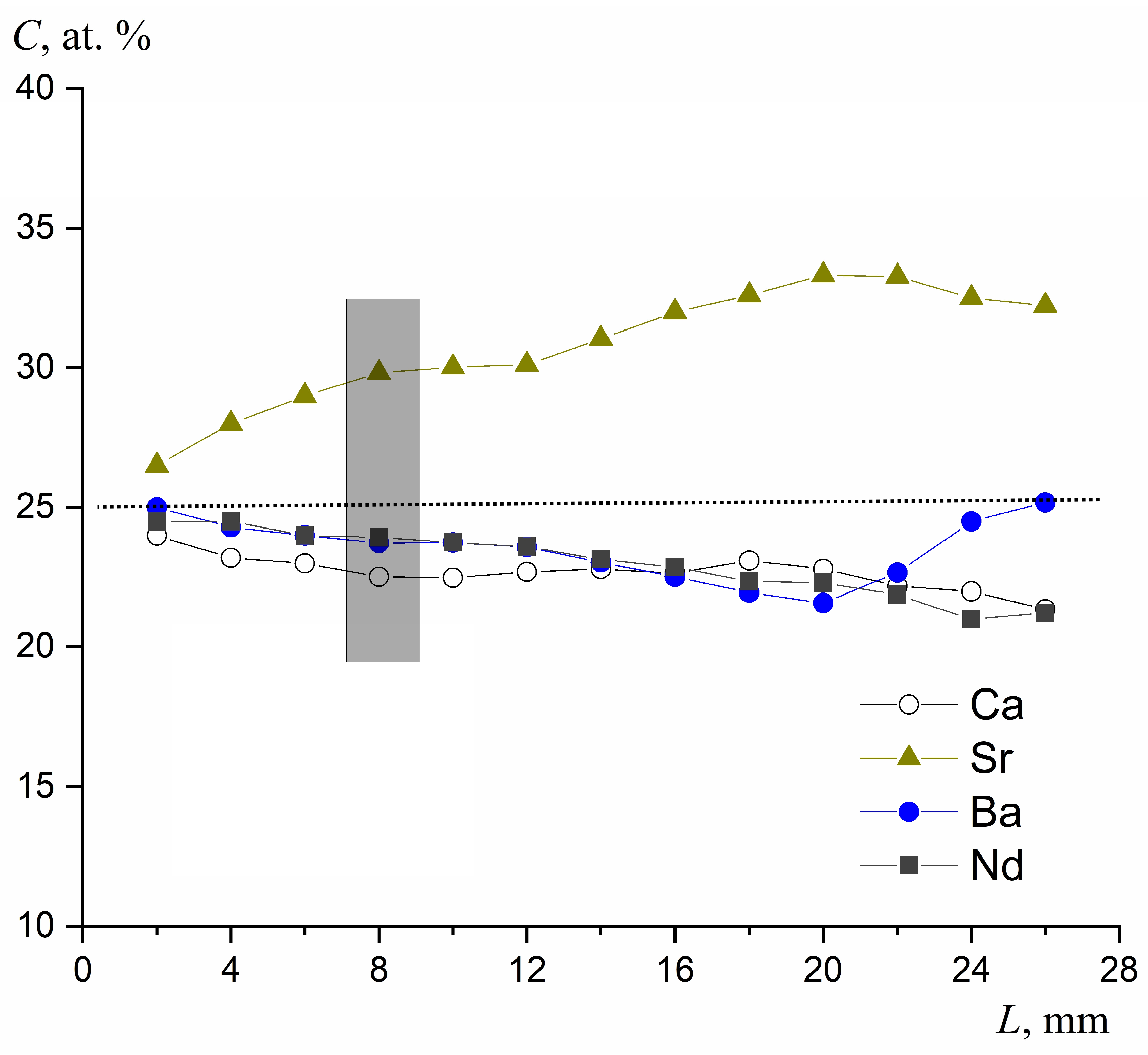
The ratio of Ca, Ba, and Nd cations remains practically constant along the length of the crystal boule, with their content decreasing uniformly toward the crystal top, while Sr, in contrast, is displaced upward during growth (Figure 2); its distribution coefficient in this multicomponent system is significantly less than unity. A distinct cellular substructure is visible in the top crystal part (Figure 1c), which may be associated with the displacement of strontium and concentration supercooling at the crystallization front as a result.
A homogeneous piece with the composition Ca0.23(1)Sr0.29(1)Ba0.24(1)Nd0.24(1)F2.24 (according to XRF analysis data) and that was close to the middle crystal part was selected for further study of the physical properties (Figure 2).
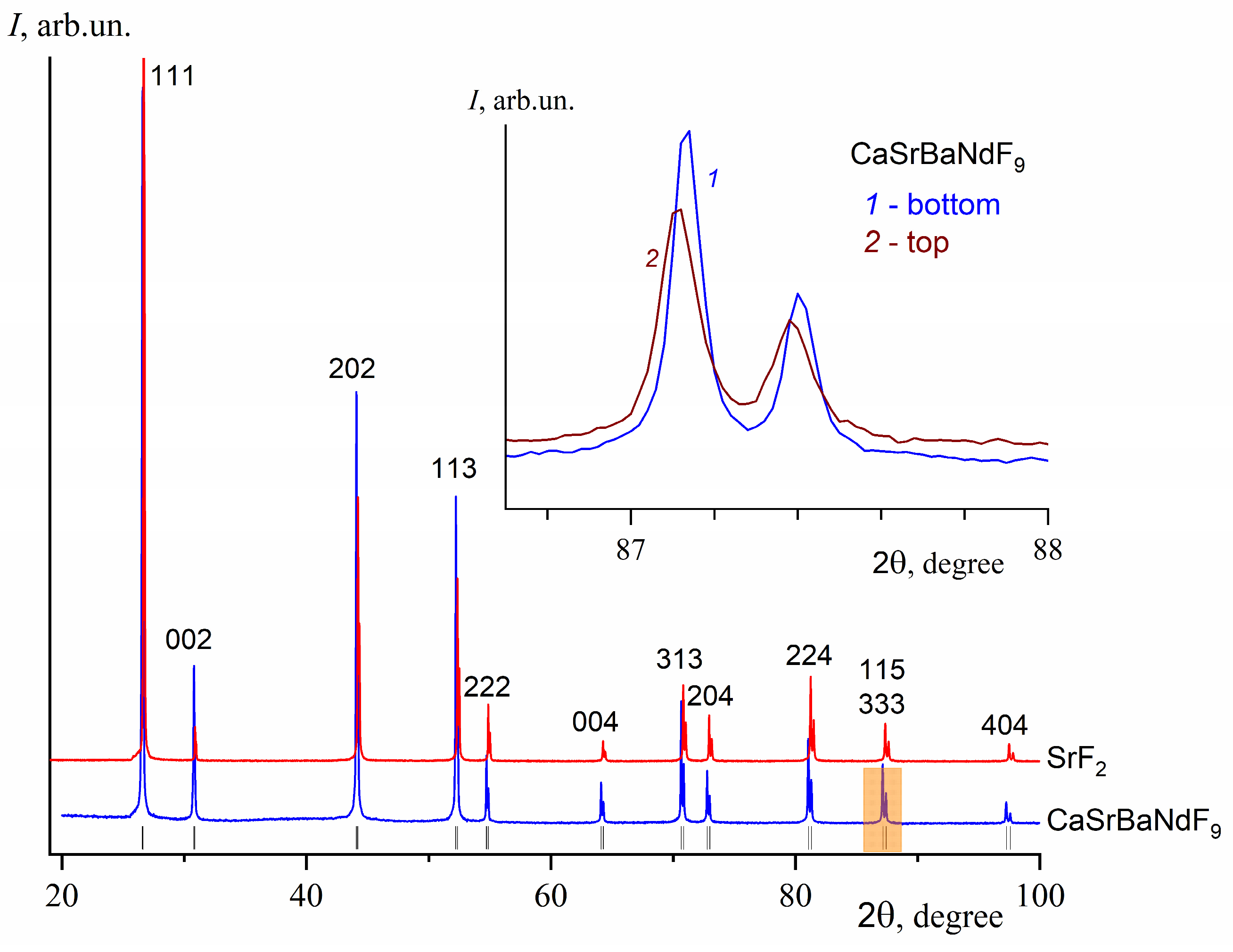
XRD analysis confirmed that the crystal is single-phase and has a high degree of crystallinity; good resolution of the Cu Kα12 doublet is observed (Figure 3). Thus, a homogeneous SS with a fluorite structure (sp. gr. Fm − 3m) with unit-cell parameters of 5.8070(1) Å and 5.8073(2) Å for the bottom and top parts of the crystalline boule, respectively, was grown. The refined unit-cell parameters are very close to pure-SrF2 ones (a = 5.8003(6) Å [52]) and does not vary significantly along the crystal length.
The synthesized CaSrBaNdF9 SS can be classified according to the generally accepted criterion 0.69R ≤ △Sconf ≤ 1.61R [53] as a high-entropy phase. For a random solid solution, the configurational entropy (△Sconf) can be estimated in the ideal-solution approximation using the Boltzmann equation [54,55]. For n components, △Sconf entropy reaches its highest value when the atomic fraction of all components is the same (equimolar). This phenomenon is known as the Gibbs paradox.
The configurational entropy per mole can be expressed as follows:
S conf   =   R i = 1 n x i l n x i ,
where R = 8314 Jmol−1K−1 is the universal gas constant and x i is the mole (atomic) fraction of the specific i-th component.
In the studied CaSrBaNdF9 SS, equivalent cationic sites can be occupied by four different cations (25 mol% each). Additionally, the aliovalent component NdF3 contributes 25 mol% excess F anions, which are located in the interstitial space of the cubic structure.
Taking this into account, the final formula for the △Sconf calculation is
S conf = R i = 1 n x i l n x i + j = 1 m y j l n y j = R ( i = 1 4 x i l n x i + y   l n y ) = 1.73 R ,
where x i y j is the mole (atomic) fraction of the specific i(j)-th cation (anion) in the respective sublattice, and n(m) is the number of cation (anion) sites in the complex mixed system [55].
A characteristic feature of HEMs is that entropy (due to the high entropy of mixing) predominates over enthalpy, reducing the total free energy of the system. This phenomenon allows for the stabilization of such SSs (usually with a face- or body-centered cubic crystal lattices), preventing their decomposition or ordering. The chaotic distribution of cations of several types in the lattice sites causes local stress and deformation. The displacement of atoms, including fluorine F ions, is hindered within such a lattice. Therefore, high-entropy phases are typically characterized by increased strength properties.
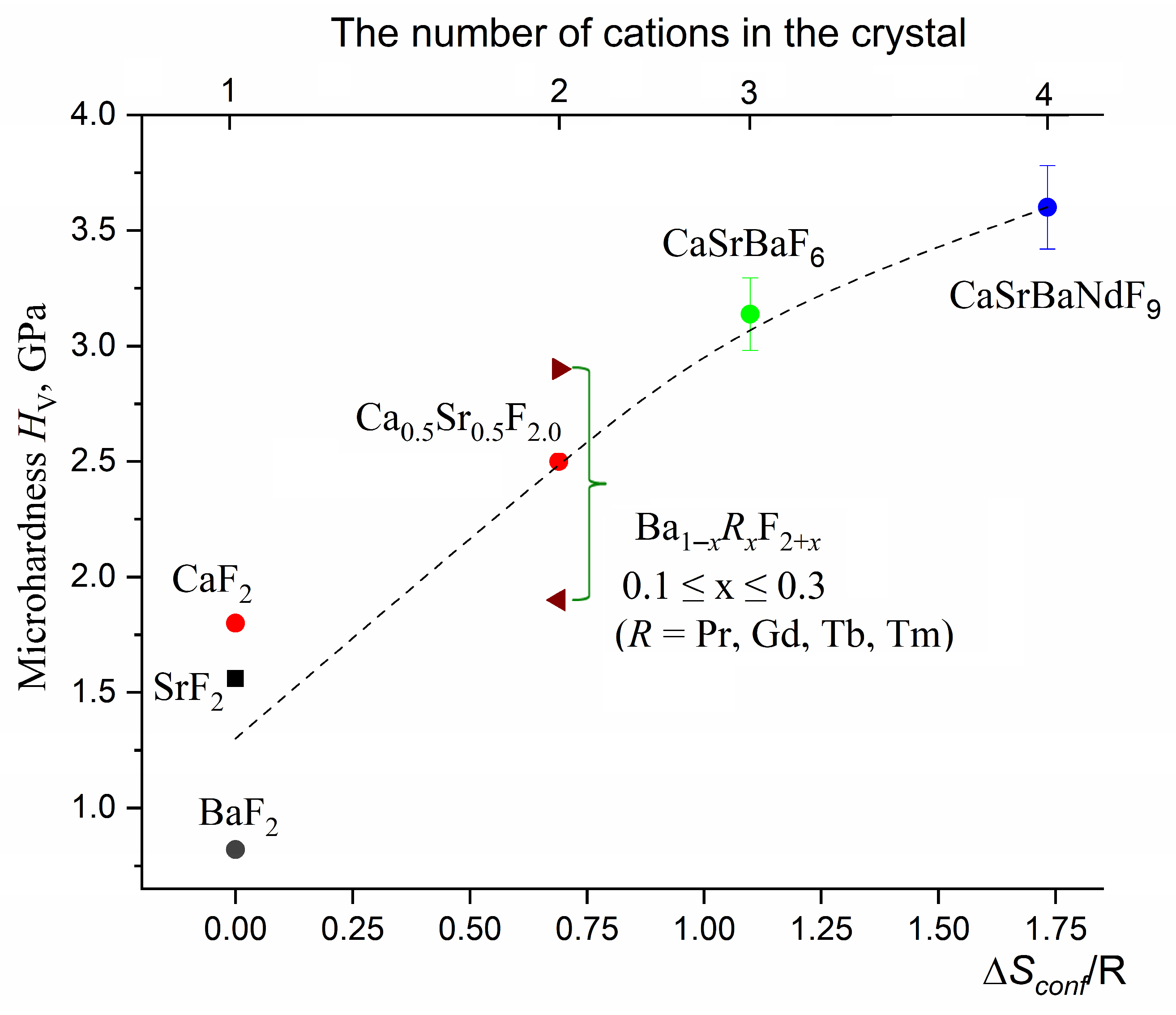
An increase in the number of SS components consistently increases its microhardness. The change in Vickers microhardness HV for some concentrated fluorite-type crystals is shown in Figure 4. Data from [56,57,58,59,60] were used for the comparative analysis.
A distinct trend toward strengthening is observed with increasing complexity of the crystal chemical composition. The studied CaSrBaNdF9 crystals belong to the group of hard materials and exhibit greater resistance to deformation than RF3 (R = La–Nd) crystals [61]. Further research is required to understand the role of lattice atomic disordering and its relationship to hardness, brittleness, and fracture toughness.
Table 1 summarizes some of the physical parameters of the Ca0.23(1)Sr0.29(1)Ba0.24(1)Nd0.24(1)F2.24 SS single crystal.
The actual density at the crystal top decreases to ρ = 4.861(3) g/cm3, due to the increase in the amount of the lighter SrF2 component in the composition.
Calculation of the refractive index using the molecular refraction additivity method according to [62] gives a value very close to the measured nD. The possibility of creating a material with a continuously changing refractive index along the crystal length while maintaining optical homogeneity in the cross section may be promising for applications in gradient-index optics [63,64].
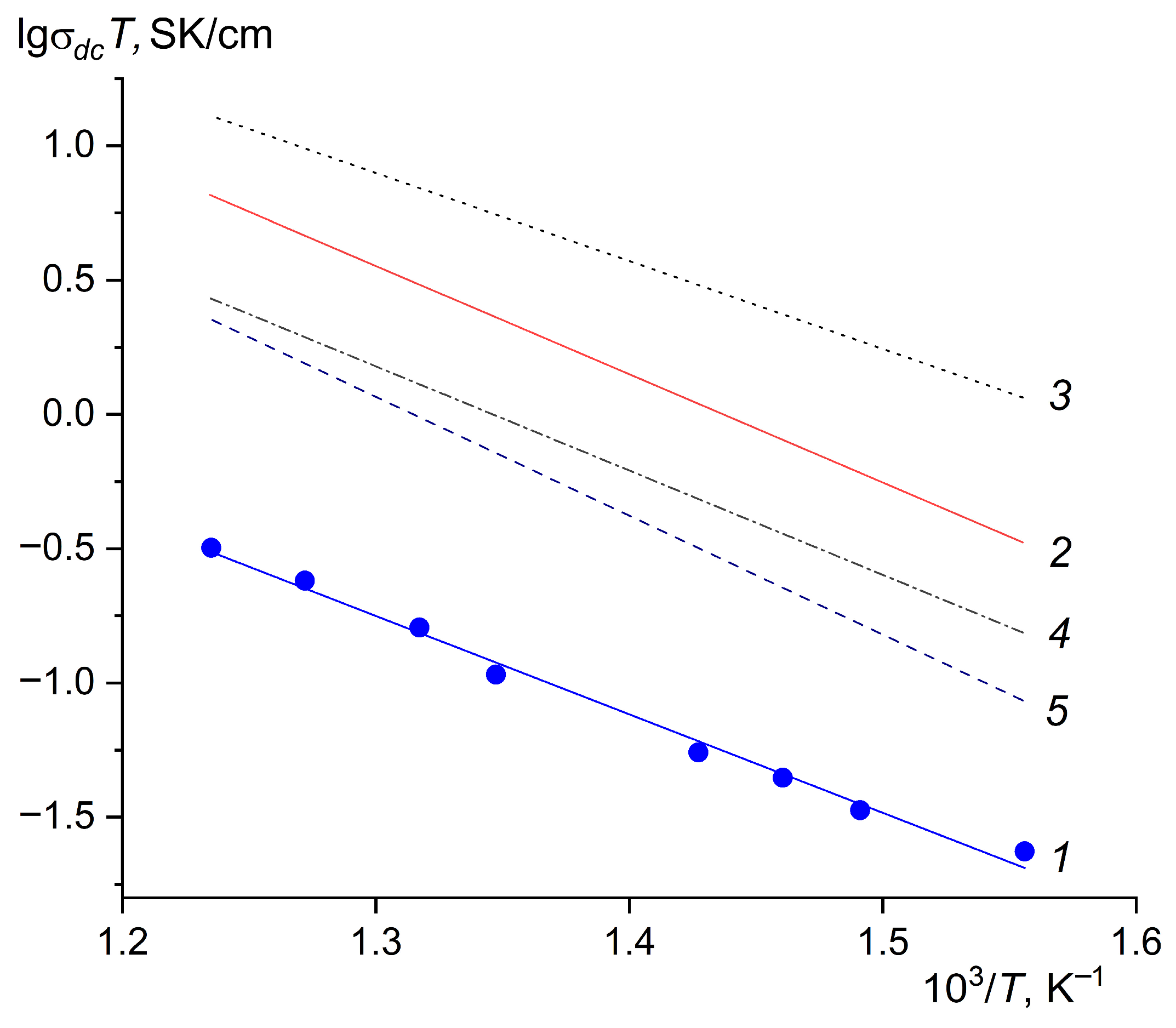
The electrophysical properties of fluorite-structured SSs in quaternary systems MF2M′F2M″F2RF3 (M, M′, M″—alkaline-earth; R—rare earth elements) have not been studied previously. Solutions based on fluorite-type MF2 (M = Ca, Sr, Ba) have high fluorine-ion conductivity [65,66,67]. The temperature dependence of the ionic conductivity σdc(T) for the CaSrBaNdF9 is shown in Figure 5, in comparison with the electrophysical data for a number of NdF3-based isostructural crystals [40,50,51].
The σdc(T) dependence for CaSrBaNdF9 does not have any peculiarities; the σdc value increases monotonically from 3.7 × 10⁻⁵ to 3.9 × 10⁻⁴ S/cm (by an order of magnitude) in the temperature range of 643–810 K (σdc = 1.0(1) × 10−6 S/cm at 500 K). The experimental data satisfy the Arrhenius–Frenkel equation with the fitting parameters A = 1.035 × 10⁴ SK/cm and ΔHσ = 0.725(5) eV, respectively.
Excess fluorine anions formed by embedding an aliovalent dopant, NdF3, into the crystal lattice, are localized in the interstitial positions of the mixed-fluorite matrix (Ca, Sr, Ba)F2 in accordance with the quasichemical reaction:
NdF3 (CaF2, SrF2, BaF2) ⟶ NdCa, Sr, Ba + Fi′ + 2FF×,
The designation of point defects is given in Kröger–Vink symbols [68].
The average value of potential barriers, equal to 0.725 eV for interstitial Fi′ ions participating in the ion transport process in CaSrBaNdF9 crystal, is comparable to the activation enthalpies of ion transport in two-component M1−xNdxF2+x (M = Ca, Sr, Ba) and more complex (Ca, Sr)1−xNdxF2+x SSs (Table 2).
A comparative analysis of the ion conductivity characteristics of SSs with varying numbers of MF2 components and neodymium trifluoride shows that the presence of Ca2+ and Ba2+ cations in the fluorite matrix increases the activation enthalpy of ion transport and reduces the SS total ionic conductivity. The binary neodymium–strontium Sr0.75Nd0.25F2.25 crystal exhibits the highest ionic conductivity among the studied (Ca, Sr, Ba)1−xNdxF2+x SSs. From the analysis of the data presented in Table 2, it is obvious that with an increase in the number of components of the matrix, the conductivity of ternary and quaternary SSs decreases by one to two orders of magnitude. Mixing SSs with different lattice defects but the same type of rare earth cations R3+ leads to a decrease in conductivity with an equimolar cation composition, that is, to the occurrence of dyssynergy (negative synergy) in ionic conductivity. Possible reasons for this phenomenon are the size mismatch of the alkaline earth metal ions M2+ [69] and the sluggish diffusion effect characteristic of HEMs.
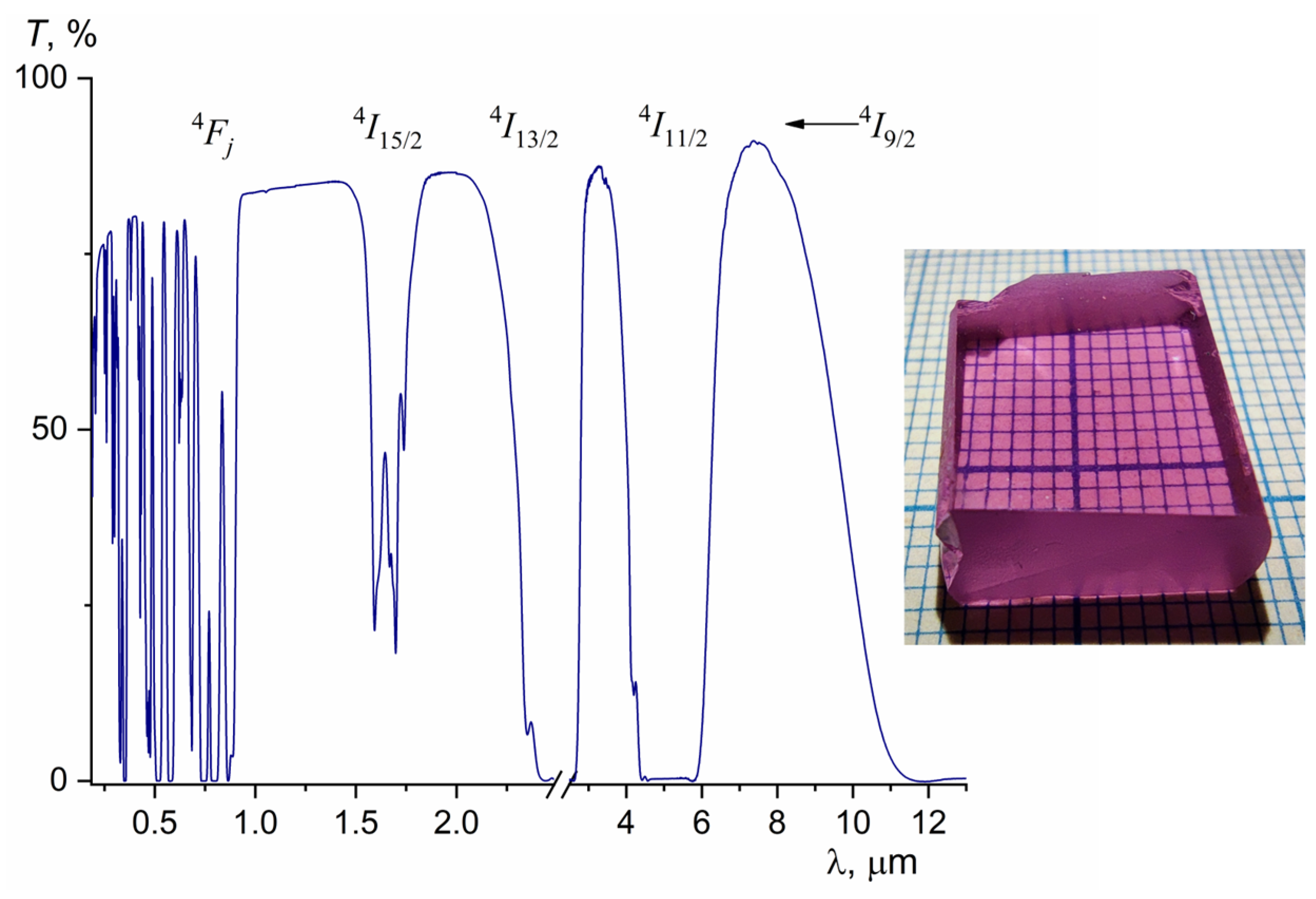
The transmission spectrum of the crystal under study is shown in Figure 6. Absorption bands characteristic of the Nd3+ ions are observed, which are associated with electronic transitions from the ground state 4I9/2 to different excited high-lying 2s+1Lj levels of the 4f configuration in these ions [70]. A sufficiently high level of transmittance in the UV spectral range indicates a low content of oxygen impurities in the grown crystals.
The 50%-transmission limit for the CaSrBaNdF9 single crystal is located at 9.6 μm (for 5 mm thick samples). The presence of a large fraction of relatively light CaF2 in the SS composition leads to a blue shift of the IR limit, in comparison with the NdF3 and Sr1−xNdxF2+x (x = 0.1–0.5) [71,72]. From the point of view of optical applications, the CaSrBaNdF9 crystals can be utilized for selective filtering of IR radiation (ranges 2.3–2.7 and 4.5–6.0 μm). It is also possible to apply these materials as optical gates for the UV spectral region, which are controlled by external laser IR radiation [73,74].
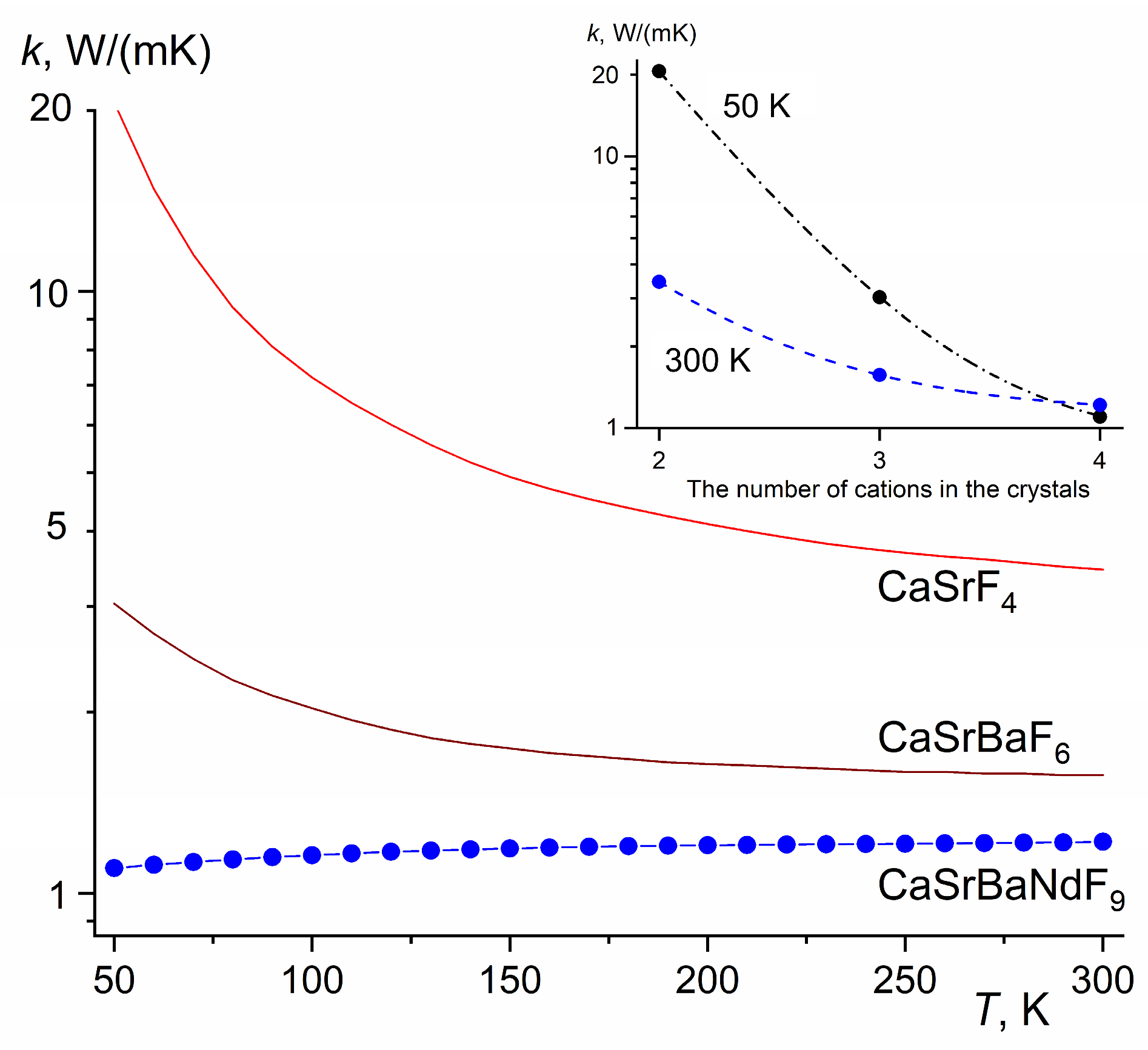
The results of thermal conductivity measurements for the CaSrBaNdF9 crystal are presented in Figure 7. Data for the ternary CaSrBaF6 and binary Ca0.5Sr0.5F2 compounds are also added for comparison [37,75].
It is clearly evident that the transfer from a ternary composition with an isovalent type of ion substitution to a quaternary one with a combination of di- and trivalent cations is accompanied not only by a significant decrease in thermal conductivity (at RT, it is lower than that of quartz glass), but also by a dramatic change in the nature of its temperature dependence. Glass-like behavior of thermal conductivity has been observed in many concentrated aliovalent fluoride SSs and is explained by intense phonon scattering by large defect structure clusters, causing an increase in the thermal resistance of multicomponent crystals [76,77].
Thermal conductivity increases monotonically with increasing temperature, which is characteristic of the disorder of materials. The glass-like behavior of k(T) dependence of the CaSrBaNdF9 crystal (as well as numerous M1−xRxF2+x crystals) is associated with structural changes due to aliovalent isomorphism, leading to defect clustering processes [78]. Structural clusters, when incorporated into the spatial lattice, do not change the motif of the closest cubic packing of cations, while the anionic (fluorine) sublattice undergoes local structural changes. Strong fluctuations of short-range order in the crystal lattice are observed.
The experimental k(T) values (within the measurement error) can be fitted by a polynomial of the form
k(T) = 1.203 × 10⁻⁸T3 − 8.656 × 10⁻⁶T2+ 2.200 × 10⁻³T + 1.011 [W/(m·K)].
An inverse linear correlation between fluoride-ion conductivity at 500 K and thermal conductivity at 100 K was established for a family of M1−xRxF2+x fluorite-structured SSs (M = Ca, Ba, and R–rare earth elements) [79]. This relationship can be described by an equation of the form
logσ500K = −1.179k100K − 4.132.
The measured values for the CaSrBaNdF9 crystal (log(σ500K, S/cm) = −6 and k100K = 1.2 W/(m K)) are consistent with this “ion transport–thermal conductivity” correlation for Ca1−xRxF2+x solutions (R = La, Ce, Pr).
The studied multicomponent crystal can be classified as a thermal insulator, which may be of interest for the creation of low-temperature thermal-barrier optical coatings.

4. Conclusions

The search for multicomponent, congruently melting crystals (solid solutions) is important for the development of materials science in general, as it enables the design of new crystalline materials, often with unexpected properties. However, it is difficult to theoretically predict specific changes in the properties of complex SSs that include aliovalent components, which cause structural and dynamic disorder of crystals. Progress is determined mainly by empirical or intuitive researcher considerations.
In this study, a four-component aliovalent Ca0.25Sr0.25Ba0.25Nd0.25F2.25 (CaSrBaNdF9) SS crystal was successfully grown from the melt and characterized for the first time. The grown material was shown to be highly entropic (△Sconf > 1.61R). An increase in the number of SS components leads to a change in some of its physical properties, both for the better and for the worse.
It was possible to trace the dynamics of the increase in the SS’s hardness with an increase in the configurational entropy of a multicomponent fluoride system. However, from the point of view of the thermal- and ionic-conducting properties of CaSrBaNdF9 crystal, with an increase in the number of components in systems, a significant dyssynergetic character is observed. The conducting properties deteriorate, which is associated with the disorder of the crystalline structure. Further characterization of CaSrBaNdF9 crystals by differential scanning calorimetry methods is currently underway to confirm the melting behavior and refine the melting point and thermal stability. Identification of the crystal homogeneity’s dependence on the applied growth parameters (pulling rate vs a given temperature gradient value at the crystallization front) is in progress.
The high isomorphic capacity of fluorite MF2s (M = Ca, Sr, Ba, Cd) and the iso- and aliovalent SSs created on their basis makes it possible to change a wide range of crystal compositions (this ability brings them closer to optical glasses) and modify their physical characteristics to solve specific practical problems.
The results of the investigation of the CaSrBaNdF9 crystal are quite recent and should be regarded as preliminary. Nevertheless, it is evident that this study demonstrates the feasibility of growing homogeneous crystals in other CaF2–SrF2–BaF2RF3 quaternary systems (where R = Y, La-Lu) and discovers a neoteric class of promising complex fluoride materials with high innovative and technical potential.

Author Contributions

Conceptualization, I.I.B.; methodology, D.N.K.; formal analysis, N.I.S. and P.A.P.; investigation, N.I.S., P.A.P., I.I.B. and D.N.K.; writing—original draft preparation, I.I.B., N.I.S., P.A.P. and D.N.K.; writing—review and editing, I.I.B. and D.N.K.; project administration, D.N.K. All authors have read and agreed to the published version of the manuscript.

Funding

This research was carried out as part of a State Assignment to the National Research Center “Kurchatov Institute” using equipment from the Research Sharing Center “Structural Diagnostics of Materials” of the Kurchatov Complex of Crystallography and Photonics.

Data Availability Statement

The original contributions presented in this study are included in the article. Further inquiries can be directed to the corresponding authors.

Acknowledgments

The authors express their deep gratitude to N.A. Arkharova, B.V. Nabatov, N.A. Ivanovskaya, and T.O. Teplyakova for their assistance in the collection and processing of the experimental data.

Conflicts of Interest

The authors declare no conflicts of interest.

References

  1. Fedorov, P.P.; Buchinskaya, I.I. Spatial inhomogeneity in crystalline materials and saddle-type congruent melting points in ternary systems. Russ. Chem. Rev. 2012, 81, 1–20. [Google Scholar] [CrossRef]
  2. Kazantseva, L.A.; Abzaev, Y.A.; Klopotov, A.A.; Kurzina, I.A. Features of phase composition of non-stoichiometric fluoride systems based on rare earth metals. Tomsk. State Univ. J. Chem. 2019, 15, 36–44. Available online: https://cyberleninka.ru/article/n/osobennosti-fazovogo-sostava-nestehiometricheskih-ftoridnyh-sistem-na-osnove-redkozemelnyh-metallov (accessed on 27 January 2026). (In Russian) [CrossRef]
  3. Chen, X.; Wu, Y. High-entropy transparent fluoride laser ceramics. J. Am. Ceram. Soc. 2020, 103, 750–756. [Google Scholar] [CrossRef]
  4. Zhang, G.; Wu, Y. High-entropy transparent ceramics: Review of potential candidates and recently studied cases. Int. J. Appl. Ceram. Technol. 2022, 19, 644–672. [Google Scholar] [CrossRef]
  5. Wang, T.; Chen, H.; Yang, Z.; Liang, J.; Dai, S. High-entropy perovskite fluorides: A new platform for oxygen evolution catalysis. J. Am. Chem. Soc. 2020, 142, 4550–4554. [Google Scholar] [CrossRef]
  6. Wang, X.; Liu, G.; Tang, C.; Tang, H.; Zhang, W.; Ju, Z.; Jiang, J.; Zhuang, Q.; Cui, Y. A novel high entropy perovskite fluoride anode with 3D cubic framework for advanced lithium-ion battery. J. Alloys Compd. 2023, 934, 167889. [Google Scholar] [CrossRef]
  7. Chen, J.; Mei, B.; Li, W.; Zhang, Y. Fabrication and spectral performance of Ndx:(La0.05Lu0.05Gd0.05Y0.05)Ca0.8−xF2.2+x high-entropy transparent fluoride ceramics. Ceram. Int. 2024, 50, 6128–6134. [Google Scholar] [CrossRef]
  8. Sukkurji, P.A.; Cui, Y.; Lee, S.; Wang, K.; Azmi, R.; Sarkar, A.; Indris, S.; Bhattacharya, S.S.; Kruk, R.; Hahn, H.; et al. Mechanochemical synthesis of novel rutile-type high entropy fluorides for electrocatalysis. J. Mater. Chem. A 2021, 9, 8998–9009. [Google Scholar] [CrossRef]
  9. Sachkov, V.I.; Knyazeva, E.M.; Nefedov, R.A.; Sachkova, A.S.; Amelichkin, I.V.; Orlov, V.V.; Medvedev, R.O. Multicomponent systems based on rare earth fluorides: Synthesis and properties. AIP Conf. Proc. 2020, 2310, 020286. [Google Scholar] [CrossRef]
  10. Chen, Z.; Zhong, C.; Okazaki, K.; Shimoda, K.; Orikasa, Y. High-entropy materials as solid state electrolytes for fluoride-ion batteries. ECS Meet. Abstr. 2024, MA2024-02, 4640. [Google Scholar] [CrossRef]
  11. Stevenson, A.J.; Serier-Brault, H.; Gredin, P.; Mortier, M. Fluoride materials for optical applications: Single crystals, ceramics, glasses, and glass–ceramics. J. Fluor. Chem. 2011, 132, 1165–1173. [Google Scholar] [CrossRef]
  12. Nicoara, I.; Stef, M. Growth and characterization of doped CaF2 crystals. In Modern Aspects of Bulk Crystal and Thin Film Preparation; Kolesnikov, N., Borisenko, E., Eds.; InTech Ltd.: London, UK, 2012; Chapter 4; pp. 71–96. [Google Scholar] [CrossRef][Green Version]
  13. Mouchovski, J.T.; Temelkov, K.A.; Vuchkov, N.K. The growth of mixed alkaline-earth fluorides for laser host applications. Prog. Cryst. Growth Charact. Mater. 2011, 57, 1–41. [Google Scholar] [CrossRef]
  14. Furuya, Y.; Wakahara, S.; Sugiyama, M.; Tanaka, H.; Fukuda, K.; Kawaguchi, N.; Yokota, Y.; Yanagida, T.; Yoshikawa, A. Crystal growth and scintillation properties of (NaxCa1−2xLux−yNdy)F2 single crystals. Opt. Mater. 2011, 34, 75–78. [Google Scholar] [CrossRef]
  15. Fedorov, P.P.; Osiko, V.V. Crystal Growth of Fluorides. In Bulk Crystal Growth of Electronic, Optical & Optoelectronic Materials; Capper, P., Kasap, S., Willoughby, A., Eds.; John Wiley & Sons Ltd.: Chichester, UK, 2005; Charter 11; pp. 339–355. [Google Scholar] [CrossRef]
  16. Sobolev, B.P. Chemical aspects of crystal growth of multicomponent fluoride materials from the melt. Crystallogr. Rep. 2002, 47, S63–S75. [Google Scholar] [CrossRef]
  17. Krivandina, E.A. Preparation of single crystals of multicomponent fluoride materials with the fluorite type structure. Butll. Soc. Cat. Cicn. 1991, 12, 393–412. Available online: https://raco.cat/index.php/ButlletiSCFQMT/article/view/221698 (accessed on 16 January 2026).
  18. Fedorov, P.P.; Kuznetsov, S.V.; Konyushkin, V.A. Morphological stability of solid-liquid interface during melt crystallization of Ba1–xRxF2+x solid solutions. Condens. Matter Interphases 2012, 14, 480–488. Available online: https://journals.vsu.ru/kcmf/article/view/1009 (accessed on 16 January 2026). (In Russian)
  19. Sobolev, B.P. Multicomponent fluoride single crystals (current status of their synthesis and prospects). In Growth of Crystals; Givargizov, E.I., Grinberg, S.A., Wester, D.W., Eds.; Springer: Boston, MA, USA, 1992; Volume 18, pp. 197–211. [Google Scholar] [CrossRef]
  20. Yoshikawa, A.; Nikl, M.; Boulon, G.; Fukuda, T. Challenge and study for developing of novel single crystalline optical materials using micro-pulling-down method. Opt. Mat. 2007, 30, 6–10. [Google Scholar] [CrossRef]
  21. Zhu, C.; Song, J.; Mei, B.; Li, W.; Liu, Z. Fabrication and optical characterizations of CaF2–SrF2–NdF3 transparent ceramics. Mater. Lett. 2016, 167, 115–117. [Google Scholar] [CrossRef]
  22. Li, X.; Hu, C.; Liu, Q.; Hreniak, D.; Li, J. Fluoride transparent ceramics for solid-state lasers: A review. J. Adv. Ceram. 2024, 13, 1891–1918. [Google Scholar] [CrossRef]
  23. Turkina, T.M.; Fedorov, P.P.; Sobolev, B.P. Morphological stability of M1–xRxF2+x solid solution single crystals (M-alkaline earth, R-rare earth elements). Butll. Soc. Cat. Cicn. 1992, 13, 259–271. Available online: https://raco.cat/index.php/ButlletiSCFQMT/article/view/221744 (accessed on 16 January 2026).
  24. Mouchovski, J.T. Supercooling at Melt Growth of Single and Mixed Fluorite Compounds: Criteria of Interface Stability. In Supercooling; Wilson, P., Ed.; InTech Ltd.: London, UK, 2012; Chapter 5; pp. 71–104. ISBN 978-953-51-0113-0. [Google Scholar] [CrossRef]
  25. Kuznetsov, S.V.; Fedorov, P.P. Morphological stability of solid-liquid interface during melt crystallization of M1−xRxF2+x solid solutions. Inorg. Mater. 2008, 44, 1434–1458. [Google Scholar] [CrossRef]
  26. Baldochi, S.L.; Morato, S.P. Fluoride Bulk Crystals: Growth. In Encyclopedia of Materials: Science and Technology, 2nd ed.; Buschow, K.H.J., Cahn, R.W., Flemings, M.C., Ilschner, B., Kramer, E.J., Mahajan, S., Eds.; Elsevier Science: Amsterdam, The Netherlands, 2001; pp. 3200–3204. [Google Scholar] [CrossRef]
  27. Fedorov, P.P.; Turkina, T.M.; Meleshina, V.A.; Sobolev, B.P. Cellular substructures in single crystalline solid solutions of inorganic fluorides having the fluorite structure. In Growth of Crystals; Givargizov, E.I., Grinberg, S.A., Eds.; Springer: Boston, MA, USA, 1991; Volume 17, pp. 165–176. [Google Scholar] [CrossRef]
  28. Takahashi, K.; Cadatal-Raduban, M.; Sarukura, N.; Kawamata, T.; Sugiyama, T.; Fukuda, T. Crystal growth and characterization of large Ca0.582Sr0.418F2 single crystal by Czochralski method using cone die. J. Cryst. Growth 2024, 628, 127541. [Google Scholar] [CrossRef]
  29. Wakahara, S.; Furuya, Y.; Yanagida, T.; Yokota, Y.; Pejchal, J.; Sugiyama, M.; Kawaguchi, N.; Totsuka, D.; Yoshikawa, A. Crystal growth and scintillation properties of Ce-doped sodium calcium lutetium complex fluoride. Opt. Mater. 2012, 34, 729–732. [Google Scholar] [CrossRef]
  30. Ushakov, S.N.; Uslamina, M.A.; Pynenkov, A.A.; Mishkin, V.P.; Nishchev, K.N.; Kuznetsov, S.V.; Chernova, E.V.; Fedorov, P.P. Growth and physical properties of CaSrBaF6 single crystals. Condens. Matter Interphases 2021, 23, 101–107. (In Russian) [Google Scholar] [CrossRef] [PubMed]
  31. Komandin, G.A.; Spector, I.E.; Fedorov, P.P.; Kuznetsov, S.V.; Ushakov, S.N.; Uslamina, M.A.; Nishchev, K.N.; Garibin, E.A. Long-wavelength optical properties of the Ca0.33Sr0.33Ba0.33F2 solid solution single crystals. Opt. Mater. 2022, 127, 112267. [Google Scholar] [CrossRef]
  32. Wang, W.; Wang, Q.; Zhang, C.; Liu, J.; Zhang, Z.; Zu, Y.; Yang, Q.; Fang, Q.; Xue, Y.; Liu, B.; et al. Component design and stable SESAM mode-locking of the disorder middle entropy Yb: CaSrBaF6 single crystal. Opt. Express 2024, 32, 31644–31656. [Google Scholar] [CrossRef] [PubMed]
  33. Karimov, D.N.; Buchinskaya, I.I.; Sorokin, N.I.; Glushkova, T.M.; Chernov, S.P.; Popov, P.A. Growth and some physical properties of congruently melting fluorite solid solutions crystals in the CaF2–SrF2RF3 (R = La, Ce) Systems. Crystallogr. Rep. 2019, 64, 834–840. [Google Scholar] [CrossRef]
  34. Buchinskaya, I.I.; Fedorov, P.P. Fluorite Solid Solutions of Congruent Melting in the PbF2–CdF2RF3 Systems. Crystallogr. Rep. 2024, 69, 270–278. [Google Scholar] [CrossRef]
  35. Ashurov, M.K.; Nuritdinov, I.; Boyboboeva, S.T. Comparative studies of spectroscopic properties and surface structure of solid solutions of CaF2:SrF2:YbF3 crystals and ceramics. J. Phys. Chem. Sol. 2024, 189, 111974. [Google Scholar] [CrossRef]
  36. Basiev, T.T.; Vasil’ev, S.V.; Doroshenko, M.E.; Konyushkin, V.A.; Kuznetsov, S.V.; Osiko, V.V.; Fedorov, P.P. Efficient lasing in diode-pumped Yb3+: CaF2–SrF2 solid-solution single crystals. Quantum Electron. 2007, 37, 934–937. [Google Scholar] [CrossRef]
  37. Popov, P.A.; Krugovykh, A.A.; Konyushkin, V.A.; Nakladov, A.N.; Ushakov, S.N.; Uslamina, M.A.; Nishchev, K.N.; Kuznetsov, S.V.; Fedorov, P.P. Thermal conductivity of single crystals of CaF2–SrF2–BaF2–YbF3 solid solutions. Inorg. Mater. 2023, 59, 507–511. [Google Scholar] [CrossRef]
  38. Kapralov, M.A.; Nizamutdinov, A.S.; Kuznetsov, S.V.; Konyushkin, V.A.; Nakladov, A.N.; Alexandrov, A.A. Spectroscopy and Distribution of Ce3+ Ions Content in CaF2–SrF2–BaF2 Crystals. Bull. Russ. Acad. Sci. Phys. 2024, 88, S592–S599. [Google Scholar] [CrossRef]
  39. Buchinskaya, I.I.; Koldaeva, M.V.; Sorokin, N.I.; Kulikov, A.G.; Karimov, D.N. Study of Pb0.5Cd0.25Lu0.25F2.25 fluorite solid solution with congruent melting nature. Crystallogr. Rep. 2025, 70, 68–76. [Google Scholar] [CrossRef]
  40. Sorokin, N.I.; Karimov, D.N.; Krivandina, E.A.; Zhmurova, Z.I.; Komar’kova, O.N. Ionic conductivity of congruently melting Ca0.6Sr0.4F2 and Ca1−x−ySryRxF2+x (R = La, Ce, Pr, Nd) single crystals with fluorite structure. Crystallogr. Rep. 2008, 53, 271–277. [Google Scholar] [CrossRef]
  41. Karimov, D.N.; Buchinskaya, I.I.; Ivanova, A.G.; Il’ina, O.N.; Ivanovskaya, N.A.; Sorokin, N.I.; Sobolev, B.P.; Glushkova, T.M.; Ksenofontov, D.A. Growth of fluorite solid solution crystals in the ternary SrF2–BaF2–LaF3 system and investigation of their properties. Crystallogr. Rep. 2018, 63, 1015–1021. [Google Scholar] [CrossRef]
  42. Voron’ko, Y.K.; Kaminskii, A.A.; Osiko, V.V. A five-component fluoride-a new laser material. Sov. Phys. Crystallogr. 1968, 13, 267. [Google Scholar]
  43. Kaminskii, A.A. High-temperature spectroscopic investigation of stimulated emission from lasers based on crystals and glasses activated with Nd3+ ions. Sov. Phys. JETP 1968, 54, 388–399. Available online: http://www.jetp.ras.ru/cgi-bin/e/index/r/54/3/p727?a=list (accessed on 19 January 2026).
  44. Murty, B.S.; Yeh, J.W.; Ranganathan, S.; Bhattacharjee, P.P. High Entropy Alloys, 2nd ed.; Elsevier Inc.: Cambridge, MA, USA, 2019; ISBN 978-0-12-816067-1. [Google Scholar] [CrossRef]
  45. Rogachev, A.S. Structure, stability, and properties of high-entropy alloys. Phys. Met. Metallogr. 2000, 121, 733–764. [Google Scholar] [CrossRef]
  46. Sarkar, A.; Wang, Q.; Schiele, A.; Reda, M.R.; Bhattacharya, S.S.; Wang, D.; Brezesinski, T.; Hahn, H.; Velasco, L.; Breitung, B. High-entropy oxides: Fundamental aspects and electrochemical properties. Adv. Mater. 2019, 31, 1806236. [Google Scholar] [CrossRef]
  47. Hsu, W.-L.; Tsai, C.-W.; Yeh, A.-C.; Yeh, J.-W. Clarifying the four core effects of high-entropy materials. Nat. Rev. Chem. 2024, 8, 471–485. [Google Scholar] [CrossRef]
  48. Li, D.; Liu, C.; Tao, S.; Cai, J.; Zhong, B.; Li, J.; Deng, W.; Hou, H.; Zou, G.; Ji, X. High-entropy electrode materials: Synthesis, properties and outlook. Nano-Micro Lett. 2025, 17, 22. [Google Scholar] [CrossRef]
  49. Petříček, V.; Dušek, M.; Palatinus, L. Crystallographic Computing System JANA2006: General features. Z. Kristallogr. Cryst. Mater. 2014, 229, 345–352. [Google Scholar] [CrossRef]
  50. Sobolev, B.P.; Sorokin, N.I.; Bolotina, N.B. Nonstoichiometric single crystals M1−xRxF2+x and R1−yMyF3−y (M = Ca, Sr, Ba: R = Rare Earth Elements) as fluorine-ionic conductive solid electrolytes. In Photonic and Electronic Properties of Fluoride Materials; Tressaud, A., Poeppelmeier, K., Eds.; Progress in Fluorine Science Series; Elsevier: Amsterdam, The Netherlands, 2016; Chapter 21; pp. 465–491. ISBN 9780128016398. [Google Scholar] [CrossRef]
  51. Ivanov-Shits, A.K.; Sorokin, N.I.; Fedorov, P.P.; Sobolev, B.P. Specific features of ion transport in nonstoichiometric Sr1−xRxF2+x phases (R = La–Lu, Y) with the fluorite-type structure. Solid State Ion. 1989, 31, 253–268. [Google Scholar] [CrossRef]
  52. Sobolev, B.P.; Karimov, D.N.; Sul’yanov, S.N.; Zhmurova, Z.I. Nanostructured crystals of fluorite phases Sr1 − xRx F2 + x (R are rare-earth elements) and their ordering. I. Crystal growth of Sr1 − xRxF2 + x (R = Y, La, Ce, Pr, Nd, Sm, Gd, Tb, Dy, Ho, Er, Tm, Yb, and Lu). Crystallogr. Rep. 2009, 54, 122–130. [Google Scholar] [CrossRef]
  53. Yeh, J.-W. Recent Progress in High-entropy Alloys. Ann. Chim. Sci. Mat. 2006, 31, 633–648. [Google Scholar] [CrossRef]
  54. Gao, M.C.; Yeh, J.; Liaw, P.K.; Zhang, Y. High-Entropy Alloys; Springer: Cham, Switzerland, 2016; 516p. [Google Scholar] [CrossRef]
  55. Xin, Y.; Zhu, M.; Zhang, H.; Wang, X. High-entropy materials: A new paradigm in the design of advanced batteries. Nano-Micro Lett. 2026, 18, 1. [Google Scholar] [CrossRef]
  56. Aronova, A.M.; Berezhkova, G.V.; Aleksandrov, V.B.; Fedorov, P.P.; Sobolev, B.P. Mechanical properties of M1−xRxF2+x fluorite-type single crystals with large stoichiometry deviations (Ba0.69La0.31F2.31 crystals). In Physical Crystallography: Collection of Scientific Papers; Vainshtein, B.K., Shuvalov, L.A., Eds.; Nauka: Moscow, Russia, 1992; pp. 151–162. ISBN 5-02-000768-4. (In Russian) [Google Scholar]
  57. Gryaznov, M.Y.; Shotin, S.V.; Chuvil’deev, V.N.; Marychev, M.O.; Sul’yanova, E.A.; Sul’yanov, S.N.; Sobolev, B.P. Nanostructured crystals of Sr1 − xRx F2 + x fluorite phases and their ordering: 6. Microindentation analysis of crystals. Crystallogr. Rep. 2012, 57, 144–150. [Google Scholar] [CrossRef]
  58. Marychev, M.O.; Chuprunov, E.V.; Krivandina, E.A.; Zhmurova, Z.I.; Sobolev, B.P. Concentration dependence of microhardness of fluorite solid solutions Ba1−xRxF2+x (R = Pr, Gd, Tb, Tm). Vestn. Nizhegorod. Univ. Ser. Fiz. Tverd. Tela 2001, 1, 111–113. Available online: http://www.unn.ru/pages/issues/vestnik/9999-0192_West_fisika_2001_1(4)/14.pdf (accessed on 7 February 2026). (In Russian)
  59. Sorokin, N.I. Mechanical Hardening of nanostructured Ba0.9R0.1F2.1 (R = rare-earth elements) crystals: Size effect. Phys. Solid State 2021, 63, 291–294. [Google Scholar] [CrossRef]
  60. Karimov, D.N.; Komar’kova, O.N.; Sorokin, N.I.; Bezhanov, V.A.; Chernov, S.P.; Popov, P.A.; Sobolev, B.P. Growth of congruently melting Ca0.59Sr0.41F2 crystals and study of their properties. Crystallogr. Rep. 2010, 55, 518–524. [Google Scholar] [CrossRef]
  61. Sizova, N.L.; Karimov, D.N.; Kosova, T.B.; Lisovenko, D.S. Mechanical properties of CeF3 single crystals. Crystallogr. Rep. 2019, 64, 942–946. [Google Scholar] [CrossRef]
  62. Konstantinova, A.F.; Krivandina, E.A.; Karimov, D.N.; Sobolev, B.P. Calculation of the refractive indices of M1−xRxF2+x crystals (M = Ca, Sr, Ba, Cd, Pb; R are rare earth elements). Crystallogr. Rep. 2010, 55, 990–994. [Google Scholar] [CrossRef]
  63. Moore, D. Gradient-index optics: A review. Appl. Opt. 1980, 19, 1035–1038. [Google Scholar] [CrossRef]
  64. Houk, M. Fabrication and Testing of Index Gradients in Fluoride Materials. Ph.D. Thesis, University of Rochester, Rochester, NY, USA, 1990; 204p. Available online: https://archive.org/details/DTIC_ADA228894 (accessed on 6 February 2026).
  65. Archer, J.A.; Chadwick, A.V.; Jack, I.R.; Zeqiri, B. Ionic conductivity studies of heavily rare earth doped fluorites. Solid State Ion. 1983, 9–10, 505–510. [Google Scholar] [CrossRef]
  66. Trnovcova, B.; Fedorov, P.P.; Furar, I. Fluoride solid electrolytes containing rare earth elements. J. Rare Earths 2008, 26, 225–232. [Google Scholar] [CrossRef]
  67. Patro, L.N.; Hariharan, K. Fast fluoride ion conducting materials in solid state ionics: An overview. Solid State Ion. 2013, 239, 41–49. [Google Scholar] [CrossRef]
  68. Kröger, F.A. The Chemistry of Imperfect Crystals, 2nd ed.; North-Holland Pub. Co.: Amsterdam, The Netherlands; Elsevier: New York, NY, USA, 1974; 3 Volumes; 1616p. [Google Scholar]
  69. Trnovcová, V.; Fedorov, P.P.; Buchinskaya, I.I.; Kubliha, M. Ionic conductivity of multicomponent fluorite-structured fluorides. Russ. J. Electrochem. 2011, 47, 639–642. [Google Scholar] [CrossRef]
  70. Runowski, M.; Stopikowska, N.; Lis, S. UV-Vis-NIR absorption spectra of lanthanide oxides and fluorides. Dalton Trans. 2020, 49, 2129–2137. [Google Scholar] [CrossRef]
  71. Krivandina, E.A.; Zhmurova, Z.I.; Sobolev, B.P.; Glushkova, T.M.; Kiselev, D.F.; Firsova, M.M.; Shtyrkova, A.P. Growth of R1 − ySryF3 − y crystals with rare earth elements of the cerium subgroup (R = La, Ce, Pr, or Nd; 0 ≤ y ≤ 0.16) and the dependence of their density and optical characteristics on composition. Crystallogr. Rep. 2006, 51, 895–901. [Google Scholar] [CrossRef]
  72. Fedorov, V.A.; Karimov, D.N.; Komar’kova, O.N.; Krivandina, E.A.; Zhmurova, Z.I.; Sobolev, B.P. Nanostructured crystals of fluorite phases Sr1 − x RxF2 + x (R are rare-earth elements) and their ordering: IV. Study of the optical transmission spectra in the 2–17-μm wavelength range. Crystallogr. Rep. 2010, 55, 122–126. [Google Scholar] [CrossRef]
  73. Aglyamov, R.D.; Naumov, A.K.; Lovchev, A.V.; Morozov, O.A. On the possibility of applying fluoride neodymium-activated crystals as light-controlled gates for ArF Laser Radiation (193 nm). Opt. Spectrosc. 2021, 129, 426–430. [Google Scholar] [CrossRef]
  74. Dubinskii, M.A. Light-driven optical switch, based on excited-state absorption in activated dielectric crystals. J. Mod. Opt. 1991, 38, 2323–2326. [Google Scholar] [CrossRef]
  75. Popov, P.A.; Moiseev, N.V.; Karimov, D.N.; Sorokin, N.I.; Sulyanova, E.A.; Sobolev, B.P.; Konyushkin, V.A.; Fedorov, P.P. Thermophysical characteristics of Ca1−xSrxF2 solid-solution Crystals (0 ≤ x ≤ 1). Crystallogr. Rep. 2015, 60, 116–122. [Google Scholar] [CrossRef]
  76. Liu, K.; Jiang, D.; Bian, G.; Su, L. Calculating and analyzing the relationship between thermal conductivity and microstructure in rare-earth doped fluoride crystals. CrystEngComm 2025, 27, 2623–2634. [Google Scholar] [CrossRef]
  77. Liu, K.; Bian, G.; Zhang, Z.; Ma, F.; Su, L. Modelling and analyzing the glass-like heat transfer behavior of rare-earth doped alkaline earth fluoride crystals. CrystEngComm 2022, 24, 6468–6476. [Google Scholar] [CrossRef]
  78. Ma, F.; Zhang, Z.; Jiang, D.; Zhang, Z.; Kou, H.; Strzep, A.; Tang, Q.; Zhou, H.; Zhang, M.; Zhang, P.; et al. Neodymium cluster evolution in fluorite laser crystal: A combined DFT and synchrotron x-ray absorption fine structure study. Cryst. Growth Des. 2022, 22, 4480–4493. [Google Scholar] [CrossRef]
  79. Fedorov, P.P.; Sorokin, N.I.; Popov, P.A. Inverse correlation between the ionic and thermal conductivities of single crystals of M1−xRxF2+x (M = Ca, Ba, R—Rare-earth element) fluorite solid solutions. Inorg. Mater. 2017, 53, 626–632. [Google Scholar] [CrossRef]
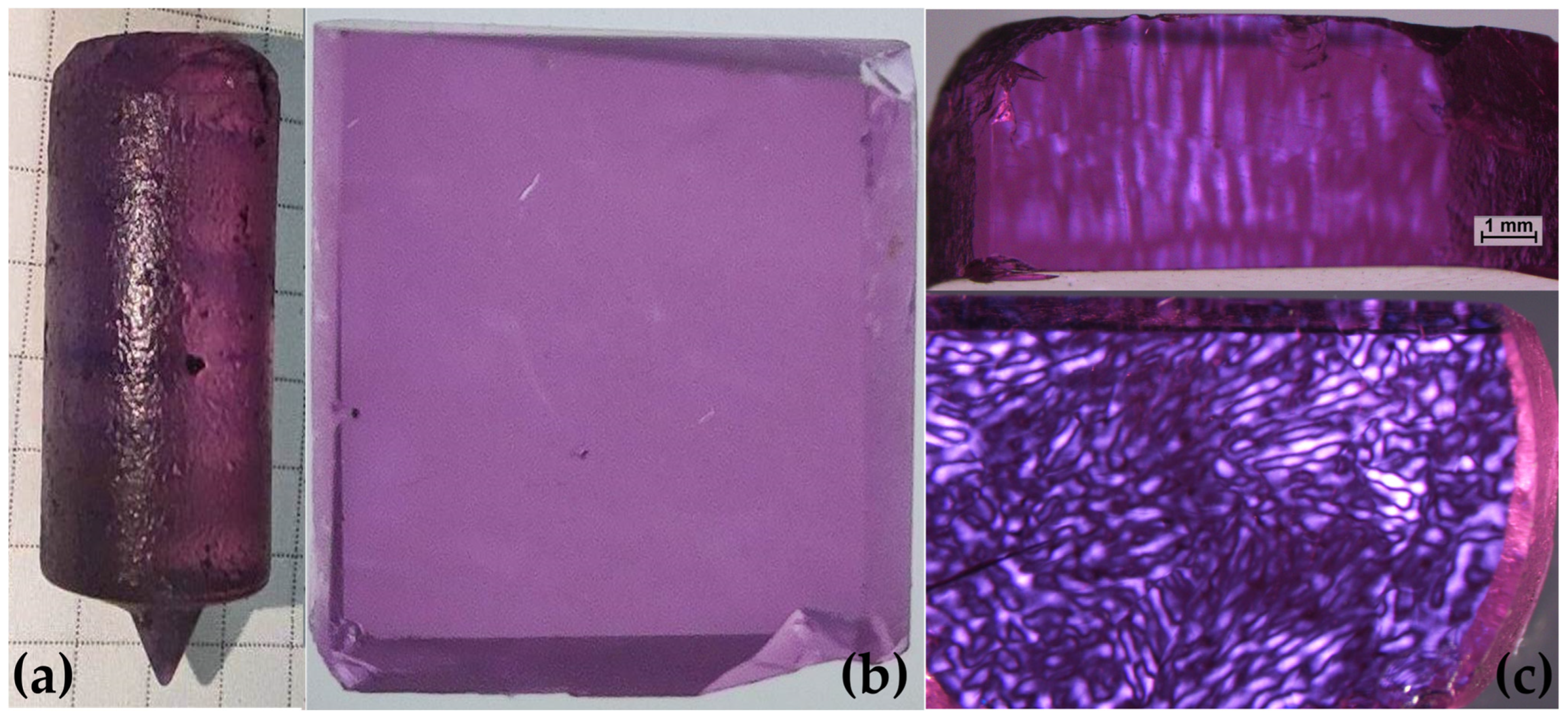
Figure 1. Appearance of as-grown CaSrBaNdF9 crystal (a) and polarized-light imaging of polished samples selected from the central (b) and top (c) sections.
Crystals 16 00140 g001
Figure 2. Distribution of cations along the growth axis of the CaSrBaNdF9 crystal according to XRF analysis data. The section of the crystal (average composition Ca0.23(1)Sr0.29(1)Ba0.24(1)Nd0.24(1)F2.24) selected for characterization is highlighted. The dotted line corresponds to the charge composition.
Crystals 16 00140 g002
Figure 3. XRD patterns of the bottom part of CaSrBaNdF9 and SrF2 crystals. The Bragg reflections positions are indicated for the sp. gr. Fm − 3m with unit-cell parameter a = 5.8070(1) Å. The inset shows an enlarged image of the reflection 115 (orange area) for the different crystal sections.
Crystals 16 00140 g003
Figure 4. Dependence of Vickers microhardness on the configurational entropy △Sconf (number of cations in the composition) of some compounds and concentrated fluoride SS single crystals. The dotted line is guide for the eye. The curly bracket limits the range of microhardness values for Ba-based crystal [58].
Crystals 16 00140 g004
Figure 5. Temperature dependence of ionic conductivity of fluorite SSs: 1–CaSrBaNdF9, 2–Ca0.75Nd0.25F2.25 [50], 3–Sr0.75Nd0.25F2.25 [51], 4–Ba0.76Nd0.24F2.24 [50], and 5–Ca0.58Sr0.21Nd0.21F2.21 [40].
Crystals 16 00140 g005
Figure 6. Transmission spectrum of the CaSrBaNdF9 crystal. The thickness of the given sample is 5 mm.
Crystals 16 00140 g006
Figure 7. Temperature dependence of the thermal conductivity k(T) of selected multicomponent crystals. Insert: thermal conductivity changes depending on the number of components in the solution at different temperatures.
Crystals 16 00140 g007
Table 1. Some studied physical properties of grown crystal.
ParameterValue
Lattice constant a, Å   5.8071(2)
Density ρ, g/cm3
   measured
   theoretical
Refractive index nD (λ = 0.589 μm)
   4.903(5)
   4.920
   Measured   1.5035(5)
   calculated according to [62]   1.509(1)
Hardness HV, GPa (at P = 0.49 H)   3.6(3)
Thermal conductivity k, W/(m·K) at 300 K    1.22(1)
Table 2. Average cation radius (rcat), conductivity at 500 K (σ500 K), and activation enthalpy of ion transport (∆Hσ) for fluorite-type concentrated (Ca, Sr, Ba)1−xNdxF2+x (x~0.25) single crystals.
Crystalrcat, ÅSconf/Rσ500 K, S/cm Hσ, eVReference
CaSrBaNdF91.3671.731.0 × 10−60.725Present work
Ca0.58Sr0.21Nd0.21F2.211.2121.301.8 × 10−60.880[40]
Ca0.56Sr0.29Nd0.15F2.15 *1.2991.255.0 × 10−70.930[69]
Ca0.75Nd0.25F2.251.2570.911.1 × 10−50.800[50]
Sr0.75Nd0.25F2.251.3620.917.9 × 10−50.650[51]
Ba0.76Nd0.24F2.241.4980.895.8 × 10−60.770[50]
* Polycrystalline form.
Disclaimer/Publisher’s Note: The statements, opinions and data contained in all publications are solely those of the individual author(s) and contributor(s) and not of MDPI and/or the editor(s). MDPI and/or the editor(s) disclaim responsibility for any injury to people or property resulting from any ideas, methods, instructions or products referred to in the content.