Article

Study on Dislocation Decomposition Mechanisms and Crack Propagation Modes in a Re/Ru Single-Crystal Nickel-Based Alloy During Room-Temperature Tensile Testing


1
School of Intelligent Manufacturing, Guizhou Communications Polytechnic University, Guiyang 551400, China
2
College of Materials and Metallurgy, Guizhou University, Guiyang 550025, China
3
Sanmenxia Nonferrous Metals Science Research Center, Sanmenxia 472000, China
*
Author to whom correspondence should be addressed.
Crystals 2026, 16(2), 138; https://doi.org/10.3390/cryst16020138
Submission received: 26 December 2025 / Revised: 6 February 2026 / Accepted: 11 February 2026 / Published: 13 February 2026

Abstract

Through room-temperature tensile testing, microstructural observation, and comparative analysis of dislocation configurations, this study investigates the deformation and damage behavior of a high-concentration Re/Ru single-crystal alloy. The results show that the alloy possesses excellent mechanical properties at room temperature, with a tensile strength of 875 MPa and a yield strength of 847 MPa. During tensile deformation, plastic strain primarily occurs through dislocation slip within the γ matrix and dislocation shear into the γ′ phase. Dislocations sheared into the γ′ phase exhibit distinct decomposition patterns. Microcracks initiate at γ′/γ interfaces where two slip systems intersect. As tensile loading continues, these microcracks coalesce, leading to increased local stress and unstable crack propagation along the γ/γ′ interfaces, ultimately resulting in fracture. This process constitutes the deformation and damage mechanism of the alloy during room-temperature tensile deformation. These findings suggest that high Re/Ru concentrations fundamentally alter low-temperature deformation pathways, which may improve resistance to brittle fracture during cold start or handling conditions.

1. Introduction

The volume fraction γ′ strengthening phase in single-crystal nickel-based alloys exceeds 60%, while grain boundaries—often prone to cracking—are eliminated. Consequently, these alloys exhibit outstanding high-temperature strength. Owing to these superior properties, single-crystal nickel-based alloys are extensively employed in the manufacture of aircraft turbine blades, where they play a crucial role [1,2,3]. With the continuous advancement of high-power, high–thrust-to-weight ratio aircraft engines, turbine inlet temperatures have risen sharply, imposing increasingly stringent performance requirements on single-crystal superalloys—the critical materials for turbine blades.
The elevated-temperature mechanical properties of superalloys primarily arises from several strengthening mechanisms, (1) solid-solution strengthening, (2) precipitation strengthening by the γ′ phase, (3) lattice misfit strengthening, (4) synergistic strengthening by Re and Ru additions, (5) interfacial strengthening at the γ/γ′ boundary [4,5,6]. The incorporation of refractory elements for example W, Mo, Ta, and Re enhances the temperature capability of the alloy. Specifically, 5% ruthenium was added to the alloy that already contained 6% rhenium significantly improves mechanical properties while suppressing TCP phase precipitation—a defining elemental characteristic of fifth-generation single-crystal superalloys [7,8,9]. Previous studies have demonstrated that the mechanical behavior of single-crystal alloys is closely associated with their deformation mechanisms and microstructural evolution [10,11]. Consequently, understanding the interrelationship between mechanical properties, deformation behavior, and microstructural evolution has become a central focus of current research.
Lv et al. [12] investigated the tensile behavior of single-crystal alloys at various temperatures. Their results showed that during room-temperature tensile deformation, dislocations shearing into the γ′ strengthening phase did not decompose into stacking faults. At 760 °C, the primary deformation mechanism involved dislocation shear into the γ′ strengthening phase accompanied by stacking fault formation. At 900 °C, both dislocation shearing into and Orowan bypassing of the γ′ phase occurred. Similarly, Zhou et al. [13] examined a second-generation single-crystal superalloy based on nickel, with a rhenium content of 1 wt% and found that at 760 °C, deformation primarily occurred through the formation of V-shaped stacking faults within the γ′ strengthening phase—termed Lomer–Cottrell dislocation locks—which effectively enhanced the alloy’s yield strength. Tan et al. [14] studied a third-generation single-crystal superalloy based on nickel, with a rhenium content of 3 wt% and stacking faults were formed in both the γ and γ′ phases when tensile deformation was conducted at 760 °C. At 980 °C, a dislocation network developed along the γ/γ′ two interface. Song et al. [15] further investigated the effect of Ru on the tensile behavior of single-crystal alloys and analyzed the associated deformation mechanisms. Their study revealed that Ru addition markedly reduces the stacking fault energy of the γ matrix and γ′ phase, leading to stacking fault formation in both the γ matrix and γ′ phase even at room temperature tensile conditions. These faults hinder dislocation motion while maintaining the alloy’s plasticity, thereby enhancing its mechanical performance. From the above analysis, it is known that the tensile deformation mechanisms of nickel-based single-crystal superalloys changes with alloy composition and testing temperature. Although extensive research has been conducted on the high-temperature tensile behavior of single-crystal alloys, insufficient understanding remains regarding the decomposition process and influencing factors after dislocation penetration into the γ′ phase during room-temperature tensile deformation in high-concentration Re/Ru-doped alloys.
Although the addition of refractory elements significantly enhances the mechanical performance of alloys, tensile and creep damage continue to be the primary failure modes during service [16,17,18]. Consequently, considerable research has focused on creep damage mechanisms in single-crystal alloys [19,20]. However, the deformation and fracture mechanisms of high-concentration Re/Ru alloys during room-temperature tensile testing remain unclear.
Although most single-crystal blades in aircraft engines operate under high-temperature conditions, the blade root experiences immense centrifugal forces and thermal stresses during the instant of engine startup. Room-temperature tensile properties—particularly yield strength and fracture toughness—serve as critical reference data for evaluating whether the blade root can withstand enormous mechanical loads without fracturing during cold starts. Despite extensive studies on high-temperature creep, the dislocation decomposition and damage evolution of high-Re/Ru single-crystal superalloys under room-temperature tensile loading remain poorly understood.
Therefore, this study investigates the deformation and damage mechanisms of high-concentration Re/Ru single-crystal alloys at room temperature through tensile testing, in conjunction with microstructural observation and contrast analysis of dislocation configurations, followed by necessary discussion.

2. Experimental Procedure

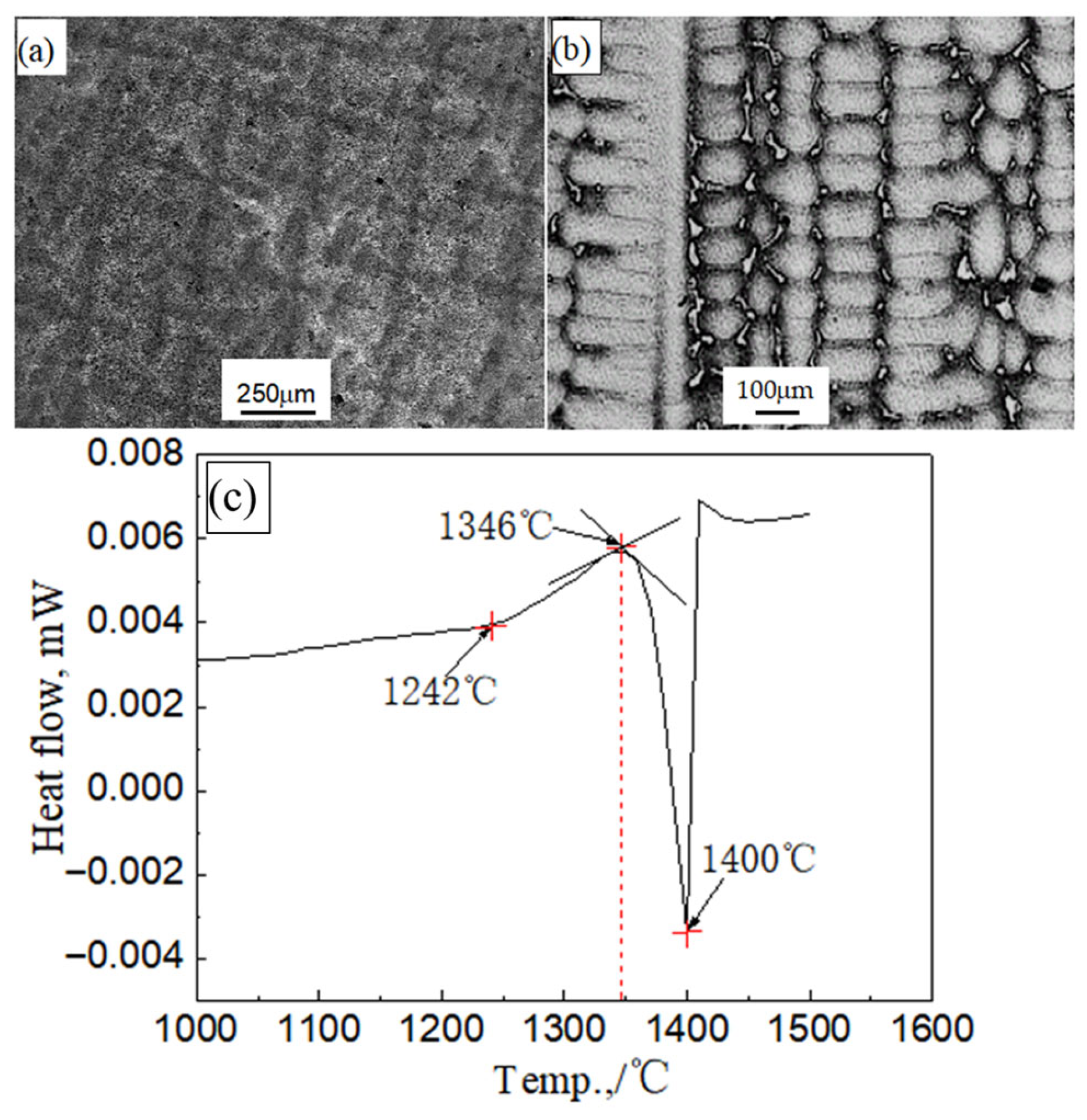
The raw materials with the chemical composition Ni–5.5%Al–7.5%Ta–3.0%Cr–Co–Mo–4.5%W–6.0%Re–5.0%Ru (The mass fractions of Co and Mo are not readily disclosed) were vacuum-cast in a ZG-0.01 vacuum induction furnace (the relevant elements were purchased from Guokeruian (Beijing) New Materials Technology Co., Ltd., Beijing, China. vacuum induction furnace: ALD Vacuum Technologies GmbH Hanau Germany). High purity master alloy ingots with precise chemical composition were prepared, and surface impurities were subsequently removed. Single-crystal test rods with a diameter of 16 mm and a length of 210 mm were then directionally solidified along the [001] orientation of the parent alloy ingot using a large double-zone heating vacuum directional solidification furnace (Shenyang Longzhen Technology Co., Ltd., Shenyang, China). Macroscopic examination of the longitudinally sectioned sample (Figure 1b) reveals a well-aligned columnar grain structure without visible boundaries. This indicates a high degree of crystallographic consistency along the growth direction, suggesting a low deviation angle from the ideal orientation.
A STA-449C differential scanning calorimeter (DSC) (Shanghai Jingke Scientific Instrument Co., Ltd., Shanghai, China) was employed to analyze the phase transformation temperatures of the alloy. Based on these results, the heat-treatment schedule for the single-crystal superalloy was established as follows: 1300 °C × 2 h plus 1310 °C × 6 h plus 1315 °C × 10 h plus 1323 °C × 10 h plus 1328 °C × 10 h plus 1332 °C × 5 h, followed by air cooling. The alloy was then subjected to a primary ageing treatment at 1180 °C for 4 h, followed by air cooling, and a secondary ageing treatment at 870 °C for 24 h, again followed by air cooling (Heat Treatment Furnace: Shanghai Haoyue Industrial Co., Ltd., Shanghai, China).
The single-crystal test rods were subsequently heat-treated to obtain the desired microstructure. Heat-treated single-crystal test rod specimens were machined along the [001] direction using an electrical discharge wire cutting machine to produce rough specimens. The rough specimens were then mechanically ground and polished to produce cylindrical tensile test specimens conforming to standards: gauge length 20 mm, diameter 5 mm, total length 40 mm, transition radius 18 mm, ensuring smooth surfaces free from damage. Finally, precise dimensional measurements and markings were completed to prepare the specimens for tensile testing.
These specimens were tested for instantaneous tensile properties at room temperature using an electronic universal testing machine (Suns Industrial Testing Systems Co., Ltd. (Suns), Shanghai, China the tensile process complies with HB standards, with a tensile rate of 2.4 × 10⁻³/s, the laboratory data provided represents the average of three experiments). After mechanical grinding and polishing, the tensile fracture alloy specimens were chemically etched using the etchant composition shown in Table 1. Following etching, the specimens underwent ultrasonic cleaning before SEM (Scanning Electron Microscopy: Hitachi High-Tech Corporation Tokyo Japan) microstructural observation. Using the electrical discharge wire cutting method, cut thin sections approximately 300 μm thick along the (001) plane at positions approximately 2 mm and 5 mm from the bottom edge of the tensile fracture specimen. The Thin sections were ground to a thickness of about 60 μm and then subjected to a double-jet thinning process to produce TEM (Transmission Electron Microscopy: Hitachi High-Tech Corporation Tokyo Japan) foils. SEM and TEM were employed to analyze the alloy’s microstructure and to investigate its deformation and damage mechanisms under tensile loading.

3. Experimental Results and Analysis

3.1. Tensile Properties and Deformation Characteristics of Alloys

Figure 1a shows the cross-sectional microstructure of the prepared alloy specimen. A single coarse columnar grain, spanning the entire field of view with no internal macroscopic boundaries, is observed. This indicates successful directional solidification and the preliminary attainment of single-crystal specimens.
The differential scanning calorimetry (DSC) heating curve of the alloy is presented in Figure 1c. To accurately determine the critical incipient melting temperature, a detailed analysis focusing on the onset of the endothermic event was performed. As shown in the figure, a prominent endothermic peak initiates at approximately 1242 °C, which likely corresponds to the dissolution of a secondary phase or a eutectic reaction. The primary solidus transition, indicative of bulk matrix melting, commences at an onset temperature of ~1336 °C. This value was determined using the standard tangent intersection method applied to the steepest descent portion of the major endothermic peak. The peak temperature of this major transition is observed at ~1346 °C, while the event concludes near 1400 °C, marking the completion of the liquidus transition. Based on the determined solidus onset (~1336 °C) and following established practice for similar alloys to avoid incipient melting while achieving effective homogenization, the solution treatment temperature for this study was selected to be below 1336 °C, specifically within a window of 1320–1335 °C, as outlined in the preliminary heat treatment regimen.
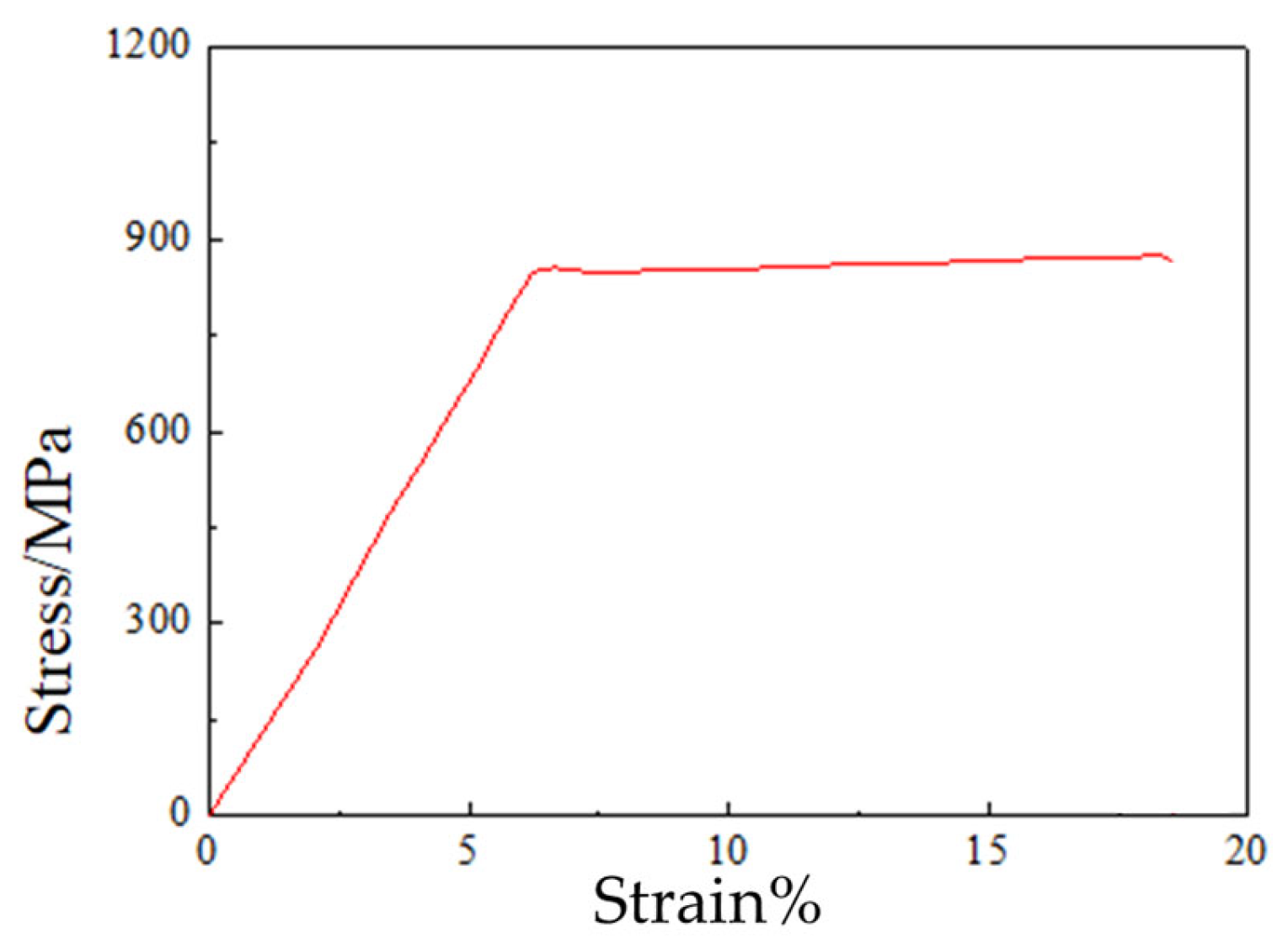
Figure 2 presents the engineering stress–strain curve (representative curve) of the experimental alloy measured at room temperature (20 °C). It can be seen that after reaching the yield point, the stress decreases slightly as post-yield strain accumulates. With continued deformation, a minor degree of work hardening occurs until final fracture. The tensile strength and yield strength of the alloy at room temperature were determined to be 875 MPa and 847 MPa, respectively, with an elongation of 18.5%. The mechanical properties of this alloy at room temperature are inferior to those of a Re/Ru-free alloy developed by our team [21]. The subsequent analysis examines the reasons for the mechanical property differences between these two alloys from the perspective of their deformation mechanisms.
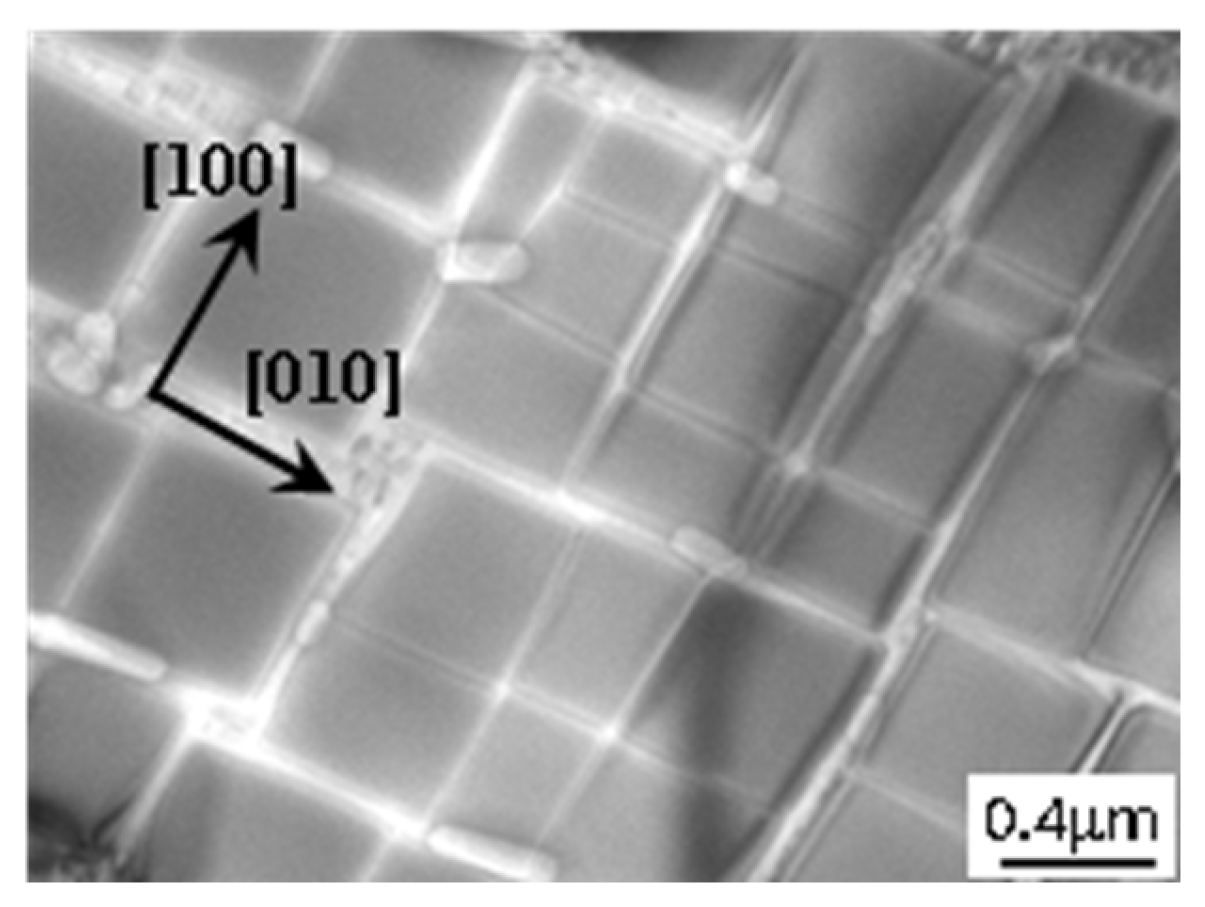
The microstructure after complete heat treatment on the (001) plane of the alloy is presented in Figure 3. The alloy consists of a regular arrangement of γ′ phases and the γ matrix phases. The γ′ phases are coherently embedded in the γ matrix and exhibit a cuboidal morphology, aligned along the [100] and [010] directions. Due to the addition of Ru, no topologically close-packed (TCP) phases were observed after heat treatment. Quantitative analysis indicates that the average γ′ size is close to 0.4 μm, the γ matrix channel width is close to 0.05 μm, and the volume fraction of the γ′ phase is around 68%. Through preliminary research, we know that after complete heat treatment, the lattice constants of the γ′ phase and γ matrix phase in this alloy are 0.3600 nm and 0.3615 nm, respectively. Calculations show the alloy’s mismatch factor to be −0.3254% [22].
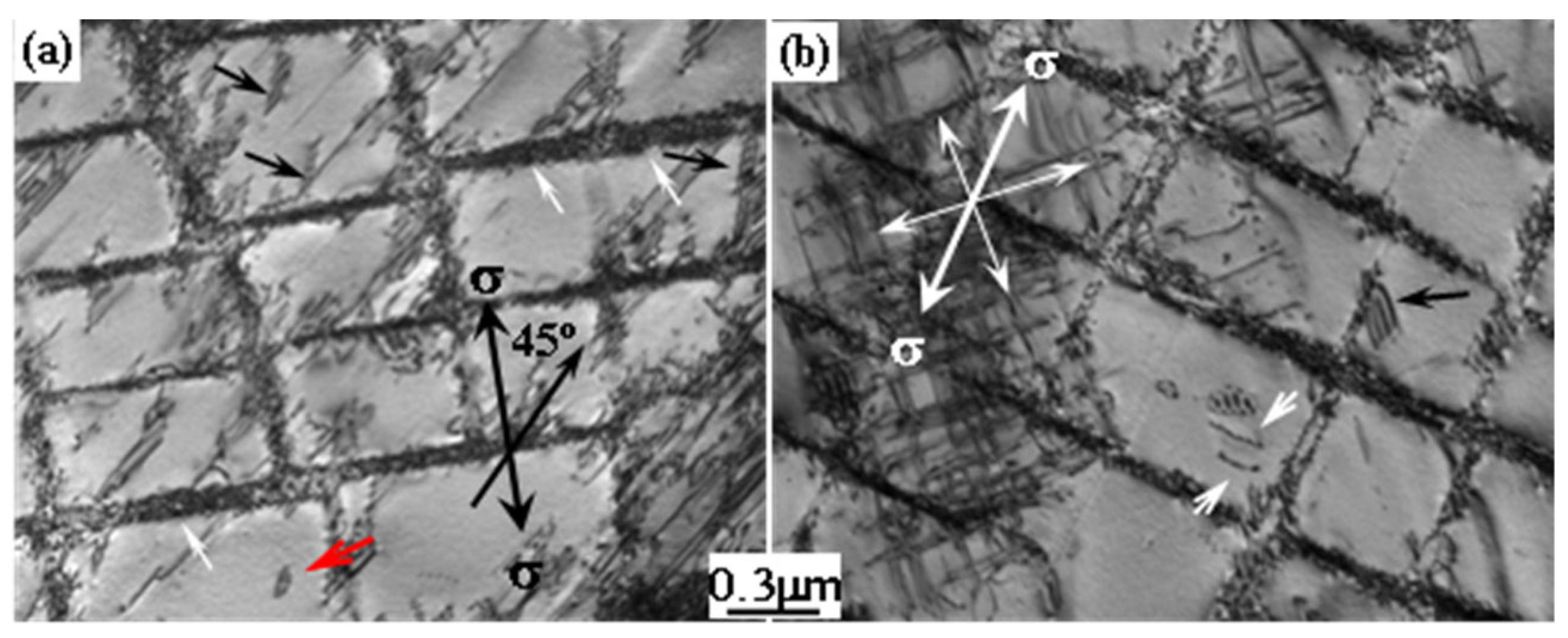
During tensile deformation, the stress distribution along the gauge length is not uniform because regions at different distances from the fracture surface experience different stress levels. Consequently, the deformation characteristics vary between regions. The evolution of dislocations during tensile loading can therefore be analyzed according to the deformation features observed in different regions of the specimen. Figure 4 shows the deformation characteristics at various distances from the fracture surface after room-temperature tensile testing. The loading direction is indicated in the figure.
Figure 4a displays the deformation characteristics in the region approximately 5 mm from the fracture surface. High-density dislocation tangles are observed at the γ/γ′ interfaces, as indicated by the short white arrows. Numerous unidirectional slip bands oriented at approximately 45° to the loading axis are present within the γ′ phase (long black arrows), indicating that only a single slip system is activated in this region. Within the γ′ phase, stacking faults with narrow decomposition widths (black arrows) and dislocation loops (red arrows) are also visible. The presence of dislocation loops suggests that some dislocations bypassed the γ′ precipitates via the Orowan mechanism during tensile deformation.
Figure 4b shows the deformation characteristics in the region approximately 2 mm from the fracture surface. In this area, numerous bidirectional slip systems perpendicular to each other and oriented at about 45° to the stress axis can be seen (long white arrows). This phenomenon is attributed to localized necking near the fracture surface, which increases the effective stress and activates secondary slip systems. Within the γ′ phase, two partial dislocations associated with an superlattice intrinsic stacking fault (SISF) (short black arrows, the specific causes of which will be analyzed later) and sawtooth-like, parallel superdislocations (white arrows) are also observed.

3.2. Alloy Damage and Fracture During Tensile Testing

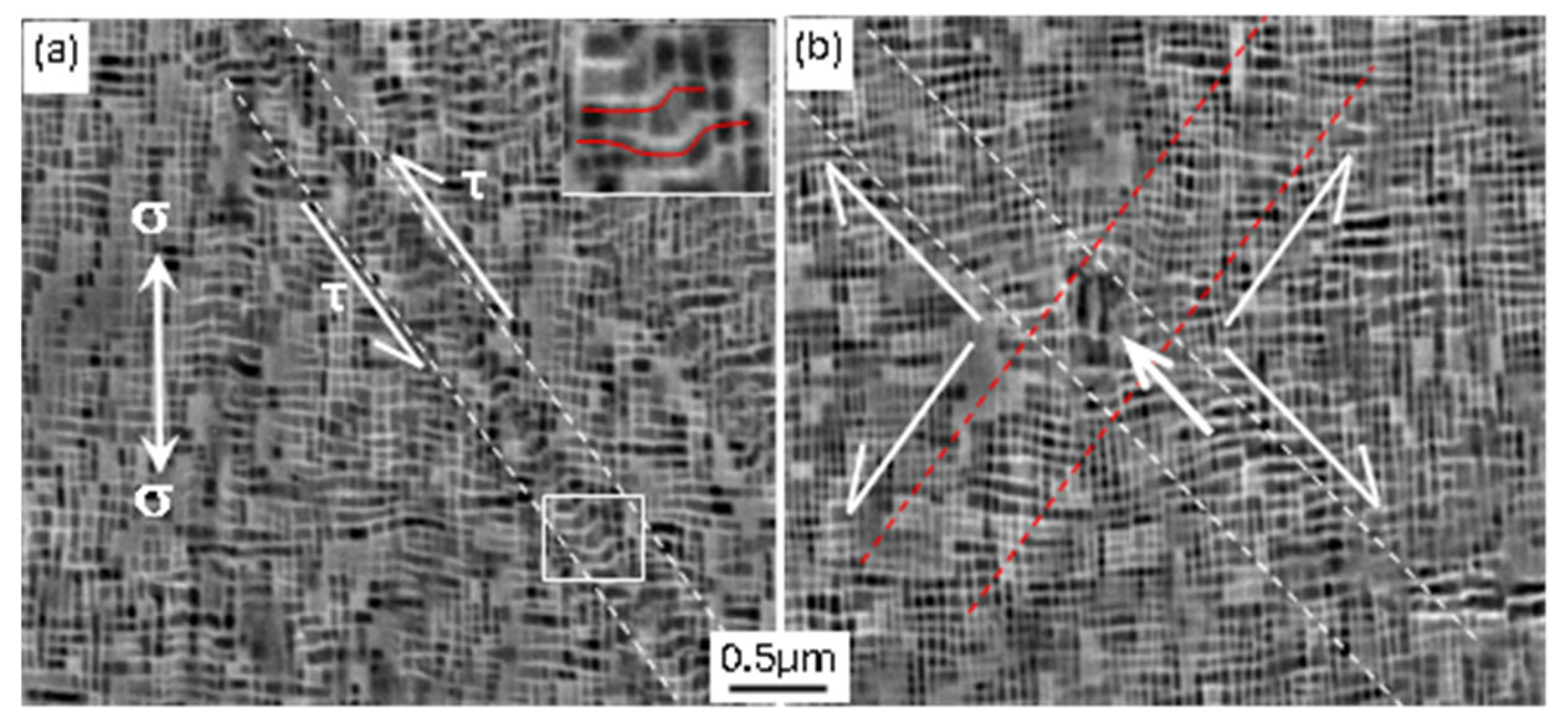
After fracture under room-temperature tensile conditions, the crack initiation and propagation morphologies at different distances from the fracture surface are shown in Figure 5.
Figure 5a shows the microstructure approximately 5 mm from the lowest point of the fracture surface. A unidirectional primary slip trace oriented at approximately 45° to the applied stress axis is observed, as indicated by the dashed line. The enlarged view of the white square region (upper left corner) reveals that the γ′ phase experiences significant distortion and deformation within the slip zone. This phenomenon occurs because, under the influence of shear stress (τ), dislocations shear along the direction of maximum shear stress into the γ′ phase (approximately 45° to the stress axis, as also seen in Figure 4). This process activates the primary slip system, producing opposing shear stresses on both sides of the slip plane.
Figure 5b shows the microstructure approximately 2 mm from the lowest point of the fracture surface. In this region, the secondary slip system is activated, as marked by the red dashed line. This activation is attributed to localized necking near the fracture surface, which leads to a sharp increase in the effective stress. Consequently, dislocations shear into the γ′ phase along secondary slip systems with lower shear stress, resulting in bidirectional dislocation shearing within the γ′ phase, to open the secondary slip system. This observation is consistent with the deformation characteristics described in Figure 5b.
Because the γ′ phase possesses higher strength than the γ matrix, dislocations gliding extensively within the γ matrix tend to pile up at the γ/γ′ interfaces, causing local stress concentration. To relieve this concentrated stress, the γ/γ′ interface separates, leading to microcrack initiation. Moreover, where the primary and secondary slip systems intersect, the γ/γ′ interface undergoes dual shearing. Therefore, cracks initiation in the γ/γ′ two-phase interface region where the primary slip system intersects the secondary slip system, as denoted by the arrows in Figure 5b. As tensile deformation progresses, accumulated strain drives crack propagation. Cracks originating from different slip bands interconnect, forming larger cracks that reduce the effective load-bearing area and increase local stress. This leads to unstable crack propagation along the γ/γ′ interfaces until final fracture. This process constitutes the tensile fracture mechanism of the alloy.

3.3. Contrast Analysis of Dislocation Configurations

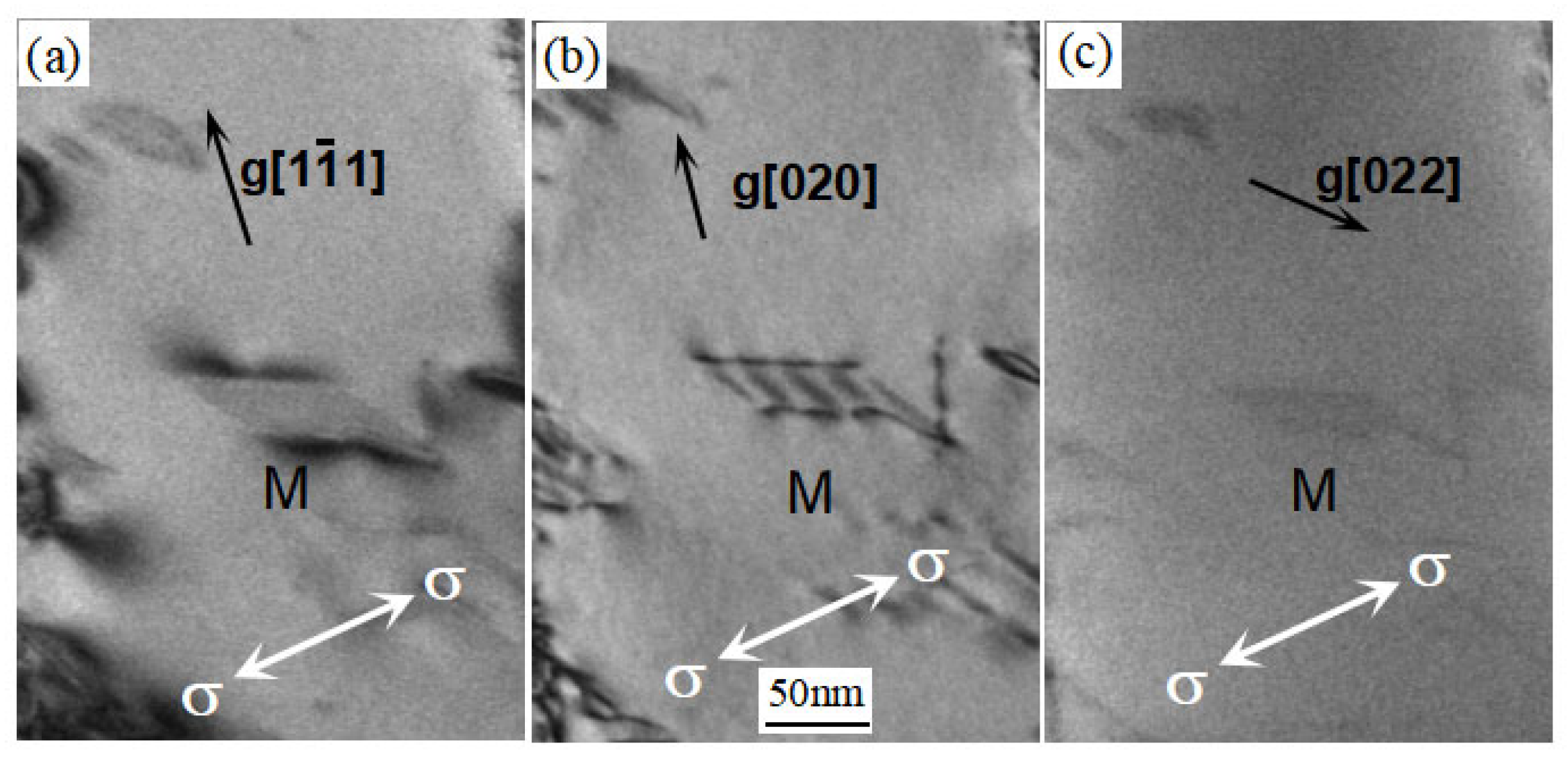
The high-magnification morphology of the stacking fault in the γ′ strengthening phase with a narrow decomposition width, corresponding to Figure 4a, is presented in Figure 6. The direction of the applied stress is indicated by the double arrow in the figure. It can be observed that the partial dislocations located on both sides of dislocation M exhibit identical contrast under different diffraction conditions, indicating that they possess the same Burgers vector.
When the diffraction vector is g = [ 1   1 ¯ 1 ], both sides of dislocation M displays contrast, while the stacking fault fringes contrast disappearance, as presented in Figure 6a. The decomposition width of stacking fault M is approximately 25 nm. Under g = [020], both the partial dislocations and stacking fault fringes display clear contrast, with the stacking fault stripes oriented perpendicular to the loading axis, as presented in Figure 6b. When g = [022], neither the partial dislocations nor the stacking fault fringes exhibit contrast, as shown in Figure 6c. According to these observations, the Burgers vector of the partial dislocations associated with dislocation M is determined to be bM = (1/2)[ 01   1 ¯ ]. This suggests that the superdislocation M shearing into the γ′ strengthening phase decomposes into two partial dislocations separated by an antiphase boundary (APB).
Since dislocation M forms an angle of approximately 45° with the tensile axis [001], its trace direction is identified as μM = [022] based on its morphology. Therefore, the slipping and decomposing plane of dislocation M is identified as ( 11   1 ¯ ) according to μM ×bM. And the decomposed reaction of dislocation M on ( 11   1 ¯ ) is determined as:
[ 01   1 ¯ ]     ( 1 / 2 ) [ 01   1 ¯ ]   +   ( APB ) ( 11   1 ¯ )   +   ( 1 / 2 ) [ 01   1 ¯ ]
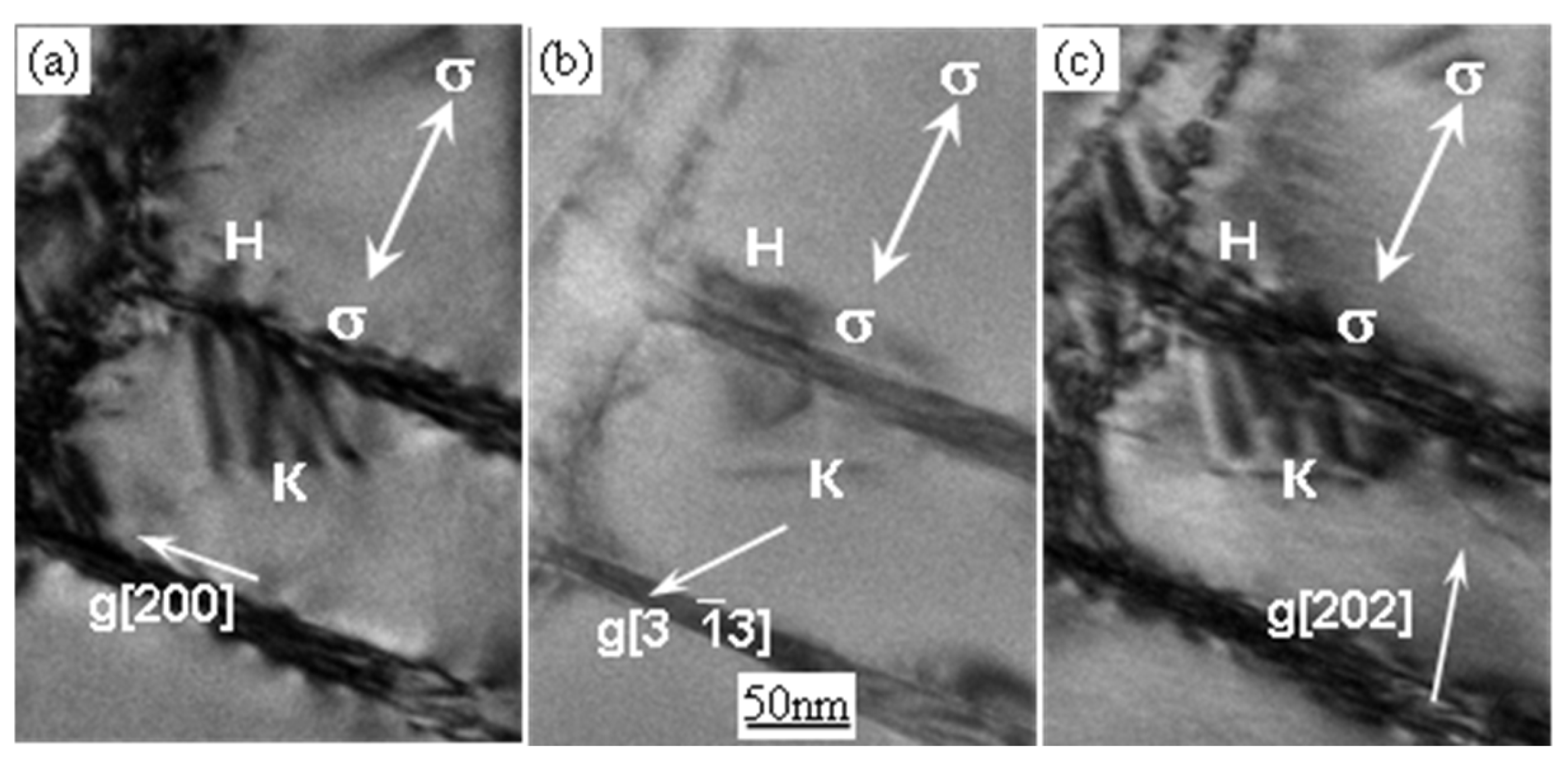
The high-magnification morphology of superlattice intrinsic stacking fault (SISF) in Figure 4b is shown in Figure 7. Stacking fault fringes are observed between two partial dislocations, H and K. Dislocation H is located at the γ/γ′ interface, whereas dislocation K is situated within the cubic γ′ phase.
When the diffraction vectors are g = [200] and g = [202], both dislocation H and the stacking fault stripes exhibit contrast, as shown in Figure 7a,c. When g = [ 3   1 ¯ 3 ], the contrasts of dislocation H and the stacking fault disappear (Figure 7b). As defined by the invisibility criterion (b·g = 0 and ±2/3), the Burgers vector of dislocation H is determined to be bH = (a/3)[211].
For dislocation K, contrast is observed under g = [ 3   1 ¯ 3 ] and g = [202] (Figure 7b,c), while it disappears under g = [200] (Figure 7a). According to the dislocation invisibility criterion, the Burgers vector of dislocation K is determined to be bK = (a/6)[ 1   1 ¯ 2 ]. These observations indicate that superlattice intrinsic stacking fault (SISF) originate from the decomposition of a superdislocation with Burgers vector (a/2)<110> shearing into the γ′ phase on the (111) plane. Consequently, the (a/2)<110> superdislocation is decomposed into a configuration consisting of two partial dislocations plus a superlattice intrinsic stacking fault (SISF), as expressed by the following reaction:
1 / 2 [ 110 ]     ( 1 / 3 ) [ 211 ]   +   ( SISF ) ( 11   1 ¯ )   +   ( 1 / 6 ) [ 1   1 ¯ 2 ]
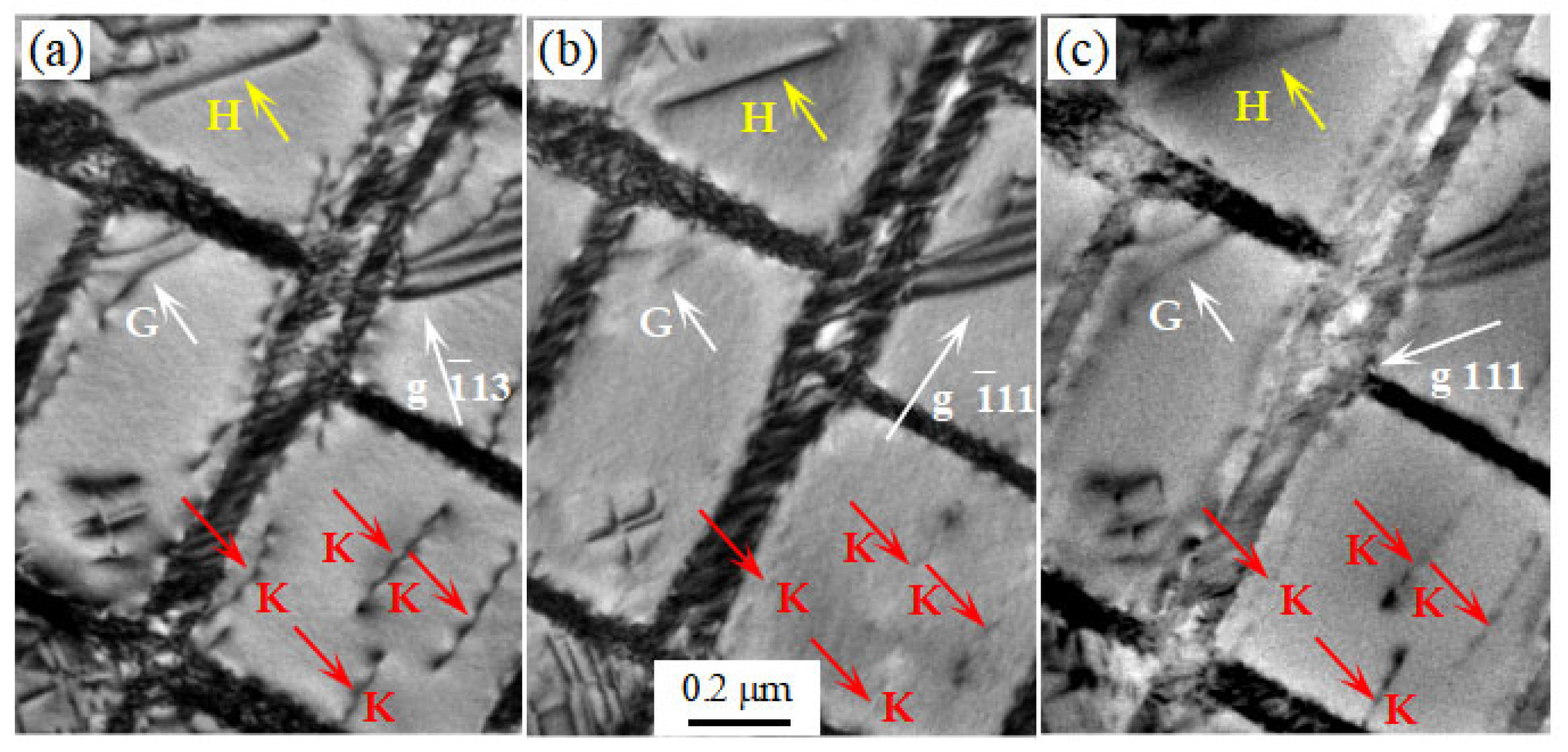
After fracture under room-temperature tensile loading, the single dislocation configurations within the γ′ phase near the fracture zone are shown in Figure 8. Dislocation lines cutting into the raft-like γ’ phase, as shown by K, H, and G in the figure. It can be seen that the same dislocation exhibits different contrast under different diffraction conditions.
It can be observed that when the diffraction vector g = [ 1 ¯ 13 ], the dislocation K indicated by the red arrow displays contrast, as shown in Figure 8a. When the diffraction vectors g = [ 1 ¯ 11 ] and g = [111], the dislocation K contrast disappearance and weak contrast, respectively, as shown in Figure 8b,c. According to the criteria of b·g = 0 dislocation invisibility, it is determined that the Burgers vector of dislocation K is determined to be bK = [ 01   1 ¯ ]. Through comparative observation, the line vector of the dislocation K is found to be μK = [202], and the slipping plane of dislocation K is identified as the ( 11   1 ¯ ) plane according to bK × μK.
Additionally, when the diffraction vector g = [ 1 ¯ 13 ], the H and G dislocations indicated by the yellow and white arrows display contrast, as shown in Figure 8a. When g = [ 1 ¯ 11 ] and g = [111], the H dislocation displays contrast and shows weak contrast, as depicted in Figure 8b,c, respectively. Consequently, the Burgers vector of the H dislocation is determined to be bH = [ 1   1 ¯ 0 ]. When g = [ 1 ¯ 11 ] and g = [111], the G dislocation disappears and displays contrast, as shown in Figure 8b,c. Consequently, the Burgers vector of the G dislocation is determined to be bG = [101]. Through comparative observation, the line vectors of the H and G dislocations are found to be μ = [022]. Based on bH × μH, as well as bG × μG, it is determined that the slip planes for both H and G dislocations are ( 11   1 ¯ ) planes.

4. Discussion

Previous research [23,24] has shown that in single-crystal alloys with an L12-ordered Ni3Al structure, the energy required for dislocation decomposition in the γ′ phase is lower than that energy required for direct dislocation slip under low-temperature conditions. Consequently, depending on the surface defect energy, dislocations can decompose into different types of stacking faults. Three primary decomposition modes have been identified for relieving lattice strain in the γ/γ′ two-phase structure after dislocation shearing into the γ′ phase [25,26]:
A <110> superdislocation shearing into the γ′ phase decomposes on {111} planes to form (1/3)<112> super-Shockley partial dislocations plus a SISF.
A <110> superdislocation shearing into the γ′ phase can decompose on both {111} and {100} planes to form (1/2)<110> partial dislocation plus an APB.
A <110> superdislocation shearing into the γ′ phase can also decompose to form (1/6)<112> super-Shockley partials plus a complex stacking fault (CSF).
Specifically, for Re/Ru-free Ni-based single-crystal superalloys under room-temperature tensile loading, it has been reported that superdislocations entering the γ′phase do not decompose into the (1/3)<112> partials + SISF configuration. Instead, they predominantly form the (1/2)<110> partials + APB configuration on {100} planes, and some dislocations can cross-slip from {111} to {100} planes to form Kear–Wilsdorf (K–W) locks, which is a key strengthening mechanism [21]. The core deformation mechanism of Re/Ru-containing Ni-based single crystals during creep at 760–800 °C is dislocation cutting of the γ′ phase [26].
In contrast, the deformation mechanism of the Re/Ru-containing alloy under room-temperature tensile conditions in this study differs from those previously reported. The superdislocations shearing into the γ′ phase decompose on the {111} plane into two types of configurations: (1/3)<112> partial dislocations plus an SISF, and (1/2)<011> partial dislocations plus an APB (as shown in Figure 6 and Figure 7). This indicates that the alloy exhibits lower stacking-fault energy on the {111} plane compared with the {100} plane [27,28,29]. No K-W locks formed by dislocation slip from the {111} plane to the {100} plane were observed after tensile fracture of this alloy. This indicates that the deformation mechanism of this alloy during room-temperature tensile deformation differs from that of Re/Ru-free nickel-based single crystals at room temperature [21] and also differs from the deformation mechanism of Re/Ru-based nickel-based single crystals during high-temperature creep [20]. Analysis indicates that K–W lock formation is a thermally activated process, the typical activation energy is approximately 1.0–1.3 eV [30]. In Re/Ru alloys, Re/Ru strongly tends to occupy Al sites in the γ′ phase, significantly enhancing interatomic bonding. This increases the difference in antiphase domain boundary energy between the {111} and {100} planes, raising the thermal activation energy required for K-W locking formation. Consequently, K-W locking cannot form at room temperature [31]. As a result, the alloy exhibits a weak work-hardening effect during room-temperature tension, consistent with the results shown in Figure 2.
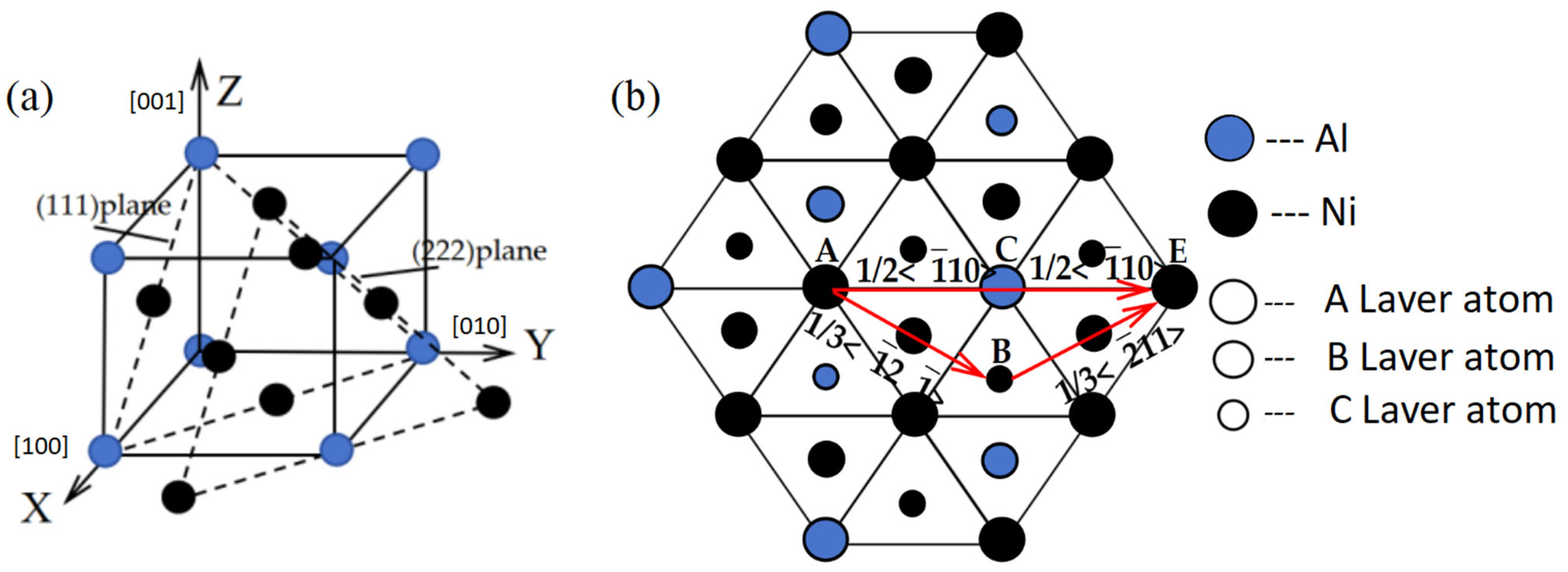
A schematic model of dislocation slip and decomposition during room-temperature tensile deformation is shown in Figure 9. Blue dots represent Al atoms, and black dots represent Ni atoms. Figure 9a depicts the atomic arrangement of Al and Ni on the γ′ unit cell {111} plane, while Figure 9b shows the projection of the ordered A, B, and C layers atoms on the same plane. Atoms with smaller radii represent projections of adjacent atomic layers parallel to (111). Each Al atom on the {111} plane is surrounded by 12 first-nearest-neighbor Ni atoms, whereas each Ni atom is surrounded by eight first-nearest-neighbor Ni atoms and four first-nearest-neighbor Al atoms.
When a dislocation with a Burgers vector of [011] decomposes along the A–C–E path, it forms an APB at point C, leaving (1/2)[011] partial dislocations on both sides—as described by Equation (1). When a dislocation with Burgers vector (1/2)[011] decomposes along the A–B–E path, it produces an SISF at point B, leaving (1/3)[211] and (1/6)[211] partial dislocations on both sides—as described by Equation (2). It is suggested that the (1/2)[011] + APB and (1/3)[112] + SISF configurations suppress dislocation motion and cross-slip, contributing to the alloy’s high deformation resistance at room temperature [32,33].

5. Conclusions

(1)
The tensile strength of single-crystal nickel-based alloy is 875 MPa, and its yield strength is 847 MPa. The resulting high yield ratio (≈0.97) indicates that the alloy deforms primarily within the elastic regime prior to fracture, suggesting limited macroscopic plastic deformation capacity but potentially good resistance to plastic strain accumulation.
(2)
Contrary to the common observation in many single-crystal superalloys at room temperature, where superdislocations readily cross-slip from {111} to {100} planes to form Kear–Wilsdorf (K-W) locks (a key strengthening mechanism), no evidence of K-W lock formation was found in the present high-Re/Ru alloy. Instead, this alloy exhibits a unique dislocation activity confined to {111} planes. The [011] superdislocations within the γ′ phase decompose on {111} planes into two configurations: a (1/2)[011] partial dislocation plus an APB, and a Giamei-locked configuration of (1/3)<112> partial dislocations plus an SISF. This predominance of planar slip on {111} planes, and the suppression of cross-slip to {100} planes, is identified as a characteristic deformation pathway induced by high Re/Ru concentrations.
(3)
Microcrack initiate in the γ/γ′ phase interface region where the primary slip system intersects with the secondary slip system. As tensile loading continues, these microcracks progressively coalesce, leading to an increase in local stress concentration and the unstable propagation of cracks along the γ/γ′ interface. This process results in final fracture, defining the damage mechanism of the alloy under room-temperature tensile conditions.
(4)
These findings suggest that high Re/Ru concentrations fundamentally alter low-temperature deformation pathways, which may improve resistance to brittle fracture during cold start or handling conditions.

Author Contributions

The first author N.T. is responsible for the initial draft creation of the article; Corresponding author S.Z. is responsible for the dislocation analysis of the article; Author S.S. is responsible for the basic experiments of the article; The author X.S. is responsible for the mechanical analysis of the article; Author X.Q. is responsible for the experimental data analysis of the article; Author L.W. is responsible for the debugging of the experimental equipment for the article; Authors Z.X. and D.D. are responsible for the literature review and formatting of the article. All authors have read and agreed to the published version of the manuscript.

Funding

Sponsorship of this research by the Guizhou Province Science and Technology Plan Project (QKHJC-ZK [2024] yiban604), Intelligent Transportation Equipment Manufacturing Technology Innovation Team Project (qianjiaoji [2023]100), Naturalscience research project of Education Department of Guizhou Province (qianjiaoji [2023]1100) are gratefully acknowledged.

Data Availability Statement

The raw data supporting the conclusions of this article will be made available by the authors on request.

Conflicts of Interest

The authors declare that they have no known competing financial interest or personal relationships that could have appeared to influence the work reported in this paper.

References

  1. Tang, Y.T.; D’sOuza, N.; Roebuck, B.; Karamched, P.; Panwisawas, C.; Collins, D.M. Ultra-high temperature deformation in a single crystal superalloy: Mesoscale process simulation and micromechanisms. Acta Mater. 2021, 203, 116468. [Google Scholar] [CrossRef]
  2. Liang, X.; Wu, J.; Zhao, Y. Creep Fracture Mechanism of a Single Crystal Nickel Base Alloy Under High Temperature and Low Stress. Met. Mater. Int. 2022, 28, 841–847. [Google Scholar] [CrossRef]
  3. Wang, Q.J.; Wu, Y.D.; Chen, J.B.; Song, J.; Xiao, C.; Hui, X. Insight into the low cycle fatigue deformation mechanisms of minor element doping single crystal superalloys at elevated temperature. Scr. Mater. 2023, 224, 115151. [Google Scholar] [CrossRef]
  4. Zhang, J.X.; Wang, J.C.; Harada, H.; Koizumi, Y. The effect of lattice misfit on the dislocation motion in superalloys during high-temperature low-stress creep. Acta Mater. 2005, 53, 4623–4633. [Google Scholar] [CrossRef]
  5. Mori, Y.; Yokokawa, T.; Kobayashi, T.; Harada, H.; Suzuki, S. Phase stability of nickel-base single crystal superalloys containing iridium substituting for ruthenium. Mater. Trans. 2016, 57, 1845–1848. [Google Scholar] [CrossRef]
  6. Huang, M.; Cheng, Z.; Xiong, J.; Li, J.; Hu, J.; Liu, Z.; Zhu, J. Coupling between Re segregation and γ/γ′ interfacial dislocations during high-temperature, low-stress creep of a nickel-based single-crystal superalloy. Acta Mater. 2014, 76, 294–305. [Google Scholar] [CrossRef]
  7. Shi, Z.X.; Liu, S.Z.; Yue, X.D.; Hu, L.J.; Yang, W.P.; Wang, X.G.; Li, J.R. Effect of cellular recrystallization on tensile properties of a nickel-based single crystal superalloy containing Re and Ru. J. Iron Steel Res. Int. 2017, 24, 1059–1064. [Google Scholar] [CrossRef]
  8. Zitara, M.; Cetel, A.; Czyrska-Filemonowicz, A. Microstructure stability of 4th generation single crystal superalloy, PWA 1497, during high temperature creep deformation. Mater. Trans. 2011, 52, 336–339. [Google Scholar] [CrossRef]
  9. Cui, L.; Su, H.; Yu, J.; Liu, J.; Jin, T.; Sun, X. Temperature dependence of tensile properties and deformation behaviors of nickel-base superalloy M951G. Mater. Sci. Eng. 2017, 696, 323–330. [Google Scholar] [CrossRef]
  10. Li, Z.; Xiong, J.; Xu, Q.; Li, J.; Liu, B. Deformation and recrystallization of single crystal nickel-based superalloys during investment casting. Mater. Process Technol. 2015, 217, 1–12. [Google Scholar] [CrossRef]
  11. Wang, L.; Pyczak, F.; Zhang, J.; Lou, L.H.; Singer, R.F. Effect of eutectics on plastic strain deformation and subsequent recrystallization in the single crystal nickel base superalloy CMSX-4. Mater. Sci. Eng. A 2012, 532, 487–492. [Google Scholar] [CrossRef]
  12. Lv, P.S.; Liu, L.R.; Zhao, G.Q.; Guo, S.; Zhou, Z.; Zhao, Y.; Zhang, J. Temperature effects on tensile behaviors and relevant deformation mechanisms of a low-cost nickel-based single crystal superalloy containing 1.5% Re. J. Alloys Compd. 2022, 926, 166819. [Google Scholar] [CrossRef]
  13. Zhou, Z.R.; Liu, L.R.; Lv, P.S.; Zhang, J. Tensile properties and deformation mechanisms of two low-cost second-generation single crystal superalloys designed by optimization of Re and W compositions at various temperatures. J. Alloys Compd. 2023, 960, 170840. [Google Scholar] [CrossRef]
  14. Tan, Z.H.; Wang, X.G.; Du, Y.L.; Duan, T.F.; Yang, Y.H.; Liu, J.L.; Liu, J.D.; Yang, L.; Li, J.G.; Zhou, Y.Z.; et al. Temperature dependence on tensile deformation mechanisms in a novel Nickel-based single crystal superalloy. Mater. Sci. Eng. A 2020, 776, 138997. [Google Scholar] [CrossRef]
  15. Song, W.; Wang, X.G.; Li, J.G.; Meng, J.; Yang, Y.H.; Liu, J.L.; Liu, J.D.; Zhou, Y.Z.; Sun, X.F. Effect of Ru on tensile behavior and deformation mechanism of a nickel-based single crystal superalloy. Mater. Sci. Eng. A 2021, 802, 140430. [Google Scholar] [CrossRef]
  16. Wang, X.G.; Liu, J.L.; Jin, T.; Sun, X.F.; Zhou, Y.Z.; Hu, Z.Q.; Do, J.H.; Choi, B.G.; Kim, I.S.; Jo, C.Y. Creep deformation related to dislocations cutting the γ′ phase of a Ni-base single crystal superalloy. Mater. Sci. Eng. A 2015, 626, 406–414. [Google Scholar] [CrossRef]
  17. Heckl, A.; Neumeier, S.; Göken, M.; Singer, R. The effect of Re and Ru on γ/γ′ microstructure, γ-solid solution strengthening and creep strength in nickel-base superalloys. Mater. Sci. Eng. A 2011, 528, 3435–3444. [Google Scholar]
  18. Wang, X.; Zhou, Y.; Zhao, Z.; Zhang, Z. Effects of solutioning on the dissolution and coarsening of γ′ precipitates in a nickel-based superalloy. J. Mater. Eng. Perform. 2015, 24, 1492–1504. [Google Scholar] [CrossRef]
  19. Tian, N.; Zhao, G.Q.; Meng, T.; Tian, S.; Liu, L.; Yan, H.; Wang, G.; Jin, F. Ultra-high-temperature creep behavior of a single-crystal nickel-based superalloy containing 6% Re/5% Ru. Mater. Charact. 2021, 180, 111394. [Google Scholar]
  20. Yan, H.; Tian, S.; Zhao, G.; Tian, N.; Zhang, S. Creep and damage of a Re/Ru-containing single crystal nickel-based alloy at high temperature. Mater. Sci. Eng. A 2021, 808, 140870. [Google Scholar] [CrossRef]
  21. Tian, N.; Tian, S.G.; Yan, H.J.; Shu, D.; Zhang, S.; Zhao, G. Deformation mechanisms and analysis of a single crystal nickel-based superalloy during tensile at room temperature. Mater. Sci. Eng. A 2019, 744, 154–162. [Google Scholar] [CrossRef]
  22. Tian, N. Microstructural Stability and Creep Behavior of a Re/Ru Single-Crystal Nickel-Based Alloy. Crystals 2025, 15, 370. [Google Scholar] [CrossRef]
  23. Zhu, Z.; Basoalto, H.; Warnken, N.; Reed, R.C. A model for the creep deformation behaviour of nickel-based single crystal superalloys. Acta Mater. 2012, 60, 4888–4900. [Google Scholar] [CrossRef]
  24. Jácome, L.A.; Nörtershäuser, P.; Heyer, J.-K.; Lahni, A.; Frenzel, J.; Dlouhy, A.; Somsen, C.; Eggeler, G. High-temperature and low-stress creep anisotropy of single-crystal superalloys. Acta Mater. 2013, 61, 2926–2943. [Google Scholar] [CrossRef]
  25. Yuan, Y.; Kawagishi, K.; Koizumi, Y.; Kobayashi, T.; Yokokawa, T.; Harada, H. Creep deformation of a sixth generation Ni-base single crystal superalloy at 800 °C. Mater. Sci. Eng. A 2014, 608, 95–100. [Google Scholar] [CrossRef]
  26. Tian, N.; Meng, T.; Sun, S.; Zhang, S.; Dang, D. Creep Behavior of a Single Crystal Nickel-Based Superalloy Containing High Concentrations of Re/Ru at an Intermediate Temperature. Crystals 2024, 14, 983. [Google Scholar] [CrossRef]
  27. Shang, S.L.; Zacherl, C.L.; Fang, H.Z.; Wang, Y.; Du, Y.; Liu, Z.K. Effects of alloying element and temperature on the stacking fault energies of dilute Ni-base superalloys. J. Phys. Condens. Matter 2012, 24, 505403. [Google Scholar] [CrossRef]
  28. Wang, X.; Liu, J.; Jin, T.; Sun, X. The effects of ruthenium additions on tensile deformation mechanisms of single crystal superalloys at different temperatures. Mater. Des. 2014, 63, 286–293. [Google Scholar] [CrossRef]
  29. Yu, X.-X.; Wang, C.-Y. The effects of alloying elements on generalized stacking fault energies, strength and ductility of γ′-Ni3Al. Mater. Sci. Eng. A 2012, 539, 38–41. [Google Scholar] [CrossRef]
  30. Murakami, H.; Honma, T.; Koizumi, Y.; Harada, H. Atom-probe tomographic analysis of the distribution of rhenium in nickel-base single-crystal superalloys. Scr. Mater. 2003, 48, 293–299. [Google Scholar]
  31. Rae, M.F. Alloy Design for High Temperature Strength: The Superalloy Experience. In Fundamentals of Creep in Metals and Alloys; Kassner, M.E., Ed.; Elsevier: Amsterdam, The Netherlands, 2008; pp. 275–298. [Google Scholar]
  32. Huo, J.J.; Shi, Q.Y.; Feng, Q. Effect of multiple alloying additions on microstructural features and creep performance at 950 °C and 400 MPa in Ru-containing single crystal superalloys. Mater. Sci. Eng. A 2017, 693, 136–144. [Google Scholar] [CrossRef]
  33. Hu, P.; Zhao, W.; Sun, Z. Vacancy effect on the generalized stacking fault energy of alloyed γ-Ni system: A first-principles study. Comput. Mater. Sci. 2019, 166, 187–192. [Google Scholar] [CrossRef]
Figure 1. Low-magnification SEM morphology image of alloy and DSC curve of the alloy during heating. (a,b) SEM image (c) DSC curve.
Crystals 16 00138 g001
Figure 2. Strain–stress curve of the alloy.
Crystals 16 00138 g002
Figure 3. Microstructure of the alloy.
Crystals 16 00138 g003
Figure 4. A series of bright-field images reveal various dislocation configurations at different locations within the alloy. (a) Region distant from the fracture surface (b) Region near the fracture surface.
Crystals 16 00138 g004
Figure 5. SEM morphology after room-temperature tensile fracture of the alloy (a) Morphology away from the fracture zone, (b) Morphology near the fracture zone.
Crystals 16 00138 g005
Figure 6. Contrast analysis of dislocation configuration after tensile fracture. (a) g = [ 1   1 ¯ 1 ], (b) g = [020], (c) g = [022].
Crystals 16 00138 g006
Figure 7. Contrast analysis of SISF configuration after tensile fracture. (a) g = [200], (b) g = [ 3   1 ¯ 3 ], (c) g = [202].
Crystals 16 00138 g007
Figure 8. Contrast analysis of single dislocation configuration in the γ′ phase after tensile fracture. (a) g = [   1 ¯ 13 ], (b) g = [ 1 ¯ 11 ], (c) g = [111].
Crystals 16 00138 g008
Figure 9. Schematic of atomic arrangement and dislocation motion on the {111} plane. (a) Al and Ni atom layers on {111} plane, (b) moving of dislocations on {111} plane.
Crystals 16 00138 g009
Table 1. Composition of the corrosive liquid used to sample for scanning.
ComponentCuSO4 (g)HCl (mL)H2SO4 (mL)H2O (mL)
content5.0100.05.080
Disclaimer/Publisher’s Note: The statements, opinions and data contained in all publications are solely those of the individual author(s) and contributor(s) and not of MDPI and/or the editor(s). MDPI and/or the editor(s) disclaim responsibility for any injury to people or property resulting from any ideas, methods, instructions or products referred to in the content.