Article

Synthesis, Structure, and Properties of the Complex Zintl Phase Eu9Zn4.5As9: A Candidate Topological Insulator and Thermoelectric Material


1
Department of Chemistry, Louisiana State University, Baton Rouge, LA 70803, USA
2
Department of Physics and Astronomy, Louisiana State University, Baton Rouge, LA 70803, USA
3
Department of Chemistry and Biochemistry, University of Delaware, Newark, DE 19716, USA
*
Authors to whom correspondence should be addressed.
These authors contributed equally to this work.
Crystals 2026, 16(2), 137; https://doi.org/10.3390/cryst16020137
Submission received: 23 January 2026 / Revised: 8 February 2026 / Accepted: 10 February 2026 / Published: 13 February 2026
(This article belongs to the Section Inorganic Crystalline Materials)

Abstract

Reported are the synthesis and detailed analysis of the crystal and electronic structure of the novel Zintl phase Eu9Zn4.5As9. This material was identified in the densely populated Eu–Zn–As compositional space. For structure determination and for property measurements, suitable single crystals of this compound were grown from either Sn- or Pb-flux. Single-crystal X-ray diffraction methods indicate that Eu9Zn4.5As9 crystallizes in the orthorhombic crystal system with the space group Pnma (a = 12.1953(7) Å, b = 4.3730(2) Å, c = 42.674(2) Å) and is formally isostructural to Ca9Mn4+xSb9, the less common “9–4–9” type. The structure is heavily disordered, with multiple partially occupied sites, yet, according to the Zintl-Klemm formalism, a charge-balanced composition (Eu2+)9(Zn2+)4.5(As3−)9 is attained. Electronic structure calculations for a model, disorder-free structure indicate no energy gap between the valence and the conduction bands and suggest (semi)metallic behavior. Preliminary susceptibility measurements confirm the expected divalent nature of Eu2+ ([Xe] 4f7 ground state).

1. Introduction

Zintl phases are intermetallic compounds, characterized by the simultaneous coexistence of covalent and ionic bonding interactions in their structures. Formed from groups 1 and 2 or lanthanide metals and the more electronegative early post-transition elements from groups 13–15, the crystal structures of these materials often exhibit unique (poly)anionic frameworks. The charge-balance requirements according to the Zintl-Klemm concept [1] are satisfied if one considers ionic-like interactions between the elements with differing electronegativities. The structural complexity that arises from this formalism is thought of as both the hallmark of Zintl phases and an important element in the design of materials with unique physical properties [2].
Zintl pnictides, the largest group of Zintl phases that have been discovered thus far, arise from combinations of the aforementioned less electronegative metals with the pnictogen elements P, As, Sb, and Bi (Pn hereafter). The unique chemistry of these materials allows them to form a large variety of homoatomic PnPn and heteroatomic PnM bonds (M = transition metals and Group 13/14 elements), which result in unique and complex structural motifs [3]. These combinations often yield narrow bandgaps and enhanced transport properties [4,5,6]. As a result, much progress surrounding the study of Zintl pnictides has been dedicated to the study of their potential for thermoelectric applications [4].
While many Zintl pnictides have already been studied as potential thermoelectrics, the majority of reports have been dedicated to the characterization of antimonides [4]. By comparison, Zintl arsenides are less studied, with only a few publications reporting transport or magnetic properties [7], although computational works have predicted increased thermoelectric performance for several arsenide systems [7,8,9], as well as experimentally validated interesting physical properties like colossal magnetoresistance, the anomalous Hall effect, and superconductivity [10,11,12,13,14,15,16,17].
Herein, we expand the field of Zintl arsenides by reporting, for the first time, the synthesis and structural characterization of a novel Zintl phase, Eu9Zn4.5As9. We present a detailed analysis of the crystal structure, the first of its kind, as well as its computed electronic band structure. As the chemical formula indicates, this compound belongs to the class of so-called “9–4–9” phases, A9M4+xPn9 (A = Ca, Sr, Eu, Yb; M = Mg, Mn, Zn, Cd; Pn = As, Sb, Bi). This family series is compositionally diverse and comprises several different structural types. Importantly, several “9–4–9” phases are well known as highly efficient thermoelectric materials with potential for dopability and excellent transport properties (Table 1).

2. Materials and Methods

2.1. Synthesis

The ternary arsenide Eu9Zn4.5As9 was originally discovered during attempts to optimize the synthesis of the Zintl arsenide Eu3ZnAs3 [34] and later heteroanionic Zintl arsenide oxide, Eu14Zn5As12O [35]. The following procedure can be utilized to synthesize large needle-like crystals (Figure 1) of the title phase. Europium metal pieces (Edgetech Ind., Tamarac, FL, USA, 99%), zinc shot (Sigma-Aldrich, St. Louis, MO, USA, 99.9%), arsenic granules (Thermo Fisher, Plaquemine, LA, USA, 99.999%), and tin shot (Thermo Scientific, Waltham, MA, USA, 99.8%) were combined in a 5:1:3:20 molar ratio and placed in an alumina crucible. Europium pieces were filed prior to use to remove oxidized coatings. All materials were handled inside an argon-filled glove box to prevent degradation (H2O and O2 ≤ 1 ppm). The loaded alumina crucible was then sealed within an evacuated fused silica ampoule topped with the quartz wool, which acts as a filter. The reactants were then heated to 1000 °C and held for 24 h before being slowly cooled to 650 °C and centrifuged to remove metal flux excess. The ampoules were then cracked open inside the glovebox.
This approach leads to the formation of large (≥1 mm) needle-like crystals of Eu9Zn4.5As9, which are black in color and very brittle. Crystals of this compound can also be obtained using other approaches, as discussed in Section 3.1. Crystals were found to be air- and moisture-stable for at least several days. Suitable crystals were selected from the reaction product for both single-crystal X-ray diffraction and magnetic studies.
CAUTION! Arsenic and arsenic-containing compounds should be handled in proper personal protective equipment. Reactions must be conducted in well-ventilated areas, as reaction temperatures above the sublimation point of arsenic (614 °C) can produce dangerous byproducts. Arsenic tends to hydrolyze and create arsane gas, which is highly toxic; crucibles should not be immediately cleaned with water. Slow oxidation under the fume hood is advised.

2.2. Structural Characterization

Structural characterization of the Eu9Zn4.5As9 phase was carried out using single-crystal X-ray diffraction (SCXRD) methods. Data were collected using a Bruker D8 Venture DUO diffractometer (Bruker, Billerica, MA, USA) equipped with a Photon III C14 detector and Ag Kα radiation microfocus tube (λ = 0.56086 Å). Small black needle-like crystals were selected from the reaction product and mounted on a MiTiGen loop attached to the goniometer. A constant cold (100 K) nitrogen flow was applied to the crystal during data collection to protect the material from potential degradation due to contact with air and moisture. After collection, the data were processed using the SAINT and SADABS programs (version 2.03) from the APEX4 software suite [36,37]. The crystal structure was solved using intrinsic phasing with SHELXT (version 2018/2) and further refined via full-matrix least-squares on F2 with SHELXL (version 2018/3) [38,39]. Olex2 (version 1.5) was used as a GUI for structure determination [40]. Finally, atomic coordinates were standardized using STRUCTURE TIDY software [41]. Selected crystallographic data, including data collection details, atomic coordinates, and bond distances, can be found in Table 2, Table 3 and Table 4.

2.3. Electronic Structure Calculations

Electronic structure calculations were performed by employing density functional theory (DFT) using the Vienna Ab Initio Simulation Package (VASP) (version 6.4.3) [42]. The Perdew–Burke–Ernzerhof (PBE) exchange–correlation energy with the generalized gradient approximation (GGA) was employed for calculations [43]. Both core and valence electrons were treated with the projector-augmented wave method, with the Eu_2 pseudopotential used to consider Eu in the +2 configuration [44]. Structure optimization was performed prior to calculating the density of states and band structures. A Gamma-centered mesh of 8 × 3 × 1 points in the Brillouin zone generated by VASPKIT and an energy cutoff of 430 eV with a convergence tolerance of 1 × 10⁻⁶ eV/atom was used for self-consistent field calculations [45].
As disorder cannot be accounted for in VASP, a disorder-free model had to be designed in order to perform the calculations. With a goal of preserving charge-balanced composition, the split As1A/As1B and Zn4A/Zn4B positions were consolidated into single, fully occupied sites (As1 and Zn4) by averaging the refined atomic coordinates. Similarly, with both the Eu1 and Eu2 8d sites modeled as 50% occupied, we returned to the 4c fully occupied sites located on the mirror plane with coordinates listed in the footnote to Table 3. This model was again refined with SHELXL to ensure the accuracy of the newly applied coordinates. Finally, the half-occupied Zn sites (Zn1, Zn3, and Zn5) had to be addressed. As this disorder could not be easily resolved by treating these sites as fully occupied, the symmetry of the model was reduced from Pnma to Pmn21 in order to split each Zn position (Wyckoff 4c) into two distinct positions (Wyckoff 2a) with the help of the ISODISTORT tool [46,47]. From there, half of the newly split Zn1, Zn3, and Zn5 sites were removed, and the remaining atoms were set to fully occupied. This method produced both a structurally comparable and charge-balanced model suitable for calculations.

2.4. Elemental Analysis

Energy-dispersive X-ray spectroscopy (EDX) was performed using a Thermo Scientific Helios G5 PFIB CXe scanning electron microscope equipped with an Oxford Instruments Ultim Max detector. Several areas of the crystal were examined at an accelerating voltage of 20 kV and current of 13 nA to obtain representative measurements. The semiquantitative EDX analysis confirmed the composition predicted from the single-crystal X-ray diffraction refinements.

2.5. Magnetic Property Measurements

Magnetic susceptibility was measured using a Quantum Design PPMS DynaCool system equipped with a 9 T Vibrating Sample Magnetometer (VSM). A suitable single crystal of Eu9Zn4.5As9 was selected and checked with the SCXRD method to confirm the identity of the sample prior to property studies. The crystal was then cleaned of flux residue and washed with hexane. It was then mounted on the sample holder and fixed using GE varnish glue. Temperature-dependent measurements were obtained with a magnetic field of 1 kOe applied along the b-axis over a temperature range from 1.8 K to 300 K under both zero-field-cooling (ZFC) and field-cooling (FC) conditions. Magnetic isotherms were measured at 2 K, 6.5 K, 11 K, 15.5 K, and 20 K with applied magnetic fields varying from 0 Oe to 90 kOe.

3. Results and Discussion

3.1. Synthesis

As was mentioned in Section 2.1, the initial goal of the experiment that led us to the discovery of Eu9Zn4.5As9 was to optimize the synthetic conditions for the growth of single crystals of the heteroanionic Eu14Zn5As12O [35] Zintl arsenide oxide. The attempt instead led to the formation of a new, previously unreported compound, later identified as the title phase. Eu9Zn4.5As9 was also identified from our efforts to obtain single-phase Eu3ZnAs3 [34]. In both cases, Eu9Zn4.5As9 was observed as a minor phase. To obtain the title compound in higher yields, several other synthetic methods were employed. Here, we caution that direct reactions of the elements in sealed Nb tubes are not suitable for high-temperature work with As [48], although many previously reported “9–4–9” compounds (Table 1) can be synthesized by this method.
Since there have been successful reports using lead or antimony molten fluxes to grow large single crystals [32,33], our subsequent efforts involved the former. Pb-flux, indeed, also yielded Eu9Zn4.5As9 crystals over various component ratios and at temperatures ranging from 900 °C to 1100 °C. However, in most cases, the reactions afforded multiphase products with tiny crystals of the title phase, suitable for SCXRD studies but not for property studies. By comparison, crystals obtained by the tin-flux method at similar conditions reached lengths of up to 3 mm, making them suitable for property characterization.
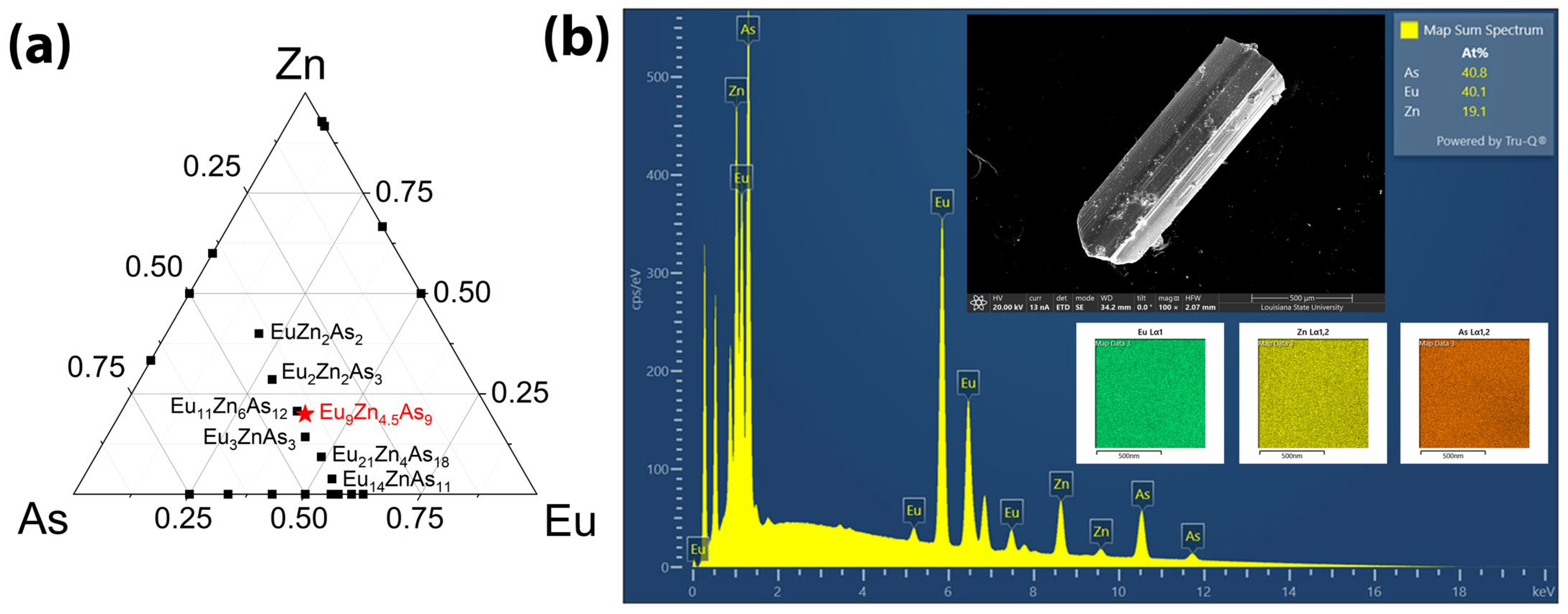
Another synthetic challenge worth mentioning here is the heavily populated Eu–Zn–As compositional space with already six reported ternary phases, EuZn2As2 [49], Eu2Zn2As3 [50], Eu11Zn6As12 [51], Eu3ZnAs3 [34], Eu21Zn4As18 [52,53], Eu14Zn1+xAs11 [54], alongside multiple binaries (Figure 1). The discovered compound falls between Eu11Zn6As12 [51] and Eu3ZnAs3 phases [34], which explains the presence of the latter as common impurity phases.
Interestingly, most of the reported ternary compounds in the Eu–Zn–As phase diagram possess unusual thermoelectric, electrical, and magnetic properties, as was exemplified for EuZn2As2 [55,56,57,58,59], Eu2Zn2As3 [50], Eu11Zn6As12 [51], Eu21Zn4As18 [60], and Eu14Zn1+xAs11 [61]. Arguably, further investigation of this compound will be warranted, which may yield the discovery of new and interesting physical properties.

3.2. Crystal Structure and Bonding

Formally, the structure of Eu9Zn4.5As9 belongs to the Ca9Mn4+xSb9 structure type (space group Pnma, Table 1) [32], although it has its own nuances; specifically, it is more disordered. In light of this, the structural description here will be brief, focusing on differences from the archetype.
Being only the second Zintl arsenide (apart from Ca9Zn4+xAs9) belonging to the 9–4–9 family (Table 1), the title Eu9Zn4.5As9 phase exemplifies a rare example of so-called 9–4–9 “supercell” [32,33] with a doubled unit cell volume, compared to the majority of the reported A9M4+xPn9 compositions (A = Ca, Sr, Eu, Yb; M = Mn, Zn, Cd; Pn = Sb, Bi, Table 1). Interestingly, recently discovered Mg-bearing Sr9Mg4+xPn9 (Pn = Sb, Bi) phases [33] are also isostructural to the “supercell” structure presented herein.
As can be expected, the unit cell volume of the Eu9Zn4.5As9 phase (~2276 Å3) is slightly larger than that of the only isostructural arsenide analog, Ca9Zn4+xAs9 (~2255 Å3) [32]. This difference is due to the larger atomic radius of Eu (1.98 Å) compared to that of Ca (1.76 Å) [62]. As a general rule, the majority of A9M4+xPn9 compounds favor smaller cations, such as Ca or Yb, and, in fewer instances, larger Sr and Eu have been found to form phases with these structures (Table 1). On this note, Eu9Zn4.5As9 exemplifies the first Eu-bearing 9–4–9 Zintl arsenide.
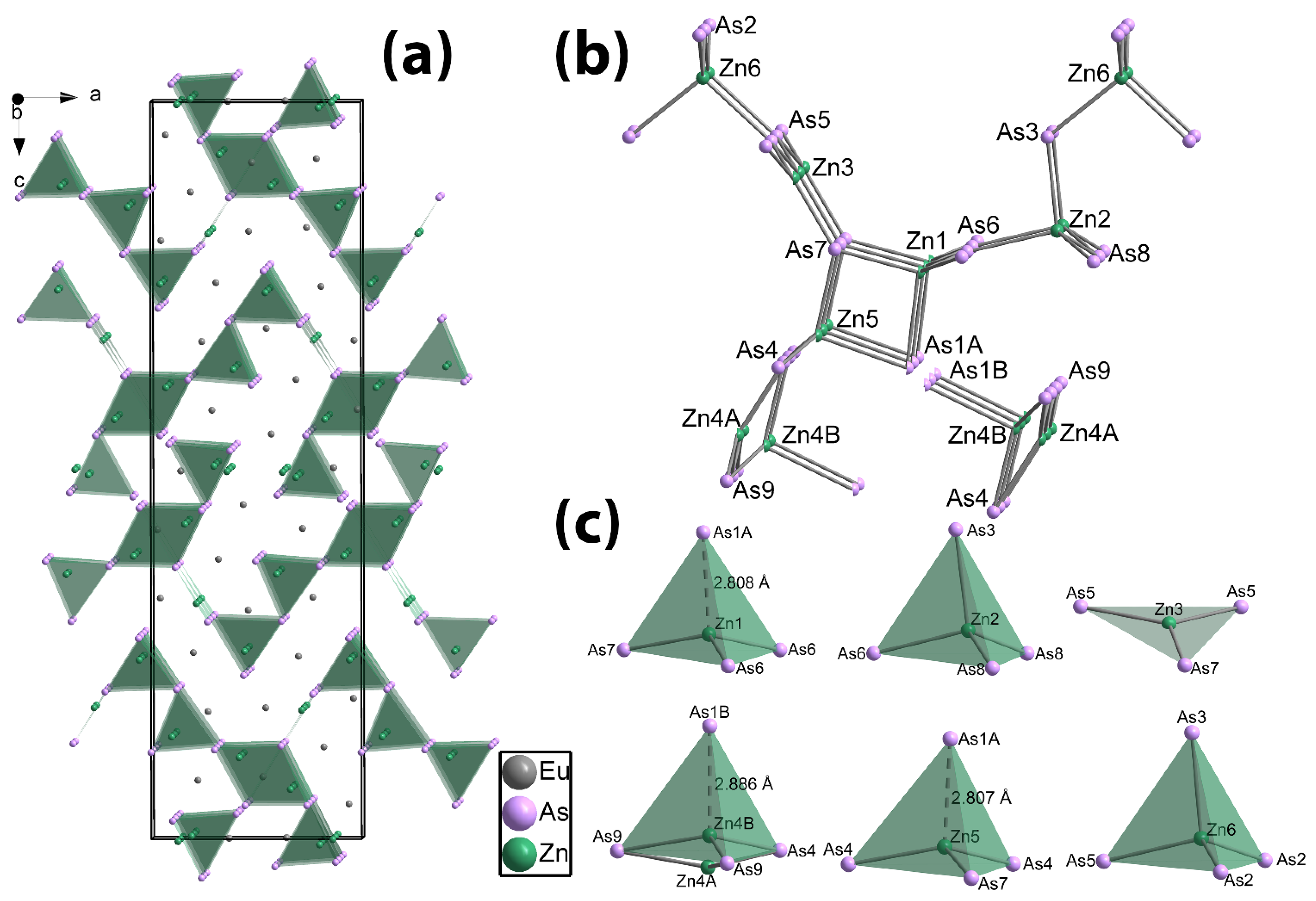
A schematic view of the orthorhombic crystal structure of Eu9Zn4.5As9 is shown in Figure 2a. The imaginary, disorderless structure can be described with the Wyckoff sequence c24, with 9 crystallographically independent Eu sites, 6 Zn sites, and 9 As sites all occupying special 4c positions. However, if all atomic positions are considered with full site occupancy factors (SOF), the resulting composition of (Eu2+)9(Zn2+)6(As−3)9 would significantly depart from being charge-balanced. On the other hand, the common trait of the structural chemistry of 9–4–9 compounds is the presence of partially occupied M sites (M = Mg, Mn, Zn, Cd), as inferred from the non-stoichiometric A9M4+xPn9 (though close to charge-balanced) compositions, quantified by the “x” value.
The Eu9Zn4.5As9 structure is not an exception, and it contains three Zn sites (Zn1, Zn3, and Zn5) with fractional SOFs of 0.485(3), 0.486(3), and 0.499(3), respectively, should they be refined unconstrained. Since all these values are very close to 0.5 (within 5σ), we fixed their occupancies to 50%. Assuming divalent Eu (which is confirmed by our magnetic property studies, vide infra), this model yields the charge-balanced (Eu2+)9(Zn2+)4.5(As−3)9 composition.
We do not, however, exclude the possibility that occupancies of these three Zn sites may vary from sample to sample, leading to Eu9Zn4+xAs9 compositions in which the x value slightly deviates from 0.5, akin to previously reported Sr9Mn4.45(1)Bi9 and Ca9Mn4.46(1)As9 [32]. Despite the predicted (semi)metallic behavior of the title compound, as discussed in Section 3.3, these small differences may slightly alter charge-carrier concentration and transport properties, similarly to the previously reported studies of thermoelectric properties of several other 9–4–9s [22,25,30,33,63,64]. In this context, the isovalent and aliovalent doping of these interstitial atoms can be viewed as an efficient mechanism to alter electrical transport properties and, therefore, potentially increase thermoelectric performance.
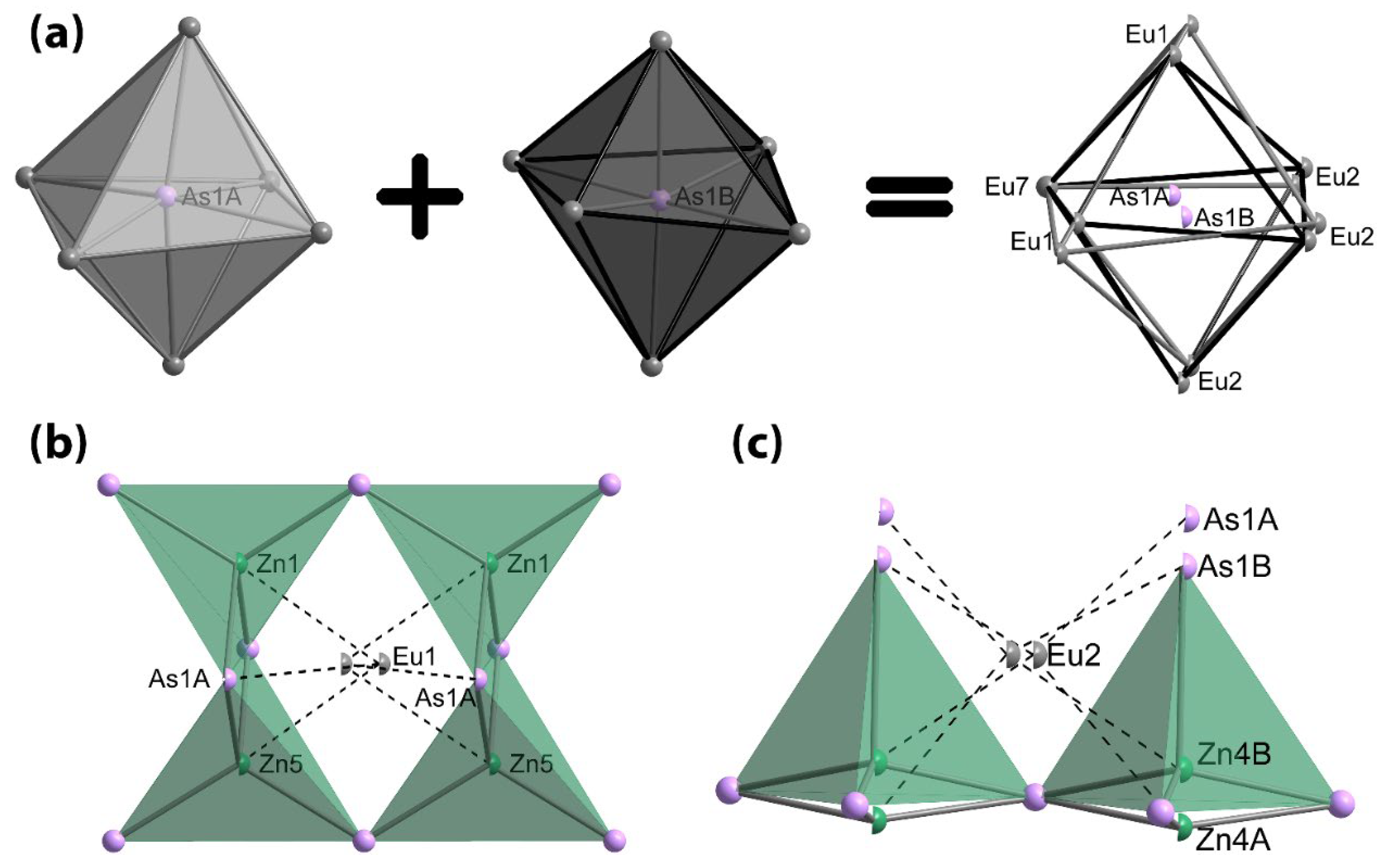
In addition, two Eu sites, Eu1 and Eu2, were modeled as split 8d sites, each with SOF of 0.5, due to the offset from the ac mirror plane. The 50% occupancy of Zn1 and Zn5 sites correlates with the split on Eu1 site, as shown in Figure 3b, in analogy to the previous reports on Sr9Mn4.45(1)Bi9 and Ca9Mn4.46(1)As9 [32]. The split on the Eu2 site, although less pronounced (as can be judged from the deviation of the y coordinate from ¼, Table 3), is not observed in these previously reported isostructural compounds for Sr2 and Ca2, making the title phase more disordered. This split, however, correlates with the concomitant split of Zn4 and As1 sites as illustrated in Figure 3c. Both sites were refined initially anisotropically and showed significantly elongated thermal ellipsoids, so after the modeled “split”, their occupancies were found to be very close to 0.5 (Table 3), comparable with the previous reports on Sr9Mn4.45(1)Bi9 and Ca9Mn4.46(1)As9. The correlation between positional disorder at the As1 and Eu1/Eu2 sites is also apparent, assuming that the As1 atom is octahedrally coordinated by Eu atoms, as shown in Figure 3c.
The elongation of the thermal parameter on As1 and consequent split into As1A and As1B positions is necessary to complete the tetrahedral coordination of partially occupied Zn4B, Zn1, and Zn5 (Figure 2c), avoiding unrealistically long interatomic Zn–As distances (Table 4). Such disorder is quite common for Zintl pnictides, and the nearly identical local structure arrangement was recently reported for the Eu14Zn5As12O phase [35].
Due to the lack of homoatomic As–As bonds, the anionic substructure of Eu9Zn4.5As9 is exclusively composed of Zn-centered polyhedra (Figure 2b). As shown in previous works, the unique crystal chemistry of Zn-bearing Zintl phases mainly originates from the versatility of Zn atoms to coordinate pnictogens in trigonal-planar and tetrahedral fashion [10,34,35,54,65,66,67,68]. In most cases, a partially occupied Zn site is associated with trigonal planar coordination, whereas fully occupied atoms tend to be tetrahedrally coordinated. While this is not always the case, as was recently shown for the Sr3ZnAs3 phase [34], the occupancy of metal often dictates the degree of protrusion from the As3 plane. In Figure 2c, the local coordination environments of all Zn sites are presented. Only for the fully occupied Zn2 and Zn6 atoms, the longest Zn–As contact does not exceed 2.76 Å, which is somewhat longer than the sum of covalent radii of Zn and As (~2.41 Å) [62] yet still indicates a sizable interaction. These two atoms also protrude the most from the As3 plane (~0.76 Å for Zn2 and 0.68 Å for Zn6), whereas the protrusion does not exceed ~0.56 Å for the partially occupied Zn atoms. The corresponding bond lengths fall in a wide range (Table 4), with all values being comparable to previous reports [49,50,51,52,53,54].
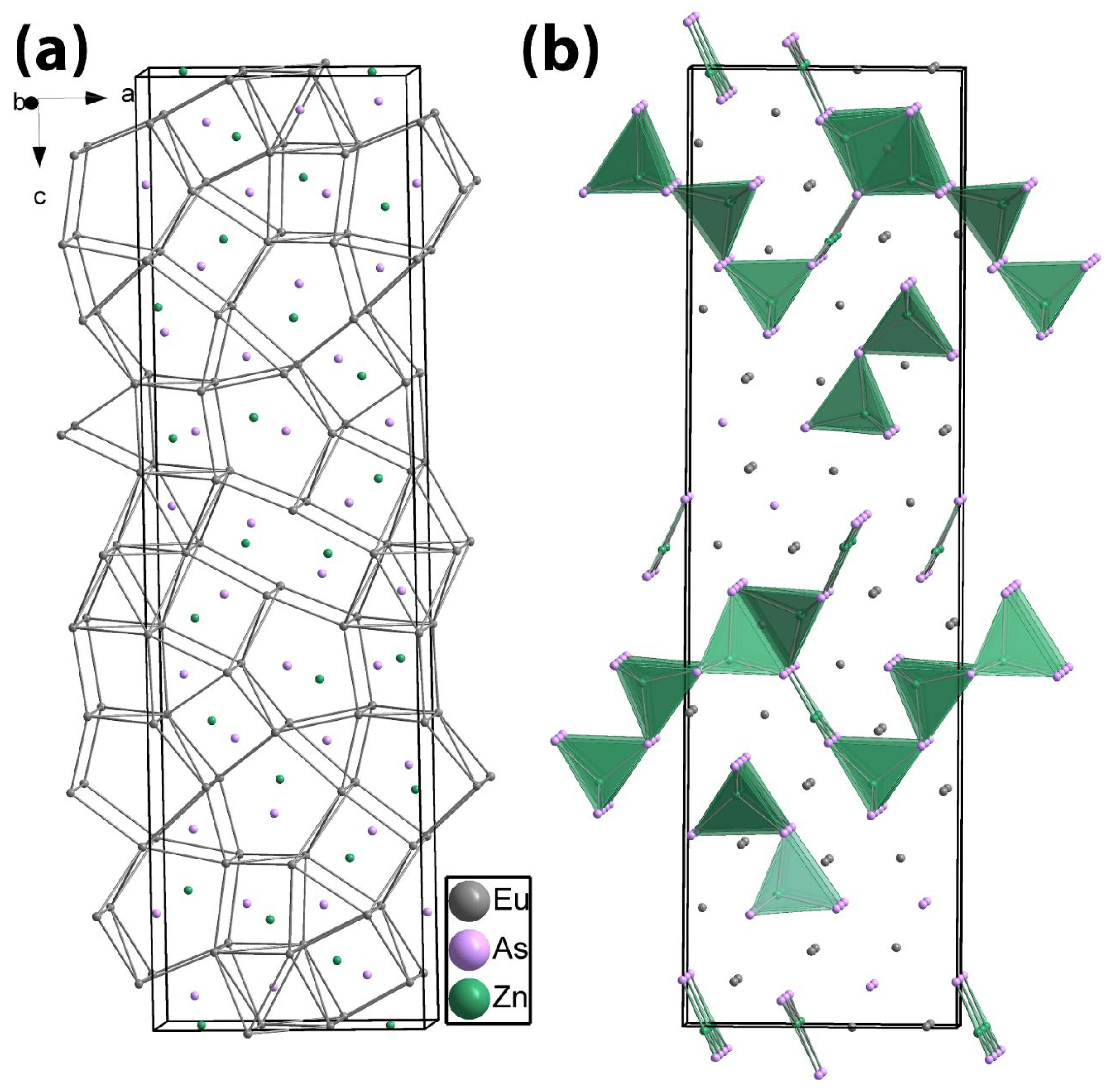
The corner- and edge-sharing arrangement of these [ZnAs4] and [ZnAs3] units (Figure 2c) composes the anionic substructure of Eu9Zn4.5As9, which can be described as a series of [Zn9As18]36− layers stacked along the c-direction (Figure 2a,b) and was discussed in a detailed manner in previous works [32,33]. Apparently, the 2D dimensionality of this assembly can be partially broken due to multiple partially occupied Zn and As sites, as exemplified in Figure 4b, which represents the disordered-free model used for the electronic structure calculations, vide infra. This needs to be considered when drawing structure-property relationships in the context of electronic and thermal transport. For instance, extensive disorder may reduce the lattice thermal conductivity, whereas doping with cations that prefer tetrahedral coordination, such as Al3+, Mn2+, or In3+, may prevent the dimensionality reduction and positively affect transport properties. These results will be presented in future studies.
At last, we would like to briefly discuss the complex arrangement of the lattice made of magnetic Eu2+ cations (Figure 4a). It is mainly composed of three main building units, typical for Zintl pnictides: (i) trigonal [Eu6] prisms, both empty and filled with As anions; (ii) distorted [Eu6] octahedra, which host disordered As1 atoms; and (iii) empty [As4] tetrahedra. There are several relatively close Eu–Eu contacts (shorter than 4.0 Å), which can be an indication of complex magnetic interactions and, potentially, anisotropy of the magnetic response.

3.3. Electronic Structure

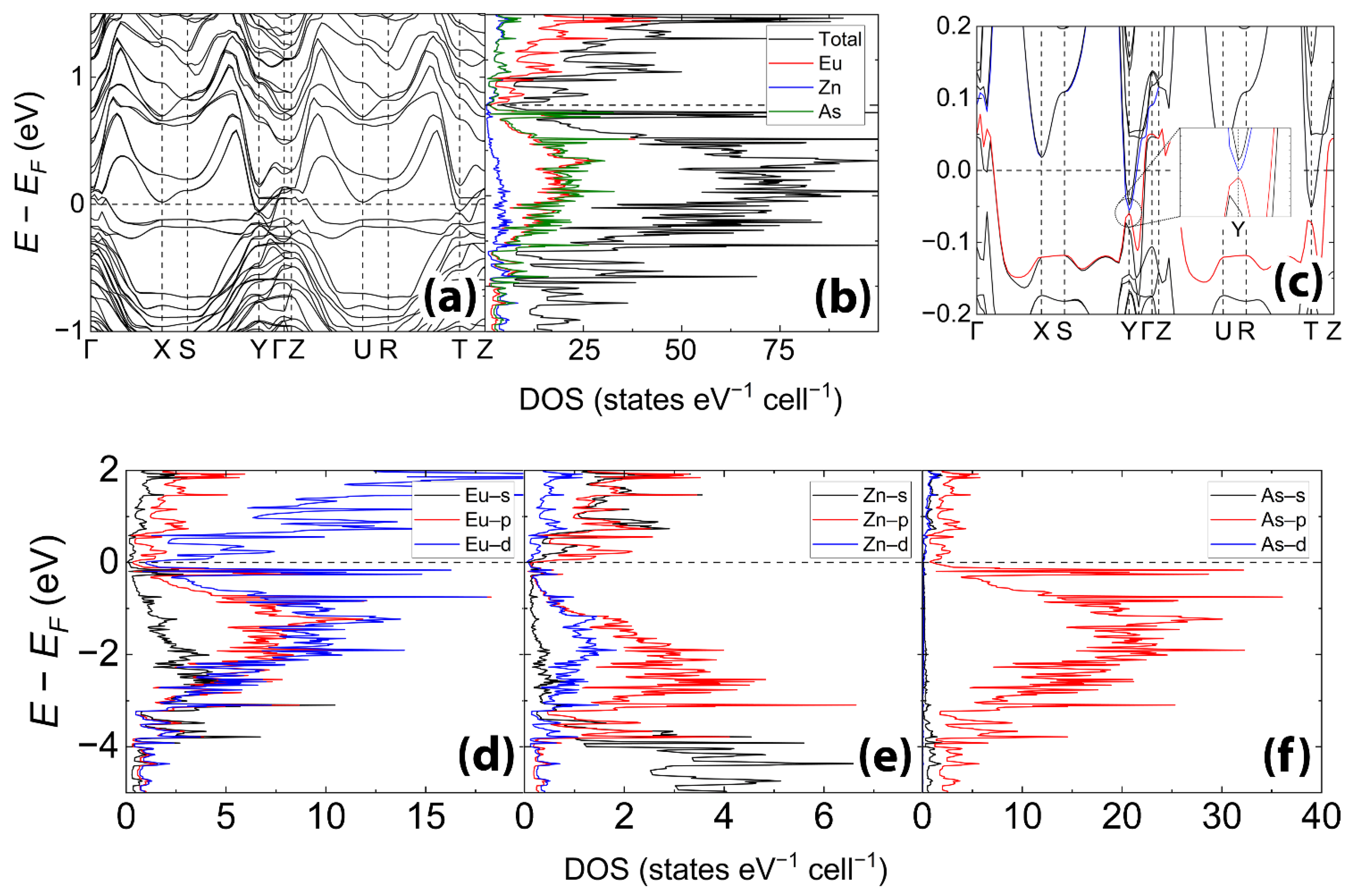
As discussed in the experimental section, a supercell model had to be constructed in order to address partially occupied sites when performing calculations on Eu9Zn4.5As9. This model is schematically represented in Figure 4b. Figure 5 shows the calculated density of states (DOS) and band structure for the title phase in the energy range of −5 to 2 eV. The Fermi level is set at 0 eV and indicated by the dashed line. A small pseudogap is observed in the DOS plot at the Fermi level.
Following the earlier discussion, the Eu9Zn4.5As9 formula is charge-balanced, and one should expect the bulk material to be a semiconductor, possibly with a narrow bandgap. From general considerations, viz., the electronegativity differences between the respective elements, many other Eu, Zn, and As-based materials should fall within the realm of semiconducting behavior. Yet these expectations are only partially corroborated by the electronic structure calculations for Eu9Zn4.5As9, where the gapless DOS plot indicates semimetallic behavior. A possible explanation for it is the partial covalency of the Eu–As interactions, which is not captured by the fully ionic (Eu2+)9(Zn2+)4.5(As3−)9 description. Evidence in support of this conjecture consists of the partial DOS curves and the large overlap of Eu and As states, which show that Eu–p, Eu–d, and As–p orbitals make up the majority of states below the Fermi level, with a lesser contribution from Zn–p states. The total and partial DOS plots exhibit features similar to those of other reported ternary Zintl pnictides [53].
Figure 4. (a) Idealized orthorhombic structure of Eu9Zn4.5As9 highlighting the complex scaffold of magnetic Eu2+ ions. The cutoff for the Eu–Eu contacts is ~4.43 Å. (b) ISODISTORT-derived disorder-free model of Eu9Zn4.5As9 used for the electronic structure calculations (space group Pmn21) drawn in polyhedral representation, emphasizing Zn-based tetrahedral and trigonal planar units. The color code is the same as in Figure 2. The unit cells are outlined.
Crystals 16 00137 g004
Also of note is the fact that in the band structure of Eu9Zn4.5As9, along the Y–Γ path (Figure 5c), the bands come extremely close to one another without crossing to form Dirac-like linearized points. This band feature has been found in other ternary topological insulating Zintl phases, such as EuAuSb [69], EuCd2As2 [70], and CaIn2As2 [11], which could indicate Eu9Zn4.5As9 as a possible nontrivial topological material. Computational studies exploring the role of spin–orbit coupling (SOC) and symmetry analyses, as well as more in-depth physical property measurements, could shed further light on the title phase’s electronic structure; however, these studies are beyond the scope of this work and will not be addressed here.
Figure 5. Calculated (a) band structure, (b) total density of states (DOS), and partial (PDOS) density of states for (d) Eu, (e) Zn, (f) As. An enlarged view of the band structure near the Fermi level is shown in (c) with the Dirac-like point at the Y k-point. The Fermi level is set at 0 eV as an energy reference.
Crystals 16 00137 g005

3.4. Magnetic Properties

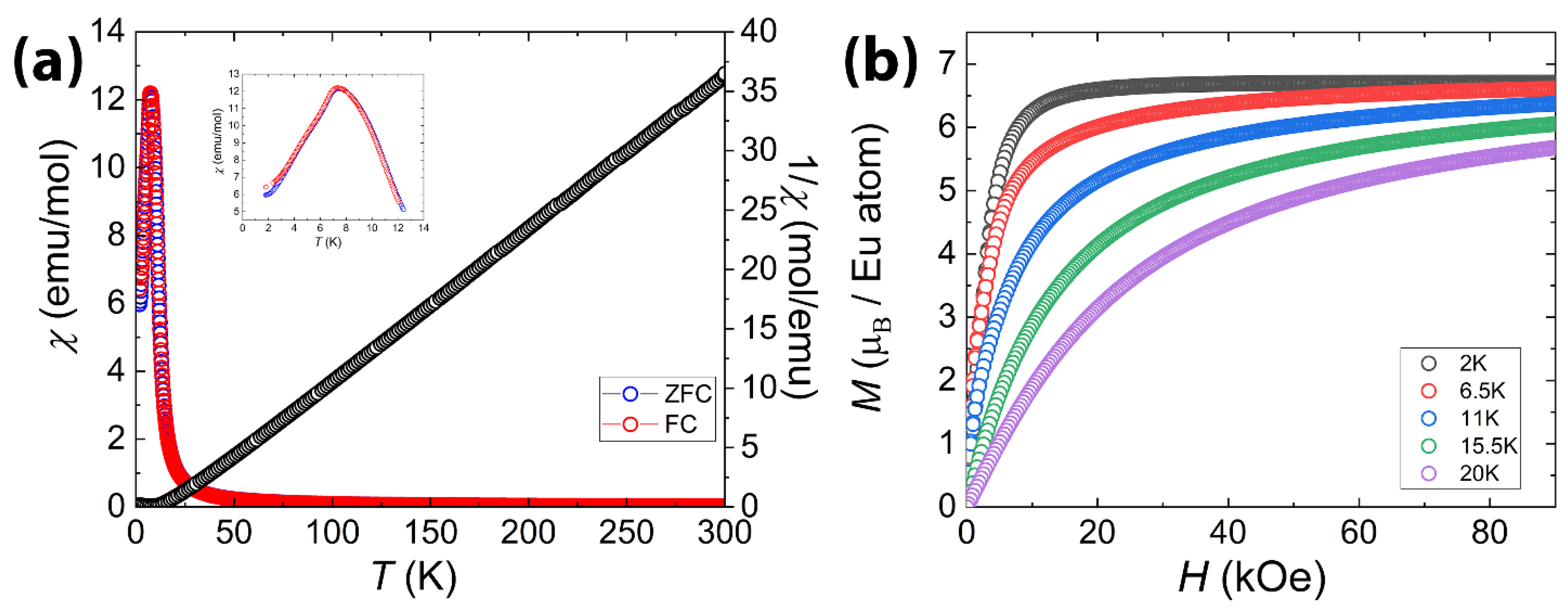
Temperature-dependent magnetic susceptibility of single-crystal Eu9Zn4.5As9 was measured under a magnetic field of 1 kOe applied along the b axis using both zero-field-cooled (ZFC) and field-cooled (FC) protocols (Figure 6a). At high temperatures, the magnetic susceptibility of Eu9Zn4.5As9 is well described by Curie–Weiss behavior (1)
χ(T) = C/(TθCW)
where C represents the Curie constant (emu·mol−1·K−1), given by C = NAµeff2/3kB (NA is Avogadro’s number, µeff is the effective magnetic moment, kB is the Boltzmann constant), and θCW denotes the Curie-Weiss temperature [71]. A fit to the susceptibility data over the temperature range 50–300 K yields an effective magnetic moment µeff = 7.9 µB and Weiss constant θCW = −2.15 K. The extracted effective moment is in excellent agreement with the theoretical free-ion value µth = 7.94 µB expected for divalent Eu2+ ions with electronic configuration [Xe] 4f7, total angular momentum J = 7/2, and Landé factor g = 2 [72]. The magnetization measurement further shows a saturation moment consistent with the theoretical value µsat = g J µB = 7.0 µB per Eu2+ ion (Figure 6b).
Upon cooling, the magnetic susceptibility of Eu9Zn4.5As9 exhibits a pronounced anomaly at the Néel temperature TN = 7.3 K (Figure 6a, inset), marking the onset of antiferromagnetic order. Below TN, a weak feature appears in the field-cooled susceptibility data near 4.9 K, accompanied by a small ZFC–FC bifurcation. Previously reported Eu-bearing 9–4–9 phases, Eu9Cd4.2Bi9 [26] and Eu9Cd4.45Sb9 [32], exhibit similar antiferromagnetic transitions at TN = 11 K and 10 K, respectively. Multiple other Eu-bearing Zintl arsenides also exhibit the antiferromagnetic transition, which is a common trait for Zintl chemistry of Eu [30,73,74,75,76,77,78,79,80,81,82,83]. In contrast, the Yb-containing representatives of this family display simple paramagnetic behavior along the low-temperature range [26,27].
Figure 6. Magnetic properties of a single crystal of Eu9Zn4.5As9. (a) Magnetic susceptibility (χ and χ−1), measured over the temperature range from 1.8 K to 300 K under zero-field-cooling (ZFC) and field-cooling (FC) conditions. (b) Magnetization isotherms measured at 2 K, 6.5K, 11 K, 15.5 K, and 20 K.
Crystals 16 00137 g006

4. Conclusions

In this work, we introduced another member of the heavily populated Eu–Zn–As system—a new Eu-bearing Zintl arsenide, Eu9Zn4.5As9. This compound has a complex, heavily disordered crystal structure, although the disorder is necessary to achieve a charge-balanced composition. Electronic structure calculations predict that this compound will likely behave like a (semi)metal, which, together with the presence of a complex framework of magnetic Eu2+ species, could lead to interesting physical properties, such as colossal magnetoresistance, complex magnetic interactions, or other quantum phenomena typical of other Zintl phases with such features. In addition, this compound can be thoroughly doped with iso- and aliovalent metal cations, such as Cd2+, Mn2+, Mg2+, Al3+, Ga3+, and In3+, which may allow for the possibility of excellent thermoelectric performance, which will be studied in future works.

Author Contributions

Conceptualization, S.B. (Sviatoslav Baranets); methodology, S.B. (Sviatoslav Baranets); validation, S.R.W. and O.P.; formal analysis, S.R.W., O.P., T.K. and S.B. (Sviatoslav Baranets); investigation, S.R.W., O.P. and S.B. (Sviatoslav Baranets); resources, S.B. (Sviatoslav Baranets), S.B. (Svilen Bobev) and X.B.; data curation, S.R.W., O.P., T.K. and B.T.; writing—original draft preparation, S.R.W. and O.P.; writing—review and editing, S.B. (Sviatoslav Baranets), S.B. (Svilen Bobev) and X.B.; visualization, S.R.W., O.P. and S.B. (Sviatoslav Baranets); supervision, S.B. (Sviatoslav Baranets); project administration, S.B. (Sviatoslav Baranets), S.B. (Svilen Bobev) and X.B.; funding acquisition, S.B. (Sviatoslav Baranets), S.B. (Svilen Bobev) and X.B. All authors have read and agreed to the published version of the manuscript.

Funding

S. Baranets acknowledges financial support from the U.S. National Science Foundation under Award No. DMR-2440354 and from the Louisiana State Board of Regents under Award LEQSF (2024-27)-RD-A-06. S. Bobev acknowledges financial support from the United States Department of Energy, Office of Science, Basic Energy Sciences, under Award #DE-SC0008885. X. Bai acknowledges financial support from the U.S. Department of Energy, Office of Science, Basic Energy Sciences, under Award Number DE-SC002542. X-ray crystallographic data were collected by the diffractometer funded by the NSF MRI award CHE-2215262.

Data Availability Statement

The corresponding crystallographic information files (CIF) have been deposited with the Cambridge Crystallographic Database Centre (CCDC) and can be obtained free of charge via https://www.ccdc.cam.ac.uk/structures/ (accessed on 10 January 2026) or by emailing data_request@ccdc.cam.ac.uk with the following depository number: 2523214. Other raw data is available upon request.

Acknowledgments

Scanning electron microscopy was performed at the Advanced Microscopy and Analytical Core (AMAC) at Louisiana State University.

Conflicts of Interest

The authors declare no conflicts of interest.

References

  1. Nesper, R. The Zintl-Klemm concept—A historical survey. Z. Anorg. Allg. Chem. 2014, 640, 2639–2648. [Google Scholar] [CrossRef]
  2. Kauzlarich, S.M. Zintl phases: From curiosities to impactful materials. Chem. Mater. 2023, 35, 7355–7362. [Google Scholar] [CrossRef] [PubMed]
  3. Ovchinnikov, A.; Bobev, S. Zintl phases with group 15 elements and the transition metals: A brief overview of pnictides with diverse and complex structures. J. Solid State Chem. 2019, 270, 346–359. [Google Scholar] [CrossRef]
  4. Liu, K.-F.; Xia, S.-Q. Recent progresses on thermoelectric Zintl phases: Structures, materials and optimization. J. Solid State Chem. 2019, 270, 252–264. [Google Scholar] [CrossRef]
  5. Kauzlarich, S.M.; Zevalkink, A.; Toberer, E.; Snyder, G.J. Zintl phases: Recent developments in thermoelectrics and future outlook. In Thermoelectric Materials and Devices; Elsevier: Amsterdam, The Netherlands, 2016. [Google Scholar]
  6. Kauzlarich, S.M.; Devlin, K.P.; Perez, C.J. Zintl phases for thermoelectric applications. In Thermoelectric Energy Conversion; Elsevier: Amsterdam, The Netherlands, 2021; pp. 157–182. [Google Scholar]
  7. Islam, M.M.; Kauzlarich, S.M. The Potential of Arsenic-Based Zintl Phases as Thermoelectric Materials: Structure & Thermoelectric Properties. Z. Anorg. Allg. Chem. 2023, 649, e202300149. [Google Scholar]
  8. Luo, D.B.; Wang, Y.X.; Yan, Y.L.; Yang, G.; Yang, J.M. The high thermopower of the Zintl compound Sr5Sn2As6 over a wide temperature range: First-principles calculations. J. Mater. Chem. 2014, 2, 15159–15167. [Google Scholar] [CrossRef]
  9. Yan, Y.L.; Wang, Y.X.; Zhang, G.B. Electronic structure and thermoelectric performance of Zintl compound Ca5Ga2As6. J. Mater. Chem. 2012, 22, 20284–20290. [Google Scholar] [CrossRef]
  10. Devlin, K.P.; Kazem, N.; Zaikina, J.V.; Cooley, J.A.; Badger, J.R.; Fettinger, J.C.; Taufour, V.; Kauzlarich, S.M. Eu11Zn4Sn2As12: A ferromagnetic Zintl semiconductor with a layered structure featuring extended Zn4As6 Sheets and ethane-like Sn2As6 units. Chem. Mater. 2018, 30, 7067–7076. [Google Scholar] [CrossRef]
  11. Ogunbunmi, M.O.; Baranets, S.; Childs, A.B.; Bobev, S. The Zintl phases AIn2As2 (A=Ca, Sr, Ba): New topological insulators and thermoelectric material candidates. Dalton Trans. 2021, 50, 9173–9184. [Google Scholar] [CrossRef]
  12. Li, H.; Gao, W.; Chen, Z.; Chu, W.; Nie, Y.; Ma, S.; Han, Y.; Wu, M.; Li, T.; Niu, Q. Magnetic properties of the layered magnetic topological insulator EuSn2As2. Phys. Rev. B 2021, 104, 054435. [Google Scholar] [CrossRef]
  13. Xu, Y.; Song, Z.; Wang, Z.; Weng, H.; Dai, X. Higher-order topology of the axion insulator EuIn2As2. Phys. Rev. Lett. 2019, 122, 256402. [Google Scholar] [CrossRef]
  14. Zhou, Z.; Wang, Z.; Chen, X.; Lu, J.-Y.; Zhang, J.; Luo, X.; Cao, G.-H.; Dong, S.; Wang, Z.-C. Unusual magnetic and transport properties in the Zintl phase Eu11Zn6As12. Phys. Rev. Mater. 2024, 8, 114421. [Google Scholar] [CrossRef]
  15. Cao, W.; Yang, H.; Li, Y.; Pei, C.; Wang, Q.; Zhao, Y.; Li, C.; Zhang, M.; Zhu, S.; Wu, J. Pressure-induced superconductivity in the Zintl topological insulator SrIn2As2. Phys. Rev. B 2023, 108, 224510. [Google Scholar] [CrossRef]
  16. Rotter, M.; Pangerl, M.; Tegel, M.; Johrendt, D. Superconductivity and crystal structures of (Ba1−xKx)Fe2As2 (x = 0–1). Angew. Chem. Int. Ed. 2008, 47, 7949–7952. [Google Scholar] [CrossRef] [PubMed]
  17. Balguri, S.; Mahendru, M.B.; Delgado, E.O.G.; Fruhling, K.; Yao, X.; Graf, D.E.; Rodriguez-Rivera, J.A.; Aczel, A.A.; Hicken, T.J.; Luetkens, H. Two types of colossal magnetoresistance with distinct mechanisms in Eu5In2As6. Phys. Rev. B 2025, 111, 115114. [Google Scholar] [CrossRef]
  18. Brechtel, E.; Cordier, G.; Schafer, H. Darstellung und kristallstruktur von Ca9Mn4Bi9 und Ca9Zn4Bi9/preparation and crystal structure of Ca9Mn4Bi9 and Ca9Zn4Bi9. Z. Naturforsch. B 1979, 34, 1229–1233. [Google Scholar] [CrossRef]
  19. Brechtel, E.; Cordier, G.; Schäfer, H. Neue Verbindungen mit der Ca9Mn4Bi9-Struktur: Zur Kenntnis von Ca9Cd4Bi9, Sr9Cd4Bi9 und Ca9Zn4Sb9/New Compounds with the Ca9Mn4Bi9 Structure: Ca9Cd4Bi9, Sr9Cd4Bi9, and Ca9Zn4Sb9. Z. Naturforsch. B 1981, 36, 1099–1104. [Google Scholar] [CrossRef]
  20. Bobev, S.; Thompson, J.D.; Sarrao, J.L.; Olmstead, M.M.; Hope, H.; Kauzlarich, S.M. Probing the Limits of the Zintl Concept: Structure and bonding in rare-earth and alkaline-earth zinc-antimonides Yb9Zn4+xSb9 and Ca9Zn4.5Sb9. Inorg. Chem. 2004, 43, 5044–5052. [Google Scholar] [CrossRef]
  21. Chen, C.; Xue, W.; Li, X.; Lan, Y.; Zhang, Z.; Wang, X.; Zhang, F.; Yao, H.; Li, S.; Sui, J. Enhanced Thermoelectric Performance of Zintl Phase Ca9Zn4+xSb9 by Beneficial Disorder on the Selective Cationic Site. ACS Appl. Mater. Interfaces 2019, 11, 37741–37747. [Google Scholar] [CrossRef]
  22. Ohno, S.; Aydemir, U.; Amsler, M.; Pöhls, J.H.; Chanakian, S.; Zevalkink, A.; White, M.A.; Bux, S.K.; Wolverton, C.; Snyder, G.J. Achieving zT > 1 in inexpensive zintl phase Ca9Zn4+xSb9 by phase boundary mapping. Adv. Funct. Mater. 2017, 27, 1606361. [Google Scholar] [CrossRef]
  23. Seo, N.; Lee, J.; Lee, Y.; Choi, M.-H.; Pi, J.H.; Lee, K.H.; Ok, K.M.; You, T.-S. Synergistic effect of cation substitution and p-type anion doping to improve thermoelectric properties in Zintl phases. Energy Mater. 2025, 5, 500123. [Google Scholar] [CrossRef]
  24. Smiadak, D.M.; Baranets, S.; Rylko, M.; Marshall, M.; Calderón-Cueva, M.; Bobev, S.; Zevalkink, A. Single crystal growth and characterization of new Zintl phase Ca9Zn3.1In0.9Sb9. J. Solid State Chem. 2021, 296, 121947. [Google Scholar] [CrossRef]
  25. Lee, J.; Kim, M.; Pi, J.H.; Choi, M.-H.; Ok, K.M.; Lee, K.H.; You, T.-S. Insights into the Crystal Structure and Thermoelectric Properties of the Zintl Phase Ca9Cd3+x–yMx+ySb9 (M=Cu, Zn) System. Chem. Mater. 2024, 37, 368–377. [Google Scholar] [CrossRef]
  26. Xia, S.-Q.; Bobev, S. Interplay Between Size and Electronic Effects in Determining the Homogeneity Range of the A9Zn4+xPn9 and A9Cd4+xPn9 Phases (0 ≤ x ≤ 0.5), A=Ca, Sr, Yb, Eu; Pn=Sb, Bi. J. Am. Chem. Soc. 2007, 129, 10011–10018. [Google Scholar] [CrossRef]
  27. Xia, S.-Q.; Bobev, S. New manganese-bearing antimonides and bismuthides with complex structures. Synthesis, structural characterization, and electronic properties of Yb9Mn4+xPn9 (Pn=Sb or Bi). Chem. Mater. 2010, 22, 840–850. [Google Scholar] [CrossRef]
  28. Kazem, N.; Hurtado, A.; Klobes, B.; Hermann, R.l.P.; Kauzlarich, S.M. Eu9Cd4–xCM2+x–y□ySb9: Ca9Mn4Bi9-Type Structure Stuffed with Coinage Metals (Cu, Ag, and Au) and the Challenges with Classical Valence Theory in Describing These Possible Zintl Phases. Inorg. Chem. 2015, 54, 850–859. [Google Scholar] [CrossRef]
  29. Bux, S.K.; Zevalkink, A.; Janka, O.; Uhl, D.; Kauzlarich, S.; Snyder, J.G.; Fleurial, J.-P. Glass-like lattice thermal conductivity and high thermoelectric efficiency in Yb9Mn4.2Sb9. J. Mater. Chem. 2014, 2, 215–220. [Google Scholar] [CrossRef]
  30. Liu, X.-C.; Liu, K.-F.; Wang, Q.-Q.; Wang, Y.-M.; Pan, M.-Y.; Xia, S.-Q. Exploring New Zintl Phases in the 9-4-9 Family via Al Substitution. Synthesis, Structure, and Physical Properties of Ae9Mn4−xAlxSb9 (Ae=Ca, Yb, Eu). Inorg. Chem. 2020, 59, 3709–3717. [Google Scholar] [CrossRef]
  31. Kim, S.-J.; Salvador, J.; Bilc, D.; Mahanti, S.; Kanatzidis, M.G. Yb9Zn4Bi9: Extension of the Zintl concept to the mixed-valent spectator cations. J. Am. Chem. Soc. 2001, 123, 12704–12705. [Google Scholar] [CrossRef]
  32. Liu, X.-C.; Wu, Z.; Xia, S.-Q.; Tao, X.-T.; Bobev, S. Structural variability versus structural flexibility. A case study of Eu9Cd4+xSb9 and Ca9Mn4+xSb9 (x ≈ 1/2). Inorg. Chem. 2015, 54, 947–955. [Google Scholar] [CrossRef]
  33. Zhang, J.; Liu, Q.; Liu, K.-F.; Tan, W.-J.; Liu, X.-C.; Xia, S.-Q. Sr9Mg4.45(1)Bi9 and Sr9Mg4.42(1)Sb9: Mg-containing Zintl phases with low thermal conductivity. Inorg. Chem. 2021, 60, 4026–4033. [Google Scholar] [CrossRef] [PubMed]
  34. Baranets, S.; Balvanz, A.; Darone, G.M.; Bobev, S. On the effects of aliovalent substitutions in thermoelectric Zintl pnictides. varied polyanionic dimensionality and complex structural transformations—The case of Sr3ZnP3 vs Sr3AlxZn1−xP3. Chem. Mater. 2022, 34, 4172–4185. [Google Scholar] [CrossRef]
  35. Ishtiyak, M.; Watts, S.R.; Thipe, B.; Womack, F.; Adams, P.; Bai, X.; Young, D.P.; Bobev, S.; Baranets, S. Advancing Heteroanionicity in Zintl Phases: Crystal Structures, Thermoelectric and Magnetic Properties of Two Quaternary Semiconducting Arsenide Oxides, Eu8Zn2As6O and Eu14Zn5As12O. Inorg. Chem. 2024, 63, 20226–20239. [Google Scholar] [CrossRef] [PubMed]
  36. SAINT, version 2.03; BrukerAXS Inc.: Madison, WI, USA, 2014.
  37. SADABS, version 2.03; BrukerAXS Inc.: Madison, WI, USA, 2014.
  38. Sheldrick, G.M. SHELXT–Integrated space-group and crystal-structure determination. Acta Crystallogr. A 2015, 71, 3–8. [Google Scholar] [CrossRef]
  39. Sheldrick, G.M. Crystal structure refinement with SHELXL. Acta Crystallogr. C 2015, 71, 3–8. [Google Scholar] [CrossRef]
  40. Dolomanov, O.V.; Bourhis, L.J.; Gildea, R.J.; Howard, J.A.; Puschmann, H. OLEX2: A complete structure solution, refinement and analysis program. J. Appl. Crystallogr. 2009, 42, 339–341. [Google Scholar] [CrossRef]
  41. Gelato, L.; Parthé, E. STRUCTURE TIDY—A computer program to standardize crystal structure data. J. Appl. Crystallogr. 1987, 20, 139–143. [Google Scholar] [CrossRef]
  42. Kresse, G.; Furthmüller, J. Efficient iterative schemes for ab initio total-energy calculations using a plane-wave basis set. Phys. Rev. B 1996, 54, 11169. [Google Scholar] [CrossRef]
  43. Perdew, J.P.; Ruzsinszky, A.; Csonka, G.I.; Vydrov, O.A.; Scuseria, G.E.; Constantin, L.A.; Zhou, X.; Burke, K. Generalized gradient approximation for solids and their surfaces. arXiv 2007, arXiv:0707.2088. [Google Scholar] [CrossRef]
  44. Blöchl, P.E. Projector augmented-wave method. Phys. Rev. B 1994, 50, 17953. [Google Scholar] [CrossRef]
  45. Wang, V.; Xu, N.; Liu, J.-C.; Tang, G.; Geng, W.-T. VASPKIT: A user-friendly interface facilitating high-throughput computing and analysis using VASP code. Comput. Phys. Commun. 2021, 267, 108033. [Google Scholar] [CrossRef]
  46. Campbell, B.J.; Stokes, H.T.; Tanner, D.E.; Hatch, D.M. ISODISPLACE: A web-based tool for exploring structural distortions. Appl. Crystallogr. 2006, 39, 607–614. [Google Scholar] [CrossRef]
  47. Stokes, H.T.; Hatch, D.M.; Campbell, B.J. ISOTROPY Software Suite. Available online: https://iso.byu.edu/ (accessed on 5 January 2026).
  48. Baranets, S.; He, H.; Bobev, S. Niobium-bearing arsenides and germanides from elemental mixtures not involving niobium: A new twist to an old problem in solid-state synthesis. Acta Crystallogr. C 2018, 74, 623–627. [Google Scholar] [CrossRef] [PubMed]
  49. Klüfers, P.; Neumann, H.; Mewis, A.; SCHUSTER, H. AB2X2-Verbindungen im CaAl2Si2-Typ. VIII. Z. Krist. Mater. 1980, 149, 211–226. [Google Scholar] [CrossRef]
  50. Stoyko, S.S.; Khatun, M.; Mar, A. Ternary arsenides A2Zn2As3 (A=Sr, Eu) and their stuffed derivatives A2Ag2ZnAs3. Inorg. Chem. 2012, 51, 2621–2628. [Google Scholar] [CrossRef]
  51. Saparov, B.; Bobev, S. Undecaeuropium hexazinc dodecaarsenide. Acta Crystallogr. E 2010, 66, i24. [Google Scholar] [CrossRef]
  52. Suen, N.-T.; Wang, Y.; Bobev, S. Synthesis, crystal structures, and physical properties of the new Zintl phases A21Zn4Pn18 (A=Ca, Eu; Pn=As, Sb)—Versatile arrangements of [ZnPn4] tetrahedra. J. Solid State Chem. 2015, 227, 204–211. [Google Scholar] [CrossRef]
  53. Ishtiyak, M.; Watts, S.R.; Pokhvata, O.; Kandabadage, T.; Baranets, S. Complex Structural Disorder in Thermoelectric Zintl Phases Eu21M4As18 (M=Mn, Zn). Z. Anorg. Allg. Chem. 2025, 651, e202500070. [Google Scholar] [CrossRef]
  54. Baranets, S.; Darone, G.M.; Bobev, S. Synthesis and structure of Sr14Zn1+xAs11 and Eu14Zn1+xAs11 (x ≤ 0.5). New members of the family of pnictides isotypic with Ca14AlSb11, exhibiting a new type of structural disorder. J. Solid State Chem. 2019, 280, 120990. [Google Scholar] [CrossRef]
  55. Kong, D.; Karbasizadeh, S.; Narasimha, G.; Regmi, P.; Tao, C.; Mu, S.; Vasudevan, R.; Harrison, I.; Jin, R.; Gai, Z. Large bandgap observed on the surfaces of EuZn2As2 single crystals. Commun. Phys. 2025, 8, 287. [Google Scholar] [CrossRef]
  56. Wang, Z.-C.; Been, E.; Gaudet, J.; Alqasseri, G.M.A.; Fruhling, K.; Yao, X.; Stuhr, U.; Zhu, Q.; Ren, Z.; Cui, Y. Anisotropy of the magnetic and transport properties of EuZn2As2. Phys. Rev. B 2022, 105, 165122. [Google Scholar] [CrossRef]
  57. Blawat, J.; Marshall, M.; Singleton, J.; Feng, E.; Cao, H.; Xie, W.; Jin, R. Unusual electrical and magnetic properties in layered EuZn2As2. Adv. Quantum Technol. 2022, 5, 2200012. [Google Scholar] [CrossRef]
  58. Bukowski, Z.; Rybicki, D.; Babij, M.; Przewoźnik, J.; Gondek, Ł.; Żukrowski, J.; Kapusta, C. Canted antiferromagnetic order in EuZn2As2 single crystals. Sci. Rep. 2022, 12, 14718. [Google Scholar] [CrossRef]
  59. Regmi, P.; Blawat, J.; Jin, R. Large unconventional Hall effect observed in EuZn2As2. Phys. Rev. B 2025, 111, 014422. [Google Scholar] [CrossRef]
  60. Islam, M.M.; Wróblewska, M.; Shen, Z.; Toberer, E.S.; Taufour, V.; Kauzlarich, S.M. Magnetism and Thermoelectric Properties of the Zintl Semiconductor: Eu21Zn4As18. Chem. Mater. 2024, 36, 11499–11508. [Google Scholar] [CrossRef] [PubMed]
  61. Islam, M.M.; Zheng, J.; Pike, A.; Star, K.E.; Bux, S.K.; Hautier, G.; Kauzlarich, S.M. Diffuson-Driven Lattice Thermal Conductivity in Zintl Arsenides: Disrupting Mass-Thermal Conductivity Relation for High Thermoelectric Performance. J. Am. Chem. Soc. 2025, 147, 42883–42893. [Google Scholar] [CrossRef]
  62. Cordero, B.; Gómez, V.; Platero-Prats, A.E.; Revés, M.; Echeverría, J.; Cremades, E.; Barragán, F.; Alvarez, S. Covalent radii revisited. Dalton Trans. 2008, 21, 2832–2838. [Google Scholar] [CrossRef]
  63. Xue, W.; Chen, C.; Nan, P.; Long, Y.; Ge, B.; Zhang, Q.; Wang, Y. Decoupling electrical conductivity and Seebeck coefficient via isoelectronic alloying in the 9-4-9-type Ca9−yEuyZn4.7Sb9 (0 ≤ y ≤ 5.0) Zintl phase. J. Mater. Chem. 2026, 14, 4396–4403. [Google Scholar] [CrossRef]
  64. Kazem, N.; Zaikina, J.V.; Ohno, S.; Snyder, G.J.; Kauzlarich, S.M. Coinage-metal-stuffed Eu9Cd4Sb9: Metallic compounds with anomalous low thermal conductivities. Chem. Mater. 2015, 27, 7508–7519. [Google Scholar] [CrossRef]
  65. Wang, J.; Yox, P.; Voyles, J.; Kovnir, K. Synthesis, crystal structure, and properties of three La–Zn–P compounds with different dimensionalities of the Zn–P framework. Cryst. Growth Des. 2018, 18, 4076–4083. [Google Scholar] [CrossRef]
  66. Wilson, D.K.; Saparov, B.; Bobev, S. Synthesis, crystal structures and properties of the Zintl phases Sr2ZnP2, Sr2ZnAs2, A2ZnSb2 and A2ZnBi2 (A=Sr and Eu). Z. Anorg. Allg. Chem. 2011, 637, 2018–2025. [Google Scholar] [CrossRef]
  67. Gvozdetskyi, V.; Lee, S.J.; Owens-Baird, B.; Dolyniuk, J.-A.; Cox, T.; Wang, R.; Lin, Z.; Ho, K.-M.; Zaikina, J.V. Ternary Zinc Antimonides Unlocked Using Hydride Synthesis. Inorg. Chem. 2021, 60, 10686–10697. [Google Scholar] [CrossRef] [PubMed]
  68. Devlin, K.P.; Zhang, J.; Fettinger, J.C.; Choi, E.S.; Hauble, A.K.; Taufour, V.; Hermann, R.P.; Kauzlarich, S.M. Deconvoluting the Magnetic Structure of the Commensurately Modulated Quinary Zintl Phase Eu11−xSrxZn4Sn2As12. Inorg. Chem. 2021, 60, 5711–5723. [Google Scholar] [CrossRef] [PubMed]
  69. Ram, D.; Singh, J.; Banerjee, S.; Sundaresan, A.; Samal, D.; Kanchana, V.; Hossain, Z. Magnetotransport and electronic structure of EuAuSb: A candidate antiferromagnetic Dirac semimetal. Phys. Rev. B 2024, 109, 155152. [Google Scholar] [CrossRef]
  70. Li, B.-X.; Song, Z.; Fang, Z.; Wang, Z.; Weng, H. Manipulation of topological phase transitions and the mechanism of magnetic interactions in Eu-based Zintl-phase materials. Phys. Rev. B 2025, 111, 205127. [Google Scholar] [CrossRef]
  71. Mugiraneza, S.; Hallas, A.M. Tutorial: A beginner’s guide to interpreting magnetic susceptibility data with the Curie-Weiss law. Commun. Phys. 2022, 5, 95. [Google Scholar] [CrossRef]
  72. Kittel, C.; McEuen, P. Introduction to Solid State Physics; John Wiley & Sons: Hoboken, NJ, USA, 2018. [Google Scholar]
  73. Wu, D.; Na, S.; Li, Y.; Zhou, X.; Wu, W.; Song, Y.; Zheng, P.; Li, Z.; Luo, J. Single-crystal growth, structure and thermal transport properties of the metallic antiferromagnet Zintl-phase β-EuIn2As2. Phys. Chem. Chem. Phys. 2024, 26, 8695–8703. [Google Scholar] [CrossRef]
  74. Radzieowski, M.; Stegemann, F.; Klenner, S.; Zhang, Y.; Fokwa, B.P.; Janka, O. On the divalent character of the Eu atoms in the ternary zintl phases Eu5In2Pn6 and Eu3MAs3 (Pn=As–Bi; M=Al, Ga). Mater. Chem. Front. 2020, 4, 1231–1248. [Google Scholar] [CrossRef]
  75. Weippert, V.; Haffner, A.; Stamatopoulos, A.; Johrendt, D. Supertetrahedral layers based on GaAs or InAs. J. Am. Chem. Soc. 2019, 141, 11245–11252. [Google Scholar] [CrossRef]
  76. Goforth, A.M.; Klavins, P.; Fettinger, J.C.; Kauzlarich, S.M. Magnetic properties and negative colossal magnetoresistance of the rare earth zintl phase EuIn2As2. Inorg. Chem. 2008, 47, 11048–11056. [Google Scholar] [CrossRef]
  77. Gebre, M.S.; Jiang, Z.; Riedel, Z.W.; Pappas, E.A.; Zhou, H.; Schleife, A.; Shoemaker, D.P. Unique structure type and antiferromagnetic ordering in semiconducting Eu2InSnP3. Chem. Mater. 2025, 37, 6118–6126. [Google Scholar] [CrossRef]
  78. Day, R.; Yamakawa, K.; Cairns, L.P.; Singleton, J.; Cao, W.; Wu, C.; Allen, M.; Moore, J.; Analytis, J.G. Colossal magnetoresistance and anisotropic spin dynamics in the antiferromagnetic semiconductor Eu5Sn2As6. Phys. Rev. B 2025, 111, 054406. [Google Scholar] [CrossRef]
  79. Fender, S.; Thomas, S.; Ronning, F.; Bauer, E.; Thompson, J.; Rosa, P. Narrow-gap semiconducting behavior in antiferromagnetic Eu11InSb9. Phys. Rev. Mater. 2021, 5, 074603. [Google Scholar] [CrossRef]
  80. Wu, Y.; Li, T.; Chen, X.; Liu, Z.; Li, Y.; Shang, Z.; Zheng, X.; Tian, H.; Wang, Z.; Bi, Y. Surface Half-Metallicity and Electronic Structure Evolution in A-Type Antiferromagnet EuIn2P2. Nano Lett. 2025, 25, 10419–10426. [Google Scholar] [CrossRef]
  81. Souza, J.C.; Thomas, S.; Bauer, E.; Thompson, J.; Ronning, F.; Pagliuso, P.; Rosa, P. Microscopic probe of magnetic polarons in antiferromagnetic Eu5In2Sb6. Phys. Rev. B 2022, 105, 035135. [Google Scholar] [CrossRef]
  82. Ma, X.; Lu, J.; Whalen, J.B.; Latturner, S.E. Flux growth and magnetoresistance behavior of rare earth Zintl phase EuMgSn. Inorg. Chem. 2013, 52, 3342–3348. [Google Scholar] [CrossRef]
  83. Cook, M.S.; Peterson, E.A.; Kengle, C.S.; Kennedy, E.; Sheeran, J.; Girod, C.; Freitas, G.; Greer, S.M.; Abbamonte, P.; Pagliuso, P. Magnetic polaron formation in EuZn2P2. Phys. Rev. Mater. 2025, 9, 104403. [Google Scholar] [CrossRef]
Figure 1. (a) Ternary Eu–Zn–As compositional diagram and (b) energy-dispersive X-ray spectroscopy analysis of Eu9Zn4.5As9. The newly discovered Eu9Zn4.5As9 phase is marked as a red star. The inserts show the electron microscope image of the synthesized needle-like crystal and elemental mapping of the material.
Crystals 16 00137 g001
Figure 2. (a) Schematic representation of the unit cell of Eu9Zn4.5As9, viewed along the b-axis. The unit cell is outlined. The structure is drawn in polyhedral representation with marked [ZnAs3] trigonal-planar and [ZnAs4] tetrahedral units. (b) A close-up view of the anionic substructure depicting all six Zn-centered polyhedra that contribute to the [Zn9As18]36− layers. Partially occupied/split sites are shown as defect-site sectors aligned with refined/constrained occupancies. (c) Zn-centered coordination polyhedra for all six crystallographically unique Zn sites. Eu atoms are shown in gray, Zn atoms are green, and As atoms are lavender.
Crystals 16 00137 g002
Figure 3. (a) Close-up view of the disorder around the As1 split site. The rightmost image shows the superposition of both As1A- and As1B-centered distorted octahedra composed of Eu7 and split Eu1/Eu7 sites. (b) Close-up view of the correlated disorder around the split Eu1 site. (c) Close-up view of the correlated disorder around split Eu2 sites. Feasible Eu–Zn and Eu–As contacts are marked as dashed lines. The color code is the same as in Figure 2.
Crystals 16 00137 g003
Table 1. All reported (to date) ternary compositions and their multinary derivatives within the 9–4–9 family of compounds.
CompoundSpace GroupReferences
Ca9Mn4+xBi9Pbam[18]
Ca9Zn4+xSb9; (Ca,Yb)9(Zn,Cu)4+xSb9Pbam[19,20,21,22,23]
Ca9(Zn,In)4+xSb9Amma
P 6 ¯   a
P 6 ¯ 2 m  a
[24]
Ca9(Cd,M)4+xSb9 (M = Zn, Al) P 6 ¯ 2 m  a[25]
Ca9Zn4+xBi9Pbam[18,26]
Ca9Cd4+xBi9Pbam[19,26]
Ca9(Mn,Al)4+xSb9Pbam[27]
Sr9Cd4+xSb9Pbam[26]
Sr9Cd4+xBi9Pbam[19,26]
Eu9Cd4+xBi9, Eu9(Cd,M)4+xBi9 (M = Cu, Ag, Au) Pbam[26,28]
Yb9Mn4+xSb9, Yb9(Mn,M)4+xSb9 (M = Zn, Al)Pbam[27,29,30]
Yb9Mn4+xBi9Pbam[27]
Yb9Zn4+xSb9Pbam[20]
Yb9Zn4+xBi9Pbam[26,31]
Yb9Cd4+xBi9Pbam[26]
Eu9(Mn,Al)4+xSb9Cmca b[30]
Ca9Mn4+xSb9Pnma c[32]
Ca9Zn4+xAs9Pnma c[32]
Sr9Mg4+xSb9Pnma c[33]
Sr9Mg4+xBi9Pnma c[33]
Eu9Zn4+xAs9Pnma cThis work
a The Amm2 modification can be thought of as a supercell of the Pbam modification (standardized unit cell parameters [a ≈ 12 Å; b ≈ 22 Å, c ≈ 4 Å]), where the relationship between the two can be expressed as a′ ≈ c, b′ ≈ 3b, and c′ ≈ a. The P 6 ¯ modification is related through a″ ≈ a 3 , c″ ≈ c. P 6 ¯ 2 m is the average basic hexagonal structure of Amm2 and P 6 ¯ superstructures with the relationship given as: a‴ ≈ a, and c‴ ≈ c. b The Cmca modification can be thought of as a supercell of the Pbam modification, where the relationship between the two can be expressed as a⁗ ≈ 2c, b⁗ ≈ b, and c⁗ ≈ 2a. c The Pnma modification can be thought of as a supercell of the Pbam modification, where the relationship between the two can be expressed as a′′′′′ ≈ a, b′′′′′ ≈ c, and c′′′′′ ≈ 2b.
Table 2. Selected data collection details and crystallographic data for Eu9Zn4.5As9 (T = 100(2) K).
Chemical FormulaEu9Zn4.5As9
fw/g mol−12336.08
Space groupPnma
a/(Å)12.1953(7)
b/(Å)4.3730(2)
c/(Å)42.674(2)
V3)2275.8(2)
Z4
ρcal./g cm−36.818
μ (Ag Kα)/cm−1221.19
Collected/independent reflections/Refined parameters33102/4501/158
R1 (I > 2σ(I)) a0.0191
wR2 (I > 2σ(I)) a0.0348
R1 (all data) a0.0217
wR2 (all data) a0.0356
Δρmax,min/e·Å−31.95/−1.24
CCDC code2523214
a R1 = Σ∣∣Fo∣ − ∣Fc∣∣/Σ∣Fo∣. wR2 = {Σ[w(Fo2Fc2)2]/ΣwFo4}1/2, w = 1/[σ2(Fo2) + (13.4340P)], where P = (Fo2 + 2Fc2)/3.
Table 3. Fractional atomic coordinates and equivalent isotropic displacement parameter Ueq values for Eu9Zn4.5As9.
AtomsSitexyzUeq a2)
Eu1 b8d0.02077(3)0.17365(8)0.58230(2)0.00749(7)
Eu2 b8d0.36020(3)0.20624(17)0.00124(2)0.012(17)
Eu34c0.03523(2)1/40.67579(2)0.00733(5)
Eu44c0.04118(2)1/40.19032(2)0.00876(5)
Eu54c0.06394(2)1/40.04691(2)0.01449(6)
Eu64c0.23374(2)1/40.32735(2)0.00802(5)
Eu74c0.28181(2)1/40.42064(2)0.01059(5)
Eu84c0.30237(2)1/40.24745(2)0.00891(5)
Eu94c0.31121(2)1/40.62266(2)0.00575(5)
Zn1 b4c0.0749(1)1/40.38646(3)0.0076(2)
Zn24c0.09963(5)1/40.86014(2)0.0069(1)
Zn3 b4c0.2755(1)1/40.17782(3)0.0069(2)
Zn4B c4c0.3015(1)1/40.49314(3)0.0132(2)
Zn4A c4c0.3646(1)1/40.50040(3)0.0132(2)
Zn5 b4c0.3303(1)1/40.07027(3)0.0073(2)
Zn64c0.44570(5)1/40.74422(2)0.0070(1)
As1A c4c0.04713(9)1/40.45177(2)0.0083(1)
As1B c4c0.08877(9)1/40.46353(3)0.0083(1)
As24c0.05186(4)1/40.27507(2)0.00597(9)
As34c0.12226(4)1/40.79615(2)0.00485(8)
As44c0.25374(4)1/40.55010(2)0.00599(9)
As54c0.28296(4)1/40.70105(2)0.00565(9)
As64c0.31521(4)1/40.87441(2)0.00710(9)
As74c0.37576(4)1/40.12899(2)0.00743(9)
As84c0.49340(4)1/40.37946(2)0.00564(9)
As94c0.61590(5)1/40.52913(2)0.0097(1)
a Ueq is defined as one-third of the trace of the orthogonalized Uij tensor. b Site Occupancy Factors (SOFs) constrained at 0.5: Zn1; Zn3; Zn5; Eu1 and Eu2 are offset from the mirror plane with original coordinates of (4c: 0.0208, 1/4, 0.5823 for Eu1; 4c: 0.3604, 1/4, 0.0013 for Eu2); c Refined Site Occupancy Factors (SOFs): 1 = 0.4858(15)Zn4A + 0.5142Zn4B; 1 = 0.5216(12)As1A + 0.4784As1B.
Table 4. Selected interatomic distances in Eu9Zn4.5As9.
Atom PairDistance (Å)Atom PairDistance (Å)
Zn1–As1A2.808(2)Zn4B–As1B2.886(2)
Zn1–As6 × 22.6154(7)Zn4B–As42.500(1)
Zn1–As72.517(1)Zn4B–As9 × 22.5879(8)
Zn2–As32.7444(7)Zn5–As1A2.807(2)
Zn2–As62.6988(8)Zn5–As4 × 22.5634(7)
Zn2–As8 × 22.5977(4)Zn5–As72.566(1)
Zn3–As5 × 22.5043(6)Zn6–As2 × 22.5525(4)
Zn3–As72.416(1)Zn6–As32.7574(8)
Zn4A–As42.515(1)Zn6–As52.7079(8)
Zn4A–As9 × 22.5348(7)
Disclaimer/Publisher’s Note: The statements, opinions and data contained in all publications are solely those of the individual author(s) and contributor(s) and not of MDPI and/or the editor(s). MDPI and/or the editor(s) disclaim responsibility for any injury to people or property resulting from any ideas, methods, instructions or products referred to in the content.