Article

Thermal Stability of Cu/Zn-15Al-(Ni)/Al Joints: The Role of Ni-Refined Interfacial Layer in Retarding Phase Decomposition

1
School of Aeronautical Engineering, Nanjing University of Industry Technology, Nanjing 210023, China
2
Aeronautic Intelligent Manufacturing and Digital Health Management Technology Engineering Research Center of Jiangsu Province, Nanjing 210023, China
3
State Key Laboratory of Advanced Welding and Joining, Harbin Institute of Technology, Harbin 150001, China
4
Jinhua Jinzhong Welding Materials Co., Ltd., Jinhua 321000, China
*
Author to whom correspondence should be addressed.
Crystals 2026, 16(2), 131; https://doi.org/10.3390/cryst16020131
Submission received: 20 January 2026 / Revised: 7 February 2026 / Accepted: 9 February 2026 / Published: 11 February 2026
(This article belongs to the Special Issue Surface Modification Treatments of Metallic Materials (2nd Edition))

Abstract

Thermal degradation of the interfacial microstructure critically limits the service life of Zn-Al brazed Cu/Al joints. This work elucidates the stabilizing role of trace Ni (0.3 wt.%) in retarding interfacial deterioration during 200 °C isothermal aging for up to 1000 h. Microstructural evolution and micromechanical responses were probed via SEM, EDS, and nanoindentation. In Ni-free joints, continuous Zn influx triggers the decomposition of the massive CuAl2 phase into a defect-ridden, Zn-rich lamellar structure, precipitating a sharp decline in shear strength from 57 MPa to 37.5 MPa. Conversely, Ni doping constructs a robust fine-grained interfacial architecture. The Ni-bearing coral-like layer exhibits exceptional morphological stability, while the underlying Cu-based transition layer undergoes in situ stratification and Zn ejection, functioning as a chemical buffer to intercept Zn diffusion. This microstructural reconfiguration enables Ni-doped joints to sustain a shear strength of ~55.2 MPa after 1000 h—matching the initial strength of Ni-free counterparts. The superior durability stems from the modulus softening of the stratified transition layer and a multi-stage crack deflection mechanism, offering a viable metallurgical strategy for robust Cu/Al interconnects.

1. Introduction

Zn-Al brazed Cu/Al joints are widely used in heat exchangers and power transmission systems due to their cost-effectiveness and high initial bonding strength. However, their long-term reliability under service conditions remains a critical bottleneck [1,2,3]. In practical applications, such as transformer windings and compact heat exchangers, these joints inevitably face prolonged thermal exposure. This continuous heat acts as a thermodynamic driving force for atomic migration, often causing severe microstructural degradation after the brazing process [4,5]. Therefore, ensuring the thermal stability of the interface is just as important as optimizing its initial static strength.
Existing research shows that failure in Cu/Al joints during thermal aging is mainly governed by the evolution of the Cu-side intermetallic compound (IMC) layer. At high temperatures, accelerated interdiffusion between Cu and Zn/Al atoms leads to excessive coarsening of brittle phases (such as CuAl2 and Cu9Al4) [6,7]. Furthermore, differences in intrinsic diffusion rates induce the formation of Kirkendall voids [8]. This microstructural deterioration causes severe elastic modulus mismatch and stress concentration, ultimately leading to a catastrophic decline in mechanical properties [9]. Consequently, modifying the metallurgy to suppress interfacial phase decomposition and retard atomic diffusion is key to extending the service life of these joints.
Microalloying is an effective strategy to control the as-brazed microstructure. Elements like Ag, Si, and Ce have been proven to improve IMC morphology and inhibit its growth [10,11]. Among these, Ni has attracted significant attention due to its high affinity for both Al and Cu atoms [12]. In lead-free solders and Al-Si brazing systems, Ni often acts as a diffusion barrier or phase stabilizer, effectively suppressing excessive IMC growth [13,14,15]. Our previous study found that adding trace Ni to Zn-15Al filler metal fundamentally reconstructs the Cu-side interface. It transforms the coarse, lamellar IMCs into a dense, fine-grained structure. This Ni-induced fine-grained microstructure significantly improves initial shear strength by restricting crack propagation.
However, a critical scientific gap remains: Does this non-equilibrium Ni-based fine-grained structure possess sufficient thermal stability to withstand long-term thermal exposure? It is unclear whether this structure can effectively retard Cu/Zn interdiffusion during high-temperature aging, or if it will rapidly coarsen and decompose like an unmodified interface [16,17,18]. Understanding the link between the initial interfacial configuration and its subsequent aging behavior is vital for predicting joint durability [19,20].
Therefore, this study compares the interfacial evolution of Cu/Zn-15Al/Al and Cu/Zn-15Al-0.3Ni/Al joints during isothermal aging at 200 °C for up to 1000 h. Using SEM, EDS, and nanoindentation, we systematically analyzed the phase transformation mechanisms and the degradation of local mechanical properties. The aim is to reveal the specific role of the initial Ni-refined layer in inhibiting phase instability and to clarify the mechanism behind the enhanced mechanical durability.

2. Materials and Methods

2.1. Sample Preparation and Brazing

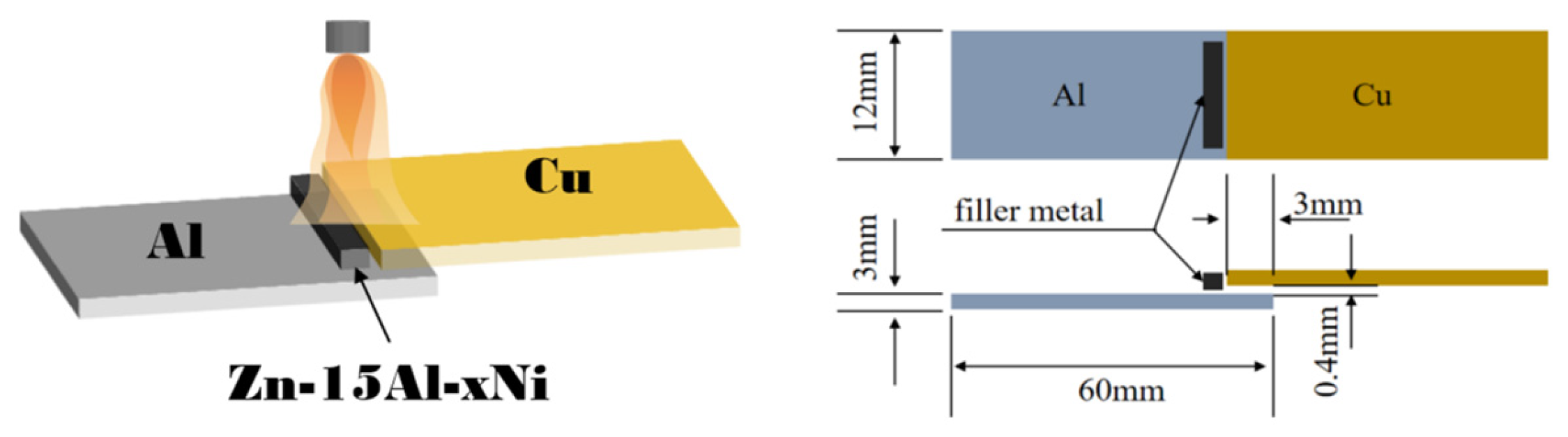
The base metals employed in this investigation were commercially available T2 copper (99.9 wt.%) and 1060 aluminum alloy (99.6 wt.%). Two distinct filler metals were prepared for comparative analysis: a eutectic Zn-15Al alloy and a microalloyed Zn-15Al-0.3Ni alloy (Zn-15Al + 0.3 wt.% Ni). The lap-joint configuration employed for mechanical testing is schematically illustrated in Figure 1.
Prior to joining, the substrate surfaces were mechanically polished and ultrasonically cleaned. To facilitate wetting and eliminate surface oxides, a non-corrosive fluoroaluminate flux (KAlF4-CsAlF4) was applied to the joint interface. The brazing operation was executed using an automated oxy-acetylene torch system (DlL, DESVER2500) with a precise oxygen-to-acetylene mixing ratio of 1:1. The thermal cycle was strictly controlled: specimens were subjected to a 4 s preheating phase followed by a 20 s dwelling period at the brazing temperature. Immediately after the heating cycle, the joints were rapidly quenched at a cooling rate of approximately 80 °C/s to freeze the microstructure.

2.2. Thermal Aging Treatment

To evaluate the microstructural stability and long-term mechanical reliability, the as-brazed Cu/Zn-15Al/Al and Cu/Zn-15Al-0.3Ni/Al joints were subjected to isothermal aging experiments. The specimens were placed in a high-precision convection drying oven maintained at a constant temperature of 200 °C. The aging durations were set at intervals of 0 h (as-brazed state), 100 h, 200 h, 500 h, 800 h, and 1000 h. Upon reaching the designated exposure times, the specimens were removed from the furnace and air-cooled to room temperature for subsequent microstructural characterization and mechanical testing.

2.3. Microstructural Characterization

Cross-sectional metallographic specimens were sectioned via wire electrical discharge machining (WEDM) and prepared using standard grinding and polishing protocols. Chemical etching was performed with a 5 vol.% nitric acid–ethanol solution for 7–8 s to reveal phase constituents. The microstructural evolution and elemental distribution at the interface were characterized using field-emission scanning electron microscopy (FE-SEM) (Thermo Fisher Scientific, Hillsboro, OR, USA) coupled with energy-dispersive X-ray spectroscopy (EDS) (Thermo Fisher Scientific, Hillsboro, OR, USA).

2.4. Mechanical and Nanoindentation Testing

The shear strength of the aged joints was assessed using a universal testing machine in accordance with the ISO 14373:2015 standard [21]. For each aging interval, a minimum of four replicates were tested to establish the mean strength and standard deviation. Post-failure analysis was conducted via SEM on both fracture surfaces and cross-sectional profiles to elucidate the dominant fracture mechanisms.
Local mechanical properties of the interfacial IMC layers were probed using a nanoindentation system (NANOG200, TSCompany, Yangju, Republic of Korea) equipped with a Berkovich diamond indenter. Indentations were performed at a peak load of 10 mN with a dwell time of 10 s. The hardness (H) and elastic modulus (E) of the distinct phases were derived from the unloading segment of the load–displacement curves utilizing the Oliver–Pharr method.

3. Results and Discussion

3.1. Morphological Stability and Phase Evolution of the Cu-Side Interface

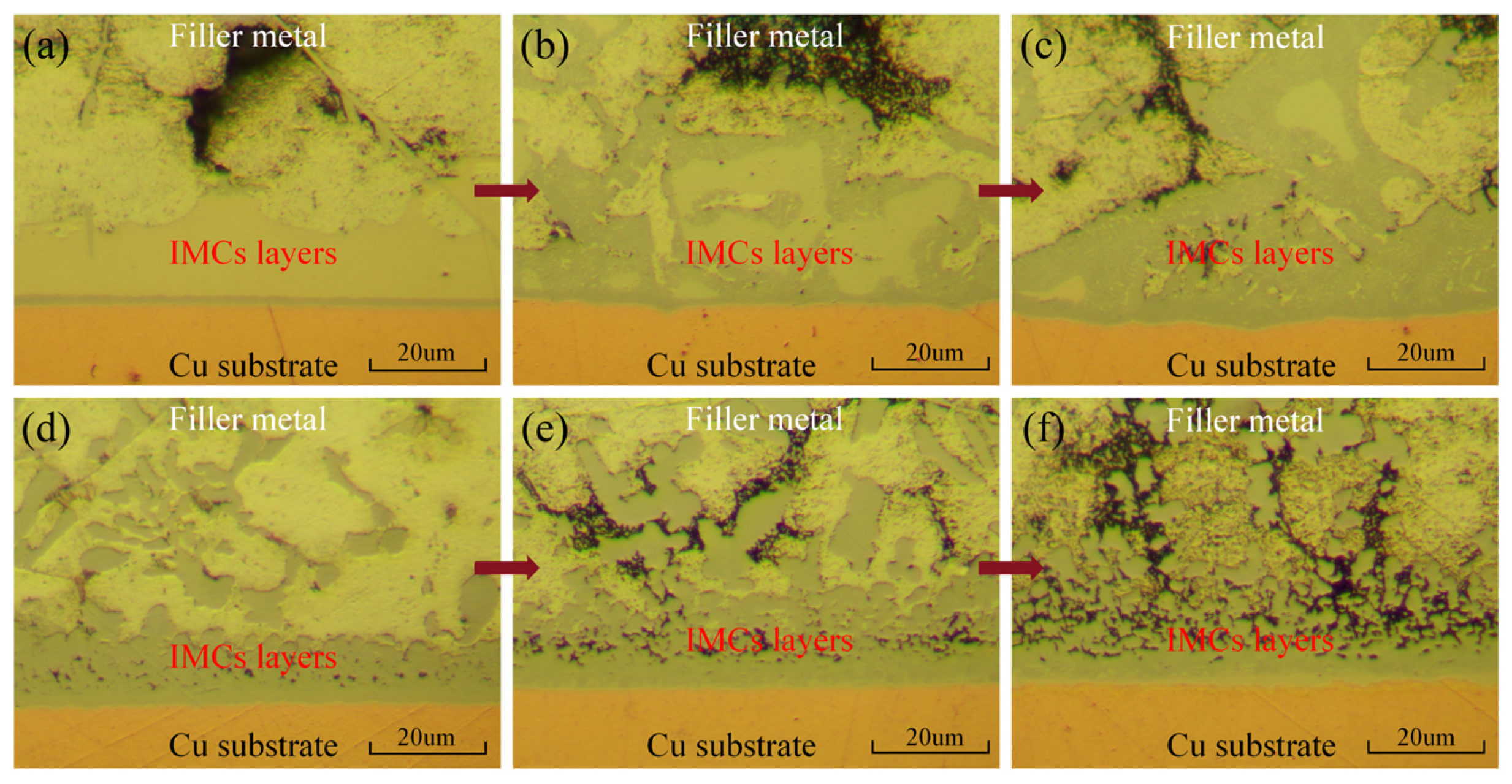
Figure 2 provides a macroscopic overview of the interfacial evolution at the Cu side via optical metallography. For the Ni-free joint (Figure 2a–c), the initial planar IMC layers progressively degrade during aging, becoming blurred and indistinct by 1000 h. In sharp contrast, the Ni-doped joint (Figure 2d–f) exhibits a characteristic “coral-like” framework interwoven with dark phases. Notably, this unique skeletal structure maintains exceptional morphological stability throughout the 1000 h aging process, with a distinct diffusion layer visibly evolving adjacent to the Cu substrate.
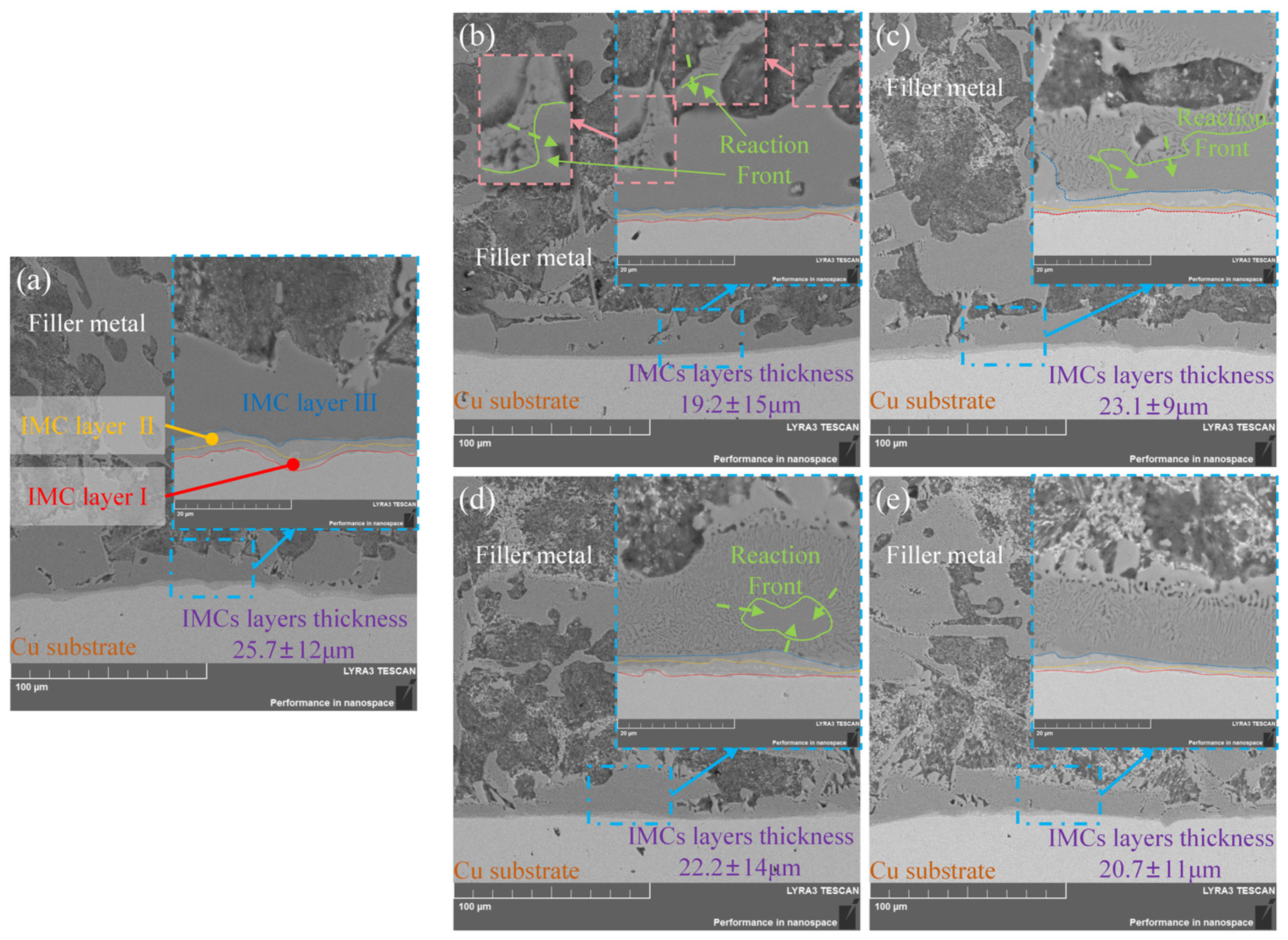
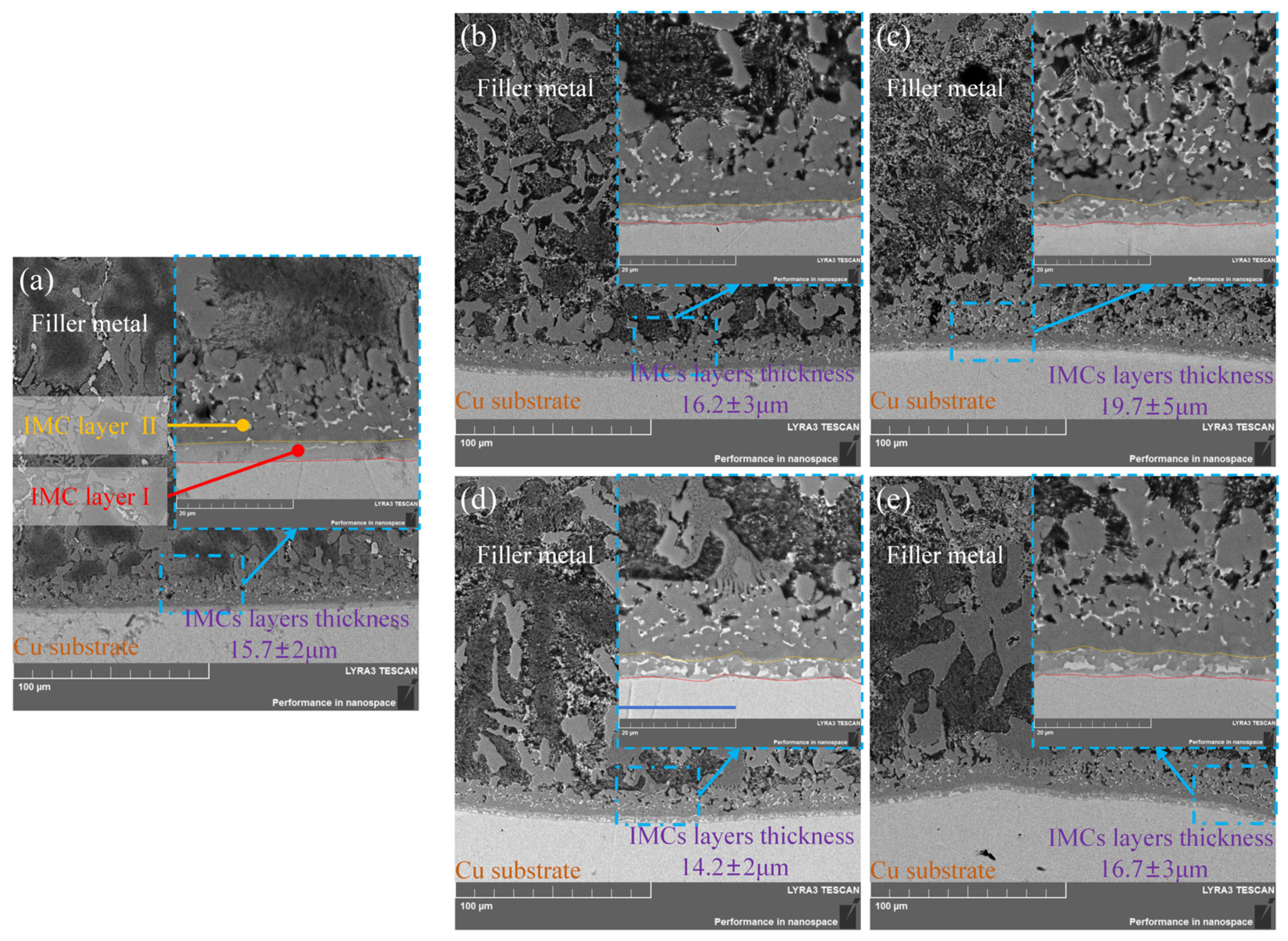
Figure 3 illustrates the cross-sectional microstructural evolution of the Cu-side interface in the Ni-free Cu/Zn-15Al/Al joint during aging at 200 °C. In the as-brazed state (0 h, Figure 3a), the interface exhibits a distinct tri-layer architecture (designated as IMC I–III). The bottom layer delimited by red and yellow dashed lines corresponds to the Cu9Al4 phase (IMC I), the intermediate layer between the yellow and blue lines is identified as the Al4.2Cu3.2Zn0.7 phase (IMC II), while the uppermost layer above the blue line consists of a massive, blocky CuAl2 phase (IMC III). Thermal exposure triggers a progressive phase transformation that is predominantly confined to the outermost IMC III layer. As evidenced in Figure 3b–e, the originally monolithic CuAl2 phase undergoes decomposition, marked by a visible reaction front (indicated by green dashed lines and arrows). This front nucleates at the filler metal interface and propagates toward the Cu substrate; behind this advancing boundary, the blocky CuAl2 transforms into a characteristic lamellar structure. As aging extends from 200 h to 1000 h, this lamellar region progressively consumes the parent phase until the transformation is nearly complete. In sharp contrast, the underlying IMC I and IMC II layers maintain remarkable structural stability throughout the 1000 h duration. As quantified in Figure 3, the total thickness of the IMC layers fluctuates within the range of 19.2 ± 15 μm to 25.7 ± 12 μm throughout the aging process. Neither the layer thickness nor the interfacial morphology exhibits a monotonic growth trend with aging time, indicating sluggish atomic interdiffusion kinetics within these specific sub-layers at 200 °C.
In comparison, Figure 4 displays the interfacial microstructural evolution of the Ni-doped Cu/Zn-15Al-0.3Ni/Al joint under identical aging conditions. In the as-brazed state (0 h, Figure 3a), the addition of Ni fundamentally reconstructs the interfacial system into a unique bi-layer architecture (designated as IMC I–II). The bottom layer (IMC I), delimited by red and yellow dashed lines adjacent to the Cu substrate, manifests in Backscattered Electron (BSE) images as a planar, continuous Cu-based transition layer with highly uniform contrast. Although exhibiting homogeneous BSE contrast, subsequent EDS analysis reveals a compositional gradient within this layer, implying it may exist as a non-equilibrium supersaturated solid solution. This transition layer maintains an exceptionally flat phase boundary with the overlying IMC, serving as a stable substrate for subsequent growth. The primary reaction zone above the yellow line (IMC II) consists of fine-grained Al4.2Cu3.2Zn0.7 phase, displaying a distinct structural gradient: a densely packed lower region transitioning into a loose, coral-like skeletal framework with Zn-rich phases filling the interstices. During subsequent thermal aging (200–1000 h, Figure 4b–e), the upper coral-like IMC II layer demonstrates remarkable morphological stability, with its fine-grained structure and loose framework showing no significant coarsening or densification. This morphological stability is further confirmed by the thickness measurements in Figure 4, which show that the interfacial layer maintains a relatively steady thickness ranging from 14.2 ± 2 μm to 19.7 ± 5 μm even after 1000 h of exposure. However, the underlying IMC I (Cu-based transition layer) exhibits distinct structural evolution. As aging proceeds, the originally homogeneous transition layer undergoes progressive stratification, splitting into upper and lower sub-layers. High-magnification insets clearly reveal the precipitation of bright, fine granular phases at the splitting interface and within the sub-layers. This significant phase separation and precipitation further confirm that the initial Cu-based transition layer was in a thermodynamically metastable state, transforming toward equilibrium through internal decomposition and elemental rearrangement driven by thermal activation.
Although thermal aging was conducted in air, SEM-EDS analysis revealed no continuous oxide layers or significant oxygen enrichment at the Cu/IMC or IMC/filler interfaces. This indicates that oxidation did not significantly contribute to the observed interfacial degradation. Consequently, the microstructural evolution and mechanical decline discussed in this study are attributed primarily to solid-state diffusion and phase transformation kinetics rather than oxidation-induced damage.

3.2. Interfacial Characterization and Phase Transformation Mechanism

3.2.1. Diffusion-Driven Decomposition of CuAl2 in Ni-Free Joints

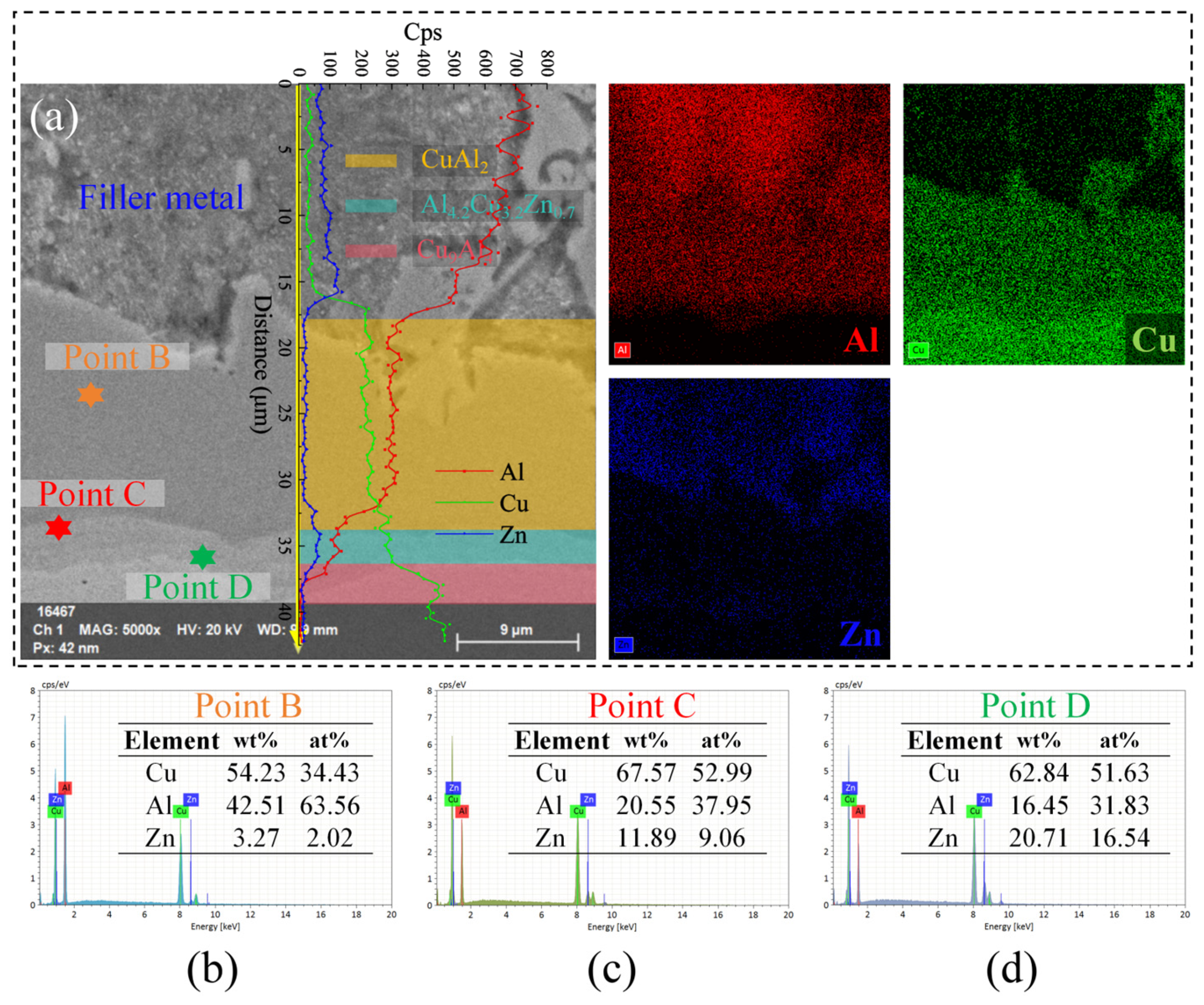
Figure 5a presents the high-magnification SEM morphology and corresponding elemental distribution of the Cu-side interface in the as-brazed (0 h) Al/Zn-15Al/Cu joint. The backscattered electron image clearly reveals that the interfacial reaction layer comprises three sub-layers with distinct morphologies and contrasts, exhibiting a stepwise elemental distribution along the direction perpendicular to the interface (indicated by the yellow arrow for the EDS line scan). Based on the translucent colored regions overlaid on the image and the corresponding EDS point analyses (Figure 5b–d), the constituent phases are precisely identified: the outermost yellow region (Point B) is rich in Al (63.56 at.%) and Cu (34.43 at.%) with an atomic ratio approximating 1:2, confirming it as the blocky CuAl2 phase; the intermediate cyan region (Point C) displays significant Zn enrichment, as evidenced by the distinct Zn peak (blue line) in the EDS line profile and the bright Zn band in the EDS mapping, with its composition (Cu: 52.99, Al: 37.95, Zn: 9.06 at.%) corresponding to the ternary Al4.2Cu3.2Zn0.7 phase; the pink region (Point D) adjacent to the Cu substrate exhibits the highest Cu content and, consistent with its layered growth characteristics, is identified as the Cu9Al4 phase. The phase identification in this study was primarily conducted via SEM-EDS point analysis. The measured compositions are in excellent agreement with the phases reported in the wider literature, and critically, they align with the same IMCs (e.g., CuAl2, Cu9Al4, and Al-Cu-Zn ternary phases) that were recently and unambiguously identified through TEM analysis in [1,9]. While this provides strong corroborating evidence, we acknowledge that this specific study does not include its own independent crystallographic validation, which can be considered a limitation. The EDS line scan profile further visually illustrates the stepwise variation in elements across these three IMC layers: the Al concentration decreases in a stepwise manner from the filler metal side toward the substrate, while the Cu concentration shows an inverse stepwise increase, clearly demarcating the phase boundaries of the distinct intermetallic compounds. This typical Cu/Cu9Al4/Al4.2Cu3.2Zn0.7/CuAl2 multilayer architecture is the product of diffusion reactions in the Cu-Al-Zn system, indicating that the aggressive diffusion of Al and Zn atoms into the Cu substrate dominated the interfacial reaction during the initial brazing process.
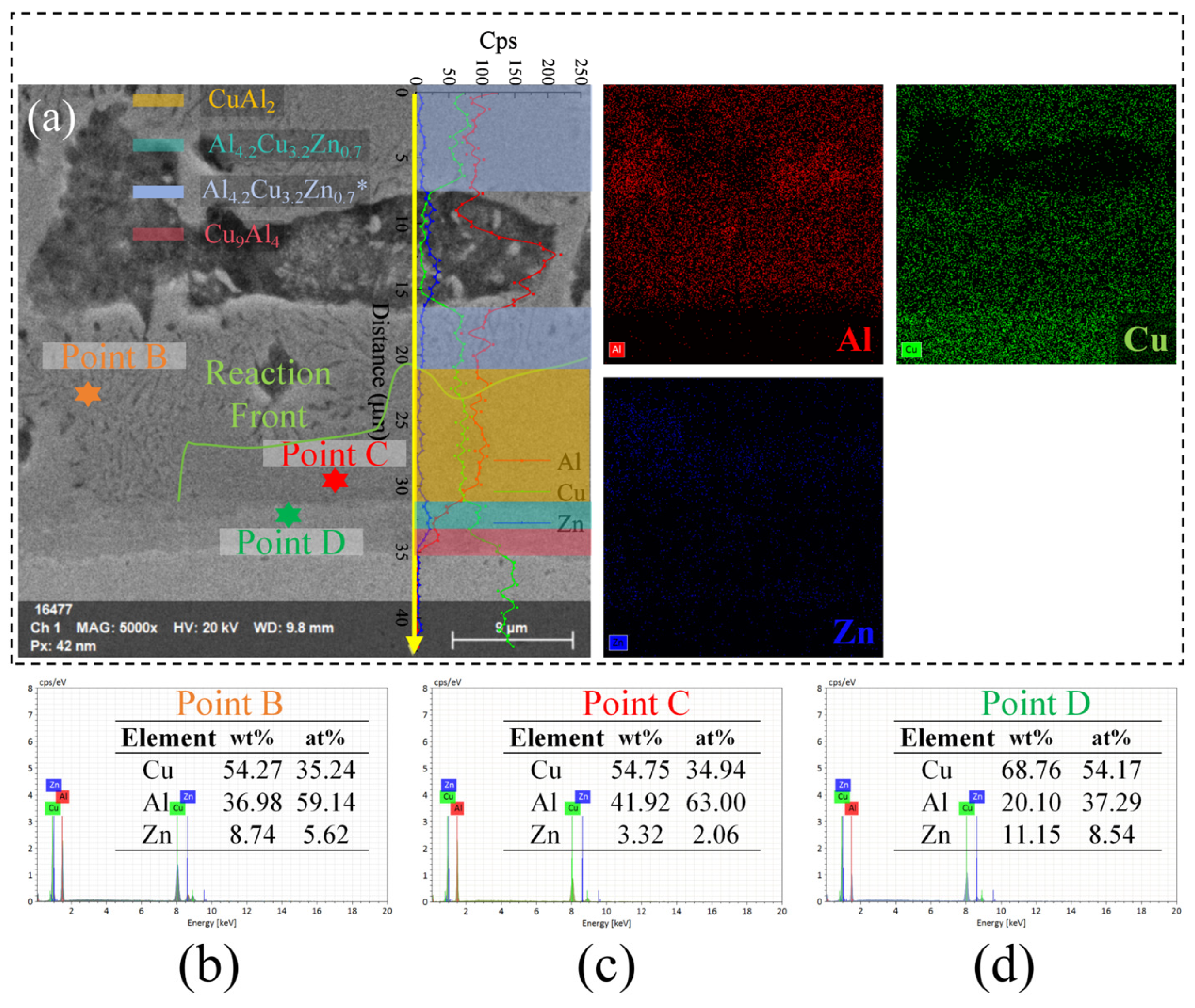
Figure 6a details the microstructural evolution and elemental redistribution of the Cu-side interface after 500 h of aging. Compared to the as-brazed state, the most significant transformation occurred within the uppermost blocky CuAl2 layer. The SEM image clearly depicts a curved reaction front (marked by the green line), which partitions the originally homogeneous CuAl2 layer into two distinct regions. To the right of the front (Point C, yellow region), the material retains its dense, blocky morphology, and EDS analysis (Figure 6c) confirms its composition (Cu: 34.94, Al: 63.00, Zn: 2.06 at.%) remains consistent with the pristine CuAl2 phase, indicating this area is largely unaffected. However, the region to the left of the front (Point B, blue-gray region) has transformed into a characteristic lamellar structure (designated as Al4.2Cu3.2Zn0.7*). A critical compositional disparity reveals the driving force behind this morphological transition: the Zn content in the lamellar region is significantly elevated compared to the untransformed zone (increasing from 2.06 at.% to 5.62 at.%), accompanied by a corresponding depletion in Al (decreasing from 63.00 at.% to 59.14 at.%). The EDS line scan profile (superimposed along the yellow arrow) provides compelling visual evidence for this mechanism: the Zn signal intensity (blue line) exhibits a distinct stepwise jump upon crossing the reaction front into the lamellar region. This phenomenon strongly suggests that the continuous thermally driven diffusion of Zn atoms from the filler metal into the interface exceeded the solid solubility limit of the CuAl2 lattice, thereby triggering the instability and decomposition of the CuAl2 phase into a Zn-enriched lamellar structure. Meanwhile, the underlying Al4.2Cu3.2Zn0.7 phase (Point D, cyan region) maintained high compositional stability (Zn: 8.54 at.%) after 500 h of aging, showing no signs of stratification or phase transformation, which reaffirms the superior thermal stability of this phase at 200 °C.
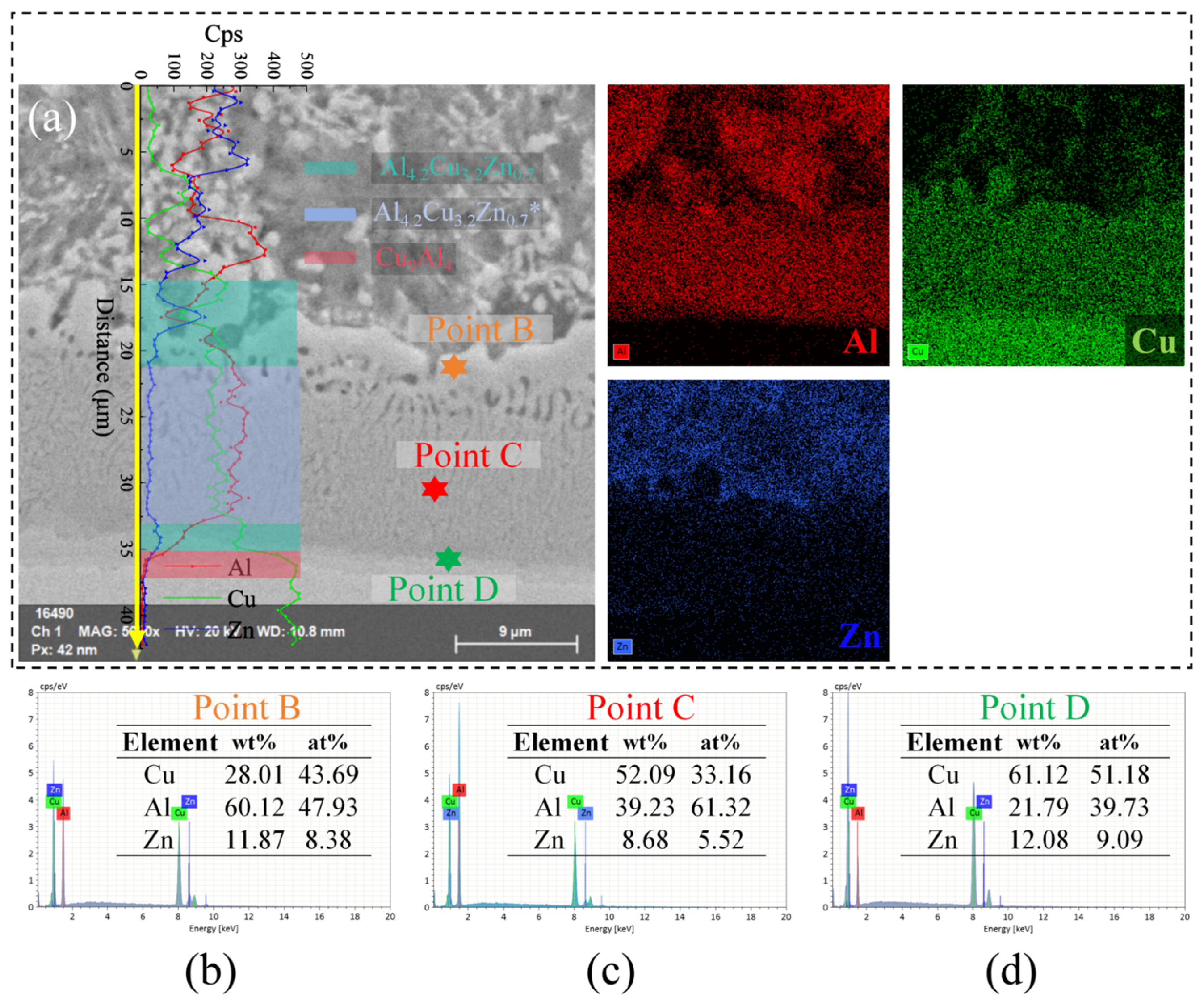
Upon further extending the aging duration to 1000 h (Figure 7), the microstructural evolution of the interface reaches its terminal state. The most prominent feature is the complete disappearance of the as-brazed blocky CuAl2 layer, which has been entirely replaced by a thick and continuous Al4.2Cu3.2Zn0.7* lamellar structure (spanning the blue-gray and cyan regions in Figure 7a). This indicates that the Zn-diffusion-driven phase decomposition has progressed from a localized reaction front to consume the entire outer layer, completing the transformation from the CuAl2 phase to the Zn-enriched lamellar constituent. EDS point analyses reveal a compositional gradient within the transformed region: the lamellar zone near the filler metal side (Point B) contains Cu 43.69, Al 47.93, and Zn 8.38 at.%, whereas the central lamellar region (Point C) retains a relatively high Al content (61.32 at.%) with 5.52 at.% Zn. This compositional heterogeneity suggests that the lamellar structure is a eutectoid-like mixture comprising interwoven Al-rich and Zn-rich phases. The EDS line scan profile provides direct evidence of elemental penetration: the Zn characteristic peak (blue line) is no longer confined to the intermediate layer but has significantly broadened outwards, covering the entire thickness of the prior CuAl2 layer, consistent with the substantial widening of the Zn bright band in the EDS mapping. In stark contrast, the lowermost Al4.2Cu3.2Zn0.7* phase (Point D, above the pink region), after enduring 1000 h of thermal aging, exhibits a chemical composition (Cu 51.18, Al 39.73, Zn 9.09 at.%) highly consistent with the as-brazed state (Zn ~9.06 at.%). This conclusively confirms the exceptional thermodynamic stability of this ternary phase at 200 °C, demonstrating its robust resistance to atomic interdiffusion and phase decomposition, identifying it as the most durable component within the interfacial architecture.

3.2.2. Phase Separation and Stabilization Effect in Ni-Doped Joints

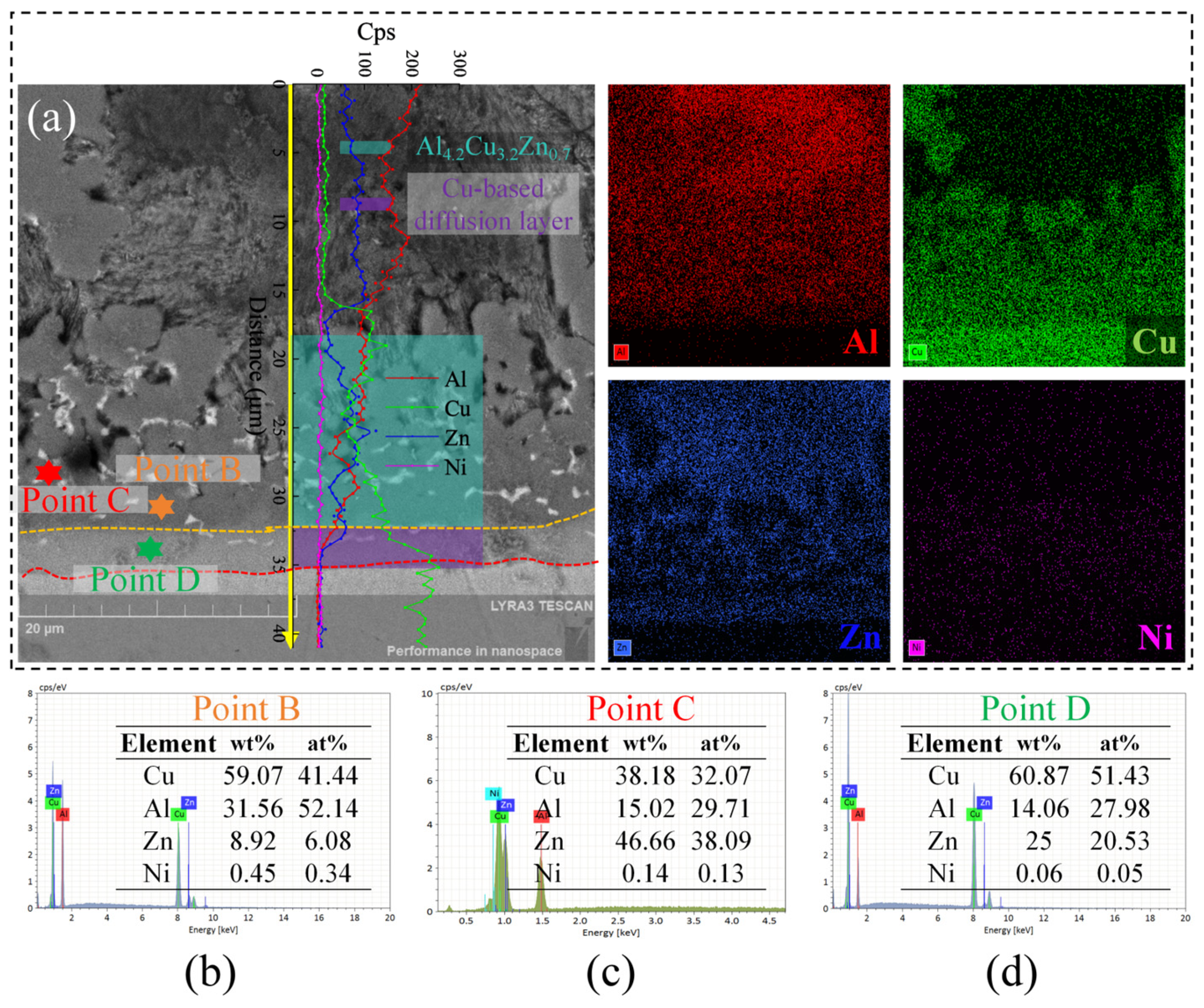
Figure 8a presents the high-magnification microstructure and elemental distribution of the Cu-side interface in the as-brazed (0 h) Al/Zn-15Al-0.3Ni/Cu joint doped with 0.3 wt.% Ni. In contrast to the Ni-free joint, the addition of Ni significantly simplifies the stratified architecture of the reaction zone into a distinct bi-layer structure. The upper layer, highlighted in cyan, exhibits a characteristic coral-like morphology. Based on the EDS point analysis (Figure 8b), the skeletal phase constituting this coral-like structure (Point B) has a composition of Cu 41.44, Al 52.14, Zn 6.08 at.%, with a trace amount of Ni (0.34 at.%), confirming it as the fine-grained Al4.2Cu3.2Zn0.7 phase. The dissolution of Ni into the lattice is likely the key factor promoting the significant grain refinement and the formation of this coral-like architecture. Zn-rich precipitates (Point C), with a Zn content as high as 38.09 at.%, are distributed within the interstices of this fine-grained framework. The bottom layer (purple region, Point D), adjacent to the Cu substrate, manifests as a planar, continuous Cu-based transition layer with highly uniform contrast in the BSE image. However, despite this morphological homogeneity at SEM resolution, the EDS line scan profile (along the yellow arrow) unveils a drastic compositional gradient within this layer: upon traversing from this layer into the Cu substrate, the signal intensities of Al (red line) and Zn (blue line) drop precipitously from top to bottom, reaching near-zero levels, while the Cu signal (green line) ascends sharply. This striking discrepancy between morphological uniformity and a steep chemical gradient strongly implies that this transition layer is not a conventional single stoichiometric intermetallic phase. Instead, consistent with previous findings [1], it is identified as a metastable dual-phase diffusion zone initially existing as a supersaturated solid solution, which subsequently decomposes into a mixture of Cu-rich matrix and fine Al-Zn-Cu precipitates during aging. Furthermore, an exceptionally flat yet indistinct interface exists between this transition layer and the overlying coral-like Al4.2Cu3.2Zn0.7 layer. This specific topological configuration not only provides an ideal substrate for the uniform nucleation of the upper fine-grained structure but also foreshadows unique evolutionary behavior in this region during subsequent thermal aging.
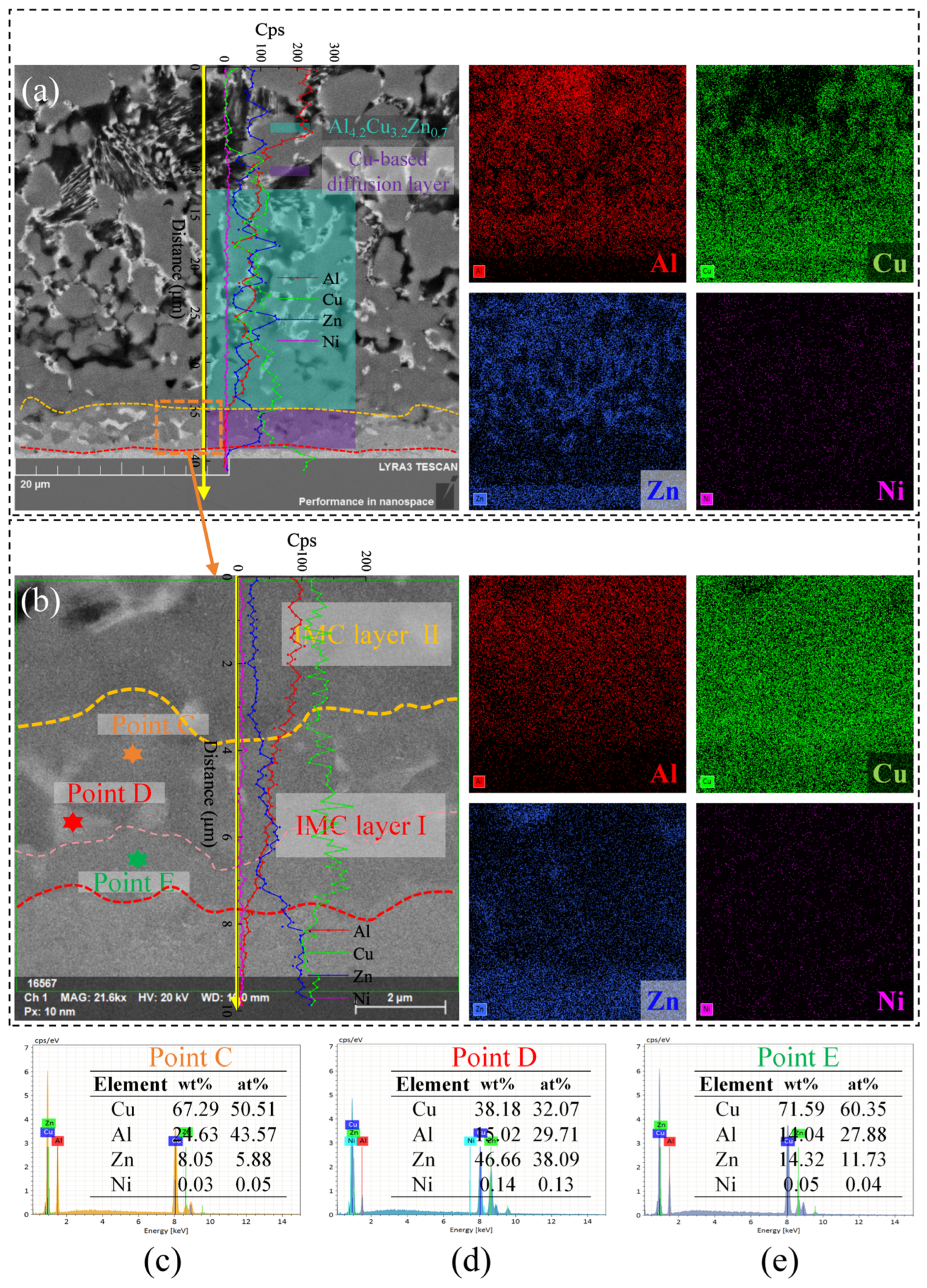
Figure 9a displays the interfacial microstructure of the Ni-doped joint after 500 h of aging. The most striking feature is the exceptional morphological stability of the upper coral-like Al4.2Cu3.2Zn0.7 layer (cyan region). Despite prolonged thermal exposure, its characteristic fine-grained framework and porous structure show no significant coarsening or densification. The EDS line scan (yellow arrow path in Figure 9a) reveals relatively stable fluctuations in elemental distribution across this layer, suggesting that the presence of Ni effectively inhibited grain boundary migration and atomic interdiffusion in this region. However, the underlying Cu-based transition layer (purple region) underwent significant internal reconstruction, which is clearly captured in the high-magnification SEM image in Figure 9b. The originally homogeneous transition layer has evolved into a bi-layer structure with distinct contrasts (delimited by the central pink dashed line): the upper sub-layer (Sub-layer II, Point C) has evolved to a composition of Cu 50.51, Al 43.57, Zn 5.88 at.%, trending towards the stable ternary Al4.2Cu3.2Zn0.7 phase; meanwhile, the lower sub-layer (Sub-layer I, Point E) is enriched in Cu (60.35 at.%) and Zn (11.73 at.%), exhibiting a stoichiometry closer to a Zn-doped Cu9Al4 phase.
Crucially, this stratification evolution is accompanied by an intense solute redistribution process. As shown in Figure 9b, numerous bright, granular precipitates (Point D) have formed at the interface between the two newly formed sub-layers (pink dashed line) and within the sub-layers themselves. EDS point analysis (Figure 9d) reveals that these precipitates possess an exceptionally high Zn content (38.09 at.%), far exceeding that of the surrounding matrix. This phenomenon provides direct evidence for the phase transformation mechanism of the transition layer: the initial Cu-based transition layer was a Zn-supersaturated metastable structure. Driven by 500 h of thermal aging, it underwent phase decomposition, differentiating into an Al-rich upper phase and a Cu-rich lower phase. As the Zn solubility limits of the lattices of these two new phases are both lower than that of the original supersaturated layer, excess Zn atoms were expelled from the lattice, eventually precipitating as Zn-rich phases at the sub-layer interface. The distinct Zn enrichment band at the stratification interface in the EDS mapping results (right side of Figure 9b) further confirms this Zn-ejection mechanism. This unique “in situ decomposition and Zn ejection” behavior allows the transition layer to effectively buffer the diffusion flux from the substrate and filler metal while undergoing its own phase transformation, thereby protecting the overlying fine-grained layer from degradation.
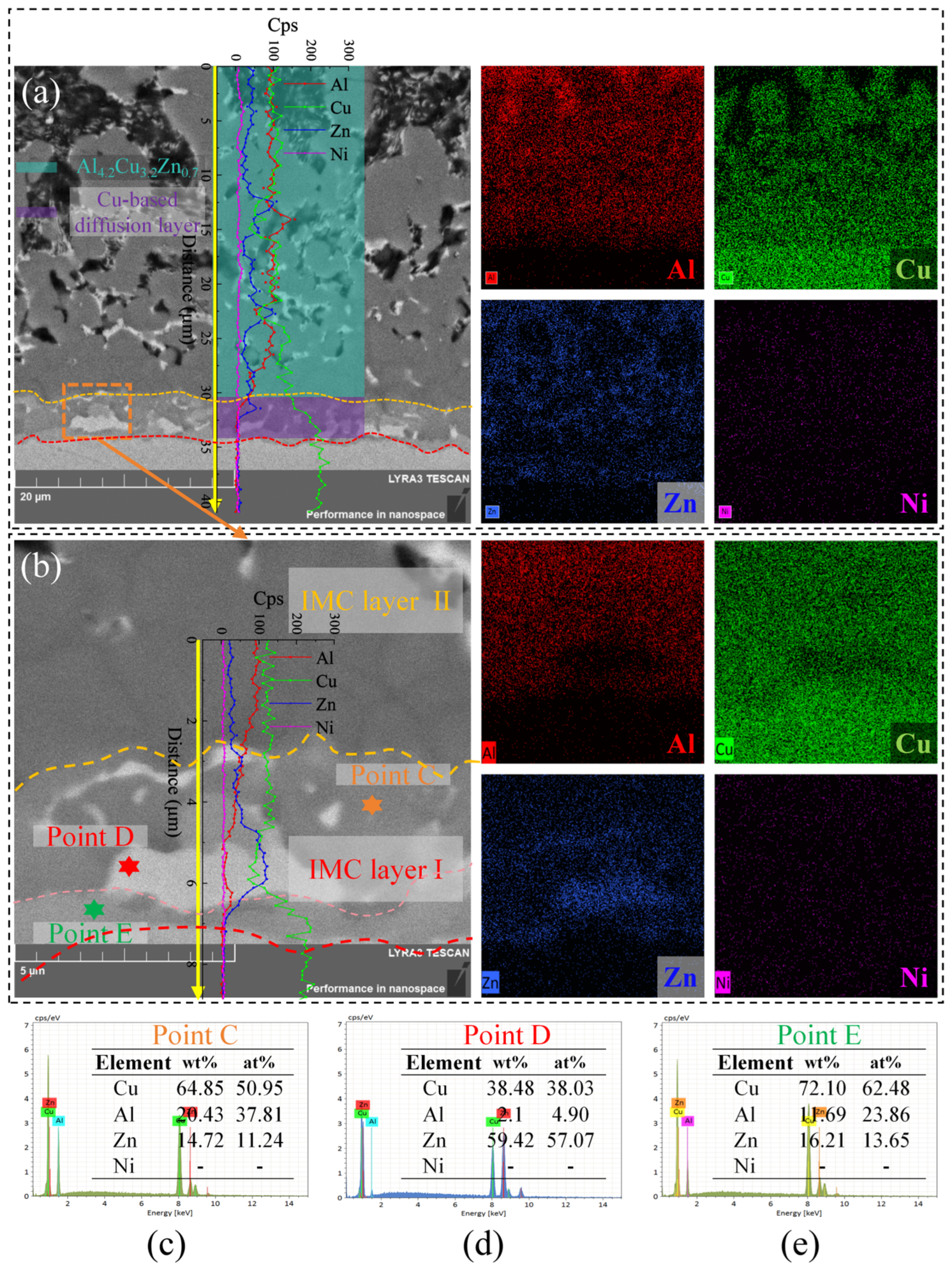
At the terminal stage of 1000 h aging, the interfacial microstructure of the Ni-doped joint (Figure 10a) exhibits an evolutionary path distinct from that of the Ni-free joint. The most prominent feature is the remarkable thermal stability of the upper coral-like Al4.2Cu3.2Zn0.7 layer (cyan region). Even under such prolonged thermal exposure, its unique fine-grained morphology and porous skeletal structure show neither collapse nor significant coarsening. The EDS line scan profile (yellow arrow) reveals that the concentration distribution of elements within this region remains stable without drastic fluctuations, confirming the superior efficacy of the Ni-induced fine-grained structure in inhibiting interfacial coarsening. However, the stratification and phase separation within the underlying Cu-based transition layer (purple region) have intensified, reaching a new stage of evolution. As shown in Figure 10b, the boundary between the upper and lower sub-layers has become more distinct and roughened, marking the deepening of the phase separation process. The Zn content of the upper sub-layer (Sub-layer II, Point C) has climbed from 5.88 at.% at 500 h to 11.24 at.%, indicating a gradual increase in Zn solubility within the lattice over time; meanwhile, the lower sub-layer (Sub-layer I, Point E) has become further enriched in Cu (62.48 at.%) and Zn (13.65 at.%), with its composition progressively approaching that of a stable Zn-rich Cu9Al4 phase.
The most critical evolution occurs in the precipitates at the stratification interface. Compared to 500 h, the precipitates (Point D) at 1000 h have visibly grown in size, exhibiting significant aggregation characteristics. EDS point analysis (Figure 10d) reveals that the Zn content of these bright white particles has surged to 57.07 at.%, far exceeding the 38.09 at.% observed at 500 h. This dramatic compositional shift uncovers a purification and ripening process: as aging proceeds, the metastable transition layer continuously rejects Zn atoms, which then diffuse to and enrich the precipitates, driving their composition toward a near-pure Zn phase or an extremely Zn-rich solid solution. The intensely bright, well-defined spots in the Zn elemental map (right side of Figure 10b) perfectly corroborate this high-enrichment phenomenon. This unique evolutionary mechanism—absorbing and isolating diffusing Zn atoms through the continuous decomposition and Zn-rejection behavior of the underlying transition layer—effectively functions as a ‘chemical buffer.’ Specifically, the inclusion of Ni alters the diffusion route by stabilizing this supersaturated Cu-based transition layer, which serves as a kinetic barrier to direct Zn infiltration into the top fine-grained Al4.2Cu3.2Zn0.7 layer. Throughout aging, this metastable layer experiences internal phase separation, persistently absorbing and expelling Zn atoms via precipitation at the stratification interface. This action significantly decreases the net Zn flux to the upper interfacial layer, thereby postponing phase breakdown and maintaining the long-term structural stability of the joint.

3.3. Evolution of Mechanical Properties and Fracture Behavior

3.3.1. Local Mechanical Degradation of Interfacial Phases via Nanoindentation

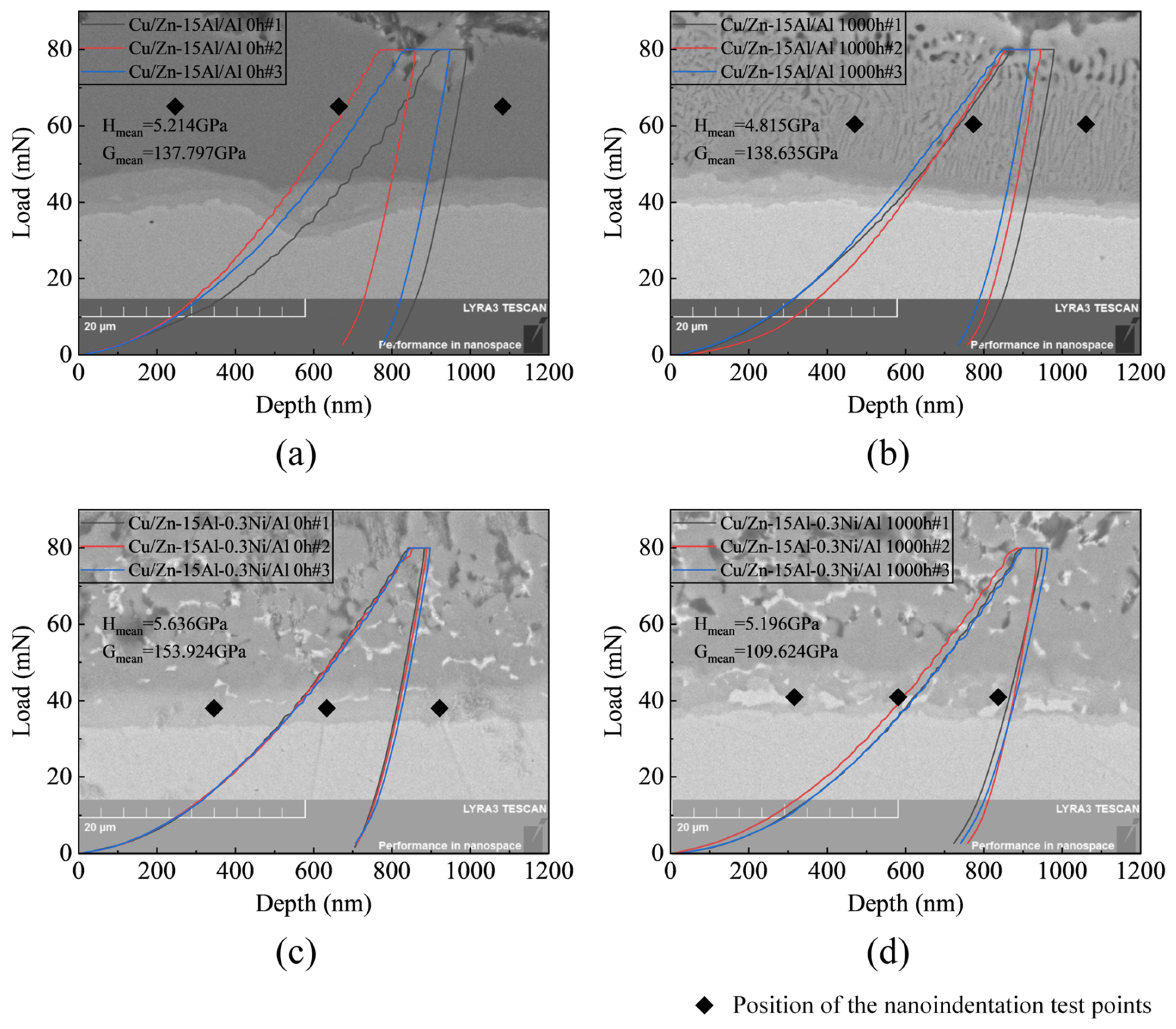
To quantify the impact of microstructural evolution on the local mechanical response of the interface, nanoindentation tests were conducted on critical interfacial phases under varying aging conditions. Indentations were performed at a peak load of 10 mN. To ensure statistical reliability, at least three valid indentations were performed for each identified phase. The specific test locations were carefully selected to be in the center of the phases, avoiding boundaries and defects, as illustrated by the black diamond markers in Figure 11. The reported hardness (H) and elastic modulus (E) values represent the mean ± standard deviation of these measurements. Figure 11a,b display the load–displacement (P-h) curves for the CuAl2 phase and its aged product in the Ni-free joint. In the as-brazed state (0 h), the massive CuAl2 phase exhibits typical high-hardness brittle characteristics, with a mean hardness (H) of 5.214 GPa and an elastic modulus (E) of 137.797 GPa. After 1000 h of aging, although this layer has completely transformed into a Zn-rich Al4.2Cu3.2Zn0.7* lamellar structure, its mechanical properties show no fundamental improvement: the hardness decreases slightly to 4.815 GPa, while the elastic modulus remains stubbornly high at 138.635 GPa. This implies that the transformed lamellar structure retains significant stiffness, failing to alleviate the modulus mismatch with the softer Cu substrate (E ≈ 110–120 GPa). This persistent high modulus discrepancy serves as a latent site for stress concentration and crack initiation.
In sharp contrast, the Cu-based transition layer in the Ni-doped joint demonstrates a radically different mechanical evolutionary behavior (Figure 11c,d). Initially (0 h), this transition layer exhibits exceptionally high mechanical strength, with a mean hardness of 5.636 GPa and an elastic modulus reaching 153.924 GPa, significantly surpassing the CuAl2 phase in the Ni-free sample. This is attributed to solid solution hardening by Ni and the lattice distortion effects of the supersaturated solid solution. However, after 1000 h of aging, accompanied by significant stratification and Zn-rejection precipitation, the mechanical signature of this region undergoes a fundamental shift: while the hardness decreases only marginally to 5.196 GPa, the elastic modulus plummets to 109.624 GPa, a reduction of nearly 29%. This significant modulus softening holds profound physical significance: the modulus of the evolved transition layer is now remarkably close to that of the Cu substrate, thereby establishing an ideal modulus transition zone at the interface. This smoothing of the modulus gradient effectively eliminates stress singularities, allowing the joint to deform more coordinately under external loads. This mechanism represents one of the key intrinsic factors contributing to the superior mechanical stability of the Ni-doped joint after long-term aging.

3.3.2. Joint Shear Strength and Failure Mechanism Transformation

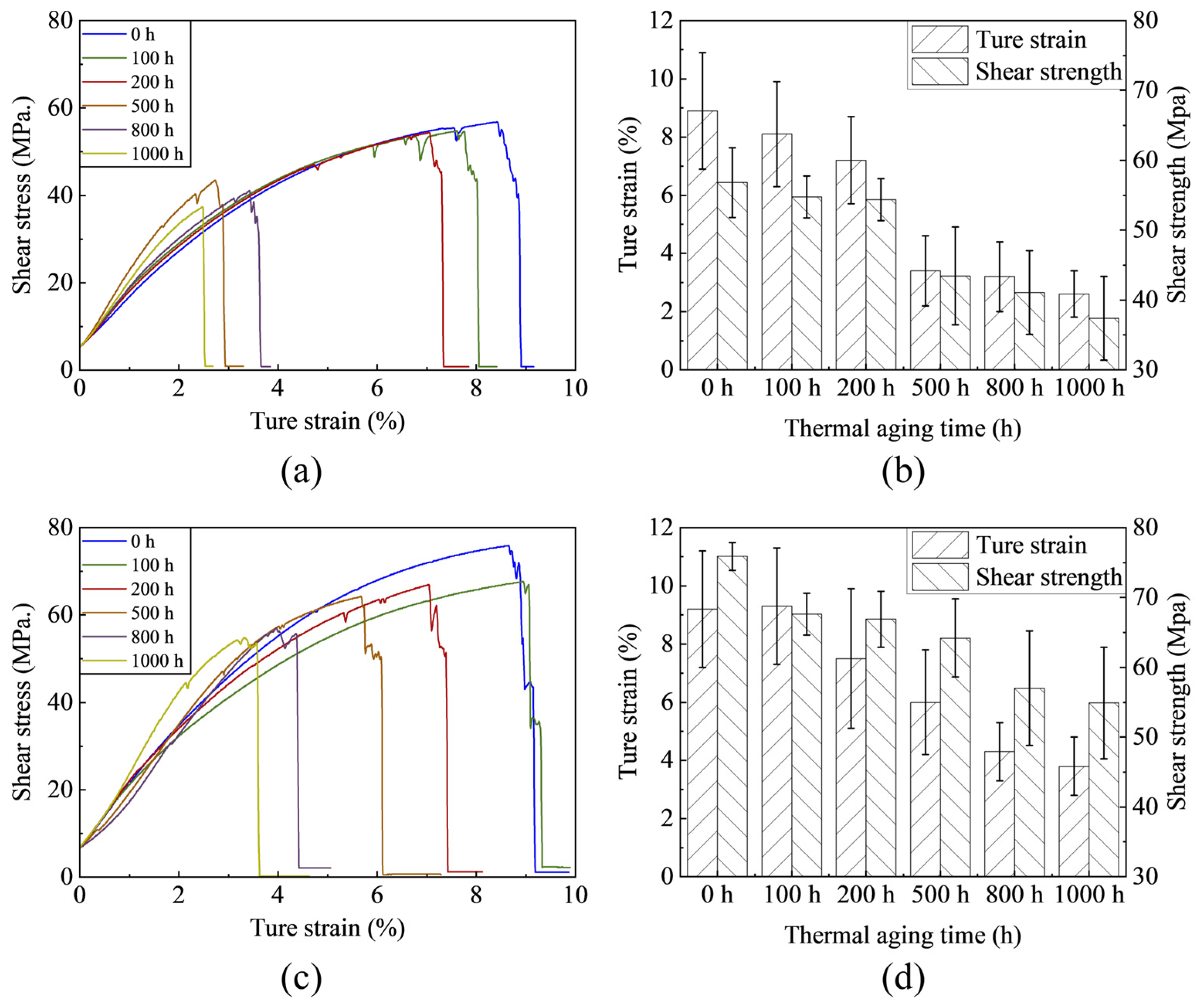
Figure 12a,b illustrate the precipitous degradation of mechanical properties in Ni-free joints during thermal aging. As quantified in the dual-axis chart in Figure 12b, in the initial stage (0–200 h), the joint shear strength (green bars) remained relatively stable at approximately 57 MPa. However, beyond 500 h, the performance deteriorated sharply: by 1000 h, the shear strength had plummeted to ~37.5 MPa, representing a 34% loss compared to the as-brazed state. More critically, the fracture strain (orange bars) reveals a drastic contraction in plastic deformation capacity. As clearly shown in Figure 12b, the fracture strain collapsed from an initial ~8.8% to less than 2.6% after 1000 h. This severe embrittlement correlates strongly with the microstructural findings: the complete transformation of the CuAl2 phase into the Al4.2Cu3.2Zn0.7* lamellar structure, while retaining high stiffness, introduced a high density of phase boundaries and defects. These served as preferential sites for crack initiation, leading to catastrophic brittle fracture at minimal strain levels.
In stark contrast, the Ni-doped joints exhibited superior mechanical durability (Figure 12c,d). Attributed to the initial fine-grain strengthening, the as-brazed shear strength reached a high level of 76.1 MPa. During subsequent aging, although a declining trend was observed, the degradation rate was significantly more gradual than that of the Ni-free counterparts. For the first 500 h, the strength remained above 64 MPa; even after 1000 h of severe aging, the residual strength was maintained at approximately 55.2 MPa—a value strikingly comparable to the initial strength of the Ni-free joint. Furthermore, the strain evolution shown in Figure 12d indicates that the Ni-doped joints retained discernible plastic deformation characteristics. Even after 1000 h, the fracture strain remained at approximately 3.8%, avoiding the completely brittle response observed in the Ni-free samples. This “soft landing” in performance evolution is directly ascribed to the modulus softening effect of the Cu-based transition layer (as detailed in Section 3.3.1). The substantial reduction in elastic modulus of the evolved transition layer effectively alleviated interfacial stiffness mismatch, acting as a stress buffer that significantly retarded premature crack propagation, thereby endowing the joint with exceptional long-term reliability.

3.3.3. Fractographic Analysis and Fracture Mechanism Evolution

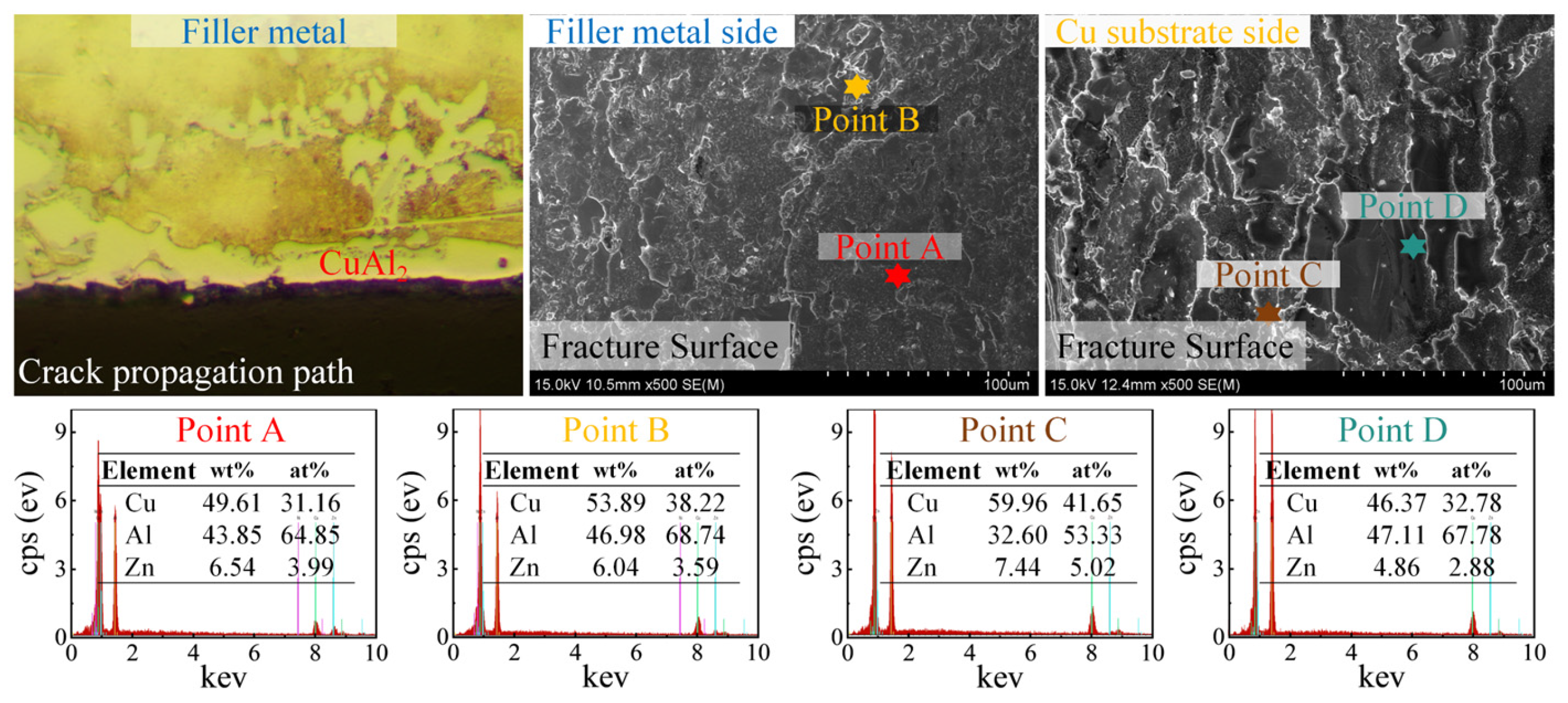
Figure 13 details the fracture behavior of the as-brazed (0 h) Ni-free joint after shear failure, combining cross-sectional observation with fractographic analysis. As explicitly shown in the cross-sectional optical micrograph of the crack propagation path (left in Figure 13), the failure occurred primarily along the interface between the massive CuAl2 layer and the underlying phases, exhibiting typical characteristics of interfacial brittle cleavage.
Correspondingly, the SEM fractography of the mating surfaces reveals the microscopic features of this separation. The fracture surface on the filler metal side (middle in Figure 13) is relatively flat and predominantly covered by a gray phase. Compositional analyses at Points A and B indicate this phase is rich in Al (~65–68 at.%) with a Cu content of ~31–38 at.%, aligning closely with the stoichiometry of the blocky CuAl2 phase. This confirms that the massive CuAl2 layer remained largely attached to the filler metal side during the separation process.
In contrast, the Cu substrate side (right in Figure 13) displays a more complex mixed morphology. The surface is mainly composed of a darker phase (Point C), whose composition (Al 53.33, Cu 41.65 at.%) corresponds to the underlying ternary Al4.2Cu3.2Zn0.7 phase. However, scattered across this surface are bright tearing ridges and residual particles (Point D), identified by their composition (Al 67.78, Cu 32.78 at.%) as CuAl2 fragments. This combination of cross-sectional and fractographic evidence conclusively demonstrates that the initial failure of the Ni-free joint originated from cleavage fracture at the CuAl2/Al4.2Cu3.2Zn0.7 phase boundary. Due to the intrinsic lattice mismatch and elastic modulus discrepancy between these two phases (as discussed in Section 3.3.1), this interface served as the weakest link for stress concentration. The crack propagated rapidly along this phase boundary, accompanied by local transgranular cleavage cutting through brittle CuAl2 grains (evidenced by the fragments on the Cu side), ultimately resulting in the low-strain brittle failure of the joint.
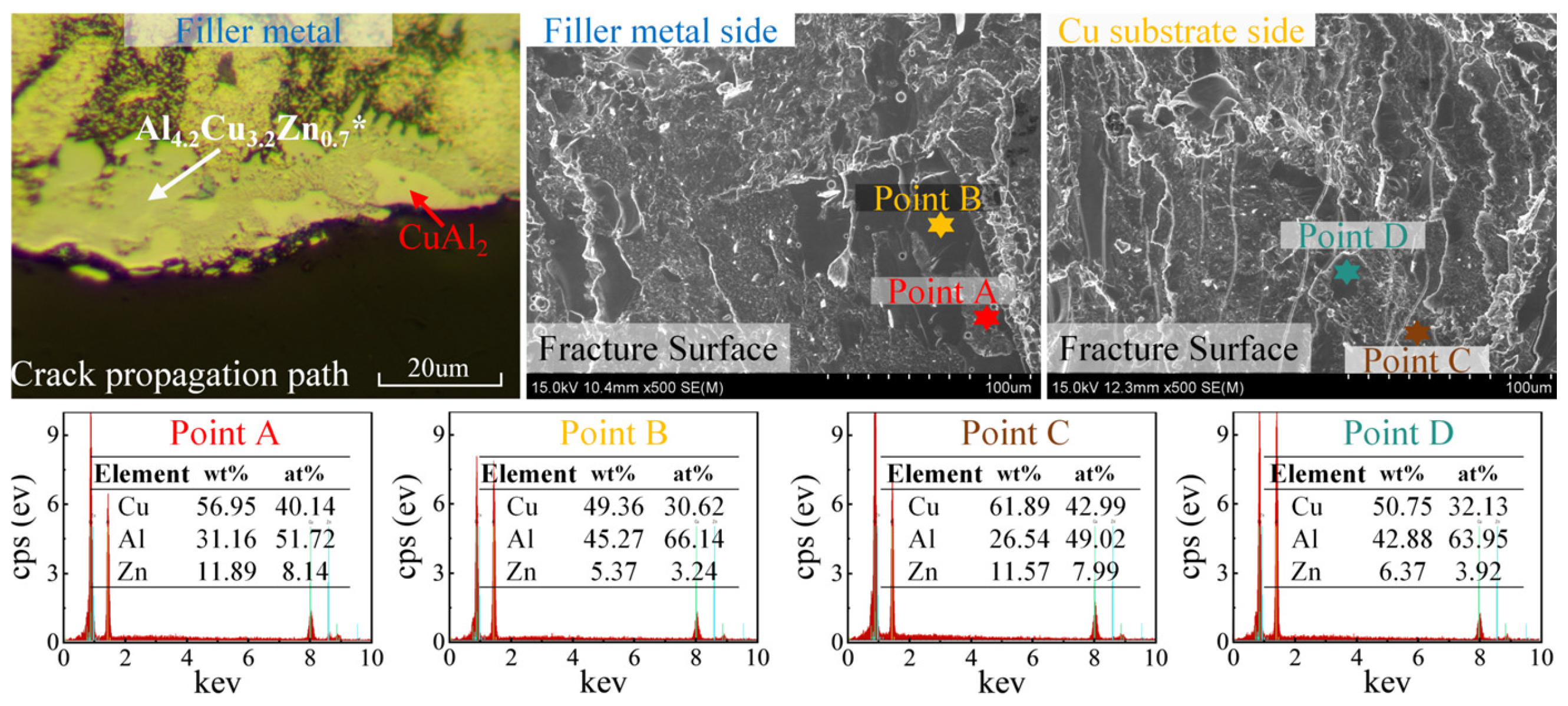
After 500 h of aging, the fracture characteristics of the Ni-free joint underwent a of interfacial phase transformation on the failure path. The cross-sectional optical mi-crograph of the crack propagation path (left in Figure 14) provides visual evidence of this transition: the crack is no longer confined to a simple, flat phase boundary but has migrated into the newly formed reaction layer, exhibiting a rougher and more tortuous trajectory
Consistent with this cross-sectional observation, the SEM fracture morphology (middle and right in Figure 14) exhibits a fragmented mixed fracture mode. EDS compositional analysis reveals the complexity of the material constitution on the fracture surface: on the filler metal side (middle in Figure 14), in addition to the residual blocky CuAl2 phase (Point B, Zn ~3.24 at.%), significantly Zn-enriched regions (Point A, Zn 8.14 at.%) are also detected, consistent with the composition of the Al4.2Cu3.2Zn0.7* lamellar structure. Similarly, the Cu substrate side (right in Figure 14) displays interphase mixing features, where the main fracture surface is covered by the lamellar Al4.2Cu3.2Zn0.7* phase (Point C, Zn 7.99 at.%), interspersed with untransformed CuAl2 fragments (Point D, Zn 3.92 at.%).
This convergence of cross-sectional path analysis and fractographic evidence confirms a fundamental shift in the failure mechanism: as CuAl2 transforms into the lamellar structure, the fracture mode has shifted from the original interfacial delamination to a mixed transgranular/intergranular fracture cutting through the newly formed, defect-ridden Al4.2Cu3.2Zn0.7* lamellar layer. Due to the high density of sub-grain boundaries and microscopic voids (induced by the Kirkendall effect) within the lamellar structure, its fracture toughness is significantly lower than that of the pristine, dense CuAl2 phase. This makes the layer more susceptible to crack initiation and propagation, thereby precipitating the precipitous drop in the joint’s shear strength.
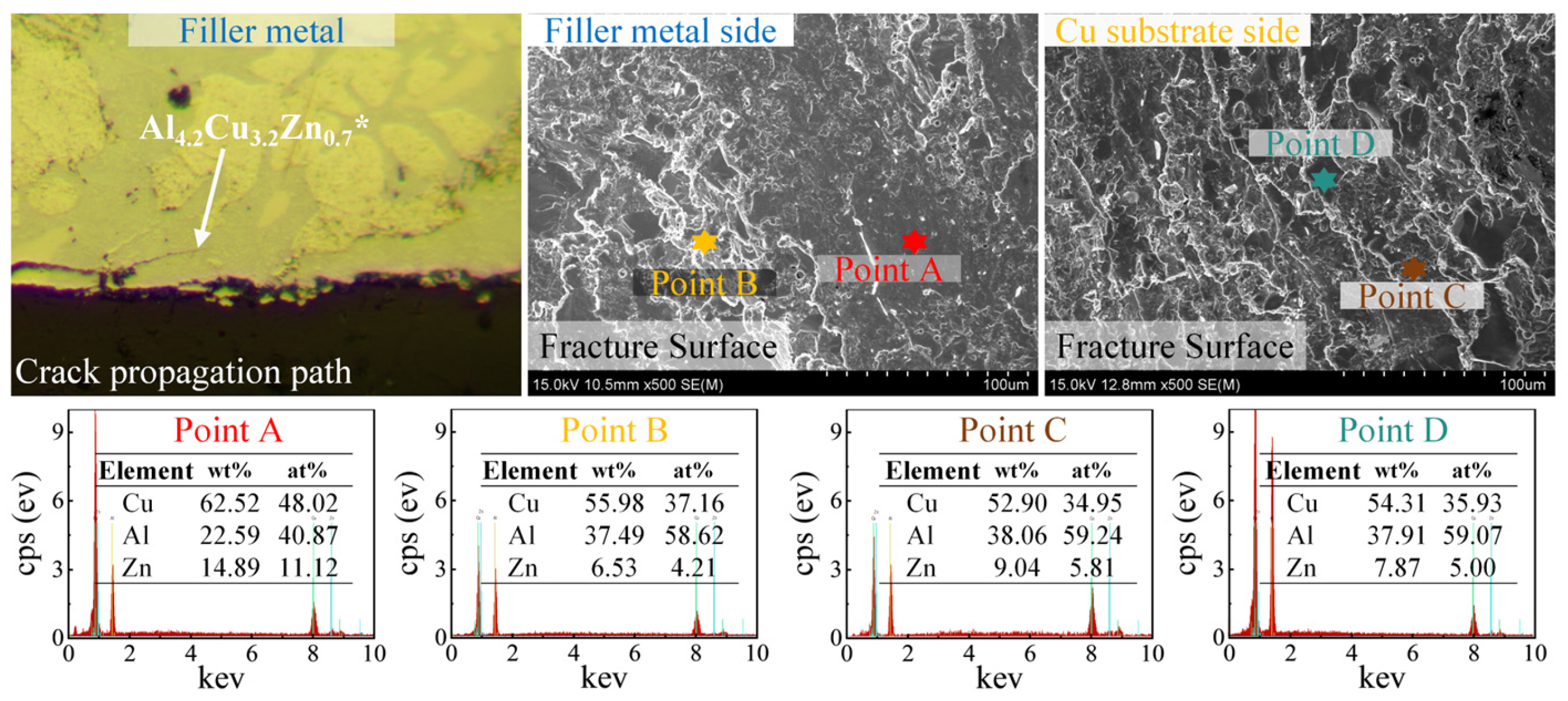
As the aging duration extended to 1000 h, the fracture mode of the Ni-free joint underwent a complete transformation. The cross-sectional optical micrograph of the crack propagation path (left in Figure 15) clearly reveals the catastrophic nature of this failure: the crack path is no longer associated with any specific interface but is completely entrapped within the bulk of the microstructurally degraded reaction layer, propagating through the porous and brittle structure.
Consistent with this internal disintegration, the SEM fracture surface (middle and right in Figure 15) no longer retains any of the large-scale flat cleavage features observed in the initial state. Instead, it is replaced by an extremely rough and fragmented morphology, littered with fine cleavage steps and disordered granular protrusions. EDS analysis of key regions on both fracture sides confirms the singularity of the failure location: whether on the filler metal side (Point A: Zn 11.12 at.%; Point B: Zn 4.21 at.%) or the Cu substrate side (Point C: Zn 5.81 at.%; Point D: Zn 5.00 at.%), the chemical compositions of all probed points fall within the range of the Zn-rich Al4.2Cu3.2Zn0.7* lamellar structure, with no trace of the pristine CuAl2 phase remaining.
This conclusive evidence confirms that failure occurred entirely within the newly generated lamellar Al4.2Cu3.2Zn0.7* layer due to its comprehensive microstructural degradation. The variation in Zn content between Point A and Point B (4.21 vs. 11.12 at.%) reflects the micro-heterogeneity of Al-rich and Zn-rich lamellae within the structure. Since this lamellar constituent was formed via diffusional phase transformation, it inevitably accumulated a high density of volume-shrinkage voids and grain boundary defects. Coupled with its retention of a high elastic modulus (as detailed in Section 3.3.1), this layer is highly prone to brittle fragmentation. Consequently, the extremely low shear strength (~37.5 MPa) of the joint at 1000 h is attributed to the comprehensive disintegration of this porous, brittle lamellar Al4.2Cu3.2Zn0.7* layer, rather than interfacial delamination.
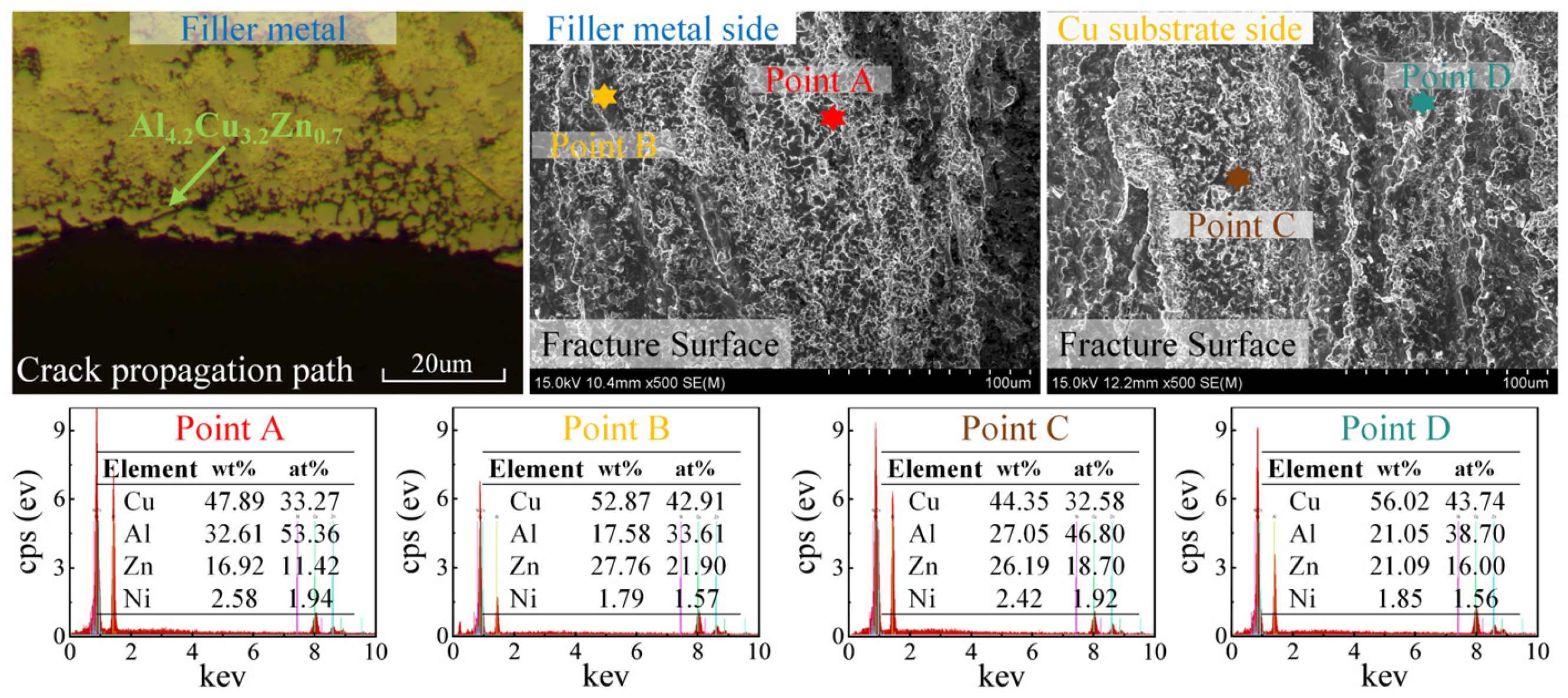
In comparison, Figure 16 presents the fracture morphology of the as-brazed (0 h) Ni-doped joint. The cross-sectional optical micrograph (left in Figure 16) provides direct insight into the toughening mechanism: the crack path is strictly confined within the Ni-induced fine-grained layer and exhibits a highly tortuous trajectory, forced to deflect and bifurcate frequently among the fine grains.
In sharp contrast to the flat brittle cleavage observed in the Ni-free joint, the SEM fracture surface (middle and right in Figure 16) exhibits a highly rough, granular micro-topography, characteristic of fracture occurring within this coral-like fine-grained layer. The entire surface is covered with densely packed micro-protrusions and deep depressions, indicating that the crack did not propagate linearly along a single weak interface but followed the complex path revealed in the cross-section. This highly tortuous crack propagation significantly increased the fracture surface area and energy dissipation, effectively explaining the superior initial shear strength of 76.1 MPa.
EDS compositional analysis further confirms the specificity of the fracture location. On both the filler metal side (Point A: Zn 11.42 at.%, Ni 1.94 at.%; Point B: Zn 21.90 at.%, Ni 1.57 at.%) and the Cu substrate side (Point C: Zn 18.70 at.%, Ni 1.92 at.%; Point D: Zn 16.00 at.%, Ni 1.56 at.%), distinct Ni signals (~1.5–2.0 at.%) and elemental ratios consistent with the Al4.2Cu3.2Zn0.7 phase were consistently detected. This demonstrates that failure was entirely confined within the tough, Ni-bearing fine-grained layer, rather than occurring at the typically weaker IMC/substrate interface. Notably, the Zn content on the fracture surface (11–22 at.%) is generally higher than that of the bulk fine grains in the cross-sectional analysis (~6 at.%), accompanied by Ni enrichment. This suggests that the crack preferentially propagated along the grain boundary network enriched with Zn and Ni segregations, exhibiting a mixed intergranular/transgranular fracture mode governed by microstructural toughening mechanisms.
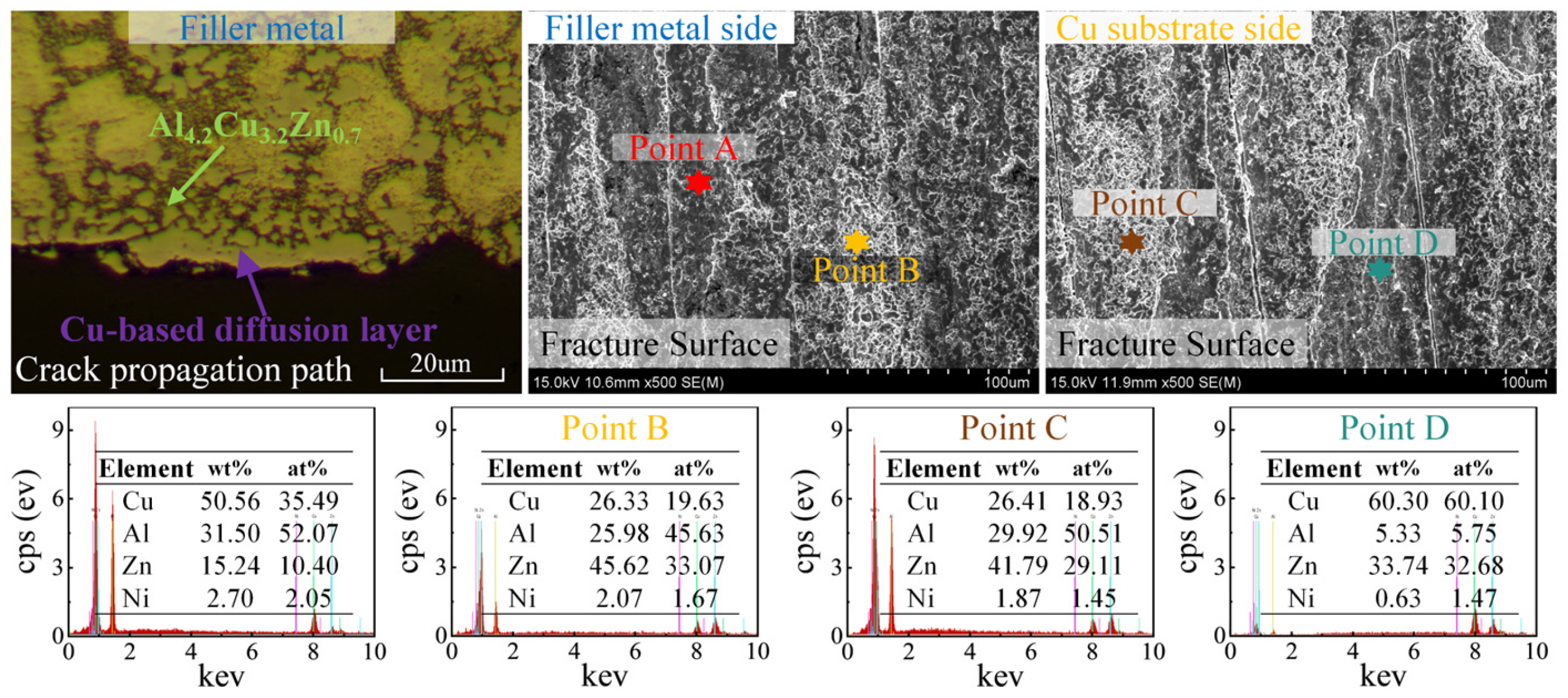
After 500 h of aging, the fracture characteristics of the Ni-doped joint exhibited a subtle yet critical transition. The cross-sectional optical micrograph (left in Figure 17) captures the onset of this transition: while the primary crack path remains within the fine-grained layer, it has begun to locally penetrate into the underlying Cu-based diffusion layer. Reflecting this path migration, the fracture surface (middle and right in Figure 17) reveals a dual morphology. While it retains granular features indicative of fine-grained fracture, implying the continued participation of the coral-like Al4.2Cu3.2Zn0.7 phase in deformation, the most significant change is the emergence of numerous parallel cracks on the Cu substrate side. The geometry of these parallel, flat cracks aligns perfectly with the stratified structure of the Cu-based transition layer observed in Section 3.2.2. EDS compositional analysis reveals the material constitution of these cracked regions: in addition to the typical Ni-bearing fine-grained phase (Points A, C), two phases closely related to the transition layer evolution were detected. One is a Zn-rich phase (Point B, Zn 33.07 at.%), matching the Zn-rejection precipitates at the stratification interface; the other is a Cu-rich phase (Point D, Cu 60.10 at.%, Zn 32.68 at.%), whose stoichiometry corresponds precisely to the lower sub-layer (Sub-layer I) formed after transition layer stratification.
The coexistence of the penetrating crack path observed in the cross-section and the specific phase compositions on the fracture surface provides direct evidence for the evolution of the failure mechanism: as aging induces stratification within the Cu-based transition layer, brittle Zn-rich precipitates accumulate in bands along the sub-layer interfaces. Under shear loading, these Zn-rich bands serve as preferential pathways for crack initiation, guiding the crack to propagate parallel to the interface along the stratification planes, thereby generating the distinct parallel crack morphology. This indicates a shift in failure mode from pure fine-grained ductile tearing to a mixed mode of “fine-grain tearing + intra-layer delamination within the transition layer.” However, despite the onset of intra-layer delamination, the joint maintains a high shear strength (~64 MPa) at 500 h, demonstrating that the unstratified coral-like fine-grained framework continues to bear the primary load, effectively delaying catastrophic failure of the overall structure.
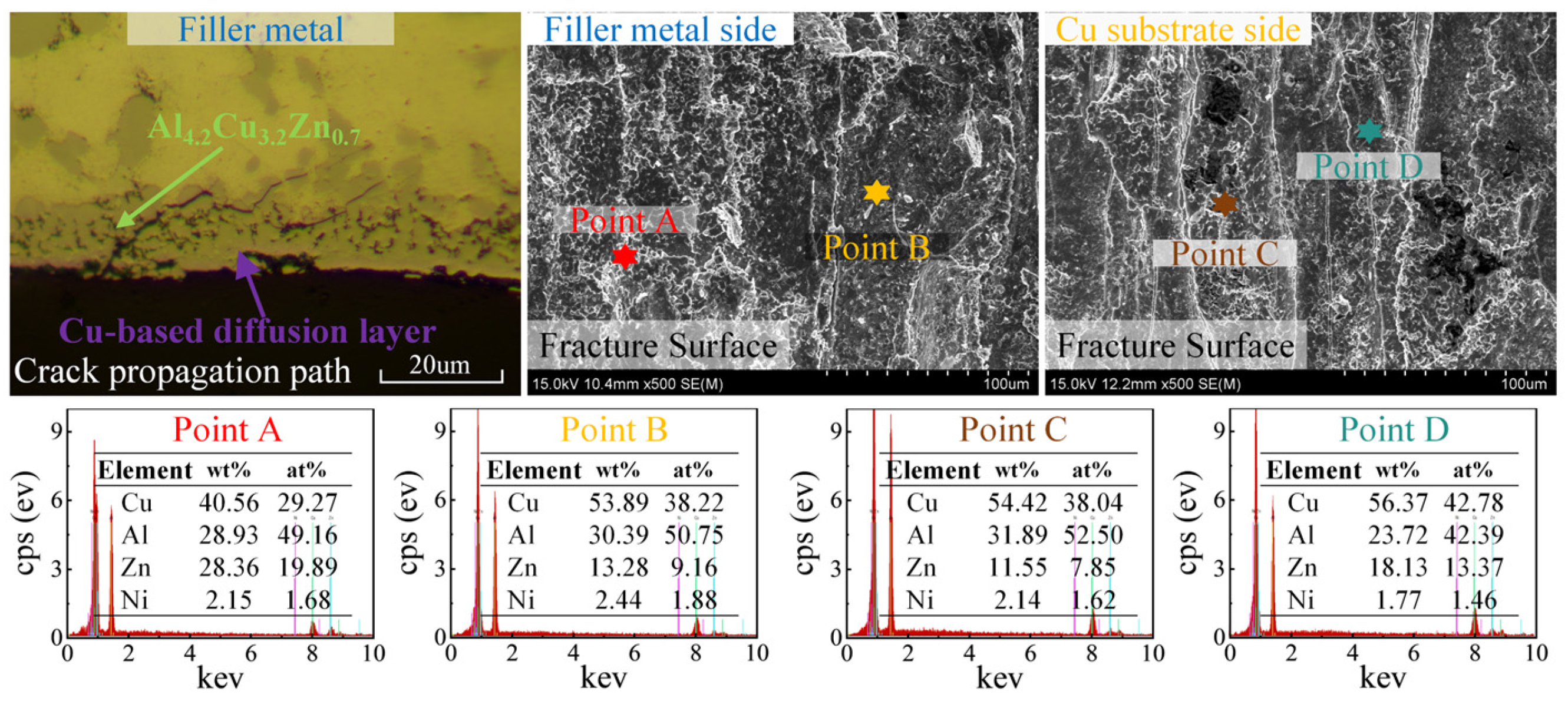
As the aging duration extended to 1000 h, the fracture morphology of the Ni-doped joint evolved into a more complex mixed-mode fracture, profoundly reflecting the cumulative impact of deep-level interfacial phase transformations. The cross-sectional optical micrograph (left in Figure 18) provides compelling visual evidence of the joint’s toughening mechanism: the crack propagation path is highly discontinuous and bifurcated, exhibiting a “multi-stage deflection” behavior where the crack is alternately trapped within the coral-like layer and redirected along the stratification interfaces of the underlying diffusion layer. Reflecting this complex path, the fracture surface (middle and right in Figure 18) exhibits a unique dual morphology. On one hand, vast areas remain covered by fine granular protrusions; EDS analysis (e.g., Points B and C) confirms their composition (Zn ~7.8–9.2 at.%, Ni ~1.6–1.9 at.%) strictly corresponds to the Ni-bearing coral-like Al4.2Cu3.2Zn0.7 fine-grained phase. This indicates that the tough coral-like framework continued to perform the primary load-bearing and shear-resistant functions up to the end of the aging period. On the other hand, the density and depth of parallel cracks on the Cu substrate side increased significantly, forming more pronounced lamellar tearing features. EDS probing of these cracked regions (e.g., Points A and D) reveals a general elevation in Zn content (~13–20 at.%), consistently accompanied by the presence of Ni. This combination of morphology and composition confirms that crack propagation is no longer confined solely within the coral-like layer but is more frequently channeled toward the underlying Cu-based transition layer interface, which has undergone severe stratification and is populated with Zn-rich precipitates.
This intensified feature of parallel cracking is directly attributed to the deepening of the “stratification and Zn-rejection” mechanism within the transition layer (as shown in Figure 10 of Section 3.2.2). As aging progressed, the coarsening and aggregation of Zn-rich precipitates at the transition layer stratification interface further weakened the interfacial bonding, turning it into a preferential path for crack propagation parallel to the substrate. However, as visualized in the cross-section (left in Figure 18), despite the occurrence of intra-layer delamination, the joint did not suffer from catastrophic brittle fracture as seen in the Ni-free samples (strength retained at ~55 MPa). This is because the fracture path was effectively “confined” within this multi-layered composite structure: when cracks attempted to traverse the hard coral-like layer, they were deflected by fine grain boundaries; when they attempted to cut into the transition layer, they were trapped and redirected by the stratification interface. This multi-stage crack deflection and trapping mechanism effectively dissipated fracture energy, thereby preventing through-thickness propagation of the main crack and endowing the Ni-doped joint with superior structural integrity and mechanical reliability under long-term high-temperature service.
While the Zn-rich precipitates effectively capture diffusing Zn atoms and protect the upper layer during the examined 1000 h period, their continuous coarsening and aggregation at the stratification interface (as observed in Figure 18) suggest a potential limit to this buffering effect. If aging extends significantly beyond 1000 h, these coarsened precipitates could eventually form a continuous brittle path, diminishing local interfacial cohesion and triggering localized embrittlement. Thus, the chemical buffering effect likely possesses a temporal threshold, which warrants further investigation in ultra-long-term studies.

4. Conclusions

In this study, the interfacial microstructural evolution and mechanical degradation mechanisms of Zn-15Al brazed Cu/Al joints with and without trace Ni addition (0.3 wt.%) were comparatively investigated. While the investigation was conducted at a single isothermal aging temperature of 200 °C and phase identification relied primarily on SEM/EDS analysis, the systematic characterization over 1000 h yields the following key conclusions:
1. Thermal Degradation of Ni-free Joints: In Ni-free joints, the interfacial degradation is driven by the diffusion-controlled decomposition of the metastable CuAl2 phase rather than layer thickening. Upon aging, the originally massive CuAl2 layer undergoes a complete phase transformation into a porous, Zn-rich Al4.2Cu3.2Zn0.7* lamellar structure, initiated by the continuous influx of Zn atoms from the filler metal. This transformation introduces a high density of defects and phase boundaries, causing the fracture mode to shift from interfacial cleavage to brittle fragmentation within the degraded lamellar layer. Consequently, the shear strength precipitates from 57 MPa to ~37.5 MPa after 1000 h, accompanied by a near-total loss of ductility.
2. Stabilization Mechanism in Ni-doped Joints: The addition of 0.3 wt.% Ni fundamentally alters the aging behavior by stabilizing the fine-grained interfacial architecture. The upper coral-like Al4.2Cu3.2Zn0.7 fine-grained layer exhibits exceptional morphological stability, resisting coarsening throughout the 1000 h exposure due to the pinning effect of Ni-enriched precipitates. Concurrently, the underlying Cu-based transition layer acts as a “chemical buffer,” undergoing an in situ stratification and purification process. It decomposes into Al-rich and Cu-rich sub-layers while rejecting excess Zn atoms to the stratification interface as precipitates, effectively intercepting the Zn diffusion flux and shielding the overlying fine-grained layer from phase decomposition.
3. Mechanical Reliability and Fracture Transition: Ni-doped joints demonstrate superior long-term mechanical reliability, retaining a shear strength of ~55.2 MPa after 1000 h aging—comparable to the initial strength of the Ni-free joint. This durability is attributed to a unique modulus softening effect: the elastic modulus of the transition layer decreases significantly from ~154 GPa to ~110 GPa upon stratification, alleviating the interfacial stiffness mismatch with the Cu substrate. Fractographic analysis reveals a transition in failure mode from pure fine-grained tearing to a mixed mode involving intra-layer delamination within the transition layer. The multi-stage crack deflection provided by the preserved coral-like framework and the stratified transition layer effectively dissipates fracture energy, preventing catastrophic brittle failure.

Author Contributions

Conceptualization, T.C. and T.X.; methodology, T.C.; software, T.C.; validation, T.C., T.X. and J.L. (Jingyi Luo); formal analysis, T.C. and S.C.; investigation, T.C. and K.M.; resources, T.C. and R.J.; data curation, T.C.; writing—original draft preparation, T.C.; writing—review and editing, T.C., T.X. and P.H.; visualization, T.C. and W.C.; supervision, T.C. and J.L. (Junyu Li); project administration, T.C.; funding acquisition, T.X. All authors have read and agreed to the published version of the manuscript.

Funding

This research was funded by Open Fund of Aeronautic Intelligent Manufacturing and Digital Health Management Technology Engineering Research Center of Jiangsu Province, grant number ZK25-03-03.

Data Availability Statement

The original contributions presented in this study are included in the article. Further inquiries can be directed to the corresponding author.

Conflicts of Interest

Author Jingyi Luo is employed by the company Jinhua Jinzhong Welding Materials Co., Ltd. The authors declare no conflicts of interest.

References

  1. Zhao, D.; Li, D.; Xiao, Y.; Li, M.; Chen, W. Acoustic cavitation-induced microstructure evolution in ultrasonically brazed Al/Cu joints using Zn-Al alloy fillers. Ultrason. Sonochemistry 2024, 124, 107001. [Google Scholar] [CrossRef] [PubMed]
  2. Zhu, R.; Guo, S.; Huang, C.; Lei, Z.; Zhang, X.; Liu, J. Effects of Different Types of Interlayers on the Interfacial Reaction Mechanism at the Cu Side of Al/Cu Lap Joints Obtained by Laser Welding/Brazing. Materials 2021, 14, 7797. [Google Scholar] [CrossRef] [PubMed]
  3. Lemma, E.A.; Dias, J.M.S.; Bastos, A.; Mascate, B.; Horovistiz, A. Advances in induction brazing of copper and dissimilar metals: Challenges and emerging trends. J. Adv. Join. Process. 2025, 11, 100302. [Google Scholar] [CrossRef]
  4. You, J.; Zhao, Y.; Dong, C.; Su, Y. Improving the microstructure and mechanical properties of Al-Cu dissimilar joints by ultrasonic dynamic-stationary shoulder friction stir welding. J. Mater. Process. Technol. 2023, 311, 117812. [Google Scholar] [CrossRef]
  5. Furuya, H.S.; Yabu, S.; Sato, Y.S.; Kokawa, H. Microstructural Control of the Interface Layer for Strength Enhancement of Dissimilar Al/Cu Joints via Ni Addition during TIG Arc Brazing. Metals 2021, 11, 491. [Google Scholar] [CrossRef]
  6. Yu, G.; Sun, H.; Chen, S.; Zou, T.; Huang, J.; Yang, J.; Zhao, Z. Enhancing Aluminum Alloy Brazing Joint Strength by Using Zn-Al-Cu Filler Metal. J. Mater. Eng. Perform. 2021, 31, 2410–2418. [Google Scholar] [CrossRef]
  7. Peng, C.; Zhu, D.; Li, K.; Du, X.; Zhao, F.; Wan, M.; Tan, Y. Research on a Low Melting Point Al-Si-Cu (Ni) Filler Metal for 6063 Aluminum Alloy Brazing. Appl. Sci. 2021, 11, 4296. [Google Scholar] [CrossRef]
  8. Gao, Z.; Jin, X.; Li, S.; Zhang, Z.; Niu, J.; Brnic, J. Study on microstructure and mechanical properties of 3003 aluminum alloy joints brazed with Al-Si-Cu-Ni paste brazing materials. Sci. Rep. 2024, 14, 10648. [Google Scholar] [CrossRef] [PubMed]
  9. Niu, Z.; Ye, Z.; Huang, J.; Yang, H.; Yang, J.; Chen, S. Interfacial structure and properties of Cu/Al joints brazed with Zn-Al filler metals. Mater. Charact. 2018, 138, 78–88. [Google Scholar] [CrossRef]
  10. Hasan, M.M.; Sharif, A.; Gafur, M.A. Characteristics of eutectic and near-eutectic Zn-Al alloys as high-temperature lead-free solders. J. Mater. Sci. Mater. Electron. 2020, 31, 1691–1702. [Google Scholar] [CrossRef]
  11. Xiao, Y.; Ji, H.; Li, M.; Kim, J. Ultrasound-assisted brazing of Cu/Al dissimilar metals using a Zn-3Al filler metal. Mater. Des. 2013, 52, 740–747. [Google Scholar] [CrossRef]
  12. Ganczar, T.; Pstruś, J.; Berent, K. Interfacial Reactions of Zn-Al Alloys with Na Addition on Cu Substrate During Spreading Test and After Aging Treatments. J. Mater. Eng. Perform. 2016, 25, 3366–3374. [Google Scholar] [CrossRef][Green Version]
  13. Yu, G.; Sun, H.; Teng, F.; Chen, S.; Huang, J.; Yang, J.; Zhao, Z. Influence of Si Addition on Microstructure, Mechanical Properties, and Corrosion Resistance of Al/Steel Brazing Joint Using Zn-15Al-XSi Filler Metals. J. Mater. Eng. Perform. 2023, 33, 1874–1884. [Google Scholar] [CrossRef]
  14. Feng, J.; Songbai, X.; Wei, D. Effects of Ti on the brazability of Zn-22Al-xTi filler metals as well as properties of Cu/Al brazing joints. Rare Met. Mater. Eng. 2013, 42, 2453–2457. [Google Scholar] [CrossRef]
  15. Li, X.; Zhai, Y.; Liu, M.; Wang, X.; Wang, T. Development of Zn–22Al–xAg filler metals for brazing 6061 aluminum alloy to T2 copper. Weld. World 2025, 69, 2907–2920. [Google Scholar] [CrossRef]
  16. Chen, T.; He, P.; Xu, T. Investigation of wetting behavior and brazing reliability of Zn-15Al-xGa filler metals in Cu/Al Joints. J. Alloys Compd. 2025, 1010, 177252. [Google Scholar] [CrossRef]
  17. Zhai, Y.; Wang, T.; Liu, M.; Zhou, N.; Li, X. Effect of Al Content on the Microstructure and Properties of Zn-Al Solder Alloys. Metals 2024, 14, 689. [Google Scholar] [CrossRef]
  18. Zhang, J.; Zhao, J.; Fu, W.; Zhang, X.; Sun, P.; Wang, Y.; Song, X. Ultrasonically Assisted Metallizing of Sapphire and Its Brazing to Magnesium Alloys with Zn-Al Alloy. J. Mater. Eng. Perform. 2024, 33, 1985–1995. [Google Scholar] [CrossRef]
  19. Feng, J.; Xue, S.B.; Dai, W. Reliability studies of Cu/Al joints brazed with Zn–Al–Ce filler metals. Mater. Des. 2012, 42, 156–163. [Google Scholar] [CrossRef]
  20. Berent, K.; Pstruś, J.; Ganczar, T. Thermal and Microstructure Characterization of Zn-Al-Si Alloys and Chemical Reaction with Cu Substrate During Spreading. J. Mater. Eng. Perform. 2016, 25, 3375–3383. [Google Scholar] [CrossRef][Green Version]
  21. ISO 14373:2015; Resistance Welding—Procedure for Spot Welding of Uncoated and Coated low Carbon Steels. International Organization for Standardization (ISO): Geneva, Switzerland, 2015.
Figure 1. Schematic diagram of brazing sample assembly.
Crystals 16 00131 g001
Figure 2. Cross-sectional optical micrographs of the interfacial evolution at the Cu side during thermal aging: (ac) Al/Zn-15Al/Cu joints aged for 0 h, 500 h, and 1000 h, respectively; (df) Al/Zn-15Al-0.3Ni/Cu joints aged for 0 h, 500 h, and 1000 h, respectively.
Crystals 16 00131 g002
Figure 3. Microstructural evolution of the IMC layers at the Cu-side interface of Al/Zn-15Al/Cu brazed joints under different aging times: (a) 0 h; (b) 200 h; (c) 500 h; (d) 800 h; (e) 1000 h.
Crystals 16 00131 g003
Figure 4. Microstructural evolution of the IMC layers at the Cu-side interface of Al/Zn-15Al-0.3Ni/Cu brazed joints under different aging times: (a) 0 h; (b) 200 h; (c) 500 h; (d) 800 h; (e) 1000 h.
Crystals 16 00131 g004
Figure 5. Interfacial characterization of Al/Zn-15Al/Cu brazed joints at 0 h: (a) SEM image and EDS mapping results; (bd) elemental compositions of the marked regions by EDS.
Crystals 16 00131 g005
Figure 6. Interfacial characterization of Al/Zn-15Al/Cu brazed joints at 500 h: (a) SEM image and EDS mapping results; (bd) elemental compositions of the marked regions by EDS.
Crystals 16 00131 g006
Figure 7. Interfacial characterization of Al/Zn-15Al/Cu brazed joints at 1000 h: (a) SEM image and EDS mapping results; (bd) elemental compositions of the marked regions by EDS.
Crystals 16 00131 g007
Figure 8. Interfacial characterization of Al/Zn-15Al-0.3Ni/Cu brazed joints at 0 h: (a) SEM image and EDS mapping results; (bd) elemental compositions of the marked regions by EDS.
Crystals 16 00131 g008
Figure 9. Interfacial characterization of Al/Zn-15Al-0.3Ni/Cu brazed joints at 500 h: (a) SEM image and EDS mapping results; (b) SEM image and EDS mapping results of Cu-based transition layer in (a); (ce) elemental compositions of the marked regions by EDS.
Crystals 16 00131 g009
Figure 10. Interfacial characterization of Al/Zn-15Al-0.3Ni/Cu brazed joints at 1000 h: (a) SEM image and EDS mapping results; (b) SEM image and EDS mapping results of Cu-based transition layer in (a); (ce) elemental compositions of the marked regions by EDS.
Crystals 16 00131 g010
Figure 11. Load–displacement (P-h) curves of the interfacial layers on the Cu side: (a,b) Al/Zn-15Al/Cu joints aged for 0 h and 1000 h, respectively; (c,d) Al/Zn-15Al-0.3Ni/Cu joints aged for 0 h and 1000 h, respectively.
Crystals 16 00131 g011
Figure 12. Shear properties of the brazed joints at different aging times: (a) Shear stress–strain curves of the Al/Zn-15Al/Cu joint; (b) Ture strain and shear strength of the Al/Zn-15Al/Cu joint; (c) Shear stress–strain curves of the Al/Zn-15Al-0.3Ni/Cu joint; (d) Ture strain and shear strength of the Al/Zn-15Al-0.3Ni/Cu joint.
Crystals 16 00131 g012
Figure 13. Failure analysis of the Al/Zn-15Al/Cu joint aged for 0 h: cross-sectional optical micrograph of the crack propagation path (left), and SEM morphologies with corresponding EDS point analysis of the mating fracture surfaces (middle and right).
Crystals 16 00131 g013
Figure 14. Failure analysis of the Al/Zn-15Al/Cu joint aged for 500 h: cross-sectional optical micrograph of the crack propagation path (left), and SEM morphologies with corresponding EDS point analysis of the mating fracture surfaces (middle and right).
Crystals 16 00131 g014
Figure 15. Failure analysis of the Al/Zn-15Al/Cu joint aged for 1000 h: cross-sectional optical micrograph of the crack propagation path (left), and SEM morphologies with corresponding EDS point analysis of the mating fracture surfaces (middle and right).
Crystals 16 00131 g015
Figure 16. Failure analysis of the Al/Zn-15Al-0.3Ni/Cu joint aged for 0 h: cross-sectional optical micrograph of the crack propagation path (left), and SEM morphologies with corresponding EDS point analysis of the mating fracture surfaces (middle and right).
Crystals 16 00131 g016
Figure 17. Failure analysis of the Al/Zn-15Al-0.3Ni/Cu joint aged for 500 h: cross-sectional optical micrograph of the crack propagation path (left), and SEM morphologies with corresponding EDS point analysis of the mating fracture surfaces (middle and right).
Crystals 16 00131 g017
Figure 18. Failure analysis of the Al/Zn-15Al-0.3Ni/Cu joint aged for 1000 h: cross-sectional optical micrograph of the crack propagation path (left), and SEM morphologies with corresponding EDS point analysis of the mating fracture surfaces (middle and right).
Crystals 16 00131 g018
Disclaimer/Publisher’s Note: The statements, opinions and data contained in all publications are solely those of the individual author(s) and contributor(s) and not of MDPI and/or the editor(s). MDPI and/or the editor(s) disclaim responsibility for any injury to people or property resulting from any ideas, methods, instructions or products referred to in the content.