Skip to Content
CrystalsCrystals
  • Review
  • Open Access

2 March 2026

Welding Techniques and Microstructural Control for Dissimilar Cu/Al Joints

,
,
,
,
and
1
Henan Key Laboratory of Advanced Conductor Materials, Institute of Materials, Henan Academy of Sciences, Zhengzhou 450046, China
2
School of Intelligent Manufacturing and Control Engineering, Shanghai Polytechnic University, Shanghai 201209, China
3
Xinxiang Qixing Brazing Technology Co., Ltd., Xinxiang 453003, China
4
School of Materials Science and Engineering, Jiangsu University of Science and Technology, Zhenjiang 212003, China

Abstract

Welding copper (Cu) and aluminum (Al) is highly demanded for lightweight and cost-effective manufacturing. However, it faces significant challenges. First, substantial differences in physical properties may lead to high residual stresses and distortion. Second, brittle intermetallic compounds (IMCs) readily form at the interface, severely compromising the joint’s mechanical properties and electrical conductivity. Third, the native oxide film on Al impedes effective wetting and bonding. Therefore, effective control over the interfacial microstructure of the welded joint is essential. This review provides a critical analysis and comparison of several typical welding techniques, including laser welding (LW), friction stir welding (FSW), ultrasonic welding (UW), brazing and soldering, and welding–brazing. These analyses focus on their process characteristics, joint microstructures, and corresponding formation mechanisms. Furthermore, this review synthesizes key strategies for enhancing joint quality, including process parameter optimization, introduction of functional interlayers, and external assistance, aimed at optimizing joint microstructure and minimizing defects. Based on the analysis, this work provides comparative insights into process selection and microstructure control, and highlights future directions: advancing novel methods such as magnetic pulse welding and transient liquid phase bonding; developing intelligent real-time process control to suppress brittle IMCs and associated defects; promoting sustainable practices and establishing standardized performance evaluation; and systematically investigating long-term reliability to support the industrial application of robust Cu/Al joints.

1. Introduction

As global manufacturing moves toward lightweight, high-performance, and cost-effective solutions, dissimilar metal welding technologies are playing an increasingly vital role in critical sectors such as aerospace, automotive, power electronics, and new energy [1,2,3,4,5,6,7]. Against this backdrop, copper (Cu)–aluminum (Al) dissimilar welding has garnered significant attention owing to its substantial economic value and technical challenges. Cu, with its exceptional electrical and thermal conductivity, has become an indispensable material in power transmission and thermal management [8,9]. However, the high density and cost of Cu limit its widespread adoption in weight-sensitive and cost-critical applications. In contrast, Al and its alloys offer approximately 60% of the electrical and thermal conductivity of Cu but only about 30% of its density. Abundant reserves and lower costs establish Al a vital material for structural lightweighting [10]. Therefore, high-quality welding techniques enable the fabrication of Cu/Al composite structures that combine the superior electrical and thermal conductivity of Cu with the lightweight and cost advantages of Al. This achieves structural lightweighting and cost reduction while enhancing performance through material synergy, thereby possessing considerable scientific merit and exhibiting vast potential for industrial deployment [11,12]. For instance, in the power battery systems of new energy vehicles (EVs), replacing pure Cu busbars with Cu/Al connectors significantly reduces battery pack weight while maintaining high electrical conductivity [13,14,15]. In aerospace, Cu/Al connectors meet aircraft weight reduction requirements while maintaining high conductivity in wiring harnesses, power distribution panels, and avionics equipment [16,17,18]. Within the power industry, Cu/Al transition joints serve as critical components connecting Cu cables to Al busbars [19]. Driven by the rapid growth of new energy, EVs, and smart grids, applications of dissimilar Cu/Al joints continue to expand, underscoring the critical need for advanced high-quality welding technologies.
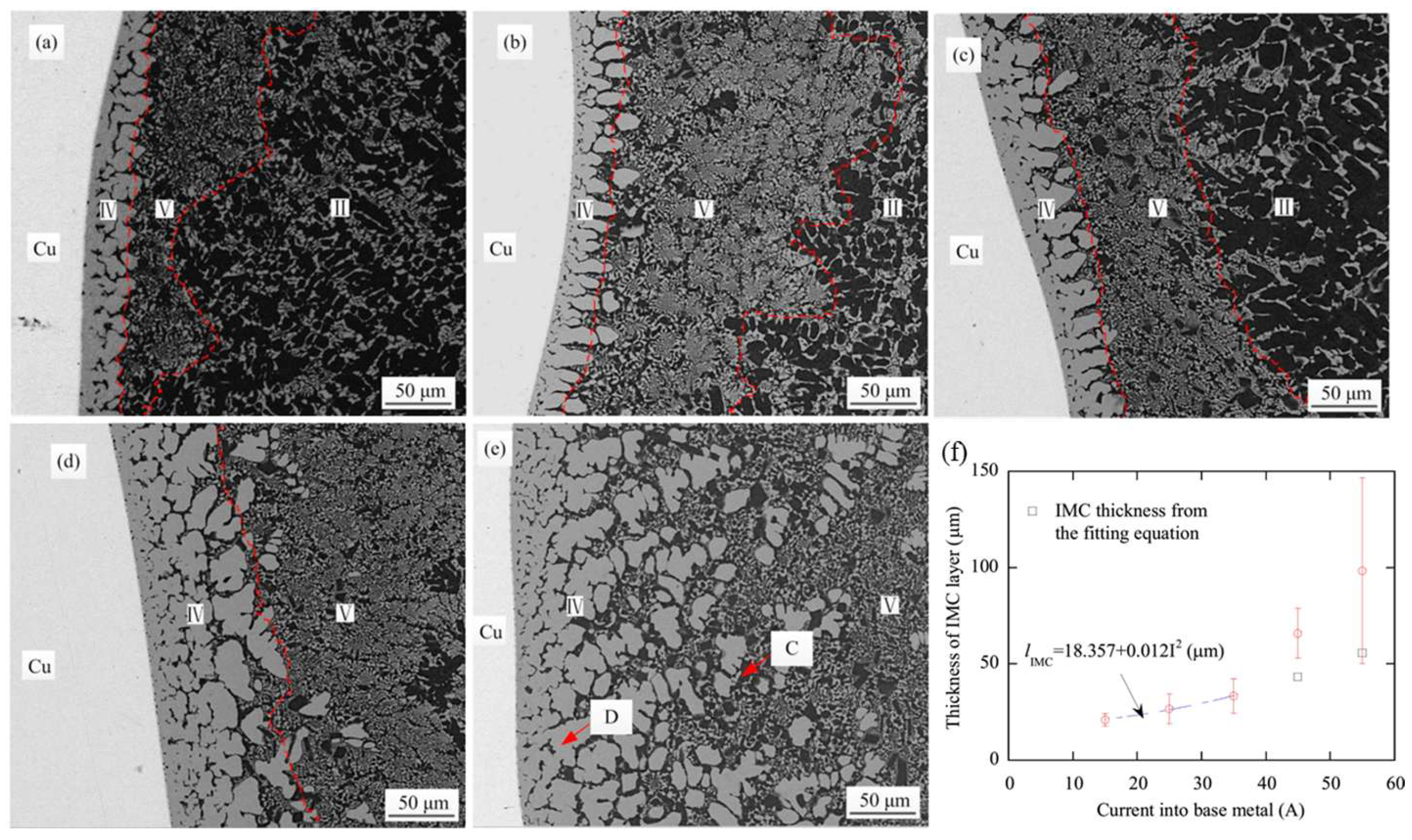
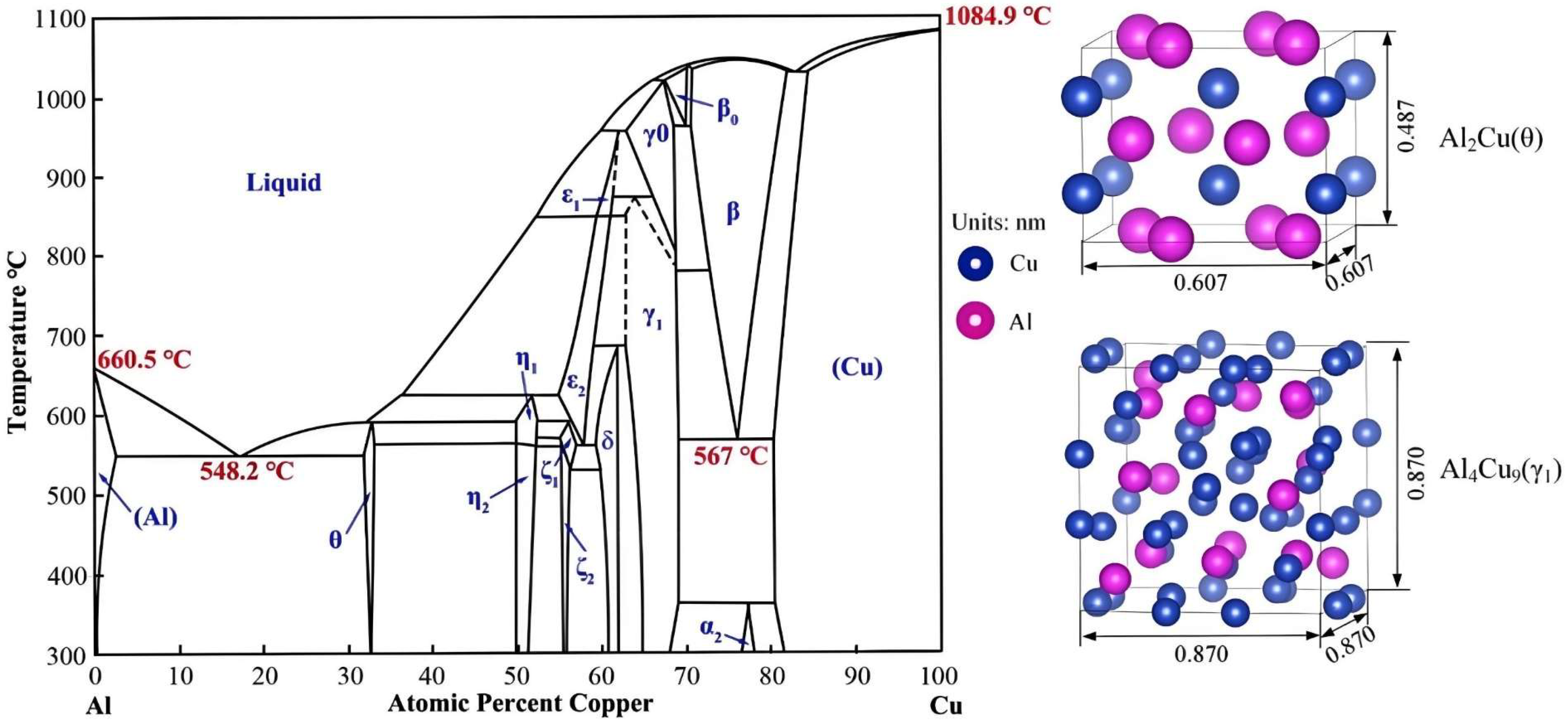
However, the development of reliable and stable Cu/Al joints faces major challenges, which stem from both inherent disparities in their physical properties and the inevitable formation of brittle intermetallic compounds (IMCs) at the interface [20,21,22,23]. Table 1 presents the physical properties of Cu and Al metals. While the data are for pure Cu and Al, they are still valuable in understanding the differences in thermophysical properties of their respective alloys [20]. As listed in Table 1, Cu possesses a significantly higher melting point than Al, and the two metals also differ substantially in their coefficients of thermal expansion (CTEs), thermal conductivity, and crystal structure. These differences render the joint region highly prone to significant thermal stress, residual stress, and deformation during welding, leading to cracks and other defects [24,25]. Figure 1 presents the binary equilibrium phase diagram for the Al-Cu system. It indicates the formation of α-Al and β-Cu substitution solid solutions at the Al-rich and Cu-rich ends, respectively. Multiple IMCs exist in the region between the two terminal solid solutions, including θ(CuAl2), η2(CuAl), ζ2(Cu4Al3), δ(Cu3Al2), and γ1(Cu9Al4) (at room temperature) [25,26]. Table 2 presents key characteristics of Cu-Al IMCs [25]; these IMCs are characterized by high hardness and electrical resistivity. When subjected to external forces, these IMCs become preferred sites for microcrack formation, resulting in a severe deterioration in mechanical strength of the joint. Moreover, their high electrical resistivity significantly increases contact resistance, which may induce localized overheating and ultimately result in joint failure during service. Therefore, both effective control over IMC formation and optimization of IMC morphology are essential for achieving reliable Cu/Al joints [27,28]. During the welding process, the growth of these IMCs is governed by solid-state interdiffusion. Typically, the thickness of an IMC layer follows parabolic kinetics, expressed as l2 = Kt, where l is the layer thickness, K is the growth rate constant, and t is time. Consequently, controlling process temperature and time constitutes a key approach for managing IMC thickness and ensuring joint reliability [27,28]. Furthermore, the formation of a dense, high-melting-point alumina film on the Al surface severely impedes the wetting and spreading of the molten metal, thereby creating a significant obstacle to effective metallurgical bonding [29,30,31,32].
Table 1. Common physical properties of Cu and Al [20].
Figure 1. Al-Cu binary equilibrium phase diagram [26].
Table 2. Key characteristics of Cu-Al IMCs [25].
Consequently, extensive research has focused on techniques for achieving reliable Cu/Al joints [1,2,3,4,5,6,7,8,9,10,11,12,13,14,15,16,17,18,19,20,21,22,23,24,33,34,35]. The methodological evolution has progressed from traditional arc welding processes (e.g., manual metal arc welding, gas metal arc welding) [36,37,38,39] toward solid-state welding methods with lower heat input and more precise control (e.g., friction stir welding (FSW), ultrasonic welding (UW) [40,41,42,43,44], laser welding (LW) [45], and advanced brazing/soldering technologies [33,46]. Control of Cu/Al dissimilar joints focuses primarily on effectively suppressing the formation and growth of IMCs, optimizing interface structure and bonding quality, and minimizing joint defects. These issues are typically addressed by optimizing welding parameters, introducing specific functional interlayers or reinforcements, and employing external assistance such as thermal, mechanical, ultrasonic [1,2,3,4,33,34,42,44,46,47].
This review systematically examines recent progress in Cu/Al dissimilar welding. By analyzing the process characteristics of mainstream Cu/Al welding methods (LW, FSW, UW, brazing/soldering, and welding–brazing) and the corresponding microstructural features of joints, it summarizes the formation mechanisms of different joint microstructures and effective approaches for improving joint microstructure and properties through various welding methods. Furthermore, it identifies the core challenges in current research and outlines future development directions in Cu/Al dissimilar welding, aiming to provide a reference for practitioners in this field.

2. Welding Techniques and Microstructure of Dissimilar Cu/Al Joints

2.1. Laser Welding (LW)

2.1.1. Fundamentals of Laser Welding (LW)

LW is a fusion welding process in which workpiece materials absorbs laser energy, converts it into heat, and thereby melts a localized area to form a weld pool [1,19,45]. This is followed by atomic diffusion and bonding, rapid cooling, and solidification, which ultimately produce the welded joint [48]. LW features a high energy density and a small heat-affected zone (HAZ). It enables precise control over the molten pool, allows for high-speed and high-precision processing, and exhibits good adaptability to various processing conditions [49]. Furthermore, the laser beam can be transmitted over long distances through optical fibers. When combined with precision optical systems, the laser beam can achieve remote, high-precision welding along complex paths [50,51]. However, high energy density can readily induce defects such as cracks and porosity [52,53,54], and highly reflective materials (e.g., Cu, Al) exhibit poor absorption efficiency for laser radiation, causing significant reflection of the incident beam and poor weld pool stability. This poses a major challenge for LW of such materials [55,56]. With continuous process improvements and gradually decreasing costs, LW has attracted significant attention in dissimilar metal welding owing to its high efficiency, non-contact nature, and ease of automation.
For welding dissimilar Cu/Al materials, LW demonstrates significant advantages over traditional arc welding processes operating under conventional parameter settings. Traditional welding methods, characterized by high heat input and consequent HAZ, promote the formation of hard and brittle IMCs. As a result, thermal stress concentration and defects such as porosity and cracks are induced, which ultimately severely degrade the mechanical properties of the joint [35]. Moreover, the high-melting-point oxide film on Al is hard to eliminate. This film inhibits metallurgical bonding by impeding fusion and promoting inclusions, all of which compromise joint quality [57]. In contrast, LW achieves localized, precise heating through its high energy density and extremely rapid heating/cooling rates. This significantly reduces the HAZ and welding deformation while effectively suppressing excessive growth and coarsening of IMCs at the Cu/Al interface. Its compatibility with automation and capability of non-contact remote welding significantly enhance process controllability and repeatability [1,19,45,56]. Consequently, LW is widely employed in fields that require exceptional joint quality and reliability. A prime example is lithium-ion battery manufacturing, where LW provides efficient and reliable joints between Al tabs and Cu busbars, ensuring low contact resistance and high current-carrying capacity [58]. Additionally, in the electric drive systems and electrical components of new EVs, LW enables high-quality welding of Al wires to Cu terminals, which meets the stringent long-term reliability requirements [23,59,60].

2.1.2. Microstructure of Laser-Welded Dissimilar Cu/Al Joints

  • IMC formation
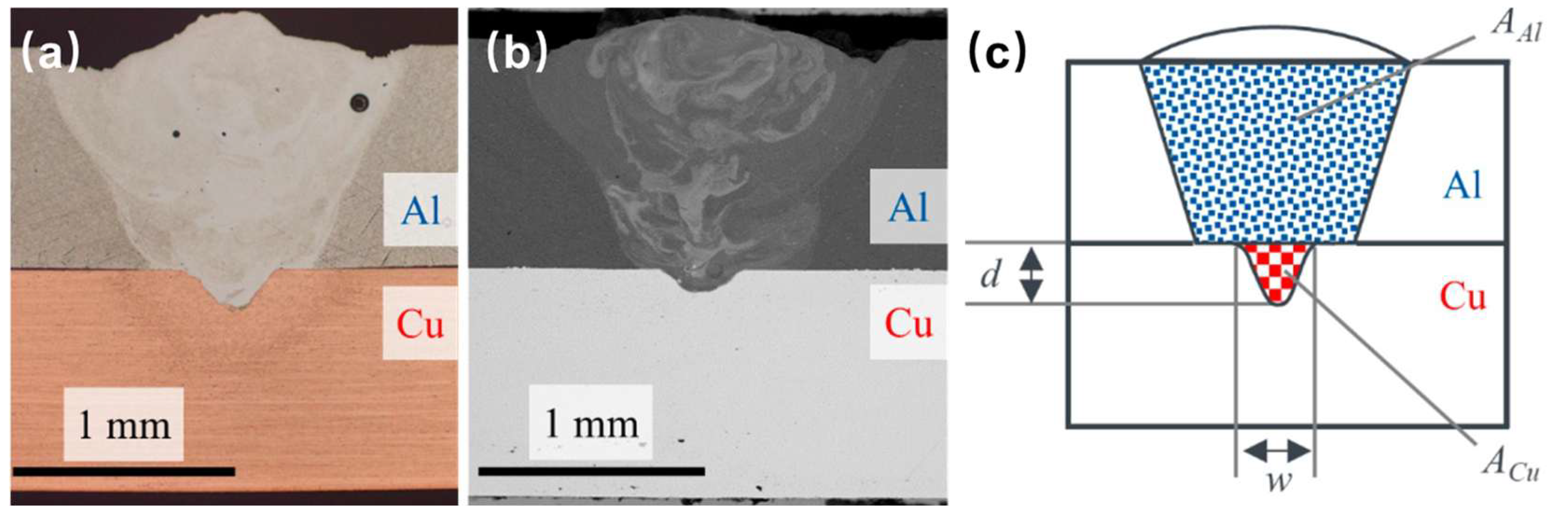
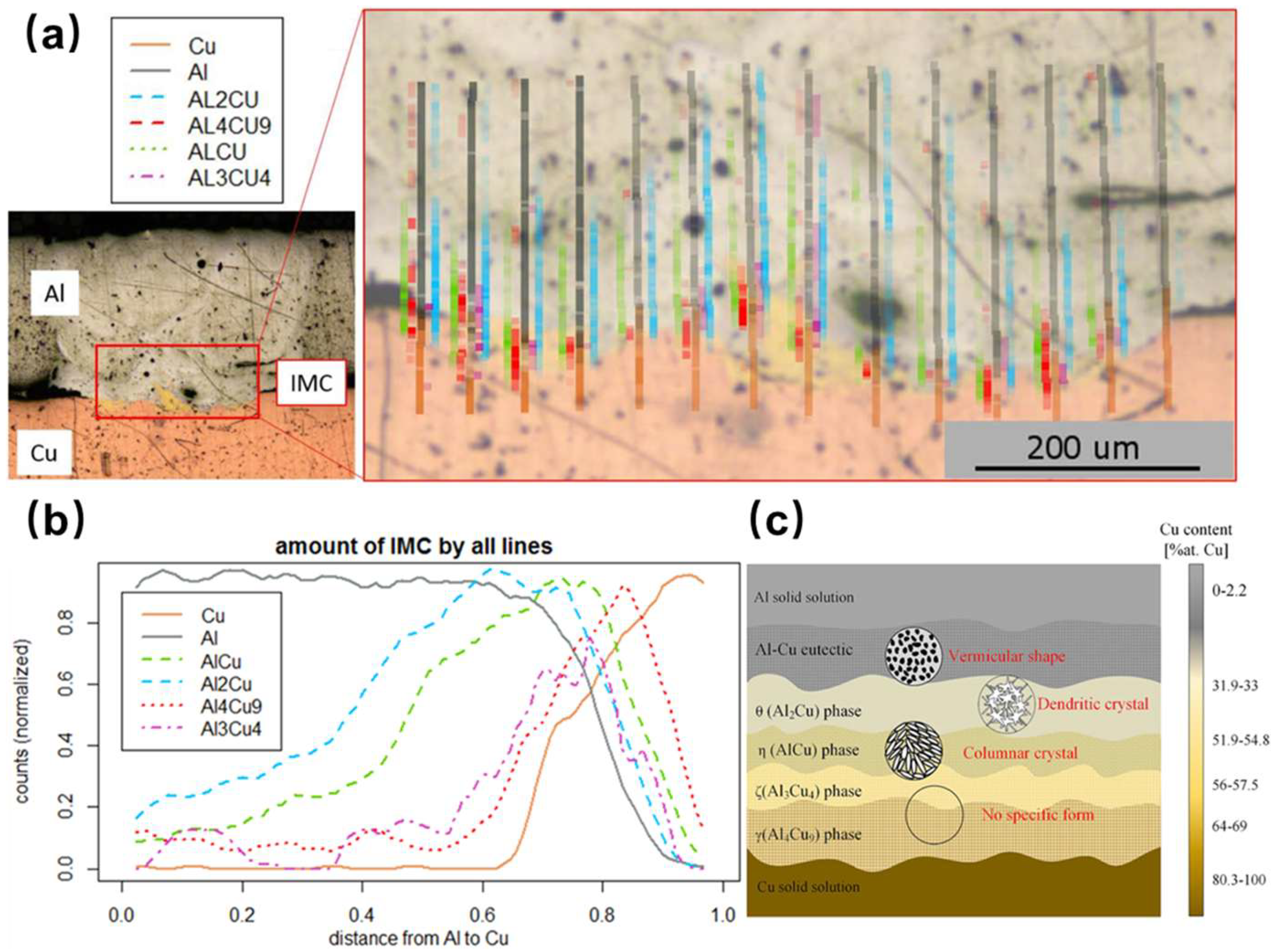
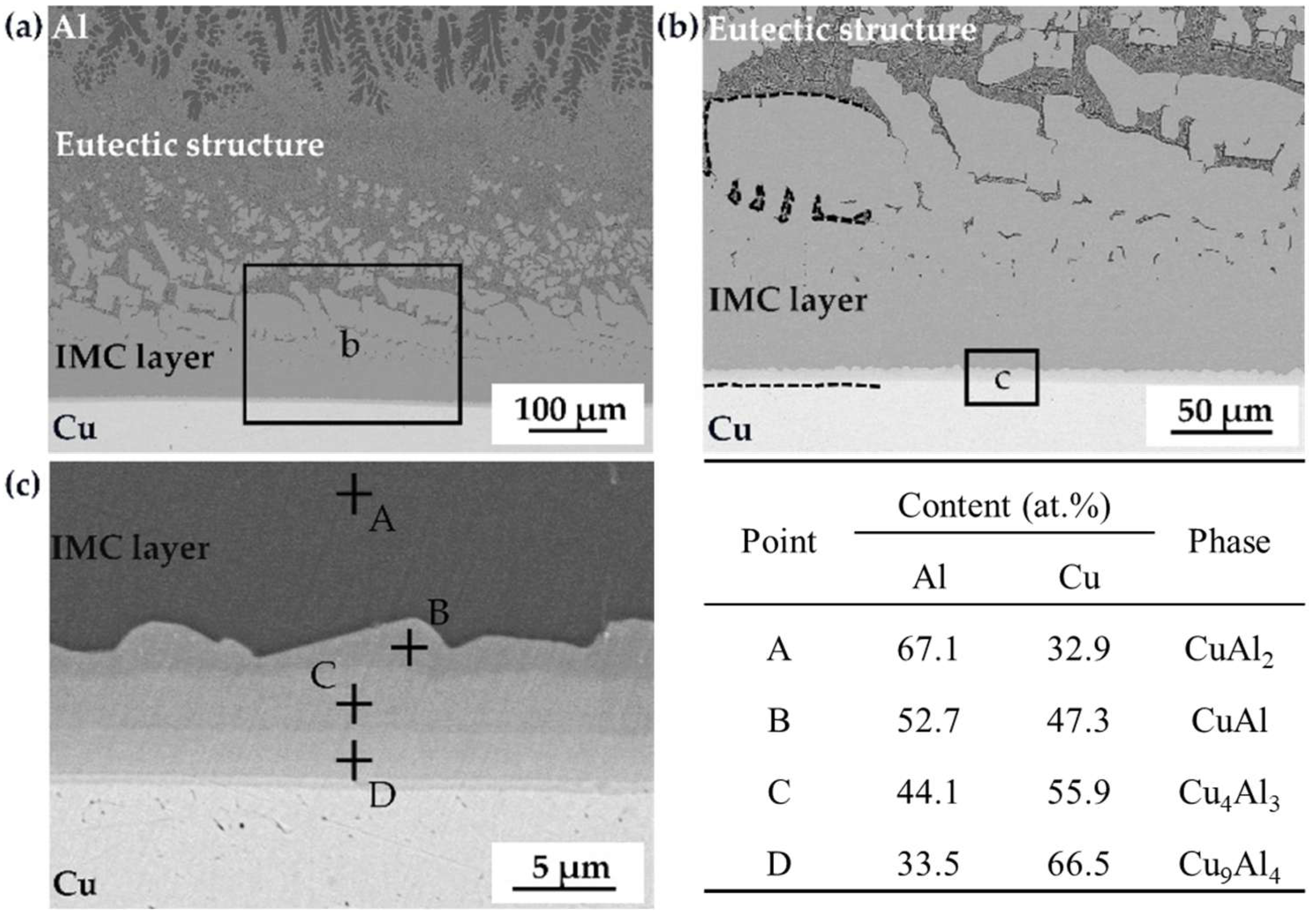
Figure 2 presents the cross-sectional morphology of a typical joint obtained by LW of Cu and Al [61]. Typically, the joint comprises four distinct regions: α-Al solid solution, Al-Cu eutectic, Cu-Al IMCs, and β-Cu solid solution, as illustrated in Figure 3 [1,25]. The region of the Cu/Al joint adjacent to the Al side is predominantly composed of dendritic θ(CuAl2) and vermicular Al-Cu eutectic phases. When Al and Cu are mixed sufficiently during the welding process, a large amount of the η2(CuAl) phase can form, exhibiting a columnar crystal structure. On the Cu side, smaller amounts of ζ2(Cu4Al3) and γ1(Cu9Al4) are formed. These two phases are among the hardest and most brittle IMCs; in the Cu-rich region, clear distinction is often difficult, with the phases tending to appear as irregular Cu clusters rather than distinct morphologies. An appropriate thickness of IMCs can improve the mechanical properties of the joint. However, when the thickness exceeds approximately 2.5 μm, joint strength decreases rapidly. Further increase beyond about 5 μm leads to severe embrittlement and a high propensity for fracture [27]. In laser-welded battery Cu/Al lugs, an excessively thick IMC layer at the interface increases the joint’s electrical resistance. This leads to greater heat generation during charging and discharging and thus accelerates battery degradation [23,62,63]. Therefore, regulating the welding process to suppress excessive IMC growth is critical.
Figure 2. Cross-sectional morphology of a typical laser-welded Cu/Al joint: (a) optical image; (b) SEM image; (c) schematic diagram [61].
Figure 3. IMCs formed in a laser-welded Cu/Al joint: (a) optical image of the IMC seam with the overlaid micro-XRD measurement grid (the lines are broadened for clarity); (b) cumulative plot of all IMCs found by the micro-XRD measurement; (c) schematic diagram of IMC layers [1,25].
2.
Porosity formation
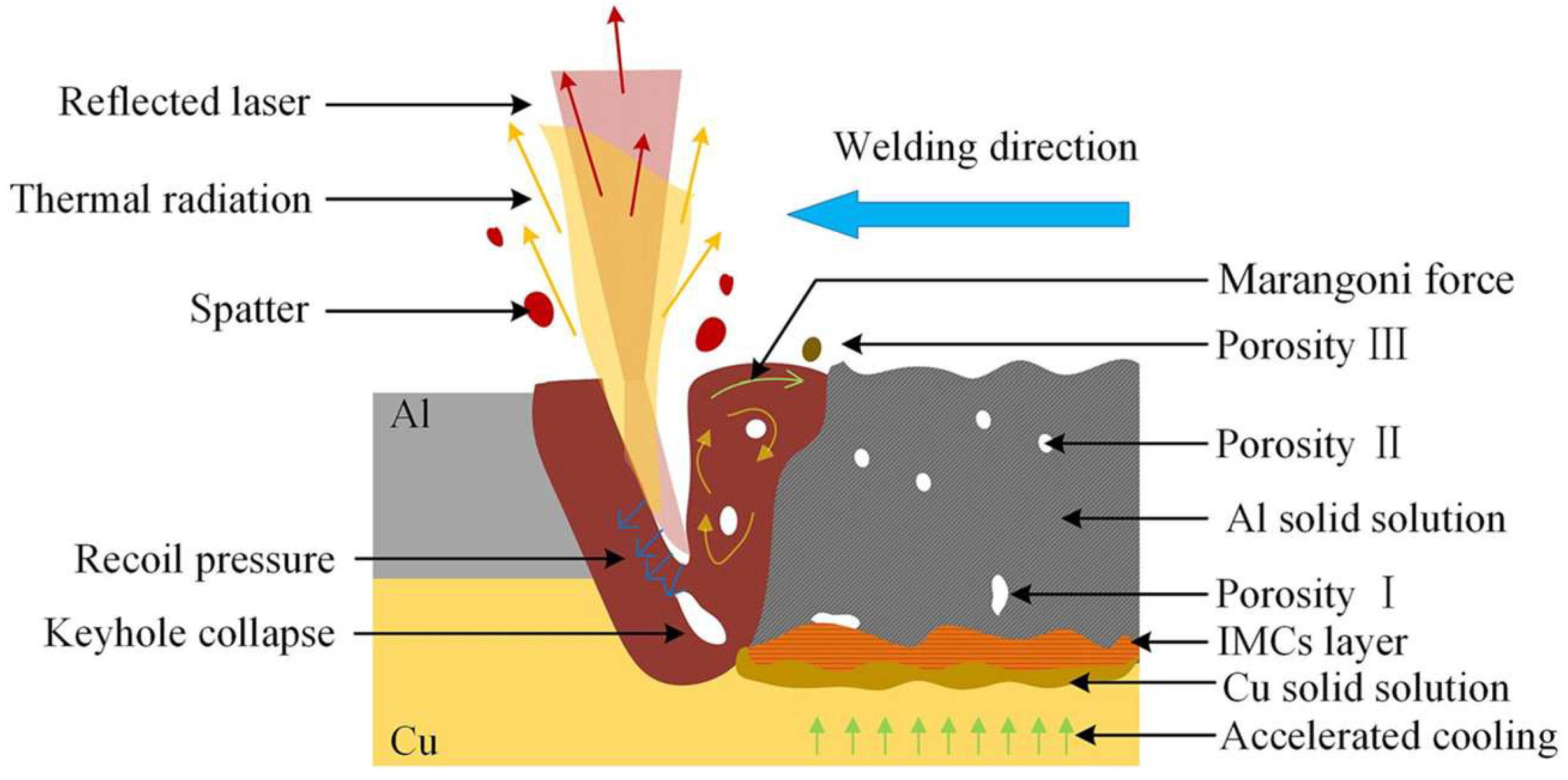
The difference in melting points and specific heat capacities between Cu and Al causes Al to melt before Cu during welding, whereas Cu only softens or partially melts. The disparity in thermal conductivity and CTEs between the two metals leads to stress concentration at the joint, resulting in porosity and cracks [20,64]. Figure 4 depicts the formation mechanisms of different types of porosity in the Cu/Al LW process [1]. During the LW process, the recoil pressure generated by metal vapor causes a keyhole to form at the bottom of the weld pool. However, the backfilling of liquid metal at the keyhole tail can be hindered as a result of the extremely rapid cooling rate induced by the high thermal conductivity of Cu. Combined with vapor pressure fluctuations, this may result in keyhole instability and collapse. If the backfilling rate of molten metal significantly lags behind the solidification rate of the weld pool, failing to promptly fill the collapsed area, internal porosity develops. These internal voids remain at the bottom of the weld pool during solidification (Porosity I). Some voids migrate along the weld pool flow toward the Al side (Porosity II) or escape through the keyhole (Porosity III). Furthermore, contaminants on the Al surface and entrapment of H, O, or N elements can also cause porosity (Porosity II) [1,19,65]. Moreover, the high thermal conductivity of Cu accelerates the cooling of Al, thereby increasing the Al’s susceptibility to porosity formation during welding [60,65].
Figure 4. Schematic diagram of the porosity formation in the Cu/Al laser welding process [1].
3.
Crack formation
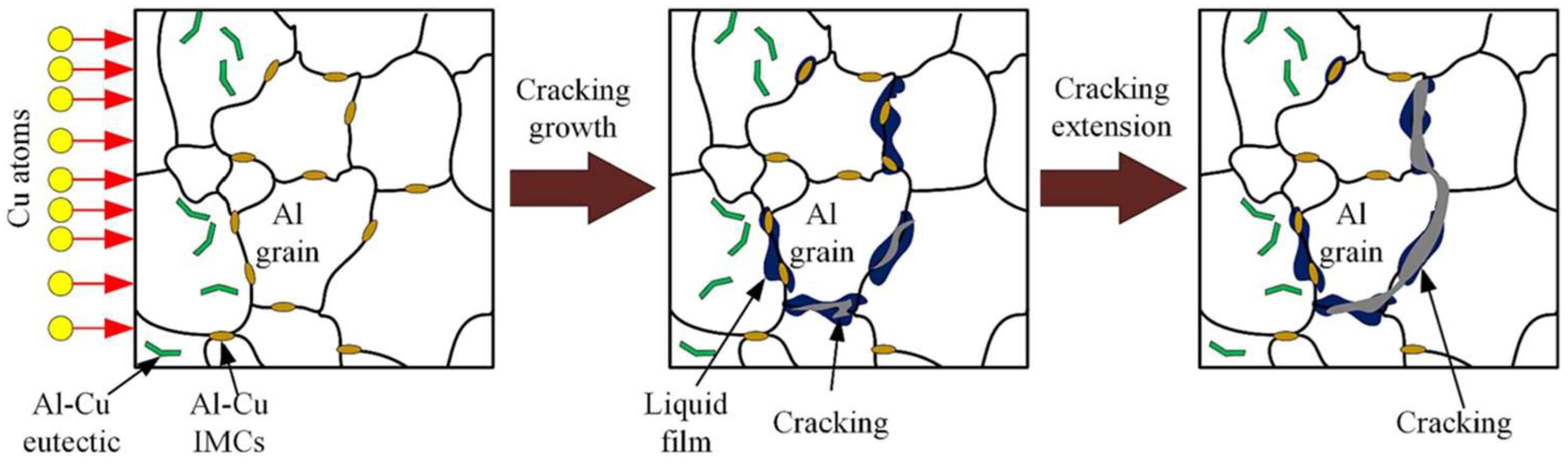
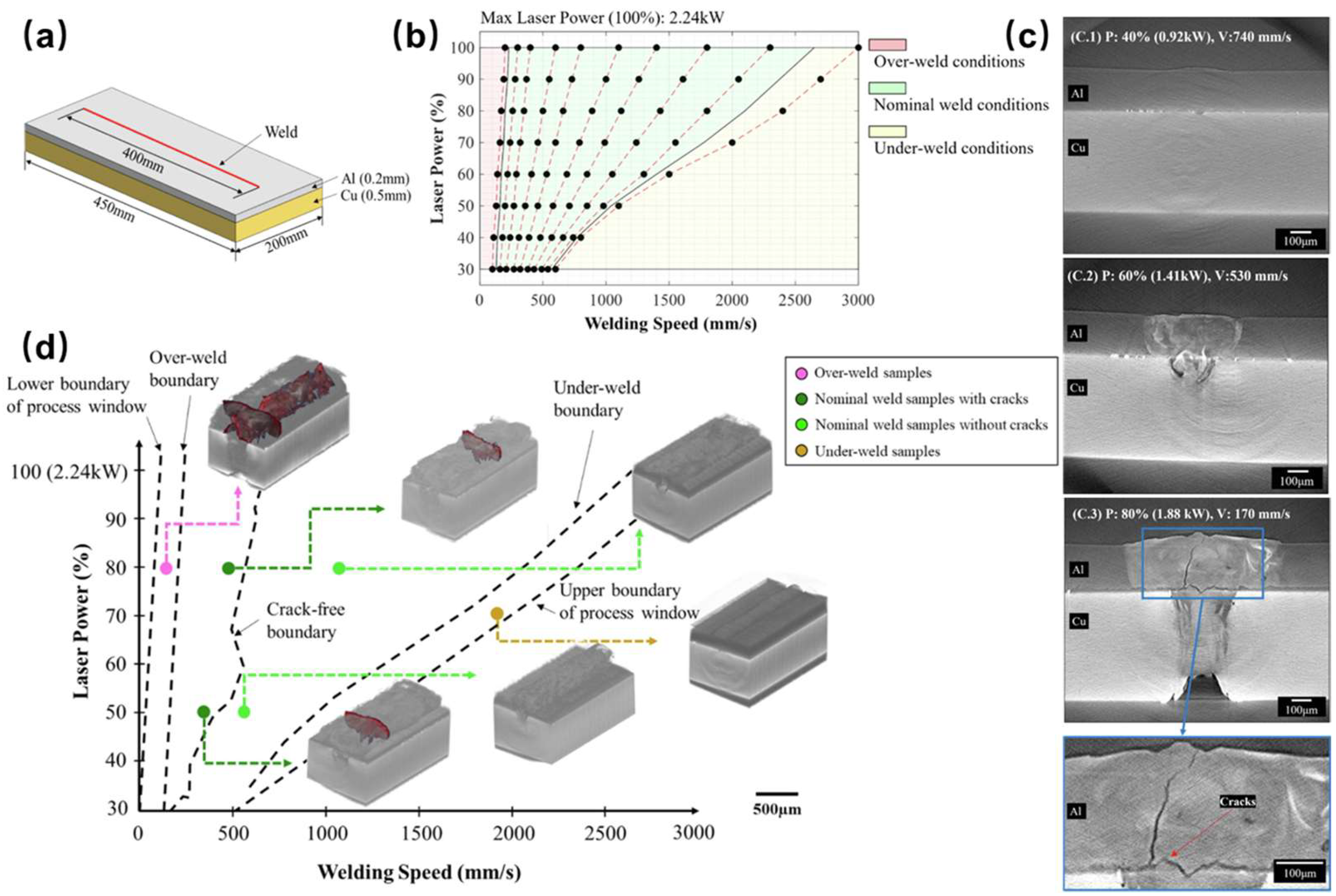
During the LW process of Cu and Al, the significant differences in their CTEs and melting points lead to asynchronous solidification, thereby generating substantial internal stresses under rapid thermal cycles. Moreover, the brittle IMCs formed at the interface severely weaken the grain boundary cohesion, resulting in the initiation and propagation of cracks along the grain boundaries of the joint [66]. Figure 5 illustrates the schematic formation of cracks in laser-welded Cu/Al joints [1]. During the LW process, Cu atoms diffuse along Al grain boundaries and react at elevated temperatures to form an Al-Cu eutectic phase, which enhances the mechanical properties of the joint. Under rapid solidification conditions, unreacted Cu and Al atoms can form Cu-Al IMCs at the grain boundaries. At this point, welding thermal stresses are relatively low, and the plastic deformation of grains is sufficient to balance localized stresses at grain boundaries, preventing liquation cracking. As the welding thermal cycles gradually progress, IMCs progressively accumulate at grain boundaries, leading to a significant degradation in grain boundary cohesion strength. This poses a challenge for the grain boundary region to accommodate the thermal strain through plastic deformation, leading to localized stress concentration. Meanwhile, the expansion of the liquid-phase region further weakens intergranular bonding, promoting the nucleation of microcracks. With increased heat input, localized thermal stress rises further, promoting the propagation of microcracks along weakened grain boundaries. Simultaneously, these microcracks can act as new initiation sites, propagating along the grain boundaries and eventually coalescing to form large, interconnected cracks. Lee et al. [66] employed 3D micro-X-ray computed tomography to characterize the microstructure of Cu/Al laser welds under varying welding speeds and laser powers. Based on this analysis, a three-dimensional processing map for the weld fusion zone was constructed, thereby identifying a processing window for preventing transverse cracks (Figure 6).
Figure 5. Schematic diagram of the crack formation in Cu/Al joints [1].
Figure 6. Process map and corresponding 3D crack morphology evolution in Cu/Al laser welds across laser power vs. welding speed parameter space: (a) specimen geometry; (b) process map; (c) µXCT cross-section images of under-, nominal, and overwelds; (d) the process map of 3D morphologies of weld fusion zone [66].
In summary, the microstructure of laser-welded Cu/Al joints directly determines their macroscopic properties and service reliability. The type, morphology, distribution, and thickness of IMCs formed at the welded joint collectively influence its mechanical properties and electrical conductivity. Additionally, defects such as porosity and cracks are key factors contributing to premature joint failure. Therefore, during the design and optimization of the LW process, it is essential to synergistically control heat input, cooling rate, and weld pool behavior to suppress excessive growth of harmful IMCs while minimizing welding defects, thereby achieving high-quality joints.

2.2. Friction Stir Welding (FSW)

2.2.1. Fundamentals of Friction Stir Welding (FSW)

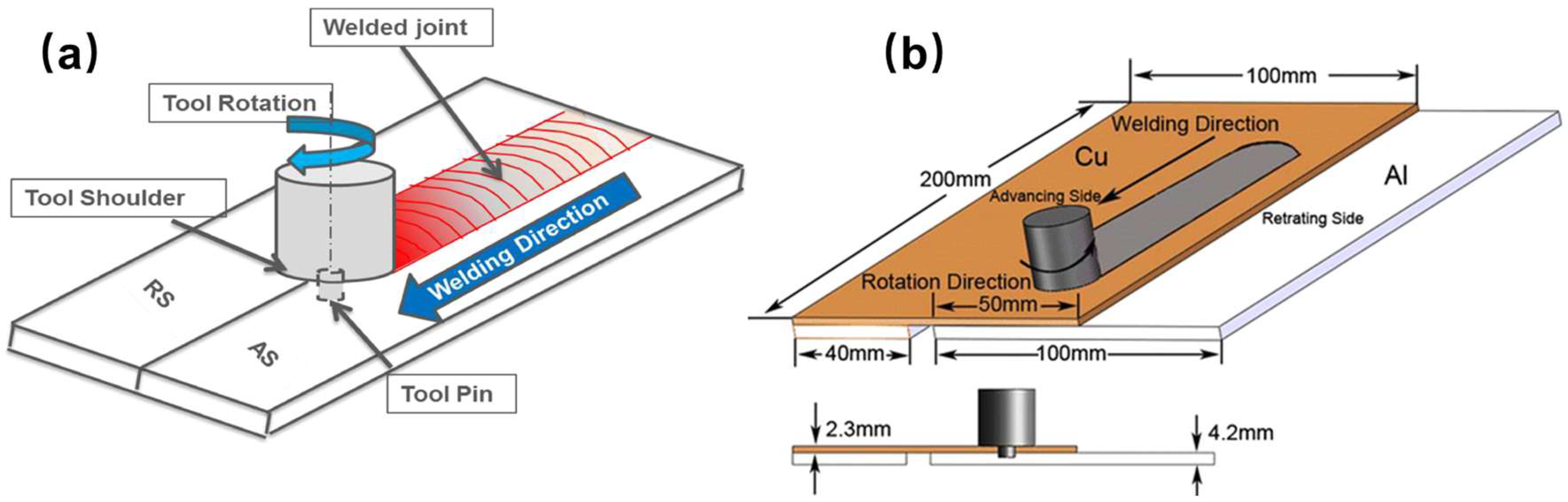
FSW is a solid-state welding technique invented and patented by The Welding Institute (TWI) in the United Kingdom in 1991 [67]. Figure 7 illustrates a schematic diagram of the working principles of friction stir butt welding (FSBW) and friction stir lap welding (FSLW) [68,69]. The FSW process can be described by three stages: plunge, dwell and traverse stages [70]. For FSBW, during the plunge stage, the non-consumable rotating tool is slowly plunged into the joint line between the two workpieces at a specific rotational speed until its shoulder fully contacts the workpiece surface. During the dwell stage, the tool maintains rotation while remaining stationary for a period. The heat and strain generated by the high-speed rotating tool soften the workpiece processing zone to a thermoplastic state. Finally, in the traverse stage, the tool moves along the joint line. The forging and intense mechanical stirring effects exerted by the tool on the material create a thermomechanically coupled process, typically forming a dense, defect-free solid-state weld [16,70]. For FSLW, the tool operates within the overlap region. During the plunge stage, the non-consumable rotating tool must fully penetrate the upper workpiece and plunge a certain depth into the lower workpiece, ensuring shoulder contact with the upper surface for effective frictional heat conduction to the interfacial region. Upon entering the dwell stage, heat and strain generated by the tool soften the materials in the upper and lower workpieces within the lap joint. During the traverse stage, as the tool moves, the mechanical stirring and forging effects of the tool disrupt the oxide film at the lap interface, while simultaneously promoting plastic deformation and atomic diffusion between the upper and lower workpieces. This thermomechanically coupled process ultimately enables interfacial bonding, forming a dense solid-state weld seam [16].
Figure 7. Schematic of the friction stir welding: (a) butt welding [68]; (b) lap welding [69].
Unlike fusion welding processes, FSW operates below the melting points of the BMs, significantly suppressing the formation of brittle IMCs and thereby improving the mechanical and electrical properties of the joint [2,10,11,31]. Furthermore, FSW enables solid-state bonding between dissimilar metals through frictional heat and plastic deformation, thereby avoiding welding defects caused by liquid phase bonding of dissimilar metals, such as burn-through, lack of fusion, solidification cracks, macro- and microsegregation, gas and shrinkage porosity, and solid inclusions. Simultaneously, its controllable thermal cycle characteristics can greatly alleviate residual stresses and deformation caused by the mismatch in the CTEs between dissimilar metals [32]. Moreover, the intense mechanical stirring directly disrupts the oxide film on the Al surface, facilitating a clean metallurgical bond at the interface [41]. Therefore, FSW can reliably produce high-performance joints and has become one of the effective solutions for welding dissimilar materials such as Cu and Al.
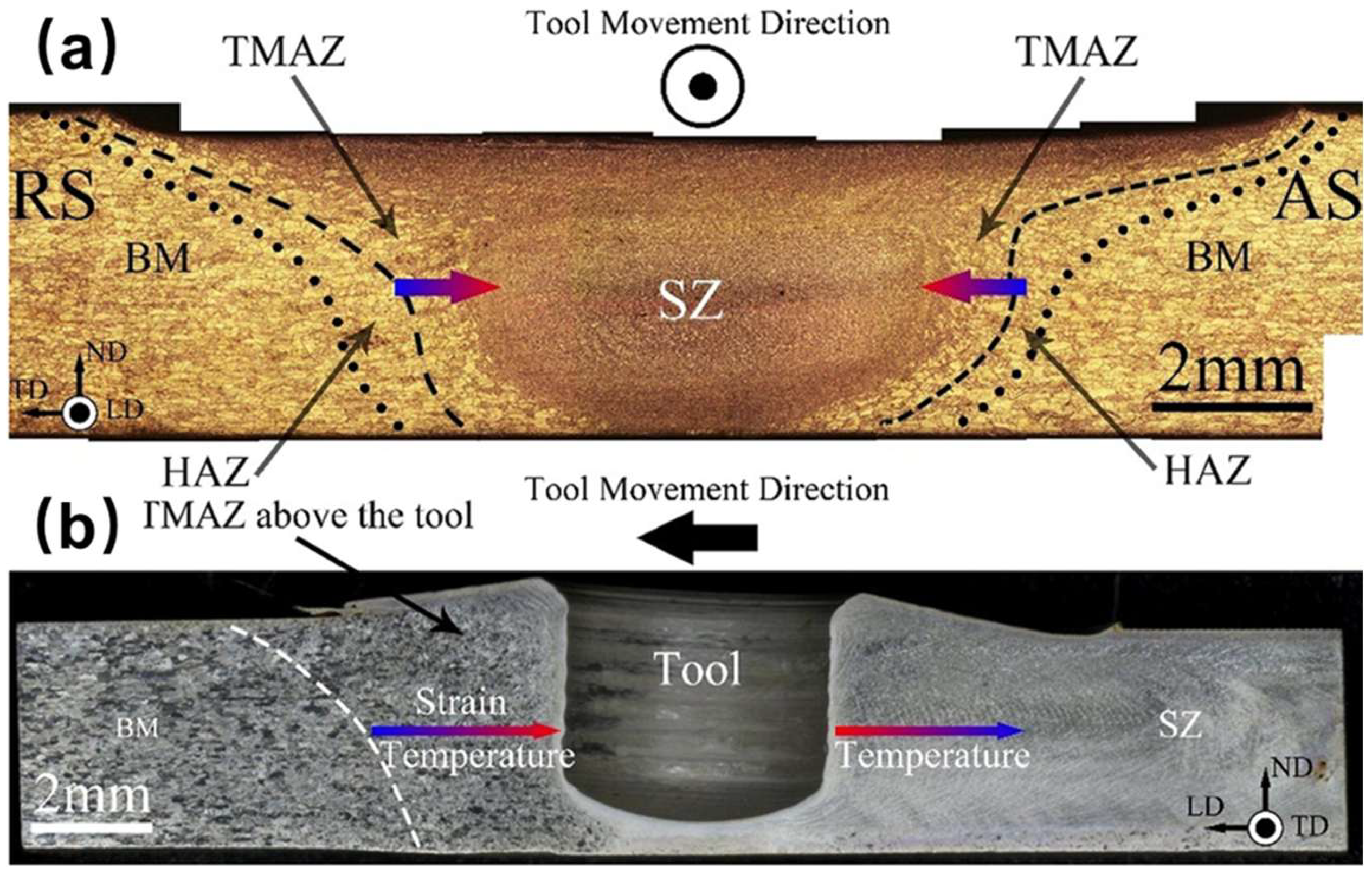
During the FSW process, the heat generated at the friction interface is transferred through the tool to the welding material, forming a dynamic temperature field. The distribution of this temperature field directly determines the metallurgical quality and grain structure evolution of the weld seam [71]. The FSW joint zone can be divided into four characteristic regions, namely: the stir zone (SZ or weld nugget zone, WNZ), the thermomechanically affected zone (TMAZ), the heat-affected zone (HAZ), and the base metal (BM) [32,72,73,74]. The SZ directly contacts the tool and undergoes severe plastic deformation. This region experiences the highest temperatures, and the substantial deformation induces dynamic recrystallization, thereby forming a fine-grained structure. The TMAZ is subjected to both the welding thermal cycle and a certain degree of plastic deformation, leading to a microstructure composed of partially recrystallized grains and thermally coarsened grains. The HAZ does not typically undergo plastic deformation. Instead, grain growth occurs under the influence of the thermal cycle [32,72,73,74]. Figure 8 presents the macrostructure of a typical FSBW joint.
Figure 8. The macrostructure of a typical FSBW joint: (a) a typical optical cross-section showing SZ, TMAZ, HAZ and BM; (b) Optical metallograph of a longitudinal cross-section obtained using the “stop-action” technique (pin was moving from left to right) [32].
Differences in the physical and mechanical properties between Cu and Al result in asymmetric thermomechanical responses during the FSW process, thereby affecting joint characteristics [2,20,32]. At the macroscale, Cu and Al exhibit a distinct color contrast (Al appears silver-white, whereas Cu is reddish-brown), which allows the welding zone and transition zone to be easily distinguished during metallographic observation [75,76]. At the microscale, Cu and Al possess different grain sizes and crystallographic orientations [74,77]. In addition, brittle IMCs tend to form at the Cu/Al interface, significantly affecting joint quality [26]. Furthermore, the difference in thermal conductivity between Cu and Al causes an uneven distribution of heat across the joint during FSW, which in turn influences microstructural evolution such as dislocation density, grain boundary structure, and precipitation behavior [75].

2.2.2. Intermetallic Compound Formation in Cu/Al FSW

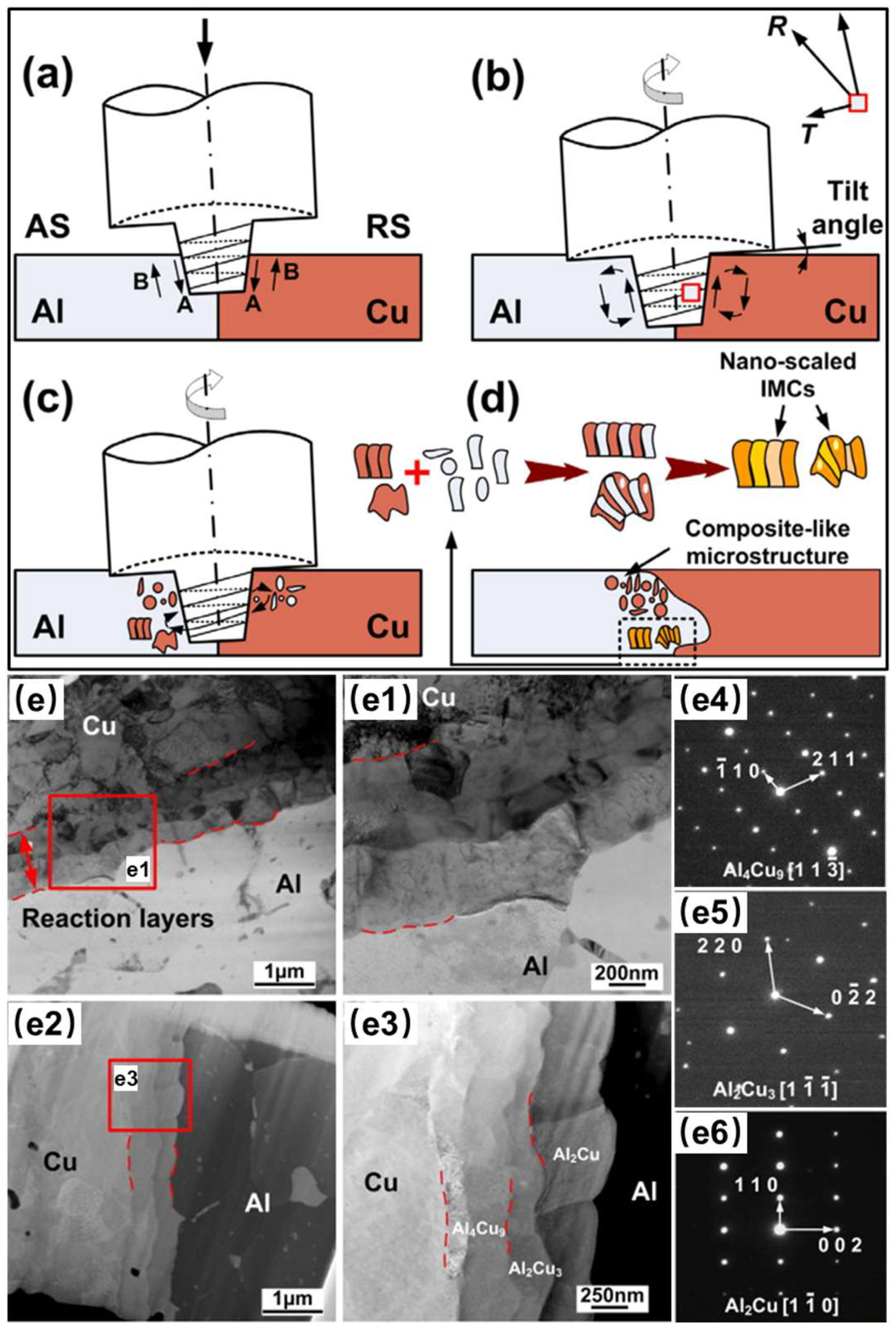
When FSW is employed to join Cu and Al, the intense thermomechanical coupling effects at the Cu/Al interface promote atomic interdiffusion and reactions. These thermomechanically driven physical and metallurgical processes lead to the formation of various IMCs, which critically affect joint quality [78]. Taking the FSBW process as an example, Tan et al. [79] elucidated the formation mechanism of IMCs and characterized the IMC layer at the Cu/Al interface by TEM, as shown in Figure 9. Under axial pressure, the pin, as it plunges into the workpiece, creates a downward flow of material adjacent to the threaded pin while simultaneously extruding the surrounding metal upward (Figure 9a). When the pin is fully inserted and the shoulder contacts the deformed material directly, the upward-flowing material is forced downward. As the tool moves along the butt line, material flow becomes closely related to both the thread direction of the pin and the rotation direction of the tool. Two forces act on the plasticized material around the pin. One is a normal pressure, P, generated by the rotation of the thread pin and acting perpendicular to the thread surface. The other is a tangential traction force, T, resulting from friction and acting parallel to the thread surface. For a right-hand threaded pin, under the combined action of these forces, the plasticized material moves upward from the bottom of the retreating side (RS) along the resultant force R (Figure 9b). Cu material is detached from the Cu block and fragmented into pieces of varying sizes, subsequently accumulating on the trailing side of the pin (Figure 9c). As the tool rotates, these fragments are dispersed into the Al matrix, forming a composite-like structure. The coupling of frictional heat and intense plastic deformation during FSW activates the Cu and Al atoms at the interface, promoting interdiffusion. This results in the formation of a nanoscale IMC layer at the Cu/Al interface below the melting points of the metals (Figure 9d). The IMC layer at the Cu/Al interface in the FSBW joint is presented in Figure 9e. Analysis of the selected-area electron diffraction (SAED) patterns indicates that the formed IMCs were composed of CuAl2, Cu3Al2, and Cu9Al4.
Figure 9. (ad) Formation mechanism of composite-like structures and IMCs during FSBW; (e) TEM analysis of the IMC layer at the Cu/Al interface; (e1) high magnification of (e); (e2) high-angle annular dark-field image corresponding to (e); (e3) high magnification of (e2); (e4e6) SAED patterns of interfacial reaction phases [79].
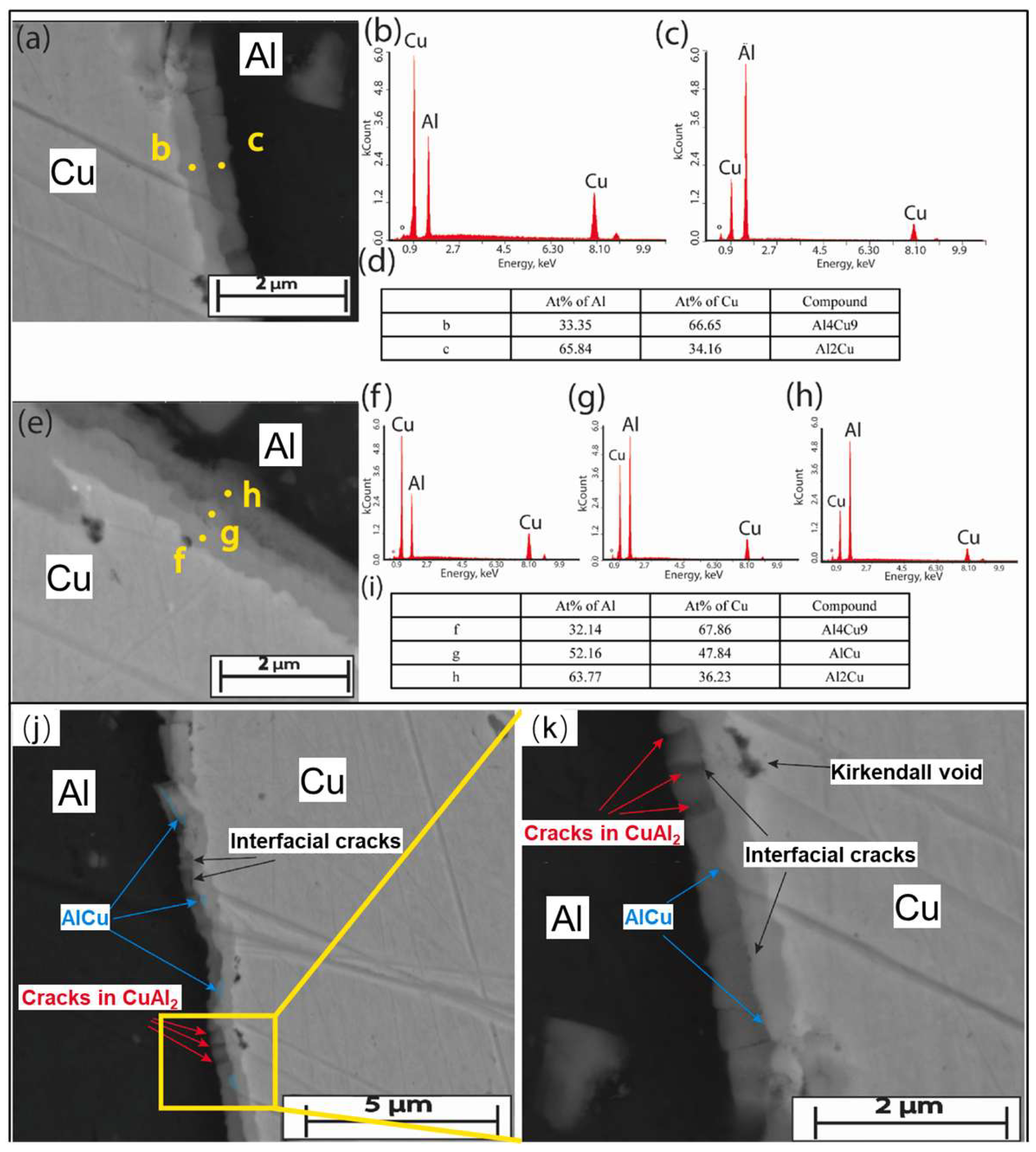
Typically, the IMCs formed sequentially from the Al side to the Cu side are CuAl2, CuAl, and Cu9Al4 (corresponding to an increasing Cu content in the IMCs), as illustrated in Figure 10 [80]. Due to the higher diffusion rate of Cu atoms compared with Al, defects such as Kirkendall voids tend to form at the interface between Cu9Al4 and Cu, which degrade joint strength [80]. It is reported that the thickness of the IMC layer is proportional to the square root of time, and elevated temperatures promote IMC growth [27,81]. The type, volume fraction, distribution, and thickness of IMCs are significantly influenced by welding parameters (tool rotation speed, traverse speed, and tool geometry) [2,10,32]. Modifying these parameters affects the welding heat input and material flow behavior, which in turn influences IMC formation. For example, increasing the tool rotation speed or decreasing the traverse speed raises the heat input, often leading to a thicker IMC layer [77,82,83,84,85]. Variations in tool geometry (e.g., shoulder diameter, pin profile) influence Cu’s fragmentation degree, dispersion state, and grain size [10,86,87,88,89]. While contributing to dispersion strengthening, IMCs also readily provide sites for crack initiation, thereby deteriorating the mechanical properties of the joint. Therefore, controlling the formation of IMCs at the Cu/Al interface during FSW is crucial for optimizing joint quality [26,90,91]. Section 3.2 systematically analyzes how welding parameters can be regulated to control heat input and material flow, thereby modulating IMC formation and improving the joint quality.
Figure 10. (a) SEM image of the vertical interface of Cu/Al joint; (bd) EDS analyses of points b and c; (e) SEM image of the corner interface of Cu/Al joint. (fi) EDS analyses of points f, g, and h; (j) SEM image of the interface of Cu/Al joint; (k) higher-magnification image clearly showing cracks and Kirkendall voids [80].

2.2.3. Microstructure of Friction Stir Butt Welded Dissimilar Cu/Al Joints

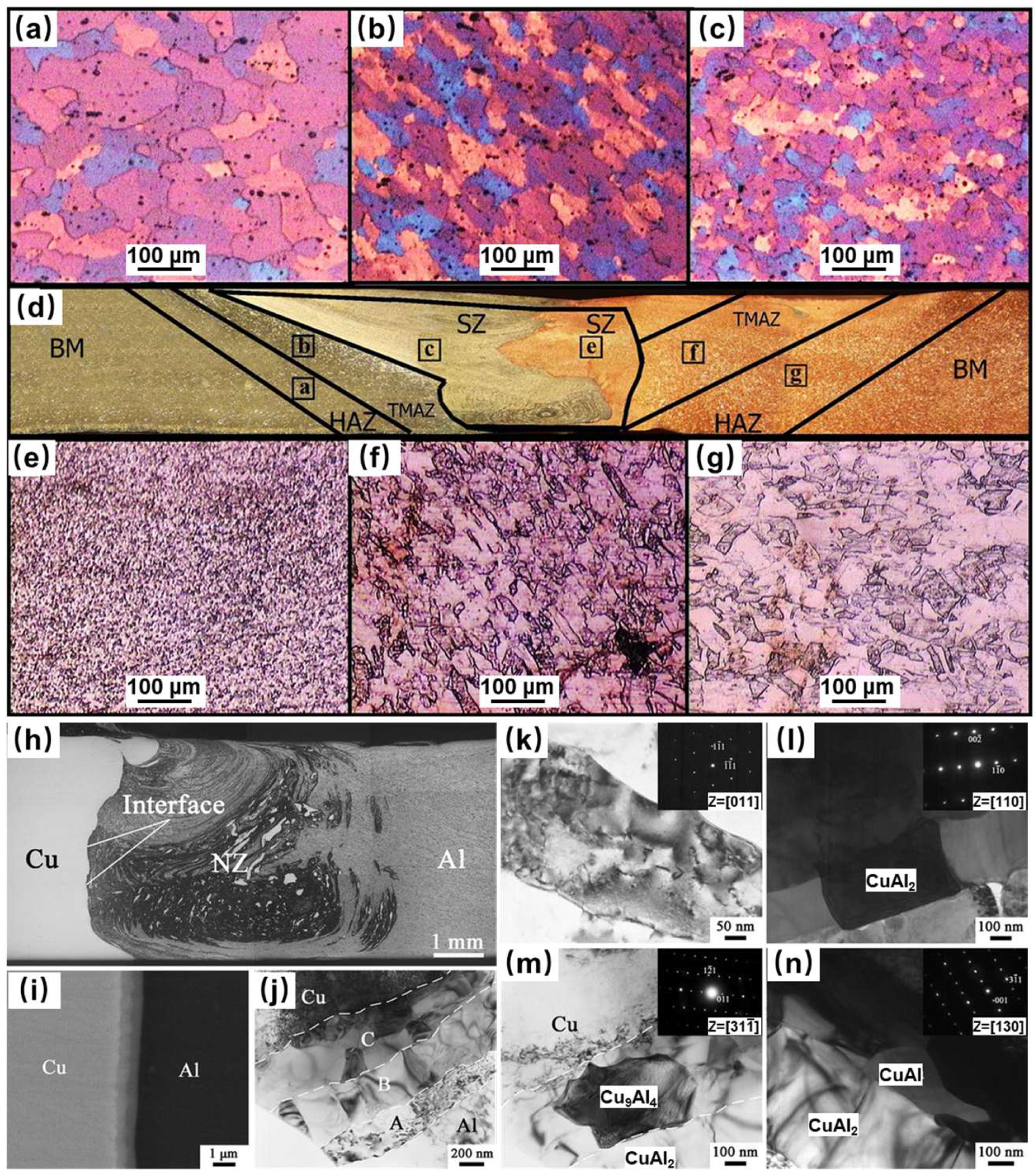
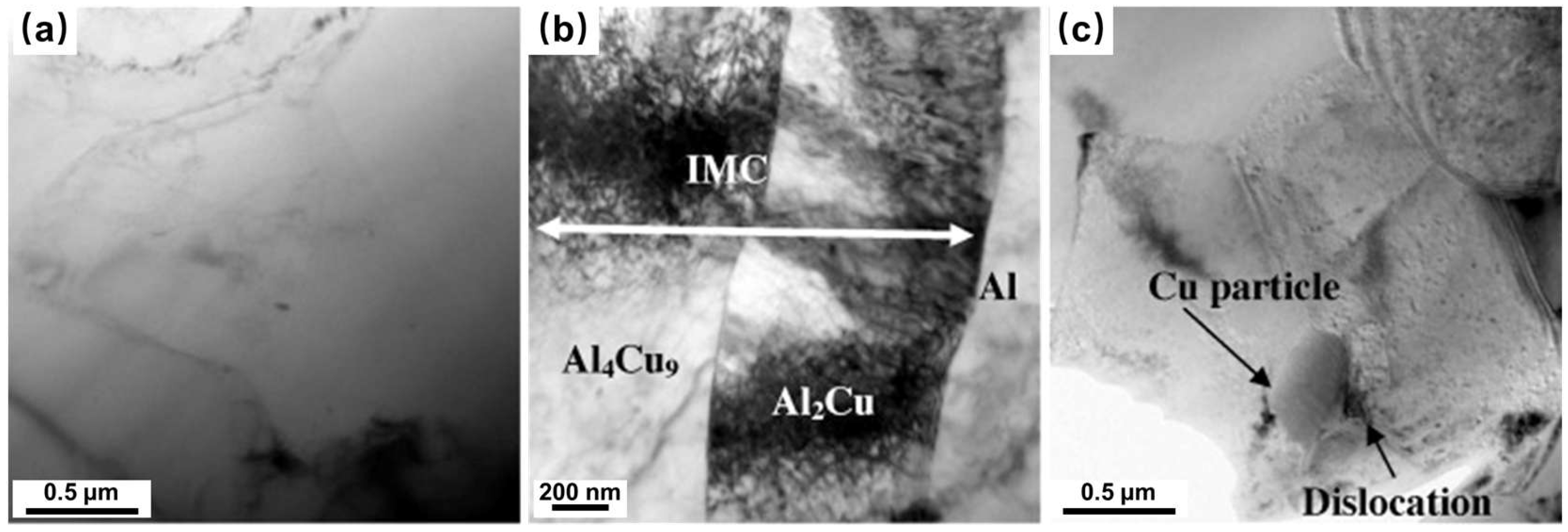
The butt joint between Cu and Al produced by FSW exhibits unique microstructural features, as presented in Figure 11 [74,92]. During the FSW process, mechanical mixing occurs between Cu and Al, forming a region with composite-like microstructure, where Cu particles are dispersed throughout the continuous Al matrix. This structure results from the intense mechanical stirring action of the tool, which strips, breaks, and incorporates Cu particles into the plasticized Al matrix. The distribution of Cu particles typically exhibits non-uniformity, contributing to dispersion strengthening and enhancing joint strength [79,91,92]. In addition, the material flow behavior causes the SZ to exhibit a typical layered or banded structure [74,93]. This layered structure, which undergoes the most severe plastic deformation particularly at the Cu/Al interface, is composed of fine recrystallized grains, as shown in Figure 11 [74]. Simultaneously, solid-state interdiffusion and reactions between Cu and Al atoms occur at the interface, forming a thin layer of IMCs (mainly CuAl2, CuAl, and Cu9Al4) at micrometer to submicrometer scales, thereby achieving effective metallurgical bonding between Cu and Al [80,91,92]. In metallographic images of a typical FSBW joint, the SZ can be divided into three regions based on contrast: bright areas (deformed Al), gray areas (deformed Cu), and black areas (mixed Cu and Al structures) [75,76]. TEM observation of the SZ in a typical FSBW joint reveals a high density of dislocations, indicating that the SZ experienced severe plastic deformation, and the deformed microstructure was retained during the welding process (Figure 12) [94].
Figure 11. Macro- and microstructure of the Cu/Al FSBW joint: (a) HAZ-Al; (b) TMAZ-Al; (c) SZ-Al; (d) macrostructure of the joint; (e) SZ-Cu; (f) TMAZ-Cu; (g) HAZ-Cu; (h) optical image of the joint; (i) SEM image of the interface in the joint; (j) TEM image of the interface zone; (k) TEM analysis of the layer A in (j); (l) layer B; (mn) layer C [74,92].
Figure 12. TEM images of SZ in the Cu/Al FSBW joint: (a) SZ-Cu; (b) IMC layers; (c) SZ-Al [94].

2.2.4. Microstructure of Friction Stir Lap Welded Dissimilar Cu/Al Joints

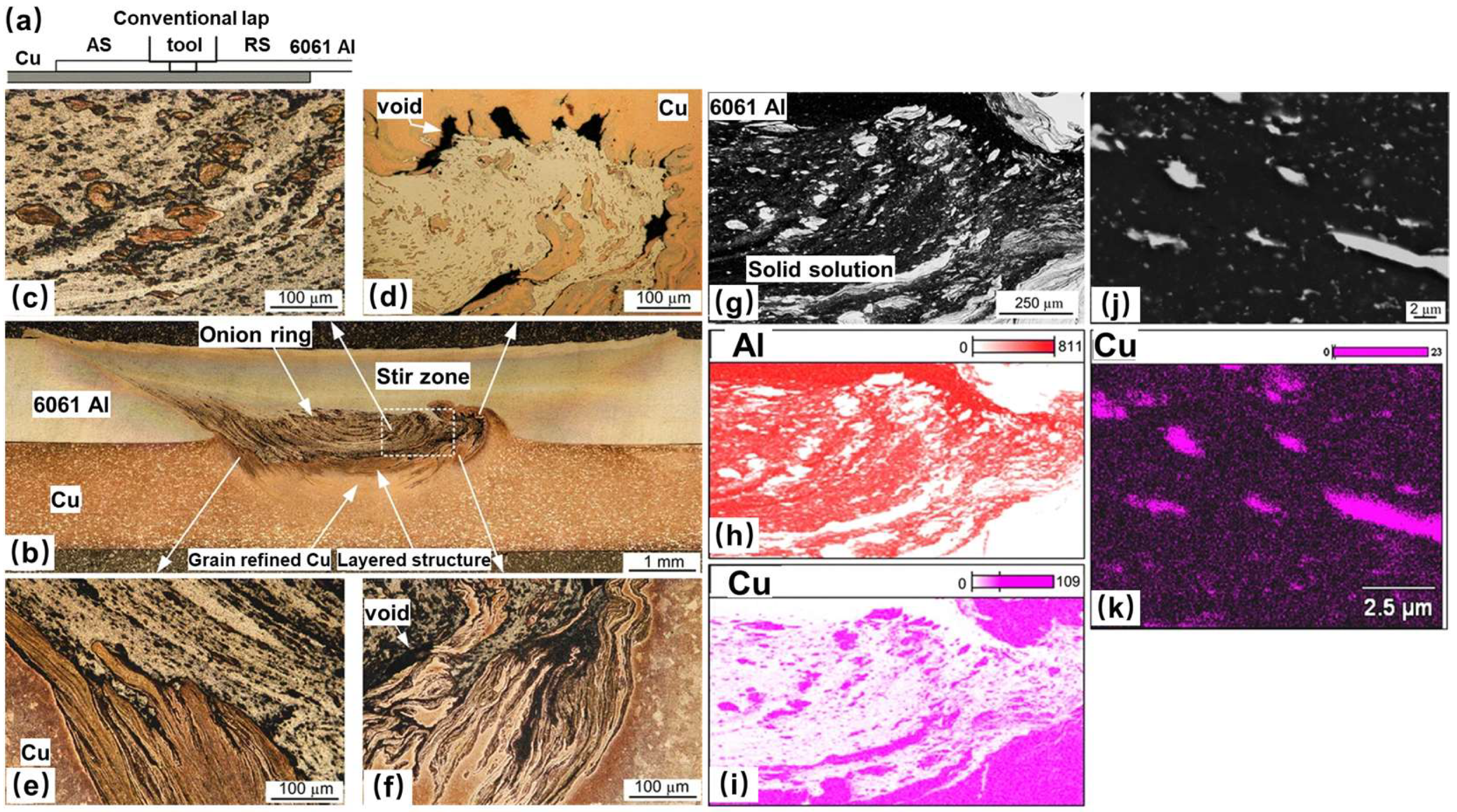
When FSW is employed for lap welding of Cu and Al, the Al workpiece is typically placed on top of the Cu workpiece. This is because the melting point of Al is significantly lower than that of Cu. Placing Al on top allows for better control of heat input, thereby preventing excessive softening or localized overheating of the lower-melting-point Al during the FSW process. This positioning configuration can promote the plastic flow and mixing of materials while suppressing the excessive growth of IMCs at the Cu/Al interface [73,88,95]. For FSLW joints with Al placed on Cu, the SZ can be divided into an upper Al-rich area and a lower Cu-rich area [73,88,95]. Figure 13 illustrates the microstructure of a Cu/Al FSLW joint [73], revealing that the SZ extends from the Al side into the interior of the Cu side. Driven by the stirring action of the tool, Cu is dragged into the Al-rich area, forming an interlocking structure that enhances joint strength through mechanical engagement.
Figure 13. Macro- and microstructure of the Cu/Al FSLW joint. (a) joint design; (b) macrostructure of the FSLW joint; (cf) etched optical images of the FSLW joint; (g) low-magnification SEM image; (hi) EDS map of Al and Cu; (j) high-magnification SEM; (k) EDS map of Cu [73].
During the FSLW process, the severe plastic deformation generates high temperatures and strain conditions, inducing dynamic recrystallization in the SZ to form equiaxed grains. In the TMAZ adjacent to the SZ, where both heat input and deformation are lower than in the SZ, only partial dynamic recrystallization occurs, and a deformed structure remains [95]. Unaffected by mechanical stirring, the HAZ experiences grain growth [95]. Micron- or submicron-sized Cu particles are distributed within the Al matrix of the SZ. Various IMCs are formed at the Cu/Al interface. Reducing traverse speed promotes IMC formation by increasing diffusion and reaction time [73].
In summary, when FSW is conducted to join Cu and Al, the welding temperature remains below the melting points of the BMs, which effectively suppresses excessive growth of brittle IMCs, reduces common fusion welding defects such as cracks and pores, alleviates residual stress and distortion caused by differences in the CTEs, and ultimately yields joints with excellent mechanical and electrical properties. The FSW joint can be divided into four characteristic zones: the SZ, which undergoes severe plastic deformation and dynamic recrystallization; the TMAZ, which experiences both heat and deformation; the HAZ, which is influenced only by thermal cycling; and the unaffected BM. However, the resulting microstructural differences across these zones can lead to heterogeneity in joint properties, which should be further explored in future research. At the Cu/Al interface, the intense thermomechanical coupling effect promotes atomic interdiffusion, leading to the formation of IMC layers such as CuAl2, CuAl, and Cu9Al4. The type, distribution, and thickness of the IMCs directly affect joint strength. Excessive thickness or uneven distribution of IMCs can easily induce cracks and Kirkendall voids, which are the main causes of joint failure. Welding parameters such as tool rotation speed, traverse speed, and tool geometry jointly regulate the welding heat input and material flow behavior, which influence IMC growth and the dispersion state of Cu particles within the Al matrix. Therefore, it is necessary to simultaneously control the heat input and material plastic flow during the FSW process to suppress excessive growth of harmful IMCs, promote metallurgical bonding at the interface, and form a composite-like structure. These combined effects are beneficial for improving joint quality.

2.3. Ultrasonic Welding (UW)

2.3.1. Fundamentals of Ultrasonic Welding (UW)

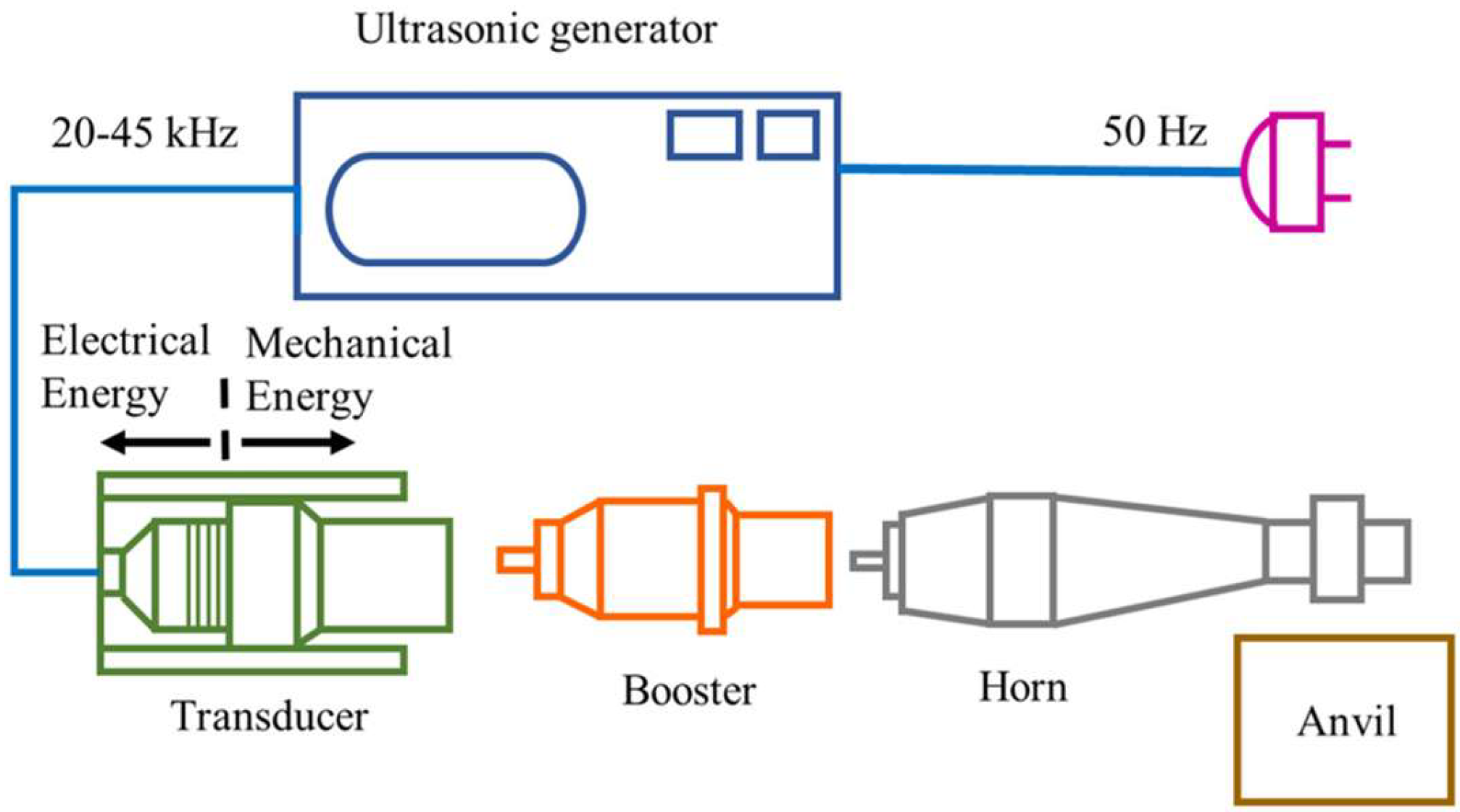
Ultrasonic welding (UW) is a solid-state welding technique that utilizes high-frequency mechanical vibrations to generate interfacial friction between materials, enabling bonding under pressure, and has been extensively adopted for lithium battery manufacturing and automotive conductor welding [4,43,44,58,59]. The UW system primarily consists of an ultrasonic generator, transducer, booster, sonotrode/horn, pneumatic press system, and anvil [96,97,98]. A schematic diagram of the UW apparatus is depicted in Figure 14 [98]. The UW process proceeds as follows: first, the overlapping workpieces are clamped and pressurized; then, the ultrasonic generator is activated to convert high-frequency electrical signals into mechanical vibrations of the same frequency. These vibrations are amplified by the booster and transmitted to the workpieces via the sonotrode [4,44,97,99]. The sonotrode maintains static pressure while vibrating at high frequency to join the workpieces. Based on different vibration modes, UW can be classified into shear vibration, where the sonotrode vibrates parallel to the workpiece surface and is suitable for metal welding, and longitudinal vibration, where the sonotrode vibrates perpendicular to the workpiece surface and is suitable for plastic welding [4,44]. Since this review focuses on Cu/Al dissimilar metal welding, the UW technique discussed herein specifically refers to ultrasonic metal welding employing the shear vibration mode. The high-frequency shear friction generated on the workpiece surface during the UW process can cause interfacial plastic flow, localized temperature rise, and oxide film disruption, which in turn promotes atomic diffusion and microbond interlocking, leading to metallurgical bonding [96,99]. The UW process offers extremely low heat input, a small heat-affected zone, and significantly reduced workpiece deformation and residual stress. The process requires neither filler metal nor shielding gas, produces no spatter, and is particularly suitable for precision welding of dissimilar highly conductive non-ferrous metals such as Cu and Al [98,100,101]. However, the low heat input limits the application scope of UW. Currently, this technique is mainly suitable for lap welding of thin metal sheets, foils, and wires, but is less effective for thicker workpieces [98]. At present, there is no unified understanding of the interfacial bonding mechanism for UW of dissimilar metals. One prevalent view holds that the diffusion of metal atoms at the interface is crucial for enhancing interfacial bonding strength and can affect the overall strength of the welded joint [101,102]. Appropriate welding process parameters can soften the BMs, allowing the softened materials to flow plastically and fill interfacial voids and gaps, thereby achieving sound metallurgical bonding. In contrast, improper welding parameters or settings may cause excessive diffusion of metal atoms, leading to the formation of a thick and brittle IMC layer at the interface, which severely deteriorates the mechanical properties of the joint [28,96,100,103,104].
Figure 14. Schematic diagram of ultrasonic welding system [98].
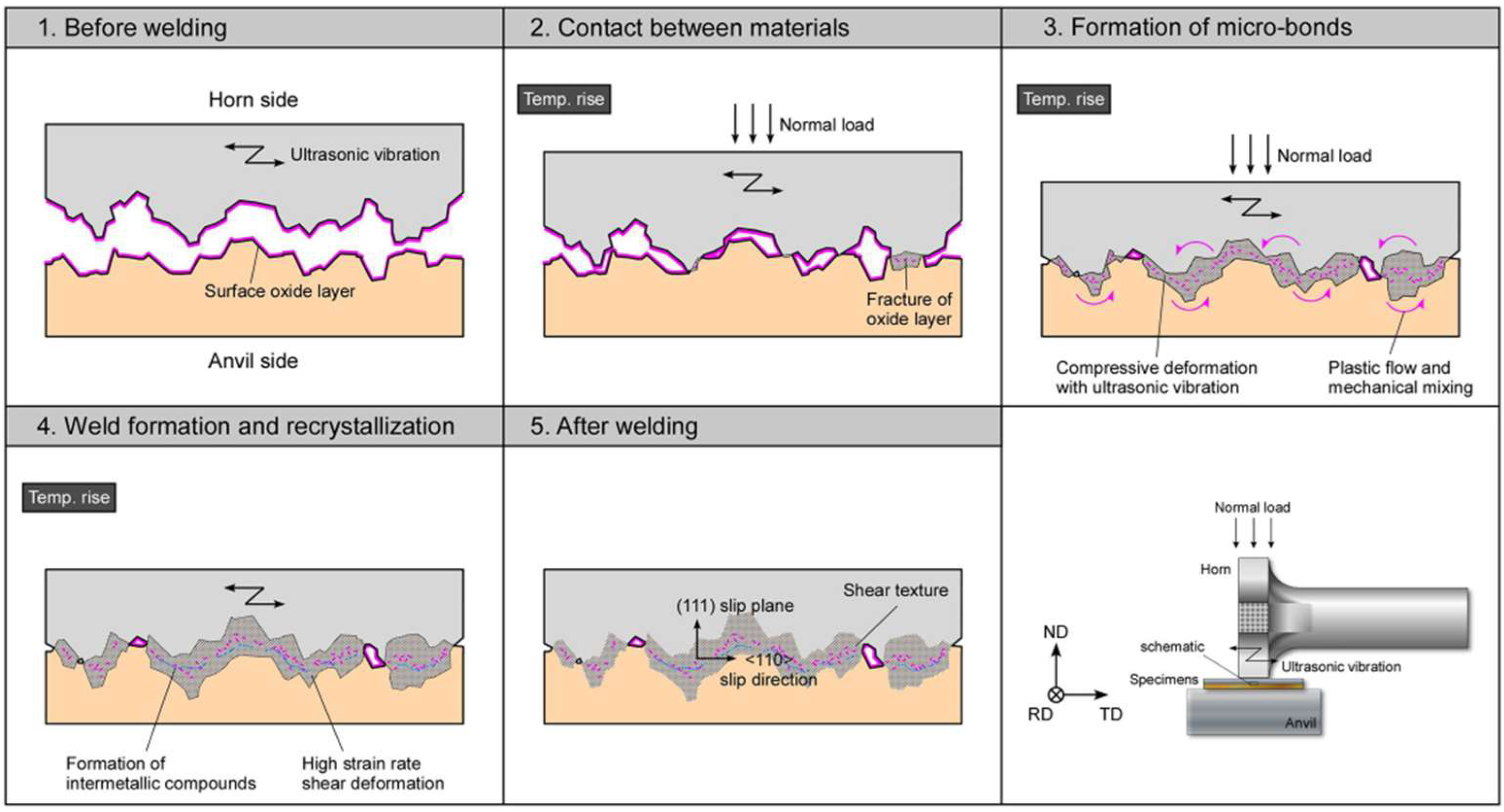
UW technology utilizes high-frequency ultrasonic vibrations to generate periodic shear stress at the lap interface, inducing interfacial friction and plastic deformation between the contacting surfaces, which in turn generates significant frictional heat [105]. The non-uniform pressure distribution resulting from the unique knurl pattern of the welding sonotrode tip leads to severe stress concentration, driving complex material flow and the formation of a wave-like interface morphology [106]. Meanwhile, the elevated interfacial temperature reduces the yield strength of material, further promoting the generation and expansion of localized adhesion and microjoints [44]. During the welding process, a specific relative motion stage occurs among the sonotrode, upper workpiece, and lower workpiece, ultimately achieving vibration synchronization to establish a sound joint. Under the combined action of normal pressure and shear vibrations, the material is extruded into the gaps of the sonotrode texture, causing vertical displacement of the sonotrode, which reflects the extent of plastic deformation [107]. Additionally, when welding Al, the oxide layer on the Al substrate is mechanically fractured, transferred, and dispersed into the Al substrate, thereby exposing fresh metal surfaces to achieve direct metallurgical bonding [108,109]. The joint quality in UW is influenced by multiple parameters, including welding time, energy, amplitude, pressure, and the sonotrode geometry. Precise control of these parameters enables the production of high-quality joints [4,44,98]. Figure 15 schematically illustrates the weld formation process during UW of Al to Cu, sequentially depicting the fracture and dispersion of oxide layers, mechanical mixing and material flow, and the subsequent formation of microbonds leading to metallurgical bonding via enhanced diffusion and IMC formation [109].
Figure 15. Schematic illustrations of the weld formation process during UW of Al to Cu [109].

2.3.2. Microstructure of Ultrasonically Welded Dissimilar Cu/Al Joints

Ultrasonic spot welding (USW) is one of the common UW techniques. When welding dissimilar materials such as Cu and Al, the joints exhibit unique morphological characteristics. Macroscopically, they are primarily manifested as surface plastic deformation caused by imprints from the sonotrode and anvil [104,105,110]. Chen et al. [110] conducted a USW on 0.2 mm thick pure Cu foils (contact with sonotrode) and pure Al foils (contact with anvil). Surface deformation morphologies of the joints were examined under different welding energies (10 to 80 J). It was found that the deformation on the Al side was much larger than that on the Cu side, and the surface appearance tended to become uneven with increasing welding energy. The research further analyzed the interfacial friction and plastic deformation generated during the USW process. In the initial stage of welding, relative movement occurred between the sonotrode and the Cu surface. At the Al/anvil interface, the friction area was relatively small, and the interface was covered with imprints induced by the anvil tips. As welding proceeded, the interfacial morphology on the Al side remained largely unchanged, but the width of the plastic deformation zone increased, with no clear evidence of interfacial friction observed. On the Cu side, the imprints caused by the sonotrode ridges widened, and the interfacial friction area remained present.
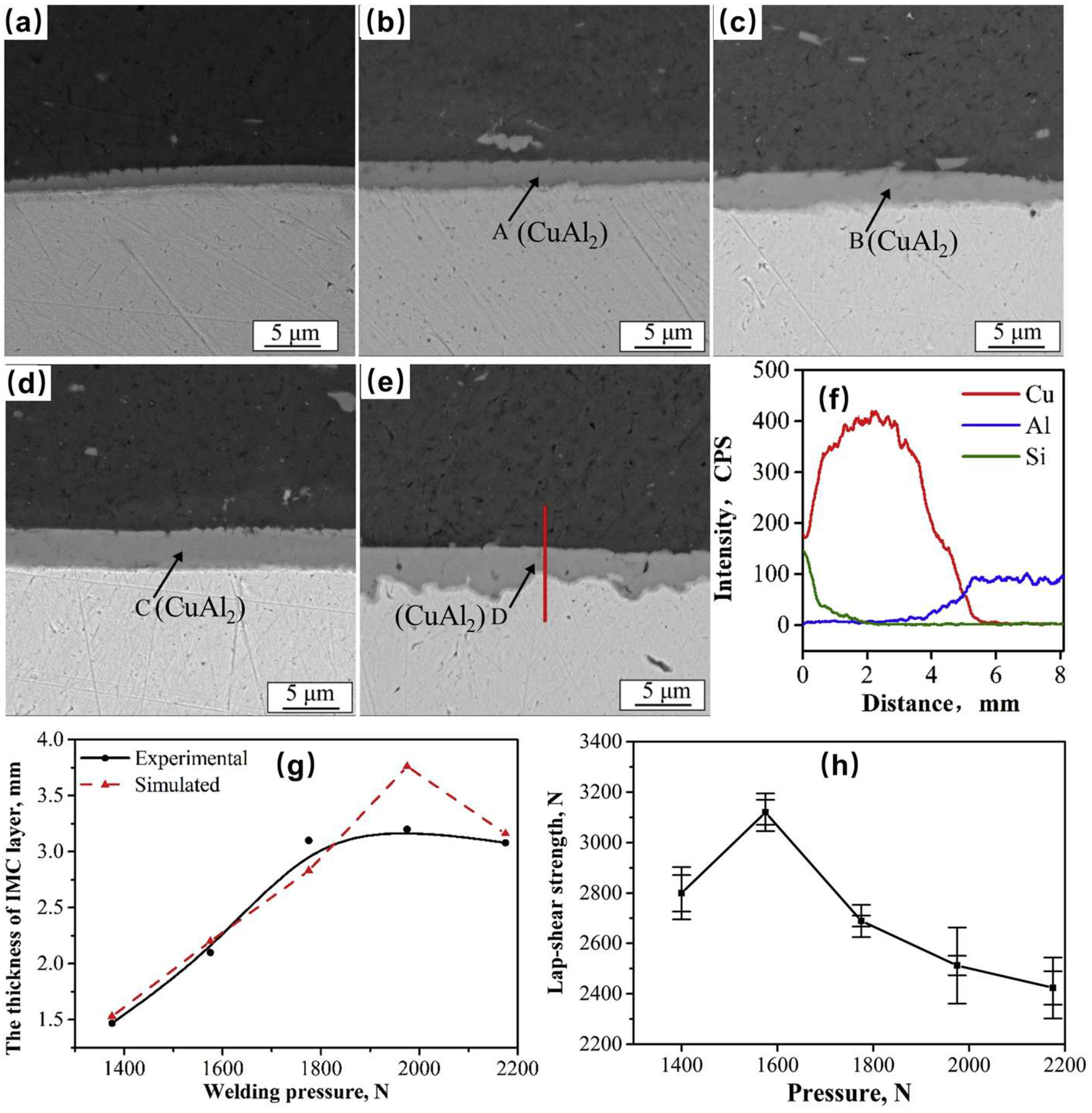
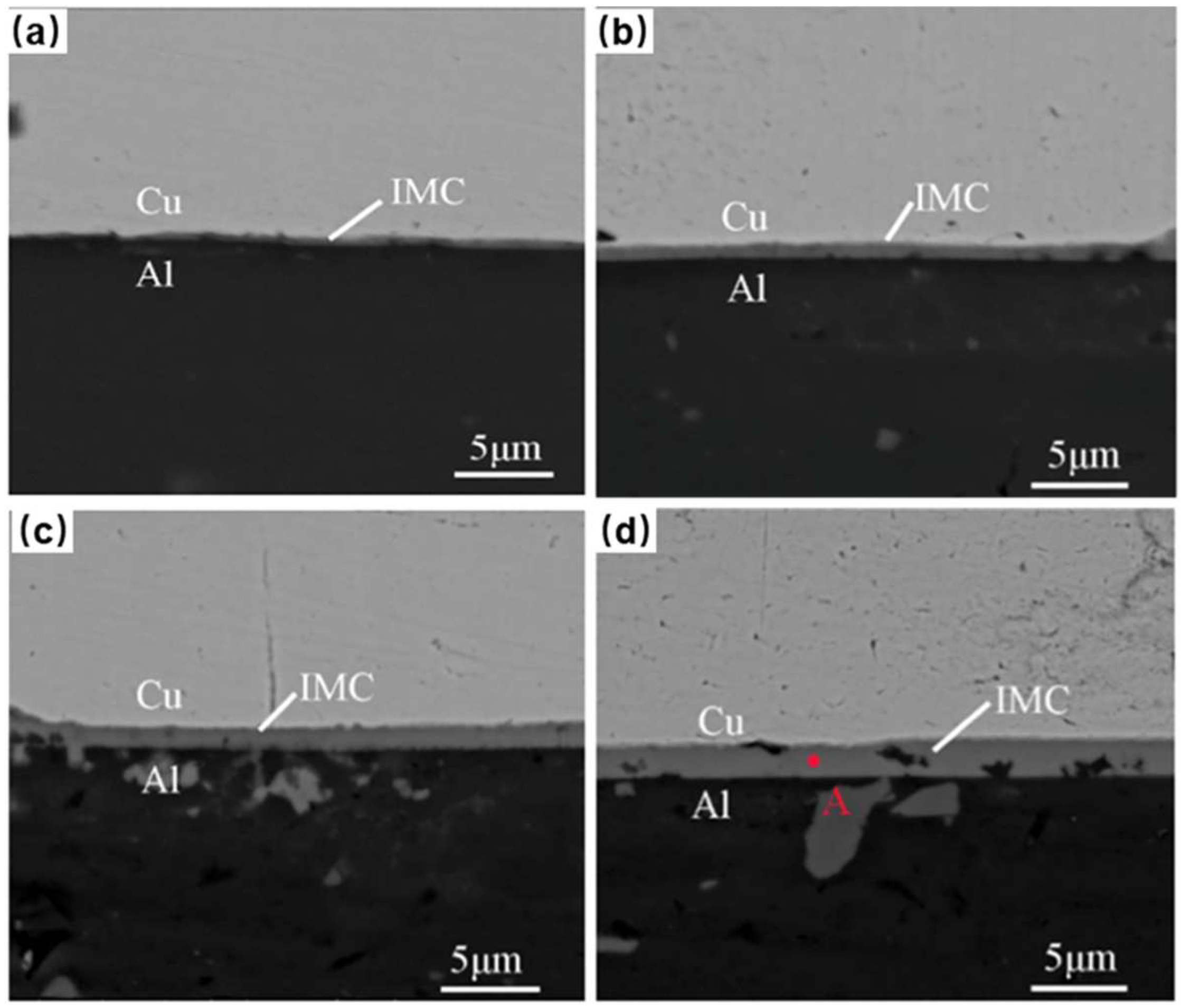
The microstructure of Cu/Al joints formed via UW is closely related to the plastic deformation induced by the welding energy or heat input. Yang et al. [111] investigated the effect of heat input on the interfacial reactions between pure Cu and 6061 Al alloy. It was observed that, when the heat input was low (welding time < 0.3 s), discontinuous IMC layers were formed at localized positions along the Cu/Al interface. At a moderate heat input (0.3 s < welding time < 0.7 s), a continuous IMC layer (primarily consisting of CuAl2 and Cu9Al4 phases) was formed at the interface, and its thickness increased with heat input. When the heat input was high (welding time > 0.7 s), a localized eutectic reaction occurred, resulting in the formation of dendritic structures (α-Al + CuAl2). Liu et al. [112] performed USW of Cu/Al (C1100 Cu/5652 Al alloy) and found that the IMC thickness increased with the welding time during UW, as illustrated in Figure 16. XRD analysis indicated that the IMC phase mainly consisted of CuAl2.
Figure 16. Microstructures of metallurgical reaction layer at different welding times during HUSW: (a) 0.3 s; (b) 0.4 s; (c) 0.5 s; (d) 0.6 s [112].
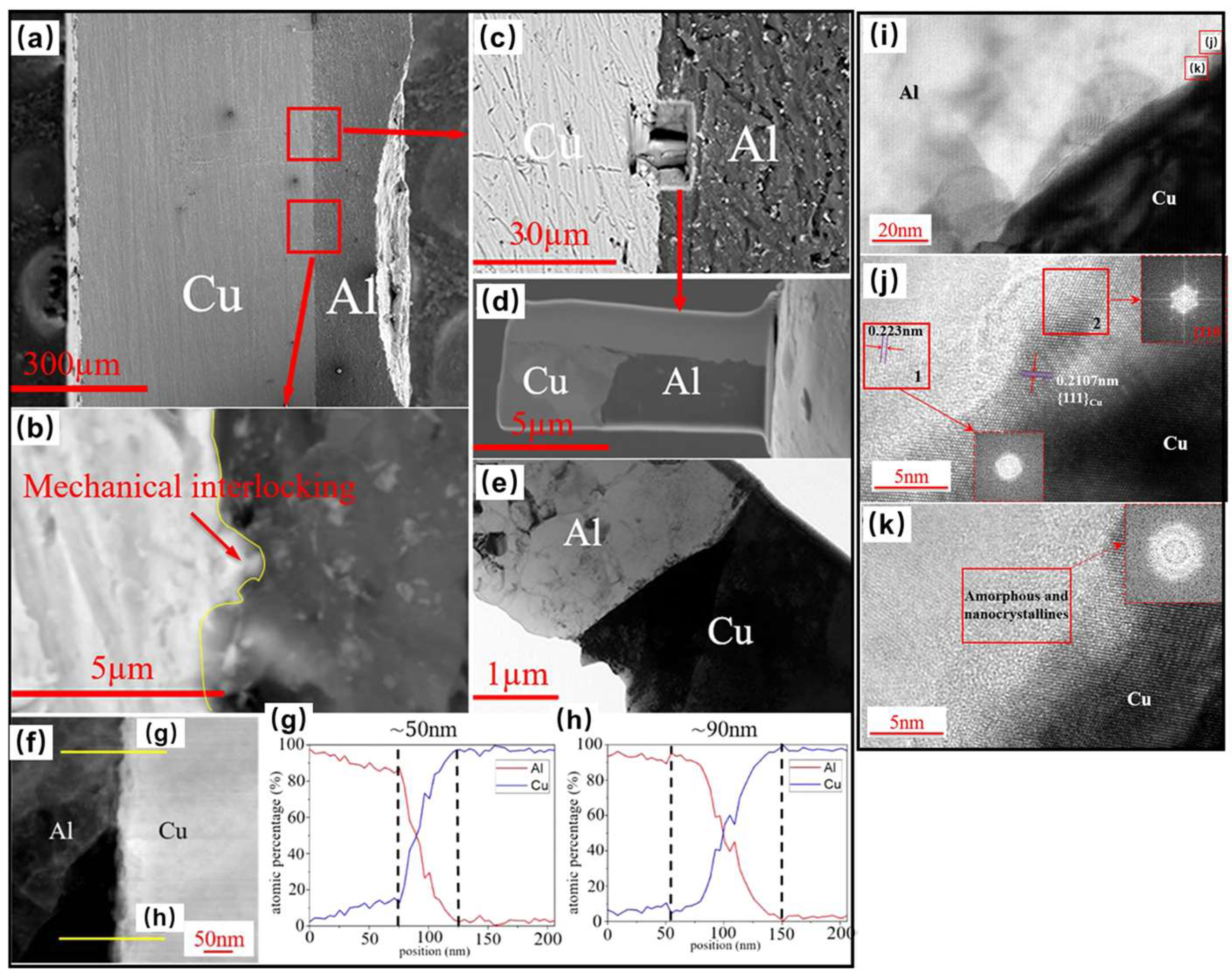
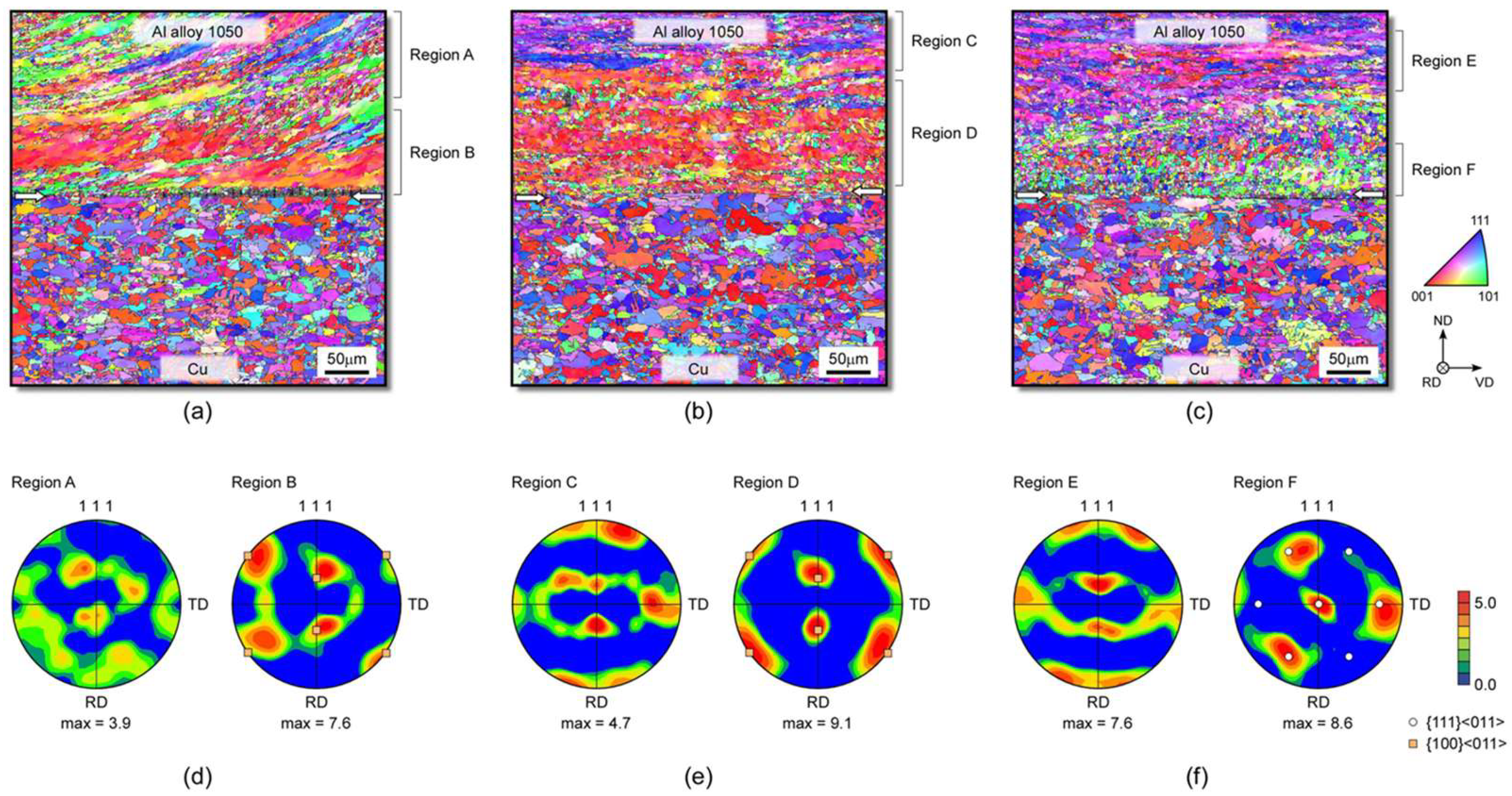
Zhang et al. [113] reported that, in Cu/Al UW joints under low heat input conditions, where the interface temperature remained relatively low, no IMC layer was formed at the Cu/Al interface. Instead, a ~10 nm thick transition layer composed of amorphous phase and nanocrystalline was formed, along with significant mechanical interlocking observed at a larger scale. Interdiffusion of Cu and Al atoms was detected within the amorphous phase. High-density dislocations and stacking faults were also observed in the BM near the transition layer. Figure 17 presents the interfacial microstructure of an ultrasonically welded dissimilar Cu/Al joint. The formation of this interfacial structure is attributed to the solid-state plastic deformation induced by ultrasonic vibration. The heat input during UW also influences the grain structure and crystal orientation of the joint. Fujii et al. [109] conducted EBSD characterization on the grain structure and crystal orientation of ultrasonically welded Cu/Al (pure Cu and 1050 Al alloy) joints. Analysis indicated that, as welding progressed, the texture type in the interfacial region on the Al side gradually transitioned from the original rolling texture to a {100}<011> compression texture and eventually evolved into a {111}<110> shear texture. Dynamic recrystallization occurred after prolonged welding time, resulting in fine equiaxed grains. Figure 18 illustrates the evolution of grain structure and crystal orientation at the Cu/Al interface with increasing welding time. Liu et al. [112] obtained a similar texture evolution process on the Al side. The microstructural evolution described above results from the combined thermomechanical coupling effects during the welding process.
Figure 17. The interfacial microstructure of an ultrasonically welded dissimilar Cu/Al joint: (a) Overview of the UW cross-section; (b) high-magnification BSE image of mechanical interlocking; (c) site selection for FIB specimen; (d) prepared FIB specimen for TEM; (e) low-magnification cross-sectional TEM image of Cu/Al interface; (f) STEM image of the weld interface; (g,h) the element distributions obtained by EDS; (i) low-magnification TEM image of the diffusion layer; (j,k) HRTEM images of the transition layer taken from (i) [113].
Figure 18. Inverse pole figure maps of the ultrasonic weld interface between 1050 Al alloy and Cu obtained after welding for (a) 0.2 s, (b) 0.3 s, and (c) 0.4 s. The white arrows indicate the approximate weld interface locations. (df) are the {111} pole figures extracted from each region of the inverse pole figure maps [109].
In summary, the macro- and microstructural characteristics of Cu/Al UW joints directly influence their bonding quality. This technique utilizes high-frequency shear vibration combined with static pressure to achieve interfacial plastic deformation, localized temperature rise, and the fragmentation of native oxide film in the solid state, which promote microbond interlocking and atomic diffusion to form a metallurgical bond. Macroscopically, the morphology of the joint is characterized by surface plastic deformation caused by indentations from the sonotrode and anvil. Because Al has lower hardness and higher plastic deformability compared with Cu, the Al side typically exhibits more pronounced deformation under the same welding parameters. Microscopically, the interfacial structure varies significantly with heat input. Under lower heat input, a nanoscale transition layer along with mechanical interlocking regions often forms at the interface, whereas appropriately increasing the heat input promotes the formation of IMCs such as CuAl2 and Cu9Al4 at the interface. The formation of such amorphous or nanoscale IMCs may affect the long-term stability of the joint, which warrants further investigation in future studies. Excessive heat input leads to an overly thick IMC layer and may even trigger local eutectic reactions, deteriorating the mechanical properties of the joint. Concurrently, the coupled thermomechanical effects during UW induce grain refinement, texture evolution, and dynamic recrystallization in the interfacial region. Therefore, it is essential to coordinate parameters such as welding time, amplitude, pressure, and sonotrode shape during the UW process, so as to enhance interfacial bonding while suppressing excessive IMC growth, which ultimately enables the achievement of high-quality and highly reliable dissimilar welding of Cu and Al.

2.4. Brazing and Soldering

2.4.1. Fundamentals of Brazing and Soldering

Brazing and soldering are welding technologies that utilize filler metals with melting points lower than those of the BMs. These processes are carried out within a temperature range above the liquidus of the filler metal but below the solidus of the BM. This process achieves metallurgical bonding between workpieces through the melting, wetting and spreading, capillary filling, and subsequent solidification of the filler metal [46,114,115]. Brazing employs a filler metal (brazing filler metal) with a liquidus temperature above 450 °C, whereas soldering utilizes one (solder) below 450 °C [116]. Based on the heat source and heating method, brazing can be categorized into conventional mainstream methods such as induction brazing, flame brazing, resistance brazing, and furnace brazing [5,117,118,119,120]. In addition, specialized methods that have developed rapidly in recent years, including laser brazing, infrared brazing, and plasma arc brazing [116,121,122]. Furthermore, ultrasound can assist in both brazing and soldering processes to remove oxide films [123,124]. Wave soldering is an efficient soldering technique specifically for electronic assembly [125]. Since the BM does not melt during brazing and soldering processes, the heating temperature remains relatively low. This results in significantly less distortion and lower residual stress. Moreover, the process is highly adaptable to workpiece geometry, allows for simultaneous welding of multiple seams or workstations, and achieves high production efficiency [33]. Consequently, brazing and soldering exhibit irreplaceable advantages in welding dissimilar materials with vastly different physical and chemical properties. For welding Cu and Al, suitable filler metals mainly include Sn-Zn solders, Zn-Al solders/brazing filler metals, and Al-Si brazing filler metals [46,118,119,120,126,127,128]. Owing to the thermodynamic tendency of Cu and Al to form various IMCs coupled with rapid atomic interdiffusion, a continuous IMC layer readily forms at the interface. These IMCs are typically hard and brittle, which can severely degrade the mechanical properties of the joint. Strategies to inhibit IMC growth at the Cu/Al interface and enhance joint quality primarily involve introducing external assistance (e.g., ultrasound, pressure) to improve the welding process, optimizing the filler metal composition, and incorporating a specific functional interlayer [5,33].

2.4.2. Microstructure of Brazed and Soldered Dissimilar Cu/Al Joints

The microstructure of brazed and soldered joints is governed by multiple factors such as the welding temperature, holding time, status of the BM, protective atmosphere, type of flux, and filler metal. The filler metal, as a key factor, primarily governs the formation of IMCs at the interface by regulating the thermodynamic driving force and kinetic processes of interfacial reactions [126,127,128]. During the brazing and soldering of Cu/Al dissimilar metals, different filler metal compositions lead to characteristic interfacial microstructures and IMCs. Therefore, the following section examines typical filler metals to illustrate these distinctive interfacial features.
(1)
Sn-Zn system
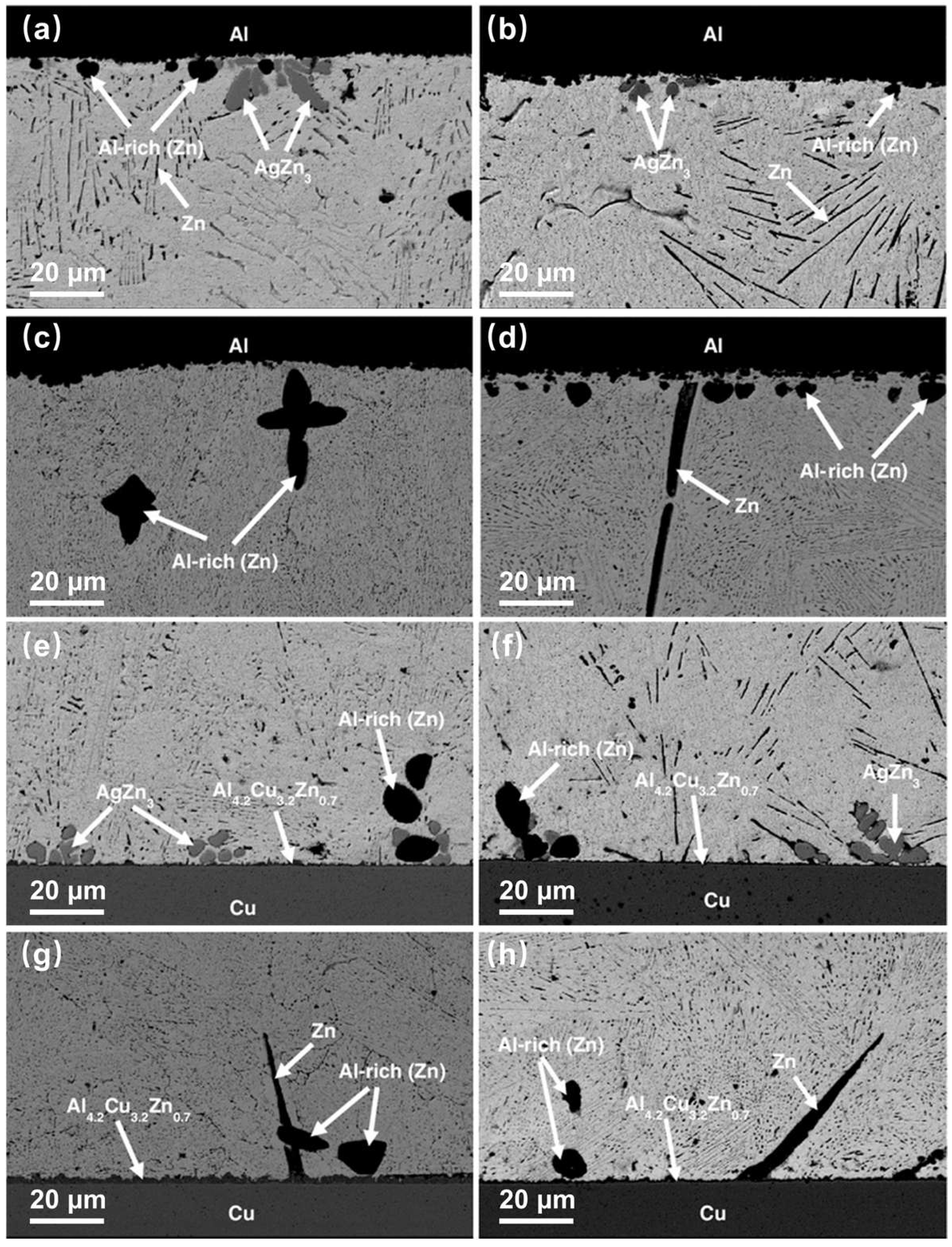
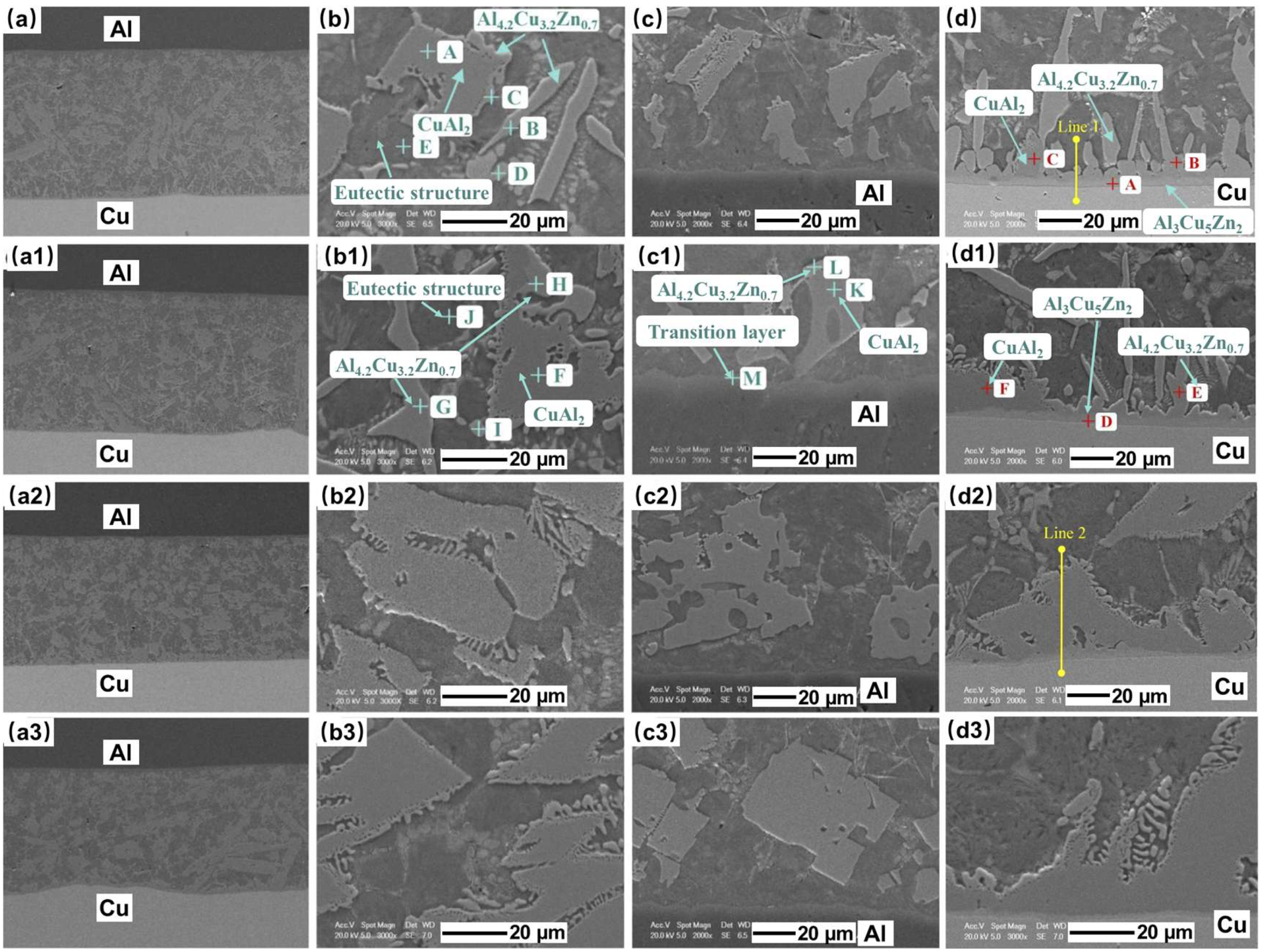
Huang et al. [126] employed Sn-Zn-(Al, Ag) near-eutectic solder to join TP2 Cu and 3003 Al alloy. The results indicated that a continuous IMC layer (Al4.2Cu3.2Zn0.7) was formed at the Cu-side interface of the solder joint. However, at the Al-side interface, due to the poor wettability of Sn on the Al surface, the interfacial reaction was limited, and no distinct IMC layer was formed. Instead, only a thin and discontinuous Al-Zn solid solution layer and a small amount of blocky Al-rich Zn-based solid solution were observed. The soldering seam mainly consisted of a β-Sn matrix and Zn-rich phases. The soldered joint microstructure is shown in Figure 19. The shear test revealed that all joint fractures occurred at the Al-side interface of the soldered joint, indicating that the bonding strength at this interface is weak and constitutes the vulnerable point of the joint.
Figure 19. SEM images at the Al-side interface of soldered joints (ad) and the Cu-side interface of soldered joints (eh): (a) Sn-Zn-Ag/Al; (b) Sn-Zn-Al-Ag/Al; (c) Sn-Zn-Al/Al; (d) Sn-9Zn/Al; (e) Sn-Zn-Ag/Cu; (f) Sn-Zn-Al-Ag/Cu; (g) Sn-Zn-Al/Cu; (h) Sn-9Zn/Cu [126].
(2)
Zn-Al system
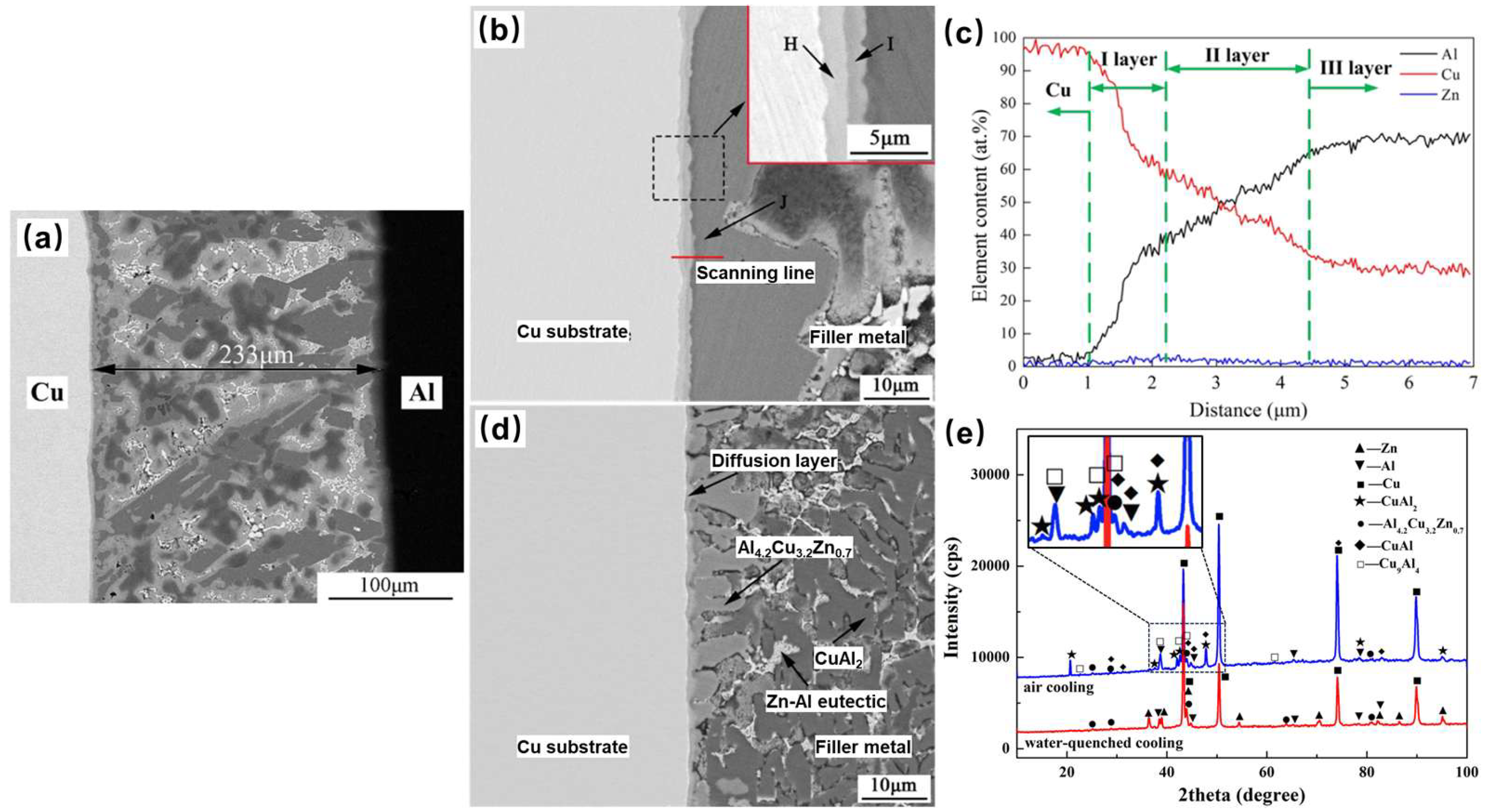
Niu et al. [127] conducted a furnace brazing study on T2 Cu and 1060 Al with Zn-Al brazing filler metals. The results indicated that the microstructure at the Cu-side interface of the brazing joint is relatively sensitive to the cooling rate and Al content. When the cooling rate was high (water quenching), the interface zone mainly consisted of α-Cu solid solution, a thin layer of CuZn phase, and rod-like Al4.2Cu3.2Zn0.7 phase. In contrast, when the cooling rate was slow (air cooling) or the Al content in the brazing filler metal was high, hard and brittle IMCs such as CuAl2, CuAl, and Cu9Al4 were formed at the interface. Mechanical property tests further demonstrated that a faster cooling rate and a brazing filler metal with lower Al content effectively suppressed the formation of hard and brittle IMCs, thereby improving joint strength. In addition, the Al-side interface of the joint primarily consisted of an α-Al solid solution, whereas the center region of the brazing seam was mainly composed of a Zn-Al eutectic structure. The joint structure is presented in Figure 20.
Figure 20. Microstructural characterization of Cu/Al joint brazed with Zn-22Al brazing filler metal: (a) SEM image of the joint; (b) SEM image of the Cu-side interface with air cooling; (c) EDS line scanning in (b); (d) SEM image of the Cu-side interface with water cooling; (e) XRD patterns of the Cu side of interface in joint with air and water-quenched cooling [127].
(3)
Al-Si system
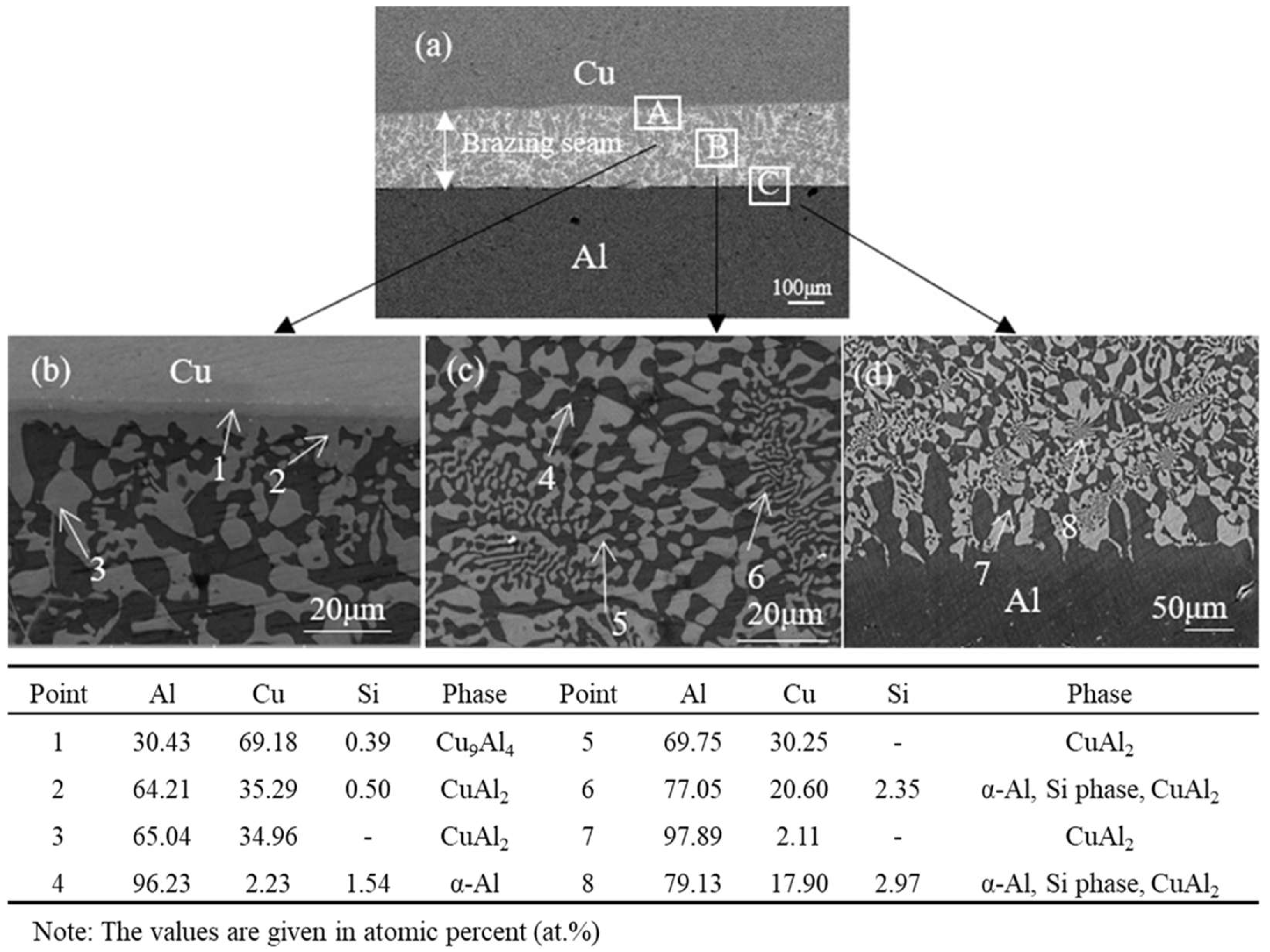
Cai et al. [128] used flux-cored Al-Si filler metal to braze T2 Cu and 3003 Al by induction brazing. Lamellar Cu9Al4 and blocky CuAl2 phases were observed at the Cu-side interface of the joint. At the Al-side interface of the joint and in the brazing seam, the microstructure mainly consisted of α-Al solid solution along with skeletal or acicular ternary eutectic phases (α-Al + Si phase + CuAl2). The joint microstructure is shown in Figure 21. Mechanical tests indicated that fracture primarily occurred at the interface between CuAl2 and α-Al phases within the brazing seam.
Figure 21. Microstructural characterization of Cu/Al joint brazed with BAl88Si brazing filler metal: (a) SEM image of the joint; (b) SEM image of Cu-side interface; (c) SEM image of brazing seam; (d) SEM image of Al-side interface. The table lists the EDS results of corresponding points in (bd) [128].
In summary, brazing and soldering are essential techniques for achieving reliable joints between Cu and Al, owing to their low processing temperatures, minimal deformation, and high adaptability. To mitigate the formation of hard and brittle IMCs at the interface, Sn-Zn solder, Zn-Al filler metal, and Al-Si filler metal systems are commonly employed, with their composition, melting range, and major constituent phases summarized in Table 3. These systems are implemented in combination with tailored composition design and optimized process parameters to inhibit IMC growth, thereby enhancing joint quality. Different filler metal systems induce distinct microstructural characteristics. When the Sn-Zn filler is adopted, a continuous IMC layer (e.g., Al4.2Cu3.2Zn0.7) is formed at the Cu-side interface. In contrast, on the Al side, only a discontinuous solid solution is formed because of poor wettability, which results in weaker bonding. With the Zn-Al filler, the microstructure on the Cu side is significantly influenced by cooling rate and Al content. Rapid cooling and low Al content can effectively inhibit the formation of brittle phases such as CuAl2, promote the formation of α-Cu solid solution, and consequently yield a thinner interfacial reaction layer. In contrast, the Al-Si brazing filler produces lamellar Cu9Al4 and blocky CuAl2 phases on the Cu side, whereas α-Al solid solution and Al-Si-Cu ternary eutectic structures are formed on the Al side and within the welding seam. Overall, the microstructure of Cu/Al joints directly influences their mechanical properties and service reliability. The joint strength and failure behavior are determined by the microstructural characteristics throughout the welding seam—particularly those of the interfacial IMCs (e.g., type, morphology, distribution, and thickness). Therefore, in the design and optimization of brazing and soldering processes, it is essential to synergistically control factors such as filler metal composition, welding temperature, cooling rate, and external field parameters to suppress excessive growth of brittle IMCs, improve interfacial bonding conditions, and ultimately obtain high-quality joints for Cu and Al.
Table 3. Composition, melting range, and major constituent phases of Sn-Zn solder, Zn-Al filler metal, and Al-Si filler metal.

2.5. Welding–Brazing

2.5.1. Fundamentals of Welding–Brazing

Welding–brazing is a dissimilar material joining process that integrates the principles of fusion welding and brazing, in which bonding is achieved by heating the dissimilar materials to a specific temperature range between their melting points [34]. At this temperature, the lower-melting-point BM partially melts and forms a weld pool together with the filler metal, whereas the higher-melting-point BM remains solid. The liquid metal then wets, spreads over, and diffuses into the solid surface of the higher-melting-point BM, ultimately forming a unique composite structure upon solidification [129]. On the lower-melting-point side, a fusion welding seam is formed where the BM and filler metal melt together, achieving a strong metallurgical bond. On the higher-melting-point side, a characteristic brazed interface is formed, which effectively avoids the potential issue of excessive brittle IMC formation caused by the melting of the BM, thereby enhancing joint reliability [130,131]. Due to the significant differences in thermophysical properties and metallurgical compatibility between Cu and Al, welding–brazing has become an effective process for achieving high-quality joints between these materials [132]. Currently, common Cu/Al welding–brazing techniques include arc welding–brazing (mainly TIG welding–brazing), laser welding–brazing, and cold metal transfer (CMT) welding–brazing, among others [6,47,63,133,134,135,136,137].

2.5.2. Microstructure of Welded–Brazed Dissimilar Cu/Al Joints

When welding–brazing is implemented to join Cu and Al, on the low-melting-point Al side, the BM melts and mixes with the molten filler metal, solidifying to form a fusion-welded joint with typical as-solidified structures such as dendrites. Simultaneously, molten Al or filler metal wets and spreads over the surface of the high-melting-point solid Cu side, forming an IMC layer through interdiffusion and chemical reactions at the interface, thereby achieving a brazed joint [131,134]. The microstructure of the welded joint, particularly the thickness, type, and distribution of IMCs at the interface, is primarily determined by the welding thermal cycle parameters (including peak temperature, dwell time at high temperature, cooling rate) and the selected filler metal system [34]. The following section outlines the microstructural characteristics of Cu/Al joints fabricated by typical welding–brazing processes using common filler metals.
The most common arc welding–brazing process for joining Cu and Al is TIG welding–brazing, owing to its stable arc, relatively low heat input, and ease of parameter control. These characteristics contribute to producing high-quality joints that are dense, defect-free, and exhibit a uniform microstructure [133,136]. Furuya et al. [138] conducted TIG welding–brazing on 1020 oxygen-free Cu and 1050 Al. The results indicated that the interfacial microstructure on the Cu side of the joint was primarily composed of multilayer IMCs. Under TIG processes with higher heat input, a relatively thick layer of CuAl2, followed by thinner layers of CuAl, Cu4Al3, and Cu9Al4, was formed at the interface from the Al side toward the Cu side. At the Al-side interface, a eutectic structure of α-Al + CuAl2 was the predominant phase. The microstructure of the joint is shown in Figure 22.
Figure 22. Microstructural characterization of Cu/Al lap joint fabricated by TIG welding–brazing: (a) SEM image of the interfacial region; (b,c) high-magnification SEM image of the IMC layer located above the Cu. The table presents the EDS results of corresponding points in (c) [138].
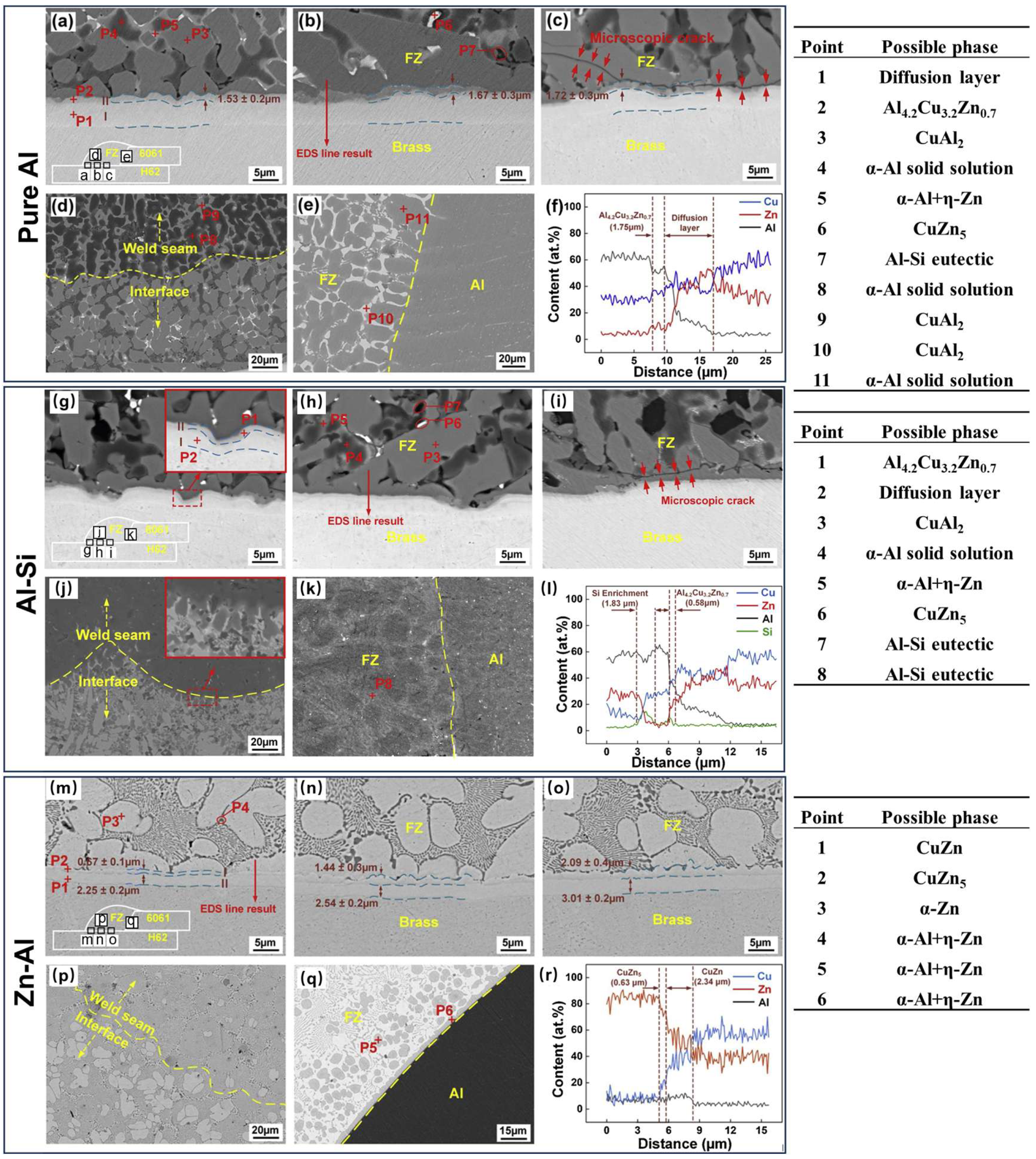
Owing to its high energy density and rapid heating and cooling rates, laser welding–brazing is well-suited for joining Cu and Al. Lei et al. [139] employed laser welding–brazing on 6061 Al alloy and H62 brass using pure Al, Al-Si, and Zn-Al filler metals, respectively. The result indicated that the filler metal composition significantly influenced the interfacial microstructure on the Cu side of the joint. When pure Al or Al-Si filler metal was adopted, a continuous Al4.2Cu3.2Zn0.7 phase and a lamellar CuAl2 phase formed at the interface, with microcracks prone to initiate within the brittle CuAl2 phase. In contrast, when Zn-Al filler metal was employed, the lower Al content effectively suppressed the formation of the CuAl2, resulting in a bilayer structure composed of CuZn and CuZn5 at the interface without obvious microcracks. Tensile tests indicated that the Zn-Al filler metal yielded the highest tensile strength (148 MPa), primarily attributed to the suppression of brittle Cu-Al IMC growth and the favorable mechanical properties of the Cu-Zn phases. In addition, no distinct IMC layer was observed at the Al-side interface, and the weld zone microstructure mainly contained α-Al solid solution, α-Al + η-Zn solid solution, and Zn-Al eutectic. The microstructure of the joint is presented in Figure 23.
Figure 23. SEM images and EDS analysis results of Cu/Al joints with pure Al (af), Al-Si (gl), and Zn-Al (mr) filler metals at different regions: (a,g,m) weld toe region; (b,h,n) middle region; (c,i,o) irradiation region; (d,j,p) weld seam; (e,k,q) Al side of interface; (f,l,r) EDS line scanning of middle region. The table shows possible phases identified by EDS [139].
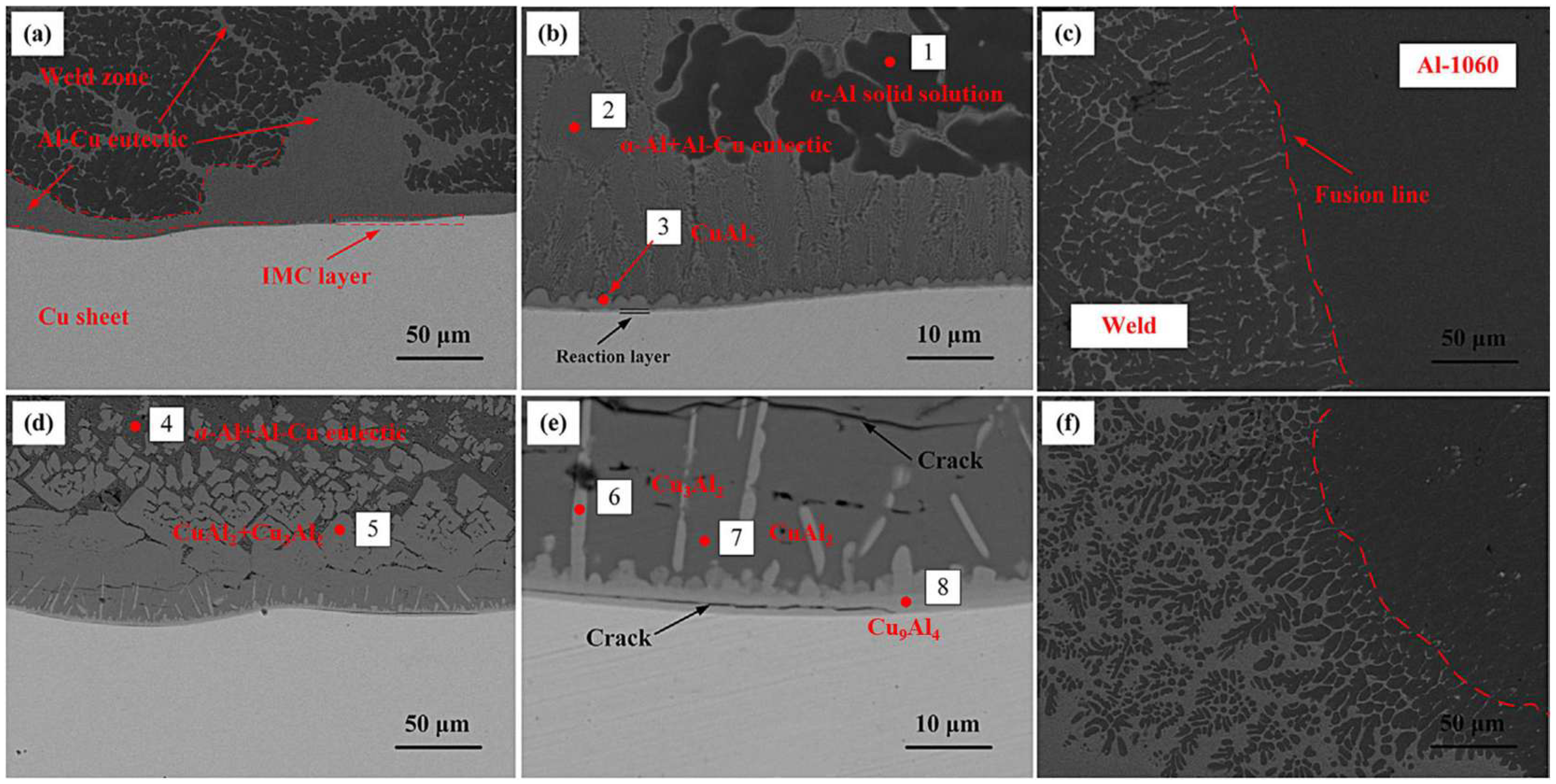
CMT is an innovative arc-welding technology that achieves spatter-free, low-distortion fusion brazing through digitally controlled wire retraction in a low-heat-input short-circuiting mode [6]. Fang et al. [140] employed CMT welding–brazing to perform lap welding without an interlayer between 1060 Al and T2 Cu. Microstructure analysis revealed that the interfacial region on the Cu side was composed of IMCs such as Cu9Al4, Cu3Al2, and CuAl2, whereas the weld zone mainly contained α-Al solid solution and Al-Cu eutectic along grain boundaries. The joint microstructure is illustrated in Figure 24. Under lower heat input, the IMC layer was relatively thin and dominated by CuAl2. As the heat input increased, the IMC layer thickened significantly, accompanied by significant growth of the CuAl2 layer, along with the emergence of needle-like Cu3Al2 and layered Cu9Al4 phases; microcracks were also observed. Mechanical tests indicated that the joint strength increased as the heat input decreased. Under the optimal parameters (102 A, 25 mm/s), the maximum shear force reached 0.983 kN. Moreover, the fracture location shifted from the Al-side HAZ to the Cu side of the interface, and the corresponding fracture mode changed from ductile to brittle.
Figure 24. SEM image of Cu/Al lap joint fabricated by CMT welding–brazing at welding current of 80 A (ac) and 87 A (df): (a,d) SEM image of Cu side of interface; (b,e) higher magnification of Cu side of interface; (c,f) SEM image of Al side of interface [140].
In summary, the distinct characteristics of various welding–brazing processes in Cu/Al joining stem from their significantly different heat input behaviors. TIG welding–brazing provides stable, low, and controllable heat input, enabling the production of high-quality joints with a uniform microstructure and few defects and resulting in a highly robust process. Laser fusion brazing is characterized by high energy density and concentrated thermal action, enabling rapid heating and cooling, which can partially suppress excessive growth of hard and brittle IMCs. However, it is more sensitive to the compatibility between filler metal composition and process parameters. CMT welding–brazing, with its uniquely low heat input and spatter-free operation, offers a significant advantage in precisely controlling the thickness of the interfacial reaction layer, thus enabling the formation of thin and continuous IMC layers. Overall, for different welding–brazing processes, the core challenge and control objective lie in precisely managing the thermal cycle to inhibit the excessive formation of hard and brittle IMCs at the joint interface, thereby achieving joints with reliable mechanical properties.

3. Strategies for Enhancing Cu/Al Dissimilar Joint Quality

3.1. Optimizing Laser Welding (LW) for Enhanced Joint Quality

The joining of Cu and Al via LW technology faces several inherent challenges. Firstly, the process is susceptible to defects such as porosity and hot cracks. Secondly, both Cu and Al exhibit high reflectivity and low absorptivity for long-wavelength near-infrared fiber laser, resulting in low energy conversion efficiency. Thirdly, it is difficult to completely avoid the formation of harmful brittle IMCs at the Cu/Al interface. Fourthly, laser equipment costs are high, and optimizing process parameters is complex [1,19,45]. To address these issues, several key improvement strategies have been developed. Specifically, short-wavelength lasers (such as blue or green lasers) can be employed to improve the energy absorption of material. Furthermore, the optimization of LW process parameters (including laser power, welding speed, and spot diameter), lap configuration, and laser output modes (e.g., oscillation, pulse), allows for precise control of heat input. Such controlled heat input improves the temperature gradient and flow behavior of the weld pool, thereby reducing the tendency for porosity and cracks and minimizing defects. Moreover, beam quality can be optimized to achieve deep penetration welding, higher power density, and faster welding speeds. Additionally, the addition of interlayers or filler metals between Cu and Al can regulate the interfacial reactions and reduce the thickness of the IMC layer [1,19,45].

3.1.1. LW Parameters

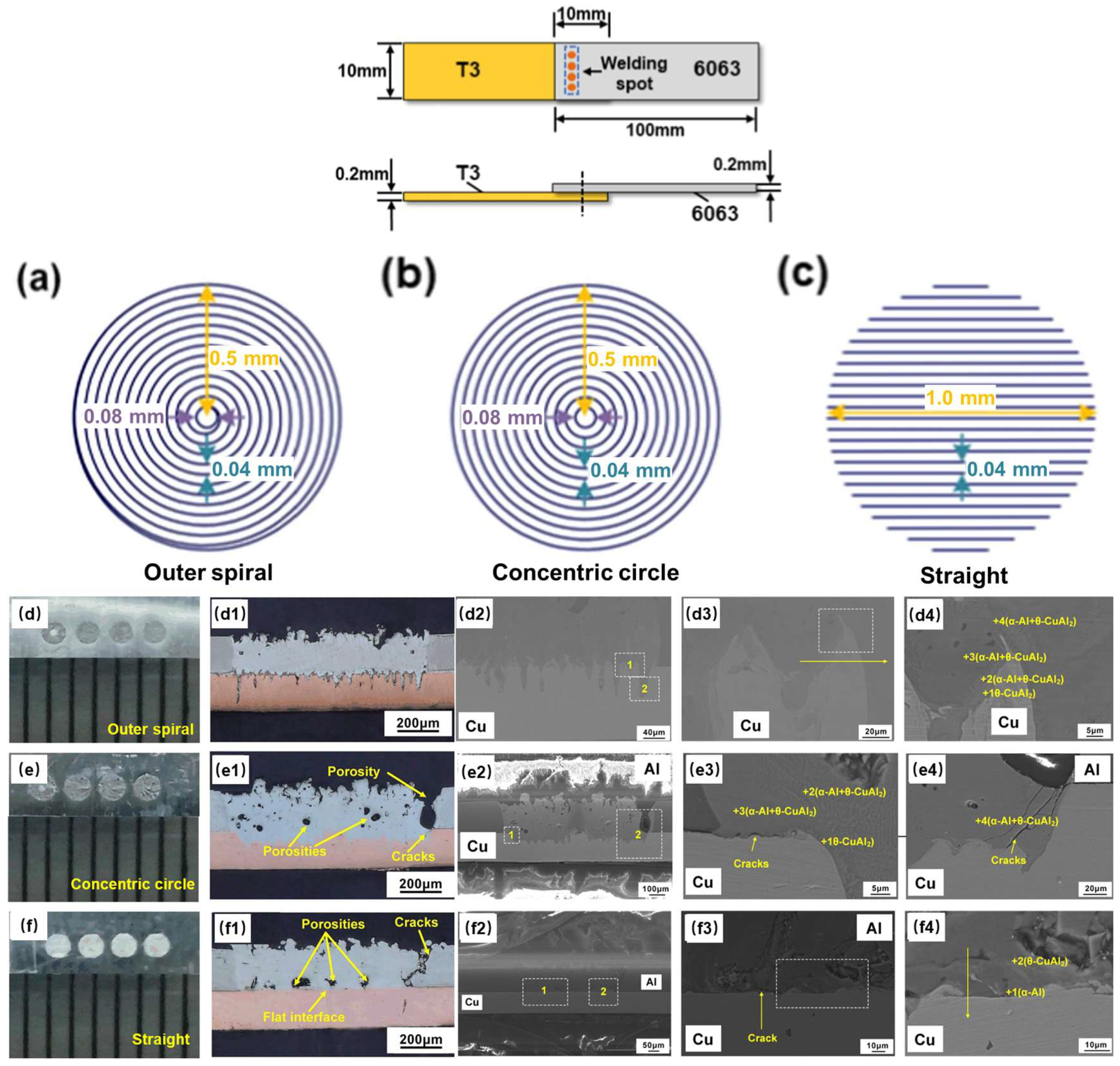
Laser power, welding speed, and spot diameter determine the input power density in the LW process. When welding Cu and Al, employing an appropriate laser power density provides sufficient energy to achieve complete fusion between the metals, thereby preventing unfused defects. Simultaneously, it effectively suppresses excessive diffusion and reaction between Cu and Al atoms, preventing the formation of excessively thick, hard, and brittle IMCs. As laser power increases, the enhanced energy input to the weld pool intensifies the melting of the BMs and promotes interdiffusion between Cu and Al. This results in more IMC formation, which in turn increases joint electrical resistance and deteriorates mechanical properties. Xue et al. [141] found that higher laser power caused an increase in primary dendrite arm spacing and growth of secondary dendrites in the hypoeutectic dendritic zone, reducing the shear strength of Cu/Al joints. Sinhmar et al. [142] employed varying laser powers (2.0, 2.1, 2.2 kW) for welding 1 mm thick pure Al and C110 Cu plates. Notably, when the power input was raised from 2.0 to 2.1 kW, the weld penetration increased by 86%. However, when the laser power was further increased to 2.2 kW, through-thickness penetration occurred, which deteriorated the mechanical strength of the joint. Additionally, an increase in the laser power input led to a corresponding increase in the width of the IMC layer. Yan et al. [143] performed spiral contour laser lap welding on Cu and Al and observed higher joint strength at a larger spiral distance and lower laser power, which was attributed to a reduction of IMC phases and a more favorable loading distribution resulting from an increased total width of the fusion zone. Yan et al. [144] demonstrated that the tensile strength of Cu/Al joints initially increases and then decreases with increasing laser power, reaching a maximum tensile strength of about 99.8 MPa at a laser power of 2.45 kW and a welding speed of 2 m/min. Research indicates that welding speed mainly affects the interaction time between the laser and the material. Lee et al. [145] carried out lap welding of Cu and Al thin sheets at different welding speeds and found that IMCs were easily formed in the wider areas in the weld fusion zones produced at 1 kW and 10 m/min, whereas IMCs were extremely reduced at the higher welding speeds of 50 m/min; furthermore, the tensile shear strength of a joint increased with increasing welding speed. Huang et al. [146] found that an increase in laser power increased both the recoil pressure and the Marangoni stress, which drove more Cu to migrate upward and mix with Al. This promoted weld pool flow and metal mixing, which in turn favored IMC formation. In contrast, an increase in welding speed shortens the molten pool lifetime, which reduces the metal mixing through the fluid flow, thereby decreasing the amount of IMCs.
To optimize welding quality, it is essential to control the growth of IMCs while ensuring sufficient power density to form an effective joint. A smaller spot diameter facilitates welding at lower laser power and higher welding speed while maintaining the required energy density for material absorption, thereby providing a broader process window to reduce the IMC layer thickness and enhance the mechanical strength and electrical conductivity of the joint [147,148]. In addition, laser beam oscillation or a high-frequency pulsed laser can be applied to design different scanning trajectories to increase the joint area and avoid the defect of low tensile force caused by small spot diameter [143].

3.1.2. Lap Configuration

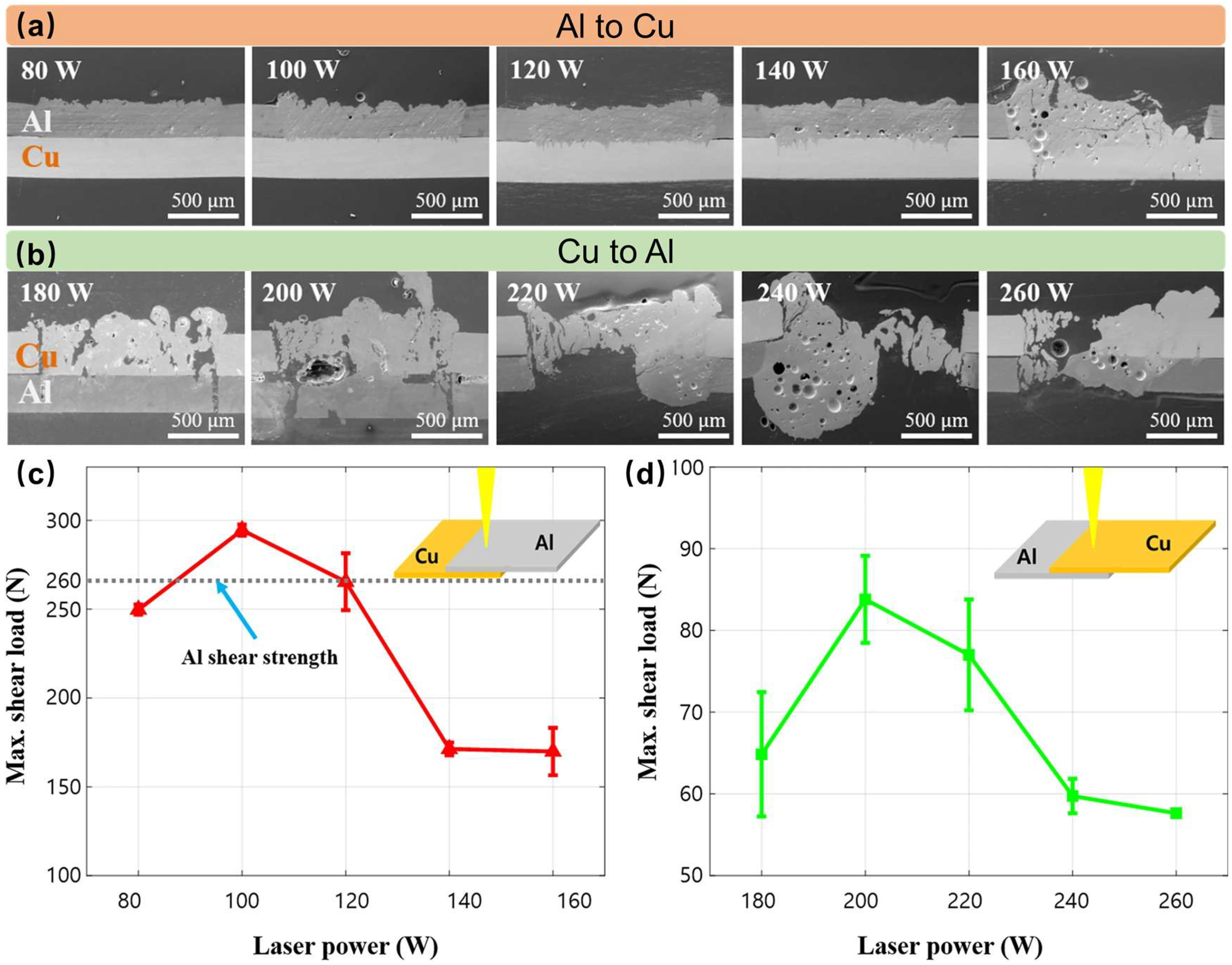
Due to the significant differences in physical properties and laser absorption efficiencies between Cu and Al, the lap configuration (whether Al or Cu is positioned on top) directly influences joint morphology and quality [1,19,45]. When placed on top, Al melts first under the laser as a result of its lower melting point and higher absorptivity. Owing to the lower density of molten Al, it cannot readily sink within the melt pool, which effectively suppresses excessive mixing with the underlying Cu. This suppressed mixing leads to a shallow and wide weld seam with a thinner IMC layer. Such joints are typically characterized by a funnel-shaped morphology and exhibit good electrical conductivity and ductility. Conversely, when Cu is placed on top, a higher power density is required to melt it. Owing to its higher density, the molten Cu tends to sink and vigorously mix with the underlying Al. This increases penetration depth and forms a thick, continuous, brittle IMC layer at the interface. Such joints exhibit a bottle-shaped morphology with higher hardness but poorer ductility [1,145,149]. Figure 25 illustrates the shear load of Cu/Al joints under different lap configurations [150]. The “Al-on-top, Cu-on-bottom” configuration exhibits higher strength because this configuration effectively suppresses IMC growth while reducing welding defects [150].
Figure 25. The microstructure (a,b) and the shear load (c,d) of Cu/Al joints: (a) SEM images of the “Al-on-top” joints; (b) SEM images of the “Cu-on-top” joints; (c) shear strength of “Al-on-top” joints; (d) shear strength of “Cu-on-top” joints [150].

3.1.3. Laser Output Mode

The laser output mode has a crucial impact on the welding quality of Cu and Al. Traditional continuous-wave LW, characterized by high energy density and a smaller HAZ, tends to cause instability of the corresponding keyhole and weld pool [151]. During the dissimilar welding of Cu and Al, the high thermal conductivity of Cu leads to extremely rapid cooling and solidification. This results in poor flowability of the molten Al and turbulent weld pool dynamics, which induce spatters and defects such as porosity or cracking in the joint. Such issues are not fully resolvable through the optimization of process parameters alone [1,19,45]. Although high-quality joints have been achieved employing continuous-wave fiber lasers for laser spiral spot welding of Cu and Al, this method suffers from high parameter sensitivity and complex process control [152]. Different laser output modes, such as beam oscillation, pulsed, and dual-beam hybrid, have been reported to control the temperature gradient and weld pool behavior, thereby improving joint quality [153,154,155].
Traditional laser keyhole welding (typically conducted with a continuous-wave laser) is characterized by highly concentrated energy, which generates an extremely high temperature gradient (G) between the center and the edge of the weld pool. This promotes rapid advancement of the solidification interface, leading to the formation of coarse columnar grains [48,56]. In contrast, laser beam oscillation employs a composite scanning strategy that combines transverse periodic oscillation with longitudinal uniform linear motion. The high-speed scanning transforms the laser beam into a moving surface heat source, significantly broadening the range of heat input on the workpiece surface. This mode produces two key effects. First, it alters the predominantly unidirectional heat flow, promoting a more uniform temperature distribution within the weld pool and thereby reducing the temperature gradient G. Second, the intense convective stirring induced by the oscillation allows the relatively cooler molten metal at the pool’s edge to fully mix with the high-temperature molten metal at the center, leading to a decrease in the actual temperature at the solidification front. These two factors collectively increase the undercooling within the liquid phase near the solidification interface [48,56]. According to classical solidification theory, greater undercooling substantially increases the probability of spontaneous nucleation within the liquid phase or activation of heterogeneous nucleation nuclei, thereby establishing prerequisites for subsequent equiaxed grain formation [156].
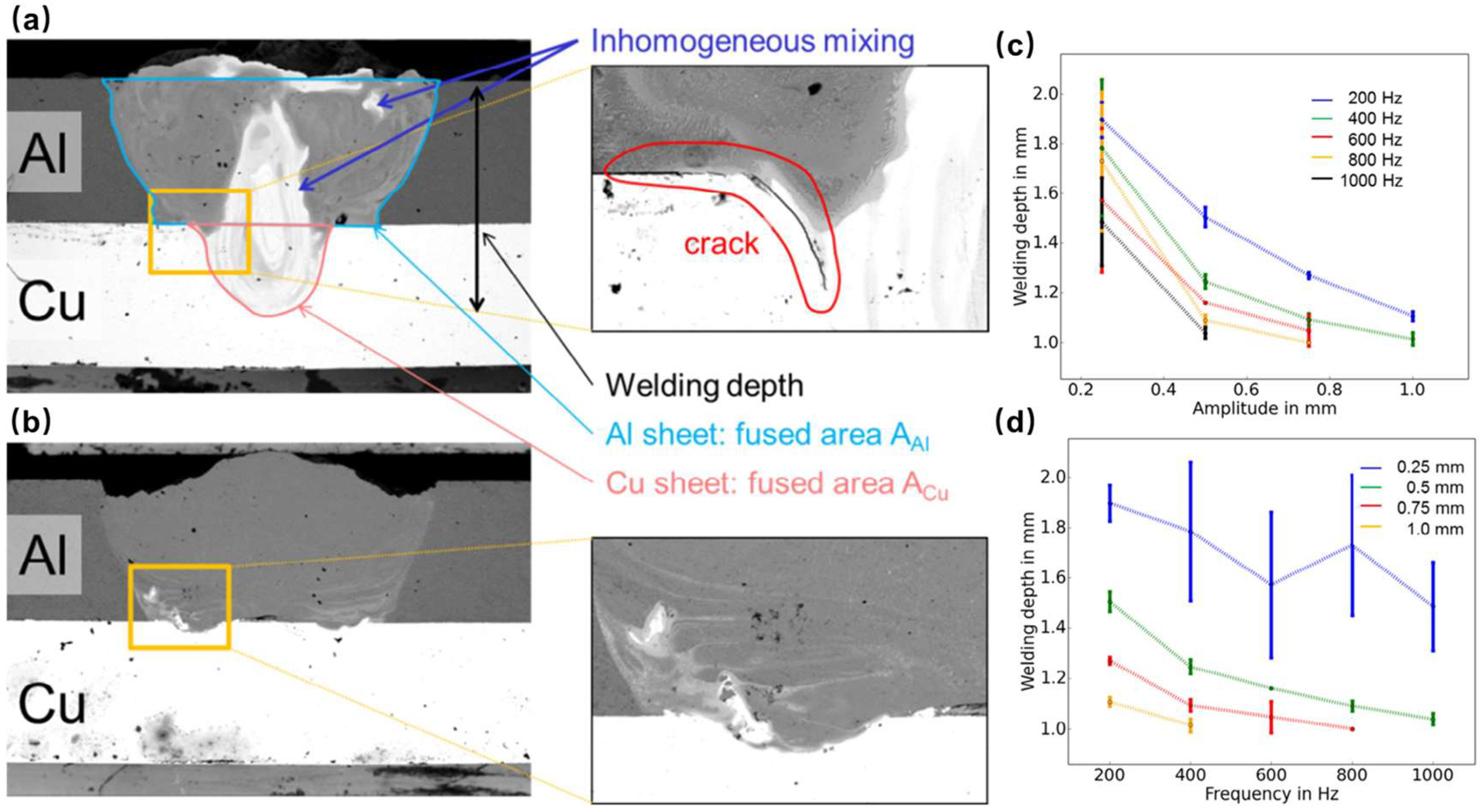
The flow within the weld pool induced by beam oscillation is the core physical process affecting grain morphology. Marangoni convection driven by surface tension gradients generates shear stress, which forms intense vortices within the weld pool and exerts significant mechanical shear on the growing dendritic tips at the columnar grain front [153]. When dendrites grow to a certain length during solidification, their roots or secondary dendrite arms may fragment, remelt, or undergo necking and detachment from the primary dendrite stem as a result of intense fluid shear forces. Transported by the convective flow to the undercooled region at the pool center, these fragmented dendritic particles serve as nuclei and grow into equiaxed grains [48,56]. Based on the solidification kinetics, the transition from columnar to equiaxed grain (CET) is governed by the ratio of the temperature gradient G to the solidification rate R (G/R) and the nucleation rate [56,157]. Compared with single LW, laser oscillation welding significantly reduces the temperature gradient G. It also increases the solidification rate R from the weld center outward by broadening the pool and modifying the solidification interface shape. The decrease in the G/R ratio corresponds to a reduction in the stability of the solidification interface, favoring the formation of equiaxed grains [153]. Consequently, precise control of oscillation parameters (such as amplitude, frequency, and waveform) enables active regulation of G, R, and nucleation conditions, thereby facilitating the targeted design of weld microstructures and enabling a transition from coarse columnar grains to fine, dense equiaxed grains [158,159]. As indicated in Figure 26 from ref. [158], an increase in the amplitude and frequency leads to a reduction in penetration depth, resulting in a tooth-shaped cross-section. At a smaller amplitude of 0.25 mm, elemental mixing is highly inhomogeneous, and large cracks are observed in the solidified region. With a larger amplitude, the relative Cu content in the weld decreases, and the molten Cu is distributed more uniformly throughout the fusion zone. In this case, no elongated cracks are found.
Figure 26. Laser beam oscillation of Cu and Al: (a,b) SEM images showing the joint cross-sections at an amplitude/frequency of 0.25 mm/800 Hz and 0.75 mm/400 Hz, respectively; (c,d) plots of welding depth versus amplitude and frequency [158].
In pulsed LW, heat input is controlled by adjusting three key parameters: peak power, pulse width, and frequency. Based on the waveform, this technique can be categorized into conventional single-pulse and multi-pulse laser modes [154]. In pulsed laser spot welding or stationary spot welding, there is no relative motion between the workpiece and the laser. The formation of the keyhole mainly stems from the vapor recoil pressure generated by the instantaneous vaporization of material under the high energy density of the laser. The pressure is strong enough to expel molten metal, so that a deep-penetration welding channel (the keyhole) is formed. In pulsed LW of Cu and Al, a significant temperature gradient exists on the molten pool surface, inducing the Marangoni effect [57,154]. This effect promotes convective circulation inside the weld pool, accelerates the mutual diffusion and mixing of Cu and Al, and forms swirl-like structures in the weld pool [57]. By reasonably setting the spot overlap area, the heat accumulation and cooling processes between pulses can be regulated, which leads to a more uniform temperature distribution, and consequently a reduction in porosity and microcracks caused by rapid solidification [1]. Moreover, the low-frequency pulsed laser can adjust the output energy through different pulse shapes, offering flexible control of heat input and cooling rate, and further optimizing weld formation and microstructure [160]. The pulse shape is defined by the phases of preheating, active welding, and cooling within the pulse width [161]. Mathivanan et al. [162] indicated that pulse shapes with distinct preheating, active welding, and cooling stages were beneficial for improving the shear strength of Cu/Al joints, while suppressing interdiffusion, and reducing porosity. Moreover, an increase in the active welding time was found to intensify Cu and Al diffusion, thereby leading to the formation of porosity and cracks. High-frequency pulsed lasers feature a defined pulse shape and lower energy per pulse (typically <100 W) than low-frequency pulsed lasers. Combined with their high beam quality and a small spot diameter, they enable the design of various scanning paths via galvo-mirrors. Zhu et al. [163] investigated the effect of different laser scanning paths in nanosecond-pulsed LW on Cu/Al lap joints. The laser scanning paths, as depicted in Figure 27, include outer spiral, concentric circle, and straight. The results indicated that adopting the outer spiral scanning path can produce sound joints with a shear load reaching 198 N, owing to the pinning effect generated by the interfacial wave structure, and the formation of a continuous and crack-free IMC layer. Li et al. [164] found that an appropriate spiral scan distance is key to obtaining high-quality joints. Tien et al. [165] optimized processing parameters for the fabrication of Cu/Al dissimilar lap joints utilizing a pulsed LW method with a wobble strategy through numerical simulation and surrogate models. The laser peak power and welding tangential speed were optimized based on three quality criteria, including melt pool width, melt pool depth, and Cu concentration, to achieve favorable weld pool geometry and minimize cracks and pores in the fusion zone. The optimal parameters yield a high shear force of 1209 N and a low electrical contact resistance of 86 µΩ.
Figure 27. Different scanning paths and corresponding appearances and microstructure of Cu/Al joints using nanosecond-pulsed laser welding: (ac) schematic diagrams for scanning paths, including outer spiral, concentric circle, and straight; (dd4, ee4, ff4) appearances and microstructure of joint produced under outer spiral, concentric circle, and straight model [163].
A dual-beam laser integrates a high-power-density Gaussian central beam with a low-power-density annular outer beam, allowing independent control of both power levels to optimize energy distribution. Compared with single laser beam welding, dual-beam LW more effectively stabilizes the keyhole and molten pool, reduces spatter, significantly decreases welding defects such as porosity and depressions, and effectively suppresses the formation of brittle IMCs, thereby improving weld quality [155]. Cha et al. [166] investigated dual-beam LW of Cu/Al dissimilar metals. The results indicated that, through the independent adjustment of the central and annular beam powers, dual-beam welding could significantly improve weld surface quality, suppress defects such as porosity and cracks, and enhance the mechanical properties of the welded joints. Ali et al. [167] employed a dual-beam configuration with a continuous laser as the primary welding heat source and a pulsed laser for preheating to perform lap welding of AA1050 Al alloy and Ni-plated C1100 Cu. The results indicated that dual-beam welding effectively reduced weld defects, optimized the microstructure, and achieved a tensile–shear load of 247.4 N and an electrical resistance of 352.3 µΩ·cm for the welded joints. Sun et al. [168] systematically investigated the influence of beam shape on Cu/Al dissimilar metal welding by adjusting the power distribution between the central and annular beams. It was found that an optimized power allocation (40% core beam and 60% annular beam) could minimize brittle IMC formation, yielding a joint with a linear load of 41.76 N/mm and an electrical resistance of 82.7 µΩ.

3.1.4. Interlayer and Filler Metals

Cu and Al possess poor mutual solid solubility, and during LW they readily form brittle IMCs. Additionally, the significant disparities in their thermophysical properties render the welding process difficult to control, leading to substantial welding stresses that severely degrade joint quality [20]. To optimize the mechanical properties of the joints, elements (or their alloys) with strong chemical affinity for both Cu and Al, such as silver (Ag), nickel (Ni), tin (Sn), zinc (Zn), and silicon (Si), are commonly employed as interlayers or filler metals. These materials serve to prevent direct contact between Cu and Al, regulate interfacial reactions, inhibit the formation of harmful IMCs, and promote the initial formation of favorable transition layers or solid solutions. Consequently, such effects mitigate welding-induced thermal stress, reduce crack susceptibility, and ultimately enhance joint mechanical properties.
Typical metal interlayers for the LW of Cu and Al include Ag, Ni, and Sn. As an interlayer, Ag can significantly enhance the mechanical stability of the joint. For instance, with a 100 μm thick Ag foil, the shear force of a Cu/Al joint can reach 800 N [169]. Chen et al. [170] employed Ag wire as the interlayer for laser butt welding of Cu and Al and found that the Ag interlayer can inhibit the formation of coarse IMCs. At the joint, CuAl2 and Ag3Al were primarily formed, while some Al-rich and Ag-rich phases existed as micron-sized particles, contributing to dispersion strengthening. Ni can form an infinite solid solution with Cu and does not form IMCs during solidification. Ni and Al form a finite solid solution, yielding the AlNi phase. Furthermore, the low thermal conductivity of Ni can suppress the thermal diffusion of Al into Cu. Furuya et al. [171] evaluated the effect of a Ni interlayer on laser-welded Cu/Al joints and found that adding Ni forms a (Cu, Ni)Al transition layer between CuAl2 and Cu9Al4, improving joint strength. Yan et al. [172] demonstrated that adding a Ni interlayer can suppress Al diffusion and refine the microstructure of harmful IMCs (mainly CuAl2) at the joint. The relevant reaction mechanism is illustrated in Figure 28. In addition, with increasing laser power, the strength of joints with a Ni interlayer first increases and then decreases, reaching a maximum of 126.9 MPa, which is 27.1% higher than that of joints fabricated without a Ni interlayer.
Figure 28. Schematic of reaction mechanism of Cu/Al dissimilar joints using Ni interlayer: (a) weld pool formation and atomic diffusion; (b) AlNi IMC nucleation and (Cu) solid solution formation; (c) (Al) solid solution precipitation and CuAl2 IMC growth; (d) eutectic reaction and final solidified microstructure [172].
Sung et al. [173] employed LW to join Ni-plated and unplated C11000-O Cu plates to AA1060 Al and compared the microstructure and properties of the two types of joints. The Ni plating did not alter the weld pool shape but significantly improved the joint strength. This improvement is attributed to the introduction of Ni, which transformed the joint interface into a wavy structure and thickened the IMC layer, thereby enhancing resistance to crack initiation and propagation. Du et al. [174] achieved hybrid LW and brazing of T2 Cu and 1050 Al foils via laser spiral spot welding. In this process, a dense Al-Ni IMC layer was formed through the reaction between the Ni interlayer and Al, which effectively suppressed the formation of brittle IMCs and thereby significantly improved joint strength and toughness. Similarly, Sn exhibited good solid-state compatibility with both Cu and Al, thereby reducing Cu-Al brittle IMC formation. The effectiveness of Sn in improving joint properties is related to its thickness. It is reported that a 10 μm thick Sn layer can significantly enhance the mechanical properties of the joint [169].
Representative filler metals for welding Cu and Al mainly include Sn-based, Al-Si, and Cu-Si alloys. Hailat et al. [175] investigated the effect of Sn-Ag-Ti alloy as a filler metal on the performance of Cu/Al joints. According to their results, a 100 μm thick layer of this alloy enhanced Cu/Al compatibility and improved joint strength. This is because the Sn-based alloy suppresses the formation of brittle CuAl2 while promoting the formation of a more uniform and ductile Al-Ag-Cu ternary phase. Si can reduce the viscosity of molten metal and enhance the fluidity of the weld pool, leading to more elemental mixing during the welding process. Additionally, Si atoms in Al-Si alloys tend to undergo interdiffusion with Cu atoms, limiting the localized enrichment of Cu and the formation of Cu-Al IMCs [176]. Weigl et al. [177] evaluated the effects of AlSi12 and CuSi3 alloys on the strength and toughness of Cu/Al joints. The results indicated that the Si in the alloys could increase the fluidity of the molten metal and promote more uniform elemental mixing, thereby reducing IMC formation and improving the strength and toughness of the joints. The higher Si content in AlSi12 led to a more pronounced improvement in the mechanical properties of the joints compared with CuSi3.
During the LW process of Cu and Al, the introduction of interlayer materials can suppress the mixing of Cu and Al and control the type and thickness of IMCs. In addition, the CTE of the interlayer or filler metal lies between that of the Cu and Al, which helps alleviate thermal stress, reduce hot cracking, and improve joint ductility. However, further research is required on issues such as the wettability of the interlayer or filler metal, the potential formation of new brittle phases, and the matching of welding parameters.
Table 4 summarizes research findings on the LW of Cu and Al. LW is well-suited for lap welding of thin Cu and Al sheets (typically ≤2 mm). Joint strength is primarily governed by the thickness of the brittle IMC layer (mainly CuAl2 and Cu9Al4) at the interface, which depends on the heat input. To suppress excessive IMC formation and improve performance, introducing interlayers such as Ni or Ag is a widely validated effective strategy. Current research mostly focuses on mechanical properties and microstructure, while systematic evaluation of the joint’s electrical performance remains insufficient.
Table 4. Summary of research conducted on LW of Cu and Al.

3.2. Optimizing Friction Stir Welding (FSW) for Enhanced Joint Quality

The bonding mechanism for joining Cu and Al metals via FSW primarily involves two aspects. First, under thermomechanical coupling, the material in the SZ undergoes severe plastic deformation and flow, forming macroscopic and microscopic mechanical interlocking structures. Second, at the Cu/Al interface, atomic diffusion and the possible IMC formation enable metallurgical bonding [2,10,11,12,16]. The size and distribution of IMCs significantly affect joint quality and fracture mechanism [75]. By optimizing welding parameters (tool geometry parameters, positioning configurations of materials, tool rotation speed, traverse speed, plunge depth, and tool tilt angle), heat input and material flow can be controlled to regulate the size and distribution of IMCs, thereby improving joint quality and strength. It is reported that forming a thin and uniform IMC layer through optimized welding parameters can enhance strength without compromising ductility [32,41,42,92]. Moreover, inserting an interlayer between Cu and Al can prevent direct contact and suppress excessive brittle IMC growth, offering another effective approach to improving joint strength and toughness [178]. Additionally, by introducing external energy fields or employing auxiliary heating/cooling techniques, derivative processes developed from traditional FSW can better regulate the welding heat process, significantly improving joint quality while enhancing efficiency [18].

3.2.1. FSW Tool Geometry Parameters

The FSW tool primarily consists of a shoulder and a pin. Its geometric parameters significantly influence heat generation, material flow, and joint quality during the FSW of Cu and Al [179,180]. A well-designed tool geometry contributes to improved weld quality, an expanded process window, and enhanced joint performance. During the FSW process, the tool must maintain stability in its geometric dimensions and material properties. Overall, tool materials must exhibit excellent high-temperature strength, hardness, and creep resistance at welding temperatures, along with outstanding high-temperature wear resistance and low chemical affinity with the workpiece materials to prevent excessive wear and sticking [181]. Additionally, the material should possess good microstructural uniformity, stability, and adequate fracture toughness to ensure long-term reliability under thermal cycling. Furthermore, good machinability is also required from a manufacturing perspective [181]. For different BMs and plate thicknesses, typical tool materials include tool steel, tungsten carbide, polycrystalline cubic boron nitride (PCBN), and cobalt-based or tungsten-based alloys [181]. For the FSW of Cu and Al, heat-treated high-speed steel and tool steel (with a hardness of 45–62 HRC) are typically employed [10]. They provide sufficient hot strength and wear resistance for the process while avoiding the high cost and brittleness of more advanced materials, such as PCBN [10,182]. However, these steels are prone to progressive wear and thermal softening during prolonged welding because of abrasive wear from hard Cu particles and adhesive wear from intense thermomechanical loading [181,182].
The geometry of the tool, particularly shoulder diameter, shoulder surface profile, pin length, pin diameter, and pin shape, significantly affects heat input, material flow, forces, and torque [87,183]. The shoulder diameter and its surface profile significantly affect the frictional heat generated between the workpiece and the shoulder surface, thereby influencing joint quality and defect formation [184,185]. Studies have demonstrated that a small shoulder diameter combined with a large pin diameter tends to cause continuous tunnel defects [10]. Moreover, a relatively small shoulder diameter coupled with high traverse speed can promote surface cracking at the joint. The shoulder surface profile directly affects material flow behavior, size of the SZ, mechanical properties of the joint, and the type and distribution of IMCs [10]. Figure 29a depicts the characteristics of the shoulder outer surface and shoulder end surface of different stirring tools. These geometric features are designed to enhance material mixing and obtain high-quality joints [186].
Figure 29. (a) FSW welding tool shoulder features [186]; (b) schematic drawing of the tool with different pin shapes [88].
The length, diameter, and surface profile of the pin also influence material flow, microstructure, and joint quality [86,87,88,89]. Zhou et al. [88] compared the effects of three types of pins (featureless pin, threaded pin, and threaded pin with flutes; Figure 29b) on the performance of Cu/Al FSBW joints. The joint produced with the threaded pin during FSW exhibited the maximum failure load of 4.3 kN. Elmetwally et al. [187] investigated the effects of four different pin shapes (straight cylindrical, tapered, triangular, and squared) on Cu/Al FSBW joints. A comparative analysis revealed that the joints made with a squared pin yielded the maximum tensile strength of 107.2 MPa, while joints made with a triangular pin exhibited the highest hardness. The high hardness was due to the formation of numerous hard and brittle Cu2Al phases; however, these joints were also more prone to crack defects. Elyasi et al. [89] investigated the effects of cylindrical pin and threaded pin on the performance of Cu/Al FSBW joints. It was demonstrated that threaded pins, by generating higher heat input and enabling more thorough mixing, led to an optimized joint structure, which exhibited improved interlocking and finer grains, yielding a tensile strength of 345 MPa.
Pinless FSW avoids keyhole formation and relies solely on shoulder forging, enabling a smooth, flat, flash-free weld seam with good appearance. Many researchers have adopted pinless FSW for spot welding of Cu and Al [78,86,188]. Zhang et al. [78] employed pinless FSW to perform lap spot welding of a 2 mm thick T2 pure Cu plate and a 1060 Al rod, with the pure Cu plate placed on top of the Al rod. The results revealed that the thickness of the IMC layer at the Cu/Al interface was related to the dwell time of the tool. When the dwell time was short (4 s), the IMC layer remained thin, and the joint exhibited optimal mechanical properties. Notably, pinless FSW also exhibits certain limitations, particularly in terms of penetration depth and process control. The absence of a pin restricts mechanical stirring action and material flow, resulting in insufficient interfacial mixing, particularly for thicker or dissimilar material combinations [78,86,188]. The process is also highly sensitive to heat input; excessive dwell time produces thick and brittle IMC layers, whereas insufficient heat may lead to incomplete bonding or voids [86]. Consequently, pinless FSW is mainly suitable for thin sheets and applications where interfacial mixing requirements are moderate.
In summary, for the FSW of Cu and Al, a concave shoulder profile combined with a threaded pin is a kind of typically optimized tool design. The concave shoulder can accommodate the extruded plasticized material and prevent excessive expulsion, while the threaded pin generates higher heat input and improves plastic flow within the SZ through the introduction of additional axial forging force. The synergy of these features promotes thorough material mixing, creates a tighter mechanical interlocking structure, and refines grain structure, thereby facilitating the production of high-quality joints.

3.2.2. FSW Primary Setup Parameters

The positioning configuration of materials is a key process factor influencing the quality of Cu/Al FSW joints (both butt and lap joints). Adjusting the material positioning directly affects the heat input, material flow behavior, and the formation and distribution of IMCs, which determine joint quality [2,11,12,42]. For FSBW joints, two main configurations are commonly employed, namely placing Al on the advancing side (AS) or Cu on the AS [2,11,12]. Theoretically, placing the harder, higher-melting-point Cu on the AS is advantageous, as it promotes more uniform material flow, thinner IMC layers, and defect-free joints [182,189,190]. Conversely, when Cu is located on the RS, its high deformation resistance prevents adequate migration toward the AS under the stirring action of the pin, readily leading to non-uniform flow and defects such as tunnels and voids [93,190]. However, the opposite configuration (Al on the AS) has also yielded sound joints with specific parameter combinations [76,79,85,191]. This suggests that the optimal positioning configuration is not fixed but rather depends on the interplay between welding parameters (such as tool rotation speed, traverse speed, and tool geometry) and material conditions (such as alloy designation and thickness). For FSLW joints, most studies prefer to position the Al on top of the Cu [95,192,193]. This configuration promotes heat generation and retention in the SZ owing to Al’s lower thermal conductivity and enhances material fluidity and mixing. This contributes to optimizing the morphology of the hook-like structure, strengthening mechanical interlocking, promoting the formation of a denser metallurgical bond at the interface, and optimizing the formation and distribution of IMCs [73,95,193].
The tool rotation speed and traverse speed directly affect the heat input and material mixing degree in FSW. Studies have indicated that properly setting these two parameters can form a thin and uniform IMC layer at the Cu/Al interface, achieving a favorable balance between the ductility and strength of the joint [194]. Typically, a higher tool rotation speed and a lower traverse speed increase heat input and promote the mixing of Cu and Al. However, excessively high tool rotation speeds can lead to the formation of a thick and continuous IMC layer, which degrades joint mechanical properties [79]. Conversely, an excessively low tool rotation speed or a high traverse speed reduces heat input. This leads to insufficient material mixing, shorter diffusion time, and suppressed IMC formation, ultimately preventing sufficient metallurgical bonding between Cu and Al and causing defects like tunnels and voids [85].
Esmaeili et al. [82] investigated the effect of tool rotation speed on IMC formation and the mechanical properties of FSBW joints between brass (CuZn30) and 1050 Al. In their experiment, Al was placed on the RS. The traverse speed, pin plunge depth, tool tilt angle, and pin offset (toward the Al side) were set to 8 mm/min, 0.25 mm, 1.5°, and 1.6 mm respectively. The tool rotation speed was set to 200, 450, 750, 900, and 1100 rpm. The results indicated that an increase in tool rotation speed promotes the thickening and growth of IMCs (CuAl2, Cu9Al4, and CuZn) at the interface. At the optimum rotation speed of 450 rpm, a narrow interfacial IMC layer and a lamellar composite structure formed within the SZ, leading to an enhanced weld tensile strength of 101 MPa. A further increase in rotation speed lowers the tensile strength of the weld, which is accompanied by the disappearance of the lamellar composite structure, increase in weld defects and thickening of the interfacial IMC layer. Tan et al. [79] successfully joined 5A02 Al alloy to pure Cu via FSBW at a tool rotation speed of 1100 rpm, a traverse speed of 20 mm/min, and a 0.2 mm tool offset toward the Al side, with the Al plate positioned on the AS. The joint strength reached 130 MPa. However, when the traverse speed was increased to 40 mm/min, void defects formed at the joint, resulting in deteriorated mechanical property with a strength of only 11 MPa. Karrar et al. [85] investigated the effect of tool rotation speed on IMC formation and mechanical properties in FSBW joints between pure Cu and AA6061 Al alloy through experimental and numerical approaches. With Al placed on the AS, tool rotation speeds of 1300, 1400, and 1500 rpm were examined while maintaining the traverse speed, tool tilt angle, and tool offset set at 100 mm/min, 2.8°, and 0 mm respectively. The results indicated that sound joints could be obtained at both 1400 rpm and 1500 rpm. The joint produced at 1500 rpm exhibited the highest tensile strength, reaching 194.5 MPa. The numerical analysis indicated that the highest speed (1500 rpm) provided suitable heat input. This promoted the formation of IMCs (CuAl2, CuAl, and Cu9Al4) and enhanced material mixing, thereby yielding a more uniform IMC distribution.
Guan et al. [195] investigated the effects of high tool rotation speed on the microstructure and properties of FSLW joints between annealed 6061 Al plates and T3 Cu plates (3 mm thick). The Al was placed above the Cu, with a traverse speed of 25 mm/min and a pin plunge depth of 0.1 mm to avoid direct penetration into the lower Cu plate. The tool rotation speeds were set at 2500, 3000, 3500, and 4000 rpm. The results demonstrated that, at tool rotation speeds of 2500 and 3000 rpm, composite-like structures and layered Cu/Al coexistence zones were formed at the Cu/Al interface on the RS, where the primary IMCs were identified as CuAl2, CuAl, and Cu9Al4. Increasing rotation speeds to 3500 and 4000 rpm led to the formation of thin and uniformly distributed layered structures with scarcely discernible IMCs at the Cu/Al interfaces. Additionally, a hook-like structure extending from the Cu side to the Al side formed on the AS, around which a small number of microcavities and microcracks were observed. Figure 30 illustrates the cross-sectional microstructure of Cu/Al FSLW joints formed at different tool rotation speeds. The joint strength was greater at tool rotation speeds of 2500 and 3000 rpm. Although the pin did not penetrate the lower Cu plate, the stirring action was sufficient to create extensive Al-Cu mixing zones and distinct IMCs at the interface, thereby enhancing metallurgical bonding. In contrast, at 3500 and 4000 rpm, the stirring action resulted in thinner layered structures and the formation of hook-like defects, which deteriorated the interfacial bonding and reduced joint strength. Firouzdor et al. [73] conducted a series of FSW experiments on AA6061 Al and pure Cu via both conventional lap welding (Al on the top) and a modified lap welding process, investigating the effect of traverse speed on joint strength. In the modified process, Cu was placed above Al, with an additional Al plate added on top of the Al to form a butt joint with the Cu. The tool rotation speed and pin tilt angle were set at 1400 rpm and 3°, respectively, with a slight pin penetration into the bottom sheet. The traverse speed was varied from 38 to 203 mm/min. The results indicated that, when the traverse speed was ≤127 mm/min, the joint strength of the modified process was higher than that of the conventional process, attributed to metallurgical bonding between the homogeneous Al materials, mechanical interlocking between Cu and Al, and the absence of defects. However, at 203 mm/min, the joint strength of the modified process decreased significantly as a result of insufficient heat input, which caused the formation of channel defects and inadequate material mixing.
Figure 30. The cross-sectional microstructure of Cu/Al FSLW joints formed at different tool rotation speeds: (a) 2500 rpm; (a1) enlarged view of the dash rectangle shown in (a); (b) 3000 rpm; (b1) enlarged view of the dash rectangle shown in (b); (c) 3500 rpm; (c1) enlarged view of the dash rectangle shown in (c); (d) 4000rpm; (d1) enlarged view of the dash rectangle shown in (d) [195].
Studies have revealed that a tilted tool generates a stronger forging effect on the trailing side and creates a high-temperature zone on the trailing AS, leading to higher peak temperatures and more intensified material flow around the tool [196,197]. Mehta et al. [198] investigated the effect of tool tilt angle on the quality of FSBW joints between AA6061-T651 Al and Cu. Al was placed on the RS, with the tool rotation speed, traverse speed, and pin offset (toward the Al) set at 1300 rpm, 40 mm/min, and 2 mm, respectively. The tool tilt angle was varied from 0° to 4°. The results indicated that defects formed in the joint when the tool tilt angle was 0° or 1°, whereas sound joints could be obtained at tilt angles of 2°, 3°, and 4°. As the tilt angle increased, the hardness in the SZ increased, reaching a maximum of 186 HV at a tilt angle of 4°; the corresponding joint tensile strength was 117 MPa. Increasing the tilt angle raised the axial plunge load, which reduced the formation of flash defects and promoted IMC growth.
Pin offset is a key process parameter influencing the quality of Cu/Al FSW joints. Offsetting the pin toward the Al side enhances the plastic flow of Al, promotes its more thorough transfer into the SZ, and fragments, refines, and uniformly distributes Cu within the Al matrix. This results in a composite layered structure and improves the bonding quality at the Cu/Al interface [2,10,11,12,42,182,199]. Hou et al. [75] placed 6061-T6 Al on the RS and C11000 Cu on the AS and investigated the mechanical properties of joints with pin offsets of 0 to 2 mm toward Al. The results demonstrated that the joint achieved the highest tensile strength of 152 MPa at an offset of 1.2 mm. Similarly, Zhou et al. [76] placed 5A06 Al alloy on the AS and T2 Cu on the RS and evaluated the mechanical properties of joints with pin offsets of 0 to 1.2 mm toward the Al. The results indicated that the joint reached its highest tensile strength of 203.4 MPa at an offset of 1.0 mm. In summary, the pin offset toward the Al side significantly influences joint quality by regulating material flow and heat input, which affects the Cu particle distribution, IMC formation, and defect generation in the joint. Both insufficient and excessive offset are detrimental; therefore, determining the optimal offset requires balancing multiple competing mechanisms.

3.2.3. Interlayer

An effective approach to enhancing the performance of Cu/Al joints is to optimize their interfacial structure by introducing interlayers, such as metal foils or reinforcing particles. This strategy effectively suppresses the formation and mitigates the detrimental effects of brittle IMCs. Kuan et al. [178] adopted a pinless FSLW process to join 1A99 Al and commercially pure Cu, adding a 0.2 mm thick Zn foil between the Cu and Al. The Zn interlayer prevented direct contact between Cu and Al, inhibiting the formation of brittle IMCs. Instead, more favorable Al-Zn and Cu-Zn binary or Al-Zn-Cu ternary compounds were formed, enhancing the toughness and strength of the joint. Moreover, Zn with its low melting point (419.5 °C) partially melted during the FSW process, forming a liquid Zn-Al eutectic phase that promoted diffusion between Al and Cu. The presence of liquid Zn provided continuous diffusion channels, enhancing the interdiffusion of elements. Sahu et al. [200] implemented FSBW to join 1050 Al (RS) and Cu alloy (AS), placing a 0.4 mm thick Zn interlayer along the weld line between two BMs. The results indicated that the Zn interlayer promoted the formation of binary IMCs such as CuAl, CuAl2, Al0.71Zn0.29, CuZn5, and the ternary intermetallic phase Al4.2Cu3.2Zn0.7. The Zn-rich phases exhibited favorable toughness, and the IMC layer was thin (micron-scale) and uniformly distributed, contributing to dispersion strengthening and solid solution strengthening. As a result, the joint achieved a strength exceeding that of the Al BM by 4%. Furthermore, the Zn interlayer acted as a site for heterogeneous nucleation, promoting grain refinement in the SZ. The grain size was reduced by 15–20% compared with joints without a Zn interlayer. Hou et al. [201] cold-sprayed a 90 μm thick Ni layer onto the faying surface of commercially pure Cu and then performed FSBW to join it to 6061 Al alloy (AS). The results demonstrated that cold spraying Ni between Cu and Al inhibited the formation of hard and brittle IMCs and reduced the IMC layer thickness (from 1 μm to 200 nm). This phenomenon is attributed to the diffusion coefficient of Al in the Ni matrix being about four orders of magnitude lower than that in Cu, thereby significantly slowing the diffusion reaction between Al and Cu. After introducing the Ni coating, the mechanical properties of the joint improved significantly, with tensile strength and elongation reaching 190 MPa and 14%, respectively. Akbari et al. [202] anodized a 23 μm thick Cu-containing composite layer as an interlayer on a 6060 Al plate and then performed FSLW (Al on top, Cu on the bottom). The results indicated that the interlayer enhanced the metallurgical and mechanical properties of the Cu/Al lap joint. The presence of the interlayer prevented direct contact between Al plate and Cu plate, reducing the formation of detrimental IMCs. Payak et al. [203] performed FSLW on 6101 Al alloy and C11000 Cu alloy and compared joint quality with four interlayer configurations: no interlayer, a single interlayer (Al-Ag-Cu or Al-Zn-Cu), and hybrid interlayers (Al-Ag-Zn-Cu). The results indicated that joints with hybrid interlayers achieved the highest tensile strength of 121.78 MPa. The improvement in tensile strength was attributed to the uniform distribution of thin Zn-generated IMCs and the dispersion of ductile Ag2Al IMCs generated by Ag in the weld zone.
In addition to metal interlayers, the addition of reinforcing particles is also an effective approach to enhancing the strength of Cu/Al FSW joints. Argesi et al. [204] joined AA5754 Al alloy (AS) to pure Cu (RS) using FSBW and introduced SiC nanoparticles (with diameters ranging from 45 to 60 nm) as an interlayer. To prevent the reinforcing particles from being expelled during welding, matching grooves and protrusions were machined on the Al and Cu plates, respectively. The grooves on the Al side were filled with SiC particles; subsequent assembly encapsulated the particles at the interface prior to welding. The results indicated that the SiC nanoparticles effectively suppressed the formation of brittle IMCs. Moreover, the reinforcing particles hindered grain boundary migration via the Zener pinning, significantly refining the grain structure in the SZ. This reduced the grain sizes of Al and Cu from 38.3 μm and 12.4 μm to 12.9 μm and 5.1 μm, respectively. The tensile strength of the joint also increased from 169 MPa to 239 MPa. Zhang et al. [205] adopted AlCoCrFeNi high-entropy alloy particles (diameter range 0.5 to 24 μm) as an interlayer to perform FSLW on annealed 6061-O Al alloy and T3 Cu. To prevent the reinforcing particles from being removed during welding, grooves were first machined in the Al plate and filled with reinforcing particles, which were then covered with a thin Al plate. A pinless tool was employed for a single FSLW pass to weld them into a composite plate. After removing the thin Al plate, a conventional tool was finally employed to perform FSLW on the particle-reinforced Al plate and the Cu plate. The fabrication process of the HEA particle-reinforced Cu/Al FSLW joint is depicted in Figure 31a. Large-sized reinforcing particles promoted grain refinement in the SZ through the particle-stimulated nucleation mechanism, while small-sized particles contributed to dispersion strengthening. Additionally, the formation of nanoscale IMCs such as Al3Ni and Al13Fe4 at the Cu/Al interface further strengthened the joint. The microstructure of the joint is presented in Figure 31b,c. Tensile tests demonstrated that the HEA particle-reinforced Cu/Al joint achieved a maximum fracture strength of 391 N/mm, which was 55% higher than that of the unreinforced Cu/Al joint (251 N/mm).
Figure 31. The fabrication process of the HEA particle-reinforced Cu/Al FSLW joint (a) and its microstructure (b,c): (a) Schematic view of the FSLW process; (b) band contrast image; (b1,b2) EDS mappings of Al and Cu; (b3) grain size distribution diagram; (b4,b5) low and high magnifications of grain constituent map; (c) TEM images of tiny particles near the Al/HEA interface; (c1) TEM image of the particles; (c1c4) HRTEM images and the corresponding FFT patterns of particle 2 and particle 4 [205].

3.2.4. Advanced FSW Technology

In addition to the conventional FSW, various advanced FSW derivative processes have been developed in recent years. These processes significantly enhance weldability, joint quality, and efficiency by introducing external energy fields or through auxiliary heating or cooling methods, such as ultrasonic-assisted FSW (UFSW), laser-assisted FSW (LFSW), and submerged FSW (SFSW) [2,10,18]. The UFSW process optimizes the physical metallurgical mechanism during the welding process by introducing additional acoustic energy. This technique utilizes thermal effects to soften materials, mechanical effects to enhance stirring and particle fragmentation, and physical effects to promote diffusion and densification, thereby achieving high-quality joints [206,207]. The introduction of ultrasonic vibrations into the FSW process for Cu/Al joints has been demonstrated to suppress IMC formation, reduce IMC layer thickness, and improve joint quality [206,207]. Common ultrasonic configurations involve applying ultrasonic vibrations directly on the tool or the workpiece [208,209]. Zhao et al. [207] reported that the introduction of ultrasound during the Cu/Al FSW process can suppress the formation of Cu-Al phases and reduce the IMC thickness, as depicted in Figure 32. Relative to conventional FSW, the IMC thickness is reduced by approximately 30–42%. In addition, UFSW promotes the mixing of Cu and Al, refines and uniformly disperses Cu particles, refines the grains in the SZ, and significantly improves joint quality. Tensile test results indicate that fracture in Cu/Al UFSW joints occurs in the Al-side HAZ and exhibits a ductile fracture mode. LFSW preheats the Cu in front of the tool, reducing the hardness and yield strength of the Cu, thereby significantly decreasing the axial welding force, extending tool life, and simultaneously improving welding performance [210]. This process also optimizes the heat input distribution, enabling simultaneous softening of Cu and Al, promoting material plastic flow, and mitigating excessive growth while optimizing the distribution of IMCs. Fei et al. [210] utilized LFSW to join 6061-T6 Al alloy and pure Cu to investigate the effects of laser power and pin offset on joint quality. The results revealed that LFSW can significantly reduce the IMC layer thickness, and appropriate laser power and pin offset can control the IMC layer thickness to about 1 μm and not exceeding 2 μm. Optimal parameters, including a laser power of 700 W, a tool rotation speed of 950 rpm, a traverse speed of 23.5 mm/min, and a pin offset of 1 mm (toward the Cu side), enable the production of high-quality, sound joints.
Figure 32. Comparison of thickness of IMCs in Cu/Al joint for (a) FSLW process and (b) UFSLW process under different traverse speeds [207].
SFSW is a variant of the conventional FSW process conducted within water or other liquid media [26]. In SFSW of Cu/Al dissimilar metals, the liquid medium serves as a coolant to control heat input, lower peak temperature, and increase cooling rate. This shortens the residence time at elevated temperatures, suppresses interfacial IMC formation, decreases IMC layer thickness, refines SZ grains, restricts HAZ grain growth, and minimizes flash defects, thereby improving joint quality [211]. Mao et al. [26] employed SFSW butt welding to join 6061-T6 Al and T2 pure Cu. Compared with the IMC layer in the conventional FSW joint, the IMC layer thickness along the entire interface in the SFSW joint was significantly reduced and its distribution was more uniform, as illustrated in Figure 33. The maximum tensile strength of the SFSW joint reaches up to 255 MPa, which is equivalent to 91.1% of the Cu BMs and 41.7% higher than that of the FSW joint. For the FSW joint, the fracture occurred in the Cu/Al interface, specifically, within CuAl2 phase or the interface between the Al and the CuAl2 layer. In contrast, the SFSW joint with higher ductility fractured in the HAZ on the Cu side. This was attributed to a thinner interfacial IMC layer formed at the Cu/Al interface resulting from a reduced heat input.
Figure 33. SEM images and interfacial IMC layer thickness of the Cu/Al FSW joint (a) and SFSW joint (b) [26].
Table 5 and Table 6 present syntheses of research findings on the FSBW and FSLW of Cu and Al, respectively. Both FSW processes achieve bonding through controlled thermomechanical processing, which is fundamentally driven by tool rotation and movement. Rotation speed, traverse speed, and tool offset are key parameters governing material flow and interfacial reactions. In terms of mechanical properties, FSBW joints typically exhibit tensile strengths of 50–90% or more of the BM, whereas FSLW emphasizes peel or shear resistance (up to several kilonewtons). The optimized process effectively suppresses interfacial IMC growth (primarily CuAl2 and Cu9Al4), limiting thickness to the micron level (typically <4 μm). This characteristic significantly outperforms many high-heat-input LW processes (Table 4), which is critical for achieving good joint mechanical properties. Interlayer introduction has emerged as a common strategy for further enhancement. Meanwhile, research is advancing toward advanced hybrid processes, including laser- and ultrasonic-assisted FSW. However, existing studies remain largely focused on mechanical properties and microstructural characterization, whereas systematic evaluations of service characteristics, including electrical properties, corrosion behavior, and fatigue life, are still lacking. Moreover, variations in testing standards across studies hinder data comparison.
Table 5. Summary of research conducted on FSBW of Cu and Al.
Table 6. Summary of research conducted on FSLW of Cu and Al metals.

3.3. Optimizing Ultrasonic Welding (UW) for Enhanced Joint Quality

For the joining of Cu and Al via UW, joint quality is highly dependent on UW parameters, which include welding time, energy, hold time, amplitude, pressure, and sonotrode geometry, among others [4,44]. Different combinations of welding parameters significantly affect joint microstructure, thereby determining its overall quality. Therefore, parameter optimization is essential for producing sound joints. Additionally, joint performance can be further enhanced by introducing external energy fields (e.g., thermal or current assistance), exerting auxiliary pressure, applying interlayers, or performing postweld heat treatment (PWHT) [4,44].

3.3.1. UW Primary Setup Parameters

The heat input of UW directly affects the microstructure evolution at the weld interface, which governs the deformation behavior and mechanical strength of the joint. An appropriate heat input (or welding time) promotes plastic deformation and material flow between Cu and Al, fostering the IMC layer formation with a moderate thickness at the interface and thus improving the mechanical properties of the joint. However, excessive welding time can lead to thickening of the IMC layer. Given its inherent brittleness, an excessively thick IMC layer is prone to microcrack initiation under welding or service stresses; furthermore, cracks tend to propagate along this brittle layer, ultimately degrading the mechanical properties of the joint.
Liu et al. [112] investigated the effect of welding time on the IMC layer in UW joints of C1100 Cu and 5652 Al alloy. The results revealed that, as welding time increased, interfacial atomic diffusion resulted in the formation of a discontinuous IMC layer (CuAl2). Simultaneously, intense plastic deformation promoted the formation of a high proportion of high-angle grain boundaries, high-density dislocations, and vacancies, which accelerated atomic diffusion and promoted the continuous formation and longitudinal growth of the IMC layer at the interface. Additionally, prolonged welding time thickened the IMC layer and deteriorated joint strength. Go et al. [212] compared the effects of welding time, amplitude, and pressure on the quality of UW joints of battery-grade Cu and Al materials. The results demonstrated that welding time exerted the most significant impact on the mechanical properties of the joint. When welding time increased from 0.1 s to 0.3 s, the joint developed deeper indentations and more intense interfacial deformation, leading to an increase in tensile shear loads from 0.49 to 0.93 kN. Furthermore, welding time influenced material flow at the interface. Prolonged welding time promoted the transformation of the interfacial bond line from a planar to a wavy structure, creating a mechanical interlock that enhanced the joint strength [103,104]. Satpathy et al. [100] conducted UW of AA1100 Al and C10100 Cu and observed the cross-section of the joint, as illustrated in Figure 34. When the welding time is too short (0.5 s), it is unfavorable for the formation of microbonds at the interface, whereas a longer welding time (0.9 s) increases the penetration depth of the sonotrode tip into the specimens and generates higher temperatures, leading to softening of the BM and reduction in sheet thickness. The above research indicates that an insufficient welding time impedes the formation of a stable metallurgical bond at the interface; in contrast, an excessively long welding time promotes the formation of a thick brittle IMC layer and causes excessive material softening, both of which are detrimental to joint strength. Therefore, optimizing welding time within a suitable process window is essential for achieving optimal mechanical properties.
Figure 34. Microstructures of cross sections of the Cu/Al USW joints with different welding times: (a) 0.5 s; (b) 0.75 s; (c) 0.9 s [100].
The amplitude of UW significantly affects material flow and interface deformation. Go et al. [212] indicated that an increase in amplitude (30 to 50 μm) significantly elevates the heat input, leading to excessively thin Al layers, exposure of Cu layers, deformation at the joint edges, and even crack formation, collectively undermining joint integrity. Furthermore, excessively high amplitudes (≥40 μm) exacerbate material softening and damage, resulting in a 12–17% reduction in tensile shear load. Dhara et al. [96] employed UW to join three layers of Al foil and a single layer of Cu foil, investigating the effect of amplitude on joint quality. The results indicated that, as the amplitude increased, the gaps between Al layers and at the Cu/Al interface gradually decreased. When the amplitude reached 50 μm and above, the continuous unbonded regions between metal layers disappeared, forming a continuous and intimately bonded interface. Simultaneously, an increase in amplitude promotes material flow and interlayer mixing, leading to the formation of wavy microbonds at the interface. This optimizes joint quality, thereby improving the mechanical properties of the weld. Liu et al. [213] investigated the effect of amplitude on the microstructure and mechanical properties of pure Cu/5652 Al alloy UW joints. The results indicated that an increase in amplitude accelerates the formation of IMC (CuAl2). At an amplitude of 25 µm, a continuous IMC layer first appeared at 0.4 s, compared with 0.6 s at 22.5 µm and 0.8 s at 20 µm. Maximum tensile strength (~75 MPa) was achieved at 0.9 s (22.5 µm) and 0.5 s (25 µm), respectively.
During UW, applying static pressure to the workpiece ensures intimate contact between the workpiece, the sonotrode, and the anvil, thereby generating high-frequency shear friction and heat during the welding process. Welding pressure significantly influences material amplitude, interface temperature, plastic deformation, and the formation and growth of IMCs, which in turn affects joint strength. Dhara et al. [96] conducted UW on three layers of Al foil and a single layer of Cu foil to investigate the effect of welding pressure on joint quality. The results demonstrated that increasing welding pressure reduced interfacial gaps in multilayer workpieces, promoted material flow and mixing, refined joint grains, and enhanced joint strength. However, excessively high welding pressure may lead to an overly thin total Al layer in the welding zone, resulting in harmful and excessive thermomechanical deformation, thereby compromising the overall performance of the joint. Li et al. [214] employed UW to join pure Cu and 6061-T6 Al, investigating the effects of welding pressure (1375–2175 N) on the sonotrode vibration amplitude, joint microstructure, and mechanical properties. The results revealed that, when the pressure reached or exceeded 1975 N, the sonotrode vibration amplitude decreased at the initial stage of welding and then gradually recovered to a level comparable to that observed under lower pressure. The vibration amplitudes of both the upper Cu specimen (sonotrode side) and the bottom Al specimen (anvil side) decreased with increasing welding pressure. The decrease in amplitude observed in the upper specimen can be attributed to two primary effects of the increased welding pressure. First, it promotes initial bonding at the interface and increases plastic deformation and interfacial interlocking, leading to enhanced interfacial friction. Second, it raises the degree of material softening, which reduces the ultrasonic shear force. Both effects contributed to the observed drop in amplitude. The decrease in amplitude observed in the bottom specimen occurred because higher welding pressure increases the amount of material extruded beneath the sonotrode. At this point, the softened Al underwent transverse plastic flow at the Cu/Al interface, filling and enveloping the interfacial region corresponding to the sonotrode teeth pattern. This caused a large portion of the vibrational energy transmitted from the sonotrode through the Cu sheet to be absorbed by the viscous interfacial layer, resulting in a decline in amplitude. Furthermore, the thickness of the IMC (CuAl2) layer first increases and then slightly decreases with increasing pressure, as depicted in Figure 35, because when the pressure reaches or exceeds 1975 N, the Si present at the interface hinders interfacial diffusion. Excessive welding pressure leads to thickening of the IMC layer, which reduces the joint strength. Choudhary et al. [215] investigated the effect of welding pressure on the UW of Cu and Al. The results indicated that increasing welding pressure expanded the welding seam area, raised the interface temperature, and significantly improved joint strength. However, excessively high pressure may also exacerbate the formation of IMCs, degrading joint quality.
Figure 35. SEM images of the Cu/Al interface (af), IMC thickness (g), and lap-shear force under various welding pressures: (a) 1375 N; (b) 1575 N; (c) 1775 N; (d) 1975 N; (e) 2175 N; (f) EDS line scanning results in (e) [214].
During UW, the sonotrode directly contacts the workpiece to transmit pressure and ultrasonic energy. Its geometry affects plastic deformation and material flow, thereby influencing the quality of the joint. Specifically, an optimized sonotrode geometry can promote interfacial material flow, enlarge the welding area, and facilitate the formation of mechanical interlocking structures and metallurgical bonding, thus improving joint quality. Currently, research on the optimization of sonotrode geometry primarily relies on finite element simulation [4,107,216,217]. By simulating the UW process with different knurling geometries and tooth parameters (such as tooth size, tooth depth, shoulder slope of outer tooth, and tooth angle), the stress–strain distribution at the faying interface is obtained. Through the correlation of these simulation results with mechanical testing and microstructural characterization, an optimal sonotrode geometry can be determined [107,216]. Research results indicated that an optimized sonotrode design can induce localized plastic deformation during contact with the workpiece, promoting microbonding and the formation of mechanical interlocking structures. Simultaneously, it avoids piercing the workpiece and suppresses the formation of brittle IMCs. Examples include sonotrode with serrated knurling (superior to flat knurling), appropriate tooth depth (achieving significant plastic deformation without excessively thinning the workpiece after welding), and a larger tooth angle (increasing interfacial plastic strain and reducing contact stress) [217].

3.3.2. Intermediate Materials

Introducing an interlayer at the Cu/Al interface is an effective approach to improving the performance of ultrasonic joints. Common intermediate materials include metal foils (interlayer) and reinforced particles. Balasundaram et al. [218] investigated the effect of a Zn interlayer on the microstructure and properties of UW joints between C110 Cu and annealed 5754 Al alloy. The results demonstrated that the addition of a Zn interlayer (50 μm thick) significantly improved the mechanical properties of the joints (lap shear tensile strengths increased by 25–170%). A eutectic structure composed of Al and CuAl2 was formed at the center of the weld, whereas an Al-Zn eutectic film and CuZn5 were formed at the weld edges. Figure 36 presents the microstructure of a Cu/Al joint with Zn interlayer. Li et al. [219] observed that Cu5Zn8 and CuAl2 were generated at the interface of USW Cu/Al joints with the addition of a Zn interlayer (50 μm thick). When the welding energy input was 700 J, the joint bearing force increased from 1300 N to 1450 N, which can be primarily attributed to the formation of Cu5Zn8. Ye et al. [220] introduced a Cu foil interlayer during the UW of Al strands and Cu terminals. It was demonstrated that the Cu foil interlayer filled the gaps between the Al strands during welding, increased the effective welding area, and significantly reduced the void ratio. The addition of Cu foil increased interfacial friction, raising the interface temperature, which promoted plastic deformation and dynamic recrystallization at the interfaces of the Al strands, Cu foil, and Cu terminals. It also facilitated diffusion bonding between the Cu foil and Cu terminals which drove cooperative deformation of the surface layer of the Al strands, achieving excellent metallurgical bonding at the interface between the Al strands and the Cu foil, along with the entire joint. Additionally, fine equiaxed grains and high-angle grain boundaries formed at the interface effectively hindered dislocation motion. Mechanical test results indicated that, after adding the Cu foil interlayer, the joint bonding force significantly increased from 1360 N to 1733 N. Ni et al. [221] introduced a 2219 Al alloy particle interlayer in the UW of C1100 Cu and 1100 Al. The results indicated that the addition of the 2219 Al alloy particle interlayer increased interfacial friction, promoted interfacial plastic deformation, effectively fragmented and removed surface oxides, and significantly increased the effective contact area between Cu and Al. Moreover, it effectively inhibited the formation of brittle IMCs, significantly improving joint quality. The maximum tensile strength of approximately 83 MPa was achieved at a welding energy of 1500 J.
Figure 36. Microstructural characterization of the Cu/Al UW joint with Zn interlayer: (a) SEM image of the joint center; (b) magnified image of the heterogeneous region indicated by the box in (a); (c) SEM image of the joint edge; (d) magnified image of the box in (c); (e) further magnified image of the box in (d); (f) EDS results of corresponding points in (a–e); (g) XRD patterns of Al-side interface; (h) XRD patterns of Cu-side interface [218].

3.3.3. Externally-Assisted UW

The introduction of additional auxiliary means (such as thermal assistance, electrical current assistance, and auxiliary pressure) during UW can effectively increase the heat input of the welding process, enhance the degree of actual diffusion at the weld interface, and improve the joint quality. Yang et al. [222] conducted resistance heat assisted USW (RUSW) to join pure Cu and 6061 Al. It was demonstrated that resistance heating significantly increased both the peak power of ultrasonic vibration and the peak temperature. Under an appropriate current (1100 A), a thin, uniform, and continuous IMC layer, identified as CuAl2, was formed at the faying interface, significantly enhancing the mechanical properties of the joint (from 300 N to 550 N). However, a further increase in current led to rapid thickening of the IMC layer. Supported by finite element simulation and experiments, Li et al. [223] systematically investigated the thermomechanical–electrical coupling behavior of the RUSW process for joining pure Cu and 6061-T6 Al alloy. A three-dimensional thermomechanical–electrical coupled finite element model was developed to simulate the RUSW process, revealing that resistance heating significantly increased the interface temperature, accelerated the penetration process of the teeth, and promoted plastic deformation in the specimens. Compared with traditional UW, within the same welding time (0.4 s), RUSW achieved the same interface temperature while forming a thinner IMC layer. In another study, Li et al. [224] further confirmed the beneficial effects of resistance heating on the quality of ultrasonic-welded joints. Regensburg et al. [225] investigated the effects of local preheating on strand compaction and interfacial bond formation in UW joints between 1070 Al stranded wire and CW004A Cu terminals. The results demonstrated that localized heating significantly improved strand compaction and interfacial bond quality, increasing the joint failure load by 58% while reducing the maximum welding power by 19%. Liu et al. [226] assessed the application of electrically assisted UW in joining C1100 Cu and 5652 Al alloy. The results revealed that the electroplastic effect and Joule heating induced by the current promoted interfacial plastic flow and significantly improved material mixing. Additionally, the introduction of current enabled rapid and efficient heating, achieving material joining within an extremely short time window. Figure 37 illustrates the variation of IMC thickness, tensile strength, and fracture energy with the assisted current. The thickness of the IMC layer increased monotonically with the current, whereas both the tensile strength and fracture energy exhibited a non-monotonic trend: they increased to peak values of 82.5 MPa and 4.1 J, respectively, at 2700 A, before decreasing at 3600 A. Xu et al. [227] applied periodic additional force (PAF) during the ultrasonic welding of T2 Cu and 6061 Al, discovering that the periodic additional force promoted plastic flow and element diffusion at the faying interface. By inducing wave-like and vortex-like interfacial morphologies, mechanical interlocking was enhanced, while the rapid diffusion of Cu into the Al side was promoted. The latter effect directly contributed to the strengthening of the interfacial metallurgical bond. Furthermore, the periodic additional force triggered dynamic recrystallization and the formation of shear textures. However, excessively high periodic additional force led to softening in the HAZ and increased texture anisotropy, ultimately deteriorating joint quality.
Figure 37. SEM images for the IMC at the center of welding region with the assisted current of (a) 0 A, (b) 1500 A, (c) 2700 A, and (d) 3600 A. Changes of the tensile strength and fracture energy of Cu/Al USW joints with assisted current (e) [226].

3.3.4. Post Processing

PWHT of Cu/Al UW joints can regulate the morphology and thickness of the IMC at the Cu/Al interface, thereby enhancing the metallurgical bonding at the interface and improving joint strength. Gu et al. [228] joined T2 Cu and 6082-T6 Al alloy via high-power USW and conducted PWHT at 200–500 °C for 1 h. The results indicated that the swirls and weld island structures were formed at the interface of the as-welded joint, which enhanced mechanical interlocking. It was also noted that no IMCs were formed under these conditions. After annealing at 200 °C, a discontinuous CuAl2 was formed at the interface, strengthening the metallurgical bonding and increasing the shear force by 18% compared with the as-welded joint, reaching 2.458 kN. When the annealing temperature was raised to 300 °C, a continuous CuAl2 layer was formed at the interface. At even higher annealing temperatures of 400 °C and 500 °C, a layered structure consisting of CuAl2, CuAl, Cu9Al4 (from the Al side to the Cu side) appeared at the interface. Notably, annealing at 300 °C and 400 °C reduced the shear force of the joint owing to the formation of a continuous hard and brittle IMC layer. In contrast, annealing at 500 °C promoted high-temperature atomic diffusion, increasing the effective metallurgical bonding area and raising the shear load to 3.138 kN. Ao et al. [229] conducted PWHT on Cu/Al USW joints at 150 °C, 300 °C, and 450 °C. The results indicated that joints could exhibit long-term stability below 150 °C without significant IMC formation, retaining approximately 80% of their initial tensile force without thermal processing. When the temperature exceeded 150 °C, various IMCs (CuAl2, CuAl, Cu9Al4) were formed at the interface. The growth of these IMCs, which increased with welding time and temperature, led to a significant reduction in joint strength and a shift in fracture mode from pullout to interfacial fracture. The above studies indicate that low-temperature, short-duration heat treatment of joints promotes the formation of an IMC layer with appropriate thickness and distribution at the interface, enhancing metallurgical bonding and improving joint strength. However, increasing the temperature or prolonging the treatment time promotes thickening of the IMC layer, which deteriorates joint quality.
Table 7 presents a synthesis of research findings on UW of Cu and Al. UW is suitable for lap joining Cu and Al thin sheets (typically ≤1 mm). It achieves metallurgical bonding through high-frequency vibration and pressure. The low heat input of this process effectively suppresses excessive growth of brittle IMCs. At the Cu/Al interface, the primary phase is CuAl2, with thickness generally maintained below 2 µm. In some cases, only a diffusion layer is observed, with no continuous IMC present. Welding time, amplitude, and pressure are the key parameters controlling energy input and interfacial reactions. The introduction of interlayers (e.g., Zn) and the development of hybrid processes such as thermal-assisted and current-assisted welding have become important research directions to enhance welding performance or expand applicability. Notably, PWHT changes the IMC type and affects joint strength. However, existing research has primarily focused on process–strength relationships, with limited systematic evaluation of electrical conductivity, corrosion resistance, and fatigue properties. Moreover, complex parameter interactions complicate the development of universally applicable optimization models.
Table 7. Summary of research conducted on UW of Cu and Al.

3.4. Optimizing Brazing and Soldering for Enhanced Joint Quality

Effective control of the microstructure at the weld interface is crucial for achieving high-performance and reliable Cu/Al joints via brazing or soldering. Currently, control strategies mainly include improving the brazing or soldering process by introducing external fields, optimizing filler metal (brazing filler metal and solder) composition, and introducing interlayers on the BM surface [230,231,232,233,234]. Notably, current improvements in brazing or soldering processes are not limited to a single strategy but tend to involve the synergistic application of multiple methods to flexibly adapt to complex practical scenarios. Research on controlling the interfacial microstructure of Cu/Al joints primarily focuses on the precise regulation of the thickness, composition, and morphology of IMCs at the Cu-side interface.

3.4.1. Assisted Brazing and Soldering Process

Advanced methods such as ultrasonic-assisted and solid-phase-assisted brazing or soldering have been employed to compensate for limitations of traditional techniques [124,139,231]. By precisely controlling the form and distribution of heat input, the diffusion behavior of elements in the interfacial region can be regulated. This regulation makes it possible to control the morphology and thickness of the IMCs, which is crucial for optimizing the mechanical properties of the joint. The mechanism of ultrasonic-assisted brazing or soldering is primarily attributed to the application of ultrasonic vibration during the welding process. The cavitation effect of ultrasound at the liquid–solid interface generates instantaneous high-pressure shock waves, which effectively fracture and remove the oxide film on the BM surface. Additionally, the accompanying acoustic streaming effect vigorously agitates the molten filler metal, facilitating the escape of dislodged oxide films. Simultaneously, ultrasonic vibration promotes mass transfer of elements within the molten filler metal, thereby significantly improving the diffusion and redistribution of solute elements. Ultrasonic vibration also increases the nucleation rate during solidification, ultimately yielding a joint with refined microstructure and more uniform compositional distribution. Xiao et al. [235] employed an ultrasonic-assisted brazing or soldering with a Zn-3Al filler metal to join 1060 Al and T2 Cu. The effects of temperature on interfacial microstructure and mechanical properties were investigated. The results indicated that dense joints free of cracks and pores could be obtained under ultrasonic action even without flux. As the temperature increased from 400 °C to 440 °C, the microstructure of the welding seam was significantly refined and became more uniformly distributed. The Al4.2Cu3.2Zn0.7 phase formed at the Cu-side interface transformed from a planar continuous layered structure into a fine, serrated morphology, with its thickness reduced to 1.9 μm. This serrated interface increased the effective contact area and created a mechanical interlocking effect with the filler metal, which helped to distribute applied stresses more uniformly and reduce localized stress concentrations caused by the mismatch in elastic modulus and coefficient of thermal expansion between the Cu substrate and the IMC. These microstructural improvements directly contributed to the enhancement of joint strength, with the tensile strength rising from 32.13 MPa at 400 °C to 78.93 MPa at 440 °C. Liang et al. [236] utilized ultrasonic-assisted semi-solid brazing technology with 0.3 mm thick Zn-22Al filler metal to join 6061 Al alloy and T1 Cu. The effects of Al-side cooling rate (2–9 K/s) and ultrasonic vibration time (0–9 s) on the microstructural evolution and mechanical properties of the brazing seam were investigated. The results demonstrated that, when the ultrasonic time was 6 s and the Al-side cooling rate was 5 K/s, a semi-solid brazed joint with high spherulite density and uniform microstructure could be achieved, exhibiting a maximum shear strength of 65.3 MPa. Compared with conventional brazing, the ultrasonic-assisted brazing suppressed dendritic growth, promoted the formation of α-Al spherulites, and effectively reduced the number of rose-like IMCs, transforming them into a monolayer phase encapsulated within the outer α-Al phase. Zhao et al. [237] applied ultrasonic-assisted soldering with Zn-3Al filler metal to join 1060 Al and T2 Cu, focusing on the influence of ultrasonic vibration time on the interfacial microstructure and mechanical properties. The results demonstrated that, as the ultrasonic vibration time was extended from 2 s to 15 s, the CuZn5 phase at the Cu-side interface was gradually eroded and transformed into an Al4.2Cu3.2Zn0.7 phase. Moreover, the thickness of the IMC layer was reduced to below 2 μm, forming a coherent interface with the Cu substrate, as presented in Figure 38. This significantly reduced interfacial stress concentration, and the tensile strength of the joint increased from 35.7 MPa to 89.3 MPa.
Figure 38. SEM images of the Cu-side interfacial reaction layers in Al/Zn-3Al/Cu joints ultrasonically soldered for (a) 2 s, (b) 6 s, (c) 10 s, (d) 15 s [237].
Solid-state-assisted brazing is a hybrid welding method that combines solid-state welding with brazing. This approach facilitates the brazing of dissimilar metals such as Cu and Al through the application of pressure to the joint during conventional brazing, thereby improving joint quality. During this process, the solid-state welding stage serves a dual purpose: on the one hand, it mechanically fractures the oxide layer on the BM surface, facilitating the spreading and wetting of the brazing filler metal; on the other hand, the induction of plastic deformation effectively reduces the required welding temperature and duration, thereby suppressing the formation and growth of IMCs at the interface. Zhang et al. [238] employed friction stir brazing (FSB) to join Cu and Al (Al on top) plates in simple lap and stepped lap joint configurations. In this process, a pinless tool and a 0.1 mm thick Zn filler foil were employed to eliminate pin wear and keyhole defects, achieving interfacial mixing via a metallurgical reaction instead of vertical plastic mixing. The mechanical action of the pinless tool effectively fractured and removed the oxide film on the BM surface, thereby creating conditions for the molten filler metal to wet the clean BM surface without the need for flux. Furthermore, the applied pressure extruded excess liquid phase from the interface, thereby significantly reducing the susceptibility of the joint to solidification cracks. At the interface in the central region of the joint, thin (~4 μm) and dense CuAl(Zn) and Cu9Al4(Zn) IMC layers were formed. Tensile tests indicated that the fracture occurred on the Al side rather than at the bonding interface, with an average failure load reaching 4746 N. Wang et al. [239] developed induction diffusion brazing to obtain a sound joint between Cu and Al. A thin interlayer of Al-based filler metal (Al-8Si-4Cu-Mg-1Ga-0.05Ge) was adopted to join Cu to Al at 600 °C for 2 s under a bonding pressure of 9 MPa. The results indicated that layered Cu9Al4 and CuAl2 were formed at the Cu-side interface, with a total thickness of only 2 μm. No significant oxide residues or pore defects were observed in the joint. Tensile failure occurred on the Al side and the joint withstood 180° bending without fracture. Paidar et al. [240] conducted a comparative study on the dieless friction stir extrusion–brazing (DFSE-B) and friction stir spot welding–brazing (FSSW-B) for joining dissimilar AA2024-T3 Al alloy and Cu with a 100 µm thick Zn filler metal. The results indicated that Zn solidification-induced voids were inevitable in the brazed zones of both joints; however, the DFSE-B process suppressed material-flow-induced defects, unlike the FSSW-B process. The DFSE-B process achieves an improved tensile shear load and high toughness as a result of the absence of a tool-induced keyhole, coupled with the intrinsic mechanical interlocking of the softer Al alloy into the harder Cu alloy. The maximum tensile shear loads of the DFSE-B and FSSW-B joints were 4029 and 3009 N, respectively. Figure 39 illustrates the schematics of the DFSE-B process and the microstructure of the joint.
Figure 39. DFSE-B process and the microstructure of the joint: (a) Schematics of DFSE-B process; (b) macrograph of joint; (c) flow-induced defect; (d) material mixing; (eh) brazed zone, blue arrows indicate Zn solidification-induced voids; (i,j) stir zone, green arrows indicate randomly dispersed Zn-rich grey patches [240].
In summary, the assisted brazing or soldering processes enable the regulation of element diffusion in the interfacial region, thereby modifying the phase morphology and thickness of the IMCs. It is noteworthy that the final stable phase composition formed at the interface primarily depends on the alloy systems of the BMs, the filler metals, and the reaction thermodynamics conditions. However, processing adjustments may also lead to changes in the phase composition and exert certain influences on the composition of the solid solution phases.

3.4.2. Brazing Filler Metal and Solder

The introduction of specific alloying elements into the filler metal enables effective regulation of the interfacial microstructure of the joint, particularly the growth of IMCs. Combining this composition design with appropriate welding process parameters enables the fabrication of welded joints with excellent performance. The primary purpose of filler metal alloying is to lower its melting point and achieve better spreading wettability, thereby improving the interfacial microstructure of the joint and enhancing the mechanical properties of the joint. Studies have indicated that adding elements such as Ni, Ag, Al, bismuth (Bi), neodymium (Nd), and gallium (Ga) to Sn-Zn solder can improve the wettability on Cu [126,241]. When an Sn-Zn-based solder is adopted to join Cu and Al, the high solid solubility of Zn in the Al matrix tends to cause excessive dissolution of the Al BM into the solder and the formation of coarse and brittle Sn-Al-Zn solid solutions, thereby weakening the interfacial bonding strength. However, an appropriate amount of Zn can reduce the chemical dissolution tendency of the weld pool toward the Al BM, suppress excessive dissolution of Al, and thereby avoid the formation of coarse brittle phases, promoting the formation of a smooth and continuous interfacial reaction layer. Simultaneously, the combined effect of Zn and Al significantly refines the eutectic structure within the soldered seam, transforming the brittle Zn phase from coarse plate-like structures into finely dispersed strengthening phases, which enhances both the strength and toughness of the joint [126]. Huang et al. [242] used Sn-Zn-Ni solder to join 3003 Al alloy and TP2 Cu, investigating the effects of Zn and Ni content on interfacial reactions and joint quality. The results indicated that an Al-Zn-Sn solid solution was primarily formed at the Al-side interface, whereas Cu5Zn8, CuZn5, and Al4.2Cu3.2Zn0.7 phases were predominantly formed at the Cu-side interface. An increase in the Zn content of the solder accelerated the dissolution of the Al, which rendered the Al-side interface more uneven. This interfacial morphology created a mechanical interlocking effect, thereby enhancing the mechanical properties of the joint. Another study by Huang et al. [126] demonstrated that the incorporation of Al into Sn-Zn solder refined its microstructure, improved the wettability on Cu and Al BMs, and enhanced the strength of the joint. The addition of Ag led to the formation of AgZn3 phases in the solder, which improved joint corrosion resistance.
The alloying elements for Zn-Al brazing filler metals primarily include Ag, Cu, Si, Ti, Ga, and RE. Ji et al. [232,243] added Ce and Ti (0.01–1 wt.%) separately to Zn-22Al filler metal, developing novel Zn-22Al-xCe and Zn-22Al-xTi brazing filler metals, which were then utilized to join 1060 Al and pure Cu. The results revealed that Ce addition refined the microstructure of the filler metal, improved its oxidation resistance and wettability on the Cu, reduced the thickness of the IMC layer at the Cu/Al interface in the brazed joint, and significantly increased the joint shear strength. Additionally, Ti addition led to the formation of Al3Ti particles in the filler metal, which refined the microstructure, raised its melting point, significantly improved wettability on Cu, reduced the IMC layer thickness, and improved the joint shear strength. Pstruś et al. [244] investigated the effect of Ag and Cu additions on the microstructure of Cu/Al brazed joints with a Zn-5.3Al filler metal. The interface microstructure was characterized by an Al-Zn solid-solution zone on the Al side and three consecutive IMC layers (β-Cu[Zn, Al], γ-Cu5[Zn, Al]8, and ε-Cu[Zn, Al]4) on the Cu side. The additions of Cu and Ag led to the precipitation of Ag- or Cu-rich phases and promoted the diffusion of these elements into the eutectic structure. On the Al side, Ag dissolved into the Al40Zn60 phase. This dissolution imparted only a minor effect on the growth rate of the interfacial compound layer but suppressed the formation of the brittle β and γ phases. Furthermore, the addition of Cu to the Zn-Al eutectic inhibited the growth of the brittle β phase. Chen et al. [245] investigated the influence of Ga on the microstructure and properties of 1060 Al/pure Cu brazed joints using a Zn-15Al filler metal. It was reported that the addition of 0.5% Ga improved the fluidity and wettability of the filler metal. With increasing Ga content, the size and proportion of CuAl2 in the brazed joint increased, and the phases at the Cu-side interface transitioned from Al4.2Cu3.2Zn0.7/Al3Cu5Zn2 to Al4.2Cu3.2Zn0.7/ CuAl2/ Al3Cu5Zn2, as presented in Figure 40. This effectively altered the crack propagation path and enhanced the joint shear strength. Shear strength tests indicated that the joint with 0.5 wt.% Ga addition achieved the highest shear strength of 85.8 MPa, representing a 15% improvement over the Ga-free joint.
Figure 40. Cross-sectional SEM micrographs of Cu/Al brazed joints with Zn-15Al-xGa filler alloys: (aa3) overall appearance; (bb3) center of brazed seam; (cc3) Al-side interface; (dd3) Cu-side interface [245].
Adding alloys or particles to Al-Si filler metals improves joint quality by lowering the melting point, enhancing wettability, and refining the microstructure. Yan et al. [246] brazed 3003 Al alloy and C11000 Cu with an Al-Si-La-Sr filler metal. The results demonstrated that La addition could refine brazing seam grain structure and promote IMC dispersion, thereby significantly improving seam microstructure and joint mechanical properties, with a shear strength exceeding 54 MPa. Jung et al. [247] employed ZrO2 nanoparticle-reinforced Al-19Cu-11Si-2Sn filler metal for induction brazing of 3003 Al alloy and Cu tubes, investigating the effect of ZrO2 content on the microstructure and wettability of the filler metal. In addition, the interfacial structure and mechanical properties of the Cu/Al joints were also evaluated. The results demonstrated that an interdiffusion zone was formed at the Al-side interface, whereas IMC layers such as Cu9Al4 and CuAl2 were generated at the Cu-side interface. The addition of 0.1 wt.% ZrO2 nanoparticles significantly refined the CuAl2 phase and Si particles in the filler metal, effectively suppressing the growth of brittle phases. The addition of ZrO2 also improved the spreading wettability of the filler metal on both Cu and Al BMs. The tensile strength of the joint increased with higher ZrO2 content, reaching a maximum of 50.5 MPa. Furthermore, fracture analysis of the brazed joint indicated that ZrO2 nanomaterials adsorbed on CuAl2 IMC blocked the crack propagation along the interface, which led to crack branching.

3.4.3. Interlayer

During the brazing or soldering of Cu and Al, a brittle IMC layer is predominantly formed on the Cu side, which degrades joint toughness and strength. It is well-established that joint quality remains stable with an IMC thickness of 2–3 μm but deteriorates rapidly beyond this threshold [46]. To address this, a metallic interlayer can be applied onto the Cu substrate to regulate the interfacial reaction and IMC formation, thereby suppressing excessive IMC growth. Shinozaki et al. [248] applied a pure Ag cladding on the surface of a Cu plate as an interlayer and vacuum-brazed pure Al to the Ag/Cu plate utilizing a commercial Al-Si-Mg-Bi filler metal. Compared with joints without the Ag interlayer, the interfacial IMCs transformed from a layered δ(Cu3Al2) phase and a wavy structure θ(CuAl2) phase into a plate-like δ(Ag2Al) phase, and the tensile strength increased from 15 MPa to 70 MPa. Huan et al. [249] laser-soldered a Cu-based component to an Al BM using an Sn-3Ag-0.5Cu solder. The results indicated that the untreated Al BM exhibited extremely poor wettability attributed to an Al2O3 oxide film with a thickness of 18.45 nm, resulting in a contact angle of 110°. To achieve soldering, a multi-layer coating process was employed: first, a Zn transition layer was formed on the Al substrate via a zincate replacement reaction to completely remove and replace the Al2O3 film, followed by sequential plating of a Ni interlayer and a Sn coating, which reduced the contact angle to 14°. After laser soldering, Cu6Sn5 was formed on the Cu pin side in the interfacial region, whereas a continuous (Cu, Ni)6Sn5 layer less than 1 μm thick was formed on the Ni layer side. The Ni layer regulated the interfacial reaction and suppressed the growth of brittle phases. Coupled with the rapid cooling rate of laser processing (>103 °C/s), the total IMC thickness was controlled below 5 μm. The microstructure characteristic of the laser-soldered joint is shown in Figure 41. The strength of the laser-soldered joint reached 95.2 N/mm.
Figure 41. SEM image of the laser-soldered joint (a) and corresponding XRD pattern (b) [249].
Liu et al. [250] produced electroless Ni-W-P and Ni-Fe-P platings on polycrystalline Cu substrates and investigated their barrier effects against element diffusion during soldering with Zn-5Al filler metal. The results demonstrated that the Ni-W-P coating significantly optimized the interfacial microstructure. After plating treatment, the IMC layer at the Cu-side interface transformed from a CuZn/Cu5Zn8/CuZn4 structure to a single Al3Ni2 compound layer, and the IMC thickness decreased from 94 μm to 2 μm, indicating that the Ni-W-P plating effectively suppressed the reaction between the Zn-5Al filler metal and the Cu substrate. Furthermore, the IMC layer at the plated interface was dense and intact, whereas numerous Kirkendall voids were observed in unplated regions. In a related study, the same team prepared three different Ni-Fe-P coatings (Ni-7Fe-9P (amorphous), Ni-34Fe-6P (crystalline), and Ni-10Fe-5P (mixed amorphous and crystalline structure)) on Cu substrates via electroless plating, and investigated the effects of reaction time and plating structure on the interfacial microstructure and IMC morphology at the Cu/Zn-5Al interface. Results demonstrated that, among the three types of coating, the Ni-Fe-P coating with a mixed structure exhibited the best diffusion barrier property for the thinnest and void-free Al3Ni2 layer. However, the crystalline Ni-Fe-P coating exhibited the poorest performance, attributed to the rapid growth of Al3Ni2 and Fe2Al5 phases resulting in a thicker IMC layer, coupled with the susceptibility of Al3Ni2 particles to exfoliation [251].
Table 8 presents a synthesis of research findings on the brazing and soldering of Cu and Al. The Cu-side IMC thickness is typically <5 μm, and the composition of the IMC is directly related to the filler metal. Specifically, Sn-Zn system solder and Zn-Al system solders/brazing filler metal primarily produce Al4.2Cu3.2Zn0.7 and Cu-Zn phases (CuZn, CuZn5), while Al-Si system brazing filler metal tends to generate Cu-Al phases (Cu2Al, Cu9Al4). Enhancing the performance of Cu/Al brazed and soldered joints primarily relies on three strategies: process optimization, filler metal composition design, and the introduction of the interlayers. However, new processes like ultrasonic brazing are difficult to scale up for application in the short term, whereas adding interlayers requires additional pretreatment, which may affect manufacturing efficiency. In comparison, filler metal alloying is applicable without modifications to existing processes and facilitates the tailoring of joint quality, which has led to its emergence as an increasingly important research focus. In the future, emphasis should be placed on utilizing materials genome engineering technology to guide the development of filler metals, thereby simplifying the development process and shortening the development cycle.
Table 8. Summary of research conducted on brazing and soldering of Cu and Al.

3.5. Optimizing Welding–Brazing for Enhanced Joint Quality

When joining Cu and Al via the welding–brazing process, the formation of various IMCs and Al-Cu eutectic structures at the joint is unavoidable, which significantly impairs the joint’s electrical conductivity, thermal conductivity, and mechanical properties [34,131]. It is crucial to effectively control the interfacial microstructure in order to achieve welded joints with excellent performance. Currently, the primary approaches to enhance the joint quality include optimizing the welding–brazing process, adjusting the composition of the brazing filler metal, and introducing interlayers to regulate interfacial metallurgical reactions [34,129,130].

3.5.1. Welding–Brazing Process

During a conventional arc welding–brazing of Cu and Al, the high heat input tends to produce a thick IMC layer at the joint, thereby degrading the mechanical properties of the joint. To overcome this issue, researchers have enhanced the quality of Cu/Al welded joints by utilizing heat sources that enable more precise control of heat input, which effectively suppresses excessive IMC formation [252,253,254,255]. The double-electrode arc welding (DE-GMAW) technology is an innovative welding technique that effectively reduces the heat input to the BM by directing part of the welding current through the bypass torch [7,47,252,253]. Zhou et al. [254] employed low-heat-input pulsed DE-GMAW with AlSi12 as the filler metal to perform welding–brazing on 5052 Al alloy and T2 Cu. By controlling the welding current to adjust heat input, the content, distribution, and morphology of the CuAl2 phase were optimized, leading to high-quality welded joints. Figure 42 illustrates the microstructure of the Cu-side interface of the joint and the variation of the thickness of the CuAl2 layer with the welding current. The interfacial zone can be divided into three regions: (II) corresponding to Al alloy metal, (IV) corresponding to the layer of CuAl2, and (V) corresponding eutectic to Al-Cu. It was observed that an increase in the welding current could promote the formation of CuAl2 particles, which dispersed in the Al alloy. The joint reached a maximum shear strength of 17.66 MPa when the welding current was set at 35 A.
Figure 42. SEM images of the Cu-side interface formed with different welding currents (ae) and the corresponding thickness of the CuAl2 layer (f): (a) Imain = 15 A, (b) Imain = 25 A, (c) Imain = 35 A, (d) Imain = 45 A, and (e) Imain = 55 A [254].
Li et al. [255] conducted an ultrasonic-assisted plasma arc welding–brazing process to join 1060 pure Al and T2 pure Cu, investigating the effects of different ultrasonic powers (0 to1800 W) on the microstructure and mechanical properties of the joint. Without ultrasonic assistance, a continuous serrated IMC layer was formed at the joint interface, with an average thickness of 155 μm, resulting in a relatively low joint strength of 51.61 MPa. In contrast, the introduction of ultrasonic assistance markedly improved the wetting and spreading behavior of molten Al on the Cu. The cavitation and acoustic streaming effects fragmented the continuous IMC layer into an island-like distribution, which promoted grain refinement and thereby effectively improved the mechanical properties of the joint. At an ultrasonic power of 1400 W, the joint shear strength reached the maximum value of 86.31 MPa, representing a 67.2% increase over the joint without ultrasonic assistance. In contrast, the IMC optimization in laser welding–brazing relies mainly on adjusting process parameters [256,257]. Zhou et al. [257] conducted a laser welding–brazing butt technique to join dissimilar 5052 Al alloy and H62 brass materials with a Zn-15Al filler wire and investigated the influence of laser offset on the microstructure and mechanical properties of the joint. The results indicated that, when the laser offset was from -0.6 mm to 0 mm (toward the Al side), the interfacial microstructure mainly consisted of a serrated Al4.2Cu3.2Zn0.7 layer adjacent to the weld seam and a continuous CuZn layer adjacent to the brass interface. When the laser offset was +0.3 mm, a Cu9Al4 layer was formed between the Al4.2Cu3.2Zn0.7 layer and the CuZn layer. This was attributed to the increased melting of the brass, leading to more Cu atoms participating in the interfacial reaction and forming brittle Cu-Al phases. The tensile strength of the joint initially increased and then decreased as the laser offset shifted from the Al side to the brass side. When the laser offset was -0.3 mm, the tensile strength of the joint reached a maximum value of 128 MPa.

3.5.2. Brazing Filler Metal and Interlayer

Similar to other welding techniques, the formation and growth of IMCs at the joint interface can also be suppressed by optimizing the composition of the filler metal. Zhang et al. [258] conducted welding–brazing of 1060 pure Al and T2 pure Cu employing pulsed DE-GMAW and systematically investigated the effects of four different filler wires (pure Al (ER1100), Al-Mg (ER5356), and Al-Si (ER4043 and ER4047)) on the microstructure and properties of the joints. The results revealed a significant difference in IMC thickness: approximately 20 μm with pure Al filler wire, versus only about 3 μm with Al-Si filler wires. This was attributed to the enrichment of Si at the interface, which hindered the interdiffusion of Al and Cu atoms, thereby suppressing the growth of the IMC layer. When using Al-Si filler wires (ER4043 and ER4047), the tensile strengths of the joints were 157.9 MPa and 161.4 MPa, respectively. With Al-Mg filler wire, the tensile strength was only 112 MPa, while with pure Al filler wire, no effective joint could be formed. For sound joints, the electrical resistivity of joints with ER4043 (2.32 μΩ·cm) was lower than that of joints with other filler wires, whereas joints with pure Al filler wires exhibited the highest electrical resistivity (2.42 μΩ·cm). Furuya et al. [138] employed TIG arc welding–brazing to join 1050 pure Al and 1020 oxygen-free Cu. When employing an Al-Ni alloy as the filler metal, the IMC layer thickness was significantly reduced, and finely dispersed Al7Cu4Ni reinforcing particles were formed in the CuAl2 layer, which effectively suppressed crack propagation and increased the joint strength to over 45 MPa. Zhu et al. [259] employed laser welding–brazing technology to join 6061Al alloy and H62 Cu alloy with a Zn-2Al filler metal. The microstructure and properties of joints were comparatively examined under three conditions: without an interlayer, with Sn foil as an interlayer, and with Ni plating on the Cu alloy surface. It was found that adding Sn foil significantly improved the wettability and spreading ability of the filler metal but produced little effect on joint strength. With the addition of a Ni coating, the joint strength increased from 148 MPa to 171 MPa. This was because the Ni coating hindered the diffusion of Cu atoms and induced the formation of an IMC layer composed of Ni3Zn14/(τ2 Zn-Ni-Al ternary phase)/(α-Zn solid solution)/Al3Ni in the fusion zone, which suppressed the formation of brittle CuZn IMC layers. Fan et al. [260] employed plasma arc welding–brazing to join 1060 pure Al and T2 pure Cu. The joint interface microstructure was regulated by introducing SiO2 particles between the Al and Cu. The results revealed that the presence of SiO2 particles hindered the interdiffusion of Al and Cu atoms and suppressed the growth of the IMC layer. The tensile strength of the joint increased from 72.9 MPa to 77.9 MPa, and the elongation increased by 45%. Additionally, the incorporation of SiO2 improved the wettability of the molten Al on the Cu surface.
Table 9 presents a synthesis of research findings on the welding–brazing of Cu and Al. The thickness and type of IMCs at the interface are critical factors determining the Cu/Al joint performance. Currently, Zn-Al and Al-Si filler metals are primarily used for Cu/Al welding–brazing, yielding IMC layers composed mainly of Cu-Zn and Cu-Al phases, respectively, at the Cu-side interface. Overall, higher joint strength and a thinner interfacial IMC layer are typically achieved with Zn-Al filler. Compared with conventional brazing, welding–brazing involves higher heat input that melts the Al BM, readily intensifying the Cu/Al interfacial reaction and IMC thickening. These metallurgical reactions can be effectively controlled via process optimization, filler composition modification, and interlayer addition, thereby suppressing IMC growth and improving joint quality.
Table 9. Summary of research conducted on welding–brazing of Cu and Al.

4. Summary

In Cu and Al dissimilar metal welding, the microstructure of the joint is key to determining its mechanical and electrical properties. Different welding techniques produce distinct joint microstructures as a result of variations in thermal processes (e.g., heat input, peak temperature, holding time, cooling rate) and bonding mechanisms (fusion welding, solid-state welding, brazing or soldering). Based on the preceding analysis, Table 10 summarizes the advantages of five welding techniques, including LW, FSW, UW, brazing and soldering, and welding–brazing, the problems and challenges in welding dissimilar Cu/Al metals, and the typical microstructural characteristics of high-quality joints. Owing to methodological differences across studies (such as BM types, sample dimensions, Cu/Al positioning configurations, and mechanical testing methods), the performance of Cu/Al joints produced by different welding processes cannot be directly compared quantitatively. Therefore, the comprehensive analysis in Table 10 is purely qualitative. Although these techniques differ in process characteristics, reliable Cu/Al joining depends on precise control of interfacial IMCs. This is accomplished by implementing tailored process improvement strategies, such as optimizing process parameters, incorporating functional interlayers, or introducing external assistance, to suppress excessive growth of brittle IMC layers. The objectives of these improvements are twofold: on the one hand, they promote reliable metallurgical bonding at the Cu/Al interface while enhancing joint toughness by regulating the distribution, morphology, and even type of IMCs to induce dispersion strengthening effects; on the other hand, they prevent excessive IMC growth from becoming crack initiation sites or forming Kirkendall voids, thereby mitigating their detrimental impacts on joint mechanical properties and electrical conductivity. On a practical level, the suitability of each technique depends on specific application requirements, with future development contingent upon exploring emerging applications that impose diverse, customized demands on Cu/Al joint performance.
Table 10. Summary of the general advantages, Cu/Al welding problems and challenges, and corresponding high-quality Cu/Al joint features of the five welding techniques.

5. Conclusions and Outlooks

This review systematically summarizes the process characteristics of mainstream Cu/Al welding methods, including LW, FSW, UW, brazing and soldering, and welding–brazing. It also covers the typical microstructural features of the corresponding joints. In addition, key strategies employed by different welding techniques to improve joint quality are outlined.
Comprehensive analysis reveals that the heat input, bonding mechanisms, and specific process parameters of welding methods directly determine the microstructural characteristics of the joints. These effects are primarily manifested as pronounced variations in the type, thickness and morphology of IMCs within the interfacial reaction layer. High-energy beam processes, such as LW and welding–brazing, are characterized by high energy density, which readily promotes rapid nucleation and growth of IMCs at the interface, leading to the formation of thick and continuous IMC layers. Such IMC layers are widely recognized as a primary factor responsible for the deterioration of joint mechanical properties. Therefore, controlling IMC formation crucially depends on the coordinated regulation of the temporal and spatial distribution of heat input, or on compositional control strategies such as the addition of specific filler metals. These approaches constrain the thermodynamic conditions within the interfacial reaction zone and thereby modify the interfacial metallurgical pathway. Solid-state welding techniques, including FSW and UW, achieve bonding through severe plastic deformation at temperatures below the melting point of Al. This effectively controls the thickness of the IMC layer while promoting elemental diffusion and material mixing, leading to the formation of dispersed IMC particles and a mechanically interlocked structure at the joint. Brazing and soldering, performed below the melting point of Al, produces joint quality that largely depends on filler composition design and interfacial activity regulation. The aim is to achieve reliable metallurgical bonding and promote the formation of a thin and uniform IMC layer at the interface to balance joint strength and toughness. Factors such as welding temperature, holding time, and filler composition collectively govern the interfacial wetting behavior and reaction kinetics, thus influencing the thickness and morphology of the IMC layer.
In summary, achieving high-quality Cu/Al joints relies on regulating interfacial reactions according to the characteristics of different welding processes, with particular attention paid to the formation of brittle IMCs. Through analyzing the correlation mechanism between welding processes and joint microstructure, combined with the employment of strategies such as process parameter optimization, tailored filler metal design, and external assistance, the growth of brittle IMCs can be suppressed, while their morphology and distribution can be favorably regulated. As a result, the overall quality and reliability of the joints can be significantly improved. Future efforts should focus on advancing technologies toward greater efficiency, intelligence, automation, and sustainability, with particular emphasis on developing novel processes for Cu/Al welding (e.g., magnetic pulse welding, transient liquid phase bonding). The establishment of intelligent welding systems through real-time monitoring and feedback control for dynamic heat input adjustment can suppress IMC growth. Combined with environmentally friendly filler metals and low-energy-consumption processes, a synergistic improvement in joint quality and manufacturing efficiency can be achieved. Meanwhile, establishing standardized testing methods for joint performance is essential for resolving inconsistencies in reported data (e.g., load-bearing capacity vs. tensile strength), providing comparable benchmarks for process optimization, and accelerating technology transfer to industrial applications. Additionally, systematic investigations of fatigue, creep, and galvanic corrosion behaviors of Cu/Al joints are crucial for refining the theoretical framework of dissimilar material welding and ensuring long-term reliable service of joined structures. Furthermore, systematic evaluation should be conducted in parallel with technological advances to assess the industrial readiness of each technique, including scalability, cost, and throughput; such evaluation is crucial for determining practical viability and guiding process selection in specific manufacturing contexts.

Author Contributions

Funding acquisition, Writing—original draft, D.J.; Supervision, Project administration, Writing—review & editing, J.P.; Conceptualization, Supervision, Writing—review & editing, X.S.; Supervision, Writing—review & editing, X.X.; Writing—review & editing, Z.Z.; Funding acquisition, Supervision, Writing—review & editing, F.L. All authors have read and agreed to the published version of the manuscript.

Funding

The authors are funded by the National Natural Science Foundation of China (No. 52505370), the Joint Fund of Henan Province Science and Technology R&D Program (Project No. 245200810096), the Zhongyuan Talent Program for Zhongyuan Youth Top-Notch Talents (Innovative Talents Program for Zhongyuan Young Postdoctor, Fei Long, 2024) and the High-level Talent Research Start-up Project Funding of Henan Academy of Sciences (Project No. 241820062, No. 20251817013). The APC was fund by the High-level Talent Research Start-up Project Funding of Henan Academy of Sciences (Project No. 20251817013)).

Conflicts of Interest

Xiaohui Shi was employed by the Xinxiang Qixing Brazing Technology Co., Ltd. The remaining authors declare that the research was conducted in the absence of any commercial or financial relationships that could be construed as a potential conflict of interest.

References

  1. Ma, B.; Gao, X.; Huang, Y.; Gao, P.P.; Zhang, Y. A review of laser welding for aluminium and copper dissimilar metals. Opt. Laser Technol. 2023, 167, 109721. [Google Scholar] [CrossRef]
  2. Habba, M.I.; Ahmed, M.M. Friction stir welding of dissimilar aluminum and copper alloys: A review of strategies for enhancing joint quality. J. Adv. Join. Process. 2025, 11, 100293. [Google Scholar] [CrossRef]
  3. Habba, M.I.; Ahmed, M.M. Friction stir welding-based technologies: A comprehensive review from the sustainable manufacturing perspectives. J. Mater. Res. Technol. 2025, 38, 1–29. [Google Scholar] [CrossRef]
  4. Yang, J.; Xie, C.; Zhang, J.; Qiao, J. Design strategies for enhancing strength and toughness in ultrasonic welding of dissimilar metals: A review. Mater. Today Commun. 2025, 42, 111502. [Google Scholar] [CrossRef]
  5. Lemma, E.A.; Dias, J.M.; Bastos, A.; Mascate, B.; Horovistiz, A. Advances in induction brazing of copper and dissimilar metals: Challenges and emerging trends. J. Adv. Join. Process. 2025, 11, 100302. [Google Scholar] [CrossRef]
  6. Bellamkonda, P.N.; Dwivedy, M.; Addanki, R. Cold metal transfer technology—A review of recent research developments. Results Eng. 2024, 23, 102423. [Google Scholar] [CrossRef]
  7. Xiang, R.; Huang, J.; Yu, X.; Zhao, H.; Fan, D. A review of double-electrode GMAW: Approaches, developments and variants. J. Manuf. Process. 2025, 133, 1160–1182. [Google Scholar] [CrossRef]
  8. Warlimont, H.; Martienssen, W. Springer Handbook of Materials Data; Springer: Cham, Switzerland, 2018. [Google Scholar]
  9. Yang, K.; Wang, Y.; Guo, M.; Wang, H.; Mo, Y.; Dong, X.; Lou, H. Recent development of advanced precipitation-strengthened Cu alloys with high strength and conductivity: A review. Prog. Mater. Sci. 2023, 138, 101141. [Google Scholar] [CrossRef]
  10. Isa, M.S.M.; Moghadasi, K.; Ariffin, M.A.; Raja, S.; bin Muhamad, M.R.; Yusof, F.; Jamaludin, M.F.; bin Yusoff, N.; bin Ab Karim, M.S. Recent research progress in friction stir welding of aluminium and copper dissimilar joint: A review. J. Mater. Res. Technol. 2021, 15, 2735–2780. [Google Scholar] [CrossRef]
  11. Galvão, I.; Loureiro, A.; Rodrigues, D.M. Critical review on friction stir welding of aluminium to copper. Sci. Technol. Weld. Join. 2016, 21, 523–546. [Google Scholar] [CrossRef]
  12. Mehta, K.P.; Badheka, V.J. A review on dissimilar friction stir welding of copper to aluminum: Process, properties, and variants. Mater. Manuf. Process. 2016, 31, 233–254. [Google Scholar] [CrossRef]
  13. Cai, W.Y. Lithium-ion battery manufacturing for electric vehicles: A contemporary overview. In Advances in Battery Manufacturing, Service, and Management Systems; Li, J.S., Li, S.Z., Han, Y., Eds.; John Wiley & Sons: Hoboken, NJ, USA, 2017; pp. 3–28. [Google Scholar]
  14. Angeloni, C.; Francioso, M.; Liverani, E.; Ascari, A.; Fortunato, A.; Tomesani, L. Laser welding in e-mobility: Process characterization and monitoring. Lasers Manuf. Mater. Process. 2024, 11, 3–24. [Google Scholar] [CrossRef]
  15. Markevitch, A.; Wiener, M.; Markushov, I. Dual-beam lasers meet challenges of the automotive industry: Versatile control of spatial energy deposition lowers the process cost and improves quality and productivity. PhotonicsViews 2024, 21, 52–55. [Google Scholar] [CrossRef]
  16. Mishra, R.S.; Ma, D.Z. Friction stir welding and processing. Mater. Sci. Eng. R Rep. 2025, 50, 1–78. [Google Scholar] [CrossRef]
  17. Sunil, M.; Shobha, R. Optimization of process parameters and characterization of welding commercially pure aluminum and copper friction using design of experiment. Int. J. Res. Eng. Technol. 2016, 5, 24–27. [Google Scholar] [CrossRef]
  18. Besharati-Givi, M.K.; Asadi, P. Advances in Friction-Stir Welding and Processing; Elsevier: Amsterdam, The Netherlands; Boston, MA, USA, 2014. [Google Scholar]
  19. Yan, S.; Li, Z.; Song, L.; Zhang, Y.; Wei, S. Research and development status of laser micro-welding of aluminum-copper dissimilar metals: A review. Opt. Lasers Eng. 2023, 161, 107312. [Google Scholar] [CrossRef]
  20. Sun, Z.; Ion, J.C. Laser welding of dissimilar metal combinations. J. Mater. Sci. 1995, 30, 4205–4214. [Google Scholar] [CrossRef]
  21. Pfeifer, S.; Grossmann, S.; Freudenberger, R.; Willing, H.; Kappl, H. Characterization of intermetallic compounds in Al-Cu-bimetallic interfaces. In Proceedings of the 2012 IEEE 58th Holm Conference on Electrical Contacts (Holm), Portland, OR, USA, 23–26 September 2012; pp. 31–36. [Google Scholar]
  22. Wulff, F.W.; Breach, C.D.; Stephan, D.; Dittmer, K.J. Characterisation of intermetallic growth in copper and gold ball bonds on aluminium metallization. In Proceedings of the 6th Electronics Packaging Technology Conference (EPTC 2004) (IEEE Cat. No. 04EX971), Singapore, 8–10 December 2004; pp. 348–353. [Google Scholar]
  23. Solchenbach, T.; Plapper, P.; Cai, W. Electrical performance of laser braze-welded aluminum-copper interconnects. J. Manuf. Process. 2014, 16, 183–189. [Google Scholar] [CrossRef]
  24. Zuo, D.; Hu, S.; Shen, J.; Xue, Z. Intermediate layer characterization and fracture behavior of laser-welded copper/aluminum metal joints. Mater. Des. 2014, 58, 357–362. [Google Scholar] [CrossRef]
  25. Schmalen, P.; Plapper, P.; Peral, I.; Titov, I.; Vallcorba, O.; Rius, J. Composition and phases in laser welded Al-Cu joints by synchrotron x-ray microdiffraction. Procedia CIRP 2018, 74, 27–32. [Google Scholar] [CrossRef]
  26. Mao, Y.; Qin, D.; Xiao, X.; Wang, X.; Fu, L. Achievement of high-strength Al/Cu dissimilar joint during submerged friction stir welding and its regulation mechanism of intermetallic compounds layer. Mater. Sci. Eng. A 2023, 865, 144164. [Google Scholar] [CrossRef]
  27. Abbasi, M.; Taheri, A.K.; Salehi, M.T. Growth rate of intermetallic compounds in Al/Cu bimetal produced by cold roll welding process. J. Alloys Compd. 2001, 319, 233–241. [Google Scholar] [CrossRef]
  28. Liu, J.; Cao, B.; Yang, J. Modelling intermetallic phase growth during high-power ultrasonic welding of copper and aluminum. J. Manuf. Process. 2018, 35, 595–603. [Google Scholar] [CrossRef]
  29. Akinlabi, E.T.; Andrews, A.; Akinlabi, S.A. Effects of processing parameters on corrosion properties of dissimilar friction stir welds of aluminium and copper. Trans. Nonferr. Met. Soc. China 2014, 24, 1323–1330. [Google Scholar] [CrossRef]
  30. Wu, Y.T.; Cheng, I.C.; Lin, C.S. Macro-and micro-galvanic corrosion of friction stir welding 6061-T6 Al and C1100 Cu dissimilar joints. J. Mater. Res. Technol. 2025, 34, 866–879. [Google Scholar] [CrossRef]
  31. Gebreamlak, G.; Palani, S.; Sirhabizu, B.; Atnaw, S.M.; Gebremichael, E. Dissimilar friction stir welding process—A review. Adv. Mater. Process. Technol. 2022, 8, 3900–3922. [Google Scholar] [CrossRef]
  32. Heidarzadeh, A.; Mironov, S.; Kaibyshev, R.; Çam, G.; Simar, A.; Gerlich, A.; Khodabakhshi, F.; Mostafaei, A.; Field, D.P.; Robson, J.D.; et al. Friction stir welding/processing of metals and alloys: A comprehensive review on microstructural evolution. Prog. Mater. Sci. 2021, 117, 100752. [Google Scholar] [CrossRef]
  33. Li, Y.X.; Chen, C.; Yi, R.X.; Ouyang, Y.W. Special brazing and soldering. J. Manuf. Process. 2020, 60, 608–635. [Google Scholar] [CrossRef]
  34. Li, Y.; Fan, D.; Huang, J.K.; Yu, X.Q. Research status on fusion brazing process and interface control mode of Al/Cu dissimilar metal. Weld. Join. 2022, 4, 1–8. [Google Scholar]
  35. Panda, S.S. Characterisation of Cu-Al alloy lap joint using TIG Welding. CIRP J. Manuf. Sci. Technol. 2021, 35, 454–459. [Google Scholar]
  36. Fouad, R.A.; Alsaleh, N.A.; Ataya, S.; Louhichi, B.; Habba, M.I.; Dardeir, A.; Hamid, F.S. Comparative analysis of Copper-Alloyed AISI 316 stainless steel Weldments: Microstructure, Strength, and corrosion performance. Eng. Fail. Anal. 2025, 182, 110059. [Google Scholar] [CrossRef]
  37. Elamin, N.Y.; Elamin, M.R.; Alhussain, H.; Elshaarawy, R.F.; Habba, M.I.; Fouad, R.A. Influence of Cu and Ni addition on metallurgical, mechanical, and corrosion behavior of TIG welded Al-Mg-Si alloy. Int. J. Press. Vessel. Pip. 2025, 216, 105533. [Google Scholar] [CrossRef]
  38. Fouad, R.A.; Habba, M.I.; Elshaghoul, Y.G.; El-Sayed Seleman, M.M.; Hafez, K.M.; Hamid, F.S.; Barakat, W.S. The influence of various welding wires on microstructure, and mechanical characteristics of AA7075 Al-alloy welded by TIG process. Sci. Rep. 2024, 14, 19023. [Google Scholar] [CrossRef] [PubMed]
  39. El-Fahhar, H.H.; Gadallah, E.A.; Habba, M.I.; El-Sayed Seleman, M.M.; Ahmed, M.M.; Mohamed, A.Y.; Fouad, R.A. Effect of post-weld heat-treatment and solid-state thermomechanical treatment on the properties of the AA6082 MIG welded joints. Sci. Rep. 2024, 14, 4380. [Google Scholar] [CrossRef] [PubMed]
  40. Esmaeili, A.; Besharati Givi, M.K.; Zareie Rajani, H.R. Experimental investigation of material flow and welding defects in friction stir welding of aluminum to brass. Mater. Manuf. Process. 2012, 27, 1402–1408. [Google Scholar] [CrossRef]
  41. Gibson, B.T.; Lammlein, D.H.; Prater, T.J.; Longhurst, W.R.; Cox, C.D.; Ballun, M.C.; Dharmaraj, K.J.; Cook, G.E.; Strauss, A.M. Friction stir welding: Process, automation, and control. J. Manuf. Process. 2014, 16, 56–73. [Google Scholar] [CrossRef]
  42. Sharma, N.; Khan, Z.A.; Siddiquee, A.N. Friction stir welding of aluminum to copper—An overview. Trans. Nonferr. Met. Soc. China 2017, 27, 2113–2136. [Google Scholar] [CrossRef]
  43. Shin, H.S.; de Leon, M. Mechanical performance and electrical resistance of ultrasonic welded multiple Cu-Al layers. J. Mater. Process. Technol. 2017, 241, 141–153. [Google Scholar] [CrossRef]
  44. Ni, Z.L.; Yang, J.J.; Hao, Y.X.; Chen, L.F.; Li, S.; Wang, X.X.; Ye, F.X. Ultrasonic spot welding of aluminum to copper: A review. Int. J. Adv. Manuf. Technol. 2020, 107, 585–606. [Google Scholar] [CrossRef]
  45. Sadeghian, A.; Iqbal, N. A review on dissimilar laser welding of steel-copper, steel-aluminum, aluminum-copper, and steel-nickel for electric vehicle battery manufacturing. Opt. Laser Technol. 2022, 146, 107595. [Google Scholar] [CrossRef]
  46. Long, W.M.; Yue, Z.; Zhong, S.J.; Zhang, G.X.; Sen, H. Research Progress on Intermetallic Compounds in Copper-Aluminum Brazed Joints. Rare Met. Mater. Eng. 2021, 50, 7–13. [Google Scholar]
  47. Lu, Y.; Chen, S.; Shi, Y.; Li, X.; Chen, J.; Kvidahl, L.; Zhang, Y.M. Double-electrode arc welding process: Principle, variants, control and developments. J. Manuf. Process. 2014, 16, 93–108. [Google Scholar] [CrossRef]
  48. You, D.Y.; Gao, X.D.; Katayama, S. Review of laser welding monitoring. Sci. Technol. Weld. Join. 2014, 19, 181–201. [Google Scholar] [CrossRef]
  49. Chen, X.; Wang, X.; Liu, Z.; Hu, Z.; Huan, P.; Yan, Q.; Hiromi, N. Effect of Cu content on microstructure transformation and mechanical properties of Fe-Al dissimilar laser welded joints. Opt. Laser Technol. 2020, 126, 106078. [Google Scholar] [CrossRef]
  50. Sokolov, M.; Franciosa, P.; Sun, T.; Ceglarek, D.; Dimatteo, V.; Ascari, A.; Fortunato, A.; Nagel, F. Applying optical coherence tomography for weld depth monitoring in remote laser welding of automotive battery tab connectors. J. Laser Appl. 2021, 33, 012028. [Google Scholar] [CrossRef]
  51. Kos, M.; Arko, E.; Kosler, H.; Jezeršek, M. Penetration-depth control in a remote laser-welding system based on an optical triangulation loop. Opt. Lasers Eng. 2021, 139, 106464. [Google Scholar] [CrossRef]
  52. Rinne, J.; Seffer, O.; Nothdurft, S.; Hermsdorf, J.; Kaierle, S.; Overmeyer, L. Investigations on the weld metal composition and associated weld metal cracking in laser beam welded steel copper dissimilar joints. J. Mater. Process. Technol. 2021, 296, 117178. [Google Scholar] [CrossRef]
  53. Chua, S.F.; Chen, H.C.; Bi, G. Influence of pulse energy density in micro laser weld of crack sensitive Al alloy sheets. J. Manuf. Process. 2019, 38, 1–8. [Google Scholar] [CrossRef]
  54. Enz, J.; Carrarin, C.; Riekehr, S.; Ventzke, V.; Kashaev, N. Hot cracking behaviour of an autogenously laser welded Al-Cu-Li alloy. Int. J. Adv. Manuf. Technol. 2018, 95, 299–310. [Google Scholar] [CrossRef]
  55. Baumann, R.; Hipp, D.; Lasagni, A.F.; Mahrle, A. Tailored absorptivity: Increasing the laser weldability of copper through surface structuring. Mater. Lett. 2021, 283, 128700. [Google Scholar] [CrossRef]
  56. Katayama, S. Fundamentals and Details of Laser Welding; Springer: Singapore, 2020. [Google Scholar]
  57. Shin, W.S.; Cho, D.W.; Jung, D.; Kang, H.; Kim, J.O.; Kim, Y.J.; Park, C. Investigation on laser welding of Al ribbon to Cu sheet: Weldability, microstructure, and mechanical and electrical properties. Metals 2021, 11, 831. [Google Scholar] [CrossRef]
  58. Das, A.; Li, D.; Williams, D.; Greenwood, D. Joining technologies for automotive battery systems manufacturing. World Electr. Veh. J. 2018, 9, 22. [Google Scholar] [CrossRef]
  59. Zwicker, M.F.R.; Moghadam, M.; Zhang, W.; Nielsen, C.V. Automotive battery pack manufacturing—A review of battery to tab joining. J. Adv. Join. Process. 2020, 1, 100017. [Google Scholar] [CrossRef]
  60. Kumar, N.; Masters, I.; Das, A. In-depth evaluation of laser-welded similar and dissimilar material tab-to-busbar electrical interconnects for electric vehicle battery pack. J. Manuf. Process. 2021, 70, 78–96. [Google Scholar] [CrossRef]
  61. Jarwitz, M.; Fetzer, F.; Weber, R.; Graf, T. Weld seam geometry and electrical resistance of laser-welded, aluminum-copper dissimilar joints produced with spatial beam oscillation. Metals 2018, 8, 510. [Google Scholar] [CrossRef]
  62. Tavassoli, S.; Abbasi, M.; Tahavvori, R. Controlling of IMCs layers formation sequence, bond strength and electrical resistance in Al-Cu bimetal compound casting process. Mater. Des. 2016, 108, 343–353. [Google Scholar] [CrossRef]
  63. Solchenbach, T.; Plapper, P. Mechanical characteristics of laser braze-welded aluminium-copper connections. Opt. Laser Technol. 2013, 54, 249–256. [Google Scholar] [CrossRef]
  64. Lee, K.; Rinker, T.J.; Tan, C.; Pour, M.M.; Geng, P.; Carlson, B.E.; Li, J. Unveiling the correlation between weld structure and fracture modes in laser welding of aluminum and copper using data-driven methods. J. Mater. Process. Technol. 2025, 338, 118752. [Google Scholar] [CrossRef]
  65. Schmalen, P.; Plapper, P.; Cai, W. Process robustness of laser braze-welded Al/Cu connectors. SAE Int. J. Altern. Powertrains 2016, 5, 195–204. [Google Scholar] [CrossRef]
  66. Lee, K.; Rinker, T.J.; Pour, M.M.; Cai, W.; Huang, W.; Tan, W.; Li, J. A study on cracks and IMCs in laser welding of Al and Cu. Manuf. Lett. 2023, 35, 221–231. [Google Scholar] [CrossRef]
  67. Colegrove, P.A.; Shercliff, H.R. 3-Dimensional CFD modelling of flow round a threaded friction stir welding tool profile. J. Mater. Process. Technol. 2005, 169, 320–327. [Google Scholar] [CrossRef]
  68. El-Sayed, M.M.; Shash, A.Y.; Abd-Rabou, M.; ElSherbiny, M.G. Welding and processing of metallic materials by using friction stir technique: A review. J. Adv. Join. Process 2021, 3, 100059. [Google Scholar] [CrossRef]
  69. Sun, H.; Zhou, Q.; Zhu, J.; Peng, Y. Analysis on the fracture of Al-Cu dissimilar materials friction stir welding lap joint. J. Mater. Eng. Perform. 2017, 26, 5715–5722. [Google Scholar] [CrossRef]
  70. Trimble, D.; Monaghan, J.; O’donnell, G.E. Force generation during friction stir welding of AA2024-T3. CIRP Ann. 2012, 61, 9–12. [Google Scholar] [CrossRef]
  71. Prabhakar, D.A.P.; Shettigar, A.K.; Herbert, M.A.; G C, M.P.; Pimenov, D.Y.; Giasin, K.; Prakash, C. A comprehensive review of friction stir techniques in structural materials and alloys: Challenges and trends. J. Mater. Res. Technol. 2022, 20, 3025–3060. [Google Scholar] [CrossRef]
  72. Jacquin, D.; Guillemot, G. A review of microstructural changes occurring during FSW in aluminium alloys and their modelling. J. Mater. Process. Technol. 2021, 288, 116706. [Google Scholar] [CrossRef]
  73. Firouzdor, V.; Kou, S. Al-to-Cu friction stir lap welding. Metall. Mater. Trans. A 2012, 43, 303–315. [Google Scholar] [CrossRef]
  74. Bakhtiari Argesi, F.; Shamsipur, A.; Mirsalehi, S.E. Dissimilar joining of pure copper to aluminum alloy via friction stir welding. Acta Metall. Sin. (Engl. Lett.) 2018, 31, 1183–1196. [Google Scholar] [CrossRef]
  75. Hou, W.; Shah, L.H.A.; Huang, G.; Shen, Y.; Gerlich, A. The role of tool offset on the microstructure and mechanical properties of Al/Cu friction stir welded joints. J. Alloys Compd. 2020, 825, 154045. [Google Scholar] [CrossRef]
  76. Zhou, J.; He, D.; Zhang, R. Effect of pin offset on interface evolution and fracture behavior of aluminum/copper dissimilar friction stir welded. Mater. Today Commun. 2023, 37, 107585. [Google Scholar] [CrossRef]
  77. Zuo, L.; Han, Y.; Shao, W.; Zhang, X.; Zuo, D. Revealing microstructure evolution and mechanical properties of Al/Cu joints during high-speed friction stir welding. J. Mater. Res. Technol. 2024, 33, 9276–9288. [Google Scholar] [CrossRef]
  78. Zhang, J.; Liu, Q.; Huang, Y. Influence of heat input on pinless friction stir spot welding of aluminum-copper dissimilar materials. Mater. Charact. 2024, 218, 114456. [Google Scholar] [CrossRef]
  79. Tan, C.W.; Jiang, Z.G.; Li, L.Q.; Chen, Y.B.; Chen, X.Y. Microstructural evolution and mechanical properties of dissimilar Al-Cu joints produced by friction stir welding. Mater. Des. 2013, 51, 466–473. [Google Scholar] [CrossRef]
  80. Beygi, R.; Carbas, R.J.C.; Marques, E.A.S.; Barbosa, A.Q.; Kasaei, M.M.; da Silva, L.F.M. Mechanism of toughness enhancement of brittle fracture by intermittent η-intermetallic in Al/Cu joint made by FSW. Mater. Sci. Eng. A 2024, 890, 145907. [Google Scholar] [CrossRef]
  81. Li, Y.; Yu, H.; Shi, Y.; Cai, F.; Cao, X.; Zhang, L.; Wei, S.; Zhong, S.; Long, W.; Jiu, Y.; et al. Study of growth kinetics of intermetallic compounds at BAl88Si/Cu interface. Mater. Lett. 2023, 330, 133269. [Google Scholar] [CrossRef]
  82. Esmaeili, A.; Rajani, H.Z.; Sharbati, M.; Givi, M.B.; Shamanian, M. The role of rotation speed on intermetallic compounds formation and mechanical behavior of friction stir welded brass/aluminum 1050 couple. Intermetallics 2011, 19, 1711–1719. [Google Scholar] [CrossRef]
  83. Bisadi, H.; Tavakoli, A.; Sangsaraki, M.T.; Sangsaraki, K.T. The influences of rotational and welding speeds on microstructures and mechanical properties of friction stir welded Al5083 and commercially pure copper sheets lap joints. Mater. Des. 2013, 43, 80–88. [Google Scholar] [CrossRef]
  84. Shojaeefard, M.H.; Khalkhali, A.; Akbari, M.; Tahani, M. Application of Taguchi optimization technique in determining aluminum to brass friction stir welding parameters. Mater. Des. 2013, 52, 587–592. [Google Scholar] [CrossRef]
  85. Karrar, G.; Galloway, A.; Toumpis, A.; Al-Badour, F.; Li, H. Prediction and validation of intermetallic compound formation during friction stir welding of AA6061 to commercially pure copper. Sci. Technol. Weld. Join. 2022, 27, 374–387. [Google Scholar] [CrossRef]
  86. Garg, A.; Bhattacharya, A. Strength and failure analysis of similar and dissimilar friction stir spot welds: Influence of different tools and pin geometries. Mater. Des. 2017, 127, 272–286. [Google Scholar] [CrossRef]
  87. Chen, G.; Li, H.; Wang, G.; Guo, Z.; Zhang, S.; Dai, Q.; Shi, Q. Effects of pin thread on the in-process material flow behavior during friction stir welding: A computational fluid dynamics study. Int. J. Mach. Tools Manuf. 2018, 124, 12–21. [Google Scholar] [CrossRef]
  88. Zhou, L.; Zhang, R.X.; Li, G.H.; Zhou, W.L.; Huang, Y.X.; Song, X.G. Effect of pin profile on microstructure and mechanical properties of friction stir spot welded Al-Cu dissimilar metals. J. Manuf. Process. 2018, 36, 1–9. [Google Scholar] [CrossRef]
  89. Elyasi, M.; Taherian, J.; Hosseinzadeh, M.; Kubit, A.; Derazkola, H.A. The effect of pin thread on material flow and mechanical properties in friction stir welding of AA6068 and pure copper. Heliyon 2023, 9, 14752. [Google Scholar] [CrossRef]
  90. Wei, Y.; Li, H.; Xiao, P.; Zou, J. Microstructure and Conductivity of the Al-Cu Joint Processed by Friction Stir Welding. Adv. Mater. Sci. Eng. 2020, 2020, 6845468. [Google Scholar] [CrossRef]
  91. García-Navarro, D.; Ortiz-Cuellar, J.C.; Galindo-Valdés, J.S.; Gómez-Casas, J.; Muñiz-Valdez, C.R.; Rodríguez-Rosales, N.A. Effects of the FSW parameters on microstructure and electrical properties in Al 6061-T6-Cu C11000 plate joints. Crystals 2020, 11, 21. [Google Scholar] [CrossRef]
  92. Xue, P.; Xiao, B.A.; Ma, Z.Y. Effect of interfacial microstructure evolution on mechanical properties and fracture behavior of friction stir-welded Al-Cu joints. Metall. Mater. Trans. A 2015, 46, 3091–3103. [Google Scholar] [CrossRef]
  93. Liu, H.J.; Shen, J.J.; Zhou, L.; Zhao, Y.Q.; Liu, C.; Kuang, L.Y. Microstructural characterisation and mechanical properties of friction stir welded joints of aluminium alloy to copper. Sci. Technol. Weld. Join. 2011, 16, 92–98. [Google Scholar] [CrossRef]
  94. Muthu, M.F.X.; Jayabalan, V. Tool travel speed effects on the microstructure of friction stir welded aluminum-copper joints. J. Mater. Process. Technol. 2015, 217, 105–113. [Google Scholar] [CrossRef]
  95. Akbari, M.; Abdi Behnagh, R.; Dadvand, A. Effect of materials position on friction stir lap welding of Al to Cu. Sci. Technol. Weld. Join. 2012, 17, 581–588. [Google Scholar] [CrossRef]
  96. Dhara, S.; Das, A. Impact of ultrasonic welding on multi-layered Al-Cu joint for electric vehicle battery applications: A layer-wise microstructural analysis. Mater. Sci. Eng. A 2020, 791, 139795. [Google Scholar] [CrossRef]
  97. Li, H.; Chen, C.; Yi, R.; Li, Y.; Wu, J. Ultrasonic welding of fiber-reinforced thermoplastic composites: A review. Int. J. Adv. Manuf. Technol. 2022, 120, 29–57. [Google Scholar] [CrossRef]
  98. Cheng, X.M.; Yang, K.; Wang, J.; Xiao, W.T.; Huang, S.S. Ultrasonic system and ultrasonic metal welding performance: A status review. J. Manuf. Process. 2022, 84, 1196–1216. [Google Scholar] [CrossRef]
  99. Yusefi, A.; Kokabi, A.H.; Abedini, R.; Fartashvand, V.; Allahverdizadeh, V. Microstructure evolution and mechanical properties analysis in dissimilar ultrasonic metal welding of aluminum to copper. J. Mater. Res. Technol. 2024, 30, 2922–2935. [Google Scholar] [CrossRef]
  100. Satpathy, M.P.; Mohapatra, K.D.; Sahoo, S.K. Ultrasonic spot welding of Al-Cu dissimilar metals: A study on parametric influence and thermo-mechanical simulation. Int. J. Model. Simul. 2018, 38, 83–95. [Google Scholar] [CrossRef]
  101. Ni, Z.L.; Li, B.H.; Liu, Y.; Huang, L.; Nazarov, A.; Wang, X.X.; Yuan, Z.P.; Ye, F.X. Numerical analysis of ultrasonic spot welding of metal sheets: A review. Sci. Technol. Weld. Join. 2023, 28, 841–864. [Google Scholar] [CrossRef]
  102. Shen, N.; Samanta, A.; Ding, H.; Cai, W.W. Simulating microstructure evolution of battery tabs during ultrasonic welding. J. Manuf. Process. 2016, 23, 306–314. [Google Scholar] [CrossRef]
  103. Wu, X.; Liu, T.; Cai, W. Microstructure, welding mechanism, and failure of Al/Cu ultrasonic welds. J. Manuf. Process. 2015, 20, 321–331. [Google Scholar] [CrossRef]
  104. Pati, P.R.; Das, S.; Satpathy, M.P.; Routara, B.C.; Sahoo, S.K.; Bhuyan, S.K. Ultrasonic spot welding of Al-Cu sheets: A comprehensive study. Mater. Today Proc. 2020, 33, 5168–5173. [Google Scholar] [CrossRef]
  105. Lu, Y.; Song, H.; Taber, G.A.; Foster, D.R.; Daehn, G.S.; Zhang, W. In-situ measurement of relative motion during ultrasonic spot welding of aluminum alloy using Photonic Doppler Velocimetry. J. Mater. Process. Technol. 2016, 231, 431–440. [Google Scholar] [CrossRef]
  106. Jahn, R.; Cooper, R.; Wilkosz, D. The effect of anvil geometry and welding energy on microstructures in ultrasonic spot welds of AA6111-T4. Metall. Mater. Trans. A 2007, 38, 570–583. [Google Scholar] [CrossRef]
  107. Chen, K.; Zhang, Y. Mechanical analysis of ultrasonic welding considering knurl pattern of sonotrode tip. Mater. Des. 2015, 87, 393–404. [Google Scholar] [CrossRef]
  108. Zhang, G.; Takahashi, Y.; Heng, Z.; Takashima, K.; Misawa, K. Ultrasonic weldability of Al ribbon to Cu sheet and the dissimilar joint formation mode. Mater. Trans. 2015, 56, 1842–1851. [Google Scholar] [CrossRef]
  109. Fujii, H.T.; Endo, H.; Sato, Y.S.; Kokawa, H. Interfacial microstructure evolution and weld formation during ultrasonic welding of Al alloy to Cu. Mater. Charact. 2018, 139, 233–240. [Google Scholar] [CrossRef]
  110. Chen, K.K.; Zhang, Y.S.; Wang, H.Z. Study of plastic deformation and interface friction process for ultrasonic welding. Sci. Technol. Weld. Join. 2017, 22, 208–216. [Google Scholar] [CrossRef]
  111. Yang, J.W.; Cao, B.; He, X.C.; Luo, H.S. Microstructure evolution and mechanical properties of Cu-Al joints by ultrasonic welding. Sci. Technol. Weld. Join. 2014, 19, 500–504. [Google Scholar] [CrossRef]
  112. Liu, J.; Cao, B.; Yang, J. Texture and intermetallic compounds of the Cu/Al dissimilar joints by high power ultrasonic welding. J. Manuf. Process. 2022, 76, 34–45. [Google Scholar] [CrossRef]
  113. Zhang, Z.; Wang, K.; Li, J.; Yu, Q.; Cai, W. Investigation of interfacial layer for ultrasonic spot welded aluminum to copper joints. Sci. Rep. 2017, 7, 12505. [Google Scholar] [CrossRef]
  114. Zhao, B.; Jian, D.; Ma, L.; Ding, Y.; Zhou, L. Precipitation of intermetallic compounds in brazing of titanium and steel using brass filler. J. Mater. Process. Technol. 2020, 285, 116730. [Google Scholar] [CrossRef]
  115. Wang, G.; Sheng, G.; Sun, J.; Wei, Y.; Gao, X.; Yu, Z.; Yuan, X. Mechanical properties and microstructure evolution of CrMnFeCoNi HEA/304 SS dissimilar brazing joints. J. Alloys Compd. 2020, 829, 154520. [Google Scholar] [CrossRef]
  116. Klocke, F.; Castell-Codesal, A.; Donst, D. Process characteristics of laser brazing aluminium alloys. Adv. Mater. Res. 2005, 6, 135–142. [Google Scholar] [CrossRef]
  117. Zhou, L.; Shi, S.L.; Zheng, W.J.; Li, T.J.; Wu, L.J.; Zhang, Z.D. Constant current induction brazing process optimization of AgCdO15-Cu electrical contact-ScienceDirect. J. Manuf. Process. 2020, 51, 122–129. [Google Scholar] [CrossRef]
  118. Xia, C.; Li, Y.; Puchkov, U.A.; Gerasimov, S.A.; Wang, J. Microstructure and phase constitution near the interface of Cu/Al vacuum brazing using Al-Si filler metal. Vacuum 2008, 82, 799–804. [Google Scholar] [CrossRef]
  119. Xia, C.Z.; Li, Y.J.; Puchkov, U.A.; Gerasimov, S.A.; Wang, J. Crack analysis near vacuum brazing interface of Cu/Al dissimilar materials using Al-Si brazing alloy. Mater. Sci. Technol. 2009, 25, 383–387. [Google Scholar] [CrossRef]
  120. Zhang, M.; Lin, Y.B.; Lv, J.Q.; Jiang, H.L. Microstructure and properties of Zn-Al filler metal brazing Cu/Al joint. Adv. Mater. Res. 2011, 311, 670–673. [Google Scholar] [CrossRef]
  121. Shiue, R.K.; Wu, S.K.; Chen, S.Y. Infrared brazing of TiAl intermetallic using BAg-8 braze alloy. Acta Mater. 2003, 51, 1991–2004. [Google Scholar] [CrossRef]
  122. Bouaifi, B.; Ouaissa, B.; Helmich, A. Plasma arc brazing in sheet metal construction. Sci. Technol. Weld. Join. 2002, 7, 326–330. [Google Scholar] [CrossRef]
  123. Tsujino, J.; Ueoka, T.; Hasegawa, K.; Fujita, Y.; Shiraki, T.; Okada, T.; Tamura, T. New methods of ultrasonic welding of metal and plastic materials. Ultrasonics 1996, 34, 177–185. [Google Scholar] [CrossRef]
  124. Xiao, Y.; Li, M.; Kim, J. Ultrasound-assisted brazing of large area Cu/Al dissimilar metals used for package heat dissipation substrate. In Proceedings of the 2013 14th International Conference on Electronic Packaging Technology (ICEPT), Dalian, China, 11–14 August 2013; pp. 660–664. [Google Scholar]
  125. Wable, G.; Chu, Q.; Damodaran, P.; Srihari, K. Wave soldering using Sn/3.0 Ag/0.5 Cu solder and water soluble VOC-free flux. IEEE Trans. Electron. Packag. Manuf. 2006, 29, 202–210. [Google Scholar] [CrossRef]
  126. Huang, M.L.; Hou, X.L.; Kang, N.; Yang, Y.C. Microstructure and interfacial reaction of Sn-Zn-x (Al, Ag) near-eutectic solders on Al and Cu substrates. J. Mater. Sci. Mater. Electron. 2014, 25, 2311–2319. [Google Scholar] [CrossRef]
  127. Niu, Z.; Ye, Z.; Huang, J.; Yang, H.; Yang, J.; Chen, S. Interfacial structure and properties of Cu/Al joints brazed with Zn-Al filler metals. Mater. Charact. 2018, 138, 78–88. [Google Scholar] [CrossRef]
  128. Cai, F.; Zhang, L.; Li, Y.; Shi, Y.; Cao, X.; Wei, S.; Long, W.; Yu, H.; Zhong, S.; Jiu, Y. Study on microstructure and mechanical properties of cu/al joints brazed by flux-cored Al–Si filler metal. Vacuum 2022, 201, 111066. [Google Scholar] [CrossRef]
  129. Huang, J.K.; Wang, Z.Y.; Liang, F.F.; Shi, Y.; Fan, D. Research status of fusion brazing for Al/Cu dissimilar alloys. Electr. Weld. Machine 2019, 49, 10–13. [Google Scholar]
  130. Xu, W.H.; Yang, J.; Xiao, M.; Peng, M.J.; Zhao, Y.X.; Liu, H.B.; Lu, H.L. Research status of dissimilar welding-brazing of aluminum to copper. J. Shanghai Univ. Eng. Sci. 2021, 35, 215–228. [Google Scholar]
  131. Zhou, X.L.; Shi, Y.; Zhu, M.; Gu, Y.F. Microstructure and mechanical properties of Al/Cu dissimilar metals welding-brazing joint. Trans. China Weld. Inst. 2018, 39, 59–62. [Google Scholar]
  132. Shi, Y.; Zhu, X.L.; Zhu, M.; Gu, Y.F.; Fan, D. Effect of filler wires on brazing interface microstructure and mechanical properties of Al/Cu dissimilar metals welding-brazing joint. Mater. Rep. 2017, 31, 61–64. [Google Scholar]
  133. Shi, Y.; Zhu, X.L.; Zhu, M.; Li, G.; Fan, D. Microstructure and mechanical properties of Al/Cu dissimilar metals pulsed DE-MIG welding-brazing joint. Chin. J. Nonferr. Met. 2017, 27, 1816–1822. [Google Scholar]
  134. Huang, J.K.; Yang, T.; Yu, X.Q.; Wang, Z.Y.; Fan, D. Study of interfacial microstructure and phase evolution of Al/Cu arc welding-brazing joint. J. Mech. Eng. 2020, 56, 17–23. [Google Scholar]
  135. Wan, X.L.; Wang, L.; Yao, Z.W.; Cheng, D.H.; Zhang, H. Laser Filling Brazing Technology of Aluminum/Copper Dissimilar Metals. Chin. J. Rare Met. 2019, 43, 494–499. [Google Scholar]
  136. Zhou, L.; Li, Z.Y.; Zhao, H.Y.; Huang, Y.X.; Xie, Y.; Tao, J.; Feng, J.C. TIG welding-brazing for Al/Cu dissimilar metals using filler material. Trans. China Weld. Inst. 2016, 37, 17–20. [Google Scholar]
  137. Selvi, S.; Vishvaksenan, A.; Rajasekar, E. Cold metal transfer (CMT) technology-An overview. Def. Technol. 2018, 14, 28–44. [Google Scholar] [CrossRef]
  138. Furuya, H.S.; Yabu, S.; Sato, Y.S.; Kokawa, H. Microstructural control of the interface layer for strength enhancement of dissimilar Al/Cu joints via Ni addition during TIG arc brazing. Metals 2021, 11, 491. [Google Scholar] [CrossRef]
  139. Lei, Z.; Zhang, X.; Liu, J.; Li, P. Interfacial microstructure and reaction mechanism with various weld fillers on laser welding-brazing of Al/Cu lap joint. J. Manuf. Process. 2021, 67, 226–240. [Google Scholar] [CrossRef]
  140. Feng, J.; Liu, Y.; Sun, Q.; Liu, J.; Wu, L. Microstructures and properties of aluminum-copper lap-welded joints by cold metal transfer technology. Adv. Eng. Mater. 2015, 17, 1480–1485. [Google Scholar] [CrossRef]
  141. Xue, Z.; Hu, S.; Shen, J.; Zuo, D.; Kannatey-Asibu, E. Microstructure characterization and mechanical properties of laser-welded copper and aluminum lap joint. J. Laser Appl. 2014, 26, 012002. [Google Scholar] [CrossRef]
  142. Sinhmar, S.; Mondal, K. Effect of variation in power input on dissimilar materials (Cu-Al) laser welding for battery manufacturing. Mater. Today Commun. 2024, 39, 109362. [Google Scholar] [CrossRef]
  143. Yan, G.; Pour, M.M.; Rinker, T.J.; Ma, J.; Carlson, B.E.; Tan, W. Laser keyhole welding of dissimilar metals with spiral contours: Metal mixing, microstructure, and mechanical strength. J. Manuf. Process. 2025, 141, 1020–1030. [Google Scholar] [CrossRef]
  144. Yan, S.; Shi, Y. Influence of laser power on microstructure and mechanical property of laser-welded Al/Cu dissimilar lap joints. J. Manuf. Process. 2019, 45, 312–321. [Google Scholar] [CrossRef]
  145. Lee, S.J.; Nakamura, H.; Kawahito, Y.; Katayama, S. Effect of welding speed on microstructural and mechanical properties of laser lap weld joints in dissimilar Al and Cu sheets. Sci. Technol. Weld. Join. 2014, 19, 111–118. [Google Scholar] [CrossRef]
  146. Huang, W.; Wang, H.; Rinker, T.; Tan, W. Investigation of metal mixing in laser keyhole welding of dissimilar metals. Mater. Des. 2020, 195, 109056. [Google Scholar] [CrossRef]
  147. Ascari, A.; Fortunato, A.; Liverani, E.; Lutey, A. Application of different pulsed laser sources to dissimilar welding of Cu and Al alloys. In Proceedings of the Lasers in Manufacturing Conference (LIM), Munich, Germany, 24–27 June 2019; pp. 1–10. [Google Scholar]
  148. Dimatteo, V.; Ascari, A.; Liverani, E.; Fortunato, A. Experimental investigation on the effect of spot diameter on continuous-wave laser welding of copper and aluminum thin sheets for battery manufacturing. Opt. Laser Technol. 2022, 145, 107495. [Google Scholar] [CrossRef]
  149. Xue, Z.; Hu, S.; Zuo, D.; Cai, W.; Lee, D.; Elijah, K.A. Molten pool characterization of laser lap welded copper and aluminum. J. Phys. D Appl. Phys. 2013, 46, 495501. [Google Scholar] [CrossRef]
  150. Trinh, L.; Lee, D. A study on laser welding for dissimilar metals of aluminum and copper using pulsed fiber laser. Int. J. Precis. Eng. Manuf. 2024, 25, 2467–2477. [Google Scholar] [CrossRef]
  151. Feng, Y.; Gao, X.; Zhang, Y.; Peng, C.; Gui, X.; Sun, Y.; Xiao, X. Simulation and experiment for dynamics of laser welding keyhole and molten pool at different penetration status. Int. J. Adv. Manuf. Technol. 2021, 112, 2301–2312. [Google Scholar] [CrossRef]
  152. Du, W.; Dong, G.; Zou, D.; Cui, X.; Xiao, R.; Xu, J.; Huang, T. Laser micro-joining of Al and Cu foils with high strength and ductility. Opt. Laser Technol. 2024, 175, 110797. [Google Scholar] [CrossRef]
  153. Chen, L.; Mi, G.; Zhang, X.; Wang, C. Effects of sinusoidal oscillating laser beam on weld formation, melt flow and grain structure during aluminum alloys lap welding. J. Mater. Process. Technol. 2021, 298, 117314. [Google Scholar] [CrossRef]
  154. Coroado, J.; Williams, S.; Suder, W.; Ganguly, S.; Meco, S.; Pardal, G. New phenomenological model for comparison of lasers with different temporal outputs. Int. J. Adv. Manuf. Technol. 2022, 120, 6107–6123. [Google Scholar] [CrossRef]
  155. Mohammadpour, M.; Wang, L.; Kong, F.; Kovacevic, R. Adjustable ring mode and single beam fiber lasers: A performance comparison. Manuf. Lett. 2020, 25, 50–55. [Google Scholar] [CrossRef]
  156. Flemings, M.C. Solidification processing. Metall. Trans. 1974, 5, 2121–2134. [Google Scholar] [CrossRef]
  157. Kou, S. Welding Metallurgy, 2nd ed.; John Wiley & Sons: Hoboken, NJ, USA, 2003. [Google Scholar]
  158. Fetzer, F.; Jarwitz, M.; Stritt, P.; Weber, R.; Graf, T. Fine-tuned remote laser welding of aluminum to copper with local beam oscillation. Phys. Procedia 2016, 83, 455–462. [Google Scholar] [CrossRef]
  159. Dimatteo, V.; Ascari, A.; Fortunato, A. Dissimilar laser welding of copper and aluminum alloys in multilayer configuration for battery applications. J. Laser Appl. 2021, 33, 042028. [Google Scholar] [CrossRef]
  160. Shi, W.; Huang, J.; Xie, Y.; Li, Y.; An, F. Laser micro-welding technology for Cu-Al dissimilar metals and mechanisms of weld defect formation. Int. J. Adv. Manuf. Technol. 2017, 93, 4197–4201. [Google Scholar] [CrossRef]
  161. Lerra, F.; Ascari, A.; Fortunato, A. The influence of laser pulse shape and separation distance on dissimilar welding of Al and Cu films. J. Manuf. Process. 2019, 45, 331–339. [Google Scholar] [CrossRef]
  162. Mathivanan, K.; Plapper, P. Laser overlap joining from copper to aluminum and analysis of failure zone. In Proceedings of the Lasers in Manufacturing Conference (LIM), Munich, Germany, 24–27 June 2019; pp. 1–11. [Google Scholar]
  163. Zhu, B.; Zhen, L.; Xia, H.; Su, J.; Niu, S.; Wu, L.; Tan, C.; Chen, B. Effect of the scanning path on the nanosecond pulse laser welded Al/Cu lapped joint. Opt. Laser Technol. 2021, 139, 106945. [Google Scholar] [CrossRef]
  164. Li, Q.; Zhu, B.; Li, H.; Niu, S.; Wu, L.; Zeng, Z.; Xia, H.; Chen, B.; Tan, C. Effect of spiral scan distance on the nanosecond-pulsed-laser lap joint of Al/Cu. Opt. Laser Technol. 2023, 158, 108896. [Google Scholar] [CrossRef]
  165. Tien, N.T.; Lo, Y.L.; Raza, M.M.; Chen, C.Y.; Chiu, C.P. Optimization of processing parameters for pulsed laser welding of dissimilar metal interconnects. Opt. Laser Technol. 2023, 159, 109022. [Google Scholar] [CrossRef]
  166. Cha, J.H.; Choi, H.W. Characterization of dissimilar aluminum-copper material joining by controlled dual laser beam. Int. J. Adv. Manuf. Technol. 2022, 119, 1909–1920. [Google Scholar] [CrossRef]
  167. Ali, S.; Shin, J. Improvement in weld quality of Al and Cu joints using dual-beam laser welding. J. Manuf. Process. 2024, 119, 499–510. [Google Scholar] [CrossRef]
  168. Sun, T.; Jabar, S.; Kumar, N.; Liu, C.; Ceglarek, D.; Franciosa, P. The impact of ring-shaped laser beam on dissimilar welding of Al-Cu thin sheets for battery tab-to-busbar connection: Microstructural, mechanical and electrical characteristics. Opt. Laser Technol. 2024, 179, 111312. [Google Scholar] [CrossRef]
  169. Mys, I.; Schmidt, M. Laser micro welding of copper and aluminum. In Proceedings of the Laser-Based Micropackaging SPIE, San Jose, CA, USA, 25–26 January 2006; pp. 28–33. [Google Scholar]
  170. Chen, T.; Liu, F.; Pang, L.; Hu, H.; Gao, P. Microstructure and performance study of Al/Cu Laser welding with Ag interlayer. Int. J. Precis. Eng. Manuf. 2024, 25, 79–89. [Google Scholar] [CrossRef]
  171. Furuya, H.S.; Sato, Y.S.; Kokawa, H.; Huang, T.; Xiao, R.S. Improvement of interfacial strength with the addition of Ni in Al/Cu dissimilar joints produced via laser brazing. Metall. Mater. Trans. A 2018, 49, 6215–6223. [Google Scholar] [CrossRef]
  172. Yan, S.; Shi, Y. Influence of Ni interlayer on microstructure and mechanical properties of laser welded joint of Al/Cu bimetal. J. Manuf. Process. 2020, 59, 343–354. [Google Scholar] [CrossRef]
  173. Sung, H.M.; Lee, S.; Lee, D.; Kim, H.; Kang, S.G.; Lee, G.D.; Jeong, K.; Han, H.N. Effect of the Ni plating on Al–Cu dissimilar metal laser welded joint. J. Mater. Res. Technol. 2024, 31, 2473–2483. [Google Scholar] [CrossRef]
  174. Du, W.; Huang, X.; Zheng, M.; Xiao, R.; Xu, J.; Huang, T. Hybrid laser welding and brazing for controlling intermetallic compounds in Al/Cu dissimilar joint. Opt. Laser Technol. 2025, 180, 111559. [Google Scholar] [CrossRef]
  175. Hailat, M.M.; Mian, A.; Chaudhury, Z.A.; Newaz, G.; Patwa, R.; Herfurth, H.J. Laser micro-welding of aluminum and copper with and without tin foil alloy. Microsyst. Technol. 2012, 18, 103–112. [Google Scholar] [CrossRef]
  176. Wang, P.; Liu, F.; Pang, L.; Guo, Z. Effect of Silicon Content in Al-Si Welding Wire on Mechanical Properties of Al/Cu Laser Welded Joint. Int. J. Precis. Eng. Manuf. 2024, 25, 1063–1071. [Google Scholar] [CrossRef]
  177. Weigl, M.; Albert, F.; Schmidt, M. Enhancing the ductility of laser-welded copper-aluminum connections by using adapted filler materials. Phys. Procedia 2011, 12, 332–338. [Google Scholar] [CrossRef]
  178. Kuang, B.; Shen, Y.; Chen, W.; Yao, X.; Xu, H.; Gao, J.; Zhang, J. The dissimilar friction stir lap welding of 1A99 Al to pure Cu using Zn as filler metal with “pinless” tool configuration. Mater. Des. 2015, 68, 54–62. [Google Scholar] [CrossRef]
  179. Banik, A.; Saha, A.; Barma, J.D.; Acharya, U.; Saha, S.C. Determination of best tool geometry for friction stir welding of AA 6061-T6 using hybrid PCA-TOPSIS optimization method. Measurement 2021, 173, 108573. [Google Scholar] [CrossRef]
  180. Li, J.; Shen, Y.; Hou, W.; Qi, Y. Friction stir welding of Ti-6Al-4V alloy: Friction tool, microstructure, and mechanical properties. J. Manuf. Process. 2020, 58, 344–354. [Google Scholar] [CrossRef]
  181. Rai, R.; De, A.; Bhadeshia, H.K.D.H.; DebRoy, T. Friction stir welding tools. Sci. Technol. Weld. Join. 2011, 16, 325–342. [Google Scholar] [CrossRef]
  182. Xue, P.; Ni, D.R.; Wang, D.; Xiao, B.L.; Ma, Z.Y. Effect of friction stir welding parameters on the microstructure and mechanical properties of the dissimilar Al-Cu joints. Mater. Sci. Eng. A 2011, 528, 4683–4689. [Google Scholar] [CrossRef]
  183. Shah, L.H.; Walbridge, S.; Gerlich, A. Tool eccentricity in friction stir welding: A comprehensive review. Sci. Technol. Weld. Join. 2019, 24, 566–578. [Google Scholar] [CrossRef]
  184. Zhang, C.; Huang, G.; Cao, Y.; Li, Q.; Niu, L.; Liu, Q. Characterizations of microstructure, crystallographic texture and mechanical properties of dissimilar friction stir welding joints for AA2024 and AA7075 under different tool shoulder end profiles. Mater. Today Commun. 2020, 25, 101435. [Google Scholar] [CrossRef]
  185. Shi, L.; Wu, C.S.; Fu, L. Effects of tool shoulder size on the thermal process and material flow behaviors in ultrasonic vibration enhanced friction stir welding. J. Manuf. Process. 2020, 53, 69–83. [Google Scholar] [CrossRef]
  186. Zhang, Y.N.; Cao, X.; Larose, S.; Wanjara, P. Review of tools for friction stir welding and processing. Can. Metall. Q. 2012, 51, 250–261. [Google Scholar] [CrossRef]
  187. Elmetwally, H.T.; Abdelhafiz, M.A.; El-Sheikh, M.N.; Abdullah, M.E. Effect of friction stir-welding tool pin geometry on the characteristics of Al-Cu joints. Appl. Eng. Lett. 2023, 8, 60–69. [Google Scholar] [CrossRef]
  188. Tognoli, E.; Schricker, K.; Bassoli, E.; Bergmann, J.P. Influence of the eutectic interface on the fatigue behaviour of friction stir spot welds of aluminum with copper. Int. J. Fatigue 2025, 194, 108834. [Google Scholar] [CrossRef]
  189. Bora, B.; Kumar, R.; Chattopadhyaya, S.; Borucki, S. Analysis of variance of dissimilar Cu-Al alloy friction stir welded joints with different offset conditions. Appl. Sci. 2021, 11, 4604. [Google Scholar] [CrossRef]
  190. Sahu, P.K.; Pal, S.; Pal, S.K.; Jain, R. Influence of plate position, tool offset and tool rotational speed on mechanical properties and microstructures of dissimilar Al/Cu friction stir welding joints. J. Mater. Process. Technol. 2016, 235, 55–67. [Google Scholar] [CrossRef]
  191. Sahu, S.K.; Haldar, N.; Datta, S.; Kumar, R. Experimental studies on AA6063-Cu dissimilar friction stir welding using Inconel 601 tool. Mater. Today Proc. 2020, 26, 180–188. [Google Scholar] [CrossRef]
  192. Panaskar, N.; Terkar, R. A review on recent advances in friction stir lap welding of aluminium and copper. Mater. Today Proc. 2017, 4, 8387–8393. [Google Scholar] [CrossRef]
  193. Xue, P.; Xiao, B.L.; Wang, D.; Ma, Z.Y. Achieving high property friction stir welded aluminium/copper lap joint at low heat input. Sci. Technol. Weld. Join. 2011, 16, 657–661. [Google Scholar] [CrossRef]
  194. Cao, F.; Li, J.; Hou, W.; Shen, Y.; Ni, R. Microstructural evolution and mechanical properties of the friction stir welded Al-Cu dissimilar joint enhanced by post-weld heat treatment. Mater. Charact. 2021, 174, 110998. [Google Scholar] [CrossRef]
  195. Guan, Q.; Zhang, H.; Liu, H.; Gao, Q.; Gong, M.; Qu, F. Structure-property characteristics of Al-Cu joint formed by high-rotation-speed friction stir lap welding without tool penetration into lower Cu sheet. J. Manuf. Process. 2020, 57, 363–369. [Google Scholar] [CrossRef]
  196. Kumar, S.; Katiyar, J.K.; Roy, B.S. Influence of tool tilt angle on physical, thermal, and mechanical properties of friction stir welded Al-Cu-Li alloys. Mater. Today Commun. 2023, 34, 105348. [Google Scholar] [CrossRef]
  197. Zhai, M.; Wu, C.; Su, H. Influence of tool tilt angle on heat transfer and material flow in friction stir welding. J. Manuf. Process. 2020, 59, 98–112. [Google Scholar] [CrossRef]
  198. Mehta, K.P.; Badheka, V.J. Effects of tilt angle on the properties of dissimilar friction stir welding copper to aluminum. Mater. Manuf. Process. 2016, 31, 255–263. [Google Scholar] [CrossRef]
  199. Yaduwanshi, D.K.; Bag, S.; Pal, S. On the effect of tool offset in hybrid-FSW of copper-aluminium alloy. Mater. Manuf. Process. 2018, 33, 277–287. [Google Scholar] [CrossRef]
  200. Sahu, P.K.; Pal, S.; Shi, Q. Effect of solid solution phase constitution on dissimilar Al/Cu FSW using Zn as an alloying element at the joint interface. SN Appl. Sci. 2019, 1, 1659. [Google Scholar] [CrossRef]
  201. Hou, W.; Oheil, M.; Shen, Z.; Shen, Y.; Jahed, H.; Gerlich, A. Enhanced strength and ductility in dissimilar friction stir butt welded Al/Cu joints by addition of a cold-spray Ni interlayer. J. Manuf. Process. 2020, 60, 573–577. [Google Scholar] [CrossRef]
  202. Akbari, M.; Bahemmat, P.; Haghpanahi, M.; Besharati Givi, M.K. Enhancing metallurgical and mechanical properties of friction stir lap welding of Al-Cu using intermediate layer. Sci. Technol. Weld. Join. 2013, 18, 518–524. [Google Scholar] [CrossRef]
  203. Payak, V.; Paulraj, J.; Roy, B.S.; Bhargava, M.; Choudhury, S. Microstructural and mechanical characteristics of friction stir welded Al6101/C11000 joints with zinc and silver interlayer. Int. J. Adv. Manuf. Technol. 2023, 128, 1419–1439. [Google Scholar] [CrossRef]
  204. Argesi, F.B.; Shamsipur, A.; Mirsalehi, S.E. Preparation of bimetallic nano-composite by dissimilar friction stir welding of copper to aluminum alloy. Trans. Nonferr. Met. Soc. China 2021, 31, 1363–1380. [Google Scholar] [CrossRef]
  205. Zhang, H.; Zhang, B.; Li, C.; Wang, Y.; Gao, Q. Strengthening characteristic and mechanism of AlCoCrFeNi high-entropy alloy particles for Al-Cu dissimilar friction stir lap welded joint. Mater. Charact. 2023, 203, 113153. [Google Scholar] [CrossRef]
  206. Fan, Z.; Bai, K.; Chen, C. The application of ultrasound in Joining: Principles, processes and properties. J. Manuf. Process. 2023, 101, 269–299. [Google Scholar] [CrossRef]
  207. Zhao, W.; Zhu, Y.; Liu, Z.; Yi, X.; Wang, J.; Fu, A.; Wang, F.; He, H. Effect of Ultrasound on Microstructure and Properties of Aluminum-Copper Friction Stir Lap Welding. Metals 2024, 14, 1162. [Google Scholar] [CrossRef]
  208. Muhammad, N.A.; Wu, C.S. Ultrasonic vibration assisted friction stir welding of aluminium alloy and pure copper. J. Manuf. Process. 2019, 39, 114–127. [Google Scholar] [CrossRef]
  209. Zhang, Z.; He, C.; Li, Y.; Yu, L.; Zhao, S.; Zhao, X. Effects of ultrasonic assisted friction stir welding on flow behavior, microstructure and mechanical properties of 7N01-T4 aluminum alloy joints. J. Mater. Sci. Technol. 2020, 43, 1–13. [Google Scholar] [CrossRef]
  210. Fei, X.; Ye, Y.; Jin, L.; Wang, H.; Lv, S. Special welding parameters study on Cu/Al joint in laser-heated friction stir welding. J. Mater. Process. Technol. 2018, 256, 160–171. [Google Scholar] [CrossRef]
  211. Lader, S.K.; Baruah, M.; Ballav, R. Significance of underwater friction stir welding on the weld integrity of thin sheets of aluminum (AA1050-O) and brass (CuZn34) joints. Mater. Sci. Eng. A 2023, 865, 144627. [Google Scholar] [CrossRef]
  212. Go, B.S.; Kim, K.H.; Ro, C.S.; Bang, H.S. Influence of process parameters on formation of Al/Cu dissimilar weld using ultrasonic welding. Int. J. Precis. Eng. Manuf. 2022, 23, 1359–1365. [Google Scholar] [CrossRef]
  213. Liu, J.; Cao, B.; Yang, J. Effects of vibration amplitude on microstructure evolution and mechanical strength of ultrasonic spot welded Cu/Al joints. Metals 2017, 7, 471. [Google Scholar] [CrossRef]
  214. Li, H.; Cao, B. Effects of welding pressure on high-power ultrasonic spot welding of Cu/Al dissimilar metals. J. Manuf. Process. 2019, 46, 194–203. [Google Scholar] [CrossRef]
  215. Choudhary, P.K.; Chauhan, S.; Chengalvarayan, R.; Gunti, R.S. Study on optimization of ultrasonic welding process parameters of Al-Cu bimetallic busbar for use in battery electric vehicle (EV). In Proceedings of the 2023 IEEE International Transportation Electrification Conference (ITEC-India), Chennai Trade Center, Chennai, India, 13–15 December 2023; pp. 1–10. [Google Scholar]
  216. Lee, D.; Cai, W. The effect of horn knurl geometry on battery tab ultrasonic welding quality: 2D finite element simulations. J. Manuf. Process. 2017, 28, 428–441. [Google Scholar] [CrossRef]
  217. Du, P.; Chen, W.; Deng, J.; Li, K.; Liu, Y. Effects of knurl tooth angle on mechanical and thermal behaviors of aluminum ultrasonic welding. Ultrasonics 2020, 108, 106207. [Google Scholar] [CrossRef]
  218. Balasundaram, R.; Patel, V.K.; Bhole, S.D.; Chen, D.L. Effect of zinc interlayer on ultrasonic spot welded aluminum-to-copper joints. Mater. Sci. Eng. A 2014, 607, 277–286. [Google Scholar] [CrossRef]
  219. Li, C.; Ao, S.; Wang, A.; Wei, Q.; Wu, M.; Luo, Z. Mechanical behavior and microstructure of ultrasonic-spot-welded Al/Cu dissimilar joints with Zn interlayer. Trans. Tianjin Univ. 2020, 26, 305–313. [Google Scholar] [CrossRef]
  220. Ye, F.; Wang, Y.; Qi, H. Joint formation and bonding mechanism of ultrasonic welded joints between aluminum wire harnesses and copper terminals with the addition of the copper foil interlayer. Mater. Lett. 2025, 385, 138162. [Google Scholar] [CrossRef]
  221. Ni, Z.; Zhao, H.; Mi, P.; Ye, F. Microstructure and mechanical performances of ultrasonic spot welded Al/Cu joints with Al 2219 alloy particle interlayer. Mater. Des. 2016, 92, 779–786. [Google Scholar] [CrossRef]
  222. Yang, J.; Cao, B. Investigation of resistance heat assisted ultrasonic welding of 6061 aluminum alloys to pure copper. Mater. Des. 2015, 74, 19–24. [Google Scholar] [CrossRef]
  223. Li, H.; Cao, B.; Yang, J.W.; Liu, J. Modeling of resistance heat assisted ultrasonic welding of Cu-Al joint. J. Mater. Process. Technol. 2018, 256, 121–130. [Google Scholar] [CrossRef]
  224. Li, H.; Cao, B. Microstructure and Mechanical Properties of Resistance Heat-Assisted High-Power Ultrasonic Dissimilar Welded Cu/Al Joint. Metals 2019, 9, 873. [Google Scholar] [CrossRef]
  225. Regensburg, A.; Petzoldt, F.; Schürer, R.; Hellwig, P.; Bergmann, J.P. Effect of local preheating during ultrasonic welding of Al-Cu joints on strand compaction and bond formation. Weld. World 2017, 61, 443–451. [Google Scholar] [CrossRef]
  226. Liu, J.; Cao, B. Microstructure characteristics and mechanical properties of the Cu/Al dissimilar joints by electric current assisted ultrasonic welding. J. Mater. Process. Technol. 2021, 297, 117239. [Google Scholar] [CrossRef]
  227. Xu, Z.; Zhang, Y. Improvement on microstructure and mechanical properties of Cu/Al ultrasonic spot welded joints assisted by periodic additional force. J. Mater. Process. Technol. 2024, 326, 118325. [Google Scholar] [CrossRef]
  228. Gu, X.; Liu, D.; Liu, J. Effect of post-weld heat treatment on the dissimilar Cu/Al joints pro-duced by high power ultrasonic spot welding. ISIJ Int. 2018, 58, 1721–1726. [Google Scholar] [CrossRef]
  229. Ao, S.; Li, C.; Zhang, W.; Wu, M.; Dai, Y.; Chen, Y.; Luo, Z. Microstructure evolution and mechanical properties of Al/Cu ultrasonic spot welded joints during thermal processing. J. Manuf. Process. 2019, 41, 307–314. [Google Scholar] [CrossRef]
  230. Gao, Y.; Huang, J.; Jiu, Y.; Wang, H.; Chang, Y. Research Status on Brazing and Interface Microstructure Control of Cu/Al Dissimilar Meta. J. Netshape Form. Eng. 2025, 17, 13–25. [Google Scholar]
  231. Paidar, M.; Ali, K.A.; Mohanavel, V.; Mehrez, S.; Ravichandran, M.; Ojo, O.O. Weldability and mechanical properties of AA5083-H112 aluminum alloy and pure copper dissimilar friction spot extrusion welding-brazing. Vacuum 2021, 187, 110080. [Google Scholar] [CrossRef]
  232. Feng, J.; Songbai, X.; Wei, D. Effects of Ti on the brazability of Zn-22Al-xTi filler metals as well as properties of Cu/Al brazing joints. Rare Met. Mater. Eng. 2013, 42, 2453–2457. [Google Scholar] [CrossRef]
  233. Kolenak, R.; Kostolny, I.; Drapala, J.; Babincova, P.; Sahul, M. Characterizing the soldering alloy type Zn-Al-Cu and study of ultrasonic soldering of Al7075/Cu combination. Metals 2020, 11, 27. [Google Scholar] [CrossRef]
  234. He, Z.; Liu, F.; Gao, P.; Pang, L.; Su, Y. Influence of Ag-18Cu-10Zn Filler Material on Microstructure and Properties of Laser-Welded Al/Cu Dissimilar Butt Joints. Materials 2024, 17, 5726. [Google Scholar] [CrossRef]
  235. Xiao, Y.; Ji, H.; Li, M.; Kim, J. Ultrasound-assisted brazing of Cu/Al dissimilar metals using a Zn–3Al filler metal. Mater. Des. 2013, 52, 740–747. [Google Scholar] [CrossRef]
  236. Liang, Y.; Pan, J.; Zhang, H.; Huang, P.; Wang, J.; Shi, Y.; Chen, L. Ultrasonic-assisted semi-solid forming method and microstructure evolution of aluminum/copper brazed joints. Metals 2020, 10, 223. [Google Scholar] [CrossRef]
  237. Zhao, D.; Li, D.; Xiao, Y.; Li, M.; Chen, W. Acoustic cavitation-induced microstructure evolution in ultrasonically brazed Al/Cu joints using Zn-Al alloy fillers. Ultrason. Sonochemistry 2024, 109, 107001. [Google Scholar] [CrossRef] [PubMed]
  238. Zhang, G.F.; Zhang, K.; Guo, Y.; Zhang, J.X. A comparative study of friction stir brazing and furnace brazing of dissimilar metal Al and Cu plates. Metallogr. Microstruct. Anal. 2014, 3, 272–280. [Google Scholar] [CrossRef]
  239. Wang, X.G.; Yan, F.J.; Li, X.G.; Wang, C.G. Induction diffusion brazing of copper to aluminium. Sci. Technol. Weld. Join. 2017, 22, 170–175. [Google Scholar] [CrossRef]
  240. Paidar, M.; Mohanavel, V.; Ojo, O.O.; Mehrez, S.; Rajkumar, S.; Ravichandran, M. Dieless friction stir extrusion-brazing (DFSE-B) of AA2024-T3 aluminum alloy to copper with Zn interlayer. Results Phys. 2021, 24, 104101. [Google Scholar] [CrossRef]
  241. Liu, J.; Huang, M.; Zhao, N.; Zhang, L. Microstructure and mechanical properties of Al/Sn-Zn-X/Cu solder joints. In Proceedings of the 2015 16th International Conference on Electronic Packaging Technology (ICEPT), Changsha, China, 11–14 August 2015; pp. 1267–1270. [Google Scholar]
  242. Huang, M.; Hou, X.; Ma, H.; Zhao, J.; Yang, Y. Interfacial reaction and mechanical properties of Al/Sn-Zn-Ni/Cu solder joints. In Proceedings of the 2013 14th International Conference on Electronic Packaging Technology (ICEPT), Dalian, China, 11–14 August 2013; pp. 879–882. [Google Scholar]
  243. Ji, F.; Xue, S.; Dai, W. Reliability studies of Cu/Al joints brazed with Zn-Al-Ce filler metals. Mater. Des. 2012, 42, 156–163. [Google Scholar]
  244. Pstruś, J.; Gancarz, T. Interfacial phenomena in Al/Al, Al/Cu, and Cu/Cu joints soldered using an Al-Zn alloy with Ag or Cu additions. J. Mater. Eng. Perform. 2014, 23, 1614–1624. [Google Scholar] [CrossRef]
  245. Chen, T.; He, P.; Xu, T. Investigation of wetting behavior and brazing reliability of Zn-15Al-xGa filler metals in Cu/Al Joints. J. Alloys Compd. 2025, 1010, 177252. [Google Scholar] [CrossRef]
  246. Yan, F.; Xu, D.; Wu, S.C.; Sun, Q.; Wang, C.; Wang, Y. Microstructure and phase constitution near the interface of Cu/3003 torch brazing using Al-Si-La-Sr filler. J. Mech. Sci. Technol. 2012, 26, 4089–4096. [Google Scholar] [CrossRef]
  247. Jung, D.H.; Rajendran, S.H.; Jung, J.P. Effect of ZrO2 nanomaterials on wettability and interfacial characteristics of Al-19Cu-11Si-2Sn filler metal for low temperature al to cu dissimilar brazing. Nanomaterials 2018, 8, 784. [Google Scholar] [CrossRef] [PubMed]
  248. Shinozaki, K.; Koyama, K. Development of Al/Cu dissimilar brazing joint controlled form of intermetallic compound. Mater. Sci. Forum 2007, 539, 4075–4080. [Google Scholar] [CrossRef]
  249. Huan, P.C.; Tang, X.X.; Sun, Q.; Akira, K.; Wang, X.N.; Wang, J.; Wang, J.L.; Wei, X.; Di, H.S. Comparative study of solder wettability on aluminum substrate and microstructure-properties of Cu-based component/aluminum laser soldering joint. Mater. Des. 2022, 215, 110485. [Google Scholar] [CrossRef]
  250. Liu, L.; Chen, Z.; Zhou, Z.; Chen, G.; Wu, F.; Liu, C. Diffusion barrier property of electroless Ni-WP coating in high temperature Zn-5Al/Cu solder interconnects. J. Alloys Compd. 2017, 722, 746–752. [Google Scholar] [CrossRef]
  251. Liu, L.; Zhang, H.; Zheng, H.; Peng, J.; Gong, P.; Wang, X.; Chen, Z.; Cao, X. Influence of crystalline structure on diffusion barrier property of electroless Ni-Fe-P coatings in Zn-Al solder interconnects. J. Alloys Compd. 2019, 804, 42–48. [Google Scholar] [CrossRef]
  252. Wu, C.S.; Zhang, M.X.; Li, K.H.; Zhang, Y.M. Numerical analysis of double-electrode gas metal arc welding process. Comput. Mater. Sci. 2007, 39, 416–423. [Google Scholar] [CrossRef]
  253. Yang, D.; Wang, G.; Zhang, G. A comparative study of GMAW-and DE-GMAW-based additive manufacturing techniques: Thermal behavior of the deposition process for thin-walled parts. Int. J. Adv. Manuf. Technol. 2017, 91, 2175–2184. [Google Scholar] [CrossRef]
  254. Zhou, X.; Zhang, G.; Shi, Y.; Zhu, M.; Yang, F. Microstructures and mechanical behavior of aluminum-copper lap joints. Mater. Sci. Eng. A 2017, 705, 105–113. [Google Scholar] [CrossRef]
  255. Li, Y.; Fan, D.; Li, Y.P.; Huang, J.K.; Yu, X.Q. Effect of ultrasonic power on microstructural and mechanical properties of Al/Cu plasma arc welding–brazing joints. J. Mater. Eng. Perform. 2023, 32, 5365–5374. [Google Scholar] [CrossRef]
  256. Li, Z.Y.; Zhou, L.; He, Z.Z.; Song, X.G.; Zhang, X.M.; Feng, J.C. Influence of laser power on microstructure and mechanical properties of Al/brass welding-brazing joints. Chin. J. Nonferr. Met. 2021, 31, 669–681. [Google Scholar]
  257. Zhou, L.; Li, Z.Y.; Song, X.G.; Tan, C.W.; He, Z.Z.; Huang, Y.X.; Feng, J.C. Influence of laser offset on laser welding-brazing of Al/brass dissimilar alloys. J. Alloys Compd. 2017, 717, 78–92. [Google Scholar] [CrossRef]
  258. Zhang, H.; Shi, Y.; Gu, Y.; Li, C. Effect of different filler wires on mechanical property and conductivity of aluminum-copper joints. Materials 2020, 13, 3648. [Google Scholar] [CrossRef] [PubMed]
  259. Zhu, R.; Guo, S.; Huang, C.; Lei, Z.; Zhang, X.; Liu, J. Effects of different types of interlayers on the interfacial reaction mechanism at the Cu side of Al/Cu lap joints obtained by laser welding/brazing. Materials 2021, 14, 7797. [Google Scholar] [CrossRef]
  260. Fan, D.; Yang, N.; Huang, J.; Yu, X. Plasma arc welding-brazing of aluminum to copper with SiO2 nanoparticles strengthening. J. Manuf. Process. 2021, 69, 253–260. [Google Scholar] [CrossRef]
Disclaimer/Publisher’s Note: The statements, opinions and data contained in all publications are solely those of the individual author(s) and contributor(s) and not of MDPI and/or the editor(s). MDPI and/or the editor(s) disclaim responsibility for any injury to people or property resulting from any ideas, methods, instructions or products referred to in the content.

Article Metrics

Citations

Article Access Statistics

Multiple requests from the same IP address are counted as one view.