
Article

Au–NiZn/Ti Electrocatalyst for Efficient Sodium Borohydride Oxidation
by
Tripura Ganti
,
Aldona Balčiūnaitė
*,
Huma Amber
*,
Giedrius Stalnionis
,
Jūratė Vaičiūnienė
,
Loreta Tamašauskaitė-Tamašiūnaitė
and
Eugenijus Norkus
Center for Physical Sciences and Technology (FTMC), Saulėtekio Ave. 3, LT-10257 Vilnius, Lithuania
*
Authors to whom correspondence should be addressed.
Crystals 2026, 16(2), 129; https://doi.org/10.3390/cryst16020129
Submission received: 15 December 2025 / Revised: 26 January 2026 / Accepted: 4 February 2026 / Published: 10 February 2026
(This article belongs to the Special Issue Advances in Electrocatalyst Materials for Sustainable Applications)

Abstract

Direct borohydride fuel cells (DBFCs) are emerging as a promising source of clean energy; however, their performance depends heavily on efficient anode catalysts for the oxidation reaction of sodium borohydride (BOR). In this study, we developed and tested the Au–NiZn/Ti electrocatalyst designed to improve the performance of DBFCs. Electrodeposition and alkaline leaching were utilized to transform a zinc-rich nickel coating into a porous dendritic structure on a titanium substrate. By adding a small amount of gold crystallites through galvanic displacement, the surface roughness and the number of active sites available for the reaction were significantly increased. Electrochemical tests confirmed that this modification enhances BOR and effectively suppresses unwanted side reactions like hydrogen evolution. The resulting catalyst demonstrated high stability, maintaining over 88% of its current density during extended operation. Ultimately, the study positions this gold-modified material as a cost-effective and durable solution for clean energy conversion technologies.

1. Introduction

The depletion of fossil fuels and the environmental hazards associated with their extraction and use have intensified the pursuit of sustainable energy solutions. Conventional fuel consumption contributes to greenhouse gas emissions and air and water pollution, creating risks for both ecosystems and human health [1,2]. Renewable energy sources, including solar, wind, and tidal power, offer alternatives; however, their availability is often constrained by geography, seasonal variations, and climatic conditions, limiting continuous energy supply [3,4].
Electrochemical energy conversion devices, particularly fuel cells, provide a viable solution by directly converting chemical energy into electricity through redox reactions [5,6,7]. Fuel cells offer high efficiency, modularity, and reduced environmental impact compared with combustion-based systems. Although hydrogen-based fuel cells are well established, safety concerns, along with challenges associated with hydrogen storage and transportation, have prompted the exploration of liquid fuels as practical substitutes. Among these technologies, direct borohydride fuel cells (DBFCs) have gained attention due to their high energy density, operational flexibility, and low-temperature stability. As an alkaline fuel cell, DBFCs use sodium borohydride (NaBH4) as the fuel. NaBH4 has a theoretical energy density of 9.3 kWh kg−1, hydrogen content of 11 wt%, and a specific capacity of 5.6 kAh kg−1, making it suitable for portable and transportable energy applications where compact and reliable storage is essential [6,7,8,9,10,11,12]. Despite these advantages, the overall efficiency of DBFCs is critically governed by the activity and selectivity of the anode catalyst. The ideal catalyst should be highly active in borohydride oxidation and suppress the hydrogen evolution reaction (HER). The reaction of a direct borohydride fuel cell (DBFC) utilizing BH4 as fuel and oxygen as oxidant is as follows:
BOR: BH4 + 8OH → B(OH)4 + 4H2O + 8e E0 = − 0.41 V vs. RHE (at pH 14)
ORR: O2 + 2H2O + 4e → 4OH  E0 = 1.23 V vs. RHE (at pH 14)
Net reaction:
NaBH4 + 2O2 → NaBO2 + 2H2O  ∆E = 1.64 V
Ideally, reaction (1) would proceed via a direct eight-electron oxidation pathway, a process that is imperative for achieving a high degree of coulombic efficiency. The byproducts of DBFC are non-toxic metaborates and water, which can be collected and recycled [6,9]. In addition, its specific energy density surpasses that of pure methanol by 50%. Upon dissolution up to its solubility limit, the volumetric energy density of the solution approaches half that of gasoline [12]. In a DBFC, the reaction shown in Equation (1) represents an eight-electron direct oxidation process with high coulombic efficiency. However, there is a possibility of a parasitic side reaction, which is a chemical hydrolysis that yields hydrogen [6,7,13].
BH4 + 2H2O → BO2 + 4H2
This reaction can cause a 25% energy drop compared to direct electrooxidation, lowering the coulombic efficiency of DBFC [14,15,16]. An ideal catalyst promotes direct borohydride oxidation while suppressing hydrogen evolution from hydrolysis, thereby increasing the performance of DBFC [6,13]. It is widely acknowledged that noble metals, including Au [9,16,17,18,19], Pt [16,17], Pd [20,21,22,23], and Ir [9], exhibit excellent performance in borohydride oxidation. However, the high cost and limited availability of noble metals have prompted the development of alloyed systems, in which noble metals are incorporated with non-noble metals to enhance catalytic activity while reducing the use of noble metals. Representative examples include Pd–Cu [8], Ni@Au [12], Pd–Sn [24], Pd10-Ni60-Co30/rGO [25], Pt/MnO-NiO [26], Pt/MnV2O6 [27], Pt–Ni/C [28], AuNi-TiO2 [29], Au(NiMo) [30], Au–Ni [31], Cu@Au [32], Au/CoNi@NC/C [33], AuxCo100−x/MWCNT [34], Co–Au [35], CoFe&AuC [36], Au–Fe/C [37], Au/CoNPC [38], Au/Co2P@NC/C [39], AuNi [40], Ag-Ni/C [41], Au/NiFe/N-C [42], Au/CoNi@NC/C [33] and purely non-noble metal alloys such as Ni–Co [5], Ni–B–Ce [6], NiMo [43], NiMoN@NC [44], NiFe [45], CoWO4 [46], Ni-Co [47], Co-Ni-B [48], NiCu [49], and Ni@Zn [50] have also been extensively investigated.
According to the mechanism of BH4 hydrolysis followed by hydrogen evolution, the electrode material for BOR can be classified as either catalytic or non-catalytic [16]. Metals such as platinum (Pt), palladium (Pd), and nickel (Ni) are classified as catalytic electrodes, whereas gold (Au) is designated as a non-catalytic electrode [51]. These metals can oxidize BH4 at low potentials; however, they may also promote BH4 hydrolysis [52]. As a result, the electrooxidation of BH4 proceeds via a hydrolysis-mediated pathway, yielding fewer than eight electrons, which is referred to as indirect electrooxidation. In contrast, direct electrooxidation occurs in the Au system [15]. According to Hua Dong et al. [53], Au exhibits a high hydrogen overpotential, which strongly restricts hydrogen adsorption and hydride formation. Thus, Au can act as an effective DBFC anode catalyst by suppressing BH4 hydrolysis and enhancing BOR. Michael V. Mirkin et al. [51] demonstrated that in highly alkaline solutions, BH4 is significantly more stable and its hydrolysis is largely suppressed when the electrolyte pH exceeds 12. This suggests that BH4 hydrolysis might depend on both the nature of the electrode material and the pH of the electrolyte. The mechanism and kinetics of BOR also depend on the nature of the catalyst, its structure, and the operating conditions [54,55].
Nickel has attracted considerable attention as a non-noble metal catalyst for BOR due to several factors. These include its abundance, low cost, and catalytic activity [56,57,58,59]. However, Ni likely promotes BH4 hydrolysis and may follow a four-electron oxidation pathway [16,52,56], resulting in reduced coulombic efficiency [56]. It has been found that alloying Ni with Zn enhanced surface roughness and active sites after alkaline leaching, leading to higher and stable BOR activity compared to pure Ni [50].
In order to address the aforementioned limitations, a NiZn alloy was fabricated in this study on a titanium substrate (Ti), serving solely as a conductive substrate. This was achieved through a single-step electrodeposition process, followed by alkaline leaching, to optimize surface morphology and enhance catalytic activity. To enhance the performance and inhibit BH4 hydrolysis, a small quantity of Au nanocrystallites was deposited on the NiZn surface by means of galvanic displacement. The resulting Au–NiZn/Ti catalyst combines the cost effectiveness of NiZn with the BH4 hydrolysis suppressing properties of Au, offering enhanced activity towards BOR. The electrochemical performance of the Au–NiZn/Ti catalyst was evaluated in alkaline media using cyclic voltammetry (CV) and chronoamperometry (CA), to investigate BOR kinetics, stability, and reaction pathways.

2. Materials and Methods

2.1. Chemicals

HAuCl4 (99.995%), sodium borohydride (NaBH4, >96%), and Ti foil (99.7% purity) were purchased from Sigma-Aldrich Supply (Saint Louis, MO, USA). Nickel sulfate heptahydrate (NiSO4⋅7H2O, >98%), H3BO3 (99.5%), (NH4)2SO4 (99%), NaOH (98.8%) were purchased from Chempur Company (Piekary Śląskie, Poland). Zinc sulfate heptahydrate ZnSO4⋅7H2O (98%) was purchased from Alfa Aesar company (Ward Hill, MA, USA). The solutions were prepared using ultrapure water with a resistivity of 18.2 MΩ cm−1. All chemicals utilized in the present study were of analytical grade and were employed, without undergoing any additional purification.

2.2. Preparation of Catalysts

The preparation of the Au–NiZn/Ti catalyst involves a three-step sequence consisting of electrodeposition, alkaline leaching, and galvanic displacement.
  • Electrodeposition of NiZn: a 1 cm × 1 cm Ti sheet was used as the substrate. Prior to this, the surface of the Ti sheet was polished using 1000-grit Al2O3 sandpaper, cleaned with lime cleaning powder, and rinsed with deionized water. A NiZn coating was then electrodeposited onto both sides of the Ti sheet using a two-electrode setup. The anode consisted of two platinum sheets (55 × 35 × 1 mm) connected by a wire. The cathode was a cleaned Ti sheet with a geometric area of 2 cm2. A plating bath containing 0.2 M NiSO4, 0.2 M ZnSO4, 0.2 M H3BO3, and 0.2 M (NH4)2SO4. This step was carried out at a constant current density of 500 mA cm−2 for one minute at 25° C, resulting in a compact, flower-like structure that is Zn-rich. Afterwards, the NiZn/Ti electrodes were rinsed thoroughly with deionized water.
  • Alkaline leaching: following electrodeposition, the NiZn/Ti electrodes undergo alkaline leaching by being immersed in a 1 M NaOH solution at room temperature for 48 h. This process selectively dissolves unwanted, loosely bound zinc, which causes the surface to transform from a compact flower-like structure into a highly porous, dendritic (fern-like) framework. This step significantly increases the surface roughness and active surface area while shifting the catalyst composition to be Ni-rich.
  • Galvanic displacement: In the final step, Au crystallites are deposited onto the porous NiZn/Ti surface. The leached electrode is then rinsed with deionized water, dried, and then immersed in a 1 M HAuCl4 solution for one minute at 25° C. This results in the growth of globular Au crystallites on the dendritic branches of the NiZn scaffold. This modification introduces additional active sites and enhances the texture of the catalyst with a low gold loading of approximately 19.2 µgAu cm−2. Following galvanic displacement, the Au–NiZn/Ti electrodes were rinsed thoroughly with deionized water, air-dried, and then subjected to additional electrochemical analysis.

2.3. Characterization of Catalysts

The surface morphology and composition of the fabricated NiZn/Ti and Au–NiZn/Ti catalysts were characterized using scanning electron microscopy (SEM) with a FEI Helios Nano Lab 650 dual beam system (Hillsboro, OR, USA), equipped with an INCA Energy 350 energy dispersive X-ray (EDX) spectrometer (Oxford Instruments, Abingdon, Oxfordshire, UK) and an X-Max 20 mm2 detector (Oxford Instruments, Abingdon, Oxfordshire, UK). The metal content of the catalysts before and after leaching was assessed using inductively coupled plasma optical emission spectroscopy (ICP-OES) with an Optima 7000DV spectrometer (Perkin Elmer, Waltham, MA, USA). For the analysis, the prepared electrodes were digested in aqua regia and diluted to a final volume of 10 mL with deionized water. The characteristic wavelengths at which the Ni, Zn, and Au elements were detected were λNi = 231.604 nm, λZn = 213.857 nm, and λAu = 267.595 nm, respectively.
X-ray diffraction (XRD) patterns were acquired using a MiniFlex XpC X-ray diffractometer with CuKα radiation (Rigaku Europe, Neu-Isenburg, Germany). A step scan mode was used in the 2θ from 5° to 90°. The step length was 0.04° and the count time was 1 s per step.

2.4. Electrochemical Measurements

Electrochemical measurements were performed using a three-electrode cell connected to a PGSTAT302 potentiostat (Metrohm Autolab B.V., Utrecht, The Netherlands) and operated via Nova software version 2.1.4. The working electrodes, each with a geometric area of 2 cm2, were the fabricated NiZn/Ti and Au–NiZn/Ti catalysts. The reference electrode was a calomel electrode (SCE, Hg/Hg2Cl2 (3.5 M KCl)), and a thin sheet of platinum (Pt) enclosed in a glass shaft with an approximate surface area of 1 cm2 (Metrohm AutoLab B.V., Utrecht, The Netherlands) was used as the counter electrode. CV measurements were conducted to investigate BOR in Ar-deaerated solutions of various NaBH4 concentrations in 1 M NaOH (i.e., 0.05 M, 0.025 M, and 0.01 M) and in a 1 M NaOH background solution at a temperature of 25 °C. Cyclic voltammograms (CVs) were recorded within the potential range of –1.2 V to 0.6 V (vs. SCE) at a scan rate of 10 mV s−1. No IR compensation was applied during the electrochemical measurements.

3. Results and Discussion

3.1. Microstructure and Morphology Studies

This study presents an investigation into the electrocatalytic activity of NiZn and Au–modified NiZn anode catalysts for BOR in an alkaline electrolyte. The deposition parameters for the NiZn/Ti catalysts were optimized, and the most favorable conditions are described above. Gold modification was achieved by immersing the NiZn/Ti catalyst in an HAuCl4 solution at 25 °C for one minute. SEM and ICP-OES were employed to examine the morphology and elemental composition of the fabricated catalysts.
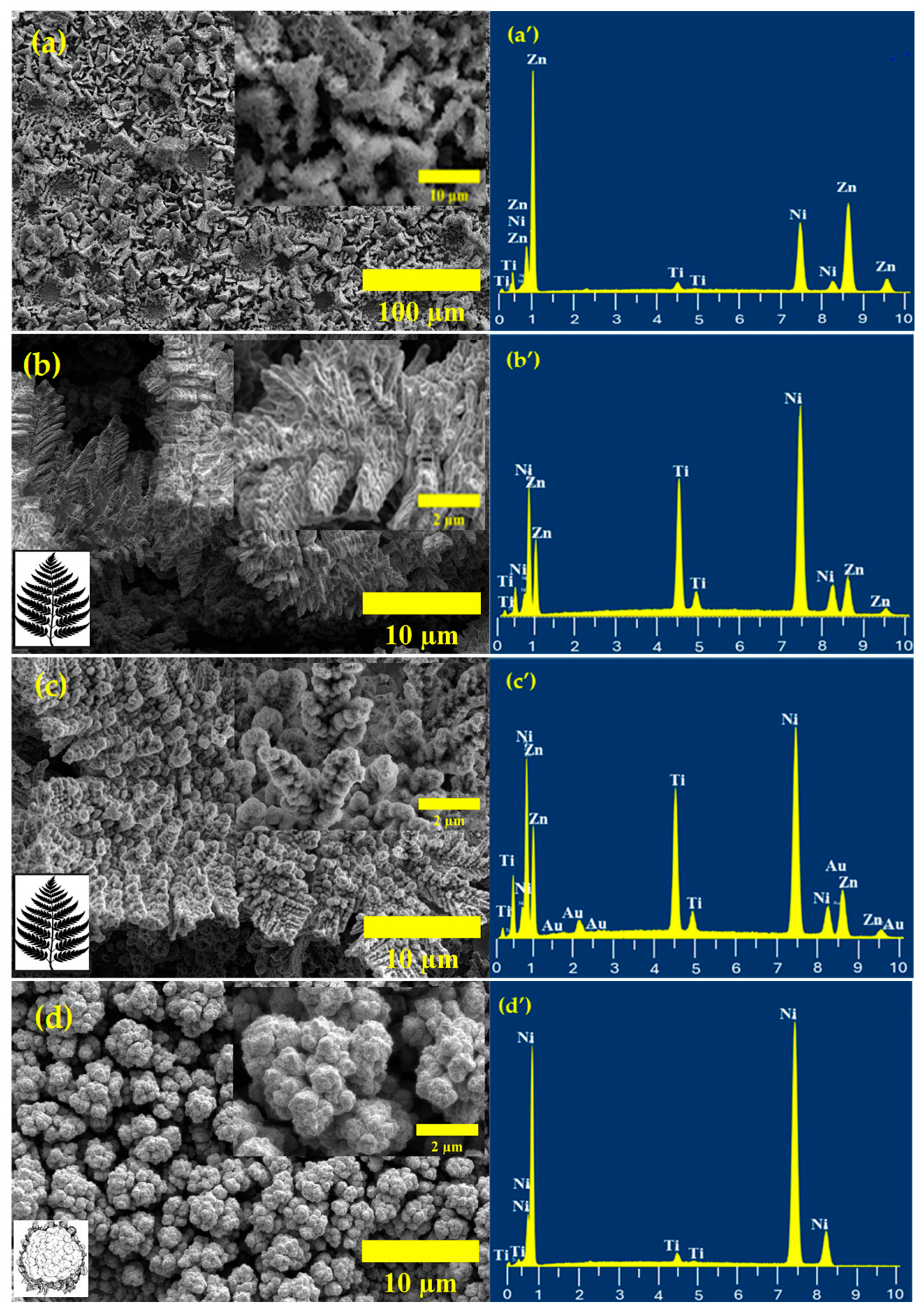
SEM images and the corresponding EDX spectra of the fabricated catalysts demonstrate that their surface morphology varies significantly depending on their treatment and composition. As shown in Figure 1a, the as-deposited NiZn/Ti catalyst exhibits a hierarchical, flower-like structure. This structure consists of petal-shaped units that are compact and dense, with relatively low porosity. The corresponding EDX spectrum (Figure 1a’, Table 1) displays a pronounced Zn peak, indicating that the alloy is Zn-rich. Following immersion in a 1 M NaOH solution for 48 h, these formations reorganize into fern-like, dendritic patterns (Figure 1b). This suggests that the selective dissolution of Zn increases surface porosity and roughness. The leaching process results in the creation of a highly porous surface. During the dissolution of unwanted, loosely bound zinc, the leaching process breaks down the initial compact units to form a more open dendritic structure. This structural opening significantly increases the surface roughness and the active surface area available for the BOR. Furthermore, the EDX spectrum (Figure 1b’, Table 1) shows a significant decrease in the Zn peak and an increase in the Ni signal. This confirms the preferential removal of unbound Zn and the formation of a more open dendritic structure.
Decorating the leached NiZn/Ti catalyst, which has a highly porous, dendritic (fern-like) framework, with Au crystallites further alters the NiZn surface and its texture. As can be seen in Figure 1c, globular Au crystallites appear on the dendritic branches, further increasing the surface roughness and the density of active sites, providing more locations for the electrochemical reaction to occur. This indicates a synergistic interaction between Au and the underlying NiZn structure. The accompanying EDX spectrum (Figure 1c’, Table 1) of Au–NiZn/Ti displays a characteristic Au peak alongside Ni and Zn, confirming the successful deposition of gold at a low loading.
For comparison, Figure 1d shows the Ni/Ti catalyst surface, which consists of three-dimensional cauliflower-like clusters composed of densely packed, rounded Ni particles. This morphology is noticeably different from the branching dendritic structure observed in NiZn/Ti, suggesting that the absence of Zn leads to the formation of compact globular aggregates. The corresponding EDX spectrum confirms that the surface is composed entirely of Ni on the Ti substrate.
As shown in Table 1, the metal loadings and weight percentages of the fabricated catalysts were determined using ICP-OES. Before leaching, the NiZn/Ti catalyst exhibited a Ni loading of 1897.7 µgNicm−2 and a Zn loading of 2862.5 µgZncm−2. After leaching, the Ni loading remained nearly unchanged at 1887 µgNicm−2, whereas the Zn loading decreased substantially to 519 µgZncm−2—a reduction of approximately fivefold. This confirms that the alkaline leaching process selectively dissolved unbound Zn while leaving Ni largely intact.
The incorporation of Au into the leached NiZn/Ti catalyst resulted in an Au loading of 19.2 µgAucm−2. This was accompanied by a slight decrease in the loadings of both Ni and Zn compared with the leached NiZn/Ti sample. This indicates that the amount of Au deposited was relatively low in comparison with the other metals.
The weight percentage analysis provides further support for these observations. Before leaching, the NiZn/Ti catalyst was Zn-rich, with Zn accounting for approximately 60 wt% and Ni for about 40 wt%. After leaching, the catalyst composition shifted towards being Ni-rich, with the Zn content decreasing to around 22 wt% and the Ni content increasing to about 78 wt%. This compositional change confirms the preferential dissolution of Zn, which is expected to enhance BOR activity by contributing to the development of a more porous surface.
The Au-modified catalyst contained only 0.88 wt% Au, which is consistent with its low loading. Taken together, the SEM and ICP-OES results demonstrate that the increased porosity and roughness of the NiZn/Ti catalyst are mainly due to Zn leaching. The subsequent incorporation of very small amounts of Au then modifies the surface texture without significantly altering the overall metal composition.
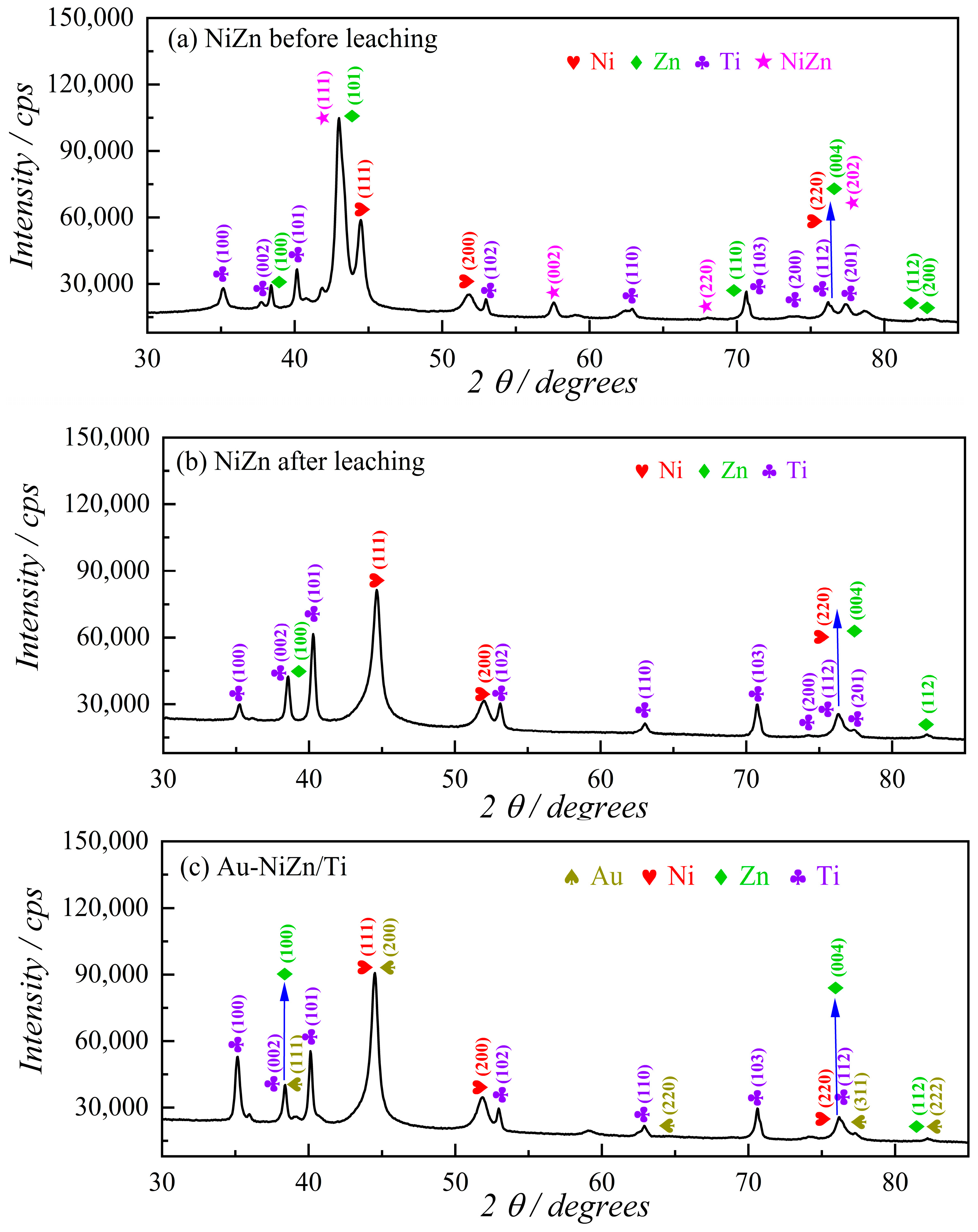
The crystal structure of the NiZn coating deposited on a Ti substrate was analyzed using X-ray diffraction (XRD) at three stages: before leaching; after NaOH leaching; and following surface modification with Au crystallites. Figure 2 shows the corresponding patterns for the NiZn/Ti (unleached) (a), NiZn/Ti (leached) (b), and Au–NiZn/Ti (c) samples. Prior to leaching, the XRD pattern exhibited several distinct diffraction peaks, indicating a crystalline, multiphase coating (Figure 2a). Strong, dominant peaks observed at 2θ ≈ 38–45° correspond to the (111) plane of face-centered cubic (fcc) Ni (COD card no. 2102269), as well as to Ni–Zn intermetallic phases. Several additional reflections are also observed at 2θ ≈ 43.05°, 57.59°, 68.02°, and 76.24°, which correspond to the (111), (002), (220), and (202) planes, respectively, of Ni–Zn alloy phases (COD card no. 1538139), and Zn-containing phases (COD card no. 9011599). This confirms the formation of a NiZn alloy coating. Furthermore, peaks originating from the Ti substrate are evident at 2θ ≈ 35.16°, 38.45°, 40.15°, 52.99°, 62.99°, 70.69°, 74.17°, 76.24°, and 77.54°, which correspond to the crystallographic planes (100), (002), (101), (102), (110) (103), (200), (112), and (201), respectively, of the hexagonal close-packed (hcp) Ti (COD card no. 9008517), as a result of the penetration depth of X-rays through the coating. The XRD pattern of the NiZn coating deposited on the Ti substrate after immersion in a NaOH solution (i.e., leaching) reveals significant phase composition and peak intensity changes compared to the pre-leached coating. This indicates the selective dissolution of Zn and structural reorganization of the coating (see Figure 2a and Figure 2b for comparison). Following leaching, the diffraction pattern is dominated by a strong, sharp peak at 2θ ≈ 44.65°, corresponding to the (111) plane of fcc Ni. The increased relative intensity and sharpening of this peak indicate the formation of a Ni-rich framework with improved crystallinity and a more pronounced preferred orientation. Several Zn-related and Ni–Zn intermetallic peaks that were present before leaching are now significantly reduced or absent, which confirms the effective removal of Zn during alkaline leaching (see Figure 2b). This behavior is consistent with the higher chemical reactivity of Zn in NaOH, which leads to dealloying and Ni enrichment within the coating.
After immersion of the NiZn/Ti (leached) sample in an HAuCl4 solution, the XRD pattern confirms the successful decoration of the Ni-rich coating with metallic Au nanoparticles, while preserving the fcc Ni structure of the underlying alloy. The relatively low intensity of the Au peaks compared to the dominant Ni reflections indicates that the Au is deposited as finely dispersed nanoparticles rather than as a continuous film (see Figure 2c). Notably, the persistence of strong Ni (111) reflections demonstrates that the Ni-rich framework remains structurally stable during Au modification. The absence of oxide-related peaks confirms that the Au is present in its metallic state. The diffraction peaks that appeared at 2θ angles of 38.38°, 44.42°, 64.60°, 77.53°, and 81.93° are characteristic of fcc Au, corresponding to the (111), (200), (220), (311), and (222) planes, respectively (see Figure 2c).
Overall, the XRD results clearly demonstrate a stepwise structural evolution from a multiphase NiZn alloy coating to a Ni-rich porous structure via selective Zn leaching, followed by the successful decoration of the surface with metallic Au nanoparticles, without disrupting the underlying Ni framework.
The average crystallite size of the NiZn coatings before and after leaching and Au modification was determined from the XRD data using the Scherrer equation:
D = Kλ/β cos θ
where D is the crystallite size (nm), K is the shape factor (0.9), λ is the X-ray wavelength (Cu Kα = 1.5406 Å), β is the full width at half maximum (FWHM) in radians, and θ is the Bragg angle. This calculation was performed using the most intense diffraction peak: Ni (111) for the unleached and leached NiZn/Ti samples and Au (111) for the Au–NiZn/Ti sample. The Ni crystallite size for NiZn/Ti (unleached) was estimated to be 23–25 nm. This relatively small size reflects alloying-induced lattice distortion and the presence of Ni–Zn intermetallic phases. In the case of NiZn/Ti after NaOH leaching, the size of the Ni crystallites increased to 38–42 nm. This increase indicates structural reorganization and grain coarsening following the selective dissolution of Zn and the formation of a Ni-rich framework. The calculated Ni crystallite size for Au–NiZn/Ti was 40–45 nm, which remained nearly unchanged. This confirms that Au deposition does not disrupt the Ni lattice. The deposited Au nanoparticles on the leached NiZn/Ti sample exhibited a crystallite size of 15–18 nm.

3.2. Study of Catalytic Activity Towards BOR

The catalytic performance of the NiZn/Ti and Au–NiZn/Ti catalysts towards BOR was evaluated using CV in 1 M NaOH containing three different concentrations of sodium borohydride (0.01 M, 0.025 M, and 0.05 M). All measurements were conducted at 25 °C with a scan rate of 10 mV s−1.
Although the BOR is theoretically an eight-electron process, the ability to achieve complete oxidation depends strongly on the nature of the electrocatalyst used. As previously reported, Ni-based electrodes do not promote full eight-electron oxidation; instead, they follow a partial oxidation pathway, as described by the reaction below [16]:
BH4 + 4OH → BO2 + 2H2O + 2H2 + 4e
In this pathway, only partial oxidation occurs, resulting in the evolution of molecular hydrogen rather than the complete eight-electron transfer [53]. Furthermore, BH4 can undergo hydrolysis in an alkaline solution, which contributes to the generation of additional hydrogen, as described by the following reactions [51]:
BH4 + H2O → BH3OH + H2
BH3OH + H2O → BO2 + 3H2
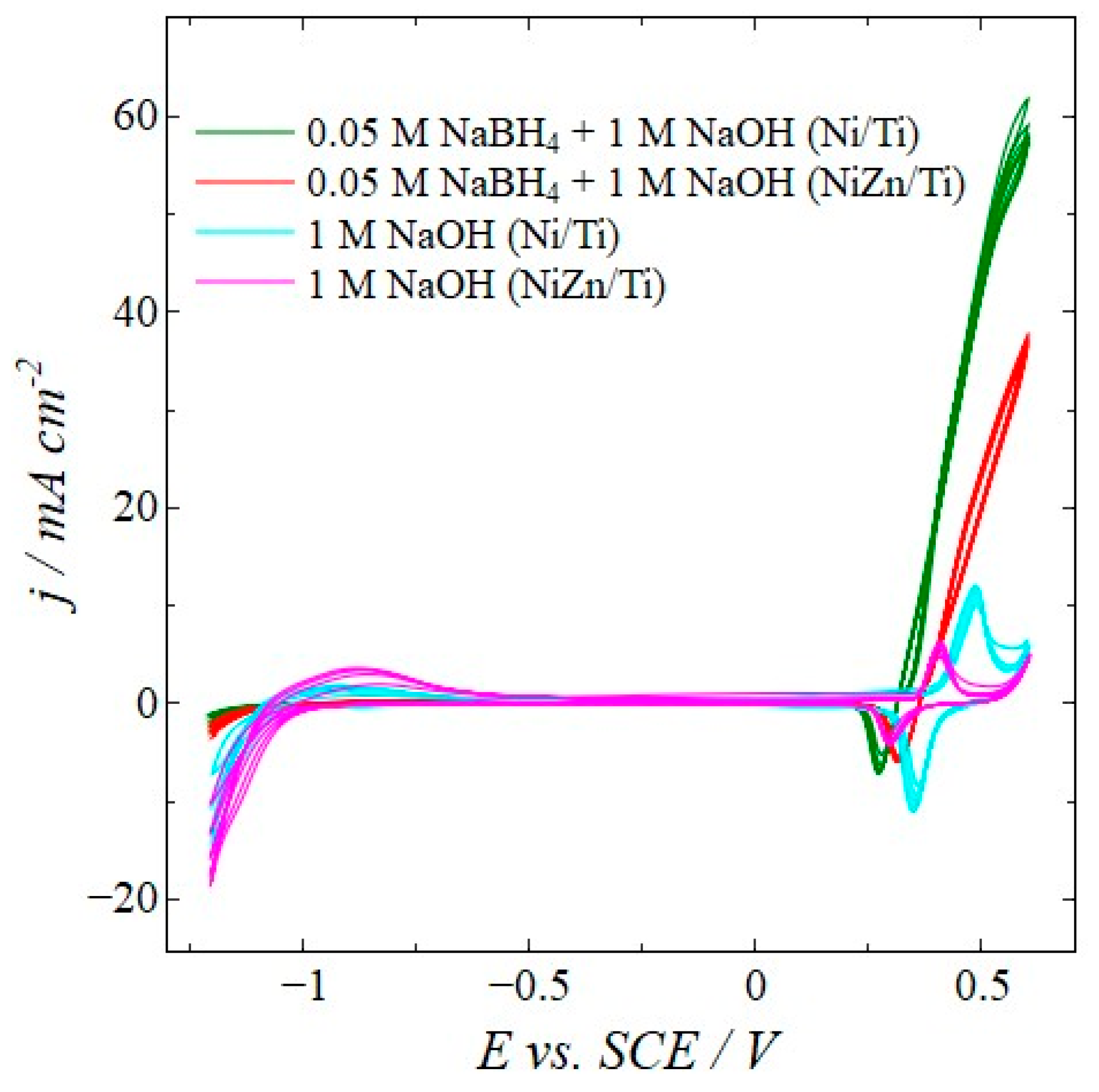
According to Mirkin et al. [51], BH3OH is an intermediate that may form either through borohydride hydrolysis or during the initial stage of electrooxidation. The electrocatalytic activity of the Ni/Ti and NiZn/Ti catalysts towards BOR was evaluated using CV in 1 M NaOH and in 0.05 M NaBH4 + 1 M NaOH at 25 °C at a scan rate of 10 mV s−1. The corresponding voltammograms are shown in Figure 3. In the presence of BH4, the Ni/Ti catalyst exhibited significantly higher anodic peak current densities than the NiZn/Ti catalyst, reaching 61.73 mA cm−2 in the initial cycle (Figure 3, olive line). However, the Ni/Ti current decreased to 57.03 mA cm−2 after repeated cycling, indicating gradual deactivation and poor long-term stability. In contrast, the NiZn/Ti catalyst exhibited lower initial peak currents (36.16 mA cm−2) that remained almost identical in the final cycle (37.46 mA cm−2), demonstrating its excellent electrochemical stability.
A negligible current response was observed for both catalysts in pure 1 M NaOH, confirming that the observed anodic currents originate from BH4 oxidation. The NiZn/Ti catalyst displayed a notable increase in current only at potentials greater than 0.2 V vs. SCE, which corresponds to the formation of NiOOH species. Because NiOOH is the active phase for BOR on Ni-based catalysts, this indicates that the NiZn/Ti catalyst only becomes catalytically active after Ni oxidation. Below 0.2 V, NiZn/Ti remains largely inactive towards BH4 oxidation. Overall, despite Ni/Ti having a higher intrinsic current, the NiZn/Ti catalyst demonstrates much greater electrochemical stability, making it a more reliable BOR electrode during prolonged operation.
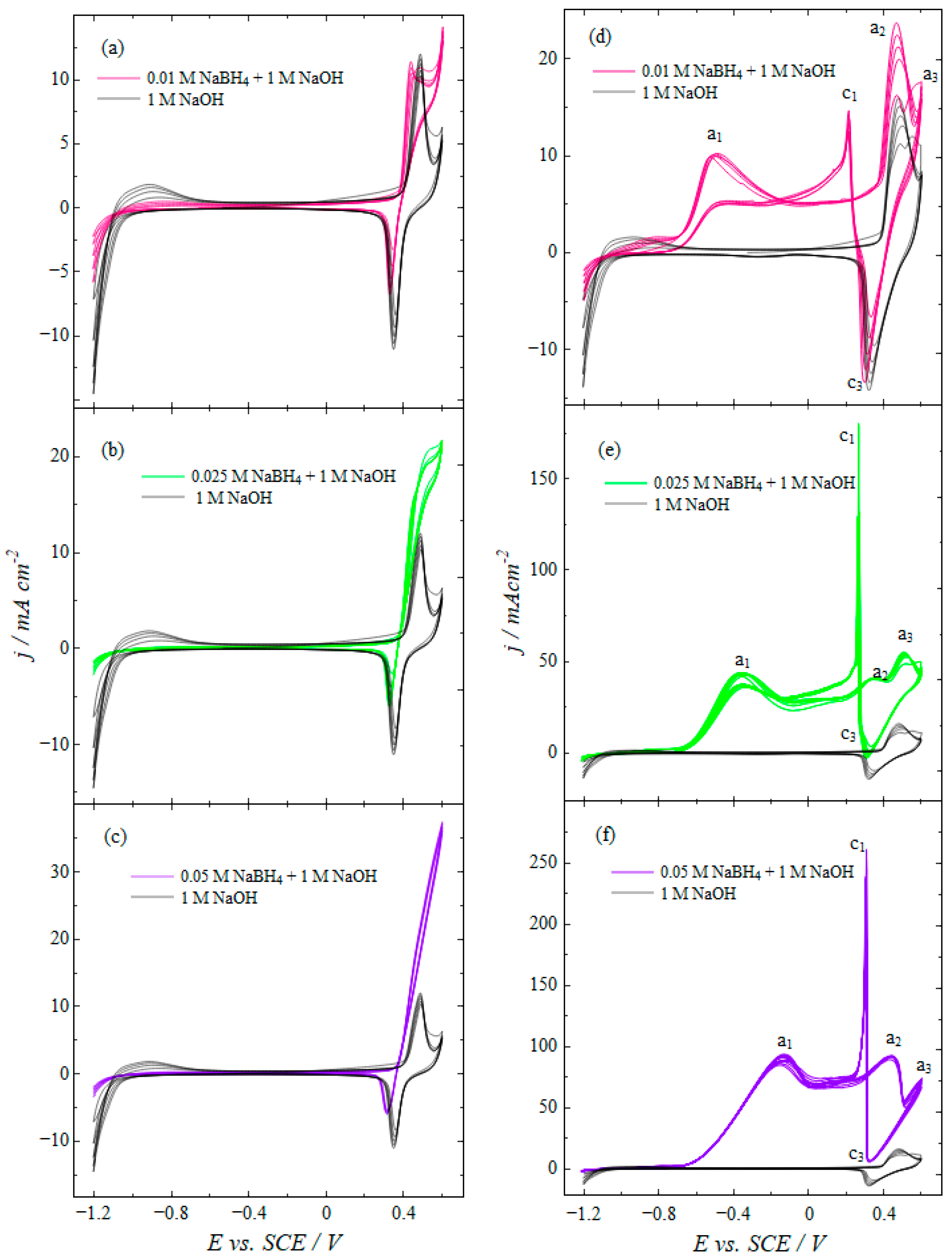
Building upon this baseline, the effect of Au modification on NiZn/Ti was examined. Figure 4 illustrates CVs of NiZn/Ti and Au–NiZn/Ti in 1 M NaOH containing three different concentrations of NaBH4 (0.01 M, 0.025 M, and 0.05 M), recorded at a scan rate of 10 mV s−1 at 25 °C. As previously reported in Ref. [51], BH3OH acts as an intermediate during hydrolysis or the first stage of electrooxidation. For the unmodified NiZn/Ti catalyst, anodic currents increase substantially at potentials above 0.2 V vs. SCE, corresponding to the formation of NiOOH species. The generation of these surface oxides, rather than the participation of metallic Ni, results in BOR activity predominantly at higher potentials. When Ni undergoes oxidation at higher anodic potentials, it cannot be readily reduced even in the presence of higher amounts of sodium borohydride. This emphasizes the significance of regulating surface oxidation of Ni towards BOR activity [21]. The absence of anodic peaks in the reverse scan indicates that BH4 is no longer electrochemically active once scanned above −0.1 V vs. SCE [27,50,53]. This behavior is unlike that in the presence of Au.
Additionally, the BOR onset shifts towards more negative potentials (<0 V vs. SCE), indicating that Au decoration modifies the NiZn surface and mitigates Ni passivation by delaying the formation of Ni(OH)2/NiOOH [7,11,18]. Peak a1 corresponds to the direct eight-electron oxidation of BH4 [26], while peaks a2 and a3 represent the Ni(OH)2 redox process [7,16]. The sharp anodic peak c1 in the reverse scan reflects the reduction of Au oxides and reactivation of the electrode surface [7,11].
Moreover, the CV profiles reveal that the Au–NiZn/Ti catalyst maintains well-defined anodic peaks at all concentrations, highlighting the stability and robustness of the Au-modified surface. Compared to the unmodified NiZn/Ti catalyst, modification results in lower overpotentials and shifts BOR activity towards more negative potentials [20]. This confirms that Au effectively facilitates electron transfer and mitigates Ni passivation. These observations emphasize the synergistic effect of Au and NiZn, enhancing not only catalytic activity but also preserving electrode stability even at higher reactant concentrations.
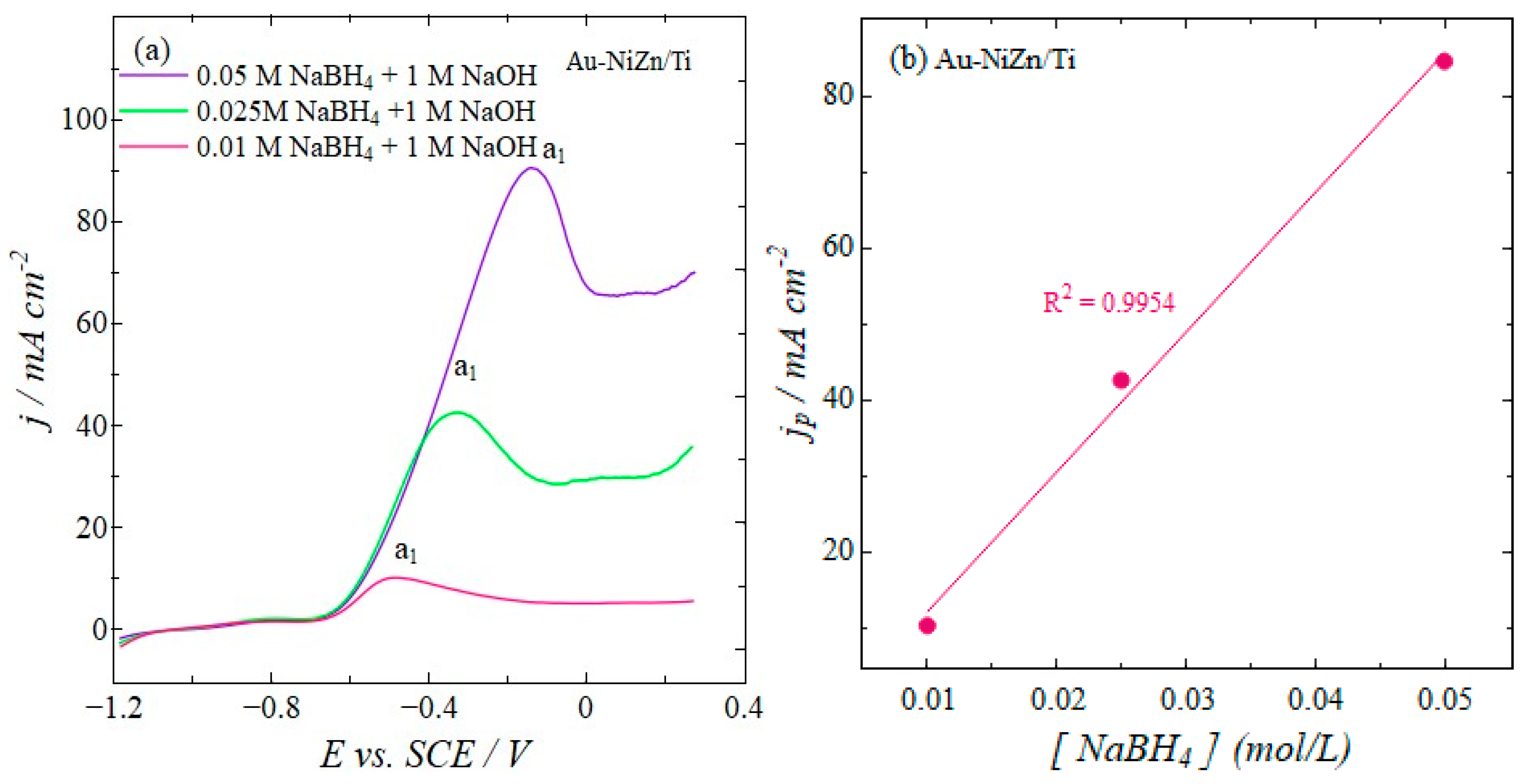
The present study investigated the effect of sodium borohydride concentration on the electrocatalytic performance of the Au–NiZn/Ti electrode using cyclic voltammetry (CV) measurements. The onset potential shifted positively from −0.75 V to −0.69 V as NaBH4 concentration increased from 0.01 M to 0.05 M. This indicates that borohydride oxidation starts at less negative potentials at higher fuel concentrations. This phenomenon reflects improved reaction kinetics. Concurrently, the anodic peak current density exhibited an increase with rising NaBH4 concentrations, indicating that higher fuel availability increases the overall oxidation rate. This increase in current density is attributed to an increase in the number of BH4 ions reaching the electrode surface, which allows for greater participation of active sites in the reaction and a reduction in mass transport limitations. Consequently, the enhancement in onset potential and the elevated peak current density indicate that higher borohydride concentration favors reaction kinetics and facilitates more efficient utilization of the catalytic surface during borohydride oxidation on the Au–NiZn/Ti electrode. Au modification leads to sharper CV peaks and significantly higher currents compared to unmodified NiZn/Ti, indicating a synergistic interaction between NiZn and Au [12]. Figure 4 then explores the effect of varying NaBH4 concentrations on the Au–NiZn/Ti catalyst in more detail.
As shown in Figure 5a, anodic peak a1 corresponds to the direct BOR on the Au–NiZn/Ti catalyst, and its magnitude increases systematically with rising NaBH4 concentration. Increasing the borohydride concentration from 0.01 M to 0.05 M results in an approximately 8.5-fold increase in the anodic peak current density, whereas increasing it from 0.01 M to 0.025 M results in a 4.3-fold increase. This trend is confirmed by the plot of current density versus borohydride concentration in Figure 5b, which shows a linear relationship (R2 = 0.9954), indicating excellent correlation. The proportional increase in peak current demonstrates that borohydride oxidation on Au–NiZn/Ti is diffusion-controlled. Therefore, the Au–NiZn/Ti electrode exhibits strong potential as an analytical (amperometric) sensor for BH4 detection, consistent with previous studies [50].
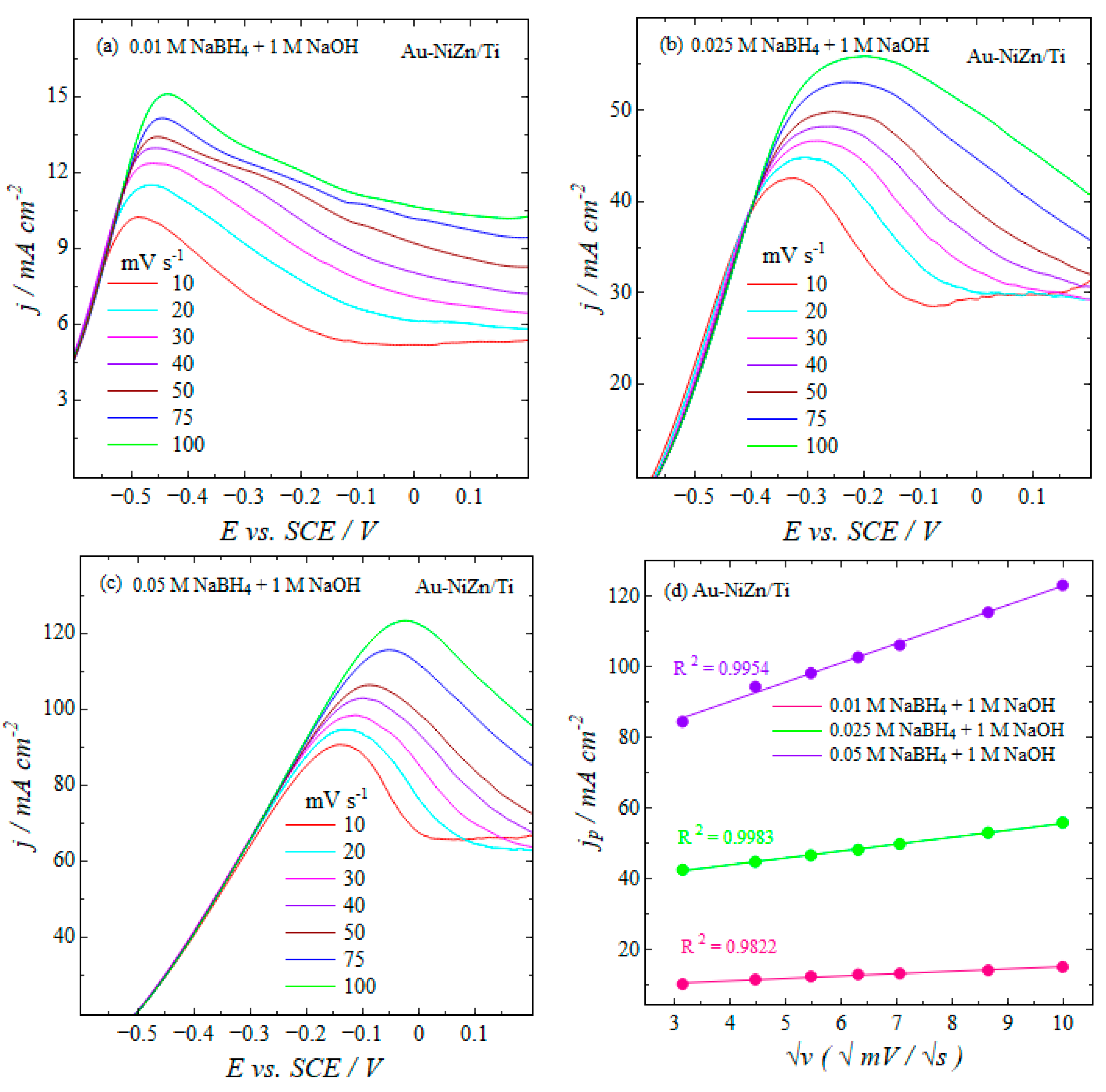
Having established the influence of NaBH4 concentration on BOR activity, the kinetic behavior of the reaction was further assessed by examining the effect of the scan rate. CVs were recorded at various scan rates, with the anodic peak current density plotted against the square root of the scan rate. For all NaBH4 concentrations, the resulting plots exhibited excellent linearity, with mean R2 values of approximately 0.99. This strong correlation (see Figure 6) confirms that the BOR process on the Au–NiZn/Ti catalyst is diffusion-controlled, in line with previous studies [12,50,51].
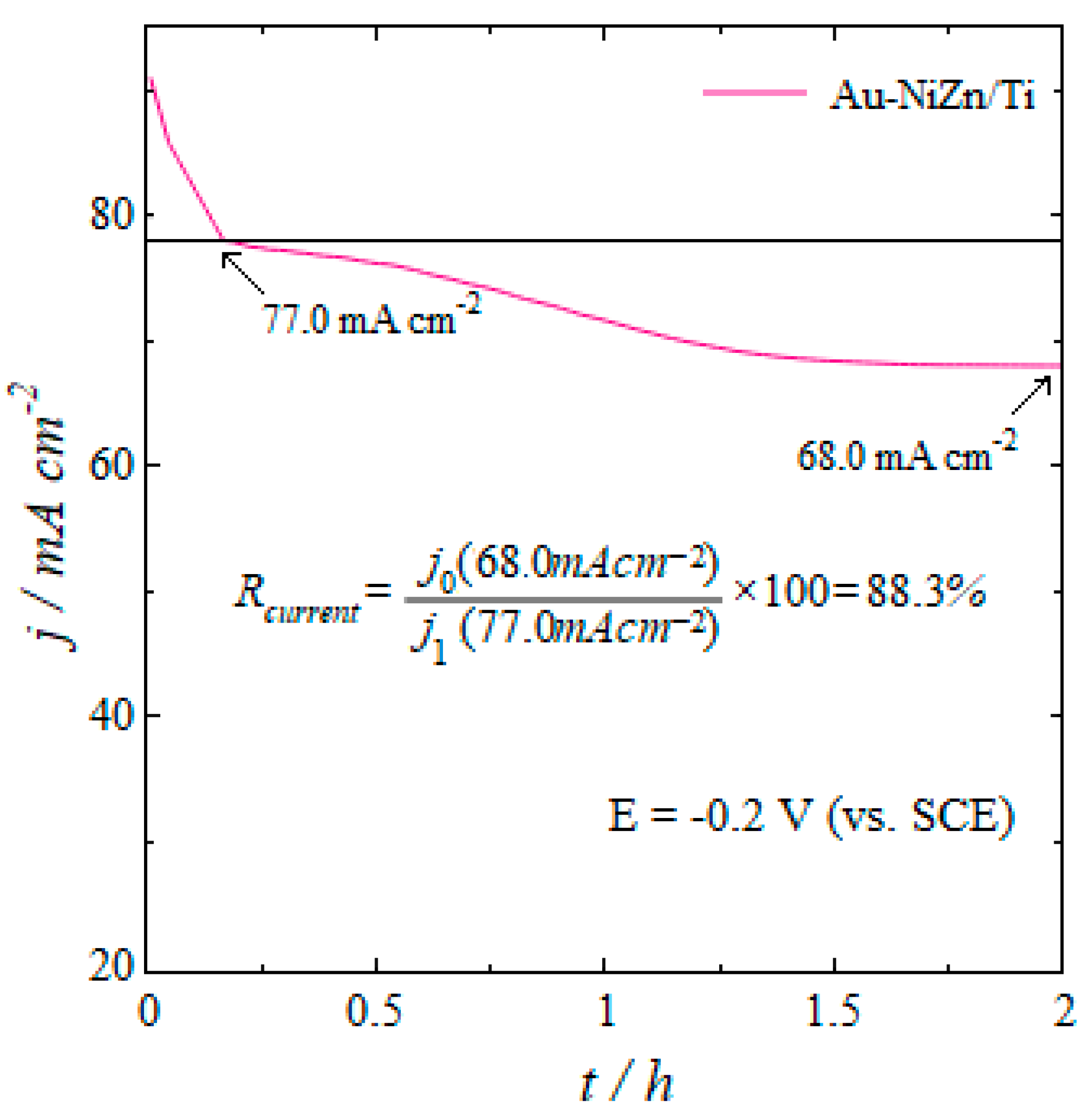
Chronoamperometric measurements were performed on the Au–NiZn/Ti catalyst in an electrolyte solution comprising 0.05 M NaBH4 and 1 M NaOH at a potential of −0.2 V (vs. SCE) for 2 h at 25 °C (see Figure 7). After approximately 10 min of chronoamperometric operation, the catalyst delivered an initial current density of about 77 mA cm−2. During continuous operation, the current decreased gradually, reaching ~68 mA cm−2 by the end of the two-hour period. This corresponds to a current retention of 88.3%, demonstrating that the Au–NiZn/Ti catalyst exhibits only moderate activity loss under sustained BOR conditions.
The slight decline in current density is typical of BOR systems and is generally attributed to the formation of intermediate species and the partial coverage of the surface by reaction products, which temporarily limits the number of accessible catalytic sites. Importantly, the absence of rapid or severe deactivation indicates that the Au modification effectively stabilizes the NiZn surface by mitigating the effects of passivation and maintaining active sites available for BH4 oxidation. Overall, the chronoamperometry results confirm the good operational durability of the Au–NiZn/Ti catalyst in alkaline borohydride oxidation.
Comparison of the anodic peak current densities of BH4 oxidation using different catalysts under various electrolytic conditions and scan rates is presented in Table 2. It can be seen that the Au–NiZn/Ti catalyst exhibits higher anodic peak current densities than the other catalysts listed in the table.

4. Conclusions

In this study, NiZn/Ti and Au–NiZn/Ti electrocatalysts were successfully fabricated through electrodeposition, followed by alkaline leaching, and subsequent galvanic displacement. Alkaline leaching selectively removed the loosely bound Zn from the NiZn coating, producing a highly porous, dendritic surface morphology. The subsequent deposition of Au crystallites onto the leached NiZn framework introduced globular nanostructures, which increased surface roughness and enhanced catalytic activity.
Electrochemical evaluation in alkaline sodium borohydride solutions showed that the Au–NiZn/Ti electrocatalyst delivered substantially higher anodic current densities and well-defined CV features associated with direct BH4 electrooxidation. The linear dependence (R2 ≈ 0.99) of the anodic peak current (a1) on the square root of the scan rate at various NaBH4 concentrations demonstrates that the borohydride oxidation reaction on the Au–NiZn/Ti catalyst is predominantly diffusion-controlled. Chronoamperometry measurements revealed that the Au–NiZn/Ti catalyst maintained 88.3% of its initial current after 2 h, indicating its high durability under continuous BOR operation.
Overall, modifying a porous NiZn scaffold with a very low content of Au crystallites yields a cost-effective, highly active, and stable electrocatalyst with great potential for use in alkaline fuel cells and clean-energy conversion technologies.

Author Contributions

Conceptualization, A.B. and L.T.-T.; Methodology, A.B., H.A., and J.V.; Software, G.S. and J.V.; Formal analysis, T.G., G.S., and J.V.; Investigation, T.G.; Data curation, T.G. and H.A.; Writing—original draft, T.G. and H.A.; Writing—review and editing, A.B., L.T.-T., and E.N.; Visualization, A.B., H.A., L.T.-T., and E.N.; Supervision, A.B., L.T.-T., and E.N. All authors have read and agreed to the published version of the manuscript.

Funding

This research received no external funding.

Data Availability Statement

The original contributions presented in this study are included in the article. Further inquiries can be directed to the corresponding authors.

Conflicts of Interest

The authors declare no conflicts of interest.

Abbreviations

The following abbreviations are used in this manuscript:
DBFCsDirect borohydride fuel cells
BORBorohydride oxidation reaction
CVCyclic voltammetry
CAChronoamperometry
EDXEnergy-dispersive X-ray spectroscopy
XRDX-ray diffraction
LSVLinear sweep voltammetry
NaBH4Sodium borohydride
ORROxygen reduction reaction
SEMScanning electron microscopy
SCESaturated calomel electrode

References

  1. Agrawal, P.; Ebrahim, S.; Ponnamma, D. Advancements in nanocarbon-based catalysts for enhanced fuel cell performance: A comprehensive review. Int. J. Energy Water Resour. 2025, 9, 1005–1027. [Google Scholar] [CrossRef]
  2. Ahmad, S.; Nawaz, T.; Ali, A.; Orhan, M.F.; Samreen, A.; Kannan, A.M. An overview of proton exchange membranes for fuel cells: Materials and manufacturing. Int. J. Hydrogen Energy 2022, 47, 19086–19131. [Google Scholar] [CrossRef]
  3. Nazir, H.; Louis, C.; Jose, S.; Prakash, J.; Muthuswamy, N.; Buan, M.E.; Flox, C.; Chavan, S.; Shi, X.; Kauranen, P.; et al. Is the H2 economy realizable in the foreseeable future? Part I: H2 production methods. Int. J. Hydrogen Energy 2020, 45, 13777–13788. [Google Scholar] [CrossRef]
  4. Dehkharghani, F.M.; Ghahremanlou, M.; Zandi, Z.; Jalili, M.; Mozafari, M.R.; Mardani, P. Future energy and therapeutic perspectives of green nano-technology: Recent advances and challenges. Nano Micro Biosyst. 2023, 2, 11–21. [Google Scholar]
  5. Cai, J.; Chen, P.; Hu, B.; Xu, C.; Yang, Y.; Meng, J.; Zhang, B.; Chen, C.; Yu, D.; Zhou, X. Succulent-plant-like Ni–Co alloy efficient catalysts for direct borohydride fuel cells. Dalton Trans. 2023, 52, 1378–1387. [Google Scholar] [CrossRef]
  6. Zhang, Y.; Tian, X.; Li, Y.; Han, J.; Wen, Z.; Li, Y.; Wu, F.; Li, W. An efficient amorphous ternary Ni-B-Ce catalyst for enhancing electrocatalytic oxidation performance of BH4. Inorg. Chem. Commun. 2025, 26, 115578. [Google Scholar] [CrossRef]
  7. Gao, Y.; Meng, W.; Lv, Y.; Li, Y.; Geng, Z.; Niu, J.; Yao, J.; Yan, J.; Zhu, K.; Cao, D.; et al. In situ construction of Co-CoO heterostructures on rGO-modified nickel foam for high-performance anode catalysts in direct borohydride-hydrogen peroxide fuel cells. J. Energy Chem. 2025, 106, 532–543. [Google Scholar] [CrossRef]
  8. Behmenyar, G.; Akin, A.N. Investigation of carbon supported Pd–Cu nanoparticles as anode catalysts for direct borohydride fuel cell. J. Power Sources 2014, 249, 239–246. [Google Scholar] [CrossRef]
  9. Caglar, A.; Kaya, S.; Kivrak, H. Characterization and electrooxidation activity of ternary metal catalysts containing Au, Ga, and Ir for enhanced direct borohydride fuel cells. J. Appl. Electrochem. 2023, 53, 1207–1218. [Google Scholar] [CrossRef]
  10. Hu, B.; Xu, C.; Chen, P.; Yu, J.; Hu, B.; Xiang, Q.; Cen, Y.; Liu, Y.; Yu, D.; Chen, C. Efficient nickel catalyst with preferred orientation and microsphere for direct borohydride fuel cell. Int. J. Hydrogen Energy 2021, 46, 27516. [Google Scholar] [CrossRef]
  11. Chin, S.X.; Vincent, J.; Razak, N.F.; Daud, N.; Chowdhury, S.; Wongchoosuk, C.; Chia, C.H. Advancements and challenges in sodium borohydride hydrogen storage: A comprehensive review of hydrolysis, regeneration, and recycling technologies. J. Renew. Sustain. Energy 2025, 17, 012702. [Google Scholar] [CrossRef]
  12. Duan, D.; Liang, J.; Liu, H.; You, X.; Wei, H.; Wei, G.; Liu, S. The effective carbon supported core–shell structure of Ni@ Au catalysts for electro-oxidation of borohydride. Int. J. Hydrogen Energy 2015, 40, 488–500. [Google Scholar] [CrossRef]
  13. Li, B.; Song, C.; Huang, X.; Ye, K.; Cheng, K.; Zhu, K.; Yan, J.; Cao, D.; Wang, G. A novel anode for direct borohydride-hydrogen peroxide fuel cell: Au nanoparticles decorated 3D self-supported reduced graphene oxide foam. ACS Sustain. Chem. Eng. 2019, 7, 11129–11137. [Google Scholar] [CrossRef]
  14. Rostamikia, G.; Janik, M.J. Direct borohydride oxidation: Mechanism determination and design of alloy catalysts guided by density functional theory. Energy Environ. Sci. 2010, 3, 1262–1274. [Google Scholar] [CrossRef]
  15. Pasqualeti, A.M.; Olu, P.Y.; Chatenet, M.; Lima, F.H. Borohydride electrooxidation on carbon-supported noble metal nano-noparticles: Insights into hydrogen and hydroxyborane formation. ACS Catal. 2015, 5, 2778–2787. [Google Scholar] [CrossRef]
  16. Gyenge, E. Electrooxidation of borohydride on platinum and gold electrodes: Implications for direct borohydride fuel cells. Electrochim. Acta 2004, 49, 965–978. [Google Scholar] [CrossRef]
  17. Uzundurukan, A.; Akça, E.S.; Budak, Y.; Devrim, Y. Carbon nanotube-graphene supported bi-metallic electrocatalyst for direct borohydride hydrogen peroxide fuel cells. Renew. Energy 2021, 172, 1351–1364. [Google Scholar] [CrossRef]
  18. Saha, P.; Rahman, M.M.; Hill, C.M. Borohydride oxidation electrocatalysis at individual, shape-controlled Au nanoparticles. Electrochem. Sci. Adv. 2022, 2, 2100120. [Google Scholar] [CrossRef]
  19. Gaudin, L.F.; Funston, A.M.; Bentley, C.L. Drop-cast gold nanoparticles are not always electro-catalytically active for the borohydride oxidation reaction. Chem. Sci. 2024, 15, 7243–7258. [Google Scholar] [CrossRef] [PubMed]
  20. Oh, T.H. Gold-based bimetallic electrocatalysts supported on multiwalled carbon nanotubes for direct borohydride-hydrogen peroxide fuel cell. Renew. Energy 2021, 163, 930–938. [Google Scholar] [CrossRef]
  21. Cheng, K.; Jiang, J.; Kong, S.; Gao, Y.; Ye, K.; Wang, G.; Zhang, W.; Cao, D. Pd nanoparticles support on rGO-C@ TiC coaxial nanowires as a novel 3D electrode for NaBH4 electrooxidation. Int. J. Hydrogen Energy 2017, 42, 2943–2951. [Google Scholar] [CrossRef]
  22. Saha, S.; Gayen, P.; Wang, Z.; Dixit, R.J.; Sharma, K.; Basu, S.; Ramani, V.K. Development of bimetallic PdNi electrocatalysts toward mitigation of catalyst poisoning in direct borohydride fuel cells. ACS Catal. 2021, 11, 8417–8430. [Google Scholar] [CrossRef]
  23. Lafforgue, C.; Atkinson, R.W., III; Swider-Lyons, K.; Chatenet, M. Evaluation of carbon-supported palladium electrocatalysts for the borohydride oxidation reaction in conditions relevant to fuel cell operation. Electrochim. Acta 2020, 341, 135971. [Google Scholar] [CrossRef]
  24. Yi, L.; Meng, Y.; Wang, R.; Fei, J.; Wang, X.; Lu, Y. Carbon supported Pd–Sn nanoparticle electrocatalysts for efficient borohydride electrooxidation. New J. Chem. 2020, 44, 13472–13479. [Google Scholar] [CrossRef]
  25. Ghasemi, R.; Moghadas, B.K.; Mohammadi, I. Optimum Ni: Co weight ratio for Pd-Nix-Coy/rGO catalyst nanoparticle for borohydride electrooxidation in direct borohydride fuel cells. Electrochim. Acta 2025, 512, 145413. [Google Scholar] [CrossRef]
  26. Martins, M.; Bozkurt, G.; Bayrakçeken, A.; Soylu, G.S.P.; Šljukić, B.; Santos, D.M. Pt-decorated binary transition metal oxides (MnO-NiO, MnO-TiO2) for enhanced electrocatalysis of oxygen reduction and borohydride oxidation. Mater. Sci. Eng. B 2024, 310, 117745. [Google Scholar] [CrossRef]
  27. Milikić, J.; Martins, M.; Dobrota, A.S.; Bozkurt, G.; Soylu, G.S.; Yurtcan, A.B.; Skorodumova, N.V.; Pašti, I.A.; Šljukić, B.; Santos, D.M. A Pt/MnV2O6 nanocomposite for the borohydride oxidation reaction. J. Energy Chem. 2021, 55, 428–436. [Google Scholar] [CrossRef]
  28. Guo, Y.; Hu, Z.; Cao, Y.; Tan, Q.; Yang, D.; Che, Y.; Zhang, C.; Ming, P.; Xiao, Q. Boosting borohydride oxidation kinetics by manipulating hydrogen evolution and oxidation through octahedral Pt–Ni/C for high-performance direct borohydride fuel cells. J. Power Sources 2024, 612, 234786. [Google Scholar] [CrossRef]
  29. Balčiūnaitė, A.; Zabielaitė, A.; Sukackienė, Z.; Kepenienė, V.; Šimkūnaitė, D.; Selskis, A.; Tamašauskaitė-Tamašiūnaitė, L.; Norkus, E. Fabrication of efficient gold–nickel-supported titania nanotube electrocatalysts for sodium borohydride–hydrogen peroxide fuel cells. Coatings 2022, 12, 850. [Google Scholar] [CrossRef]
  30. Barua, S.; Balčiūnaitė, A.; Vaičiūnienė, J.; Tamašauskaitė-Tamašiūnaitė, L.; Norkus, E. High-efficiency borohydride oxidation and oxygen reduction on titanium-supported Au(NiMo) catalysts for alkaline fuel cells. Chem. Phys. Impact 2025, 10, 100827. [Google Scholar] [CrossRef]
  31. He, P.; Wang, Y.; Wang, X.; Pei, F.; Wang, H.; Liu, L.; Yi, L. Investigation of carbon supported Au-Ni bimetallic nanoparticles as electrocatalyst for direct borohydride fuel cell. J. Power Sources 2011, 196, 1042–1047. [Google Scholar] [CrossRef]
  32. Dey, S.; Raul, C.K.; Karmakar, R.; Pramanik, S.; Dey, D.; Ali, S.I.; Mandal, A.C.; Basu, S. Borohydride oxidation performance of Cu@Au core–shell electrocatalysts supported by MWCNTs, activated charcoal, and carbon black Vulcan XC-72R: A comparative study for fuel cell applications. J. Appl. Electrochem. 2026, 56, 6. [Google Scholar] [CrossRef]
  33. Yi, L.; Wang, Q.; Peng, X.; Deng, W.; Ma, X.; Li, X.; Yi, W. ZIF-drived N-doped carbon supported Co, Ni-codoped Au nanoparticle catalyst as efficient anode catalyst for borohydride electrooxidation reaction. Ionics 2023, 29, 1543–1551. [Google Scholar] [CrossRef]
  34. Raul, C.K.; Dey, S.; Halder, M.; Karmakar, R.; Basu, S.; Meikap, A.K. Synthesis of AuxCo100−x/MWCNT nanoparticles as an efficient anode electrocatalyst for borohydride oxidation in alkaline medium. J. Appl. Electrochem. 2023, 53, 977–990. [Google Scholar] [CrossRef]
  35. Duan, D.; Feng, J.; You, X.; Zhou, X.; Wang, Y.; Chen, L.; Liu, S. Evaluation of Co-Au bimetallic nanoparticles as anode electrocatalyst for direct borohydride-hydrogen peroxide fuel cell. Ionics 2021, 27, 3521–3532. [Google Scholar] [CrossRef]
  36. Xue, L.; Shi, W.; Song, D.; Huang, X.; Zhang, J.; Zhang, Y.; Yuan, W.; Huang, S.; Sun, K.; Zheng, L.; et al. Constructing a multisite catalyst for achieving efficient and highly selective borohydride oxidation reaction. J. Colloid Interface Sci. 2025, 699, 138253. [Google Scholar] [CrossRef]
  37. Yi, L.; Wei, W.; Zhao, C.; Tian, L.; Liu, J.; Wang, X. Enhanced activity of Au-Fe/C anodic electrocatalyst for direct borohydride-hydrogen peroxide fuel cell. J. Power Sources 2015, 285, 325–333. [Google Scholar] [CrossRef]
  38. Yi, L.; Peng, X.; Ma, X.; Gao, Y.; Wang, X.; Lu, Y. Investigation of ZIF-Derived Co, N Co-Doped porous carbon-supported Au nanoparticles as an effective catalyst for borohydride electrooxidation. New J. Chem. 2021, 45, 21206–21214. [Google Scholar] [CrossRef]
  39. Yi, L.; Peng, X.; Meng, Y.; Ding, Y.; Wang, X.; Lu, Y. N-doped carbon-coated Co2P-supported Au nanocomposite as the anode catalyst for borohydride electrooxidation. New J. Chem. 2021, 45, 14779–14788. [Google Scholar] [CrossRef]
  40. Raul, C.K.; Chatterjee, T.; Halder, M.; Sinha, R.; Dey, S.; Basu, S.; Meikap, A.K. Reverse Micelle Synthesis of AuyNi100-y nanoparticles decorated multiwalled carbon nanotubes as high-performance anode electrocatalysts for direct borohydride-hydrogen peroxide fuel cells. Chem. Nano Mat. 2025, 11, 202500005. [Google Scholar] [CrossRef]
  41. Dey, S.; Mandal, M.K.; Pramanik, S.; Raul, C.K.; Chatterjee, A.; Basu, S. Exploring the efficiency of borohydride electrooxidation performance for borohydride fuel cell application using carbon-supported silver-nickel (Ag-Ni/C) nanospheres: Emphasizing catalyst loading (wt%) on the carbon support and sample loading on electrode surface. Appl. Phys. A 2024, 130, 678. [Google Scholar]
  42. Yi, L.; Meng, Y.; Yang, S.; Fei, J.; Ding, Y.; Wang, X.; Lu, Y. N-doped carbon-supported Au-modified NiFe alloy nanoparticle composite catalysts for BH4 electrooxidation. New J. Chem. 2020, 44, 6940–6946. [Google Scholar] [CrossRef]
  43. Yang, Y.; Cui, Z.; Yi, C.; Chen, M.; Yang, H.; Hou, X.; Wang, G.; Wang, S.; Liu, Y.; Cao, G.; et al. Regulating chemical and electronic structure of Ni-based catalysts via introducing heteroatoms for boosting electrochemical oxidation of borohydride. Chem. Eng. J. 2025, 521, 166900. [Google Scholar] [CrossRef]
  44. He, B.; Zhuang, S.; Tai, X.; Zhang, J.; Xie, A.; Cheng, L.; Song, P.; Tang, Y.; Chen, Y.; Wan, P. Carbon coated and nitrogen doped hierarchical NiMo-based electrocatalysts with high activity and durability for efficient borohydride oxidation. ACS Appl. Mater. Interfaces 2022, 14, 17631–17641. [Google Scholar] [CrossRef]
  45. Yang, Y.; Zhu, X.; Yi, C.; Yang, H.; Hou, X.; Liao, X.; Chen, C.; Yu, D.; Zhou, X. An efficient NiFe binary alloy anode catalyst for direct borohydride fuel cells. Chem. Engin. J. 2023, 472, 145097. [Google Scholar] [CrossRef]
  46. Tiwari, A.; Singh, V.; Nagaiah, T.C. Non-noble cobalt tungstate catalyst for effective electrocatalytic oxidation of borohydride. ACS Appl. Mater. Interfaces 2019, 11, 21465–21472. [Google Scholar] [CrossRef]
  47. Mohammadi, T.; Hosseini, M.G.; Asadpour-Zeynali, K.; Majidi, M.R. High-performance direct borohydride-hydrogen peroxide fuel cell using Ni foam-supported Ni-Co nanoparticles as a noble-metal free anode electrocatalyst. Synth. Met. 2024, 308, 117729. [Google Scholar] [CrossRef]
  48. Duan, Y.E.; Li, S.; Tan, Q.; Chen, Y.; Zou, K.; Dai, X.; Bayati, M.; Xu, B.B.; Dala, L.; Liu, T.X. Cobalt nickel boride nanocomposite as high-performance anode catalyst for direct borohydride fuel cell. Int. J. Hydrogen Energy 2021, 46, 15471–15481. [Google Scholar] [CrossRef]
  49. Vorms, E.A.; Suprun, E.A.; Nartova, A.V.; Kvon, R.I.; Oshchepkov, A.G. Electrodeposited NiCu nanoparticles for the borohydride oxidation reaction: Effect of Cu on the activity and stability of Ni upon surface oxidation. Electrochim. Acta 2022, 433, 141196. [Google Scholar] [CrossRef]
  50. Hu, B.; Chen, P.; Xu, C.; Meng, J.; Cai, J.; Yang, Y.; Zhang, B.; Yu, D.; Zhou, X.; Chen, C. Hierarchical leaf-shaped Ni@Zn bimetallic catalyst with high stability and selectivity for borohydride oxidation. Appl. Catal. B Environ. Energy 2022, 307, 121183. [Google Scholar] [CrossRef]
  51. Mirkin, M.V.; Yang, H.; Bard, A.J. Borohydride oxidation at a gold electrode. J. Electrochem. Soc. 1992, 139, 2212. [Google Scholar] [CrossRef]
  52. Santos, D.M.; Sequeira, C.A. Cyclic voltammetry investigation of borohydride oxidation at a gold electrode. Electrochem. Acta 2010, 55, 6775–6781. [Google Scholar] [CrossRef]
  53. Dong, H.; Feng, R.; Ai, X.; Cao, Y.; Yang, H.; Cha, C. Electrooxidation mechanisms and discharge characteristics of borohydride on different catalytic metal surfaces. J. Phys. Chem. B 2005, 109, 10896–10901. [Google Scholar] [CrossRef]
  54. Oshchepkov, A.; Bonnefont, A.; Maranzana, G.; Savinova, E.R.; Chatenet, M. Direct borohydride fuel cells: A selected review of their reaction mechanisms, electrocatalysts, and influence of operating parameters on their performance. Curr. Opin. Electrochem. 2022, 32, 100883. [Google Scholar] [CrossRef]
  55. Basirun, W.J.; Shah, S.T.; Shalauddin, M.; Akhter, S.; Jamaludin, N.S.; Hayyan, A. A review of electrochemical reduction of sodium metaborate. Energies 2022, 16, 15. [Google Scholar] [CrossRef]
  56. Oshchepkov, A.G.; Braesch, G.; Ould-Amara, S.; Rostamikia, G.; Maranzana, G.; Bonnefont, A.; Papaefthimiou, V.; Janik, M.J.; Chatenet, M.; Savinova, E.R. Nickel metal nanoparticles as anode electrocatalysts for highly efficient direct borohydride fuel cells. ACS Catal. 2019, 9, 8520–8528. [Google Scholar] [CrossRef]
  57. Liu, B.H.; Li, Z.P.; Suda, S. Anodic oxidation of alkali borohydrides catalyzed by nickel. J. Electrochem. Soc. 2003, 150, A398. [Google Scholar] [CrossRef]
  58. Braesch, G.; Oshchepkov, A.G.; Bonnefont, A.; Asonkeng, F.; Maurer, T.; Maranzana, G.; Savinova, E.R.; Chatenet, M. Nickel 3D structures enhanced by electrodeposition of nickel nanoparticles as high performance anodes for direct borohydride fuel cells. ChemElectroChem 2020, 7, 1789–1799. [Google Scholar] [CrossRef]
  59. Hosseini, M.G.; Abdolmaleki, M.; Ashrafpoor, S. Electrocatalytic oxidation of sodium borohydride on a nanoporous Ni/Zn-Ni electrode. Chin. J. Catal. 2012, 33, 1817–1824. [Google Scholar] [CrossRef]
  60. Milikić, J.; Tapia, A.; Stamenović, U.; Vodnik, V.; Otoničar, M.; Škapin, S.; Santos, D.M.; Šljukić, B. High-performance metal (Au, Cu)-polypyrrole nanocomposites for electrochemical borohydride oxidation in fuel cell applications. Int. J. Hydrogen Energy 2022, 47, 36990–37001. [Google Scholar] [CrossRef]
  61. Duan, D.; Yin, X.; Wang, Q.; Liu, S.; Wang, Y. Performance evaluation of borohydride electrooxidation reaction with ternary alloy Au–Ni–Cu/C catalysts. J. Appl. Electrochem. 2018, 48, 835–847. [Google Scholar] [CrossRef]
  62. Geng, X.; Zhang, H.; Ye, W.; Ma, Y.; Zhong, H. Ni–Pt/C as anode electrocatalyst for a direct borohydride fuel cell. J. Power Sources 2008, 185, 627–632. [Google Scholar] [CrossRef]
  63. Duan, D.; Yin, X.; Zhao, J.; Liu, S.; Wang, Y. Performance study of amorphous NiB alloys modified by Mo as electrocatalysts for borohydride oxidation. Ionics 2022, 28, 1377–1386. [Google Scholar] [CrossRef]
  64. Belhaj, I.; Becker, A.; Viana, A.M.; Gusmão, F.M.; Chaves, M.; Šljukić, B.; Balula, S.S.; Cunha-Silva, L.; Santos, D.M. Au–MIL nanocomposites with enhanced borohydride oxidation kinetics for potential use in direct liquid fuel cells. Energies 2025, 18, 4503. [Google Scholar] [CrossRef]
Figure 1. SEM images (ad) and EDX spectra (a’d’) of NiZn/Ti (a) before leaching, (b) after leaching, (c) Au–NiZn/Ti, and (d) Ni/Ti.
Crystals 16 00129 g001
Figure 2. XRD patterns of (a) NiZn/Ti (unleached), (b) NiZn/Ti (leached), and (c) Au–NiZn electrodes. Peak positions are indicated according to Crystallography Open Database (COD) data cards: Ni—2102269; Zn—9011599; NiZn—1538139; Ti—9008517; Au—1100138.
Crystals 16 00129 g002
Figure 3. CVs recorded in 1 M NaOH (cyan solid line—Ni/Ti and pink solid line—NiZn/Ti) and in 0.05 M NaBH4 + 1 M NaOH (olive solid line—Ni/Ti and red solid line NiZn/Ti) at a scan rate of 10 mV s−1 at 25 °C.
Crystals 16 00129 g003
Figure 4. CVs of NiZn/Ti (ac) and Au–NiZn/Ti (df) were recorded in 1 M NaOH (black line) and in 1 M NaOH containing NaBH4 at concentrations of 0.01 M (pink line), 0.025 M (green line), and 0.05 M (violet line), all at 25 °C and at a scan rate of 10 mV s−1.
Crystals 16 00129 g004
Figure 5. (a) Anodic scans of BOR on the Au–NiZn/Ti catalyst recorded in 1 M NaOH containing NaBH4 at concentrations of 0.01 M (pink line), 0.025 M (green line), and 0.05 M (violet line) at 25 °C and at 10 mV s−1. (b) The corresponding peak a1 current density as a function of NaBH4 concentration, obtained from the voltammograms in (a), shows linear dependence.
Crystals 16 00129 g005
Figure 6. Anodic scans of BOR on the Au–NiZn/Ti catalyst recorded in 1 M NaOH containing NaBH4 concentrations of 0.01 M (a), 0.025 M (b), and 0.05 M (c) at 25 °C and at different scan rates. (d) Corresponding anodic peak (a1) current density plots versus the square root of the scan rate for the Au–NiZn/Ti catalyst under the same conditions.
Crystals 16 00129 g006
Figure 7. CA data for Au–NiZn/Ti catalyst recorded in 0.05 M NaBH4 + 1 M NaOH at 25 °C and at a constant potential of −0.2 V (vs. SCE) for 2 h.
Crystals 16 00129 g007
Table 1. Elemental composition of the fabricated catalysts obtained by ICP-OES.
CatalystMetal Loading (µgmetalcm−2)Weight Percentage (%)Total Metal Loading (µgmetalcm−2)
NiZnAuNiZnAu
NiZn/Ti
Before leaching
1897.72862.539.8660.144760.2
NiZn/Ti
after leaching
1887.0519.078.4321.572406.0
Au–NiZn/Ti1781.7373.719.282.6616.460.882174.7
Table 2. Comparison of anodic peak current densities of reported catalysts for BH4 oxidation.
CatalystElectrolyteScan Rate mV s−1Anodic Peak Current Density (mA cm−2)Ref.
Ni1@Au1/C0.03 M NaBH4 +
1 M NaOH
5026.0[12]
Au74Co26/MWCNT0.01 M NaBH4 +
0.5 M NaOH
10024.15[34]
Co4–Au1/C0.1 M NaBH4 +
2 M NaOH
2044.1[35]
Au50Fe50/C0.1 M NaBH4 +
3 M NaOH
2033.8[37]
Au50Ni50/MWCNT0.03 M NaBH4 +
1 M NaOH
10073.21[40]
Co-Ni-B0.1 M KBH4 +
1 M KOH
-6.6[48]
AuPPy0.03 M NaBH4 +
2 M NaOH
508.46[60]
CuPPy0.03 M NaBH4 +
2 M NaOH
502.74[60]
Au2Ni1Cu1/C0.1 M NaBH4 +
2 M NaOH
5061.4[61]
Ni/C 0.2 M NaBH4 +
2 M NaOH
5018.0[62]
NiB-Mo0.05/C0.5 M NaBH4 +
2 M NaOH
2053.5[63]
Au@MIL101-NH20.03 M NaBH4 +
2 M NaOH
5019.9 [64]
NiZn/Ti 0.05 M NaBH4 +
1 M NaOH
1037.46This work
Au–NiZn/Ti0.05 M NaBH4 +
1 M NaOH
1084.51This work
Disclaimer/Publisher’s Note: The statements, opinions and data contained in all publications are solely those of the individual author(s) and contributor(s) and not of MDPI and/or the editor(s). MDPI and/or the editor(s) disclaim responsibility for any injury to people or property resulting from any ideas, methods, instructions or products referred to in the content.