
Review

Iron Oxychloride (FeOCl)-Based Materials as High-Performance Heterogeneous Fenton-like Catalysts: Crystal Structure, Reaction Mechanisms, Material Engineering, and Environmental Applications

1
School of Civil Engineering and Architecture, Taizhou Vocational and Technical College, Taizhou 318001, China
2
Hefei Nexchip Semiconductor Corporation, Hefei 230012, China
3
State Key Laboratory of Advanced Special Steel, Shanghai Applied Radiation Institute, Shanghai University, Shanghai 200444, China
*
Author to whom correspondence should be addressed.
These authors contributed equally to this work.
Catalysts 2026, 16(8), 703; https://doi.org/10.3390/catal16080703
Submission received: 4 July 2026 / Revised: 28 July 2026 / Accepted: 30 July 2026 / Published: 2 August 2026

Abstract

Iron oxychloride (FeOCl) has recently attracted considerable attention as a high-performance heterogeneous Fenton-like catalyst. Its layered Fe-O-Cl coordination environment enables rapid FeIII/FeII redox cycling and efficient activation of H2O2, thereby promoting the generation of reactive oxygen species (ROS) for pollutant degradation. This review summarizes recent progress in FeOCl-based materials, including their crystal structure, optical, electrochemical, magnetic and other physicochemical properties, synthesis strategies, catalytic mechanisms, and environmental applications, with particular emphasis on experimental evidence and density functional theory (DFT) calculations. Special attention is given to pH-insensitive H2O2 activation, visible-light-assisted Fenton-like reactions, heterojunction construction, elemental doping, intercalation engineering, membrane-supported catalysts, morphology engineering, and flow-through electro-Fenton configurations. FeOCl-based catalysts have demonstrated outstanding performance in degrading dyes, antibiotics, phenolic compounds, endocrine-disrupting compounds, and other recalcitrant pollutants, while also showing potential in heavy-metal adsorption, selective oxidation, and energy-related applications. Finally, remaining challenges concerning catalyst stability, iron leaching, scalable synthesis, realistic water matrices, byproduct toxicity, and reactor integration are discussed to guide the rational design of practical FeOCl-based catalytic systems.

1. Introduction

The rapid expansion of industrialization and urbanization has resulted in the widespread contamination of aquatic environments by diverse organic pollutants, including synthetic dyes, pharmaceutical residues, agrochemicals, and personal care products [1,2,3,4,5]. Many of these compounds are poorly biodegradable and environmentally persistent, posing ecological and public-health risks through bioaccumulation and transfer along the food chain. Conventional water-treatment methods, such as adsorption, biological degradation, and chemical coagulation, are often insufficient for the complete mineralization of recalcitrant contaminants [6,7,8,9]. Therefore, more effective and sustainable remediation strategies are urgently required.
Advanced oxidation processes (AOPs) are among the most promising technologies for removing refractory organic contaminants from water and wastewater [10,11,12,13,14]. AOPs rely on the in situ generation of reactive oxygen species (ROS), particularly hydroxyl radicals (·OH), which possess a very high oxidation potential (E0 = 2.80 V vs. NHE) and react rapidly and non-selectively with most organic compounds (k = 108–1010 M−1·s−1) [15,16]. Among the different AOPs, the Fenton reaction remains one of the most widely studied. In the classical Fenton process, Fe2+ reacts with H2O2 to generate ·OH and Fe3+.
Despite its effectiveness, the homogeneous Fenton process is limited by several intrinsic drawbacks that hinder practical application [17,18,19,20]: (i) a narrow acidic operating pH window (pH 2–4) is required to avoid iron precipitation; (ii) large amounts of iron sludge are generated and require post-treatment; (iii) the regeneration of Fe2+ from Fe3+ is slow and often rate-limiting; and (iv) catalyst recovery and reuse are difficult. To overcome these limitations, heterogeneous Fenton-like catalysis has been extensively developed, in which solid iron-based catalysts replace dissolved iron salts, enabling broader pH operation, easier catalyst separation, improved recyclability, and reduced secondary pollution.
The acidic pH requirement is not only related to iron solubility but also to reaction kinetics and speciation [21,22,23]. At pH 2–4, soluble Fe2+/Fe3+ aquo and hydroxo complexes remain available for homogeneous redox cycling, and H2O2 activation proceeds efficiently before extensive Fe(III) hydrolysis and precipitation occur. As pH increases, Fe(OH)3 formation reduces the concentration of catalytically available iron and suppresses Fe3+ reduction. However, strongly acidic conditions can also accelerate metal dissolution from heterogeneous catalysts and increase the risk of secondary iron release. Therefore, FeOCl systems must be evaluated by combining degradation kinetics with dissolved-iron measurements, post-reaction XRD/XPS characterization and reusability tests rather than by pollutant removal alone.
A wide range of iron-based heterogeneous catalysts has been investigated for Fenton-like reactions, including iron oxides (α-Fe2O3, Fe3O4, γ-Fe2O3), iron oxyhydroxides (α-FeOOH, γ-FeOOH), iron-containing layered double hydroxides, and iron-immobilized porous frameworks [24,25,26,27,28]. However, many conventional iron-based heterogeneous catalysts show only moderate activity, mainly because the surface reduction of Fe3+ to Fe2+ is sluggish, thereby limiting H2O2 activation and ·OH generation [29,30,31]. This kinetic bottleneck has stimulated the search for new iron-based materials with intrinsically improved catalytic activity and for engineering strategies that further enhance catalyst performance.
Among emerging heterogeneous Fenton-like catalysts, iron oxychloride (FeOCl) has attracted particular attention because of its remarkable catalytic activity for ·OH generation through H2O2 decomposition [32,33,34]. FeOCl exhibits catalytic activities 2–4 orders of magnitude higher than those of conventional Fe2O3, Fe3O4, and FeOOH catalysts, making it one of the most efficient iron-based Fenton-like catalysts reported to date. Its layered crystal structure, composed of cis-[FeO4Cl2] octahedra, provides a distinctive Fe-O-Cl coordination environment that facilitates Fe(III)/Fe(II) redox cycling. Notably, FeOCl nanosheets enable pH-insensitive H2O2 activation, addressing the long-standing pH limitation of Fenton chemistry.
The evolution of FeOCl-based Fenton-like catalysis has unfolded through several pivotal milestones. It began with the discovery of FeOCl as an exceptionally active heterogeneous Fenton catalyst that outperforms conventional iron oxides in generating •OH from H2O2. This spurred extensive mechanistic studies—combining XPS, XANES/EXAFS, electron paramagnetic resonance (EPR), and density functional theory (DFT) calculations—to elucidate how the unique layered Fe-O-Cl coordination accelerates the Fe(III)/Fe(II) redox cycle. These insights subsequently drove the rational engineering of FeOCl through intercalation, elemental doping, and hybridization with functional supports (e.g., graphene oxide, g-C3N4, carbon nanotubes, and nanodots) [35,36,37]. Currently, the field is advancing toward practical deployment, with emerging innovations in flow-through electro-Fenton electrodes, membrane-confined catalysis, and tunable oxidation platforms paving the way for the scale-up of heterogeneous iron nanocatalysts.
The structural versatility of FeOCl additionally permits the rational design of composite materials with enhanced catalytic attributes [38,39,40]. FeOCl has been successfully integrated with graphene oxide (GO), graphitic carbon nitride (g-C3N4), carbon nanotubes (CNTs), and other functional materials to construct heterojunctions that promote charge separation and accelerate the Fe(III)/Fe(II) redox cycle [41,42,43,44,45]. Moreover, FeOCl serves as an excellent precursor for the synthesis of porous α-Fe2O3 nanostructures and as a model platform for elucidating the fundamental mechanisms of iron-catalyzed H2O2 activation through density functional theory (DFT) calculations.
This review provides a systematic overview of recent advances in FeOCl and related iron-based materials for heterogeneous Fenton-like catalysis. Compared with earlier FeOCl reviews that mainly summarized advanced oxidation applications or general material properties, the present review is organized around the full structure-property-mechanism-engineering-application relationship [46]. It first discusses the crystal structure and physicochemical properties of FeOCl, followed by mechanistic evidence from spectroscopy, quenching experiments, radical quantification and theoretical calculations. It then reviews strategies for enhancing the performance and stability of FeOCl-based materials, including heterojunction construction, intercalation, elemental doping, photo-/sono-/electro-assisted activation, morphology control, membrane confinement and composite design. Environmental and catalytic applications are subsequently summarized with comparative reaction conditions and stability information. Finally, research limitations and future directions are discussed, with the aim of guiding the rational design of next-generation Fenton-like catalysts for practical water-treatment applications.

2. Crystal Structure and Physicochemical Properties of FeOCl

FeOCl belongs to the family of transition metal oxyhalides and crystallizes in the orthorhombic crystal system within the space group Pmnm (D2h13). The crystal structure of FeOCl was initially elucidated by Goldsztaub in the 1930s and was subsequently refined by Lind in 1970 through single-crystal X-ray diffraction analysis [47], yielding precise lattice parameters of a = 3.780 ± 0.005 Å, b = 7.917 ± 0.005 Å, and c = 3.302 ± 0.005 Å. The structure is characterized by a distinctive layered architecture that differs fundamentally from the three-dimensional frameworks typifying conventional iron oxides. The observation from scanning electron microscopy (SEM) revealed that the prepared FeOCl exhibited a distinct lamellar structure and high-resolution transmission electron microscopy images further unveiled the lattice stripe spacings corresponding to the (110) and (010) crystal planes of FeOCl [48].
In the FeOCl crystal lattice, each iron atom is coordinated by four oxygen atoms and two chlorine atoms in a cis-[FeO4Cl2] octahedral configuration. These octahedral units share O–O or O–Cl edges to form double layers, which are subsequently stacked along the crystallographic b-axis with a terminal layer of chlorine atoms. The interlayer spacing is sustained by van der Waals interactions between the chlorine atoms residing on adjacent layers, with a Cl–Cl interatomic distance of approximately 3.68 Å—roughly twice the van der Waals radius of chlorine. This layered architecture imparts FeOCl with several pivotal properties: (i) it facilitates the intercalation of guest molecules and ions between the layers; (ii) it enables exfoliation into ultrathin two-dimensional nanosheets; and (iii) it provides accessible diffusion channels for reactant transport and product desorption during catalytic processes.
The Fe–O bond lengths in FeOCl are 1.964 and 2.100 Å, comparable to those in γ-FeOOH and α-Fe2O3, whereas the Fe–Cl bond length of 2.368 Å is close to the ionic Fe–Cl bond in FeCl3. The differences in electronegativity, atomic radius, and bonding preference between oxygen and chlorine along the c-direction distort the edge-sharing octahedral layers relative to those in γ-FeOOH and α-Fe2O3. Specifically, the O–Fe–Cl and O–Fe–O bond angles adjacent to the (001) plane are 172.39° and 148.48°, respectively, while the corresponding angles in iron oxides are approximately 160° on both sides.
From an electronic structure perspective, FeOCl exhibits a narrow band gap of approximately 1.63–1.74 eV, which is appreciably smaller than that of hematite (α-Fe2O3, ~2.1 eV) and other prevalent iron oxides. This narrow band gap enables FeOCl to harvest visible light efficiently, rendering it an attractive candidate for photo-Fenton applications. Under visible light irradiation, FeOCl can be photoexcited to generate electron–hole pairs that participate in the catalytic cycle by accelerating the reduction of Fe3+ to Fe2+. The valence band maximum of FeOCl is predominantly composed of O 2p and Cl 3p orbitals, whereas the conduction band minimum is dominated by Fe 3d orbitals.
Electrochemical and surface-chemical characterization further helps connect FeOCl structure with Fenton-like activity [49,50,51]. Electrochemical impedance spectroscopy (EIS), transient photocurrent response and Mott-Schottky analysis can be used to evaluate charge-transfer resistance, carrier separation and band-position features in photo-Fenton systems. Diffuse reflectance spectroscopy (DRS) provides band-gap information, Raman spectroscopy probes Fe-O/Fe-Cl lattice vibrations and disorder, XPS identifies Fe(III)/Fe(II), O vacancies and surface hydroxyl/chloride environments, and TGA combined with XRD or Moessbauer spectroscopy reveals thermal transformation from FeOCl to iron oxides or oxyhydroxides. These complementary techniques are essential because FeOCl activity depends not only on morphology but also on coordination environment, surface hydroxyl coverage, lattice stability and electron-transfer pathways.
Magnetic property investigations employing Mössbauer spectroscopy have revealed that FeOCl exhibits antiferromagnetic ordering at low temperatures, with the Néel temperature (T_N) reported in the range of 68–90 K, depending upon the crystallinity and preparation protocols of the sample [52]. At ambient temperature, the Mössbauer spectrum of FeOCl is characteristic of high-spin Fe3+ ions situated within a non-cubic coordination environment. The magnetic susceptibility (χ_m) at room temperature is approximately 3.86 × 10⁻³ emu·mol−1. The antiferromagnetic structure is non-collinear, featuring two crystallographically inequivalent Fe3+ sites, which further underscores the complexity of the electronic structure in FeOCl.
Another important feature of FeOCl chemistry is its sensitivity to moisture and thermal treatment [53,54,55]. FeOCl can partially decompose upon exposure to water or elevated temperatures, forming iron oxides or oxyhydroxides. This behavior does not necessarily mean complete catalyst failure during aqueous Fenton-like reactions, but it requires careful stability verification. In water, the outermost Fe-Cl coordination environment may undergo hydrolysis, surface hydroxylation, chloride release or partial reconstruction; under oxidative conditions, these processes can change active-site density and iron-leaching behavior. Although surface hydroxyl groups may bridge electron transfer and promote oxidant activation [54], excessive hydrolysis can weaken structural integrity. Therefore, stable FeOCl catalysts should be evaluated by repeated-cycle experiments, long-term flow tests, dissolved Fe/Cl analysis, post-reaction XRD/Raman/XPS/TEM characterization and total organic carbon (TOC) removal, rather than short-term degradation efficiency alone. Although moisture sensitivity requires careful handling during synthesis and storage, controlled thermal decomposition can also be exploited to prepare porous α-Fe2O3 nanostructures through FeOCl precursors.

3. Catalytic Mechanisms of FeOCl in Fenton-like Reactions

3.1. Fe(III)/Fe(II) Redox Cycling and Hydroxyl Radical Generation

The cornerstone of FeOCl’s exceptional Fenton-like catalytic activity resides in its unique capacity to facilitate rapid cycling between the Fe(III) and Fe(II) oxidation states on the catalyst surface. In the classical homogeneous Fenton reaction, the reduction of Fe3+ to Fe2+ (Reaction 2) proceeds approximately four orders of magnitude more slowly than the oxidation of Fe2+ by H2O2 (Reaction 1), rendering Fe3+ reduction the rate-limiting step that governs the overall efficiency of ·OH production [56]:
Fe2+ + H2O2 → Fe3+ + ·OH + OH  k1 = 40–80 M−1·s−1
Fe3+ + H2O2 → Fe2+ + ·OOH + H+  k2 = 0.001–0.01 M−1·s−1
The mechanism underlying the rapid Fe(III)/Fe(II) interconversion in FeOCl nanosheets was clarified by Sun et al. [34]. Through extensive characterization employing X-ray absorption near-edge structure (XANES), extended X-ray absorption fine structure (EXAFS), XPS and EPR spin-trapping experiments, they demonstrated that FeOCl facilitates a distinctive catalytic cycle: surface Fe(III) sites react with H2O2 to yield Fe(II) and superoxide radicals (·O2−), and the resulting Fe(II) subsequently reacts with H2O2 to generate ·OH while regenerating Fe(III). This intrinsic redox cycle operates efficiently across a wide pH range (3.0–9.0), with substantial ·OH production even at neutral pH, conditions under which conventional heterogeneous Fenton catalysts remain virtually inactive. Zhang et al. further conducted a quantitative investigation into the H2O2 utilization efficiency catalyzed by FeOCl under visible light [57]. The degradation rate constant of Rhodamine B (RhB) in the FeOCl/H2O2/Vis system was found to be approximately 13.4-fold higher than that observed in the FeOCl/H2O2 dark system, demonstrating the substantial enhancement afforded by photogenerated charge carriers. Quantitative analysis of ·OH generation revealed that the formation rate of ·OH in the FeOCl/H2O2/Vis system increased by approximately 30% relative to the dark system, confirming that visible light excitation accelerates the Fe(III)/Fe(II) cycle and promotes ·OH production.

3.2. Theoretical Insights into H2O2 Activation on FeOCl Surfaces

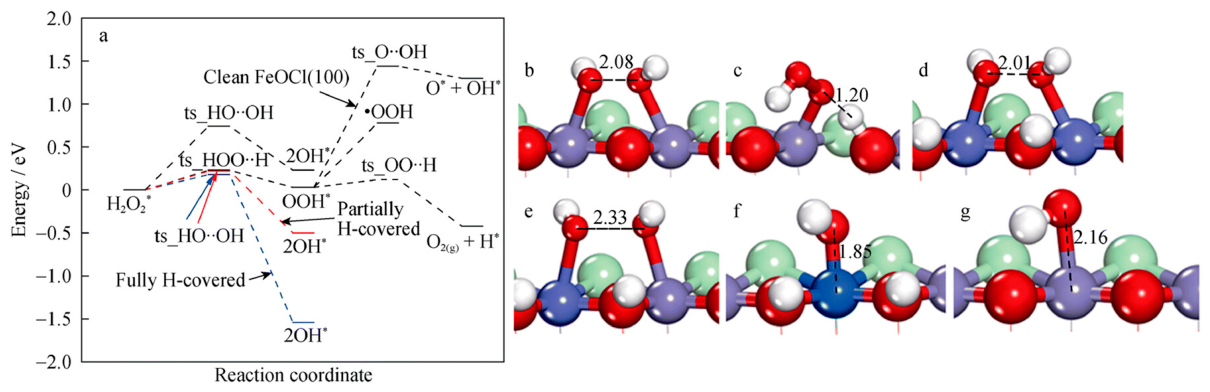
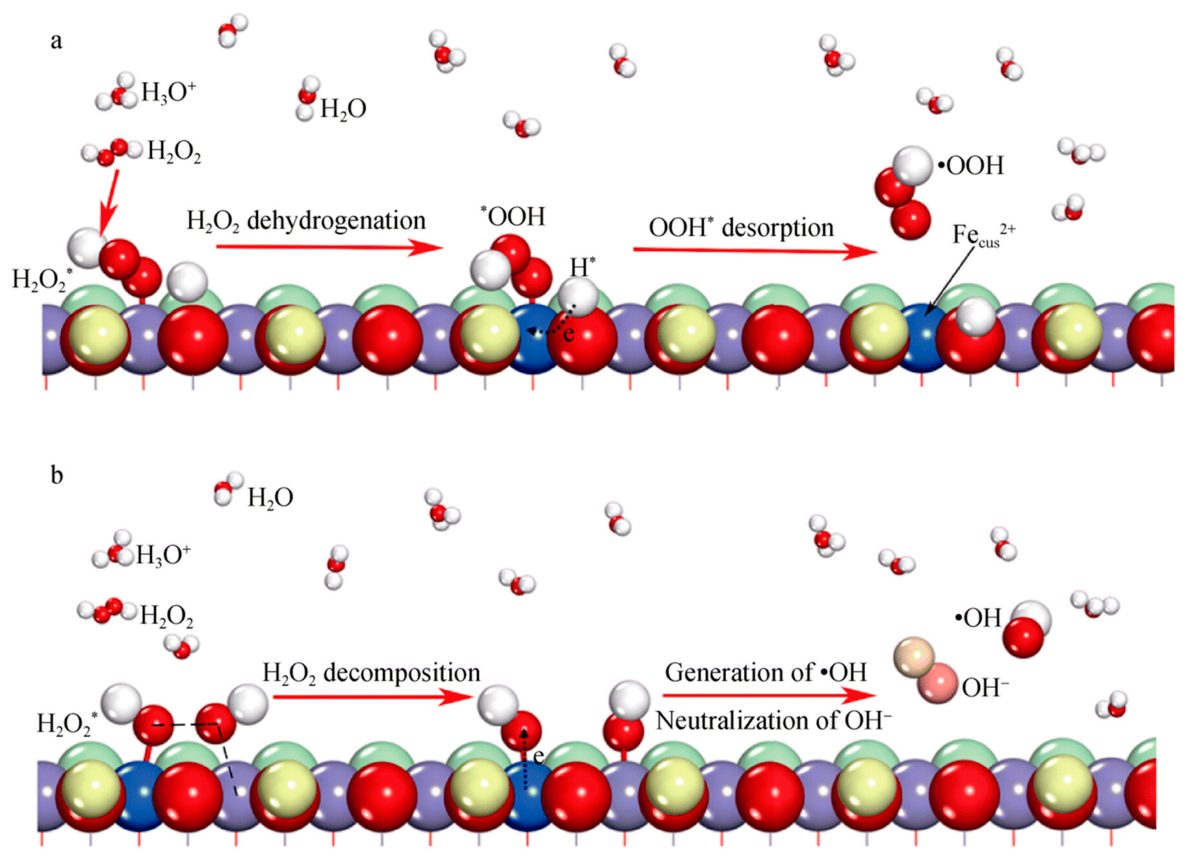
First-principles density functional theory (DFT) calculations have furnished atomic-level insights into the Fenton reaction mechanism on FeOCl surfaces. Ji et al. employed DFT calculations to systematically interrogate the H2O2 decomposition and conversion mechanism on the FeOCl(100) surface in Figure 1. Their study unveiled several pivotal findings that account for the superior activity of FeOCl relative to α-Fe2O3 [58].
On a pristine FeOCl(100) surface, the exposed [Fe3+-Fe3+] sites cannot efficiently cleave the O-O bond of H2O2 to form OH groups [33,59,60]. Instead, H2O2 tends to undergo dehydrogenation by surface lattice oxygen atoms, triggering side reactions that ultimately produce O2, while residual H atoms gradually hydrogenate surface lattice oxygen and reduce Fe3+ to Fe2+. This hydrogenation step is important because it generates reduced iron sites required for subsequent catalytic turnover. On a fully H-covered FeOCl(100) surface, H2O2 can dissociate at [Fe2+-Fe2+] sites into two surface-bound OH species; however, these OH groups bind too strongly to Fe2+ to desorb readily as free ·OH radicals. The key conclusion of this computational study is that partially protonated FeOCl(100) surfaces, which are more representative of acidic reaction environments, contain [Fe2+-Fe3+] mixed-valence active units. On these units, H2O2 can undergo O–O bond cleavage, and the OH adsorbed at the Fe3+ site can desorb as ·OH, while another OH group couples with a surface H atom to form H2O, completing the catalytic cycle. This mechanism explains why the simultaneous presence of Fe2+ and Fe3+ is essential for efficient ·OH production and why FeOCl can maintain this mixed-valence state during catalysis.
The longstanding debate regarding the primary reactive intermediate in Fenton and Fenton-like reactions—whether it constitutes a free ·OH radical or a high-valent ferryl species (FeIV=O)—has persisted for decades [61]. Although the preponderance of studies on FeOCl catalysis support the ·OH radical mechanism based on EPR spin-trapping and radical quenching experiments, the possibility of surface-bound or transient ferryl intermediates cannot be wholly excluded, particularly under near-neutral pH conditions where the lifetime of free ·OH is exceedingly short. Recent reappraisals of Fenton chemistry suggest that both radical and non-radical pathways may coexist, contingent upon the specific catalyst structure, reaction conditions, and target pollutants. Further mechanistic investigations leveraging advanced in situ spectroscopic techniques are warranted to comprehensively elucidate the reactive species operative in FeOCl-catalyzed Fenton-like processes.

3.3. pH-Insensitive H2O2 Activation

One of the most consequential advantages of FeOCl over conventional heterogeneous Fenton catalysts is its capacity to activate H2O2 and produce ·OH across a broad pH range. Sun et al. demonstrated that FeOCl nanosheets generate detectable quantities of ·OH at pH values spanning 3.0 to 9.0, with cumulative ·OH production reaching 11.0 μM within 1 min at pH 7.0 [34]. This performance stands in stark contrast to that of previously investigated heterogeneous Fenton catalysts—such as Fe2O3, Fe3O4, and FeOOH—which produce negligible ·OH at neutral pH. Remarkably, when comparing the cumulative ·OH generation within the first minute of reaction, FeOCl was found to be three-fold more efficient than the homogeneous Fenton catalyst (Fe2+) across the entire investigated pH range.
The pH insensitivity of FeOCl can be attributed to several factors. First, the unique chlorine coordination environment modulates the Lewis acidity and redox properties of surface iron sites, helping them retain reactivity as solution pH increases. Second, the layered structure may provide confined microenvironments in which local conditions differ from the bulk solution. Third, chlorine atoms can act as electron-withdrawing groups that stabilize reduced Fe2+ sites against rapid reoxidation. This pH-insensitive behavior is highly valuable for water treatment because it reduces or eliminates the need for pH adjustment before and after treatment, thereby lowering operating costs and process complexity.

3.4. Reactive Species and Effects of Realistic Water Matrices

For practical water treatment, FeOCl performance must be evaluated under realistic water matrices rather than only in ultrapure water. Natural organic matter (NOM) can compete with target pollutants for ROS, shield active sites and form transformation byproducts [62]. Inorganic anions such as chloride, bicarbonate, carbonate, nitrate, phosphate and sulfate can either scavenge radicals, form secondary radicals, buffer pH or block iron sites [63]. Water alkalinity is particularly important because bicarbonate/carbonate consumes ·OH and shifts the system toward less reactive carbonate radicals [64]. Pollutant concentration, catalyst dosage, oxidant dosage, ionic strength and mass-transfer conditions further control apparent kinetics. These effects explain why pH-universal activity in model solutions must be complemented by tests in tap water, river water, wastewater effluent and high-salinity matrices.
FeOCl-based systems can generate multiple ROS depending on oxidant type, illumination, pH and catalyst modification. In H2O2 systems, ·OH is generally identified as the dominant oxidant by EPR spin trapping with DMPO, fluorescence probing and scavenging with tert-butanol or isopropanol [65]. In persulfate or percarbonate systems, SO4·, ·O2, singlet oxygen (1O2), holes (h+) and surface-bound high-valent iron-oxo species may also contribute [66]. The relative importance of these species should be interpreted cautiously because scavengers can alter solution chemistry and EPR detects only spin-trappable intermediates. Therefore, reliable mechanism assignment requires convergent evidence from EPR, selective quenching, isotope labeling, probe-compound kinetics, in situ spectroscopy and DFT calculations.

4. Synthesis Methodologies for FeOCl-Based Materials

The catalytic performance of FeOCl is intimately related to its crystallinity, morphology, particle size, and surface attributes—all of which are dictated by the synthesis methodology. Several synthetic approaches have been developed for the preparation of FeOCl and its derivatives, each affording distinct advantages in terms of product quality, scalability, and controllability.

4.1. Chemical Vapor Transport Method

The most common laboratory-scale synthesis of FeOCl involves chemical vapor transport between Fe2O3 and FeCl3 in a sealed quartz ampoule [67,68,69]. In this method, anhydrous FeCl3 and Fe2O3 powders are sealed under vacuum and heated in a two-zone furnace under a controlled temperature gradient, typically 370–380 °C at the source zone and 350–360 °C at the growth zone. FeCl3 vapor acts as both reactant and transport agent, reacting with Fe2O3 to form FeOCl crystals at the cooler end of the ampoule over several days. This route yields highly crystalline FeOCl with well-defined facets and is therefore suitable for fundamental studies of crystal structure and catalytic mechanisms.

4.2. Partial Thermal Decomposition Method

A more scalable synthetic route is the partial thermal decomposition of FeCl3·6H2O. In this method, FeCl3·6H2O is heated at a controlled temperature, typically 200–300 °C, in air or under an inert atmosphere for several hours. Thermal treatment partially decomposes the iron chloride hydrate, releasing HCl and H2O while forming FeOCl as an intermediate product: FeCl3·6H2O > FeOCl + 2HCl + 5H2O. This method is widely used because it is simple, rapid, low-cost and capable of producing gram-scale quantities of FeOCl. Zhang et al. and Chen et al. used this route to prepare FeOCl for photo-Fenton studies [70,71]. The crystallinity and particle size of the resulting FeOCl can be tuned by adjusting calcination temperature, heating rate, gas atmosphere, precursor mass, reactor geometry and post-washing protocol. Temperatures that are too low can leave hydrated chloride residues, whereas excessive temperature or prolonged heating promotes transformation to iron oxides. Therefore, XRD should be combined with TGA, FTIR/Raman, SEM/TEM and chloride analysis to confirm phase purity and exclude residual FeCl3, which could otherwise contribute to homogeneous Fenton activity.

4.3. Chemical Vapor Deposition

Chemical vapor deposition (CVD) has been developed for the growth of FeOCl nanosheet arrays on substrates. Hou et al. reported the deposition of FeOCl nanosheet arrays on fluorine-doped tin oxide (FTO) glass substrates via a CVD process [72]. The FeOCl nanosheet arrays were subsequently transformed into porous α-Fe2O3 nanosheet arrays through thermal treatment, yielding photoanodes with markedly enhanced photoelectrochemical water-splitting performance. The CVD approach offers the distinct advantage of producing oriented nanostructures with precisely controlled morphology and direct integration with device substrates.

4.4. Exfoliation Strategies for Ultrathin Nanosheets

The layered crystal architecture of FeOCl enables its exfoliation into ultrathin two-dimensional nanosheets, which expose a higher density of active sites and exhibit augmented catalytic properties. Liquid-phase exfoliation methods—including ultrasonication in appropriate solvents and chemical intercalation–exfoliation employing organolithium reagents—have been successfully deployed to produce few-layer FeOCl nanosheets from bulk crystals [73,74]. Wang et al. demonstrated that exfoliated FeOCl nanosheets exhibited superior Pb(II) adsorption capacity compared to bulk FeOCl, underscoring the importance of surface area and active site accessibility in dictating material performance [75].

4.5. Intercalation, Doping and Composite Synthesis

The van der Waals gap of FeOCl allows intercalation and interface engineering, which are useful for tailoring electronic structure and catalytic stability. Polyaniline-intercalated FeOCl changes the local pH-dependent structure-activity relationship [68], K-intercalated FeOCl steers the H2O2 activation pathway [76], and MXene/FeOCl architectures manipulate interlayer interfaces for electrochemical water treatment [74]. Elemental doping is another important strategy. Metal dopants such as Co, Ce, V and alkali ions can modify Fe-O/Fe-Cl bonding, redistribute charge density, accelerate Fe(III)/Fe(II) cycling and create additional defect sites. Non-metal or carbon-based modifications, including carbon nanodots and conductive carbon networks, can enhance light absorption, in situ H2O2 production, electron transfer and catalyst dispersion [77,78]. For researchers entering this field, synthesis reports should specify precursor hydration state, calcination atmosphere, temperature program, washing procedure, storage condition and evidence excluding dissolved-iron artifacts.

5. Strategies for Enhancing FeOCl Catalytic Performance

Although FeOCl already possesses high intrinsic catalytic activity, its performance can be further improved through targeted material engineering. This section reviews major strategies used to optimize FeOCl-based catalysts in terms of activity, stability, and applicability.

5.1. Heterojunction Construction with Two-Dimensional Materials

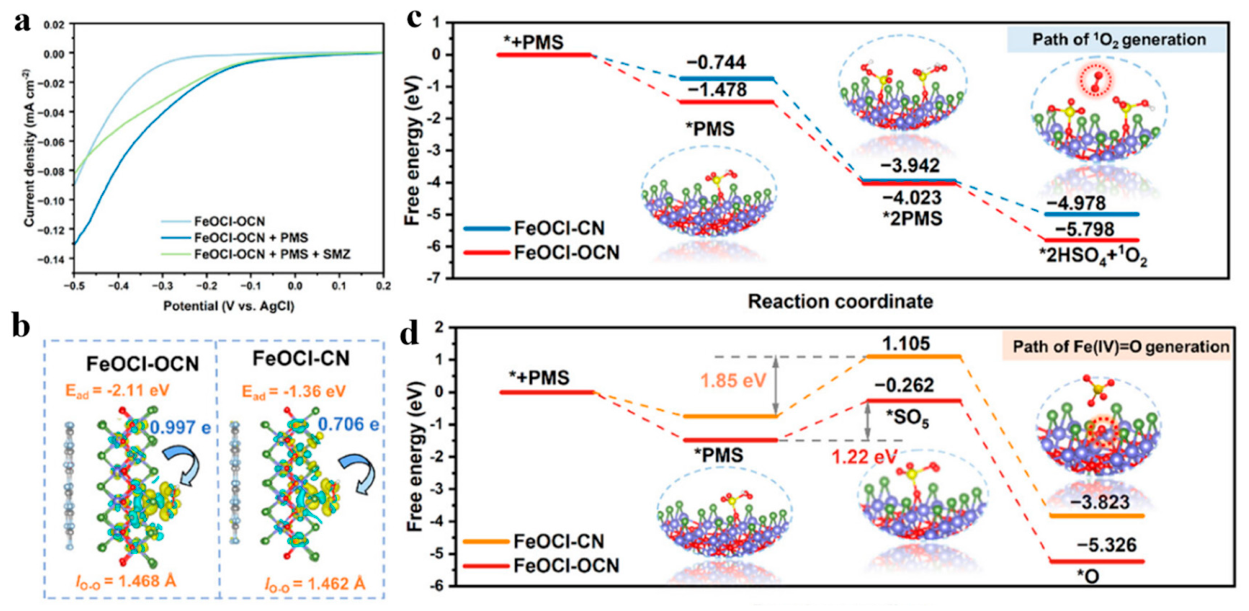
The mechanistic advantage of heterojunction engineering is exemplified in Figure 2, which illustrates the tailored built-in electric field (BIEF) and charge transfer pathway in the oxygen-doped g-C3N4/FeOCl (FeOCl-OCN) composite for peroxymonosulfate (PMS) activation [51]. Driven by a large work function difference (ΔΦ = 3.235 eV), electrons spontaneously migrate from the oxygen-doped g-C3N4 (OCN) support to the FeOCl. This BIEF-driven mechanism effectively induces the rearrangement of structural Fe(II)/Fe(III) in FeOCl, which enhances the binding affinity to PMS and reduces the energy barrier for *O formation, thereby favoring a highly selective nonradical pathway for singlet oxygen (1O2) and high-valent iron-oxo (Fe(IV)═O) generation for pollutant degradation.
The construction of heterojunctions between FeOCl and other two-dimensional materials has proven to be an efficacious strategy for promoting charge separation and augmenting catalytic performance. Zhang et al. developed a novel 2D/2D FeOCl/graphite oxide (GO) heterojunction that exhibited remarkable enhancement in sunlight-driven photo-Fenton catalytic activity [70]. The FeOCl/GO (1 wt% GO) catalyst achieved a degradation rate constant 5.3-fold higher than that of pristine FeOCl and retained excellent catalytic activity through four consecutive degradation cycles. The enhanced performance was attributed to a double-transfer mechanism and the formation of an interfacial electric field at the FeOCl–GO junction, which promoted the efficient separation of photoinduced electron–hole pairs. Furthermore, the increased negative surface charge (ζ-potential) of FeOCl/GO enhanced electrostatic attraction with cationic pollutants such as Rhodamine B, further bolstering degradation efficiency.
The double-transfer mechanism proposed for FeOCl/GO can be understood as coupled charge and mass/interfacial transfer. First, photogenerated electrons migrate from FeOCl to conductive GO sheets, suppressing electron-hole recombination and increasing the availability of electrons for Fe(III) reduction. Second, the interfacial electric field and negatively charged GO surface promote adsorption and transfer of cationic pollutants toward FeOCl active sites. Thus, the enhanced activity arises from simultaneous electronic transfer and pollutant/reactant enrichment at the heterointerface.
Zhao et al. designed a Z-scheme heterogeneous photo-Fenton-like g-C3N4/FeOCl catalyst by a calcination method [79]. The Z-scheme heterojunction between g-C3N4 and FeOCl promoted spatial separation of photogenerated electron–hole pairs while preserving the strong reduction potential of g-C3N4 conduction-band electrons and the strong oxidation potential of FeOCl valence-band holes. This configuration significantly enhanced the degradation of tetracycline and Rhodamine B under visible-light irradiation. Radical-trapping experiments and electron spin resonance (ESR) measurements confirmed that ·OH was the dominant reactive species, while the increased specific surface area of the composite further promoted H2O2 decomposition.
In addition to GO and g-C3N4, other FeOCl intercalation and heterojunction systems deserve attention. Carbon nanodot-modified FeOCl couples in situ H2O2 production with FeOCl-mediated H2O2 activation. CNT-and carbon-filter-supported FeOCl improves electrical conductivity and mass transport in electro-Fenton systems [44,78]. PVDF and ceramic membrane-supported FeOCl confine catalytic sites in flow-through architectures and reduce post-treatment separation requirements [43,80]. Polyaniline-intercalated, amine-intercalated and cation-intercalated FeOCl modify the interlayer environment, alter redox behavior and can improve stability under specific pH conditions [76]. These examples show that FeOCl engineering has moved beyond simple binary GO/g-C3N4 composites toward interfacial, conductive, polymeric and membrane-confined architectures.

5.2. Photo-, Sono-, Piezo- and Electro-Assisted Performance Enhancement

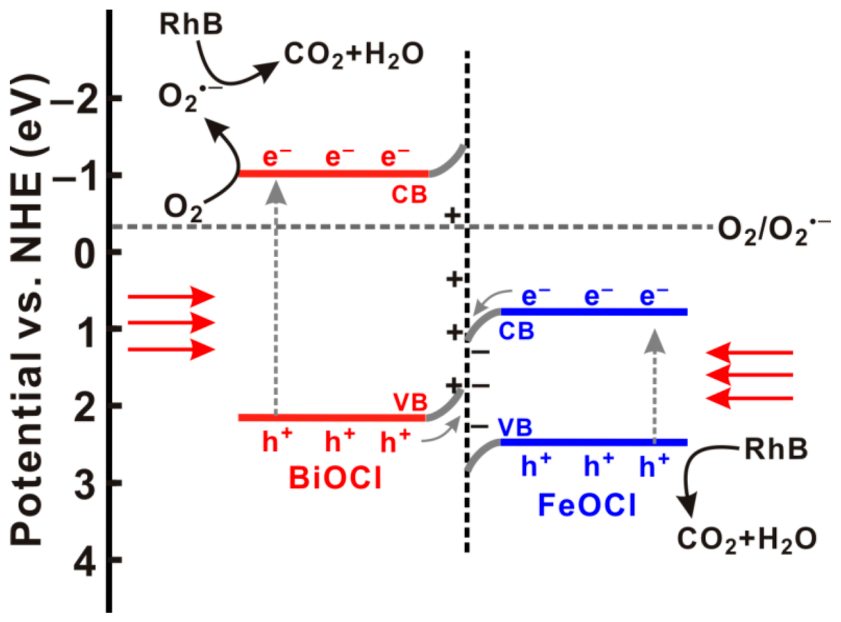
Figure 3 shows the plausible S-scheme mechanism for the visible-light-driven photocatalytic degradation of RhB by the BiOCl/FeOCl heterostructure [81]. Upon visible-light excitation, both BiOCl and FeOCl generate electron–hole pairs. Owing to interfacial band bending and the built-in electric field, the photogenerated electrons in the conduction band of FeOCl recombine with the holes in the valence band of BiOCl. Consequently, the highly reductive electrons retained in the conduction band of BiOCl reduce dissolved O2 to ·O2, whereas the strongly oxidative holes preserved in the valence band of FeOCl directly oxidize RhB. This S-scheme charge-transfer pathway suppresses carrier recombination while maintaining strong redox capabilities, enabling the continuous generation of ·O2 and h+ as the dominant reactive species and thereby promoting the rapid degradation of organic pollutants.
The narrow band gap of FeOCl (1.63–1.74 eV) makes it an effective visible-light-responsive photo-Fenton catalyst. Under visible-light irradiation, FeOCl generates electron–hole pairs that participate in the catalytic cycle: photogenerated electrons reduce Fe3+ to Fe2+ and accelerate the rate-limiting step of the Fenton reaction, while photogenerated holes can directly oxidize organic pollutants or react with water/hydroxyl groups to produce additional ·OH [65,66,71].
Chen et al. investigated the activation of sodium percarbonate (SPC) by FeOCl under visible light (FeOCl/SPC/Vis system) for the degradation of Rhodamine B [66]. The participation of visible light substantially augmented the degradation rate, attributable to the accelerated Fe(III)/Fe(II) redox cycle driven by photogenerated electrons. XPS characterization corroborated the valence changes of iron species before and after the reaction. The same research group also examined the heterogeneous activation of persulfate (PS) with FeOCl under visible light irradiation [71]. In the FeOCl/PS/Vis system, both photogenerated holes (h+) and sulfate radicals (SO4·) were identified as the predominant reactive oxidants, with superoxide radicals (·O2) also contributing to the degradation process. These investigations collectively demonstrate that the combination of FeOCl with various oxidants (H2O2, SPC, PS) under visible light can generate multiple reactive species for efficient pollutant degradation.
ElShafei et al. investigated the synergistic effects of ultrasonic (US) and ultraviolet (UV) irradiation on the heterogeneous Fenton degradation of 2-nitrophenol using metal oxychloride catalysts [82]. Among Fe, Cu, Bi, and Zn oxychlorides, FeOCl showed the highest degradation rate constant (0.15 min−1). The combined US/UV sonophotocatalytic system exhibited a synergistic effect, with a degradation rate higher than the sum of the individual processes. This improvement was attributed to enhanced mass transfer induced by ultrasonic cavitation and more effective cleaning of the catalyst surface, which exposed fresh active sites.
Recent work has also expanded assisted activation beyond light and ultrasound. Piezoelectric FeOCl-mediated Fenton-like processes use mechanical energy to generate polarization charges that facilitate redox cycling and contaminant oxidation [48]. Flow-through electro-Fenton systems use external bias to continuously regenerate Fe(II), while also reducing diffusion limitations through convection [44,78]. These assisted processes should be discussed as engineering strategies rather than as stand-alone mechanisms, because their primary value lies in overcoming charge-transfer and mass-transfer limitations of pristine FeOCl powders.

5.3. Morphology Engineering and Active Site Exposure

The catalytic performance of FeOCl is critically dependent on the exposure of active surface sites. Exfoliation of bulk FeOCl into ultrathin nanosheets dramatically increases the specific surface area and the density of accessible iron active sites. DFT calculations by Ji et al. identified the FeOCl(100) surface as the catalytically active facet, where the [Fe2+-Fe3+] active units reside [58]. Luo et al. demonstrated through combined computational and experimental investigations that the (110) and (010) facets of FeOCl possess distinct orientations of oxygen and chlorine atoms, resulting in differential adsorption energies toward Pb(II) [83]. The (110) facet was found to exhibit greater selectivity for Pb(II) adsorption owing to the favorable arrangement of surface Cl and O atoms, underscoring the importance of crystal facet engineering in optimizing FeOCl performance for specific applications.
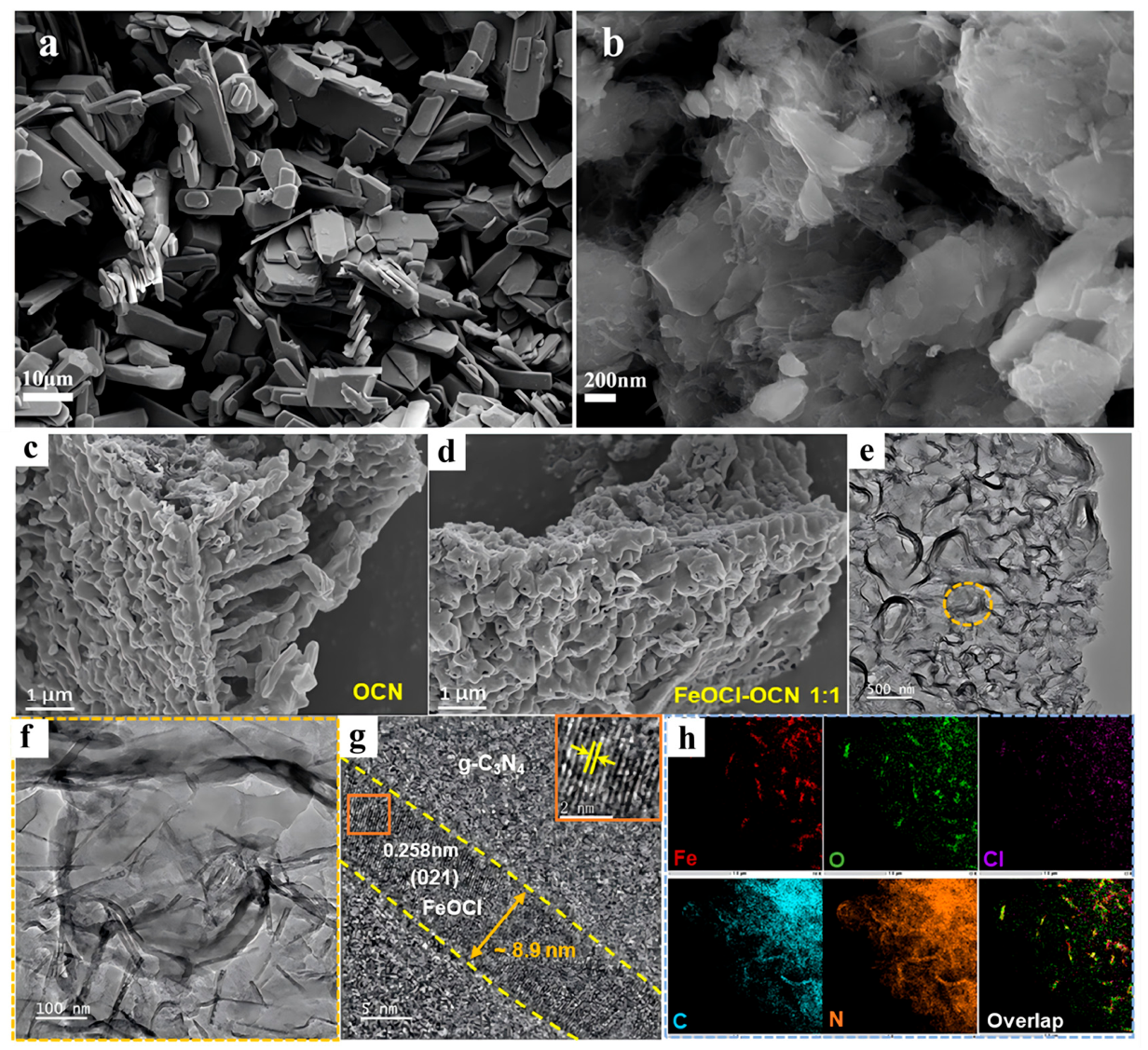
Representative SEM and TEM studies consistently show that FeOCl activity is strongly linked to exposed nanosheet, nanoflake, membrane-confined or electrode-supported morphologies [80,83,84]. The large intensity of (010) plane indicates an orientation perpendicular to b-axis, facilitating the formation of a flake-like morphology during synthesis (Figure 4a,b) [85]. As shown in Figure 4c–h, pristine OCN exhibits a porous, stalactite-like architecture composed of stacked and corrugated lamellae, providing abundant exposed edges and anchoring sites for FeOCl deposition (Figure 4c) [51]. After FeOCl loading, FeOCl–OCN 1:1 largely retains this open hierarchical structure, with ultrathin FeOCl nanosheets uniformly dispersed on the OCN surface and partially embedded within its porous framework (Figure 4d–f), thereby ensuring intimate interfacial contact and facilitating reactant transport. The HRTEM image reveals a well-defined FeOCl/g-C3N4 heterointerface and distinct lattice fringes with an interplanar spacing of 0.258 nm, corresponding to the (021) plane of FeOCl; the supported FeOCl nanosheet has a thickness of approximately 8.9 nm (Figure 4g). Furthermore, EDS elemental mapping shows broadly distributed C and N throughout the OCN scaffold and co-localized Fe, O, and Cl within the deposited nanosheets, confirming the successful formation and homogeneous immobilization of FeOCl on OCN (Figure 4h). These structural characteristics create abundant and closely coupled heterointerfaces, which are favorable for interfacial electron transfer and efficient PMS activation.
Li et al. demonstrated that functionalizing carbon nanotube (CNT) filters with nanoscale FeOCl particles substantially promoted the generation of ·OH within a flow-through electro-Fenton system [78]. The nanoscale FeOCl particles exposed a high density of active sites and facilitated efficient Fe3+/Fe2+ cycling under an applied electric potential of −0.8 V vs. Ag/AgCl. The flow-through configuration provided convection-enhanced mass transport, achieving an oxidative flux of 5.32 ± 0.41 mmol·h−1·m−2 for tetracycline degradation, which substantially outperformed conventional batch reactor configurations.

5.4. FeOCl-Derived and FeOCl-Composite Materials

FeOCl serves as an excellent precursor for the synthesis of nanostructured iron oxide materials with controlled morphologies. The thermal decomposition of FeOCl under controlled conditions yields porous α-Fe2O3 nanostructures that retain the morphology of the parent FeOCl. Wang et al. converted CVD-grown FeOCl nanosheet arrays into porous α-Fe2O3 nanosheet arrays, which exhibited a photocurrent three-fold higher than that of planar hematite films at 1.23 V vs. RHE [86]. The enhanced performance was attributed to the porous nanosheet architecture, which provides a substantial electrode–electrolyte interfacial area and short charge transport distances.
The combination of FeOCl with porous supports has also been explored. FeOCl/SBA-15 catalysts have been used for phenol degradation, where the mesoporous silica support provides a high surface area and promotes the dispersion of FeOCl active sites [87]. Related Fe-g-C3N4/graphitized mesoporous carbon composites have also been reported as effective Fenton-like catalysts over a broad pH range, illustrating the versatility of integrating FeOCl-related iron species with carbonaceous or porous supports [88].
Beyond FeOCl itself, other iron-based composites have shown considerable promise in Fenton-like catalysis. Fe3O4–CeO2 metal oxide nanocomposites [89], Fe3O4@β-CD nanocomposites [90], Fe0/Fe3O4 composites [91], and nFe2O3/MIL-53(Cu) [92]-supported catalysts have all demonstrated enhanced catalytic activities through diverse mechanisms, including metal–metal synergy, improved dispersion, and support effects. These investigations afford valuable insights that can inform the further development of FeOCl-based composite catalysts.
The FeOCl composite family can be further broadened to polyoxometalates, metal sulfides, conductive polymers and membrane-supported catalysts. Polyoxometalates can serve as reversible electron reservoirs that facilitate Fe(III) reduction. Metal sulfides may promote interfacial electron transfer and broaden visible-light absorption, although sulfide oxidation and secondary metal release require evaluation. Conductive polymers such as polyaniline provide interlayer spacing control and pH-responsive electron transport. PVDF, PES and ceramic membranes immobilize FeOCl in practical modules, improve catalyst recovery and enable flow-through operation [43,44,80]. These architectures are particularly important for moving FeOCl from batch proof-of-concept experiments toward continuous water-treatment systems.

6. Environmental and Catalytic Applications

The mechanistic advantage of the FeOCl catalyst for environmental and catalytic applications is exemplified in Figure 5, which illustrates the atomic-level Fenton reaction pathway on the proton pre-covered FeOCl(100) surface [58]. Upon H2O2 activation, an initial dehydrogenation process reduces specific surface iron sites, leading to the in situ formation of a unique [Fecus2+-Fecus3+] active unit. Driven by this dual-site configuration, a synergistic catalytic pathway is established where a subsequent H2O2 molecule undergoes rapid O-O bond cleavage. This mechanism effectively utilizes the highly reactive Fecus2+ sites to break the peroxide bond, while leveraging the adjacent Fecus3+ sites to ensure the facile desorption of the generated hydroxyl groups as highly oxidative hydroxyl radicals (•OH). This synergistic interplay between the Fe2+ and Fe3+ sites ensures continuous •OH generation and efficient catalytic turnover, thereby enabling the rapid degradation and mineralization of organic pollutants in wastewater treatment.

6.1. Degradation of Organic Pollutants in Water

The primary application of FeOCl-based catalysts is the degradation of organic pollutants in aqueous systems. Their catalytic activity is associated with efficient Fe(II)/Fe(III) conversion and H2O2 activation over FeOCl nanosheets. The main application of FeOCl-based catalysts is the degradation of organic pollutants in aqueous systems. FeOCl catalysts have shown excellent performance for removing dyes (Rhodamine B, methylene blue, methyl orange), antibiotics (tetracycline, sulfamethazine), endocrine-disrupting phenolic compounds (bisphenol A), phenolic compounds (phenol, 2-nitrophenol, 4-chlorophenol), and recalcitrant pollutants such as carbamazepine, halogenated benzenes, and perfluorooctanoic acid [65,78,82]. Sun et al. showed that FeOCl nanosheets outperformed other Fenton catalysts for all tested pollutants, including compounds that are difficult to remove by conventional Fenton systems [34].
The FeOCl/GO composite catalyst achieved complete degradation of Rhodamine B within 40 min under simulated sunlight irradiation, with a degradation rate constant 5.3-fold that of FeOCl alone [70]. The g-C3N4/FeOCl Z-scheme catalyst demonstrated efficient degradation of both the colorless antibiotic tetracycline and the dye Rhodamine B under visible light, highlighting its broad applicability [79]. The CNT/FeOCl filter achieved over 95% removal of tetracycline in a continuous flow-through electro-Fenton system, demonstrating substantial potential for practical wastewater treatment applications [78].
Oxidative degradation pathways over pristine and modified FeOCl generally begin with attack by ·OH, SO4·, h+ or surface-bound iron-oxo species on electron-rich sites of organic pollutants. For dyes such as RhB, N-deethylation, chromophore cleavage, ring opening and formation of low-molecular-weight carboxylic acids are commonly observed before mineralization to CO2 and H2O. For antibiotics such as tetracycline and sulfamethazine, hydroxylation, demethylation, deamination, decarbonylation and ring-opening reactions can generate transformation products whose toxicity may differ from the parent compounds. Therefore, future FeOCl studies should combine LC-MS pathway identification, TOC removal, toxicity assays and byproduct-risk assessment rather than relying only on UV-vis decolorization or parent-compound disappearance.

6.2. Heavy Metal Adsorption and Sequestration

In addition to oxidative degradation of organic pollutants, FeOCl nanosheets show strong potential for adsorptive removal of heavy-metal ions. Luo et al. combined DFT calculations with experiments to study Pb(II) adsorption on FeOCl nanosheets [83]. The calculations indicated that the (110) facet, with a favorable arrangement of oxygen and chlorine surface sites, binds Pb(II) more strongly than the (010) facet. Exfoliated ultrathin FeOCl nanosheets with greater exposure of (110) facets exhibited significantly enhanced Pb(II) adsorption compared with bulk FeOCl. The adsorption performance of FeOCl-based materials for the removal of various heavy-metal ions is summarized in Table 1. This work highlights the multifunctional potential of FeOCl materials for water treatment by combining adsorptive and oxidative removal pathways.

6.3. Selective Oxidation and Chemical Synthesis

The catalytic versatility of FeOCl extends beyond environmental remediation to selective chemical transformations. ElMetwally et al. demonstrated that FeOCl is an efficient heterogeneous catalyst for the selective hydroxylation of benzene to phenol employing H2O2 as the oxidant [101]. Phenol is a critical industrial chemical produced predominantly via the energy-intensive cumene process, and direct benzene hydroxylation represents an attractive alternative pathway. FeOCl exhibited superior activity compared to other reported catalysts for this reaction, attributable to its facile self-redox potential and remarkable capacity to generate substantial quantities of hydroxyl radicals within a short timeframe. The catalyst maintained its activity over four consecutive reaction cycles under the harsh conditions of benzene hydroxylation.
Mechanistically, benzene hydroxylation over FeOCl proceeds through H2O2 adsorption and activation at mixed-valence Fe sites, followed by generation of highly reactive ·OH or surface-bound oxoiron species that attack the aromatic ring. The main challenge is selectivity: excessive radical concentration can overoxidize phenol to quinones, ring-opening products or CO2. FeOCl is attractive because its self-redox Fe(III)/Fe(II) cycling can provide a high local oxidant flux while the heterogeneous surface partially confines reactive intermediates. Rational control of H2O2 dosage, solvent, temperature, surface hydroxyl coverage and FeOCl morphology is therefore essential for balancing benzene conversion and phenol selectivity.

6.4. Electro-Fenton and Energy-Related Applications

The application of FeOCl in electro-Fenton systems represents a promising direction for continuous-flow water treatment. Li et al. developed a carbon nanotube filter functionalized with FeOCl for flow-through electro-Fenton degradation of tetracycline [78]. The application of an external electric potential (−0.8 V vs. Ag/AgCl) provided continuous electrochemical reduction of Fe3+ to Fe2+, sustaining the catalytic cycle without the necessity for chemical reducing agents. The flow-through configuration enhanced mass transport through convection, surmounting the diffusion limitations inherent in conventional batch reactors.
The electro-Fenton mechanism combines heterogeneous FeOCl catalysis with electrochemical regeneration [44,78,102]. Oxygen reduction at the cathode can generate H2O2 in situ, while the applied potential reduces Fe(III) sites on FeOCl to Fe(II), sustaining continuous ROS production without repeated addition of soluble iron. In flow-through electrodes, convective transport shortens the diffusion distance between pollutant molecules, H2O2 and FeOCl active sites, thereby improving apparent kinetics and oxidant utilization. Key design variables include electrode conductivity, FeOCl loading, hydraulic residence time, applied potential, oxygen supply, membrane fouling and long-term iron leaching.
Beyond water treatment, FeOCl and its derivatives have found applications in energy conversion and storage technologies. FeOCl has been investigated as a cathode material for chloride ion batteries [103], wherein the reversible intercalation/deintercalation of chloride ions within the layered FeOCl architecture enables electrochemical energy storage. FeOCl-derived porous α-Fe2O3 nanostructures function as efficient photoanodes for photoelectrochemical water splitting [86], while FeOCl supported on carbon aerogels has been explored as an anode material for supercapacitors [104]. These diverse applications underscore the multifunctional nature of FeOCl materials and their potential across the energy–environment nexus.

7. Research Limitations and Practical Challenges

Scale-up introduces additional challenges. Chemical vapor transport gives high-quality crystals but is poorly suited for large-scale production, whereas thermal decomposition is scalable but demands strict phase-purity control and off-gas management. In real waters, NOM, bicarbonate, chloride, phosphate and suspended solids can consume ROS or block active sites. Reactor integration must therefore consider catalyst immobilization, hydraulic resistance, mass transfer, oxidant utilization, regeneration, spent-catalyst handling and secondary contamination. Addressing these issues will require standardized reporting of dissolved Fe/Cl, reusability, long-term continuous operation, mineralization, toxicity and cost metrics.
Despite its high intrinsic activity, FeOCl still faces several limitations before practical water-treatment deployment. First, aqueous stability remains a central concern because Fe-Cl coordination can be hydrolyzed, leading to surface reconstruction, chloride release and iron leaching. Stabilization strategies include membrane confinement, conductive carbon supports, polymer/interlayer engineering, surface hydroxyl regulation, dopant-induced lattice strengthening and flow-through immobilization. Second, many studies report rapid parent-pollutant disappearance but provide limited TOC removal, byproduct identification or toxicity evaluation. Third, kinetic comparisons are often difficult because catalyst dosage, oxidant concentration, pH, pollutant concentration, irradiation intensity and water matrix differ substantially among reports.

8. Conclusions and Future Perspectives

Iron oxychloride (FeOCl) has emerged as one of the most promising heterogeneous Fenton-like catalysts for environmental remediation, with catalytic activities 2–4 orders of magnitude higher than those of conventional iron-based catalysts. This performance arises from its layered crystal structure, narrow band gap, and ability to sustain rapid Fe(III)/Fe(II) redox cycling over a wide pH range. DFT calculations have identified the [Fe2+–Fe3+] mixed-valence active unit as a key motif for efficient H2O2 activation, providing mechanistic guidance for rational catalyst design.
Major progress has been made in enhancing FeOCl performance through heterojunction construction with two-dimensional materials such as graphene oxide and g-C3N4, photo- and sono-assisted activation, morphology engineering to expose active facets, and the development of FeOCl-derived nanostructures. FeOCl-based catalysts have demonstrated effectiveness in degrading diverse organic pollutants, adsorbing heavy metals, and catalyzing selective transformations such as benzene hydroxylation to phenol. Their integration into flow-through electro-Fenton systems is a promising step toward practical water-treatment applications.
The principles established through FeOCl research have also informed the design of single-atom iron catalysts and interface-confined ferrous centers, linking bulk FeOCl chemistry with atomically precise catalyst design. Future work should prioritize: (i) mechanistic clarification by operando spectroscopy, isotope labeling, radical quantification and DFT under realistic hydration conditions; (ii) stability-oriented catalyst design that suppresses iron leaching while preserving rapid Fe(III)/Fe(II) cycling; (iii) standardized comparison of TOF, ROS generation rate, oxidant utilization, mineralization and toxicity; (iv) evaluation in tap water, river water, wastewater effluent and saline matrices; and (v) integration into membrane, electro-Fenton and modular flow-through reactors. Continued interdisciplinary efforts across materials science, computational chemistry, environmental engineering and chemical engineering are expected to advance next-generation FeOCl-based catalytic systems for sustainable water management and environmental protection.

Author Contributions

Y.L.: Investigation, writing draft, Writing—Reviewing and Editing, M.Z.: Investigation, Writing—Reviewing and Editing, T.D.: Conceptualization, Supervision, Investigation, Writing—Reviewing and Editing. All authors have read and agreed to the published version of the manuscript.

Funding

This research was funded by the General Projects of the Department of Education of Zhejiang Province (Project No.: Y202558551); Taizhou Science and Technology Plan Project (Project No.: 25gb31); The Research Start-up Fund for High-level Talents of Taizhou Vocational & Technical College (Project No.: 2025GCC06).

Data Availability Statement

No new data were created or analyzed in this study. Data sharing is not applicable to this article.

Acknowledgments

During the preparation of this manuscript, the authors used ChatGPT (GPT-5.5, OpenAI) for the purposes of language polishing and improving the grammar, clarity, and readability of the text. The authors have reviewed and edited the output and take full responsibility for the content of this publication.

Conflicts of Interest

Mengxiang Zhu is employees of Hefei Nexchip Semiconductor Corporation. This study was not funded by Hefei Nexchip Semiconductor Corporation.

References

  1. Rai, P.K. Heavy metal phytoremediation from aquatic ecosystems with special reference to macrophytes. Crit. Rev. Environ. Sci. Technol. 2009, 39, 697–753. [Google Scholar] [CrossRef] [Scilit]
  2. Li, Y.; Ma, Y.; Li, K.; Chen, S.; Yue, D. Photocatalytic reactor as a bridge to link the commercialization of photocatalyst in water and air purification. Catalysts 2022, 12, 724. [Google Scholar] [CrossRef] [Scilit]
  3. Zhang, X.; Li, L.; Xie, Z.; Ma, J.; Li, Y.-F.; Cai, M.; Ren, N.-Q.; Kallenborn, R.; Zhang, Z.-F.; Zhang, X.; et al. Exploring global oceanic persistence and ecological effects of legacy persistent organic pollutants across five decades. Sci. Adv. 2024, 10, eado5534. [Google Scholar] [CrossRef] [Scilit] [PubMed]
  4. Liu, X.; Wei, W.; Chen, Z.; Wu, L.; Duan, H.; Zheng, M.; Wang, D.; Ni, B.-J. The threats of micro-and nanoplastics to aquatic ecosystems and water health. Nat. Water 2025, 3, 764–781. [Google Scholar] [CrossRef] [Scilit]
  5. Perelo, L.W. Review: In situ and bioremediation of organic pollutants in aquatic sediments. J. Hazard. Mater. 2010, 177, 81–89. [Google Scholar] [CrossRef] [Scilit] [PubMed]
  6. Zahmatkesh, S.; Karimian, M.; Chen, Z.; Ni, B.-J. Combination of coagulation and adsorption technologies for advanced wastewater treatment for potable water reuse: By ANN, NSGA-II, and RSM. J. Environ. Manag. 2024, 349, 119429. [Google Scholar] [CrossRef] [Scilit] [PubMed]
  7. Wang, F.; Wang, Z.; Zhao, Y.; Zhang, J. Performance of traditional and emerging water-treatment technologies in the removal of tetracycline antibiotics. Catalysts 2024, 14, 269. [Google Scholar] [CrossRef] [Scilit]
  8. Sun, B.; Tian, Y.; Feng, M.; Zhang, S.; Yang, H.; Qin, J.; Bi, W.; Qiao, X.; Liu, F.; Hou, Q. A novel win–win wastewater treatment process: Recover functional element from sludge to enhances TiO2 for deep photocatalytic oxidation. Chem. Eng. J. 2025, 507, 160627. [Google Scholar] [CrossRef] [Scilit]
  9. Wang, A.; Xu, H.; Yao, C.; Hu, T.; Wang, J.; Lin, T.; Tao, H.; Ding, M. Understanding the pollutant molecular fate in a two-stage biological-coagulation-membrane distillation hybrid process for treating hypersaline organic wastewater. Desalination 2025, 614, 119210. [Google Scholar] [CrossRef] [Scilit]
  10. Ghatak, H.R. Advanced oxidation processes for the treatment of biorecalcitrant organics in wastewater. Crit. Rev. Environ. Sci. Technol. 2014, 44, 1167–1219. [Google Scholar] [CrossRef] [Scilit]
  11. Deng, Y.; Ezyske, C.M. Sulfate radical-advanced oxidation process (SR-AOP) for simultaneous removal of refractory organic contaminants and ammonia in landfill leachate. Water Res. 2011, 45, 6189–6194. [Google Scholar] [PubMed]
  12. Wang, L.; Zhu, Z.; Wu, Y.; Wang, C.; Liu, J.; Wang, C. Ultrafast degradation of refractory organic pollutants via PMS activation over Co3CuAl-LDH with coordinatively unsaturated Co-Cu dual active sites: Enhanced electron transfer mechanism. Sep. Purif. Technol. 2025, 377, 134514. [Google Scholar] [CrossRef] [Scilit]
  13. Manna, M.; Sen, S. Advanced oxidation process: A sustainable technology for treating refractory organic compounds present in industrial wastewater. Environ. Sci. Pollut. Res. 2023, 30, 25477–25505. [Google Scholar]
  14. Feijoo, S.; Yu, X.; Kamali, M.; Appels, L.; Dewil, R. Generation of oxidative radicals by advanced oxidation processes (AOPs) in wastewater treatment: A mechanistic, environmental and economic review. Rev. Environ. Sci. Bio-Technol. 2023, 22, 205–248. [Google Scholar] [CrossRef] [Scilit]
  15. Gligorovski, S.; Strekowski, R.; Barbati, S.; Vione, D. Environmental implications of hydroxyl radicals (• OH). Chem. Rev. 2015, 115, 13051–13092. [Google Scholar] [CrossRef] [Scilit] [PubMed]
  16. Pignatello, J.J.; Oliveros, E.; MacKay, A. Advanced oxidation processes for organic contaminant destruction based on the Fenton reaction and related chemistry. Crit. Rev. Environ. Sci. Technol. 2006, 36, 1–84. [Google Scholar] [CrossRef] [Scilit]
  17. Tian, Q.; Li, Q.; Zhang, T.; Huang, W.; Zhao, C.; Hu, B.; Xu, X. Molecular Orbital Level Micro-Electric Field in Green Fenton-Like Chemistry for Water Treatment: From Mechanism Understanding to Scale-Up Applications. Adv. Mater. 2025, 37, e09280. [Google Scholar] [CrossRef] [Scilit] [PubMed]
  18. Zhang, M.-H.; Dong, H.; Zhao, L.; Wang, D.-X.; Meng, D. A review on Fenton process for organic wastewater treatment based on optimization perspective. Sci. Total Environ. 2019, 670, 110–121. [Google Scholar] [CrossRef] [Scilit] [PubMed]
  19. Deng, F.; Olvera-Vargas, H.; Zhou, M.; Qiu, S.; Sirés, I.; Brillas, E. Critical review on the mechanisms of Fe2+ regeneration in the electro-Fenton process: Fundamentals and boosting strategies. Chem. Rev. 2023, 123, 4635–4662. [Google Scholar] [CrossRef] [Scilit] [PubMed]
  20. Tang, Y.; Dou, J.; Lu, Z.; Xu, J.; He, Y. Accelerating Fe2+/Fe3+ cycle via biochar to improve catalytic degradation efficiency of the Fe3+/persulfate oxidation. Environ. Pollut. 2023, 316, 120669. [Google Scholar] [CrossRef] [Scilit] [PubMed]
  21. Fu, H.; Lin, J.; Shang, G.; Dong, W.; Grassian, V.H.; Carmichael, G.R.; Li, Y.; Chen, J. Solubility of Iron from Combustion Source Particles in Acidic Media Linked to Iron Speciation. Environ. Sci. Technol. 2012, 46, 11119–11127. [Google Scholar] [CrossRef] [Scilit] [PubMed]
  22. Tian, H.; Cui, K.; Sun, S.; Li, H.; Chen, X. Construction of acidic microenvironments to overcome the pH dependence of iron-based catalysts and application to the degradation of micropollutants by AOPs. Chem. Eng. J. 2024, 488, 150934. [Google Scholar] [CrossRef] [Scilit]
  23. Szady, C.; Picarillo, G.; Davis, E.J.; Drapanauskaite, D.; Buneviciene, K.; Baltrusaitis, J.; Navea, J.G. Iron dissolution and speciation from combustion particles under environmentally relevant conditions. Environ. Chem. 2023, 20, 12. [Google Scholar] [CrossRef] [Scilit]
  24. Abuelwafa, A.A.; Rashid, N.M.; Elnobi, S.; Soga, T. Exploring optical, electrical, and impedance properties of Al/α-Fe2O3 nanoflakes/FTO heterojunction device. Surf. Interfaces 2025, 72, 107152. [Google Scholar] [CrossRef] [Scilit]
  25. Baruah, M.J.; Dutta, R.; Zaki, M.E.A.; Bania, K.K. Heterogeneous iron-based catalysts for organic transformation reactions: A brief overview. Molecules 2024, 29, 3177. [Google Scholar] [CrossRef] [Scilit] [PubMed]
  26. Gopalsamy, K.; Zhang, H.; Fang, W. Advances in Heterogeneous Iron nanocatalysts for enhanced Fenton-based processes in wastewater treatment. Chem. Commun. 2026, 62, 12802–12824. [Google Scholar] [CrossRef] [Scilit] [PubMed]
  27. Tao, Y.; Duan, Y.; Chen, Z.; Ye, M.; Wang, Z.; Yi, J.; Jiang, W.; Gu, B.; Yang, F.; Hu, Q. Synergistic heterogeneous catalysis: MoS2/α-FeOOH nanocomposites for pH-universal PMS activation and efficient antibiotic degradation. Mol. Catal. 2025, 581, 115150. [Google Scholar] [CrossRef] [Scilit]
  28. Ai, Y.; Liu, L.; Zhang, C.; Qi, L.; He, M.; Liang, Z.; Sun, H.-B.; Luo, G.; Liang, Q. Amorphous flowerlike goethite FeOOH hierarchical supraparticles: Superior capability for catalytic hydrogenation of nitroaromatics in water. ACS Appl. Mater. Interfaces 2018, 10, 32180–32191. [Google Scholar] [CrossRef] [Scilit] [PubMed]
  29. Pereira, M.C.; Oliveira, L.C.A.; Murad, E. Iron oxide catalysts: Fenton and Fentonlike reactions–a review. Clay Miner. 2012, 47, 285–302. [Google Scholar] [CrossRef] [Scilit]
  30. Liu, Z.; Pan, S.; Xu, F.; Wang, Z.; Zhao, C.; Xu, X.; Gao, B.; Li, Q. Revealing the fundamental role of MoO2 in promoting efficient and stable activation of persulfate by iron carbon based catalysts: Efficient Fe2+/Fe3+ cycling to generate reactive species. Water Res. 2022, 225, 119142. [Google Scholar] [CrossRef] [Scilit] [PubMed]
  31. Munoz, M.; de Pedro, Z.M.; Casas, J.A.; Rodriguez, J.J. Preparation of magnetite-based catalysts and their application in heterogeneous Fenton oxidation–a review. Appl. Catal. B Environ. 2015, 176, 249–265. [Google Scholar] [CrossRef] [Scilit]
  32. Feng, Z.; Zhang, Y.; Tian, X.; Lu, W.; Wang, Q.; Zhang, Z.; Wang, A. Vacuum ultraviolet light-driven, FeOCl-catalyzed heterogeneous photo-Fenton process for enhanced degradation of acetaminophen in water: Efficacy and mechanism. Environ. Res. 2026, 289, 123373. [Google Scholar] [CrossRef] [Scilit] [PubMed]
  33. Liu, Y.; Wang, H. Unraveling the Origin of Superior Activity of FeOCl for Photocatalytic Fenton Reaction. J. Phys. Chem. C 2024, 128, 20878–20885. [Google Scholar] [CrossRef] [Scilit]
  34. Sun, M.; Chu, C.; Geng, F.; Lu, X.; Qu, J.; Crittenden, J.; Elimelech, M.; Kim, J.-H. Reinventing Fenton chemistry: Iron oxychloride nanosheet for pH-insensitive H2O2 activation. Environ. Sci. Technol. Lett. 2018, 5, 186–191. [Google Scholar] [CrossRef] [Scilit]
  35. Ding, Z.; Yue, D.; Liu, X.; He, Z.; Zhu, K.; Chen, J.; Shi, G. Graphene Oxide-Assisted Growth of Ultralong and Soft Single-Crystalline NaCl Ionic Nanowires for Potential Optical Nanodevices. ACS Appl. Nano Mater. 2021, 4, 13495–13500. [Google Scholar] [CrossRef] [Scilit]
  36. Motamedi, M.; Chen, Z.; Yerushalmi, L.; Haghighat, F. Z-scheme PPy-g-C3N4-MIL88B heterogeneous photo-Fenton catalyst for tris-(2-chloroisopropyl) phosphate (TCPP) degradation: By-products, RSM optimization, and machine learning models. J. Water Process Eng. 2026, 82, 109373. [Google Scholar] [CrossRef] [Scilit]
  37. Liu, Y.; Shen, Y.; Sun, L.; Li, J.; Liu, C.; Ren, W.; Li, F.; Gao, L.; Chen, J.; Liu, F.; et al. Elemental superdoping of graphene and carbon nanotubes. Nat. Commun. 2016, 7, 10921. [Google Scholar] [CrossRef] [Scilit] [PubMed]
  38. Zhu, T.; Shi, X.; Yan, Z.; Sun, Z. Tailored electronic modulation driven by CoOFe bridge bonds: The key role of charge redistribution in boosting electrocatalytic oxidation of co-doped FeOCl Fenton catalysts. Sep. Purif. Technol. 2025, 380, 135387. [Google Scholar]
  39. Zhao, X.; Zhang, Z. FeOCl in advanced oxidization processes for water purification: A critical review. Curr. Pollut. Rep. 2023, 9, 143–164. [Google Scholar] [CrossRef] [Scilit]
  40. Li, B.; Wang, P.; Cheng, X.; Zou, R.; Su, Y.; Zhang, Y. Selective and nonselective removal of hydrophobic compounds by coupling engineered FeOCl in a cathode-anode synergistic electrochemical platform. J. Hazard. Mater. 2023, 459, 132148. [Google Scholar] [CrossRef] [Scilit] [PubMed]
  41. Zhang, Q.; Zhang, M.; Li, T.; Du, R.; Yu, G.; Deng, S. FeOCl-confined activated carbon for improving intraparticle Fenton-like oxidation regeneration. J. Hazard. Mater. 2023, 442, 130026. [Google Scholar] [CrossRef] [Scilit] [PubMed]
  42. Nguyen, V.-H.; Mousavi, M.; Ghasemi, J.B.; Van Le, Q.; Delbari, S.A.; Asl, M.S.; Shokouhimehr, M.; Mohammadi, M.; Azizian-Kalandaragh, Y.; Namini, A.S. In situ preparation of g-C3N4 nanosheet/FeOCl: Achievement and promoted photocatalytic nitrogen fixation activity. J. Colloid Interface Sci. 2021, 587, 538–549. [Google Scholar] [CrossRef] [Scilit] [PubMed]
  43. Zheng, H.; Xiao, C.; Jiang, S.; Li, M.; Zhu, M.; Zhou, Y.; Sun, X.; Zhang, D.; Zhang, L. Fabrication of PVDF membrane loaded with ultra-thin g-C3N4/FeOCl nanomaterials and study on catalytic and antifouling properties. Sep. Purif. Technol. 2024, 331, 125641. [Google Scholar] [CrossRef] [Scilit]
  44. Lu, Y.; Xing, X.; Xia, J. Enhanced electro-Fenton oxidation in flow-through system with PES/FeOCl@ CNT cathode: Nano-confined and dimensional effects. J. Water Process Eng. 2025, 79, 109045. [Google Scholar] [CrossRef] [Scilit]
  45. Li, M.; Zhou, Y.; Tang, X.; Zhang, H.; Wang, S.; Nie, A.; Fan, X.; Cheng, Y.; Qiu, T. Monolayer iron oxychloride with a resonant band structure for ultrasensitive molecular sensing. ACS Appl. Mater. Interfaces 2023, 15, 10166–10174. [Google Scholar] [CrossRef] [Scilit] [PubMed]
  46. Zeng, Y.; Wang, Z.; Xu, P.; Lai, C.; Qin, H.; He, Y.; Li, Y.; Huo, X.; Tian, Q.; Wang, C. Fenton chemistry rising star: Iron oxychloride. Coord. Chem. Rev. 2024, 518, 216051. [Google Scholar] [CrossRef] [Scilit]
  47. Lind, M.D. Refinement of the crystal structure of iron oxychloride. Acta Crystallogr. 1970, 26, 1058–1062. [Google Scholar] [CrossRef] [Scilit]
  48. Ding, Y.; Tao, H.; Guan, Z.; Yang, F.; Li, D. A novel piezoelectric fenton-like process mediated by FeOCl for efficient contaminant removal. Chem. Eng. J. 2024, 497, 154781. [Google Scholar] [CrossRef] [Scilit]
  49. Wang, Q.; Wang, X.; Zhou, J.; Wang, H.; Liu, J.; Ma, X.; Wang, W. Sustainable FeOCl-driven interfacial reconstruction for upcycling spent graphite anodes. Sep. Purif. Technol. 2026, 410, 139346. [Google Scholar] [CrossRef] [Scilit]
  50. Xu, J.; Sun, H.; Yang, X.; Guo, H. BaTiO3/FeOCl composite as highly efficient Piezo-Photo-Fenton catalyst for the degradation of tetracycline hydrochloride. Inorg. Chem. Commun. 2026, 191, 117197. [Google Scholar] [CrossRef] [Scilit]
  51. Zeng, Y.; Qin, H.; Wu, F.; Gao, J.; Li, W.; Li, J.; Wu, S.; Xu, P.; Lai, C.; Wang, Z. Oxygen Doping Enables Tailored Built-In Electric Fields in FeOCl/g-C3N4 Heterojunctions for Enhanced Peroxymonosulfate Activation. Adv. Funct. Mater. 2025, 35, 2423664. [Google Scholar] [CrossRef] [Scilit]
  52. Grant, R. Magnetic structure of FeOCl. J. Appl. Phys. 1971, 42, 1619–1620. [Google Scholar] [CrossRef] [Scilit]
  53. Zheng, Z.; Dai, J.; Li, A.; Gao, M.; Qiu, Y.; Zhang, X.; Jin, Z.; Cheng, M.; Cao, H.; Ji, Q.; et al. Ultralow-Temperature Synthesis of Two-Dimensional Anisotropic FeOCl and Quasi-One-Dimensional Moiré Superlattices. ACS Nano 2026, 20, 5973–5982. [Google Scholar] [CrossRef] [Scilit] [PubMed]
  54. Dong, H.; Zhou, Y.; Li, Z.; Liu, W.; Li, S.; Zhu, M. Self-regulation of Lewis acid sites on FeOCl toward piezo-self-Fenton reaction for continuous hydroxyl radicals generation. Nat. Commun. 2026, 17, 3775. [Google Scholar] [CrossRef] [Scilit] [PubMed]
  55. Banewicz, J.; Maguire, J. Intercalation of cations in FeOCl by iodide reactions. Mater. Res. Bull. 1986, 21, 93–98. [Google Scholar] [CrossRef] [Scilit]
  56. Bokare, A.D.; Choi, W. Review of iron-free Fenton-like systems for activating H2O2 in advanced oxidation processes. J. Hazard. Mater. 2014, 275, 121–135. [Google Scholar] [CrossRef] [Scilit] [PubMed]
  57. Zhang, J.; Zhang, G.; Ji, Q.; Lan, H.; Qu, J.; Liu, H. Carbon nanodot-modified FeOCl for photo-assisted Fenton reaction featuring synergistic in-situ H2O2 production and activation. Appl. Catal. B Environ. 2020, 266, 118665. [Google Scholar] [CrossRef] [Scilit]
  58. Ji, X.X.; Wang, H.F.; Hu, P.J. First principles study of Fenton reaction catalyzed by FeOCl: Reaction mechanism and location of active site. Rare Met. 2019, 38, 783–792. [Google Scholar] [CrossRef] [Scilit]
  59. Xu, X.; Zhang, S.; Wang, Y.; Lin, Y.; Guan, Q.; Chen, C. Identifying the role of surface hydroxyl on FeOCl in bridging electron transfer toward efficient persulfate activation. Environ. Sci. Technol. 2023, 57, 12922–12930. [Google Scholar] [CrossRef] [Scilit] [PubMed]
  60. Chen, S.; Liang, J.; Li, J.; Bao, C.; Chen, Y.; Yue, D.; Fan, M.; Li, K.; Jia, J. Regulation of Surface Terminal Hydroxyl Coverage of FeOCl Catalyst via Crystal Facet Protection for Enhanced H2O2 Activation. Environ. Sci. Technol. 2025, 59, 10620–10630. [Google Scholar] [CrossRef] [Scilit] [PubMed]
  61. Meyerstein, D. Re-examining Fenton and Fenton-like reactions. Nat. Rev. Chem. 2021, 5, 595–597. [Google Scholar] [CrossRef] [Scilit] [PubMed]
  62. Bai, X.; Liu, H.; Qin, S.; Zhu, B. Competition and regulation of radical vs. non-radical pathways in iron-activated peracetic acid systems. Catal. Sci. Technol. 2025, 15, 6253–6270. [Google Scholar] [CrossRef] [Scilit]
  63. Gutiérrez-Zapata, H.M.; Alvear-Daza, J.J.; Rengifo-Herrera, J.A.; Sanabria, J. Addition of Hydrogen Peroxide to Groundwater with Natural Iron Induces Water Disinfection by Photo-Fenton at Circumneutral pH and other Photochemical Events. Photochem. Photobiol. 2017, 93, 1224–1231. [Google Scholar] [CrossRef] [Scilit] [PubMed]
  64. Hu, H.; Huang, J. Engineering pathway control in single-atom catalysis for advanced oxidation and electro-oxidation water treatment. Catal. Sci. Technol. 2026, 16, 3112–3136. [Google Scholar] [CrossRef] [Scilit]
  65. Zhang, B.; Chen, M.; Li, D.; Xu, H.; Xia, D. Quantitative investigation into the enhancing utilization efficiency of H2O2 catalyzed by FeOCl under visible light. J. Photochem. Photobiol. A Chem. 2020, 386, 112072. [Google Scholar] [CrossRef] [Scilit]
  66. Chen, M.; Xu, H.; Wang, Q.; Li, D.; Xia, D. Activation mechanism of sodium percarbonate by FeOCl under visible-light-enhanced catalytic oxidation. Chem. Phys. Lett. 2018, 706, 415–420. [Google Scholar] [CrossRef] [Scilit]
  67. Qian, Z.; Song, Z.; Wu, J.; Wang, D.; Wen, W.; Wang, X.; Liu, Y.; Xie, L. Chemical vapor deposition and Raman spectroscopy of two-dimensional antiferromagnetic FeOCl crystals. J. Phys. Chem. C 2023, 127, 6785–6792. [Google Scholar] [CrossRef] [Scilit]
  68. Hwang, S.R.; Li, W.-H.; Lee, K.C.; Lynn, J.W.; Wu, C.-G. Spiral magnetic structure of Fe in Van der Waals gapped FeOCl and polyaniline-intercalated FeOCl. Phys. Rev. B 2000, 62, 14157. [Google Scholar] [CrossRef] [Scilit]
  69. Zeng, Y.; Gu, P.; Zhao, Z.; Zhang, B.; Lin, Z.; Peng, Y.; Li, W.; Zhao, W.; Leng, Y.; Tan, P.; et al. 2D FeOCl: A highly in-plane anisotropic antiferromagnetic semiconductor synthesized via temperature-oscillation chemical vapor transport. Adv. Mater. 2022, 34, 2108847. [Google Scholar] [CrossRef] [Scilit] [PubMed]
  70. Zhang, J.; Liu, G.; Liu, S. 2D/2D FeOCl/graphite oxide heterojunction with enhanced catalytic performance as a photo-Fenton catalyst. New J. Chem. 2018, 42, 6896–6902. [Google Scholar] [CrossRef] [Scilit]
  71. Chen, M.; Xu, H.; Zhang, X.; Li, D.; Xia, D. Mechanism of heterogeneous activation of persulfate with FeOCl under visible light irradiation. J. Mater. Res. 2018, 33, 3549–3558. [Google Scholar] [CrossRef] [Scilit]
  72. Hou, H.; Shao, G.; Wang, Y.; Wong, W.; Yang, W. Insights on advanced substrates for controllable fabrication of photoanodes toward efficient and stable photoelectrochemical water splitting. Carbon Energy 2024, 6, e373. [Google Scholar] [CrossRef] [Scilit]
  73. Mohammadpour, Z.; Jebeli, F.M.; Ghasemzadeh, S. Peroxidase-mimetic activity of FeOCl nanosheets for the colorimetric determination of glutathione and cysteine. Microchim. Acta 2021, 188, 239. [Google Scholar] [CrossRef] [Scilit] [PubMed]
  74. Lei, J.; Zhang, X.; Wang, J.; Yu, F.; Liang, M.; Wang, X.; Bi, Z.; Shang, G.; Xie, H.; Ma, J. Interlayer structure manipulation of FeOCl/MXene with soft/hard interface design for safe water production using dechlorination battery deionization. Angew. Chem. Int. Ed. 2024, 63, e202401972. [Google Scholar] [CrossRef] [Scilit] [PubMed]
  75. Wang, H.; Sun, W.; Liang, X.; Zou, H.; Jiao, X.; Lin, K.A.; Li, T. Two-dimensional Fe2O3 nanosheets as adsorbent for the removal of Pb (II) from aqueous solution. J. Mol. Liq. 2021, 335, 116197. [Google Scholar] [CrossRef] [Scilit]
  76. Wang, J.; Hou, K.-P.; Wen, Y.; Liu, H.; Wang, H.; Chakarawet, K.; Gong, M.; Yang, X. Interlayer structure manipulation of iron oxychloride by potassium cation intercalation to steer H2O2 activation pathway. J. Am. Chem. Soc. 2022, 144, 4294–4299. [Google Scholar] [CrossRef] [Scilit] [PubMed]
  77. Gao, R.; Pan, L.; Li, Z.; Shi, C.; Yao, Y.; Zhang, X.; Zou, J. Engineering Facets and Oxygen Vacancies over Hematite Single Crystal for Intensified Electrocatalytic H2O2 Production. Adv. Funct. Mater. 2020, 30, 1910539. [Google Scholar] [CrossRef] [Scilit]
  78. Li, Z.; Shen, C.; Liu, Y.; Ma, C.; Li, F.; Yang, B.; Huang, M.; Wang, Z.; Dong, L.; Wolfgang, S. Carbon Nanotube Filter Functionalized with Iron Oxychloride for Flow-through Electro-Fenton. Appl. Catal. B Environ. 2020, 260, 118204. [Google Scholar] [CrossRef] [Scilit]
  79. Zhao, J.; Ji, M.; Di, J.; Zhang, Y.; He, M.; Li, H.; Xia, J. Novel Z-scheme heterogeneous photo-Fenton-like g-C3N4/FeOCl for the pollutants degradation under visible light irradiation. J. Photochem. Photobiol. A Chem. 2020, 391, 112343. [Google Scholar] [CrossRef] [Scilit]
  80. Zhang, S.; Hedtke, T.; Zhu, Q.; Sun, M.; Weon, S.; Zhao, Y.; Stavitski, E.; Elimelech, M.; Kim, J.-H. Membrane-confined iron oxychloride nanocatalysts for highly efficient heterogeneous Fenton water treatment. Environ. Sci. Technol. 2021, 55, 9266–9275. [Google Scholar] [CrossRef] [Scilit] [PubMed]
  81. Guo, H.; Deng, Y.; Yin, H.; Liu, J.; Zou, S. Fabricating BiOCl Nanoflake/FeOCl Nanospindle Heterostructures for Efficient Visible-Light Photocatalysis. Molecules 2023, 28, 6949. [Google Scholar] [CrossRef] [Scilit] [PubMed]
  82. ElShafei, G.M.S.; Al-Sabagh, A.M.; Yehia, F.Z.; Philip, C.A.; Moussa, N.A.; Eshaq, G.; ElMetwally, A.E. Metal oxychlorides as robust heterogeneous Fenton catalysts for the sonophotocatalytic degradation of 2-nitrophenol. Appl. Catal. B Environ. 2018, 224, 681–691. [Google Scholar] [CrossRef] [Scilit]
  83. Luo, J.; Sun, M.; Ritt, C.L.; Liu, X.; Pei, Y.; Crittenden, J.C.; Elimelech, M. Tuning Pb(II) Adsorption from Aqueous Solutions on Ultrathin Iron Oxychloride (FeOCl) Nanosheets. Environ. Sci. Technol. 2019, 53, 2075–2085. [Google Scholar] [CrossRef] [Scilit] [PubMed]
  84. Yang, X.-J.; Xu, X.-M.; Xu, J.; Han, Y.-F. Iron oxychloride (FeOCl): An efficient Fenton-like catalyst for producing hydroxyl radicals in degradation of organic contaminants. J. Am. Chem. Soc. 2013, 135, 16058–16061. [Google Scholar] [CrossRef] [Scilit] [PubMed]
  85. Zhao, X.; Li, Q.; Yu, T.; Yang, M.; Fink, K.; Shen, X. Carbon incorporation effects and reaction mechanism of FeOCl cathode materials for chloride ion batteries. Sci. Rep. 2016, 6, 19448. [Google Scholar] [CrossRef] [Scilit] [PubMed]
  86. Wang, C.W.; Yang, S.; Jiang, H.B.; Yang, H. Chemical Vapor Deposition of FeOCl Nanosheet Arrays and Their Conversion to Porous α-Fe2O3 Photoanodes for Photoelectrochemical Water Splitting. Chem. Eur. J. 2015, 21, 18024–18028. [Google Scholar] [CrossRef] [Scilit] [PubMed]
  87. Yang, X.J.; Tian, P.F.; Zhang, X.M.; Yu, X.; Wu, T.; Xu, J.; Han, Y.F. The generation of hydroxyl radicals by hydrogen peroxide decomposition on FeOCl/SBA-15 catalysts for phenol degradation. AIChE J. 2015, 61, 166–176. [Google Scholar] [CrossRef] [Scilit]
  88. Ma, J.; Yang, Q.; Wen, Y.; Liu, W. Fe-g-C3N4/graphitized mesoporous carbon composite as an effective Fenton-like catalyst in a wide pH range. Appl. Catal. B Environ. 2017, 201, 232–240. [Google Scholar] [CrossRef] [Scilit]
  89. Gogoi, A.; Navgire, M.; Sarma, K.C.; Gogoi, P. Fe3O4-CeO2 metal oxide nanocomposite as a Fenton-like heterogeneous catalyst for degradation of catechol. Chem. Eng. J. 2017, 311, 153–162. [Google Scholar] [CrossRef] [Scilit]
  90. Wang, M.; Fang, G.; Liu, P.; Zhou, D.; Ma, C.; Zhang, D.; Zhan, J. Fe3O4@β-CD nanocomposite as heterogeneous Fenton-like catalyst for enhanced degradation of 4-chlorophenol (4-CP). Appl. Catal. B Environ. 2016, 188, 113–122. [Google Scholar] [CrossRef] [Scilit]
  91. Costa, R.C.C.; Moura, F.C.C.; Ardisson, J.D.; Fabris, J.D.; Lago, R.M. Highly active heterogeneous Fenton-like systems based on Fe0/Fe3O4 composites prepared by controlled reduction of iron oxides. Appl. Catal. B Environ. 2008, 83, 131–139. [Google Scholar] [CrossRef] [Scilit]
  92. Ren, Y.; Shi, M.; Zhang, W.; Dionysiou, D.D.; Lu, J.; Shan, C.; Zhang, Y.; Lv, L.; Pan, B. Enhancing the Fenton-like Catalytic Activity of nFe2O3 by MIL-53(Cu) Support: A Mechanistic Investigation. Environ. Sci. Technol. 2020, 54, 5258–5267. [Google Scholar] [CrossRef] [Scilit] [PubMed]
  93. Cao, Y.; Cui, K.; Chen, Y.; Cui, M.; Li, G.; Li, D.; Yang, X. Efficient degradation of tetracycline by H2O2 catalyzed by FeOCl: A wide range of pH values from 3 to 7. Solid State Sci. 2021, 113, 106548. [Google Scholar] [CrossRef] [Scilit]
  94. Jia, X.; Cao, P.; Qin, X.; Chen, S.; Yu, H.; Quan, X. High-efficiency electrochemical activation of H2O2 into· OH enabled by flow-through FeOCl-modified carbon electrode for organic pollutants degradation. Sep. Purif. Technol. 2022, 295, 121279. [Google Scholar] [CrossRef] [Scilit]
  95. Sun, M.; Zucker, I.; Davenport, D.M.; Zhou, X.; Qu, J.; Elimelech, M. Reactive, self-cleaning ultrafiltration membrane functionalized with iron oxychloride nanocatalysts. Environ. Sci. Technol. 2018, 52, 8674–8683. [Google Scholar] [CrossRef] [Scilit] [PubMed]
  96. Zhang, J.; Yang, M.; Lian, Y.; Zhong, M.; Sha, J.; Liu, G.; Zhao, X.; Liu, S. Ce3+ self-doped CeOx/FeOCl: An efficient Fenton catalyst for phenol degradation under mild conditions. Dalton Trans. 2019, 48, 3476–3485. [Google Scholar] [CrossRef] [Scilit] [PubMed]
  97. Jiang, L.; Gong, M.; Jiang, X.; Zhang, J.; Liu, G.; Zeng, Q. Vertical growth of 2D BiOCl nanosheets on FeOCl nanoplates as an efficient photo-Fenton catalyst for phenol degradation. Desalin. Water Treat. 2021, 225, 320–330. [Google Scholar] [CrossRef] [Scilit]
  98. Wang, J.; Zhong, S.; Wen, Y.; Li, J.; Wang, H.; Liu, H.; Cui, C.; Gong, M.; Zhang, H.; Yang, X. Coupling-promoted oxidative degradation of organic micropollutants by iron oxychloride (FeOCl) with dual active sites. Chem. Eng. J. Adv. 2022, 9, 100214. [Google Scholar] [CrossRef] [Scilit]
  99. Wang, J.; Tsai, M.-C.; Lu, Z.; Li, Y.; Huang, G.; Wang, H.; Liu, H.; Liao, X.; Hwang, B.-J.; Neumann, A.; et al. PH-dependent structure–activity relationship of polyaniline-intercalated FeOCl for heterogeneous fenton reactions. ACS Omega 2019, 4, 21945–21953. [Google Scholar] [CrossRef] [Scilit] [PubMed]
  100. Zuo, S.; Ding, Y.; Wu, L.; Yang, F.; Guan, Z.; Ding, S.; Xia, D.; Li, X.; Li, D. Revealing the Synergistic Mechanism of the Generation, Migration and Nearby Utilization of Reactive Oxygen Species in FeOCl-MOF Yolk-shell Reactors. Water Res. 2023, 231, 119631. [Google Scholar] [CrossRef] [Scilit] [PubMed]
  101. ElMetwally, A.E.; Eshaq, G.; Yehia, F.Z.; Al-Sabagh, A.M.; Kegnæs, S. Iron Oxychloride as an Efficient Catalyst for Selective Hydroxylation of Benzene to Phenol. ACS Catal. 2018, 8, 10668–10675. [Google Scholar] [CrossRef] [Scilit]
  102. Divya; Kalra, S.; Kaur, N.; Singh, N. Hierarchically Structured Organic Cation Intercalated Heterojunction: A Selective Sensor–Catalyst Interface for Simultaneous Detection and Degradation of Fenitrothion. ACS Appl. Eng. Mater. 2026, 4, 143–156. [Google Scholar] [CrossRef] [Scilit]
  103. Yang, R.; Yu, T.; Zhao, X. Polypyrrole-coated iron oxychloride cathode material with improved cycling stability for chloride ion batteries. J. Alloys Compd. 2019, 788, 407–412. [Google Scholar] [CrossRef] [Scilit]
  104. Wan, C.; Jiao, Y.; Bao, W.; Gao, H.; Wu, Y.; Li, J. Self-stacked multilayer FeOCl supported on a cellulose-derived carbon aerogel: A new and high-performance anode material for supercapacitors. J. Mater. Chem. A 2019, 7, 9556–9564. [Google Scholar] [CrossRef] [Scilit]
Figure 1. (a) Energy profiles of H2O2 decomposition process with Fenton reaction on clean FeOCl(100) surface, fully H-covered surface and partially H-covered surface; optimized TS of (b) O–O dissociation reaction and (c) dehydrogenation of H2O2 on clean FeOCl(100) surface; TS of O–O breaking reaction of H2O2 on (d) fully or (e) partially H-covered surface; adsorption configuration of OH group sitting on (f) Fecus2+ and (g) Fecus3+ [58]. The asterisk (*) denotes an adsorbed species bound to the catalyst surface.
Catalysts 16 00703 g001
Figure 2. (a) The LSV curves of FeOCl-OCN in different conditions; (b) PMS adsorption energy, length of the O−O bond, charge density difference diagrams, and Bader charges on FeOCl−OCN and FeOCl−CN; (c) i-t curves of different electrodes; (c,d) The free energy profiles of (d) 1O2 [51]. The asterisk (*) denotes species adsorbed on the catalyst surface.
Catalysts 16 00703 g002
Figure 3. Schematic illustration of photocatalytic degradation of RhB over BiOCl/FeOCle [81].
Catalysts 16 00703 g003
Figure 4. SEM images of the as-prepared FeOCl and FeOCl/carbon compsites (a,b) [85]; (c) SEM of OCN and (d) FeOCl-OCN. (e) TEM images and (f) the enlarged TEM images of FeOCl-OCN. (g) HR-TEM images and (h) EDS elemental mapping data of FeOCl-OCN [51].
Catalysts 16 00703 g004
Figure 5. Schematic illustration of Fenton reaction mechanism on proton pre-covered FeOCl(100) surface: (a) Formation of [Fecus2+–Fecus3+] unit as a result of H2O2 dehydrogenation and OOH* desorption process; (b) H2O2 adsorption and decomposition co-catalyzed by [Fecus2+–Fecus3+] unit, as well as OH desorption into radicals on Fecus3+ site and OH neutralization reaction on Fecus2+ site by coupling with proton or surface-adsorbed H [58]. The asterisk (*) denotes a species adsorbed on the catalyst surface.
Catalysts 16 00703 g005
Table 1. Catalytic performance of typical FeOCl-based heterogeneous Fenton-like catalysts for the degradation of organic pollutants in diverse aquatic environments.
Catalyst
(Loading, g L−1)
H2O2
(g L−1)
Pollutant
(Concentration, mg L−1)
Removal
Efficiency
(Degradation Time, min) (%)
TOF
(min−1)
Ref
FeOCl-CM
(0.1)
0.07pCBA (3.1)100% (75)0.28[80]
K-FeOCl
(1.0)
1.72-MeOP (10)100% (120)0.096[76]
FeOCl
(0.35)
0.17TC (60)93% (60)0.64[93]
FeOCl-modified carbon fiber
(0.57)
0.34Phenol (20)92% (900)0.041[94]
FeOCl/PVDF
(1.0)
0.34BPA (1.0)100% (10)0.075[95]
CeOx/FeOCl
(0.5)
1.6Phenol (5)100% (5)5.9[96]
BiOCl/FeOCl
(0.5)
2.6Phenol (5)100% (12)3.3[97]
V-FeOCl-25%
(0.5)
0.34SDZ (2)90% (10)0.38[98]
FeOCl-PANI
(0.2)
0.5BPA (10)70% (60)0.58[99]
FeOCl-MOF
(0.5)
0.02BPA (11.4)100% (30)0.66[100]
Disclaimer/Publisher’s Note: The statements, opinions and data contained in all publications are solely those of the individual author(s) and contributor(s) and not of MDPI and/or the editor(s). MDPI and/or the editor(s) disclaim responsibility for any injury to people or property resulting from any ideas, methods, instructions or products referred to in the content.