Article

Tuning the Selectivity: Evaluating Pt-Co and Pt-Ni Anchored on TiO2 for the Generation of Benign End Products in Photocatalytic Nitrate Reduction


1
Institute of Physical Chemistry-Ilie Murgulescu, Romanian Academy, 202 Splaiul Independentei, 060021 Bucharest, Romania
2
National Institute of Materials Physics, Atomistilor 405A, 077125 Magurele, Romania
3
Faculty of Applied Chemistry and Material Science, University “Politehnica” of Bucharest, 1–7 Polizu Street, 011061 Bucharest, Romania
*
Authors to whom correspondence should be addressed.
Catalysts 2026, 16(8), 684; https://doi.org/10.3390/catal16080684
Submission received: 16 June 2026 / Revised: 22 July 2026 / Accepted: 24 July 2026 / Published: 28 July 2026

Abstract

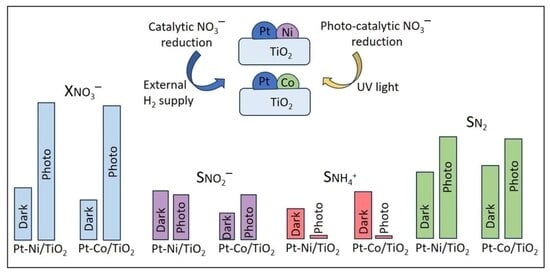
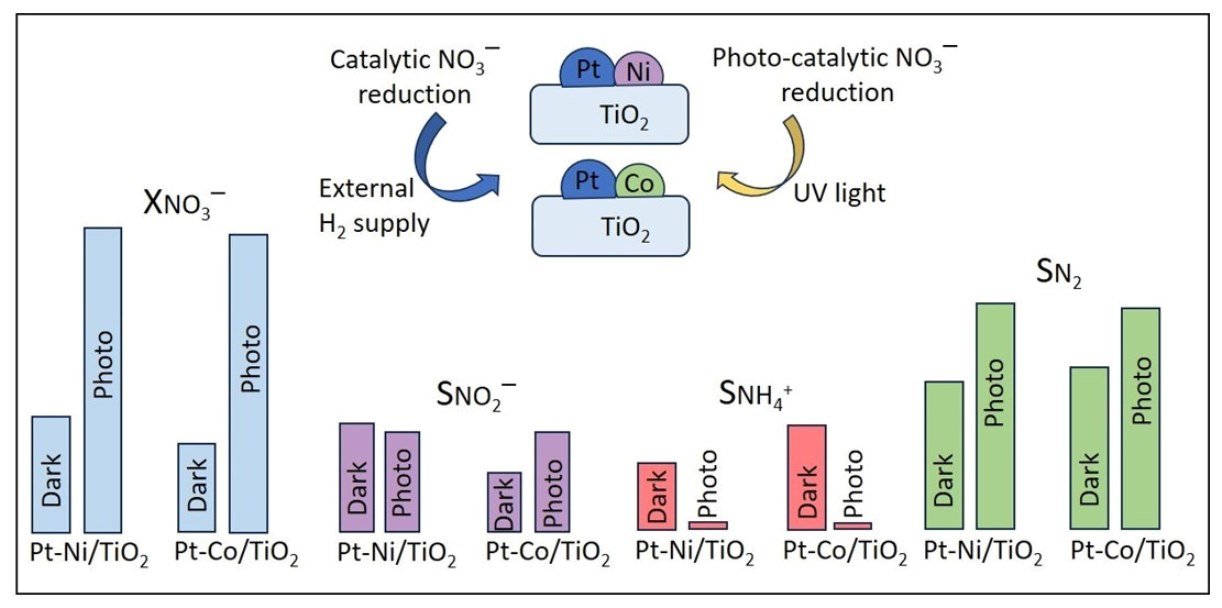
This study addresses the urgent issue of nitrate-contaminated water by investigating Ni-Pt and Co-Pt catalysts supported on TiO2, with the aim of improving both photocatalytic efficiency and reaction selectivity. The influence of adding non-noble metal co-catalysts to TiO2, in addition to Pt, was explored. The synthesized samples were characterized by scanning electron microscopy (SEM), powder X-ray diffraction (XRD), hydrogen temperature-programmed reduction (H2-TPR), diffuse reflectance UV–Vis spectroscopy, photoluminescence (PL), and X-ray photoelectron spectroscopy (XPS). The assessment of catalytic performance was conducted during the catalytic hydrogenation of nitrate, followed by an evaluation of the photocatalytic performance achieved when the aqueous nitrate solution was irradiated with UV light. The focus is on assessing the synergistic effects of the catalysts supported on TiO2 in nitrate reduction, as well as their selectivity towards benign reaction products during the photocatalytic process, in contrast to the reactions occurring in the absence of light. Despite the selectivity for nitrite being preserved, the photocatalytic experiments indicated that the selectivity for N2 reached around 68%, which is about 1.5 times higher than the values observed during the dark catalytic reaction. In contrast, the selectivity for ammonium saw a notable reduction. The findings were discussed in relation to the characteristics of the synthesized materials.

Graphical Abstract

1. Introduction

Pollution of aquatic ecosystems with nitrates (NO3) is a major environmental problem globally [1,2]. The extensive use of nitrogen-based fertilizers, the combustion of fossil fuels, and the release of industrial and domestic wastewater lead to widespread contamination. In addition to causing serious ecological damage, NO3 also poses significant threats to public health through consumption of contaminated drinking water or through the food chain, where it can be converted to nitrite (NO2), thereby increasing the risk of various health conditions [3]. In various parts of the world, regulators have imposed stringent restrictions on NO3 levels in water, with the World Health Organization (WHO) setting a maximum contaminant level of 50 ppm, underscoring the stringent demand for effective remediation technologies. Given the harmful effects of nitrate on both human health and ecosystems, international environmental regulatory bodies, including the U.S. Environmental Protection Agency (USEPA) and WHO, have established a maximum permissible concentration of 10 mg NO3/L in drinking water. In contrast, the European Union (EU) has proposed limits of 50 mg/L for NO3, 0.1 mg/L for NO2, and 0.5 mg/L for NH4+ [4,5,6].
In the realm of innovative wastewater treatment technologies, advanced oxidation processes (AOPs) [7,8,9] that employ photochemical or photocatalytic techniques [10,11] are becoming increasingly vital. The application of photocatalytic treatments extends to reduction processes as well, such as denitrification, which seeks to convert nitrate into benign nitrogen gas [12]. The capability and selectivity of a photocatalytic system for the reduction of nitrate to dinitrogen are determined by the parameters that control the reaction. Importantly, the selectivity greatly depended on the nature of the photocatalytic material used. Although several research papers detail the removal of organic and inorganic pollutants through photocatalytic methods, the photocatalytic reduction of nitrate in water remains relatively underexplored. The primary obstacle is the difficulty of obtaining a photoactive material that can effectively and selectively reduce water-soluble nitrate to N2 gas. As particles are subjected to incident light whose energy surpasses the semiconductor band gap, electrons (e) begin to be excited into the conduction band (CB), resulting in the formation of positive holes (h+) that facilitate oxidation and reduction processes. The relationship between the energy position of the photocatalyst’s band and the redox potential is notably close, as the reduction reaction is triggered when the conduction band potential is more negative than the reduction potential of the relevant species [13]. Conversely, the oxidation reaction requires the valence band potential to surpass the oxidation potential of the species involved.
Among oxide photocatalysts, titanium dioxide (TiO2) has been intensively used in photocatalysis [14,15] and environmental pollutant cleanup applications [16,17,18,19,20,21]. Although titanium dioxide is used extensively in water remediation, the effect of common anions such as nitrate on its photocatalytic performance has not been thoroughly investigated [22]. In the last few years, various investigations have been undertaken to refine the catalytic reduction process of NO3, indicating that bimetallic catalysts are superior to monometallic ones. These bimetallic catalysts consist of a noble metal, predominantly Pt, Pd, Rh, or Ru, alongside a transition metal such as Cu, Sn, or In. Although the precise reaction mechanism is not yet completely elucidated, the most widely accepted model [23] posits that the promoting metal is crucial for the reduction of NO3 through a redox process, while the noble metal’s primary role is to regenerate the promoting metal via spilled-over hydrogen (which is chemisorbed) [24,25]. Noble metals themselves lack activity in the NO3 reduction; however, they demonstrate significant efficacy in nitrite degradation, which is thought to occur through activated hydrogen [26]. Noble metal nanoparticles, including platinum, lower the kinetic barrier for interfacial electron transfer at the semiconductor interface, thereby enhancing hydrogen evolution catalysis. Additionally, these nanoparticles facilitate electron transfer, which is crucial for efficient catalytic activity in hydrogen production [27,28]. Although a precious metal co-catalyst, especially platinum (Pt), exhibits outstanding performance in photocatalytic reactions [29,30], it is quite expensive. Therefore, another important base metal co-catalyst, i.e., nickel (Ni), is proposed due to its much lower cost-effectiveness. So far, several approaches for the synthesis of supports and heterogeneous catalysts/photocatalysts have been examined [31,32]. The impregnation method is commonly employed for the loading of co-catalysts onto supports, including NiO/TiO2 in earlier literature [33]. A considerable gap exists in direct research concerning the application of Pt-Ni/TiO2 for nitrate reduction, although there are investigations into related catalytic materials. This situation points to a valuable opportunity for further research, as the current literature does not provide comprehensive coverage of this specific catalyst combination. In addition, the lack of focused studies on Pt-Ni/TiO2 indicates significant potential for future research. Its role and effectiveness in nitrate reduction are still inadequately explored. Gao et al. [34] prepared bimetallic Ni–Cu/TiO2 to remove nitrate in water, and the experiment showed that Ni–Cu/TiO2 had stronger photocatalytic activity than Pt/TiO2, Ni/TiO2, and Cu/TiO2 deposited by a single metal.
To gain insights into the enhanced activity of binary catalysts such as Pt-Co and Pt-Ni in the oxidation–reduction reaction, these catalysts were developed and characterized using various techniques. The Pt-Co and Pt-Ni binary alloy catalysts demonstrated superior activity compared to a single Pt catalyst with the same surface area, due to the decreased Pt-Pt adjacent distance [35,36]. Despite the frequent use of platinum (Pt) and cobalt (Co) independently with TiO2 in nitrate reduction research, there are relatively few studies that combine Pt and Co supported on TiO2 for this purpose, especially when compared to other combinations like Pt-Cu or Co-doped variants. This particular formulation seems to be an emerging focus within the wider field of noble metal-enhanced transition metal oxide catalysts. In the context of TiO2−based photocatalysts for nitrate reduction, a central inquiry is how to enhance the photocatalytic conversion of nitrate (NO3) to desired products, such as nitrogen gas (N2), while also improving selectivity and efficiency, particularly through metal doping on TiO2. Research is concentrating on specific areas, such as managing selectivity towards nitrogen. Another approach could involve addressing low selectivity and the formation of toxic by-products such as nitrite (NO2) by optimizing catalysts to favor the generation of N2. Additionally, enhancing the separation of photogenerated electron–hole pairs is crucial. An investigation into the effects of noble metals (such as Pt) and transition metals (such as Ni and Co) on TiO2 in this context is very important. Another research avenue could explore how the interaction of bimetallic systems (e.g., Pt-Ni, Pt-Co) on the TiO2 support optimizes nitrate adsorption and the mechanism of the hydrogenation reaction.
In light of these considerations, the current research presents the synthesis and characterization of Ni-Pt and Co-Pt catalysts supported on TiO2. This is followed by an assessment of their catalytic performance in the nitrate reduction reaction. The intention behind adding non-noble metal co-catalysts to TiO2, in addition to Pt, was to explore their interactions and properties in both catalytic hydrogenation and the photocatalytic reduction of nitrates. The catalytic hydrogenation was carried out using hydrogen as the reducing agent. Subsequently, photocatalytic testing was performed to assess selectivity towards the resultant products, with a specific focus on the selectivity for non-toxic nitrogen.

2. Results and Discussion

2.1. Scanning Electron Microscopy (SEM-EDX)

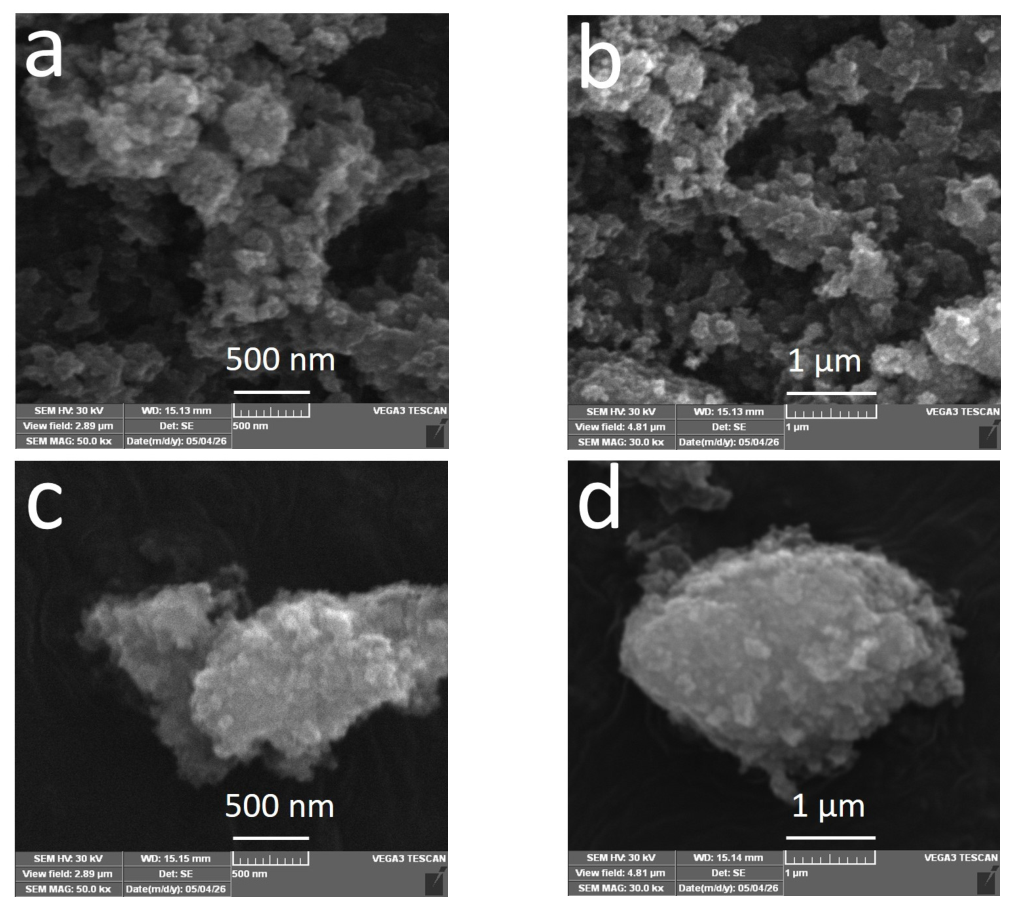
The morphology of Pt-Ni/TiO2 and Pt-Co/TiO2 materials has been investigated using scanning electron microscopy (SEM) on a Tescan Vega3 LMH instrument equipped with a BSE detector and EDS spectrometer (TESCAN Brno, s.r.o., Brno, Czech Republic) (Figure 1).
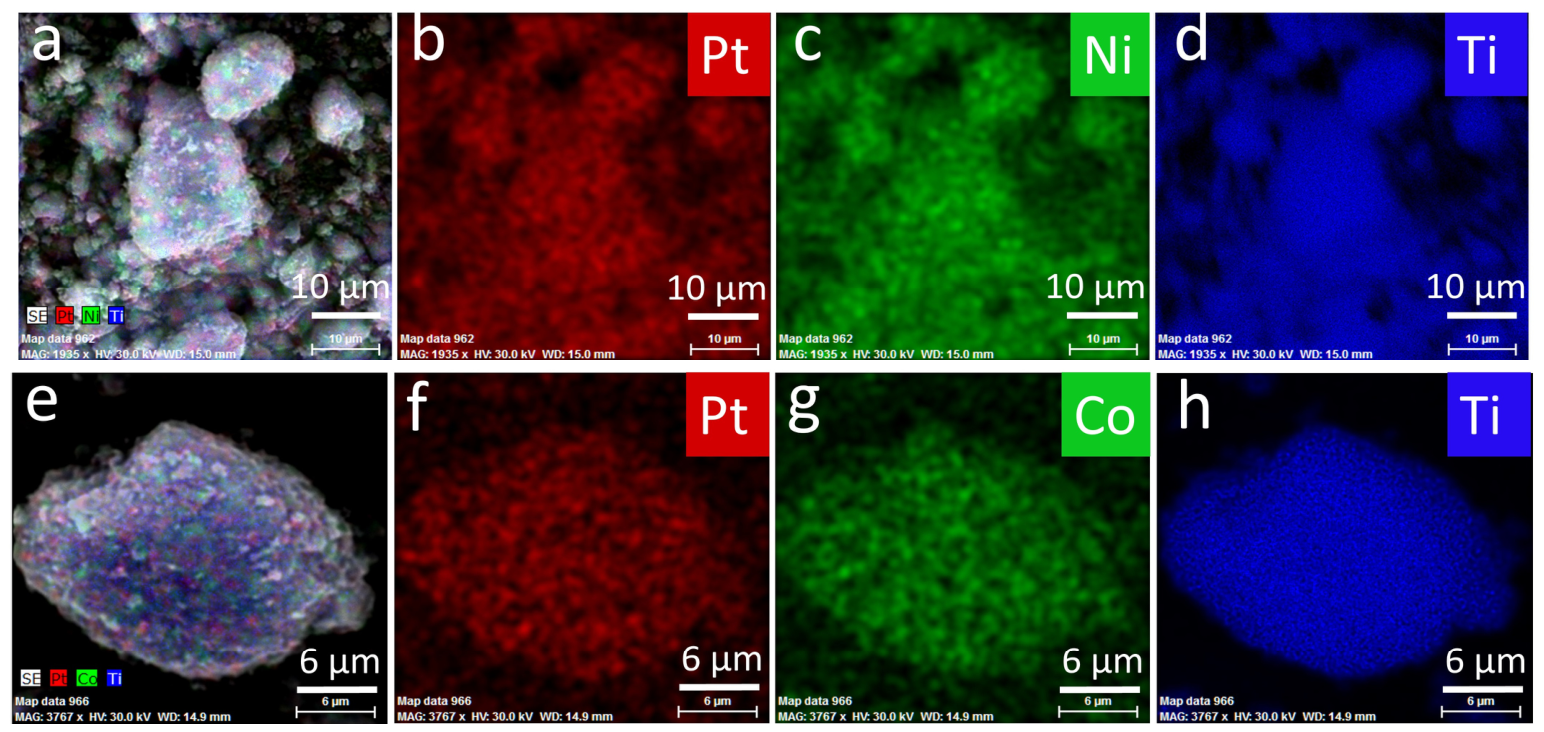
To investigate the elemental composition and its distribution within the sample, SEM/EDX mapping was employed (Figure 2 and Figure 3).
The specific granular structure and morphology associated with TiO2 in the Ni-Pt/TiO2 sample (Figure 1a,b) are notably more compact in the Co-Pt/TiO2 sample (Figure 2a,b). The brighter sections indicate the presence of impregnated metals, a conclusion that is further supported by SEM-EDX analysis.
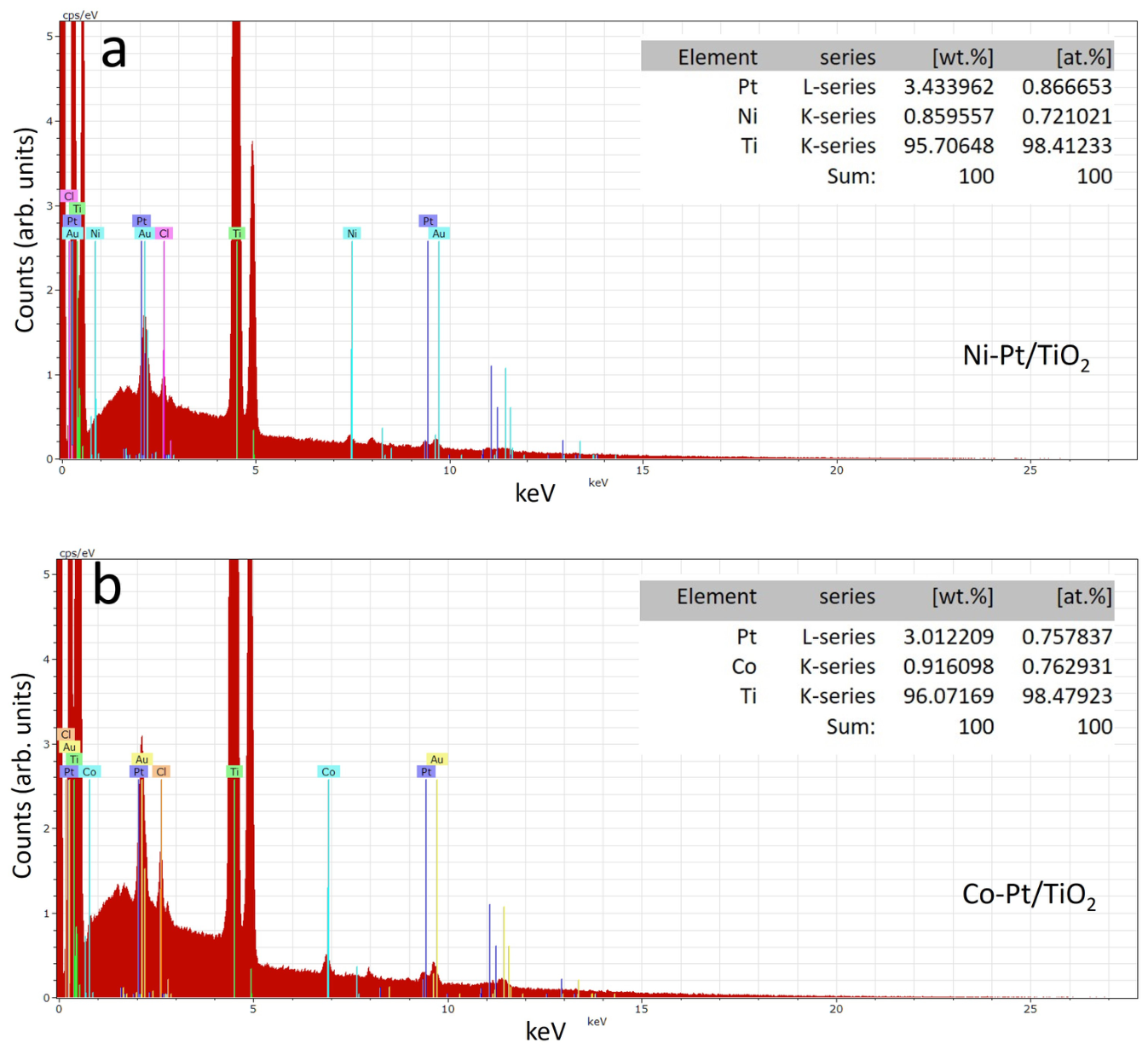
The composition of the samples was evaluated by EDX analysis (Figure 3). In Figure 3a,b, the molar ratios of Pt and Ni atoms, and Pt and Co atoms are 0.86:0.72 and 0.75:0.76, respectively, which are very close to the theoretical ratio of 1:1.
Elemental mapping illustrates the existence of Pt, Ni, Co, or Ti (Figure 2a–h). It was observed in Figure 2b–d,f–h that there is a relatively uniform distribution of Ti and metal atoms within the Ni-Pt/TiO2 and Co-Pt/TiO2 configurations.

2.2. X-Ray Diffraction (XRD) and Temperature-Programmed Reduction in Hydrogen (H2-TPR)

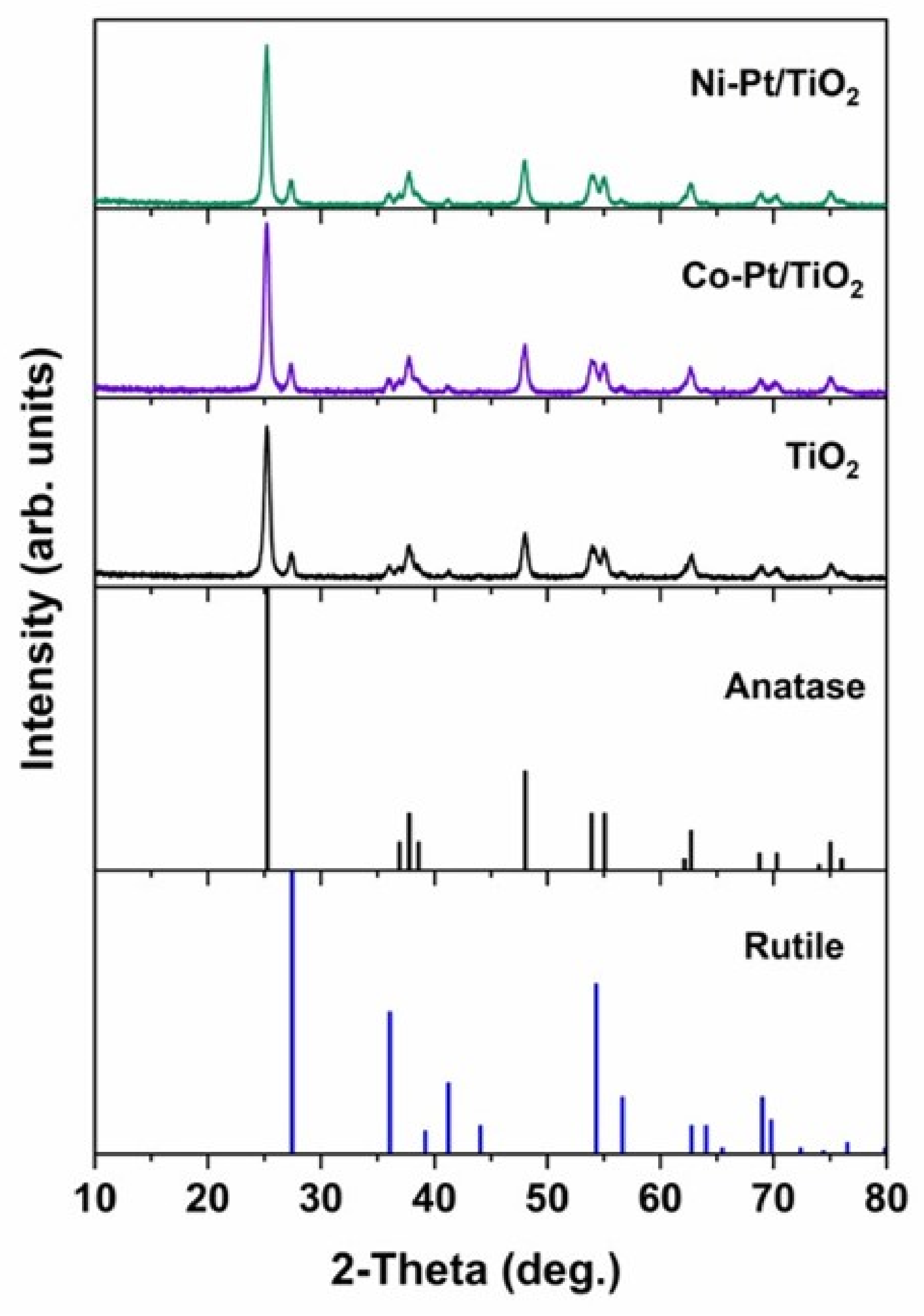
The crystallographic structures of the samples were studied by XRD (Figure 4). Diffraction peaks ascribed to TiO2 were observed for both samples, indicating its crystalline nature. As shown in Figure 4, the observed peaks for Ni-Pt/TiO2 and Co-Pt/TiO2 correspond to the characteristic diffraction patterns of anatase (JCPDS card no. 00-021-1272) and rutile (JCPDS card no. 00-021-1276) TiO2 crystalline phases, respectively. Higher peaks of diffraction intensity of TiO2 as anatase phase appeared at 25.20°, 38.42°, 47.94°, 53.84°, 54.98°, 62.71°, and 25.20°, 38.61°, 47.97°, 53.88°, 54.96°, 62.67°for Ni-Pt/TiO2 and Co-Pt/TiO2, respectively. Strong intensity of TiO2 as rutile phase appeared at 27.33°, 35.98°, 56.47°, and 27.32°, 35.95°, 56.59° for Ni-Pt/TiO2 and Co-Pt/TiO2, respectively.
The absence of reflections related to Ni, Co, and/or Pt in the samples can be attributed to the low levels of deposited metals (0.5 wt.% for Ni and Co, and 1.5 wt.% for Pt), which do not surpass the sensitivity limit of the XRD method. The absence of characteristic XRD reflections can be attributed to the extremely small size of the Pt, Co-Pt, and Ni-Pt particles. Accordingly, these components do not alter the underlying crystalline phase (such as pristine anatase or rutile).
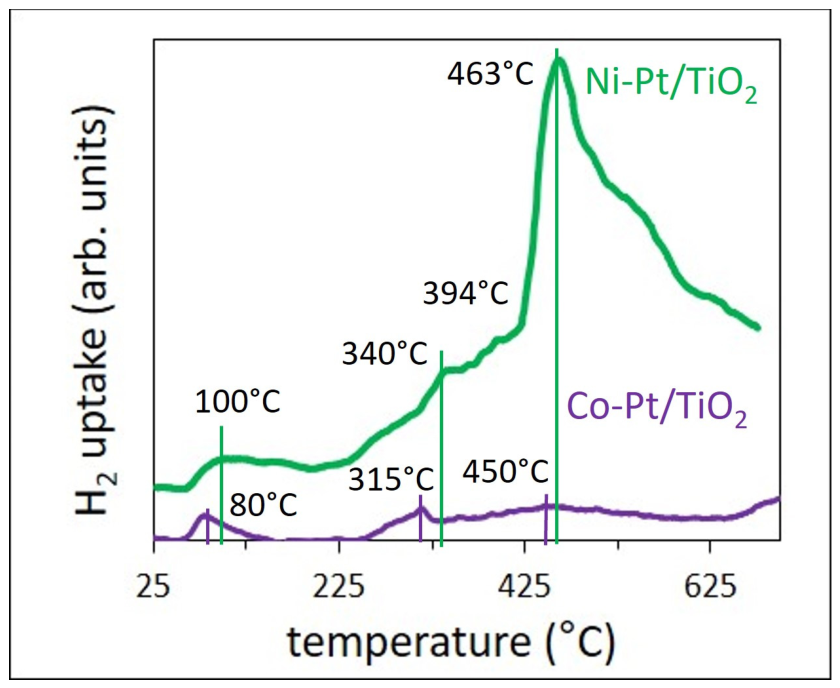
The redox behavior of Pt, Ni, and Co species on Ni-Pt/TiO2 and Co-Pt/TiO2 was further investigated by H2-TPR. TPR profiles for TiO2-based catalysts are presented in Figure 5.
The H2-TPR profile of a bimetallic Ni-Pt/TiO2 catalyst typically shows two main reduction events: a low-temperature peak (below ~225 °C) for highly dispersed PtOx species and hydrogen spillover, and a broad, shifted high-temperature region (~300 °C to 500 °C) corresponding to the reduction of bulk and interacting NiO species [37,38].
The low-temperature peak (<225 °C) is attributed to the easy reduction of platinum oxide [39]. Due to a strong bimetallic electronic interaction, dissociated hydrogen spills over from the reduced Pt to nearby Ni and Co species, as well as to the TiO2 support. Pt species (PtOx) are reduced at a lower temperature for Co-Pt/TiO2 (80 °C) compared to Ni-Pt/TiO2 (100 °C).
The high-temperature peak (~300–500 °C) represents the reduction of Ni2+ to Ni0. When Pt interacts with Ni, the reduction peak shifts to a significantly lower temperature compared to a monometallic Ni/TiO2 catalyst. Ni–Pt interaction reduces at lower temperatures than Ni-only catalysts because Pt facilitates H2 dissociation and hydrogen spillover, accelerating NiO reduction. This promotional effect lowers the activation energy required for Ni reduction. Monometallic Ni catalysts tend to re-oxidize or reincorporate into the TiO2 support lattice, requiring higher temperatures to reduce again. Pt suppresses these processes, keeping Ni in a more easily reducible state [40]. This proves that the Pt-Ni interfacial contact makes the nickel species much easier to reduce.
For Ni-Pt/TiO2 (Figure 5), a significant reduction maximum is observed at 463 °C, which is attributed to the reduction of Ni2+ ions (from the bulk) that have interacted with the support. A small high-temperature shoulder above 500 °C may appear, indicating a very strong metal–support interaction (SMSI) between NiO species and the TiO2 surface [41]. The presence of shoulders at 340 and 394 °C indicates the reduction of dispersed Ni2+ ions (from the surface), occurring alongside the major peak (Figure 5).
The H2-TPR profile of a Pt-Co/TiO2 bimetallic catalyst typically features two main reduction stages from 400 °C to 700 °C [42]. The addition of platinum acts as a promoter, shifting the cobalt reduction to significantly lower temperatures compared to a monometallic Co/TiO2 catalyst. Co–Pt/TiO2 catalysts show lower H2 TPR reduction temperatures than monometallic Co/TiO2 because Pt promotes cobalt reducibility by enhancing H2 activation, suppressing Co particle aggregation, and weakening metal–support interactions [43].
The low-temperature region (200–350 °C) corresponds to the reduction of highly dispersed, easily reducible cobalt oxide species (such as Co3O4 → CoO and CoO → Co0) and any surface platinum oxides. Platinum facilitates hydrogen spillover, which triggers the reduction of neighboring cobalt phases at lower temperatures. In the high-temperature region (350–600 °C), the reduction of larger cobalt oxide particles (bulk-like Co3O4) and cobalt species that interact with the TiO2 support occurred. The reduction of dispersed Co3+ and Co2+ ions is indicated by shoulders at 280 °C, followed by a peak at 315 °C due to Co2+ ions that have interacted with the support (Figure 5). A broad reduction maximum at 450 °C is due to Co2+ with a relatively stronger interaction with the support (Figure 5). The quantitative data in Table 1 show a substantial increase in hydrogen consumption for the Ni-Pt/TiO2 catalyst (1667.7 µmol H2/g) compared with the Co-Pt/TiO2 sample (335.1 µmol H2/g), indicating a markedly higher extent of reducible surface species in the Ni-Pt system.

2.3. Diffuse Reflectance UV–Vis Spectroscopy (UV–Vis)

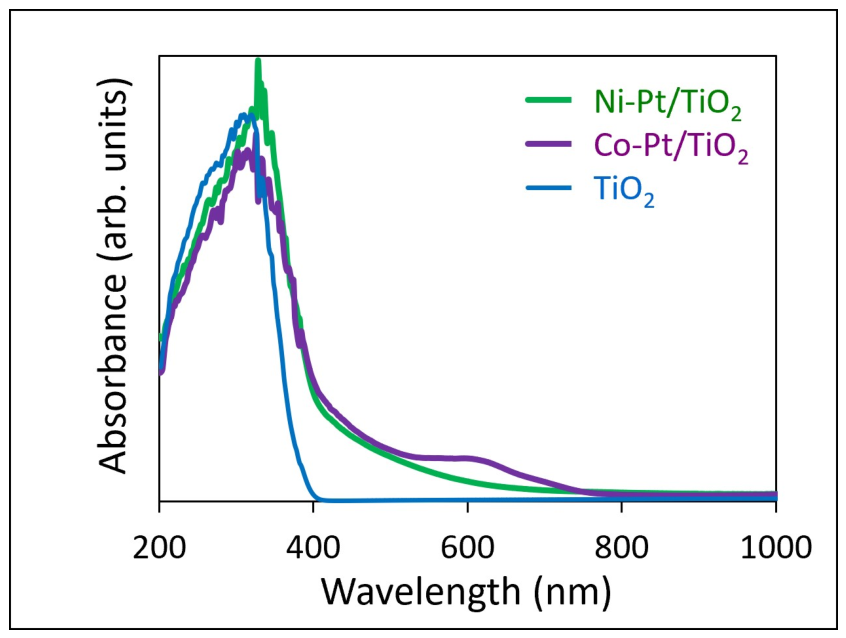
UV–Vis diffuse reflectance measurements were performed, and the results are presented in Figure 6.
All samples exhibit strong UV absorption at wavelengths below ~400 nm due to TiO2 band-to-band transitions [44]. The Ni-Pt/TiO2 sample exhibits absorption within the visible domain, extending to 600 nm. Platinum particles facilitate interfacial charge transfer. From the literature, when interacting as Pt-Ni, bimetallic clusters typically exhibit a broad, continuous absorption enhancement across the 400–600 nm range [45].
The Co-Pt/TiO2 profile also features strong UV absorption at ≈380 nm from the TiO2 bandgap, alongside a visible-light ‘redshift’ and broadened absorption tail caused by Pt-Co doping, resulting in intra-bandgap states. The UV region (200 nm−380 nm) is dominated by intrinsic O2− → Ti4+ charge transfer. Pure TiO2 is essentially transparent in the visible spectrum (400−800 nm). The addition of different elements introduces impurity energy levels (mid-gap states). The modified TiO2 samples exhibit enhanced visible-light absorption, particularly for Co-Pt/TiO2. The Co-Pt/TiO2 presents absorption bands in the 550–620 nm range. This absorption might be attributed to the metal charge on Co3O4 nanoparticles and indicates the presence of Co2+ [46,47]. The band gap energy of pristine TiO2 was 3.42 eV in concordance with the Tauc method for direct transitions (η = 1/2).

2.4. Photoluminescence Spectroscopy (PL)

The photoluminescence (PL) signals observed in semiconductor materials result from the recombination of charge carriers that are generated by light [48]. In most cases, a lower PL intensity indicates a reduced recombination rate of photogenerated electron–hole pairs, which is associated with an increased photocatalytic activity of semiconductor photocatalysts [15,49].
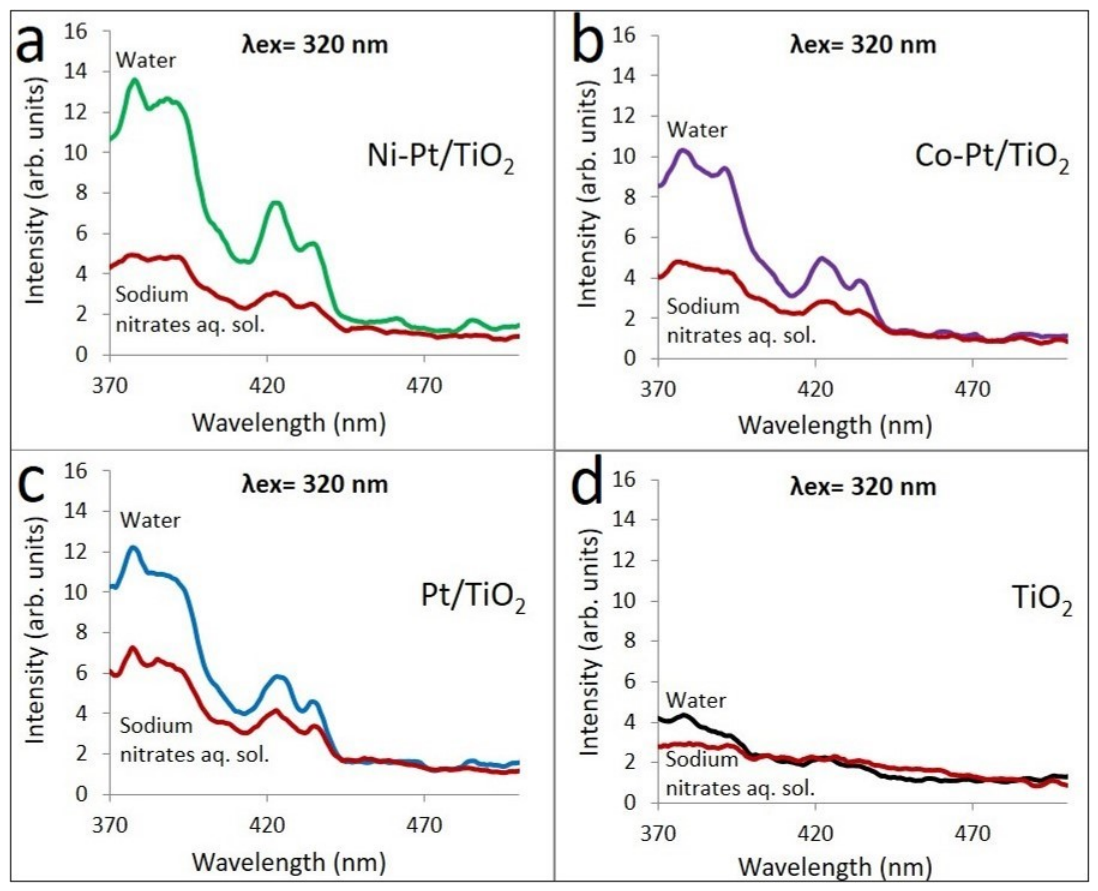
In this study, the PL emission spectra of Ni-Pt/TiO2 and Co-Pt/TiO2 catalysts in water and in aqueous nitrate solution were examined in the wavelength range of 370–500 nm, as shown in Figure 7a,b. For comparison purposes, Pt/TiO2 (Figure 7c) and TiO2 (Figure 7d) were evaluated. All samples were calcined at 400 °C.
Within the spectral range from 370 to 450 nm (Figure 7a–c), two significant pairs of photoluminescence (PL) peaks can be identified: the initial pair occurs at approximately 380–390 nm, while the subsequent pair is found at around 425–435 nm. According to the literature data, photoluminescence at 380–390 nm excitation corresponds to the near-band-edge emission of TiO2. Generally, unmodified TiO2 exhibits peaks near 394 nm (band edge) and broad defect/oxygen vacancy bands around 432 nm or 537 nm [50]. Based on the existing literature data, the peak observed at 394 nm could be assigned to the transition from Ti+4 3d states to O2− 2p states. The peak at 432 nm can be attributed to the transition from Ti+4 3d states to the deep acceptor level OH, while the peak at 537 nm corresponds to the transition from the deep donor level induced by an O vacancy to the ground state of O2− 2p states. The main sites for trapped electrons and holes are oxygen vacancies and surface hydroxyl groups. These carriers, which become immobilized by oxygen vacancies and surface hydroxyl groups, play a significant role in the visible luminescence observed in materials [50,51].
The reduced photoluminescence of the TiO2-based samples in aqueous nitrate solution, relative to the same samples suspended in water (Figure 7a–c), indicates that the photogenerated charges are being used in an induced chemical reaction by the presence of nitrates at the catalyst surface. A slight increase in PL quenching in nitrate solution is observed for the Ni-Pt/TiO2 sample (Figure 7a) compared with the Co-Pt/TiO2 sample (Figure 7b). This aligns with the results obtained from the photocatalytic tests, which will be discussed later.

2.5. X-Ray Photoelectron Spectroscopy (XPS)

The elemental composition and chemical state of the catalytic materials were assessed through X-ray photoelectron spectroscopy (XPS). The XPS spectra indicated the presence of Ti, O, Pt, Ni, Co, and C (with C a common contaminant) on the surfaces of the Ni-Pt/TiO2 and Co-Pt/TiO2 catalysts. Table 2 presents the surface element contents (at. %) derived from the XPS measurements.
The XPS examination of both samples reveals that the relative atomic percentage of Pt is the same, 0.4 (as shown in Table 2). Conversely, Ni is present at a double atomic percentage of 0.8, compared with Co, at 0.4.
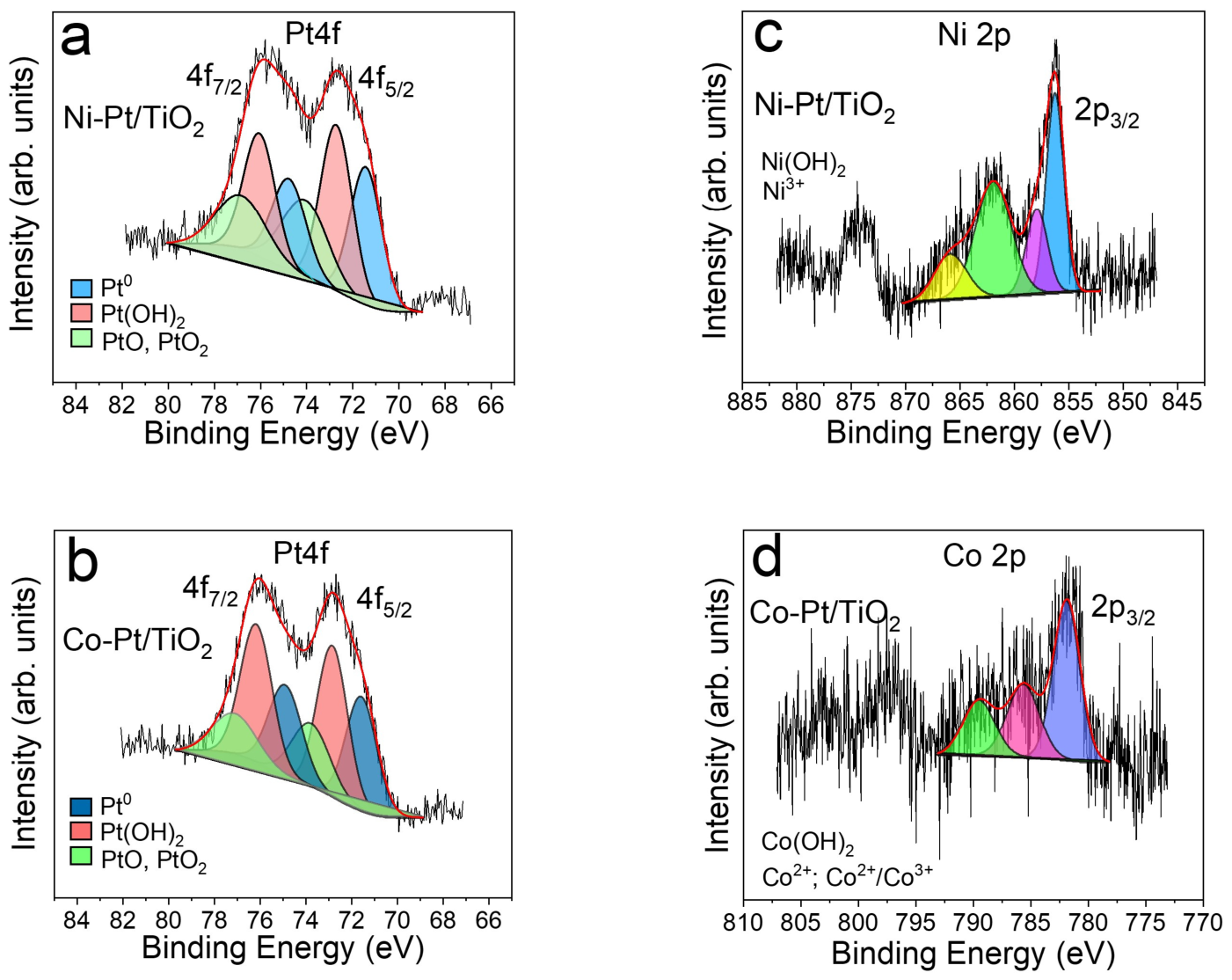
In Figure 8, the XPS spectra for the Pt 4f (Figure 8a,b), Ni 2p (Figure 8c), and Co 2p (Figure 8d) regions are illustrated for the Ni-Pt/TiO2 and Co-Pt/TiO2 catalysts.
In the region corresponding to Pt 4f in the XPS scans (refer to Figure 8a,b), the blue doublet signifies the metallic state, Pt0 [44,52]. As illustrated in Figure 8a,b, the Pt 4f7/2 and Pt 4f5/2 lines are observed at 71.44–74.77 eV and 71.55–74.88 eV for Ni-Pt/TiO2 and Co-Pt/TiO2, respectively, which are attributed to metallic platinum (Pt0). The second red doublet presents lines at 72.72–76.05 eV and 72.80–76.14 eV for Ni-Pt/TiO2 and Co-Pt/TiO2, respectively, suggesting the presence of Pt2+, characteristic of Pt (OH)2. The third green doublet, at 74.08–76.84 eV and 73.76–77.09 eV for Ni-Pt/TiO2 and Co-Pt/TiO2, respectively, can be associated with Pt2+ and Pt4+, suggesting the presence of platinum oxides (PtO and PtO2).
The spectrum acquired for Ni in the Ni-Pt/TiO2 sample exhibits significant noise (Figure 8c); the Ni 2p3/2 peak was analyzed. The Ni 2p3/2 feature is complex, characterized by notable multiplet splitting at binding energies of 856.17, 857.84, 861.86, and 865.83 eV. Typically, the interpretation of Ni 2p3/2 involves comparing the spectrum’s shape with those of standard compounds and examining the binding energies of the observed peaks. In our analysis, the spectrum closely resembles that of the Ni (OH)2 compound. Additionally, at a binding energy exceeding 856.17 eV, the Ni3+ state can also be present.
The Co 2p signal in XPS spectra for Co-Pt/TiO2 also exhibited significant noise (Figure 8d). Typically, the binding energy of Co 2p3/2 shows minor shifts. Due to the noise in this signal, the energy of the highest peak, 781.84 eV, can be attributed to various compounds, with a high probability of it being a hydroxide. It can also include contributions from highly dispersed Co2+ ions interacting strongly with the TiO2 support. Additionally, Co 2p displays a complex multiplet structure at binding energies of 781.84, 785.59 and 789.49 eV, associated with the Co2+ state (or mixed-valence Co2+/Co3+ spinels).
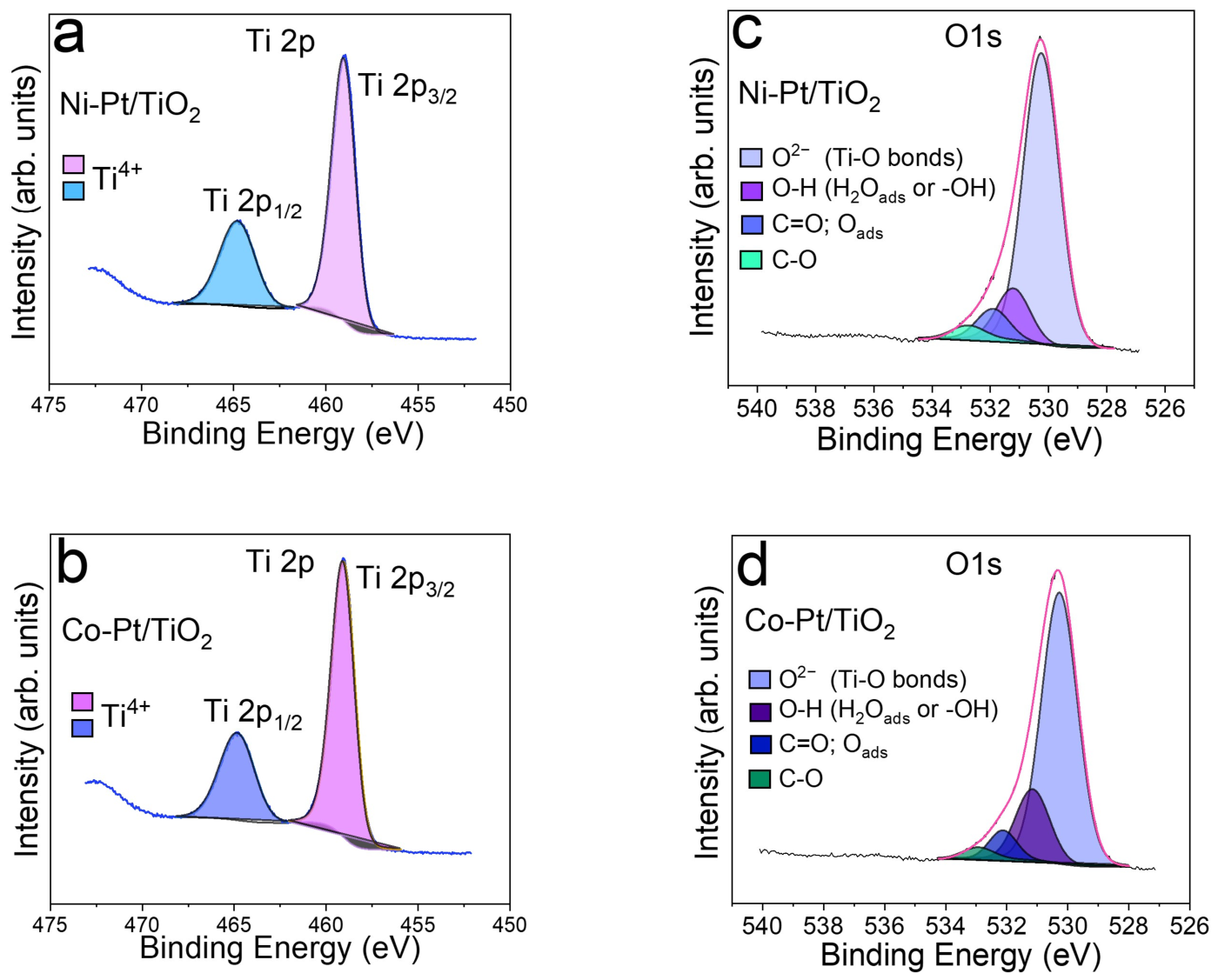
Figure 9a,b illustrate the Ti 2p XPS spectra, which display two peaks at 459.05–464.81 eV for Ni-Pt/TiO2 (Figure 9a) and 458.99–464.77 eV for Co-Pt/TiO2 (Figure 9b). These peaks are attributed to the Ti 2p3/2 and Ti 2p1/2 core levels, respectively, suggesting a standard oxidation state of Ti4+ in the TiO2 [53]. The decomposed peaks of the O 1s core level in the XPS spectra over the catalysts are presented in Figure 9c,d. The binding energies (BE) of 530.22 eV and 530.24 eV for Ni-Pt/TiO2 (Figure 9c) and Co-Pt/TiO2 (Figure 9d), respectively, can be linked to oxygen from TiO2; 531.18 eV and 531.12 eV correspond to metallic hydroxide; 531.88 eV and 532.09 eV are associated with double bonds C=O and adsorbed oxygen; while 532.74 eV and 532.91 eV relate to single bonds C-O.
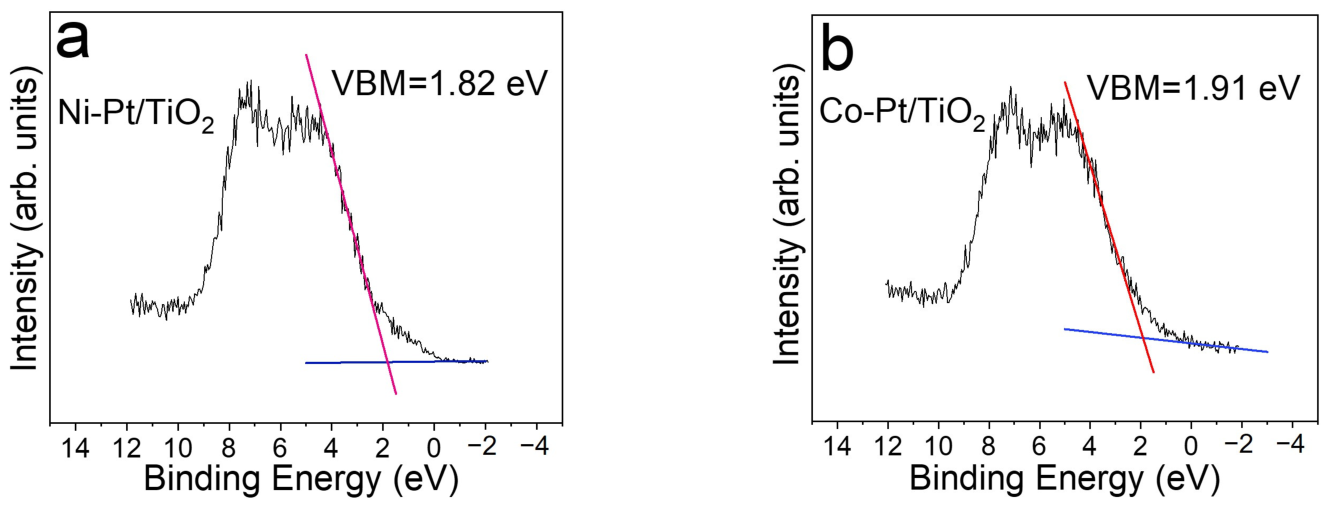
Extracting the valence band maximum (VBM) from XPS involves linearly extrapolating the leading edge of the valence band spectrum to the baseline binding energy. For standard undoped TiO2, the VBM typically lies around 2.6–2.8 eV below the Fermi level (EF). However, loading Ni-Pt and Co-Pt onto the surface modifies the electronic properties—often introducing interfacial states (e.g., due to Pt-O-Ti or Ni/Co-O-Ti interactions) that can shift the apparent VBM or induce tailing states.
Using XPS, the position of the valence band maximum relative to the Fermi level for TiO2-based samples was measured (Figure 10a,b).
The estimated values are VBM = 1.82 eV (Figure 10a) and 1.91 eV (Figure 10b) for Ni-Pt/TiO2 and Co-Pt/TiO2, respectively. Accordingly, the modified TiO2 samples have shifted the valence band energy relative to the Fermi level. At lower binding energies approaching 0 eV, a noticeable reduction in the curve’s steepness is observed, indicating potential metallic states for both samples. These values indicate the energy gap between the highest occupied electron states (VBM) and the Fermi level (EF).
Thus, for the Co-Pt/TiO2 sample, the valence band edge is slightly lower than the EF compared to the Ni-Pt/TiO2 sample, reflecting differences in their interfacial electronic structures. A higher VBM for the Co-Pt/TiO2 catalyst could indicate that its photogenerated holes have a higher oxidation potential (enhanced capacity for species oxidation). These energy levels indicate that Ni-Pt/TiO2 exhibits a stronger thermodynamic reducing power for photocatalytic nitrate reduction.
Photocatalytic nitrate reduction requires photogenerated electrons to break down NO3 ions. The typical standard redox potentials at neutral pH (pH = 7) for the competing pathways are (according to Equations (1)–(3)):
2NO3 + 12H+ + 10e → N2 + 6H2O (+0.75 V vs. NHE),
NO3 + 2H+ + 2e → NO2 + H2O (+0.42 V vs. NHE),
NO3 + 10H+ + 8e → NH4+ + 3H2O (+0.36 V vs. NHE),
If ECB values are significantly more negative than standard redox potentials, there is a strong thermodynamic driving force to reduce nitrate. However, Ni-Pt/TiO2 has a more negative conduction band position, meaning its photogenerated electrons have a higher overpotential, which typically accelerates the multi-electron transfer kinetics required to reduce nitrate to N2 or NH4+. Ni-Pt/TiO2 shifts the absorption edge slightly to the visible boundary, enhancing photon absorption under solar irradiation. This may impact the reactivity of NO3 during its photodegradation to N2 [54].
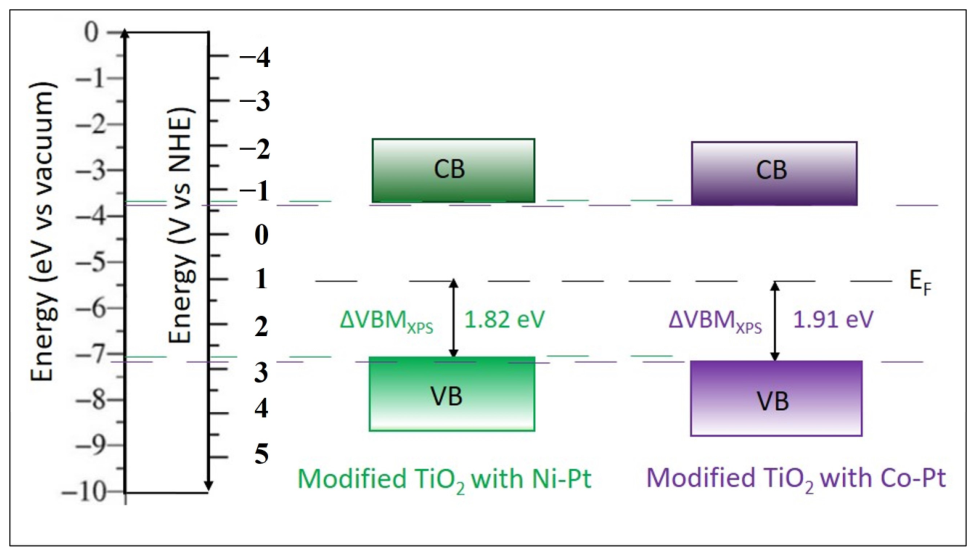
The reduction power of a photocatalyst is governed by its conduction band minimum (ECB). Referring to the energy on an absolute scale and presuming that the work function (φ) for NiO is 5.5 eV [55] and for CoO is 5.25 eV [56], we assume a work function of about 5.30 eV. The following calculations could be made for the conduction band minimum CBM and valence band maximum VBM on the absolute scale (CBMabs and VBMabs) and on the normal hydrogen electrode (NHE) scale (CBMNHE and VBMNHE) according to Equations (4)–(7), where Eg = 3.42 eV for pristine TiO2.
VBMabs = −(∆VBMXPS + φ)
CBMabs = VBMabs + Eg
CBMNHE = −CBMabs − 4.5
VBMNHE = CBMNHE + Eg
The obtained values for TiO2 modified with Ni-Pt are: VBMabs = −(∆VBMXPS + φ) = −(1.82 + 5.30) = −7.12 eV; CBMabs = VBMabs + Eg = −7.12 + 3.42 = −3.70 eV; CBMNHE = −CBMabs − 4.5 = −(−3.70) − 4.5 = −0.80 V; VBMNHE = CBMNHE + Eg = −0.80 + 3.42 = +2.62 V.
The same calculations are applied for TiO2 modified with Co-Pt: VBMabs = −(∆VBMXPS + φ) = −(1.91 + 5.30) = −7.21 eV; CBMabs = VBMabs + Eg = −7.21 + 3.42 = −3.79 eV; CBMNHE = −CBMabs − 4.5 = −(−3.79) − 4.5 = −0.71 V; VBMNHE = CBMNHE + Eg = −0.71 + 3.42 = +2.71 V. Based on these values, Figure 11 illustrates a schematic representation of the relative band positions for TiO2 modified with Ni-Pt and Co-Pt.

2.6. Reduction of Nitrates via Catalytic and Photocatalytic Approaches

The principal difficulty in implementing catalytic systems for the removal of nitrates from water is limiting the formation of nitrites and ammonium (byproducts) while promoting selectivity for harmless byproducts such as nitrogen gas (N2). To investigate the support effect and the interactions between platinum and nickel, as well as platinum and cobalt, we assessed the catalytic performance of bimetallic catalysts supported on TiO2 and dispersed in an aqueous nitrate solution.
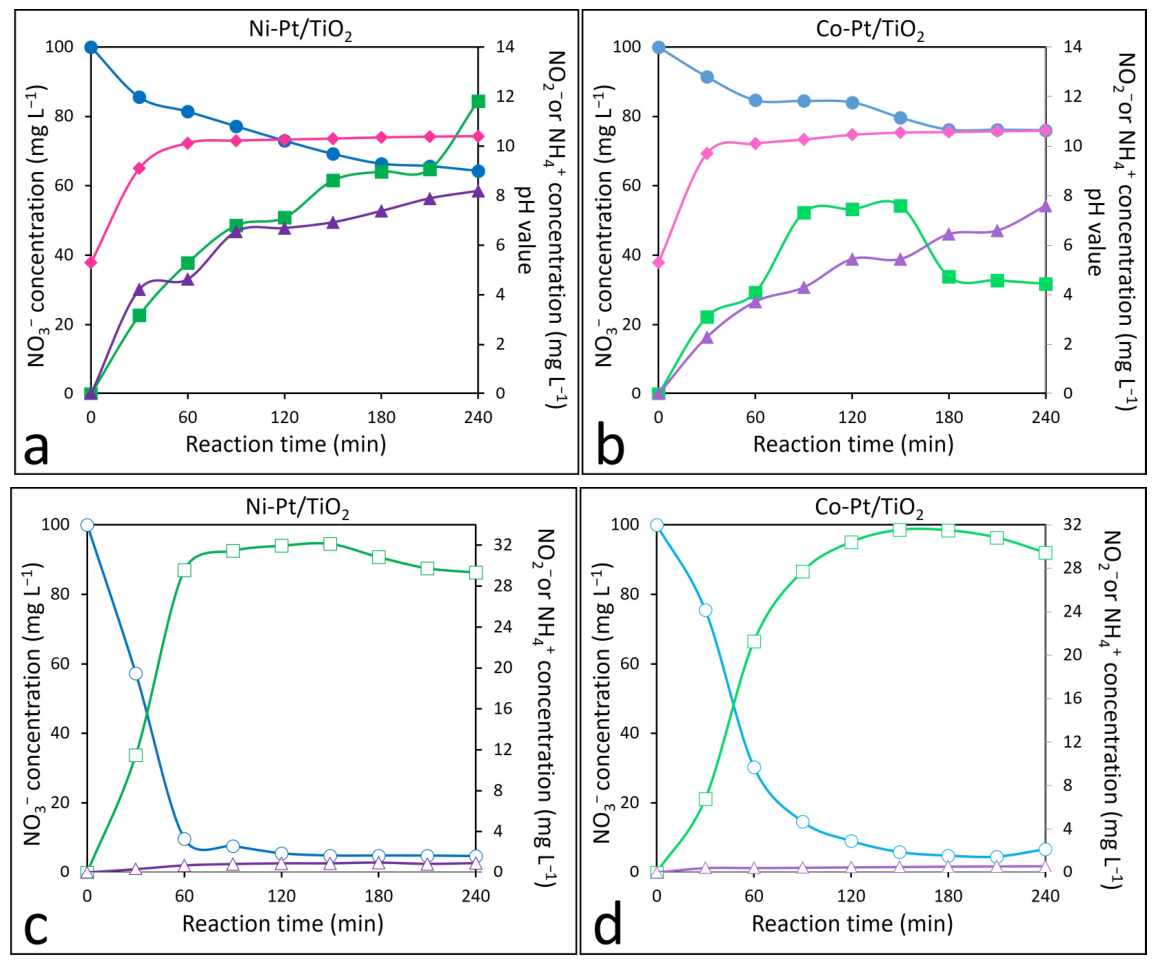
The variations in the concentrations of nitrate, nitrite, and ammonia ions, as well as the pH levels of the solution, during nitrate reduction experiments performed in dark conditions with hydrogen bubbling, using Ni-Pt/TiO2 and Co-Pt/TiO2 catalysts, are depicted as a function of time in Figure 12a,b.
Table 3 presents the NO3 conversion values and the selectivity for NO2, NH4+, and N2 after 4 h of catalytic hydrogenation (in the dark) and photocatalytic nitrate reduction (under UV light) over Ni-Pt/TiO2 and Co-Pt/TiO2 catalysts.
TiO2 in water generates reactive species (•OH radicals, O2 superoxide, OH, etc.) when irradiated with UV light. These reactive species can play important roles in the photocatalytic reaction mechanisms [57].
In the nitrate reduction experiments conducted in the absence of light, the pH of the aqueous nitrate solution is recorded (Figure 12a,b). The pH level influences the surface charges of the particles. An increase in pH is observed, which is attributed to the enhancement of the negative surface charge resulting from the formation of OH groups [3] and NH4+. The catalytic hydrogenation reaction indicates low nitrate conversion, with only 35.74% achieved for Ni-Pt/TiO2 and less than 24.01% for Co-Pt/TiO2 (Table 3). The formation of nitrite exhibits a steady increase for Ni-Pt/TiO2, achieving a selectivity of 33.00%. Conversely, Co-Pt/TiO2 shows an initial rise followed by a decline, resulting in a selectivity of 18.40%. Additionally, the selectivity for ammonium is significant, with values of 22.90% for Ni-Pt/TiO2 and 31.50% for Co-Pt/TiO2. The final calculations yield selectivity towards N2 of 44.10% for Ni-Pt/TiO2 and 50.10% for Co-Pt/TiO2 (Table 3).
During the photocatalytic reaction (Figure 12c,d), a notable decrease in nitrate concentration is observed. The nitrate conversion of 95.31% for Ni-Pt/TiO2 and 93.32% for Co-Pt/TiO2 is achieved. As anticipated, nitrate converts to nitrite, exhibiting selectivity values of 30.07% for Ni-Pt/TiO2 and 31.50% for Co-Pt/TiO2. Ammonia is generated in minimal quantities, with selectivity of merely 0.96% for Ni-Pt/TiO2 and 0.60% for Co-Pt/TiO2. In parallel, the selectivity towards N2 is 68.34% for Ni-Pt/TiO2 and 67.90% for Co-Pt/TiO2.
As a summary, nitrate conversion rates exceed 93% for each catalyst employed under UV exposure. Additionally, the selectivity for ammonium is lower in the photocatalytic reaction. The selectivity for non-toxic nitrogen markedly increases following the photocatalytic nitrate reduction, approximating 68%.
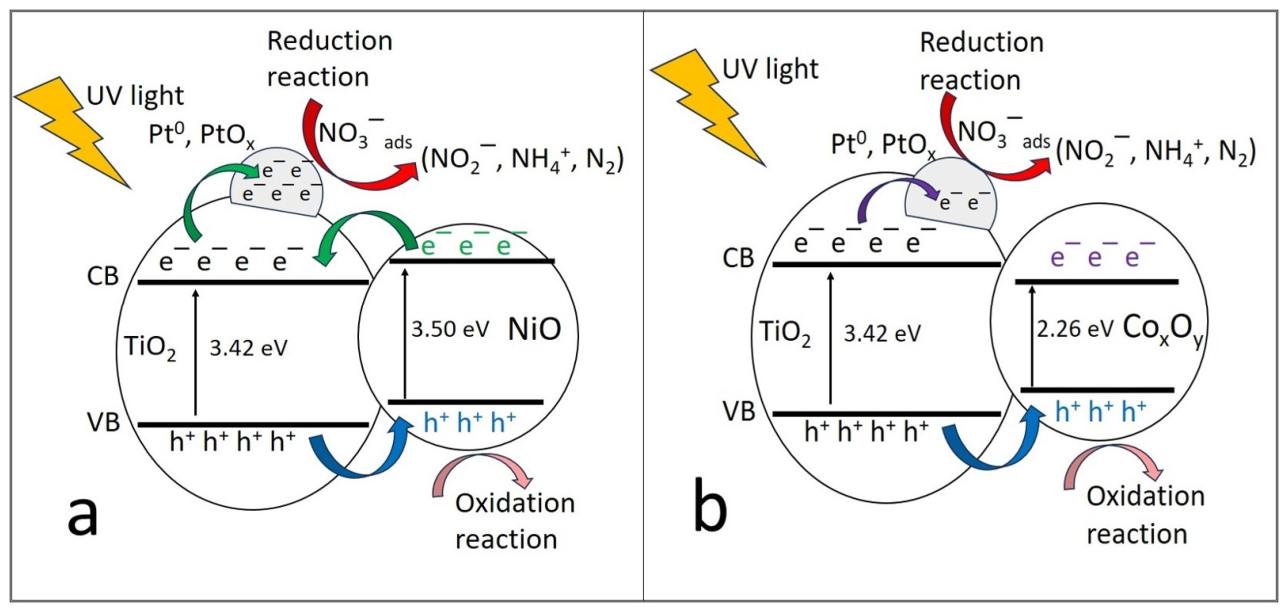
This modification of TiO2 facilitates the harnessing of a broader spectrum of solar energy, thereby markedly enhancing photocatalytic efficiency. Considering Ni-Pt/TiO2 and Co-Pt/TiO2 as heterojunction systems, the components form a highly efficient, spatially separated charge transfer pathway that reduces electron–hole recombination. Given the available literature data on Eg values of 3.50 eV [55] for NiO and 2.26 eV [56] for CoO, a mechanism illustrating charge transfer for Ni-Pt/TiO2 and Co-Pt/TiO2 photocatalysts is proposed in Figure 13a,b.
Ni-Pt/TiO2 (Figure 13a) is more efficient in separating electron (e)–hole (h+) pairs compared to Co-Pt/TiO2 (Figure 13b). Upon UV light irradiation, both NiO and TiO2 generate e–h+ pairs. Electrons photogenerated in the conduction band (CB) of NiO transfer to the CB of TiO2. Electrons are moved directly through TiO2 to the Pt. The accumulated electrons at the Pt particles readily participate in reduction reactions. The Pt particles serve as active catalytic sites for the reduction reaction by accepting electrons (e) from TiO2, therefore acting as an efficient electron trap to halt backward reactions.

3. Materials and Methods

3.1. Catalyst Preparation

The catalysts were synthesized using the wet incipient successive impregnation method. TiO2 (Aeroxide, 50 m2/g) was purchased from Evonik’s Nippon Aerosil, Yokkaichi, Japan. Some precursor solutions were prepared by adding the required volume of deionized water to H2PtCl6·6H2O (Wako Pure Chemical Industries, Ltd., Osaka, Japan), Ni (NO3)2·6H2O (Merck KGaA, Darmstadt, Germany), and Co (NO3)2·6H2O (Merck KGaA, Darmstadt, Germany), respectively.
In the preparation method, the loading of Ni2+ and Co2+ ions was performed by dropwise addition of 2 mL of aqueous solution containing Pt4+/Ni2+ and Pt4+/Co2+, respectively, to 1 g of TiO2 for 2 wt.% Ni-Pt and 2 wt.% Co-Pt. The total amount of metal was kept constant at 2 wt.% during the synthesis process.
In the first preparation step, Pt/TiO2 was prepared by incipient wet impregnation. The Ni-Pt loading was fixed at a molar ratio of 1:1, with a base of 1 g of support. The H2PtCl6 solution was mixed into the TiO2 support. The obtained Pt/TiO2 sample was dried for 1 h at 80 °C. Then, the Ni (NO3)2 solution was mixed with the Pt/TiO2 sample. The solid Ni-Pt/TiO2 powder was heated up to 400 °C for 2 h. The same procedure was followed to obtain the Co-Pt/TiO2 sample.
Before the photocatalytic tests, the synthesized materials were activated for 1 h at 400 °C in a hydrogen atmosphere.

3.2. Characterization

The prepared catalysts were examined by scanning electron microscopy (SEM), powder X-ray diffraction (XRD), temperature-programmed reduction in hydrogen (H2-TPR), diffuse reflectance UV–Visible spectroscopy, photoluminescence (PL), and X-ray photoelectron spectroscopy (XPS).
SEM: Scanning electron microscopy (SEM) images were recorded on a Scanning Electron Microscope VEGA3 (TESCAN Brno, s.r.o., Brno, Czech Republic) coupled with an energy-dispersive X-ray (EDX) detector (Tescan, Brno, Czech Republic).
XRD: Powder X-Ray diffraction patterns for the catalysts were recorded using a Rigaku diffractometer (Rigaku Corp., Tokyo, Japan), type Ultima IV, in parallel-beam geometry with Cu-Kα (λ = 1.5406 Å) radiation in the 2θ range of 10–80°, at a scan rate of 5°/min and a step size of 0.02°. Using the Williamson–Hall method, based on XRD data, the size of D crystallites was evaluated.
H2-TPR: Using a flow system incorporating a Chembet 3000 Quantachrome Instrument (Quantachrome, Boynton Beach, FL, USA), equipped with thermal conductivity detectors (TCD), temperature-programmed reduction experiments were performed. The reduction procedure was performed; the temperature ranged from room temperature to 800 °C, the heating rate was 10 °C min−1, while a reducing gas mixture (5% H2 in argon at a flow rate of 70 mL/min) was passed through it.
UV–Vis: UV–Visible spectra were recorded using a PerkinElmer Lambda 35 spectrophotometer (PerkinElmer, Shelton, CT, USA), with an integrating sphere (Shelton, CT, USA). Measurements were performed at room temperature over a wavelength range of 200−1100 nm, using a Spectralon (Labsphere, Inc., North Sutton, NH, USA) as a reference standard for reflectance. The reflectance data were subsequently converted into absorption spectra utilizing the Kubelka–Munk function, F(R).
PL: The photoluminescence spectroscopy measurements were performed at room temperature using a Cary Eclipse fluorescence spectrometer (Agilent Technologies, Bayan Lepas (Penang), Malaysia) with excitation/emission slits widths of 5/5 nm. The powders of interest (2 mg) were suspended in water and in an aqueous sodium nitrate solution. The excitation wavelength was 320 nm.
XPS: A SPECS spectrometer (SPECS Surface Nano Analysis GmbH, Berlin, Germany), with a PHOIBOS 150 analyzer (SPECS Surface Nano Analysis GmbH, Berlin, Germany), was used for X-ray Photoelectron Spectroscopy (XPS) measurements. Specs XR-50M RX source operated on a monochromatic Al anode (Ex = 1486.7 eV) at 300 W, with charge compensation using a Specs FG15/40 flood gun (SPECS Surface Nano Analysis GmbH, Berlin, Germany). Acquisition was done with a Pass Energy of 10 eV for individual spectra and 50 eV for the extended spectrum.

3.3. Catalytic Hydrogenation and Photocatalytic Testing for Nitrate Reduction

3.3.1. Catalytic Hydrogenation Test (In the Absence of Light)

The performance of the catalysts in the reduction reaction was investigated for Ni-Pt/TiO2 and Co-Pt/TiO2. Before conducting the catalytic experiments, the materials were reduced in hydrogen at 400 °C for 1 h. The tests were performed in a 250 mL catalytic reactor equipped with a magnetic stirrer (Heidolph Instruments GmbH & Co. KG, Schwabach, Germany). In a typical catalytic reaction, 0.1 g of catalyst was added to the reactor containing 200 mL of a 100 mg L−1 nitrate (NaNO3) aqueous solution. After a 30-min equilibration period, hydrogen was bubbled into the solution at a rate of 30 cm3 min−1. The nitrate reduction reaction occurred at room temperature (25 °C) in the absence of light. Every 30 min, 2 mL of the suspension was withdrawn, filtered, and analyzed to assess the reaction results. The composition of each aliquot was analyzed using an ion chromatography system (Agilent ICS-900). The anionic and cationic columns of the ion chromatograph separated nitrate (NO3), nitrite (NO2), and ammonium (NH4+) ions. The pH of the solution was determined using a digital pH meter (Mettler-Toledo GmbH/Mettler-Toledo International Inc., Greifensee, Switzerland).

3.3.2. Photocatalytic Test (Under UV Light)

The evaluation of photocatalytic performance in the reduction of nitrate ions for Ni-Pt/TiO2 and Co-Pt/TiO2 was conducted using a quartz immersion well photochemical reactor (Photochemical Reactors Ltd., Reading (Sonning Common), Berkshire, UK). Before conducting the catalytic experiments, the materials were reduced in hydrogen at 400 °C for 1 h. A 70 mL solution of NO3, initially containing 100 mg L−1 of nitrate, was stirred with 0.035 g of catalyst. The reactor was internally irradiated with a 125 W mercury lamp, which primarily emits light at 366 nm. To ensure the removal of dissolved oxygen, the samples were continuously purged with argon (20 cm3 min−1). The concentrations of nitrate, nitrite, and ammonium in the solution after photocatalytic reduction were determined using an ISC-900 Dionex ion chromatograph (Thermo Fisher Scientific Inc. (Dionex Corporation), Sunnyvale, CA, USA).
The NO3 conversion percentage was calculated according to Equation (8):
Conversion X (%) = (C0 − Ct)/C0 × 100%,
where C0 (mg/L) and Ct (mg/L) represent the initial NO3 concentration and its concentration at time t, respectively.
The selectivity of NO2 or NH4+ was estimated using Equation (9), and the N2 selectivity was obtained via Equation (10):
S (NO2/NH4+) (%) = (ΔCNO2/ΔCNH4+)/ΔCNO3,
S (N2) (%) = 1 − S (NO2) − S (NH4+) × 100%,
where ΔC(NO3), ΔC(NO2), and ΔC(NH4+) are the absolute differences in NO3, NO2, and NH4+ concentrations before and after reaction, respectively. The quantity of N2 was determined using a mole balance, presuming that the only side products generated are NO2 and NH4+.
During the preparation of this manuscript, the authors used Grammarly (Version 14.1313.0) and the free AI paraphrasing tool Ahrefs (not publicly version-numbered; operates on a continuous deployment model; free utility requiring no login or software installation) to improve readability, language, and grammar. The authors reviewed and edited the output and take full responsibility for the content of this publication.

4. Conclusions

This study addresses the urgent environmental issue of treating nitrate-contaminated water by investigating Ni-Pt/TiO2 and Co-Pt/TiO2 catalysts. The impact of incorporating non-noble metal cocatalysts alongside Pt into TiO2 was examined using various characterization techniques.
The distinct structure and morphology of TiO2 are visible in the Ni-Pt/TiO2 sample, whereas the Co-Pt/TiO2 sample displays a more compact arrangement. Elemental mapping reveals a uniform arrangement of Ti and metal atoms in the structures of Ni-Pt/TiO2 and Co-Pt/TiO2. The limited amounts of deposited metal ions prevent these components from changing the basic crystalline phase, such as the original anatase or rutile. The strong interaction between the electronic components enhances hydrogen dissociation, facilitating its easy transfer from the reduced Pt to the nearby Ni and Co species, as well as to the TiO2 support. In the case of Co-Pt/TiO2, the reduction of Pt species (PtOx) occurs at a lower temperature compared to Ni-Pt/TiO2.
The lower photoluminescence of the TiO2-based samples in an aqueous nitrate solution, compared to the same samples in water, implies that the photogenerated charges participate in a nitrate-facilitated chemical reaction at the catalyst surface. A slight improvement in PL quenching is observed for the Ni-Pt/TiO2 sample in nitrate solution, compared to the Co-Pt/TiO2 sample. The Ni-Pt/TiO2 catalyst exhibits improved activity in photogenerated charge separation. This is consistent with the results of the photocatalytic tests.
The catalytic hydrogenation reaction shows a low nitrate conversion rate, particularly for the Co-Pt/TiO2 catalyst. Nevertheless, when exposed to UV light, the conversion of nitrate is 95.31% for Ni-Pt/TiO2 and 93.32% for Co-Pt/TiO2. The NH4+ generation occurs in limited quantities, with selectivity rates of just 0.96% for Ni-Pt/TiO2 and 0.60% for Co-Pt/TiO2. The selectivity for harmless N2 increases significantly in the photocatalytic reduction of nitrates, to 68.34% for Ni-Pt/TiO2 and 67.90% for Co-Pt/TiO2.

Author Contributions

Conceptualization, A.V., F.P., and I.B.; validation, A.V. and F.P.; investigation, A.V., C.A., V.B., I.A., C.N., C.M., M.P., and F.P.; writing—original draft preparation, A.V.; writing—review and editing, A.V., F.P., and I.B.; supervision, I.B. All authors have read and agreed to the published version of the manuscript.

Funding

This research received no external funding.

Data Availability Statement

The original contributions presented in the study are included in the article; further inquiries can be directed to the corresponding authors.

Acknowledgments

We gratefully acknowledge the institutional support provided through the inter-academic agreement “An Innovative Approach to Nitrogen Compound Removal via Reduction and Ammonia Nitrogen Ozonation Using Bimetallic Nanoparticle-Based Heterostructures”, between the Romanian Academy and Vietnam Academy of Science and Technology. The collaborative environment and administrative assistance enabled this study. During the preparation of this manuscript, the authors used Grammarly and the free AI paraphrasing tool Ahrefs to improve readability, language, and grammar. The authors reviewed and edited the output and take full responsibility for the content of this publication.

Conflicts of Interest

The authors declare no conflicts of interest.

References

  1. Riaz, M.; Ahmad, M.N.; Mukhtar, M.; Nawaz, N. Nitrate contamination of soil and water: Implications for ecosystem functions and human health. In Inorganic Contaminants and Radionuclides; Elsevier: Amsterdam, The Netherlands, 2024; pp. 351–373. [Google Scholar] [CrossRef] [Scilit]
  2. Yin, S.; Wang, Y. Progress and Challenges in the Electrocatalytic Reduction of Nitrate to Ammonia. Molecules 2025, 30, 3910. [Google Scholar] [CrossRef] [Scilit] [PubMed]
  3. Barrabés, N.; Sá, J. Catalytic nitrate removal from water, past, present and future perspectives. Appl. Catal. B Environ. 2011, 104, 1–5. [Google Scholar] [CrossRef] [Scilit]
  4. World Health Organization. Nitrate and Nitrite in Drinking-Water: Background Document for Development of WHO Guidelines for Drinking-Water Quality; (No. WHO/SDE/WSH/04.03/56); World Health Organization: Geneva, Switzerland, 2003; Available online: https://iris.who.int/bitstream/handle/10665/75380/WHO_SDE_WSH_04.03_56_eng.pdf (accessed on 5 June 2026).
  5. Office of Water, US Environmental Protection Agency. 2012 Edition of the Drinking Water Standards and Health Advisories; EPA 822-S-12-001; Office of Water, US Environmental Protection Agency: Washington, DC, USA, 2012.
  6. Massarelli, C.; Losacco, D.; Tumolo, M.; Campanale, C.; Uricchio, V.F. Protection of water resources from agriculture pollution: An integrated methodological approach for the nitrates Directive 91–676-EEC implementation. Int. J. Environ. Res. Public Health 2021, 18, 13323. [Google Scholar] [CrossRef] [Scilit] [PubMed]
  7. Glaze, W.H.; Kang, J.W.; Chapin, D.H. The chemistry of water treatment processes involving ozone, hydrogen peroxide and ultraviolet radiation. Ozone Sci. Eng. 1987, 9, 335–352. [Google Scholar] [CrossRef] [Scilit]
  8. Vilhunen, S.; Sillanpää, M. Recent developments in photochemical and chemical AOPs in water treatment: A mini-review. Rev. Environ. Sci. Biotechnol. 2010, 9, 323–330. [Google Scholar] [CrossRef] [Scilit]
  9. Garrido-Cardenas, J.A.; Esteban-García, B.; Agüera, A.; Sánchez-Pérez, J.A.; Manzano-Agugliaro, F. Wastewater treatment by advanced oxidation process and their worldwide research trends. Int. J. Environ. Res. Public Health 2020, 17, 170. [Google Scholar] [CrossRef] [Scilit] [PubMed]
  10. Petcu, G.; Papa, F.; Atkinson, I.; Baran, A.; Apostol, N.G.; Petrescu, S.; Richaudeau, L.; Blin, J.-L.; Parvulescu, V. Co-and Ni-doped TiO2 nanoparticles supported on zeolite Y with photocatalytic properties. Nanomaterials 2023, 13, 2200. [Google Scholar] [CrossRef] [Scilit] [PubMed]
  11. State, R.N.; Morosan, M.A.; Cretu, L.; Straca, A.I.; Vasile, A.; Bratan, V.; Culita, D.; Atkinson, I.; Balint, I.; Papa, F. The Effect of the Metal Oxide as the Support for Silver Nanoparticles on the Catalytic Activity for Ammonia Ozonation. Catalysts 2025, 15, 104. [Google Scholar] [CrossRef] [Scilit]
  12. Ajmal, Z.; Naciri, Y.; Hsini, A.; Bresolin, B.M.; Qadeer, A.; Nauman, M.; Arif, M.; Irshad, M.K.; Khan, K.A.; Djellabi, R.; et al. Prospects of photocatalysis in the management of nitrate contamination in potable water. In Progress and Prospects in the Management of Oxyanion Polluted Aqua Systems; Springer International Publishing: Cham, Switzerland, 2021; pp. 185–217. [Google Scholar] [CrossRef] [Scilit]
  13. Chen, S.; Wang, L.W. Thermodynamic oxidation and reduction potentials of photocatalytic semiconductors in aqueous solution. Chem. Mater. 2012, 24, 3659–3666. [Google Scholar] [CrossRef] [Scilit]
  14. Sreethawong, T.; Suzuki, Y.; Yoshikawa, S. Photocatalytic evolution of hydrogen over mesoporous TiO2 supported NiO photocatalyst prepared by single-step sol–gel process with surfactant template. Int. J. Hydrogen Energy 2005, 30, 1053–1062. [Google Scholar] [CrossRef] [Scilit]
  15. Vasile, A.; Papa, F.; Bratan, V.; Munteanu, C.; Teodorescu, M.; Atkinson, I.; Anastasescu, M.; Kawamoto, D.; Negrila, C.; Ene, C.D.; et al. Water denitration over titania-supported Pt and Cu by combined photocatalytic and catalytic processes: Implications for hydrogen generation properties in a photocatalytic system. J. Environ. Chem. Eng. 2022, 10, 107129. [Google Scholar] [CrossRef] [Scilit]
  16. Mills, A.; Le Hunte, S. An overview of semiconductor photocatalysis. J. Photochem. Photobiol. A Chem. 1997, 108, 1–35. [Google Scholar] [CrossRef] [Scilit]
  17. Dascalu, I.; Hornoiu, C.; Calderon-Moreno, J.M.; Enache, M.; Culita, D.; Somacescu, S. Sol-gel synthesis of ZnO/Zn2-xFexTiO4 powders: Structural properties, electrical conductivity and dielectric behavior. J. Sol-Gel Sci. Technol. 2018, 86, 151–161. [Google Scholar] [CrossRef] [Scilit]
  18. Negoescu, D.; Vasile, A.; Bratan, V.; Hornoiu, C.; Munteanu, C.; Scurtu, M.; Teodorescu, M.; Atkinson, I.; Papa, F.; Balint, I. Thermosensitive triblock copolymer templated synthesis of Pt-Cu supported on TiO2: Investigation of their catalytic activity for CO oxidation reaction. Rev. Roum. Chim. 2018, 63, 829–835. [Google Scholar]
  19. Sandulescu, A.; Anastasescu, C.; Papa, F.; Raciulete, M.; Vasile, A.; Spataru, T.; Scarisoreanu, M.; Fleaca, C.; Mihailescu, C.N.; Teodorescu, V.S.; et al. Advancements on basic working principles of photo-driven oxidative degradation of organic substrates over pristine and noble metal-modified TiO2. Model case of phenol photo oxidation. Catalysts 2021, 11, 487. [Google Scholar] [CrossRef] [Scilit]
  20. Filip, M.; Anghel, E.M.; Rednic, V.; Papa, F.; Somacescu, S.; Munteanu, C.; Aldea, N.; Zhang, J.; Parvulescu, V. Variation in Metal–Support Interaction with TiO2 Loading and Synthesis Conditions for Pt-Ti/SBA-15 Active Catalysts in Methane Combustion. Nanomaterials 2023, 13, 1647. [Google Scholar] [CrossRef] [Scilit] [PubMed]
  21. Negoescu, D.; Bratan, V.; Gherendi, M.; Atkinson, I.; Culita, D.C.; Neacsu, A.; Baran, A.; Petrescu, S.; Parvulescu, V. Iron Promoted TiO2-Activated Carbon Nanocomposites for Photocatalytic Degradation of Congo Red in Water. Catalysts 2024, 14, 844. [Google Scholar] [CrossRef] [Scilit]
  22. Hu, Z.; Wu, J.; Shen, L.; Lin, Z.; Xu, Z.; Xiao, Z.; Fang, Z.; Li, D.; Chen, P.; Lv, W.; et al. The Overlooked Role of Nitrate in Mediating Electron Transfer and Enhancing Reactive Species Generation in TiO2 Photocatalytic Water Remediation. Process Saf. Environ. Prot. 2026, 209, 108631. [Google Scholar] [CrossRef] [Scilit]
  23. Epron, F.; Gauthard, F.; Pinéda, C.; Barbier, J. Catalytic reduction of nitrate and nitrite on Pt–Cu/Al2O3 catalysts in aqueous solution: Role of the interaction between copper and platinum in the reaction. J. Catal. 2001, 198, 309–318. [Google Scholar] [CrossRef] [Scilit]
  24. Quiton, K.G.N.; Lu, M.C.; Huang, Y.H. Synthesis and catalytic utilization of bimetallic systems for wastewater remediation: A review. Chemosphere 2021, 262, 128371. [Google Scholar] [CrossRef] [Scilit] [PubMed]
  25. Trawczynski, J.; Gheek, P.; Okal, J.; Zawadzki, M.; Gomez, M.J.I. Reduction of nitrate on active carbon supported Pd-Cu catalysts. Appl. Catal. A Gen. 2011, 409–410, 39–47. [Google Scholar] [CrossRef] [Scilit]
  26. Hasan, I.M.U.; Xu, N.; Liu, Y.; Nawaz, M.Z.; Feng, H.; Qiao, J. Noble and non-noble metal based catalysts for electrochemical nitrate reduction to ammonia: Activity, selectivity and stability. Electrochem. Energy Rev. 2024, 7, 36. [Google Scholar] [CrossRef] [Scilit]
  27. Vamvasakis, I.; Liu, B.; Armatas, G.S. Size effects of platinum nanoparticles in the photocatalytic hydrogen production over 3D mesoporous networks of CdS and Pt nanojunctions. Adv. Funct. Mater. 2016, 26, 8062–8071. [Google Scholar] [CrossRef] [Scilit]
  28. Vasile, A.; Scurtu, M.; Munteanu, C.; Teodorescu, M.; Anastasescu, M.; Balint, I. Synthesis of well-defined Pt nanoparticles with controlled morphology in the presence of new types of thermosensitive polymers. Process Saf. Environ. Prot. 2017, 108, 144–152. [Google Scholar] [CrossRef] [Scilit]
  29. Wang, K.; Kowalska, E. Property-governed performance of platinum-modified titania photocatalysts. Front. Chem. 2022, 10, 972494. [Google Scholar] [CrossRef] [Scilit] [PubMed]
  30. Jin, Z.; Xu, Y.; Li, Y.; Tang, S.; Wang, X. Reaction Condition-Dependent platinum Co-Catalyst states and their impact on photocatalytic activity in polymeric carbon nitride. Appl. Surf. Sci. 2025, 689, 162497. [Google Scholar] [CrossRef] [Scilit]
  31. De, S.; Zhang, J.; Luque, R.; Yan, N. Ni-based bimetallic heterogeneous catalysts for energy and environmental applications. Energy Environ. Sci. 2016, 9, 3314–3347. [Google Scholar] [CrossRef] [Scilit]
  32. Valiyeva, G.G.; Bavasso, I.; Di Palma, L.; Hajiyeva, S.R.; Ramazanov, M.A.; Hajiyeva, F.V. Synthesis of Fe/Ni bimetallic nanoparticles and application to the catalytic removal of nitrates from water. Nanomaterials 2019, 9, 1130. [Google Scholar] [CrossRef] [Scilit] [PubMed]
  33. Kudo, A.; Domen, K.; Maruya, K.; Onishi, T. Photocatalytic activities of TiO2 loaded with NiO. Chem. Phys. Lett. 1987, 133, 517–519. [Google Scholar] [CrossRef] [Scilit]
  34. Gao, W.; Jin, R.; Chen, J.; Guan, X.; Zeng, H.; Zhang, F.; Guan, N. Titania-supported Bimetallic Catalysts for Photocatalytic Reduction of Nitrate. Catal. Today 2004, 90, 331–336. [Google Scholar] [CrossRef] [Scilit]
  35. Chadha, U.; Selvaraj, S.K.; Ashokan, H.; Hariharan, S.P.; Mathew Paul, V.; Venkatarangan, V.; Paramasivam, V. Complex nanomaterials in catalysis for chemically significant applications: From synthesis and hydrocarbon processing to renewable energy applications. Adv. Mater. Sci. Eng. 2022, 2022, 1552334. [Google Scholar] [CrossRef] [Scilit]
  36. Bashyam, R.; Zelenay, P. A class of non-precious metal composite catalysts for fuel cells. Nature 2006, 443, 63–66. [Google Scholar] [CrossRef] [Scilit] [PubMed]
  37. Ashokkumar, S.; Ganesan, V.; Ramaswamy, K.K.; Balasubramanian, V. Bimetallic Co-Ni/TiO2 catalysts for selective hydrogenation of cinnamaldehyde. Res. Chem. Intermed. 2018, 44, 6703. [Google Scholar] [CrossRef] [Scilit]
  38. Chen, M.; Li, B.; Wang, F.; Fang, J.; Li, K.; Zhang, C. Enhanced CH4 selectivity in CO2 hydrogenation on bimetallic Pt–Ni catalysts with Pt nanoparticles modified by isolated Ni atoms. ACS Appl. Nano Mater. 2023, 6, 5826–5834. [Google Scholar] [CrossRef] [Scilit]
  39. Kang, X.; Guo, W.; Yu, T.; Wang, C. Harnessing metal-support interaction on Pt/TiO2 catalysts for oxygen vacancy engineering via H2 reduction toward low-temperature ethylene oxidation. J. Catal. 2025, 453, 116469. [Google Scholar] [CrossRef] [Scilit]
  40. Tusini, E.; Casapu, M.; Zimina, A.; Doronkin, D.E.; Störmer, H.; Barthe, L.; Belin, S.; Grunwaldt, J.D. Structural changes of Ni and Ni–Pt methane steam reforming catalysts during activation, reaction, and deactivation under dynamic reaction conditions. ACS Catal. 2024, 14, 7463–7477. [Google Scholar] [CrossRef] [Scilit] [PubMed]
  41. Tomer, A.; Djakovitch, L.; Perret, N. Evaluation of Ni/TiO2 catalysts in the semi-hydrogenation of alkynols under mild conditions in water. Green Chem. 2025, 27, 12403–12420. [Google Scholar] [CrossRef] [Scilit]
  42. Hu, C.; Qiu, C.; Zhang, W.; Song, J.; Meng, Q.; Yuan, Q.; Wang, T. Insights into the Role of Pt Promoter in Co/TiO2 Catalysts for CO Hydrogenation. Catalysts 2024, 14, 922. [Google Scholar] [CrossRef] [Scilit]
  43. Sato, K.; Ito, A.; Tomonaga, H.; Kanematsu, H.; Wada, Y.; Asakura, H.; Hosokawa, S.; Tanaka, T.; Toriyama, T.; Yamamoto, T.; et al. Pt–Co Alloy Nanoparticles on a γ-Al2O3 Support: Synergistic Effect between Isolated Electron-Rich Pt and Co for Automotive Exhaust Purification. ChemPlusChem 2019, 84, 447. [Google Scholar] [CrossRef] [Scilit] [PubMed]
  44. Vasile, A.; Dobrescu, G.; Bratan, V.; Teodorescu, M.; Munteanu, C.; Atkinson, I.; Negrila, C.; Papa, F.; Balint, I. Fractal behavior of nanostructured Pt/TiO2 catalysts: Synthesis, characterization and evaluation of photocatalytic hydrogen generation. Catalysts 2024, 14, 619. [Google Scholar] [CrossRef] [Scilit]
  45. Pol, R.; Guerrero, M.; García-Lecina, E.; Altube, A.; Rossinyol, E.; Garroni, S.; Barò, M.D.; Pons, J.; Sort, J.; Pellicer, E. Ni-, Pt-and (Ni/Pt)-doped TiO2 nanophotocatalysts: A smart approach for sustainable degradation of Rhodamine B dye. Appl. Catal. B Environ. 2016, 181, 270–278. [Google Scholar] [CrossRef] [Scilit]
  46. Kim, K.J.; Park, Y.R. Optical investigation of charge-transfer transitions in spinel Co3O4. Solid State Commun. 2003, 127, 25–28. [Google Scholar] [CrossRef] [Scilit]
  47. Abd El-Fattah, Z.M.; Ahmad, F.; Hassan, M.A. Tuning the structural and optical properties in cobalt oxide-doped borosilicate glasses. J. Alloys Compd. 2017, 728, 773–779. [Google Scholar] [CrossRef] [Scilit]
  48. Liqiang, J.; Yichun, Q.; Baiqi, W.; Shudan, L.; Baojiang, J.; Libin, Y.; Wei, F.; Honggang, F.; Jiazhong, S. Review of photoluminescence performance of nano-sized semiconductor materials and its relationships with photocatalytic activity. Sol. Energy Mater. Sol. Cells 2006, 90, 1773–1787. [Google Scholar] [CrossRef] [Scilit]
  49. Yu, J.G.; Yu, H.G.; Cheng, B.; Zhao, X.J.; Yu, J.C.; Ho, W.K. The effect of calcination temperature on the surface microstructure and photocatalytic activity of TiO2 thin films prepared by liquid phase deposition. J. Phys. Chem. B 2003, 107, 13871–13879. [Google Scholar] [CrossRef] [Scilit]
  50. Singh, P.K.; Mukherjee, S.; Ghosh, C.K.; Maitra, S. Spectroscopic investigation on sol gel derived TiO2 nanoparticles. J. Adv. Nanomater. 2017, 2, 161. [Google Scholar] [CrossRef] [Scilit]
  51. Mathew, S.; Kumar Prasad, A.; Benoy, T.; Rakesh, P.P.; Hari, M.; Libish, T.M.; Radhakrishnan, P.; Nampoori, V.P.N.; Vallabhan, C.P.G. UV-visible photoluminescence of TiO2 nanoparticles prepared by hydrothermal method. J. Fluoresc. 2012, 22, 1563–1569. [Google Scholar] [CrossRef] [Scilit] [PubMed]
  52. Li, Y.H.; Xing, J.; Chen, Z.J.; Li, Z.; Tian, F.; Zheng, L.R.; Feng, H.W.; Hu, P.; Jun, H.Z.; Gui, H.Y. Unidirectional suppression of hydrogen oxidation on oxidized platinum clusters. Nat. Commun. 2013, 4, 2500–2507. [Google Scholar] [CrossRef] [Scilit] [PubMed]
  53. Akel, S.; Dillert, R.; Bahnemann, D.W. Photocatalytic Hydrogen Evolution Over Pt/Co-TiO2 Photocatalysts. J. Photocatal. 2021, 2, 35–48. [Google Scholar] [CrossRef] [Scilit]
  54. Adamu, H. Photocatalytic remediation of nitrate in aqueous environment by TiO2-based photocatalysts—Influence of organic hole scavenger on the selectivity of reaction. In Proceedings of the Online International Conference on Catalysis and Chemical Engineering, Virtual, 4–5 March 2021; pp. 4–5. [Google Scholar]
  55. Hou, L.; Li, S.; Lin, Y.; Wang, D.; Xie, T. Photogenerated charges transfer across the interface between NiO and TiO2 nanotube arrays for photocatalytic degradation: A surface photovoltage study. J. Colloid Interface Sci. 2016, 464, 96–102. [Google Scholar] [CrossRef] [Scilit] [PubMed]
  56. Chen, X.; Sun, B.; Chu, J.; Han, Z.; Wang, Y.; Du, Y.; Han, X.; Xu, P. Oxygen vacancy-induced construction of CoO/h-TiO2 Z-scheme heterostructures for enhanced photocatalytic hydrogen evolution. ACS Appl. Mater. Interfaces 2022, 14, 28945–28955. [Google Scholar] [CrossRef] [Scilit] [PubMed]
  57. Fujishima, A.; Rao, T.N.; Tryk, D.A. Titanium dioxide photocatalysis. J. Photochem. Photobiol. C Photochem. Rev. 2000, 1, 1–21. [Google Scholar] [CrossRef] [Scilit]
Figure 1. (a,b) SEM images of Ni-Pt/TiO2; (c,d) SEM images of Co-Pt/TiO2.
Catalysts 16 00684 g001
Figure 2. (ad) SEM-EDX elemental mappings of Ni-Pt/TiO2, where (a) is a secondary electron image and analogous elemental mapping of the elements (b) Pt, (c) Ni, (d) Ti; (eh) SEM-EDX elemental mappings of Co-Pt/TiO2, where (e) is a secondary electron image and analogous elemental mapping of the elements (f) Pt, (g) Ni, (h) Ti.
Catalysts 16 00684 g002
Figure 3. (a) EDX spectrum of Ni-Pt/TiO2, and table for the weight and atomic percentage of Pt, Ni, Ti; (b) EDX spectrum of Co-Pt/TiO2, and table for the weight and atomic percentage of Pt, Co, Ti.
Catalysts 16 00684 g003
Figure 4. XRD patterns for Ni-Pt/TiO2, Co-Pt/TiO2, and TiO2 are shown with JCPDS card no. 00-021-1272 and JCPDS card no. 00-021-1276 for anatase and rutile TiO2, respectively, as a reference.
Catalysts 16 00684 g004
Figure 5. H2-TPR profiles for Ni-Pt/TiO2 and Co-Pt/TiO2.
Catalysts 16 00684 g005
Figure 6. Diffuse reflectance UV–Visible absorption spectra.
Catalysts 16 00684 g006
Figure 7. Comparative photoluminescence spectra (excitation wavelength λ = 320 nm) in water and nitrate aqueous solution for (a) Ni-Pt/TiO2; (b) Co-Pt/TiO2; (c) Pt/TiO2; (d) TiO2.
Catalysts 16 00684 g007
Figure 8. (a) Pt 4f XPS spectra for Ni-Pt/TiO2; (b) Pt 4f XPS spectra for Co-Pt/TiO2; (c) Ni 2p XPS spectra for Ni-Pt/TiO2; (d) Co 2p XPS spectra for Co-Pt/TiO2.
Catalysts 16 00684 g008
Figure 9. Ti 2p XPS spectra for (a) Ni-Pt/TiO2; (b) Co-Pt/TiO2, and O 1s XPS spectra for (c) Ni-Pt/TiO2; (d) Co-Pt/TiO2.
Catalysts 16 00684 g009
Figure 10. VBM XPS spectra for (a) Ni-Pt/TiO2 and (b) Co-Pt/TiO2.
Catalysts 16 00684 g010
Figure 11. Schematic diagram of energy bands.
Catalysts 16 00684 g011
Figure 12. The concentrations of the nitrate (blue filled circle symbol, blue empty circle symbol) (⬤, ○), produced nitrite (green filled square symbol, green empty square symbol) (⯀, ◻) and ammonium (purple filled triangle symbol, purple empty triangle symbol) (▲, △), and pH (pink filled diamond symbol) (⯁) value of the solution as a function of the reaction time over Ni-Pt/TiO2 and Co-Pt/TiO2 catalysts in (a,b) Dark catalytic nitrate reduction. Reaction conditions: catalyst weight, 0.1 g; temperature, 25 °C; reactant, NO3, 200 mL; H2, and in (c,d) Photo-catalytic nitrate reduction. Reaction conditions: 0.035 g cat.; 18 °C; reactant, NO3, 70 mL; Ar, 20 cm3 min−1; UV lamp.
Catalysts 16 00684 g012
Figure 13. Proposed charge transfer mechanism in (a) Ni-Pt/TiO2 and (b) Co-Pt/TiO2 photocatalysts.
Catalysts 16 00684 g013
Table 1. Quantitative results for H2 consumption.
CatalystH2 Consumption (μmol/g)
Total H2PtOx/Pt0Co3+,2+(Ni2+)/Co2+,0(Ni0)-Surface
(Low-Temperature Region)
Co2+(Ni2+)/Co0(Ni0)-Bulk
(High-Temperature Region)
Ni-Pt/TiO2335.123.473.5238.2
Co-Pt/TiO21666.730.1363.41273.2
Table 2. Surface atomic composition (atomic %).
CatalystCOTiPtNiCo
Ni-Pt/TiO237.444.217.20.40.8-
Co-Pt/TiO237.744.017.50.4-0.4
Table 3. NO3 conversion (X %) and NO2, NH4+, and N2 selectivity (S %) after 4 h.
Ni-Pt/TiO2Co-Pt/TiO2
Nitrate ReductionCatalyticPhotocatalyticCatalyticPhotocatalytic
X (NO3)35.7495.3124.0193.32
S (NO2)33.0030.0718.4031.50
S (NH4+)22.900.9631.500.60
S (N2)44.1068.3450.1067.90
Disclaimer/Publisher’s Note: The statements, opinions and data contained in all publications are solely those of the individual author(s) and contributor(s) and not of MDPI and/or the editor(s). MDPI and/or the editor(s) disclaim responsibility for any injury to people or property resulting from any ideas, methods, instructions or products referred to in the content.