Article

Valorization of Coal Fly Ash Cenospheres as Catalyst Supports for Green Diesel Synthesis

by
Giuseppe Di Vito Nolfi
1,
Katia Gallucci
2 and
Leucio Rossi
1,*
1
Department of Physical and Chemical Sciences, University of L’Aquila, 67100 L’Aquila, Italy
2
Department of Industrial and Information Engineering and Economics, University of L’Aquila, 67100 L’Aquila, Italy
*
Author to whom correspondence should be addressed.
Catalysts 2026, 16(8), 680; https://doi.org/10.3390/catal16080680
Submission received: 30 June 2026 / Revised: 20 July 2026 / Accepted: 25 July 2026 / Published: 27 July 2026

Abstract

To reduce dependence on fossil fuels and limit their environmental impact, the development of biofuels represents an effective strategy. Green diesel is a biofuel synthesized from vegetable oil that is fully compatible with conventional diesel engines and therefore represents a promising alternative to mineral diesel. In addition, the use of waste-derived catalysts can further improve the sustainability of the process. In this study, fly ash cenospheres (FAC), an abundant industrial waste, were used as a support to synthesize several transition-metal-based catalysts. The catalysts were tested for the catalytic deoxygenation of vegetable oils in a batch reactor at 320 °C and 40 bar H2 using 10 wt% catalyst and n-hexane as the solvent. Among the tested catalysts, NiMo(5/15)/FAC exhibited the best performance, achieving complete conversion and producing a biofuel containing 91.7% C15–C18 hydrocarbons. The physicochemical properties of the catalyst were investigated using ICP-MS, FT-IR, XRD, and BET-BJH analyses. The effects of the solvent, feedstock, and catalyst reuse were also evaluated. In the recycling tests, the catalyst activity rapidly decreased; however, the regeneration step fully restored its catalytic performance. These results show that FAC can be effectively valorized as a catalyst support for green diesel synthesis.

1. Introduction

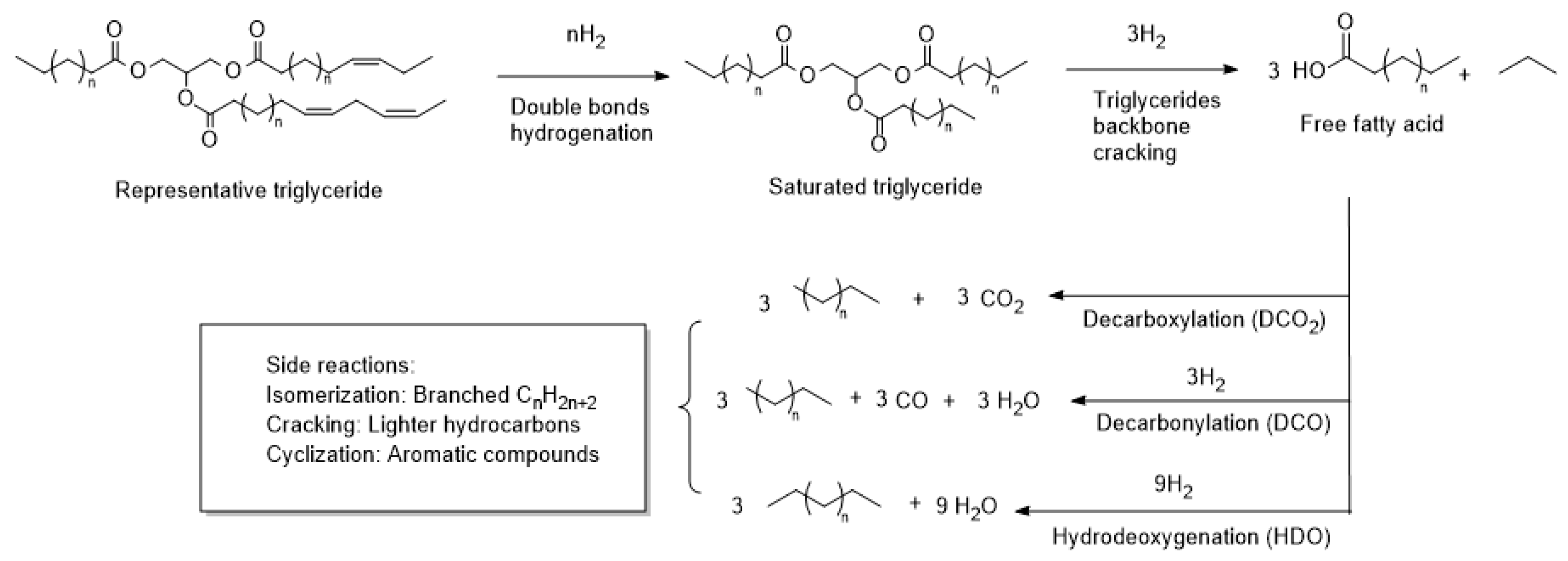
Today, more than 80% of global energy demand is still met by fossil fuels [1]. Their extensive use results in well-known problems, including environmental pollution and depletion of reserves. In particular, fossil-fuel combustion releases large amounts of greenhouse gases, mainly CO2, as well as VOCs, SOx, and NOx, which are well-known air pollutants [2]. In addition, fossil fuels are a non-renewable energy source and therefore subject to depletion. This issue is further intensified by the continuous increase in global energy demand, driven by population growth, technological development and economic expansion [3]. In particular, the transport sector greatly contributes to fossil fuel consumption; indeed, 95% of transport energy demand is provided by oil (accounting for 60% of total oil consumption) and also contributes to around 24% of total CO2 and greenhouse gas emissions [4,5]. To overcome these drawbacks, the scientific community has strongly focused on the development of renewable energy sources, and, in the transport sector, biofuels represent one of the main renewable alternatives. Biofuels can be obtained from different types of biomass, including sugars–starch, lignocellulosic and triglyceride-based biomass. Among these, triglyceride-based biomass, like vegetable oils, is widely used because it has similar chemical-physical characteristics to those of petroleum derivatives (triglycerides are composed of fatty acids with carbon atom chains similar in length to those of oil-derived hydrocarbons) [6]. Vegetable oil-derived biofuels can provide environmental benefits over conventional fossil fuels, since their use can reduce greenhouse gas emissions and lower the release of pollutants such as SOx, carbon monoxide, unburned hydrocarbons and particulate matter [7]. In addition, they are a renewable energy source and therefore not subject to depletion. Moreover, the use of waste oil can also provide further benefits in terms of waste management. The most common strategy for triglyceride biomass upgrading is the transesterification of vegetable oil, in which triglycerides are converted into a biofuel consisting of fatty acid methyl esters (FAMEs) commonly known as biodiesel. Biodiesel was introduced in 1992 by the National Soy Diesel Development Board and is still among the most widely used biofuels [8]. Despite its wide use, however, biodiesel has several drawbacks, including storage instability, high oxygen content (which results in lower energy density than petroleum diesel), high corrosivity and limited compatibility with conventional diesel engines, since it can generally be used only in blends with petroleum diesel [9,10]. Green diesel (trade name given by UOP/Eni), also known as hydrotreated vegetable oil (HVO) or renewable diesel, is a hydrocarbon biofuel consisting exclusively of hydrocarbons and was first marketed by Neste Oil in 2007 [11]. Green diesel can be obtained through the catalytic deoxygenation reaction (CDO) of vegetable oils, in which triglycerides are thermally treated, typically in a hydrogen atmosphere and with a heterogeneous catalyst and converted into hydrocarbons. The reaction scheme for green diesel formation is shown in Figure 1 [12].
Briefly, triglycerides are first hydrogenated and then cleaved to form free fatty acids and propane through a β-elimination reaction (most common mechanism) [13]. The resulting fatty acids are then converted into hydrocarbons through three different reaction pathways: hydrodeoxygenation (HDO), decarbonylation (DCO) and decarboxylation (DCO2). In the HDO pathway, oxygen is removed as H2O and a hydrocarbon with the same number of carbon atoms as the starting fatty acid is formed. In contrast, DCO and DCO2 lead to the formation of a hydrocarbon with one carbon atom less than the starting fatty acid; oxygen is removed as CO and H2O in DCO, and as CO2 in DCO2 [14,15]. Side reactions, such as cracking, isomerization, oligomerization and gas-phase reactions, are also possible during the reaction. Cracking produces short-chain hydrocarbons, which are more suitable for jet-fuel-like biofuel production [16,17,18]. Isomerization forms branched hydrocarbons, which improve the cold-flow properties of the biofuel [19,20,21]. Oligomerization, on the other hand, is an undesirable reaction because it leads to the formation of coke and long-chain hydrocarbons, which can deactivate the catalyst and negatively affect the properties of the final biofuel [22]. In the gas phase, water–gas shift and methanation reactions may also occur, contributing to the overall reaction by producing or consuming H2 [23]. The overall process is influenced by many factors, including temperature, hydrogen pressure, reactor configuration, feedstock type and, especially, the catalyst. The most commonly used catalysts are noble- or transition-metal-based catalysts (like Pd, Pt, Ru, Ni, Mo, Co, W), supported on different materials such as Al2O3, SiO2, zeolites, and activated carbon [23,24,25,26,27,28,29]. Noble-metal-based catalysts are particularly active; however, their high cost limits their practical application. For this reason, reduced or sulfided transition-metal catalysts have been developed as alternative systems. Sulfided catalysts are very active in the catalytic deoxygenation reaction, and the most commonly used systems are based on Ni and Co promoted with Mo and W [30,31,32,33]. However, sulfided catalysts can suffer from rapid deactivation due to sulfur leaching, and, to maintain their activity, it is necessary to use sulfiding agents that pollute the biofuel produced [34,35]. Reduced transition metal catalysts are able to overcome these limitations, since they can show activity comparable to that of sulfided catalysts, while reducing deactivation and avoiding sulfur contamination of the biofuel, as suggested by Harnos et al. [36]. Among these catalysts, Ni- and Co-based systems promoted with W or Mo and supported on Al2O3, SiO2 and zeolites are the most widely investigated [36,37,38,39,40]. In a recent study, we synthesized a NiMoAl-based catalyst using the co-precipitation method [41]. This catalyst proved to be highly active, representing a viable alternative to conventional sulfided or noble-metal-based catalysts. However, to further improve process sustainability, we decided to shift our research towards the development of catalysts derived from waste materials. Recently, increasing efforts have been made to synthesize catalysts from waste materials, with the aim of valorizing a waste that would otherwise require disposal [7,42,43,44,45]. Coal fly ash (CFA) is a waste product generated during coal combustion, and it has been reported that one ton of coal fly ash is produced for every two tons of coal [46]. Because of its large-scale production and environmental impact, CFA disposal represents an important issue. For this reason, considerable attention has been paid to CFA recycling. Indeed, CFA has been widely used as an additive in cement and construction, as fertilizers, as an adsorbent for wastewater treatment and as a catalyst or catalyst precursor [47,48,49]. CFA can be used as a precursor of high-added-value materials, including zeolites and mesoporous silica, or directly used as a support for metal catalysts [50,51,52,53]. As catalysts, CFA has been widely used for biodiesel synthesis [53,54,55,56,57,58]. However, to the best of our knowledge, no studies have reported the use of fly-ash-derived catalysts for green diesel production. In this work, we report the synthesis of several metal transition-based catalysts supported on fly ash cenospheres (FAC) (the fly ash cenospheres are a component of the coal fly ash) and zeolites, obtained from FAC. These catalysts were subsequently tested in catalytic deoxygenation reactions in a batch reactor under fixed reaction conditions. The most efficient catalyst was selected for further studies to evaluate the effects of the reaction solvent and feedstock type. In addition, it was tested to assess its activity over multiple reaction cycles. Finally, the catalyst was characterized using FT-IR, XRD, ICP-MS, and N2 physisorption.

2. Results

2.1. Oil Characterization

Sunflower oil (SO), rapeseed oil (RO), peanut oil (PAO), corn oil (CO) and palm oil (PO) were purchased from local suppliers, while soybean oil (SBO) was purchased from Merck KGaA. Waste cooking oil (WCO) was collected from households. The oils were characterized by transesterification in accordance with the AOAC 969.33 standard [59]. In the transesterification reaction, the fatty acids of the triglycerides (TGs) were converted into fatty acid methyl esters (FAMEs), which were subsequently analyzed by GC-FID. FAME identification was performed by comparing the retention times of the sample with those of a C14–C22 FAME reference standard (see experimental section). The fatty acid compositions of the vegetable oils are reported in Table 1.
The composition of the oil is important for the CDO reaction because a high content of unsaturated fatty acids can lead to higher H2 consumption. In addition, the composition of the starting oil affects the product distribution. For example, palm oil produces a biofuel richer in C16 alkanes and therefore with a high cetane number.

2.2. Catalyst Synthesis

Several transition metal catalysts supported on fly ash cenospheres (FAC) and on zeolites synthesized from FAC were prepared and evaluated in the catalytic deoxygenation (CDO) reaction. The FAC employed in this study were sourced from a coal-fired power plant located in Kolkata, India. After catalyst screening, the most performing catalyst was characterized. Its elemental composition was determined by ICP-MS, while specific surface area and pore size distribution were investigated by N2 physisorption analyses. The crystalline structure and surface functional groups were investigated by XRD and FT-IR, respectively.

2.2.1. Synthesis of FAC-Based Catalysts

Before being used, the FAC were treated with an acid solution to remove impurities and soluble metals, following the procedure described by Sutarno et al. [60]. After acid treatment, the solid, named FAC-HCl, was filtered, washed with deionized water until neutral, and dried in an oven at 110 °C overnight. The catalysts were then synthesized via excess wet impregnation. Appropriate amounts of metal salts were dissolved in an aqueous suspension containing FAC-HCl and stirred at room temperature for 3 h. Water was then removed using a rotary evaporator, and the resulting solid was dried in an oven at 110 °C overnight. Finally, the dried material was calcined in a muffle furnace at the decomposition temperature of the corresponding metal salts, as reported in the literature [61,62,63,64,65]. Catalyst reductions were carried out in a tubular fixed-bed reactor under an H2/N2 flow (10%/90%). The reduction conditions were selected based on hydrogen consumption measurements using an ABB gas analyzer. After reduction, the catalysts were stored in sealed containers under an argon atmosphere to maintain inert conditions and prevent possible oxidation. The catalysts were labeled as MNX(m,n,x)/FAC, where M, N, and X represent the impregnated metals, while m, n, and x indicate the nominal loading of the impregnated metals of the corresponding metal oxides. For example, NiMo(5/15)/FAC refers to a catalyst prepared by impregnating FAC-HCl with Ni and Mo salts to obtain nominal loadings of 5 wt% of NiO and 15 wt% of MoO3 after calcination. The nominal wt% of the impregnated metals of all the FAC-supported catalysts are reported in Table 2. The catalysts were further distinguished according to their treatment stage: non-calcined samples were labeled as MNX(m,n,x)/FAC N.C., calcined samples as MNX(m,n,x)/FAC C., and reduced samples as MNX(m,n,x)/FAC R. For instance, NiMo(5/15)/FAC R. denotes the reduced form of the catalyst containing 5 wt% of NiO and 15 wt% of MoO3. Further experimental details are provided in the Experimental section. Table 2 summarizes the synthesized FAC-supported catalysts and their respective calcination and reduction conditions.

2.2.2. Synthesis of Zeolite-Based Catalysts

FAC-derived zeolite support was synthesized by the alkali fusion method proposed by Sutarno et al. [60]. FAC were fused with NaOH in a muffle furnace. The resulting solid was suspended in Milli-Q water and aged overnight under stirring. The suspension was then subjected to hydrothermal treatment, after which the formed solid was filtered and dried. Metal impregnation was carried out via excess wet impregnation, following the same procedure described for FAC-supported catalysts. To evaluate the influence of the support, the zeolite-based catalysts were synthesized using the same metal species and loadings chosen for the FAC-supported counterparts. For all the zeolite-supported catalysts, the wt% of the oxide metals are reported in Table 3. Calcination was performed under the same conditions used for the corresponding FAC-based catalysts. Reduction conditions were determined using an ABB gas analyzer, as previously described. The catalysts were labeled using the same convention adopted for FAC-based materials, i.e., MNX(m,n,x)/Zeo, where M, N, and X refer to the impregnated metals and m, n, and x represent the nominal loadings of the corresponding metal oxides. The catalyst forms were also distinguished by the suffixes N.C. (non-calcined), C. (calcined), and R. (reduced). Table 3 reports the synthesized zeolite-based catalysts and their respective calcination and reduction conditions.

2.3. CDO Reaction and Product Characterization

The catalytic activity of the synthesized materials was evaluated in a high-pressure batch reactor system (4590 Micro Bench Top Reactor, equipped with magnetic drives and a 4848 Reactor Controller). Catalyst screening was performed under fixed reaction conditions: temperature of 320 °C, hydrogen pressure of 40 bar measured at room temperature, 2.00 g of sunflower oil, 0.200 g of catalyst (corresponding to a catalyst-to-oil ratio of 10 wt%), and 20.0 g of hexane as solvent, 6 h of reaction time and 200 rpm of stirring. Further details on the experimental setup are provided in the Experimental section. Based on the results obtained from this preliminary screening, the catalyst exhibiting the highest activity was selected for further investigations, including solvent screening, oil screening and recycling tests. At the end of each reaction, the catalyst was recovered by vacuum filtration and dried under vacuum overnight. The resulting reaction mixture, namely Organic Liquid Product (OLP), was concentrated with a rotary evaporator and weighed to determine the yield. The OLP yield, expressed as OLP wt%, was calculated according to Equation (1):
O L P   w t % = g O L P g O i l × 100
where gOLP is the mass of OLP (in grams) recovered, and gOil is the initial mass of oil (in grams) used in the reaction.
The obtained OLP was preliminarily characterized by Fourier-transform infrared spectroscopy (FT-IR) to qualitatively assess the extent of reaction conversion. FT-IR is a rapid and effective analytical technique for this purpose, as it allows the identification of specific functional groups associated with the reactants and products. In particular, the spectral region between 1750 and 1700 cm−1 was examined, where the characteristic stretching vibrations of the ester carbonyl group, approximately at 1745 cm−1, and the carboxylic acid carbonyl group, around 1710 cm−1, can be observed. These signals provide information on the relative presence of triglycerides and free fatty acids and can therefore be used as qualitative indicators of reaction progression. Furthermore, the presence of oxygenated compounds in the product mixture was further assessed from the absorption bands in the 1350–900 cm−1 region, which correspond to C–O stretching vibrations typically associated with esters, alcohols, and other oxygen-containing functionalities [66].
The OLP was further analyzed by gas chromatography coupled with flame ionization detection (GC-FID) to determine its composition and quantify the components in the mixture. Prior to GC-FID analysis, an aliquot of the OLP was subjected to a transesterification reaction, following the same protocol employed for oil characterization. This step was performed to assess the presence of unreacted oil species, such as triglycerides and free fatty acids, through the formation of their corresponding methyl esters. The components present in the mixture were identified by comparing their retention times with those of a reference mixture of n-alkanes (C7–C40). To identify any unknown chromatographic peaks observed in the GC-FID profiles, the transesterified mixture was subsequently analyzed by gas chromatography coupled with mass spectrometry (GC-MS). Unknown compounds were identified by comparing the acquired mass spectra with those in the NIST spectral library. In addition, Kovats retention indices were calculated and used as a complementary tool to support the structural identification of the unknown components. The investigated reaction parameters were the organic liquid product yield (OLP (%), reaction conversion (Χ), the green diesel yield (GD %) and the selectivity (S) [67,68]. The reaction product distribution was assessed in terms of the relative percentages of the main hydrocarbon classes and unreacted or intermediate compounds. Specifically, the analysis focused on the quantification of olefins, linear alkanes in the ranges C8–C14, C15–C18 and C > 18, branched hydrocarbons, and unconverted feedstock components, such as free fatty acids and triglycerides, identified and quantified in the form of their corresponding fatty acid methyl esters (FAME).
Equation (2) was used to determine the conversion (Χ), where FAME represents the sum of the chromatographic peak area percentages assigned to fatty acid methyl esters, and gOLP and gOil represent the mass of crude reaction mixture recovered after the reaction and the initial mass of oil used as feedstock, respectively.
χ = 1 F A M E × g O L P g O i l × 100
The green diesel yield (GD %) was calculated using Equation (3), where AnC15–C18 is the sum of the chromatographic peak area percentages assigned to linear alkane in the C15–C18 range (green diesel fraction)
G D   % = A n C 15 C 18 × g O L P g O I L × 100
Finally, the preference of the catalysts toward HDO and DCOx reaction (see Figure 1) was evaluated according to Equation (4). Selectivity was calculated as the ratio between the sum of the peak areas corresponding to hexadecane and octadecane, C16 + C18, derived from HDO, and the sum of the peak areas related to pentadecane and heptadecane, C15 + C17, derived from DCOx.
S = C 16 + C 18 C 15 + C 17 × 100
An S-value greater than 1 indicates a preference for HDO, whereas an S-value lower than 1 suggests that the reaction proceeds mainly through the DCOx pathway.

2.3.1. Catalyst Screening

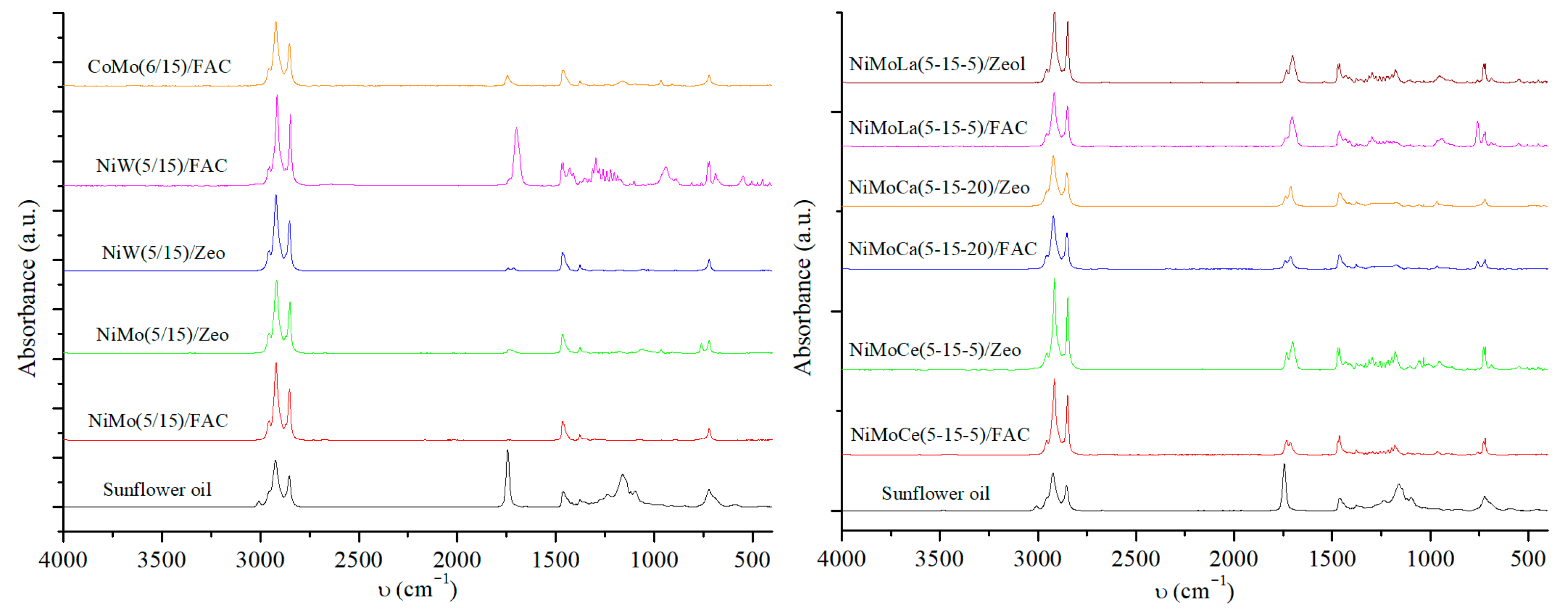
As previously reported, the catalyst screening experiments were conducted under the following reaction conditions: temperature of 320 °C, hydrogen pressure of 40 bar (measured at room temperature), 2 g of sunflower oil as feedstock, 20 g of hexane, 0.200 g of catalyst (corresponding to a catalyst-to-oil ratio of 10 wt%), reaction time of 6 h and stirring at 200 rpm. Figure 2 shows the FT-IR spectra of the reaction mixtures obtained using bimetallic, on the left, and trimetallic catalysts, on the right, compared to the FT-IR spectrum of the sunflower oil.
The FT-IR of sunflower oil displays a strong absorption band in the carbonyl region, attributed to triglyceride ester groups at approximately 1745 cm−1, along with several bands in the 1350–800 cm−1 region corresponding to C–O vibrations. A decrease in the intensity or disappearance of these peaks in the reaction mixtures can therefore be used as a qualitative indicator of triglyceride conversion. For the bimetallic catalysts, Figure 2 left side, only the spectrum of the reaction mixture obtained with NiMo(5/15)/FAC shows the complete disappearance of both the ester carbonyl band and the C–O stretching region. This observation, coupled with the presence of characteristic C–H stretching and bending vibrations (3050–2750 cm−1, 1460 cm−1, 1377 cm−1, and 720 cm−1), suggests nearly complete conversion of triglycerides into hydrocarbons. Based on the intensity of the carbonyl band, NiMo(5/15)/Zeo and NiW(5/15)/Zeo also showed good activity, but in these cases, two small peaks are present in the 1750–1710 cm−1 range, indicating incomplete conversion of triglycerides and partial formation of free fatty acids. The spectrum obtained using NiW(5/15)/FAC is dominated by an intense absorption band centered at 1710 cm−1, suggesting efficient conversion of triglycerides into free fatty acids, but limited activity in their subsequent deoxygenation to hydrocarbons. An opposite trend is observed with CoMo(6/15)/FAC, where the band at 1745 cm−1 suggests lower triglyceride conversion; however, the catalyst appears to promote the further transformation of free fatty acids into hydrocarbons more effectively. Regarding the trimetallic catalysts (Figure 2 right side), FT-IR spectra consistently show the presence of both ester and carboxylic acid carbonyl peaks, indicating limited overall conversion. Therefore, trimetallic catalysts appear to be less active than bimetallic ones. FT-IR spectra provide only a qualitative interpretation of the catalytic activity of the catalysts; a more detailed analysis of the reaction mixtures was performed by GC-FID and GC-MS analysis (Table 4).
To evaluate the effect of the FAC support on the CDO reaction, two different blank tests were addressed (entries 1 and 2, Table 4). In the first blank test, the CDO reaction was carried out in the absence of catalyst and support (entry 1), while in the second (entry 2) only the HCl-treated FAC support was used. The results indicate that the FAC support shows negligible activity in the CDO reaction because the results for entry 1 and entry 2 are very similar (the reaction in entry 2 shows only a small amount of hydrocarbons, 5.2%). As also evidenced by the FT-IR spectra, the data in the table clearly show that bimetallic catalysts exhibit higher activity than trimetallic ones. In all cases, trimetallic catalysts display high FAME content, exceeding 50%, indicating incomplete deoxygenation. Among the screened catalysts, NiMo(5/15)/FAC (entry 3) exhibited the highest activity, achieving complete conversion and producing 91.7% diesel-range hydrocarbons. This corresponds to an OLP yield of 72.2 wt% and indicates the formation of a fully hydrocarbon biofuel with high selectivity toward diesel-range products. The significant influence of the support is evident when comparing NiMo(5/15)/FAC with NiMo(5/15)/Zeo (entry 3 vs. entry 4). Despite having the same nominal metal loading, the zeolite-supported catalyst showed lower activity, with 87% conversion compared with 100% for NiMo(5/15)/FAC. After NiMo(5/15)/FAC, the most active catalysts were CoMo(6/15)/FAC and NiW(5/15)/Zeo (entry 5 and 7). CoMo(6/15)/FAC achieves 97.3% conversion and a biofuel yield of 75.5 wt%. However, it shows lower hydrogenation activity than NiMo(5/15)/FAC, resulting in a higher amount of unsaturated hydrocarbons (20.6%) and, therefore, lower n-C15–C18 hydrocarbon content (67.1%). CoMo-based catalysts have often been associated with higher selectivity toward unsaturated products, as reported in the literature [30,69]. The NiW(5/15)/Zeo system (entry 7) shows a comparable conversion to that of CoMo(6/15)/FAC, but the resulting biofuel contains a higher concentration of alkanes in the diesel range, approximately 90%. This indicates a higher degree of hydrogenation than that observed for the CoMo catalyst. In contrast to the NiMo-based systems, for which the FAC-supported catalyst was more active than the zeolite-supported analogue, the opposite trend was observed for the NiW system. In this case, NiW(5/15)/Zeo was more active than NiW(5/15)/FAC, highlighting a support-dependent behavior specific to the NiW formulation (entries 3 and 4 vs. entries 6 and 7). For all the catalysts tested, low cracking activity is observed. In any case, less than 5% of n-C7–C14 hydrocarbon is produced.
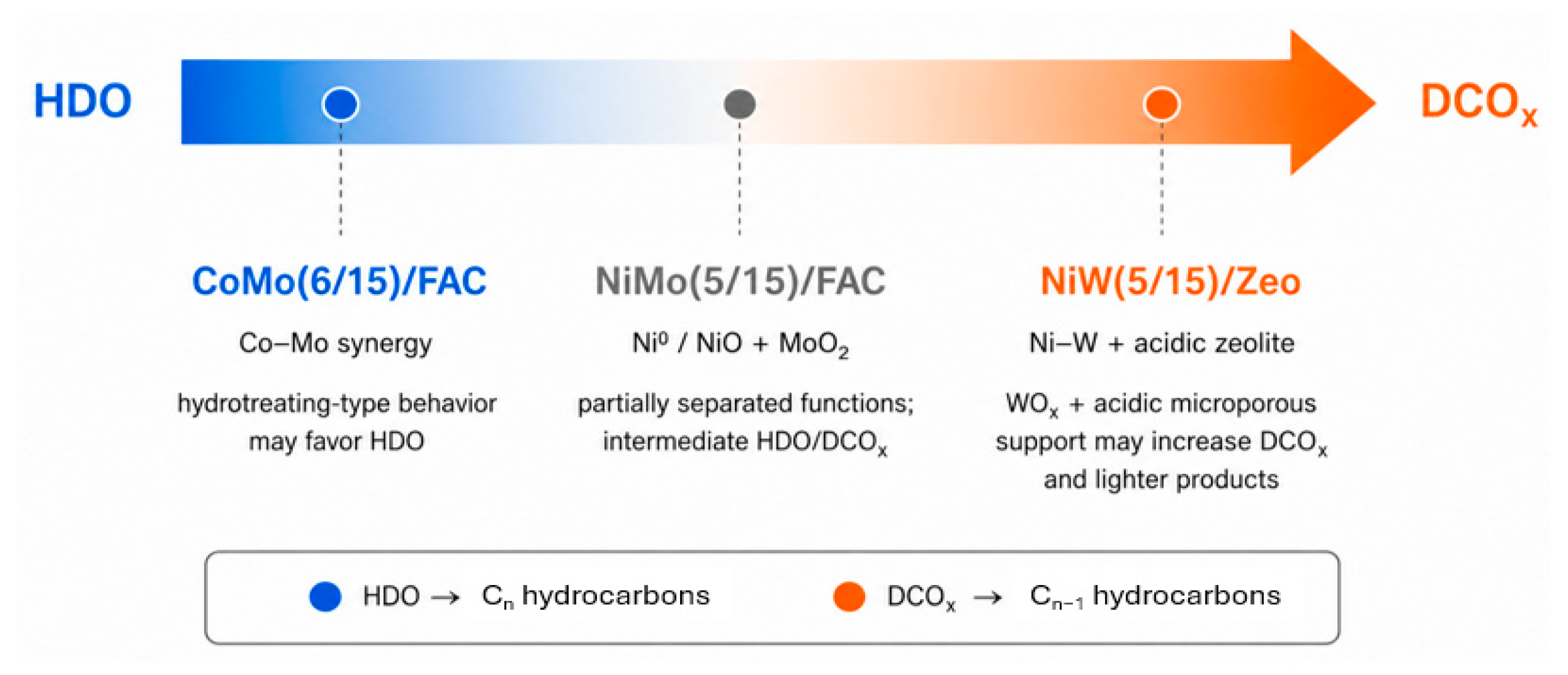
Focusing on product distribution and HDCO/DCOx selectivity, NiMo(5/15)/FAC promoted both hydrodeoxygenation (HDO, yielding C18 + C16 alkane) and decarbonylation /decarboxylation (DCO/DCO2, yielding C17 + C15 alkane) pathways, with a slight preference for the HDO route (S value = 1.5). This is consistent with previous observations by Kubička et al. [33]. Interestingly, in agreement with several authors [70,71,72], CoMo(6/15)/FAC shows notable selectivity toward HDO products (S = 6.3), whereas NiW(5/15)/Zeo strongly prefers the DCOx pathway. A detailed mechanistic explanation of the observed reaction selectivity would require an extensive physicochemical characterization of all the tested catalysts. Such an investigation is beyond the scope of the present work; however, the different selectivity trends observed may be tentatively interpreted on the basis of literature on related deoxygenation catalysts. Moreover, the discussion was limited to catalysts showing significant catalytic activity, since selectivity values obtained at low conversion are less representative and may be strongly affected by incomplete reaction progress. For NiMo(5/15)/FAC, the interpretation is partially supported by the XRD results (see Section 2.4.3). No crystalline Ni–Mo mixed phase was detected, whereas Ni was identified as Ni0 and NiO and Mo mainly as MoO2. The coexistence of Ni species and MoO2 species may explain its intermediate HDO/DCOx selectivity. Metallic Ni can promote H2 activation and hydrogenation, while Mo-containing species may provide more oxophilic sites for oxygenated-group adsorption and C–O bond cleavage [73]. Conversely, at sites where only Ni is present, DCOx may be more strongly favored, as observed by Kubička and Kaluža [33]. The CoMo system shows very high selectivity for the HDO reaction; it seems that the catalyst may behave more like conventional hydrotreating-type catalysts, where Co-promoted Mo sites provide a more integrated hydrogenation/C–O cleavage function [15]. Therefore, the higher HDO contribution of CoMo-based catalysts may be related to more effective Co–Mo synergy, whereas NiMo(5/15)/FAC appears to contain partially separated Ni and MoO2 phases. For NiW/Zeo, the higher DCOx contribution may arise from the combined effect of Ni–W functions and the acidic zeolitic support. Gosselink et al. report that WO3-based catalysts preferentially promote DCOx [74]. At the same time, the acidic and microporous zeolitic support can favor dehydration, cracking, isomerization and secondary transformations, increasing the formation of Cn−1 and lighter hydrocarbons [75]. A schematic representation of the observed selectivity trends is presented in Figure 3.
It should be noted that the best-performing catalysts, NiMo(5/15)/FAC, CoMo(6/15)/FAC and NiW(5/15)/Zeo, resulted in lower OLP yields. This behavior may be related to the nature of the catalytic deoxygenation reaction. As conversion increases, the formation of volatile products also increases, including propane derived from the triglyceride backbone, light hydrocarbons from cracking, and CO and CO2 from DCO-DCO2 [38].
In the case of incomplete conversion, and after transesterification, several reaction mixtures report high FAME concentrations, indicating the presence of significant amounts of unconverted triglycerides and/or free fatty acids. The main detected compound was methyl stearate, small percentages of methyl palmitate, and, in a few cases, also methyl elaidate (this reflects the composition of vegetable oils, which, except in the case of palm oil, consist mainly of fatty acids with 18 carbon atoms). These compounds were identified after GC-MS analysis. Although vegetable oils consist of fatty acids with a cis configuration, the presence of methyl elaidate is not unexpected, since cis-trans isomerization may occur during the reaction [76,77]. In addition, by analyzing the reaction mixture via GC-MS before the transesterification step, other oxygenated compounds such as 1-octadecanol, propyl stearate, and propyl palmitate were observed. CDO proceeds through a sequence of reduction reactions; therefore, the observed 1-octadecanol may derive from the reduction of octadecanal (not observed in any reaction mixture). Several studies report the presence of 1-octadecanol as a reaction intermediate [14,33,34,75,78,79,80]. Conversely, octadecanal is rarely observed due to its rapid conversion into heptadecane or 1-octadecanol [81,82,83]. Finally, the detection of propyl stearate and propyl palmitate supports the occurrence of the initial triglyceride cleavage through β-elimination. Indeed, propyl stearate (and propyl palmitate) can be formed when the β-elimination reaction stops after the second hydrogenation step [14,33].
In conclusion, according to the catalytic screening, the activities of the synthesized catalysts follow the order: NiMo(5/15)/FAC > NiW(5/15)/Zeo > CoMo(6/15)/FAC > NiW(5/15)/FAC trimetallic catalysts. Given its higher activity, the NiMo(5/15)/FAC catalyst was used for further studies.

2.3.2. Solvent Effect

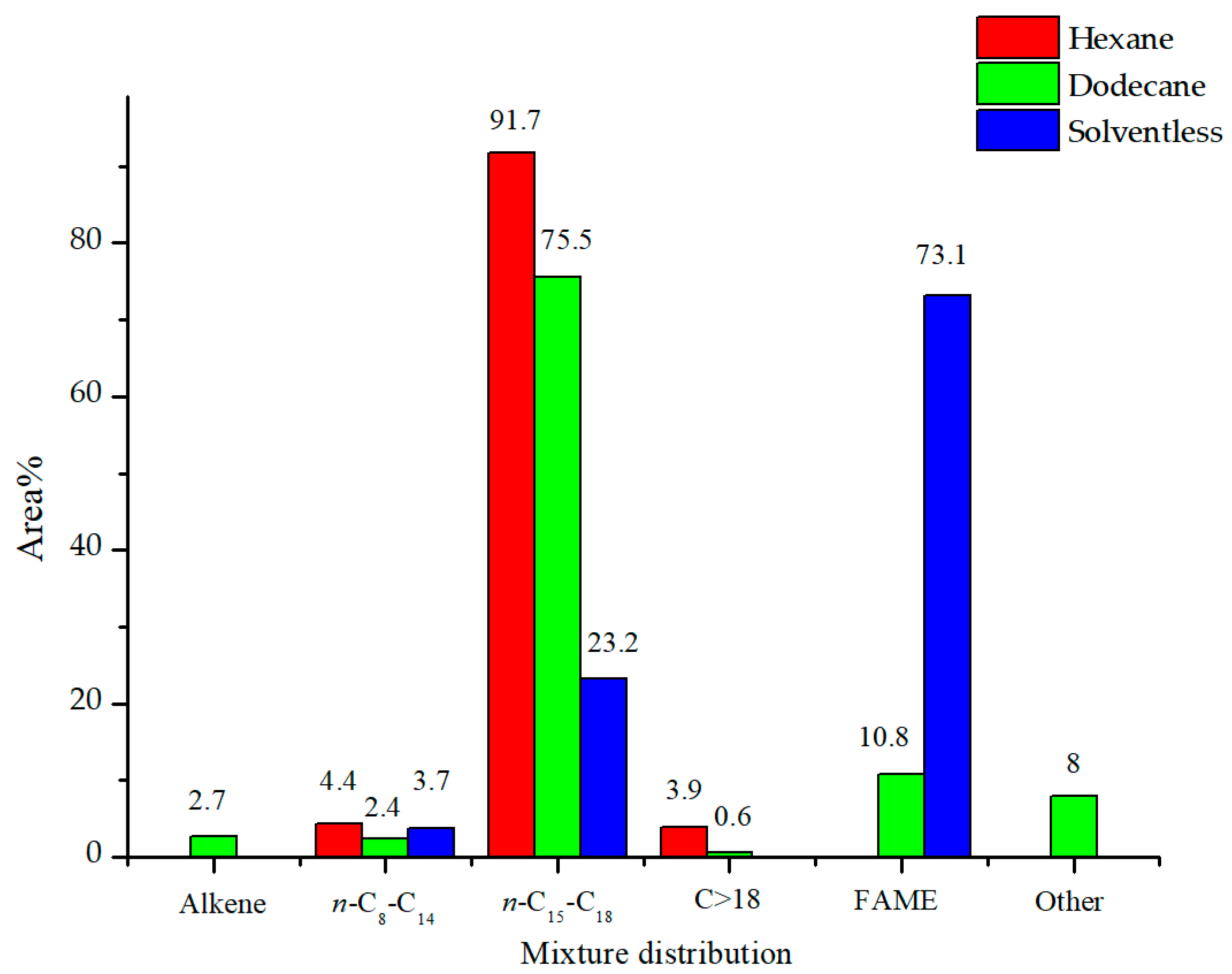
The activity of NiMo(5/15)/FAC was evaluated under solvent-free conditions and using n-dodecane instead of n-hexane as solvent. n-hexane and n-dodecane were selected to compare hydrocarbon solvents with markedly different volatility and phase behavior. n-hexane, under the investigated conditions, is close to its critical region and can significantly influence mass transfer and hydrogen solubility. On the other hand, its high volatility contributes significantly to the autogenous pressure of the reactor. n-dodecane was included as a heavier and less volatile hydrocarbon solvent, which remains more closely associated with the liquid phase and provides a thermally stable and persistent liquid hydrocarbon medium. In addition, n-dodecane is widely used in the HDO reaction [37,73,84]. The two solvents may therefore generate different fluid densities, hydrogen solubilities, mass-transfer conditions and liquid-phase compositions. Their properties may also indirectly affect catalyst stability by influencing the accumulation of heavy intermediates and coke precursors. Finally, the solvent-free reaction may offer important process advantages, including elimination of solvent recovery, lower downstream separation costs and reduced solvent consumption. The reactions were carried out at 320 °C, 40 bar H2, 10 wt% catalyst and 6 h reaction time. The results of the experiments are shown in Figure 4.
As shown in Figure 4, the reaction performed under solvent-free conditions did not give satisfactory results. The catalyst shows low activity, and the resulting biofuel contains high FAME content, 73.1%, indicating a large amount of unconverted oil. Conversely, the use of a solvent significantly enhances catalytic activity; however, 100% conversion was observed only when n-hexane was used. When n-dodecane was used, the reaction product contained 10.8% FAME and a green diesel fraction of 75.5%. In contrast, the reaction performed in n-hexane achieved complete conversion and produced 91.7% diesel-range hydrocarbons. The solvent did not significantly affect reaction pathway selectivity, since the catalyst showed an S value of 1.5 in n-hexane and 1.4 in n-dodecane. The higher activity observed in n-hexane can be correlated to the physical state of the solvent under the reaction conditions employed. n-hexane has a critical temperature of 234 °C and a critical pressure of 30 bar; therefore, under the investigated reaction temperature, it is above its critical temperature and may behave as a supercritical fluid [85]. In this state, the lower viscosity, enhanced diffusivity and improved phase contact of the medium may favor hydrogen availability at the catalyst surface and reduce gas–liquid mass-transfer limitations. Numerous studies have reported the beneficial effect of supercritical n-hexane in the CDO reaction [86,87,88,89,90]. Furthermore, the use of n-hexane results in easy work-up, since it can be easily separated from the reaction product via vacuum evaporation and reused in subsequent reactions, improving the overall sustainability of the process.

2.3.3. Feedstock Effect

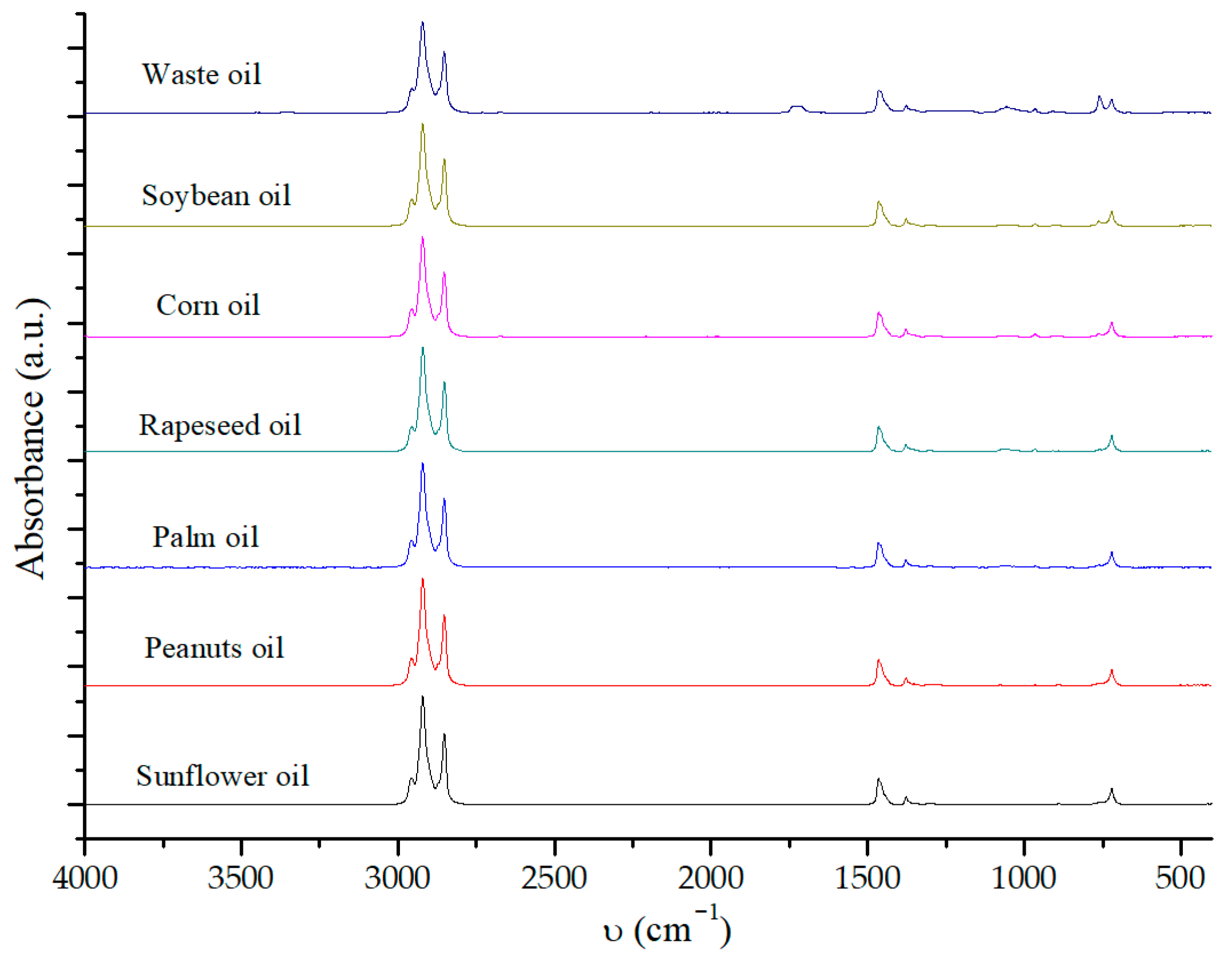
The type of feedstock used in the reaction can influence both conversion and product distribution. In practical applications, oil selection is often governed by local availability and cost; therefore, an efficient catalyst should also be active with feedstocks of different origin and composition. To assess catalyst robustness, the performance of NiMo(5/15)/FAC was evaluated using different oils at the same reaction conditions used in catalyst screening. The FT-IR spectra and the GC-FID analysis of the OLP obtained with different oils are shown in Figure 5 and Table 5 respectively.
Similar FT-IR spectra were obtained for all the edible oils used, indicating almost complete conversion. Waste cooking oil was the only exception, as its spectrum still showed a weak absorption band in the 1750–1710 cm−1 region, suggesting residual carbonyl-containing compounds and therefore lower conversion.
Focusing on product distribution, Table 5 shows that complete conversion is achieved in all cases except for waste oil. With the waste oil, a conversion of 83% was obtained, producing a biofuel with a significant amount of methyl esters (16.1%). Lower conversion when using waste cooking oil is not unusual. Kim et al. reported a decrease in conversion when waste cooking oil was used instead of fresh soybean oil (41.8% vs. 91.0%) and attributed this behavior to the presence of degradation products and other contaminants accumulated during the previous use of the oil, which may promote catalyst deactivation [91]. Similar observations were reported by Ding et al. [92]. In addition, the lower deoxygenation activity may also be associated with the high concentration of unsaturated hydrocarbons in the products, which accounted for approximately 20%. Unsaturated compounds can decrease catalyst activity by adsorbing on the catalyst surface. They can also undergo oligomerization and polymerization reactions, promoting coke formation and consequently causing active-site coverage and pore blockage [93,94].
Sunflower oil gave the highest content of hydrocarbons in the diesel range (91.7%). However, it also showed the lowest OLP yield, 72.2 wt%, and therefore a lower green diesel yield, 66.1 wt%. The lower OLP yield may be related to the catalyst selectivity. In the case of sunflower oil, the catalyst showed an S value of 1.5, while for the other oils, the S value was generally higher than 3. An S value of 1.5 indicates a greater relative contribution of DCO/DCO2 pathways, which result in lower carbon retention in the liquid hydrocarbon fraction than HDO [33,95]. However, the markedly lower OLP yield cannot be explained only by the S value and suggests that additional volatile products may have formed. During the deoxygenation of vegetable oils, CO and CO2 are generated through DCO and DCO2, while methane, ethane and other light hydrocarbons may also form through secondary reactions such as methanation, cracking, hydrogenolysis and decarbonylation [33,96]. For all the oils used, n-C15–C18 hydrocarbon contents higher than 80% were observed; however, some differences can be noted. The highest biofuel yield was obtained with peanut oil (88.0%), but this reaction also produced the highest content of C > 18 hydrocarbons. The higher concentration of long-chain hydrocarbons is related to the feedstock composition, since peanut oil has a relatively high content of long-chain fatty acids, 5.8%, as reported in Table 1. When palm oil was used, no remarkable differences were observed in terms of green diesel yield and OLP yield. However, palm oil is rich in palmitic acid, and the resulting biofuel results in high nC16 hydrocarbon contents (29.8%). A high hexadecane amount is beneficial for green diesel production because it increases the cetane number (the maximum value of cetane number is 100 and is attributed to pure hexadecane).

2.3.4. Recycling Tests and Regeneration of the Catalyst

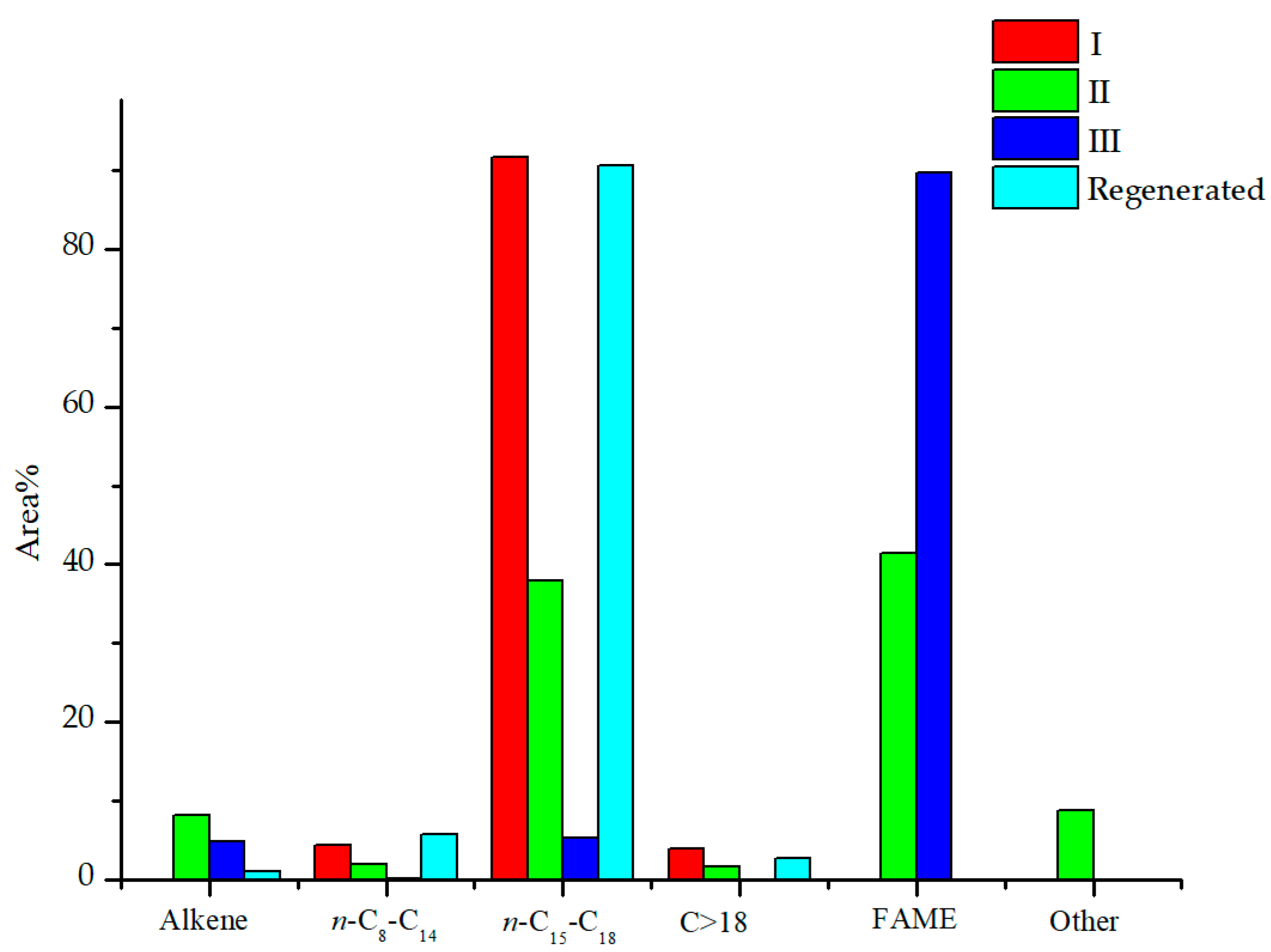
Catalyst efficiency is also related to its stability over successive reaction cycles. Therefore, the stability of NiMo(5/15)/FAC was assessed through recycling tests performed at 320 °C, 40 bar H2, 10 wt% catalyst and 6 h reaction time. In the first run, 20 g of n-hexane, 2 g of sunflower oil and 0.2 g of catalyst were used. In the subsequent reactions, the amounts of reactants and solvent were adjusted according to the amount of recovered catalyst. Specifically, the oil/catalyst ratio was maintained at 10:1, while the n-hexane/oil ratio was kept at 10:1. At the end of each reaction, the catalyst was recovered, dried overnight under vacuum and reused in the subsequent reaction without further treatment. The results obtained in the recycling tests are shown in Figure 6.
Unfortunately, the catalyst quickly loses its activity; in the second reaction cycle, it loses about 50% of its activity, leading to a drop in n-C15–C18 content from 91.7% to 37.9% and, consequently, in high FAME content (41.5%). At the third reaction cycle, the catalyst completely loses its activity, resulting in a biofuel consisting mainly of FAME (89.7%), of which 85.1% is methyl stearate. This loss of activity was consequently reflected in the conversion degree, OLP yield, and green diesel yield (Table 6).
The results reported in Table 6 show a marked loss of catalytic activity over successive reaction cycles. Conversion decreased from 100% in the first cycle to 19.7% in the third, while the green diesel yield dropped from 66.1 to 4.5 wt%. Typically, catalyst deactivation can be related to three main causes: active metal leaching, active metal sintering, and coke formation, which may cover active sites and reduce catalytic activity [79,93,97,98,99,100]. ICP-MS analysis of the spent catalyst, discussed in Section 2.4.1, did not reveal any relevant loss of Ni, while Mo content significantly decreased, from 11.7 wt% in the fresh catalyst to 7.7 wt% in the spent catalyst. This evidence could indicate that the decline in catalytic activity may be partially related to Mo leaching. Furthermore, after the third reaction cycle, the mass of the recovered catalyst was higher than the mass before the reaction. This finding suggests the accumulation of carbonaceous deposits on the catalyst. To verify this hypothesis, the spent material was calcined at 400 °C for 3 h and subsequently reduced before being tested again. The reactant quantities were adjusted according to the amount of catalyst recovered after regeneration. In this case, reduction was carried out in batches at 320 °C under 40 bar H2 for 8 h. After regeneration, the catalyst recovered its initial activity, achieving 100% conversion and producing a fully hydrocarbon biofuel containing 90.6% diesel-range hydrocarbons. These findings are consistent with a significant contribution of carbonaceous deposition to catalyst deactivation; however, the simultaneous decrease in Mo content indicates that metal leaching may also have contributed.

2.4. Characterization of NiMo(5/15)/FAC Catalyst

After catalyst screening, the physicochemical properties of the NiMo(5/15)/FAC catalyst were investigated using several characterization techniques. Inductively coupled plasma mass spectrometry (ICP-MS) was used to determine the elemental composition. Fourier-transform infrared spectroscopy (FT-IR) provided information on surface functional groups and chemical bonds, while X-ray diffraction (XRD) was employed to identify the crystalline phases present in the material. Finally, nitrogen adsorption–desorption analysis, evaluated using the BET and BJH methods, was used to determine the specific surface area, pore volume and pore-size distribution. The results obtained from these analyses are discussed in detail in the following sections.

2.4.1. ICP-MS Elemental Analysis

ICP-MS analysis was performed on HCl-treated FAC support and on NiMo(5/15)/FAC to evaluate the actual metal loading impregnated onto FAC. In addition, elemental composition analysis was also carried out on spent NiMo(5/15)/FAC to investigate metal leaching after the deoxygenation reaction; in this case, only Ni and Mo contents were evaluated. Table 7 reports the data obtained after ICP-MS analysis.
FAC are an aluminosilicate material; therefore, it is not surprising that ICP-MS analysis shows 35 wt% Si and 16 wt% Al for the FAC support. The analysis detected 4.4 wt% of Ni and 11.7 wt% of Mo in the NiMo(5/15)/FAC catalyst, confirming the loading of the selected metals. The experimental Ni/Mo molar ratio is slightly higher than the theoretical one, mainly because of the lower Mo content compared with the nominal amount used in the synthesis. In addition, lower Si and Al contents were observed in the catalyst than in the original FAC support. This decrease is related to the incorporation of Ni and Mo, which contributes to the total mass of the catalyst. In the spent catalysts, the ICP-MS revealed that the Ni content of the catalyst remained essentially unchanged, whereas a noticeable decrease in the Mo content was observed. However, as discussed in Section 2.3.4, Mo leaching does not appear to be the main cause of catalyst deactivation, since the NiMo(5/15)/FAC catalyst recovered most of its initial activity after the regeneration step.

2.4.2. FT-IR Analysis

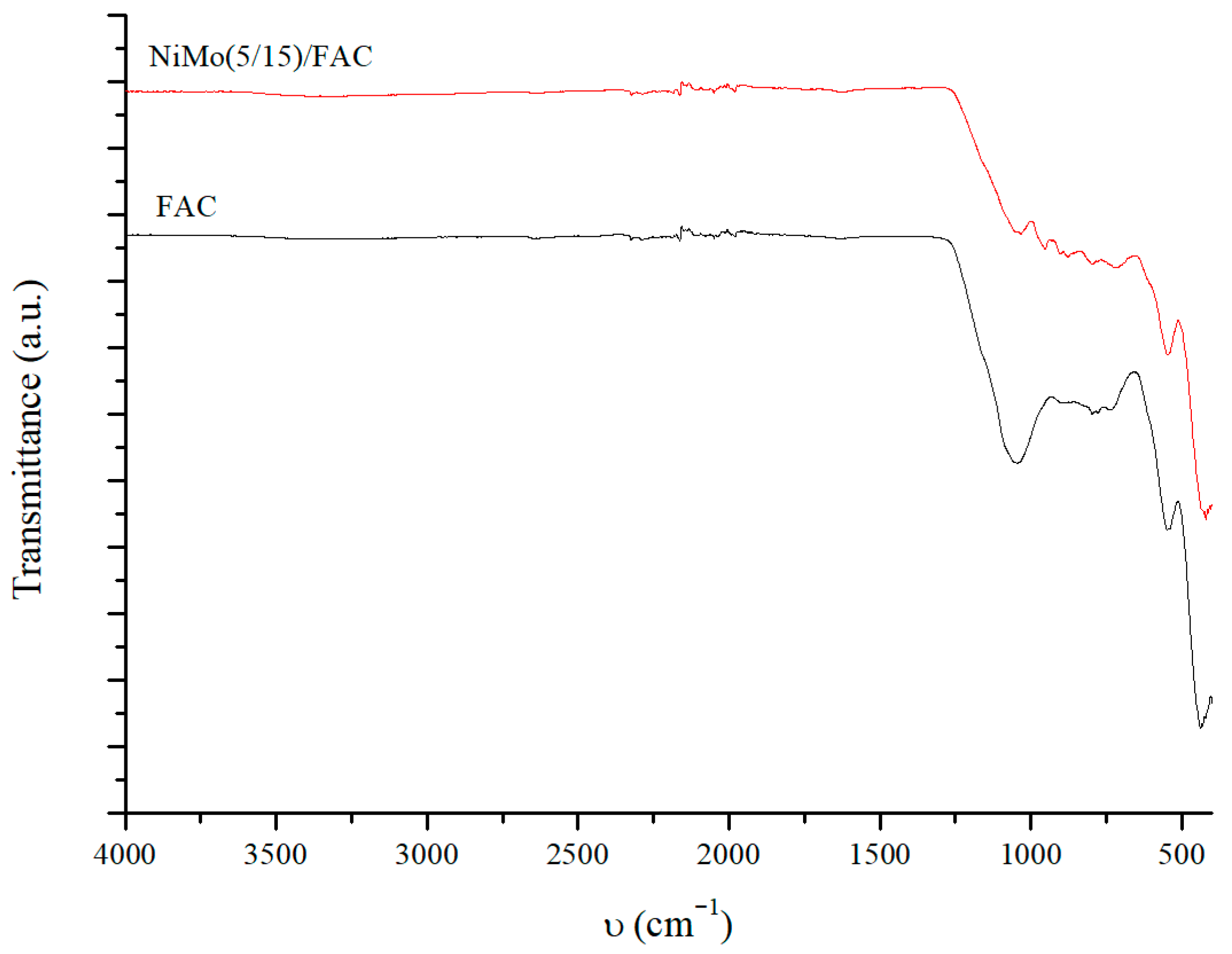
FT-IR spectroscopy was performed to evaluate the surface characteristics of the catalyst. The spectrum of the calcined NiMo(5/15)/FAC sample was compared with that of the original FAC support to identify surface changes associated with Ni and Mo impregnation, as shown in Figure 7.
The FAC spectrum shows a band centered at 1055 cm−1, which is related to Si-O-Si asymmetric stretching. The symmetric stretching and bending vibrations of Si–O–Si are attributed to the bands centered at 798 cm−1 and 450 cm−1 respectively. In addition, asymmetric Si-O-Al stretching is also observed as a weak band at 545 cm−1 [101,102,103]. After the Ni and Mo impregnation, the bands related to Si- and Al-containing phases showed a decrease in intensity, which can be associated with the deposition of NiO and MoO3 on the support rather than inside the pores. In addition, new bands were observed in the FT-IR of the NiMo(5/15)/FAC catalyst. In particular, the signals at 957 cm−1 and 880 cm−1 were assigned to the asymmetric and symmetric stretching vibrations of the Mo=O bond, respectively, confirming the presence of MoO3 [104]. No absorption bands related to NiO were detected. The relatively low NiO loading, together with the overlap with the more intense bands of the aluminosilicate matrix, may account for the absence of clearly resolved NiO signals.

2.4.3. XRD Analysis

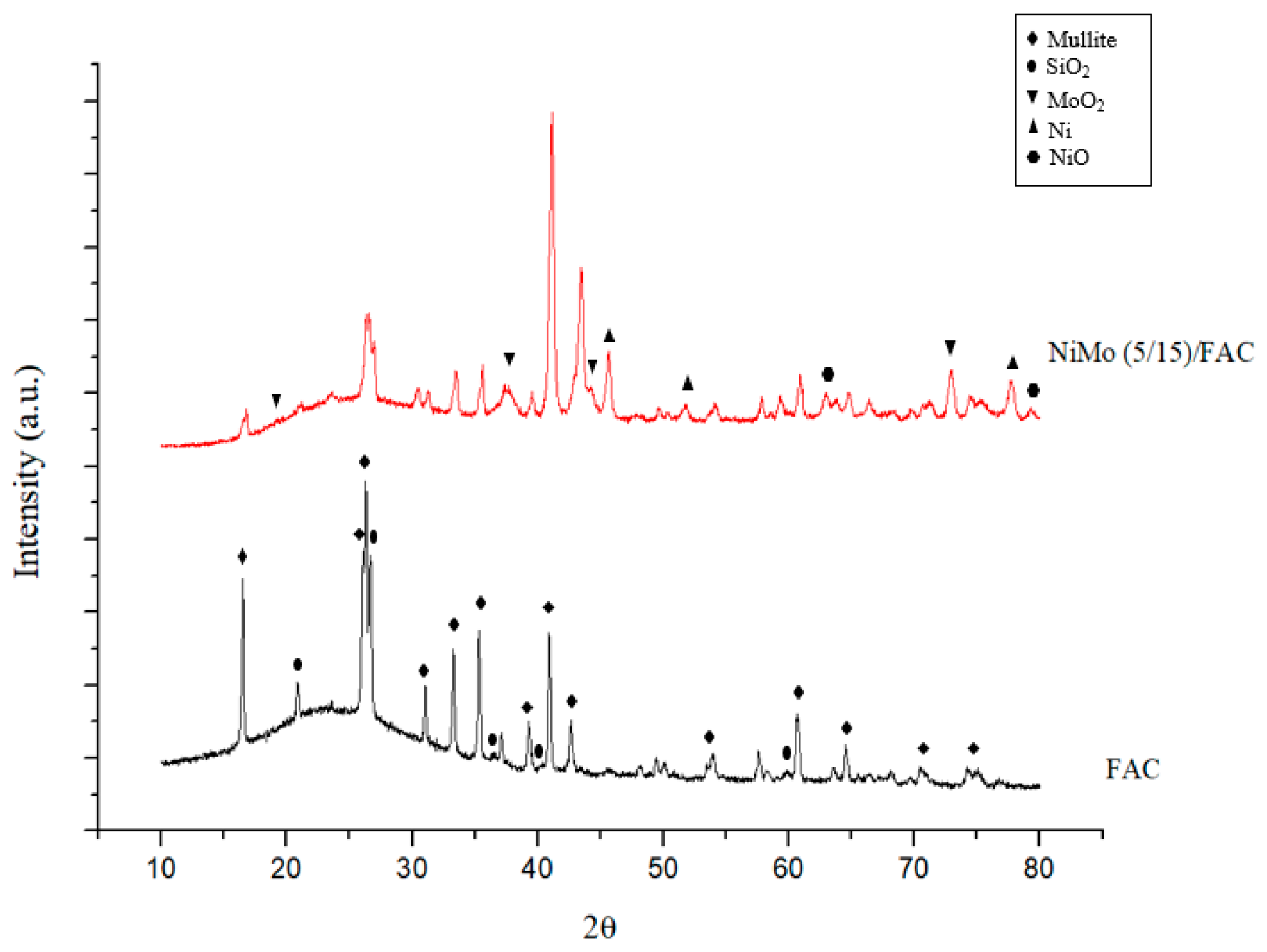
To identify the crystalline phases present in both the catalyst and support, XRD analysis of FAC and NiMo(5/15)/FAC (in reduced state) was carried out. The XRD diffractograms recorded are reported in Figure 8.
The diffraction pattern of the FAC support shows the typical reflections associated with mullite (2θ = 16.4°, 26°, 26.2°, 30.5°, 33.5°, 35.5°, 40.9°, and 60.8°). This aluminosilicate phase is commonly found in fly ash cenospheres [102,105]. In addition to mullite, quartz is another characteristic phase of FAC and can be present in both crystalline and amorphous forms. The crystalline phase gives reflections at 2θ of 20.9°, 26.6°, 36.5°, 50.1°, and 59.93°, whereas the amorphous contribution is indicated by the broad background feature extending from approximately 10° to 40° and centered near 25° [106,107]. After synthesis, the reduced NiMo(5/15)/FAC catalyst still exhibits the reflections of the support; however, with lower intensity, indicating a partial loss of crystallinity after metal incorporation. Additional reflections appear in the reduced sample and can be associated with the deposited Ni- and Mo-containing phases. Under the reduction conditions employed, MoO3 is expected to be converted into MoO2, whose characteristic reflections occur at 2θ = 21.2°, 26.8°, and 44.3°. In this case, the reflections at 21.2° and 44.3° were observed, while the reflection at 26.8° was not clearly distinguishable, most likely because of overlap with the intense reflections of the support [108,109]. The peaks observed at approximately 45°, 51°, and 76° are assigned to metallic Ni, confirming the reduction of part of the nickel phase [110,111]. Reflections attributable to NiO are also present at 2θ = 37.2°, 43.3°, 62.8°, and 75.5°. Their occurrence may indicate that nickel reduction was incomplete or that partial oxidation took place after the reduction treatment [110].

2.4.4. FAC Particle Size Distribution and BET-BJH Analysis

Particle size analysis showed a decrease in the Sauter mean diameter from 95.6 μm for the raw FAC to 87.0 μm for the HCl-washed FAC, likely due to the removal of soluble surface components and limited fragmentation during stirring. The resulting particle size should favor particle dispersion and external surface accessibility in the stirred 100 mL batch reactor and may also reduce intraparticle diffusion distances.
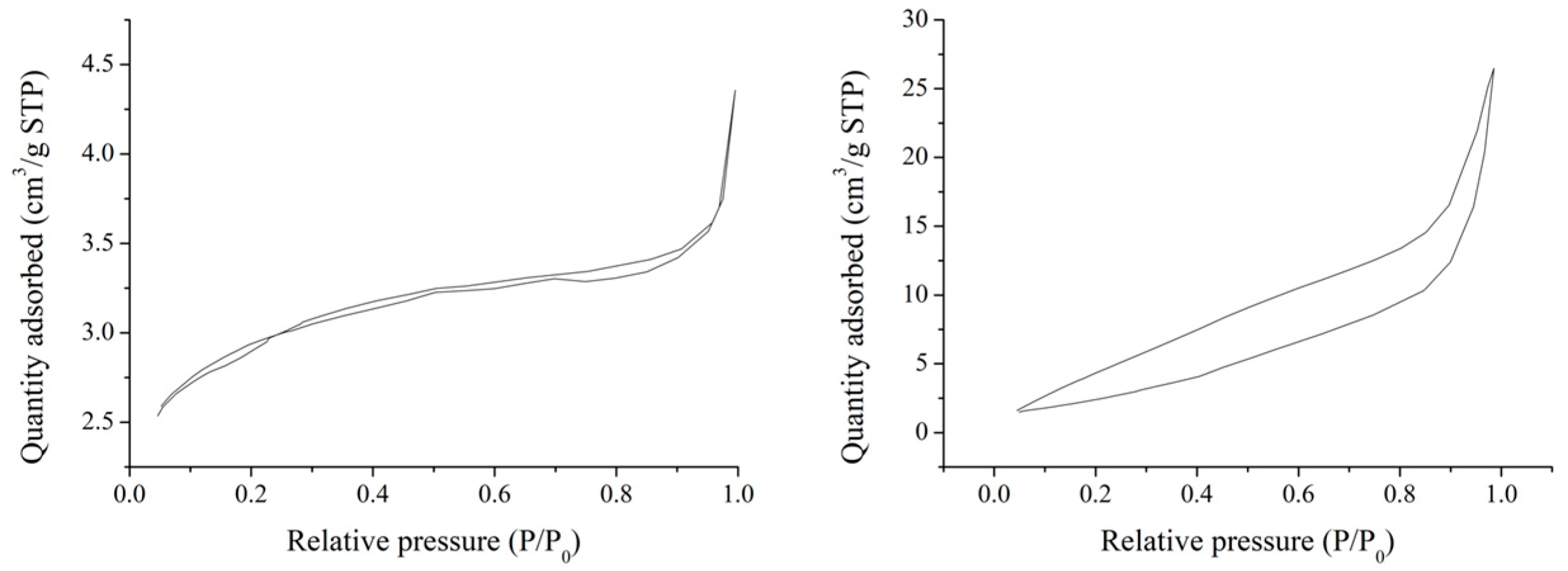
Focusing on porosimetry analysis, both the FAC support and the reduced catalyst display adsorption profiles mainly associated with type II isotherms, according to the IUPAC classification, which are generally observed for non-porous or macroporous material. The reduced NiMo(5/15)/FAC catalyst shows a more pronounced hysteresis loop, suggesting a type IV isotherm, characteristic of mesoporous material (Figure 9) [112]. An increase in the amount of adsorbed nitrogen is observed after impregnation of FAC with Ni and Mo, suggesting a change in the adsorption properties of the material. In both cases, an H3-type hysteresis loop is observed, which is generally associated with capillary condensation in mesopores, often arising from slit-shaped pores or interparticle voids. The loop is narrow for the FAC support, whereas it extends over a broader relative-pressure range for NiMo(5/15)/FAC, suggesting a wider distribution of mesopores after metal deposition, in agreement with the observation of Deka and Bhattacharyya [113].
Table 8 shows the textural properties of the materials. After Ni and Mo impregnation, the BET surface area slightly decreased from 10.10 to 8.40 m2/g. Conversely, the BJH pore volume increased from 0.004 cm3/g to 0.05 cm3/g, and the average pore diameter increased from 1.6nm to 23.3 nm. These findings suggest that Ni and Mo impregnation modified the porous structure of the FAC support, possibly increasing the contribution of mesoporosity or improving the accessibility of existing pores [56,110].

3. Discussion

This study demonstrates that fly ash cenospheres (FAC), a waste residue of coal combustion, can be effectively used as support for catalysts used in the deoxygenation of vegetable oils. FAC were used either directly, after acid treatment, or converted into zeolitic materials. Both supports were employed to synthesize several transition-metal-based catalysts, including bimetallic and trimetallic systems. Catalytic screening was carried out in a batch reactor at 320 °C and 40 bar of H2, using sunflower oil as feedstock and n-hexane as solvent. Among the tested catalysts, the NiMo(5/5)/FAC showed the best catalytic activity, achieving 100% conversion and producing a biofuel rich in diesel-range hydrocarbons (n-C15–C18 = 91.7%). Some of the zeolite-supported catalysts also showed appreciable activity. In particular, NiW(5/15)/Zeo reached high conversion and produced a considerable amount of diesel-range hydrocarbons, suggesting that converting FAC into zeolite can also represent an effective strategy for catalyst synthesis. Future work will focus on optimizing zeolite synthesis from FAC in order to tune their composition, pore structure and acidity, making them more effective supports. After catalyst screening, NiMo(5/15)/FAC, which proved to be the most active catalyst, was further investigated. Its activity was evaluated using n-dodecane as solvent and under solvent-free conditions. Its robustness was also investigated by varying the feedstock, and its stability was tested over consecutive reaction cycles.
The solvent-free reaction did not give satisfactory results, as conversion was very low, and the reaction product was rich in FAME. Under the conditions adopted here, the absence of solvent may have limited hydrogen transfer between the gas phase, the oil and the catalyst surface. Further optimization of the operating conditions, metal dispersion, and support properties will therefore be required to obtain satisfactory activity under solvent-free conditions. In addition, one possible strategy could be to perform the reaction in a semi-batch or continuous-flow reactor. These configurations allow continuous hydrogen supply and provide better control of product residence time, limiting side-reactions leading to heavy compounds that can deactivate the catalyst. Some studies report that continuous processes can enhance conversion and stability [96,114,115].
NiMo(5/15)/FAC was active with all the fresh vegetable oils examined. However, waste cooking oil gave a lower conversion of 83% and produced larger amounts of unsaturated hydrocarbons and FAME. The poorer performance observed with waste cooking oil may be related to the impurities present in the waste oil after use that could compete for active sites, hinder mass transfer, or promote carbon deposition. In addition, the high concentration of unsaturated hydrocarbons detected in the mixture can contribute to deactivating the catalyst by promoting oligomerization and polymerization reactions [91,116]. Nevertheless, the catalysts show appreciable activity, offering a starting point for further studies with waste oils. Combining waste-oil upgrading with the valorization of FAC would be particularly attractive from a circular-economy perspective.
The recycling tests revealed a rapid loss of activity, with conversion decreasing to 61.1% in the second cycle. This deactivation was mainly attributed to coke deposition, which is one of the most common causes of catalyst deactivation during the deoxygenation and hydrotreatment of biomass-derived feedstocks. Coke may cover the metal phase, block pore entrances and alter the surface properties of the support [117,118]. Therefore, further studies should focus on improving catalyst formulation to mitigate this phenomenon. Different activation treatments, the addition of other promoters or variation of the metal loading could increase accessible porosity, improve metal dispersion, reducibility, and stability of the active phase [119,120]. In addition, the use of continuous reactors could help remove by-products that deactivate the catalyst, thus preserving catalytic activity. Nevertheless, the regeneration step performed on the spent catalyst fully restored the catalytic activity of the NiMo(5/15)/FAC catalyst, providing further evidence of the effectiveness of this catalytic system.
Despite the limitations reported, NiMo(5/15)/FAC represents a promising starting point for the development of catalysts based on very abundant waste. The system offers several potential advantages over other catalyst families used in vegetable-oil deoxygenation, especially from the perspective of sustainability. Conventional sulfided NiMo and CoMo catalysts are highly active, but maintaining their activity requires the addition of sulfur-containing compounds, which may contaminate the product and increase process complexity [34,35]. In contrast, activation by reduction overcomes this limitation.
Noble-metal catalysts based on Pd, Pt, or Ru are generally highly effective for hydrogenation and deoxygenation and do not require sulfidation. However, their high cost and limited availability can affect the economic sustainability of large-scale applications [121,122,123]. NiMo/FAC instead combines non-noble metals with support obtained from industrial waste.
Transition-metal carbides, nitrides, and phosphides have also been investigated as alternatives to sulfided catalysts. These catalysts can exhibit high activity, in some cases comparable to that of noble-metal catalysts. However, their synthesis often requires high temperatures, reactive atmospheres and specific precursors, resulting in more demanding preparation procedures than the synthetic route used for NiMo(5/15)/FAC [120,124].
Table 9 presents a comparison between the catalyst developed in this study and other catalysts reported in the literature, particularly NiMo-based catalysts. The selection of literature studies was based on work conducted in batch reactors using real feedstock.
Although a direct comparison is not straightforward because of differences in feedstock composition, reactor configuration, catalyst loading, solvent and product-yield definitions, the results show that the NiMo(5/15)/FAC catalyst shows activity comparable to that of many catalysts reported in the literature. In some cases, higher hydrocarbon yields or higher C15–C18 selectivity have been reported, especially for optimized noble-metal catalysts or conventional sulfided systems. However, these catalysts often require more expensive active phases, higher reaction temperatures or pressures, or more controlled catalyst activation procedures. In this context, the NiMo(5/15)/FAC formulation represents an effective alternative, since it combines high conversion and high diesel-range hydrocarbon selectivity with the use of a waste-derived aluminosilicate support. The comparison therefore suggests that the NiMo(5/15)/FAC catalyst is a promising candidate for green diesel production, which combines a simple synthesis route, the valorization of waste material, and good catalytic activity. It shows 100% conversion with a product containing 91.7% of hydrocarbon in the diesel fraction at 320 °C, 40 bar of H2 and for 6 h of reaction time. In addition, it maintains activity for all the edible oil feedstocks and recovers its activity after an easy regeneration step. However, further studies are planned to improve the catalytic performance and reduce the limitations observed during reuse.

4. Materials and Methods

4.1. Catalyst Synthesis

4.1.1. Acid Treatment of Raw FAC

Before being used as a support, the cenospheres were subjected to acid treatment to remove impurities. The acid treatment was performed following the procedure proposed by Sutarno et al. [60]. A total of 10 g of FAC were suspended in a 5 M HCl (37%, Carlo Erba, Milano, Italy) aqueous solution, and the suspension was vigorously stirred under reflux for 1 h. After cooling, the solid was separated by vacuum filtration and washed with distilled water until neutral pH was reached. The resulting solid was then dried in an oven at 110 °C overnight and stored before being used for catalyst synthesis.

4.1.2. FAC Zeolitization Process

FAC-derived zeolites were synthesized using the alkali fusion method described in the literature [60]. A total of 10 g of HCl-treated FAC and 12 g of NaOH (NaOH pearl 97%, Lancaster, MA, USA), corresponding to a FAC:NaOH weight ratio of 1:1.2, were mixed in a crucible and ground to uniform the powder. The mixture was then transferred into a muffle furnace and melted at 550 °C (5 °C/min) for 1 h. After cooling, the fused product was ground, transferred with 100 mL of distilled H2O in a Teflon beaker and stirred overnight at room temperature. The slurry was then hydrothermally treated at 110 °C for 72 h. The resulting solid was vacuum-filtrated, washed with distilled H2O until neutral and finally dried at 110 °C overnight. The obtained zeolites were collected in a bottle and subsequently used as a support for the synthesis of catalysts.

4.1.3. FAC- and Zeolite-Supported Catalyst Synthesis

The chemicals used for the synthesis of the bimetallic and trimetallic catalysts supported on FAC and zeolite were as follows: Ni(NO3)2∙6H2O (98%, Alfa Aesar, Heysham, Lancashire, UK ), Co(NO3)2∙6H2O (98.0-102.0%, Alfa Aesar, Heysham, Lancashire, UK), (NH4)6Mo7O24∙4H2O (99%, Alfa Aesar, Heysham, Lancashire, UK), (NH4)6W12O39∙xH2O (≥85% WO3 basis (gravimetric), Alfa Aesar, Heysham, Lancashire, UK), Ce(NO3)3∙6H2O (99.5%, Alfa Aesar, Heysham, Lancashire, UK), Ca(CH3CO2)2∙H2O (≥99.0%, Sigma-Aldrich, Darmstadt, Germany), La(CH3CO2)3·xH2O (99.9%, Sigma Aldrich, Darmstadt, Germany).
As an example of catalyst synthesis, the following section reports the synthesis of NiMo(5/15)/FAC catalyst; the same synthesis approach can be extended to all the other bi-metallic and trimetallic catalysts supported on FAC and zeolite.
Ni(NO3)2∙6H2O (0.529 g, 1.8 mmol) and (NH4)6Mo7O24∙4H2O (0.501 g, 0.4 mmol) were dissolved in 10 mL of distilled water in a 50 mL round-bottom flask. When trimetallic catalysts were synthesized, Ce(NO3)3∙6H2O, La(CH3CO2)3∙xH2O or Ca(CH3CO2)2∙H2O was also added. After the salts were completely dissolved, 2.174 g of HCl-treated FAC (or zeolite) were added, and the suspension was stirred for 3 h at room temperature. The amount of metal salts used was calculated to obtain a catalyst with nominal content of 5 wt% of NiO and 15 wt% of MoO3 (the quantities of metal salts used for the synthesis of the other catalysts were also selected to obtain the desired nominal metal oxide contents). Afterwards, water was removed using a rotary evaporator (50 °C, 40 torr), and the resulting solid was dried overnight at 110 °C. Once dried, the material was recovered and placed in a crucible for the calcination process. In the case of NiMo(5/15)/FAC, calcination was carried out at 400 °C (5 °C/min) for 4 h. For the reduction step, the catalyst was placed in a tubular reactor and treated under a 10:90% H2/N2 gas flow (20Nml/min of H2 and 180Nml/min of N2). The reduction temperature and duration were selected by monitoring H2 consumption using an ABB gas analyzer. In the case of NiMo(5/15)/FAC, the reduction was performed at 700 °C (5 °C/min) for 3 h. At the end of the reduction process, the reactor was cooled to room temperature under a flow of 200 Nml/min of N2 to prevent oxidation. Once the reactor had reached room temperature, the catalyst was recovered in a flask and stored under an argon atmosphere to avoid possible oxidation. The same procedure was carried out for all the other FAC- and zeolite-supported catalysts. The same H2 and N2 flow rates were used, whereas the reduction temperatures and time varied according to their H2 consumption. All the information concerning the synthesis of the FAC- and zeolite-supported catalysts is reported in Table 2 and Table 3.

4.2. Oil and Catalyst Characterization

4.2.1. Oil Characterization

Edible sunflower oil (SO), rapeseed oil (RO), corn oil (CO), peanut oil (PAO) and palm oil (PO) were purchased from local traders, while soybean oil (SBO) was purchased from Merck (soybean oil is a dietary source of long-chain triglycerides and other lipids); all the oils were used for the CDO reaction without any previous treatment. The fatty acid composition of the used oils was investigated after transesterification reaction according to the AOAC Official Method 969.33 [59].
A total of 0.350 g of oil was placed in a 50 mL flask and refluxed for 10 min with 2 N NaOH methanolic solution (NaOH pearl 97%, Lancaster, MA, USA; CH3OH anhydrous, 99.8%, Merck, Darmstadt, Germany) After 10 min, a 10 wt% BF3 methanolic solution (Boron trifluoride-methanol solution ~10% (~1.3 M), for GC derivatization, LiChropur™, Supelco®, Bellefonte, PA, USA) was added and kept under reflux for 1 min. Finally, 5 mL of n-hexane (99% Carlo Erba, Milano, Italy) was added and, once the solution reached room temperature, a NaCl (99.7%, Merck, Darmstadt, Germany) saturated solution was transferred into the flask, and the separation of the organic phase from the aqueous phase occurred. An aliquot of 1.3 mL of the organic layer was collected and transferred to a vial containing anhydrous Na2SO4 (≥99%, Carlo Erba, Milano, Italy) to remove residual water.
Then, 1 μL of the resulting solution was manually injected into a Trace GC Ultra gas chromatograph (Thermo Fisher Scientific, Waltham, MA, USA) coupled with a flame ionization detector (FID) and with a Supelco® SP-2380 capillary column (30 m × 0.25 mm × 25 μm, stationary phase = Poly(90% biscyanopropyl/10% cyanopropylphenyl siloxane)). The chromatographic analysis was performed under isothermal conditions at 180 °C for 25 min. Hydrogen was used as the carrier gas, with a split flow of 25 mL/min, while both the injector and detector temperatures were set at 250 °C. The chromatographic peaks were identified by comparison with a commercial FAME reference mixture containing C14–C22 methyl esters (F.A.M.E. Mix, Supelco, Bellefonte, PA, USA). Data acquisition and chromatogram processing were performed using Xcalibur™ software (software version 4.0, Thermo Fisher Scientific, Waltham, MA, USA). The results of the oil characterization are shown in Table 1.

4.2.2. Catalyst Characterization

The NiMo(5/15)/FAC catalyst was characterized to identify the physicochemical characteristics of the material. The elemental composition of the catalyst was investigated with an iCAP™ TQe ICP-MS (Thermo Fisher Scientific, Waltham, MA, USA) with a triple quadrupole MS detector. Hydrogen peroxide solution (≥30%) for ultra-trace analysis (Sigma-Aldrich, Darmstadt, Germany) and suprapure® nitric acid (65%) (Merck, Darmstadt, Germany) were used in sample digestion. Instrument control and data processing were performed using Qtegra™ Intelligent Scientific Data Solution software (software version 2.14, Thermo Fisher Scientific, Waltham, MA, USA).
FT-IR spectra were recorded in attenuated total reflectance mode using a PerkinElmer Spectrum instrument (Spectrum Two™ model). The collected spectra were processed with Spectrum software (PerkinElmer Spectrum version 10.03.06). Each spectrum was obtained by averaging 16 scans at a resolution of 4 cm−1.
X-Ray diffraction measurements were performed with a PANalytical X’Pert PRO diffractometer (PANalytical, Almelo, The Netherlands) operating in Bragg–Brentano geometry and equipped with Cu irradiation (Kα1 = 1.540598 Å; Kα2 = 1.544426 Å; Kb = 1.39225 Å). The X’Pert HighScore Plus software (version software 5.2, Malvern Panalytical, Almelo, The Netherlands) was used to manage the diffractograms obtained with angle 2θ ranging from 10° to 80°. Crystalline phases were identified by ICDD and ICSD reference databases.
The particle-size distributions of the raw FAC and HCl-washed fly ash cenospheres were determined using a Mastersizer 2000 laser diffraction particle-size analyzer (Malvern Instruments, Malvern, Worcestershire, UK). Representative samples were obtained by manual coning and quartering and subsequently dispersed in distilled water and placed in a beaker. The particle retention index was set to 2.08, and the absorption index was set to 1. The data collected from these detectors were processed using Mie’s mathematical model.
N2 physisorption analysis was carried out using a NOVA 1200e Surface Area & Pore Size Analyzer from Quanta-chrome Instruments (Boynton Beach, FL, USA). BET and BJH calculations were performed with Nova Station software (version 11.0). Before the analysis, approximately 100–200 mg of sample was degassed under high vacuum at 200 °C (10 °C/min) for 8 h.

4.3. Set-Up for Catalytic Deoxygenation Reaction and Product Analysis

4.3.1. Catalytic Deoxygenation Reaction

A 100 mL stainless steel autoclave reactor (4590 Micro Bench Top Reactor, equipped with magnetic drives and a 4848 Reactor Controller, Parr Instrument Company, Moline, IL, USA) was used to carry out the deoxygenation experiments. The reactor was initially loaded with 2 g of oil, 20 g of n-hexane (≥95%, HPLC grade, Sigma-Aldrich, Darmstadt, Germany) and catalyst-to-oil weight ratio = 10 wt% (0.200 g of catalyst). To ensure an oxygen-free atmosphere, the reactor was flushed three times with N2 and three times with H2 before the reaction. The deoxygenation tests were performed with 40 bar partial pressure of H2 (at room temperature), 320 °C, constant stirring and for 6 h (the reaction started when the reactor reached 320 °C). After this, the reactor was cooled and washed with CHCl3 and n-hexane to recover further product. The catalyst was filtered under vacuum by washing with n-hexane and CHCl3 and then dried overnight in a vacuum oven. The reaction mixture was recovered in a previously weighed flask, concentrated using a rotary evaporator, dried under vacuum, and finally re-weighed to assess the yield of the liquid organic product (OLP).

4.3.2. Green Diesel Analysis

To qualitatively assess the degree of conversion of the reaction, a small portion of OLP was analyzed with the same FT-IR ATR used for catalyst characterization (4 scans and 4 cm−1). The degree of conversion can be evaluated by observing the peak at 1745 cm−1, corresponding to the stretching vibration of the carbonyl ester; in addition, the appearance of a peak at 1710 cm−1 indicates the occurrence of free fatty acids (peak related to C=O vibration of free fatty acids) [66]. The conversion degree and compound distribution in the mixture were evaluated by GC-FID and GC-MS analysis. However, before analysis, a small portion of OLP (350 mg) was transesterified to convert residual oil into methyl esters that are easier to analyze by GC-FID and GC-MS; transesterification was performed in the same way as described for oil characterization [59]. A total of 1 μL of the transesterified mixture was injected into an Agilent 7820A GC gas chromatograph (Agilent Technologies, Inc., Santa Clara, CA, USA) equipped with a flame ionization detector (FID) and an HP-5 19091J-413 capillary column (30 m × 0.32 mm × 0.25 μm, stationary phase = (5–Phenyl)-methylpolysiloxane). The heat run involves a steady state at 50 °C for 5 min, then the temperature is increased to 280 °C with a ramp of 10 °C/min, and finally this temperature is maintained for 7 min. The FID was set at 300 °C while the injector was set at 270 °C, and the eluent gas was H2. Chromatographic runs were elaborated with the software OpenLAB CDS (version C.01.10, Agilent Technologies, Inc., Santa Clara, CA, USA), and the identification of chromatographic peaks corresponding to n-alkanes was performed by comparison with a C7–C40 linear saturated alkane standard solution (C7–C40 Saturated Alkanes Standard, 1000 μg/mL each component, Supelco, Bellefonte, PA, USA). In addition, to evaluate the presence of FAME isomers, the transesterified sample was injected into the same GC-FID used for oil characterization, and the chromatographic run was performed with the same thermic program used for oil characterization. Unidentified chromatographic peaks were identified with a GC-MS system (GC model: Varian Star 3400cx, MS model: Varian Saturn 2000) equipped with an HP-5 column (30 m × 0.25 µm × 0.25 mm stationary phase = 5% phenyl-methyl polysiloxane). The sample was prepared by diluting 20 μL of the transesterified mixture in 1.5 mL of n-hexane; 1 μL of this sample was injected into the GC-MS. The analysis was carried out over a 35 min run, starting with a 5 min hold at 50 °C, followed by a temperature increase of 5 °C/min up to 280 °C, and ending with a 5 min hold at 280 °C. Helium was used as the carrier gas. The trap and injector temperatures were both set at 250 °C. Data elaboration was performed with Varian MS Workstation (version 6.9). Unknown peaks were identified by comparing their mass spectrum with a library (NIST). Additionally, Kovats retention indices were calculated to further validate the unidentified compounds. The parameters investigated to evaluate the catalyst’s activity are presented in Section 2.3.

5. Conclusions

Coal fly ash cenospheres (FAC) were successfully employed as direct supports or as precursors to zeolitic supports for the synthesis of several catalysts for the deoxygenation of vegetable oil. Among the catalysts tested, NiMo(5/15)/FAC demonstrates the best catalytic activity, achieving 100% conversion and producing a biofuel with 91.7% of n-C15–C18, corresponding to a green diesel yield of 66.1 wt%. Furthermore, zeolitic catalysts show acceptable activity in the deoxygenation reaction. The NiMo(5/15)/FAC was tested in solvent-free conditions, with different feedstocks and in multiple reaction cycles. The results obtained show that the catalyst is not active without n-hexane as solvent but demonstrates high activity for all the used feedstocks. However, catalytic activity drops to 83% conversion when waste cooking oil was used. The catalyst rapidly lost its activity during the recycling test, but regeneration of the spent catalyst through calcination completely restored catalyst activity; after regeneration, the catalyst reached 100% conversion with a green diesel yield of 69.9 wt%. Based on the results obtained, it can be stated that NiMo(5/15)/FAC represents a promising waste-derived catalyst formulation and a useful starting point for further optimization.
FAC-based catalysts can enhance the sustainability of the overall process by valorizing waste products that would otherwise require disposal. Future work will focus on optimizing FAC-based catalysts and the process setup, evaluating their catalytic activity in continuous-flow reactors and under solvent-free conditions.

Author Contributions

Conceptualization, L.R. and G.D.V.N.; methodology, L.R. and G.D.V.N.; investigation, G.D.V.N.; writing—original draft preparation, G.D.V.N.; writing—review and editing, G.D.V.N., K.G. and L.R.; visualization, L.R.; supervision, L.R. and K.G.; project administration, L.R.; funding acquisition, K.G. All authors have read and agreed to the published version of the manuscript.

Funding

This research received no external funding.

Data Availability Statement

The original contributions presented in this study are included in the article. Further inquiries can be directed to the corresponding author.

Acknowledgments

The authors would like to thank Fabiola Ferrante of the Department of Industrial and Information Engineering and Economics for the BET-BJH analyses, Martina Foschi of the Department of Physical and Chemical Sciences for the ICP-MS analyses, and Giuliana Taglieri and Valeria Daniele for the XRD analyses.

Conflicts of Interest

The authors declare no conflicts of interest.

References

  1. Institute, E. Data Downloads and Archive. Available online: https://www.energyinst.org/statistical-review/resources-and-data-downloads (accessed on 16 June 2026).
  2. Miyazaki, K.; Bowman, K. Predictability of Fossil Fuel CO2 from Air Quality Emissions. Nat. Commun. 2023, 14, 1604. [Google Scholar] [CrossRef] [PubMed]
  3. Zhironkin, S.; Abu-Abed, F. Fossil Fuel Prospects in the Energy of the Future (Energy 5.0): A Review. Energies 2024, 17, 5606. [Google Scholar] [CrossRef]
  4. Emodi, N.V.; Okereke, C.; Abam, F.I.; Diemuodeke, O.E.; Owebor, K.; Nnamani, U.A. Transport Sector Decarbonisation in the Global South: A Systematic Literature Review. Energy Strategy Rev. 2022, 43, 100925. [Google Scholar] [CrossRef]
  5. Saboori, B.; Sapri, M.; bin Baba, M. Economic Growth, Energy Consumption and CO2 Emissions in OECD (Organization for Economic Co-Operation and Development)’s Transport Sector: A Fully Modified Bi-Directional Relationship Approach. Energy 2014, 66, 150–161. [Google Scholar] [CrossRef]
  6. Gosselink, R.W.; Hollak, S.A.W.; Chang, S.-W.; van Haveren, J.; de Jong, K.P.; Bitter, J.H.; van Es, D.S. Reaction Pathways for the Deoxygenation of Vegetable Oils and Related Model Compounds. ChemSusChem 2013, 6, 1576–1594. [Google Scholar] [CrossRef] [PubMed]
  7. Quevedo-Amador, R.A.; Escalera-Velasco, B.P.; Arias, A.M.R.; Reynel-Ávila, H.E.; Moreno-Piraján, J.C.; Giraldo, L.; Bonilla-Petriciolet, A. Application of Waste Biomass for the Production of Biofuels and Catalysts: A Review. Clean Technol. Environ. Policy 2024, 26, 943–997. [Google Scholar] [CrossRef]
  8. Akram, F.; Haq, I.U.; Raja, S.I.; Mir, A.S.; Qureshi, S.S.; Aqeel, A.; Shah, F.I. Current Trends in Biodiesel Production Technologies and Future Progressions: A Possible Displacement of the Petro-Diesel. J. Clean. Prod. 2022, 370, 133479. [Google Scholar] [CrossRef]
  9. Shi, H.; Chen, J.; Yang, Y.; Tian, S. Catalytic Deoxygenation of Methyl Laurate as a Model Compound to Hydrocarbons on Nickel Phosphide Catalysts: Remarkable Support Effect. Fuel Process. Technol. 2014, 118, 161–170. [Google Scholar] [CrossRef]
  10. Saxena, P.; Jawale, S.; Joshipura, M.H. A Review on Prediction of Properties of Biodiesel and Blends of Biodiesel. Procedia Eng. 2013, 51, 395–402. [Google Scholar] [CrossRef]
  11. Sonthalia, A.; Kumar, N. Hydroprocessed Vegetable Oil as a Fuel for Transportation Sector: A Review. J. Energy Inst. 2019, 92, 1–17. [Google Scholar] [CrossRef]
  12. Di Vito Nolfi, G.; Gallucci, K.; Rossi, L. Green Diesel Production by Catalytic Hydrodeoxygenation of Vegetables Oils. Int. J. Environ. Res. Public. Health 2021, 18, 13041. [Google Scholar] [CrossRef] [PubMed]
  13. Rogers, K.A.; Zheng, Y. Selective Deoxygenation of Biomass-Derived Bio-Oils within Hydrogen-Modest Environments: A Review and New Insights. ChemSusChem 2016, 9, 1750–1772. [Google Scholar] [CrossRef] [PubMed]
  14. Kubička, D.; Bejblová, M.; Vlk, J. Conversion of Vegetable Oils into Hydrocarbons over CoMo/MCM-41 Catalysts. Top. Catal. 2010, 53, 168–178. [Google Scholar] [CrossRef]
  15. Veriansyah, B.; Han, J.Y.; Kim, S.K.; Hong, S.-A.; Kim, Y.J.; Lim, J.S.; Shu, Y.-W.; Oh, S.-G.; Kim, J. Production of Renewable Diesel by Hydroprocessing of Soybean Oil: Effect of Catalysts. Fuel 2012, 94, 578–585. [Google Scholar] [CrossRef]
  16. Wang, W.-C.; Tao, L. Corrigendum to “Bio-Jet Fuel Conversion Technologies” [Renew Sustain Energy Rev 53 (2016) 801–822]. Renew. Sustain. Energy Rev. 2017, 79, 1556. [Google Scholar] [CrossRef]
  17. Lahijani, P.; Mohammadi, M.; Mohamed, A.R.; Ismail, F.; Lee, K.T.; Amini, G. Upgrading Biomass-Derived Pyrolysis Bio-Oil to Bio-Jet Fuel through Catalytic Cracking and Hydrodeoxygenation: A Review of Recent Progress. Energy Convers. Manag. 2022, 268, 115956. [Google Scholar] [CrossRef]
  18. Jia, C.; Zhang, C.; Xie, S.; Zhang, W.; Wang, Z.; Lin, H. One-Pot Production of Jet Fuels from Fatty Acids and Vegetable Oils in Biphasic Tandem Catalytic Process. Fuel 2021, 302, 121060. [Google Scholar] [CrossRef]
  19. Sousa, F.P.; Silva, L.N.; de Rezende, D.B.; de Oliveira, L.C.A.; Pasa, V.M.D. Simultaneous Deoxygenation, Cracking and Isomerization of Palm Kernel Oil and Palm Olein over Beta Zeolite to Produce Biogasoline, Green Diesel and Biojet-Fuel. Fuel 2018, 223, 149–156. [Google Scholar] [CrossRef]
  20. Yeletsky, P.M.; Kukushkin, R.G.; Yakovlev, V.A.; Chen, B.H. Corrigendum to “Recent Advances in One-Stage Conversion of Lipid-Based Biomass-Derived Oils into Fuel Components—Aromatics and Isomerized Alkanes” [Fuel 278 (2020) 118255]. Fuel 2020, 281, 118756. [Google Scholar] [CrossRef]
  21. Herskowitz, M.; Landau, M.V.; Reizner, Y.; Berger, D. A Commercially-Viable, One-Step Process for Production of Green Diesel from Soybean Oil on Pt/SAPO-11. Fuel 2013, 111, 157–164. [Google Scholar] [CrossRef]
  22. Oh, M.; Jin, M.; Lee, K.; Kim, J.-C.; Ryoo, R.; Choi, M. Importance of Pore Size and Lewis Acidity of Pt/Al2O3 for Mitigating Mass Transfer Limitation and Catalyst Fouling in Triglyceride Deoxygenation. Chem. Eng. J. 2022, 439, 135530. [Google Scholar] [CrossRef]
  23. Snåre, M.; Kubičková, I.; Mäki-Arvela, P.; Eränen, K.; Murzin, D.Y. Heterogeneous Catalytic Deoxygenation of Stearic Acid for Production of Biodiesel. Ind. Eng. Chem. Res. 2006, 45, 5708–5715. [Google Scholar] [CrossRef]
  24. Domínguez-Barroso, M.V.; Herrera, C.; Larrubia, M.A.; Alemany, L.J. Diesel Oil-like Hydrocarbon Production from Vegetable Oil in a Single Process over Pt–Ni/Al2O3 and Pd/C Combined Catalysts. Fuel Process. Technol. 2016, 148, 110–116. [Google Scholar] [CrossRef]
  25. Murata, K.; Liu, Y.; Inaba, M.; Takahara, I. Production of Synthetic Diesel by Hydrotreatment of Jatropha Oils Using Pt−Re/H-ZSM-5 Catalyst. Energy Fuels 2010, 24, 2404–2409. [Google Scholar] [CrossRef]
  26. Madsen, A.T.; Ahmed, E.H.; Christensen, C.H.; Fehrmann, R.; Riisager, A. Hydrodeoxygenation of Waste Fat for Diesel Production: Study on Model Feed with Pt/Alumina Catalyst. Fuel 2011, 90, 3433–3438. [Google Scholar] [CrossRef]
  27. Jin, M.; Choi, M. Hydrothermal Deoxygenation of Triglycerides over Carbon-Supported Bimetallic PtRe Catalysts without an External Hydrogen Source. Mol. Catal. 2019, 474, 110419. [Google Scholar] [CrossRef]
  28. Mikulec, J.; Cvengroš, J.; Joríková, Ľ.; Banič, M.; Kleinová, A. Second Generation Diesel Fuel from Renewable Sources. J. Clean. Prod. 2010, 18, 917–926. [Google Scholar] [CrossRef]
  29. Ishihara, A.; Fukui, N.; Nasu, H.; Hashimoto, T. Hydrocracking of Soybean Oil Using Zeolite–Alumina Composite Supported NiMo Catalysts. Fuel 2014, 134, 611–617. [Google Scholar] [CrossRef]
  30. Toba, M.; Abe, Y.; Kuramochi, H.; Osako, M.; Mochizuki, T.; Yoshimura, Y. Hydrodeoxygenation of Waste Vegetable Oil over Sulfide Catalysts. Catal. Today 2011, 164, 533–537. [Google Scholar] [CrossRef]
  31. Liu, Y.; Sotelo-Boyás, R.; Murata, K.; Minowa, T.; Sakanishi, K. Hydrotreatment of Vegetable Oils to Produce Bio-Hydrogenated Diesel and Liquefied Petroleum Gas Fuel over Catalysts Containing Sulfided Ni–Mo and Solid Acids. Energy Fuels 2011, 25, 4675–4685. [Google Scholar] [CrossRef]
  32. Tiwari, R.; Rana, B.S.; Kumar, R.; Verma, D.; Kumar, R.; Joshi, R.K.; Garg, M.O.; Sinha, A.K. Hydrotreating and Hydrocracking Catalysts for Processing of Waste Soya-Oil and Refinery-Oil Mixtures. Catal. Commun. 2011, 12, 559–562. [Google Scholar] [CrossRef]
  33. Kubička, D.; Kaluža, L. Deoxygenation of Vegetable Oils over Sulfided Ni, Mo and NiMo Catalysts. Appl. Catal. Gen. 2010, 372, 199–208. [Google Scholar] [CrossRef]
  34. Kubička, D.; Horáček, J. Deactivation of HDS Catalysts in Deoxygenation of Vegetable Oils. Appl. Catal. Gen. 2011, 394, 9–17. [Google Scholar] [CrossRef]
  35. Şenol, O.İ.; Viljava, T.-R.; Krause, A.O.I. Effect of Sulphiding Agents on the Hydrodeoxygenation of Aliphatic Esters on Sulphided Catalysts. Appl. Catal. Gen. 2007, 326, 236–244. [Google Scholar] [CrossRef]
  36. Harnos, S.; Onyestyák, G.; Kalló, D. Hydrocarbons from Sunflower Oil over Partly Reduced Catalysts. React. Kinet. Mech. Catal. 2012, 106, 99–111. [Google Scholar] [CrossRef]
  37. Kumar, P.; Yenumala, S.R.; Maity, S.K.; Shee, D. Kinetics of Hydrodeoxygenation of Stearic Acid Using Supported Nickel Catalysts: Effects of Supports. Appl. Catal. Gen. 2014, 471, 28–38. [Google Scholar] [CrossRef]
  38. Krár, M.; Kovács, S.; Kalló, D.; Hancsók, J. Fuel Purpose Hydrotreating of Sunflower Oil on CoMo/Al2O3 Catalyst. Bioresour. Technol. 2010, 101, 9287–9293. [Google Scholar] [CrossRef] [PubMed]
  39. Krár, M.; Kasza, T.; Kovács, S.; Kalló, D.; Hancsók, J. Bio Gas Oils with Improved Low Temperature Properties. Fuel Process. Technol. 2011, 92, 886–892. [Google Scholar] [CrossRef]
  40. Gousi, M.; Kordouli, E.; Bourikas, K.; Simianakis, E.; Ladas, S.; Panagiotou, G.D.; Kordulis, C.; Lycourghiotis, A. Green Diesel Production over Nickel-Alumina Nanostructured Catalysts Promoted by Zinc. Catal. Today 2020, 355, 903–909. [Google Scholar] [CrossRef]
  41. Di Vito Nolfi, G.; Gallucci, K.; Mucciante, V.; Rossi, L. Production of Green Diesel via the Ni/Al Mo Hydrotalcite Catalyzed Deoxygenation of Rapeseed Oil. Molecules 2025, 30, 1699. [Google Scholar] [CrossRef] [PubMed]
  42. Sudewi, W.S.; Kurniawansyah, F.; Mahfud, M. Sustainable Processing of Geothermal Waste into a Functional Catalyst for Green Diesel from Hydrocracking Castor Oil. Green Technol. Sustain. 2026, 4, 100395. [Google Scholar] [CrossRef]
  43. Safa-Gamal, M.; Asikin-Mijan, N.; Arumugam, M.; Khalit, W.N.A.W.; Nur Azreena, I.; Hafez, F.S.; Taufiq-Yap, Y.H. Catalytic Deoxygenation by H2-Free Single-Step Conversion of Free Fatty Acid Feedstock over a Co-Ag Carbon-Based Catalyst for Green Diesel Production. J. Anal. Appl. Pyrolysis 2021, 160, 105334. [Google Scholar] [CrossRef]
  44. Ao, S.; Changmai, B.; Vanlalveni, C.; Chhandama, M.V.L.; Wheatley, A.E.H.; Rokhum, S.L. Biomass Waste-Derived Catalysts for Biodiesel Production: Recent Advances and Key Challenges. Renew. Energy 2024, 223, 120031. [Google Scholar] [CrossRef]
  45. Parida, S.; Singh, M.; Pradhan, S. Biomass Wastes: A Potential Catalyst Source for Biodiesel Production. Bioresour. Technol. Rep. 2022, 18, 101081. [Google Scholar] [CrossRef]
  46. Ju, T.; Meng, Y.; Han, S.; Lin, L.; Jiang, J. On the State of the Art of Crystalline Structure Reconstruction of Coal Fly Ash: A Focus on Zeolites. Chemosphere 2021, 283, 131010. [Google Scholar] [CrossRef] [PubMed]
  47. Gollakota, A.R.K.; Volli, V.; Shu, C.-M. Progressive Utilisation Prospects of Coal Fly Ash: A Review. Sci. Total Environ. 2019, 672, 951–989. [Google Scholar] [CrossRef] [PubMed]
  48. Wang, C.; Xu, G.; Gu, X.; Gao, Y.; Zhao, P. High Value-Added Applications of Coal Fly Ash in the Form of Porous Materials: A Review. Ceram. Int. 2021, 47, 22302–22315. [Google Scholar] [CrossRef]
  49. Blissett, R.S.; Rowson, N.A. A Review of the Multi-Component Utilisation of Coal Fly Ash. Fuel 2012, 97, 1–23. [Google Scholar] [CrossRef]
  50. Qi, G.; Lei, X.; Li, L.; Yuan, C.; Sun, Y.; Chen, J.; Chen, J.; Wang, Y.; Hao, J. Preparation and Evaluation of a Mesoporous Calcium-Silicate Material (MCSM) from Coal Fly Ash for Removal of Co(II) from Wastewater. Chem. Eng. J. 2015, 279, 777–787. [Google Scholar] [CrossRef]
  51. Srinivasan, A.; Grutzeck, M.W. The Adsorption of SO2 by Zeolites Synthesized from Fly Ash. Environ. Sci. Technol. 1999, 33, 1464–1469. [Google Scholar] [CrossRef]
  52. Saputra, E.; Muhammad, S.; Sun, H.; Ang, H.M.; Tadé, M.O.; Wang, S. Red Mud and Fly Ash Supported Co Catalysts for Phenol Oxidation. Catal. Today 2012, 190, 68–72. [Google Scholar] [CrossRef]
  53. Chakraborty, R.; Bepari, S.; Banerjee, A. Transesterification of Soybean Oil Catalyzed by Fly Ash and Egg Shell Derived Solid Catalysts. Chem. Eng. J. 2010, 165, 798–805. [Google Scholar] [CrossRef]
  54. Desta, T.G.; Gebresilasie, G.G.; Meressa, G.G.; Abraha, S.K.; Weldeslassie, M.W.; Abdu, K.Y.; Endris, Y.A.; Shah, M.A. Production and Characterization of Biodiesel from Jatropha Curcas Seed Oil by Using Fly Ash as a Catalyst. ACS Omega 2025, 10, 25498–25505. [Google Scholar] [CrossRef] [PubMed]
  55. Das, S.; Kaushik, B.; Chaudhury, A.P.; Basumatary, S.; Pratap, P.; Mohan, S.; Rano, R.; Rokhum, S.L. Microwave-Assisted Biodiesel Production from WCO Using Snail Shell-Derived CaO@Coal Fly Ash: Optimization via RSM, Cost Analysis, Kinetics, Thermodynamics, and Bibliometrics. Renew. Energy 2025, 254, 123741. [Google Scholar] [CrossRef]
  56. Yusuff, A.S.; Bhonsle, A.K.; Trivedi, J.; Bangwal, D.P.; Singh, L.P.; Atray, N. Synthesis and Characterization of Coal Fly Ash Supported Zinc Oxide Catalyst for Biodiesel Production Using Used Cooking Oil as Feed. Renew. Energy 2021, 170, 302–314. [Google Scholar] [CrossRef]
  57. Manique, M.C.; Lacerda, L.V.; Alves, A.K.; Bergmann, C.P. Biodiesel Production Using Coal Fly Ash-Derived Sodalite as a Heterogeneous Catalyst. Fuel 2017, 190, 268–273. [Google Scholar] [CrossRef]
  58. Kotwal, M.S.; Niphadkar, P.S.; Deshpande, S.S.; Bokade, V.V.; Joshi, P.N. Transesterification of Sunflower Oil Catalyzed by Flyash-Based Solid Catalysts. Fuel 2009, 88, 1773–1778. [Google Scholar] [CrossRef]
  59. Firestone, D.; Yurawecz, M. AOAC Official Methods of Analysis; AOAC International: Rockville, MD, USA, 2002; Volume 41. [Google Scholar]
  60. Sutarno, S.; Arryanto, Y. Synthesis of Faujasite from Fly Ash and Its Applications for Hydrocracking of Petroleum Distillates. Bull. Chem. React. Eng. Catal. 2007, 2, 45–51. [Google Scholar] [CrossRef]
  61. Brockner, W.; Ehrhardt, C.; Gjikaj, M. Thermal Decomposition of Nickel Nitrate Hexahydrate, Ni(NO3)2·6H2O, in Comparison to Co(NO3)2·6H2O and Ca(NO3)2·4H2O. Thermochim. Acta 2007, 456, 64–68. [Google Scholar] [CrossRef]
  62. Kovács, T.N.; Hunyadi, D.; de Lucena, A.L.A.; Szilágyi, I.M. Thermal Decomposition of Ammonium Molybdates. J. Therm. Anal. Calorim. 2016, 124, 1013–1021. [Google Scholar] [CrossRef]
  63. Gobichon, A.-E.; Auffrédic, J.-P.; Louër, D. Thermal Decomposition of Neutral and Basic Lanthanum Nitrates Studied with Temperature-Dependent Powder Diffraction and Thermogravimetric Analysis. Solid State Ion. 1996, 93, 51–64. [Google Scholar] [CrossRef]
  64. Hunyadi, D.; Sajó, I.; Szilágyi, I.M. Structure and Thermal Decomposition of Ammonium Metatungstate. J. Therm. Anal. Calorim. 2014, 116, 329–337. [Google Scholar] [CrossRef]
  65. Wendlandt, W.W. The Thermolysis of the Rare Earth and Other Metal Nitrates. Anal. Chim. Acta 1956, 15, 435–439. [Google Scholar] [CrossRef]
  66. Satyarthi, J.K.; Srinivas, D. Fourier Transform Infrared Spectroscopic Method for Monitoring Hydroprocessing of Vegetable Oils To Produce Hydrocarbon-Based Biofuel. Energy Fuels 2011, 25, 3318–3322. [Google Scholar] [CrossRef]
  67. Kaewchada, A.; Akkarawatkhoosith, N.; Bunpim, D.; Bangjang, T.; Ngamcharussrivichai, C.; Jaree, A. Production of Bio-Hydrogenated Diesel from Palm Oil Using Rh/HZSM-5 in a Continuous Mini Fixed-Bed Reactor. Chem. Eng. Process.-Process Intensif. 2021, 168, 108586. [Google Scholar] [CrossRef]
  68. Wang, C.; Tian, Z.; Wang, L.; Xu, R.; Liu, Q.; Qu, W.; Ma, H.; Wang, B. One-Step Hydrotreatment of Vegetable Oil to Produce High Quality Diesel-Range Alkanes. ChemSusChem 2012, 5, 1974–1983. [Google Scholar] [CrossRef] [PubMed]
  69. Zhang, H.; Lin, H.; Zheng, Y. The Role of Cobalt and Nickel in Deoxygenation of Vegetable Oils. Appl. Catal. B Environ. 2014, 160–161, 415–422. [Google Scholar] [CrossRef]
  70. Kubička, D.; Šimáček, P.; Žilková, N. Transformation of Vegetable Oils into Hydrocarbons over Mesoporous-Alumina-Supported CoMo Catalysts. Top. Catal. 2009, 52, 161–168. [Google Scholar] [CrossRef]
  71. Horáček, J.; Tišler, Z.; Rubáš, V.; Kubička, D. HDO Catalysts for Triglycerides Conversion into Pyrolysis and Isomerization Feedstock. Fuel 2014, 121, 57–64. [Google Scholar] [CrossRef]
  72. Srifa, A.; Viriya-empikul, N.; Assabumrungrat, S.; Faungnawakij, K. Catalytic Behaviors of Ni/γ-Al2O3 and Co/γ-Al2O3 during the Hydrodeoxygenation of Palm Oil. Catal. Sci. Technol. 2015, 5, 3693–3705. [Google Scholar] [CrossRef]
  73. Lee, C.-W.; Lin, P.-Y.; Chen, B.-H.; Kukushkin, R.G.; Yakovlev, V.A. Hydrodeoxygenation of Palmitic Acid over Zeolite-Supported Nickel Catalysts. Catal. Today 2021, 379, 124–131. [Google Scholar] [CrossRef]
  74. Gosselink, R.W.; Stellwagen, D.R.; Bitter, J.H. Tungsten-Based Catalysts for Selective Deoxygenation. Angew. Chem. Int. Ed. 2013, 52, 5089–5092. [Google Scholar] [CrossRef] [PubMed]
  75. Peng, B.; Yao, Y.; Zhao, C.; Lercher, J.A. Towards Quantitative Conversion of Microalgae Oil to Diesel-Range Alkanes with Bifunctional Catalysts. Angew. Chem. Int. Ed. 2012, 51, 2072–2075. [Google Scholar] [CrossRef] [PubMed]
  76. Snåre, M.; Kubičková, I.; Mäki-Arvela, P.; Chichova, D.; Eränen, K.; Murzin, D.Y. Catalytic Deoxygenation of Unsaturated Renewable Feedstocks for Production of Diesel Fuel Hydrocarbons. Fuel 2008, 87, 933–945. [Google Scholar] [CrossRef]
  77. Mohammed, S.T.; Hamad, K.I.; Gheni, S.A.; Aqar, D.Y.; Ahmed, S.M.R.; Mahmood, M.A.; Ceylan, S.; Abdullah, G.H. Enhancement of Stability of Pd/AC Deoxygenation Catalyst for Hydrothermal Production of Green Diesel Fuel from Waste Cooking Oil. Chem. Eng. Sci. 2022, 251, 117489. [Google Scholar] [CrossRef]
  78. Šimáček, P.; Kubička, D.; Šebor, G.; Pospíšil, M. Hydroprocessed Rapeseed Oil as a Source of Hydrocarbon-Based Biodiesel. Fuel 2009, 88, 456–460. [Google Scholar] [CrossRef]
  79. Abdul Razak, N.A.; Mijan, N.-A.; Taufiq-Yap, Y.H.; Derawi, D. Production of Green Diesel via Hydrogen-Free and Solventless Deoxygenation Reaction of Waste Cooking Oil. J. Clean. Prod. 2022, 366, 132971. [Google Scholar] [CrossRef]
  80. Cai, Z.; Liang, R.; Yu, P.; Liu, Y.; Ma, Y.; Cao, Y.; Huang, K.; Jiang, L.; Bao, X. Improving Conversion of Methyl Palmitate to Diesel-like Fuel through Catalytic Deoxygenation with B2O3-Modified ZrO2. Fuel Process. Technol. 2022, 226, 107091. [Google Scholar] [CrossRef]
  81. Boda, L.; Onyestyák, G.; Solt, H.; Lónyi, F.; Valyon, J.; Thernesz, A. Catalytic Hydroconversion of Tricaprylin and Caprylic Acid as Model Reaction for Biofuel Production from Triglycerides. Appl. Catal. Gen. 2010, 374, 158–169. [Google Scholar] [CrossRef]
  82. Peng, B.; Yuan, X.; Zhao, C.; Lercher, J.A. Stabilizing Catalytic Pathways via Redundancy: Selective Reduction of Microalgae Oil to Alkanes. J. Am. Chem. Soc. 2012, 134, 9400–9405. [Google Scholar] [CrossRef] [PubMed]
  83. Rozmysłowicz, B.; Mäki-Arvela, P.; Tokarev, A.; Leino, A.-R.; Eränen, K.; Murzin, D.Y. Influence of Hydrogen in Catalytic Deoxygenation of Fatty Acids and Their Derivatives over Pd/C. Ind. Eng. Chem. Res. 2012, 51, 8922–8927. [Google Scholar] [CrossRef]
  84. Arora, P.; Grennfelt, E.L.; Olsson, L.; Creaser, D. Kinetic Study of Hydrodeoxygenation of Stearic Acid as Model Compound for Renewable Oils. Chem. Eng. J. 2019, 364, 376–389. [Google Scholar] [CrossRef]
  85. Informatics, N.O. of D. and N-Hexane. Available online: https://webbook.nist.gov/cgi/cbook.cgi?ID=C110543&Mask=4 (accessed on 17 July 2026).
  86. Yang, Y.; Gilbert, A.; Xu, C. (Charles) Hydrodeoxygenation of Bio-Crude in Supercritical Hexane with Sulfided CoMo and CoMoP Catalysts Supported on MgO: A Model Compound Study Using Phenol. Appl. Catal. Gen. 2009, 360, 242–249. [Google Scholar] [CrossRef]
  87. Xu, C.; Hamilton, S.; Mallik, A.; Ghosh, M. Upgrading of Athabasca Vacuum Tower Bottoms (VTB) in Supercritical Hydrocarbon Solvents with activated carbon-Supported Metallic Catalysts. Energy Fuels 2007, 21, 3490–3498. [Google Scholar] [CrossRef]
  88. Fang, X.; Shi, Y.; Wu, K.; Liang, J.; Wu, Y.; Yang, M. Upgrading of Palmitic Acid over MOF Catalysts in Supercritical Fluid of N-Hexane. RSC Adv. 2017, 7, 40581–40590. [Google Scholar] [CrossRef]
  89. Stepacheva, A.A.; Sidorov, A.I.; Matveeva, V.G.; Sulman, M.G.; Sulman, E.M. Fatty Acid Deoxygenation in Supercritical Hexane over Catalysts Synthesized Hydrothermally for Biodiesel Production. Chem. Eng. Technol. 2019, 42, 780–787. [Google Scholar] [CrossRef]
  90. Meller, E.; Green, U.; Aizenshtat, Z.; Sasson, Y. Catalytic Deoxygenation of Castor Oil over Pd/C for the Production of Cost Effective Biofuel. Fuel 2014, 133, 89–95. [Google Scholar] [CrossRef]
  91. Kim, S.K.; Han, J.Y.; Hong, S.-A.; Lee, Y.-W.; Kim, J. Supercritical CO2-Purification of Waste Cooking Oil for High-Yield Diesel-like Hydrocarbons via Catalytic Hydrodeoxygenation. Fuel 2013, 111, 510–518. [Google Scholar] [CrossRef]
  92. Ding, S.; Li, F.; Li, Z.; Yu, H.; Song, C.; Xiong, D.; Lin, H. Catalytic Hydrodeoxygenation of Waste Cooking Oil and Stearic Acid over Reduced Nickel-Basded Catalysts. Catal. Commun. 2021, 149, 106235. [Google Scholar] [CrossRef]
  93. Li, Y.; Zhang, C.; Liu, Y.; Tang, S.; Chen, G.; Zhang, R.; Tang, X. Coke Formation on the Surface of Ni/HZSM-5 and Ni-Cu/HZSM-5 Catalysts during Bio-Oil Hydrodeoxygenation. Fuel 2017, 189, 23–31. [Google Scholar] [CrossRef]
  94. Carrasco Díaz, A.; Abdelouahed, L.; Brodu, N.; Montes-Jiménez, V.; Taouk, B. Upgrading of Pyrolysis Bio-Oil by Catalytic Hydrodeoxygenation, a Review Focused on Catalysts, Model Molecules, Deactivation, and Reaction Routes. Molecules 2024, 29, 4325. [Google Scholar] [CrossRef] [PubMed]
  95. Kubička, D.; Horáček, J.; Setnička, M.; Bulánek, R.; Zukal, A.; Kubičková, I. Effect of Support-Active Phase Interactions on the Catalyst Activity and Selectivity in Deoxygenation of Triglycerides. Appl. Catal. B Environ. 2014, 145, 101–107. [Google Scholar] [CrossRef]
  96. Baldauf, E.; Sievers, A.; Willner, T. Hydrodeoxygenation of Cracked Vegetable Oil Using CoMo/Al2O3 and Pt/C Catalysts. Int. J. Energy Environ. Eng. 2016, 7, 273–287. [Google Scholar] [CrossRef]
  97. Li, Y.; Zhang, C.; Liu, Y.; Hou, X.; Zhang, R.; Tang, X. Coke Deposition on Ni/HZSM-5 in Bio-Oil Hydrodeoxygenation Processing. Energy Fuels 2015, 29, 1722–1728. [Google Scholar] [CrossRef]
  98. Madsen, A.T.; Rozmysłowicz, B.; Simakova, I.L.; Kilpiö, T.; Leino, A.-R.; Kordás, K.; Eränen, K.; Mäki-Arvela, P.; Murzin, D.Y. Step Changes and Deactivation Behavior in the Continuous Decarboxylation of Stearic Acid. Ind. Eng. Chem. Res. 2011, 50, 11049–11058. [Google Scholar] [CrossRef]
  99. Vitolo, S.; Bresci, B.; Seggiani, M.; Gallo, M.G. Catalytic Upgrading of Pyrolytic Oils over HZSM-5 Zeolite: Behaviour of the Catalyst When Used in Repeated Upgrading–Regenerating Cycles. Fuel 2001, 80, 17–26. [Google Scholar] [CrossRef]
  100. Wang, J.; Chen, Y.; Liu, C.; Lu, Y.; Lin, X.; Hou, D.; Luo, C.; Wang, D.; Zheng, Z.; Zheng, Y. Highly Stable Mo-Based Bimetallic Catalysts for Selective Deoxygenation of Oleic Acid to Fuel-like Hydrocarbons. J. Environ. Chem. Eng. 2023, 11, 109104. [Google Scholar] [CrossRef]
  101. Jain, D.; Khatri, C.; Rani, A. Synthesis and Characterization of Novel Solid Base Catalyst from Fly Ash. Fuel 2011, 90, 2083–2088. [Google Scholar] [CrossRef]
  102. Chandane, V.S.; Rathod, A.P.; Wasewar, K.L.; Sonawane, S.S. Efficient Cenosphere Supported Catalyst for the Esterification of n-Octanol with Acetic Acid. Comptes Rendus Chim. 2017, 20, 818–826. [Google Scholar] [CrossRef]
  103. Li, C.J.; Zhang, Y.J.; Chen, H.; He, P.Y.; Zhang, Y.; Meng, Q. Synthesis of Fly Ash Cenospheres-Based Hollow ABW Zeolite for Dye Removal via the Coupling of Adsorption and Photocatalysis. Adv. Powder Technol. 2021, 32, 3436–3446. [Google Scholar] [CrossRef]
  104. Du, Y.; Zhou, L.; Liu, Z.; Lei, J.; Li, J. Ionic Liquid-Based 3DOM Meso/Macroporous Mo/TiO2 Materials with Superior Oxidation Desulfurization Performance at Room Temperature. Mater. Res. Bull. 2020, 126, 110849. [Google Scholar] [CrossRef]
  105. Czuma, N.; Samojeden, B.; Zarębska, K.; Motak, M.; Da Costa, P. Modified Fly Ash, a Waste Material from the Energy Industry, as a Catalyst for the CO2 Reduction to Methane. Energy 2022, 243, 122718. [Google Scholar] [CrossRef]
  106. Scaccia, S.; Vanga, G.; Gattia, D.M.; Stendardo, S. Preparation of CaO-Based Sorbent from Coal Fly Ash Cenospheres for Calcium Looping Process. J. Alloys Compd. 2019, 801, 123–129. [Google Scholar] [CrossRef]
  107. Gao, K.; Sahraei, O.A.; Iliuta, M.C. Development of Residue Coal Fly Ash Supported Nickel Catalyst for H2 Production via Glycerol Steam Reforming. Appl. Catal. B Environ. 2021, 291, 119958. [Google Scholar] [CrossRef]
  108. Kordouli, E.; Sygellou, L.; Kordulis, C.; Bourikas, K.; Lycourghiotis, A. Probing the Synergistic Ratio of the NiMo/γ-Al2O3 Reduced Catalysts for the Transformation of Natural Triglycerides into Green Diesel. Appl. Catal. B Environ. 2017, 209, 12–22. [Google Scholar] [CrossRef]
  109. Ding, S.; Li, Z.; Li, F.; Wang, Z.; Li, J.; Zhao, T.; Lin, H.; Chen, C. Catalytic Hydrogenation of Stearic Acid over Reduced NiMo Catalysts: Structure–Activity Relationship and Effect of the Hydrogen-Donor. Appl. Catal. Gen. 2018, 566, 146–154. [Google Scholar] [CrossRef]
  110. Gao, Y.; Jiang, J.; Meng, Y.; Aihemaiti, A.; Ju, T.; Chen, X.; Yan, F. A Novel Nickel Catalyst Supported on Activated Coal Fly Ash for Syngas Production via Biogas Dry Reforming. Renew. Energy 2020, 149, 786–793. [Google Scholar] [CrossRef]
  111. Samojeden, B.; Kamienowska, M.; Izquierdo Colorado, A.; Galvez, M.E.; Kolebuk, I.; Motak, M.; Da Costa, P. Novel Nickel- and Magnesium-Modified Cenospheres as Catalysts for Dry Reforming of Methane at Moderate Temperatures. Catalysts 2019, 9, 1066. [Google Scholar] [CrossRef]
  112. Thommes, M.; Kaneko, K.; Neimark, A.V.; Olivier, J.P.; Rodriguez-Reinoso, F.; Rouquerol, J.; Sing, K.S.W. Physisorption of Gases, with Special Reference to the Evaluation of Surface Area and Pore Size Distribution (IUPAC Technical Report). Pure Appl. Chem. 2015, 87, 1051–1069. [Google Scholar] [CrossRef]
  113. Deka, B.; Bhattacharyya, K.G. Using Coal Fly Ash as a Support for Mn(II), Co(II) and Ni(II) and Utilizing the Materials as Novel Oxidation Catalysts for 4-Chlorophenol Mineralization. J. Environ. Manag. 2015, 150, 479–488. [Google Scholar] [CrossRef] [PubMed]
  114. Immer, J.G.; Kelly, M.J.; Lamb, H.H. Catalytic Reaction Pathways in Liquid-Phase Deoxygenation of C18 Free Fatty Acids. Appl. Catal. Gen. 2010, 375, 134–139. [Google Scholar] [CrossRef]
  115. Loe, R.; Lavoignat, Y.; Maier, M.; Abdallah, M.; Morgan, T.; Qian, D.; Pace, R.; Santillan-Jimenez, E.; Crocker, M. Continuous Catalytic Deoxygenation of Waste Free Fatty Acid-Based Feeds to Fuel-Like Hydrocarbons Over a Supported Ni-Cu Catalyst. Catalysts 2019, 9, 123. [Google Scholar] [CrossRef]
  116. Morgan, T.; Grubb, D.; Santillan-Jimenez, E.; Crocker, M. Conversion of Triglycerides to Hydrocarbons Over Supported Metal Catalysts. Top. Catal. 2010, 53, 820–829. [Google Scholar] [CrossRef]
  117. Zhao, X.; Wei, L.; Cheng, S.; Julson, J. Review of Heterogeneous Catalysts for Catalytically Upgrading Vegetable Oils into Hydrocarbon Biofuels. Catalysts 2017, 7, 83. [Google Scholar] [CrossRef]
  118. Argyle, M.D.; Bartholomew, C.H. Heterogeneous Catalyst Deactivation and Regeneration: A Review. Catalysts 2015, 5, 145–269. [Google Scholar] [CrossRef]
  119. Robinson, A.M.; Hensley, J.E.; Medlin, J.W. Bifunctional Catalysts for Upgrading of Biomass-Derived Oxygenates: A Review. ACS Catal. 2016, 6, 5026–5043. [Google Scholar] [CrossRef]
  120. Lin, D.; Mao, Z.; Shang, J.; Zhu, H.; Liu, T.; Wu, Y.; Li, H.Z.; Peng, C.; Feng, X. Catalyst Design Strategies for Deoxygenation of Vegetable Oils to Produce Second-Generation Biodiesel. Ind. Eng. Chem. Res. 2023, 62, 12462–12481. [Google Scholar] [CrossRef]
  121. Mortensen, P.M.; Grunwaldt, J.-D.; Jensen, P.A.; Knudsen, K.G.; Jensen, A.D. A Review of Catalytic Upgrading of Bio-Oil to Engine Fuels. Appl. Catal. Gen. 2011, 407, 1–19. [Google Scholar] [CrossRef]
  122. Marafi, M.; Furimsky, E. Hydroprocessing Catalysts Containing Noble Metals: Deactivation, Regeneration, Metals Reclamation, and Environment and Safety. Energy Fuels 2017, 31, 5711–5750. [Google Scholar] [CrossRef]
  123. Arun, N.; Sharma, R.V.; Dalai, A.K. Green Diesel Synthesis by Hydrodeoxygenation of Bio-Based Feedstocks: Strategies for Catalyst Design and Development. Renew. Sustain. Energy Rev. 2015, 48, 240–255. [Google Scholar] [CrossRef]
  124. Furimsky, E. Metal Carbides and Nitrides as Potential Catalysts for Hydroprocessing. Appl. Catal. Gen. 2003, 240, 1–28. [Google Scholar] [CrossRef]
  125. Yenumala, S.R.; Kumar, P.; Maity, S.K.; Shee, D. Production of Green Diesel from Karanja Oil (Pongamia pinnata) Using Mesoporous NiMo-Alumina Composite Catalysts. Bioresour. Technol. Rep. 2019, 7, 100288. [Google Scholar] [CrossRef]
  126. Thongkumkoon, S.; Kiatkittipong, W.; Hartley, U.W.; Laosiripojana, N.; Daorattanachai, P. Catalytic Activity of Trimetallic Sulfided Re-Ni-Mo/γ-Al2O3 toward Deoxygenation of Palm Feedstocks. Renew. Energy 2019, 140, 111–123. [Google Scholar] [CrossRef]
  127. Wang, F.; Xu, J.; Jiang, J.; Liu, P.; Li, F.; Ye, J.; Zhou, M. Hydrotreatment of Vegetable Oil for Green Diesel over Activated Carbon Supported Molybdenum Carbide Catalyst. Fuel 2018, 216, 738–746. [Google Scholar] [CrossRef]
Figure 1. CDO reaction.
Catalysts 16 00680 g001
Figure 2. FT-IR of the OLP obtained after catalyst screening (bimetallic catalysts on the left, trimetallic catalysts on the right).
Catalysts 16 00680 g002
Figure 3. Reaction selectivity trends of the most active catalysts.
Catalysts 16 00680 g003
Figure 4. Effect of the solvent on the CDO reaction with NiMo(5/15)/FAC catalyst.
Catalysts 16 00680 g004
Figure 5. Effect of the feedstock on the CDO reaction with NiMo(5/15)/FAC catalyst.
Catalysts 16 00680 g005
Figure 6. Hydrocarbon distribution over three reaction cycles and after catalyst regeneration.
Catalysts 16 00680 g006
Figure 7. FT-IR spectra of FAC and NiMo(5/15)/FAC (calcined) (spectra recorded in ATR mode and with solids in powder form).
Catalysts 16 00680 g007
Figure 8. XRD diffractogram of FAC support and NiMo(5/15)/FAC catalyst.
Catalysts 16 00680 g008
Figure 9. Left side: FAC adsorption isotherm. Right side: NiMo(5/15)/FAC R. adsorption isotherm.
Catalysts 16 00680 g009
Table 1. Fatty acid composition of the oils used.
OilsFAME (Area %)
C14C16C18C18:1c 1C18:2cC18:3cC20C20:1cC22
Sunflower--6.53.238.651.50.2------
Rapeseed--4.91.764.519.57.30.61.20.3
Soybean0.211.33.921.455.37.20.3--0.4
Peanut--7.42.574.69.7--0.22.43.2
Corn--11.81.930.554.20.90.4--0.3
Palm0.938.85.342.711.60.30.4----
Waste0.18.74.835.349.60.3--0.21.0
1 Cn:mc: n is the number of carbon atoms; m is the number of double bonds; c means cis.
Table 2. FAC-supported catalysts synthesized.
CatalystWt% of Impregnated
Metals
Calcination
Conditions 1
Reduction
Conditions 2
NiMo(5/15)/FAC5% NiO, 15% MoO3400 °C (5 °C/min), 4 h700 °C (5 °C/min), 3 h
CoMo(6/15)/FAC6% CoO, 15% MoO3600 °C (5 °C/min), 4 h800 °C (10 °C/min), 3 h
NiW(5/15)/FAC5% NiO, 15% WO3600 °C (5 °C/min), 4 h800 °C (10 °C/min), 3 h
NiMoCe(5/15/5)/FAC5% NiO, 15% MoO3, 5% CeO2400 °C (5 °C/min), 4 h820 °C (5 °C/min), 3 h
NiMoLa(5/15/5)/FAC5% NiO, 15% MoO3, 5% La2O3800 °C (10 °C/min), 4 h700 °C (5 °C/min), 3 h
NiMoCa(5/15/20)/FAC5% NiO, 15% MoO3, 20% CaO800 °C (20 °C/min), 4 h800 °C (5 °C/min), 3 h
1 Chosen after a literature review on the decomposition temperature of the used salts [61,62,63,64,65]. 2 Chosen after ABB analysis.
Table 3. Zeolite-supported catalysts synthesized.
CatalystWt% of Impregnated
Metals
Calcination
Conditions 1
Reduction
Conditions 2
NiMo(5/15)/Zeo5% NiO, 15% MoO3400 °C (5 °C/min), 4 h700 °C (5 °C/min), 3 h
NiW(5/15)/Zeo5% NiO, 15% WO3600 °C (5 °C/min), 4 h750 °C (10 °C/min), 3 h
NiMoCe(5/15/5)/Zeo5% NiO, 15% MoO3, 5% CeO2400 °C (5 °C/min), 4 h720 °C (5 °C/min), 3 h
NiMoLa(5/15/5)/Zeo5% NiO, 15% MoO3, 5% La2O3800 °C (20 °C/min), 4 h850 °C (5 °C/min), 3 h
NiMoCa(5/15/20)/Zeo5% NiO, 15% MoO3, 20% CaO800 °C (10 °C/min), 4 h780 °C (5 °C/min), 3 h
1 Chosen after a literature review on the decomposition temperature of the used salts [61,62,63,64,65]. 2 Chosen after ABB analysis.
Table 4. Distribution of reaction products and catalytic performance parameters for the tested catalysts.
EntryCatalyst 1Alkenesn-C8–C14n-C15–C18C > 18FAMEOtherSXOLP (wt%)GD (wt%)
1blank--------81.918.1--15.085.1--
2FAC2.41.01.60.279.415.4--15.095.31.8
3NiMo(5/15)/FAC--4.491.73.9----1.5100.072.266.2
4NiMo(5/15)/Zeo12.52.639.10.912.932.01.587.796.137.0
5CoMo(6/15)/FAC20.65.067.1--3.43.96.397.375.550.6
6NiW(5/15)/FAC11.30.611.0--72.24.90.432.587.49.6
7NiW(5/15)/Zeo1.93.590.01.52.30.80.497.382.674.3
8NiMoCe(5/15/5)/FAC22.71.422.90.252.8--0.952.390.320.7
9NiMoCe(5/15/5)/Zeo12.60.58.1--78.8--0.635.482.06.6
10NiMoLa(5/15/5)/FAC4.30.32.7--82.210.50.317.688.92.4
11NiMoLa(5/15/5)/Zeo17.41.310.80.257.412.90.731.797.210.2
12NiMoCa(5/15/20)/FAC15.02.828.60.852.40.40.654.786.424.7
13NiMoCa(5/15/20)/Zeo7.51.55.5--85.5--0.626.086.44.8
1 All the reactions were performed at 320 °C, 40 bar H2, 20 g of n-hexane, 2 g of sunflower oil, 0.200 g of catalyst and 6 h of reaction time.
Table 5. Distribution of reaction products and catalytic performance of NiMo(5/15)/FAC with different oils.
Entry 1OilAlkenesn-C8–C14n-C15–C18C > 18FAMEOtherSXOLP (wt%)GD (wt%)
1Sunflower--4.491.73.9----1.5100.072.266.1
2Peanut0.44.487.47.7----3.5100.088.077.0
3Palm2.96.389.51.4----3.2100.082.273.6
4Rapeseed7.55.285.22.1----3.9100.084.772.0
5Corn5.65.087.51.8----3.4100.080.669.8
6Soybean5.28.583.42.8----3.8100.079.165.3
7Waste cooking oil20.611.342.04.316.15.71.783.077.932.8
1 All the reactions were performed at 320 °C, 40 bar H2, 20 g of n-hexane, 2 g of feedstock, 0.200 g of NiMo(5/15)/FAC and 6 h of reaction time.
Table 6. Catalyst activity in the recycling tests.
Entry 1CycleSXOLP (wt%)GD (wt%)
1I1.5100.072.266.1
2II0.761.192.728.5
3III0.519.789.54.5
4Catalyst regenerated3.8100.078.969.9
1 All the reactions were performed at 320 °C, 40 bar H2, sunflower oil:n-hexane = 1:10, NiMo/FAC; sunflower oil 10 wt% and 6 h of reaction time.
Table 7. Data obtained after ICP-MS elemental analysis.
CatalystSi (wt%)Al (wt%)Ni (wt%)Mo (wt%)Nominal (Ni/Mo) 1Experimental (Ni/Mo) 1
FAC35 ± 216.0 ± 0.4----
NiMo(5/15)/FAC20 ± 113.0 ± 0.34.4 ± 0.111.7 ± 0.30.540.62
NiMo(5/15)/FAC post test 2--4.2 ± 0.17.5 ± 0.3 0.92
1 Molar ratio. 2 For this analysis, only Ni and Mo contents were evaluated.
Table 8. Textural properties of FAC and NiMo/FAC R.
SampleBET Surface Area (m2/g)BJH Pore Volume (cm3/g)Average Pore Diameter (4V/SBET)
FAC10.10 ± 0.010.004 ± 0.0011.59 ± 0.4
NiMo(5/15)/FAC R.8.4 ± 0.010.049 ± 0.01023.33 ± 4.76
Table 9. Comparison of NiMo(5/15)/FAC with selected literature.
CatalystFeedstockBest-Performing ConditionsMain Catalytic ResultReference
NiMo(5/15)/FACSunflower oil320 °C, 40 bar H2, 6 h, n-hexane as solvent, 10 wt% catalyst100% conversion; 91.7% n-C15–C18; 72.2 wt% OLPThis work
NiMoAl LDHRapeseed oil320 °C, 40 bar H2, 6 h, n-hexane as solvent, 10 wt% catalyst100% conversion; 92.0% n-C15–C18; 72.9 wt% OLP[41]
Commercial sulfided NiMo/γ-Al2O3Soybean oil400 °C, 9.2 MPa H2, 2 h, cat/oil = 0.044–0.088, solvent-free91.9–92.9% conversion; 76.8% n-C15–C18[15]
NiMo–alumina compositeKaranja oil340 °C, 30 bar H2, 4 h, n-dodecane as solvent, 20 wt% catalyst100% conversion; Product distribution: 13% < C18, 75% C18, 12% > C18 alkanes[125]
NiMo/ZSM-5Palmitic acid300 °C, 35 bar H2, 4 h, n-dodecane as solvent, 25 wt% catalyst99% conversion; 70% of C > 12 hydrocarbon[73]
5 wt% Pd/CCastor oil FAMEBatch, 340 °C, 10 bar initial H2, 6 h, n-hexane as solvent, 10 wt% catalyst100% conversion; 95% total alkane yield; 95% C17–C18[90]
Sulfided Re–Ni–Mo/γ-Al2O3PFAD, refined palm stearin, refined palm olein370 °C, 4 MPa, 1 h, solvent-free, ca. 2.2 wt% catalyst100% conversion; diesel yield = 72.5% from PFAD, 69.7% from RPS, and 69.5% from RPO[126]
Mo2C/ACFAME, soybean oil, rubber seed oil370 °C, 3.0 MPa H2, 3 h, n-hexane as solvent, 10 wt% catalystFAME: 100.0% conversion, 85% n-C15–C18;
Soybean: 100% conversion, 74% n-C15–C18;
Rubber seed oil: 97% conversion 78% n-C15–C18
[127]
Disclaimer/Publisher’s Note: The statements, opinions and data contained in all publications are solely those of the individual author(s) and contributor(s) and not of MDPI and/or the editor(s). MDPI and/or the editor(s) disclaim responsibility for any injury to people or property resulting from any ideas, methods, instructions or products referred to in the content.