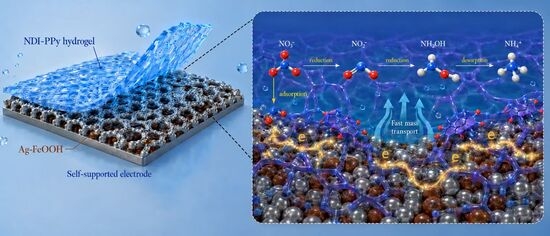
1. Introduction
Ammonia (NH
3) serves as a critical feedstock for the fertilizer, textile, and pharmaceutical industries and has emerged as a promising carbon-free energy carrier. Current industrial ammonia production relies heavily on the energy-intensive Haber–Bosch process, which entails substantial resource consumption and significant environmental burden [
1,
2,
3]. Renewable energy-driven electrochemical ammonium synthesis offers a sustainable alternative to this long-standing dilemma. However, the direct electrocatalytic reduction of N
2 to NH
4+ is severely impeded by the exceptionally high kinetic barrier associated with the N≡N triple bond (945 kJ·mol
−1). In contrast, nitrate (NO
3−), a ubiquitous aquatic pollutant, possesses a substantially lower N–O bond dissociation energy (~204 kJ·mol
−1) and a more positive reduction potential, rendering it a thermodynamically and kinetically more viable nitrogen source for electrocatalytic ammonium synthesis. Electrocatalytic nitrate reduction to ammonium (NRA) thus enables simultaneous pollutant remediation and resource recovery with markedly reduced energy input, delivering dual environmental and economic benefits.
Long-term durability of electrocatalysts is the core bottleneck restricting the industrialization of nitrate electroreduction (NRA). Precious-metal catalysts such as Pt and Pd deliver outstanding intrinsic catalytic activity yet suffer from scarce reserves and prohibitive costs, severely hampering their large-scale deployment [
4,
5]. Accordingly, developing non-noble-metal catalytic systems with high activity, high selectivity, low cost and outstanding long-term stability stands as a critical scientific challenge in this research field. Current studies predominantly construct composite architectures using nitrides, sulfides and carbonaceous materials to optimize the activity stability trade-off [
6,
7,
8], followed by further performance improvement via surface functionalization and nanoparticle immobilization. Hydrogels have drawn intensive attention thanks to their three-dimensional hydrophilic network: confined porous channels streamline mass transport and modulate electrocatalytic kinetics, immobilize supported nanocatalysts to suppress active component detachment, and accelerate charge transfer by tuning interfacial electronic configurations [
9,
10]. Intimate contact between hydrogel and electrolyte reduces interfacial impedance synchronously to boost catalytic activity and product selectivity. Despite numerous modification protocols available to improve catalyst durability, most involve harsh reaction conditions and tedious fabrication procedures [
11,
12], which urgently call for mild, facile yet highly efficient stabilization strategies. Our group has previously explored hydrogel-modified electrodes toward electrocatalytic nitrate reduction and verified their positive effect on cycling stability promotion [
13]. However, the performance and long-term durability of hydrogel-modified NRA electrodes still require further optimization. Different from our previous hydrogel-modified NRA study, the present work focuses on the non-invasive stabilization of an Ag-FeOOH catalytic substrate derived from our Ag-site-modified FeOOH system. The purpose of this study is not to simply repeat hydrogel coating, but to construct an amine-rich aromatic NDI hydrogel and further introduce a conductive PPy network to improve the operational durability of the Ag-FeOOH electrode and investigate its possible influence on apparent interfacial transport behavior. Moreover, a series of hydrogel-modified electrodes, including NDI, ND, PAM, PVA, SA, and PAA, were prepared on the same Ag-FeOOH substrate to comparatively evaluate the effects of functional groups, porous structures, and conductive network construction on NRA performance and cycling stability. Diversified hydrogel species and crosslinking strengthening approaches are capable of reinforcing the mechanical robustness of hydrogel coatings [
14,
15].
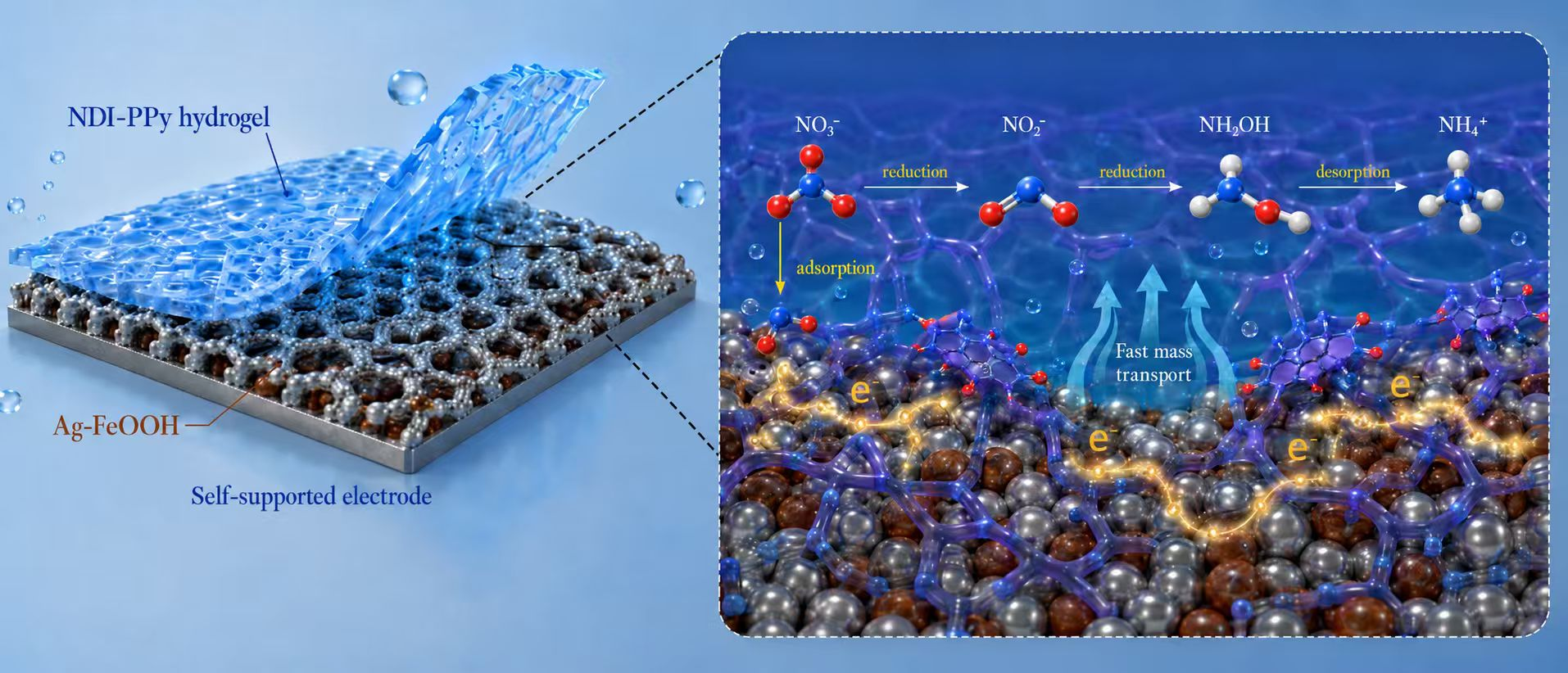
In this work, an ND hydrogel network was first constructed through the copolymerization of NAS and DMA. Subsequently, amine-rich aromatic units were introduced by mild substitution with 4,4′-iminodianiline (IDA), yielding the NDI hydrogel. Finally, Fe3+-triggered in situ polymerization of pyrrole was performed within the hydrogel network to generate conductive polypyrrole (PPy). Compared with simple physical mixing or post-loading, this in situ construction strategy is expected to provide closer interfacial contact between the hydrogel layer and the Ag-FeOOH substrate, while reducing random aggregation and mechanical detachment of the hydrogel components during electrolysis. This non-invasive modification strategy is designed to preserve the catalytic functionality of the Ag-FeOOH substrate while improving electrode integrity and potentially influencing interfacial transport behavior within the composite electrode. The Ag-FeOOH substrate used in this work was derived from our previously developed Ag-site-modified FeOOH catalytic system for electrocatalytic nitrate-to-ammonium reduction. Therefore, the present study does not aim to redesign the Ag-FeOOH catalytic substrate itself, but rather uses it as a model electrode to develop a non-invasive hydrogel stabilization strategy.
Targeting the above obstacles, this work adopts self-supported Ag-FeOOH as the substrate and proposes a sequential polymerization substitution polymerization strategy to fabricate porous conductive hydrogel catalytic electrodes, thereby improving the operational durability of the electrode. To further understand the role of hydrogel coatings, NDI-PPy/Ag-FeOOH composite electrodes are fabricated for NRA performance and cycling stability assessments. Parallel control samples are prepared by coating conventional hydrogels (PAM, SA, PVA, PAA) and PPy-containing conductive hydrogel systems onto identical substrates. Benefiting from this control system, this work provides a comparative understanding of how hydrogel composition, porous architecture, and conductive network construction influence the catalytic performance and cycling stability of hydrogel-modified Ag-FeOOH electrodes. This work provides a useful design guideline for hydrogel-based electrocatalysts and offers experimental evidence and comparative insights for hydrogel application in electrocatalytic nitrate reduction.
2. Results and Discussion
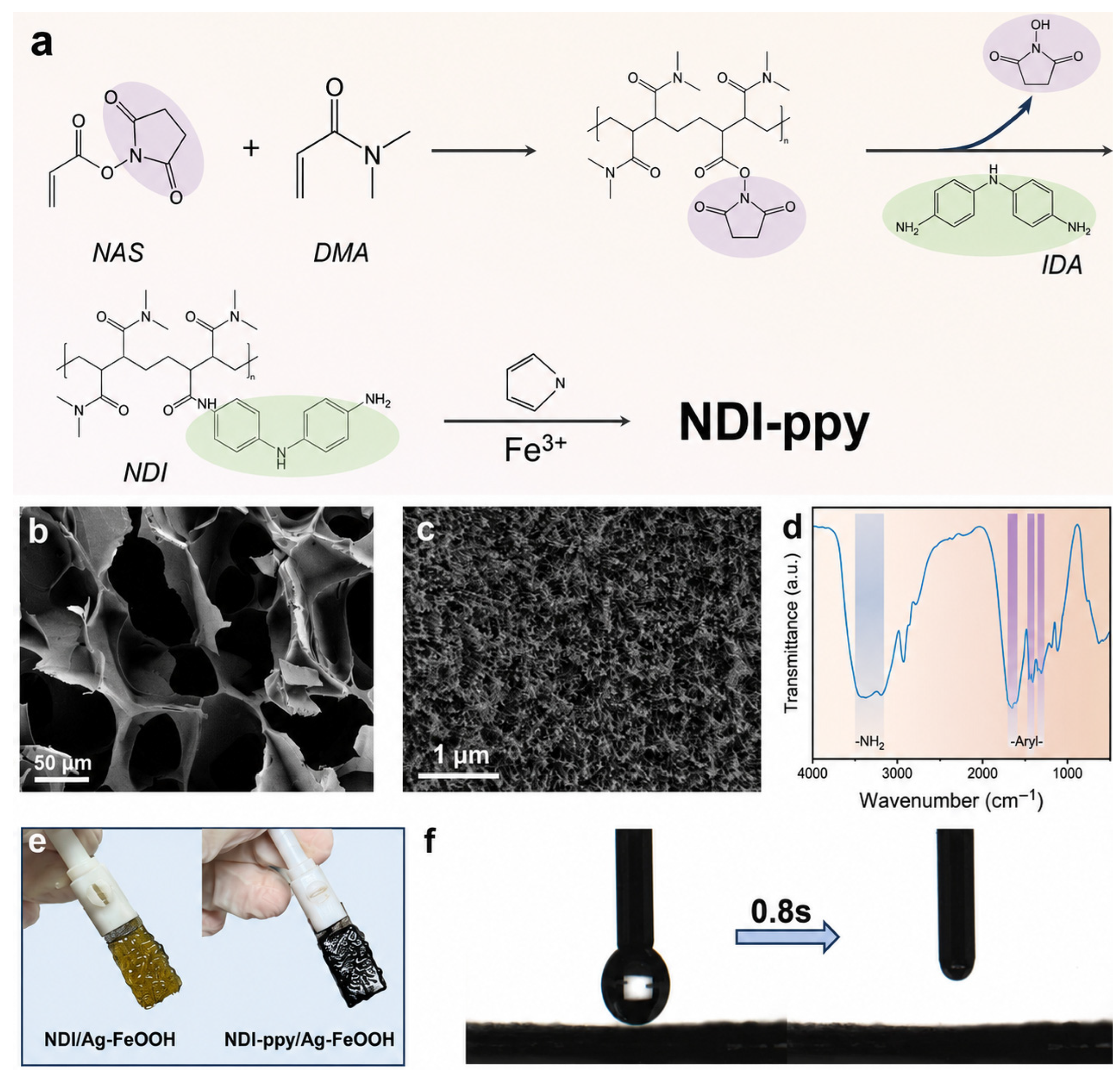
The conductive NDI-PPy hydrogel was synthesized on the Ag-FeOOH surface via a sequential room-temperature polymerization–substitution–polymerization process (
Figure 1a). The in situ construction process was adopted to promote intimate contact between the hydrogel network and the Ag-FeOOH substrate. Unlike simple physical mixing, which may lead to non-uniform distribution, weak interfacial adhesion, and possible detachment of hydrogel components during electrolysis, the in situ formed hydrogel layer can conformally cover the catalyst surface and maintain a more integrated electrode architecture. Therefore, this strategy is considered beneficial for constructing a stable hydrogel-modified self-supported electrode for NRA. Scanning electron microscopy (SEM) images (
Figure 1b,c) reveal the porous architecture of the NDI-PPy hydrogel, whose interconnected channels facilitate mass transport during electrocatalysis [
16,
17]. Fourier transform infrared (FTIR) spectroscopy (
Figure 1d) confirms the successful functionalization: characteristic absorption bands at 3200–3500 cm
−1 and 1450–1600 cm
−1 are assigned to –NH
2 stretching and benzene ring vibrations within the gel, respectively. To introduce a conductive polymer component into the hydrogel network, Fe
3+-triggered in situ polymerization of pyrrole was performed within the NDI hydrogel, yielding a uniformly black-colored NDI-PPy/Ag-FeOOH electrode (
Figure 1e). Contact angle measurements (
Figure 1f) further demonstrate the excellent hydrophilicity of the composite electrode, which is favorable for mass transport in electrocatalytic reactions [
18]. Collectively, the NDI-PPy/Ag-FeOOH electrode possesses a porous interior and a hydrophilic surface, rendering it well-suited for subsequent electrocatalytic NRA experiments. It should be noted that direct characterization of the underlying Ag-FeOOH active surface after hydrogel coating remains challenging because the catalyst surface is covered by the porous hydrogel network. Therefore, the present discussion does not aim to determine the exact active-site exposure after coating. Further cross-sectional microscopy, depth-profile surface analysis, and interfacial characterization are required to directly clarify the active surface structure of the hydrogel-modified Ag-FeOOH electrode.
Subsequently, the electrocatalytic NRA performance of NDI-PPy/Ag-FeOOH was evaluated in 0.5 M Na
2SO
4 electrolyte containing 100 ppm NO
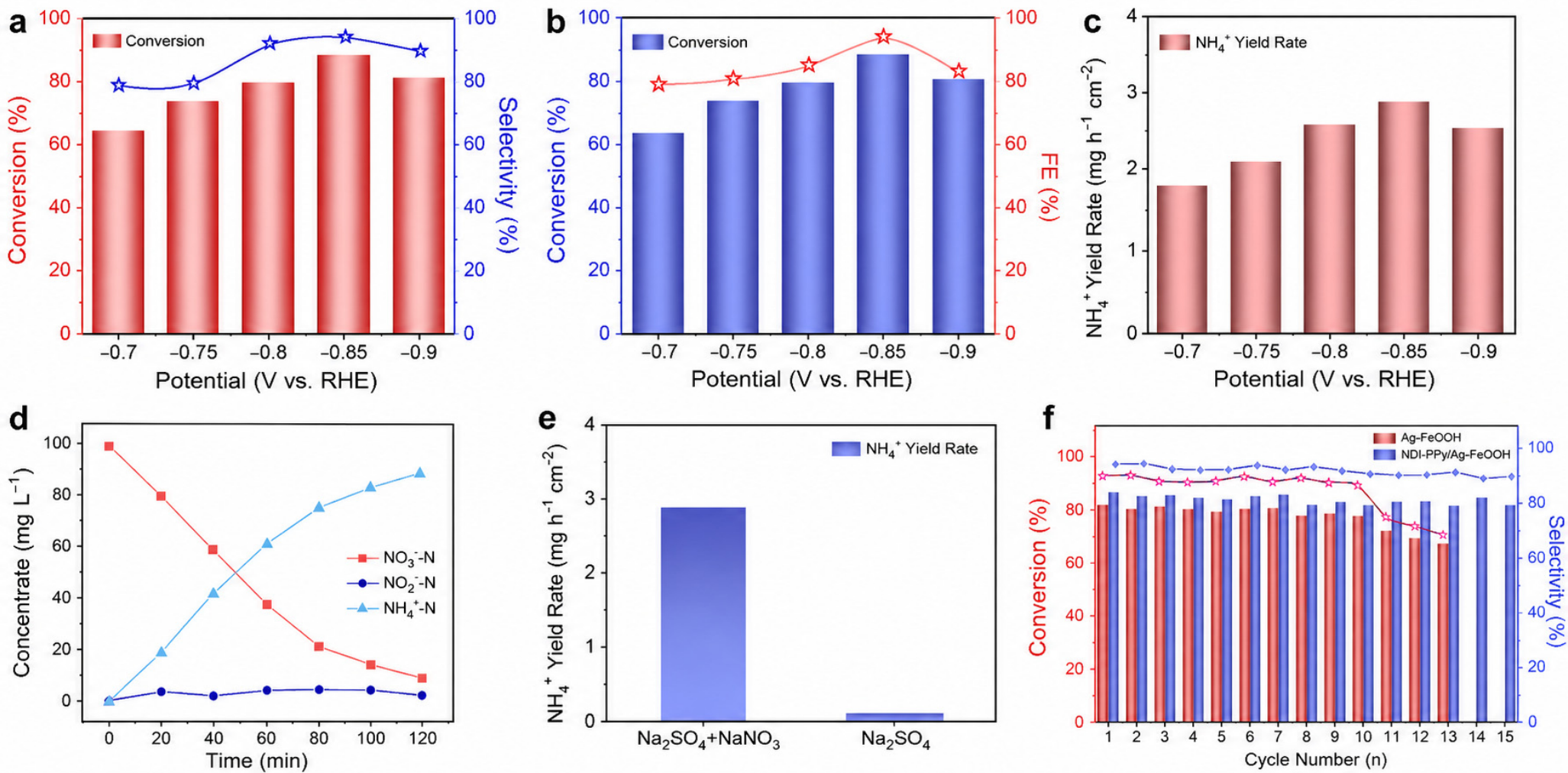
3−-N at various applied potentials. As shown in
Figure 2a–c, the initial NRA catalytic performance reaches a maximum at −0.85 V vs. RHE, delivering a NO
3−-N removal efficiency of 89.34%, an NH
4+-N selectivity of 94.27%, Faradaic efficiency of 89.53%, and an NH
4+-N yield rate of 2.95 mg h
−1 cm
−2. Time-dependent concentration profiles of NO
3−-N, NO
2−-N, and NH
4+-N were monitored during chronoamperometric electrolysis at −0.85 V vs. RHE (
Figure 2d). A rapid decline in NO
3−-N concentration is accompanied by a corresponding increase in NH
4+-N, confirming efficient nitrate-to-ammonium conversion. Notably, the NO
2−-N intermediate exhibits a transient accumulation followed by complete consumption, with its concentration remaining negligibly low throughout the reaction, indicative of excellent ammonium selectivity. A control experiment conducted in blank Na
2SO
4 electrolyte without NO
3− (
Figure 2e) yields negligible ammonium production, indicating that the detected NH
4+ mainly originates from nitrate reduction under the tested conditions rather than from the blank electrolyte. However, gaseous nitrogen-containing products, especially N
2O, were not directly analyzed in this study. In addition, ion chromatography was not performed to independently validate the liquid-phase nitrogen-containing ionic species. Therefore, the product selectivity discussed here is based on the quantified liquid-phase species obtained from UV-Vis colorimetric analysis, and further gas chromatography, online mass spectrometry, and ion chromatography analyses are required to fully evaluate gaseous byproducts and cross-validate nitrogen-containing products during NRA. Cycling durability was preliminarily assessed via 15 consecutive cycling tests on both NDI-PPy/Ag-FeOOH and bare Ag-FeOOH (
Figure 2f). The Ag-FeOOH electrode maintains stable performance over the first 10 cycles but exhibits a marked decline in both removal rate and selectivity during cycles 11–13. In contrast, the NDI-PPy/Ag-FeOOH electrode exhibits improved performance retention after 15 consecutive cycles, demonstrating enhanced operational stability compared with bare Ag-FeOOH. After consecutive cycling tests, the NDI-PPy/Ag-FeOOH electrode retained a NO
3− conversion rate of 89.64%, an NH
4+ selectivity of 87.94%, and a Faradaic efficiency of 90.46%. Overall, these results suggest that the conductive hydrogel coating contributes to improved catalytic performance and cycling stability of the Ag-FeOOH substrate. Although the 15-cycle test provides useful comparative evidence for the improved cycling durability of NDI-PPy/Ag-FeOOH, it does not fully represent long-term durability under practical operating conditions. In addition, quantitative Ag/Fe dissolution analysis, post-cycling morphological characterization, post-cycling chemical analysis of the hydrogel layer, and analysis of possible hydrogel degradation products were not performed in this study. Therefore, further ICP-based dissolution measurements, post-cycling SEM/TEM or cross-sectional microscopy, FTIR/Raman/XPS analyses, post-electrolysis electrolyte analysis such as TOC, LC-MS, GC-MS, or HPLC, and extended continuous electrolysis are required to evaluate active-component retention, morphology evolution, hydrogel chemical stability, possible hydrogel-derived degradation products, and operational lifetime.
It should also be explicitly acknowledged that X-ray diffraction (XRD), X-ray photoelectron spectroscopy (XPS), and electrochemical impedance spectroscopy (EIS) were not performed in the present study. Consequently, possible changes in crystalline phase, surface chemical state, oxidation state distribution, and charge-transfer resistance induced by hydrogel modification cannot be directly established from the current dataset. Therefore, the discussion of hydrogel-mediated stabilization and interfacial transport effects in this work is based primarily on the observed morphological features, FTIR characterization, wettability measurements, electrochemical current responses, catalytic performance, and comparative cycling behavior, and should not be interpreted as direct structural, spectroscopic, or impedance-based evidence of atomic-scale electronic reconstruction or accelerated interfacial charge transfer. Further XRD, XPS, and EIS analyses are required to directly clarify these aspects in future studies.
It should be noted that Cu-based catalysts have been widely regarded as one of the most efficient catalyst families for electrocatalytic nitrate-to-ammonium reduction, owing to their favorable nitrate adsorption and fast nitrate reduction kinetics [
19]. Several representative Cu-based or Cu-containing catalysts have achieved NH
3 Faradaic efficiencies higher than 95% under optimized reaction conditions [
3,
20,
21]. Therefore, the Faradaic efficiency of the present NDI-PPy/Ag-FeOOH electrode is not superior to the best-performing Cu-based systems. However, the purpose of this work is not to surpass Cu-based catalysts in intrinsic activity, but to develop a non-invasive hydrogel stabilization strategy for Ag-FeOOH electrodes. The NDI-PPy hydrogel layer improves the cycling durability of the Ag-FeOOH substrate while maintaining favorable NO
3−-N removal efficiency and NH
4+-N selectivity. Compared with highly active Cu-based systems, the advantage of this Ag-FeOOH-based approach lies in the mild hydrogel modification process, improved electrode integrity, and systematic regulation of hydrogel chemistry and conductivity. Nevertheless, further optimization of active sites, hydrogel thickness, and conductive network construction is still required to narrow the performance gap with state-of-the-art Cu-based catalysts.
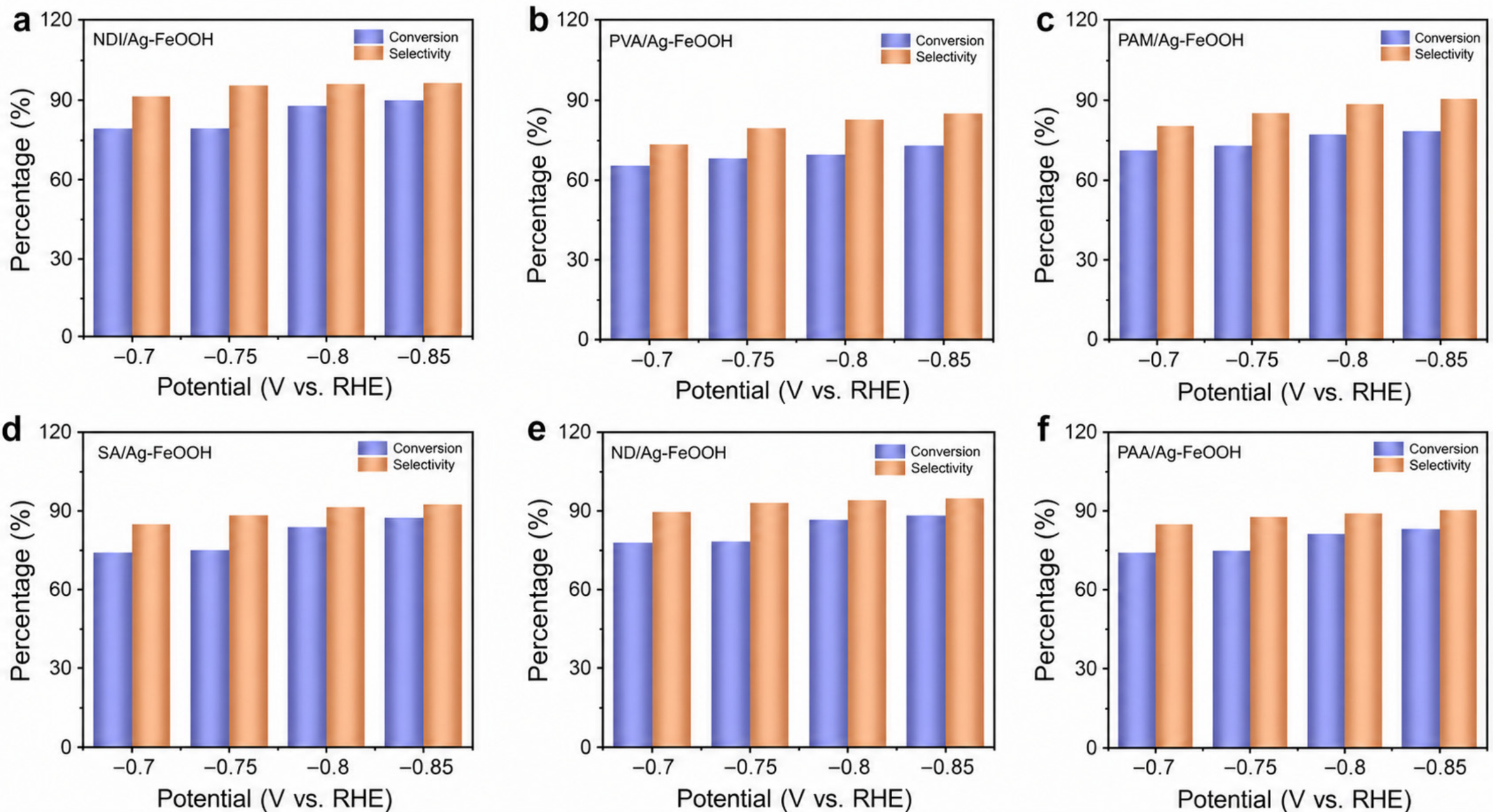
To further elucidate the role of hydrogel functional groups, a series of control hydrogels were loaded onto the same Ag-FeOOH substrate for systematic comparison: NDI (amine-functionalized aromatic hydrogel), ND (non-substituted hydrogel, i.e., NDI without the final IDA substitution step), polyacrylamide (PAM, amide group), polyvinyl alcohol (PVA, hydroxyl group), sodium alginate (SA, hydroxyl and ester groups), and polyacrylic acid (PAA, carboxyl group). As shown in
Figure 3, these hydrogels, bearing distinct functional moieties, exhibit markedly different electrocatalytic NRA performances. The NDI/Ag-FeOOH electrode delivers the highest NO
3− removal rates and selectivity across all tested potentials, achieving removal rates of 78.81%, 79.20%, 87.88%, and 89.56%, and selectivities of 91.33%, 94.97%, 95.73%, and 96.26% at the four applied potentials, respectively. In contrast, the ND/Ag-FeOOH electrode (lacking the IDA substitution step) shows comparatively lower performance, with removal rates of 75.23%, 76.62%, 84.13%, and 86.77%, and selectivities of 89.50%, 93.07%, 93.82%, and 94.33% at the same potentials, respectively. The systematic comparison between NDI and ND suggests that the introduction of amine-rich aromatic groups through the IDA substitution step is associated with measurable improvements in both activity and selectivity under the tested conditions. Finally, cyclic stability tests were conducted on selected gel-modified electrodes to evaluate their cycling durability under identical conditions.
As summarized in
Table 1, the gel-modified electrodes exhibit markedly different NO
3−-N removal efficiencies during the cycling tests. The NDI/Ag-FeOOH electrode maintains excellent removal stability throughout the cycling tests, with an average NO
3−-N removal efficiency of 86.07%. The PAM/Ag-FeOOH electrode also demonstrates robust durability, retaining an average removal rate of 78.84%. In contrast, the ND/Ag-FeOOH electrode undergoes a pronounced performance degradation after only four cycles. A direct comparison between NDI and ND suggests that the amine-rich aromatic moieties introduced via the IDA substitution step contribute to improved electrode stability. The PVA/Ag-FeOOH electrode also shows measurable NRA activity in the potential-dependent tests. However, its cycling data are not included in
Table 1 and
Table 2; therefore, only a qualitative discussion is provided here. The dense, non-porous architecture of PVA may impede mass transport and trap gas bubbles generated during electrolysis, which is unfavorable for sustained cycling stability. Similarly, the PAA/Ag-FeOOH electrode, bearing abundant carboxyl groups, exhibits severe gel delamination, resulting in a substantial decline in cyclic stability. In addition to NO
3−-N removal efficiency, NH
4+-N selectivity was also monitored during consecutive cycling tests, and the corresponding results are summarized in
Table 2.
As summarized in
Table 2, the NDI/Ag-FeOOH and PAM/Ag-FeOOH electrodes exhibit remarkable NH
4+-N selectivity retention throughout the cycling tests. Although the hydroxyl-rich PVA hydrogel provides enhanced interfacial adhesion, its dense, non-porous architecture impedes mass and gas transport, thereby limiting cycling stability. The SA hydrogel, despite possessing an abundant porous network, inherently adsorbs anionic species, leading to substantial accumulation of OH
− during electrocatalysis and consequently compromising electrode stability. The inferior performance of the SA-based electrode may be associated with anion adsorption-induced localized pH elevation at the electrode–electrolyte interface, which could accelerate degradation of the catalytic material. Collectively, these results indicate that the superior stability of NDI and PAM may be associated with their nitrogen-containing polar groups and porous architectures, which facilitate simultaneous mass and gas transport, thereby supporting sustained electrocatalytic performance.
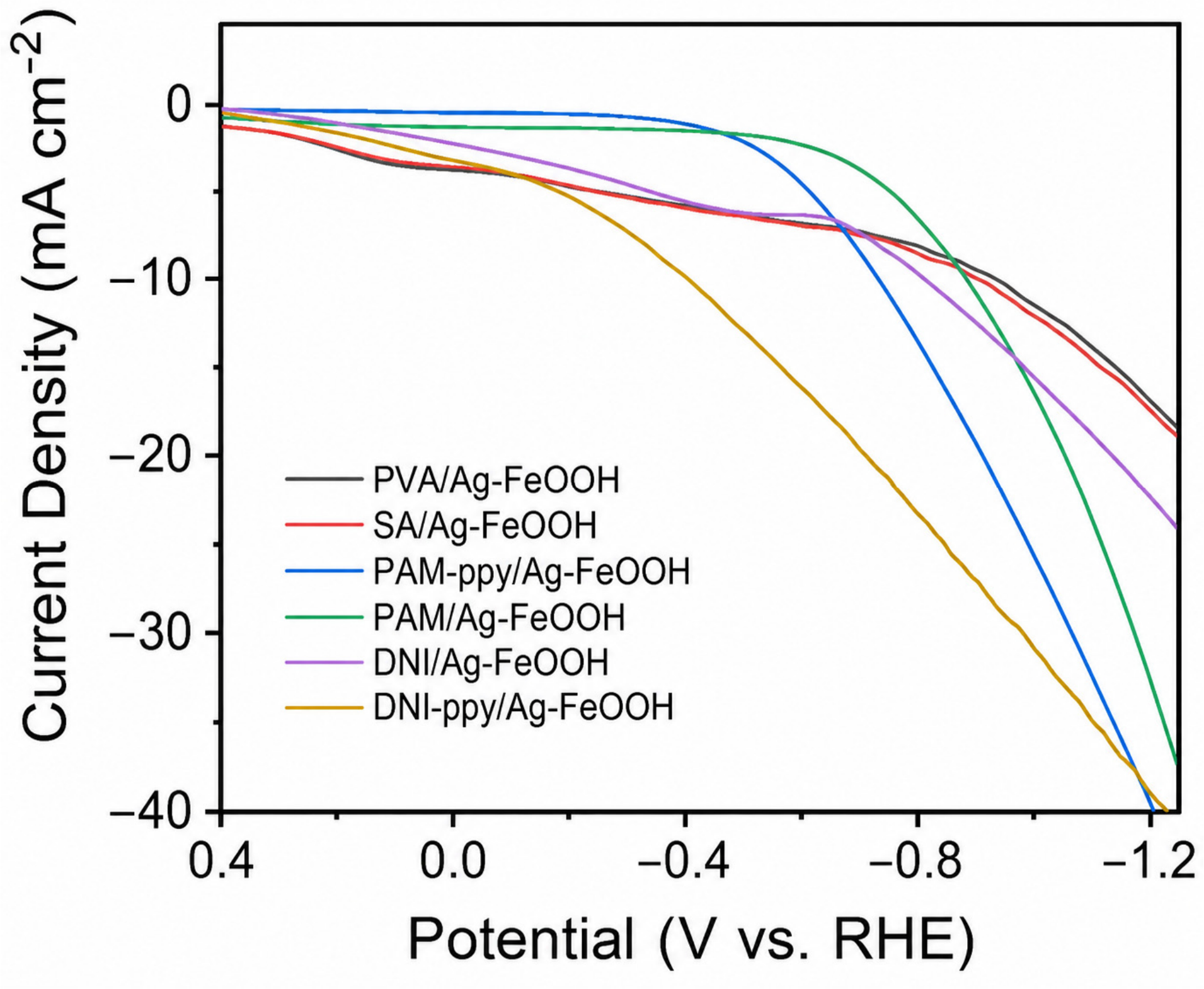
Linear sweep voltammetry (LSV) measurements were conducted on NDI/Ag-FeOOH, NDI-PPy/Ag-FeOOH, PAM/Ag-FeOOH, PAM-PPy/Ag-FeOOH, PVA/Ag-FeOOH, and SA/Ag-FeOOH electrodes in 0.5 M Na
2SO
4 electrolyte containing 100 ppm NO
3−-N, to evaluate the current response toward nitrate reduction on the gel-modified electrodes. As shown in
Figure 4, the NDI-PPy/Ag-FeOOH electrode exhibits the largest cathodic current response among all tested configurations. Notably, a systematic comparison reveals that the incorporation of the conductive polypyrrole (PPy) network leads to a pronounced enhancement in current response for both NDI-PPy/Ag-FeOOH relative to NDI/Ag-FeOOH and PAM-PPy/Ag-FeOOH relative to PAM/Ag-FeOOH. This comparative trend indicates that the PPy-containing electrodes exhibit a stronger apparent cathodic current response under identical geometric-area testing conditions; however, because EIS measurements were not performed, the LSV results alone cannot directly establish a decrease in charge-transfer resistance, and the possible influence of PPy on interfacial charge transport should therefore be regarded as a plausible interpretation rather than a directly verified mechanism. It should be noted that the electrochemical active surface area (ECSA) was not determined in this study. Therefore, the LSV current responses and catalytic performances are discussed based on the geometric electrode area and should be interpreted as apparent electrode-level behavior rather than ECSA-normalized intrinsic activity. Further EIS and double-layer-capacitance-derived ECSA measurements are required to distinguish the respective contributions of charge-transfer resistance, electrochemically accessible surface area, interfacial transport behavior, and hydrogel structure to the observed NRA performance. To further elucidate the impact of this enhanced current response on electrocatalytic NRA performance, chronoamperometric electrolysis was performed on the paired electrode systems (NDI-PPy/Ag-FeOOH vs. NDI/Ag-FeOOH and PAM-PPy/Ag-FeOOH vs. PAM/Ag-FeOOH) under identical conditions (0.5 M Na
2SO
4, 100 ppm NO
3−-N).
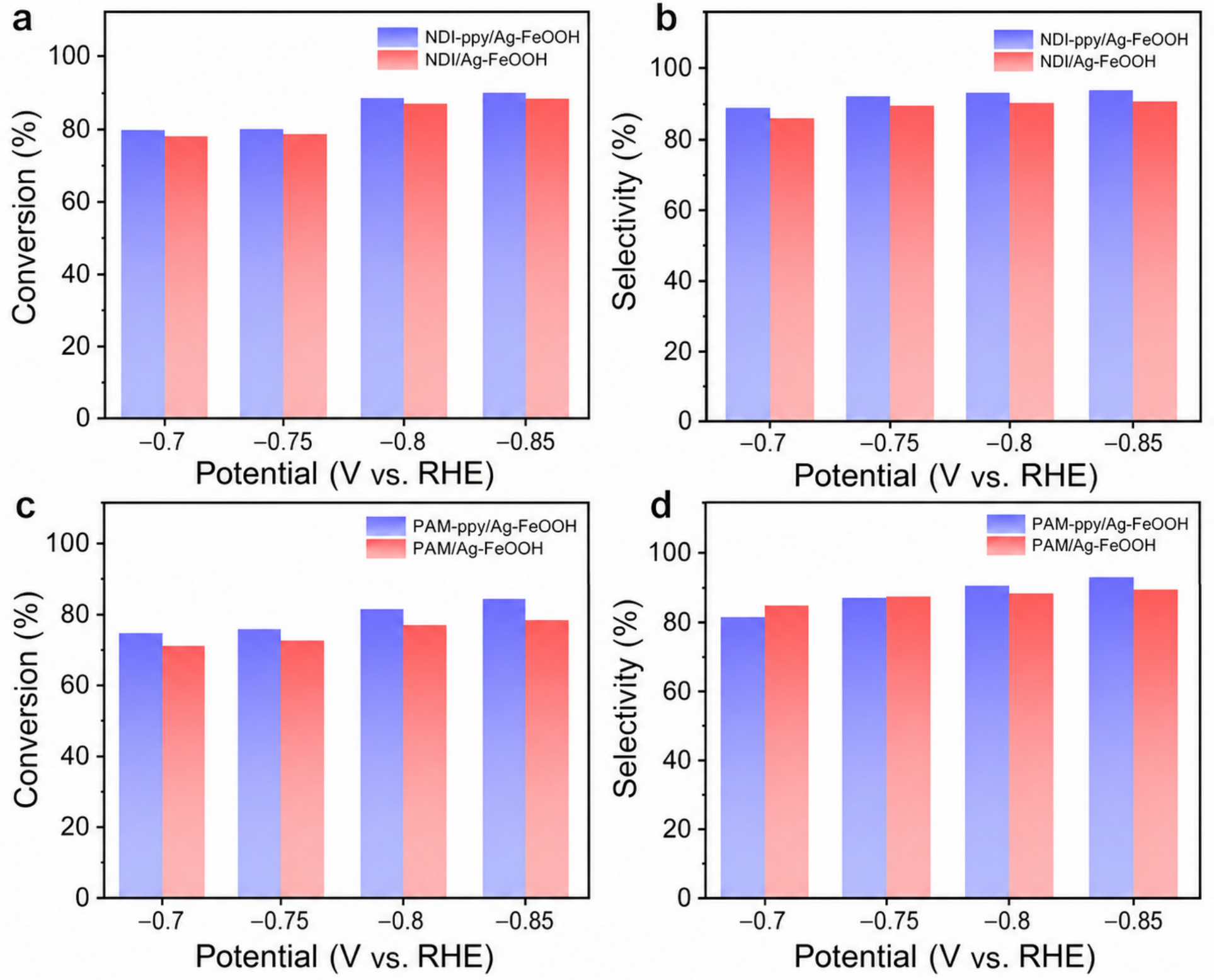
The chronoamperometric electrolysis results of 0.5 M Na
2SO
4 containing 100 ppm NO
3−-N are presented in
Figure 5. For both the NDI and PAM hydrogel systems, the incorporation of the conductive PPy network yields a simultaneous enhancement in NO
3−-N removal rate and NH
4+-N selectivity at identical applied potentials: NDI-PPy/Ag-FeOOH outperforms NDI/Ag-FeOOH, and PAM-PPy/Ag-FeOOH surpasses PAM/Ag-FeOOH. This consistent trend across two distinct hydrogel platforms suggests that the incorporation of the PPy network is associated with improved apparent electrode-level NRA performance under the tested conditions; however, in the absence of EIS measurements, the origin of this improvement cannot be attributed exclusively to enhanced interfacial charge transfer, and may also involve combined effects of hydrogel structure, ion transport, catalyst accessibility, and electrode integrity. It should be noted that the hydrogel thickness and PPy loading amount were not independently quantified or systematically optimized in this study. All hydrogel-modified electrodes were prepared under the same precursor and polymerization conditions to ensure comparability among different systems. Further quantitative control over hydrogel coating thickness and PPy content will be necessary to optimize mass transport, interfacial electron transfer, and cycling stability of hydrogel-modified NRA electrodes. It should also be noted that the nitrate concentration range investigated in this study is limited. Most comparative NRA tests were conducted in 0.5 M Na
2SO
4 containing 100 ppm NO
3−-N to ensure consistent evaluation of different hydrogel-modified electrodes. Therefore, the present results mainly demonstrate the relative performance and stabilization effect under a fixed nitrate concentration rather than concentration-dependent catalytic behavior. Future studies should evaluate a broader nitrate concentration range and more realistic wastewater matrices to further assess the practical applicability of hydrogel-modified NRA electrodes.
3. Materials and Methods
3.1. Material Preparation
The NDI-PPy/Ag-FeOOH electrode was prepared through a sequential polymerization substitution polymerization process, including Ag-FeOOH substrate construction, ND hydrogel formation, IDA substitution, and Fe3+-triggered pyrrole polymerization. Using a titanium mesh as the substrate, the Ag-FeOOH material was prepared via a two-step process combining hydrothermal synthesis and electroplating. On this basis, the NDI/Ag-FeOOH electrode was fabricated by in situ loading of the NDI hydrogel onto the Ag-FeOOH surface. The detailed fabrication procedure is as follows.
(1) Place the pre-treated titanium mesh into a 50 mL mixed solution containing 0.03 M FeCl3·6H2O and 0.03 M Na2SO4. Conduct a hydrothermal reaction at 60 °C under normal pressure for 12 h to obtain the FeOOH catalyst. Rinse the catalyst three times with deionized water and then dry it at 60 °C for subsequent use.
(2) Utilize the as-prepared FeOOH catalyst as the working electrode in a three-electrode system for electroplating. The plating solution is a 50 mL mixed solution containing 3.55 g Na2SO4, 0.32 g Na3C6H5O7, and 0.024 g AgNO3. Perform electroplating at a potential of −0.35 V vs. RHE using an I-t test for 30 s. For the electrodes used in this work, the amount of AgNO3 was fixed at 0.024 g. After electroplating, rinse the electrode three times with deionized water and dry it at 60 °C for further use. To avoid random aggregation caused by simple physical mixing, the hydrogel layer was constructed directly on the Ag-FeOOH surface through a sequential in situ polymerization–substitution–polymerization process.
(3) A covalent organic scaffold was synthesized via free-radical copolymerization of N,N’-methylenebisacrylamide (30 mM, crosslinker) and N,N-dimethylacrylamide (3.0 M) with N-acryloxysuccinimide (30 mM) in dimethyl sulfoxide (DMSO), using 2-hydroxy-4′-(2-hydroxyethoxy)-2-methylylpropiophenone (30 mM) as the photoinitiator.
(4) The as-synthesized dry Ag-FeOOH was placed in a mold and infiltrated with the prepared precursor solution A. The mold was then exposed to a UV LED lamp for 2 h to afford the ND/Ag-FeOOH electrode.
(5) The ND/Ag-FeOOH electrode was immersed in an anhydrous DMSO solution containing 4,4′-iminodianiline (IDA, 30 mM) for 8 h to substitute the succinimide groups, yielding the NDI/Ag-FeOOH electrode.
(6) The NDI/Ag-FeOOH electrode was first soaked in a 1.0 M FeCl3 solution for 1 h, followed by transfer to an aqueous pyrrole solution (0.1 wt%) and left to stand for 12 h, enabling in situ polymerization of the conductive polypyrrole (PPy) network within the gel to form the final NDI-PPy/Ag-FeOOH electrode.
3.2. Product Detection
The liquid-phase nitrogen-containing species, including NO3−-N, NO2−-N, and NH4+-N, were quantified using a UV-Vis spectrophotometer. Subsequently, their concentrations in the electrolyte were calibrated using the corresponding standard curves.
(1) Determination of NO3−-N Concentration: An appropriate amount of the electrolyte sample was pipetted into a centrifuge tube and diluted to 5 mL with deionized water. Then, 200 μL of sulfamic acid solution (5 wt%) was added. The mixture was placed on a laboratory bench and allowed to react at room temperature in the dark for 15 min. After the color reaction was complete, the absorbance values at dual wavelengths of 220 nm and 275 nm were measured using a quartz cuvette in a UV-Vis spectrophotometer. During data processing, the dual-wavelength correction method was used to calculate the net absorbance value (A = A220 nm − 2 × A275 nm). The standard curve of NO3−-N was obtained by fitting the absorbance values corresponding to different concentrations of NO3−-N solutions.
(2) Determination of NO2−-N Concentration: First, 25 mL of deionized water was placed in a beaker, followed by the sequential addition of 2 g of C6H8N2O2S reagent and 0.1 g of C12H14N2·2HCl while stirring. Then, 5 mL of H3PO4 was slowly added dropwise to form a transparent solution. An appropriate amount of the electrolyte sample to be tested was pipetted and diluted to 5 mL, mixed well, and then 100 μL of a freshly prepared color reagent was added. The mixture was placed in a dark box and allowed to stand in the dark for 20 min. The absorbance value of the colored solution was measured at the characteristic absorption wavelength of 540 nm using a UV-Vis spectrophotometer. The standard curve of NO2−-N was obtained by fitting the absorbance values corresponding to different concentrations of NO2−-N solutions.
(3) Determination of NH4+-N Concentration: The concentration of NH4+-N was detected using the Nessler’s reagent colorimetric method. First, Nessler’s reagent was prepared by dissolving 0.8 g of NaOH in 5 mL of deionized water and allowing the solution to cool to room temperature. Then, 0.35 g of KI and 0.5 g of HgI2 were added, and the mixture was stirred until fully dissolved. Subsequently, an appropriate amount of the electrolyte sample was pipetted into a centrifuge tube and diluted to 5 mL with deionized water. After that, 100 µL of NaKC4H4O6 solution (0.5 g mL−1) and 100 µL of Nessler’s reagent were added sequentially. The mixture was placed in a dark box and allowed to stand in the dark for 30 min. The absorbance value of the colored solution was measured at the characteristic absorption wavelength of 420 nm using a UV-Vis spectrophotometer. The standard curve of NH4+-N was obtained by fitting the absorbance values corresponding to different concentrations of NH4+-N standard solutions.
(4) Calculation of NRA parameters:
The NO
3−-N conversion efficiency was calculated according to the following equation:
The NH
4+-N selectivity was calculated as follows:
The Faradaic efficiency for NH
4+-N formation was calculated using the following equation:
where
The NH
4+-N yield rate was calculated according to the following equation:
The Faradaic efficiency for NO
2−-N formation was calculated as follows:
where:
In these equations, c0(NO3−-N) is the initial NO3−-N concentration, Δc(NO3−-N) is the concentration change of NO3−-N before and after electrolysis, c(NH4+-N) and c(NO2−-N) are the concentrations of generated NH4+-N and NO2−-N, respectively, V is the electrolyte volume, F is the Faraday constant (96,485.3 C mol−1), Q is the total charge passed during electrolysis, t is the electrolysis time, and S is the geometric area of the working electrode.
3.3. Characterization
SEM images were obtained using an S-4800 scanning electron microscope (Hitachi High-Tech Corporation, Tokyo, Japan). Fourier transform infrared spectroscopy (FTIR) spectra were recorded using a VERTEX 80 FTIR spectrometer coupled with a HYPERION 2000 infrared microscope (Bruker Optics GmbH & Co. KG, Ettlingen, Germany). Contact angle measurements were performed using a JC2000D contact angle meter (Shanghai Zhongchen Digital Technology Equipment Co., Ltd., Shanghai, China) to evaluate the surface wettability of the prepared electrodes. UV–Vis spectra were recorded using a UV2600 spectrophotometer (Tianmei, Shanghai, China) to quantify the concentrations of nitrogen-containing species.
4. Conclusions
To fabricate electrocatalytic NRA electrodes with concurrently high activity and stability, a porous hydrogel was loaded onto an Ag-FeOOH substrate, with target functional groups introduced into the covalent backbone via a mild substitution reaction. The effects of hydrogel type, functional moieties, and conductive polymer incorporation on electrocatalytic NRA performance were systematically investigated. The results suggest that nitrogen-containing hydrogels (NDI, PAM) contribute to improved cycling stability of the Ag-FeOOH substrate, whereas PVA may suffer from limited stability due to the absence of efficient mass-transport channels despite strong adhesion, and SA may suffer from the polyanionic behavior of abundant –COO− groups, which could induce localized pH elevation and subsequent degradation. Notably, NDI exhibits better apparent NRA performance than PAM under the tested conditions, which may be related to the presence of additional aromatic moieties and their possible influence on interfacial nitrate reduction. Furthermore, the incorporation of the conductive polymer PPy into N-containing hydrogel-modified electrodes is associated with simultaneous improvements in NO3− removal and NH4+ selectivity under the tested conditions, suggesting that the conductive network may contribute to improved apparent electrode-level NRA performance, although direct verification of changes in interfacial charge-transfer resistance requires further EIS analysis. Collectively, the NDI-PPy/Ag-FeOOH electrode achieves a favorable balance between activity and cycling durability among the investigated hydrogel-modified systems. Under the optimized electrolysis conditions, it delivers an initial NO3−-N removal efficiency of 89.34%, an NH4+-N selectivity of 94.27%, a Faradaic efficiency of 89.53%, and an NH4+-N yield rate of 2.95 mg h−1 cm−2. After 15 consecutive cycling tests, the NDI-PPy/Ag-FeOOH electrode retained a NO3− conversion rate of 89.64%, an NH4+ selectivity of 87.94%, and a Faradaic efficiency of 90.46%, demonstrating improved cycling durability relative to bare Ag-FeOOH under the tested conditions. It should be emphasized that XRD, XPS, and EIS analyses were not performed in the present study; therefore, the current results do not directly establish hydrogel-induced changes in crystalline phase, surface chemical state, oxidation-state distribution, or charge-transfer resistance. The mechanistic interpretations presented here are consequently restricted to trends inferred from the available morphological, spectroscopic, wettability, electrochemical, catalytic, and cycling data. Future studies combining XRD, XPS, EIS, post-cycling morphological and chemical analyses, quantitative Ag/Fe dissolution measurements, degradation-product analysis, gaseous-product detection, ion chromatography validation, ECSA evaluation, extended stability tests, and broader nitrate concentration ranges are required to achieve a more complete understanding of the stabilization mechanism and practical durability of the hydrogel-modified Ag-FeOOH electrode.