Article

Selective Gas-Phase γ-Picoline Oxidation over V–Mn Oxide Catalyst: Feed Conditions and System Deactivation Resistance

by
Kairat Kadirbekov
1,*,
Nurdaulet Buzayev
1,2,*,
Tileutai Abildin
2,
Svetlana Yermukhanova
3,
Mels Oshakbayev
1,
Kamilla Khakimbolatova
4 and
Gulnara Seitkhal
1
1
Laboratory of Petroleum Chemistry and Petrochemical Synthesis, A.B. Bekturov Institute of Chemical Sciences, Almaty 050010, Kazakhstan
2
Department of Physical Chemistry, Catalysis and Petrochemistry, Farabi University, Almaty 050040, Kazakhstan
3
Industrial Technology Institute, Zhangir Khan West-Kazakhstan Agrarian Technical University, Uralsk 090009, Kazakhstan
4
National Institute of Intellectual Property, Almaty 050010, Kazakhstan
*
Authors to whom correspondence should be addressed.
Catalysts 2026, 16(7), 610; https://doi.org/10.3390/catal16070610
Submission received: 4 June 2026 / Revised: 27 June 2026 / Accepted: 2 July 2026 / Published: 3 July 2026

Abstract

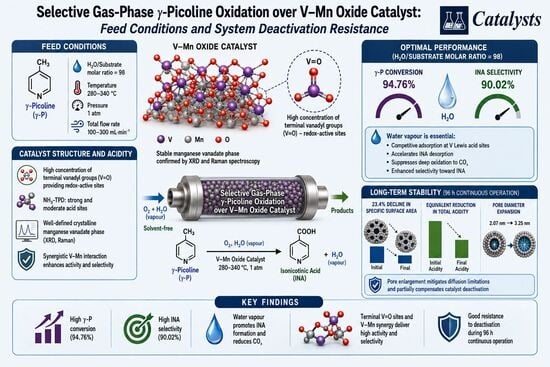
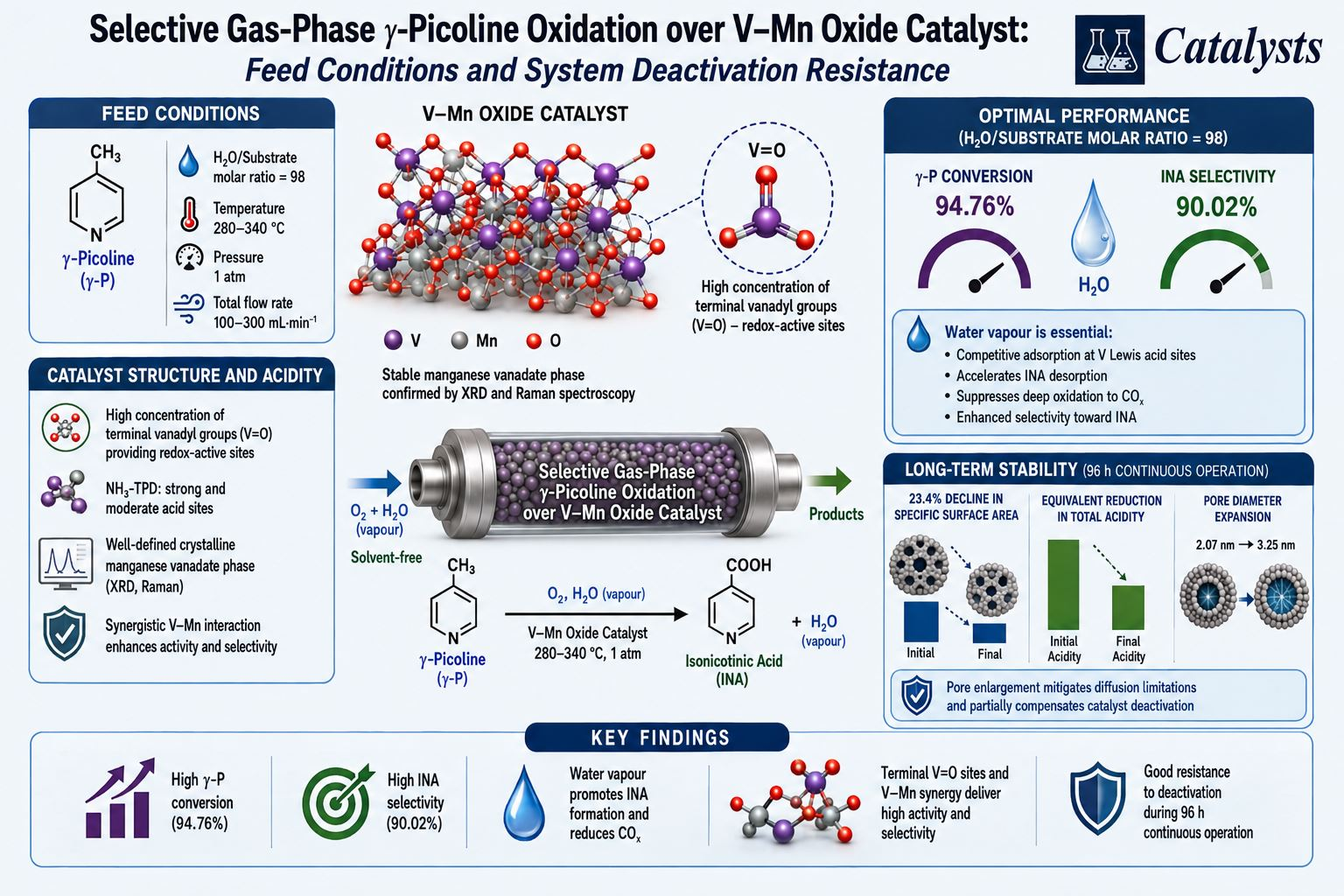
The selective gas-phase oxidation of γ-picoline (γ-P) to isonicotinic acid (INA)—a key precursor for the anti-tuberculosis drug isoniazid—was investigated over a V–Mn oxide catalyst as a solvent-free, waste-minimizing alternative to conventional liquid-phase synthesis routes. XRD and Raman spectroscopy confirmed the formation of a stable manganese vanadate crystalline phase with a high concentration of terminal vanadyl groups (V=O), providing well-defined redox-active sites. Water vapour proved essential for sustainable process performance: at an optimal H2O/substrate molar ratio of 98, γ-picoline conversion reached 94.8% with INA selectivity of 86.5%, eliminating the need for hazardous solvents or additives. NH3-TPD and kinetic analysis revealed that water vapour acts as a competitive adsorbent at vanadium Lewis acid sites, accelerating target product desorption and suppressing deep oxidation to COx—directly reducing carbon waste. Long-term stability was assessed over 96 h of continuous operation: the 23.4% decline in specific surface area correlated with an equivalent reduction in total acidity, while pore diameter expansion from 2.07 to 3.25 nm mitigated diffusion limitations, partially compensating for deactivation. These findings establish the V–Mn oxide system as a promising green catalytic platform for upgrading petrochemical fractions into high-value pharmaceutical intermediates with reduced environmental impact.

Graphical Abstract

1. Introduction

Isonicotinic acid (INA) is an essential building block for isoniazid, a first-line anti-tuberculosis drug of global pharmaceutical importance [1]. Its industrial production via gas-phase catalytic oxidation of γ-picoline (γ-P) with atmospheric oxygen represents an inherently cleaner synthetic route compared to liquid-phase, avoiding hazardous solvents and minimizing toxic waste streams [2,3]. The substrate itself is a renewable petrochemical derivative. Its industrial synthesis is based on the Chichibabin reaction—the catalytic condensation of ammonia with acetaldehyde. This process proceeds via intermediate stages involving the formation of crotonic condensation products, which explains the presence of γ-P in the crotonic fractions of petrochemical production [4,5].
Vanadium oxide is traditionally used as the active component in such reactions due to its high redox activity and ability to transfer oxygen fragments via the Mars–van-Krevelen mechanism [6,7,8]. However, vanadium catalysts have low selectivity for the target product and limited thermal stability [9]. At elevated temperatures, V-containing catalysts may undergo deactivation due to sintering of the active phase, agglomeration of vanadium particles and a reduction in SSA, leading to a decrease in the number of available active sites. These structural changes can impair the catalytic activity and long-term stability of the process [10].
Modification with transition metals is a well-established strategy to improve both selectivity and longevity of vanadium-based systems [11,12,13,14,15]. The V–Ti–O catalyst achieves complete conversion at 310 °C; however, the yield of INA does not exceed 40% [2]. The V–Zr–O system enabled an increase in the INA yield to 57% at a lower temperature of 270 °C [12]. For V–Cr–O, a conversion of 91.7% and an INA yield of approximately 57% have been reported at 300 °C [13]. More complex systems provide further improvements in performance: V–Ti–Cr–O achieves 100% conversion and a 67% yield of INA at 250 °C [14], whilst V–Ti–Sb–O provides 88% conversion and 80% selectivity for INA at 320–340 °C [15]. In particular, the combination of vanadium and manganese has attracted the attention of researchers [16,17,18]. In our previous studies, the V–Ti–Mn–O catalyst exhibited a conversion of 82% and a selectivity for INA of 67% at 320–360 °C [17]. The introduction of manganese leads to the formation of mixed oxide phases, such as Mn2V2O7, which exhibit improved redox properties and increased oxygen mobility. The synergy between Mn and V is linked to the interaction of the Mn3+/Mn2+ and V5+/V4+ redox pairs, which promotes the formation of oxygen vacancies and enhances catalytic activity [19]. Beyond composition, surface electrochemical properties, active center architecture, and oxygen vacancy mobility collectively govern efficiency and selectivity—enabling regeneration of active centers at high temperatures over extended operating cycles [20,21,22,23]. Longer catalyst lifetimes directly translate to reduced material consumption and a smaller environmental footprint.
Feed composition is equally critical in governing the sustainability of gas-phase selective oxidation of alkylpyridines, determining the balance between selective carboxylic acid formation and wasteful deep oxidation to COx [24]. The O2/substrate ratio (optimally 10–25) controls the V5+/V4+ redox cycle efficiency: oxygen deficiency slows active site regeneration, while excess oxygen promotes undesirable deep oxidation [25,26]. Substrate concentration above 1–3 vol.% increases competition for active sites, reducing surface availability by 15–40% and shifting selectivity [27]. Water vapour, notably, acts as a green process modifier: at H2O/substrate ratios of 20–120 mol/mol, selectivity increases by 10–25% and COx formation drops by 15–35%, through competitive adsorption on vanadium Lewis acid sites, weakened binding of oxygen-containing intermediates, and accelerated product desorption [28,29,30,31]—all without introducing any additional chemical reagents.
Despite considerable research on alkylpyridine oxidation, the influence of feed conditions on γ-picoline oxidation over V–Mn oxides remains insufficiently studied, particularly regarding long-term catalyst stability and deactivation mechanisms that determine real-world process viability. Building on our previous work on vanadium-based systems for 4-methylpyridine oxidation [17,32], the present study addresses two under-investigated aspects: (i) the effect of feed molar ratios on catalytic performance, and (ii) the physicochemical evolution of the catalyst over 96 h of continuous operation. Together, these objectives provide a foundation for the rational design of more sustainable, longer-lived catalytic systems for pharmaceutical intermediate production.

2. Results and Discussion

2.1. Structural and Textural Properties

X-ray diffraction analysis (Figure 1) shows that the V–Mn catalyst is a multiphase oxide system formed because of high-temperature interaction between vanadium and manganese oxides. The diffractogram clearly gives intense reflections at 2θ ≈ 28.7° and 30.1°, indexed as (200) and (201), which are characteristic of the Mn2V2O7 crystalline phase, indicating the formation of thermodynamically stable mixed manganese-vanadium oxides.
Additional reflections in the 2θ ≈ 33–36° region with indices (103), (202) and (101) can be attributed to the Mn3O4 phase, which is consistent with the partial crystallization of manganese oxides in the form of large domains. The presence of a (311) reflection at 2θ ≈ 41° and a weak (222) reflection in the 44–45° range further confirms the presence of mixed V-Mn oxide structures forming at the phase boundary [33].
In the high-angle region of the diffractogram, peaks are observed at 2θ ≈ 54–56° and 58–60°, indexed as (132), (211) and (332), which may be associated with the crystalline modifications Mn2V2O7 and Mn3O4, while a weak reflection at 2θ ≈ 69–70° (350) indicates the presence of highly ordered manganese oxide domains. The absence of intense and clearly defined V2O5 peaks indicates that vanadium in the system is predominantly present in the form of highly dispersed or structurally incorporated VOx fragments, rather than in the form of a separate crystalline phase.
Thus, the XRD data indicates the formation of a dense, partially sintered multicomponent oxide matrix consisting of Mn2V2O7, Mn3O4, and dispersed vanadium centers. This phase organization contributes to the formation of heterogeneous Mn–O–V bonds and active redox sites, ensuring high lattice oxygen mobility and efficient Mn3+/Mn4+ and V4+/V5+ cycles [34,35]. These structural features are directly related to the catalytic behavior of the system in the selective oxidation of γ-picoline, determining moderate substrate conversion and limited selectivity towards INA due to the low dispersion of active centers and limited accessible surface area.
The textural parameters of the synthesized V–Mn catalyst, determined by the low-temperature nitrogen adsorption–desorption method, are presented in (Table 1). The freshly prepared catalyst is characterized by a moderate SSA (SBET), amounting to 9.31 m2/g. Analysis of the contribution of different surface types shows that the vast majority of the total area (about 89%) is accounted for by the external surface (Sext = 8.29 m2/g), while the contribution of micropores remains insignificant (Smicro = 1.72 m2/g). This distribution is a favorable factor for selective oxidation reactions of heterocyclic compounds, as it ensures high accessibility of active sites for the relatively bulky γ-P molecules and minimizes steric hindrance. The average pore diameter is 2.07 nm places the material at the micropore–mesopore boundary, formally classifying it as a mesoporous according to the IUPAC classification (2 nm ≤ Dp ≤ 50 nm) [36]. However, in combination with the low total pore volume (0.00122 cm3/g), these parameters indicate the formation of a dense crystalline structure of a V–Mn mixed oxide. It is likely that the porosity in this system is predominantly represented by intergranular voids arising from the aggregation of nanoparticles.
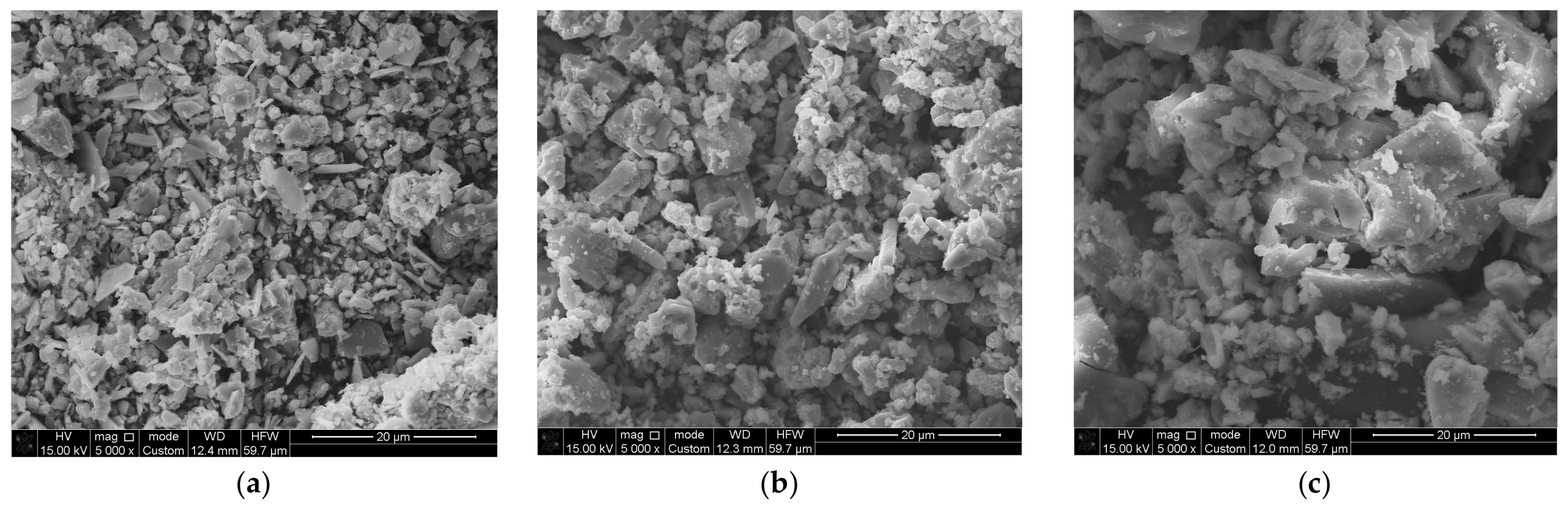
The surface morphology and microstructure of the V–Mn catalyst were investigated using scanning electron microscopy (Figure 2). The micrograph shows a heterogeneous structure consisting of primary particles and their large secondary aggregates with a broad size distribution (from 1 to 15 μm). The morphology is characterized by a combination of two types of structures: lamellar formations, characteristic of the crystalline phases of vanadium oxides. Irregularly shaped granular aggregates, likely belonging to manganese oxide phases or mixed oxide systems. These SEM data are in good agreement with the results of texture analysis (BET). Despite the presence of large micron-sized aggregates, the catalyst exhibits a measurable SSA (9.31 m2/g). This confirms that the large particles observed in the image are secondary agglomerates consisting of nanoscale primary crystallites. The surface roughness and the presence of interparticle voids (interstitial porosity), visible in the SEM image contribute to the external surface area (Sext) identified by the BET method. This open morphology ensures efficient diffusion of γ-P to the active sites and facilitates the removal of INA.

2.2. XPS

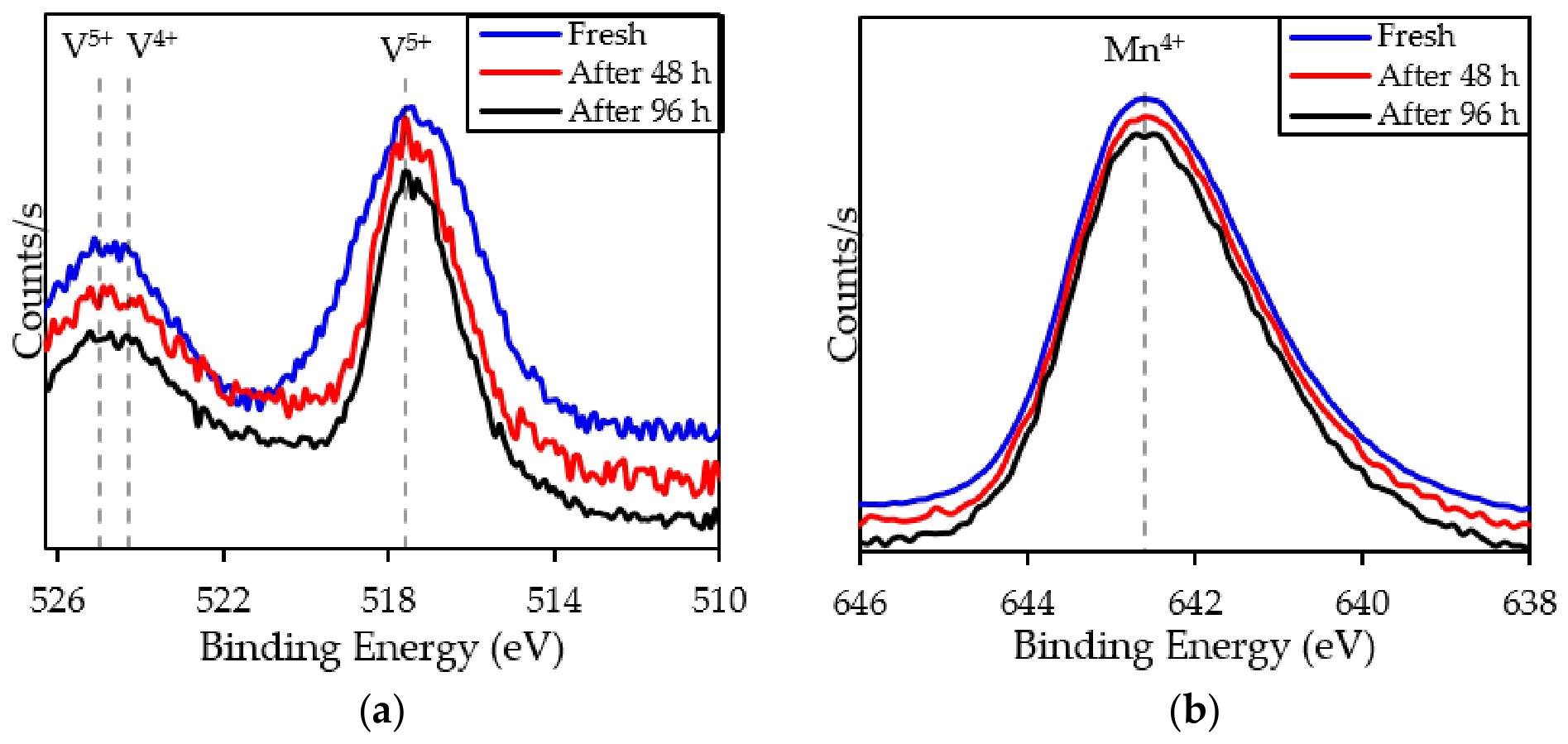
The chemical state of the elements on the surface and their stability were investigated using XPS for fresh and spent (48 h, 96 h) samples of the V–Mn catalyst (Figure 3 and Table 2). In the high-resolution V2p spectrum, two main signals are identified with binding energies of ~517.5 eV (V2p3/2) and ~525.0 eV (V2p1/2), which unambiguously correspond to V5+ ions in the mixed oxide phases [37]. The presence of a characteristic broadening (shoulder) in the low-binding-energy region (~524.3 eV), corresponding to the V4+ state, indicates partial surface reduction and the formation of oxygen vacancies, which play a key role in the activation of molecular oxygen. The state of the manganese component is characterized by a pronounced Mn2p3/2 peak at 642.6 eV, typical for Mn4+ ions [38]. Quantitative analysis of the atomic composition revealed a vanadium surface enrichment effect, whereby the V/Mn ratio on the surface of the fresh sample was 1.23, which significantly exceeds the calculated bulk value (1.00), thereby ensuring a high concentration of active sites in the zone of direct contact with the substrate. The observed surface enrichment in vanadium is a direct consequence of the Pechini synthesis route: the citrate-polyol precursor promotes atomic-level mixing of V and Mn, but during calcination at 800 °C, the lower surface free energy of VOx species drives their preferential migration to the surface, a process documented for Pechini-derived mixed oxides [32]. The progressive decrease in the surface V/Mn ratio from 1.23 (fresh) to 1.16 (96 h) under reaction conditions reflects partial redistribution of surface vanadium into bulk vanadate structures, consistent with the H2-TPR data showing a shift in the reduction peak from 410 °C to 580 °C.

2.3. Raman Spectroscopy

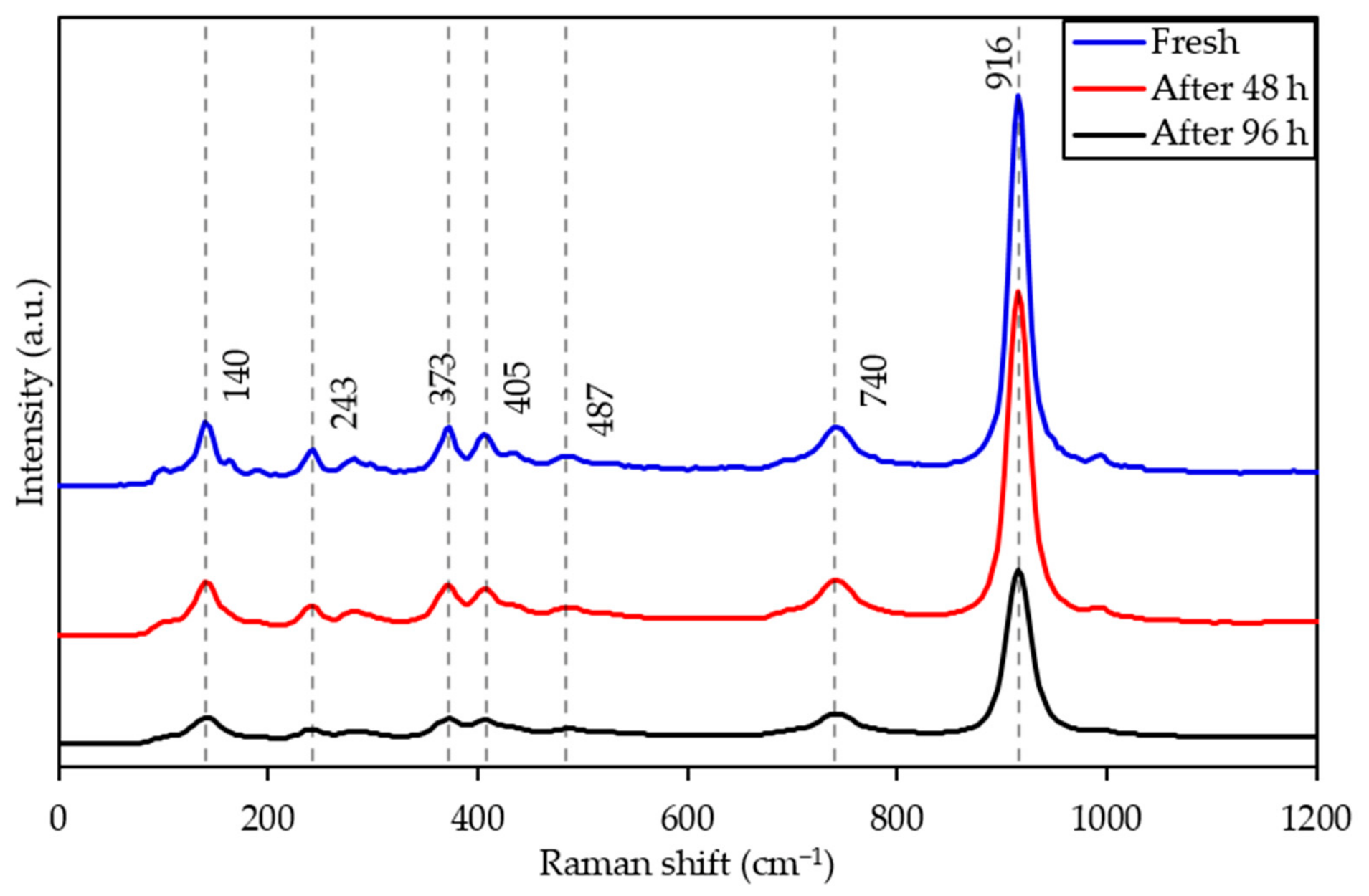
The local molecular environment and phase composition of the surface of the synthesized V–Mn catalyst were investigated using Raman spectroscopy (Figure 4). The sample spectrum is dominated by a narrow and intense band at 916 cm−1, caused by valence vibrations of the terminal V=O bonds (vanadyl groups) in highly ordered tetrahedral or pyramidal VOx units. The presence of this clearly defined peak indicates the structural homogeneity of the vanadium active sites in the highest oxidation state (V5+), which correlates with the XPS results. The band at 740 cm−1 corresponds to the asymmetric vibrations of the V–O–Mn (or V–O–V) bridging bonds forming the framework of the mixed oxide system. A group of peaks in the mid- and low-frequency regions (487, 405, 373, 243, and 140 cm−1) corresponds to deformation and lattice (phonon) vibrations of the crystal lattice. The narrow profile and high intensity of these lines confirm the presence of long-range crystalline order and a high degree of grain vitrification, which is fully consistent with the XRD and SEM data.

2.4. Redox and Acidic Properties (H2-TPR and NH3-TPD)

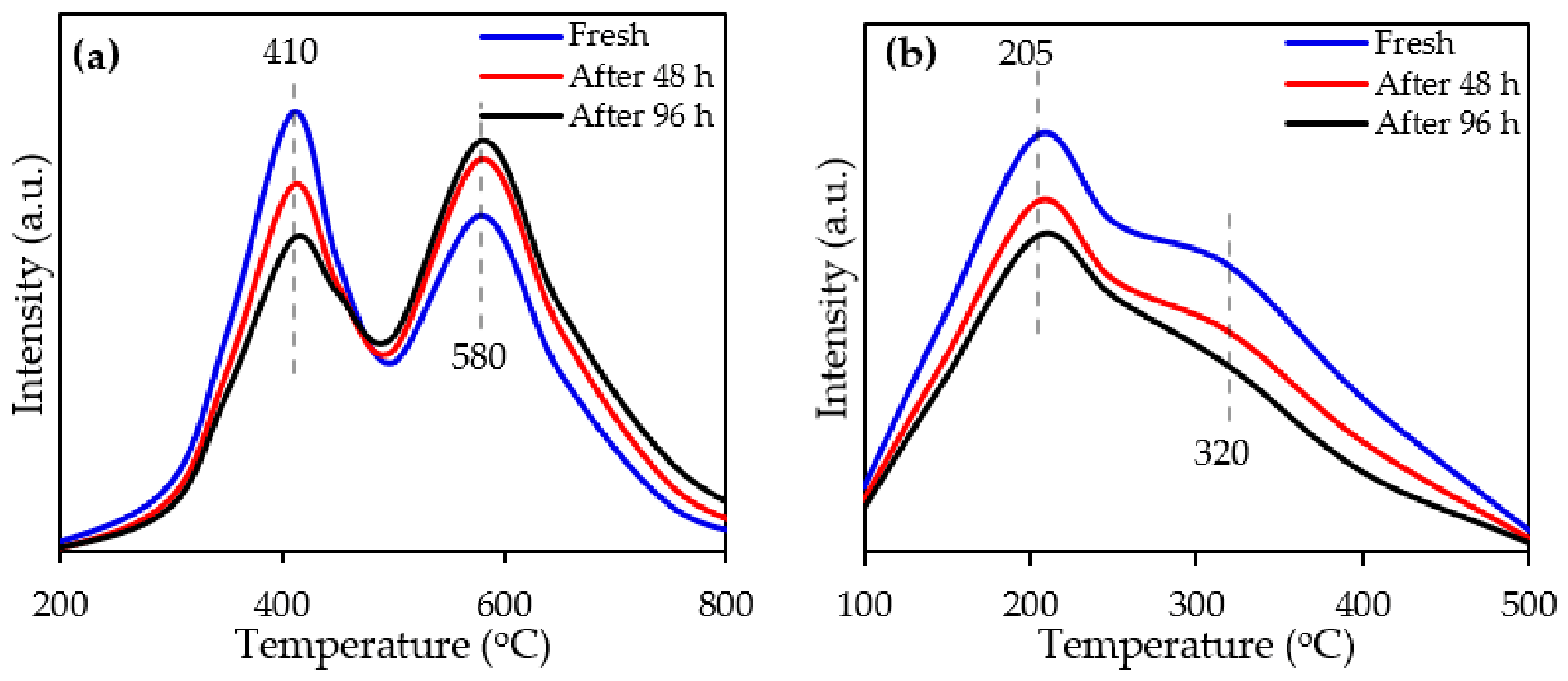
An investigation of the redox properties of a freshly prepared V–Mn catalyst using the method of temperature-programmed hydrogen reduction (Figure 5a) revealed a two-stage nature of the active phase reduction. The profile is dominated by an intense low-temperature peak with a maximum at 410 °C, which is associated with the reduction in highly dispersed surface forms of vanadium that are in strong interaction with the manganese component. A significant reduction in the reduction temperature compared to pure V2O5 (above 600 °C) indicates a pronounced promoting effect of manganese, leading to the weakening of V–O bonds and an increase in the mobility of lattice oxygen. The second peak at 580 °C corresponds to the reduction in larger aggregates and bulk phases of manganese vanadate, which is consistent with the high degree of crystallinity of the sample, as determined by X-ray diffraction and Raman spectroscopy. The observed shift in the reduction processes into the low-temperature region indicates increased redox activity of the system and suggests a plausible reaction pathway involving the effective implementation of the Mars–van Krevelen mechanism, which may ensure the activation of the C–H bond in the methyl group of γ-picoline and the stable regeneration of active sites during the catalytic cycle [39].
The surface acidity of the V–Mn catalyst was investigated using temperature-programmed ammonia desorption (NH3-TPD). The desorption profile (Figure 5b) is characterised by a broad distribution of signals in the 150–500 °C range, indicating the presence of sites with varying adsorption strengths. The main desorption peak at 205 °C corresponds to the desorption of ammonia from weak and moderate acid sites, which in vanadium-containing systems are predominantly identified as Lewis acid sites [40]. The XPS data (V2p and Mn2p3/2) confirm the presence of surface V5+/V4+ and Mn4+ pairs, as well as an increased proportion of surface oxygen associated with defective and coordinatively unsaturated states. The combination of XPS data and NH3-TPD suggests that the observed acidic centers are predominantly Lewis acid sites associated with surface cationic centers of transition metals.
The presence of a pronounced shoulder in the high-temperature region with a maximum around 320 °C indicates the presence of strong acid sites responsible for the strong chemisorption of the probe molecule. These centers play a key role in the initial stage of the reaction, ensuring the adsorption of γ-P molecules through the interaction of the nitrogen atom’s unshared electron pair with metal vacancies. The optimal ratio of moderate to strong acidic centres plays an important role in the activation of the C–H bonds of the methyl group in alkylpyridines and their subsequent selective oxidation. At the same time, excessive surface acidity may enhance the adsorption of intermediate compounds and promote their further deep oxidation to COx, leading to a reduction in the selectivity of the process [41]. Thus, NH3-TPD combined with XPS confirms the presence of a well-developed surface acid function, attributable to the coordinatively unsaturated cationic V–Mn centers of the oxide system, which ensures a balance between reagent activation and product desorption. The combined surface characterization data allow direct structure–performance correlations to be established for the V–Mn system. The geometric surface state—specifically the high external surface area (Sext = 8.29 m2/g)—governs substrate accessibility and thus conversion. The electronic surface state—the V5+/V4+ ratio and surface V/Mn enrichment (1.23) determined by XPS—controls the Mars–van Krevelen redox cycle efficiency and thereby selectivity. The acid site distribution determined by NH3-TPD—weak Lewis sites (205 °C) governing product desorption, strong sites (320 °C) governing substrate activation—determines the balance between INA selectivity and deep oxidation to COx. The redox site distribution from H2-TPR—dispersed surface vanadates (410 °C) vs. bulk Mn2V2O7 (580 °C)—controls the completion of the two-step oxidation sequence γ-P → aldehyde → INA. These correlations are discussed quantitatively in the context of the catalytic performance data in Section 2.5 and Section 2.6.

2.5. Catalytic Performance

2.5.1. Effect of the Reaction Mixture Composition on the Conversion of γ-Picoline

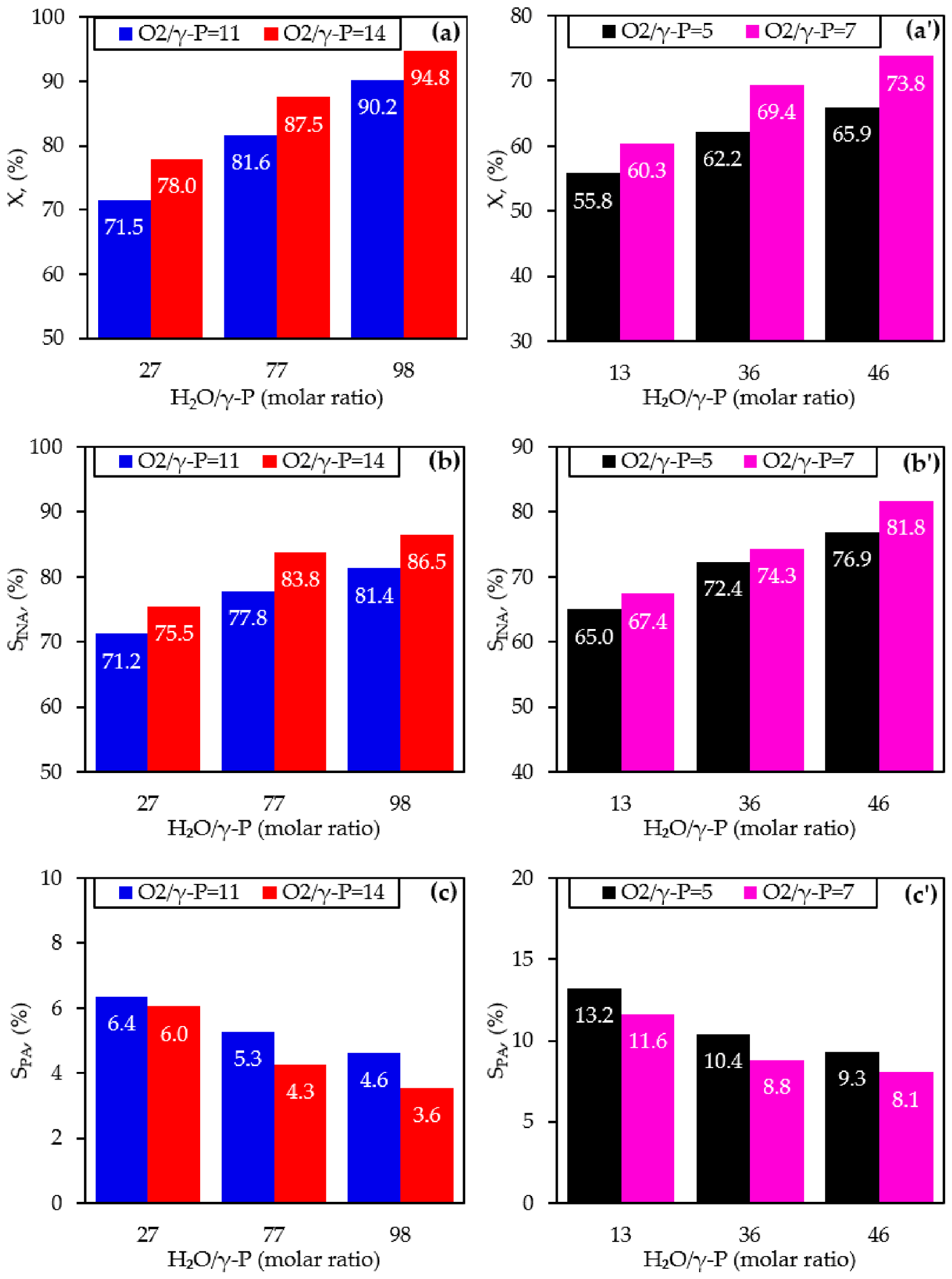
Analysis of the relationship between the conversion (X) of γ-P and the composition of the gas phase reveals two key factors: the promoting effect of water vapour and the limiting influence of the Weight Hourly Space Velocity (WHSV) (Figure 6a,a′). At low WHSV of 0.035 h−1 (Figure 6a), a synergistic effect of excess oxygen and water is observed. Increasing the O2/γ-P molar ratio from 11 to 14 leads to a 5–10% increase in conversion across the entire range of water concentrations. The maximum value of X reaches 94.8% at H2O/γ-P = 98. However, critical analysis shows that upon reaching high water excesses (ratio > 77), the conversion curve reaches a ‘plateau’, indicating the virtually complete saturation of the vanadium active sites with hydroxyl groups. The transition to a higher WHSV (0.074 h−1, Figure 6a′) shows a sharp drop in the system’s activity. Even at maximum water and oxygen feed rates, the conversion does not exceed 73.8%. This indicates that when the O2/γ-P ratio is reduced to 5–7, the rate of catalyst reoxidation via the Mars-van Krevelen mechanism ceases to correlate with the feed flow. The catalyst surface transitions to a predominantly reduced state, which limits its productivity.

2.5.2. Selectivity of INA and Intermediate Product Formation

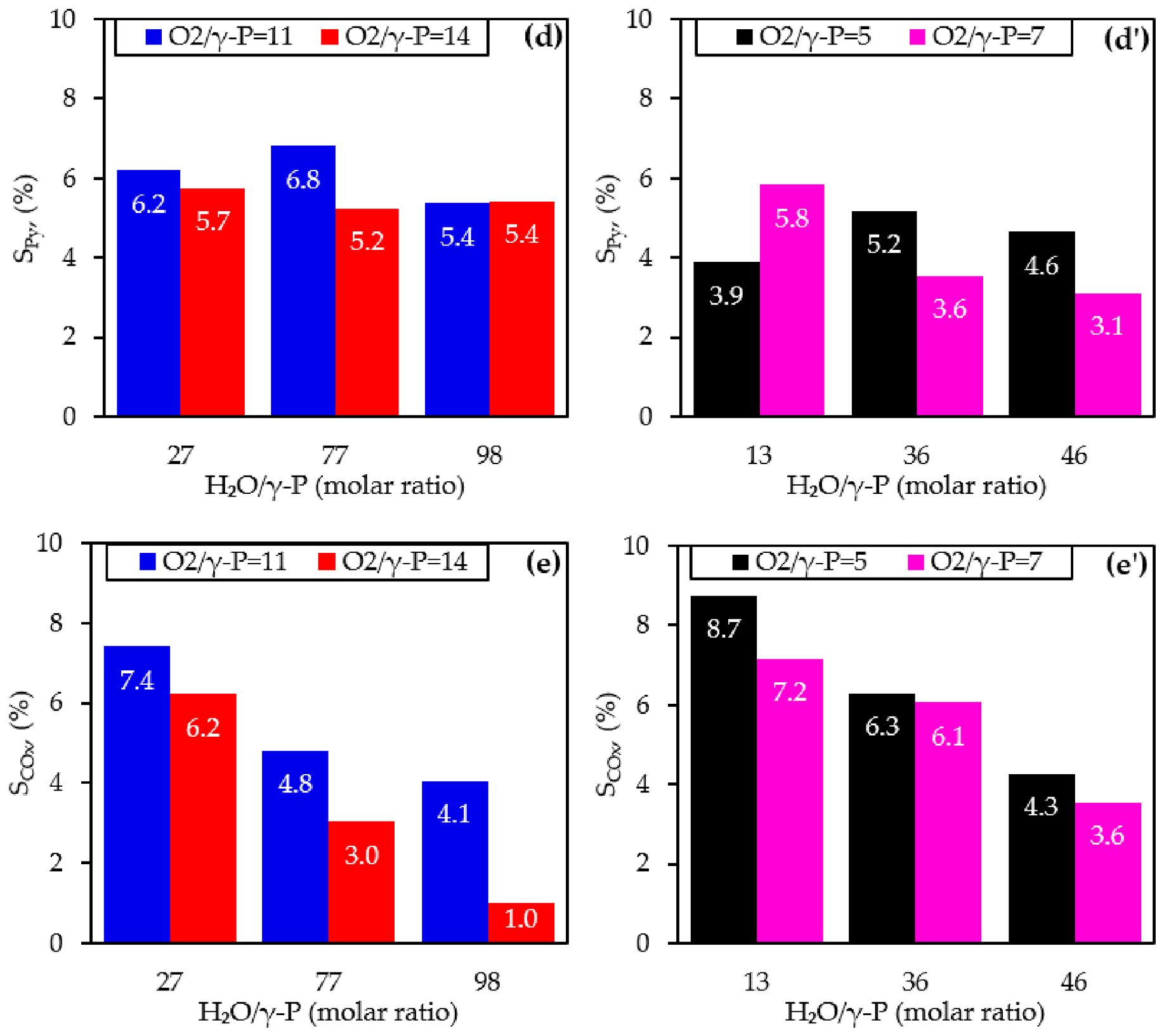
Target product selectivity (SINA) shows a direct dependence on the degree of surface hydration (Figure 6b,b′). At low loading (Figure 6b), the addition of water allows SINA to be increased from 71.2% to 86.5%. It is critically important to note the inverse correlation between acid selectivity and aldehyde selectivity (SPA, Figure 6c). As the water concentration increases, the aldehyde selectivity decreases (from 6.4% to 3.6%). This demonstrates that water vapour acts as a functional process modifier, accelerating the sequential oxidation of 4-pyridinecarbaldehyde to INA and shifting the product distribution toward the target acid—an effect achievable through feed design rather than catalyst reformulation. This observation is consistent with the literature [28,29], where for picoline oxidation systems on V2O5–TiO2 that, in the range H2O/substrate = 20–120 mol/mol, the increase in selectivity for carboxylic acid is 10–25%. Under high-load conditions (Figure 6b′,c′), the system’s efficiency is significantly lower. The maximum selectivity for INA is 81.8%, whilst an abnormally high aldehyde yield is observed (up to 13.2% under water deficit, Figure 6b′). This indicates that, at WHSV 0.074 h−1, the rate-limiting step is not only the primary activation of the C–H bond, but also the conversion of intermediate compounds that desorb from the surface before they have had time to oxidize to acids.

2.5.3. Analysis of Side Reactions: Decarboxylation and Deep Oxidation

Of particular interest is the analysis of pyridine (SPy) and carbon oxides (SCOx) formation, which reflect destructive reaction pathways. Pyridine selectivity (Figure 6d,d′): under optimal conditions stabilizes in the range of 3–6%. It is noteworthy that an increase in oxygen concentration at low load has virtually no effect on SPy (Figure 6d), indicating that decarboxylation proceeds as a parallel reaction not directly linked to the oxidation cycle. At high loading (Figure 6d′), the Spy values are slightly lower, which may be due to an overall decrease in the proportion of converted acid. Water acts as an effective inhibitor of product ‘burning’. At low load and H2O/γ-P = 98, the selectivity for COx (Figure 6e) drops to a record low of 1.0%, confirming that feed composition optimization serves as an additive-free strategy for deep oxidation suppression—a principle directly aligned with waste prevention in green chemistry. The proportional relationship between the decrease in total acidity as measured by NH3-TPD (23–25%) and the reduction in SBET (23.4%) after 96 h of operation confirms the reversible, competitive nature of the interaction between water and Lewis sites, rather than their irreversible poisoning. The literature [30,31] shows that hydroxyl groups formed during the adsorption of water on coordinatively unsaturated V5+ centers act as displacement agents for adsorbed intermediate compounds, reducing the likelihood of ring opening. In the absence of sufficient water, INA is strongly adsorbed onto vanadium Lewis sites, undergoing ring destruction. An excess of water competitively displaces INA molecules, ensuring their preservation. However, at a loading of 0.074 h−1 (Figure 6e′) and oxygen deficiency (O2/γ-P = 5), the proportion of deep oxidation remains high (8.7%), confirming the system’s inability to operate effectively under ‘dry’ conditions at high concentrations of organic substrate.

2.5.4. Time-on-Stream (TOS) Stability Analysis of Catalyst

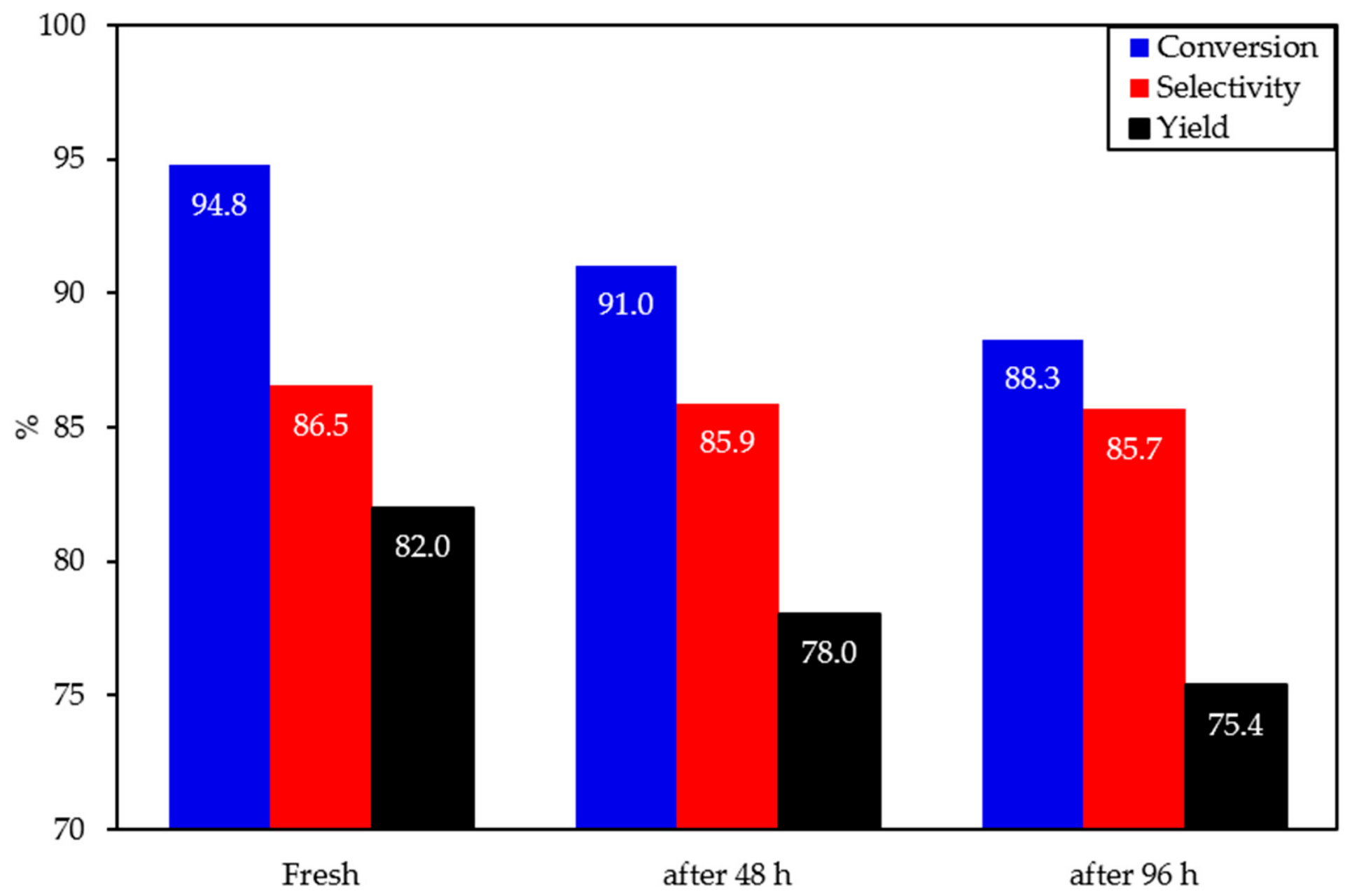
The stability of the catalyst was assessed during a 96 h continuous run in the γ-picoline oxidation reaction. As shown in Figure 7, the freshly prepared catalyst exhibited high activity: the conversion was 94.8%, the selectivity was 86.5%, and the yield was 82.0%. After 48 h of operation, a slight decrease in catalytic activity was observed: the conversion decreased to 91.0% and the yield to 78.0%, whilst the selectivity remained relatively stable at 85.9%. After 96 h of reaction, a further gradual decrease in activity occurred, leading to a reduction in conversion to 88.0% and yield to 75.4%, whilst selectivity generally remained at a high level (85.7%). The observed decline in catalytic performance over time may be attributed to gradual physicochemical changes in the catalyst under reaction conditions. It is important to note that, despite a gradual decrease in activity, the catalyst retains high conversion and selectivity values even after 96 h, which indicates its satisfactory operational stability under the conditions studied.

2.5.5. Reaction Rate

To evaluate the catalytic activity, the reaction rate was used, calculated using Formula (1) as the amount of γ-P that reacted per unit time per unit mass of catalyst. At a γ-P flow rate of 0.00376 mol·h−1 and a catalyst mass of 10 g, the reaction rate for the fresh sample was 3.56 × 10⁻⁴ mol·g−1·h−1. After 48 h of operation, the value decreased to 3.42 × 10⁻⁴ mol·g−1·h−1, and after 96 h—to 3.32 × 10⁻⁴ mol·g−1·h−1. The observed decrease in reaction rate over the 96 h test period was only about 6.7%, which indicates the high stability of the V–Mn catalytic system under conditions of prolonged operation. Since the reaction rate is directly related to the amount of substrate converted, this parameter reflects the integral activity of all available surface sites and allows the preservation of catalytic efficiency over time to be assessed. The slight decrease in reaction rate is consistent with the physicochemical characterization data of the spent samples and indicates the absence of significant deactivation, blocking of active sites, or major structural changes in the catalyst. Furthermore, the maintenance of a high reaction rate correlates with high conversion and selectivity towards the target product, confirming the stability of the γ-P selective oxidation mechanism throughout the entire test period.

2.6. Stability and Evolution of the V-Mn System

The stability of the catalyst was assessed under severe reaction conditions at 300 °C in a continuous-flow reactor using a feed mixture with a γ-picoline/O2/H2O molar ratio of 1:14:98. The catalyst was tested for up to 96 h on stream, and samples were collected for characterization in the fresh state and after 48 and 96 h of operation. A comprehensive analysis of structural and textural changes allows us to assess the suitability of the V-Mn system for long-term processes.

2.6.1. Structural Stability (XRD, XPS, Raman)

As can be seen from the XRD data (Figure 1), the crystalline structure of the catalyst demonstrates satisfactory stability. The diffraction patterns of the samples after 48 and 96 h of operation are completely identical to that of the fresh catalyst. The preservation of the position and relative intensity of the (200), (201) and (211) reflections confirms that the manganese vanadate phase does not undergo decomposition or recrystallization. The absence of peaks for individual oxides (V2O5 or MnOx) demonstrates the chemical stability of the V–O–Mn bond.
The almost complete coincidence of peak positions for fresh and spent samples (517.4–517.6 eV for V2p3/2 and 642.5–642.7 eV for Mn2p3/2) indicates relatively stable redox behavior of the active sites and the absence of phase degradation during long-term operation. This is consistent with SEM data on the morphological stability of the agglomerates and BET results, where the high surface area (Sext = 8.29 m2/g) contributes to the maximum exposure of the identified V5+ sites for the adsorption of γ-P. The preservation of the system’s electronic state after 96 h of operation confirms that the reaction is proposed to proceeds via the Mars-van Krevelen mechanism, in which the rate of surface reoxidation effectively compensates for the consumption of lattice oxygen. A slight decrease in signal intensity on the sample after 96 h of operation, while the binding energies and high surface V/Mn ratio (1.32) remain unchanged, may be due to surface carbonization.
The results of Raman spectroscopy (Figure 3) confirm phase stability at the molecular level. The main band of V=O terminal bonds (916 cm−1) retains its profile and position in all three samples. This is a critically important observation, as despite the influence of the reaction medium, the nature of the active sites remains unchanged. A slight decrease in peak intensity in the 96 h sample may be attributed to the accumulation of trace amounts of coking products or an increase in surface defects; however, the chemical identity of the active phase is preserved.

2.6.2. Textural and Morphological Evolution

Unlike the stable crystal lattice, the textural characteristics of the sample undergo a predictable evolution (Table 1). A decrease in SBET is observed from 9.31 m2/g (fresh) to 7.89 m2/g (48 h) and further to 7.13 m2/g (96 h). The total decrease amounted to 23.4%, resulting in a proportional reduction in the number of accessible active sites, causing conversion to decrease from 94.8% to 88.3%. Analysis of the dynamics shows that 65% of the total surface area loss occurs in the first 48 h, after which the degradation process slows down significantly. This indicates that the system has reached a ‘steady state’ (ageing effect). A monotonic increase in the average pore diameter Dp from 2.07 nm to 3.25 nm was observed. An increase in pore diameter accompanied by a simultaneous decrease in surface area is a classic sign of ‘pore coalescence’. The elimination of the narrowest micropores (Smicro fell from 1.72 to 1.19 m2/g) is energetically favorable for the system. This process has a positive side effect: the expansion of pores into the mesoporous range (>2 nm) facilitates the diffusion of INA, reducing the likelihood of it becoming ‘trapped’ and being overoxidized to COx. This explains why the selectivity of the process remained consistently high until the end of the experiment. From a sustainability perspective, this extended catalyst lifetime directly translates to reduced solid waste generation and lower material consumption per unit of INA produced.
SEM micrographs visualize the physical wear of the surface. A fresh catalyst (Figure 2a) is characterized by smooth crystal faces. After 48 h (Figure 2b) of operation, the faces become covered with microcracks and ‘dust-like’ particles, which correlates with the initial drop in BET surface area. By 96 h (Figure 2c), the surface appears markedly eroded, the edges of the particles are smoothed, and an increase in the proportion of fine-grained fragments is observed.

2.6.3. Redox and Surface Properties

The H2-TPR profiles (Figure 5a) clearly demonstrate the redistribution of active vanadium species during the catalytic process. The observed systematic decrease in the intensity of the low-temperature peak at 410 °C, accompanied by an increase in the high-temperature signal at 580 °C, indicates the gradual thermal sintering of highly dispersed surface vanadates and their transformation into larger, three-dimensional crystalline aggregates. This dynamics of the redox profiles is in strict accordance with the SEM results, which recorded morphological erosion of the faces, and the XPS data, confirming the preservation of the phase integrity of manganese vanadate with some coarsening of the crystallites. Analysis of acid characteristics using the NH3-TPD method (Figure 5b) revealed that the nature of the active sites—weak Lewis acid sites (205 °C) and medium/strong sites (320 °C)—remains unchanged over 96 h of operation, which explains the consistently 89.15% selectivity of the process towards INA. However, the total concentration of acid sites decreases in the order V-Mn fresh > V-Mn 48 h > V-Mn 96 h. It has been established that the total decrease in surface desorption capacity after 96 h of operation is 23–25%, which correlates almost perfectly with the decrease in SSA according to BET (by 23.4%). Thus, the deactivation of the V–Mn system can be described as the result of a combination of factors, including structural rearrangement of the porous system, partial agglomeration of surface areas, and the possible formation of minor carbonaceous deposits, leading to a reduction in the accessibility of active sites. At the same time, the chemical nature of the active phase and its redox function are preserved, which explains the stable catalytic selectivity over 96 h of operation.

3. Materials and Methods

3.1. Materials

The starting reagents used for catalyst synthesis were a vanadium sulphate trihydrate (VOSO4·3H2O), manganese sulphate monohydrate (MnSO4·H2O), citric acid (C6H8O7), and ethylene glycol (C2H6O2), all purchased from Sigma-Aldrich (St. Louis, MO, USA). All chemicals used were of analytical purity (≈97%) and without additional purification. Distilled water was used as a solvent at all stages of synthesis.

3.2. Catalyst Synthesis

The V–Mn system catalyst was synthesized using the Pechini method, following the procedure described in our previous work [32]. Vanadyl sulphate trihydrate (VOSO4·3H2O) and manganese sulphate monohydrate (MnSO4·H2O) were used as precursors in a molar ratio of V:Mn = 1:1. The corresponding amounts of vanadium and manganese salts were dissolved in distilled water with intensive stirring, after which citric acid and ethylene glycol were sequentially added to the solution, ensuring the formation of organometallic complexes and their uniform distribution at the molecular level. The resulting reaction mixture was heated at a temperature of 90–110 °C until a homogeneous gel-like polymer precursor was formed. After removing the solvent, the gel was subjected to preliminary heat treatment at 250 °C to decompose the organic matrix and remove residual organic fragments. The final formation of the mixed-oxide vanadium-manganese phase was carried out by calcining the sample at 800 °C for 4 h in an air atmosphere. The selected temperature regime ensured the completion of the crystallization processes of the oxide phases and the stabilization of the catalyst structure.

3.3. Analysis and Characterization

The structure and phase composition of the sample were determined by X-ray diffraction (XRD, Dandong Aolong Radiative Instrument Group Co., Ltd., Dandong, China) analysis using the ICDD PDF-2 diffraction database for phase identification. Textural characteristics were determined by low-temperature nitrogen adsorption (BET/BJH, ASAP 2400 Micrometrics Gemini VII2390a instrument, Micromeritics Instrument Corporation, Norcross, GA, USA), including SSA, pore distribution, and interparticle structural changes after calcination. The surface morphology was studied by scanning electron microscopy (SEM, Quanta 200i 3D, FEI Company, Hillsboro, OR, USA), allowing the degree of particle aggregation, oxide domain dispersion, and microstructure uniformity to be assessed. The electronic state of the surface and the valence states of the elements were determined using X-ray photoelectron spectroscopy (XPS, Thermo Scientific NEXSA, Thermo Fisher Scientific, Waltham, MA, USA). The measurements were carried out using a monochromatic Al Kα (1486.6 eV) source. To ensure the accuracy of the binding energy determinations, the spectra were calibrated against the C1s (284.8 eV) peak of adsorbed carbon. Raman spectroscopy (Solver Spectrum Raman spectrometer (NT-MDT, Zelenograd, Russia) was used to clarify the nature of surface fragments, determine the presence of terminal bonds and modes, and identify temperature-unstable states of manganese oxides. H2-TPR and NH3-TPD analyses were carried out on a Micromeritics AutoChem II 2920 analyzer (TCD) (Micromeritics Instrument Corporation, Norcross, GA, USA). For H2-TPR, samples (~50 mg) were first held in Ar at 200 °C (1 h), then reduced in 10% H2/Ar (50 mL/min) whilst heating from 50 to 800 °C (10 °C/min). For NH3-TPD, the catalyst was calcined in He at 300 °C (1 h), saturated with NH3 at 100 °C (30 min) and, after removal of the physisorbent phase with a He flow, desorbed up to 500 °C (10 °C/min).
Catalytic tests were carried out in a fixed-bed flow reactor (10.0 g of catalyst). The daily test cycle involved measuring catalytic activity at five temperatures (260–340 °C) in 20 °C increments. At each temperature, the reaction system was held for 20 min, followed by sampling for gas chromatography (GC) analysis. Between cycles, and also when the conditions for the supply of water, oxygen or feedstock were changed, the catalyst underwent in situ regeneration in an air stream to restore its initial activity. Catalytic tests were carried out in at least three parallel experiments. The experimental data are presented as mean values with standard deviation. The uncertainty in the determination of conversion and selectivity was estimated on the basis of repeated measurements and amounted to ±3%. The reaction conditions (300 °C, WHSV = 0.035 h−1, H2O/O2/γ-P = 98/14/1) were selected as the optimal conditions, under which the highest values of catalytic activity and selectivity were achieved whilst maintaining stable catalyst performance.
The reaction rate was calculated using the formula:
νrate = Fin · X/mcat,
where Fin—is the molar flow rate of γ-P at the reactor inlet; X—is the conversion of γ-P, mcat—is the mass of the catalyst.

4. Conclusions

As a result of the study, highly efficient V–Mn catalyst for the partial oxidation of γ-P have been developed and characterised in detail. Comprehensive analysis (XRD, Raman, XPS) confirms the formation of a manganese vanadate phase with a predominance of surface V5+ and Mn4+ and vanadium enrichment at the surface (V/Mn = 1.23), which ensures a high density of active sites. The catalyst demonstrates high catalytic activity and selectivity, whilst the COx yield is reduced to 1.00% due to the optimal combination of water vapour and oxygen, which modifies the surface properties of the system.
The calculated reaction rates for the fresh catalyst and samples after 48 and 96 h of operation were 3.56 × 10⁻⁴, 3.42 × 10⁻⁴ and 3.32 × 10⁻⁴ mol·g−1·h−1 respectively. The slight decrease in reaction rate (≈6.7% over 96 h) indicates the high resistance of the V–Mn system to deactivation. The results of long-term tests show that, following a stabilization period, the catalyst retains high catalytic activity and enters a quasi-steady-state operating mode.
Thus, the V–Mn system represents a promising green catalytic platform for the solvent-free, waste-minimizing conversion of petrochemical-derived γ-picoline to the pharmaceutical intermediate INA. The combination of atmospheric oxygen as a benign oxidant, water vapour as a reagent-free selectivity modifier, and a durable catalyst with a 96 h operational lifetime positions this approach as a sustainable alternative to conventional liquid-phase synthesis routes, with direct relevance to the principles of green chemistry and cleaner pharmaceutical manufacturing.

Author Contributions

Funding acquisition, project administration, supervision, writing—original draft, K.K. (Kairat Kadirbekov); formal analysis, investigation, methodology, writing—original draft, N.B.; data curation, resources, methodology, validation, T.A.; data curation, validation, visualisation, writing—review and editing, S.Y.; supervision, resources, funding acquisition, writing—review and editing, M.O.; validation, resources, investigation, K.K. (Kamilla Khakimbolatova); formal analysis, investigation, visualization, G.S. All authors have read and agreed to the published version of the manuscript.

Funding

This research was funded by the Science Committee of the Committee of Science of the Ministry of Science and Higher Education of the Republic of Kazakhstan, grant number BR27101179.

Data Availability Statement

The data presented in this study are available from the corresponding authors upon reasonable request.

Acknowledgments

The authors would like to express their gratitude to the “National Nanotechnological Open-Type Laboratory” for SEM and Raman spectroscopy data, which played a key role in conducting this study.

Conflicts of Interest

The authors declare no conflicts of interest.

Abbreviations

The following abbreviations are used in this manuscript:
INAIsonicotinic acid
γ-Pγ-picoline
SSASpecific surface area
IUPACInternational Union of Pure and Applied Chemistry
WHSVWeight Hourly Space Velocity
TOFTurnover frequency
TOSTime-on-stream

References

  1. Thomas, L.; Raju, A.P.; Mallayasamy, S.; Rao, M. Precision Medicine Strategies to Improve Isoniazid Therapy in Patients with Tuberculosis. Eur. J. Drug Metab. Pharmacokinet. 2024, 49, 541–557. [Google Scholar] [CrossRef] [PubMed]
  2. Yang, G.J.; Huang, H.F.; Lu, H.F.; Liu, H.; Chen, Y.F. Oxidation of 4-picoline to isonicotinic acid on V–Ti–O catalysts. J. Chem. Eng. Chin. Univ. 2007, 21, 448–453. [Google Scholar] [CrossRef]
  3. Chesalov, Y.A.; Andrushkevich, T.V.; Baltakhinov, V.P. FTIR study of the role of surface complexes in the transformation of picoline isomers on vanadium–titanium oxide catalysts. Vib. Spectrosc. 2016, 83, 138–150. [Google Scholar] [CrossRef]
  4. Zhang, X.; Luo, C.-W.; Huang, C.; Chen, B.H.; Huang, D.G.; Pan, J.G.; Chao, Z.S. Synthesis of 3-picoline from acrolein and ammonia through a liquid-phase reaction pathway using SO42−/ZrO2-FeZSM-5 as catalyst. Chem. Eng. J. 2014, 253, 544–553. [Google Scholar] [CrossRef]
  5. Li, Z.; Nizkorodov, S.A.; Chen, H.; Lu, X.; Yang, X.; Chen, J. Nitrogen-containing secondary organic aerosol formation by acrolein reaction with ammonia/ammonium. Atmos. Chem. Phys. 2019, 19, 1343–1356. [Google Scholar] [CrossRef]
  6. Ferreira de Araújo, J.; Dionigi, F.; Merzdorf, T.; Oh, H.S.; Strasser, P. Evidence of Mars–van Krevelen mechanism in the electrochemical oxygen evolution on Ni-based catalysts. Angew. Chem. Int. Ed. 2021, 60, 11554–11561. [Google Scholar] [CrossRef] [PubMed]
  7. Ross, J.R.H. The kinetics and mechanisms of catalytic reactions. In Contemporary Catalysis: Fundamentals and Current Applications; Elsevier: Amsterdam, The Netherlands, 2019; pp. 161–186. [Google Scholar] [CrossRef]
  8. Tang, T.; Ye, L.; Chen, Y.; Xue, J.; Shen, X.; Chen, J.; Quarcoo, F.H.; Rac, V.; Rakić, V.; Li, X.; et al. Diving into the Interface-Mediated Mars–van Krevelen (M–vK) Characteristic of CuOx-Supported CeO2 Catalysts. Appl. Catal. B Environ. 2024, 344, 123368. [Google Scholar] [CrossRef]
  9. Ye, B.; Jeong, B.; Lee, M.J.; Kim, T.H.; Park, S.S.; Lee, S.; Kim, H.D. Recent trends in vanadium-based SCR catalysts for NOx reduction in industrial applications: Stationary sources. Nano Converg. 2022, 9, 51. [Google Scholar] [CrossRef] [PubMed]
  10. Li, Y.; Zhang, T.; Niu, X.; Zhu, Y. Vanadium-Based Catalysts for Selective Catalytic Reduction of NOx with Ammonia: Synthesis, Poisoning Mechanism, Regeneration Methods and Research Prospects. Fuel 2024, 365, 131184. [Google Scholar] [CrossRef]
  11. Yun, D.; Wang, Y.; Herrera, J.E. Ethanol partial oxidation over VOx/TiO2 catalysts: The role of titania surface oxygen on vanadia reoxidation in the Mars–van Krevelen mechanism. ACS Catal. 2018, 8, 4681–4693. [Google Scholar] [CrossRef]
  12. Mikhailovskaya, T.P.; Vorobyev, P.B.; Kadirbekov, K.A.; Kurmakyzy, R. Catalytic Activity of Vanadium Oxide Catalysts Mod-ified by Ti, Sn, Zr Oxides in the Partial Oxidation of 4-Methylpyridine. Chem. J. Kazakhstan 2020, 2, 77–83. Available online: https://chemjournal.kz/index.php/journal/article/view/75 (accessed on 14 April 2023).
  13. Buzayev, N.; Kadirbekov, K.; Tolemisova, D.; Basbayeva, G. Oxidation of 4-methylpyridine on V–Cr–O catalyst. Chem. J. Kazakhstan 2024, 3, 114–123. [Google Scholar] [CrossRef]
  14. Vorobyev, V.B.; Mikhaylovskaya, T.P.; Yugai, O.K.; Serebryanskaya, A.P.; Kurmakyzy, R. Vapour-Phase Oxidation of 3- and 4-Methylpyridines on Vanadium Oxide Catalysts Modified by Titanium and Chromium Oxides. Chem. J. Kazakhstan 2019, 1, 113–124. Available online: https://chemjournal.kz/index.php/journal/article/view/154 (accessed on 4 April 2023).
  15. Singh, S.K.; Tiwari, N.; Agarwal, A. Process for Producing Pyridine Carboxylic Acids. U.S. Patent 8,575,350 B2, 5 November 2013. Available online: https://patents.google.com/patent/US8575350B2/en (accessed on 25 June 2026).
  16. Zheng, J.; Zhao, W.; Song, L.; Wang, H.; Yan, H.; Chen, G.; Han, C.; Zhang, J. Advances of manganese-oxides-based catalysts for indoor formaldehyde removal. Green Energy Environ. 2023, 8, 626–653. [Google Scholar] [CrossRef]
  17. Kadirbekov, K.; Buzayev, N.; Tussupkaliyev, Y.; Oshakbayev, M. Oxidation of 4-methylpyridine on vanadium-based catalysts modified with titanium and manganese. Catalysts 2025, 15, 625. [Google Scholar] [CrossRef]
  18. Zhu, J.; Cheng, F.; Wang, F.; Wen, S.; Liu, X. Selective oxidation of 5-hydroxymethylfurfural to 2,5-diformylfuran over a vanadium manganese oxide catalyst. Catal. Lett. 2022, 152, 2280–2287. [Google Scholar] [CrossRef]
  19. Liu, X.; Wu, J.; Zhang, S.; Li, Q.; Wu, Z.; Zhang, J. Evaluation of an ε-manganese (IV) oxide/manganese vanadium oxide composite catalyst enriched with oxygen vacancies for enhanced formaldehyde removal. Appl. Catal. B Environ. 2023, 320, 121994. [Google Scholar] [CrossRef]
  20. Du, H.; Luo, H.; Jiang, M.; Yan, X.; Jiang, F.; Chen, H. A Review of Activating Lattice Oxygen of Metal Oxides for Catalytic Reactions: Reaction Mechanisms, Modulation Strategies of Activity and Their Practical Applications. Appl. Catal. A Gen. 2023, 668, 119348. [Google Scholar] [CrossRef]
  21. Jiang, Z.; Li, Y.; Tang, Z.; Yuan, D.; Lin, F. Strong metal–support interactions in catalytic oxidation of VOCs: Mechanistic insights, support engineering strategies, and emerging catalyst design paradigms. Environ. Sci. Technol. 2025, 59, 19644–19666. [Google Scholar] [CrossRef] [PubMed]
  22. Yang, H.; Li, G.; Jiang, G.; Zhang, Z.; Hao, Z. Heterogeneous selective oxidation over supported metal catalysts: From nanoparticles to single atoms. Appl. Catal. B Environ. 2023, 325, 122384. [Google Scholar] [CrossRef]
  23. Song, S.; Zhang, S.; Zhang, X.; Verma, P.; Wen, M. Advances in catalytic oxidation of volatile organic compounds over Pd-supported catalysts: Recent trends and challenges. Front. Mater. 2020, 7, 595667. [Google Scholar] [CrossRef]
  24. Ovchinnikova, E.V.; Andrushkevich, T.V.; Popova, G.Y.; Meshcheryakov, V.D.; Chumachenko, V.A. Oxidation of β-picoline to nicotinic acid over V2O5–TiO2 catalyst: Kinetic studies and reaction mechanism. Chem. Eng. J. 2009, 154, 60–68. [Google Scholar] [CrossRef]
  25. Weckhuysen, B.M.; Keller, D.E. Chemistry, spectroscopy and the role of supported vanadium oxides in heterogeneous catalysis. Catal. Today 2003, 78, 25–46. [Google Scholar] [CrossRef]
  26. Grasselli, R.K. Fundamental principles of selective heterogeneous oxidation catalysis. Top. Catal. 2002, 21, 79–88. [Google Scholar] [CrossRef]
  27. Chesalov, Y.A.; Ovchinnikova, E.V.; Chernobay, G.B.; Popova, G.Y.; Andrushkevich, T.V. Mechanism of the oxygen involvement in nicotinic acid formation under β-picoline oxidation on V–Ti–O catalyst. Catal. Today 2010, 157, 39–43. [Google Scholar] [CrossRef]
  28. Andrushkevich, T.V.; Ovchinnikova, E.V. The role of water in selective heterogeneous catalytic oxidation of hydrocarbons. Mol. Catal. 2019, 477, 110734. [Google Scholar] [CrossRef]
  29. Fung, V.; Janik, M.; Crossley, S.; Chin, Y.-H.C.; Savara, A. Unimolecular and Bimolecular Reactions of Organic Intermediates on Metal Oxide Catalysts: An Update. Catal. Rev. Sci. Eng. 2025, 67, 1060–1125. [Google Scholar] [CrossRef]
  30. Zhao, S.; Yang, Y.; Bi, F.; Chen, Y.; Wu, M.; Zhang, X.; Wang, G. Oxygen Vacancies in the Catalyst: Efficient Degradation of Gaseous Pollutants. Chem. Eng. J. 2023, 452, 140376. [Google Scholar] [CrossRef]
  31. Li, X.; Wang, X.; Roy, K.; van Bokhoven, J.A.; Artiglia, L. Role of water on the structure of palladium for complete oxidation of methane. ACS Catal. 2020, 10, 5783–5792. [Google Scholar] [CrossRef]
  32. Buzayev, N.; Kadirbekov, K.; Oshakbayev, M. Synthesis and investigation of vanadium-based catalysts for the oxidation of 4-methylpyridine to isonicotinic acid. Int. J. Mol. Sci. 2026, 27, 2715. [Google Scholar] [CrossRef] [PubMed]
  33. Zheng, C.; Jian, B.; Zhong, J.; Huang, S. Single-crystalline Mn2V2O7 anodes with high rate and ultra-stable capability for sodium-ion batteries. J. Alloys Compd. 2023, 934, 168018. [Google Scholar] [CrossRef]
  34. Li, J.; Zhao, E.; Zhao, Y.; Wang, R.; Guo, J.; Wang, Q.; Mao, J.; Ling, T. A molecular catalyst-like oxide with strong redox capability for electrocatalysis. Chem. Mater. 2025, 37, 1027–1036. [Google Scholar] [CrossRef]
  35. Arasi, S.E.; Ranjithkumar, R.; Devendran, P.; Krishnakumar, M.; Arivarasan, A. Investigation on electrochemical behaviour of manganese vanadate nanopebbles as potential electrode material for supercapacitors. J. Alloys Compd. 2021, 857, 157628. [Google Scholar] [CrossRef]
  36. Thommes, M.; Kaneko, K.; Neimark, A.V.; Olivier, J.P.; Rodríguez-Reinoso, F.; Rouquerol, J.; Sing, K.S.W. Physisorption of gases, with special reference to the evaluation of surface area and pore size distribution. Pure Appl. Chem. 2015, 87, 1051–1069. [Google Scholar] [CrossRef]
  37. Ravinder, G.; Sreelatha, C.J.; Chandar Rao, P.; Nagaraju, P.; Vijayakumar, Y.; Sreekanth, T. Gossamer-like V2O5 thin films for the detection of toxic volatile organic compounds. J. Sci. Res. 2021, 13, 347–359. [Google Scholar] [CrossRef]
  38. Biesinger, M.C. Accessing the Robustness of Adventitious Carbon for Charge Referencing (Correction) Purposes in XPS Analysis: Insights from a Multi-User Facility Data Review. Appl. Surf. Sci. 2022, 597, 153681. [Google Scholar] [CrossRef]
  39. Song, Z.; Peng, Y.; Zhao, X.; Liu, H.; Gao, C.; Si, W.; Li, J. Roles of Ru on the V2O5–WO3/TiO2 catalyst for the simultaneous purification of NOx and chlorobenzene: A dechlorination promoter and a redox inductor. ACS Catal. 2022, 12, 11505–11517. [Google Scholar] [CrossRef]
  40. Consentino, L.; Pantaleo, G.; Parola, V.L. NH3-NO SCR catalysts for engine exhaust gases abatement: Replacement of toxic V2O5 with MnOx to improve the environmental sustainability. Top. Catal. 2023, 66, 850–859. [Google Scholar] [CrossRef]
  41. Wachs, I.E. Overview of the Catalytic Properties of Bulk Unsupported and Supported Group 4–5-6 Oxides. Catal. Today 2024, 431, 114596. [Google Scholar] [CrossRef]
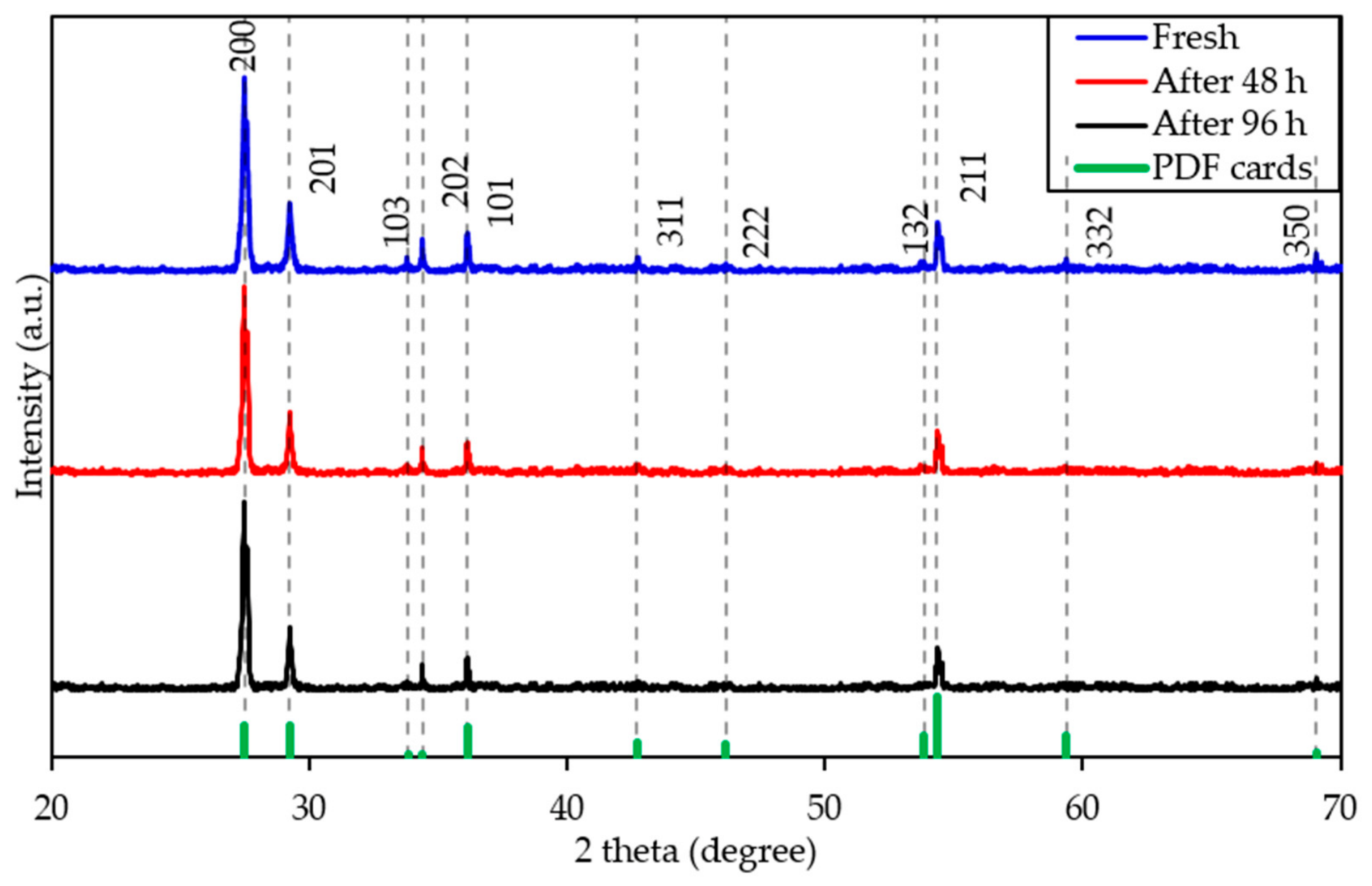
Figure 1. XRD patterns of V-Mn catalyst.
Catalysts 16 00610 g001
Figure 2. Surface morphology of V–Mn catalyst at 5000× magnification: (a) fresh, (b) after 48 h, and (c) after 96 h.
Catalysts 16 00610 g002
Figure 3. XPS spectra of V-Mn catalysts: (a) V2p; (b) Mn2p.
Catalysts 16 00610 g003
Figure 4. Raman spectra of V-Mn catalyst.
Catalysts 16 00610 g004
Figure 5. Redox behaviour and surface acidity of the V-Mn catalyst: (a) H2-TPR; (b) NH3-TPD profiles.
Catalysts 16 00610 g005
Figure 6. Effect of reactant molar ratios on γ-P conversion (a,a′); INA selectivity (b,b′); 4-pyridinecarboxaldehyde selectivity (c,c′); pyridine selectivity (d,d′); and COx selectivity (e,e′) at WHSV = 0.035 h−1 (ae) and 0.074 h−1 (a′e′).
Catalysts 16 00610 g006aCatalysts 16 00610 g006b
Figure 7. Catalytic stability of V-Mn catalyst in γ-P oxidation over 96 h at WHSV = 0.035 h−1.
Catalysts 16 00610 g007
Table 1. Textural parameters of V–Mn catalyst.
CatalystsSBET,
m2/g
Sext,
m2/g
Smicro,
m2/g
Vp,
cm3/g
Dp,
nm
V-Mn fresh9.318.291.720.001222.07
V-Mn after 48 h7.896.681.450.001092.56
V-Mn after 96 h7.135.761.190.000993.25
Table 2. The relative surface concentration of V/Mn obtained from XPS spectra.
CatalystsSurface V/Mn Ratio
(at.%)
Volume Ratio V/Mn
(%)
V-Mn fresh1.231.00
V-Mn after 48 h1.191.00
V-Mn after 96 h1.161.00
Disclaimer/Publisher’s Note: The statements, opinions and data contained in all publications are solely those of the individual author(s) and contributor(s) and not of MDPI and/or the editor(s). MDPI and/or the editor(s) disclaim responsibility for any injury to people or property resulting from any ideas, methods, instructions or products referred to in the content.