


Abstract
CdS and Cd-deficient CdS (D-CdS) were prepared using a simple hydrothermal method. Pristine CdS exhibited slow electron transfer and limited active sites in periodate (PI) activation, while Cd vacancy defect engineering proposed in this work effectively overcame these drawbacks. The optimal Cd-deficient D-CdS8 could effectively activate PI and exhibit excellent degradation performance toward tetracycline (TC). Within 90 min, the D-CdS8/PI system could achieve 92.3% removal of 10 mg L−1 TC. This study systematically explores the influences of different factors and coexisting substances on TC degradation. Radical quenching experiments revealed that IO3· and ·OH were the dominant reactive species for TC degradation in D-CdS8/PI system. Electrochemical characterization indicated that the introduction of Cd vacancies made D-CdS8 possess higher electron transfer efficiency. The D-CdS8/PI system achieved enhanced PI activation and improved TC degradation, with reaction rates 2.15 times superior to the CdS/PI system. Furthermore, degradation pathways and toxicological analysis of intermediates for TC degradation were also conducted. This study provided a simple and feasible strategy for developing efficient defective catalysts for the remediation of antibiotic-contaminated water.
1. Introduction
Antibiotics possess bacteriostatic and bactericidal effects that are widely used in healthcare, animal husbandry and agricultural production [1,2]. However, the widespread use and incomplete removal of antibiotics have led to the continuous release of their residues into aquatic environments, posing significant threats to aquatic ecosystems and potential hazards to human health [3]. Among various antibiotics, tetracycline (TC) is one of the most frequently detected pollutants in water bodies due to its widespread application and environmental persistence [4]. Therefore, developing efficient technologies for TC elimination has become an urgent environmental challenge.
Compared with conventional antibiotic treatment methods [5,6,7], advanced oxidation processes (AOPs) have become a dominant research focus. Among diverse AOPs, periodate-based advanced oxidation processes (PI-AOPs) have attracted increasing attention for the removal of antibiotics in water. As an emerging oxidant, periodate (PI) possesses a high oxidation potential and excellent electron-accepting capacity. Owing to its unique redox properties, it can generate highly reactive species such as IO3·, IO4·, O2·−, 1O2, and ·OH after activation, achieving efficient degradation of antibiotic molecules [8]. In addition, reactive iodine species produced during PI activation can facilitate electron transfer and enhance the oxidation efficiency of the system [9]. However, due to the poor self-decomposition capability of PI, its intrinsic activation efficiency remains limited, resulting in poor degradation performance toward pollutants and thus making the design of highly efficient activators crucial for enhancing PI-AOPs systems.
In recent years, transition metal sulfides (TMSs) have attracted considerable attention in the field of environmental catalysis because of their abundant redox sites, favorable electrical conductivity and outstanding catalytic capability [10,11]. Various modified TMSs materials, including heterostructured sulfides [12], vacancy-engineered sulfides [13] and metal-doped sulfides [14], have been widely explored to further boost their catalytic performance toward organic pollutant remediation. Among TMSs, cadmium sulfide (CdS) stands out as a promising semiconductor catalyst. It possesses a suitable band gap structure and superior charge transfer property, which endow it with remarkable catalytic activity [15]. More importantly, defect engineering has been demonstrated as an effective strategy to regulate the electronic structure of semiconductors, which can create additional active sites and accelerate interfacial electron transfer [16]. In particular, Cd-deficient CdS (D-CdS) can promote electron migration and facilitate PI activation through defect-induced charge redistribution. Cheng et al. [17] immobilized ligand-free Cu clusters on Cd-defective CdS nanorods, where Cd vacancies trigger interfacial charge redistribution to accelerate electron migration and boost CO2 photoreduction.
In this work, a series of D-CdS were synthesized via a simple hydrothermal method and applied for PI activation toward TC degradation. The influence of Cd vacancies on the electronic structure, charge-transfer process, and catalytic performance was systematically investigated. The dominant reactive species and electron-transfer pathways responsible for PI activation were elucidated using radical quenching experiments and electrochemical analyses. Moreover, the degradation mechanism of TC was further revealed by identifying the degradation intermediates using a liquid chromatograph mass spectrometer (LC-MS). The biological toxicity of the degradation intermediates was assessed via ecological structure–activity relationships (ECOSAR). This study provides new insights into defect-mediated PI activation and offers an effective strategy for designing high-performance catalysts for water purification.
2. Results and Discussion
2.1. Catalyst Characterization
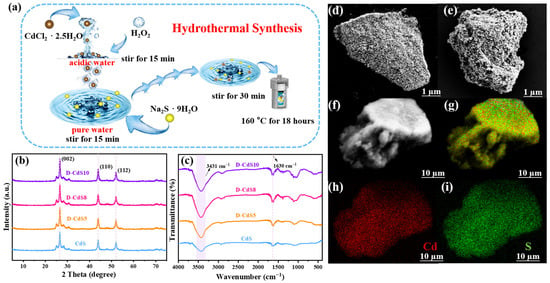
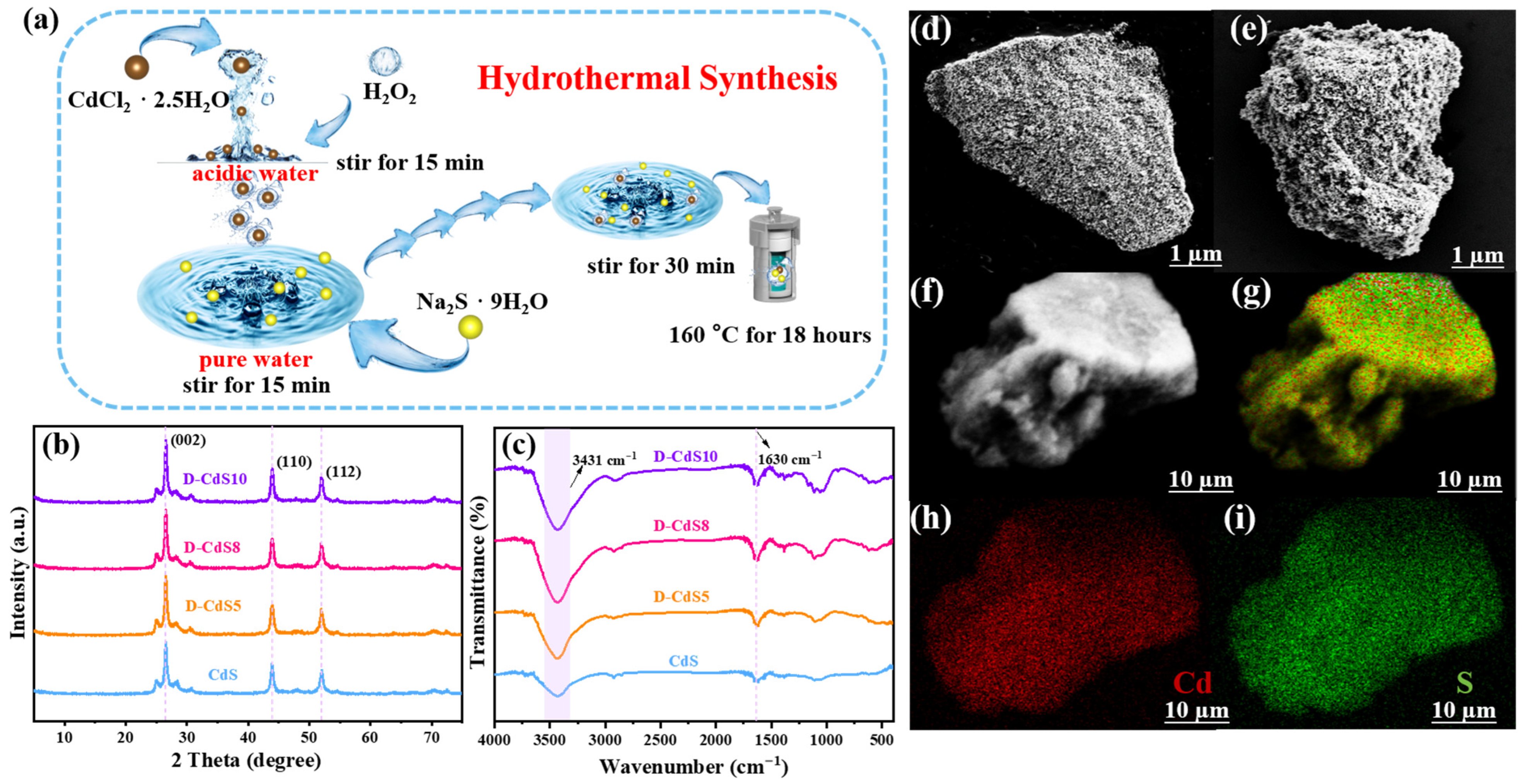
A preparation process diagram of D-CdS is displayed in Figure 1a. X-ray diffraction (XRD) was employed to analyze the crystal structures of CdS and D-CdS, with the results presented in Figure 1b. Distinct diffraction peaks of CdS appeared at 2θ ≈ 26.5°, 44.0°, and 52.0°, corresponding to the (002), (110), and (112) crystal planes, respectively, which verified the successful synthesis of CdS [18]. Compared with pure CdS, no obvious changes were observed in the diffraction peaks of D-CdS, indicating that the introduction of Cd vacancies in D-CdS5, D-CdS8 and D-CdS10 did not change the crystal structure.
Figure 1.
(a) Synthesis process diagram of D-CdS; (b) XRD patterns of CdS and D-CdS; (c) FT-IR spectra of CdS and D-CdS; (d,e) SEM images of CdS and D-CdS8; (f–i) EDS elemental mapping of D-CdS8 (total, Cd, S).
As shown in the Fourier-transform infrared (FT-IR) spectra (Figure 1c), all samples exhibited distinct absorption bands at 3431 cm−1 and 1630 cm−1, which corresponded to the stretching vibration of the O-H stretching and O-H bending modes, respectively [19]. These characteristic peaks originated from adsorbed water molecules bound on the material’s surface. No additional characteristic peaks were observed in the FT-IR spectra, demonstrating that the introduction of surface defects hardly altered the intrinsic structure of the D-CdS and were consistent with the findings derived from XRD analysis.
The scanning electron microscopy (SEM) images illustrate the morphologies of CdS and D-CdS8. As shown in Figure 1d, CdS exhibited a dense and highly aggregated structure. After introducing Cd vacancies, D-CdS8 retained bulk-like morphology, but formed a rougher surface with a more porous and loosely packed structure, which provided abundant adsorption sites for PI, strengthening the interfacial contact between the D-CdS8 and PI and further accelerating the interfacial electron transfer process that drove PI activation. The EDS-mapping results (Figure 1f–i) show that both Cd and S elements were uniformly distributed throughout D-CdS8 with no evidence of elemental agglomeration, demonstrating the homogeneous dispersion of elements in the sample.
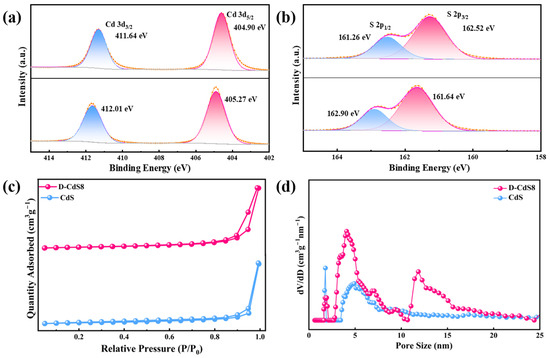
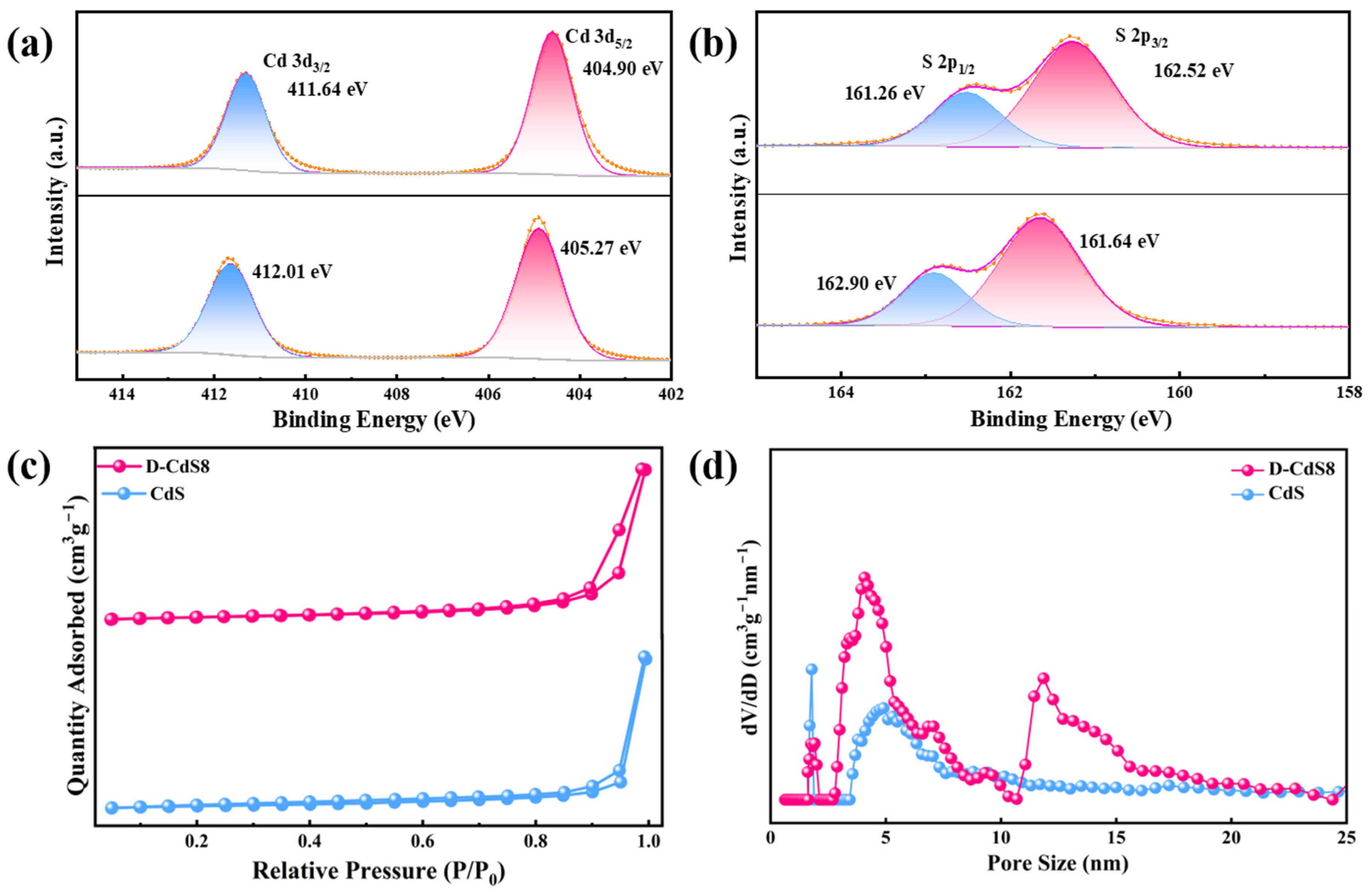
To elucidate the elemental composition and chemical states of CdS and D-CdS8, X-ray photoelectron spectroscopy (XPS) characterization was performed. The XPS survey spectra (Figure S1) revealed that the primary elements in CdS and D-CdS8 were Cd and S, which was agreed with the EDS results. As shown in Figure 2a, two characteristic peaks observed at 405.27 eV and 412.01 eV in the Cd 3d spectrum corresponded to Cd 3d5/2 and Cd 3d3/2, indicating that Cd mainly existed in the Cd2+ oxidation state. In the S 2p XPS spectrum (Figure 2b) two characteristic peaks appeared at 160.90 eV and 161.64 eV, assigned to S 2p3/2 and S 2p1/2, revealing that sulfur mainly existed in the form of S2− [20]. Compared with CdS, both characteristic peaks of Cd 3d and S 2p in D-CdS8 shifted toward lower binding energies, suggesting a redistribution of local electron induced by the introduction of Cd vacancies. The surface Cd/S atomic ratio of pristine CdS calculated from XPS quantification was 0.99:1, nearly identical to the theoretical stoichiometric ratio (1:1) of CdS crystals. In contrast, the surface Cd/S atomic ratio of D-CdS8 was determined to be only 0.84:1, distinctly lower than the theoretical value. The obvious decline in the Cd/S ratio preliminarily indicating the formation of Cd vacancies [21].
Figure 2.
(a) Cd 3d, (b) S 2p. (c) N2 adsorption–desorption isotherms, (d) pore size distribution curves of CdS and D-CdS8.
Pore structures of CdS and D-CdS8 were analyzed via N2 adsorption–desorption measurements. The isotherms of the CdS and D-CdS8 both displayed combined type I and IV isotherms (Figure 2c), indicating the coexistence of mesopores and micropores in the samples. This result was in line with the pore size distribution results calculated using the DFT methods shown in Figure 2d. In contrast to CdS, D-CdS8 exhibited an increased pore volume and a larger specific surface area of 57.269 m2g−1 (Table S1), which could provide more abundant surface active sites and promote TC adsorption, thereby benefiting subsequent catalytic reactions [22]. The larger specific surface area significantly facilitated full contact between the D-CdS8, PI and TC, effectively accelerated the oxidative degradation process.
2.2. Catalytic Degradation of TC
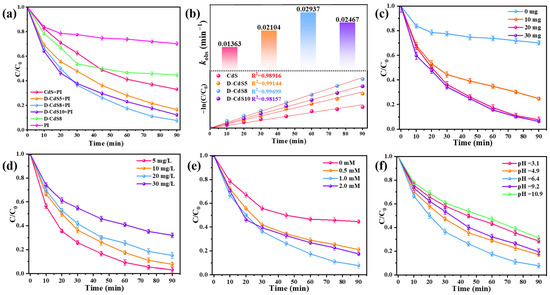
The catalytic performances of CdS and D-CdS for activating PI were evaluated using TC degradation experiments, and the results are presented in Figure 3. As shown in Figure 3a, only 67% of TC was removed in the CdS/PI system within 90 min. The introduction of Cd vacancies markedly improved the degradation efficiency of TC. The enhanced activity of D-Cd-S could be attributed to the electronic modulation by Cd vacancies, which promoted PI activation and facilitates the generation of reactive species. Among D-CdS, D-CdS8 exhibited the highest catalytic activity, with a degradation rate reaching 92.3%. In contrast, TC removal by adsorption on D-CdS8 alone and oxidation by PI alone reached only 55.4% and 29.9%, respectively, indicating that the superior performance originated from the synergistic interaction between D-CdS8 and PI. Figure 3b displays the pseudo-first-order kinetic fitting results and reaction rate constants (kobs) of CdS/PI, D-CdS5/PI, D-CdS8/PI and D-CdS10/PI systems for TC degradation. Specifically, the kobs value of the D-CdS8/PI system was 2.15 times higher than CdS/PI system, which could be attributed to the introduction of Cd vacancies. Notably, the D-CdS8/PI system had the higher kobs than that of D-CdS5/PI and D-CdS10/PI, suggesting that an appropriate concentration of Cd vacancies was critical for optimizing catalytic activity, while excessive vacancies might introduce charge recombination centers, thereby limiting the further enhancement of catalytic performance. Furthermore, the kobs value of the D-CdS8/PI system toward TC degradation were compared with those documented in previous PI-AOPs studies (Figure S2). The results clearly illustrate that the D-CdS8/PI system possesses satisfactory degradation performance toward TC.
Figure 3.
(a) TC degradation efficiency over different systems; (b) pseudo-first-order kinetic fitting and rate constants for TC degradation; (c) effect of D-CdS8 dosage, (d) initial TC concentration, (e) PI concentration, (f) initial pH on TC degradation.
A series of experiments were conducted to explore the effects of reaction conditions on TC degradation in the D-CdS-8/PI system. Figure 3c illustrates the effect of catalyst dosage on degradation efficiency. The degradation rate of TC rose evidently when the dosage increased from 10 mg to 20 mg, while further dosage increases brought little improvement. Therefore, 20 mg was selected as the optimal catalyst dosage considering economic cost and environmental benefits. The increase in initial TC concentration led to the gradual decline in degradation efficiency in the D-CdS-8/PI system (Figure 3d), which was mainly due to the insufficient active sites and competitive consumption of active sites by the substrate and its intermediates. The degradation rate of TC improved with an increase in PI concentration from 0 to 1.0 mM. However, the TC degradation efficiency decreased when the PI concentration exceeded 1.0 mM (Figure 3e). This phenomenon may originate from the self-quenching of reactive species and their nonproductive consumption by excess PI molecules. Initial pH value was a crucial factor affecting catalytic performance. As shown in Figure 3f, the degradation rate of TC was optimal under near-neutral conditions, while both acidic and alkaline environments inhibited TC degradation. Under alkaline conditions, the surface charge of D-CdS8 shifted from positive to negative, enhancing electrostatic repulsion with PI and thereby weakening PI adsorption and activation [23]. Under acidic conditions, a large amount of H+ preferentially occupied the active sites of the D-CdS8, competing with PI for adsorption and thus inhibited TC degradation [24].
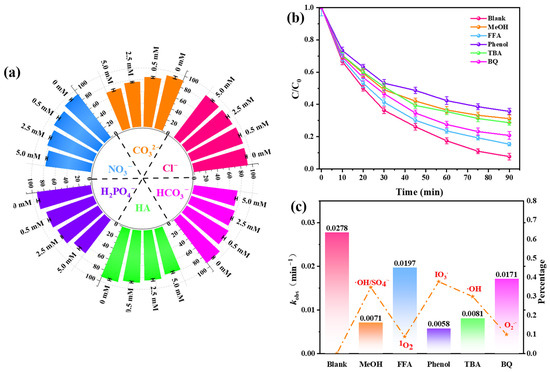
To investigate the effects of common coexisting components in actual water matrices on TC degradation performance in the D-CdS8/PI system, the influences of different concentrations of inorganic anions (Cl−, HCO3−, NO3−, CO32− and H2PO4−) and natural organic matter (HA) on TC degradation efficiency were examined in this study, and the results are presented in Figure 4a. The experimental results show that Cl− had a negligible effect on degradation performance, even at relatively high concentrations, indicating the excellent resistance of the D-CdS8/PI system toward Cl− interference. In contrast, HCO3−, CO32−, NO3−, H2PO4− and HA all affected TC degradation to different degrees, and their impacts were strongly dependent on the component concentrations. CO32− and HCO3− acted as scavengers for highly reactive species such as ·OH, thereby reducing the degradation efficiency of TC [25,26]. For H2PO4−, it may form an inorganic layer on the surface of D-CdS8, blocking partial active sites and hindering electron transfer between PI and D-CdS8 [27]. And NO3− can be adsorbed onto the surface of D-CdS8, competing with TC for active sites and interfering with interfacial electron transfer. For HA, this may be because its hydroxyl and carboxyl groups occupied the active sites [28]. Overall, the D-CdS8/PI system exhibited strong resistance to the interference of Cl− present in actual water bodies. Nevertheless, high concentrations of HCO3−, CO32−, NO3−, H2PO4− and HA still exerted an adverse effect on the degradation of TC. Additionally, we conducted TC degradation experiments on different water matrices to evaluate the practical degradation performance of the D-CdS8/PI system in real water environments. As shown in Figure S3, TC degradation efficiency reached the highest level in pure water, while a slight decrease was observed in natural water bodies (tap water and river water). This reduction in efficiency was most likely attributed to the complex coexistence of anions and organic/inorganic impurities in real aquatic environments.
Figure 4.
(a) Effects of coexisting anions and HA on TC degradation; (b) radical quenching experiments on TC degradation; (c) contribution ratios of active species and pseudo-first-order rate constants for TC degradation.
To evaluate the reusability and stability of the D-CdS8 catalyst, three consecutive recycling experiments were performed. Detailed procedures for catalyst recycling and regeneration are provided in Supporting Information (Text S1). As shown in Figure S4, the catalyst maintained high catalytic activity over three cycles, with only a slight decrease in degradation efficiency observed. One possible reason for this was that the oxidation of surface sulfur generates sulfate radicals and soluble sulfate. A depletion in sulfur active sites lowered the electron transfer efficiency of PI activation. Moreover, adsorbed sulfate intermediates occupied surface adsorption sites. The consumption of sulfur sites and surface passivation together weaken the cycling stability of D-CdS8. Furthermore, XRD (Figure S5) and FT-IR (Figure S6) characterizations of the recovered catalyst after the cycles revealed no significant structural or compositional changes compared with the fresh sample, confirming its excellent structural stability during the reaction.
To further evaluate the structural stability and secondary pollution risk of D-CdS8 in water treatment, inductively coupled plasma mass spectrometry (ICP-MS) was used to quantify cadmium leaching after TC degradation. In total, 1.38% of cadmium dissolved into the solution. This low leaching fraction verified the superior structural stability of D-CdS8 during catalysis, and additional optimization routes should be explored to further reduce cadmium release.
2.3. Catalytic Degradation Mechanisms
Quenching experiments were conducted in this study to identify the active species involved in TC degradation. All typical quenchers used in the experiments were selected according to the previous literature [29,30]. Methanol (MeOH) was used to scavenge ·OH and SO4·−. Tert-butanol (TBA) specifically trapped ·OH, while p-benzoquinone (p-BQ) quenched O2·−. Furfuryl alcohol (FFA) was applied to eliminate 1O2, and phenol served as the scavenger for IO3·. As shown in Figure 4b, the addition of phenol caused the strongest inhibition on TC degradation, indicating that IO3· was the dominant active species in the D-CdS8/PI system. Both MeOH and TBA exhibited obvious inhibitory effects, suggesting that ·OH also played an important role. p-BQ and FFA showed the weakest inhibition, which demonstrated that O2·− and 1O2 contributed little to the degradation reaction. Furthermore, the pseudo-first-order kinetic model was used to fit the degradation curves for quantitative analysis of the contribution of various active species. The kobs and radical contribution ratios obtained from quenching experiments are presented in Figure 4c. The calculated kobs after quenching were 0.0071 min−1 (MeOH), 0.0197 min−1 (FFA), 0.0058 min−1 (phenol), 0.0081 min−1 (TBA), and 0.0171 min−1 (BQ). And the contribution percentages were determined as 4.79% (SO4·−), 29.83% (·OH), 10.02% (O2·−), 8.84% (1O2), and 37.67% (IO3·). In summary, IO3· and ·OH were the dominant reactive species for TC degradation in the D-CdS8/PI system. By contrast, SO4·−, O2·− and 1O2 made negligible contributions to the removal of TC. The above results clearly clarified the composition and relative contribution of active species during the degradation process.
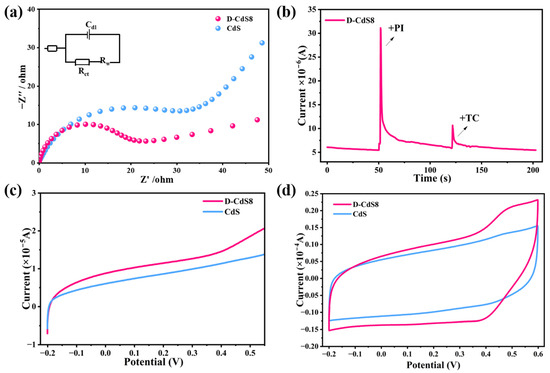
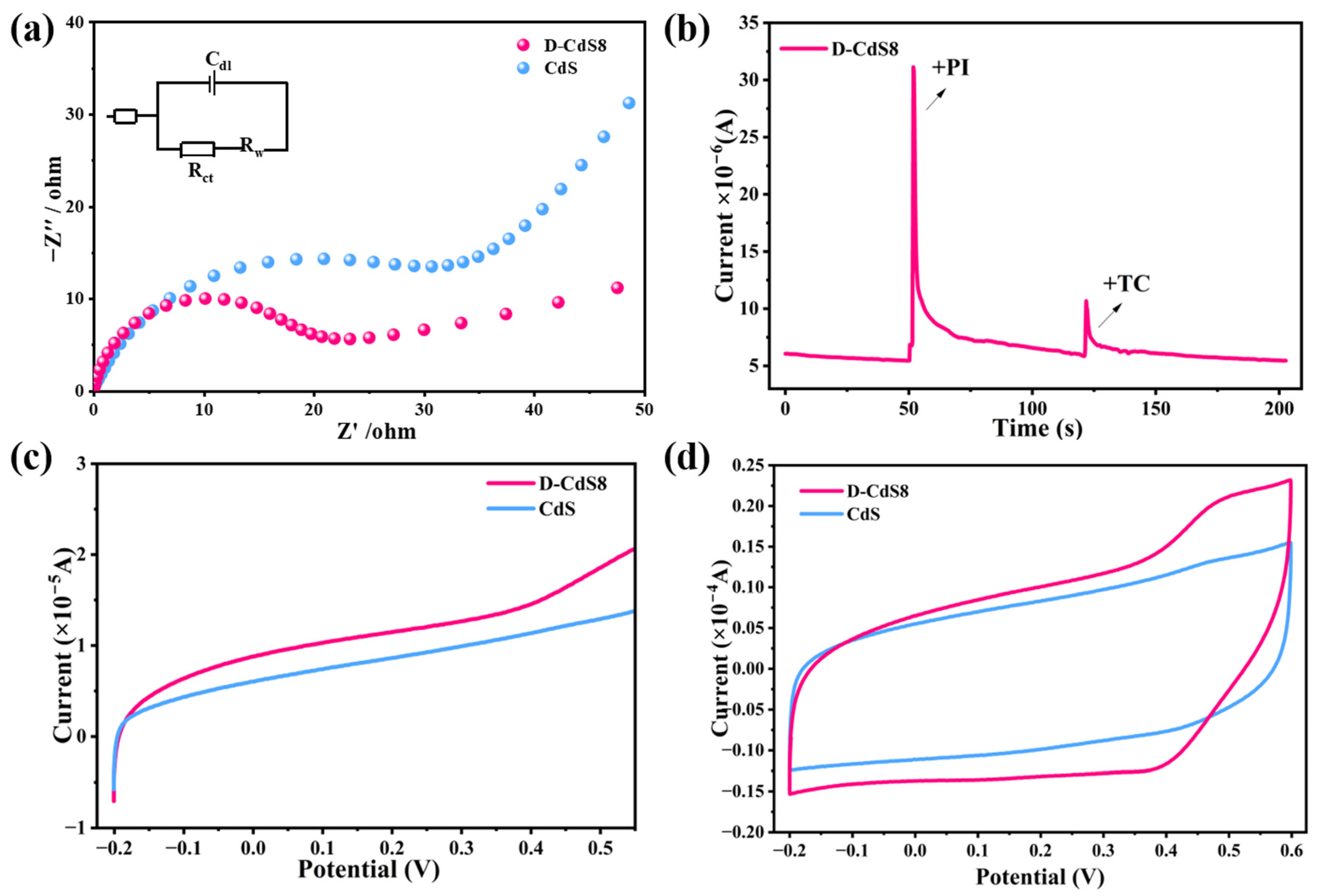
Electrochemical impedance spectroscopy (EIS), amperometric i-t curves, linear sweep voltammetry (LSV) and cyclic voltammetry (CV) were employed in this work to investigate and verify the electron transfer behavior of the D-CdS8 system. Firstly, EIS was employed to analyze the charge transfer kinetics of the two samples (Figure 5a). Compared with CdS, D-CdS8 exhibited a smaller impedance semicircle, demonstrating its lower charge transfer resistance and more efficient charge transfer [31]. Figure 5b shows the i-t curves of the D-CdS8/PI system. A prompt current signal was detected upon adding PI and TC, verifying the efficient electron transfer at the interface between PI, TC and D-CdS8. This favorable interfacial electron transfer further facilitated the activation of PI and the subsequent degradation of TC [32]. The LSV curves (Figure 5c) showed that D-CdS8 achieved a higher current density, indicating its superior oxidation rate for TC [33]. Moreover, D-CdS8 displayed higher redox peaks and a larger cyclic voltammetry curve area (Figure 5d). These results demonstrate that D-CdS8 possesses a fast redox reaction rate, which facilitates rapid electron transfer during the catalytic decomposition of PI [34]. These electrochemical differences were attributed to the introduction of Cd vacancies. The constructed defects effectively optimize the electron transfer and redox properties of D-CdS8, which was beneficial to PI activation and TC removal. Generally, these electrochemical results clearly clarified the mechanism by which Cd vacancies enhanced PI activation: Cd deficiency induced lattice electron redistribution, lowered charge transfer barriers and accelerated electron supply to adsorbed PI. The boosted interfacial electron transfer directly promoted the reduction of PI and continuous generation of dominant IO3· and ·OH, thereby greatly elevating the catalytic oxidation efficiency toward TC.
Figure 5.
(a) EIS Nyquist plots of CdS and D-CdS8; (b) i-t curve in the D-CdS8/PI system; (c) LSV curves; (d) CV curves of CdS and D-CdS8.
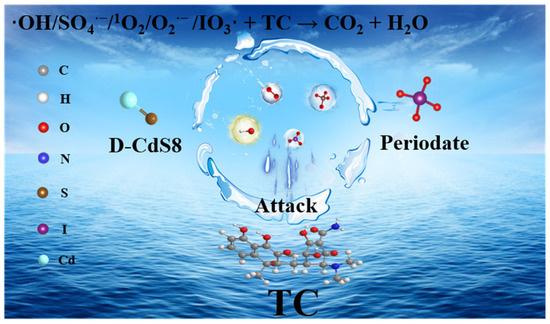
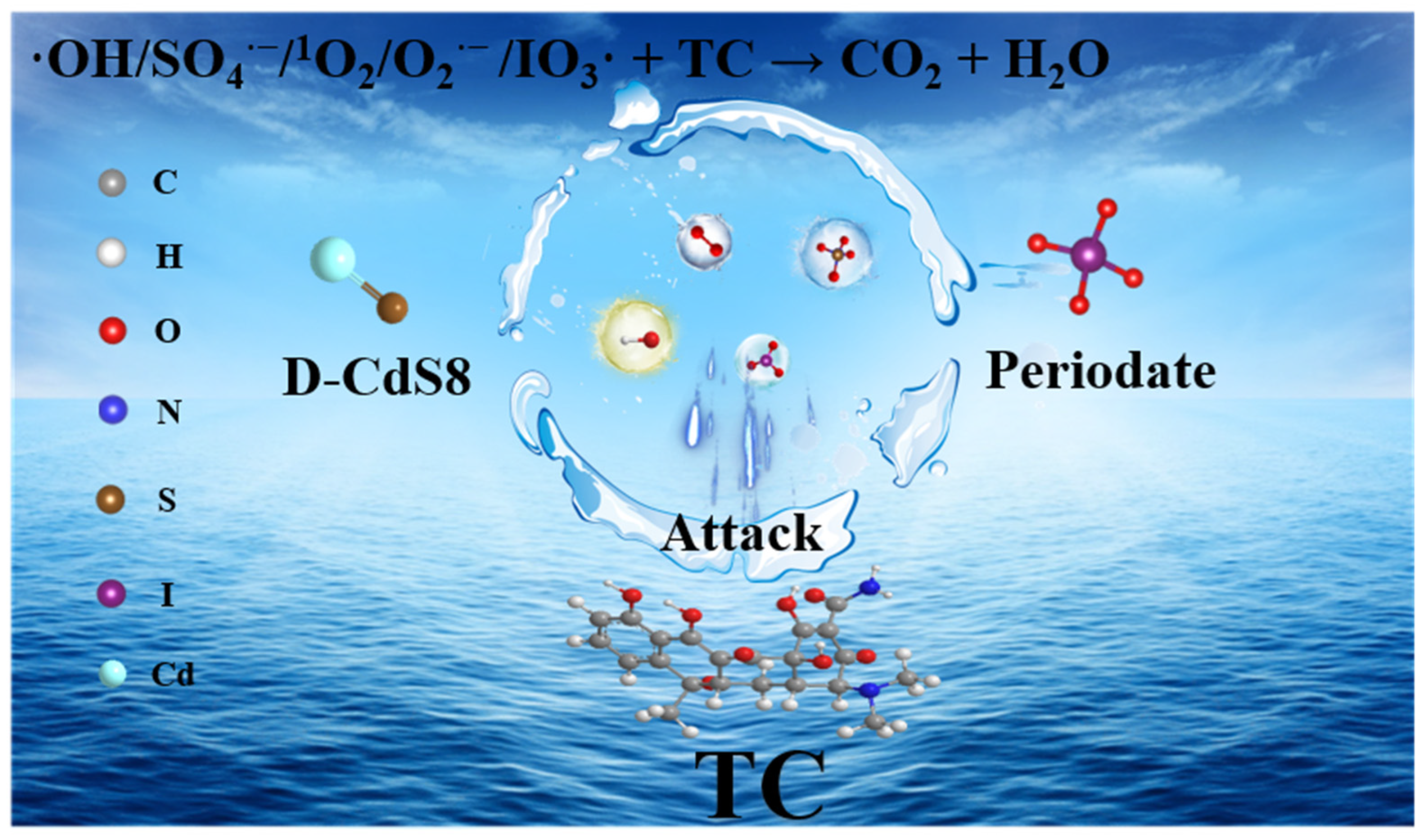
Based on the analysis presented above, a possible degradation mechanism of TC in the D-CdS8 /PI system was proposed [35,36], as shown in Figure 6. After PI adsorbed onto the surface of D-CdS8, a series of reactions took place and generated various active species such as ·OH, SO4·−, 1O2, O2·− and IO3·. As shown in Equation (1), PI was adsorbed on the surface of D-CdS8 and gained electrons, generating the dominant active species IO3· in the system [37]. The O·− produced in the reaction and IO3· reacted with water molecules respectively to collectively form ·OH (Equations (2) and (3)) [38]. Free electrons in the system were captured by dissolved oxygen to form O2·− (Equation (4)), which was then converted into 1O2 by reacting with ·OH (Equation (5)) [39]. Meanwhile, sulfur species (S22−) on the surface of D-CdS8 were oxidized to SO4·− by PI (Equation (6)) [27]. Based on the above analysis, the reactive oxygen species generated in the D-CdS8/PI system collectively participated in the degradation of TC. As described in Equation (7), these active species attacked the TC molecules and eventually mineralized them into harmless small molecules such as CO2 and H2O.
Figure 6.
Mechanism of TC degradation in D-CdS8/PI system.
2.4. Possible Degradation Pathways of TC and Toxicity Analysis
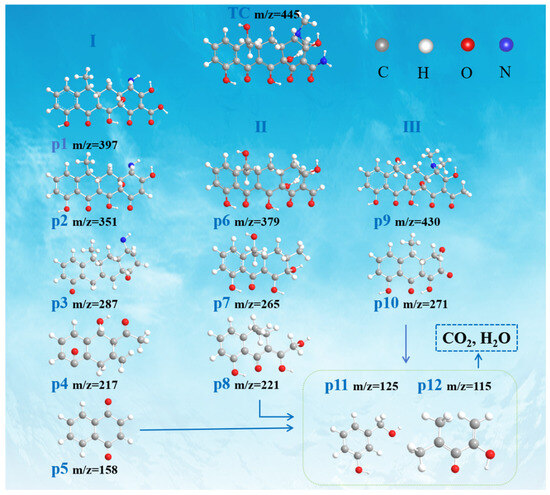
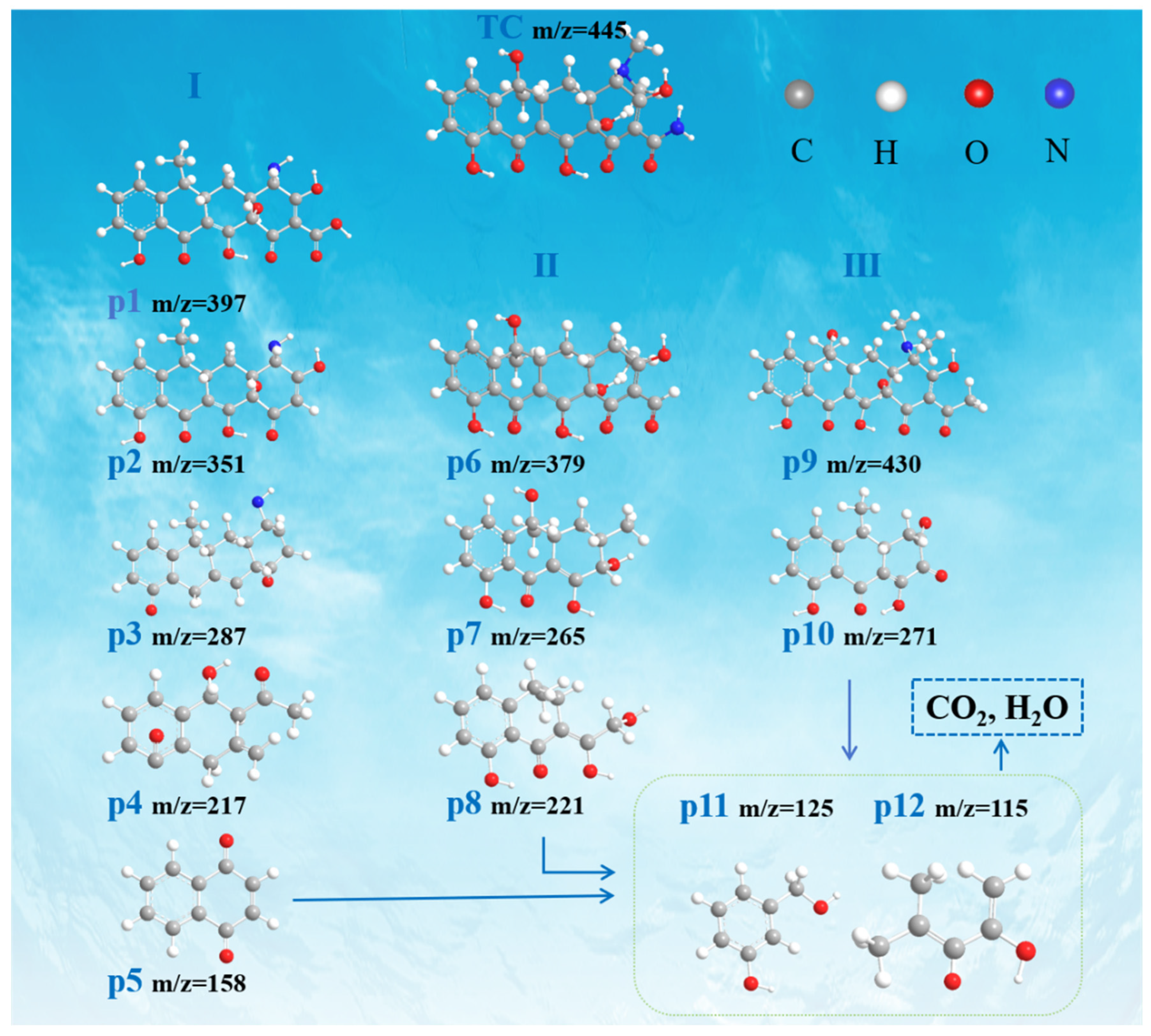
To explore the degradation process of TC in the D-CdS8/PI system, the intermediate products formed during the reaction were identified using LC-MS. Based on the detected mass-to-charge ratios (m/z), a total of 12 major intermediates (P1–P12) were identified, and three possible degradation pathways (Pathways I, II, and III) were proposed accordingly [40,41,42], as illustrated in Figure 7. Pathway I was dominated by the deamination, dehydroxylation, and ring-opening reactions of the TC (m/z = 445). First, under the attack of reactive species, TC underwent demethylation and hydroxyl oxidation to form P1 (m/z = 397). Subsequently, the side chain was further removed and carbonylation occurred, yielding P2 (m/z = 351). As the oxidation reaction proceeded, the conjugated structure was gradually destroyed, forming the deaminated product P3 (m/z = 287) and the dehydroxylated product P4 (m/z = 217). Finally, ring-opening cleavage generated the small-molecule intermediate P5 (m/z = 158). In Pathway II, the benzene ring and enol structure of the TC molecule were easily attacked by reactive species, triggering hydroxylation and ring-opening reactions. TC first underwent a hydroxyl addition reaction to form P6 (m/z = 379), and then sequentially generated P7 (m/z = 265) and P8 (m/z = 221) through decarbonylation and dehydroxylation reactions. Pathway III mainly involved the oxidation and cleavage of the side chain of the TC molecule. The dimethylamino and hydroxyl groups on the TC molecule underwent oxidation under the action of reactive species to form P9 (m/z = 430), followed by side chain cleavage accompanied by deamination to yield P10 (m/z = 271). The small-molecule intermediates generated from the three pathways (e.g., P5, P8, and P10) were further continuously attacked by the reactive species in the system (·OH, SO4·−, 1O2, O2·− and IO3·), undergoing deep oxidation and mineralization reactions. They were eventually completely degraded into small molecules such as P11 (m/z = 125) and P12 (m/z = 115) and ultimately converted into inorganic products such as CO2 and H2O, achieving the harmless removal of TC.
Figure 7.
Proposed pathways of TC in D-CdS8/PI system.
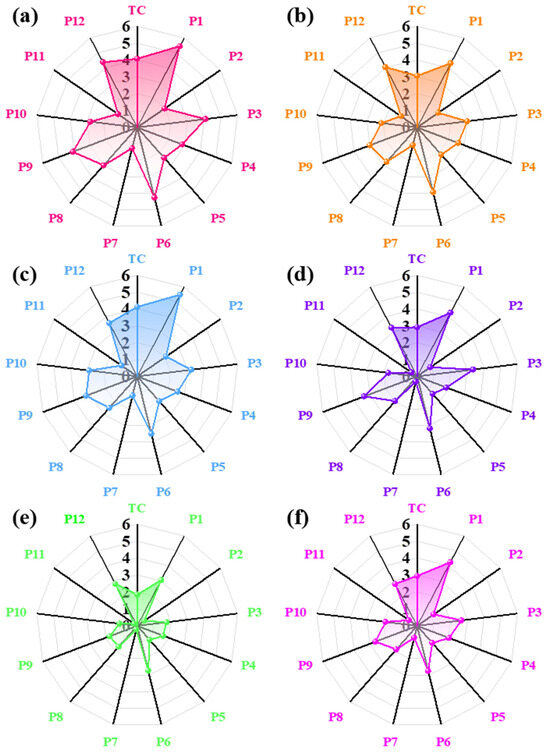
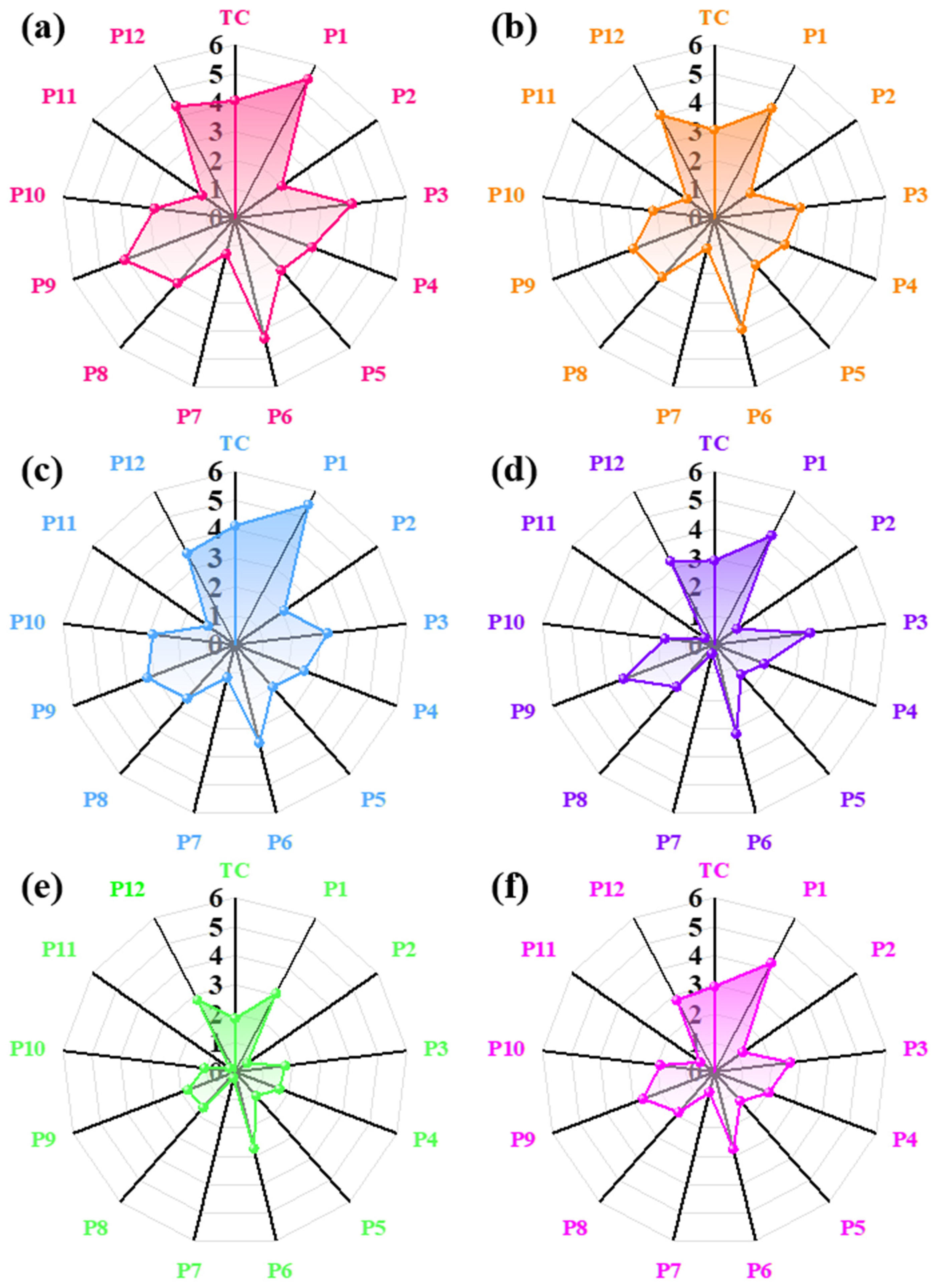
Figure 8 presents radar plots based on lgK values (common logarithm of toxicity concentration, where higher values indicate lower toxicity), systematically revealing the acute and chronic ecotoxicity differences of TC and its 12 degradation intermediates to fish, Daphnia, and Green Algae. Figure 8a–f displays the lgK distribution across different toxicity assessment dimensions. TC showed relatively high lgK values for all three model organisms, indicating controllable original toxicity. In contrast, degradation products exhibited significant toxicity differentiation: P1, P6, and P12 showed generally higher lgK values than TC, with P1 exceeding 4.0 in multiple dimensions (Figure 8a,c), confirming reduced toxicity and a low-toxicity category. Conversely, P2, P7, and P11 showed significantly low lgK values (some below 2.0, Figure 8b,d), with toxicity levels far exceeding the TC, indicating that some degradation processes could increase toxicity. Meanwhile, Daphnia showed greater sensitivity to most products, with generally lower lgK values than fish and Green Algae, and chronic toxicity lgK values were overall lower than acute toxicity (Figure 8e,f), indicating more prominent long-term ecological risks. Overall, Figure 8 clearly demonstrates the evolution of dynamic toxicity during TC degradation, where the high toxicity risk of certain intermediates cannot be ignored, providing key support for optimizing catalytic conditions and regulating degradation pathways to reduce overall ecological risk.
Figure 8.
Ecotoxicity radar charts of TC and its degradation intermediates based on lgK values. Acute chronic toxicity to (a) fish, (b) Daphnia, and (c) Green Algae; chronic toxicity to (d) fish, (e) Daphnia, and (f) Green Algae.
3. Materials and Methods
3.1. Materials
Detailed information on the reagents is given in Text S2 in the Supporting Information.
3.2. Synthesis of Catalysts
Synthesis of D-CdS: 3.5 mmol of CdCl2·2.5H2O and 0.4 mL of 10 vol% H2O2 were dissolved in 20 mL acidic aqueous solution (pH = 1). Meanwhile, 5 mmol, 8 mmol and 10 mmol of Na2S·9H2O were separately dissolved in 20 mL deionized water. Under stirring, the CdCl2·2.5H2O solution was added slowly into the Na2S·9H2O solution. After the completion of dropping, the obtained suspension was transferred into a Teflon-lined stainless-steel autoclave and hydrothermally treated at 160 °C for 18 h. After cooling to room temperature, the precipitate was washed three times with deionized water and then dried in a vacuum-drying oven at 60 °C for 12 h. The as-prepared samples were named D-CdS5, D-CdS8 and D-CdS10 according to the different molar amounts of Na2S·9H2O added.
Synthesis of CdS: The synthesis procedure of CdS was basically consistent with D-CdS. The only differences were that the dosage of Na2S·9H2O was adjusted to 3.5 mmol, and 3.5 mmol CdCl2·2.5H2O was directly dissolved in 20 mL deionized water.
3.3. Characterization of Materials
XRD (D8 ADVANCE, Bruker AXS GmbH, Karlsruhe, Germany) was employed to determine the crystal structure of the samples with Cu Kα radiation at 40 mA. Functional group information was obtained through FT-IR (Thermo Fisher Scientific, Waltham, MA, USA). Micro-morphology was observed using SEM (GEMINI 300, Carl Zeiss Microscopy GmbH, Oberkochen, Germany). XPS (ESCALAB Xi+, Thermo Fisher Scientific, Waltham, MA, USA) was employed to analyze the elemental composition and variations in chemical states of the samples before and after the reaction. The specific surface area and pore size distribution of the porous materials were evaluated using nitrogen adsorption measurements (BET, Quantachrome Instruments, Boynton Beach, FL, USA). The electrochemical properties of materials were measured using an electrochemical workstation in a standard three-electrode system.
3.4. Catalytic Activity Experimental Procedure
TC degradation experiments were carried out in 100 mL beakers containing 50 mL of 10 mg/L TC solution and 20 mg catalyst. An amount of 1.0 mM PI was added to the TC solution to initiate the degradation reaction. Magnetic stirring was maintained during the reaction for uniform catalyst dispersion. At set intervals, 1.5 mL aliquots were taken and immediately quenched with 0.2 mL of 2.0 M Na2S2O3. The samples were filtered through a 0.22 µm polyethersulfone filter (MilliporeSigma, Burlington, MA, USA) and TC concentrations were analyzed via high-performance liquid chromatography (HPLC, Zhejiang Fuli Analytical Instruments Co., Ltd., Wenling, Zhejiang, China). All tests were performed in triplicate to guarantee reliable and reproducible results.
The experimental details of TC concentration analysis and degradation product detection can be found in Text S3 in the Supporting Information.
4. Conclusions
In summary, this study prepared D-CdS catalysts via a simple hydrothermal method for PI activation to degrade TC. The optimal catalyst D-CdS8 achieved a 92.3% removal rate of 10 mg/L TC within 90 min with a kobs value of 0.02937 min−1, much higher than the pure CdS system in the presence of PI. Mechanistic investigations revealed that the introduction of Cd vacancies effectively reduced charge transfer resistance and accelerated interfacial electron transfer, thereby enhancing PI activation, which in turn increased the yield of IO3· and ·OH and ultimately improved TC degradation. The D-CdS8/PI system achieved stable and efficient TC degradation under diverse water matrices and coexisting common interfering ions and retained outstanding recyclability after three cycling experiments. Potential degradation intermediates of TC were identified via LC-MS analysis, and the toxicity evolution of degradation products was assessed using the ECOSAR, verifying the environmental benignity of the developed catalytic system. This study provided a simple and feasible strategy for designing high-efficiency defective CdS catalysts to activate PI for the remediation of antibiotic-contaminated water and also offered a new idea for the advanced purification of organic pollutants in aqueous environments.
Supplementary Materials
The following supporting information can be downloaded at https://www.mdpi.com/article/10.3390/catal16070611/s1. Text S1: Catalyst recycling and regeneration procedure; Text S2: Chemicals; Text S3: Experimental analysis; Table S1: Physicochemical parameters of CdS and D-CdS8; Figure S1: XPS survey spectra of CdS and D-CdS8; Figure S2: Comparison of TC degradation performance in different systems. (a) D-CdS8/PI (this study). (b) Cu3V2O8∙H2O/PI [43]. (c) CuCo2O4/PI [44]. (d) C3N5-Nv/PI [45]. (e) CuFeS2/PI [46]; Figure S3: Degradation curves of TC in different water matrices; Figure S4: Cyclic stability of D-CdS8 for TC degradation; Figure S5: XRD patterns of fresh and used D-CdS8 catalysts; Figure S6: FT-IR spectra of fresh and used D-CdS8 catalysts.
Author Contributions
S.G.: Writing—original draft. B.N.: Visualization. Z.L.: Data curation. R.L.: Investigation. X.Z.: Methodology. Z.Z.: Validation. J.L.: Supervision. N.L.: Writing—review and editing, Funding acquisition. All authors have read and agreed to the published version of the manuscript.
Funding
This research was funded by the National Natural Science Foundation of China (Nos. 42177405, 12075152), the Innovation Program of Shanghai Municipal Education Commission (2021-03-147), and the Energy Science and Technology discipline under the Shanghai Class IV Peak Disciplinary Development Program.
Data Availability Statement
The datasets generated and analyzed during the current study are available from the corresponding author upon reasonable request.
Conflicts of Interest
The authors declare no conflicts of interest.
References
- Blake, K.S.; Xue, Y.-P.; Gillespie, V.J.; Fishbein, S.R.S.; Tolia, N.H.; Wencewicz, T.A.; Dantas, G. The tetracycline resistome is shaped by selection for specific resistance mechanisms by each antibiotic generation. Nat. Commun. 2025, 16, 1452. [Google Scholar] [CrossRef] [Scilit]
- Antos, J.; Piosik, M.; Ginter-Kramarczyk, D.; Zembrzuska, J.; Kruszelnicka, I. Tetracyclines contamination in European aquatic environments: A comprehensive review of occurrence, fate, and removal techniques. Chemosphere 2024, 353, 141519. [Google Scholar] [CrossRef] [Scilit] [PubMed]
- Deza-Cruz, I.; de Menezes, A.; Gardner, B.; Aktan, Í.; Alnajjar, S.; Betson, M.; Cabal Rosel, A.; Caniça, M.; Chambers, M.A.; Tarrant, G.; et al. Mapping the evidence of the effects of environmental factors on the prevalence of antibiotic resistance in the non-built environment. Environ. Int. 2025, 202, 109634. [Google Scholar] [CrossRef] [Scilit] [PubMed]
- Li, Y.; Liu, X.; Wang, J.; Li, S. High-generation tetracyclines shifted microbial community composition and induced the emergence of antibiotic resistant bacteria in soil. J. Hazard. Mater. 2024, 480, 135757. [Google Scholar] [CrossRef] [Scilit] [PubMed]
- Haider, Z.; Imran, M.; Muhmood, T. Photoelectrochemical Production of Peroxydisulfate (PDS), a Clean Oxidant: Recent Development and Challenges. Int. J. Mol. Sci. 2026, 27, 3066. [Google Scholar] [CrossRef] [Scilit] [PubMed]
- Yang, H.; Lee, C.-G.; Lee, J. Piezocatalysis-combined advanced oxidation processes for organic pollutant degradation in water system. Ultrason. Sonochem. 2025, 113, 107219. [Google Scholar] [CrossRef] [Scilit] [PubMed]
- Manos, D.; Konstantinou, I. Recent Advances in Transition Metal Selenide-Based Catalysts for Organic Pollutant Degradation by Advanced Oxidation Processes. Catalysts 2025, 15, 938. [Google Scholar] [CrossRef] [Scilit]
- Xu, J.; Zhang, Z.; Yang, J.; Ma, Y.; Han, T.; Quan, G.; Zhang, X.; Lei, J.; Liu, N. Treatment of pharmaceuticals and personal care products (PPCPs) using periodate-based advanced oxidation technology: A review. Chem. Eng. J. 2025, 512, 162355. [Google Scholar] [CrossRef] [Scilit]
- Sukhatskiy, Y.; Shepida, M.; Sozanskyi, M.; Znak, Z.; Gogate, P.R. Periodate-based advanced oxidation processes for wastewater treatment: A review. Sep. Purif. Technol. 2023, 304, 122305. [Google Scholar] [CrossRef] [Scilit]
- Liu, N.; Tian, M.; Zhang, Y.; Yang, J.; Wang, Z.; Dai, W.; Quan, G.; Lei, J.; Zhang, X.; Tang, L. Three-dimensional MIL-88A(Fe)-derived α-Fe2O3 and graphene composite for efficient photo-Fenton-like degradation of ciprofloxacin. Chin. Chem. Lett. 2025, 36, 111063. [Google Scholar] [CrossRef] [Scilit]
- Ali, S.; Bakhtiar, S.U.H.; Ismail, A.; Ismail, P.M.; Hayat, S.; Zada, A.; Wu, X.; Alodhayb, A.N.; Zahid, M.; Raziq, F.; et al. Transition metal sulfides: From design strategies to environmental and energy-related applications. Coord. Chem. Rev. 2025, 523, 216237. [Google Scholar] [CrossRef] [Scilit]
- Haider, Z.; Ju, H. Strategies to Boost Photocatalytic Degradation of Emerging Contaminants Using ZnO Heterostructure Photocatalysts. Appl. Sci. 2026, 16, 5279. [Google Scholar] [CrossRef] [Scilit]
- Chen, B.; Wang, Y.; Shen, S.; Zhong, W.; Lu, H.; Pan, Y. Lattice Defects and Electronic Modulation of Flower-Like Zn3In2S6 Promote Photocatalytic Degradation of Multiple Antibiotics. Small Methods 2024, 8, 2301598. [Google Scholar] [CrossRef] [Scilit] [PubMed]
- Zhao, X.; Tong, J.; Bai, S.; Qian, J. Dual-metal-catalyzed Fenton-like reaction on CdxZn1-xS @biochar: Mechanistic insights into sulfide-metal interactions for water purification. Appl. Catal. B Environ. 2025, 379, 125654. [Google Scholar] [CrossRef] [Scilit]
- MacSwain, W.; Ma, D.-K.; Li, Z.-J.; Lin, H.; Bai, Y.-L.; Hu, X.; Zheng, W. Metal-based co-catalysts in semiconductor CdS hybrid nanostructures for enhanced photocatalysis: Material design, mechanisms, and emerging trends. Coord. Chem. Rev. 2026, 549, 217247. [Google Scholar] [CrossRef] [Scilit]
- Muhammad, P.; Zada, A.; Rashid, J.; Hanif, S.; Gao, Y.; Li, C.; Li, Y.; Fan, K.; Wang, Y. Defect Engineering in Nanocatalysts: From Design and Synthesis to Applications. Adv. Funct. Mater. 2024, 34, 2314686. [Google Scholar] [CrossRef] [Scilit]
- Cheng, L.; Li, B.; Yin, H.; Fan, J.; Xiang, Q. Cu clusters immobilized on Cd-defective cadmium sulfide nano-rods towards photocatalytic CO2 reduction. J. Mater. Sci. Technol. 2022, 118, 54–63. [Google Scholar] [CrossRef] [Scilit]
- Li, Q.; Jin, F.; Yuan, M.; Xu, C.; Jin, Z. Carbon coating-induced electron-thermal synergistic modulation for enhanced photocatalytic hydrogen evolution over CdS/CuMoO4 heterojunctions. Appl. Catal. B Environ. 2026, 384, 126168. [Google Scholar] [CrossRef] [Scilit]
- Akhtar, N.; Choi, C.; Ateeq, M.; Fazil, P.; Shah, N.S.; Khan, J.A.; Al-Sehemi, A.G.; Zada, A.; Ali Shah, M.I.; Ikram, R.; et al. Visible light active CdS/CuO nanocomposites for photocatalytic degradation of ciprofloxacin, H2 production and antimicrobial activity. Chem. Eng. J. 2025, 507, 160336. [Google Scholar] [CrossRef] [Scilit]
- Hsu, F.-R.; Chen, Y.-C.; Yeh, C.-H.; Lin, H.-Y.; Chen, H.-Y.T.; Wu, J.M. Boosting piezoelectric catalytic ammonia synthesis: A synergistic approach with sulfur vacancy engineered CdS pyramid-surface nanospheres. Nano Energy 2025, 142, 111270. [Google Scholar] [CrossRef] [Scilit]
- Yang, K.; Huang, Y.; Wang, T.; Li, Y.; Du, Y.; Ling, J.; Fan, Z.; Zhang, C.; Ma, C. In-Situ Anchoring of Co Single-Atom Synergistically with Cd Vacancy of Cadmium Sulfide for Boosting Asymmetric Charge Distribution and Photocatalytic Hydrogen Evolution. Adv. Mater. 2024, 36, 2409832. [Google Scholar] [CrossRef] [Scilit] [PubMed]
- Yang, J.; Guo, S.; Dong, H.; Liu, Y.; Wang, J.; Quan, G.; Zhang, X.; Lei, J.; Liu, N. Enhanced visible-light-driven photocatalysis of ibuprofen by NH2 modified MIL-53(Fe) graphene aerogel: Performance, mechanism, pathway and toxicity assessment. Colloids Surf. A Physicochem. Eng. Asp. 2025, 726, 137769. [Google Scholar] [CrossRef] [Scilit]
- Guo, T.; Fan, J.; Gao, J.; Wu, K.; Zhao, Z.; Wu, X.; Martins, P.M.; Li, Y.; Zhou, G. Green Mechanochemical Synthesis of Defect-rich Pyrite for Mine Wastewater Degradation by Periodate Activation. Sep. Purif. Technol. 2025, 361, 131273. [Google Scholar] [CrossRef] [Scilit]
- Zhang, X.; Kamali, M.; Van Beeck, R.; Hens, W.; Truyen, J.; Cabooter, D.; Dewil, R. Degradation of ciprofloxacin using magnetite nanoparticle-activated periodate: Kinetic, mechanistic and toxicity evaluation. Chem. Eng. J. 2023, 478, 147323. [Google Scholar] [CrossRef] [Scilit]
- Du, J.; Xiao, G.; Xi, Y.; Zhu, X.; Su, F.; Kim, S.H. Periodate activation with manganese oxides for sulfanilamide degradation. Water Res. 2020, 169, 115278. [Google Scholar] [CrossRef] [Scilit] [PubMed]
- Huang, J.; Tong, H.; Shi, D.; Xu, S.; Wen, X.; Fu, K.; Xie, H.; Cai, H.; Liu, J.; Tang, S.; et al. Efficient activation of periodate using MnFe2O4/BC composite for removal of organic contaminants: Performance and mechanism. Sep. Purif. Technol. 2024, 345, 127404. [Google Scholar] [CrossRef] [Scilit]
- Guo, S.; Ni, B.; Zhai, Y.; Huang, S.; Tian, M.; Cao, Y.; Zhang, X.; Lei, J.; Tang, L.; Liu, N. Insights into synergistic catalysis of FeS2/MIL-88A(Fe) composites for periodate activation: Accelerated electron transfer and tetracycline degradation. Sep. Purif. Technol. 2026, 399, 138398. [Google Scholar] [CrossRef] [Scilit]
- Song, B.; Zeng, Z.; Almatrafi, E.; Shen, M.; Xiong, W.; Zhou, C.; Wang, W.; Zeng, G.; Gong, J. Pyrite-mediated advanced oxidation processes: Applications, mechanisms, and enhancing strategies. Water Res. 2022, 211, 118048. [Google Scholar] [CrossRef] [Scilit] [PubMed]
- Liu, N.; Xu, J.; Zhai, Y.; Zhang, Z.; Dang, Y.; Cao, Y.; Li, Z.; Huang, W.; Zhang, X.; Tang, L. Structure–activity relationship in periodate activation by Fe–MOFs: Why MIL-101(Fe) outperforms other MIL-series in antibiotic degradation. Green Energy Environ. 2026, 11, 578–590. [Google Scholar] [CrossRef] [Scilit]
- Liu, N.; Huang, W.; Zhang, X.; Tang, L.; Wang, L.; Wang, Y.; Wu, M. Ultrathin graphene oxide encapsulated in uniform MIL-88A(Fe) for enhanced visible light-driven photodegradation of RhB. Appl. Catal. B Environ. 2018, 221, 119–128. [Google Scholar] [CrossRef] [Scilit]
- Li, Z.; Guo, S.; Ni, B.; Lin, Z.; Han, T.; Wang, D.; Lei, J.; Liu, N. Rapid Preparation of g-C3N4/GO Composites via Electron Beam Irradiation for Enhanced Ofloxacin Removal. Catalysts 2025, 15, 1118. [Google Scholar] [CrossRef] [Scilit]
- Yang, L.; Yang, F.; Zhang, H.; Zhou, H.; Luo, M.; Liu, Y.; Zhao, C.; Zheng, L.; Lai, B. Insight into the electron transfer regime of periodate activation on MnO2: The critical role of surface Mn(IV). J. Hazard. Mater. 2023, 454, 131479. [Google Scholar] [CrossRef] [Scilit] [PubMed]
- Li, H.; Liu, J.; Zhang, X.; Li, W.; Liu, L.; Wu, S.; Mou, Z.; Huang, M.; Wang, Z.; Yuan, R. Three-dimensional interface engineering via CoMoO4@Co3O4 immobilized on nickel foam for sulfamethoxazole degradation with enhanced electron transfer and high-efficiency peroxymonosulfate activation. Appl. Catal. B Environ. 2025, 376, 125453. [Google Scholar] [CrossRef] [Scilit]
- Wang, Z.; Almatrafi, E.; Wang, H.; Qin, H.; Wang, W.; Du, L.; Chen, S.; Zeng, G.; Xu, P. Cobalt Single Atoms Anchored on Oxygen-Doped Tubular Carbon Nitride for Efficient Peroxymonosulfate Activation: Simultaneous Coordination Structure and Morphology Modulation. Angew. Chem. 2022, 61, e202202338. [Google Scholar] [CrossRef] [Scilit] [PubMed]
- Ling, C.; Wu, S.; Han, J.; Dong, T.; Zhu, C.; Li, X.; Xu, L.; Zhang, Y.; Zhou, M.; Pan, Y. Sulfide-modified zero-valent iron activated periodate for sulfadiazine removal: Performance and dominant routine of reactive species production. Water Res. 2022, 220, 118676. [Google Scholar] [CrossRef] [Scilit] [PubMed]
- Chen, W.; Dai, X.; Liu, Z.; Du, B.; Zheng, X.; Ma, D.; Huang, X. Sulfide-modified cobalt silicate activated periodate for nitenpyram degradation: Enhanced radical and non-radical pathway. Chem. Eng. J. 2023, 469, 143922. [Google Scholar] [CrossRef] [Scilit]
- Shi, H.; Liu, Y.; Liu, R.; Li, B.; Zhou, M.; Chen, C.; Teng, J.; Li, R.; Zhao, L.; Lin, H. Mechanistic Unveiling of Radical and Nonradical Pathways in Periodate Activation for Water Treatment: Generation Mechanism, Oxidative Behaviors, and Functional Merits. Small 2025, 21, e08443. [Google Scholar] [CrossRef] [Scilit] [PubMed]
- Zhang, H.; Chen, S.; Wang, Z.; Fan, C.; Li, T.; Yan, N.; Zheng, Y. Light-driven periodate activation via Fe-N doped semi-coke for enhanced norfloxacin degradation. J. Environ. Chem. Eng. 2025, 13, 117927. [Google Scholar] [CrossRef] [Scilit]
- Liu, H.; Zhang, J.; Zhang, L.; Cheng, X.; Yang, X.; Xing, Z.; Li, L.; Bai, H. MOF-derived 3D bimetallic sulfide for highly efficient activation of peroxymonosulfate: Synergistic radical and non-radical degradation of norfloxacin. Sep. Purif. Technol. 2026, 394, 137645. [Google Scholar] [CrossRef] [Scilit]
- Guo, Z.; Liang, Y.; He, K.; Jiang, H.; Liu, X.; Xu, C.; Xiao, Y.; Li, J. Microstructure regulation to manifold catalysis sites of magnetic hydrochar for enhancing Fenton-like degradation of tetracycline. Chin. Chem. Lett. 2026, 37, 111306. [Google Scholar] [CrossRef] [Scilit]
- Yin, L.; Bao, T.; Wang, J.; Wang, B.; Yao, Y.; Xu, L.; Shi, R.; Xi, M.; Liu, C.; Hu, X. Copper-based conductive metal organic framework as an efficient Fenton-like catalyst for enhanced tetracycline degradation. Sep. Purif. Technol. 2025, 375, 133797. [Google Scholar] [CrossRef] [Scilit]
- Pan, Z.; Liu, X.; Xu, R.; Zhou, X.; Yu, H.; Li, L.; Yu, Y.; Song, C.; Wang, T. Efficient degradation of tetracycline in water by a Mn-doped FeOCl-functionalized carbon catalytic membrane. Sep. Purif. Technol. 2026, 383, 136117. [Google Scholar] [CrossRef] [Scilit]
- Xu, P.; Yao, J.; Li, N.; Feng, J.; Wu, R.; Hou, B. Catalytic degradation of tetracycline by nano-sized Cu3V2O8·H2O activated periodate: Per-formance and mechanism. J. Water Process Eng. 2024, 68, 106469. [Google Scholar] [CrossRef] [Scilit]
- Xu, P.; Li, N.; Ma, J.; Yao, J.; Hou, B. Performance and mechanism of tetracycline degradation by CuCo2O4 nanomaterial activated periodate. Environ. Pollut. 2025, 378, 126506. [Google Scholar] [CrossRef] [Scilit] [PubMed]
- Li, S.; Yang, Z.; Wang, Y.; Wang, C. Nitrogen vacancies and metal vanadium co-doped C3N5 catalyst for efficient periodate activation to degrade tetracycline. Sep. Purif. Technol. 2025, 361, 131260. [Google Scholar] [CrossRef] [Scilit]
- Xiong, Y.; Tang, X.; Liu, Y.; Li, W.; He, Y.; Deng, Y.; Lin, Z.; Zhou, Y. Activation of periodate by chalcopyrite for efficient degradation of tetra-cycline hydrochloride. Sep. Purif. Technol. 2024, 333, 125813. [Google Scholar] [CrossRef] [Scilit]
Disclaimer/Publisher’s Note: The statements, opinions and data contained in all publications are solely those of the individual author(s) and contributor(s) and not of MDPI and/or the editor(s). MDPI and/or the editor(s) disclaim responsibility for any injury to people or property resulting from any ideas, methods, instructions or products referred to in the content. |
© 2026 by the authors. Licensee MDPI, Basel, Switzerland. This article is an open access article distributed under the terms and conditions of the Creative Commons Attribution (CC BY) license.