1. Introduction
Dyes are extensively used in a wide range of industrial sectors, including textile, leather, paper, printing, and food processing industries. Due to incomplete fixation during manufacturing and application processes, substantial amounts of dyes are discharged into industrial effluents, resulting in wastewater with high organic load, intense color, complex composition, and elevated suspended solids [
1]. In addition to causing serious aesthetic deterioration of water bodies, many dyes and their degradation intermediates exhibit persistence, toxicity, and potential ecological risks [
2]. Therefore, the efficient treatment of dye-containing wastewater has become an important issue in water pollution control.
Hydrogen peroxide (H
2O
2)-based advanced oxidation processes (AOPs) have attracted extensive attention because of their simplicity, strong oxidation capacity, and effectiveness in degrading refractory organic pollutants [
3,
4,
5]. Among them, the Fenton process is one of the most widely studied systems, in which Fe
2+ activates H
2O
2 to generate hydroxyl radicals (•OH) for rapid oxidation of organic compounds (Equation (1)) [
6]. However, the practical efficiency of the Fenton process is often limited by the slow regeneration of Fe
2+ from Fe
3+, which suppresses the Fe
3+/Fe
2+ redox cycle and lowers H
2O
2 utilization efficiency. Therefore, accelerating Fe
2+ regeneration is crucial for improving the performance of Fenton oxidation systems.
Various approaches have been developed to enhance the Fe
3+/Fe
2+ cycle in the Fenton process. For example, several reducing agents, such as thiosulfate [
7], gallic acid [
8], hydroxylamine [
9] and ascorbic acid [
10], have been introduced to promote the reduction of Fe
3+ to Fe
2+, and their effectiveness in enhancing contaminant degradation has been demonstrated. However, the addition of soluble organic or inorganic reductants may introduce secondary contaminants, consume reactive oxygen species, or compete with target pollutants for •OH, thereby lowering the overall oxidation efficiency [
11]. Zero-valent iron (Fe
0) has also been employed to strengthen Fenton systems because it can continuously provide Fe
2+ through corrosion under acidic conditions [
12]. Nevertheless, the corrosion and electron-transfer processes of Fe
0 are strongly affected by the formation and thickening of surface oxide layers, which increase electron-transfer resistance and hinder the reduction of Fe
3+ by Fe
0. In addition, external energy-assisted methods, such as ultraviolet irradiation [
13] and electric assistance [
14], have been reported to effectively promote Fe
3+ reduction and enhance H
2O
2 activation. However, these methods generally require additional energy input and may show limited resistance to water matrix interference, which constrains their practical application in complex wastewater treatment. Accordingly, it is highly necessary to explore novel, feasible modification strategies to optimize and upgrade traditional Fenton technology.
Compared with the direct addition of soluble reductants, zero-valent metals are attractive because they can continuously donate electrons and facilitate Fe
3+ reduction without introducing large amounts of dissolved organic additives. Among them, zero-valent copper (Cu
0) has been reported to effectively accelerate the Fe
3+/Fe
2+ cycle, thereby improving H
2O
2 activation and pollutant degradation efficiency [
15]. However, Cu
+ generated during the corrosion of Cu
0 can be readily oxidized by dissolved oxygen to Cu
2+, leading to inefficient electron utilization and potentially limiting the long-term performance of the system [
16]. In this context, zero-valent manganese (Mn
0) may represent a promising alternative. Owing to the lower redox potential of the Mn
2+/Mn
0 couple relative to that of Cu
2+/Cu
0, Mn
0 is expected to exhibit a stronger reducing ability and thus greater potential to promote Fe
3+ reduction in Fenton systems [
17]. Moreover, manganese species are generally considered less toxic than copper species, which may make Mn
0 more favorable for practical water treatment applications [
18]. Although Mn-based materials have been investigated in some oxidation systems, the performance and mechanism of the Mn
0/Fe
2+/H
2O
2 process for pollutant degradation have not yet been systematically clarified. In particular, the role of Mn
0 in promoting H
2O
2 activation, the dominant reactive oxygen species involved, and the applicability of this process in complex water matrices remain insufficiently understood.
In this study, dye degradation by the Mn0/Fe2+/H2O2 system was systematically investigated. Among dyes, Acid Orange 7 (AO7), a typical azo dye with high chromaticity and recalcitrance, was chosen as a target pollutant. The objectives of this work were: (i) to evaluate the enhancement effect of Mn0 on AO7 degradation in the Fe2+/H2O2 system; (ii) to elucidate the dominant reactive oxygen species and the associated H2O2 activation mechanism; and (iii) to assess the applicability of the Mn0/Fe2+/H2O2 system in real water matrices and its resistance to interference from common coexisting substances. This work is expected to provide mechanistic insight into Mn0-assisted Fenton oxidation and to support the development of efficient and practical advanced oxidation technologies for dye-containing wastewater treatment.
2. Results and Discussion
2.1. AO7 Degradation in Different Reaction Systems
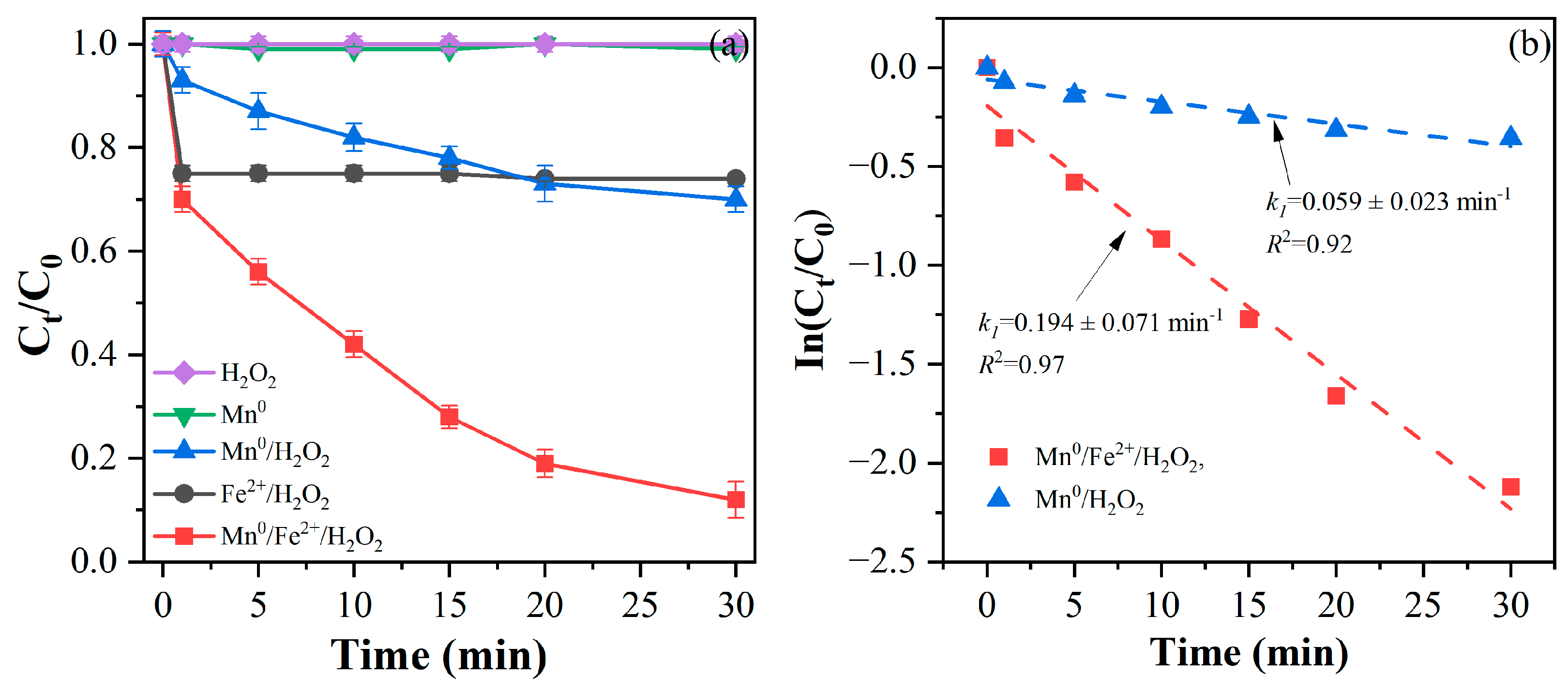
Figure 1a shows the AO7 degradation performance of five reaction systems, including H
2O
2, Mn
0, Fe
2+/H
2O
2, Mn
0/H
2O
2, and Mn
0/Fe
2+/H
2O
2 systems. Negligible AO7 degradation was observed in the H
2O
2 system and Mn
0 systems within 30 min, indicating that neither H
2O
2 nor Mn
0 alone was effective for AO7 degradation under the tested conditions. In the Fe
2+/H
2O
2 system, approximately 25% of AO7 was rapidly degraded in the initial 1 min, after which the pollutant concentration remained nearly unchanged. This trend is consistent with previous studies, in which Fe
2+ rapidly activated H
2O
2 at the initial stage, whereas the slow reduction of Fe
3+ to Fe
2+ limited the sustained generation of reactive oxidizing species [
9]. By contrast, the Mn
0/H
2O
2 system achieved about 30% AO7 degradation within 30 min, suggesting that Mn
0 was able to activate H
2O
2 to some extent. More importantly, the Mn
0/Fe
2+/H
2O
2 system exhibited the best performance, achieving 88% AO7 degradation within 30 min. This efficiency was substantially higher than those of the Fe
2+/H
2O
2 and Mn
0/H
2O
2 systems, suggesting a synergistic effect between Mn
0 and Fe
2+ in promoting H
2O
2 activation. Furthermore, a systematic comparison of AO7 degradation performance among various Fenton-like processes is summarized in
Table S1. Compared to mineral-catalyzed or energy-assisted Fenton processes, the Mn
0/Fe
2+/H
2O
2 system exhibits highly competitive degradation efficiency rapidly (within 30 min) at remarkably lower chemical dosages and without external energy input. Its primary advantage lies in the rapid and sustained regeneration of Fe
2+ driven by Mn
0.
To quantitatively compare the reaction kinetics, a pseudo-first-order kinetic model was applied (
Figure 1b). However, this model was not suitable for the Fe
2+/H
2O
2 system. In that system, the reaction exhibited a rapid initial burst but virtually stalled within the first minute due to the swift depletion of Fe
2+ and the slow regeneration from Fe
3+, leading to a premature plateau. Consequently, kinetic fitting for the Fe
2+/H
2O
2 system was omitted to avoid statistically invalid comparisons. For the applicable systems, the rate constants (
k1) were calculated over the 30 min fitting range. The Mn
0/Fe
2+/H
2O
2 system exhibited a
k1 of 0.194 ± 0.071 min
−1 (
R2 = 0.97), which was notably higher than that of the Mn
0/H
2O
2 system (
k1 = 0.059 ± 0.023 min
−1,
R2 = 0.92). These kinetic results quantitatively support that the introduction of Mn
0 helps sustain the catalytic oxidation and mitigates the rapid stagnation typically observed in the Fenton process.
2.2. Identification of Reactive Oxygen Species in the Mn0/Fe2+/H2O2 System
The identification of reactive oxygen species (ROS) is critical for elucidating the oxidation mechanism of advanced oxidation processes. In Fe
2+-activated H
2O
2 systems, •OH has traditionally been considered the predominant oxidizing species [
14,
15]. However, increasing evidence suggests that ferryl Fe(IV), such as FeO
2+, may also be formed during Fenton-like reactions and contribute to pollutant oxidation [
19,
20]. Accordingly, both •OH and FeO
2+ were considered potential reactive species for the degradation of target pollutants in the Mn
0/Fe
2+/H
2O
2 system.
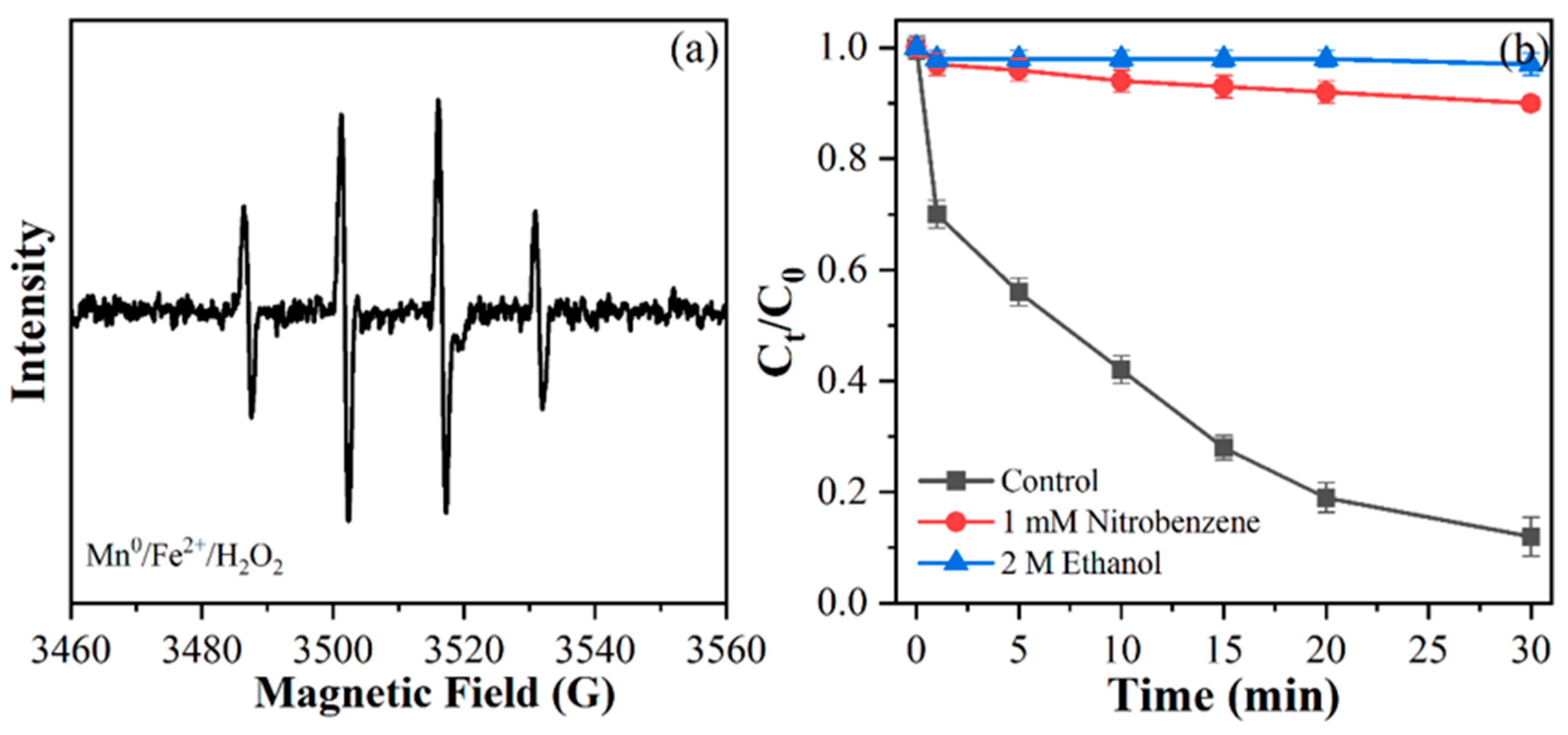
To clarify the ROS involved in AO7 degradation, ESR analysis and scavenging experiments were performed. As shown in
Figure 2a, a characteristic four-line ESR signal with an intensity ratio of 1:2:2:1 was observed in the presence of DMPO, which is attributable to the DMPO-•OH adduct. This result confirms the generation of •OH in the Mn
0/Fe
2+/H
2O
2 system.
To further evaluate the contributions of different oxidizing species, nitrobenzene and ethanol were employed as chemical scavengers. Nitrobenzene is known to react rapidly with •OH but negligibly with FeO
2+ [
21]. As shown in
Figure 2b, the addition of 1 mM nitrobenzene markedly suppressed AO7 degradation, and the degradation efficiency decreased to approximately 10%, indicating that •OH was the dominant oxidizing species in the system. In contrast, ethanol was capable of simultaneously scavenging both •OH and FeO
2+ [
22]. When 2 M ethanol was introduced, AO7 degradation was almost completely inhibited (
Figure 2b). The stronger inhibition observed with ethanol than with nitrobenzene suggests that FeO
2+ also participated in AO7 oxidation, although its contribution was secondary to that of •OH.
In addition, PMSO was adopted as a specific probe for FeO
2+. It has been documented that FeO
2+ can selectively oxidize PMSO to produce PMSO
2, whereas •OH tends to yield other byproducts such as hydroxylated derivatives and biphenyl substances [
23]. As shown in
Figure S1, nearly 5 μM PMSO
2 was detected after 1 mM PMSO was added to the Mn
0/Fe
2+/H
2O
2 system, providing additional evidence for the formation of FeO
2+. The generation of FeO
2+ may be described by Equation (2) [
24]:
Although classical Fenton chemistry predominantly generates •OH at bulk pH < 3.0 (consistent with the 88.6% contribution of •OH in this study), the detection of FeO2+ (11.4% contribution) indicates the co-existence of the two-electron transfer pathway. This could be attributed to the corrosive consumption of protons by Mn0 at the solid-liquid interface, which increases the pH near the Mn0 surface, creating a microenvironment that favors the heterolytic cleavage of H2O2 to generate FeO2+.
Collectively, all of the above results indicate that •OH and FeO2+ were involved in AO7 degradation in the Mn0/Fe2+/H2O2 system, with •OH serving as the predominant reactive species. Based on the inhibition extents observed in the scavenging experiments, the relative contributions of •OH and FeO2+ to AO7 degradation were estimated to be 88.6% and 11.4%, respectively.
2.3. Enhancement Mechanism of Mn0/Fe2+/H2O2 System
The superior AO7 degradation observed in the Mn
0/Fe
2+/H
2O
2 system suggests a synergistic interaction between Mn
0 and Fe
2+ during H
2O
2 activation. As shown in
Figure S2, negligible AO7 degradation occurred in the H
2O
2, Mn
0, and Mn
2+/H
2O
2 systems, indicating that dissolved Mn
2+ contributed little to H
2O
2 activation under the tested conditions. During the reaction, Mn
0 was gradually oxidized and released predominantly as Mn
2+. Therefore, the reactivity observed in the Mn
0/H
2O
2 system can be reasonably ascribed to direct H
2O
2 activation at the Mn
0 surface. Specifically, the solid-liquid interfacial electron transfer from Mn
0 to H
2O
2 is likely to promote the cleavage of the O-O bond, generating •OH as proposed in Equation (3). Previous studies have likewise shown that the coupling of Fe
2+ and Mn
0 can enhance H
2O
2 activation [
17,
25], thereby greatly improving the degradation efficiency of AO7.
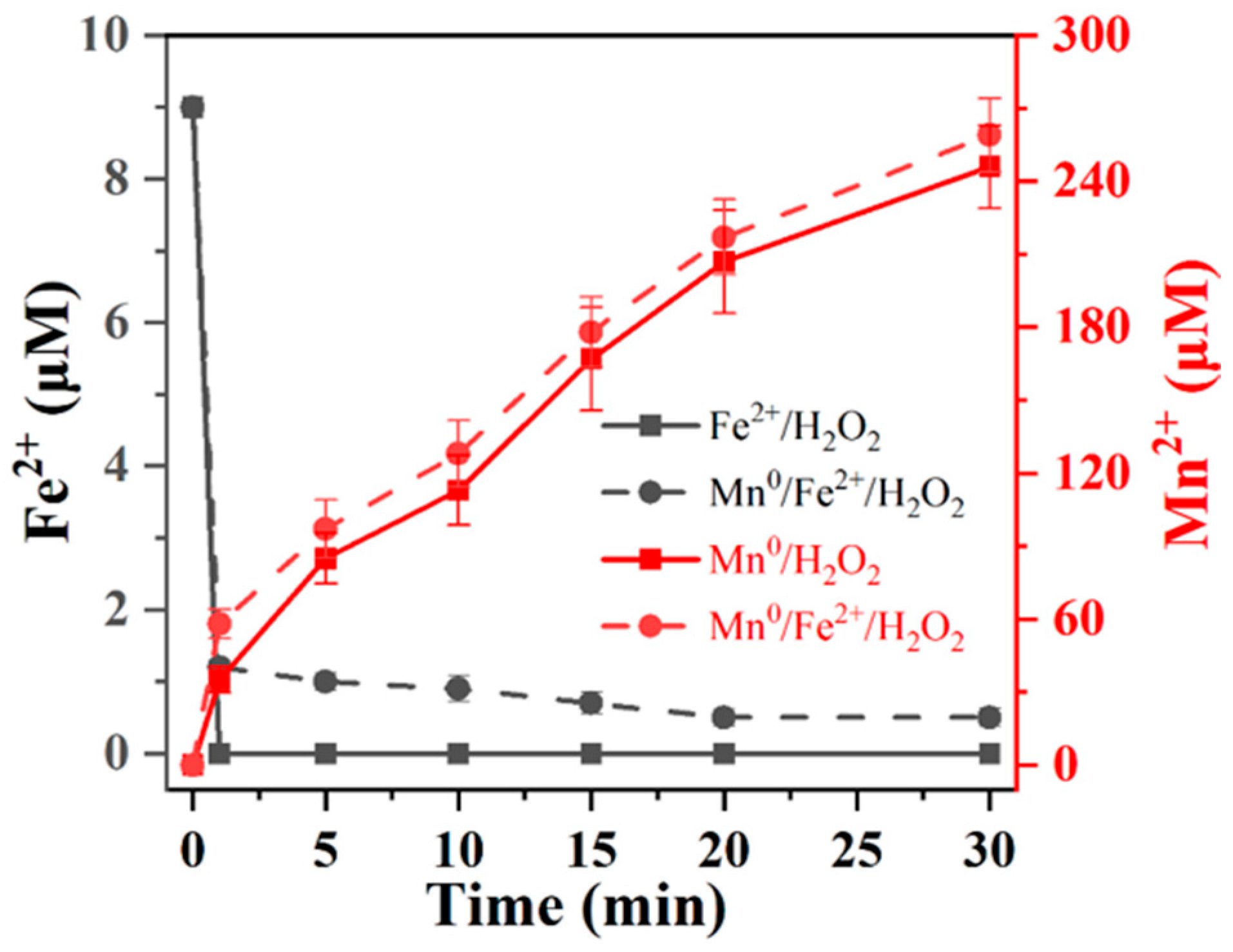
To further elucidate the enhancement mechanism, the variations in Fe
2+ and Mn
0 concentrations were monitored. As shown in
Figure 3, Fe
2+ in the Fe
2+/H
2O
2 system decreased from 9 μM to 0 μM, whereas 0.5–1 μM Fe
2+ remained in the Mn
0/Fe
2+/H
2O
2 system throughout the reaction. The persistence of Fe
2+ suggests that Mn
0 facilitated the regeneration of Fe
2+ from Fe
3+. To experimentally verify this, we monitored the generation of Fe
2+ in a control Mn
0/Fe
3+ system ([Mn
0]
0 = 0.05 g/L, [Fe
3+]
0 = 10 μM, pH
0 = 3.0 ± 0.1 and 25 ± 2 °C). The results revealed that 9.50 ± 0.21 μM of Fe
2+ was rapidly produced within 5 min of reaction, providing direct evidence that Mn
0 efficiently reduces Fe
3+ to maintain the iron redox cycle (as shown in Equation (4)).
In addition, Mn
2+ release increased slightly from 246 to 259 μM after Fe
2+ was introduced into the Mn
0/H
2O
2 system (
Figure 3), which is consistent with Mn
0 oxidation coupled with Fe
3+ reduction. Given the initial Mn
0 dosage of 0.05 g/L (approximately 0.91 mM), the released Mn
2+ accounts for a sacrificial consumption of 28.5% of the initial Mn
0, with the remaining 71.5% remaining in the solid phase. Meanwhile, the homogeneous iron species remained dissolved and 100% conserved in the liquid phase under the acidic conditions. These results indicate that Mn
0 promoted Fe
3+/Fe
2+ redox cycling in the coupled system.
It should be noted that while this sacrificial dissolution of Mn
0 effectively drives the iron cycle, it leads to a final Mn
2+ accumulation of 259 μM (14.2 mg/L). This value exceeds the Mn discharge limit of 2.0 mg/L specified in the Integrated Wastewater Discharge Standard (GB 8978-1996) [
26]. Therefore, to prevent secondary metal contamination in practical applications, a subsequent alkaline precipitation step (e.g., adjusting effluent pH to ≥9.0) is necessary as a post-treatment to efficiently recover the dissolved Mn as solid precipitates.
The accelerated iron redox cycle also enhanced H
2O
2 utilization. As shown in
Figure S3, H
2O
2 decomposition in the Mn
0/Fe
2+/H
2O
2 system was significantly higher than that in either the Mn
0/H
2O
2 or Fe
2+/H
2O
2 system. At the end of the reaction, the H
2O
2 consumed in the ternary system reached 0.36 mM (corresponding to an utilization efficiency of 2.4% for AO7 degradation), whereas the Fe
2+/H
2O
2 system only consumed 0.03 mM (with a nominal efficiency of 8.3%). This result suggests that Mn
0 not only participated in H
2O
2 activation directly, but also sustained the availability of Fe
2+ through Fe
3+ reduction, thereby promoting continuous H
2O
2 decomposition and ROS generation.
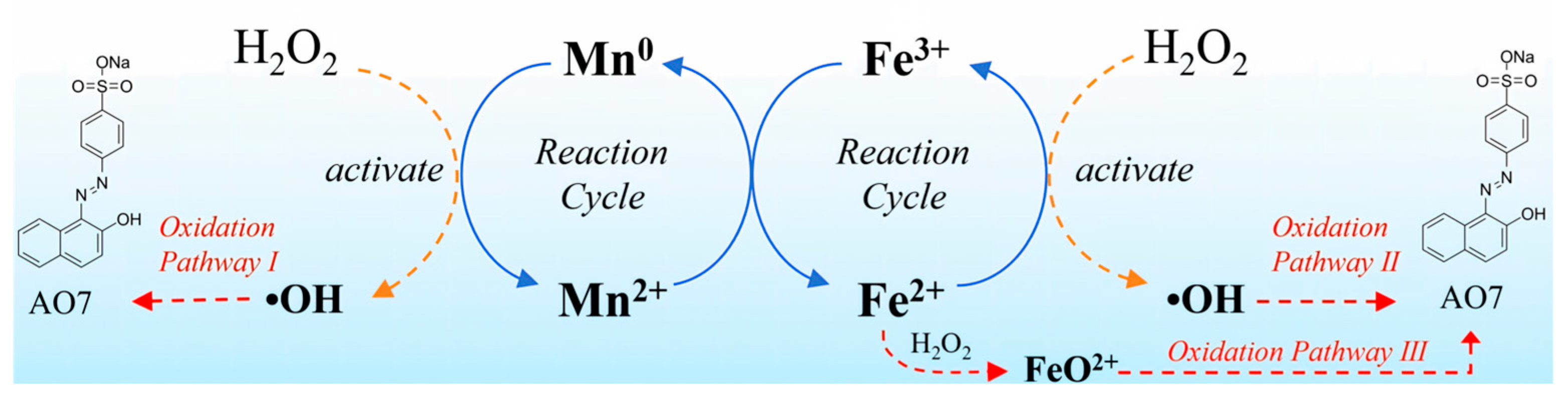
Overall, the enhanced performance of the Mn
0/Fe
2+/H
2O
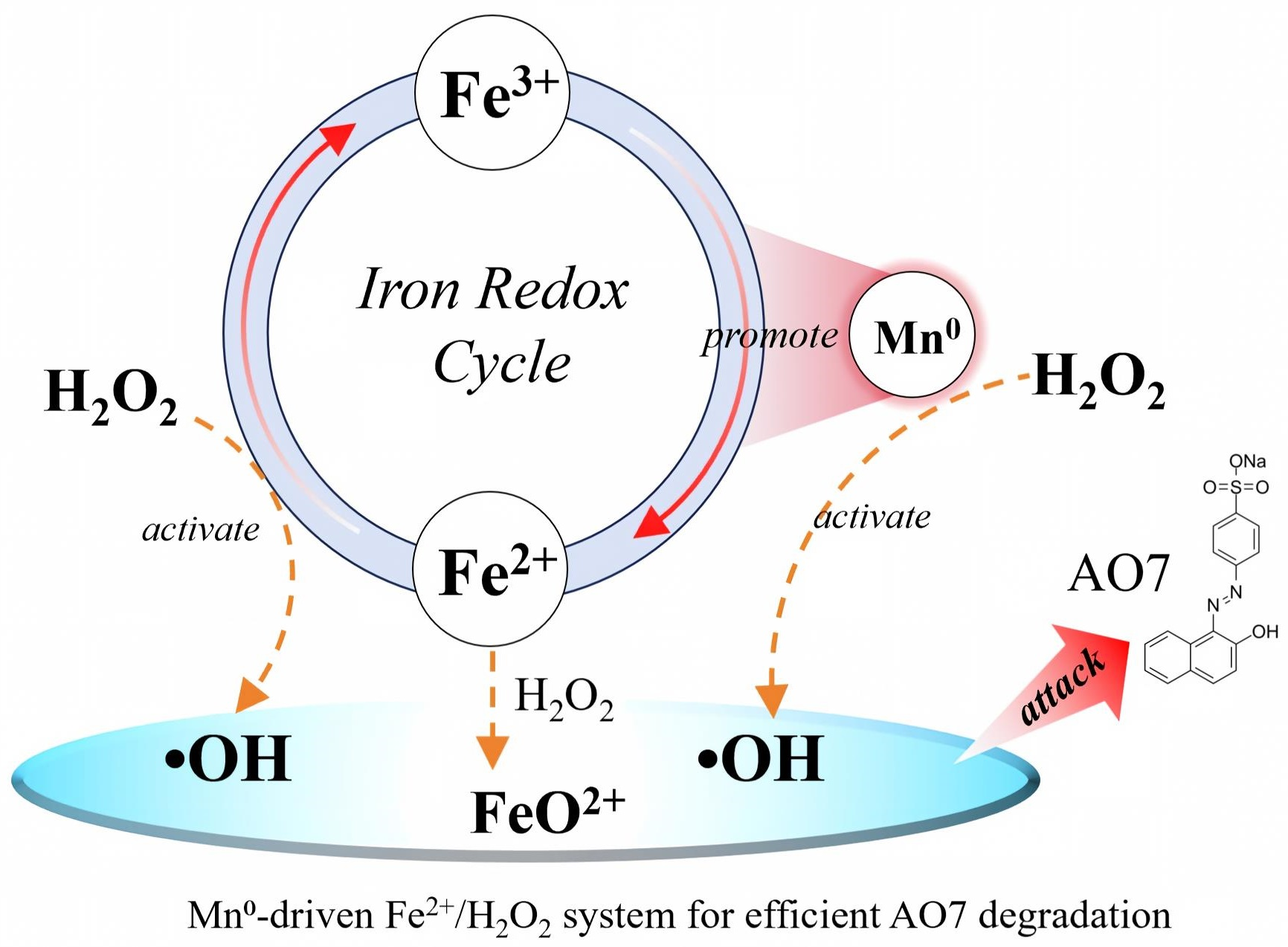
2 system can be attributed to a highly efficient heterogeneous–homogeneous redox coupling mechanism involving two synergistic pathways: (i) direct activation of H
2O
2 by Mn
0 and (ii) Mn
0-mediated regeneration of Fe
2+ from Fe
3+, which accelerated the Fe
3+/Fe
2+ redox cycle and improved H
2O
2 activation efficiency. In this process, Fe
2+ activated H
2O
2 to generate •OH and FeO
2+ via Equations (1) and (2), while Mn
0 continuously replenished Fe
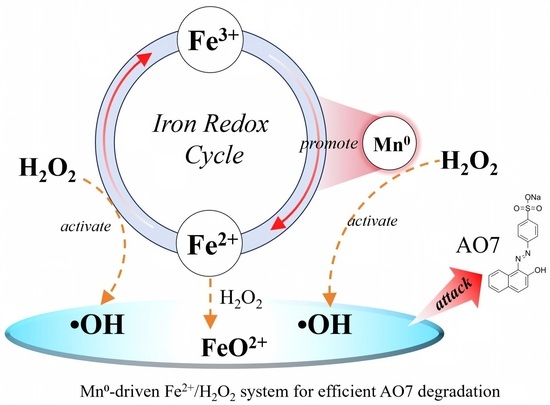
2+ through Equation (4), thereby sustaining ROS production and enhancing AO7 degradation. A schematic illustration of the proposed mechanism is presented in
Figure 4.
2.4. Effects of Reaction Factors on AO7 Degradation in the Mn0/Fe2+/H2O2 System
Based on the results discussed above, Fe
2+ played an important role in enhancing AO7 degradation capacity in the Mn
0/H
2O
2 system. Thus, investigating the impact of Fe
2+ concentration on AO7 degradation in the Mn
0/Fe
2+/H
2O
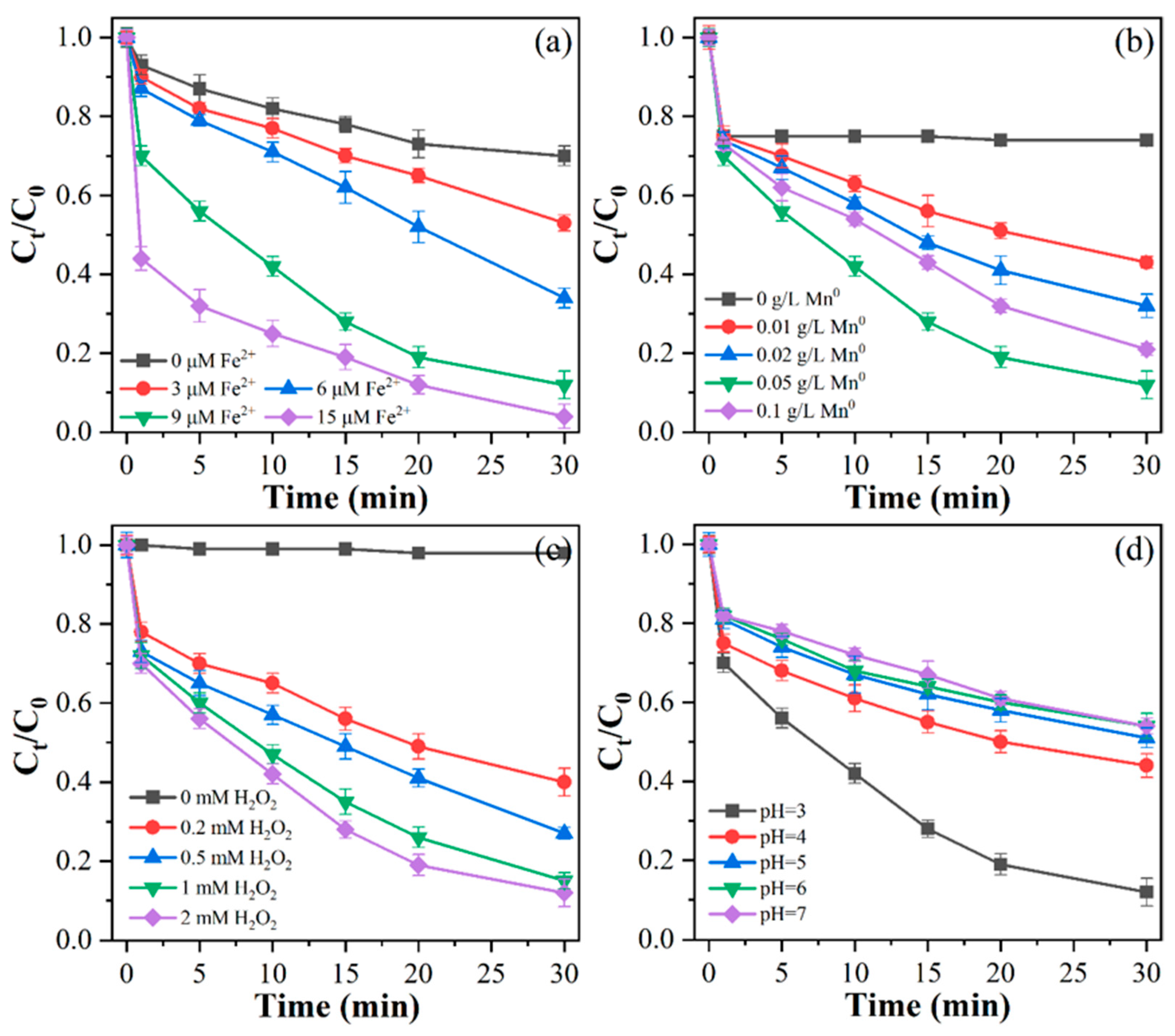
2 system was of great significance. As shown in
Figure 5a, AO7 degradation increased continuously as the Fe
2+ concentration increased from 0 to 15 μM. Specifically, the degradation efficiency after 30 min increased from 30% to 96%. This enhancement can be attributed to the greater availability of Fe
2+ for H
2O
2 activation, which facilitated Fe
3+/Fe
2+ redox cycling and promoted the formation of •OH and FeO
2+ for AO7 degradation.
The dosage of Mn
0 directly dictates the availability of reactive sites for H
2O
2 activation. As shown in
Figure 5b, increasing the Mn
0 dosage from 0 to 0.05 g/L significantly enhanced AO7 degradation from 26% to 88% within 30 min. This profound improvement indicates that an adequate Mn
0 supply provides sufficient reactive sites to trigger H
2O
2 decomposition, ensuring continuous •OH production and rapid Fe
3+/Fe
2+ interconversion. However, a further increase in Mn
0 dosage to 0.1 g/L resulted in a slight decline in degradation efficiency to 79%. This inhibitory effect is likely due to the parasitic scavenging of •OH and FeO
2+ by excess Mn
0 particles.
The oxidant dosage is another critical parameter governing reactive species yield. The effect of H
2O
2 dosage is shown in
Figure 5c. Within the investigated range of 0–2.0 mM, AO7 degradation increased with increasing H
2O
2 concentration. After 30 min, the degradation efficiency increased from 2% to 88%. The improved performance can be ascribed to the increased availability of H
2O
2 for activation by Fe
2+ and Mn
0, which enhanced the production of •OH and FeO
2+ responsible for AO7 degradation.
pH fundamentally governs iron speciation and redox potential, heavily influencing the performance of advanced oxidation processes [
27]. As illustrated in
Figure 5d, the AO7 degradation efficiency exhibited a strong pH dependence, declining steadily from 88% to 46% as the initial pH increased from 3.0 to 7.0 in the Mn
0/Fe
2+/H
2O
2 system. As discussed in
Section 2.3, efficient Fe
3+/Fe
2+ redox cycling is essential for sustained H
2O
2 activation in this system. Ferric speciation is strongly pH-dependent, and the dominant Fe
3+ species shift from soluble Fe
3+ and FeOH
2+ to Fe(OH)
2+ and insoluble Fe(OH)
3 as pH increases from 3 to 7 (
Figure S4). Compared with soluble ferric species under acidic conditions, these hydrolyzed forms are less reactive and more prone to precipitation as iron hydroxides. Consequently, the regeneration of Fe
2+ from Fe
3+ becomes less efficient at higher pH due to the surface passivation by precipitates and the decreased redox potential of iron couples [
28,
29], leading to suppressed H
2O
2 activation and lower AO7 degradation.
Overall, these results demonstrate that AO7 degradation in the Mn0/Fe2+/H2O2 system was strongly dependent on Fe2+ concentration, Mn0 dosage, H2O2 dosage, and initial pH. Efficient degradation was achieved at higher Fe2+ and H2O2 concentrations, an appropriate Mn0 dosage, and acidic conditions.
2.5. Effects of Water Matrix Constituents and Performance in Real Water Samples
Coexisting inorganic anions and natural organic matter are ubiquitous in natural waters and may affect contaminant degradation during advanced oxidation processes [
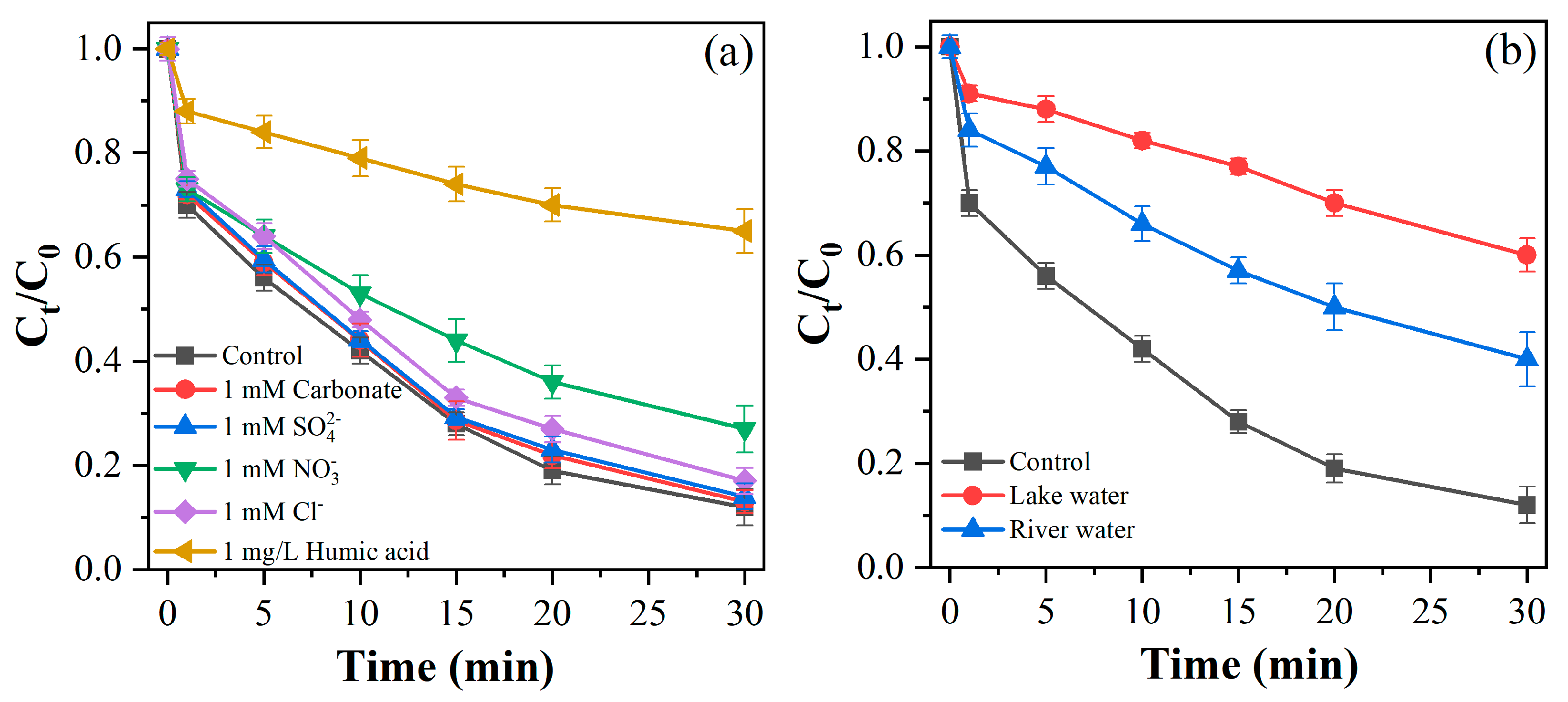
30]. A unified concentration of 1 mM for inorganic anions (and 1 mg/L for HA) was selected. This value was adopted as a standardized condition, commonly utilized in fundamental AOP studies, to clearly observe and compare the distinct inhibitory impacts and fundamental radical-scavenging mechanisms of different water matrix constituents on AO7 degradation. As shown in
Figure 6a, the addition of 1 mM carbonate species or SO
42− caused little change in AO7 degradation in the Mn
0/Fe
2+/H
2O
2 system under the tested conditions. In contrast, the presence of Cl
− slightly decreased the AO7 degradation efficiency from 88% to 83%. This inhibition was mainly attributed to the reaction of Cl
− with •OH, which can convert •OH into less reactive chlorine-based radicals/species and thereby reduce the overall oxidation efficiency [
31,
32]. Among the tested anions, NO
3− exhibited a more pronounced inhibitory effect, decreasing the AO7 degradation efficiency from 88% to 73%. This result may be related to the direct reaction between NO
3− and Mn
0 (Equation (5)), which consumes Mn
0 and reduces its availability for H
2O
2 activation and Fe
3+ reduction [
33]. Humic acid showed the strongest suppression effect, and AO7 degradation decreased sharply to 35%. This substantial inhibition can be ascribed to the competitive scavenging of reactive oxidizing species, including •OH and FeO
2+, by humic substances [
34].
To further evaluate the practical applicability of the Mn
0/Fe
2+/H
2O
2 process, AO7 degradation was examined in authentic water samples, including lake water and river water. As shown in
Figure 6b, both real water matrices substantially suppressed AO7 degradation, with final degradation efficiencies of 40% in lake water and 60% in river water, respectively. The stronger inhibition in lake water is likely due to its typically higher accumulation of natural organic matter and salinity compared to flowing river water. Moreover, the background impurities in natural water, particularly natural organic matter (NOM) and inorganic ions (e.g., Cl
− and NO
3−), competed with AO7 for reactive oxygen species such as •OH and FeO
2+. This competitive effect was the key reason for the weakened pollutant degradation capacity in real water environments. Consequently, overcoming this scavenging effect in complex matrices would inevitably increase chemical demands, such as higher H
2O
2 consumption.
Furthermore, scaling up this system for real wastewater treatment presents several operational limitations. The optimal performance strictly depends on an acidic environment (pH 3.0), which necessitates costly acidification prior to treatment and subsequent neutralization. Additionally, the sacrificial dissolution of Mn0 introduces metal ions into the effluent, requiring post-treatment alkaline precipitation to meet discharge standards, which inevitably generates metal hydroxide sludge. These results and operational constraints indicate that although the Mn0/Fe2+/H2O2 system exhibits high degradation efficiency in model solutions, its practical application potential requires further evaluation.
3. Materials and Methods
3.1. Chemicals
Acid Orange 7 (AO7, C16H11N2NaO4S, >85%), zero-valent manganese (Mn0, >99.9%), ferrous sulfate heptahydrate (FeSO4·7H2O, >99%), hydrogen peroxide (H2O2, 30 wt%), sodium hydroxide (NaOH, >96%), sulfuric acid (H2SO4, 95–98%), and 1,10-phenanthroline monohydrate (C12H8N2·H2O, >98%), sodium carbonate (Na2CO3, >99%), sodium chloride (NaCl, >99.8%), sodium sulfate (Na2SO4, >99%), sodium nitrate (NaNO3, >99%), humic acid (≥90%), nitrobenzene (C6H5NO2, >99.5%), 5,5-dimethyl-1-pyrroline N-oxide (C6H11NO, DMPO, >97%), sodium thiosulfate (Na2S2O3, >99%), methyl phenyl sulfoxide (PMSO, >95%), methyl phenyl sulfone (PMSO2, >97%) and tert-butyl alcohol (C4H10O, >98%) were purchased from Sinopharm Chemical Reagent Co., Ltd. (Shanghai, China). Deionized water was used to prepare all solutions. In addition, lake water from Taiping Lake and river water from the Xin’an River were used as water matrices for AO7 solution preparation.
3.2. Experimental Procedures
Batch degradation experiments were carried out in 250 mL conical flasks with continuous magnetic stirring (500 rpm) at room temperature (25 ± 2 °C). Before each experiment, the initial pH of the AO7 solution was adjusted to the desired value using 0.01 M NaOH solutions and 0.01 M H2SO4. In a typical experiment with the Mn0/Fe2+/H2O2 system, 100 mL of AO7 solution (initial concentration of 10 μM) was transferred into the flask, followed by the addition of a predetermined volume of H2O2 and FeSO4 solution. Mn0 was then added within a few seconds to initiate the reaction. At predetermined time intervals, 1 mL samples were collected and immediately quenched with 1 mL of 0.5 M sodium thiosulfate solution, followed by filtration through a 0.45 μm membrane before analyzing. For comparison, control experiments using Fe2+/H2O2, Mn0/H2O2, Fe2+ alone, and Mn0 alone were also conducted. For the active species quenching experiments, the quencher at a specified concentration was mixed with the AO7 solution prior to the addition of other substances. The relative contributions of •OH and FeO2+ were estimated from the differences in AO7 degradation efficiencies in the presence of selective scavengers. Each experiment was performed in triplicate, and the results are reported as mean values with standard deviations.
3.3. Analytical Methods
The residual AO7 concentration was determined from its absorbance at 484 nm using a UV–visible spectrophotometer (U-3900, Hitachi Limited, Tokyo, Japan) based on a standard calibration curve. The degradation efficiency of AO7 was calculated using the following Equation (6), and the degradation kinetics were fitted to the pseudo-first-order model described by Equation (7):
where
C0 and
Ct are the initial concentration and the concentration of AO7 at reaction time
t (μM), respectively;
k1 represents the pseudo-first-order rate constant (min
−1), and
t is the reaction time (min).
Solution pH was monitored with a PH2-25 pH meter (Shanghai INESA Scientific Instrument Co., Ltd., Shanghai, China). The content of Fe
2+ was quantified at 510 nm using the 1,10-phenanthroline monohydrate colorimetric method [
35], while H
2O
2 concentration was determined by the ABTS method at 415 nm [
36]. The concentration of M
2+ was determined using a Flame Atomic Absorption Spectrophotometer (FAAS, TAS-990, Beijing Purkinje General Instrument Co., Ltd., Beijing, China). The analysis was conducted using an air-acetylene flame. The analytical wavelength for Mn was set at 279.5 nm with a slit width of 0.3 nm. Standard calibration curves were established prior to the measurements, exhibiting excellent linearity (
R2 > 0.999). To ensure the reliability of the results, all samples were filtered through a 0.22 μm membrane and appropriately diluted before measurement, and the analyses were performed in triplicate. An electron spin resonance (ESR) spectrometer (Bruker EMXplus, Bruker Corporation, Karlsruhe, Germany) was employed to detect reactive oxygen species using 5,5-dimethyl-1-pyrroline N-oxide (DMPO) as the spin-trapping agent.
4. Conclusions
In this study, we developed an efficient Mn0/Fe2+/H2O2 system for rapid AO7 degradation, achieving 88% removal within 30 min under optimized conditions. It was demonstrated that the synergistic coupling of zero-valent manganese (Mn0) and Fe2+ significantly enhances H2O2 activation. Specifically, Mn0 plays a crucial dual role: it facilitates direct H2O2 cleavage and continuously regenerates Fe2+ from Fe3+, thereby sustaining the iron redox cycle. Both hydroxyl radicals (•OH) and high-valent iron species (FeO2+) cooperatively drive the oxidation process. While the system exhibits exceptional reactivity in model solutions, its efficiency is attenuated in authentic water matrices due to competitive scavenging by natural constituents.
Overall, this work deepens the understanding of reactive species generation and iron cycling in Mn0-assisted systems, providing a feasible strategy for strengthening Fenton-like oxidation via metal-mediated redox coupling. Nevertheless, for future applications in complex wastewater treatment, operational limitations, including the need for pH adjustment, H2O2 consumption, and the management of metal–hydroxide sludge, must be carefully addressed. Additionally, comprehensive evaluations of mineralization efficiency (e.g., TOC/COD removal), transformation by-products, and effluent toxicity will be imperative to ensure the environmental safety of the treated water. Addressing these engineering and environmental aspects will ultimately improve the overall techno-economic viability of this advanced oxidation technology.