
Article

Solventless Glycerol Etherification to Di- and Tri-Glycerol over Mg-La Mixed Oxides Derived from Layered Double Hydroxides


1
Department of Chemical Engineering, Lee Kong Chian Faculty of Engineering and Science, Universiti Tunku Abdul Rahman, Bandar Sungai Long, Kajang 43000, Selangor, Malaysia
2
Centre for Advanced and Sustainable Materials Research, Universiti Tunku Abdul Rahman, Bandar Sungai Long, Kajang 43000, Selangor, Malaysia
3
Faculty of Engineering and Information Technology, Southern University, PTD 64888, Jalan Selatan Utama, KM 15, Off, Skudai Lbh, Skudai 81300, Johor, Malaysia
4
Chemical Engineering Department, Jashore University of Science and Technology, 1 Churamonkathi-Chaugachha Road, Jashore 7408, Bangladesh
*
Authors to whom correspondence should be addressed.
Catalysts 2026, 16(7), 607; https://doi.org/10.3390/catal16070607
Submission received: 31 May 2026 / Revised: 24 June 2026 / Accepted: 27 June 2026 / Published: 2 July 2026

Abstract

Mg–La mixed metal oxides derived from layered double hydroxide (LDH) precursors were synthesized via coprecipitation and evaluated as heterogeneous catalysts for solventless glycerol etherification to short-chain polyglycerols. The influence of Mg/La molar ratio on the structural, textural, and catalytic properties of the catalysts was systematically investigated using XRD, BET, SEM-EDX, FTIR, TPD-CO2, TPD-NH3 and ICP-OES analyses. XRD confirmed the formation of La2O2CO3 phases, while CO2-TPD analysis revealed the presence of abundant medium-to-strong basic sites. Among the synthesized catalysts, Mg0.25La0.75O2 exhibited the highest basic site concentration (6830 µmol g−1) and superior catalytic performance due to the possible cooperative interaction between Mg- and La-derived sites. Under optimum reaction conditions of 220 °C, 8 h, and 2 wt% catalyst loading, the catalyst achieved 90% glycerol conversion with 70% diglycerol selectivity, 23% triglycerol selectivity, and 84% combined diglycerol and triglycerol yield. Reaction temperature, catalyst loading, and reaction duration significantly influenced oligomer distribution and catalyst performance. Reusability studies demonstrated acceptable catalyst stability for up to four cycles before gradual deactivation caused by oligomer deposition and metal leaching. The results highlight Mg–La mixed oxides as promising catalysts for sustainable solvent-free glycerol valorization, while demonstrating a scalable and environmentally benign strategy for maximizing lower-degree polyglycerol production within shorter reaction durations and reduced processing cost.

1. Introduction

The swift advancement of economies and the rise in population have led to a significant uptick in global energy production and consumption. Fossil fuels are more cost-effective to produce compared to renewable sources, positioning them as a significant feedstock for energy infrastructure. Nonetheless, their depletion may adversely affect the global economy, leading to increased petrochemical prices and contributing to climate change. The global market is showing a growing interest in renewable alternative resources like biofuels. Biodiesel is often suggested as a viable alternative due to its renewable nature, environmental friendliness, biodegradability, and cost-effectiveness for sustained production [1,2,3]. Glycerol, a notable byproduct of biodiesel synthesis, presents considerable prospective precursor to acquire valuable chemicals such as glycerol ethers, 1,2-propanediol, 1,3-propanediol, and glyceric acid [4,5]. The conversion of unprocessed triglycerides into biodiesel results in the production of glycerol as a by-product, with a yield of approximately 100 kg of glycerol per ton of biodiesel produced [4,6,7]. Glycerol has reached an excess due to an increase in production spurred by the growth of oleochemicals and biodiesel. The surplus supply resulted in a decline in glycerol prices, attributed to advancements in biodiesel production, thereby establishing it as a viable chemical for the synthesis of other value-added compounds [8]. Recent reports indicate that crude glycerol is typically valued at approximately USD 280–320 t−1, whereas refined glycerol can command prices exceeding USD 1400–2800 t−1 depending on purity and application [9]. In contrast, polyglycerols are considerably higher-value specialty chemicals, with reported market prices of approximately USD 4–5 kg−1 and increasing demand in food, cosmetic, pharmaceutical, surfactant, and polymer industries. The global glycerol market was valued at approximately USD 4.5 billion in 2025 and is projected to continue growing due to increasing demand from personal care, pharmaceutical, and chemical sectors [10]. Therefore, the selective conversion of low-value glycerol into di- and triglycerol represents an economically attractive route for producing value-added bio-based chemicals while enhancing the sustainability of biodiesel production [11].
Etherification [12], esterification [13], oxidation [14], dehydration [15] and reforming [16] are several examples of catalytic processes used to convert glycerol. The etherification process has attracted considerable attention because of the potential of glycerol tert-butyl ethers, especially di-ethers and tri-ethers, as biofuel additives that improve combustion efficiency. When added to biodiesel, these ethers lower its viscosity and decrease emissions of hydrocarbons, aldehydes, particulate matter, and carbon monoxide [17]. Glycerol serves as an important chemical compound in the synthesis of biodiesel, as it can be transformed into di-, tri-, tetra-, or polyglycerols, thereby enhancing yield. During etherification, glycerol molecules undergo condensation to form di- and tri-glycerol, exhibiting various structural configurations such as linear, branched, or cyclic forms. The condensation occurring at primary or secondary hydroxyls plays a crucial role in determining the final shape, while intramolecular condensation may influence the structure of the product [6,17]. Continuous investigation is enhancing the yields of lower-degree polyglycerol. The development of a catalyst exhibiting exceptional characteristics for achieving high glycerol conversion and producing greater quantities of the desired lower degree polyglycerols in a solventless environment continues to pose a significant scientific challenge. Recent advancements in glycerol etherification have concentrated on enhancing yield and conversion rates of lower degree polyglycerols and glycerol ethers using solventless techniques supported by catalysts. This was brought on by the numerous drawbacks of solvent-based etherification, including the creation of unwanted byproducts [18,19], a significant amount of solvent needed to reach the proper degree of glycerol conversion [20,21] and higher investment and operating costs as a result of water molecules forming during the reaction [22]. Application of heterogeneous base catalysts [12], acid catalysts [23] and heteropolyacids [24] catalyzed reactions is commonly employed in the solventless etherification process. The processes of etherification that are catalyzed by acid lead to faster reactions; however, they suffer from a lack of selectivity. This is attributed to increased oligomerization with secondary products, which can lead to an unwanted side reaction that involves the dehydration of glycerol, ultimately producing acrolein [25,26]. The base-catalyzed catalytic etherification process leads to improved glycerol conversion and more selectivity for preferred polyglycerol molecules [6,12,27,28].
Charles et al. demonstrated that a 2 wt% Na2CO3 catalyst resulted in 96% glycerol conversion over a period of 8 h at a temperature of 260 °C, achieving 81% selectivity for di-, tri-, and tetraglycerols [29]. The utilization of a Li/zeolite Y microporous catalyst demonstrated selectivity of 21% for di-glycerol and 32% for tri-glycerol at a temperature of 240 °C over an 8-h period, with a catalyst loading of 2 wt%, resulting in a maximum glycerol conversion of 98% [30]. The study by Park et al. revealed that X-type zeolite heterogeneous catalysts containing alkali metal ions such as Li+, Na+, and K+ improve glycerol conversion, while concurrently diminishing the selectivity for diglycerol and triglycerol owing to enhanced oligomerization. The catalytic activity for glycerol conversion ranked as follows: XZ-K > XZ-Li > XZ-Na [31]. The Ca1.6Al0.4La0.6O3 mixed metal oxide catalyst demonstrated a conversion rate of 96% and a selectivity of 52% for diglycerol at 250 °C over a duration of 8 h within a mesoporous structure; however, the selectivity for triglycerol was not reported [32]. In addition to a diglycerol selectivity of 29% and a triglycerol selectivity of 20%, the hydrotalcite catalyst, which exhibited a macroporous structure and a 2:1 Ca/Al ratio, attained the utmost glycerol conversion at 84%. A total yield of 59% was attained with a catalyst dosage of 2 wt% at a temperature of 235 °C for a 24-h period [33].
Mixed metal oxides obtained from layered double hydroxides (LDHs) show great potential for practical applications, owing to their straightforward synthesis and ease of handling. The solids are composed of brucite-type layers in which M2+ ions are partly substituted by M3+ ions, resulting in a net positive charge. Anions in the interlayer region and water molecules provide compensation for this. The basicity, interlayer distance, and crystallite morphology of these solids are susceptible to modifications by altering the type of cations, the metal ratio in the brucite-like layers, and the interlayer anionic species. Hydrotalcite-like materials’ fundamental characteristics and the uniform distribution of mixed oxides during thermal decomposition are essential components of their effective utilization in catalysis [34,35]. The overall expression for these solids is [M2+1−x M3+x(OH)2]Anx/n·mH2O, where M2+ denotes the divalent metal cations, such as Mg2+, Ca2+, Ni2+, and Cu2+, while M3+ indicates the trivalent metal cations, including La3+, Al3+, Cr3+, and Ga3+. The molar fraction, x, is calculated using the formula [M3+]/([M2+] + [M3+]), where An− represents the interlayer anion, such as OH, NO3, CO32−, or SO42−. The synthesized hydrotalcite undergoes thermal decomposition, resulting in a mixed metal oxide characterized by robust basic sites, [M2+1−xM3+x]O2 [36,37].
The plausible etherification of glycerol over heterogeneous mixed-metal oxide catalysts is proposed to proceed via an SN2-type pathway [38,39], as illustrated in Figure 1. The surface M–O–M′ acid–base pair (where M represents a divalent metal cation, M2+, and M′ represents a trivalent metal cation, M3+) facilitates glycerol activation through synergistic interactions with the hydroxyl groups. The basic lattice oxygen abstracts a proton from a terminal hydroxyl group of glycerol, generating a surface-stabilized glycerolate species with enhanced nucleophilic character. The resulting alkoxide oxygen subsequently attacks the less sterically hindered terminal carbon atom of a second glycerol molecule in an SN2-like nucleophilic substitution step. This leads to the formation of a diglycerol intermediate, followed by proton transfer and dehydration, yielding diglycerol as the primary product together with a molecule of water [40,41,42]. The synergistic interaction between the acidic metal centers and basic lattice oxygen sites is therefore essential for glycerol activation and subsequent C–O–C bond formation.
Hydrotalcite, where La3+ ions partially replace Mg2+, has been studied across multiple disciplines. Pd/MgLa mixed oxide hydrotalcite catalysts were effectively utilized and reused in catalytic transfer hydrogenation reactions within ionic liquids, leading to outstanding hydrogenation of α,β-unsaturated carboxylic acid derivatives, and the catalysts were regenerated with minimal activity loss [43]. The MgLa mixed oxide served as a catalyst in the oxidation of dibenzothiophene at 60 °C using hydrogen peroxide. Enhanced reaction rates and elevated activity were observed following calcination and rehydration, attributed to the increased basic strength of the mixed oxide [44]. Investigations conducted by Desmartin et al. on the fundamental characteristics of mixed oxide catalysts observed an improved distribution of basic strength attributed to the increased basicity of the MgLa mixed oxides. The use of MgLa mixed oxide catalysts as a robust solid base and effective agent for the transesterification process involving soybean oil and methanol at 65 °C yields a reaction rate similar to that documented for anchored guanidines [45]. The integration of Mg and La to create hydrotalcite precursors across various fields has shown significant promise, particularly because of their enhanced basicity, superior activity, and regeneration ability with minimal activity loss. In terms of novelty, the objective of this study is to evaluate the catalytic performance of MgLa-mixed metal oxides that are derived from hydrotalcite precursors and used in the solventless glycerol etherification process, bearing the objective of achieving a higher yield of lower-degree polyglycerols at a shorter reaction duration. The effects of the MgLa molar ratio on the physical and chemical characteristics, reactivity, catalytic efficacy, and reusability of the catalysts were examined to show that these catalysts exhibit high activity and selectivity in producing lower degree polyglycerol in a solventless environment.

2. Results

2.1. Characterization of Catalysts

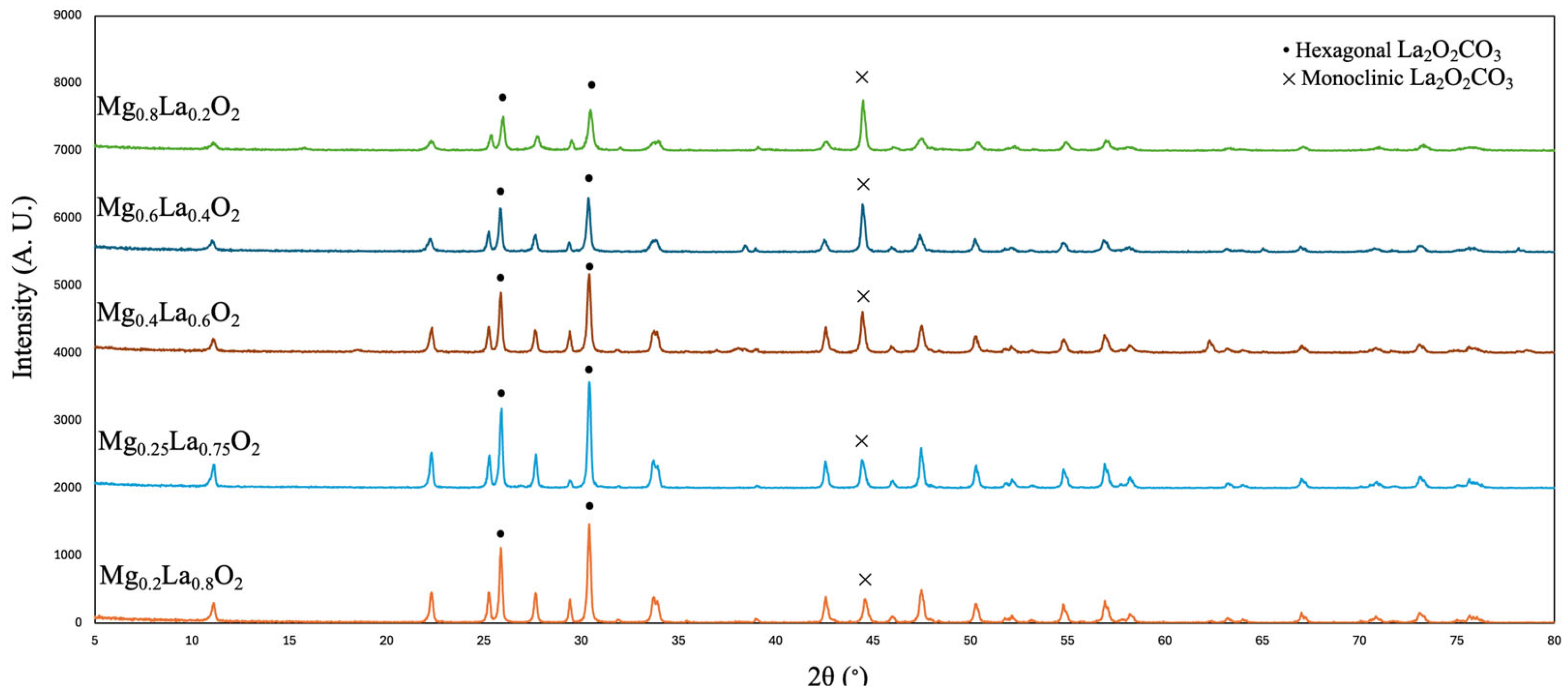
The XRD patterns of Mg1−xLaxO2 displayed distinct and pronounced diffraction peaks at 2θ = 25.8°, 30.3°, and 44.4°, regardless of the molar ratio, as shown in Figure 2. The observed peaks correspond to lanthanum oxide carbonate, La2O2CO3, which exists as hexagonal structure (JCPDS File: 00-037-0804) and monoclinic structure (JCPDS File: 00-048-1113) [46,47]. The hexagonal configuration has been reported to be more advantageous in the catalytic process owing to its stability [48]. The formation of this phase also indicates a reconstruction of a layered structure during the coprecipitation and thermal treatment [49]. The peaks exhibited greater crystallinity with an increase in the lanthanum molar ratio. The distinctness of the peaks results from an increase in the crystallite size, as shown in Table 1. The observed increase in crystallite size corresponding to the molar concentration of La3+ supports these findings [50].
The calcination process conducted at 450 °C resulted in solids exhibiting specific surface areas that varied from 74 m2 g−1 to 87 m2 g−1, as detailed in Table 1. The findings indicated that the surface area diminished as the La3+ molar ratio increased, aligning with the XRD results that showed a rise in crystallite size. High concentrations of La3+ lead to the formation of monoclinic La2O2CO3 phases, which are linked to a decrease in surface area [47]. The enhancement of the catalyst’s pore volume with increased La3+ ion concentration illustrates that La3+ contributes to the porosity of the synthesized catalyst [51]. Abundant La3+ might have caused partial collapse of the catalyst microstructure, resulting in a decreased pore volume for Mg0.2La0.8O2. This suggests a delicate balance is required when optimizing La3+ ion concentration to achieve the desired porosity without compromising the structural integrity of the catalyst. EDX analyses revealed that the elemental composition of the Mg:La ratio closely aligns with the molar ratio of the synthesized catalysts, indicating a uniform distribution of the elements on the surface of the catalysts. Lower Mg ratio was detected in the Mg0.2La0.8O2 as compared to the other synthesized catalysts, which could be attributed to the excessive La3+ ions predominating the outer layer of the catalysts, while the Mg2+ located in the inner particle sites.
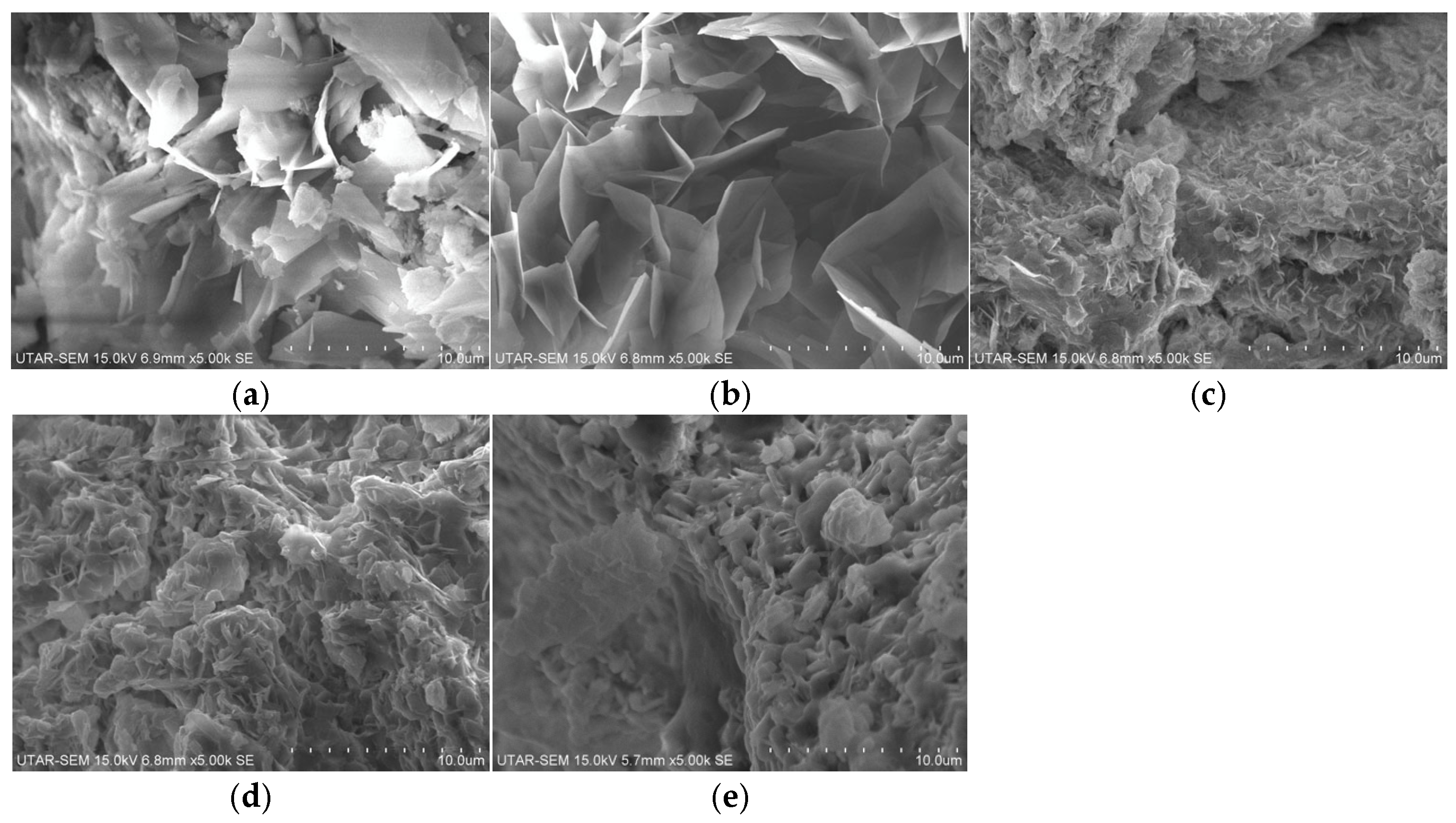
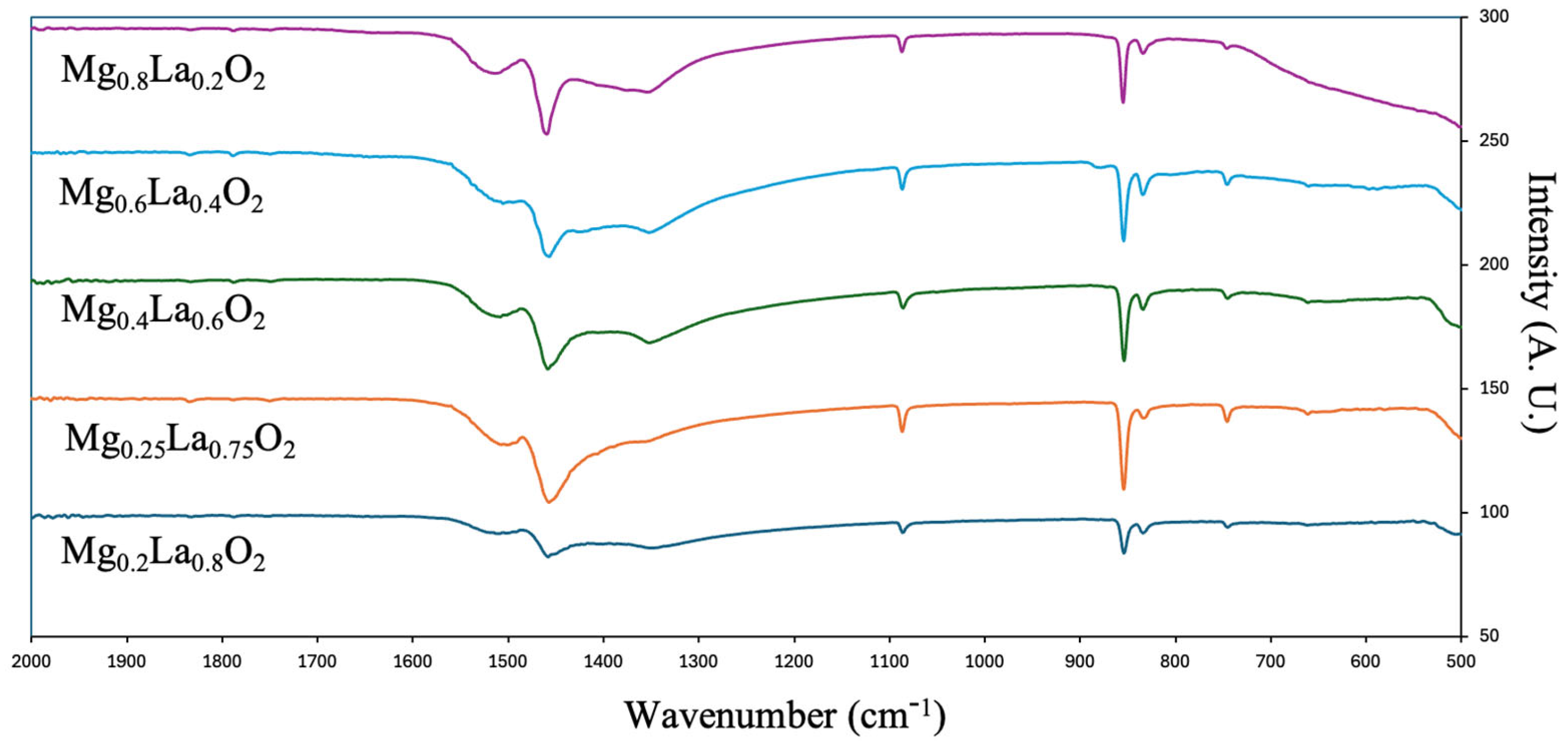
The morphology of catalysts with different metal loadings was examined using Scanning Electron Microscopy (SEM) analysis. The SEM micrographs presented in Figure 3 illustrate that the synthesized catalysts consist of irregularly shaped platelets [49] that aggregated to form a cluster of particles lacking a distinct shape [37]. When the loading of the La3+ ion exceeded that of the Mg2+ ion, the aggregation of irregularly shaped platelets was reduced, leading to a well-exposed platelet with enhanced accessibility. The increased catalysts’ pore volumes, as indicated in Table 1, supports this observation. Fourier transform infrared spectra depicted in Figure 4 illustrate the MgLa mixed metal oxide catalysts. Two distinct bands were detected at roughly 1450 cm−1 and 860 cm−1. The band at 1450 cm−1 coincides with those of hexagonal La2O2CO3 [52], which further validates the XRD findings. The band observed at 860 cm−1 can be attributed to the stretching vibration of the surface CO32− groups, suggesting that a small quantity of CO2 has been absorbed onto the catalyst surface [53]. Bands below 1000 cm−1 are associated with the M–O–M′ vibration mode (where M = M2+ and M′ = M3+), thus, in this case, it represents the Mg–O–La vibration. This highlighted the effectiveness of the coprecipitation method in integrating Mg2+ and La3+, as well as the significance of this bond in CO2 absorption [54].
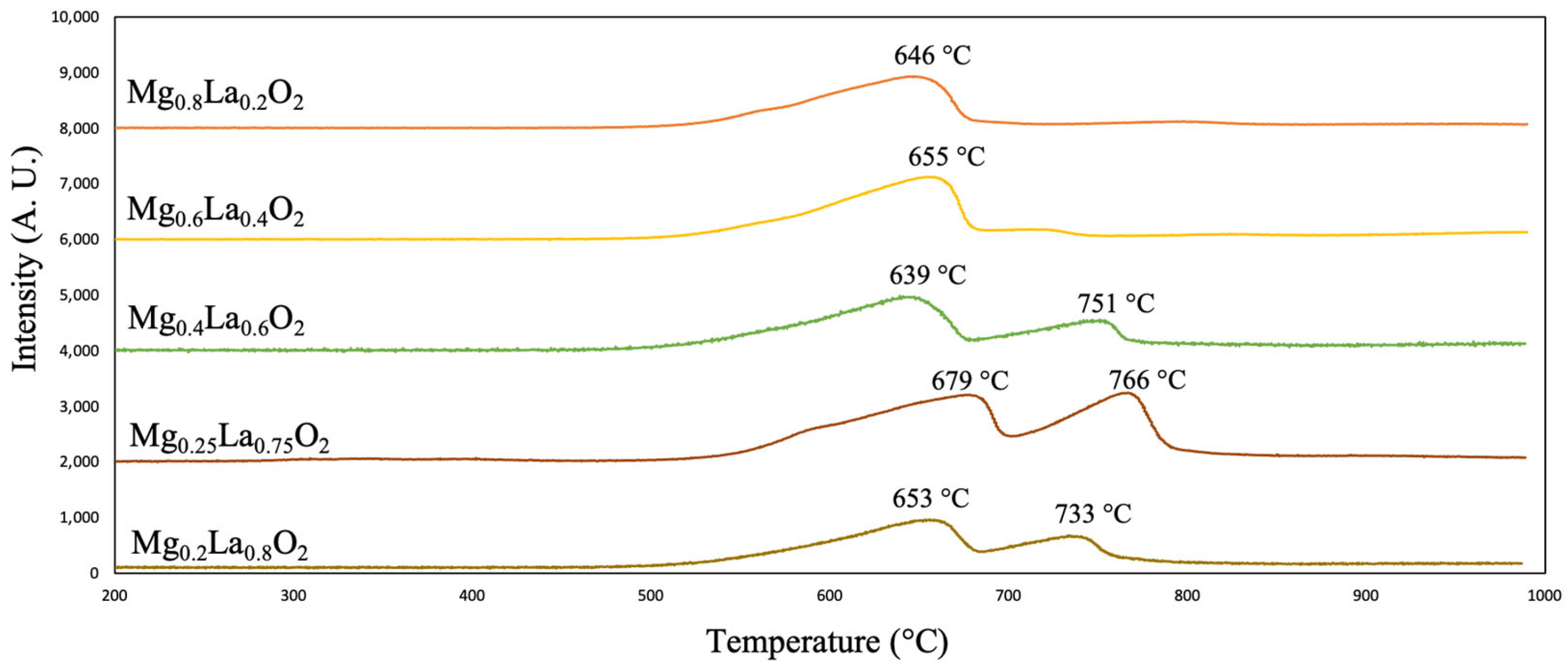
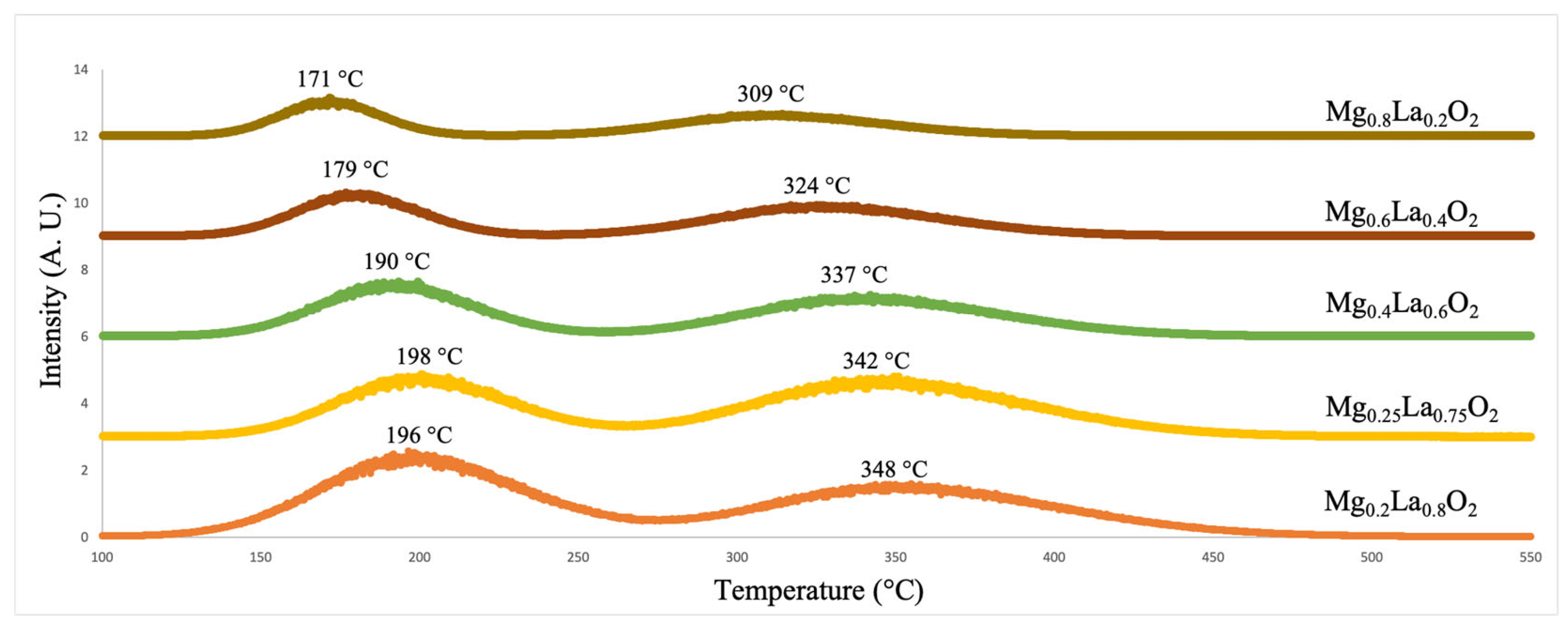
TPD-CO2 analysis reveals the presence of basic sites with varying strengths on the synthesized catalysts, corresponding to weak (50–200 °C), medium (200–350 °C), and strong (>350 °C) basic sites. These categories correspond to the release of CO2 from metal-hydroxide, metal-oxygen ion pairs, and unsaturated O2− anions, respectively [12,55]. The analysis showed that all synthesized catalysts exhibited predominantly strong basic sites, as indicated in Figure 5 and the concentration of strong basic sites in Table 1. This suggests that the surface basicity of the Mg–La mixed oxides is mainly associated with strongly basic O2− species, which can facilitate glycerol activation through deprotonation of the hydroxyl group to form glycerolate intermediates [40,41,42]. Furthermore, this indicates that a mixed metal oxide catalyst featuring robust basic sites, [M2+1−xM3+x]O2, was successfully synthesized through the thermal treatment of hydrotalcite, allowing for desorption [36,37]. A variety of scholarly articles have indicated that the formation of carbonate species occurs due to the absorption of CO2 on strong basic sites [12,36,37,56]. Additionally, the asymmetry of the peak concentrated close to 700 °C suggests the formation of various carbonate species, such as bridging, chelating, unidentate, and bidentate carbonates [55,57,58,59,60]. When the molar concentration of La3+ surpassed that of Mg2+, the catalysts displayed two pronounced desorption peaks, leading to an increased removal of CO2. Research conducted by Garbarino et al. indicates that the addition of La3+ enhances the catalyst’s basicity through specific interactions and coupling with the unsaturated O2− ion, facilitating the adsorption of CO2 [61]. The addition of La3+ to the system must be carefully controlled, as an excess can result in particle aggregation on the surface of the catalytic systems under investigation [62].
Temperature-programmed desorption of ammonia (TPD-NH3) is a well-established method for probing the surface acidity of solid catalysts, providing both the distribution and relative strength of acid sites [63]. On the synthesized catalysts, the NH3 desorption profile in Figure 6 reveals acid sites spanning a continuum of strengths, with temperature ranges that closely parallel those observed in the TPD-CO2 analysis. The desorption curve can be deconvoluted into three regions [12,36,49,64] where weak acid sites (50–200 °C) of NH3 desorbing in this low-temperature window correspond to surface hydroxyl groups that retain ammonia through hydrogen-bonding interactions. These sites are the most abundant but least energetic [65]. Moderate acid sites (200–350 °C) where the intermediate desorption range is associated with metal–oxygen pairs (M–O–M’) in the mixed oxide lattice. This assignment aligns with the medium-strength acid site window (200–350 °C). The intimate mixing of metal components in the oxide framework generates Lewis acid centers of appreciable strength through the polarization of M–O–M’ bridges [65]. Strong acid sites (>350 °C) are attributed to exposed M2+ or M3+ cations functioning as strong Lewis acid centers, with the highest-strength sites residing at edges or corners of crystallites where coordinative unsaturation is greatest. Such coordinatively unsaturated metal centers are described as potent Lewis acid sites owing to their enhanced electron-accepting character [66]. The TPD-NH3 profiles reveal that the distribution of acid sites is strongly governed by the Mg2+/La3+ ratio. The low-temperature desorption region, assigned to weak acid sites, decreases progressively with increasing Mg content, indicating a gradual reduction in weakly bound NH3 species. In contrast, the intermediate-temperature desorption region, attributed to moderate acid sites, exhibits a non-monotonic dependence on composition [63,65]. This behavior suggests that limited Mg incorporation modifies the local surface environment in a manner that favors the generation or exposure of acid sites of intermediate strength, potentially associated with coordinatively unsaturated metal cations and mixed M–O–M’ surface ensembles [66,67]. At higher Mg contents, however, the abundance of these acidic surface species appears to diminish, resulting in a progressive decrease in both weak and moderate acidity. Overall, these results demonstrate that the surface acidity of Mg–La mixed oxides can be effectively tuned by adjusting the Mg2+/La3+ ratio.

2.2. Catalytic Activity

2.2.1. Performance of Synthesized Catalysts

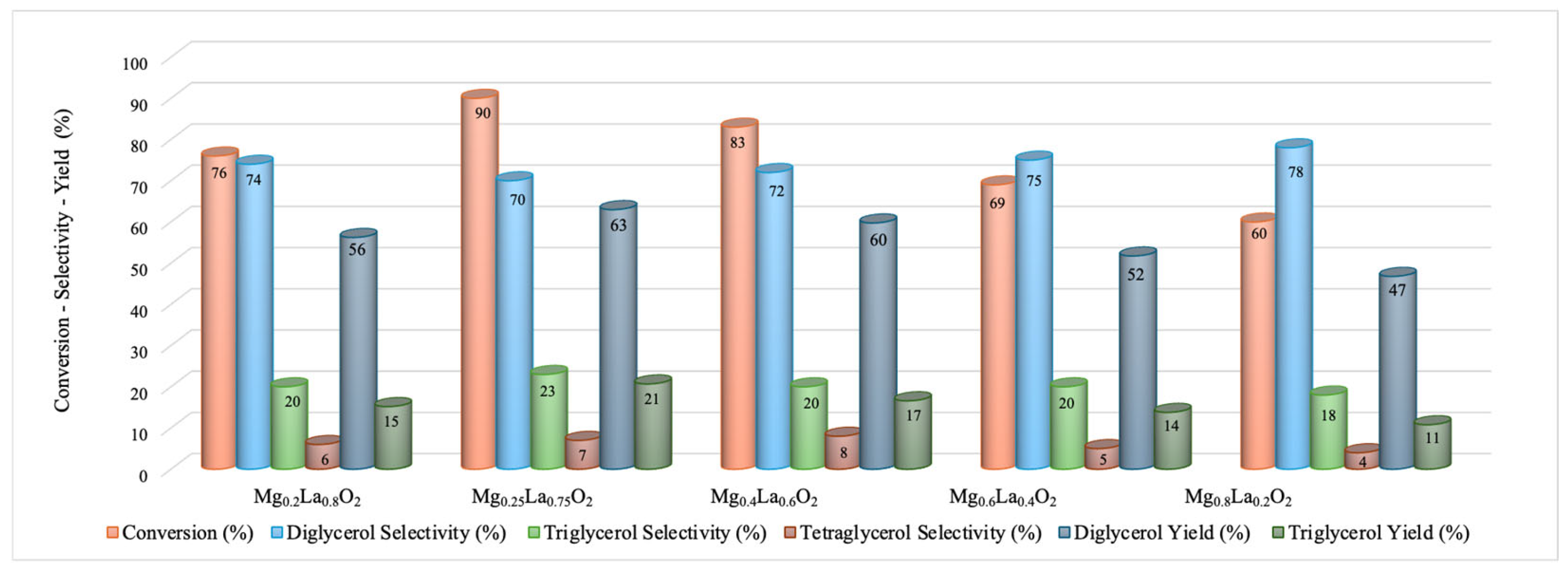
The etherification of glycerol to polyglycerol with heterogeneous catalysts is becoming increasingly favored because of advantages like easy catalyst separation and reuse. However, it still faces challenges, including insufficient catalytic activity, the need for harsher reaction conditions, and the potential leaching of the catalyst into the reaction medium [36]. Figure 7 illustrates the catalytic outcomes achieved with Mg1−xLaxO2 catalysts over a reaction period of 8 h at 220 °C, utilizing a catalyst loading of 2 wt%. The conversion and selectivity of di- and triglycerol improved with reaction time, reaching a peak at 8 h. The catalyst Mg0.25La0.75O2 attained the highest conversion rate of 90%, with selectivity values of 70% for diglycerol and 23% for triglycerol. Theoretical investigations of alkaline earth metal oxides have highlighted the critical role of Lewis acidic metal centers and surface basic oxygen sites in governing glycerol activation and etherification pathways, indicating that the balance between acidity and basicity is a key determinant of catalytic performance [68]. Lewis acid sites consist of coordinated unsaturated metal cations on metal oxides, whereas Lewis base sites are constituted by oxygen anions [69,70]. Metal cations that lack electrons exhibit acidity as they accept electrons, whereas oxygen anions that are rich in electrons serve as basic donors of electrons [70]. The arrangement of unsaturated surface metal ions has been demonstrated in numerous investigations to promote the hydroxyl departure in the glycerol etherification reaction, thereby triggering the oligomerization of glycerol [32,71,72]. The catalyst that achieved the ideal equilibrium between basicity and Lewis acidity demonstrated the highest level of activity, highlighting the significance of both sites. The coexistence of acidic and basic functionalities boosts the molecular interactions and activation of glycerol on the catalyst surface [32,72,73]. It can be suggested that the unsaturated metal cations (Mg2+ and La3+) function as Lewis acid sites, which are counterbalanced by the formation of hexagonal La2O2CO3 as the molar concentration of La3+ increases. Additionally, the presence of the labile O2− anion enhances the catalytic activity of the synthesized catalyst.

2.2.2. Impact of Reaction Time

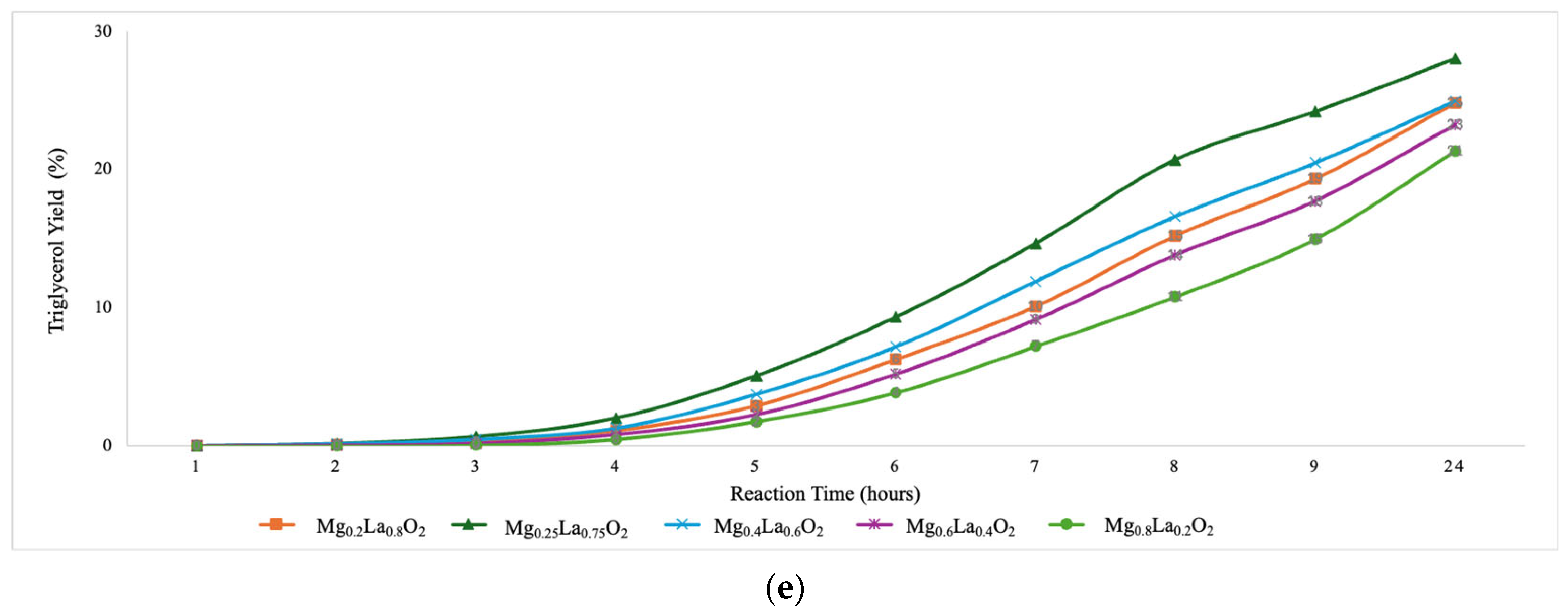
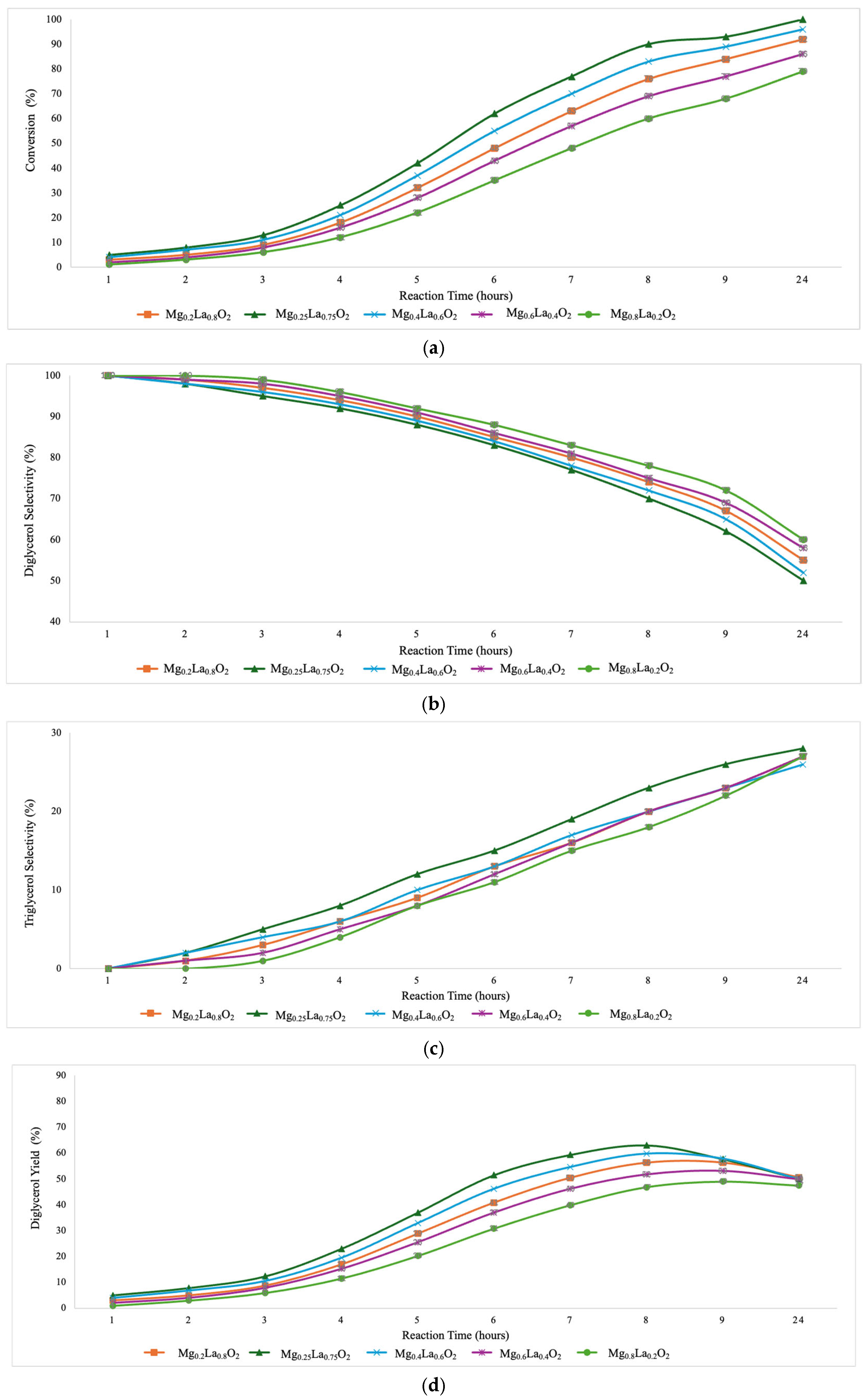
The impact of etherification duration on glycerol conversion, selectivity, and product yield is shown in Figure 8. As the reaction time increased, glycerol conversion also increased. The Mg0.25La0.75O2 catalyst showed rapid conversion up to approximately 8 h, after which the rate of increase became slightly lower. This behavior may be attributed to the gradual approach toward reaction equilibrium, the reduced glycerol concentration [37], the accumulation of higher oligomers on active sites [56] and mild diffusion limitations caused by the increasing viscosity of the reaction mixture [49]. The continued increase in conversion beyond 8 h suggests that equilibrium had not yet been reached under the investigated conditions [38,74]. In parallel, the decrease in diglycerol selectivity and increase in triglycerol selectivity are consistent with the consecutive etherification pathway of glycerol [74,75]. Diglycerol is initially formed as the major product and then undergoes further etherification with glycerol or oligomeric intermediates to produce triglycerol and higher polyglycerols [74,76,77]. Therefore, diglycerol selectivity decreases over time as it is progressively consumed to form higher oligomers such as triglycerol and tetraglycerols [56,74,78]. The more pronounced decline observed for Mg0.25La0.75O2 suggests that the catalyst possessed higher catalytic activity and more accessible active basic sites [49], thereby facilitating further oligomerization reactions [56]. Triglycerol selectivity increased with reaction time due to the sequential oligomerization pathway of glycerol etherification, where diglycerol acted as the intermediate before further conversion into triglycerol and higher oligomers. Triglycerol formation accelerated after approximately 4–5 h as sufficient diglycerol accumulated to promote secondary etherification reactions. Mg0.25La0.75O2 exhibited the highest triglycerol selectivity due to its optimal balance of accessible medium-strength basic sites, favorable Mg–La interaction, and enhanced oligomerization efficiency [56,79]. Lower-activity catalysts showed delayed triglycerol formation because slower glycerol conversion reduced diglycerol accumulation and suppressed secondary oligomerization [31,80]. Near 24 h, triglycerol selectivity plateaued slightly because triglycerol underwent further etherification into tetraglycerol, while increasing viscosity and oligomer accumulation introduced mild diffusion limitations that reduced the net triglycerol formation rate [76]. The diglycerol + triglycerol yield profile shown in the graph is scientifically consistent with the catalytic behavior expected for solventless glycerol etherification over Mg–La mixed oxide catalysts. Initially, product yield increased slowly because glycerol conversion and oligomer formation were still limited at the early reaction stage. As the reaction progressed, yield increased more rapidly due to accelerated glycerol conversion and enhanced formation of diglycerol and triglycerol intermediates. Mg0.25La0.75O2 exhibited the highest yield throughout the reaction due to its optimal balance of accessible medium-strength basic sites, favorable Mg–La interaction, and improved active-site accessibility, which enhanced oligomerization efficiency. Similar observations have been reported for heterogeneous mixed oxide catalysts where optimal acid–base properties and mesoporosity promoted higher oligomer yields [37].

2.2.3. Impact of Reaction Temperature

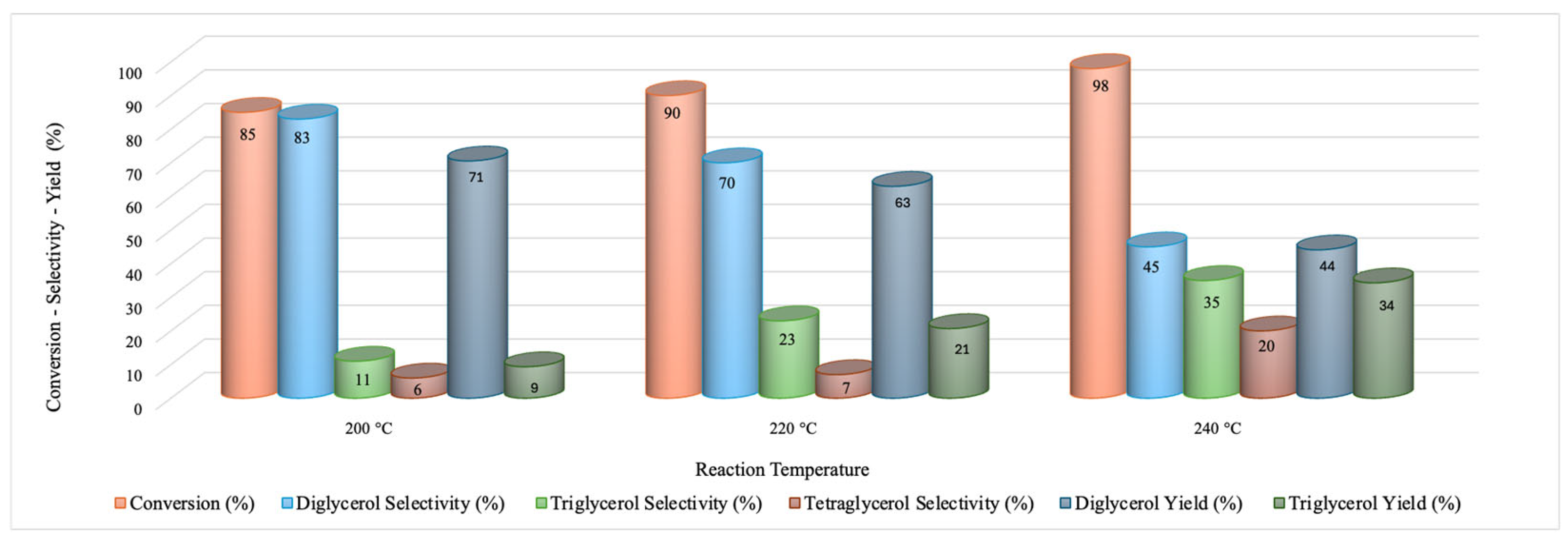
The results in Figure 9 demonstrate that reaction temperature significantly influenced glycerol conversion, oligomer selectivity, and diglycerol + triglycerol yield during solventless glycerol etherification over Mg0.25La0.75O2 catalyst. Increasing the reaction temperature from 200 °C to 240 °C progressively enhanced glycerol conversion from 85% to 98%, indicating that higher temperature accelerated glycerol activation and oligomerization kinetics. Similar temperature-dependent conversion behavior has been widely reported for heterogeneous glycerol etherification over basic mixed oxide catalysts [37,56,75]. Given that multiple studies have demonstrated that reaction temperatures exceeding 250 °C considerably diminish product selectivity, no exploration into increasing the reaction temperature further was conducted [31,37,78,81,82]. At lower temperature (200 °C), diglycerol selectivity remained high (83%) because the reaction favored partial etherification while suppressing secondary oligomerization into higher oligomers. As temperature increased to 220 °C and 240 °C, diglycerol selectivity decreased substantially while triglycerol and tetraglycerol selectivity increased. This behavior suggests that elevated temperature promoted sequential oligomerization reactions in which diglycerol underwent further etherification into triglycerol and tetraglycerol. Similar observations have been reported for glycerol oligomerization over solid base catalysts, where higher temperatures enhanced secondary condensation reactions and favored higher oligomer formation [49]. The catalyst activity showed a notable decline when the reaction temperature was lowered to 200 °C, indicating that the rate of oligomerization is quite minimal at these reduced temperatures, aligning with previously documented results [29,32,83,84]. The highest overall diglycerol + triglycerol yield was obtained at 220 °C, indicating that this temperature provided the optimum balance between glycerol conversion and selective oligomer formation. Although 240 °C produced the highest conversion, excessive secondary oligomerization likely reduced the yield of desirable oligomers due to formation of heavier products and possible side reactions. Similar optimum-temperature behavior has been reported in glycerol etherification studies involving heterogeneous mixed oxide catalysts [49].

2.2.4. Impact of Catalyst Loading

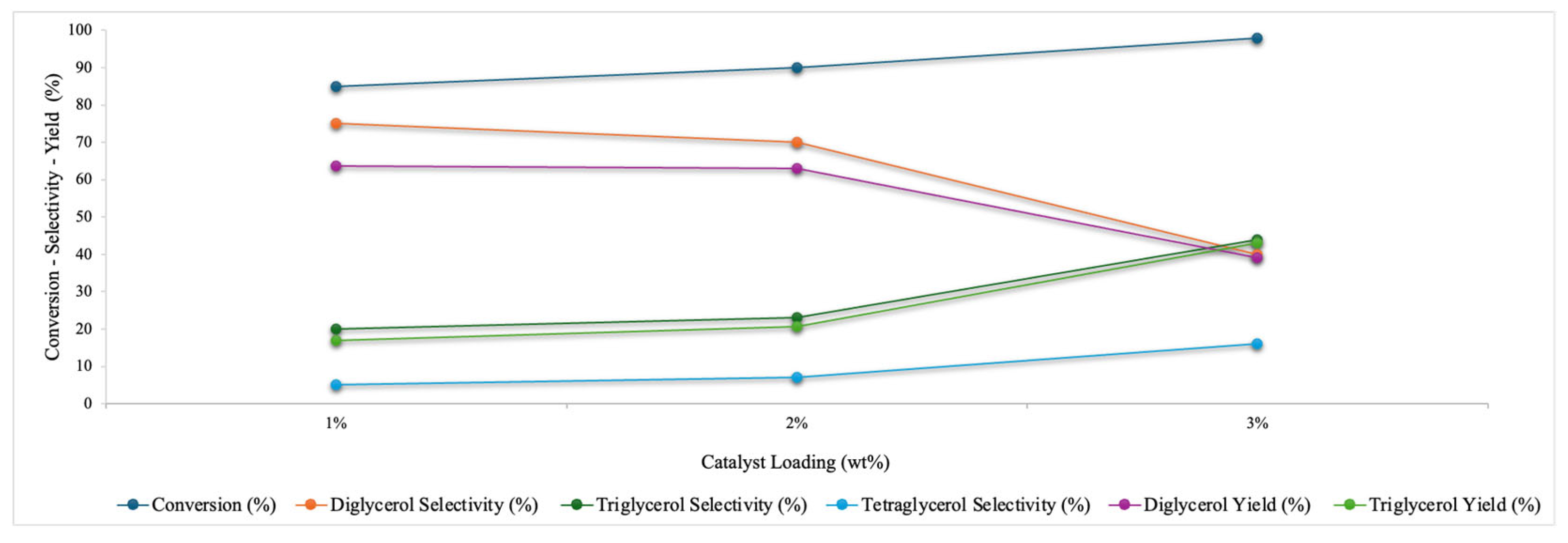
The results shown in Figure 10 indicate that catalyst loading significantly influenced glycerol conversion, oligomer selectivity, and overall diglycerol + triglycerol yield during solventless glycerol etherification over Mg0.25La0.75O2 catalyst. Increasing catalyst loading from 1 wt% to 3 wt% progressively increased glycerol conversion from 85% to 98% due to the higher availability of accessible active basic sites that enhanced glycerol activation and etherification reactions more effectively [37,81,82]. A decrease in catalyst loading often leads to lower glycerol conversion, as there is reduced catalyst availability to facilitate the process. An increase in catalyst concentration frequently leads to higher glycerol conversion rates and enhanced selectivity for di- and triglycerol. The observed outcome was correlated with the desiccation process of glycerol molecules. Interaction between these oxide catalysts with O-H bonds of glycerol may have strengthened the hydroxyl oxygen’s nucleophilic nature, facilitating the oligomerisation of glycerol [75]. The hydroxyl group of one glycerol molecule may have attacked a polarised glycerol molecule, potentially leading to the cleavage of a water molecule and the formation of lower degree polyglycerols [75,83]. Conversely, there have been observed declining trends in diglycerol selectivity that may be elucidated by the phenomenon where diglycerol reverts to glycerol [75]. Additionally, the reaction could have experienced further inhibition due to mass transfer occurring during the process [83]. At lower catalyst loading (1 wt%), diglycerol selectivity remained comparatively high because the limited number of active sites favored partial etherification while suppressing secondary oligomerization into higher oligomers. As catalyst loading increased, diglycerol selectivity decreased substantially, whereas triglycerol and tetraglycerol selectivity increased. This behavior suggests that higher catalyst loading enhanced secondary etherification reactions by increasing the density and accessibility of medium-strength basic sites, thereby promoting further oligomerization of diglycerol into triglycerol and tetraglycerol [31,56]. The highest diglycerol + triglycerol yield was obtained at 2 wt% catalyst loading, indicating that this loading provided the optimum balance between glycerol conversion and selective oligomer formation. Although 3 wt% catalyst loading produced the highest conversion, excessive secondary oligomerization likely reduced diglycerol selectivity and promoted formation of heavier oligomers, thereby lowering the overall desirable oligomer yield. In addition, excessive catalyst loading may increase oligomer accumulation on catalyst surfaces, causing mild diffusion limitations and reduced selectivity toward desirable oligomer products [49,75,78].

2.2.5. Reusability Studies

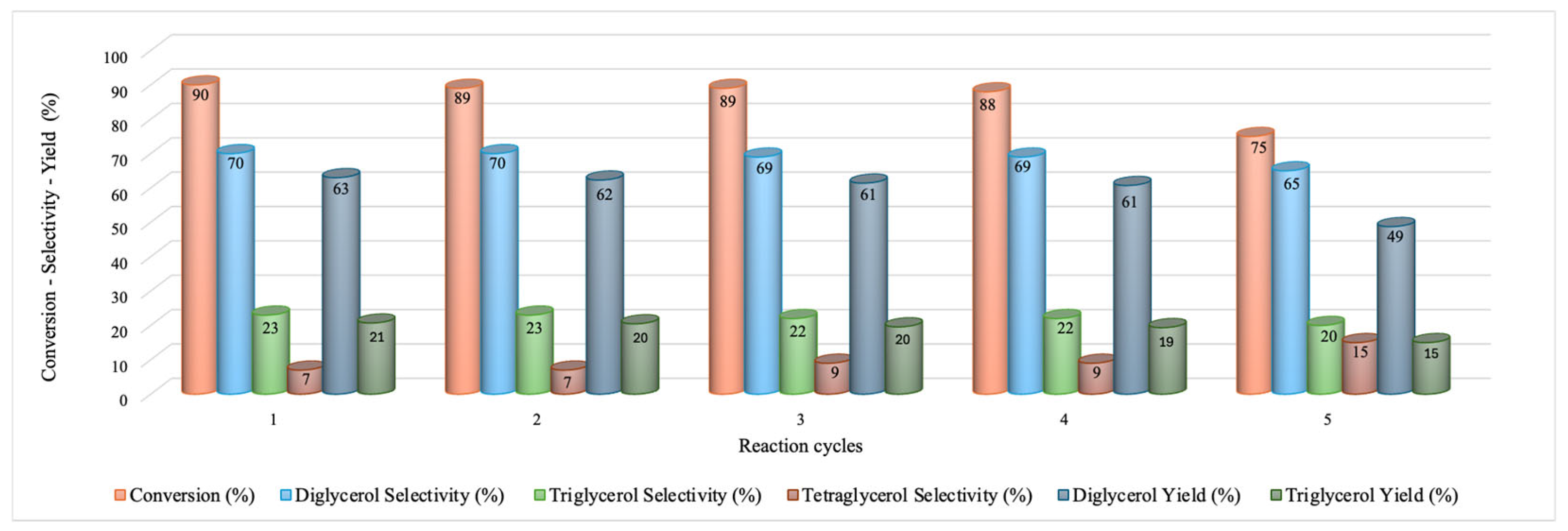
The ability to reuse the catalyst is a crucial factor in catalytic reactions. This study investigated the endurance of the catalytic efficacy of a mixed oxide Mg0.25La0.75O2 catalyst through its recycling in five successive batch runs under optimal glycerol etherification conditions. After each catalytic experiment, the catalyst underwent filtration and was rinsed with methanol (Merck, 99.9%), followed by drying in the oven at 80 °C for 8 h. Figure 11 illustrates the transformation of glycerol and the corresponding output over five consecutive cycles. The leaching of active metals during reactions diminishes catalytic activity, as the metals that are lost can dissolve into the reaction media. Leached metals contribute to the homogeneity of the solution. This happens given that specific species, including starting materials, products, by-products, or intermediates, establish stronger interactions alongside the metal intricate compared to the ligand ability on the solid substrate. Modifications applied to the gathered catalyst, such as filtration, washing, and drying, can affect catalytic activity in subsequent tests [32,77,85]. The catalyst reusability results demonstrate that Mg0.25La0.75O2 maintained relatively high catalytic activity during repeated glycerol etherification cycles, although gradual deactivation became noticeable after prolonged reuse. Glycerol conversion decreased slightly from 90% in the first cycle to 88–89% during the second to fourth cycles, indicating that the catalyst initially retained good structural stability and active-site accessibility. However, conversion decreased more significantly to 75% during the fifth cycle, suggesting progressive catalyst deactivation. Similar reusability behavior has been widely reported for heterogeneous glycerol etherification catalysts and is commonly associated with oligomer deposition, partial blockage of active basic sites, and gradual loss of accessible surface area [32,75]. Diglycerol selectivity gradually decreased from 70% to 65% with increasing reaction cycles, whereas triglycerol and tetraglycerol selectivity increased progressively. This behavior suggests that repeated catalyst usage promoted secondary oligomerization reactions and accumulation of heavier oligomers on catalyst surfaces. The increasing triglycerol and tetraglycerol selectivity indicates that residual oligomer species adsorbed on active sites may have facilitated further condensation reactions during reuse cycles [56,71,78,86]. The diglycerol + triglycerol yield remained relatively stable during the first four cycles before decreasing substantially during the fifth cycle, indicating that Mg0.25La0.75O2 possessed acceptable catalyst durability and structural stability under solventless etherification conditions. The gradual decline in catalytic performance at prolonged reuse cycles was likely caused by deposition of higher oligomers, partial hydroxylation of surface basic sites, and mild pore blockage that reduced active-site accessibility and diffusion efficiency [49,82].
The dissolution of metal species from the fluid phase was evaluated using ICP-OES, in the solution of the reaction mixture and presented in Table 2. This indicates that Mg and La undergo partial dissolution in the liquid phase throughout the etherification process. The slight decrease in catalytic activity after repeated reuse cycles may be attributed to partial blockage of active basic sites by higher oligomer deposition and minor Mg leaching from the mixed oxide structure [87]. The gradual increase in Mg concentration detected by ICP-OES with increasing reaction cycles indicates minor deterioration of accessible Mg-based active sites during prolonged catalyst reuse [88]. The leaching of La from the utilized catalyst also contributes to the catalyst’s diminished activity and selectivity. The findings are corroborated by the research conducted by Seshu Babu et al., which indicates that Mg/La catalysts serve as reusable catalysts. Incorporation of La enhances the catalyst’s basicity, attributed to the presence of strong basic sites. The leaching of La diminishes the catalyst’s basicity [89], resulting in the formation of more acidic catalysts. The investigation into the surface characteristics of the utilized catalyst after the fifth cycle revealed a notable decrease in surface area, from 74.17 m2 g−1 to 39.27 m2 g−1. The reduction in the catalyst’s surface area could be attributed to the products partially obstructing it during the reaction process. The surface of the catalyst was obscured by the oligomers produced during the reaction, potentially diminishing the availability of active sites [32].
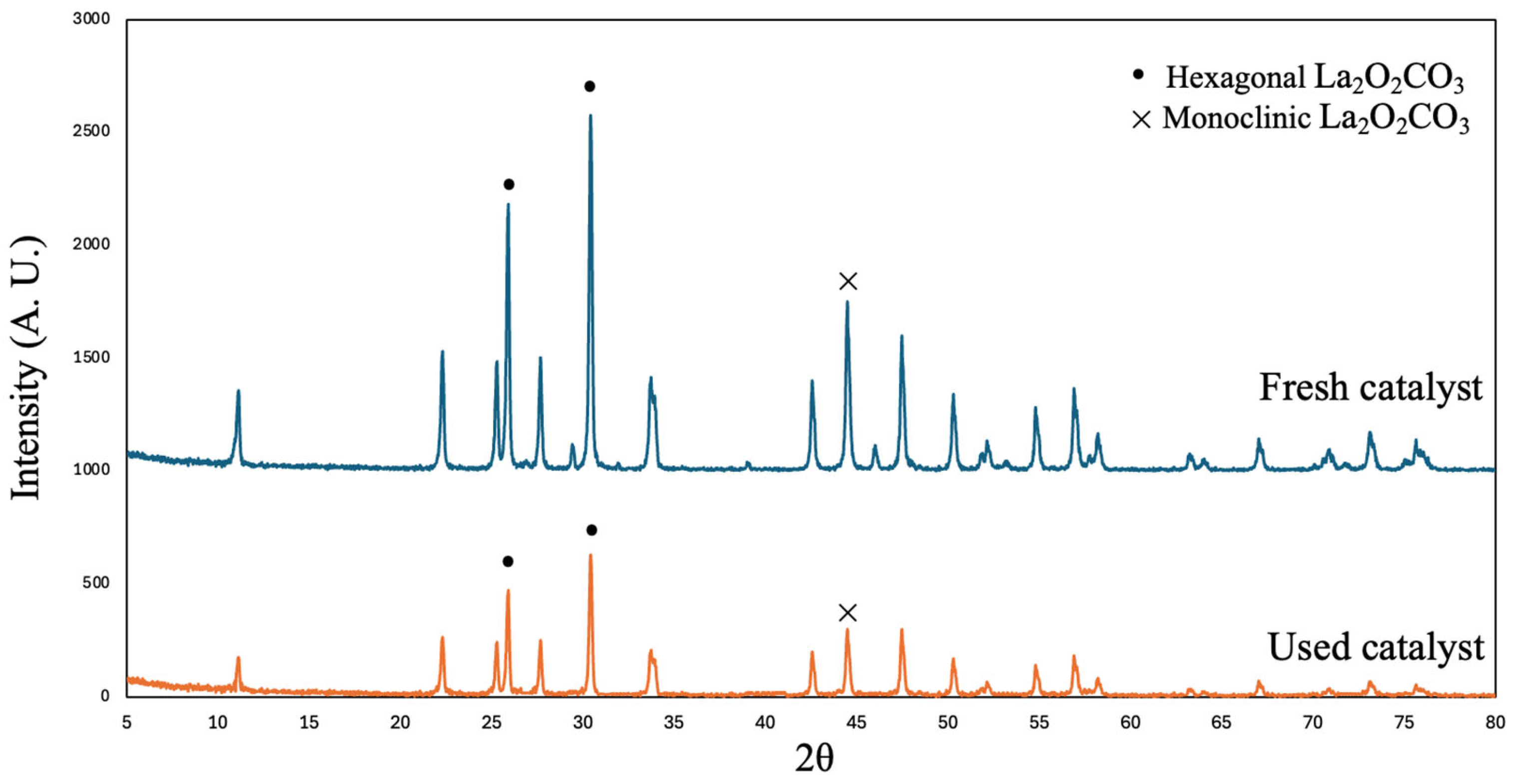
A similar pattern may be seen in the catalyst’s XRD analyses before and after the four etherification cycles (Figure 12). The primary peaks, 2θ = 25.8°, 30.3° and 44.4°, which are attributed to the La2O2CO3 species, are clearly visible. After the fifth cycle, the strength of these conspicuous peaks diminished. This modest reduction, which is comparable to the fresh mixed oxide Mg0.25La0.75O2 catalyst sample, suggests a decent retention of the structure. The lack of these peaks or their reduced intensities, conversely, indicates that leaching is taking place throughout the reaction; there is a decline in the quantity of metals present within the catalyst framework. The intensity of the La2O2CO3 component peaks was notably reduced after the fifth cycle in comparison to the fresh catalyst. The reduction in the basicity of the catalysts, as La leaches from the mixed metal oxide catalysts, results in a significant decline in catalytic performance. To enhance the reusability of mixed metal oxides, one could consider strategies such as improving their stability [90,91], developing effective regeneration techniques [92] and investigating innovative synthesis methods that regulate their structure and composition [93,94,95].
Although the Mg0.25La0.75O2 catalyst demonstrated satisfactory reusability, further improvements in catalyst durability remain desirable for long-term industrial implementation. Future studies could focus on optimizing catalyst composition as well as synthesis and calcination conditions, since previous studies on LDH-derived and related mixed oxides for glycerol etherification show that these variables strongly influence catalyst acid-base properties and catalytic behavior [36,56,96,97]. Such optimization may help maintain catalytic performance over extended use. In addition, these catalyst systems have been widely investigated for glycerol etherification to short-chain polyglycerols, so preserving high activity and selectivity toward di- and triglycerol remains an important objective for future catalyst development [36,56,96,98].

2.2.6. Comparison of Catalytic Performance of Mg0.25La0.75O2 with Other Catalysts

The Mg0.25La0.75O2 catalyst demonstrated superior catalytic efficiency for solventless glycerol etherification when benchmarked against previously reported heterogeneous catalysts, as outlined in Table 3. Among the LDH-derived catalysts reported for solventless glycerol etherification, Mg0.25La0.75O2 demonstrated the most balanced catalytic performance under comparatively moderate reaction conditions. The catalyst achieved 90% glycerol conversion together with high diglycerol selectivity (70%), triglycerol selectivity (23%), and overall oligomer yield (84%) within only 8 h of reaction. In contrast, most previously reported LDH-based catalysts required significantly longer reaction durations (typically 24 h) while producing lower conversion or oligomer yield [12,36,37,49,56]. The superior catalytic activity of Mg0.25La0.75O2 may be attributed to the possible cooperative interaction between Mg- and La-derived sites, which enhanced medium-strength basicity, Lewis acidity, and active-site accessibility. These properties promoted efficient glycerol activation and controlled oligomerization toward desirable short-chain polyglycerols under solvent-free conditions. These findings indicate that Mg0.25La0.75O2 is a promising heterogeneous catalyst for efficient and selective production of short-chain polyglycerols from glycerol under industrially relevant solvent-free conditions.

3. Materials and Methods

3.1. Catalyst Synthesis

A coprecipitation method at a constant pH was selected to synthesize a series of MgLa mixed metal oxides by varying the molar ratios of Mg and La, while maintaining a total cation concentration of 1 M. In 50 mL of distilled water, 10.260 g of Mg(NO3)2•6H2O (Merck, 99.0%) was dissolved to create 0.8 M Mg2+. Using the same volume, 4.330 g of La(NO3)3•6H2O (Merck, Petaling Jaya, Malaysia, 99.9%) was dissolved to yield 0.2 M of La3+. Both solutions were placed into a flask and vigorously stirred at room temperature. A precipitant solution of NaOH (Merck, 97.0%) and Na2CO3 (Merck, 99.5%) at concentrations of 2 M and 0.125 M, respectively, was used to maintain the pH at 10. After a 24-h ageing period for the precursor, the solids underwent centrifugation and were subsequently dried at 80 °C. A series of catalysts was synthesized by repeating a similar procedure, with modifications made to the molar concentration of both cations. The precursors were transformed into the appropriate mixed metal oxides by activating the hydrotalcites in a tube furnace at 450 °C for 15 h, utilizing nitrogen gas flowing at a rate of 40 mL min−1 [36].

3.2. Catalyst Characterization

Powdered XRD patterns were collected at ambient temperature utilizing Cu Kα radiation with a Shimadzu model XRD-6000 Diffractometer (from Shimadzu Corporation, Kyoto, Japan) across a 2θ range of 5° to 80°. Crystallite sizes were determined from X-ray peak broadening utilizing the Debye-Scherrer equation, as illustrated in Equation (1).
t = 0.89 λ β h k l θ h k l
where t = crystallite size, nm
λ = Wavelength of X-ray for Cu Kα radiation
βhkl = Full width at half maximum (FWHM) of the hkl plane
θhkl = diffraction angle of hkl plane
Overall surface area of these catalysts was evaluated through the Brunauer–Emmett–Teller (BET) method utilizing a Micromeritics 3Flex Adsorption Analyzer (from Micromeritics Instrument Corporation, Norcross, GA, USA). Prior to nitrogen adsorption, the samples underwent degassing at 450 °C (10 °C min−1) for a duration of 18 h. The Nicolet™ iS™ 10 FTIR Spectrometer (from Thermo Fisher Scientific, Shah Alam, Malaysia) was employed to analyze Fourier transform infrared (FTIR) spectra. The spectra were gathered within the wave number range from 4000 to 500 cm−1 at atmospheric pressure and room temperature. The Hitachi S-3400N (from Hitachi High-Tech Corporation, Kuala Lumpur, Malaysia), in conjunction with the EDAX-Ametex-Apollo X59 (from AMETEK Inc., Mahwah, NJ, USA), was utilized for scanning electron microscopy (SEM) and energy-dispersive X-ray (EDX) analysis. The basicity of the catalysts was investigated using temperature-programmed CO2 desorption on a Thermo Electron TPDRO 1100 (from Thermo Fisher Scientific, Shah Alam, Malaysia). Approximately 100 mg of the material underwent pretreatment for 60 min at a temperature of 450 °C while being exposed to helium flow at a rate of 50 mL min−1, with a ramping rate of 10 °C min−1. A pure CO2 stream (50 mL min−1) was introduced for a duration of 60 min following the reduction of the reaction temperature to 100 °C. A thermal conductivity detector (TCD) was employed to quantify the CO2 produced during the TPD-CO2 reaction, conducted in helium flow at temperatures ranging from 100 °C to 1000 °C (30 mL min−1 with a ramp rate of 10 °C min−1). The total acidity of the catalysts was analyzed using temperature-programmed NH3 desorption on a Micrometrics Autochem II 2920 equipped with TCD (from Micromeritics Instrument Corporation, Norcross, GA, USA). After cleaning 100 mg of the material at 450 °C in helium flow rate of 50 mL min−1 with a ramping rate of 10 °C min−1, the reaction temperature was reduced to 100 °C, followed by the introduction of a pure stream of NH3 at 50 mL min−1 for 60 min. The TPD-NH3 was carried out between 100 °C and 550 °C (30 mL min−1 with a ramp rate of 10 °C min−1). Metal leaching from the catalyst was evaluated by PerkinElmer Optima 7000 DV Inductively Coupled Plasma Optical Emission Spectrometry (ICP-OES) (from Perkin Elmer Sdn. Bhd., Petaling Jaya, Malaysia). Analysis of the liquid phase collected after the solventless glycerol etherification reaction. After each reaction cycle, the reaction mixture was cooled to room temperature and the solid catalyst was separated by centrifugation, followed by filtration. Due to the high viscosity of the solventless glycerol etherification mixture, the liquid sample was diluted with deionized water at a 1:9 ratio. The diluted sample was then acidified with nitric acid to obtain approximately 2 vol% HNO3, ensuring complete stabilization of dissolved Mg and La species in solution. The measured concentrations were corrected according to the dilution factor.

3.3. Catalyst Reaction and Analysis

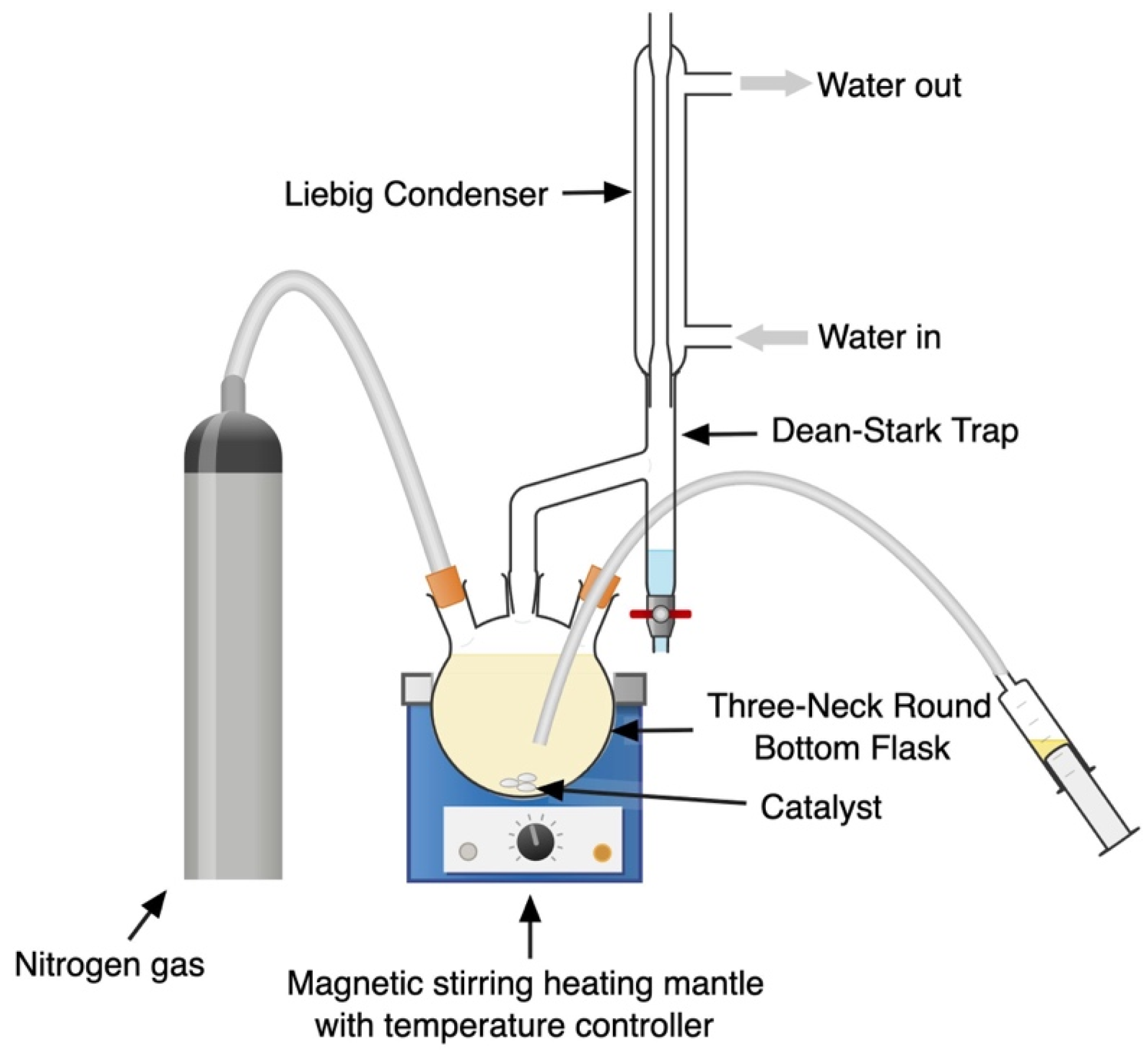
As illustrated in Figure 13, a 250 mL glass batch reactor featuring three necks and a circular bottom was employed to assess the solventless etherification of glycerol. The reactor featured a water-cooled condenser along with a Dean Stark apparatus designed exclusively for the elimination of surplus water. 50 g of glycerol (Merck, 99.5%) were mixed with 2 wt% of fresh calcined catalyst. The reactor’s atmosphere was maintained inert through a nitrogen gas flow of 10 mL min−1 to prevent glycerol oxidation. The injector and detector temperature were set at 100 °C and 220 °C, respectively. The reaction was conducted at 1000 rpm using a magnetic stirring heating mantle, with temperature regulation achieved through a thermocouple linked to a proportional-integral-derivative regulator. After the procedure, the resulting mélange underwent rapid cooling in an ice bath. The catalysts underwent separation through filtration, followed by washing with water and subsequent drying. The influence of the temperature of the reaction mixture (200 °C, 220 °C, and 240 °C) and catalyst loading (1 wt%, 2 wt% and 3 wt%) was further assessed. To evaluate the study’s repeatability, the catalysts were filtered, washed with distilled water, dried at 80 °C, and subjected to solventless etherification until a significant decrease in catalyst efficacy was observed.
The reaction products were analyzed utilizing a Perkin Elmer Clarus 500 gas chromatograph (GC) (from Perkin Elmer Sdn. Bhd., Petaling Jaya, Malaysia), featuring a flame ionization detector. The system consisted of a Zebron GC column, ZB-1, that measured 30 m in length, featuring an internal diameter of 0.25 mm along with a film thickness of 0.25 µm. Following silylation [36,82], gas chromatography analysis was conducted on the collected product samples. A 0.05 mL aliquot of the reaction mixture was dissolved in 1.5 mL of dried pyridine (Merck, 99.9%). 0.15 mL of this mixture was combined with 0.15 mL of N,O-Bis(trimethylsilyl)trifluoroacetamide (Merck, 99.0%), and subsequently, 0.75 mL of dry pyridine was added. The mixture underwent ageing in an oven at 60 °C for a duration of 60 min, followed by analysis using gas chromatography. The analysis revealed the presence of unreacted glycerol, diglycerol, and triglycerol as the identified products through GC. The investigation focused on the reusability of the optimized mixed metal oxide catalysts to determine the operational cycle count. The formulas employed to calculate glycerol conversion (%), diglycerol selectivity (%), triglycerol selectivity (%), and diglycerol + triglycerol yield (%) are outlined below:
Glycerol   conversion   ( % ) = Glycerol   transformed   ( moles ) Initial   glycerol   ( moles ) × 100
Product   selectivity   ( % ) = Diglycerol / triglycerol   produced   ( moles ) Total   product   ( moles ) × 100
Product   yield   ( % ) = Diglycerol / triglycerol   produced   ( moles ) Initial   glycerol   ( moles ) × 100

4. Conclusions

In conclusion, this study demonstrates that LDH-derived Mg–La mixed oxides are not merely strongly basic catalysts, but composition-tunable bifunctional surfaces in which the Mg2+/La3+ ratio controls crystallinity, porosity, and the balance between basic and acidic surface sites. Among the synthesized materials, Mg0.25La0.75O2 exhibited the most favorable catalytic behavior because it combined the highest strong basic-site concentration with enhanced Mg–La interfacial interaction and improved active-site accessibility, delivering 90% glycerol conversion, 70% diglycerol selectivity, 23% triglycerol selectivity, and an 84% combined yield under the optimized conditions of 220 °C, 8 h, and 2 wt% catalyst loading. These findings indicate that selective etherification is governed not by maximizing a single surface property, but by achieving an optimal acid–base synergy that promotes glycerol deprotonation and controlled sequential oligomerization. The performance trends further reveal that excessive Mg or La enrichment is detrimental because it perturbs the surface architecture and reduces the population of accessible active sites, thereby weakening catalytic efficiency and selectivity. Although the catalyst retained acceptable activity over the first four reuse cycles, the decline observed upon prolonged recycling suggests that partial leaching of Mg/La species, as well as possibly oligomer deposition and loss of accessible basic sites, remain the principal causes of deactivation. Overall, this work establishes compositional tuning of Mg–La mixed oxides as an effective strategy for directing solventless glycerol etherification toward short-chain polyglycerols, while also highlighting the need for improved structural stabilization to extend catalyst lifetime and industrial relevance.

Author Contributions

P.P.: Conceptualization, Methodology, Validation, Formal data analysis, Funding acquisition, Writing—original draft, Writing—review and editing. S.L., Y.Y.H., L.L.K. and S.C.: Supervision, Project administration, Conceptualization, Validation, Funding acquisition, Writing—review and editing. All authors have read and agreed to the published version of the manuscript.

Funding

We express our sincere appreciation for the financial support received from Universiti Tunku Abdul Rahman (UTAR) in providing the research fund (IPSR/RMC/UTARRF/2017-C2/P01 and IPSR/RMC/UTARRF/2021-C1/P01).

Data Availability Statement

The data that supports the findings of this study are available from the corresponding author upon reasonable request.

Acknowledgments

We are deeply grateful for the generous financial support provided.

Conflicts of Interest

The authors state that there are no known competing financial interests or personal relationships that could be perceived as influencing the work reported in this paper.

References

  1. Palanychamy, P.; Lim, S.; Yap, Y.H.; Leong, L.K. Critical Review of the Various Reaction Mechanisms for Glycerol Etherification. Catalysts 2022, 12, 1487. [Google Scholar] [CrossRef]
  2. Saikia, K.; Rajkumari, K.; Moyon, N.S.; Basumatary, S.; Halder, G.; Rashid, U.; Rokhum, S.L. Sulphonated Biomass-Based Catalyst for Solketal Synthesis by Acetalization of Glycerol—A Byproduct of Biodiesel Production. Fuel Process. Technol. 2022, 238, 107482. [Google Scholar] [CrossRef]
  3. Li, Y.; Zhang, S.; Li, Z.; Zhang, H.; Li, H.; Yang, S. Green Synthesis of Heterogeneous Polymeric Bio-Based Acid Decorated with Hydrophobic Regulator for Efficient Catalytic Production of Biodiesel at Low Temperatures. Fuel 2022, 329, 125467. [Google Scholar] [CrossRef]
  4. Alashek, F.; Keshe, M.; Alhassan, G. Preparation of Glycerol Derivatives by Entered of Glycerol in Different Chemical Organic Reactions: A Review. Results Chem. 2022, 4, 100359. [Google Scholar] [CrossRef]
  5. Foo, G.S.; Wei, D.; Sholl, D.S.; Sievers, C. Role of Lewis and Brønsted Acid Sites in the Dehydration of Glycerol over Niobia. ACS Catal. 2014, 4, 3180–3192. [Google Scholar] [CrossRef]
  6. Chong, C.C.; Aqsha, A.; Ayoub, M.; Sajid, M.; Abdullah, A.Z.; Yusup, S.; Abdullah, B. A Review over the Role of Catalysts for Selective Short-Chain Polyglycerol Production from Biodiesel Derived Waste Glycerol. Environ. Technol. Innov. 2020, 19, 100859. [Google Scholar] [CrossRef]
  7. Roy, D.; Subramaniam, B.; Chaudhari, R.V. Cu-Based Catalysts Show Low Temperature Activity for Glycerol Conversion to Lactic Acid. ACS Catal. 2011, 1, 548–551. [Google Scholar] [CrossRef]
  8. Wang, Z.; Wang, L.; Jiang, Y.; Hunger, M.; Huang, J. Cooperativity of Brønsted and Lewis Acid Sites on Zeolite for Glycerol Dehydration. ACS Catal. 2014, 4, 1144–1147. [Google Scholar] [CrossRef]
  9. Glycerine Market Report and Forecast 2025–2034. Available online: https://www.researchandmarkets.com/reports/6162857/glycerine-market-report-forecast?srsltid=AfmBOopZX8vHEdmMy7dLFXYkdWS_XPKonaTsH-VbTd7GkIomrokp4gfE&utm_source=chatgpt.com (accessed on 17 June 2026).
  10. Glycerol Market. Available online: https://www.transparencymarketresearch.com/glycerol-market.html?utm_source=chatgpt.com (accessed on 17 June 2026).
  11. Moklis, M.H.; Cheng, S.; Cross, J.S. Current and Future Trends for Crude Glycerol Upgrading to High Value-Added Products. Sustainability 2023, 15, 2979. [Google Scholar] [CrossRef]
  12. Khumho, R.; Tocuweang, K.; Sangkhum, P.; Kuchonthara, P.; Ashokkumar, V.; Ngamcharussrivichai, C. Etherification of Glycerol into Short-Chain Polyglycerols over MgAl LDH/CaCO3 Nanocomposites as Heterogeneous Catalysts to Promote Circular Bioeconomy. Chemosphere 2022, 291, 133091. [Google Scholar] [CrossRef] [PubMed]
  13. Maquirriain, M.A.; Querini, C.A.; Pisarello, M.L. Glycerine Esterification with Free Fatty Acids: Homogeneous Catalysis. Chem. Eng. Res. Des. 2021, 171, 86–99. [Google Scholar] [CrossRef]
  14. Pereira, V.S.; Nandenha, J.; Ramos, A.; Neto, A.O. Effects of TiO2 in Pd-TiO2/C for Glycerol Oxidation in a Direct Alkaline Fuel Cell. J. Fuel Chem. Technol. 2022, 50, 474–482. [Google Scholar] [CrossRef]
  15. Bhaduri, K.; Ghosh, A.; Auroux, A.; Chatterjee, S.; Bhaumik, A.; Chowdhury, B. Soft-Templating Routes for the Synthesis of Mesoporous Tantalum Phosphates and Their Catalytic Activity in Glycerol Dehydration and Carbonylation Reactions. Mol. Catal. 2022, 518, 112074. [Google Scholar] [CrossRef]
  16. Qureshi, F.; Yusuf, M.; Pasha, A.A.; Khan, H.W.; Imteyaz, B.; Irshad, K. Sustainable and Energy Efficient Hydrogen Production via Glycerol Reforming Techniques: A Review. Int. J. Hydrogen Energy 2022, 47, 41397–41420. [Google Scholar] [CrossRef]
  17. Bagnato, G.; Iulianelli, A.; Sanna, A.; Basile, A. Glycerol Production and Transformation: A Critical Review with Particular Emphasis on Glycerol Reforming Reaction for Producing Hydrogen in Conventional and Membrane Reactors. Membranes 2017, 7, 17. [Google Scholar] [CrossRef]
  18. Zhao, W.; Yi, C.; Yang, B.; Hu, J.; Huang, X. Etherification of Glycerol and Isobutylene Catalyzed over Rare Earth Modified Hβ-Zeolite. Fuel Process. Technol. 2013, 112, 70–75. [Google Scholar] [CrossRef]
  19. Bozkurt, Ö.D.; Bağlar, N.; Çelebi, S.; Uzun, A. Screening of Solid Acid Catalysts for Etherification of Glycerol with Isobutene under Identical Conditions. Catal. Today 2020, 357, 483–494. [Google Scholar] [CrossRef]
  20. Gonzalez-Arellano, C.; Grau-Atienza, A.; Serrano, E.; Romero, A.A.; Garcia-Martinez, J.; Luque, R. The Role of Mesoporosity and Si/Al Ratio in the Catalytic Etherification of Glycerol with Benzyl Alcohol Using ZSM-5 Zeolites. J. Mol. Catal. A Chem. 2015, 406, 40–45. [Google Scholar] [CrossRef]
  21. Tekale, D.P.; Yadav, G.D.; Dalai, A.K. Solvent-Free Benzylation of Glycerol by Benzyl Alcohol Using Heteropoly Acid Impregnated on k-10 Clay as Catalyst. Catalysts 2021, 11, 34. [Google Scholar] [CrossRef]
  22. Cannilla, C.; Giacoppo, G.; Frusteri, L.; Todaro, S.; Bonura, G.; Frusteri, F. Techno-Economic Feasibility of Industrial Production of Biofuels by Glycerol Etherification Reaction with Isobutene or Tert-Butyl Alcohol Assisted by Vapor-Permeation Membrane. J. Ind. Eng. Chem. 2021, 98, 413–424. [Google Scholar] [CrossRef]
  23. Chiosso, M.E.; Casella, M.L.; Merlo, A.B. Synthesis and Catalytic Evaluation of Acidic Carbons in the Etherification of Glycerol Obtained from Biodiesel Production. Catal. Today 2021, 372, 107–114. [Google Scholar] [CrossRef]
  24. da Silva, M.J.; Chaves, D.M.; Ferreira, S.O.; da Silva, R.C.; Gabriel Filho, J.B.; Bruziquesi, C.G.O.; Al-Rabiah, A.A. Impacts of Sn(II) Doping on the Keggin Heteropolyacid-Catalyzed Etherification of Glycerol with Tert-Butyl Alcohol. Chem. Eng. Sci. 2022, 247, 116913. [Google Scholar] [CrossRef]
  25. Sutter, M.; Da Silva, E.; Duguet, N.; Raoul, Y.; Métay, E.; Lemaire, M. Glycerol Ether Synthesis: A Bench Test for Green Chemistry Concepts and Technologies. Chem. Rev. 2015, 115, 8609–8651. [Google Scholar] [CrossRef] [PubMed]
  26. Pagliaro, M.; Ciriminna, R.; Kimura, H.; Rossi, M.; Della Pina, C. From Glycerol to Value-Added Products. Angew. Chem. Int. Ed. 2007, 46, 4434–4440. [Google Scholar]
  27. Xiao, L.; Mao, J.; Zhou, J.; Guo, X.; Zhang, S. Enhanced Performance of HY Zeolites by Acid Wash for Glycerol Etherification with Isobutene. Appl. Catal. A Gen. 2011, 393, 88–95. [Google Scholar] [CrossRef]
  28. Yuan, Z.; Xia, S.; Chen, P.; Hou, Z.; Zheng, X. Etherification of Biodiesel-Based Glycerol with Bioethanol over Tungstophosphoric Acid To Synthesize Glyceryl Ethers. Energy Fuels 2011, 25, 3186–3191. [Google Scholar] [CrossRef]
  29. Charles, G.; Clacens, J.-M.; Pouilloux, Y.; Barrault, J. Préparation de Diglydérol et Triglycérol Par Polymérisation Directe Du Glycérol En Présence de Catalyseurs Solides. Ol. Corps Gras Lipides 2003, 10, 74–82. [Google Scholar] [CrossRef]
  30. Ayoub, M.; Abdullah, A.Z.; Ahmad, M.; Sultana, S. Performance of Lithium Modified Zeolite Y Catalyst in Solvent-Free Conversion of Glycerol to Polyglycerols. J. Taibah Univ. Sci. 2014, 8, 231–235. [Google Scholar] [CrossRef]
  31. Park, S.K.; Kim, D.W.; Lee, S.Y.; Lee, J.S. Direct Etherification Reaction of Glycerol Using Alkali Metal Cation (Li+, Na+ and K+) Containing X-Type Zeolites as Heterogeneous Catalysts: Optimization of the Reaction Conditions. Catalysts 2021, 11, 1323. [Google Scholar] [CrossRef]
  32. Gholami, Z.; Abdullah, A.Z.; Lee, K.T. Catalytic Etherification of Glycerol to Diglycerol Over Heterogeneous Calcium-Based Mixed-Oxide Catalyst: Reusability and Stability. Chem. Eng. Commun. 2015, 202, 1397–1405. [Google Scholar] [CrossRef]
  33. Aguado-Deblas, L.; Estevez, R.; Russo, M.; La Parola, V.; Bautista, F.M.; Testa, M.L. Microwave-Assisted Glycerol Etherification Over Sulfonic Acid Catalysts. Materials 2020, 13, 1584. [Google Scholar] [CrossRef] [PubMed]
  34. Román, M.S.S.; Holgado, M.J. Intercalation of Phenylalanine, Isocoumarin and Ochratoxin A (OTA) into LDH’s. Open J. Inorg. Chem. 2015, 5, 52–62. [Google Scholar] [CrossRef]
  35. Tichit, D.; Fajula, F. Layered Double Hydroxides as Solid Base Catalysts and Catalyst Precursors. In Studies in Surface Science and Catalysis; Kiricsi, I., Pál-Borbély, G., Nagy, J.B., Karge, H.G., Eds.; Elsevier: Amsterdam, The Netherlands, 1999; Volume 125, pp. 329–340. [Google Scholar]
  36. Guerrero-Urbaneja, P.; García-Sancho, C.; Moreno-Tost, R.; Mérida-Robles, J.; Santamaría-González, J.; Jiménez-López, A.; Maireles-Torres, P. Glycerol Valorization by Etherification to Polyglycerols by Using Metal Oxides Derived from MgFe Hydrotalcites. Appl. Catal. A Gen. 2014, 470, 199–207. [Google Scholar] [CrossRef]
  37. García-Sancho, C.; Moreno-Tost, R.; Mérida-Robles, J.M.; Santamaría-González, J.; Jiménez-López, A.; Torres, P.M. Etherification of Glycerol to Polyglycerols over MgAl Mixed Oxides. Catal. Today 2011, 167, 84–90. [Google Scholar] [CrossRef]
  38. Clacens, J.-M.; Pouilloux, Y.; Barrault, J. Selective Etherification of Glycerol to Polyglycerols over Impregnated Basic MCM-41 Type Mesoporous Catalysts. Appl. Catal. 2002, 227, 181–190. [Google Scholar] [CrossRef]
  39. Barrault, J.; Clacens, J.-M.; Pouilloux, Y. Selective Oligomerization of Glycerol Over Mesoporous Catalysts. Top. Catal. 2004, 27, 137–142. [Google Scholar] [CrossRef]
  40. Pagliaro, M.; Rossi, M. Etherification. In The Future of Glycerol: New Uses of a Versatile Raw Material; Pagliaro, M., Rossi, M., Eds.; The Royal Society of Chemistry: Cambridge, UK, 2008; pp. 65–72. [Google Scholar]
  41. Pagliaro, M.; Rossi, M. Etherification. In The Future of Glycerol; Pagliaro, M., Rossi, M., Eds.; The Royal Society of Chemistry: Cambridge, UK, 2010; pp. 87–101. [Google Scholar]
  42. Krisnandi, Y.K.; Eckelt, R.; Schneider, M.; Martin, A.; Richter, M. Glycerol Upgrading over Zeolites by Batch-Reactor Liquid-Phase Oligomerization: Heterogeneous versus Homogeneous Reaction. ChemSusChem 2008, 1, 835–844. [Google Scholar] [CrossRef] [PubMed]
  43. Baán, Z.; Potor, A.; Cwik, A.; Hell, Z.; Keglevich, G.; Finta, Z.; Hermecz, I. Catalytic Transfer Hydrogenation and Hydrogenolysis in Ionic Liquids with Pd/MgLa Mixed Oxide and Pd/MgAl Hydrotalcite as Recyclable Catalysts. Synth. Commun. 2008, 38, 1601–1609. [Google Scholar] [CrossRef]
  44. Palomeque, J.; Clacens, J.-M.; Figueras, F. Oxidation of Dibenzothiophene by Hydrogen Peroxide Catalyzed by Solid Bases. J. Catal. 2002, 211, 103–108. [Google Scholar] [CrossRef]
  45. Desmartin-Chomel, A.; Hamad, B.; Palomeque, J.; Essayem, N.; Bergeret, G.; Figueras, F. Basic Properties of MgLaO Mixed Oxides as Determined by Microcalorimetry and Kinetics. Catal. Today 2010, 152, 110–114. [Google Scholar] [CrossRef]
  46. Bakiz, B.; Guinneton, F.; Arab, M.; Benlhachemi, A.; Villain, S.; Satre, P.; Gavarri, J.-R. Carbonatation and Decarbonatation Kinetics in the La2O3-La2O2CO3 System under CO2 Gas Flows. Adv. Mater. Sci. Eng. 2010, 2010, 360597. [Google Scholar] [CrossRef]
  47. Yu, H.; Jiang, K.; Kang, S.G.; Men, Y.; Shin, E.W. Hexagonal and Monoclinic Phases of La2O2Co3 Nanoparticles and Their Phase-Related Co2 Behavior. Nanomaterials 2020, 10, 2061. [Google Scholar] [CrossRef] [PubMed]
  48. Hussein, G.A.M.; Gates, B.C. Characterization of Porous Lanthanum Oxide Catalysts. Microscopic and Spectroscopic Studies. J. Chem. Soc. Faraday Trans. 1996, 92, 2425–2430. [Google Scholar] [CrossRef]
  49. Sangkhum, P.; Yanamphorn, J.; Wangriya, A.; Ngamcharussrivichai, C. Ca–Mg–Al Ternary Mixed Oxides Derived from Layered Double Hydroxide for Selective Etherification of Glycerol to Short-Chain Polyglycerols. Appl. Clay Sci. 2019, 173, 79–87. [Google Scholar] [CrossRef]
  50. Trujillano, R.; González-García, I.; Morato, A.; Rives, V. Controlling the Synthesis Conditions for Tuning the Properties of Hydrotalcite-like Materials at the Nano Scale. ChemEngineering 2018, 2, 31. [Google Scholar] [CrossRef]
  51. Dippong, T.; Cadar, O.; Deac, I.G.; Petean, I.; Levei, E.A.; Simedru, D. Influence of La3+ Substitution on the Structure, Morphology and Magnetic Properties of CoLaxFe2−xO4@SiO2 Nanocomposites. J. Alloys Compd. 2024, 976, 172998. [Google Scholar] [CrossRef]
  52. Cornaglia, L.M.; Múnera, J.; Irusta, S.; Lombardo, E.A. Raman Studies of Rh and Pt on La2O3 Catalysts Used in a Membrane Reactor for Hydrogen Production. Appl. Catal. A Gen. 2004, 263, 91–101. [Google Scholar] [CrossRef]
  53. Gholami, Z.; Lee, K.T.; Abdullah, A.Z. Glycerol Etherification to Polyglycerols Using Ca1+xAlxLaxO3 Composite Catalysts in a Solventless Medium. J. Taiwan Inst. Chem. Eng. 2013, 44, 117–122. [Google Scholar] [CrossRef]
  54. Abdelsadek, Z.; Köten, H.; Gonzalez-Cortes, S.; Cherifi, O.; Halliche, D.; Masset, P.J. Lanthanum-Promoted Nickel-Based Catalysts for the Dry Reforming of Methane at Low Temperatures. JOM 2023, 75, 727–738. [Google Scholar] [CrossRef]
  55. Zhang, H.M.; Zhang, S.H.; Stewart, P.; Zhu, C.H.; Liu, W.J.; Hexemer, A.; Schaible, E.; Wang, C. Thermal Stability and Thermal Aging of Poly(Vinyl Chloride)/MgAl Layered Double Hydroxides Composites. Chin. J. Polym. Sci. Engl. Ed. 2016, 34, 542–551. [Google Scholar] [CrossRef]
  56. Pérez-Barrado, E.; Pujol, M.C.; Aguiló, M.; Llorca, J.; Cesteros, Y.; Díaz, F.; Pallarès, J.; Marsal, L.F.; Salagre, P. Influence of Acid-Base Properties of Calcined MgAl and CaAl Layered Double Hydroxides on the Catalytic Glycerol Etherification to Short-Chain Polyglycerols. Chem. Eng. J. 2015, 264, 547–556. [Google Scholar] [CrossRef]
  57. León, M.; Díaz, E.; Vega, A.; Ordóñez, S.; Auroux, A. Consequences of the Iron-Aluminium Exchange on the Performance of Hydrotalcite-Derived Mixed Oxides for Ethanol Condensation. Appl. Catal. B 2011, 102, 590–599. [Google Scholar] [CrossRef]
  58. Prescott, H.A.; Li, Z.J.; Kemnitz, E.; Trunschke, A.; Deutsch, J.; Lieske, H.; Auroux, A. Application of Calcined Mg-Al Hydrotalcites for Michael Additions: An Investigation of Catalytic Activity and Acid-Base Properties. J. Catal. 2005, 234, 119–130. [Google Scholar] [CrossRef]
  59. Prinetto, F.; Ghiotti, G.; Durand, R.; Tichit, D. Investigation of Acid-Base Properties of Catalysts Obtained from Layered Double Hydroxides. J. Phys. Chem. B 2000, 104, 11117–11126. [Google Scholar] [CrossRef]
  60. Shen, J.; Tu, M.; Hu, C. Structural and Surface Acid/Base Properties of Hydrotalcite-Derived MgAlO Oxides Calcined at Varying Temperatures. J. Solid State Chem. 1998, 137, 295–301. [Google Scholar] [CrossRef]
  61. Garbarino, G.; Wang, C.; Valsamakis, I.; Chitsazan, S.; Riani, P.; Finocchio, E.; Flytzani-Stephanopoulos, M.; Busca, G. Acido-Basicity of Lanthana/Alumina Catalysts and Their Activity in Ethanol Conversion. Appl. Catal. B 2017, 200, 458–468. [Google Scholar] [CrossRef]
  62. Dendek, D.; Zakrzewski, M.; Ciesielski, R.; Kedziora, A.; Maniukiewicz, W.; Szynkowska-Jóźwik, M.; Maniecki, T. The Influence of Basicity/Acidity of Lanthanum Systems on the Activity and Selectivity of the Transesterification Process. Molecules 2024, 29, 2857. [Google Scholar] [CrossRef] [PubMed]
  63. Chen, L.; Janssens, T.V.W.; Skoglundh, M.; Grönbeck, H. Interpretation of NH3-TPD Profiles from Cu-CHA Using First-Principles Calculations. Top. Catal. 2018, 62, 93–99. [Google Scholar] [CrossRef]
  64. Aloui, M.; Cecilia, J.A.; Moreno-Tost, R.; Ghorbel, S.B.; Saïd Zina, M.; Rodríguez-Castellón, E. Glycerol Etherification towards Selective Diglycerol over Mixed Oxides Derived from Hydrotalcites: Effect of Ni Loading. J. Solgel Sci. Technol. 2021, 97, 351–364. [Google Scholar] [CrossRef]
  65. Costa, C.; Lopes, J.M.; Lemos, F.; Ribeiro, F.R. Activity–Acidity Relationship in Zeolite Y: Part 2. Determination of the Acid Strength Distribution by Temperature Programmed Desorption of Ammonia. J. Mol. Catal. A Chem. 1999, 144, 221–231. [Google Scholar] [CrossRef]
  66. Kökçam-Demir, Ü.; Goldman, A.; Esrafili, L.; Gharib, M.; Morsali, A.; Weingart, O.; Janiak, C. Coordinatively Unsaturated Metal Sites (Open Metal Sites) in Metal–Organic Frameworks: Design and Applications. Chem. Soc. Rev. 2020, 49, 2751–2798. [Google Scholar] [CrossRef] [PubMed]
  67. Niwa, M.; Katada, N. New Method for the Temperature- Programmed Desorption (TPD) of Ammonia Experiment for Characterization of Zeolite Acidity: A Review. Chem. Rec. 2013, 13, 432–455. [Google Scholar] [CrossRef] [PubMed]
  68. Calatayud, M.; Ruppert, A.M.; Weckhuysen, B.M. Theoretical Study on the Role of Surface Basicity and Lewis Acidity on the Etherification of Glycerol over Alkaline Earth Metal Oxides. Chem.—Eur. J. 2009, 15, 10864–10870. [Google Scholar] [CrossRef] [PubMed]
  69. Sakthivel, A.; Nakamura, R.; Komura, K.; Sugi, Y. Esterification of Glycerol by Lauric Acid over Aluminium and Zirconium Containing Mesoporous Molecular Sieves in Supercritical Carbon Dioxide Medium. J. Supercrit. Fluids 2007, 42, 219–225. [Google Scholar] [CrossRef]
  70. Abro, S.; Pouilloux, Y.; Barrault, J. Selective Synthesis of Monoglycerides from Glycerol and Oleic Acid in the Presence of Solid Catalysts. In Studies in Surface Science and Catalysis; Blaser, H.U., Baiker, A., Prins, R., Eds.; Elsevier: Amsterdam, The Netherlands, 1997; Volume 108, pp. 539–546. [Google Scholar]
  71. Ruppert, A.M.; Meeldijk, J.D.; Kuipers, B.W.M.; Erné, B.H.; Weckhuysen, B.M. Glycerol Etherification over Highly Active CaO-Based Materials: New Mechanistic Aspects and Related Colloidal Particle Formation. Chem.—Eur. J. 2008, 14, 2016–2024. [Google Scholar] [CrossRef] [PubMed]
  72. Gholami, Z.; Abdullah, A.Z.; Lee, K.T. Heterogeneously Catalyzed Etherification of Glycerol to Diglycerol over Calcium-Lanthanum Oxide Supported on MCM-41: A Heterogeneous Basic Catalyst. Appl. Catal. A Gen. 2014, 479, 76–86. [Google Scholar] [CrossRef]
  73. Talebian-Kiakalaieh, A.; Amin, N.A.S.; Hezaveh, H. Glycerol for Renewable Acrolein Production by Catalytic Dehydration. Renew. Sustain. Energy Rev. 2014, 40, 28–59. [Google Scholar] [CrossRef]
  74. Bhargava, A.; Shelke, S.; Dilkash, M.; Chaubal-Durve, N.S.; Patil, P.D.; Nadar, S.S.; Marghade, D.; Tiwari, M.S. A Comprehensive Review on Catalytic Etherification of Glycerol to Value-Added Products. Rev. Chem. Eng. 2023, 39, 1187–1226. [Google Scholar] [CrossRef]
  75. Martin, A.; Richter, M. Oligomerization of Glycerol—A Critical Review. Eur. J. Lipid Sci. Technol. 2011, 113, 100–117. [Google Scholar] [CrossRef]
  76. Ebadipour, N.; Paul, S.; Katryniok, B.; Dumeignil, F. Alkaline-Based Catalysts for Glycerol Polymerization Reaction: A Review. Catalysts 2020, 10, 1021. [Google Scholar] [CrossRef]
  77. Raza Naqvi, S.; Ayoub, M.; Wan, J.W.; Ahmad, M.; Mathialagan, R.; Farrukh, S.; Danish, M.; Ullah, S. Glycerol Conversion to Diglycerol via Etherification under Microwave Irradiation. In Apolipoproteins, Triglycerides and Cholesterol; Waisundara, V.Y., Jovandaric, M.Z.Z., Eds.; IntechOpen: London, UK, 2020. [Google Scholar]
  78. Han, T.; Lee, J.S. Positive Effect of Antagonistic Additives on the Homogeneous Catalytic Etherification Reaction of Glycerol. Catalysts 2021, 11, 1000. [Google Scholar] [CrossRef]
  79. Surendar, M.; Padmakar, D.; Lingaiah, N.; Rama Rao, K.S.; Sai Prasad, P.S. Influence of La2O3 Composition in MgO–La2O3 Mixed Oxide-Supported Co Catalysts on the Hydrogen Yield in Glycerol Steam Reforming. Sustain. Energy Fuels 2017, 1, 354–361. [Google Scholar] [CrossRef]
  80. Gholami, Z.; Zuhairi Abdullah, A. Selective Etherification of Glycerol over Heterogeneous Mixed Oxide Catalyst: Optimization of Reaction Parameters. Chem. Eng. Sci. 2013, 1, 79–86. [Google Scholar] [CrossRef]
  81. Frusteri, F.; Frusteri, L.; Cannilla, C.; Bonura, G. Catalytic Etherification of Glycerol to Produce Biofuels over Novel Spherical Silica Supported Hyflon® Catalysts. Bioresour. Technol. 2012, 118, 350–358. [Google Scholar] [CrossRef] [PubMed]
  82. Barros, F.J.S.; Moreno-Tost, R.; Cecilia, J.A.; Ledesma-Muñoz, A.L.; de Oliveira, L.C.C.; Luna, F.M.T.; Vieira, R.S. Glycerol Oligomers Production by Etherification Using Calcined Eggshell as Catalyst. Mol. Catal. 2017, 433, 282–290. [Google Scholar] [CrossRef]
  83. Ayoub, M.; Khayoon, M.S.; Abdullah, A.Z. Synthesis of Oxygenated Fuel Additives via the Solventless Etherification of Glycerol. Bioresour. Technol. 2012, 112, 308–312. [Google Scholar] [CrossRef] [PubMed]
  84. Clacens, J.-M.; Pouilloux, Y.; Barrault, J.; Linares, C.; Goldwasser, M. Mesoporous Basic Catalysts: Comparison with Alkaline Exchange Zeolites (Basicity and Porosity). Application to the Selective Etherification of Glycerol to Polyglycerols. In Studies in Surface Science and Catalysis; Delmon, B., Jacobs, P.A., Maggi, R., Martens, J.A., Grange, P., Poncelet, G., Eds.; Elsevier: Amsterdam, The Netherlands, 1998; Volume 118, pp. 895–902. [Google Scholar]
  85. Koranian, P.; Huang, Q.; Dalai, A.K.; Sammynaiken, R. Chemicals Production from Glycerol through Heterogeneous Catalysis: A Review. Catalysts 2022, 12, 897. [Google Scholar] [CrossRef]
  86. Barros, F.J.; Cecilia, J.A.; Moreno-Tost, R.; Oliveira, M.; Rodriguez-Castellon, E.; Luna, F.M.; Vieira, R. Glycerol Oligomerization Using Low Cost Dolomite Catalyst. Waste Biomass Valorization 2020, 11, 1499–1512. [Google Scholar] [CrossRef]
  87. Singh, D.; Reddy, B.; Ganesh, A.; Mahajani, S. Zinc/Lanthanum Mixed-Oxide Catalyst for the Synthesis of Glycerol Carbonate by Transesterification of Glycerol. Ind. Eng. Chem. Res. 2014, 53, 18786–18795. [Google Scholar] [CrossRef]
  88. Dube, S.T.; Qwabe, L.Q.; Friedrich, H.B. Modified Basicity of MgFe Mixed Metal Oxides Catalysts for Glycerol Conversion to Form Glycerol Carbonate via the Transesterification Route. Appl. Catal. O Open 2025, 206, 207065. [Google Scholar] [CrossRef]
  89. Babu, N.; Pasha, N.; Rao, K.; S Sai Prasad, P.; Nakka, L. A Heterogeneous Strong Basic Mg/La Mixed Oxide Catalyst for Efficient Synthesis of Polyfunctionalized Pyrans. Tetrahedron Lett. 2008, 49, 2730–2733. [Google Scholar] [CrossRef]
  90. Ali, S.; Abdul Nasir, J.; Nasir Dara, R.; Rehman, Z. Modification Strategies of Metal Oxide Photocatalysts for Clean Energy and Environmental Applications: A Review. Inorg. Chem. Commun. 2022, 145, 110011. [Google Scholar] [CrossRef]
  91. Horlyck, J.; Nashira, A.; Lovell, E.; Daiyan, R.; Bedford, N.; Wei, Y.; Amal, R.; Scott, J. Plasma Treating Mixed Metal Oxides to Improve Oxidative Performance via Defect Generation. Materials 2019, 12, 2756. [Google Scholar] [CrossRef] [PubMed]
  92. Lowe, B.; Gardy, J.; Wu, K.; Hassanpour, A. Mixed Metal Oxide Catalysts in Biodiesel Production. In Biodiesel Production; John Wiley & Sons Ltd.: Hoboken, NJ, USA, 2022; pp. 143–166. [Google Scholar]
  93. Abdelrahman, E.A.; Al-Farraj, E.S. Facile Synthesis and Characterizations of Mixed Metal Oxide Nanoparticles for the Efficient Photocatalytic Degradation of Rhodamine B and Congo Red Dyes. Nanomaterials 2022, 12, 3992. [Google Scholar] [CrossRef] [PubMed]
  94. Zhu, J.; Zhu, Z.; Zhang, H.; Lu, H.; Qiu, Y.; Zhu, L.; Küppers, S. Enhanced Photocatalytic Activity of Ce-Doped Zn-Al Multi-Metal Oxide Composites Derived from Layered Double Hydroxide Precursors. J. Colloid Interface Sci. 2016, 481, 144–157. [Google Scholar] [CrossRef] [PubMed]
  95. Janani, F.Z.; Khiar, H.; Taoufik, N.; Elhalil, A.; Sadiq, M.; Puga, A.V.; Mansouri, S.; Barka, N. ZnO–Al2O3–CeO2–Ce2O3 Mixed Metal Oxides as a Promising Photocatalyst for Methyl Orange Photocatalytic Degradation. Mater. Today Chem. 2021, 21, 100495. [Google Scholar] [CrossRef]
  96. Barros, F.J.S.; Liu, Y.; Paula, C.D.; de Luna, F.M.T.; Rodríguez-Castellón, E.; Silveira Vieira, R. Enhancement of the Catalytic Activity of Mg/Al Layered Double Hydroxide for Glycerol Oligomers Production. Dalton Trans. 2022, 51, 3213–3224. [Google Scholar] [CrossRef] [PubMed]
  97. Takehira, K. Recent Development of Layered Double Hydroxide-Derived Catalysts − Rehydration, Reconstitution, and Supporting, Aiming at Commercial Application−. Appl. Clay Sci. 2017, 136, 112–141. [Google Scholar] [CrossRef]
  98. Anuar, M.R.; Abdullah, A.Z.; Othman, M.R. Etherification of Glycerol to Polyglycerols over Hydrotalcite Catalyst Prepared Using a Combustion Method. Catal. Commun. 2013, 32, 67–70. [Google Scholar] [CrossRef]
Figure 1. Plausible heterogeneous base-catalyzed glycerol etherification.
Catalysts 16 00607 g001
Figure 2. XRD patterns of Mg1−xLaxO2.
Catalysts 16 00607 g002
Figure 3. SEM images of Mg1−xLaxO2. (a) Mg0.2La0.8O2; (b) Mg0.25La0.75O2; (c) Mg0.4La0.6O2; (d) Mg0.6La0.4O2; (e) Mg0.8La0.2O2.
Catalysts 16 00607 g003
Figure 4. FTIR of Mg1−xLaxO2.
Catalysts 16 00607 g004
Figure 5. CO2 temperature programmed desorption of Mg1−xLaxO2.
Catalysts 16 00607 g005
Figure 6. NH3 temperature programmed desorption of Mg1−xLaxO2.
Catalysts 16 00607 g006
Figure 7. Glycerol conversion, selectivity and yield of di- and triglycerol in the solventless etherification reaction using Mg1−xLaxO2 catalysts (reaction conditions: glycerol = 50 g; catalyst = 2 wt%; temperature = 220 °C; reaction time = 8 h).
Catalysts 16 00607 g007
Figure 8. Impact of reaction time in the solventless etherification reaction using Mg1−xLaxO2 catalysts (reaction conditions: glycerol = 50 g; catalyst = 2 wt%; temperature = 220 °C). (a) Conversion (%) (b) Diglycerol selectivity (%) (c) Triglycerol selectivity (%) (d) Diglycerol yield (%) (e) Triglycerol yield (%).
Catalysts 16 00607 g008aCatalysts 16 00607 g008b
Figure 9. Impact of reaction temperature on glycerol conversion, selectivity and yield of di- and triglycerol (reaction conditions: glycerol = 50 g; catalyst = 2 wt% of Mg0.25La0.75O2; duration = 8 h).
Catalysts 16 00607 g009
Figure 10. Impact of catalyst loading wt% on glycerol conversion, selectivity and yield of di- and triglycerol (reaction conditions: glycerol = 50 g; catalyst = Mg0.25La0.75O2; temperature = 220 °C; duration = 8 h).
Catalysts 16 00607 g010
Figure 11. Catalysts reusability assessment (reaction conditions: glycerol = 50 g; catalyst = 2 wt% of Mg0.25La0.75O2; temperature = 220 °C; duration = 8 h).
Catalysts 16 00607 g011
Figure 12. Comparison of XRD patterns between fresh catalysts and after 5 runs.
Catalysts 16 00607 g012
Figure 13. Glycerol Etherification Setup.
Catalysts 16 00607 g013
Table 1. Physical, chemical and reactivity analyses of Mg1−xLaxO2.
CatalystsCrystallite Size (nm) 1SBET
(m2 g−1) 2
Vp
(cm3 g−1) 2
Elemental
Composition
(Mg:La) 3
Strong Basic Site
Concentration
(µmol g−1) 4
Weak Acid Site Concentration (µmol g−1) 5Moderate Acid Site Concentration (µmol g−1) 5
Mg0.2La0.8O264.4971.120.41517:83380552.9031.63
Mg0.25La0.75O264.3774.170.69824:76683044.3934.77
Mg0.4La0.6O263.0178.630.48939:61418442.6528.42
Mg0.6La0.4O261.6881.210.37862:38359739.7124.40
Mg0.8La0.2O260.6787.290.27381:19292236.8320.30
1 Crystallite size was assessed through XRD analysis employing Scherrer’s equation. 2 Surface area and pore volume as determined by BET analysis. 3 EDX analysis. 4 Determined from TPD-CO2. 5 Determined from TPD-NH3.
Table 2. ICP-OES analysis on the reaction mixture.
Catalysts/Mg0.25La0.75O2Mg2+
(ppm) 1
La3+
(ppm) 1
SBET
(m2 g−1) 2
Reaction cycle 11.20.10-
Reaction cycle 21.80.12-
Reaction cycle 32.40.15-
Reaction cycle 43.20.18-
Reaction cycle 55.50.3039.27
1 ICP-OES. 2 BET surface area.
Table 3. Comparison of catalytic performance between LDH-derived heterogeneous catalysts for solventless glycerol etherification to short-chain polyglycerols.
CatalystsCatalyst Loading
(wt%)
Reaction
Temperature
(°C)
Reaction Duration
(h)
Conversion
(%)
Diglycerol
Selectivity
(%)
Triglycerol Selectivity
(%)
Di- and Triglycerol Yield (%)Reference
Mg0.25La0.75O22220890702384Present work
Mg0.25La0.75O2222024100502878Present work
MgFeO42220244191941[36]
MgAl_Na22202450.784.815.250.7[37]
cHC4/107322202484292041.2[56]
Mg1Al1 LDH/CaCO332202452.192852.1[12]
7.5%Ca-MgAl MMO32202440.478.311.736.4[49]
Disclaimer/Publisher’s Note: The statements, opinions and data contained in all publications are solely those of the individual author(s) and contributor(s) and not of MDPI and/or the editor(s). MDPI and/or the editor(s) disclaim responsibility for any injury to people or property resulting from any ideas, methods, instructions or products referred to in the content.