Review

Recent Advances in Heterogeneous Photocatalysis for Lignin Valorisation

by
Najiba Mel
,
Izaskun Dávila-Rodríguez
,
María González-Alriols
* and
Jalel Labidi
*
Biorefinery Processes Research Group (BioRP), Chemical and Environmental Engineering Department, University of the Basque Country (EHU), 20018 Donostia-San Sebastián, Gipuzkoa, Spain
*
Authors to whom correspondence should be addressed.
Catalysts 2026, 16(7), 601; https://doi.org/10.3390/catal16070601
Submission received: 5 May 2026 / Revised: 5 June 2026 / Accepted: 15 June 2026 / Published: 30 June 2026

Abstract

Lignin, one of the most abundant renewable aromatic biopolymers on earth, represents a promising feedstock for producing high-value chemicals capable of replacing fossil-derived resources, yet its structural complexity poses significant barriers to efficient valorization. In recent years, photocatalytic transformation has emerged as an attractive strategy to overcome these limitations, employing heterogeneous catalysts to harness solar energy for the selective cleavage and functionalization of lignin under mild and sustainable conditions. This review provides a comprehensive overview of recent progress in heterogeneous photocatalysts designed for lignin degradation, emphasizing how material composition, morphological features, surface properties, and band-gap engineering influence catalytic efficiency and selectivity. Key reaction pathways and mechanistic insights are discussed to elucidate the roles of photo-generated charge-carriers, reactive oxygen species, and catalyst–lignin interactions in driving depolymerization and upgrading processes. Furthermore, we analyze current challenges—including low reaction selectivity, catalyst deactivation, and limited scalability—and highlight emerging strategies aimed at improving catalyst stability, enhancing visible-light utilization, and promoting targeted product formation. By critically examining these advancements and limitations, this review outlines future opportunities for the development of efficient, robust, and economically viable photocatalytic systems to enable the sustainable and large-scale valorization of lignin.

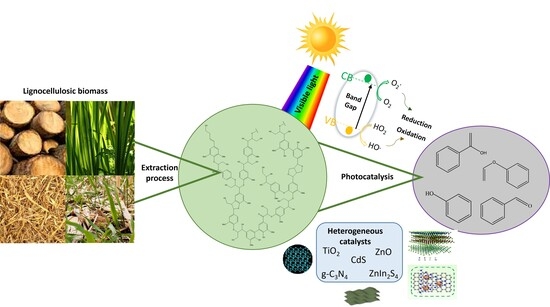
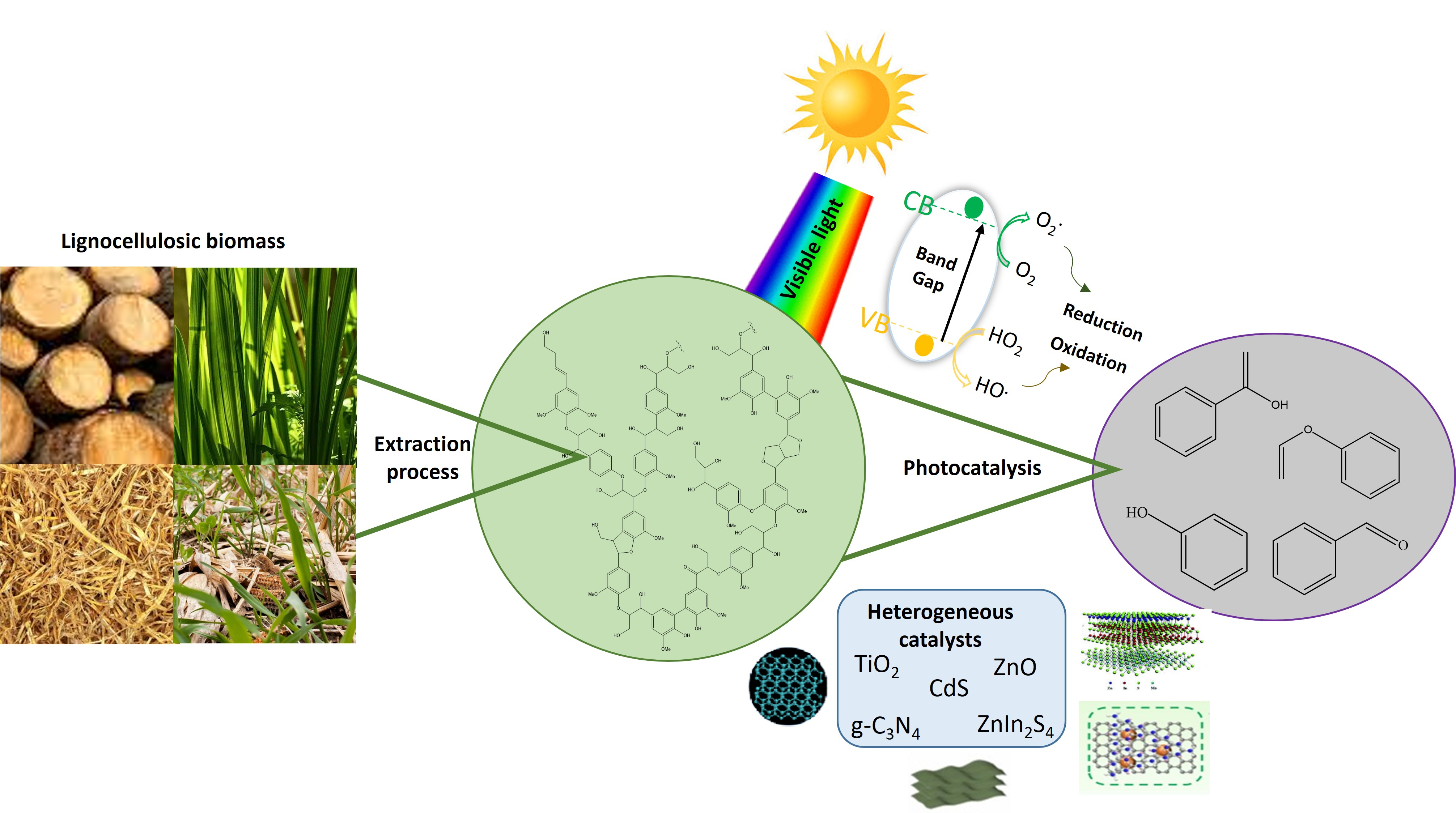
Graphical Abstract

1. Introduction

Over the last two centuries, the global population has experienced sustained growth and is projected to exceed 10 billion by the late 21st century, with continued expansion anticipated into the 2070s [1]. This demographic evolution has intensified urbanization, industrialization, and technological development, collectively driving a steady rise in global energy demand [2]. In this context, the U.S. Energy Information Administration projects that global primary energy consumption will increase by nearly 50% between 2020 and 2050 under a reference-case scenario, largely due to economic growth and rising living standards in non-OECD (Organisation for Economic Co-operation and Development) regions [3]. At present, fossil fuels remain the dominant energy source worldwide. However, their extensive use has led to severe environmental consequences, primarily through greenhouse gas emissions that accelerate anthropogenic climate change [4]. Numerous empirical studies have confirmed the strong correlation between population growth, increasing energy consumption, and rising CO2 emissions [5]. Moreover, fossil fuels are finite resources formed over geological timescales, and their continued exploitation raises critical concerns regarding long-term availability, price volatility, and energy security [6]. These challenges have stimulated global interest in sustainable and low-carbon energy alternatives. Among renewable options, biomass stands out due to its broad geographical availability and high annual global production [7]. Building on this potential, the biorefinery concept has been developed to enable the conversion of biomass into fuels, chemicals, and materials that can partially replace petroleum-derived feedstock [8]. When sustainably managed, biomass-based energy systems may offer reduced net greenhouse gas emissions, although rigorous carbon accounting is required to ensure genuine climate benefits [9].
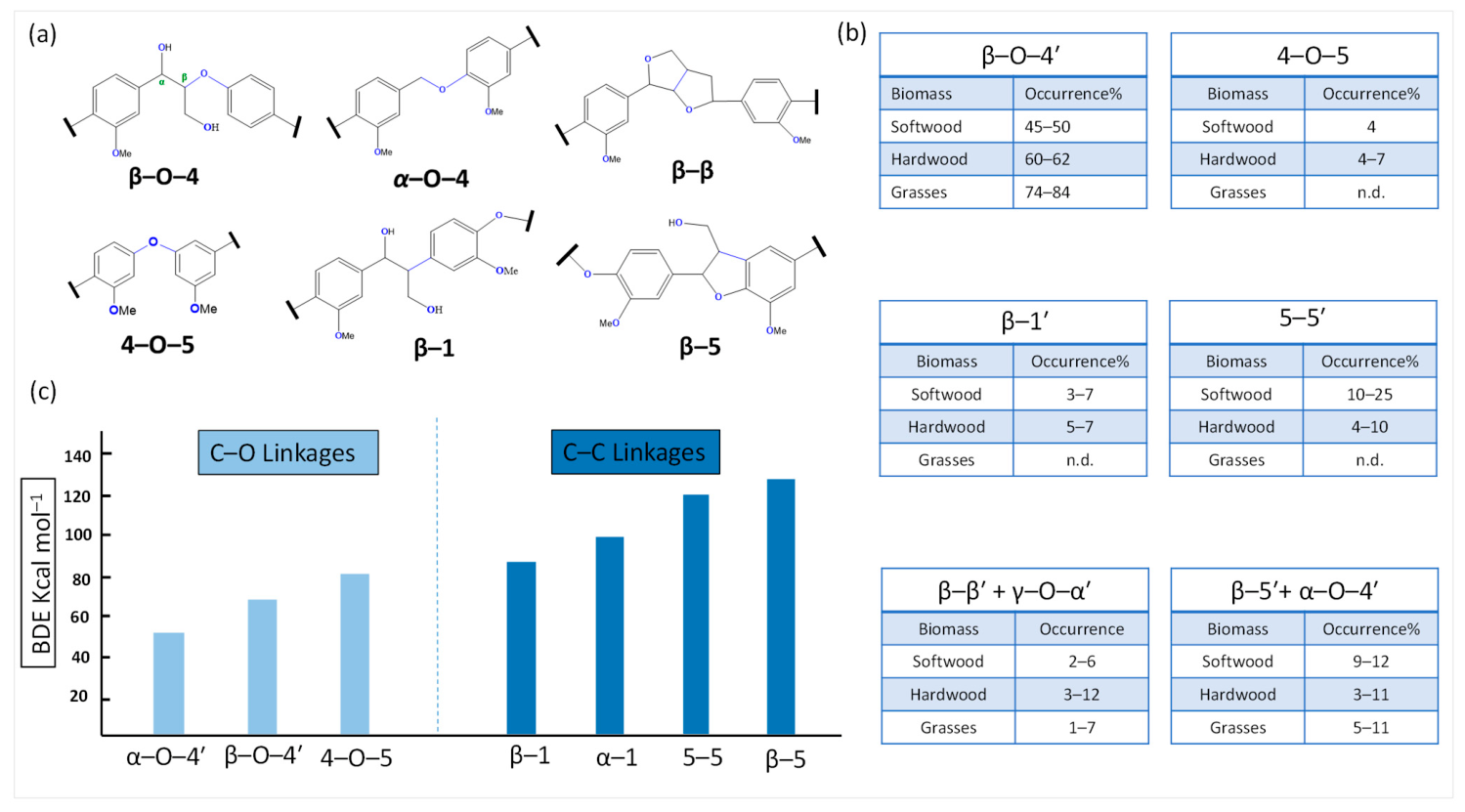
Lignocellulosic biomass has emerged as a particularly attractive biorefinery feedstock owing to its abundance, renewability, and non-food nature. It is primarily composed of cellulose (40–60 wt.%), hemicellulose (15–30 wt.%), and lignin (10–25 wt.%), with proportions varying depending on biomass species and origin [10]. Cellulose and hemicellulose are polysaccharides that can be hydrolyzed into fermentable sugars [11], enabling the production of bioethanol and key platform chemicals such as furfural, levulinic acid, and 5-hydroxymethylfurfural [12]. In contrast to the carbohydrate fractions, lignin is an amorphous and highly complex three-dimensional aromatic biopolymer whose exact native structure remains unresolved despite decades of intensive research [13]. Lignin is the most abundant renewable aromatic polymer on Earth, accounting for nearly 30% of global organic carbon, making it an attractive alternative to fossil-derived aromatics [14]. It has an intricate structure, which confers mechanical strength, hydrophobicity, and resistance to microbial degradation in plant cell walls [15]. It is generally described as a randomly cross-linked network composed of phenylpropanoid units bearing methoxyl, phenolic, aliphatic hydroxyl, and minor aldehyde functionalities, with its molecular architecture strongly influenced by plant species, growing conditions, extraction methodologies, and analytical techniques [16]. Lignin is biosynthesized via the enzyme-mediated radical coupling of three primary monolignols, namely p-coumaryl, coniferyl, and sinapyl alcohols, which respectively form p-hydroxyphenyl (H), guaiacyl (G), and syringyl (S) structural units that differ in the degree of aromatic methoxylation [17]. The relative abundance of H, G, and S units varies substantially among biomass types, with softwoods dominated by G units, hardwoods composed mainly of G and S units, and grasses exhibiting a more balanced distribution with elevated H-unit content, directly impacting the diversity and frequency of interunit linkages formed during polymerization [18]. These phenylpropanoid units are interconnected through a range of ether and carbon–carbon bonds (Figure 1), including β-O-4, α-O-4, β-β, β-5, 5-5, and β-1 linkages, whose formation is governed by radical reactivity and monolignol composition [19]. Among these, the β-O-4 ether linkage is the most prevalent, accounting for approximately 50–80% of all interunit bonds depending on biomass origin, and is characterized by comparatively low bond dissociation energy, making it the primary target in lignin depolymerization studies [20]. The significant variability in linkage distribution and bond strengths results in pronounced differences in lignin reactivity and physicochemical behavior, underscoring the need for detailed structure–property understanding to rationally design efficient and selective lignin valorisation strategies [21].
Industrially, the pulp and paper industry is the primary source of technical lignin, generating tens of millions of tons annually as a by-product [22]. Despite its increasing availability, approximately 98–99% of industrial lignin is currently combusted for low-value heat and power generation, while less than 2% is valorized into higher-value chemicals and materials [23]. This underutilization represents a major bottleneck in biorefinery economics and a significant missed opportunity for sustainable chemical production.
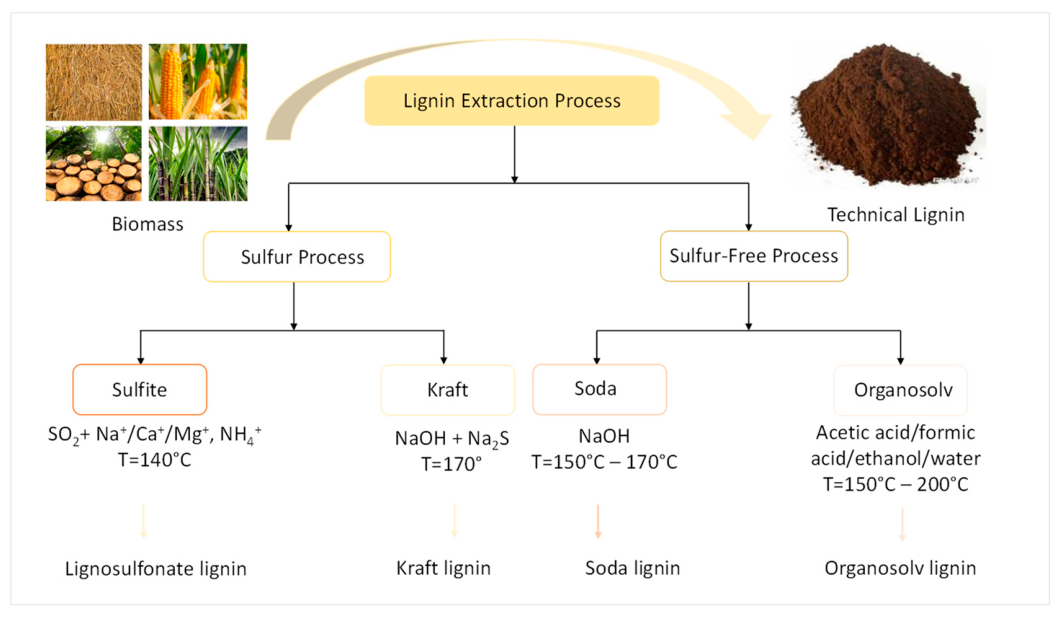
Consequently, lignin valorization has become a central research focus over the past decade. Numerous studies have demonstrated lignin’s potential as a renewable source of aromatic chemicals, fuels, and functional materials. Lignin can be extracted by different processes, among which chemical ones are the best-known and most widely applied. They can be classified into two different categories; sulfur-bearing and sulfur-free delignification processes (Figure 2) [24].
Maximizing lignin’s applications requires efficient extraction methods that preserve its native structure to the greatest extent possible with high purity. However, conventional lignin separation methods often induce changes in the macromolecular structure, affecting its properties such as molecular weight, polydispersity, purity, residual sugar, ash, and sulfur content. As summarized in Table 1, lignin composition is heavily dependent on the extraction method [25,26].
Among the different valorization strategies, depolymerization plays a key role by enabling access to low-molecular-weight aromatic products. These aromatic compounds are receiving a lot of attention for food applications such as natural antioxidants, antibacterial films, which can help alleviate oxidative stress-related diseases and limit the activity and growth of bacteria and fungi, respectively [27]. Conventional approaches for depolymerizing lignin, such as hydrogenolysis, oxidation, pyrolysis, and hydrolysis, have been extensively investigated [28]. However, many of these methods rely on harsh reaction conditions, high temperatures and pressures, large hydrogen inputs, or corrosive reagents, which limit their sustainability and industrial scalability [29].
In this context, solar-driven photocatalysis has emerged as a promising alternative for lignin conversion under mild conditions. Photocatalytic processes harness renewable solar energy to drive redox reactions at ambient temperature and pressure, offering advantages in terms of energy efficiency and selectivity [30]. More broadly, semiconductor photocatalysis has been successfully applied in green hydrogen production [31], air decontamination [32], and selective organic synthesis [33], providing a strong technological foundation.
More recently, photocatalysis has attracted increasing attention for lignin valorization. Photocatalytic systems enable the oxidative or reductive cleavage of lignin bonds under benign conditions, often in aqueous environments, while minimizing char formation and excessive mineralization [34]. Both homogeneous and heterogeneous photocatalytic systems have been explored; however, heterogeneous photocatalysts are generally favored because of their superior stability, reusability, and ease of separation [35].
Current research increasingly emphasizes the rational design of heterogeneous photocatalysts, focusing on catalyst composition, crystal structure, morphology, electronic properties, and surface chemistry to optimize lignin adsorption, charge separation, and reaction pathways [36]. Advanced characterization techniques and mechanistic studies have revealed that catalyst support interactions, defect engineering, and co-catalyst integration can strongly influence activity and product selectivity [37,38]. Apart from this, de Ghalta et al. (2024) also observed that operational parameters such as the reactor geometry, catalyst concentration, particle agglomerate size, pH, recycle flow rate and radiation wavelength could influence the number of photons absorbed by the photocatalyst and, consequently, their activity [39].
Despite substantial progress, major challenges remain in achieving high lignin conversion efficiencies, controlled product distributions, and long-term catalyst stability. Therefore, a systematic understanding of structure–property–performance relationships is critical to advancing photocatalytic lignin valorization toward industrial relevance [40]. Accordingly, this review provides a comprehensive overview of recent advances in heterogeneous photocatalytic lignin conversion, covering catalyst design strategies, reaction mechanisms, characterization approaches, and future perspectives for sustainable biorefinery applications.

2. An Overview of Photocatalysis

At the beginning of the 20th century, photochemistry emerged as a scientific discipline largely due to the pioneering work of Giacomo Ciamician, who is widely regarded as the father of modern photo chemistry. Already in the late 19th century and early 1900s, Ciamician systematically demonstrated that light could serve as a direct energy source to promote chemical transformations, independently of thermal activation [41]. His vision culminated in the famous 1912 lecture “The Photochemistry of the Future”, where he anticipated the large-scale utilization of solar energy to drive chemical reactions and produce fuels, concepts that underpin modern photocatalysis and artificial photosynthesis [41,42,43].
Despite these early insights, the explicit concept of catalysis assisted by light was formulated slightly later. In 1910, I. S. Plotnikow introduced the term photocatalysis in his seminal textbook, proposing that specific substances could mediate chemical reactions under illumination without being consumed, thus laying the conceptual foundation of photocatalytic processes [44]. Shortly thereafter, in 1911, Alexander Eibner provided the first experimental evidence of a photocatalytic effect by observing the photo bleaching of Prussian blue in the presence of zinc oxide (ZnO) under light irradiation [45]. In parallel, Bruner and Kozak reported the photodecomposition of oxalic acid in the presence of uranyl salts, an observation of major historical relevance as it marked the first appearance of the term photocatalysis in a scientific article title and contributed to the development of actinometry [46]. Following these pioneering studies, research activity remained limited for nearly a decade due to the absence of clear technological applications and the limitations of light sources and analytical tools. Interest was revived in the early 1920s when Baly and co-workers demonstrated the photocatalytic synthesis of organic compounds—including formaldehyde and carbohydrates—from CO2 and water under illumination, using inorganic catalysts [47]. Soon after, Baur and Perret showed that ZnO could photo reduce Ag+ ions to metallic silver under solar irradiation, establishing metal oxides as functional photocatalysts [48]. Additional milestones followed, such as the photocatalytic formation of hydrogen peroxide in aqueous ZnO suspensions and the photo reduction of noble metal salts (AgNO3 and AuCl3) over TiO2 and Nb2O5 surfaces in the late 1920s and early 1930s [49]. Nevertheless, practical applications remained marginal, and research activity declined again until the energy crises of the 1970s renewed interest in solar-driven chemical processes. A decisive breakthrough occurred in 1972, when Fujishima and Honda reported the photo electrochemical splitting of water using TiO2 electrodes under ultraviolet (UV) illumination, demonstrating direct solar-to-chemical energy conversion and inaugurating the modern era of photocatalysis [50]. This discovery triggered exponential growth in photocatalysis research, particularly in environmental remediation, solar fuels, and energy conversion. In 2011, the International Union of Pure and Applied Chemistry (IUPAC) formally defined photocatalysis as a process in which the rate of a chemical reaction is altered or initiated by light in the presence of a substance—photocatalyst—that absorbs light and actively participates in the chemical transformation of the reacting species [51]. Since then, the number of publications in the field has grown dramatically, exceeding several thousand articles per year and reflecting the central role of photocatalysis in addressing energy and environmental challenges [52].
Importantly, it should be emphasized that the vast majority of photocatalysis research conducted to date has focused on heterogeneous systems, in which solid semiconductors act as light-absorbing catalysts interfacing with liquid or gas-phase reactants. This predominance is largely due to the superior stability, recyclability, and industrial relevance of heterogeneous photocatalysts compared to homogeneous analogues [53]. Consequently, most published studies have concentrated on elucidating reaction mechanisms, charge-carrier dynamics, and surface chemistry in heterogeneous photocatalytic materials [54].

2.1. Emergence of Lignin Valorisation via Photocatalysis

The application of photocatalysis to lignin valorization is a comparatively recent development within the field. While thermal, chemical, and biological lignin depolymerization strategies dominated early biomass research, the first systematic studies employing photocatalysis to cleave lignin-derived C–O and C–C bonds began to appear in the late 2000s and early 2010s, motivated by the need for mild, selective, and energy-efficient biomass conversion routes [30,55]. Initial efforts focused primarily on model lignin compounds to elucidate reaction pathways under light-driven conditions. Significant progress was achieved during the 2015–2025 period, when heterogeneous semiconductor-based photocatalysts and visible-light-active systems were successfully applied to the depolymerization and selective functionalization of lignin models, and more recently, technical and native lignins [35,39]. Photocatalytic lignin valorization has since emerged as a promising strategy for producing renewable aromatic chemicals under environmentally benign conditions, positioning it as a key research direction within sustainable photocatalysis and biorefinery concepts.

2.2. Photocatalytic Mechanism in Heterogeneous Systems

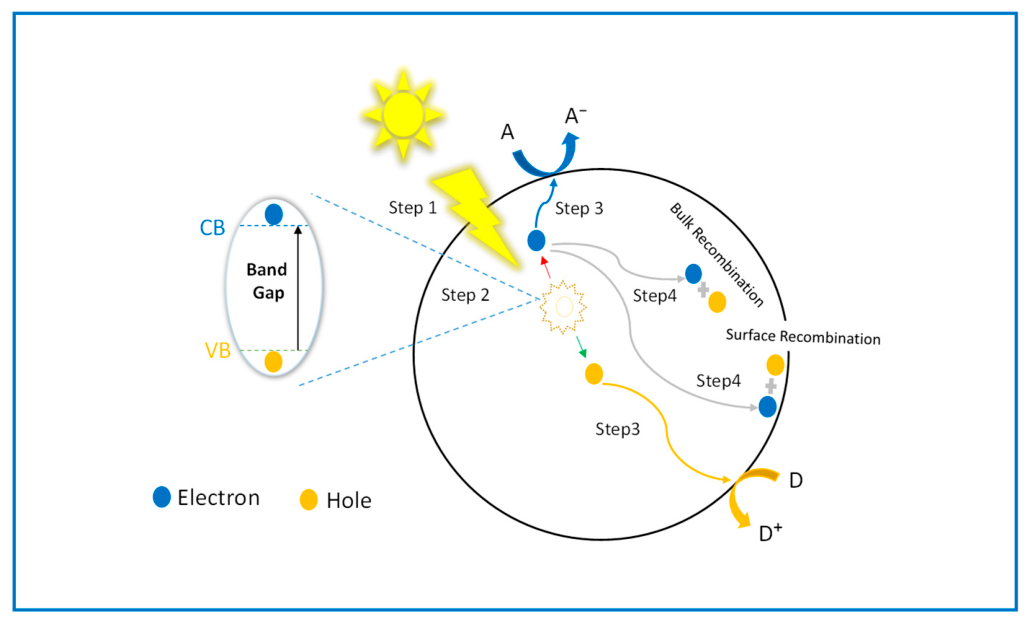
Heterogeneous photocatalysis relies on the ability of a solid semiconductor to absorb light and convert photon energy into separated charge carriers capable of driving surface redox reactions. Despite the diversity of photocatalytic materials and applications, a unified mechanistic framework has been established and is applicable to most semiconductor photocatalysts, as schematically illustrated in Figure 3 [56,57,58].
Step 1: Light Absorption and Charge Generation: as shown on the left side of Figure 3, when a semiconductor photocatalyst is irradiated with photons of energy equal to or greater than its band-gap energy, electrons are excited from the valence band (VB) to the conduction band (CB), generating free charge carriers: conduction-band electrons (e) and valence-band holes (h+) [59].
Step 2: Charge carrier Migration and Trapping: following excitation, the photogenerated electrons and holes can migrate through the bulk of the semiconductor or become trapped at defect sites, grain boundaries, or surface states, as depicted by Step 2 in Figure 3 [60]. This transport process is critical because only charge-carriers reaching the surface without recombination can participate in chemical reactions [61].
Step 3: Surface Redox Reactions: once charge carriers reach the surface (Step 3 in Figure 3), they can initiate interfacial oxidation and reduction reactions with adsorbed species. Conduction-band electrons typically reduce molecular oxygen to form superoxide radical anions (O2), while valence-band holes oxidize surface hydroxyl groups or water molecules to generate hydroxyl radicals (•OH) [62]. These reactive oxygen species (ROS) are highly non-selective and play a central role in photocatalytic degradation, organic transformations, and biomass valorization reactions [63,64,65].
Step 4: Charge Recombination Pathways: competing with productive surface reactions are various charge recombination processes, illustrated on the right side of Figure 3. These include bulk recombination within the semiconductor lattice and surface recombination involving adsorbed species or defects [66]. Because recombination dissipates the absorbed photon energy as heat or light, suppressing recombination through heterojunction formation, co-catalyst deposition, or defect engineering remains a primary design strategy in modern photocatalyst development [67,68,69].
The mechanistic sequence illustrated in Figure 3 has enabled application-specific refinements that go beyond generic photo-induced redox chemistry. Indifferent application, mechanistic studies have clarified how surface hydroxylation, defect-mediated charge trapping, and oxygen reduction pathways collectively control the generation rate and selectivity of reactive oxygen species, leading to catalyst designs that favor hole-driven oxidation over unproductive recombination processes [70]. More recently, lignin valorization research has leveraged this mechanistic understanding to tailor photocatalysts that promote controlled radical formation and selective C–O or C–C bond activation, shifting the role of photogenerated charge carriers from indiscriminate oxidants toward tunable reagents for biomass conversion chemistry [71,72].

3. Heterogeneous Photocatalysts for Lignin Valorization

3.1. Metal Oxide Semiconductors

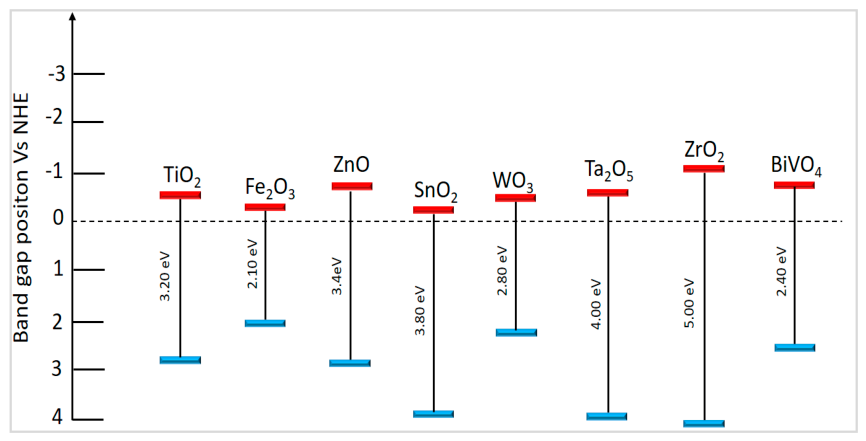
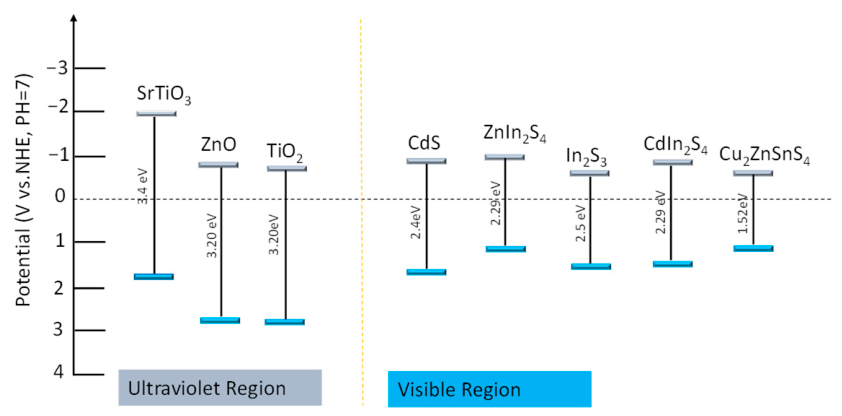
Since the 1970s, metal oxide semiconductors such as TiO2, ZnO, SnO2, and CeO2 have played a central role in heterogeneous photocatalysis due to their ability to generate reactive charge carriers under light irradiation and promote redox reactions at the solid–liquid interface [73,74,75,76]. Their chemical stability, earth abundance, comparatively low cost, and environmental compatibility [77], have made them benchmark materials across environmental remediation, solar fuels, and biomass conversion applications [36,78]. Despite sharing a common photocatalytic principle, metal oxides differ significantly in bandgap energy, as can be seen in Figure 4, band-edge positions, light absorption range, and redox potentials, which directly determine their suitability for specific reactions [79,80]. These differences are particularly relevant for lignin transformation, where selective bond cleavage rather than complete mineralization is desired.

3.2. Titanium Dioxide

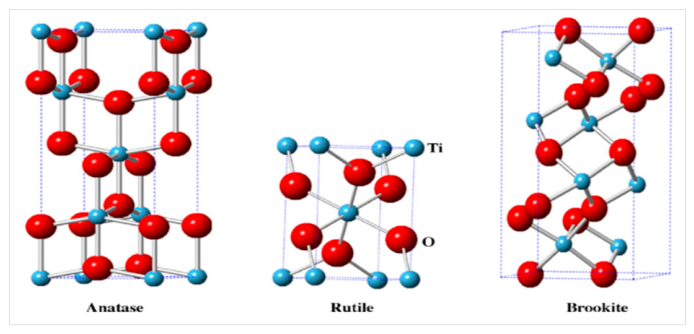
Among metal oxides, TiO2 remains the most extensively studied photocatalyst for lignin degradation and valorisation owing to its robustness, non-toxicity, low cost, andstrong oxidative capability under UV illumination [81,82]. Naturally occurring TiO2 exists in three polymorphs: anatase, rutile, and brookite, whose cristalline structure is shown in Figure 5. Differences in crystal structure led to distinct electronic properties and photocatalytic behaviour [83]. Anatase TiO2, which presents a bandgap of ~3.2 eV, as can be seen in Figure 4, is considered the most photocatalytically active phase due to its higher surface hydroxyl density, longer charge carrier lifetimes, and lower electron–hole recombination rate compared to rutile [84]. Rutile (bandgap ~3.0 eV) is thermodynamically more stable but typically less active, while brookite remains comparatively underexplored [84,85].
The first application of TiO2 in lignin photodegradation was reported by Kobayakawa et al. in 1989, demonstrating the conversion of Kraft lignin into CO2 and low-molecular-weight products under UV illumination [86]. Subsequently, Ksibi et al. showed that heterogeneous photocatalysis with TiO2 dramatically outperforms direct photolysis, achieving 56% lignin degradation compared to only 3.3% without the catalyst after 7 h of irradiation [87]. Beyond depolymerisation, TiO2-mediated photocatalysis enables partial lignin valorisation into aromatic compounds, by the cleavage of the β-O-4, which is the most abundant bond in lignins [88]. Prado et al. reported the formation of vanillin, syringaldehyde, and acetovanillone from organosolv lignin under UV irradiation, although prolonged irradiation favoured repolymerisation and reduced product yields [89]. Despite these promising results, pristine TiO2 suffers from intrinsic limitations:
(i)
its wide bandgap restricts absorption to UV light (~5% of the solar spectrum),
(ii)
rapid electron–hole recombination reduces quantum efficiency, and
(iii)
catalyst recovery and recyclability remain challenging in slurry systems. To address these limitations, extensive efforts have focused on TiO2 modification through metal doping, non-metal doping, and surface/interface engineering.

3.2.1. Metal-Modified TiO2

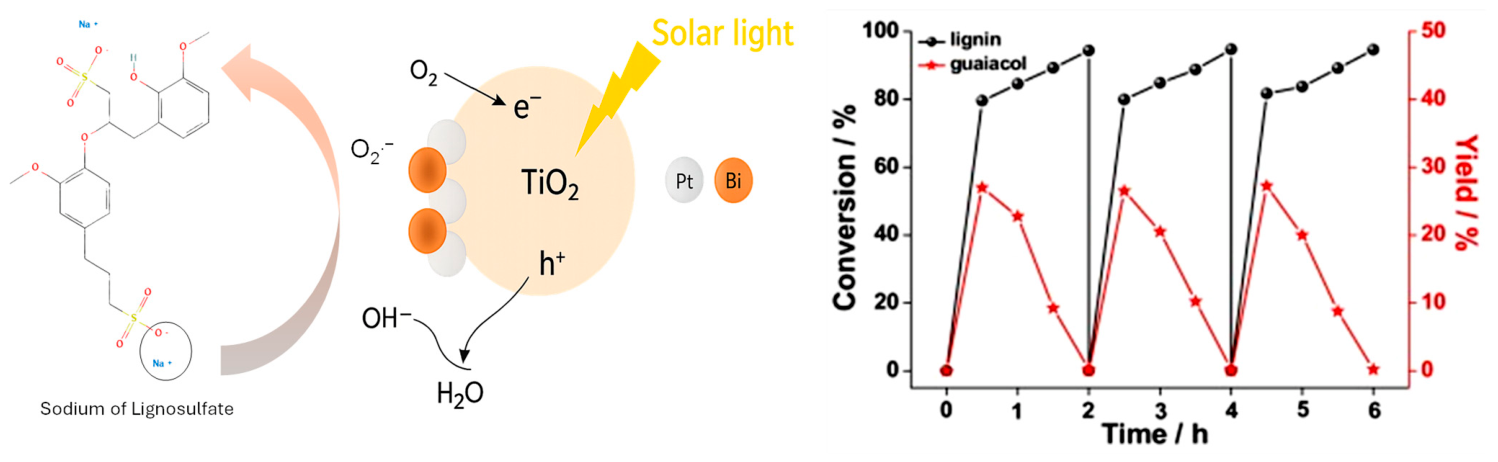
Noble and transition metals (e.g., Pt, Ag, Ni, Fe) act as electron sinks, improving charge separation and enhancing photocatalytic activity [86]. Cheng et al. demonstrated that 20 wt.% Ni/TiO2 achieved complete conversion of a β-O-4 lignin model compound, compared to only 56% conversion over pristine TiO2 under identical conditions [88]. Similarly, Ag-doped TiO2 showed improved degradation of native lignin, with Ag TiO2 sintered in air reaching a conversion of 33.82%, attributed to enhanced reactive oxygen species generation [90]. Binary metal systems can further improve selectivity. Gong et al. reported that Bi/Pt TiO2 enabled 84.5% lignosulphonate conversion within 1 h under solar-simulated irradiation, outperforming mono-metal and unmodified TiO2 catalysts, following the mechanism shown in Figure 6 [91].

3.2.2. Non-Metal-Doped and Carbon-Modified TiO2

Non-metal doping (N, C, S) introduces mid-gap states that enable visible-light absorption while avoiding noblemetal cost and photocorrosion issues [92]. N-doped TiO2 showed improved lignin degradation under both UV (~90%) and visible light (~35%), significantly surpassing pristine TiO2 [93]. Carbon-based modification using lignin itself as a dopant has also been explored. TiO2/lignin composites exhibit enhanced visible-light absorption and reduced charge carrier recombination, enabling partial lignin conversion to vanillin (1.09%) alongside ~40% total degradation [94].
A comparative summary of representative TiO2-based photocatalysts applied to lignin and lignin model compounds is provided in Table 2.

3.3. Other Metal Oxides: ZnO

ZnO is frequently considered a viable alternative to TiO2 due to its similar band structure, lower production cost, and higher electron mobility [99]. Kansal et al. reported that ZnO outperformed TiO2 in the UV-driven degradation of lignin obtained from rice straw [100]. However, ZnO remains limited by UV-only activation, photo corrosion in alkaline media, and chemical instability under acidic conditions [101]. Strategies such as nano structuring and hybridisation with reduced graphene oxide (rGO) have been employed to narrow the bandgap and enhance visible-light-driven lignin conversion [102,103].

3.4. Metal Sulfides

Metal sulfides represent a major class of inorganic photocatalysts that have attracted increasing attention as alternatives to conventional metal oxides, particularly for visible-light-driven applications. Their key advantage lies in their intrinsically narrow band gaps, typically below 3.0 eV, which enable the efficient absorption of photons over a wide spectral range extending from the near-ultraviolet to the visible and near-infrared regions (ca. 300–800 nm) [104,105,106]. This property allows metal sulfides to utilize a significantly larger fraction of the solar spectrum than traditional wide-band-gap metal oxides such as TiO2, which are mainly activated under ultraviolet irradiation [105]. As illustrated in Figure 7, the narrower band gaps of metal sulfides markedly enhance their ability to harvest visible light, which constitutes approximately 43% of the total solar energy reaching the Earth’s surface [107]. Consequently, metal sulfides have emerged as promising candidates for solar-energy-driven reactions, including photocatalytic fuel generation, environmental remediation, and biomass valorization [106,108,109].
Although naturally occurring sulfide minerals are abundant in the Earth’s crust, most photocatalytic investigations employ synthetically prepared metal sulfides to precisely control their crystal phase, morphology, particle size, and surface chemistry. A wide range of synthesis strategies has therefore been developed, including hydrothermal and solvothermal methods, chemical precipitation, microwave-assisted synthesis, ball milling, thermal decomposition of single-source precursors, exfoliation techniques, and electrochemical routes [106,108,109]. These efforts have led to the discovery and optimization of hundreds of sulfide-based materials. From a compositional standpoint, metal sulfides can be systematically classified into three major categories: (i) binary metal sulfides, containing one metal element and sulfur (e.g., CdS, ZnS, MoS2, WS2, PbS, NiS, FeS2, Cu2S, In2S3); (ii) ternary metal sulfides, composed of two metals and sulfur (e.g., ZnIn2S4, CdIn2S4, CuInS2, CuGaS2); and (iii) quaternary metal sulfides, incorporating three different metals (e.g., Cu2ZnSnS4) [108,109]. Bibliometric analyses reveal that the number of publications on metal sulfide photocatalysts has grown rapidly over the last decade, particularly after 2010, reflecting their growing significance in energy conversion and environmental applications [109]. This trend underscores the urgent demand for photocatalysts capable of efficiently utilizing visible light while maintaining stability and high catalytic activity.

3.4.1. Cadmium Sulfide

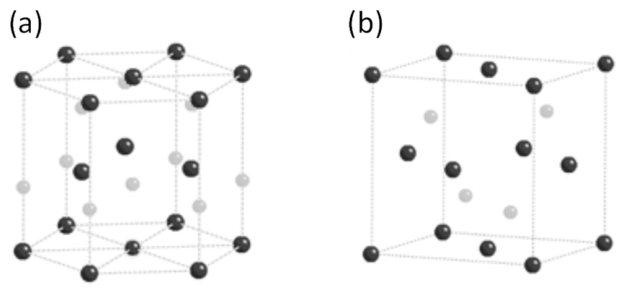
Among the various metal sulfides, cadmium sulfide is one of the most studied and widely applied photocatalysts. CdS possesses a direct band gap of approximately 2.4 eV, enabling strong absorption in the visible region and superior photoactivation compared with traditional oxide photocatalysts such as TiO2 [107,110,111]. Moreover, the optical, electronic, and catalytic properties of CdS can be readily tailored by controlling synthesis parameters, such as precursor composition, reaction temperature, crystallinity, particle size, and morphology [110,111]. From a crystallographic perspective, CdS mainly exists in two crystal phases: hexagonal wurtzite and cubic zinc blende structures, as shown in Figure 8 [112]. The wurtzite structure features a hexagonal close-packed arrangement with an ABAB stacking sequence, whereas the zinc blende phase adopts a cubic lattice with an ABC stacking sequence.
Comparative studies consistently demonstrate that wurtzite CdS exhibits higher structural stability and more favorable charge carrier transport than its cubic counterpart, resulting in enhanced photocatalytic performance [111,112]. Depending on the synthesis route employed, CdS can be prepared in a wide variety of dimensional architectures, including zero-dimensional quantum dots, one-dimensional nanorods and nanowires, two-dimensional nanosheets, and three-dimensional hierarchical structures [111]. These morphological variations strongly influence surface area, charge separation efficiency, and catalytic reactivity.
CdS-Based Photocatalysts for Lignin Model Compounds and Native Lignin
Cadmium sulfide has emerged as one of the most extensively investigated metal sulfide photocatalysts for lignin valorization, owing to its narrow band gap, strong visible-light absorption, and tunable electronic structure. Although CdS has long been studied in photocatalytic water splitting and organic transformations, its application in lignin depolymerization is recent and has rapidly evolved over the past decade. Since the pioneering work by Wu et al. in 2018, which first demonstrated visible-light-driven β-O-4 bond cleavage and native lignin valorization over CdS quantum dots [35], a growing number of studies have subsequently confirmed that pristine and modified CdS-based photocatalysts enable efficient and selective lignin depolymerization under mild conditions [113,114,115,116]. Table 3 summarizes the most relevant studies investigating the use of CdS-based photocatalyst used for lignin valorization.
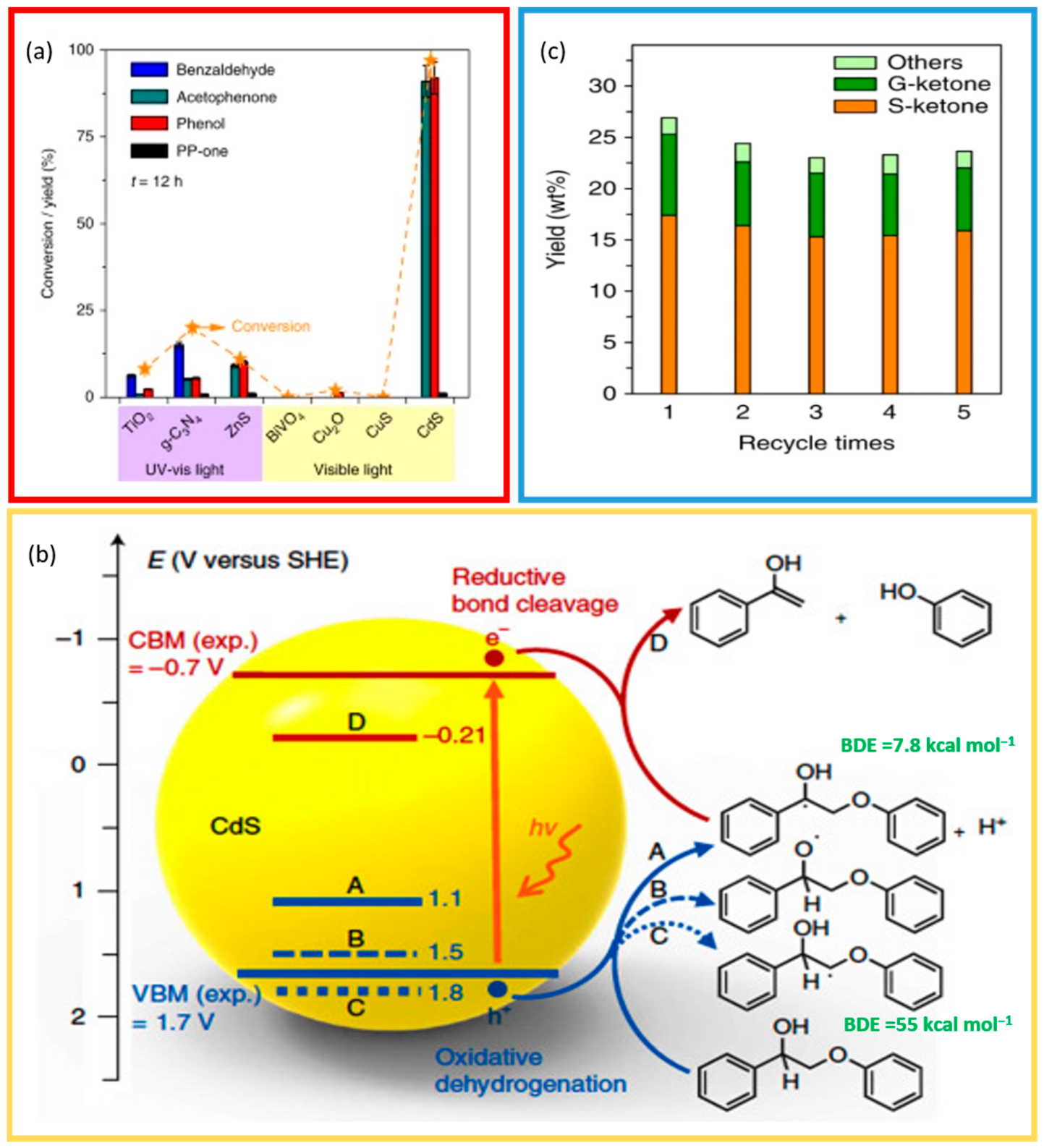
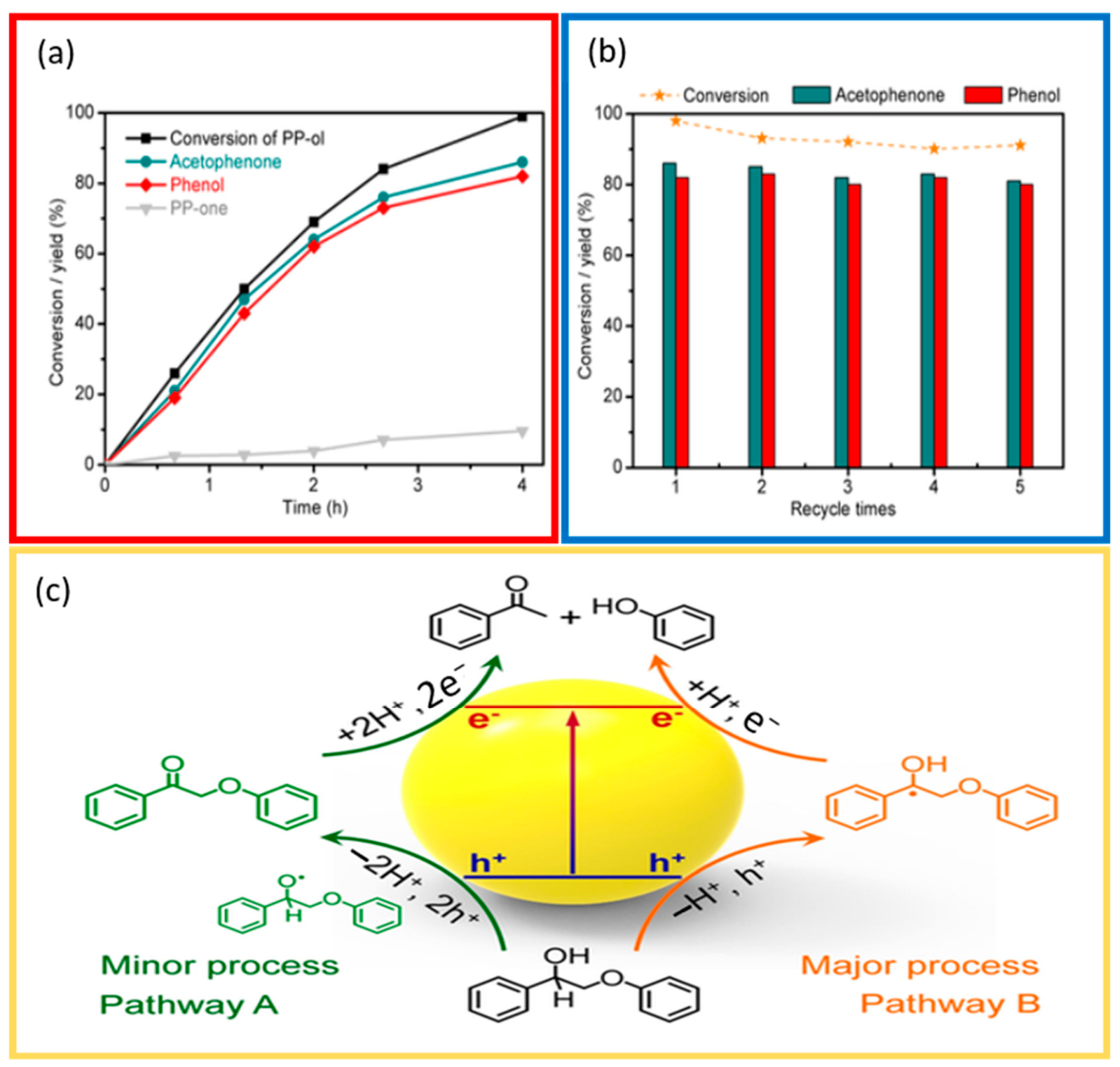
Wu and co-workers [35] systematically compared CdS nanoparticles (20–40 nm) with a zinc blend structure with other typical semiconductors—including g-C3N4, Cu2O, BiVO4, TiO2, ZnS, and CuS—for the photocatalytic cleavage of 2-phenoxy-1-phenylethanol (PP-ol), a representative lignin β-O-4 model compound (Figure 9).
Figure 9 collectively demonstrates why CdS quantum dots constitute a benchmark photocatalyst for lignin β-O-4 bond cleavage. As shown in Figure 9a, CdS outperforms a series of representative semiconductors in the photocatalytic conversion of a lignin model compound, confirming its favorable band-edge alignment and redox capability under visible light. They also observed that the particle size strongly influenced the activity of the photocatalyst, exhibiting the CdS quantum dots’ dramatically enhanced activity compared to larger nanoparticles, highlighting the critical role of quantum confinement in tuning charge carrier energetics and suppressing recombination. To rationalize this behavior, an electron–hole coupled oxidation (EHCO) mechanism is proposed (Figure 9b), in which photogenerated holes initiate oxidative activation of the β-O-4 linkage while electrons drive the subsequent reductive C–O bond cleavage. This mechanism underscores the cooperative involvement of both charge-carriers in lignin depolymerization. Finally, Figure 9c confirms the recyclability and operational stability of the CdS quantum dots, reinforcing their potential for sustainable lignin valorization.
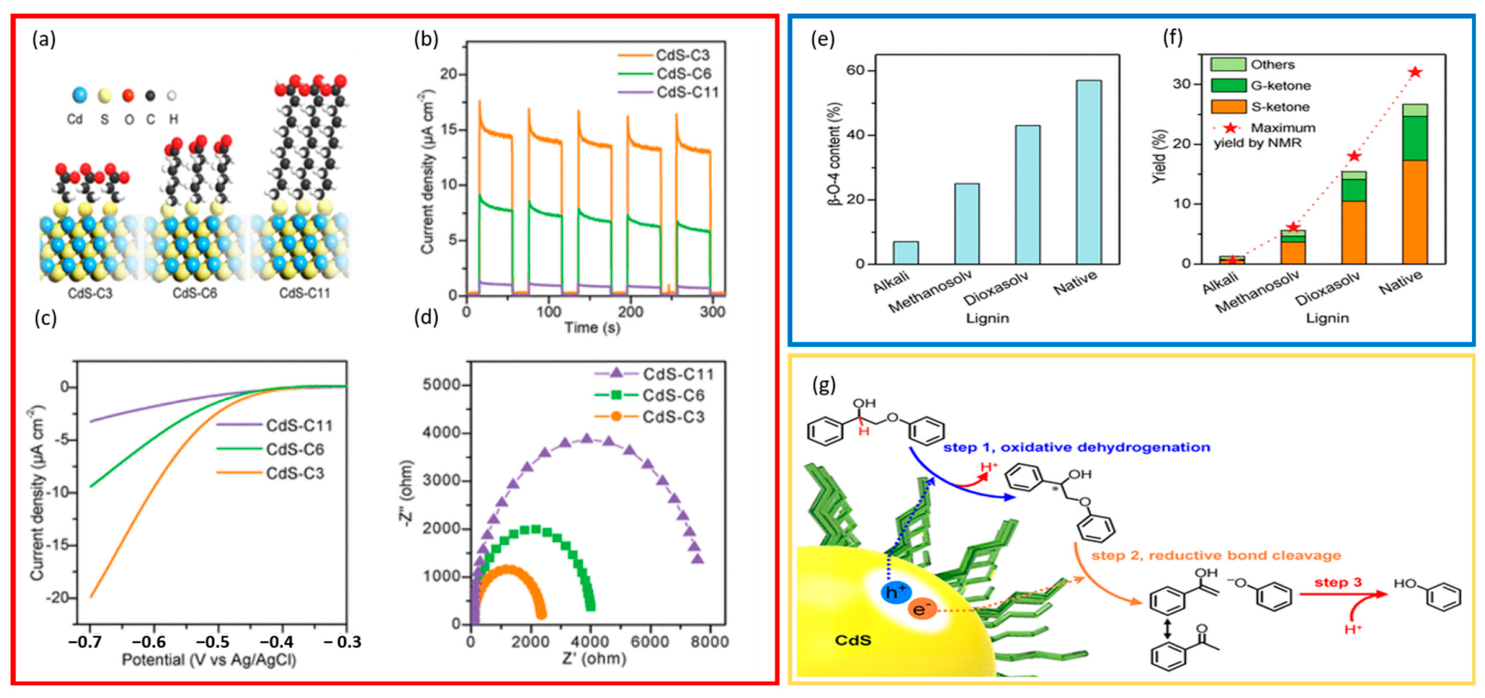
Photoinduced holes abstract hydrogen atoms from the Cα–H, Cβ–H, or O–H positions, generating radical intermediates. The resulting Cα radical substantially lowers the Cβ–O bond dissociation energy, allowing subsequent reductive cleavage by photogenerated electrons to yield phenol and acetophenone as dominant products. To address mass-transfer limitations associated with solid native lignin, CdS quantum dots were functionalized with hydrophilic ligands, such as 3-mercaptopropionic acid, to produce stable colloidal dispersions. This strategy enabled effective interaction with native lignin in lignocellulosic biomass, yielding up to 27 wt.% aromatic monomers from birch lignin under mild conditions. Subsequent studies systematically demonstrated that ligand physicochemical properties—including hydrophilicity, alkyl-chain length, and electronic coupling—play a decisive role in charge transfer and catalytic efficiency (Figure 10) [113].
Figure 10 elucidates the decisive role of surface-ligand engineering in governing the photocatalytic performance of CdS quantum dots for lignin valorization. Figure 10a schematically illustrates the structure of CdS-Cx quantum dots functionalized with mercaptoalkanoic acid ligands of different alkyl-chain lengths, providing a defined platform to probe ligand effects on charge transfer. Transient photocurrent measurements shown in Figure 10b reveal that shortening the ligand chain substantially enhances the photocurrent response, indicating the more efficient migration of photogenerated electrons. Consistently, Figure 10c,d demonstrate that CdS-C3 exhibits the most favorable charge-transfer kinetics and lowest interfacial resistance among the tested catalysts, confirming that short, hydrophilic ligands minimize the electronic barrier between the CdS core and the reaction medium.
Extending these characteristics to lignin conversion, Figure 10e highlights the varying content of β-O-4 linkages in different lignin feeds, while Figure 10f correlates this structural feature with aromatic monomer yields achieved over CdS-Cx catalysts, underscoring the dependence of depolymerization efficiency on both catalyst design and lignin structure. Finally, Figure 10g presents a ligand-mediated EHCO mechanism, demonstrating that appropriate surface ligands not only improve catalyst dispersion but also actively participate in charge transfer during β-O-4 bond cleavage.

3.4.2. Electronic and Interfacial Engineering of CdS Photocatalysts

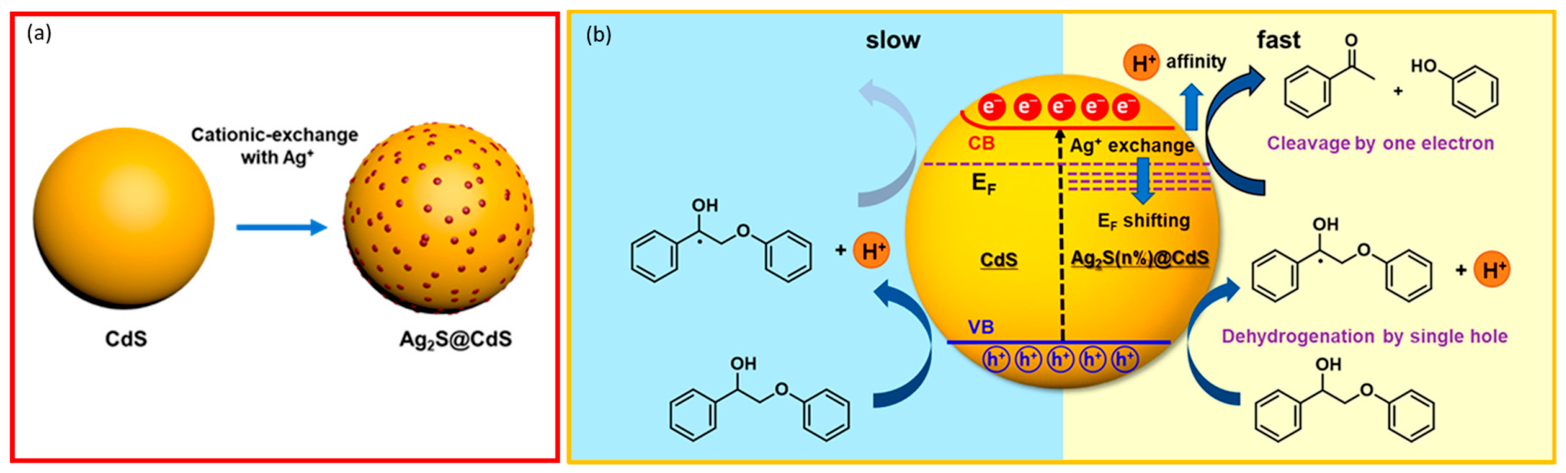
Beyond surface functionalization, electronic structure modulation has proven to be an effective strategy for improving CdS photocatalysts. Yoo et al. reported the synthesis of Ag2S@CdS heterostructures via cation exchange, in which surface-deposited Ag2S altered the Fermi level and facilitated charge separation [114]. The optimized Ag2S(2%)@CdS composite exhibited nearly quantitative PP-ol conversion within 3 h and retained >90% activity over multiple cycles.
Figure 11 illustrates how electronic structure modulation through heterostructure formation enhances the photocatalytic performance of CdS for lignin model compound conversion. Figure 11a schematically depicts the cation exchange process used to deposit Ag2S onto CdS nanoparticles, producing Ag2S@CdS composites with intimate interfacial contact. They also observed that increasing the Ag2S content progressively shifts the valence band edge and lowers the Fermi level, evidencing electronic structure reconfiguration that favors charge separation and electron transfer. These changes translate directly into catalytic performance, with it being observed that Ag2S(2%)@CdS achieves nearly complete β-O-4 bond cleavage of the lignin model compound within short irradiation times, outperforming pristine CdS, Ag2S alone, and their physical mixture. It also presents excellent stability, with activity retained over multiple cycles. Mechanistically, Figure 11b indicates that Ag2S promotes the rapid transfer of photogenerated electrons, facilitating reductive Cβ–O bond cleavage via radical intermediates.
Furthermore, ultrathin metal/CdS (M = Fe, Mn, Co, Cu, Ni) systems prepared via chemical reduction displayed solvent-dependent product selectivity. In particular, Ni/CdS exhibited outstanding activity and tunable selectivity toward oxidation, hydrogenolysis, or coupled reactions depending on solvent composition and pH. Han et al. (2019) prepared ultrathin Ni-decorated CdS nanosheets, in which evenly dispersed Ni nanoparticles were supported on few-layer CdS, providing abundant interfacial active sites [115]. They observed that Ni/CdS exhibits markedly different selectivity depending on solvent composition: in pure acetonitrile, oxidative pathways dominate, whereas the presence of water or alkaline additives suppresses hydrogen evolution and promotes selective Cβ–O bond hydrogenolysis to phenol and acetophenone. These results demonstrate that surface Ni species act as electron sinks and hydrogen reservoirs, while the solvent environment regulates proton availability and charge consumption.

3.5. Zinc Indium Sulfide (ZnIn2S4): A Ternary Metal Sulfide Photocatalyst

Compared with binary metal sulfides, ternary metal sulfides often exhibit superior photocatalytic activity due to their adjustable band structures, improved charge separation, and enhanced stability. Among them, zinc indium sulfide (ZnIn2S4) has emerged as a particularly promising visible-light-responsive photocatalyst, owing to its high absorption coefficient, favorable band-edge positions, good photostability, relatively low toxicity, and abundance of constituent elements [117].
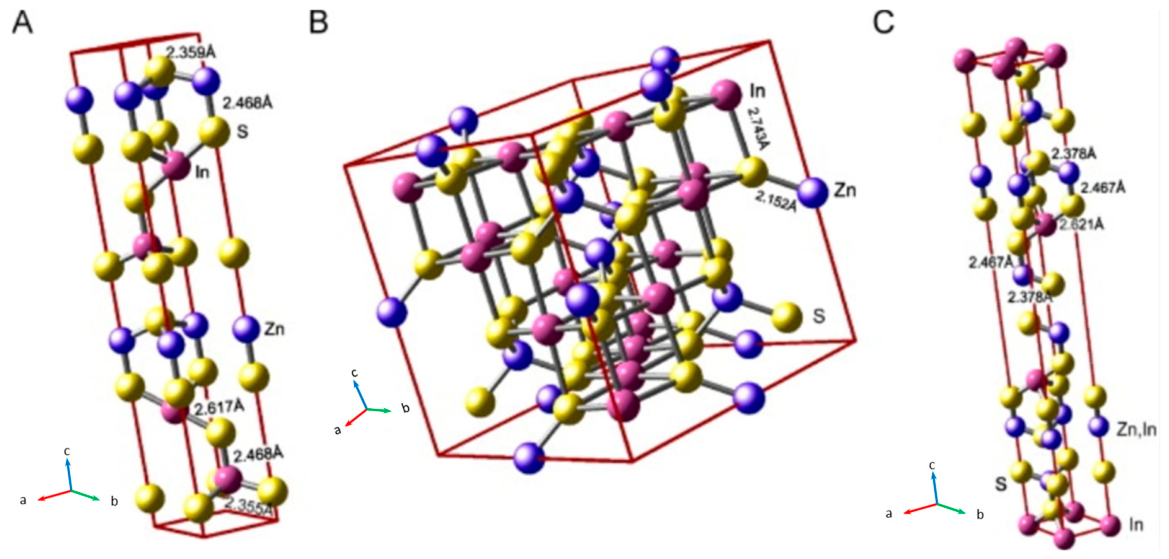
ZnIn2S4 exhibits a valence band maximum around +1.48 eV and a conduction band minimum near −0.76 eV (vs. NHE), rendering it thermodynamically suitable for driving both oxidation and reduction reactions under visible-light irradiation [118]. Moreover, ZnIn2S4 exists in multiple crystal phases—hexagonal, cubic, and rhombic—each associated with distinct electronic and transport properties (Figure 12) [119].
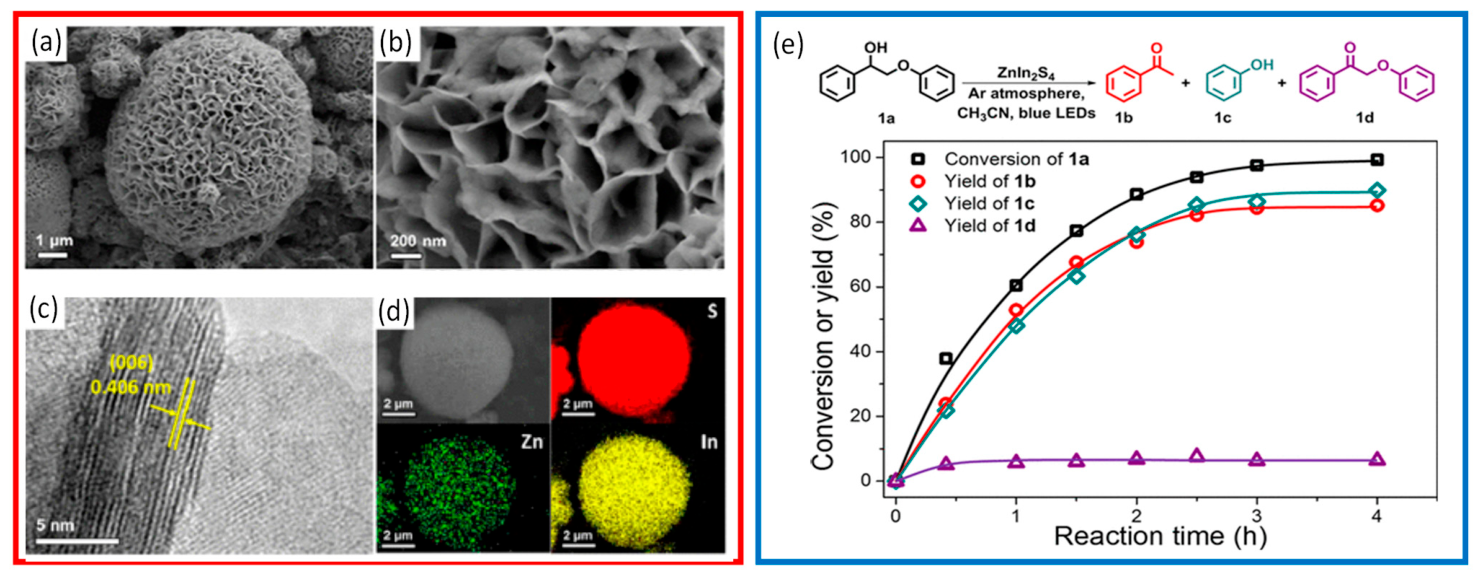
The first application of ZnIn2S4 in lignin valorization was reported in 2017, demonstrating efficient visible-light-driven β-O-4 bond cleavage through a self-hydrogen transfer mechanism [118]. Since this initial demonstration, a variety of ZnIn2S4-based photocatalysts have been developed using strategies such as compositional modulation, band structure engineering, doping, and defect introduction to further enhance activity and selectivity toward lignin valorization (Table 4). The key structural features, optical properties, reaction performance, and mechanistic insights of this ZnIn2S4 photocatalytic system are presented in Figure 13.
Figure 13 illustrates the preparation, characterization, photocatalytic performance, and mechanistic interpretation of ZnIn2S4 for lignin model compound and native lignin conversion. Figure 13a–c show that the hydrothermally synthesized ZnIn2S4 exhibits a porous micro spherical morphology with a well-defined hexagonal crystal structure, as confirmed by SEM and HRTEM analyses. The elemental mapping in Figure 13d demonstrates the homogeneous distribution of Zn, In, and S, confirming successful synthesis with near-stoichiometric composition. The photocatalytic results in Figure 13e show efficient β-O-4 bond cleavage of the lignin model compound, yielding acetophenone and phenol as major products.
Subsequent work focused on band engineering through stoichiometric control, leading to ZnmIn2Sm3 materials with tunable redox potentials. Among these, Zn4In2S7 demonstrated optimal activity during the depolymerization of lignin models due to balanced light absorption and redox capability [120]. Figure 14 illustrates the band structure engineering strategy applied to ZnmIn2Sm3 (m = 1–6) photocatalysts and its impact on lignin β-O-4 bond cleavage.
Lin et al. (2019) formed this type of photocatalyst by a hydrothermal synthesis route and, in order to tune the catalyst composition, they controlled the Zn/In ratio [120]. They also observed that increasing the value of m in ZnmIn2Sm3 (m = 1–6) photocatalysts systematically shifts the conduction band to more negative potentials while moving the valence band to higher oxidative potentials, enabling the fine regulation of redox capability under visible light. The resulting photocatalytic performance in lignin depolymerization is presented in Figure 14a, where Zn4In2S7 exhibits the highest activity due to its optimal band alignment for cooperative oxidation–reduction reactions. Figure 14b confirms acceptable stability over consecutive catalytic cycles, while Figure 14c illustrates the proposed mechanism, emphasizing the role of surface generated sulfur species in facilitating Cα–H activation and subsequent β-O-4 bond cleavage of the lignin model.
Additional strategies—including transition-metal doping, sulfur-vacancy engineering, and alkaline reaction environments—have further improved ZnIn2S4-based photocatalysts. The controlled introduction of sulfur vacancies enhanced electron trapping, promoted charge separation, increased surface area, and enabled lignin depolymerization efficiencies exceeding 80% [122].

3.6. Carbon Based Materials as Metal Free Photocatalysts

The rapidly increasing demand for metals in infrastructure development, renewable energy technologies, and transportation has raised concerns regarding the long-term sustainability of metal dependent materials due to the finite nature of mineral resources [123,124]. This scenario has intensified interest in the development of metal-free photocatalysts, particularly those derived from earth-abundant elements.
Carbon, being one of the most abundant elements on Earth, offers a compelling foundation for the design of sustainable and environmentally benign photocatalytic materials [125]. Carbon-based materials have therefore emerged as promising alternatives to inorganic metal-based semiconductors. In particular, carbon nanomaterials (CNMs) have attracted substantial attention owing to their tunable electronic structure, excellent chemical stability, high electrical conductivity, photoluminescence, and low toxicity [125,126,127].
These features have enabled their application in diverse fields, including photocatalysis, solar cells, batteries, supercapacitors, and environmental remediation [126,127].

3.6.1. Classification and General Properties of Carbon Based Photocatalysts

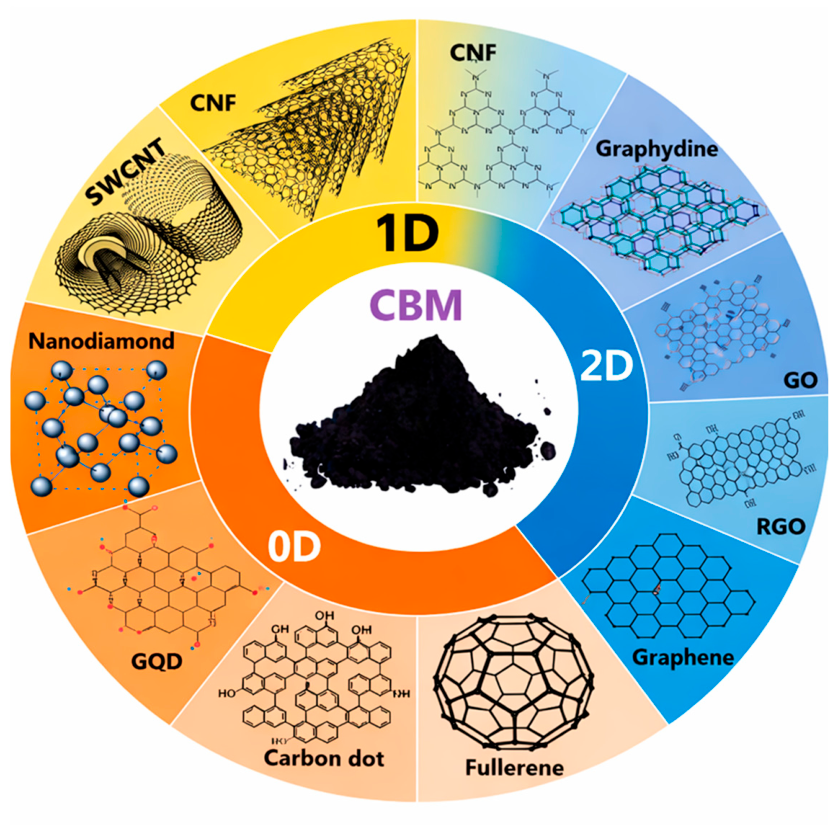
Based on their dimensionality, carbon nanomaterials can be classified into zero-, one-, and two-dimensional structures, as schematically illustrated in Figure 15. Zero-dimensional materials include fullerenes, carbon dots (CDs), graphene quantum dots (GQDs), and nanodiamonds; one-dimensional materials comprise carbon nanotubes (single and multi-walled) and carbon nanofibers; meanwhile, two-dimensional materials encompass graphene, graphene oxide (GO), reduced graphene oxide (rGO), graphdiyne, and graphitic carbon nitride (g-C3N4) [128].
Despite structural diversity, these carbon allotropes share several advantageous characteristics, including facile synthesis, robust thermal and chemical stability, high charge carrier mobility, and strong light absorption [124,125,126]. Compared with conventional inorganic semiconductors, carbon-based materials are generally non-toxic and environmentally benign, stemming from their metal-free nature [129]. Their intrinsic π conjugated frameworks also enable efficient charge delocalization and electron storage behavior, prolonging charge-carrier lifetimes and enhancing photocatalytic performance [127]. Moreover, their structures can be readily modified through heteroatom doping, defect engineering, or surface functionalization to tailor catalytic activity toward specific reactions [126].

3.6.2. Graphitic Carbon Nitride (g-C3N4): Structure, Properties, and Photocatalytic Potential

Among carbon-based photocatalysts, graphitic carbon nitride (g-C3N4) is the most extensively studied metal-free semiconductor. Its photocatalytic potential was first reported in 2009, when Wang et al. demonstrated visible-light-driven water splitting using polymeric g-C3N4, establishing it as a new generation of metal free photocatalysts [130]. Since then, g-C3N4 has become a benchmark material in photocatalysis due to its moderate band gap (~2.7 eV), enabling visible light absorption up to ~460 nm [131,132,133]. It can be synthesized inexpensively from nitrogen rich, earth-abundant precursors, and exhibits suitable conduction and valence band positions to drive a variety of redox reactions [131,132,133,134]. In addition, g-C3N4 is thermally stable up to ~600 °C, chemically inert in most solvents, and exhibits excellent environmental compatibility and low toxicity [135]. Structurally, g-C3N4 is composed primarily of carbon and nitrogen with trace hydrogen. Its framework is built from tri-s-triazine (heptazine) units connected via amino groups, forming a two-dimensional layered structure stabilized by van der Waals interactions. This graphitic phase is considered the most thermodynamically stable allotrope of polymeric carbon nitride under ambient conditions [136].
Synthesis of g-C3N4
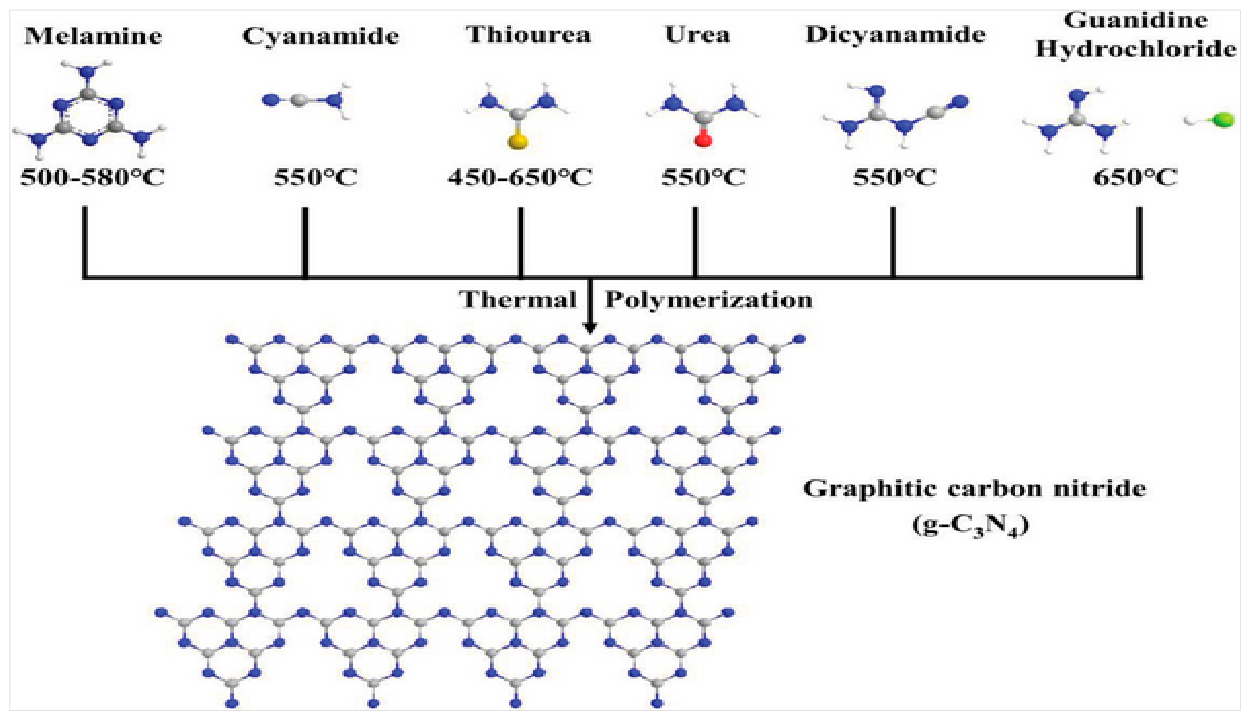
To date, several synthesis routes have been developed, among which thermal condensation is the most widely employed. In this approach, rich nitrogen precursors such as melamine, dicyandiamide, cyanamide, urea, or thiourea are polymerized at elevated temperatures to yield bulk g-C3N4. The diversity of precursors and processing conditions enables control over morphology, crystallinity, and defect density, as schematically shown in Figure 16 [137].
The crystallinity and structural order of g-C3N4 strongly influence its optical and electronic properties. By tuning synthesis parameters such as precursor type, heating rate, calcination temperature, and time, the density of defects and degree of polymerization can be optimized for targeted photocatalytic applications [135].
g-C3N4 in Lignin Photocatalytic Valorization
Although g-C3N4 exhibits many favorable properties, pristine bulk g-C3N4 suffers from several intrinsic limitations, including low specific surface area (~10 m2 g−1), insufficient light absorption in the blue violet region, limited active sites, and the rapid recombination of photogenerated charge carriers [135,136,137,138]. Consequently, significant research efforts have focused on structural and electronic modifications to enhance its photocatalytic efficiency. Table 5 highlights representative examples of modified g-C3N4 systems, illustrating how porosity engineering, defect introduction, and surface modulation significantly enhance lignin depolymerization efficiency and product selectivity.

3.7. Structural Engineering Strategies and Mechanistic Insights

In their pioneering study, Liu et al. synthesized mesoporous g-C3N4 (mpg g-C3N4) via controlled urea condensation, achieving substantially higher photocatalytic activity compared with conventional bulk g-C3N4 [139]. They observed that the increased surface area and reduced charge carrier recombination rate of mpg g-C3N4 directly correlate with improved lignin model compound conversion.
Subsequent studies have demonstrated that defect engineering, including cyano group introduction, sulfur doping, nitrogen vacancies, and oxidative etching, further improves photocatalytic performance by enhancing light absorption, charge separation, and active site density [141]. Mechanistic investigations consistently suggest that photogenerated holes initiate hydrogen abstraction at benzylic positions, while electrons reduce molecular oxygen to reactive oxygen species that mediate C–C bond cleavage through radical pathways.
Advanced modification strategies, such as water assisted synthesis, multi-step calcination, and atmosphere controlled thermal treatments, enable fine control over electronic structure and defect distribution, ultimately leading to higher lignin conversion efficiencies and improved catalyst stability [140,141,142]. Liu et al. (2018) carried out the first comprehensive study employing mesoporous g-C3N4 for visible-light-driven lignin model conversion [139]. They observed the synthesized g-C3N4 revealing a porous micro spherical architecture and a well-defined layered framework that enhances substrate accessibility. Elemental mapping analysis confirms the homogeneous distribution of carbon and nitrogen, indicative of a structurally uniform polymeric network. They also observed that this photocatalyst presents a suitable band gap and strong visible light absorption, explaining the efficient photoexcitation under mild irradiation conditions. The photocatalytic results highlight high conversion of the β-O-4 lignin model compound into aromatic products. According to them, the depolymerization of the lignin models takes place via a self-hydrogen transfer mechanism, in which photogenerated holes initiate dehydrogenation at benzylic positions while accumulated hydrogen species participate in subsequent reductive bond cleavage.
Beyond g-C3N4, other organic and polymeric photocatalysts are being explored for lignin valorization; however, g-C3N4 remains the most mature and versatile metal-free platform due to its tunability, stability, and scalability [144]. Continued advances in defect engineering, heterostructure construction, and mechanistic understanding are expected to further enhance its role in sustainable biomass conversion.

4. Strategic Outlook for Photocatalytic Lignin Valorization

Although the valorization of lignin by heterogeneous photocatalysis offers promising prospects for the production of high-value aromatic compounds, its exploitation remains largely confined to the laboratory scale. To date, no pilot-scale or industrial deployment has been recorded, highlighting the complexity of scaling it up. The development of a viable and economically competitive technology that could be scaled up relies on solving three interconnected scientific and technological challenges: at the molecular level, optimizing the solubility of lignin and the adequacy of the solvent; at the operational level, ensuring the efficient recyclability of the photocatalyst and ensuring its sustainability; and at the reactor level, rigorous mathematical modeling of the physical phenomena inherent in scaling up.

4.1. Optimization of Lignin Solubility

Developing an economically viable and industrially transferable lignin valorization process requires prioritizing eco-responsible and green reaction media such as water. However, the intrinsic recalcitrance of lignin and its hydrophobicity constitute a major technological hurdle, preventing its efficient dissolution in pure water [145]. Consequently, achieving the homogeneous dispersion of lignin within conventional aqueous phases remains a particularly challenging endeavor. The low solubility of the biopolymer due to its recalcitrant structure leads to insufficient mass transfer and light distribution in the photocatalytic conversion process. As a result, the reaction performance could be significantly worsened by the presence of the suspended lignin substrate; on the one hand, this is because the suspended biomass scatters penetrating light, causing turbidity that hinders light penetration into the reactor and photon absorption by the catalyst [146]. On the other hand, this is because the interaction between the photocatalysts and lignin complex network could be inhibited [146].
This limitation has historically forced researchers to use mixed aqueous–organic systems, such as CH3CN/H2O [94], or to resort to organic solvents such as i-PrOH or CH3CN. The ideal solvent to perform the photocatalytic depolymerization of lignin must ensure the homogeneous dispersion of the biopolymer so that the reaction proceeds uniformly throughout the entire volume of the reactor, so it has to several rigorous criteria [30]:
(a)
Possess a high solubilization capacity for the various lignin fractions;
(b)
Not act as an optical filter or as a scavenger of photogenerated charge carriers;
(c)
Exhibit total chemical inertness to prevent corrosion of the reactor walls;
(d)
Be economical, bio-based/non-toxic, and easily recyclable.
Reconciling these requirements is one of the major obstacles to the industrial scale-up of the process. While the organic co-solvents can circumvent solubility constraints, they seriously compromise the overall environmental impact, since under highly oxidizing photocatalytic conditions, these solvents undergo oxidative degradation, which can generate highly toxic byproducts such as nitrogen oxides (NOx) and hydrogen cyanide (HCN) [147]. Consequently, the development of green solvent systems capable of effectively breaking the hydrophobic interactions of lignin, facilitating intimate contact of the photocatalyst with the complex network lignin, and improving the catalyst’s access to lignin bonds, without compromising operational safety or the energy efficiency of the process, is still a need.

4.2. Suitability of the Photocatalyst

Apart from selecting the adequate solvent, the industrial-scale implementation of photocatalytic lignin conversion also depends on the photocatalytic material itself. For instance, metal oxides, such as TiO2 and ZnO, present limited solar-light utilization since they are predominantly active under ultraviolet irradiation [100]. The metal sulfides, on the other hand, present extended activity in the visible region, but they present high toxicity and they suffer from photocorrosion, induced by the photogenerated holes [109]. Addressing these limitations through the development of visible- and near-infrared-responsive, earth-abundant photocatalysts and through process-intensified photoreactor concepts will be essential to render photocatalytic lignin valorization competitive within a sustainable biorefinery framework [30,124].
To solve this challenge, advances in material modification and reaction system intensification have been carried out, which have significantly improved catalytic performance compared to early studies in this field. Nevertheless, in most of the studies the photocatalysts used are not commercially available and are generally synthesized on a laboratory scale. However, for a process to be applicable on a large scale, photocatalytic materials must be available in sufficient quantities. Thus, from a practical standpoint, the scaling up of the photocatalytic process and its cost-effectiveness must rely on the use of abundant, environmentally friendly, and readily available materials, in accordance with the requirements of the circular economy. Furthermore, the industrial future of this technology will depend on the design of eco-efficient synthesis routes and high-performance techniques for recycling and regenerating photocatalysts [148].
Another aspect of the photocatalyst that exerts a big influence on its activity is its particle size. Commonly, photocatalysts with small individual nanoparticles exhibit high surface-area-to-volume ratios and short charge carrier diffusion distances, which significantly reduce electron–hole recombination and increase their activity. However, this extreme reactivity promotes agglomeration, which can greatly reduce efficiency [149]. From a design perspective, the extent of nanoparticle agglomeration represents a critical trade-off between photocatalytic efficiency and long-term recyclability. While maintaining highly dispersed, small individual nanoparticles maximize initial photon utilization and active site exposure. Conversely, while controlled agglomeration or the engineered growth of larger particulate networks facilitates easier catalyst separation and recycling, it introduces severe mass and photon transport limitations. Agglomerates increase local turbidity, shield inner active sites from light propagation, and can lead to rapid sedimentation, thereby diminishing fluidization and reactor scalability [150,151].
Therefore, controlling the physical particle properties of photocatalysts, such as primary size, concentration, and macro-scale agglomeration, and parameters such as the extinction coefficient, scattering, and photon utilization efficiency, which can affect the resulting optical behavior, is crucial for understanding photocatalyst performance and scalability. The correlation of these interdependent physicochemical and photocatalytic parameters has been demonstrated in the literature in different applications [152].
Additionally, although photocatalysts commonly can be recycled over several cycles, scaling up the photocatalytic depolymerization of the lignin may not be economically viable unless long-term recyclability is achieved. The accomplishment of this long-term recyclability is associated with the operational stability and resistance to deactivation of the photocatalysts. One of the causes of the deactivation of the photocatalyst could be the adsorption of substrates, intermediates and reaction products onto the catalyst surface [153]. The occupation of the active centers of its surface could hinder their contact with the substrate, leading to a gradual decrease in its activity [154]. Another cause of the deactivation of the photocatalyst is associated with irreversible alterations to its microscopic structure or the destruction of its physical or chemical structure, which commonly takes place by photocorrosion or photothermal effects [153]. In some cases, the regeneration of its active sites could be carried out by physical or chemical methods such as high-temperature treatments and ultrasonic cleaning, or acid–base treatments or reductive reactivation, respectively [153]. Nevertheless, in recent years, the trend is to use anti-deactivation photocatalysts, which could be obtained by the improvement of their crystal structure or by the modification of their surface [153].

4.3. Reaction Systems

To maximize the reactant conversion and product selectivity, adjusting various reaction conditions has proven capable of significantly improving performance. Notably, the use of a continuous flow system instead of a conventional batch photoreactor could maximize process efficiency, resulting in higher yields. This configuration not only reduces the amount of photocatalyst required but also improves the overall system kinetics [155,156]. Another type of reactor that can be used is photocatalytic membrane reactors, which by combining photocatalysis with membrane filtration facilitate the separation and reuse of suspended photocatalysts [157].
In addition to the physicochemical properties of the suspension, the characteristics of the light source, its electrical power, the emission wavelength, and solvent choice play a decisive role in dictating the overall process efficiency [88].

4.4. Kinetic and Reaction Engineering Considerations for Scale-Up

Beyond material design and reactor configuration, the development of scalable photocatalytic lignin valorization processes critically depends on a rigorous understanding of reaction kinetics and transport phenomena. In most reported studies, photocatalytic performance is evaluated in terms of conversion or product yield under specific experimental conditions, whereas intrinsic kinetic parameters and rate laws are rarely established. This limitation has been widely recognized in heterogeneous photocatalysis, where operational parameters such as catalyst concentration, light intensity, and reactor geometry strongly influence the observed reaction rates rather than reflecting intrinsic kinetics [39].
From a kinetic perspective, photocatalytic lignin conversion is inherently complex due to the coupling between photon absorption, charge carrier generation, surface reactions, and recombination processes. In addition, the structural heterogeneity of lignin leads to distributed reactivity, further complicating the establishment of well-defined rate expressions. As previously discussed, parameters such as radiation wavelength, catalyst loading, and reactor configuration directly affect photon absorption and thus apparent activity [39]. Future studies should therefore focus on systematically decoupling intrinsic kinetics from external effects through the controlled variation of these parameters, enabling the identification of rate-limiting steps.
Mass transfer limitations represent another critical factor, particularly in heterogeneous systems involving poorly soluble lignin. As described in Section 4.1, lignin recalcitrance and limited solubility lead to heterogeneous suspensions, which hinder catalyst–substrate interactions and reduce effective reaction rates. Additionally, suspended lignin particles scatter incident radiation and limit light penetration, reinforcing the coupling between mass transport and photon distribution [146]. Diffusion limitations at the solid–liquid interface and within catalyst agglomerates further reduce the accessibility of active sites, highlighting the need for improved dispersion strategies and optimized reaction media.
Photon transport and distribution play a central role in determining the overall efficiency of photocatalytic systems. Light attenuation caused by absorption and scattering within catalyst suspensions leads to non-uniform photon flux inside the reactor, directly impacting reaction rates. The importance of photon absorption and radiative transfer phenomena in photocatalytic reactors has been demonstrated in slurry systems, where light distribution depends on catalyst concentration, optical properties, and reactor geometry [39,152]. Consequently, the coupling between radiation transport and reaction kinetics must be considered to correctly interpret experimental results and to design scalable systems.
From a reaction engineering perspective, integrating these phenomena requires the development of comprehensive models that account for hydrodynamics, mass transfer, radiation transport, and chemical kinetics. As discussed in Section 4.3, advanced reactor configurations such as continuous-flow systems and photocatalytic membrane reactors can improve overall efficiency by enhancing mass transfer and light utilization [155,156,157]. However, their design and optimization require predictive modelling approaches capable of describing multiphase transport and spatial variations in photon flux.
Ultimately, the incorporation of kinetic modelling and reaction engineering principles is essential to enable reliable scale-up and to assess the techno-economic feasibility of photocatalytic lignin valorization. Bridging the gap between laboratory-scale studies and industrial implementation will require moving beyond empirical optimization towards quantitatively validated models that integrate catalyst performance with reactor design and operating conditions.

4.5. Design Rules for Next-Generation Photocatalysts

The development of next-generation photocatalysts for lignin valorization is governed by a set of interrelated challenges that directly translate into emerging design rules. Foremost among these is the need to extend photocatalytic activity beyond the ultraviolet range into the visible and near-infrared regions, while preserving sufficient redox driving forces to enable selective bond activation rather than non-selective oxidation. Achieving this balance requires rational band-gap and band-edge engineering, as excessive narrowing of the band-gap often compromises oxidative and reductive potentials. At the same time, photocatalyst performance is strongly dictated by catalyst–lignin interfacial chemistry. Surface hydroxyl density, acid–base character, and specific adsorption modes govern lignin binding, radical stabilization, and charge carrier utilization, ultimately controlling selectivity in C–O and C–C bond cleavage and suppressing undesired polymerization pathways. Beyond intrinsic material properties, reactor configuration and light-management strategies play a decisive role in translating photocatalytic activity to practical systems. Photon flux distribution, light penetration depth, and mass-transfer limitations frequently dictate overall reaction efficiency, particularly under scaled or continuous-flow conditions. A persistent limitation remains the disparity between reactivity observed for simplified lignin model compounds and that of real technical lignins, whose structural heterogeneity, high molecular weight, and limited solubility impose additional constraints on catalyst accessibility and stability. Consequently, next-generation photocatalysts must be designed to tolerate compositional complexity while retaining activity and selectivity under realistic processing conditions. Finally, long-term sustainability considerations increasingly favor earth-abundant, low-toxicity, and metal-lean materials, reinforcing a strategic shift from indiscriminate oxidative depolymerization toward controlled, tunable photocatalytic transformations compatible with scalable biorefinery integration.

5. Conclusions

Heterogeneous photocatalysis has emerged as a versatile and promising platform for lignin valorization, offering a sustainable route to transform one of the most abundant renewable aromatic biopolymers into value-added chemicals under mild operating conditions. The advances reviewed in this work demonstrate that rational photocatalyst design—encompassing band-structure engineering, surface and interfacial modification, and control of charge carrier dynamics—enables the selective cleavage of lignin C–O and C–C linkages while limiting excessive mineralization and polymerization.
Despite this progress, the translation of laboratory-scale achievements to industrial implementation remains constrained by several interdependent challenges. Limited utilization of the solar spectrum, catalyst deactivation under realistic reaction environments, and the pronounced performance gap between idealized lignin model compounds and structurally heterogeneous technical lignins continue to hinder scalability. Addressing these limitations requires a shift from empirical catalyst development toward design rules that integrate light absorption, interfacial chemistry, and reaction engineering considerations.
Future research should therefore prioritize the development of visible- and near-infrared-responsive, earth-abundant and metal-lean photocatalysts with improved stability, alongside process-intensified reactor concepts capable of maximizing photon utilization and mass transfer under continuous-flow operation. Equally important is the advancement of mechanistic understanding for real lignin systems, enabling the transition from indiscriminate oxidative degradation to controlled and tunable photocatalytic transformations. Ultimately, the integration of photocatalytic lignin valorization within broader biorefinery schemes, in combination with complementary catalytic and biological technologies, represents a viable pathway toward scalable, economically competitive, and sustainable valorization of lignin resources.

Author Contributions

Conceptualization, N.M., I.D.-R. and J.L.; Literature analysis and data curation, N.M., I.D.-R. and M.G.-A.; writing—original draft preparation, N.M.; writing—review and editing, M.G.-A., I.D.-R. and J.L.; supervision, J.L. and M.G.-A. All authors have read and agreed to the published version of the manuscript.

Funding

This research was funded by Basque Government, grant number IT1498-22 and the Article Processing Charges were funded by the University of the Basque Country, EHU.

Data Availability Statement

No new data has been created for the preparation of this review work.

Acknowledgments

The authors acknowledge the financial support of the Basque Government and the University of the Basque Country.

Conflicts of Interest

The authors declare no conflicts of interest.

Abbreviations

The following abbreviations are used in this manuscript:
BDEBond Dissociation Energy
BMSsBinary Metal Sulfides
CBConduction Band
CBMConduction Band Maximum
EDXEnergy Dispersive X-ray
HOMOHighest Occupied Molecular Orbital
HRTEMHigh-Resolution Transmission Electron Microscopy
MOSMetal Oxides Semiconductors
PLPhotoluminescence Spectroscopy
PP-ol2-phenoxy-1-phenylethanol
PP-one2-phenoxy-1-phenyl-ethanone
QDQuantum dot
ROSReactive Oxygen Species
SEMScanning Electron Microscopy
SHEStandard Hydrogen Electrode
SETSingle Electron Transfer
TEMTransmission Electron Microscope
TMSsTernary Metal Sulfides
UV–vis DRSUV–Visible Diffuse Reflectance Spectroscopy
VBValence Band
VBMValence band maximum
XPSX-ray Photoelectron Spectroscopy

References

  1. Bongaarts, J. Human Population Growth and the Demographic Transition. Philos. Trans. R. Soc. B Biol. Sci. 2009, 364, 2985–2990. [Google Scholar] [CrossRef] [PubMed]
  2. De Wrachien, D.; Schultz, B.; Goli, M.B. Impacts of Population Growth and Climate Change on Food Production and Irrigation and Drainage Needs: A World-Wide View. Irrig. Drain. 2021, 70, 981–995. [Google Scholar] [CrossRef]
  3. U.S. Energy Information Administration (EIA). International Energy Outlook 2023. Available online: https://www.eia.gov/outlooks/ieo/ (accessed on 10 June 2026).
  4. Rezaei, S.; Hormaza Mejia, A.; Wu, Y.; Reed, J.; Brouwer, J. Global Warming Impacts of the Transition from Fossil Fuel Conversion and Infrastructure to Hydrogen. Appl. Energy 2025, 397, 126363. [Google Scholar] [CrossRef]
  5. Shaari, M.S.; Abidin, N.Z.; Ridzuan, A.R.; Meo, M.S. The Impacts of Rural Population Growth, Energy Use and Economic Growth on CO2 Emissions. Int. J. Energy Econ. Policy 2021, 11, 553–561. [Google Scholar] [CrossRef]
  6. Akhtar Usmani, R.; Dar, M.A.; Khan, A.A. Advanced Biofuels and Circular Economy; Palgrave Advances in Bioeconomy: Economics and Policies; Springer Nature: Cham, Switzerland, 2025; ISBN 978-3-031-86933-4. [Google Scholar]
  7. Antar, M.; Lyu, D.; Nazari, M.; Shah, A.; Zhou, X.; Smith, D.L. Biomass for a Sustainable Bioeconomy: An Overview of World Biomass Production and Utilization. Renew. Sustain. Energy Rev. 2021, 139, 110691. [Google Scholar] [CrossRef]
  8. Kastner, B. Exploring the Bioeconomy as Discourse: Identifying Archetypical Bioeconomy Discourses and the Emergence of a Transformative Bioeconomy. Ecol. Soc. 2026, 31, 40. [Google Scholar] [CrossRef]
  9. Searchinger, T.D.; Hamburg, S.P.; Melillo, J.; Chameides, W.; Havlik, P.; Kammen, D.M.; Likens, G.E.; Lubowski, R.N.; Obersteiner, M.; Oppenheimer, M.; et al. Fixing a Critical Climate Accounting Error. Science 2009, 326, 527–528. [Google Scholar] [CrossRef] [PubMed]
  10. Wang, S.; Dai, G.; Yang, H.; Luo, Z. Lignocellulosic Biomass Pyrolysis Mechanism: A State-of-the-Art Review. Prog. Energy Combust. Sci. 2017, 62, 33–86. [Google Scholar] [CrossRef]
  11. Sekar, R.; Shin, H.D.; DiChristina, T.J. Direct Conversion of Cellulose and Hemicellulose to Fermentable Sugars by a Microbially-Driven Fenton Reaction. Bioresour. Technol. 2016, 218, 1133–1139. [Google Scholar] [CrossRef] [PubMed]
  12. Xu, C.; Arancon, R.A.D.; Labidi, J.; Luque, R. Lignin Depolymerisation Strategies: Towards Valuable Chemicals and Fuels. Chem. Soc. Rev. 2014, 43, 7485–7500. [Google Scholar] [CrossRef] [PubMed]
  13. Vanholme, R.; Demedts, B.; Morreel, K.; Ralph, J.; Boerjan, W. Lignin Biosynthesis and Structure. Plant Physiol. 2010, 153, 895–905. [Google Scholar] [CrossRef] [PubMed]
  14. Moretti, C.; Corona, B.; Hoefnagels, R.; Vural-Gürsel, I.; Gosselink, R.; Junginger, M. Review of Life Cycle Assessments of Lignin and Derived Products: Lessons Learned. Sci. Total Environ. 2021, 770, 144656. [Google Scholar] [CrossRef] [PubMed]
  15. Nilza, N.; Salam, M.D. Recent Advances in Generation of Bioproducts from Lignin: A Comprehensive Review. Discov. Sustain. 2025, 6, 1083. [Google Scholar] [CrossRef]
  16. Adler, E. Lignin Chemistry-Past, Present and Future. Wood Sci. Technol. 1977, 11, 169–218. [Google Scholar] [CrossRef]
  17. Boerjan, W.; Ralph, J.; Baucher, M. Lignin Biosynthesis. Annu. Rev. Plant Biol. 2003, 54, 519–546. [Google Scholar] [CrossRef] [PubMed]
  18. Lu, Y.-C.; Lu, Y.; Fan, X. Structure and Characteristics of Lignin. In Lignin; Springer: Cham, Switzerland, 2020; pp. 17–75. ISBN 978-3-030-40663-9. [Google Scholar]
  19. Galkin, M.V.; Samec, J.S.M. Lignin Valorization through Catalytic Lignocellulose Fractionation: A Fundamental Platform for the Future Biorefinery. ChemSusChem 2016, 9, 1544–1558. [Google Scholar] [CrossRef] [PubMed]
  20. Parthasarathi, R.; Romero, R.A.; Redondo, A.; Gnanakaran, S. Theoretical Study of the Remarkably Diverse Linkages in Lignin. J. Phys. Chem. Lett. 2011, 2, 2660–2666. [Google Scholar] [CrossRef]
  21. Brienza, F.; Cannella, D.; Montesdeoca, D.; Cybulska, I.; Debecker, D.P. A Guide to Lignin Valorization in Biorefineries: Traditional, Recent, and Forthcoming Approaches to Convert Raw Lignocellulose into Valuable Materials and Chemicals. RSC Sustain. 2024, 2, 37–90. [Google Scholar] [CrossRef]
  22. Bajwa, D.S.; Pourhashem, G.; Ullah, A.H.; Bajwa, S.G. A Concise Review of Current Lignin Production, Applications, Products and Their Environmental Impact. Ind. Crops Prod. 2019, 139, 111526. [Google Scholar] [CrossRef]
  23. Zevallos Torres, L.A.; Lorenci Woiciechowski, A.; de Andrade Tanobe, V.O.; Karp, S.G.; Guimarães Lorenci, L.C.; Faulds, C.; Soccol, C.R. Lignin as a Potential Source of High-Added Value Compounds: A Review. J. Clean. Prod. 2020, 263, 121499. [Google Scholar] [CrossRef]
  24. Mandlekar, N.; Cayla, A.; Rault, F.; Giraud, S.; Salaün, F.; Malucelli, G.; Guan, J.-P. An Overview on the Use of Lignin and Its Derivatives in Fire Retardant Polymer Systems. In Lignin—Trends and Applications; InTech: London, UK, 2018; ISBN 978-953-51-3902-7. [Google Scholar]
  25. Taher, M.A.; Wang, X.; Faridul Hasan, K.M.; Miah, M.R.; Zhu, J.; Chen, J. Lignin Modification for Enhanced Performance of Polymer Composites. ACS Appl. Bio Mater. 2023, 6, 5169–5192. [Google Scholar] [CrossRef] [PubMed]
  26. Tribot, A.; Amer, G.; Abdou Alio, M.; de Baynast, H.; Delattre, C.; Pons, A.; Mathias, J.D.; Callois, J.M.; Vial, C.; Michaud, P.; et al. Wood-Lignin: Supply, Extraction Processes and Use as Bio-Based Material. Eur. Polym. J. 2019, 112, 228–240. [Google Scholar] [CrossRef]
  27. Okonkwo, C.E.; Hussain, S.Z.; Onyeaka, H.; Adeyanju, A.A.; Nwonuma, C.O.; Bashir, A.A.; Farooq, A.; Zhou, C.; Shittu, T.D. Lignin Polyphenol: From Biomass to Innovative Food Applications, and Influence on Gut Microflora. Ind. Crops Prod. 2023, 206, 117696. [Google Scholar] [CrossRef]
  28. Luo, Z.; Cao, D.; Jiang, P.; Chen, J.; Ji, T.; Lin, H.; Lu, X.; Mu, L.; Zhu, J. Recent Progress in Microwave-Assisted Lignin Conversion. Renew. Sustain. Energy Rev. 2025, 219, 115855. [Google Scholar] [CrossRef]
  29. Zhou, N.; Thilakarathna, W.P.D.W.; He, Q.S.; Rupasinghe, H.P.V. A Review: Depolymerization of Lignin to Generate High-Value Bio-Products: Opportunities, Challenges, and Prospects. Front. Energy Res. 2022, 9, 758744. [Google Scholar] [CrossRef]
  30. Zhang, Q.; Gupta, N.K.; Rose, M.; Gu, X.; Menezes, P.W.; Chen, Z. Mechanistic Insights into the Photocatalytic Valorization of Lignin Models via C−O/C−C Cleavage or C−C/C−N Coupling. Chem Catal. 2023, 3, 100470. [Google Scholar] [CrossRef]
  31. Ahmad, K.; Ghatak, H.R.; Ahuja, S.M. A Review on Photocatalytic Remediation of Environmental Pollutants and H2 Production through Water Splitting: A Sustainable Approach. Environ. Technol. Innov. 2020, 19, 100893. [Google Scholar] [CrossRef]
  32. Ballari, M.M.; Carballada, J.; Minen, R.I.; Salvadores, F.; Brouwers, H.J.H.; Alfano, O.M.; Cassano, A.E. Visible Light TiO2 Photocatalysts Assessment for Air Decontamination. Process Saf. Environ. Prot. 2016, 101, 124–133. [Google Scholar] [CrossRef]
  33. Prier, C.K.; Rankic, D.A.; MacMillan, D.W.C. Visible Light Photoredox Catalysis with Transition Metal Complexes: Applications in Organic Synthesis. Chem. Rev. 2013, 113, 5322–5363. [Google Scholar] [CrossRef] [PubMed]
  34. Colmenares, J.C.; Magdziarz, A. Room Temperature Versatile Conversion of Biomass-Derived Compounds by Means of Supported TiO2 Photocatalysts. J. Mol. Catal. A Chem. 2013, 366, 156–162. [Google Scholar] [CrossRef]
  35. Wu, X.; Fan, X.; Xie, S.; Lin, J.; Cheng, J.; Zhang, Q.; Chen, L.; Wang, Y. Solar Energy-Driven Lignin-First Approach to Full Utilization of Lignocellulosic Biomass under Mild Conditions. Nat. Catal. 2018, 1, 772–780. [Google Scholar] [CrossRef]
  36. Liu, T.; Huang, J.; Li, J.; Wang, K.; Guo, Z.; Wu, H.; Yang, S.; Li, H. Heterogeneous Photocatalysis for Biomass Valorization to Organic Acids. Green Chem. 2023, 25, 10338–10365. [Google Scholar] [CrossRef]
  37. Guo, H.; Luo, X.; Wang, L.; Yang, C.; Li, S.; Liu, S.; Li, J.; Chen, Z. Lignin-Assisted Photoreactions: Unveiling New Frontiers in Light-Induced Chemistry. ChemSusChem 2025, 18, e202402117. [Google Scholar] [CrossRef]
  38. Salaices, M.; Serrano, B.; De Lasa, H.I. Experimental Evaluation of Photon Absorption in an Aqueous TiO2 Slurry Reactor. Chem. Eng. J. 2002, 90, 219–229. [Google Scholar] [CrossRef]
  39. Ghalta, R.; Srivastava, R. Advancing Sustainable Lignin Valorisation: Utilizing Z-Scheme Photocatalysts for Efficient Hydrogenolysis of Lignin’s β-O-4, α-O-4, and 4-O-5 Linkages under Ambient Conditions. Green Chem. 2024, 26, 7384–7405. [Google Scholar] [CrossRef]
  40. Zhang, C.; Shen, X.; Jin, Y.; Cheng, J.; Cai, C.; Wang, F. Catalytic Strategies and Mechanism Analysis Orbiting the Center of Critical Intermediates in Lignin Depolymerization. Chem. Rev. 2023, 123, 4510–4601. [Google Scholar] [CrossRef] [PubMed]
  41. Ciamician, G. The Photochemistsy of the Future. Science 1912, 36, 385–394. [Google Scholar] [CrossRef] [PubMed]
  42. Venturi, M.; Balzani, V.; Gandolfi, T. Fuels from Solar Energy. A Dream of Giacomo Ciamician, the Father of Photochemistry. 2005. Available online: https://acrobat.uservoice.com/forums/931921-adobe-acrobat-in-browsers/suggestions/47670005-chrome-extension-efaidnbmnnnibpcajpcglclefindmka (accessed on 10 June 2026).
  43. Albini, A.; Fagnoni, M. 1908: Giacomo Ciamician and the Concept of Green Chemistry. ChemSusChem 2008, 1, 63–66. [Google Scholar] [CrossRef]
  44. Kümmell, G. Photochemie. Leipzig: B.G. Teubner. Catalog Record: Photochemie|HathiTrust Digital Library. 1908. Available online: https://catalog.hathitrust.org/Record/012241985 (accessed on 10 June 2026).
  45. Eibner, A. Action of Light on Pigments. Chemiker-Zeitung 1911, 35, 753–755. [Google Scholar]
  46. Bruner, L.; Kozak, J. Zur Kenntnis Der Photokatalyse. I. Die Lichtreaktion in Gemischen: Uransalz + Oxalsäure. Z. Elektrochem. Angew. Phys. Chem. 1911, 17, 354–360. [Google Scholar] [CrossRef]
  47. Baly, E.C.C.; Heilbron, I.M.; Barker, W.F. CX.—Photocatalysis. Part I. The Synthesis of Formaldehyde and Carbohydrates from Carbon Dioxide and Water. J. Chem. Soc. Trans. 1921, 119, 1025–1035. [Google Scholar] [CrossRef]
  48. Baur, E.; Perret, A. Über Die Einwirkung von Licht Auf Gelöste Silbersalze in Gegenwart von Zinkoxyd. Helv. Chim. Acta 1924, 7, 910–915. [Google Scholar] [CrossRef]
  49. Sajama, S.; Kamppinen, M. A Historical Introduction to Phenomenology; Routledge: Oxford, UK, 2013; Volume 71, ISBN 9781134478897. [Google Scholar]
  50. Fujishima, A.; Honda, K. Electrochemical Photolysis of Water at a Semiconductor Electrode. Nature 1972, 238, 37–38. [Google Scholar] [CrossRef]
  51. Braslavsky, S.E.; Braun, A.M.; Cassano, A.E.; Emeline, A.V.; Litter, M.I.; Palmisano, L.; Parmon, V.N.; Serpone, N. Glossary of Terms Used in Photocatalysis and Radiation Catalysis (IUPAC Recommendations 2011). Pure Appl. Chem. 2011, 83, 931–1014. [Google Scholar] [CrossRef]
  52. Sordello, F.; Calza, P.; Minero, C.; Malato, S.; Minella, M. More than One Century of History for Photocatalysis, from Past, Present and Future Perspectives. Catalysts 2022, 12, 1572. [Google Scholar] [CrossRef]
  53. Low, J.; Zhang, C.; Ma, J.; Murzin, D.Y.; Xiong, Y. Heterogeneous Photocatalysis: What Is Being Overlooked? Trends Chem. 2023, 5, 121–132. [Google Scholar] [CrossRef]
  54. Guillard, C.; Robert, D. Fifty Years of Research in Environmental Photocatalysis: Scientific Advances, Discoveries, and New Perspectives. Catalysts 2024, 14, 547. [Google Scholar] [CrossRef]
  55. Chen, H.; Wan, K.; Zheng, F.; Zhang, Z.; Zhang, Y.; Long, D. Mechanism Insight into Photocatalytic Conversion of Lignin for Valuable Chemicals and Fuels Production: A State-of-the-Art Review. Renew. Sustain. Energy Rev. 2021, 147, 111217. [Google Scholar] [CrossRef]
  56. Pan, Z.-Z.; Li, Y.; Zhao, Y.; Zhang, C.; Chen, H. Bulk Phase Charge Transfer in Focus—And in Sequential along with Surface Steps. Catal. Today 2021, 364, 2–6. [Google Scholar] [CrossRef]
  57. Yusuf, M.; Rosha, P.; Qureshi, F.; Ali, F.M.; Ibrahim, H. Recent Avenues in the Photocatalytic Splitting of Water for Eco-Friendly Hydrogen Production. Sustain. Mater. Technol. 2025, 43, e01332. [Google Scholar] [CrossRef]
  58. Huang, S.; Yang, X.; Zhou, L.; Lei, J.; Wang, L.; Liu, Y.; Zhang, J. Photocatalytic Production of H2O2 and Its In-Situ Environmental Applications. Res. Chem. Intermed. 2024, 50, 2917–2969. [Google Scholar] [CrossRef]
  59. de Macedo, O.B.; de Oliveira, A.L.M.; dos Santos, I.M.G. Zinc Tungstate: A Review on Its Application as Heterogeneous Photocatalyst. Cerâmica 2022, 68, 294–315. [Google Scholar] [CrossRef]
  60. Tachikawa, T.; Majima, T. Single-Molecule, Single-Particle Fluorescence Imaging of TiO2-Based Photocatalytic Reactions. Chem. Soc. Rev. 2010, 39, 4802. [Google Scholar] [CrossRef] [PubMed]
  61. Zhang, Z.; Wang, W.; Wang, L.; Sun, S. Enhancement of Visible-Light Photocatalysis by Coupling with Narrow-Band-Gap Semiconductor: A Case Study on Bi2S3/Bi2WO6. ACS Appl. Mater. Interfaces 2012, 4, 593–597. [Google Scholar] [CrossRef] [PubMed]
  62. Nosaka, Y.; Nosaka, A.Y. Generation and Detection of Reactive Oxygen Species in Photocatalysis. Chem. Rev. 2017, 117, 11302–11336. [Google Scholar] [CrossRef] [PubMed]
  63. Linsebigler, A.L.; Lu, G.; Yates, J.T. Photocatalysis on TiO2 Surfaces: Principles, Mechanisms, and Selected Results. Chem. Rev. 1995, 95, 735–758. [Google Scholar] [CrossRef]
  64. Habisreutinger, S.N.; Schmidt-Mende, L.; Stolarczyk, J.K. Photocatalytic Reduction of CO2 on TiO2 and Other Semiconductors. Angew. Chem. Int. Ed. 2013, 52, 7372–7408. [Google Scholar] [CrossRef] [PubMed]
  65. Aboagye, D.; Djellabi, R.; Medina, F.; Contreras, S. Radical-Mediated Photocatalysis for Lignocellulosic Biomass Conversion into Value-Added Chemicals and Hydrogen: Facts, Opportunities and Challenges. Angew. Chem. 2023, 135, e202301909. [Google Scholar] [CrossRef]
  66. Tang, J.; Durrant, J.R.; Klug, D.R. Mechanism of Photocatalytic Water Splitting in TiO2. Reaction of Water with Photoholes, Importance of Charge Carrier Dynamics, and Evidence for Four-Hole Chemistry. J. Am. Chem. Soc. 2008, 130, 13885–13891. [Google Scholar] [CrossRef] [PubMed]
  67. Hisatomi, T.; Kubota, J.; Domen, K. Recent Advances in Semiconductors for Photocatalytic and Photoelectrochemical Water Splitting. Chem. Soc. Rev. 2014, 43, 7520–7535. [Google Scholar] [CrossRef] [PubMed]
  68. Mohamadpour, F.; Amani, A.M. Photocatalytic Systems: Reactions, Mechanism, and Applications. RSC Adv. 2024, 14, 20609–20645. [Google Scholar] [CrossRef] [PubMed]
  69. Wang, Z.; Xiao, M.; You, J.; Liu, G.; Wang, L. Defect Engineering in Photocatalysts and Photoelectrodes: From Small to Big. Acc. Mater. Res. 2022, 3, 1127–1136. [Google Scholar] [CrossRef]
  70. Chen, X.; Li, C.; Grätzel, M.; Kostecki, R.; Mao, S.S. Nanomaterials for Renewable Energy Production and Storage. Chem. Soc. Rev. 2012, 41, 7909. [Google Scholar] [CrossRef] [PubMed]
  71. Liu, X.; Jiang, Z.; Cao, X.; Shen, Z.; Zhao, W.; Wang, F.; Cui, M.; Liang, C. Z-Scheme Heterojunction g-C3N4/CQD/CdZnS with High Redox Capability for Enhancing Visible Light-Driven Photocatalytic Depolymerization of Lignin into Aromatic Monomers. Green Chem. 2024, 26, 1935–1948. [Google Scholar] [CrossRef]
  72. Liu, X.; Jiang, Z.; Cao, X.; Shen, Z.; Zhao, W.; Wang, F.; Cui, M.; Liang, C. Fabrication of S-Scheme g-C3N4/Zn4In2S7 Heterojunction Photocatalyst for Enhancing Selective Cleavage of β-O-4 Bond in Lignin Model Compounds and Lignin. ACS Sustain. Chem. Eng. 2023, 11, 14947–14959. [Google Scholar] [CrossRef]
  73. Ishchenko, O.; Rogé, V.; Lamblin, G.; Lenoble, D.; Fechete, I. TiO2, ZnO, and SnO2-Based Metal Oxides for Photocatalytic Applications: Principles and Development. Comptes Rendus Chim. 2021, 24, 103–124. [Google Scholar] [CrossRef]
  74. Pelizzetti, E.; Minero, C. Metal Oxides as Photocatalysts for Environmental Detoxification. Comments Inorg. Chem. 1994, 15, 297–337. [Google Scholar] [CrossRef]
  75. Hoffmann, M.R.; Martin, S.T.; Choi, W.; Bahnemann, D.W. Environmental Applications of Semiconductor Photocatalysis. Chem. Rev. 1995, 95, 69–96. [Google Scholar] [CrossRef]
  76. Ravelli, D.; Dondi, D.; Fagnoni, M.; Albini, A. Photocatalysis. A Multi-Faceted Concept for Green Chemistry. Chem. Soc. Rev. 2009, 38, 1999. [Google Scholar] [CrossRef] [PubMed]
  77. Khan, M.M.; Adil, S.F.; Al-Mayouf, A. Metal Oxides as Photocatalysts. J. Saudi Chem. Soc. 2015, 19, 462–464. [Google Scholar] [CrossRef]
  78. Strunk, J. Heterogeneous Photocatalysis; Wiley: Hoboken, NJ, USA, 2021; ISBN 9783527344642. [Google Scholar]
  79. Riente, P.; Noël, T. Application of Metal Oxide Semiconductors in Light-Driven Organic Transformations. Catal. Sci. Technol. 2019, 9, 5186–5232. [Google Scholar] [CrossRef]
  80. Yang, Y.; Niu, S.; Han, D.; Liu, T.; Wang, G.; Li, Y. Progress in Developing Metal Oxide Nanomaterials for Photoelectrochemical Water Splitting. Adv. Energy Mater. 2017, 7, 1700555. [Google Scholar] [CrossRef]
  81. Mamaghani, A.H.; Haghighat, F.; Lee, C.-S. Photocatalytic Oxidation Technology for Indoor Environment Air Purification: The State-of-the-Art. Appl. Catal. B Environ. 2017, 203, 247–269. [Google Scholar] [CrossRef]
  82. Sultana, S.; Syrek, K.; Sulka, G.D. Revolutionizing Lignin Photovalorization: Recent Advances in TiO2-Based Materials and beyond in Pursuit of Optimal Solutions for a Sustainable Future. Sustain. Energy Fuels 2024, 8, 2383–2422. [Google Scholar] [CrossRef]
  83. Yamakata, A.; Vequizo, J.J.M. Curious Behaviors of Photogenerated Electrons and Holes at the Defects on Anatase, Rutile, and Brookite TiO2 Powders: A Review. J. Photochem. Photobiol. C Photochem. Rev. 2019, 40, 234–243. [Google Scholar] [CrossRef]
  84. Etacheri, V.; Di Valentin, C.; Schneider, J.; Bahnemann, D.; Pillai, S.C. Visible-Light Activation of TiO2 Photocatalysts: Advances in Theory and Experiments. J. Photochem. Photobiol. C Photochem. Rev. 2015, 25, 1–29. [Google Scholar] [CrossRef]
  85. Coward, L.T.; Chu, T.T.M.; Li, X.; Lyu, P.; Love, O. Surface or Bulk? Mechanistic Insights into Ni2+-Doped Brookite TiO2 Photocatalysts. ACS Nanosci. Au 2025, 5, 324–336. [Google Scholar] [CrossRef] [PubMed]
  86. Kobayakawa, K.; Sato, Y.; Nakamura, S.; Fujishima, A. Photodecomposition of Kraft Lignin Catalyzed by Titanium Dioxide. Bull. Chem. Soc. Jpn. 1989, 62, 3433–3436. [Google Scholar] [CrossRef]
  87. Ksibi, M. Photodegradation of Lignin from Black Liquor Using a UV/TiO2 System. J. Photochem. Photobiol. A Chem. 2003, 154, 211–218. [Google Scholar] [CrossRef]
  88. Chen, C.; Liu, P.; Xia, H.; Zhou, M.; Zhao, J.; Sharma, B.K.; Jiang, J. Photocatalytic Cleavage of β-O-4 Ether Bonds in Lignin over Ni/TiO2. Molecules 2020, 25, 2109. [Google Scholar] [CrossRef] [PubMed]
  89. Prado, R.; Erdocia, X.; Labidi, J. Effect of the Photocatalytic Activity of TiO2 on Lignin Depolymerization. Chemosphere 2013, 91, 1355–1361. [Google Scholar] [CrossRef] [PubMed]
  90. Hongdilokkul, P.; Chuangchote, S.; Laosiripojana, N.; Sagawa, T. Conversion of Lignin via Photocatalysis Using Synthesized Ag-TiO2 Photocatalysts Sintered under Different Atmospheres. J. Sustain. Energy Environ. 2017, 8, 101–105. [Google Scholar]
  91. Gong, J.; Imbault, A.; Farnood, R. The Promoting Role of Bismuth for the Enhanced Photocatalytic Oxidation of Lignin on Pt-TiO2 Under Solar Light Illumination. Appl. Catal. B Environ. 2017, 204, 296–303. [Google Scholar] [CrossRef]
  92. Piątkowska, A.; Janus, M.; Szymański, K.; Mozia, S. C-,N- and S-Doped TiO2 Photocatalysts: A Review. Catalysts 2021, 11, 144. [Google Scholar] [CrossRef]
  93. Rangel, R.; Cedeño, V.J.; Espino, J.; Bartolo-Pérez, P.; Rodríguez-Gattorno, G.; Alvarado-Gil, J.J. Comparing the Efficiency of N-Doped TiO2 and N-Doped Bi2MoO6 Photo Catalysts for MB and Lignin Photodegradation. Catalysts 2018, 8, 668. [Google Scholar] [CrossRef]
  94. Srisasiwimon, N.; Chuangchote, S.; Laosiripojana, N.; Sagawa, T. TiO2/Lignin-Based Carbon Composited Photocatalysts for Enhanced Photocatalytic Conversion of Lignin to High Value Chemicals. ACS Sustain. Chem. Eng. 2018, 6, 13968–13976. [Google Scholar] [CrossRef]
  95. Ma, Y.-S.; Chang, C.-N.; Chiang, Y.-P.; Sung, H.-F.; Chao, A.C. Photocatalytic Degradation of Lignin Using Pt/TiO2 as the Catalyst. Chemosphere 2008, 71, 998–1004. [Google Scholar] [CrossRef] [PubMed]
  96. Fan, H.; Li, H.; Liu, Z.; Yang, F.; Li, G. Production of Fine Chemicals by Integrated Photocatalytical Degradation of Alkali Lignin Solution in Corrugated Plate Reactor and Cyclic Extraction Technology. Ind. Crops Prod. 2015, 74, 497–504. [Google Scholar] [CrossRef]
  97. Xiao, X.; Han, Y.; Liu, C.; Li, Y.; Sun, G.; Wang, X. Visible-Light-Activated TiO2 Photocatalysis Regionally Modified by SiO2 for Lignin Depolymerization. Mater. Today Energy 2022, 30, 101190. [Google Scholar] [CrossRef]
  98. Xiao, X.; Han, Y.; Liu, C.; Wang, X. β-O-4 Linkage Breakage of Lignin Enabled by TiO2 with off/on Switchable Defect Sites for Photocatalysis. J. Solid State Chem. 2023, 319, 123810. [Google Scholar] [CrossRef]
  99. Ong, C.B.; Ng, L.Y.; Mohammad, A.W. A Review of ZnO Nanoparticles as Solar Photocatalysts: Synthesis, Mechanisms and Applications. Renew. Sustain. Energy Rev. 2018, 81, 536–551. [Google Scholar] [CrossRef]
  100. Kansal, S.K.; Singh, M.; Sud, D. Studies on TiO2/ZnO Photocatalysed Degradation of Lignin. J. Hazard. Mater. 2008, 153, 412–417. [Google Scholar] [CrossRef] [PubMed]
  101. Lee, K.M.; Lai, C.W.; Ngai, K.S.; Juan, J.C. Recent Developments of Zinc Oxide Based Photocatalyst in Water Treatment Technology: A Review. Water Res. 2016, 88, 428–448. [Google Scholar] [CrossRef] [PubMed]
  102. Ramos-Corona, A.; Rangel, R.; Alvarado-Gil, J.J.; Adem, E. Photocatalytic Performance of ZnO/N-RGO For Lignin Degradation Under Vis Light Energy. MRS Adv. 2019, 4, 3407–3415. [Google Scholar] [CrossRef]
  103. Yaqoob, A.A.; Noor, N.H.b.M.; Umar, K.; Adnan, R.; Ibrahim, M.N.M.; Rashid, M. Graphene Oxide–ZnO Nanocomposite: An Efficient Visible Light Photocatalyst for Degradation of Rhodamine B. Appl. Nanosci. 2021, 11, 1291–1302. [Google Scholar] [CrossRef]
  104. Sandhu, Z.A.; Raza, M.A.; Farwa, U.; Nasr, S.; Yahia, I.S.; Fatima, S.; Munawar, M.; Hadayet, Y.; Ashraf, S.; Ashraf, H. Response Surface Methodology: A Powerful Tool for Optimizing the Synthesis of Metal Sulfide Nanoparticles for Dye Degradation. Mater. Adv. 2023, 4, 5094–5125. [Google Scholar] [CrossRef]
  105. Wang, F.; Huang, F.; Yu, F.; Kang, X.; Wang, Q.; Liu, Y. Metal-Sulfide Photocatalysts for Solar-Fuel Generation across the Solar Spectrum. Cell Rep. Phys. Sci. 2023, 4, 101450. [Google Scholar] [CrossRef]
  106. Wu, Z.; Xiong, Z.; Lai, B. Metal Sulfide-Based Catalysts in Advanced Oxidation Processes for Water Decontamination. Environ. Funct. Mater. 2022, 1, 298–315. [Google Scholar] [CrossRef]
  107. Nasir, J.A.; Rehman, Z.U.; Shah, S.N.A.; Khan, A.; Butler, I.S.; Catlow, C.R.A. Recent Developments and Perspectives in CdS-Based Photocatalysts for Water Splitting. J. Mater. Chem. A 2020, 8, 20752–20780. [Google Scholar] [CrossRef]
  108. Wang, J.; Lin, S.; Tian, N.; Ma, T.; Zhang, Y.; Huang, H. Nanostructured Metal Sulfides: Classification, Modification Strategy, and Solar-Driven CO2 Reduction Application. Adv. Funct. Mater. 2021, 31, 2008008. [Google Scholar] [CrossRef]
  109. Zhang, S.; Ou, X.; Xiang, Q.; Carabineiro, S.A.C.; Fan, J.; Lv, K. Research Progress in Metal Sulfides for Photocatalysis: From Activity to Stability. Chemosphere 2022, 303, 135085. [Google Scholar] [CrossRef] [PubMed]
  110. Liu, X.; Sayed, M.; Bie, C.; Cheng, B.; Hu, B.; Yu, J.; Zhang, L. Hollow CdS-Based Photocatalysts. J. Mater. 2021, 7, 419–439. [Google Scholar] [CrossRef]
  111. Jie, L.; Gao, X.; Cao, X.; Wu, S.; Long, X.; Ma, Q.; Su, J. A Review of CdS Photocatalytic Nanomaterials: Morphology, Synthesis Methods, and Applications. Mater. Sci. Semicond. Process. 2024, 176, 108288. [Google Scholar] [CrossRef]
  112. Zhai, T.; Fang, X.; Li, L.; Bando, Y.; Golberg, D. One-Dimensional CdS Nanostructures: Synthesis, Properties, and Applications. Nanoscale 2010, 2, 168–187. [Google Scholar] [CrossRef] [PubMed]
  113. Wu, X.; Xie, S.; Liu, C.; Zhou, C.; Lin, J.; Kang, J.; Zhang, Q.; Wang, Z.; Wang, Y. Ligand-Controlled Photocatalysis of CdS Quantum Dots for Lignin Valorization under Visible Light. ACS Catal. 2019, 9, 8443–8451. [Google Scholar] [CrossRef]
  114. Yoo, H.; Lee, M.-W.; Lee, S.; Lee, J.; Cho, S.; Lee, H.; Cha, H.G.; Kim, H.S. Enhancing Photocatalytic β-O-4 Bond Cleavage in Lignin Model Compounds by Silver-Exchanged Cadmium Sulfide. ACS Catal. 2020, 10, 8465–8475. [Google Scholar] [CrossRef]
  115. Han, G.; Yan, T.; Zhang, W.; Zhang, Y.C.; Lee, D.Y.; Cao, Z.; Sun, Y. Highly Selective Photocatalytic Valorization of Lignin Model Compounds Using Ultrathin Metal/CdS. ACS Catal. 2019, 9, 11341–11349. [Google Scholar] [CrossRef]
  116. Xu, J.; Lin, F.; Wang, J.; Wang, Y. Photocatalyst CdS for Efficient Cleavage of Lignin C O Bonds in Micellar Aqueous Medium. Chem. Phys. Lett. 2022, 805, 139981. [Google Scholar] [CrossRef]
  117. Liu, M.; Wang, N.; Cheng, M.; Zhu, F.; Qin, Y.; Zhou, J.; Guan, J.; Ge, Y.; Zhu, H.; Chen, W.; et al. Promotion of Photocatalytic Lignin Models C β –O Bond Cleavage by Cr-Doped Zinc Indium Sulfide in Alkaline Solvent. J. Phys. Chem. C 2023, 127, 11997–12007. [Google Scholar] [CrossRef]
  118. Luo, N.; Wang, M.; Li, H.; Zhang, J.; Hou, T.; Chen, H.; Zhang, X.; Lu, J.; Wang, F. Visible-Light-Driven Self-Hydrogen Transfer Hydrogenolysis of Lignin Models and Extracts into Phenolic Products. ACS Catal. 2017, 7, 4571–4580. [Google Scholar] [CrossRef]
  119. Yan, Y.; Chen, Z.; Cheng, X.; Shi, W. Research Progress of ZnIn2S4-Based Catalysts for Photocatalytic Overall Water Splitting. Catalysts 2023, 13, 967. [Google Scholar] [CrossRef]
  120. Lin, J.; Wu, X.; Xie, S.; Chen, L.; Zhang, Q.; Deng, W.; Wang, Y. Visible-Light-Driven Cleavage of C−O Linkage for Lignin Valorization to Functionalized Aromatics. ChemSusChem 2019, 12, 5023–5031. [Google Scholar] [CrossRef] [PubMed]
  121. Shao, S.; Wang, K.; Love, J.B.; Yu, J.; Du, S.; Yue, Z.; Fan, X. Water Promoted Photocatalytic Cβ-O Bonds Hydrogenolysis in Lignin Model Compounds and Lignin Biomass Conversion to Aromatic Monomers. Chem. Eng. J. 2022, 435, 134980. [Google Scholar] [CrossRef]
  122. Zhang, J.; Sun, J.; Suo, C.; Li, W.; Luo, S.; Tian, B.; Ma, C.; Liu, S. Sulfur Vacancy Induced Radical Generation in ZnIn2S4 for Lignin Photocatalytic Cα–Cβ Cleavage. Sustain. Energy Fuels 2024, 8, 4496–4506. [Google Scholar] [CrossRef]
  123. DebRoy, T.; Elmer, J.W. Metals beyond Tomorrow: Balancing Supply, Demand, Sustainability, Substitution, and Innovations. Mater. Today 2024, 80, 737–757. [Google Scholar] [CrossRef]
  124. Ge, J.; Zhang, Y.; Park, S.-J. Recent Advances in Carbonaceous Photocatalysts with Enhanced Photocatalytic Performances: A Mini Review. Materials 2019, 12, 1916. [Google Scholar] [CrossRef] [PubMed]
  125. Giannakoudakis, D.A.; Zormpa, F.F.; Margellou, A.G.; Qayyum, A.; Colmenares-Quintero, R.F.; Len, C.; Colmenares, J.C.; Triantafyllidis, K.S. Carbon-Based Nanocatalysts (CnCs) for Biomass Valorization and Hazardous Organics Remediation. Nanomaterials 2022, 12, 1679. [Google Scholar] [CrossRef] [PubMed]
  126. Yi, H.; Huang, D.; Qin, L.; Zeng, G.; Lai, C.; Cheng, M.; Ye, S.; Song, B.; Ren, X.; Guo, X. Selective Prepared Carbon Nanomaterials for Advanced Photocatalytic Application in Environmental Pollutant Treatment and Hydrogen Production. Appl. Catal. B Environ. 2018, 239, 408–424. [Google Scholar] [CrossRef]
  127. Mohapatra, L.; Cheon, D.; Yoo, S.H. Carbon-Based Nanomaterials for Catalytic Wastewater Treatment: A Review. Molecules 2023, 28, 1805. [Google Scholar] [CrossRef] [PubMed]
  128. Şak, B.; Sousa, H.B.A.; Prior, J.A. V Carbon Nanomaterial-Based Electrochemical Biosensors for Alzheimer’s Disease Biomarkers: Progress, Challenges, and Future Perspectives. Biosensors 2025, 15, 684. [Google Scholar] [CrossRef] [PubMed]
  129. Wang, Q.; Fang, Z.; Zhang, W.; Zhang, D. High-Efficiency g-C3N4 Based Photocatalysts for CO2 Reduction: Modification Methods. Adv. Fiber Mater. 2022, 4, 342–360. [Google Scholar] [CrossRef]
  130. Wang, X.; Maeda, K.; Thomas, A.; Takanabe, K.; Xin, G.; Carlsson, J.M.; Domen, K.; Antonietti, M. A Metal-Free Polymeric Photocatalyst for Hydrogen Production from Water under Visible Light. In Materials for Sustainable Energy; Co-Published with Macmillan Publishers Ltd.: London, UK, 2010; pp. 271–275. ISBN 9789814317665. [Google Scholar]
  131. Vaya, D.; Kaushik, B.; Surolia, P.K. Recent Advances in Graphitic Carbon Nitride Semiconductor: Structure, Synthesis and Applications. Mater. Sci. Semicond. Process. 2022, 137, 106181. [Google Scholar] [CrossRef]
  132. Zhang, W.; Xu, D.; Wang, F.; Chen, M. Element-Doped Graphitic Carbon Nitride: Confirmation of Doped Elements and Applications. Nanoscale Adv. 2021, 3, 4370–4387. [Google Scholar] [CrossRef] [PubMed]
  133. Wang, L.; Wang, K.; He, T.; Zhao, Y.; Song, H.; Wang, H. Graphitic Carbon Nitride-Based Photocatalytic Materials: Preparation Strategy and Application. ACS Sustain. Chem. Eng. 2020, 8, 16048–16085. [Google Scholar] [CrossRef]
  134. Saman, F.; Se Ling, C.H.; Ayub, A.; Rafeny, N.H.B.; Mahadi, A.H.; Subagyo, R.; Nugraha, R.E.; Prasetyoko, D.; Bahruji, H. Review on Synthesis and Modification of g-C3N4 for Photocatalytic H2 Production. Int. J. Hydrogen Energy 2024, 77, 1090–1116. [Google Scholar] [CrossRef]
  135. Kumar, N.; Kumari, M.; Ismael, M.; Tahir, M.; Sharma, R.K.; Kumari, K.; Koduru, J.R.; Singh, P. Graphitic Carbon Nitride (g–C3N4)–Assisted Materials for the Detection and Remediation of Hazardous Gases and VOCs. Environ. Res. 2023, 231, 116149. [Google Scholar] [CrossRef] [PubMed]
  136. Wang, A.; Wang, C.; Fu, L.; Wong-Ng, W.; Lan, Y. Recent Advances of Graphitic Carbon Nitride-Based Structures and Applications in Catalyst, Sensing, Imaging, and LEDs. Nano-Micro Lett. 2017, 9, 47. [Google Scholar] [CrossRef] [PubMed]
  137. Xie, L.; Wang, X.; Zhang, Z.; Ma, Y.; Du, T.; Wang, R.; Wang, J. Photosynthesis of Hydrogen Peroxide Based on g-C3N4: The Road of a Cost-Effective Clean Fuel Production. Small 2023, 19, 2301007. [Google Scholar] [CrossRef] [PubMed]
  138. Li, Y.; Li, X.; Zhang, H.; Fan, J.; Xiang, Q. Design and Application of Active Sites in g-C3N4-Based Photocatalysts. J. Mater. Sci. Technol. 2020, 56, 69–88. [Google Scholar] [CrossRef]
  139. Liu, H.; Li, H.; Lu, J.; Zeng, S.; Wang, M.; Luo, N.; Xu, S.; Wang, F. Photocatalytic Cleavage of C–C Bond in Lignin Models under Visible Light on Mesoporous Graphitic Carbon Nitride through π–π Stacking Interaction. ACS Catal. 2018, 8, 4761–4771. [Google Scholar] [CrossRef]
  140. Ku, C.; Li, K.; Guo, H.; Wu, Q.; Yan, L. One-Step Construction of Mesoporous Cyano and Sulfur Co-Modified Carbon Nitride for Photocatalytic Valorization of Lignin to Functionalized Aromatics. Appl. Surf. Sci. 2022, 592, 153266. [Google Scholar] [CrossRef]
  141. Cao, M.; Shao, S.; Wei, W.; Love, J.B.; Yue, Z.; Zhang, Y.; Zhang, X.; Xue, Y.; Yu, J.; Fan, X. Engineering Multiple Defect Sites on Ultrathin Graphitic Carbon Nitride for Efficiently Photocatalytic Conversion of Lignin into Monomeric Aromatics via Selective C–C Bond Scission. Appl. Surf. Sci. 2024, 643, 158653. [Google Scholar] [CrossRef]
  142. Li, X.; Wu, T.; Fang, G.; Tian, Q.; Yang, Q. Metal-Free Oxidized Carbon Nitride for Efficient Sunlight-Driven Photocleavage of Lignin β-O-4 Bond. Appl. Surf. Sci. 2023, 617, 156598. [Google Scholar] [CrossRef]
  143. Xu, J.; Shi, J.; Wang, J.; Zhang, L.; Wang, Y. Photocatalyst g-C3N4 for Efficient Cleavage of Lignin CC Bonds in Micellar Aqueous Medium. Mol. Catal. 2022, 530, 112598. [Google Scholar] [CrossRef]
  144. Luo, Y.; Zhu, Y.; Han, Y.; Ye, H.; Liu, R.; Lan, Y.; Xue, M.; Xie, X.; Yu, S.; Zhang, L.; et al. g-C3N4-Based Photocatalysts for Organic Pollutant Removal: A Critical Review. Carbon Res. 2023, 2, 14. [Google Scholar] [CrossRef]
  145. Zhao, X.; You, C.; Li, X.; Zhang, Y.; Wang, F. The Depolymerization of Lignin in Water/Acetone/Formic Acid Synergistic Solvents to Produce High-Value Added Phenolic Monomers without External Hydrogen and Catalyst. Fuel Process. Technol. 2024, 261, 108102. [Google Scholar] [CrossRef]
  146. Skillen, N.; Daly, H.; Lan, L.; Aljohani, M.; Murnaghan, C.W.J.; Fan, X.; Hardacre, C.; Sheldrake, G.N.; Robertson, P.K.J. Photocatalytic Reforming of Biomass: What Role Will the Technology Play in Future Energy Systems. Top. Curr. Chem. 2022, 380, 33. [Google Scholar] [CrossRef] [PubMed]
  147. Peeters, W.; Neerup, R.; Fosbøl, P.L. Solvent Degradation & Influences on Amine-Based Carbon Capture Operations. Int. J. Greenh. Gas Control 2025, 147, 104500. [Google Scholar] [CrossRef]
  148. Omar, M.; Omar, S.; Sopian, K.; Iskandar Mohamad, T. Photoreforming of Organic Waste into Hydrogen: Catalyst Design, Feedstock Valorization, and Future Perspectives. Energy Eng. 2026, 123, 3. [Google Scholar] [CrossRef]
  149. Zhang, H.; Liu, Y.; Liu, N.; Kang, S. Understanding the Interface Properties of Photocatalytic Reactors for Rational Engineering Applications. Chem. Eng. J. 2023, 472, 145057. [Google Scholar] [CrossRef]
  150. Tang, M.; Shen, J.; Liu, Z. Well-Defined Heterocatalysts for Plastic Upcycling: From Design to Applications. Adv. Mater. 2026, 38, e73465. [Google Scholar] [CrossRef] [PubMed]
  151. Alhalafi, Z.H.; Alsharif, M.A.; Alahmari, H.; Alenazy, D.M.; Alessa, H.; Hameed, A.M.; Abu-Melha, S.; El-Metwaly, N. Study of Photophysical Properties, Photodegradation Breakdown Cost and Recycling Processes of Zn/SnO2 Quantum Dots via Real Industrial Wastewater Treatment. Arab. J. Chem. 2026, 19, 7562025. [Google Scholar] [CrossRef]
  152. Sakurai, H.; Kiuchi, M.; Jin, T. Macroaggregation Effect of TiO2 Nanoparticles on the Photocatalytic Activity and Post-Reaction Separation for Aqueous Degradation of Organic Compounds. J. Environ. Chem. Eng. 2021, 9, 104936. [Google Scholar] [CrossRef]
  153. Ma, Y.; Duan, Y.; Su, H.; Li, Y.; Chen, Z.; Li, J. Status and Challenges of Photocatalysis in Environmental Applications: Photocatalyst Deactivation. Nano Res. 2025, 18, 94907750. [Google Scholar] [CrossRef]
  154. Dhada, I.; Sharma, M.; Nagar, P.K. Quantification and Human Health Risk Assessment of By-Products of Photo Catalytic Oxidation of Ethylbenzene, Xylene and Toluene in Indoor Air of Analytical Laboratories. J. Hazard. Mater. 2016, 316, 1–10. [Google Scholar] [CrossRef] [PubMed]
  155. Nguyen, J.D.; Matsuura, B.S.; Stephenson, C.R.J. A Photochemical Strategy for Lignin Degradation at Room Temperature. J. Am. Chem. Soc. 2014, 136, 1218–1221. [Google Scholar] [CrossRef] [PubMed]
  156. Li, S.; Hao, Z.; Wang, K.; Tong, M.; Yang, Y.; Jiang, H.; Xiao, Y.; Zhang, F. Visible Light-Enabled Selective Depolymerization of Oxidized Lignin by an Organic Photocatalyst. Chem. Commun. 2020, 56, 11243–11246. [Google Scholar] [CrossRef] [PubMed]
  157. Yan, X.; Tang, Y.; Ma, C.; Liu, Y.; Xu, J. Deactivation and Regeneration of Photocatalysts: A Review. Desalin. Water Treat. 2018, 124, 160–176. [Google Scholar] [CrossRef]
Figure 1. Schematic representation of the abundancy of lignin (a); Their frequency in different types of lignocellulosic feedstocks (b); and their bond dissociation energy (BDE) (c) [20,21].
Catalysts 16 00601 g001
Figure 2. A schematic representation of lignin extraction processes.
Catalysts 16 00601 g002
Figure 3. Basic mechanism of heterogeneous catalysis.
Catalysts 16 00601 g003
Figure 4. Energy band structures of common metal oxides semiconductors (MOS).
Catalysts 16 00601 g004
Figure 5. Main Types of TiO2 Phase Crystallinity [84].
Catalysts 16 00601 g005
Figure 6. Mechanism of photocatalytic oxidation of lignin using the Bi1%/Pt1–TiO2 photocatalyst and the conversion rates achieved after several uses of the photocatalyst [91].
Catalysts 16 00601 g006
Figure 7. Narrow band-gap characteristics of metal sulfides compared with metal oxides [104,109].
Catalysts 16 00601 g007
Figure 8. Main crystal structures of CdS nanostructures: (a) hexagonal and (b) cubic. Black and gray balls represent Cd and S respectively [112].
Catalysts 16 00601 g008
Figure 9. Photocatalytic screening of semiconductors (a), electron–hole coupled oxidation (EHCO) mechanism (b) and catalyst recyclability (c) [35].
Catalysts 16 00601 g009
Figure 10. Conceptual model of CdS-Cx (a), EIS spectra characterization of CdS-Cx (b), linear sweep voltammetry curves (c),transient photocurrent response of CdS-Cx (d), Contents of β-O-4 bonds in different lignins (e), photocatalytic monomer yield from lignin with varying linkages (f), and illustration of the role of the length of ligands in this mechanism of lignin depolymerization performance (g) [113].
Catalysts 16 00601 g010
Figure 11. Cation-exchange synthesis (a) and the mechanism of Ag2S@CdS photocatalysts (b) [114].
Catalysts 16 00601 g011
Figure 12. Crystal structures of ZnIn2S4: rhombic (A), cubic (B), (C) hexagonal [119].
Catalysts 16 00601 g012
Figure 13. Morphology of the ZnIn2S4 (ad) and product distribution obtained during the photocatalysis of lignin models (e) [118].
Catalysts 16 00601 g013
Figure 14. Time-dependent photocatalytic conversion of lignin model using Zn4In2S7 (a), Reusability cycles of the Zn4In2S7 (b), Proposed mechanism of the photocatalytic conversion of lignin over the using Zn4In2S7 (c) [120].
Catalysts 16 00601 g014
Figure 15. Classification of carbon-based nanomaterials according to dimensionality [128].
Catalysts 16 00601 g015
Figure 16. Schematic representation of g-C3N4 synthesis from different rich nitrogen precursors via thermal condensation [137].
Catalysts 16 00601 g016
Table 1. Lignin composition and characteristics, such as the average molecular weight (Mw), the polydispersity index (PDI) and solubility, depending on the extraction method [26].
Lignin
Type
Annual Prod. (kt/y)Purity (%)Sulphur/
Ash (%)
Sugars (%)Mw (g/mol)PDISolubility
Kraft9088–951–3/
0.5–3
1.0–2.31500–5000 to 25,0002.1–3.5Alkaline solutions and high-polar organic solvents.
Lignosulphonates1.850–700/
0.7–2.3
1.5–3.01000–50,000
to 150,000
4.2–7Water soluble and high-polar organic solvents.
Organosolv397–980/
1.7
1.0–3500–10,8001–4.7Basic solution and organic solvents
Soda5–1088–953.5–8/
4–8
-1000–3000 to 15,0002.5–3.5Alkaline solutions and polar organic solvents.
Table 2. TiO2-based photocatalysts applied to lignin and lignin model compounds.
CatalystSubstrateConversion %Light SourceMediumReaction TimeReactorYield
%
Ref.
20 wt.% Ni/TiO2β-O-4 model compound (2-phenoxy-1-phenylethanone)100UV (30 W)i-PrOH12 hBatchAcetophenone (88), Phenol (82)[88]
Ag-TiO2 (air-sintered)Kraft lignin33.82UV (400 W, λ = 365 nm)CH3CN/H2O (80:20 v/v)5 hBatchNot specified[90]
Bi1%/Pt1–TiO2Lignosulphonate84.50Xe lamp (300 W)Aqueous solution1 hBatchGuaiacol (22.7)[91]
Pt/TiO2Synthetic ligninUV (35 W, λ = 254 nm)Water15 minBatchMineralization (DOC removal)[95]
Fe-TiO2Native ligninUV (21 W, λ = 254 nm)NaOH (0.5 M)5 hFlowBHT, DBP, DIBP[96]
N-TiO2Alkali lignin32.00Xe arc lamp (200 W, UV–Vis)NaOH/H2O120 minBatchNot specified[93]
TiO2/lignin compositeKraft lignin40.28UV (400 W, λ = 365 nm)CH3CN/H2O (80:20 v/v)5 hBatchVanillin (1.09)[94]
SiO2–TiO2β-O-4 model compound (2-phenoxy-1-phenylethanol)90.00Xe lamp (500 W)Water120 minBatchAcetophenone, Phenol[97]
H-TiO2-N2lignin model100Xe lamp (500 W))Water80 minBatchAromatic monomers[98]
DOC: Dissolved Organic Carbon, BHT: Butylated Hydroxytoluene, DBP: Dibutyl Phthalate, DIBP: Diisobutyl Phthalate.
Table 3. Summary of CdS-based photocatalyst used for lignin valorization.
CatalystSubstrate Conversion
(%)
Light SourceSolventAtmosphereTimeReactorMain Product
(Yield)
Ref.
CdS QD-4.4 nm2-phenoxy-1-phenylethanol
99%
Xe-lamp
(420–780 nm)
CH3CNN23 hBatchAcetophenone 91%
Phenol 93%
[35]
CdS-C3 QDsNative ligninXenon lamp
(400–780 nm)
CH3CN/H2O
(1/1)
Ar8 hBatchFunctionalized monomeric aromatics 27%[113]
Ag2S (2%)@CdS 2-phenoxy-1-phenylethanol
99%
Blue light-emitting diodes LED (6 W)CH3CNAr3 hBatchAcetophenone 91%
phenol 95%
[114]
Ni/CdS 2-phenoxy-1-phenylethanol
>90%
Blue LEDs 8 W
(440–460 nm)
CH3CN/0.1 M KOH (2:8)N22 hBatchAcetophenone 90%
Phenol 90%
[115]
CdS2-phenoxy-1-phenylethanol
>90%
Blue lamps 100 W
(455 nm)
Aqueous micellar medium N230 min BatchAcetophenone 74.65%
Phenol 81.79%
[116]
Table 4. Summary of modified ZnIn2S4 photocatalyst used for lignin valorization.
CatalystSubstrate Conversion
(%)
Light SourceSolventAtmosphereTimeReactorMain Product
(Yield)
Ref.
ZnIn2S42-phenoxy-1-phenylethanol
99%
Blue LEDs (9.6 W, λ = 455 nm)CH3CNAr (42 °C)4 hBatchAcetophenone 83%
Phenol 90%
[118]
Zn4In2S72-phenoxy-1-phenylethanol
99%
Xe lamp (600 mW/cm2, λ = 400–780 nm)CH3CN/H2O
(1:1)
N24 hBatchAcetophenone 86%
Phenol 82%
[120]
ZIS-32-phenoxy-1-phenylethanol
100%
Xe lamp, (0.35 W/cm2)CH3CN:H2O (2:3, v/v)Ar1.5 hBatchAcetophenone 91.9%
phenol 93.7%
[121]
CZIS2-phenoxy-1-phenylethanol
>90%
Sunlight (115 mW/cm2)CH3CN/0.1 M KOH (2:8)N23 hBatchAcetophenone 95%
Phenol 96%
[117]
ZIS-Sv0.6dioxin lignin > 80.42%light density (600 W/cm2)BMIMNTf2N212 hBatchAromatic compounds [122]
Table 5. Summary of modified g-C3N4-based photocatalysts reported for lignin photo valorization under visible light irradiation.
CatalystSubstrate Conversion (%)LightSolventAtmosphereTimeReactorProducts (%)Ref
mpg-g-C3N4Catalysts 16 00601 i001LED 6 W (λ = 455 nm)CH3CNO210 hBatchCatalysts 16 00601 i002[139]
MCSCN-75Catalysts 16 00601 i00320 W LED (λ = 420–430 nm)CH3CNAir90 minBatchCatalysts 16 00601 i004[140]
W10D1U9-2Catalysts 16 00601 i005xenon arc lamp (0.35 W/cm2)CH3CNO25 hBatchCatalysts 16 00601 i006[141]
oxidized g-C3N4Catalysts 16 00601 i007xenon lamp (113.1 mW/cm2).CH3CNAir0.5 hBatchCatalysts 16 00601 i008[142]
g-C3N4Catalysts 16 00601 i009Xe lamp 300 WSDS-8/CH3COOH (2.9/0.1)O22 hBatchCatalysts 16 00601 i010[143]
Disclaimer/Publisher’s Note: The statements, opinions and data contained in all publications are solely those of the individual author(s) and contributor(s) and not of MDPI and/or the editor(s). MDPI and/or the editor(s) disclaim responsibility for any injury to people or property resulting from any ideas, methods, instructions or products referred to in the content.