Article

Enhanced Photocatalytic Degradation of Hazardous Formaldehyde over the Cu2O–TiO2 Based Binary-Photocatalysts at Ambient Temperature


1
Department of Applied Chemistry, Providence University, Shalu, Taichung 433, Taiwan
2
Chemical Engineering Department, College of Engineering, Imam Mohammad Ibn Saud Islamic University (IMSIU), Riyadh 11432, Saudi Arabia
3
Department of Chemical Engineering, College of Engineering, King Faisal University, Al-Ahsa 31982, Saudi Arabia
4
Department of Civil and Environmental Engineering, College of Engineering, King Faisal University, Al-Ahsa 31982, Saudi Arabia
*
Authors to whom correspondence should be addressed.
Catalysts 2026, 16(7), 581; https://doi.org/10.3390/catal16070581 (registering DOI)
Submission received: 10 April 2026 / Revised: 28 May 2026 / Accepted: 23 June 2026 / Published: 25 June 2026

Abstract

Formaldehyde (HCHO), a prevalent indoor air pollutant released from furniture and building materials, poses significant health risks due to its carcinogenic nature. In this study, a binary cuprous oxide–titanium dioxide (Cu2O–TiO2) composite photocatalyst was synthesized via a hydrothermal method to enable efficient visible-light-driven degradation of gaseous formaldehyde at ambient temperature. The structural, morphological, and optical properties of the as-prepared catalysts were characterized using XRD, SEM, TEM, EDX, and UV-Vis spectroscopy. While pristine Cu2O exhibited a formaldehyde degradation efficiency of approximately 68% under white light illumination, the incorporation of TiO2 markedly enhanced the photocatalytic performance. Among the different mass ratios tested, the Cu2O–TiO2 (1:1) composite demonstrated the highest activity, achieving 83% degradation of formaldehyde within 240 min under white light. Enhanced performance is attributed to the formation of a heterojunction that reduces the effective bandgap, promotes charge separation, and suppresses electron–hole recombination. Additionally, the generation of carbon dioxide and water as end products confirmed complete mineralization. The catalyst also showed good reusability, retaining over 81% efficiency after five cycles. This work presents a cost-effective, stable, and visible-light-active Cu2O–TiO2 heterojunction photocatalyst with strong potential for indoor air purification applications.

1. Introduction

Formaldehyde (HCHO) is a volatile organic compound and a known carcinogen. It is a common indoor pollutant released from various household items, furniture, and building materials through a process known as off-gassing [1]. Given the health risks associated with its widespread use, controlling indoor HCHO is of paramount interest, particularly via catalytic oxidation to carbon dioxide and water at room temperature. Noble-metal systems, including palladium, platinum, rhodium, iridium, gold, and transition metal oxides such as manganese oxide, cerium oxide, and cobalt oxide [2,3,4,5], have been extensively studied. Noble-metal-based catalysts exhibit superior performance due to increased dissociative adsorption sites, low activation energy, and optimal binding strength with HCHO and its intermediate species. However, they come with a high production cost. Other materials have also been explored; for example, hexagonal prism MnCe-MOFs exhibited exceptional performance, achieving nearly 97.2% HCHO degradation efficiency within 48 h and maintaining over 96% efficiency [6]. This high activity and stability were attributed to the structure, featuring abundant Mn3O4 spherical nanoparticles and uniform dispersion of CeO2, which provide active sites. In addition, the catalyst demonstrated lower initial reduction temperatures, enhanced oxygen mobility, and abundant surface OH groups, facilitating HCHO oxidation. Incorporating CeO2 further inhibited Mn3O4 particle growth and improved water vapor resistance, enhancing stability.
A common photocatalyst, titanium dioxide (TiO2) [7] supported on a mineral such as sepiolite, achieved an 87.56% HCHO degradation rate under solar light, which is 2.63 times higher than that of pure TiO2 [8]. Key enhancements included uniform TiO2 dispersion, smaller grain size (10.9 nm), increased surface area (114.8 m2/g), and improved carrier separation efficiency, generating more active superoxide ions (•O2), hydroxyl radicals (•OH), and holes (h+). The sepiolite support led to enhanced adsorption and structural stability, making the nanocomposite a cost-effective and efficient solution for indoor air purification. A Pt@TiO2 core/shell nanomaterial demonstrated superior photocatalytic efficiency, achieving 98.3% HCHO degradation compared to 92.4%, 75.2%, and 85.6% for TiO2 (P25), homemade TiO2, and 1 wt% Pt/TiO2, respectively [9]. The core–shell structure was confirmed, with Pt enhancing electron transfer and reducing electron–hole recombination, thereby improving photocatalytic activity. The material also showed excellent reusability, maintaining 95.6% efficiency after 10 cycles.
A novel CuOx/OVs-TiO2 photocatalyst-loaded wallpaper for efficient visible-light degradation of indoor HCHO achieved 76.26% HCHO removal in 180 min (52.54% higher than bare wallpaper) and 68.25% mineralization to CO2/H2O, with enhanced stability (86.88% efficiency retention after 5 cycles) [9]. A key mechanism involved •OH radicals as the primary oxidants, converting HCHO via dioxymethylene and formate intermediates. The porous wallpaper enhanced HCHO adsorption, while CuOₓ and oxygen vacancies in TiO2 improved visible-light activity and charge separation. Hollow nanofibers based on Pt/NiO demonstrated exceptional catalytic activity for HCHO oxidation, achieving 89.1% removal efficiency, significantly higher than that of Pt/NiO microspheres (57.6%). Such improved performance was attributed to the hierarchical hollow catalytic structure, which provides abundant porosity and uniform Pt dispersion, boosting active site availability and reactant diffusion. In situ diffuse reflectance infrared Fourier transform spectroscopy revealed dioxymethylene and formate as key intermediates during the HCHO oxidation process [10,11].
In this work, a Cu2O–TiO2 heterojunction was synthesized to study the photogenerated degradation of hazardous HCHO under visible light, leveraging their exceptional optical and electronic properties [12,13,14]. Cu2O is known to exhibit excitonic behavior along with an extremely long exciton lifetime and high electromagnetic polaron densities, facilitating enhanced light–matter interactions. In contrast, TiO2 is a well-established photocatalyst capable of generating reactive oxygen species such as •OH and •O2 under UV light, which are essential for breaking down HCHO. After heterojunction formation, the resulting composite exhibits a reduced bandgap energy (~2.07 eV) compared to pure TiO2 (3.22 eV), significantly extending its photoresponse into the visible spectrum and enhancing light absorption. This, in turn, facilitates efficient charge separation and suppresses the recombination process, thereby improving photocatalytic efficiency.

2. Results and Discussion

2.1. XRD Analysis and UV DRS Spectra

XRD patterns were used to determine the phase composition of the synthesized materials. Figure 1a shows the XRD patterns of pure Cu2O tetrahedra and Cu2O octahedra, and the characteristic peaks are consistent with literature reports. Figure 1b displays the XRD patterns of Cu2O nanoparticles, TiO2 nanofibers, and the Cu2O/TiO2 (1:1) nanocomposite. The diffraction peaks of Cu2O nanoparticles correspond to the (110), (111), (200), (220), and (204) planes at 2θ angles of 27°, 36°, 42°, 62°, and 74°, respectively. Those of TiO2 nanofibers correspond to the (101), (004), (200), (110), (211), and (204) planes at 2θ angles of 25°, 37°, 47°, 53°, 54°, and 63°, respectively. The Cu2O/TiO2 (1:1) nanocomposite shows peaks at 2θ angles of 25°, 36°, 37°, 47°, 53°, 54°, 62°, 63°, and 74°, which can be indexed to the (101), (111), (004), (200), (110), (211), (220), (204), (311), and (132) planes, confirming the coexistence of both Cu2O and TiO2 phases. All diffraction peaks of Cu2O are indexable to the cubic phase (JCPDS No. 00-005-0667), and those of TiO2 correspond to the anatase phase (JCPDS No. 00-021-1272) [15,16,17].
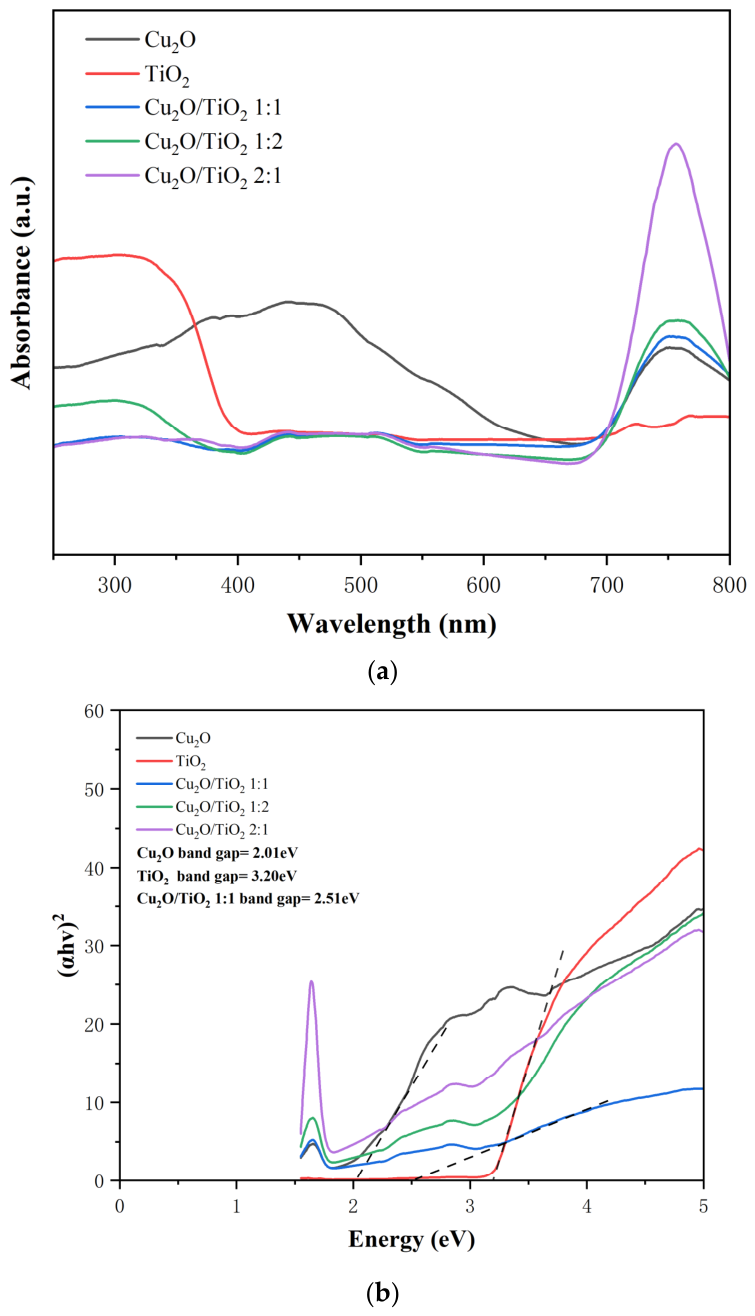
UV-Vis diffuse reflectance spectroscopy (Figure 2a) revealed that the composite exhibits an absorption edge between those of Cu2O and TiO2. The corresponding Tauc plots (Figure 2b) gave bandgap energies of ~2.0 eV for Cu2O, ~3.2 eV for TiO2, and ~2.07 eV for the Cu2O–TiO2 (1:1) composite (by black dashed lines).

2.2. SEM, TEM, EDX and Mapping of Cu2O/TiO2 Nanocomposites

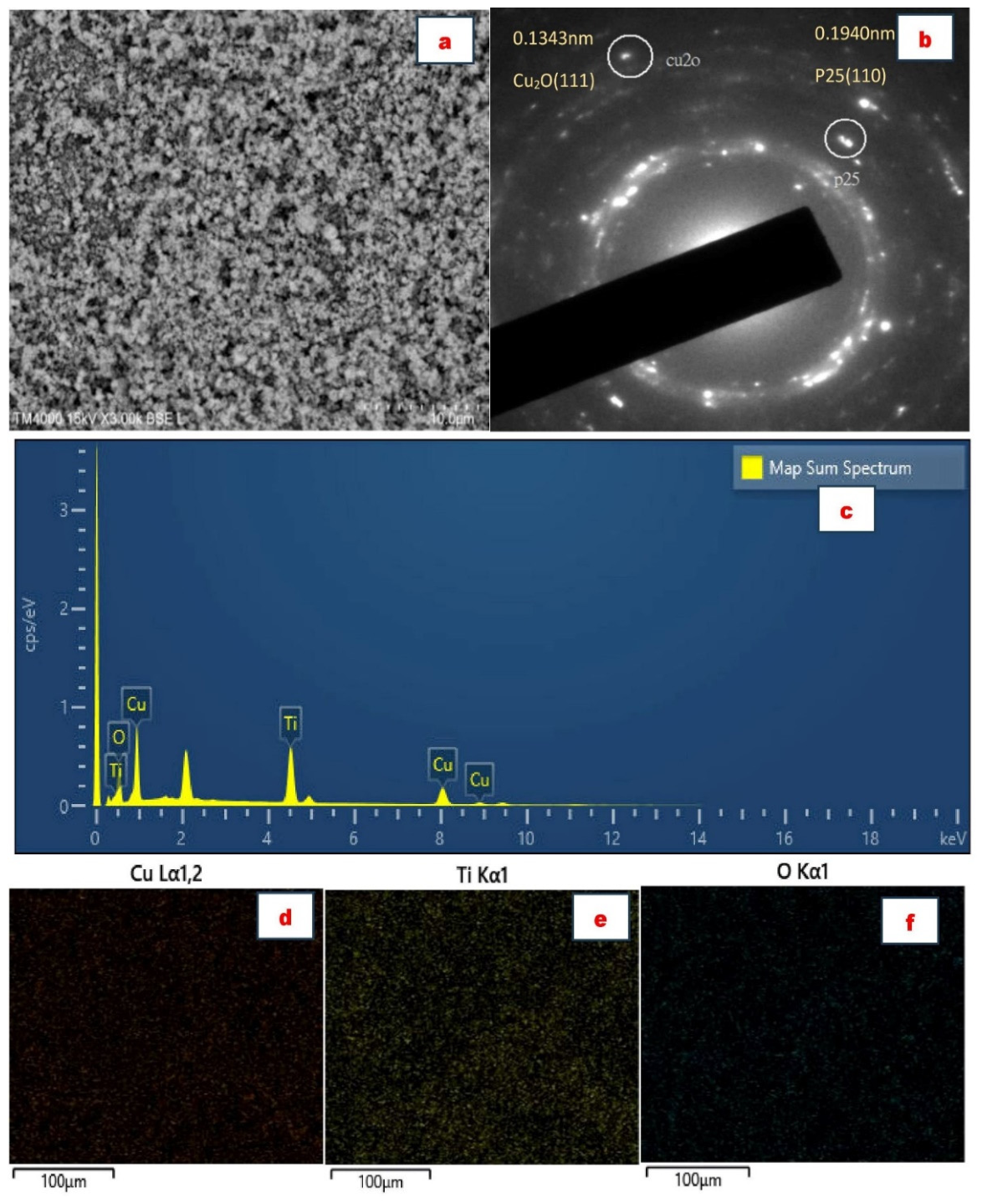
SEM, TEM, EDX and Mapping of Cu2O nanoparticles and TiO2 nanofibers are given in Supplement File as Figures S1 and S2. The SEM image of the Cu2O/TiO2 (1:1) nanocomposites is shown in Figure 3a. The SEM imaging of Cu2O/TiO2 (1:1) nanocomposites shows that the material has highly regular and uniform structures can be seen in Figure 3a. The adsorption process benefits from this uniform structure [18]. The TEM picture of the synthesized Cu2O/TiO2 (1:1) nanocomposite is shown in Figure 3b in which the crystal plane of the Cu2O nanoparticles and TiO2 nanofibers can be observed which confirm the formation of nanocomposites. EDX spectrum analysis (Figure 3c) reveals that nanoparticles contain Cu, Ti, and O with 44.06, 27.71, and 28.23 weight percent, respectively. Figure 3d–f shows the mapping of the Cu2O/TiO2 (1:1) nanocomposites in which every element shown in the different color and its percentage is given in the EDX [19,20].
High-resolution TEM (HRTEM) analysis was performed to further investigate the morphology and interfacial structure of the Cu2O–TiO2 (1:1) composite. As shown in Figure S3a–f, the HRTEM images reveal well-defined lattice fringes for both pristine Cu2O and TiO2. For Cu2O, in Figure S1b the lattice spacing of 0.21 nm corresponds to the (200) plane of cubic Cu2O. In Figure S2b, for TiO2 the lattice spacing of 0.35 nm corresponds to the (101) plane of anatase TiO2. In the Cu2O–TiO2 (1:1) composite (Figure S3e,f), both sets of lattice fringes are clearly visible, and the two phases are in intimate contact, confirming the successful formation of a heterojunction. This close interfacial contact is expected to facilitate efficient charge transfer between Cu2O and TiO2, thereby enhancing photocatalytic activity [21,22,23]. No amorphous layers or secondary phases are observed at the interface, indicating a clean and well-constructed heterojunction.

2.3. Photodegradation of Formaldehyde Experiments

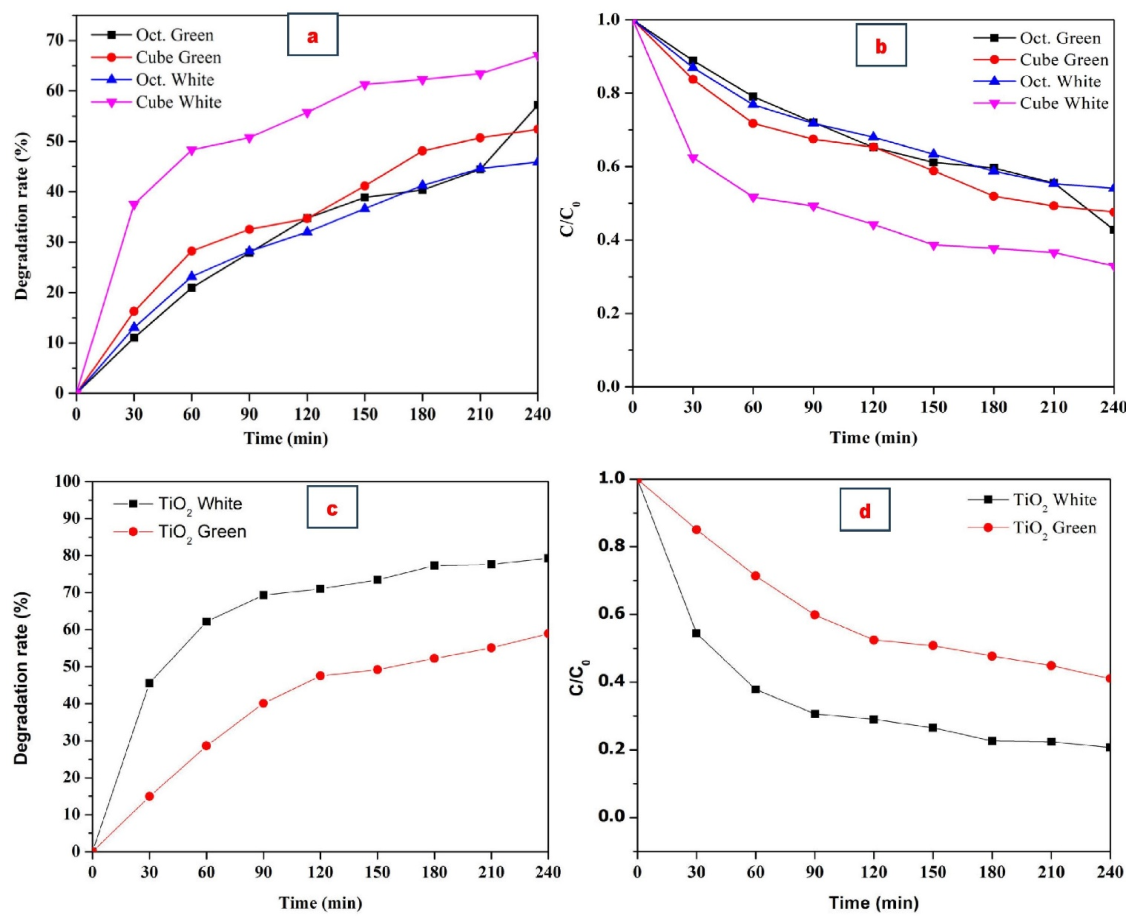
As shown in Figure 4a, the Cu2O tetrahedron exhibited a degradation efficiency of 68% under white light illumination within 240 min, which is notably higher than that of the Cu2O octahedron (approximately 45%, Figure 4a). This shape-dependent activity is attributed to the tetrahedron’s exposed (111) facets, which are known to be more active for surface redox reactions. The corresponding C/C0 plots (Figure 4b) reveal a gradual decrease in HCHO concentration over time, with an apparent pseudo-first-order rate constant of 0.0041 min−1 for the tetrahedron (calculated from ln(C0/C) vs. time, see Figure S4). The calculated rate constants for all samples are listed in Table S1.
For pristine TiO2 (Figure 4c,d), a degradation efficiency of 78% was achieved under identical conditions, with a rate constant of 0.0055 min−1. The higher activity of TiO2 compared to Cu2O tetrahedron is consistent with its superior charge carrier mobility and surface hydroxyl group density, which promote •OH radical generation.

2.4. Comparison of Different Proportions of Cuprous Oxide–Titanium Dioxide

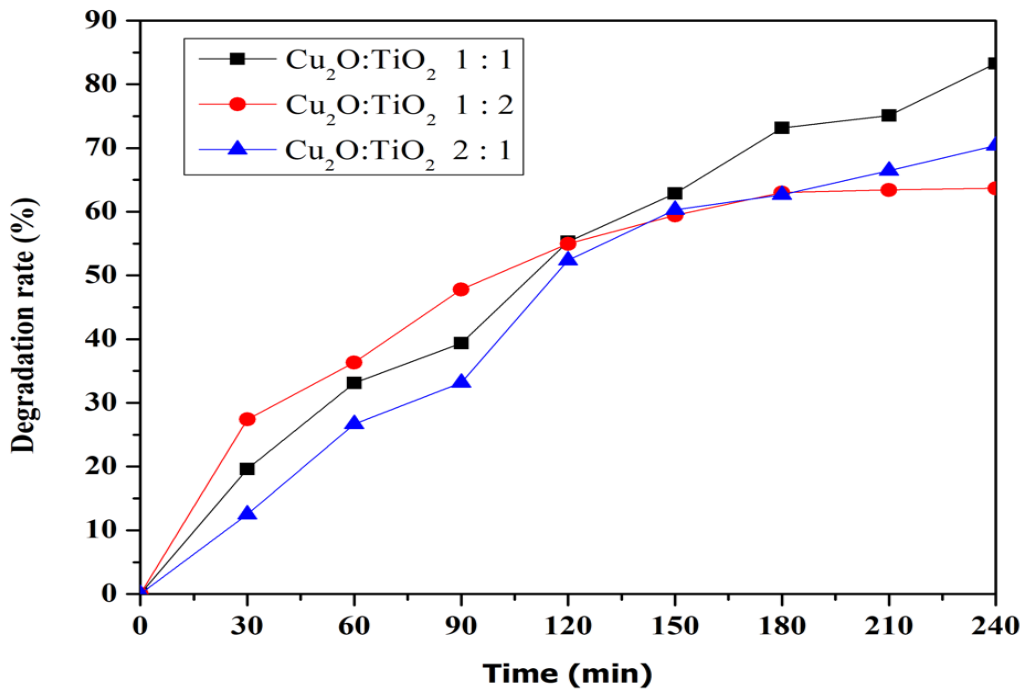
In this experiment, different proportions of cuprous oxide–titanium dioxide were used for the formaldehyde degradation. Various different ratios/proportions of cuprous oxide–titanium dioxide were prepared firstly: Cu2O:TiO2 (1:1), (1:2), (2:1). The experimental results are shown in Figure 5 and Table 1 in the form of carbon dioxide and humidity changes. It can be seen that the degradation rate of cuprous oxide and titanium dioxide (1:1) is very high which can be observed by seeing the amount of carbon dioxide and humidity in Table 1. For Cu2O:TiO2 (1:1) (Figure 5), a degradation efficiency of 83% was achieved under identical conditions, with a rate constant of 0.0071 min−1 in Table S1. As for the products of this experiment, carbon dioxide and water, their generation was observed through the cumulative carbon dioxide production and humidity change tables, indicating that formaldehyde was successfully degraded into carbon dioxide and water [24,25,26].
Optimization of the Cu2O:TiO2 mass ratio: To determine the optimal composite composition, Cu2O–TiO2 photocatalysts with mass ratios of 1:2, 1:1, and 2:1 were prepared and tested under identical conditions (white LED, 120 mW/cm2, 5 ppm HCHO). The 1:1 composite exhibited the highest degradation efficiency (83%), compared to 1:2 (72%) and 2:1 (70%) (Figure 5). This equimass ratio maximizes interfacial contact between the two phases, promoting efficient charge separation as confirmed by the strongest PL quenching observed for the 1:1 composite (Figure 6a,b). While many photocatalytic studies employ low Cu2O loadings (0.3–5 wt%) for sensitization purposes, such compositions typically form isolated Cu2O islands on TiO2 rather than a continuous heterojunction. For applications requiring a type-II heterojunction where both components act as primary light absorbers—especially under white light with limited UV content—higher Cu2O loadings (30–50 wt%) are often optimal. This is consistent with previous reports on Cu2O/TiO2 heterojunctions where the best performance was achieved at 1:1 mass ratio or at Cu2O concentrations of 30–70%.

2.5. Possible Mechanism of HCHO Degradation

2.5.1. Steady-State Photoluminescence Analysis of Charge Separation

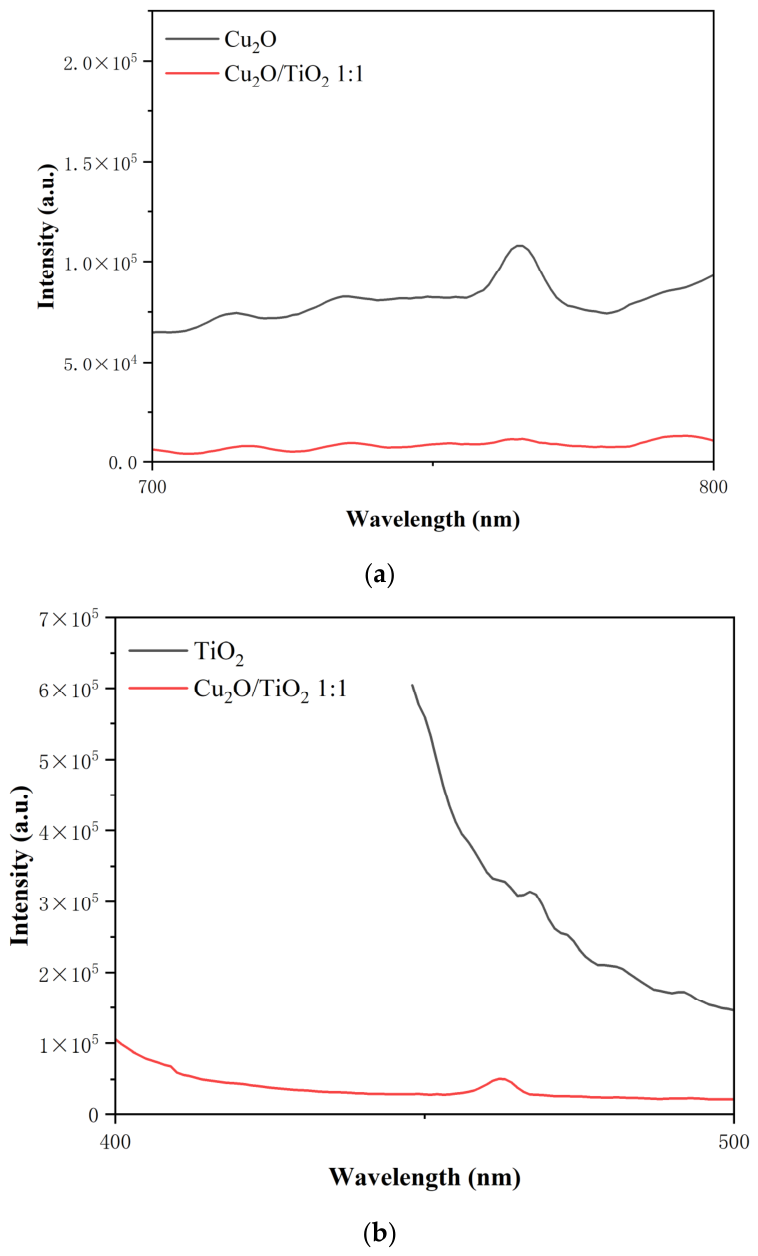
To experimentally evaluate the charge separation efficiency of the Cu2O–TiO2 heterojunction, steady-state photoluminescence (PL) spectra of pristine Cu2O, pristine TiO2, and the Cu2O–TiO2 (1:1) composite were recorded at room temperature with an excitation wavelength of 325 nm (Figure 6a,b).
As shown in Figure 6a, the PL intensity of the Cu2O–TiO2 (1:1) composite is significantly lower than that of pristine Cu2O, with a reduction of approximately 57%. Similarly, Figure 6b shows that the PL intensity of the composite is also markedly lower than that of pristine TiO2. Since PL emission arises from the radiative recombination of photogenerated electron–hole pairs, the lower PL intensity indicates that charge recombination is effectively suppressed in the composite.
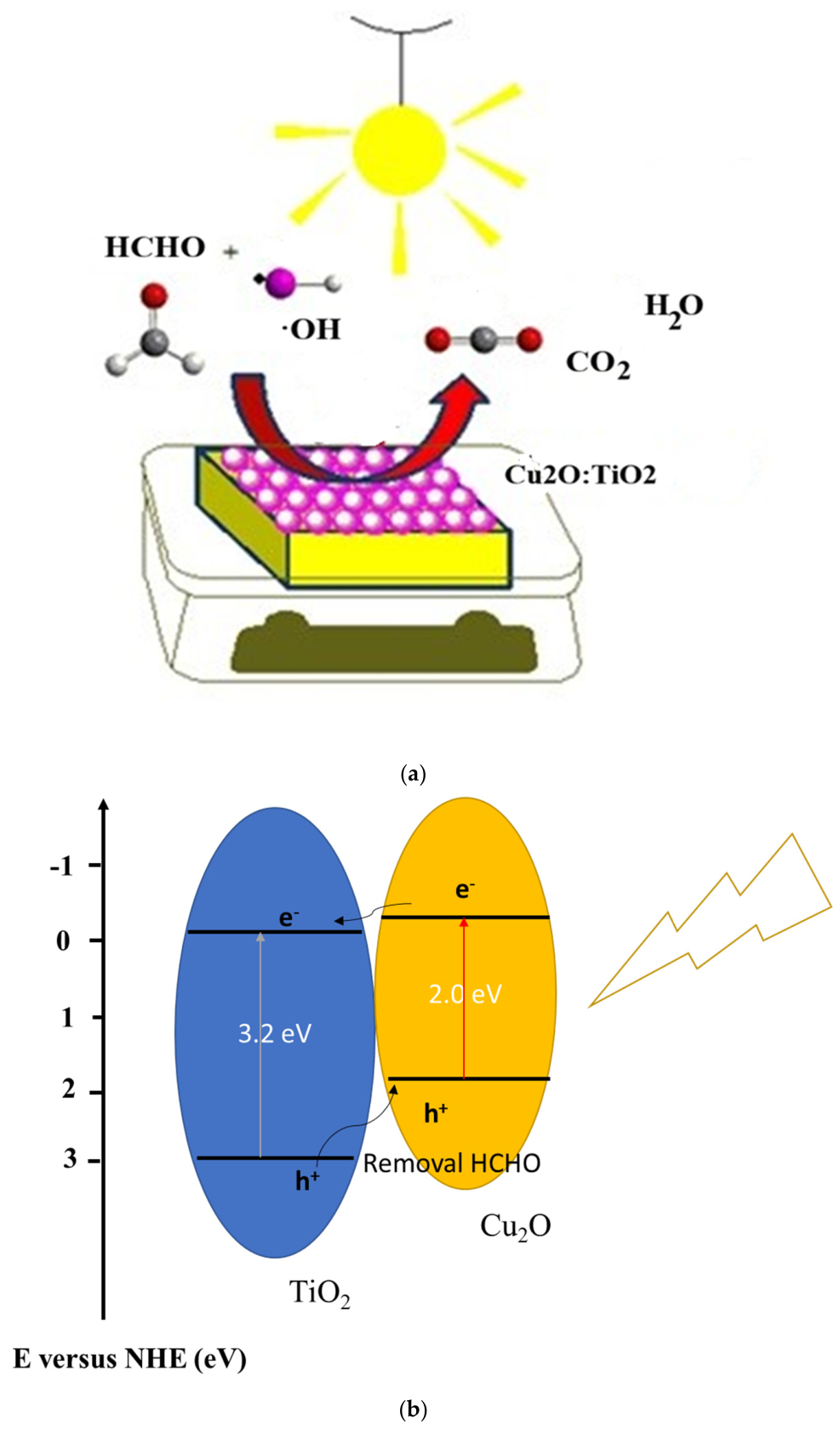
This PL quenching provides direct experimental evidence for the proposed type-II band alignment (Figure 7b). In the heterojunction, photogenerated electrons in Cu2O (which has a higher conduction band) can transfer to TiO2 (with a lower conduction band), while photogenerated holes in TiO2 (with a deeper valence band) can transfer to Cu2O (with a shallower valence band). This spatial separation of charge carriers minimizes radiative recombination, leading to enhanced photocatalytic activity.
The suppressed recombination is fully consistent with the observed enhancement in HCHO degradation efficiency (83% for the composite vs. 68% for Cu2O and 78% for TiO2) and the increased pseudo-first-order rate constants (Table S1). Future work will include time-resolved PL (TRPL) measurements to quantitatively determine charge carrier lifetimes and radical scavenger experiments to identify the dominant reactive species.

2.5.2. Possible Mechanism

While the proposed mechanism in Equations (1)–(6) and Figure 7a suggests that hydroxyl radicals (•OH) and photogenerated holes (h+) are the primary reactive species for HCHO oxidation, we acknowledge that direct radical trapping experiments (e.g., using tert-butanol for •OH, benzoquinone for O2, or EDTA for h+) have not been performed in the present study. Such experiments are typically required to unequivocally assign the contribution of each active species.
Nevertheless, several lines of indirect evidence support the proposed charge transfer pathway in the Cu2O–TiO2 (1:1) heterojunction:
(i)
Band alignment considerations: In Figure 7b, based on the measured bandgap energies (Cu2O: ~2.0 eV, TiO2: ~3.2 eV) and their respective valence band edge positions reported in the literature (Cu2O: ~0.9 V vs. NHE; TiO2: ~2.9 V vs. NHE). The heterojunction facilitates the accumulation of holes in the valence band of Cu2O. These holes can either directly oxidize adsorbed HCHO or react with surface hydroxyl groups/water to generate •OH radicals, as previously described for similar p–n heterojunction photocatalysts [18]. The bandgap energies of Cu2O and TiO2 were experimentally determined by UV-Vis diffuse reflectance spectroscopy (Figure 2a,b). The valence band positions were taken from literature values commonly accepted for these materials [18]. While direct experimental confirmation (e.g., by XPS valence band or Mott–Schottky analysis) is not yet available, the observed enhancement in photocatalytic activity (83% for the composite vs. 68% for Cu2O and 78% for TiO2) and the increased rate constant (Table S1) are consistent with a type-II heterojunction that facilitates charge separation. Future work will include direct band alignment characterization to further validate the proposed charge transfer pathway.
(ii)
Complete mineralization to CO2 and H2O: The clear detection of cumulative CO2 (18 ppm, Table 1) and an increase in relative humidity (2%, Table 1) confirms that HCHO is fully oxidized. Such deep oxidation typically requires strong oxidants such as •OH or h+ rather than weaker species like O2 alone.
(iii)
Consistency with literature reports: Several studies on Cu2O–TiO2 composites and related heterojunctions have verified via electron paramagnetic resonance (EPR) and scavenger experiments that •OH and h+ are the dominant oxidative species for VOC degradation [27,28]. Our observed degradation trends (83% for Cu2O–TiO2 vs. 68% for pure Cu2O and 78% for pure TiO2) are fully consistent with those reports.
Therefore, while direct experimental verification is not yet available, the weight of indirect evidence strongly suggests that •OH and h+ play major roles in the photocatalytic degradation of HCHO over the Cu2O–TiO2 (1:1) heterojunction. Future work will include systematic radical trapping experiments and EPR measurements to definitively confirm the charge transfer pathway.
The proposed reaction steps are summarized as follows (repeated from above for clarity):
Photocatalyst → e + h+
H2O → H+ + OH
h+ + OH → •OH
HCHO + •OH → •CHO + H2O
•CHO + •OH → HCOOH
HCOOH + 2 h+ → CO2 + 2 H+

2.6. Reusability and Comparison of Cu2O:TiO2 (1:1) with Other

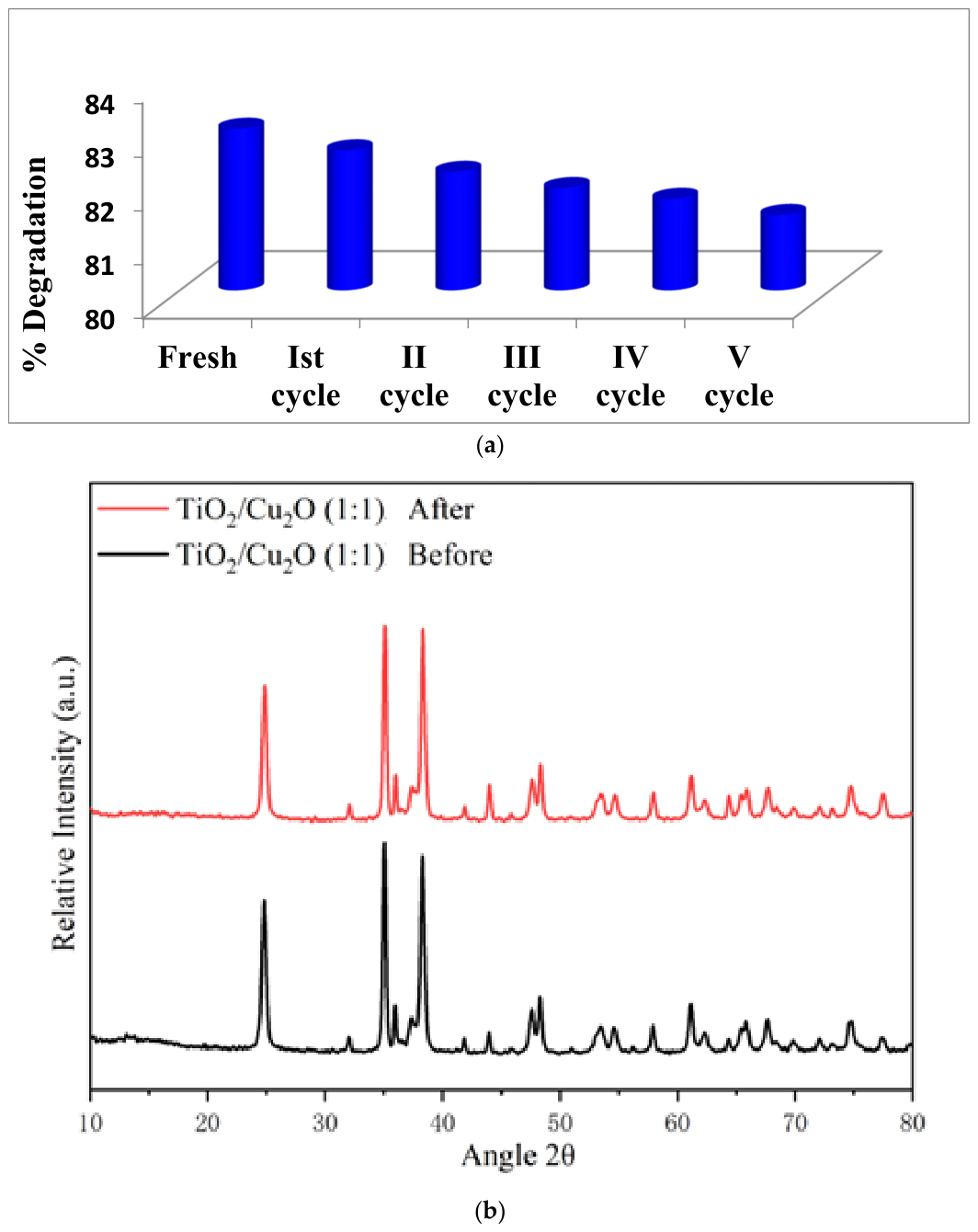
Degradation of HCHO is 83% using Cu2O:TiO2 (1:1) in the first cycle. The reused experiment was carried out in which the Cu2O:TiO2 (1:1) were activated using gentle washing after each cycle. The reusability test was carried out for five cycles, and the degradation rate remained 81.4% after the fifth cycle (Figure 8a), confirming excellent stability of the Cu2O–TiO2 (1:1) catalyst. The comparison of Cu2O–TiO2 (1:1) with other photocatalysts for formaldehyde degradation and it is shown in Table 2. Table 2 shows that the % degradation of HCHO is comparable with our photocatalyst. A common drawback of many degradation studies is the use of high-intensity or high-energy lamps with variable spectral outputs. Furthermore, XRD patterns of the catalyst before and after five cycles of Cu2O–TiO2 (1:1) (Figure 8b). It showed no significant change in the characteristic peaks of Cu2O, indicating that the crystal structure of Cu2O was preserved under the mild reaction conditions (white light illumination, ambient temperature, gas-phase reaction). The presence of TiO2 likely protects Cu2O from direct oxidation by photogenerated holes, as holes tend to migrate toward the Cu2O surface but are rapidly consumed by HCHO oxidation.
To provide a fair comparison with previously reported Cu2O–TiO2 composite photocatalysts for HCHO degradation, we have summarized key studies in Table 2. It should be noted that direct quantitative comparison is challenging due to significant differences in experimental conditions, including light source (type, intensity, spectrum), catalyst loading, initial HCHO concentration, reactor geometry, and reaction time.
Several representative studies are compared in Table 2. For example, Zhu et al. [26] reported 83.9% HCHO degradation using 0.0032 wt% TAgNPt/BiVO4 under visible light, while Hu et al. [28] achieved 82.5% using BiOCl/TiO2/sepiolite under solar light. Our Cu2O–TiO2 (1:1) catalyst achieves 83% degradation under white light (120 mW/cm2, 400–700 nm), which is comparable to these literature values.
Importantly, many existing studies utilize high-intensity UV lamps (e.g., 500 W Hg lamps) or Xe lamps, which are less practical for indoor air purification due to safety concerns and high energy consumption. In contrast, our system employs a white LED panel (120 mW/cm2), which is economical, safe, and more suitable for real-world applications. Furthermore, we provide direct evidence of complete mineralization (CO2 production, 18 ppm) and long-term stability (81.4% degradation rate retention after five cycles, confirmed by XRD), which are often not reported in comparative studies.
While some previously reported Cu2O–TiO2 composites show higher degradation efficiencies under UV or high-intensity irradiation, our system achieves comparable or better performance under mild white light conditions, highlighting its potential for practical indoor air purification.
A key advantage of the Cu2O–TiO2 heterojunction over pristine TiO2 lies not only in the improved degradation efficiency but, more importantly, in its ability to function under mild white light (400–700 nm, 120 mW/cm2). While pure TiO2 (P25) is known to exhibit high efficiency under UV-rich light, its practical application for indoor air purification is limited by the absence of strong UV sources in indoor environments and safety concerns. In contrast, our composite effectively harvests visible light, as confirmed by UV-Vis DRS (Figure 2a) and the reduced bandgap (~2.07 eV, Figure 2b). Furthermore, the composite achieves complete mineralization of HCHO to CO2 and H2O (Table 1), a finding rarely reported in the literature for gas-phase HCHO degradation. The heterojunction also suppresses electron–hole recombination, as evidenced by steady-state PL quenching (Figure 6a,b), and protects Cu2O from photocorrosion, as verified by XRD before and after five cycles (Figure 8b). Therefore, the major benefit of adding Cu2O is to enable visible-light operation, ensure complete mineralization, and enhance stability, making the composite a practical and robust candidate for real-world indoor air purification.

3. Experimental Methods

3.1. Experimental Chemicals and Equipment

All chemicals were purchased from Fisher Scientific (Waltham, MA, USA) or Sigma-Aldrich (St. Louis, MO, USA) and used as received. X-ray diffraction (XRD) patterns were recorded on a SHIMADZU XRD-6000X (Kyoto, Japan) (Cu Kα radiation, λ = 0.15404 nm, 35 kV, 35 mA, scan range 10–80°, step 0.1°, speed 2°/min). Transmission electron microscopy (TEM) images were obtained using a JEM-2010 (Tokyo, Japan) (LaB6 filament, accelerating voltage 120–200 kV). UV-Vis diffuse reflectance spectra were measured on a T90+ UV/Vis spectrometer (PG Instruments Ltd., Wibtoft, UK) in the range of 200–800 nm.

3.2. Photocatalyst Preparation

3.2.1. Cuprous Oxide (Cu2O) Synthesis

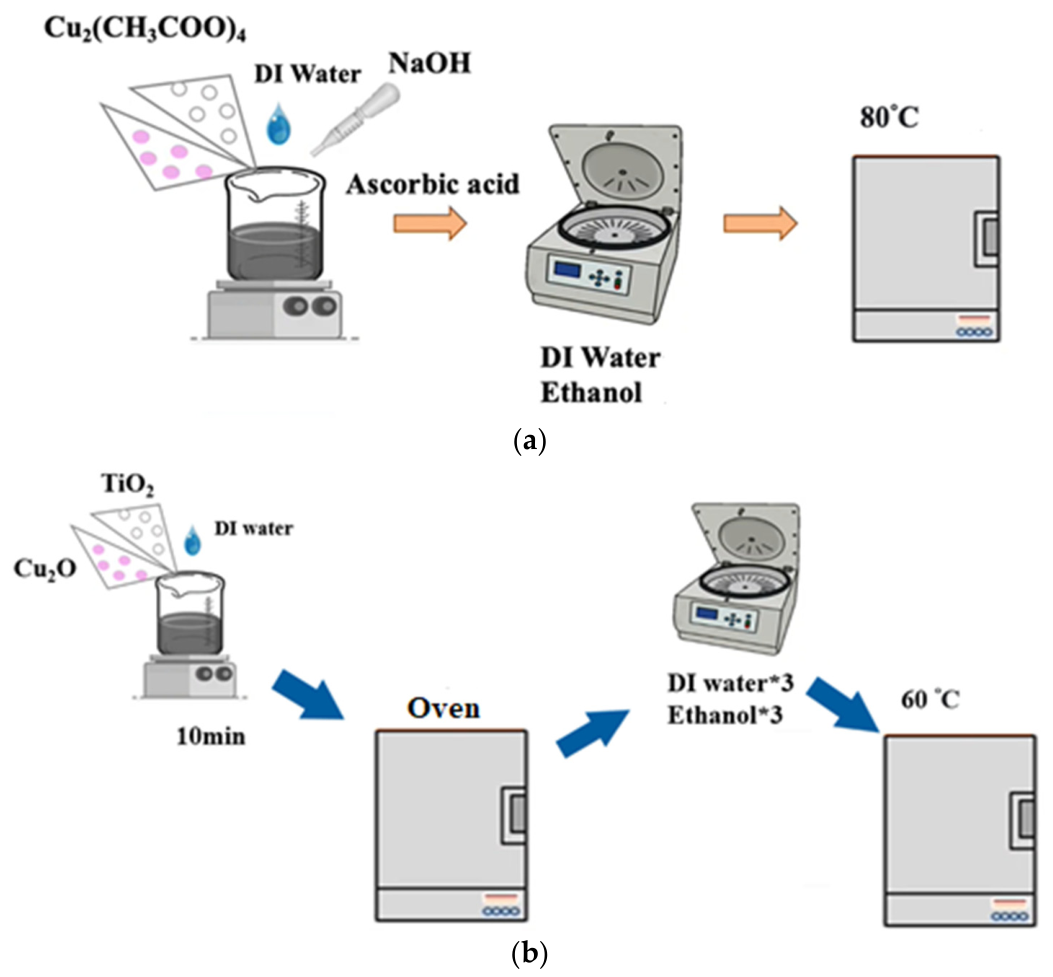
A total of 0.103 g of copper acetate was dissolved in deionized water (DIW). Then 2 mL of 2.5 M sodium hydroxide was added, followed by the required amount of ascorbic acid. The solution was stirred until the color changed from dark blue to orange. The orange-red precipitate was collected by centrifugation, washed repeatedly with DIW and ethanol, and dried in an air oven at 80 °C for 24 h (Figure 9a) [31,32].

3.2.2. Cu2O–TiO2 Composite Materials (1:1, 1:2, 2:1)

The Cu2O/TiO2 nanocomposites were synthesized by a hydrothermal method. Finely ground cuprous oxide powder and commercially available titanium dioxide (TiO2) nanopowder (Degussa P25, ≥99.5% purity) were mixed in the desired mass ratio with 20–30 mL of ultrapure water in a beaker. The mixture was shaken for 10–15 min, then transferred into a PTFE-lined stainless steel autoclave and heated at 180 °C for 24 h. After cooling, the product was centrifuged, washed three times with ethanol and three times with ultrapure water, and dried at 80 °C (Figure 9b) [7].

3.3. Experimental Instruments

3.3.1. Formaldehyde Detector (Formaldemeter)

Formaldehyde concentration was measured using a Formaldemeter htV (PPM Technology, Caernarfon, UK) based on an electrochemical sensor. Before each series of experiments, the detector was calibrated using a standard tube (PN: 500-100-02, reference 1.05 ppm at 25 °C) after temperature equilibration (25 ± 1 °C, 2 h). Zero point was verified with activated carbon-filtered air (HCHO < 0.01 ppm). During experiments, the probe was inserted into the reactor through a dedicated port, and the concentration (ppm) was recorded at 30 min intervals.

3.3.2. Carbon Dioxide Detectors (CO2 Monitor)

A ZG106 carbon dioxide detector was used to monitor the CO2 concentration and ambient temperature inside the reaction vessel. The operating procedure was as follows: (1) Press the power button to turn on the detector. (2) The screen displays “WARM UP” during the initial warm-up period; the instrument was allowed to stand for one minute until the “WARM UP” message disappeared and “TEMP” appeared, indicating that warm-up was complete. (3) Insert the detector into the reaction vessel through the designated port. The displayed value (in ppm) corresponds to the current CO2 concentration.

3.4. Photocatalytic Degradation Experimental Procedure

3.4.1. Reactor Setup and Catalyst Loading

All photocatalytic experiments were conducted in a cylindrical borosilicate glass reactor (total volume: 500 mL; effective gas-phase volume: 350 mL) with a quartz glass cover to allow light transmission. A precisely weighed amount (0.035 g) of the as-prepared photocatalyst was uniformly spread onto a glass Petri dish (diameter: 5 cm, area: 19.6 cm2), which was placed at the bottom of the reactor. The reactor lid was sealed using vacuum grease and further wrapped with Parafilm and electrical tape to ensure airtightness. A serum stopper was inserted into the side port for gas injection and sampling.

3.4.2. Gas Introduction and Adsorption Equilibrium

A buffer bottle containing paraformaldehyde was gently shaken to generate gaseous formaldehyde. The formaldehyde gas was introduced into the reactor through a plastic tube connected to a serum stopper, using a syringe to inject air into the buffer bottle. The initial formaldehyde concentration (C0) was adjusted to 5.0 ± 0.2 ppm, as measured by the calibrated Formaldemeter htV. After reaching the desired concentration, the plastic tube was removed, and the reactor was kept in the dark for 180 min to establish adsorption–desorption equilibrium of HCHO on the catalyst surface. No light irradiation was applied during this period.

3.4.3. Photodegradation Under White Light

After the dark adsorption period, the reactor was placed inside a light box equipped with a white light-emitting diode (LED) panel (YSD-LED-100W, 6500 K, 8000 lm). The LED panel was positioned at a fixed distance of 15 cm above the reactor, providing an average light intensity of 120 mW/cm2 at the catalyst surface (measured by a calibrated optical power meter, PM100D, Thorlabs, Newton, NJ, USA). The spectral output of the LED covers 400–700 nm (peak at 450 nm) with negligible emission below 400 nm (<0.1%), eliminating the need for a UV cut-off filter. The light was then turned on, marking the start of the photocatalytic reaction (t = 0). The formaldehyde concentration, carbon dioxide concentration, and relative humidity were recorded at 30 min intervals for a total reaction time of 240 min. The formaldehyde detector probe was inserted through a dedicated port sealed with a serum stopper during each measurement.

3.4.4. Control Experiments

To verify the photocatalytic origin of HCHO removal, two control experiments were conducted under identical conditions:
Dark adsorption control: The reactor containing the photocatalyst was kept in complete darkness for 240 min without any light irradiation. This experiment quantified the amount of HCHO removed solely by physical or chemical adsorption.
Direct photolysis control: The reactor was filled with HCHO gas (5 ppm) but without any photocatalyst, and then exposed to white light for 240 min to evaluate HCHO degradation by light alone.

3.4.5. Calculation of Degradation Efficiency

The formaldehyde degradation efficiency (D, %) was calculated using the following equation:
D % = C 0 C C 0 × 100 %
where C0 is the initial formaldehyde concentration (after dark adsorption equilibrium, before light illumination) and C is the formaldehyde concentration at irradiation time (in minutes). All experiments were performed in triplicate, and the average values with standard deviations are reported.

3.4.6. Reusability Test

After each photocatalytic cycle, the used Cu2O–TiO2 (1:1) catalyst was gently washed with deionized water and absolute ethanol, followed by drying at 80 °C for 12 h. The recovered catalyst was then reused under the same experimental conditions for up to five consecutive cycles to evaluate its stability and reusability.

4. Conclusions

In this study, a high-performance Cu2O–TiO2 (1:1) heterojunction photocatalyst was successfully synthesized via a robust hydrothermal method. Structural and morphological characterizations confirmed the successful integration of Cu2O nanoparticles with TiO2 nanofibers, creating an optimized interface for enhanced light harvesting.
The experimental results demonstrated that:
The Cu2O–TiO2 (1:1) composite achieved a superior formaldehyde (HCHO) degradation efficiency of 83% under white light irradiation within 240 min. This performance significantly outperformed the mono-material constituents, where Cu2O tetrahedra and TiO2 achieved degradation rates of 68% and 78%, respectively. The high degradation efficiency was accompanied by a cumulative CO2 production of 18 ppm, confirming the successful mineralization of hazardous HCHO into non-toxic end products. The synergistic enhancement is attributed to the formation of a heterojunction that effectively narrows the bandgap to approximately 2.07 eV, thereby extending the photoresponse into the visible spectrum. This architecture facilitates efficient charge separation and suppresses electron–hole recombination, which is critical for maintaining high photocatalytic activity. Furthermore, the catalyst exhibited excellent stability and reusability, retaining 81.4% efficiency after five consecutive cycles, highlighting its potential for long-term air purification.
By utilizing economical white light rather than high-energy UV sources, this work provides a cost-effective and sustainable strategy for the removal of volatile organic compounds in indoor environments. Future research may focus on further optimizing the heterojunction interface to achieve complete mineralization at even shorter exposure intervals.

Supplementary Materials

The following supporting information can be downloaded at: https://www.mdpi.com/article/10.3390/catal16070581/s1. Figure S1: (a) Low magnification SEM image, (b) High magnification TEM image, (c) EDX spectrum, Mapping images of the Cu2O nanoparticles. Figure S2: (a) Low magnification SEM image, (b) High magnification TEM image, (c) EDX spectrum, Mapping images of the TiO2 nanofibers. Figure S3: HRTEM images of (a) Cu2O (b) Cu2O (c) TiO2 (d) TiO2 (e) Cu2O–TiO2 (1:1) (f) Cu2O–TiO2 (1:1). Figure S4: ln(C0/C) versus irradiation time of (a) Cu2O–TiO2 (1:1) (b) TiO2 (c) Cu2O. Table S1: Apparent pseudo-first-order rate constants of photocatalysts.

Author Contributions

Conceptualization, R.-J.W.; Software, R.-J.W. and S.R.; Validation, R.-J.W.; Formal analysis, Y.-C.S. and A.F.A.-S.; Investigation, Y.-C.S., M.H.R. and M.A.; Resources, Y.-C.S., S.R. and A.F.A.-S.; Writing—original draft, M.A.; Writing—review & editing, Y.-C.S., R.-J.W., M.H.R., S.R., A.F.A.-S. and M.A.; Visualization, R.-J.W.; Supervision, R.-J.W. and M.A.; Project administration, R.-J.W. and M.A.; Funding acquisition, M.H.R., S.R. and M.A. All authors have read and agreed to the published version of the manuscript.

Funding

This work was supported by the Deanship of Scientific Research, Vice Presidency for Graduate Studies and Scientific Research, King Faisal University, Saudi Arabia (Grant No. KFU261837).

Data Availability Statement

All datasets used in this work are available from the corresponding authors.

Acknowledgments

The authors gratefully acknowledge the funding provided for this research by the Deanship of Scientific Research, Vice Presidency for Graduate Studies and Scientific Research, King Faisal University, Saudi Arabia.

Conflicts of Interest

The authors declare no conflicts of interest.

References

  1. Sun, X.; Wang, Y.; Cui, J.; Li, Y.; Lin, J. Noble-Metal-Based Catalysts on a Scale from Nanoparticles to Subnanoclusters and Single Atoms for Formaldehyde Oxidation at Room Temperature: A Review. ACS Appl. Nano Mater. 2024, 7, 3546–3563. [Google Scholar] [CrossRef]
  2. Nie, L.; Yu, J.; Jaroniec, M.; Tao, F.F. Room-temperature catalytic oxidation of formaldehyde on catalysts. Catal. Sci. Technol. 2016, 6, 3649–3669. [Google Scholar] [CrossRef]
  3. Guo, J.H.; Lin, C.X.; Jiang, C.J.; Zhang, P.Y. Review on noble metal-based catalysts for formaldehyde oxidation at room temperature. Appl. Surf. Sci. 2019, 475, 237–255. [Google Scholar] [CrossRef]
  4. Zhu, S.; Wang, J.; Nie, L. Progress of Catalytic Oxidation of Formaldehyde over Manganese Oxides. ChemistrySelect 2019, 4, 12085–12098. [Google Scholar] [CrossRef]
  5. Miao, L.; Wang, J.; Zhang, P. Review on manganese dioxide for catalytic oxidation of airborne formaldehyde. Appl. Surf. Sci. 2019, 466, 441–453. [Google Scholar] [CrossRef]
  6. An, G.F.; Huang, Q.; Li, X.; Mao, J.J.; Wei, C.; Yang, B.; Li, D.W.; Chen, M.D.; Tao, T.; Yang, H. Efficiently enhancing stability for a low concentration HCHO degradation using hexagonal prism MnCe-MOFs catalysts. Mater. Chem. Phys. 2024, 328, 130027. [Google Scholar]
  7. Liang, W. Long-term indoor formaldehyde variations and health risk assessment in Chinese urban residences following renovation. Build. Environ. 2021, 206, 108402. [Google Scholar] [CrossRef]
  8. Song, J.; Ren, X.; Hu, G.; Wang, L.; Hu, X. Enhanced photocatalytic degradation of indoor formaldehyde by sepiolite decorated with TiO2 nanoparticles: Effects of key preparation parameters. Microporous Mesoporous Mater. 2023, 353, 112515. [Google Scholar] [CrossRef]
  9. Zhu, Z.; Wu, R.J. The degradation of formaldehyde using a Pt@TiO2 nanoparticles in presence of visible light irradiation at room temperature. J. Taiwan Inst. Chem. Eng. 2015, 50, 276–281. [Google Scholar] [CrossRef]
  10. Guo, Y.; Gao, P.; Han, Q.; Feng, L.; Zhang, L. Enhancing visible light degradation of gaseous formaldehyde with CuOx/OVs-TiO2 photocatalyst loaded wallpaper: Preparation, efficacy and mechanism. Chemosphere 2025, 371, 144051. [Google Scholar] [CrossRef] [PubMed]
  11. Zeng, X.; Zeng, Z.; Hu, Q.; Liu, K.; Ming, L.; Cheng, B.; Wang, W.; Luo, G.; Cao, S. Hierarchical Pt/NiO hollow nanofibers for catalytic oxidation of HCHO at room temperature. Chin. J. Struct. Chem. 2025, 44, 100575. [Google Scholar] [CrossRef]
  12. Bai, H. Synthesis of Bi2S3-TiO2 nanocomposite and its electrochemical and enhanced photocatalytic properties for phenol degradation. Int. J. Electrochem. Sci. 2023, 18, 100071. [Google Scholar] [CrossRef]
  13. Wang, Y.; Zhang, Y.; Liu, Y.; Wu, Z. Fluorine-induced oxygen vacancies on TiO2 nanosheets for photocatalytic indoor VOCs degradation. Appl. Catal. B Environ. 2022, 316, 121610. [Google Scholar] [CrossRef]
  14. Mu, Y.-L.; He, Q.; Li, C.-Y.; Sheng, D.; Wu, S.-H.; Liu, Y.; Ren, H.-T.; Han, X. Contributions of Surface Oxidizing Species and Cu+ to the Antibacterial Activities of Cu2O with Different Crystalline Structures. Langmuir 2024, 40, 17909–17918. [Google Scholar] [CrossRef]
  15. Li, Y.; Wang, B.; Liu, S.; Duan, X.; Hu, Z. Synthesis and Characterization of Cu2O/TiO2 Photocatalysts for H2 Evolution from Aqueous Solution with Different Scavengers. Appl. Surf. Sci. 2015, 324, 736–744. [Google Scholar] [CrossRef]
  16. Acharya, R.; Pati, S.; Parida, K. A review on visible light driven spinel ferrite-g-C3N4 photocatalytic systems with enhanced solar light utilization. J. Mol. Liq. 2022, 357, 119105. [Google Scholar] [CrossRef]
  17. Acharya, R.; Acharya, L.; Parida, K. BiFeO3-Based Materials For Augmented Photoactivity. In Perovskite Materials for Energy and Environmental Applications; Wiley-Scrivener: Beverly, MA, USA, 2022; pp. 167–216. [Google Scholar] [CrossRef]
  18. Mansingh, S.; Sultana, S.; Acharya, R.; Ghosh, M.K.; Parida, K.M. Efficient Photon Conversion via Double Charge Dynamics CeO2–BiFeO3 p–n Heterojunction Photocatalyst Promising toward N2 Fixation and Phenol–Cr(VI) Detoxification. Inorg. Chem. 2020, 59, 3856–3873. [Google Scholar] [CrossRef] [PubMed]
  19. Xie, S.; Wang, Z.; Cheng, F.; Zhang, P.; Mai, W.; Tong, Y. Ceria and ceria-based nanostructured materials for photoenergy applications. Nano Energy 2017, 34, 313–337. [Google Scholar] [CrossRef]
  20. Arul, N.S.; Mangalaraj, D.; Ramachandran, R.; Grace, A.N.; Han, J.I. Fabrication of CeO2/Fe2O3 composite nanospindles for enhanced visible light driven photocatalysts and supercapacitor electrodes. J. Mater. Chem. A 2015, 3, 15248–15258. [Google Scholar] [CrossRef]
  21. Sreeremya, T.S.; Krishnan, A.; Remani, K.C.; Patil, K.R.; Brougham, D.F.; Ghosh, S. Shape-Selective Oriented Cerium Oxide Nanocrystals Permit Assessment of the Effect of the Exposed Facets on Catalytic Activity and Oxygen Storage Capacity. ACS Appl. Mater. Interfaces 2015, 7, 8545–8555. [Google Scholar] [CrossRef] [PubMed]
  22. Paier, J.; Penschke, C.L.; Sauer, J. Oxygen Defects and Surface Chemistry of Ceria: Quantum Chemical Studies Compared to Experiment. Chem. Rev. 2013, 113, 3949–3985. [Google Scholar] [CrossRef] [PubMed]
  23. Wetchakun, N.; Chaiwichain, S.; Inceesungvorn, B.; Pingmuang, K.; Phanichphant, S.; Minett, A.I.; Chen, J. BiVO4/CeO2 Nanocomposites with High Visible-Light-Induced Photocatalytic Activity. ACS Appl. Mater. Interfaces 2012, 4, 3718–3723. [Google Scholar] [CrossRef] [PubMed]
  24. Chaiwichian, S.; Inceesungvorn, B.; Pingmuang, K.; Wetchakun, K.; Phanichphant, S.; Wetchakun, N. Synthesis and Characterization of the Novel BiVO4/CeO2 Nanocomposites. Eng. J. 2012, 16, 153–160. [Google Scholar] [CrossRef][Green Version]
  25. Li, K.; Ji, J.; He, M.; Huang, H. Complete oxidation of formaldehyde over a Pd/CeO2 catalyst at room temperature: Tunable active oxygen species content by non-thermal plasma activation. Catal. Sci. Technol. 2020, 10, 6257–6265. [Google Scholar] [CrossRef]
  26. Zhu, Z.; Lin, Y.C.; Chung, C.L.; Wu, R.J.; Huang, C.L. A novel composite of triangular silver nanoplates on BiVO4 for gaseous formaldehyde degradation. Appl. Surf. Sci. 2021, 543, 148784. [Google Scholar] [CrossRef]
  27. Zhang, G.; Sun, Z.; Duan, Y.; Ma, R.; Zheng, S. Synthesis of nano-TiO2/diatomite composite and its photocatalytic degradation of gaseous formaldehyde. Appl. Surf. Sci. 2017, 412, 105–112. [Google Scholar] [CrossRef]
  28. Hu, X.; Li, C.; Sun, Z.; Song, J.; Zheng, S. Enhanced photocatalytic removal of indoor formaldehyde by ternary heterogeneous BiOCl/TiO2/sepiolite composite under solar and visible light. Build. Environ. 2020, 168, 106481. [Google Scholar] [CrossRef]
  29. Lu, C.C.; Alshahrani, T.; Wu, R.J.; Fegade, U.; Jethave, G.; Al-Ahmed, A.; Khan, F.; Kolate, S. Synthesis of CeO2–BiVO4 nano photocatalyst material and used for the degradation of gaseous formaldehyde. Opt. Mater. 2023, 144, 114310. [Google Scholar] [CrossRef]
  30. Wu, P.; Attarde, S.; Lu, C.C.; Wu, R.J.; Fegade, U.; Kolate, S.; Patil, N.; Altalhi, T. ZnMn2O4-BiVO4 as Photocatalyst for Degradation of Gaseous HCHO Using Daylight. ChemistrySelect 2024, 9, e202401501. [Google Scholar] [CrossRef]
  31. Chen, D.; Ni, S.; Fang, J.J.; Xiao, T. Preparation of Cu2O nanoparticles in cupric chloride solutions with a simple mechanochemical approach. J. Alloys Compd. 2010, 504, S345–S348. [Google Scholar] [CrossRef]
  32. Lu, S.; Wang, F.; Chen, C.; Li, K. Catalytic oxidation of formaldehyde over CeO2-Co3O4 catalysts. J. Rare Earths 2017, 35, 867–874. [Google Scholar] [CrossRef]
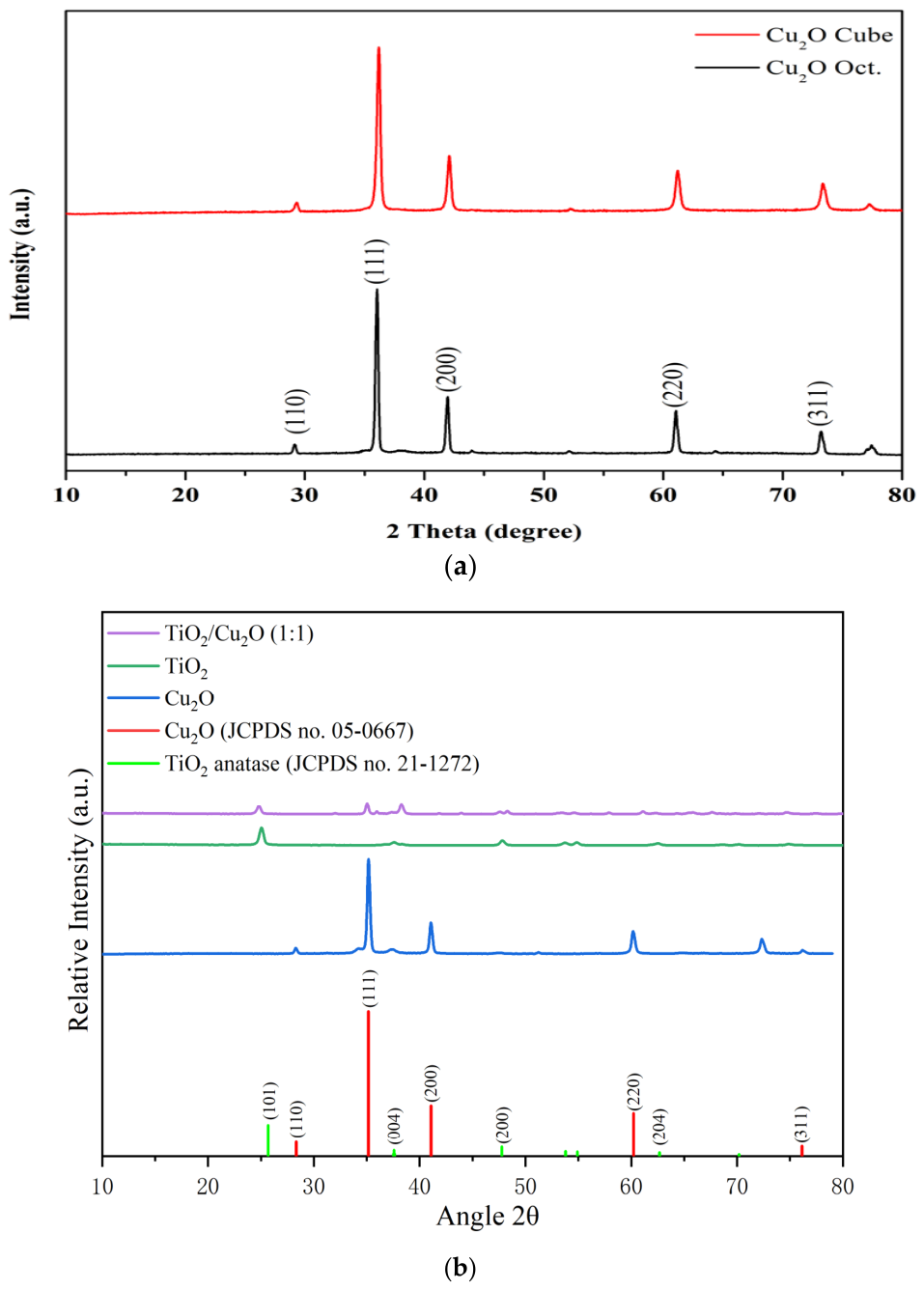
Figure 1. (a) XRD pattern of Cu2O tetrahedron and Cu2O octahedron (JCPDS No. 00-005-0667); (b) XRD patterns of Cu2O nanoparticles (JCPDS No. 00-005-0667), TiO2 nanofibers (JCPDS No. 00-021-1272), and Cu2O–TiO2 (1:1) nanocomposites.
Catalysts 16 00581 g001
Figure 2. (a) UV-Vis diffuse reflectance spectra of Cu2O, TiO2, and Cu2O–TiO2; (b) corresponding Tauc plots for bandgap determination.
Catalysts 16 00581 g002
Figure 3. (a) Low-magnification SEM image, (b) high-magnification TEM image, (c) EDX spectrum, (df) mapping images of the Cu2O/TiO2 (1:1) nanocomposites.
Catalysts 16 00581 g003
Figure 4. Photocatalytic degradation of gaseous formaldehyde under white light illumination (LED, 120 mW/cm2, 400–700 nm). (a) Degradation efficiency of Cu2O tetrahedra and Cu2O octahedra; (b) normalized concentration (C/C0) vs. irradiation time for Cu2O samples; (c) degradation efficiency of pristine TiO2; (d) C/C0 vs. time for TiO2. Experimental conditions: catalyst loading = 0.035 g; initial HCHO concentration = 5.0 ± 0.2 ppm; reactor gas-phase volume = 350 mL; total reaction time = 240 min.
Catalysts 16 00581 g004
Figure 5. Photocatalytic degradation of gaseous formaldehyde under white light illumination (LED, 120 mW/cm2, 400–700 nm) of cuprous oxide–titanium dioxide at different ratios.
Catalysts 16 00581 g005
Figure 6. Steady-state photoluminescence (PL) spectra measured at an excitation wavelength of 325 nm. (a) Comparison of pristine Cu2O and Cu2O–TiO2 (1:1) composite; (b) comparison of pristine TiO2 and Cu2O–TiO2 (1:1) composite.
Catalysts 16 00581 g006
Figure 7. (a) Schematic representation of Cu2O–TiO2 (1:1) photocatalyst under visible light irradiation with possible mechanism for HCHO adsorption. (b) Energy diagram of Cu2O–TiO2 (1:1) photocatalyst.
Catalysts 16 00581 g007
Figure 8. (a) Reusability of the Cu2O–TiO2 (1:1) catalyst for formaldehyde degradation over five consecutive cycles. (b) XRD patterns of the Cu2O–TiO2 (1:1) catalyst before and after five cycles.
Catalysts 16 00581 g008
Figure 9. (a) Cuprous oxide manufacturing process, (b) cuprous oxide–titanium dioxide manufacturing process.
Catalysts 16 00581 g009
Table 1. Copper–titanium dioxide hydration change table.
Cu2O
Tetrahedron
Cu2O
Octahedron
TiO2 1:1 1:2 2:1
CO2 Concentration changes (ppm)968181012
Humidity Change (%)1%1%1%2%2%2%
Table 2. Degradation rate and reproducibility comparison with literature.
Reference Years/
Author/Ref
Material/Light Source Initial HCHO
Concentration (ppm)
Degradation
Rate (%)/Time (min)
Stability Test (Cycles/% Degradation Rate)
Li et al., 2020 [25]Pd/CeO2; Hg lamp1.076.0%; 60NA
Zhu et al., 2021 [26]0.0032 wt%
TAgNPt/BiVO4;
Xe lamp, (300 W)
0.583.9%; 120NA
Zhang et al., 2017 [27]TiO2/diatomite; Hg lamp1.078.2%; 240NA
Hu et al., 2020 [28]BiOCl/TiO2/sepiolite; Solar (simulated, 500 W Xe)0.582.5%5 cycles/~74.3%
Lu et al., 2023 [29]CeO2–BiVO4; Daylight (LED)2.078%5 cycles/~73.3%
Wu et al., 2024 [30]ZnMn2O4-BiVO4
Daylight LED
2.066%NA
This workCu2O–TiO2 (1:1); White LED (120 mW/cm2, 400–700 nm)5.083.0%5 cycles/81.4%
NA = not available in the cited reference.
Disclaimer/Publisher’s Note: The statements, opinions and data contained in all publications are solely those of the individual author(s) and contributor(s) and not of MDPI and/or the editor(s). MDPI and/or the editor(s) disclaim responsibility for any injury to people or property resulting from any ideas, methods, instructions or products referred to in the content.