Review

Enzymatic Degradation of Crystalline Polyethylene Terephthalate: Challenges, Strategies, and Perspectives Towards Sustainable Recycling


by
Norbert Graefe
1,†,
Jonas Gunkel
1,†,
Christian Sonnendecker
2,
Wolfgang Zimmermann
3 and
Georg Künze
1,4,5,*
1
Institute for Drug Discovery, Leipzig University, 04103 Leipzig, Germany
2
Institute of Bioanalytical Chemistry, Centre for Biotechnology and Biomedicine, Leipzig University, 04103 Leipzig, Germany
3
Institute of Analytical Chemistry, Leipzig University, 04103 Leipzig, Germany
4
Center for Scalable Data Analytics and Artificial Intelligence, Leipzig University, 04105 Leipzig, Germany
5
Interdisciplinary Center for Bioinformatics, Leipzig University, 04107 Leipzig, Germany
*
Author to whom correspondence should be addressed.
These authors contributed equally to this work.
Catalysts 2026, 16(7), 580; https://doi.org/10.3390/catal16070580
Submission received: 29 April 2026 / Revised: 11 June 2026 / Accepted: 22 June 2026 / Published: 25 June 2026
(This article belongs to the Special Issue Catalysts and Plastics: From Degradation to Functional Applications)

Abstract

Polyethylene terephthalate (PET) is one of the most widely used plastics for single-use applications, with annual global production exceeding 80 Mt. Enzymatic degradation of PET has emerged as a promising and sustainable alternative to conventional recycling methods, enabling the hydrolysis of PET into its constituent monomers. While amorphous PET can be efficiently degraded by polyester hydrolases identified from environmental sources, crystalline PET remains highly recalcitrant to enzymatic attack and constitutes a major bottleneck for the industrial implementation of enzymatic PET recycling. Although physicochemical pretreatments can increase PET amorphicity, these approaches often require substantial energy input, thereby compromising the overall sustainability of the process. Consequently, the development of enzymes capable of directly degrading crystalline PET has long been sought; however, currently engineered enzymes exhibit insufficient catalytic activity toward highly crystalline PET owing to multiple factors, including limited substrate surface accessibility, highly ordered polymer morphology, incompatible binding-pocket geometries, restricted chain mobility, and unfavorable conformational energetics at the polymer–enzyme interface. This review aims to evaluate the factors limiting the enzymatic degradation of crystalline PET and to assess current strategies for overcoming low degradation rates. Specifically, it examines advances in substrate modification as well as enzyme- and process-engineering approaches designed to improve the depolymerization of crystalline PET. The advantages and limitations of these strategies are critically compared and discussed, highlighting the remaining challenges and future directions toward efficient and scalable biocatalytic PET recycling.

1. Introduction

Polyethylene terephthalate (PET) is a semi-crystalline polymer with global production exceeding 80 Mt yr−1. It is widely used across diverse sectors, predominantly for the production of textiles and packaging materials [1]. Despite its extensive use in single-use applications, the global PET recycling rate of ~20–30% is comparatively low, with higher recycling rates in North America (~37–38%) and Europe (~50–60%) [2,3]. This makes PET one of the most prevalent plastic pollutants worldwide. In response to this growing environmental challenge, enzymatic recycling has emerged as an innovative and potentially sustainable strategy, involving the selective depolymerization of PET by polyester hydrolases into its constituent monomers under mild reaction conditions. This approach has progressed beyond laboratory-scale studies to early-stage industrial implementation, with companies such as Carbios at the forefront, currently planning an enzymatic PET recycling plant at a 50,000 t yr−1 scale [4,5].
Despite these technological advances in enzymatic PET recycling, reviewed previously by Wei and Zimmermann [6,7], Kawai et al. [8], and Ellis et al. [9], a major remaining challenge is the degradation of PET with high crystallinity, which remains largely recalcitrant to enzymatic attack. To shed light on how the crystallinity of PET influences the hydrolytic activity of polyester hydrolases and to identify strategies for improving the accessibility of high-crystalline PET to enzymatic depolymerization, this review adopts a multidisciplinary perspective, integrating findings from polymer physics, enzymology, and protein engineering. It first revisits the structural hallmarks of PET crystallization and compares different analytical techniques for its quantification. For comprehensive overviews of PET properties and current knowledge about the crystallization process, the reader is referred to previous papers [10,11]. The review then discusses the mechanistic basis underlying the recalcitrance of enzymes toward highly crystalline PET, before summarizing pretreatment strategies aimed at enhancing enzymatic accessibility. This is followed by an overview of enzyme engineering approaches designed to boost the intrinsic catalytic activity toward semi-crystalline and high-crystalline PET regions. Finally, additional approaches of process conditions, often in combination with pretreatment and/or protein engineering strategies, are presented. Together, these insights aim to provide a road map for overcoming current limitations and advancing the enzymatic recycling of post-consumer PET.

1.1. PET Production

PET is composed of repeating units of ethylene glycol (EG) and terephthalic acid (TPA), which are linked together via ester bonds. Although recycling efforts have steadily increased, reaching rates of up to 20–30%, the majority of the polymer is still produced as virgin material from fossil feedstocks [12]. Industrially, TPA is synthesized through the oxidation of p-xylene [13,14], while EG is produced via ethylene oxidation followed by subsequent hydration [15]. Alternative pathways involving biomass as a feedstock have been explored [16,17].
The production of PET resin involves two principal stages. In the initial prepolymerization step, bis(2-hydroxyethyl) terephthalate (BHET) and other low-molecular-weight oligomers are formed, which serve as precursors for the subsequent melt polycondensation. BHET can be synthesized either by direct esterification of TPA with EG or alternatively by transesterification of dimethyl terephthalate (DMT) with EG [18]. In the direct esterification route, which represents the dominant industrial process, a typical TPA:EG molar ratio of 1:1.5–3 is employed, and the reaction is conducted at 240–260 °C with water removed as a by-product. In contrast, the transesterification route commonly utilizes a DMT:EG ratio of 1:2.1–2.3 and proceeds at 170–210 °C, during which methanol is continuously removed from the reaction mixture [19].
The resulting prepolymer is subsequently heated up to approximately 280 °C under reduced pressure to promote melt polycondensation, during which excess EG is continuously removed [19]. As EG is present in excess during PET synthesis, diethylene glycol (DEG) is a common side product formed via etherification reactions and is often copolymerized into the polymer chain, typically constituting about 2–5 mol% in commercial PET.

1.2. PET Crystallization Processes

At temperatures above the melting point (Tm ≈ 260 °C), PET exists in the melt state, in which the polymer adopts randomly fluctuating conformations. When the melt is rapidly quenched below the glass transition temperature (Tg ≈ 65–75 °C), the random orientation of the chain is maintained, crystal formation is kinetically hindered and an amorphous material is formed [20,21]. Such amorphous PET is a transparent and flexible material, which is widely used for food and beverage packaging [22]. However, these properties are not always desirable, for example in beverage bottles and textile fibres, which require enhanced gas barrier properties, opacity, heat and chemical resistance, as well as stiffness and mechanical strength. These properties are achieved by producing PET with a higher degree of crystallinity [11].
Crystalline regions form when the melt is cooled sufficiently slowly (typically at a rate of ~1 K s−1 or lower), allowing the polymeric chains sufficient time to arrange into a triclinic unit cell [20,23]. In addition to thermally induced crystallization, crystals can also be formed by mechanical means commonly referred to as stress- or strain-induced crystallization. This process requires a stretching of the PET material at temperatures above Tg [24]. The resulting degree of crystallinity and the morphology of the polymer are determined by the extension ratio, temperature, and the stretching rate [25,26,27].
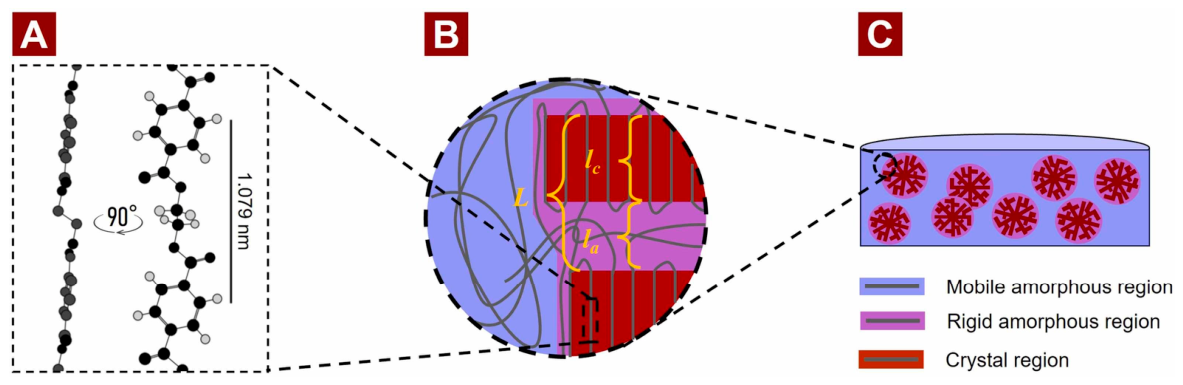
During crystallization, PET chains undergo a conformational transition from a mixture of trans and gauche conformations toward a more extended predominantly all-trans conformation (Figure 1A). Even though the all-trans conformation of an isolated chain is energetically less favorable, stabilization occurs through chain packing, including cooperative dispersion forces, dipolar interactions of the ester groups and π–π interactions between aromatic rings [28].
Polymer crystallization is a 3-step procedure, consisting of primary nucleation, crystal growth and secondary nucleation (or perfection). Primary nucleation occurs when small, spontaneously formed aggregates of chain segments reach a critical size and become thermodynamically stable, thereby acting as crystal nuclei in a homogeneous nucleation event. In contrast, heterogeneous nucleation can take place on impurities or added particles, which lower the energy barrier and promote an earlier onset of crystallization. Subsequently, crystalline lamellae grow from these nuclei and assemble into spherulites, with the growth rate peaking around 160–180 °C. This growth is strongly influenced by chain mobility, molar mass, and structural irregularities such as branching or diethylene glycol content. The spherulites continue to grow until they impinge upon one another [10,11,29,30].
In parallel, crystal perfection (or secondary crystallization) takes place, involving the gradual reorganization and thickening of existing lamellae (Figure 1B), as reflected by an increase in the average crystalline lamella thickness (lc) and a decrease in the thickness of the amorphous layers (la). This process also improves structural ordering and can lead to the formation of additional small crystallites within confined amorphous regions, often by inserting thinner lamellae between existing crystalline stacks. Unlike primary crystallization, secondary crystallization proceeds more slowly because chain mobility is limited. It occurs mainly in highly constrained regions between lamellae, particularly near fold surfaces, where molecular motion is strongly restricted [11,31,32].
The presence and growth of crystalline regions impose considerable topological constraints on adjacent amorphous chain segments. As a consequence, the amorphous material located in close proximity to crystal surfaces becomes immobilized and forms the rigid amorphous fraction (RAF). This fraction may also include amorphous material located within interlamellar regions when the confinement is sufficiently strong [33].
In contrast, the mobile amorphous fraction (MAF) is located farther away from crystalline constraints, typically in the interspherulitic regions (Figure 1C), and retains thermal mobility. Upon cooling below the glass transition temperature (Tg), the MAF undergoes vitrification. The glass transition thus represents a second-order thermal transition associated exclusively with the MAF, during which this fraction transforms from a rigid glassy state to a more flexible, rubbery state upon heating. The crystalline regions and the RAF remain unaffected by the glass transition, as chain mobility in these domains is suppressed by crystal-induced constraints. Consequently, only the chains within the MAF regain mobility above Tg, while those in the RAF remain largely immobilized until vitrifying at 200 °C [10,34,35]. Another difference between MAF and RAF is their molecular orientation. The chains that make up MAF are mainly gauche and RAF is mainly trans, while the crystalline form is all-trans [36]. A schematic illustration of the crystalline regions is shown in Figure 1B,C.
When the polymer melt cools slowly, crystal growth proceeds for longer scales, typically resulting in larger spherulites. If these crystalline domains reach dimensions comparable to wavelengths of visible light, light scattering increases and the material appears opaque [10,37]. In contrast, strain-induced crystallization produces highly oriented rod-like or fibrillary structures [38,39]. This process increases the nucleation density, as chain alignment reduces the entropic barrier to crystallization, resulting in a larger number of smaller crystalline domains. When the resulting crystallites remain sufficiently small, light scattering is reduced, enhancing the material’s transparency [24].

1.3. Methods to Determine PET Crystallinity

There are several methods available to determine the crystallinity of PET. Since these techniques rely on different physical principles, they often yield different values for the same sample. Differential scanning calorimetry (DSC) is the most commonly used method. In DSC, crystallinity is determined by heating the polymer and measuring the melting enthalpy of its crystalline regions, which is then normalized against that of a fully crystalline reference material [40,41]. This method provides an average bulk crystallinity, while spatial heterogeneities remain unresolved [10]. As crystals may form during the heating process (cold crystallization), the crystallinity values are often overestimated [42].
Wide-angle X-ray scattering/diffraction (WAXS/WAXD) probes the structural order within a material by quantifying diffraction peaks arising from crystalline lattice planes relative to the total scattered intensity. In this technique, X-rays are directed onto the sample and scattered at wide angles, producing a characteristic diffraction pattern. Highly ordered crystalline regions give rise to sharp diffraction peaks, whereas disordered amorphous regions produce a broad scattering halo. Because WAXS is sensitive primarily to long-range periodic atomic order, it may not fully capture small, defective, or strained crystallites and therefore can underestimate the overall degree of crystallinity [40,42,43].
Similarly, small-angle X-ray scattering (SAXS) provides information about the nanoscale structural organization of crystalline and amorphous domains, including lamellar morphology, such as long period and lamellar thickness. However, it does not directly yield the absolute degree of crystallinity without additional assumptions or complementary measurements [44,45].
Fourier transform infrared spectroscopy (FTIR) and Raman spectroscopy probe conformational differences in PET chains, typically distinguishing trans from gauche conformations. These methods provide semi-quantitative or relative measures of conformational order rather than absolute crystallinity and are more sensitive to the PET surface in their application [44].
Additional methods include dilatometry, which relies on the higher density of crystalline PET compared to amorphous PET and estimates crystallinity based on bulk density values, as well as solid-state nuclear magnetic resonance spectroscopy (NMR) [46]. NMR provides insights into local molecular mobility and structural order, enabling differentiation between crystalline, RAF, and MAF regions based on distinct relaxation behaviors and also allows an estimation of the trans/gauche-ratio [47,48].
In the context of enzyme degradation, Thomsen et al. suggested to compare the crystallinity of the MAF region (ΧMAF) instead of the highly crystalline region (ΧC), since enzyme kinetics is more closely related to the degradation of the MAF [49]. This can be determined with DSC by quantifying the fraction that undergoes glass transition at Tg or by solid-state NMR [47,50].
Throughout the literature, PET crystallinity is often described using qualitative terms such as “amorphous,” “semi-crystalline,” and “highly crystalline,” but the assignment of these labels is not consistent across studies. In particular, materials referred to as “highly crystalline” may correspond to substantially different crystallinity values depending on the source, with reported examples ranging from approximately 20% to over 40%. This variability reflects differences in experimental methods, sample history, and author-specific conventions rather than a standardized definition. As a result, qualitative crystallinity descriptors cannot be interpreted uniformly across studies and should be considered in the context of the underlying measurement method and material processing conditions [10]. In practice, the term “highly crystalline PET” is frequently used to describe PET substrates that exhibit markedly reduced susceptibility to enzymatic hydrolysis. However, as the onset and magnitude of this effect vary with substrate properties, crystallinity determination methods, and the enzyme under investigation, no universally accepted crystallinity threshold exists.

2. Enzymes Struggle with Crystalline PET

The first demonstration of enzymatic PET depolymerization was achieved in 2005 using the cutinase TfH from the actinomycete Thermobifida fusca [51]. Since then, a large and continuously growing number of enzymes capable of degrading PET have been reported, many of which are cataloged in the PAZy database [52]. Enzymatic hydrolysis of PET is typically most efficient at temperatures above the Tg, where increased mobility of amorphous chains within the MAF enhances substrate accessibility. Consequently, highly effective PET hydrolases generally exhibit high thermostability above the Tg of PET, enabling them to maintain structural stability and catalytic activity under elevated temperatures over extended periods, with degradation rates approaching near-complete conversion for amorphous PET.
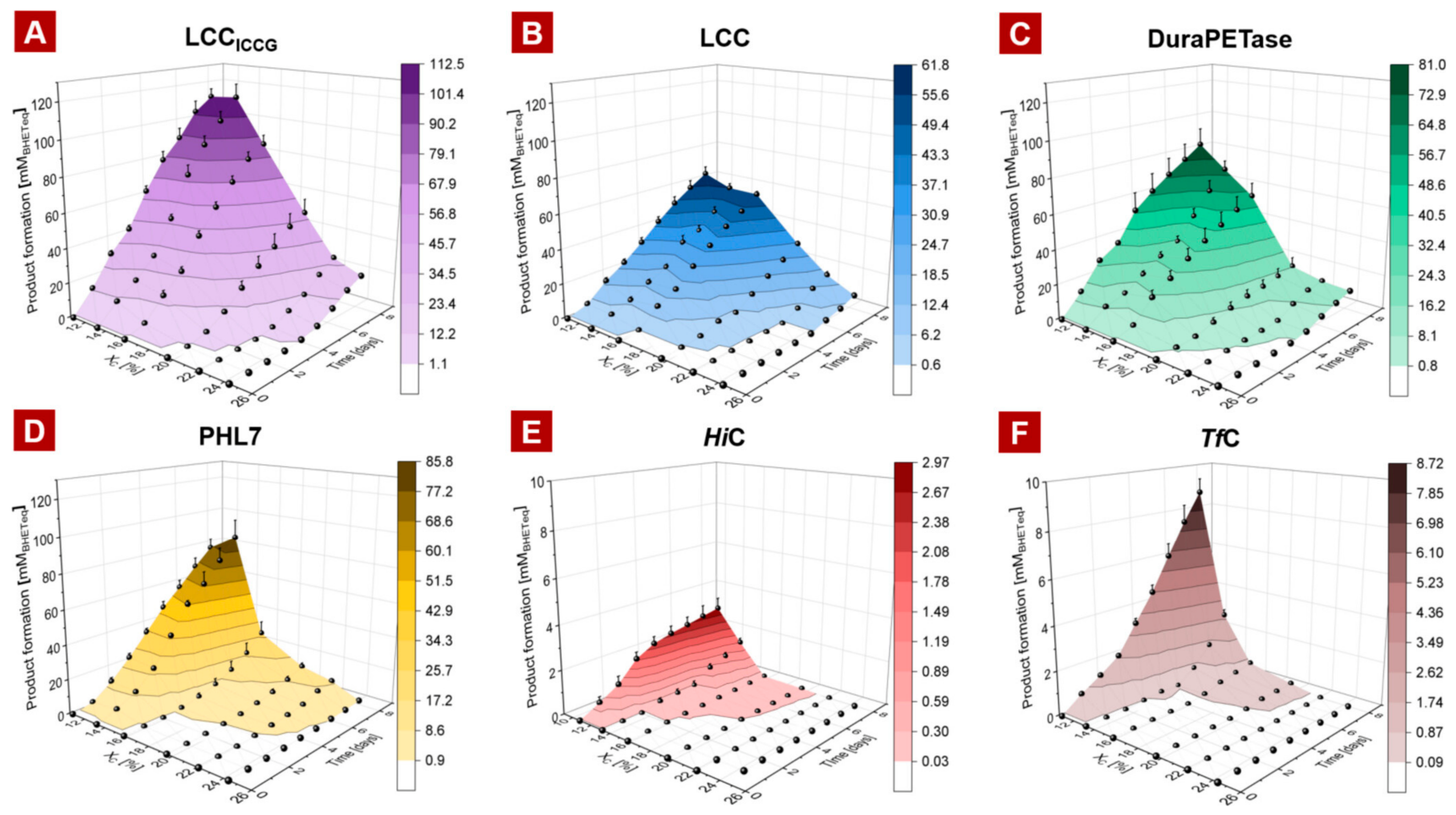
However, increased crystallinity of the substrate leads to a pronounced reduction in degradation rates. Controlled crystallinity experiments have shown that enzymatic product release can effectively cease above certain crystallinity thresholds (e.g., ~22–27% for LCCICCG and ~17% for DuraPETase of annealed PET disks), underscoring why bottle-grade PET remains challenging to degrade without prior pretreatment [53]. Thomsen et al. demonstrated that polyester hydrolases exhibit different sensitivities to PET crystallinity, with PHL7, HiC, and TfC being more strongly affected by increasing crystallinity than LCCICCG, LCC, and DuraPETase as illustrated in Figure 2 [54]. This suggests that crystallinity sensitivity is to some extent an intrinsic property of the enzyme and largely independent of hydrolytic activity at low crystallinity. This behavior has been attributed to differences in conformational selectivity toward PET chains, in particular to those adopting the trans conformation, in agreement with the interpretation of Guo et al. [55]. In line with these observations, Thomsen et al. further showed that increasing crystallinity reduces the number of accessible cleavage sites on the PET surface, thereby directly impacting enzyme–substrate interactions and overall catalytic efficiency. At low crystallinity, high surface accessibility supports efficient hydrolysis, with enzyme concentration often limiting the reaction rate. In contrast, at higher crystallinity, reduced accessibility shifts the system to substrate-limited conditions, where the reaction rate depends on the density of accessible attack sites [49,54].
Enzymatic PET hydrolysis is a heterogeneous process occurring at the polymer–liquid interface. In addition to polymer crystallinity, interfacial phenomena, enzyme adsorption, and local water availability may also influence degradation rates.
Although the enzyme may readily adsorb to the PET interface, catalytic turnover becomes predominantly constrained by substrate accessibility and PET chain mobility rather than intrinsic catalytic kinetics. Interfacial processes such as enzyme adsorption, substrate accommodation within the active site, and substrate desorption have been identified as key rate-limiting steps in PET hydrolysis. Productive catalysis requires the local disengagement of a PET chain from the surrounding polymer matrix, followed by its entry into the active-site groove in a hydrolytically competent conformation [7,56,57]. As increasing crystallinity directly restricts polymer chain mobility, the probability of achieving such productive chain extraction and rearrangement is significantly reduced [7,57]. Free-energy calculations using the well-tempered metadynamics method revealed that PET chain detachment from crystalline regions is associated with substantially higher energy barriers due to stronger interchain interactions. This elevated energetic cost impedes the transition toward catalytically competent states, even when enzyme-PET surface proximity is achieved [58]. As a result, highly crystalline PET remains intrinsically recalcitrant, even under conditions that promote enzyme adsorption, such as the presence of surfactants or other additives [7,57].
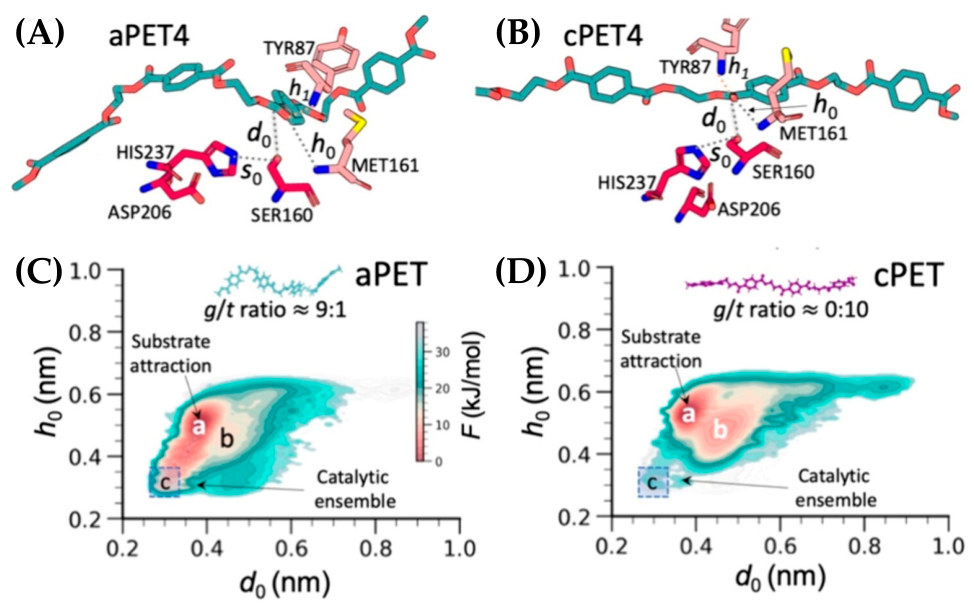
To rationalize the experimentally observed differences in enzymatic activity with increasing PET crystallinity, computational approaches have also been employed to probe enzyme–substrate interactions at the molecular level. Molecular modeling studies revealed that amorphous PET (aPET) chains, characterized by mixed trans/gauche conformations, bind more favorably to IsPETase and adopt reactive conformations with shorter nucleophilic attack distances, compared to crystalline PET (cPET) chains with an all-trans conformation [58,59]. As shown in Figure 3, the simulated free-energy landscapes reveal distinct populations corresponding to substrate-attraction states and catalytically competent configurations, defined by optimal distances between the nucleophilic serine and the ester bond. In aPET, the broader distribution enables frequent transitions into reactive states, whereas in cPET, the conformational space is more restricted and biased toward non-productive, attraction-dominated states. Furthermore, the simulations indicate that productive configurations require the simultaneous alignment of multiple geometric parameters, including the nucleophile–substrate distance and hydrogen-bonding interactions within the catalytic triad, which are entropically disfavored in the more rigid crystalline environment [58]. Accordingly, aPET chains exhibit lower activation barriers, whereas cPET chains display higher distortion energies and reduced stabilization within the oxyanion hole [59].
Molecular dynamic simulations employing large-scale atomic PET models (>3800 monomers) further compared the molecular structure and polymer chain conformation in amorphous and crystalline PET and their impact on enzyme interactions [60]. The study showed that amorphous PET exhibits a broad distribution of trans/gauche conformations with relatively low rotational energy barriers, enabling local chain mobility and frequent conformational rearrangements. In contrast, crystalline PET adopts extended all-trans conformations with significantly higher energetic penalties for dihedral rotation, reflecting strong intermolecular packing constraints. These differences directly affect enzyme–substrate interactions: in amorphous PET, flexible chain segments can transiently disengage and adopt conformations that allow ester bonds to access the IsPETase active site, whereas in crystalline PET, restricted mobility and dense packing limit ester bond exposure and reduce the likelihood of productive binding. Accordingly, IsPETase associates more favorably and adopts catalytically relevant orientations on amorphous surfaces, while interactions with crystalline PET are more constrained and frequently non-productive due to limited chain accessibility.
Notably, when the enzyme environment beyond the active site is excluded, the activation barrier for crystalline PET decreases substantially, indicating that the enzyme environment imposes unfavorable steric constraints, whereas amorphous PET remains largely unaffected. Conformational analysis further indicated that both trans and gauche PET conformations are catalytically competent during the acylation, with the gauche conformation being slightly favored due to its lower distortion energy. In the rate-determining deacylation step, however, a linear trans conformation exhibits the lowest activation energy barrier, relative to both gauche and twisted trans conformations. This enhanced reactivity arises from reduced distortion and more favorable electrostatic and geometric interactions within the active site, including optimized charge distribution and catalytic water position [59]. Overall, the rigidity, higher distortion energy, and unfavorable enzyme–substrate interactions associated with the all-trans crystalline PET collectively hinder its efficient enzymatic cleavage, thereby explaining the enzyme’s preference for amorphous PET depolymerization.

3. PET Pretreatment

Many PET products such as beverage bottles exhibit a high crystallinity (typically above 30%), making them intrinsically recalcitrant to enzymatic degradation. Previous studies have shown that PET samples with a crystallinity ~30% rarely exceed enzymatic degradation extents of more than ~20% [54]. To enable their efficient enzymatic depolymerization, pretreatment procedures are typically applied prior to enzymatic hydrolysis. The goal of such pretreatments is to reduce the crystallinity, modify surface properties, enhance enzyme adsorption, and increase surface area or hydrophilicity, thereby facilitating enzyme access to the hydrolysable ester bond [61]. An overview of pretreatment strategies discussed below is provided in Table 1.
The primary method to decrease crystallinity is to melt the PET sample, followed by rapid quenching. For example, Lu et al. demonstrated that melting PET bottles with 25.9–33.8% crystallinity for 20 min followed by quenching yielded a nearly uniformly amorphous material with 2% crystallinity, resulting in a more than 300-fold increase in enzymatic degradation activity [62].
Ball milling represents a rapid, mild and chemical-free process that increases surface roughness and thereby enhances enzymatic hydrolysis efficiency. Zhou et al. achieved a 12% reduction in crystallinity of a 51% crystalline sample after 30 min of ball milling, accompanied with a size reduction from 1 cm to below 1 mm, which resulted in a 23.8-fold increase in enzymatic activity [63].
Shao et al. applied a one-step high-speed rotary grinding process (8000 rpm) followed by cooling, resulting in a reduction in crystallinity from 26.8% to 11.3% along with micronization of post-consumer PET (pcPET). This pretreatment also caused a slight increase in surface hydrophobicity, which may enhance enzyme adsorption, and led to a significant reduction in molecular weight. Collectively, these effects facilitated enzymatic degradation, achieving conversion exceeding 90% [64].
Cryomilling has emerged as an alternative mechanical pretreatment in which PET is milled at cryogenic temperatures (e.g., using liquid nitrogen), leading to pronounced embrittlement of the polymer. This process results in substantial particle size reduction, increased surface area, and partial disruption of crystalline domains without inducing thermal degradation. As a consequence, cryomilled PET exhibits enhanced enzymatic accessibility and improved hydrolysis rates compared to untreated material. Interestingly, reducing the particle size had little effect on the overall conversion extent [65].
Another approach was demonstrated by Guo et al., who subjected shredded commercial PET bottles to 2 h of microwave radiation, resulting in chain scission and reduced molecular weight. This treatment promoted conformational changes towards more enzyme-accessible states, leading to a ~1800-fold increase in enzymatic hydrolysis, despite an increase in trans conformations and the associated increase in crystallinity [55]. Falkenstein et al. irradiated Goodfellow PET (Gf-PET) films using a 1-kW xenon lamp for 14 days, which reduced the average molecular weight but increased crystallinity, as indicated by a higher trans/gauche ratio [48]. These changes led to an increased resistance of the PET sample against enzymatic degradation.
Giraldo-Narcizo et al. treated pcPET bottles with 10 M NaOH for 24 h, leading to a roughened surface and a decrease in crystallinity from 33.7% to 27.7%. This low-energy demanding and cost-effective process led to an 8.4-fold increase in enzymatic hydrolysis activity [66]. Xing et al. dissolved PET powder in a hexafluoroisopropanol (HFIP)/NaOH solution, offering the advantage that no neutralization step is necessary, due to the low amounts of NaOH used. This pretreatment lowered the crystallinity of PET powder from 42.9% to 7.9%, enabling complete enzymatic degradation. Notably, this approach proved effective across a range of commercial PET products with varying crystallinities, consistently achieving degradation rates above 95% [67].
Sonnendecker, Zhao, and Zimmermann developed a dissolution–precipitation pretreatment in which biaxially stretched PET is dissolved in HFIP and subsequently precipitated using an anti-solvent. In particular, precipitation with isopropanol yields macroporous materials with a specific surface area of up to 43 m2 g−1, accompanied by low crystallinity and a 100- to 400-fold increased density of enzyme binding sites. This structural transformation enables rapid and nearly complete enzymatic hydrolysis, with PHL7 degrading the material within 30 min. The resulting substrate represents a useful model for studying polyester hydrolase kinetics [68].
Furukawa et al. incubated PET (40% crystallinity) with 0.005% sodium tetradecyl sulfate at 30 °C for 1 h, rendering the surface more negatively charged and thereby enhancing the adsorption of the cationic IsPETase, which resulted in an 120-fold increase in activity [69]. Another method was demonstrated by Puspitasari et al., who showed that coating the PET surface with hydrophobins and incubating them at 30 °C, increased the PET surface hydrophobicity. This treatment enhanced enzymatic degradation, increasing PET weight loss from 18% to 34%, likely due to improved hydrophobic interactions between the enzyme and the polymer surface via the substrate-binding cleft [70].
Table 1. Summary of pretreatment strategies for PET prior to enzymatic hydrolysis. Crystallinity values before and after treatment are shown where reported. ND, not determined in reported study; NR, not reported. The crystallinity was determined by DSC unless stated otherwise. * Xc determined by WAXS.
ClassificationPretreatment
Condition
Enzyme/
Variant
PET
Substrate
(Xcbefore → Xcafter)
Reported EffectImprovement of Degradation
vs. Untreated
Reference
alkaline10 M NaOH
(24 h at 25 °C)
IsPETasepcPET water bottle
(33.70% → 27.68%)
Surface roughening and reduction in crystallinity84.4-fold[66]
0.12 wt% NaOH/HFIP solvation (2 h)LCCICCGPET powder
(42.9% → 7.9%)
Reduction in size and crystallinityNo degradation vs. complete degradation[67]
surfactantsincubation with hydrophobins
(3 h at 30 °C)
IsPETasePET fiber
(64.8% → ND) *
PET bottle powder
(38.8% → ND) *
Hydrophilization of PET surface1.88-fold (fiber)
1.60-fold (powder)
[70]
incubation with 0.005% C14-OSO3 (1 h at 30 °C)IsPETasePET film
(3–5% → unchanged)
Increased surface anionization120-fold[69]
thermalmelting (20 min 290 °C) and quenchingFastPETasepcPET
(25.9–33.8% → 2%)
Reduced crystallinity234–364-fold[62]
mechanicalBall milling (30 min)LCCYGApcPET fiber
(51% → 39%) *
PET curtain
(29.8% → ND)
Surface roughening and reduction in crystallinity and size23.5-fold (fiber)
23.8-fold (curtain)
[63]
High speed milling with subsequent coolingNI-M7pcPET bottles
(26.8% → 11.3%)
Reduction in size, molecular weight and crystallinity. Increase in surface hydrophobicityND
>90% degradation
[64]
CryomillingLCCICCGPET films
(4.2% → 11.0%)
Reduction in size and increase in surface areaND
>99% degradation
[65]
radiationUV radiation (14 d)LCCPET films
(NR)
Reduction in average molecular mass. Increase in crystallinity0.71-fold[48]
shred and microwave radiation (2 h)IsPETase-S238ApcPET bottles
(NR)
Increased accessible surface, trans-enrichment and crystallinity increase1400-fold[55]

4. Engineering Strategies to Enhance Enzyme Activity Towards Crystalline PET

In addition to the various pretreatment strategies that aim to reduce PET crystallinity through physical or chemical modifications, alternative approaches have focused on directly enhancing the intrinsic catalytic performance of enzymes toward highly crystalline PET. These strategies target the enzyme itself or the reaction environment to overcome limitations in substrate accessibility and turnover. We highlight several complementary engineering strategies that have emerged in the current years, including (i) modifications to improve substrate binding and facilitate active-site entry, (ii) engineering of PET hydrolases to enhance thermal and operational stability, (iii) optimization of enzyme–surface interactions to promote PET binding, and (iv) process engineering approaches designed to improve overall degradation efficiency under industrially relevant conditions. The strategies discussed in this section are summarized in Table 2.

4.1. Engineering to Improve Substrate Binding and Active-Site Entry

Binding groove remodeling directly targets the processes of substrate entry and binding, which represent the key rate-limiting steps under crystallinity-constrained conditions [57,71]. Early structural insights have already emphasized the importance of active-site accessibility: the discovery of IsPETase revealed a more open and solvent-exposed binding cleft compared to canonical cutinases. Subsequent mutational reshaping of the binding groove improved PET hydrolysis, indicating that the native architecture is not fully optimized for efficient substrate processing [72].
Additional evidence supporting the importance of groove architecture comes from the engineering of the LCCICCG enzyme, developed through structure-guided mutagenesis aimed at optimizing a widened hydrophobic binding cleft [56]. This variant combines a stabilizing disulfide bond (D238C/S283C) with groove-optimizing mutations (e.g., F243I, Y127G), achieving ~90% depolymerization of bottle-grade PET under high-concentration conditions [56]. These findings suggest that groove optimization is critical for engaging structurally constrained polymer segments, rather than merely enhancing enzyme stability, consistent with mechanistic analyses emphasizing substrate binding and positioning as dominant determinants of PET hydrolysis [71].
More direct evidence for the relevance of active-site groove engineering is provided by Cao et al., who applied structure-guided directed evolution using site saturation mutagenesis to residues surrounding the substrate binding cleft of LCC. Using non-pretreated PET powder with ~42% crystallinity as the screening substrate, they identified the WCCG-sup variant lineage with significantly enhanced depolymerization performance. These variants exhibited markedly increased product release and catalytic efficiency compared to the parental enzyme, with WCCG-sup1 showing ~4-fold higher TPA production after 48 h on ~42% crystalline PET powder. Notably, complete depolymerization was still only demonstrated for lower-crystallinity PET (~16%), indicating that while groove remodeling substantially improves activity on crystalline PET, crystallinity-dependent kinetic limitations remain. The introduced mutations primarily target residues that define the binding cleft, including positions at the groove entrance and along the hydrophobic substrate channel, and collectively reshape the groove by reducing steric constraints and redistributing aromatic and hydrophobic interactions, thereby facilitating improved alignment and stabilization of PET chains within the catalytic cleft. Together, the results from Cao et al. demonstrate that targeted reshaping of the active-site groove enhances substrate engagement and turnover under crystallinity-constrained conditions [73].
Mechanistic insight into these improvements is further provided by binding-mode-guided engineering of PHL7. Structure analyses of PHL7 in its substrate-bound state by Richter et al. revealed a comparatively compact and well-defined active-site groove, suggesting this as a structural basis for reduced conformational heterogeneity and more precise substrate positioning [74]. Groove mutations L92F/Q94 introduced into PHL7 by Pfaff et al. enhanced aromatic stacking interactions with PET and improved packing with the binding cleft, as suggested by computational modeling, thereby shifting the ensemble of substrate-binding modes toward catalytically competent states. These effects were experimentally validated using amorphous PET films, pretreated pcPET, and PET oligomers [75]. While these substrates do not represent highly crystalline PET, the underlying mechanism is readily transferable: reduced chain mobility under crystallinity-limited conditions restricts conformational sampling and increases the likelihood of nonproductive binding events [57,75]. Accordingly, optimizing the groove geometry to favor productive binding of conformationally constrained, all-trans PET chains becomes a critical factor for efficient catalysis of crystalline PET [76]. Taken together, these findings suggest that not only binding within the active site, but also substrate entry into the groove, constitutes a key determinant of catalytic efficiency under crystallinity-constrained conditions.
To elucidate the substrate entry process at atomic resolution, a quantitative computational framework for simulating substrate entry, combined with free-energy analyses of modeled entry pathways, was developed by Jäckering et al. According to their simulation results, PET degradation proceeds via initial nonspecific adsorption, followed by entry into the active site through discrete pathways separated by defined energy barriers, including contributions from PET–PET interactions [50]. As PET–PET interactions are strengthened in crystalline domains, substrate entry becomes increasingly rate-limiting under these conditions. Using this framework, mutations such as T211G in LCCICCG and S68A in PHL7FY were predicted to reshape the free-energy landscape by facilitating transitions toward productive binding states and destabilizing nonproductive intermediates. Experimental characterization of these variants revealed altered kinetic parameters (e.g., ~3-fold differences in invKM (inverse Michaelis constant (KM−1)) and catalytic efficiency, indicating improved substrate engagement, although these differences should be interpreted with caution given the inherent variability of kinetic assays and the lack of a corresponding effect in bulk degradation (e.g., weight-loss assays). These results demonstrate that entry-path engineering, guided by computational insights, has the potential to enhance interfacial catalysis by increasing the probability of productive substrate accommodation rather than altering intrinsic catalytic chemistry [57].
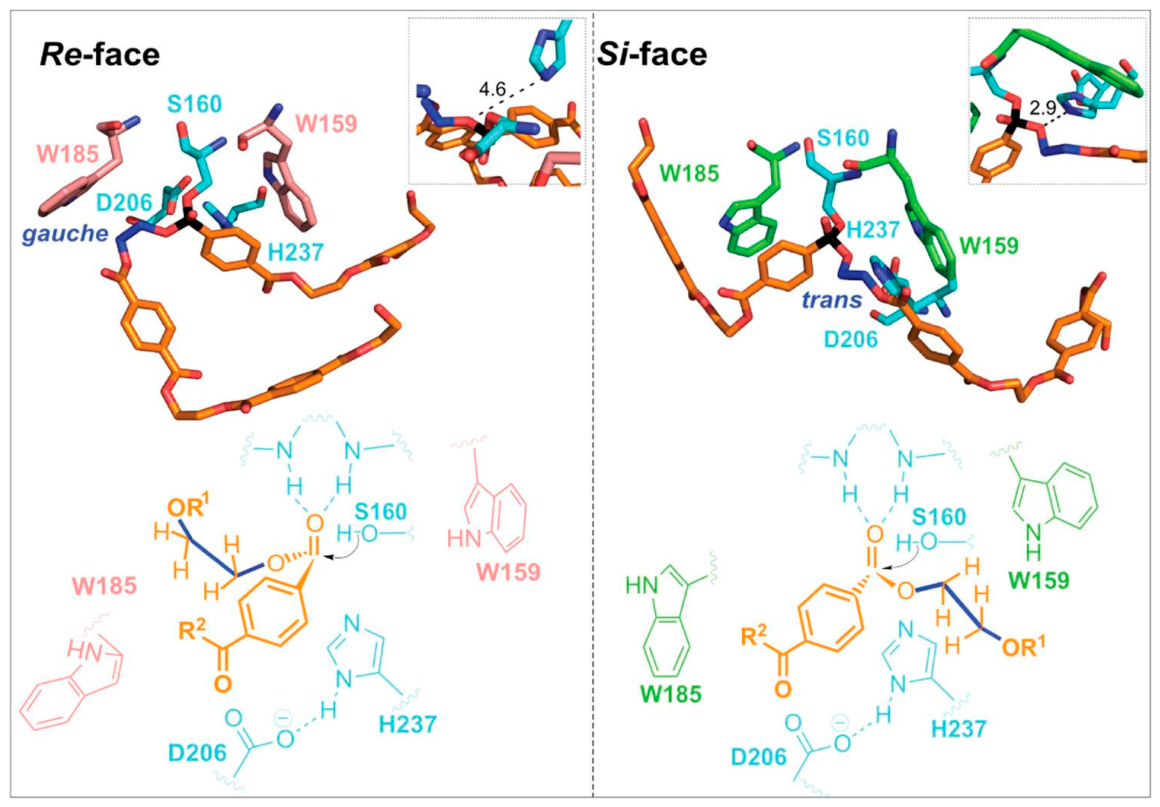
An example where this concept has been applied is the study by Guo et al. [76], who engineered IsPETase through targeted mutations in active-site loops to improve substrate accommodation. Specifically, residue S238 in the β8–α6 loop adjacent to the catalytic H237 was modified to alanine, thereby disrupting the native S238–N241 hydrogen-bonding network. This modification was proposed to increase the flexibility of the catalytic loop and alter the position of the “wobbling” W185, ultimately promoting the binding of PET chains in a planar, all-trans conformation. This conformational preference is illustrated in Figure 4 (Si-face), where energy-minimized tetrahedral intermediates reveal that trans-configured PET chains adopt a more favorable alignment with the catalytic triad in the S238A variant compared to gauche conformations. Experimental characterization showed that S238A exhibited moderately increased PET hydrolysis, along with a ~4-fold increase in substrate binding affinity, as determined by fluorescence microscopy. Furthermore, the variant showed a 2.8-fold higher activity on a microwave-treated, trans-enriched PET oligomer compared to the wild-type enzyme. Notably, its catalytic efficiency (kcat/KM) toward a soluble model substrate (pNPB) remained essentially unchanged, indicating that the observed improvements primarily arise from enhanced substrate binding rather than intrinsic catalytic turnover. Docking and molecular dynamics simulations further confirmed that S238A stabilizes PET in an extended trans conformation within the active site while maintaining a productive catalytic triad geometry [76].
Extending this strategy beyond single-point mutations, more recent work has combined binding-groove and stability engineering in TurboPETase, a computationally redesigned PET hydrolase developed using a machine learning-guided Greedy Accumulated Strategy for Protein Engineering (GRAPE) approach [77]. This study combined mutations targeting the substrate-binding cleft with stabilizing modifications, including a disulfide bridge and surface-interaction-optimizing mutations. Structural and molecular dynamics simulation analyses suggested that the enhanced performance is largely associated with increased flexibility of the PET-binding groove, facilitating substrate access and productive positioning at the polymer interface. TurboPETase achieved ~98% depolymerization of pretreated pcPET within 8 h at industrially relevant substrate loadings (200 g kg−1) at 65 °C. Notably, the pcPET substrate used in this study was subjected to a high-temperature melting and extrusion process prior to enzymatic treatment, resulting in a predominantly amorphous material. Although the initial crystallinity of pcPET was not explicitly reported, it is likely to have been relatively low due to this pretreatment. After depolymerization, the remaining PET exhibited a crystallinity of ~11.9% [77]. This apparent decrease in crystallinity should be interpreted with caution, as it is likely attributable to the preferential degradation of more accessible, amorphous regions, rather than extensive conversion of highly crystalline domains. These findings suggest that groove optimization combined with enzyme stabilization enhances degradation of the accessible polymer fraction under process-relevant conditions, but does not overcome the inherent limitations associated with restricted access to crystalline regions.
Although only a subset of studies explicitly employ highly crystalline substrates, their findings converge on substrate entry and limited chain mobility as the primary constraints under crystallinity-limited conditions [10,57,71]. As crystallinity increases, the energetic penalties for PET chain disengagement rise, lowering the frequency of productive binding events. Accordingly, effective enzymes must capture and stabilize transiently accessible chain segments in catalytically competent configurations. Collectively, groove remodeling and entry-path engineering strategies address these limitations by facilitating substrate access rather than accelerating the intrinsic hydrolysis step, thereby representing key adaptation strategies for crystalline PET degradation [57,71].

4.2. Engineering of PET Hydrolases for Higher Stability

While groove and entry-path engineering enhance productive substrate engagement, efficient degradation of crystalline PET also depends on the ability of the enzymes to operate near the glass-transition temperature of PET (Tg ≈ 65–75 °C), where increased segmental mobility enhances substrate accessibility and enables catalytic turnover, primarily within the MAF, while having only limited impact on highly crystalline regions. [8,78]. Accordingly, thermophilic enzymes generally outperform mesophilic counterparts for PET depolymerization under such conditions [7]. Protein engineering strategies to increase the stability, including the introduction of disulfide bonds, salt bridges, or improved core packing, therefore aim to increase the melting temperature and prevent thermal denaturation.
A prototypical example is the engineering of leaf–branch compost cutinase (LCC), where replacement of a Ca2+-binding motif with a disulfide bridge (D238C/S283C) increased the melting temperature to 94.5 °C with only moderate loss of catalytic activity [49], thereby extending enzyme lifetime under process-relevant conditions. Consistent with this principle, multi-mutant variants derived from LCCICCG have been developed to enhance performance under conditions relevant for semi-crystalline PET substrates. For example, the LCCICCG-derived I6M variant exhibits improved thermostability and enhanced activity at elevated temperatures, resulting in substantially increased product release on PET powder with ~30% crystallinity compared to the parental enzyme [79]; although such product formation should be interpreted with caution, as it likely reflects preferential turnover of amorphous regions rather than extensive depolymerization of highly crystalline domains, and may be influenced by heterogeneity in the PET substrate (e.g., variable crystallinity in bottle-derived materials).
Another complementary example following a similar stability-driven design strategy is DuraPETase, obtained via a GRAPE-based computational redesign of IsPETase, which markedly increases thermostability and prolongs catalytic lifetime at elevated temperatures. On semi-crystalline pcPET (~30–34% crystallinity), this results in an approximately 300-fold increase in product formation relative to the wild-type enzyme; however, absolute conversion remains limited (~15%) and considerably below that observed for low-crystallinity substrates [80]. We note that the PET film was prepared via HFIP dissolution and reprecipitation, likely yielding a non-native morphology. Accordingly, the observed performance gains should be interpreted with caution, as they may not translate to industrially relevant PET materials and could be further amplified by the low baseline activity of the wild-type enzyme. These observations suggest that performance gains primarily arise from enhanced enzyme persistence rather than improved substrate accessibility.
Notably, stabilizing mutations in PET hydrolases are often located in distal or second-shell regions, where they enhance global protein stability while minimizing perturbations of the catalytic site [62,81]. This reflects the need to balance structural rigidity with the conformational flexibility required for efficient substrate binding and turnover, as also observed in recent machine learning-guided designs that simultaneously improve stability and activity [62]. Crucially, increased stability alone is insufficient to overcome the intrinsic limitations imposed by restricted chain mobility in crystalline domains. Even highly thermostable PET hydrolases exhibit markedly reduced activity on highly crystalline compared to amorphous substrates, indicating that substrate accessibility, governed by PET chain mobility, remains the dominant constraint [10].
Therefore, while stability engineering extends the operational temperature window and prolongs enzyme lifetime, combining it with groove- and entry-path engineering represents a promising strategy to improve substrate accessibility; however, its effectiveness in enabling the degradation of highly crystalline PET remains to be demonstrated.

4.3. Engineering for Improved PET Surface Binding

In addition to active-site and entry-path optimization, engineering enzyme–PET interactions at the polymer interface represents a complementary strategy to enhance PET depolymerization. Because PET-degrading enzymes act predominantly at the solid–liquid interface, surface interaction engineering can increase enzyme adsorption and thereby enhance the frequency of productive catalytic events on polymer substrates [7,82]. This effect is expected to become increasingly important under highly crystalline conditions, where productive enzyme–polymer encounters are intrinsically limited [7,54].
Engineering the enzyme’s surface electrostatic properties represents one of the most direct approaches to enhance enzyme–polymer interactions. The introduction of positively charged residues on the enzyme surface has been shown to substantially increase PET binding and hydrolytic activity. For example, charge-engineered variants of PET2, a thermostable variant of Cut190, exhibited ~2.7-fold higher binding rates and ~6–7-fold higher hydrolysis rates compared to the wild type when tested on amorphous PET films [83]. While these experiments do not directly address crystalline substrates, they demonstrate that enhanced electrostatic interactions with the polar ester backbone improve enzyme adsorption and stabilize enzyme–polymer contacts. Furthermore, adsorption studies by Badino et al. showed that the PET hydrolases HiC and TfC bind with high affinity to PET surfaces, with dissociation constants in the nM range, and that adsorption reaches saturation corresponding to near-monolayer coverage of the polymer surface. These findings indicate that catalytic performance is strongly influenced by the local enzyme concentration at the polymer interface [82].
Complementary to electrostatic modifications, hydrophobic surface engineering can enhance interactions with the largely apolar PET surface. Increasing surface hydrophobicity enhances van der Waals interactions with the polymer surface and reduces enzyme desorption [82,84,85]. Early work on cutinases demonstrated that introducing binding domains or hydrophobic surface patches improves adsorption and PET hydrolysis on PET films of low to moderate crystallinity, although this effect was not always rigorously quantified. For example, fusion of a type-A binding module to a cutinase from Thermobifida cellulosilytica (Thc_Cut1) resulted in an approximately 3–4-fold increase in PET hydrolysis activity, consistent with enhanced enzyme residence time at the polymer interface [86].
More directly relevant to semi-crystalline PET, fusion of hydrophobic surface-anchoring peptide tags to engineered PETases has been evaluated on substrates with defined crystallinity. In particular, an anchor-fused HotPETase variant exhibited ~1.5-fold higher initial hydrolysis rates on PET microparticles with ~30% crystallinity, when tested on both low-crystallinity (7.6%) and higher-crystallinity (~30%) substrates. However no significant improvement in final depolymerization yield was observed at higher substrate loadings, indicating that enhanced adsorption primarily accelerates initial reaction rates rather than overall conversion [87].
An alternative approach involves the use of carbohydrate-binding modules (CBMs) to enhance enzyme localization at the polymer surface. CBMs are non-catalytic domains that bind insoluble polymeric substrates and act as tethering modules, thereby increasing the local enzyme concentration at the interface [88]. Accordingly, CBM-fused PET hydrolases show modest performance improvements under low-concentration conditions (<10 wt% PET) on amorphous PET, but no benefit at higher substrate loadings where binding is already extensive [88]. It was further demonstrated that CBM fusion depends on substrate crystallinity, with beneficial effects observed for low-crystallinity substrates but detrimental effects for more crystalline PET, likely due to non-productive binding or steric effects that limit effective substrate engagement [89].
Experimental observations indicate that adsorption-enhancing modifications generally improve initial hydrolysis rates but show diminishing effects at higher substrate loadings and do not substantially enhance final depolymerization yields. This trend is evident for both, anchor peptide-modified enzymes [87] and CBM-fused enzymes [88]. In some cases, increased surface affinity can even impair activity on more recalcitrant or less accessible PET substrates, likely due to non-productive binding or steric constraints [89].
These findings underscore that adsorption strength must be carefully balanced. While insufficient binding limits enzyme–polymer encounters, excessively strong or non-specific adsorption can reduce catalytic efficiency [82]. Consequently, surface interaction engineering primarily modulates interfacial kinetics rather than overcoming intrinsic limitations in substrate accessibility. Its most effective application therefore lies in combination with active-site and stability engineering, which together define substrate processing, catalytic turnover, and enzyme persistence under process-relevant conditions.

4.4. Process Engineering Approaches to Enhance Highly Crystalline PET Degradation

In addition to enzyme-centered engineering, modifying the reaction environment provides a complementary strategy to enhance PET depolymerization. These approaches are particularly relevant for highly crystalline PET [7,54].
One strategy involves the use of hydrophobins, small amphiphilic proteins produced by filamentous fungi that self-assemble at hydrophobic–hydrophilic interfaces, thereby modifying surface properties and enhancing enzyme adsorption on hydrophobic PET surfaces [90]. In PET degradation, this improves enzyme–polymer interactions and substrate accessibility. Accordingly, hydrophobin-assisted systems were shown to significantly enhance PET hydrolysis on semi-crystalline and highly crystalline substrates. For example, combining IsPETase with hydrophobins increased weight loss of PET fibers (Xc ≈ 38.8%) from ~18% to ~31–35% and of PET bottle powder (Xc ≈ 64.8%) from ~17% to ~27–29%. However, X-ray diffraction analysis revealed an increase in crystallinity during degradation, indicating that hydrolysis primarily occurs in amorphous regions, while crystalline domains remain largely unaffected [70]. More directly relevant to highly crystalline PET, co-display of IsPETase with hydrophobins on yeast cells enabled degradation of PET with ~45% crystallinity, resulting in a ~328-fold increase in turnover rate compared to the free enzyme. However, despite this substantial relative improvement, absolute degradation remained low, with only ~3% reduction in film thickness observed, while the free enzyme showed negligible activity under the same conditions [91].
A fundamentally different approach involves moist-solid or solid-state reaction systems, which modify the reaction environment to improve accessibility in highly crystalline PET. Using HiC cutinase, Kaabel et al. demonstrated hydrolysis of consumer-grade PET plastics (ΧC ~30–40%), achieving ~15-fold higher enzyme efficiency and ~13-fold higher space–time yield compared to aqueous systems. Notably, PET crystallinity remained largely unchanged during hydrolysis, suggesting that both amorphous and crystalline regions may contribute to the observed degradation. However, it should be noted that the substrate was subjected to ball milling during processing, which is known to induce partial amorphization of crystalline PET and thereby increase substrate accessibility. Accordingly, the observed performance improvements likely arise from a combination of increased interfacial contact, reduced diffusion limitations, and mechanically induced structural changes, rather than from enzymatic conversion of highly crystalline PET alone [92].
Finally, enzyme immobilization and confinement strategies, including encapsulation in porous materials such as metal–organic frameworks (MOF), have emerged as approaches to enhance enzymatic PET degradation. Immobilization improves enzyme stability, prolongs activity at elevated temperatures, and can increase local enzyme concentrations at the polymer interface, resulting in moderate activity enhancements compared to free enzymes [93]. More advanced MOF-based systems can additionally promote enzyme co-localization and interfacial interactions. For example, a customized self-assembled biocatalyst integrating PETase and MHETase within a CaZn-MOF framework, combined with hydrophobin-mediated surface engineering, achieved >90% depolymerization of untreated PET and produced ~9.5 mM TPA, highlighting the potential of MOF-assisted synergistic biocatalysis under favorable substrate conditions [94].
Notably, recent studies have also explored enzymatic activity on highly crystalline PET substrates in the form of micro- and nanoplastics. In one example, the engineered PET hydrolase LCCICCG was immobilized on tannic acid–modified, MOF-derived FeCo layered double hydroxide supports (ZIF-67-derived FeCo-LDH). This system enabled degradation of PET nanoparticles and microparticles with crystallinities of ~50%, where immobilization increased activity by ~16-fold compared to the free enzyme after 96 h. However, despite this substantial relative improvement, absolute depolymerization remained low (~5%) [95], and no direct evidence for efficient depolymerization of the crystalline fractions was provided; thus, the observed product formation may predominantly originate from more accessible amorphous regions.
Accordingly, enzyme immobilization primarily enhances stability and sustains catalytic activity under process-relevant conditions, rather than directly improving access to crystalline domains, and is therefore most effective when combined with strategies that increase substrate accessibility.
Collectively, the four reviewed approaches address complementary limitations of highly crystalline PET degradation: while active-site and entry-path engineering improve substrate accommodation and stability engineering enables catalysis at elevated temperatures, surface- and process-level strategies increase the frequency of productive enzyme–polymer interactions without fundamentally altering substrate accessibility. Importantly, none of these approaches has yet demonstrated complete depolymerization of highly crystalline PET, highlighting that intrinsic limitations imposed by restricted substrate accessibility remain unresolved. These findings suggest that further improvements in the depolymerization of highly crystalline pcPET may require the integration of multiple complementary engineering strategies.
Table 2. Summary of recent PET hydrolase engineering strategies. Fold improvements in degradation relative to the benchmark enzyme and PET Xc values are shown where reported. ND, not determined in reported study.
Engineering
Focus
Specific
Strategy
Enzyme/
Variant
PET
Substrate (Xc)
Reported EffectImprovement in Degradation
vs. Benchmark
Reference
Binding groove
remodeling
Active site & thermostability engineeringLCCICCGAmorphized bottle
grade pcPET (ND)
Hydrophobic groove
remodeling
~1.6 fold vs. LCC[56]
Structure-guided
directed evolution
WCCG-sup1Unpretreated crystalline PET powder (42%)Enhanced substrate
adsorption
~2.9 fold vs. WCCG[73]
Binding mode guided mutagenesisPHL7-L92F/Q94YGrinder crushed crystalline PET powder (33%)Improved productive substrate
binding
3.4 fold vs. PHL7[75]
MD-guided muta-
genesis
PHL7-S68APET-nanoparticles (ND)Reduced substrate entry barriers3-fold decrease in invKM vs. PHL7[57]
Conformation guided mutagenesisIsPETase-S238AMicrowave-treated, trans-enriched PET (ND)Enhanced trans-PET recognition2.8 fold vs. IsPETase[76]
Computational re-
design via GRAPE
TurboPETaseAmorphous + pretreated PET powder (11.1%)Enhanced binding groove flexibility~1.3 fold after 8 h vs. LCCICCG[77]
Stability
enhancement
Computational
redesign + evolutionary analysis
LCCICCG_I6MPretreated pcPET material (plastic bottles, ND)Enhanced thermostability3.64 fold vs. LCCICCG[79]
Computational re-
design via GRAPE
DuraPETaseHFIP pretreated PET films (~30%)Synergistic stability mutations~300 fold vs. IsPETase[80]
Improved PET surface bindingSurface charge
engineering
PET2 7MAmorphous GfPET
(0.02%)
Enhanced electrostatic PET binding6.8 fold vs. PET 2 WT[83]
Binding-domain
fusion
Thc_Cut1 + CBM/PBMAmorphous PET films (ND)Adsorption-driven hydrolysis
enhancement
3.75 fold vs. Thc_Cut1[85]
Hydrophobic peptide fusionAnchor fused HotPETaseCrystalline PET powder
(35%)
Enhanced PET
surface adsorption
1.5 fold vs. HotPETase[87]
CBM fusionCBM-fused
LCCYCCG + LCCICCG
Amorphous PET (ND)Limited benefit of CBMs at high PET loadings~4 fold
vs LCCYCCG
(at low PET loading)
[88]
CBM fusionCBM-fused
LCCICCG + PHL7
Amorphous PET film/
powder (4.5%, 10.2%) and Crystalline PET film/
powder (35.2%, 42.1%)
CBM performance is crystallinity-
dependent
Substrate dependent[89]
Process
engineering
Yeast cell-surface
co-display of PETase and hydrophobin
IsPETase + HFBICrystalline PET (45%)Improved PET
surface adhesion and PET-enzyme interactions
~328 fold turnover rate
increase vs. IsPETase
[91]
Moist-solid reaction systemHiCPretreated pcPET material (bottles, 30–35%)Solid-state processing improves PET degradation~13 fold higher space-time yield
~15 fold higher enzyme
efficiency vs. HiC
[92]
Self-assembled MOF biocatalyst + hydrophobin mediated surface engineeringIsPETase + MHETase in CaZn-MOFAmorphous GfPET filmMulti enzyme cooperation enhances depolymerization9.5 mM TPA yield
90% weight loss vs. IsPETase (free enzyme)
[94]
Tannic-acid-modified ZIF-67-derived FeCo_LDH immobilizationImmobilized LCCICCGPET micro-/nanoparticles (~50%)Immobilization sustains activity~16 fold vs. LCCICCG
(free enzyme)
[95]

5. Conclusions and Future Perspectives

In this review, we examined how PET crystallinity influences the hydrolytic activity of PET hydrolases and discussed strategies to overcome this limitation. These approaches include various pretreatment methods, as well as protein engineering and process optimization, aimed at mitigating the effects of crystallinity. Complete enzymatic degradation of highly crystalline PET without prior pretreatment has not been demonstrated yet. However, the observed variation in enzymatic activity with increasing crystallinity indicates that recalcitrance is not solely determined by the PET substrate, but also by limitations of the enzyme itself. Moreover, crystallinity alone does not fully capture substrate recalcitrance, as factors such as specific surface area, chain orientation (e.g., induced by biaxial stretching), and processing history can strongly influence polymer accessibility and degradation behavior. Consequently, there remains room for improvement, especially in enhancing enzyme–surface interactions and reducing the energetic barriers associated with catalysis.
Although many PET hydrolases adopt binding conformations well suited to amorphous PET, binding to all-trans crystalline PET remains energetically unfavorable due to steric constraints within the binding site, which leads to non-productive binding modes. This suggests that rational redesign of the binding groove, or the development of alternative scaffolds with more open and linear geometries, potentially including enzymes from distinct α/β-hydrolase families that share catalytic mechanisms but differ in substrate-binding architectures, could improve access of the catalytic serine to the ester bonds in crystalline PET chains. However, even with optimized binding properties, intrinsic material properties of crystalline PET would still pose a barrier, as polymer chains are significantly more difficult to disengage from the bulk than those in amorphous regions [58]. Thus, amorphous PET is inherently more susceptible to enzymatic degradation than crystalline PET under comparable conditions.
Interestingly, machine-learning-guided enzyme discovery has identified variants that exhibit higher activity on crystalline PET powder than amorphous PET films, indicating that the overall degree of crystallinity alone does not necessarily determine the degradation rate [96]. Instead, parameters such as accessible surface area, substrate morphology, and the presence of initially accessible, easily cleavable non-crystalline regions can strongly influence enzymatic performance. This highlights the need for more detailed characterization of PET substrates, for example using spatially resolved spectroscopic techniques, to better resolve local variations in crystallinity and morphology. Therefore, it is essential to measure crystallinity both before and after enzymatic treatment to accurately assess the enzyme’s impact on crystalline regions. An increase in the overall degree of crystallinity after the reaction may indicate preferential degradation of amorphous regions, while crystalline domains remain largely unaffected.
In summary, the major challenges for the enzymatic depolymerization of highly crystalline PET include restricted accessibility of polymer chains within crystalline domains, non-productive enzyme–substrate interactions, and insufficient catalytic turnover on tightly packed PET conformations. Addressing these limitations will likely require a combination of complementary approaches, including active-site redesign to promote productive binding of crystalline PET chains, improved enzyme stability under process-relevant conditions, enhanced enzyme localization at the polymer interface, and pretreatment strategies that increase substrate accessibility while minimizing energy demand.
Pretreatment remains a necessary but often costly step in enzymatic PET recycling. Current industrial approaches, such as the patented process developed by Carbios, rely on an amorphization step involving thermal treatment, optional shear, and rapid cooling prior to enzymatic depolymerization [97]. However, a process-based life cycle assessment comparing enzymatically recycled PET with virgin PET reported that the former can exhibit higher environmental impacts, largely due to the energy-intensive amorphization of pcPET required during pretreatment [98], highlighting the potential economic benefits of enhancing enzyme activity towards crystalline PET. Nevertheless, techno-economic analyses indicate that enzymatically recycled PET can be cost-competitive with virgin PET, particularly when pretreatment processes are optimized to reduce energy consumption and operating costs [99,100]. In addition, scalable enzyme production platforms that avoid the use of antibiotics for plasmid maintenance and overexpression [101] may further improve the sustainability, regulatory acceptance, and industrial feasibility of enzymatic PET recycling processes. Future research should therefore focus on combining advances in enzyme engineering with the development of more sustainable and energy-efficient pretreatment strategies, thereby enabling more effective, economically viable, and scalable PET recycling processes.

Author Contributions

Conceptualization, N.G., J.G. and G.K.; writing—original draft preparation, N.G. and J.G.; writing—review and editing, N.G., J.G., W.Z., C.S. and G.K.; project administration, G.K., C.S. and W.Z.; funding acquisition, G.K., C.S. and W.Z. All authors have read and agreed to the published version of the manuscript.

Funding

This research was funded by European Union’s Just Transition Fund (JTF) InfraProNet programme and the federal state of Saxony, project no. 100704504 (to N.G., J.G., G.K.). The APC was funded in part by the Open Access Publishing Funds of Leipzig University, supported by the German Research Foundation within the programme Open Access Publication Funding.

Data Availability Statement

No new data were created or analyzed in this study. Data sharing is not applicable to this article.

Acknowledgments

During the preparation of this manuscript, the authors used ChatGPT (GPT-5.5, OpenAI, San Francisco, CA, USA). for minor language polishing The authors have reviewed and edited the output and take full responsibility for the content of this publication.

Conflicts of Interest

The authors declare no conflicts of interest.

Abbreviations

The following abbreviations are used in this manuscript:
aPETAmorphous PET
BHETBis(2-Hydroxyethyl) terephthalate
cPETCrystalline PET
CBMsCarbohydrate-binding modules
DMTDimethyl terephthalate
DSCDifferential scanning calorimetry
GfPETGoodfellow PET
GRAPEGreedy Accumulated Strategy for Protein Engineering
EGEthylene glycol
HFIPHexafluoroisopropanol
FTIRFourier-transformation infrared spectroscopy
invKMInverse Michaelis constant
MAFMobile amorphous fraction
NDNot determined
NRNot reported
NMRNuclear magnetic resonance spectroscopy
pcPETPost-consumer PET
PETPolyethylene terephthalate
RAFRigid amorphous fraction
TgGlass transition temperature
TmMelting temperature
TPATerephthalic acid
ΧCCrystallinity
lcAverage crystalline lamella thickness
laAverage interlamellar amorphous layer thickness
LLong period
SAXSSmall-angle X-ray scattering
WAXDWide-angle X-ray diffraction
WAXSWide-angle X-ray scattering
MOFMetal–organic framework
ZIFZeolitic imidazolate framework

References

  1. Han, J.; Zuo, J.; Zillante, G.; Chang, R.; Du, L. A Systematic Review of PET Circularity Technologies and Management Strategies: Challenges and Future Directions. Resour. Conserv. Recycl. 2025, 219, 108280. [Google Scholar] [CrossRef]
  2. NAPCOR’s 2022 PET Recycling Report Demonstrates Bottle-To-Bottle Circularity on The Rise. 2022. Available online: https://napcor.com/news/2022-pet-recycling-report/ (accessed on 29 April 2026).
  3. Polyethylene Terephthalate (PET) Market Overview. 2024. Available online: https://www.marketgrowthreports.com/market-reports/polyethylene-terephthalate-pet-market-118314 (accessed on 29 April 2026).
  4. Supported by Significant Progress in the Financing of Its Industrial Project in France, Carbios Confirms Its Objective to Build the Longlaville Plant. 2026. Available online: https://www.carbios.com/newsroom/en/supported-by-significant-progress-in-the-financing-of-its-industrial-project-in-france-carbios-confirms-its-objective-to-build-the-longlaville-plant/ (accessed on 29 April 2026).
  5. CARBIOS and Wankai New Materials, a Subsidiary of Zhink Group, Are Committed to the Large-Scale Deployment of CARBIOS’ PET Biorecycling Technology in Asia, with the First Step Being the Construction of a PET Biorecycling Plant in China. 2025. Available online: https://www.carbios.com/newsroom/en/carbios-and-wankai-new-materials-a-subsidiary-of-zhink-group-are-committed-to-the-large-scale-deployment-of-carbios-pet-biorecycling-technology-in-asia/ (accessed on 29 April 2026).
  6. Wei, R.; Zimmermann, W. Biocatalysis as a Green Route for Recycling the Recalcitrant Plastic Polyethylene Terephthalate. Microb. Biotechnol. 2017, 10, 1302–1307. [Google Scholar] [CrossRef] [PubMed]
  7. Wei, R.; Zimmermann, W. Microbial Enzymes for the Recycling of Recalcitrant Petroleum-Based Plastics: How Far Are We? Microb. Biotechnol. 2017, 10, 1308–1322. [Google Scholar] [CrossRef] [PubMed]
  8. Kawai, F.; Kawabata, T.; Oda, M. Current Knowledge on Enzymatic PET Degradation and Its Possible Application to Waste Stream Management and Other Fields. Appl. Microbiol. Biotechnol. 2019, 103, 4253–4268. [Google Scholar] [CrossRef] [PubMed]
  9. Ellis, L.D.; Rorrer, N.A.; Sullivan, K.P.; Otto, M.; McGeehan, J.E.; Román-Leshkov, Y.; Wierckx, N.; Beckham, G.T. Chemical and Biological Catalysis for Plastics Recycling and Upcycling. Nat. Catal. 2021, 4, 539–556. [Google Scholar] [CrossRef]
  10. Thomsen, T.B.; Almdal, K.; Meyer, A.S. Significance of Poly(Ethylene Terephthalate) (PET) Substrate Crystallinity on Enzymatic Degradation. New Biotechnol. 2023, 78, 162–172. [Google Scholar] [CrossRef] [PubMed]
  11. Di Lorenzo, M.L. Crystallization of Poly(Ethylene Terephthalate): A Review. Polymers 2024, 16, 1975. [Google Scholar] [CrossRef] [PubMed]
  12. Muringayil Joseph, T.; Azat, S.; Ahmadi, Z.; Moini Jazani, O.; Esmaeili, A.; Kianfar, E.; Haponiuk, J.; Thomas, S. Polyethylene Terephthalate (PET) Recycling: A Review. Case Stud. Chem. Environ. Eng. 2024, 9, 100673. [Google Scholar] [CrossRef]
  13. Lapa, H.M.; Martins, L.M.D.R.S. P-Xylene Oxidation to Terephthalic Acid: New Trends. Molecules 2023, 28, 1922. [Google Scholar] [CrossRef] [PubMed]
  14. Tomás, R.A.F.; Bordado, J.C.M.; Gomes, J.F.P. P-Xylene Oxidation to Terephthalic Acid: A Literature Review Oriented toward Process Optimization and Development. Chem. Rev. 2013, 113, 7421–7469. [Google Scholar] [CrossRef] [PubMed]
  15. Altiokka, M.R.; Akyalçin, S. Kinetics of the Hydration of Ethylene Oxide in the Presence of Heterogeneous Catalyst. Ind. Eng. Chem. Res. 2009, 48, 10840–10844. [Google Scholar] [CrossRef]
  16. Rusen, E.; Mocanu, A.; Brincoveanu, O.; Toader, G.; Diacon, A.; Aldrigo, M.; Iordănescu, S.; Ciuprina, G.; Romaniţan, C.; Necolau, M. Synthesis and Characterization of a New Material Based on PET Aminolysis Product and MXenes. ACS Sustain. Resour. Manag. 2025, 2, 2292–2301. [Google Scholar] [CrossRef]
  17. Pang, J.; Zheng, M.; Sun, R.; Wang, A.; Wang, X.; Zhang, T. Synthesis of Ethylene Glycol and Terephthalic Acid from Biomass for Producing PET. Green Chem. 2016, 18, 342–359. [Google Scholar] [CrossRef]
  18. Al-Munif, M.; Rao, M.V.; Bashir, Z.; Padmanabhan, S. Process for Making Polyethylene Terephthalate. US 8,901,271 B2, 2 December 2014. [Google Scholar]
  19. Pang, K.; Kotek, R.; Tonelli, A. Review of Conventional and Novel Polymerization Processes for Polyesters. Prog. Polym. Sci. 2006, 31, 1009–1037. [Google Scholar] [CrossRef]
  20. Androsch, R.; Schick, C.; Rhoades, A.M. Application of Tammann’s Two-Stage Crystal Nuclei Development Method for Analysis of the Thermal Stability of Homogeneous Crystal Nuclei of Poly(Ethylene Terephthalate). Macromolecules 2015, 48, 8082–8089. [Google Scholar] [CrossRef]
  21. Cole, K.C.; Ajji, A.; Pellerin, É. New Insights into the Development of Ordered Structure in Poly(Ethylene Terephthalate). 1. Results from External Reflection Infrared Spectroscopy. Macromolecules 2002, 35, 770–784. [Google Scholar] [CrossRef]
  22. Tsironi, T.N.; Chatzidakis, S.M.; Stoforos, N.G. The Future of Polyethylene Terephthalate Bottles: Challenges and Sustainability. Packag. Technol. Sci. 2022, 35, 317–325. [Google Scholar] [CrossRef]
  23. Bai, C. Structural Changes in Poly(Ethylene Terephthalate) Induced by Mechanical Milling. Polymer 2000, 41, 7147–7157. [Google Scholar] [CrossRef]
  24. Zekriardehani, S.; Jabarin, S.A.; Gidley, D.R.; Coleman, M.R. Effect of Chain Dynamics, Crystallinity, and Free Volume on the Barrier Properties of Poly(Ethylene Terephthalate) Biaxially Oriented Films. Macromolecules 2017, 50, 2845–2855. [Google Scholar] [CrossRef]
  25. Chandran, P.; Jabarin, S. Biaxial Orientation of Poly(Ethylene Terephthalate). Part I: Nature of the Stress—Strain Curves. Adv. Polym. Technol. 1993, 12, 119–132. [Google Scholar] [CrossRef]
  26. Chandran, P.; Jabarin, S. Biaxial Orientation of Poly (Ethylene Terephthalate). Part II: The Strain–Hardening Parameter. Adv. Polym. Technol. 1993, 12, 133–151. [Google Scholar] [CrossRef]
  27. Chandran, P.; Jabarin, S. Biaxial Orientation of Poly(Ethylene Terephthalate). Part III: Comparative Structure and Property Changes Resulting from Simultaneous and Sequential Orientation. Adv. Polym. Technol. 1993, 12, 153–165. [Google Scholar] [CrossRef]
  28. Kurita, T.; Fukuda, Y.; Takahashi, M.; Sasanuma, Y. Crystalline Moduli of Polymers, Evaluated from Density Functional Theory Calculations under Periodic Boundary Conditions. ACS Omega 2018, 3, 4824–4835. [Google Scholar] [CrossRef] [PubMed]
  29. Imai, M.; Kaji, K. Polymer Crystallization from the Metastable Melt: The Formation Mechanism of Spherulites. Polymer 2006, 47, 5544–5554. [Google Scholar] [CrossRef]
  30. Fakirov, S.; Seganov, I.; Kurdowa, E. Effect of Chain Composition of Poly(Ethylene Terephthalate) Structure and Properties. Makromol. Chem. 1981, 182, 185–197. [Google Scholar] [CrossRef]
  31. Chen, J.; Zhang, W.; Chen, Y.; Zhang, H.; Ye, B.; Yu, W.; Li, L. Structural Evolutions of the Amorphous Fraction of Polyethylene Terephthalate during the Secondary Crystallization. Polymer 2022, 253, 124987. [Google Scholar] [CrossRef]
  32. Hay, J.N. Secondary Crystallization Kinetics. Polym. Cryst. 2018, 1, e10007. [Google Scholar] [CrossRef]
  33. Di Lorenzo, M.L.; Righetti, M.C. Crystallization-Induced Formation of Rigid Amorphous Fraction. Polym. Cryst. 2018, 1, e10023. [Google Scholar] [CrossRef]
  34. Androsch, R.; Wunderlich, B. The Link between Rigid Amorphous Fraction and Crystal Perfection in Cold-Crystallized Poly(Ethylene Terephthalate). Polymer 2005, 46, 12556–12566. [Google Scholar] [CrossRef]
  35. Chen, H.; Cebe, P. Vitrification and Devitrification of Rigid Amorphous Fraction of PET during Quasi-Isothermal Cooling and Heating. Macromolecules 2009, 42, 288–292. [Google Scholar] [CrossRef]
  36. Chen, H.; Liu, Z.; Cebe, P. Chain Confinement in Electrospun Nanofibers of PET with Carbon Nanotubes. Polymer 2009, 50, 872–880. [Google Scholar] [CrossRef]
  37. Tsai, R.; Lee, D.; Fang, H.; Tsai, H. Crystalline Study of Amorphous Poly(Ethylene Terephthalate) Sheets through Annealing. Asia-Pac. J. Chem. Eng. 2009, 4, 140–146. [Google Scholar] [CrossRef]
  38. Jabarin, S.A. Strain-induced Crystallization of Poly(Ethylene Terephthalate). Polym. Eng. Sci. 1992, 32, 1341–1349. [Google Scholar] [CrossRef]
  39. Li, Y.; Makita, Y.; Zhang, G.; Rui, G.; Li, Z.-M.; Zhong, G.-J.; Miyoshi, T.; Huang, H.-D.; Zhu, L. Effects of Rigid Amorphous Fraction and Lamellar Crystal Orientation on Electrical Insulation of Poly(Ethylene Terephthalate) Films. Macromolecules 2020, 53, 3967–3977. [Google Scholar] [CrossRef]
  40. Salem, K.S.; Kasera, N.K.; Rahman, M.d.A.; Jameel, H.; Habibi, Y.; Eichhorn, S.J.; French, A.D.; Pal, L.; Lucia, L.A. Comparison and Assessment of Methods for Cellulose Crystallinity Determination. Chem. Soc. Rev. 2023, 52, 6417–6446. [Google Scholar] [CrossRef] [PubMed]
  41. Schick, C. Differential Scanning Calorimetry (DSC) of Semicrystalline Polymers. Anal. Bioanal. Chem. 2009, 395, 1589–1611. [Google Scholar] [CrossRef] [PubMed]
  42. Doumeng, M.; Makhlouf, L.; Berthet, F.; Marsan, O.; Delbé, K.; Denape, J.; Chabert, F. A Comparative Study of the Crystallinity of Polyetheretherketone by Using Density, DSC, XRD, and Raman Spectroscopy Techniques. Polym. Test. 2021, 93, 106878. [Google Scholar] [CrossRef]
  43. Uzun, İ. Methods of Determining the Degree of Crystallinity of Polymers with X-Ray Diffraction: A Review. J. Polym. Res. 2023, 30, 394. [Google Scholar] [CrossRef]
  44. Sharma, K.; Braun, O.; Tritsch, S.; Muff, R.; Hufenus, R.; Perret, E. 2D Raman, ATR-FTIR, WAXD, SAXS and DSC Data of PET Mono- and PET/PA6 Bicomponent Filaments. Data Brief 2021, 38, 107416. [Google Scholar] [CrossRef] [PubMed]
  45. Rabiej, S.; Wlochowicz, A. SAXS and WAXS Investigations of the Crystallinity in Polymers. Angew. Makromol. Chem. 1990, 175, 81–97. [Google Scholar] [CrossRef]
  46. Hartley, F.D.; Lord, F.W.; Morgan, L.B. Crystallization Phenomena in Polymers-Effect of Melt Conditions and the Temperature of Crystallization on the Course of the Crystallization in Polyethylene Terephthalate. Philos. Trans. R. Soc. Lond. Ser. Math. Phys. Sci. 1954, 247, 23–34. [Google Scholar] [CrossRef]
  47. Chaiyut, N.; Amornsakchai, T.; Kaji, H.; Horii, F. Solid-State 13C NMR Investigation of the Structure and Dynamics of Highly Drawn Polyethylene—Detection of the Oriented Non-Crystalline Component. Polymer 2006, 47, 2470–2481. [Google Scholar] [CrossRef]
  48. Falkenstein, P.; Gräsing, D.; Bielytskyi, P.; Zimmermann, W.; Matysik, J.; Wei, R.; Song, C. UV Pretreatment Impairs the Enzymatic Degradation of Polyethylene Terephthalate. Front. Microbiol. 2020, 11, 689. [Google Scholar] [CrossRef] [PubMed]
  49. Thomsen, T.B.; Radmer, T.S.; Meyer, A.S. Enzymatic Degradation of Poly(Ethylene Terephthalate) (PET): Identifying the Cause of the Hypersensitive Enzyme Kinetic Response to Increased PET Crystallinity. Enzym. Microb. Technol. 2024, 173, 110353. [Google Scholar] [CrossRef] [PubMed]
  50. Thomsen, T.B.; Hunt, C.J.; Meyer, A.S. Standardized Method for Controlled Modification of Poly (Ethylene Terephthalate) (PET) Crystallinity for Assaying PET Degrading Enzymes. MethodsX 2022, 9, 101815. [Google Scholar] [CrossRef] [PubMed]
  51. Müller, R.; Schrader, H.; Profe, J.; Dresler, K.; Deckwer, W. Enzymatic Degradation of Poly(Ethylene Terephthalate): Rapid Hydrolyse Using a Hydrolase from T. Fusca. Macromol. Rapid Commun. 2005, 26, 1400–1405. [Google Scholar] [CrossRef]
  52. Buchholz, P.C.F.; Feuerriegel, G.; Zhang, H.; Perez-Garcia, P.; Nover, L.-L.; Chow, J.; Streit, W.R.; Pleiss, J. Plastics Degradation by Hydrolytic Enzymes: The Plastics-Active Enzymes Database-PAZy. Proteins 2022, 90, 1443–1456. [Google Scholar] [CrossRef] [PubMed]
  53. Thomsen, T.B.; Hunt, C.J.; Meyer, A.S. Influence of Substrate Crystallinity and Glass Transition Temperature on Enzymatic Degradation of Polyethylene Terephthalate (PET). New Biotechnol. 2022, 69, 28–35. [Google Scholar] [CrossRef] [PubMed]
  54. Thomsen, T.B.; Schubert, S.; Hunt, C.J.; Borch, K.; Jensen, K.; Brask, J.; Westh, P.; Meyer, A.S. Rate Response of Poly(Ethylene Terephthalate)-Hydrolases to Substrate Crystallinity: Basis for Understanding the Lag Phase. ChemSusChem 2023, 16, e202300291. [Google Scholar] [CrossRef] [PubMed]
  55. Guo, B.; Lopez-Lorenzo, X.; Fang, Y.; Bäckström, E.; Capezza, A.J.; Vanga, S.R.; Furó, I.; Hakkarainen, M.; Syrén, P.-O. Fast Depolymerization of PET Bottle Mediated by Microwave Pre-Treatment and An Engineered PETase. ChemSusChem 2023, 16, e202300742. [Google Scholar] [CrossRef] [PubMed]
  56. Tournier, V.; Topham, C.M.; Gilles, A.; David, B.; Folgoas, C.; Moya-Leclair, E.; Kamionka, E.; Desrousseaux, M.-L.; Texier, H.; Gavalda, S.; et al. An Engineered PET Depolymerase to Break down and Recycle Plastic Bottles. Nature 2020, 580, 216–219. [Google Scholar] [CrossRef] [PubMed]
  57. Jäckering, A.; Göttsch, F.; Schäffler, M.; Doerr, M.; Bornscheuer, U.T.; Wei, R.; Strodel, B. From Bulk to Binding: Decoding the Entry of PET into Hydrolase Binding Pockets. JACS Au 2024, 4, 4000–4012. [Google Scholar] [CrossRef] [PubMed]
  58. Di Pede-Mattatelli, A.; Maria-Solano, M.A.; Haisha, O.; Colizzi, F. Why Do PETases Struggle with Crystalline PET? Catalytic Ensemble Sampling Reveals Molecular Bottlenecks. J. Phys. Chem. Lett. 2026, 17, 5069–5078. [Google Scholar] [CrossRef] [PubMed]
  59. Zheng, M.; Li, Y.; Dong, W.; Zhang, Q.; Wang, W. Hydrolase-Catalyzed Depolymerization Mechanism toward Crystalline and Amorphous Polyethylene Terephthalate. ACS Sustain. Chem. Eng. 2024, 12, 10252–10259. [Google Scholar] [CrossRef]
  60. Paiva, P.; Ippoliti, E.; Carloni, P.; Fernandes, P.A.; Ramos, M.J. Atomistic Adsorption of PETase onto Large-Scale PET 3D-Models That Mimic Reality. Phys. Chem. Chem. Phys. 2025, 27, 2139–2150. [Google Scholar] [CrossRef] [PubMed]
  61. Dewi, S.; Horbach, T.; Neumann, T.; Jaeger, K.; Streit, W.; Hartmann, L. Evaluation of Pretreatment Strategies and Combinations of Enzymes for Degradation of Polyethylene Terephthalate. J. Polym. Sci. 2025, 63, 2770–2781. [Google Scholar] [CrossRef]
  62. Lu, H.; Diaz, D.J.; Czarnecki, N.J.; Zhu, C.; Kim, W.; Shroff, R.; Acosta, D.J.; Alexander, B.R.; Cole, H.O.; Zhang, Y.; et al. Machine Learning-Aided Engineering of Hydrolases for PET Depolymerization. Nature 2022, 604, 662–667. [Google Scholar] [CrossRef] [PubMed]
  63. Zhou, Y.; Zhang, J.; Zheng, Y.; Lin, W.; You, S.; Wang, M.; Su, R.; Qi, W. Simple Enzymatic Depolymerization Process Based on Rapid Ball Milling Pretreatment for High-Crystalline Polyethylene Terephthalate Fibers. Bioresour. Technol. 2025, 416, 131759. [Google Scholar] [CrossRef] [PubMed]
  64. Shao, C.; Cui, Z.; Zhang, Y.; Long, J.; Tian, X.; Shen, X.; Yang, Q.; Zhang, H.; Chen, B.; Tan, T. Integrated Enzyme Engineering and One-Step Pretreatment Enable Scalable PET Waste Depolymerization. ACS Sustain. Chem. Eng. 2026, 14, 3990–4006. [Google Scholar] [CrossRef]
  65. Brizendine, R.K.; Erickson, E.; Haugen, S.J.; Ramirez, K.J.; Miscall, J.; Salvachúa, D.; Pickford, A.R.; Sobkowicz, M.J.; McGeehan, J.E.; Beckham, G.T. Particle Size Reduction of Poly(Ethylene Terephthalate) Increases the Rate of Enzymatic Depolymerization But Does Not Increase the Overall Conversion Extent. ACS Sustain. Chem. Eng. 2022, 10, 9131–9140. [Google Scholar] [CrossRef]
  66. Giraldo-Narcizo, S.; Guenani, N.; Sánchez-Pérez, A.M.; Guerrero, A. Accelerated Polyethylene Terephthalate (PET) Enzymatic Degradation by Room Temperature Alkali Pre-Treatment for Reduced Polymer Crystallinity. ChemBioChem Eur. J. Chem. Biol. 2023, 24, e202200503. [Google Scholar] [CrossRef] [PubMed]
  67. Xing, H.; Akram, E.; Ali, R.; Gao, Y.; Zhang, Y. Diluted Alkaline Pretreatment in Hexafluoroisopropanol Facilitates Chemoenzymatic Depolymerization of Polyethylene Terephthalate. Environ. Res. 2025, 279, 121794. [Google Scholar] [CrossRef] [PubMed]
  68. Sonnendecker, C.; Zhao, Z.; Zimmermann, W. Process for the Enzymatic Recycling of Polyesters with Crystalline Components. DE 10 2023 111010 A1, 31 October 2024. Available online: https://patents.google.com/patent/DE102023111010A1/en (accessed on 29 April 2026).
  69. Furukawa, M.; Kawakami, N.; Oda, K.; Miyamoto, K. Acceleration of Enzymatic Degradation of Poly(Ethylene Terephthalate) by Surface Coating with Anionic Surfactants. ChemSusChem 2018, 11, 4018–4025. [Google Scholar] [CrossRef] [PubMed]
  70. Puspitasari, N.; Tsai, S.-L.; Lee, C.-K. Class I Hydrophobins Pretreatment Stimulates PETase for Monomers Recycling of Waste PETs. Int. J. Biol. Macromol. 2021, 176, 157–164. [Google Scholar] [CrossRef] [PubMed]
  71. Wei, R.; von Haugwitz, G.; Pfaff, L.; Mican, J.; Badenhorst, C.P.S.; Liu, W.; Weber, G.; Austin, H.P.; Bednar, D.; Damborsky, J.; et al. Mechanism-Based Design of Efficient PET Hydrolases. ACS Catal. 2022, 12, 3382–3396. [Google Scholar] [CrossRef] [PubMed]
  72. Austin, H.P.; Allen, M.D.; Donohoe, B.S.; Rorrer, N.A.; Kearns, F.L.; Silveira, R.L.; Pollard, B.C.; Dominick, G.; Duman, R.; El Omari, K.; et al. Characterization and Engineering of a Plastic-Degrading Aromatic Polyesterase. Proc. Natl. Acad. Sci. USA 2018, 115, E4350–E4357. [Google Scholar] [CrossRef] [PubMed]
  73. Cao, Y.; Xiang, L.; Nikodinovic-Runic, J.; Maslak, V.; Jin, J.-M.; Liang, C.; Tang, S.-Y. Improving Enzymatic Degradation of Unpretreated Poly(Ethylene Terephthalate). Chin. J. Catal. 2025, 71, 375–389. [Google Scholar] [CrossRef]
  74. Richter, P.K.; Blázquez-Sánchez, P.; Zhao, Z.; Engelberger, F.; Wiebeler, C.; Künze, G.; Frank, R.; Krinke, D.; Frezzotti, E.; Lihanova, Y.; et al. Structure and Function of the Metagenomic Plastic-Degrading Polyester Hydrolase PHL7 Bound to Its Product. Nat. Commun. 2023, 14, 1905. [Google Scholar] [CrossRef] [PubMed]
  75. Pfaff, L.; Gao, J.; Li, Z.; Jäckering, A.; Weber, G.; Mican, J.; Chen, Y.; Dong, W.; Han, X.; Feiler, C.G.; et al. Multiple Substrate Binding Mode-Guided Engineering of a Thermophilic PET Hydrolase. ACS Catal. 2022, 12, 9790–9800. [Google Scholar] [CrossRef] [PubMed]
  76. Guo, B.; Vanga, S.R.; Lopez-Lorenzo, X.; Saenz-Mendez, P.; Ericsson, S.R.; Fang, Y.; Ye, X.; Schriever, K.; Bäckström, E.; Biundo, A.; et al. Conformational Selection in Biocatalytic Plastic Degradation by PETase. ACS Catal. 2022, 12, 3397–3409. [Google Scholar] [CrossRef]
  77. Cui, Y.; Chen, Y.; Sun, J.; Zhu, T.; Pang, H.; Li, C.; Geng, W.-C.; Wu, B. Computational Redesign of a Hydrolase for Nearly Complete PET Depolymerization at Industrially Relevant High-Solids Loading. Nat. Commun. 2024, 15, 1417. [Google Scholar] [CrossRef] [PubMed]
  78. Ronkvist, Å.M.; Xie, W.; Lu, W.; Gross, R.A. Cutinase-Catalyzed Hydrolysis of Poly(Ethylene Terephthalate). Macromolecules 2009, 42, 5128–5138. [Google Scholar] [CrossRef]
  79. Ding, Z.; Xu, G.; Miao, R.; Wu, N.; Zhang, W.; Yao, B.; Guan, F.; Huang, H.; Tian, J. Rational Redesign of Thermophilic PET Hydrolase LCCICCG to Enhance Hydrolysis of High Crystallinity Polyethylene Terephthalates. J. Hazard. Mater. 2023, 453, 131386. [Google Scholar] [CrossRef] [PubMed]
  80. Cui, Y.; Chen, Y.; Liu, X.; Dong, S.; Tian, Y.; Qiao, Y.; Mitra, R.; Han, J.; Li, C.; Han, X.; et al. Computational Redesign of a PETase for Plastic Biodegradation under Ambient Condition by the GRAPE Strategy. ACS Catal. 2021, 11, 1340–1350. [Google Scholar] [CrossRef]
  81. Son, H.F.; Joo, S.; Seo, H.; Sagong, H.-Y.; Lee, S.H.; Hong, H.; Kim, K.-J. Structural Bioinformatics-Based Protein Engineering of Thermo-Stable PETase from Ideonella Sakaiensis. Enzym. Microb. Technol. 2020, 141, 109656. [Google Scholar] [CrossRef] [PubMed]
  82. Badino, S.F.; Bååth, J.A.; Borch, K.; Jensen, K.; Westh, P. Adsorption of Enzymes with Hydrolytic Activity on Polyethylene Terephthalate. Enzym. Microb. Technol. 2021, 152, 109937. [Google Scholar] [CrossRef] [PubMed]
  83. Nakamura, A.; Kobayashi, N.; Koga, N.; Iino, R. Positive Charge Introduction on the Surface of Thermostabilized PET Hydrolase Facilitates PET Binding and Degradation. ACS Catal. 2021, 11, 8550–8564. [Google Scholar] [CrossRef]
  84. Herrero Acero, E.; Ribitsch, D.; Dellacher, A.; Zitzenbacher, S.; Marold, A.; Steinkellner, G.; Gruber, K.; Schwab, H.; Guebitz, G.M. Surface Engineering of a Cutinase from Thermobifida Cellulosilytica for Improved Polyester Hydrolysis. Biotechnol. Bioeng. 2013, 110, 2581–2590. [Google Scholar] [CrossRef] [PubMed]
  85. Ribitsch, D.; Herrero Acero, E.; Przylucka, A.; Zitzenbacher, S.; Marold, A.; Gamerith, C.; Tscheließnig, R.; Jungbauer, A.; Rennhofer, H.; Lichtenegger, H.; et al. Enhanced Cutinase-Catalyzed Hydrolysis of Polyethylene Terephthalate by Covalent Fusion to Hydrophobins. Appl. Environ. Microbiol. 2015, 81, 3586–3592. [Google Scholar] [CrossRef] [PubMed]
  86. Ribitsch, D.; Yebra, A.O.; Zitzenbacher, S.; Wu, J.; Nowitsch, S.; Steinkellner, G.; Greimel, K.; Doliska, A.; Oberdorfer, G.; Gruber, C.C.; et al. Fusion of Binding Domains to Thermobifida Cellulosilytica Cutinase to Tune Sorption Characteristics and Enhancing PET Hydrolysis. Biomacromolecules 2013, 14, 1769–1776. [Google Scholar] [CrossRef] [PubMed]
  87. Wang, Y.; Akram, E.; Ding, Y.; He, C.; Zhang, Y. Fusion of Hydrophobic Anchor Peptides Promotes the Hydrolytic Activity of PETase but Not the Extent of PET Depolymerization. ChemCatChem 2025, 17, e202401252. [Google Scholar] [CrossRef]
  88. Graham, R.; Erickson, E.; Brizendine, R.K.; Salvachúa, D.; Michener, W.E.; Li, Y.; Tan, Z.; Beckham, G.T.; McGeehan, J.E.; Pickford, A.R. The Role of Binding Modules in Enzymatic Poly(Ethylene Terephthalate) Hydrolysis at High-Solids Loadings. Chem Catal. 2022, 2, 2644–2657. [Google Scholar] [CrossRef]
  89. Rennison, A.P.; Prestel, A.; Westh, P.; Møller, M.S. Comparative Biochemistry of PET Hydrolase-Carbohydrate-Binding Module Fusion Enzymes on a Variety of PET Substrates. Enzym. Microb. Technol. 2024, 180, 110479. [Google Scholar] [CrossRef] [PubMed]
  90. Wösten, H.A.B. Hydrophobins: Multipurpose Proteins. Annu. Rev. Microbiol. 2001, 55, 625–646. [Google Scholar] [CrossRef] [PubMed]
  91. Chen, Z.; Duan, R.; Xiao, Y.; Wei, Y.; Zhang, H.; Sun, X.; Wang, S.; Cheng, Y.; Wang, X.; Tong, S.; et al. Biodegradation of Highly Crystallized Poly(Ethylene Terephthalate) through Cell Surface Codisplay of Bacterial PETase and Hydrophobin. Nat. Commun. 2022, 13, 7138. [Google Scholar] [CrossRef] [PubMed]
  92. Kaabel, S.; Therien, J.P.D.; Deschênes, C.E.; Duncan, D.; Friščić, T.; Auclair, K. Enzymatic Depolymerization of Highly Crystalline Polyethylene Terephthalate Enabled in Moist-Solid Reaction Mixtures. Proc. Natl. Acad. Sci. USA 2021, 118, e2026452118. [Google Scholar] [CrossRef] [PubMed]
  93. Mehta, J.; Bhardwaj, N.; Bhardwaj, S.K.; Kim, K.-H.; Deep, A. Recent Advances in Enzyme Immobilization Techniques: Metal-Organic Frameworks as Novel Substrates. Coord. Chem. Rev. 2016, 322, 30–40. [Google Scholar] [CrossRef]
  94. Zhang, W.; Han, Y.; Yang, F.; Guan, L.; Lu, F.; Mao, S.; Tian, K.; Yao, M.; Qin, H.-M. A Customized Self-Assembled Synergistic Biocatalyst for Plastic Depolymerization. J. Hazard. Mater. 2024, 477, 135380. [Google Scholar] [CrossRef] [PubMed]
  95. Chen, Y.; Xu, Y.; Zhou, Y.; Deng, Z.; Feng, Y.; Zhang, R.; Yang, C.; Li, H.; Yu, H.; Zhang, G. Tailored Magnetic ZIF-67-Derived FeCo-LDH for PETase Immobilization toward Effective Removal and Biodegradation of High-Crystallinity Micro- and Nano-PET. J. Hazard. Mater. 2025, 500, 140419. [Google Scholar] [CrossRef] [PubMed]
  96. Norton-Baker, B.; Komp, E.; Gado, J.E.; Denton, M.C.R.; Mathews, I.I.; Murphy, N.P.; Erickson, E.; Storment, O.O.; Sarangi, R.; Gauthier, N.P.; et al. Machine Learning-Guided Identification of PET Hydrolases from Natural Diversity. ACS Catal. 2025, 15, 16070–16083. [Google Scholar] [CrossRef] [PubMed]
  97. Desrousseaux, M.-L.; Duquesne, S.; Marty, A.; Texier, H.; Chateauminois, M. A Process for Degrading Plastic Products. WO 2017/198786 A1, 23 November 2017. [Google Scholar]
  98. Uekert, T.; DesVeaux, J.S.; Singh, A.; Nicholson, S.R.; Lamers, P.; Ghosh, T.; McGeehan, J.E.; Carpenter, A.C.; Beckham, G.T. Life Cycle Assessment of Enzymatic Poly(Ethylene Terephthalate) Recycling. Green Chem. 2022, 24, 6531–6543. [Google Scholar] [CrossRef]
  99. Murphy, N.P.; Dempsey, S.H.; DesVeaux, J.S.; Uekert, T.; Chang, A.C.; Mailaram, S.; Alherech, M.; Alt, H.M.; Ramirez, K.J.; Norton-Baker, B.; et al. Process Innovations to Enable Viable Enzymatic Poly(Ethylene Terephthalate) Recycling. Nat. Chem. Eng. 2025, 2, 309–320. [Google Scholar] [CrossRef]
  100. Singh, A.; Rorrer, N.A.; Nicholson, S.R.; Erickson, E.; DesVeaux, J.S.; Avelino, A.F.T.; Lamers, P.; Bhatt, A.; Zhang, Y.; Avery, G.; et al. Techno-Economic, Life-Cycle, and Socioeconomic Impact Analysis of Enzymatic Recycling of Poly(Ethylene Terephthalate). Joule 2021, 5, 2479–2503. [Google Scholar] [CrossRef]
  101. Brechun, K.E.; Förschle, M.; Schmidt, M.; Kranz, H. Method for plasmid-based antibiotic-free fermentation. Microb. Cell Fact. 2024, 23, 18. [Google Scholar] [CrossRef] [PubMed]
Figure 1. Schematic representation of semi-crystalline PET. (A) Side and front view of the all-trans conformation. (B) Arrangement and lamellar structure of the polymeric chains in semi-crystal PET. The labeled lengths represent: la—average interlamellar amorphous layer thickness, lc—average crystalline lamellae thickness, and L—long period. (C) Schematic representation of the spherical crystalline regions in a semi-crystalline PET material. Reproduced from Thomsen et al., New Biotechnol. 2023, 78, 162–172, doi: 10.1016/j.nbt.2023.11.001 [10], licensed under CC BY 4.0.
Catalysts 16 00580 g001
Figure 2. Hydrolytic activity of the PET hydrolases (A) LCCICCG, (B) LCC, (C) DuraPETase, (D) PHL7, (E) HiC and (F) TfC measured over 8 days on PET substrates with crystallinity values (Xc) ranging from 10.8% to 24.4%, showing differing levels of tolerance to increasing substrate crystallinity. Experimental runs (black circles) performed in triplicates. Error bars represent the standard deviation. Reproduced from Thomsen et al., ChemSusChem 2023, 16, e202300291, doi: 10.1002/cssc.202300291 [54], licensed under CC BY-NC-ND 4.0.
Catalysts 16 00580 g002
Figure 3. Molecular modeling of amorphous (aPET) and crystalline PET (cPET) model substrates illustrates the relationship between substrate geometry and catalytic activity. Representative binding modes (A,B) highlight differences in substrate positioning relative to the catalytic triad. The PET chain is shown in turquoise, the catalytic triad in magenta and the oxyanion hole in salmon. Free-energy maps show the distribution of states as a function of the distance to the catalytic S160 (d0) and oxyanion hole residue M161 (h0) of amorphous (C) and crystalline PET (D). S0 demonstrates the hydrogen-bond distance between Ser160 and His237 within the catalytic triad. Regions representing substrate-attraction states (a, b) and catalytically competent configurations (c) are indicated. Adapted from Di Pede-Mattatelli, J. Phys. Chem. Lett., 2026. doi: 10.1021/acs.jpclett.6c00308 [58], licensed under CC BY 4.0.
Catalysts 16 00580 g003
Figure 4. Mechanistic model illustrating the trans-substrate preference of the IsPETase S238A variant. Energy-minimized tetrahedral reaction intermediates are shown for PET in the gauche conformation (left) and the trans conformation (right). The catalytic triad is depicted in cyan, while the PET chain is shown in orange. Key tryptophan residues are highlighted in magenta in the gauche state and in green in the trans state. The arrow indicates the nucleophilic attack, and dashed lines represent the hydrogen-bonding network involved in the catalytic reaction. Reproduced from Guo et al., ACS Catalysis, 2022, doi: 10.1021/acscatal.1c05548 [76], licensed under CC BY 4.0.
Catalysts 16 00580 g004
Disclaimer/Publisher’s Note: The statements, opinions and data contained in all publications are solely those of the individual author(s) and contributor(s) and not of MDPI and/or the editor(s). MDPI and/or the editor(s) disclaim responsibility for any injury to people or property resulting from any ideas, methods, instructions or products referred to in the content.