Article

Adsorption and Diffusion Behaviors of Multi-Component Mixtures in CO2 Methanation over Ni/ZSM-5: Effects of Temperature and Si/Al Ratio

State Key Laboratory of Heavy Oil Processing, College of Chemistry and Chemical Engineering, China University of Petroleum (East China), Qingdao 266580, China
*
Author to whom correspondence should be addressed.
Catalysts 2026, 16(7), 578; https://doi.org/10.3390/catal16070578 (registering DOI)
Submission received: 12 May 2026 / Revised: 17 June 2026 / Accepted: 21 June 2026 / Published: 23 June 2026

Abstract

CO2 methanation with renewable hydrogen is a promising strategy for carbon valorization and synthetic natural gas (SNG) production. However, the molecular mechanisms behind catalyst-dependent adsorption and mass transport in zeolite-confined spaces are still not fully elucidated. Herein, we performed comparative molecular simulations on HZSM-5, Ni/ZSM-5 and Ru/ZSM-5 by combining density functional theory (DFT), grand canonical Monte Carlo (GCMC) and molecular dynamics (MD) methods, aiming to clarify the thermodynamic and mass transport mechanisms of reactant enrichment and product desorption in CO2 methanation. The electronic structures of the three systems were systematically evaluated via Mulliken charge analysis, differential charge density mapping, and frontier molecular orbital calculations. We further quantified the adsorption thermodynamics and diffusion kinetics of reactants and products, focusing specifically on the effects of temperature and framework Si/Al ratio for Ni/ZSM-5. The results show that Ni doping greatly modulates the local electronic environment of the ZSM-5 framework, enhancing the adsorption of CO2 (−121.9 kJ·mol−1) and H2 (−81.6 kJ·mol−1) and weakening the adsorption of CH4 and H2O. A higher Si/Al ratio reduces CO2 adsorption capacity, while elevated temperatures inhibit reactant adsorption and lower the diffusion selectivity of CH4. This demonstrates that moderately low temperatures and moderate Si/Al ratios can optimize the adsorption and diffusion behaviors of reactants and products. This work provides molecular-level insights into the adsorption and diffusion behaviors of Ni/ZSM-5 and offers theoretical references for the rational development of high-performance CO2 methanation catalysts.

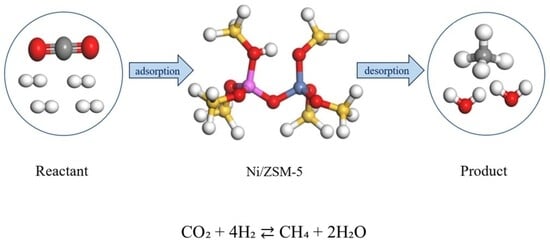
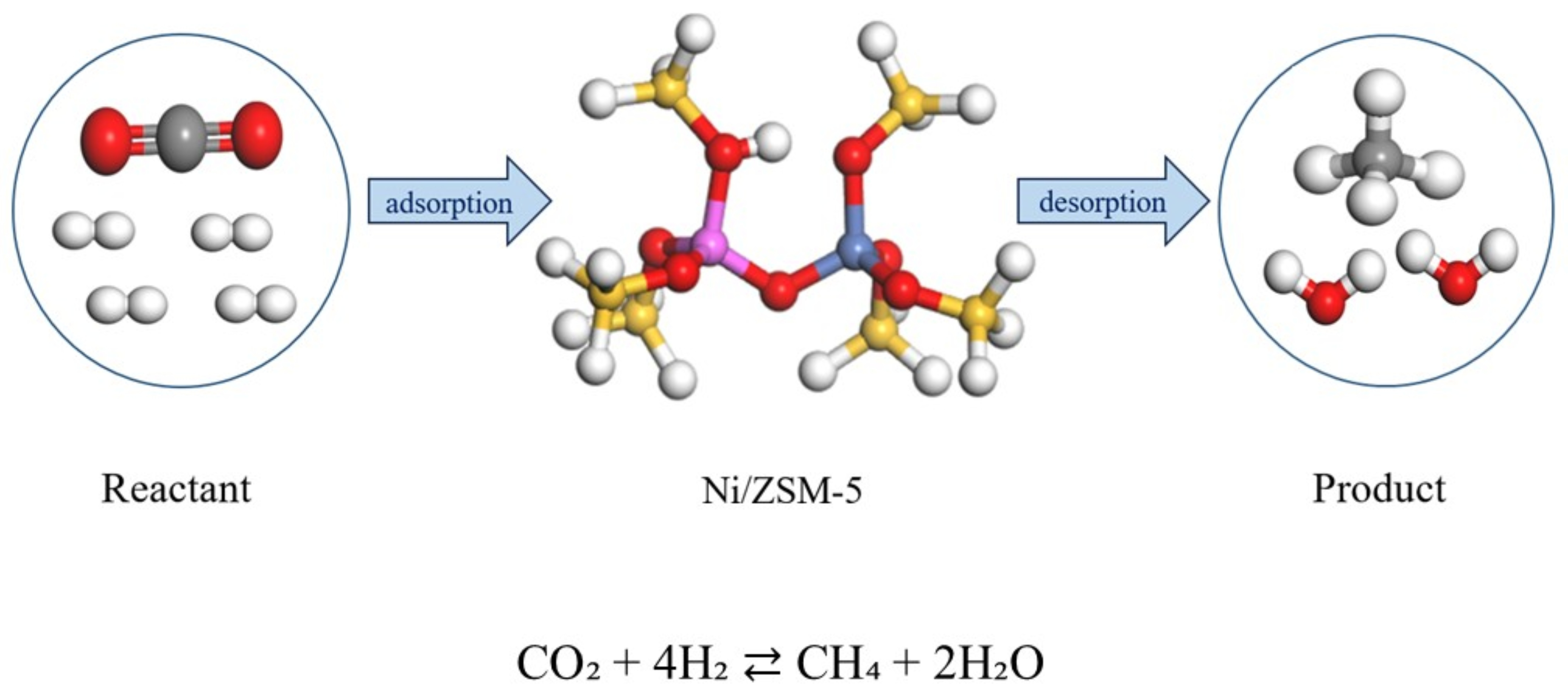
Graphical Abstract

1. Introduction

Methane is an important energy carrier and chemical feedstock in the current energy system. With the rapid expansion of intermittent renewable energy, power-to-gas (PtG) technology, which converts CO2 and green H2 into synthetic natural gas, has become a scalable approach for carbon recycling and seasonal energy storage. Compared with direct hydrogen storage, methane can be transported through existing natural gas pipelines, which greatly cuts storage and delivery costs and realizes grid-scale energy regulation [1,2,3,4].
The main reaction, CO2 + 4H2 ⇄ CH4 + 2H2O ( Δ H 298 K 0 = −164.9 kJ mol−1), is highly exothermic and thermodynamically favored at low temperatures. Nevertheless, CO2 is kinetically inert owing to its linear and fully oxidized molecular structure, so high temperatures are required for its effective activation. This trade-off between thermodynamics and kinetics is further complicated by the endothermic reverse water-gas shift (RWGS) reaction. At temperatures above 400 °C, RWGS becomes dominant, leading to increased CO selectivity and decreased CH4 yield [5,6]. Consequently, efficient catalysts must simultaneously lower the kinetic barrier for CO2 activation and suppress high-temperature side reactions.
CO 2 + 4 H 2     CH 4 + 2 H 2 O Δ H 298 K 0 = 164.9 kJ   mol 1
CO 2 + H 2     CO + 2 H 2 O Δ H 298 K 0 = 41.2 kJ   mol 1
2 CO + 4 H 2     C + CO 2 Δ H 298 K 0 = 172.4 kJ   mol 1
CH 4     C + 2 H 2 Δ H 298 K 0 = 74.8 kJ   mol 1
The primary CO2 methanation pathway (1) competes with the RWGS reaction (2) and potential coking routes (3)~(4), making selectivity control highly temperature-dependent. While low temperatures thermodynamically favor CH4, they severely limit reactant activation and surface mobility. In this context, zeolite-encapsulated catalysts such as Ni/ZSM-5 possess unique advantages. Their adjustable acidity, uniform micropores and ion-exchangeable sites can regulate local reactant concentration, stabilize key reaction intermediates and promote product desorption. However, the molecular-scale interactions among framework composition (e.g., Si/Al ratio), metal doping and the adsorption-diffusion behaviors of multicomponent gas mixtures are still not fully clarified, particularly under varying thermal conditions.
Current consensus identifies two dominant pathways for CO2 methanation: the dissociative CO-mediated route and the associative formate-mediated route [7,8]. The former proceeds via CO2 dissociation into adsorbed CO* and O*, followed by sequential hydrogenation, whereas the latter involves formate (HCOO*) as a key surface intermediate. Despite extensive experimental and theoretical studies, the dominant pathway is still highly dependent on catalyst composition, surface coverage and reaction conditions, and no unified mechanistic framework has been established to date. Given this complexity, the present study does not aim to resolve the elementary reaction steps or compute intrinsic energy barriers. Instead, we focus on the molecular processes before and after the reaction-specifically, how metal incorporation (Ni vs. Ru), framework acidity (Si/Al ratio), and temperature govern the adsorption thermodynamics, electronic perturbation, and diffusional transport of reactants and products within the ZSM-5 confinement. These factors critically determine local reactant availability and product removal efficiency, which are prerequisites for any surface reaction pathway.
Active metals for CO2 methanation are generally categorized into noble metals (e.g., Ru, Rh, Pt, Pd) and base transition metals (e.g., Ni, Co, Fe, Mo). Noble metals (especially Ru and Rh) show excellent low-temperature catalytic activity, yet their scarcity and high cost limit large-scale industrial applications [9]. In contrast, non-noble metals are earth-abundant, cost-effective, and suitable for scalable synthesis. Among them, Ni-based catalysts have emerged as the most promising non-noble alternative, demonstrating competitive experimental conversion rates and high CH4 selectivity [9]. The widespread adoption of Ni is further attributed to its favorable d-band electronic structure, which facilitates reactant adsorption and surface activation under practical conditions.
The catalytic behavior of Ni is strongly influenced by the choice of support. Conventional oxide supports (e.g., Al2O3, SiO2, CeO2) provide oxygen vacancies and basic sites that promote CO2 chemisorption, while their high surface area aids metal dispersion [10]. Nevertheless, Ni nanoparticles tend to undergo thermal sintering and agglomeration under the exothermic conditions of CO2 methanation, resulting in the loss of active sites and rapid catalyst deactivation [11]. This stability issue is closely related to the particle size of Ni species: while smaller Ni clusters have a higher surface-to-volume ratio and higher defect density, they exhibit lower thermal stability. Consequently, confining Ni within structurally robust, porous frameworks has become a key strategy to simultaneously maximize metal utilization and suppress sintering-induced deactivation [12].
Zeolites, with their crystalline microporous architectures, tunable acidity, and exceptional hydrothermal stability, serve as ideal confinement hosts for Ni species. Their uniform channel systems not only anchor metal nanoparticles to prevent agglomeration but also create a distinct microenvironment that modulates local reactant concentration and product transport. Experimental studies consistently highlight these advantages: Wang et al. [13] demonstrated that encapsulating Rh within HZSM-5 crystals yielded a confined nanoporous environment that sustained 93.7–95.0% CH4 selectivity. Similarly, Sholeha et al. [14] reported superior Ni dispersion and long-term stability on NaZSM-5 compared to large-pore zeolites (NaBEA, NaY, NaA), while Obrom et al. [15] observed minimal Ni agglomeration and sustained 100% CH4 selectivity over Ni/ZSM-5 relative to Ni/ANA and Ni/SiO2. These findings underscore the critical role of zeolite confinement in stabilizing active sites and steering selectivity.
Despite the well-documented experimental performance of Ni/ZSM-5 [14,15,16,17], the molecular-level factors governing reactant enrichment, product desorption, and metal-framework electronic interactions within the confined micropores remain insufficiently quantified. In this theoretical study, Ni and Ru atoms were modeled as framework-substituted sites to investigate their electronic interactions with the zeolite framework, without distinguishing their ionic, metallic or oxide states observed in experiments. In particular, the combined effects of framework composition (Si/Al ratio), operating temperature, and metal species (Ni vs. Ru) on the competitive adsorption and diffusional transport of multi-component gas mixtures have not been systematically elucidated. To address this, the present work employs a multi-scale simulation framework: DFT is utilized to probe the electronic perturbation and adsorption energetics of HZSM-5, Ni/ZSM-5, and Ru/ZSM-5, while GCMC and MD simulations quantify the mixture adsorption thermodynamics and diffusional transport under varying temperatures and Si/Al ratios. Rather than resolving elementary reaction steps or computing intrinsic energy barriers-which are highly sensitive to dynamic surface reconstruction, coverage effects, and kinetic modeling assumptions-this study deliberately focuses on the pre-reaction molecular processes that govern local reactant availability and product removal efficiency. Among the investigated systems, Ni/ZSM-5 was selected for detailed adsorption and diffusion simulations due to its more favorable electronic modulation effects and its industrial relevance in CO2 methanation catalysts, whereas Ru/ZSM-5 was used as a reference noble-metal system in the electronic structure comparison. These thermodynamic and transport insights reveal the molecular characteristics of reactant enrichment and product desorption in zeolite-confined systems, and provide fundamental theoretical data for further studying the catalytic process of CO2 methanation. The novelty of this work lies in the systematic elucidation of the structure-property relationships at the electronic level. Unlike previous studies that primarily focus on macroscopic catalytic performance or single-gas adsorption, this work uniquely integrates DFT and molecular simulations to reveal how the electronic perturbation induced by Ni and Ru substitution at the T12 site modulates the local electrostatic field of the ZSM-5 framework. Furthermore, we provide novel molecular-level insights into the competitive adsorption thermodynamics and the distinct diffusion energy barriers of multi-component mixtures (e.g., CH4/CO), bridging the gap between microscopic electronic structures and macroscopic mass transport phenomena.

2. Results and Discussion

2.1. DFT Simulation Results and Discussion

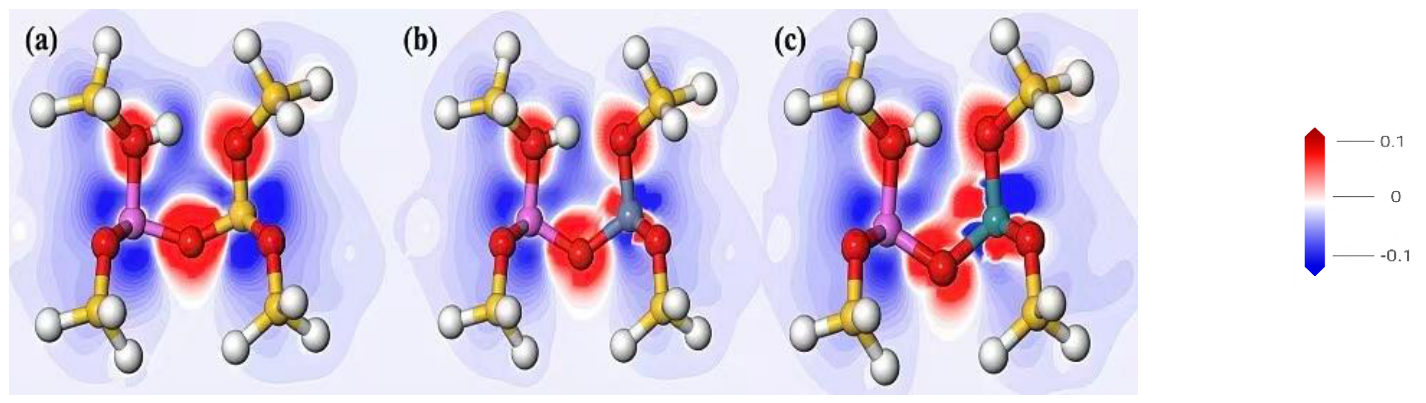
As illustrated in Figure 1, the incorporation of Ni or Ru into the ZSM-5 framework induces a pronounced redistribution of electron density. The electron depletion regions around the framework oxygen atoms adjacent to the substitution site are notably contracted, while electron accumulation is observed around the introduced metal centers. These differential charge density maps confirm that metal substitution disrupts the local electrostatic equilibrium of the pristine zeolite, establishing a polarized microenvironment that can modulate guest molecule interactions.
Mulliken population analysis (Table 1) further quantifies this electronic perturbation. Compared with HZSM-5 and Ru/ZSM-5, Ni/ZSM-5 exhibits a more pronounced charge redistribution at the metal-substituted T12 site and its neighboring oxygen atoms. Due to the lower electronegativity of Ni relative to Ru and Si, the Ni center carries a lower positive charge, which alters the local electrostatic field within the pore channel. This modified charge landscape directly influences the adsorption thermodynamics of polar and quadrupolar guest molecules, providing an electronic basis for the distinct adsorption behavior observed over Ni/ZSM-5. The above electronic differences originate from the framework substitution configuration of Ni and Ru. Compared with ion-exchanged cations or extra-framework metal species, heteroatoms integrated into the zeolite lattice have stronger orbital coupling with surrounding framework atoms, which is the fundamental reason for the unique electronic distribution and molecular adsorption characteristics of the framework-doped catalysts.
To ensure robustness of electronic interpretation, Mulliken charge analysis is complemented by differential charge density and frontier orbital analysis. Geometric optimization reveals systematic changes in the local framework structure (Table 2). Following the correlation reported by Redondo et al. [18], the T-O-T bond angle at the T12 site serves as a structural descriptor for Brønsted acidity, with larger angles corresponding to stronger acid sites. The calculated T-O-T angles decrease sequentially from 139.580° (HZSM-5) to 112.868° (Ru/ZSM-5), indicating a gradual moderation of framework acidity upon metal incorporation. The T-O-T angle is employed as a qualitative indicator of framework distortion rather than a direct quantitative measure of acidity. In CO2 methanation, excessively strong acidity is known to thermodynamically favor the deep adsorption and polymerization of carbonaceous intermediates, increasing the propensity for pore blockage and catalyst deactivation. Consistent with experimental observations that moderate acidity effectively suppresses carbon deposition and contributes to extended operational stability [19], the attenuated acidity in Ni/ZSM-5 and Ru/ZSM-5 creates a more balanced microenvironment. It should be noted that the anti-coking behavior discussed herein is indirectly inferred from the modulation of acidity and adsorption properties, rather than verified by direct carbon deposition calculations. This thermodynamic profile mitigates the strong binding of coke precursors while preserving accessible sites for sustained reactant turnover.
The frontier molecular orbital analysis (Table 3) shows that Ni/ZSM-5 possesses a notably narrower HOMO (Highest Occupied Molecular Orbital) and LUMO (Lowest Unoccupied Molecular Orbital) energy gap compared to HZSM-5 and Ru/ZSM-5. Notably, the HOMO-LUMO gap is only adopted for qualitative comparison of electronic properties among cluster models, and it cannot fully describe the electronic band structure of practical heterogeneous catalysts. A narrower band gap indicates higher electronic softness and polarizability, which promote charge transfer between the zeolite framework and adsorbed molecules. This electronic characteristic aligns with the stronger adsorption energetics observed for Ni/ZSM-5, as a more readily perturbed electronic structure lowers the thermodynamic penalty for guest molecule binding and surface charge redistribution.
The narrower HOMO-LUMO gap of Ni/ZSM-5 indicates a more polarizable electronic structure, which facilitates charge transfer with adsorbates and underpins its stronger adsorption affinity toward reactant molecules. In heterogeneous catalysis, the thermodynamic balance between reactant adsorption and product desorption fundamentally governs local site availability and serves as a prerequisite for efficient catalytic turnover and selectivity control. Therefore, the observed electronic modulation originates from framework substitution-induced charge redistribution rather than from a specific metallic or oxide phase of Ni or Ru. In this study, we do not overinterpret the HOMO–LUMO gap data, and all electronic structure conclusions are cross-validated by multiple computational results. To elucidate the adsorption behavior of Ni/ZSM-5 in the context of CO2 methanation, spin-polarized DFT calculations employing the GGA-PBE functional were performed to systematically evaluate the binding configurations and energetics of reactants (CO2, H2) and products (CH4, H2O) on HZSM-5, Ni/ZSM-5, and Ru/ZSM-5. The most stable adsorption geometries for each species were fully optimized, and the adsorbate-framework interaction strengths were quantified via adsorption energies (Eads). The optimized configurations and corresponding energetic data are summarized in Figure 2, Figure 3, Figure 4, Figure 5 and Table 4.
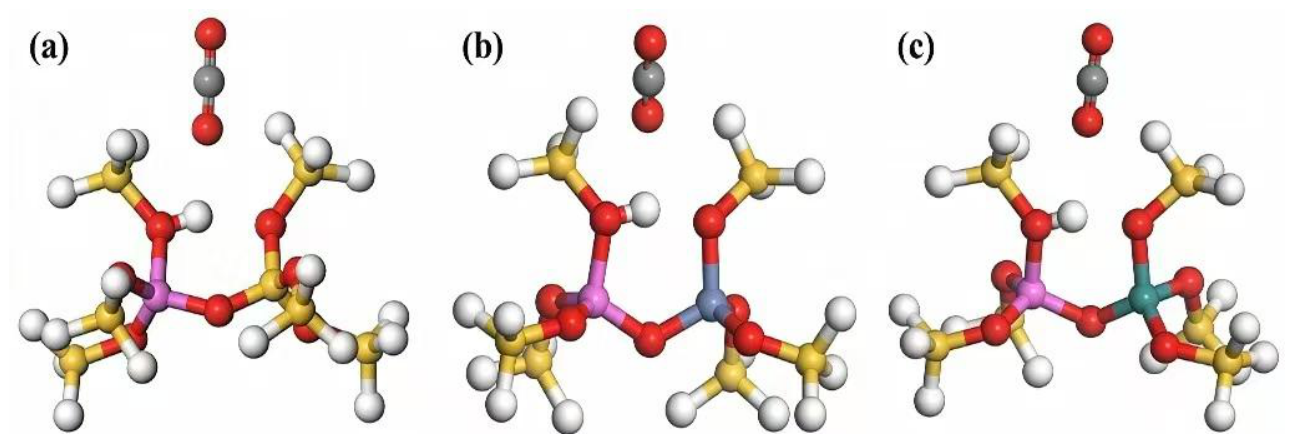
As shown in Figure 2, CO2 preferentially binds via its oxygen atoms toward the metal-modified active sites across all three systems. The calculated Eads for CO2 on Ni/ZSM-5 is −121.9 kJ mol−1, significantly more negative than on HZSM-5 (−69.6 kJ mol−1) and Ru/ZSM-5 (−96.7 kJ mol−1). This indicates that the interaction between CO2 and Ni/ZSM-5 is stronger, enabling more stable adsorption and thereby facilitating subsequent reactions.
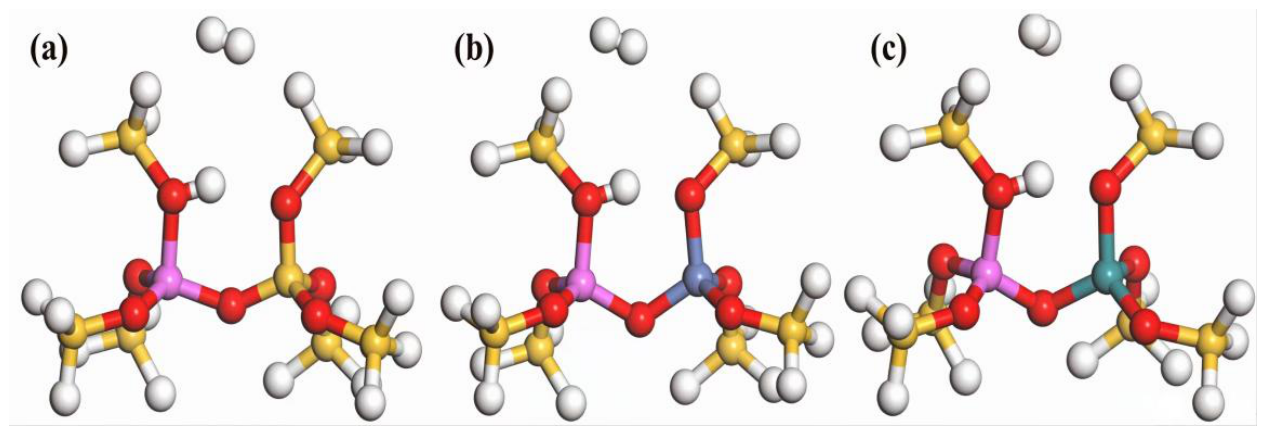
A similar trend is observed for H2 adsorption. The Eads on Ni/ZSM-5 (−81.6 kJ mol−1) is substantially more negative than on HZSM-5 (−30.3 kJ mol−1) and Ru/ZSM-5 (−60.1 kJ mol−1), reflecting stronger H2 capture capability. The preferential accumulation of H2 near Ni sites establishes a hydrogen-rich local microenvironment, which thermodynamically supports sustained hydrogenation steps without requiring excessive external pressure.
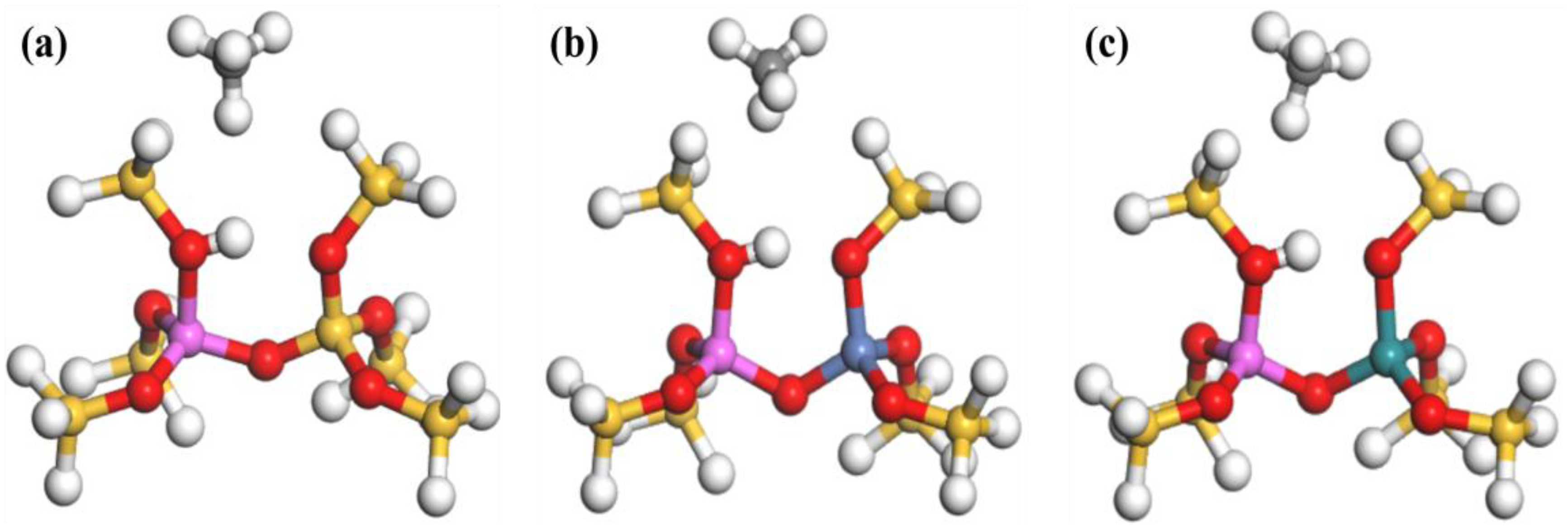
In contrast to the reactants, the product CH4 exhibits weaker binding on Ni/ZSM-5 (−70.1 kJ mol−1) compared to HZSM-5 (−98.8 kJ mol−1) and Ru/ZSM-5 (−76.0 kJ mol−1). The reduced adsorption strength minimizes product site-blocking and facilitates rapid CH4 desorption from the confined pores. This thermodynamic profile effectively lowers the residence time of methane within the framework, which is beneficial to the continuous renewal of surface sites. In the metal-free HZSM-5 system, adsorption is dominated by confinement-induced dispersion interactions, where CO/CO2 exhibits higher sensitivity to thermal perturbation compared to CH4, leading to a relative inversion in adsorption strength.
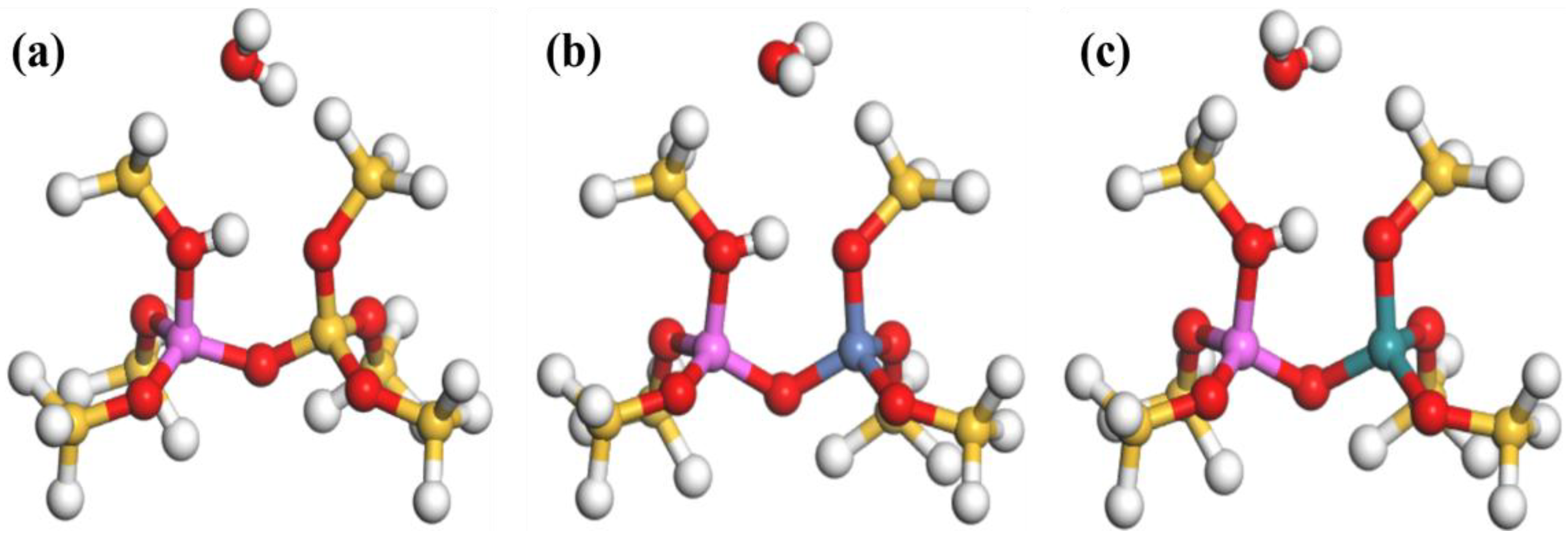
H2O adsorbs primarily through hydrogen bonding with framework oxygen atoms near the active site. The adsorption energy on Ni/ZSM-5 (−51.6 kJ mol−1) is notably weaker than on HZSM-5 (−87.1 kJ mol−1) and slightly weaker than on Ru/ZSM-5 (−53.8 kJ mol−1). Given that H2O is a strong competitive adsorbate that can poison active sites and hinder reactant access [20], the relatively low H2O affinity on Ni/ZSM-5 thermodynamically favors rapid product desorption. This characteristic helps maintain site accessibility under reaction conditions and mitigates competitive inhibition by water vapor. Based on these results, Ni/ZSM-5 was selected for subsequent multiscale simulations due to its more pronounced enhancement of adsorption-related properties.
It is noteworthy that the computed adsorption energy of CH4 on HZSM-5 (−98.8 kJ mol−1) is considerably larger in magnitude than experimentally measured differential heats of adsorption (~22.5–28 kJ mol−1) reported for H-ZSM-5 using calorimetric methods [21,22]. This discrepancy originates from three compounding factors inherent to the GGA-PBE + DFT-D3/8T cluster approach. First, DFT calculations provide the electronic adsorption energy at 0 K (ΔEads), which does not incorporate zero-point energy (ZPE) corrections, finite-temperature thermal enthalpy contributions, or entropic effects that are intrinsic to experimentally measured heats of adsorption. Second, dispersion-corrected GGA functionals are known to systematically overestimate adsorption energies of small nonpolar alkanes: Chiu et al. [23] showed that PBE-D methods overestimate alkane adsorption enthalpies in zeolites by 21–46 kJ mol−1; Piccini et al. [24] further demonstrated using high-accuracy MP2:DFT hybrid calculations that PBE-D3 overestimates CH4 binding in H-chabazite by ~9 kJ mol−1 relative to MP2 reference values, with the PBE-D3 period result of −34.9 kJ mol−1 already substantially exceeding the MP2 benchmark of −25.6 kJ mol−1. Third, the finite 8T cluster model, although computationally efficient and suitable for describing local active-site chemistry, inherently lacks the full three-dimensional channel confinement of the MFI framework, leading to truncation of long-range dispersion interactions with distant pore-wall atoms; H-atom boundary termination additionally introduces artificial electronic boundary effects. These three sources of error act cumulatively and are particularly pronounced for CH4, whose adsorption is exclusively driven by weak van der Waals interactions rather than electrostatic or hydrogen-bonding contributions. By contrast, polar molecules such as CO2 and H2O, whose adsorption energies are dominated by electrostatic interactions with the Brønsted acid site and metal centers, show smaller relative deviations from literature DFT benchmarks [25]. Importantly, the relative trends in adsorption energies across different adsorbates and catalyst formulations remain physically meaningful, and all conclusions regarding preferential CO2 activation and H2-rich local environments at Ni sites are unaffected by this systematic methodological offset.
The adsorption energies calculated in this work are pure electronic energies at 0 K, without ZPE and thermal corrections. This treatment is adopted to maintain consistent calculation settings for all catalyst models, and it will not affect the analysis of relative adsorption trends.

2.2. Adsorption and Diffusion Behavior from Molecular Simulations

Reaction temperature plays a key role in regulating the thermodynamic equilibrium and molecular mass transport in CO2 methanation. Thermodynamic analyses confirm that the exothermic nature of the methanation reaction favors lower temperatures to achieve higher equilibrium CO2 conversion [26,27]. In this study, the adsorption behavior of CO2 on Ni/ZSM-5 was investigated in the temperature range of 400–600 °C.
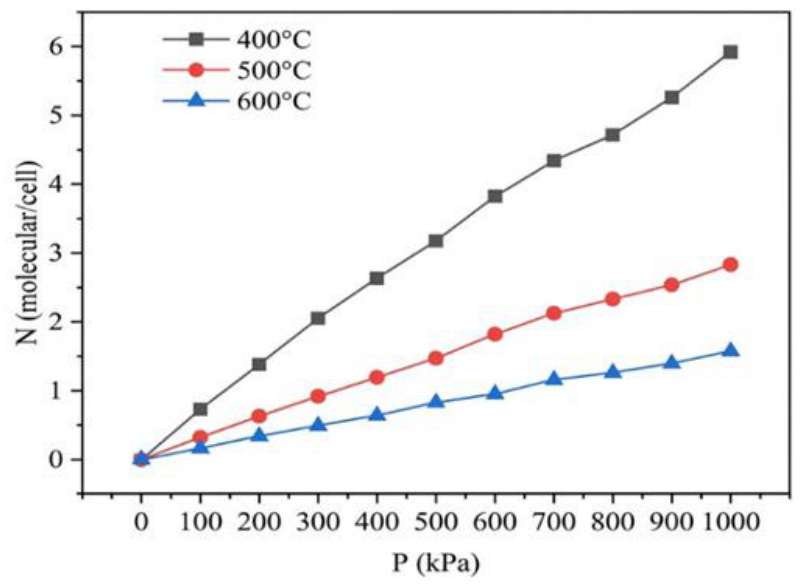
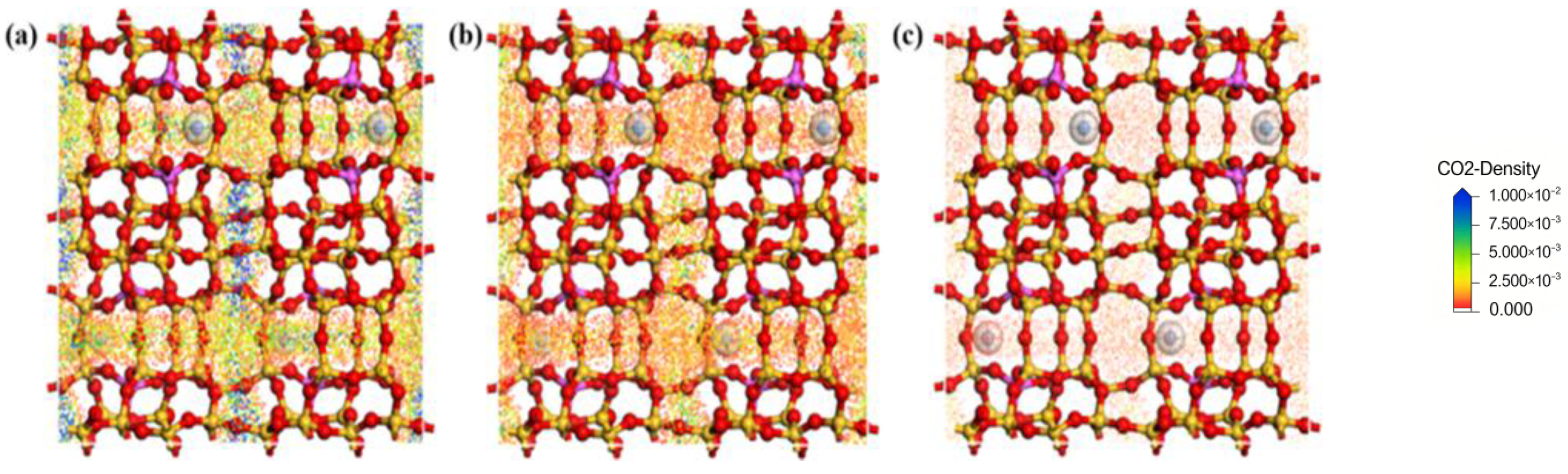
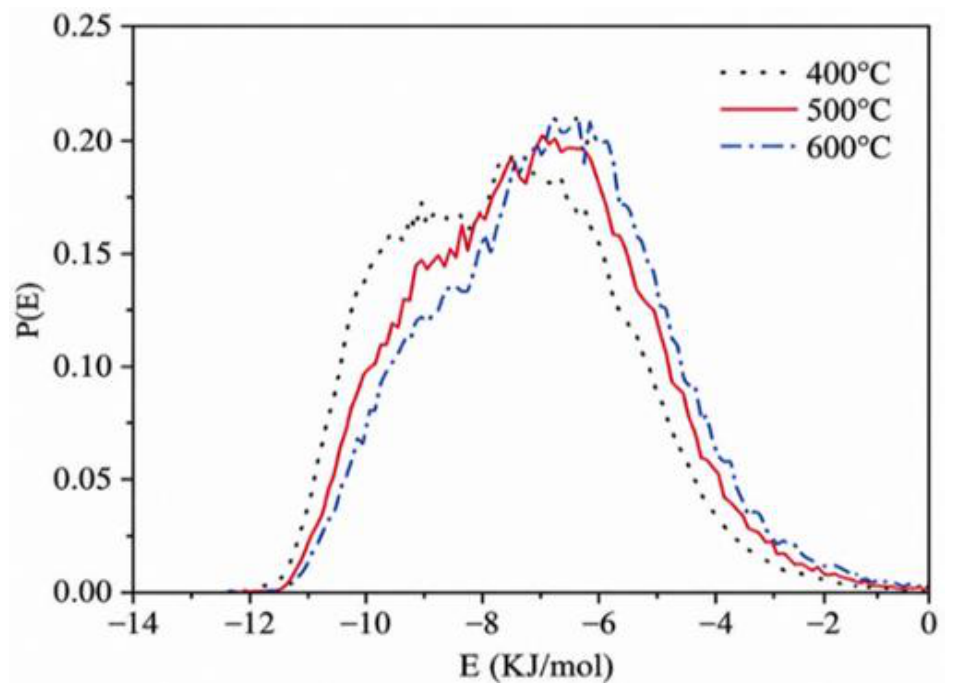
Figure 6 presents the CO2 adsorption isotherms on Ni/ZSM-5 at varying temperatures. As expected, CO2 uptake increases with pressure but declines markedly as temperature rises from 400 to 600 °C at constant pressure. This trend is further illustrated by the adsorption density distributions (Figure 7), which show a progressive depletion of CO2 within the pore channels at elevated temperatures. The decreased adsorption capacity is attributed to intensified molecular thermal motion, which weakens the interaction between adsorbates and the zeolite framework and shortens the residence time of CO2 on active sites. The adsorption energy distribution profiles (Figure 8) corroborate this thermodynamic behavior: the primary interaction peak shifts toward weaker binding energies, with the absolute peak value decreasing from 7.45 kJ mol−1 at 400 °C to 6.35 kJ mol−1 at 600 °C. These results establish a clear thermodynamic trade-off: while elevated temperatures are typically required to overcome kinetic barriers for CO2 activation, they simultaneously suppress reactant enrichment within the zeolite pores.
Framework composition, particularly the Si/Al ratio, directly modulates the density and strength of adsorption sites in zeolites. Experimental studies have consistently shown that moderate basicity or balanced acid-base properties facilitate CO2 capture and stabilize key surface intermediates [28,29,30,31,32,33]. In Ni/ZSM-5 systems, varying the Si/Al ratio alters the distribution of framework charges and cation exchange sites, which in turn governs the local adsorption environment. To decouple these compositional effects from temperature, the influence of the Si/Al ratio on CO2 adsorption thermodynamics was systematically evaluated.
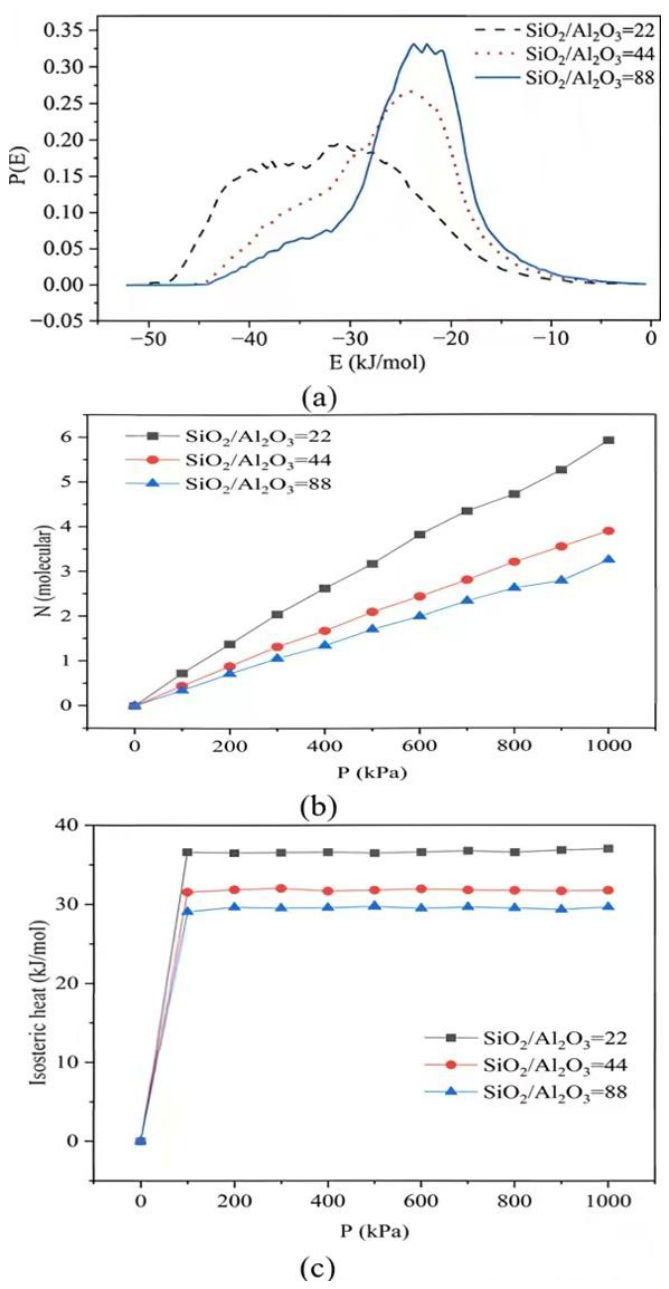
As shown in Figure 9a, when the Si/Al ratio increases from 22 to 88, the CO2 adsorption energy distribution shifts toward weaker intermolecular interactions, with the primary peak magnitude decreasing from 7.45 to 5.35 kJ mol−1. Correspondingly, both the equilibrium adsorption capacity (Figure 9b) and the isosteric heat of adsorption (Figure 9c) decline monotonically with higher Si/Al ratios. This indicates that a more siliceous framework provides fewer strong electrostatic interaction sites for the quadrupolar CO2 molecule, thereby weakening reactant capture. These computational trends align with experimental CO2-TPD observations by Zu et al. [31], who reported a reduction in strong adsorption sites and decreased methanation performance as the Si/Al ratio increased. The present simulations provide a molecular-level thermodynamic rationale for these experimental findings: higher Si/Al ratios diminish the driving force for CO2 enrichment within the confined pores.
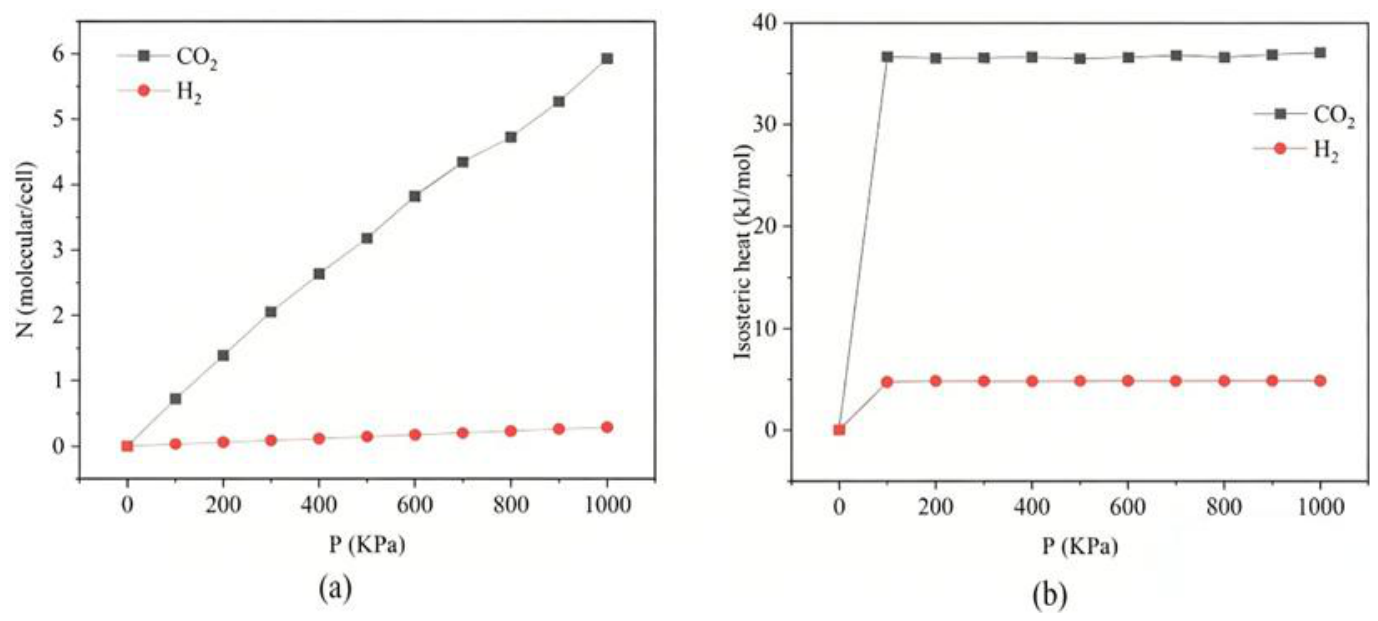
The adsorption behavior of H2 was evaluated under identical conditions to assess competitive reactant uptake. Figure 10a reveals that H2 adsorption is substantially lower than that of CO2 across the entire pressure range. This disparity is quantified by the isosteric heats of adsorption (Figure 10b), where H2 exhibits a significantly weaker interaction (4.6 kJ mol−1) compared to CO2 (36.4 kJ mol−1). From a thermodynamic standpoint, the weak physisorption of H2 suggests that a stoichiometric H2/CO2 feed ratio may lead to hydrogen deficiency within the pore microenvironment. This provides a molecular basis for the common experimental practice of employing H2-rich feeds (H2/CO2 > 4) to compensate for low H2 uptake, ensure sufficient surface hydrogen coverage, and mitigate carbonaceous deposition [26,32,33].
Beyond reactant enrichment, the adsorption and transport of products (CH4 and H2O/CO) critically influence site regeneration and the local reaction equilibrium. In confined zeolite systems, strong product binding can lead to site blocking, while differential diffusion rates may alter the observed product distribution. To elucidate these post-reaction transport constraints, both single-component and competitive adsorption of CH4 and CO were investigated.
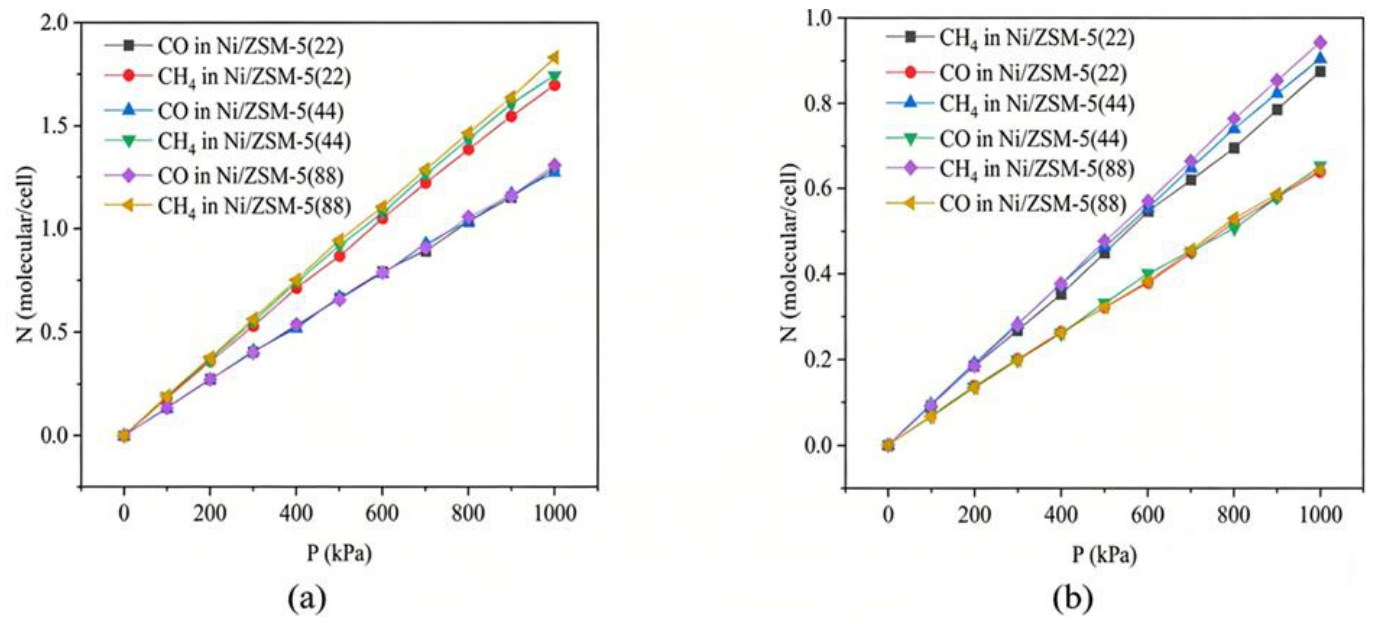
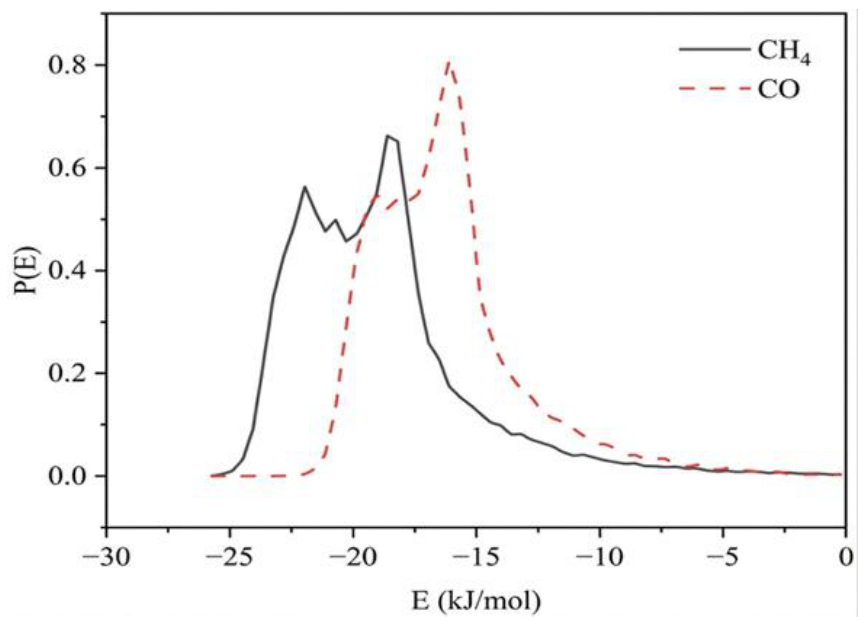
Figure 11a shows that CH4 exhibits a higher equilibrium uptake than CO on Ni/ZSM-5 across 0.001–1000 kPa. This is attributed to the larger polarizability and kinetic diameter of CH4, which enhance van der Waals interactions with the pore walls [34]. Competitive adsorption simulations (Figure 11b) yield a similar trend, indicating that CH4 preferentially occupies confinement sites over CO. The adsorption energy distributions (Figure 12) display bimodal profiles for both molecules, reflecting heterogeneity in binding environments within the ZSM-5 channel system. Notably, while CH4 binds more strongly than CO, experimental product streams are typically CH4-dominant under methanation conditions. This discrepancy underscores that macroscopic selectivity is kinetically governed and cannot be deduced solely from equilibrium adsorption strengths. Furthermore, Figure 11b indicates that increasing the Si/Al ratio enhances CH4 uptake while CO adsorption remains largely unaffected. Thermodynamically, this implies that highly siliceous frameworks may increase CH4 residence time and hinder product desorption, reinforcing the preference for moderate Si/Al ratios to balance reactant capture and product release.
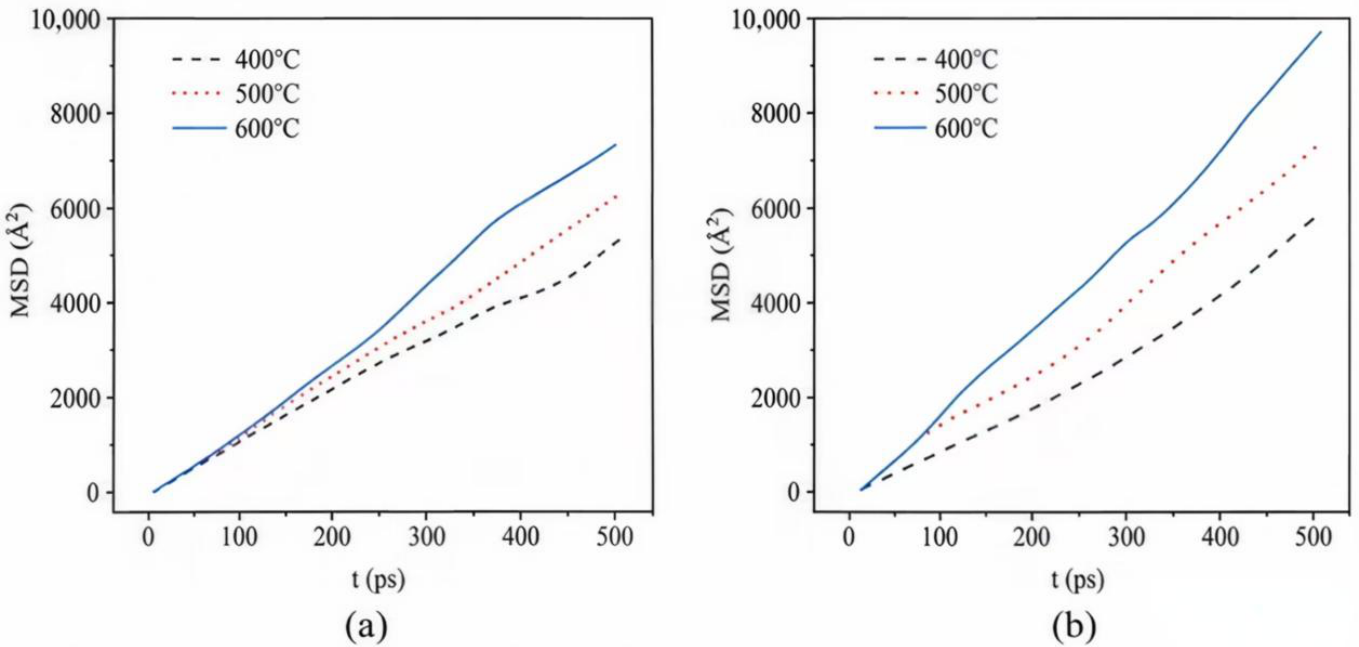
Product desorption and transport within confined zeolite pores are dominated by intracrystalline diffusion, which directly governs active site accessibility and catalytic turnover frequency. MD simulations were adopted to calculate the self-diffusion coefficients (Ds) of CH4 and CO based on the Einstein relation from mean square displacement (MSD) trajectories, as summarized in Table 5. At the same temperature, the Ds of CH4 remains lower than that of CO, which is closely associated with the stronger adsorption affinity and larger molecular size of CH4. The stronger framework-adsorbate interaction of CH4 raises the energy barrier for intercage hopping in zeolites, thereby leading to higher diffusional resistance relative to CO.
Temperature exerts a pronounced influence on product transport dynamics. As shown in Figure 13, the slopes of the MSD-t profiles increase substantially from 400 to 600 °C, indicating thermally activated diffusion. Elevated temperatures amplify molecular kinetic energy, effectively weakening adsorbate-framework trapping and accelerating pore escape. Table 5 further reveals that the diffusivity ratio (S = D CH 4 /DCO) decreases with rising temperature, suggesting that CO transport becomes relatively more facile compared to CH4 under thermal promotion. Collectively, these transport simulations demonstrate that while higher temperatures thermodynamically suppress reactant adsorption, they are essential for overcoming diffusional limitations and ensuring rapid product desorption from the zeolite network. It is worth noting that the above trends are summarized from adsorption and diffusion perspectives. To determine the real optimal reaction conditions, reaction kinetics and experimental verification are further required.

3. Computational Methods

3.1. DFT Calculations

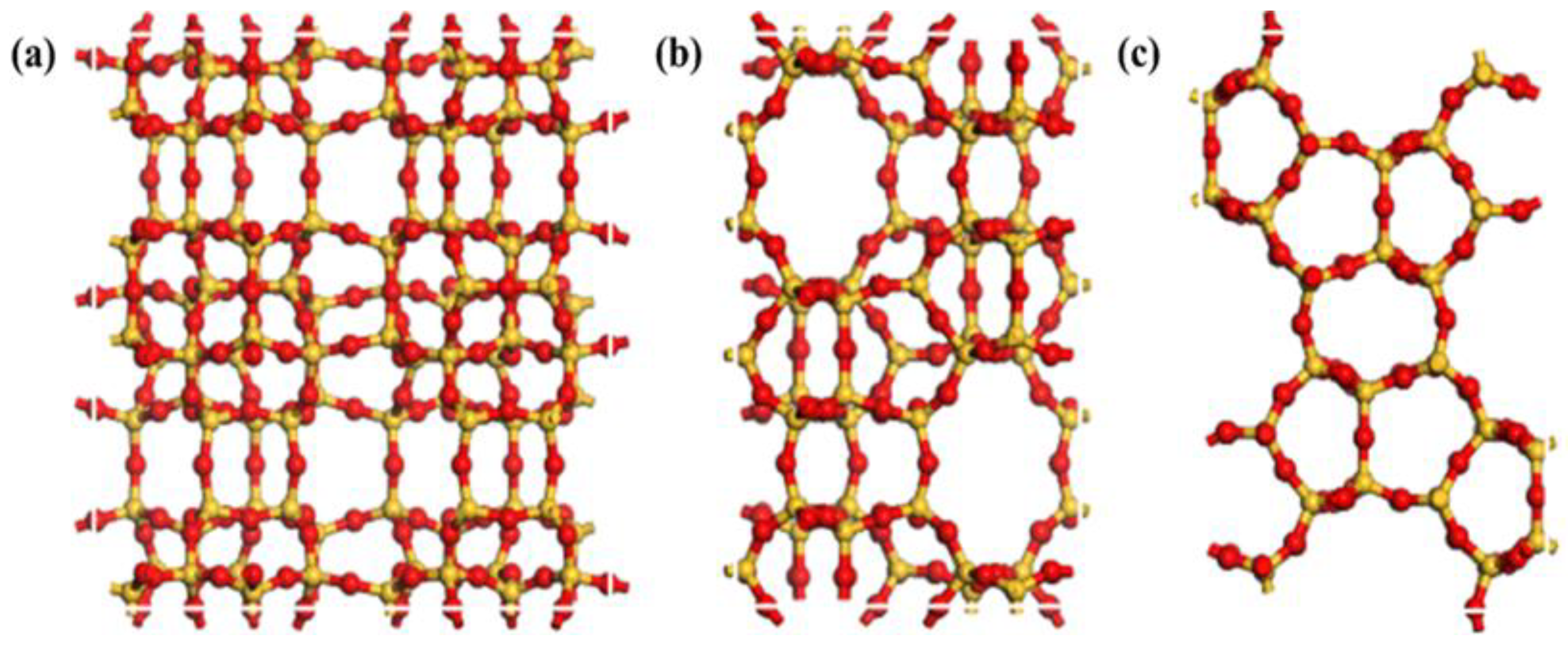
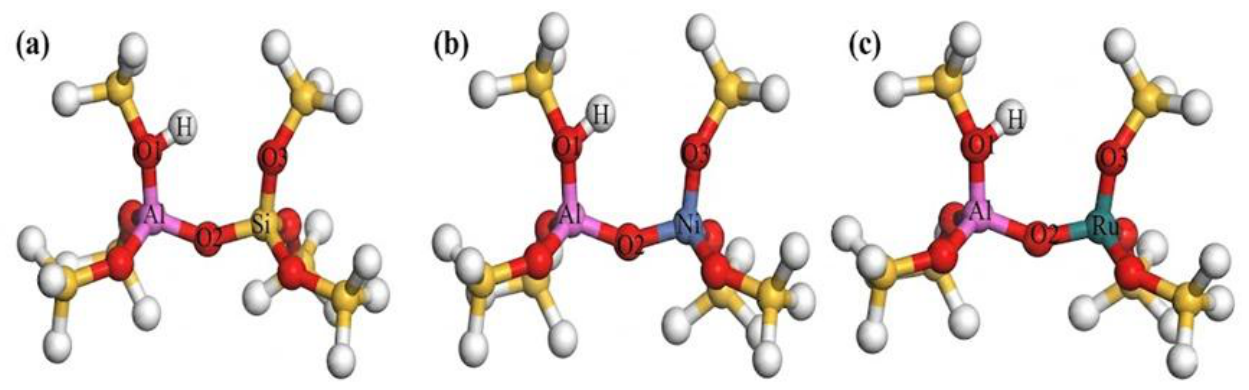
The initial ZSM-5 framework (MFI topology) was obtained from the International Zeolite Association (IZA) database (Figure 14; https://www.iza-structure.org/databases/; accessed on 7 June 2025). The crystalline structure features a three-dimensional interconnected pore system comprising straight channels (5.3 × 5.6 Å) and sinusoidal channels (5.1 × 5.5 Å), both defined by 10-membered rings [35]. The unit cell crystallizes in the Pnma space group with lattice parameters a = 20.07 Å, b = 19.92 Å, c = 13.42 Å, and α = β = γ = 90°. Among the 12 crystallographically distinct T-sites (T = Si, Al), the T12 position, located at the channel intersection, is widely recognized as a catalytically relevant site for guest molecule interactions [36,37].
To balance computational efficiency with quantum mechanical accuracy, a representative 8T cluster model encompassing the T12 site was extracted from the periodic framework (this cluster model was used for electronic structure and adsorption energy calculations, while full periodic MFI frameworks were adopted for GCMC and MD simulations). The 8T cluster centered on the T12 active site can fully retain the local geometric configuration, electronic environment and Brønsted acid characteristics of ZSM-5 active centers, which is a widely accepted model for comparative adsorption research of zeolites. All dangling bonds at the cluster edge were terminated with hydrogen atoms, during calculations to avoid artificial structural distortion induced by boundary effects. Although the 8T cluster model effectively captures local electronic structures, it lacks long-range electrostatic interactions inherent to the periodic framework. Future investigations will employ periodic DFT models to comprehensively validate these confinement effects. Dangling bonds at the cluster boundary were saturated with terminal hydrogen atoms. The Si-H bond lengths were fixed at 1.47 Å, oriented along the original Si-O bond vectors, and the coordinates of these capping H atoms were constrained during geometry optimization to preserve the local zeolite topology and prevent artificial structural relaxation.
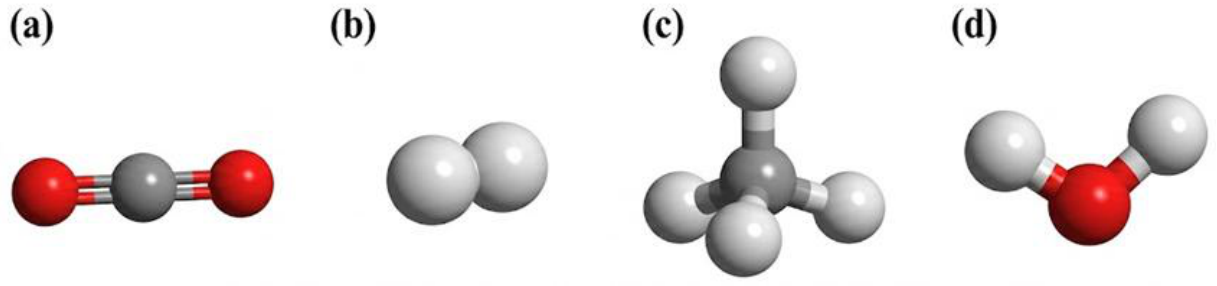
The Brønsted acidic HZSM-5 model was constructed by isomorphously substituting the T12 Si atom with Al, followed by the introduction of a charge-balancing proton at the adjacent framework oxygen atom, yielding an Al12-O(H)-Si3 bridging hydroxyl group [37]. This acidic site resides at the pore intersection and serves as the primary anchor for guest molecules. To model the metal-modified catalysts, Ni and Ru species were incorporated into the cluster adjacent to the Brønsted site, generating the Ni/ZSM-5 and Ru/ZSM-5 configurations (Figure 15). Herein, Ni and Ru are designed as framework isomorphous substitution heteroatoms: they replace the tetrahedral Si atom at the T12 site of the ZSM-5 lattice and maintain the intrinsic tetrahedral coordination environment of the zeolite framework. This configuration is distinctly different from two other common metal species in metal-modified ZSM-5 catalysts: (1) ion-exchanged metal cations, which reside in zeolite pores and compensate the negative charge of the aluminosilicate framework via electrostatic interaction; (2) extra-framework metal nanoparticles or metal oxide clusters, which are dispersed on the zeolite surface or internal pores and exist independently of the lattice. This study exclusively focuses on the lattice doping effect, so ion-exchanged cations and extra-framework metal species are not included in the current model. It should be noted that in this work, Ni and Ru species are introduced as framework-substituted heteroatoms at the T12 site of ZSM-5, rather than extra-framework metallic clusters or oxide nanoparticles. This model is only used to isolate the electronic and structural perturbation induced by framework incorporation, without explicitly assigning a specific oxidation state or particle morphology. All cluster models underwent full structural relaxation under the aforementioned boundary constraints. Reactant (CO2, H2) and product (CH4, H2O) molecules were constructed and individually optimized in the gas phase prior to adsorption studies (Figure 16).
All quantum chemical calculations were performed using the DMol3 module within Materials Studio 2023. The exchange-correlation interactions were described by the Perdew–Burke–Ernzerhof (PBE) functional within the generalized gradient approximation (GGA), with Grimme’s DFT-D3 correction employed to account for van der Waals interactions. A double-numerical quality basis set with polarization functions (DNP) was employed, and the real-space global orbital cutoff was set to 4.5 Å. Basis set superposition error (BSSE) is not corrected in this work. All models were calculated with the same basis set and computational parameters. The systematic error derived from BSSE can be largely offset when comparing relative adsorption strengths between different systems. Self-consistent field (SCF) convergence was set to 1.0 × 10⁻⁵ Ha, with a thermal smearing of 0.005 Ha to facilitate electronic convergence. Geometry optimizations were considered converged when the maximum energy change, force, and displacement fell below 2.0 × 10⁻⁵ Ha, 0.005 Ha Å−1, and 0.005 Å, respectively. Spin-polarized calculations were enabled for all systems containing transition metals. Electronic properties, including differential charge density distributions, Mulliken population analyses, and frontier molecular orbital energies, were computed based on the optimized ground-state geometries. Adsorption energies (Eads) were calculated as:
Eads = Etotal − (Ecatalyst + Emolecule)
where a negative value indicates exothermic, favorable adsorption between the adsorbate and the catalyst.

3.2. GCMC and MD Simulations

To capture long-range confinement effects and intracrystalline diffusion pathways, a periodic 1 × 1 × 2 supercell of the MFI framework was constructed from the IZA database. Framework Al atoms were introduced by isomorphous substitution of Si sites in strict accordance with Löwenstein’s rule to prevent Al-O-Al linkages [35]. An initial Ni-substituted ZSM-5 configuration with a Si/Al ratio of 11 was constructed via isomorphous substitution of framework Si atoms by Ni. All periodic models follow the framework substitution mode and maintain overall charge neutrality. Models with varying Si/Al ratios were subsequently constructed by adjusting the Al substitution density while maintaining overall charge neutrality. All periodic frameworks underwent preliminary geometry optimization to relieve local steric strain prior to statistical sampling.
GCMC simulations were employed to evaluate the adsorption thermodynamics of reactants and products within the periodic Ni/ZSM-5 frameworks. Simulations were conducted using the Metropolis algorithm in the NVT ensemble. The COMPASS III force field was applied to describe both framework-adsorbate and adsorbate-adsorbate interactions. Van der Waals interactions were computed using an atom-based summation method with a cutoff radius of 15.5 Å, while long-range electrostatic interactions were treated via the Ewald summation method with a convergence tolerance of 1.0 × 10⁻⁴ kcal mol−1 (≈4.18 × 10⁻⁴ kJ mol−1). Each simulation comprised 1 × 10⁵ equilibration steps followed by 1 × 10⁶ production steps to ensure statistical convergence. Fugacity coefficients were calculated using the Peng-Robinson equation of state to convert system pressures to chemical potentials. From the equilibrated trajectories, adsorption isotherms, isosteric heats of adsorption, spatial density distributions, and adsorption energy distribution profiles were extracted.
MD simulations were performed to investigate the intracrystalline diffusion behavior of the primary product (CH4) and the potential by-product (CO) under infinite dilution conditions. Ten guest molecules were initially inserted into the optimized Ni/ZSM-5 supercell using a Monte Carlo docking procedure, followed by structural relaxation and a thermal equilibration cycle to eliminate unfavorable steric overlaps. Production MD trajectories were generated in the canonical (NVT) ensemble using the COMPASS III force field and a Nose-Hoover thermostat to maintain target temperatures. A cutoff distance of 15.5 Å was applied for non-bonded interactions. Each simulation spanned 1.0 ns with a 1.0 fs integration time step. The initial 500 ps were discarded for equilibration, and the subsequent 500 ps were used for statistical analysis. Self-diffusion coefficients (Ds) were derived from MSD trajectories via the Einstein relation:
D = 1 6 N lim t d d t r t r 0 2

4. Conclusions

This work systematically investigated the pre-reaction molecular behaviors of CO2 methanation over Ni/ZSM-5 by combining DFT, GCMC and MD simulations. The results reveal that Ni doping greatly modulates the local electronic structure of the ZSM-5 framework. It enhances the adsorption affinity of the catalyst toward reactants (CO2 and H2) and weakens the adsorption of products (CH4 and H2O), which facilitates rapid product desorption and the regeneration of active sites. Parametric analyses reveal a thermodynamic-transport trade-off: while elevated temperatures accelerate intracrystalline diffusion, they substantially suppress CO2 enrichment within the pores. Similarly, higher Si/Al ratios weaken electrostatic reactant-framework interactions. Consequently, moderately low temperatures and intermediate Si/Al ratios optimize the balance between reactant uptake and product removal, establishing a confined microenvironment thermodynamically and transport-wise conducive to methanation. Collectively, these findings establish molecular-level thermodynamic and transport descriptors that clarify how framework composition and operating conditions modulate the local reaction microenvironment, offering a fundamental baseline for the rational design of zeolite-confined methanation catalysts. As this work deliberately focuses on equilibrium adsorption and diffusional transport rather than elementary reaction kinetics, future investigations should integrate coverage-dependent microkinetic modeling, dynamic surface reconstruction effects, and in situ spectroscopic validation. Such multi-scale efforts will bridge the present thermodynamic benchmarks with macroscopic catalytic performance, enabling more predictive and experimentally grounded catalyst design.
Despite the valuable molecular-level insights provided by this study, certain limitations should be acknowledged. The current molecular simulations primarily rely on rigid framework assumptions and do not fully capture the dynamic structural flexibility of the zeolite at high temperatures. Furthermore, the present thermodynamic and kinetic benchmarks do not yet integrate coverage-dependent microkinetic modeling, dynamic surface reconstruction effects of the metal sites under reactive atmospheres, or in situ spectroscopic validation. Although H2O adsorption was considered in the present study, its potential role in proton transfer, intermediate stabilization, and water-assisted catalytic processes was not explicitly investigated and warrants future study. Future multi-scale efforts should incorporate these dynamic and operando effects to bridge the present microscopic benchmarks with macroscopic catalytic performance, enabling more predictive and experimentally grounded catalyst design.

Author Contributions

Conceptualization, J.G. and P.C.; methodology, J.G., P.C. and W.X.; software, J.G. and P.C.; validation, M.D. and Z.J.; formal analysis, J.G. and Y.Z.; investigation, J.G. and P.C.; resources, X.W. and M.D.; data curation, J.G., P.C. and K.C.; writing—original draft preparation, J.G. and P.C.; writing—review and editing, J.G., W.X. and D.L.; visualization, D.W.; supervision, W.X.; project administration, W.X.; funding acquisition, W.X. All authors have read and agreed to the published version of the manuscript.

Funding

This work is a project sponsored by the National Natural Science Foundation of China (Grant 21978327).

Data Availability Statement

The data presented in this study are available within the article.

Conflicts of Interest

The authors declare no conflicts of interest.

References

  1. Wang, P.; Shi, R.; Zhao, J.; Zhang, T. Photodriven Methane Conversion on Transition Metal Oxide Catalyst: Recent Progress and Prospects. Adv. Sci. 2024, 11, 2305471. [Google Scholar]
  2. Pham, T.T.P.; Ro, K.S.; Chen, L.; Kumar, G.; Lin, C.S.K. Microwave-Assisted Dry Reforming of Methane for Syngas Production: A Review. Environ. Chem. Lett. 2020, 18, 1987–2019. [Google Scholar] [CrossRef]
  3. Chen, Y.; Su, J.H.; Wang, Y. Feasibility Analysis of the Application of Carbon Dioxide Hydrogenation to Methane in China. Integr. Smart Energy 2022, 44, 86–90. (In Chinese) [Google Scholar]
  4. Jiang, S.Q.; Zhang, F.; Teng, H.D. Feasibility Analysis of Methanation-Based Utilization of Hydrogen Produced from Wind Power. Sol. Energy 2022, 242, 5–9. (In Chinese) [Google Scholar]
  5. Massa, F.; Coppola, A.; Scala, F. A Thermodynamic Study of Sorption-Enhanced CO2 Methanation at Low Pressure. J. CO2 Util. 2020, 35, 176–184. [Google Scholar] [CrossRef]
  6. Lee, W.J.; Li, C.; Prajitno, H.; Lim, J.W.; Patel, J.; Yang, Y. Recent Trend in Thermal Catalytic Low-Temperature CO2 Methanation: A Critical Review. Catal. Today 2021, 368, 2–19. [Google Scholar]
  7. Xie, Y.; Wen, J.; Li, Z.; Ruan, C.; Zhang, H.; Li, D. Progress in Reaction Mechanisms and Catalyst Development of Ceria-Based Catalysts for Low-Temperature CO2 Methanation. Green Chem. 2023, 25, 130–152. [Google Scholar]
  8. Miao, B.; Ma, S.S.K.; Wang, X.; Su, H.; Yang, Y. Catalysis Mechanisms of CO2 and CO Methanation. Catal. Sci. Technol. 2016, 6, 4048–4058. [Google Scholar] [CrossRef]
  9. Younas, M.; Kong, L.L.; Bashir, M.J.K.; Nadeem, H.; Shehzad, A.; Sethupathi, S. Recent Advancements, Fundamental Challenges, and Opportunities in Catalytic Methanation of CO2. Energy Fuels 2016, 30, 8815–8831. [Google Scholar] [CrossRef]
  10. Guo, Y.; Mei, S.; Yuan, K.; Wang, D.; Li, Y.; Liu, H.; Yan, C. Low-Temperature CO2 Methanation over CeO2-Supported Ru Single Atoms, Nanoclusters, and Nanoparticles Competitively Tuned by Strong Metal-Support Interactions and H-Spillover Effect. ACS Catal. 2018, 8, 6203–6215. [Google Scholar]
  11. Liu, M.; Miao, C.; Wu, Z. Recent Advances in the Synthesis, Characterization, and Catalytic Consequence of Metal Species Confined within Zeolite for Hydrogen-Related Reactions. Ind. Chem. Mater. 2024, 2, 57–84. [Google Scholar]
  12. Yang, F.; Deng, D.; Pan, X.; Bao, X. Understanding Nano Effects in Catalysis. Natl. Sci. Rev. 2015, 2, 183–201. [Google Scholar] [CrossRef]
  13. Wang, C.; Guan, E.; Wang, L.; Zhang, J.; Yang, J.; Liu, L.; Meng, X.; Xiao, F.S. Product Selectivity Controlled by Nanoporous Environments in Zeolite Crystals Enveloping Rhodium Nanoparticle Catalysts for CO2 Hydrogenation. J. Am. Chem. Soc. 2019, 141, 8482–8488. [Google Scholar] [CrossRef] [PubMed]
  14. Sholeha, N.A.; Mohamad, S.; Bahruji, H.; Abdullah, T.A.T.; Prasetyoko, D. Enhanced CO2 Methanation at Mild Temperature on Ni/Zeolite from Kaolin: Effect of Metal-Support Interface. RSC Adv. 2021, 11, 16376–16387. [Google Scholar] [PubMed]
  15. Obrom, W.; Yingyuen, W.; Nanmong, T.; Kidkhunthod, P.; Numpilai, T.; Witoon, T. Investigating the Role of Zeolite Supports in Ni-Based Catalysts for CO2 Methanation Using in situ/operando XAS-GC-MS. Microporous Mesoporous Mater. 2025, 390, 113548. [Google Scholar]
  16. Chen, Y.; Qiu, B.; Liu, Y.; Guo, Y.; Guo, Y.; Lu, G. An Active and Stable Nickel-Based Catalyst with Embedment Structure for CO2 Methanation. Appl. Catal. B Environ. 2020, 269, 118801. [Google Scholar] [CrossRef]
  17. Cui, Y.; Qiu, J.; Chen, B.; Zhang, J.; Zhang, Z.; Li, X. CO2 Methanation over Ni/ZSM-5 Catalysts: The Effects of Support Morphology and La2O3 Modification. Fuel 2022, 324, 124679. [Google Scholar]
  18. Redondo, A.; Hay, P.J. Quantum Chemical Studies of Acid Sites in Zeolite ZSM-5. J. Phys. Chem. 1993, 97, 11754–11761. [Google Scholar] [CrossRef]
  19. Zhang, Q.; Yu, J.H.; Corma, A. Applications of Zeolites to C1 Chemistry: Recent Advances, Challenges, and Opportunities. Adv. Mater. 2020, 32, 2002927. [Google Scholar] [CrossRef]
  20. Jiang, L.; Li, K.; Porter, W.N.; Wang, Y.; Yan, N. Role of H2O in Catalytic Conversion of C1 Molecules. J. Am. Chem. Soc. 2024, 146, 2857–2875. [Google Scholar] [CrossRef] [PubMed]
  21. Zhang, Y.; Yu, J.; Yeh, Y.-H.; Gorte, R.J.; Rangarajan, S.; Mavrikakis, M. An adsorption study of CH4 on ZSM-5, MOR, and ZSM-12. J. Phys. Chem. C 2015, 119, 28970–28978. [Google Scholar] [CrossRef]
  22. Ramstetter, A.; Baerns, M. The adsorption of methane on H-ZSM-5 zeolite. J. Catal. 1984, 84, 106–112. [Google Scholar]
  23. Chiu, C.-C.; Vande Vondele, J.; Finney, A.R. Predicting adsorption enthalpies on silicalite and HZSM-5: A benchmark study on dispersion interactions. J. Comput. Chem. 2014, 35, 1300–1310. [Google Scholar]
  24. Piccini, G.; Alessio, M.; Sauer, J.; Zhi, Y.; Liu, Y.; Kolvenbach, R.; Jentys, A.; Lercher, J.A. Accurate Adsorption Thermodynamics of Small Alkanes in Zeolites. Ab initio Theory and Experiment for H-Chabazite. J. Phys. Chem. C 2015, 119, 6128–6137. [Google Scholar] [CrossRef]
  25. Zukal, A.; Arean, C.O.; Delgado, M.R.; Nachtigall, P.; Pulido, A.; Mayerova, J.; Cejka, J. Combined DFT/CC and IR spectroscopic studies on carbon dioxide adsorption on the zeolite H-FER. Energy Environ. Sci. 2009, 2, 1240–1247. [Google Scholar] [CrossRef]
  26. Gao, J.; Wang, Y.; Ping, Y.; Hu, D.; Xu, G.; Gu, F.; Su, F. A Thermodynamic Analysis of Methanation Reactions of Carbon Oxides for the Production of Synthetic Natural Gas. RSC Adv. 2012, 2, 2358–2368. [Google Scholar] [CrossRef]
  27. Koytsoumpa, E.I.; Karellas, S. Equilibrium and Kinetic Aspects for Catalytic Methanation Focusing on CO2-Derived Substitute Natural Gas (SNG). Renew. Sustain. Energy Rev. 2018, 94, 536–550. [Google Scholar]
  28. Ren, J.; Lei, H.; Mebrahtu, C.; Palkovits, R. Ni-Based Hydrotalcite-Derived Catalysts for Enhanced CO2 Methanation: Thermal Tuning of the Metal-Support Interaction. Appl. Catal. B Environ. 2024, 340, 123245. [Google Scholar]
  29. Pan, Q.S.; Peng, J.X.; Sun, T.J.; Wang, S.D.; Hu, C.W. Insight into the Reaction Route of CO2 Methanation: Promotion Effect of Medium Basic Sites. Catal. Commun. 2014, 45, 74–78. [Google Scholar] [CrossRef]
  30. Liang, C.; Zhang, L.; Zheng, Y.; Wang, H.; Ma, X. Methanation of CO2 over Nickel Catalysts: Impacts of Acidic/Basic Sites on Formation of the Reaction Intermediates. Fuel 2020, 262, 116521. [Google Scholar] [CrossRef]
  31. Zu, Y.; Li, Y.; Zhu, Y.; Zhang, J.; Han, J.; Zhang, J. Balance Effect between Ni Dispersion and Hydrophobicity in CO2 Methanation over Ni/ZSM-5. Int. J. Hydrogen Energy 2024, 90, 1243–1251. [Google Scholar] [CrossRef]
  32. Gómez, L.; Martínez, I.; Navarro, M.V.; Grasa, G.; Murillo, R. Selection and Optimisation of a Zeolite/Catalyst Mixture for Sorption-Enhanced CO2 Methanation (SEM) Process. J. CO2 Util. 2023, 77, 102611. [Google Scholar]
  33. Sreedhar, I.; Varun, Y.; Singh, S.A.; Hegde, S.G. Developmental Trends in CO2 Methanation Using Various Catalysts. Catal. Sci. Technol. 2019, 9, 4478–4504. [Google Scholar] [CrossRef]
  34. Keyvanloo, Z.; Pour, A.N.; Moosavi, F. Molecular Dynamic Simulation Studies of Adsorption and Diffusion Behaviors of Methanol and Ethanol through ZSM-5 Zeolite. J. Mol. Graph. Model. 2022, 110, 108048. [Google Scholar] [CrossRef] [PubMed]
  35. Lonsinger, S.R.; Chakraborty, A.K.; Theodorou, D.N.; Bell, A.T. The Effects of Local Structural Relaxation on Aluminum Siting within H-ZSM-5. Catal. Lett. 1991, 11, 209–217. [Google Scholar] [CrossRef]
  36. Gonzales, N.O.; Bell, A.T.; Chakraborty, A.K. Density Functional Theory Calculations of the Effects of Local Composition and Defect Structure on the Proton Affinity of H-ZSM-5. J. Phys. Chem. B 1997, 101, 10058–10064. [Google Scholar]
  37. Wen, Z.; Yang, D.; Yang, F.; Liu, Z. Methylation of Toluene with Methanol over HZSM-5: A Periodic Density Functional Theory Investigation. Chin. J. Catal. 2016, 37, 1882–1890. [Google Scholar] [CrossRef]
Figure 1. Differential charge density maps of (a) HZSM-5, (b) Ni/ZSM-5, (c) Ru/ZSM-5 catalysts.
Catalysts 16 00578 g001
Figure 2. Optimized adsorption configurations of CO2 on (a) HZSM-5, (b) Ni/ZSM-5, and (c) Ru/ZSM-5 catalysts.
Catalysts 16 00578 g002
Figure 3. Optimized adsorption configurations of H2 on (a) HZSM-5, (b) Ni/ZSM-5, and (c) Ru/ZSM-5 catalysts.
Catalysts 16 00578 g003
Figure 4. Optimized adsorption configurations of CH4 on (a) HZSM-5, (b) Ni/ZSM-5, and (c) Ru/ZSM-5 catalysts.
Catalysts 16 00578 g004
Figure 5. Optimized adsorption configurations of H2O on (a) HZSM-5, (b) Ni/ZSM-5, and (c) Ru/ZSM-5 catalysts.
Catalysts 16 00578 g005
Figure 6. Adsorption isotherms of CO2 on the Ni/ZSM-5 catalyst at different temperatures.
Catalysts 16 00578 g006
Figure 7. CO2 adsorption density on the Ni/ZSM-5 catalyst at 500 kPa and different temperatures: (a) 400 °C, (b) 500 °C, (c) 600 °C.
Catalysts 16 00578 g007
Figure 8. Interaction energy curves between CO2 and Ni/ZSM-5 at different temperatures.
Catalysts 16 00578 g008
Figure 9. Effect of different Si/Al ratios on the CO2 adsorption behavior on Ni/ZSM-5: (a) Adsorption interaction energy curves, (b) Adsorption isotherms, (c) Isothermal adsorption heat curves.
Catalysts 16 00578 g009
Figure 10. (a) Adsorption isotherms and (b) isosteric heats of adsorption for H2 and CO2 over Ni/ZSM-5 at 400 °C.
Catalysts 16 00578 g010
Figure 11. (a) Single-component and (b) mixed-component adsorption isotherms of CH4 and CO over Ni/ZSM-5 with varying Si/Al ratios. Note: Ni/ZSM-5(x), x = SiO2/Al2O3.
Catalysts 16 00578 g011
Figure 12. Interaction energy curves of mixed product components on Ni/ZSM-5.
Catalysts 16 00578 g012
Figure 13. MSD-t curves for CH4 (a), CO (b) at different temperatures on Ni/ZSM-5.
Catalysts 16 00578 g013
Figure 14. Schematic diagram of the unit-cell structure of the original ZSM-5 zeolite: (a) front view, (b) side view, (c) top view.
Catalysts 16 00578 g014
Figure 15. Cross-channel (T12) models of the zeolite for (a) HZSM-5, (b) Ni/ZSM-5, and (c) Ru/ZSM-5.
Catalysts 16 00578 g015
Figure 16. Molecular models of (a) CO2, (b) H2, (c) CH4 and (d) H2O after structural optimization.
Catalysts 16 00578 g016
Table 1. Mulliken charges of each atom on each catalyst.
AtomHZSM-5 (e)Ni/ZSM-5 (e)Ru/ZSM-5 (e)
O1−0.910−0.922−0.722
O2−0.831−0.634−0.689
O3−0.920−0.830−0.834
Al1.2811.2921.274
Si1.723--
Ni-0.955-
Ru--1.124
H0.5560.5260.420
Table 2. Bond lengths and bond angles of active sites on each catalyst.
Measurement ItemsHZSM-5Ni/ZSM-5Ru/ZSM-5
d(O1-H) (Å)1.00221.03201.0151
d(Al-O1) (Å)1.91011.88321.9033
d(Al-O2) (Å)1.71131.74611.7740
d(Si/Ni/Ru-O2) (Å)1.58591.77131.8857
d(Si/Ni/Ru-O3) (Å)1.67771.87041.9549
∠Al-O2 Al/Ni/Ru (°)139.580120.363112.868
Table 3. Differences in frontier orbital energy gaps among different catalysts.
Ni/ZSM-5Ru/ZSM-5HZSM-5
HOMO (Ha)−0.131−0.191−0.244
LUMO (Ha)−0.051−0.054−0.070
∆E (kJ mol−1)208.940359.343456.827
Table 4. Adsorption energies (kJ mol−1) of different molecules on HZSM-5, Ni/ZSM-5, and Ru/ZSM-5.
CatalystsCO2H2CH4H2O
HZSM-5−69.566−30.296−98.800−87.126
Ru/ZSM-5−96.6788−60.110−76.030−53.839
Ni/ZSM-5−121.861−81.627−70.145−51.6620
Table 5. Diffusion coefficients of CH4 and CO in Ni/ZSM-5 at different temperatures.
Temperature (°C)Diffusion Coefficient × 10−4 (cm2 s−1)
CH4CO D CH 4 /DCO
4001.6751.9030.880
5002.0372.4130.844
6002.5583.1700.807
Disclaimer/Publisher’s Note: The statements, opinions and data contained in all publications are solely those of the individual author(s) and contributor(s) and not of MDPI and/or the editor(s). MDPI and/or the editor(s) disclaim responsibility for any injury to people or property resulting from any ideas, methods, instructions or products referred to in the content.