Article

Mechanistic Insights into Comonomer Effects on Propylene Polymerization over TiCl3 Catalysts

CNOOC Institute of Chemicals & Advanced Materials, Beijing 102209, China
*
Authors to whom correspondence should be addressed.
Catalysts 2026, 16(7), 576; https://doi.org/10.3390/catal16070576
Submission received: 11 May 2026 / Revised: 9 June 2026 / Accepted: 18 June 2026 / Published: 23 June 2026
(This article belongs to the Special Issue Feature Papers in "Industrial Catalysis" Section, 3rd Edition)

Abstract

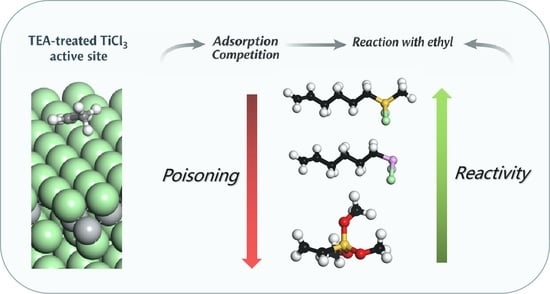
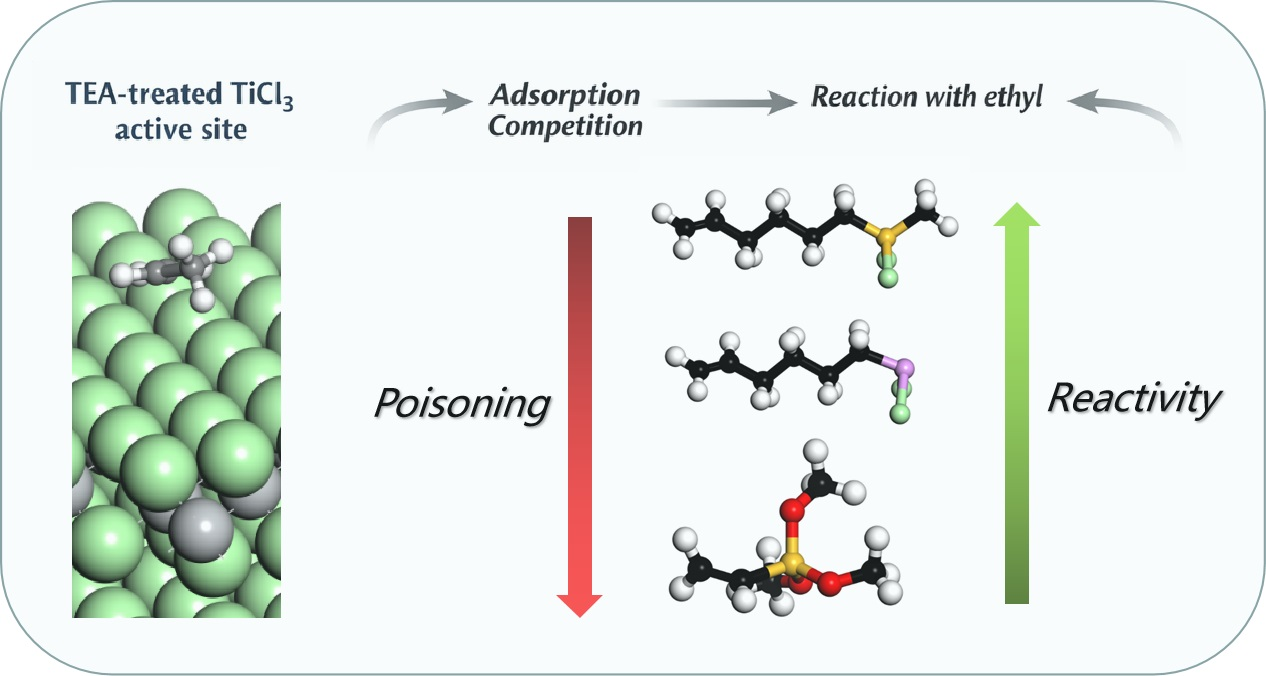
Incorporating comonomers in propylene polymerization plays a critical role in tuning the physical and chemical properties of the resulting polymers. In this study, the impact of three developed comonomers on propylene polymerization over the triethylaluminum-treated TiCl3 catalyst was investigated in detail by DFT. The results indicate that these comonomers remain highly stable under actual catalytic conditions, with their ions or functional groups showing a low propensity for detachment, which would otherwise poison the catalyst or disrupt the polymerization process. However, the three comonomers on the surface with a strong adsorption capacity may compete with propylene for adsorption, which will affect the polymerization. Among them, Vinyltrimethoxysilane, which exhibits the strongest adsorption ability, tends to form bonds with the ethyl on the catalyst surface, leading to catalyst poisoning and inhibiting the reaction. In contrast, 5-hexenyl methyldichlorosilane demonstrates relatively higher activity due to its balanced properties. The order of reactivity in the polymerization reaction: 5-hexenyl methyldichlorosilane > 5-hexenyldichlorophosphonane > vinyltrimethoxysilane. This work provides fundamental mechanistic insights into how functional comonomers interact with catalytic active sites through adsorption, competitive reactions, and insertion processes. Additional free energy analysis at 333 K confirms that these mechanistic trends remain unchanged under realistic reaction conditions. Rather than directly simulating industrial catalysts, the present study focuses on a model TiCl3 system to elucidate intrinsic structure-reactivity relationships. These findings contribute to a deeper understanding of comonomer effects in olefin polymerization at the molecular level.

Graphical Abstract

1. Introduction

Polypropylene, an important general-purpose plastic, is widely used in packaging, automotive, household appliances and other fields due to its excellent mechanical properties, chemical stability, and low production cost [1,2,3,4,5,6]. However, as high-end applications place higher demands on material performance, the limitations of traditional polypropylene in flexibility, transparency, thermal stability, and functionalization are increasingly evident [7,8,9,10,11]. Therefore, improving the overall performance of polypropylene, especially endowing it with multifunctional properties, has become an important research focus in materials science [4,12,13,14,15].
Among various modification methods, in situ copolymerization modification technology has shown high efficiency and controllability by directly regulating the polypropylene chain structure during the polymerization process, making it the most industrially promising approach at present [16,17,18,19]. The core of this technology lies in introducing comonomers during polymerization, thereby achieving precise control over the microscopic structure (such as sequence regularity, molecular chain conformation) and macroscopic properties (such as mechanical, thermal, and optical properties) of polypropylene through molecular design. Traditionally, the introduction of non-polar α-olefin comonomers such as ethylene and butene has been relatively mature [20,21]. These monomers can weaken the crystallinity of polypropylene and enhance its flexibility and transparency, thereby successfully expanding its application range. On this basis, researchers have begun to attempt the introduction of comonomers containing functional polar groups (such as heteroatoms like Si, P, Cl) to extend the application boundaries of polypropylene further. For example, by introducing flame-retardant, antibacterial, or conductive groups, polypropylene can be applied in high-end fields such as electronics, medical, and aerospace [22,23,24,25]. However, the introduction of such functional comonomers also brings new challenges. The polar groups in their structure have strong electron-donating properties and coordination ability, which may interact with the catalyst during the polymerization process, leading to passivation of active sites or catalyst poisoning, thereby significantly suppressing polymerization efficiency [26,27].
Taking the Ziegler-Natta catalytic system represented by TEA (triethylaluminum)-activated TiCl3 as an example, TiCl3 is widely employed as a prototypical model catalyst due to its relatively well-defined surface structure and identifiable active sites, which allows the isolation of intrinsic interactions at the catalytic center. In this system, the Ti3+-C2H5 active site polarizes the π bond of propylene, enabling efficient insertion reactions. However, the polar functional groups of functional comonomers (such as Si-OCH3, PCl2, etc.) may strongly adsorb to or even irreversibly coordinate with the Ti active site, resulting in occupation or deactivation of active sites. This phenomenon has been preliminarily observed in experiments [28,29]. For example, Jinyong Dong et al. [19,30,31] improved the rheological performance of polypropylene by introducing α-olefin alkyl silane comonomers, but also found that certain functionalized silane monomers significantly reduced catalytic activity [32], indicating that different functional comonomers have significant and complex impacts on the catalytic system. Although some experimental studies have explored the influence of functional monomers, relevant theoretical research remains relatively scarce, especially concerning the molecular mechanisms by which these monomers affect polymerization kinetics and catalyst stability through adsorption, cooperative reaction or competitive effects. Therefore, it is necessary to use advanced theoretical calculation methods to systematically analyze, at the atomic scale, the influence of functional comonomers on the in situ polymerization process of polypropylene, to guide the rational design of functional monomers and the development of high-performance polypropylene materials.
Unlike previous DFT studies, which primarily focused on catalyst active-site structures, olefin insertion mechanisms or conventional non-polar olefin polymerization, the influence of functional comonomers on Ziegler-Natta-catalyzed propylene polymerization remains insufficiently understood at the molecular level. In particular, the interaction among adsorption competition, catalyst poisoning, reactions with surface ethyl species and comonomer insertion has not been systematically investigated. Therefore, three representative functional comonomers—vinyltrimethoxysilane [33,34], 5-hexenyl methyldichlorosilane [35,36], and 5-hexenyldichlorophosphonane —were selected. These comonomers were not intended to represent a systematic variation in a single molecular parameter. Instead, they were chosen as representative functional monomers featuring distinct Si- and P-containing functionalities and different spatial separations between the C=C bond and the functional group. Such structural diversity enables an evaluation of how different functional-group environments influence adsorption, catalyst poisoning and insertion behavior during propylene polymerization.
Based on this, density functional theory (DFT) calculations combined with molecular dynamics simulations were employed to systematically investigate the behavior of these functional comonomers in the TEA-treated TiCl3 catalytic system. The research contents include: (1) adsorption behavior of the three comonomers on the TiCl3 surface and their poisoning effect on the catalyst; (2) competitive reactions between functional groups on the comonomers and the ethyl ligands at the catalyst active site; (3) insertion reaction paths and energy barrier analysis between comonomers and propylene or its derivative intermediates. By constructing detailed reaction models and quantitatively calculating adsorption energies, transition state barriers and thermodynamic changes, this paper aims to reveal the internal correlation between comonomer molecular structure and its influence on polymerization performance. This study aims to provide fundamental mechanistic insights into the interactions between functional comonomers and catalytically active sites, which may contribute to a better understanding of structure-reactivity relationships in olefin polymerization.

2. Results and Discussion

2.1. Mechanism of Pure Catalyst TiCl3 Affected by Comonomers

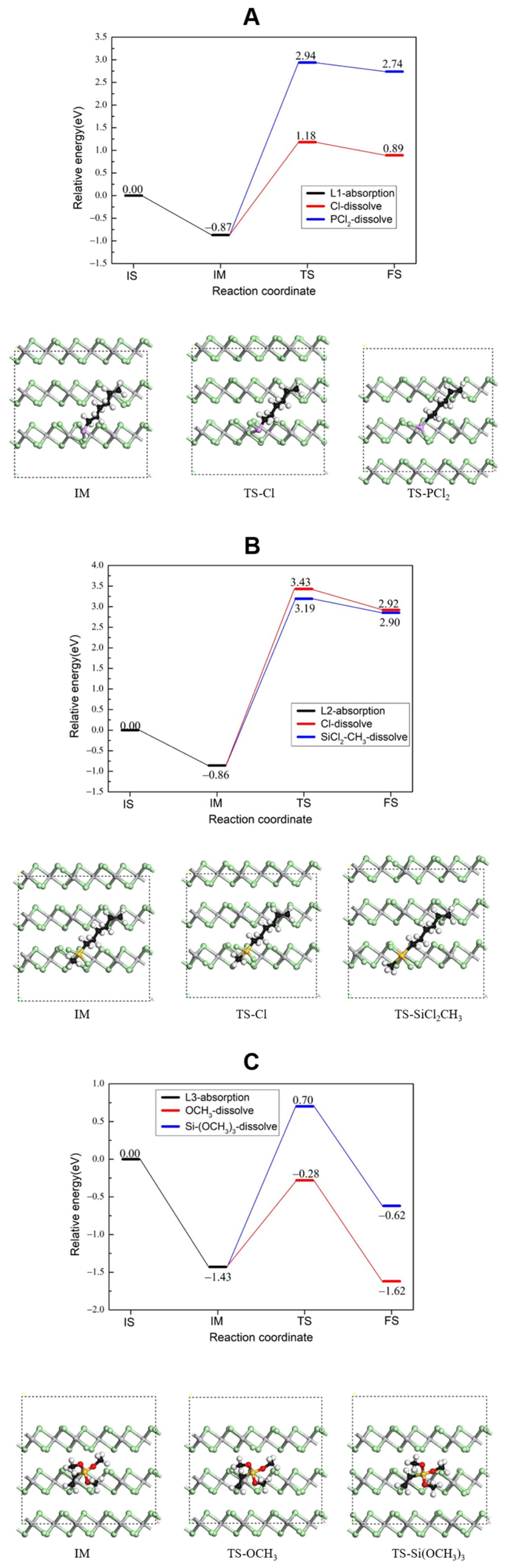
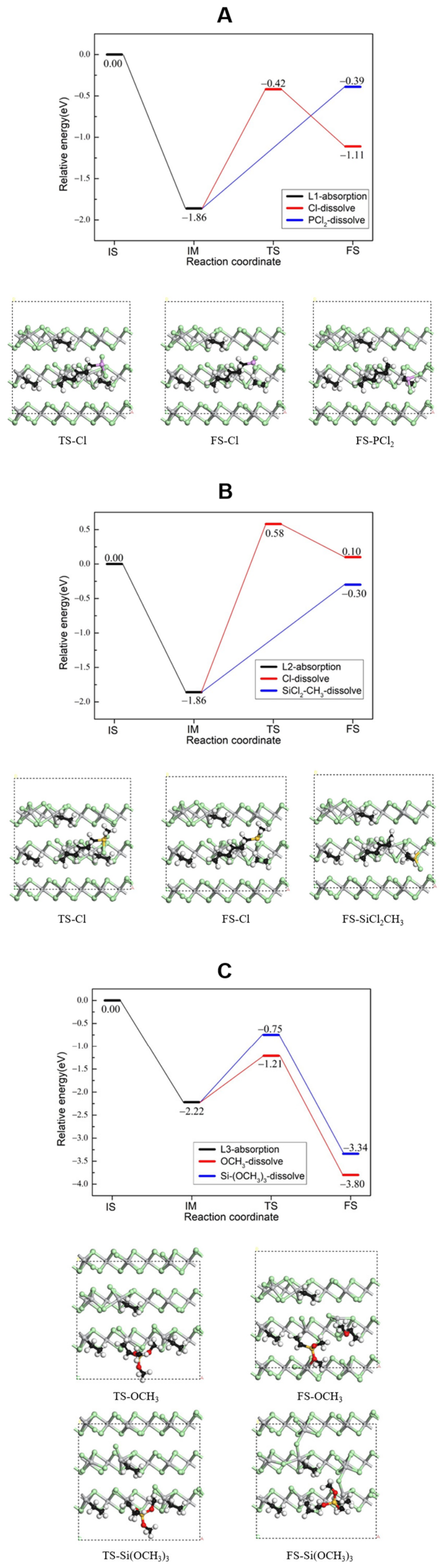
Based on the structure of 5-hexenyldichlorophosphonane, it can be found one end is a n-hexenyl group and another end is a PCl2 group. Obviously, compared to the n-hexenyl group, the PCl2 group may poison the TiCl3 catalyst during the polymerization reaction. Therefore, the process of Cl dissociating from the copolymer monomer 5-hexenyldichlorophosphonane and poisoning the TiCl3 catalyst is investigated, as well as the process of the PCl2 group dissociating and poisoning the TiCl3 catalyst. As shown in Figure 1A, when one 5-hexenyldichlorophosphonane adsorbs on the (001) surface of TiCl3, it releases an adsorption energy of 0.87 eV. 5-hexenyldichlorophosphonane primarily bonds through the C=C bond of the n-hexenyl group with the Ti sites on the surface, which is due to the Ti in the TiCl3 catalyst being in the +3 oxidation state with one electron in its d orbital, while the C=C bond acts as an electron-attracting group. Therefore, there is a strong interaction between the Ti3+ and the C=C bond, which is consistent with previous theoretical studies showing that olefin coordination to Ti centers is the key initial step in Ziegler-Natta polymerization [37]. During the poisoning process by Cl, one Cl atom dissociates from 5-hexenyldichlorophosphonane and binds with a Ti site after overcoming a transition state energy barrier of 2.05 eV. (The oxidation state of Ti was inferred from its calculated magnetic moment. In transition metal systems, Ti3+ (d1) typically exhibits a magnetic moment of ~1 μB, whereas Ti4+ (d0) shows a near-zero magnetic moment.) Therefore, the disappearance of the magnetic moment indicates oxidation of Ti from +3 to +4. Such oxidation and deactivation behavior induced by strongly coordinating species has been widely reported in Ziegler-Natta catalyst systems [38]. The reaction energy of this step reaches 1.76 eV. In the poisoning process by the PCl2 group, the detachment step requires overcoming an energy barrier of 3.81 eV. Subsequently, the PCl2 group binds with a Ti site through the P atom with the system energy increasing by 3.61 eV. Meanwhile, the Ti connected to PCl2 is also poisoned to +4. By observation, both are difficult to take place due to the quite high barrier.
It can be found that one end is a n-hexenyl group similar to 5-hexenyldichlorophosphonane by investigating the structure of the comonomer 5-hexenyl methyldichlorosilane, while the other end is a SiCl2CH3 group. The primary contributors to the poisoning of the catalyst are the Cl and SiCl2CH3 groups, which interact with and poison the Ti sites on the surface. When 5-hexenyl methyldichlorosilane adsorbs on the (001) surface of TiCl3 with −0.86 eV of adsorption energy (Figure 1B). The C=C bond of 5-hexenyl methyldichlorosilane interacts with the Ti site, exhibiting a similar adsorption effect to that of 5-hexenyldichlorophosphonane due to both connecting to the surface through the C=C bond. Next, we investigated the dissociation of the Cl and SiCl2CH3 groups from 5-hexenyl methyldichlorosilane. Breaking the Cl-Si bond requires overcoming an energy barrier of 4.29 eV, with a reaction energy of 3.78 eV. In the reaction where the C-Si bond is broken to detach the SiCl2CH3 group, the energy barrier and reaction energy are 4.05 eV and 3.76 eV, respectively. Both reactions are difficult to take place, indicating that 5-hexenyl methyldichlorosilane is very stable and not prone to poisoning the TiCl3 catalyst.
The structure of the comonomer vinyltrimethoxysilane with a tetrahedron structure significantly differs from the long-chain structure of the previous two compounds. Vinyltrimethoxysilane consists of a silicon atom centrally bonded to three methoxy groups and one vinyl group. In this study, we studied the effects of methoxy group dissociation, adsorption and the co-adsorption of the vinyl group and Si(OCH3)3 group after the C-Si bond breaks on the poisoning of the TiCl3 catalyst (Figure 1C). Similar to the previous two comonomers, it involves adsorption through the C=C bond at surface sites, with an adsorption energy of −1.43 eV. The reaction energy barrier for methoxy group dissociation is found to be 1.15 eV. After the methoxy group dissociates, it would adsorb at one Ti site. Notably, Ti remains in the +3 oxidation state, which aligns with the donor property of the methoxy group. This further suggests that the poisoning effect of the methoxy group on the catalyst is due to its occupation of active sites, rather than oxidizing Ti3+ to Ti4+, as the Cl function. Unlike the endothermic steps for the previous two comonomers, this reaction is exothermic with a reaction energy of −0.19 eV. For the reaction involving the breaking of the vinyl group from the Si(OCH3)3 group, the reaction energy barrier and reaction energy are 2.13 eV and 0.81 eV, respectively. After dissociation, the vinyl group and Si(OCH3)3 group would adsorb at two different Ti sites via the C=C bond and Si, respectively. Similar to the effect of the methoxy group on Ti, both the vinyl group and the Si(OCH3)3 group occupy the active sites on Ti without altering their oxidation state. Comparatively, the methoxy group in vinyltrimethoxysilane is more likely to dissociate than the C-Si bond to break, which aligns with other studies showing that high temperatures reduce the methoxy bond energy, causing its dissociation from Si [39,40,41,42].
From above, the effect of the comonomers on the pure TiCl3 (001) surface is primarily reflected in their adsorption on the catalyst surface, occupying active sites and thus competing with propylene for adsorption. This competition will reduce the catalytic activity. Such competitive adsorption behavior has been widely discussed in previous studies, where strongly adsorbed species can block active sites and compete with olefin adsorption [43]. Unlike 5-hexenyldichlorophosphonane and 5-hexenyl methyldichlorosilane, which exhibit higher stability, the comonomer vinyltrimethoxysilane shows a certain likelihood of losing its methoxy groups, potentially occupying additional active sites.

2.2. Mechanism of Catalyst TiCl3 with the Ethyl Affected by Comonomer

TiCl3 catalysts are often pretreated with triethylaluminum in actual polymerization reactions [44,45], resulting in ligand exchange reactions where an ethyl group replaces one of the Cl atoms at the Ti active site, forming the catalytic active center. The detachment of atoms or groups from the comonomers may interact with the ethyl at these active sites, leading to the formation of by-products that occupy the catalyst surface and affect the activity of the catalyst.
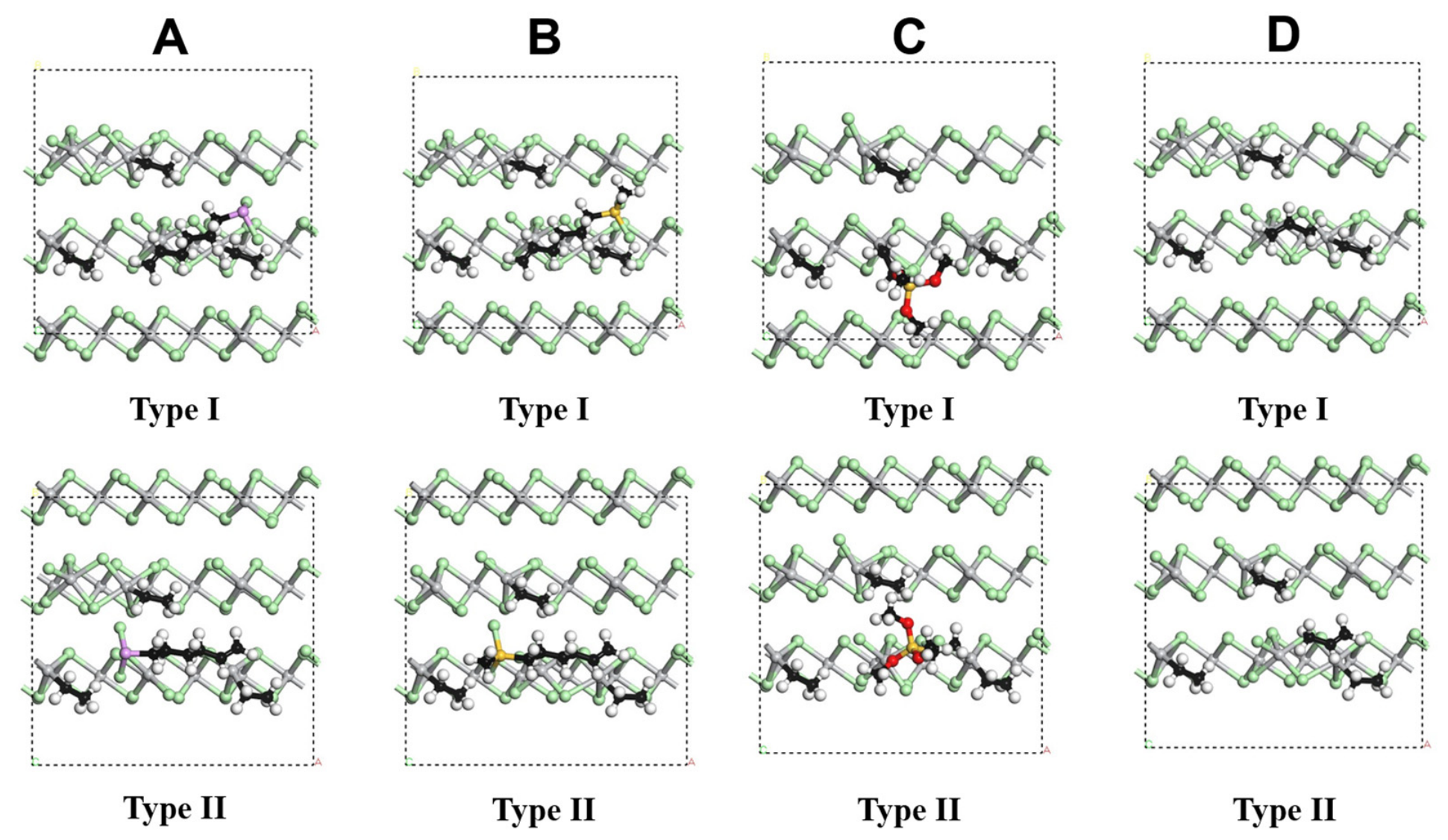
In the study of the adsorption of 5-hexenyldichlorophosphonane on the TiCl3 (001) surface, Figure 2 reveals two adsorption sites: the unmodified Ti site (Type I) and the Ti site (Type II) modified by C2H5. When 5-hexenyldichlorophosphonane adsorbs via its C=C bond at one unmodified Ti site, the adsorption energy is −1.86 eV (Figure 2A). This is significantly stronger compared to the adsorption on TiCl3 (001) surface before C2H5 modification. The enhancement in adsorption strength can be attributed to C2H5 acting as a stronger electron-donating group [43] than Cl, thereby strengthening the interaction between the C=C bond of 5-hexenyldichlorophosphonane and the Ti site. However, when 5-hexenyldichlorophosphonane adsorbs at the Ti site modified by C2H5, the adsorption energy decreases to −1.02 eV. The relatively weaker adsorption at this site is likely due to steric hindrance. The long-chain structure of 5-hexenyldichlorophosphonane encounters repulsion from the surface C2H5 group, reducing its adsorption strength. For similar reasons, the adsorption energies of 5-hexenyl methyldichlorosilane (Figure 2B) at Ti sites with and without C2H5 modification are 1.05 eV and 1.86 eV, respectively. Unlike the previous two comonomers, vinyltrimethoxysilane is slightly influenced by steric hindrance due to its tetrahedron structure (Figure 2C). The adsorption energies are 1.99 eV and 2.22 eV for Ti sites with and without C2H5 modification, respectively.

2.2.1. Reaction Mechanism of the Detached Atom or Functional Group with the Ethyl

When 5-hexenyldichlorophosphonane adsorbs at the unmodified Ti site through its C=C bond, we investigated the reaction of its other end, specifically the Cl and PCl2 groups, with the neighboring C2H5 group (Figure 3A). The transition state energy barrier for the process where a Cl atom detaches from the surface and bonds with C2H5 to form C2H5Cl is 1.44 eV, with a reaction energy of 0.75 eV. The formation of C2H5PCl2 involves a steadily increasing transition state energy, reaching 1.47 eV. In the 5-hexenyl methyldichlorosilane system as shown in Figure 3B, the reaction of the Cl atom detaches from 5-hexenyl methyldichlorosilane and reacts with C2H5 exhibits an energy barrier of 2.46 eV and a reaction energy of 1.96 eV. The SiCl2CH3 group detaches and reacts with C2H5 after passing through a steadily increasing transition state energy (1.56 eV), resulting in the formation of C2H5SiCl2CH3. In the vinyltrimethoxysilane system, the energy barrier and reaction energy for the formation of C2H5OCH3 are 1.01 and 1.58 eV, respectively (Figure 3C). In contrast, the reaction between the Si(OCH3)3 group and C2H5 after C-Si bond cleavage requires overcoming an energy barrier of 1.47 eV and releasing 1.12 eV of energy. Compared with the pure TiCl3 system, the ions or functional groups of the three comonomers are more likely to poison the catalyst in the presence of C2H5. This can be attributed to the fact that these detached ions or functional groups form more stable bonds with C2H5 compared to Ti, which lowers the activation energy barrier to some degree. Such side reactions involving alkyl–halide formation have also been discussed in other polymerization reaction as possible deactivation pathways [46].

2.2.2. Reaction Mechanism of the Comonomers with the Ethyl

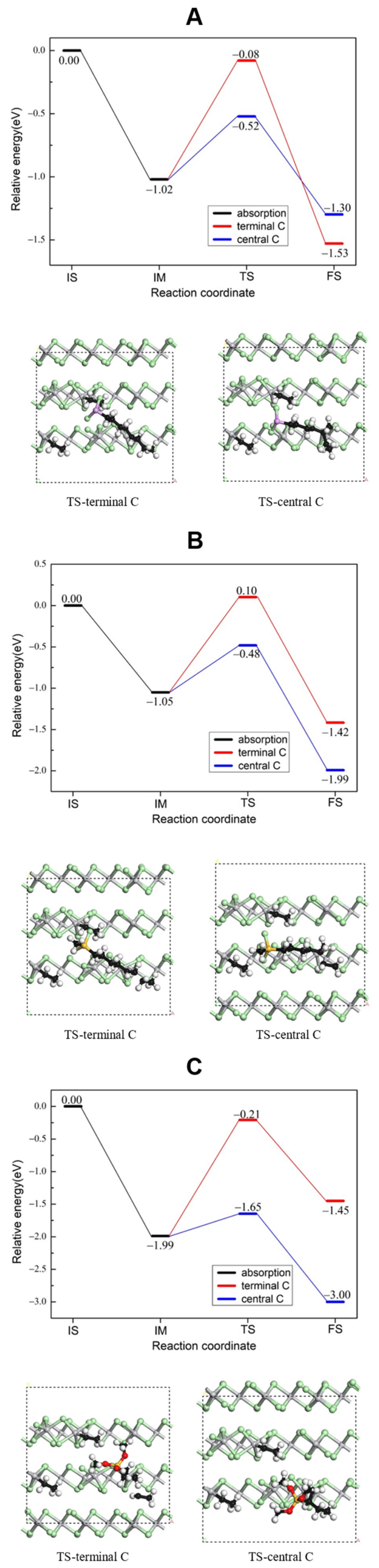
After studying the effects of ion or functional group detachment on the catalyst, we further explored the interactions between the comonomers and the C2H5 at the Ti active site, which serves as the polymerization reaction center. Specifically, we investigated the bonding processes between the C=C bond between the comonomers and C2H5, where either carbon atom in the double bond interacts with C2H5 to form a bond. In the case of 5-hexenyldichlorophosphonane (Figure 4A), during the bonding of the terminal carbon in the double bond with C2H5, all four H atoms attached to these two carbon atoms must shift slightly from the ends of the molecular chain toward the molecular backbone, particularly the two hydrogens on the terminal carbon of 5-hexenyldichlorophosphonane. This shift creates enough space to accommodate the bonding of the two carbon atoms, resulting in the formation of PCl2-(CH2)4-CH-C3H7. Consequently, this process requires overcoming an energy barrier of 0.94 eV. In contrast, the reaction barrier of the C2H5 bonds with the central carbon atom in the double bond is reduced to 0.50 eV. This is due to the central carbon with only one hydrogen atom and less steric hindrance. Steric effects are known to play a critical role in determining insertion pathways in olefin polymerization reactions [47]. Therefore, the structure that more easily adjusts to a favorable C-C coupling environment to form PCl2-(CH2)4-CH(C2H5)-CH2. Thermodynamically, the energy difference between these two processes is 0.21 eV, making the pathway involving the central carbon more competitive. This type also applies to the other two comonomers in their reactions with ethyl groups. As shown in Figure 4B, for 5-hexenyl methyldichlorosilane, the transition state energy barrier and reaction energy for the terminal carbon reacting with C2H5 are 1.15 eV and −0.37 eV, respectively. When the central carbon reacts with C2H5, the energy barrier and reaction energy drop to 0.57 eV and −0.94 eV, respectively. The reaction between vinyltrimethoxysilane and ethyl exhibits even more pronounced differences (Figure 4C). Due to steric hindrance, the energy barrier for the reaction between the terminal carbon and the ethyl group reaches 1.78 eV, with a reaction energy of 0.54 eV. In contrast, the central carbon, located at a “bend” in the structure, has enough space, resulting in a much lower energy barrier of only 0.34 eV and the release of 1.01 eV of energy when bonding with ethyl.
In summary, after the TiCl3 surface is modified by C2H5, the adsorption capacity of the comonomers on the surface is further enhanced. The comonomers exhibit strong interactions with the surface C2H5. Similar to the results in the previous Section 2.1, vinyltrimethoxysilane exhibits the strongest adsorption ability and reactivity among the comonomers. Additionally, the ions or functional groups of the comonomers may also form more stable species with the ethyl, leading to a significant reduction in the energy barrier for their detachment from the comonomers. However, these reactions are difficult to proceed with the high barrier.

2.3. Reaction Mechanism of Propylene and Comonomer on Catalyst TiCl3

After exploring the toxicity of the comonomers to the catalyst, we also explored their reactions with propylene to evaluate their participation in the polymerization process. We simplified the model by only considering the interaction between the comonomers and a single propylene molecule.

2.3.1. Reaction Mechanism of Propylene and Comonomer on Pure Catalyst TiCl3

The reaction of comonomers with C3H6 on the pure TiCl3 (001) surface was studied first. The diagrams of the reaction mechanism are shown in Figure 5. The C=C bond of 5-hexenyldichlorophosphonane occupies the Ti site when 5-hexenyldichlorophosphonane is adsorbed on surface sites, preventing C3H6 from co-adsorbing at the same Ti site. Instead, C3H6 adsorbs at an adjacent Ti site via its C=C bond with an adsorption energy of −0.70 eV. Next, they will form a PCl2-(CH2)4-CH-CH2-CH2-CHCH3 species adsorbed on the surface if 5-hexenyldichlorophosphonane attacks the double-bonded carbon in propylene. This process has a high energy barrier of 2.43 eV and a reaction energy of 1.64 eV when C3H6 is under inactivation states. If 5-hexenyldichlorophosphonane attacks the central carbon in propylene, it forms a PCl2-(CH2)4-CH-CH2-CHCH3-CH2 species. This reaction is similarly difficult, being endothermic by 2.32 eV with a transition state energy barrier of 2.63 eV. On the catalyst surface with 5-hexenyl methyldichlorosilane, C3H6 adsorbs at an adjacent Ti site with −0.60 eV. When 5-hexenyl methyldichlorosilane attacks the double-bonded carbon and the central carbon of C3H6, it forms CH3-SiCl2-(CH2)4-CH-CH2-CH2-CHCH3 and CH3-SiCl2-(CH2)4-CH-CH2-CHCH3-CH2 species, respectively. The transition state energies for these reactions are 2.14 and 3.47 eV. The reaction energies are consistent with the transition states, with the reaction energies of 1.62 and 2.25 eV. In the system with vinyltrimethoxysilane, the adsorption energy of C3H6 is similar to the previous two systems at 0.60 eV. When vinyltrimethoxysilane attacks the double-bonded carbon in C3H6, the transition state energy is 2.10 eV, forming a (CH3O)3-Si-CH-CH2-CH2-CHCH3 species and absorbing 1.56 eV of energy from the environment. If it attacks the central carbon, it would form a (CH3O)3-Si-CH-CH2-CHCH3-CH2 species with a reaction energy barrier and reaction energy of 1.59 eV and 0.90 eV, respectively. In conclusion, the transition state energies and reaction energies are generally above 1.50 and 1.00 eV, respectively, making the direct reaction difficult without propylene activation. Therefore, if no ethyl groups on the surface or the comonomers destroy the active sites, it will be challenging for C3H6 to be activated and participate in the reaction.

2.3.2. Reaction Mechanism of Propylene and Comonomer on Catalyst TiCl3 Modified by the Ethyl

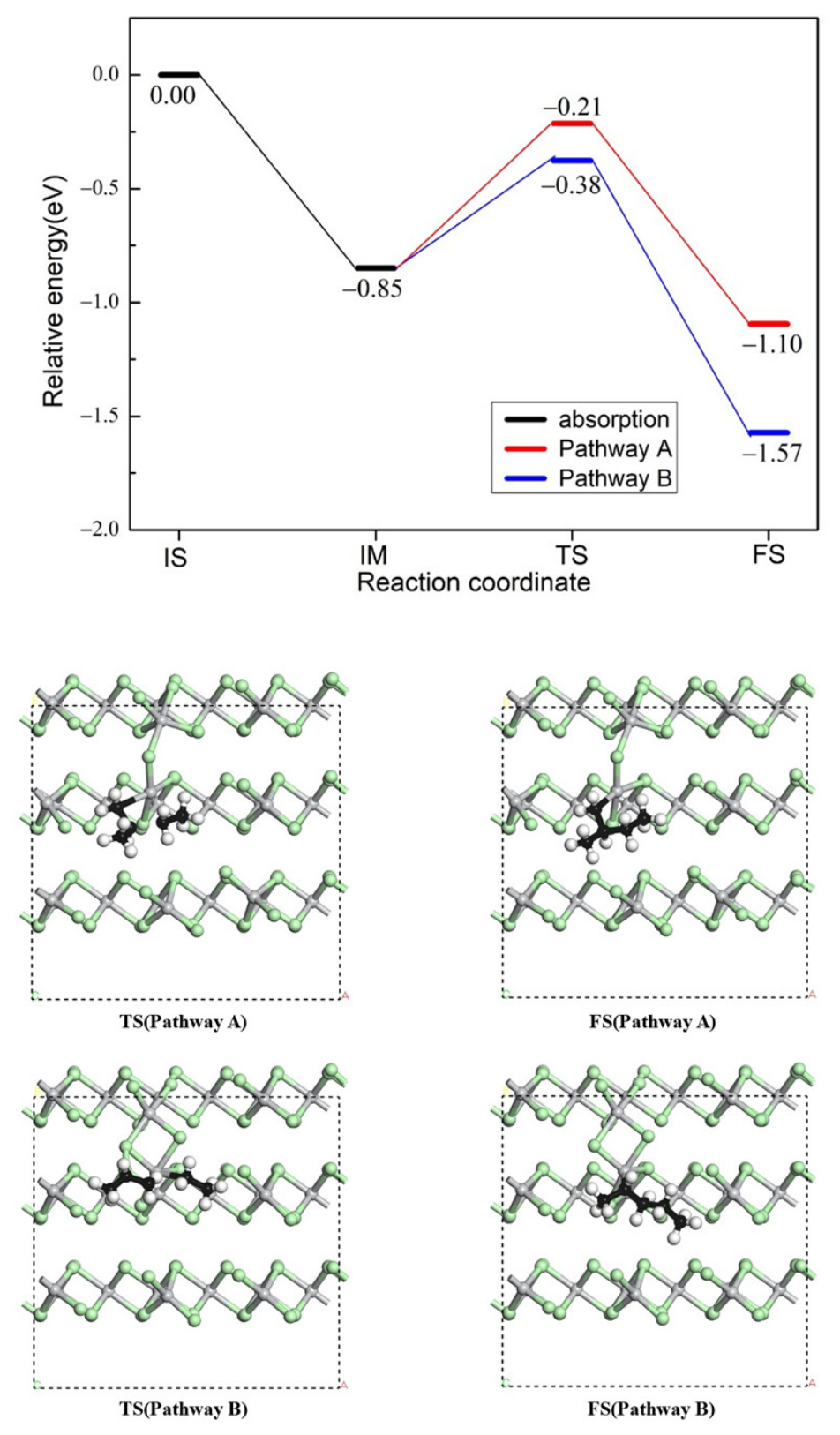
Based on the model of TiCl3 catalyst treated with triethylaluminum, we calculated the adsorption energy of one C3H6 on the active Ti site modified by C2H5 in Figure 6, which is 0.85 eV. In the subsequent reaction, C3H6 undergoes activation by insertion into the alkyl group, with two possible reaction pathways. This process follows the classical Cossee–Arlman mechanism of olefin polymerization [46]. Pathway B involves C2H5 attacking the central carbon of propylene. This process generates the C2H5-CH2-CH-CH3 activated species after overcoming a transition state energy barrier of 0.47 eV and releasing 0.73 eV of energy, which is adsorbed at the Ti site through the CH2 group and prepared for the next polymerization step. In Pathway A, C2H5 interacts with the double-bonded carbon of propylene, resulting in the formation of the C2H5-CHCH3-CH2 activated species, which is connected to the Ti site via the CH group. The transition state energy barrier and reaction energy for this step are 0.62 eV and −0.25 eV, respectively. Although the small size of the propylene molecule means that steric hindrance slightly affects the transition state energy barriers for both pathways, Pathway B still has a clear advantage in both kinetics and thermodynamics, making this pathway more competitive. Therefore, the following studies will be based on the product of Pathway B, C2H5-CH2-CH-CH3. Notably, the reaction energy barrier between the comonomers and C2H5 ranges from 0.34 to 0.57 eV in Section 2.2.2, which may compete with propylene activation and affect the polymerization reaction.
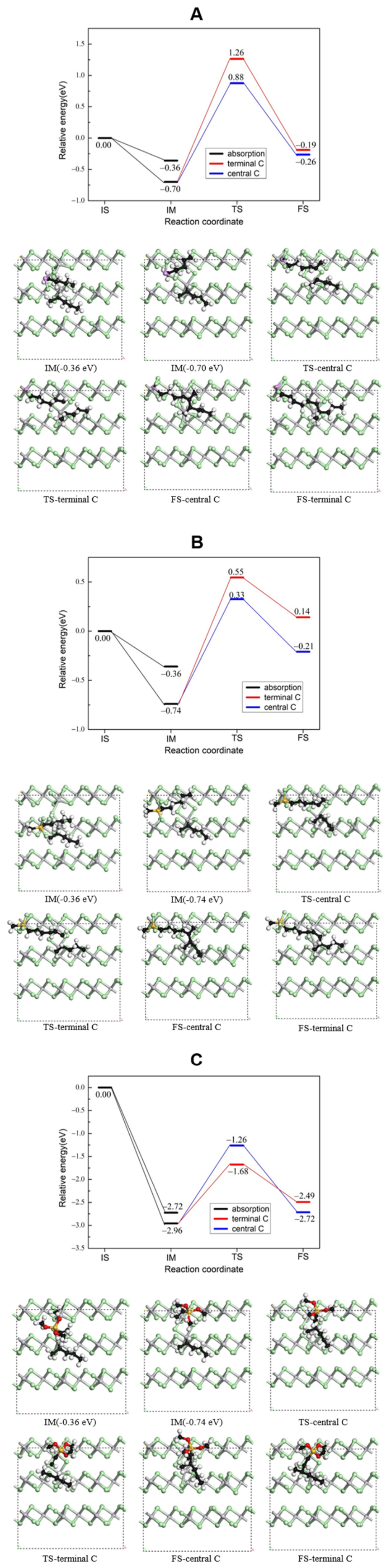
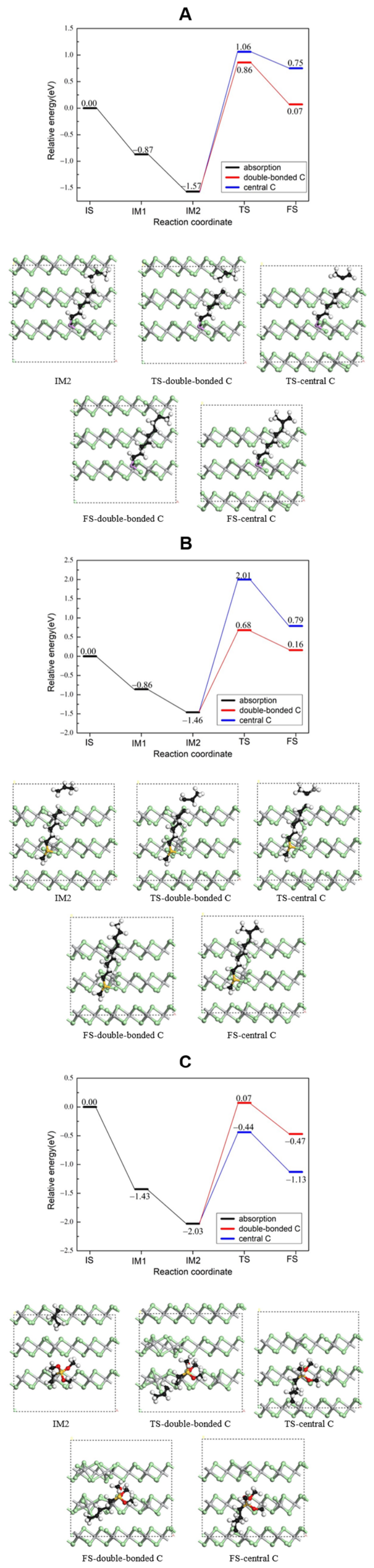
As shown in Figure 7A, when 5-hexenyldichlorophosphonane adsorbs on the catalyst TiCl3 (001) surface, it tends to adsorb alone at an empty Ti site, releasing an adsorption heat of 0.70 eV. However, when co-adsorbed with C2H5-CH2-CH-CH3 at the same site, the adsorption energy is reduced to −0.36 eV due to steric hindrance. The subsequent insertion of 5-hexenyldichlorophosphonane into C2H5-CH2-CH-CH3 follows a similar mechanism to the C2H5 reaction with comonomers described in Section 2.2.1., C2H5-CH2-CH-CH3 is more inclined to form a bond with the central carbon of the C=C bond in 5-hexenyldichlorophosphonane due to steric effects, with a reaction barrier of 1.58 eV. Due to the repulsive force, the H on the central C is also synergistically transferred to the terminal C during C-C coupling. The reaction barrier for C2H5-CH2-CH-CH3 bonding with the terminal carbon is 1.96 eV. The adsorption and reaction processes of 5-hexenyl methyldichlorosilane are similar to those of 5-hexenyldichlorophosphonane (Figure 7B). It also prefers to adsorb at a neighboring vacant Ti site, releasing 0.74 eV of adsorption energy. Co-adsorption with C2H5-CH2-CH-CH3 at the same Ti site only releases 0.36 eV of energy. The reaction barriers for C2H5-CH2-CH-CH3 coupling with the central and terminal carbons of 5-hexenyl methyldichlorosilane are 1.07 eV and 1.29 eV, respectively, which are influenced by steric hindrance. The H on central C is also transferred to terminal C.
In contrast to the long-chain structures of 5-hexenyl methyldichlorosilane and 5-hexenyldichlorophosphonane, vinyltrimethoxysilane, with its unique tetrahedron structure, exhibits adsorption energies of −2.96 eV at a vacant site and −2.72 eV at a site occupied by C2H5-CH2-CH-CH3 (Figure 7C). This adsorption process is less affected by steric hindrance. However, the insertion of vinyltrimethoxysilane into C2H5-CH2-CH-CH3 follows a different mode compared to the previous two comonomers. Unlike the smaller C2H5 group, which tends to bond with the central carbon, the bulky Si(OCH3)3 group of vinyltrimethoxysilane inhibits the larger C2H5-CH2-CH-CH3 group from bonding with the central carbon, resulting in a reaction barrier of 1.70 eV. Conversely, the reaction barrier for bonding between the terminal carbon of vinyltrimethoxysilane and C2H5-CHCH3-CH2 is 1.28 eV.
In summary, among the comonomers, 5-hexenyl methyldichlorosilane demonstrates the highest competitiveness in the polymerization insertion process, followed by vinyltrimethoxysilane, and then 5-hexenyldichlorophosphonane. Nevertheless, the reaction barriers for the insertion of all three comonomers exceed 1.00 eV, which is significantly higher compared to the 0.40–0.70 eV barriers for propylene insertion.

2.4. Discussion

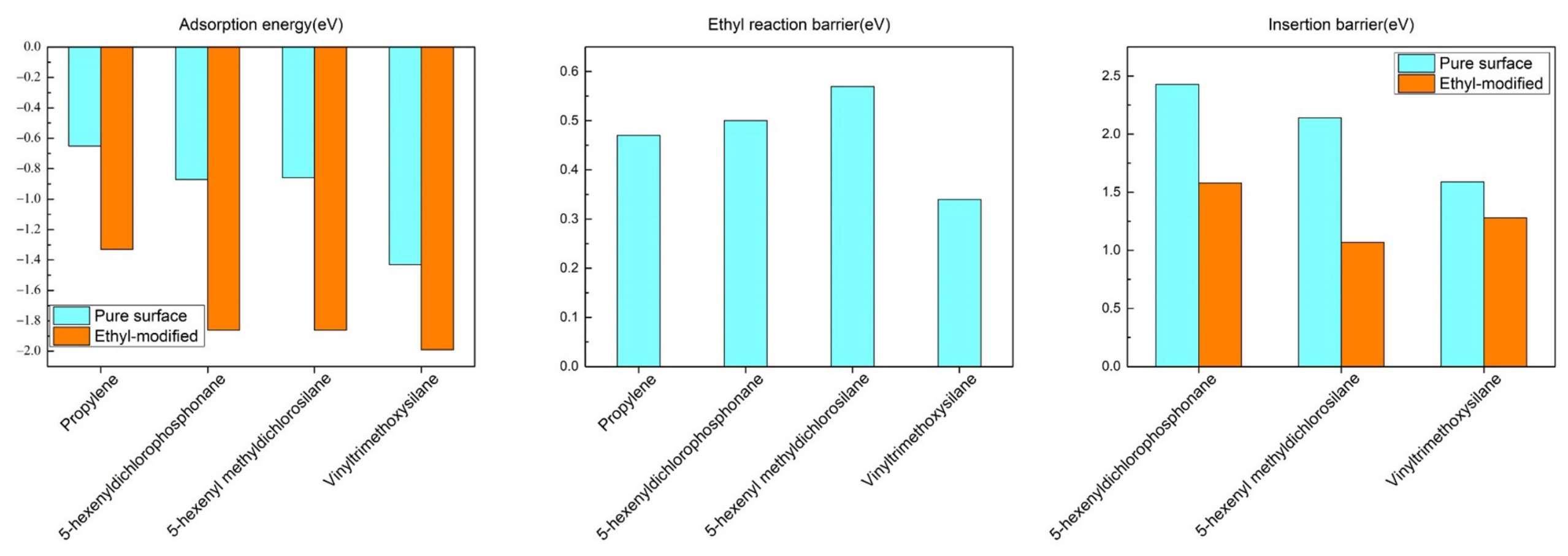
Through our mechanism study of the three comonomers in TiCl3-catalyzed propylene polymerization, we can provide a more detailed explanation of how these comonomers specifically affect the reaction. As shown in Table 1, the adsorption energies of 5-hexenyl methyldichlorosilane and 5-hexenyldichlorophosphonane both exceed 0.85 eV on the pure TiCl3 surface, with vinyltrimethoxysilane reaching 1.43 eV. In comparison, the adsorption energy of the propylene molecule is about 0.65 eV. Although the adsorption strengths of the first two comonomers are similar to those of propylene, vinyltrimethoxysilane is more competitive than propylene in adsorption. If the catalyst is treated with triethylaluminum and the surface is modified with ethyl groups, this will further enhance the adsorption advantage of the comonomers. Due to the electron-donating property of ethyl groups, the adsorption energies of 5-hexenyl methyldichlorosilane and 5-hexenyldichlorophosphonane increase to 1.86 eV, while vinyltrimethoxysilane reaches 2.22 eV. In contrast, the adsorption energy of propylene only rises to 1.33 eV. Bader analysis (Table S1) shows that adsorption of vinyltrimethoxysilane induces the largest charge transfer between the adsorbate and the Ti active site, consistent with its strongest adsorption strength. This finding is consistent with previous experimental studies showing that polar molecules can act as poisons in Ziegler-Natta catalysts by strongly interacting with active sites, leading to decreased catalytic activity [38,48,49].
By investigating the reaction between the comonomers/propylene and the ethyl, we can observe from Table 2 that vinyltrimethoxysilane is more likely to react with surface-bound ethyl than propylene, thereby disrupting the active site. The reaction barrier and reaction energy between vinyltrimethoxysilane and ethyl are 0.34 eV and −1.01 eV, respectively. For propylene, the reaction barrier and reaction energy with ethyl are 0.47 eV and −0.73 eV, respectively. These results show that both thermodynamically and kinetically, the surface ethyl groups are more likely to react with vinyltrimethoxysilane, which can inhibit the activation of propylene. On the other hand, while the adsorption ability of 5-hexenyl methyldichlorosilane and 5-hexenyldichlorophosphonane with ethyl groups is slightly stronger than that of propylene, their reaction barriers are above 0.50 eV. Therefore, these two comonomers will compete with propylene for activation and will not completely inhibit the activation of propylene and its subsequent reactions, like the vinyltrimethoxysilane.
In the comonomer insertion reactions with propylene, Table 3 shows that on the pure TiCl3 catalyst, which is not treated with triethylaluminum, the propylene remains unactivated, resulting in high reaction barriers for the direct bonding between the comonomers and propylene, with the barriers exceeding 1.50 eV and reaction energies above 1.00 eV. This indicates that the insertion reaction of the comonomers is difficult to process under these conditions. However, when the reaction takes place on the catalyst modified by ethyl groups, the difficulty of the reaction is significantly reduced, with the propylene being pre-activated by the ethyl. The reaction barriers for the comonomers with propylene derivatives can decrease to between 1.00 and 1.60 eV, and the reaction energies can drop to below 0.50 eV. Given that the barriers for propylene polymerization are generally below 1.00 eV, the insertion rate of the comonomers is quite low. From the theoretical results, the insertion ability of the comonomers follows the order: 5-hexenyl methyldichlorosilane > vinyltrimethoxysilane > 5-hexenyldichlorophosphonane. However, considering the strong adsorption ability of vinyltrimethoxysilane and its higher reactivity with surface ethyl groups compared to propylene, the overall propylene polymerization process is affected. Taking this into account, the insertion order for the whole reaction can be revised to: 5-hexenyl methyldichlorosilane > 5-hexenyldichlorophosphonane > vinyltrimethoxysilane.
To provide a more intuitive comparison, Figure 9 summarizes these competitive processes for all three comonomers. It clearly illustrates that vinyltrimethoxysilane exhibits the strongest adsorption and highest tendency to react with surface ethyl groups, whereas 5-hexenyl methyldichlorosilane shows the most favorable insertion kinetics. Collectively, these results demonstrate that the overall performance of a functional comonomer is not determined by insertion ability alone, but by the balance among adsorption strength, reactivity toward surface ethyl species and insertion kinetics, as captured both in Table 1, Table 2 and Table 3 and Figure 8.
The available experimental evidence also supports the trends predicted by the present calculations. In particular, 5-hexenyl methyldichlorosilane has been reported to participate in Ziegler-Natta catalyzed propylene polymerization while maintaining relatively stable catalyst activity. This behavior is consistent with the present calculations, which indicate a favorable balance among adsorption strength, reactivity toward surface ethyl species, and insertion ability. In contrast, experimental studies on the incorporation of vinyltrimethoxysilane and 5-hexenyldichlorophosphonane in Ziegler-Natta catalyzed propylene polymerization remain scarce. Therefore, the results should primarily be regarded as mechanistic predictions of their relative behavior. It provides a deep understanding of the intrinsic structure-reactivity relationships governing comonomer incorporation and catalyst inhibition.
To evaluate the effect of temperature, Gibbs free energy at 333 K was calculated based on the calculated adsorption and reaction energy. The entropy contribution mainly originates from the loss of translational and rotational freedom upon adsorption and from the constrained molecular configurations at the transition states, which generally leads to less negative adsorption free energies and slightly higher activation free energies than the purely electronic values. Although entropy corrections modify the absolute Gibbs free energies, they are significantly smaller than the energy differences among the investigated reaction pathways and therefore do not alter the relative energetic ordering. The results (Tables S2–S4) show that the relative adsorption strengths, reaction preferences with ethyl groups and the high barriers associated with comonomer insertion are all preserved. Consequently, the mechanistic conclusions of this work remain unaffected under realistic reaction conditions.
To further evaluate the reliability of the conclusions under realistic polymerization conditions, the effect of the reaction medium was examined using a continuum solvent model representing liquid propylene (ε ≈ 1.88). As shown in Table S5, the adsorption energies of all investigated species become slightly less negative in the solvent environment compared with the vacuum result. However, the changes are limited to 0.05–0.10 eV, and the relative adsorption strengths remain unchanged. These results indicate that although solvent effects slightly modify the absolute energies, they do not alter the mechanistic conclusions derived from the vacuum condition.
Beyond confirming the robustness of the proposed reaction mechanism, the calculated results also provide insight into the potential consequences of comonomer incorporation on the polymerization process. In particular, the influence of functional comonomers on stereochemical control is worth considering. Although the stereoregularity of polypropylene was not explicitly investigated in the present work, the different insertion preferences observed for vinyltrimethoxysilane compared with the other two comonomers may lead to distinct chain-end environments upon incorporation. Such changes could potentially influence subsequent stereoselective propylene insertion events and therefore affect tacticity. In contrast, the longer spacer chains present in 5-hexenyl methyldichlorosilane and 5-hexenyldichlorophosphonane are expected to reduce the direct influence of the functional groups on the local stereochemical environment of the active site.

3. Calculation Method

First-principles calculations were performed using the Vienna Ab initio Simulation Package (VASP 6.0, University of Vienna, Vienna, Austria) [50,51]. The generalized gradient approximation (GGA) with the Perdew-Burke-Ernzerhof (PBE) exchange-correlation functional was employed [52]. Projector augmented-wave (PAW) pseudopotentials were used to describe the interaction between ions and electrons. The plane-wave cutoff energy was set to 400 eV. The electronic relaxation with a convergence criterion of 10−4 eV for the electronic self-consistent loop. The calculations were performed with the gamma point (1 × 1 × 1) k-point mesh for the Brillouin zone integration, and a Gaussian smearing method with a Sigma of 0.05 eV was applied. For the DFT+U calculations, the Dudarev approach was used, applying an effective U value of 4.20 eV on the Ti 3d states [53]. The ionic relaxation was conducted using a conjugate gradient algorithm until the forces on each atom were less than 0.05 eV/Å. The corrections for long-range van der Waals interactions (D3) were included. The climbing image nudged elastic band (CI-NEB) method was employed to locate the transition states [54,55]. The transition state calculations were refined until the forces on the images converged to less than 0.05 eV/Å. Frequency calculations were performed to verify the identified transition states. The free energy was corrected at 333 K according to the method in the literature [56]. Additionally, we calculated adsorption energies using the following formula:
Eads = Esurf-adsorbateEsurfEadsorbate
where Esurf-adsorbate, Esurf, and Eadsorbate are the total energies of the adsorbate-surface system, isolated surface, and gas phase adsorbate, respectively.
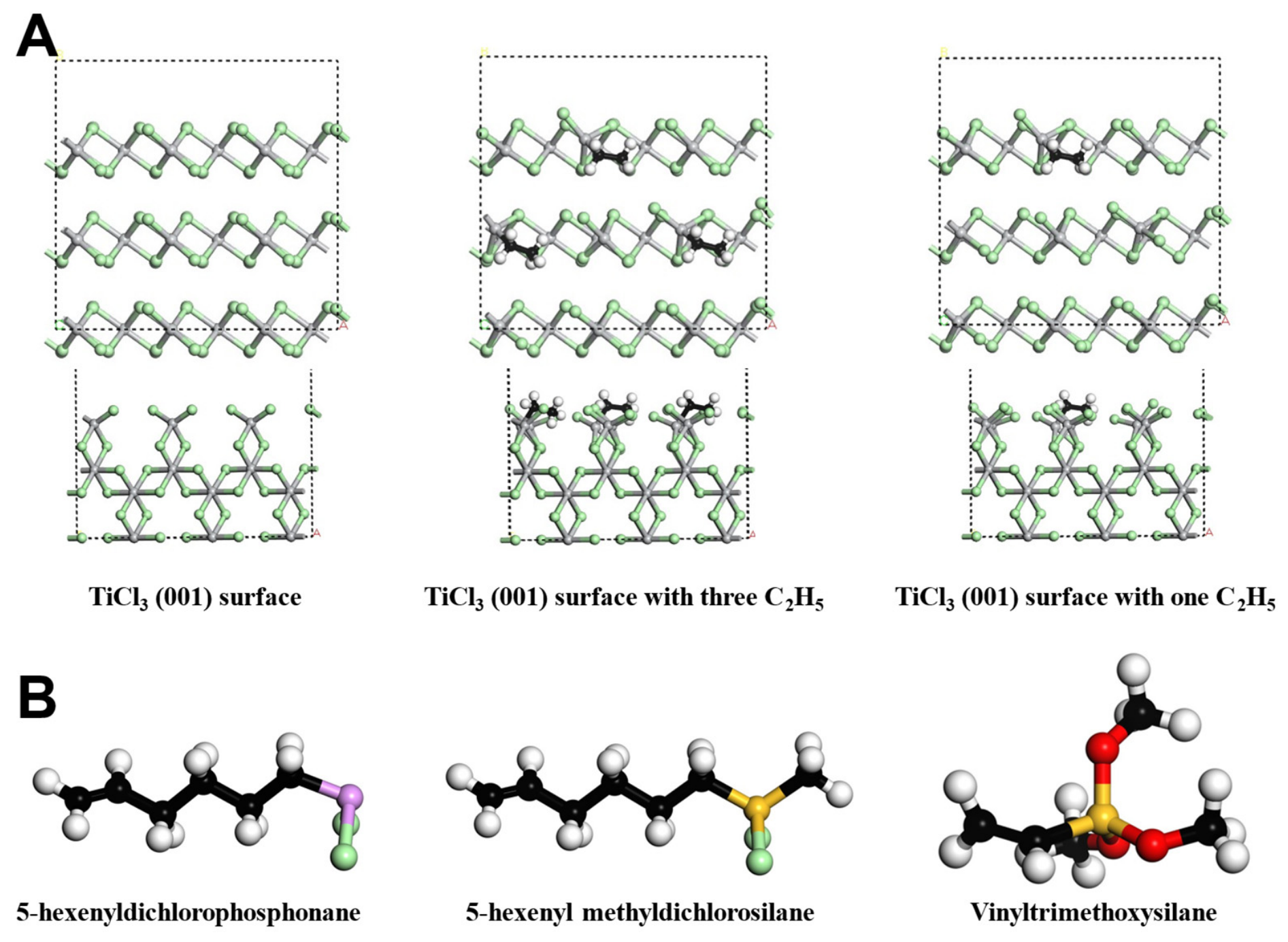
Bulk α-TiCl3 forms a trigonal lattice with space group P-31M and the lattice constants are: a = b = 6.14 Å, c = 5.85 Å. As shown in Figure 9A, we built a periodic slab with three layers for the TiCl3 (001) surface. 4 × 4 surface unit cells were used. The bottom layer was fixed, while the top two layers were relaxed during the calculation. A vacuum layer of 15 Å was introduced to eliminate interactions between periodic images. Although industrial Ziegler-Natta catalysts are typically based on MgCl2-supported Ti species, this work focuses on the elementary reactions occurring at Ti active sites rather than on the structural role of the MgCl2 support. Therefore, the TiCl3(001) slabs were employed as a simplified model to represent the local catalytic environment. This model enables a direct comparison of the adsorption, catalyst poisoning, reaction with surface ethyl species and insertion behavior of different functional comonomers under a consistent catalytic framework, facilitating the identification of their intrinsic structure-reactivity relationships. The structures of three comonomers 5-hexenyldichlorophosphonane, 5-hexenyl methyldichlorosilane and vinyltrimethoxysilane are also shown in Figure 9B.

4. Conclusions

This work provides fundamental mechanistic insights into the propylene polymerization of three comonomers using DFT methods. The study reveals that pretreatment of the TiCl3 catalyst with triethylaluminum is essential in the polymerization process. During the insertion of comonomers into propylene, unactivated propylene molecules struggle to interact and bond with the comonomers, resulting in high energy barriers and enthalpy changes. In contrast, ethyl-activated propylene molecules exhibit significantly improved reactivity, with much lower reaction barriers and enthalpy changes, making the reaction feasible.
The activity order of the three comonomers follows the trend: 5-hexenyl methyldichlorosilane > 5-hexenyldichlorophosphonane > vinyltrimethoxysilane. In the actual catalytic reaction process, the comonomer molecules are quite stable, and the ions or functional groups on the comonomers are unlikely to detach and affect the polymerization reaction. However, since the adsorption capacity of the comonomers on the surface is generally stronger than that of propylene molecules, they can interfere with the polymerization process to some degree. This is particularly evident with vinyltrimethoxysilane, whose adsorption energy is nearly double that of propylene. Additionally, all three comonomers can bond with surface ethyl groups, creating a competitive reaction with propylene. This competition is especially strong with vinyltrimethoxysilane, which reacts with the ethyl more readily than propylene, poisoning the catalyst and preventing the ethyl from activating propylene, thereby inhibiting the reaction. In contrast, 5-hexenyl methyldichlorosilane has moderate adsorption capacity and lower reactivity with ethyl compared to propylene. At the same time, its good activity with propylene-derived intermediates allows it to integrate into the growing polymer chain. Therefore, overall, 5-hexenyl methyldichlorosilane exhibits better insertion ability compared to the other two comonomers. Importantly, free energy analysis at 333 K further demonstrates that these conclusions are robust under practical polymerization conditions.
Beyond comparing individual comonomers, this work provides a unified mechanistic framework for understanding the behavior of functional comonomers in TiCl3-catalyzed propylene polymerization. The results reveal that adsorption competition, catalyst poisoning, reactions with surface ethyl species and insertion processes are strongly coupled and collectively determine comonomer incorporation. In particular, the overall performance of a functional comonomer is governed not by insertion ability alone, but by the balance between adsorption strength, reactivity toward surface ethyl species and insertion kinetics. This mechanistic understanding provides molecular-level guidance for the rational design of next-generation functional comonomers, which contributes to a deeper understanding of comonomer effects in olefin polymerization.

Supplementary Materials

The following supporting information can be downloaded at: https://www.mdpi.com/article/10.3390/catal16070576/s1, Table S1: Bader charge transfer (e) upon adsorption on TiCl3 (001) surface with the ethyl; Table S2: Adsorption free energy (eV) of related species on TiCl3 (001) surface at 333 K with and without the ethyl; Table S3: The most favorable reaction pathway free energy (eV) of the related species at 333 K with the ethyl; Table S4: The most favorable reaction pathway free energy (eV) of the comonomers inserted into the propylene species at 333 K; Table S5: Adsorption energy (eV) of related species on TiCl3 (001) surface with the ethyl in propylene solution.

Author Contributions

Conceptualization, L.W. and C.Y.; methodology, L.W.; software, L.M.; validation, Y.W., X.L. and J.L.; formal analysis, J.W.; investigation, Z.Z.; resources, W.F.; data curation, Y.W.; writing—original draft preparation, L.W., C.Y. and Y.W.; writing—review and editing, Z.H. and S.F.; visualization, L.W.; supervision, Z.H. and S.F.; project administration, L.M.; funding acquisition, C.Y. All authors have read and agreed to the published version of the manuscript.

Funding

This work was supported by CNOOC.

Data Availability Statement

The original contributions presented in this study are included in the article/Supplementary Material. Further inquiries can be directed to the corresponding authors.

Conflicts of Interest

All authors were employed by CNOOC Institute of Chemicals & Advanced Materials. All authors declare that the research was conducted in the absence of any commercial or financial relationships that could be construed as a potential conflict of interest.

References

  1. Peterlin, A. Molecular Model of Drawing Polyethylene and Polypropylene. J. Mater. Sci. 1971, 6, 490–508. [Google Scholar] [CrossRef]
  2. Varga, J. Supermolecular Structure of Isotactic Polypropylene. J. Mater. Sci. 1992, 27, 2557–2579. [Google Scholar] [CrossRef]
  3. Jones, A.T.; Aizlewood, J.M.; Beckett, D.R. Crystalline Forms of Isotactic Polypropylene. Makromol. Chem. 1964, 75, 134–158. [Google Scholar] [CrossRef]
  4. Hossain, M.T.; Shahid, M.A.; Mahmud, N.; Habib, A.; Rana, M.M.; Khan, S.A.; Hossain, M.D. Research and Application of Polypropylene: A Review. Discov. Nano 2024, 19, 2. [Google Scholar] [CrossRef] [PubMed]
  5. Zhang, S.; Horrocks, A.R. A Review of Flame Retardant Polypropylene Fibres. Prog. Polym. Sci. 2003, 28, 1517–1538. [Google Scholar] [CrossRef]
  6. Patil, A.; Patel, A.; Purohit, R. An Overview of Polymeric Materials for Automotive Applications. Mater. Today Proc. 2017, 4, 3807–3815. [Google Scholar] [CrossRef]
  7. Echeverria, C.A.; Handoko, W.; Pahlevani, F.; Sahajwalla, V. Cascading Use of Textile Waste for the Advancement of Fibre Reinforced Composites for Building Applications. J. Clean. Prod. 2019, 208, 1524–1536. [Google Scholar] [CrossRef]
  8. Cai, Z.; Wan, Y.; Becker, M.L.; Long, Y.-Z.; Dean, D. Poly(Propylene Fumarate)-Based Materials: Synthesis, Functionalization, Properties, Device Fabrication and Biomedical Applications. Biomaterials 2019, 208, 45–71. [Google Scholar] [CrossRef] [PubMed]
  9. Subasinghe, A.; Somashekar, A.A.; Bhattacharyya, D. Effects of Wool Fibre and Other Additives on the Flammability and Mechanical Performance of Polypropylene/Kenaf Composites. Compos. Part. B Eng. 2018, 136, 168–176. [Google Scholar] [CrossRef]
  10. Echeverria, C.A.; Pahlevani, F.; Sahajwalla, V. Valorisation of Discarded Nonwoven Polypropylene as Potential Matrix-Phase for Thermoplastic-Lignocellulose Hybrid Material Engineered for Building Applications. J. Clean. Prod. 2020, 258, 120730. [Google Scholar] [CrossRef]
  11. Deep, A.; Bhatt, D.; Shrivastav, V.; Bhardwaj, S.K.; Malik, P. Synthesis, Characterization and Applications of Polyolefin Based Eco-Friendly Polymer Composites. In Sustainable Polymer Composites and Nanocomposites; Inamuddin Thomas, S., Kumar Mishra, R., Asiri, A.M., Eds.; Springer International Publishing: Cham, Switzerland, 2019; pp. 65–103. ISBN 978-3-030-05398-7. [Google Scholar]
  12. Li, X.; Sheng, M.; Gong, S.; Wu, H.; Chen, X.; Lu, X.; Qu, J. Flexible and Multifunctional Phase Change Composites Featuring High-Efficiency Electromagnetic Interference Shielding and Thermal Management for Use in Electronic Devices. Chem. Eng. J. 2022, 430, 132928. [Google Scholar] [CrossRef]
  13. Jagadeesh, P.; Puttegowda, M.; Mavinkere Rangappa, S.; Siengchin, S. A Review on Extraction, Chemical Treatment, Characterization of Natural Fibers and Its Composites for Potential Applications. Polym. Compos. 2021, 42, 6239–6264. [Google Scholar] [CrossRef]
  14. Zhao, X.; Korey, M.; Li, K.; Copenhaver, K.; Tekinalp, H.; Celik, S.; Kalaitzidou, K.; Ruan, R.; Ragauskas, A.J.; Ozcan, S. Plastic Waste Upcycling toward a Circular Economy. Chem. Eng. J. 2022, 428, 131928. [Google Scholar] [CrossRef]
  15. Wu, C.L.; Zhang, M.Q.; Rong, M.Z.; Friedrich, K. Tensile Performance Improvement of Low Nanoparticles Filled-Polypropylene Composites. Compos. Sci. Technol. 2002, 62, 1327–1340. [Google Scholar] [CrossRef]
  16. Song, L.; Chi, W.; Zhang, Q.; Ren, J.; Yang, B.; Cong, F.; Li, Y.; Wang, W.; Li, X.; Wang, Y. High-Performance and Functional Fully Bio-Based Polylactic Acid/Polypropylene Carbonate Blends by in Situ Multistep Reaction-Induced Interfacial Control. Int. J. Biol. Macromol. 2024, 258, 128799. [Google Scholar] [CrossRef] [PubMed]
  17. Salehi, A.; Kheradmandkeysomi, M.; Rahman, S.S.; Rahmati, R.; Afzal, A.; Li, R.; Park, C.B. Fabricating Super-Tough Polypropylene Nanocomposites Incorporating Silane Cross-Linked in-Situ Nano-Fibrillated Ethylene-1-Butene Copolymer. Mater. Today Chem. 2024, 35, 101856. [Google Scholar] [CrossRef]
  18. Funck, A.; Kaminsky, W. Polypropylene Carbon Nanotube Composites by in Situ Polymerization. Compos. Sci. Technol. 2007, 67, 906–915. [Google Scholar] [CrossRef]
  19. Liu, X.; Qin, Y.; Zhao, S.; Dong, J.-Y. In Situ Promotion of Long-Chain Branching in Polyethylene from Ziegler–Natta Catalysts. ACS Appl. Polym. Mater. 2021, 3, 6455–6467. [Google Scholar] [CrossRef]
  20. Xu, M.; Chen, C. A Disubstituted-Norbornene-Based Comonomer Strategy to Address Polar Monomer Problem. Sci. Bull. 2021, 66, 1429–1436. [Google Scholar] [CrossRef] [PubMed]
  21. Han, X.-W.; Zhang, X.; Zhou, Y.; Maimaitiming, A.; Sun, X.-L.; Gao, Y.; Li, P.; Zhu, B.; Chen, E.Y.-X.; Kuang, X.; et al. Circular Olefin Copolymers Made de Novo from Ethylene and α-Olefins. Nat. Commun. 2024, 15, 1462. [Google Scholar] [CrossRef] [PubMed]
  22. Chojnowski, J.; Cypryk, M.; Kurjata, J. Organic Polysilanes Interrupted by Heteroatoms. Prog. Polym. Sci. 2003, 28, 691–728. [Google Scholar] [CrossRef]
  23. Tian, H.; Wang, Y.; Wu, C.; Kang, X.; Wang, B. Direct Synthesis of Polyethylene Containing Two Kinds of Heteroatoms by Scandium Complexes. Polym. Chem. 2025, 16, 1057–1064. [Google Scholar] [CrossRef]
  24. Tan, C.; Si, G.; Zou, C.; Chen, C. Functional Polyolefins and Composites. Angew. Chem. Int. Ed. 2025, 64, e202424529. [Google Scholar] [CrossRef] [PubMed]
  25. Tan, C.; Zou, C.; Chen, C. Material Properties of Functional Polyethylenes from Transition-Metal-Catalyzed Ethylene–Polar Monomer Copolymerization. Macromolecules 2022, 55, 1910–1922. [Google Scholar] [CrossRef]
  26. Bao, J.; Li, Y.; Chan, C.-M.; Law, K.-C.; Yiu, S.-M.; Chan, M.C.W. Geometrically Constrained Cofacial Bi-Titanium Olefin Polymerization Catalysts: Tuning and Enhancing Comonomer Incorporation Density. ACS Catal. 2024, 14, 17911–17918. [Google Scholar] [CrossRef]
  27. Luckham, S.L.J.; Nozaki, K. Toward the Copolymerization of Propylene with Polar Comonomers. Acc. Chem. Res. 2021, 54, 344–355. [Google Scholar] [CrossRef] [PubMed]
  28. Guo, X.; Liu, Z.; Fan, Z.; Liu, B. New Insights into the Nature of Ti(II) and Ti(III) Active Sites in the Heterogeneous Ziegler–Natta Catalyst. J. Phys. Chem. C 2023, 127, 5720–5730. [Google Scholar] [CrossRef]
  29. Chen, E.Y.-X.; Marks, T.J. Cocatalysts for Metal-Catalyzed Olefin Polymerization: Activators, Activation Processes, and Structure−Activity Relationships. Chem. Rev. 2000, 100, 1391–1434. [Google Scholar] [CrossRef] [PubMed]
  30. Yang, T.; Qin, Y.; Dong, J.-Y. Nonconjugated α,ω-Diolefin/Propylene Copolymerization to Long Chain-Branched Polypropylene by Ziegler–Natta Catalyst: Overcoming Steric Hindrance by Introducing an Extra Electronic Pulling Effect. Macromolecules 2018, 51, 9234–9249. [Google Scholar] [CrossRef]
  31. Liu, Y.; Qin, Y.; Dong, J.-Y. Assessing 1,9-Decadiene/Ethylene Copolymerization with Ziegler–Natta Catalyst to Access Long Chain-Branched Polyethylene. ACS Omega 2021, 6, 675–679. [Google Scholar] [CrossRef] [PubMed]
  32. Li, J.; Yang, K.; Wu, K.; Jing, Z.; Dong, J. Eco-friendly Polypropylene Power Cable Insulation: Present Status and Perspective. IET Nanodielectr. 2023, 6, 130–146. [Google Scholar] [CrossRef]
  33. Marcu, I.; Daniels, E.S.; Dimonie, V.L.; Hagiopol, C.; Roberts, J.E.; El-Aasser, M.S. Incorporation of Alkoxysilanes into Model Latex Systems: Vinyl Copolymerization of Vinyltriethoxysilane and n-Butyl Acrylate. Macromolecules 2003, 36, 328–332. [Google Scholar] [CrossRef]
  34. Wagner, G.H.; Bailey, D.L.; Pines, A.N.; Dunham, M.L.; Mclntire, D.B. Reactions of Vinyltrichlorosilane and Vinyltriethoxysilane. Ind. Eng. Chem. 1953, 45, 367–374. [Google Scholar] [CrossRef]
  35. Li, K.; Zhou, H.; Qin, Y.; Zhao, Y.; Wang, D.; Dong, J.-Y. ω-Alkenylmethyldichlorosilane-Assisted Propylene Polymerization with Ziegler-Natta Catalyst to Long Chain-Branched Polypropylene. Polymer 2020, 202, 122737. [Google Scholar] [CrossRef]
  36. Kim, H.K.; Matyjaszewski, K. Anions and Radicals as Intermediates in the Reductive Coupling of Disubstituted Dichlorosilanes with Sodium: Trapping the Intermediate Radicals in Polymerization of Allyl- and Hexenyldichlorosilanes. Polym. Bull. 1989, 22, 441–448. [Google Scholar] [CrossRef]
  37. Weiss, H.; Ehrig, M.; Ahlrichs, R. Ethylene Insertion in the Homogeneous Ziegler-Natta Catalysis: An Ab Initio Investigation on a Correlated Level. J. Am. Chem. Soc. 1994, 116, 4919–4928. [Google Scholar] [CrossRef]
  38. Bahri-Laleh, N.; Hanifpour, A.; Mirmohammadi, S.A.; Poater, A.; Nekoomanesh-Haghighi, M.; Talarico, G.; Cavallo, L. Computational Modeling of Heterogeneous Ziegler-Natta Catalysts for Olefins Polymerization. Prog. Polym. Sci. 2018, 84, 89–114. [Google Scholar] [CrossRef]
  39. Kuznetsova, A.; Wovchko, E.A.; Yates, J.T. FTIR Study of the Adsorption and Thermal Behavior of Vinyltriethoxysilane Chemisorbed on γ-Al2O3. Langmuir 1997, 13, 5322–5328. [Google Scholar] [CrossRef]
  40. Bidiyasar, R.; Kumar, R.; Jakhar, N. State-of-the-Art Review of Mitigation Techniques and Performance Enhancement Methods of Phase Change Materials for Thermal Energy Storage Technology. Environ. Sci. Pollut. Res. 2025, 33, 2178–2222. [Google Scholar] [CrossRef] [PubMed]
  41. Tikhani, F.; Shirkavand Hadavand, B.; Fakharizadeh Bafghi, H.; Jouyandeh, M.; Vahabi, H.; Formela, K.; Hosseini, H.; Paran, S.M.R.; Esmaeili, A.; Mohaddespour, A.; et al. Polyurethane/Silane-Functionalized ZrO2 Nanocomposite Powder Coatings: Thermal Degradation Kinetics. Coatings 2020, 10, 413. [Google Scholar] [CrossRef]
  42. Zhao, A.; Liu, J.; Zhou, R.; Yang, X.; He, A. A DFT Study on the Role of Alkoxysilanes in the Polymerization of Isoprene over Ziegler-Natta Catalyst. Comput. Theor. Chem. 2024, 1237, 114661. [Google Scholar] [CrossRef]
  43. Mukhopadhyay, S.; Kulkarni, S.A.; Bhaduri, S. Density Functional Study on the Role of Electronic Factors in Variation of Polymerization Activity for Ziegler–Natta Catalyst. J. Mol. Struct. THEOCHEM 2004, 673, 65–77. [Google Scholar] [CrossRef]
  44. Schmidt, J.; Risse, T.; Hamann, H.; Freund, H.-J. Characterization of a Model Ziegler–Natta Catalyst for Ethylene Polymerization. J. Chem. Phys. 2002, 116, 10861–10868. [Google Scholar] [CrossRef]
  45. De Lemos, C.; Franceschini, F.; Radtke, C.; Dos Santos, J.H.Z.; Wolf, C.R. The Effects of Partial Replacement of TiCl4 by Ti(OR)4 on the Performance of MgCl2-Supported Ziegler–Natta Catalysts. Appl. Catal. A Gen. 2012, 423–424, 69–77. [Google Scholar] [CrossRef]
  46. Boero, M.; Terakura, K.; Parrinello, M. First Principles Molecular Dynamics Study of Catalysis for Polyolefins: The Ziegler-Natta Heterogeneous System. Int. J. Mol. Sci. 2002, 3, 395–406. [Google Scholar] [CrossRef]
  47. D’Anania, O.; De Rosa, C.; Talarico, G. Mechanistic Insights on 1-Butene Polymerization Catalyzed by Homogeneous Single-Site Catalysts: A DFT Computational Study. Front. Chem. 2024, 12, 1377740. [Google Scholar] [CrossRef] [PubMed]
  48. Wang, Y.; Wang, Q.; Tan, C.; Chen, C. Synthesis of Polar-Functionalized Isotactic Polypropylenes Using Commercial Heterogeneous Ziegler–Natta Catalyst. J. Am. Chem. Soc. 2024, 146, 6837–6845. [Google Scholar] [CrossRef] [PubMed]
  49. Tangjituabun, K.; Yull Kim, S.; Hiraoka, Y.; Taniike, T.; Terano, M.; Jongsomjit, B.; Praserthdam, P. Effects of Various Poisoning Compounds on the Activity and Stereospecificity of Heterogeneous Ziegler–Natta Catalyst. Sci. Technol. Adv. Mater. 2008, 9, 024402. [Google Scholar] [CrossRef] [PubMed]
  50. Kresse, G.; Hafner, J. Ab.Initio Molecular-Dynamics Simulation of the Liquid-Metal–Amorphous-Semiconductor Transition in Germanium. Phys. Rev. B 1994, 49, 14251–14269. [Google Scholar] [CrossRef] [PubMed]
  51. Kresse, G.; Furthmüller, J. Efficient Iterative Schemes for Ab. Initio Total-Energy Calculations Using a Plane-Wave Basis Set. Phys. Rev. B 1996, 54, 11169–11186. [Google Scholar] [CrossRef] [PubMed]
  52. Perdew, J.P.; Burke, K.; Ernzerhof, M. Generalized Gradient Approximation Made Simple. Phys. Rev. Lett. 1996, 77, 3865–3868. [Google Scholar] [CrossRef] [PubMed]
  53. Wang, L.; Song, W.; Deng, J.; Zheng, H.; Liu, J.; Zhao, Z.; Gao, M.; Wei, Y. Facet-Dependent Photocatalytic Decomposition of N2O on the Anatase TiO2: A DFT Study. Nanoscale 2018, 10, 6024–6038. [Google Scholar] [CrossRef] [PubMed]
  54. Henkelman, G.; Uberuaga, B.P.; Jónsson, H. A Climbing Image Nudged Elastic Band Method for Finding Saddle Points and Minimum Energy Paths. J. Chem. Phys. 2000, 113, 9901–9904. [Google Scholar] [CrossRef]
  55. Henkelman, G.; Jónsson, H. Improved Tangent Estimate in the Nudged Elastic Band Method for Finding Minimum Energy Paths and Saddle Points. J. Chem. Phys. 2000, 113, 9978–9985. [Google Scholar] [CrossRef]
  56. Szécsényi, Á.; Khramenkova, E.; Chernyshov, I.Y.; Li, G.; Gascon, J.; Pidko, E.A. Breaking Linear Scaling Relationships with Secondary Interactions in Confined Space: A Case Study of Methane Oxidation by Fe/ZSM-5 Zeolite. ACS Catal. 2019, 9, 9276–9284. [Google Scholar] [CrossRef]
Figure 1. The diagrams of the poisoning mechanism of 5-hexenyldichlorophosphonane (A), 5-hexenyl methyldichlorosilane (B) and vinyltrimethoxysilane (C) on TiCl3 (001) surface. Ti, Cl, C, H, P Si and O atoms are shown in gray, green, black, white, purple, wheat and red, respectively.
Catalysts 16 00576 g001
Figure 2. The adsorption structures of 5-hexenyldichlorophosphonane (A), 5-hexenyl methyldichlorosilane (B), Vinyltrimethoxysilane (C) and C3H6 (D) on TiCl3 (001) surface with the ethyl.
Catalysts 16 00576 g002
Figure 3. The diagrams of the poisoning mechanism of 5-hexenyldichlorophosphonane (A), 5-hexenyl methyldichlorosilane (B) and Vinyltrimethoxysilane (C) on TiCl3 (001) surface with the ethyl.
Catalysts 16 00576 g003
Figure 4. The diagrams of the reaction mechanism of the ethyl with 5-hexenyldichlorophosphonane (A), 5-hexenyl methyldichlorosilane (B) and Vinyltrimethoxysilane (C) on TiCl3 (001) surface with the ethyl.
Catalysts 16 00576 g004
Figure 5. The diagrams of the reaction mechanism of the propylene with 5-hexenyldichlorophosphonane (A), 5-hexenyl methyldichlorosilane (B) and Vinyltrimethoxysilane (C) on TiCl3 (001) surface.
Catalysts 16 00576 g005
Figure 6. The diagram of the reaction mechanism of the propylene’s activation on TiCl3 (001) surface with ethyl. (A) Pathway A and (B) Pathway B.
Catalysts 16 00576 g006
Figure 7. The diagrams of the insertion mechanism for 5-hexenyldichlorophosphonane (A), 5-hexenyl methyldichlorosilane (B) and Vinyltrimethoxysilane (C) on TiCl3 (001) surface.
Catalysts 16 00576 g007
Figure 8. Integrated comparison of adsorption strength, ethyl reactivity, and insertion barriers for propylene and three comonomers on TiCl3 catalysts.
Catalysts 16 00576 g008
Figure 9. The top and side views of models of TiCl3 (001) surfaces (A) and three comonomers (B).
Catalysts 16 00576 g009
Table 1. Adsorption energy (eV) of related species on TiCl3 (001) surface with and without the ethyl.
SpeciesPure TiCl3 (001) SurfaceTiCl3 (001) Surface with the Ethyl
Propylene−0.65−1.33
5-hexenyldichlorophosphonane−0.87−1.86
5-hexenyl methyldichlorosilane−0.86−1.86
Vinyltrimethoxysilane−1.43−2.22
Table 2. The most favorable reaction pathway energy (eV) of the related species with the ethyl.
SpeciesAdsorptionTS Energy Barrier Reaction Energy
Propylene−0.850.47−0.72
5-hexenyldichlorophosphonane−1.020.50−0.28
5-hexenyl methyldichlorosilane−1.050.57−0.94
Vinyltrimethoxysilane−1.990.34−1.01
Table 3. The most favorable reaction pathway energy (eV) of the comonomers inserted into the propylene species.
ComonomersPure TiCl3 (001) SurfaceTiCl3 (001) Surface with the Ethyl
TS Energy Barrier Reaction EnergyTS Energy Barrier Reaction Energy
5-hexenyldichlorophosphonane2.431.641.580.44
5-hexenyl methyldichlorosilane2.141.621.070.53
Vinyltrimethoxysilane1.590.901.280.46
Disclaimer/Publisher’s Note: The statements, opinions and data contained in all publications are solely those of the individual author(s) and contributor(s) and not of MDPI and/or the editor(s). MDPI and/or the editor(s) disclaim responsibility for any injury to people or property resulting from any ideas, methods, instructions or products referred to in the content.