Article

Multiscale Structure–Transport–Performance Relationships in Porous Catalyst Layers for Electrochemical Hydrogen Compression


by
Alfonso Navarro-Montejo
1,
Carlos Pacheco
1,
Abimael Rodriguez
2,
Enrique Escobedo
1 and
Romeli Barbosa
1,*
1
Centro de Investigación Científica de Yucatán, Mérida 97302, Yucatán, Mexico
2
División de Ciencias e Ingeniería, Universidad de Quintana Roo, Boulevard Bahía S/N, Chetumal 77019, Quintana Roo, Mexico
*
Author to whom correspondence should be addressed.
Catalysts 2026, 16(6), 535; https://doi.org/10.3390/catal16060535 (registering DOI)
Submission received: 14 April 2026 / Revised: 12 May 2026 / Accepted: 2 June 2026 / Published: 9 June 2026
(This article belongs to the Special Issue Recent Advances in Energy-Related Materials in Catalysts, 3rd Edition)

Abstract

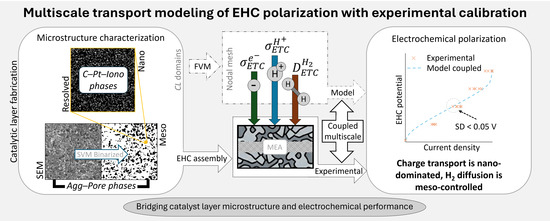
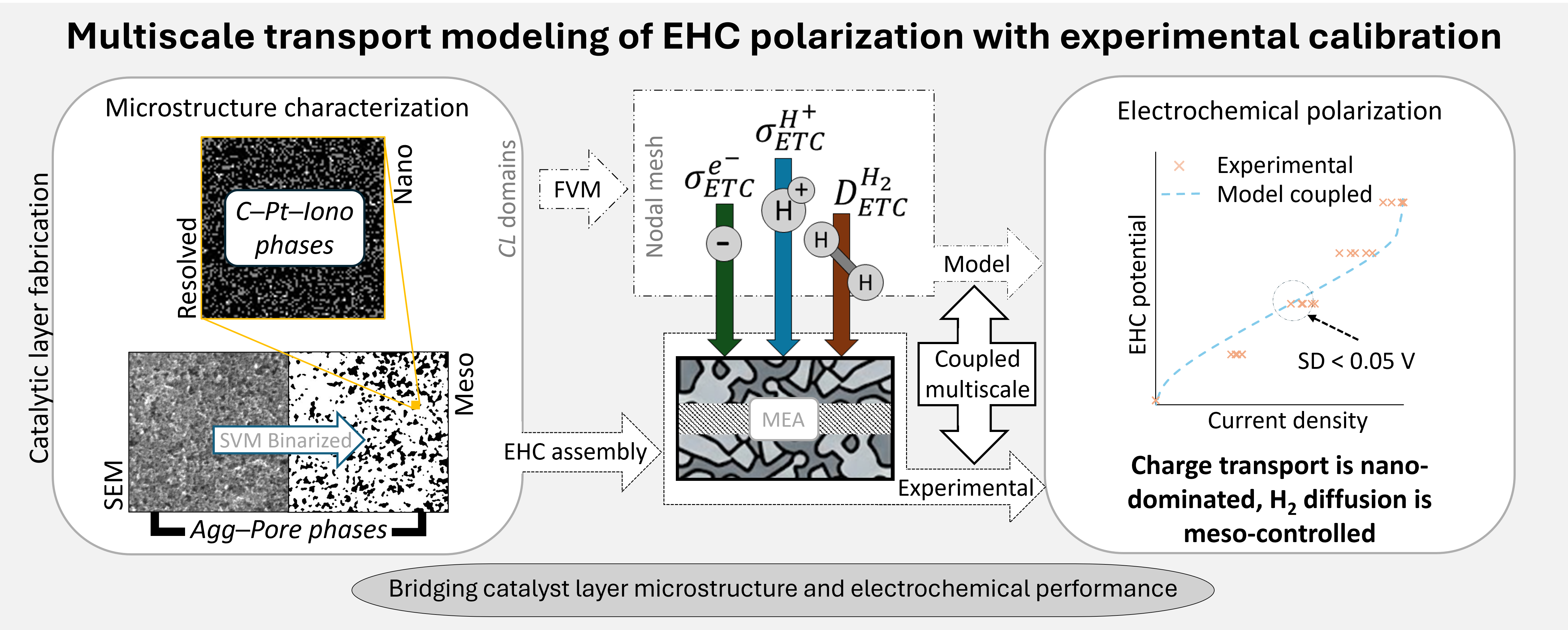
The electrochemical performance of hydrogen compressors (EHCs) depends critically on the hierarchical microstructure of their catalyst layers (CLs), where platinum, carbon, and ionomer phases govern coupled charge and mass transport across nanometric (Nano) and mesoporous (Meso) scales, the latter characterized by agglomerate and pore phases. This work presents an experimental–computational framework to establish quantitative microstructure–transport–performance relationships in EHC CLs. CLs were fabricated by electrospray deposition on Nafion® 117 membranes and characterized by scanning electron microscopy, from which 33 representative Meso MCs were extracted and used to assemble an EHC cell for experimental polarization curves. Statistically equivalent Nano MCs resolved phase connectivity within the agglomerate phase and determined the effective catalyst area from neighboring phase configurations. Effective transport coefficients for electronic conductivity, protonic conductivity, and H2 diffusivity were computed via the finite volume method and multiscale-coupled into an analytical polarization model. Electronic and protonic conductivities are controlled by conductive-phase connectivity at the Nano scale, while H2 diffusivity is governed by the pore fraction and spatial distribution at the Meso scale, with variations exceeding three orders of magnitude. Multiscale transport coupling factors obtained via inverse calibration reduced model–experiment discrepancies to 0.05 V, validating the framework for EHC electrode design.

Graphical Abstract

1. Introduction

The performance of electrochemical hydrogen compressors (EHCs) depends strongly on the structure and functionality of their catalyst layers (CLs), where coupled charge and mass transport processes determine overall efficiency. Within these systems, the electrode microstructure governs electron, proton, and hydrogen gas (H2) transport across coexisting solid and porous phases [1]. The coupling between morphology, connectivity, and transport properties requires multiscale approaches capable of linking local structural features to the global energetic response of the system [2,3].
Effective transport coefficients (ETCs) provide a practical framework for analyzing and predicting electrode performance. Electronic conductivity, protonic conductivity, and H2 diffusivity are sensitive to both material composition and spatial phase organization, as well as to connectivity across nanometric (Nano) and mesoporous (Meso) scales [4]. Establishing quantitative relationships between microstructure and transport is therefore essential for the rational design of high-performance electrodes [5,6].
The electrochemical behavior of EHCs is largely governed by transport resistances within the CLs, where electronic conduction, protonic conduction, and gas diffusion occur in a coupled manner across multiple scales. Studies addressing coupled transport modeling have shown that interactions among H2 diffusion, charge transport, and membrane hydration strongly influence polarization and system efficiency [7], and that optimizing the electrode architecture is essential to reduce ohmic and diffusional losses associated with pressure, relative humidity, and interfacial resistances [8]. A complementary line of research has focused on multiscale morphology–transport relationships: Oliveira et al. [9] demonstrated that ETCs in polymer electrolyte systems can be derived directly from the local morphology, establishing a quantitative link between microstructure and macroscopic response; Richter et al. [10] showed that membrane hydration and temperature gradients significantly affect H2 transport and voltage efficiency at high compression ratios; and Amirkhani Dehkordi et al. [11] identified pore topology as a key factor governing coupled mass transport and electrochemical performance in porous electrodes. At the reactor scale, Cornejo et al. [12] highlighted that structured catalytic systems require multiscale sub-models to capture coupled mass and heat transport across different length scales. Collectively, these studies indicate that relatively small morphological variations, particularly in ionomer and conductive carbon distribution, can produce substantial changes in device performance.
Taken together, these works demonstrate that multiphase connectivity within the CL determines the ETCs and, ultimately, the polarization response of the EHC. A quantitative description of the microstructure–transport relationship is therefore central to advanced CL design. However, despite these advances, a quantitative framework that simultaneously resolves transport at the Nano and Meso scales, links phase-specific connectivity to the macroscopic electrochemical response, and reconciles numerical predictions with experimental polarization data through physically consistent calibration remains absent in the EHC literature. Direct experimental measurement of ETCs at the Nano and Meso scales is further limited by the inability to isolate individual phase contributions and by artifacts inherent to sample preparation at these length scales.
Prior work by this research group has contributed to understanding multiscale transport in porous electrochemical materials. Pacheco et al. [13] analyzed the effect of microstructural isotropy on diffusion, showing that aligned structures enhance gas transport relative to isotropic configurations. Romeli et al. [14] proposed a multiscale framework for CLs in proton exchange membrane fuel cells, demonstrating that electronic and protonic transport depend on hierarchical interactions between Nano and Meso scales. More recently, A. Navarro-Montejo et al. [15] numerically examined the role of phase composition and spatial ordering in EHC electrodes, finding that controlled alignment significantly affects ETCs and polarization behavior. Building on these contributions, the present work extends this methodological foundation in three distinct aspects: (i) Meso domains are obtained directly from SEM characterization of fabricated electrodes rather than from idealized microstructures; (ii) the effective electrocatalyst area is determined from Nano scale phase connectivity among Pt, C, and Iono phases using a nodal effectiveness criterion; and (iii) MTCFs are introduced as a physically consistent inverse calibration mechanism that reconciles multiscale numerical predictions with experimental polarization data from the same electrode, providing a quantitative and experimentally validated bridge between the microstructure and electrochemical performance. Electrodes were fabricated and characterized by SEM, enabling the extraction of 33 representative Meso domains in which agglomerates (Agg) and pore (Pore) phases are distinguished. From measured phase compositions, a statistically equivalent Nano domain was generated to determine the effective electrocatalyst area of nodal phases comprising platinum (Pt), carbon (C), and ionomer (Iono) configurations. ETCs were computed using a finite volume method (FVM) and incorporated into a polarization model calibrated against experimental data from the same electrode. This approach links the hierarchical organization of CL phases with multiscale transport and the resulting energetic response, providing a consistent bridge between experimental microstructures and predictive electrochemical modeling, and offering scale-specific design guidelines for CL optimization: nanoscale conductive-phase connectivity governs charge transport, while mesoscale pore topology controls hydrogen diffusion, enabling decoupled and targeted electrode design strategies for EHC applications.

2. Results and Discussion

The results are presented in four main sections. Section 2.1 provides a structural analysis of the 33 representative MCs at the mesoporous scale ( M C s M e s o ) of an EHC electrode and their spatial correlations, aiming to identify morphological patterns relevant to transport phenomena and electrochemical reactions. Section 2.2 addresses the determination of ETCs and their influence on the local electrochemical response, considering MCs at the nanometric scale ( M C s N a n o ); polarization curves are generated through the electrochemical model and compared against experimental data obtained from the assembled EHC cell. Section 2.3 introduces the multiscale transport coupling factors (MTCFs) obtained by coupling the transport coefficients against experimental data. Finally, Section 2.4 presents the calibrated polarization curves and their comparison with experimental results, assessing the agreement between model predictions and the actual EHC behavior.

2.1. Structural Analysis and Spatial Correlations of the Microstructures

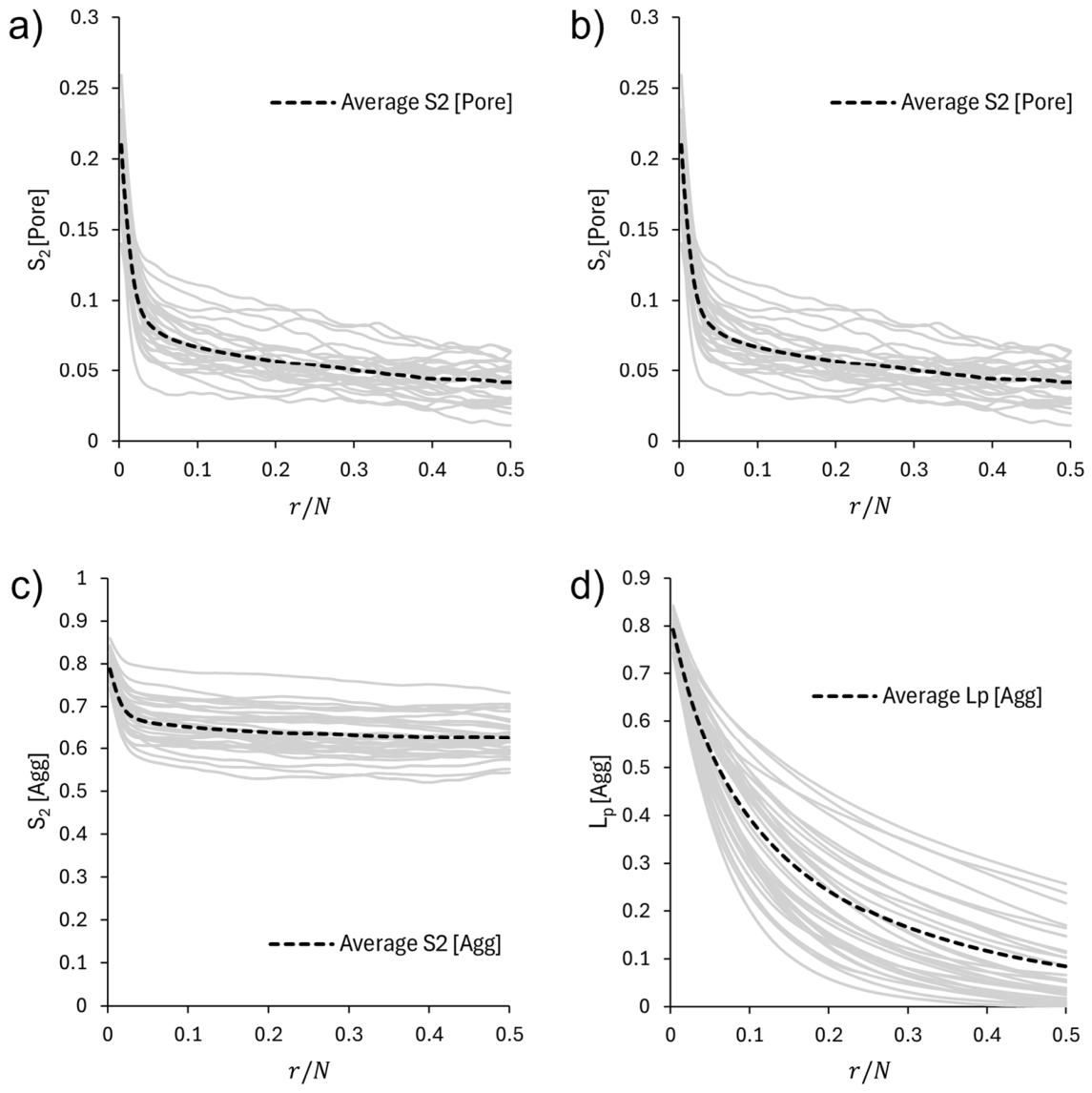
Figure 1 shows the statistical characterization of Pore and Agg phases for the 33 MCs using the two-point probability ( S 2 ) and lineal path ( L p ) correlation functions (see Equations (1) and (2)), along with their averaged values as a function of normalized distance ( r / N ). Panels (a) and (b) correspond to the Pore, while (c) and (d) correspond to the Agg phase. The MCs exhibit a heterogeneous phase composition with a relatively uniform spatial distribution. The Pore phase consists mainly of isolated regions with limited connectivity, whereas the Agg phase forms continuous and well-connected pathways.
Figure 1a shows that S 2 for the Pore phase decreases sharply and stabilizes near 0.05 for r / N > 0.1, with low variability among MCs. Consistently, Figure 1b indicates that L p rapidly approaches zero for r / N ≳ 0.05, confirming the poor connectivity of pores. At r/ N → 0, both functions yield an average porosity of ~0.22. In contrast, Figure 1c,d show that the Agg phase maintains high spatial continuity: S 2 stabilizes around 0.65 and L p decreases gradually, indicating connected transport pathways. The corresponding Agg fraction is ~0.79, confirming its dominant structural role. The low variability in phase fractions and spatial correlation functions across the 33 M C s M e s o confirms the structural reproducibility of the fabricated electrode and supports the statistical representativeness of the extracted domains.

2.2. Effective Transport Coefficients and Electrochemical Response

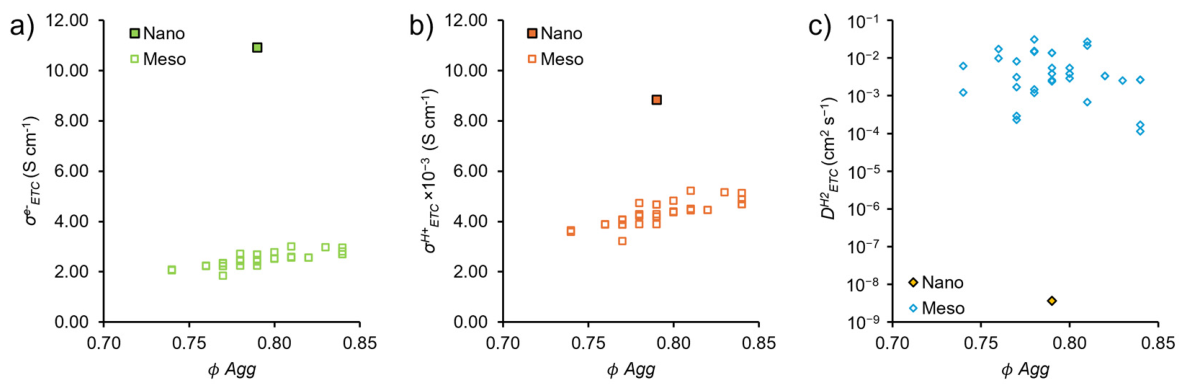
Figure 2 shows ETCs for electronic conductivity ( σ E T C e ), protonic conductivity ( σ E T C H + ), and H2 diffusivity ( D E T C H 2 ) as functions of the agglomerate phase fraction ( ϕ A g g ) at the Meso scale, together with the Nano scale values used as inputs (see Equations (3)–(5)). Both σ E T C e and σ E T C H + increase monotonically with ϕ a g g , reflecting the dependence of Meso transport on conductive network connectivity established at the Nano scale. For a given ϕ a g g , dispersion remains due to differences in topology and phase connectivity among MCs. In contrast, D E T C H 2 shows no direct dependence on the Agg phase and is governed primarily by the pore fraction ( ϕ P o r e ) and connectivity.
Figure 2a shows that σ E T C e at Nano remains constant (10.91 S cm−1), while Meso values range from 1.85 to 3.00 S cm−1, with a maximum variation of 26.79% and an average of 10.75%. This highlights the role of agglomerate connectivity in electronic transport. Similarly, Figure 2b shows that σ E T C H + at Nano (8.83 × 10⁻³ S cm−1) decreases at Meso to 3.2 × 10⁻³ to 5.2 × 10⁻³ S cm−1, with comparable variability, indicating similar transport limitations across scales. In contrast, Figure 2c shows a markedly different trend for D E T C H 2 . While the Nano value remains fixed (3.70 × 10⁻⁶ cm2 s−1), Meso values span from 0.11 × 10⁻³ to 30.95 × 10⁻³ cm2 s−1, covering approximately two orders of magnitude relative to the Nano input value of 3.70 × 10⁻⁶ cm2 s−1. This confirms that H2 transport is dominated by pore connectivity at the Meso scale.
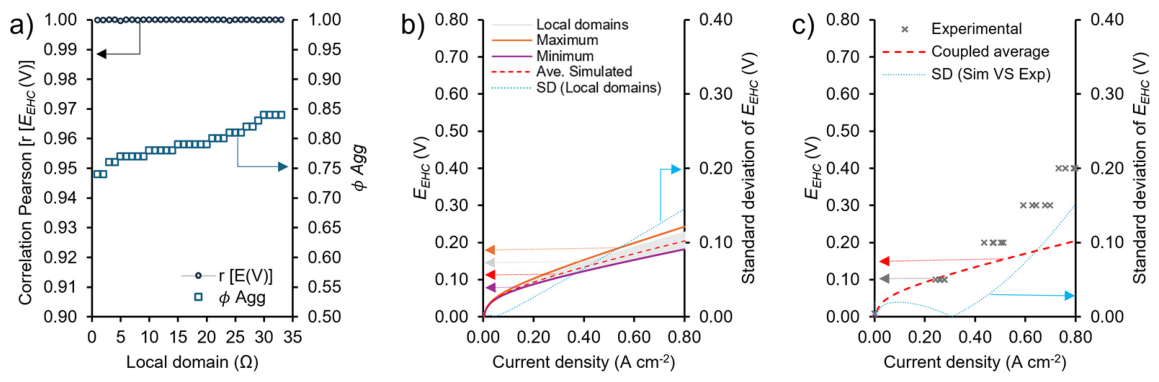
Figure 3 evaluates the consistency of the simulated polarization response across the domains, determined with the electrochemical model (see Equation (6)). The Pearson coefficient (r) (see Equation (11)) between individual curves and the ensemble average exceeds 0.9997 in all cases, indicating nearly identical behavior despite variations in ϕ a g g and phase distribution. Dispersion is simultaneously quantified through the standard deviation (SD) of EHC potential ( E E H C ), and Figure 3c includes the SD between the experimental polarization response and the averaged simulation.
Figure 3a shows that all domains exhibit r > 0.9997, confirming near-identical behavior between individual polarization curves and the ensemble-averaged response. The ϕ a g g values range from 0.74 to 0.84, with a mean of 0.79, consistent with the structural and transport analyses discussed above. Figure 3b presents the minimum and maximum potential responses among the domains, along with the ensemble average and pointwise SD. At 0.5 A cm−2, potentials range from 0.138 to 0.176 V (27.54% difference), increasing to 0.182 to 0.243 V at 0.8 A cm−2 (33.52%). The averaged curve yields intermediate values of 0.152 and 0.204 V at 0.5 and 0.8 A cm−2, respectively. Across the domains, the potential SD varies between 0 and 0.145 V, with a mean of 0.066 V, confirming bounded variability. Figure 3c compares the averaged simulated curve with the experimental polarization response. The five independent experimental measurements showed high reproducibility, with an average SD of 0.029 A cm−2 and a maximum SD of 0.042 A cm−2 (6.43%) at 0.3 V (see Supplementary Material, Figure S6). The model systematically overestimates the energetic response, with a maximum current density deviation of 17.90% at 0.3 V and an average deviation of 10.95% over the full range. The SD between simulated and experimental responses ranges from 0 to 0.151 V (mean 0.044 V), quantifying the overall discrepancy. Although the ETCs capture internal consistency and overall trends, the systematic deviation indicates the need for multiscale correction, addressed through coupling factors in Section 2.3.

2.3. Multiscale Coupling Factors and Adjusted Transport Coefficients

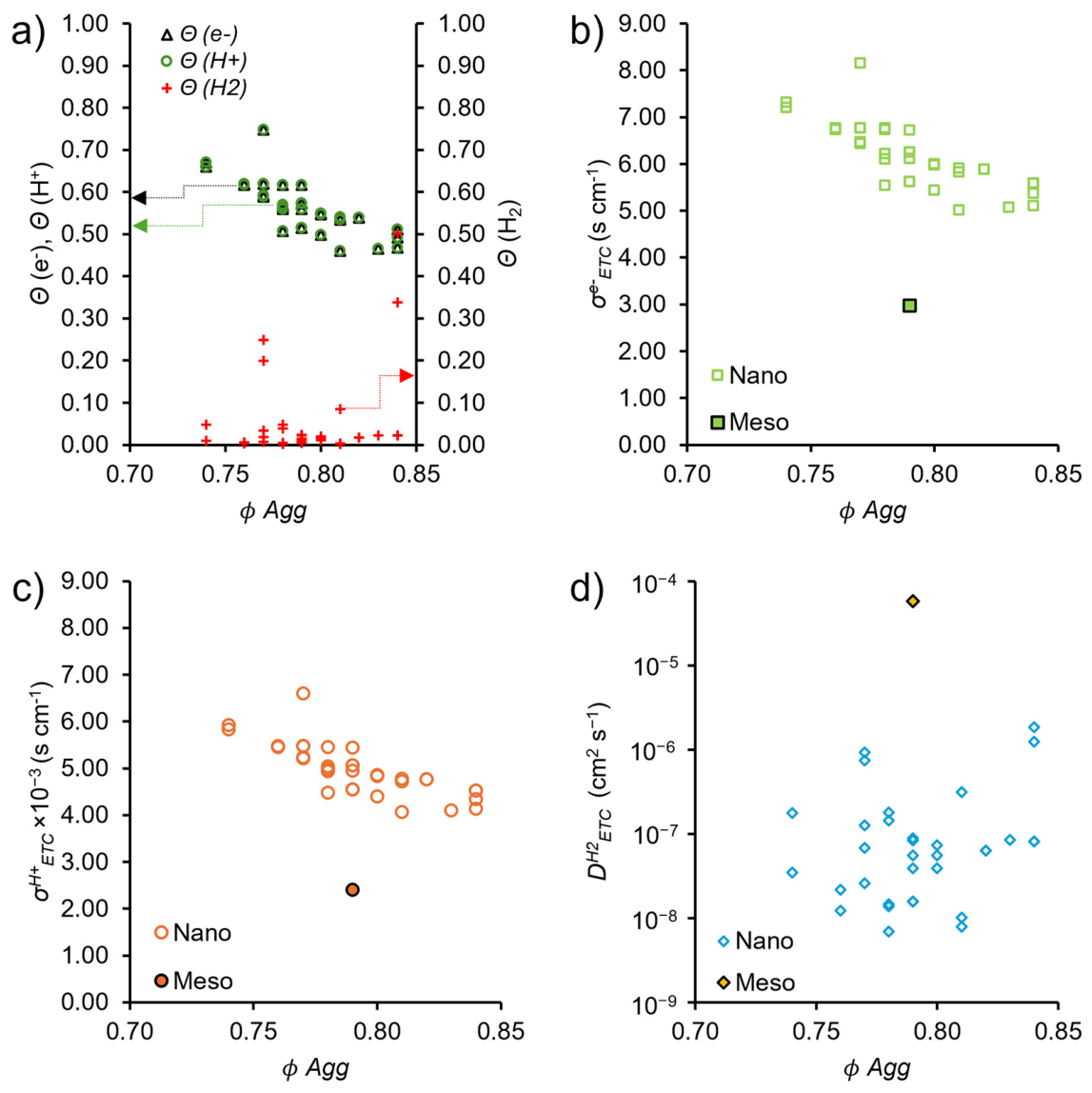
Figure 4 shows the calibrated σ E T C e , σ E T C H + , and D E T C H 2 at the Nano scale, along with the corresponding Meso coefficients. After calibration, σ E T C e and σ E T C H + at Nano decrease quasi-linearly with increasing ϕ a g g , indicating reduced effective conductivity despite an increased phase fraction. In contrast, D E T C H 2 shows a weak correlation with ϕ a g g , confirming its dependence on the pore structure. The MTCF values ( Θ ) (see Equation (12)) were applied to adjust the ETCs at the Nano scale (see Equation (13)–(15)), while the adjusted Meso coupling factor for H2 diffusion was determined separately (see Equation (16)).
Figure 4a shows the coupling factors Θ e , Θ H + , and Θ H 2 as a function of ϕ a g g . For σ E T C e and σ E T C H + at Nano, Θ ranges from 0.46 to 0.75 (63.04% maximum relative difference), with the largest variation at ϕ a g g = 0.77 (26.79%) and an average variation of 10.75%. Θ H 2 , considering Nano and Meso scale contributions, varies between 0.002 and 0.501, spanning approximately two orders of magnitude, highlighting the high sensitivity of H2 transport to Pore-phase heterogeneity. Figure 4b shows the transverse σ E T C e at Nano and Meso scales as a function of ϕ a g g . At Nano, σ E T C e ranged from 5.02 to 8.16 S cm−1, with a maximum relative difference of 62.57% and an average of 6.16 S cm−1. At Meso, σ E T C e reached 2.96 S cm−1 at ϕ a g g = 0.79 , indicating that the average Nano conductivity is approximately 108% higher than the corresponding Meso value. A similar trend is observed for σ E T C H + (Figure 4c): at Nano, values varied between 4.06 × 10⁻³ and 6.60 × 10⁻³ S cm−1 (62.55% maximum difference; average 4.97 × 10⁻³ S cm−1), whereas at the Meso scale, it reached 2.40 × 10⁻³ S cm−1 for ϕ a g g = 0.79 , approximately 52% smaller than the Nano scale average. Figure 4d reveals a markedly different behavior for D E T C H 2 . At Nano, values ranged from 6.9 × 10⁻⁹ to 1.853 × 10⁻⁶ cm2 s−1, spanning approximately two orders of magnitude, with an average of 0.205 × 10⁻⁶ cm2 s−1. At Meso, D E T C H 2 reached 5.75 × 10⁻⁵ cm2 s−1 for ϕ a g g = 0.79 , approximately two orders of magnitude higher than the Nano scale average, confirming the dominant role of porosity in governing gas transport. The large variation in H2-related MTCFs reflects the physically distinct transport mechanisms operating at each scale: H2 diffusion through the Iono phase within the agglomerate at the Nano scale is not significant compared to transport through the Pore phase at the Meso scale (see Section 3.4.1), which explains the disproportionate variation observed and should not be interpreted as numerical instability.

2.4. Calibrated Polarization Curves and Comparison with Experimental Results

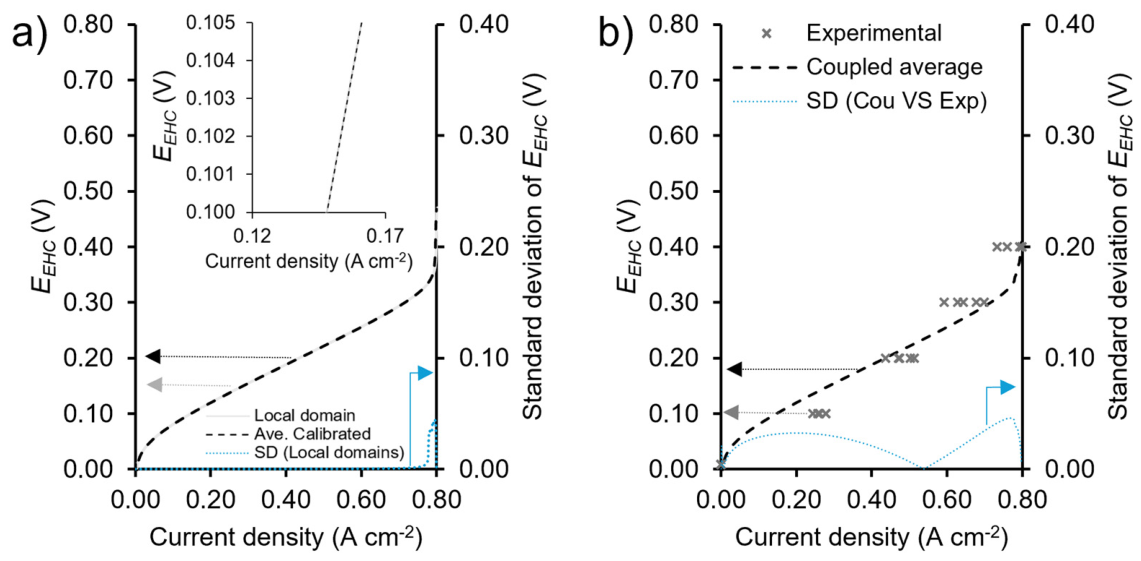
Figure 5 presents the coupled polarization curves for all domains, the ensemble average (Cou), and the corresponding SD, compared against the experimental response (Exp). Calibration significantly improves agreement with experimental data and reduces dispersion.
Figure 5a shows that after coupling, all local polarization curves converge toward a common trend, with the average curve accurately representing the overall electrochemical behavior of the electrode. At 0.5 A cm−2, the average potential was 0.221 V, increasing to 0.469 V at 0.8 A cm−2. Among the 33 coupled curves, the SD ranged from 0 to 0.045 V, with an average of 0.001 V, indicating practically negligible dispersion after calibration. Figure 5b compares experimental potentials with the calibrated average curve. The SD between the calibrated simulation and the experimental values ranged from 0 to a maximum of 0.046 V (at 0.768 A cm−2), with an average of 0.024 V. These results confirm the strong agreement between the calibrated multiscale model and the experimental electrochemical response of the EHC, validating the consistency of the proposed numerical–experimental approach.
The results presented demonstrate that transport processes in the EHC are governed by structurally differentiated mechanisms depending on the scale of analysis: σ E T C e and σ E T C H + respond primarily to the connectivity of the conductive phases at the Nano scale, while D E T C H 2 is dominated by the fraction and spatial distribution of the Pore phase at the Meso scale, with variations that can exceed three orders of magnitude between domains of similar composition. This multiscale behavior is consistent with the findings reported by Amirkhani Dehkordi et al., who demonstrated that Pore phase topology in architectured electrodes decisively determines the mass transport regime, with tortuosity and connectivity being the factors that modulate the transition between convective and diffusive transport [11]; in particular, their results show that highly tortuous structures generate electrochemically inactive zones, a phenomenon analogous to the disproportionate increase in ETC dispersion observed in domains with heterogeneous porosity in the present study. Similarly, the systematic overestimation of the polarization curve observed prior to calibration is consistent with the findings of Richter et al., who identified that ohmic losses associated with membrane resistance and internal cell resistance constitute the factor of greatest impact on E E H C , surpassing even kinetic parameters, and underscoring that water management and membrane hydration introduce nonlinear effects that are difficult to capture without properly calibrated models [10]. In this regard, the results of Oliveira et al. reinforce that ETCs in polymer electrolyte systems emerge from the hierarchical organization of multiscale phases, and that their accurate description requires coupled sub-models capable of correctly capturing the macroscopic response of the system [9], a conclusion that the present work formalizes quantitatively through the proposed calibration framework.

3. Materials and Methods

The proposed methodology combines experimental characterization, microstructural analysis, and numerical–analytical modeling to relate Nano and Meso phase organization within the CL to its electrochemical response, following established multiscale approaches for porous electrodes [16,17]. The framework consists of three components: (i) experimental characterization, including SEM-based acquisition of representative M C s M e s o at 9000× and polarization measurements under potentiostatic control; (ii) statistical and geometrical analysis, where MGs are processed to extract representative M C s M e s o [18] and coupled with statistically equivalent M C s N a n o derived from composition; and (iii) numerical and analytical modeling, including ETC determination via FVM [11,19,20], estimation of the effective catalyst area, and implementation of an analytical polarization model calibrated against experimental data [11,21,22].
The membrane–electrode assembly (MEA) was fabricated and characterized by SEM. MGs were processed to extract representative cross-sectional regions at the Meso scale. The MEA was then assembled into an EHC cell to obtain reference polarization curves. Based on electrode composition, M C s N a n o were generated to represent the phases contained within the Agg phase. ETCs for electrons, protons, and H2 were computed using FVM, and the electrochemically active area was determined. These parameters were incorporated into the analytical model to generate polarization curves, which were compared with experiments to calibrate transport parameters and establish multiscale coupling.

3.1. Fabrication of the Catalyst Layers

Anode and cathode CLs were fabricated using identical composition and deposition procedures. The catalyst ink was deposited on both sides of a Nafion® 117 membrane (The Chemours Company, Wilmington, DE, USA) with a 16 cm2 active area by electrospray, forming the MEA. This method produced uniform coatings with good interfacial adhesion [23].
The ink consisted of 25 mg of Pt/C (30 wt.% Pt), 790 µL cm−2 of 5 wt.% Nafion solution, and 1620 µL cm−2 of an isopropyl alcohol–water mixture. The suspension was sonicated for 30 min and stirred prior to deposition. Electrospray conditions included a controlled flow rate, 8–10 kV applied potential, and 5 cm nozzle-to-substrate distance.

3.2. SEM Morphological Characterization and Image Processing

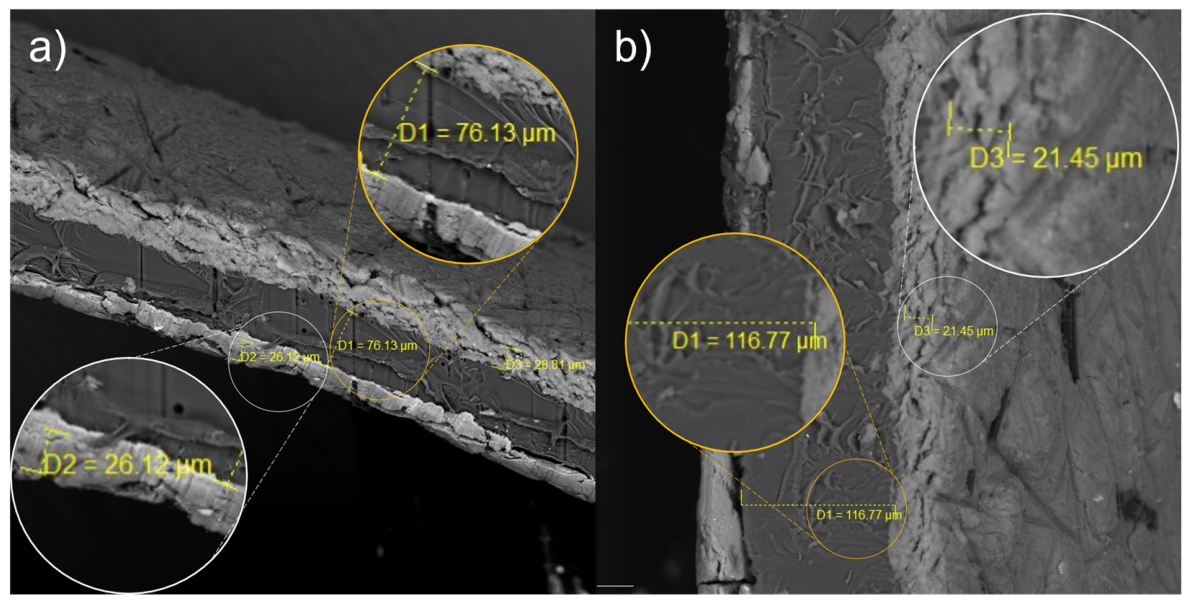
The anode CL was used for SEM morphological characterization, ensuring that the microstructural domains extracted from SEM MGs are representative of the electrode used to obtain the numerical and experimental polarization curves. Distances between the electrode surface and membrane were sampled across multiple locations, yielding average values of 23.23 µm for the CL and 90 µm for the membrane, as illustrated in Figure 6.
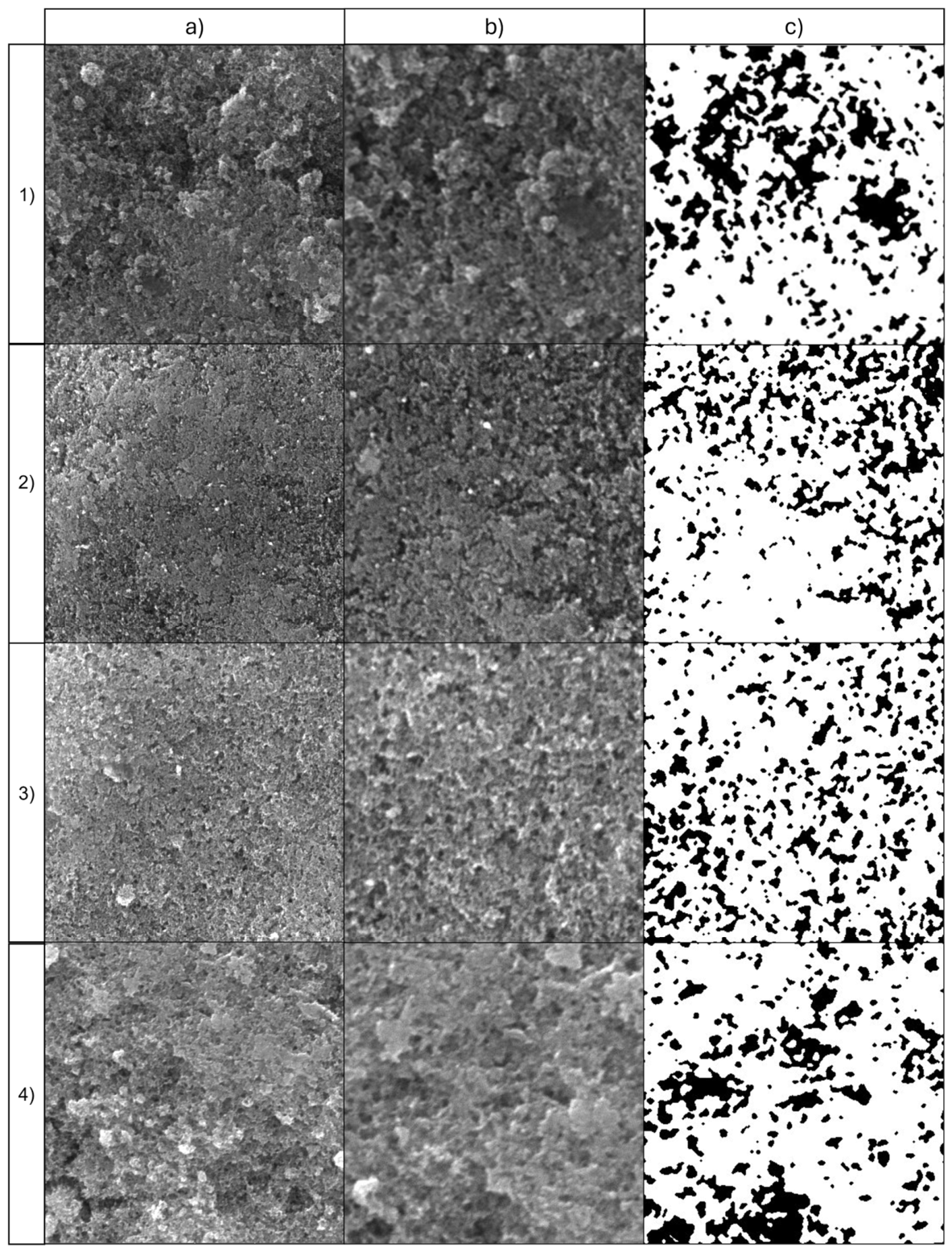
Based on an average Pore size of 40 nm, 28 SEM MGs were acquired at 9000× (25 µm field of view, 768 × 768 px). From these, 33 representative MCs (350 × 350 px, 14 µm × 14 µm) were selected following standard domain selection criteria [24]. The complete set of SEM MGs and all extracted MCs, along with their binarized representations, are provided in the Supplementary Material (Figures S1–S4). Images were segmented using supervised support vector machines (SVMs) [25], distinguishing Agg and Pore phases. Each MG was independently trained using 30 manually labeled samples per phase, selected by direct visual inspection, with the grayscale value, gradient magnitude, and gradient direction as input features. Images were pre-processed via equalization, normalization, and denoising, and post-processed with morphological erosion and dilation. This per-image training strategy reduces systematic segmentation bias across the 33 M C s M e s o , and has been validated against Otsu’s thresholding method, demonstrating accuracy and recall improvements of up to 90% and 50%, respectively. The resulting binary matrices describe phase distributions within Meso structures. Figure 7 presents examples of the original CL MGs, the extracted MCs, and their corresponding binarized images.
Microstructural characterization employed the S 2 (Equation (1)) and L p , π (Equation (2)) correlation functions, to quantify spatial correlations of ϕ p o r e and ϕ a g g [26,27]. Both functions were applied to each pixel phase ( π ), corresponding to Agg and Pores within the domain, evaluated along horizontal and vertical directions and expressed as a function of r / N . Mean values were obtained across all MCs.
S 2 r = 1 2 N 2 j = 1 N 1 N r i = 1 N r T π i , j · T π i + r , j + i = 1 N 1 N r j = 1 N r T π i , j · T π i , j + r
where N is the size of the square matrix in pixels, r is the separation distance between two points within the matrix, and T π ( i , j ) represents the matrix value at position ( i , j ), corresponding to one of the π .
L p , π x , r = 0 r T π x + k
where p denotes the direction of the linear path (horizontal or vertical), x represents a point ( i , j ) within the matrix, and T π ( x + k ) is an indicator function that takes a value of 1 if position ( x + k ) belongs to π , and 0 otherwise; x + k denotes the displacement from x in increments of length k .

3.3. Measurement of EHC Polarization Curves

The fabricated MEA was assembled into a single-cell EHC for electrochemical evaluation. The setup included stainless-steel current collectors with flow fields, carbon cloth gas diffusion layers, and high-resistance silicone gaskets to ensure proper sealing. The cell was compressed between stainless-steel plates to maintain electrical contact and mechanical stability [28].
High-purity H2 (≥99.99%) was supplied to the anode at 1 bar using a regulated inlet line without restricting the flow rate. Pressure was monitored at both electrodes using calibrated gauges, and H2 flow rates at the inlet and outlet were controlled using mass flow controllers, ensuring stable operation. The cathode operated at 2 bar, controlled by the back-pressure valve. A photograph of the assembled EHC cell and the corresponding gas line configuration is provided in the Supplementary Material (Figure S5).
Polarization curves were obtained under potentiostatic control using a BioLogic VSP-300 system (BioLogic Science Instruments, Seyssinet-Pariset, France). Prior to measurements, the system was purged and stabilized at the selected potential [22]. Once steady-state conditions were reached, the current response was recorded. Measurements were conducted at ~25 °C under ambient humidity conditions using stepwise potentials from open-circuit potential (OCP) to 0 V, allowing current stabilization at each step. Five independent tests were conducted under identical operating conditions to ensure reproducibility, with a maximum SD of 0.042 A cm−2 (6.43%) at 0.3 V and an average SD of 0.029 A cm−2 across the evaluated voltage range (see Section 2.2 and Supplementary Material, Figure S6).

3.4. Multiscale Numerical–Analytical Methodology

A multiscale framework was developed to relate the CL microstructure to macroscopic electrochemical behavior. Electron and proton conduction, as well as H2 diffusion, were resolved using FVM simulations on M C s N a n o and M C s M e s o , yielding the corresponding ETCs [22,29]. These coefficients, together with the effective electrocatalyst area derived from Pt-C-Iono connectivity, were incorporated into an analytical electrode model. The model expresses the cell voltage as the sum of thermodynamic, kinetic, ohmic, and mass transport contributions, allowing the generation of polarization curves. Agreement with experimental data was used to calibrate transport parameters and ensure consistency across scales [14,15].

3.4.1. Generation of Agglomerate Microstructures

Geometric and mass parameters were determined from the electrode composition, CL thickness, and phase fractions. Using densities of carbon (2.10 g cm−3), platinum (21.45 g cm−3), and ionomer (1.58 g cm−3), and an active area of 16.0 cm2, the total electrode volume was estimated as 37.17 × 10⁻³ cm3. Ten representative M C N a n o were generated by randomly distributing C, Pt, and Iono phases within a 2D domain of 350 × 350 px (1.96 µm2), assuming a statistically isotropic phase arrangement consistent with the disordered nature of catalyst ink-derived agglomerates [26]. These structures represent the agglomerate phase and explicitly resolve interfacial connectivity. A schematic representation of a representative M C N a n o highlighting the randomly distributed phases is provided in the Supplementary Material (Figure S7).

3.4.2. Multiscale Transport Phenomena

ETCs for σ E T C e , σ E T C H + , and D E T C H 2 were determined at both Nano and Meso scales. At the Nano scale, the domain corresponds to the catalyst particle size (4 nm), where Pt, C, and Iono phases are explicitly resolved and their interactions govern local transport [15]. At the Meso scale, transport is represented by the 33 M C s M e s o , where Agg and Pore phases are distinguished.
Simulations were performed on 2D domains assuming in-plane isotropy, supported by the statistically uniform phase distribution. While 3D reconstructions would capture additional connectivity effects and provide direct tortuosity estimates, previous studies indicate that 2D representations provide reliable ETC estimates when statistical representativeness of the extracted domains is ensured [30]. Extension to 3D microstructural reconstruction is recognized as an important direction for future work.

3.4.3. Effective Transport Coefficients

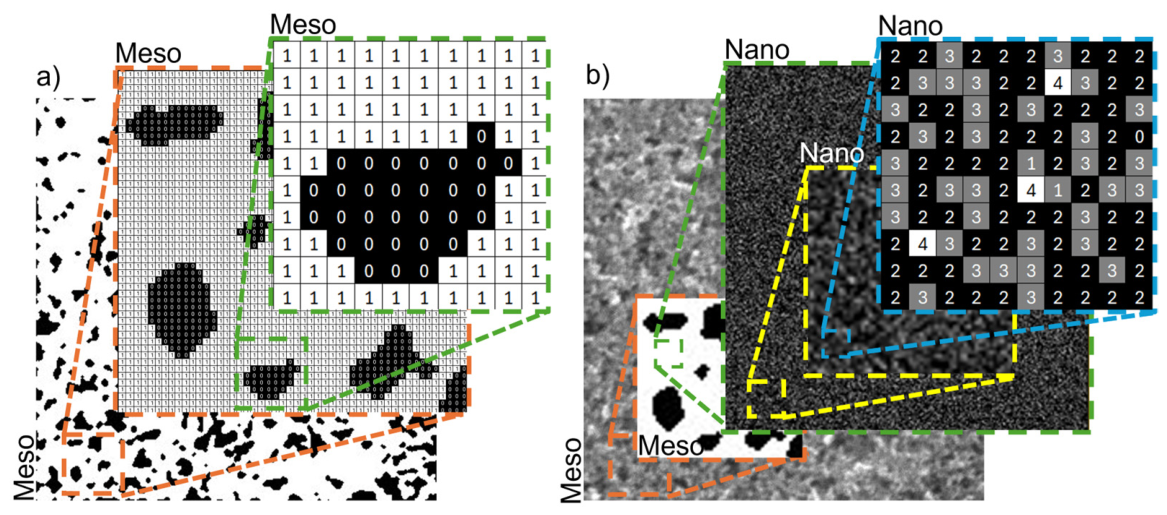
Transport fields were solved using FVM, treating each pixel as a control volume. Phase distributions were represented as matrix-based arrays: Pore (0) and Agg (1) nodes at the Meso scale; Iono (2), C (3), and Pt (4) nodes at the Nano scale [11,15]. Figure 8 schematically illustrates the multiscale linkage between M C s M e s o and M C s N a n o , highlighting the identification and interfacial connectivity among the phases that constitute the electrode.
A linear potential gradient was imposed across the domain, consistent with the macroscopic through-plane condition. The governing equations were solved using a line-by-line Tri-Diagonal Matrix Algorithm (TDMA) scheme with Dirichlet boundary conditions in the transport direction and no-flux conditions laterally. Convergence was defined by a root mean square error (ε) of 1.0 × 10⁻⁶ [26].
ETCs were obtained from the resolved potential fields according to Equations (3)–(5) through arithmetic averaging of the local potentials, establishing a linear relationship between the average effective flux ( J e f f ) and the imposed generalized potential or concentration gradient [13]. At the Nano scale, coefficients were computed by resolving C-Pt-Iono connectivity. The boundary conditions employed are summarized in Table 1 and were established based on previously validated simulation models [15,26,31].
σ E T C e = J e f f e l M C V S N · A N x . N y
σ E T C H + = J e f f H + l M C V S N · A N x . N y
D E T C H 2 = J e f f H 2 l M C C S N · A N x . N y
where σ E T C e and σ E T C H + denote the ETCs for electronic and protonic conduction, respectively, and D E T C H 2 represents the effective H2 diffusion coefficient. The terms Δ V S N and Δ C S N correspond to the imposed electrical potential and concentration differences between the South (S) and North (N) boundaries of the MC, respectively. The imposed gradients were selected to ensure a linear transport response within the effective medium regime. The parameter A N x , N y denotes the transverse area of the domain, while l M C corresponds to the characteristic length of the MC at the analyzed scale. A unit depth was assumed for the 2D simulations, allowing direct evaluation of flux densities.
For Nano scale simulations, ETCs of the Agg phases ( σ E T C e , σ E T C H + , and D E T C H 2 ), hereafter denoted as E T C N a n o , were computed by explicitly resolving the interfacial connectivity among C, Pt, and Iono within the reconstructed agglomerate microstructures. At the Meso level, the Agg phase was treated as a homogenized continuum characterized by E T C N a n o values; accordingly, Agg nodes in the M C s M e s o were assigned the corresponding E T C N a n o , while Pore nodes were assigned the intrinsic H2 diffusivity. The resulting coefficients at this scale are referred to as E T C M e s o . These E T C M e s o values are subsequently implemented in the macroscopic electrochemical formulation of the CL. In the polarization model, the ohmic contribution is treated under a homogenized through-plane approximation, where electronic and protonic conductivities correspond to σ E T C e and σ E T C H + , respectively. The concentration overpotential is derived assuming steady-state Fickian diffusion of H2 across the CL, with effective diffusivity defined by D E T C H 2 . This strategy ensures hierarchical multiscale consistency between the structurally resolved MC simulations and the macroscopic electrochemical response. The intrinsic transport properties assigned to each phase are summarized in Table 2.

3.5. Multiscale Electrochemical Analytical Polarization Model

E E H C was modeled as the sum of reversible potential, anodic overpotential, and ohmic losses. The reversible term depends on the H2 pressure gradient, while cathodic losses were neglected due to fast kinetics under the operating conditions. E E H C is formulated as follows (Equation (6)) [7,37]:
E E H C = E r e v + η a n + i o p   Ω m e m + Ω e x t
where E r e v represents the reversible potential determined by the H2 pressure gradient between cathode and anode, consistent with the operating conditions used in the experimental measurements. Since cathodic activation and mass transport losses are negligible under H2 oxidation conditions at the cathode, where exchange current densities are significantly higher than at the anode [38,39], no explicit cathodic overpotential is introduced. Membrane resistance was estimated from thickness and protonic conductivity (Section 3.5.4), while external resistance was set to a fixed value consistent with typical laboratory-scale EHC systems, in agreement with established modeling approaches. The term η a n denotes the total anode overpotential, accounting for activation, mass transport, and ohmic losses within the CL. Ω m e m corresponds to the protonic resistance of the Nafion membrane, while Ω e x t groups the resistive contributions of the external conductive elements. The operating current density, i o p , was evaluated over the range of 0–0.8 A cm−2, using increments of 1.0 × 10⁻³ A cm−2.

3.5.1. Reversible Potential

The reversible potential represents the minimum work required for electrochemical compression and was calculated using the Nernst equation under isothermal and ideal gas assumptions (Equation (7)):
E r e v = R T o p n e F ln P c a t P a n
where R is the universal gas constant, T o p is the operating temperature, n e is the number of electrons transferred, F is Faraday’s constant, and P c a t and P a n are the H2 partial pressures at the cathode and anode, set to 2 and 1 bar, respectively, consistent with the operating conditions used in the experimental measurements. This term defines the reversible baseline of the EHC and is independent of electrode microstructure and transport limitations.

3.5.2. Anodic Overpotential

In previous work, an analytical model was developed to describe the electrochemical response of the EHC anode, where the anodic potential was expressed as the sum of Nernst contribution, activation losses, ohmic resistance, and concentration overpotentials [15]. In the present study, this formulation is adopted and extended by explicitly incorporating ETC values obtained from multiscale analysis in MGs of an experimental electrode. These coefficients, together with the operating and simulation parameters summarized in Table 3, are used to reformulate the anodic overpotential as follows (Equation (8)):
η a n = R T o p n e F l n P a n P r e f + R T o p n e α a n F l n i o p i 0   C L e f f c a t a l y s t / A C L ,     s u r f a c e + δ C L   i o p 1 σ E T C e +   1 σ E T C H +   + R T o p n e F l n 1 i o p n e   F   D E T C H 2   C 0 / δ C L
where P r e f is the reference pressure (1 bar), α a n is the charge transfer coefficient, i 0 is the exchange current density, δ C L is the CL thickness, C 0 is the reference H2 concentration, A C L , s u r f a c e is the geometric electrode area, and C L e f f c a t a l y s t represents the effective Pt active area within the CL as determined from the Nano structural analysis.

3.5.3. Effective Electrocatalyst Area

The effective catalyst area was determined from M C s N a n o by identifying Pt nodes in contact with C and Iono phases. Local effectiveness factors (100%, 66%, 33%, or 0%) were assigned based on interfacial configuration. The sum of the effective areas obtained from M C s N a n o was subsequently scaled to A C L ,   s u r f a c e using Equation (9):
C L e f f c a t a l y s t =   A n o d a l , e f f c a t a l i z e r 1 ϕ p o r e   A C L ,     s u r f a c e A N x . N y n a n o
where A n o d a l , e f f c a t a l i z e r denotes the total effective catalyst area within M C s N a n o , and ϕ Pore represents the electrode porosity fraction (0.21). This procedure was applied to the ten M C s N a n o , yielding an average effective catalyst area of C L e f f c a t a l y s t = 99.23 × 10 3   cm 2 .

3.5.4. Ohmic Losses: Membrane and External Resistances

Ohmic losses include membrane and external electronic resistance. Membrane resistance was estimated from thickness and protonic conductivity according to Equation (10):
  Ω m e m = δ m e m σ m e m
where a membrane thickness of δ m e m = 9.0   × 10 3 c m and a protonic conductivity of σ m e m = 0.1   S   cm 1 were adopted. The external resistance,   Ω e x t , was assumed to be constant at 0.05 Ω cm2, consistent with typical values reported for laboratory-scale EHC systems [7,8].

3.6. Energetic Correlation of Electrode Domains

Polarization curves were computed for each of the 33 M C s M e s o and averaged over ten simulations. A global mean curve was constructed, and variability was quantified using SD [44]. To identify non-representative fluctuations among domains, the Pearson correlation coefficient was calculated between the polarization curve of each MC and the global averaged curve according to Equation (11):
r n =   i E E H C , n i o p E ¯ E H C , n E ¯ E H C i o p E ¯ E H C i o p E E H C , n i o p E ¯ E H C , n 2 i o p E ¯ E H C i o p E ¯ E H C 2
where r n is the Pearson correlation coefficient for each MC, E E H C , n denotes the potential values of the evaluated polarization curve, and E ¯ E H C represents the average potential obtained from the 33 polarization curves.

3.7. Multiscale Transport Coupling Factor

To reconcile modeled and experimental behavior, MTCFs ( Θ ) ranging from 0 to 1 were introduced. These factors enable numerical adjustment of the calculated ETCs, ensuring that the electrochemical model reproduces experimental polarization curves in a physically consistent manner. The procedure was formulated as an inverse parameter estimation problem and solved via a grid-search strategy using RMSE minimization, consistent with established calibration practices in electrochemical systems [45]. A schematic diagram of the implemented algorithm is provided in the Supplementary Material (Figure S8).
Based on Equation (6) and the parameters in Table 3, the algorithm systematically explores combinations of σ E T C e , σ E T C H + , and D E T C H 2 . For each parameter set, a simulated polarization curve is generated, and its agreement with experimental data is quantified using the root mean square error (RMSE). The ETCs are iteratively updated until a convergence criterion of RMSE < 5.0 × 10⁻³ is met, yielding the optimal parameters σ i t e r e , σ i t e r H + , and D i t e r H 2 [46]. The procedure was repeated ten times, and representative E T C M e s o values were obtained as the arithmetic mean of the convergent solutions. To calibrate the electrochemical model (Equation (8)) against the experimental response, MTCFs were defined as the ratio between ETCs estimated through the inverse procedure and the corresponding E T C M e s o of each MC, as expressed in Equation (12):
Θ n a n o K n =   E T C i t e r K E T C m e s o K n
where Θ n a n o K is the coupling factor associated with transport process K (electronic conduction, protonic conduction, or H2 diffusion), E T C i t e r K denotes the transport coefficients obtained from the grid-search procedure, and E T C M e s o K corresponds to the coefficients predicted by the multiscale numerical model for each MC (n).
Based on these coupling factors, E T C N a n o K values were determined and expressed as σ Θ , N a n o e , σ Θ , N a n o H + , and D Θ , N a n o H 2 according to Equations (13)–(15):
σ Θ , n a n o e = Θ n a n o e · σ E T C , n a n o e
σ Θ , n a n o H + = Θ n a n o H + · σ E T C , n a n o H +
D Θ , n a n o H 2 = Θ n a n o H 2 · D E T C , n a n o H 2
The coupled Nano transport coefficients σ Θ , N a n o e , σ Θ , N a n o H + , and D Θ , N a n o H 2 were subsequently incorporated into the multiscale model, which was re-solved using FVM to yield the corresponding Meso coefficients σ Θ , M e s o e , σ Θ , M e s o H + , and D Θ , M e s o H 2 . Since D Θ , M e s o H 2 exhibited only minor variations with respect to its pre-calibration value, an adjusted (adj) Meso coupling factor was introduced to further refine this coefficient against the experimental response, as expressed in Equation (16):
Θ m e s o H 2 n a d j =   D i t e r H 2 D Θ , m e s o H 2 n
Consequently, D Θ , M e s o H 2 was recalculated as the product of the adjusted coupling factor ( Θ M e s o H 2 ) n a d j and the corresponding unadjusted value D Θ , M e s o H 2 ) n . The close agreement between ( Θ M e s o H 2 ) n a d j and Θ N a n o H 2 ) n confirms the internal consistency between the Nano and Meso calibration procedures. Using the calibrated E T C M e s o Θ values, polarization curves for the 33 M C s M e s o were obtained through the electrochemical model. This procedure was repeated ten times for each MC, with the arithmetic mean taken as the representative result. The average polarization curve was then compared with experimental data through SD analysis.

4. Conclusions

An integrated experimental–computational framework was developed to link the catalyst layer microstructure with transport properties and electrochemical performance in EHCs. CLs fabricated by electrospray deposition were characterized by SEM to extract representative mesoscopic domains, which were coupled with composition-based Nano scale reconstructions to resolve phase connectivity among platinum, carbon, and ionomer.
Transport processes are governed by distinct structural features across scales: electronic and protonic conductivities are controlled by Nano scale conductive-phase connectivity, while hydrogen transport depends on the Meso scale pore fraction and spatial distribution. Despite local topological variations, the electrochemical response is robust and governed by averaged structural characteristics.
Microstructure-derived transport coefficients reproduce consistent polarization trends but systematically overestimate the experimental response, reflecting limitations in direct multiscale coupling without calibration. Introducing transport coupling factors through RMSE-based inverse estimation reduces deviations below 0.05 V, with the consistency between Nano and Meso scale adjustments supporting the physical coherence of the approach.
The results indicate that optimizing CL performance requires decoupled design strategies. For the first time in the context of EHC CLs, these strategies are supported by quantitative evidence: enhancing electronic and protonic conductivities requires improving Pt, C, and Iono interfacial connectivity at the Nano scale, where calibrated σ E T C e and σ E T C H + values ranged from 5.02 to 8.16 S cm−1 and 4.06 × 10⁻³ to 6.60 × 10⁻³ S cm−1, respectively; while increasing H2 transport requires optimizing the pore fraction and spatial distribution at the Meso scale, where D E T C H 2 varies by more than three orders of magnitude between domains of similar composition. Since these transport mechanisms are governed by structurally distinct features at different scales, they can be targeted independently during electrode fabrication, providing specific numerical benchmarks for EHC electrode design that were previously unavailable in the literature. The proposed framework provides an experimentally validated methodology and practical design guidelines for advanced porous CLs in hydrogen compression and related electrochemical energy technologies. Extension of the framework to multiple operating conditions, including varying pressure, temperature, and humidity, as well as to 3D microstructural reconstruction techniques to capture additional connectivity effects and provide direct tortuosity estimates, are recognized as important directions for future work. Experimental characterization of ionomer distribution, Pt accessibility, and interfacial contact resistance would further strengthen the physical basis of the framework and enhance the generalizability of the proposed multiscale approach.

Supplementary Materials

The following supporting information can be downloaded at https://www.mdpi.com/article/10.3390/catal16060535/s1, Figure S1: Complete set of the 28 SEM micrographs acquired at different electrode locations for mesoporous domain selection; Figure S2: Complete set of extracted mesoporous domains (MCs 1–12) and their corresponding binarized representations; Figure S3: Complete set of extracted mesoporous domains (MCs 13–24) and their corresponding binarized representations; Figure S4: Complete set of extracted mesoporous domains (MCs 25–33) and their corresponding binarized representations; Figure S5: Experimental setup of the electrochemical hydrogen compressor single cell; Figure S6. Reproducibility of experimental polarization measurements; Figure S7: Schematic representation of a representative MCnano domain; Figure S8: Schematic diagram of the grid-search algorithm for ETC determination.

Author Contributions

Conceptualization, A.N.-M., E.E. and R.B.; Methodology, A.N.-M. and R.B.; Software, A.N.-M., C.P., A.R. and R.B.; Validation, A.N.-M., E.E. and R.B.; Formal Analysis, A.N.-M., A.R. and R.B.; Investigation, E.E. and R.B.; Data Curation, C.P., A.R., E.E. and R.B.; Writing—Original Draft Preparation, A.N.-M. and R.B.; Writing—Review and Editing, A.N.-M., C.P. and R.B.; Visualization, A.N.-M. and R.B.; Supervision, R.B. All authors have read and agreed to the published version of the manuscript.

Funding

This research received no external funding.

Data Availability Statement

The original contributions presented in this study are included in the article and Supplementary Materials. Further inquiries can be directed to the corresponding author.

Acknowledgments

A. Navarro-Montejo is thankful for the support of SECIHTI through the scholarship granted under CVU registration 711472. C.P. acknowledges SECIHTI for the postdoctoral research fellowship 2022(3), application number 4047288. During the preparation of this manuscript, the authors used ChatGPT (OpenAI, GPT-5) for grammar and structural improvement of the manuscript. The authors have reviewed and edited the output and take full responsibility for the content of this publication.

Conflicts of Interest

The authors declare that they have no known competing financial interests or personal relationships that could have appeared to influence the work reported in this paper.

Abbreviations

AggAgglomerate phaseMGsMicrographs
CCarbon phaseNanoNanometric scale
CouCoupledMTCFMultiscale transport coupling factor
CLsCatalyst layersOCPOpen circuit potential
EHCElectrochemical hydrogen compressorPtPlatinum phase
ETCEffective transport coefficientPorePore phase
ExpExperimentalRMSERoot mean square error
FVMFinite volume methodSDStandard deviation
IonoIonomer phaseSimSimulated
MCsMicrostructuresSEMScanning electron microscopy
MEAsMembrane-electrode assembliesSVMSupport vector machine
MesoMesoporous scaleTDMATri-diagonal matrix algorithm
Nomenclature
A C L ,     s u r f a c e Electrode surface areacm2 N Matrix sizepx
A n o d a l , e f f c a t a l i z e r Effective catalyst area within nanostructurecm2 n e Number of electrons transferred
  C 0 Reference hydrogen concentrationmol cm−3 p Linear path direction
D Hydrogen diffusivitycm2 s−1 P a n Hydrogen partial pressure at anodebar
E Cell potentialV P c a t Hydrogen partial pressure at cathodebar
E r e v Reversible potentialV R Ideal gas constantJ K mol−1
E E H C , n Potential of evaluated EHC microstructure domainV r Separation distancepx
F Faraday constantC mol−1 r n Pearson correlation coefficient
i 0 Exchange current densityA cm−2 T o p Operating temperatureK
i o p Operating current densityA cm−2 x Spatial coordinate within matrix
J e f f Effective species flux (e, H+, H2) Δ C S N Concentration difference (south–north boundary)V
k Linear increment length Δ V S N Potential difference (south–north boundary)V
l M C Microstructure lengthcm
Greek Symbols
α a n Anodic charge transfer coefficient ϕ Pore Porosity fraction (porosity)
δ C L Catalyst layer thicknesscm π Phase indicator function (agg or pore)
δ m e m Membrane thicknesscm σ E T C Effective electronic or protonic conductivityS cm−1
η a n Anodic overpotentialV σ i t e r Iterative effective conductivity (grid-search)S cm−1
Θ M e s o Transport coupling factor at mesoporous scale σ m e m Membrane protonic conductivityS cm−1
Θ N a n o Transport coupling factor at nanometric scale Ω e x t External resistanceΩ cm2
ϕ A g g Agglomerate fraction   Ω m e m Membrane protonic resistanceΩ cm2
Subscripts
a n Anode m e m Membrane
c a t Cathode o p Operating condition
e f f Effective S N South–north boundary
i t e r Iterative (grid-search)
Superscripts
eElectronH2Hydrogen gas
H+Proton K Transport process identifier

References

  1. Alfath, M.; Lee, C.W. Recent Advances in the Catalyst Design and Mass Transport Control for the Electrochemical Reduction of Carbon Dioxide to Formate. Catalysts 2020, 10, 859. [Google Scholar] [CrossRef]
  2. Mekonnin, A.S.; Wacławiak, K.; Humayun, M.; Zhang, S.; Ullah, H. Hydrogen Storage Technology, and Its Challenges: A Review. Catalysts 2025, 15, 260. [Google Scholar] [CrossRef]
  3. Sdanghi, G.; Maranzana, G.; Celzard, A.; Fierro, V. Towards Non-Mechanical Hybrid Hydrogen Compression for Decentralized Hydrogen Facilities. Energies 2020, 13, 3145. [Google Scholar] [CrossRef]
  4. Jung, J.K.; Kim, K.-T.; Chung, K.S. Two Volumetric Techniques for Determining the Transport Properties of Hydrogen Gas in Polymer. Mater. Chem. Phys. 2022, 276, 125364. [Google Scholar] [CrossRef]
  5. Saadat, N.; Jaffer, S.; Tjong, J.; Oksman, K.; Sain, M. Enhancing Performance of Advanced Fuel Cell Design with Functional Energy Materials and Process. J. Mater. Res. Technol. 2023, 26, 1723–1735. [Google Scholar] [CrossRef]
  6. Prokop, T.A.; Berent, K.; Szmyd, J.S.; Brus, G. A Three-Dimensional Numerical Assessment of Heterogeneity Impact on a Solid Oxide Fuel Cell’s Anode Performance. Catalysts 2018, 8, 503. [Google Scholar] [CrossRef]
  7. Lee, J.; Yoon, S.; Park, H.; Chinannai, M.F.; Phan, T.T.; Kim, S.K.; Ju, H. Coupled Mechanical and Electrochemical Modeling and Simulations for Electrochemical Hydrogen Compressors (EHC). Renew. Energy 2023, 216, 119071. [Google Scholar] [CrossRef]
  8. Pineda-Delgado, J.L.; Menchaca-Rivera, J.A.; Pérez-Robles, J.F.; Aviles-Arellano, L.M.; Chávez-Ramirez, A.U.; Gutierrez, B.C.K.; de Jesús Hernández-Cortes, R.; Rivera, J.G.; Rivas, S. Energetic Evaluations of an Electrochemical Hydrogen Compressor. J. Energy Storage 2022, 55, 105675. [Google Scholar] [CrossRef]
  9. Oliveira, L.F.L.; Jallut, C.; Franco, A.A. A Multiscale Physical Model of a Polymer Electrolyte Membrane Water Electrolyzer. Electrochim. Acta 2013, 110, 363–374. [Google Scholar] [CrossRef]
  10. Richter, M.; Keuschnigg, C.; Grabner, B.; Macherhammer, M.G.; Trattner, A. Investigation of Favourable Operating Conditions for Electrochemical Hydrogen Compressors by 3D CFD Simulation and Single Cell Tests. Int. J. Hydrogen Energy 2025, 185, 150251. [Google Scholar] [CrossRef]
  11. Dehkordi, E.A.; Alamdari, E.K.; Karbasi, M.; Mirbagheri, M.H. 3D Printed Architected Polymer/Ag/Pb Lattice Electrodes: Linking Pore Geometry to Mass Transport and Electrochemical Performance. J. Mater. Res. Technol. 2026, 42, 2875–2887. [Google Scholar] [CrossRef]
  12. Cornejo, I.; Hayes, R.E. A Review of the Critical Aspects in the Multi-Scale Modelling of Structured Catalytic Reactors. Catalysts 2021, 11, 89. [Google Scholar] [CrossRef]
  13. Pacheco, C.; Barbosa, R.; Navarro-Montejo, A.; Ordoñez, L.C. Theoretical Analysis of the Effect of Isotropy on the Effective Diffusion Coefficient in the Porous and Agglomerated Phase of the Electrodes of a PEMFC. Sci. Rep. 2024, 14, 7299. [Google Scholar] [CrossRef]
  14. Barbosa, R.; Escobar, B.; Cano, U.; Ortegon, J.; Sanchez, V.M. Multiscale Relationship of Electronic and Ionic Conduction Efficiency in a PEMFC Catalyst Layer. Int. J. Hydrogen Energy 2016, 41, 19399–19407. [Google Scholar] [CrossRef]
  15. Navarro-Montejo, A.; Pacheco, C.; Ortegon, J.; Barbosa, R. Numerical Study on Enhanced Electrochemical Performance of Hydrogen Compressor Electrodes by Controlled Phase Alignment. J. Power Sources 2025, 641, 236889. [Google Scholar] [CrossRef]
  16. Zhang, R.; Chen, L.; Min, T.; Mu, Y.-T.; Hao, L.; Tao, W.-Q. Multiscale Study of Reactive Transport and Multiphase Heat Transfer Processes in Catalyst Layers of Proton Exchange Membrane Fuel Cells. Carbon Neutrality 2024, 3, 14. [Google Scholar] [CrossRef]
  17. Malekzadeh, M.; Shishesaz, M.; Mosalmani, R.; Maleki, V.A.; Yaghootian, A. Carbon Nanotube Reinforced 3D Printed PMMA Filaments: Mechanical Enhancement through Experimental and Multi-Scale Modeling. Mater. Chem. Phys. 2025, 345, 131194. [Google Scholar] [CrossRef]
  18. Lloreda-Jurado, P.J.; Hernández-Saz, J.; Chicardi, E.; Paúl, A.; Sepúlveda, R. Pore Morphology Evolution and Atom Distribution of Doped Fe2O3 Foams Developed by Freeze-Casting after Redox Cycling. J. Mater. Res. Technol. 2021, 13, 1887–1898. [Google Scholar] [CrossRef]
  19. Yang, F.; Xu, X.; Li, Y.; Chen, D.; Hu, S.; He, Z.; Du, Y. A Review on Mass Transfer in Multiscale Porous Media in Proton Exchange Membrane Fuel Cells: Mechanism, Modeling, and Parameter Identification. Energies 2023, 16, 3547. [Google Scholar] [CrossRef]
  20. Pacheco, C.; Navarro, A.; Escobedo, E.; Barbosa, R. Numerical Assessment of Elliptical Pore Orientation and Eccentricity Effects on Charge Transport in Anisotropic Functional Membranes. Membranes 2025, 15, 370. [Google Scholar] [CrossRef]
  21. Kim, C.; Gong, M.; Lee, J.; Na, Y. Minimizing Specific Energy Consumption of Electrochemical Hydrogen Compressor at Various Operating Conditions Using Pseudo-2D Model Simulation. Membranes 2022, 12, 1214. [Google Scholar] [CrossRef]
  22. Nordio, M.; Rizzi, F.; Manzolini, G.; Mulder, M.; Raymakers, L.; Van Sint Annaland, M.; Gallucci, F. Experimental and Modelling Study of an Electrochemical Hydrogen Compressor. Chem. Eng. J. 2019, 369, 432–442. [Google Scholar] [CrossRef]
  23. Toudret, P.; Blachot, J.-F.; Heitzmann, M.; Jacques, P.-A. Impact of the Cathode Layer Printing Process on the Performance of MEA Integrating PGM Free Catalyst. Catalysts 2021, 11, 669. [Google Scholar] [CrossRef]
  24. Abbasi, S.; Guerreiro, B.; Fakourihassanabadi, M.; Herkendaal, N.; Vannpeene, V.; Martin, M.H.; Gaudet, J.; Roué, L.; Thorpe, S.; Guay, D. High-Performance Porous 3D Ni Skeleton Electrodes for the Oxygen Evolution Reaction. J. Mater. Res. Technol. 2024, 33, 4796–4808. [Google Scholar] [CrossRef]
  25. Ortegon, J.; Ledesma-Alonso, R.; Barbosa, R.; Vázquez Castillo, J.; Castillo Atoche, A. Material Phase Classification by Means of Support Vector Machines. Comput. Mater. Sci. 2018, 148, 336–342. [Google Scholar] [CrossRef]
  26. Escobar, B.; Ortegón, J.; Rodríguez, A.; Oskam, G.; Pacheco, C.; Hernández, J.; Barbosa, R. Simulated Annealing and Finite Volume Method to Study the Microstructure Isotropy Effect on the Effective Transport Coefficient of a 2D Unidirectional Composite. Mater. Today Commun. 2020, 24, 101343. [Google Scholar] [CrossRef]
  27. Xie, Q.; Gao, J.; Ye, X.; Li, J.; Song, Y.; Hu, S. Reconstruction of Porous Media Pore Structure and Simulation Effect Analysis of Multi-Index Based on SNESIM Algorithm. Sci. Rep. 2025, 15, 4856. [Google Scholar] [CrossRef]
  28. Feng, K.; Li, Z.; Cai, X.; Chu, P.K. Silver Implanted 316L Stainless Steel as Bipolar Plates in Polymer Electrolyte Membrane Fuel Cells. Mater. Chem. Phys. 2011, 126, 6–11. [Google Scholar] [CrossRef]
  29. Kim, M.S.; Kim, J.; Kim, S.Y.; Chu, C.H.; Rho, K.H.; Kim, M.; Kim, D.K. Parametric Study on the Performance of Electrochemical Hydrogen Compressors. Renew. Energy 2022, 199, 1176–1188. [Google Scholar] [CrossRef]
  30. Walsh, F.C. Electrode Reactions in Metal Finishing. Trans. IMF 1991, 69, 107–110. [Google Scholar] [CrossRef]
  31. Han, B.; Mo, J.; Kang, Z.; Yang, G.; Barnhill, W.; Zhang, F.-Y. Modeling of Two-Phase Transport in Proton Exchange Membrane Electrolyzer Cells for Hydrogen Energy. Int. J. Hydrogen Energy 2017, 42, 4478–4489. [Google Scholar] [CrossRef]
  32. Pérez-Rodríguez, S.; Pastor, E.; Lázaro, M.J. Electrochemical Behavior of the Carbon Black Vulcan XC-72R: Influence of the Surface Chemistry. Int. J. Hydrogen Energy 2018, 43, 7911–7922. [Google Scholar] [CrossRef]
  33. Wang, C.; Li, N.; Shin, D.W.; Lee, S.Y.; Kang, N.R.; Lee, Y.M.; Guiver, M.D. Fluorene-Based Poly(Arylene Ether Sulfone)s Containing Clustered Flexible Pendant Sulfonic Acids as Proton Exchange Membranes. Macromolecules 2011, 44, 7296–7306. [Google Scholar] [CrossRef]
  34. Dannoun, E.M.A.; Aziz, S.B.; Kadir, M.F.Z.; Brza, M.A.; Nofal, M.M.; Hadi, J.M.; Al-Saeedi, S.I.; Abdulwahid, R.T. The Study of Impedance, Ion Transport Properties, EEC Modeling, Dielectric and Electrochemical Characteristics of Plasticized Proton Conducting PVA Based Electrolytes. J. Mater. Res. Technol. 2022, 17, 1976–1985. [Google Scholar] [CrossRef]
  35. Piszko, M.; Schmidt, P.S.; Rausch, M.H.; Fröba, A.P. Thermal Diffusivity and Fick Diffusion Coefficient in Mixtures of Hydrogen and Methane by Dynamic Light Scattering. Int. J. Thermophys. 2023, 44, 146. [Google Scholar] [CrossRef]
  36. Jung, C.-Y.; Park, C.-H.; Lee, Y.-M.; Kim, W.-J.; Yi, S.-C. Numerical Analysis of Catalyst Agglomerates and Liquid Water Transport in Proton Exchange Membrane Fuel Cells. Int. J. Hydrogen Energy 2010, 35, 8433–8445. [Google Scholar] [CrossRef]
  37. Marciuš, D.; Kovač, A.; Firak, M. Fundamental Mathematical Model of Electrochemical Hydrogen Compressor. Energy Convers. Manag. 2024, 309, 118423. [Google Scholar] [CrossRef]
  38. Sheng, W.; Gasteiger, H.A.; Shao-Horn, Y. Hydrogen Oxidation and Evolution Reaction Kinetics on Platinum: Acid vs Alkaline Electrolytes. J. Electrochem. Soc. 2010, 157, B1529. [Google Scholar] [CrossRef]
  39. Conway, B.E.; Tilak, B.V. Interfacial Processes Involving Electrocatalytic Evolution and Oxidation of H2, and the Role of Chemisorbed H. Electrochim. Acta 2002, 47, 3571–3594. [Google Scholar] [CrossRef]
  40. Le, A.D.; Zhou, B. A General Model of Proton Exchange Membrane Fuel Cell. J. Power Sources 2008, 182, 197–222. [Google Scholar] [CrossRef]
  41. Toghyani, S.; Baniasadi, E.; Afshari, E.; Javani, N. Performance Analysis and Exergoeconomic Assessment of a Proton Exchange Membrane Compressor for Electrochemical Hydrogen Storage. Int. J. Hydrogen Energy 2020, 45, 34993–35005. [Google Scholar] [CrossRef]
  42. Trinh, D.H.; Kim, Y.; Yu, S. One-Dimensional Dynamic Model of a PEM Fuel Cell for Analyzing through-Plane Species Distribution and Irreversible Losses under Various Operating Conditions. Case Stud. Therm. Eng. 2024, 60, 104815. [Google Scholar] [CrossRef]
  43. Neyerlin, K.C.; Gu, W.; Jorne, J.; Gasteiger, H.A. Study of the Exchange Current Density for the Hydrogen Oxidation and Evolution Reactions. J. Electrochem. Soc. 2007, 154, B631. [Google Scholar] [CrossRef]
  44. Huan, D.; Wang, W.; Xie, Y.; Shi, N.; Wan, Y.; Xia, C.; Peng, R.; Lu, Y. Investigation of Real Polarization Resistance for Electrode Performance in Proton-Conducting Electrolysis Cells. J. Mater. Chem. A Mater. 2018, 6, 18508–18517. [Google Scholar] [CrossRef]
  45. Mitra, U.; Arya, A.; Gupta, S. A Comprehensive and Comparative Review on Parameter Estimation Methods for Modelling Proton Exchange Membrane Fuel Cell. Fuel 2023, 335, 127080. [Google Scholar] [CrossRef]
  46. Rezk, H.; Olabi, A.G.; Ferahtia, S.; Sayed, E.T. Accurate Parameter Estimation Methodology Applied to Model Proton Exchange Membrane Fuel Cell. Energy 2022, 255, 124454. [Google Scholar] [CrossRef]
Figure 1. Statistical characterization of Pore and Agg phases for the 33 M C s M e s o of the EHC electrode using the S 2 and L p correlation functions as a function of r / N . Panels (a,b) correspond to the Pore phase, and (c,d) to the Agg phase. Mean values across all MCs are shown. The grey lines indicate individual realizations of the 33 MCs.
Catalysts 16 00535 g001
Figure 2. Effective transport coefficients as a function of ϕ a g g : (a) σ E T C e , (b) σ E T C H + , and (c) D E T C H 2 . Single markers represent the fixed Nano scale input values, while scattered markers show the corresponding Meso scale values obtained from the 33 M C s M e s o .
Catalysts 16 00535 g002
Figure 3. Electrochemical response consistency across the M C s M e s o . (a) r correlation between individual domain polarization curves and the ensemble-averaged response, with corresponding ϕ a g g . (b) Minimum and maximum simulated polarization curves, ensemble average, and pointwise potential SD across all domains. (c) Comparison between the experimental polarization response and the averaged simulation, including the SD between both datasets. Arrows denote the association between the plotted data and the left/right y-axes.
Catalysts 16 00535 g003
Figure 4. (a) MTCFs Θ for electronic and protonic conduction at Nano scale, and H2 diffusion at Nano and Meso scales, as a function of ϕ a g g . Calibrated ETCs at Nano scale for (b) σ E T C e , (c) σ E T C H + , and (d) D E T C H 2 , together with the corresponding representative Meso scale ETCs of the electrode. Arrows in panel (a) indicate the corresponding left and right y-axes.
Catalysts 16 00535 g004
Figure 5. Coupled polarization curves and experimental validation. (a) Coupled polarization curves for the M C s M e s o and pointwise SD of the potentials. (b) Comparison between Exp and Cou, including the SD between both datasets. Arrows in panels (a,b) indicate the corresponding left and right y-axes.
Catalysts 16 00535 g005
Figure 6. Representative SEM micrographs of the CL cross-sectional thickness. (a) Measured thickness values of D1 = 76.13 µm and D2 = 26.12 µm, indicating regions of maximum and minimum thickness, respectively. (b) Cross-sectional view showing a CL thickness of D1 = 116.77 µm and a surface feature of D3 = 21.45 µm.
Catalysts 16 00535 g006
Figure 7. Representative MGs of the CL. Rows 1–4 correspond to different electrode domains. The columns show (a) SEM MGs at 9000× magnification (25 µm field of view, 768 × 768 px); (b) extracted MCs (14 µm × 14 µm, 350 × 350 px); and (c) MCs binarized using SVM-based segmentation.
Catalysts 16 00535 g007
Figure 8. Schematic representation of the multiscale coupling of the MCs. (a) Meso domain showing Agg and Pore phases. (b) Nano representation of the Meso Agg, where C, Pt, and Iono are explicitly resolved. In both cases, the matrix-based discretization for the numerical evaluation of the ETCs is illustrated.
Catalysts 16 00535 g008
Table 1. Boundary conditions and domain dimensions of the MCs.
MC l M C
[cm]
V S V N C S C N
[V][mol cm−3]
M C n a n o 1.4 × 10−40.530.472.406 × 10−52.132 × 10⁻⁵
M C m e s o 1.4 × 10−30.80130.19873.637 × 10−59.03 × 10⁻⁶
Table 2. Reference transport coefficients for each phase.
Transport CoefficientCPtIonoPore
Electrical conductivity ( σ e )
[S cm−1]
2.77Ref. [32]1.02 × 10⁵Ref. [30]00
Protonic conductivity ( σ H + )
[S cm−1]
000.165Refs. [33,34]0
Hydrogen diffusivity ( D H 2 )
[cm2 s−1]
001.18 × 10⁻⁵Ref. [35]0.77Ref. [36]
Table 3. Operating and simulation parameters of the EHC electrode.
ParameterNomenclatureValueUnitReference
Ideal gas constant R 8.31448J K mol−1Ref. [40]
Operating temperature T o p 298.15K
Number of transferred electrons n e 2.0 e Ref. [40]
Faraday constant F 96,485.33C mol−1Ref. [41]
Charge transfer coefficient α a n 0.8Ref. [42]
Reference exchange current density α a n 1.0A cm−2Ref. [43]
Electrode surface area A C L ,     s u r f a c e 16.0cm2
Reference hydrogen concentration   C 0 4.54 × 10⁻⁵mol cm−3Ref. [31]
CL thickness δ C L 23.23 × 10⁻⁴cm
Disclaimer/Publisher’s Note: The statements, opinions and data contained in all publications are solely those of the individual author(s) and contributor(s) and not of MDPI and/or the editor(s). MDPI and/or the editor(s) disclaim responsibility for any injury to people or property resulting from any ideas, methods, instructions or products referred to in the content.