Article

Ni/Siral Catalysts for Ethylene Oligomerization: Effects of Si/Al Ratio on Ni Speciation and Catalytic Performance

Department of Chemical and Biomolecular Engineering, North Carolina State University, Raleigh, NC 27695-7905, USA
*
Author to whom correspondence should be addressed.
Catalysts 2026, 16(6), 524; https://doi.org/10.3390/catal16060524 (registering DOI)
Submission received: 7 April 2026 / Revised: 2 May 2026 / Accepted: 5 May 2026 / Published: 5 June 2026

Abstract

Ni/Siral catalysts with different Si/Al ratios were prepared by incipient wetness impregnation (IWI) to assess the impact of support composition on Ni2+ speciation and ethylene oligomerization (EO) performance. The catalysts were characterized by X-ray photoelectron spectroscopy (XPS), H2 temperature-programmed reduction (TPR), X-ray diffraction (XRD), NH3 temperature-programmed desorption (TPD), high-angle annular dark-field scanning transmission electron microscopy (HAADF-STEM) with energy-dispersive X-ray (EDX) analysis, and diffuse-reflectance infrared Fourier transform spectroscopy (DRIFTS). The EO catalysts were tested in a fixed-bed reactor at 225 °C under 11 bar ethylene and at 120 °C under 26 bar ethylene. Ni/Siral-70 was the most active catalyst investigated, but Ni/Siral-30 also exhibited good performance. The active sites were inferred to be isolated Ni2+ ions on amorphous SiO2-Al2O3 containing interstitial Al3+ ions that enhance Brønsted acidity; Ni/Siral-70 displayed the highest concentration of these sites based on CO DRIFTS. Formation of NiAl2O4 surface species limited the activity of Ni/Siral-30 and especially Ni/Siral-5. The catalysts were also tested using a simulated ethane oxidative dehydrogenation (ODH) product stream containing 44% ethylene, 44% ethane, 4.5% methane, 2% H2, 4.5% CO2, 0.9% propylene, and 0.1% CO. The simulated ODH mixture gave lower EO conversion than 50/50 ethylene/N2 at 225 °C and 11 bar over Ni/Siral-30, consistent with catalyst poisoning. In contrast, EO conversion over the Ni/Siral-70 catalyst was unaffected under these conditions. Catalyst testing at 120 °C and 26 bar revealed catalyst poisoning by feed impurities for both catalysts. Low-temperature/high-pressure EO activity was not recovered by simple thermal regeneration of Ni/Siral-30 at 300 °C.

Graphical Abstract

1. Introduction

In addition to methane, wet natural gas contains non-trivial concentrations of natural gas liquids. The higher boiling points of propane and butane compared to ethane allow them to be separated before pipeline transport and sold as liquefied petroleum gas [1]. In many cases, interstate pipelines only permit the transport of dry natural gas, and consequently, ethane is flared, particularly at isolated production sites [2]. In addition to being a significant source of greenhouse gas emissions, the flaring of rejected ethane is a substantial waste of a finite hydrocarbon resource [3]. The modular conversion of ethane to easy-to-transport and highly valuable liquid oligomers is a promising alternative. In one proposed scheme, ethylene produced by chemical looping oxidative dehydrogenation (ODH) of ethane is fed to a fixed-bed ethylene oligomerization (EO) reactor containing supported Ni catalysts for conversion to C4-C12 alkenes [4]. Beginning with amorphous SiO2-Al2O3 (ASA) supports, Ni2+ species supported on aluminosilicates, e.g., zeolite Beta, AlMCM-41, AlSBA-15, and SiO2-doped Al2O3, have demonstrated excellent EO activity, favorable selectivity to liquid range (C6+) oligomers, and stability at comparatively mild conditions (120–250 °C, 10–40 bar) [5,6,7,8,9].
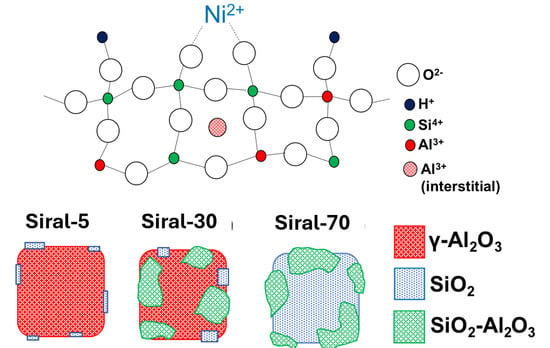
Ni/Siral-30, prepared by incipient wetness impregnation (IWI) with aqueous Ni(NO3)2 followed by calcination, has recently demonstrated excellent performance as an EO catalyst [8]. Similarly prepared Ni/Siral-40 was successfully evaluated for liquid oligomer production from sub- and super-critical ethylene at a range of temperatures, Ni loadings, and reactor configurations [10]. Typically, isolated Ni2+ ions grafted to the oxide surface and <2-nm NiO crystallites have been posited as the EO active sites [8,9]. As Ni-catalyzed EO is an active area of research, we refer the reader to recent reviews [11,12]. The heterogeneity of Ni2+ speciation on these supports renders the correct identification of the active sites a considerable challenge. The Siral-X family of SiO2-doped Al2O3 catalyst supports is produced by anchoring a SiO2 precursor (orthosilic acid) to boehmite (AlO(OH)), followed by calcination [13]. The final SiO2 content (X) can be varied by adjusting the amount of SiO2 precursor added during synthesis and determines the quantity and nature of acid sites displayed on the oxide surface. Siral materials containing 30–70 wt.% SiO2 exhibits moderately strong Brønsted acid sites (BAS) [13]. The exact origin of strong acidity is a matter for debate because the materials do not display v(OH) bands distinct from the non-acidic silanol (SiOH) groups of SiO2 [14]. It is evident that aluminosilicate supports in general display enhanced levels of Brønsted acidity compared to amorphous SiO2 or commercial γ-Al2O3 [14]. Moreover, surface composition and acidity are expected to change as a function of the Si/Al ratio.
Ni/SiO2 and Ni/Al2O3 are not active EO catalysts (as confirmed in this work), suggesting that strong BAS are required for EO activity; however, BAS do not participate directly in the Ni2+-catalyzed oligomerization pathway [15], and Ni2+ speciation is likely a key factor determining EO activity. Moreover, Ni speciation is expected to depend on the Si/Al ratio for Siral supports. In this work, Ni/Siral-5, 30, and 70 catalysts were prepared, characterized, and tested in order to identify the effects of support surface composition on Ni2+ speciation and EO performance. Ni/Siral-70, which to our knowledge has not been previously reported as an EO catalyst, exhibited the highest activity level. Characterization of the catalysts and calcined supports by X-ray photoelectron spectroscopy (XPS), H2 temperature-programmed reduction (TPR), X-ray diffraction (XRD), NH3 temperature-programmed desorption (TPD), high-angle annular dark-field scanning transmission electron microscopy with energy-dispersive X-ray mapping (HAADF-STEM EDX), and diffuse-reflectance infrared Fourier transform spectroscopy (DRIFTS) before and after CO adsorption evidenced that the EO active sites are isolated Ni2+ ions grafted to Al3+-stabilized SiO groups, and these species are most abundant in Ni/Siral-70. Bulk-like supported NiO crystallites and a surface NiAl2O4 phase were shown to be inactive. In addition, we demonstrate EO over Ni/Siral-30 and Ni/Siral-70 using a model mixed feed containing products (and byproducts) from chemical-looping oxidative dehydrogenation (ODH) of ethane.

2. Results and Discussion

2.1. Catalyst Compositions and Textural Properties

Textural properties of the catalysts and calcined supports, and Ni loadings from ICP-OES are provided in Table 1. All the supports are mesoporous with mean BJH pore sizes ranging from 6 to 23 nm. The supported Ni catalysts exhibit lower surface areas and total pore volumes than the corresponding supports. These observations are attributed to pore filling/blockage by NiO particles; the total pore volume loss increases with the support Si/Al ratio. The Ni/Siral-5 and Ni/Siral-70 catalysts contain 15-nm mesopores, whereas the Ni/Siral-30 catalyst has smaller 10-nm mesopores; these values are very similar to those of the corresponding supports. The calcined γ-Al2O3 support and Ni/Al2O3 catalyst have 6-nm average BJH pore sizes. The silica support has the largest BJH pore size (26 nm). Each catalyst has within 10% of the intended 5 wt.% Ni loading, except for Ni/SiO2. The Ni loading of this catalyst was not determined by ICP-OES, but it was prepared by IWI with an intended loading of 2.5 wt.%.

2.2. XRD, XPS, and HAADF-STEM

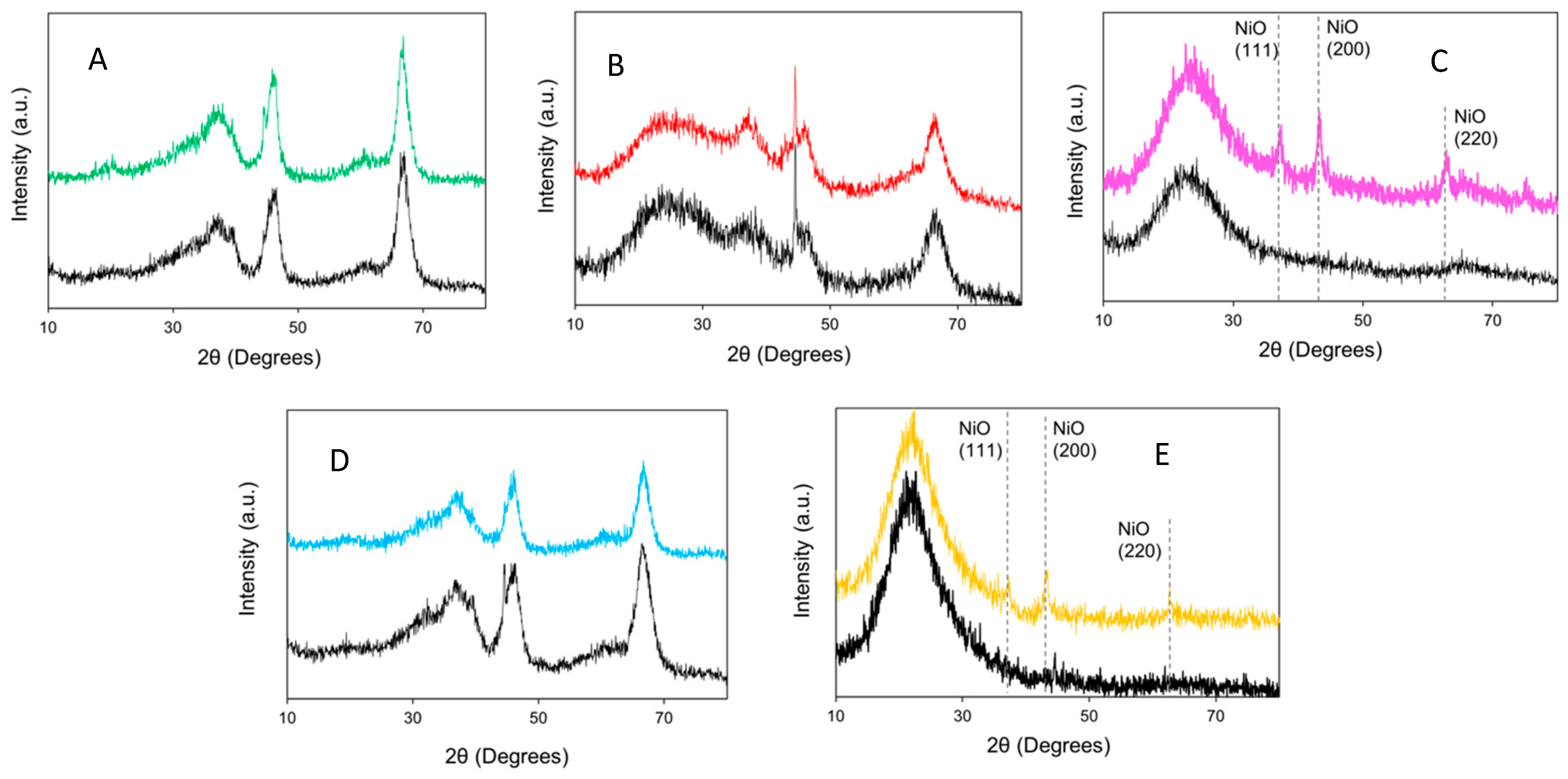
X-ray diffractograms of the supported Ni catalysts and calcined supports are shown in Figure 1. Calcined boehmite, Ni/Al2O3, Siral-5, and Ni/Siral-5 display closely similar patterns that contain predominantly peaks characteristic of γ-Al2O3 at 37°, 46°, and 68° [16]. There are no discernible differences between the diffractograms of the Ni-containing catalysts and the corresponding calcined supports. The diffractograms of Siral-30 and Ni/Siral-30 are nearly identical, displaying a very broad feature at ~25° characteristic of amorphous silica and broad peaks characteristic of γ-Al2O3. The structure of Siral-30 is consistent with γ-Al2O3 nanoparticles covered with an amorphous SiO2 layer [8,9]. We infer that the Siral-30 support is biphasic, comprising separate SiO2 and Al2O3 nanoparticles consistent with HAADF-STEM (vide infra). In contrast, Siral-70 and Ni/Siral-70 display an intense broad XRD peak at ~25° and a barely detectable γ-Al2O3 peak at ~68°. We infer from the strong peak for an amorphous SiO2-containing phase and the near absence of crystalline γ-Al2O3 XRD peaks that Siral-70 comprises a bulk ASA phase containing tetrahedrally coordinated Al3+ centers [13]. SiO2 displays only an intense broad band at ~25° assigned to an amorphous phase. In addition, small narrow peaks at 37°, 42°, and 53° that correspond to the [111, 200, 220] Bragg reflections of NiO, respectively, ref. [17] are observed in the XRD patterns of Ni/SiO2 and Ni/Siral-70. In contrast, we do not observe NiO XRD peaks for the Ni/Siral-30 catalyst, indicating that any particles are smaller than the Debye-Scherrer limit.
The Si/Al ratios of the catalysts and calcined support measured by XPS are compared to the corresponding bulk values in Table 2. The XPS (surface) values increase monotonically with bulk Si/Al, but in all instances the surface is more enriched in Si than the bulk. This is not surprising because the supports were synthesized by grafting a SiO2 precursor onto boehmite. The positive deviation of the surface Si/Al ratios from the bulk increases as bulk Si/Al ratios decrease; i.e., the lower the total percentage of SiO2, the more concentrated it is at the particle surfaces. The (Si/Al)S value of Ni/Siral-70 comes closest to approximating that of the bulk, indicating that the distribution of Al3+ and Si4+ ions is more nearly homogeneous. The surface-to-bulk composition ratio (NiS/NiB) provides a measure of Ni2+ species dispersion, which decreases monotonically with (Si/Al)S for the supported catalysts (Table 2). The 2.5 wt.% Ni/SiO2 catalyst prepared by IWI shows negligible Ni 2p photoemission intensity because of its low loading and NiO dispersion (vide infra). Conversely, the NiS/NiB ratio for Ni/Al2O3 is the largest and nearly unity, suggesting that the bulk and surface Ni concentrations are closely similar. The lower, albeit similar, NiS/NiB values demonstrated by Ni/Siral-5 and Ni/Siral-30 evidence intermixing of Ni and Al-Si oxide species. The Ni/Siral-70 catalyst has a significantly lower NiS/NiB ratio, consistent with larger NiO crystallites. Previous research has established that larger NiO crystallites are produced on aluminosilicate supports with higher Si/Al ratios [18].
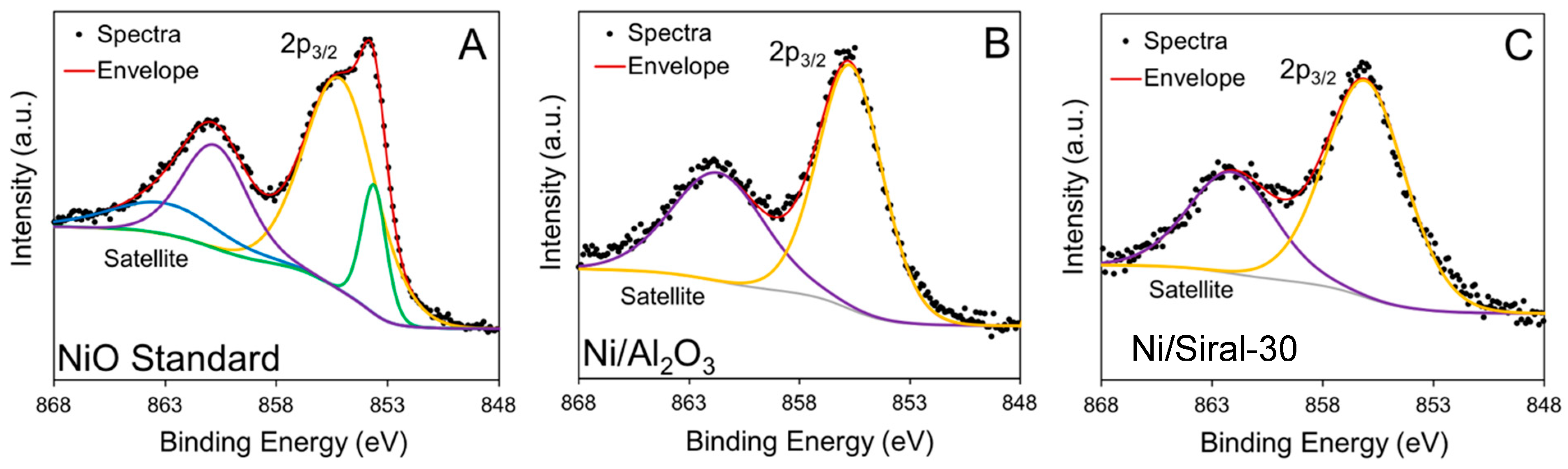
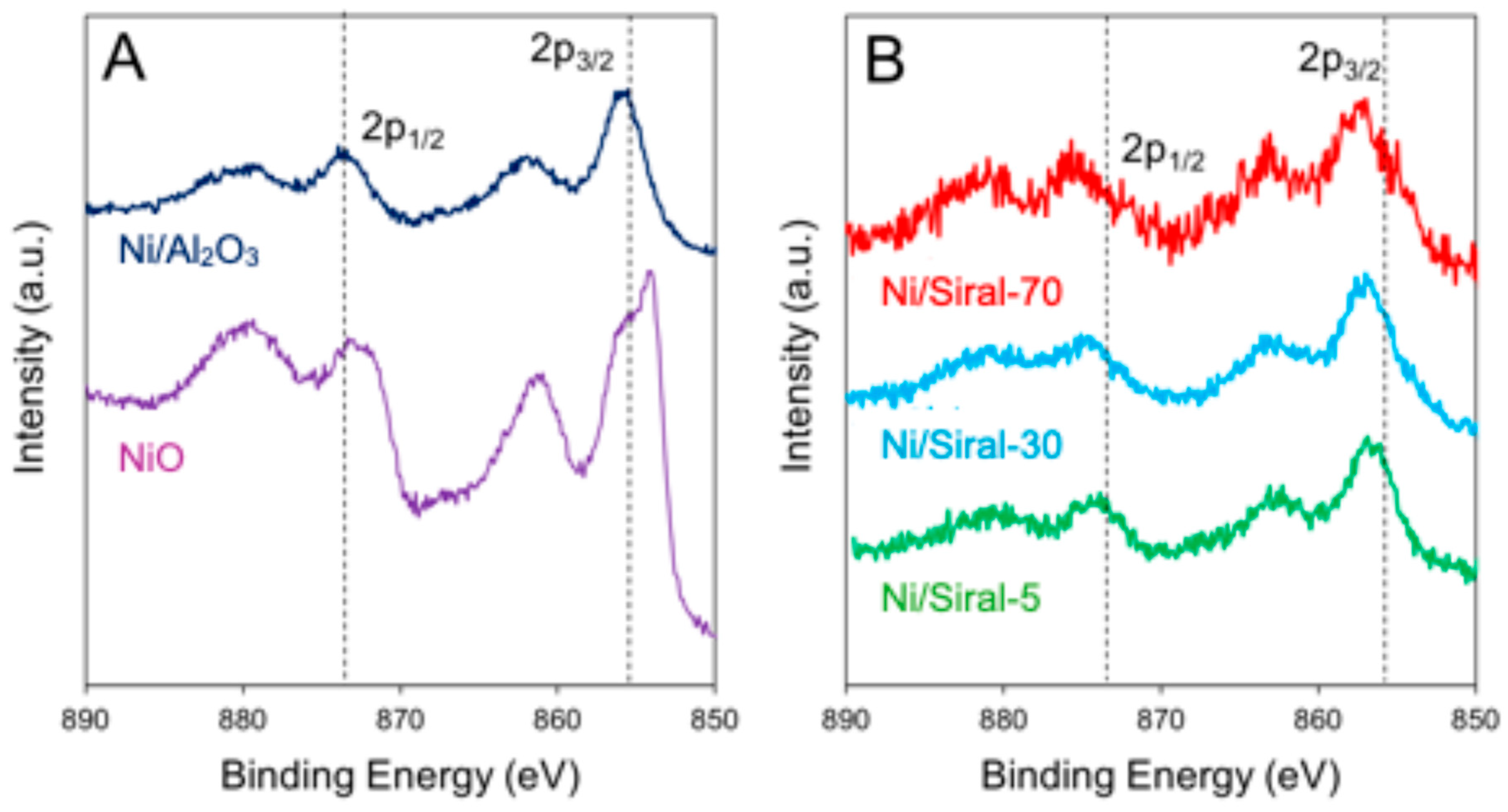
Ni 2p XP spectra of the Ni/Al2O3 and Ni/Siral catalysts and a NiO standard are shown in Figure 2. The spectrum of bulk NiO (Figure 2A) shows a well-resolved 2p3/2 and 2p3/2 spin-orbit doublet with strong shake-up satellite features [19]. In addition, the NiO spectrum contains a characteristic 2p3/2 feature at 854 eV associated with multiplet splitting. In contrast, this distinguishing feature is not observed in the spectrum of Ni/Al2O3 nor in the spectra of Ni/Siral-5 and Ni/Siral-30. The XP spectrum of Ni/Siral-5 is similar to Ni/Siral-30, albeit with a somewhat lower signal-to-noise ratio (Figure 2B). The XP spectrum of Ni/Siral-70 has a significantly lower S/N ratio, and the broad, poorly unresolved peaks suggest the presence of multiple Ni2+ species. The Ni 2p3/2 peaks of Ni/Al2O3 and Ni/Siral-30 appear at 855.8 and 856.9 eV, respectively, with satellites at ~862 and 863 eV, respectively. The Ni 2p3/2 binding energy for Ni/Al2O3 closely matches typical literature values for NiAl2O4 (~856 eV) [20,21]. Interestingly, an additional ~1 eV shift of the Ni 2p3/2 peak to higher binding energy (relative to NiO) is observed for the Ni/Siral catalysts (Figure 2B). Apparently, there is a range of Ni 2p3/2 binding energies for NiAl2O4 that may be related to impurities (e.g., Si) or Ni2+ in specific crystallographic sites (i.e., spinel or inverse spinel). For example, Jimenez-Gonzalez et al. assigned Ni 2p3/2 peaks between 856 and 857 eV to NiAl2O4 species in Ni/Al2O3 methane-reforming catalysts that had been activated at 850 °C [22].
More detailed analyses of the XP spectra of NiO powder, Ni/Al2O3, and Ni/Siral-30 in the Ni 2p3/2 region are presented in Figure 3, including Gaussian-Lorentzian fits of the main peaks, shake-up satellites, and multiplet splitting features. Multiplet splitting is only observed for the standard, suggesting that these catalysts do not contain bulk-like NiO crystallites. The spectrum of Ni/Al2O3 comprises well-resolved primary and satellite peaks. The spectrum of Ni/Siral-30 is similar; however, the peaks are broader and less well-resolved. The peak broadening may be intrinsic, arising from a range of Ni2+ environments, or may be associated with sample charging during XPS measurements.
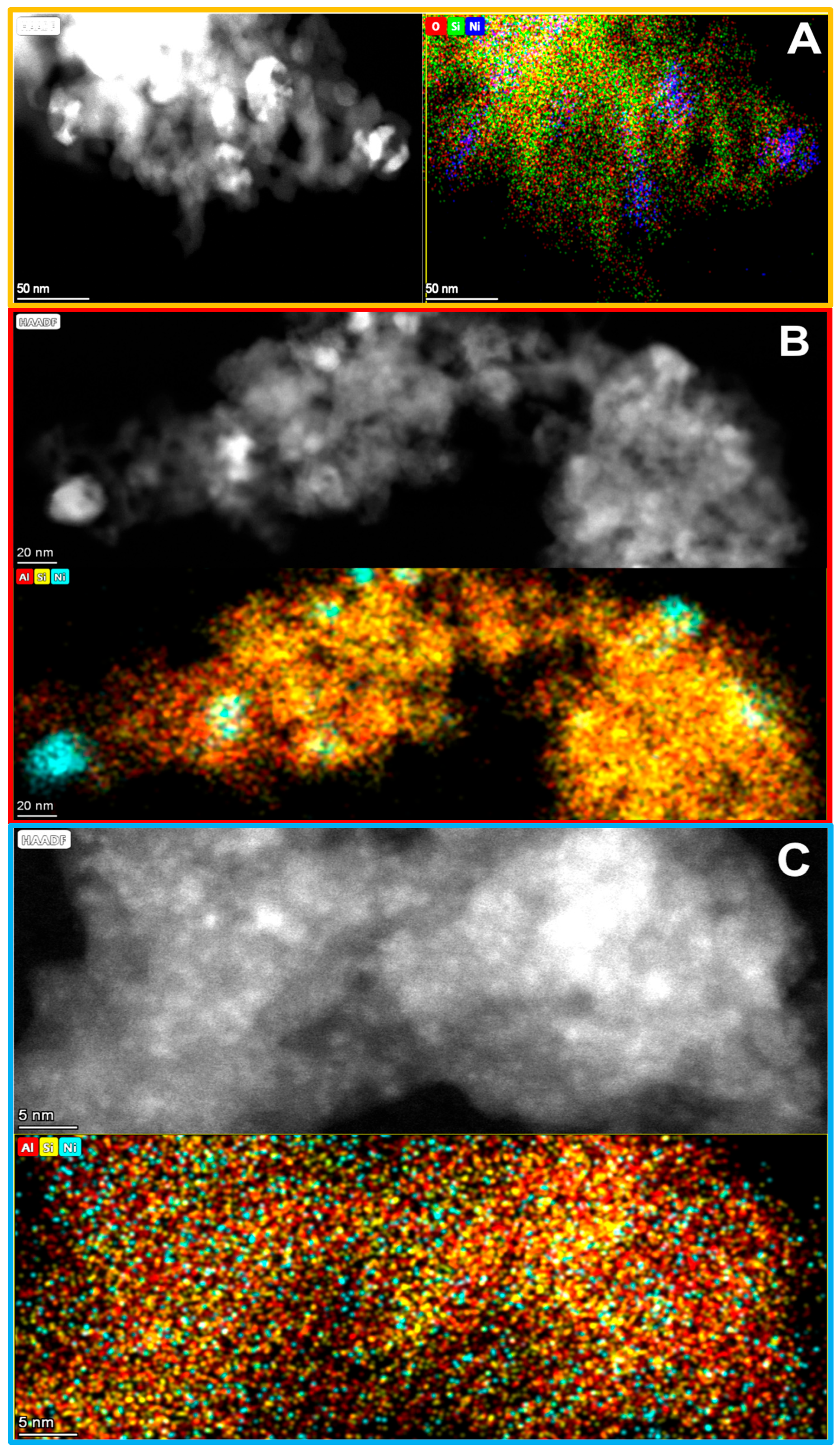
HAADF-STEM images and EDX maps of the Ni/SiO2, Ni/Siral-70, and Ni/Siral-30 catalysts are shown in Figure 4. The bright 20–30-nm particles in Figure 4A are NiO crystallites on SiO2, as confirmed by the EDX map and consistent with XRD (vide supra). The HAADF-STEM image of Ni/Siral-70 (Figure 4B) contains smaller 10–20 nm NiO crystallites, as corroborated by the EDX map. In contrast, the HAADF-STEM image and EDX map (Figure 4C) of Ni/Siral-30 comprise small (<2-nm) NiO clusters (nanoparticles) that appear to be uniformly dispersed over the support; however, this observation does not exclude the presence of a surface NiAl2O4 layer or mononuclear Ni2+ complexes. Previously, STEM images of a 5 wt.% Ni/Siralox-30 catalyst by Moussa et al. showed sub-5 nm NiO nanoparticles in addition to larger (>10 nm) NiO particles [9]. Their commercial Siralox-30 support was produced by calcination at ~900 °C and has a lower surface area than our Siral-30 support, which was calcined at 500 °C.

2.3. H2 TPR

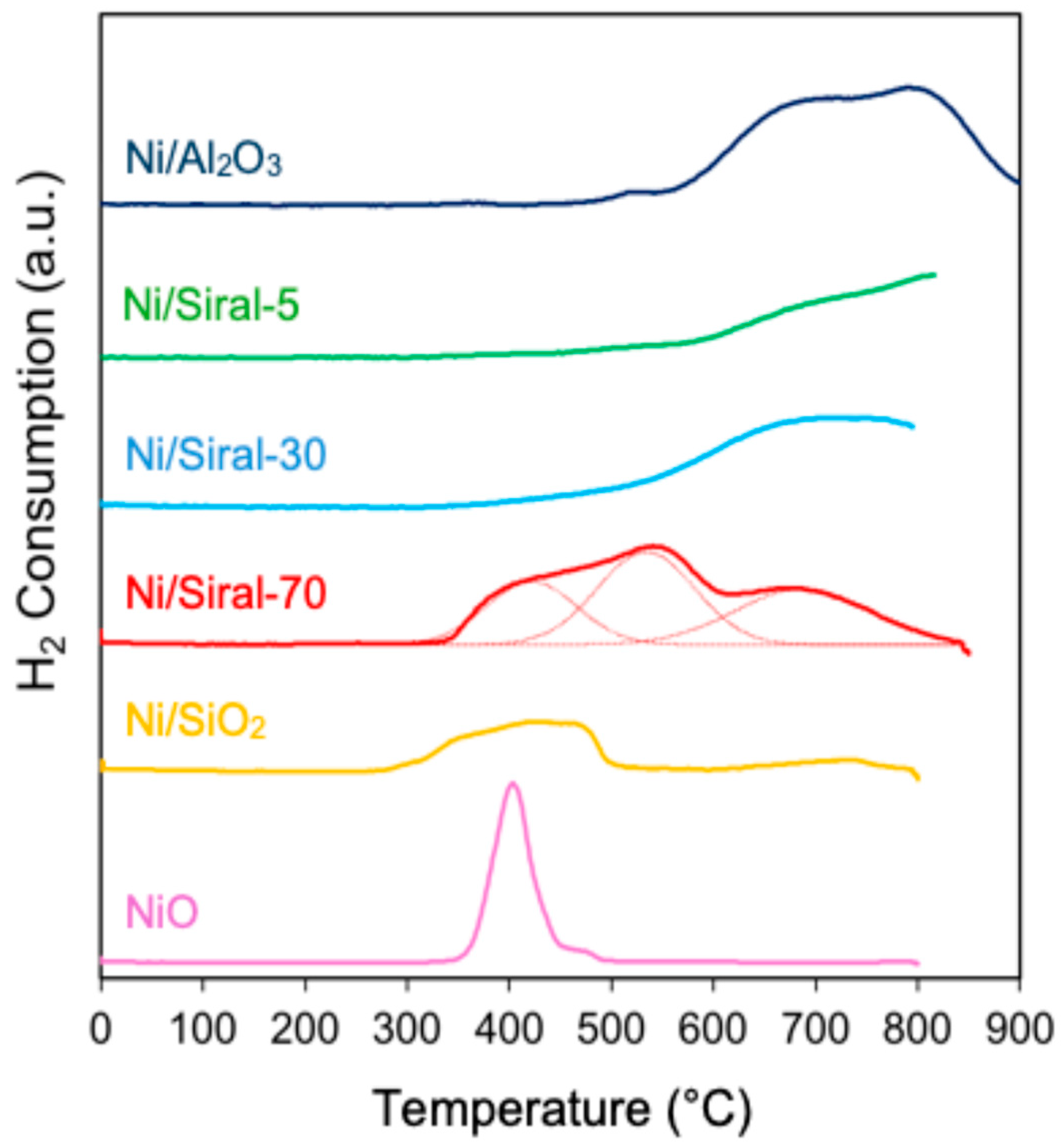
H2 TPR was used to investigate the impact of the support Si/Al ratio on Ni2+ speciation and reducibility, including the degree of interaction between Ni2+ ions and the support surface. TPR profiles of the catalysts and a NiO standard are presented in Figure 5. The main TPR peak for bulk NiO is narrow and appears at ~400 °C. The reduction of Ni2+ to Ni0 should yield a H/Ni ratio of 2, the value obtained for the NiO standard. The H/Ni values obtained for the catalysts (Table 1) are within the expected range, although there is considerable variation. We infer from the TPR peak temperatures that Ni2+ ion reducibility increases with increasing support Si/Al ratio due to changes in Ni2+ speciation [20,23]. Reduction of Ni/SiO2 occurs over a broad temperature range centered around 400 °C. The breadth of the TPR peak (compared to bulk NiO) may be attributed to the crystallite size distribution (as observed by STEM-EDX) and degree of interaction with the support [21]; however, some have suggested that non-stoichiometric NiO (that contains Ni3+ ions) and Ni2O3 species also may contribute [22]. The TPR profile of Ni/Siral-70 is broad and complex, comprising at least three peaks associated with different Ni2+ species. Fitting reveals a peak at 400 °C assignable to NiO (and consistent with our XRD results), a second peak at 530 °C, and a very broad peak at ~650–700 °C. By comparison to the reduction temperatures of Ni2+ in Beta zeolite and Ni/SiO2-Al2O3, the 530 °C band is assigned to isolated Ni2+ ions on the support [23,24]. The broad high-temperature peak is suggestive of either NiO nanoparticles interacting strongly with the support or surface Ni aluminate species. The TPR profile of Ni/Siral-30 displays an increasing signal beginning around 500 °C, rising to a broad maximum around 700 °C. In contrast, Ni/Siral-5 does not evidence a significant reduction below ~600 °C. Instead, Ni/Siral-5 exhibits high-temperature H2 uptake that does not return to baseline at 800 °C; thus, a H/Ni ratio less than 2 is expected. The TPR profile of Ni/Al2O3 exhibits a small peak at ~530 °C and strong, overlapping but clearly discernible components at 690 °C and 800 °C. Ni/Al2O3 catalysts prepared by IWI and calcined at 500 °C can contain difficult-to-reduce surface NiAl2O4 spinel (tetrahedral Ni2+) and inverse-spinel (octahedral Ni2+) species [20,21]. The X-ray diffractogram of Ni/Al2O3 did not show evidence of bulk NiAl2O4, but the Ni 2p XP spectrum of Ni/Al2O3 is fully consistent with NiAl2O4. Moreover, the high-temperature TPR peaks are closely similar to those assigned by Boukha et al. [20] to the reduction of Ni2+ ions in NiAl2O4. The small peak at ~530 °C could be assigned to isolated Ni2+ ions and/or NiO nanoparticles interacting strongly with the support.

2.4. NH3 TPD

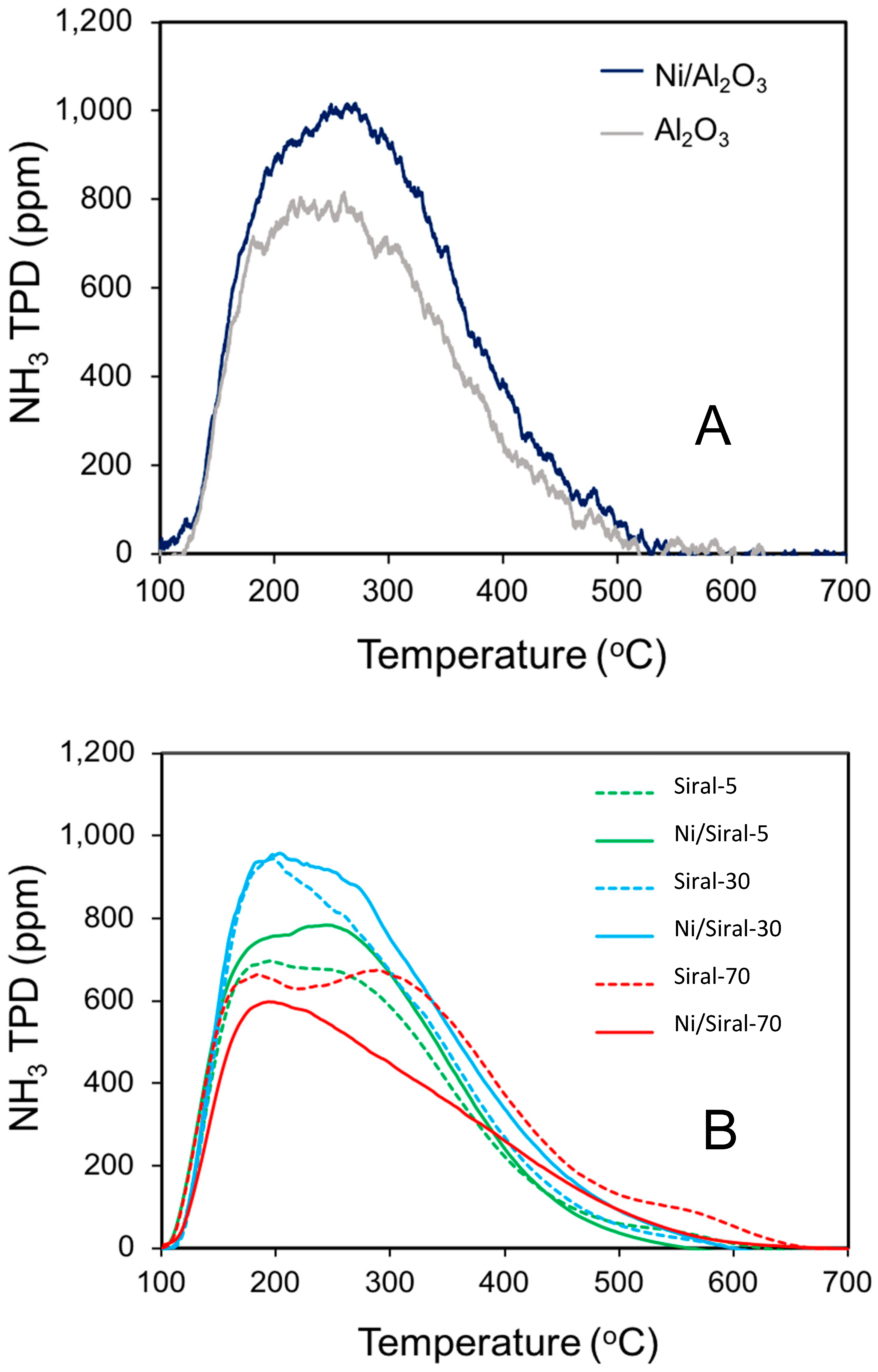
NH3 TPD profiles are shown in Figure 6A for (1) γ-Al2O3 derived by calcining boehmite at 500 °C and (2) a Ni/Al2O3 catalyst prepared by IWI of the resulting support with subsequent calcination at 500 °C. The NH3 TPD profiles are closely similar and characterized by an asymmetric peak at 200–300 °C with a high-temperature tail. The surface acidity of γ-Al2O3 is typically attributed to surface Al-OH groups (weak BAS) and coordinatively unsaturated (cus) tetrahedral Al3+ sites (Lewis acid sites, LAS) based on FTIR measurements of basic probe molecules [25,26]. Ni/Al2O3 displays substantially more NH3 desorption than γ-Al2O3, consistent with the presence of Ni2+ LAS. NH3 TPD profiles for the calcined Siral supports and the Ni/Siral catalysts are shown in Figure 6B. Siral-70 and Siral-30 demonstrate ~0.45 mmol/g NH3 desorption, and Ni/Siral-5 slightly less (~0.40 mmol/g). Although the Siral supports exhibit similar densities of total acid sites, the relative contributions of BAS and LAS are expected to vary with the Si/Al ratio [13]. Siral-5 and Siral-30 exhibit desorption bands similar to γ-Al2O3 characterized by a peak at ~180 and one at ~275 °C that tails off at high temperature. Siral-70 has a smaller low-temperature (180 °C) peak and another at 310 °C arising from strong BAS, i.e., Si-OH-Al moieties [27]. Siral-70 also has a weak high-temperature TPD peak at ~550 °C, consistent with strong LAS. Ni/Siral-5 and Ni/Siral-30 exhibit greater NH3 desorption peak areas than the corresponding supports, consistent with adsorption on BAS and Ni2+ LAS [20]. Conversely, Ni/Siral-70 demonstrates a substantially lower NH3 desorption peak area than the bare support. Notably, the BAS peak at 310 °C is strongly suppressed, and it seems reasonable to infer that Ni2+ species exchange with protons during catalyst preparation. These BAS in Siral-70 are probably associated with interstitial Al3+ and act as Ni2+ grafting sites.

2.5. DRIFTS

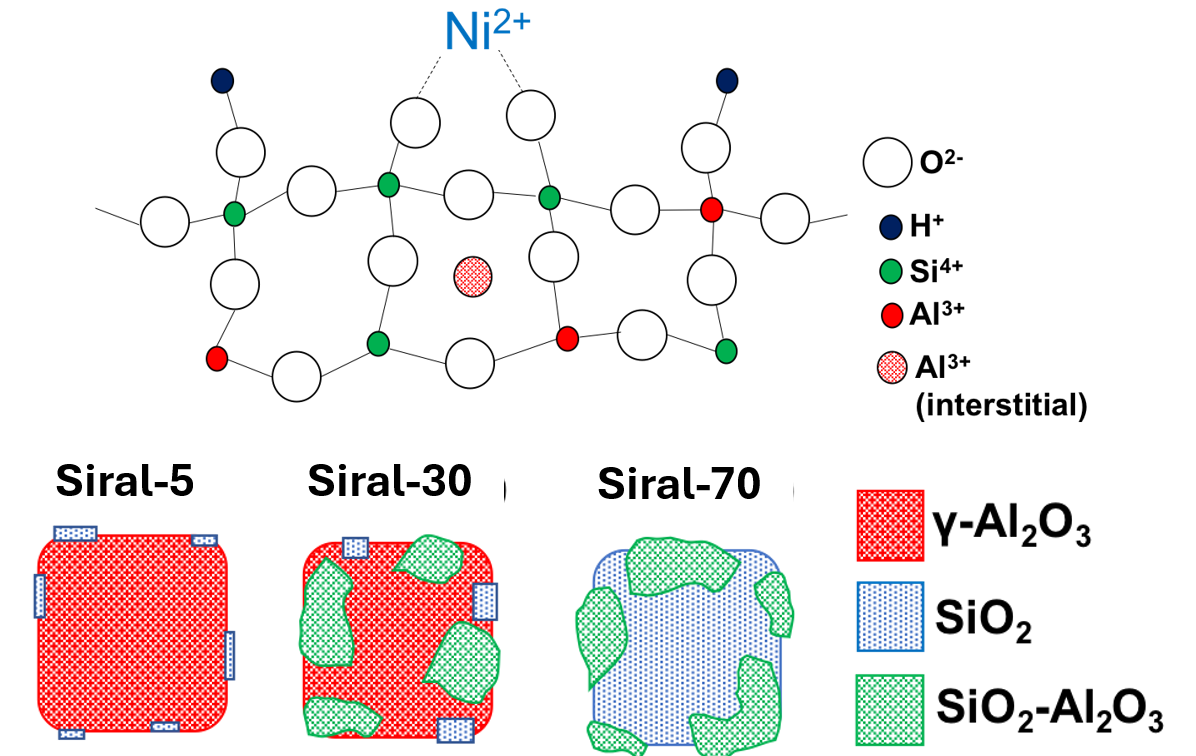
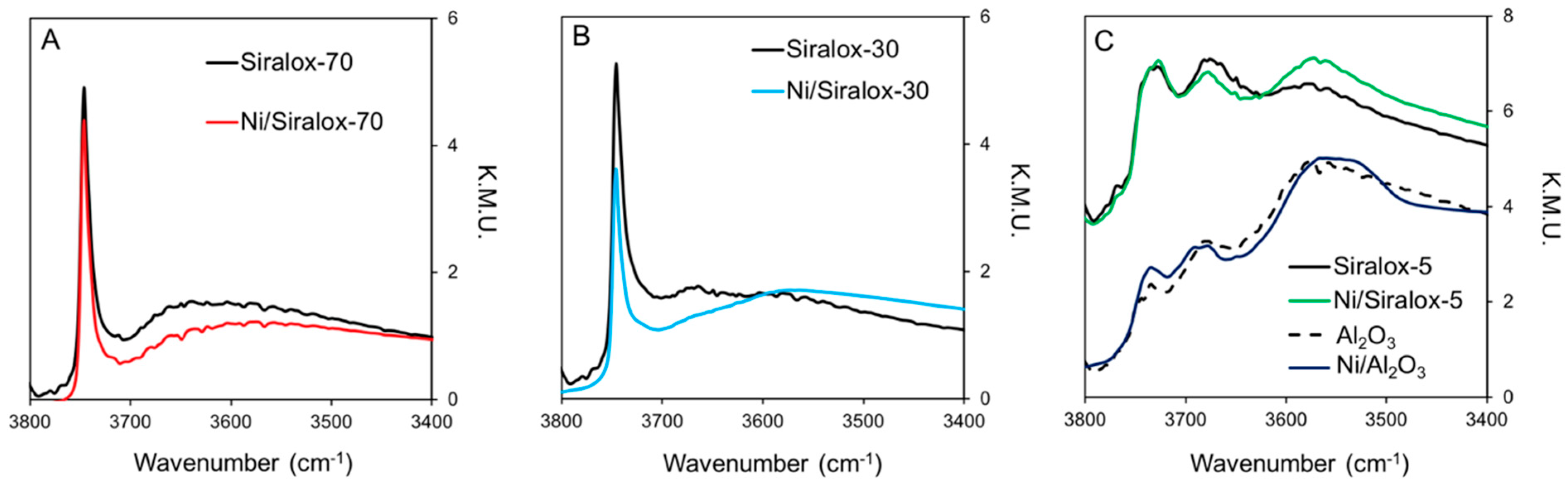
The v(OH) DRIFT spectra of the catalysts after in situ pretreatment at 350 °C are shown in Figure 7. The spectrum of Siral-70 (Figure 7A) closely resembles that of amorphous SiO2, indicating essentially complete encapsulation (coverage) of γ-Al2O3 by silica [13]. Siral-70 exhibits a single sharp v(OH) peak at 3743 cm−1 assigned to isolated Si-OH groups, as found on weakly acidic SiO2 surfaces. Despite its similar IR spectrum, the stronger surface acidity of Siral-70 has been confirmed by NH3 TPD (this work) and other techniques [23]. The decreased area of the v(OH) band associated with vicinal (H-bonded) OH groups (broad maximum at ~3400–3700 cm−1) on addition of Ni2+ to Siral-70 can be explained by divalent ion exchange with vicinal (H-bonded) Si-OH groups [28]. The v(OH) spectrum of Siral-30 also comprises bands assigned to isolated and vicinal Si-OH species despite its relatively high alumina content (Figure 7B). Moreover, the Siral-30 surface is substantially more Si-rich than the bulk (Table 2). Daniell et al. [13] determined that silicon-aluminum oxides derived from Siral-30 and Siral-40 after calcination at 550 °C were covered by silica-rich layers, as evidenced by a sharp isolated v(OH) at 3743 cm−1. These silica-alumina samples exhibited the strongest BAS according to low-temperature CO IR measurements [13]. Ni/Siral-30 demonstrates a substantial loss of isolated and bridging surface OH groups (based on peak area) when compared to the bare support, evidencing ion exchange of Ni2+ species. Siral-5 displays primarily bands associated with γ-Al2O3 with a minor contribution from isolated Si-OH species at 3747 cm−1 (Figure 7C) [25]. Upon addition of Ni2+, the DRIFT spectrum indicates loss of isolated and vicinal Si-OH groups and an increase in one type of bridging (vicinal) Al-OH groups. Our results are consistent with previous work indicating that Siral-5 comprises isolated patches of SiO2 on a γ-Al2O3 surface [14,16].
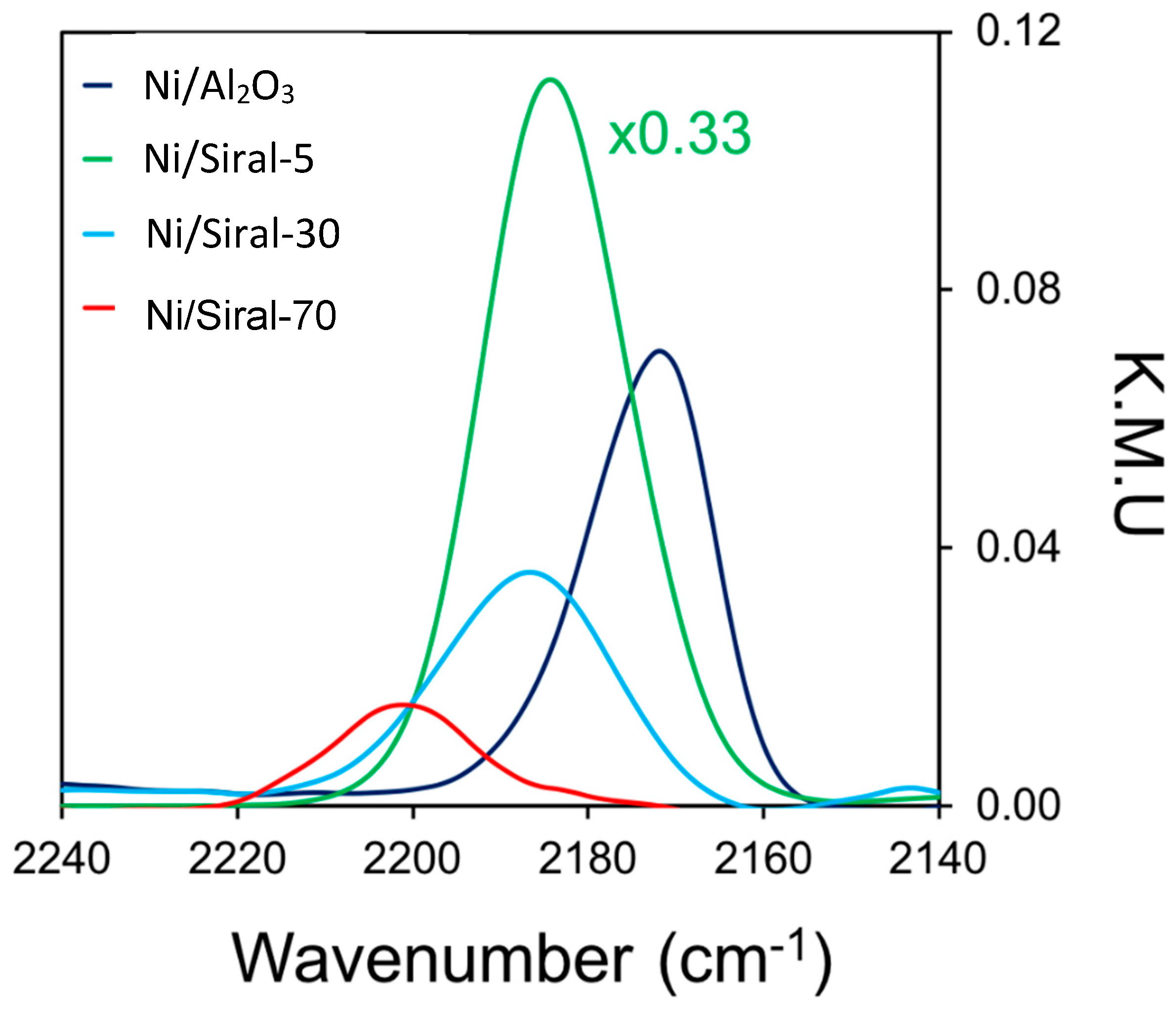
The v(CO) DRIFT spectra of the catalysts after in situ pretreatment at 350 °C and CO adsorption at 20 °C are shown in Figure 8. The observed peaks arise from CO interacting with Ni2+ species because they were not observed for the pretreated supports after CO exposure at 20 °C. Only in measurements at sub-ambient temperatures have carbonyl bands (2190–2150 cm−1) assigned to cus-surface Al3+ or BAS been reported [29]. Moreover, CO does not reduce the Ni2+ species to Ni+ under these conditions [30]. Ni/Siral-70 exhibits a broad band at 2201 cm−1 that may be composed of several individual components. We assign this peak to CO adsorbed on isolated Ni2+ ions by comparison to the spectra of CO coordinated to Ni2+ ions hosted in zeolites, e.g., Ni-Beta [31]. In comparison, Stoyanova et al. [23] observed v(CO) peaks at 2195 and 2191 cm−1 (depending on Ni loading) for Ni/Siral-70 catalysts (prepared by grafting and IWI) and exposed to CO at sub-ambient temperatures. Ni/Siral-30 displays a medium-intensity v(CO) band at 2184 cm−1 with a small shoulder at ~2200 cm−1. The former may be assigned to CO coordinated to cus Ni2+ ions on NiAl2O4 crystallite surfaces [32], and the latter to CO on isolated Ni2+ ions. Alternatively, the 2184 cm−1 peak may be assigned to CO adsorbed on NiO nanoparticles [8,9], and this assignment is consistent with HAADF-STEM images of this catalyst (Figure 4C). Ni/Siral-5 exhibits an intense, nearly symmetrical v(CO) peak at 2184 cm−1 that may be assigned to cus Ni2+ ions on NiAl2O4 surfaces or CO on NiO nanoparticles. Unfortunately, HAADF-STEM images of this catalyst are not available. In contrast, Ni/Al2O3 exhibits an asymmetric peak centered at 2172 cm−1 with a second component at ~2184 cm−1. Because the XPS and TPR results for Ni/Al2O3 are fully consistent with NiAl2O4, we assign the 2172 cm−1 peak to CO interacting with cus Ni2+ cations on this surface phase. Previous work indicates that SiO2 interacts with the most reactive surface sites of Al2O3, thereby reducing the strength of the Ni2+-support interaction (relative to γ-Al2O3) [16]. This is consistent with the lower CO DRIFTS frequency for Ni/Al2O3 when compared to Ni/Siral-5. The v(CO) frequencies reflect the Lewis acidity of the Ni2+ ions in exchange sites (higher frequency = stronger LAS) and indirectly the Bronsted acidity of the original proton exchange sites. The nature of the site (spinel tetrahedral or inverse-spinel octahedral) and the degree of coordinative unsaturation may impact Ni2+ Lewis acidity and therefore the observed CO stretching frequency. We state with some confidence, however, that the Ni2+ sites associated with the 2172-cm−1 band are significantly less Lewis acidic than isolated Ni2+ species on Siral-70 (or Siral-30).

2.6. EO Catalysis

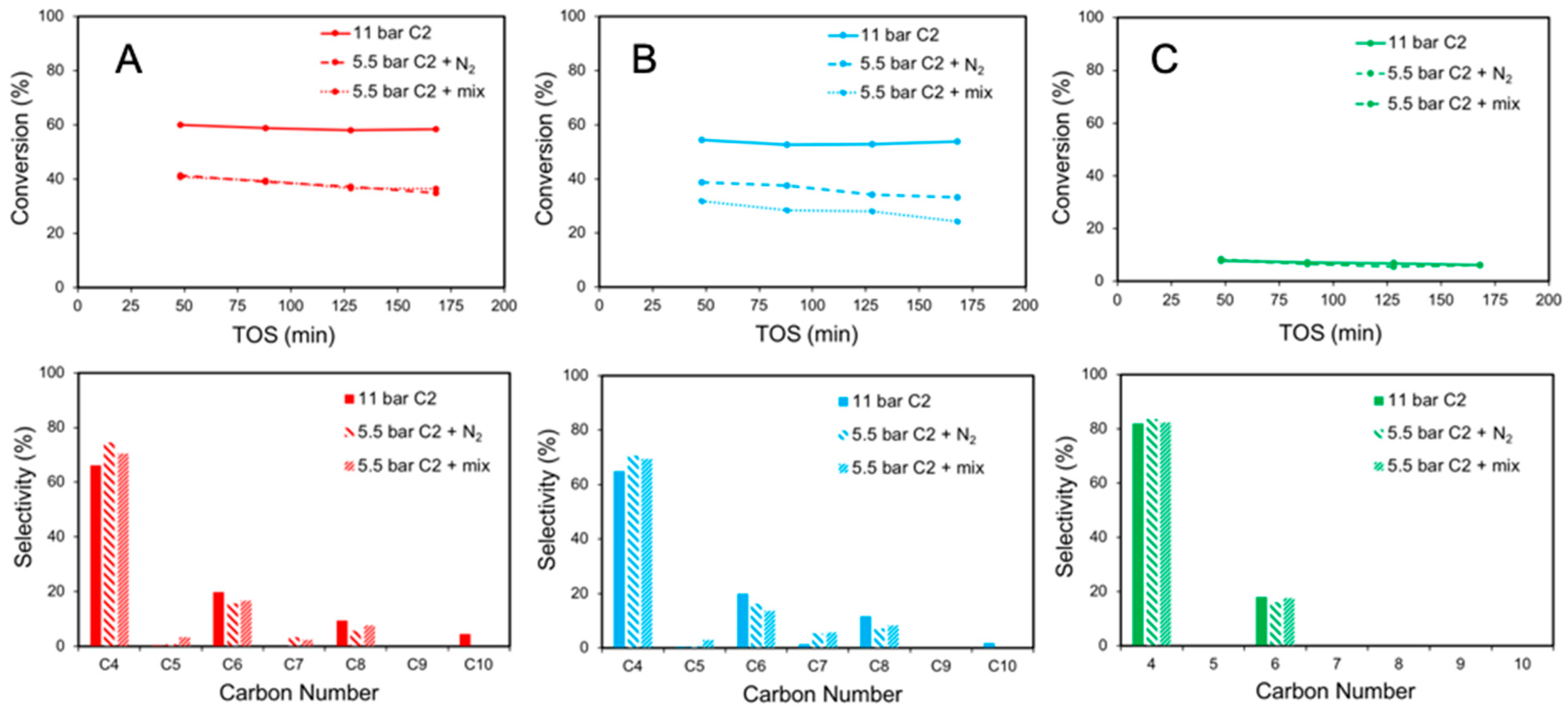
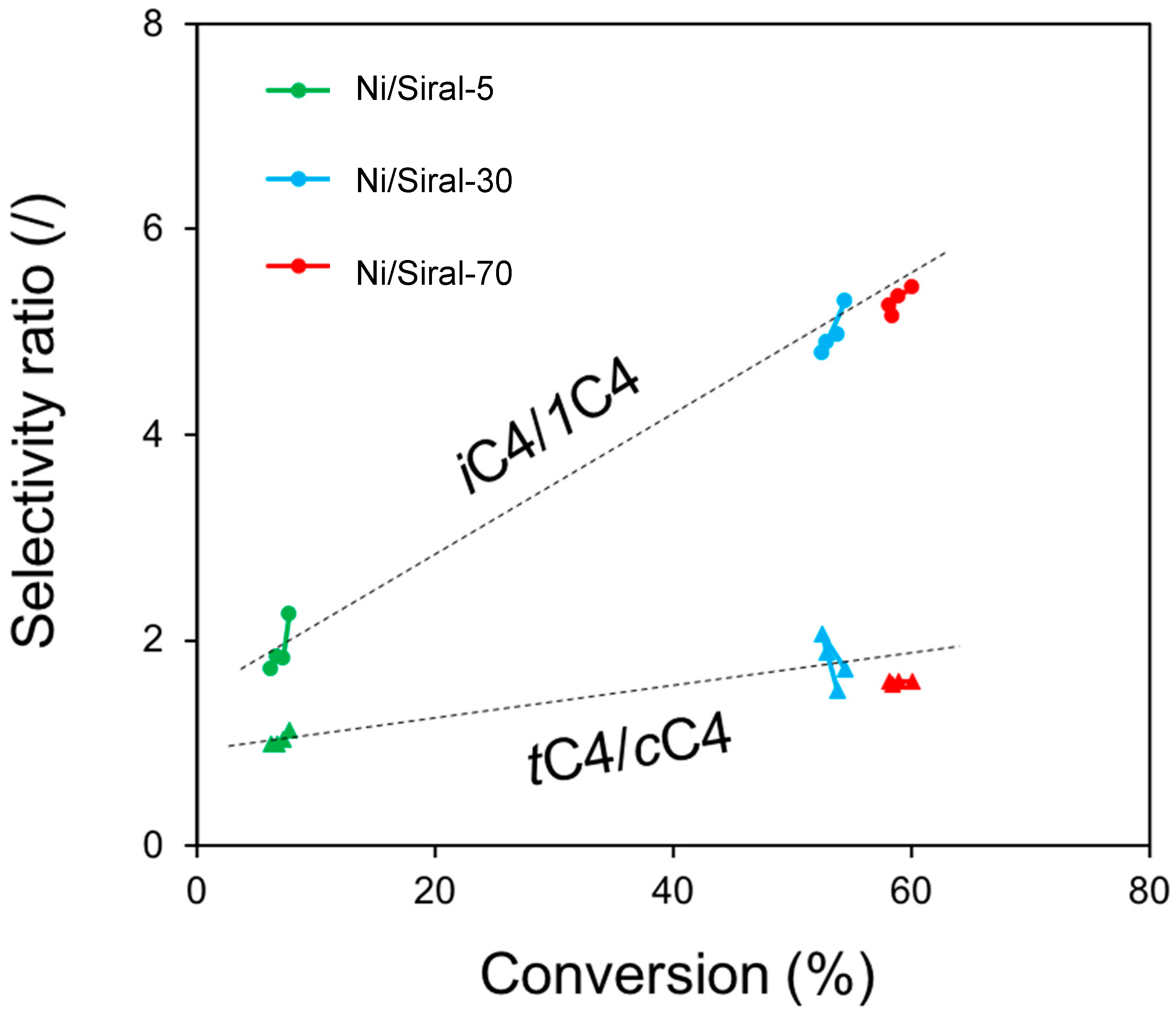
Temporal conversions and steady-state EO product distributions from the Ni/Siral catalysts at 225 °C, 11 bar, and 6 h−1 WHSV are presented in Figure 9. The Ni/SiO2 and Ni/Al2O3 catalysts were inactive (<2% conversion), confirming that NiO crystallites and NiAl2O4 have negligible EO activity under these conditions. Ni/Siral-70 was the most active catalyst; however, Ni/Siral-30 also gave comparable (>50%) EO conversion. Catalyst deactivation with time-on-stream (TOS) during these relatively brief runs was insignificant. The oligomer product distribution approximated Schulz–Flory behavior with ~63% butene selectivity. Ni/Siral-70 produced a slightly higher yield of C10 products than Ni/Siral-30. In contrast, Ni/Siral-5 exhibited only ~7% conversion with 80% C4 selectivity; C8 and C10 oligomers were not detected for Ni/Siral-5. The iC4/1C4 ratio [sum of internal C4 isomers to 1-butene] increases linearly with conversion over the Ni/Siral catalysts with a non-zero y-intercept (Figure 10). There is also a modest trend of decreasing cis/trans ratio with increasing conversion. We infer that cis/trans-2-butene and 1-butene are primary EO products [15,33,34]. Isobutene and odd-numbered oligomers require catalysts containing strong BAS and were detected in minor concentrations only over Ni/Siral-30 and Ni/Siral-70.
EO catalysis at 225 °C and 11 bar was investigated using a feed stream containing 44% ethylene, 44% ethane, 4.5% methane, 2% H2, 4.5% CO2, 0.9% propylene, and 0.1% CO that was intended to simulate an ethane ODH product stream. Catalyst performance was compared to results obtained using a 50/50 ethylene/N2 feed under equivalent conditions. The Ni/Siral-5 catalyst gave very low (<10%) ethylene conversion irrespective of the feed mixture (Figure 9). In contrast, the Ni/Siral-70 catalyst displayed substantial activity with only slight deactivation with TOS. EO conversion over Ni/Siral-70 was nearly equivalent using the simulated ODH product mixture and a 50/50 ethylene/N2 mixture, indicating a negligible impact of reactive impurities on catalyst performance [35]. The EO product distributions over Ni/Siral-70 were closely similar to each other; however, the addition of diluents appeared to reduce the chain-growth probability slightly with respect to 100% ethylene. Ethane, methane, and CO2 were non-reactive diluents, whereas propylene reacted over Ni2+ oligomerization sites [36]. The simulated ODH mixture gave lower conversion than the 50/50 ethylene/N2 mixture over Ni/Siral-30 consistent with the effect of catalyst poisons, e.g., CO. DRIFT spectra of the catalysts (Figure 8) indicate that both Ni/Siral-30 and Ni/Siral-70 adsorb CO at 20 °C, and although the relevant absorption coefficients are unknown, Ni/Siral-30 does have a substantially smaller initial Ni2+-CO peak area than Ni/Siral-70. Assuming the active sites to be isolated Ni2+ ions (vide infra), CO DRIFTS and TPR indicate this species to be less abundant in Ni/Siral-30 than Ni/Siral-70. We suggest that the lower concentration of active sites renders Ni/Siral-30 more susceptible to catalyst poisoning (e.g., by CO) than Ni/Siral-70.
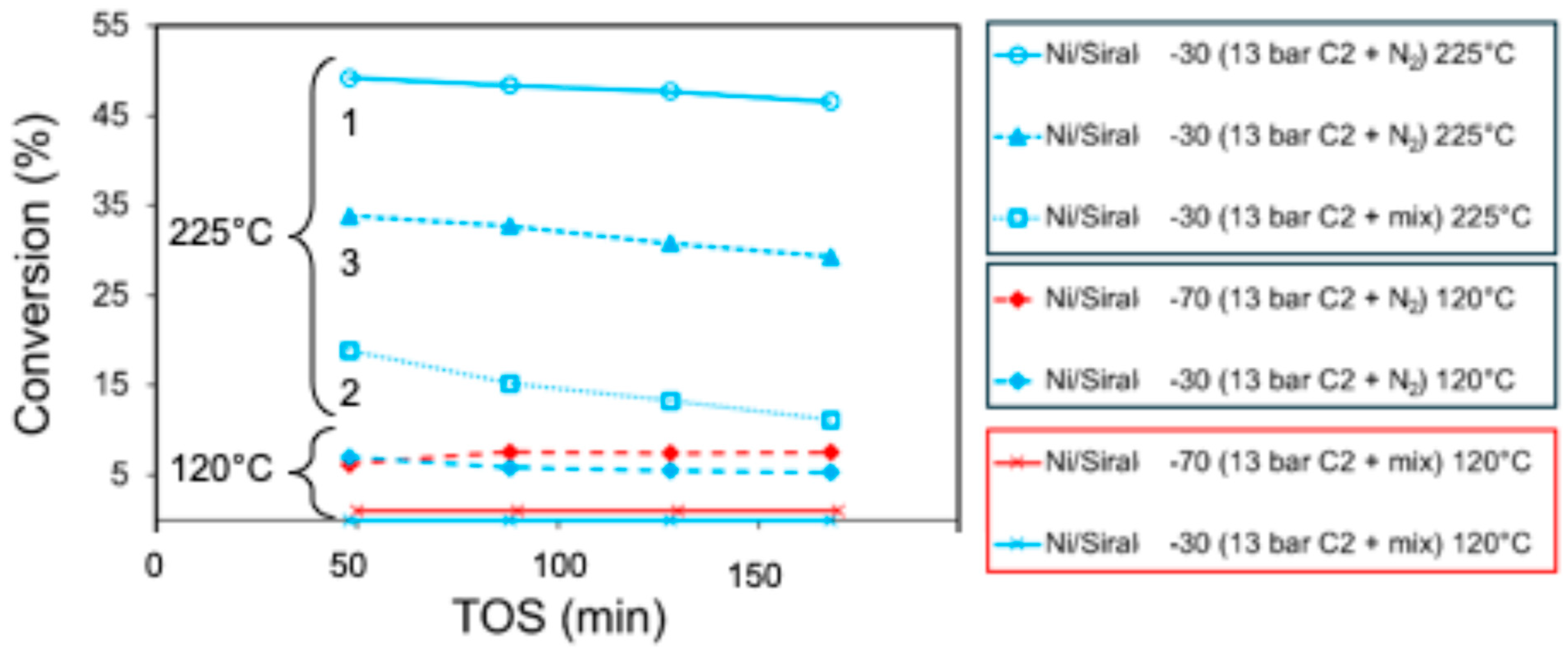
Additional EO reactor runs were performed at 120 °C and 26 bar (low-temperature, high-pressure conditions) using fresh catalyst and a 50/50 ethylene/N2 feed (Figure 11). Ni/Siral-70 and Ni/Siral-30 gave 6–8% conversion under these conditions, the former being more active. High-pressure and low-temperature operation in the presence of CO was expected to have a deleterious effect on catalyst activity. Follow-on measurements using the simulated ODH feed (Figure 11) gave very low activity consistent with catalyst poisoning. After a run using the simulated feed at 26 bar, the Ni/Siral-30 catalyst was kept in the reactor and heated to 300 °C in flowing N2 to ascertain whether thermal catalyst regeneration was possible. For comparison, a fresh Ni/Siral-30 catalyst was tested at 225 °C and 26 bar using a 50/50 ethylene/N2 feed mixture (denoted Run 1), and catalyst performance was comparable to that obtained using 11 bar of 100% ethane. The regenerated Ni/Siral-30 catalyst, however, gave only ~15% conversion at 225 °C with the simulated feed, and there was significant deactivation with TOS (Run 2). After a second attempted regeneration, the catalyst was tested at 225 °C using a 50/50 ethylene/N2 feed, and ~30% conversion with relatively stable activity was observed (Run 3). The difference in steady-state conversion observed for Runs 1 and 3 can be explained by assuming a significant fraction of Ni active sites remain poisoned following regeneration at 300 °C. Higher regeneration temperatures or time may be required to restore full catalytic activity. Alternatively, some Ni2+ sites may have been reduced to Ni+, and regeneration in air or O2 might be necessary.

2.7. Nature of EO Active Sites

There is reasonable consensus that the EO active sites in Ni/Siral catalysts comprise isolated Ni2+ ions grafted to an amorphous SiO2-Al2O3 support [11,15]. More specifically, the Ni2+ grafting sites are conjectured to be vicinal surface Si-OH groups with adjacent interstitial Al3+ ions that enhance Brønsted acidity [15]. To our knowledge, ours is the first report of Ni/Siral-70 as an EO catalyst; however, the EO activity of Ni2+ supported on conventional ASA supports is well-known, and Ni/Siral-70 has been evaluated for the conversion of ethylene to propylene [23]. Moussa et al. [9] compared several Ni/aluminosilicate catalysts for EO, including Ni-Beta and Ni/Siralox-30, and they found Ni/Siralox-30 to be among the most active catalysts. It should be noted that Ni/Siralox-30 was prepared using a commercial aluminosilicate support (Siralox-30) that was pre-calcined at temperatures > 550 °C and not derived from calcination of Siral-30 at 500–550 °C in the lab. Our EO data indicate that Ni/Siral-70 exhibits comparable to modestly greater activity than Ni/Siral-30, making it one of the most active Ni aluminosilicate catalysts with greater activity than Ni-Beta [9,31]. NH3 TPD provided evidence for the ion-exchange of Ni2+ species with surface acid sites during the preparation of this catalyst. A CO DRIFTS peak at ~2200 cm−1, consistent with isolated Ni2+ complexes grafted to SiO2-Al2O3, was observed for the Ni/Siral-70 catalyst; however, TPR, XRD, and v(OH) DRIFTS indicate that this catalyst contains a mixture of Ni2+ species, including bulk-like (inactive) NiO, isolated Ni2+ ions, and NiAl2O4 species (also thought to be inactive). A contribution from NiO nanoparticles also cannot be excluded. Ni/Siral-30 also has substantial EO activity and contains isolated Ni2+ species grafted to amorphous SiO2-Al2O3; however, these are a minority species represented by a shoulder near 2200 cm−1 in the CO DRIFTS spectrum. The main peak at 2184 cm−1 can be assigned to CO coordinated to cus Ni2+ ions on NiAl2O4 crystallite surfaces [32] and/or to CO adsorbed on NiO nanoparticles [8]. The former species is not expected to be active for EO catalysis; however, the latter has been suggested to show activity arising from cus Ni2+ ions [9]. On the basis of extensive characterization, including low-temperature CO FTIR spectroscopy and extended x-ray absorption fine structure (EXAFS) spectroscopy, Lee et al. [8] inferred that isolated Ni2+ species grafted to amorphous SiO2-Al2O3 were the predominant active sites in Ni/Siral-30. We concur with their conclusion; however, isolated Ni2+ species appear to be less abundant in Ni/Siral-30 than in Ni/Siral-70. Ni/Siral-5 comprises a NiAl2O4 surface phase and/or NiO nanoparticles and exhibits very low EO activity. Because Siral-5 consists of γ-Al2O3 overlaid with isolated islands of SiO2, strong interaction of the Ni(NO3)2 precursor with γ-Al2O3 surfaces during calcination leads to formation of a difficult-to-reduce and EO-inactive NiAl2O4 surface phase.
3. Materials and Methods

3.1. Catalyst Preparation

Chemical reagents were purchased from Sigma-Aldrich (Burlington, MA, USA), and high-purity gases were purchased from Airgas (Radnor, PA, USA), unless otherwise noted. Catapal A (pseudoboehmite/boehmite) and Siral-X (X = 5, 30, and 70) SiO2-doped hydrated aluminum oxides (boehmite) were received from Sasol (Sandton, South Africa) and calcined at 500 °C for 4 h in 1 L/min of flowing air, converting them to the corresponding oxide supports. Ni/Al2O3 and Ni/Siral-X (X = 5, 30, and 70) catalysts were synthesized by IWI of the supports using aqueous solutions of Ni(NO3)2, followed by a second calcination at 500 °C for 4 h in air. The Ni(NO3)2 concentrations of the solutions were sufficient to yield catalysts with ~5% wt.% Ni loading. For comparison, a Ni/SiO2 catalyst with a target Ni loading of 2.5 wt.% was prepared by IWI using Aerosil-300 SiO2 (Evonik, Essen, Germany) as the support. The NiO standard was a reagent-grade powder obtained from Sigma-Aldrich. Ni loadings were determined by inductively coupled plasma optical emission spectrometry (ICP-OES) at Galbraith Laboratories (Knoxville, TN, USA).

3.2. Catalyst Characterization

Specific surface areas were determined from N2 adsorption isotherms measured at 77 K on a Micromeritics ASAP 2020c instrument (Norcross, GA, USA) using a five-point Brunauer–Emmett–Teller (BET) method. The procedures for performing H2 temperature-programmed reduction (TPR) and NH3 temperature-programmed desorption (TPD) have been described previously [31]. TPD and TPR were performed on a Micromeritics 2920 instrument (Norcross, GA, USA) with a 50 mL/min flow rate, and the process effluents were measured by TCD and/or calibrated QMS detectors (Micromeritics, Norcross, GA, USA). Briefly, TPR measurements were taken by pre-treating the sample in situ in flowing He for 1 h at 300 °C, cooling to 0 °C or 20 °C, switching the flow to 5% H2/Ar, waiting for 45 min to achieve a stable baseline before ramping to 800 °C or 1000 °C at 10 °C/min. H/Ni ratios were calculated by integrating calibrated H2 consumption curves and normalizing by Ni loadings obtained by ICP-OES (Galbraith Laboratories, Knoxville, TN, USA). TPD measurements were taken by pretreating the sample in situ in flowing He for 30 min at 500 °C, cooling to 100 °C, switching the flow to 1% NH3/He (ARC3 gases), saturating the sample for 20 min, switching the flow back to He for 60 min to remove physisorbed NH3 before ramping to 700 °C at 10 °C/min.
DRIFT spectra of the activated catalysts before and after CO adsorption at 20 °C were taken on a Vertex 70 FTIR spectrometer (Anton Paar GmbH, Graz, Austria) equipped with a Harrick Praying Mantis in situ DRIFTS accessory. Briefly, the samples were activated in flowing He for 1 h at 350 °C and then cooled to 20 °C, at which point a DRIFT spectrum was taken for analysis of the v(OH) region. The sample was then saturated with CO, and another spectrum was taken for v(CO) analysis. X-ray photoelectron spectra were taken with a PHI 3057 instrument equipped with a spherical capacitor analyzer and a dual-anode X-ray source (only the Al Kα source was used in this work) (Physical Electronics, Chanhassen, MN, USA). The vacuum chamber base pressure was 5 × 10⁻¹⁰ torr, and binding energies were referred to the adventitious C 1s peak at 284.6 eV. Ni 2p3/2 spectra were averaged over 50 energy scans at 29.35 eV pass energy and 0.125 eV step size. Spectra were deconvoluted with the casaXPS software, employing a Shirley background and a 30:70 Gaussian–Lorentzian peak shape. X-ray diffractograms were taken with a Rigaku SmartLab instrument (Woodlands, TX, USA) equipped with a Cu Kα source (λ = 0.1542 nm). HAAFD-STEM images with EDX mapping were kindly taken by the NCSU Analytical Instrumentation Facility. The images and EDX data were acquired on a ThermoFisher Titan instrument (Eindhoven, The Netherlands) operated at 200 kV with probe currents between 75 pA (for imaging) and 500 pA (for EDX acquisition).

3.3. Ethylene Oligomerization

EO experiments were conducted using a fixed-bed flow reactor described elsewhere [31]. Briefly, 250 mg of catalyst was loaded and activated at 300 °C for 1 h in flowing N2. The reactor was then cooled to 20 °C, pressurized to 11 bar with ethylene, and the temperature ramped to 225 °C, maintaining pressure at 11 bar. An ethylene feed rate of 20 sccm provided a weight hourly space velocity (WHSV) of 6 h−1. EO products were analyzed by on-line GC-FID using a Shimadzu GC-2010 instrument (Columbia, MD, USA). Conversion calculated as follows: total product GC area/(total product GC area + ethylene GC area). Selectivity to a given carbon-number oligomer product is calculated as: oligomer product GC area/(total product GC area). Another set of experiments was performed with a feed stream containing 44% ethylene, 44% ethane, 4.5% methane, 2% H2, 4.5% CO2, 0.9% propylene, and 0.1% CO to simulate an ethane-to-liquids process in which the EO reactor is located downstream of an ODH reactor [4]. In these runs, the catalyst mass was 250 mg, and the total flow rate was 40 sccm, providing a WHSV of 5.3 h−1. For comparison, runs were performed with 40 sccm of 50% ethylene/N2, providing a WHSV of 6 h−1. Reactions were performed at 225 °C and 11 bar or 120 °C and 26 bar, giving ethylene partial pressures (PC2) of 5.5 or 13 bar (in the case of C2/N2 mix feed), and 4.8 or 11.4 bar (in the case of the simulated feed).

4. Conclusions

Commercially available SiO2-doped Al2O3 supports impregnated with Ni(NO3)2 and calcined at 500 °C yield highly active EO catalysts depending on the Si/Al ratio. Ni/Siral-70 was the most active catalyst investigated in this work. We infer that the active sites are isolated Ni2+ ions grafted to vicinal {SiO-} groups on amorphous SiO2-Al2O3 surfaces. Al3+ ions in Siral-70 are relatively uniformly distributed throughout the amorphous SiO2 framework, forming a near-continuous ASA phase. Interstitial Al3+ ions enhance the Brønsted acidity of the surface silanol groups that are Ni2+ grafting sites. Ni/Siral-70, however, contains a variety of Ni2+ species, including bulk-like NiO crystallites and a NiAl2O4 surface phase, in addition to isolated Ni2+ ions. Ni/Siral-30 also contains isolated Ni2+ species grafted to SiO2-Al2O3; however, the formation of inactive NiAl2O4 species limits its performance. Ni/Siral-5 shows very poor EO activity as the corresponding biphasic support (γ-Al2O3 with isolated SiO2 islands) interacts strongly with Ni2+ species, resulting in an inactive NiAl2O4 surface phase. Ni/Siral catalysts show little or no loss of activity when operated at 225 °C and 11 bar in the presence of reactive feed impurities, e.g., CO. However, at 120 °C and 26 bar (conditions more favorable for CO adsorption), catalyst activity was substantially reduced, and these changes were not reversible by thermal regeneration. We speculate that this may result from a reduction of the Ni2+ ions to inactive Ni+ ions by CO.
In conclusion, Ni speciation and EO activity are strongly influenced by the Si/Al ratio of the Siral support. When IWI is employed for catalyst preparation, isolated Ni2+ species are produced only when there is a surface phase with strongly Brønsted acidic silanol groups available to serve as grafting sites. Conversely, if the surface silanol groups are weakly acidic (i.e., SiO2), NiO crystallites form during calcination because the interaction with Ni2+ ions is insufficient to inhibit NiO formation. Ni/Siral-70 contains acidic silanol groups (as measured by NH3 TPD), has the highest concentration of isolated Ni2+ species (TPR and CO DRIFTS), and exhibits the greatest EO activity. Moreover, the presence of BAS enhances the EO rate and isomerization/branching reactions over this catalyst [11,15]. The higher Al content of Siral-30 and especially Siral-5 results in lower Brønsted acidity and the formation of inactive NiAl2O4.

Author Contributions

Conceptualization, J.M. and H.H.L.; Formal analysis, J.M.; Funding acquisition, H.H.L.; Investigation, J.M.; Methodology, J.M.; Supervision, H.H.L. All authors have read and agreed to the published version of the manuscript.

Funding

This work was supported by the AIChE/DOE RAPID Institute (DE-EE0007888-05-6).

Data Availability Statement

All pertinent data are provided in the manuscript.

Acknowledgments

The authors acknowledge Kyle Vogt-Lowell for his assistance with the XRD measurements.

Conflicts of Interest

The authors declare no conflicts of interest.

References

  1. Faramawy, S.; Zaki, T.; Sakr, A.A.E. Natural gas origin, composition, and processing: A review. J. Nat. Gas Sci. Eng. 2016, 34, 34–54. [Google Scholar] [CrossRef]
  2. Foss, M.M. Interstate Natural Gas—Quality Specifications & Interchangeability; Center for Energy Economics: Austin, TX, USA, 2004; p. 52. [Google Scholar]
  3. Weyant, C.; Shepson, P.; Subramanian, R.; Cambaliza, M.; Heimburger, A.; McCabe, D.; Baum, E.; Stirm, B.; Bond, T. Black carbon emissions from associated natural gas flaring. Environ. Sci. Technol. 2016, 50, 2075–2081. [Google Scholar] [CrossRef]
  4. Neal, L.; Haribal, V.; McCaig, J.; Lamb, H.H.; Li, F. Modular-scale ethane to liquids via chemical looping oxidative dehydrogenation: Redox catalyst performance and process analysis. J. Adv. Manuf. Process. 2019, 1, e10015. [Google Scholar] [CrossRef]
  5. Hulea, V.; Fajula, F. Ni-exchanged AlMCM-41—An efficient bifunctional catalyst for ethylene oligomerization. J. Catal. 2004, 225, 213–222. [Google Scholar] [CrossRef]
  6. Andrei, R.; Popa, M.; Fajula, F.; Hulea, V. Heterogeneous oligomerization of ethylene over highly active and stable Ni-AlSBA-15 mesoporous catalysts. J. Catal. 2015, 323, 76–84. [Google Scholar] [CrossRef]
  7. Chauvin, Y.; Commereuc, D.; Hughes, F. Nickel-based heterogeneous catalysts for olefin oligomerization: I. Support and anion effects. Appl. Catal. 1988, 42, 205–216. [Google Scholar] [CrossRef]
  8. Lee, M.; Yoon, J.; Kim, Y.; Yoon, J.; Chae, H.; Han, Y.; Hwang, D. Ni/SIRAL-30 as a heterogeneous catalyst for ethylene oligomerization. Appl. Catal. A Gen. 2018, 562, 87–93. [Google Scholar] [CrossRef]
  9. Moussa, S.; Arribas, M.; Concepcion, P.; Martinez, A. Heterogeneous oligomerization of ethylene to liquids on bifunctional Ni-based catalysts: The influence of support properties on nickel speciation and catalytic performance. Catal. Today 2016, 277, 78–88. [Google Scholar] [CrossRef]
  10. Seufitelli, G.V.S.; Gustafson, R. Novel Ni-SIRAL catalyst for heterogeneous ethylene oligomerization. Ind. Eng. Chem. Res. 2022, 61, 4286–4299. [Google Scholar] [CrossRef]
  11. Olivier-Bourbigou, H.; Breuil, P.A.R.; Magna, L.; Michel, T.; Pastor, M.F.E.; Delcroix, D. Nickel catalyzed olefin oligomerization and dimerization. Chem. Rev. 2020, 120, 7919–7983. [Google Scholar] [CrossRef]
  12. Hulea, V. Nickel-aluminosilicate catalysts for ethylene oligomerization: Recent scientific progress. Catal. Sci. Technol. 2025, 15, 4612–4631. [Google Scholar] [CrossRef]
  13. Daniell, W.; Schubert, U.; Glöckler, R.; Meyer, A.; Noweck, K.; Knözinger, H. Enhanced surface acidity in mixed alumina–silicas: A low-temperature FTIR study. Appl. Catal. A Gen. 2000, 196, 247–260. [Google Scholar] [CrossRef]
  14. Busca, G. Silica-alumina catalytic materials: A critical review. Catal. Today 2020, 357, 621–629. [Google Scholar] [CrossRef]
  15. Koninckx, E.; Mendes, P.S.F.; Thybaut, J.W.; Broadbelt, L.J. Ethylene oligomerization on nickel catalysts on a solid acid support: From New mechanistic insights to tunable bifunctionality. Appl. Catal. A 2021, 624, 118296. [Google Scholar] [CrossRef]
  16. Garbarino, G.; Chitsazana, S.; Phunga, T.K.; Rianic, P.; Busca, G. Preparation of supported catalysts: A study of the effect of small amounts of silica on Ni/Al2O3 catalysts. Appl. Catal. A Gen. 2015, 505, 86–97. [Google Scholar] [CrossRef]
  17. Li, X.; Zhang, X.; Li, Z.; Qian, Y. Synthesis and characteristics of NiO nanoparticles by thermal decomposition of nickel dimethylglyoximate rods. Solid State Commun. 2006, 137, 581–584. [Google Scholar] [CrossRef]
  18. Houalla, M.; Delmon, B. Physicochemical characterization and reducibility of nickel oxide supported on a wide range of silica-aluminas. J. Phys. Chem. 1980, 84, 2194–2199. [Google Scholar] [CrossRef]
  19. Peck, M.A.; Langell, M.A. Comparison of nanoscaled and bulk NiO structural and environmental characteristics by XRD, XAFS, and XPS. Chem. Mater. 2012, 24, 4483–4490. [Google Scholar] [CrossRef]
  20. Boukha, Z.; Jiménez-Velasco, C.; de Rivas, B.; González-Velasco, J.R.; Gutiérrez-Ortiz, J.I.; López-Fonseca, R. Synthesis, characterisation and performance evaluation of spinel-derived Ni/Al2O3 catalysts for various methane reforming reactions. Appl. Catal. B 2014, 158–159, 190–201. [Google Scholar] [CrossRef]
  21. Heracleous, E.; Lee, A.F.; Wilson, K.; Lemonidou, A.A. Investigation of Ni-based alumina-supported catalysts for the oxidative dehydrogenation of ethane to ethylene: Structural characterization and reactivity studies. J. Catal. 2005, 231, 159–171. [Google Scholar] [CrossRef]
  22. Jime, C.; Boukhaa, Z.; de Rivasa, B.; Delgadob, J.J.; Cauquib, M.A.; Gonza, J.R.; Gutie, J.I.; Lo, R. Structural characterisation of Ni/alumina reforming catalysts activated at high temperatures. Appl. Catal. A 2013, 466, 9–20. [Google Scholar]
  23. Stoyanova, M.; Bentrup, U.; Atia, H.; Kondratenko, E.V.; Linke, D.; Rodemerck, U. The role of speciation of Ni2+ and its interaction with the support for selectivity and stability in the conversion of ethylene to propene. Cat. Sci. Technol. 2019, 9, 3137. [Google Scholar] [CrossRef]
  24. Barrio, V.L.; Arias, P.L.; Cambra, J.F.; Güemez, M.B.; Campos-Martin, J.M.; Pawelec, B.; Fierro, J.L.G. Evaluation of silica-alumina-supported nickel catalysts in dibenzothiophene hydrodesulphurization. Appl. Catal. A Gen. 2003, 248, 211–225. [Google Scholar] [CrossRef]
  25. Ballinger, T.H.; Yates, J.T. IR spectroscopic detection of Lewis acid sites on alumina using adsorbed carbon monoxide. Correlation with aluminum-hydroxyl group removal. Langmuir 1991, 7, 3041–3045. [Google Scholar] [CrossRef]
  26. Morterra, C.; Magnacca, G. A case study: Surface chemistry and surface structure of catalytic aluminas, as studied by vibrational spectroscopy of adsorbed species. Catal. Today 1996, 27, 497–532. [Google Scholar] [CrossRef]
  27. Cant, N.W.; Little, L.H. Lewis and Bronsted acid sites on silica-alumina. Nature 1966, 211, 69–70. [Google Scholar] [CrossRef]
  28. Paukshtis, E.A.; Yaranova, M.A.; Batueva, I.S.; Bal’zhinimaev, B.S. A FTIR study of silanol nests over mesoporous silicate materials. Microporous Mesoporous Mater. 2019, 288, 109582. [Google Scholar] [CrossRef]
  29. Garbarino, G.; Escribano, V.S.; Finocchio, E.; Busca, G. Steam reforming of phenol–ethanol mixture over 5% Ni/Al2O3. Appl. Catal. B 2012, 113–114, 281–289. [Google Scholar] [CrossRef]
  30. Henry, R.; Komurcu, M.; Ganjkhanlou, Y.; Brogaard, R.; Lu, L.; Jens, K.; Berlier, G.; Olsbye, U. Ethene oligomerization on nickel microporous and mesoporous-supported catalysts: Investigation of the active sites. Catal. Today 2018, 299, 154–163. [Google Scholar] [CrossRef]
  31. McCaig, J.; Lamb, H.H. Ni-H-beta catalysts for ethylene oligomerization: Impact of parent cation on Ni loading, speciation, and siting. Catalysts 2022, 12, 824. [Google Scholar] [CrossRef]
  32. Busca, G.; Lorenzelli, V.; Escribano, V.S.; Guidetti, R. FT-113 study of the surface properties of the spinels NiAl2O4 and CoAl2O4 in relation to those of transitional aluminas. J. Catal. 1991, 131, 167–177. [Google Scholar] [CrossRef]
  33. Nicolaides, C.P.; Scurrell, M.S.; Semano, P.M. Nickel silica-alumina catalysts for ethene oligomerization—control of the selectivity to 1-alkene products. Appl. Catal. A Gen. 2003, 245, 43–53. [Google Scholar] [CrossRef]
  34. Joshi, R.; Zhang, G.; Miller, J.; Gounder, R. Evidence for the coordination–insertion mechanism of ethene dimerization at nickel cations exchanged onto beta molecular sieves. ACS Catal. 2018, 8, 11407–11422. [Google Scholar] [CrossRef]
  35. Andrei, R.D.; Borodina, E.; Minoux, D.; Nesterenko, N.; Dath, J.; Cammarano, C.; Hulea, V. Ethylene oligomerization from diluted stream over Ni-containing heterogeneous catalysts. Ind. Eng. Chem. Res. 2020, 59, 1746–1752. [Google Scholar] [CrossRef]
  36. Mlinar, A.N.; Baur, G.B.; Bong, G.G.; Getsoian, A.; Bell, A.T. Propene oligomerization over Ni-exchanged Na-X zeolites. J. Catal. 2012, 296, 156–164. [Google Scholar] [CrossRef]
Figure 1. X-ray diffractograms of Ni/Siral-5 (A), Ni/Siral-30 (B), Ni/Siral-70 (C), Ni/Al2O3 (D), and Ni/SiO2 (E) catalysts prepared by IWI (top/color) and those of corresponding aluminum-silicon oxide supports (bottom/black).
Catalysts 16 00524 g001
Figure 2. Ni 2p XP spectra of NiO and Ni/Al2O3 (A) and Ni/Siral (B).
Catalysts 16 00524 g002
Figure 3. (A) NiO Standard; (B) Ni/Al2O3; (C) Ni/Siral-30. Ni 2p3/2 XP spectra of NiO, Ni/Al2O3, and Ni/Siral-30 with curve fitting using 30:70 Gaussian: Lorentzian line shapes (color lines). Overall fit: red, background: gray, 2p3/2 peak: yellow, 2p3/2 multiplet splitting (NiO only): green:, 2p3/2 satellite: purple.
Catalysts 16 00524 g003
Figure 4. HAADF-STEM images with corresponding composite EDX maps for (A): Ni/SiO2, (B): Ni/Siral-70, and (C): Ni/Siral-30. Over-exposure washed out HAADF label in (A).
Catalysts 16 00524 g004
Figure 5. H2 TPR profiles of Ni/Siral catalysts, Ni/SiO2, and Ni/Al2O3 pretreated at 300 °C in He for 1 h. Ni/Siral-70 peaks fitted with Gaussian line shapes.
Catalysts 16 00524 g005
Figure 6. NH3 TPD profiles of Ni/γ-Al2O3 and γ-Al2O3 (A) and Ni/Siral catalysts (B) and calcined supports pretreated at 500 °C in He for 30 min.
Catalysts 16 00524 g006
Figure 7. v(OH) DRIFT spectra of Ni/Siral-70 (A), Ni/Siral-30 (B), and Ni/Siral-5 (top) and Ni/Al2O3 (bottom) (C) and corresponding calcined supports after in situ pretreatment at 350 °C for 1 h in flowing He. The black traces are the calcined supports (including the dashed trace for Al2O3). The color traces are the supported Ni catalysts.
Catalysts 16 00524 g007
Figure 8. v(CO) DRIFT spectra at 20 °C for Ni/Siral catalysts and Ni/Al2O3 after in situ pretreatment at 350 °C in He for 1 h.
Catalysts 16 00524 g008
Figure 9. EO temporal conversion (top) and oligomer selectivity (bottom) for Ni/Siral-70 (A), Ni/Siral-30 (B), and Ni/Siral-5 (C) at 225 °C and 11 bar. Feed compositions: 100% ethylene, 50% ethylene/N2, and simulated ethane ODH feed.
Catalysts 16 00524 g009
Figure 10. Butene isomer selectivity ratios for EO at 225 °C, 11 bar, and 6 h−1 WHSV ethylene. The four data points for each Ni/Siral catalyst represent different TOS values.
Catalysts 16 00524 g010
Figure 11. Temporal conversion over Ni/Siral-30 and Ni/Siral-70 catalysts at 120 °C or 225 °C, WHSV = 6 h−1 with respect to ethylene and 26 bar simulated feed or 13 bar C2 + 13 bar N2. PT = 26 bar, PC2 ~ 13 bar. Lines denoted 1: fresh catalyst, 2: used catalyst, 3: regenerated catalyst.
Catalysts 16 00524 g011
Table 1. Catalyst and support textural properties, Ni loadings, and quantitative TPR results.
CatalystBET Surface Area (m2/g)BJH Pore Size a (nm)Pore Volume (cm3/g) bNi Loading (wt.%)H/Ni TPR (mol/mol)
Ni/SiO2269231.45~2.5 cn/a d
SiO2262261.40--
Ni/Siral-70289151.164.992.04
Siral-70356161.50--
Ni/Siral-30350100.794.502.31
Siral-30457100.90--
Ni/Siral-5234150.654.581.89
Siral-5275150.71--
Ni/Al2O322460.414.802.15
Al2O331660.55--
a Barrett-Joyner-Halenda method. b Evaluated at P/P0 = 0.99. c Target Ni loading. d Not available.
Table 2. Quantitative XPS results.
Catalyst(Si/Al)S (mol/mol) a(Si/Al)B (mol/mol)Surface Ni (wt.%) aNiS/NiB bNi 2p3/2
BE (eV)
NiO----854.0
Ni/Siral-701.961.881.70.34857.2
Siral-702.48----
Ni/Siral-300.760.352.40.53856.9
Siral-300.73----
Ni/Siral-50.180.042.70.59856.8
Siral-50.16----
Ni/Al2O3--4.30.91855.8
a XPS surface composition. b Surface-to-bulk Ni concentration ratio (based on nominal bulk composition).
Disclaimer/Publisher’s Note: The statements, opinions and data contained in all publications are solely those of the individual author(s) and contributor(s) and not of MDPI and/or the editor(s). MDPI and/or the editor(s) disclaim responsibility for any injury to people or property resulting from any ideas, methods, instructions or products referred to in the content.