Recovery of V2O5 from Spent Vanadium Catalysts: Materials Insights into Deactivation and Recycling Strategies

 , ,
, ,  , and
, and
Abstract
1. Introduction
2. Sulphuric Acid Production and Vanadium-Based Catalysts: Process and Technological Background
3. Deactivation of Vanadium Catalysts During the Industrial Oxidation of Sulphur(IV) Oxide
3.1. The Physicochemical Characteristics of the Active Vanadium Catalyst
3.2. Classification and Mechanisms of Thermal Deactivation
3.3. Phase Transformations in the Silica Support
3.4. The Recrystallisation and Degradation of the Active Phase
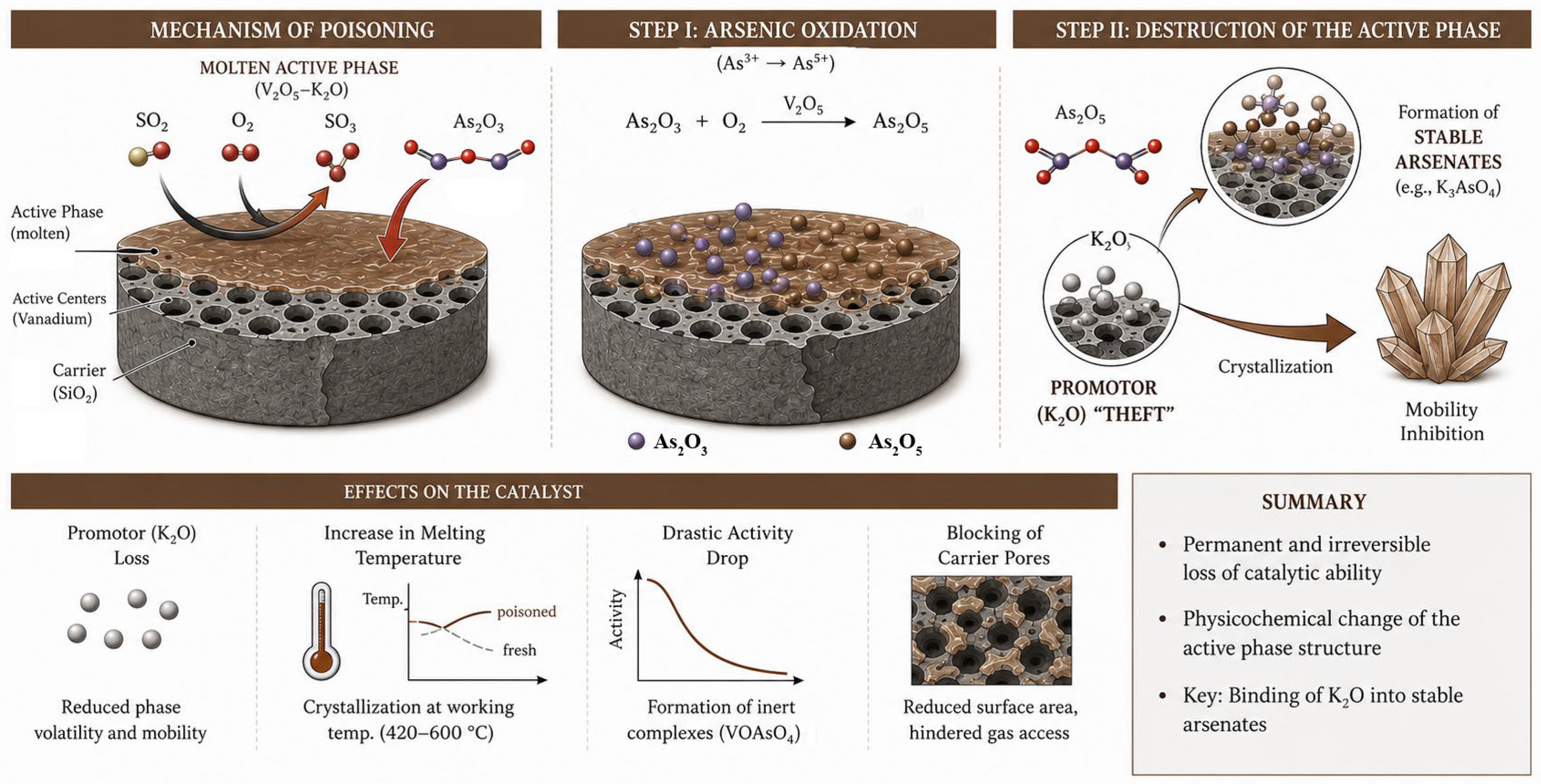
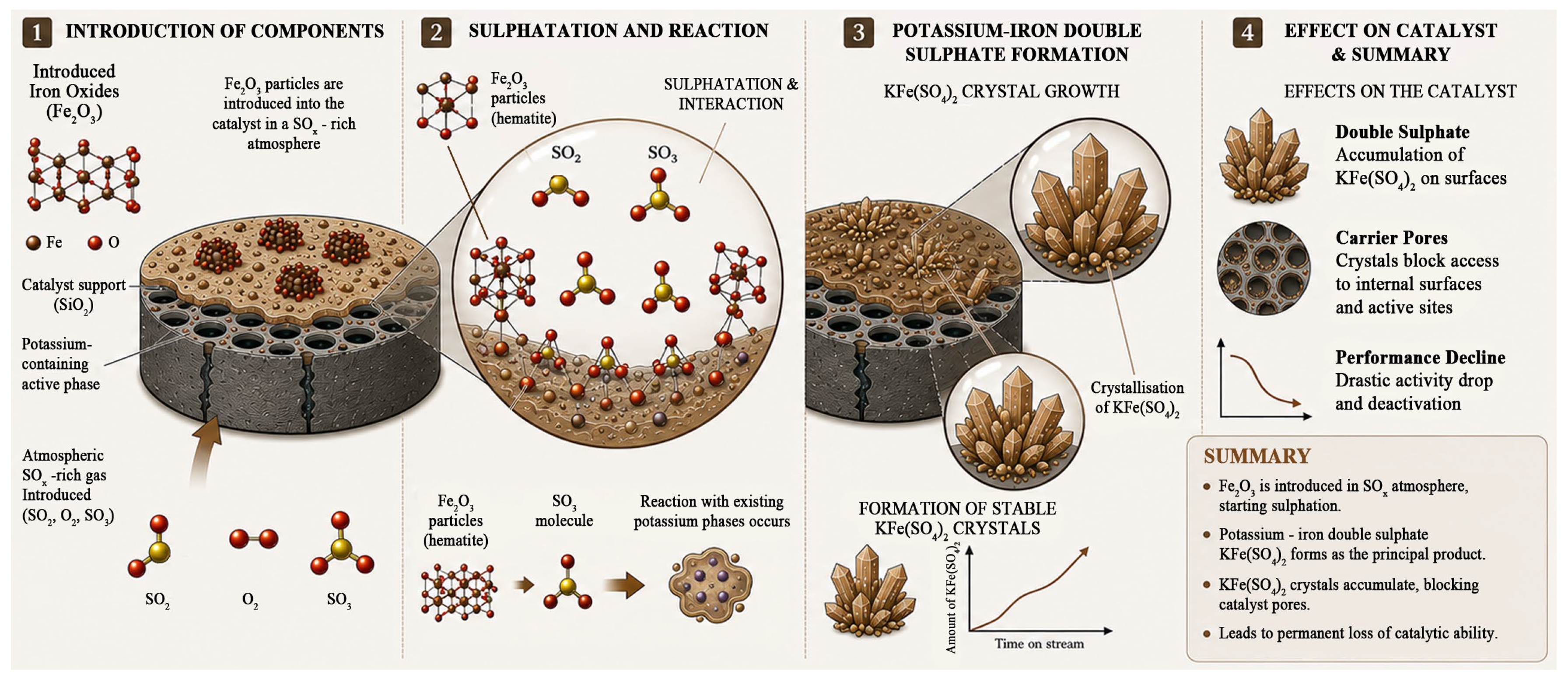
3.5. Chemical Poisoning of Vanadium Catalysts—The Effect of Gaseous Contaminants
3.6. Physical Deactivation and Operational Issues
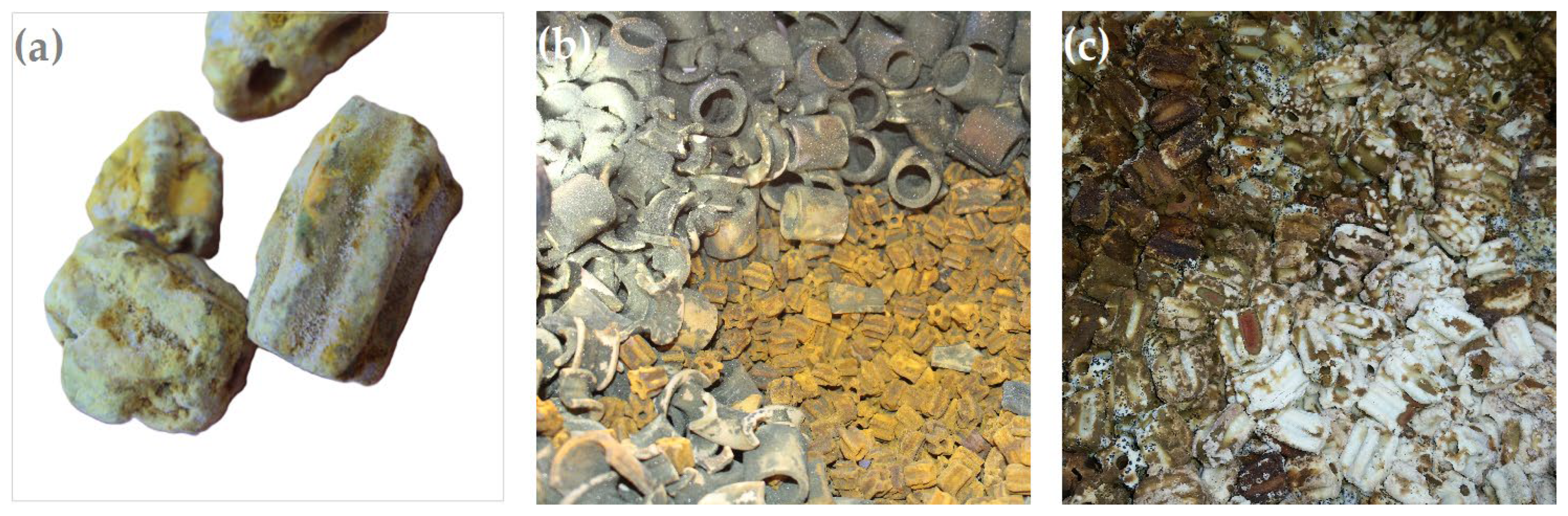
- The occurrence of dust accumulation and bed clogging (Figure 5b). Dust particles, such as ash residues from sulphur combustion or metal oxides from calcining furnaces, are carried by the gas and settle within the voids between the catalyst components. This results in the formation of a hard crust, which has been shown to significantly increase hydraulic resistance. The increase in resistance has a direct impact on the power output of the blowers supplying the gas, which in turn significantly affects electricity costs. In exceptional circumstances, a phenomenon referred to as ‘channelled flow’ occurs, whereby the gas is observed to traverse solely through a limited number of unobstructed channels. Consequently, a marked decline in contact time and a concomitant reduction in the conversion rate are evident [70,73,74,81,82,84].
- Mechanical abrasion and screenings during operation in the contact unit, the catalyst packing (particularly those with complex shapes such as Raschig rings or star-shaped elements) undergoes abrasion due to vibrations and impacts from the gas stream. The resultant catalytic dust further clogs the bed. Statistics from Polish plants (Głogów, Legnica, Police) demonstrate that the proportion of screenings generated during routine inspections ranges from 2% to as much as 15% of the bed mass, contingent on process stability and catalyst quality [70,73,74,81,82,84].
4. Catalyst Condition Diagnostics—Laboratory and Industrial Methods
- Transmission electron microscopy (TEM/HRTEM/HAADF-STEM). This instrument is ideal for structural analysis, including the identification of lattice defects and the dispersion of the active vanadium phase.
- Electron paramagnetic resonance spectroscopy (EPR/ESR) is a technique used in the field of spectroscopy. The present text provides information on the immediate coordination environment of vanadium ions and enables the tracking of catalytic reaction mechanisms.
- Porosimetry is a method of measuring the porosity of a material. One example of this is mercury porosimetry. The assessment of specific surface area, pore volume and density is of crucial importance in determining the availability of active sites.
- The application of UV-Vis spectroscopy is a key element of the research. The composition of solutions is analysed in order to facilitate the study of spent catalysts.
- Thermal analysis (TA) methods. The measurement of changes in mass (TGA) or enthalpy (DSC) as a function of temperature is a method by which the thermal stability of the catalyst can be determined.
- Activity studies in a laboratory setup: Analysis of activity in oxidation processes in the temperature range 400–600 °C.
5. Criteria for the Replacement and Segregation of Vanadium Catalysts, and Innovations in Deactivation Resistance
6. Hydrometallurgical Approaches to Vanadium Recovery from Spent Catalysts
- V2O5-SiO2-K/Na type SVC (Spent Vanadium Catalysts). Spent catalysts from sulphuric acid production plants. Classic contact catalysts in which the active phase consists of V2O5 deposited on a SiO2 support, usually with the addition of alkali promoters, mainly K2SO4 and Na2SO4 [87].
- SCR (Selective Catalytic Reduction) of the V2O5-WO3/TiO2 or V-Mo/Ti type. Spent catalysts used in flue gas denitrification processes. In these materials, the active vanadium phase is mainly deposited on TiO2, and typical additives include WO3 or MoO3 [88].
- HDS-hydrodesulphurisation of the Ni-Mo-V/Al2O3 type. Refinery catalysts in which vanadium is not the primary active component, but occurs as a metallic impurity deposited on an Al2O3 support, usually together with Ni and Mo [89].
6.1. Extraction of Vanadium from Spent Vanadium Catalyst Mass
6.1.1. Acid Leaching
6.1.2. Caustic Leaching
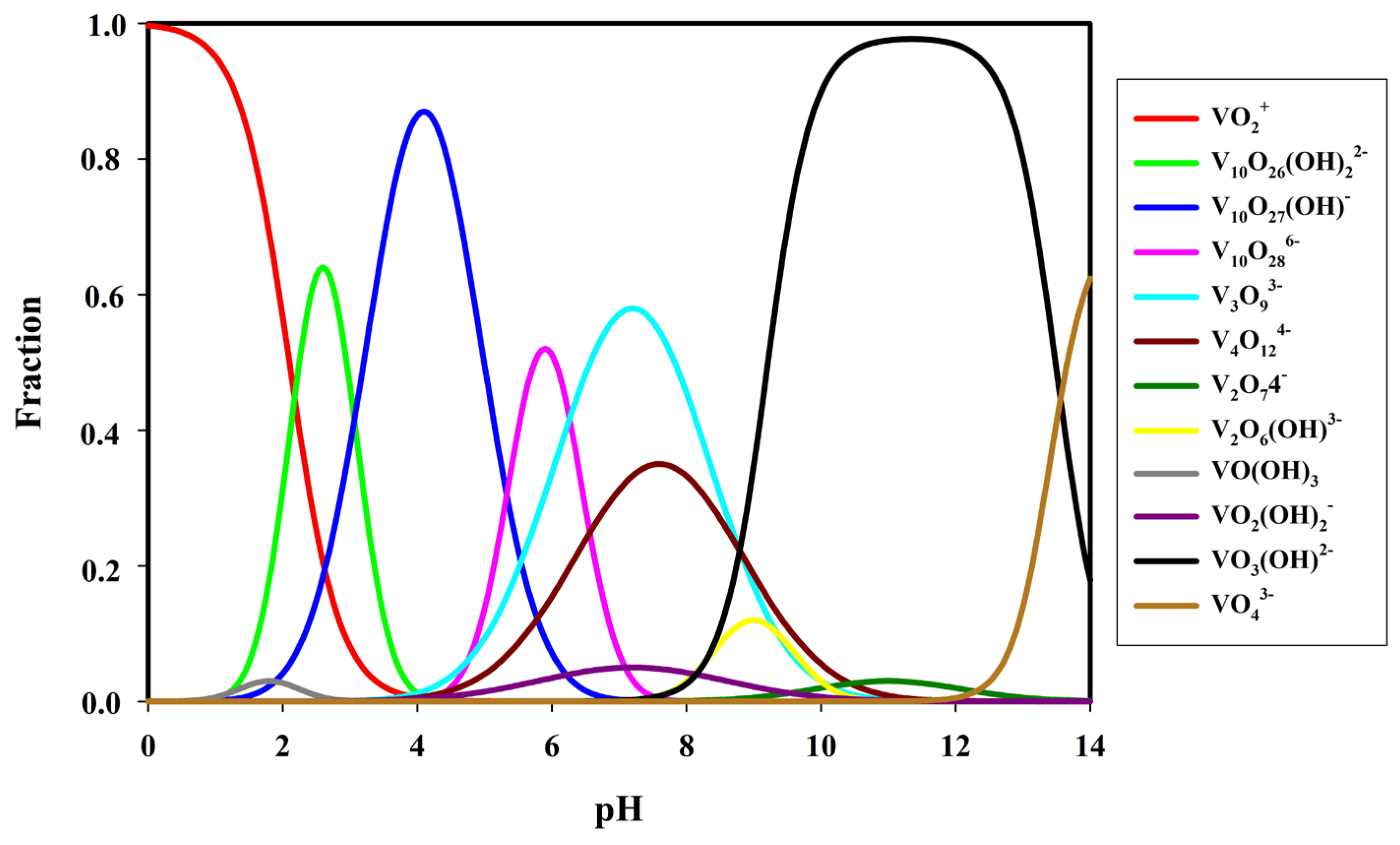
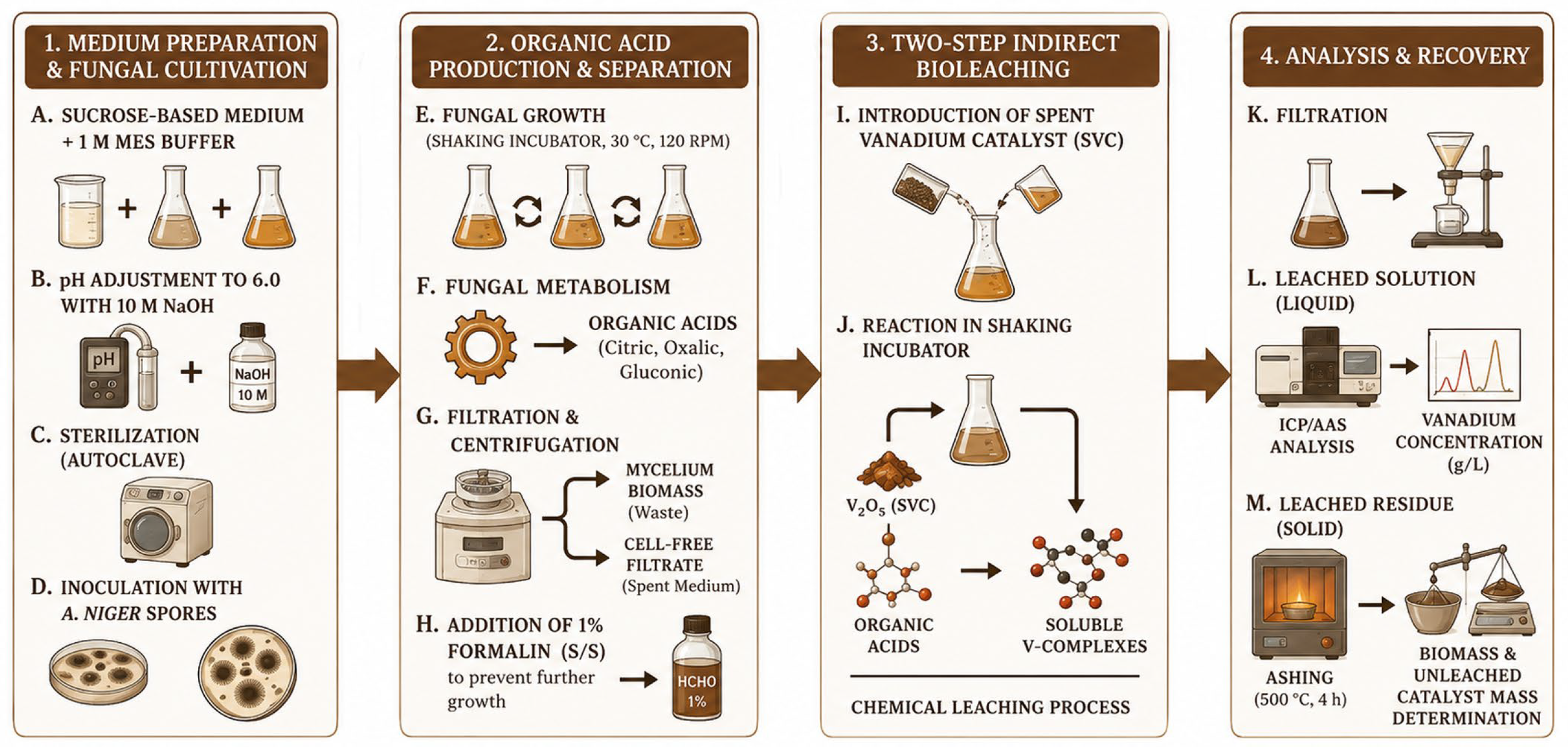
6.1.3. Bioleaching
6.2. Vanadium Separation Techniques from Pregnant Leach Solutions
6.2.1. Adsorption with Activated Carbon
6.2.2. Precipitation
6.2.3. Solvent Extraction
6.2.4. Ion Exchange
6.3. Management of Silica Residue and Secondary Waste Generated After Vanadium Recovery
7. Conclusions
Author Contributions
Funding
Data Availability Statement
Acknowledgments
Conflicts of Interest
References
- European Commission. JRC RMIS. Critical and Strategic Materials. 2024. Available online: https://rmis.jrc.ec.europa.eu/critical-and-strategic-materials (accessed on 9 April 2026).
- U.S. Geological Survey. Vanadium. In 2023 Minerals Yearbook; U.S. Geological Survey: Reston, VA, USA, 2026. Available online: https://pubs.usgs.gov/periodicals/mcs2023/mcs2023.pdf (accessed on 12 April 2026).
- Rogers, B.L.; Banerjee, S. Mine the Gap: Sourcing Vanadium for the Energy Transition. Joule 2025, 9, 102139. [Google Scholar] [CrossRef] [Scilit]
- Temam, A.G.; Alshoaibi, A.; Getaneh, S.A.; Awada, C.; Nwanya, A.C.; Ejikeme, P.M.; Ezema, F.I. Recent Progress on V2O5 Based Electroactive Materials: Synthesis, Properties, and Supercapacitor Application. Curr. Opin. Electrochem. 2023, 38, 101239. [Google Scholar] [CrossRef] [Scilit]
- Le, T.K.; Pham, P.V.; Dong, C.; Bahlawane, N.; Vernardou, D.; Mjejri, I.; Rougier, A.; Kim, S.W. Recent advances in vanadium pentoxide (V2O5) towards related applications in chromogenics and beyond: Fundamentals, progress, and perspectives. J. Mater. Chem. C 2022, 10, 4019–4071. [Google Scholar] [CrossRef] [Scilit]
- Karapidakis, E.; Vernardou, D. Progress on V2O5 Cathodes for Multivalent Aqueous Batteries. Materials 2021, 14, 2310. [Google Scholar] [CrossRef] [Scilit] [PubMed]
- Li, Y.; Chen, S.; Duan, W.; Nan, Y.; Ding, D.; Xiao, G. Research Progress of Vanadium Pentoxide Photocatalytic Materials. RSC Adv. 2023, 13, 22945–22957. [Google Scholar] [CrossRef] [Scilit]
- Hu, P.; Hu, P.; Vu, T.D.; Li, M.; Wang, S.; Ke, Y.; Zeng, X.; Mai, L.; Long, Y. Vanadium Oxide: Phase Diagrams, Structures, Synthesis, and Applications. Chem. Rev. 2023, 123, 4353–4415. [Google Scholar] [CrossRef] [Scilit]
- Gamal, H.; Elshahawy, A.M.; Medany, S.S.; Hefnawy, M.A.; Shalaby, M.S. Recent Advances of Vanadium Oxides and Their Derivatives in Supercapacitor Applications: A Comprehensive Review. J. Energy Storage 2024, 76, 109788. [Google Scholar] [CrossRef] [Scilit]
- Kiran, P.; Jasrotia, P.; Verma, A.; Kumar, A.; Hmar, J.J.L.; Jyoti; Kumar, T. Vanadium Pentoxide Gas Sensors: An Overview of Elemental Doping Strategies and Their Effect on Sensing Performance. Catal. Commun. 2024, 187, 106838. [Google Scholar] [CrossRef] [Scilit]
- Tolstopyatova, E.G.; Salnikova, Y.D.; Holze, R.; Kondratiev, V.V. Progress and Challenges of Vanadium Oxide Cathodes for Rechargeable Magnesium Batteries. Molecules 2024, 29, 3349. [Google Scholar] [CrossRef] [Scilit]
- Li, H.; Wu, J.; Li, M.; Wang, Y. Recent Advances in Vanadium-Based Electrocatalysts for Hydrogen and Oxygen Evolution Reactions: A Review. Catalysts 2024, 14, 368. [Google Scholar] [CrossRef] [Scilit]
- Mazidi, M.; Mosayebi Behbahani, R.; Fazeli, A. Ce Promoted V2O5 Catalyst in Oxidation of SO2 Reaction. Appl. Catal. B-Environ. 2017, 209, 190–202. [Google Scholar] [CrossRef] [Scilit]
- Vo, P.N.X.; Nguyen, L.-P.; Tran, T.V.; Ngo, P.T.; Luong, T.N. Oxidative Regeneration Study of Spent V2O5 Catalyst from Sulfuric Acid Manufacture. React. Kinet. Mech. Catal. 2018, 125, 887–900. [Google Scholar] [CrossRef] [Scilit]
- Grobela, M.; Grzesiak, P. The Influence of Iron Compounds in the Sulfuric Acid Catalyst on the SO2 Oxidation Process. Pol. J. Chem. Technol. 2007, 9, 2–6. [Google Scholar] [CrossRef] [Scilit]
- Balzhinimaev, B.S.; Ivanov, A.A.; Lapina, O.B.; Mastikhin, V.M.; Zamaraev, K.I. Mechanism of Sulphur Dioxide Oxidation over Supported Vanadium Catalysts. Faraday Discuss. Chem. Soc. 1989, 87, 133–147. [Google Scholar] [CrossRef] [Scilit]
- Zhang, W.; Qi, S.; Pantaleo, G.; Liotta, L.F. WO3-V2O5 Active Oxides for NOx SCR by NH3: Preparation Methods, Catalysts’ Composition, and Deactivation Mechanism—A Review. Catalysts 2019, 9, 527. [Google Scholar] [CrossRef] [Scilit]
- Busca, G.; Lietti, L.; Ramis, G.; Berti, F. Chemical and Mechanistic Aspects of the Selective Catalytic Reduction of NOx by Ammonia over Oxide Catalysts: A Review. Appl. Catal. B-Environ. 1998, 18, 1–36. [Google Scholar] [CrossRef] [Scilit]
- Zhao, S.; Peng, J.; Ge, R.; Yang, K.; Wu, S.; Qian, Y.; Xu, T.; Gao, J.; Chen, Y.; Sun, Z. Poisoning and Regeneration of Commercial V2O5-WO3/TiO2 Selective Catalytic Reduction (SCR) Catalyst in Coal-Fired Power Plants. Process Saf. Environ. Prot. 2022, 168, 971–992. [Google Scholar] [CrossRef] [Scilit]
- Rajath, S.; Bagewadi, M.; Shivakumar, N.D. V2O5-TiO2 SCR Plate Catalysts for High Dust De-NOx Applications: A Comprehensive Characterization Study. Emiss. Control Sci. Technol. 2025, 11, 25. [Google Scholar] [CrossRef] [Scilit]
- Gnanasekaran, L.; Rajendran, S.; Karimi-Maleh, H.; Priya, A.K.; Qin, J.; Soto-Moscoso, M.; Ansar, S.; Bathula, C. Surface Modification of TiO2 by Adding V2O5 Nanocatalytic System for Hydrogen Generation. Chem. Eng. Res. Des. 2022, 182, 114–119. [Google Scholar] [CrossRef] [Scilit]
- Vinodh, R.; Pollet, B.G. Facile and cost-effective nickel-anchored nanofibril V2O5 electrocatalyst for efficient oxygen evolution reaction. Int. J. Hydrogen Energy 2025, 113, 395–405. [Google Scholar] [CrossRef] [Scilit]
- Nandana, A.B.; Anand, A.C.; George, S.M.; Rakhi, R.B. Electrochemical Investigation of V2O5 as a High-Performance Material for Supercapacitors and Electrocatalysis. ACS Appl. Electron. Mater. 2026, 8, 634–644. [Google Scholar] [CrossRef] [Scilit]
- Schneider, K.; Lubecka, M.; Czapla, A. V2O5 Thin Films for Gas Sensor Applications. Sens. Actuators B Chem. 2016, 236, 970–977. [Google Scholar] [CrossRef] [Scilit]
- Majumdar, D.; Mandal, M.; Bhattacharya, S.K. V2O5 and Its Carbon-Based Nanocomposites for Supercapacitor Applications. ChemElectroChem 2019, 6, 1623–1648. [Google Scholar] [CrossRef] [Scilit]
- Zhang, W.; Zuo, C.; Tang, C.; Tang, W.; Lan, B.; Fu, X.; Dong, S.; Luo, P. The Current Developments and Perspectives of V2O5 as Cathode for Rechargeable Aqueous Zinc-Ion Batteries. Energy Technol. 2021, 9, 2000789. [Google Scholar] [CrossRef] [Scilit]
- Li, Y.; Huang, Z.; Kalambate, P.K.; Zhong, Y.; Huang, Z.; Xie, M.; Shen, Y.; Huang, Y. V2O5 Nanopaper as a Cathode Material with High Capacity and Long Cycle Life for Rechargeable Aqueous Zinc-Ion Battery. Nano Energy 2019, 60, 752–759. [Google Scholar] [CrossRef] [Scilit]
- Babar, B.M.; Sutar, S.H.; Mujawar, S.H.; Patil, S.S.; Babar, U.D.; Pawar, U.T.; Kadam, P.M.; Patil, P.S.; Kadam, L.D. V2O5-rGO Based Chemiresistive Gas Sensor for NO2 Detection. Mater. Sci. Eng. B 2023, 298, 116827. [Google Scholar] [CrossRef] [Scilit]
- Zhang, F.; Qu, Y.; Lu, X.; Ding, Z.; Li, S.; Ji, W.; Liu, S. Double-Shelled Hollow Sphere V2O5-Based Conductometric Ethanol Gas Sensor. Sens. Actuators B Chem. 2024, 417, 136009. [Google Scholar] [CrossRef] [Scilit]
- Wang, Z.; Liu, Y.; Zhang, Y.; Dong, Y.; Jiang, Z.; Zhang, L.; Liu, W.; Guan, J.; Lin, H. Efficient and Sustainable Photocatalytic Degradation of Dye in Wastewater with Porous and Recyclable Wood Foam@V2O5 Photocatalysts. J. Clean. Prod. 2022, 332, 130054. [Google Scholar] [CrossRef] [Scilit]
- Shalini, K.S.; Kavitha, R.; Basavarajaiah, S.M.; Nirmala, B. Green Synthesis of α-V2O5 Photocatalyst Using Gymnema sylvestre Leaf Extract and an Insight into the Mechanism of Photocatalytic Degradation of Methylene Blue and Congo Red under Visible Light Illumination. Next Sustain. 2026, 7, 100267. [Google Scholar] [CrossRef] [Scilit]
- Yadav, A.A.; Hunge, Y.M.; Kang, S.-W.; Fujishima, A.; Terashima, C. Enhanced Photocatalytic Degradation Activity Using the V2O5/rGO Composite. Nanomaterials 2023, 13, 338. [Google Scholar] [CrossRef] [Scilit]
- Mahnoor, M.; Chandio, R.; Inam, A.; Ahad, I.U. Critical and Strategic Raw Materials for Energy Storage Devices. Batteries 2025, 11, 163. [Google Scholar] [CrossRef] [Scilit]
- Simandl, G.J.; Paradis, S. Vanadium as a Critical Material: Economic Geology with Emphasis on Market and the Main Deposit Types. Appl. Earth Sci. 2022, 131, 218–236. [Google Scholar] [CrossRef] [Scilit]
- U.S. Geological Survey. Mineral Commodity Summaries 2026; U.S. Geological Survey: Reston, VA, USA, 2026. [CrossRef] [Scilit]
- U.S. Geological Survey. Vanadium. In Minerals Yearbook 2022: Metals and Minerals; U.S. Geological Survey: Reston, VA, USA, 2026. Available online: https://pubs.usgs.gov/myb/vol1/2022/myb1-2022-vanadium.pdf (accessed on 12 April 2026).
- U.S. Geological Survey. Vanadium. In Minerals Yearbook 2018: Metals and Minerals; U.S. Geological Survey: Reston, VA, USA, 2021. Available online: https://d9-wret.s3.us-west-2.amazonaws.com/assets/palladium/production/atoms/files/myb1-2018-vanad.pdf (accessed on 12 April 2026).
- U.S. Geological Survey. Vanadium. In Minerals Yearbook 2010: Metals and Minerals; U.S. Geological Survey: Reston, VA, USA, 2012. Available online: https://d9-wret.s3.us-west-2.amazonaws.com/assets/palladium/production/mineral-pubs/vanadium/myb1-2010-vanad.pdf (accessed on 12 April 2026).
- U.S. Geological Survey. Vanadium. In Minerals Yearbook 2005: Metals and Minerals; U.S. Geological Survey: Reston, VA, USA, 2007. Available online: https://d9-wret.s3.us-west-2.amazonaws.com/assets/palladium/production/mineral-pubs/vanadium/vanadmyb05.pdf (accessed on 12 April 2026).
- U.S. Geological Survey. Vanadium. In Minerals Yearbook 2001: Metals and Minerals; U.S. Geological Survey: Reston, VA, USA, 2003. Available online: https://d9-wret.s3.us-west-2.amazonaws.com/assets/palladium/production/mineral-pubs/vanadium/vanamyb01.pdf (accessed on 12 April 2026).
- Hossain, M.H.; Abdullah, N.; Tan, K.H.; Saidur, R.; Mohd Radzi, M.A.; Shafie, S. Evolution of Vanadium Redox Flow Battery in Electrode. Chem. Rec. 2024, 24, e202300092. [Google Scholar] [CrossRef] [Scilit]
- Puleston, T.; Clemente, A.; Costa-Castelló, R.; Serra, M. Modelling and Estimation of Vanadium Redox Flow Batteries: A Review. Batteries 2022, 8, 121. [Google Scholar] [CrossRef] [Scilit]
- Al Amayreh, H.H.; Al-Harahsheh, M.; Al-Otoom, A.Y.; Al-Makhadmeh, L.; Al-Harahsheh, A.M. The Recovery of Vanadium Pentoxide (V2O5) from Spent Catalyst Utilized in a Sulfuric Acid Production Plant in Jordan. Materials 2023, 16, 6503. [Google Scholar] [CrossRef] [Scilit]
- Romanovskaia, E.; Romanovski, V.; Kwapinski, W.; Kurilo, I. Selective Recovery of Vanadium Pentoxide from Spent Catalysts of Sulfuric Acid Production: Sustainable Approach. Hydrometallurgy 2021, 200, 105568. [Google Scholar] [CrossRef] [Scilit]
- El Hasbaoui, N.; Elhadrami, A.; Brahmi, R. Method for Regenerating Spent Catalyst Used to Produce Sulfuric Acid in the SO2 to SO3 Conversion Step. Mater. Sci. Forum 2025, 1173, 113–121. [Google Scholar] [CrossRef] [Scilit]
- Wagenfeld, J.-G.; Al-Ali, K.; Almheiri, S.; Slavens, A.F.; Calvet, N. Sustainable applications utilizing sulfur, a by-product from oil and gas industry: A state-of-the-art review. Waste Manag. 2019, 95, 78–89. [Google Scholar] [CrossRef] [Scilit]
- Maslin, M.; Van Heerde, L.; Day, S. Sulfur: A potential resource crisis that could stifle green technology and threaten food security as the world decarbonises. Geogr. J. 2022, 188, 498–505. [Google Scholar] [CrossRef] [Scilit]
- U.S. Geological Survey. Mineral Commodity Summaries 2025; U.S. Geological Survey: Reston, VA, USA, 2025. [CrossRef] [Scilit]
- U.S. Geological Survey. Mineral Commodity Summaries 2020; U.S. Geological Survey: Reston, VA, USA, 2020. [CrossRef] [Scilit]
- Bertau, M.; Wellmer, F.-W.; Scholz, R.W.; Mew, M.; Zenk, L.; Aubel, I.; Fröhlich, P.; Raddant, M.; Steiner, G. The Future of Phosphoric Acid Production—Why We Have to Leave Trodden Paths. ChemSusChem 2025, 18, e202401155. [Google Scholar] [CrossRef] [Scilit] [PubMed]
- Davenport, W.G.; King, M.J.; Moats, M.S.; Schlesinger, M.E. Sulfuric Acid Manufacture: Analysis, Control and Optimization; Elsevier: Oxford, UK, 2013. [Google Scholar]
- Sharma, R.K.; Cox, M.S.; Oglesby, C.; Dhillon, J.S. Revisiting the role of sulfur in crop production: A narrative review. J. Agric. Food Res. 2024, 15, 101013. [Google Scholar] [CrossRef] [Scilit]
- Ciesielczyk, F.; Jesionowski, T. Inorganic Acids—Technology Background and Future Perspectives. Phys. Sci. Rev. 2020, 5, 20190030. [Google Scholar] [CrossRef] [Scilit]
- Toledo, A.G.R.; Bevilaqua, D.; Panda, S.; Akcil, A. Hydrometallurgical processing of sulfide minerals from the perspective of semiconductor electrochemistry: A review. Miner. Eng. 2023, 200, 10x09. [Google Scholar] [CrossRef] [Scilit]
- León, F.; Rojas, L.; Bazán, V.; Martínez, Y.; Peña, A.; Garcia, J. A systematic review of copper heap leaching: Key operational variables, green reagents, and sustainable engineering strategies. Processes 2025, 13, 1513. [Google Scholar] [CrossRef] [Scilit]
- Zhao, K.; Gao, F.; Yang, Q. Comprehensive review on metallurgical upgradation processes of nickel sulfide ores. J. Sustain. Metall. 2022, 8, 1169–1195. [Google Scholar] [CrossRef] [Scilit]
- Zhang, W.; Li, X.; Zhao, L.; Sun, W. Comparative Analysis of Sulfuric-Acid-Catalyzed Isobutane-Butene Alkylation Based on Kinetic Modeling. Processes 2025, 13, 1604. [Google Scholar] [CrossRef] [Scilit]
- Ivashkina, E.N.; Ivanchina, E.D.; Nurmakanova, A.E.; Boychenko, S.S.; Ushakov, A.S.; Dolganova, I.O. Mathematical Modeling of Sulfuric Acid Catalyzed Alkylation of Isobutane with Olefins. Procedia Eng. 2016, 152, 81–86. [Google Scholar] [CrossRef] [Scilit]
- Xin, Z.; Jiang, H.; Zhang, Z.; Chen, Y.; Wang, J. Kinetic Model of Olefins/Isobutane Alkylation Using Sulfuric Acid as Catalyst. ACS Omega 2022, 7, 9513–9526. [Google Scholar] [CrossRef] [Scilit] [PubMed]
- Tian, S.; Wang, Y.; Zhang, X.; Li, J. Case Study for Enhancing Concentration of Waste Dilute Sulfuric Acid. Sep. Purif. Technol. 2023, 312, 123373. [Google Scholar] [CrossRef] [Scilit]
- Li, W.; Erickson, E.M.; Manthiram, A. High-Nickel Layered Oxide Cathodes for Lithium-Based Automotive Batteries. Nat. Energy 2020, 5, 26–34. [Google Scholar] [CrossRef] [Scilit]
- Li, H.; Xing, S.; Liu, Y.; Li, F.; Guo, H.; Kuang, G. Recovery of Lithium, Iron, and Phosphorus from Spent LiFePO4 Batteries Using Stoichiometric Sulfuric Acid Leaching System. ACS Sustain. Chem. Eng. 2017, 5, 8017–8024. [Google Scholar] [CrossRef] [Scilit]
- Ukwuani, A.T.; Tao, W. Developing a Vacuum Thermal Stripping-Acid Absorption Process for Ammonia Recovery from Digestate. Water Res. 2016, 106, 108–117. [Google Scholar] [CrossRef] [Scilit] [PubMed]
- Shannak, S.; Cochrane, L.; Bobarykina, D. Strategic Analysis of Metal Dependency in the Transition to Low-Carbon Energy: A Critical Examination of Nickel, Cobalt, Lithium, Graphite, and Copper Scarcity. Energy Res. Soc. Sci. 2024, 118, 103773. [Google Scholar] [CrossRef] [Scilit]
- Kiefer, D.M. Sulfuric acid: Pumping up the volume. Today’s Chem. Work 2001, 10, 57–58. [Google Scholar]
- Ashar, N.G.; Golwalkar, K.R. A Practical Guide to the Manufacture of Sulfuric Acid, Oleums, and Sulfonating Agents; Springer: Cham, Switzerland, 2013. [Google Scholar] [CrossRef] [Scilit]
- d’Aquin, G.E.; Fell, R.C. Sulfur and Sulfuric Acid. In Handbook of Industrial Chemistry and Biotechnology, 12th ed.; Kent, J.A., Ed.; Springer: Boston, MA, USA, 2012. [Google Scholar] [CrossRef] [Scilit]
- Grzesiak, P. Methods and Technologies of Sulphuric Acid Production. In Sulphuric Acid; Institute of Plant Protection (IOR): Poznań, Poland, 2002; Volume 1. (In Polish) [Google Scholar]
- Müller, H. Sulfuric Acid and Sulfur Trioxide. In Ullmann’s Encyclopedia of Industrial Chemistry; Wiley-VCH: Weinheim, Germany, 2000. [Google Scholar] [CrossRef] [Scilit]
- European Commission. Best Available Techniques (BAT) Reference Document for the Production of Large Volume Inorganic Chemicals—Ammonia, Acids and Fertilisers; Publications Office of the European Union: Luxembourg, 2017. [Google Scholar]
- Grzesiak, P. Best Available Techniques (BAT) in Sulphuric Acid Production. In Sulphuric Acid; Institute of Plant Protection (IOR): Poznań, Poland, 2004; Volume 2. (In Polish) [Google Scholar]
- Vernikovskaya, N.V.; Zagoruiko, A.N.; Noskov, A.S. SO2 oxidation method: Mathematical modeling taking into account dynamic properties of the process. Chem. Eng. Sci. 1999, 54, 5239–5246. [Google Scholar] [CrossRef] [Scilit]
- Grzesiak, P. Vanadium Catalysts for the Oxidation of SO2. In Sulphuric Acid; Institute of Plant Protection (IOR): Poznań, Poland, 2005; Volume 5. (In Polish) [Google Scholar]
- Mazurek, K. Recovery of vanadium, potassium and iron from a spent vanadium catalyst by oxalic acid solution leaching, precipitation and ion exchange processes. Hydrometallurgy 2013, 134–135, 26–31. [Google Scholar] [CrossRef] [Scilit]
- Ksibi, M.; Elaloui, E.; Houas, A.; Moussa, N. Diagnosis of deactivation sources for vanadium catalysts used in SO2 oxidation reaction and optimization of vanadium extraction from deactivated catalysts. Appl. Surf. Sci. 2003, 220, 105–112. [Google Scholar] [CrossRef] [Scilit]
- Cavalca, F.; Beato, P.; Hyldtoft, J.; Christensen, K.; Helveg, S. Vanadia-based catalysts for the sulfur dioxide oxidation studied in situ by transmission electron microscopy and raman spectroscopy. J. Phys. Chem. C 2017, 121, 3350–3364. [Google Scholar] [CrossRef] [Scilit]
- EL Hasbaoui, N.; EL Hadrami, A.; Brahmi, R. Accelerated deactivation of industrial SO2 oxidation catalysts in sulfuric acid production. Comptes Rendus Chim. 2026, 29, 99–105. [Google Scholar] [CrossRef] [Scilit]
- Li, X.; Yao, D.; Wu, F.; Wang, X.; Wei, L.; Liu, B. New findings in hydrothermal deactivation research on the vanadia-selective catalytic reduction catalyst. ACS Omega 2019, 4, 5088−5097. [Google Scholar] [CrossRef] [Scilit]
- Li, J.; Zhang, P.; Chen, L.; Zhang, Y.; Qi, L. Regeneration of selective catalyst reduction catalysts deactivated by Pb, As, and alkali metals. ACS Omega 2020, 5, 13886−13893. [Google Scholar] [CrossRef] [Scilit]
- Mikoda, B.; Potysz, A.; Gruszecka-Kosowska, A.; Kmiecik, E.; Tomczyk, A. Spent sulfuric acid plant catalyst: Valuable resource of vanadium or risky residue? Process comparison for environmental implications. Environ. Sci. Pollut. Res. 2021, 28, 59358–59367. [Google Scholar] [CrossRef] [Scilit] [PubMed]
- European Sulphuric Acid Association & Fertilizers Europe. Best Available Techniques for Pollution Prevention and Control in the European Sulphuric Acid and Fertilizer Industries. In Booklet No. 3 of 8, 2nd ed.; ESA/Fertilizers Europe: Brussels, Belgium, 2000. [Google Scholar]
- Perdomo Gómez, L.; Perdomo González, L.; Coello Machado, N.; Glistau, E. Vanadium recovery from spent catalyst: From lab to industry. Int. J. Eng. 2024, 22, 59–70. [Google Scholar]
- Wang, X.; Kang, Y.; Li, J.; Li, D. Influence of cerium and cesium promoters on vanadium catalyst for sulfur dioxide oxidation. Korean J. Chem. Eng. 2019, 36, 650–659. [Google Scholar] [CrossRef] [Scilit]
- Cheng, W.; Li, J.; Deng, J.; Li, Y.; Cheng, F. Leaching vanadium from the spent denitration catalyst in the sulfuric acid/oxalic acid combined solvent. ACS Omega 2024, 9, 9286–9294. [Google Scholar] [CrossRef] [Scilit]
- Du, X.; Xue, J.; Wang, X.; Chen, Y.; Ran, J.; Zhang, L. Oxidation of sulfur dioxide over V2O5/TiO2 catalyst with low vanadium loading: A theoretical study. J. Phys. Chem. C. 2018, 122, 4517–4523. [Google Scholar] [CrossRef] [Scilit]
- Chen, B.; Guo, Y.; Du, H.; Wang, S.; Liu, B.; Li, L. Review of Vanadium Production Part II: Secondary Resources. Min. Metall. Explor. 2026, 43, 769–791. [Google Scholar] [CrossRef] [Scilit]
- Wen, J.; Wang, X.; Yu, F.; Tian, M.; Wang, C.; Huang, G.; Xu, S. Recovery and Value-Added Utilization of Critical Metals from Spent Catalysts for New Energy Industry. J. Clean. Prod. 2023, 419, 138295. [Google Scholar] [CrossRef] [Scilit]
- Zeng, F.; Van Caneghem, J.; Granata, G. Alkaline Leaching of Spent SCR Catalysts: Mechanochemical Activation vs. Mechanochemical Leaching. Sep. Purif. Technol. 2026, 390, 136806. [Google Scholar] [CrossRef] [Scilit]
- Yu, H.; Liu, S.; Yaraş, A.; Enkhchimeg, B.; Hu, L.; Zhang, W.; Peng, M.; Arslanoğlu, H.; Mao, L. Recovery of Valuable Metals from Spent Hydrodesulfurization (HDS) Catalysts: A Comprehensive Research Review and Specific Industrial Cases. J. Environ. Manag. 2025, 379, 124920. [Google Scholar] [CrossRef] [Scilit]
- Trypuć, M.; Grzesiak, P.; Mazurek, K.; Grobela, M. Kompleksowe Zagospodarowanie Szkodliwych Odpadów Katalizatora Wanadowego Stosowanego Do Utleniania SO2, Tom 1, Charakterystyka Procesów i Katalizatorów w Produkcji Kwasu Siarkowego [Comprehensive Management of Harmful Waste of Vanadium Catalyst Used for SO2 Oxidation, Volume 1, Characteristics of Processes and Catalysts in Sulfuric Acid Production]; Wydawnictwo Naukowe Instytutu Ochrony Roślin w Poznaniu: Poznań, Poland, 2007; p. 195. (In Polish) [Google Scholar]
- Garcia, D.J.; Lozano Blanco, L.J.; Mulero Vivancos, M.D. Leaching of Vanadium from Sulphuric Acid Manufacture Spent Catalysts. Rev. Metal. Madrit. 2001, 37, 18–23. [Google Scholar] [CrossRef] [Scilit]
- Perdomo Gómez, L.A.; Perdomo González, L.; Coello Machado, N.I.; Glistau, E. Processing Strategy for Catalytic Residues Containing Vanadium. In Otto-Von-Guericke Universität Magdeburg; OVGU: Magdeburg, Germany, 2024. [Google Scholar] [CrossRef]
- Wu, L.; Dai, C.; Wang, H.; Wang, J.; Dong, Y. Leaching of Vanadium, Potassium, and Iron from Spent Catalyst of the Manufacture of Sulfuric Acid. J. Mater. Res. Technol. 2021, 11, 905–913. [Google Scholar] [CrossRef] [Scilit]
- Shaltout, A.; El-Hallag, R.; Razek, T. Green Recovery of Vanadium from Spent Vanadium Catalyst from Sulfuric Acid Production. Sci. Rep. 2026, 16, 12869. [Google Scholar] [CrossRef] [Scilit]
- DocsRoom—European Commission. Available online: https://ec.europa.eu/docsroom/documents/42849 (accessed on 28 April 2026).
- Wang, M.; Huang, S.; Chen, B.; Wang, X. A Review of Processing Technologies for Vanadium Extraction from Stone Coal. Miner. Process. Extr. Metall. 2018, 129, 290–298. [Google Scholar] [CrossRef] [Scilit]
- Grzesiak, P. Utilization of industrial wastes from sulfuric acid production processes. Przem. Chem. 2006, 85, 1015–1019. [Google Scholar]
- Pyrzyńska, K.; Wierzbicki, T. Determination of Vanadium Species in Environmental Samples. Talanta 2004, 64, 823–829. [Google Scholar] [CrossRef] [Scilit]
- Liu, L.; Wang, L.; Su, S.; Yang, T.; Dai, Z.; Qing, M.; Xu, K.; Hu, S.; Wang, Y.; Xiang, J. Leaching Behavior of Vanadium from Spent SCR Catalyst and Its Immobilization in Cement-Based Solidification/Stabilization with Sulfurizing Agent. Fuel 2019, 243, 406–412. [Google Scholar] [CrossRef] [Scilit]
- Bauer, G.; Güther, V.; Hess, H.; Otto, A.; Roidl, O.; Roller, H.; Sattelberger, S. Vanadium and Vanadium Compounds. In Ullmann’s Encyclopedia of Industrial Chemistry; John Wiley & Sons, Ltd.: Hoboken, NJ, USA, 2000. [Google Scholar]
- Sola, A.B.C.; Kumar Parhi, P.; Lee, J.-Y.; Nam Kang, H.; Kumar Jyothi, R. Environmentally Friendly Approach to Recover Vanadium and Tungsten from Spent SCR Catalyst Leach Liquors Using Aliquat 336. RSC Adv. 2020, 10, 19736–19746. [Google Scholar] [CrossRef] [Scilit] [PubMed]
- Mazurek, K.; Grzesiak, P.; Trypuć, M.; Grobela, M.; Białowicz, K.; Motała, R. The comprehensive management of the hazardous vanadium catalyst waste from the oxidation of SO2; P1: Hydrometallurgical processes. Przem. Chem. 2010, 89, 253–258. [Google Scholar]
- Wen, J.; Ning, P.; Cao, H.; Zhao, H.; Sun, Z.; Zhang, Y. Novel Method for Characterization of Aqueous Vanadium Species: A Perspective for the Transition Metal Chemical Speciation Studies. J. Hazard. Mater. 2019, 364, 91–99. [Google Scholar] [CrossRef] [Scilit]
- Baldermann, A.; Stamm, F.M. Effect of Kinetics, pH, Aqueous Speciation and Presence of Ferrihydrite on Vanadium (V) Uptake by Allophanic and Smectitic Clays. Chem. Geol. 2022, 607, 121022. [Google Scholar] [CrossRef] [Scilit]
- Kologrieva, U.; Volkov, A.; Krasnyanskaya, I.; Stulov, P.; Wainstein, D. Analysis of Hydrometallurgical Methods for Obtaining Vanadium Concentrates from the Waste by Chemical Production of Vanadium Pentoxide. Materials 2022, 15, 938. [Google Scholar] [CrossRef] [Scilit] [PubMed]
- Wachs, I.E. Catalysis Science of Supported Vanadium Oxide Catalysts. Dalton Trans. 2013, 42, 11762–11769. [Google Scholar] [CrossRef] [Scilit]
- Moskalyk, R.R.; Alfantazi, A.M. Processing of Vanadium: A Review. Miner. Eng. 2003, 16, 793–805. [Google Scholar] [CrossRef] [Scilit]
- Moon, G.; Kim, J.H.; Lee, J.-Y.; Kang, J. Leaching of Spent Selective Catalytic Reduction Catalyst Using Alkaline Melting for Recovery of Titanium, Tungsten, and Vanadium. Hydrometallurgy 2019, 189, 105132. [Google Scholar] [CrossRef] [Scilit]
- Jeon, J.H.; Cueva Sola, A.B.; Lee, J.Y.; Jyothi, R.K. Hydrometallurgical Process Development to Recycle Valuable Metals from Spent SCR DeNOx Catalyst. Sci. Rep. 2021, 11, 22131. [Google Scholar] [CrossRef] [Scilit]
- Zeng, L.; Cheng, C.Y. A Literature Review of the Recovery of Molybdenum and Vanadium from Spent Hydrodesulphurisation Catalysts: Part I: Metallurgical Processes. Hydrometallurgy 2009, 98, 1–9. [Google Scholar] [CrossRef] [Scilit]
- Lozano-Blanco, L.; Juan, D. Leaching of Vanadium from Spent Sulphuric Acid Catalysts. Miner. Eng. 2001, 14, 543–546. [Google Scholar] [CrossRef] [Scilit]
- Singh, N.; Pasupuleti, K.S.; Ambili, S.; Lee, J.; Kim, M.-D.; Lee, J.-Y. Sustainable Vanadium Recovery from SAM Spent Catalysts: A Hydrometallurgical Approach for High-Purity V2O5 Production and Gas Sensing Applications. Sustain. Mater. Technol. 2026, 48, e01995. [Google Scholar] [CrossRef] [Scilit]
- Mazurek, K. Removal of Vanadium, Potassium and Iron from Spent Vanadium Catalyst by Leaching with Citric Acid at Atmospheric Pressure. Green Sci. 2014, 16, 59–62. [Google Scholar] [CrossRef] [Scilit]
- Erust, C.; Akcil, A.; Bedelova, Z.; Anarbekov, K.; Baikonurova, A.; Tuncuk, A. Recovery of Vanadium from Spent Catalysts of Sulfuric Acid Plant by Using Inorganic and Organic Acids: Laboratory and Semi-Pilot Tests. Waste Manag. 2016, 49, 455–461. [Google Scholar] [CrossRef] [Scilit]
- Sefton, V.B.; Fox, R.; Lorenz, W.P. Method of Separately Recovering Metal Values of Petroleum Refining Catalyst. US Patent US4861565A, 29 August 1989. [Google Scholar]
- Wang, B.; Yang, Q. Recovery of V2O5 from Spent SCR Catalyst by H2SO4-Ascorbic Acid Leaching and Chemical Precipitation. J. Environ. Chem. Eng. 2022, 10, 108719. [Google Scholar] [CrossRef] [Scilit]
- Nikiforova, A.; Kozhura, O.; Pasenko, O. Leaching of Vanadium by Sulfur Dioxide from Spent Catalysts for Sulfuric Acid Production. Hydrometallurgy 2016, 164, 31–37. [Google Scholar] [CrossRef] [Scilit]
- Marafi, M.; Stanislaus, A. Spent Hydroprocessing Catalyst Management: A Review: Part II. Advances in Metal Recovery and Safe Disposal Methods. Resour. Conserv. Recycl. 2008, 53, 1–26. [Google Scholar] [CrossRef] [Scilit]
- Abbott, A.P.; Capper, G.; Davies, D.L.; Abas, F.O. Vanadium Oxide Recovery from Spent Catalysts by Chemical Leaching. Eng. Technol. 2008, 26, 1–2. [Google Scholar] [CrossRef] [Scilit]
- Ho, E.M.; Kyle, J.; Lallenec, S.; Muir, D.M.; Parker, A.J. Recovery of Vanadium from Spent Catalysts and Alumina Residues. In Hydrometallurgy ’94; Springer: Dordrecht, The Netherlands, 1994; pp. 1105–1121. [Google Scholar] [CrossRef] [Scilit]
- Mousa, K.M.; Kouba, S.K. Study on Vanadium Recovery from Spent Catalyst Used in the Manufacture of Sulfuric Acid. Iraqi J. Chem. Pet. Eng. 2010, 11, 49–54. [Google Scholar] [CrossRef] [Scilit]
- Mazurek, K.; Białowicz, K.; Trypuć, M. Extraction of Vanadium Compounds from the Used Vanadium Catalyst with the Potassium Hydroxide Solution. Green Sci. 2010, 12, 23–28. [Google Scholar] [CrossRef] [Scilit]
- Mazurek, K.; Białowicz, K.; Trypuć, M. Recovery of Vanadium, Potassium and Iron from a Spent Catalyst Using Urea Solution. Hydrometallurgy 2010, 103, 19–24. [Google Scholar] [CrossRef] [Scilit]
- Ognyanova, A.; Ozturk, A.T.; De Michelis, I.; Ferella, F.; Taglieri, G.; Akcil, A.; Vegliò, F. Metal Extraction from Spent Sulfuric Acid Catalyst through Alkaline and Acidic Leaching. Hydrometallurgy 2009, 100, 20–28. [Google Scholar] [CrossRef] [Scilit]
- Erüst, C.; Akcil, A.; Gahan, C.S.; Tuncuk, A.; Deveci, H. Biohydrometallurgy of Secondary Metal Resources: A Potential Alternative Approach for Metal Recovery. J. Chem. Technol. Biotechnol. 2013, 88, 2115–2132. [Google Scholar] [CrossRef] [Scilit]
- Pradhan, D.; Kim, D.J.; Ahn, J.G.; Gahan, C.S.; Chung, H.S.; Lee, S.W. Comparison of Bioleaching Kinetics of Spent Catalyst by Adapted and Unadapted Iron & Sulfur Oxidizing Bacteria—Effect of Pulp Density, Particle Size and Temperature. Korean J. Met. Mater. 2011, 49, 956–966. [Google Scholar] [CrossRef] [Scilit]
- Rastegar, S.O.; Mousavi, S.M.; Shojaosadati, S.A.; Sarraf Mamoory, R. Bioleaching of V, Ni, and Cu from Residual Produced in Oil Fired Furnaces Using Acidithiobacillus ferrooxidans. Hydrometallurgy 2015, 157, 50–59. [Google Scholar] [CrossRef] [Scilit]
- Bredberg, K.; Karlsson, H.T.; Holst, O. Reduction of Vanadium(V) with Acidithiobacillus ferrooxidans and Acidithiobacillus thiooxidans. Bioresour. Technol. 2004, 92, 93–96. [Google Scholar] [CrossRef] [Scilit]
- Pourbaix, M. Atlas of Electrochemical Equilibria in Aqueous Solutions; National Association of Corrosion Engineers: Houston, TX, USA, 1974; pp. 1–644. [Google Scholar]
- Santhiya, D.; Ting, Y.-P. Bioleaching of Spent Refinery Processing Catalyst Using Aspergillus niger with High-Yield Oxalic Acid. J. Biotechnol. 2005, 116, 171–184. [Google Scholar] [CrossRef] [Scilit]
- Aung, K.M.M.; Ting, Y.-P. Bioleaching of Spent Fluid Catalytic Cracking Catalyst Using Aspergillus niger. J. Biotechnol. 2005, 116, 159–170. [Google Scholar] [CrossRef] [Scilit]
- Zhang, J.; Zhang, W.; Zhang, L.; Gu, S. A Critical Review of Technology for Selective Recovery of Vanadium from Leaching Solution in V2O5 Production. Solvent Extr. Ion. Exch. 2014, 32, 221–248. [Google Scholar] [CrossRef] [Scilit]
- Vinco, J.H.; Romano Espinosa, D.C.; Soares Tenório, J.A. Purification of Vanadium-Bearing Solutions: A Comprehensive Review. Miner. Eng. 2025, 227, 109289. [Google Scholar] [CrossRef] [Scilit]
- Mukherjee, T.K.; Chakraborty, S.P.; Bidaye, A.C.; Gupta, C.K. Recovery of Pure Vanadium Oxide from Bayer Sludge. Miner. Eng. 1990, 3, 345–353. [Google Scholar] [CrossRef] [Scilit]
- Rokukawa, N. Resources Recycling Technology. In Earth’s 93—Recycling Congress (ReC’93). Proceedings of the International Recycling Congress, Geneva, Switzerland; Hexagon Ltd.: Copenhagen, Denmark, 1993; pp. 14–16. [Google Scholar]
- Kedelbayev, B.S.; Dadakhodzhaev, A.T.; Tashkarayev, R.A.; Kalymbetov, G.Y. Resource-Saving Technology for Processing of Spent Vanadium Catalysts with Vanadium Pentoxide Production and Integrated Utilization of Secondary Products. J. Ecol. Eng. 2025, 26, 258–268. [Google Scholar] [CrossRef]
- Anioł, S.; Korolewicz, T.; Kubala, J. Investigations concerning the recovery of V2O5 from the spent vanadium catalyst for the production of sulphuric acid. Pol. J. Appl. Chem. 1997, 41, 25–34. [Google Scholar]
- Cheraghi, A.; Ardakani, M.S.; Keshavarz Alamdari, E.; Haghshenas Fatmesari, D.; Darvishi, D.; Sadrnezhaad, S.K. Thermodynamics of Vanadium (V) Solvent Extraction by Mixture of D2EHPA and TBP. Int. J. Miner. Process. 2015, 138, 49–54. [Google Scholar] [CrossRef] [Scilit]
- Li, X.; Wei, C.; Wu, J.; Li, M.; Deng, Z.; Xu, H. Thermodynamics and Mechanism of Vanadium(IV) Extraction from Sulphate Medium with D2EHPA, EHEHPA and CYANEX 272 in Kerosene. Trans. Nonferrous Met. Soc. China 2012, 22, 461–466. [Google Scholar] [CrossRef] [Scilit]
- Li, X.; Wei, C.; Deng, Z.; Li, M.; Li, C.; Fan, G.; Xu, H. Selective solvent extraction of vanadium over iron from a stone coal/black shale acid leach solution by D2EHPA/TBP. Hydrometallurgy 2011, 105, 359–363. [Google Scholar] [CrossRef] [Scilit]
- Jiang, D.; Song, N.; Liao, S.; Lian, Y.; Ma, J.; Jia, Q. Study on the Synergistic Extraction of Vanadium by Mixtures of Acidic Organophosphorus Extractants and Primary Amine N1923. Sep. Purif. Technol. 2015, 156, 835–840. [Google Scholar] [CrossRef] [Scilit]
- Toncheva, G.K.; Milcheva, N.P.; Gavazov, K.B. Liquid-Liquid Extraction-Chromogenic System for Vanadium(V) Based on 4-(2-thiazolylazo)orcinol (TAO) and Aliquat 336. Acta Chim. Slov. 2018, 65, 847–852. [Google Scholar] [CrossRef] [Scilit]
- Drużyński, S.; Mazurek, K.; Białowicz, K. The use of ion exchange in the recovery of vanadium from the mass of a spent catalyst used in the oxidation of SO2 to SO3. Pol. J. Chem. Technol. 2014, 16, 69–73. [Google Scholar] [CrossRef] [Scilit]
- Wawrzynkiewicz, M.; Wołowicz, M.; Hubicki, Z. Vanadium(V) Removal from Aqueous Solutions and Real Wastewaters onto Anion Exchangers and Lewatit AF5. Molecules 2022, 27, 5432. [Google Scholar] [CrossRef] [Scilit]
- Motała, R.; Grzesiak, P.; Grobela, M.; Hłyń, T.; Łukaszyk, J. Effect of support regeneration and active phase composition on activity of the vanadium catalysts. Przem. Chem. 2013, 92, 260–264. [Google Scholar]
- Grzesiak, P.; Grobela, M.; Motała, R.; Mazurek, K. Effect of recovered silica on the properties of new vanadium catalysts. Przem. Chem. 2010, 89, 372–376. [Google Scholar]
- Grzesiak, P.; Grobela, M.; Motała, R.; Mazurek, K. Opracowanie metod odzysku krzemionki ze zużytych katalizatorów nie posiadających zdefektowanej tekstury nośnika [Development of Silica Recovery Methods from Spent Catalysts without Defective Carrier Texture]. In Kompleksowe Zagospodarowanie Szkodliwych Odpadów Katalizatora Wanadowego Stosowanego do Utleniania SO2; Trypuć, M., Grzesiak, P., Mazurek, K., Grobela, M., Eds.; Wydawnictwo Naukowe Instytutu Ochrony Roślin w Poznaniu: Toruń-Poznań, Poland, 2009; Volume 2, pp. 195–219. (In Polish) [Google Scholar]





| Structural Parameter | ‘Fresh’ Catalyst | ‘Spent’ Catalyst |
|---|---|---|
| Pore volume, cm3∙g−1 | 0.520 | 0.482 |
| Pore radius, μm | 0.51 | 0.81 |
| Percentage of wide pores (>0.81 mm), % | 7.8 | 61.9 |
| Country | V | K | Na | Fe | S | Cu | Zn | Pb | Hg | Cd | Si | Rest | Reference |
|---|---|---|---|---|---|---|---|---|---|---|---|---|---|
| Poland * (sulphur type) | 2.98 | 5.98 | N/A | 1.19 | 5.68 | <0.01 | N/A | N/A | N/A | N/A | N/A | 84.17 | [90] |
| Poland * (metallurgical type) | 3.04 | 6.51 | N/A | 1.61 | 5.51 | 1.76 | 0.16 | 0.37 | <0.03 | <0.02 | N/A | 81.04 | [90] |
| Spain (metallurgical type) | 4.04–4.38 | 6.03–6.86 | 0.26–0.93 | 0.70–0.96 | 6.37–12.5 | N/A | N/A | N/A | N/A | N/A | ~48.2 | ~26–33 | [91] |
| Belarus (sulphur type) | 7.5 | 9.1 | N/A | 1.4 | 10.2 | N/A | N/A | N/A | N/A | N/A | 23.2 | 48.6 | [44] |
| Cuba (metallurgical type) | 1.92 | N/A | 1.09 | 6.35 | 7.17 | 0.014 | 0.018 | 0.16 | N/A | N/A | 30.03 | 51.68 | [92] |
| China * (metallurgical type) | 2.6 | 8.46 | 0.79 | 7.4 | 21.31 | N/A | N/A | N/A | N/A | N/A | 23.24 | 35.39 | [93] |
| Jordan * (sulphur type) | 2.974 | 9.212 | 0.752 | 0.690 | 4.575 | 0.0039 | 0.0044 | N/A | N/A | N/A | 31.724 | 48.78 | [43] |
| Acid Leaching System | Conditions (C, T, Time, L/S, Particle Size) | V Recovery from PLS (%) | Reference |
|---|---|---|---|
| HCl | 2 mol∙dm−3, room temperature, <10 min, 2.5 cm3∙g−1, particle size 2–4 mm | ~99 | [111] |
| H2SO4 | 0.5 mol∙dm−3, 25 °C, 5 min, 5 cm3∙g−1, particle size 0.00252–0.00397 mm | 91, 96 | [112] |
| H2C2O4 (oxalic acid) | 2 wt.%, 50 °C, 4 h, 10–25 cm3∙g−1 particle size < 0.250 mm | ~90 | [74] |
| C6H8O7 (citric acid) | 10 wt.%, 50 °C, 4 h, >10 cm3∙g−1, particle size < 0.160 mm | ~90 | [113] |
| C6H8O7 + H2O2 (citric acid) | 0.1 mol∙dm−3 C6H8O7, 0.1 mol∙dm−3 H2O2, 50 °C, 2 h, 25 cm3∙g−1 particle size < 0.150 mm | 95 | [114] |
| Alkaline Leaching System | Conditions (C, T, Time, L/S, Particle Size) | V Recovery from PLS (%) | Reference |
|---|---|---|---|
| NaOH | 4 mol∙dm−3, 100 °C, 5 h, 5 cm3∙g−1, particle size 0.105 mm | ~99 | [121] |
| NaOH + H2O2 | 5 wt.% NaOH, 30 wt.% H2O2, 25 °C, 1 h, 10 cm3∙g−1, particle size < 0.2 mm, L(H2O2)/S = 0.175 cm3∙g−1 | 91 | [90] |
| (NH4)2CO3 + H2O2 | 10 wt.% (NH4)2CO3, 30 wt.% H2O2, room temperature, 1 h, 10 cm3∙g−1, particle size n.d., L(H2O2)/S = 0.16 cm3∙g−1 | 94 | [90] |
| KOH | 15 wt.%, 50 °C, 4 h, 10 cm3∙g−1, particle size < 0.075 mm | 86 | [122] |
| Urea | 40 wt.%, 20 °C, 1 h, 10 cm3∙g−1, particle size 0.18–0.25 mm | 79 | [123] |
Disclaimer/Publisher’s Note: The statements, opinions and data contained in all publications are solely those of the individual author(s) and contributor(s) and not of MDPI and/or the editor(s). MDPI and/or the editor(s) disclaim responsibility for any injury to people or property resulting from any ideas, methods, instructions or products referred to in the content. |
© 2026 by the authors. Licensee MDPI, Basel, Switzerland. This article is an open access article distributed under the terms and conditions of the Creative Commons Attribution (CC BY) license.
Share and Cite
Drużyński, S.; Wróbel-Kaszanek, A.; Igliński, B.; Kiełkowska, U.; Mazurek, K. Recovery of V2O5 from Spent Vanadium Catalysts: Materials Insights into Deactivation and Recycling Strategies. Catalysts 2026, 16, 522. https://doi.org/10.3390/catal16060522
Drużyński S, Wróbel-Kaszanek A, Igliński B, Kiełkowska U, Mazurek K. Recovery of V2O5 from Spent Vanadium Catalysts: Materials Insights into Deactivation and Recycling Strategies. Catalysts. 2026; 16(6):522. https://doi.org/10.3390/catal16060522
Chicago/Turabian StyleDrużyński, Sebastian, Adriana Wróbel-Kaszanek, Bartłomiej Igliński, Urszula Kiełkowska, and Krzysztof Mazurek. 2026. "Recovery of V2O5 from Spent Vanadium Catalysts: Materials Insights into Deactivation and Recycling Strategies" Catalysts 16, no. 6: 522. https://doi.org/10.3390/catal16060522
APA StyleDrużyński, S., Wróbel-Kaszanek, A., Igliński, B., Kiełkowska, U., & Mazurek, K. (2026). Recovery of V2O5 from Spent Vanadium Catalysts: Materials Insights into Deactivation and Recycling Strategies. Catalysts, 16(6), 522. https://doi.org/10.3390/catal16060522