Kinetic, Computational and Mechanistic Investigation of [Rh(κ2-dppe)2]-Catalyzed Transfer Hydroformylation of Alkenes with Formaldehyde Assisted by Bayesian Parameter Estimation


Abstract
1. Introduction
2. Results and Discussion
2.1. Kinetics of the Hydroformylation of Styrene with Formaldehyde
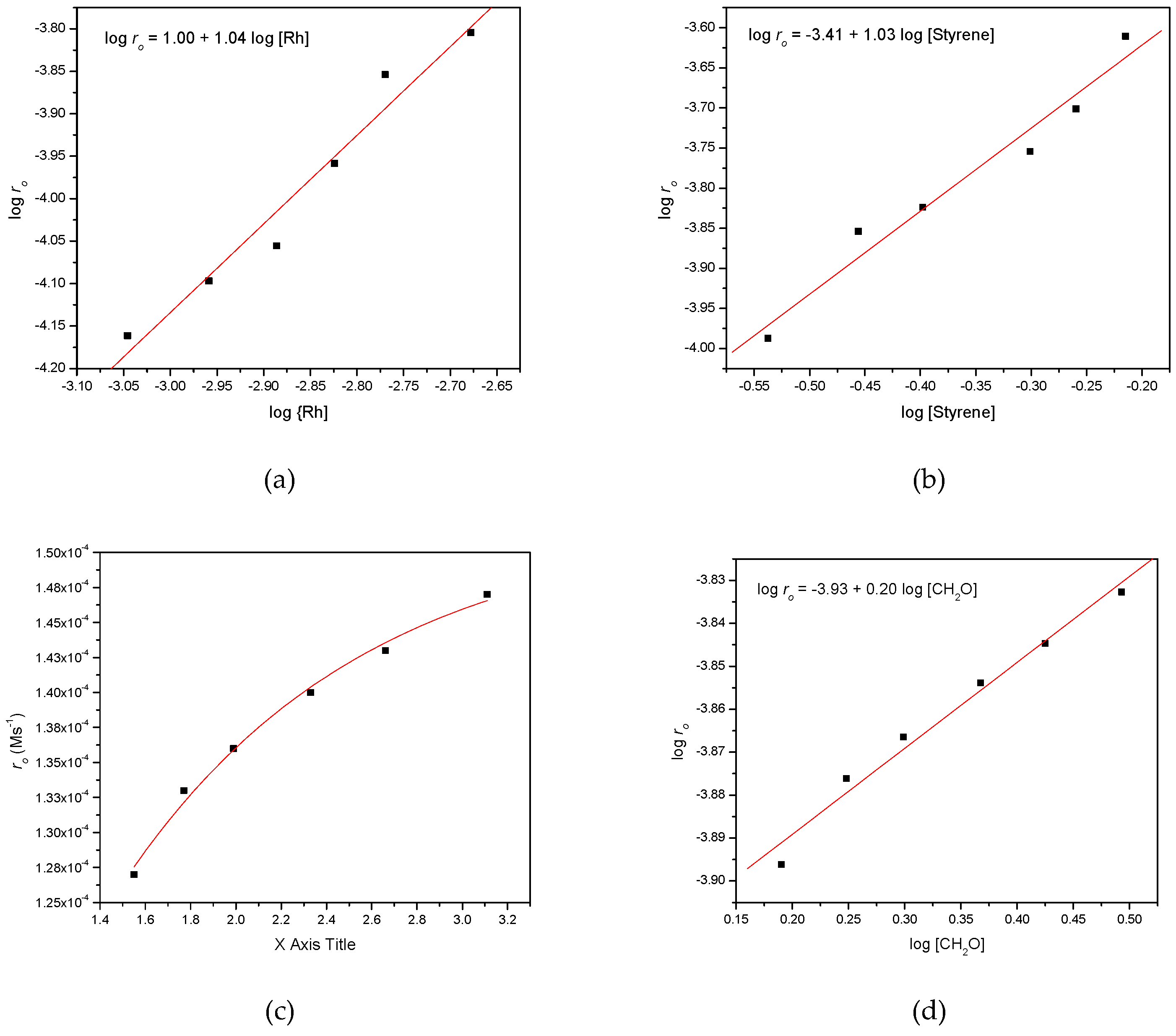
- There is a direct (first order) dependence of the hydroformylation rate with respect to the Rh concentration up to a certain concentration (2.1 × 10⁻³ M); the plot of log ro versus log [Rh] at low catalyst concentrations gives a straight line (Figure 2a) with a slope of 1.04 (entries 1–6, Table 1). However, unlike 1-hexene transfer hydroformylation, an inhibition of the reaction was observed at higher Rh concentrations (entries 7 and 8, Table 1), which can be attributed to the formation of a less active or inactive species. Therefore, the order with respect to the concentrations of the other components was determined within the range of first-order kinetics with respect to the catalyst.
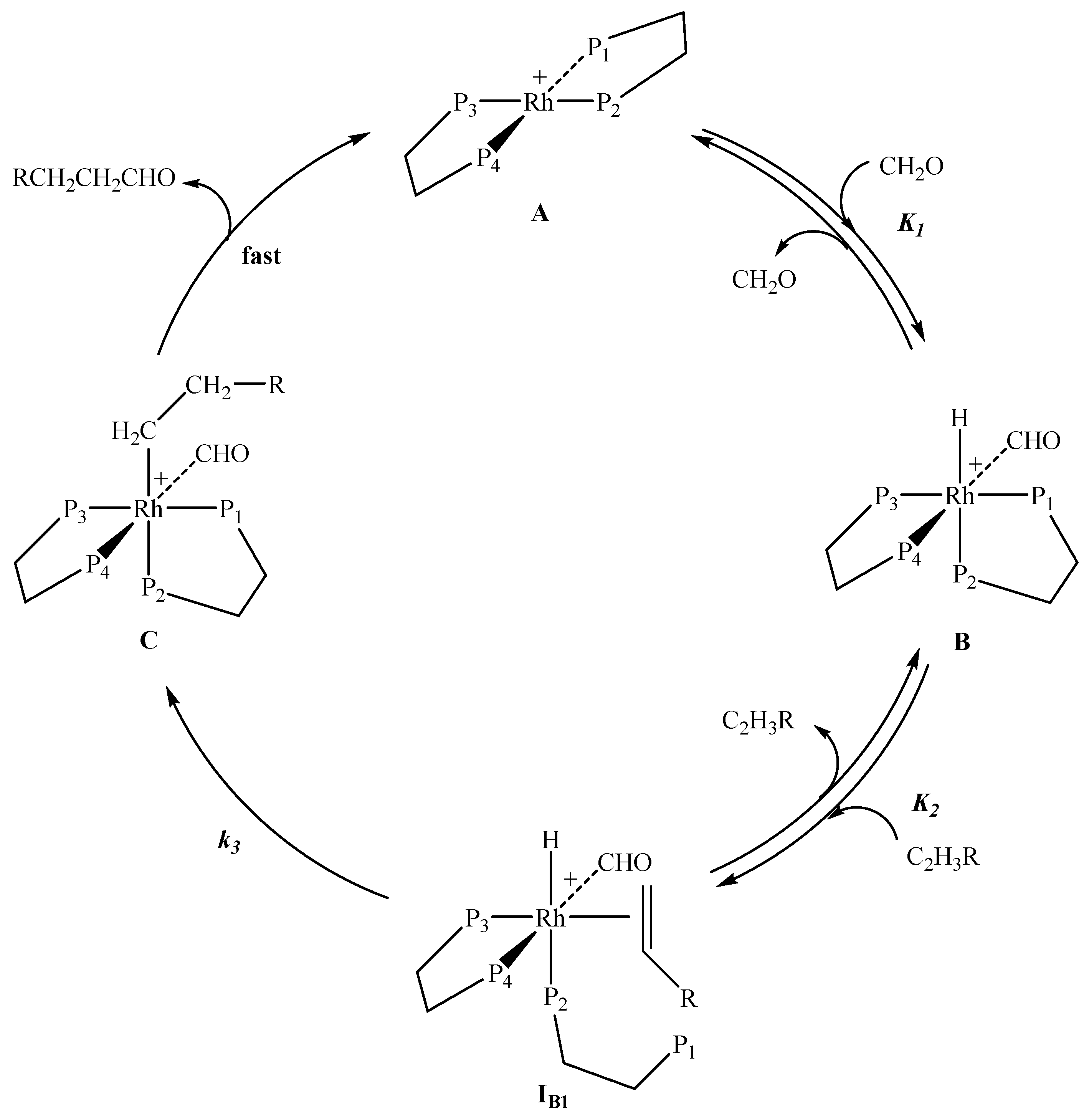
- It was observed that the reaction was also first-order with respect to substrate concentration (Figure 2b). The plot of log ro versus log [styrene] yielded a straight line with slope 1.03. The fact that first-order behavior was observed with respect to the concentration of styrene indicates that the substrate likely participates in the rate-determining step (rds) of the reaction.
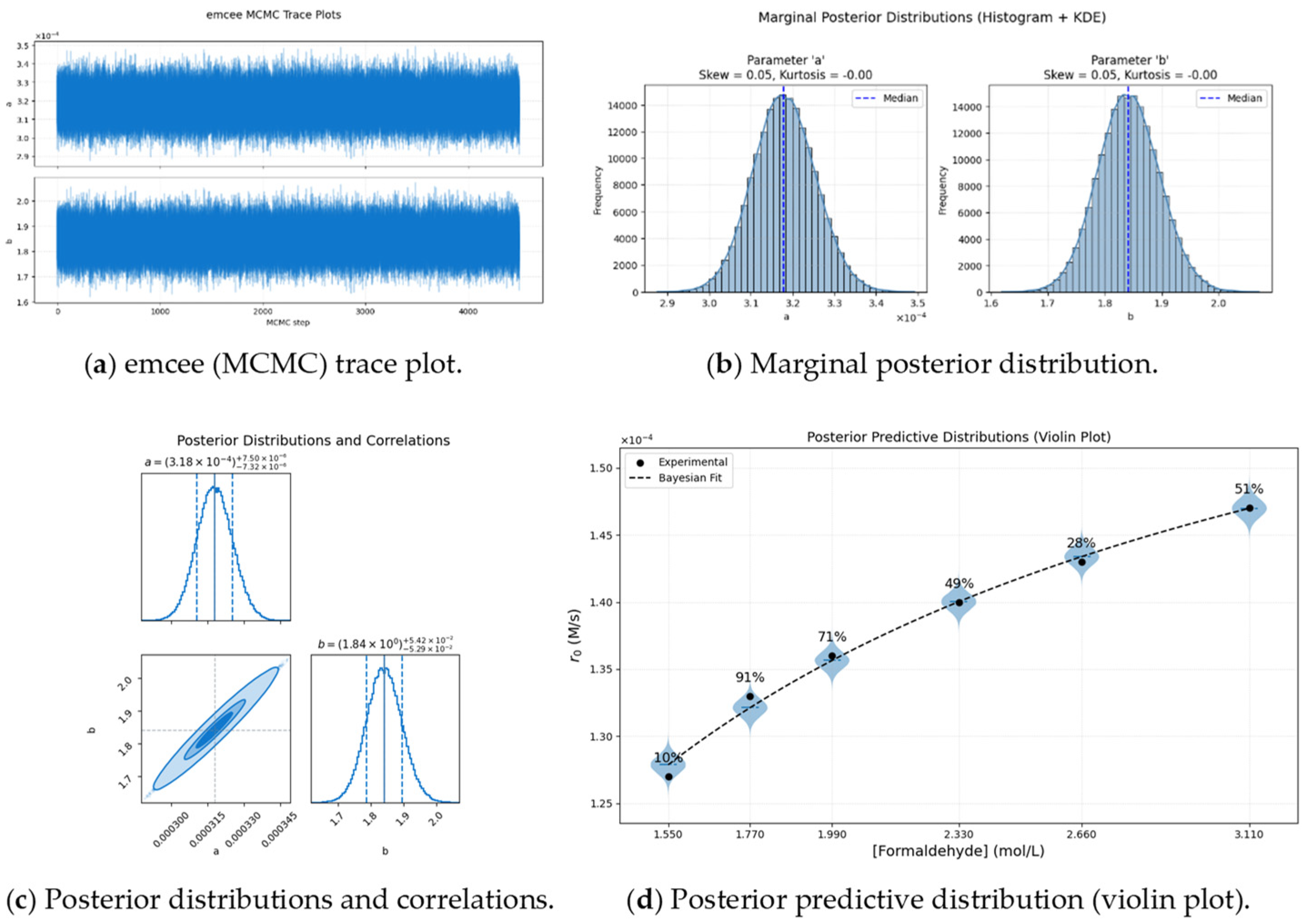
- The reaction rate varied according to a saturation curve as a function of formaldehyde concentration (Figure 2c), and exhibited a fractional order dependence of 0.20 (Figure 2d). This fractional-order dependence indicates that formaldehyde is involved in an equilibrium prior to the rds of the reaction.
2.2. DFT Study of the Hydroformylation of Styrene with Formaldehyde
2.3. Overview of the Mechanism of the Alkene Hydroformylation with Formaldehyde
2.4. Mathematical Kinetic Model for the Alkene Hydroformylation with Formaldehyde
3. Materials and Methods
3.1. Kinetic Measurements and Calculations
3.2. Computational Strategy
3.3. Statistical Bayesian Analysis
4. Conclusions
Supplementary Materials
Author Contributions
Funding
Data Availability Statement
Acknowledgments
Conflicts of Interest
Abbreviations
| dppe | 1,2-bis(diphenylphosphino)ethane |
| dpe | 1,2-bis(phosphino)ethane |
| DFT | Density functional theory |
| GGA | Generalized Gradient Approximation |
| rds | rate-determining step |
| binap | 2,2′-bis(diphenylphosphino)-1,1′-binaphthyl |
| xantphos | 4,5-bis(diphenylphosphino)-9,9-dimethylxanthene |
| biphep | 2,2′-bis(diphenylphosphino)-1,1′-biphenyl |
| nixantphos | 4,6-bis(diphenylphosphino)-10H-phenoxazine |
| Ph-bpe | (R,R)-1,2-bis(2,5-diphenylphospholano)ethane |
| LMFit | Levenberg-Marquardt fit |
| MCMC | Markov Chain Monte Carlo |
| emcee | It is an MIT licensed pure-Python implementation of Goodman & Weare’s Affine Invariant MCMC Ensemble sampler |
References
- Bhaduri, S.; Mukesh, D. Homogeneous Catalysis: Mechanisms and Industrial Applications, 2nd ed.; Wiley-Interscience: New York, NY, USA, 2014; pp. 141–152. [Google Scholar]
- Zhang, B.; Peña Fuentes, D.; Börner, A. Hydroformylation. ChemTexts 2022, 8, 2. [Google Scholar] [CrossRef]
- Hebrard, F.; Kalck, P. Cobalt-catalyzed hydroformylation of alkenes: Generation and recycling of the carbonyl species, and catalytic cycle. Chem. Rev. 2009, 109, 4272–4282. [Google Scholar] [CrossRef]
- Franke, R.; Selent, D.; Börner, A. Applied hydroformylation. Chem. Rev. 2012, 112, 5675–5732. [Google Scholar] [CrossRef] [PubMed]
- Modroño-Alonso, M.; Guanipa, V.; Melean, L.G.; Rosales, M.; González, A.; Baricelli, P.J. Catalytic activity of the RhH(CO)(TPPTS)3 precursor in the biphasic hydroformylation reaction of C5–C7 alkenes from a real naphtha cut. Appl. Catal. A Gen. 2009, 358, 211–214. [Google Scholar] [CrossRef]
- Baricelli, P.J.; Melean, L.G.; Modroño-Alonso, M.; Rodríguez, A.; Rosales, M.; González, A. Advances in the aqueous-phase hydroformylation of olefins from a refinery naphtha cut: The effect of monoethanolamine in the catalytic activity of the Rh/TPPTS system. Catal. Today 2015, 247, 124–131. [Google Scholar] [CrossRef]
- Baricelli, P.J.; Pereira, J.C.; Rosales, M. Aqueous-biphasic catalysis: A technological alternative for the use of organometallic complexes in hydrogenation and hydroformylation reactions with possible industrial application. Catal. Today 2025, 443, 114969. [Google Scholar] [CrossRef]
- Kokkinos, N.C. Alternative refinery process of fuel catalytic upgrade in aqueous media. In Clean Fuel for Mobility; Di Blasio, G., Agarwal, A.K., Belgiorno, G., Shukla, P.C., Eds.; Springer: Singapore, 2022. [Google Scholar]
- Behr, A.; Westfechtel, A.; Pérez Gomes, J. Catalytic processes for the technical use of natural fats and oils. Chem. Eng. Technol. 2008, 31, 700–714. [Google Scholar] [CrossRef]
- Whiteker, G.T.; Cobley, C.J. Applications of rhodium-catalyzed hydroformylation in the pharmaceutical, agrochemical, and fragrance industries. In Topics in Organometallic Chemistry; Beller, M., Blaser, H.-U., Eds.; Springer: Berlin/Heidelberg, Germany, 2012; Volume 42, pp. 35–46. [Google Scholar] [CrossRef]
- Wu, L.; Liu, Q.; Jackstell, R.; Beller, M. Carbonylations of Alkenes with CO Surrogates. Angew. Chem. Int. Ed. 2014, 53, 6310–6320. [Google Scholar] [CrossRef] [PubMed]
- Gorbunov, D.N.; Nenasheva, M.V.; Kardasheva, Y.S.; Karakhanov, E.A. Alternative sources of syngas for hydroformylation of unsaturated compounds. Russ. Chem. Bull. 2020, 69, 625–634. [Google Scholar] [CrossRef]
- Zhao, Z.; Lei, S.; Feng, W.; Wang, X.; Li, H.; Chen, H.; Wang, L.; Zhao, F.; Fu, S. Advances in hydroformylation with formaldehyde, formic acid and carbon dioxide as syngas surrogates. RSC Adv. 2025, 15, 43564–43575. [Google Scholar] [CrossRef]
- Ritleng, V.; Sirlin, C.; Pfeffer, M. Ru-, Rh-, and Pd-catalyzed C−C bond formation involving C−H activation and addition on unsaturated substrates: Reactions and mechanistic aspects. Chem. Rev. 2002, 102, 1731–1770. [Google Scholar] [CrossRef]
- Willis, M.C. Transition metal catalyzed alkene and alkyne hydroacylation. Chem. Rev. 2010, 110, 725–748. [Google Scholar] [CrossRef] [PubMed]
- Chen, H.; Kang, X.; Zhang, Z.; He, L. Recent advances in using carbon dioxide as a carbonyl source for carbonylation reactions. Sustain. Chem. Energy Mater. 2026, 3, 100038. [Google Scholar] [CrossRef]
- Okano, T.; Kobayashi, T.; Konishi, H.; Kiji, J. Hydroformylation of olefins with paraformaldehyde catalyzed by rhodium complexes. Tetrahedron Lett. 1982, 23, 4967–4968. [Google Scholar] [CrossRef]
- Blackborow, J.R.; Daroda, R.J.; Wilkinson, G. Homogeneous hydrogenation of carbon monoxide. Coord. Chem. Rev. 1982, 43, 17–38. [Google Scholar] [CrossRef]
- Jemier, G.; Nahmed, E.; Libs-Konrath, S. Formaldehyde and formates as sources of synthesis gas via ruthenium-catalyzed decomposition reactions. J. Mol. Catal. 1991, 64, 337–347. [Google Scholar] [CrossRef]
- Lassaletta, J.-M.; Fernández, R.; Gasch, C.; Vázquez, J. Formaldehyde dimethylhydrazone: A new neutral reagent for nucleophilic hydroformylation and hydrocyanation. Tetrahedron 1996, 52, 9143–9160. [Google Scholar] [CrossRef]
- Ahn, H.S.; Han, S.H.; Uhm, S.J.; Seok, W.K.; Lee, H.N.; Korneeva, G.A. Hydroformylation of olefins with formaldehyde in the presence of RhHCO(PPh3)3. J. Mol. Catal. A Chem. 1999, 144, 295–306. [Google Scholar] [CrossRef]
- Morimoto, T.; Kakiuchi, K. Evolution of carbonylation catalysis: No need for carbon monoxide. Angew. Chem. Int. Ed. 2004, 43, 5580–5588. [Google Scholar] [CrossRef] [PubMed]
- Rosales, M.; González, A.; González, B.; Moratinos, C.; Pérez, H.; Urdaneta, J.; Sánchez-Delgado, R.A. Hydroformylation of alkenes with paraformaldehyde catalyzed by rhodium–phosphine complexes. J. Organomet. Chem. 2005, 690, 3095–3098. [Google Scholar] [CrossRef]
- Rosales, M.; Arrieta, F.; Baricelli, P.; González, A.; González, B.; Guerrero, Y.; Moratinos, C.; Pacheco, I.; Pérez, H.; Urdaneta, J. A comparative study of the 1-hexene hydroformylation either under syngas conditions or with paraformaldehyde catalyzed by rhodium/diphosphine systems. Catal. Lett. 2008, 126, 367–370. [Google Scholar] [CrossRef]
- Rosales, M.; Pérez, H.; Arrieta, F.; Izquierdo, R.; Moratinos, C.; Baricelli, P.J. Kinetics and mechanisms of homogeneous catalytic reactions. Part 14. Hydroformylation of 1-hexene with formaldehyde catalyzed by a cationic bis(diphosphine)rhodium complex. J. Mol. Catal. A Chem. 2016, 421, 122–130. [Google Scholar] [CrossRef]
- Rosales, M.; González, B.; Molina, J.; Pérez, H.; Modroño-Alonso, M.; Baricelli, P.J. Reactions of alkenes and alkynes with formaldehyde catalyzed by rhodium systems containing phosphine ligands. J. Mex. Chem. Soc. 2017, 61, 120–127. [Google Scholar] [CrossRef]
- Makado, G.; Morimoto, T.; Sugimoto, Y.; Tsutsumi, K.; Kagawa, N.; Kakiuchi, K. Highly linear-selective hydroformylation of 1-alkenes using formaldehyde as a syngas substitute. Adv. Synth. Catal. 2010, 352, 299–304. [Google Scholar] [CrossRef]
- Cini, E.; Airiau, E.; Girard, N.; Mann, A.; Salvadori, J.; Taddei, M. Microwave-assisted domino hydroformylation without syngas. Synlett 2011, 2, 199–202. [Google Scholar] [CrossRef]
- Morimoto, T.; Fujii, T.; Miyoshi, K.; Makado, G.; Tanimoto, H.; Nishiyama, Y.; Kakiuchi, K. Accessible protocol for asymmetric hydroformylation of vinylarenes using formaldehyde. Org. Biomol. Chem. 2015, 13, 4632–4636. [Google Scholar] [CrossRef]
- Concha-Puelles, M.; Cortínez, A.; Lezana, N.; Vilches-Herrera, M.; Lühr, S. Valorisation of biobased olefins via Rh-catalyzed transfer hydroformylation and isomerization using formaldehyde as CO/H2 surrogate. Catal. Sci. Technol. 2022, 12, 6883–6890. [Google Scholar] [CrossRef]
- Delolo, F.G.; Vieira, G.M.; Villarreal, J.A.A.; dos Santos, E.N.; Gusevskaya, E.V. One-pot hydroformylation/O-acylation of propenylbenzenes for the synthesis of polyfunctionalized fragrances. Catal. Today 2021, 381, 272–279. [Google Scholar] [CrossRef]
- Delolo, F.G.; dos Santos, E.N.; Gusevskaya, E.V. One-pot reactions in different sites: A new approach in hydroformylation-based processes. ChemCatChem 2024, 26, e202400273. [Google Scholar] [CrossRef]
- Kégl, T. Computational aspects of hydroformylation. RSC Adv. 2015, 5, 4304–4327. [Google Scholar] [CrossRef]
- Papp, T.; Nagy, P.R.; Kégl, T. Advanced computation of enthalpies for a range of hydroformylation reactions with a predictive power to match experiments. Chem. Phys. Lett. 2025, 861, 141833. [Google Scholar] [CrossRef]
- Hyatt, I.F.D.; Andrew, H.K.; Morehead, T., Jr.; Sargent, A.L. Mechanism of rhodium-catalyzed intramolecular hydroacylation: A computational study. Organometallics 2008, 27, 135–147. [Google Scholar] [CrossRef]
- Wang, F.; Meng, Q.; Li, M. Density functional computations of Rh(I)-catalysed hydroacylation of acetic aldehyde and ethene. Mol. Simul. 2008, 34, 515–523. [Google Scholar] [CrossRef]
- Wang, F.; Meng, Q.; Li, M. Mechanism of rhodium-catalyzed hydroacylation of propylene using formaldehyde: A computational study. Int. J. Quantum Chem. 2009, 110, 850–859. [Google Scholar] [CrossRef]
- Froment, G.F. Model discrimination and parameter estimation in heterogeneous catalysis. AlChE J. 1975, 21, 1041–1057. [Google Scholar] [CrossRef]
- Matera, S.; Schneider, W.F.; Heyden, A.; Savara, A. Progress in accurate chemical kinetic modelling, simulations and parameter estimation for heterogeneous catalysis. ACS Catal. 2019, 9, 6624–6647. [Google Scholar] [CrossRef]
- Walker, E.A.; Ravisankar, K.; Savara, A. CheKiPEUQ Intro 2: Harnessing uncertainties from data sets, Bayesian design of experiments in chemical kinetics. ChemCatChem 2020, 12, 5401–5410. [Google Scholar] [CrossRef]
- Murzin, D.Y.; Wärnå, J.; Haario, H.; Salmi, T. Parameter estimation in kinetic models of complex heterogeneous catalytic reactions using Bayesian statistics. React. Kinet. Mech. Catal. 2021, 133, 1–15. [Google Scholar] [CrossRef]
- Foreman-Mackey, D.; Hogg, D.W.; Lang, D.; Goodman, J. emcee: The MCMC hammer. Publ. Astron. Soc. Pac. 2013, 125, 306–312. [Google Scholar] [CrossRef]
- Bernardi, A.; Gomoescu, L.; Wang, J.; Pantelides, C.C.; Chadwick, D.; Chachuat, B. Kinetic model discrimination for methanol and DME synthesis using Bayesian estimation. IFAC Pap. 2019, 52, 335–340. [Google Scholar] [CrossRef]
- Sameera, W.M.C.; Maseras, F. Transition metal catalysis by density functional theory and density functional theory/molecular mechanics. WIREs Comput. Mol. Sci. 2012, 2, 375–385. [Google Scholar] [CrossRef]
- Mardirossian, N.; Head-Gordon, M. Thirty years of density functional theory in computational chemistry: An overview and extensive assessment of 200 density functionals. Mol. Phys. 2017, 115, 2315–2372. [Google Scholar] [CrossRef]
- Quesne, M.G.; Silveri, F.; de Leeuw, N.H.; Catlow, C.R.A. Advances in sustainable catalysis: A computational perspective. Front. Chem. 2019, 7, 182. [Google Scholar] [CrossRef]
- Cui, C.-X.; Chen, H.; Li, S.-J.; Zhang, T.; Qu, L.-B.; Lan, Y. Mechanism of Ir-catalyzed hydrogenation: A theoretical view. Coord. Chem. Rev. 2020, 412, 213251. [Google Scholar] [CrossRef]
- Rosales, M.; Arrieta, F.; Baricelli, P.; Colina, A.; Izquierdo, R. A detailed DFT theoretical investigation of the mechanism of quinoline hydrogenation catalyzed by a (1,5-cyclooctadiene)rhodium(I) complex. Catal. Today 2025, 447, 115160. [Google Scholar] [CrossRef]
- Thorn, D.L. Hydrido formyl, methoxycarbonyl, hydroxymethyl, and methyl complexes of iridium: Syntheses and reactivities. Organometallics 1982, 1, 197–204. [Google Scholar] [CrossRef]
- Rosales, M.; Almanza-Caro, M.; Galeano-Andrades, R.; Drosos-Ramírez, J.C.; Soto, O. Hydroformylation of alkenylbenzenes catalyzed by rhodium-phosphine complexes: Mechanistic features and kinetic behavior resolved through bayesian analysis. Catalysts 2026, 16, 274. [Google Scholar] [CrossRef]
- Varshavskii, Y.S.; Cherkasova, T.G. A simple method for preparing acetylacetonatodicarbonylrhodium(I). Russ. J. Inorg. Chem. 1967, 12, 899. [Google Scholar]
- Casado, J.; López-Quintela, M.A.; Lorenzo-Barral, F.M. The initial rate method in chemical kinetics: Evaluation and experimental illustration. J. Chem. Educ. 1983, 63, 450. [Google Scholar] [CrossRef]
- Frisch, M.J.; Trucks, G.W.; Schlegel, H.B.; Scuseria, G.E.; Robb, M.A.; Cheeseman, J.R.; Scalmani, G.; Barone, V.; Mennucci, B.; Petersson, G.A.; et al. Gaussian 09, Revision E.01; Gaussian Inc.: Pittsburgh, PA, USA, 2009.
- Parr, R.G.; Yang, W. Density-Functional Theory of Atoms and Molecules; Oxford University Press: New York, NY, USA, 1989. [Google Scholar]
- Sholl, D.S.; Steckel, J.A. Density Functional Theory: A Practical Introduction; John Wiley & Sons, Inc.: Hoboken, NJ, USA, 2009; p. 238. [Google Scholar]
- Verma, P.; Truhlar, D.G. Status and challenges of density functional theory. Trends Chem. 2020, 2, 302–318. [Google Scholar] [CrossRef]
- Becke, A.D. Density-functional thermochemistry. III. The role of exact exchange. J. Chem. Phys. 1993, 98, 5648–5652. [Google Scholar] [CrossRef]
- Lee, C.; Yang, W.; Parr, R.G. Development of the Colle-Salvetti correlation-energy formula into a functional of the electron density. Phys. Rev. B 1988, 37, 785–789. [Google Scholar] [CrossRef]
- Grimme, S. Semiempirical GGA-type density functional constructed with a long-range dispersion correction. J. Comput. Chem. 2006, 27, 1787–1799. [Google Scholar] [CrossRef]
- Chaia, J.-D.; Head-Gordon, M. Systematic optimization of long-range corrected hybrid density functionals. J. Chem. Phys. 2008, 128, 084106. [Google Scholar] [CrossRef]
- Chaia, J.-D.; Head-Gordon, M. Long-range corrected hybrid density functionals with damped atom–atom dispersion corrections. Phys. Chem. Chem. Phys. 2008, 10, 6615–6620. [Google Scholar] [CrossRef]
- Zhao, Y.; Truhlar, D.G. A new local density functional for main-group thermochemistry, transition metal bonding, thermochemical kinetics, and noncovalent interactions. J. Chem. Phys. 2006, 125, 194101. [Google Scholar] [CrossRef]
- Zhao, Y.; Truhlar, D.G. The M06 suite of density functionals for main group thermochemistry, thermochemical kinetics, noncovalent interactions, excited states, and transition elements: Two new functionals and systematic testing of four M06-class functionals and 12 other functionals. Theor. Chem. Acc. 2008, 120, 215–241. [Google Scholar] [CrossRef]
- Zhao, Y.; Truhlar, D.G. Density Functionals with Broad Applicability in Chemistry. Acc. Chem. Res. 2008, 41, 157–167. [Google Scholar] [CrossRef]
- Zhao, Y.; Truhlar, D.G. Applications and validations of the Minnesota density functionals. Chem. Phys. Lett. 2011, 502, 1–13. [Google Scholar] [CrossRef]
- Peverati, R.; Truhlar, D.G. M11-L: A Local Density Functional That Provides Improved Accuracy for Electronic Structure Calculations in Chemistry and Physics. J. Phys. Chem. Lett. 2012, 3, 117–124. [Google Scholar] [CrossRef]
- Cremer, D. Møller–Plesset perturbation theory: From small molecule methods to methods for thousands of atoms. WIREs Comp. Mol. Sci. 2011, 1, 509–530. [Google Scholar] [CrossRef]
- Gonzalez, C.; Schlegel, H.B. Reaction path following in mass-weighted internal coordinates. J. Phys. Chem. 1990, 94, 5523–5527. [Google Scholar] [CrossRef]
- Rosales, M.; Gonzalez, A.; Guerrero, Y.; Pacheco, I.; Sánchez-Delgado, R.A. Kinetics and mechanisms of homogeneous catalytic reactions: Part 6. Hydroformylation of 1-hexene by use of Rh(acac)(CO)2/dppe [dppe = 1,2-bis(diphenylphosphino)ethane] as the precatalyst. J. Mol. Catal. A Gen. 2007, 270, 241–249. [Google Scholar] [CrossRef]



| Entry | T (K) | [Rh] (mM) | [S] a (M) | [CH2O] (M) | 104 ro (Ms−1) |
|---|---|---|---|---|---|
| 1 | 373 | 0.9 | 0.35 | 2.33 | 0.69 |
| 2 | 373 | 1.1 | 0.35 | 2.33 | 0.80 |
| 3 | 373 | 1.3 | 0.35 | 2.33 | 0.88 |
| 4 | 373 | 1.5 | 0.35 | 2.33 | 1.10 |
| 5 | 373 | 1.7 | 0.35 | 2.33 | 1.40 |
| 6 | 373 | 2.1 | 0.35 | 2.33 | 1.57 |
| 7 | 373 | 2.5 | 0.35 | 2.33 | 1.43 |
| 8 | 373 | 2.8 | 0.35 | 2.33 | 1.13 |
| 9 | 373 | 1.7 | 0.29 | 2.33 | 1.03 |
| 10 | 373 | 1.7 | 0.40 | 2.33 | 1.50 |
| 11 | 373 | 1.7 | 0.50 | 2.33 | 1.76 |
| 12 | 373 | 1.7 | 0.55 | 2.33 | 1.99 |
| 13 | 373 | 1.7 | 0.61 | 2.33 | 2.45 |
| 14 | 373 | 1.7 | 0.35 | 1.55 | 1.27 |
| 15 | 373 | 1.7 | 0.35 | 1.77 | 1.33 |
| 16 | 373 | 1.7 | 0.35 | 1.99 | 1.36 |
| 17 | 373 | 1.7 | 0.35 | 2.66 | 1.43 |
| 18 | 373 | 1.7 | 0.35 | 3.11 | 1.47 |
| 19 | 353 | 1.7 | 0.35 | 2.33 | 0.24 |
| 20 | 363 | 1.7 | 0.35 | 2.33 | 0.73 |
| 21 | 383 | 1.7 | 0.35 | 2.33 | 3.31 |
| Elementary Step | ΔE b | ΔH b | ΔG b | Ea b |
|---|---|---|---|---|
| Oxidative addition of formaldehyde a | −8.5 | −9.3 | 4.2 | Ea1 = 8.4 |
| Dissociation of P1 and ethylene coordination | 8.9 | 8.1 | 20.5 | |
| Migration of hydride to ethylene (dissociated P1) | −28.9 | −28.9 | −26.5 | Ea2 = 29.0 |
| Dissociation of P3 and ethylene coordination | 3.0 | 2.3 | 14.0 | |
| Migration of hydride to ethylene (dissociated P3) | −23.0 | −23.0 | −20.0 | Ea2 = 38.6 |
| Dissociation of P4 and ethylene coordination | 3.9 | 3.2 | 15.4 | |
| Migration of hydride to ethylene (dissociated P4) | −23.9 | −23.9 | −21.4 | Ea2 = 37.2 |
| Reductive elimination of propanal a | −4.0 | −3.2 | −17.9 | Ea3 = 23.4 |
| Parameter | Equilibrium Constants or Products of Rate and/or Equilibrium Constants | Value | Error | % Error |
|---|---|---|---|---|
| m | 3.18 × 10⁻⁴ | 7.41 × 10⁻⁶ | 2.3 | |
| n | 1.84 | 0.05 | 2.7 | |
| m/ | 0.54 | 0.01 | 1.9 | |
| m/n | 0.29 | 0.01 | 3.6 |
Disclaimer/Publisher’s Note: The statements, opinions and data contained in all publications are solely those of the individual author(s) and contributor(s) and not of MDPI and/or the editor(s). MDPI and/or the editor(s) disclaim responsibility for any injury to people or property resulting from any ideas, methods, instructions or products referred to in the content. |
© 2026 by the authors. Licensee MDPI, Basel, Switzerland. This article is an open access article distributed under the terms and conditions of the Creative Commons Attribution (CC BY) license.
Share and Cite
Rosales, M.; Arrieta, F.; Drosos-Ramirez, J.C. Kinetic, Computational and Mechanistic Investigation of [Rh(κ2-dppe)2]-Catalyzed Transfer Hydroformylation of Alkenes with Formaldehyde Assisted by Bayesian Parameter Estimation. Catalysts 2026, 16, 521. https://doi.org/10.3390/catal16060521
Rosales M, Arrieta F, Drosos-Ramirez JC. Kinetic, Computational and Mechanistic Investigation of [Rh(κ2-dppe)2]-Catalyzed Transfer Hydroformylation of Alkenes with Formaldehyde Assisted by Bayesian Parameter Estimation. Catalysts. 2026; 16(6):521. https://doi.org/10.3390/catal16060521
Chicago/Turabian StyleRosales, Merlín, Federico Arrieta, and Juan Carlos Drosos-Ramirez. 2026. "Kinetic, Computational and Mechanistic Investigation of [Rh(κ2-dppe)2]-Catalyzed Transfer Hydroformylation of Alkenes with Formaldehyde Assisted by Bayesian Parameter Estimation" Catalysts 16, no. 6: 521. https://doi.org/10.3390/catal16060521
APA StyleRosales, M., Arrieta, F., & Drosos-Ramirez, J. C. (2026). Kinetic, Computational and Mechanistic Investigation of [Rh(κ2-dppe)2]-Catalyzed Transfer Hydroformylation of Alkenes with Formaldehyde Assisted by Bayesian Parameter Estimation. Catalysts, 16(6), 521. https://doi.org/10.3390/catal16060521