Comparative Analysis of Ignition and Combustion Characteristics in Straight-Channel and U-Bend Micro Catalytic Combustors: Numerical Investigation of Inlet Velocity Effects

 ,
,
Abstract
1. Introduction
2. Results and Analysis
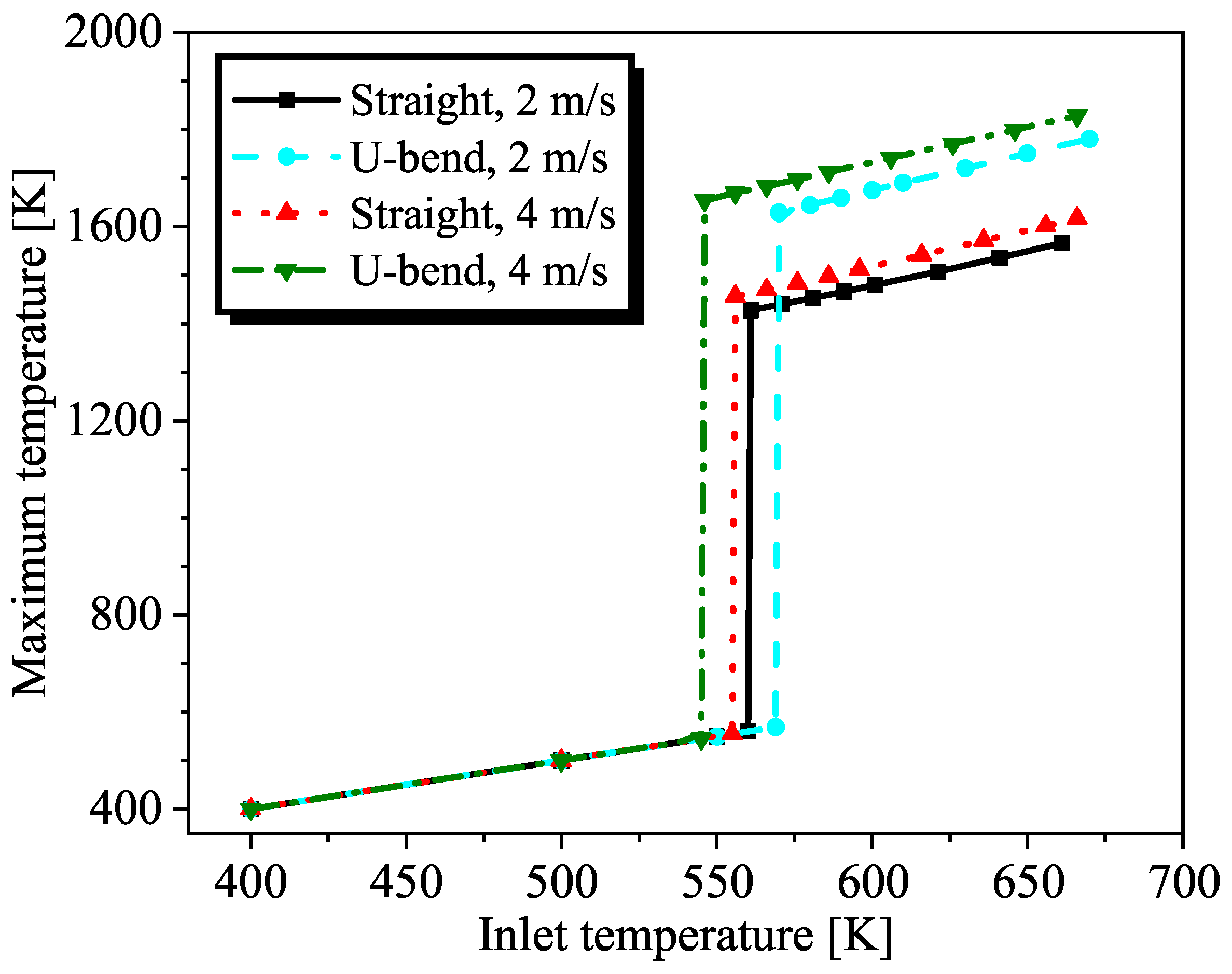
2.1. Determination of Ignition Temperature
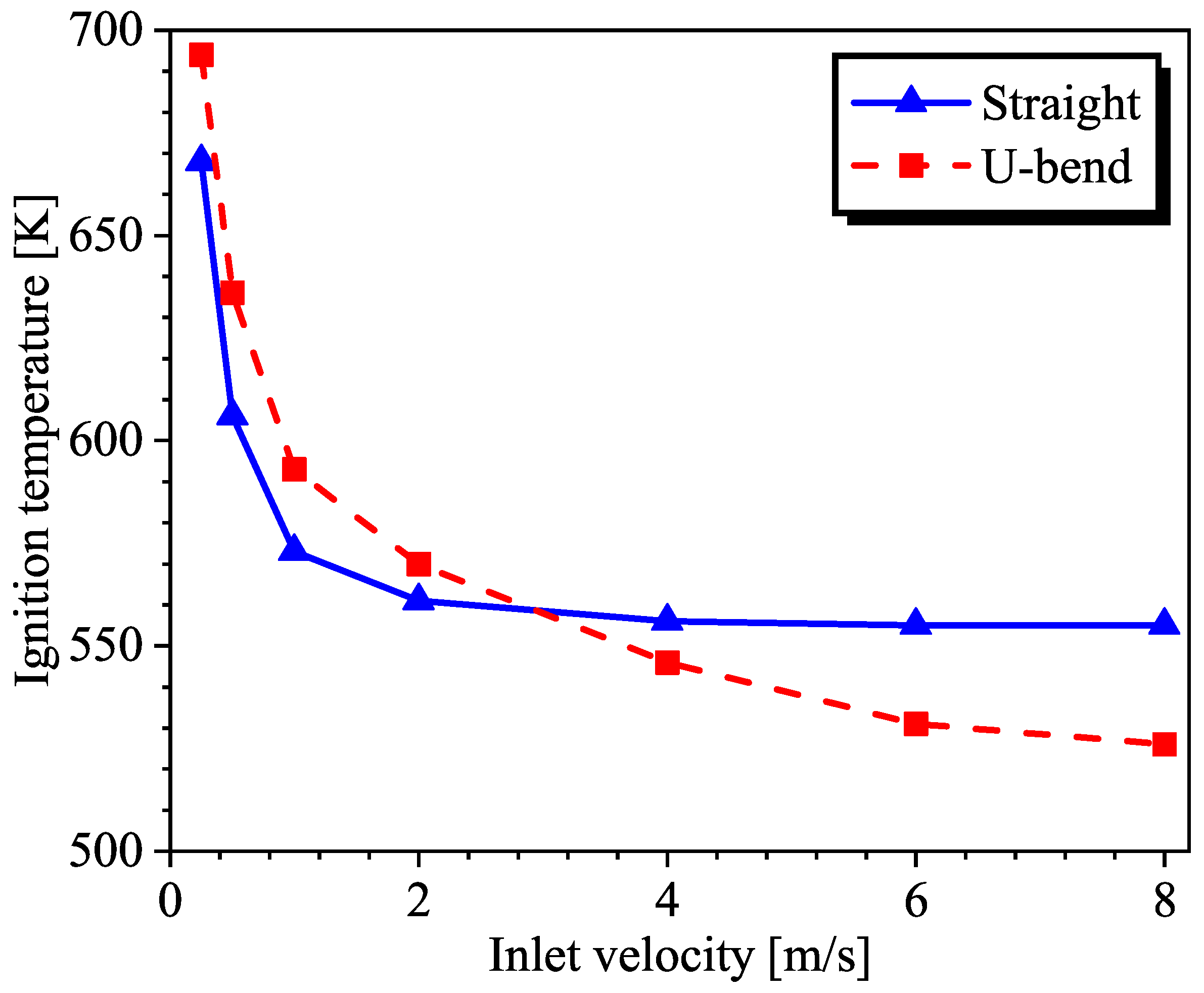
2.2. Comparison of Ignition Temperature Between Straight-Channel and U-Bend Microreactors at Varying Inlet Velocities
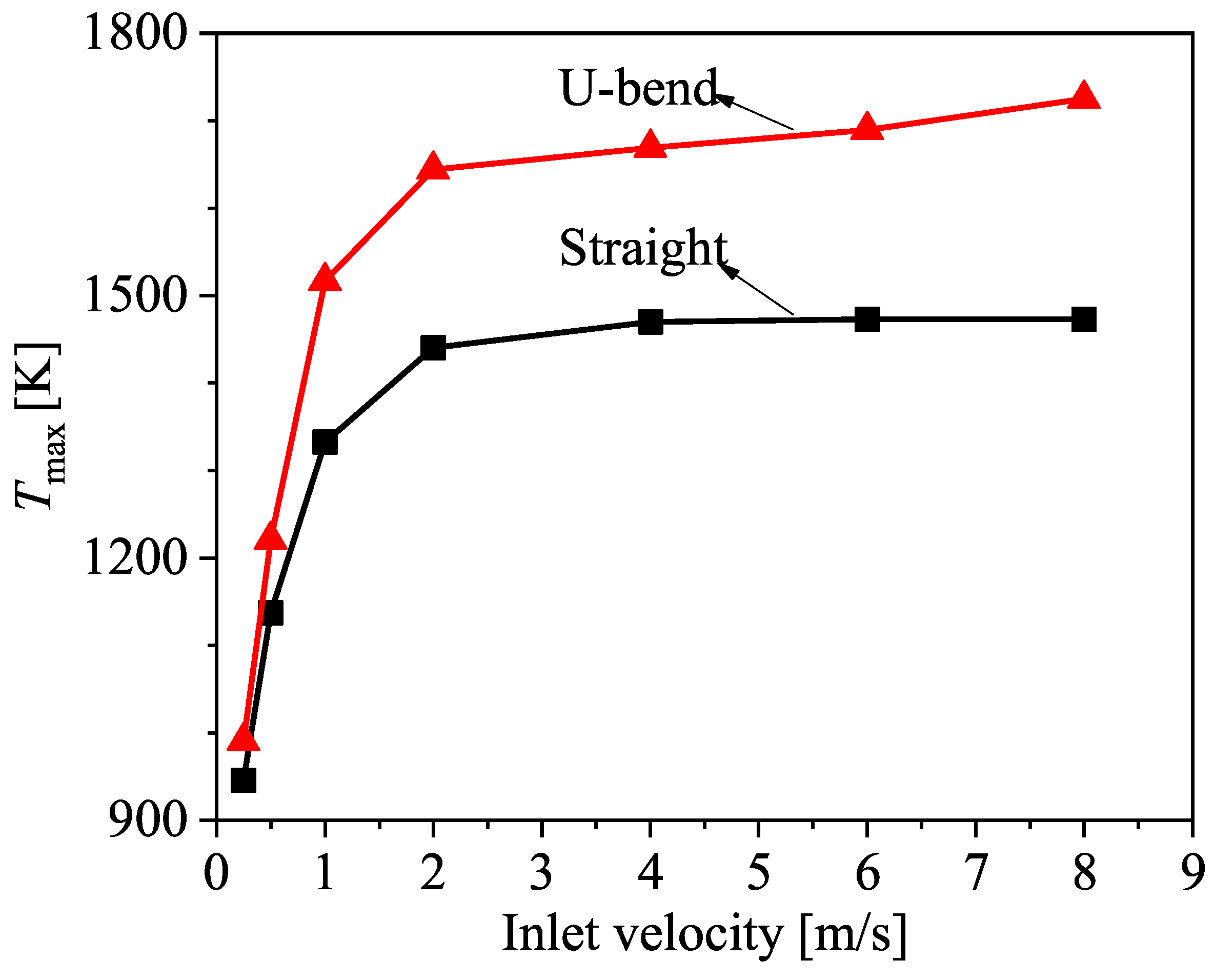
2.3. Comparison of Maximum Combustion Temperature Between Straight-Channel and U-Bend Microreactors at Varying Inlet Velocities
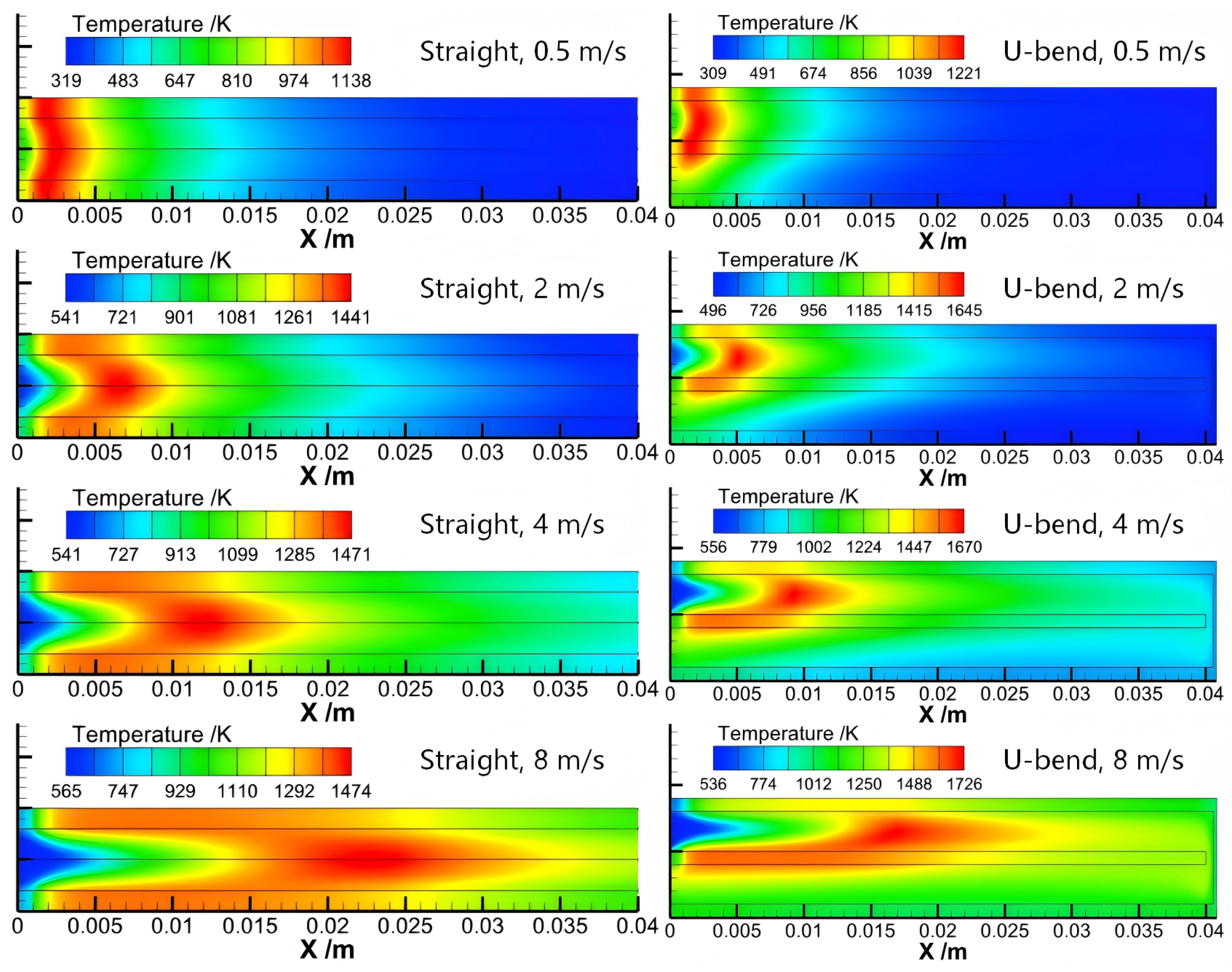
2.4. Comparison of Temperature Distribution Between Straight-Channel and U-Bend Microreactors
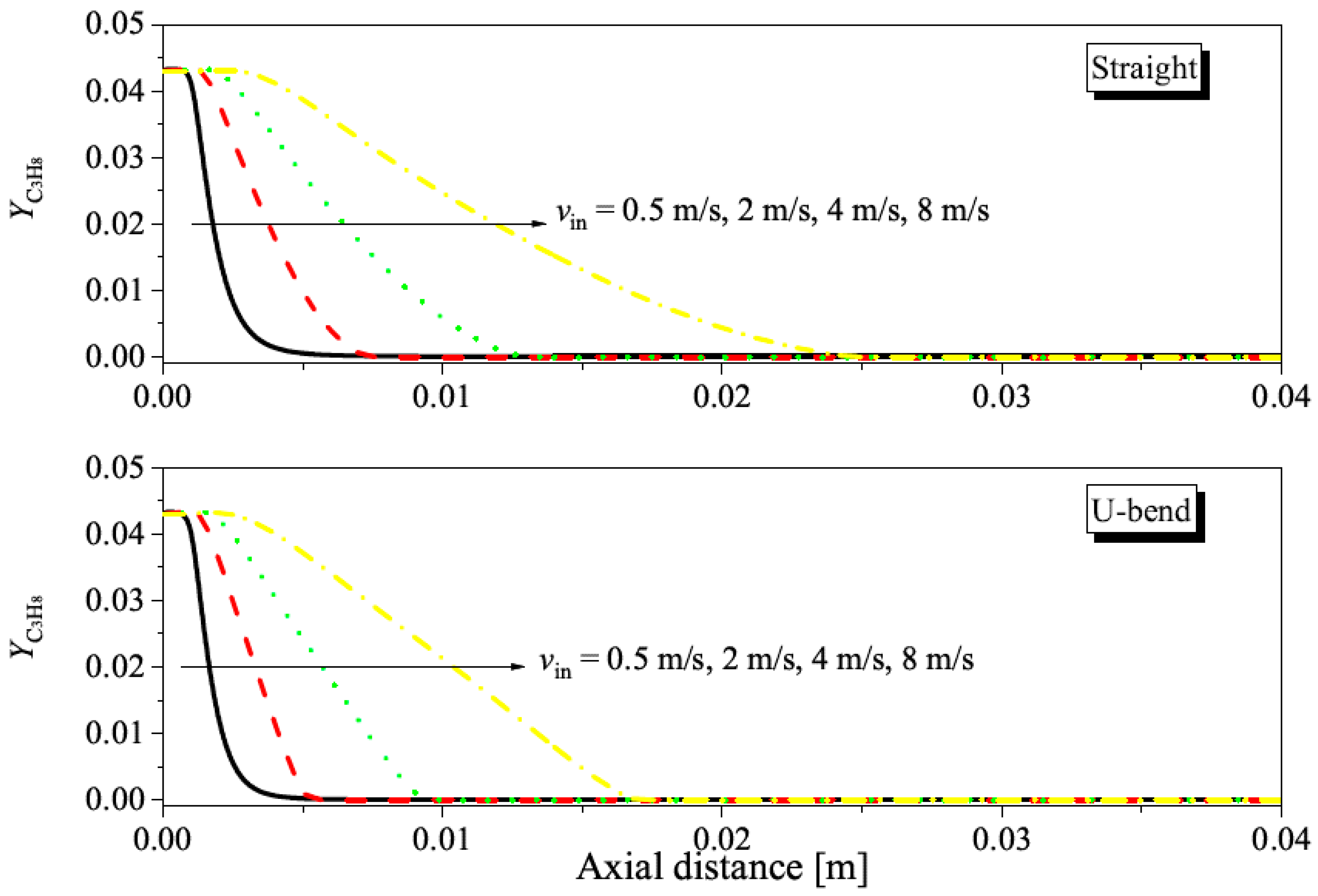
2.5. Comparison of Propane Mass Fraction Distribution Between Straight-Channel and U-Bend Microreactors
2.6. Comparison of Ignition Delay Time Between Straight-Channel and U-Bend Microreactors at Varying Inlet Velocities
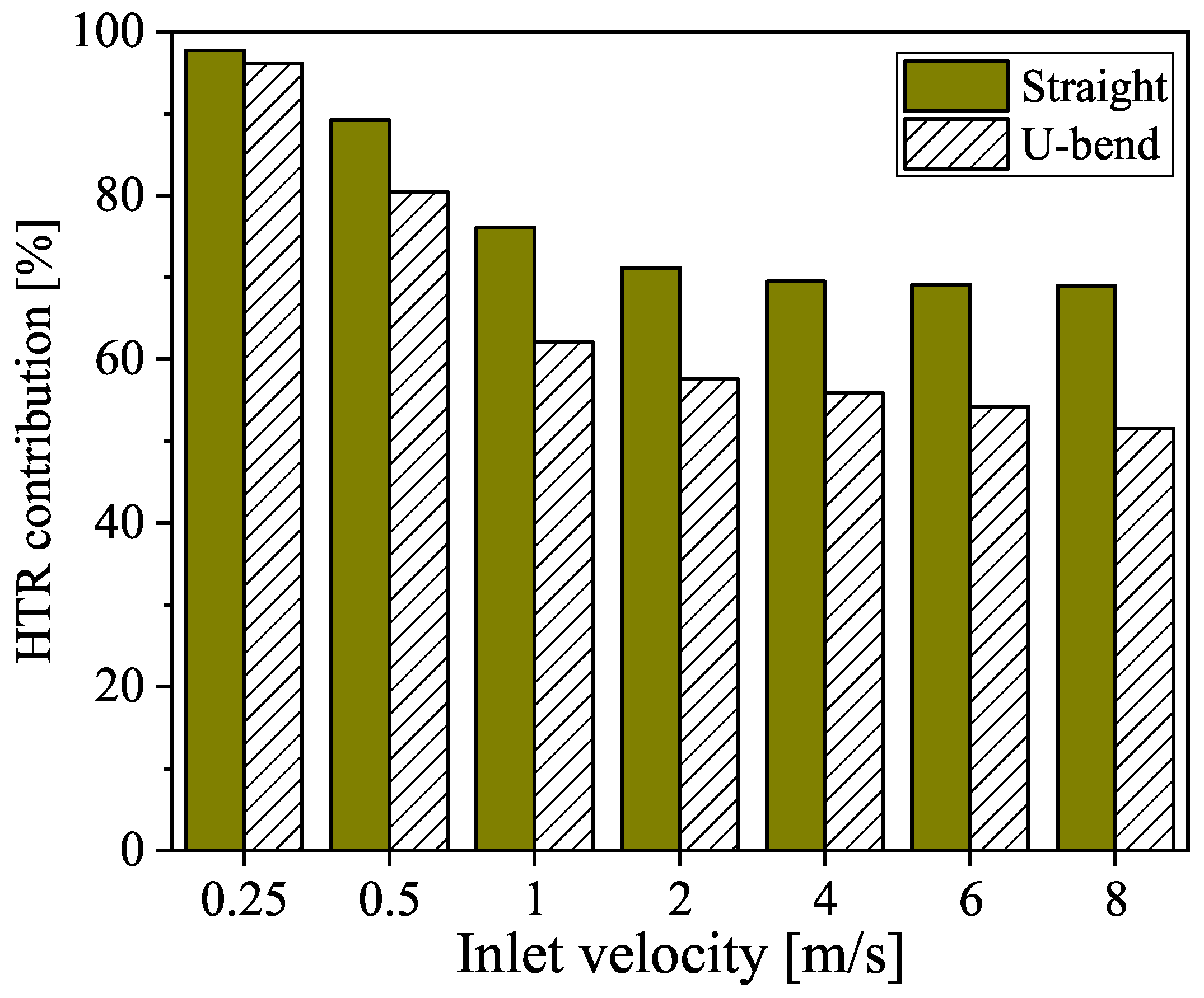
2.7. Comparison of HTR Contribution Between Straight-Channel and U-Bend Microreactors at Varying Inlet Velocities
3. Mathematical Model
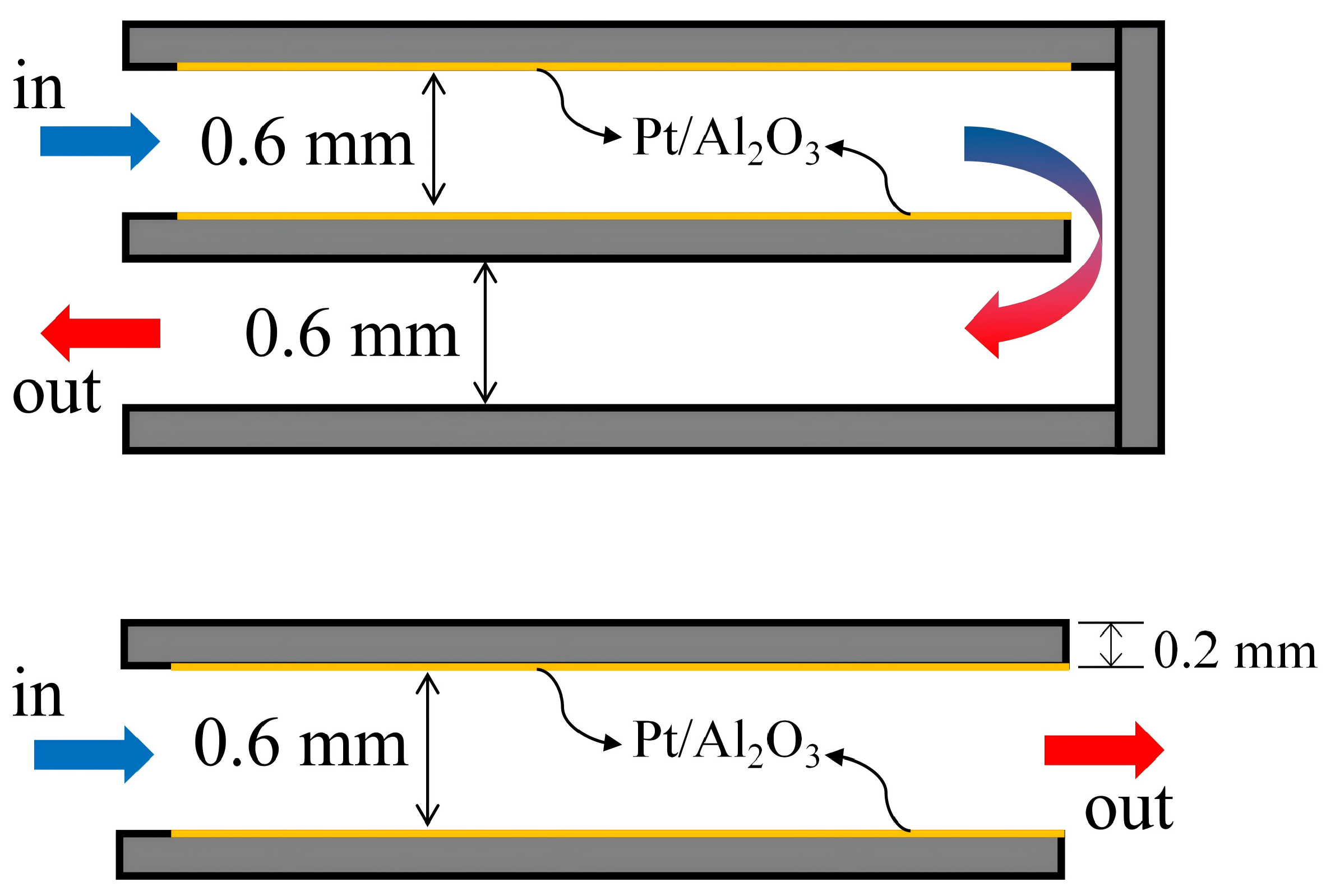
3.1. Model Description
- The width of the reaction channel is sufficiently large compared to its height such that any gradient along the width direction is negligible, thereby allowing a two-dimensional modeling approach.
- The flow in the microchannel is laminar.
- The gas mixture behaves as an ideal gas.
- Gas-phase radiation is neglected due to the small optical thickness.
3.2. Meshing, Boundary Conditions, Physical Properties, and Solution Strategy
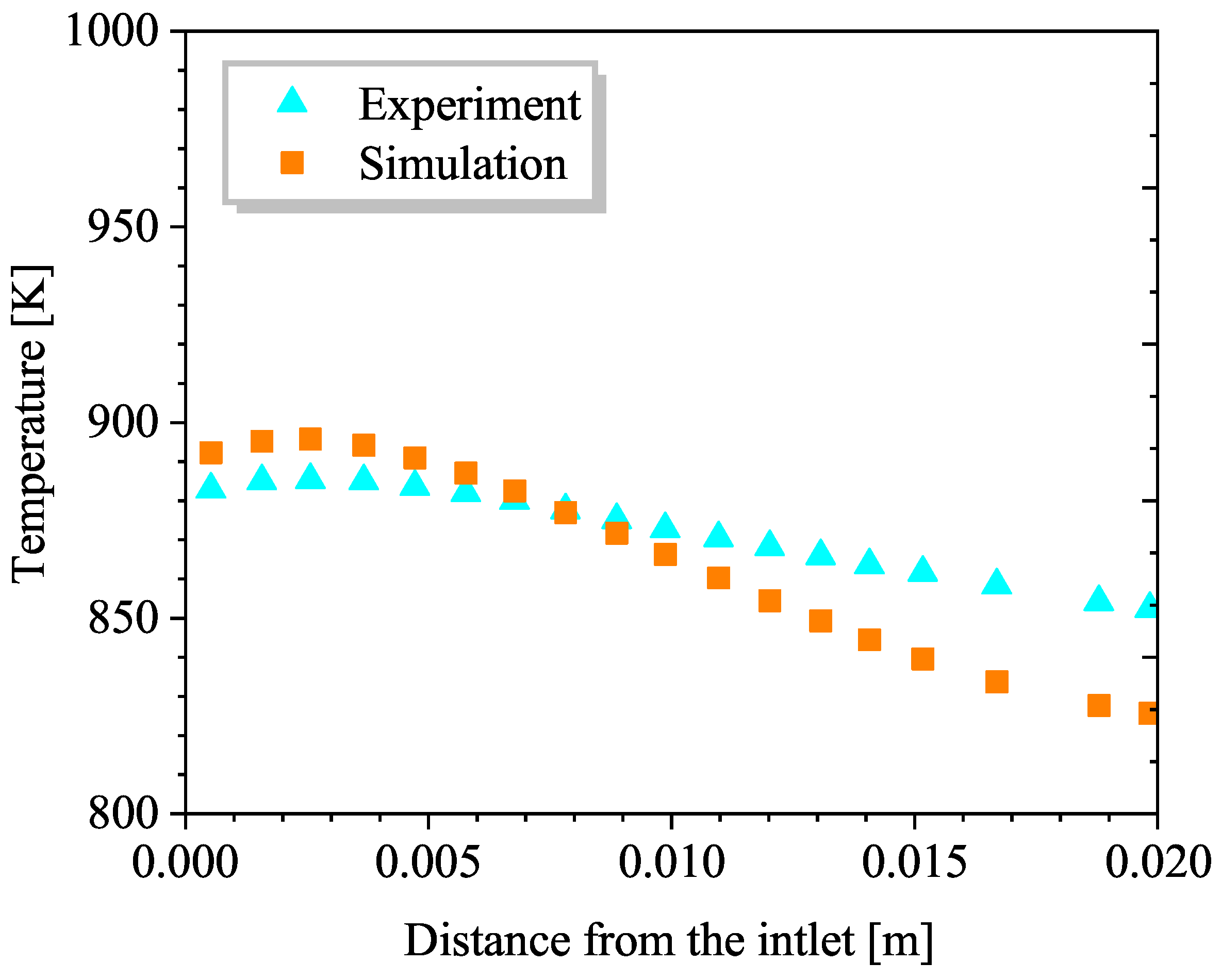
3.3. Model Validation
4. Conclusions
- The relative ignition advantage between the two configurations depends strongly on the flow regime. The straight-channel combustor exhibits lower ignition temperatures at low inlet velocities (≤2 m/s), while the U-bend design demonstrates superior ignition performance at high velocities (≥4 m/s), achieving an ignition temperature as low as 526 K at 8 m/s compared to 555 K for the straight-channel counterpart.
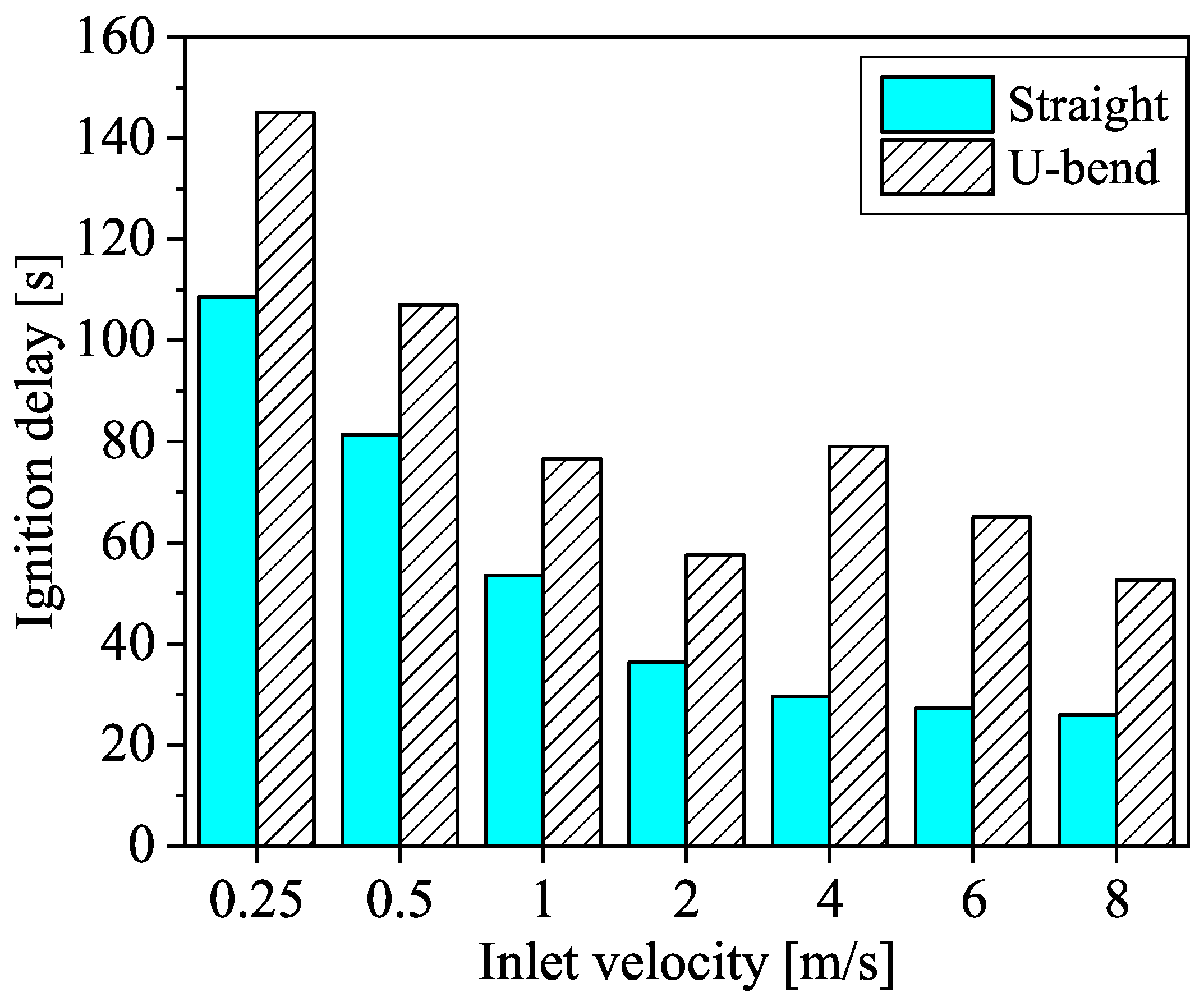
- Despite its higher ignition temperatures at elevated flow rates, the straight-channel combustor consistently yields shorter ignition times (25.9–108.6 s) across the entire velocity range tested, in contrast to the U-bend design (52.6–145.2 s). This suggests that the straight-channel configuration is more favorable for rapid cold-start applications where minimizing time to light-off is critical.
- The U-bend combustor achieves higher maximum combustion temperatures under high-velocity conditions (1726 K vs. 1474 K at 8 m/s), attributable to improved heat recirculation with the uncoated recirculating channel. However, this benefit is accompanied by a reduced heterogeneous reaction contribution compared to the straight-channel design across all velocities.
- The U-bend configuration is advantageous for high-flow-rate applications requiring low ignition temperatures and high sustained combustion temperatures, whereas the straight-channel design is preferable for scenarios demanding rapid ignition, such as cold-start conditions in portable power systems.
Author Contributions
Funding
Data Availability Statement
Acknowledgments
Conflicts of Interest
References
- Aravind, B.; Raghuram, G.K.S.; Kishore, V.R.; Kumar, S. Compact design of planar stepped micro combustor for portable thermoelectric power generation. Energy Convers. Manag. 2018, 156, 224–234. [Google Scholar] [CrossRef]
- Hu, X.; Shen, Z.; Wang, Y. On the design of a hydrogen micro-rectangular combustor for portable thermoelectric generators. Chem. Eng. Process. Process Intensif. 2024, 195, 109611. [Google Scholar] [CrossRef]
- Wang, J.; Zhang, Y.; Peng, S.; Yu, S.; Ran, J.; Chua, K.J.; Li, M.; Shao, Y.; Liu, S. Thermal analysis of a micro tubular reactor for methanol steam reforming by optimizing the multilayer arrangement of catalyst bed for the catalytic combustion of methanol. Int. J. Hydrogen Energy 2023, 48, 28315–28332. [Google Scholar] [CrossRef]
- Nauman, M.; Pan, J.; Wang, Y.; Li, F.; Ojo, A.O.; Raza, A. A review of recent advancements in micro combustion techniques to enhance flame stability and fuel residence time. Int. J. Hydrogen Energy 2024, 49, 1165–1193. [Google Scholar] [CrossRef]
- Kommu, M.; Kaisare, N.S. Ignition of homo/hetero combustion of propane in a microreactor with catalyst segmentation. Chem. Eng. Res. Des. 2018, 138, 125–134. [Google Scholar] [CrossRef]
- Norton, D.G.; Vlachos, D.G. Combustion characteristics and flame stability at the microscale: A CFD study of premixed methane/air mixtures. Chem. Eng. Sci. 2003, 58, 4871–4882. [Google Scholar] [CrossRef]
- Zheng, T.; Zhou, W.; Chu, X.; Lian, Y. Trapezoidal cavity for high reforming temperature performance of auto-thermal methanol steam reforming micro-reactor for hydrogen production. Int. J. Hydrogen Energy 2022, 47, 5053–5063. [Google Scholar] [CrossRef]
- Lu, Q.; Wang, Y.; Zhang, Y.; Fan, B.; Wang, Y.; Quaye, E.K.; Pan, J. Effect of inserted baffles on hydrogen heterogeneous reaction in planar catalytic micro combustor. Int. J. Hydrogen Energy 2023, 48, 15722–15735. [Google Scholar] [CrossRef]
- Lu, Q.; Wang, Q.; Fan, B.; Zhang, Y.; Wang, Y.; Nauman, M.; Pan, J. Numerical study on hydrogen heterogeneous reaction characteristic in a micro catalytic combustor with blunt body. Fuel 2024, 357, 129632. [Google Scholar] [CrossRef]
- Lu, Q.; Gou, J.; Wang, Y.; Quaye, E.K.; Pan, J. Thermal and chemical analysis on the hetero-/homogeneous combustion characteristics of H2/Air mixture in a micro channel with catalyst segmentation. Fuel 2022, 320, 123883. [Google Scholar] [CrossRef]
- Xiao, S.; Zhang, Y.; Lu, Q.; Wang, Y.; Quaye, E.K.; Pan, J. Numerical simulation and emission analysis of ammonia/oxygen premixed combustion process in micro-combustor with baffle. Chem. Eng. Process. 2022, 174, 108871. [Google Scholar] [CrossRef]
- Wang, Z.; Wang, Z.; Miao, Z.; Ma, L.; Xu, W.; Li, Z.; Yang, Z.; Jiang, G. Propane ignition characteristics in a Pt-catalyzed microreactor for SOFC preheating: A numerical study of catalyst activity effects. Batteries 2025, 11, 390. [Google Scholar] [CrossRef]
- Li, Z.; Yu, M.; Bi, J.; Yang, H.; Wang, X.; Wang, Z.; Wu, G.; Yang, Z. Effect of catalytic activity on ignition and combustion characteristics in a propane-fueled U-Bend micro-reactor: Numerical modeling with catalyst coating as reactive wall. Coatings 2026, 16, 419. [Google Scholar] [CrossRef]
- Westbrook, C.K.; Dryer, F.L. Simplified reaction mechanisms for the oxidation of hydrocarbon fuels in flames. Combust. Sci. Technol. 1981, 27, 31–43. [Google Scholar] [CrossRef]
- Deshmukh, S.R.; Vlachos, D.G. A reduced mechanism for methane and one-step rate expressions for fuel-lean catalytic combustion of small alkanes on noble metals. Combust. Flame 2007, 149, 366–383. [Google Scholar] [CrossRef]
- Fluent, A. Fluent 14.0 User’s Guide; ANSYS FLUENT Inc.: Canonsburg, PA, USA, 2015. [Google Scholar]
- Lu, Q.; Zhou, H.; Zhang, Y.; Gou, J.; Fan, B.; Jiang, C.; Yang, W.; Yuan, J.; Pan, J. Experimental and numerical investigations on hetero-/homogeneous combustion characteristics of C3H8/Air mixtures in the micro catalytic combustor. Appl. Therm. Eng. 2025, 274, 126638. [Google Scholar] [CrossRef]





| Symbol | Description |
|---|---|
| Pre-exponential factor | |
| c | Molar concentration |
| Activation energy for adsorption/desorption | |
| Activation energy of oxygen desorption | |
| Gas enthalpy | |
| Solid enthalpy | |
| Diffusion flux of the i-th component | |
| Adsorption rate constant | |
| Desorption rate constant | |
| Molecular weight of species i | |
| Number of gas phase components | |
| P | Pressure |
| R | Ideal gas constant |
| Generation rate of the i-th component | |
| Homogeneous reaction rate | |
| Heterogeneous reaction rate | |
| Sticking coefficient | |
| T | Temperature |
| Temperature ratio | |
| Reference temperature | |
| V | Velocity vector |
| X | Mole fraction |
| Mass fraction of the i-th component | |
| Temperature exponent for adsorption/desorption | |
| Surface area factor | |
| Active site density of the catalyst | |
| Gas thermal conductivity | |
| Solid thermal conductivity | |
| Dynamic viscosity | |
| Gas mixture density | |
| Density of the solid wall |
Disclaimer/Publisher’s Note: The statements, opinions and data contained in all publications are solely those of the individual author(s) and contributor(s) and not of MDPI and/or the editor(s). MDPI and/or the editor(s) disclaim responsibility for any injury to people or property resulting from any ideas, methods, instructions or products referred to in the content. |
© 2026 by the authors. Licensee MDPI, Basel, Switzerland. This article is an open access article distributed under the terms and conditions of the Creative Commons Attribution (CC BY) license.
Share and Cite
Wang, Z.; Bi, J.; Li, Z.; Yu, M.; Ma, W.; Zhai, W.; Lv, J.; Kong, X. Comparative Analysis of Ignition and Combustion Characteristics in Straight-Channel and U-Bend Micro Catalytic Combustors: Numerical Investigation of Inlet Velocity Effects. Catalysts 2026, 16, 506. https://doi.org/10.3390/catal16060506
Wang Z, Bi J, Li Z, Yu M, Ma W, Zhai W, Lv J, Kong X. Comparative Analysis of Ignition and Combustion Characteristics in Straight-Channel and U-Bend Micro Catalytic Combustors: Numerical Investigation of Inlet Velocity Effects. Catalysts. 2026; 16(6):506. https://doi.org/10.3390/catal16060506
Chicago/Turabian StyleWang, Zhen, Jiangtao Bi, Zunmin Li, Mengmeng Yu, Wenli Ma, Wei Zhai, Jinsheng Lv, and Xiangjin Kong. 2026. "Comparative Analysis of Ignition and Combustion Characteristics in Straight-Channel and U-Bend Micro Catalytic Combustors: Numerical Investigation of Inlet Velocity Effects" Catalysts 16, no. 6: 506. https://doi.org/10.3390/catal16060506
APA StyleWang, Z., Bi, J., Li, Z., Yu, M., Ma, W., Zhai, W., Lv, J., & Kong, X. (2026). Comparative Analysis of Ignition and Combustion Characteristics in Straight-Channel and U-Bend Micro Catalytic Combustors: Numerical Investigation of Inlet Velocity Effects. Catalysts, 16(6), 506. https://doi.org/10.3390/catal16060506