Article

Binder-Free Co3O4 Nanoneedles on Nickel Foam for Selective Electrocatalytic Nitrate Reduction to Ammonium


1
Hunan Engineering Research Center of Water Security Technology and Application, College of Civil Engineering, Hunan University, Changsha 410082, China
2
Department of Water Engineering and Science, College of Civil Engineering, Hunan University, Changsha 410082, China
*
Author to whom correspondence should be addressed.
Catalysts 2026, 16(6), 505; https://doi.org/10.3390/catal16060505
Submission received: 16 April 2026 / Revised: 23 May 2026 / Accepted: 29 May 2026 / Published: 1 June 2026

Abstract

A binder-free Co3O4 nanoneedle electrode grown directly on nickel foam (Co3O4@NF) was fabricated by hydrothermal synthesis followed by calcination and evaluated for electrocatalytic nitrate reduction to ammonium. The integrated three-dimensional architecture combines the catalytic activity of Co3O4 with the high conductivity and open porosity of nickel foam, thus exposing abundant active sites, shortening electron-transfer pathways, and facilitating mass transport. Among the electrodes prepared at different calcination temperatures, Co3O4@NF calcined at 400 °C delivered the best performance. Under the optimal conditions of −1.4 V vs. Ag/AgCl, pH 7, and an initial NO3-N concentration of 50 mg L−1, the electrode achieved 83.4% nitrate removal within 480 min together with 98.7% ammonium selectivity. Electrochemical measurements revealed a markedly enlarged electrochemically active surface area and reduced charge-transfer resistance after Co3O4 loading. Mechanistic analyses via TBA quenching experiments and DFT calculations revealed that both the direct pathway and the hydrogen-assisted indirect pathway were operative, with the indirect pathway being dominant due to its lower free energy barrier while maintaining negligible nitrite accumulation. The electrode also showed good cycling stability and retained high ammonium selectivity in real water matrices. These results demonstrate that binder-free Co3O4 nanoneedles supported on nickel foam constitute a promising cathode architecture for coupling nitrate removal with ammonia recovery.

1. Introduction

Nitrate contamination in aquatic environments has become a persistent environmental challenge due to the intensive use of nitrogen fertilizers, agricultural runoff, and the discharge of nitrate-containing industrial effluents. Elevated nitrate levels not only disturb aquatic ecosystems but also pose risks to human health through drinking-water exposure [1,2,3]. In complex water environments, nitrate frequently coexists with other pollutants, including antibiotics and microplastics, which can further intensify ecological stress and complicate treatment [4,5]. Therefore, nitrate pollution requires greater attention.
Current nitrate removal technologies mainly include physical methods, such as adsorption and ion exchange [6,7], chemical reduction [8], and biological treatment, the latter being the most widely applied approach in water treatment facilities [9]. However, biological treatment still suffers from several intrinsic limitations, including dependence on external carbon sources, sensitivity to temperature and toxic substances, and the generation of large amounts of sludge [10,11,12]. To overcome these limitations, emerging technologies such as membrane separation [13,14,15], photocatalysis [16], and electrocatalysis [17,18] have been increasingly investigated. Electrocatalytic nitrate reduction is particularly attractive because it can operate under mild conditions, is readily controllable, and offers the additional possibility of converting nitrate into value-added ammonia rather than simply removing nitrogen from water [19,20].
The cathode material is a decisive factor in electrocatalytic nitrate reduction because it governs the adsorption of nitrate and intermediates, the kinetics of interfacial electron transfer, and the final product distribution [21]. To improve electrocatalytic activity, single-metal electrodes based on iron (Fe), copper (Cu), zinc (Zn), nickel (Ni), cobalt (Co), platinum (Pt), and other metals have been extensively explored as potential cathode materials [22,23,24,25]. More recently, bimetallic catalytic materials have attracted increasing attention because synergistic interactions between different metals can reduce the overpotential and accelerate nitrate reduction kinetics. Accordingly, a series of bimetallic electrodes, including Co-Ru, Cu-Ni, and Cu-Pd, have been developed to enhance reaction performance [26,27,28,29]. For example, Cerrón-Calle et al. prepared a Cu/Co(OH)x/Cu foam electrode and demonstrated that indirect nitrate reduction mediated by adsorbed hydrogen generated during the hydrogen evolution side reaction could improve both the performance and selectivity of the galvanostatic system [30]. Despite these advances, many catalysts still suffer from insufficient structural robustness, limited active-site accessibility, or poor long-term stability. Transition metal oxides and composite architectures therefore remain of considerable interest because they can provide multiple catalytic centers together with enhanced structural durability [31,32].
Among the reported cathode materials, cobalt is widely regarded as a promising candidate because of its favorable catalytic activity and economic feasibility [33]. In addition, the successful application of cobalt and its oxides in electrocatalytic reactions such as the carbon dioxide reduction reaction (CO2RR) and oxygen reduction reaction (ORR) further highlights their potential for electrocatalytic nitrate reduction [34,35]. Nevertheless, conventional powder-coated electrodes generally require polymeric binders and additional conductive additives, which can introduce contact resistance, mask active sites, and compromise mechanical stability. Constructing a binder-free and self-supported cobalt oxide electrode is therefore an appealing strategy for improving catalytic efficiency and practical durability.
Nickel foam (NF) has been widely used in electrocatalysis because its continuous metallic framework provides rapid electron transport pathways, its porous structure offers sufficient space for active-site loading, and it exhibits excellent resistance to alkaline corrosion [36,37]. Compared with substrates such as carbon cloth and titanium mesh, nickel foam is more cost-effective, can be readily modified through in situ hydrothermal methods, and can generate interfacial synergistic effects with metal oxides, thereby further promoting catalytic kinetics [38,39]. For example, Yan et al. improved oxygen evolution reaction performance by fabricating a MnO2/NiCo2O4/NF electrode, in which the synergistic effect between nickel foam and bimetallic oxides not only enhanced conductivity and mass transfer efficiency but also improved the intrinsic catalytic activity [40]. Compared with planar substrates such as titanium mesh or carbon cloth, NF can be readily modified through hydrothermal methods to form intimate catalyst–substrate interfaces and hierarchical nanostructures. These characteristics make NF a suitable platform for the fabrication of integrated electrocatalytic electrodes with high conductivity, strong adhesion, and efficient mass transfer.
Herein, we report a binder-free Co3O4 nanoneedle array grown directly on nickel foam (Co3O4@NF) through hydrothermal synthesis followed by calcination. The resulting electrode combines a self-supported three-dimensional framework with a high density of exposed Co-based active sites, thereby promoting nitrate adsorption, interfacial electron transfer, and product desorption. The structure–performance relationship was systematically examined by varying the calcination temperature, and the effects of operating parameters, reaction mechanism, stability, and real-water applicability were further evaluated. This work provides a simple and effective strategy for designing self-supported cobalt oxide cathodes for selective electrocatalytic nitrate-to-ammonium conversion.

2. Results

2.1. Structural Characterization of the Co3O4@NF Electrode

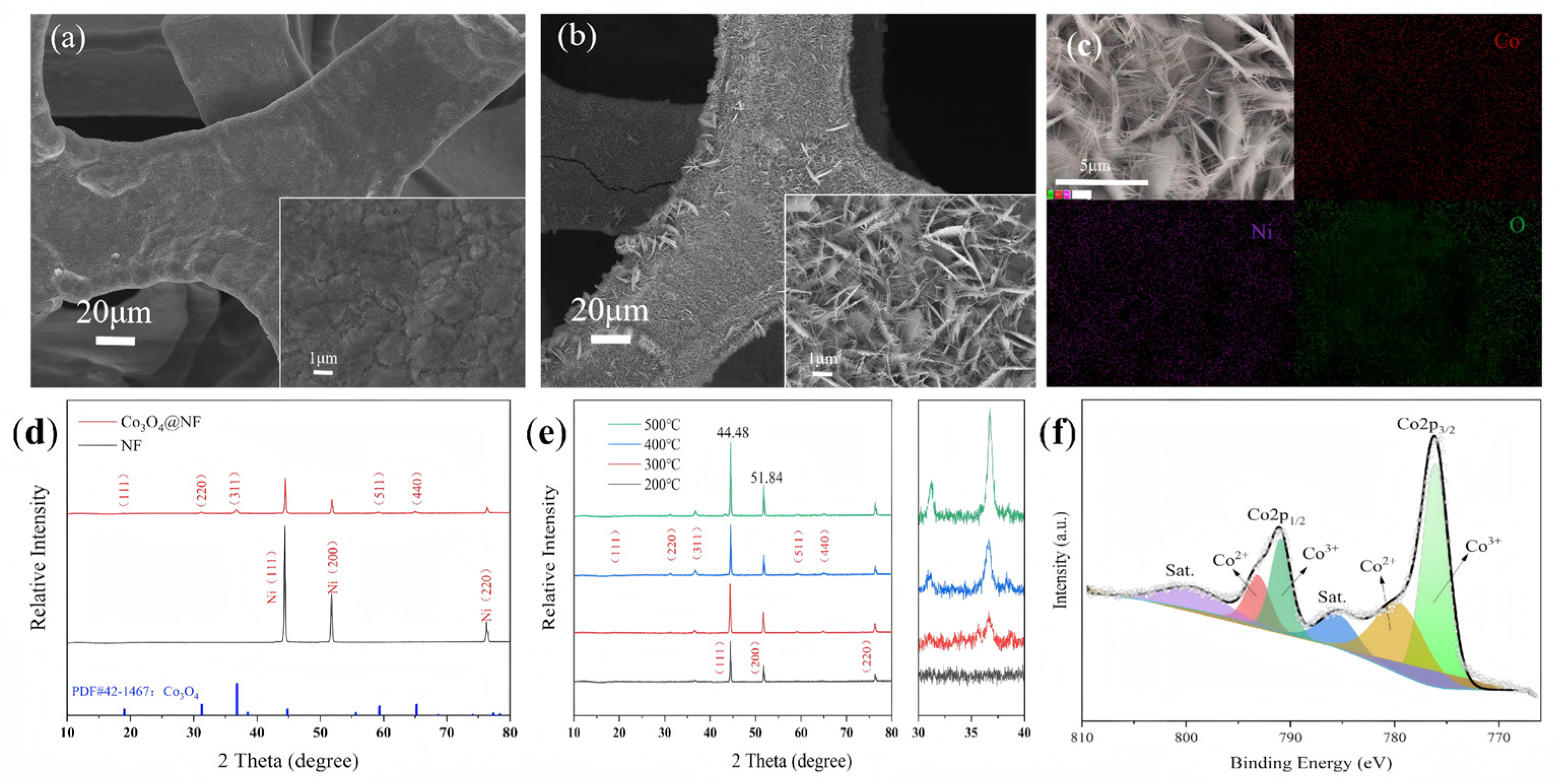
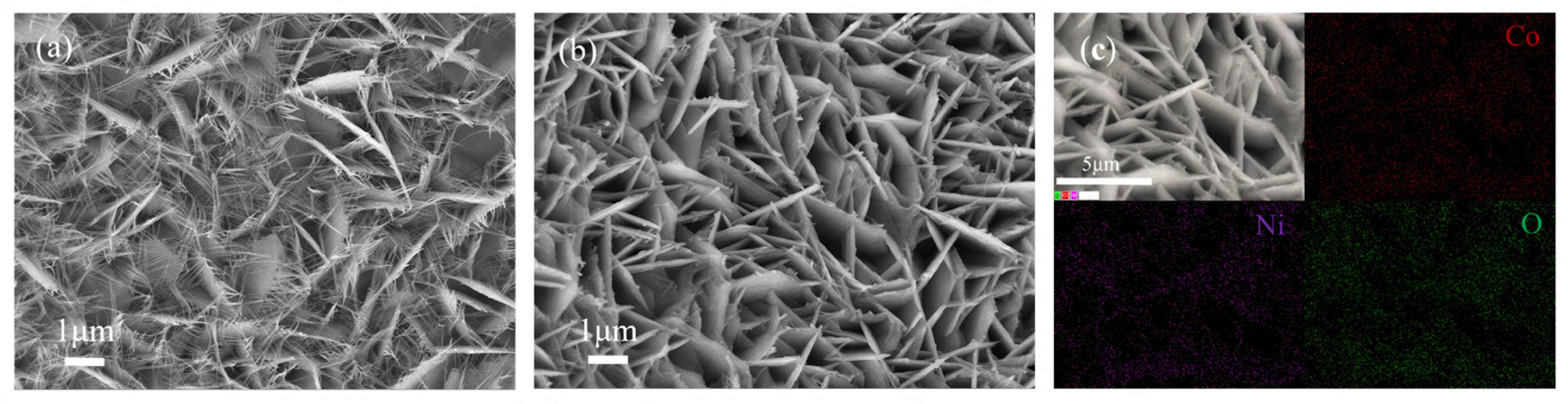
As shown in Figure 1a, pristine nickel foam exhibited a smooth surface, a three-dimensional interconnected framework, and pore sizes ranging from 200 to 500 μm [41]. After the hydrothermal treatment followed by calcination, the surface of the Co3O4@NF electrode was uniformly covered with a large number of nanoneedles, and the electrode color changed from purple to black. As shown in Figure 1b, Co3O4 grew vertically on the nickel foam skeleton in the form of nanoneedle arrays. This unique architecture markedly increased the specific surface area and provided abundant accessible Co2+/Co3+ active sites, which favored the adsorption and activation of NO3. Meanwhile, the porous self-supported structure of the Co3O4@NF electrode provides a large specific surface area, which increases the number of exposed cobalt active sites. In addition, this open architecture is expected to shorten ion diffusion paths and facilitate electrolyte penetration, which is beneficial for mass transfer during the nitrate reduction process. In addition, the self-supported porous structure enabled the rapid and uniform transport of nitrate ions throughout the electrode surface and promoted the timely desorption and release of reaction products, providing a structural basis for the enhanced nitrate removal performance.
Figure 1c shows the SEM-EDS elemental mapping results. The energy-dispersive X-ray spectroscopy (EDS) analysis confirmed the homogeneous spatial distribution of Co, Ni, and O over the entire electrode surface, indicating the successful formation of cobalt oxide nanostructures on the substrate skeleton. Combined with Figures S1 and S2, the agreement between the elemental distribution maps and the overall spectrum further demonstrated that Co3O4 was successfully loaded onto the nickel foam substrate with high uniformity and purity, thus providing a reliable material basis for the subsequent electrochemical performance evaluation.
The X-ray diffraction (XRD) patterns of the electrodes are shown in Figure 1d,e. For pristine nickel foam, three distinct diffraction peaks appeared at 44.5°, 51.9°, and 76.4°, corresponding to the (111), (200), and (220) crystal planes of metallic Ni, respectively. For the Co3O4@NF electrode, characteristic diffraction peaks were observed at 18.9°, 31.3°, 36.9°, 59.4°, and 65.2°, which could be indexed to the (111), (220), (311), (511), and (440) crystal planes of Co3O4, respectively. These results confirm the successful preparation of the Co3O4@NF electrode.
X-ray photoelectron spectroscopy (XPS) was further conducted to investigate the surface chemical composition of the electrode. As shown in Figure 1f, the Co 2p spectrum of the Co3O4@NF electrode displayed two main peaks at 780 and 795 eV, corresponding to Co 2p3/2 and Co 2p1/2, respectively. All peaks were obtained via Gaussian–Lorentzian deconvolution after Shirley background subtraction. The peaks located at 781.5 and 796.6 eV were assigned to Co2+, whereas those at 780 and 794.8 eV were attributed to Co3+. The satellite peaks at 768.8 and 804 eV originated from the shake-up excitation of Co2+. In addition, the Co3+/Co2+ molar ratio of the Co3O4@NF cathode was calculated to be 1.67, which was lower than the theoretical value of 2.0 for ideal Co3O4. This deviation suggests the presence of abundant oxygen vacancies and lattice defects on the electrode surface, which were beneficial for tuning the surface electronic structure and enhancing the adsorption and activation of nitrate ions. At the same time, this ratio ensured the presence of sufficient highly active Co3+ sites for effective NO3 adsorption and N–O bond cleavage while retaining an appropriate amount of Co2+ to participate in the reversible Co3+/Co2+ redox cycle. As a result, interfacial electron transfer and reaction kinetics were accelerated. The moderate Co3+/Co2+ ratio therefore provided a favorable balance between active-site density and electron transport efficiency, which may account for the excellent catalytic activity, high selectivity, and good stability of the Co3O4@NF electrode in electrocatalytic nitrate reduction.

2.2. Electrocatalytic Performance and Parameter Optimization

2.2.1. Optimization of Electrode Calcination Temperature

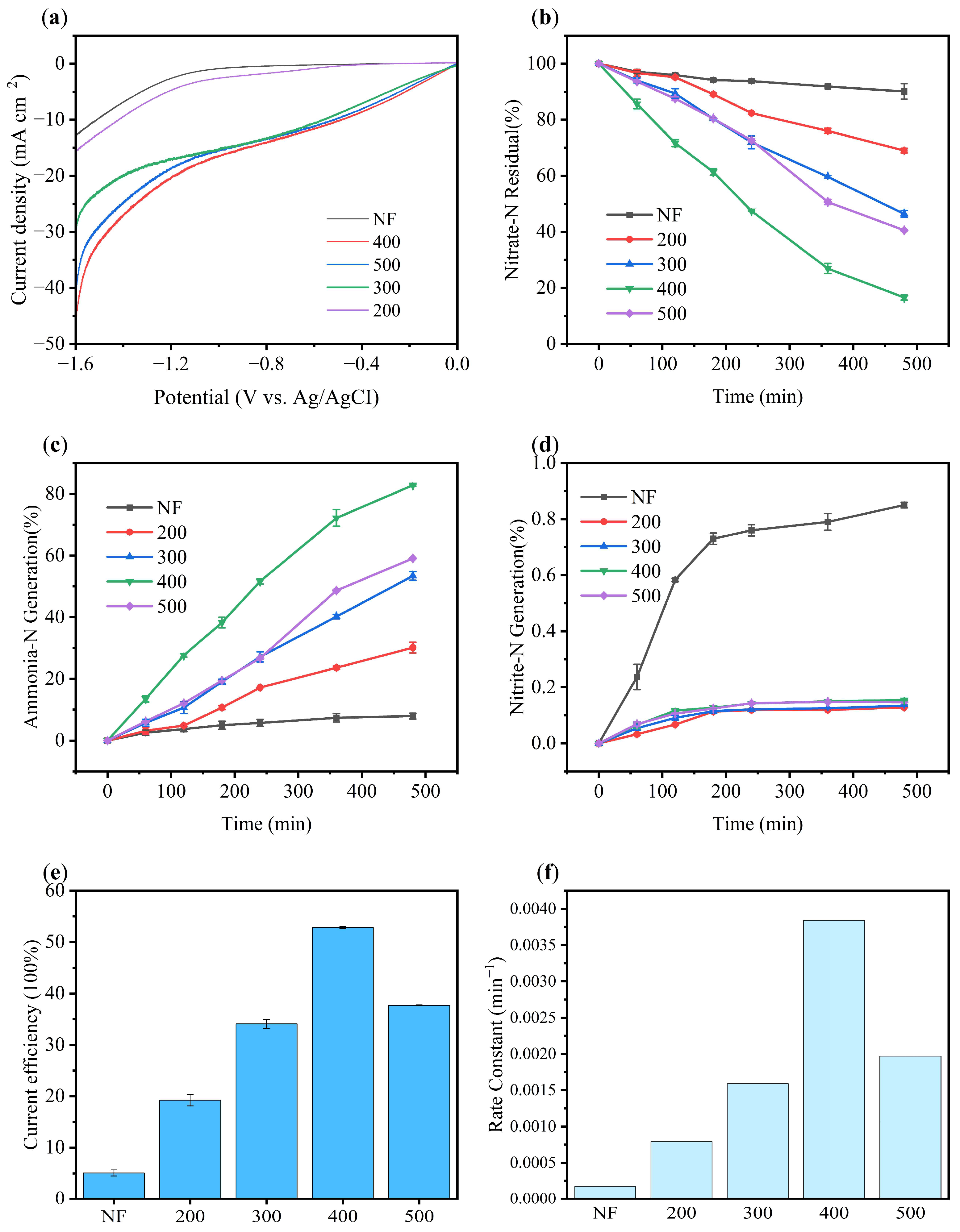
The preparation of Co3O4 nanoneedles supported on nickel foam (Co3O4@NF) is strongly influenced by calcination temperature, which in turn affects the electrocatalytic performance of the resulting electrodes. Therefore, the crystal structure and nitrate reduction performance of electrodes prepared at different calcination temperatures (200–500 °C) were systematically investigated. Linear sweep voltammetry (LSV) was first performed to evaluate the electrochemical behavior of the electrodes calcined at different temperatures. As shown in Figure 2a, Co3O4@NF calcined at 400 °C, denoted as Co3O4@NF(400), exhibited the highest current density at the same potential, indicating the best electrochemical activity among the tested samples.
The influence of calcination temperature on the crystal structure of Co3O4 was further examined by XRD (Figure 1e). When the calcination temperature was 200 °C, the dominant diffraction peaks were nearly identical to those of pristine nickel foam, suggesting that no obvious structural transformation had occurred. When the temperature increased to 300 °C, weak diffraction peaks appeared at 18.9°, 31.3°, 36.9°, 59.4°, and 65.2°, corresponding to the (111), (220), (311), (511), and (440) crystal planes of Co3O4, respectively, indicating partial oxidation of cobalt hydroxide to Co3O4. For the electrodes calcined at 200 and 300 °C, only weak and broad diffraction peaks were observed above the nickel foam background, corresponding to the poorly crystalline Co(OH)2 precursor phase. In contrast, well-defined diffraction peaks assigned to spinel Co3O4 (PDF# 42-1467) appeared at 400 °C and remained unchanged at 500 °C, confirming the complete thermal conversion of the precursor to crystalline Co3O4.
Figure 2b–d shows the effect of calcination temperature on NO3-N removal under an applied potential of −1.4 V (vs. Ag/AgCl) and an initial NO3-N concentration of 50 mg L−1. As shown in Figure 2b, the NO3-N removal efficiency increased from 31.1% to 53.6% when the calcination temperature increased from 200 to 300 °C and further increased to 83.4% at 400 °C. Correspondingly, the reaction rate constant successively increased by 101.3% and 141.5%, reaching 0.00384 min−1 cm−2. As the primary catalytic oxide phase, the amount of Co3O4 increased with increasing calcination temperature, thereby accelerating NO3-N reduction. According to the XRD results, Co3O4 exhibited favorable crystallinity at both 400 and 500 °C. However, when the calcination temperature was further increased to 500 °C, the NO3-N removal efficiency decreased to 59.4%, accompanied by a 48.7% decrease in the reaction rate constant. This decline can be mainly attributed to morphological coarsening and agglomeration of the Co3O4 active layer at excessive calcination temperature, which reduced the electrochemically active surface area and increased the charge-transfer resistance. Therefore, 400 °C was selected as the optimal calcination temperature for subsequent experiments. Meanwhile, to verify whether calcination at 500 °C would damage the catalyst structure, SEM characterization was performed on Co3O4 @NF prepared at 500 °C. Figure S3 reveals that a large number of irregular agglomerates and flaky aggregates appeared on the catalyst surface, resulting in a highly inhomogeneous distribution of nanostructures. The material underwent pronounced particle coarsening: the originally slender nanoneedles and nanosheets thickened, shortened, and agglomerated. These results demonstrate that the selection of calcination temperature is of critical importance for the preparation of this catalyst.
The main reduction products, NH4+ and NO2, that formed during nitrate reduction were also analyzed. Figure 2e presents the Faradaic efficiencies of different Co3O4@NF electrodes. Among all samples, Co3O4@NF(400) exhibited the highest NH4+-N generation percentage and Faradaic efficiency, reaching 82.3% and 53.0%, respectively. Notably, the NO2-N generation percentage, a by-product of nitrate reduction, remained at a very low level for all Co3O4@NF electrodes throughout the experiments. This result may be attributed to the high catalytic activity of Co3O4@NF, which favored the direct reduction of NO3 to NH4+. Meanwhile, Table 1 was obtained through calculation. It can be seen that the catalyst exhibited the maximum NH4+-N yield rate of 0.628 mg·h−1·cm−2 at a calcination temperature of 400 °C. These findings collectively demonstrate that Co3O4@NF(400) exhibited excellent nitrate reduction performance and high selectivity toward NH4+.

2.2.2. Electrochemical Testing

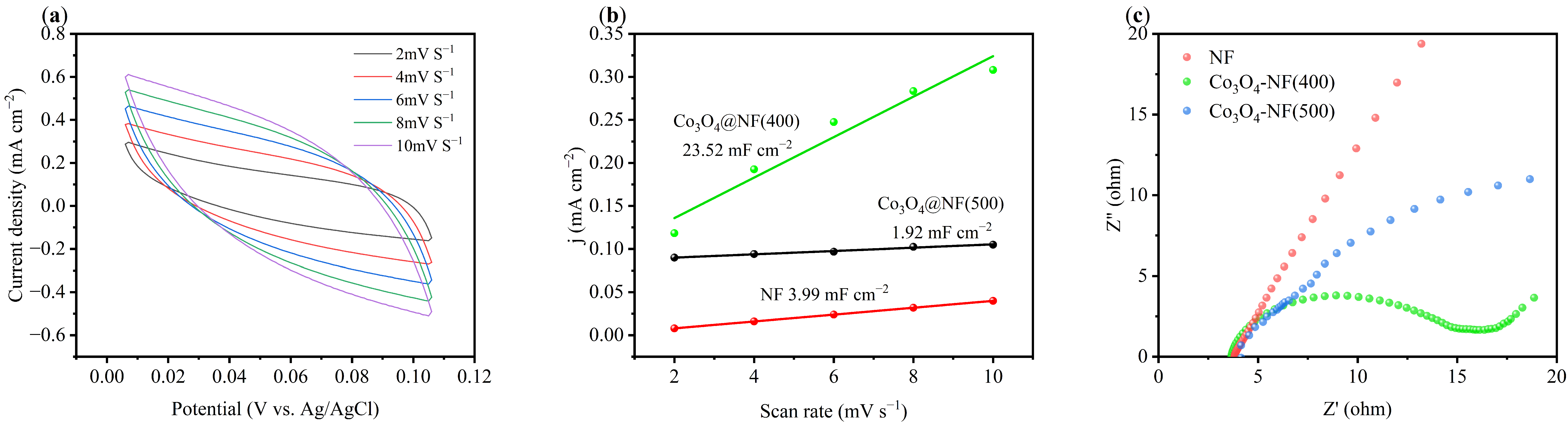
The electrochemically active surface area (ECSA) is an important parameter for evaluating the effective active surface area of a catalyst and is closely related to catalytic activity. In this study, the ECSA was estimated using the double-layer capacitance method. Cyclic voltammetry (CV) curves were recorded at different scan rates within a non-Faradaic potential window of 0.005–0.105 V (vs. Ag/AgCl), where no redox reaction occurred (Figure 3a and Figure S4). The scan rates were set at 2, 4, 6, 8, and 10 mV s−1. Linear fitting of current density against scan rate (Figure 3b) gave a double-layer capacitance (Cdl) of 23.52 mF cm−2 for Co3O4@NF(400), 1.92 mF cm−2 for Co3O4@NF(500) and 3.96 mF cm−2 for bare NF [42]. The corresponding ECSA values were calculated to be 588 cm2 for Co3O4@NF(400), 48 cm2 for Co3O4@NF(500), and 99 cm2 for NF, indicating that Co3O4@NF(400) possessed a much larger electrochemically active surface area and a greater number of accessible active sites.
Electrochemical impedance spectroscopy (EIS) analysis (Figure 3c) showed that the loading of Co3O4 reduced the overall electrode resistance and accelerated electron transfer, thereby improving the electrocatalytic activity.

2.2.3. Effect of Initial Nitrate Concentration

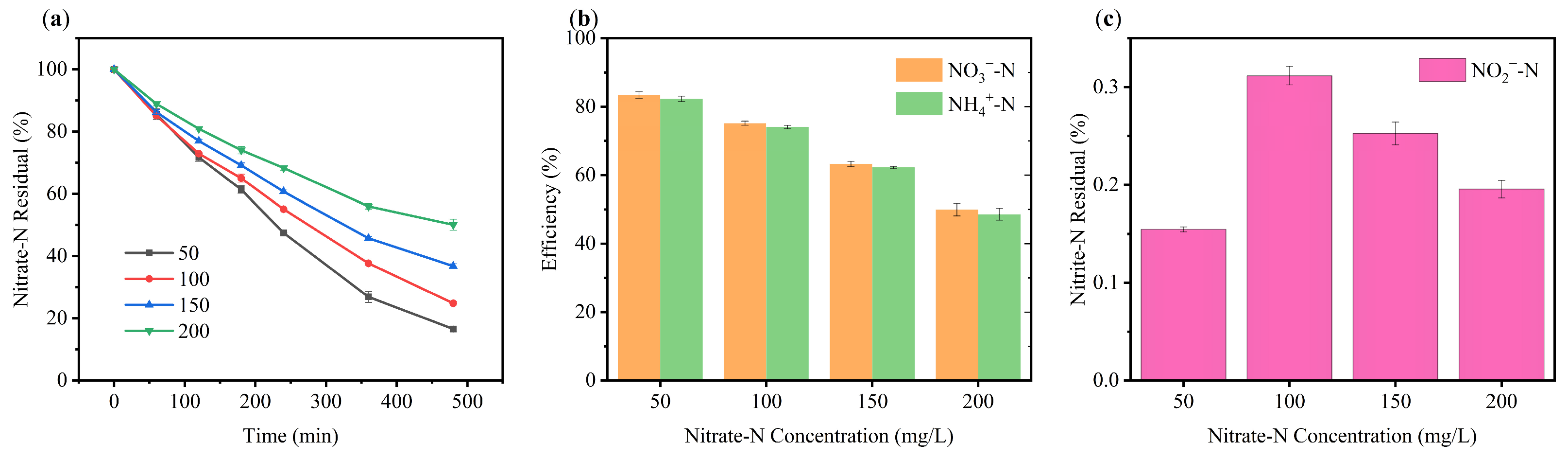
Because nitrate concentrations in actual wastewater may vary over a wide range, the influence of the initial NO3 concentration on reduction performance was investigated to evaluate the catalytic capability of Co3O4@NF toward nitrate reduction. As shown in Figure 4a–c, when the initial NO3 concentration increased from 50 to 200 mg L−1, the corresponding NO3-N removal efficiency decreased from 83.4% to 49.9%, while the NH4+-N generation percentage decreased from 82.3% to 48.6%.
Although the overall NO3-N removal efficiency decreased, the total amount of removed NO3 and produced NH4+ both increased with increasing nitrate concentration, while the NH4+-N selectivity remained at approximately 98%. This phenomenon may be explained by the suppression of the hydrogen evolution reaction at higher nitrate concentrations, which left more active sites available for nitrate reduction. Meanwhile, the elevated NO3 concentration may also enhance nitrate mass transfer during the electrochemical reaction.

2.2.4. Effect of Initial Voltage Intensity

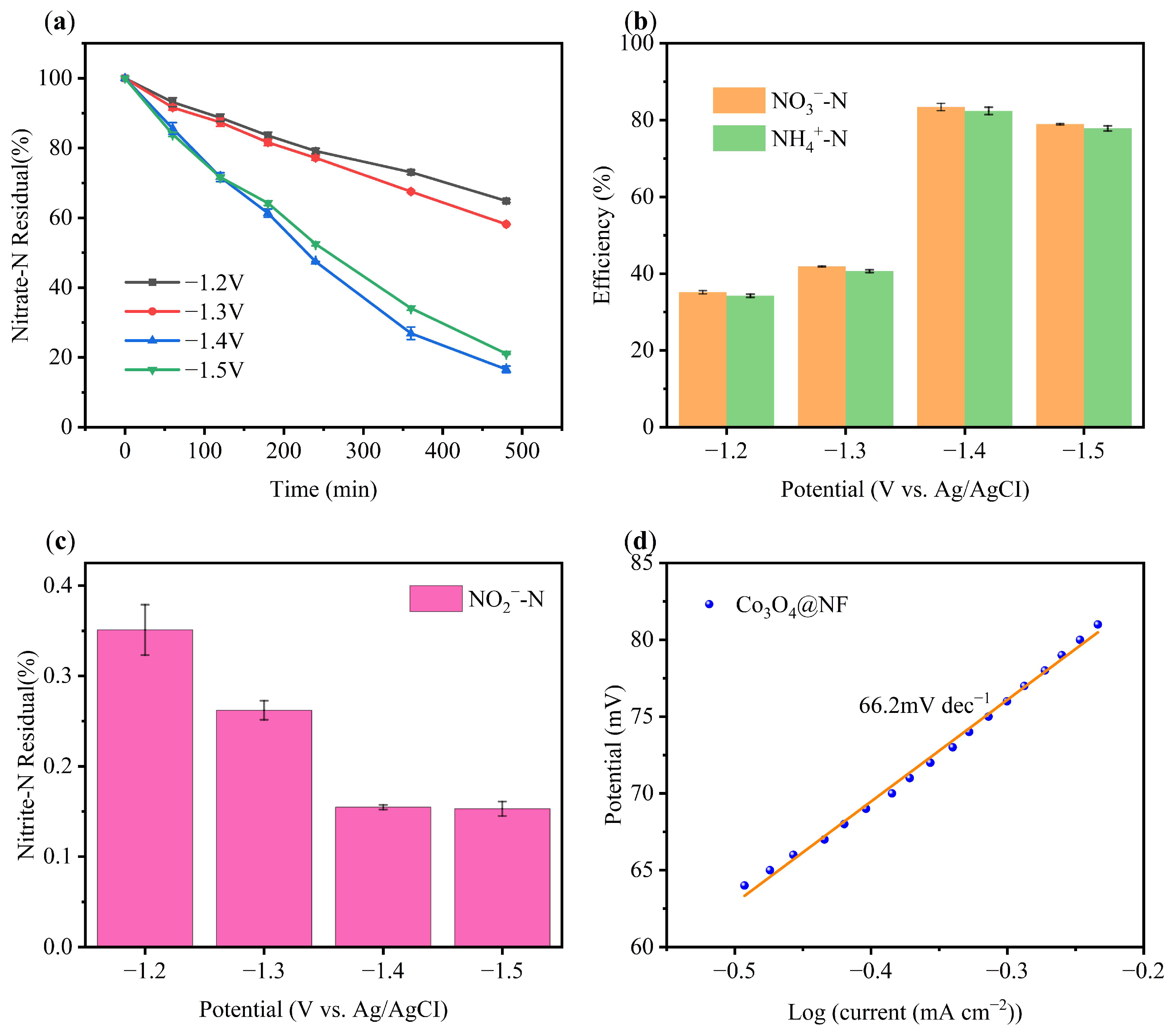
As shown in Figure 5a–c, the NO3-N removal efficiency increased markedly as the applied potential increased from −1.2 to −1.4 V. Specifically, when the potential increased from −1.3 to −1.4 V, the NO3-N removal efficiency increased from 35.2% to 83.4%, accompanied by an increase in NH4+-N generation percentage from 34.3% to 82.4%. When the potential was further increased to −1.5 V, the NO3-N removal efficiency was similar to that at −1.4 V but slightly lower, and the NH4+-N generation percentage also decreased slightly.
The enhanced NO3-N removal efficiency can be interpreted according to Faraday’s law, which states that the amount of transformed species at the electrode surface is proportional to the number of electrons transferred. The decline in NO3-N removal efficiency at higher potentials may be attributed to the intensified hydrogen evolution reaction (HER), which competed for active sites and inhibited nitrate electroreduction. In addition, excessive current density leads to higher energy consumption during electroreduction. Therefore, to balance NO3-N removal efficiency and energy utilization, an applied potential of −1.4 V was selected for subsequent experiments.
As shown in Figure 5d, based on the polarization curve (Figure S5), the Tafel slope of the catalyst was fitted to be 66.2 mV dec−1, indicating favorable electrocatalytic reaction kinetics over the as-prepared catalyst.

2.2.5. Effect of Initial pH

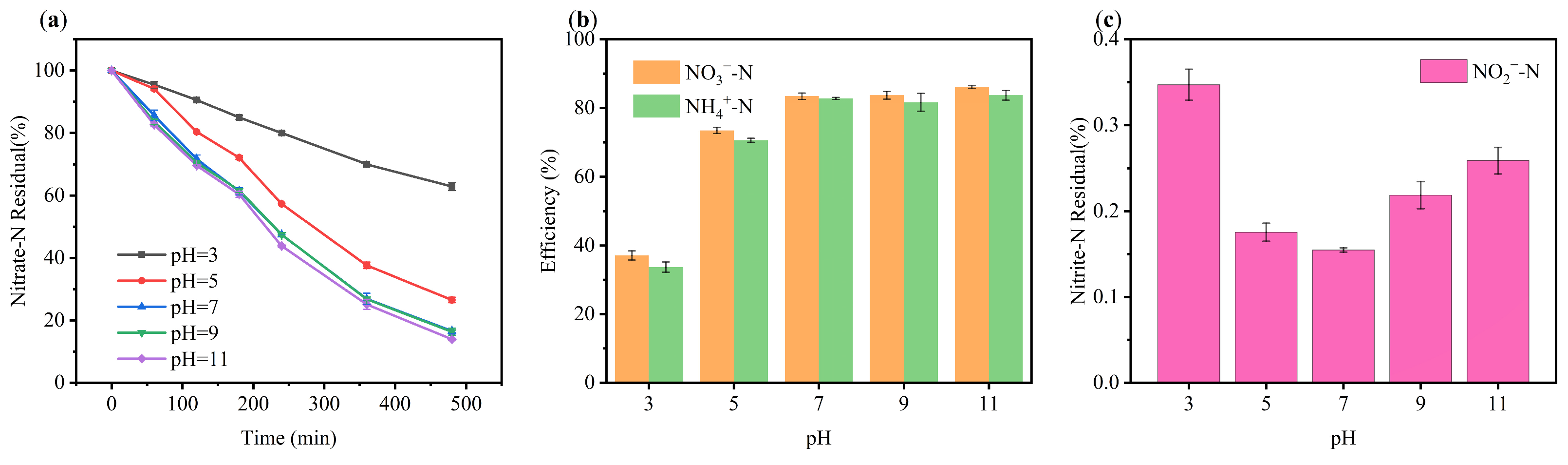
An increased proton (H+) concentration in the electrolyte promotes the hydrogen evolution reaction (HER), which competes with and suppresses NO3-N reduction. As shown in Figure 6a–c, the NO3-N removal efficiency was clearly restricted at an initial pH of 3 because of the strong competition between HER and nitrate reduction under acidic conditions.
When the initial pH increased from 3 to 7, the NO3-N removal efficiency increased markedly from 37.1% to 73.5% and then to 83.4%. However, only slight variation in NO3-N removal efficiency was observed within the pH range of 7–11, with values of 83.4%, 83.7%, and 86.1%, respectively. These results indicate that the Co3O4@NF electrode maintained favorable and stable catalytic activity under both neutral and alkaline conditions.

2.3. Stability and Structural Integrity

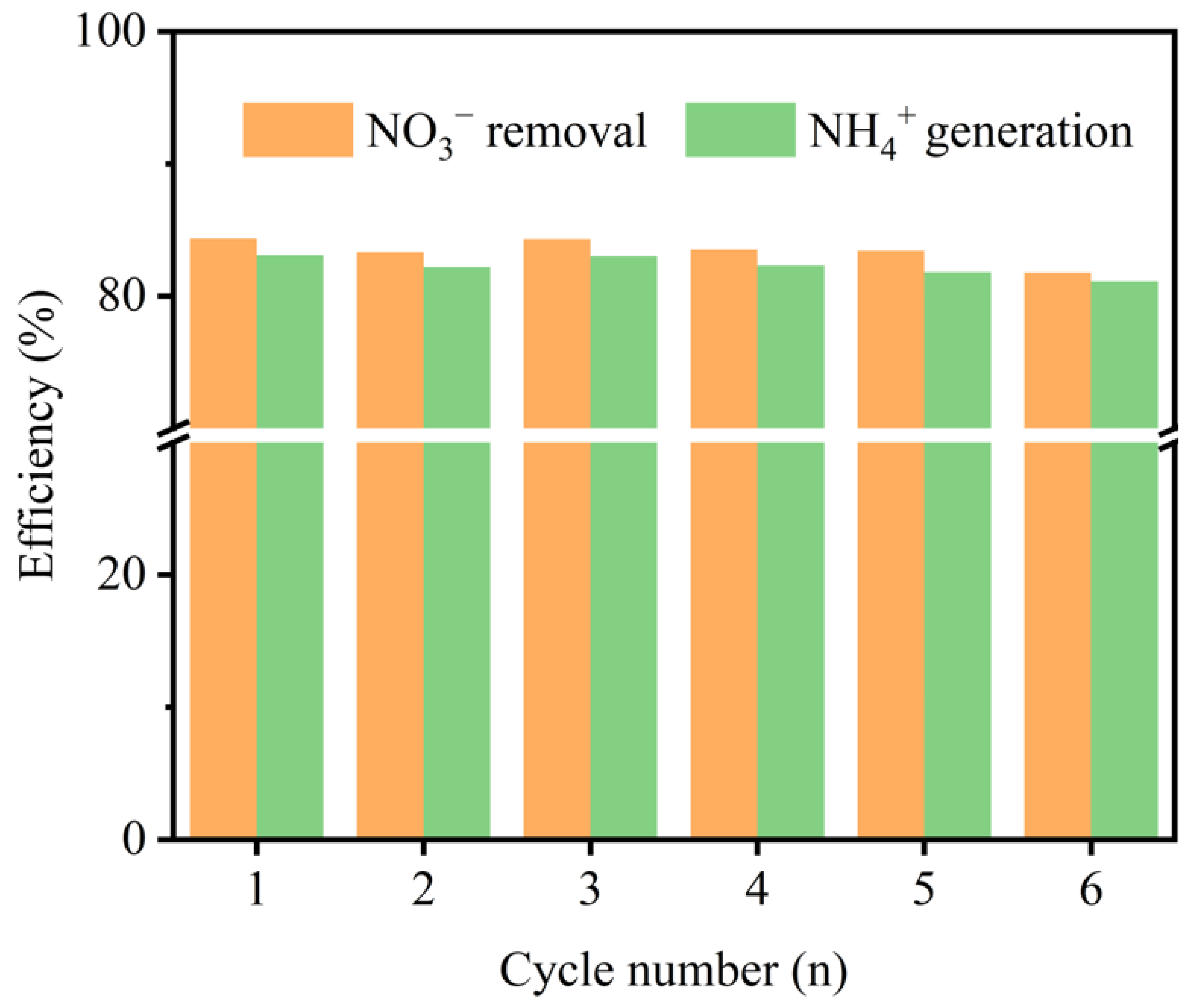
Electrode stability is a key criterion for assessing practical application potential. In this study, six consecutive cycling experiments were conducted to evaluate the long-term stability of the Co3O4@NF catalyst. As shown in Figure 7, no obvious decrease in NO3-N removal efficiency or NH4+-N generation percentage was observed after six cycles. The NO3-N removal efficiencies of the Co3O4@NF electrode over the six cycles were 84.4%, 83.3%, 84.3%, 82.5%, 83.5%, and 81.8%, respectively. These results confirm that the Co3O4@NF electrode exhibited excellent stability during nitrate reduction and therefore has strong potential for practical engineering applications.
Figure 8a,b shows the SEM images of the Co3O4 nanoneedle/nickel foam electrode before and after the electrocatalytic reaction. The structural stability of the electrode during electrolysis was evaluated by comparing its morphology, crystal structure, and surface chemical state before and after reaction. The electrode retained its characteristic nanostructure after reaction, without obvious morphological collapse or substantial loss of surface Co/O signals in EDS mapping, indicating excellent structural integrity and cycling stability during electrocatalysis. The EDS mapping images and spectra in Figure 8c further showed that the oxygen content of the electrode did not change significantly after the reaction. These results further confirm the excellent stability of the Co3O4@NF electrode.
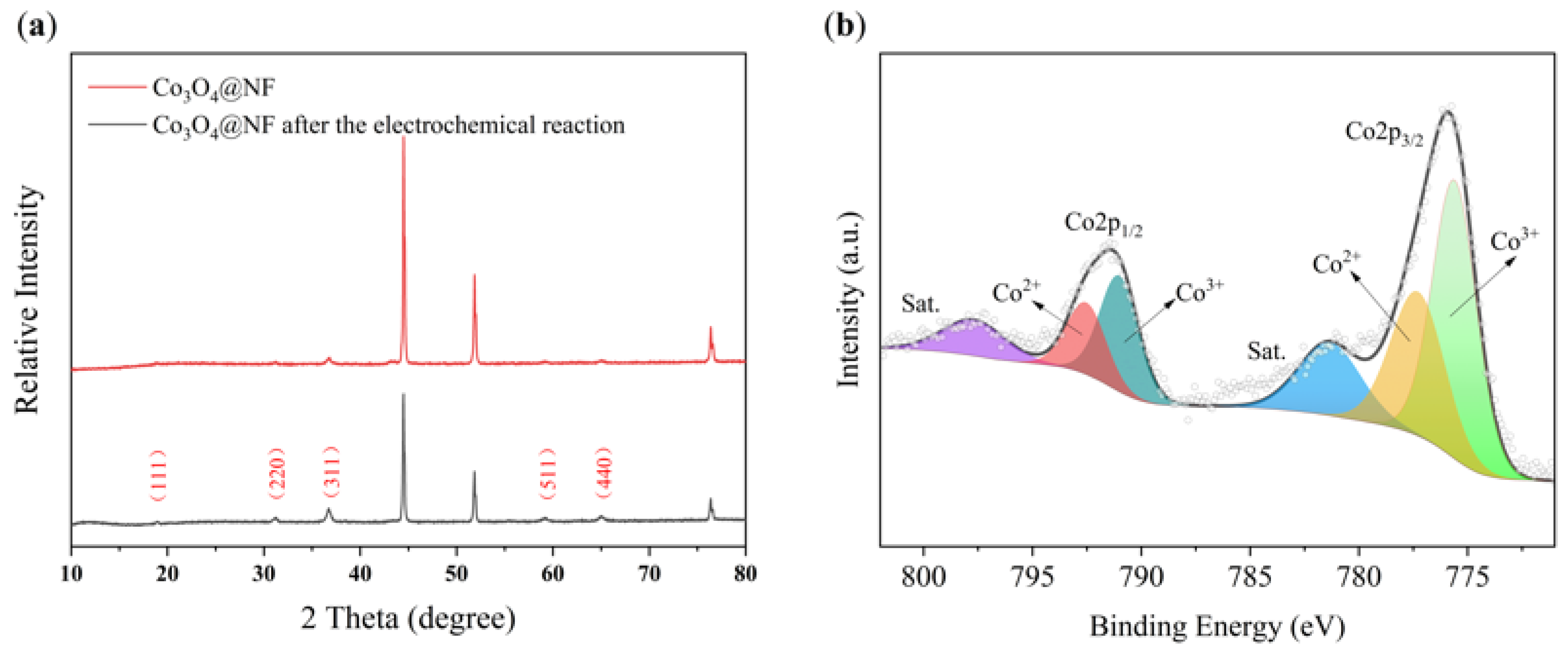
To evaluate the stability of Co3O4@NF during nitrate reduction, we performed XRD and XPS characterizations on the post-reaction catalyst (Figure 9). The XRD patterns before and after the reaction were nearly identical. All diffraction peaks matched the standard spinel Co3O4 phase (PDF#42-1467), and no new peaks, peak shifts, or no obvious new peaks or peak shifts were observed. This confirms that the crystal structure of the catalyst remains intact and no phase transformation occurs during the reaction. The post-reaction Co 2p XPS spectrum can still be deconvoluted into characteristic Co2+ and Co3+ peaks with unchanged binding energies. Quantitative analysis showed that the Co3+/Co2+ ratio decreased slightly from 1.67 to 1.60, indicating a negligible change in the valence state of cobalt species. These results collectively demonstrate that Co3O4@NF exhibits excellent structural and chemical stability.

2.4. Electrocatalytic Nitrate Reduction Mechanism

The electrocatalytic nitrate reduction mechanism was further investigated through electrochemical measurements and radical trapping experiments.
To investigate the nitrate reduction pathway over the Co3O4@NF electrode, tert-butanol (TBA) was used as a selective scavenger for adsorbed hydrogen atoms (H*). In electrocatalytic nitrate reduction systems, the reaction can proceed via two distinct pathways. (1) The direct electron transfer pathway: Nitrate ions are directly adsorbed on the electrode surface and accept electrons from the catalyst to undergo reduction. (2) The indirect H*-mediated pathway: Water molecules or protons are first reduced on the electrode surface to generate highly reactive adsorbed hydrogen atoms (H*). These H* species then act as reducing agents and react with nitrate ions in the vicinity of the electrode surface to promote their reduction.
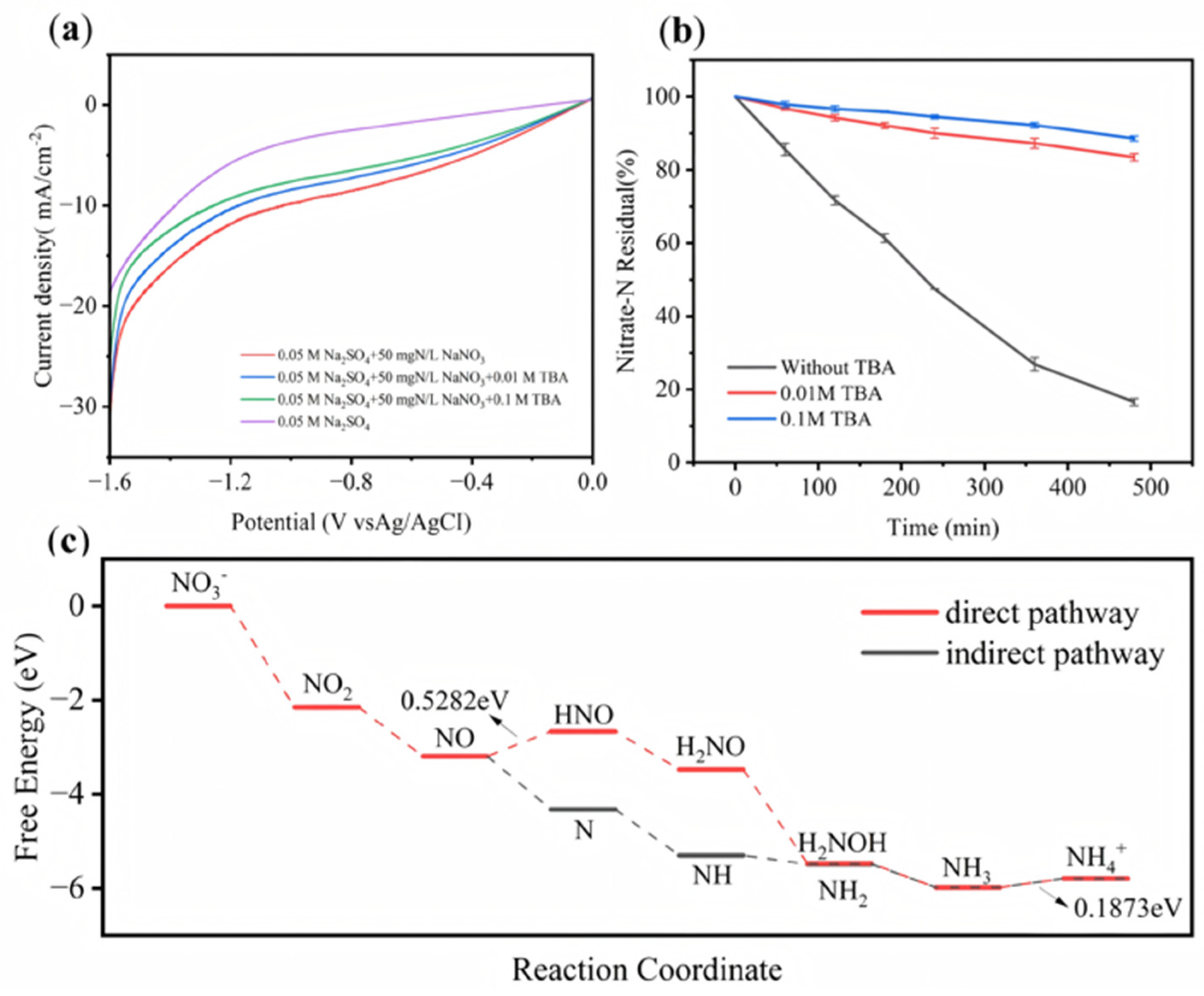
TBA is widely recognized as an effective and selective H* scavenger. When TBA is added to the electrolyte, it rapidly reacts with and quenches all available H* radicals, thereby completely inhibiting the indirect H*-mediated pathway. By comparing the catalytic performance with and without TBA addition, we can quantitatively evaluate the contribution of the indirect pathway to the overall nitrate reduction reaction. Figure 10a shows the variation trend of the LSV response after the addition of tert-butanol (TBA) to the electrolyte. As the TBA concentration increases, the current density decreases but remains higher than that in the nitrate-free electrolyte, indicating an attenuation of the current response. As shown in Figure 10b, when the TBA concentration rises to 10 mM, the NO3-N removal efficiency decreases from 83.4% to 16.6%. Meanwhile, the NO3-N removal efficiency drops to 11.4% at a TBA concentration of 100 mM. The NO3-N removal efficiency is significantly reduced by 80.1% and 86.3%, respectively, demonstrating that both the direct reduction pathway and the indirect reduction pathway of Co3O4@NF are involved in the nitrate reduction process, with the indirect pathway playing a dominant role. To exclude TBA-induced active-site blocking, LSV curves were measured in nitrate-free 0.05 M Na2SO4 with 0–0.1 M TBA (Figure S6). The nearly overlapping curves confirm no significant TBA adsorption. Therefore, the performance decline after TBA addition arises solely from inhibition of the dominant H*-mediated indirect pathway.
In addition, as presented in Figure 10c, density functional theory (DFT) calculations were performed on the direct and indirect reaction pathways of the catalyst. On the Co3O4 (311) crystal plane, the free energy increase in the rate-determining step (RDS) for the direct reaction pathway was 0.5282 eV. In contrast, the calculated energy change of the rate-determining step for the indirect reaction pathway on the Co3O4(311) plane was considerably lower, at only 0.1873 eV. The detailed reaction pathways are shown in Figure S10. These results further confirm that the nitrate reduction reaction over Co3O4@NF is dominated by the indirect reaction pathway.
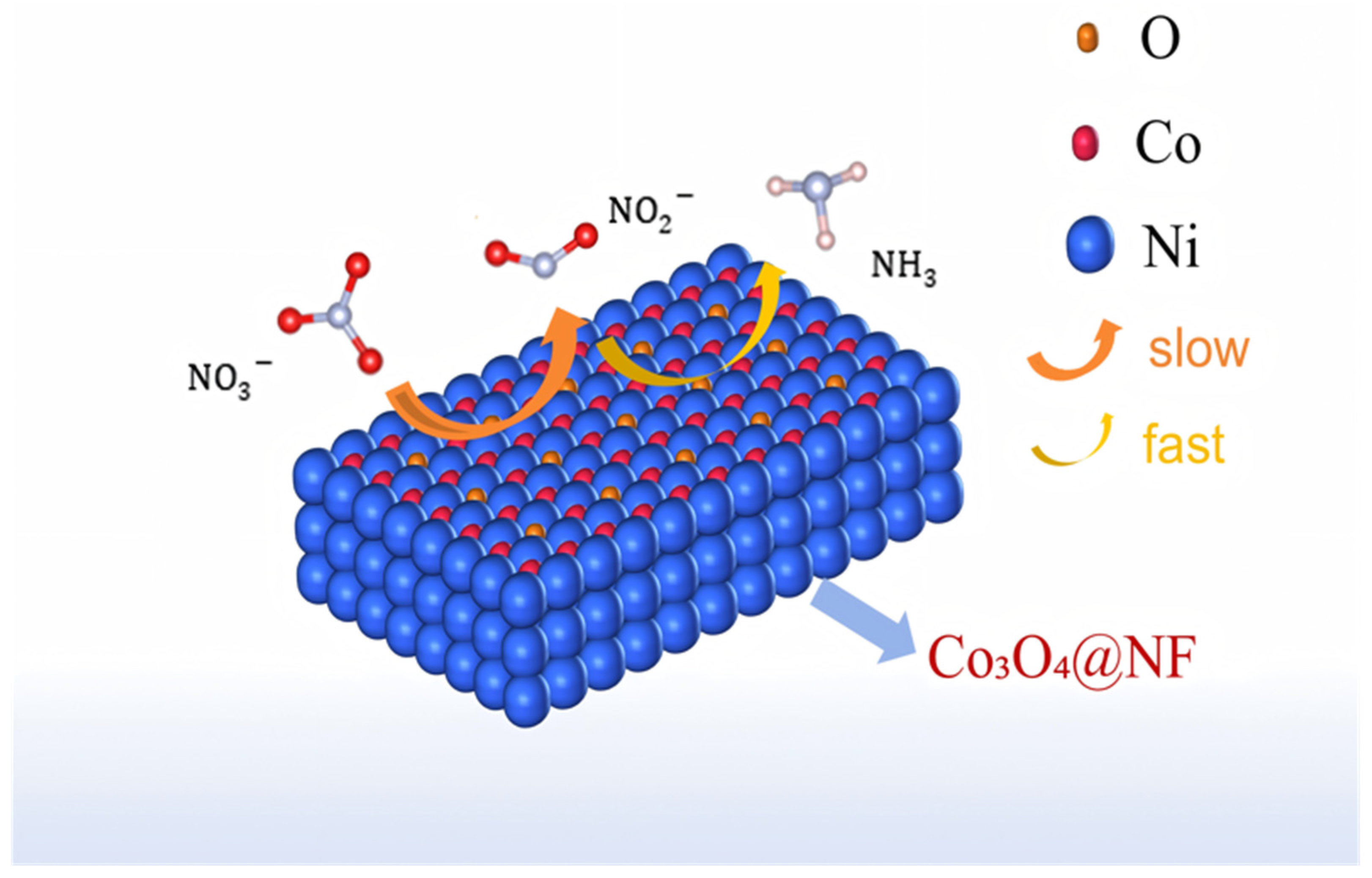
Based on the experimental results, NH4+-N was identified as the main product of electrocatalytic nitrate reduction, whereas the concentration of nitrite, as an intermediate product, remained extremely low throughout the reaction. This finding indicates that nitrate underwent rapid, continuous, and deep reduction on the electrode surface and that the reaction likely followed a direct eight-electron transfer pathway. Intermediate species such as nitrite generated during the reaction could be rapidly reduced further without obvious desorption or accumulation and were ultimately converted into ammonium ions with high efficiency. Figure 11 shows the proposed reaction mechanism of nitrate on Co3O4@NF, and the specific reaction equations are provided in the Supplementary Materials.

2.5. Performance in Real Water Matrices

The practical performance of the optimal Co3O4@NF(400) electrode was evaluated using Xiangjiang River water (collected from Orange Isle, Changsha) and secondary clarifier effluent from a sewage treatment plant in Chengdu. All samples were filtered through a 0.45 μm membrane to remove suspended solids and stored at 4 °C in the dark before tests. Next, 50 mM Na2SO4 was added as supporting electrolyte, and the initial NO3-N concentration was adjusted to 50 mg·L−1 for all samples, maintaining identical conditions to simulated wastewater.
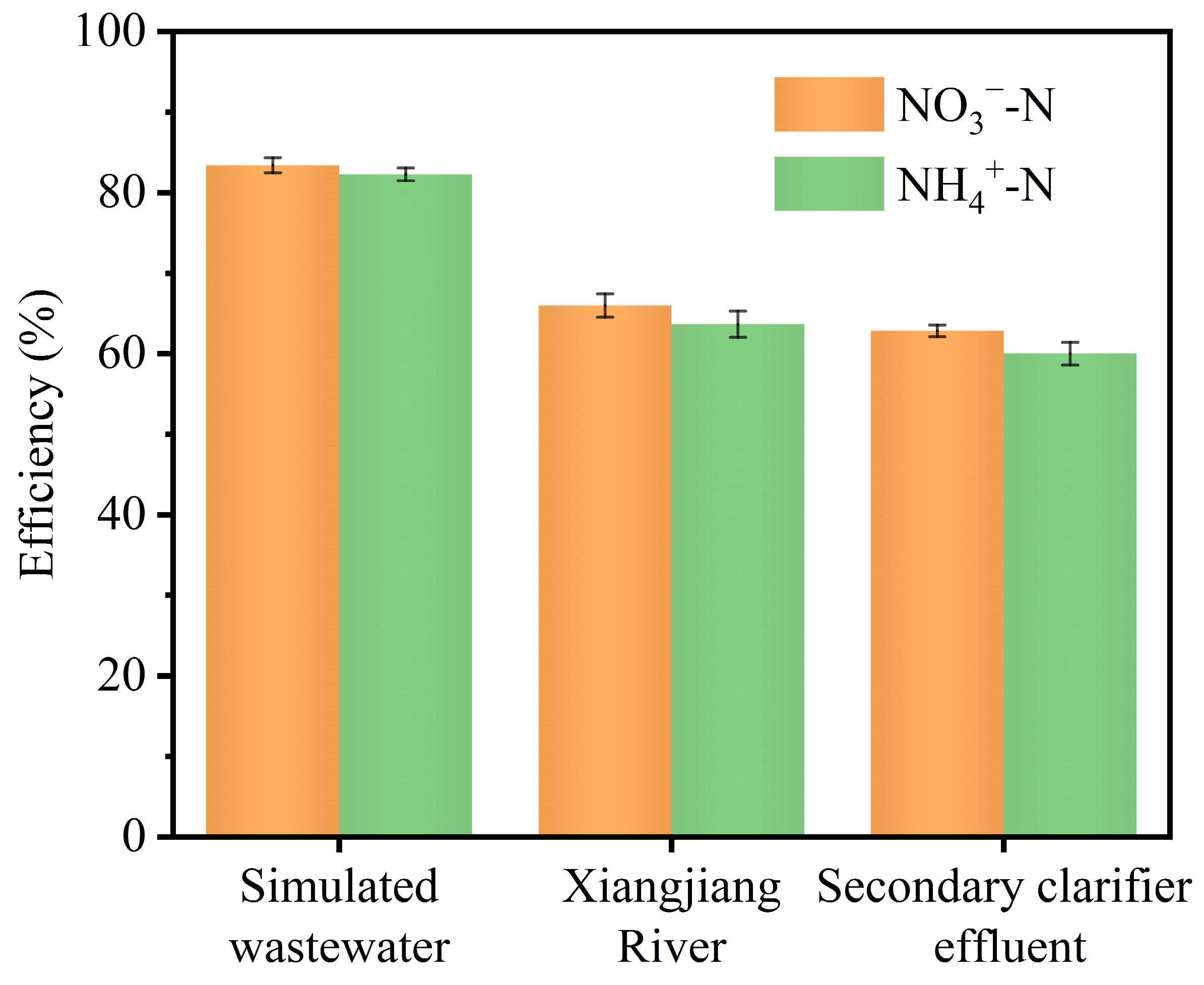
As shown in Figure 12, nitrate removal efficiencies decreased to 65.98% (Xiangjiang River) and 62.85% (secondary clarifier effluent) compared to 83.4% in simulated wastewater. This decline may be related to matrix effects in real waters, where coexisting ions and dissolved organic matter could compete for active sites or partially cover the electrode surface. Because comprehensive water-quality characterization was not available in this study, further systematic analysis is needed to identify the dominant interfering species. The slightly lower efficiency in secondary clarifier effluent is consistent with its typically higher impurity content.
Notably, excellent ammonia retention was achieved in both real waters. Total NH4+-N recovery efficiencies reached 95.2% in Xiangjiang River water and 87.1% in secondary clarifier effluent (which contained an initial NH4+-N concentration of 6.2 mg·L−1). These results demonstrate that the Co3O4@NF electrode retained high ammonia selectivity even in complex real environments, showing promising potential for simultaneous nitrate removal and ammonia recovery in practical wastewater treatment.

3. Discussion

The superior nitrate reduction performance of Co3O4@NF can be ascribed to the synergistic combination of electrode architecture and catalytic composition. The nickel foam substrate provides a continuous three-dimensional conductive scaffold, whereas the in situ grown Co3O4 nanoneedles supply abundant exposed catalytic sites and a shortened diffusion path for ions and electrons. Consistent with this structural design, Co3O4@NF exhibited a substantially larger electrochemically active surface area and lower charge-transfer resistance than bare NF, confirming that the integrated binder-free configuration effectively enhances interfacial electrochemical reactivity.
Calcination temperature was a critical parameter in determining the final catalytic behavior. At relatively low temperatures, the precursor was not fully converted into crystalline Co3O4, resulting in an insufficient density of active oxide sites. Calcination at 400 °C enabled the formation of well-defined Co3O4 while preserving the nanoneedle morphology and porous electrode framework. In contrast, further heating to 500 °C likely induced structural coarsening or partial deterioration of the hierarchical architecture, thereby reducing active-site accessibility and weakening electrocatalytic performance. These results highlight that catalytic efficiency depends on both phase evolution and morphological preservation.
The product distribution also indicates that Co3O4@NF favors deep nitrate reduction to ammonium rather than the accumulation of nitrite. The consistently low nitrite concentration suggests that once nitrite was formed, it was rapidly further reduced on the catalyst surface. Combined with the tert-butanol trapping experiments and DFT analysis, the data support the coexistence of direct electron-transfer and hydrogen-assisted indirect pathways, with the latter making the dominant contribution under the present conditions. Such mechanistic behavior is beneficial for achieving high ammonium selectivity while suppressing undesirable intermediate buildup.
From an application perspective, the catalyst retained high ammonium selectivity in both river water and secondary clarifier effluent, demonstrating a degree of tolerance toward complex water matrices. The decrease in nitrate removal efficiency observed in real waters nevertheless implies that coexisting ions and dissolved organic matter may compete for active sites or interfere with nitrate adsorption and interfacial reduction. Future studies should therefore evaluate long-term operation, energy consumption, matrix effects, and the integration of this process with downstream ammonia recovery or continuous-flow treatment systems.

4. Materials and Methods

4.1. Reagents and Materials

All reagents and solvents were of analytical grade and used as received. Nickel foam (99.99%) was purchased from Alibaba. Cobalt nitrate hexahydrate (Co(NO3)2·6H2O, 99%), urea (CO(NH2)2, ≥99%), ammonium fluoride (NH4F, ≥99%), hydrochloric acid (HCl), sodium hydroxide (NaOH), acetone, absolute ethanol, ethylene glycol, sodium sulfate (Na2SO4, 99%), ammonium chloride (NH4Cl, 99.99%), sodium nitrate (NaNO3, 99%), sodium nitrite (NaNO2, 99%), sulfuric acid (H2SO4, 98%), and tert-butanol (TBA, 99.5%) were obtained from Sinopharm Chemical Reagent Co., Ltd. (Shanghai, China). All aqueous solutions were prepared with ultrapure deionized water.

4.2. Fabrication of the Binder-Free Co3O4@NF Cathode

Nickel foam (NF) was first cut into pieces measuring 3.0 × 2.0 cm2. The cut NF was sequentially ultrasonically cleaned in acetone, 1 mol·L−1 HCl, and absolute ethanol for 15 min each, followed by a final ultrasonic cleaning step in deionized water for 15 min to ensure the complete removal of surface impurities. The cleaned NF was then dried in a vacuum oven at 60 °C for 12 h.
Subsequently, the Co3O4@NF foam cathode was fabricated through a combination of hydrothermal treatment and calcination. The precursor solution was prepared by dissolving 1 mmol Co(NO3)2·6H2O, 6 mmol urea (CO(NH2)2), and 4 mmol ammonium fluoride (NH4F) in 30 mL deionized water. The resulting solution was transferred into a 50 mL Teflon-lined stainless-steel autoclave, after which the dried NF was immersed in the solution. The autoclave was then sealed and heated in an electric oven at 120 °C for 8 h, allowing the uniform growth of Co(OH)2 nanoneedle arrays on the NF substrate. After the hydrothermal reaction, the obtained electrode was rinsed with deionized water and vacuum-dried at 60 °C for subsequent use. The dried electrode was then precisely cut into four smaller working electrode pieces with dimensions of 1.0 × 1.5 cm2. During all electrochemical measurements, the electrode was held by a PTFE-coated electrode clip, and only the lower 1.0 × 1.0 cm2 portion was immersed in the electrolyte solution as the effective geometric area. All current densities, ECSA values, rate constants, and NH3 yield rates were normalized to this exposed geometric area of 1.0 cm2.
The Co3O4 nanoneedle-supported nickel foam electrode (Co3O4@NF) was obtained by annealing the as-prepared Co(OH)2@NF in a muffle furnace at 400 °C for 120 min. In addition, control samples were prepared at different thermal oxidation temperatures (200, 300, and 500 °C) for comparison. The relevant reaction processes are shown below:
C o ( N O 3 ) 2 · 6 H 2 O + C O ( N H 2 ) 2 C o ( O H ) 2 + C O 2 ( g ) + 2 N H 4 N O 3 + 3 H 2 O   ( g )
6 C o ( O H ) 2 + O 2   ( g ) 2 C o 3 O 4 + 6 H 2 O   ( g )

4.3. Electrochemical Nitrate Removal Experiments

Electrochemical nitrate removal experiments were carried out using a CHI 760E electrochemical workstation (Chenhua Instruments Co., Ltd., Shanghai, China). A three-electrode system coupled with a single-chamber electrochemical reactor (150 mL) was employed. The Co3O4@NF foam electrode, with an effective immersed area of 1 cm2 (1 × 1 cm2), was mounted on an electrode holder and used as the working electrode. A platinum sheet (1 × 1 cm2) and a silver/silver chloride (Ag/AgCl) electrode were used as the counter electrode and reference electrode, respectively. Before each electrochemical measurement, the electrolyte was purged with high-purity nitrogen for 30 min to remove dissolved oxygen, and a nitrogen atmosphere was maintained throughout the entire test process; all experiments were performed at 25 ± 1 °C.
Unless otherwise specified, the simulated wastewater consisted of 100 mL 0.05 mol·L−1 sodium sulfate (Na2SO4) electrolyte containing 50 mg N·L−1 sodium nitrate (NaNO3). The reaction solution was continuously stirred at a constant rate of 400 rpm during the entire experiment to ensure uniform mass transfer. During each experiment, a constant potential was applied for a predetermined period. At regular time intervals, 0.75 mL aliquots were collected using a syringe for the determination of ammonia nitrogen (NH4+-N), nitrate nitrogen (NO3-N), and nitrite nitrogen (NO2-N).
The solution pH was monitored in real-time with a calibrated pH meter during adjustment, and 0.1 M NaOH or H2SO4 was added dropwise until the predetermined pH value was reached. Meanwhile, as the supporting electrolyte was 50 mM Na2SO4, the ions (Na+ and SO42−) introduced during pH adjustment were identical to the background ions. The additional concentration of ions introduced in this process is negligible, and thus no significant influence on the nitrate reduction performance or product selectivity was expected.
Concentrations were analyzed using a Shimadzu UV-2600 ultraviolet–visible (UV–Vis) spectrophotometer based on colorimetric methods. The absorbance of the reacted solutions was measured at 220, 275, 540, and 420 nm, respectively. The measured standard curves (Figures S7–S9) were used for the determination of NO3-N, NO2-N, and NH4+-N, respectively [43,44,45].
All electrochemical performance metrics, including NO3-N removal efficiency, NO2-N generation percentage, NH4+-N generation percentage, NH4+-N selectivity, Faradaic efficiency, and NH4+-N yield rate, were calculated using nitrogen mass-based equations. The detailed calculation formulas and definitions of all parameters are provided in Supplementary Materials S3.

4.4. Characterization Methods

The morphology of the electrodes was characterized using field-emission scanning electron microscopy (FE-SEM, TESCAN MIRA LMS, Brno, Czech Republic), and the corresponding elemental composition and distribution were analyzed using the attached energy-dispersive X-ray spectroscopy (EDS) system. X-ray diffraction (XRD) patterns were recorded on a Rigaku SmartLab SE diffractometer (Tokyo, Japan) using Cu Kα radiation (λ = 1.54060 Å). X-ray photoelectron spectroscopy (XPS) measurements were performed on a Shimadzu/Kratos AXIS SUPRA+ spectrometer (Kyoto, Japan), and all binding energies were calibrated against the C 1s peak at 284.8 eV.
Electrochemical measurements, including linear sweep voltammetry (LSV), cyclic voltammetry (CV), and electrochemical active surface area (ECSA) analysis, were conducted on an electrochemical workstation using a conventional three-electrode system, in which the Co3O4@NF electrode served as the working electrode, an Ag/AgCl electrode as the reference electrode, and a platinum plate as the counter electrode.

5. Conclusions

A binder-free Co3O4 nanoneedle array supported on nickel foam was successfully fabricated through hydrothermal growth followed by calcination. The resulting Co3O4@NF electrode provided a three-dimensional porous architecture, intimate catalyst–substrate contact, and abundant exposed active sites, all of which are advantageous for interfacial electron transfer and nitrate reduction. Among the tested samples, the electrode calcined at 400 °C delivered the best overall performance, indicating that an appropriate balance between Co3O4 formation and structural preservation is essential for efficient catalysis.
Under the optimal conditions of −1.4 V vs. Ag/AgCl, pH 7, and 50 mg L−1 NO3-N, Co3O4@NF achieved 83.4% nitrate removal within 480 min together with 98.7% ammonium selectivity. The slight variation between the representative value of 83.4% and the first-cycle value in the cycling test resulted from independent repeated experiments. Electrochemical characterization showed that Co3O4 loading substantially increased the electrochemically active surface area and decreased the charge-transfer resistance relative to bare NF, which is consistent with the improved catalytic behavior. Mechanistic analyses based on TBA quenching experiments and DFT calculations suggest that nitrate reduction on Co3O4@NF proceeds through coexisting direct electron-transfer and H*-assisted indirect pathways, with the indirect pathways making the dominant contribution under the present conditions. The negligible nitrite accumulation further indicates rapid subsequent reduction of intermediates to ammonium. In addition, the electrode maintained stable performance over repeated cycles and preserved high ammonium selectivity in real water matrices, highlighting its practical potential.
Mechanistic analyses suggested that nitrate conversion on Co3O4@NF involved both direct electrocatalytic reduction and hydrogen-assisted indirect reduction, with the indirect route likely dominating the overall process. The very low accumulation of nitrite further indicates the rapid subsequent reduction of reaction intermediates on the catalyst surface. Overall, this study demonstrates that self-supported Co3O4 nanoneedles on nickel foam represent an effective cathode design for selective electrocatalytic nitrate-to-ammonium conversion and provide a useful basis for the development of binder-free electrodes for water treatment and nitrogen resource recovery.

Supplementary Materials

The following supporting information can be downloaded at: https://www.mdpi.com/article/10.3390/catal16060505/s1, Equation (S1): Nitrate-N removal efficiency calculation formula; Equation (S2): Nitrite-N generation percentage calculation formula; Equation (S3): Ammonium-N generation percentage calculation formula; Equation (S4): Ammonium-N selectivity calculation formula; Equation (S5): Faradaic efficiency calculation formula; Equation (S6): Total charge passed calculation formula; Equation (S7): Ammonium-N yield rate calculation formula; Equation (S8): Pseudo-first-order kinetic model formula; Equation (S9): Area-normalized rate constant calculation formula; Equation (S10): Electrochemical active surface area (ECSA) calculation formula; Figure S1: XPS survey spectrum and high-resolution Co 2p spectrum of the Co3O4@NF electrode; Figure S2: Energy-dispersive X-ray spectroscopy (EDS) spectra of bare NF and Co3O4@NF electrodes; Figure S3: SEM image of Co3O4@NF(500); Figure S4: CV curves of the Co3O4@NF(500) catalyst in the non-Faradaic region at different scan rates; Figure S5: Polarization curve of the Co3O4@NF electrode; Figure S6: LSV curves of the Co3O4@NF electrode in 0.05 M Na2SO4 electrolyte with different concentrations of TBA; Figure S7: Calibration curve for NO3-N determination; Figure S8: Calibration curve for NO2-N determination; Figure S9: Calibration curve for NH4+-N determination; Figure S10: Direct and indirect reaction pathways of Co3O4 on the (311) plane; Table S1: Comparison of the nitrate reduction performance of Co3O4@NF with representative electrocatalytic electrodes reported in the literature [46,47,48,49,50,51].

Author Contributions

Conceptualization, software, investigation, data curation, writing—original draft preparation, visualization, Y.L. and R.W.; methodology, validation, formal analysis, Y.L., J.Y. and R.W.; resources, R.W.; writing—review and editing, P.X. and R.W.; supervision, P.X. and R.W.; project administration, P.X. and R.W.; funding acquisition, P.X. All authors have read and agreed to the published version of the manuscript.

Funding

This study received funding from the Research Foundation of Education Bureau of Hunan Province, China (Grant No. 25B0050) and the National Key Research and Development Program of China (Grant No. 2019YFD1100101).

Data Availability Statement

Data are contained within the article.

Conflicts of Interest

The authors declare no conflicts of interest.

Abbreviations

The following abbreviations are used in this manuscript:
NFNickel Foam
LSVLinear Sweep Voltammetry
CVCyclic Voltammetry
ECSAElectrochemical Active Surface Area
CdlDouble-Layer Capacitance
EISElectrochemical Impedance Spectroscopy
HERHydrogen Evolution Reaction
TBATert-Butanol
FE-SEMField-Emission Scanning Electron Microscopy
EDSEnergy-Dispersive X-Ray Spectrometer
XRDX-Ray Diffraction
XPSX-Ray Photoelectron Spectroscopy
UV–VisUltraviolet–Visible Spectrophotometry
RDSRate-Determining Step
DFTDensity Functional Theory

References

  1. Moloantoa, K.M.; Khetsha, Z.P.; van Heerden, E.; Castillo, J.C.; Cason, E.D. Nitrate Water Contamination from Industrial Activities and Complete Denitrification as a Remediation Option. Water 2022, 14, 799. [Google Scholar] [CrossRef] [Scilit]
  2. Su, H.; Kang, W.; Li, Y.; Li, Z. Fluoride and nitrate contamination of groundwater in the Loess Plateau, China: Sources and related human health risks. Environ. Pollut. 2021, 286, 117287. [Google Scholar] [CrossRef] [Scilit]
  3. Liu, Z.; Wang, X.; Jia, S.; Mao, B. Multi-methods to investigate spatiotemporal variations of nitrogen-nitrate and its risks to human health in China’s largest fresh water lake (Poyang Lake). Sci. Total Environ. 2023, 863, 160975. [Google Scholar] [CrossRef] [Scilit]
  4. Ma, L.; Li, Z.; He, G.; Liu, G.; Ji, M.; Liu, W. Effect of combined cadmium and doxycycline pollution on the nitrogen cycle in constructed ditch wetlands. Environ. Chem. Lett. 2024, 22, 989–995. [Google Scholar] [CrossRef] [Scilit]
  5. Xing, Y.-F.; Zhu, X.-Y.; Dong, H.-B.; Huang, J.-H.; Duan, Y.-F.; Zhang, J.-S. Microplastics and Nitrite Stress Affect Physiological and Metabolic Functions of the Hepatopancreas in Marine Shrimp. J. Xenobiotics 2026, 16, 22. [Google Scholar] [CrossRef] [Scilit]
  6. Bae, B.-U.; Jung, Y.-H.; Han, W.-W.; Shin, H.-S. Improved brine recycling during nitrate removal using ion exchange. Water Res. 2002, 36, 3330–3340. [Google Scholar] [CrossRef] [Scilit] [PubMed]
  7. Yu, Y.; Perumal, P.; Sithole, T.; Luukkonen, T. Recovery of ammonium and nitrate from wastewater using adsorption-based techniques: A review. J. Clean. Prod. 2025, 519, 145976. [Google Scholar] [CrossRef] [Scilit]
  8. Zhang, J.; Wu, J.; Chao, J.; Shi, N.; Li, H.; Hu, Q.; Yang, X.J. Simultaneous removal of nitrate, copper and hexavalent chromium from water by aluminum-iron alloy particles. J. Contam. Hydrol. 2019, 227, 103541. [Google Scholar] [CrossRef] [Scilit]
  9. Zhang, Z.; Zhang, Y.; Shi, Z.; Chen, Y. Linking Genome-Centric Metagenomics to Kinetic Analysis Reveals the Regulation Mechanism of Hydroxylamine in Nitrite Accumulation of Biological Denitrification. Environ. Sci. Technol. 2022, 56, 10317–10328. [Google Scholar] [CrossRef] [Scilit]
  10. Yan, L.; Miao, J.; Li, M.; Zhang, Y.; Si, W.; Liu, X.; Qiao, J.; Yang, Z.; Wang, P. Removal of nitrate by aerobic denitrification granular sludge under strongly alkaline and low carbon to nitrogen ratio conditions: Performance and mechanism. Bioresour. Technol. 2026, 449, 134362. [Google Scholar] [CrossRef] [Scilit] [PubMed]
  11. Li, X.; Wang, B.; Ma, Y.; Jiang, T.; Peng, Y. Enhanced mesophilic fermentation of waste activated sludge by integration with in-situ nitrate reduction. Bioresour. Technol. 2023, 368, 128317. [Google Scholar] [CrossRef] [Scilit]
  12. Chen, J.; Zhang, C.; Liu, Y.; Tian, J.; Guo, J. In-Situ Improvement of the Sediment Microenvironment by Nitrate in Tailwater of Wastewater Treatment Plants Combined with Aerobic Denitrifying Bacteria under Low-DO Regulation. Water 2024, 16, 1000. [Google Scholar] [CrossRef] [Scilit]
  13. Chang, Y.S.; Ooi, B.S. Multiple nutrient recovery from aquaculture wastewater through vacuum membrane distillation. Chem. Eng. J. 2026, 527, 172109. [Google Scholar] [CrossRef] [Scilit]
  14. Liu, B.; Lu, D.; Zhang, T.; Shen, Y.; Qiu, Z.; Mao, X.; Wu, R. Sustainable approach for landfill leachate treatment through dielectric barrier discharge/ferrate (DBD/Fe(VI)) enhanced nanofiltration. J. Membr. Sci. 2025, 714, 123404. [Google Scholar] [CrossRef] [Scilit]
  15. Lu, D.; Mao, X.; Wu, R.; Liu, B. Dielectric Barrier Discharge (DBD) enhanced Fenton process for landfill leachate nanofiltration: Organic matter removal and membrane fouling alleviation. Water Res. 2024, 266, 122358. [Google Scholar] [CrossRef] [Scilit]
  16. Tugaoen, H.O.N.; Garcia-Segura, S.; Hristovski, K.; Westerhoff, P. Challenges in photocatalytic reduction of nitrate as a water treatment technology. Sci. Total Environ. 2017, 599–600, 1524–1551. [Google Scholar] [CrossRef] [Scilit]
  17. Liu, B.; Sun, X.; Sun, W.; Zhang, Y.; Wang, L.; Bai, J.; Xu, G. La-doped carbon nanofibers loaded with Cu-Co nanocubes enable highly efficient series electrochemical catalysis for nitrate reduction in ammonia synthesis. J. Alloys Compd. 2026, 1059, 187155. [Google Scholar] [CrossRef] [Scilit]
  18. Hu, L.; Teng, M.; Zhao, Y.; Zhang, W.; Hu, H.; Cheng, X.; Yuan, W.; Yuan, J.; Zhang, C.; Li, F.; et al. Recent progress of two-dimensional materials for efficient electrochemical nitrate reduction. J. Environ. Chem. Eng. 2026, 14, 121455. [Google Scholar] [CrossRef] [Scilit]
  19. Martínez, J.; Ortiz, A.; Ortiz, I. State-of-the-art and perspectives of the catalytic and electrocatalytic reduction of aqueous nitrates. Appl. Catal. B 2017, 207, 42–59. [Google Scholar] [CrossRef] [Scilit]
  20. Meng, S.; Ling, Y.; Yang, M.; Zhao, X.; Osman, A.I.; Al-Muhtaseb, A.a.H.; Rooney, D.W.; Yap, P.-S. Recent research progress of electrocatalytic reduction technology for nitrate wastewater: A review. J. Environ. Chem. Eng. 2023, 11, 109418. [Google Scholar] [CrossRef] [Scilit]
  21. Yan, C.; Lee, K.-L.; Troutman, J.P.; Brady, C.E.; Humphrey, S.M.; Cwiertny, D.M.; Mubeen, S.; Werth, C.J. Tailored copper-based cathode design advances economic viability of electrocatalytic nitrate treatment with ammonia recovery in a scalable flow reactor. Appl. Catal. B Environ. 2024, 357, 124278. [Google Scholar] [CrossRef] [Scilit]
  22. Guo, J.; Zhang, L.H.; Guo, Y.; Shi, C.; Han, A.; Wang, D.; Yu, F. Oxygen-Incorporation-Engineered Interfacial Water Modulation on Single-Atom Cu Sites for Enhanced Dilute Nitrate Electroreduction. Angew. Chem. Int. Ed. 2025, 65, 2516401. [Google Scholar] [CrossRef] [Scilit]
  23. Meng, Z.; Priyadarsini, A.; Shi, K.; Ren, Z.; Subedi, D.; Israel, D.; Kaden, W.E.; Feng, X.; Kattel, S. pH-Dependent Electroreduction of Nitrate on Fe Single-Atom Catalyst. ChemSusChem 2025, 18, e202500717. [Google Scholar] [CrossRef] [Scilit]
  24. Wu, C.; Liang, G.; Xia, S.; Zhou, J.; Lichtfouse, E.; Cai, X.; Xu, S.; Liu, H. In situ-generated palladium nanoparticles promoted co-reduction of bromate and nitrate in hydrogenotrophic biofilms. Water Res. 2025, 286, 124303. [Google Scholar] [CrossRef] [Scilit] [PubMed]
  25. García-Fernández, M.J.; Pastor-Blas, M.M.; Epron, F.; Sepúlveda-Escribano, A. Proposed mechanisms for the removal of nitrate from water by platinum catalysts supported on polyaniline and polypyrrole. Appl. Catal. B 2018, 225, 162–171. [Google Scholar] [CrossRef] [Scilit]
  26. Zhou, F.; Lv, B.; Zhang, Y.; Wu, Y.; Wang, Y.; Luo, W. Carbon-constrained CoRu bimetallic catalysts enabling efficient electrocatalytic reduction of nitrate to ammonia. J. Power Sources 2025, 657, 238222. [Google Scholar] [CrossRef] [Scilit]
  27. Qu, Y.; Li, X.; Xia, Y.; Lan, H.; Ding, L.; Zhong, J.; Chang, X. Enhanced nitrate reduction to ammonia using Cu-Ni catalyst: Synergistic mechanisms and reaction pathways. J. Environ. Sci. 2026, 159, 23–32. [Google Scholar] [CrossRef] [Scilit]
  28. Zhao, C.; Wang, T.-H.; Chen, Z.W.; Wen, Z.; Jiang, Q. Multi-site activation in metal-doped CuPd alloy catalysts enhances nitrate electroreduction to ammonia. Mater. Today Sustain. 2025, 30, 101104. [Google Scholar] [CrossRef] [Scilit]
  29. Peng, C.; Wu, R.; Yang, Y.; Li, C.; Lin, Y.; Chen, S.; Kuai, Z.; Li, L. Hydrothermal formation of controllable hexagonal holes and Er2O3/Er2O3-RGO particles on silicon wafers toward superhydrophobic surfaces. J. Colloid Interface Sci. 2020, 580, 768–775. [Google Scholar] [CrossRef] [Scilit] [PubMed]
  30. Cerrón-Calle, G.A.; Maya, A.; Leon, D.; Roldan, M.; Fajardo, A.S.; Sánchez-Sánchez, C.M.; Garcia-Segura, S. Unlocking sustainable nitrate reduction: Earth-abundant bimetallic electrodes under galvanostatic evaluation. Electrochim. Acta 2024, 489, 144263. [Google Scholar] [CrossRef] [Scilit]
  31. Sahoo, S.; Wickramathilaka, K.Y.; Njeri, E.; Silva, D.; Suib, S.L. A review on transition metal oxides in catalysis. Front. Chem. 2024, 12, 1374878. [Google Scholar] [CrossRef] [Scilit]
  32. Krishnan, A.; Swarnalal, A.; Das, D.; Krishnan, M.; Saji, V.S.; Shibli, S.M.A. A review on transition metal oxides based photocatalysts for degradation of synthetic organic pollutants. J. Environ. Sci. 2024, 139, 389–417. [Google Scholar] [CrossRef] [Scilit]
  33. Gao, N.; Guo, M.; Tong, H.; Hou, G.; Ba, J.; Zhang, X.; Zhang, R.; Zhang, H.; Fu, X.; Cancellara, L.; et al. Atomically Dispersed Cobalt on Ionic Carbon Nitrides for Selective and Efficient Nitrate Electroreduction to Ammonia. Angew. Chem. Int. Ed. 2026, 65, e2543286. [Google Scholar] [CrossRef] [Scilit]
  34. Farid, S.; Rashid, A. One-step dealloying-derived cobalt nanoelectrodes for highly efficient electroreduction of carbon dioxide. Fuel 2026, 411, 138077. [Google Scholar] [CrossRef] [Scilit]
  35. Dharmaraj, K.; Hanna, R.; Ruske, F.; Douglas-Henry, D.; Lauermann, I.; Prathapani, S.; Reyes-Figueroa, P.; Rodriguez-Ayllon, Y.; Lu, Y.; Nicolosi, V.; et al. Ammonia tolerant alkaline oxygen reduction reaction on bimetallic cobalt spinels. Chem. Eng. J. 2025, 522, 167192. [Google Scholar] [CrossRef] [Scilit]
  36. Lin, Y.-P.; Chen, W.-H.; Fan, S.-C.; Cheng, K.-W. Evaluation of cell performance for Zn-CO2 batteries using bifunctional honeycomb-like ZnS/CuxS and S-doped NiO/Co3O4 electrocatalysts on Ni foams as gas cathodes. J. Energy Storage 2025, 139, 118560. [Google Scholar] [CrossRef] [Scilit]
  37. He, L.; Zeng, T.; Yao, F.; Zhong, Y.; Tan, C.; Pi, Z.; Hou, K.; Chen, S.; Li, X.; Yang, Q. Electrocatalytic reduction of nitrate by carbon encapsulated Cu-Fe electroactive nanocatalysts on Ni foam. J. Colloid Interface Sci. 2023, 634, 440–449. [Google Scholar] [CrossRef] [Scilit]
  38. Li, X.; Zhao, X.; Lv, J.; Jia, X.; Zhou, S.; Huang, Y.; Chang, F.; Zhang, H.; Hu, G. Self-supported porous copper oxide nanosheet arrays for efficient and selective electrochemical conversion of nitrate ions to nitrogen gas. J. Mater. Sci. Technol. 2023, 137, 104–111. [Google Scholar] [CrossRef] [Scilit]
  39. Jonoush, Z.A.; Rezaee, A.; Ghaffarinejad, A. Electrocatalytic nitrate reduction using Fe0/Fe3O4 nanoparticles immobilized on nickel foam: Selectivity and energy consumption studies. J. Clean. Prod. 2020, 242, 118569. [Google Scholar] [CrossRef] [Scilit]
  40. Yan, K.-L.; Shang, X.; Gao, W.-K.; Dong, B.; Li, X.; Chi, J.-Q.; Liu, Y.-R.; Chai, Y.-M.; Liu, C.-G. Ternary MnO2/NiCo2O4/NF with hierarchical structure and synergistic interaction as efficient electrocatalysts for oxygen evolution reaction. J. Alloys Compd. 2017, 719, 314–321. [Google Scholar] [CrossRef] [Scilit]
  41. Wu, H.S.M.; Tao, X.; Che, Z.; Sun, K.; Chen, R.; Wang, T. Visualization of gas–liquid two-phase flow in open-cell metal foams. Chem. Ind. Eng. Prog. 2021, 40, 4152–4164. [Google Scholar] [CrossRef]
  42. Pierożyński, B.; Kuczyński, M.; Mikołajczyk, T. Simple Nickel Foam Modification Procedures for Enhanced Ni Foam Supercapacitor Applications. Crystals 2024, 14, 777. [Google Scholar] [CrossRef] [Scilit]
  43. GB/T 7480-1987; Water Quality—Determination of Nitrate Nitrogen—Phenol Disulfonic Acid Spectrophotometry. State Environmental Protection Administration of China: Beijing, China, 1987; p. 8.
  44. GB/T 7493-1987; Water Quality—Determination of Nitrite Nitrogen—Spectrophotometric Method. State Environmental Protection Administration of China: Beijing, China, 1987; p. 8.
  45. HJ 535-2009; Water Quality—Determination of Ammonia Nitrogen—Nessler’s Reagent Spectrophotometry. Ministry of Ecology and Environment of China: Beijing, China, 2009; p. 9.
  46. Su, L.; Li, K.; Zhang, H.; Fan, M.; Ying, D.; Sun, T.; Wang, Y.; Jia, J. Electrochemical nitrate reduction by using a novel Co3O4/Ti cathode. Water Res. 2017, 120, 1–11. [Google Scholar] [CrossRef] [Scilit]
  47. Zhu, T.; Chen, Q.; Liao, P.; Duan, W.; Liang, S.; Yan, Z.; Feng, C. Single-Atom Cu Catalysts for Enhanced Electrocatalytic Nitrate Reduction with Significant Alleviation of Nitrite Production. Small 2020, 16, e2004526. [Google Scholar] [CrossRef] [Scilit]
  48. Zhang, Z.; Xu, Y.; Shi, W.; Wang, W.; Zhang, R.; Bao, X.; Zhang, B.; Li, L.; Cui, F. Electrochemical-catalytic reduction of nitrate over Pd–Cu/γAl2O3 catalyst in cathode chamber: Enhanced removal efficiency and N2 selectivity. Chem. Eng. J. 2016, 290, 201–208. [Google Scholar] [CrossRef] [Scilit]
  49. Li, M.; Feng, C.; Zhang, Z.; Lei, X.; Chen, R.; Yang, Y.; Sugiura, N. Simultaneous reduction of nitrate and oxidation of by-products using electrochemical method. J. Hazard. Mater. 2009, 171, 724–730. [Google Scholar] [CrossRef] [Scilit]
  50. Chen, M.; Bi, J.; Huang, X.; Wang, T.; Wang, Z.; Hao, H. Bi2O3 nanosheets arrays in-situ decorated on carbon cloth for efficient electrochemical reduction of nitrate. Chemosphere 2021, 278, 130386. [Google Scholar] [CrossRef] [Scilit] [PubMed]
  51. Duan, W.; Li, G.; Lei, Z.; Zhu, T.; Xue, Y.; Wei, C.; Feng, C. Highly active and durable carbon electrocatalyst for nitrate reduction reaction. Water Res. 2019, 161, 126–135. [Google Scholar] [CrossRef] [Scilit] [PubMed]
Figure 1. SEM images of the (a) bare NF and (b) Co3O4@NF(400). (c) EDS mapping of the Co3O4@NF(400) electrode. XRD patterns of (d) Ni foam and Co3O4@NF(400) electrode. (e) Electrodes calcined at various temperatures (left panel) and their corresponding magnified views in the 2θ range of 30–40° (right panel). (f) XPS spectrum of Co 2p for the Co3O4@NF(400) electrode.
Catalysts 16 00505 g001
Figure 2. (a) LSV curves of catalysts calcined at different temperatures (experimental conditions: 50 mg L−1 NO3-N, 50 mM Na2SO4, scan rate 10 mV s−1). Nitrate removal performance of catalysts prepared at different calcination temperatures: (b) NO3-N removal curves, (c) NO2-N concentration, and (d) NH4+-N concentration (experimental conditions: 50 mg L−1 NO3-N, 50 mM Na2SO4, pH 7, voltage −1.4 V vs. Ag/AgCl). (e) Faradaic efficiency and (f) reaction rate constant of catalysts prepared at different calcination temperatures.
Catalysts 16 00505 g002
Figure 3. Electrochemical characterization of bare NF, Co3O4@NF(400), and Co3O4@NF(500) catalyst in the non-Faradaic region: (a) CV curves (experimental conditions: potential window 0.005–0.105 V vs. Ag/AgCl, scan rates 2, 4, 6, 8, and 10 mV s−1, 50 mM Na2SO4). (b) Linear fitting of current density against scan rate for the calculation of Cdl and ECSA. (c) EIS Nyquist plot (experimental conditions: −0.4 V vs. Ag/AgCl, 50 mg L−1 NO3-N, 50 mM Na2SO4, amplitude 5 mV, frequency range 105–10−2 Hz).
Catalysts 16 00505 g003
Figure 4. Effect of initial nitrate concentration on electrode performance: (a) NO3-N removal curves, (b) NO3-N removal efficiency and NH4+-N production, and (c) NO2-N production.
Catalysts 16 00505 g004
Figure 5. Effect of applied potential on electrode performance: (a) NO3-N removal curves, (b) NO3-N removal efficiency and NH4+-N production, (c) NO2-N production, and (d) Tafel slope of Co3O4@NF.
Catalysts 16 00505 g005
Figure 6. Effect of initial pH on electrode performance: (a) NO3-N removal curves, (b) NO3-N removal efficiency and NH4+-N production, and (c) NO2-N production.
Catalysts 16 00505 g006
Figure 7. NO3-N removal efficiency and NH4+-N production during six consecutive cycles.
Catalysts 16 00505 g007
Figure 8. SEM images of Co3O4@NF (a) before testing and (b) after testing; (c) EDS mapping image of Co3O4@NF after testing.
Catalysts 16 00505 g008
Figure 9. Post-reaction characterization of the Co3O4@NF catalyst: (a) XRD patterns before and after the electrochemical reaction. (b) High-resolution Co 2p XPS spectrum of the catalyst after the reaction.
Catalysts 16 00505 g009
Figure 10. (a) NO3-N removal curves after the addition of TBA at different concentrations; (b) LSV curves of Co3O4@NF under different reaction conditions (scan rate 10 mV s−1); (c) DFT calculations of direct and indirect reaction pathways for Co3O4(311).
Catalysts 16 00505 g010
Figure 11. A proposed mechanism for the nitrate reduction reaction occurring on Co3O4@NF.
Catalysts 16 00505 g011
Figure 12. NO3-N removal efficiency and NH4+-N production in different water matrices.
Catalysts 16 00505 g012
Table 1. NH4+-N yield per cm−2 of catalyst at different calcination temperatures.
SamplesNH4+-N Yield Rate (mg·h−1·cm−2)
200 °C300 °C400 °C500 °C
Co3O4@NF0.2290.4050.6280.448
Disclaimer/Publisher’s Note: The statements, opinions and data contained in all publications are solely those of the individual author(s) and contributor(s) and not of MDPI and/or the editor(s). MDPI and/or the editor(s) disclaim responsibility for any injury to people or property resulting from any ideas, methods, instructions or products referred to in the content.