Review

Advanced Electrolytic Water Catalysts: A Key Technology Empowering China’s “Dual Carbon” Strategy


1
College of Science, Hebei North University, Zhangjiakou 075000, China
2
Hebei Key Laboratory of Applied Chemistry, School of Environmental and Chemical Engineering, Yanshan University, Qinhuangdao 066000, China
*
Authors to whom correspondence should be addressed.
Catalysts 2026, 16(5), 475; https://doi.org/10.3390/catal16050475
Submission received: 31 March 2026 / Revised: 8 May 2026 / Accepted: 9 May 2026 / Published: 20 May 2026
(This article belongs to the Special Issue Catalysis and New Energy Materials)

Abstract

Hydrogen energy is an important carrier for achieving China’s “dual carbon” goals, and one of the sources of green hydrogen is to develop better water electrolysis catalysts. This paper reviews the current research status of water electrolysis hydrogen production catalysts, analyzes the role and significance of advanced hydrogen energy catalysts in achieving the “dual carbon” goals, and conducts an in-depth analysis of the difficulties in moving from the laboratory to large-scale application, namely, how to bridge the “four gaps”, including catalyst performance evaluation, long-term application of catalysts, macro-scale preparation, and device integration. It also proposes overall improvement ideas and measures. In this paper, effective improvement methods are proposed for these “four gaps”, which can improve the relevant indicators and service life of water electrolysis hydrogen production catalysts, further promote the large-scale production and industrial application of green hydrogen, and provide a strong guarantee for solving China’s “dual carbon” problems.

1. Introduction

1.1. China’s “Dual Carbon” Goals and the Role of Hydrogen Energy

Since 2020, China has formally pledged its “30·60” climate goals to the international community, a policy term that refers to peaking carbon dioxide emissions before 2030 and achieving carbon neutrality before 2060 [1,2,3]. This “30·60”framework is a national development strategy that is reshaping China’s energy structure, industrial decarbonization pathway, and technological priorities in emerging clean-energy sectors. In this context, hydrogen energy has gained strategic importance because it can connect renewable power generation with industrial fuel substitution, seasonal energy storage, and low-carbon feedstock supply. This strategic decision not only underscores China’s significant responsibility in addressing the global climate change crisis but also signals a profound transformation in national governance. It necessitates a comprehensive, systematic, and substantive green and low-carbon transition across all facets of socio-economic development, from productivity allocation to consumption patterns [4]. Within this overarching context, a fundamental restructuring of the energy sector emerges as the logical starting point and core pillar for realizing the dual carbon vision. Given the dominance of traditional fossil fuels in the current energy consumption landscape, their high carbon emission profile constitutes a critical constraint on sustainable development. Consequently, accelerating the establishment of a new energy system predominantly powered by renewable sources, and fostering a paradigm shift from high-intensity energy exploitation to zero-carbon/negative-carbon cycles, has become the most urgent strategic imperative for China’s high-quality development in the contemporary era [5,6].
Among numerous alternative energy technologies, hydrogen energy, particularly “green hydrogen,” is widely recognized as a pivotal component for future energy systems and a strategic choice for deep decarbonization [7,8,9,10,11,12]. This is attributed to its zero-carbon emissions throughout its entire production and utilization lifecycle, exceptionally high gravimetric energy density, and the abundant, widely distributed nature of its raw material (water). Furthermore, green hydrogen serves as an ideal medium for large-scale, long-duration energy storage, effectively addressing the intermittency and volatility challenges inherent in renewable energy sources [12,13]. It also represents ultimate solution for decarbonizing “hard-to-abate” sectors. In transportation, it can replace fossil fuels for heavy-duty trucks and ocean shipping, while in industry, it functions as a green reducing agent for steelmaking or a direct feedstock for producing green methanol and ammonia [14]. However, transforming green hydrogen’s immense potential into reality faces significant obstacles, most notably the high cost and low energy conversion efficiency of water electrolysis technology [15,16], with catalysts being the fundamental underlying factor [17,18]. The kinetic properties of the hydrogen evolution reaction (HER) and oxygen evolution reaction (OER) during water electrolysis—especially the OER, which involves a sluggish four-electron transfer—are critical. The high overpotential of the OER is a primary cause of substantial energy loss and a limiting factor for electrolyzer performance [17,18]. Therefore, developing advanced electrocatalysts that possess high intrinsic activity, long-term stability, and cost-effectiveness is not merely a frontier topic in materials science. It is a decisive technological bottleneck and a key enabling technology for reducing green hydrogen production costs, enhancing energy system efficiency, and ensuring the successful implementation of China’s “dual carbon” strategy.
This paper aims to systematically review and synthesize the research frontiers and advancements in advanced water electrolysis catalysts from a multi-dimensional perspective. It not only clarifies and thoroughly analyzes the core technical challenges encountered in scaling water electrolysis catalytic systems from laboratory-scale research to large-scale industrial application—including issues related to hydrogen production efficiency, activity degradation, and structural collapse under industrial operating conditions. The article also proposes forward-looking insights and rigorously scientifically sound strategies for future development. This endeavor seeks not only to provide invaluable academic reference and theoretical support for researchers but also to build a crucial bridge between fundamental material innovation and complex engineering applications. Ultimately, it endeavors to lay out a clear, scientific, and practical technological roadmap to help China’s green hydrogen industry achieve leapfrog development, transforming from follower to leader.
Although the fundamental electrochemical principles and catalyst design strategies discussed in this review are globally relevant, their urgency and implementation logic are particularly prominent in China. On the one hand, China possesses the world’s largest installed renewable-energy capacity, creating strong demand for flexible, large-scale energy conversion pathways to mitigate curtailment of wind and solar power. On the other hand, China also faces decarbonization pressure in hard-to-abate sectors such as steel, chemicals, refining, and heavy transportation, where direct electrification alone is insufficient. Therefore, advanced water electrolysis catalysts should be understood not only as a scientific topic in electrocatalysis, but also as an enabling technology for China’s green hydrogen deployment, industrial restructuring, and long-term energy security.

1.2. Overview of Dual Carbon Strategy and Water Electrolysis Hydrogen Production Technologies

As previously discussed, the “dual carbon” strategy is intricately linked with the large-scale deployment of green hydrogen. Renewable energy-driven water electrolysis, as the core pathway for green hydrogen production, has a direct and significant impact on the industrialization process of hydrogen energy through its technological maturity and cost-effectiveness. This section first introduces the mainstream water electrolysis technologies: PEMWE, AWE, and AEMWE. We will clarify their fundamental principles, technological bottlenecks, and current development status, thereby leading into a discussion on the role of catalysts.

1.2.1. Proton Exchange Membrane Water Electrolysis

Proton Exchange Membrane Water Electrolysis technology has seen remarkable advancements in recent years, making it widely regarded as a highly promising direction for future high-efficiency hydrogen production. Its fundamental advantages include high current density, high hydrogen purity, and rapid dynamic response [19]. Consequently, PEMWE is well-suited for coupling with intermittent renewable energy sources (wind and solar power). It can efficiently and reliably convert fluctuating electricity into hydrogen, thereby significantly enhancing the utilization efficiency of renewable energy and contributing to grid stability. However, PEMWE systems incur high costs because they operate in highly acidic environments. This necessitates electrocatalysts with excellent acid resistance and catalytic activity. Currently, high-performance PEMWE electrocatalysts are typically based on rare and precious metals such as iridium (Ir) and platinum (Pt), leading to substantial equipment expenses [20,21]. Nevertheless, significant research progress has been made domestically and internationally in developing novel low-cost and high-performance catalyst materials in recent years. Simultaneously, efforts are underway to optimize electrolyzer design and operational strategies to further reduce costs.

1.2.2. Alkaline Water Electrolysis

Alkaline Water Electrolysis (AWE) is currently one of the most mature and commercially established water electrolysis technologies for hydrogen production [22]. Its most prominent advantage is low cost, primarily because it can utilize non-precious metals as catalysts. However, AWE also has its drawbacks. Firstly, its current density is generally low, requiring larger equipment volumes for the same hydrogen output. Secondly, AWE necessitates the use of highly concentrated and corrosive alkaline electrolytes (e.g., concentrated KOH solution). This poses significant challenges in selecting appropriate equipment materials and leads to higher technical demands for safe operation and maintenance [23]. Thirdly, AWE exhibits a relatively slow dynamic response [24], making it prone to issues when directly coupled with intermittent renewable energy sources (wind and solar power) due to input power fluctuations.

1.2.3. Anion Exchange Membrane Water Electrolysis

AEMWE is widely recognized as one of the most promising and important technological pathways in the field of water electrolysis for hydrogen production. Its most significant feature is combining the advantages of both AWE and PEMWE [19]. Similar to AWE, AEMWE can operate under mild alkaline conditions, allowing for the use of low-cost non-precious catalysts, which substantially reduces equipment costs. To provide a concise technology-level comparison, Figure 1 summarizes the working principles, development status, and key challenges of the three mainstream water electrolysis routes, namely PEMWE, AWE, and AEMWE. As shown, these systems differ not only in electrolyte environment and ion transport mechanism, but also in catalyst requirements, device architecture, maturity, and cost structure. PEMWE offers high efficiency and rapid response but remains strongly dependent on noble-metal catalysts and acid-stable materials. AWE benefits from technological maturity and low material cost, yet suffers from relatively low current density and weaker dynamic adaptability. AEMWE attempts to combine the advantages of both systems, but its further development is still constrained by membrane durability, interfacial compatibility, and insufficient long-term full-cell validation. Therefore, this comparison highlights that catalyst design cannot be separated from the electrolyzer platform, and that the practical value of advanced electrocatalysts must be evaluated within the broader framework of device operation and industrial deployment [25].

2. Advanced Water Electrolysis Catalyst Research Progress

Water electrolysis for hydrogen production is a crucial method for achieving the carbon peaking and carbon neutrality goals of the “dual carbon” strategy. Its fundamental aim is the efficient and economical production of “green hydrogen” [26,27]. The performance of HER and OER catalysts is thus a key factor in realizing this objective [28,29,30,31]. Currently, the mainstream water electrolysis technologies include PEMWE, AWE, and AEMWE [28,29]. Each of these technological routes places different emphasis on catalyst design strategies and performance optimization methods [32].

2.1. Proton Exchange Membrane Water Electrolysis and Catalyst Development
PEMWE technology has garnered significant attention due to its advantages such as high current density and high hydrogen purity [33,34,35]. However, because PEMWE devices operate in acidic environments, the catalysts used must possess excellent acid resistance [36,37]. Among acidic HER catalysts, Pt stands out as one of the best due to its superior catalytic performance [38]. Nevertheless, its scarcity and high cost hinder large-scale implementation [38,39]. Consequently, a “low-Pt” strategy has been widely adopted by the academic community [39,40]. The most common approach involves utilizing transition metals like nickel (Ni), cobalt (Co), and iron (Fe) to modify the surface electronic structure of Pt, thereby optimizing the adsorption energy of H* intermediates [39,40]. Core-shell structured catalysts, where Pt atoms are confined to a thin layer supported by inexpensive non-precious metal cores, significantly enhance Pt utilization and greatly improve poisoning resistance [39]. Furthermore, anchoring single Pt atoms onto conductive supports to form single-atom catalysts (SACs) [41,42] can achieve nearly 100% atomic utilization of Pt. Their activity can be tuned by adjusting the coordination environment [41]. For instance, a reported SAC, formed by grafting Pt single atoms onto Ni nanoparticles as hypothetical combinatorial sites (SACs/Pt@Ni), achieved a current density of 500 mA cm−2 at 1.8 V in a single cell, corresponding to an area ratio improvement.
Non-precious metal catalysts complement precious metal catalysts. Transition metal sulfides (e.g., MoS2, WS2) show promising potential for acidic HER, although their intrinsic active sites are generally limited [43]. In contrast, transition metal phosphides, such as the RuP2/Ni5P4/NiMoO4 heterostructure, offer an excellent alternative. They utilize phosphorus atoms to modulate the d-band electronic structure of the metal, leading to optimally strong metal-hydrogen bonds and exhibiting superior HER catalytic performance and stability [43,44]. A recently reported polyaniline nanowire-modified Ni2P hollow sphere catalyst demonstrated excellent catalytic activity for HER in both 0.5 M H2SO4 solution and PEMWE. This can be attributed to its unique hybrid structure, excellent conductivity, suitable surface activity, and optimized hydrogen adsorption capability [43].
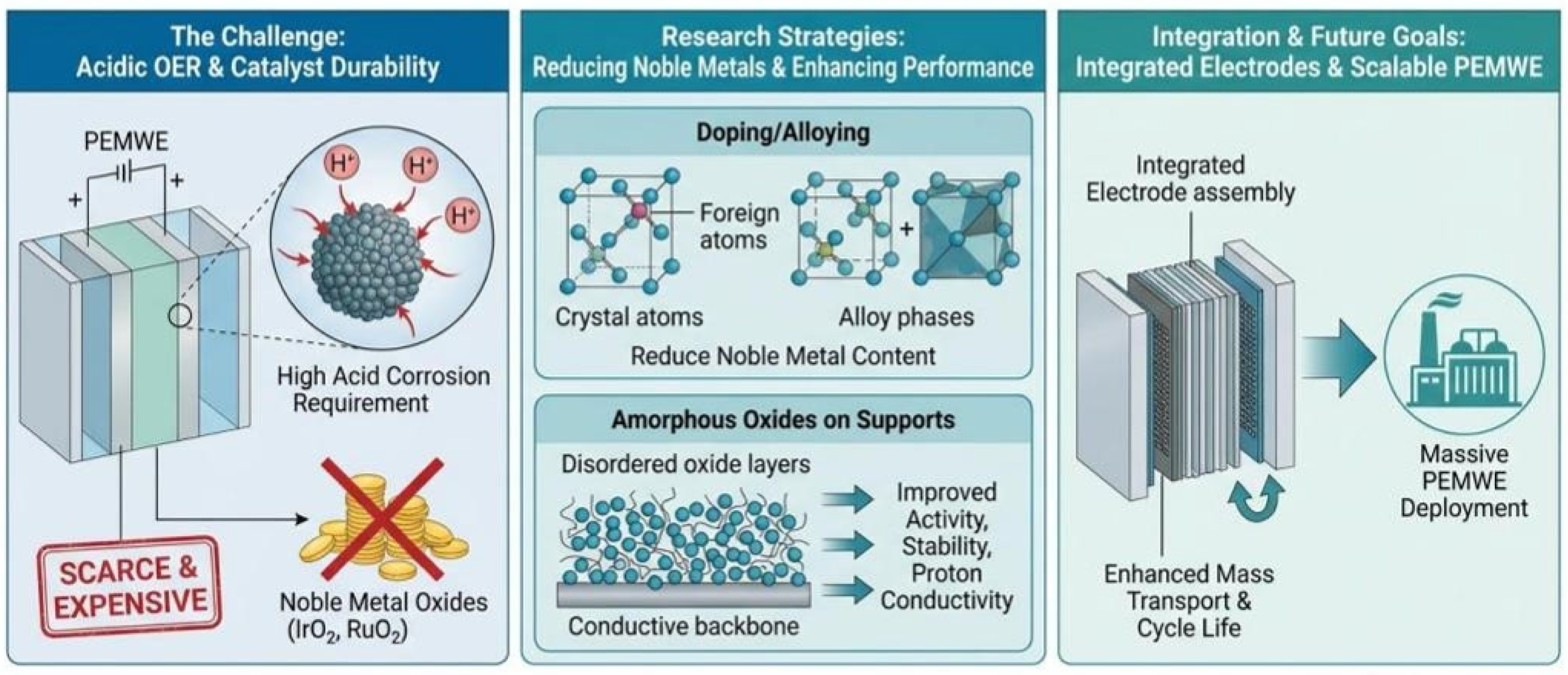
Acidic OER poses a significant challenge for PEMWE, demanding high acid corrosion resistance from catalysts [45]. As illustrated in Figure 2, the acidic OER in PEMWE represents one of the most critical bottlenecks in advanced water electrolysis because it requires catalysts to operate simultaneously under high anodic potential, strong oxidative stress, and highly corrosive acidic conditions. Under such an environment, catalyst dissolution, surface reconstruction, support corrosion, and active-site deactivation can occur concurrently, making it extremely difficult to achieve both high activity and long-term durability. Accordingly, current design strategies mainly focus on tuning the electronic structure of active centers, introducing defect or dopant regulation, constructing heterointerfaces, and stabilizing high-valence catalytic phases. This explains why Ir-based catalysts remain the dominant practical benchmark, while non-noble alternatives, although scientifically promising, still face substantial challenges in structural stability and real-device operation under acidic conditions. Currently, precious metal oxides like IrO2 and RuO2 are widely used due to their favorable catalytic effects [35,36,37,38,39,40,41,42,43,44,45,46]. However, the high cost and limited reserves of these precious metals severely impede the large-scale commercialization of PEMWE. In recent years, non-Ir/Ru perovskite oxides and high-valence transition metal oxides have also been explored in PEMWE acidic electrolyzers. Yet, these materials often suffer structural corrosion and deactivation due to poisoning in strong acidic environments [47,48,49]. Among these, Co-based non-precious metal catalysts, which also apply to acidic OER, present a viable alternative to Ir-based catalysts due to their advantageous d-orbital electronic structure [47]. Moreover, research indicates that modifying the design strategies for Co-based catalysts—by tuning their electronic structure, introducing defects, or constructing heterojunctions—can effectively improve their catalytic activity and stability under acidic OER conditions. For example, a dual-functional catalyst based on Sb-doped RuSbOx demonstrated ultra-high durability, stably operating for 150 h for OER at 2.5 V overpotential and 300 h for HER at 1.2 V overpotential at 100 mA cm−2 under acidic conditions [42].
Recent progress in PEMWE catalyst development suggests that the current “top catalyst” landscape is increasingly defined by two parallel directions: maximizing the utilization efficiency of noble metals and stabilizing active structures under harsh acidic operation. On the cathode side, Pt remains the benchmark HER catalyst, but the most competitive recent developments are no longer bulk Pt materials; rather, they are low-loading Pt alloys, Pt-skin/core-shell structures, and atomically dispersed Pt motifs designed to preserve near-benchmark hydrogen adsorption energetics while minimizing Pt usage. On the anode side, Ir-based catalysts continue to dominate the practical frontier of acidic OER, especially in the form of nanostructured IrO2, mixed Ir oxides, and electronically tuned Ir-containing composites. In this sense, the “top” PEMWE catalysts are not simply those with the lowest reported overpotentials, but those capable of combining low noble-metal loading, high activity at industrially relevant current densities, and acceptable resistance to dissolution, agglomeration, or support degradation. This also explains why recent high-impact studies increasingly evaluate PEM catalysts under full-cell conditions rather than relying exclusively on half-cell measurements.
Figure 2. Challenges and Strategies for Acidic Oxygen Evolution Reaction(OER) in Proton Exchange Membrane Water Electrolysis (PEMWE) [35,36,37,38,39,40,41,42,43,44,45,46].
Catalysts 16 00475 g002

2.2. Alkaline Water Electrolysis and Catalyst Development

Although AWE is currently the most commercially mature and widely applied technology, its most prominent advantage lies in its ability to use inexpensive non-precious metal catalysts. However, it suffers from a slower dynamic response [50]. Since alkaline HER catalysts must undergo an additional water dissociation process [51,52], high demands are placed on their overall performance. Traditional nickel-based catalysts, such as Ni-Mo alloys, can effectively and precisely tune their adsorption and activation capabilities for water molecules by adjusting their composition ratio [53]. Cobalt- and iron-based phosphides and chalcogenides can significantly reduce the barrier for water dissociation by modulating the electronic states and atomic arrangements on their material surfaces, thus exhibiting excellent catalytic performance [54]. For instance, optimizing the phosphide-to-phosphate ratio in the transition metal phosphide NiCoP significantly enhances its activity in alkaline HER [55].
Alkaline OER is a crucial area where non-precious metal catalysts demonstrate significant advantages, and the material systems developed for it are relatively mature. Research primarily focuses on iron-, cobalt-, and nickel-based metal compounds. Nickel-iron layered double hydroxides (NiFe-LDH) are among the most promising non-precious metal OER catalysts [56,57]. They exhibit good catalytic performance through the modulation of their layered structure, enlargement of surface area, and increase in active sites [56]. An effective method to improve catalytic performance involves iron regulating nickel sites, leading to the oxidation of nickel-iron during the reaction to form high-valence nickel species [58]. Furthermore, cobalt-based (OH)x undergoes dynamic surface reconstruction to form a highly active phase under oxygen atmosphere [59], as does nickel (OH)x (or (OH)yOx). Oxides such as spinels and perovskites enhance catalytic performance by altering the adsorption strength of oxygen intermediates through crystal engineering and the construction of heterointerfaces (e.g., RuOx/Co3O4). Notably, Co-Ir/Ru composite electrocatalysts exhibit excellent catalytic performance and long-term stability under acidic conditions for OER [59].
In alkaline water electrolysis, the leading catalyst systems are characterized less by precious-metal optimization and more by the rational use of earth-abundant transition metals. For HER, NiMo-based catalysts remain among the most competitive due to their balanced ability to promote water dissociation and hydrogen adsorption, while phosphides, sulfides, nitrides, and heterostructured Ni/Co/Fe-based compounds have emerged as strong candidates through interfacial charge redistribution and defect-mediated activation [60]. For OER, NiFe-LDH and related oxyhydroxide systems remain widely recognized as top-performing non-noble-metal catalysts because of their favorable redox chemistry, tunable layered structure, and strong activity after in-situ reconstruction [61]. However, the practical superiority of alkaline “top catalysts” increasingly depends on their ability to sustain high current density, maintain adhesion and conductivity in porous electrodes, and tolerate dynamic gas evolution under long-duration operation. Accordingly, the most promising AWE catalysts are those that combine low material cost with robust performance not only in conventional three-electrode tests, but also in industrially relevant alkaline cell environments.

2.3. Anion Exchange Membrane Water Electrolysis and Catalyst Development

AEMWE is considered an ideal technology that combines the advantages of both AWE and PEMWE [36]. It enables high current densities and rapid dynamic responses using non-precious metal catalysts under mild alkaline conditions. The development strategies for its HER and OER catalysts are largely consistent with those for alkaline systems [20]. However, it is crucial that AEMWE catalysts are compatible with the anion exchange membrane [62].
HER catalyst development for AEMWE can directly reference approaches used in alkaline systems [39]. Nickel-based catalysts are highly promising HER candidates for AEMWE, capable of replacing precious metal catalysts. For instance, nickel-iron layered double hydroxides and their derivatives are well-suited for AEMWE’s HER [63]. Furthermore, nickel-doped chromium hydroxides, through work function engineering, can enhance the built-in electric field, optimize interfacial charge redistribution, and thereby boost alkaline HER catalytic activity [63]. Taken together, the current top-catalyst landscape across PEMWE, AWE, and AEMWE reveals that catalyst leadership is highly platform-dependent. In PEMWE, top catalysts are still defined by how effectively they reduce noble-metal loading while retaining acid stability. In AWE, catalyst leadership is increasingly associated with how low-cost transition-metal systems can support high-current-density operation and durable gas evolution management. In AEMWE, the definition of a top catalyst extends further to include membrane compatibility and interfacial durability. This comparison underscores an important point: catalyst “top performance” should not be interpreted as a single universal ranking, but as a context-dependent balance among activity, durability, resource demand, and device integration requirements. The corresponding representative catalysts are summarized in Table 1.
For AEMWE, the current generation of top catalysts largely overlaps compositionally with advanced alkaline catalysts, but their ranking cannot be transferred directly from liquid-phase alkaline testing. In many recent reports, Ni-based HER catalysts, NiFe-derived OER catalysts, and bifunctional heterostructures have delivered promising full-cell voltages under mild alkaline membrane conditions, making them attractive candidates for precious-metal-free AEMWE. Nevertheless, the most meaningful distinction in AEMWE is that catalyst excellence is inseparable from membrane and ionomer compatibility. A catalyst that performs well in concentrated alkaline electrolyte may not remain optimal once incorporated into a hydroxide-exchange membrane electrode assembly, where local hydration, ionomer adsorption, hydroxide transport, and interfacial degradation strongly influence overall behavior. Therefore, the top catalysts for AEMWE should be defined not only by half-cell activity, but also by their ability to function within a stable HEM/ionomer/catalyst-layer architecture under practical current density and long-term operation.

2.4. Benchmarking Catalyst Performance Under Full-Cell Conditions

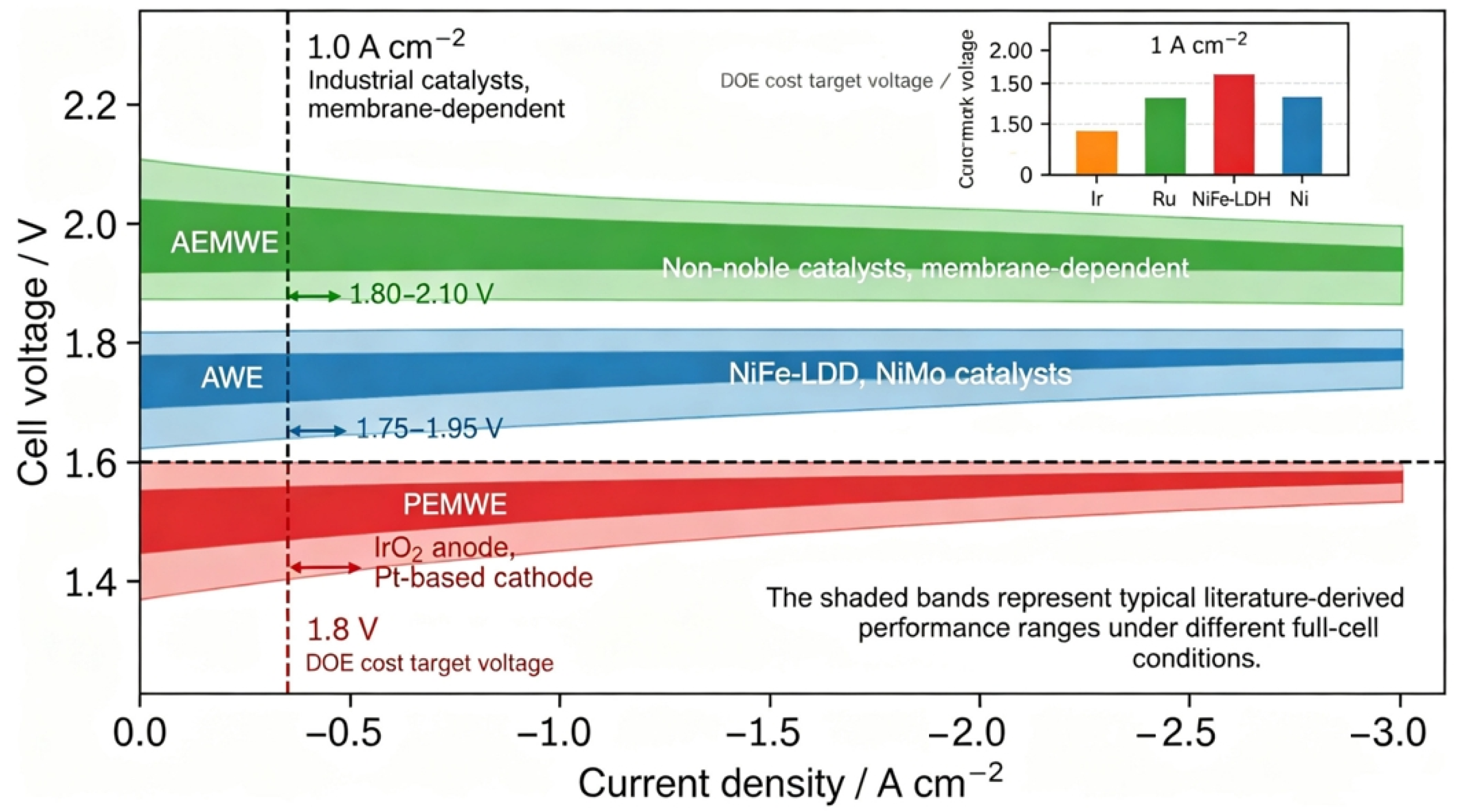
To further clarify the practical differences among these three electrolyzer technologies, Figure 3 compares their typical full-cell voltage ranges under industrially relevant current density, particularly at 1.0 A·cm−2. As indicated by the shaded performance bands, PEMWE generally exhibits the lowest operating voltage, typically around 1.40–1.60 V, owing to the rapid proton transport of the membrane and the high intrinsic activity of noble-metal catalyst pairs, especially IrO2 at the anode and Pt-based materials at the cathode. This performance advantage is one of the key reasons PEMWE is regarded as a leading route for high-efficiency hydrogen production, although its reliance on scarce precious metals remains a major barrier to cost reduction and large-scale deployment. In comparison, AWE usually operates in the range of approximately 1.75–1.95 V under similar conditions, with representative catalyst systems such as NiFe-LDH and NiMo-based materials. Although its voltage efficiency is somewhat lower than that of PEMWE, AWE benefits from mature technology, lower catalyst cost, and compatibility with earth-abundant transition metals, making it the most commercially established water electrolysis technology. AEMWE is conceptually designed to bridge the gap between these two systems by combining the low-cost catalyst advantage of alkaline electrolysis with the membrane-based architecture and dynamic response of PEMWE. However, as the figure shows, its current full-cell voltage still commonly falls in the range of about 1.80–2.10 V, and its performance is strongly dependent on membrane properties, catalyst-layer design, and interfacial compatibility. The inset comparison further illustrates that Ir-based catalysts still deliver the best voltage performance at 1 A·cm−2, whereas Ru-, NiFe-LDH-, and Ni-based systems generally operate at higher voltages, reflecting the trade-off between activity, stability, and cost. Therefore, the evaluation of advanced water electrolysis catalysts should not rely solely on half-cell activity, but must consider full-cell efficiency, industrial current density, membrane compatibility, and long-term operational durability. In this context, the development of catalysts that can reduce noble-metal dependence while maintaining competitive cell voltage is essential for accelerating the transition from laboratory-scale research to practical green hydrogen production.

2.5. Emerging Catalyst Design Strategies and Optimization Methods

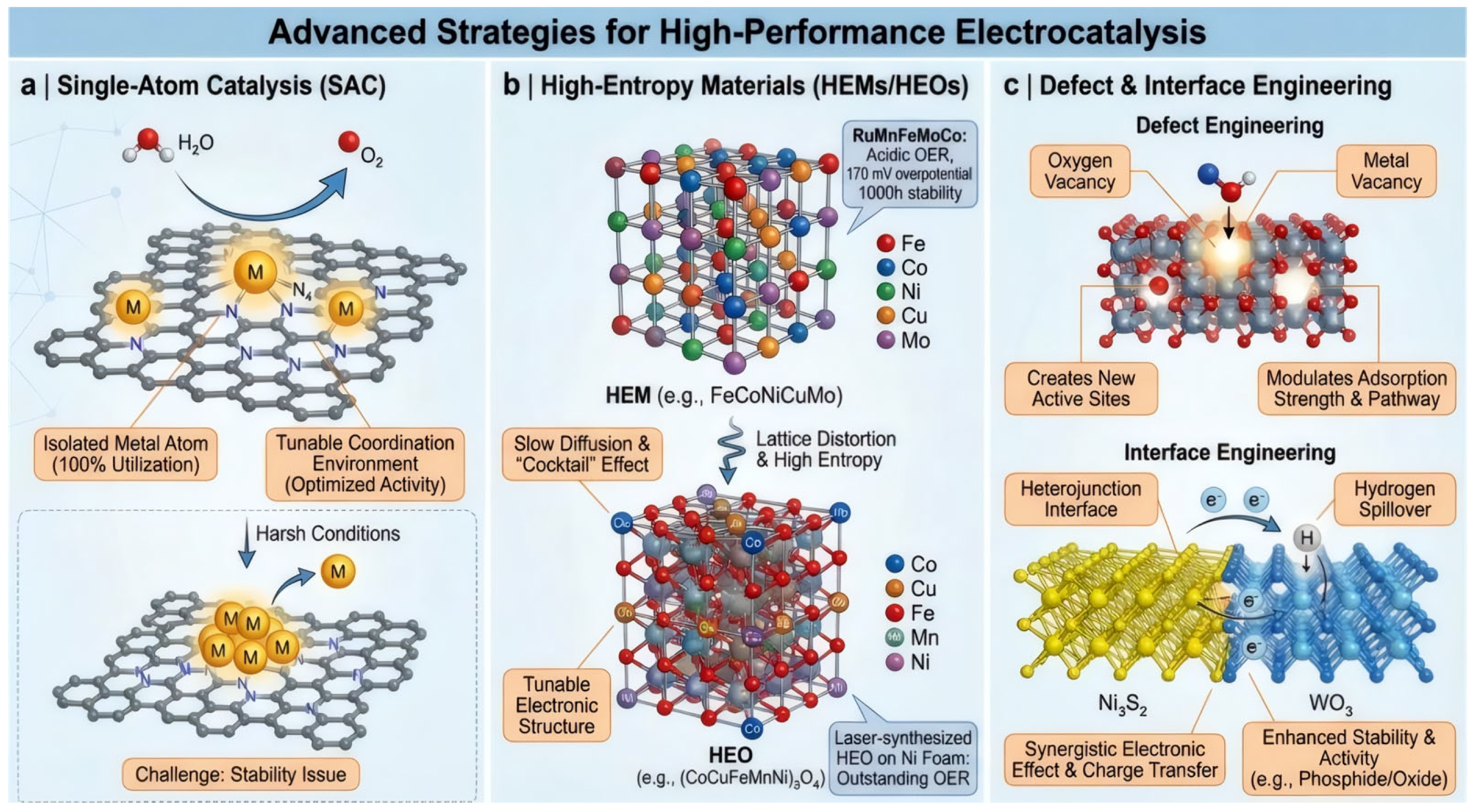
Achieving large-scale, low-cost “green hydrogen” production in the future critically depends on overcoming the inherent trade-offs between high activity, robust stability, and economic feasibility of electrocatalysts. To this end, emerging catalyst design paradigms offer multi-faceted solutions. These range from single-atom catalysis, which pursues ultimate atomic efficiency, to high-entropy materials that construct ultra-stable structures through multi-principal element synergistic effects, and further to defect and interface engineering for precise tuning of active site electronic states. These strategies are not isolated but collectively aim to synergistically optimize catalytic performance through rational, atomic-scale design. This provides a clear roadmap for developing next-generation high-performance water electrolysis catalysts, laying a solid scientific foundation for the ultimate commercialization of green hydrogen.
In Figure 4, Single-Atom Catalysis: SACs anchor metal atoms in an isolated form on a support, thereby achieving nearly 100% atomic utilization. Furthermore, their catalytic activity can be optimized by tuning the coordination environment. However, it is important to acknowledge that the stability of SACs under harsh conditions remains an unresolved issue.
High-Entropy Alloys/Oxides (HEMs/HEOs): High-entropy materials, such as FeCoNiCuMo high-entropy alloys and CoCuFeMnNi high-entropy oxides, exhibit excellent structural stability, corrosion resistance, and tunable electronic structures in electrocatalysis [67,68]. These superior properties stem from their high-entropy effect, lattice distortion effect, sluggish diffusion effect, and “cocktail” effect. For instance, a five-component high-entropy ruthenium-based alloy, RuMnFeMoCo, demonstrated an exceptionally low overpotential of 170 mV for acidic OER and ultra-long stability for 1000 h [67]. Additionally, a noble-metal-free high-entropy oxide (CoCuFeMnNi)3O4 2D nanosheet, directly synthesized on a nickel foam substrate using ultrafast laser, showed outstanding OER performance [68].
Defect and Interface Engineering: Defect engineering involves modifying the electronic structure of catalysts through oxygen vacancies, metal vacancies, and lattice distortions, which in turn creates new active sites. Oxygen vacancies, for example, can alter the adsorption strength of reaction intermediates on the catalyst surface, thereby optimizing the catalytic pathway [48]. Interface engineering, on the other hand, leverages the synergistic electronic effects at the interface of heterostructured materials to promote charge transfer while enhancing catalyst stability. The Ni3S2/WO3 heterostructure serves as a typical example, where hydrogen spillover is achieved through interface engineering, significantly boosting alkaline HER performance [69]. More notably, phosphide/oxide heterostructured electrocatalysts have successfully combined high activity with robust stability for industrial-scale hydrogen production [70].
The aforementioned novel strategies have a profoundly clear and positive impact on the future development of water electrolysis hydrogen production catalysts. They effectively address existing challenges such as high cost, low activity, and poor stability of current catalysts, thereby facilitating the large-scale commercialization of “green hydrogen” [71].

3. Significance and Impact of Hydrogen Energy Catalysts on the “Dual Carbon” Strategy

Hydrogen energy catalysts hold profound significance for the implementation of the “dual carbon” strategy. Their technological advancement will facilitate enhanced hydrogen production efficiency, reduced production costs, and contribute to the restructuring of energy systems, national energy security, and improved scientific and technological competitiveness. Consequently, these advancements are crucial for propelling “green hydrogen” from demonstration projects towards large-scale commercial application.

3.1. Economic Driver: Catalysts as the Core Lever for Reducing Green Hydrogen Costs

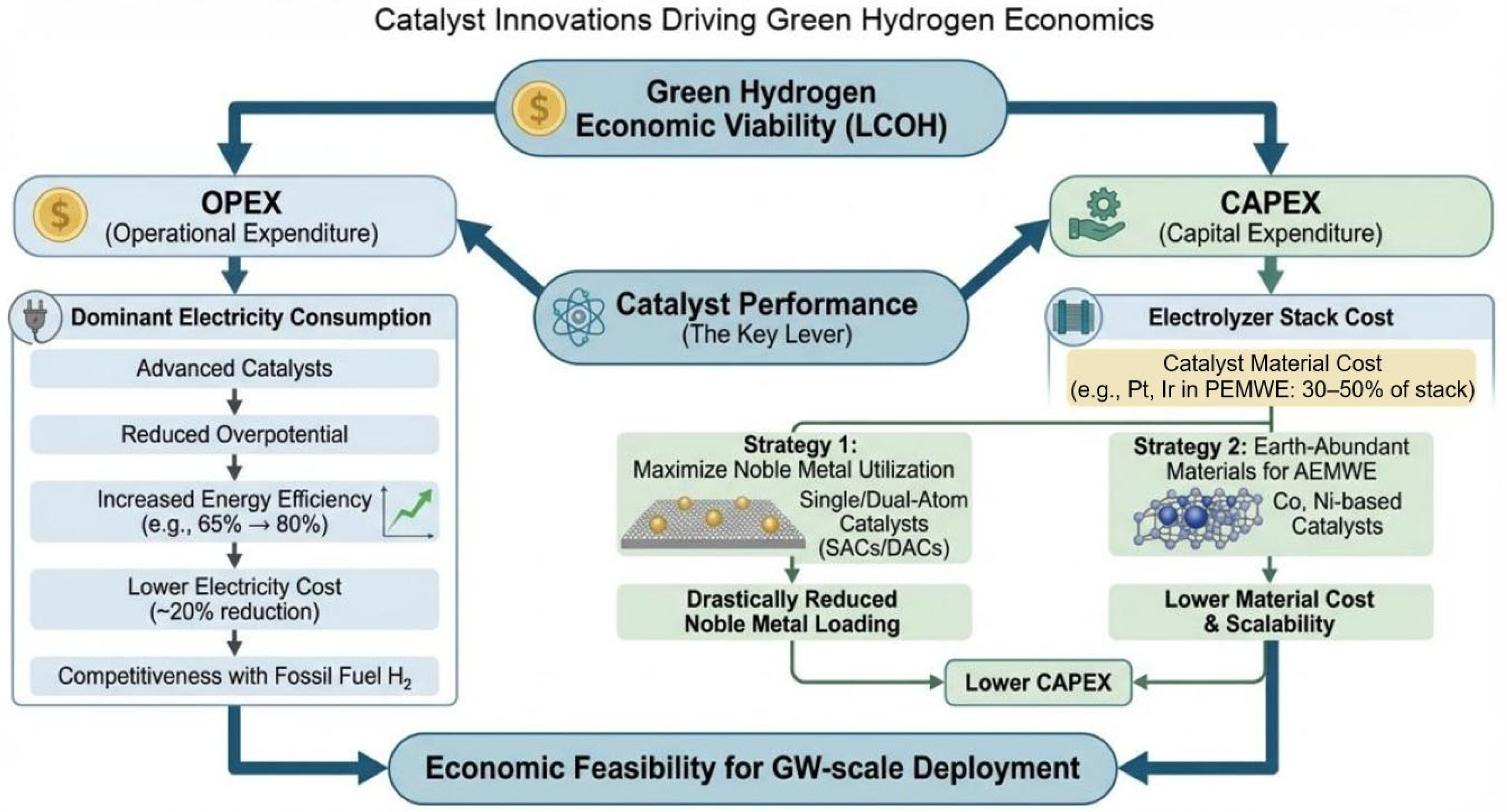
The economic competitiveness of green hydrogen is commonly assessed by the levelized cost of hydrogen (LCOH), which is jointly determined by capital expenditure (CAPEX), operating expenditure (OPEX), system lifetime, and capacity factor [27]. Among these factors, catalyst development has a disproportionate influence because it affects both electricity consumption and stack cost simultaneously. From the OPEX perspective, catalyst activity directly determines the cell voltage required to reach a target current density. Even a moderate reduction in overpotential can translate into significant electricity savings when electrolyzers operate continuously at industrial scale. For example, improving full-cell efficiency from approximately 65% to 80% can reduce electricity demand per unit hydrogen output by a substantial margin, which is particularly important given that electricity typically dominates the LCOH of electrolysis-based hydrogen. Figure 5 further illustrates the economic logic by which catalyst innovation influences the overall competitiveness of green hydrogen. Rather than affecting only one isolated parameter, catalyst development simultaneously impacts electricity consumption, stack cost, replacement frequency, and system lifetime. More active catalysts can lower the operating voltage at a given current density and thus reduce power consumption, whereas more durable catalysts can extend service life and decrease maintenance or replacement costs. At the same time, reducing noble-metal loading or replacing scarce elements with earth-abundant materials can directly improve supply-chain security and lower capital expenditure. Therefore, the economic contribution of catalysts should be understood in a system-level sense, where activity, durability, resource demand, and manufacturability jointly determine the real cost of hydrogen production.
From the CAPEX perspective, catalyst composition strongly affects stack cost, although the magnitude of this effect differs among electrolyzer technologies. In PEMWE, the use of Pt at the cathode and especially Ir-based catalysts at the anode remains a major contributor to stack cost because precious metals are required not only for activity but also for acid stability. Reported techno-economic analyses generally show that catalyst-coated membrane assemblies, porous transport layers, and bipolar plates together account for a large share of stack cost, with precious-metal catalyst loading remaining one of the most strategically important cost-reduction targets. In contrast, AWE stacks can use non-precious catalysts and comparatively mature electrode materials, which lowers catalyst-related CAPEX but may be offset by larger system footprint, lower current density, and balance-of-plant requirements. AEMWE occupies an intermediate position: in principle, it can reduce noble-metal dependence while retaining membrane-type device advantages, but its current costs remain highly sensitive to membrane/ionomer durability, catalyst-layer optimization, and manufacturing immaturity.
Importantly, catalyst cost should not be interpreted only in terms of raw material price per kilogram. A low-cost catalyst can still be uneconomical if it requires complex synthesis, shows poor stability, or performs inadequately at industrial current density, thereby increasing replacement frequency or electricity consumption. Conversely, a more expensive catalyst may be justified if it enables higher efficiency, smaller stack area, and longer service life. Therefore, meaningful economic comparison requires consideration of catalyst utilization efficiency, degradation rate, device compatibility, and system-level energy performance rather than simple material cost alone.
Recent case studies further illustrate this point. In PEMWE, reducing iridium loading through single-atom, cluster, or ultrathin-coating strategies is attractive because it directly targets one of the most severe material bottlenecks in scaling future gigawatt-level deployment [31,40]. However, if such ultra-low-loading strategies compromise long-term anode stability or are difficult to manufacture reproducibly, their apparent economic advantage may be weakened. In alkaline systems, Ni-, Fe-, and Co-based catalysts offer superior raw-material affordability and are compatible with existing large-scale industrial supply chains, which is advantageous for rapid deployment in China. Yet their true cost competitiveness depends on whether they can sustain high-current operation with acceptable degradation rates in commercial electrodes. Thus, the economic significance of catalyst innovation lies not only in replacing precious metals, but in achieving a practical balance among overpotential, durability, manufacturability, and resource security.
In the Chinese context, these economic differences have particularly important implications. China has strong manufacturing capacity in alkaline electrolyzer deployment and a rapidly growing renewable-energy base, especially in regions where wind and solar curtailment remain significant. Under such conditions, catalyst innovation that improves the current density, efficiency, and dynamic adaptability of low-cost alkaline systems may generate immediate large-scale economic value. At the same time, PEMWE and AEMWE remain strategically important for future high-performance, flexible, and space-efficient hydrogen production scenarios, particularly where variable renewable power integration and high-purity hydrogen demand are critical. Therefore, catalyst cost reduction in China should be understood not as a single-material challenge, but as part of a differentiated technology portfolio aligned with regional renewable resources, industrial hydrogen demand, and long-term supply-chain security.

3.2. Cornerstone of Industrial Security: Building an Autonomous and Controllable Hydrogen Technology System

The “dual carbon” strategy fundamentally represents a profound and systematic restructuring of industrial frameworks. Its success, therefore, hinges on the prerequisite of an autonomous and controllable key technology chain and supply chain [26]. The hydrogen energy sector is a prime example of this necessity. China possesses scarce platinum group metal (PGM) resources and exhibits extremely high reliance on imports. Building a future large-scale green hydrogen industry on such dependence on these rare strategic resources would pose significant risks to national energy security. Consequently, developing high-performance catalyst systems based on China’s abundant reserves of transition metals like nickel, iron, and cobalt is a clear and prudent strategic choice to ensure the long-term healthy development of the hydrogen energy industry [54,55]. It is worth noting that a series of non-precious metal materials, exemplified by nickel-iron layered double hydroxides, have already demonstrated catalytic activities in alkaline OER that are comparable to, or even surpass, those of precious metal benchmark catalysts. This effectively validates the feasibility of the non-precious metal route through robust experimental evidence [58]. More remarkably, technological autonomy at the catalyst level can generate immense industrial ripple effects, fostering a new high-end manufacturing industrial chain. This chain spans from “preparation of high-purity metal salt precursors” to “large-scale catalyst synthesis,” and further to “automated production of membrane electrode assemblies” and “integration of high-performance electrolyzer systems” [72]. This emerging industrial chain will not only cultivate new economic growth points but also significantly enhance China’s strategic position and influence in global green technology standard-setting and the restructuring of future energy landscapes.

3.3. Key to System Restructuring: Hydrogen as the Coupling Hub of the Energy System

Advanced catalysts represent the most critical and central technological link in the deep coupling of the power sector with the hydrogen economy, thereby restructuring the future energy system [29]. High-efficiency electrolyzers, enabled by advanced catalysts, can convert intermittent renewable electricity in situ and promptly into hydrogen storage carriers. This naturally addresses the challenges of large-scale, cross-seasonal energy storage and transfer, and compensates for the inherent limitations of electrochemical storage technologies like lithium-ion batteries in terms of storage duration and capacity. Thus, it becomes a fundamental means to mitigate renewable energy volatility and enable its full-time integration. Simultaneously, the rapid response capability dictated by catalyst kinetic characteristics allows PEMWE and similar electrolytic equipment to be rationally utilized as “flexible loads” within the power grid. They can directly and efficiently participate in ancillary services such as peak shaving and frequency regulation, as PEMWE technology can quickly respond to renewable energy fluctuations. This not only enhances the stability of the power system but also creates extremely favorable conditions for the grid integration of a higher proportion of volatile renewable energy sources. Echoing this, the development of bifunctional catalysts is opening new avenues for simpler and more efficient systems, such as reversible electrolyzers, thereby more fully and directly leveraging hydrogen’s coupling role within the energy system [44].

4. Challenges and Enhancement Strategies for Hydrogen Energy Catalysts

Water electrolysis is a pivotal technology for realizing a sustainable energy economy and achieving carbon neutrality. Consequently, the development of high-performance electrocatalysts remains central to its progress [73,74]. However, transitioning these catalysts from laboratory discovery to industrial application necessitates bridging a “quadruple gap”: performance, longevity, fabrication, and integration. Fundamentally, these challenges arise from a structural misalignment between research paradigms and engineering logic, hidden behind disparate technical parameters [75,76].

4.1. Core Challenges: The Quadruple Gap from Ideal Models to Harsh Realities

4.1.1. The Performance Gap: Scaling from “Milliampere” to “Ampere” Levels

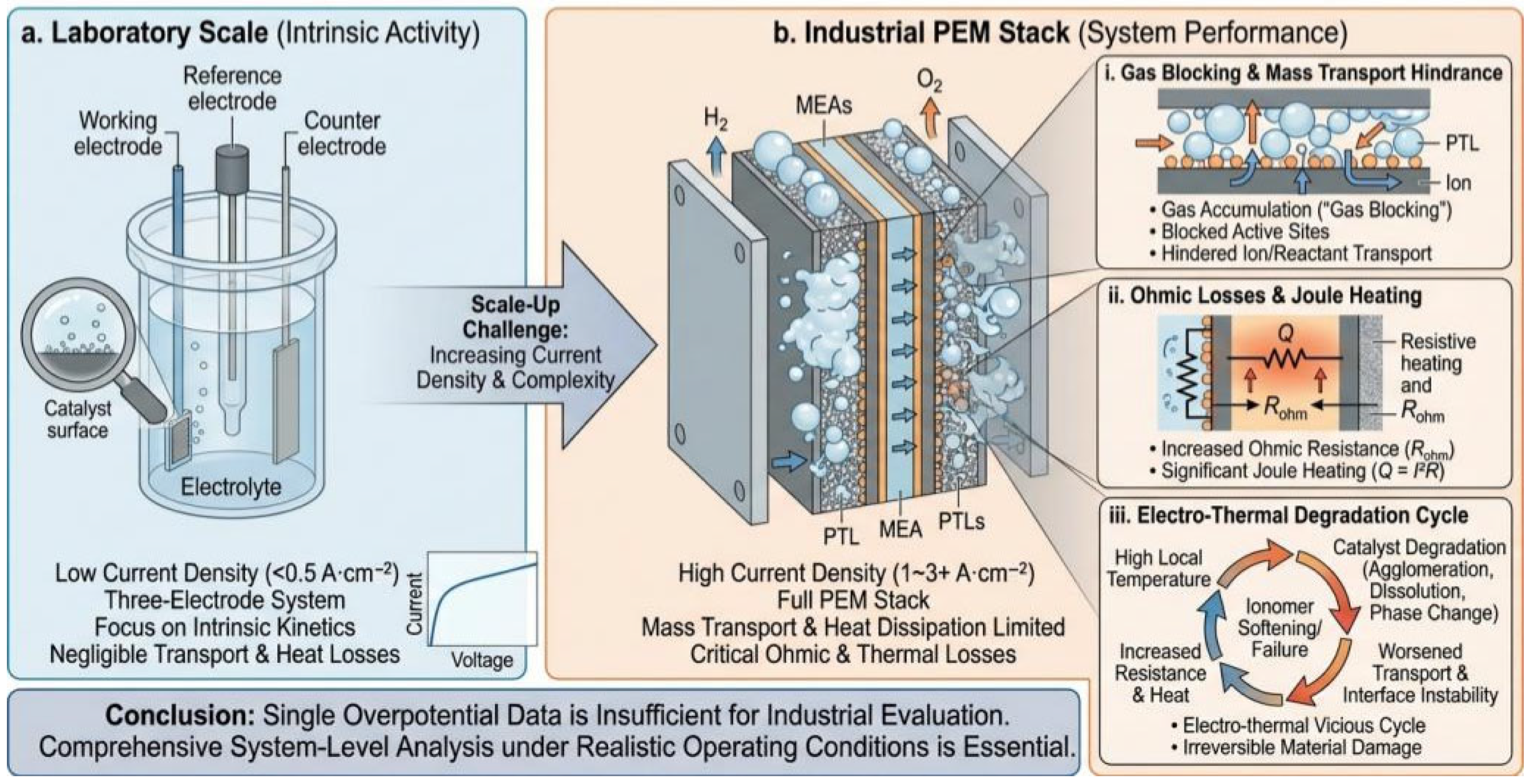
Figure 6 schematically highlights the fundamental discrepancy between laboratory-scale catalyst evaluation and industrial electrolyzer operation. In most academic studies, catalysts are assessed in simplified three-electrode systems at relatively low current densities, where intrinsic reaction kinetics dominate the measured performance. By contrast, industrial Proton Exchange Membrane electrolyzers operate continuously at “ampere-scale” densities (1–3 A·cm−2 or higher, Table 2). This represents a scale discrepancy of several orders of magnitude [77]. As a result, catalysts that appear highly active in low-current half-cell tests may show markedly inferior behavior once integrated into industrial devices. This “lab-to-factory” gap underscores the need to move beyond conventional overpotential benchmarking and toward application-oriented evaluation under realistic current density, electrode architecture, and thermal-management conditions [78].
A primary issue is the “gas-masking” effect. Massive volumes of gaseous products (H2 and O2) accumulate on the catalyst surface and within porous structures. This accumulation shields active sites, hinders ionic transport, and obstructs the conduction of Joule heat [77,78]. Furthermore, high-current operation substantially increases Ohmic losses. These losses originate from the electronic/ionic resistance within the catalyst layer and the contact resistance at diffusion interfaces [78,79].
Crucially, if the generated Joule heat is not dissipated promptly, localized temperatures within the catalyst layer spike. This thermal stress exacerbates the agglomeration, phase transformation, and dissolution of catalyst nanoparticles. It also induces ionomer softening and aggregate decomposition, triggering a vicious electro-thermal cycle that leads to severe interfacial instability. Consequently, standalone overpotential data obtained from laboratory settings fails to reliably characterize the actual effectiveness of a catalyst under industrial-grade operating conditions.

4.1.2. The Longevity Gap: Failure Evolution from “Hour” to “Ten-Thousand-Hour” Scales

Industrial electrolyzers are expected to operate stably for tens of thousands of hours under fluctuating current, elevated voltage, and chemically aggressive conditions. By contrast, most academic studies still evaluate durability over only tens to hundreds of hours, often under simplified galvanostatic or potentiostatic protocols. This mismatch creates a major knowledge gap because short-term tests are insufficient to capture the coupled degradation pathways that determine long-term device failure [80,81].
Under prolonged electrochemical stress, catalysts may undergo several overlapping degradation mechanisms. Structurally, nanoparticle agglomeration and Ostwald ripening progressively decrease electrochemically active surface area. At the same time, metastable amorphous or defect-rich phases that exhibit high initial activity may gradually transform into more stable but less active crystalline states [82,83]. In addition, component leaching is a pervasive problem. Under OER conditions, transition metals such as Co and Mn, as well as even noble metals such as Ir, can dissolve into the electrolyte or membrane environment. These dissolved species may subsequently migrate, redeposit, poison counter-electrode catalysts, or contaminate the membrane, thereby accelerating system-wide performance loss. Even for state-of-the-art acidic OER catalysts, the dissolution of iridium remains one of the most serious unresolved barriers to true long-lifetime PEMWE deployment [42].

4.1.3. The Fabrication Gap: Scaling from “Gram” to “Ton” Levels

Many high-performance catalysts reported in the literature rely on sophisticated laboratory synthesis procedures involving expensive precursors, delicate templates, controlled atmospheres, or multiple post-treatment steps. While these methods are highly effective for proof-of-concept studies, they often lack compatibility with industrial manufacturing. The first challenge is economic viability: a catalyst that performs well electrochemically may still be commercially unattractive if its synthesis requires high energy input, low space-time yield, or poor raw-material utilization. The second challenge is batch consistency. Complex multistep procedures are often highly sensitive to subtle fluctuations in temperature, concentration, or mixing conditions, which makes it difficult to maintain uniform particle size, phase structure, defect density, and morphology during scale-up [84,85,86]. The third challenge concerns environmental health and safety. Solvents, toxic reagents, and waste streams that are manageable in gram-scale laboratory work may become unacceptable at industrial scale. Therefore, future catalyst manufacturing must move toward green, continuous, and quality-controlled synthesis routes that can deliver not only performance, but also reproducibility, compliance, and cost competitiveness.

4.1.4. The Integration Gap: From “Powder” to “Device” System Engineering

The ultimate value of an electrocatalyst is not determined by powder activity alone, but by its behavior after integration into a membrane electrode assembly (MEA). In practical electrolyzers, performance emerges from the coupling of catalyst particles with ionomer phases, membranes, porous transport media, and operating conditions [87]. As a result, an excellent powder catalyst does not automatically yield an excellent device.
A central requirement in MEA design is the formation of an efficient triple-phase boundary, where electronically conductive catalyst surfaces, ion-conducting ionomer domains, and liquid/gaseous reactants can interact simultaneously. The quality of this interfacial architecture depends strongly on catalyst-ink formulation, solvent composition, ionomer content, deposition method, and drying behavior. In addition, catalyst morphology plays a decisive role in determining how ionomer coats or penetrates the catalyst layer [66,88]. Nanoparticles, nanowires, nanosheets, porous aggregates, and hierarchical structures exhibit very different surface roughness, curvature, pore accessibility, and wetting behavior, all of which affect ionomer distribution, hydroxide/proton transport, gas release, and local water management. Consequently, a catalyst morphology that appears optimal in half-cell testing may become transport-limited or poorly utilized in a real MEA.
Another critical issue is ionomer stability. In PEMWE and especially AEMWE/HEM-based systems, ionomers are not inert binders but functional ionic conductors whose chemical stability directly affects device lifetime. Under oxidative potentials, radical attack, local dehydration, or extreme local pH conditions, ionomer backbones and ionic functional groups may degrade, resulting in conductivity loss, interfacial detachment, and increased transport resistance. In alkaline membrane systems, degradation of cationic groups in hydroxide-conducting ionomers remains a particularly serious challenge. Moreover, the interaction between catalyst surface chemistry and ionomer adsorption can either enhance or hinder device performance. Excessively strong ionomer adsorption may block active sites, while insufficient interfacial affinity can produce discontinuous ionic pathways and poor mechanical integrity.
Therefore, catalyst integration should be treated as a multi-physical-field optimization problem involving electronic conduction, ionic migration, reactant supply, and product removal [88,89]. These transport processes are strongly coupled and frequently involve trade-offs. Increasing ionomer content may improve ionic connectivity but aggravate mass-transport resistance; creating highly porous structures may facilitate gas release but reduce interparticle electrical contact or catalyst-layer cohesion. For this reason, future catalyst development should move beyond powder-centric metrics and adopt an MEA-oriented design philosophy in which catalyst composition, morphology, ionomer chemistry, and electrode architecture are co-optimized from the outset.

4.2. Enhancement Strategies: Building a Multi-Dimensional Innovation System for Industrialization

To bridge the previously identified gaps, a comprehensive innovation framework must be established, focusing on evaluation standards, manufacturing scalability, and interdisciplinary synergy.

4.2.1. Establishing an Application-Oriented Evaluation Paradigm

To ensure that electrocatalyst research effectively supports industrial deployment, a new evaluation paradigm must be established that aligns laboratory assessment with realistic operating conditions [90,91]. In recent years, international bodies and roadmaps have increasingly emphasized not only catalytic activity, but also durability, efficiency, scalability, and system cost. For example, U.S. Department of Energy (DOE) hydrogen programs have highlighted aggressive targets for hydrogen production cost, stack durability, and performance under practical operating current densities, while European hydrogen roadmaps and decarbonization strategies have similarly stressed manufacturability, resource efficiency, and the rapid expansion of green hydrogen capacity. These international benchmarks make it clear that academic catalyst development should be judged not merely by isolated overpotential records, but by its contribution to device-level efficiency, lifetime, and cost reduction.
In this context, industrial-scale testing is essential. Catalyst performance, including polarization behavior and stability, should be reported whenever possible at current densities of at least 1 A·cm−2 and preferably under full-cell or MEA-relevant conditions. Clear distinction between raw cell voltage and iR-corrected values is necessary to avoid misleading interpretation of intrinsic activity and Ohmic loss. Beyond static testing, dynamic stress protocols are also required. Standardized accelerated stress tests that simulate start-stop operation, renewable load fluctuation, and intermittent high-current operation are critical for understanding realistic degradation pathways. Coupled with electrolyte analysis and post-mortem structural characterization, such protocols can provide a more mechanistic and predictive framework for catalyst screening.
Finally, the evaluation system itself should be broadened. Although metrics such as overpotential, Tafel slope, mass activity, and turnover frequency remain scientifically useful, they are insufficient on their own for judging industrial relevance. System-level indicators such as energy efficiency, power density, degradation rate, catalyst utilization, and projected cost contribution should be incorporated more routinely into catalyst evaluation. Only through such an application-oriented paradigm can the field move from record-setting laboratory results to truly deployable technologies.

4.2.2. Developing Green and Scalable Fabrication Technologies

Overcoming production bottlenecks requires a conceptual shift from laboratory-scale precision synthesis to manufacturing-oriented process design. Continuous-flow synthesis, including microreactor-based approaches, offers a promising route because it enables tighter control over mixing, nucleation, residence time, and thermal history, thereby improving reproducibility and scalability simultaneously. In parallel, catalyst design should increasingly prioritize abundant industrial feedstocks and environmentally benign synthetic routes such as aqueous-phase processing, solvent minimization, and template-free construction. This is particularly important for future gigawatt-scale electrolyzer deployment, where environmental health and safety constraints cannot be treated as secondary issues. In addition, online process analytical technology and closed-loop quality control should be incorporated into catalyst production to ensure batch consistency in composition, morphology, and defect structure. These changes will be critical for translating promising catalyst concepts into industrially manufacturable products.

4.2.3. Strengthening Multi-Scale and Cross-Disciplinary Synergy

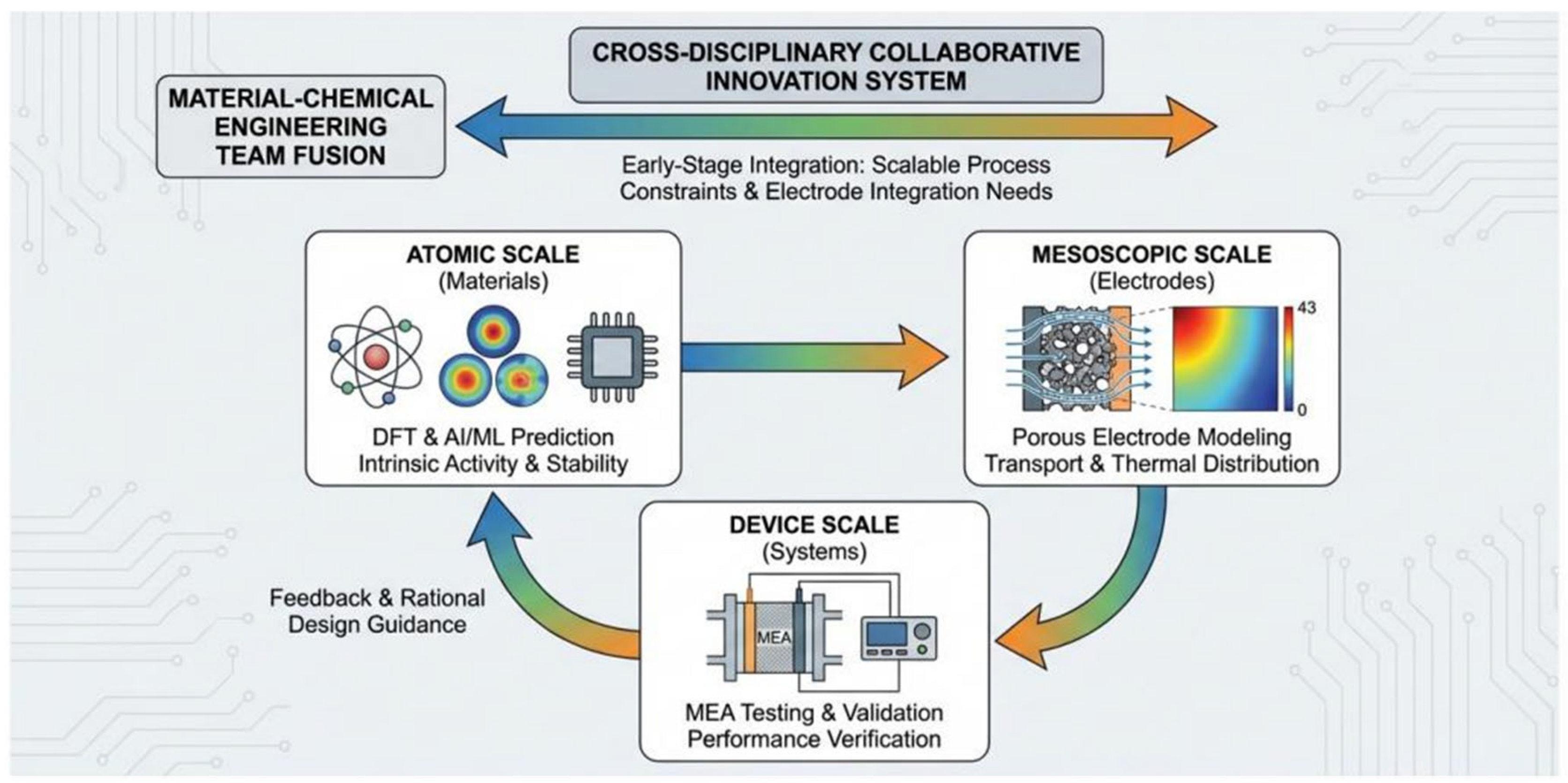
The fragmentation between catalyst discovery, electrode engineering, and device integration remains a major barrier to rapid technological progress. To overcome this, a tightly integrated computation–experiment–engineering framework is required [66]. As shown in Figure 7, future catalyst innovation should be guided by a closed-loop framework that integrates theoretical prediction, experimental validation, and engineering feedback. In such a system, atomistic simulation and data-driven screening can identify potentially favorable active-site motifs and stable compositions, while advanced synthesis and operando characterization can verify the corresponding structure–property relationships under realistic reaction conditions. These results must then be further tested at the electrode and device levels to determine whether the apparent material advantages survive scale-up and MEA integration. The significance of this closed-loop model lies in its ability to connect fundamental discovery with industrial constraints at an early stage, thereby shortening the cycle from catalyst concept generation to practical electrolyzer.

4.2.4. Standardizing Advanced In-Situ and Operando Characterization

Bridging the gap between laboratory performance and real operating behavior requires the wider adoption and standardization of advanced in-situ and operando characterization tools [90,91]. Techniques such as synchrotron-based X-ray spectroscopy, in-situ transmission electron microscopy, and operando vibrational spectroscopy can reveal dynamic changes in oxidation state, coordination environment, intermediate adsorption, and structural reconstruction under realistic electrolysis conditions. However, the value of these techniques depends not only on spatial or temporal resolution, but also on whether the testing environment is representative of actual electrolyzer operation. For this reason, the development of standardized electrochemical cells and operando protocols is equally important. Such standardization would improve data comparability across laboratories and accelerate the creation of shared databases linking dynamic catalyst structure to practical performance and degradation behavior. In the long term, these databases could become foundational resources for both mechanism-guided catalyst design and AI-assisted discovery.

4.3. Specific Enhancement Strategies and Material Advancements

4.3.1. Innovations at the Material Level

Material-level innovation remains a crucial route for improving catalyst performance while reducing dependence on scarce elements. Single-atom catalysts are particularly attractive because they maximize atomic utilization and allow the local electronic environment of active centers to be tailored with exceptional precision. This makes them promising not only for enhancing intrinsic activity, but also for reducing Pt or Ir loading in membrane-based electrolyzers. Similarly, MXene-derived or other electronically conductive hybrid architectures provide additional opportunities for stabilizing small active sites, facilitating charge transfer, and improving utilization under high current density. Nevertheless, such materials should be assessed not only for their record activity in half-cell tests, but also for their structural robustness and compatibility with scalable electrode fabrication [92].

4.3.2. Optimization at the Structural Level

At the structural level, catalyst design is increasingly focused on hierarchical architectures that coordinate active-site accessibility with efficient transport. Graded porosity, interconnected channels, and nanoscale/mesoscale coupling can help reduce gas accumulation, improve water supply, and maintain effective catalyst utilization at high current density. Hierarchical nanosheet or porous-array structures based on IrRu and related systems are representative examples, as they can provide both rapid electron transport and improved bubble-release pathways. Such structural engineering is especially important for bridging the gap between excellent intrinsic activity and stable device performance in industrial electrolyzers.

4.3.3. Improvements at the Interfacial Level

Interfacial engineering is essential because many apparent catalyst failures in practical devices originate not from the active phase itself, but from weak adhesion, transport discontinuity, or chemically unstable interfaces. Covalent functionalization strategies can strengthen the interaction between catalyst surfaces and ionomer phases, thereby improving proton or hydroxide transport as well as mechanical integrity. Atomic layer deposition offers another powerful tool by applying ultrathin protective coatings that suppress corrosion or defect-triggered degradation without completely blocking activity [76]. Plasma treatment and related surface activation techniques can also improve catalyst–substrate contact and reduce interfacial resistance. These approaches are particularly valuable for AEMWE and HEM-related systems, where interfacial instability and ionomer degradation remain major obstacles to long-term operation [93].

4.3.4. System-Level Engineering Design and Evaluation

Ultimately, the translation of catalyst innovation into commercial impact depends on system-level engineering. Multi-scale modeling that couples DFT, microkinetics, porous-electrode transport, and thermal analysis can identify the operating thresholds at which local gas accumulation, Ohmic heating, and reactant starvation begin to dominate. These insights can then guide rational design of catalyst layers and MEAs. In parallel, industrially relevant accelerated aging protocols are needed to bridge the gap between laboratory stability claims and real service lifetimes. Looking forward, digital twins, online diagnostics, and AI-assisted operation optimization may provide powerful new tools for extending electrolyzer lifetime and maximizing system efficiency. This is especially important in renewable-powered operation, where frequent start-stop cycles and fluctuating loads impose stress conditions that are still insufficiently represented in most catalyst studies [94,95].

5. Conclusion and Outlook: Bridging the Gap Towards a Green Hydrogen Economy

5.1. Summary of Research Progress

Water electrolysis is a cornerstone technology for global carbon neutrality, and high-performance electrocatalysts lie at the center of this transition. This review has summarized the evolution of water electrolysis catalyst research from early dependence on precious metals to more sophisticated approaches based on alloying, single-atom dispersion, defect regulation, interfacial modulation, and high-entropy material design. In parallel, earth-abundant catalyst systems based on Ni, Fe, and Co have emerged as increasingly important candidates for alkaline and membrane-alkaline electrolyzers, while Pt- and Ir-based catalysts continue to define the practical benchmark for acidic PEMWE. A key conclusion of this review is that catalyst development should no longer be interpreted solely through isolated laboratory metrics, but through the combined lens of catalytic activity, long-term durability, manufacturing feasibility, and device integration.
Despite impressive progress, the industrialization of advanced water electrolysis catalysts is still constrained by a four-fold gap involving performance, longevity, fabrication, and integration. First, there remains a major disconnect between low-current laboratory measurements and ampere-level industrial operation. Second, short-term durability claims often fail to capture the long-term degradation pathways relevant to real devices. Third, many advanced catalysts rely on synthesis routes that are difficult to scale economically, reproducibly, or sustainably. Fourth, strong powder-level performance does not guarantee successful implementation in membrane electrode assemblies, where ionomer distribution, interfacial transport, and structural stability become equally decisive. In this sense, the central challenge is not simply material optimization, but a broader transition from paper-oriented catalyst discovery to problem-oriented system engineering.

5.2. Future Outlook and Research Paradigms

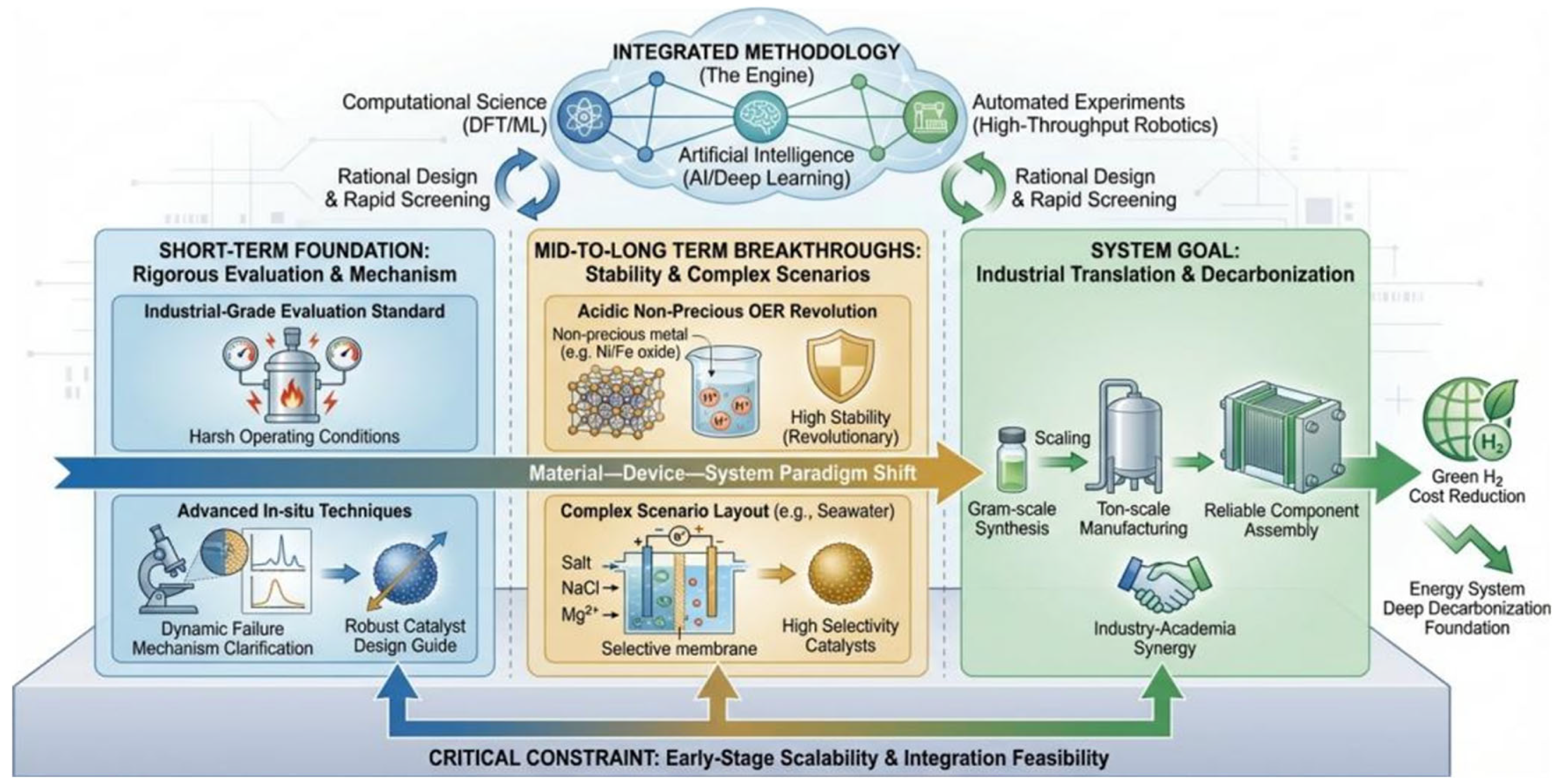
As illustrated in Figure 8, future research should proceed along a more integrated “material–device–system” pathway. In the short term, establishing industrially relevant evaluation standards is a priority. Catalyst testing must increasingly include high-current-density performance, realistic polarization behavior, degradation under dynamic loads, and MEA-level validation. In the medium to long term, breakthroughs in stability—particularly for non-precious OER catalysts under acidic or membrane-based conditions—will be critical for reshaping the techno-economic landscape of green hydrogen. At the same time, the integration of computational design, artificial intelligence, automated experimentation, and operando characterization offers a powerful route for accelerating catalyst discovery and for moving beyond trial-and-error development.
For China, these challenges and opportunities have special strategic significance. As the country advances toward its “30·60” targets and continues expanding renewable-energy capacity, the need for efficient, durable, and scalable hydrogen-production technologies will become increasingly urgent. Advanced water electrolysis catalysts are therefore not only a topic of academic interest, but also a key enabling technology for renewable-energy consumption, industrial decarbonization, strategic resource substitution, and the establishment of an autonomous green-hydrogen industrial chain. Only by embedding manufacturing scalability, resource security, and device integration into the earliest stages of catalyst design can laboratory breakthroughs be translated into the practical foundation of a competitive green hydrogen economy in China and beyond.

Author Contributions

Conceptualization, X.Z. and J.Z.; methodology, J.W.; software, X.Z.; validation, X.Z., Z.Z. (Zongtai Zhou) and J.W.; formal analysis, Z.Z. (Zikang Zhao); investigation, X.Z.; resources, X.Z.; data curation, X.Z.; writing—original draft preparation, X.Z. and J.W.; writing—review and editing, J.Z.; visualization, Z.Z. (Zongtai Zhou); supervision, J.W.; project administration, J.W.; funding acquisition, J.Z. All authors have read and agreed to the published version of the manuscript.

Funding

This research received no external funding.

Data Availability Statement

This review article did not generate new primary data. Data sharing is not applicable, as all findings are based on previously published studies cited in the reference list.

Conflicts of Interest

The authors declare no conflict of interest.

References

  1. Huang, B.H.-X. The future of Carbon-neutrality science and technology from an industrial transformation perspective: An interview with Hou-Liang Dai. Natl. Sci. Rev. 2022, 10, nwac295. [Google Scholar] [CrossRef]
  2. Liu, L.; Wang, X.; Wang, Z. Recent progress and emerging strategies for carbon peak and carbon neutrality in China. Greenh. Gases Sci. Technol. 2023, 13, 732–759. [Google Scholar] [CrossRef]
  3. An’na, W.; Chengjiang, Q.; Yu, K. China’s New Energy Vehicles: Carbon Neutrality Solutions with Global Implications. Int. Crit. Thought 2025, 15, 567–583. [Google Scholar] [CrossRef]
  4. He, K. China’s carbon neutrality faces the challenges of “three highs and one short”, and requires “five carbon implementations” to achieve dual carbon goals. iEnergy 2023, 2, 2–3. [Google Scholar] [CrossRef]
  5. Cheng, X.; Ye, K.; Min Du, A.; Bao, Z.; Chlomou, G. Dual carbon goals and renewable energy Innovations. Res. Int. Bus. Financ. 2024, 70, 102406. [Google Scholar] [CrossRef]
  6. Wang, H.; Chen, X.; Yang, Q.; Li, B.; Yue, Z.; Ampah, J.D.; Liu, H.; Yao, M. Optimization of Renewable Energy Hydrogen Production Systems Using Volatility Improved Multi-Objective Particle Swarm Algorithm. Energies 2024, 17, 2384. [Google Scholar] [CrossRef]
  7. Ham, K.; Bae, S.; Lee, J. Classification and technical target of water electrolysis for hydrogen Production. J. Energy Chem. 2024, 95, 554–576. [Google Scholar] [CrossRef]
  8. Wang, Z. Analysis of Progress and Optimization Pathways for Hydrogen Production Technologies under Dual Carbon Goals. Appl. Comput. Eng. 2025, 159, 93–103. [Google Scholar] [CrossRef]
  9. Łosiewicz, B. Technology for Green Hydrogen Production: Desk Analysis. Energies 2024, 17, 4514. [Google Scholar] [CrossRef]
  10. Song, X.; Liang, D.; Song, J.; Xu, G.; Deng, Z.; Niu, M. Problems and Technology Development Trends of Hydrogen Production from Renewable Energy Power Electrolysis—A Review. In Proceedings of the 2021 IEEE 5th Conference on Energy Internet and Energy System Integration (EI2), Taiyuan, China, 22–24 October 2021; pp. 3879–3882. [Google Scholar]
  11. De Jesús Pozos-Texon, F.; Gasca-Caballero, C.J.; Díaz-Marchetti, R.; Pinilla-Rodríguez, J.A.; Contreras-Valenzuela, L.E.; Tijerino-Torres, M.M. Advancing green hydrogen production technologies: From renewable energy integration to leading electrolyzer solutions. In Proceedings of the 2024 IEEE Technology and Engineering Management Society (TEMSCON LATAM), Panama, Panama, 18–19 July 2024; pp. 1–5. [Google Scholar]
  12. Liu, B.; Lai, M.; Wang, Y.; Wang, Y.; Chen, J.; Song, C. Assessment of green hydrogen production by volatile renewable energy under different SSPs scenarios in China. Renew. Energy 2024, 235, 121296. [Google Scholar] [CrossRef]
  13. Xu, J.; Zhu, J.; Yuan, H.; Zhang, H.; Wei, X.; Dai, H.; Wang, C. Study on Energy Allocation Strategy of Multiple Electrolyzers for Renewable Energy-Based Hydrogen Production System. J. Phys. Conf. Ser. 2025, 3012, 012059. [Google Scholar] [CrossRef]
  14. Zhou, X.; Sun, Z.; Liu, J.; Yan, H.; Feng, X.; Chen, D.; Yang, C. Towards Low-carbon consumption and cleaner methanol production via hybrid hydrogen supply strategy: A techno-economic-environment Assessment. Chem. Eng. Sci. 2024, 288, 119708. [Google Scholar] [CrossRef]
  15. Athia, N.; Pandey, M.; Sen, M.; Saxena, S. Factors affecting the production cost of green hydrogen and its challenge for sustainable Development. Environ. Dev. Sustain. 2024, 27, 26039–26083. [Google Scholar] [CrossRef]
  16. Wang, Y.; Wen, C.; Tu, J.; Zhan, Z.; Zhang, B.; Liu, Q.; Zhang, Z.; Hu, H.; Liu, T. The Multi-scenario projection of cost reduction in hydrogen production by proton exchange membrane (PEM) water electrolysis in the near future (2020–2060) of China. Fuel 2023, 354, 129409. [Google Scholar] [CrossRef]
  17. Gao, X.; Chen, Y.; Wang, Y.; Zhao, L.; Zhao, X.; Du, J.; Wu, H.; Chen, A. Next-Generation Green Hydrogen: Progress and Perspective from Electricity, Catalyst to Electrolyte in Electrocatalytic Water Splitting. Nano-Micro Lett. 2024, 16, 237. [Google Scholar] [CrossRef] [PubMed]
  18. Zhang, X.; Cao, C.; Ling, T.; Ye, C.; Lu, J.; Shan, J. Developing Practical Catalysts for High-Current-Density Water Electrolysis. Adv. Energy Mater. 2024, 14, 2402633. [Google Scholar] [CrossRef]
  19. Palmas, S.; Rodriguez, J.; Mais, L.; Mascia, M.; Herrando, M.C.; Vacca, A. Anion exchange membrane: A valuable perspective in emerging technologies of low temperature water Electrolysis. Curr. Opin. Electrochem. 2023, 37, 101178. [Google Scholar] [CrossRef]
  20. Hwang, D.Y.; Han, G.H.; Yoo, J.; Ahn, S.; Song, S.; Ahn, S.H. Recent Progress on Designing Non-noble Catalyst for Hydrogen Evolution Reaction in Anion Exchange Membrane Water Electrolyzers. Korean J. Chem. Eng. 2024, 42, 3349–3363. [Google Scholar] [CrossRef]
  21. Matz, L.; Bensmann, B.; Hanke-Rauschenbach, R.; Minke, C. Resource-Efficient Gigawatt Water Electrolysis in Germany—A Circular Economy Potential Analysis. Circ. Econ. Sustain. 2024, 4, 1153–1182. [Google Scholar] [CrossRef]
  22. Zhang, Y.; Pan, C.-L.; Liao, H.-T. Carbon Neutrality Policies and Technologies: A Scientometric Analysis of Social Science Disciplines. Front. Environ. Sci. 2021, 9, 761736. [Google Scholar] [CrossRef]
  23. Dong, Z.; Qing, Z.; Yu, Z.; Haoran, L.; Qifan, Y.; Rui, Z.; Zhoujian, A. Performance response analysis and optimization for integrated renewable energy systems using biomass and heat pumps: A multi-objective Approach. Carbon Neutrality 2024, 3, 33. [Google Scholar] [CrossRef]
  24. Chen, S.; Zhang, S.; Zeng, Q.; Ao, J.; Chen, X.; Zhang, S. Can artificial intelligence achieve carbon neutrality? Evidence from a quasi-natural experiment. Front. Ecol. Evol. 2023, 11, 1151017. [Google Scholar] [CrossRef]
  25. Saheb, T.; Dehghani, M.; Saheb, T. Artificial intelligence for sustainable energy: A contextual topic modeling and content Analysis. Sustain. Comput. Inform. Syst. 2022, 35, 100699. [Google Scholar] [CrossRef]
  26. Qahtan, T.F.; Alade, I.O.; Rahaman, M.S.; Saleh, T.A. Mapping the research landscape of hydrogen production through electrocatalysis: A decade of progress and key Trends. Renew. Sustain. Energy Rev. 2023, 184, 113490. [Google Scholar] [CrossRef]
  27. Shin, H.; Jang, D.; Lee, S.; Cho, H.-S.; Kim, K.-H.; Kang, S. Techno-economic evaluation of green hydrogen production with low-temperature water electrolysis technologies directly coupled with renewable power Sources. Energy Convers. Manag. 2023, 286, 117083. [Google Scholar] [CrossRef]
  28. Jeon, S.S.; Lee, W.; Jeon, H.; Lee, H. Developing Catalysts for Membrane Electrode Assemblies in High Performance Polymer Electrolyte Membrane Water Electrolyzers. ChemSusChem 2024, 17, e202301827. [Google Scholar] [CrossRef]
  29. Bodard, A.; Chen, Z.; ELJarray, O.; Zhang, G. Green Hydrogen Production by Low-Temperature Membrane-Engineered Water Electrolyzers, and Regenerative Fuel Cells. Small Methods 2024, 8, e2400574. [Google Scholar] [CrossRef]
  30. Jeon, S.S.; Lee, H. Developing Catalysts for Proton and Anion Exchange Membrane Water Electrolyzers. ECS Meet. Abstr. 2024, MA2024-02, 2857. [Google Scholar] [CrossRef]
  31. Arshad, U.; Tang, J.; Shao, Z. Replace Platinum for Hydrogen Evolution Reaction in the Cathode of Proton Exchange Membrane Water Electrolyzers. SusMat 2025, 5, e267. [Google Scholar] [CrossRef]
  32. Wang, Q.; Wang, Y.; Luk, H.M.; Tang, J.; Wu, S.; Wu, D.; Hu, Z.; Cui, D.; Zhang, J. Recent advances in Non-precious metal electrocatalysts for anion exchange membrane water electrolysis: Mechanistic insights, catalyst design, and structural regulation Strategies. Chem. Eng. J. 2025, 523, 168587. [Google Scholar] [CrossRef]
  33. Xia, W.; Zhang, J.; Xu, G.; Jin, T.; Wang, Q.; Jiao, L. Recent advances and challenges in Single-atom catalysts for proton exchange membrane water Electrolysis. Next Mater. 2025, 8, 100553. [Google Scholar] [CrossRef]
  34. Li, Z.; Wen, X.; Liu, Y.; Qi, X.; Wang, Z.; Wang, D. Non-precious metal catalysts for acidic water oxidation: From mechanism insights to electrocatalyst Design. J. Alloys Compd. 2025, 1039, 183127. [Google Scholar] [CrossRef]
  35. Yang, X.; Xu, C.; Fu, Z.; Wang, X.; Chen, Y. Noble Metal-based electrocatalysts for acidic water electrolysis: Design strategies, AI-empowered approaches, and industrialization Prospects. Prog. Nat. Sci. Mater. Int. 2025, 36, 31–41. [Google Scholar] [CrossRef]
  36. Yan, C.; Zhou, J.; Zhao, Y.; Lin, Y. Design Strategies for Stable and Active Co-Based Electrocatalysts in Acidic Oxygen Evolution Reaction. Chem. Asian J. 2025, 20, e202401818. [Google Scholar] [CrossRef] [PubMed]
  37. Ahn, H.; Ji, H.; Moon, J.; Bootharaju, M.S.; Hyeon, T.; Lee, B.-H. Design Principles for Non-Iridium-Based Oxygen Evolution Catalysts in Proton Exchange Membrane Water Electrolyzers. ACS Energy Lett. 2025, 11, 245–269. [Google Scholar] [CrossRef]
  38. Leng, Y. Platinum-Based Catalysts for the Hydrogen Evolution Reaction: Recent Advances in Preparation and Performance. Appl. Comput. Eng. 2025, 188, 204–210. [Google Scholar] [CrossRef]
  39. Choi, K.J.; Kim, S.-K. A Pt cathode with high mass activity for proton exchange membrane water Electrolysis. Int. J. Hydrogen Energy 2023, 48, 849–863. [Google Scholar] [CrossRef]
  40. Zeng, H.; Ji, Y.; Wen, J.; Li, X.; Zheng, T.; Jiang, Q.; Xia, C. Pt Nanocluster-catalyzed hydrogen evolution reaction: Recent advances and future Outlook. Chin. Chem. Lett. 2025, 36, 109686. [Google Scholar] [CrossRef]
  41. Lim, W.-G.; Truong, H.N.; Jeong, J.-Y.; Kim, D.; Oh, L.S.; Jo, C.; Kim, C.; Kim, H.J.; Choi, S.M.; Shin, H.; et al. Toward feasible single Atom-based hydrogen evolution electrocatalysts via artificial ensemble sites for anion exchange membrane water Electrolyzer. Appl. Catal. B Environ. 2024, 343, 123568. [Google Scholar] [CrossRef]
  42. Niu, Z.; Qiao, Z.; Sun, P.; Chen, J.; Wang, S.; Huo, F.; Cao, D. Single-Atom Sb-Doped RuSbOx Bifunctional Catalysts for Ultra-Stable PEM Water Electrolyzers. Small 2025, 21, 2502088. [Google Scholar] [CrossRef]
  43. Shi, H.; Qian, J.; Hu, X. Polyaniline nanowires decorated nickel phosphides hollow spheres hydrogen evolution catalyst for proton exchange membrane Electrolysis. J. Power Sources 2024, 596, 234099. [Google Scholar] [CrossRef]
  44. Nguyen, T.H.; Tran, P.K.L.; Tran, D.T.; Dinh, V.A.; Kim, N.H.; Lee, J.H. Ru-Ru2P hetero-cluster promoted V2CTx sheets-based electrocatalyst enables industrial-level AEM water Electrolysis. Appl. Catal. B Environ. 2024, 343, 123517. [Google Scholar] [CrossRef]
  45. Tamilarasi, B.; Jithul, K.P.; Pandey, J. Non-noble metal-based electro-catalyst for the oxygen evolution reaction: Towards an active & stable electro-catalyst for PEM water Electrolysis. Int. J. Hydrogen Energy 2024, 58, 556–582. [Google Scholar]
  46. Chen, Y.; Shang, C.; Xiao, X.; Guo, W.; Xu, Q. Recent progress of electrocatalysts for acidic oxygen evolution Reaction. Coord. Chem. Rev. 2024, 508, 215758. [Google Scholar] [CrossRef]
  47. Xu, K.; Liang, X.; Ge, X.; Liu, W.; Zhang, S.; Liu, J. Recent progress in Cobalt-based non-noble-metal electrocatalysts for acidic oxygen evolution reaction: A Review. Curr. Opin. Electrochem. 2026, 56, 101817. [Google Scholar] [CrossRef]
  48. Liu, T.; Chen, C.; Pu, Z.; Huang, Q.; Zhang, X.; Al-Enizi, A.M.; Nafady, A.; Huang, S.; Chen, D.; Mu, S. Non-Noble-Metal-Based Electrocatalysts for Acidic Oxygen Evolution Reaction: Recent Progress, Challenges, and Perspectives. Small 2024, 20, 2405399. [Google Scholar] [CrossRef]
  49. Lin, M.Y.; Chen, X.Q.; Liu, P.F.; Hou, Y. Acid-stable oxygen-evolving catalysts: Progress in non-precious material engineering and scalability Barriers. Nanoscale 2025, 17, 22566–22593. [Google Scholar] [CrossRef]
  50. Li, L. Advancements in Non-Precious Electrocatalysts for Alkaline Water Electrolysis: Mechanistic Insights and Industrial Application Challenges. Appl. Comput. Eng. 2025, 181, 245–252. [Google Scholar] [CrossRef]
  51. Chen, Y.; Xu, Z.; Chen, G.Z. Nano-Scale Engineering of Heterojunction for Alkaline Water Electrolysis. Materials 2023, 17, 199. [Google Scholar] [CrossRef]
  52. Lao, M.; Li, P.; Jiang, Y.; Pan, H.; Dou, S.X.; Sun, W. From fundamentals and theories to heterostructured electrocatalyst design: An in-depth understanding of alkaline hydrogen evolution Reaction. Nano Energy 2022, 98, 107231. [Google Scholar] [CrossRef]
  53. Kreider, M.E.; Maldonado Santos, A.; Yu, H.; Volk, E.; Chan, A.-L.; Sweers, M.; Dang, N.J.; Alia, S.M. Challenges and Opportunities for Ni-Based Cathode Catalysts in Anion Exchange Membrane Electrolyzers. ECS Meet. Abstr. 2025, MA2025-02, 1891. [Google Scholar] [CrossRef]
  54. Kim, T.; Yeo, K.-R.; Kim, H.; Lee, J.; Kim, S.-K. Impact of Phosphide–Phosphate Ratio on NiCoP Catalysts for Hydrogen Evolution in Anion Exchange Membrane Water Electrolysis. Int. J. Energy Res. 2025, 2025, 6685212. [Google Scholar] [CrossRef]
  55. Gao, Y.; Liu, L.; Jiang, Y.; Yu, D.; Zheng, X.; Wang, J.; Liu, J.; Luo, D.; Zhang, Y.; Shi, Z.; et al. Design Principles and Mechanistic Understandings of Non-Noble-Metal Bifunctional Electrocatalysts for Zinc–Air Batteries. Nano-Micro Lett. 2024, 16, 162. [Google Scholar] [CrossRef]
  56. Klingenhof, M.; Trzesniowski, H.; Koch, S.; Zhu, J.; Zeng, Z.; Metzler, L.; Klinger, A.; Elshamy, M.; Lehmann, F.; Buchheister, P.W.; et al. High-performance anion-exchange membrane water electrolysers using NiX (X = Fe,Co,Mn) catalyst-coated membranes with redox-active Ni–O Ligands. Nat. Catal. 2024, 7, 1213–1222. [Google Scholar] [CrossRef]
  57. Jhu, P.-S.; Chang, C.-W.; Cheng, C.-C.; Ting, Y.-C.; Lin, T.-Y.; Yen, F.-Y.; Chen, P.-W.; Lu, S.-Y. Non-precious high entropy alloys and highly alkali-resistant composite membranes based high performance anion exchange membrane water Electrolyzers. Nano Energy 2024, 126, 109703. [Google Scholar] [CrossRef]
  58. Ha, J.S.; Park, Y.; Jeong, J.; Lee, S.H.; Lee, S.J.; Kim, I.T.; Park, S.H.; Jin, H.; Kim, S.M.; Choi, S.; et al. Solar-Powered AEM Electrolyzer via PGM-Free (Oxy)hydroxide Anode with Solar to Hydrogen Conversion Efficiency of 12.44%. Adv. Sci. 2024, 11, 2401782. [Google Scholar] [CrossRef]
  59. Chong, L.; Wen, J.; Song, E.; Yang, Z.; Bloom, I.D.; Ding, W. Synergistic Co─Ir/Ru Composite Electrocatalysts Impart Efficient and Durable Oxygen Evolution Catalysis in Acid. Adv. Energy Mater. 2023, 13, 2302306. [Google Scholar] [CrossRef]
  60. Shaik, S.; Kundu, J.; Yuan, Y.; Chung, W.; Han, D.; Lee, U.; Huang, H.; Choi, S. Recent Progress and Perspective in Pure Water-Fed Anion Exchange Membrane Water Electrolyzers. Adv. Energy Mater. 2024, 14, 2401956. [Google Scholar] [CrossRef]
  61. Wang, Y.; Ban, T.; Guo, M.; Zhu, X. Poly(fluorenyl-indolinedione) based hydroxide conducting membrane for anion exchange membrane water Electrolyzers. Int. J. Hydrogen Energy 2024, 49, 1123–1133. [Google Scholar] [CrossRef]
  62. Miao, D.; Li, J.; Ren, J.; Chen, Z. Exploring the Potential of Ni-Based Hydrogen Evolution Catalysts in Anion Exchange Membrane Water Electrolyzer. Adv. Mater. 2026, 38, e20491. [Google Scholar] [CrossRef]
  63. Yuan, Y.; Li, X.; Wu, H.; Ye, C.; Yang, Y.; Ye, M.; Shen, J. Enhanced Built-in Electric Field via Work Function Engineering for Efficient Anion Membrane Water Electrolysis. ACS Energy Lett. 2025, 10, 2960–2971. [Google Scholar] [CrossRef]
  64. Chen, J.; Ma, J.; Huang, T.; Liu, Q.; Liu, X.; Luo, R.; Xu, J.; Wang, X.; Jiang, T.; Liu, H.; et al. Iridium-Free High-Entropy Alloy for Acidic Water Oxidation at High Current Densities. Angew. Chem. Int. Ed. 2025, 64, e202503330. [Google Scholar] [CrossRef]
  65. Kamaruddin, H.; Zhang, J.; Lu, Y.; Xiu, M.; Wei, Y.; Huang, Y. Laser Irradiated Noble Metal-Free High Entropy Oxide 2-D Sheets for Highly Efficient Anion Exchange Membrane Water Electrolyzers. Adv. Funct. Mater. 2025, 35, 2507930. [Google Scholar] [CrossRef]
  66. Liu, X.; Zhang, Y.; Liao, H.; Zhou, B.; Zhang, S.; Liu, F.; Tan, P.; Liu, M.; Pan, J. Interface-engineered Ni3S2/WO3 heterostructures bridging Volmer/Tafel processes via hydrogen spillover for enhanced alkaline hydrogen Evolution. J. Colloid Interface Sci. 2026, 702, 139014. [Google Scholar] [CrossRef]
  67. Dong, Y.; Wu, A.; Yang, G.; Wang, J.; Liu, Y.; Yan, H.; Tian, C.; Fu, H. Lower-Temperature Synthesis of Nitrogen-Rich Molybdenum Nitride/Nickel (Cobalt) Heterojunctional Assembly for the Effective Water Electrolysis. Adv. Funct. Mater. 2024, 35, 2412979. [Google Scholar] [CrossRef]
  68. Yang, Y. Advances and Challenges in Catalysts for Proton Exchange Membrane Water Electrolysis. Appl. Comput. Eng. 2025, 187, 103–109. [Google Scholar] [CrossRef]
  69. Haeryang, L.; Jae-Yeop, J.; Dae Hwan, L.; Shin-Woo, M.; Giwon, S.; Dayeong, C.; Won Bae, K.; Sung Mook, C.; Taiho, P. Morphology and cell performance of poly(fluorene)-based anion exchange membranes for water electrolysis: Effect of backbone core structure. J. Mater. Chem. A 2023, 11, 25938. [Google Scholar]
  70. Agrawal, D.; Mahajan, N.; Singh, S.A.; Sreedhar, I. Green hydrogen production pathways for sustainable future with net zero Emissions. Fuel 2024, 359, 130131. [Google Scholar] [CrossRef]
  71. Sun, H.; Xu, X.; Kim, H.; Jung, W.; Zhou, W.; Shao, Z. Electrochemical Water Splitting: Bridging the Gaps Between Fundamental Research and Industrial Applications. Energy Environ. Mater. 2023, 6, e12441. [Google Scholar] [CrossRef]
  72. Chen, J.; Shi, L.; Du, L.; Ye, S.; Zhao, S. Challenges and opportunities for industrial Proton-exchange membrane water Splitting. Chem. Catal. 2023, 3, 100733. [Google Scholar] [CrossRef]
  73. Du, X.; Qi, M.; Wang, Y. From Atomic-Level Synthesis to Device-Scale Reactors: A Multiscale Approach to Water Electrolysis. Acc. Chem. Res. 2024, 57, 1298–1309. [Google Scholar] [CrossRef]
  74. Zang, B.; Liu, X.; Gu, C.; Chen, J.; Wang, L.; Zheng, W. Design Strategies of Hydrogen Evolution Reaction Nano Electrocatalysts for High Current Density Water Splitting. Nanomaterials 2024, 14, 1172. [Google Scholar] [CrossRef]
  75. Li, W.; Liu, Y.; Azam, A.; Liu, Y.; Yang, J.; Wang, D.; Sorrell, C.C.; Zhao, C.; Li, S. Unlocking Efficiency: Minimizing Energy Loss in Electrocatalysts for Water Splitting. Adv. Mater. 2024, 36, 2404658. [Google Scholar] [CrossRef]
  76. Zhang, Q.; Li, Y.; Luo, F.; Yang, Z. Navigating the energy crisis: Design principles and challenges in the development of high-performance catalysts for electrolytic water Splitting. Chem. Commun. 2025, 61, 10747–10763. [Google Scholar] [CrossRef]
  77. Meharban, F.; Lin, C.; Wu, X.; Tan, L.; Wang, H.; Hu, W.; Zhou, D.; Li, X.; Luo, W. Scaling Up Stability: Navigating from Lab Insights to Robust Oxygen Evolution Electrocatalysts for Industrial Water Electrolysis. Adv. Energy Mater. 2024, 14, 2402886. [Google Scholar] [CrossRef]
  78. Wang, Z. Activity and stability of catalysts for electrocatalytic water splitting in acidic Media. Sci. China Mater. 2024, 67, 1124–1128. [Google Scholar] [CrossRef]
  79. Rong, C.; Meyer, Q.; Lu, H.; Zhao, C. Bridging Laboratory Catalysts with Industrial Proton Exchange Membrane Water Electrolyzers. Adv. Mater. 2025, 38, e12414. [Google Scholar] [CrossRef]
  80. Wu, Q.; Zhou, R.; Yao, Z.; Wang, T.; Li, Q. Effective approaches for enhancing the stability of Ruthenium-based electrocatalysts towards acidic oxygen evolution Reaction. Chin. Chem. Lett. 2024, 35, 109416. [Google Scholar] [CrossRef]
  81. Li, J.; Li, Z.; Sun, Q.; Wang, Y.; Li, Y.; Peng, Y.; Li, Y.; Zhang, C.; Liu, B.; Zhao, Y. Recent Advances in the Large-Scale Production of Photo/Electrocatalysts for Energy Conversion and Beyond. Adv. Energy Mater. 2024, 14, 2402441. [Google Scholar] [CrossRef]
  82. Lovato, K.; Fier, P.S.; Maloney, K.M. The application of modern reactions in Large-scale Synthesis. Nat. Rev. Chem. 2021, 5, 546–563. [Google Scholar] [CrossRef]
  83. Jordan, D.C.; Hayden, S.C.; Haegel, N.M.; Veers, P.; Alia, S.; Barnes, T.; Gaulding, A.; Jungjohann, K.L. Nanoscale science for terawatt/gigaton scale performance of clean energy Technologies. Joule 2024, 8, 272–279. [Google Scholar] [CrossRef]
  84. Hong, R.; Xing, L.; Huang, F.; Chen, Y.; Li, P.; Fang, X.; Zhao, M.; Ren, H.; Dong, Z.; Yang, Y.; et al. Scaling up membrane electrode assemblies for industrial Applications. Chem. Catal. 2025, 5, 101463. [Google Scholar] [CrossRef]
  85. Jin, H.; Chen, X.; Da, Y.; Fan, L.; Jiang, R.; Chen, W. Advancing Multiscale-Coupled Heterointerface Catalysts for Enhanced Water Electrolysis. Acc. Mater. Res. 2025, 6, 648–660. [Google Scholar] [CrossRef]
  86. Kang, X.; Yu, Q.; Zhang, T.; Hu, S.; Liu, H.; Zhang, Z.; Liu, B. A perspective on interface engineering of transition metal dichalcogenides for High-current-density hydrogen Evolution. Chin. J. Catal. 2024, 56, 9–24. [Google Scholar] [CrossRef]
  87. Lazaridis, T.; Stühmeier, B.M.; Gasteiger, H.A.; El-Sayed, H.A. Capabilities and limitations of rotating disk electrodes versus membrane electrode assemblies in the investigation of Electrocatalysts. Nat. Catal. 2022, 5, 363–373. [Google Scholar] [CrossRef]
  88. Sherrell, P.C.; Iesalnieks, M.; Ehrnst, Y.; Rezk, A.R.; Šutka, A. Electrocatalysis for Green(er) Chemistry: Limitations and Opportunities with Traditional and Emerging Characterization Methods for Tangible Societal Impact. Adv. Energy Sustain. Res. 2024, 5, 2400008. [Google Scholar] [CrossRef]
  89. Basov, D.N.; Averitt, R.D.; Hsieh, D. Towards properties on demand in quantum Materials. Nat. Mater. 2017, 16, 1077–1088. [Google Scholar] [CrossRef]
  90. Tran, P.K.L.; Nguyen, T.H.; Tran, D.T.; Dinh, V.A.; Nga Ta, T.T.; Dong, C.-L.; Kim, N.H.; Lee, J.H. Tunable charge Pt Sites-dominated alloy confined by mxene-derived oxycarbide enables ultra-stable ampere-level hydrogen Production. Appl. Catal. B Environ. Energy 2025, 363, 124801. [Google Scholar] [CrossRef]
  91. Tao, L.; Lv, F.; Wang, D.; Luo, H.; Lin, F.; Gong, H.; Mi, H.; Wang, S.; Zhang, Q.; Gu, L.; et al. Mass-efficient catalyst layer of hierarchical sub-nanosheets on nanowire for practical proton exchange membrane Electrolyzer. Joule 2024, 8, 450–460. [Google Scholar] [CrossRef]
  92. Lindquist, G.A.; Gaitor, J.C.; Thompson, W.L.; Brogden, V.; Noonan, K.J.T.; Boettcher, S.W. Oxidative instability of ionomers in Hydroxide-exchange-membrane water Electrolyzers. Energy Environ. Sci. 2023, 16, 4373–4387. [Google Scholar] [CrossRef]
  93. Cui, M.; Guo, R.; Wang, F.; Zhou, Y.; Zhao, W.; Liu, Y.; Ou, Q.; Zhang, S. Plasma Induced Atomic-Scale Soldering Enhanced Efficiency and Stability of Electrocatalysts for Ampere-Level Current Density Water Splitting. Small 2024, 20, 2405567. [Google Scholar] [CrossRef]
  94. Bin, S.; Chen, Z.; Zhu, Y.; Zhang, Y.; Xia, Y.; Gong, S.; Zhang, F.; Shi, L.; Duan, X.; Sun, Z. High-pressure proton exchange membrane water electrolysis: Current status and challenges in hydrogen Production. Int. J. Hydrogen Energy 2024, 67, 390–405. [Google Scholar] [CrossRef]
  95. Brissaud, F.; Chaise, A.; Gault, K.; Soual, S. Lessons learned from Jupiter 1000, an industrial demonstrator of Power-to-Gas. Int. J. Hydrogen Energy 2024, 49, 925–932. [Google Scholar] [CrossRef]
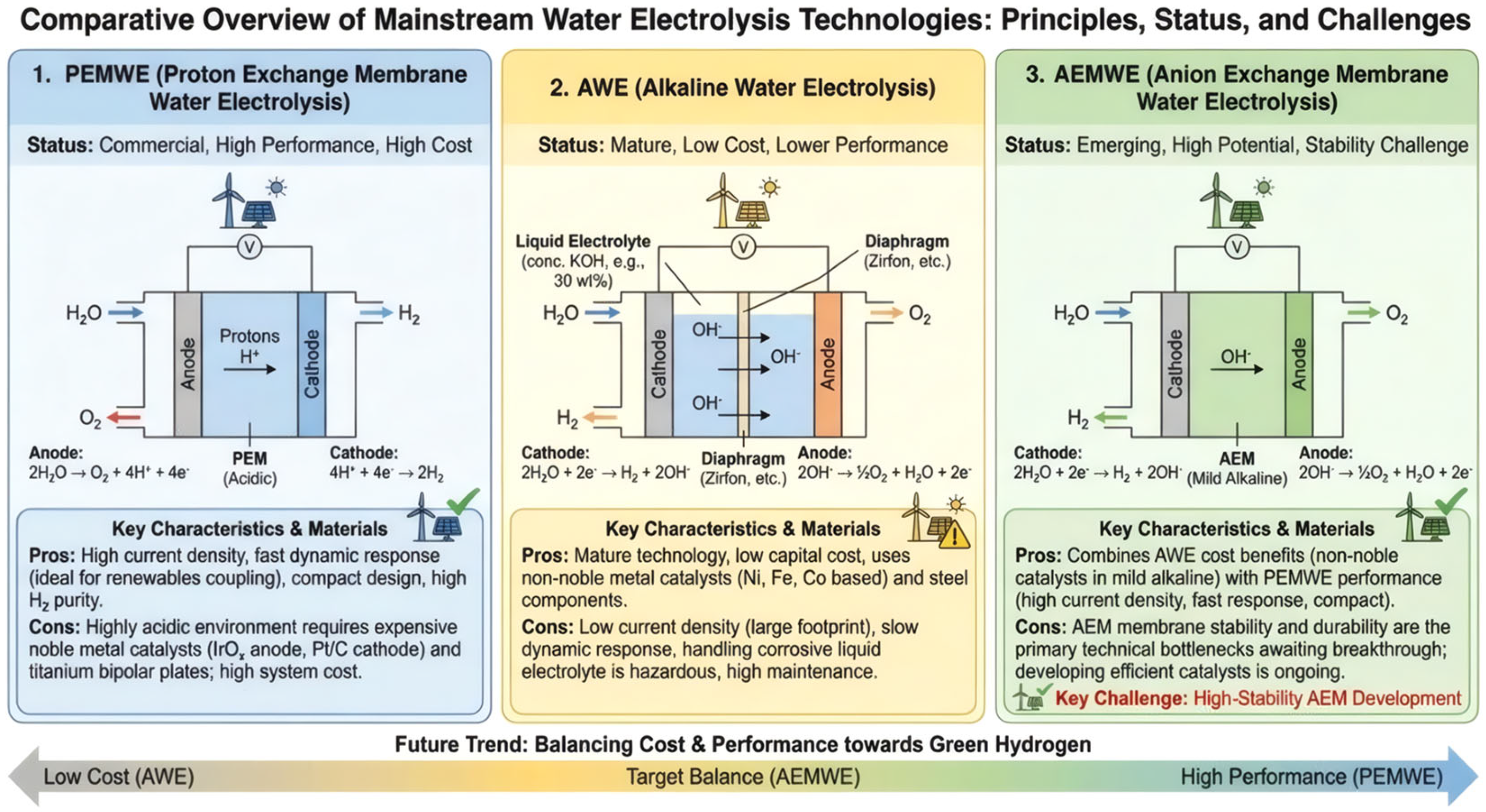
Figure 1. Comparative Overview of Mainstream Water Electrolysis Technologies: Principles, Status, and Challenges.
Catalysts 16 00475 g001
Figure 3. Full-cell voltage comparison of PEMWE, AWE, and AEMWE at industrially relevant current densities. PEMWE generally shows the lowest voltage, AWE relies on low-cost Ni-based catalyst systems at moderately higher voltages, and AEMWE remains strongly dependent on membrane and interface properties.
Catalysts 16 00475 g003
Figure 4. Advanced Strategies for High-Performance Electrocatalysis.
Catalysts 16 00475 g004
Figure 5. Catalyst Innovations Driving Green Hydrogen Economics.
Catalysts 16 00475 g005
Figure 6. The “Lab-to-Factory” Performance Gapin PEM Electrolysis: From Milliampere to Ampere Scales.
Catalysts 16 00475 g006
Figure 7. Schematic of the integrated computation-experiment-engineering closed-loop system for accelerated water electrocatalyst and device development.
Catalysts 16 00475 g007
Figure 8. R&D Paradigm Shift for Green Hydrogen Technologies: Material-Device System Integration.
Catalysts 16 00475 g008
Table 1. Representative advanced HER/OER catalysts for PEMWE, AWE, and AEMWE, with comparison of activity, durability, and practical considerations.
Electrolyzer TypeReactionRepresentative Catalyst SystemTypical Electrolyte/EnvironmentRepresentative Performance MetricStability/DurabilityMain AdvantageMain LimitationReferences
PEMWEHERPt-based alloy catalyst AcidicLower Pt loading Moderate to goodImproved Pt utilization; Expensive/complexity[39]
PEMWEOERIrO2Acidic PEM anodehigh activity in acidGoodState-of-the-art catalystHigh Ir cost and scarcity[35]
PEMWEOERRu-based AcidicHigh intrinsic OER activitylower durability Excellent activityLimited acid durability; [64]
AWEHERNiMo alloysAlkaline Low overpotential Good in many studiesMature, low-cost, Performance sensitive [65]
AWEOERNiFe-LDHAlkalinethe most active non-noble OER Good in alkaline testsLow cost; excellent activityLimited durability[50]
AEMWEHERNi-based catalysts (Ni, NiMo)Mild alkaline membrane Comparable alkaline HER trend Limited long-term full-cell data Precious-metal-free pathway Limited durability[62]
AEMWEOERNiFe-LDH and related oxyhydroxideAEM/HEM environmentPromising OER activityOften limited by membranedLow-cost OER candidateInterface compatibility [56]
Cross-platform emerging strategyHER/OERDefect-engineered/interface-engineered heterostructuresVariousStrongly improved apparent activityVariablePowerful route for tuning adsorption and charge transferreconstruction, and reproducibility can beunclear[66]
Table 2. Comparison of Key Parameters and Performance Limitations between Laboratory Research and Industrial Electrolysis.
ParameterLaboratory Research (Lab)Industrial Electrolysis (Fab)
Current DensityLow (typically <0.5 A·cm−2)High (1.0–3.0+ A·cm−2)
Testing EnvironmentThree-electrode aqueous systemProton Exchange Membrane (PEM) stack
Limiting FactorsIntrinsic kinetic activityMass transport and thermal management
Disclaimer/Publisher’s Note: The statements, opinions and data contained in all publications are solely those of the individual author(s) and contributor(s) and not of MDPI and/or the editor(s). MDPI and/or the editor(s) disclaim responsibility for any injury to people or property resulting from any ideas, methods, instructions or products referred to in the content.