Photocatalytic Degradation of Polycyclic Aromatic Hydrocarbons in Simulated Offshore Oil Spill Wastewater by Magnesium Phthalocyanine Derivatives Supported on Coconut Shell Activated Carbon

 ,
,
Abstract
1. Introduction
2. Results
2.1. Optical Characterization
2.2. Textural Properties and Pore Structure Evolution
2.3. Morphological and Elemental Characterization
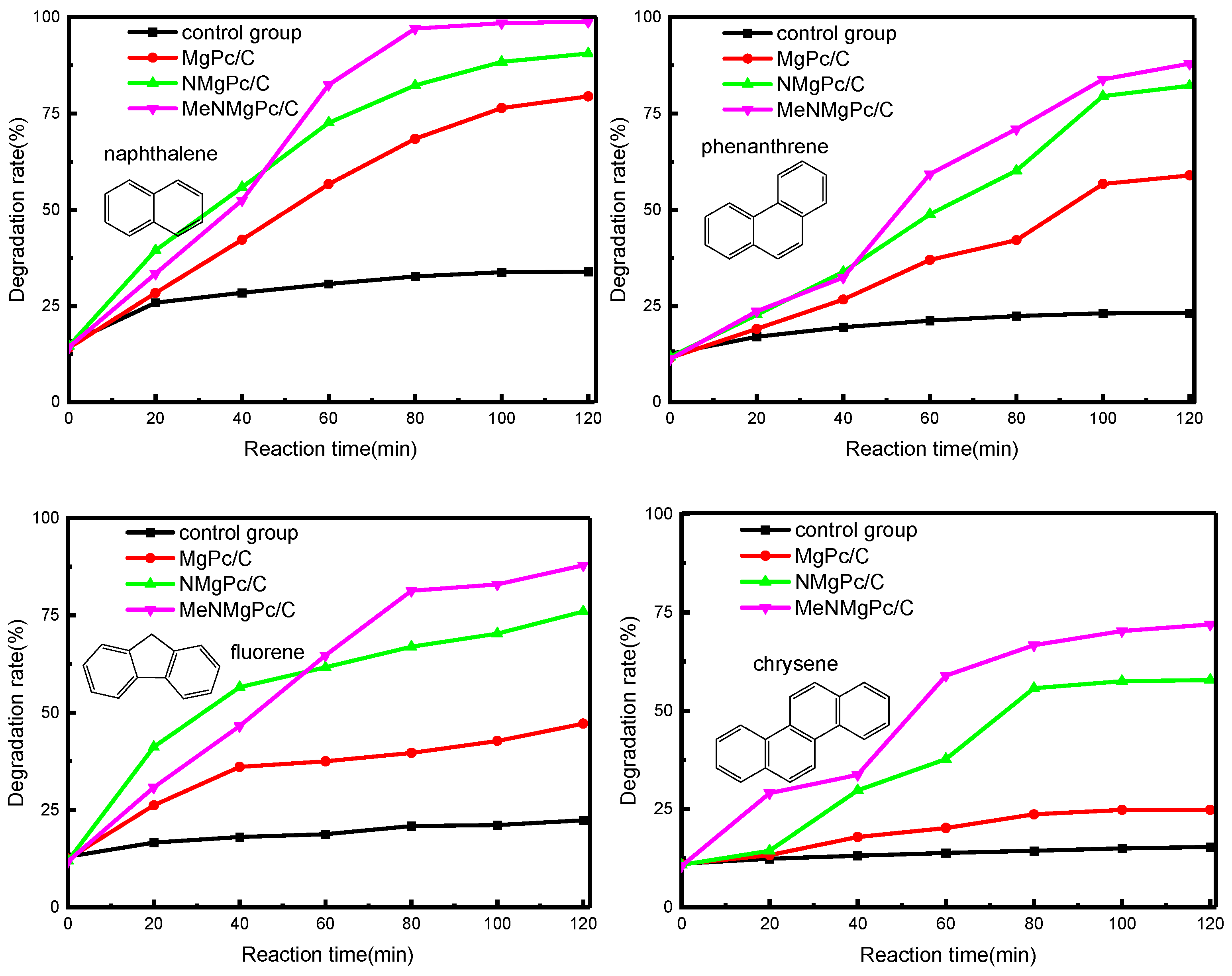
2.4. Photocatalytic Performance
2.5. Optimization of Operational Parameters: Single-Factor Analysis
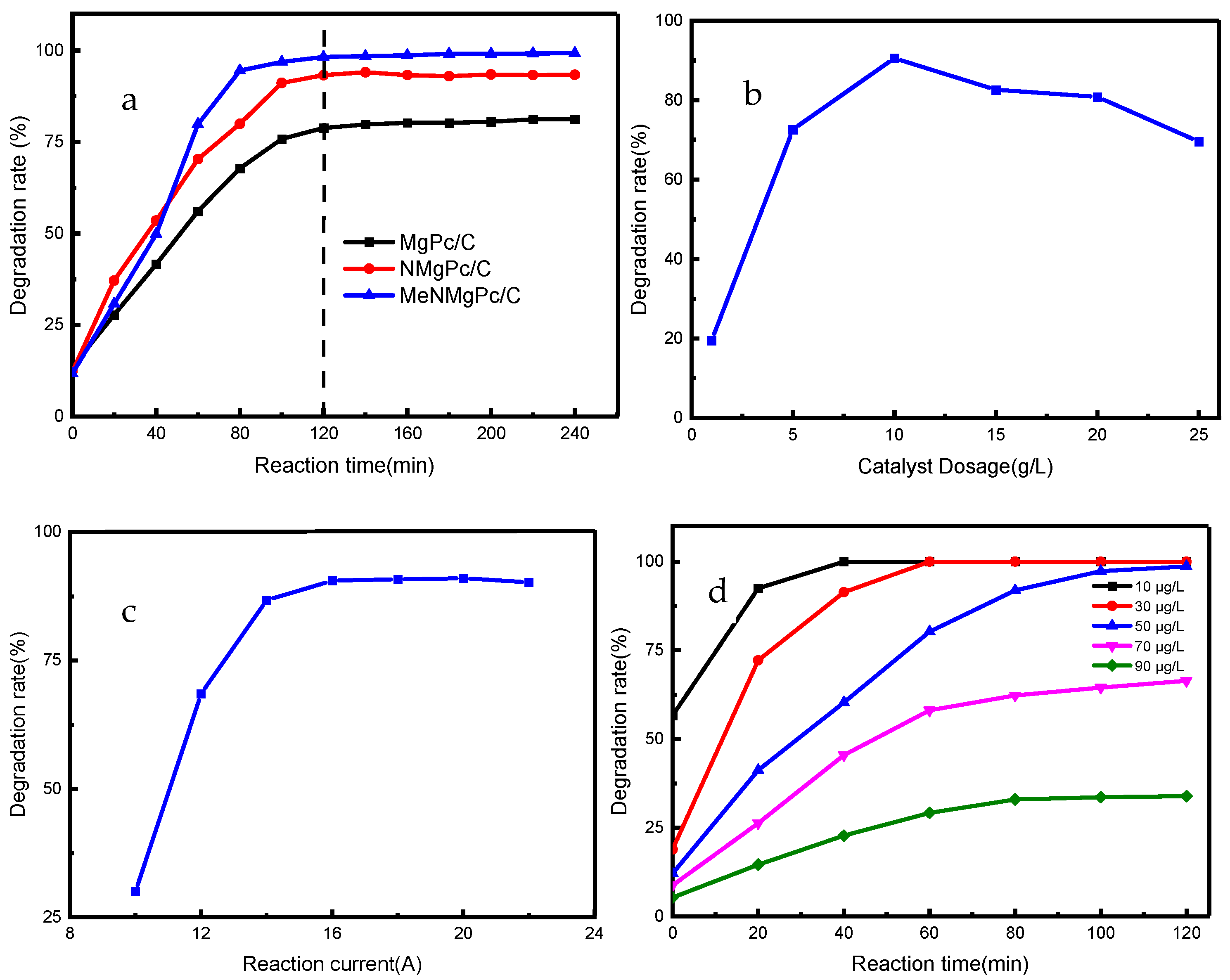
- Effect of Reaction Time: Temporal monitoring over a 4-h period revealed a rapid initial surge in degradation efficiency, which peaked between 120 and 140 min before reaching a plateau. To balance maximal pollutant removal with optimal energy consumption, 120 min was established as the standard reaction duration (Figure 5a).
- Effect of Catalyst Dosage: Varying the catalyst loading (1–25 g/L) in a 50 μg/L naphthalene solution identified 10 g/L as the optimal dosage, achieving a peak degradation efficiency of 90.55%. Insufficient loading (1 g/L) yielded a marginal removal rate of 15.7% due to a severe scarcity of accessible catalytic active sites. Conversely, dosages exceeding 10 g/L induced detrimental light scattering and inner-filter effects; excessive suspended particles hindered photon penetration into the suspension bulk [24]. Furthermore, excessive carrier amounts introduced competitive physical adsorption, convoluting the true photocatalytic contribution (Figure 5b).
- Effect of Light Intensity (Operating Current): The applied current, which directly dictates the photon flux of the light source, exhibited a positive correlation with degradation efficiency up to 16 A. Beyond this threshold, the efficiency plateaued, indicating that the generation and separation of electron-hole pairs had reached thermodynamic saturation [25]. Consequently, 16 A was selected to prevent superfluous energy expenditure without compromising kinetic benefits (Figure 5c).
- Effect of Initial Concentration: An inversely proportional relationship was observed between the initial naphthalene concentration and degradation efficiency. At highly dilute concentrations (<50 μg/L), rapid removal was predominantly governed by the profound physical adsorption capacity of the porous carbonaceous support rather than genuine photocatalysis. Conversely, at concentrations exceeding 50 μg/L, the fixed density of photoactive sites and constrained interfacial mass transfer restricted the overall efficiency [26]. Thus, 50 μg/L was standardized for subsequent evaluations (Figure 5d).
2.6. Process Optimization via Box-Behnken Response Surface Methodology
2.7. Identification of Degradation Intermediates
3. Discussion
3.1. Role of Chemical Modification in Catalytic Activity
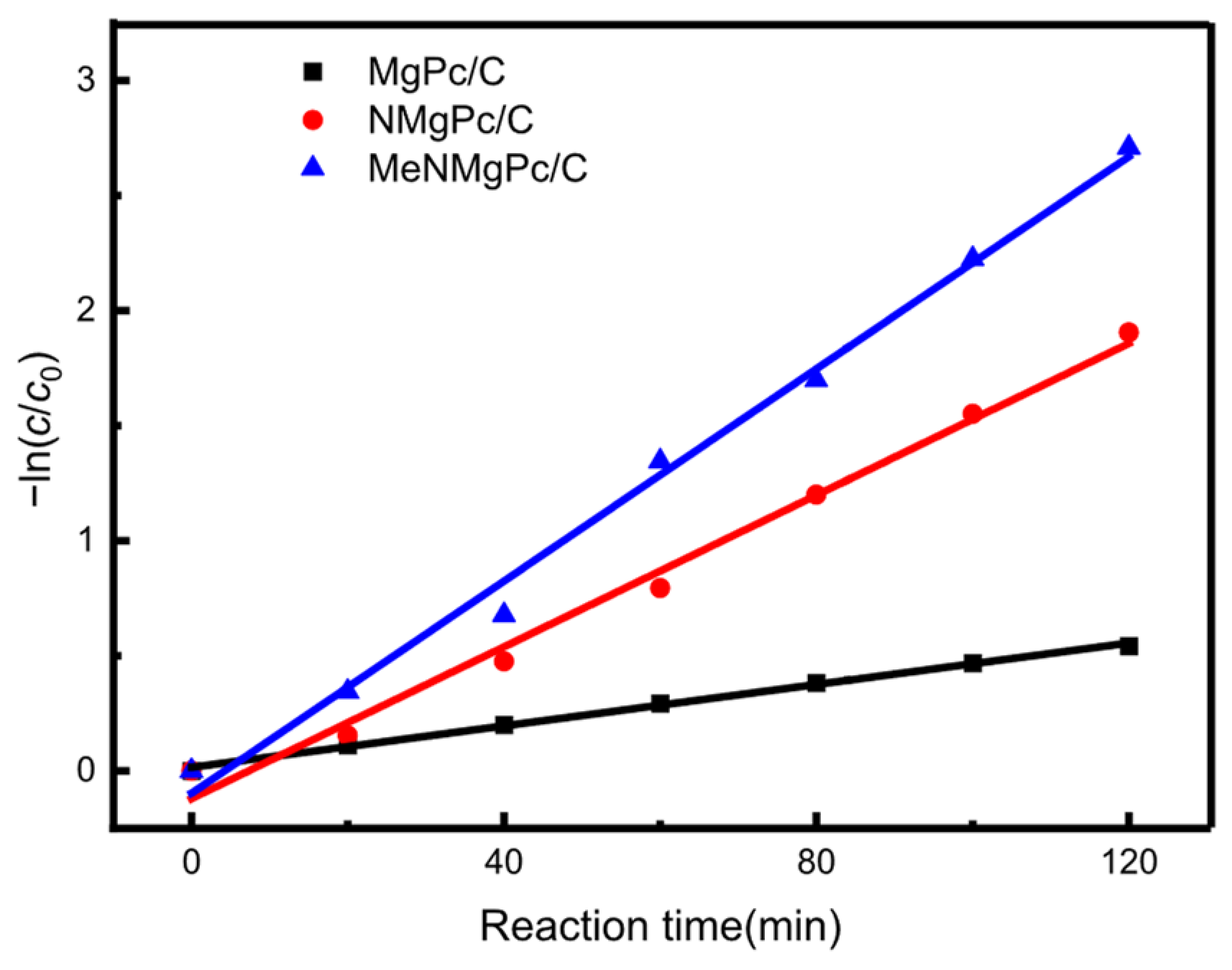
3.2. Photocatalytic Degradation Kinetics
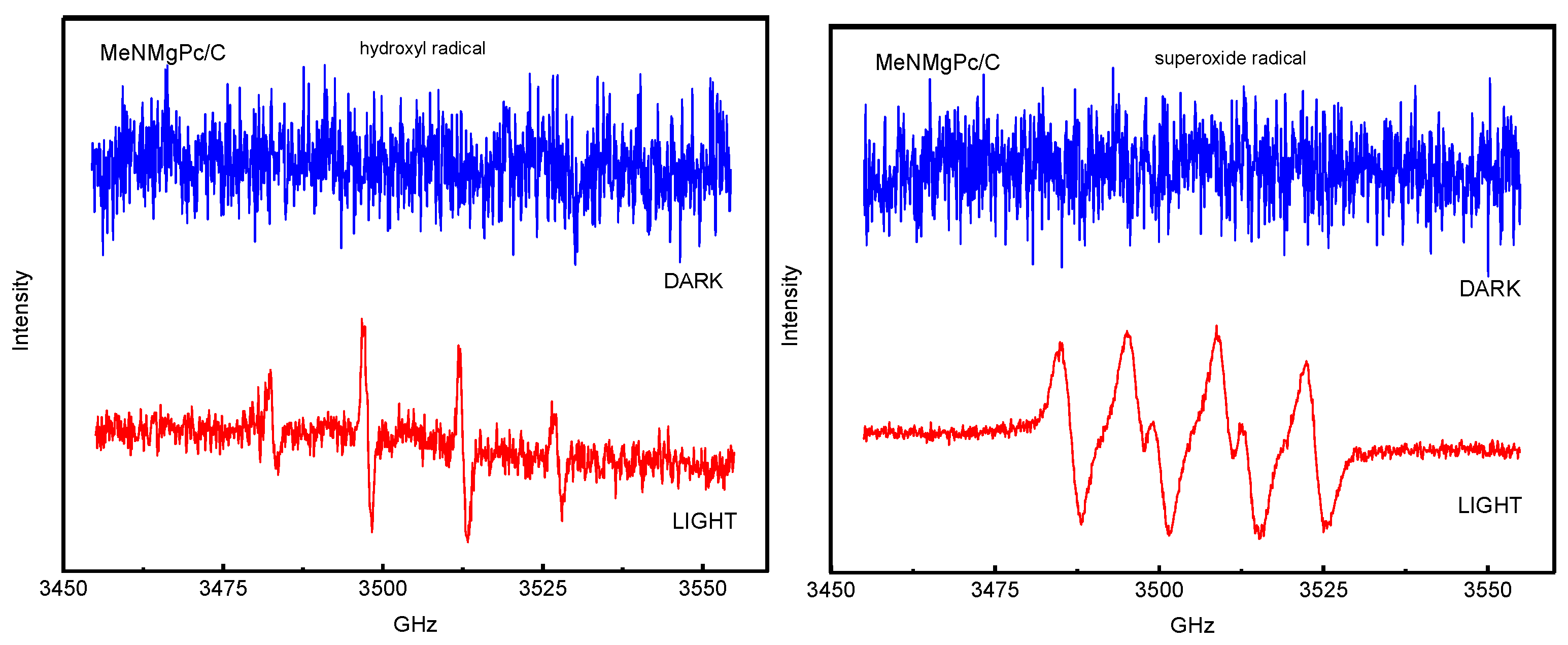
3.3. Identification of Reactive Oxygen Species and Photocatalytic Mechanism
3.4. Proposed Photodegradation Pathway and Comprehensive Mechanism
3.5. Practical Implications and Future Perspectives
4. Materials and Methods
4.1. Reagents and Materials
4.2. Synthesis of MgPc, NMgPc, and MeNMgPc
4.3. Preparation of Catalyst Composites
4.4. Characterization Methods
4.5. Photocatalytic Degradation Experiments
4.6. GC-MS Analysis of Degradation Intermediates
5. Conclusions
Author Contributions
Funding
Data Availability Statement
Conflicts of Interest
Abbreviations
| AC | activated carbon |
| AOPs | advanced oxidation processes |
| BET | Brunauer-Emmett-Teller |
| DMF | N,N-dimethylformamide |
| DMPO | 5,5-dimethyl-1-pyrroline-N-oxide |
| EDAX | energy-dispersive X-ray spectroscopy |
| ESR | electron spin resonance |
| GC-MS | gas chromatography-mass spectrometry |
| HOMO | highest occupied molecular orbital |
| LUMO | lowest unoccupied molecular orbital |
| MeNMgPc | methyl-substituted magnesium azaphthalocyanine |
| MgPc | magnesium phthalocyanine |
| NMgPc | magnesium azaphthalocyanine |
| PAHs | polycyclic aromatic hydrocarbons |
| Pc | phthalocyanine |
| ROS | reactive oxygen species |
| RSM | response surface methodology |
| SEM | scanning electron microscopy |
| USEPA | United States Environmental Protection Agency |
| UV-Vis | ultraviolet-visible |
| •OH | hydroxyl radical |
| O2•− | superoxide radical anion |
References
- Prahl, F.G.; Carpenter, R. Hydrocarbons in Washington coastal sediments. Estuar. Coast. Shelf Sci. 1984, 18, 703–720. [Google Scholar] [CrossRef]
- Rubio-Clemente, A.T.; Torres-Palma, R.A.; Peñuela, G.A. Removal of polycyclic aromatic hydrocarbons in aqueous environment by chemical treatments: A review. Sci. Total Environ. 2014, 478, 201–225. [Google Scholar] [CrossRef]
- Haritash, A.K.; Kaushik, C.P. Biodegradation aspects of polycyclic aromatic hydrocarbons (PAHs): A review. J. Hazard. Mater. 2009, 169, 1–15. [Google Scholar] [CrossRef] [PubMed]
- Fu, J.; Kyzas, G.Z.; Cai, Z.; Deliyanni, E.A.; Liu, W.; Zhao, D. Photocatalytic degradation of phenanthrene by graphite oxide-TiO2-Sr(OH)2/SrCO3 nanocomposite under solar irradiation: Effects of water quality parameters and predictive modeling. Chem. Eng. J. 2018, 335, 290–300. [Google Scholar] [CrossRef]
- Gogate, P.R.; Pandit, A.B. A review of imperative technologies for wastewater treatment I: Oxidation technologies at ambient conditions. Adv. Environ. Res. 2004, 8, 501–551. [Google Scholar] [CrossRef]
- Marin, M.L.; Santos-Juanes, L.; Arques, A.; Amat, A.M.; Miranda, M.A. Organic photocatalysts for the oxidation of pollutants and model compounds. Chem. Rev. 2012, 112, 1710–1750. [Google Scholar] [CrossRef]
- Torre, G.D.L.; Claessens, C.G.; Torres, T. Phthalocyanines: Old dyes, new materials. Putting color in nanotechnology. Chem. Commun. 2007, 38, 2000–2015. [Google Scholar] [CrossRef] [PubMed]
- Iliev, V.; Alexiev, V.; Bilyarska, L. Effect of metal phthalocyanine complex aggregation on the catalytic and photocatalytic oxidation of sulfur containing compounds. J. Mol. Catal. A Chem. 1999, 137, 15–22. [Google Scholar] [CrossRef]
- Kudrevich, S.V.; van Lier, J.E. Aza-analogs of phthalocyanine: Syntheses and properties. Coord. Chem. Rev. 1996, 156, 163–182. [Google Scholar] [CrossRef]
- Donzello, M.P.; Ercolani, C.; Novakova, V.; Zimcik, P. Tetrapyrazinoporphyrazines and their metal derivatives. Part I: Synthesis and basic structural information. Coord. Chem. Rev. 2016, 309, 107–179. [Google Scholar] [CrossRef]
- Zimcik, P. Azaphthalocyanines—From synthesis through photochemical and photophysical properties to emerging applications. Chem. Listy 2012, 106, 275–282. [Google Scholar]
- Wu, L.; Li, A.; Gao, G.; Fei, Z.; Xu, S.; Zhang, Q. Efficient photodegradation of 2,4-dichlorophenol in aqueous solution catalyzed by polydivinylbenzene-supported zinc phthalocyanine. J. Mol. Catal. A Chem. 2007, 269, 183–189. [Google Scholar] [CrossRef]
- Marsh, H.; Rodríguez-Reinoso, F. Activated Carbon; Elsevier: Amsterdam, The Netherlands, 2006. [Google Scholar] [CrossRef]
- Stillman, M.J.; Nyokong, T. Absorption and magnetic circular dichroism spectral properties of phthalocyanines. Phthalocyanines Prop. Appl. 1989, 1, 133–289. [Google Scholar]
- Bommer, J.C.; Spikes, J.D. Phthalocyanines: Properties and Applications. Photochem. Photobiol. 1991, 53, 419. [Google Scholar] [CrossRef]
- Snow, A.W. Phthalocyanine aggregation. In The Porphyrin Handbook; Karl, M.K., Kevin, M.S., Roger, G., Eds.; Elsevier: Amsterdam, The Netherlands, 2003; Volume 17, pp. 129–176. [Google Scholar] [CrossRef]
- Novakova, V.; Donzello, M.P.; Ercolani, C.; Zimcik, P.; Stuzhin, P.A. Tetrapyrazinoporphyrazines and their metal derivatives. Part II: Electronic structure, electrochemical, spectral, photophysical and other application related properties. Coord. Chem. Rev. 2018, 361, 1–73. [Google Scholar] [CrossRef]
- Al-sawah, M.; Nazeer, A.A.; Salah, L.; Durmuş, M.; Makhseed, S. Novel azaphthalocyanines with efficient anti-corrosion capability: Effect of halogens and heavy metals. J. Mol. Liq. 2019, 293, 111545. [Google Scholar] [CrossRef]
- Thommes, M.; Kaneko, K.; Neimark, A.V.; Olivier, J.P.; Rodriguez-Reinoso, F.; Rouquerol, J.; Sing, K.S. Physisorption of gases, with special reference to the evaluation of surface area and pore size distribution (IUPAC Technical Report). Pure Appl. Chem. 2015, 87, 1051–1069. [Google Scholar] [CrossRef]
- Kruk, M.; Jaroniec, M. Gas adsorption characterization of ordered organic−inorganic nanocomposite materials. Chem. Mater. 2001, 13, 3169–3183. [Google Scholar] [CrossRef]
- Davis, M.E. Ordered porous materials for emerging applications. Nature 2002, 417, 813–821. [Google Scholar] [CrossRef]
- Nyokong, T. Effects of substituents on the photochemical and photophysical properties of main group metal phthalocyanines. Coord. Chem. Rev. 2007, 251, 1707–1722. [Google Scholar] [CrossRef]
- Sorokin, A.B. Phthalocyanine metal complexes in catalysis. Chem. Rev. 2013, 113, 8152–8191. [Google Scholar] [CrossRef]
- Herrmann, J.M. Heterogeneous photocatalysis: Fundamentals and applications to the removal of various types of aqueous pollutants. Catal. Today 1999, 53, 115–129. [Google Scholar] [CrossRef]
- Malato, S.; Fernández-Ibáñez, P.; Maldonado, M.I.; Blanco, J.; Gernjak, W. Decontamination and disinfection of water by solar photocatalysis: Recent overview and trends. Catal. Today 2009, 147, 1–59. [Google Scholar] [CrossRef]
- Lazar, M.A.; Varghese, S.; Nair, A.S. Photocatalytic water treatment by titanium dioxide: Recent updates. Catalysts 2012, 2, 572–601. [Google Scholar] [CrossRef]
- Bezerra, M.A.; Santelli, R.E.; Oliveira, E.P.; Villar, L.S.; Escaleira, L.A. Response surface methodology (RSM) as a tool for optimization in analytical chemistry. Talanta 2008, 76, 965–977. [Google Scholar] [CrossRef]
- Myers, R.H.; Montgomery, D.C.; Anderson-Cook, C.M. Response Surface Methodology: Process and Product Optimization Using Designed Experiments; John Wiley & Sons: Hoboken, NJ, USA, 2016. [Google Scholar]
- Asghar, A.; Raman, A.A.A.; Daud, W.M.A.W. Advanced oxidation processes for in-situ production of hydrogen peroxide/hydroxyl radical for textile wastewater treatment: A review. J. Clean. Prod. 2015, 87, 826–838. [Google Scholar] [CrossRef]
- McQueen, A.D.; Ballentine, M.L.; May, L.R.; Laber, C.H.; Das, A.; Bortner, M.J.; Kennedy, A.J. Photocatalytic degradation of polycyclic aromatic hydrocarbons in water by 3D printed TiO2 composites. ACS EST. Water 2021, 2, 137–147. [Google Scholar] [CrossRef]
- Blessing, O.; Keating, P.; Ivaturi, A. Visible-Light-Active BiOI/TiO2 Heterojunction Photocatalysts for Remediation of Crude Oil-Contaminated Water. ACS Omega 2023, 8, 43556–43572. [Google Scholar] [CrossRef]
- Iliev, V.; Ileva, A.; Bilyarska, L. Oxidation and photooxidation of sulfur-containing compounds in the presence of immobilized phthalocyanine complexes. J. Mol. Catal. A Chem. 1997, 126, 99–108. [Google Scholar] [CrossRef]
- Kaya, E.N.; Durmuş, M.; Bulut, M. The effects of substituents’ positions and variety of axial groups on the photochemical properties of coumarin substituted indium(III) phthalocyanines. J. Organomet. Chem. 2014, 774, 94–100. [Google Scholar] [CrossRef]
- Zimcik, P.; Miletin, M.; Novakova, V.; Kopecky, K.; Dvorakova, Z. Tetrapyrazinoporphyrazines with different number of peripheral pyridyl rings: Synthesis, photophysical and photochemical properties. Dye. Pigment. 2009, 81, 35–39. [Google Scholar] [CrossRef]
- Claessens, C.G.; Hahn, U.; Torres, T. Phthalocyanines: From outstanding electronic properties to emerging applications. Chem. Rec. 2008, 8, 75–97. [Google Scholar] [CrossRef]
- Boyce, S.D.; Hoffman, M.R.; Hong, P.A.; Moberly, L.M. Catalysis of the autoxidation of aquated sulfur dioxide by homogeneous metal-phthalocyanine complexes. Environ. Sci. Technol. 1983, 17, 602–611. [Google Scholar] [CrossRef]
- Turchi, C.S.; Ollis, D.F. Photocatalytic degradation of organic water contaminants: Mechanisms involving hydroxyl radical attack. J. Catal. 1990, 122, 178–192. [Google Scholar] [CrossRef]
- Sirtori, C.; Altvater, P.K.; de Freitas, A.M.; Peralta-Zamora, P.G. Degradation of aqueous solutions of camphor by heterogeneous photocatalysis. J. Hazard. Mater. 2006, 129, 110–115. [Google Scholar] [CrossRef]
- Nosaka, Y.; Nosaka, A.Y. Generation and detection of reactive oxygen species in photocatalysis. Chem. Rev. 2017, 117, 11302–11336. [Google Scholar] [CrossRef]
- Dabestani, R.; Ivanov, I.N. A Compilation of Physical, Spectroscopic and Photophysical Properties of Polycyclic Aromatic Hydrocarbons. Photochem. Photobiol. 2010, 70, 10–34. [Google Scholar] [CrossRef]
- Rani, C.N.; Karthikeyan, S. Investigation of phenanthrene degradation in a slurry photocatalytic membrane reactor: Influence of operating variables and data validation. Desalin. Water Treat. 2019, 145, 11–25. [Google Scholar] [CrossRef]
- DeRosa, M.C.; Crutchley, R.J. Photosensitized singlet oxygen and its applications. Coord. Chem. Rev. 2002, 233, 351–371. [Google Scholar] [CrossRef]
- Chong, M.N.; Jin, B.; Chow, C.W.; Saint, C. Recent developments in photocatalytic water treatment technology: A review. Water Res. 2010, 44, 2997–3027. [Google Scholar] [CrossRef] [PubMed]
- Wang, H.; Wang, H.; Wang, Z.; Tang, L.; Zeng, G.; Xu, P.; Chen, M.; Xiong, T.; Zhou, C.; Li, X.; et al. Covalent organic framework photocatalysts: Structures and applications. Chem. Soc. Rev. 2020, 49, 4135–4165. [Google Scholar] [CrossRef] [PubMed]
- Loeb, S.K.; Alvarez, P.J.J.; Brame, J.A.; Cates, E.L.; Choi, W.; Crittenden, J.; Dionysiou, D.D.; Li, Q.; Li-Puma, G.; Quan, X.; et al. The technology horizon for photocatalytic water treatment: Sunrise or sunset? Environ. Sci. Technol. 2019, 53, 2937–2947. [Google Scholar] [CrossRef] [PubMed]





| Material | SBET (m2/g) | Vp (cm3/g) | Dp (nm) |
|---|---|---|---|
| Unloaded AC | 377.66 | 0.15 | 1.92 |
| MgPc/C | 184.40 | 0.07 | 2.27 |
| NMgPc/C | 130.93 | 0.05 | 2.31 |
| MeNMgPc/C | 88.09 | 0.03 | 2.29 |
| Run | X1 (g/L) | X2 (A) | X3 (h) | Actual (%) | Predicted (%) |
|---|---|---|---|---|---|
| 1 | 5 | 10 | 2.0 | 71.00 | 70.81 |
| 2 | 15 | 10 | 2.0 | 88.70 | 86.08 |
| 3 | 5 | 20 | 2.0 | 78.67 | 81.29 |
| 4 | 15 | 20 | 2.0 | 95.10 | 95.29 |
| 5 | 5 | 15 | 1.5 | 75.33 | 74.42 |
| 6 | 15 | 15 | 1.5 | 87.44 | 88.96 |
| 7 | 5 | 15 | 2.5 | 79.50 | 77.98 |
| 8 | 15 | 15 | 2.5 | 91.80 | 92.71 |
| 9 | 10 | 10 | 1.5 | 79.30 | 80.40 |
| 10 | 10 | 20 | 1.5 | 92.25 | 90.54 |
| 11 | 10 | 10 | 2.5 | 82.63 | 84.34 |
| 12 | 10 | 20 | 2.5 | 95.01 | 93.91 |
| 13 | 10 | 15 | 2.0 | 90.55 | 90.55 |
| 14 | 10 | 15 | 2.0 | 90.55 | 90.55 |
| 15 | 10 | 15 | 2.0 | 90.55 | 90.55 |
| No. | Intermediate Product | Retention Time (min) | Irradiation (15 min) | Irradiation (45 min) | Irradiation (90 min) |
|---|---|---|---|---|---|
| 1 | Octanoic acid | 3.883–3.890 | Detected | Detected | Detected |
| 2 | 3-Allyl-2-methoxyphenol | 6.893–6.900 | Detected | N.D. | N.D. |
| 3 | 2,6-Diisobutyl-4-methylphenol | 9.993–10.000 | Detected | Detected | N.D. |
| 4 | Bis(2-methylpropyl) phthalate (DIBP) | 17.303–17.310 | Detected | Detected | N.D. |
| 5 | 1-Heptadecanol | 17.573–17.580 | Detected | Detected | Detected |
| 6 | Butyl isobutyl phthalate | 19.110–19.117 | Detected | N.D. | N.D. |
| 7 | 1-Octadecanol | 21.390–21.397 | Detected | Detected | Detected |
| 8 | Bis(2-ethylhexyl) phthalate (DEHP) | 28.660–28.667 | Detected | Detected | N.D. |
| 9 | Ethyl 4-(2-hydroxyethyl)benzoate | 38.540–38.547 | N.D. | Detected | N.D. |
| 10 | 9,10-Anthraquinone | 64.850–64.857 | Detected | Detected | N.D. |
| 11 | Nonahydro-9H-xanthen-9-one | 65.910–65.917 | Detected | Detected | N.D. |
| Catalyst | k (×10−3 min−1) | R2 |
|---|---|---|
| MgPc/C | 4.5 | 0.9969 |
| NMgPc/C | 16.5 | 0.9884 |
| MeNMgPc/C | 23.1 | 0.9921 |
Disclaimer/Publisher’s Note: The statements, opinions and data contained in all publications are solely those of the individual author(s) and contributor(s) and not of MDPI and/or the editor(s). MDPI and/or the editor(s) disclaim responsibility for any injury to people or property resulting from any ideas, methods, instructions or products referred to in the content. |
© 2026 by the authors. Licensee MDPI, Basel, Switzerland. This article is an open access article distributed under the terms and conditions of the Creative Commons Attribution (CC BY) license.
Share and Cite
Wang, D.; Li, H.; Liang, L.; Su, J.; Wei, J.; Wang, D.; Zuo, C.; Liu, Q. Photocatalytic Degradation of Polycyclic Aromatic Hydrocarbons in Simulated Offshore Oil Spill Wastewater by Magnesium Phthalocyanine Derivatives Supported on Coconut Shell Activated Carbon. Catalysts 2026, 16, 470. https://doi.org/10.3390/catal16050470
Wang D, Li H, Liang L, Su J, Wei J, Wang D, Zuo C, Liu Q. Photocatalytic Degradation of Polycyclic Aromatic Hydrocarbons in Simulated Offshore Oil Spill Wastewater by Magnesium Phthalocyanine Derivatives Supported on Coconut Shell Activated Carbon. Catalysts. 2026; 16(5):470. https://doi.org/10.3390/catal16050470
Chicago/Turabian StyleWang, Dejun, Hui Li, Lihua Liang, Juan Su, Jifang Wei, Dong Wang, Changjiang Zuo, and Qiyou Liu. 2026. "Photocatalytic Degradation of Polycyclic Aromatic Hydrocarbons in Simulated Offshore Oil Spill Wastewater by Magnesium Phthalocyanine Derivatives Supported on Coconut Shell Activated Carbon" Catalysts 16, no. 5: 470. https://doi.org/10.3390/catal16050470
APA StyleWang, D., Li, H., Liang, L., Su, J., Wei, J., Wang, D., Zuo, C., & Liu, Q. (2026). Photocatalytic Degradation of Polycyclic Aromatic Hydrocarbons in Simulated Offshore Oil Spill Wastewater by Magnesium Phthalocyanine Derivatives Supported on Coconut Shell Activated Carbon. Catalysts, 16(5), 470. https://doi.org/10.3390/catal16050470