
Article

Boosting Toluene Oxidation Performance of CoAl2O4 Catalysts by Incorporating the Synergistic Co3+-Ov Sites


1
College of Forestry, Henan Agricultural University, Zhengzhou 450046, China
2
Flavors and Fragrance Engineering and Technology Research Center of Henan Province, College of Tobacco Science, Henan Agricultural University, Zhengzhou 450046, China
3
Key Laboratory of Yunnan Province for Synthesizing Sulfur-Containing Fine Chemicals, Kunming University of Science and Technology, Kunming 650500, China
4
School of Energy and Environmental Engineering, University of Science and Technology Beijing, Beijing 100083, China
5
State Key Laboratory for Structural Chemistry of Unstable and Stable Species, Beijing National Laboratory for Molecular Sciences (BNLMS), CAS Research/Education Center for Excellence in Molecular Sciences, Institute of Chemistry, Chinese Academy of Sciences, Beijing 100190, China
*
Authors to whom correspondence should be addressed.
Catalysts 2026, 16(5), 466; https://doi.org/10.3390/catal16050466
Submission received: 9 April 2026 / Revised: 7 May 2026 / Accepted: 11 May 2026 / Published: 16 May 2026
(This article belongs to the Special Issue Catalytic Removal of Volatile Organic Compounds (VOCs))

Abstract

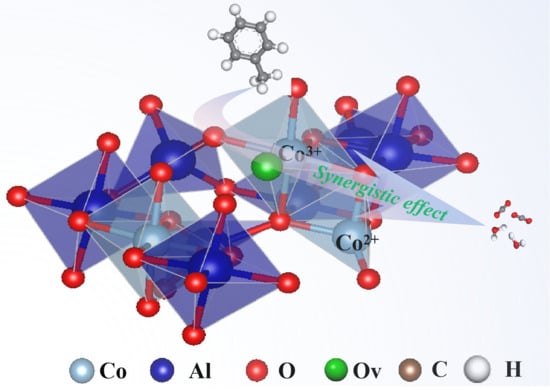
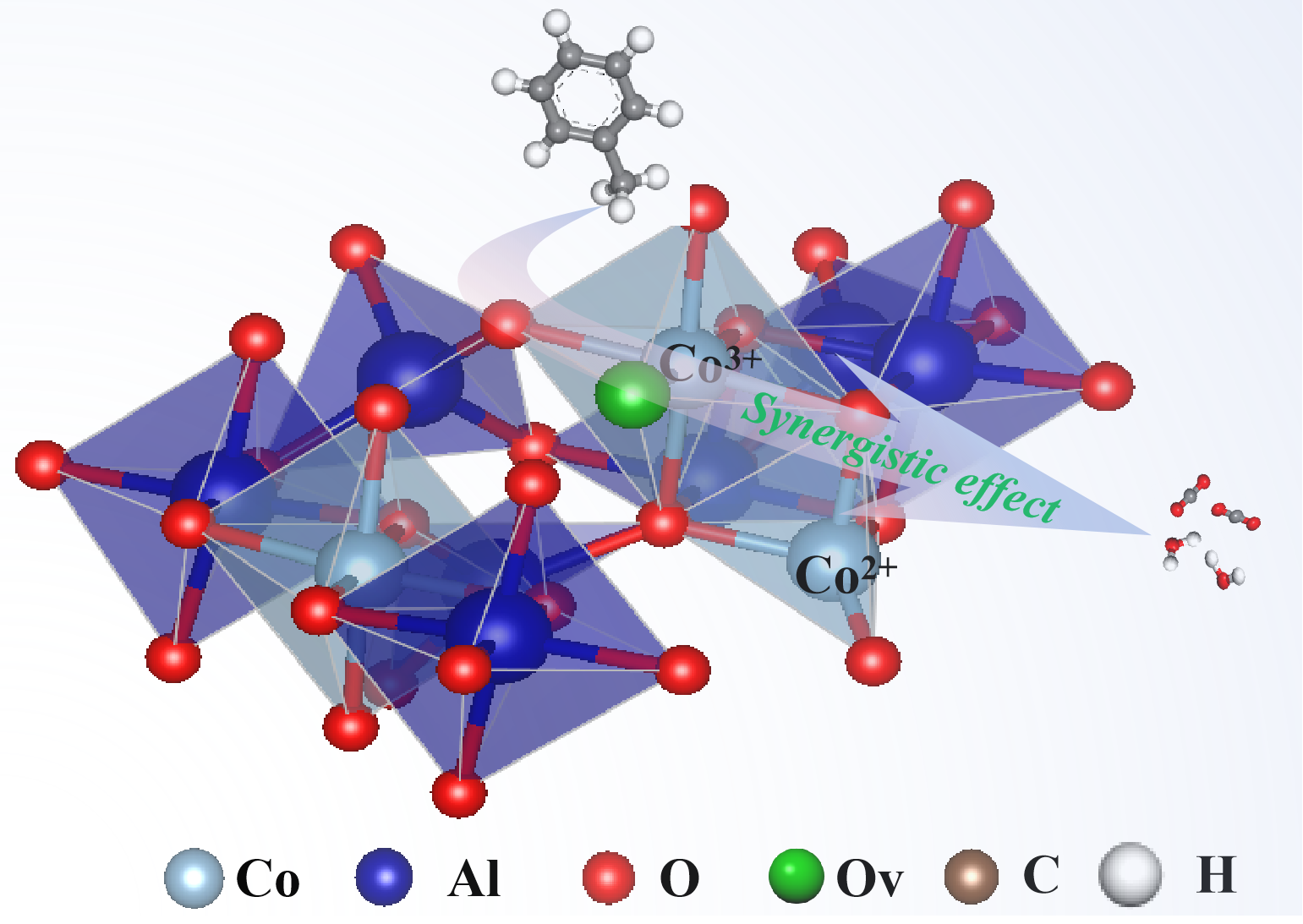
Volatile organic compounds can aggravate the atmospheric pollution and health risks due to their high toxicity and photochemical reactivity. Herein, a series of cobalt aluminate spinel catalysts with high efficiency was fabricated via a cost-efficient solvothermal method. Plentiful oxygen vacancies with negative charge were introduced adjacent to the octahedrally coordinated Co3+ species in CoAl2O4 catalysts, thereby generating the synergetic Co3+-oxygen vacancy (Ov) sites, which facilitated the rapid activation and migration of oxygen species. Accordingly, the superior catalytic activity was observed for 1Al-1Co even with lower cobalt due to the presence of abundant Co3+-Ov sites, revealing the predominant roles of synergetic sites in the toluene oxidation. Moreover, the 1Al-1Co catalyst exhibited the optimal intrinsic catalytic performance with the lowest activation energy of 161.2 kJ·mol−1 and the highest specific toluene reaction rate of 3.18 × 10⁻⁵ mmol·h−1·m−2. In situ DRIFTS results further verified that oxygen vacancies and active Co3+ species could synergistically boost highly reactive oxygen species, which rapidly oxidize benzoate into maleic anhydride, achieving the efficient complete oxidation of toluene.

Graphical Abstract

1. Introduction

Volatile organic compounds (VOCs) refer to organic chemical compounds with low boiling points and high vapor pressure at room temperature, which are prevalently derived from industrial processes, solvent use, vehicle exhausts, and daily lives [1]. However, most VOCs such as benzene, formaldehyde, and toluene are not only highly toxic and carcinogenic, but also can participate in the generation of tropospheric ozone and secondary organic aerosol by photochemical reactions, leading to atmospheric pollution, which poses a serious threat to human health and the ecological environment [2,3]. Therefore, various destruction technologies including photocatalytic decomposition, catalytic oxidation, plasma catalysis, and biological degradation, have been investigated to eliminate VOCs, among which the catalytic oxidation is regarded as the potential technology due to the high efficiency, low consumption, and environmental friendliness [4,5].
Spinel oxides with a general formula of AB2O4 present a stable cubic structure consisting of A-O tetrahedra and B-O octahedra, which have been emerging as a hot research material in catalytic reactions on account of their diverse composition and electronic configuration [6,7,8]. However, traditional spinel materials suffer from inferior catalytic performance because of the low-density active sites and poor electron transfer [9,10]. Indeed, the electronic structure and coordination environment could be effectively modified by introducing heteroatoms to substitute the cations at the A/B sites in the spinel structure, thereby boosting the catalytic reaction activity [11,12]. Furthermore, the surface of spinel oxides was also refabricated by the tetrahedral-octahedral phase interface construction, leading to the lattice mismatch or defects, thus contributing to lowering the oxygen vacancy formation energy [13,14]. As an important lattice defect, oxygen vacancies can regulate the local electron structure and geometric configuration of the catalyst, which greatly improves the electron mobility and reduces the reaction free energy [15,16]. Meanwhile, the unsaturated coordination structure formed by the oxygen vacancy and surrounding metal cations (Mn+-Ov) in the material can regulate the metal-oxygen bond and create new reaction sites, facilitating the catalytic performance [17,18]. Therefore, constructing the synergistic effect between active metal sites and oxygen vacancies in spinel catalysts is an effective method to regulate the catalytic efficiency of VOCs degradation.
In general, cobalt-based catalysts exhibit high activity and have become a potential alternative to noble metals in various catalytic reactions due to the abundant resource, low cost, and the reversible redox of Co2+/Co3+ species [19,20]. It has been found that surface Co sites of cobalt-based catalysts might undergo self-reconstruction to generate active octahedral Co3+ species, achieving a superior catalytic activity [21]. Thus, we selected the inert aluminum as the matching element and prepared a series of AlCo2O4 catalysts with abundant Co3+-Ov sites using a cost-efficient solvothermal method. It was found that abundant oxygen vacancies were generated in the vicinity of high-valence Co3+ species in cobalt aluminate spinel, thus generating the synergistic Co3+-Ov sites. Accordingly, the low-temperature reducibility and oxygen activation ability were promoted by the synergistic effect of oxygen vacancy and active Co3+ species, thus greatly enhancing the catalytic efficiency. The catalyst mechanism of toluene degradation was also elucidated by in situ DRIFTS spectra.

2. Results and Discussion

2.1. Structure and Surface State Characterization

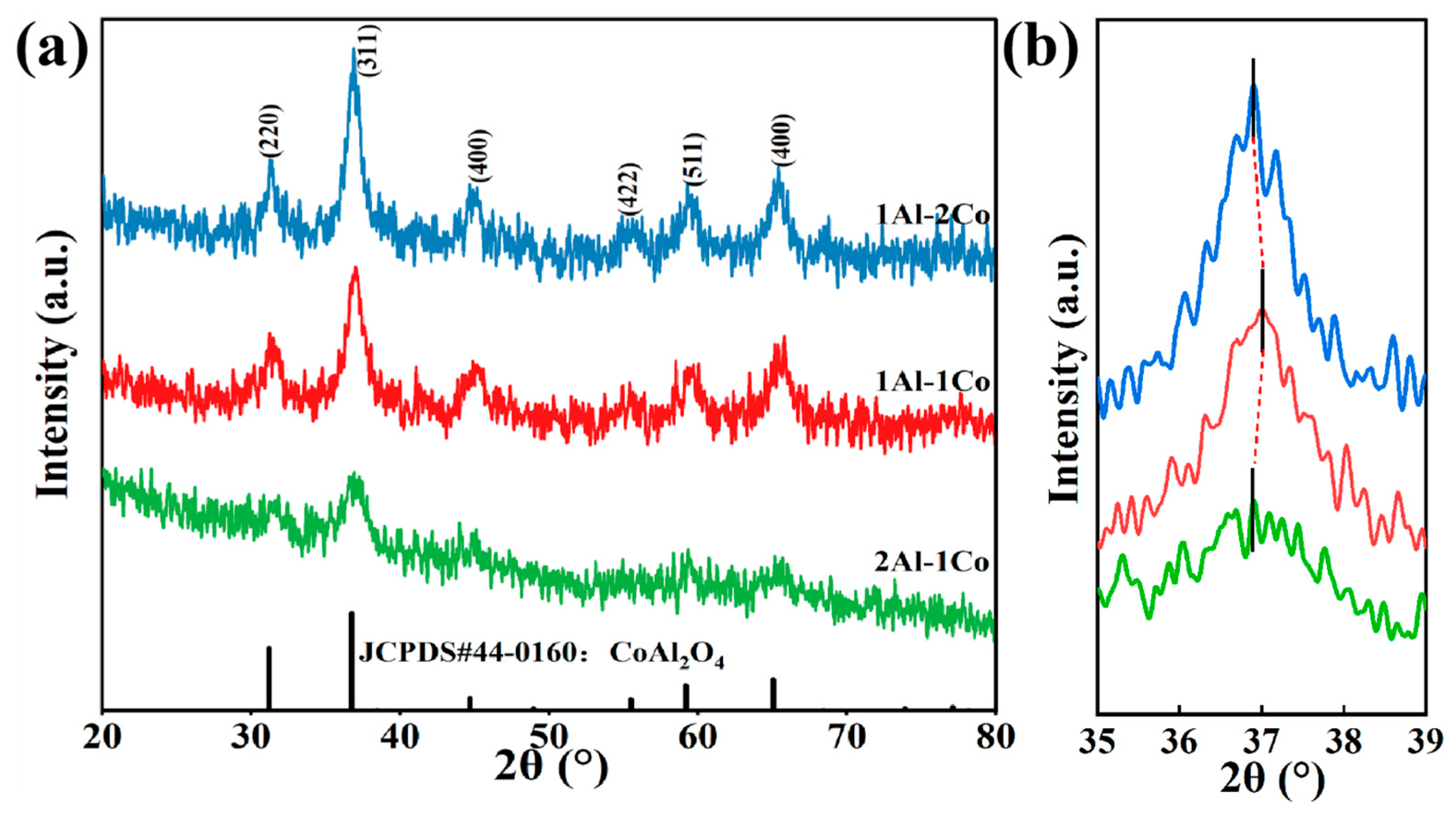
According to the XRD pattern (Figure 1a), the 1Al-2Co, 1Al-1Co and 2Al-1Co catalysts showed obvious characteristic diffraction peaks at 2θ = 18.95°, 31.19°, 36.75°, 44.69°, 55.51°, 59.20°, 65.05°, corresponding to the crystal planes of (111), (220), (311), (400), (422), (511) and (440) of CoAl2O4 (JCPDS#44-0160) with the cubic crystal system [22]. It was proven that the spinel structure was successfully constructed via a mild solvothermal method. The crystallite sizes of CoAl2O4 samples were estimated from the Debye–Scherrer formula on the basis of the diffraction peaks ascribed to the (311) crystal plane. As shown in Table 1, the crystal sizes of the 1Al-2Co, 1Al-1Co, and 2Al-1Co samples are 8.1, 7.3, and 8.5 nm, respectively. The lower crystallite size indicates more grain boundaries or defects, demonstrating the high concentrations of defects in the 1Al-1Co sample [23,24]. Partially enlarged XRD patterns of 1Al-2Co, 1Al-1Co, and 2Al-1Co are displayed in Figure 1b. Obviously, the (311) plane peaks were shifted to a higher diffraction angle in the order of 2Al-1Co, Al-2Co, and 1Al-1Co, which demonstrated that there was compressive strain or lattice contraction in the CoAl2O4 crystal structure, probably due to the vacancy generation [25,26]. Therefore, it can be inferred that the vacancy defects increased in the order of 2Al-1Co, Al-2Co, and 1Al-1Co.
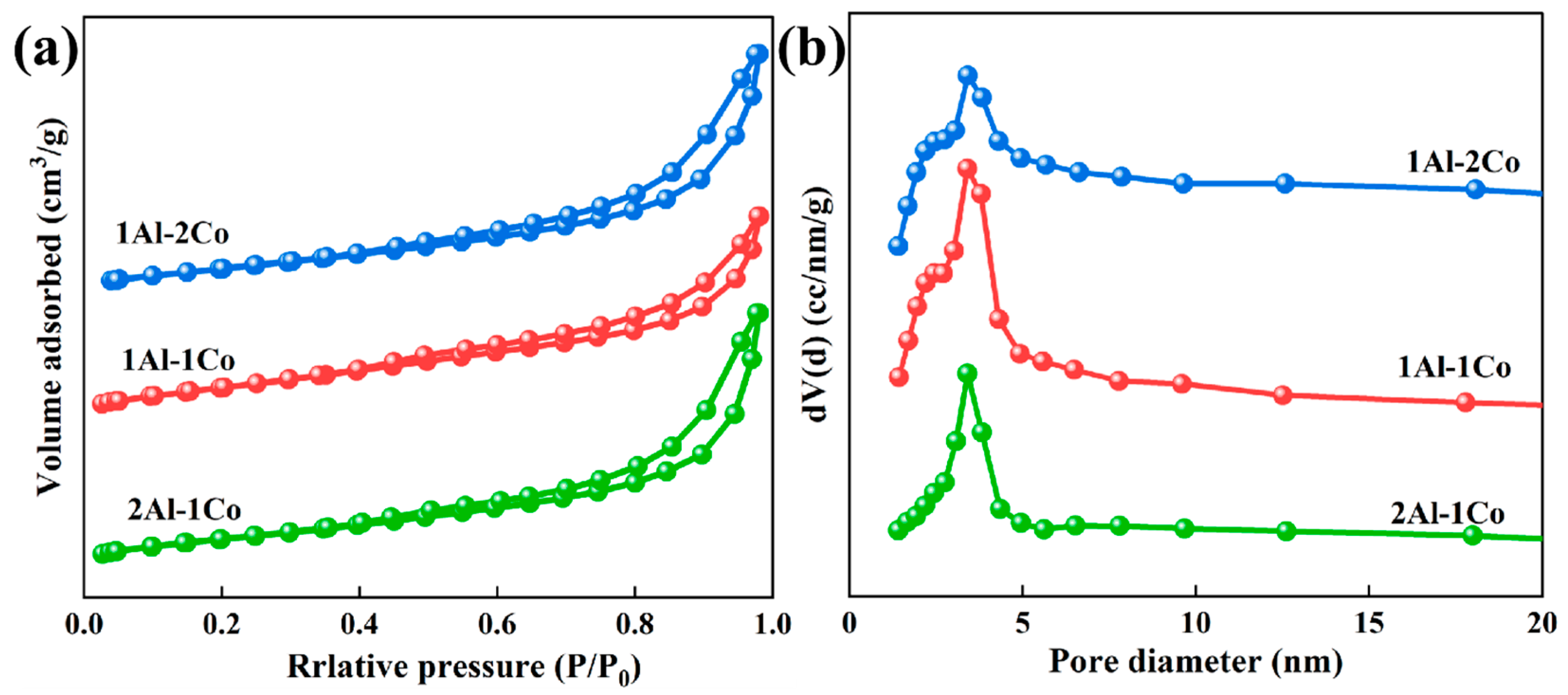
The nitrogen adsorption–desorption isotherms were measured to obtain the specific surface area and pore size distribution of the sample and are displayed in Figure 2. According to the IUPAC recommendations, the 1Al-2Co, 1Al-1Co, and 2Al-1Co samples exhibited type IV isotherms with H4-type hysteresis loops in the entire measured relative pressure (P/P0) range [27]. As shown in Table 1, the specific surface areas of 1Al-2Co, 1Al-1Co, and 2Al-1Co samples were 96.0, 113.5, and 114.8 m2·g−1, while the total pore volumes corresponded to 0.37, 0.32, and 0.40 cm3·g−1, respectively. As shown in Figure 2b, there were small pores around 2.4 nm besides 3.4 nm for 1Al-2Co and 1Al-1Co, but the pore diameter of 2Al-1Co was 3.4 nm.
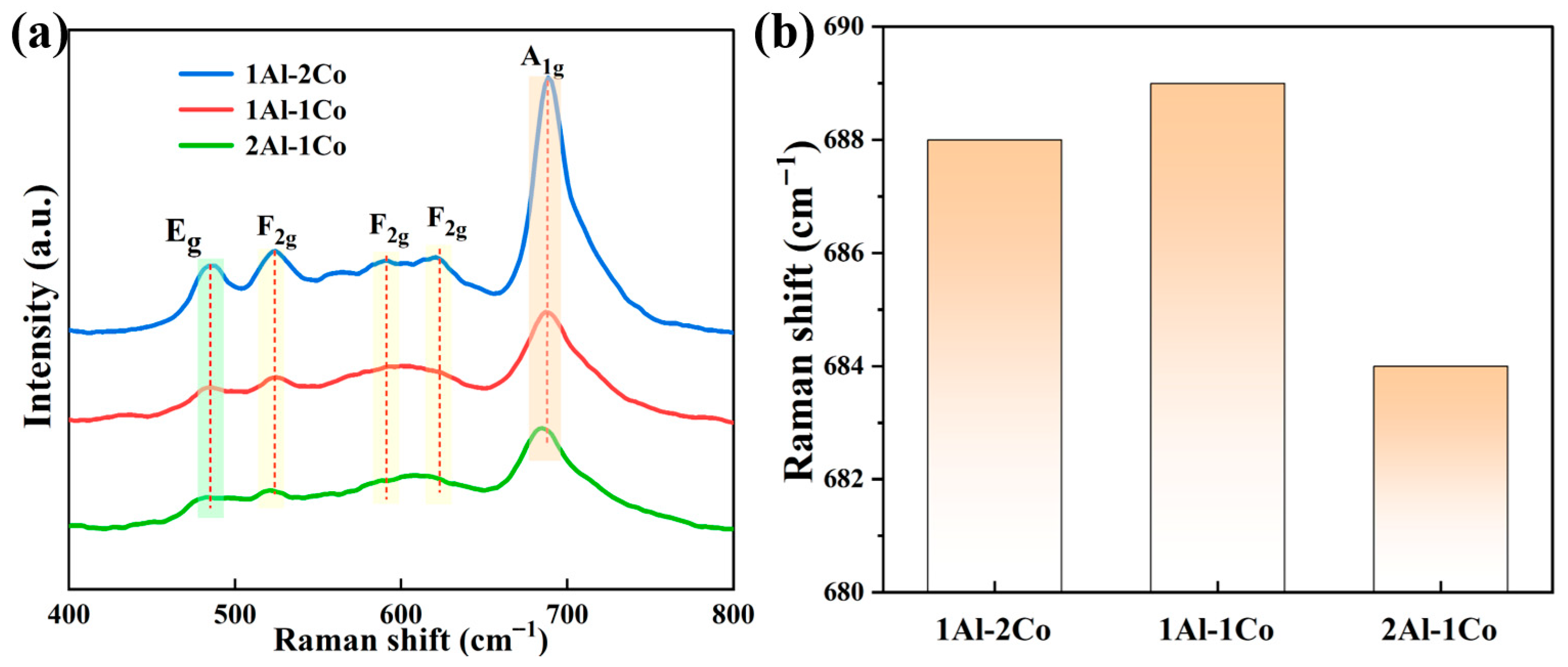
Raman spectroscopy was employed to further analyze the structural defects, such as lattice disorder or oxygen vacancy, in spinel catalysts. Raman spectra in Figure 3a showed that there were five distinct Raman vibrational bands for the 1Al-2Co catalyst. The peak located at 485 cm−1 was attributed to the Eg vibrational mode corresponding to the symmetric bending motion of oxygen atoms in the tetrahedral sites [28]. Three F2g vibrational modes at 523, 591, and 622 cm−1 were assigned to the stretching vibration of Co/Al-O in the tetrahedral sites, while the A1g symmetric mode at 688 cm−1 was related to the vibration mode of Co3+-O2− in the octahedral sites (CoO6), which is a characteristic peak of the spinel structure [29]. It can be clearly seen from Figure 3 that 1Al-1Co and 2Al-1Co samples exhibited similar Raman spectra, but the A1g Raman peaks shifted to a higher frequency in the sequence of 2Al-1Co, Al-2Co, and 1Al-1Co (Figure 3b), further verifying the plentiful defects in 1Al-1Co catalyst [30].
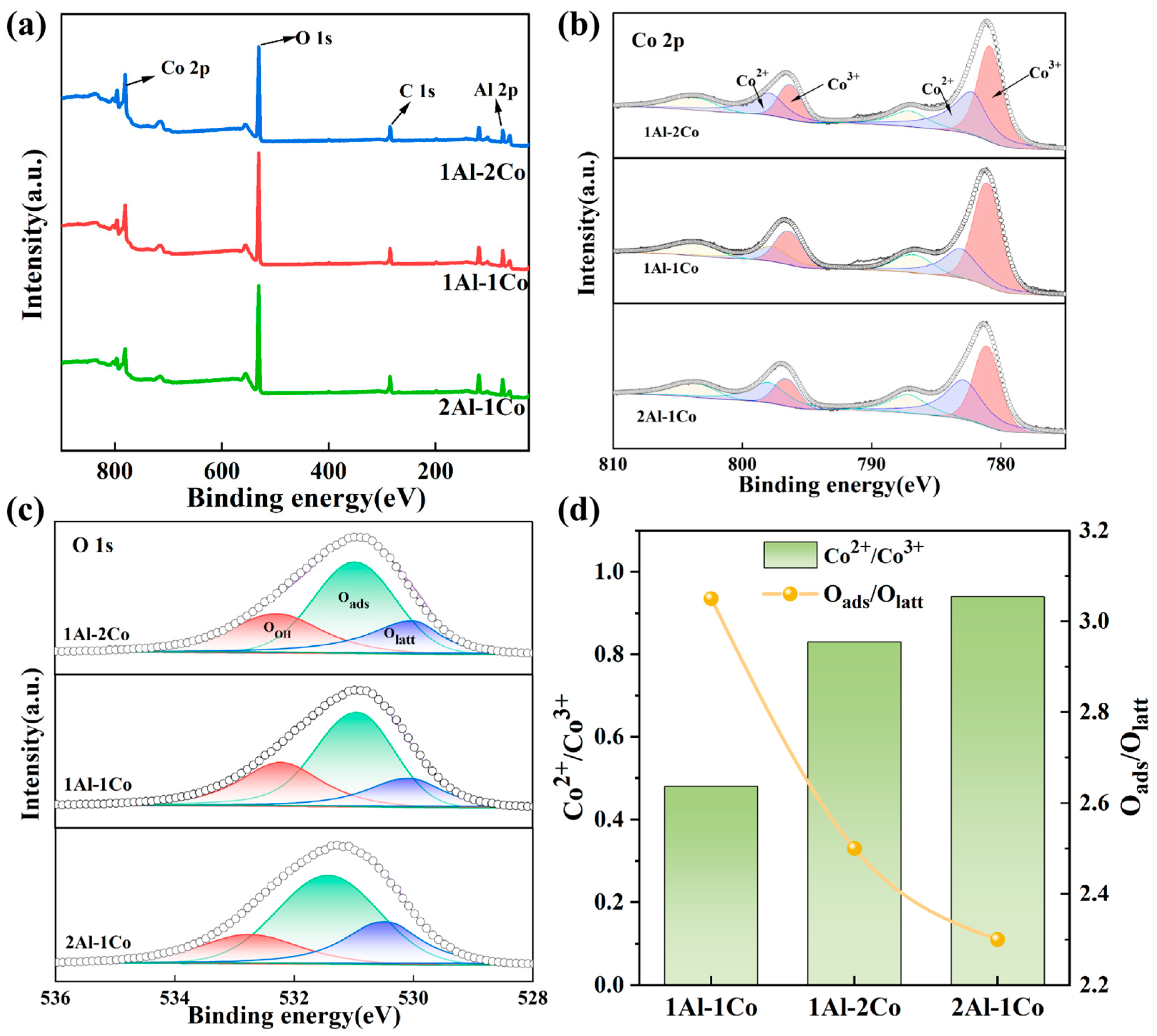
To further elucidate the surface elemental and chemical states of the spinel catalysts, X-ray photoelectron spectroscopy (XPS) was conducted. As displayed in Figure 4a, the peaks with binding energies at approximately 779.6, 530.9, 284.8, and 73.8 eV corresponded to Co 2p, O 1s, C 1s, and Al 2p, respectively. The detailed valence states of spinel catalysts were demonstrated in high-resolution XPS spectra. In Figure 4b, two obvious peaks of Co 2p1/2 and Co 2p3/2 were observed for the Co 2p XPS spectra of the three samples, which are caused by the spin–orbit re-splitting of Co 2p [31,32]. The fitted peaks at 797.9 and 783.2 eV were attributed to the tetrahedral Co2+ species, while those at 796.5 and 781.2 eV corresponded to the characteristic peaks of octahedral Co3+ species [33,34]. It has been demonstrated that the octahedral Co3+ sites could provide a more favorable local electronic structure for the catalytic reaction in comparison with the tetrahedral Co2+ sites, thus serving as the main catalytic active sites [31,35]. The relative content of Co3+ species was estimated from the area proportion of deconvoluted Co 2p XPS peaks and summarized in Table 1. Specifically, the order of the Co2+/Co3+ ratio was as follows: 1Al-1Co (0.48) < 1Al-2Co (0.83) < 2Al-1Co (0.94), and the 1Al-1Co sample possessed the highest content of octahedrally coordinated Co3+ species, thus improving the catalytic performance. It can be seen from the O 1s XPS spectra in Figure 4c that there were three obvious peaks at 529.9, 531.9, and 532.2 eV corresponding to lattice oxygen (Olatt), surface adsorbed oxygen (Oads), and surface OH groups (OOH), respectively [36]. It is reported that surface adsorbed oxygen is closely associated with the presence of oxygen vacancies [37,38]. Table 1 demonstrates that the Oads/Olatt ratios of 1Al-2Co, 1Al-1Co, and 2Al-1Co were 2.50, 3.05, and 2.30, respectively, revealing the higher vacancy defects in the 1Al-1Co sample. Indeed, oxygen vacancies could be induced by a high-valence cobalt over CoAl2O4 spinel according to the Kroger–Vink notation as follows [39,40].
2 C o C o × + O O × 2 C o C o + V O + 1 2 O 2
where the subscript and superscript correspond to the occupied lattice sites and the electric charge variation relative to that in a stoichiometric crystal, respectively. A positive or negative charge was indicated by a bullet (•) or prime (′), while there was no change in the charge, which was represented by the cross (×). Thus, the presence of cobalt with a higher oxidation state would yield a higher concentration of oxygen vacancies (VO″). As a consequence, these provide strong evidence that the plentiful oxygen vacancies were generated in the vicinity of Co3+ sites in CoAl2O4 spinel, while the relative concentration exhibited an obvious increased tendency for 2Al-1Co, 1Al-2Co, and 1Al-1Co, among which there was the highest amount of synergistic Co3+-Ov sites in 1Al-1Co sample.
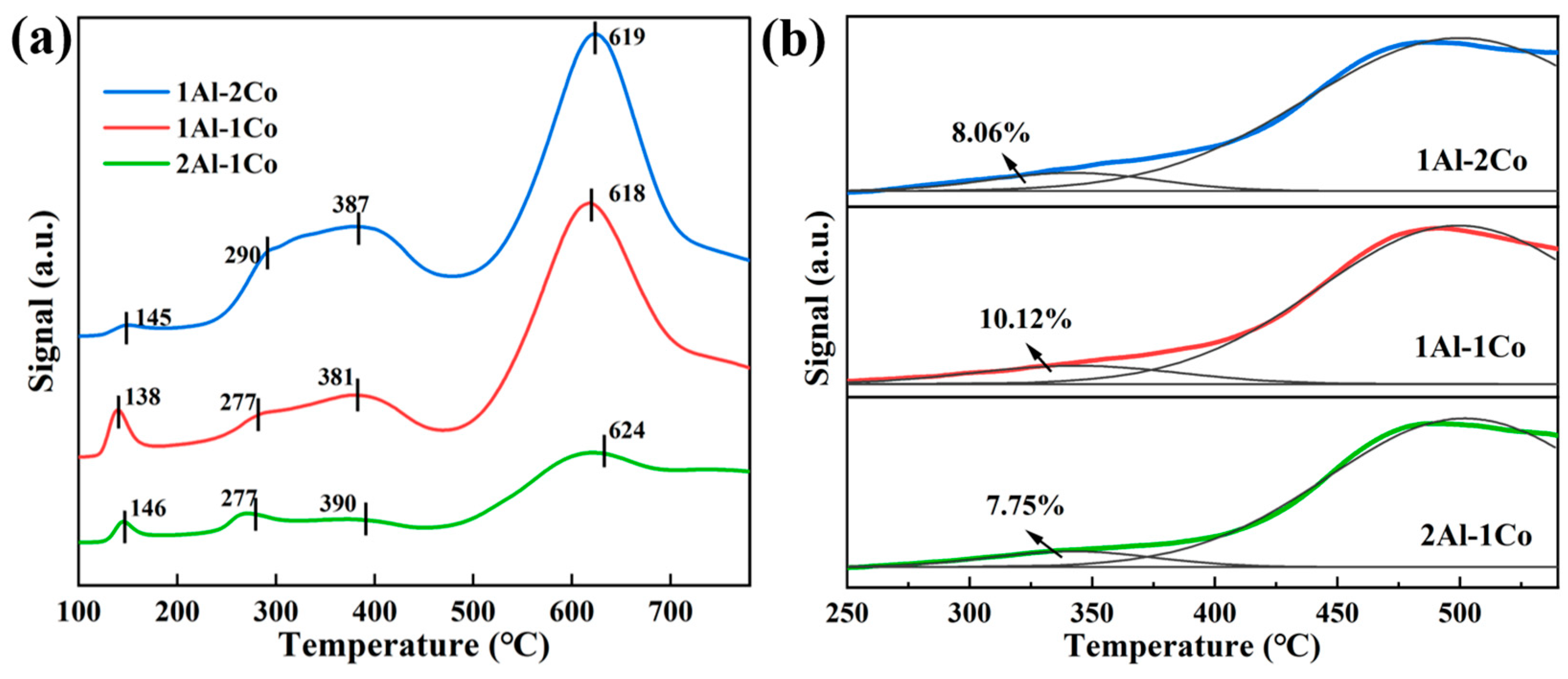
H2-TPR profiles were employed to evaluate the redox properties of spinel catalysts. As displayed in Figure 5a, all cobalt aluminate spinel catalysts exhibited four kinds of hydrogen reduction peaks. Two reduction peaks centered at 277–290 and 381–390 °C could be ascribed to the reduction of Co3+ to Co2+. The former was associated with surface cobalt ions not interacting with the cobalt aluminate phase, while the latter was attributed to the reduction of Co3+ species in CoAl2O4. High-temperature peaks at 618–624 °C were identified as the reduction of Co2+ to metallic Co0 [11,41]. Low-temperature peaks at 138–146 °C were attributed to the reduction of the labile Co species near oxygen vacancies, where the Co-O bond strength is weaker [42,43]. It can be clearly seen that the 1Al-1Co sample exhibited a lower reduction temperature and higher hydrogen consumption in comparison with 1Al-2Co and 2Al-1Co, meaning a distinct improvement in low-temperature reducibility, probably due to the synergistic effect of the octahedral Co3+ species and oxygen vacancies.
O2-TPD profiles of three spinel catalysts were also conducted and displayed in Figure 5b. It can be clearly seen that O2-TPD profiles of all CoAl2O4 samples could be fitted into two desorption temperature regions around 340 and 500 °C, which were labeled as α-O and β-O. The α-O represented the surface lattice oxygen species, while the β-O species were correlated to the liberation mostly from the bulk spinel structure [44]. Peak area fitting analysis revealed that the relative content of lattice oxygen species in the 1Al-1Co sample (10.12%) was higher than that in 1Al-2Co (8.06%) and 2Al-1Co (7.75%), indicating easier activation and release of lattice oxygen species [45,46]. Accordingly, the synergistic Co3+-Ov sites could promote low-temperature reducibility and oxygen activation ability, which is of crucial importance in catalytic oxidation.

2.2. Catalyst Activity

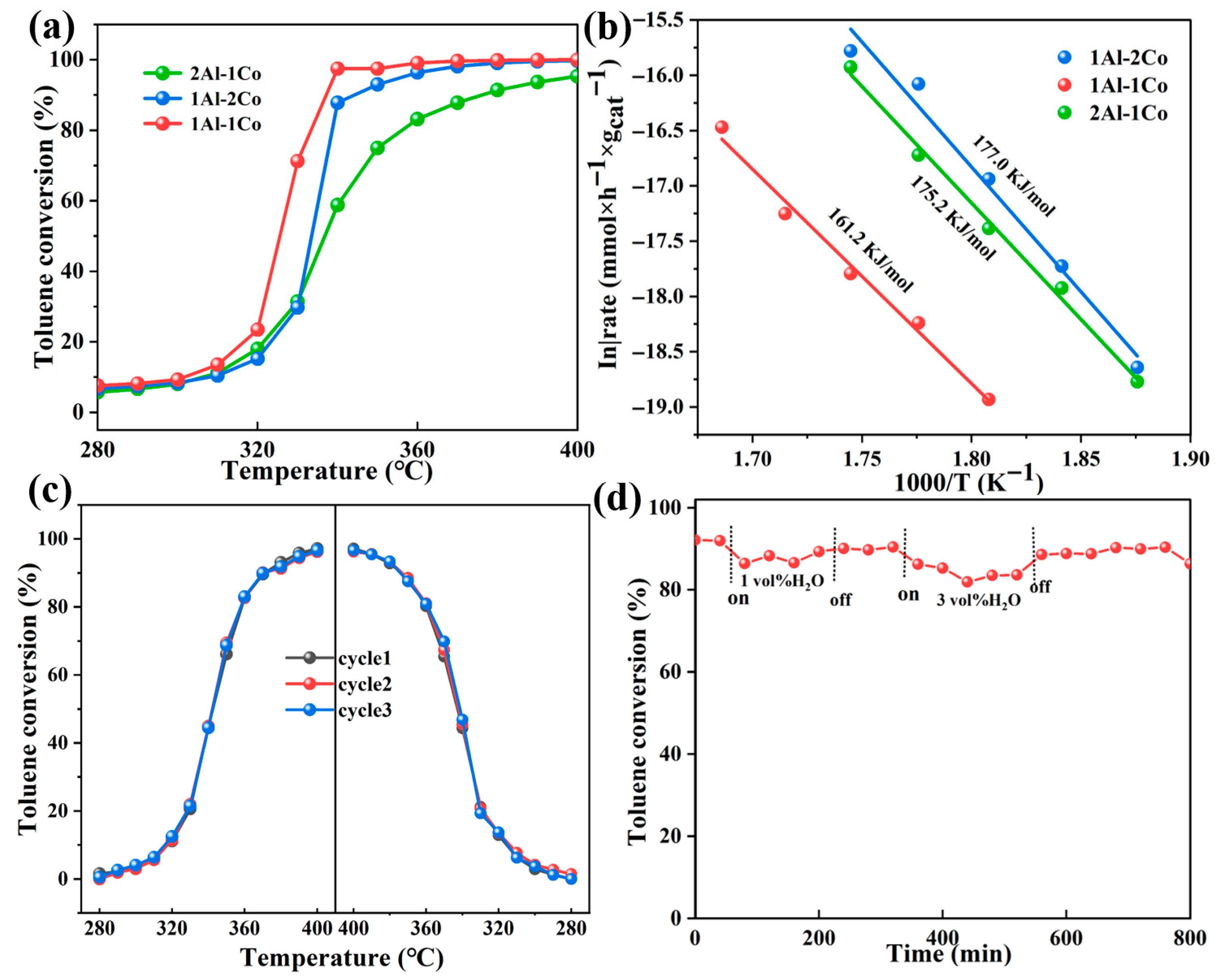
Catalytic performance of CoAl2O4 catalysts was evaluated by selecting toluene oxidation as the representative reaction, and corresponding conversion curves are shown in Figure 6a. It can be clearly seen that the 2Al-1Co catalyst displayed the worst catalytic activity, and the temperatures for achieving 50% (T50) and 90% (T90) toluene conversion were 337 and 376 °C (Table 2). With increasing the Co/Al ratio from 1:2 to 1:1 and 2:1, the T50 of 1Al-2Co and 2Al-1Co catalysts dropped to 325 and 337 °C, while T90 decreased to 333 and 344 °C, respectively. Hence, the ranking of catalytic performance for toluene elimination was as follows: 1Al-1Co > 1Al-2Co > 2Al-1Co. Numerous studies have shown that cobalt oxides generally exhibit a superior low-temperature catalytic activity and are widely applied in toluene oxidation, but alumina is commonly used as the support due to its inertness in catalytic reaction. Thus, increasing the Co/Al proportion from 1:2 to 1:1 could boost the toluene degradation, but the worst catalytic efficiency was observed for 1Al-2Co, even with more cobalt in comparison with 1Al-1Co. This abnormal phenomenon could be attributed to the synergetic effect of oxygen vacancies and octahedral Co3+ species in 1Al-1Co, leading to a superior catalytic activity. Table S1 presents a comparison of the toluene oxidation activity between the catalyst prepared in this work and a series of other catalysts. It can be clearly seen that the as-synthesized 1Al-1Co catalysts exhibited a better degradation efficiency than the supported Co3O4 catalysts or CoAl2O4 catalysts in the literature. Furthermore, the comparable or superior catalytic activity was also observed for the 1Al-1Co catalyst in comparison with AAl2O4 spinel catalysts (A = Ni, Cu, Zn).
Kinetic tests of CoAl2O4 catalysts were also conducted to investigate the influence of the Co/Al atomic ratio on the intrinsic catalytic performance. According to the Arrhenius plot (Figure 6b), the apparent activation energy (Ea) of the 1Al-1Co sample was calculated to be 161.2 kJ·mol−1, which was lower than that of the 1Al-2Co (177.0 kJ·mol−1) and 2Al-1Co (175.2 kJ·mol−1). The specific toluene reaction rate (Rs) at 310 °C was also measured to exclude the interference of the specific surface area on the catalytic activity. As shown in Table 2, the specific reaction rate of 1Al-1Co sample was 3.18 × 10⁻⁵ mmol·h−1·m−2, which was much higher than those of the 1Al-2Co (2.90 × 10⁻⁵ mmol·h−1·m−2) and 2Al-1Co (2.58 × 10⁻⁵ mmol·h−1·m−2). Consequently, the 1Al-1Co sample had the optimal intrinsic catalytic activity, revealing the vital role of the synergistic Co3+-Ov sites in promoting catalytic performance for CoAl2O4 catalysts. XRD patterns of 1Al-1Co-R catalyst after catalytic test were also performed and displayed in Figure S1. Obviously, the used 1Al-1Co-R catalyst exhibited similar XRD patterns to the fresh 1Al-1Co catalyst, indicating that the spinel structure was still retained.
In order to investigate the potential of 1Al-1Co catalyst in practical application, the variation of toluene conversion under heating–cooling cycles, different WHSV, and water vapor conditions was studied. Toluene conversion in three consecutive heating–cooling cycles was displayed in Figure 6c. It was evident that the 1Al-1Co sample maintained the almost unaltered efficiency of toluene degradation, indicating excellent tolerance to temperature fluctuations. Figure S2 shows that at a WHSV of 30,000 mL·gcat−1·h−1, the catalytic efficiency of the 1Al-1Co catalyst was superior to that at higher WHSVs. With reducing the WHSV from 60,000 to 30,000 mL·gcat−1·h−1, T50 and T90 decreased from 305 and 324 °C to 302 and 309 °C, respectively. When the WHSV was increased to 120,000 mL·gcat−1·h−1, the higher temperature for toluene conversion with T50 at 310 °C and T90 at 348 °C was observed. The toluene conversion of the 1Al-1Co catalyst under different moisture conditions was also investigated. As shown in Figure 6d, the toluene conversion decreased from 92% to 86% with the introduction of 1 vol% water vapor into the reaction gas stream and then quickly recovered to about 90% once it was removed. Further increasing the water vapor to 3 vol% led to a continuous reduction to 82% in toluene conversion that recovered to 88% after removing the water vapor. These results illustrated that the 1Al-1Co catalyst possessed excellent water repellency and regeneration capability.

2.3. Reaction Mechanism

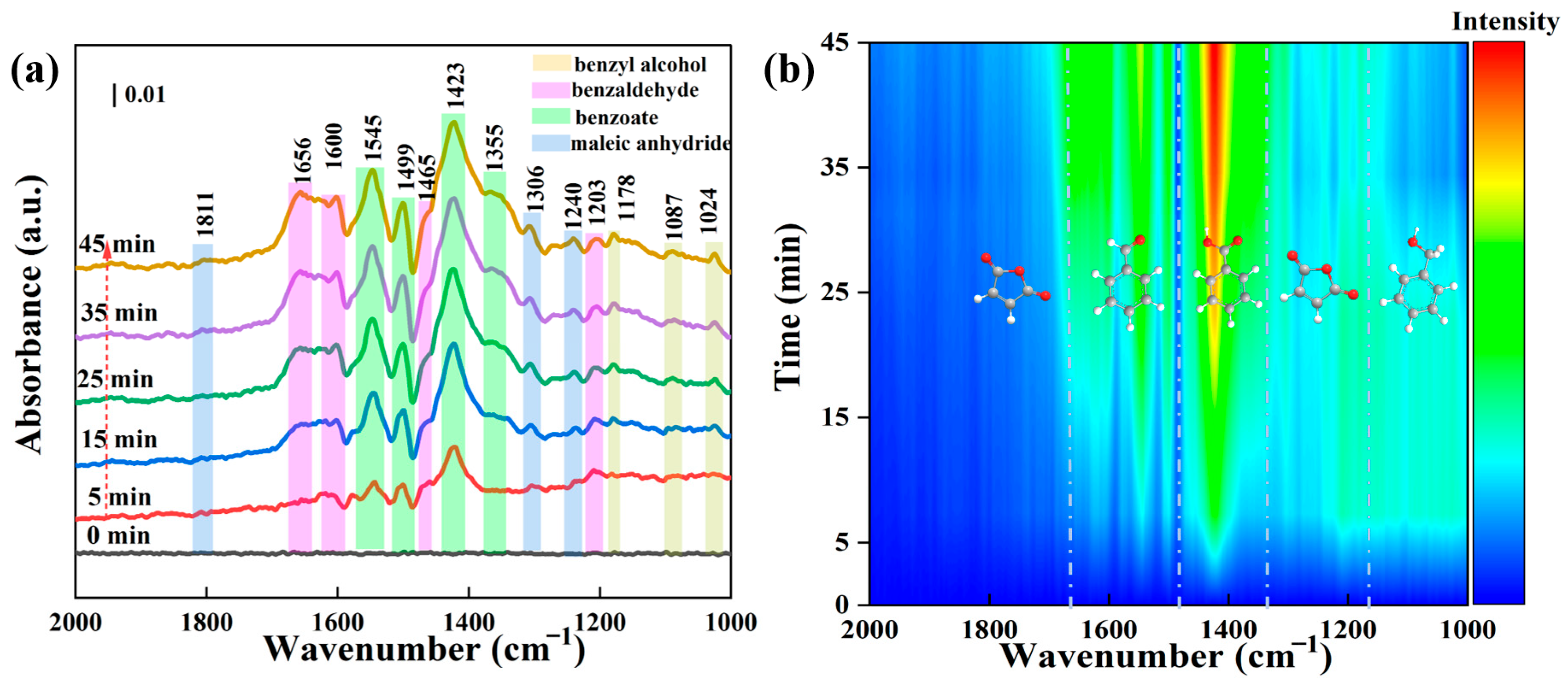
The catalytic degradation mechanism of toluene over the 1Al-1Co catalyst was dynamically monitored and clearly elucidated by in situ DRIFTS. As shown in Figure 7a, the C-O bending vibration attributed to benzyl alcohol was detected at 1024, 1087, and 1178 cm−1, which might be due to the reaction between toluene and surface oxygen species [47,48]. Obvious characteristic peaks of benzaldehyde appeared at 1203, 1465, 1600, and 1656 cm−1, and benzoic acid species were observed at 1355, 1423, 1499, and 1545 cm−1 [49,50]. Moreover, the adsorption peaks of maleic anhydride species, as the main open-ring product of toluene oxidation, were also detected at 1240, 1306, and 1811 cm−1, indicating that the benzene ring underwent a cleavage reaction [51,52]. The contour projection of the toluene transient reaction in Figure 7b further confirmed that the various oxidation intermediates, including benzyl alcohol, benzaldehyde, benzoic acid, and maleic anhydride, were generated during toluene degradation, and their intensity increased with extension of the reaction time, meaning a successive oxidation process. Therefore, it can be speculated that toluene was sequentially oxidized into the benzyl alcohol, benzaldehyde, and benzoate species by reacting with active oxygen species, and the latter two became the predominant intermediates [53]. Indeed, the ring-opening of benzoate into maleic anhydride has been reported to be the rate-limiting step during the toluene oxidation, as the further transformation of anhydride species into CO2 and H2O is a relatively straightforward process [47,54]. As mentioned above, abundant Co3+-Ov sites were successfully incorporated into CoAl2O4 catalysts via a mild solvothermal method and dominated the catalytic performance of toluene degradation, which was verified by a worse catalytic efficiency for 1Al-2Co even with more cobalt with respect to 1Al-1Co. Importantly, oxygen vacancies and octahedrally coordinated Co3+ species could synergistically promote the generation of the highly active and mobile oxygen species, which rapidly oxidize benzoate into maleic anhydride (Figure S3) [55]. Accordingly, the considerable accumulation of ring-opening product over the 1Co-1Al catalyst surface was observed, which was easily mineralized into CO2 and H2O, achieving the superior catalytic efficiency for toluene oxidation.

3. Experimental

3.1. Materials

All the reagents were used directly without further purification. Isopropanol and acetic acid solution were purchased from Tianjin Fuyu Fine Chemical Co., Ltd., Tianjin, China. Al(NO3)3·9H2O and Co(NO3)2·6H2O were obtained from National Pharmaceutical Chemical Reagent Co., Ltd., Shanghai, China.

3.2. Catalyst Preparation

Cobalt aluminate spinel catalysts were prepared via a simple solvothermal method by varying the atomic ratio of cobalt to aluminum. Specifically, 6.363 g Al(NO3)3·9H2O and 4.937 g of Co(NO3)2·6H2O were dissolved in 40 mL of isopropanol, and then 20 mL of acetic acid was added. After stirring for 30 min, the mixture solution was transferred into a 100 mL Teflon-lined stainless steel autoclave and placed into a preheating oven at 200 °C for 4 h. When cooled to room temperature, the precipitates were washed alternately using water and ethanol three times, then dried overnight at 60 °C in a vacuum drying oven, and finally calcinated at 400 °C for 4 h in a muffle furnace to obtain the spinel catalyst, labeled as 1Al-1Co catalyst. The atomic ratios of aluminum and cobalt were changed from 1:1 to 1:2 and 2:1, respectively, and the other steps remained unchanged to obtain the 1Al-2Co and 2Al-1Co catalysts.

3.3. Catalyst Characterization

X-ray diffraction (XRD) was conducted using a Rigaku/SmartLab SE type X-ray powder diffractometer with Cu Kα radiation at a scanning rate (2θ) of 8 °/min. N2 adsorption–desorption was measured by the Quantachrome autosorb-iQ instrument at 77 K to evaluate the specific surface area and pore structure of the catalysts. An X-ray photoelectron spectrometer (Thermo Scientific K-Alpha, Waltham, MA, USA) was used to obtain the elemental composition and valence state of the sample surface with Al Kα radiation (hυ = 1486.6 eV). Raman spectroscopy was obtained by a Thermo Scientific DXR instrument (Thermo Scientific, Waltham, MA, USA), and the excitation light source was set to 532 nm. Hydrogen programmed reduction (H2-TPR) and oxygen programmed temperature desorption (O2-TPD) of the samples were acquired by an Automated Chemisorption Analyzer (Auto Chem III 2930, Micromeritics Instrument Corp., Norcross, GA, USA). The test temperature ranged from 50 to 750 °C at a heating rate of 10 °C/min, and the signals were monitored by TCD. In situ DRIFTS spectra were collected on a German Bruker INVENIO-S spectrometer (Bruker, Berlin, Germany) in the range of 1000–4000 cm−1 by accumulating 12 scans at a resolution of 4 cm−1. Prior to the measurements, the samples were pretreated in N2 flow and the background spectrum was subtracted. After that, the toluene/O2/N2 mixture flow was introduced, and the spectra of the catalyst at 330 °C were recorded.

3.4. Activity Measurement

The catalytic oxidation of toluene on spinel catalysts was evaluated using a continuous flow fixed-bed catalytic reactor. The reaction gas consisted of 1000 ppm toluene and 20% oxygen, with nitrogen serving as the balancing gas. The gas passed through the fixed bed at a flow rate of 50 mL/min, corresponding to a weight hourly space velocity (WHSV) of 60,000 mL·gcat−1·h−1. Prior to the catalytic test, the samples were pressed, crushed, and sieved into a 40–60 mesh, and then placed in a quartz tube with an inner diameter of 4 mm. The toluene concentration at the inlet and outlet was measured using a gas chromatograph (Techcomp GC 7980, Techcomp Scientific Instruments Co., Ltd., Hong Kong, China). The toluene conversion (Xtoluene) and the reaction rate (Rs) were obtained by the following formula:
X t o l u e n e = C i n l e t C o u t l e t C i n l e t × 100 %
R s = X t o l u e n e Q C f W
In the formula, Cinlet and Coutlet presented the inlet and outlet toluene concentrations in the reaction tube. Q, Cf, and W corresponded to the volumetric flow rate (mL/h), inlet toluene concentration (mol/mL), and mass (g), respectively. The apparent activation energy (Ea) was calculated from Arrhenius-type plots of toluene reaction rates.

4. Conclusions

In this contribution, we prepared a series of CoAl2O4 spinel catalysts with abundant Co3+-Ov sites by adjusting the molar ratio of cobalt to aluminum based on a mild solvothermal method. Abundant oxygen vacancies appeared in the vicinity of the octahedrally coordinated Co3+ species in CoAl2O4 spinel in company with the generation of the synergistic Co3+-Ov sites; meanwhile, their relative concentration exhibited an increased tendency for 2Al-1Co, 1Al-2Co, and 1Al-1Co. Accordingly, the redox property and the oxygen activation ability were greatly promoted by plentiful Co3+-Ov sites in 1Al-1Co. Catalytic activity displayed that a superior catalytic efficiency for toluene oxidation was observed for the 1Al-1Co catalyst, even with the lower cobalt in comparison with the 1Al-2Co catalyst, revealing the predominant roles of synergistic Co3+-Ov sites in toluene degradation. Furthermore, the 1Al-1Co catalyst had the highest specific surface reaction rate and the lowest reaction activation energy. In situ DRIFTS results exhibited the considerable accumulation of maleic anhydride over the 1Al-1Co catalyst, which indicated that the ring-opening product was easily generated due to the synergetic Co3+-Ov sites, thus achieving the efficient complete oxidation of toluene. This work provides a promising strategy to construct high-performance spinel catalysts by incorporating the synergistic Co3+-Ov sites for VOCs removal.

Supplementary Materials

The following supporting information can be downloaded at: https://www.mdpi.com/article/10.3390/catal16050466/s1, Refs. [56,57,58,59] are cited in the Supplementary Materials.

Author Contributions

D.W.: Conceptualization, Data curation, Investigation, Methodology, Writing—original draft. X.Y. (Xueqin Yang): Conceptualization, Data curation, Funding acquisition, Methodology, Writing—original draft. M.X.: Data curation, Methodology, Funding acquisition. X.Z.: Methodology, Writing—review and editing. G.R.: Conceptualization, Supervision. X.C.: Supervision, Writing—review and editing. X.Y. (Xiaolin Yu): Conceptualization, Funding acquisition, Methodology, Supervision, Writing—review and editing. M.G.: Validation, Writing—review and editing. All authors have read and agreed to the published version of the manuscript.

Funding

This work was supported by the National Natural Science Foundation of China (22576064, 22406049), and the Zhongyuan Young Top Talents for Scientific and Technological Innovation Project.

Data Availability Statement

The data supporting this article have been included as part of the Supplementary Materials. And all raw data are available in the Science Data Bank at https://www.scidb.cn/s/Zb2QJr (accessed on 13 March 2026).

Conflicts of Interest

The authors declare no conflicts of interest.

References

  1. Dang, F.; Ai, C.; Ma, C.; Jiang, Z.; Liu, J.; Tian, M.; Zhang, M.; He, C. Advances in metal oxide catalysts for efficient VOCs oxidation: Synthesis strategy and catalytic mechanism. Chin. J. Catal. 2026, 81, 97–123. [Google Scholar] [CrossRef]
  2. Wang, D.D.; Yamg, X.Q.; Ma, Z.Q.; Zhu, X.H.; Ru, G.X.; Guo, Y.C.; Yu, X.L.; Ge, M.F. Research progress on the poisoning mechanism of flue gas VOCs purification catalysts. Energy Environ. Prot. 2024, 38, 68–80. [Google Scholar]
  3. Shan, C.P.; Wang, Y.C.; Li, J.B.; Zhao, Q.; Han, R.; Liu, C.X.; Liu, Q.L. Recent Advances of VOCs Catalytic Oxidation over Spinel Oxides: Catalyst Design and Reaction Mechanism. Environ. Sci. Technol. 2023, 57, 9495–9514. [Google Scholar] [CrossRef]
  4. Zhang, R.Q.; He, H.Z.; Tang, Y.E.; Zhang, Z.C.; Zhou, H.L.; Yu, J.L.; Zhang, L.; Dai, B.Q. A Review on Fe2O3-Based Catalysts for Toluene Oxidation: Catalysts Design and Optimization with the Formation of Abundant Oxygen Vacancies. ChemCatChem 2024, 16, e202400396. [Google Scholar] [CrossRef]
  5. Lee, J.E.; Ok, Y.S.; Tsang, D.C.W.; Song, J.; Jung, S.C.; Park, Y.K. Recent advances in volatile organic compounds abatement by catalysis and catalytic hybrid processes: A critical review. Sci. Total Environ. 2020, 719, 137405. [Google Scholar] [CrossRef]
  6. Murindababisha, D.; Yusuf, A.; Sun, Y.; Wang, C.J.; Ren, Y.; Lv, J.G.; Xiao, H.; Chen, G.Z.; He, J. Current progress on catalytic oxidation of toluene: A review. Environ. Sci. Pollut. Res. 2021, 28, 62030–62060. [Google Scholar] [CrossRef]
  7. Chen, M.; Kitiphatpiboon, N.; Feng, C.R.; Zhao, Q.; Abudula, A.; Ma, Y.F.; Yan, K.; Guan, G.Q. Tuning octahedron sites in MnFe2O4 spinel by boron doping for highly efficient seawater splitting. Appl. Catal. B Environ. Energy 2023, 330, 122577. [Google Scholar] [CrossRef]
  8. Duan, X.L.; Pan, M.; Yu, F.P.; Yuan, D.R. Synthesis, structure and optical properties of CoAl2O4 spinel nanocrystals. J. Alloys Compd. 2011, 509, 1079–1083. [Google Scholar] [CrossRef]
  9. Xu, W.; Liao, Y.; Wu, H.; Jiang, X.; Song, L.; Liu, Z.; Yu, C.; Yeung, K.L.; Ye, D. Cerium-Driven Electronic Modulation in CoMn2O4 Spinel: Uniting Lattice and Gaseous Oxygen Pathways for Accelerated Toluene Destruction. J. Hazard. Mater. 2025, 502, 140642. [Google Scholar] [CrossRef]
  10. Ren, Y.W.; Dong, C.; Song, C.; Qu, Z.P. Spinel-Based Catalysts That Enable Catalytic Oxidation of Volatile Organic Compounds. Environ. Sci. Technol. 2024, 58, 20785–20811. [Google Scholar] [CrossRef]
  11. Lv, Y.; Yan, H.; Liu, T.; Xu, J.; Xu, X.; Fang, X.; Wang, X. Manufacturing AAl2O4 (A = Cu, Co, Ni, Zn) spinel catalysts for toluene combustion: Elucidating the A-site replacement effect on the reactivity. ChemCatChem 2024, 16, e202301264. [Google Scholar] [CrossRef]
  12. Wu, J.; Wang, X.; Zheng, W.; Sun, Y.; Xie, Y.; Ma, K.; Zhang, Z.; Liao, Q.; Tian, Z.; Kang, Z. Identifying and interpreting geometric configureuration-dependent activity of spinel catalysts for water reduction. J. Am. Chem. Soc. 2022, 144, 19163–19172. [Google Scholar] [CrossRef]
  13. Xiao, K.; Liu, Z.Q. Regulation strategy of spinel OER electrocatalyst. Chin. Sci. Bull.—Chin. 2025, 70, 2966–2980. [Google Scholar] [CrossRef]
  14. Zou, A.; Wu, C.; Zhang, Q.; Tang, Y.; Li, J.; Meng, H.; Wang, Z.; Diao, C.; Yu, Z.; Xue, J. Promoting Surface Reconstruction in Spinel Oxides via Tetrahedral-Octahedral Phase Boundary Construction for Efficient Oxygen Evolution. Angew. Chem. Int. Ed. 2024, 63, e202409912. [Google Scholar]
  15. Li, X.-J.; Wang, F.; Wang, J.-F.; Wang, C.-C.; Wang, P.; Wang, A.; Yi, X.-H. Quasi-MIL-101 (Fe) with rich oxygen vacancies for boosted heterogeneous photo-Fenton reaction. Sep. Purif. Technol. 2025, 364, 132510. [Google Scholar] [CrossRef]
  16. Wu, L.Y.; Wu, Q.L.; Han, Y.; Zhang, D.D.; Zhang, R.R.; Song, N.; Wu, X.F.; Zeng, J.R.; Yuan, P.; Chen, J.; et al. Strengthening the Synergy between Oxygen Vacancies in Electrocatalysts for Efficient Glycerol Electrooxidation. Adv. Mater. 2024, 36, e2401857. [Google Scholar] [CrossRef]
  17. Zhang, P.; Li, H.; Wang, Z.; Wang, X.; Nuobu, G.; Zhao, Z.; Chang, L.; Guo, J.; Xu, M.; Chen, F. Atomic-scale regulation of La doping in spinel Co3O4 lattice for highly efficient VOCs oxidation. Appl. Catal. B Environ. Energy 2025, 381, 125899. [Google Scholar] [CrossRef]
  18. Zhang, Q.; Zhang, M.; Pan, Z.; Li, D.-C.; Tian, Z.; Ma, Y.; Gao, R.; Liu, J.; Wang, G.-H. Seed-mediated engineering of dual-atom Ag-Pd synergy on CeO2 for selective transfer hydrogenation of nitroarenes. Appl. Catal. B Environ. Energy 2025, 382, 126019. [Google Scholar] [CrossRef]
  19. Yan, Y.; Yin, K.; Ouyang, M.; Tian, J.T.; Li, H.T.; Tang, K.K.; Yang, C.; Yang, W.L.; Chen, P.R.; Liu, P.; et al. Modulating Co Species Charge Distribution in Co3O4 for Boosted Low-Temperature Complete Oxidation of VOCs: Surface Co2+-O Sites Induced Reactant Adsorption and Activation. Environ. Sci. Technol. 2026, 60, 8603–8617. [Google Scholar] [CrossRef] [PubMed]
  20. Hou, K.; Zhao, Z.; Li, G.; Li, B.; Shui, Z.; Hao, B.; Sui, D.; Li, X.; Cheng, J.; Hao, Z. Advances in Structure Manipulation of Cobalt-Based Oxides for Catalytic Oxidation of Exhaust Gas. Environ. Sci. Technol. 2025, 59, 20879–20909. [Google Scholar] [CrossRef] [PubMed]
  21. Wu, T.; Sun, S.; Song, J.; Xi, S.; Du, Y.; Chen, B.; Sasangka, W.A.; Liao, H.; Gan, C.L.; Scherer, G.G. Iron-facilitated dynamic active-site generation on spinel CoAl2O4 with self-termination of surface reconstruction for water oxidation. Nat. Catal. 2019, 2, 763–772. [Google Scholar] [CrossRef]
  22. Han, M.; Wang, Z.S.; Xu, Y.; Wu, R.; Jiao, S.H.; Chen, Y.; Feng, S.H. Physical properties of MgAl2O4, CoAl2O4, NiAl2O4, CuAl2O4, and ZnAl2O4 spinels synthesized by a solution combustion method. Mater. Chem. Phys. 2018, 215, 251–258. [Google Scholar] [CrossRef]
  23. Bai, B.; Li, J.; Hao, J. D-MnO2, 2D-MnO2 and 3D-MnO2 for low-temperature oxidation of ethanol. Appl. Catal. B Environ. 2015, 164, 241–250. [Google Scholar] [CrossRef]
  24. Yao, W.Q.; Wu, B.; Liu, Y.Q. Growth and Grain Boundaries in 2D Materials. ACS Nano 2020, 14, 9320–9346. [Google Scholar] [CrossRef]
  25. Wen, R.; Li, H.; Zhao, H.J.; Ren, K.; Hao, R.T.; He, K.P.; Zhao, C.N.; Wan, X.; Wang, W.C. Enhancing Ozone Decomposition in Humid Environments through Carbon Doping to Disrupt the Hydrogen Bond Network in Mullite YMn2O5. Environ. Sci. Technol. 2024, 58, 20687–20698. [Google Scholar] [CrossRef]
  26. Yang, X.Q.; Chen, L.; Yu, X.L.; Yu, J.; Han, D.W.; Xiao, M.L.; Ge, M.F.; Yang, X.T. Exploration of atomic interfaces with inherent oxygen vacancies in zirconia for toluene oxidation. J. Mater. Chem. A 2022, 11, 287–296. [Google Scholar] [CrossRef]
  27. Gao, P.; Tang, P.; Mo, Y.; Xiao, P.T.; Zhou, W.; Chen, S.; Dong, H.L.; Li, Z.W.; Xu, C.H.; Liu, J.L. Covalency competition induced selective bond breakage and surface reconstruction in manganese cobaltite towards enhanced electrochemical charge storage. Green Energy Environ. 2024, 9, 909–918. [Google Scholar] [CrossRef]
  28. Long, Y.P.; Zhu, X.; Gao, C.; Si, W.Z.; Li, J.H.; Peng, Y. Modulation of Co spin state at Co3O4 crystalline-amorphous interfaces for CO oxidation and N2O decomposition. Nat. Commun. 2025, 16, 1048. [Google Scholar] [CrossRef]
  29. Dabrowa, J.; Stygar, M.; Mikula, A.; Knapik, A.; Mroczka, K.; Tejchman, W.; Danielewski, M.; Martin, M. Synthesis and microstructure of the (Co,Cr,Fe,Mn,Ni)3O4 high entropy oxide characterized by spinel structure. Mater. Lett. 2018, 216, 32–36. [Google Scholar] [CrossRef]
  30. Hua, S.; Xiaolin, Y.; Yucong, G.; Jiguang, D.; Maofa, G. Achieving efficient toluene oxidation over metal–organic framework-derived Pt/CeO2-Co3O4 catalyst. Appl. Surf. Sci. 2022, 591, 153225. [Google Scholar]
  31. Hu, Q.; Qi, S.; Huo, Q.H.; Zhao, Y.X.; Sun, J.J.; Chen, X.B.; Lv, M.Y.; Zhou, W.L.; Feng, C.; Chai, X.Y.; et al. Designing Efficient Nitrate Reduction Electrocatalysts by Identifying and Optimizing Active Sites of Co-Based Spinels. J. Am. Chem. Soc. 2023, 146, 2967–2976. [Google Scholar] [CrossRef]
  32. Zou, G.; Liu, H.W.; Liu, T.F.; Han, S.B.; Tan, Z.J.; Zhang, S.W.; Guo, Y.G.; Yu, J.C.; Zhang, X.M.; Lu, F.; et al. High-entropy-induced CoO6 octahedral distortion for boosted oxygen evolution reaction at high temperature. Energy Environ. Sci. 2025, 18, 9478–9489. [Google Scholar] [CrossRef]
  33. Götsch, T.; Cruz, D.; Zeller, P.; Rabe, A.; Dreyer, M.; Cosanne, N.; Girgsdies, F.; Allan, J.; Hävecker, M.; Efimenko, A.; et al. Local solid-state processes adjust the selectivity in catalytic oxidation reactions on cobalt oxides. Nat. Catal. 2025, 8, 1314–1324. [Google Scholar] [CrossRef]
  34. Wan, C.S.; Liao, Y.M.; Huang, H.Y.; Li, D.L.; Zhan, Y.Y.; Xiao, Y.H.; Jiang, L.L. Novel preparation of copper-cobalt spinel oxides using Cu2+-Co2+-Co3+ hydrotalcite-like compounds as active catalysts for methane combustion. Chem. Eng. J. 2025, 513, 162813. [Google Scholar] [CrossRef]
  35. Cai, L.K.; Liu, Y.; Zhang, J.F.; Jia, Q.Q.; Guan, J.C.; Sun, H.W.; Yu, Y.; Huang, Y. Unveiling the geometric site dependent activity of spinel Co3O4 for electrocatalytic chlorine evolution reaction. J. Energy Chem. 2024, 92, 95–103. [Google Scholar] [CrossRef]
  36. Su, R.D.; Gao, Y.X.; Chen, L.; Chen, Y.; Li, N.; Liu, W.; Gao, B.Y.; Li, Q. Utilizing the oxygen-atom trapping effect of Co3O4 with oxygen vacancies to promote chlorite activation for water decontamination. Proc. Natl. Acad. Sci. USA 2024, 121, e2319427121. [Google Scholar] [CrossRef]
  37. Shang, L.; Xu, S.; Ni, Y.X.; Lu, Y.; Li, H.X.; Zhang, K.; Yan, Z.H.; Cheng, F.Y.; Chen, J. Structure Engineering Enabled O-O Radical Coupling in Spinel Oxides for Enhanced Oxygen Evolution Reaction. J. Am. Chem. Soc. 2025, 147, 34169–34180. [Google Scholar] [CrossRef]
  38. Zheng, F.; Lu, J.Y.; Liu, C.J.; Zheng, H.X.; Xu, Q. Synergistic engineering of oxygen vacancies, cation vacancies, and surface acidity in MOFs-derived Co-Mn spinel oxides via acid etching: A pathway to enhanced toluene oxidation performance. J. Hazard. Mater. 2025, 492, 138239. [Google Scholar] [CrossRef]
  39. Tompsett, D.A.; Parker, S.C.; Islam, M.S. Rutile (β-)MnO2 Surfaces and Vacancy Formation for High Electrochemical and Catalytic Performance. J. Am. Chem. Soc. 2014, 136, 1418–1426. [Google Scholar] [CrossRef]
  40. Meng, Q.J.; Wang, W.L.; Weng, X.L.; Liu, Y.; Wang, H.Q.; Wu, Z.B. Active Oxygen Species in Lan+1NinO3n+1 Layered Perovskites for Catalytic Oxidation of Toluene and Methane. J. Phys. Chem. C 2016, 120, 3259–3266. [Google Scholar] [CrossRef]
  41. Reynoso, A.J.; Ayastuy, J.L.; Iriarte-Velasco, U.; Gutiérrez-Ortiz, M.A.; Technologies, E.C. Cobalt aluminate spinel-derived catalysts for glycerol aqueous phase reforming. Appl. Catal. B Environ. 2018, 239, 86–101. [Google Scholar] [CrossRef]
  42. Rhodes, M.D.; Bell, A.T. The effects of zirconia morphology on methanol synthesis from CO and H2 over Cu/ZrO2 catalysts: Part I. Steady-state studies. J. Catal. 2005, 233, 198–209. [Google Scholar] [CrossRef]
  43. Yang, X.Q.; Ma, Z.Q.; Wang, D.D.; Yu, X.L.; Zhu, X.H.; Wang, T.; Yuan, Y.; Guo, Y.C.; Shi, B.; Ge, M.F.; et al. Oxygen vacancy-mediated Mn2O3 catalyst with high efficiency and stability for toluene oxidation. J. Colloid Interface Sci. 2024, 675, 815–824. [Google Scholar] [CrossRef] [PubMed]
  44. Yu, H.; Mao, S.J.; Lu, B.; Wang, H.; Zhang, X.; Qi, M.H.; Gao, R.L.; Wang, Y. Optimizing Selectivity in VOx/TiO2 Catalysts for Ammoxidation: Insights from Structure-Performance Relationships. ACS Catal. 2024, 14, 8720–8729. [Google Scholar] [CrossRef]
  45. Liu, Y.; Wang, F.Y.; Xie, F.; Zheng, J.M.; Lan, J.T.; Guo, F.R.; Sun, Y.F.; Zhang, L.Z.; Liu, X. CaO-Promoted Lattice Oxygen Activation and Antichlorine Poisoning over Mullite for Catalytic Chlorobenzene Combustion. ACS Catal. 2023, 13, 10340–10350. [Google Scholar] [CrossRef]
  46. Yang, X.Q.; Yu, X.L.; Jing, M.Z.; Song, W.Y.; Liu, J.; Ge, M.F. Defective MnxZr1-xO2 Solid Solution for the Catalytic Oxidation of Toluene: Insights into the Oxygen Vacancy Contribution. ACS Appl. Mater. Interfaces 2019, 11, 730–739. [Google Scholar] [CrossRef]
  47. Li, J.; Na, H.B.; Zeng, X.L.; Zhu, T.L.; Liu, Z.M. In situ DRIFTS investigation for the oxidation of toluene by ozone over Mn/HZSM-5. Ag/HZSM-5 and Mn-Ag/HZSM-5 catalysts. Appl. Surf. Sci. 2014, 311, 690–696. [Google Scholar] [CrossRef]
  48. Sun, H.; Liu, Z.G.; Chen, S.; Quan, X. The role of lattice oxygen on the activity and selectivity of the OMS-2 catalyst for the total oxidation of toluene. Chem. Eng. J. 2015, 270, 58–65. [Google Scholar] [CrossRef]
  49. Xiao, M.L.; Han, D.W.; Yang, X.Q.; Yu, J.; Shi, B.; Guo, Y.C.; Yu, X.L.; Ge, M.F. Active Interfacial Perimeter in Pt/CeO2 Catalysts with Embedding Structure for Water-Tolerant Toluene Combustion. Environ. Sci. Technol. 2024, 58, 22808–22817. [Google Scholar] [CrossRef]
  50. Han, D.W.; Xiao, M.L.; Wei, Y.C.; Yang, X.Q.; Guo, Y.C.; Ma, L.J.; Yu, X.L.; Ge, M.F. Enhanced sulfur resistance by constructing MnOx–Co3O4 interface on Ni foam in the removal of benzene. Environ. Sci.-Nano 2023, 10, 284–294. [Google Scholar] [CrossRef]
  51. Wang, X.; Huang, Q.L.; Wu, W.S.; Lv, L.; Zhang, W.M.; Pan, B.C. Unveiling the Size Effects of Oxygen Vacancy Clusters in Toluene Combustion under Humid Conditions. Environ. Sci. Technol. 2025, 59, 20041–20050. [Google Scholar] [CrossRef]
  52. Zhang, M.; Zhang, Y.; Xu, Q.; Li, X.; Chen, J.; Jia, H. Synergistic combination of active Pt species and light-driven photothermal catalysis for highly efficient toluene oxidation. Catal. Sci. Technol. 2024, 14, 5996–6006. [Google Scholar] [CrossRef]
  53. Lapa, H.M.; Martins, L. Toluene Oxidation: CO2 vs Benzaldehyde: Current Status and Future Perspectives. ACS Omega 2024, 9, 26780–26804. [Google Scholar] [CrossRef] [PubMed]
  54. Yang, X.; Ma, X.; Yu, X.; Ge, M. Exploration of strong metal-support interaction in zirconia supported catalysts for toluene oxidation. Appl. Catal. B 2020, 263, 118355. [Google Scholar] [CrossRef]
  55. Qian, M.S.; Li, R.Y.; Adamski, A.; Sojka, Z.; Liu, Z.P.; Liu, Z.M. Catalytic oxidation of toluene: Mechanisms, deactivation, mitigation, and regeneration. Fuel 2026, 406, 136887. [Google Scholar] [CrossRef]
  56. Tu, W.L.; Dong, X.X.; Du, R.R.; Wang, Q.; Yang, F.; Ou, R.; Wang, X.Y.; Li, L.L.; Yuan, A.H. Hierarchical laminated Al2O3 in-situ integrated with high-dispersed Co3O4 for improved toluene catalytic combustion. Adv. Powder Technol. 2022, 33, 103377. [Google Scholar] [CrossRef]
  57. Chai, G.; Du, D.; Wang, C.; Zhang, C.; Cardenas, L.; Bion, N.; Guo, Y.; Gil, S.; Giroir-Fendler, A. Spinel Co3O4 oxides-support synergistic effect on catalytic oxidation of toluene. Appl. Catal. A Gen. 2021, 614, 118044. [Google Scholar] [CrossRef]
  58. Bialas, A.; Mazur, M.; Natkanski, P.; Dudek, B.; Kozak, M.; Wach, A.; Kustrowski, P. Hydrotalcite-derived cobalt-aluminum mixed oxide catalysts for toluene combustion. Appl. Surf. Sci. 2015, 362, 297–303. [Google Scholar] [CrossRef]
  59. Bialas, A.; Niebrzydowska, P.; Dudek, B.; Piwowarska, Z.; Chmielarz, L.; Michalik, M.; Kozak, M.; Kuśtrowski, P. Coprecipitated Co–Al and Cu–Al oxide catalysts for toluene total oxidation. Catal. Today 2010, 176, 413–416. [Google Scholar] [CrossRef]
Figure 1. (a) XRD patterns of 1Al-2Co, 1Al-1Co, and 2Al-1Co, and (b) enlarged view of the corresponding sample (311) peaks.
Catalysts 16 00466 g001
Figure 2. (a) Nitrogen adsorption–desorption isotherms and (b) pore size distribution curves of 1Al-2Co, 1Al-1Co, and 2Al-1Co.
Catalysts 16 00466 g002
Figure 3. (a) Raman spectra and (b) corresponding Raman shift of A1g in 1Al-2Co, 1Al-1Co, and 2Al-1Co.
Catalysts 16 00466 g003
Figure 4. XPS spectra of CoAl2O4 samples: (a) full range spectrum, and high-resolution of (b) Co 2p along with (c) O 1s, and (d) the relative content of Co2+/Co3+ along with Oads/Olatt in 1Al-2Co, 1Al-1Co, and 2Al-1Co.
Catalysts 16 00466 g004
Figure 5. (a) H2-TPR and (b) O2-TPD profiles of 1Al-2Co, 1Al-1Co and 2Al-1Co catalysts.
Catalysts 16 00466 g005
Figure 6. (a) Toluene conversion, (b) Arrhenius plots of reaction rates of 1Al-2Co, 1Al-1Co, and 2Al-1Co catalysts, (c) cyclic stability test in three consecutive heating-cooling runs, and (d) catalytic water resistance for 1Al-1Co catalyst.
Catalysts 16 00466 g006
Figure 7. (a) In situ DRIFTS spectra and (b) corresponding contour projection of the toluene transient reaction over 1Al-1Co.
Catalysts 16 00466 g007
Table 1. Physical and chemical properties of 1Al-2Co, 1Al-1Co, and 2Al-1Co catalysts.
SamplesSurface Area
(m2·g−1)
Total Pore Volume
(cm3·g−1)
Pore Diameter
(nm)
Crystallite Size
(nm)
Co2+/Co3+Oads/Olatt
1Al-2Co96.00.373.418.10.832.50
1Al-1Co113.50.323.417.30.483.05
2Al-1Co114.80.403.418.50.942.30
Table 2. Catalytic properties of toluene oxidation of 1Al-2Co, 1Al-1Co, and 2Al-1Co catalysts.
Samples T50
(°C)
T90
(°C)
Rs at 310 °C (mmol·h−1·m−1) Ea
(kJ·mol−1)
1Al-2Co3333443.18 × 10−5177.0
1Al-1Co3253372.90 × 10−5161.2
2Al-1Co3373762.58 × 10−5175.2
Disclaimer/Publisher’s Note: The statements, opinions and data contained in all publications are solely those of the individual author(s) and contributor(s) and not of MDPI and/or the editor(s). MDPI and/or the editor(s) disclaim responsibility for any injury to people or property resulting from any ideas, methods, instructions or products referred to in the content.