Article

High-Value Utilization of Waste Drilling Mud to Synthesize MFI Zeolite

1
College of Chemistry and Chemical Engineering, China University of Petroleum, Qingdao 266580, China
2
Technology Inspection Center of Shengli Oilfield Branch, Dongying 257000, China
*
Authors to whom correspondence should be addressed.
Catalysts 2026, 16(5), 452; https://doi.org/10.3390/catal16050452
Submission received: 21 March 2026 / Revised: 30 April 2026 / Accepted: 7 May 2026 / Published: 13 May 2026

Abstract

While the petroleum industry undergoes structural adjustments in supply and demand alongside a green and low-carbon transition, water drilling mud generated during oil extraction poses severe environmental challenges. Consequently, addressing the solid waste pollution and disposal issues associated with drilling mud has become critical. In this study, ZSM-5 zeolite was synthesized using water drilling mud as a silicon and aluminum source, inexpensive n-butylamine as a template agent, and a combined approach of alkali-melting activation pre-treatment and seed-directed hydrothermal synthesis. By adjusting key parameters such as water content, template agent dosage, and seed addition, optimal synthesis conditions were determined. Based on these conditions, a series of ZSM-5 zeolites with varying silicon-to-aluminum ratios were synthesized. Characterization results from XRD, TEM, SEM, and N2 adsorption–desorption experiments revealed that all prepared samples exhibited high crystallinity, regular morphology, and high specific surface area. 27Al MAS NMR results indicated that almost aluminum species were located at the framework structures with four-coordination. In the 1,3,5-triisopropylbenzene cracking reaction, the conversion rate increased with decreasing silicon-to-aluminum ratio, consistent with variations in acid amount. These findings achieve high-value utilization of waste drilling mud, offering a novel pathway for low-cost synthesis of high-performance ZSM-5 zeolite. This breakthrough injects fresh momentum into the petroleum refining industry’s green sustainable development, fostering a win–win scenario that harmonizes ecological conservation with industrial profitability.

1. Introduction

Since the implementation of China’s 13th Five-Year Plan, 70% of newly discovered domestic oil reserves and 90% of natural gas reserves have primarily been low-grade unconventional resources [1]. These resources typically include shale oil and gas, tight oil and gas, coalbed methane, natural gas hydrates, heavy oil, and oil sands. It is estimated that China’s total recoverable unconventional resources amount to 55 billion tons, including 20 billion tons of tight oil and 35 billion tons of shale gas [2]. Enhancing the effective utilization and efficient development of these resources has become a critical safeguard for the growth of China’s oil and gas industry. However, the drilling mud generated during oil and gas operations poses a severe environmental challenge [3,4]. Water-based drilling mud (WBM) constitutes the primary solid waste in oilfields. To facilitate drilling operations, substantial quantities of chemical additives such as weighting agents, thickeners, and corrosion inhibitors are incorporated. These additives contain complex mixtures of heavy metals, high-salinity and high-alkalinity substances, and organic toxic compounds, leading to ecological issues including soil degradation and water pollution [5,6,7]. In the Shengli Oilfield alone, the annual output reaches approximately 500,000 tons, with external disposal costs exceeding 70 million RMB per year. Therefore, the efficient resource utilization of water drilling mud is a key research topic under the 13th Five-Year National Key Science and Technology Special Project [8].
The silica and alumina content in water drilling mud exceeds 55 wt%. The use of silica- and alumina-rich natural clay as a direct raw material to replace chemical synthesis of zeolite has garnered significant attention in both academic and industrial circles [9]. This approach facilitated the recovery and utilization of solid waste while offering added-value applications. ZSM-5 zeolite has achieved remarkable success in the chemical industry due to its high specific surface area, surface acidity, unique pore structure, and excellent thermal stability [10,11]. Jida Gao et al. [12] successfully synthesized ZSM-5 zeolite using coal gangue as raw material, achieving heavy metal adsorption capacities as high as 95%. Sethuraman et al. [13] developed ZSM-5 zeolite using kaolinite as the sole source of silicon and aluminum, demonstrating excellent conversion rates in denitrification reactions. Additionally, Yifei Zhao [14] similarly synthesized ZSM-5 zeolite using fly ash and rice husk ash.
In oilfield solid waste sludge, silicon–aluminum species predominantly exist in crystalline forms such as quartz and feldspar, exhibiting relatively stable structures and minimal chemical reactivity [15]. During zeolite synthesis, impurities are difficult to remove effectively when used directly as raw materials, resulting in impurity crystals within the synthesized zeolite samples that may even compromise their performance. Therefore, an appropriate activation method is required to disrupt the crystalline structure of silicoaluminate minerals into individual [SiO4] and [AlO4] tetrahedra or their simple aggregates.
Based on the above approach, the extent of crystal structure destruction caused by several common activation methods, including acid–base activation [16,17,18], mechanical activation [19], quasi-solid-phase activation [20,21], sub-molten salt activation [22,23], and alkali-melting activation [24,25], was first examined to identify the optimal activation strategy. Subsequently, a simple, economical, and environmentally friendly preparation method was developed. This approach utilized water drilling mud as a source of silicon and aluminum, employed inexpensive and recyclable fatty amines (n-butylamine) as a template agent, and incorporated a small amount of pure silica zeolite (S-1) as a seed to facilitate hydrothermal synthesis of ZSM-5 zeolite. Considering cost and quality, the effects of water content, template agent dosage, and seed crystal dosage on zeolite crystallinity were systematically investigated in this study. Optimal synthesis conditions were determined to prepare ZSM-5 with varying silicon-to-aluminum ratios, and its crystallization process was explored. Furthermore, the aluminum content and acidity of ZSM-5 frameworks with varying silicon-to-aluminum ratios were characterized and analyzed, and their performance in the 1,3,5-triisopropylbenzene cracking reaction was investigated.

2. Results and Discussion

2.1. Activation of Water Drilling Mud

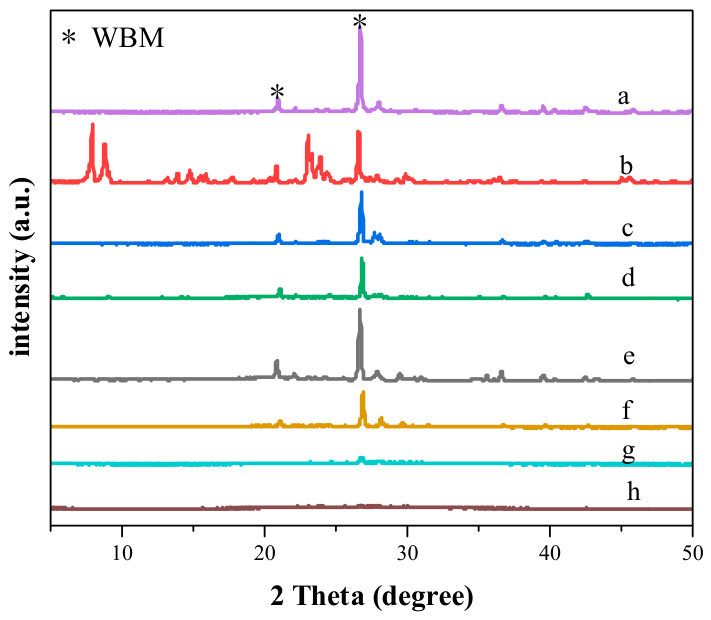
Water-based mud (WBM) exhibited two distinct characteristic diffraction peaks at 2θ = 20.94° and 26.74° [26], attributed to the quartz phase (Figure 1a). XRF analysis determined the composition of the water-based mud (Table 1), revealing a low silicon-to-aluminum ratio. Therefore, additional silicon source (silica gel) must be added during the synthesis of ZSM-5 zeolite. First, mud precursors were used as the partial silicon source, complete aluminum source, and alkali source, supplemented with silica gel as an additional silicon source. The feedstock was prepared according to the ratio of 1.0 SiO2: 0.04 Al2O3: 0.25 C4H11N: 0.10 Na2O: 25 H2O: 2 wt.% seed. The XRD pattern of the hydrothermal crystallization sample is shown in Figure 1b. This sample exhibited characteristic peaks attributed to the MFI topology, indicating the successful synthesis of ZSM-5 zeolite. However, quartz phase impurity peaks originating from the mud precursor were also present. Therefore, pre-activation of the precursor was required to decompose the inert SiO2 into highly reactive silicon–aluminum species, followed by crystallization to ZSM-5 zeolite, thereby enhancing the utilization efficiency of silicon–aluminum components in the mud.
Six common activation strategies including acid activation, alkali activation, mechanical activation, pseudo-solid-phase activation, sub-molten salt activation, and alkali fusion activation were investigated in this study. Their XRD patterns are shown in Figure 1c–h. Only the spectrum of the product from alkali fusion activation showed no characteristic diffraction peaks of water-based mud. Calculations revealed that this sample achieved an activation rate as high as 90%, with the leaching rate of active silica–alumina approaching the theoretical maximum. This indicated that the inert components in the mud have been essentially fully activated, with all inert constituents converted into highly active silica–alumina species [27]. Therefore, the water-based mud treated with alkali fusion activation was selected as the precursor for the subsequent synthesis of ZSM-5 zeolite.

2.2. Crystallization of Mud-Based ZSM-5 Zeolite

ZSM-5 zeolite was synthesized via hydrothermal methods, which used water-based mud treated with alkaline fusion activation as a precursor, n-butylamine as a template agent, and industrial-grade ZSM-5 zeolite as a seed crystal. By optimizing synthesis conditions and investigating the crystallization process, the characteristics of WBM conversion into ZSM-5 zeolite were elucidated.

2.2.1. Effect of Water Content

Numerous studies indicated that the water content of gels in hydrothermal synthesis systems significantly impacted the crystallinity and yield of zeolites. Excessively low water content typically resulted in overly viscous synthetic gels, hindering crystallization. Conversely, excessively high water content led to decreased alkalinity, reduced crystallization rates, and even incomplete crystallization [28]. Figure S1 illustrates the effect of water-to-silica ratio on zeolite formation. All samples exhibited characteristic peaks attributable to MFI phase, while an inert component of the quartz phase in the WBM precursor disappeared, indicating that pure-phase ZSM-5 zeolite could be synthesized within this water content range. The crystallinity of the samples showed an initial increase followed by a subsequent decrease. At a water-to-silicon ratio of 25, the synthesized sample exhibited the strongest ZSM-5 characteristic diffraction peaks between 22° and 25° and between 7° and 9° in the 2θ range, with the highest crystallinity reaching 100%. Therefore, the optimal water-to-silicon ratio was 25.

2.2.2. Effect of Template Agent

Another critical factor influencing hydrothermal zeolite synthesis was the amount of template agent, which played a structural guiding and charge-balancing role in zeolite formation. By influencing solution composition and nucleation processes, template molecules lowered the chemical potential required for crystal formation, thereby promoting zeolite synthesis both thermodynamically and kinetically [29]. Moreover, the template agent served as a spatial filler during zeolite synthesis, providing structural support and stability to the framework [30]. Figure S2 shows the XRD patterns of low-silica ZSM-5 zeolites synthesized with different C4H11N content. As depicted, when n(C4H11N)/n(SiO2) = 0.05, the XRD pattern exhibited only weak ZSM-5 zeolite diffraction peaks, with a relative crystallinity (RC) of merely 24%. As the amount of template agent increased, the diffraction peak intensity of the synthesized ZSM-5 zeolite gradually strengthened and the relative crystallinity gradually increased. However, when the excessive template agent was added, the diffraction peak intensity of ZSM-5 zeolite tended to decrease. At n(C4H11N)/n(SiO2) = 0.3, the relative crystallinity of the synthesized ZSM-5 zeolite reached its maximum, achieving 100%. As the amount of template agent increased, the structural directing effect of n-butylamine intensified, leading to enhanced crystallinity in the synthesized ZSM-5 zeolite. However, excessive template agent addition altered the alkalinity of the gel system, adversely affecting crystallization. On the other hand, n-butylamine was a macromolecular substance. Excessive addition prevented aluminum species from entering the zeolite framework, while insufficient addition weakened its structural directing effect, adversely affecting crystallization in the synthesis system [31]. Therefore, a molar ratio of template to silica of 0.3 was optimal for synthesizing highly crystalline ZSM-5 zeolite.

2.2.3. Effect of Seed Addition Amount

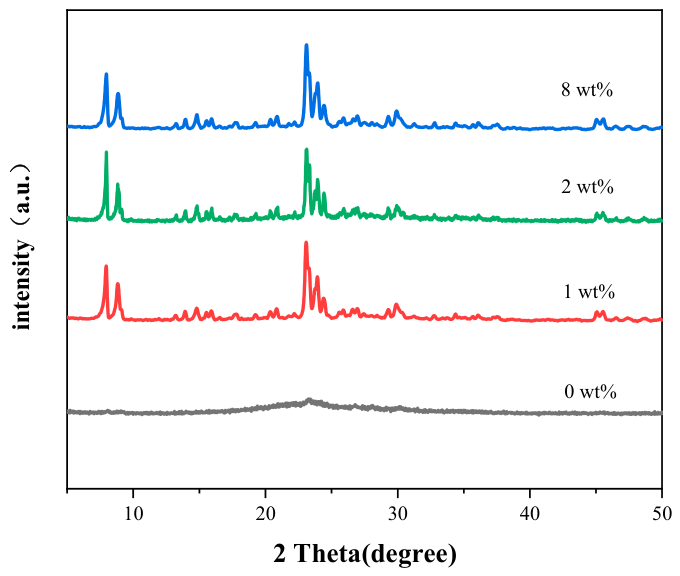
Figure 2 presents the XRD patterns of ZSM-5 zeolite synthesized with different seed concentrations. The sample without seed addition exhibited an amorphous species, indicating that the presence of seeds played a crucial role in the crystallization process. It was generally believed that adding a small amount of seed crystals prior to the hydrothermal synthesis of zeolite can shorten the nucleation induction period, thereby accelerating the crystallization rate [32]. Consequently, samples containing seed crystals all exhibited characteristic diffraction peaks attributable to the MFI structure, with high intensity and no additional impurity peaks. They demonstrated good crystallinity. When the seed crystal addition was 2%, the zeolite achieved the optimal crystallinity of 100%. Increasing the seed amount to 8% resulted in only a slight change in crystallinity. The results above indicated that increasing the seed addition can enhance the number of nucleation sites within a certain range, thereby accelerating crystal growth and improving the relative crystallinity of ZSM-5 zeolite. Excessive nucleation sites in the synthesis system no longer significantly promoted crystal growth, eventually stabilizing the process. Therefore, the optimal seed addition was determined to be 2 wt%.

2.2.4. Effect of Feedstock Silicon-to-Aluminum Ratio (SAR)

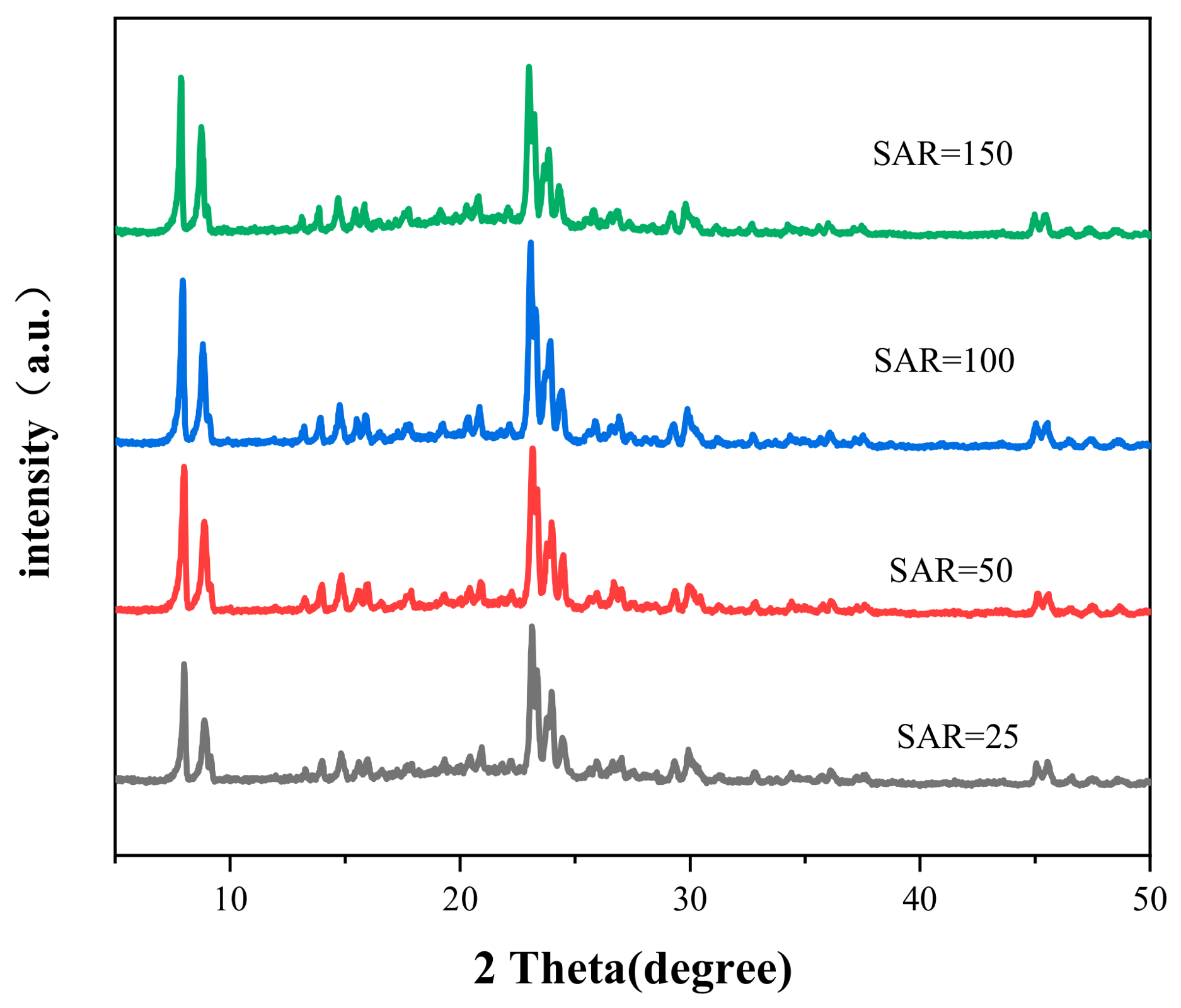
The silicon-to-aluminum ratio (SAR) directly influences the acid properties of zeolites. Figure 3 shows the XRD patterns of samples synthesized with different silicon-to-aluminum ratios using activated mud as the precursor. All samples exhibited characteristic diffraction peaks typical of MFI zeolites, indicating that this method can synthesize well-crystallized ZSM-5 zeolites within a feedstock silicon-to-aluminum ratio range of 25–150.
TEM images of ZSM-5 zeolite synthesized at different silicon-to-aluminum ratios are shown in Figure S3. As seen in the figure, ZSM-5 synthesized at different silicon-to-aluminum ratios exhibited a nanosheet structure with relatively uniform particle size and well-defined crystal planes [33]. Samples synthesized at low silicon-to-aluminum ratios showed some agglomeration.
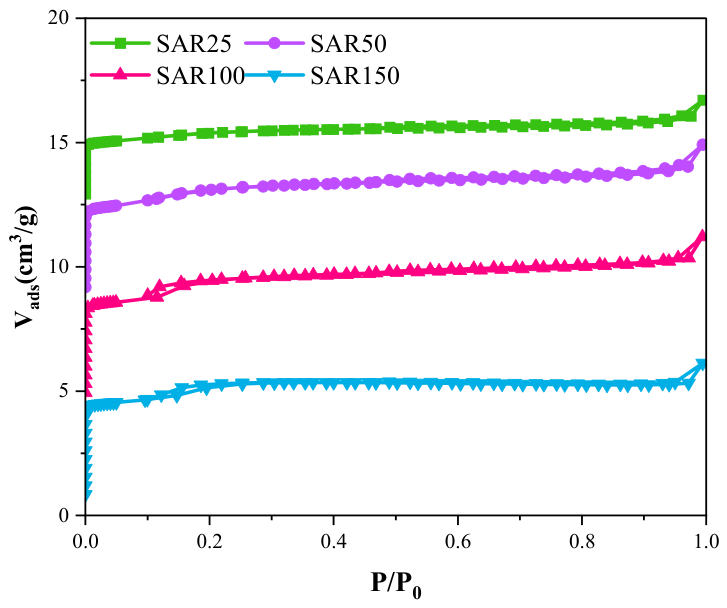
Figure 4 shows the N2 adsorption–desorption isotherms and pore size distribution diagrams for ZSM-5 zeolites with different silicon-to-aluminum ratios. As seen in the figure, all N2 adsorption/desorption isotherms for the ZSM-5 zeolites exhibit typical Type I isotherms, characterized by a steep increase in N2 adsorption capacity within an extremely low relative pressure range. This indicated that all samples possess a micropore structure [34].
Table 2 compares the textural properties of the four samples. As the silicon-to-aluminum ratio increases, the specific surface area, external surface area, and pore volume of the synthesized zeolite all showed an upward trend. This may be attributed to the formation of non-framework aluminum covering the zeolite surface, which reduces the specific surface area and pore volume.
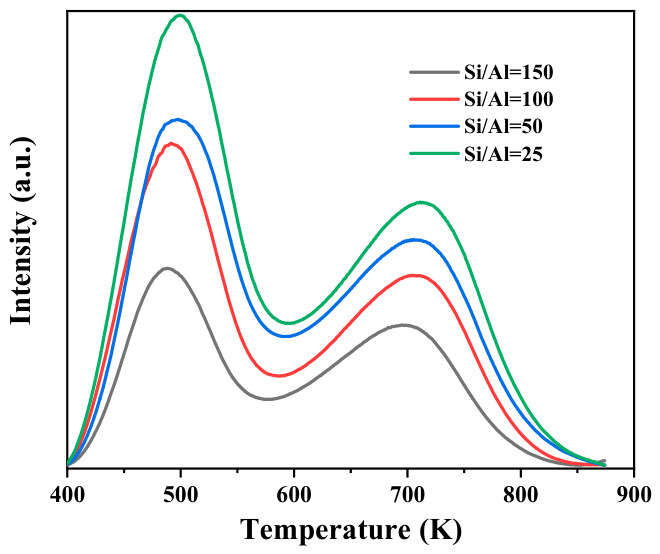
The acid properties of those samples with different silicon-to-aluminum ratios were studied by the NH3-TPD results (Figure 5). All samples show two distinct NH3 desorption peaks, representing the weak acid sites at low temperature (400~600 K) and the strong acid sites at high temperature (600~800 K), respectively. The acid concentration determined from the deconvoluted desorption peak areas are summarized in Table 3. It can be found that both of the weak and strong acid sites decreased with the increase in Si/Al ratio of those samples. This phenomenon is mainly attributed to the reduced framework Al content, which inevitably decreases the total number of acid sites at a higher silicon-to-aluminum ratio.
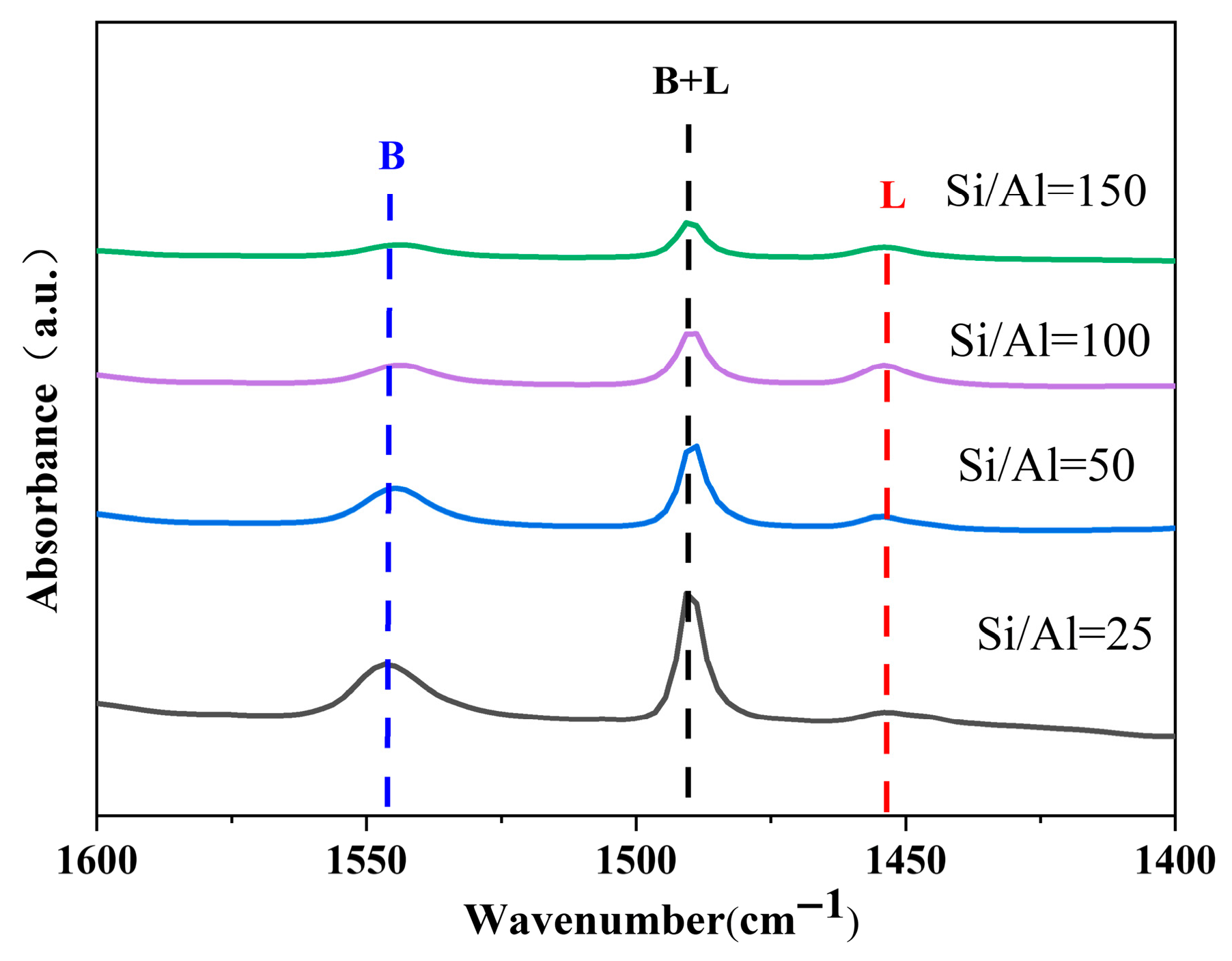
The Brønsted acidity and Lewis acidity of ZSM-5 zeolite synthesized with different silicon-to-aluminum ratios are shown in Figure 6. The desorption peaks near 1540 cm−1 and 1446 cm−1 correspond to pyridine adsorption at Brønsted acid sites and Lewis acid sites, respectively [35]. The desorption peak at 1484 cm−1 arose from resonance between the pyridine ring at Brønsted acid sites and Lewis acid sites. It can be observed that as the silicon-to-aluminum ratio increases, the acidity gradually decreases, corresponding to the aforementioned NH3-TPD spectrum. This was attributed to the increased silicon-to-aluminum ratio in the parent ZSM-5 zeolite, resulting in fewer aluminum atoms entering the zeolite framework and consequently generating fewer acidic sites.
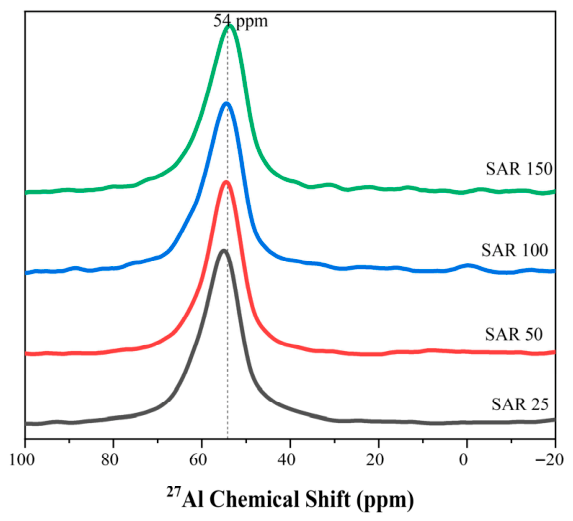
Solid-state NMR data for ZSM-5 zeolite synthesized with different silicon-to-aluminum ratios are shown in Figure 7. The aluminum in zeolite materials was primarily divided into two types: AlIV species on the framework and non-framework AlVI species. Among these, the AlIV species on the framework were the primary source of zeolite acidity, endowing the zeolite with strong acidity and excellent catalytic activity. From the 27Al MAS NMR results, it was evident that all samples exhibit a framework aluminum species with a tetrahedral coordination at 54 ppm, while a hexahedral non-framework aluminum species was essentially absent at 0 ppm [36,37]. This indicated that MFI zeolites synthesized entirely from activated natural silicoaluminate minerals did not contain octahedral non-framework AlVI species. As the molar ratio of silicon-to-aluminum increases, the chemical site at 54 ppm gradually weakens, further indicating a reduction in the actual framework aluminum content within the zeolite.

2.2.5. Study on the Mechanism of Crystallization Process

Using the dynamic crystallization method, the product changes over time were studied at a rotation speed of 50 rpm and a temperature of 170 °C to investigate the crystallization mechanism. All subsequent experiments were conducted under these reaction conditions.
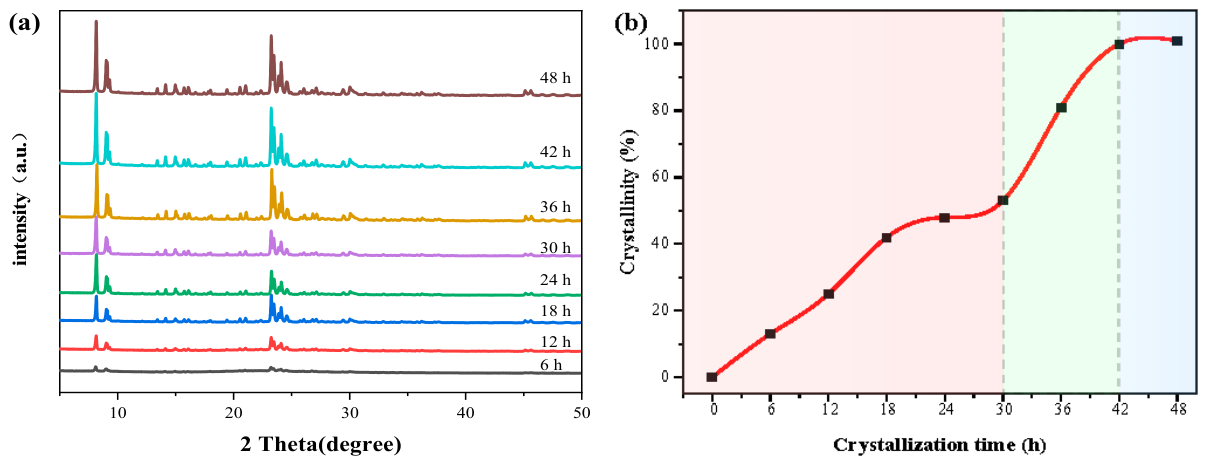
Figure 8a shows the XRD patterns of samples at different crystallization times. It can be observed that as time progresses, the growth process of ZSM-5 involved a crystallization transition from an amorphous phase to a crystalline phase. The XRD pattern of the sample obtained at 6 h exhibits peaks at 2θ = 8.09°, 9.04°, 13.16°, 13.92°, 14.70°, 15.56°, 15.86°, 23.06°, 23.92°, and 24.35°. These weak characteristic ZSM-5 diffraction peaks were attributed to seed crystal signals, indicating that the product primarily consisted of an amorphous silicoaluminate gel. The intensity of the characteristic ZSM-5 diffraction peaks increased significantly after 12 h and continued to rise gradually with extended crystallization time. No significant change in peak intensity was observed after 42 h, indicating that well-crystallized zeolite samples can be obtained after 42 h of crystallization.
The relative crystallinity of products at different crystallization times was calculated based on characteristic peak areas, and crystallization curves were plotted as shown in Figure 8b. The evolution of the ZSM-5 zeolite crystallization curve can be divided into three distinct stages. During the induction period prior to 30 h, silicon and aluminum components continuously leached from the mud. This process was accompanied by partial dissolution of seed crystals, forming additional nucleation sites and initiating crystal growth. After 30 h, as both nucleation sites and silicon–aluminum species reached their maximum levels in the system, the synthesis entered a rapid crystal growth phase. Following 42 h of crystallization, the effective components in the solution were largely depleted, and crystal growth entered a stabilization phase. The relative crystallinity remained virtually unchanged thereafter.
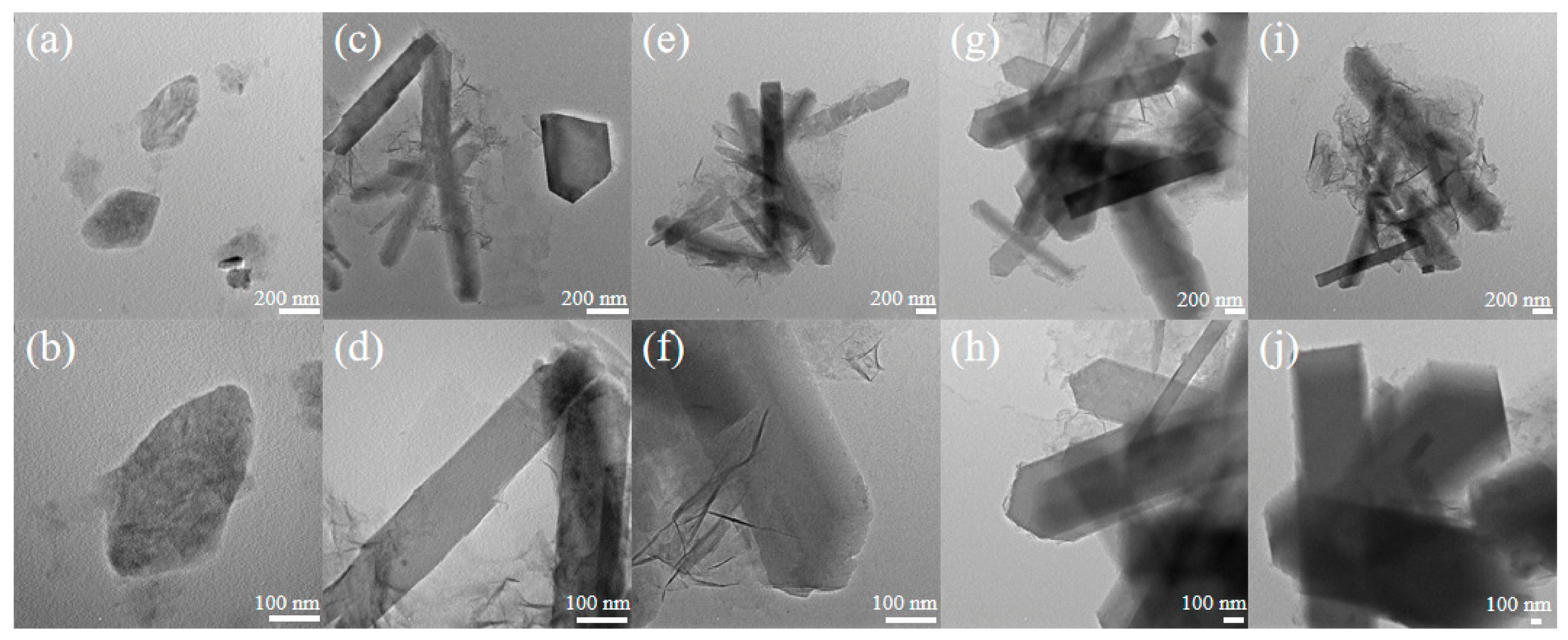
Figure 9 shows TEM images of synthesized samples at different crystallization times. As shown in the figure, after aging completion (crystallization time = 0 h), the solid product consists of fragmented mud precursors broken under vigorous stirring and the additionally added amorphous silica precursor. When the crystallization time reached 18 h, the ZSM-5 zeolite exhibited a preliminary plate-like morphology, though its edges remained indistinct. The surface appeared rough and uneven, dotted with amorphous material. When the crystallization time was further extended to 30 h, the product contained both relatively complete ZSM-5 zeolite single crystals and smaller ZSM-5 zeolite fragments that had not fully grown. At 42 h of crystallization, the product was filled with uniformly sized ZSM-5 zeolite crystals exhibiting well-defined outlines and increasingly smooth surfaces, presenting a regular plate-like morphology. Further prolongation of the time did not alter the morphology of the samples. Therefore, the optimal crystallization time was determined to be 42 h.
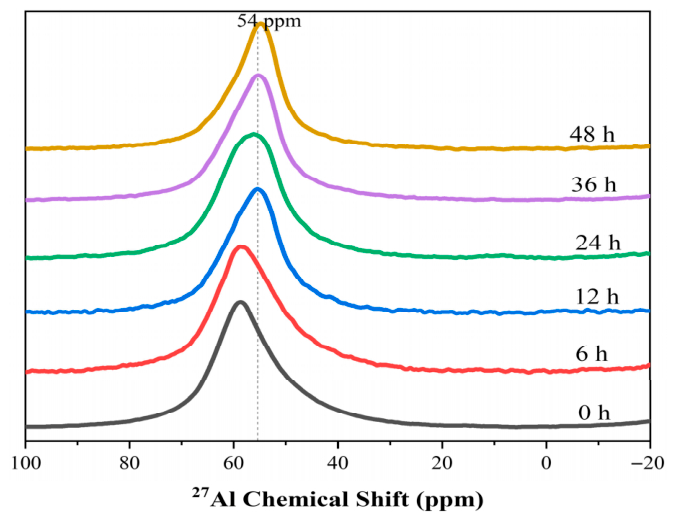
To investigate the coordination state of aluminum in the crystallization products at different crystallization times, aluminum NMR characterization was performed, as shown in Figure 10. At 0–6 h, only a signal for a tetracoordinate aluminum species was observed around 60 ppm, differing from the chemical shift of the tetracoordinate framework aluminum species. This suggested that the activated aluminum species in the mud is a highly reactive tetracoordinate aluminum species. The absence of a characteristic peak for the hexacoordinate, less reactive aluminum species at 0 ppm further indicated that the mud has been fully activated. At 12 h of crystallization, the highly active tetracoordinate aluminum at 60 ppm gradually shifted toward tetracoordinate framework aluminum at 54 ppm, at which point crystal nuclei in the system begin to grow slowly (Figure 11 and Figure 12). When crystallization reaches 48 h, the characteristic peak at 54 ppm narrowed significantly, indicating that nearly all aluminum species exist as tetracoordinate framework aluminum.
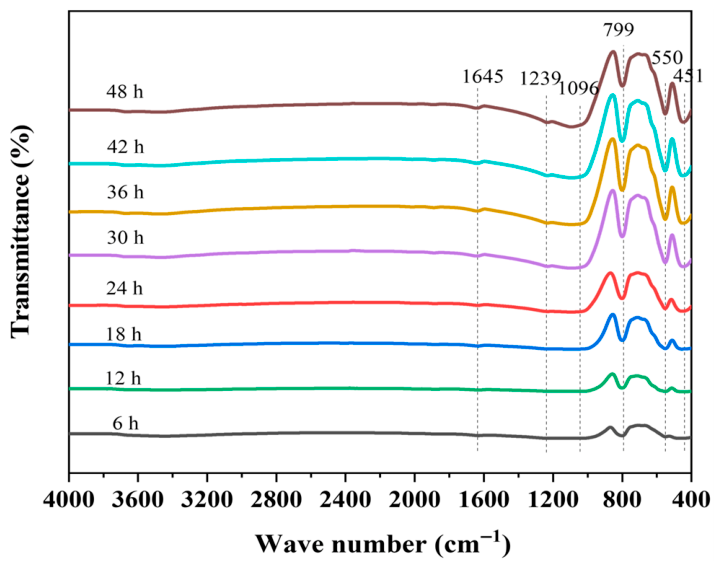
Figure 11 compares Fourier transform infrared spectra of samples with different crystallization times. The vibration peak at 451 cm−1 was attributed to the bending vibration of the T-O bond (where T is Si or Al), while the peak at 799 cm−1 corresponds to the symmetric stretching vibration of the T-O bond. The vibration peak at 1096 cm−1 can be attributed to the antisymmetric stretching vibration of the T-O-T bond, while the peak at 1239 cm−1 originated from the symmetric stretching vibration of the T-O-T bond. These vibrational modes reflected the structural linkages between the silicon–oxygen and aluminum–oxygen tetrahedra within the zeolite framework. Additionally, the characteristic absorption band near 550 cm−1 correlated with the unique double-pentagonal ring vibration mode of ZSM-5 zeolite, serving as crucial evidence for its structural presence [38]. Prior to 24 h, the absorption peak intensity showed no significant change, indicating relatively low crystallinity during this induction phase. After 24 h, as crystallization time increased, the intensity of the characteristic peak markedly enhanced, reflecting progressively higher crystallinity and corresponding to a rapid crystal growth phase. This crystallization kinetic behavior aligned with XRD analysis conclusions, jointly confirming the crystallization process of ZSM-5 zeolite.
Based on the above discussion, a synthesis strategy combining mud alkali fusion activation with seed-directed hydrothermal synthesis has been proposed to achieve high-value utilization of waste drilling mud (Figure 12). The growth process can be described as follows: First, the mud precursor was activated using the alkali fusion activation method. With the assistance of a chemical medium (NaOH), the crystalline phase structure of the minerals was completely disrupted. The highly polymerized silica–alumina minerals were gradually depolymerized into chain-like, ring-like, and island-like oligomeric amorphous silica–alumina species. During the initial crystallization phase, these amorphous oligomeric silicoaluminate species continuously dissolve, supplying abundant nutrients for the formation of the initial gel. Simultaneously, S-1 seeds first depolymerized into numerous smaller nucleation centers within the alkaline environment. Subsequently, the seed crystal was enveloped by silicon–aluminum species within the system and began to grow. Once both the silicon–aluminum content and the number of crystal nuclei reached saturation in the system, the nuclei rapidly absorb silicon–aluminum species to grow rapidly, forming numerous nanocrystals of varying sizes. As the hydrothermal crystallization time extended, the nanocrystals self-assemble into regular, uniform plate-like particles. Finally, when the materials in the gel system were depleted, the crystal growth rate and depolymerization rate reach equilibrium, and crystal growth ceases.

2.3. Reaction Performance Evaluation

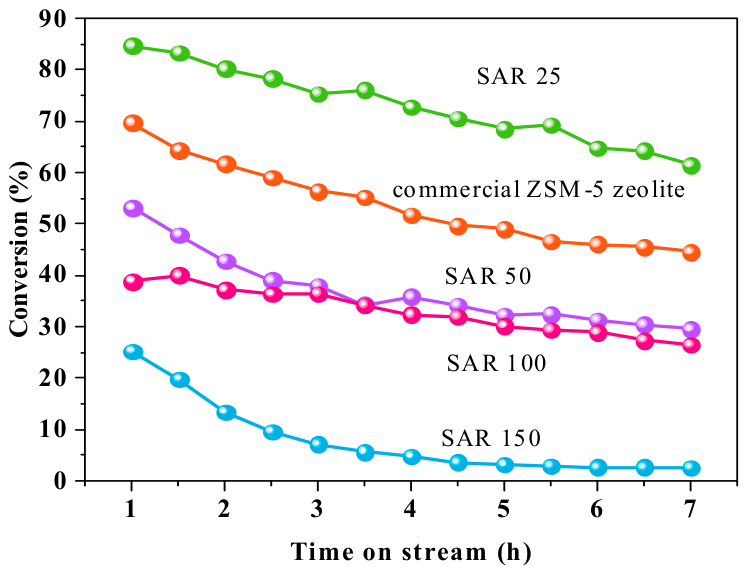
To evaluate the catalytic performance of ZSM-5 zeolite synthesized from drilling mud-derived silicon and aluminum sources, the catalytic cracking of bulky 1,3,5-triisopropylbenzene (TIPB) was carried out in a fixed-bed reactor. To objectively assess the catalytic quality of the as-synthesized zeolites, a commercial industrial ZSM-5 sample with a silicon-to-aluminum ratio (SAR) of 38 was introduced as a reference. The reaction results are presented in Figure 13. It can be seen that the TIPB conversion gradually declines with the increase in SAR for the synthetic ZSM-5 samples. Given that the kinetic diameter of TIPB is 0.94 nm, it cannot diffuse into the intrinsic micropore channels of ZSM-5. Hence, the TIPB cracking reaction is restricted to the external surface of zeolite crystals, and the catalytic activity is dominantly determined by the quantity and strength of acid sites distributed on the external surface region.
The acid site distribution derived from NH3-TPD characterization is summarized in Table 3. The synthetic SAR-25 sample exhibits the highest total acid content of 665 μmol/g, including 362 μmol/g weak acid sites and 302 μmol/g strong acid sites, which endows it with the optimal initial TIPB cracking activity and even surpasses the industrial SAR-38 ZSM-5 reference. Notably, SAR-50 and SAR-100 possess greatly different total acid amounts of 328 μmol/g and 264 μmol/g, respectively, while they deliver nearly identical catalytic performance in TIPB cracking (Figure 13). This phenomenon can be reasonably explained by the acid strength distribution. The ratio of strong acid sites to weak acid sites is highly close between SAR-50 (159/169 ≈ 0.94) and SAR-100 (130/134 ≈ 0.97). Furthermore, after normalization by external specific surface area (98 m2/g for SAR-50 and 127 m2/g for SAR-100), the surface density of strong acid sites of the two samples is comparable. Relevant literature has demonstrated that strong Brønsted acid sites of MFI-type zeolites are preferentially situated at channel intersections, which are highly accessible to bulky TIPB molecules [39]. By contrast, weak acid sites originating from surface silanol groups or structural defects make negligible contribution to cracking activity. Consequently, even though the total acid amount of SAR100 is lower than that of SAR50, the ratio of strong acid amounts (159/130 ≈ 1.22) is close to the ratio of external surface areas (127/98 ≈ 1.30), resulting in a comparable external surface density of strong acid sites; together with its larger external surface area, this enables equivalent catalytic behavior. Meanwhile, the catalytic activity of industrial SAR-38 ZSM-5 is between SAR-25 and SAR-50, further verifying that the drilling mud-synthesized ZSM-5 with appropriate SAR possesses excellent acid properties and competitive catalytic cracking performance compared with commercial industrial samples.

3. Experiment Section

3.1. Materials

The dried water-based drilling mud (WBM) was sourced from Shengli Oilfield; silica gel (solid powder, 98 wt% SiO2) was purchased from Aladdin Reagent Co., Ltd. (Shanghai, China); n-butylamine (analytical grade) was obtained from Sinopharm Chemical Reagent Co., Ltd. (Shanghai, China); NaOH (analytical grade) was sourced from Beijing Chemical Factory (Beijing, China); HCl (37.5% by mass) was sourced from Jinzhou Gucheng Chemical Reagent Co., Ltd. (Jinzhou, China). Commercial pure silica zeolite with a typical MFI topological structure (S-1, served as seed) were provided by RuiZhiAn New Materials Co., Ltd. (Zibo, China).

3.2. Synthetic Procedures

3.2.1. Activation of Dried Drilling Mud

For alkali activation, 1 g of mud precursor was placed in 10 mL of sodium hydroxide solution (1 mol/L) and stirred at 90 °C for 4 h. This treatment was repeated three times. Finally, the mixture was washed to neutrality and dried.
For acid activation, the mud precursor was placed in a 2 mol/L hydrochloric acid solution at a liquid-to-solid ratio of 10 mL/g and treated at 80 °C for 12 h. Afterwards, the mixture was washed to neutrality and dried.
For mechanical activation, the mud precursor was placed into a ball milling jar and milled for 1 h, after which the ball-milled material was separated.
For pseudo-solid-phase activation, the mud, sodium hydroxide, and water were mixed in a mass ratio of 1:1:0.4, and the mixture was then extruded into rods. The rods were dried in an oven at 100 °C for 12 h.
For sub-molten salt activation, NaOH and water were placed in a 1:1 mass ratio within a PTFE-lined vessel and stirred until dissolved. Then, 10 g of mud was added to the NaOH solution. The thoroughly mixed product was treated in an oven at 240 °C for 2 h. The sample was then removed, ground, washed, and dried for later use.
For alkali fusion activation, the mud was ground with NaOH at a mass ratio of 1:0.2 in a mortar for 10 min until uniformly mixed. The mixture was transferred to a zirconia dry pot and treated at 900 °C in a muffle furnace for 2 h. After removal, it was ground and set aside for later use.

3.2.2. Synthesis of ZSM-5 Zeolite

For the synthesis, 2.5 g of alkali-fused mud precursor, 2.58 g of silica gel, 1.19 g of n-butylamine, 0.079 g of seed crystals, and 29.51 g of deionized water were thoroughly mixed until uniformly blended. The final molar composition of the system was: 1.0 SiO2: 0.04 Al2O3: 0.25 C4H11N: 0.10 Na2O: 25 H2O, with the seed addition accounting for 2% of the total SiO2 mass in the system, where the optimal conditions for ZSM-5 aggregates were established. The mixture was stirred continuously at room temperature for 3 h to form a uniform gel. The gel was then transferred to a stainless steel crystallization vessel lined with polytetrafluoroethylene and subjected to rotary crystallization at 170 °C. After crystallization, the mixture was allowed to cool naturally to room temperature, and the mother liquor was separated and removed by filtration. The solid product was repeatedly washed with deionized water until the washings approached neutrality. The washed solid was then dried in an oven at 100 °C. The dried solid product was placed in a muffle furnace and calcined at 550 °C for 4 h to completely remove the template agent from the system, yielding NaZSM-5 zeolite. All aluminum and alkali sources originated from the mud precursor, while other silicon-to-aluminum ratios of ZSM-5 were achieved by adjusting the silica gel to mud ratio.
For ion exchange, the prepared NaZSM-5 zeolite was subjected to treatment with a 1 mol/L NH4NO3 solution at 80 °C. A liquid-to-solid ratio of 10 mL/g was maintained, with each exchange lasting 1.5 h and the process being repeated three times. After the ion exchange was completed, the material was washed and dried again. It was then placed in a muffle furnace and calcined at 550 °C for 4 h, ultimately yielding H-type ZSM-5 zeolite.

3.3. Materials Characterization

XRD patterns were obtained using a Rigaku SmartLab X-ray diffractometer (Akishima-shi, Japan) operated with Rigaku SmartLab Studio II software. The instrument was equipped with a Cu Kα X-ray source and operated at 40 kV and 100 mA. The scanning range was set from 2θ = 5° to 50°, with a scanning speed of 8°/min. TEM images were acquired using an FEI Tecnai G220 S-twin transmission electron microscope (Hillsboro, OR, USA) operated with FEI Tecnai User Interface software at an acceleration voltage of 200 kV. High-resolution TEM images were obtained using a JEOL JEM-2100F transmission electron microscope (Tokyo, Japan) operated with JEOL TEM Center software. The sample was prepared as follows: the sample powder was dispersed in ethanol, and the suspension was then deposited onto a carbon-based copper mesh using a capillary tube. The ethanol was allowed to evaporate, and the sample was set aside for later use. Nitrogen physical adsorption data were obtained using a Quadrasorb SL gas adsorption analyzer (Quantachrome Instruments, Inc., Boynton Beach, FL, USA) operated with Quantachrome QuadraWin software (Version 7.1), primarily to collect information on the mesoporous structure. Prior to testing, the samples were degassed for 8 h at 573 K under vacuum conditions and subsequently tested at 77 K. The BET specific surface area was calculated using the multipoint BET method. The external specific surface area and micropore volume were determined via the t-plot method. The total pore volume was calculated at a relative pressure of P/P = 0.99. The mesopore size distribution curve was obtained using the BJH method. Pyridine infrared spectra were obtained using a Nicolet 6700 infrared spectrometer (Thermo Fisher Scientific, Waltham, MA, USA) operated with Thermo Fisher OMNIC software (Version 9.0). The test resolution was 4 cm−1, the scan range was 400–4000 cm−1, and the number of scans was 64. For pyridine infrared spectroscopy (Py-IR), the spectrum obtained after cooling to room temperature was used as the background. Pyridine was adsorbed at room temperature for 30 min, followed by desorption at 573 K for 30 min each. The difference spectra were then obtained by scanning. The chemical composition of the samples was determined by X-ray fluorescence spectroscopy (XRF) using a Zetiym XRF spectrometer (PANalytical B.V., Almelo, The Netherlands) operated with IQ + NEW software (Version 3.0). The relative content of each element was calculated using IQ + NEW software (Version 3.0, Malvern Panalytical, Almelo, The Netherlands) for standardless quantitative analysis. The acid content and acid strength of the samples were measured on an in-house ammonia temperature-programmed desorption instrument equipped with a TCD detector. The specific operational steps were as follows: 0.1400 g of sample (20–40 mesh) was accurately weighed and placed in a U-shaped quartz tube. The sample was pre-treated at 530 °C for 30 min under a helium atmosphere and then cooled to 120 °C. NH3 was injected until adsorption saturation was achieved. After purging with helium until the detector baseline stabilized, the temperature was increased to 605 °C at a rate of 10 °C/min to gradually desorb the NH3. During the temperature ramp, the desorption signals of NH3 were continuously recorded by a Shimadzu GC-8A gas chromatograph (Nakagyo-ku, Japan). The acid strength was determined based on the desorption temperature of NH3, while the total acid content of each sample was calculated from the corresponding total NH3 desorption peak area. 27Al MAS NMR spectra were recorded using a one-pulse sequence with a spinning rate of 20 kHz. A total of 2048 scans were performed with a π/12 pulse width of 0.33 μs and a recycle delay of 2 s. Spectral processing was performed using Bruker TopSpin software (Version 4.0).

3.4. Evaluation of Catalytic Performance

A fixed-bed apparatus was constructed in the laboratory to conduct FCC catalytic cracking measurements. Using 1,3,5-triisopropylbenzene (TIPB) as a model compound, the reaction was evaluated at 350 °C under atmospheric pressure (0.1 MPa) and a nitrogen atmosphere. First, 1.0 g of catalyst was formed into 20–40 mesh particles and loaded into the reactor in the order of ceramic balls, catalyst, and ceramic balls; the catalyst was loaded into a stainless steel reaction tube (60 cm in length and 8 mm in inner diameter). The catalyst was pre-treated for 1 h at 500 °C under a nitrogen atmosphere, followed by reaction at a controlled temperature of 350 °C. The mass space velocity was maintained constant at 2 h−1. The injection volume of 1,3,5-triisopropylbenzene was 2.5 mL. TIPB conversion was analyzed using a gas chromatograph (Varian CP300, Agilent, Santa Clara, CA, USA) operated with Varian Star Workstation software (Version 4.5, Varian, Inc., Walnut Creek, CA, USA) equipped with a flame detector and a 50 m HP-PONA capillary column to measure reactants and products.

4. Conclusions

Research findings indicated that unactivated drilling mud exhibits stable structure and cannot directly synthesize pure-phase ZSM-5 zeolite. Comparing acid–base activation, mechanical activation, pseudo-solid-phase activation, and sub-molten salt activation methods revealed that the alkali fusion activation process can completely disrupt the layered silicoaluminate structure of inert components such as quartz and feldspar in drilling mud, achieving a relative activation rate of inert components reaching 90%. Using n-butylamine as a template agent and S-1 as a nucleating agent, ZSM-5 zeolite was synthesized. By modulating the water–silica ratio, crystallization time, and template agent dosage, highly crystalline ZSM-5 zeolite was successfully synthesized. The synthesized ZSM-5 zeolites with varying silicon-to-aluminum ratios all exhibited high crystallinity and high specific surface area. Aluminum NMR results indicated that the aluminum species were predominantly tetracoordinated framework aluminum. In the 1,3,5-triisopropylbenzene cracking reaction, the conversion rate increased with decreasing silicon-to-aluminum ratio, consistent with changes in acid loading.

Supplementary Materials

The following supporting information can be downloaded at: https://www.mdpi.com/article/10.3390/catal16050452/s1, Figure S1: XRD patterns of samples synthesized using activated WBM as the precursor under different water-to-silicon ratios; Figure S2: XRD patterns of samples synthesized by adding different amount of template; Figure S3: TEM images of crystallized products under different silicon–aluminum ratios of feeding (a,b: SAR = 25; c,d: SAR = 50; e,f: SAR = 100; g,h: SAR = 150).

Author Contributions

J.Z.: Conceptualization, Methodology, Investigation, Writing—original draft, Software. G.W.: Conceptualization, Methodology, Validation, Resources, Funding acquisition, Project administration, Supervision. T.Z.: Data curation, Writing—review & editing. Y.J.: Investigation, Validation. F.L.: Conceptualization, Funding acquisition, Methodology, Resources, Writing—review & editing, Supervision. All authors have read and agreed to the published version of the manuscript.

Funding

This work was supported by the Shandong Provincial Postdoctoral Innovation Project (SDCX-ZG-202502100).

Data Availability Statement

The raw data supporting the conclusions of this article will be made available by the authors on request.

Conflicts of Interest

Author Guanchao Wang was employed by the company Technology Inspection Center of Shengli Oilfield Branch. The remaining authors declare that the research was conducted in the absence of any commercial or financial relationships that could be construed as a potential conflict of interest.

References

  1. Zhou, Y.; Wang, M.; Yuan, H.; Huang, L. Research on the security of China’s oil resources supply based on the objective weight method. J. Saf. Sci. Resil. 2023, 4, 265–273. [Google Scholar] [CrossRef]
  2. Fu, E.; He, W. The development and utilization of shale oil and gas resources in China and economic analysis of energy security under the background of global energy crisis. J. Pet. Explor. Prod. Technol. 2024, 14, 2315–2341. [Google Scholar] [CrossRef]
  3. Chen, F.; Sun, L.; Jiang, B.; Huo, X.; Pan, X.; Feng, C.; Zhang, Z. A Review of AI Applications in Unconventional Oil and Gas Exploration and Development. Energies 2025, 18, 391. [Google Scholar] [CrossRef]
  4. Waqar, A.; Othman, I.; Shafiq, N.; Mansoor, M.S. Applications of AI in oil and gas projects towards sustainable development: A systematic literature review. Artif. Intell. Rev. 2023, 56, 12771–12798. [Google Scholar] [CrossRef]
  5. Ayilara, M.S.; Babalola, O.O. Bioremediation of environmental wastes: The role of microorganisms. Front. Agron. 2023, 5, 1183691. [Google Scholar] [CrossRef]
  6. Palansooriya, K.N.; Shaheen, S.M.; Chen, S.S.; Tsang, D.C.W.; Hashimoto, Y.; Hou, D.; Bolan, N.S.; Rinklebe, J.; Ok, Y.S. Soil amendments for immobilization of potentially toxic elements in contaminated soils: A critical review. Environ. Int. 2020, 134, 105046. [Google Scholar] [CrossRef]
  7. Fashola, M.O.; Ngole-Jeme, V.M.; Babalola, O.O. Heavy Metal Pollution from Gold Mines: Environmental Effects and Bacterial Strategies for Resistance. Int. J. Environ. Res. Public Health 2016, 13, 1047. [Google Scholar] [CrossRef]
  8. Lei, Q.; Xu, Y.; Cai, B.; Guan, B.; Wang, X.; Bi, G.; Li, H.; Li, S.; Ding, B.; Fu, H.; et al. Progress and prospects of horizontal well fracturing technology for shale oil and gas reservoirs. Pet. Explor. Dev. 2022, 49, 191–199. [Google Scholar] [CrossRef]
  9. Wen, H.; Li, Y.; Yin, H.; Wang, W.; Jin, Z.; Han, S.; Jiang, N. Simple and sustainable synthesis of loosely stacked nano-H-ZSM-5 aggregates from kaolin and catalytic studies. Adv. Powder Technol. 2024, 35, 104635. [Google Scholar] [CrossRef]
  10. Wang, L.; Gao, X.; Qu, Y.; Diao, Y.; Song, H. Facile activation approach of steam-deactivated ZSM-5 zeolite for light olefin production in catalytic cracking reactions. Fuel 2025, 384, 133957. [Google Scholar] [CrossRef]
  11. Li, G.; Foo, C.; Fan, R.; Zheng, M.; Wang, Q.; Chu, Y.; Li, J.; Day, S.; Steadman, P.; Tang, C.; et al. Atomic locations and adsorbate interactions of Al single and pair sites in H-ZSM-5 zeolite. Science 2025, 387, 388–393. [Google Scholar] [CrossRef]
  12. Gao, J.; Lin, Q.; Yang, T.; Bao, Y.; Liu, J. Preparation and characterization of ZSM-5 molecular sieve using coal gangue as a raw material via solvent-free method: Adsorption performance tests for heavy metal ions and methylene blue. Chemosphere 2023, 341, 139741. [Google Scholar] [CrossRef] [PubMed]
  13. Narayanan, S.; Duraisamy, K.; Bharanitharan, A. Utilizing ZSM-5 Zeolite, Synthesized from Kaolin Clay, as a Catalyst Presents an Efficient Approach for Reducing Emissions in Compression Ignition (CI) Engines. Eng. Proc. 2025, 93, 16. [Google Scholar]
  14. Zhao, Y.; Gu, S.; Li, L.; Wang, M. From waste to catalyst: Growth mechanisms of ZSM-5 zeolite from coal fly ash & rice husk ash and its performance as catalyst for tetracycline degradation in fenton-like oxidation. Environ. Pollut. 2024, 345, 123509. [Google Scholar] [CrossRef]
  15. Sun, J.; Yang, J.; Bai, Y.; Lyu, K.; Liu, F. Research progress and development of deep and ultra-deep drilling fluid technology. Pet. Explor. Dev. 2024, 51, 1022–1034. [Google Scholar] [CrossRef]
  16. Hamri, N.; Imessaoudene, A.; Hadadi, A.; Cheikh, S.; Boukerroui, A.; Bollinger, J.-C.; Amrane, A.; Tahraoui, H.; Tran, H.N.; Ezzat, A.O.; et al. Enhanced Adsorption Capacity of Methylene Blue Dye onto Kaolin through Acid Treatment: Batch Adsorption and Machine Learning Studies. Water 2024, 16, 243. [Google Scholar] [CrossRef]
  17. Shahcheragh, S.K.; Bagheri Mohagheghi, M.M.; Shirpay, A. Effect of physical and chemical activation methods on the structure, optical absorbance, band gap and urbach energy of porous activated carbon. SN Appl. Sci. 2023, 5, 313. [Google Scholar] [CrossRef]
  18. Han, R.; Guo, X.; Guan, J.; Yao, X.; Hao, Y. Activation Mechanism of Coal Gangue and Its Impact on the Properties of Geopolymers: A Review. Polymers 2022, 14, 3861. [Google Scholar] [CrossRef]
  19. Takahashi, H. Effects of Dry Grinding on Kaolin Minerals. I. Kaolinite. Bull. Chem. Soc. Jpn. 1959, 32, 235–245. [Google Scholar] [CrossRef]
  20. Yang, Y.; Zhao, X.; Lv, J.; Fan, S. Sustainable synthesis of NaX by quasi-solid phase conversion from coal fly ash. J. Environ. Chem. Eng. 2024, 12, 114413. [Google Scholar] [CrossRef]
  21. Li, X.; Yuan, L.; Liu, D.; Xiang, J.; Li, Z.; Huang, Y. Solid/Quasi-Solid Phase Conversion of Sulfur in Lithium-Sulfur Battery. Small 2022, 18, 2106970. [Google Scholar] [CrossRef]
  22. Prokof’ev, V.Y.; Gordina, N.E. Preparation of granulated LTA and SOD zeolites from mechanically activated mixtures of metakaolin and sodium hydroxide. Appl. Clay Sci. 2014, 101, 44–51. [Google Scholar] [CrossRef]
  23. Yang, D.; Yu, M.; Mubula, Y.; Yuan, W.; Huang, Z.; Lin, B.; Mei, G.; Qiu, T. Recovering rare earths, lithium and fluorine from rare earth molten salt electrolytic slag using sub-molten salt method. J. Rare Earths 2024, 42, 1774–1781. [Google Scholar] [CrossRef]
  24. Luo, X.; Huang, L.; Wei, L.; Chen, M.; Zhou, Z.; Zhang, T. A technique for preparing one-part geopolymers by activating alkali-fused lithium slag with solid sodium silicate. Constr. Build. Mater. 2024, 435, 136817. [Google Scholar] [CrossRef]
  25. Wang, K.; Peng, N.; Sun, J.; Lu, G.; Chen, M.; Deng, F.; Dou, R.; Nie, L.; Zhong, Y. Synthesis of silica-composited biochars from alkali-fused fly ash and agricultural wastes for enhanced adsorption of methylene blue. Sci. Total Environ. 2020, 729, 139055. [Google Scholar] [CrossRef] [PubMed]
  26. Lalji, S.M.; Ali, S.I.; Khan, M.A.; Ghauri, R. Investigation of rheological behavior, filtration characteristics and microbial activity of biopolymer water-based drilling fluids containing monovalent and divalent cations. Chem. Pap. 2023, 77, 4693–4704. [Google Scholar] [CrossRef]
  27. Sun, Y.; Pan, A.; Ma, Y.; Chang, J. Extraction of alumina and silica from high-silica bauxite by sintering with sodium carbonate followed by two-step leaching with water and sulfuric acid. RSC Adv. 2023, 13, 23254–23266. [Google Scholar] [CrossRef]
  28. Asselman, K.; Kirschhock, C.; Breynaert, E. Illuminating the Black Box: A Perspective on Zeolite Crystallization in Inorganic Media. Acc. Chem. Res. 2023, 56, 2391–2402. [Google Scholar] [CrossRef] [PubMed]
  29. Tang, X.; Altundal, O.F.; Daeyaert, F.; Liu, Z.; Sastre, G. Computational insights on the role of structure-directing agents (SDAs) in the synthesis of zeolites. Chem. Soc. Rev. 2025, 54, 7067–7092. [Google Scholar] [CrossRef]
  30. Chen, F.J.; Yu, J. Discovery of Stable Extra-large Pore Zeolites Based on Rational Design of Structure-directing Agents. Acc. Chem. Res. 2025, 58, 2402–2414. [Google Scholar] [CrossRef]
  31. Di Iorio, J.R.; Gounder, R. Controlling the Isolation and Pairing of Aluminum in Chabazite Zeolites Using Mixtures of Organic and Inorganic Structure-Directing Agents. Chem. Mater. 2016, 28, 2236–2247. [Google Scholar] [CrossRef]
  32. Thompson, R.W. Chapter 2—Nucleation, growth, and seeding in zeolite synthesis. In Verified Syntheses of Zeolitic Materials; Elsevier: Amsterdam, The Netherlands, 2001; pp. 21–23. [Google Scholar]
  33. Liu, K.; Ramirez, A.; Zhang, X.; Çağlayan, M.; Gong, X.; Gascon, J.; Chowdhury, A.D. Interplay Between Particle Size and Hierarchy of Zeolite ZSM-5 During the CO2-to-aromatics Process. ChemSusChem 2023, 16, e202300608. [Google Scholar] [CrossRef]
  34. Wang, J.; Gao, X.; Chen, G.; Ding, C. Forming pure shaped ZSM-5 zeolite bodies by a steam-assisted method and their application in methanol to aromatic reactions. RSC Adv. 2019, 9, 28451–28459. [Google Scholar] [CrossRef]
  35. Lercher, J.A.; Ritter, G.; Vinek, H. Acid—Base properties of silica—Alumina oxides derived from NaX zeolites. II. Infrared and temperature-programmed desorption study of adsorption of pyridine. J. Colloid Interface Sci. 1985, 106, 215–221. [Google Scholar] [CrossRef]
  36. Du, K.; Zhang, X.; He, T.; Shen, W.; Xu, H.; Tang, Y.; Cao, X.-M.; Huang, Z.; Zhang, Y. Dynamic Evolution of Structural Ordering and Aluminum Redistribution During ZSM-5 Zeolite Crystallization. Angew. Chem. Int. Ed. 2025, 64, e202507223. [Google Scholar] [CrossRef] [PubMed]
  37. Sklenak, S.; Dědeček, J.; Li, C.; Wichterlová, B.; Gábová, V.; Sierka, M.; Sauer, J. Aluminium siting in the ZSM-5 framework by combination of high resolution 27Al NMR and DFT/MM calculations. Phys. Chem. Chem. Phys. 2009, 11, 1237–1247. [Google Scholar] [CrossRef]
  38. Lesthaeghe, D.; Vansteenkiste, P.; Verstraelen, T.; Ghysels, A.; Kirschhock, C.E.A.; Martens, J.A.; Speybroeck, V.V.; Waroquier, M. MFI Fingerprint: How Pentasil-Induced IR Bands Shift during Zeolite Nanogrowth. J. Phys. Chem. C 2008, 112, 9186–9191. [Google Scholar] [CrossRef]
  39. Ji, Y.; Liu, Z.M.; Zhao, Z.C.; Gao, P.; Bao, X.H.; Chen, K.Z.; Hou, G.J. Untangling Framework Confinements: A Dynamical Study on Bulky Aromatic Molecules in MFI Zeolites. ACS Catal. 2022, 12, 15288. [Google Scholar] [CrossRef]
Figure 1. XRD patterns of WBM (a), direct hydrothermal crystallization using WBM as precursor (b), acid activation (c), alkali activation (d), mechanical activation (e), pseudo-solid-phase activation (f), sub-molten salt activation (g), and alkali fusion activation (h) samples.
Catalysts 16 00452 g001
Figure 2. XRD patterns of samples synthesized with different seed addition amounts.
Catalysts 16 00452 g002
Figure 3. XRD patterns of samples synthesized using activated mud as precursor under different silicon–aluminum ratios.
Catalysts 16 00452 g003
Figure 4. N2 adsorption–desorption curves of crystallized products under different silicon–aluminum ratios of feeding.
Catalysts 16 00452 g004
Figure 5. NH3-TPD profiles of ZSM-5 zeolites with different silicon–aluminum ratios.
Catalysts 16 00452 g005
Figure 6. Py-IR spectra of ZSM-5 zeolites with different silicon–aluminum ratios.
Catalysts 16 00452 g006
Figure 7. 27Al MAS NMR spectra of crystallized products under different silicon–aluminum ratios of feeding.
Catalysts 16 00452 g007
Figure 8. XRD patterns (a) and crystallization curves (b) of sludge-based ZSM-5 zeolite molecular sieves under different crystallization times.
Catalysts 16 00452 g008
Figure 9. TEM images of products at different crystallization times ((a,b): 0 h; (c,d): 18 h; (e,f): 30 h; (g,h): 42 h; (i,j): 48 h).
Catalysts 16 00452 g009
Figure 10. 27Al MAS NMR spectra of crystallized products at different crystallization times.
Catalysts 16 00452 g010
Figure 11. FT-IR spectra of crystallization products under different crystallization times.
Catalysts 16 00452 g011
Figure 12. Study on the crystallization mechanism of drilling mud-based ZSM-5 zeolite via seed-directed hydrothermal synthesis.
Catalysts 16 00452 g012
Figure 13. Effect of ZSM-5 zeolites with different silicon–aluminum ratios on FCC catalytic cracking reaction performance.
Catalysts 16 00452 g013
Table 1. Chemical composition of the WBM and its activation product.
SampleComponent wt/%SiO2/Al2O3
(Molar Ratio)
Al2O3SiO2Na2OMgOSO3ClK2OCaOFe2O3Loss
WBM13.3641.895.542.831.463.412.219.014.2715.855.33
alkali fusion10.7053.9416.601.741.080.252.005.654.263.798.56
Table 2. Pore structure parameters of different silicon–aluminum ratios of ZSM-5 zeolites.
SamplesSBET
(m2/g)
Sext
(m2/g)
Vtotal
(cm3/g)
Vmicro
(cm3/g)
Vmeso
(cm3/g)
SAR = 25225480.110.070.04
SAR = 50337980.210.100.11
SAR = 1003681270.230.110.12
SAR = 1503781190.220.110.11
Table 3. Acid properties of different silicon–aluminum ratios of ZSM-5 zeolites.
SamplesAcidity (μmol g−1)
WeakStrongTotal
SAR 25362302665
SAR 50169159328
SAR 100134130264
SAR 1505257109
Disclaimer/Publisher’s Note: The statements, opinions and data contained in all publications are solely those of the individual author(s) and contributor(s) and not of MDPI and/or the editor(s). MDPI and/or the editor(s) disclaim responsibility for any injury to people or property resulting from any ideas, methods, instructions or products referred to in the content.