
Article

P,N-Codoped Carbon for Efficient 2,5-Diformylfuran Production from Fructose
1
School of Food and Biological Engineering, Xihua University, Chengdu 610039, China
2
Yibin Xihua University Research Institute, Yibin 644001, China
*
Author to whom correspondence should be addressed.
These authors contributed equally to this work.
Catalysts 2026, 16(5), 451; https://doi.org/10.3390/catal16050451
Submission received: 30 March 2026 / Revised: 5 May 2026 / Accepted: 9 May 2026 / Published: 12 May 2026

Abstract

This study presents an approach for the “one-pot two-step” synthesis of 2,5-diformylfuran (DFF) from fructose using a metal-free phosphorus-doped carbon nitride (P-CN) catalyst. The bifunctional P-CN integrates P-O bonds for acid-catalyzed fructose dehydration to 5-hydroxymethylfurfural (HMF) and P-C/graphitic-N sites for selective aerobic HMF oxidation to DFF. The 10% P-CN catalyst achieved 91.5% DFF yield during the stepwise oxidation of isolated HMF under the mild conditions (1.5 MPa O2, 120 °C), while the “one-pot” cascade reaction yielded 63% DFF due to competing side reactions. Characterization revealed that P-doping enhanced porosity (883 m2/g surface area) and electronic properties, with graphitic-N facilitating O2 activation. P=O groups are hypothesized to mediate proton transfer from reactive substrates via hydrogen-bonding networks, thereby enhancing acid-catalyzed pathways. NH3-TPD and XPS confirmed tailored acid sites and P-N/C elemental synergism, while FT-IR demonstrated substrate adsorption via P=O/HMF-OH interactions. The catalyst retained stability over multiple cycles, demonstrating its practicality. This work advances biomass valorization by elucidating the dual-role design of nonmetallic catalysts, offering an eco-friendly alternative to conventional metal-based systems.

Graphical Abstract

1. Introduction

The construction of catalytic systems for the valorization of biomass-derived carbohydrates into high-value chemicals has emerged as a pivotal strategy in addressing global environmental challenges and reducing reliance on fossil resources [1,2]. Among these chemicals, 2,5-furandicarboxaldehyde (DFF) has garnered significant attention owing to its broad range of applications in pharmaceuticals, polymers, and fine chemicals [3,4].
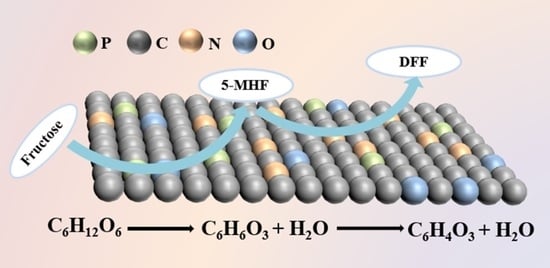
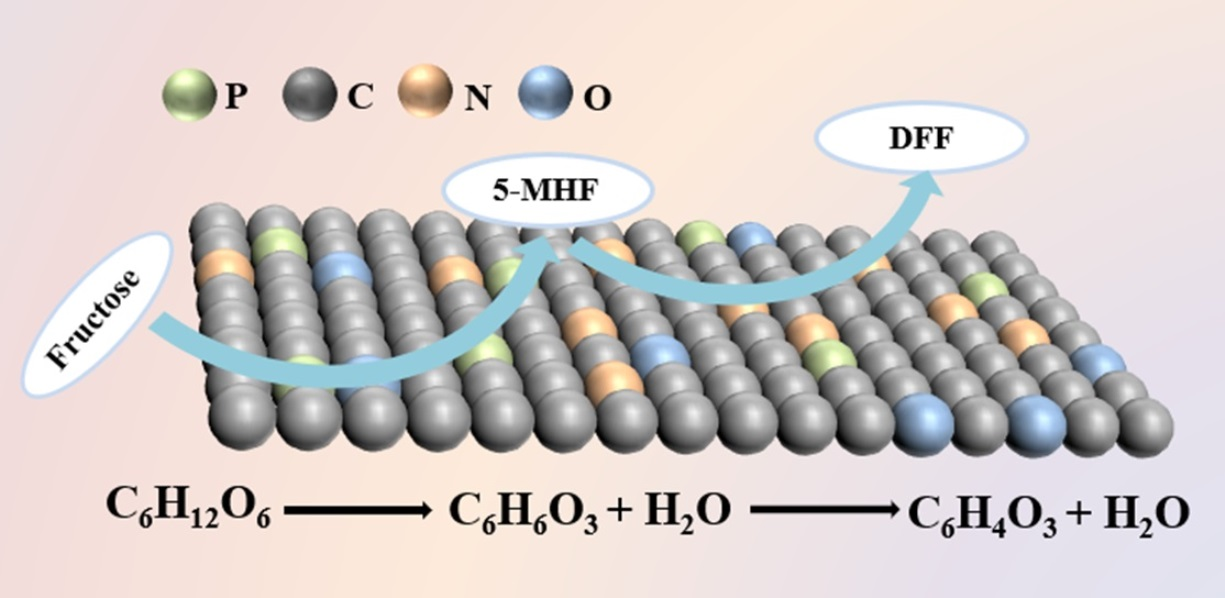
However, the high-efficiency selective conversion of biomass feedstocks such as fructose into DFF remains a formidable challenge, often requiring harsh reaction conditions or relying on expensive and environmentally unfriendly metal-based catalysts. Fructose conversion to DFF via the “one-pot two-step” strategy has been reported across relevant publications. The catalytic strategy based on the CrCl3/NaBr/NaVO3 system was employed by Xiang et al. for the one-step conversion of glucose, and ultimately a 18% DFF yield was achieved. By adding the catalyst in two steps, a higher DFF yield of 55% could be obtained than the one-step method [5]. Halliday used a combination of H+ resin and vanadium-based catalysts to realize the transformation of fructose into DFF using a “one-pot two-step” method. After optimizing the reaction conditions, the researchers chose DMSO as the reaction solvent and first utilized the acidic catalyst H+ resin to promote the formation of HMF (maximum yield: 80%). Subsequently, the generated HMF was converted to DFF at a 45% yield by a vanadium-based catalyst [6]. In addition, researchers such as Takagaki employed Amberlyst-15 as an acid catalyst, leading to the dehydration conversion of fructose to HMF, and then utilized the Ru/HT catalyst under an oxygen atmosphere to oxidize HMF to DFF, with a yield of 25% [7]. Chen used a solid acid catalyst, namely positively charged graphite carbon nitride (g-C3N4), to promote the hydrolysis of fructose, achieving a HMF yield of 80% [8]. Then the V-g-C3N4 catalyst was introduced to induce the reaction to obtain DFF in 63% yield. A team of researchers, including Cui [9], reported the catalytic production of DFF from fructose using V2O5/ceramic (V-CP (10 w%)) in DMSO solvent. First, fructose was induced to produce 5-HMF by removing three molecules of water with the assistance of H2SO4, followed by the oxidation of HMF using V-CP catalyst under an oxygen atmosphere, which resulted in 68.4% DFF yield. The “one-pot two-step” approach, which is widely used in the preparation of DFF from fructose, requires the introduction of acidic and oxidizing catalysts during the reaction in separate stages, which leads to an increase in the DFF yield compared with the “one-pot one-step” method. Inspired by the above findings, the purpose of this work is to explore the bifunctional nonmetallic P-CN catalysts to realize high DFF yield from fructose conversion. The specific pathway of this reaction is shown in Scheme 1. Fructose is first dehydrated to HMF under acidic catalysis, followed by the selective oxidation of HMF to the target product DFF.
In this study, we present a novel bifunctional, metal-free phosphorus-doped carbon nitride (P-CN) catalyst for converting fructose into DFF through a “one-pot two-step”. The integration of P-O bonds for acid-catalyzed dehydration and P-C bonds, synergistically coupled with graphitic-N for selective oxidation, endows the catalyst with exceptional activity and selectivity. Operating under mild conditions (120 °C), this catalytic system enables complete conversion of fructose and HMF, achieving a remarkable DFF yield of 63%. Furthermore, the P-CN catalyst exhibits excellent reusability, retaining its catalytic activity over multiple reaction cycles without obvious deactivation. This work not only demonstrates the potential of metal-free, bifunctional catalysts in biomass conversion but also provides fresh mechanistic insights to guide the rational design of high-performance catalytic systems for green chemical synthesis.

2. Results

2.1. Catalyst Structure Analysis

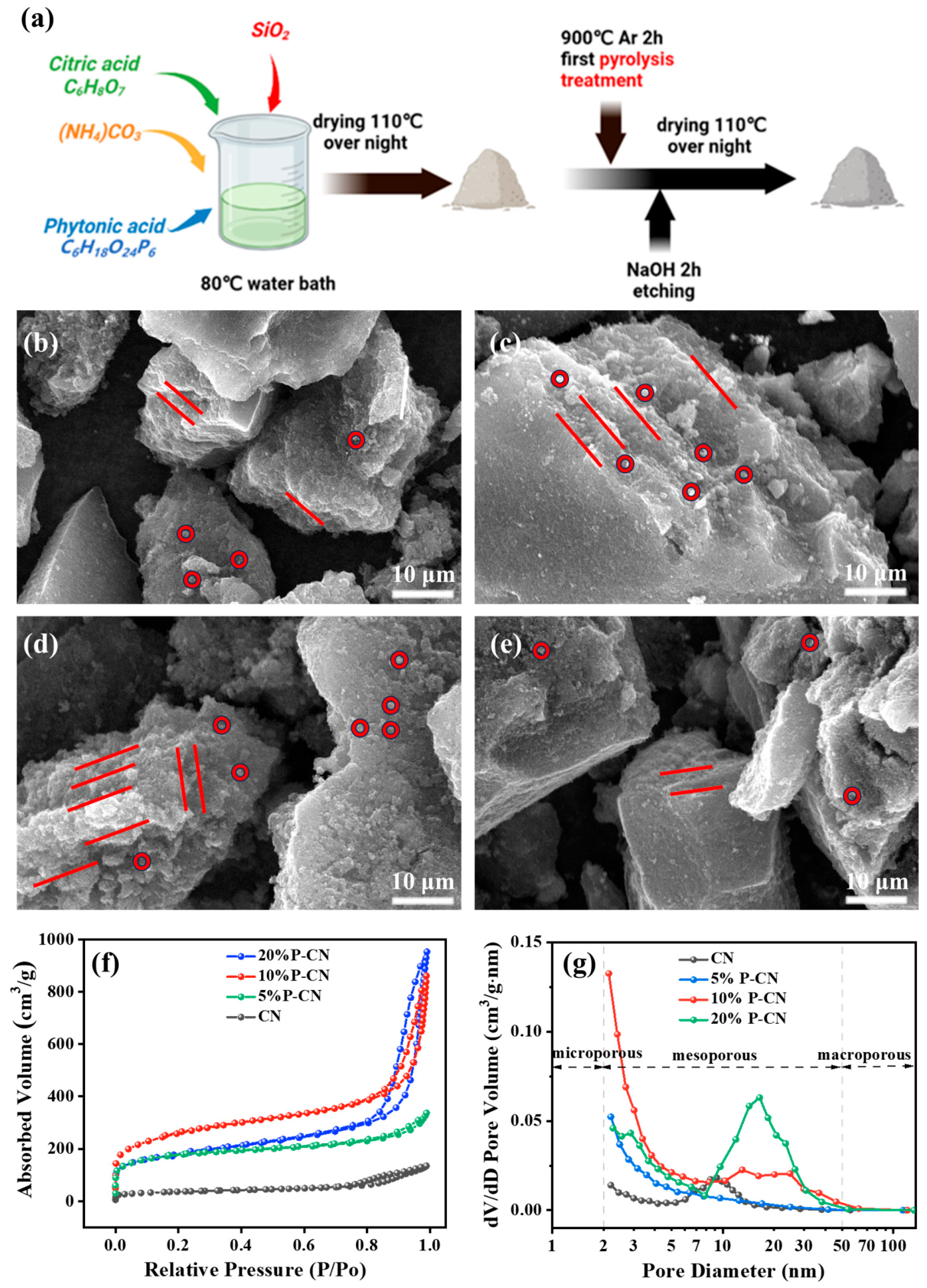
Figure 1a illustrates the preparation process of the P-CN catalyst. Firstly, a precursor paste is formed in water at 80 °C, and then dried and pyrolyzed under argon at 900 °C. Subsequent alkaline treatment to remove silica template, followed by washing and drying, yields P-CN catalysts. The morphological evolution of the P-CN catalyst under different phytic acid addition amounts was studied by the SEM system (Figure 1b–e). It was found that CN has a smooth and dense block structure. P doping causes particles to appear on its surface and increases the roughness. The increase in phytic acid loading will further promote the formation of crystalline particles on the catalyst surface. It presents a dense and well-dispersed particle morphology at a 10% loading. Further, loading increases to 20% results in a decrease in particle clarity, indicating that excessive P doping leads to structural densification [10].
N2 adsorption–desorption measurements were performed to analyze the textural properties of the P-CN catalysts, with quantitative results presented in Table 1. All the catalysts displayed Type I isotherms, as exhibited in Figure 1f. The adsorption capacity increases rapidly under low P/Po, confirming the existence of strong N2 adsorption, which is a characteristic of microporous materials. The H3 and H4 hysteresis loops under high P/Po indicate the formation of an irregular fissure-like mesoporous structure, which is consistent with previous reports [11,12]. For the P-CN catalysts, their BET specific surface area (SSA) was found to be in the range of 123–883 m2/g. With increasing phosphorus loading, the SSA initially increased and then decreased, indicating that incorporating a higher amount of phosphorus into the CN framework positively influences the SSA of the catalyst. The 10% P-CN catalyst exhibited the highest SSA of 883 m2/g, representing an approximately sevenfold increase compared to the lowest value. The pore size distribution shown in Figure 1g reveals key structural changes. The primary pore size of CN is 9.3 nm, but the pore size of 5% P-CN is reduced to 6.5 nm. Ten percent P-CN presents a bimodal structure of 13.6 nm and 28.4 nm, which gives it the maximum specific surface area. In conclusion, the synthetic method developed in this work can prepare P-CN catalysts with high SSA, providing more active sites to enhance the catalytic activity.
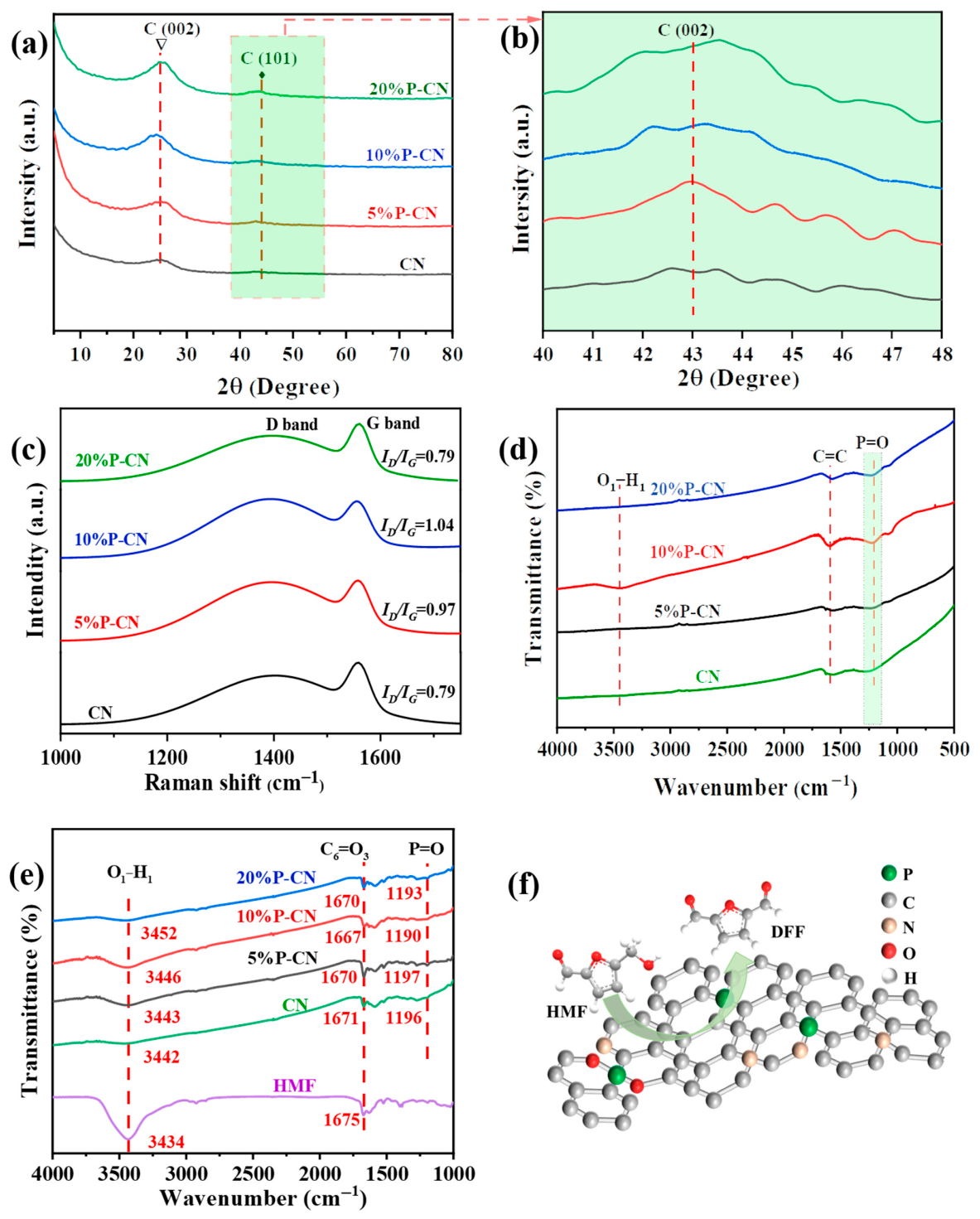
Figure 2a,b shows the crystal structures of the prepared X% P-CN. The two characteristic peaks at 2θ ≈ 25° and 43°, respectively, correspond to the (002) and (101) crystal planes, which are typical graphite carbon nitride (g-CN) with low structural order [13]. The wide and weak diffraction peaks (Figure 2a) confirm that synthetic carbon materials have disordered amorphous properties [10]. Notably, with increasing phytic acid content, the peak at 43° intensifies (Figure 2b), suggesting that phosphorus doping modifies the local atomic arrangement and influences the structural defects in P-CN [14].
Raman spectroscopy further elaborates on the degree of structural defects with different P doping amounts. The intensity ratio of the D band to the G band is widely used to evaluate the graphitization degree and defect concentration of carbon materials. A higher ID/IG value signifies a lower graphitization degree and more structural defects induced by heteroatom doping. Raman analysis of the spent catalyst (Figure S7) shows identical ID/IG band positions and intensity ratios to the fresh material, confirming that the observed 1578 cm−1 G-band is intrinsic to P-doped carbon nitride and unaffected by the reaction environment. No new peaks or significant shifts were detected after the reaction. As shown in Figure 2c, with increasing P doping amount, the ID/IG ratio exhibits a trend of first increasing and then decreasing. Among them, 10% P-CN exhibits the largest ID/IG ratio (1.04), indicating that appropriate phosphorus doping can effectively introduce structural defects and optimize the defect density within the catalyst to the greatest extent. These defects can regulate the surface electronic structure and provide favorable active sites for the catalytic reaction [15,16]. The functional groups and chemical bonds of the catalysts were investigated using Fourier-transform infrared (FT-IR) spectroscopy. As presented in Figure 2d, distinct absorption peaks at 1579 cm−1 and 1120 cm−1 were assigned to C=C and P=O stretching vibrations, respectively [11,12,17]. The presence of P-C bonds may enhance oxidation activity, while the P=O groups in phosphorylated carbon xerogels serve as critical Brønsted acid sites, facilitating proton transfer to fructose and stabilizing cyclic intermediates during its dehydration to HMF [11,18,19]. Figure 2e displays the adsorption behavior of HMF molecules. The broad absorption at 3434 cm−1 is ascribed to O1-H1 stretching vibrations of the hydroxymethyl group (–CH2OH) in HMF, consistent with reported quasi-in situ DRIFTS data (3432–3421 cm−1) [17], confirming its origin from HMF rather than moisture. No H–O–H bending mode (~1600 cm−1) was observed, excluding water interference [20]. The sharp band at 1675 cm−1 corresponds to the conjugated C=O stretching (C6=O3) of the furan ring [11,17], aligning with DFT-predicted frequencies (1670–1680 cm−1) for HMF in a vertical adsorption configuration [17]. Upon HMF adsorption, the O1-H1 vibration shifted from 3434 cm−1 to 3452 cm−1 [21], while the C6=O3 and P=O bonds exhibited smaller shifts (~8 cm−1 and a red shift, respectively) [22]. These spectral changes, coupled with the absence of water-related peaks, validate that the observed interactions are intrinsic to HMF and the catalyst. The stronger O1-H1 shift suggests HMF adsorbs vertically via –OH coordination to P=O sites (Figure 2f), with the C=O group interacting weakly.

2.2. Surface Physicochemical Analysis

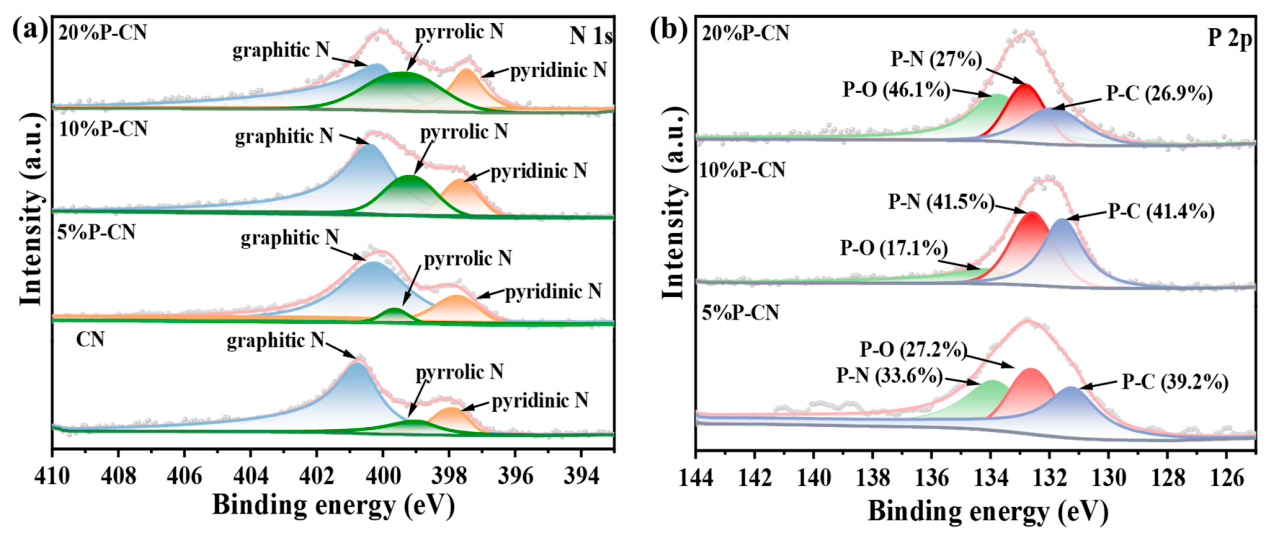
XPS characterization provides critical evidence of successful phosphorus incorporation into the carbon nitride (CN) framework, as demonstrated by the survey spectrum (Figure S1a), which clearly identifies the presence of P (133 eV, P 2 p), C (284.6 eV, C 1s), N (400 eV, N 1s), and O (532 eV, O 1s) [14,23]. The C 1s XPS spectrum (Figure S1b) showed four deconvoluted peaks at 284.8 eV (C-C sp2, graphitic support), 285.4 eV (C-C sp3, graphitic support), 286.6 eV (C-P sp3), and 288.5 eV (C=O), with no observable C-N bond signals. Furthermore, deconvolution of the high-resolution N 1s spectrum (Figure 3a) identifies three distinct nitrogen species: pyridinic nitrogen at 398.5 eV, pyrrolic nitrogen at 399.5 eV, and graphitic nitrogen at 401.0 eV. The relative abundance of N-species undergoes marked changes with increasing P-doping. CN exhibits the highest pyridinic N content (32.1%), whereas its proportion decreases in 5% P-CN (15.2%), 10% P-CN (12.4%), and 20% P-CN (19.3%). Pyridinic N serves as the primary active site for O2 adsorption and activation, while graphitic N significantly enhances charge mobility, facilitating efficient electron transfer during oxidation reactions [15]. Conversely, pyrrolic N is maximized in 10% P-CN (38.97%), suggesting P-induced optimization of N coordination. Graphitic N peaks at 68.8% in 5% P-CN, supporting rapid charge transfer, but declines at higher P loadings. These findings highlight P-mediated regulation of N speciation, which directly influences oxygen activation and redox kinetics.
The P 2 p spectrum (Figure 3b) resolves three bonding configurations: P-C (131.2 eV), P-N (132.5 eV), and P-O (133.8 eV). For 10% P-CN, the high-resolution N 1s and P 2p spectra reveal a high content of P-N (41.5%) and P-C (41.4%). Among these, the P-N is matched with the optimized pore structure of the material, because P-N bonding critically modulates porosity, improving reactant diffusion and active site accessibility. While its correlation with defect density (Raman ID/IG ratio, Figure 2c) further confirms its role in creating structural defects [14,16,18,24]. P-C configurations contribute to extended π-conjugation, thereby promoting the formation of redox-active sites [25]. Notably, the coexistence of abundant graphitic N and P-C/P-N moieties in the material further fosters synergistic catalysis: graphitic N enhances oxygen chemisorption, P-C induces favorable electron delocalization, and P-N refines the pore architecture [24,26,27,28]. In contrast, the excessive P-O bonds in 20% P-CN (46.1%) likely introduce excessive surface acidity, which impairs catalytic selectivity. These results demonstrate that precise regulation of the N/P coordination environment is a decisive factor for efficient HMF oxidation, providing a rational design blueprint for high-performance metal-free catalysts.
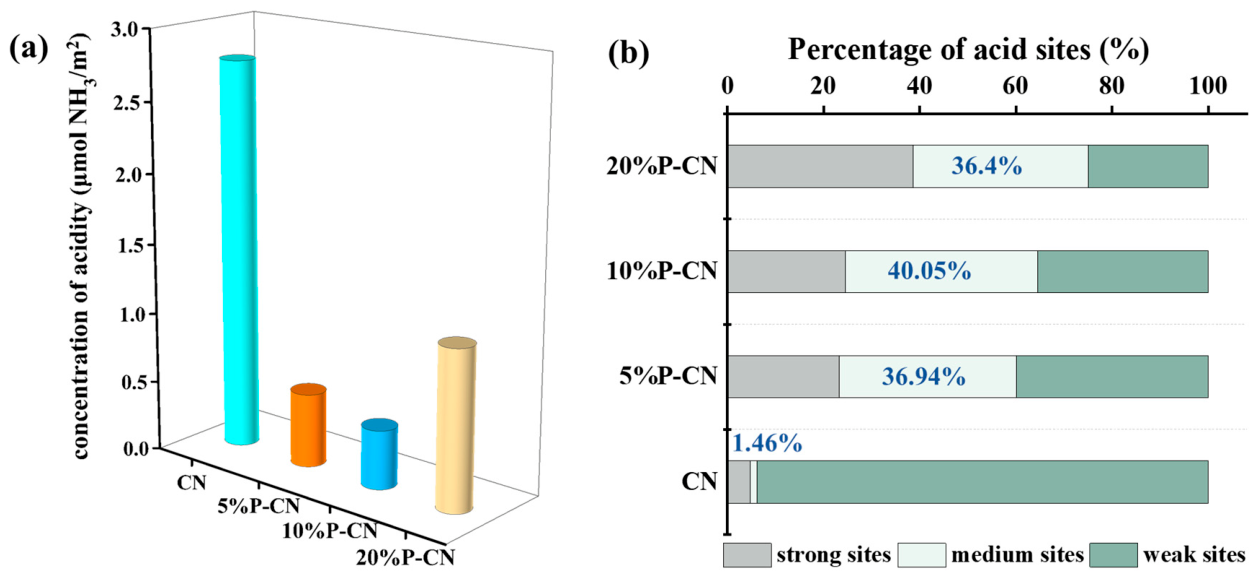
NH3-TPD studies (Figure 4) demonstrate a distinct correlation between phosphorus doping levels and the acid site distribution of P-CN catalysts. The total acidity follows: 10% P-CN (0.421 μmol/m2) < 5% P-CN (0.527 μmol/m2) < 20% P-CN (1.140 μmol/m2) < CN (2.773 μmol/m2), as shown in Figure 4a. Although undoped CN exhibits the highest total acidity among all catalysts, its acid site distribution is dominated by weak acid sites (<250 °C), which account for approximately 93% of the total acid sites. The proportion of CN medium-intensity acid sites is extremely small (only 1.46%), which may affect the catalytic efficiency of the fructose dehydration reaction. In contrast, 20% P-CN possesses the highest proportion of strong acid sites, reaching 39.81%. This high content of strong acid sites may promote potential over-dehydration and side reactions. Ten percent P-CN achieves optimal catalytic performance, with ~40% medium acid sites (250–400 °C) selectively stabilizing fructose dehydration intermediates, leading to an exceptional HMF yield of 97%. DFT studies (Ref. [19]) corroborate that such sites provide ideal protonation energetics, minimizing humin formation from excessive cracking or polymerization.

2.3. Screening of P-CN Catalyst by the “Two-Pot Two-Step”

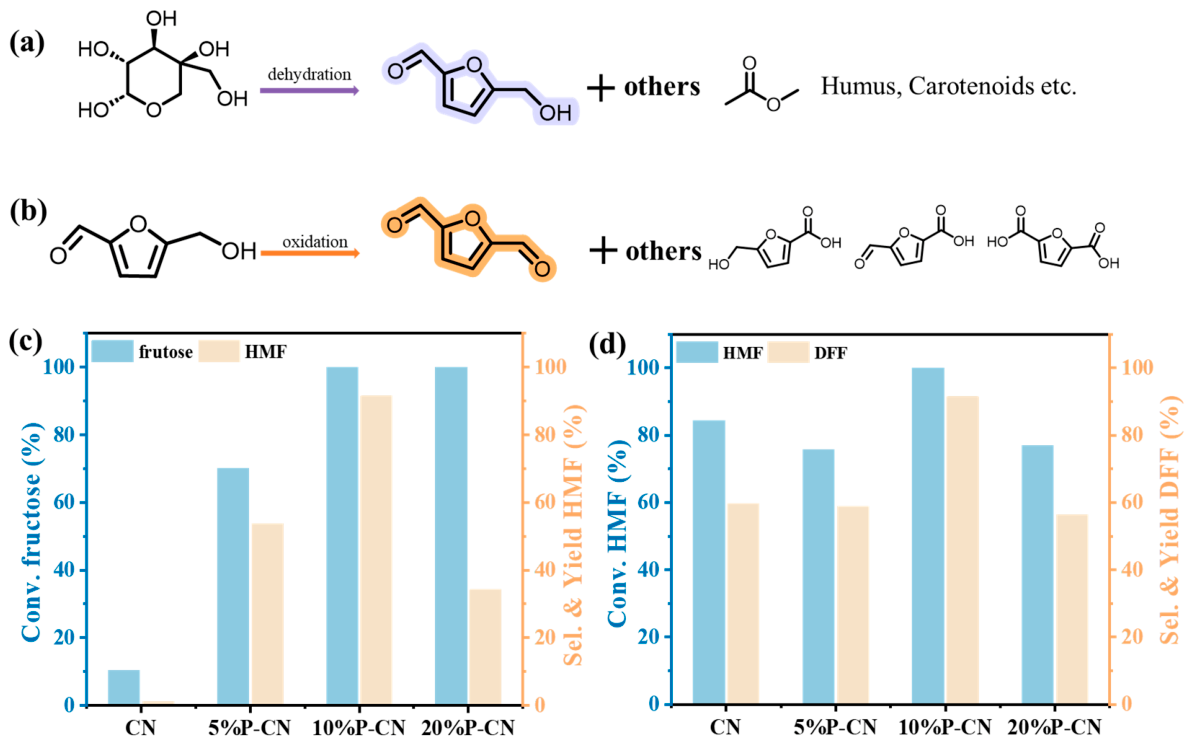
The catalytic performance of the synthesized catalyst in two key reaction steps, namely fructose dehydration to HMF (Figure 5a) and HMF oxidation to DFF (Figure 5b), was evaluated. Besides the main products HMF and DFF, the by-products also included 5-formyl-2-furanic acid, 2, 5-furanediformic acid, Methyl acetate, etc. Generally, a larger specific surface area can expose more active sites and further improve catalytic activity. As shown in Table 1, the specific surface area of the samples first increases and then decreases with the increase in phosphorus loading, and the reactant conversion and product yield show the same trend. Notably, 10% P-CN exhibits the largest specific surface area (883.13 m2/g), with the highest HMF yield (97%) and DFF yield (91.5%). Moreover, the addition of P is known to enhance strong Brønsted acid sites and redox-active phosphorus species, thereby improving catalytic performance in the fructose-to-DFF process. To modulate the yields of HMF and DFF, we adjusted the loading of phosphorus (P). The concentrations corresponding to different P loadings are presented in Table 1. As exhibited in Figure 5c,d, the 10% P-CN catalyst achieved significantly higher yields of HMF and DFF, at 97% and 91.5%, respectively, compared to the C-N catalyst, which exhibited no detectable HMF formation and a DFF yield of only 59.7%. Moreover, the 10% P-CN catalyst outperformed other P-loaded catalysts, including 5% P-CN and 20% P-CN. These results highlight the importance of incorporating an optimal amount of phytic acid to achieve high catalytic performance in the selective conversion of fructose to HMF via dehydration, followed by the oxidation of HMF to DFF. For a better understanding of the reaction mechanism, the proportion of mild acid sites for these catalysts is calculated in Figure 4a, and the data are displayed in Figure 4b, which are 1.46% for the CN catalyst, 36.94% for the 5% P-CN catalyst, 40.05% for the 10% P-CN catalyst, and 36.42% for the 20% P-CN catalyst, respectively. The 10% P-CN catalyst exhibited the highest concentration of mild acid sites among the samples, indicating superior catalytic efficiency for the fructose coupling dehydration reaction. Previous studies have demonstrated that the content of graphitized N plays a decisive role in the catalytic activity of aerobic oxidation of HMF to DFF [14]. Notably, the 10% P-CN catalyst has the highest graphitization N content (48.6%), which corresponds to its highest catalytic activity for the oxidation of HMF.
We systematically reviewed existing non-precious-metal catalyst systems and summarized the comparison results in Table 2 to highlight the competitive performance of our methodology. A 100% fructose conversion rate and a 97% yield for HMF were achieved under mild conditions (120 °C, 2 h and air atmosphere), which fully demonstrated the excellent performance of the 10% P-CN catalyst. This catalytic performance is outstanding, significantly superior to most of the catalytic systems that have been reported, including the SPAN catalyst (conversion: 100%, yield: 71%, 3 h, 140 °C), P/N-0.25 (conversion: 48%, yield: 33.6%, 16 h, 120 °C) and Amberlyst-45 (conversion: 90.6%, yield: 36.6%, 3 h, 130 °C). This remarkable activity was further reflected in 10% P-CN outstanding productivity of 4.85 mmol HMF·g−1·h−1, which was an order of magnitude greater than that of P/N-0.25 (1.38 mmol·g−1·h−1), and substantially higher than Amberlyst-45 (0.68 mmol·g−1·h−1). Despite a 0.5 h longer reaction time, 10% P-CN exhibited a superior yield of 4.63 mmol·g−1·h−1, exceeding the value of 4.22 mmol·g−1·h−1 obtained with Glu-TsOH. Notably, 10% P-CN exhibits a lower substrate/catalyst ratio than the catalysts described below for the aerobic oxidation of HMF to DFF. The 10% P-CN catalyst maintained excellent performance, delivering 91.5% DFF yield with full HMF conversion in 6 h at 120 °C under 1.5 MPa O2 pressure. P-C-N-5-800 (yield: 99.5%, reaction time: 9 h) and NC-950 (yield: 95.1%, reaction time: 14 h) have higher yields than the highest yields of the nonmetallic catalysts in this study, but the reaction times of both were significantly longer than that of this system (6 h). Although GO-NS exhibited a lower oxygen pressure than that used in this study, 10% P-CN achieved a shorter reaction time and higher DFF productivity. The 10% P-CN metal-free bifunctional catalyst, integrating acid-catalyzed dehydration and aerobic oxidation, achieves stable and efficient conversion of biomass feedstocks under mild conditions and in a relatively short time compared with the aforementioned catalytic systems.

2.4. Optimization of Conditions for Fructose Conversion into DFF via the “Two-Pot Two-Step”

In the process optimization experiments, we strictly followed the principle of single variable. The effect of reaction temperature (80, 100, 120 and 140 °C) on the “two-pot two-step” fructose-to-DFF conversion was systematically studied using the 10% P-CN catalyst. For the fructose dehydration step (Figure S2a), the HMF yield followed a volcano-shaped trend: while higher temperatures promoted the endothermic reaction by accelerating molecular collisions, excessive heating beyond 120 °C sharply reduced the yield (80% at 140 °C vs. 92.6% at 120 °C). This decline resulted from competing thermal degradation pathways, including HMF decomposition (to levulinic/formic acid) and undesired polymerization side reactions [22], confirming 120 °C as the optimal trade-off between reaction rate and selectivity. In the subsequent HMF oxidation to DFF (Figure S2b), both conversion and yield displayed strong temperature dependence below 120 °C, increasing from 38% to 100% and 23% to 91.5%, respectively, as the temperature rose from 80 °C to 120 °C. This reflects the thermally activated nature of the oxygen-mediated oxidation process. Notably, further heating to 140 °C did not improve performance, suggesting the oxidation reaches kinetic saturation at 120 °C. The identical optimum temperature (120 °C) for both steps highlights the exceptional bifunctionality of 10% P-CN, enabling integrated one-pot transformations without requiring temperature modulation between dehydration and oxidation stages. This operational synergy significantly enhances the practicality of the catalytic system compared to conventional sequential processes with distinct temperature requirements.
The solvent polarity is also one of the key parameters on the catalytic behavior of 10% P-CN in the fructose dehydration and HMF oxidation process (Figure S3). For dehydration, DMSO facilitated complete fructose conversion (100%) with a 91.5% HMF yield due to its electron-withdrawing capability, which stabilized reaction intermediates through charge delocalization [35], whereas poor fructose solubility in toluene/DMF led to negligible activity. Conversely, weakly polar toluene enabled a high DFF yield (87%) within 3 h for HMF oxidation, whereas strongly polar solvents (DMF, DMSO) severely suppressed yields (<40%) by competitively adsorbing on P-CN’s active sites, hindering HMF accessibility. These distinct polarity-dependent behaviors highlight DMSO’s superiority for dehydration and toluene’s efficacy for oxidation, underscoring the importance of optimizing solvent environments in tandem catalytic systems where sequential reactions may require different polarity conditions for optimal performance.
The influence of 10% P-CN catalyst dosage on fructose dehydration and HMF oxidation was systematically examined. Figure S4 demonstrates that increasing the amount of catalyst exerted a positive effect on the catalytic performance. For fructose dehydration, increasing the catalyst amount from 50 mg to 100 mg resulted in complete fructose conversion being maintained, while the DFF yield increased sharply from 32.71% to 97%. But higher dosages (>100 mg) reduced yield due to excessive Brønsted acid sites, which promoted humin/oligomer formation via side reactions [19]. For HMF oxidation, when the catalyst loading was progressively increased from 50 mg to 70 mg, both HMF conversion (100%) and DFF yield (91.5%) remained consistently high, indicating that the active sites on 10% P-CN had become saturated. Such results confirm the high efficiency of the 10% P-CN catalyst for fructose into HMF and the selective oxidation of HMF into DFF.

2.5. Catalytic Stability

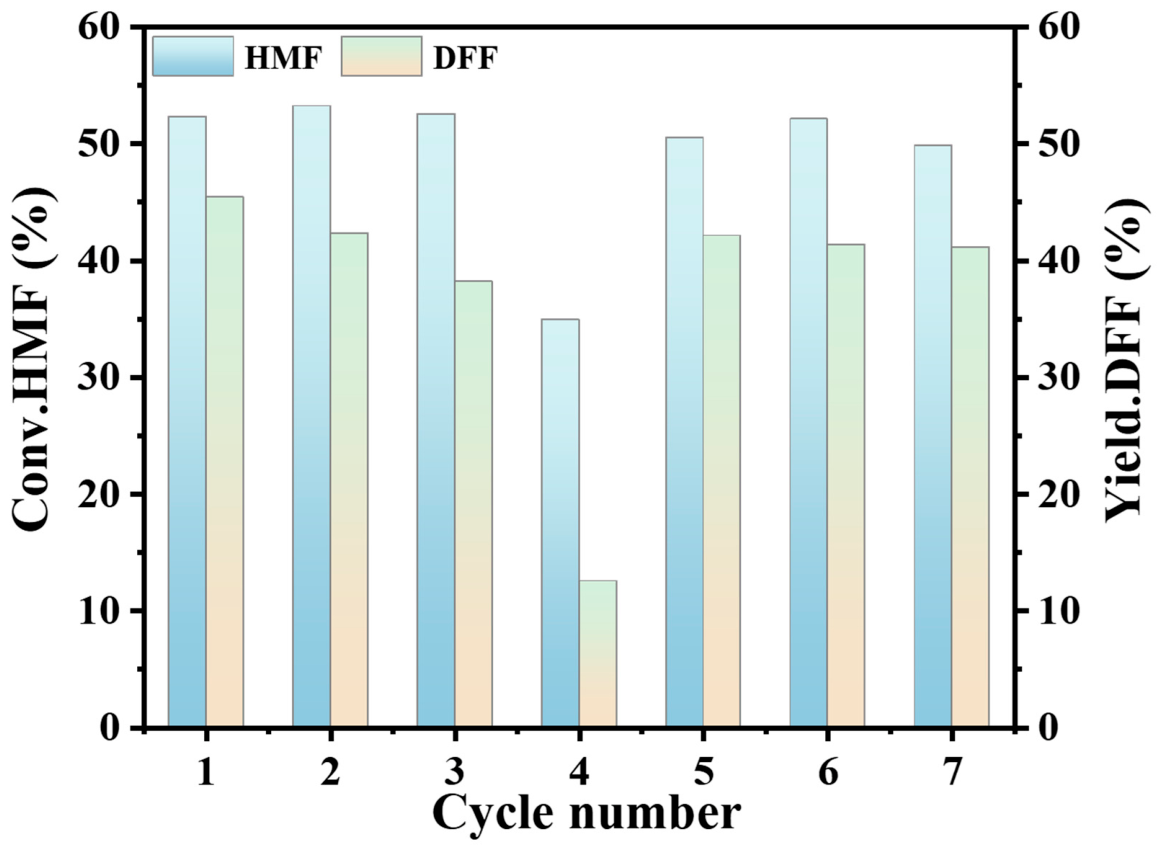
We evaluated the reusability of the 10% P-CN catalyst in the oxidation of HMF. After each cycle, the recovered catalyst was washed with ultrapure water and anhydrous ethanol, followed by vacuum drying. As shown in Figure 6, HMF conversion decreased progressively over four cycles, with the DFF yield substantially declining from 55% in the first cycle to 10% by the fourth cycle. This significant inhibition is attributed to humin deposition blocking active sites [19]. Post-reaction characterization confirmed fundamental structural preservation: XRD analysis of the spent catalyst showed no significant change in the diffraction peak at 2θ ≈ 43° compared to the fresh counterpart, indicating the structural framework incorporating phosphorus atoms remains stable under reaction conditions (Figure S6). Furthermore, Raman spectroscopy revealed a slight increase rather than a decrease in the ID/IG ratio, strongly suggesting neither reaction products nor substrate caused irreversible occupation or destruction of the catalyst’s active sites (Figure S7). Supporting this, FT-IR analysis detected characteristic O-H (3444 cm−1) and conjugated C=O (1671 cm−1) stretching vibrations, frequencies nearly identical to those observed during HMF adsorption studies on the fresh catalyst (3434 cm−1 and 1675 cm−1), implying the nature of surface interactions persists after reaction in Figure S8 [22]. Subsequent high-temperature treatment (Ar, 500 °C, 2 h) of the deactivated catalyst significantly improved performance, restoring HMF conversion and DFF yield to levels indistinguishable from the first cycle. This complete activity recovery, underpinned by multi-technique characterization evidence, conclusively demonstrates the robust structural stability of the P-CN framework during operation and underscores the necessity of periodic regeneration to maintain long-term efficiency in biomass conversion.

2.6. “One-Pot Two-Step” Conversion of Fructose to DFF

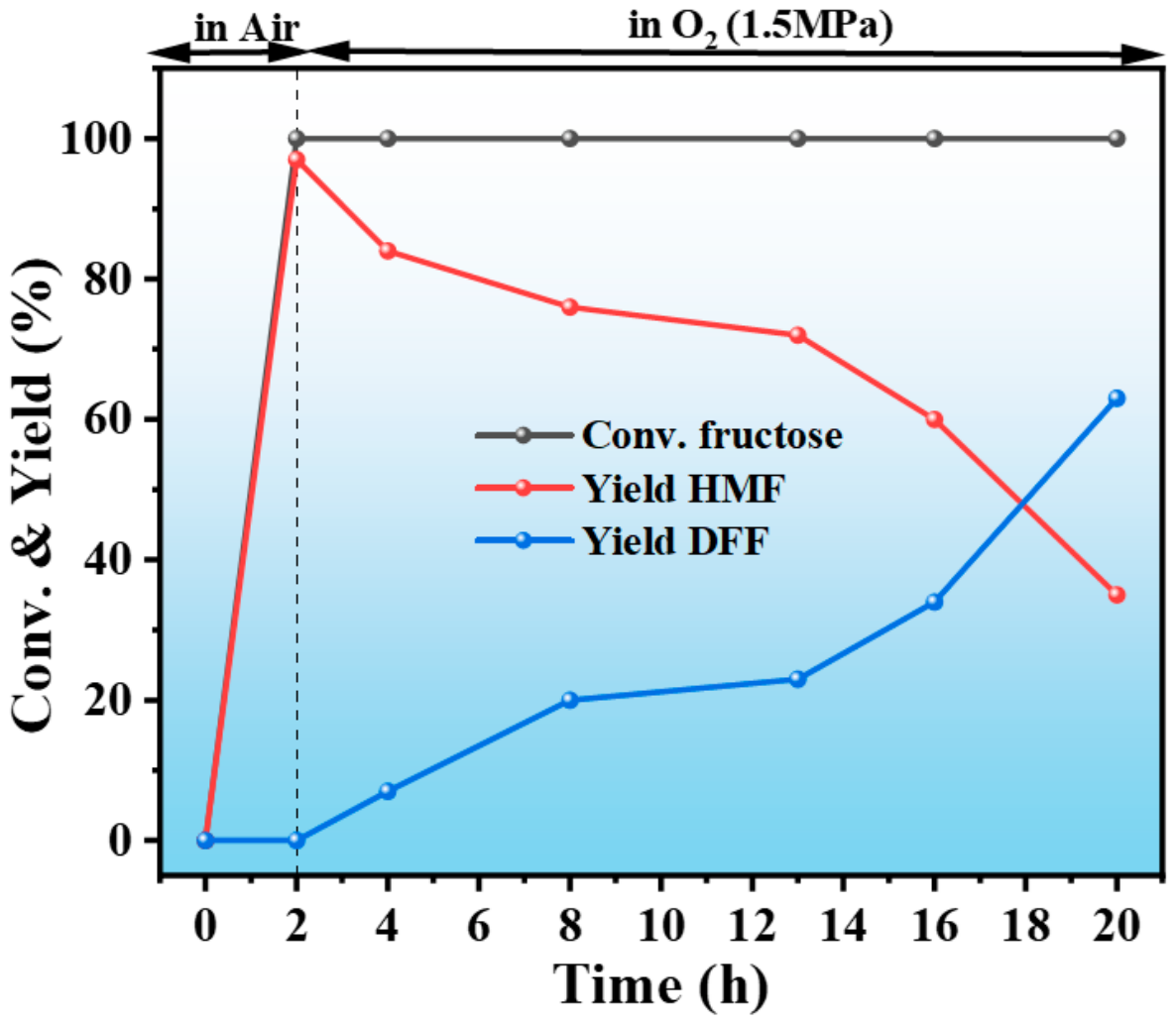
Finally, we employed the excellent 10% P-CN as an acid and oxidation dual-function catalyst to synthesize DFF from fructose via a “one-pot two-step” approach. In the process of one-pot, 10% P-CN was employed as an acid catalyst for the dehydration of fructose, achieving a 97% yield of HMF at 120 °C for 2 h reaction period in DMSO (the product distribution during the reaction, as determined by HPLC analysis, is shown in Figure S5). Subsequently, 1.5 MPa O2 was charged for the oxidation of HMF to DFF. The yield of DFF reached 63% after a continuous reaction at 120 °C for 18 h. This result confirmed that 10% P-CN catalyst could convert fructose into DFF through a “one-pot two-step” process (Figure 7). This performance was notably lower than the 72.5% DFF yield reported by Lv et al. [36] using sulfonated graphene oxide (GO) under a sequential N2/O2 atmosphere in DMSO (2 h N2, then 22 h O2 at 140 °C). The comparative analysis shows that although the P-CN catalyst has excellent dehydration activity, the inherent limitations of its redox ability significantly restrict the reaction efficiency of the oxidation step. To address this issue, key reaction parameters such as oxygen pressure, reaction time or temperature distribution can be regulated to suppress excessive oxidation side reactions. Meanwhile, under the premise of ensuring the structural stability of the P-CN catalyst (as demonstrated by the recycling experiment results), its redox activity can be further enhanced, thereby improving the overall performance of the catalytic system.
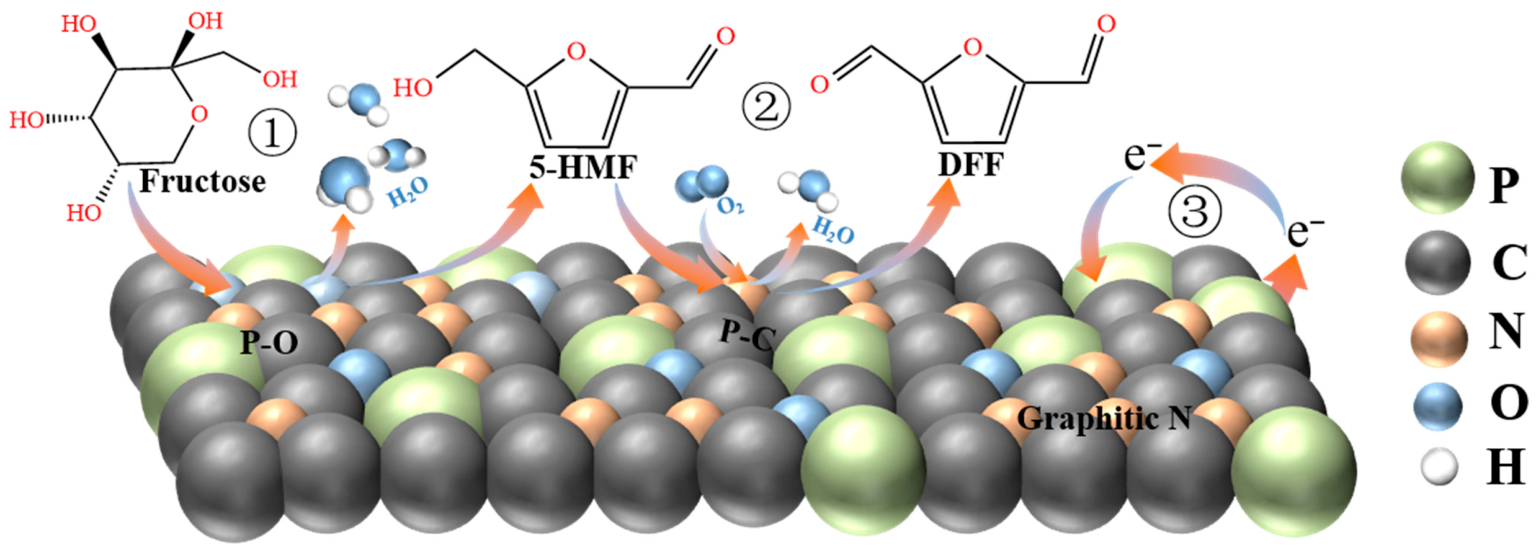
The phosphorus-doped carbon nitride (P-CN) catalyst operates through a bifunctional mechanism that integrates Brønsted acidic sites (P=O) and redox-active domains (graphitic-N/P-C) to drive the tandem conversion of fructose to DFF. Specifically, the P=O acted as acidic sites for fructose dehydration to produce HMF, while graphitic-N acted as the oxidative sites for HMF selective oxidation to produce DFF. Our experimental evidence reveals that P=O groups serve as proton donors, facilitating fructose dehydration to HMF, which is stabilized via hydrogen-bonding interactions, as demonstrated by FT-IR (O-H shift from 3434 to 3452 cm−1). Simultaneously, graphitic-N and P-C/P-N moieties synergistically activate molecular oxygen for selective HMF oxidation, as supported by XPS data showing optimal graphitic-N content (48.6%) for the highest-performing 10% P-CN catalyst. The hierarchical porosity of the catalyst, with a bimodal pore distribution (13.6/28.4 nm) and high surface area (883 m2/g), ensures efficient reactant diffusion and active-site accessibility. While Raman spectroscopy (ID/IG = 1.04) confirms defect-rich domains that enhance electronic conductivity. The NH3-TPD quantified the critical role of medium-strength acid sites (40.05%) in suppressing side reactions. This structure-activity relationship, underpinned by spectroscopic and kinetic data, establishes P-CN as a tunable metal-free system where P=O-mediated proton transfer and graphitic-N-driven oxygen activation operate concertedly to achieve high DFF yields (91.5%). The proposed catalytic cycle (Figure 8) unifies these observations, illustrating how spatially coupled but functionally distinct sites enable cascade transformations under mild conditions.

3. Materials and Methods

3.1. Catalyst Preparation

A precursor solution was prepared by dissolving 2.187 g citric acid monohydrate, 5 g ammonium carbonate, and 1.2 g SiO2 in 25 mL ultrapure water under stirring at 25 °C for 20 min. Different amounts of 50% phytic acid were added and stirred for 5 min, followed by solvent evaporation at 80 °C for 6 h and drying at 110 °C overnight [13]. The resulting solid was ground and pyrolyzed at 900 °C (5 °C/min, Ar flow: 30 mL/min) for 2 h. The SiO2 template was removed by etching with 80 g/L NaOH at 80 °C for 2 h, and the product was washed, dried, and labeled as X%P-CN (where “X” denotes the phytic acid doping ratio).

3.2. Catalytic Performance Evaluation

Using the experimental methods of “two-pot two-step” and “one-pot two-step” approaches, the catalytic effect of the P-CN catalyst on the dehydration and oxidation reactions using fructose as the raw material to produce DFF was investigated. The “two-pot two-step” method is divided into the dehydration step (fructose conversion into HMF) and the oxidation step (HMF conversion into DFF). The dehydration step is as follows: a homogeneous mixture of 180 g fructose, 100 mg 10% P-CN and 20 mL dimethyl sulfoxide solvent (DMSO) was loaded into the reactor. After being magnetically stirred in an air environment at 120 °C for 2 h, the sample was extracted and subjected to filtration with a 0.22 μm PTFE membrane. Subsequently, it was analyzed using Shimadzu LC-16 high-performance liquid chromatography (HPLC). For the oxidation step, a homogeneous mixture of 40 mg HMF, 20 mL toluene and 50 mg 10% P-CN was loaded into an autoclave reactor, filled with 1.5 MPa O2, and reacted at 120 °C for 6 h. The conversion efficiency of HMF and the synthesis rate of HMF and DFF (calculated as shown in Equations (1) and (3)) were analyzed by HPLC with an ultraviolet detector (UV) and a Waters Sunfire C18 chromatographic column (5 µm, 4.6 mm × 250 mm). The mobile phase consists of 600 mL ultrapure water, 257 mL acetonitrile and 0.57 mL acetic acid (the flow rate: 1 mL/min). The percent conversion of fructose (calculated as shown in Formula (1)) was analyzed by the external standard method with LC-16 coupled to a differential refractive index detector and Aminex-87H, with a mobile phase of 0.49 g/L H2SO4 (the flow rate: 0.6 mL min−1). The “one-pot two-step” method involves loading a mixture of 180 g fructose, 100 mg 10% P-CN and 20 mL DMSO into a reactor. The mixture is magnetically stirred at 120 °C for 2 h in air. After 1 h of reaction, the sample is taken out and analyzed by HPLC. Then, 1.5 MPa of oxygen is filled, and the mixture is reacted at 120 °C for 6 h. The sample was taken out at regular intervals and analyzed by HPLC. The conversion rate and synthesis rate were calculated as shown in Formulas (1) and (3).
Conversion   ( % ) = 1 mole   of   the   remaining   reactant mole   of   initial   reactant   ×   100 %
Selectivity   ( % ) = mole   of   the   reactant   corresponding   to   each   product mole   of   initial   reactant mole   of   remaining   reactant   ×   100 %  
Yield   % = mole   of   the   reactant   corresponding   to   each   product mole   of   initial   reactant   ×   100 %
productivity   mmol HMF · g cat 1 · h 1 = mole   of   HMF m cat   ×   time   ×   100 %
productivity   mmol DFF · g cat 1 · h 1 = mole   of   DFF m cat   ×   time   ×   100 %

3.3. Characterizations

The Brunauer–Emmett–Teller (BET) specific surface area, pore volume, and average pore size of the catalysts were determined by nitrogen adsorption–desorption at 77 K (liquid nitrogen temperature) using a JK-B112 device from Beijing Jingwei Gaobo Instrument Co. (Beijing, China). Prior to the nitrogen adsorption experiment, the samples were outgassed at 300 °C for 1 h under vacuum in order to desorb impurities and moisture [13].
Ammonia temperature-desorption (NH3-TPD) measurement was performed on the AutoChem II 2920 instrument (Hangzhou, China), which is fitted with a thermal conductivity detector (TCD). Before the test, 100 mg of catalysts were pretreated in a helium atmosphere (30 mL min−1) and heated to 300 °C at a rate of 10 °C min−1 and held at this temperature for 1 h. Subsequently, the catalysts were cooled to 50 °C and then exposed to pure NH3 gas at the same flow rate for 1 h to ensure complete adsorption. After the adsorption step, the NH3 stream was replaced with a helium purge flow for 1 h to eliminate physisorbed ammonia species and achieve a stable baseline. Finally, the catalyst was heated at a rate of 10 °C min−1 to 700 °C, with a helium gas flow rate of 30 mL min−1 maintained throughout the process.
The X-ray diffraction (XRD) patterns were recorded using a Smart Lab 3KW diffractometer (Rigaku, Chengdu, China) with Cu Kα radiation (λ = 1.5406 Å), operating at 2 kV and 40 mA, and scanning a 2θ range from 5° to 80°. FT-IR spectra of the samples were collected in the wavenumber range of 4000–400 cm−1. Prior to FT-IR measurements, both KBr and catalyst samples were dried at 110 °C for 12 h in a forced-air drying oven to remove residual moisture and physisorbed water. The test was conducted at a constant temperature of 120 °C, and 32 scans were completed in cumulative intervals of different durations. X-ray photoelectron spectroscopy (XPS) analysis was carried out on a Thermo Escalab 250 Xi instrument (Hangzhou, China). Using the C 1s photoelectron spectral line as the reference, the 284.8 eV binding energy was selected as the reference position to complete the calibration of the spectrum. The microscopic morphology and structural characteristics of the synthesized catalyst were characterized using a scanning electron microscope (model: SEM3200, accelerating voltage: 15 kV, beam current mode: conventional) (Chengdu, China). Raman spectroscopy (Use this college builded an experimental platform) was carried out using an Ar+ laser (wavelength 532 nm, detection range 50–3550 cm−1) as the excitation source to characterize the structural features of the catalyst.

4. Conclusions

In summary, this study developed a phosphorus/graphitic-N co-doped metal-free carbon material prepared with a comparatively high SSA. Before applying this catalyst to the “one-pot one-step” approach, we separately tested its catalytic activity toward fructose dehydration and HMF oxidation. The findings indicate that P-CN is not only an ideal catalyst applicable to both dehydration and oxidation reactions, but also exhibits excellent catalytic performance during the one-step synthesis of DFF using fructose as the feedstock. It was demonstrated that the doping of N and P facilitates the formation of oxidatively active sites and acidic sites in the catalyst, thereby significantly promoting the stepwise selective conversion of fructose to HMF via dehydration and oxidation of HMF to DFF. Furthermore, stability tests confirm that the P-CN maintained 92% of its initial activity after continuous operation for up to 1 h and remained reusable. Based on these findings, this metal-free catalyst, which combines environmental friendliness with structural stability, opens up a novel and feasible technical pathway for the one-step synthesis of DFF using fructose.

Supplementary Materials

The following supporting information can be downloaded at: https://www.mdpi.com/article/10.3390/catal16050451/s1, Figure S1. (a) XPS scan spectra of P-CN catalyst under different amounts of phytic acid added. (b) XPS C 1s spectra of P-CN with varying amounts of phytic acid, Figure S2. (a) The effect of temperature on HMF synthesis from fructose. Reaction conditions: 20 ml DMSO, 100 mg catalyst, 180 mg fructose, atmospheric, 80~140 °C, 2 h. (b) The effect of temperature on HMF selective oxidation to DFF. Reaction conditions: 20 ml toluene, 50 mg catalyst, 1.5 MPa O2 pressure, 40 mg HMF, 80~140 °C, 6 h, Figure S3. (a) The effect of solvent on HMF synthesis from fructose. Reaction conditions: 100 mg catalyst, 180 mg fructose, atmospheric, 120 °C, 2 h. (b) The effect of solvent on DFF synthesis from HMF. Reaction conditions: 50 mg catalyst, 40 mg HMF, 1.5 MPa O2 pressure, 120 °C, 6 h, Figure S4. (a) The effect of catalyst dosage on HMF synthesis from fructose. Reaction conditions: 20 ml DMSO, 50~125 mg catalyst, 180 mg fructose, atmospheric, 120 °C, 2 h. (b) The effect of catalyst dosage on HMF selective oxidation to DFF. Reaction conditions: 20 ml toluene, 50 mg catalyst, 0~1.5 MPa O2 pressure, 120 °C, 6 h, Figure S5. The HPLC test results of the catalytic conversion of “one-pot two steps” fructose to DFF, Figure S6. (a) Powder X-ray diffraction patterns of the P-CN catalysts (including CN, 10% P-CN, and spent 10% P-CN). (b) local enlarged view, Figure S7. Raman spectra of P-CN catalysts (including CN, 10% P-CN, and spent 10% P-CN), Figure S8. Interaction between the HMF molecules and the P-CN catalysts characterized by FT-IR spectra.

Author Contributions

Conceptualization, X.L.; Methodology, H.L., Y.W., C.L. and M.W.; Data analysis, H.L., Q.D., Y.W., T.M., C.L. and M.W.; Investigation, Q.D. and T.M.; Writing, H.L. and Q.D.; Data curation, H.L.; Supervision, X.L.; Resources, X.L.; Writing—review and editing, X.L. All authors have read and agreed to the published version of the manuscript.

Funding

Science and Technology Department Program of Yibin (2025JC010).

Data Availability Statement

The raw data supporting the conclusions of this article will be made available by the authors on request.

Acknowledgments

We gratefully thank the following funding for supporting this work: Science and Technology Department Program of Yibin (2025JC010).

Conflicts of Interest

The authors declare no conflicts of interest. The authors declare that they have no known competing financial interests or personal relationships that could have appeared to influence the work reported in this paper.

References

  1. Gallezot, P. Conversion of biomass to selected chemical products. Chem. Soc. Rev. 2012, 41, 1538–1558. [Google Scholar] [CrossRef] [PubMed]
  2. Corma, A.; Iborra, S.; Velty, A. Chemical routes for the transformation of biomass into chemicals. Chem. Rev. 2007, 107, 2411–2502. [Google Scholar] [CrossRef] [PubMed]
  3. Battula, V.R.; Jaryal, A.; Kailasam, K. Visible light-driven simultaneous H2 production by water splitting coupled with selective oxidation of HMF to DFF catalyzed by porous carbon nitride. J. Mater. Chem. A 2019, 7, 5643–5649. [Google Scholar] [CrossRef]
  4. Wu, J.; Yan, S.; Wang, C.; Lay, C.-H.; Wang, X.; Wang, X.; Huo, M. Fabrication of ordered mesoporous POMs/SiO2–NH2 nanofibers for production of DFF from 5-HMF for cellulose wastewater resource recovery. Chemosphere 2021, 277, 130316. [Google Scholar] [CrossRef]
  5. Xiang, X.; He, L.; Yang, Y.; Guo, B.; Tong, D.; Hu, C. A one-pot two-step approach for the catalytic conversion of glucose into 2,5-diformylfuran. Catal. Lett. 2011, 141, 735–741. [Google Scholar] [CrossRef]
  6. Halliday, G.A.; Young, R.J.; Grushin, V.V. One-pot, two-step, practical catalytic synthesis of 2,5-diformylfuran from fructose. Org. Lett. 2003, 5, 2003–2005. [Google Scholar] [CrossRef]
  7. Takagaki, A.; Takahashi, M.; Nishimura, S.; Ebitani, K. One-pot synthesis of 2,5-diformylfuran from carbohydrate derivatives by sulfonated resin and hydrotalcite-supported ruthenium catalysts. ACS Catal. 2011, 1, 1562–1565. [Google Scholar] [CrossRef]
  8. Chen, J.; Guo, Y.; Chen, J.; Song, L.; Chen, L. One-step approach to 2,5-diformylfuran from fructose by proton-and vanadium-containing graphitic carbon nitride. ChemCatChem 2014, 6, 3174–3181. [Google Scholar] [CrossRef]
  9. Cui, M.; Huang, R.; Qi, W.; Su, R.; He, Z. Cascade catalysis via dehydration and oxidation: One-pot synthesis of 2,5-diformylfuran from fructose using acid and V2O5/ceramic catalysts. RSC Adv. 2017, 7, 7560–7566. [Google Scholar] [CrossRef]
  10. Wang, Q.; Hao, J.; Zhao, Z. Microwave-assisted conversion of fructose to 5-Hydroxymethylfurfural using sulfonated porous carbon derived from biomass. Austr. J. Chem. 2017, 71, 24–31. [Google Scholar] [CrossRef]
  11. Zhang, Z.; Huber, G.W. Catalytic oxidation of carbohydrates into organic acids and furan chemicals. Chem. Soc. Rev. 2018, 47, 1351–1390. [Google Scholar] [CrossRef]
  12. Zhang, J.; Zhao, Z.; Xia, Z.; Dai, L. A metal-free bifunctional electrocatalyst for oxygen reduction and oxygen evolution reactions. Nat. Nanotechnol. 2015, 10, 444–452. [Google Scholar] [CrossRef]
  13. Zhang, X.; Truong-Phuoc, L.; Liao, X.; Papaefthimiou, V.; Pugliesi, M.; Tuci, G.; Giambastiani, G.; Pronkin, S.; Pham-Huu, C. Inducing atomically dispersed Cl–FeN4 sites for ORRs in the SiO2-mediated synthesis of highly mesoporous N-enriched C-networks. J. Mater. Chem. A 2022, 10, 6153–6164. [Google Scholar] [CrossRef]
  14. Zhang, H.; Clark, J.H.; Geng, T.; Zhang, H.; Cao, F. A Carbon catalyst Co-doped with P and N for efficient and selective oxidation of 5-hydroxymethylfurfural into 2,5-diformylfuran. ChemSusChem 2021, 14, 456–466. [Google Scholar]
  15. Ao, X.; Zhang, W.; Li, Z.; Li, J.-G.; Soule, L.; Huang, X.; Chiang, W.-H.; Chen, H.M.; Wang, C.; Liu, M. Markedly enhanced oxygen reduction activity of single-atom Fe catalysts via integration with Fe nanoclusters. ACS Nano 2019, 13, 11853–11862. [Google Scholar] [CrossRef]
  16. Hu, X.; Fan, M.; Zhu, Y.; Zhu, Q.; Song, Q.; Dong, Z. Biomass-derived phosphorus-doped carbon materials as efficient metal-free catalysts for selective aerobic oxidation of alcohols. Green Chem. 2019, 21, 5274–5283. [Google Scholar] [CrossRef]
  17. Liao, X.; Guo, M.; Tang, W.; Liu, C.; Luo, W.; Tan, L.; Noguchi, T.G.; Yamauchi, M.; Zhao, Y.; Li, X. Bimetallic single atom promoted α-MnO2 for enhanced catalytic oxidation of 5-hydroxymethylfurfural. Green Chem. 2022, 24, 8424–8433. [Google Scholar] [CrossRef]
  18. Mao, X.; Cao, Z.; Yin, Y.; Wang, Z.; Dong, H.; Yang, S. Direct synthesis of nitrogen and phosphorus co-doped hierarchical porous carbon networks with biological materials as efficient electrocatalysts for oxygen reduction reaction. Int. J. Hydrogen Energy 2018, 43, 10341–10350. [Google Scholar]
  19. Eblagon, K.M.; Arenillas, A.; Malaika, A.; Pereira, M.F.R.; Figueiredo, J.L. The influence of the surface chemistry of phosphorylated carbon xerogel catalysts on the production of HMF from fructose in water. Fuel 2023, 334, 126610. [Google Scholar] [CrossRef]
  20. Mantz, Y.A.; Chen, B.; Martyna, G.J. Structural correlations and motifs in liquid water at selected temperatures: Ab initio and empirical model predictions. J. Phys. Chem. B 2006, 110, 3540–3554. [Google Scholar]
  21. Zhang, B.; Ren, J.; Liu, X.; Guo, Y.; Guo, Y.; Lu, G.; Wang, Y. Novel sulfonated carbonaceous materials from p-toluenesulfonic acid/glucose as a high-performance solid-acid catalyst. Catal. Commun. 2010, 11, 629–632. [Google Scholar] [CrossRef]
  22. Dong, C.; Qu, Z.; Jiang, X.; Ren, Y. Tuning oxygen vacancy concentration of MnO2 through metal doping for improved toluene oxidation. J. Hazard. Mater. 2020, 391, 122181. [Google Scholar] [CrossRef]
  23. Patel, M.A.; Luo, F.; Khoshi, M.R.; Rabie, E.; Zhang, Q.; Flach, C.R.; Mendelsohn, R.; Garfunkel, E.; Szostak, M.; He, H. P-doped porous carbon as metal free catalysts for selective aerobic oxidation with an unexpected mechanism. ACS Nano 2016, 10, 2305–2315. [Google Scholar] [CrossRef]
  24. Liu, Z.W.; Peng, F.; Wang, H.J.; Yu, H.; Zheng, W.X.; Yang, J. Phosphorus-doped graphite layers with high electrocatalytic activity for the O2 reduction in an alkaline medium. Angew. Chem. Int. Ed. 2011, 50, 3257–3261. [Google Scholar] [CrossRef]
  25. Cheng, J.; Lyu, C.; Li, H.; Wu, J.; Hu, Y.; Han, B.; Wu, K.; Hojamberdiev, M.; Geng, D. Steering the oxygen reduction reaction pathways of N-carbon hollow spheres by heteroatom doping. Appl. Catal. B 2023, 327, 122470. [Google Scholar] [CrossRef]
  26. Hao, J.; Mao, W.; Ye, G.; Xia, Y.; Wei, C.; Zeng, L.; Zhou, J. Tin–chromium bimetallic metal–organic framework MIL-101 (Cr, Sn) as a catalyst for glucose conversion into HMF. Biomass Bioenergy 2022, 159, 106395. [Google Scholar] [CrossRef]
  27. Wang, K.; Jiang, P.; Yang, M.; Ma, P.; Qin, J.; Huang, X.; Ma, L.; Li, R. Metal-free nitrogen-doped carbon nanosheets: A catalyst for the direct synthesis of imines under mild conditions. Green Chem. 2019, 21, 2448–2461. [Google Scholar] [CrossRef]
  28. Indrawirawan, S.; Sun, H.; Duan, X.; Wang, S. Low temperature combustion synthesis of nitrogen-doped graphene for metal-free catalytic oxidation. J. Mater. Chem. A 2015, 3, 3432–3440. [Google Scholar] [CrossRef]
  29. Dai, J.; Zhu, L.; Tang, D.; Fu, X.; Tang, J.; Guo, X.; Hu, C. Sulfonated polyaniline as a solid organocatalyst for dehydration of fructose into 5-hydroxymethylfurfural. Green Chem. 2017, 19, 1932–1939. [Google Scholar] [CrossRef]
  30. Hiraga, Y.; Ebina, K.; Su, Y.; Watanabe, M.; Oriez, V.; Camy, S. Synthesis/separation of 5-hydroxymethylfurfural converted from fructose promoted by H2O–CO2 biphasic system with solid catalysts: Experimental and kinetic modeling approaches. Chem. Eng. J. 2024, 485, 149606. [Google Scholar] [CrossRef]
  31. Villa, A.; Schiavoni, M.; Fulvio, P.F.; Mahurin, S.M.; Dai, S.; Mayes, R.T.; Veith, G.M.; Prati, L. Phosphorylated mesoporous carbon as effective catalyst for the selective fructose dehydration to HMF. J. Energy Chem. 2013, 22, 305–311. [Google Scholar] [CrossRef]
  32. Wang, J.; Xu, W.; Ren, J.; Liu, X.; Lu, G.; Wang, Y. Efficient catalytic conversion of fructose into hydroxymethylfurfural by a novel carbon-based solid acid. Green Chem. 2011, 13, 2678–2681. [Google Scholar] [CrossRef]
  33. Ren, Y.; Yuan, Z.; Lv, K.; Sun, J.; Zhang, Z.; Chi, Q. Selective and metal-free oxidation of biomass-derived 5-hydroxymethylfurfural to 2,5-diformylfuran over nitrogen-doped carbon materials. Green Chem. 2018, 20, 4946–4956. [Google Scholar] [CrossRef]
  34. Lv, G.; Wang, H.; Yang, Y.; Deng, T.; Chen, C.; Zhu, Y.; Hou, X. Graphene oxide: A convenient metal-free carbocatalyst for facilitating aerobic oxidation of 5-hydroxymethylfurfural into 2,5-diformylfuran. ACS Catal. 2015, 5, 5636–5646. [Google Scholar] [CrossRef]
  35. Qi, L.; Mui, Y.F.; Lo, S.W.; Lui, M.Y.; Akien, G.R.; Horváth, I.T. Catalytic conversion of fructose, glucose, and sucrose to 5-(hydroxymethyl) furfural and levulinic and formic acids in γ-valerolactone as a green solvent. ACS Catal. 2014, 4, 1470–1477. [Google Scholar] [CrossRef]
  36. Lv, G.; Wang, H.; Yang, Y.; Deng, T.; Chen, C.; Zhu, Y.; Hou, X. Direct synthesis of 2,5-diformylfuran from fructose with graphene oxide as a bifunctional and metal-free catalyst. Green Chem. 2016, 18, 2302–2307. [Google Scholar] [CrossRef]

Scheme 1. Selective preparation of DFF from fructose.
Catalysts 16 00451 sch001
Figure 1. (a) Synthesis process of P-CN catalysts. (be) Scanning electron microscopy of P-CN catalyst with different phytic acid addition amounts of 0%, 5%, 10% and 20%. (f) N2 adsorption–desorption isotherms of 0%, 5%, 10%, 20% P-CN. (g) Pore size distributions of CN, 5% P-CN, 10% P-CN, 20% P-CN.
Catalysts 16 00451 g001
Figure 2. (a) Powder X-ray diffraction patterns of P-CN catalysts with varying amounts of phytic acid and (b) local enlarged view. (c) Raman spectra of P-CN catalysts with varying amounts of phytic acid. (d) Infrared spectrum of P-CN catalysts. (e) Interaction between the HMF molecules and the P-CN catalysts characterized by FT-IR spectra. (f) The 3D molecular structure of HMF adsorption and DFF desorption on the P-CN catalyst was proposed.
Catalysts 16 00451 g002
Figure 3. (a) XPS N 1s spectra of P-CN with varying amounts of phytic acid. (b) XPS P 2p spectra of P-CN with varying amounts of phytic acid.
Catalysts 16 00451 g003
Figure 4. (a) The NH3 desorption amount calculated by integrating NH3-TPD curves of P-CN catalysts with different phytic acid added. (b) The ratio of strong, medium, and weak acid sites of P-CN catalysts with different phytic acid added.
Catalysts 16 00451 g004
Figure 5. (a) Product distribution of the fructose dehydration reaction. (b) Product distribution of the HMF oxidation reaction. (c) The influence of phytic acid loading on the CN catalytic performances for the fructose dehydration reaction. Reaction conditions: 20 mL DMSO, 100 mg catalyst, 180 mg fructose, atmospheric, 120 °C, 2 h. (d) The influence of phytic acid loading on the CN catalytic performances for the HMF oxidation reaction. Reaction conditions: 20 mL toluene, 50 mg catalyst; 40 mg HMF, 1.5 MPa O2 pressure, 120 °C, 6 h.
Catalysts 16 00451 g005
Figure 6. Catalytic stability of the 10% P-CN. Reaction condition: 20 mL toluene, 50 mg P-CN, 40 mg HMF, 1.5 MPa O2 pressure, 120 °C, 1 h.
Catalysts 16 00451 g006
Figure 7. A plot of HMF and DFF yield versus reaction time for the catalytic transformation of fructose. The 1.5 MPa oxygen was filled after 2 h. Reaction conditions: 100 mg 10% P-CN catalyst, 180 mg fructose, air atmosphere, 20 mL DMSO, 18 h.
Catalysts 16 00451 g007
Figure 8. Schematic explanation of doping mechanism over 10% P-CN catalyst.
Catalysts 16 00451 g008
Table 1. Physicochemical properties of P-CN catalysts with varying P proportion.
CatalystP a at%C a at%N a at%O a at%Specific Surface Area b (m2/g)Pore Volume b (cm3/g)Pore Size b (nm)
CN092.953.833.22123.350.216.77
5%P-CN0.2390.054.165.07596.270.523.49
10%P-CN1.6983.405.229.69883.131.336.03
20%P-CN1.2488.573.456.73607.221.479.71
a Determined through XPS characterization methods. b Based on the N2 adsorption–desorption isotherm calculations.
Table 2. Comparison of the catalytic performances of 10% P-CN and the reported nonmetallic catalysts.
CatalystSubstrate/Catalyst Ratio (w/w)SolventConv. Fru. (%)HMF Yield (%)Time (h)T (°C)Atmosphere/Pressure (MPa)HMF Productivity (mmol·gcat−1·h−1)
10% P-CN9:5DMSO100972120Atm.4.85
(this work)
SPAN3:1water/1,4-dioxane (v/v = 5/95)100713140N23.94 [29]
Amberlyst-451:1H2O90.636.63130CO2/250.68 [30]
P/N-0.252:1H2O4833.616120Atm.1.38 [31]
Glu-TsOH5:4DMSO99.991.21.5130Atm.4.22 [32]
CatalystSubstrate/Catalyst Ratio (w/w)SolventConv. HMF (%)DFF Yield (%)Time (h)T (°C)O2 Pressure (MPa)DFF Productivity (mmol·gcat−1·h−1)
10% P-CN4:5Toluene10091.561201.51.05
(this work)
P-C-N-5-80063:40MeCN10099.5912011.38 [14]
NC-95063:2065 wt.% HNO3/acetonitrile10095.11410011.18 [33]
GO60:50acetonitrile10099.6121000.40.83 [34]
Disclaimer/Publisher’s Note: The statements, opinions and data contained in all publications are solely those of the individual author(s) and contributor(s) and not of MDPI and/or the editor(s). MDPI and/or the editor(s) disclaim responsibility for any injury to people or property resulting from any ideas, methods, instructions or products referred to in the content.