Article

Ordered Pt3Fe Nanoparticles Supported on Mesoporous Carbon Derived from Indene for Enhanced Hydrogen Evolution Reaction

1
College of Chemistry and Chemical Engineering, Qingdao University, Qingdao 266071, China
2
State Key Laboratory of Photoelectric Conversion and Utilization of Solar Energy, Qingdao Institute of Bioenergy and Bioprocess Technology, Chinese Academy of Sciences, Qingdao 266101, China
3
Qingdao New Energy Shandong Laboratory, Qingdao 266101, China
*
Authors to whom correspondence should be addressed.
Catalysts 2026, 16(5), 439; https://doi.org/10.3390/catal16050439
Submission received: 10 April 2026 / Revised: 7 May 2026 / Accepted: 7 May 2026 / Published: 9 May 2026

Abstract

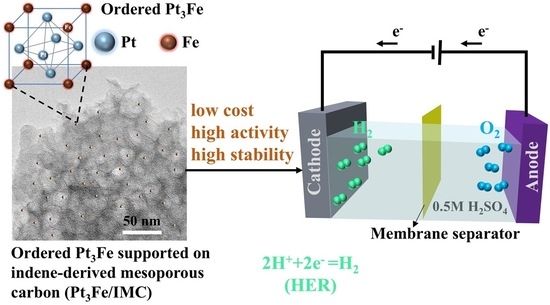
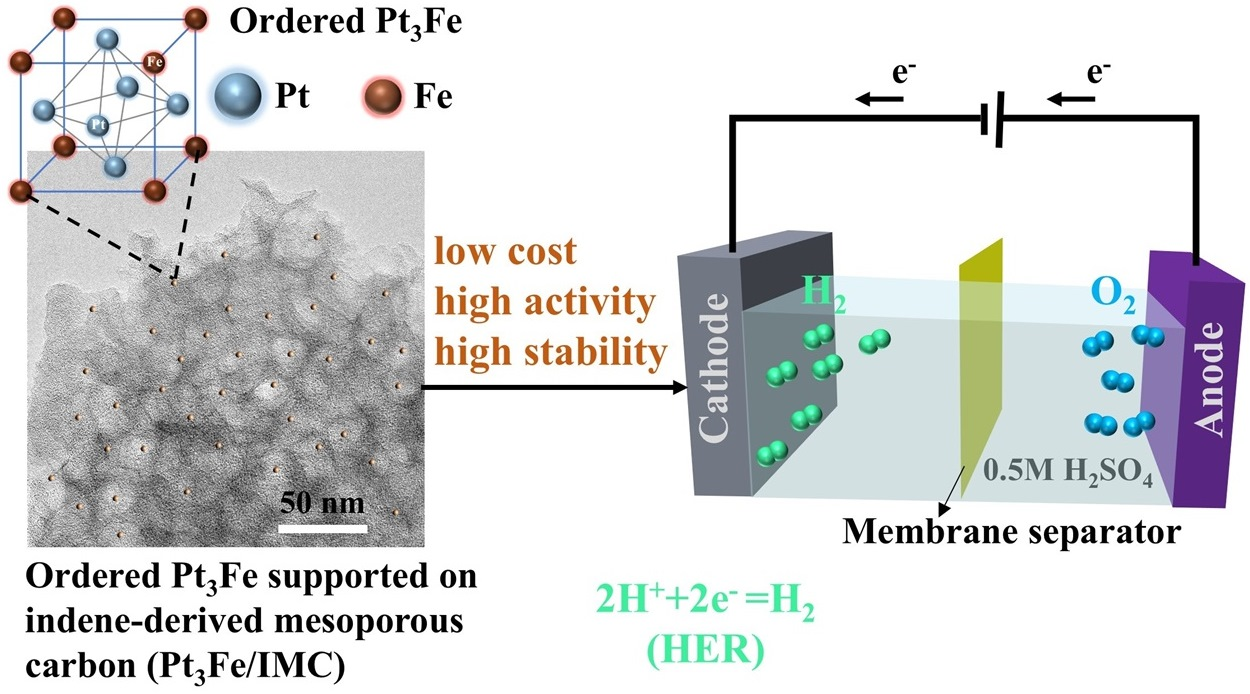
Pt-based intermetallics are high-efficiency electrocatalysts for the hydrogen evolution reaction (HER) in proton exchange membrane water electrolysis (PEMWE). However, the synthesis of intermetallics usually relies on high-temperature annealing, which easily induces particle agglomeration and limits the improvement of catalytic performance. In this study, a synergistic strategy of spatial confinement and ordered structure regulation is adopted, and indene-derived mesoporous carbon (IMC) is used as the support to controllably synthesize the intermetallic Pt3Fe catalyst. The IMC support can anchor and spatially confine nanoparticles, thereby preventing particle sintering and agglomeration during high-temperature annealing. In 0.5 mol·L−1 H2SO4 electrolytes, the catalyst exhibits excellent catalytic performance: it achieves an overpotential of only 19.1 mV at a current density of 10 mA·cm−2, which is 9.4 mV lower than that of commercial Pt/C; its mass activity reaches 2.76 A·mgPt−1, 8 times that of commercial Pt/C. Chronopotentiometry measurements show negligible potential variation after 190 h of operation at 10 mA·cm−2. This strategy suppresses particle agglomeration through the spatial confinement effect of IMC and modulates electronic states via the ordered structure, providing a practical route for the scalable preparation of low-cost, highly active and high-stability Pt-based intermetallics for PEMWE applications.

Graphical Abstract

1. Introduction

Hydrogen, defined as a clean, efficient, and sustainable secondary energy source, plays a vital role in the global transition of energy transition [1]. Conventional hydrogen production technologies suffer from inherent drawbacks. Fossil-fuel-based methods are associated with high carbon emissions [2], and thermocatalytic processes require substantial energy input [3,4]. In addition, photocatalytic water splitting is constrained by low solar energy utilization and photocorrosion of materials, making large-scale application challenging [5,6]. Electrocatalytic water electrolysis enables clean hydrogen production under mild conditions and can be integrated with wind and photovoltaic power to generate green hydrogen, demonstrating great development potential [7]. Water electrolysis is acknowledged as the mainstream technology for large-scale green hydrogen production, among which PEMWE electrolysis is considered a crucial direction for industrial hydrogen generation [8]. Platinum (Pt) is currently regarded as one of the most effective electrocatalysts for the hydrogen evolution reaction (HER). However, its large-scale application is hindered by its high cost and limited reserves [9]. Accordingly, designing high-efficiency and low-cost electrocatalysts is crucial for enabling the scalable deployment of HER technologies [10,11].
On this basis, alloying and support structure optimization are identified as two key modification strategies [12]. Pt–M alloys, formed by the combination of Pt and transition metals, are verified to optimize the adsorption of hydrogen intermediates via electronic interactions. Compared with disordered alloys, ordered intermetallic compounds possess more stable structures, stronger electronic coupling, and superior catalytic performance. To date, a variety of Pt-M-ordered intermetallic compounds, including Pt3Fe [13,14], PtCo [15,16], PtNi [17,18], PtRu [19] and Pt3Ir [20], have been successfully synthesized and applied in electrocatalytic investigations of the HER. Among these, L12-type (Cu3Au-type) Pt3Fe is proven to exhibit particularly prominent performance [21,22]. This structure is confirmed to effectively regulate the electronic structure of Pt and suppress metal dissolution as well as particle agglomeration, thus being equipped with outstanding stability.
Carbon materials, featuring excellent electrical conductivity, large specific surface area, and low cost, are widely utilized as supports for Pt-based catalysts [23]. Despite the mature preparation process and favorable particle dispersion of commercial carbon blacks, limitations such as insufficient surface defect sites, monotonous pore structure and weak anchoring capability are observed. The agglomeration of alloy particles is easily induced, and the stability and atomic utilization efficiency of the catalyst are consequently reduced [24]. Mesoporous carbon, with a large specific surface area, well-defined mesoporous structure, and moderate surface defects, presents distinct advantages in the dispersion of alloy particles. Moderate surface defect sites, combined with the spatial confinement effect of the carbon support, facilitate the highly uniform dispersion of alloy particles. The mesoporous structure further restricts their overgrowth and agglomeration, thereby realizing effective control of alloy particle size via a synergistic dual-function mechanism. Effective regulation of alloy particle size is achieved through the synergy of the two effects [25,26]. Meanwhile, the mass transfer of H+ is accelerated by hierarchical pores, and the mass transport during the reaction is optimized.
Mesoporous carbon shows outstanding advantages as a support for platinum-based catalysts, but issues of precursor selection and template removal limit its catalytic performance. Knossalla et al. [27] prepared mesoporous carbon using divinylbenzene and SiO2 template, with problems of hard template removal and uneven precursor filling. In addition, sucrose [28], glucose [29] and urea–formaldehyde resin [30] have defects of uncontrollable polymerization and poor pore-filling in preparing mesoporous carbon. To address these issues, Takeshita et al. [31] used furfuryl alcohol and SiO2 template, optimizing pore structure via acid-catalyzed polycondensation without solving SiO2 removal difficulty. By adopting Fe3O4 as the hard template, the inherent drawbacks of SiO2 templates can be effectively avoided. Template removal can be realized without strong corrosive reagents, and the structural integrity of carbon skeletons can be well preserved [32]. Nevertheless, indene has been rarely selected as a carbon precursor in current reports, while indene offers distinct advantages as a carbon precursor, enabling controlled linear polymerization at a moderate rate under mild conditions. This avoids agglomeration and runaway polymerization at high rates as well as insufficient pore filling at low rates, resulting in uniform and adequate template infiltration and improved pore structure compared to conventional precursors.
Herein, indene-derived mesoporous carbon (IMC) was synthesized using Fe3O4 nanoparticles as a template in this work. Benefiting from the synergistic effect between the spatial confinement of IMC and ordered Pt3Fe intermetallic alloy, efficient loading and uniform dispersion of alloy nanoparticles were achieved, leading to the construction of a high-performance catalytic system for acidic HER. Systematic characterizations demonstrate that the spatial confinement effect of IMC can effectively inhibit the agglomeration and growth of Pt3Fe alloy particles. Meanwhile, the ordered intermetallic structure optimizes the electronic structure and enhances corrosion resistance of Pt. The synergy of the two effects significantly improves catalytic performance. Electrochemical measurements reveal that the as-fabricated Pt3Fe/IMC catalyst exhibits a remarkably lower overpotential than commercial Pt/C at a current density of 10 mA·cm−2, along with excellent long-term stability. This strategy provides experimental basis and practical guidance for designing high-efficiency, stable and low-cost Pt-based catalysts for the acidic HER.

2. Results and Discussion

2.1. Structural and Morphology Characterization

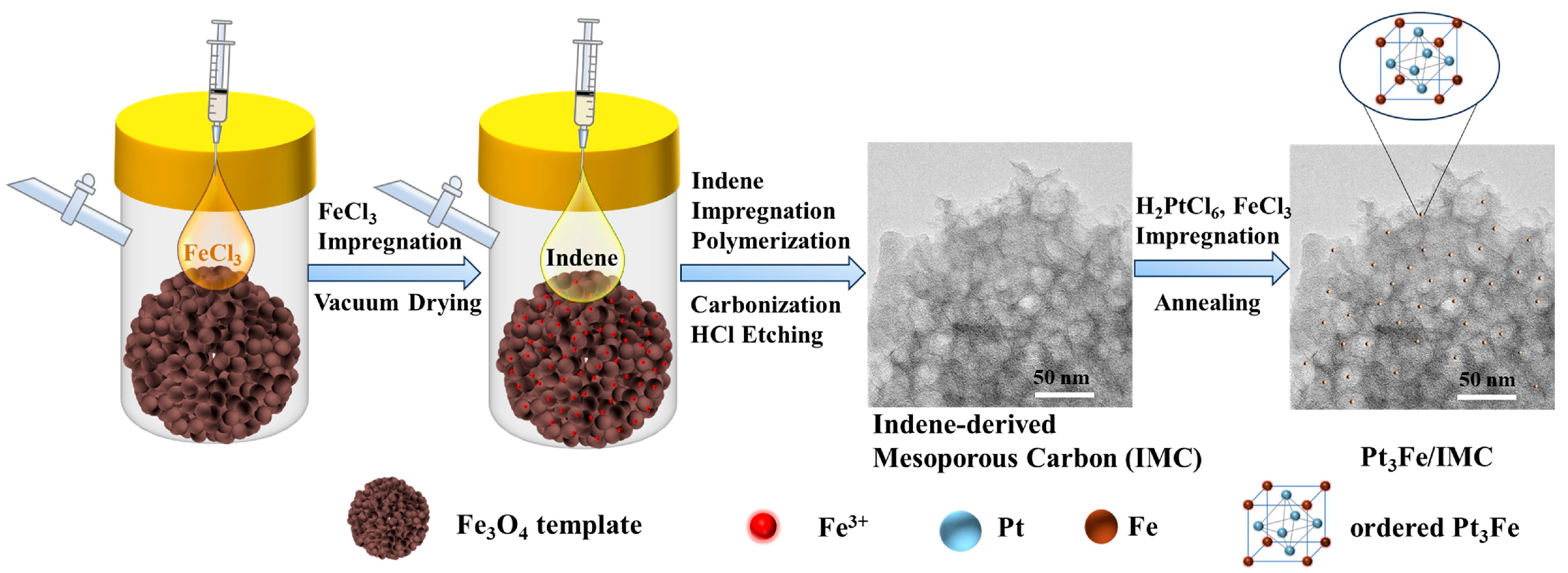
Figure 1 illustrates the synthetic process of the Pt3Fe/IMC catalyst. In this work, indene-derived mesoporous carbon (IMC) support was prepared by a hard-template method. The whole procedure includes key steps of polymerization, carbonization and etching. Briefly, Fe3+ was loaded into the Fe3O4 template by impregnation method and served as an initiator to induce the confined polymerization of indene in the template. Subsequently, indene was impregnated and polymerized in the confined mesopores. Finally, uniform IMC was obtained after high-temperature carbonization followed by HCl etching. Using the as-obtained IMC as the support, a Pt/Fe molar ratio of 3 was set, followed by incipient wetness impregnation and high-temperature reduction to form the bimetallic alloy, yielding the Pt3Fe/IMC catalyst.
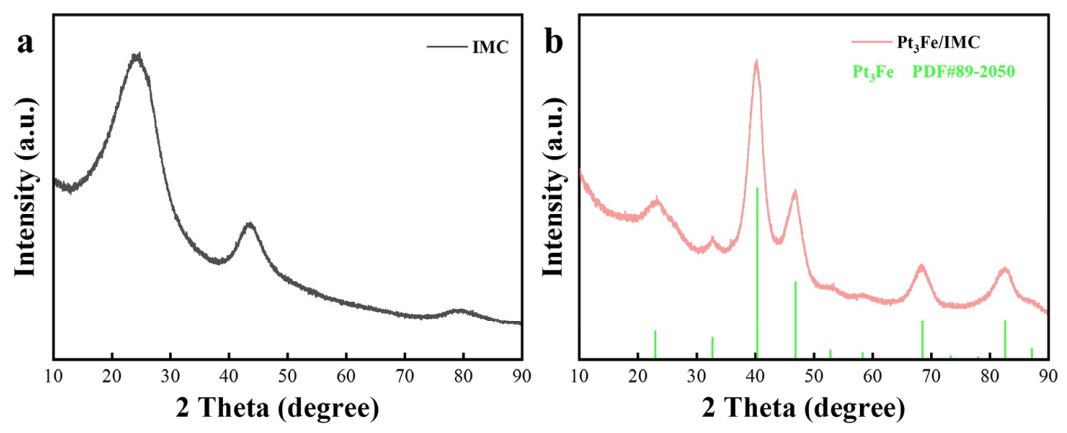
As shown in Figure 2a, the XRD pattern of IMC displays distinct carbon diffraction peaks at 24° and 43°, indicating the presence of an amorphous carbon phase without any impurity phases. As demonstrated by Raman spectroscopy (Figure S1), the ID/IG ratio of IMC is measured to be 2.37, which is remarkably higher than those of commercial carbon supports EC-300J (1.59) and XC-72 (1.28). A lower graphitization degree and higher density of defect sites are thereby verified in the carbon matrix. N2 adsorption–desorption (BET) measurement exhibits a typical type IV isotherm with a hysteresis loop for the IMC support (Figure S2), which confirms its mesopore dominated porous structure. A specific surface area of 398 m2·g−1 is achieved for the IMC support. According to the pore size distribution curve, mesopores are identified as the dominant pores accompanied by a small amount of micropores, while no obvious macropore structure is detected. Numerous mesopores in the pore channels of the material are directly observed by transmission electron microscopy (TEM) (Figure 3a) [33,34]. The IMC support that exhibits hierarchical porosity, moderate specific surface area and rational structural defects is endowed with the capacity for stable anchoring and uniform dispersion of Pt3Fe alloy particles. An ideal reaction microenvironment is constructed for hydrogen evolution reaction.
As illustrated in Figure 2b, the Pt3Fe/IMC catalyst exhibits typical XRD diffraction peaks, which are well indexed to the Pt3Fe alloy phase (JCPDS No. 89-2050). Characteristic (100) and (110) superlattice diffraction peaks of the L12-type ordered structure are clearly observed at 2θ ≈ 22.9° and 32.7° [13,21]. Such superlattice peaks serve as direct structural evidence for the long-range ordered arrangement, in which Fe atoms orderly occupy the vertexes of the cubic unit cell, while Pt atoms are located at the face centers. This confirms that the as-obtained product is the ordered Pt3Fe intermetallic phase rather than the disordered solid solution phase with randomly distributed atoms [35,36]. As shown in Figure S3, no characteristic diffraction peaks of impurity phases including metallic Fe (2θ = 44.7°), Fe2O3 (2θ = 33.2°), and Fe3O4 (2θ = 35.4°) are detected in the XRD pattern of Pt3Fe/IMC, indicating the complete reaction between Pt and Fe precursors. The single-phase Pt3Fe alloy is successfully fabricated without residual unreacted metals or metal oxides. Compared with the standard XRD pattern of pure Pt (JCPDS No. 04-0802), the characteristic diffraction angles of the (111), (200), (220), and (311) crystal planes are located at 39.8°, 46.2°, 67.4°, and 81.3°, respectively. In contrast, the corresponding diffraction angles of Pt3Fe shift to higher angles at 40.3°, 46.9°, 68.5°, and 82.6°, respectively. This shift can be attributed to the successful incorporation of Fe atoms (atomic radius 0.126 nm) into the Pt lattice (atomic radius 0.139 nm). The substitution of partial Pt lattice sites by smaller Fe atoms induces lattice contraction, which is consistent with the crystal structure evolution during the alloying of Pt3Fe [35]. Based on the Bragg equation and the interplanar spacing formula, the lattice constant was calculated from the diffraction peaks of (111), (200), (220) and (311) crystal planes, giving an average value of 0.3873 nm, which is in high agreement with the theoretical lattice constant of Pt3Fe (0.3872 nm) from the standard JCPDS card No. 89-2050. This result confirms that Fe doping can induce the ordered reconstruction of the Pt lattice, leading to the formation of the ordered Pt3Fe intermetallic phase. Similarly, the XRD patterns of the Pt3Fe/EC-300J and Pt3Fe/XC-72 catalysts (Figure S4a,b) are both in good agreement with the standard card JCPDS No.89-2050, with no diffraction peaks of impurity phases observed. Meanwhile, the shift trend of their diffraction peaks is consistent with that of Pt3Fe/IMC, confirming that both catalysts are successfully fabricated into the ordered Pt3Fe alloy phase.
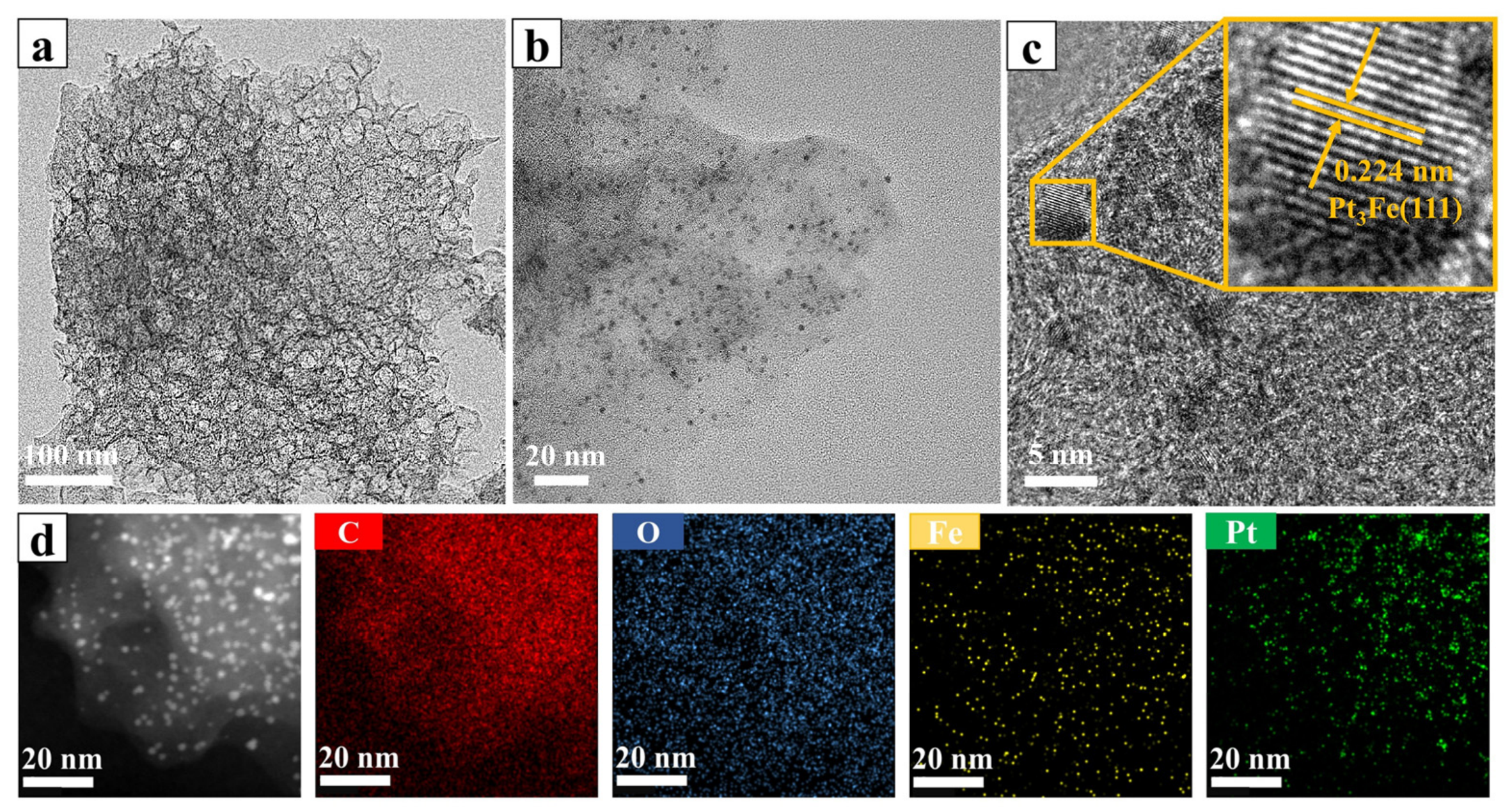
HRTEM images of Pt3Fe/IMC (Figure 3b and Figure S5) verify the uniform distribution of Pt3Fe nanoparticles on the IMC support. The particle size is about 2 nm, and no obvious aggregation of large particles is observed. Lattice fringes with an interplanar spacing of 0.224 nm are clearly observed in the HRTEM image of Pt3Fe/IMC (Figure 3c), which is highly consistent with the theoretical spacing (0.22355 nm) of the (111) plane of Pt3Fe (JCPDS No. 89-2050). This directly confirms the formation of the (111) crystal plane of Pt3Fe alloy at the microscopic scale [14,22]. Physical mixing of Pt and Fe would lead to the coexistence of lattice fringes of Pt (111) (0.227 nm) and Fe (110) (0.203 nm) in HRTEM images. However, such fringes are not observed in the sample of this work, which further excludes the possibility of physical mixing.
Energy-dispersive X-ray spectroscopy (EDS) elemental mapping reveals the homogeneous distribution of Pt and Fe elements throughout the catalyst particles, without obvious Pt-enriched or Fe-aggregated regions (Figure 3d), which supports the formation of the Pt–Fe alloy structure. Quantitative elemental analysis (Figure S6) shows that the atomic ratio of Pt to Fe is approximately 3:1 (Pt: 0.21 atom%, Fe: 0.07 atom%), which matches the ideal stoichiometric ratio of Pt3Fe/IMC alloy and is consistent with the bulk analysis results from inductively coupled plasma optical emission spectrometry (ICP-OES). The Pt3Fe/IMC catalyst contains 9.37 wt% Pt and 0.81 wt% Fe.
All the above results collectively confirm that Pt and Fe are homogeneously mixed at the atomic scale, and the Pt3Fe alloy phase with a stoichiometric ratio close to the ideal value is successfully synthesized.
X-ray photoelectron spectroscopy (XPS) was employed to systematically characterize the chemical states and electronic structures of the elements in the as-prepared Pt3Fe/IMC catalyst, Pt/IMC catalyst, and Fe/IMC catalyst. The XPS survey spectra reveal that characteristic O1s peaks were observed for all samples (Figure S7). These signals originated from oxygen-containing functional groups, such as hydroxyl and carbonyl groups, formed on the surface of the IMC carbon support during air exposure, a phenomenon commonly observed in carbon materials during preparation and storage [37,38].
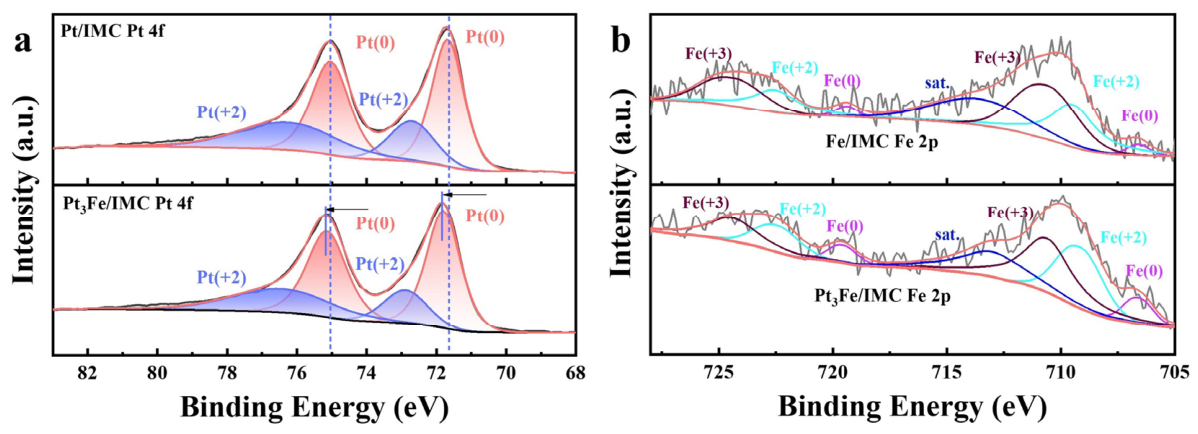
As shown in Figure 4a, deconvolution the Pt 4f spectrum (Pt 4f7/2 and Pt 4f5/2) of the Pt3Fe/IMC sample yields two sets of characteristic peaks. The peaks located at 71.79 eV and 75.14 eV are assigned to elemental platinum (Pt0), while those at 72.86 eV and 76.51 eV are attributed to Pt2+ species [22]. Comparative analysis indicated that the Pt 4f peaks of the Pt3Fe/IMC exhibited an obvious positive shift relative to those of the Pt/IMC catalyst. The positive shift in the binding energy of Pt in Pt3Fe indicates that Fe incorporation induces a downward shift of the d-band center of Pt and modifies its electronic structure. This modulation of the electronic structure effectively regulated the adsorption and desorption strengths of hydrogen intermediates (H*) on the Pt surface, thereby enhancing the electrocatalytic HER performance [22,39]. Notably, the positive shift in the Pt binding energy in Pt3Fe nanoparticles further confirmed the existence of significant intermetallic interactions and electron transfer between Pt and Fe in the Pt3Fe structure. Furthermore, the proportion of Pt0 in the ordered Pt3Fe/IMC catalyst was significantly higher than that of Pt2+, indicating that most of the platinum precursor had been successfully reduced to Pt–Fe alloy nanoparticles, which verified the excellent reduction effect of the synthesis process.
Further analysis demonstrated that the Pt0/Pt2+ ratio of the Pt3Fe/IMC catalyst was higher than that of the Pt/IMC catalyst. A higher Pt0/Pt2+ ratio was beneficial for the improvement of its HER catalytic performance, as more elemental Pt on the catalyst surface provided more efficient active sites for reaction substrates. The chemical valence state distributions of Pt and Fe in the Pt3Fe/IMC, Pt/IMC, and Fe/IMC catalysts are summarized in Tables S1 and S2. As illustrated in Figure 3b, characteristic peaks of Fe corresponding to Fe0, Fe2+, and Fe3+ are clearly observed in the Fe 2p spectrum. The binding energy of Fe in the ordered Pt3Fe/IMC catalyst was lower than that in the Fe/IMC, indicating that the interaction between Pt and Fe exerted a substantial regulatory effect on the electronic state of Fe.

2.2. Electrochemical Activity

To reveal the synergistic effects of the spatial confinement from the IMC support and the electronic modulation from the ordered Pt3Fe intermetallic on the HER performance, the catalytic activity and stability of Pt3Fe/IMC were systematically evaluated in 0.5 mol·L−1 H2SO4 electrolyte. Pt3Fe/EC-300J, Pt3Fe/XC-72, Pt/IMC, and commercial Pt/C were selected as reference catalysts. and the intrinsic origin of the outstanding HER performance of Pt3Fe/IMC was clarified based on the electrochemical results.
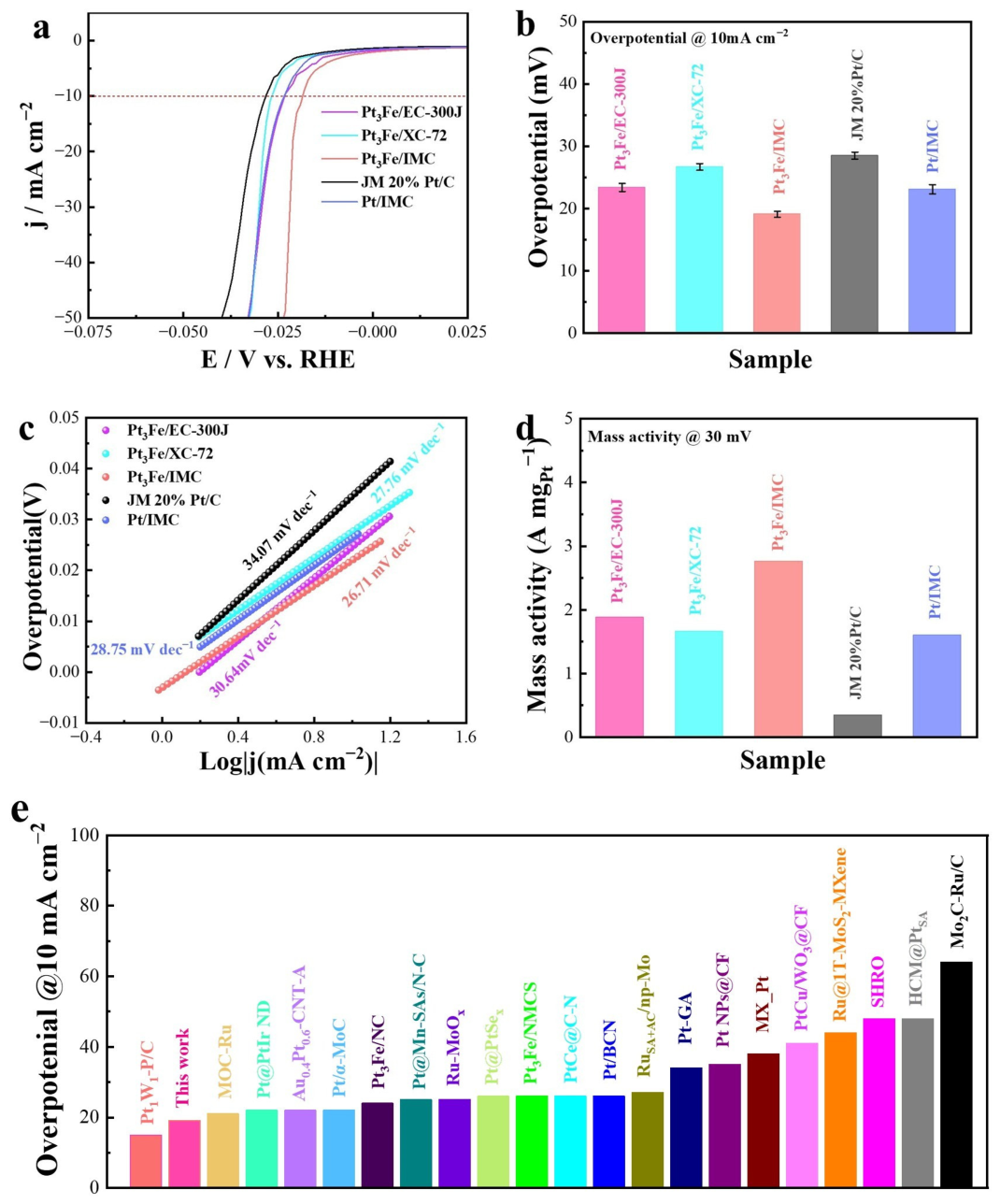
Figure 5a–c present the linear sweep voltammetry (LSV) curves, corresponding overpotentials, and Tafel slopes, respectively. Pt3Fe/IMC exhibits an overpotential of only 19.1 mV at 10 mA·cm−2 and a Tafel slope as low as 26.71 mV·dec−1, which are significantly superior to those of Pt3Fe/EC-300J (23.4 mV, 30.64 mV·dec−1), Pt/IMC (23.1 mV, 28.75 mV·dec−1), Pt3Fe/XC-72 (26.7 mV, 27.76 mV·dec−1), and commercial Pt/C (28.5 mV, 34.07 mV·dec−1).
The Tafel slope is closely correlated with its reaction mechanism. The low Tafel slope of Pt3Fe/IMC and the commercial 20% Pt/C indicates that the hydrogen evolution process follows the Volmer-Tafel mechanism, involving the Volmer step (H3O+ + e = Hads+ H2O) and the Tafel step (Hads + Hads = H2). The Tafel step acts as the rate-determining step of the overall reaction, with its energy barrier dominated by the Gibbs free energy of hydrogen adsorption (ΔGH*) on the catalyst surface [40,41]. The mesoporous confinement effect of IMC enables uniform dispersion of Pt3Fe particles, suppresses agglomeration, accelerates mass transfer and hydrogen desorption, thereby significantly improving reaction kinetics. Traditional carbon blacks such as XC-72 and EC-300J lack effective confinement structures, leading to sintering and agglomeration during high-temperature treatment, resulting in active site loss, increased mass transfer resistance, and restricted catalytic performance. Meanwhile, the ordered L12-Pt3Fe phase downshifts the Pt d-band center and optimizes ΔGH*, reducing the kinetic barrier of the rate-determining step [25]. As displayed in Figure 5e and Table S3, Pt3Fe/IMC, featuring mesoporous confinement and alloy electronic modulation, exhibits outstanding HER performance compared with recently reported catalysts.
To compare the intrinsic activity, the mass activities of the catalysts were calculated (Figure 5d). At an overpotential of 30 mV, the mass activity of Pt3Fe/IMC reaches up to 2.76 A·mgPt−1, which is 1.46 times that of Pt3Fe/EC-300J (1.90 A·mgPt−1), 1.66 times that of Pt3Fe/XC-72 (1.66 A·mgPt−1), 1.72 times that of Pt/IMC (1.60 A·mgPt−1), and 8.00 times that of commercial Pt/C (0.345 A·mgPt−1). Pt particles in commercial Pt/C tend to agglomerate, rendering a significant fraction of bulk Pt catalytically inactive and resulting in low Pt utilization. Conventional carbon supports provide weak confinement, allowing alloy particles to sinter and coarsen during heat treatment, thereby reducing the exposure of active sites. Ordered Pt3Fe intermetallic compounds act as intrinsic active sites, where electronic modulation by Fe atoms optimizes hydrogen adsorption free energy. When coupled with the dispersion effect of the IMC support, the effective utilization of Pt atoms is significantly enhanced. Consistent with Pt3Fe/IMC, the HER activities of Pt3Fe/EC-300J and Pt3Fe/XC-72 shown in Figure 5a are both superior to that of commercial Pt/C, further demonstrating the advantages of Pt3Fe intermetallics.
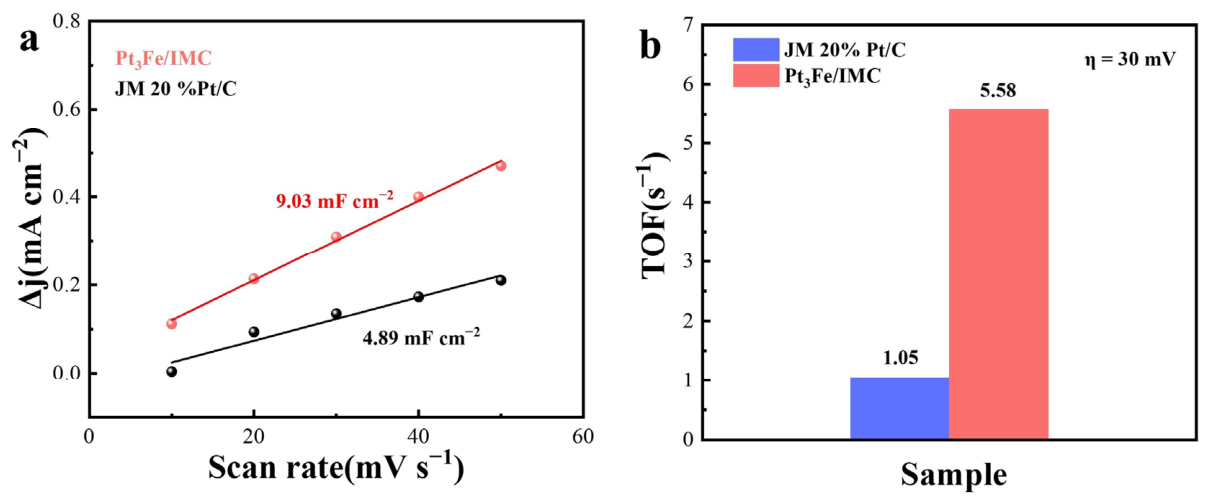
To further explore the intrinsic catalytic activity of Pt3Fe, the turnover frequency (TOF) and double-layer capacitance (Cdl) were measured, with Cdl positively correlated to the electrochemical active surface area (ECSA). The higher Cdl of Pt3Fe (Figure 6a) indicates a larger ECSA and more exposed active sites. As shown in Figure 6b, The TOF value of MC reaches 5.85 s−1 at an overpotential of 30 mV in 0.5 mol·L−1 H2SO4 solution, which is 5.7 times higher than that of commercial 20 wt% Pt/C (1.05 s−1), confirming its superior intrinsic catalytic activity. The hierarchically porous IMC support enables high dispersion of alloy nanoparticles and sufficient active site exposure, while Pt3Fe alloying modulates the electronic structure and optimizes intrinsic kinetics, collectively delivering excellent HER performance. To reveal the interfacial charge-transfer kinetics of Pt3Fe/IMC, EIS was conducted at various potentials, with the corresponding Bode phase plots displayed in Figure S10. The phase angle approaches 0° at high frequencies, reflecting the dominance of solution resistance. The low-frequency phase peak is directly associated with interfacial charge transfer. As the potential shifts negatively, the phase angle response of Pt3Fe/IMC accelerates, confirming decreased charge-transfer resistance and improved HER kinetics [42].
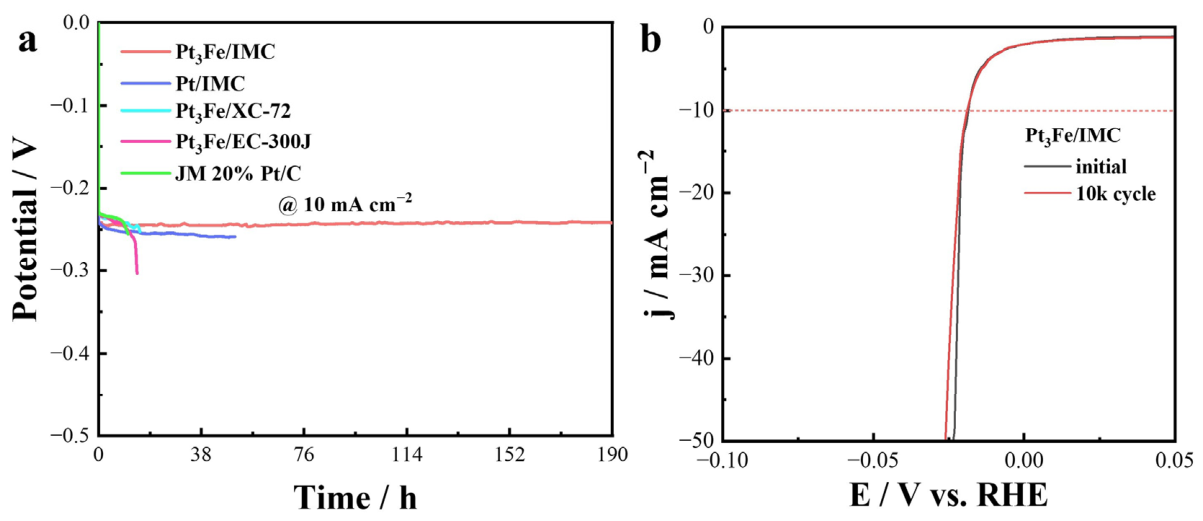
Long-term stability is a key parameter for the practical application of catalysts, which was evaluated by chronopotentiometry in this work. As shown in Figure 7a and Figure S8, the chronopotentiometry measurements confirm the long-term stability of the catalysts. Pt3Fe/IMC can operate continuously for 190 h at a constant current density of 10 mA·cm−2 with a stable curve and negligible potential change. In contrast, Pt/IMC exhibits an obvious increase in potential after 50 h of operation, while Pt3Fe/EC-300J, Pt3Fe/XC-72 and commercial Pt/C show a rapid increase in potential within 10 h of operation. Additionally, accelerated durability tests (10,000 cycles) show that the polarization curve of Pt3Fe/IMC nearly overlaps with the initial one over 0–20 mA·cm−2, with only a slight shift at 10 mA·cm−2, indicating negligible HER activity loss and excellent cyclic stability (Figure 7b).
The stability of Pt3Fe/IMC is significantly superior to that of reference samples. Morphological characterization of Pt3Fe/IMC after stability tests shows that its structure is well preserved following both long-term chronopotentiometry and repeated CV cycling, with no obvious particle migration or agglomeration (Figures S12–S15). In commercial Pt/C, the single-metal Pt nanoparticles are prone to agglomerate and dissolve during electrolysis, leading to rapid loss of active sites and poor stability. Although Pt3Fe/XC-72 and Pt3Fe/EC-300J consist of Pt3Fe alloys, conventional carbon blacks provide weak confinement, causing particles to migrate and agglomerate under long-term operation and resulting in obvious performance degradation. In contrast, the mesoporous IMC support effectively suppresses these processes, while the thermodynamically stable ordered Pt3Fe phase further enhances durability. This synergistic effect contributes to both the outstanding long-term chronopotentiometry stability and the robust cyclic stability of Pt3Fe/IMC.

3. Materials and Methods

3.1. Chemicals

Chloroplatinic acid hexahydrate (H2PtCl6·6H2O) and ferric chloride hexahydrate (FeCl3·6H2O) were purchased from Aladdin Reagent Co., Ltd. (Shanghai, China). Indene was obtained from Sinochem International Advanced Materials (Hebei) Co., Ltd. (Shijiazhuang, China). Hydrochloric acid (HCl) and ethanol (C2H5OH) were acquired from Sinopharm Group (Beijing, China). EC-300J and XC-72 carbon black were supplied by SFEP International, Shanghai, China. Commercial 20 wt% JM Pt/C catalyst was purchased from Johnson Matthey Corporation (London, UK), and a 5 wt% Nafion solution was obtained from DuPont (Wilmington, DE, USA).

3.2. Synthesis

3.2.1. Synthesis of Indene-Derived Mesoporous Carbon (IMC)

The Fe3O4 template was prepared according to a well-established synthetic protocol reported in the published literature. A measure of 3 g of the as-prepared Fe3O4 template was accurately weighed and transferred into a 25 mL Schlenk reaction tube, which was sealed with a rubber stopper and connected to a water-circulating vacuum pump to complete the evacuation of the sealed system inside the tube. A measure of 2 mL of 0.2 M ferric chloride solution was accurately pipetted with a 5 mL syringe and slowly injected into the reaction tube, followed by sufficient shaking to achieve thorough mixing of the two solid–liquid phases. After the mixing was completed, all the materials were transferred into a vacuum drying apparatus at 60 °C for drying treatment. The obtained composite product was collected, fully ground into uniform powder, and placed back into the original Schlenk tube for subsequent use. Following the aforementioned treatment procedure for Fe3+, 1.8 mL of indene reagent was added to the Schlenk tube containing the ground composite product via an impregnation method. The mixture was sufficiently shaken to achieve homogeneous mixing. It was then placed in a vacuum environment at 25 °C to conduct a 12 h polymerization reaction. The precursor obtained after polymerization was transferred into a high-temperature tubular furnace protected by an argon atmosphere, where carbonization treatment was completed by constant-temperature calcination at 1000 °C. The carbonized product was then subjected to etching treatment with 3 mol/L hydrochloric acid solution at 80 °C for 13 h, during which the residual Fe3O4 hard template and other impurity components in the system were simultaneously removed. After the etching was finished, the obtained solid sample was repeatedly rinsed with deionized water until the washing solution reached a neutral state. Finally, drying treatment was performed on the washed sample to fabricate the target indene-derived mesoporous carbon (IMC).

3.2.2. Synthesis of Pt3Fe/IMC, Pt3Fe/EC-300J, Pt3Fe/XC-72, Pt/IMC and Fe/IMC

Pt3Fe nanoparticle catalyst supported on IMC was fabricated via an impregnation-reduction method. A homogeneous mixed precursor solution, which was prepared with hexachloroplatinic acid hexahydrate (H2PtCl6·6H2O) and ferric chloride hexahydrate (FeCl3·6H2O) at a preset stoichiometric ratio, was dropwise and uniformly added into the pretreated IMC support, with the molar ratio of Pt to Fe in the system precisely controlled at 3:1. Prior to heating, the tube furnace was purged with high-purity Ar for 30 min to remove residual air and moisture. Meanwhile, a heating rate of 5 °C·min−1 was employed to ensure gradual reduction and ordered phase transformation. After incipient wetness impregnation at room temperature, the obtained solid–liquid composite was subjected to ultrasonic dispersion treatment in an ultrasonic environment at 25 °C for 2 h, followed by vacuum freeze-drying overnight. The dried solid sample was placed in a tube furnace and subjected to reduction treatment at 700 °C for 2 h under a mixed H2/Ar atmosphere with a H2 volume fraction of 10%. After natural cooling to room temperature, the Pt3Fe/IMC catalyst was obtained, with the mass fraction of the Pt3Fe active component being 10%.
Pt3Fe/XC-72 and Pt3Fe/EC-300J catalysts were synthesized following the same preparation procedure mentioned above, with only the carbon support replaced by the corresponding commercial XC-72 and EC-300J conductive carbon blacks. With only the support type varied, all other experimental parameters including precursor concentration, impregnation conditions, ultrasonic parameters, reduction atmosphere, and heat treatment schedule were kept constant to ensure a controlled single-variable comparison. Pt/IMC and Fe/IMC monometallic catalysts were prepared via the same impregnation-reduction process as that adopted for Pt3Fe/IMC. The difference between the two catalysts lies in that only H2PtCl6·6H2O as a single component was added into the precursor solution for the fabrication of Pt/IMC. The total metal loading of monometallic catalysts was matched to the 10 wt% active component loading of Pt3Fe/IMC. While only FeCl3·6H2O as a single component was introduced into the precursor solution for the synthesis of Fe/IMC.

3.3. Characterizations

A series of characterization methods were adopted to analyze the morphology and structural features of the as-prepared catalysts. Powder X-ray diffraction (XRD) measurements were performed on a Bruker D8-Advance diffractometer (Bruker Corporation, Karlsruhe, Germany) to identify the phase composition and crystalline structure. Sample morphology was observed using an FEI Tecnai G2 F30 TEM (Thermo Fisher Scientific, Hillsboro, OR, USA). The surface chemical states of samples were identified by XPS with a Thermo Scientific K-Alpha system (Thermo Fisher Scientific, Waltham, MA, USA). Raman spectroscopy (Thermo Fisher Scientific, Madison, WI, USA) was applied to evaluate the graphitization level of carbon supports. BET measurement was performed on a Micromeritics ASAP 2020 apparatus (Micromeritics, Norcross, GA, USA) to measure the specific surface area and pore structure. The elemental composition of catalysts was detected by ICP-OES using an Agilent 7800 device (Agilent Technologies, Santa Clara, CA, USA).

3.4. Electrochemical Measurements

All electrochemical measurements were carried out using a CHI760E workstation (Shanghai Chenhua Instrument Co., Ltd., Shanghai, China) in a standard three-electrode setup. The catalyst ink was prepared by dispersing 5 mg of catalyst in 970 µL of ethanol and 30 µL of 5 wt% Nafion solution, followed by ultrasonication for 80 min. The catalyst ink was deposited onto a rotating ring-disk electrode (RRDE) with a 5 mm glassy carbon substrate, yielding an overall catalyst loading of 200 μgcat. cm−2. A carbon rod served as the counter electrode, and an Ag/AgCl electrode immersed in saturated KCl solution was employed as the reference electrode for potential recording. Cyclic voltammetry (CV) profiles were acquired in 0.5 M H2SO4 at a scan rate of 50 mV s−1. The hydrogen evolution reaction (HER) activity was assessed by linear sweep voltammetry (LSV) in 0.5 M H2SO4 at 5 mV s−1 with full 100% IR compensation and an electrode rotation rate of 1600 rpm. Cyclic voltammetry (CV) and chronopotentiometry (CP) were applied to assess the long-term stability of the as-prepared catalysts.

4. Conclusions

In this work, IMC was successfully prepared using Fe3O4 hard template and indene as the carbon source. Based on the synergistic strategy of spatial confinement and ordered alloying, Pt3Fe ordered alloy nanoparticles were uniformly dispersed on the as-prepared support, and the high-performance Pt3Fe/IMC catalyst was constructed. The as-synthesized catalyst exhibits superior HER performance and stability to Pt3Fe/EC-300J, Pt3Fe/XC-72 and commercial Pt/C in 0.5 mol·L−1 H2SO4. The catalyst delivers an overpotential of only 19.1 mV at 10 mA·cm−2 and a mass activity of 2.76 A·mgpt−1, significantly outperforming the commercial Pt/C. It also shows excellent long-term stability with negligible potential decay during a 190 h chronopotentiometry measurement. IMC effectively suppresses alloy nanoparticle aggregation and ensures uniform dispersion, while ordered Pt3Fe modulates electronic structure to enhance intrinsic catalytic activity. This work provides a feasible approach and experimental basis for the construction of efficient and stable Pt-based catalysts for acidic hydrogen evolution.

Supplementary Materials

The following supporting information can be downloaded at: https://www.mdpi.com/article/10.3390/catal16050439/s1, Figure S1. (a,b) Raman spectra of IMC, EC-300J and XC-72; Figure S2. (a) N2 adsorption/desorption curve and (b) pore size distribution of IMC; Figure S3. XRD pattern of the electrocatalyst, with reference to standard PDF cards for Pt3Fe, Pt, Fe, Fe2O3, and Fe3O4; Figure S4. XRD patterns of (a) Pt3Fe/EC-300J, (b) Pt3Fe/XC-72, (c) JM 20wt% Pt/C, (d) Pt/IMC, and (e) Fe/IMC; Figure S5. (a) HRTEM image of Pt3Fe/IMC, (b) Size distribution of the Pt3Fe alloy nanoparticles; Figure S6. EDS spectrum of Pt3Fe/IMC; Figure S7. XPS survey spectra of IMC, Fe/IMC, Pt/IMC, and Pt3Fe/IMC; Figure S8. Enlarged chronopotentiometry curves of different catalysts recorded at a constant current density of 10 mA cm−2 in 0.5 mol·L−1 H2SO4 electrolyte; Figure S9. (a,b) CV curve of Pt3Fe/IMC and commercial Pt/C; Figure S10. Bode phase plots of Pt3Fe/IMC; Figure S11. SEM images of Pt3Fe/IMC catalyst before the HER test; Figure S12. SEM images of Pt3Fe/IMC after long-term chronopotentiometry stability test; Figure S13. SEM images of Pt3Fe/IMC after 10,000 CV cycles; Figure S14. (a) TEM and (b) HRTEM images of Pt3Fe/IMC after long-term chronopotentiometry stability test; Figure S15. (a) TEM and (b) HRTEM images of Pt3Fe/IMC after 10,000 CV cycles. Table S1. XPS spectra of different catalysts with Pt 4f and atomic percentages (AP) of different Pt species; Table S2. Binding energies of Fe (0), Fe (+2) and Fe (+3) component deconvoluted from Fe 2p XPS spectrum; Table S3. Comparison of the HER activity between Pt3Fe/IMC and other state-of-the-art alloy-based electrocatalysts in 0.5 M H2SO4 solution. Refs. [43,44,45,46,47,48,49,50,51,52,53,54,55,56,57,58,59] are cited in the Supplementary Materials.

Author Contributions

H.-P.L. and Y.Z.: conceptualization, supervision; Y.W. and G.S.: methodology; G.S.: investigation, writing—original draft preparation; L.L.: investigation; X.W. and Y.Y.: writing—review and editing. All authors have read and agreed to the published version of the manuscript.

Funding

This research was funded by the National Key Research and Development Program of China, grant number 2023YFB4004502-4.

Data Availability Statement

The data that support the findings of this study are available from the corresponding author upon reasonable request.

Conflicts of Interest

The authors declare no conflicts of interest.

References

  1. Tharun, V.; Kumar, P.S. A Comprehensive Review on Hydrogen Production, Purification, Storage, and Utilization: Challenges and Future Directions. Renew. Sustain. Energy Rev. 2025, 224, 116067. [Google Scholar] [CrossRef]
  2. Lin, K.; Chen, B.; Liu, Z.; Fu, L.; Hao, S.; Li, J.; Zhang, Y.; Xie, H. Toward Efficient, Low-Carbon, and Cost-Effective Hydrogen Production Shifting from Fossil Fuel-Based to Renewable Water Electrolysis: A Perspective and Outlook. Appl. Energy 2025, 401, 126661. [Google Scholar] [CrossRef]
  3. Zhao, Z.; He, W.; Guo, B.; Yu, J.; Wang, Z.; Yu, H. A Comprehensive Review of Ammonia Decomposition for Hydrogen Production. Energy Fuels 2025, 39, 13825–13847. [Google Scholar] [CrossRef]
  4. Mancuso, A.; Diglio, M.; Impemba, S.; Venditto, V.; Vaiano, V.; Buonerba, A.; Sacco, O. Dual-Function Bare Copper Oxide (Photo)Catalysts for Selective Phenol Production via Benzene Hydroxylation and Low-Temperature Hydrogen Generation from Formic Acid. Catalysts 2025, 15, 866. [Google Scholar] [CrossRef]
  5. Impemba, S.; Provinciali, G.; Filippi, J.; Caporali, S.; Muzzi, B.; Casini, A.; Caporali, M. Tightly Interfaced Cu2O with In2O3 to Promote Hydrogen Evolution in Presence of Biomass-Derived Alcohols. ChemNanoMat 2024, 10, e202400459. [Google Scholar] [CrossRef]
  6. Anwar, S.; Aslam, Z.; Aslam, U.; Mehmood, U.; Rana, A.G.; Mahmood, N.; Rafique, A. Advances and Challenges in Photocatalytic Water Splitting: Recent Developments and Trends. Fuel 2026, 404, 136280. [Google Scholar] [CrossRef]
  7. Gao, X.; Chen, Y.; Wang, Y.; Zhao, L.; Zhao, X.; Du, J.; Wu, H.; Chen, A. Next-Generation Green Hydrogen: Progress and Perspective from Electricity, Catalyst to Electrolyte in Electrocatalytic Water Splitting. Nano-Micro Lett. 2024, 16, 237. [Google Scholar] [CrossRef]
  8. Wang, J.; Yang, J.; Feng, Y.; Hua, J.; Chen, Z.; Liao, M.; Zhang, J.; Qin, J. Comparative Experimental Study of Alkaline and Proton Exchange Membrane Water Electrolysis for Green Hydrogen Production. Appl. Energy 2025, 379, 124936. [Google Scholar] [CrossRef]
  9. Cui, Z.; Jiao, W.; Huang, Z.; Chen, G.; Zhang, B.; Han, Y.; Huang, W. Design and Synthesis of Noble Metal-Based Alloy Electrocatalysts and Their Application in Hydrogen Evolution Reaction. Small 2023, 19, 2301465. [Google Scholar] [CrossRef]
  10. Lu, J.; Qian, G.; Luo, L.; He, H.; Yin, S. Contributions of Oxygen Vacancies to the Hydrogen Evolution Catalytic Activity of Tungsten Oxides. Int. J. Hydrogen Energy 2021, 46, 676–682. [Google Scholar] [CrossRef]
  11. Feng, S.; Lu, J.; Luo, L.; Qian, G.; Chen, J.; Abbo, H.S.; Titinchi, S.J.J.; Yin, S. Enhancement of Oxygen Reduction Activity and Stability via Introducing Acid-Resistant Refractory Mo and Regulating the near-Surface Pt Content. J. Energy Chem. 2020, 51, 246–252. [Google Scholar] [CrossRef]
  12. Yang, Q.; Zeng, J.; Yang, G.; Sun, X.; Lin, X.; Liu, K.; Chen, J.; Wang, S.; Lu, X.F. Carbon-Supported Platinum-Based Electrocatalysts for Alkaline Hydrogen Evolution. EES Catal. 2025, 3, 972–993. [Google Scholar] [CrossRef]
  13. Nie, M.; Wang, Z.; He, D.; Gan, W.; Yuan, Q. Ultrafine Pt3Fe Intermetallic Electrocatalysts Formed by Ultrafast Joule Heating toward Ethanol Oxidation. ACS Sustain. Chem. Eng. 2024, 12, 16700–16710. [Google Scholar] [CrossRef]
  14. Jung, C.; Lee, C.; Bang, K.; Lim, J.; Lee, H.; Ryu, H.J.; Cho, E.; Lee, H.M. Synthesis of Chemically Ordered Pt3Fe/C Intermetallic Electrocatalysts for Oxygen Reduction Reaction with Enhanced Activity and Durability via a Removable Carbon Coating. ACS Appl. Mater. Interfaces 2017, 9, 31806–31815. [Google Scholar] [CrossRef]
  15. Chen, J.; Yu, T.; Zhai, Z.; Qian, G.; Yin, S. Coupling Interface Engineering with Electronic Interaction toward High-Efficiency H2 Evolution in pH-Universal Electrolytes. J. Energy Chem. 2023, 80, 535–541. [Google Scholar] [CrossRef]
  16. Chen, Z.; Liu, J.; Yang, B.; Lin, M.; Molochas, C.; Tsiakaras, P.; Shen, P. Two-Stage Confinement Derived Small-Sized Highly Ordered L10-PtCoZn for Effective Oxygen Reduction Catalysis in PEM Fuel Cells. J. Colloid Interface Sci. 2023, 652, 388–404. [Google Scholar] [CrossRef]
  17. Chen, Q.; Yang, H.; Ali, A.; Wang, R.; Shen, P. Heterostructure PtNi Supported by Pd Nanosheets High-Performance Catalysts for Multifunctional Fuel Cell. Int. J. Hydrogen Energy 2023, 48, 20655–20666. [Google Scholar] [CrossRef]
  18. Feng, S.; Chen, J.; Qian, G.; Mo, Y.; Lu, J.; Chen, W.; Luo, L.; Yin, S. Metal–Support Interactions in a Molybdenum Oxide Anchored PtNi Alloy for Improving Oxygen Reduction Activity. ACS Appl. Energy Mater. 2020, 3, 12246–12253. [Google Scholar] [CrossRef]
  19. Pang, B.; Liu, X.; Liu, T.; Chen, T.; Shen, X.; Zhang, W.; Wang, S.; Liu, T.; Liu, D.; Ding, T.; et al. Laser-Assisted High-Performance PtRu Alloy for pH-Universal Hydrogen Evolution. Energy Environ. Sci. 2022, 15, 102–108. [Google Scholar] [CrossRef]
  20. Ni, Z.; Luo, C.; Cheng, B.; Kuang, P.; Li, Y.; Yu, J. Construction of Hierarchical and Self-Supported NiFe-Pt3Ir Electrode for Hydrogen Production with Industrial Current Density. Appl. Catal. B Environ. 2023, 321, 122072. [Google Scholar] [CrossRef]
  21. Zhao, T.; Li, Y.; Liu, J.; Wang, X.; Zhang, J.; Liu, C.; Xing, W.; Ge, J. Highly Dispersed L12-Pt3Fe Intermetallic Particles Supported on Single Atom Fe–Nx–Cy Active Sites for Enhanced Activity and Durability towards Oxygen Reduction. Chin. Chem. Lett. 2023, 34, 107824. [Google Scholar] [CrossRef]
  22. Zhang, B.; Yang, H.; Zhou, X.; Xia, Y.; Bai, L.; Li, Z.; Wang, X.; Sun, M. Salt Matrix Strategy for General Synthesis of High-Loading Intermetallic Pt3M Catalysts toward Electrocatalytic Hydrogen Evolution. Inorg. Chem. 2025, 64, 7656–7665. [Google Scholar] [CrossRef]
  23. Wu, B.; Yang, H.; Li, L.; Tang, X.; Wu, Y.; Huang, B.; Lützenkirchen-Hecht, D.; Qiu, M.; Yuan, K.; Chen, Y. Integrating PtCo Intermetallic with Highly Graphitized Carbon Toward Durable Oxygen Electroreduction in Proton Exchange Membrane Fuel Cells. Adv. Mater. 2025, 37, 2500096. [Google Scholar] [CrossRef]
  24. Wang, G.; Zhao, W.; Mansoor, M.; Liu, Y.; Wang, X.; Zhang, K.; Xiao, C.; Liu, Q.; Mao, L.; Wang, M.; et al. Recent Progress in Using Mesoporous Carbon Materials as Catalyst Support for Proton Exchange Membrane Fuel Cells. Nanomaterials 2023, 13, 2818. [Google Scholar] [CrossRef]
  25. Kuang, P.; Ni, Z.; Zhu, B.; Lin, Y.; Yu, J. Modulating the d-Band Center Enables Ultrafine Pt3Fe Alloy Nanoparticles for pH-Universal Hydrogen Evolution Reaction. Adv. Mater. 2023, 35, 2303030. [Google Scholar] [CrossRef] [PubMed]
  26. Huang, W.; Nie, J.; Zheng, Z.; Wang, X.; Qiu, C.; Li, X.; Zhou, Z.; Duan, Z.; Wang, Y.; Sun, S. Unveiling Atomic-Level Synergy of Pt3Fe Alloy Nanoparticles and Fe Single Atoms for Enhanced Electrochemical Stability. JACS Au 2025, 5, 5726–5738. [Google Scholar] [CrossRef]
  27. Knossalla, J.; Paciok, P.; Göhl, D.; Jalalpoor, D.; Pizzutilo, E.; Mingers, A.M.; Heggen, M.; Dunin-Borkowski, R.E.; Mayrhofer, K.J.J.; Schüth, F.; et al. Shape-Controlled Nanoparticles in Pore-Confined Space. J. Am. Chem. Soc. 2018, 140, 15684–15689. [Google Scholar] [CrossRef] [PubMed]
  28. Baptista, J.; Schneider, R.; Rossi De Aguiar, K.M.F.; Módenes, A.N.; Scheufele, F.B. Optimization of Mesoporous Carbon Adsorbents from Sucrose and Aerosil 380 Hydrophilic Silica by Hard Templating. ACS Omega 2025, 10, 38890–38901. [Google Scholar] [CrossRef] [PubMed]
  29. Zhou, K.-Y.; Guo, J.-Z.; Hu, Y.; Mu, W.-L.; Gao, X.-K.; Song, L.-F. A Highly Stable Spherical FeCo–N–C Cathode Catalyst for Zinc-Air Batteries Prepared by a Template-Assisted Method. Int. J. Electrochem. Sci. 2025, 20, 101179. [Google Scholar] [CrossRef]
  30. Miao, W.; Hu, Y.; Liu, J.; Wang, X.; Liu, Z.; Peng, H.; Ma, G. Silica Hard Template Extracted from Semicoke Residue Toward the Hierarchical Porous Carbon Skeleton for Lithium–Sulfur Batteries. ACS Appl. Nano Mater. 2024, 7, 17493–17503. [Google Scholar] [CrossRef]
  31. Takeshita, T.; Yano, K.; Kodama, K. Effect of the Pore Size of Mesoporous Carbon Supports for Cathode Catalysts on the Cell Performance of Polymer Electrolyte Fuel Cells. ACS Catal. 2025, 15, 13549–13557. [Google Scholar] [CrossRef]
  32. Wang, J.; Ma, M.; Zhang, N.; Yu, L.; Zhang, B.; Guo, W.; Tian, K.; Li, X.; Wang, H. Self-Sacrificial Fe3O4-Templated Synthesis of Pomegranate-like Micro/Mesoporous N, O co-Doped Carbon Nanoclusters with Complete Pseudocapacitive Pyrrolic/Pyridinic Sites for Superior Supercapacitance. Appl. Surf. Sci. 2026, 721, 165492. [Google Scholar] [CrossRef]
  33. Gu, J.; Hu, Z.; Feng, F.; Xu, X.; Wang, J.; Zhang, M.; Wu, Z. One-Step Templating–Activation Strategy toward N-Doped Ordered Mesoporous Carbon Materials with Ultrahigh Microporosity for Efficient Gas Adsorption. ACS Appl. Mater. Interfaces 2026, 18, 5739–5750. [Google Scholar] [CrossRef]
  34. Zhu, H.; Yan, Z.; Wang, X.; Liu, W.; Guo, L.; Wei, Q.; Wang, M. Synergistic Effect of Mesoporous Carbon-Based Framework with Sodiophilic Nanoparticles for Stable Sodium Metal Anodes. Adv. Funct. Mater. 2025, 35, 2502032. [Google Scholar] [CrossRef]
  35. Xiong, Y.; Yang, Y.; Joress, H.; Padgett, E.; Gupta, U.; Yarlagadda, V.; Agyeman-Budu, D.N.; Huang, X.; Moylan, T.E.; Zeng, R.; et al. Revealing the Atomic Ordering of Binary Intermetallics Using in Situ Heating Techniques at Multilength Scales. Proc. Natl. Acad. Sci. USA 2019, 116, 1974–1983. [Google Scholar] [CrossRef] [PubMed]
  36. Zheng, Q.; Zhang, Z.R.; Du, J.; Lin, L.L.; Xia, W.X.; Zhang, J.; Bian, B.R.; Liu, J.P. A Novel Direct Reduction Method to Synthesize Ordered Fe-Pt Alloy Nanoparticles. J. Mater. Sci. Technol. 2019, 35, 560–567. [Google Scholar] [CrossRef]
  37. Rosenthal, D.; Ruta, M.; Schlögl, R.; Kiwi-Minsker, L. Combined XPS and TPD Study of Oxygen-Functionalized Carbon Nanofibers Grown on Sintered Metal Fibers. Carbon 2010, 48, 1835–1843. [Google Scholar] [CrossRef]
  38. Boehm, H.P. Surface Oxides on Carbon and Their Analysis: A Critical Assessment. Carbon 2002, 40, 145–149. [Google Scholar] [CrossRef]
  39. Zhang, B.; Zhang, L.; Yang, H.; Shan, M.; Bai, L.; Li, Z.; Sun, M. Gram-Scale Synthesis of Small-Sized PtM Intermetallics as High-Performance Catalysts for the Hydrogen Evolution Reaction. Chem. Commun. 2024, 60, 5290–5293. [Google Scholar] [CrossRef]
  40. Hu, M.; Cai, Z.; Yang, S.; Wang, Z.; Shen, F.; Liang, X.; Sun, G.; Ren, H.; Cao, Y.; Hu, B.; et al. Direct Growth of Uniform Bimetallic Core-Shell or Intermetallic Nanoparticles on Carbon via a Surface-Confinement Strategy for Electrochemical Hydrogen Evolution Reaction. Adv. Funct. Mater. 2023, 33, 2212097. [Google Scholar] [CrossRef]
  41. Gong, L.; Zhu, J.; Xia, F.; Zhang, Y.; Shi, W.; Chen, L.; Yu, J.; Wu, J.; Mu, S. Marriage of Ultralow Platinum and Single-Atom MnN4 Moiety for Augmented ORR and HER Catalysis. ACS Catal. 2023, 13, 4012–4020. [Google Scholar] [CrossRef]
  42. Yao, B.; Yan, Y.; Yang, Y.; Yu, S.; Chen, Y.; Liu, Q.; Zhu, Z.; Jiao, D.; Xing, Z.; Wang, D.; et al. Synergistic Lewis Acid-Base Pairs-Mediated Microenvironment Optimization for Hydrogen Evolution in pH-Universal and Alkaline Seawater. Appl. Catal. B Environ. Energy 2026, 386, 126384. [Google Scholar] [CrossRef]
  43. Guan, Y.; Song, Z.; Xue, C.; Yao, X.; Zheng, M.L.; Fu, J.; Li, W.; Li, Y.; Ren, X.; Zhang, L.; et al. Atomic Phosphorus Sites for Anchoring Platinum–Tungsten Dimers to Facilitate Proton Transfer in All-pH Hydrogen Evolution. Adv. Energy Mater. 2025, 15, 2402714. [Google Scholar] [CrossRef]
  44. Zeng, B.; Yuan, H.; Guo, Z.; Er, X.; Liu, Y.; Dong, B.; Ma, F. Selenium-Mediated Sub-1 Nm Amorphous Shell Spatially Confines Platinum Nanocrystal for Efficient Hydrogen Evolution. Adv. Funct. Mater. 2025, 35, 2504608. [Google Scholar] [CrossRef]
  45. Wang, F.; Gao, Y.; Jiang, Z.; Tian, F.; Pang, Z.; Yu, X.; Li, G.; Hsu, H.-Y.; Hu, S.; Ji, L.; et al. Bridging-Induced Densified MXene Films with Ultralow Single-Atom Pt Loading for Highly Efficient Hydrogen Evolution. Nano Res. 2025, 18, 94907671. [Google Scholar] [CrossRef]
  46. Liu, W.; Wang, A.; Zhang, J.; Yu, S.; Wang, M.; Tian, S.; Tang, H.; Zhao, Z.; Ren, X.; Guo, Y.; et al. Pt/α-MoC Catalyst Boosting pH-Universal Hydrogen Evolution Reaction at High Current Densities. ACS Nano 2025, 19, 10038–10047. [Google Scholar] [CrossRef] [PubMed]
  47. Yao, H.; Yu, X.; Jia, Y.; Zhang, J.; Yao, J.; Liu, J.; Su, B.; Guo, X. Synergistic Interaction of Monodisperse Pt Nanoparticles with Defect-rich Graphene Aerogel for Efficient Acidic Hydrogen Evolution. Rare Met. 2025, 44, 2513–2521. [Google Scholar] [CrossRef]
  48. Peng, W.; Yang, F.; Ke, S.; Wang, Y.; Li, X.; Yang, S.; Mi, R.; Liu, Y.; Huang, Z.; Min, X.; et al. A Biomass-Derived PtCe@C-N Catalyst with Strong Metal-Support Interaction for High-Efficiency Hydrogen Evolution. J. Alloys Compd. 2025, 1035, 181510. [Google Scholar] [CrossRef]
  49. Chakrabartty, S.; Parse, H.; Krämer, M.; Kim, S.; Raabe, D.; Gault, B.; Sokol, M.; Rosen, B.A.; Eliaz, N. Ti3C2Tz Supported Pulse-Electrodeposited Pt Nanostructures for Enhanced Acidic Electrochemical Hydrogen Evolution. ChemCatChem 2024, 16, e202401088. [Google Scholar] [CrossRef]
  50. Liu, L.; Wang, Y.; Zhao, Y.; Wang, Y.; Zhang, Z.; Wu, T.; Qin, W.; Liu, S.; Jia, B.; Wu, H.; et al. Ultrahigh Pt-Mass-Activity Hydrogen Evolution Catalyst Electrodeposited from Bulk Pt. Adv. Funct. Mater. 2022, 32, 2112207. [Google Scholar] [CrossRef]
  51. Li, Q.; Deng, Z.; Tao, D.; Pan, J.; Xu, W.; Zhang, Z.; Zhong, H.; Gao, Y.; Shang, Q.; Ni, Y.; et al. Edge-Effect Modulated Noble Metal Electrocatalysts for Efficient and pH-Universal Hydrogen Evolution Reaction. Adv. Funct. Mater. 2024, 34, 2411283. [Google Scholar] [CrossRef]
  52. Liu, C.; Wei, Z.; Cao, M.; Cao, R. Pt Nanodendrites with a PtIr Alloy Surface Structure Exhibit Excellent Stability toward Acidic Hydrogen Evolution Reaction. Nano Res. 2024, 17, 4844–4849. [Google Scholar] [CrossRef]
  53. Kang, J.; Kloppenburg, J.; Sheng, J.; Xu, Z.; Meinander, K.; Jiang, H.; Lv, Z.-P.; Kauppinen, E.I.; Zhang, Q.; Chen, X.; et al. Anomalous Enhancement of the Electrocatalytic Hydrogen Evolution Reaction in AuPt Nanoclusters. ACS Catal. 2025, 15, 9928–9939. [Google Scholar] [CrossRef]
  54. Liu, F.; Zhang, S.; Ma, S.; Cao, Z.; Li, Y.; Ma, Y.; Xu, X.; Zhang, J.; Xue, Y.; Tang, C. Hydrogen Spillover by Boron Carbon Nitride Support for Efficient Acidic Hydrogen Evolution Reaction. Chem. Eng. J. 2025, 522, 167219. [Google Scholar] [CrossRef]
  55. Jian, C.; Yuan, J.; Wang, T.; Zeng, L.; Liu, W. Construction of Ru Single-Atom and Cluster/np-Mo Synergistic Active Sites with Hydrogen Spillover for Efficient Hydrogen Evolution Reaction. Chem. Eng. J. 2025, 510, 161683. [Google Scholar] [CrossRef]
  56. Yang, C.; Wu, Z.; Zhao, Z.; Gao, Y.; Ma, T.; Luo, X.; Cheng, C.; Wang, Y.; Li, S.; Zhao, C. Mn-Oxygen Compounds Coordinated Ruthenium Sites with Deprotonated and Low Oxophilic Microenvironments for Membrane Electrolyzer-Based H2 -Production. Adv. Mater. 2023, 35, 2303331. [Google Scholar] [CrossRef]
  57. Li, G.; Sun, T.; Niu, H.; Yan, Y.; Liu, T.; Jiang, S.; Yang, Q.; Zhou, W.; Guo, L. Triple Interface Optimization of Ru-based Electrocatalyst with Enhanced Activity and Stability for Hydrogen Evolution Reaction. Adv. Funct. Mater. 2023, 33, 2212514. [Google Scholar] [CrossRef]
  58. Wang, Y.; Lu, Q.; Li, F.; Guan, D.; Bu, Y. Atomic-Scale Configuration Enables Fast Hydrogen Migration for Electrocatalysis of Acidic Hydrogen Evolution. Adv. Funct. Mater. 2023, 33, 2213523. [Google Scholar] [CrossRef]
  59. Tang, R.; Yang, Y.; Zhou, Y.; Yu, X. Rational Design of Heterostructured Ru Cluster-Based Catalyst for pH Universal Hydrogen Evolution Reaction and High-Performance Zn-H2 O Battery. Adv. Funct. Mater. 2024, 34, 2301925. [Google Scholar] [CrossRef]
Figure 1. Schematic illustration for the synthetic process of Pt3Fe/IMC catalyst.
Catalysts 16 00439 g001
Figure 2. XRD patterns of (a) the IMC support and (b) Pt3Fe/IMC catalyst.
Catalysts 16 00439 g002
Figure 3. (a) TEM image of IMC, (b,c) HRTEM images and (d) EDX elemental mapping images of Pt3Fe/IMC catalyst.
Catalysts 16 00439 g003
Figure 4. (a,b) Pt 4f and Fe 2p XPS spectra of Pt3Fe/IMC, Pt/IMC, and Fe/IMC.
Catalysts 16 00439 g004
Figure 5. (a) LSV curves of Pt3Fe/EC-300J, Pt3Fe/XC-72, Pt/IMC, and JM 20 wt% Pt/C in 0.5 M H2SO4; (b) corresponding η10 of these samples; (c) Tafel slope of these samples; (d) mass activity of these samples; (e) comparison of Pt3Fe/IMC potential at 10 mA cm−2 with that of other works.
Catalysts 16 00439 g005
Figure 6. (a) Cdl values and (b) TOF values of Pt3Fe/IMC and commercial Pt/C.
Catalysts 16 00439 g006
Figure 7. (a) Chronopotentiometry curve of Pt3Fe/EC-300J, Pt3Fe/XC-72, Pt/IMC, and JM 20 wt% Pt/C at 10 mA cm −2 in 0.5 M H2SO4. (b) Polarization curves of Pt3Fe/IMC before and after 10,000 CV cycles.
Catalysts 16 00439 g007
Disclaimer/Publisher’s Note: The statements, opinions and data contained in all publications are solely those of the individual author(s) and contributor(s) and not of MDPI and/or the editor(s). MDPI and/or the editor(s) disclaim responsibility for any injury to people or property resulting from any ideas, methods, instructions or products referred to in the content.