Article

Design and Optimization of ZnO–ZnCr2O4 Heterojunction for Enhanced Solar-Light Photocatalytic Degradation of Rhodamine B


1
Laboratory Processes for Materials, Energy, Water and Environment, Faculty of Exact Sciences, University of Bouira, Bouira 10000, Algeria
2
Laboratory of Chemistry, Department of Chemistry, Faculty of Exact Sciences, University of Bouira, Bouira 10000, Algeria
3
Research Center of Semi-Conductor Technology for Energy, CRTSE-02, Bd. Dr. Frantz Fanon, B.P. 140, 7 Merveilles, Algiers 16038, Algeria
4
Technical Platform for Physico-Chemical Analyzes (PTAPC-Bejaia), Targa Ouzemour, Bejaia 06000, Algeria
5
Laboratoire de Physico-Chimie des Matériaux et Catalyse, Faculté des Sciences Exactes, Université de Bejaia, Bejaia 06000, Algeria
6
Department of Biology, College of Science, Imam Mohammad Ibn Saud Islamic University (IMSIU), Riyadh 11623, Saudi Arabia
7
Laboratoire de Gestion et Valorisation des Ressources Naturelles et Assurance Qualité, Faculté SNVST, University of Bouira, Bouira 10000, Algeria
*
Authors to whom correspondence should be addressed.
Catalysts 2026, 16(5), 406; https://doi.org/10.3390/catal16050406
Submission received: 1 March 2026 / Revised: 31 March 2026 / Accepted: 24 April 2026 / Published: 1 May 2026

Abstract

ZnO–ZnCr2O4 heterojunction nanocomposites were synthesized via co-precipitation with nominal spinel loadings of 10, 20, and 30 wt.% (denoted ZnCr-10, ZnCr-20, ZnCr-30) to evaluate structure–property–performance relationships in photocatalytic dye degradation. Rietveld refinement of XRD data revealed actual crystalline phase fractions of 12.1%, 32.4%, and 39.9% ZnCr2O4, respectively, with systematic morphological evolution from dispersed nanoparticles (ZnCr-10) to densely agglomerated structures (ZnCr-30) observed by SEM. Optical analysis demonstrated that ZnCr-10 (apparent band gap 3.09 eV) retains ZnO-dominated absorption with moderate interfacial electronic coupling, while ZnCr-20 shows enhanced visible response (2.89 eV) through interface-mediated transitions. ZnCr-30 exhibits strong sub-bandgap absorption (1.63 eV) originating from defect states rather than intrinsic band narrowing. Photoluminescence studies under UV excitation revealed optimal radiative recombination suppression in ZnCr-10, consistent with efficient interfacial charge separation, whereas excessive loading (ZnCr-30) introduced defect-mediated recombination centers. Photocatalytic degradation of Rhodamine B (5 mg/L, 0.5 g/L catalyst, solar irradiation) followed the order: ZnCr-10 (k = 0.0307 min−1) > ZnO (0.0203 min−1) > ZnCr-20 (0.0230 min−1) > ZnCr2O4 (0.0166 min−1) > ZnCr-30 (0.0113 min−1). The optimal ZnCr-10 performance is attributed to balanced interfacial contact between phases enabling charge separation without excessive agglomeration or defect accumulation. Operational parameters (pH 7, 50 mg/100 mL, 100 µL H2O2) were optimized, achieving 98% degradation in 60 min. This study demonstrates that photocatalytic enhancement in ZnO–spinel heterojunctions is governed by interfacial architecture and defect management rather than optical absorption alone, providing design principles for efficient solar-driven environmental remediation.

1. Introduction

The rapid pace of industrial development has significantly contributed to environmental degradation, primarily through the release of persistent organic pollutants into aquatic systems [1,2,3]. Among various industrial sectors, the textile industry is recognized as a major source of highly colored effluents containing dyes such as Rhodamine B, which exhibit high chemical stability, resistance to natural degradation, and considerable toxicity toward ecosystems and human health [4,5,6,7]. Consequently, the development of efficient, sustainable, and environmentally friendly water treatment technologies has become a critical priority [8,9].
Conventional wastewater treatment methods, including adsorption [10,11], coagulation–flocculation [12], and electrocoagulation [13], have been widely investigated. However, these techniques are often limited by high operational costs and the transfer of pollutants from one phase to another rather than complete degradation, which may generate secondary environmental issues [14,15]. In this context, advanced oxidation processes (AOPs), particularly heterogeneous photocatalysis, have attracted increasing attention due to their ability to mineralize organic pollutants into harmless products such as CO2 and H2O [16,17,18,19]. The integration of nanotechnology into photocatalytic systems further enhances efficiency, as semiconductor nanomaterials exhibit unique optical, electronic, and catalytic properties [20,21].
Among various semiconductors, zinc oxide (ZnO) has been extensively studied due to its strong oxidative potential, chemical stability, low toxicity, and cost-effectiveness [22]. Nevertheless, its practical application remains limited by two major drawbacks: (i) its wide band gap (~3.37 eV), restricting its absorption mainly to UV light, and (ii) the rapid recombination of photogenerated electron–hole pairs, which reduces photocatalytic efficiency [4,23]. To overcome these limitations, considerable efforts have been devoted to modifying ZnO through strategies such as doping, morphology control, and, most effectively, heterojunction construction [24,25].
Heterojunctions formed between ZnO and other semiconductors with suitable band structures provide an effective approach to improve charge separation, extend light absorption, and enhance photocatalytic performance. These interfaces facilitate the spatial separation of photogenerated electrons and holes, thereby reducing recombination losses and increasing the availability of reactive species involved in pollutant degradation [26,27,28,29,30]. As a result, ZnO-based heterojunction systems have emerged as a promising solution for overcoming the intrinsic limitations of pure ZnO.
Among the various materials investigated for heterojunction formation, spinel chromites have attracted particular interest due to their excellent catalytic activity, chemical stability, and resistance to harsh operating conditions [9,31,32,33,34,35]. These materials have demonstrated strong potential in applications such as photocatalysis, energy conversion, and environmental remediation. In particular, zinc chromite (ZnCr2O4), a spinel oxide, exhibits favorable structural, optical, and electronic properties, including visible-light absorption capability and high stability against photocorrosion [36].
The combination of ZnO and ZnCr2O4 to form a heterojunction system is therefore highly promising, as it can simultaneously enhance light absorption, promote charge separation, and improve photocatalytic efficiency. The interfacial interaction between these two semiconductors plays a crucial role in determining the overall performance, as it governs charge transfer pathways and recombination dynamics [36,37,38,39].
In this work, ZnO–ZnCr2O4 heterojunction nanocomposites were synthesized via a co-precipitation method with varying spinel contents (10, 20, and 30 wt.%) to investigate their structure–property–performance relationships. The aim is to identify the optimal composition that maximizes photocatalytic efficiency for the degradation of Rhodamine B. Particular attention is given to understanding the role of heterojunction formation, interfacial charge transfer, and defect states in controlling photocatalytic activity.
To ensure reliable and reproducible results, key operational parameters, including catalyst dosage, pollutant concentration, pH, and hydrogen peroxide (H2O2) addition, were systematically optimized. The role of H2O2 as an electron acceptor and radical promoter was also examined to elucidate its influence on photocatalytic performance.
Rhodamine B was selected as a model pollutant due to its widespread industrial use, persistence in aquatic environments, and well-documented toxicity. Its degradation provides a relevant framework for evaluating the efficiency of photocatalytic systems for environmental remediation applications [40,41].

2. Results and Discussions

2.1. Characterization of the Various Samples

Nominal loadings represent intended precursor ratios; XRD phase fractions reflect actual crystalline phase composition after calcination. The significant deviation between nominal and actual ZnCr2O4 content (e.g., ZnCr-10: 10% nominal vs. 12.1% XRD) indicates incomplete conversion of chromium precursor to spinel phase under the synthesis conditions employed. EDS Cr content is lower than XRD phase fraction due to the detection of total chromium (including amorphous species) versus crystalline ZnCr2O4 only. Samples are designated by nominal loading (ZnCr-10, ZnCr-20, ZnCr-30) throughout this manuscript for consistency. The optical response of ZnCr-30 is characterized by sub-bandgap defect absorption rather than true band gap narrowing.
It should be emphasized that the nominal Zn2+/Cr3+ molar ratios employed during synthesis represent only the initial chemical composition of the precursor system and do not necessarily correspond to the actual crystalline phase fractions formed after calcination [42,43]. In nanostructured multiphase systems, phase formation is not governed solely by stoichiometry, but is strongly influenced by crystallization kinetics, cation diffusion processes, and the thermodynamic stability of each individual phase [44].
This interpretation is also consistent with reports on ZnO/ZnCr2O4 composite/heterostructure systems, where the interface and phase evolution are strongly dependent on synthesis pathway and heat treatment [45].
Consequently, a fraction of chromium species may not fully participate in the formation of the crystalline spinel phase, but instead may remain weakly crystallized, localized at interfacial regions between the two phases, or present as nanoscopic domains below the detection limit of X-ray diffraction [44].
Since X-ray diffraction probes only long-range ordered crystalline phases, the phase fractions derived from XRD analysis or Rietveld refinement reflect exclusively the contribution of these crystalline domains and do not represent the total chemical composition of the system [7,42,43]. Therefore, deviations between the nominal precursor ratios and the XRD-derived phase fractions are commonly observed in nanostructured oxide heterojunction systems and should be regarded as an inherent structural feature rather than a limitation. Such behavior further supports the formation of genuine ZnO–ZnCr2O4 heterojunctions rather than a homogeneous solid solution [46].
Accordingly, the sample nomenclature proposed in the synthesis section will be consistently adopted throughout all subsequent characterization and discussion sections, ensuring methodological coherence and a clear correlation between structural features and the physicochemical properties investigated.
To facilitate clear interpretation of the structure–property–performance relationships presented in subsequent sections, Table 1 consolidates the nominal synthesis compositions, XRD-determined phase fractions, EDS elemental analysis, optical properties, and photocatalytic performance for all synthesized samples. The sample designation system (ZnCr-10, ZnCr-20, ZnCr-30) reflects the nominal ZnCr2O4 loading and is used consistently throughout this manuscript. Readers should note that significant deviations exist between nominal loadings and actual crystalline phase fractions determined by Rietveld refinement, as detailed in Table 1. This unified nomenclature replaces the previous inconsistent labeling system and should be used for all cross-referencing within this work.

2.1.1. Characterization of the Various Phases via XRD

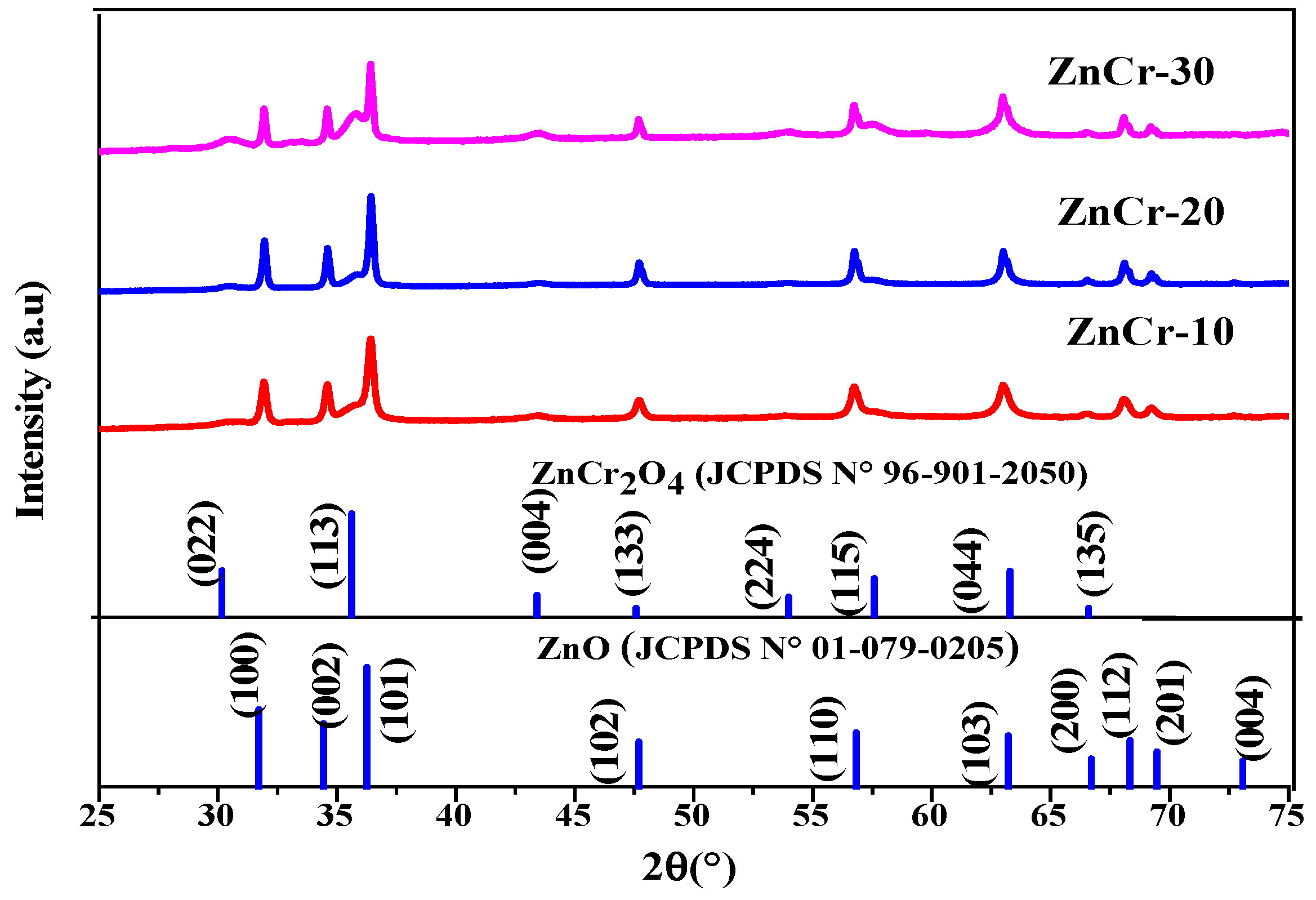
The XRD patterns confirm the coexistence of two crystalline phases in the synthesized materials: wurtzite ZnO (JCPDS No. 01-079-0205) and cubic spinel ZnCr2O4 (JCPDS No. 96-901-2050) (Figure 1). The ZnO reflections at ~32°, 34.5°, 36.6°, 47.7°, 56.8°, and 63.35° (2θ) can be indexed to the (100), (002), (101), (102), (110), and (103) planes, respectively, while the ZnCr2O4 peaks at ~30.1°, 35.5°, 43.4°, 54°, and 57.6° correspond to the (022), (113), (004), (224), and (115) planes, confirming the successful formation of the composite structure. Importantly, the intensity of ZnCr2O4 reflections increases systematically with increasing nominal ZnCr2O4 loading (ZnCr-10 → ZnCr-20 → ZnCr-30), indicating a progressive increase in the crystalline spinel contribution within the composites (Figure 1).
The average crystallite size of the synthesized samples was estimated using the Debye-Scherrer equation based on the full width at half maximum (FWHM) of the main diffraction peaks:
D = K λ β   c o s θ
where λ is the X-ray wavelength, K is the shape factor, β is the FWHM of the diffraction peak (in radians), and θ is the Bragg angle. The calculated crystallite sizes fall within the nanometer range, confirming the nanocrystalline nature of the ZnO–ZnCr2O4 composites.
Furthermore, Rietveld refinement of the XRD data (Table 1 and Table 2) confirms the presence of two crystalline phases, namely hexagonal wurtzite ZnO (space group P63mc) and cubic spinel ZnCr2O4 (space group Fd3m). The refined lattice parameters remain nearly constant across the series (ZnO: a ≈ 3.25 Å, c ≈ 5.21 Å; ZnCr2O4: a ≈ 8.35–8.36 Å), indicating good structural stability of both phases. The slight variations observed are within experimental uncertainty and may be attributed to interfacial effects rather than significant lattice distortion. In addition, the refinement quality indicators (Rp, Rwp, and RB) exhibit satisfactory values, confirming the reliability of the structural model.
The updated Rietveld phase fractions reveal that ZnO remains the dominant phase in all samples, while the ZnCr2O4 content increases progressively with nominal loading. This confirms that the composite formation occurs through phase coexistence and interfacial interaction rather than complete phase transformation, supporting the formation of a true heterojunction system.
This phase coexistence is consistent with previous reports on ZnO–ZnCr2O4 systems. For example, Dixit et al. observed both ZnO and ZnCr2O4 phases in solution-grown nanostructures, confirming that the system typically stabilizes as a two-phase composite rather than a single solid solution [47]. Similarly, Zhan et al. identified the coexistence of wurtzite ZnO and spinel ZnCr2O4 phases without additional crystalline impurities [48].
However, the synthesis route plays a critical role in determining the structural features. While high-temperature treatments reported in the literature promote partial lattice interaction or limited doping effects [49], the present co-precipitation/calcination route (500 °C, 2 h) favors nanoscale phase separation and the formation of well-defined heterointerfaces. Therefore, although no additional diffraction peaks are observed, the presence of amorphous or highly dispersed interfacial species cannot be excluded due to the intrinsic limitation of XRD, which probes only long-range crystalline order.
Overall, the structural analysis demonstrates that the ZnO–ZnCr2O4 system forms a stable biphasic heterojunction with controlled phase distribution and preserved lattice integrity. Such an interface-driven architecture is expected to play a key role in enhancing charge separation efficiency, thereby directly influencing the optical response and photocatalytic performance of the materials.

2.1.2. Field-Emission Scanning Electron Microscopy

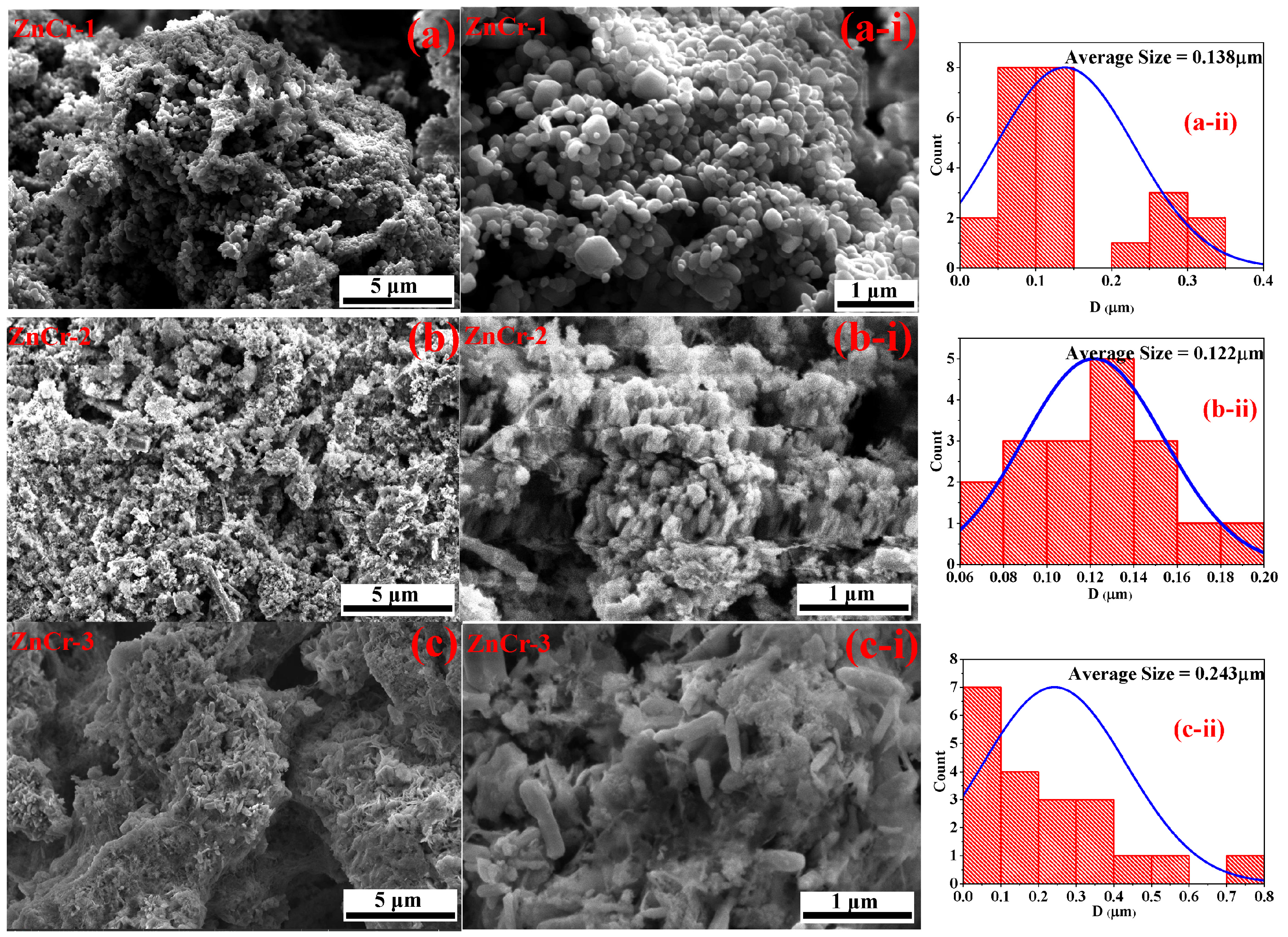
Field-emission scanning electron microscopy (FE-SEM) was employed to investigate the surface morphology and microstructural evolution of the ZnO/ZnCr2O4 nanocomposites as a function of ZnCr2O4 loading. The discussion focuses exclusively on representative compositions that consistently reflect the structural and optical trends identified by XRD, UV–Vis, and photoluminescence analyses.
The ZnCr-20 sample exhibits a relatively open and heterogeneous morphology composed of aggregated yet distinguishable granular particles (Figure 2). At both low and high magnifications, the surface appears moderately rough with loosely packed clusters, reflecting a ZnO-rich microstructure in which the intrinsic crystallization behavior of ZnO primarily governs particle growth. The average particle size is approximately 0.138 μm, providing a suitable baseline morphology for comparison with higher loadings. Similar morphologies have been reported for lightly chromium-modified ZnO systems, where low chromium content induces only subtle changes in particle organization without major restructuring of the surface architecture [50].
At intermediate loading, the ZnCr-10 sample displays a pronounced morphological evolution. The surface becomes more compact and organized, consisting of interconnected granular clusters forming a relatively uniform network. High-magnification images reveal enhanced particle–particle contact and improved structural cohesion, indicative of stronger interfacial interactions between ZnO and ZnCr2O4 phases. The average particle size (~0.122 μm) remains within the sub-micrometric range, indicating controlled aggregation rather than excessive coalescence. This morphology is characteristic of an optimal heterojunction configuration, where sufficient interfacial contact is achieved while preserving surface accessibility. Such a microstructure is fully consistent with the suppressed PL emission and moderate band-gap narrowing observed for this composition, both reflecting improved charge separation at the ZnO/ZnCr2O4 interface [51,52].
In contrast, the ZnCr-30 sample, corresponding to the highest ZnCr2O4 loading, exhibits a markedly compact and highly agglomerated morphology. The surface is dominated by large, block-like aggregates with a substantial reduction in porosity and surface openness. The average particle size increases significantly to approximately 0.243 μm, confirming pronounced particle coalescence at excessive spinel content. Such dense agglomeration is commonly associated with reduced light penetration and limited accessibility of surface-active sites, and has been frequently reported in heavily loaded oxide–spinel composite systems [51]. This morphological behavior correlates well with the defect-dominated optical response and anomalously large red shift observed for this sample.
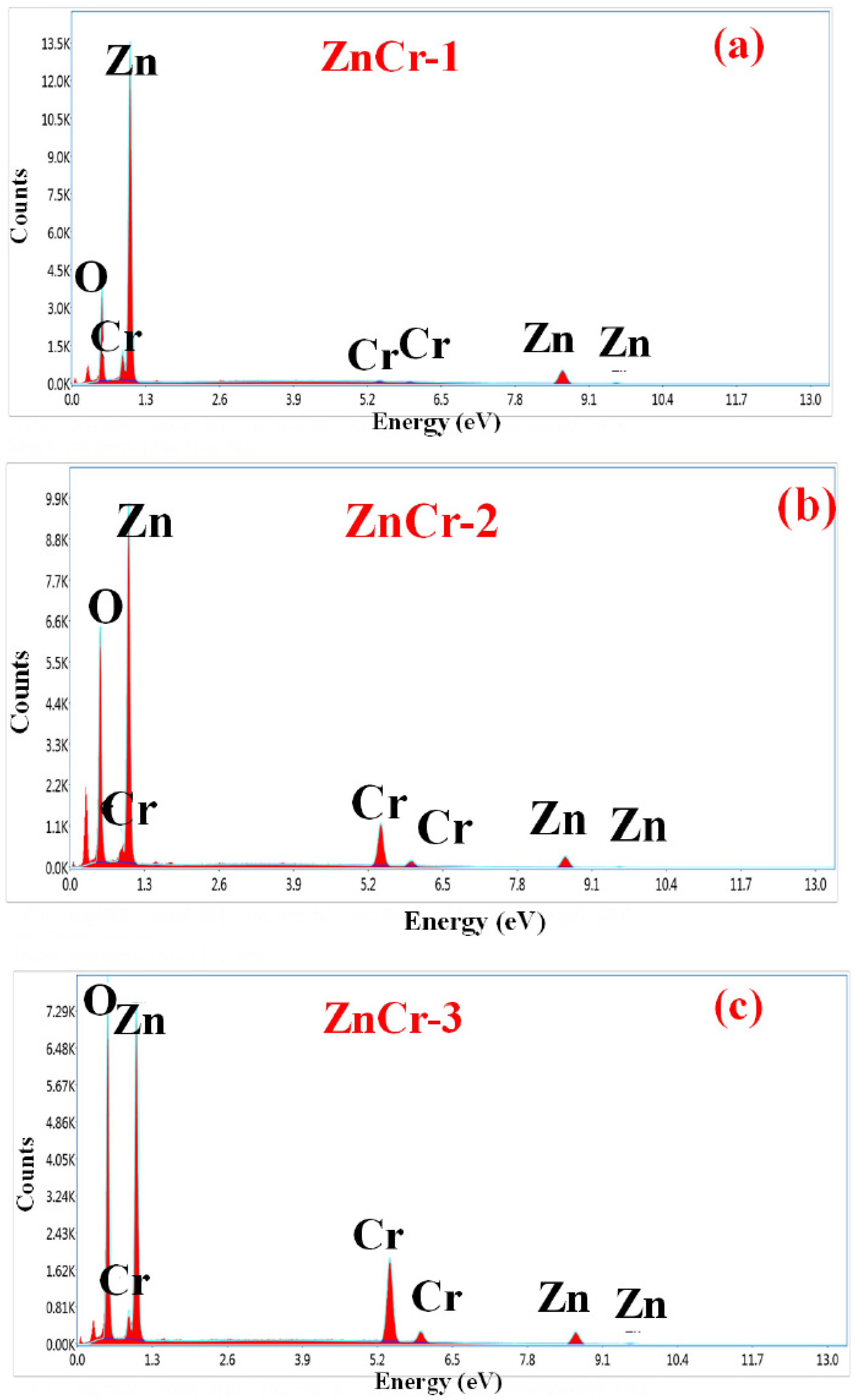
EDS analysis confirms the progressive increase in chromium content from ZnCr-20 to ZnCr-30, in agreement with the nominal compositional trend (Table 3). These results are consistent with XRD findings, which demonstrate the coexistence of hexagonal ZnO and cubic ZnCr2O4 phases and the gradual enrichment of the spinel phase with increasing loading.
Overall, the SEM-EDS observations reveal a clear microstructural progression from a ZnO-rich, moderately aggregated morphology ZnCr-20, through an optimally interconnected heterojunction architecture ZnCr-10, to a densely agglomerated structure at excessive loading ZnCr-30. This evolution highlights the critical role of ZnCr2O4 content in controlling particle organization, interfacial contact, and surface accessibility, which are key parameters governing the photocatalytic performance of ZnO–ZnCr2O4 heterostructures.
EDS analysis confirms a progressive increase in chromium content across the retained ZnO/ZnCr2O4 nanocomposites, consistent with the increasing ZnCr2O4 content from ZnCr-10 (8.1 wt.%) to ZnCr-30 (21.3 wt.%). Accordingly, a monotonic rise in the Cr/Zn atomic ratio is observed from ZnCr-10 to ZnCr-30, reflecting the gradual enrichment of the spinel component within the composite system (Figure 3). Despite this trend, the zinc content remains relatively high in all samples, indicating that the ZnO phase continues to constitute the dominant structural framework even at elevated ZnCr2O4 contents.
These compositional trends are in good agreement with XRD results, which evidence the coexistence of hexagonal wurtzite ZnO and cubic spinel ZnCr2O4 phases in all samples. The progressive enhancement of ZnCr2O4-related diffraction peaks with increasing content further confirms the increasing contribution and crystallinity of the spinel phase.
Consistently, SEM observations reveal a clear microstructural evolution as a function of ZnCr2O4 content, from relatively open and ZnO-rich morphologies at low loading (ZnCr-10), to a more compact and interconnected heterojunction architecture at intermediate content (ZnCr-20), and finally to densely aggregated structures at the highest loading (ZnCr-30). The EDS-derived compositional changes directly support this morphological progression, linking increased chromium incorporation to enhanced interfacial contact and, at higher contents, to pronounced agglomeration.
Overall, the combined SEM, EDS, and XRD analyses provide strong evidence for the successful formation and structural integration of ZnO–ZnCr2O4 heterojunctions. The results underline the importance of controlling the ZnCr2O4 content to balance chromium incorporation, particle dispersion, interfacial contact, and surface accessibility—key parameters governing the photocatalytic performance of the composite system.

2.1.3. Optical Analysis of the Synthesized Samples by UV–Vis Spectroscopy

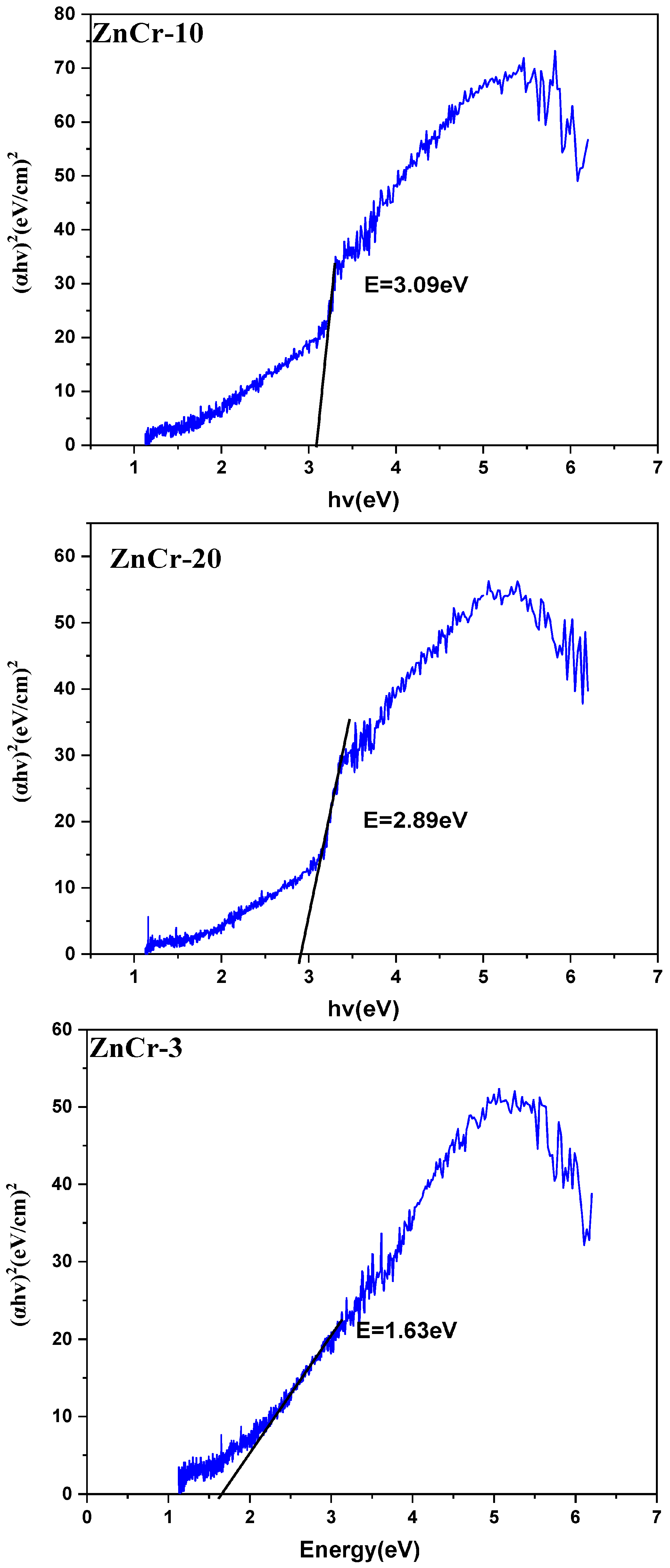
The optical band-gap evolution observed for the ZnO–ZnCr2O4 nanocomposites synthesized via co-precipitation exhibits a pronounced non-linear dependence on composition, consistent with previously reported ZnO-spinel systems (Figure 4). For ZnCr-10, an apparent optical band gap of approximately 3.09 eV is obtained, remaining close to that of pristine ZnO. This behavior indicates that the optical response is predominantly governed by ZnO, while interfacial electronic interaction is already established, reflecting the formation of a heterojunction. The contribution of ZnCr2O4 becomes progressively more significant with increasing spinel content, influencing both the optical absorption behavior and the charge transfer processes within the system [48,53].
Upon increasing the ZnCr2O4 content to 20 wt.% (ZnCr-20), a noticeable red shift in the absorption edge is observed, yielding an apparent band gap of approximately 2.89 eV. This moderate optical shift cannot be attributed to intrinsic band-gap narrowing of ZnCr2O4, but rather to enhanced interfacial electronic coupling and the emergence of interface-related and defect-assisted electronic states. Similar behavior has been widely reported in ZnO/ZnCr2O4 heterostructures and related spinel-based systems, where optical modulation originates primarily from interface engineering and charge-transfer pathways rather than fundamental band-structure modification [47,49,54]. In this intermediate-composition regime, the balance between ZnO light absorption and interfacial functionality is maximized.
In contrast, the ZnCr-30 sample exhibits a significantly reduced apparent optical band gap of approximately 1.63 eV. This low-energy absorption onset should not be interpreted as a true band-gap narrowing. According to previous studies on ZnO–ZnCr2O4 nanostructures, strong absorption in the visible and near-infrared regions at high spinel content is predominantly associated with defect-induced sub-bandgap states, Cr3+-related intra-gap transitions, and pronounced band-tailing effects [47,53]. Such defect-dominated optical features are known to promote non-radiative recombination rather than beneficial charge-carrier generation, which explains why enhanced visible absorption does not necessarily translate into improved photocatalytic activity.

2.1.4. Photoluminescence (PL) Analysis of ZnO/ZnCr2O4 Composites

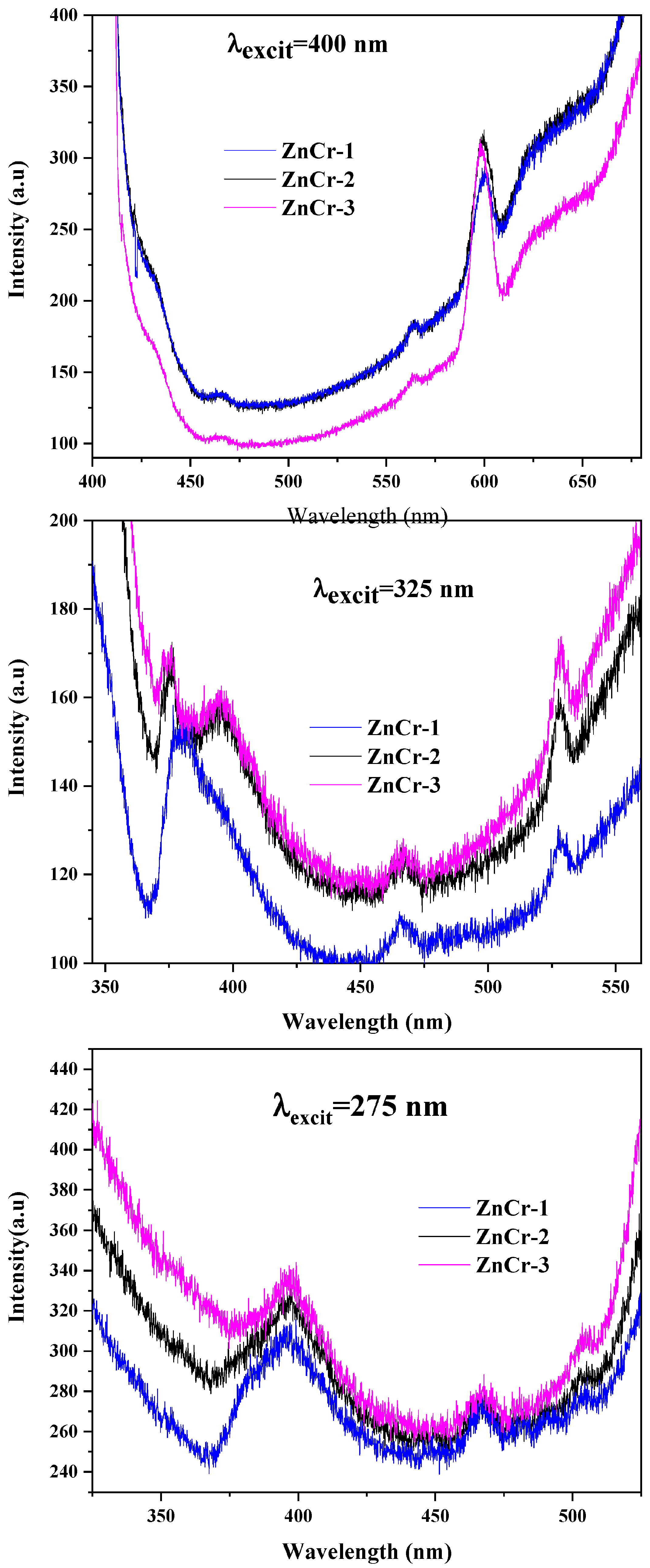
The photoluminescence behavior observed for the ZnO/ZnCr2O4 composites exhibits trends that are consistent with, yet distinct from, previously reported ZnO–ZnCr2O4 systems, reflecting the strong influence of synthesis route and interfacial structure. Under UV excitation at 275 and 325 nm, ZnCr-10 (low loading) shows the most pronounced PL quenching compared to ZnCr-20 and ZnCr-30. Similar PL suppression at optimized spinel loading has been reported by Gao et al. [45], for ZnO–ZnCr2O4 heterostructures derived from LDH precursors, where moderate ZnCr2O4 incorporation was shown to reduce radiative recombination through interfacial effects without introducing excessive defect-related emission [45]. This agreement suggests that, in both systems, an optimal interface density can suppress radiative recombination more effectively than either insufficient or excessive secondary-phase loading.
In contrast, studies employing different synthesis strategies have reported distinct PL responses. For instance, Dixit et al. [47] observed strong visible and near-infrared PL features in ZnO–ZnCr2O4 nanowalls, which were attributed primarily to Cr3+-related intra-gap transitions and defect-assisted recombination rather than interfacial charge separation. Unlike the nanowall architecture synthesized via solution growth, the present co-precipitated composites exhibit significantly lower PL intensity at optimal loading under UV excitation, indicating that radiative recombination pathways are more effectively suppressed in the ZnCr-10 sample.
At higher ZnCr2O4 loading (ZnCr-30), the PL intensity increases markedly under UV excitation, in agreement with reports by Zhan et al., who noted that excessive spinel content and increased structural disorder can introduce additional recombination centers, even in biphasic ZnO/ZnCr2O4 systems [48]. The strong PL emission observed for ZnCr-30 under UV excitation is therefore attributed to increased defect density and particle agglomeration, as also suggested by the SEM analysis.
Under visible excitation at 400 nm, the PL response changes significantly, with ZnCr-30 exhibiting the lowest emission intensity, while ZnCr-10 and ZnCr-20 show nearly overlapping spectra. Similar excitation-dependent PL behavior has been reported in ZnO–ZnCr2O4 systems, where visible excitation primarily probes defect- and interface-related states rather than near-band-edge recombination [49]. The reduced PL intensity of ZnCr-30 at 400 nm is therefore associated with dominant non-radiative defect-mediated pathways rather than improved charge separation (Figure 5).
Overall, comparison with literature confirms that PL behavior in ZnO/ZnCr2O4 composites is highly sensitive to ZnCr2O4 loading and synthesis route. The present results demonstrate that PL quenching at optimized loading (ZnCr-10) is consistent with interface-controlled suppression of radiative recombination, whereas excessive loading promotes defect-dominated recombination, in agreement with previous reports on ZnO–ZnCr2O4 heterostructures These findings further support the conclusion that photocatalytic performance is governed by a balance between interfacial interaction and defect density rather than by optical absorption alone.

2.2. Photocatalytic Degradation of the Rhodamine B Dye

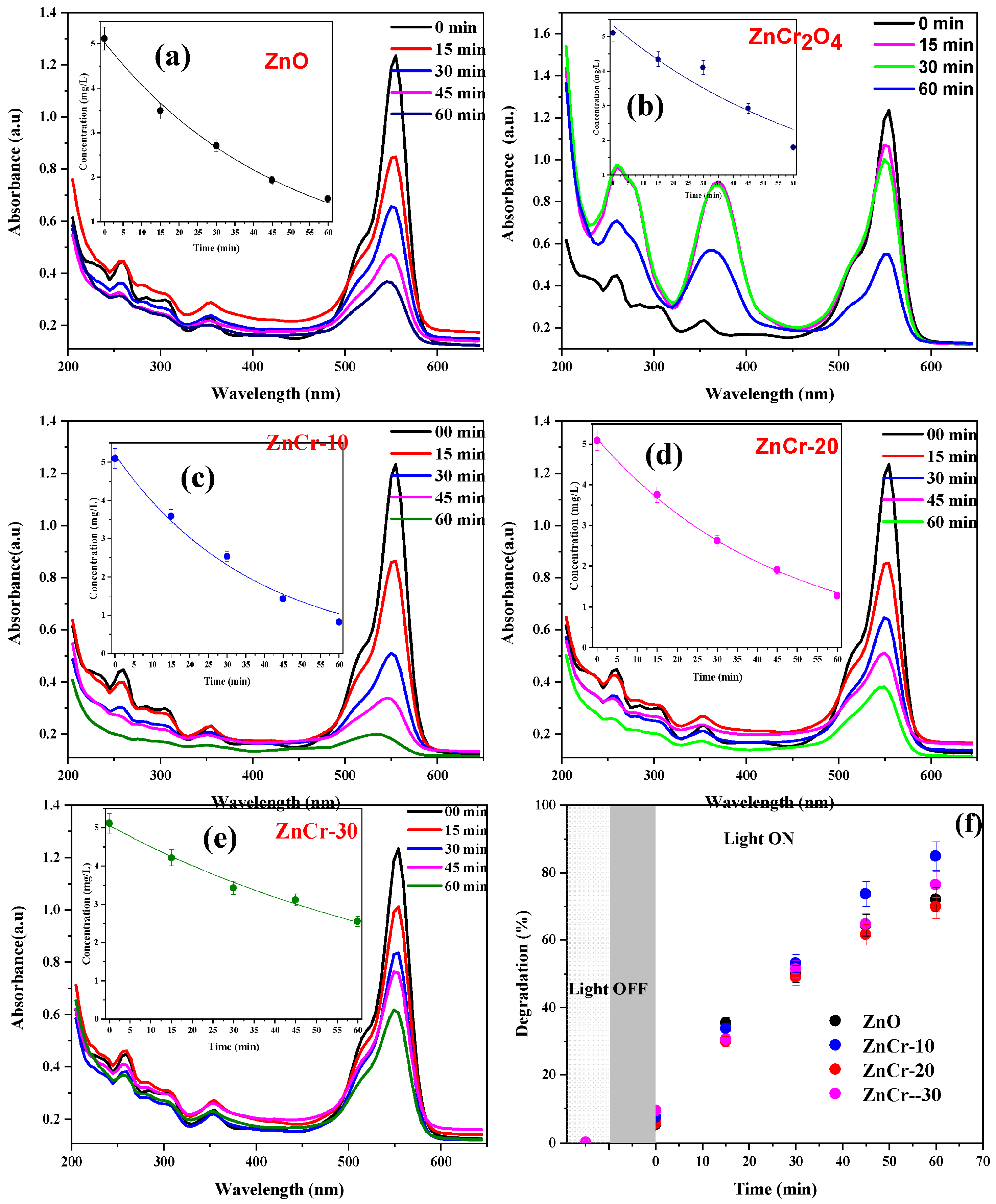
The photocatalytic degradation of Rhodamine B (RhB) over the prepared ZnO/ZnCr2O4 nanocomposites was investigated under natural sunlight irradiation, and the catalytic performance was evaluated by monitoring the evolution of the UV–Vis absorption spectra as a function of irradiation time. The apparent rate constants calculated using the pseudo-first-order kinetic model clearly indicate that the photocatalytic activity strongly depends on the ZnCr2O4 loading in the composite.
It is well established that the direct photolysis of Rhodamine B under light irradiation is negligible in the absence of a catalyst, confirming that the observed degradation is mainly attributed to the photocatalytic activity of the system [55]. In addition, the adsorption of Rhodamine B onto the catalyst surface was found to be negligible, as only a slight decrease in concentration was observed under dark conditions.
Among all investigated samples, the ZnCr-10 catalyst exhibits the highest photocatalytic activity with a rate constant of k = 0.0307 min−1, significantly higher than that of pure ZnO (k = 0.0203 min−1) and pure ZnCr2O4 (k = 0.0166 min−1). The rapid decrease in the characteristic RhB absorption band located at approximately λ ≈ 555 nm confirms the progressive breakdown of the dye chromophore during irradiation. A similar spectral behavior has been reported in previous studies, where the absorption band of Rhodamine B around 554 nm gradually decreased and disappeared, indicating the occurrence of chromophore cleavage and N-deethylation during dye degradation. The resulting intermediates were further oxidized into smaller organic molecules such as carboxylic acids, which could ultimately be mineralized into CO2 and H2O, as confirmed by total organic carbon (TOC) measurements [56].
In contrast, the photocatalytic efficiency decreases at higher ZnCr2O4 loading. The ZnCr-30 sample shows a considerably lower degradation rate (k = 0.0113 min−1). Furthermore, the post-reaction UV–Vis spectra of pure ZnCr2O4 reveal the persistence of absorption features in the 250–400 nm region, suggesting the formation or accumulation of intermediate species during the photodegradation process.
Interestingly, such residual absorption bands are not observed for the ZnCr-10 composite. In this case, the characteristic absorption peak of RhB progressively disappears with irradiation time without the appearance of noticeable new peaks, indicating a more advanced degradation of the dye structure. This observation suggests that the ZnO/ZnCr2O4 heterojunction formed at the optimized loading (ZnCr-10) not only enhances the degradation rate but also reduces the accumulation of detectable intermediate products (Figure 6 and Table 4).

2.2.1. Photocatalytic Degradation of Rhodamine B by ZnCr-10 Under Different Light Sources

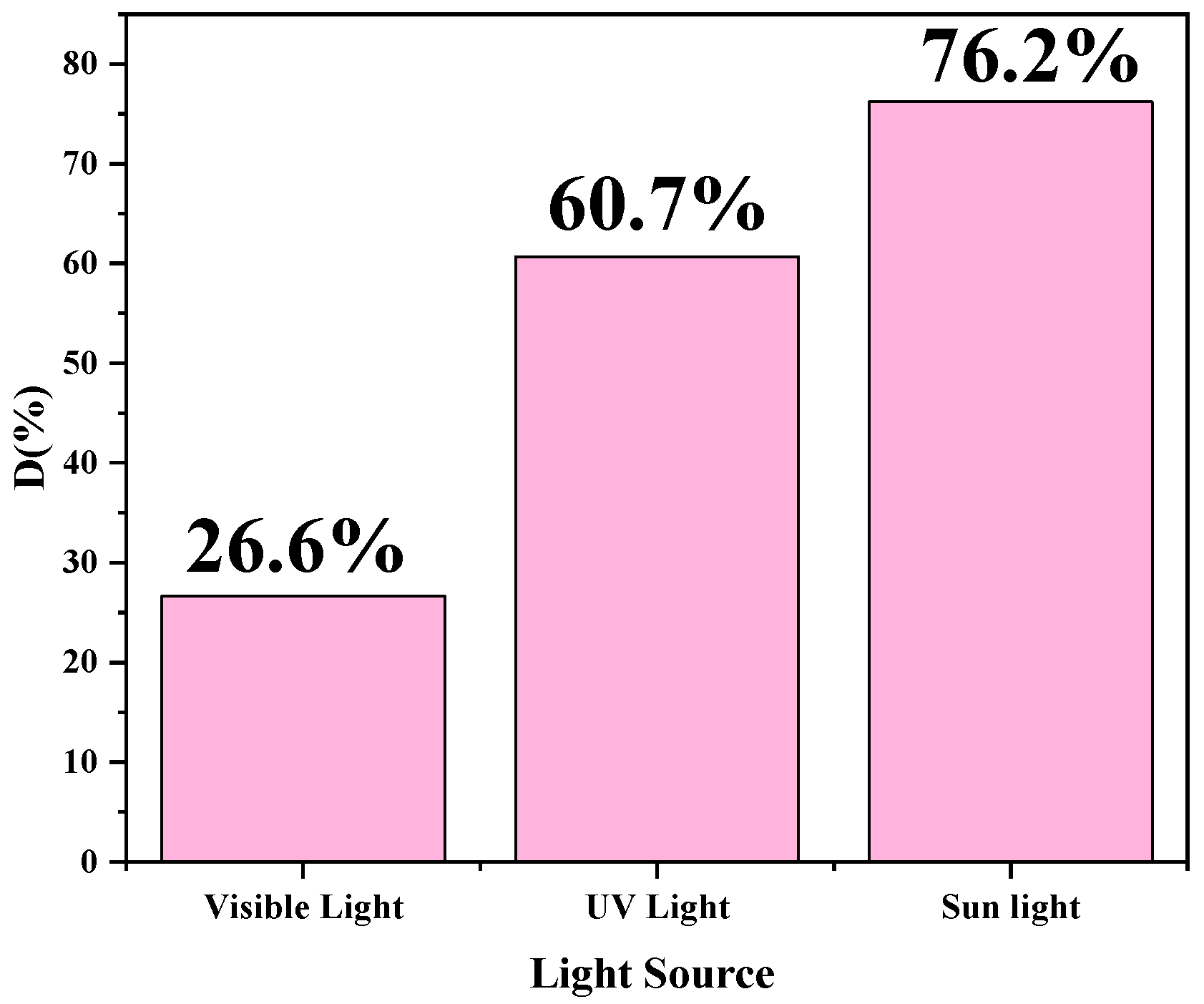
After identifying the ZnCr-10 composite as the most active photocatalyst, it was selected to investigate the influence of the irradiation source on the degradation efficiency of Rhodamine B (RhB). Photocatalytic experiments were therefore carried out under three different light sources: visible light, UV light, and natural sunlight (UV light (365 nm, 15 W), visible light (150 W LED), and sunlight irradiation).
As shown in Figure 7, the degradation efficiency strongly depends on the irradiation source. The highest degradation efficiency is observed under natural sunlight (76.2%), followed by UV irradiation (60.7%), while the lowest degradation is obtained under visible light (26.6%).
This behavior can be explained by the optical excitation characteristics of the two components of the system. Under visible light, the photon energy is not sufficient to efficiently excite the ZnO phase, resulting in limited photocatalytic activity. Under UV irradiation, the ZnO phase can be effectively activated; however, the contribution of the ZnCr2O4 phase remains less significant under this monochromatic excitation.
In contrast, natural sunlight provides a broad spectral distribution including both UV and visible photons. This allows the simultaneous activation of both components of the ZnO/ZnCr2O4 system, promoting stronger interaction at the heterojunction interface. As a result, a synergistic effect occurs, enhancing charge separation and improving the overall photocatalytic degradation efficiency.

2.2.2. Effect of Catalyst Dosage on Photocatalytic Degradation of Rhodamine B

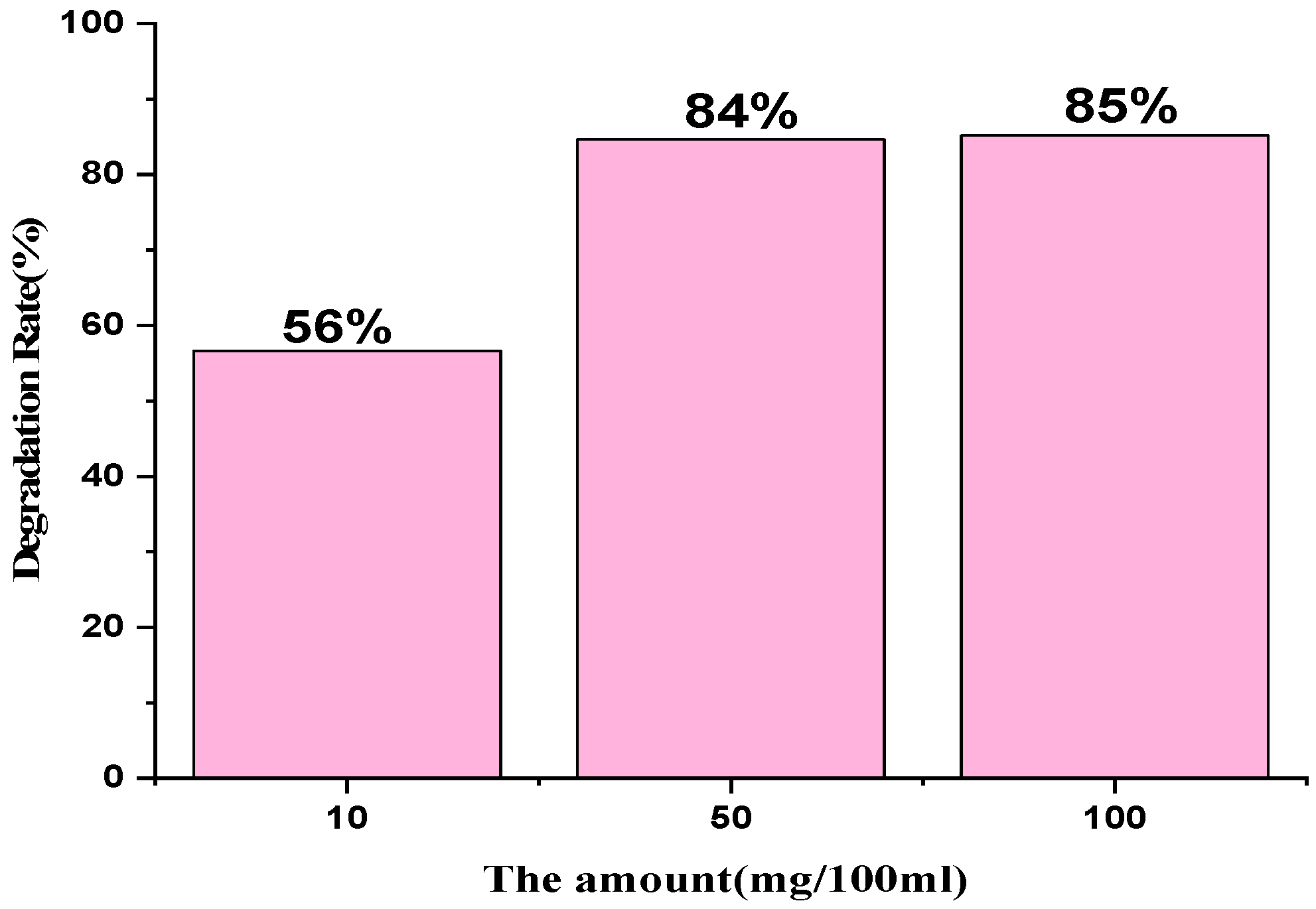
The influence of catalyst dosage on the photocatalytic degradation of Rhodamine B was examined using the optimized ZnCr-10 nanocomposite at different catalyst amounts (10, 50, and 100 mg per 100 mL of solution), as shown in Figure 8. The degradation efficiency increases significantly when the catalyst dosage is raised from 10 to 50 mg, improving from 56% to 84%. This enhancement is attributed to the increased availability of active surface sites, improved photon absorption, and a higher generation rate of reactive oxygen species, such as hydroxyl and superoxide radicals, which actively participate in dye degradation reactions [57,58].
However, further increasing the catalyst dosage to 100 mg results in only a marginal improvement in degradation efficiency (85%), indicating that the photocatalytic system approaches a saturation regime. At high catalyst concentrations, excessive particle loading in the suspension can lead to light scattering and shielding effects, which reduce the effective penetration of light into the reaction medium. In addition, higher catalyst amounts may promote particle agglomeration and increase the probability of electron–hole recombination, thereby limiting the contribution of additional active sites to the overall photocatalytic performance [58].
Therefore, an optimal catalyst dosage exists for the ZnCr-10 system, at which a balance is achieved between light utilization, active surface area, and mass transfer efficiency. In the present study, a catalyst loading of 50 mg per 100 mL is identified as the optimal dosage, providing maximum photocatalytic efficiency without the adverse effects associated with excessive catalyst concentrations.

2.2.3. Effect of Initial Rhodamine B Concentration

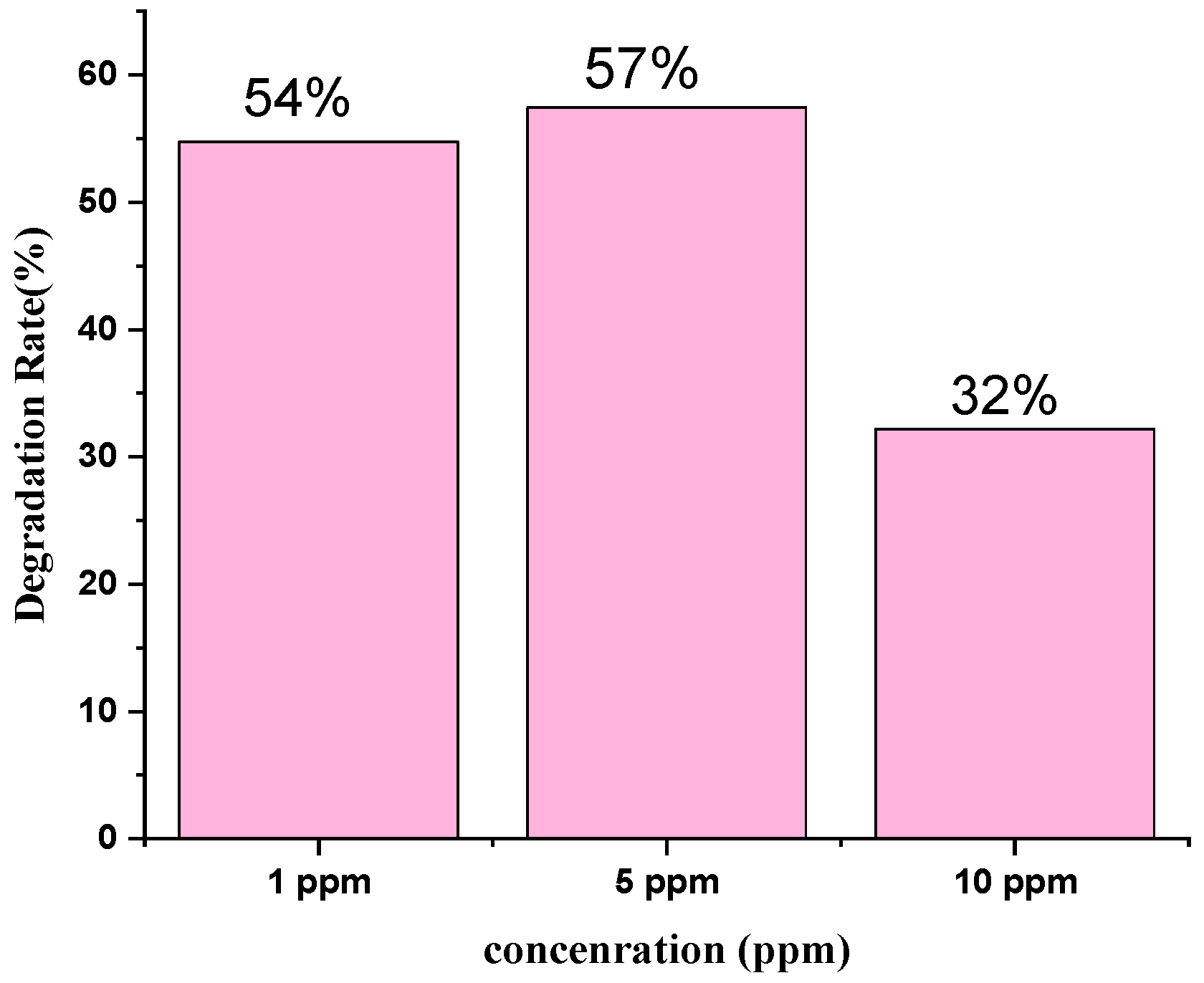
The effect of the initial Rhodamine B concentration on the photocatalytic performance of the ZnCr-10 nanocomposite was investigated at different dye concentrations (1, 5, and 10 ppm), as illustrated in Figure 9. The degradation efficiency increases slightly from 54% at 1 ppm to a maximum of 57% at 5 ppm, indicating a slightly more effective utilization of the available active sites at moderate dye concentration.
However, a pronounced decrease in degradation efficiency is observed when the initial dye concentration is increased to 10 ppm, where the degradation rate drops to 32%. This behavior can be attributed to the saturation of active sites on the catalyst surface and the increased competition between dye molecules for reactive oxygen species. Moreover, at higher dye concentrations, the strong light absorption of Rhodamine B induces a screening (inner filter) effect, which reduces photon penetration to the catalyst surface and limits the generation of electron–hole pairs, thereby lowering the photocatalytic efficiency [4,22].
These results clearly demonstrate the existence of an optimal initial dye concentration. For the ZnCr-10 system, a Rhodamine B concentration of 5 ppm provides the most favorable balance between surface coverage, light absorption, and reactive species availability, leading to the highest degradation efficiency [59,60].

2.2.4. Effect of pH on Photocatalytic Performance

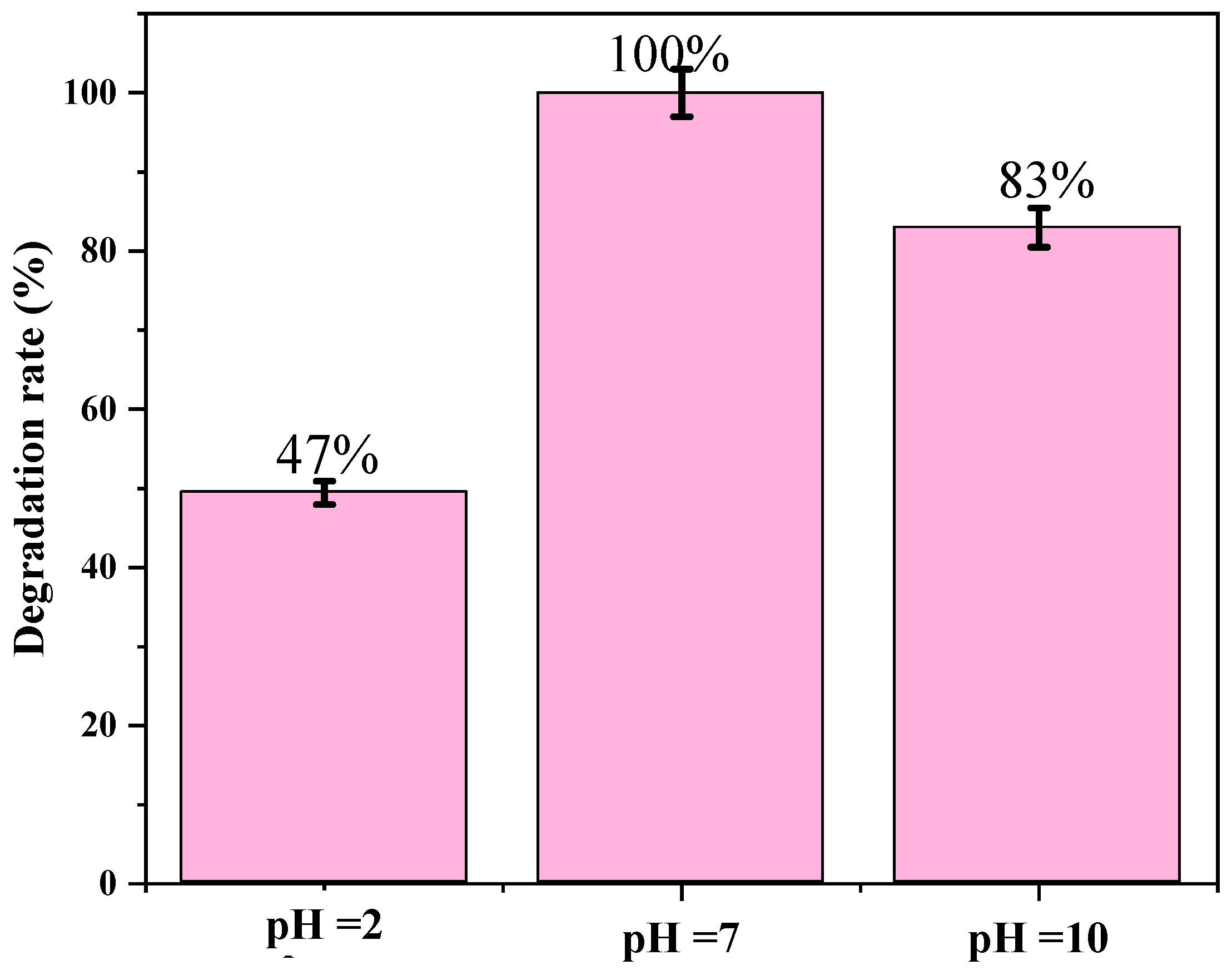
The pH of the solution plays a crucial role in photocatalytic processes, influencing both the surface charge of the photocatalyst and the speciation of the pollutant. The effect of pH on the photocatalytic degradation of Rhodamine B (RhB) was investigated by adjusting the initial pH to 2, 7, and 10 using the optimal ZnO/ZnCr2O4 sample under identical experimental conditions (Figure 10).
The point of zero charge (pH PZC) of the catalyst was determined to be approximately 6.75. Therefore, the catalyst surface is positively charged at pH < pH PZC and negatively charged at pH > pH PZC. In aqueous solution, RhB (pKa = 3.22) exists in equilibrium between a cationic form (RH+) and a zwitterionic form (R±), depending on the pH [61,62].
At pH = 2, the degradation efficiency is limited to 47%, which can be attributed to electrostatic repulsion between the positively charged catalyst surface and the cationic RhB molecules, leading to reduced adsorption. In addition, the strongly acidic medium may affect the surface stability of ZnO-containing materials.
At pH = 7, which is close to the pHpzc, the photocatalytic activity reaches its maximum (100%). Under these conditions, the catalyst surface is nearly neutral, allowing favorable adsorption of RhB while maintaining high catalyst stability. Moreover, the balance between adsorption, reactive oxygen species (ROS) generation, and surface reactions is optimal, resulting in enhanced photocatalytic performance.
At pH = 10, although the negatively charged surface favors electrostatic attraction with cationic RhB, the degradation efficiency decreases to about 83%, indicating that electrostatic interactions alone do not control the photocatalytic process. Based on the band structure analysis, the valence band of ZnO (+2.88 eV vs. NHE) is sufficiently positive to generate hydroxyl radicals (•OH). Therefore, •OH generation mainly occurs on the ZnO component and is not the limiting step.
In addition, it is well established that the oxidation potential of hydroxyl radicals depends on the pH of the solution. As the pH increases, the oxidation potential of •OH decreases, which reduces its effective oxidative ability. Consequently, although OH concentration is higher under alkaline conditions, the generated •OH radicals are less effective in degrading organic pollutants [63].
Furthermore, at high pH, excess OH ions may act as hole (h+) scavengers, compete with RhB molecules for active sites, and promote non-productive side reactions. Changes in RhB speciation under alkaline conditions may also induce molecular aggregation, reducing the effective interaction between the pollutant and the catalyst surface. These combined effects lead to a decrease in photocatalytic efficiency at pH = 10.

2.2.5. Effect of H2O2 on Photocatalytic Performance

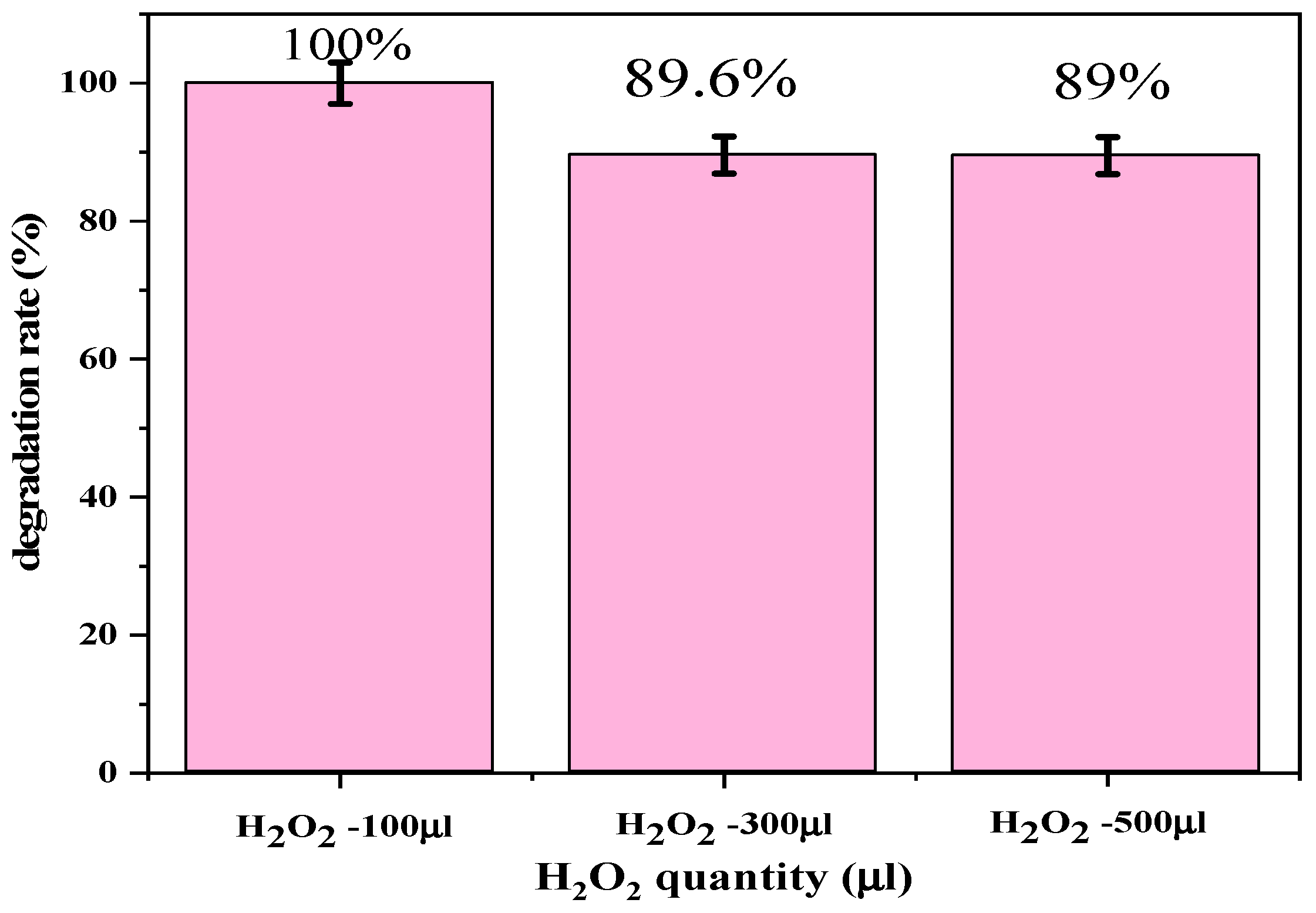
The influence of hydrogen peroxide (H2O2) on the photocatalytic degradation of Rhodamine B was investigated by varying its concentration at 333 mg/L (100 µL), 1000 mg/L (300 µL), and 1660 mg/L (500 µL) under the same optimal photocatalytic conditions.
As shown in Figure 11, the degradation rate initially increases with the addition of H2O2, reaching a maximum of 100% at 333 mg/L (100 µL). However, further increases in H2O2 concentration result in a net decrease in photocatalytic activity, with degradation rates of 89.6% at 1000 mg/L (300 µL) and 89% at 1660 mg/L (500 µL).
This behavior can be explained by the dual role of H2O2 in photocatalytic processes. At low concentration (333 mg/L, 100 µL), H2O2 acts as an effective electron acceptor, reacting with photogenerated electrons to form highly reactive hydroxyl radicals (•OH), which enhance the degradation of pollutants, leading to the highest degradation efficiency.
However, when the concentration of H2O2 exceeds the optimal level, it starts to act as a radical scavenger, reacting with •OH radicals and superoxide radicals (•O2), thereby reducing the number of active species available for the degradation process. In addition, excess H2O2 can undergo recombination reactions, producing less reactive species such as H2O and O2, which inhibits photocatalytic efficiency.
Proposed mechanism of H2O2 effect in photocatalysis
Enhancement role (at low H2O2 concentration):
H2O2 + e → •OH + OH
H2O2 + hν → 2 •OH
•OH + Rhodamine B → CO2 + H2O
Inhibition role (at excess H2O2 concentration):
OH + H2O2H2O + HO2
O2 + H2O2HO2• + OH
HO2• + •OHH2O + O2
These reactions are based on commonly reported photocatalytic and radical mechanisms in the literature [61,62].
Proposed Photocatalytic Mechanism
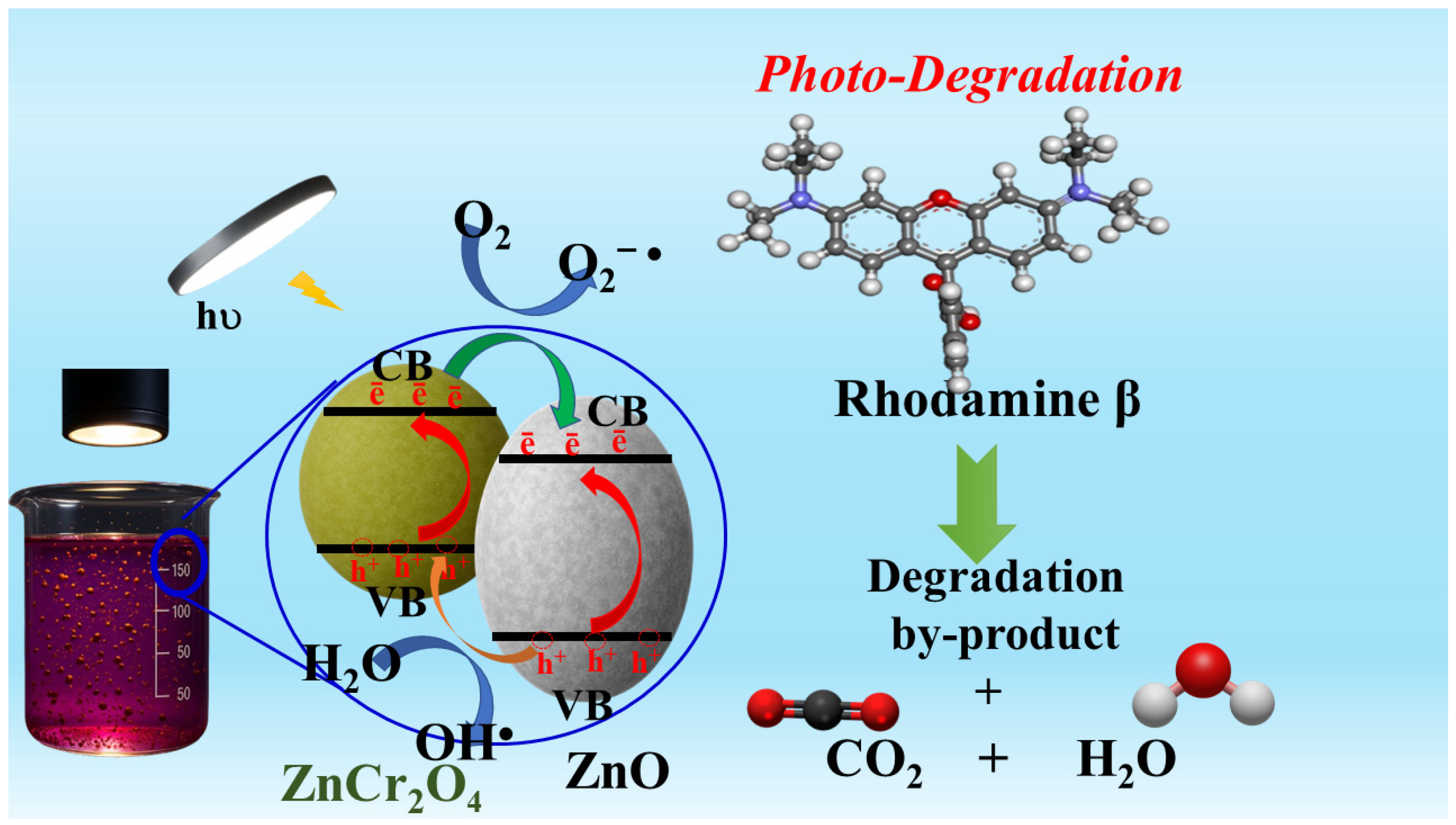
The photocatalytic mechanism of the ZnO/ZnCr2O4 heterojunction was analyzed based on the relative conduction band (CB) and valence band (VB) positions, as well as the interfacial charge transfer behavior, following the S-scheme heterojunction model reported in the literature [64].
For ZnO, the CB and VB edge potentials are located at approximately −0.32 eV and +2.88 eV vs. NHE, respectively [65]. For ZnCr2O4, the flat-band potential (Efb = −0.061 V vs SCE) and band gap (Eg = 1.85 eV) have been reported, leading to CB and VB positions of −1.87 V and −0.018 V vs. SCE, respectively [66]. After conversion to the NHE scale using E(NHE) = E(SCE) + 0.241, the band edge positions of ZnCr2O4 are estimated to be CB = −1.63 eV and VB = +0.22 eV vs. NHE.
These results indicate that ZnCr2O4 possesses a significantly more negative CB than ZnO, while ZnO exhibits a more positive VB than ZnCr2O4. Such a staggered band alignment suggests that a conventional type-II mechanism would weaken the redox ability of the system, whereas an S-scheme pathway can preserve highly reactive charge carriers [64].
Upon contact between ZnO and ZnCr2O4, charge redistribution occurs at the interface, leading to the formation of an internal electric field, which governs the migration of photogenerated charge carriers [64]. Under light irradiation, electrons excited in the CB of ZnO tend to recombine with holes in the VB of ZnCr2O4 at the interface. Consequently, highly reducing electrons remain in the CB of ZnCr2O4, while strongly oxidizing holes accumulate in the VB of ZnO (Figure 12).
This mechanism is consistent with the redox requirements of the photocatalytic process. The electrons in the CB of ZnCr2O4 (−1.63 eV) are sufficiently negative to reduce dissolved oxygen to superoxide radicals (O2), while the holes in the VB of ZnO (+2.88 eV) are sufficiently positive to oxidize water or hydroxide ions to hydroxyl radicals (•OH). Therefore, the enhanced photocatalytic activity of the ZnO/ZnCr2O4 heterojunction can be attributed to the S-scheme charge transfer mechanism, which promotes efficient charge separation while preserving strong redox ability.
The photocatalytic mechanism can be described as follows [67]:
Charge generation:
ZnO/ZnCr2O4 + hν → e + h+
Hole oxidation of hydroxyl ions:
h+ + OH → •OH
Hole oxidation of water:
h+ + H2O → •OH + H+
Electron reduction of oxygen:
e + O2 → •O2
Formation of reactive oxygen species [68]:
•O2 + H+ → HO2
HO2• + e → HO2.
HO2 + H+ → H2O
H2O2 + hν → 2•OH
Organic pollutant degradation:
•OH/•O2 + Rhodamine B → intermediates → CO2 + H2O
The formation of •OH radicals is thermodynamically favored due to the sufficiently positive valence band of ZnO (+2.88 eV vs. NHE) [65], while the generation of superoxide radicals (•O2) is mainly attributed to the conduction band of ZnCr2O4 (−1.63 eV vs. NHE), which is sufficiently negative to reduce O2 [66].

2.2.6. Reusability Test

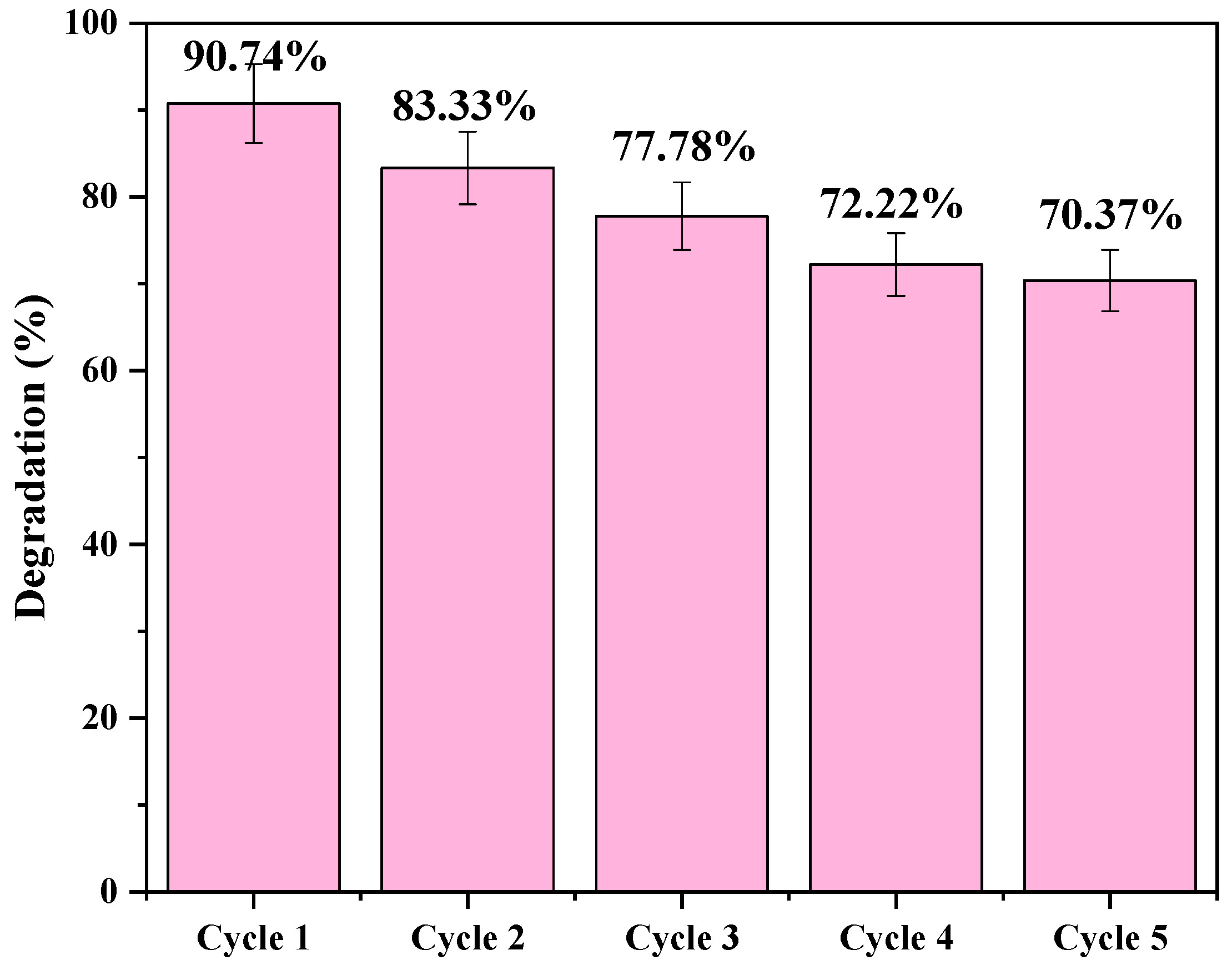
The reusability of the prepared photocatalyst was evaluated over five consecutive cycles for the degradation of Rhodamine B under identical experimental conditions. The solar irradiation intensity was monitored for each cycle and ranged between approximately (20–35 mW/cm2). As shown in Figure 13, the photocatalytic efficiency exhibited a gradual decrease from approximately 90.7% in the first cycle to 70.4% after the fifth cycle. This progressive decline in activity can be attributed to several factors commonly reported in photocatalytic systems. First, a partial loss of catalyst mass during the recovery and washing steps may reduce the number of available active sites. Second, the accumulation of intermediate degradation products on the catalyst surface may block active sites and hinder the adsorption of Rhodamine B molecules. Additionally, slight structural or surface modifications of the catalyst during repeated use may contribute to the observed decrease in performance.
Despite this decline, the photocatalyst retained a relatively high degradation efficiency (~70%) after five cycles, indicating good stability and reusability. Similar behavior has been reported for ZnO-based photocatalysts, where the decrease in efficiency during repeated cycles is attributed to photocorrosion effects and surface-related phenomena, while stable systems maintain high activity over multiple reuses [69]. The absence of a sharp drop in activity in the present study suggests that the ZnO/ZnCr2O4 heterojunction structure remains relatively stable during repeated photocatalytic processes.
Experimental conditions: [RhB]0 = 5 mg/L, catalyst dose = 50 mg/100 mL (0.5 g/L), pH ≈ natural, t = 60 min; natural sunlight irradiation (≈95–142 W/m2).

2.2.7. Comparative Photocatalytic Performance Discussion

The ZnO/ZnCr2O4 heterojunction developed in this study demonstrated efficient photocatalytic activity, achieving 98% Rhodamine B degradation under solar irradiation within 60 min using only 0.5 g/L of catalyst at a dye concentration of 5 mg/L.
When compared with previously reported systems, this performance is notable. For example, ZnO/CuFe2O4 and ZnO/NiFe2O4 heterostructures showed similar efficiencies (~98–98.8%) but required longer irradiation times (2–3 h) under comparable solar conditions. Systems such as ZnO–MnFe2O4 and Mn3O4/ZnO/AC also achieved high degradation efficiencies (~93–95.8%) but involved longer exposure durations or higher catalyst dosages. While Fe3O4/ZnO composites exhibited excellent photocatalytic performance under UV light, such conditions are less energy-efficient and less representative of practical solar-driven applications.
Overall, the ZnO/ZnCr2O4 system offers a favorable balance between degradation efficiency, reaction time, catalyst dosage, and light source, highlighting its potential among ZnO/spinel-based heterojunctions for solar-driven environmental remediation.

2.3. Socio-Economic and Ecological Sustainability

From a techno-economic perspective, the large-scale applicability of the ZnCr-10 photocatalyst was evaluated based on industrial precursor pricing, energy consumption, and process scalability. Unlike laboratory-scale estimations using analytical-grade reagents, this assessment relies on bulk industrial market prices to provide a realistic economic projection.
The synthesis, based on co-precipitation followed by calcination at 500 °C for 2 h, employs widely available precursors, including zinc chloride (ZnCl2 or ZnCl2·6H2O), chromium(III) chloride (CrCl3 or CrCl3·6H2O), and sodium hydroxide (NaOH). These materials are produced at large scale and are commonly used in industry, significantly reducing costs compared to laboratory-grade chemicals. A stoichiometric mass balance for 1 kg of ZnCr-10 indicates that approximately 1.5–2.8 kg of zinc precursor, 0.13–0.46 kg of chromium precursor, and 1.0–1.2 kg of NaOH are required, depending on hydration state and pH control (Table 5).
Based on bulk supplier data, the raw material cost is estimated at 3.5–3.8 $ kg−1. The calcination step represents an additional energy input, typically 0.4–0.8 kWh kg−1 at 500 °C, corresponding to 0.05–0.10 $ kg−1. Consequently, the total production cost is estimated at 3.6–3.9 $ kg−1. This value remains competitive compared to conventional photocatalysts such as TiO2, due to the use of low-cost precursors and a scalable synthesis route.
The synthesis avoids organic solvents and relies on aqueous precipitation, reducing environmental impact and aligning with green chemistry principles. During application, the process operates under solar irradiation, minimizing external energy demand and supporting sustainable water treatment, particularly in decentralized and resource-limited regions.
It should be emphasized that this techno-economic evaluation is limited to the production cost of the photocatalyst (material synthesis stage), including raw materials and thermal energy. Costs related to practical application, such as reactor design, catalyst immobilization, and post-treatment separation, are not included, as they depend strongly on the selected process configuration.
In slurry systems, where the catalyst is used in powder form, separation steps such as filtration or sedimentation may be required, which can influence overall process economics and increase operational costs at large scale. However, these aspects are system-dependent and should be assessed within specific reactor designs and operational conditions.
Overall, considering industrial precursor pricing, energy consumption, and process scalability, the ZnCr-10 nanocomposite demonstrates strong techno-economic feasibility and environmental sustainability, making it a promising candidate for large-scale photocatalytic water treatment (Table 6).

3. Materials and Methods

3.1. Materials and Chemicals Used in Experiments

Chromium(III) chloride (CrCl3, analytical grade, ≥99.9%, Biochem, Shanghai, China), zinc(II) chloride hydrate (ZnCl2·6H2O, analytical grade, ≥99.9%, Biochem, Shanghai, China), and sodium hydroxide (NaOH, 99.99%, Biochem, Shanghai, China) were employed as precursor materials for the synthesis of ZnO and ZnO/ZnCr2O4 heterojunction nanoparticles (NPs) without any further purification. Hydrogen peroxide (H2O2, 30%, Honeywell, Beijing, China), Rhodamine B dye (C28H31ClN2O3, Biochem, Shanghai, China), and demineralized water (DW) were also used in all experiments. All chemicals were of analytical grade and were used as received.

3.2. Preparation of ZnO and ZnO–ZnCr2O4 Nanocomposites

ZnO–ZnCr2O4 nanocomposites were synthesized via a co-precipitation method following a protocol previously reported in our earlier work [2], with appropriate modifications. For comparison, pure ZnO nanoparticles were also prepared using the same procedure. In a typical synthesis, an appropriate amount of ZnCl2 was dissolved in demineralized water under continuous magnetic stirring. Subsequently, an aqueous NaOH solution was added dropwise until the pH reached approximately 10, resulting in the formation of a white Zn(OH)2 precipitate.
For the preparation of ZnO–ZnCr2O4 heterojunction nanocomposites, a similar procedure was employed. A calculated amount of CrCl3·6H2O was first dissolved in demineralized water, and the resulting solution was gradually added to the zinc precursor solution under continuous stirring (500 rpm for 1 h). Different Zn2+/Cr3+ molar ratios were maintained to obtain composites with varying ZnCr2O4 contents (10, 20, and 30 wt.%). These values correspond to the nominal ZnO–x%ZnCr2O4 compositions, calculated based on the stoichiometric ratios of the Zn2+ and Cr3+ precursors.
After sufficient homogenization, NaOH was added dropwise as the precipitating agent to induce the co-precipitation of mixed hydroxide intermediates. The resulting precipitates were filtered and thoroughly washed several times with demineralized water to remove residual chloride ions and to achieve neutral pH. The obtained solids were then dried and subsequently calcined in a muffle furnace at 500 °C for 2 h under air atmosphere, using a heating rate of 5 °C min−1, to promote the formation of the ZnO/ZnCr2O4 nanocomposites. The final samples were denoted as ZnCr–10, ZnCr–20, and ZnCr–30 corresponding to 10, 20, and 30 wt.% ZnCr2O4, respectively.

3.3. Characterization

Powder X-ray diffraction (XRD) patterns were recorded in the 2θ range of 20–80° using a PANalytical Empyrean diffractometer (Almelo, The Netherlands) equipped with Cu Kα radiation (λ = 1.5406 Å), operated at 40 kV and 40 mA, with a step size of 0.028° and a counting time of 2 s per step. Phase identification was performed by comparison with standard reference data from the ICDD–PDF database. Rietveld refinement was subsequently carried out using the appropriate space groups for the hexagonal wurtzite ZnO phase (P63mc) and the cubic spinel ZnCr2O4 phase (Fd3m). The refinement enabled the evaluation of lattice parameters, phase fractions, crystallite sizes, and agreement factors (Rp, Rwp, and Rexp). In addition, the average crystallite size was estimated using the Debye–Scherrer equation to complement the microstructural analysis.
Morphological analysis was conducted using a Thermo Scientific Quattro S field-emission scanning electron microscope (FE-SEM, Waltham, MA, USA) equipped with an energy-dispersive X-ray spectroscopy (EDS) detector to examine surface morphology and elemental composition.
Optical absorption measurements were carried out in the 200–800 nm wavelength range using an Evolution 220 UV–Visible spectrophotometer (Thermo Fisher Scientific, Waltham, MA, USA).

3.4. Photocatalysis Performance

Rhodamine B (RhB) was used as the model dye to assess the photocatalytic efficacy of the different samples. The photodegradation experiments were performed using several irradiation sources: natural sun light, visible light (150 W LED lamps), and UV light (365 nm, rated at 15 W). The experiments were conducted in beakers containing 50 mg of photocatalyst and 100 mL of an aqueous solution of RhB dye at concentrations ranging from 5 to 20 mg/L. Before the photocatalytic procedure, the solutions were subjected to magnetic stirring for 120 min in darkness to evaluate the absorbance yield of the sample, despite the adsorption equilibrium being reached after 30 min.
The effect of pH on photocatalytic degradation was investigated by adjusting the pH of a 5 mg/L Rhodamine B solution with 0.1 M NaOH and 0.1 M HCl, and monitoring pH values (2, 7, 10) using a calibrated pH meter. For H2O2, 100, 300, and 500 microliters were included into the reaction mixture while maintaining a constant catalyst dose and reaction volume. Kinetic investigations were performed by collecting samples at 15-. The samples underwent centrifugation to eliminate the catalyst, and the supernatant was examined using UV–Vis spectrophotometry.
The photodegradation yield (D (%)) was calculated using the formula [78]:
D = C     C t C × 100 %
C and Ct denote the RhB concentration after adsorption equilibrium on the semiconductor before irradiation and at a certain period, respectively.
The kinetics and rate constant of RhB dye photodegradation were evaluated using the Langmuir-Hinshelwood non-linear first-order model (Equation (18)). This model provides an effective description of the relationship between the degradation rate and the concentration of the organic pollutant [15].
r = dC t dt = kKC t 1 + KC t
where k [mg/(min × L)] and K (L/mg) are the surface rate constant and the adsorption rate constants, respectively. Ct is dye concentration at time t (min).
During the photocatalytic degradation, pollutant concentrations are typically low and decrease over time. Mathematically, the ratio 1 1 + K C t tends towards 1, ( 1 1 + K C t 1 ), because KCt << 1.
Moreover, for low initial concentrations (typically below 10 mg/L), the photocatalytic degradation of Rhodamine B is generally well described by a pseudo-first-order kinetic model, as widely reported in the literature [79,80,81].
Hence, the Langmuir-Hinshelwood equation (Equation (19)) can be simplified as follows (Equation (3)):
d C t d t = k 1 C t
The integral of Equation (19) gives Equation (20), which describes the kinetics of the first-order model.
C t = C ads × e k 1 t
where k1 (1/min) is the rate constant of the first-order reaction.

4. Conclusions

ZnO–ZnCr2O4 heterojunction nanocomposites were successfully synthesized via a co-precipitation method followed by calcination at 500 °C, leading to stable biphasic systems composed of hexagonal wurtzite ZnO and cubic spinel ZnCr2O4. Rietveld-refined XRD analysis confirmed that the crystalline ZnCr2O4 fraction increases progressively from 12.1 wt.% in ZnCr-10 to 39.9 wt.% in ZnCr-30, while ZnO remains the dominant structural matrix, indicating partial precursor conversion and the formation of well-defined heterojunction interfaces. The discrepancy between XRD-derived phase fractions and EDS results is attributed to the fact that XRD reflects only crystalline phases, whereas EDS accounts for total elemental composition, including amorphous and interfacial species.
Morphological and optical analyses revealed a strong dependence of microstructure and charge-carrier behavior on ZnCr2O4 loading. ZnCr-10 exhibited a relatively open and interconnected morphology with efficient suppression of radiative recombination, indicating effective interfacial charge separation. In contrast, higher spinel content (ZnCr-30) led to pronounced particle agglomeration, increased defect density, and the emergence of sub-bandgap absorption associated with defect states, which promoted non-radiative recombination pathways.
Photocatalytic degradation experiments demonstrated that ZnCr-10 achieves the highest activity (k = 0.0307 min−1) under natural sunlight, with 98% Rhodamine B removal within 60 min under optimized conditions (5 mg/L, 50 mg/100 mL, pH 7, 100 µL H2O2). This superior performance is attributed to an optimal balance between heterointerface density, surface accessibility, and light penetration, enabling efficient charge separation while minimizing recombination losses. Conversely, excessive ZnCr2O4 incorporation resulted in reduced photocatalytic performance due to defect-induced recombination and light-shielding effects.
These results demonstrate that photocatalytic performance in ZnO–ZnCr2O4 systems is governed primarily by interfacial engineering and defect control rather than by band-gap narrowing alone. From a materials design perspective, an optimal secondary phase content is essential to maximize interfacial charge separation without inducing detrimental structural effects. The combination of high efficiency, solar-driven operation, and low-cost, scalable synthesis highlights the strong potential of the ZnO–ZnCr2O4 heterojunction as a sustainable photocatalyst for environmental remediation and solar-assisted water treatment applications.

Author Contributions

Conceptualization, A.S. (Amira Saidani); methodology, A.B.; investigation, A.S. (Amira Saidani) and M.S.; formal analysis, A.S. (Amira Saidani); data curation, A.S. (Amira Saidani), M.S. and R.B.; photoluminescence analysis, A.S. (Abdelhafid Souici); writing—original draft preparation, A.S. (Amira Saidani) and M.S.; writing—review and editing, R.B., I.B., K.F., L.M., A.B. and A.D.; supervision, H.B. and L.M.; project administration, H.B. and L.M.; funding acquisition, M.A.M.A., H.B. and G.S.E.-S., scientific revision and correction, M.A.M.A., G.S.E.-S. and L.M. All authors have read and agreed to the published version of the manuscript.

Funding

This work was supported and funded by the Deanship of Scientific Research at Imam Mohammad Ibn Saud Islamic University (IMSIU) (grant number IMSIU-DDRSP2602).

Data Availability Statement

The original contributions presented in this study are included in the article. Further inquiries can be directed to the corresponding author(s).

Conflicts of Interest

The authors declare no conflicts of interest.

References

  1. Cheikh, S.; Imessaoudene, A.; Bollinger, J.-C.; Manseri, A.; Bouzaza, A.; Hadadi, A.; Hamri, N.; Amrane, A.; Mouni, L. Adsorption Behavior and Mechanisms of the Emerging Antibiotic Pollutant Norfloxacin on Eco-Friendly and Low Cost Hydroxyapatite: Integrated Experimental and Response Surface Methodology Optimized Adsorption Process. J. Mol. Liq. 2023, 392, 123424. [Google Scholar] [CrossRef]
  2. Adam, A.B.; Mu’azu, J.B.; Titilayo, O.A.; Ba’aku, A.E.; Gani, J.; Abubakar, M.Y. The Role of Organic Pollutants in Water Pollution A Review. J. Chem. Technol. 2025, 1, 142–159. [Google Scholar] [CrossRef]
  3. Li, L.; Chen, C.; Li, D.; Breivik, K.; Abbasi, G.; Li, Y.-F. What Do We Know about the Production and Release of Persistent Organic Pollutants in the Global Environment? Environ. Sci. Adv. 2023, 2, 55–68. [Google Scholar] [CrossRef]
  4. Saidani, A.; Boudraa, R.; Fendi, K.; Benouadah, L.; Benabbas, A.; Djermoune, A.; Salvestrini, S.; Bollinger, J.-C.; Alayyaf, A.A.; Mouni, L. Effect of Calcination Temperature on the Photocatalytic Activity of Precipitated ZnO Nanoparticles for the Degradation of Rhodamine B Under Different Light Sources. Water 2024, 17, 32. [Google Scholar] [CrossRef]
  5. Alakhras, F.; Alhajri, E.; Haounati, R.; Ouachtak, H.; Addi, A.A.; Saleh, T.A. A Comparative Study of Photocatalytic Degradation of Rhodamine B Using Natural-Based Zeolite Composites. Surf. Interfaces 2020, 20, 100611. [Google Scholar] [CrossRef]
  6. Boudraa, R.; Djermoune, A.; Touati-Talantikite, D.; Blkacemi, H.; Madi, K.; Bouallouche, R.; Ait Merzeg, F.; Kebir, M.; Fadhillah, F.; Ali, F.A.A.; et al. Green-Synthesized Ag/Ag3O4/CuO from Inula Viscosa Coupled with Peroxydisulfate for Safranin O Degradation: Modeling and Optimization Using DT_LSBOOST and Dragonfly Algorithm. Appl. Water Sci. 2025, 15, 318. [Google Scholar] [CrossRef]
  7. Boudraa, R.; Djermoune, A.; Balit, S.; Madi, K.; Touati-Talantikite, D.; Bouallouche, R.; Bachari, K.; Bellardita, M.; Kebir, M.; Ait Merzeg, F.; et al. Towards Sustainable Water Treatment: Green Fabrication of Core–Shell Photocatalysts Supported on Fiberglass Textiles. J. Water Process Eng. 2026, 81, 109199. [Google Scholar] [CrossRef]
  8. Belkacemi, H.; Benhadji, A.; Ahmed, M.T.; Boudraa, R.; Tahraoui, H.; Amrane, A.; Mignot, M.; Ledoux, A. Innovative Utilization of Leather Waste for Chromium-Doped ZnO Photocatalysts: Advanced Modeling and MATLAB Optimization for Effective Wastewater Treatment. J. Indian Chem. Soc. 2026, 103, 102436. [Google Scholar] [CrossRef]
  9. Merdoud, R.; Aoudjit, F.; Mouni, L.; Ranade, V.V. Degradation of methyl orange using hydrodynamic Cavitation, H2O2, and photo-catalysis with TiO2-Coated glass Fibers: Key operating parameters and synergistic effects. Ultrason. Sonochem. 2024, 103, 106772. [Google Scholar] [CrossRef]
  10. Hamri, N.; Imessaoudene, A.; Bouchelkia, N.; Boudraa, R.; Cheikh, S.; Bollinger, J.-C.; Assadi, A.A.; Boukerroui, A.; Mouni, L. Innovative Surface Modification of Kaolinite by Direct Grafting of an Anionic Surfactant to Improve Pollutant Adsorption and Effluent Decontamination. J. Dispers. Sci. Technol. 2024, 1–20. [Google Scholar] [CrossRef]
  11. Bouchelkia, N.; Mouni, L.; Belkhiri, L.; Bouzaza, A.; Bollinger, J.C.; Madani, K.; Dahmoune, F. Removal of lead (II) from water using activated carbon developed from jujube stones, a low-cost sorbent. Sep. Sci. Technol. 2016, 51, 1645–1653. [Google Scholar] [CrossRef]
  12. Jiang, J.-Q. The Role of Coagulation in Water Treatment. Curr. Opin. Chem. Eng. 2015, 8, 36–44. [Google Scholar] [CrossRef]
  13. AL-Mashhadi, R.N.; Al-Obaidy, A. Malachite Green Removal from Wastewater by Electro Coagulation Treatment Technique. In AIP Conference Proceedings; AIP Publishing: Melville, NY, USA, 2022; Volume 2660. [Google Scholar] [CrossRef]
  14. Boudraa, R.; Talantikite-Touati, D.; Souici, A.; Djermoune, A.; Saidani, A.; Fendi, K.; Amrane, A.; Bollinger, J.-C.; Tran, H.N.; Mouni, L. Breaking New Grounds: Solid-State Synthesis of TiO2–La2O3–CuO Nanocomposites for Degrading Brilliant Green Dye under Visible Light. J. Clean. Prod. 2024, 481, 144126. [Google Scholar] [CrossRef]
  15. Boudraa, R.; Talantikite-Touati, D.; Souici, A.; Djermoune, A.; Saidani, A.; Fendi, K.; Amrane, A.; Bollinger, J.-C.; Tran, H.N.; Hadadi, A.; et al. Optical and Photocatalytic Properties of TiO2–Bi2O3–CuO Supported on Natural Zeolite for Removing Safranin-O Dye from Water and Wastewater. J. Photochem. Photobiol. A Chem. 2023, 443, 114845. [Google Scholar] [CrossRef]
  16. Nidheesh, P.V.; Couras, C.; Karim, A.V.; Nadais, H. A Review of Integrated Advanced Oxidation Processes and Biological Processes for Organic Pollutant Removal. Chem. Eng. Commun. 2022, 209, 390–432. [Google Scholar] [CrossRef]
  17. Mahbub, P.; Duke, M. Scalability of Advanced Oxidation Processes (AOPs) in Industrial Applications: A Review. J. Environ. Manag. 2023, 345, 118861. [Google Scholar] [CrossRef]
  18. Pandis, P.K.; Kalogirou, C.; Kanellou, E.; Vaitsis, C.; Savvidou, M.G.; Sourkouni, G.; Zorpas, A.A.; Argirusis, C. Key Points of Advanced Oxidation Processes (AOPs) for Wastewater, Organic Pollutants and Pharmaceutical Waste Treatment: A Mini Review. ChemEngineering 2022, 6, 8. [Google Scholar] [CrossRef]
  19. Kanjal, M.I.; Muneer, M.; Ullah, S.; Sabir, S.; Boudraa, R.; Amrane, A.; Mouni, L. UV Radiation-Induced Degradation of Moxifloxacin: Toxicity Evaluation and Conditions Optimization. Euro-Mediterr. J. Environ. Integr. 2025, 10, 2231–2243. [Google Scholar] [CrossRef]
  20. Fendi, K.; Bouzidi, N.; Boudraa, R.; Saidani, A.; Manseri, A.; Eliche Quesada, D.; Nguyen Hai, T.; Bollinger, J.-C.; Salvestrini, S.; Kebir, M.; et al. Testing of Kaolinite/TiO2 Nanocomposites for Methylene Blue Removal: Photodegradation and Mechanism. Int. J. Chem. React. Eng. 2025, 22, 1493–1508. [Google Scholar] [CrossRef]
  21. Fendi, K.; Bouzidi, N.; Boudraa, R.; Saidani, A.; Manseri, A.; Kebir, M.; Bollinger, J.-C.; Al-Farraj, E.S.; Alghamdi, M.A.; Abou El-Reash, Y.G.; et al. TiO2–MgO/Kaolinite Hybrid Catalysts: Synthesis, Characterization, and Photocatalytic Activity for the Degradation of Crystal Violet Dye and Toxic Volatile Butyraldehyde. Catalysts 2026, 16, 160. [Google Scholar] [CrossRef]
  22. Shu, X. Research on Photoelectric Properties of ZnO-Based Semiconductor Material. J. Phys. Conf. Ser. 2023, 2541, 012060. [Google Scholar] [CrossRef]
  23. Alharshan, G.A.; Aboraia, A.M.; Uosif, M.A.; Sharaf, I.M.; Shaaban, E.R.; Saad, M.; ALMohiy, H.; Elsenety, M.M. Optical Band Gap Tuning, DFT Understandings, and Photocatalysis Performance of ZnO Nanoparticle-Doped Fe Compounds. Materials 2023, 16, 2676. [Google Scholar] [CrossRef]
  24. Ge, T.; Chen, J. Time Constant Estimation and Alleviation of Interior Charge Recombination for Photocatalytic Reaction Guided by Correlation with Photoelectrochemical Behaviors. J. Phys. Chem. Lett. 2024, 15, 1241–1245. [Google Scholar] [CrossRef]
  25. Kahraman, A.; Bacellar, C.; Nazari, M.; Cannizzo, A.; Milne, C. Probing the Ultrafast Charge Carrier Dynamics in Mn-Doped ZnO Nanoparticles. In The International Conference on Ultrafast Phenomena (UP); Optica Publishing Group: Washington, DC, USA, 2022; p. W4A-4. [Google Scholar]
  26. Zhang, Y.; Sun, Y.; Wang, Q.; Zhuang, Z.; Ma, Z.; Liu, L.; Wang, G.; Wang, D.; Zheng, X. Synergy of Photogenerated Electrons and Holes toward Efficient Photocatalytic Urea Synthesis from CO2 and N2. Angew. Chem. Int. Ed. 2024, 63, e202405637. [Google Scholar] [CrossRef] [PubMed]
  27. Rekhila, G.; Saidani, A.; Hocine, F.; Hariz, S.H.B.; Trari, M. Characterization of the Hetero-System ZnCo2O4/ZnO Prepared by Sol Gel: Application to the Degradation of Ponceau 4R under Solar Light. Appl. Phys. A 2020, 126, 620. [Google Scholar] [CrossRef]
  28. Wang, Z.; Lin, Z.; Shen, S.; Zhong, W.; Cao, S. Advances in Designing Heterojunction Photocatalytic Materials. Chin. J. Catal. 2021, 42, 710–730. [Google Scholar] [CrossRef]
  29. Askari, N.; Jamalzadeh, M.; Askari, A.; Liu, N.; Samali, B.; Sillanpaa, M.; Sheppard, L.; Li, H.; Dewil, R. Unveiling the Photocatalytic Marvels: Recent Advances in Solar Heterojunctions for Environmental Remediation and Energy Harvesting. J. Environ. Sci. 2025, 148, 283–297. [Google Scholar] [CrossRef] [PubMed]
  30. Fatima, N.; Tahir, M.B.; Noor, A.; Sagir, M.; Tahir, M.S.; Alrobei, H.; Fatima, U.; Shahzad, K.; Ali, A.M.; Muhammad, S. Influence of van Der Waals Heterostructures of 2D Materials on Catalytic Performance of ZnO and Its Applications in Energy: A Review. Int. J. Hydrogen Energy 2021, 46, 25413–25423. [Google Scholar] [CrossRef]
  31. Li, K.; Li, T.; Dai, Y.; Quan, Y.; Zhao, J.; Ren, J. Highly Active Urchin-like MCo2O4 (M = Co, Cu, Ni or Zn) Spinel for Toluene Catalytic Combustion. Fuel 2022, 318, 123648. [Google Scholar] [CrossRef]
  32. Wani, T.A. A Facile Synthesis and Characterization of Spinel Zinc-Chromite (ZnCr2O4) Nanoparticles: Their Photocatalytic, Antibacterial, and Anticancer Activities. J. Sol-Gel Sci. Technol. 2024, 110, 74–89. [Google Scholar] [CrossRef]
  33. Timbadiya, U.P.; Tanna, A.R.; Desai, H.B. A Review on Spinel Chromites and Their Composites: Synthesis, Characterization, and Applications. EPJ Web Conf. 2026, 348, 03003. [Google Scholar] [CrossRef]
  34. Yang, S.; Gu, J.; Dai, B.; Zhang, L. A Critical Review of the Synthesis and Applications of Spinel-derived Catalysts to Bio-oil Upgrading. ChemSusChem 2025, 18, e202401115. [Google Scholar] [CrossRef] [PubMed]
  35. Rao, A.; Thakur, P.; Thakur, A. Future Perspectives of Spinel Nano-Ferrites. In Applications of Spinel Nano-Ferrites in Health, Environmental Sustainability, and Safety; CRC Press: Boca Raton, FL, USA, 2025; pp. 213–224. ISBN 1-003-56894-7. [Google Scholar]
  36. Dumitru, R.; Manea, F.; Păcurariu, C.; Lupa, L.; Pop, A.; Cioablă, A.; Surdu, A.; Ianculescu, A. Synthesis, Characterization of Nanosized ZnCr2O4 and Its Photocatalytic Performance in the Degradation of Humic Acid from Drinking Water. Catalysts 2018, 8, 210. [Google Scholar] [CrossRef]
  37. Xiong, R.; Zhou, X.; Chen, K.; Xiao, Y.; Cheng, B.; Lei, S. Oxygen-Defect-Mediated ZnCr2O4/ZnIn2S4 Z-Scheme Heterojunction as Photocatalyst for Hydrogen Production and Wastewater Remediation. Inorg. Chem. 2023, 62, 3646–3659. [Google Scholar] [CrossRef]
  38. Hassan, N.; Jalil, A.; Aldeen, E.S.; Bahari, M.; Teh, L.; Rajendran, S.; Jusoh, N.; Ainirazali, N. Integrating ZnO with Fibrous Silica Zirconia Pn Heterojunction for Effective Photoredox of Hexavalent Chromium and Congo Red. J. Water Process Eng. 2024, 59, 105050. [Google Scholar] [CrossRef]
  39. Tedesco, C.; Giovilli, G.; Malavasi, L. Photocatalytic Nitrogen Fixation Materials and Mechanistic Features: State of the Art and Future Perspectives. Eur. J. Inorg. Chem. 2025, 28, e202400686. [Google Scholar] [CrossRef]
  40. Skjolding, L.M.; Dyhr, K.; Köppl, C.; McKnight, U.; Bauer-Gottwein, P.; Mayer, P.; Bjerg, P.; Baun, A. Assessing the Aquatic Toxicity and Environmental Safety of Tracer Compounds Rhodamine B and Rhodamine WT. Water Res. 2021, 197, 117109. [Google Scholar] [CrossRef]
  41. Al-Gheethi, A.A.; Azhar, Q.M.; Kumar, P.S.; Yusuf, A.A.; Al-Buriahi, A.K.; Mohamed, R.M.S.R.; Al-Shaibani, M.M. Sustainable Approaches for Removing Rhodamine B Dye Using Agricultural Waste Adsorbents: A Review. Chemosphere 2022, 287, 132080. [Google Scholar] [CrossRef]
  42. Rietveld, H.M. A Profile Refinement Method for Nuclear and Magnetic Structures. Appl. Crystallogr. 1969, 2, 65–71. [Google Scholar] [CrossRef]
  43. Young, R. Introduction to the Rietveld Method. In The Rietveld Method; Oxford University Press: Oxford, UK, 1993; pp. 1–38. [Google Scholar] [CrossRef]
  44. Klug, H.P.; Alexander, L.E. X-Ray Diffraction Procedures: For Polycrystalline and Amorphous Materials, 2nd ed.; Wiley-VCH: Weinheim, Germany, 1974; p. 992. ISBN 0-471-49369-4. [Google Scholar]
  45. Gao, J.; Wu, F.; Zhao, Y.; Bian, X.; Zhou, C.; Tang, J.; Zhang, T. Tuning the Interfaces of ZnO/ZnCr2O4 Derived from Layered-Double-Hydroxide Precursors to Advance Nitrogen Photofixation. ChemSusChem 2023, 16, e202300944. [Google Scholar] [CrossRef]
  46. Xu, Y.; Schoonen, M.A. The Absolute Energy Positions of Conduction and Valence Bands of Selected Semiconducting Minerals. Am. Mineral. 2000, 85, 543–556. [Google Scholar] [CrossRef]
  47. Dixit, T.; Agrawal, J.; Muralidhar, M.; Murakami, M.; Ganapathi, K.L.; Singh, V.; Rao, M.R. Exciton Lasing in ZnO-ZnCr2O4 Nanowalls. IEEE Photonics J. 2019, 11, 1–7. [Google Scholar] [CrossRef]
  48. Zhan, W.; Kosinskiy, A.Y.; Vines, L.; Johansen, K.M.; Carvalho, P.A.; Prytz, Ø. ZnCr2O4 Inclusions in ZnO Matrix Investigated by Probe-Corrected STEM-EELS. Materials 2019, 12, 888. [Google Scholar] [CrossRef] [PubMed]
  49. Feng, X.; Jia, H.; Li, R.; Lin, L.; Li, M.; Chen, M.; Liu, C.; Du, X.; Wang, X.; Ding, Y. ZnOx Overlayer Confined on ZnCr2O4 Spinel for Direct Syngas Conversion to Light Olefins. Nat. Commun. 2025, 16, 3711. [Google Scholar] [CrossRef]
  50. Gac, W.; Zawadzki, W.; Słowik, G.; Greluk, M.; Pawlonka, J.; Machocki, A. Chromium-Modified Zinc Oxides. J. Therm. Anal. Calorim. 2016, 125, 1205–1215. [Google Scholar] [CrossRef]
  51. Priscilla, S.J.; Judi, V.A.; Daniel, R.; Sivaji, K. Effects of Chromium Doping on the Electrical Properties of ZnO Nanoparticles. Emerg. Sci. J. 2020, 4, 82–88. [Google Scholar] [CrossRef]
  52. Davies, J.T. Interfacial Phenomena; Elsevier: Amsterdam, The Netherlands, 2012; p. 494. ISBN 0-323-16166-9. [Google Scholar]
  53. Mousavi, Z.; Soofivand, F.; Esmaeili-Zare, M.; Salavati-Niasari, M.; Bagheri, S. ZnCr2O4 Nanoparticles: Facile Synthesis, Characterization and Photocatalytic Properties. Sci. Rep. 2016, 6, 20071. [Google Scholar] [CrossRef]
  54. Song, M.; Pan, X.; Wang, W.; Zhao, L. ZnO-ZnCr2O4 Multi-Functional Coating Inducing Uniform Zinc Deposition for Highly Stable Zn Anodes. Chem. Eng. J. 2025, 504, 159088. [Google Scholar] [CrossRef]
  55. Lesniewicz, A.; Lewandowska-Andralojc, A. Probing Mechanism of Rhodamine B Decolorization under Homogeneous Conditions via pH-Controlled Photocatalysis with Anionic Porphyrin. Sci. Rep. 2024, 14, 22600. [Google Scholar] [CrossRef]
  56. Wang, S.; Jia, Y.; Song, L.; Zhang, H. Decolorization and Mineralization of Rhodamine B in Aqueous Solution with a Triple System of Cerium(IV)/H2O2/Hydroxylamine. ACS Omega 2018, 3, 18456–18465. [Google Scholar] [CrossRef]
  57. Sun, X.; Yi, Z.; Wang, S.; Liu, G.; Wang, X.; Yang, H. Interface Electric Field and Photothermal Effect of Ag2S@CdZnS Hollow Heterostructures Synergistically Boosting Photocatalytic H2 Evolution. Sep. Purif. Technol. 2026, 385, 136365. [Google Scholar] [CrossRef]
  58. Sun, W.; Meng, S.; Zhang, S.; Zheng, X.; Ye, X.; Fu, X.; Chen, S. Insight into the Transfer Mechanisms of Photogenerated Carriers for Heterojunction Photocatalysts with the Analogous Positions of Valence Band and Conduction Band: A Case Study of ZnO/TiO2. J. Phys. Chem. C 2018, 122, 15409–15420. [Google Scholar] [CrossRef]
  59. Cherifi, K.; Rekhila, G.; Omeiri, S.; Bessekhouad, Y.; Trari, M. Physical and Photoelectrochemical Properties of the Spinel ZnCr2O4 Prepared by Sol Gel: Application to Orange II Degradation under Solar Light. J. Photochem. Photobiol. A Chem. 2019, 368, 290–295. [Google Scholar] [CrossRef]
  60. Fujishima, A.; Zhang, X.; Tryk, D.A. TiO2 Photocatalysis and Related Surface Phenomena. Surf. Sci. Rep. 2008, 63, 515–582. [Google Scholar] [CrossRef]
  61. Rao, W.; Piliouras, P.; Wang, X.-S.; Guido, A.; Kugler, K.; Sieren, B.; Wang, L.; Lv, G.; Li, Z. Zwitterionic Dye Rhodamine B (RhB) Uptake on Different Types of Clay Minerals. Appl. Clay Sci. 2020, 197, 105790. [Google Scholar] [CrossRef]
  62. Mchedlov-Petrossyan, N.; Vodolazkaya, N.; Doroshenko, A. Ionic Equilibria of Fluorophores in Organized Solutions: The Influence of Micellar Microenvironment on Protolytic and Photophysical Properties of Rhodamine B. J. Fluoresc. 2003, 13, 235–248. [Google Scholar] [CrossRef]
  63. Konstantinou, I.K.; Albanis, T.A. TiO2-Assisted Photocatalytic Degradation of Azo Dyes in Aqueous Solution: Kinetic and Mechanistic Investigations: A Review. Appl. Catal. B Environ. 2004, 49, 1–14. [Google Scholar] [CrossRef]
  64. Koppenol, W.; Liebman, J. The Oxidizing Nature of the Hydroxyl Radical. A Comparison with the Ferryl Ion (FeO2+). J. Phys. Chem. 1984, 88, 99–101. [Google Scholar] [CrossRef]
  65. Lim, N.Y.Y.; Chiam, S.L.; Leo, C.P.; Chang, C.K. Recent Modification, Mechanisms, and Performance of Zinc Oxide-Based Photocatalysts for Sustainable Dye Degradation. Hybrid Adv. 2024, 7, 100318. [Google Scholar] [CrossRef]
  66. González, S.; Jaramillo-Fierro, X. Ab Initio Study of Formation Mechanisms and Thermochemical Properties of Reactive Oxygen Species (ROS) in Photocatalytic Processes. Int. J. Mol. Sci. 2025, 26, 8989. [Google Scholar] [CrossRef]
  67. Tseng, D.-H.; Juang, L.-C.; Huang, H.-H. Effect of Oxygen and Hydrogen Peroxide on the Photocatalytic Degradation of Monochlorobenzene in TiO2 Aqueous Suspension. Int. J. Photoenergy 2012, 2012, 328526. [Google Scholar] [CrossRef]
  68. Pera-Titus, M.; García-Molina, V.; Baños, M.A.; Giménez, J.; Esplugas, S. Degradation of Chlorophenols by Means of Advanced Oxidation Processes: A General Review. Appl. Catal. B Environ. 2004, 47, 219–256. [Google Scholar] [CrossRef]
  69. Kitture, R.; Koppikar, S.J.; Kaul-Ghanekar, R.; Kale, S.N. Catalyst Efficiency, Photostability and Reusability Study of ZnO Nanoparticles in Visible Light for Dye Degradation. J. Phys. Chem. Solids 2011, 72, 60–66. [Google Scholar] [CrossRef]
  70. Alsulmi, A.; Mohammed, N.N.; Soltan, A.; Messih, M.A.; Ahmed, M. Engineering S-Scheme CuO/ZnO Heterojunctions Sonochemically for Eradicating RhB Dye from Wastewater under Solar Radiation. RSC Adv. 2023, 13, 13269–13281. [Google Scholar] [CrossRef]
  71. Nguyen, L.T.; Vo, D.-V.N.; Nguyen, L.T.; Duong, A.T.; Nguyen, H.Q.; Chu, N.M.; Nguyen, D.T.C.; Van Tran, T. Synthesis, Characterization, and Application of ZnFe2O4@ ZnO Nanoparticles for Photocatalytic Degradation of Rhodamine B under Visible-Light Illumination. Environ. Technol. Innov. 2022, 25, 102130. [Google Scholar] [CrossRef]
  72. Manzoor, I.; Vijayaraghavan, R. ZnO2–SnO2: A New, Efficient Heterojunction Composite for the Rapid and Enhanced Photocatalytic Degradation of Rhodamine B Dye and Moxifloxacin under UV Irradiation and Sunlight. New J. Chem. 2024, 48, 20126–20139. [Google Scholar] [CrossRef]
  73. Rahmayeni; Arief, S.; Jamarun, N.; Emriadi; Stiadi, Y. Magnetically Separable ZnO-MnFe2O4 Nanocomposites Synthesized in Organic-Free Media for Dye Degradation Under Natural Sunlight. Orient. J. Chem. 2017, 33, 2758–2765. [Google Scholar] [CrossRef]
  74. Stiadi, Y.; Wendari, T.P. Tuning the Structural, Magnetic, and Optical Properties of ZnO/NiFe2O4 Heterojunction Photocatalyst for Simultaneous Photodegradation of Rhodamine B and Methylene Blue under Natural Sunlight. Environ. Eng. Res. 2022, 28, 220074. [Google Scholar] [CrossRef]
  75. Nguyen, H.T.; Doan, V.-D.; Nguyen, T.L.H.; Nguyen, A.-T.; Tran, Q.-H.; Tran, V.A.; Le, V.T. Mechanistic Pathway and Optimization of Rhodamine B Degradation Using Mn3O4/ZnO Nanocomposite on Microalgae-Based Carbon. RSC Adv. 2025, 15, 6241–6259. [Google Scholar] [CrossRef]
  76. Qi, L.; Wang, S.; Liu, Y.; Zhao, P.; Tian, J.; Zhu, B.; Zhang, S.; Xie, W.; Yu, H. Facile Preparation of Magnetically Separable Fe3O4/ZnO Nanocomposite with Enhanced Photocatalytic Activity for Degradation of Rhodamine B. Nanomaterials 2024, 14, 926. [Google Scholar] [CrossRef] [PubMed]
  77. Rahmayeni; Azizah, N.; Stiadi, Y.; Putri, Y.E.; Zulhadjri. Magnetic Particles Nanorod of ZnO/CuFe2O4 Prepared by Green Synthesized Approach: Structural, Optical and Magnetic Properties, and Photocatalytic Activity. Mater. Res. 2021, 25, e20210164. [Google Scholar] [CrossRef]
  78. Wang, Y.; Zhang, J.; Sun, X.; Yi, Z.; Wang, S.; Liu, G.; Pu, Z.; Yang, H. Constructing Ag/In2S3/BiOBr Double-Heterojunction Photocatalysts for Boosting Photocatalytic Degradation of Pollutants and H2O2 Synthesis. Mater. Res. Bull. 2026, 197, 113965. [Google Scholar] [CrossRef]
  79. Kahoul, K.; Ahmedchekkat, F.; Chiha, M. Intensification of Rhodamine B Photodegradation Using TiO2 Nanocatalyst Synthesized via Non-Conventional Sol-Gel Method. Desalination Water Treat. 2025, 324, 101433. [Google Scholar] [CrossRef]
  80. Mzimela, N.; Tichapondwa, S.; Chirwa, E. Visible-Light-Activated Photocatalytic Degradation of Rhodamine B Using WO3 Nanoparticles. RSC Adv. 2022, 12, 34652–34659. [Google Scholar] [CrossRef]
  81. Gupta, V.; Singh, S. Improved Photocatalytic Degradation of Rhodamine B Dye Using Bi0.5Na0.5TiO3 Ferroelectric Nanoparticles: Optimization of pH and Poling. Chem. Inorg. Mater. 2024, 3, 100051. [Google Scholar] [CrossRef]
Figure 1. XRD diffractogram of different synthesized samples.
Catalysts 16 00406 g001
Figure 2. FE-SEM images of (a,a-i) ZnCr-1, (b,b-i) ZnCr-2, and (c,c-i) ZnCr-3; (a-ii,b-ii,c-ii) Particle size distributions of ZnCr-1, ZnCr-2, and ZnCr-3 samples, respectively.
Catalysts 16 00406 g002
Figure 3. (ac) Microanalysis EDS of the synthesized samples.
Catalysts 16 00406 g003
Figure 4. Tauc plot of synthesized materials.
Catalysts 16 00406 g004
Figure 5. Photoluminescence emission spectra of ZnO/ZnCr2O4 nanocomposites recorded at different excitation wavelengths.
Catalysts 16 00406 g005
Figure 6. (ae) Photocatalytic efficiency of the different synthesized materials for RhB degradation under sunlight irradiation and (f) the degradation yield. (Experimental conditions: [RhB]0 = 5 mg/L, catalyst dose = 50 mg/100 mL (0.5 g/L), pH ≈ natural, t = 60 min; sunlight irradiation.)
Catalysts 16 00406 g006
Figure 7. Photocatalytic degradation of RhB over ZnCr-10 under different irradiation sources (UV light (365 nm, 15 W), visible light (150 W LED), and sunlight irradiation). Experimental conditions: [RhB]0 = 5 mg/L, catalyst dose = 50 mg/100 mL (0.5 g/L), pH ≈ natural, t = 45 min.
Catalysts 16 00406 g007
Figure 8. Photocatalytic degradation of RhB as a function of ZnCr-10 catalyst dosage. Experimental conditions: [RhB]0 = 5 mg/L, catalyst dose = 10–100 mg/100 mL, pH ≈ natural, sunlight irradiation.
Catalysts 16 00406 g008
Figure 9. Effect of initial RhB concentration on photocatalytic degradation efficiency. Experimental conditions: catalyst dose = 50 mg/100 mL (0.5 g/L), pH ≈ natural, sunlight irradiation.
Catalysts 16 00406 g009
Figure 10. Effect of initial pH on the photocatalytic degradation of RhB under optimal conditions over ZnO/ZnCr2O4. Experimental conditions: [RhB]0 = 5 mg/L, catalyst dose = 50 mg/100 mL (0.5 g/L), pH0 = 2–10, natural sunlight.
Catalysts 16 00406 g010
Figure 11. Effect of H2O2 concentration on the photocatalytic degradation of RhB over ZnO/ZnCr2O4 under optimal conditions. Experimental conditions: [RhB]0 = 5 mg/L, catalyst dose = 50 mg/100 mL (0.5 g/L), pH ≈ natural, [H2O2] varied, t = 20 min; sunlight irradiation.
Catalysts 16 00406 g011
Figure 12. The mechanism involved during the catalytic degradation of Rhodamine β dye by the synthesized photocatalyst.
Catalysts 16 00406 g012
Figure 13. Reusability plot of the synthesized ZnO/ZnCr2O4 composite for Rhodamine B degradation over five consecutive cycles.
Catalysts 16 00406 g013
Table 1. Unified Sample Nomenclature, Phase Composition, and Photocatalytic Performance Summary.
Sample DesignationNominal ZnCr2O4 Loading (wt.%)XRD Phase Fraction ZnO (wt.%)XRD Phase
Fraction—ZnCr2O4 (wt.%)
EDS Cr Content (wt.%)EDS Cr/Zn Atomic RatioOptical Response (eV)Photocatalytic Rate Constant k (min−1)Performance Rank
ZnCr-101087.912.18.10.063.090.0307Optimal
ZnCr-202067.632.417.10.132.890.0230Intermediate
ZnCr-303060.139.921.30.17Defect-dominated (sub-bandgap)0.0113Lowest
Table 2. Refined structural parameters data using Rietveld refinement.
MaterialsLattice ParametersRp (%)Rwp (%)RB (%)Crystallite Size (REIT) (nm)Crystallite Size (DSH) (nm)ZnO (%)ZnCr2O4 (%)
ZnCr-10ZnCr2O4: a = b = c = a = 8.351(1) Å; α = β = γ = 90°; V = 582.46 Å3
ZnO: a = b = 3.25035(2) Å; c = 5.2069(1) Å; α = β = 90°; γ = 120°; V = 47.68 Å3
4.856.231.8766.4750.2287.912.1
ZnCr-20ZnCr2O4: a = b = c = 8.352(4) Å; α = β = γ = 90°; V = 584.40 Å3
ZnO: a = b = 3.2508(8) Å; c = 5.208(1) Å; α = β = 90°; γ = 120°; V = 47.69 Å3
6.388.432.3445.3344.2867.632.4
ZnCr-30ZnCr2O4: a = b = c = 8.357(2) Å; α = β= γ = 90°; V = 584.32 Å3
ZnO: a = b = 3.2516(5) Å; c = 5.2084(9) Å; α = β = 90°; γ = 120°; V = 47.71 Å3
6.468.492.3160.1555.7060.139.9
Table 3. Elemental composition of the synthesized samples obtained from microanalysis.
SamplesZn (at.%)Cr (at.%)Cr/Zn Atomic RatioEstimated ZnCr2O4 %
ZnCr-1066.740.068.1%
ZnCr-2058.27.80.1317.1%
ZnCr-3054.59.40.1721.3%
Table 4. Apparent pseudo-first-order kinetic constants (k) and correlation coefficients (R2) for Rhodamine B photodegradation over different ZnO/ZnCr2O4 photocatalysts.
SampleDegradation Rate Constant k (min−1)R2
ZnO0.02030.995
ZnCr-100.03070.985
ZnCr-200.02300.998
ZnCr-300.01130.989
ZnCr2O40.01660.896
Table 5. Comparison of photocatalytic performance of ZnO-based heterojunction systems for Rhodamine B degradation under different experimental conditions.
No.SystemConditionsEfficiency/RateReferences
1ZnO/10 wt.% CuOC0 = 10 mg/L
S/L = 1.0 g/L
Solar simulator (300 W)
~93% in 240 min[70]
2ZnFe2O4/ZnOC0 = 5 mg/L
S/L = 0.75
Visible LED (≥420 nm)
91.87% 240 min (4 h)[71]
3ZnO/SnO2C0 = 5 mg/L
S/L = 0.5 g/L
UV/Sunlight
~96.2% in 105 min[72]
4ZnO–MnFe2O4 Nanocomposite C0 = 10 mg/L
S/L = 1.0 g/L
sunlight
~93% under sunlight (~3 h)[73]
5ZnO/NiFe2O4 heterojunctionC0 = 10 mg/L
S/L = 1.0 g/L
Natural sunlight (11:00 a.m.–01:00 p.m.)
98% Rhodamine B degradation within 3 h[74]
6Mn3O4/ZnO/AC compositeC0 = 10 mg/L
S/L = 2 g/L
Visible light
95.85% in 420 min[75]
7Fe3O4/ZnO compositeC0 = 5 mg/L
S/L = 0.25 g/L
500 W UV Hg lamp
100% in 50 min[76]
8ZnO/CuFe2O4 nanorodsC0 = 10 mg/L
S/L = 1.0 g/L
Solar light
98% in 2 h[77]
9ZnO/ZnCr2O4C0 = 5 mg/L
S/L = 0.5 g/L
Solar
98% in 60 minThis study
Table 6. Cost-effectiveness evaluation of synthesized photocatalysts for wastewater treatment.
ComponentPrice/kg (Lab) $Amount Needed (kg)Total Cost (Lab) $Price/kg
(Industrial) $
Amount Needed (kg)Total Cost (Industrial) $
ZnCl2·6H2O140.292.807393.190.902.8072.53
CrCl3·6H2O176.000.22840.132.150.2280.49
NaOH (with 20% excess)44.751.22654.860.211.2260.26
Energy (Calcination 500 °C, 2 h)—corrected0.10 kWh kg−10.6 kWh kg−10.06
Total Cost488.18 $3.34 $ kg−1
$: dollar.
Disclaimer/Publisher’s Note: The statements, opinions and data contained in all publications are solely those of the individual author(s) and contributor(s) and not of MDPI and/or the editor(s). MDPI and/or the editor(s) disclaim responsibility for any injury to people or property resulting from any ideas, methods, instructions or products referred to in the content.