Article

Untangling the Role of Organosilane Functional Groups in the Aerosol-Assisted Hydrothermal Synthesis of Sn-Beta Zeolites


1
Key Laboratory of Energy Chemical and Nano-Catalysis of Liaoning Province, School of Chemical and Environmental Engineering, Liaoning University of Technology, Jinzhou 121001, China
2
Key Laboratory of Testing and Quality Control for Petroleum Products, State Administration for Market Regulation, Shenyang 110144, China
3
School of Petrochemical Engineering, Liaoning Petrochemical University, Fushun 113001, China
*
Authors to whom correspondence should be addressed.
Catalysts 2026, 16(5), 426; https://doi.org/10.3390/catal16050426
Submission received: 11 March 2026 / Revised: 24 April 2026 / Accepted: 28 April 2026 / Published: 5 May 2026
(This article belongs to the Special Issue State of the Art and Future Challenges in Zeolite Catalysts)

Abstract

In this work, various types of organosilanes were introduced into Sn-Si oxide through a simple aerosol process to yield synthesis precursors. Then, a series of Sn-Beta zeolites were successfully synthesized using a hydrothermal method in the presence of fluoride. The influence of amine groups (A, 2A, and 3A), the length of branched chains present in the organosilanes, as well as the use of dipodal silanization agents (B2A) on the morphology, pore structure, acidic properties, coordination state, and content of Sn species in the obtained Sn-Beta zeolite samples was investigated. Compared to the organosilane-free Sn-Beta (crystal size: 1.3 μm; Si/Sn = 119; Lewis acid density: 77 μmol·g−1), all monopodal organosilane-doped samples (Sn-Beta-A, -2A, and -3A) exhibited reduced crystal sizes (~0.9 μm) and increased specific surface areas (up to 502 m2·g−1 for Sn-Beta-2A). UV–Vis spectroscopy showed that Sn-Beta-2A (containing two amine groups) achieved the highest optical bandgap (4.68 eV) and the strongest suppression of extra-framework SnOx species (peak at ~269 nm), indicating the most isolated tetrahedral framework Sn4+ sites. This sample also delivered the highest Lewis acid density (225 μmol·g−1) and the best catalytic performance in the Baeyer–Villiger oxidation of cyclohexanone (39% conversion, TON = 106) and 2-adamantanone (37% conversion, TON = 101). By contrast, the dipodal organosilane (B2A) caused severe steric hindrance, yielding the lowest crystallinity (relative crystallinity 64%), Si/Sn ratio (158), Lewis acid density (38 μmol·g−1), and catalytic activity, despite forming a nanoaggregate morphology with high mesoporosity (V meso = 0.20 cm3·g−1). These quantitative results demonstrate that monopodal organosilanes with two amine groups optimally balance Sn incorporation and textural properties, whereas dipodal silanes hinder framework Sn entry. This study provides clear, numerically grounded guidelines for selecting organosilane functional groups to design high-performance Sn-Beta zeolites.

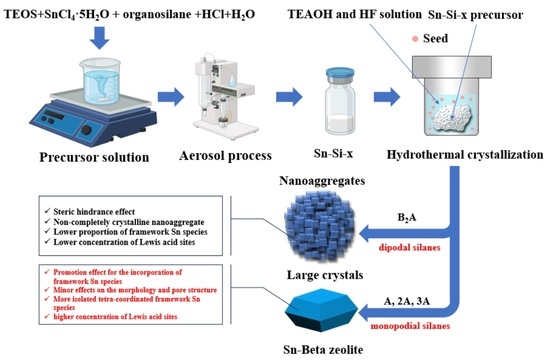
Graphical Abstract

1. Introduction

Zeolites are a class of crystalline porous materials that are widely used in adsorption, separation, ion exchange, and catalysis due to their excellent hydrothermal stability, abundant porous structures, and tunable acidity [1,2,3]. In conventional zeolite frameworks, the tetrahedrally coordinated (T) atoms are typically silicon (Si) and aluminum (Al), which bond with oxygen atoms to form Si–O and Al–O linkages, respectively. When trivalent Al3+ adopts a tetrahedral coordination, it generates negative charges within the framework, which must be balanced by positively charged cations such as Na+ and K+. Upon exchange of these cations with protons (H+), Brønsted acid sites are formed in the form of bridging hydroxyl groups (Si–OH–Al) [4]. In addition, aluminum atoms in the zeolite framework can be isomorphously substituted by tetravalent metals such as Ti, Sn, and Zr, which eliminates Brønsted acid sites while generating Lewis acid sites [5]. These Lewis acid sites, confined within the micropores, provide a unique microenvironment and are capable of catalyzing distinctive reactions.
Incorporating tetravalent tin (Sn4+) species into the framework of Beta zeolites yields Sn-Beta zeolites, which form highly active Lewis acid centers [6]. These Sn-Beta catalysts exhibit excellent performance in various reactions, such as Baeyer–Villiger oxidation (B-V) [7], Meerwein–Ponndorf–Verley (MPV) reduction [8], and biomass conversion [9,10,11]. However, due to the atomic radius of Sn (1.72 Å) being significantly larger than that of silicon (1.17 Å) and the mismatch between their hydrolysis rates, spontaneous nucleation during hydrothermal synthesis is challenging. Typically, toxic fluorides (such as ammonium fluoride or hydrofluoric acid) are required as mineralizing agents. The introduction of fluoride brings the pH of the synthesis system close to neutral, resulting in slow nucleation and growth rates. Consequently, the obtained Sn-Beta zeolites not only require prolonged crystallization times (often exceeding 10–15 days) but also exhibit crystal sizes on the micrometer scale. Furthermore, the coordination of F with Sn4+ causes a substantial amount of Sn4+ to remain in the mother liquor, preventing its incorporation into the framework (typically resulting in Si/Sn > 100). Therefore, conventional hydrothermally synthesized Sn-Beta zeolites typically achieve a cyclohexanone conversion of ~26–30% within 2–24 h, with an ε-caprolactone selectivity of ~60–65% in the B-V oxidation of cyclohexanone [12,13]. These drawbacks significantly limit their industrial scale-up and application. Subsequently, researchers have developed two-step post-synthesis methods. In these approaches, Beta zeolites containing Al or B are first dealuminated using strong acids (HNO3, 1–13 M) to generate abundant hydroxyl nests (defect sites). Specific tin precursors are then introduced into the framework via gas–solid isomorphous substitution [14], liquid–solid grafting [15], or solid-state ion exchange [16] to produce Sn-Beta zeolites. These synthesis methods offer advantages such as avoiding the use of fluorides, shorter synthesis times, smaller crystal sizes, and higher Sn loadings. However, since Sn atoms can only substitute a portion of the hydroxyl nests generated by acid dealumination, the resulting Sn-Beta zeolites still contain numerous defect sites (hydroxyl nests), which enhance their hydrophilicity. In liquid-phase reactions involving water, this often leads to instability and deactivation of Sn species, thereby affecting catalytic performance to some extent [17]. Two-step post-synthesis of Sn-Beta zeolites can achieve ketone conversions of ~35–41% in the B-V oxidation reaction but require prolonged synthesis times and multiple steps [18,19,20]. Therefore, developing an efficient hydrothermal synthesis strategy for Sn-Beta zeolites remains of great significance.
Organosilane-assisted hydrothermal synthesis is one of the most common and efficient methods for the synthesis of hierarchical or nano zeolites [21]. This method is usually based on the crystallization of silanized protozeolitic nano-units. The presence of organosilane moieties hinders their aggregation and avoids the formation of conventional microcrystalline zeolites. After the final calcination, organosilane is released, leaving pores in the mesopore range. However, this strategy is barely applied for zeolite synthesis in fluoride media. This may be because organosilane is generally immiscible in the starting gel in the presence of fluoride media [22]. Our group developed an aerosol-assisted hydrothermal method to synthesize zeolites [23,24]. The Sn-Si composite oxide produced via an aerosol process acts as the precursor for further crystallization of Sn-Beta zeolites [25,26]. Recent work from our group reported that the introduction of organosilane trimethoxy [3-(phenyl) propyl] silane (PHAPTMS) into Sn-Si oxide through the aerosol process avoids direct contact between organosilane and fluoride media, and thus hierarchical Sn-Beta nanoaggregates with crystal sizes ranging from 40 to 50 nm can be successfully synthesized [27]. However, the bulk phenyl groups of the alkyl chains partially restricted the incorporation of Sn species into the Beta zeolite framework, resulting a limited improvement of Lewis acidity in the obtained Sn-Beta materials (approx. 9–24 μmolg−1). From this perspective, a deeper investigation was necessary to understand the effective role of the functional groups of organosilanes in regulating the morphology, pore structure, and acidic properties of the resulting materials.
The present work systematically investigates, for the first time, how the number of amine groups, branched chain length, and monopodal versus dipodal architecture independently affect Sn-Beta zeolite properties during hydrothermal synthesis in the presence of a fluoride medium. To this end, a series of Sn-Beta zeolites were synthesized using an aerosol-assisted hydrothermal method in the presence of fluoride using different organosilanes (A, 2A, 3A, and B2A, Figure S1), and the resulting materials were characterized in terms of crystallinity, morphology, pore structure, Sn coordination state, Lewis acid density, and catalytic performance in the Baeyer–Villiger oxidation of cyclohexanone and 2-adamantanone. These insights provide rational design principles for organosilane selection in fluoride-mediated heteroatom zeolite synthesis.

2. Results and Discussion

2.1. Synthesis of Sn-Si Composite Oxide Precursor

The Sn-Si composite oxide precursors containing organosilanes were prepared via the sample aerosol method. The precursor doped with 2A (Sn-Si-2A) exhibited an amorphous spherical morphology with a smooth surface and a particle size ranging from approximately 50 nm to 8 μm (Figure 1a,b), which was similar to the sample prepared without adding organosilane [28], indicating that the incorporation of organosilane had little effect on the morphology of the precursor. The FT-IR analysis of the Sn-Si-x precursor series is shown in Figure 1c. Compared with the organosilane-free sample (Sn-Si), the spectra of samples containing organosilanes exhibited a distinct vibrational peak at around 1455 cm−1, attributed to the bending vibration of C–H in the organosilane [29], confirming the successful introduction of organosilane into the Sn-Si composite oxide using the aerosol method. The influence of the organosilane on the coordination state of Sn species in the precursors was determined via UV–Vis spectroscopy, as shown in Figure 1d. All samples displayed a prominent absorption band at 200–220 nm, assigned to the isolated four-coordinated Sn species incorporated into the amorphous silica framework [30]. The sample without organosilane (Sn-Si) and that doped with monoamine organosilane (Sn-Si-A) exhibited only isolated tetrahedral framework Sn species. With an increase in the number of amino groups and elongation of the branched chains in the organosilane dopant, the Sn-Si-2A and Sn-Si-3A samples showed a broad absorption band at around 320 nm, attributed to extra-framework bulk SnO2 particles [31]. By contrast, the sample doped with bidentate organosilane containing two branched chains (Sn-Si-B2A) displayed a characteristic absorption band at approximately 285 nm, indicating the presence of SnOx nanoclusters [32]. This was likely due to the steric hindrance effect of the branched chains introduced by the organosilane, which partially hindered the incorporation of Sn ions into the amorphous silica framework, leading to the formation of non-framework Sn species during the high-temperature (473 K) spray-drying process. The above results fully demonstrated that organosilanes were successfully incorporated into the Sn-Si oxide precursors via aerosol technology, and that differences in the branched chains of the organosilanes resulted in distinct distributions within the amorphous silica framework.

2.2. Synthesis of Sn-Beta Zeolite

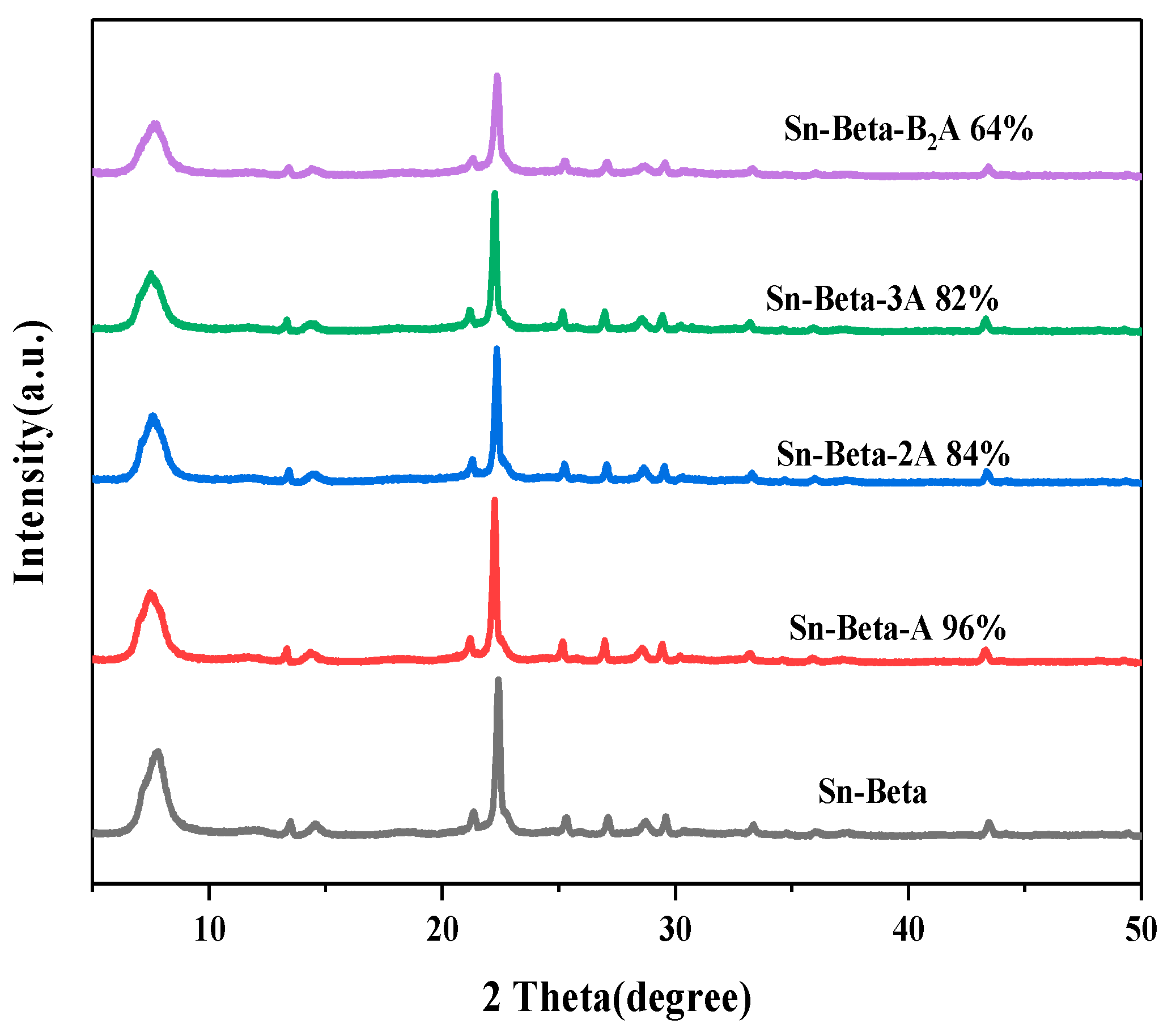
The Sn-Beta zeolites were hydrothermally synthesized using the Sn-Si-x precursors with the aid of TEAOH, fluoride, and seeds. Analysis of the XRD patterns (Figure 2) of the obtained Sn-Beta-x series samples revealed distinct diffraction peaks at 7.6° and 22.4°, characteristic of the typical BEA topology. However, significant differences in relative crystallinity were observed. With an increase in the number of amino groups in the organosilane (Sn-Beta-A, Sn-Beta-2A, and Sn-Beta-3A), the relative crystallinity of the samples gradually decreased (from 96% to 82%), while the Sn-Beta-B2A sample exhibited a relative crystallinity of only 64%. This was likely due to the fact that the Si atoms in the organosilane also served as partial silicon sources and were incorporated into the Beta zeolite framework during crystallization. However, as the number of amino groups in the organosilane increased, the branched chains gradually lengthened, leading to an increasingly pronounced inhibition of crystallization. Among these, the Sn-Beta-B2A sample contained two Si atoms, and more organosilane was introduced into the zeolite during the hydrothermal process. This resulted in the strongest inhibitory effect, leading to incomplete crystallization and the lowest crystallinity, which was consistent with similar reports on the organosilane-assisted synthesis of ZSM-5 zeolites [33].
It is known that XRD patterns also provide several structural parameters. The lattice constants and unit cell volumes of the Sn-Beta-x samples were calculated based on the tetragonal crystal system (Table S1). Sn-Beta-2A exhibited the largest unit cell volume (4186.7 Å3), indicating the highest degree of Sn incorporation into the framework, as the Sn–O bonds (ca. 1.91 Å) were longer than the Si–O bonds (ca. 1.61 Å). Conversely, Sn-Beta-B2A showed the smallest unit cell volume (4092.1 Å3) and d(101) lattice constant (11.49 Å), consistent with its low Sn content (Si/Sn = 158, Table 1) and the predominance of shorter Si–O bonds [34]. The texture coefficients (TC) for the major diffraction planes were all close to 1.0 (Table S2), indicating no preferred crystallographic orientation in any of the samples. This was consistent with the SEM images (Figure 3), which showed randomly oriented crystals for all samples. Crystallite size was determined using both the Scherrer equation and Williamson–Hall (W-H) plots (Table S1). The W-H method accounted for lattice strain contributions to peak broadening and yielded slightly larger crystallite sizes (28.5–51.4 nm) compared to the Scherrer equation (29.1–39.1 nm). The crystallite size decreased progressively from Sn-Beta (51.4 nm) to Sn-Beta-B2A (28.5 nm), confirming that the organosilanes inhibited crystal growth, with the dipodal B2A showing the strongest inhibitory effect.
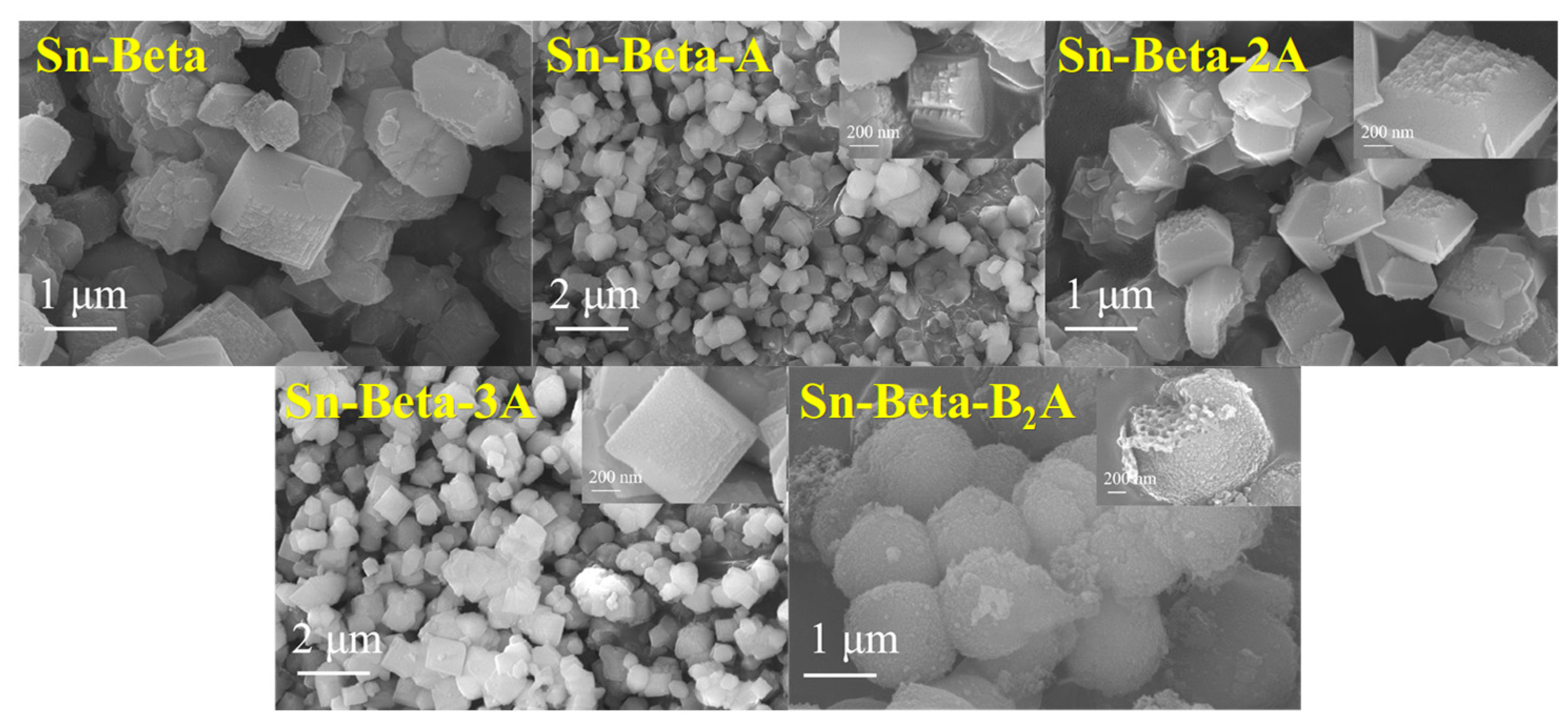
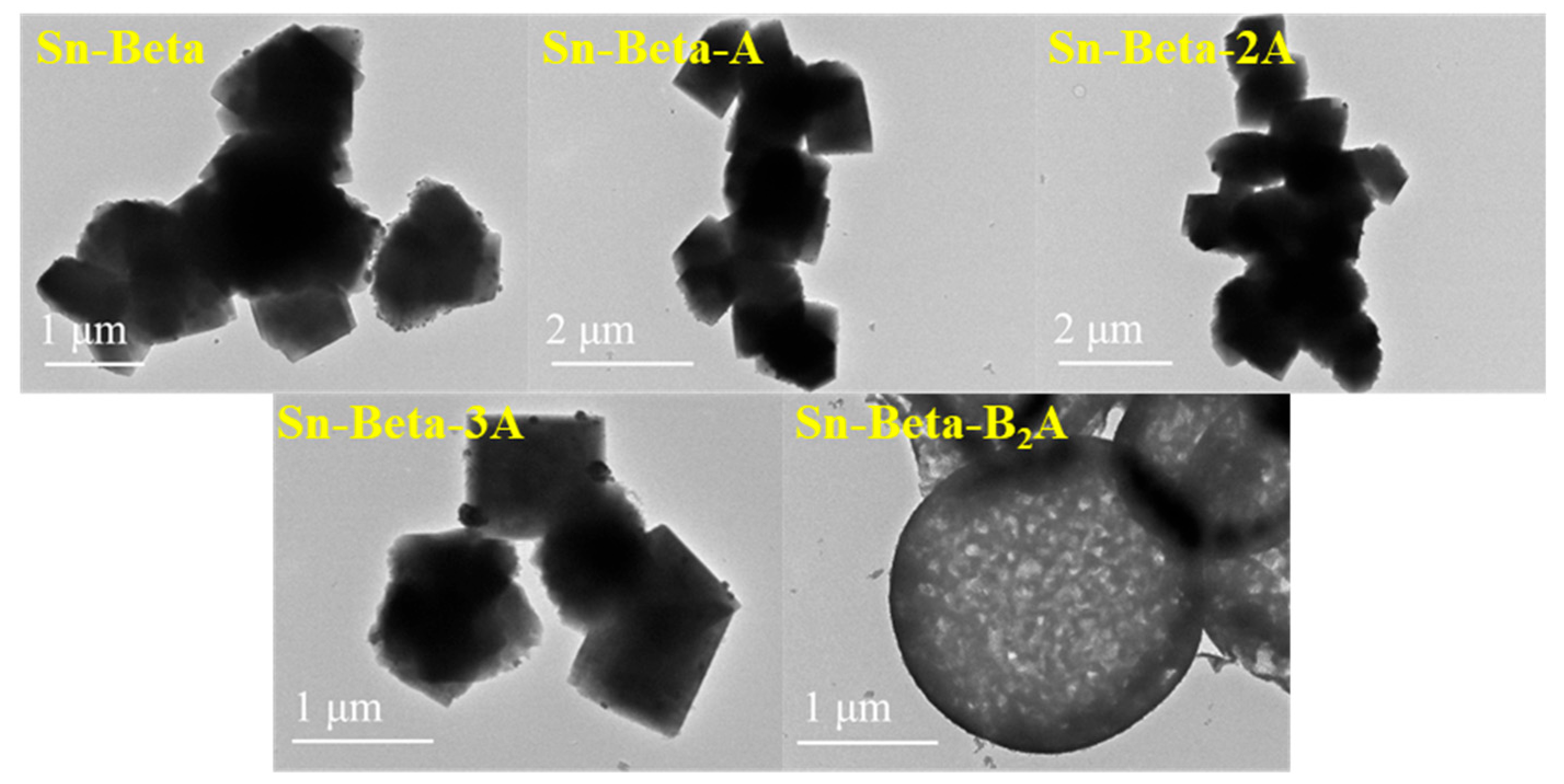
The effects of different organosilane types on the morphology and crystal size of the obtained Sn-Beta zeolites were analyzed via SEM and TEM (Figure 3 and Figure 4). The Sn-Beta sample prepared without organosilane exhibited a typical truncated bipyramidal morphology, with crystal sizes ranging from 1 to 1.6 μm (Figure S2), consistent with previously reported zeolites hydrothermally synthesized in fluoride media [7,35]. As the number of amino groups in the doped organosilane increased, the overall morphology of the Sn-Beta-A, Sn-Beta-2A, and Sn-Beta-3A zeolite samples did not change significantly, but the crystal size decreased to approximately 0.9 μm (Figure S2). By contrast, the Sn-Beta-B2A sample showed a substantial morphological transformation, exhibiting a spherical nanoaggregate morphology with the size also reduced to about 1 μm, indicating that the introduction of the dipodal organosilane (B2A) significantly inhibited zeolite growth and led to the formation of nanoaggregates. This finding was consistent with the XRD results (Figure 2). The EDAX results (Figure S3) showed that the Sn element was uniformly distributed in each sample, with no enrichment observed. The above results demonstrated that the incorporation of organosilane led to a reduction in crystal size, while the number of amino groups had little effect on zeolite morphology and Sn element distribution. Instead, the number of Si atoms in the organic branched chain played a decisive role in determining the morphology of the zeolite.
TEM analysis (Figure 4) further revealed that the Sn-Beta zeolite prepared without organosilane had an average particle size of 1.3 μm, whereas the samples synthesized with organosilanes (Sn-Beta-A, Sn-Beta-2A, Sn-Beta-3A, and Sn-Beta-B2A) all exhibited crystal sizes of approximately 0.9 μm. Notably, the Sn-Beta-B2A sample displayed a pronounced nanoaggregate morphology, with mesoporous structures clearly observable within the crystals, originating from the accumulation of nanocrystallites. It also can be seen from the HRTEM (Figure S4) analysis that clear lattice fringes were observed for all samples, confirming their high crystallinity. The measured d-spacings were as follows: Sn-Beta: 11.75 Å, Sn-Beta-A: 11.71 Å, Sn-Beta-2A: 11.82 Å, and Sn-Beta-3A: 11.65 Å. These results corresponded well with the (101) plane of the BEA topology and were in excellent agreement with the d-spacing results calculated from the XRD data (Table S1). Sn-Beta-2A exhibited the largest d-spacing (11.80 Å) among the series, which correlated well with the highest framework Sn content determined via ICP. This lattice expansion was fundamentally attributed to the isomorphic substitution of Si atoms by larger Sn atoms, as the Sn–O bond (~1.91 Å) was significantly longer than the Si–O bond (~1.61 Å). These results provided direct evidence that organosilane 2A facilitated the most efficient incorporation of Sn into the framework while exerting the minimal inhibitory effect on the crystallization process.
The effects of different organosilane types on the pore structure and textural properties of the obtained Sn-Beta zeolites were investigated via nitrogen physisorption analysis (Figure S5). All samples exhibited type IV adsorption isotherms, indicating the presence of microporous structures. H4 hysteresis loops were observed in the relative pressure range of 0.44 < P/P0 < 0.85, suggesting the possible existence of mesopores. Compared with the Sn-Beta zeolite prepared without organosilane, the samples synthesized with monopodial organosilanes (Sn-Beta-A, Sn-Beta-2A, and Sn-Beta-3A) showed slightly increased specific surface areas (Table 1), which may be attributed to the reduction in crystal size. The micropore and mesopore volumes remained largely unchanged, indicating that the number of amino groups in the organosilane had little effect on the textural properties of the zeolite. By contrast, the Sn-Beta-B2A zeolite sample exhibited the largest hysteresis loop, external surface area (159 m2/g), mesopore volume (0.2 cm3/g), and specific surface area (549 m2/g). This was associated with the nanoaggregate morphology of this sample and the presence of pronounced mesopores, consistent with the observations from TEM images (Figure 4). The BJH pore size distribution (Figure S5b) indicated that the undoped sample (Sn-Beta) exhibited a typical microporous structure. Sn-Beta-B2A exhibited an obvious pore size distribution centered at 3 nm, which was also consistent with its nanoaggregate morphology observed via TEM. For the other samples (Sn-Beta-A, Sn-Beta-2A, and Sn-Beta-3A), the pore size distributions were less pronounced and uneven, which was consistent with their large single-crystal morphologies. These results indicated that the dipodal organosilane (B2A), with its larger organic branched chains, introduced significant steric hindrance that restricted zeolite growth, leading to the formation of spherical nanoaggregate morphology. By contrast, the other organosilanes (A, 2A, and 3A) possessed shorter branched chains and thus induced weaker steric hindrance, resulting in typical single-crystal morphologies with less pronounced pore size distributions. It is noted that Serrano et al. [33] systematically investigated the role of organosilane functional groups in the synthesis of hierarchical ZSM-5 zeolites and reported that increasing the number of amine groups enhanced organosilane incorporation and structural distortion, while dipodal organosilanes led to non-completely crystalline materials due to excessive steric hindrance. Their observation that the dipodal B2A sample exhibited the lowest crystallinity and the highest Si/Al ratio (lowest Al incorporation) directly aligned with our finding that Sn-Beta-B2A showed the lowest relative crystallinity (64%) and the highest Si/Sn ratio (158). Similarly, Sun et al. [36] demonstrated that organosilane (TPED) promoted the formation of hierarchical SAPO-34 aggregates from a cubic-like morphology with an enhanced external surface area. Therefore, it can be concluded that doping with organosilanes possessing large organic branched chains yields nanoaggregate morphologies, which can be attributed to the significant steric hindrance that restricts zeolite growth and inhibits the fusion of neighboring crystals. However, our other organosilane-doped samples (A, 2A, and 3A) showed no significant morphological changes (Figure 3), which may due to the use of different synthesis systems. The synthesis of ZSM-5 and SAPO-34 in the literature was performed under hydroxide-mediated (OH) conditions, whereas our Sn-Beta zeolites were synthesized in fluoride-containing media (F) at near-neutral pH. In fluoride media, crystallization proceeds more slowly and favors the formation of larger, more defect-free crystals. The steric hindrance effect of the organic branched chains in the short-chain organosilane-doped samples (A, 2A, and 3A) was likely weakened in the fluoride-containing system. This was also consistent with the observation that these samples exhibited relatively small mesopore volumes (Table 1 and Figure S5b).
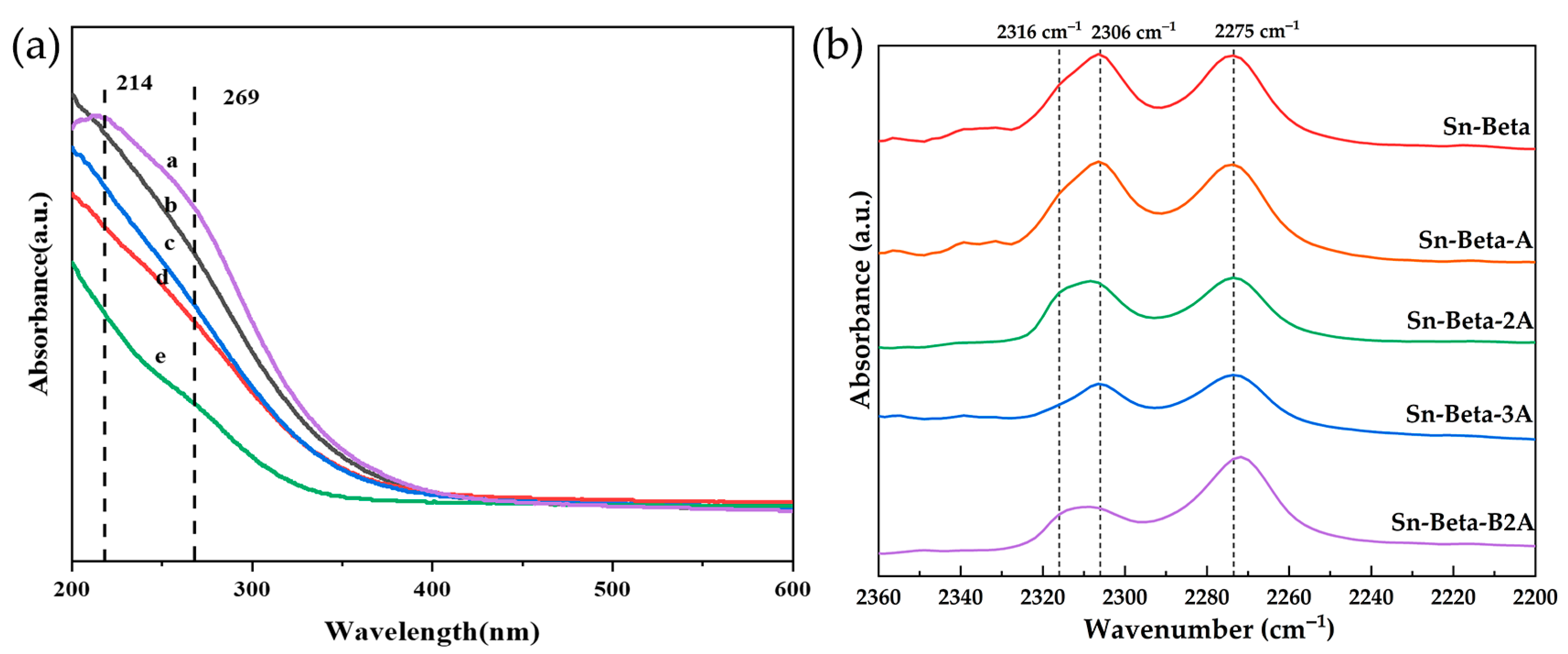
The influence of different organosilane types on the coordination state of Sn species in the resulting Sn-Beta zeolites was analyzed through UV–Vis spectroscopy (Figure 5a). The sample without doped organosilane (Sn-Beta, Figure 5a) exhibited a distinct absorption peak at 214 nm and a weak peak at 269 nm, which could be attributed to tetrahedrally coordinated framework Sn(IV) species and extra-framework SnOx clusters, respectively [26,37]. For the other samples doped with organosilanes, the absorption peak at 214 nm blue-shifted to 200 nm, indicating the formation of more isolated framework Sn(IV) sites. Moreover, the optical bandgap (Eg) values, calculated from UV–Vis spectra using the Tauc plot method (Figure S6), provided quantitative evidence for the coordination state of Sn species. The Eg values followed the order: Sn-Beta (3.96 eV) < Sn-Beta-A (4.26 eV) < Sn-Beta-3A (4.54 eV) < Sn-Beta-B2A (4.58 eV) < Sn-Beta-2A (4.68 eV). These results further confirmed that doping with organosilanes, particularly with diamine-functionalized 2A, yielded Sn-Beta zeolites with more isolated tetracoordinated framework Sn species. A higher Eg value indicates a larger energy requirement for the ligand-to-metal charge transfer (LMCT) transition, which is characteristic of Sn(IV) sites possessing a more symmetric coordination environment and a higher degree of isolation within the BEA framework [6]. Furthermore, compared to that of the Sn-Beta sample without doped organosilane, the intensity of the absorption peak at 269 nm attributed to extra-framework Sn species was significantly reduced in the organosilane-doped samples. This indicated that doping with different organosilanes had a significant impact on the extent of Sn incorporation into the framework. Among these, Sn-Beta-2A, containing two amine groups, possessed the highest framework Sn content, which was consistent with the actual Si/Sn ratios obtained from the ICP results (Table 1).
It is also noted that other studies have fully confirmed that amino groups can coordinate with metal ions to form stable complexes. During the hydrothermal synthesis of zeolites, this complexation can not only prevent the hydrolysis and precipitation of metal species but also facilitate the incorporation of metal ions at specific positions [38]. Previous research by our group indicated that the synthesis of Sn-Beta zeolites via the aerosol-assisted hydrothermal method follows a liquid-phase growth mechanism [24]. In short, the Sn-Si precursor first dissolves in the liquid phase under the action of the template and mineralizer, followed by nucleation and growth in the liquid phase. A possible explanation for the results obtained in this study is as follows. On the one hand, during the hydrothermal crystallization process, the dissolved Sn species may preferentially coordinate with the terminal amine groups (-NH2) of the organic chains. Subsequently, under the action of the mineralizer (F), they are more readily incorporated into tetrahedral framework positions, and the coordination environment becomes more isolated. This explains why Sn-Beta-2A possessed more framework Sn species than Sn-Beta-A. On the other hand, with a further increase in the number of amine groups in the organic branches, the length of the organic branch also increases significantly. Its steric hindrance may interfere with the F-assisted incorporation of Sn into the framework. This phenomenon was more pronounced in Sn-Beta-B2A (Figure 5a). The dipodal organosilane possessed a larger organic branch, and its steric hindrance effect was also the most significant. This led to its lowest framework Sn content, and the absorption peak for extra-framework Sn species was also more apparent compared to samples doped with monopodial organosilanes. These results demonstrated that the role of amine groups in the introduced organosilane has a significant impact on the coordination state of Sn species, and simultaneously, the steric hindrance effect of the branches in the organosilane cannot be overlooked.
To further differentiate the coordination states of framework Sn sites, CD3CN-adsorbed FT-IR spectra were recorded (Figure 5b). Three distinct bands were observed at 2275, 2306, and 2316 cm−1 for all samples. The band at 2275 cm−1 was attributed to physisorbed CD3CN, while the bands at 2306 and 2316 cm−1 were assigned to CD3CN adsorbed on the “close” (Sn-(OSi)4) and “open” ((OSi)3Sn-OH) framework Sn sites, respectively [39]. It was clearly observed that Sn-Beta-2A displayed a significantly higher intensity of the 2316 cm−1 band compared to the other samples, demonstrating that the doping of organosilane 2A favored the formation of ‘open’ framework Sn sites. These results indicated that the obtained Sn-Beta-x samples indeed presented isolated framework Sn sites and mainly contained integrated tetrahedral framework Sn sites. Boronat et al. proved that open Sn sites are more active in oxidation reactions than closed sites [40].
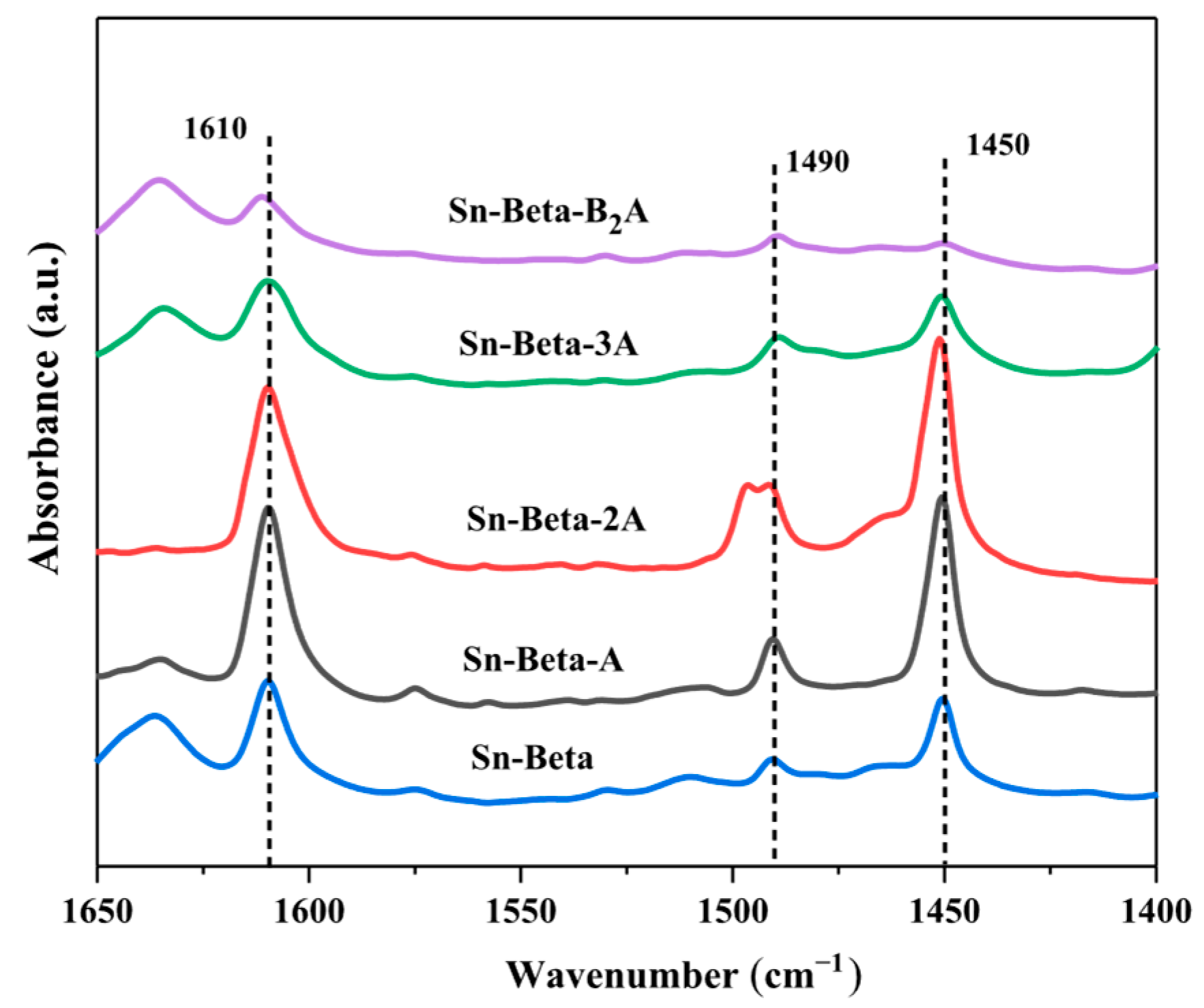
The influence of different organosilane types on the acidic properties of the resulting Sn-Beta zeolites was analyzed through pyridine-adsorbed IR (Py-IR) spectroscopy (Figure 6). All samples exhibited distinct absorption peaks at 1450 cm−1 and 1610 cm−1, which were attributed to Lewis acid sites [41]. No additional absorption peak appeared around 1540 cm−1, demonstrating the absence of Brönsted acid sites in the Sn-Beta zeolites [25]. Therefore, the absorption peak at 1490 cm−1 was also attributed to Lewis acid sites [42]. The Lewis acid density for each sample was calculated using formula (1), and the results are shown in Table 1. Compared to the Sn-Beta sample without doping, the samples doped with monopodial organosilanes (Sn-Beta-A, Sn-Beta-2A, and Sn-Beta-3A) showed a significantly increased Lewis acid density, which may be attributed to their more isolated framework Sn(IV) sites (Figure 5a). By contrast, the Sn-Beta-B2A zeolite sample exhibited the lowest Lewis acid density, possibly due to the steric hindrance of its doped dipodal organosilane affecting the incorporation of Sn species into the framework. These findings were consistent with the UV–Vis characterization results shown in Figure 5a.
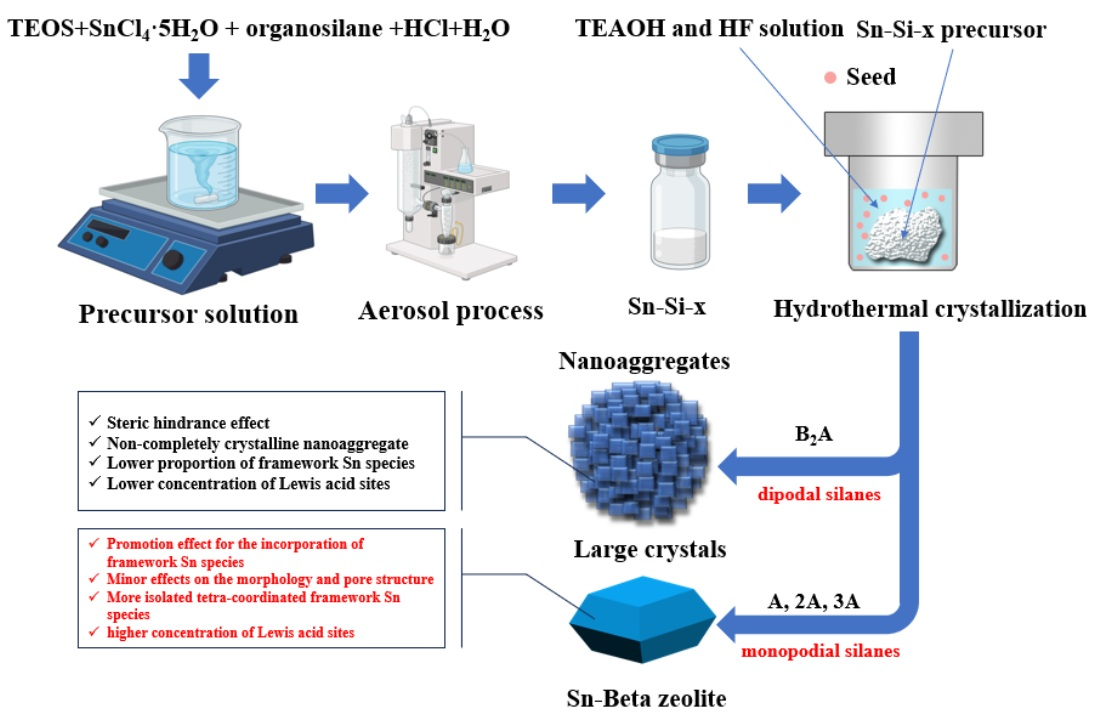
The above results fully demonstrated that doping with monopodal organosilanes had little effect on the morphology and pore structure of the obtained Sn-Beta zeolite samples. The role of the amino groups was to promote the incorporation of Sn species into the zeolite framework, forming more isolated tetra-coordinated framework Sn species, thus resulting in a higher Lewis acid density. On the other hand, the steric hindrance effect of the organic branched chains became more pronounced as the branched chains lengthened. This effect inhibited the growth and fusion of zeolite crystals. Consequently, the morphology of the sample doped with dipodal organosilane (Sn-Beta-B2A) transformed into nanoaggregates. It also hindered the incorporation of Sn species into the framework, with this sample exhibiting the lowest framework Sn content and Lewis acid density (Scheme S1).

2.3. Catalytic Evaluation

The isolated tetracoordinated Sn species within the framework of Sn-Beta zeolites exhibit Lewis acidity, thereby enabling the catalysis of a range of redox reactions [43,44,45]. The Baeyer–Villiger oxidation of cyclohexanone with hydrogen peroxide is a Lewis acid-catalyzed reaction and the product ε-caprolactone is an important industrial intermediate with a wide range of applications. The reaction scheme for this transformation, along with the catalytic activity of the Sn-Beta zeolite-x catalysts prepared in this study, is detailed in Table 2. A previous report by our group confirmed that the Sn-Si oxide precursor exhibited only 7% cyclohexanone conversion, with no detectable formation of the target product ε-caprolactone [28]. By contrast, the Sn-Beta zeolite obtained via hydrothermal synthesis from this precursor achieved a cyclohexanone conversion of 29% and an ε-caprolactone selectivity of 61% (Table 2, Entry 1), indicating that the incorporation of Sn into the Beta zeolite framework generated catalytically active framework Sn species. The Sn-Beta zeolite samples prepared with different types of organosilanes showed slightly improved cyclohexanone conversion and yield. The order of their catalytic activity was Sn-Beta-2A > Sn-Beta-A > Sn-Beta-3A > Sn-Beta-B2A ≈ Sn-Beta. The Sn-Beta-2A zeolite catalyst exhibited the highest cyclohexanone conversion (39%, Table 2, Entry 3). This was likely attributable to this sample possessing the highest quantity of tetracoordinated framework Sn species (Figure 5a), which resulted in a higher Lewis acid density (Table 1), effectively promoting the conversion of cyclohexanone to lactone. Concurrently, the catalytic performance of the Sn-Beta-A and Sn-Beta-3A samples was also higher than that of Sn-Beta (Table 2, Entries 1, 2, 4), suggesting that smaller crystallite sizes may also contribute to enhanced catalytic performance. By comparison, the catalytic performance of the Sn-Beta-B2A sample was comparable to that of the Sn-Beta sample without doping. Although this sample exhibited a nanoagglomerate morphology (Figure 3) and possessed the largest mesopore volume (Table 1), the introduction of the dipodal organosilane hindered the incorporation of Sn species into the zeolite framework, resulting in the lowest relative crystallinity and Lewis acid density (Table 1). The superior diffusion properties were insufficient to compensate for the loss of active Sn species, thus leading to its lower catalytic activity (Table 2, Entry 5). Furthermore, the selectivity toward ε-caprolactone for all samples ranged between 60% and 64%. GC-MS analysis indicated that the main byproduct was 6-hydroxyhexanoic acid, resulting from the further hydrolytic ring-opening of ε-caprolactone (Table 2). According to literature reports, the weak acidity of hydrogen peroxide and even the Lewis acidity within Sn-Beta zeolites [20] can potentially lead to this side reaction. Although the formation of byproduct 6-hydroxycaproic acid seems unavoidable, it is possible to increase product selectivity by lowering the molar ratio of H2O2 to cyclohexanone and moderately reducing the reaction time [46].
To further investigate the advantages of the obtained Sn-Beta zeolites, the Baeyer–Villiger oxidation of 2-adamantanone with hydrogen peroxide was selected as a model reaction, and the catalytic performance results are shown in Table 3. All samples exhibited extremely high selectivity (greater than 99%) in this reaction. This is because of the rigid structure of the 2-adamantanone molecule, which made the resulting lactone less prone to ring-opening, which was consistent with other literature reports [46,47]. The Sn-Beta zeolite sample prepared without organosilane addition showed a low conversion of 2-adamantanone (Table 3, Entry 1), indicating that the micropores limited the access of the bulky reactant molecule to the active sites inside the catalyst. The samples doped with monopodial organosilanes (Sn-Beta-A, Sn-Beta-2A, and Sn-Beta-3A) exhibited increased specific surface areas (Table 1) and enhanced diffusion properties, thus showing higher catalytic activity for 2-adamantanone (Table 3, Entries 2–4). Among these, the Sn-Beta-2A sample, possessing the highest Lewis acid density and smaller crystal size, displayed the highest conversion rate of 37% in this reaction. For the Sn-Beta-B2A zeolite sample, although it had a larger mesopore volume, the quantity of tetracoordinated framework Sn species was limited (Table 1), resulting in poor catalytic activity (Table 3, Entry 5). These results indicated that the number of active framework Sn species in the Sn-Beta catalyst, along with the diffusion properties conferred by smaller crystal sizes and mesopores, played a crucial role in the catalytic activity.
In addition, the turnover number (TON) of all catalysts in the B-V oxidation of cyclohexanone and 2-adamantanone indicated that all organosilane-doped samples (Sn-Beta-A, Sn-Beta-2A, Sn-Beta-3A, and Sn-Beta-B2A) exhibited higher TON values (105–116) than the undoped Sn-Beta (85–88), which may due to the organosilane-doped samples exhibiting a blue-shifted absorption peak (from 214 nm to ~200 nm) and increased optical bandgap (Eg) values (from 3.96 eV to 4.26–4.68 eV, Figure S6). This indicated that the Sn species in these samples were present as more highly isolated, tetracoordinated framework species, which were the true active sites for Baeyer-Villiger oxidation. By contrast, the undoped Sn-Beta sample contained a higher proportion of less active extra-framework SnOx clusters (UV–Vis absorption at ~269 nm). It is also noted that the TON value of the Sn-Beta-B2A sample was relatively higher despite its low conversion, which may due to its very low Sn content (Si/Sn = 158, the highest among all samples). TON was calculated as moles of product per mole of Sn. With the same catalyst mass (50 mg) and ketone amount (2 mmol), Sn-Beta-B2A contained far fewer Sn atoms than the other samples (approximately 1/6 of Sn-Beta-2A). Therefore, even 30% conversion resulted in a TON value (116) that was slightly higher than that of Sn-Beta-2A (106), which achieved 39% conversion but with ~6× more Sn sites. This did not indicate that Sn-Beta-B2A was more active overall; rather, it reflected that each of its limited Sn sites was highly accessible due to its nanoaggregate morphology and high mesoporosity. A similar phenomenon was reported by Philipp Treu et al. in comparing the catalytic performance of catalysts with different Sn contents, who found that as the Sn content increases, although conversion improves, the TON value decreases [48].
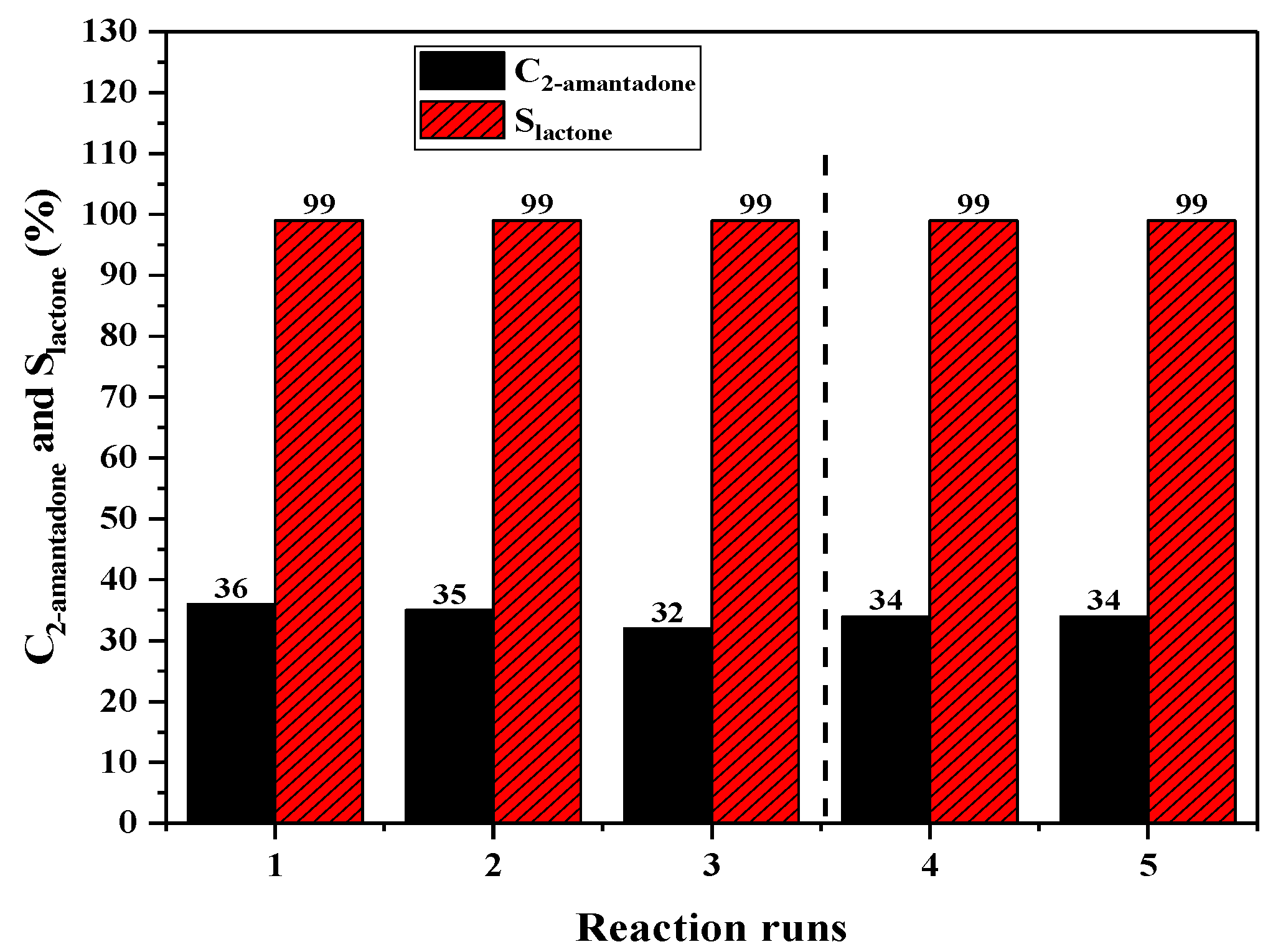
Another criterion for evaluating catalysts is reusability. The Sn-Beta-2A catalyst was recovered by washing with ethanol and deionized water at least three times and dried at 383 K for the next run. As shown in Figure 7, the conversion of 2-adamantanone decreased slightly (from 36% to 32%) during the first three runs. However, the used catalyst was almost reactivated (Figure 7, fourth and fifth run) after a calcination process (823K, 4 h). In order to investigate the stability of the Sn species in the Sn-Beta zeolite during the catalytic reaction, the Sn-Beta-2A catalyst was removed via hot filtration after the reaction proceeded for 3 h. The residual reagent was allowed to continue for an additional 3 h, and no significant increase in 2-admantanone conversion was observed, as shown in Figure S7a, fully indicating that no Sn species was leached from the Sn-Beta-2A catalyst under the reaction conditions. Furthermore, a comparison of the UV–Vis spectra between the fresh and regenerated Sn-Beta-2A catalysts is shown Figure S7b. The characteristic absorption band for framework tetrahedral Sn species (~214 nm) remained largely intact, while a slight increase in the intensity of the band at 289 nm (corresponding to oligomeric SnOx clusters) was observed. Since Sn leaching was excluded (Figure S7a), the slight decrease in catalytic activity (a 2% reduction in conversion after five cycles) should be due to the partial change of the Sn coordinated environment (from tetrahedrally framework Sn species to extra-framework SnOx clusters).
Table S3 summarizes the catalytic performance of Sn-based catalysts from other relevant studies. Taking various reaction conditions into account (including catalyst dosage, ketone amount, and reaction time), the Sn-Beta catalyst in this study demonstrated superior catalytic performance.
In addition, it is well accepted that unlike Ti-silicates, where Ti first activates H2O2 to enhance its nucleophilicity for epoxidation [49], the isolated tetracoordinated Sn(IV) sites in Sn-Beta zeolites first attack the ketone carbonyl, increasing its positive charge and electrophilicity. Subsequently, H2O2 attacks the activated carbonyl carbon to form a Criegee intermediate, which rearranges to release the lactone. This mechanism also explains why Sn-Beta-2A, with the highest framework Sn content and Lewis acid density, exhibited the best catalytic performance [50].

3. Materials and Methods

3.1. Materials

Stannic chloride pentahydrate (SnCl4·5H2O, analytically pure), hydrofluoric acid (40 wt% in water), cyclohexanone (C6H10O, analytically pure), chlorobenzen (C6H5Cl, analytically pure), 1,4-dioxane (C4H8O2, analytically pure), N-[3-(trimethoxysilyl)propyl]ethylenediamine (2A, C8H22N2O3Si, analytically pure), 3-[2-(2-aminoetyhlamino)ethylamino]propyl-trimethoxysilane (3A, C10H27N3O3Si, analytically pure), tetraethyl ammonium hydroxide (N(C2H5)4OH, 25 wt% in water), and ε-caprolactone (C6H10O2, analytically pure) were obtained from Shanghai Aladdin Biochemical Technology Co., Ltd. (Shanghai, China). Hydrochloric acid (HCl analytically pure) and nitric acid (HNO3, analytically pure) were sourced from Jinzhou Gucheng Chemical Regent Co., Ltd. (Jinzhou, China). (3-Aminopropyl)trimethoxysilane (A, C6H17NO3Si, analytically) and bis [3-(trimethoxysilyl)propyl]ethylene diamine (B2A, C14H36N2O6Si2, analytically pure) were supplied by Shanghai Yien Chemical Technology Co., Ltd. (Shanghai, China). 2-Adamantanone (C10H14O, analytically pure) was provided by Shanhai Mscklin Biochemical Co., Ltd. (Shanghai, China). Tetraethyl orthosilicate (C8H20O4Si, analytically pure) and hydrogen peroxide (H2O2, 30 wt% in water) were sourced from Tianjin Yongda Chemical Regent Co., Ltd. (Tianjin, China). Deionized water was produced in the laboratory. All the chemicals and reagents were used as received without further purification.

3.2. Method

Synthesis of Sn-Si composite oxide precursor: First, 4 g of hydrochloric acid was mixed with 270 g of deionized water to form an aqueous hydrochloric acid solution. Then, an organosilane (A, 2A, 3A or B2A; structural formulas shown in Figure S1) was added to the above solution. After complete dissolution, 156 g of TEOS was introduced. Following the complete hydrolysis of TEOS, 1.20 g of SnCl4·5H2O was added. The molar composition was 1.0 SiO2:0.008 SnO2:20 H2O:0.15 HCl:0.08 organosilane. Finally, the precursor solution was fed into the atomizer using a peristaltic pump (MAI-GZJ, Shanghai Nai Precision Instrument Co., Ltd., Shanghai, China) at a drying temperature of 483 K and a flow rate of 600 mL/h to obtain a solid powder. The powder was subsequently dried at 373 K for 6 h to yield the Sn-Si composite oxide samples, denoted as Sn-Si-x, where x represents the type of organosilane. For comparison, a Sn-Si composite oxide sample without any organosilane was also prepared and denoted as Sn-Si.
Synthesis of Sn-Beta seeds: First, 1 g of commercial H-Beta zeolite (Qiwangda Chemical Technology CO., Ltd., Dalian, China, SiO2/Al2O3 = 30) and 50 mL of 7.2 M HNO3 solution were added into a 100 mL round-bottomed flask. The sample was placed in an oil bath at 373 K under reflux for 12 h for dealumination. Finally, the sample was washed until neutral and dried at 383 K for 6 h to obtain Sn-Beta seeds.
Synthesis of Sn-Beta zeolite: The Sn-Beta zeolites were synthesized via the hydrothermal method in fluoride media using the aerosol powder (Sn-Si-x) as the precursor. In a typical synthesis, 1 g of the Sn-Si-x powder was mixed with specific amounts of the structure-directing agent (tetraethyl ammonium hydroxide solution, 25 wt% TEAOH), the mineralizing agent (hydrofluoric acid solution, 40 wt% HF), and 3 wt% seeds (with respect to the silica content). The molar composition was 1.0 SiO2:0.008 SnO2:0.4 TEAOH:0.4 HF:2 H2O:0.08 organosilane:3 wt% seed. The final gel was transferred into a PTFE-lined stainless-steel autoclave and heated at 443 K for 4 days. Then, the product was filtered and thoroughly washed using deionized water. The powder was dried at 383 K for 6 h, and calcined at 823 K for 4 h to obtain the Sn-Beta zeolite, denoted as Sn-Beta-x, where x represents the type of organosilane. Sample prepared without any organosilane was used as a reference and denoted as Sn-Beta. The overall of the catalyst synthesis is shown in Scheme S1.

3.3. Catalyst Characterization

Powder X-ray diffraction (XRD) patterns were recorded on a Rigaku D/Max 2400 diffractometer (Rigaku, Tokyo, Japan) equipped with Cu–Kα radiation operating at 40 kV and 10 mA. The scanning range was set at 5–50° with a scanning rate of 8 °/min. The morphology and structure of the samples were characterized via transmission electron microscope (TEM, FEI Tecnai G220 S-twin, FEI, Hillsboro, OR, USA) operating at 200 kV and scanning electron microscopy (SEM, Hitachi S-4800, Hitachi, Tokyo, Japan) operating at 3 kV. The coordination status of Sn was detected using a UV-550 ultraviolet spectrophotometer (Jasco Company, Hachioji, Japan). Barium sulphate powder was used as the reference, and the spectra were recorded at a slow scan rate over a wavelength range of 200–600 nm. The Sn loading content was determined via inductively coupled plasma (ICP) analysis on a Perkin Elmer Optima 2000 DV (Waltham, MA, USA) inductively coupled plasma atomic emission spectroscope. The porous structures of the materials were measured via N2 physical adsorption isotherms using an ASAP 2020 fully automatic physical adsorption analyzer (American Micronics Company, Tustin, CA, USA). The samples were treated at 473 K for 4 h prior to analysis. The size distribution was calculated from the adsorption isotherm using the Barrett–Joyner–Halenda (BJH) method. The specific surface area was calculated from the adsorption data using the Brunauer–Emmett–Teller (BET) equation. FT-IR spectra were recorded on a Bruker EQUINOX-35 spectrometer (Bruker, Billerica, MA, USA) in the range of 4000–400 cm−1 with a spectral resolution of 4 cm−1. Lewis acid sites were probed using deuterated acetonitrile (CD3CN) and pyridine as probe molecules. Prior to measurements, the samples were evacuated in an in situ cell at 673 K for 3 h. Subsequently, deuterated acetonitrile was introduced into the cell at room temperature for 30 min, followed by desorption at the same temperature for 30 min. Pyridine adsorption was performed at room temperature for 30 min, followed by vacuum desorption at 423 K for 30 min. Finally, the corresponding FT-IR spectra were collected. The Lewis acid density was quantitatively calculated according to Equation (1) [23]:
Site   density   ( μ mol / g )   =   IA ( cm 1 ) E ( cm / μ mol )   ×   a ( cm 2 ) m ( g )
where IA is the integrated area of the absorption peak at 1450 cm−1; a and m are the area and mass of the self-supporting wafer, respectively; and E is the integrated molar extinction coefficient (E = 1.42 cm/μmol).

3.4. Performance Evaluation

The catalytic performance of the Baeyer–Villiger oxidation of cyclohexanone and 2-adamantanone using H2O2 as the oxidant was evaluated in a 50 mL round-bottomed flask. Typically, 0.05 g of catalyst was added to a mixture containing 10 mL of 1,4-dioxane, 2 mmol of reactant, 3 mmol of H2O2, and 0.5 g of chlorobenzene (internal standard). The resulting mixture was stirred at 353 K for 3 h. After cooling, the reaction mixture was separated from the catalyst via centrifugation, and the supernatant liquid was analyzed via gas chromatography using a GC-7890 gas chromatograph (Techcomp, Hong Kong, China) equipped with an SE-54 capillary column (30 m × 0.32 mm × 0.5 μm) and an FID detector. For the B-V oxidation of 2-adamantanone, the reaction temperature was set to 363 K while keeping all other conditions unchanged. The conversion of ketone (C), selectivity of lactone (S), yield (Y), and turnover number (TON) were calculated according to the following equations:
C   =   n Ketone     n Ketone n Ketone   ×   100 %
S = n Lactones n Ketone     n Ketone   ×   100 %
Y = C × S × 100%
TON   =   moles   of   product   formed moles   of   Sn   in   the   catalyst

4. Conclusions

In this work, a series of Sn-Beta zeolites were successfully synthesized via an aerosol-assisted hydrothermal method in fluoride media using Sn-Si mixed oxide doped with different types of organosilanes as precursors. The systematic investigation focused on how the number of amine groups, the length of branched chains, and the use of monopodal versus dipodal organosilanes influenced the physicochemical properties and catalytic performance of the resulting Sn-Beta zeolites.
The results demonstrated that monopodal organosilanes containing amino groups have a minor effect on the morphology and pore structure of Sn-Beta but significantly promote the incorporation of Sn species into the zeolite framework. Among these, the sample functionalized with two amino groups (Sn-Beta-2A) exhibited the highest content of isolated tetracoordinated framework Sn species, the greatest Lewis acid density (225 μmol/g), a smaller crystal size (~0.9 μm), and an increased specific surface area (502 m2/g), leading to superior catalytic performance in the Baeyer–Villiger oxidation of both cyclohexanone and 2-adamantanone.
By contrast, increasing the number of amino groups to three (Sn-Beta-3A) or introducing dipodal organosilanes with longer branched chains (Sn-Beta-B2A) introduced significant steric hindrance. This hindered zeolite crystallization, reduced framework Sn incorporation, and, in the case of Sn-Beta-B2A, led to a nanoaggregate morphology with mesoporous characteristics but the lowest crystallinity and Lewis acid density, which ultimately limited catalytic activity.
These findings highlight that while amino groups in organosilanes enhance Sn incorporation and Lewis acidity, the steric hindrance of branched chains—especially in dipodal structures—can counteract these benefits. Therefore, optimizing the balance between functional group chemistry and steric effects is crucial for designing high-performance Sn-Beta zeolites. The aerosol-assisted synthesis strategy presented in this work provides a new perspective for the synthesis of high-performance heteroatom zeolites in fluoride-containing systems.

Supplementary Materials

The following supporting information can be downloaded at: https://www.mdpi.com/article/10.3390/catal16050426/s1, Figure S1: Silanization agents employed for the preparation of the Sn-Beta samples; Figure S2: Particle size distribution histograms of Sn-Beta-x series samples; Figure S3: EDAX analysis of Sn-Beta-x series samples; Figure S4: HRTEM images of Sn-Beta-x series samples; Figure S5: Nitrogen adsorption desorption curves (a) and BJH pore size distribution (b) of Sn-Beta-x series samples; Figure S6: Tauc plots of Sn-Beta-x series samples; Figure S7: (a) The thermal filtration experiment with the Sn-Beta-2A catalyst; (b) UV–Vis spectra of the fresh and the regenerated Sn-Beta-2A; Table S1: Lattice constants of Sn-Beta-x series samples; Table S2: Texture coefficients of Sn-Beta-x series samples; Table S3: Comparison of the catalytic performance between other Sn based catalysts and Sn-Beta-2A, see [12,24,51,52]; Scheme S1. Schematic illustration of the Sn-Beta zeolites synthesized via the aerosol-assisted hydrothermal method.

Author Contributions

Y.L.: investigation, validation, data curation, formal analysis, writing—original draft and preparation. X.F.: conceptualization, supervision, methodology, writing—review and editing. H.H.: Supervision, writing—review and editing, funding acquisition. S.W.: Characterization. Q.M.: supervision, writing—review and editing, funding acquisition. All authors have read and agreed to the published version of the manuscript.

Funding

This work was supported by Basic Research Projects of Liaoning Provincial Department of Education (LJ212410154069, LJ212410148017); the Doctoral Scientific Startup Fund of Liaoning Province (2025-BS-0413); the Opening Project of Fund of Key Laboratory of Testing and Quality Control for Petroleum Products, State Administration for Market Regulation (2025TQCP005); and the Undergraduate Innovation and Entrepreneurship Training Program Project of Liaoning University of Technology (202410154011).

Data Availability Statement

The original contributions presented in this study are included in the article and Supplementary Materials. Further inquiries can be directed to the corresponding authors.

Conflicts of Interest

The authors declare that they have no known competing financial interests or personal relationships that could have appeared to influence the work reported in this paper.

References

  1. Busca, G. Metal Oxides as Acid-Base Catalytic Materials. In Heterogeneous Catalytic Materials; Elsevier: Amsterdam, The Netherlands, 2014; pp. 103–195. [Google Scholar]
  2. Kresge, A.C.; Leonowicz, M.E.; Roth, W.J.; Vartuli, J.C.; Beck, J.S. Ordered Mesoporous Molecular Sieves Synthesized by a Liquid-Crystal Template Mechanism. Nature 1992, 359, 710–712. [Google Scholar] [CrossRef]
  3. Zhu, M.; Cheng, Y.; Luo, Q.; El-khateeb, M.; Zhang, Q. A Review of Synthetic Approaches to Hollow Nanostructures. Mater. Chem. Front. 2021, 5, 2552–2587. [Google Scholar] [CrossRef]
  4. Poolakkandy, R.R.; Menamparambath, M.M. Soft-Template-Assisted Synthesis: A Promising Approach for the Fabrication of Transition Metal Oxides. Nanoscale Adv. 2020, 2, 5015–5045. [Google Scholar] [CrossRef]
  5. Soler-Illia, G.J.D.A.A.; Sanchez, C.; Lebeau, B.; Patarin, J. Chemical Strategies To Design Textured Materials: From Microporous and Mesoporous Oxides to Nanonetworks and Hierarchical Structures. Chem. Rev. 2002, 102, 4093–4138. [Google Scholar] [CrossRef]
  6. Li, P.; Liu, G.; Wu, H.; Liu, Y.; Jiang, J.; Wu, P. Postsynthesis and Selective Oxidation Properties of Nanosized Sn-Beta Zeolite. J. Phys. Chem. C 2011, 115, 3663–3670. [Google Scholar] [CrossRef]
  7. Osmundsen, C.M.; Holm, M.S.; Dahl, S.; Taarning, E. Tin-Containing Silicates: Structure–Activity Relations. Proc. R. Soc. A Math. Phys. Eng. Sci. 2012, 468, 2000–2016. [Google Scholar] [CrossRef]
  8. Moliner, M.; Román-Leshkov, Y.; Davis, M.E. Tin-Containing Zeolites Are Highly Active Catalysts for the Isomerization of Glucose in Water. Proc. Natl. Acad. Sci. USA 2010, 107, 6164–6168. [Google Scholar] [CrossRef] [PubMed]
  9. Borlaf, M.; Moreno, R. Colloidal Sol-Gel: A Powerful Low-Temperature Aqueous Synthesis Route of Nanosized Powders and Suspensions. Open Ceram. 2021, 8, 100200. [Google Scholar] [CrossRef]
  10. Nandiyanto, A.B.D.; Okuyama, K. Progress in Developing Spray-Drying Methods for the Production of Controlled Morphology Particles: From the Nanometer to Submicrometer Size Ranges. Adv. Powder Technol. 2011, 22, 1–19. [Google Scholar] [CrossRef]
  11. Debecker, D.P.; Le Bras, S.; Boissière, C.; Chaumonnot, A.; Sanchez, C. Aerosol Processing: A Wind of Innovation in the Field of Advanced Heterogeneous Catalysts. Chem. Soc. Rev. 2018, 47, 4112–4155. [Google Scholar] [CrossRef] [PubMed]
  12. Xie, X.; Yan, S.; Zhai, W.; Zhang, Z.; Liu, L.; Liu, J.; Xiong, G.; Liu, F. Fluoride-Free Synthesis of Plate-like Sn-Beta Zeolite via Aerosol-Assisted Hydrothermal Route. Microporous Mesoporous Mater. 2025, 394, 113682. [Google Scholar] [CrossRef]
  13. Fadhli; Erika, D.; Mardiana, S.; Rasrendra, C.B.; Khalil, M.; Kadja, G.T. Kadja Nanocasting Nanoporous Nickel Oxides from Mesoporous Silicas and Their Comparative Catalytic Applications for the Reduction of P-Nitrophenol. Chem. Phys. Lett. 2022, 803, 139809. [Google Scholar] [CrossRef]
  14. Iskandar, F.; Gradon, L.; Okuyama, K. Control of the Morphology of Nanostructured Particles Prepared by the Spray Drying of a Nanoparticle Sol. J. Colloid Interface Sci. 2003, 265, 296–303. [Google Scholar] [CrossRef]
  15. Baeyer, A.; Villiger, V. Einwirkung Des Caro’schen Reagens Auf Ketone. Berichte Dtsch. Chem. Ges. 1899, 32, 3625–3633. [Google Scholar] [CrossRef]
  16. Cui, X.; Shi, J. Sn-Based Catalysts for Baeyer-Villiger Oxidations by Using Hydrogen Peroxide as Oxidant. Sci. China Mater. 2016, 59, 675–700. [Google Scholar] [CrossRef]
  17. Ten Brink, G.-J.; Vis, J.-M.; Arends, I.W.C.E.; Sheldon, R.A. Selenium-Catalyzed Oxidations with Aqueous Hydrogen Peroxide. 2. Baeyer−Villiger Reactions in Homogeneous Solution1. J. Org. Chem. 2001, 66, 2429–2433. [Google Scholar] [CrossRef]
  18. Yao, J.-K.; Fu, K.-R.; Wang, Y.-C.; Li, T.-D.; Liu, H.-X.; Wang, J.-G. Hierarchically Porous Sn-β Zeolites via an OSDA-Free Synthesis. Green. Chem. 2017, 19, 3214–3218. [Google Scholar] [CrossRef]
  19. Hammond, C.; Conrad, S.; Hermans, I. Simple and Scalable Preparation of Highly Active Lewis Acidic Sn-β. Angew. Chem. Int. Ed. 2012, 51, 10179–10183. [Google Scholar] [CrossRef]
  20. Yakabi, K.; Milne, K.; Buchard, A.; Hammond, C. Selectivity and Lifetime Effects in Zeolite-Catalysed Baeyer–Villiger Oxidation Investigated in Batch and Continuous Flow. ChemCatChem 2016, 8, 3490–3498. [Google Scholar] [CrossRef]
  21. Rodrigues, M.V.; Okolie, C.; Sievers, C.; Martins, L. Organosilane-Assisted Synthesis of Hierarchical MCM-22 Zeolites for Condensation of Glycerol into Bulky Products. Cryst. Growth Des. 2019, 19, 231–241. [Google Scholar] [CrossRef]
  22. Jo, C.; Park, W.; Ryoo, R. Synthesis of Mesoporous Zeolites in Fluoride Media with Structure-Directing Multiammonium Surfactants. Microporous Mesoporous Mater. 2017, 239, 19–27. [Google Scholar] [CrossRef]
  23. Xiong, G.; Liu, X.; Zhao, R.; Liu, J.; Yin, J.; Meng, Q.; Guo, Z.; Liu, L. Synthesis and Crystallization Mechanism of Nano-Sized Zeolite Beta Aggregates via Aerosol-Assisted Method. Microporous Mesoporous Mater. 2017, 249, 97–104. [Google Scholar] [CrossRef]
  24. Meng, Q.; Liu, J.; Xiong, G.; Liu, X.; Liu, L.; Guo, H. Aerosol-Seed-Assisted Hydrothermal Synthesis of Sn-Beta Zeolite and Its Catalytic Performance in Baeyer–Villiger Oxidation. Microporous Mesoporous Mater. 2018, 266, 242–251. [Google Scholar] [CrossRef]
  25. Meng, Q.; Liu, J.; Xiong, G.; Li, X.; Liu, L.; Guo, H. The Synthesis of Hierarchical Sn-Beta Zeolite via Aerosol-Assisted Hydrothermal Method Combined with a Mild Base Treatment. Microporous Mesoporous Mater. 2019, 287, 85–92. [Google Scholar] [CrossRef]
  26. Meng, Q.; Liu, J.; Xiong, G.; Liu, L.; Guo, H. Fast Hydrothermal Synthesis of Hierarchical Sn-Beta Zeolite with High Sn Content in Fluoride Media. Microporous Mesoporous Mater. 2020, 294, 109915. [Google Scholar] [CrossRef]
  27. Meng, Q.; Liu, J.; Liu, L.; Xiong, G. Aerosol-Assisted Hydrothermal Synthesis of Hierarchical Sn-Beta Nanoaggregates in Fluoride Media. Microporous Mesoporous Mater. 2021, 320, 111090. [Google Scholar] [CrossRef]
  28. Jin, P.; Zhu, L.; Wei, D.; Tang, M.; Wang, X. A DFT Study on the Mechanisms of Tungsten-Catalyzed Baeyer–Villiger Reaction Using Hydrogen Peroxide as Oxidant. Comput. Theor. Chem. 2011, 966, 207–212. [Google Scholar] [CrossRef]
  29. Zuo, Y.; Zhang, T.; Liu, M.; Ji, Y.; Song, C.; Guo, X. Mesoporous/Microporous Titanium Silicalite with Controllable Pore Diameter for Cyclohexene Epoxidation. Ind. Eng. Chem. Res. 2018, 57, 512–520. [Google Scholar] [CrossRef]
  30. Wang, C.; Bai, H. Catalytic Incineration of Acetone on Mesoporous Silica Supported Metal Oxides Prepared by One-Step Aerosol Method. Ind. Eng. Chem. Res. 2011, 50, 3842–3848. [Google Scholar] [CrossRef]
  31. Ferrini, P.; Dijkmans, J.; De Clercq, R.; Van de Vyver, S.; Dusselier, M.; Jacobs, P.A.; Sels, B.F. Lewis Acid Catalysis on Single Site Sn Centers Incorporated into Silica Hosts. Coord. Chem. Rev. 2017, 343, 220–255. [Google Scholar] [CrossRef]
  32. Bermejo-Deval, R.; Gounder, R.; Davis, M.E. Framework and Extraframework Tin Sites in Zeolite Beta React Glucose Differently. ACS Catal. 2012, 2, 2705–2713. [Google Scholar] [CrossRef]
  33. Alonso-Doncel, M.; Peral, A.; Shamzhy, M.; Čejka, J.; Sanz, R.; Serrano, D.P. Untangling the Role of the Organosilane Functional Groups in the Synthesis of Hierarchical ZSM-5 Zeolite by Crystallization of Silanized Protozeolitic Units. Catal. Today 2020, 345, 27–38. [Google Scholar] [CrossRef]
  34. Zhang, K.; Fernandez, S.; Kobaslija, S.; Pilyugina, T.; O’Brien, J.; Lawrence, J.A.I.; Ostraat, M.L. Optimization of Hierarchical Structures for Beta Zeolites by Post-Synthetic Base Leaching. Ind. Eng. Chem. Res. 2016, 55, 8567–8575. [Google Scholar] [CrossRef]
  35. Dai, W.; Lei, Q.; Wu, G.; Guan, N.; Hunger, M.; Li, L. Spectroscopic Signature of Lewis Acidic Framework and Extraframework Sn Sites in Beta Zeolites. ACS Catal. 2020, 10, 14135–14146. [Google Scholar] [CrossRef]
  36. Sun, C.; Zhao, A.; Wang, Y.; Wang, Z.; Zhao, J.; Zhao, T.; Liu, W.; Shi, M.; Lu, J.; Wu, S.; et al. Organosilane-Assistant Synthesis of Hierarchical SAPO-34 Aggregates with Superior MTO Performance. Microporous Mesoporous Mater. 2021, 310, 110619. [Google Scholar] [CrossRef]
  37. Masters, K. Spray Drying Handbook; Longman Scientific & Technical: London, UK, 1991. [Google Scholar]
  38. Koekkoek, A.J.J.; Tempelman, C.H.L.; Degirmenci, V.; Guo, M.; Feng, Z.; Li, C.; Hensen, E.J.M. Hierarchical Zeolites Prepared by Organosilane Templating: A Study of the Synthesis Mechanism and Catalytic Activity. Catal. Today 2011, 168, 96–111. [Google Scholar] [CrossRef]
  39. Roy, S.; Bakhmutsky, K.; Mahmoud, E.; Lobo, R.F.; Gorte, R.J. Probing Lewis Acid Sites in Sn-Beta Zeolite. ACS Catal. 2013, 3, 573–580. [Google Scholar] [CrossRef]
  40. Boronat, M.; Concepcion, P.; Corma, A.; Renz, M.; Valencia, S. Michael Renz Determination of the Catalytically Active Oxidation Lewis Acid Sites in Sn-Beta Zeolites, and Their Optimisation by the Combination of Theoretical and Experimental Studies. J. Catal. 2005, 234, 111–118. [Google Scholar] [CrossRef]
  41. Velev, O.D.; Lenhoff, A.M.; Kaler, E.W. A Class of Microstructured Particles Through Colloidal Crystallization. Science 2000, 287, 2240–2243. [Google Scholar] [CrossRef]
  42. Přech, J.; Carretero, M.A.; Čejka, J. Baeyer–Villiger Oxidation of Cyclic Ketones by Using Tin–Silica Pillared Catalysts. ChemCatChem 2017, 9, 3063–3072. [Google Scholar] [CrossRef]
  43. Liu, X.; Zhang, J.; Liu, X.; Yang, K.; Su, T.; Lü, H.; Wu, P.; Zhu, Z. Robust Baeyer-Villiger Oxidation over Highly Mesoporous Single-Crystalline Sn-Beta Zeolite. Chem. Eng. J. 2025, 507, 160566. [Google Scholar] [CrossRef]
  44. You, X.; Xu, Y.; Lu, T.; Tang, N.; Luo, W.; Yang, X.; Liu, Z. Catalytic Oppenauer Oxidation of Secondary Alcohols over Post-Synthesized Sn-Beta. Catal. Sci. Technol. 2023, 13, 2551–2558. [Google Scholar] [CrossRef]
  45. Quan, Y.; Peng, L.; Jin, Y.; Wu, S.; Zhao, J.; Ren, J. Production of γ-Valerolactone from Ethyl Levulinate over Hydrothermally Synthesized Sn-Beta under Mild Conditions. Fuel 2023, 332, 126262. [Google Scholar] [CrossRef]
  46. Zhu, Z.; Xu, H.; Jiang, J.; Guan, Y.; Wu, P. Sn-Beta Zeolite Hydrothermally Synthesized via Interzeolite Transformation as Efficient Lewis Acid Catalyst. J. Catal. 2017, 352, 1–12. [Google Scholar] [CrossRef]
  47. Wu, Z.; Jin, C.; Yang, Z.; Che, R. Integrating Hierarchical Interfacial Polarization in Yeast-Derived Mo2C/C Nanoflower/Microsphere Nanoarchitecture for Boosting Microwave Absorption Performance. Carbon 2022, 189, 530–538. [Google Scholar] [CrossRef]
  48. Treu, P.; Huber, P.; Plessow, P.N.; Studt, F.; Saraçi, E. Lewis Acid Sn-Beta Catalysts for the Cycloaddition of Isoprene and Methyl Acrylate: A Greener Route to Bio-Derived Monomers. Catal. Sci. Technol. 2022, 12, 7439–7447. [Google Scholar] [CrossRef]
  49. Corma, A.; García, H. Lewis Acids as Catalysts in Oxidation Reactions: From Homogeneous to Heterogeneous Systems. Chem. Rev. 2002, 102, 3837–3892. [Google Scholar] [CrossRef]
  50. Corma, A.; Nemeth, L.T.; Renz, M.; Valencia, S. Susana Valencia Sn-Zeolite Beta as a Heterogeneous Chemoselective Catalyst for Baeyer–Villiger Oxidations. Nature 2001, 412, 423–425. [Google Scholar] [CrossRef]
  51. Chen, T.; Wang, B.; Li, Y.; Liu, L.; Qiu, S. Hydrothermal Synthesis of Tin Containing Mesoporous Silicas and Their Catalytic Performance over Baeyer–Villiger Oxidation of Cyclohexanone to ε-Caprolactone: Comparison of Sn/MCM-41 and Sn/SBA-15. J. Porous Mater. 2015, 22, 949–957. [Google Scholar] [CrossRef]
  52. Luo, H.Y.; Bui, L.; Gunther, W.R.; Min, E.; Román-Leshkov, Y. Synthesis and Catalytic Activity of Sn-MFI Nanosheets for the Baeyer–Villiger Oxidation of Cyclic Ketones. ACS Catal. 2012, 2, 2695–2699. [Google Scholar] [CrossRef]
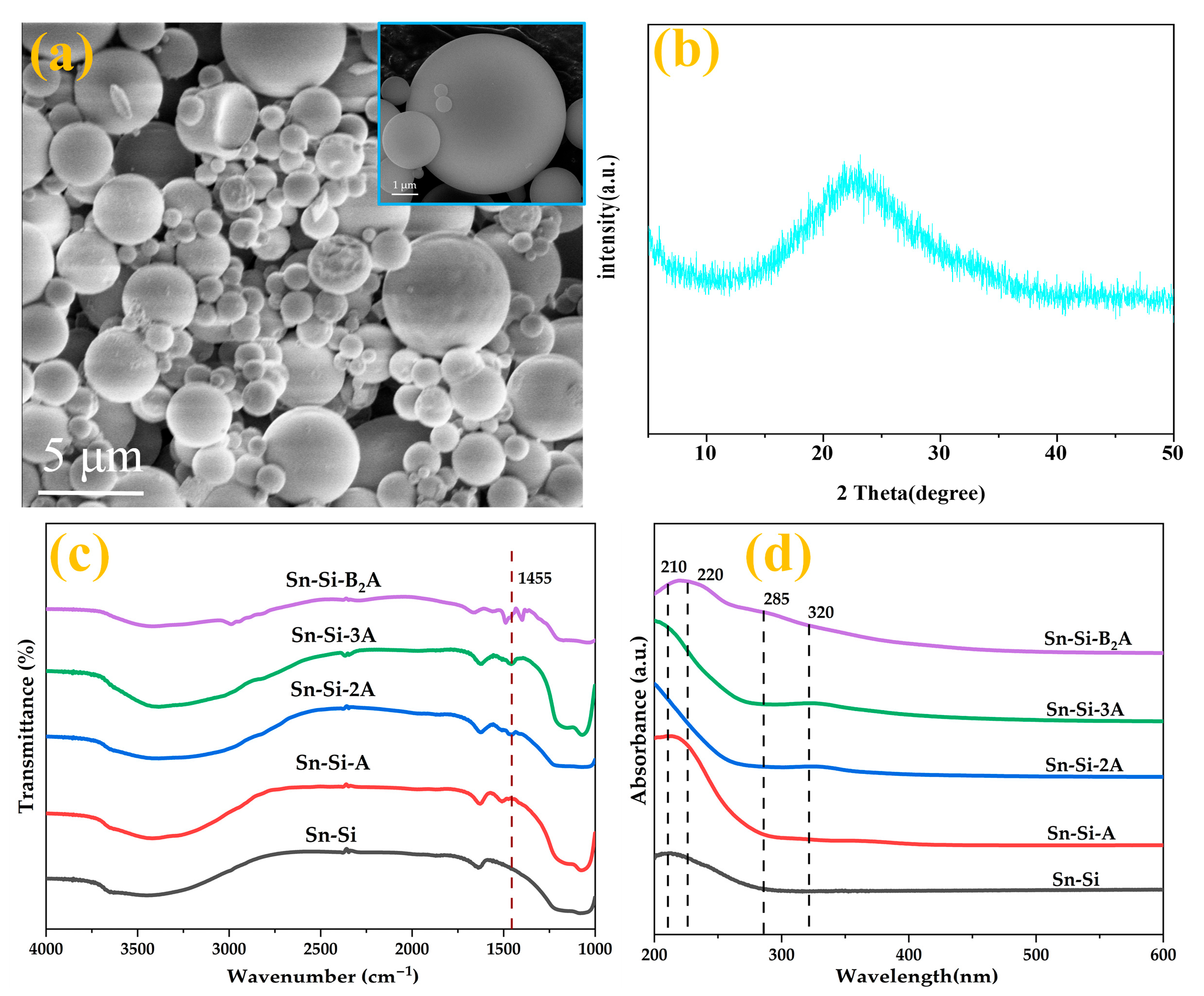
Figure 1. SEM image (a) and XRD pattern (b) of Sn-Si-2A samples; FT-IR (c) and UV–Vis (d) spectra of Sn-Si-x samples.
Catalysts 16 00426 g001
Figure 2. XRD spectra of Sn-Beta-x series samples.
Catalysts 16 00426 g002
Figure 3. SEM images of Sn-Beta-x series samples.
Catalysts 16 00426 g003
Figure 4. TEM images of Sn-Beta-x series samples.
Catalysts 16 00426 g004
Figure 5. (a) UV–Vis spectra of Sn-Beta-x samples: Sn-Beta (a), Sn-Beta-2A (b), Sn-Beta-A (c), Sn-Beta-3A (d) and Sn-Beta-B2A (e); (b) CD3CN-IR spectra of Sn-Beta-x series samples.
Catalysts 16 00426 g005
Figure 6. Py-IR spectra of Sn-Beta-x series samples.
Catalysts 16 00426 g006
Figure 7. The reusability experiment with the Sn-Beta-2A catalyst. The dashed line indicates that the catalyst was regenerated by calcination after the third cycle.
Catalysts 16 00426 g007
Table 1. Texture properties of Sn-Beta-x series samples.
SampleSi/Sn
Ratio a
LS b
μmol/g
Surface Area (m2·g−1)Pore Volume (cm3·g−1)
SBET cSExter dVTotal VMicro eVMeso f
Sn-Beta11977474910.280.200.08
Sn-Beta-A124180497970.290.200.09
Sn-Beta-2A1112255021080.310.210.10
Sn-Beta-3A131116485870.290.210.08
Sn-Beta-B2A158385491590.400.200.20
a Determined via ICP-OES; b Lewis acid sites; c BET surface area; d External surface area; e t-plot method; f VTotal − Vmicro; P/P0 = 0.99.
Table 2. Catalytic performance of B-V oxidation of cyclohexanone with hydrogen peroxide over the Sn-Beta-x series zeolites a.
Catalysts 16 00426 i001
EntryCatalystConversion (%)Selectivity (%) bYield (%)TON
1Sn-Beta29611785
2Sn-Beta-A366423109
3Sn-Beta-2A396224106
4Sn-Beta-3A336221105
5Sn-Beta-B2A306018116
a Reaction conditions: cat., 50 mg, cyclohexanone, 2 mmol, H2O2 (30%), 3 mmol, 1,4-dioxane, 8 mL, temp, 353 K, time, 3 h. b The main byproduct was 6-hydroxycaproic acid.
Table 3. Catalytic performance of B-V oxidation of 2-adamantanone with hydrogen peroxide over the Sn-Beta-x series zeolites a.
Catalysts 16 00426 i002
EntryCatalystConversion/(%)Selectivity/(%)Yield/(%)TON
1Sn-Beta30>993088
2Sn-Beta-A35>9935106
3Sn-Beta-2A37>9937101
4Sn-Beta-3A32>9932103
5Sn-Beta-B2A29>9929112
a Reaction conditions: cat., 50 mg, 2-adamantanone, 2 mmol, H2O2 (30%), 3 mmol, 1,4-dioxane, 8 mL, temp, 363 K, time, 3 h.
Disclaimer/Publisher’s Note: The statements, opinions and data contained in all publications are solely those of the individual author(s) and contributor(s) and not of MDPI and/or the editor(s). MDPI and/or the editor(s) disclaim responsibility for any injury to people or property resulting from any ideas, methods, instructions or products referred to in the content.