Article

Boosted Visible-Light Photocatalysis of MoS2/g-C3N4 Composites by Atmosphere-Controlled Mo Species Evolution
1
School of Materials Science and Engineering, Shanghai Institute of Technology, Shanghai 201418, China
2
Key Laboratory of Inorganic Functional Materials and Devices, Chinese Academy of Sciences, Shanghai 200050, China
3
State Key Laboratory of Urban Water Resource and Environment, Harbin Institute of Technology, Harbin 150090, China
4
State Key Laboratory of Crystal Materials, Jinan 250100, China
5
State Key Laboratory for Advanced Metals and Materials, University of Science and Technology Beijing, Beijing 100083, China
*
Author to whom correspondence should be addressed.
Catalysts 2026, 16(5), 395; https://doi.org/10.3390/catal16050395
Submission received: 3 April 2026 / Revised: 23 April 2026 / Accepted: 27 April 2026 / Published: 29 April 2026
(This article belongs to the Special Issue 15th Anniversary of Catalysts—Recent Advances in Photocatalysis)

Abstract

To improve the visible-light-driven photocatalytic degradation efficiency of g-C3N4-based photocatalysts toward organic pollutants, a MoS2/g-C3N4 composite precursor was employed in this work, and the phase composition and defect environment of Mo species were regulated by post-annealing under air and N2 atmospheres, respectively, thereby constructing Mo-based/g-C3N4 (MCN) composites with distinct structural evolution characteristics. The results showed that the photocatalytic activity of the as-sonicated MCN composite toward methylene blue (MB) was only moderately improved, among which the 15% loading sample exhibited the best performance with a degradation efficiency of about 42.0% within 60 min. In contrast, annealing at 400 °C under N2 resulted in only a slight activity change, whereas the sample treated at 400 °C in air (Air-15% MCN) achieved an MB degradation efficiency of 99.9% within 60 min, together with a much higher pseudo-first-order reaction rate constant than that of the air-treated sample at a lower temperature. XRD, FT-IR and XPS analyses revealed that air annealing induced the conversion of MoS2 into highly crystalline MoO3 (or MoO3−x), leading to the formation of a reconstructed MoO3−x/g-C3N4 composite interface. Meanwhile, the increased high-binding-energy component in the O 1s spectrum and the EPR signal around g ≈ 2.00 further suggested the presence of more abundant defect-related centers in the air-treated sample. Although Air-15% MCN possessed a lower specific surface area than the untreated and N2-treated samples, it displayed enhanced visible-light absorption, higher transient photocurrent response, lower interfacial charge-transfer resistance, and accelerated carrier dynamics, indicating that the activity enhancement mainly originated from atmosphere-induced phase transformation, interfacial reconstruction, defect-related active centers, and improved charge separation/transfer, rather than from the surface area effect. Based on the above results, a possible interfacial charge-transfer pathway is tentatively proposed for the g-C3N4/MoO3−x interface formed after air treatment, which contributes to the efficient utilization of photogenerated carriers and the rapid degradation of MB. This work demonstrates that atmosphere-induced phase transformation is a simple and effective strategy for regulating the structure and photocatalytic performance of Mo-based/g-C3N4 composites, and provides useful guidance for the design of efficient visible-light photocatalysts.

1. Introduction

Photocatalysis has attracted extensive attention over the past few decades as a sustainable and environmentally friendly strategy for remediating organic pollutants in water under mild conditions by utilizing solar energy [1]. In a typical photocatalytic process, semiconductors absorb incident photons and generate photoexcited electrons and holes, which subsequently migrate to the surface and participate in redox reactions to decompose organic contaminants into less harmful products [1,2]. Owing to its low energy consumption, mild operating conditions, and potential for solar utilization, photocatalysis has been widely explored for the degradation of dyes, antibiotics, and other emerging organic pollutants in wastewater [2,3]. However, the practical efficiency of most photocatalytic systems remains limited by several intrinsic factors, including insufficient visible-light absorption, rapid recombination of photogenerated charge carriers, sluggish interfacial charge transport, and inadequate surface reaction kinetics [4,5,6]. Therefore, the development of photocatalysts that can simultaneously enhance light harvesting, accelerate charge separation/transfer, and preserve strong redox ability remains a central issue in this field [7,8].
Among various visible-light-responsive photocatalysts, graphitic carbon nitride (g-C3N4) has been widely regarded as a promising candidate because of its suitable band gap, high chemical stability, low cost, earth-abundant composition, and facile preparation from nitrogen-rich precursors [9,10]. Since the pioneering report of polymeric carbon nitride as a metal-free photocatalyst, g-C3N4 has been extensively studied in photocatalytic hydrogen evolution, CO2 reduction, and pollutant degradation [9,11]. Nevertheless, pristine g-C3N4 still suffers from several well-recognized limitations, such as low specific surface area, severe electron–hole recombination, insufficient charge mobility, and restricted visible-light utilization, all of which suppress its intrinsic photocatalytic efficiency [12,13,14]. To overcome these drawbacks, various modification strategies have been proposed, including morphology regulation, elemental doping, defect engineering, cocatalyst loading, and heterostructure construction [15,16,17]. Among these approaches, constructing heterostructures is generally considered one of the most effective strategies because it can create built-in electric fields or interfacial potential differences, thereby facilitating charge separation and interfacial transport while broadening the light-response range [18,19,20]. In particular, for g-C3N4-based systems, a narrower band gap is often desired to improve visible-light absorption, whereas strong oxidation and reduction abilities require a more positive valence-band edge and a more negative conduction-band edge, respectively. These requirements are difficult to satisfy simultaneously in a single semiconductor, which further highlights the importance of designing heterostructures with appropriate band alignment [21,22,23].
In recent years, Mo-based semiconductors, especially MoS2 and MoO3, have received considerable attention as coupling components for g-C3N4-based heterostructures [24]. Two-dimensional MoS2 possesses a layered structure, abundant edge sites, and relatively strong visible-light absorption, which make it attractive for light harvesting and interfacial charge transfer [18,25]. Meanwhile, layered MoO3, as a typical transition-metal oxide, exhibits strong electron-accepting characteristics, good thermal/chemical stability, and high oxidation ability, enabling it to act as an effective partner for promoting charge separation and oxidation reactions in photocatalytic composites [22,26]. As a result, MoS2/g-C3N4 and MoO3/g-C3N4 systems have been widely investigated for the degradation of dyes, antibiotics, and other organic contaminants under visible light [27]. In many cases, the enhanced performance of these composites has been attributed to heterojunction effects, such as type-II, Z-scheme, or S-scheme charge transfer pathways, which are believed to improve carrier separation and preserve stronger redox capability [28]. Moreover, Mo-based/g-C3N4 heterostructures are often associated with enhanced generation of reactive species, including ·O2, ·OH, and h+, thereby accelerating the degradation kinetics of organic molecules [29].
Despite these advances, several issues remain insufficiently clarified in current Mo-based/g-C3N4 photocatalytic degradation systems. First, the actual phase composition of Mo species may not remain identical to the nominal precursor composition during post-annealing or photocatalytic operation. In particular, MoS2 can be readily oxidized into MoO3 under oxidative atmospheres or elevated temperatures, meaning that the “nominal” MoS2/g-C3N4 composite may not represent the real active phase participating in the photocatalytic reaction [30]. This issue is particularly important because phase evolution can significantly alter the band structure, surface chemistry, interfacial coupling, and ultimately the photocatalytic behavior. Second, defect-related effects, especially those associated with oxygen vacancies or oxygen-deficient centers, are frequently invoked to explain activity enhancement in Mo-based oxide systems; however, in many studies such assignments are mainly based on high-binding-energy O 1s components in XPS spectra, which are often difficult to distinguish rigorously from adsorbed oxygen, hydroxyl groups, or other surface species [31,32,33]. Without complementary evidence such as electron paramagnetic resonance (EPR), the role of defect centers can be easily overinterpreted [34,35]. Third, although improved degradation activity is commonly discussed in terms of heterojunction-mediated charge separation, the relationship between phase transformation, defect generation, band structure evolution, and charge-transfer dynamics is still not sufficiently evidenced in many reported systems [36,37,38]. Therefore, it remains necessary to establish a more reliable structure–defect–charge transfer correlation for Mo-based/g-C3N4 photocatalysts, especially in systems where the Mo precursor may undergo atmosphere-induced phase transformation [39,40].
Based on the above considerations, in this work, a MoS2/g-C3N4 composite precursor was employed as the starting system, and controllable structural evolution was achieved through post-annealing under N2 and air atmospheres, respectively. By comparing the as-prepared composite with the N2-treated and air-treated samples, a series of Mo-based/g-C3N4 photocatalysts with significantly different phase composition and defect environment was obtained. The characterization of phase composition (XRD and FT-IR), structural (SEM) and surface chemical analysis (XPS of Mo 3d, S 2p, and O 1s) demonstrated that air treatment induced pronounced phase evolution of the Mo species and reconstructed the interfacial contact with g-C3N4, while the EPR signal around g ≈ 2.00 provided supporting evidence for defect-related centers associated with the air-treated sample. Furthermore, by combining UV–vis/UPS-derived band information with PL, EIS, transient photocurrent, and TRPL measurements, the present work aims to establish a more convincing correlation between phase evolution, defect formation, interfacial charge behavior, and visible-light-driven photocatalytic performance. This study is expected to provide experimental insight into atmosphere-induced phase transformation and defect engineering in Mo-based/g-C3N4 composites, and to offer a practical strategy for the rational design of high-efficiency visible-light photocatalysts for organic pollutant degradation.

2. Experimental Section

2.1. Preparation of Samples

2.1.1. Synthesis of MoS2

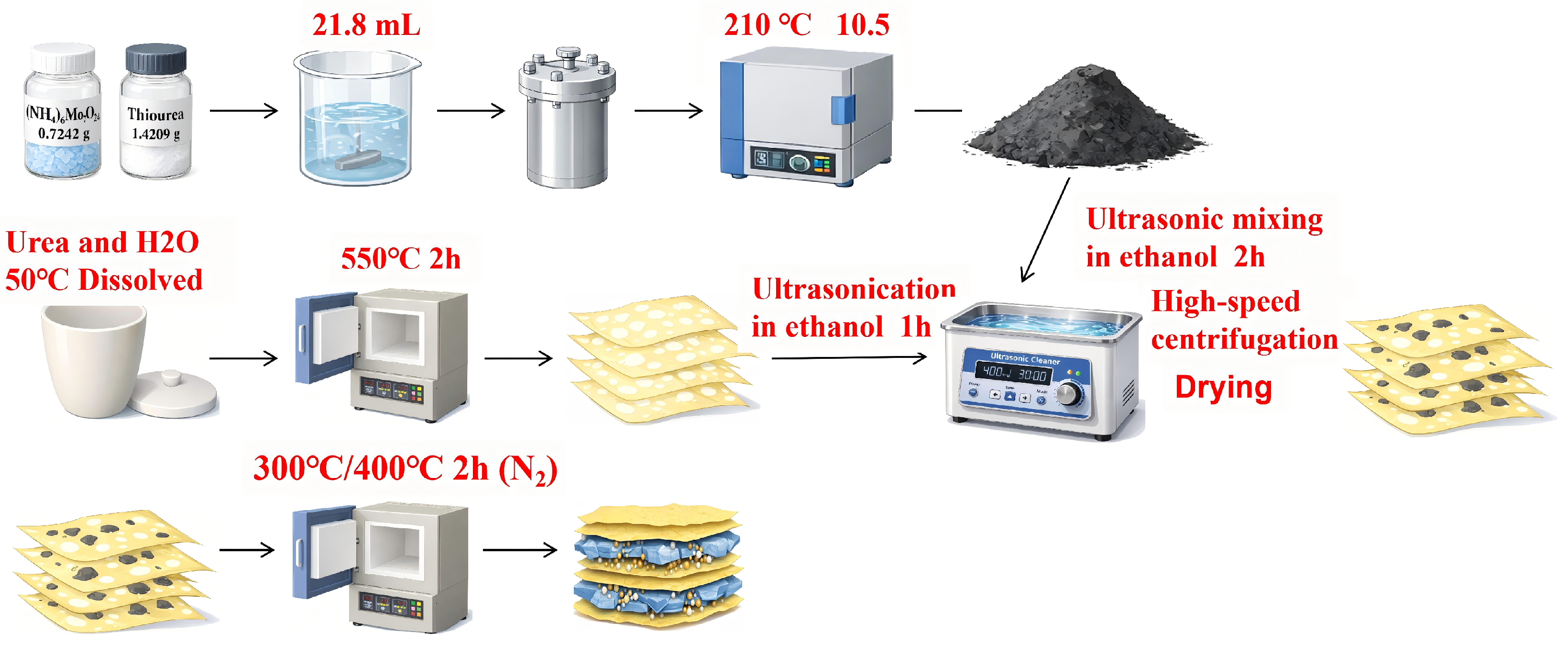
First, 0.7242 g of (NH4)6Mo7O24·4H2O and 1.4209 g of thiourea were dissolved in 21.8 mL of deionized water under stirring to form a clear precursor solution. The solution was then transferred into a Teflon-lined stainless-steel autoclave and maintained at 210 °C for 10.5 h. After the reaction, the autoclave was naturally cooled to room temperature. The resulting black precipitate was collected, washed several times with deionized water and absolute ethanol alternately until the supernatant became clear, and then dried in a vacuum oven at 60 °C. The obtained powder was denoted as MoS2. The overall preparation process of the MoO3−x/g-C3N4 composite photocatalysts is schematically illustrated in Figure 1.

2.1.2. Synthesis of g-C3N4

Graphitic carbon nitride (g-C3N4) was prepared as follows. 10 g of urea was dissolved in 30 mL of deionized water. After complete dissolution, the solution was transferred into a covered crucible and heated in a muffle furnace from room temperature to 550 °C at a ramping rate of 5 °C min−1, followed by calcination for 2 h. After naturally cooling to room temperature, the yellow product was collected and denoted as CN.

2.1.3. Preparation of Composite Samples

To prepare the composites, MoS2 and CN were mixed according to the mass fraction of MoS2, where x = 5, 10, 15, and 20 wt%. The mixed powders were dispersed in ethanol and ultrasonicated to improve interfacial contact. After filtration and drying, the obtained samples were denoted as x% MCN. Subsequently, the x% MCN samples were further calcined at different temperatures (300 and 400 °C) under different atmospheres (air or N2). After cooling to room temperature, the final products were obtained. In particular, the samples treated in air and N2 at 400 °C were denoted as Air-15% MCN and N2-15% MCN, respectively.

2.2. Photocatalytic Activity Test

All photocatalytic degradation experiments were carried out under irradiation from a 500 W xenon lamp. In a typical run, 0.01 g of catalyst was dispersed in 50 mL of 20 mg L−1 methylene blue (MB) solution in a cylindrical jacketed glass reactor equipped with continuous magnetic stirring and external water circulation for cooling. Before illumination, the suspension was magnetically stirred in the dark for 0.5 h to establish adsorption–desorption equilibrium at room temperature. During the photocatalytic reaction, aliquots were withdrawn at 20 min intervals, and the concentration of MB was determined from its characteristic absorbance at 664 nm using a UV–vis spectrophotometer. The detailed photocatalytic setup, including the lamp arrangement and reactor configuration, is shown in the Supporting Information (Figure S1).

2.3. Radical Trapping Experiment

To identify the main reactive species involved in the MB degradation process, radical trapping experiments were performed by adding different scavengers into the initial MB solution. Specifically, N2, disodium ethylenediaminetetraacetate (EDTA-2Na), and isopropanol (IPA) were used as scavengers for ·O2, h+, and ·OH, respectively.

2.4. Photoelectrochemical Measurements

The photoelectrochemical properties were evaluated on a Chenhua CHI660E electrochemical workstation using a standard three-electrode configuration under illumination from a 500 W xenon lamp. A catalyst-coated ITO electrode served as the working electrode, while Pt foil and Ag/AgCl (saturated KCl) were used as the counter and reference electrodes, respectively. A 0.5 M Na2SO4 aqueous solution was employed as the supporting electrolyte.
The working electrode was prepared as follows. Approximately 15 mg of catalyst was dispersed in 20 μL of 5 wt% Nafion solution and 0.5 mL of ethanol, and then ground into a homogeneous slurry. The slurry was uniformly spread onto an ITO glass substrate with an active area of 0.8 cm2. Finally, the coated electrode was dried at 80 °C before use.
The transient photocurrent response was monitored on a Chenhua CHI660E electrochemical workstation with the same three-electrode setup. Electrochemical impedance spectroscopy (EIS) was also measured under identical conditions.

2.5. Characterization Methods

The phase composition and morphology of the samples were analyzed by X-ray diffraction (XRD, SmartLab SE, Rigaku, Tokyo, Japan), Fourier transform infrared spectroscopy (FT-IR, Nicolet iS5, Thermo Fisher Scientific, Waltham, MA, USA), and scanning electron microscopy (SEM, GeminiSEM 300, ZEISS, Oberkochen, Germany, operated at 20 kV). The chemical states of the elements were investigated by X-ray photoelectron spectroscopy (XPS, K-Alpha, Thermo Scientific, Waltham, MA, USA). The optical properties were characterized by UV–vis diffuse reflectance spectroscopy (UV–vis DRS, UV-3600i Plus, Shimadzu, Kyoto, Japan). Photoluminescence (PL) spectra were recorded on an Edinburgh FS5 spectrometer (Edinburgh Instruments, Livingston, UK). Photoelectrochemical performance, including photocurrent response and electrochemical impedance spectroscopy, was measured using a standard three-electrode system on a Chenhua CHI660E electrochemical workstation (CH Instruments, Shanghai, China). The specific surface area and pore structure were determined by N2 adsorption–desorption measurements using an automatic surface area and porosity analyzer (BET, ASAP 2460, Micromeritics, Norcross, GA, USA). Electron paramagnetic resonance (EPR) measurement was performed on the solid powdered sample at room temperature using a Bruker EMXplus-6/1 spectrometer (Bruker, Billerica, MA, USA). The spectrum was recorded directly without illumination to probe vacancy-/defect-related paramagnetic centers in the sample.

3. Results and Discussion

3.1. Characterization

To more clearly compare the phase evolution of Mo species and the possible difference in defect formation, the same precursor composite (15% MCN) was selected as the basis in this work, and then thermally treated at 400 °C under air and N2 atmospheres, respectively, to obtain two control samples. Owing to the different oxygen contents in the two atmospheres, it is reasonable to expect that MoS2 would be more readily oxidized and gradually converted into MoO3 under air, possibly accompanied by the generation of more defect-related active sites. In contrast, under N2 atmosphere, the sulfide framework of MoS2 is more likely to be preserved, while the oxidation process is significantly suppressed.
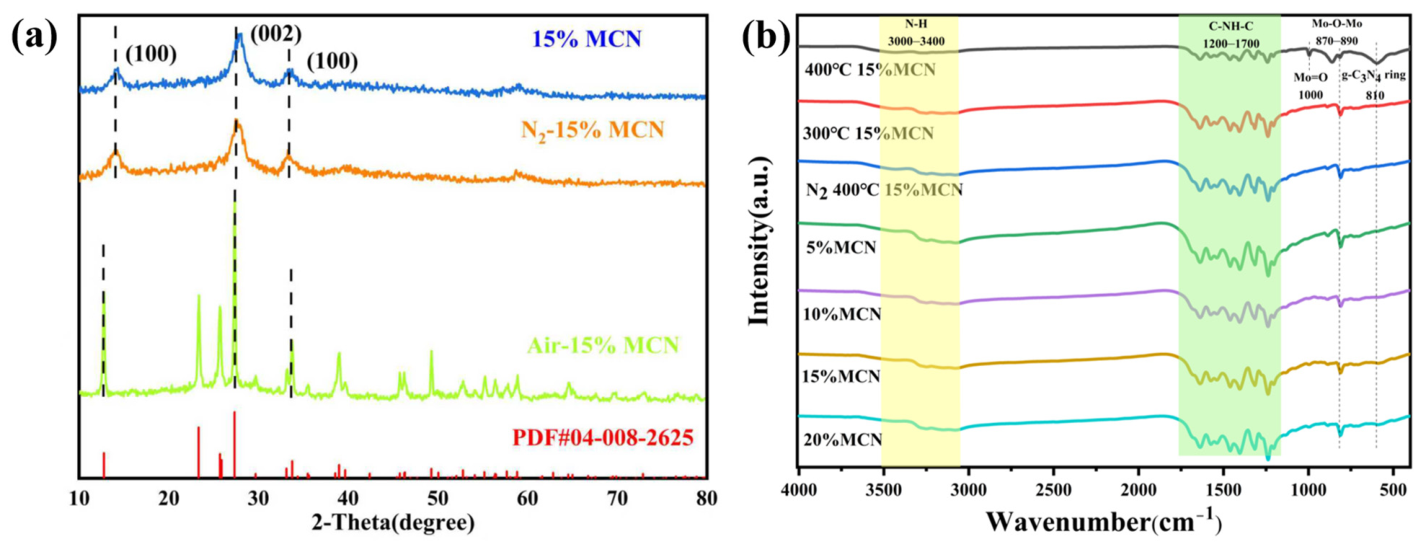
As shown in Figure 2a, the XRD patterns of 15% MCN, N2-15% MCN, and Air-15% MCN are compared. For 15% MCN, two characteristic diffraction peaks located at around 2θ ≈ 13° and 27° can be observed, which are assigned to the (100) in-plane structural packing and the (002) interlayer stacking of g-C3N4, respectively. This indicates that the basic framework of g-C3N4 is retained after ultrasonic coupling [19,35]. For N2-15% MCN, the overall diffraction profile is similar to that of 15% MCN, and the characteristic peaks of g-C3N4 still dominate the pattern, suggesting that no fundamental phase transformation occurs after heat treatment at 400 °C under N2. In contrast, the diffraction pattern of Air-15% MCN changes significantly, showing multiple sharp and intense diffraction peaks that match well with the standard card of MoO3 (PDF#04-008-2625), indicating the formation of highly crystalline MoO3 after air calcination [31,32,40]. Meanwhile, the characteristic (100)/(002) peaks of g-C3N4 become less pronounced in Air-15% MCN. This is more likely due to the dominant diffraction contribution from crystalline MoO3 together with the weakened stacking order of g-C3N4, rather than implying the disappearance of g-C3N4 itself. Therefore, FTIR and XPS analyses were further employed to verify whether the composite framework was still preserved.
The FTIR spectra of different samples are shown in Figure 2b. In general, all samples exhibit a series of characteristic absorption bands in the range of 1200–1700 cm−1, which can be assigned to the stretching vibrations of C–N and C=N bonds in the g-C3N4 framework. In addition, the typical breathing mode of the heptazine/triazine ring can be observed at around 810 cm−1. The presence of these signals indicates that the basic structural features of g-C3N4 can still be identified in both the MoS2-loaded composites and the heat-treated samples. In the high-wavenumber region (3000–3400 cm−1), a broad absorption band is observed, which is generally associated with the stretching vibrations of surface –NH/–NH2 groups and adsorbed water. By comparing the samples treated under different conditions, it can be found that the peak profile in this region changes after heat treatment, which may be attributed to partial deammoniation and further condensation during thermal treatment, leading to a decrease in hydrogen-containing surface groups.
More importantly, in Air-15% MCN, characteristic absorptions related to Mo–O bonds appear in the low-wavenumber region. The band at around 870–890 cm−1 can be associated with the stretching vibration of Mo–O–Mo, while the absorption near ~1000 cm−1 can be attributed to Mo–O related vibrations. These features are consistent with the MoO3 phase identified by XRD, supporting from the chemical-bonding perspective that MoS2 is oxidized into MoO3 during heat treatment in air. In comparison, the Mo–O-related absorptions in N2-15% MCN are much weaker, indicating that deep oxidation is suppressed under N2 and the sulfide-related structure is more likely to be retained.
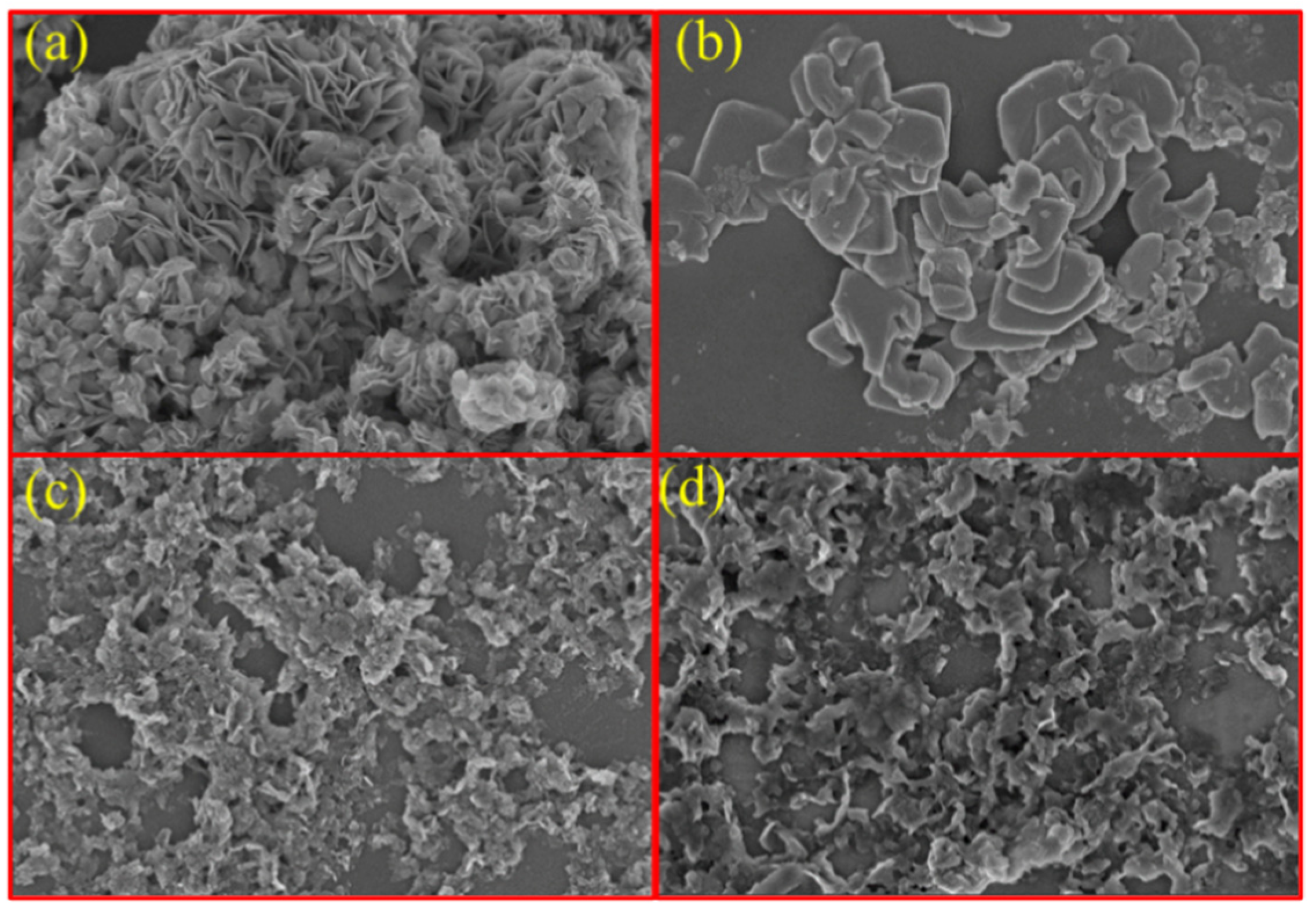
As shown in Figure 3a–d, the microstructures of the Mo-based component, g-C3N4, and the composite samples were further examined by SEM. The sample in Figure 3a exhibits a typical flower-like or clustered nanosheet morphology composed of a large number of wrinkled nanosheets, showing clear layered structural characteristics. Such a morphology usually provides abundant edge sites and is favorable for contact with the substrate material. In Figure 3b, g-C3N4 mainly presents a stacked blocky/sheet-like structure with relatively clear sheet edges, although obvious stacking and agglomeration can still be observed, which is consistent with the typical morphology of bulk g-C3N4 obtained by thermal polymerization. After compositing (Figure 3c), the sample surface is composed of irregular particles and layered structures, exhibiting a looser porous morphology with visible cavities. This suggests that Mo-based species and g-C3N4 can form a certain degree of coupling after ultrasonic dispersion, although local aggregation and non-uniform regions are still present, implying that the interfacial contact at this stage may remain limited. After further heat treatment (Figure 3d), the sample exhibits a more distinct rough and network-like surface morphology, with more pronounced porous features. This indicates that thermal treatment may induce structural rearrangement and microstructural reconstruction of the components, thereby increasing the interfacial contact area to some extent and exposing more surface sites.
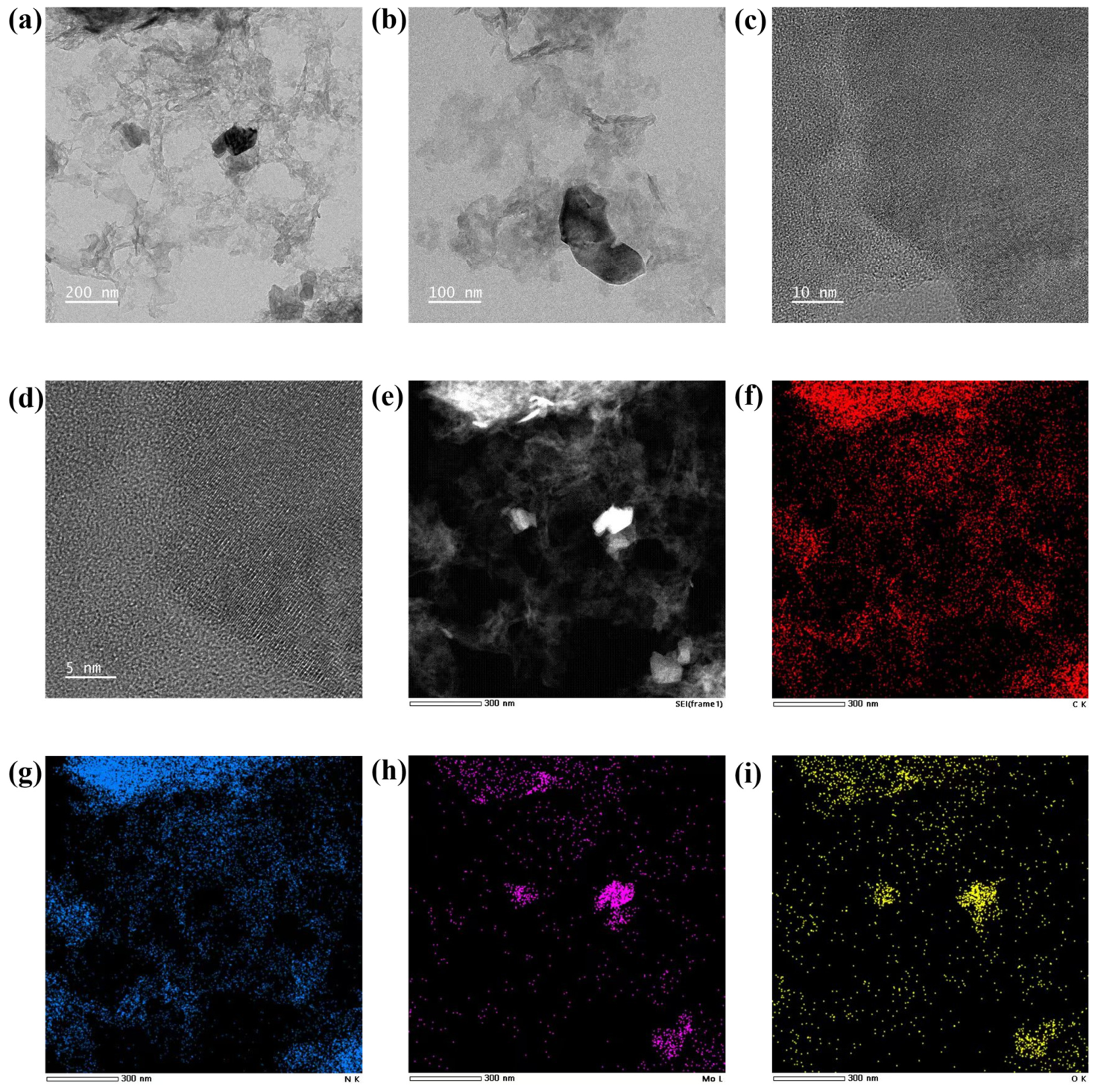
TEM and STEM-EDS mapping analyses were performed to investigate the microstructure of Air-15% MCN, and the results are shown in Figure 4. As shown in Figure 4a and b, the sample mainly exhibits a wrinkled sheet-like morphology with several dark particles attached to the nanosheet matrix. In the HRTEM images (Figure 4c,d), the particle region shows clear lattice fringes, while the surrounding nanosheet region is less ordered, indicating intimate contact between the crystalline Mo-containing domains and the g-C3N4 matrix. The STEM-EDS mapping results (Figure 4e–i) show that C and N are distributed over the nanosheet framework, whereas Mo and O are mainly enriched in the localized particle regions. Combined with the XRD and XPS results, these observations support the formation of Mo/O-rich domains tightly contacted with the g-C3N4 matrix after air treatment.
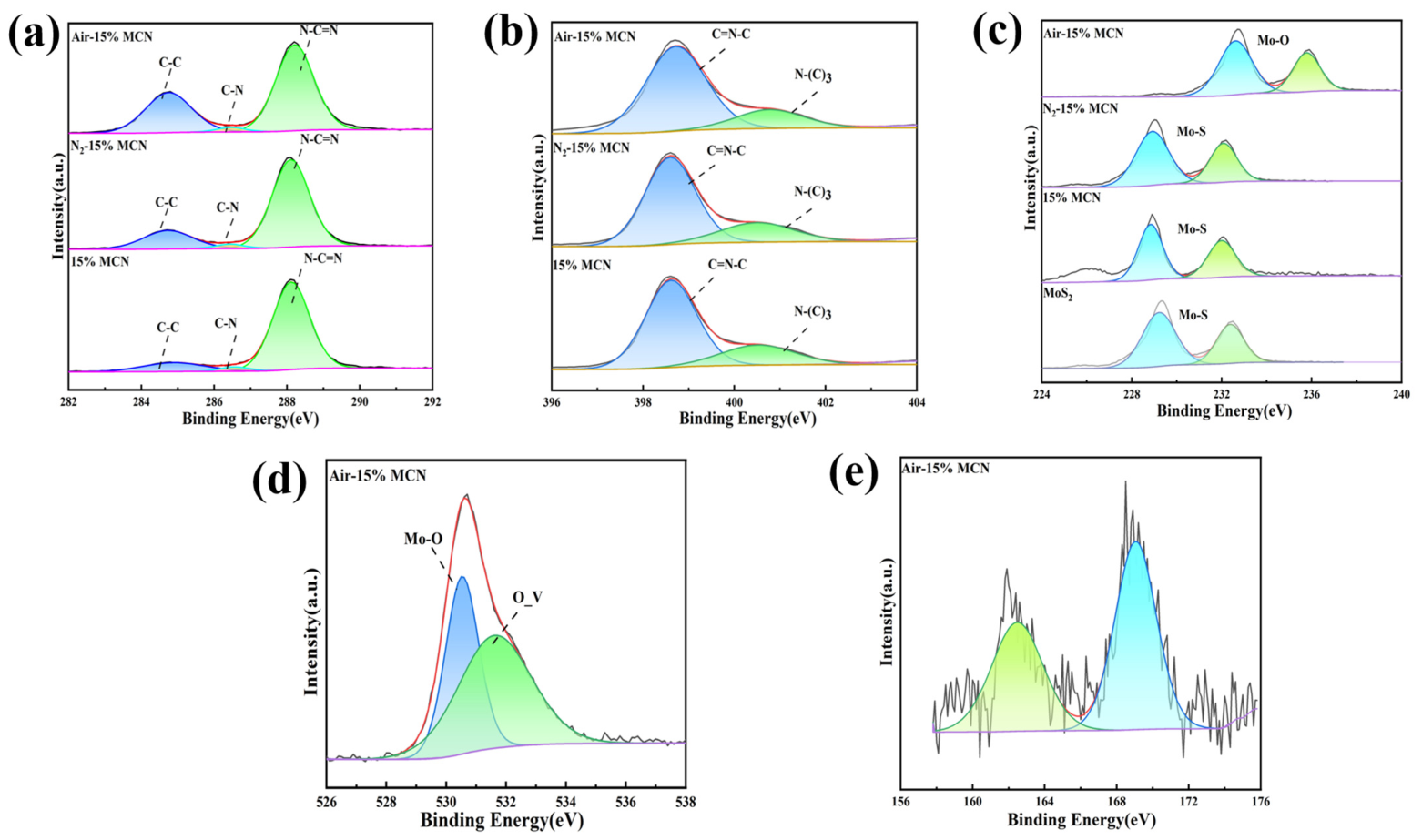
As shown in the C 1s spectra in Figure 5, all three samples can be deconvoluted into a dominant peak centered at around 288.2 eV, which is typically assigned to the N–C=N species (sp2-hybridized carbon) in the triazine/heptazine units of g-C3N4. In addition, a weak peak located near 284.8 eV is generally attributed to adventitious surface carbon, while the component at 286–286.5 eV can be assigned to C–N species. Overall, the characteristic features in the C 1s spectra indicate that the carbon nitride framework was not completely destroyed during thermal treatment, and Air-15% MCN still retains the essential structural characteristics of g-C3N4.
The fitted N 1s spectra show that the peak at around 398–399 eV can be attributed to C=N–C (sp2-hybridized N), whereas the component at 400–401 eV is commonly assigned to N–(C)3. Slight differences in peak shape and relative area can be observed after treatment under different atmospheres, suggesting that thermal treatment may induce changes in the local chemical environment surrounding the carbon nitride framework.
For the MoS2 and 15% MCN samples, the Mo 3d spectra are mainly dominated by the characteristic Mo–S species, indicating that MoS2 remains the major Mo-containing phase in the as-prepared composite. In the case of N2-15% MCN, the spectrum is still primarily composed of Mo–S related signals, although slight changes in peak shape can be noticed. This suggests that under the N2 atmosphere, the sulfide framework of MoS2 is largely preserved, and only limited surface reconstruction or slight oxidation may occur.
In contrast, Air-15% MCN exhibits a pronounced increase in the Mo–O related components, accompanied by a significant attenuation of the Mo–S features, indicating that air annealing promotes the conversion of Mo species toward higher oxidation states.
The O 1s spectrum of Air-15% MCN can be deconvoluted into two main components. The lower-binding-energy peak, located at around 530.5 eV, is generally assigned to lattice oxygen in Mo–O bonds, whereas the higher-binding-energy component at approximately 531.6 eV is commonly associated with defect-related oxygen species. The increase in the high-binding-energy O 1s component suggests the enrichment of defect-related/adsorbed oxygen species. Combined with the enhanced defect signal observed in the EPR spectrum, it can be inferred that oxygen-defect-related centers may participate in the photocatalytic reaction process.
In the S 2p region (~156–176 eV), MoS2, 15% MCN, and N2-15% MCN all display characteristic sulfide-related components at around 162–163 eV, corresponding to S2− species. By contrast, in Air-15% MCN, the sulfide-related signal is markedly weakened, while additional components may appear at higher binding energies (typically ~168–170 eV), which can be assigned to SOx species (such as sulfate/sulfite-like species). This result is consistent with the oxidation of MoS2 during air calcination, accompanied by the further oxidation of sulfur-containing species.
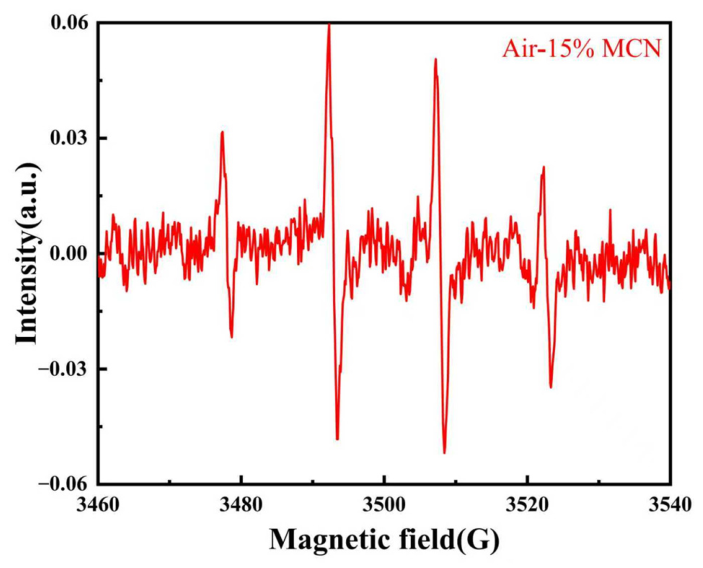
To further probe the presence of defect-related paramagnetic centers in the air-treated sample, EPR measurement was carried out on the solid powdered Air-15% MCN sample at room temperature without illumination, and the result is shown in Figure 6. A distinct resonance signal can be observed at around 3.48 × 10³ G, corresponding to a g value close to 2.00, which is generally associated with unpaired electrons trapped at vacancy-/defect-related sites. This result provides supplementary evidence for the presence of defect-related paramagnetic centers in the sample [37]. Combined with the increased high-binding-energy component in the O 1s spectrum, it suggests that air annealing may introduce more defect-related oxygen-containing surface species. However, it should be emphasized that the present EPR signal together with O 1s analysis is still insufficient to unambiguously assign these species to a specific type of oxygen vacancy or carbon vacancy. Therefore, in this work, they are more conservatively described as defect-related centers [25,38], and their possible role is further discussed together with the charge-dynamics results.

3.2. Optical and Photoelectrochemical Properties

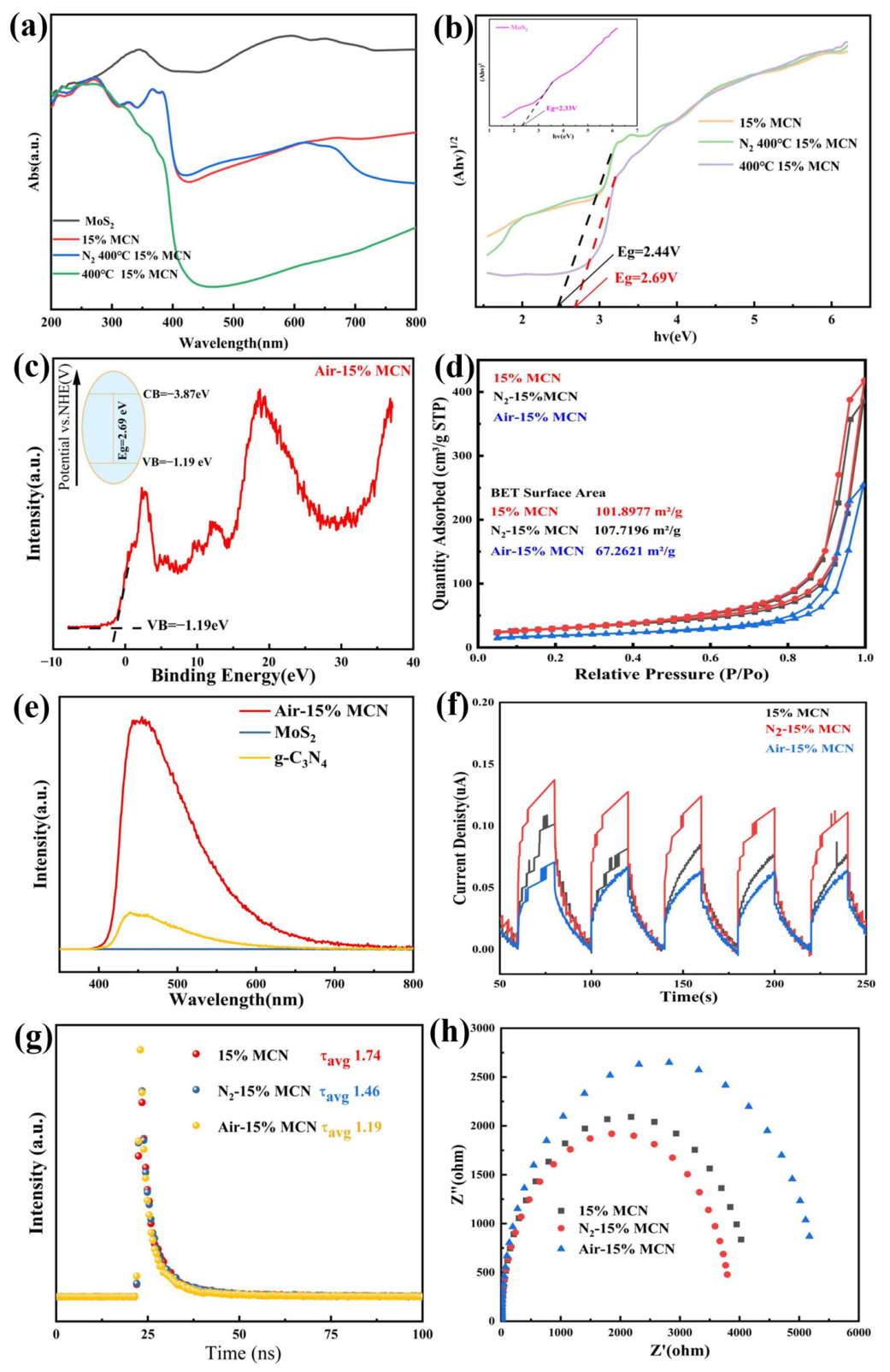
As shown in Figure 7a, compared with pristine g-C3N4, the composite samples exhibit stronger light absorption in the visible region, indicating that the introduction of Mo-based components and the subsequent heat treatment effectively altered the light-harvesting capability of the materials. In particular, Air-15% MCN shows a more pronounced enhancement in visible-light absorption. This phenomenon usually suggests that, in addition to the intrinsic band-gap absorption, defect-related energy levels or interfacial charge-transfer states may also be introduced, thereby extending the photoresponse range.
Furthermore, the Tauc plots shown in Figure 7b reveal clear differences in the apparent band gaps of the three samples. Among them, Air-15% MCN exhibits a smaller apparent band gap, whereas the untreated and N2-treated samples possess relatively larger values. This trend is consistent with the enhanced visible-light absorption observed in the DRS spectra, indicating that air treatment provides more favorable optical characteristics for photocatalytic applications.
As shown in Figure 7c, taking Air-15% MCN as an example, its valence-band edge position is estimated to be approximately 1.19 eV. This result suggests that the air-treated sample possesses a relatively positive valence-band level, which is favorable for the participation of photogenerated holes in oxidation reactions.
The nitrogen adsorption–desorption isotherms shown in Figure 7d indicate that all three samples possess certain porous structural features. The BET specific surface areas are approximately 101.90 m2 g−1 for 15% MCN, 107.72 m2 g−1 for N2-15% MCN, and 67.26 m2 g−1 for Air-15% MCN, respectively. Notably, although Air-15% MCN has the lowest specific surface area among the three samples, it exhibits the best photocatalytic performance. This result suggests that the activity enhancement is unlikely to originate simply from the surface-area effect.
As shown in Figure 7e, all three samples exhibit the broad emission feature typically observed for g-C3N4-based systems under visible light excitation. This emission is mainly attributed to radiative recombination within the carbon nitride framework, together with a possible contribution from defect-related recombination pathways. Compared with 15% MCN, the PL intensity of N2-15% MCN changes after N2 treatment, indicating that thermal treatment may regulate the local electronic structure and recombination behavior of the material. More importantly, Air-15% MCN also shows obvious changes in its PL behavior, which may be related to the phase transformation of Mo species (MoS2 → MoO3) and the reconstruction of the interfacial chemical environment, thereby introducing new charge-transfer channels or defect states and affecting the probability of radiative recombination.
It should be noted that PL intensity is influenced by multiple factors, including radiative recombination, defect-related emission, and nonradiative transitions. Therefore, PL alone is insufficient to quantitatively evaluate charge-separation efficiency. In the present work, the PL results are interpreted together with TRPL, transient photocurrent, and EIS measurements. Although Air-15% MCN exhibits altered PL behavior, it simultaneously shows a stronger photocurrent response, lower charge-transfer resistance, and faster carrier dynamics. These results suggest that the interfacial charge-transfer process becomes more efficient after air treatment, which is beneficial for the participation of photogenerated carriers in surface redox reactions and thus improves the photocatalytic activity.
As shown in Figure 7f, all three samples display reproducible transient responses during the on/off illumination cycles, indicating stable generation and transport of photogenerated carriers. By comparison, Air-15% MCN exhibits the strongest photocurrent response, which generally implies a higher charge-separation efficiency and a more efficient extraction of photogenerated electrons into the external circuit, thereby indirectly supporting its faster charge-utilization process in photocatalysis. The Nyquist plots in Figure 7h further provide evidence for the interfacial charge-transfer resistance. In general, a smaller semicircle radius corresponds to a lower charge-transfer resistance. Combined with the photocurrent results, the lower interfacial resistance of Air-15% MCN indicates more efficient interfacial charge transport, which is consistent with its superior photocatalytic performance.
The TRPL results in Figure 7g show significant differences in the average lifetimes of the three samples, with τ_avg ≈ 1.74 ns for 15% MCN, 1.46 ns for N2-15% MCN, and 1.19 ns for Air-15% MCN, respectively. In the present system, since Air-15% MCN also exhibits a stronger photocurrent response and lower EIS resistance, the shortened lifetime is more reasonably attributed to the faster transfer of photogenerated carriers to the interface or active sites before recombination occurs, rather than to enhanced recombination itself. In other words, the TRPL results, together with the photoelectrochemical data, provide a mutually supportive piece of evidence indicating that air treatment leads to more efficient interfacial charge dynamics.

3.3. Photocatalytic Degradation of MB

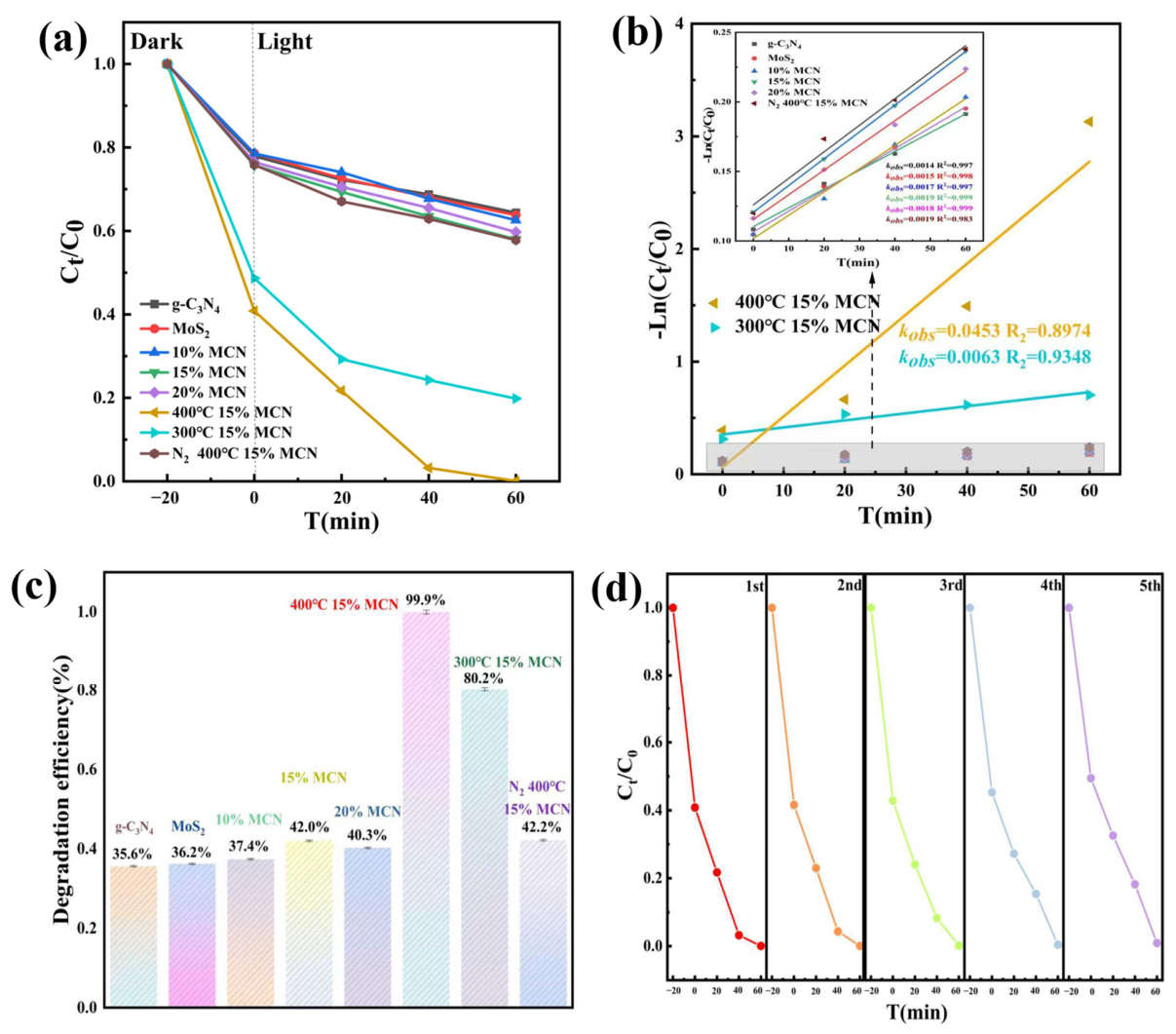
As shown in Figure 8a, under identical conditions (500 W xenon lamp, 20 mg L−1 MB, 10 mg catalyst, and 30 min dark adsorption), the degradation efficiencies of pristine g-C3N4 and MoS2 after 60 min were only 35.6% and 36.2%, respectively, indicating that the individual components have limited ability for MB removal. After coupling MoS2 with g-C3N4, the photocatalytic activity is moderately improved. Among the composite samples, 15% MCN exhibits the best performance (42%), while the degradation efficiencies of 10% MCN and 20% MCN were 37.4% and 40.3%, respectively. This result suggests that simple ultrasonic coupling alone cannot effectively overcome the efficiency limitation of the system. Possible reasons include insufficient interfacial contact, persistent charge recombination after compositing, and the inability of MoS2 to provide a continuous and efficient interfacial charge-transfer pathway in the composite.
More importantly, after post-treatment of the optimal 15% MCN sample, the photocatalytic behavior becomes significantly differentiated. The sample treated under N2 atmosphere, namely N2-15% MCN, shows a degradation efficiency of 42.2%, which is very close to that of 15% MCN, indicating that thermal treatment under oxygen-deficient conditions has only a limited effect on activity improvement. In sharp contrast, the sample treated under an air atmosphere, namely Air-15% MCN, exhibited a dramatically enhanced degradation efficiency of 99.9% within 60 min, demonstrating that air calcination plays a decisive role in improving the photocatalytic performance. Meanwhile, the lower-temperature air-treated sample, Air-15% MCN (300 °C), achieved a degradation efficiency of 80.2%, which is significantly lower than that of the 400 °C air-treated sample but still much higher than that of the untreated composite. This result indicates that both the treatment temperature and atmosphere jointly determine the extent of structural evolution and the final photocatalytic activity.
To quantitatively compare the reaction rates, the degradation process was further fitted using a pseudo-first-order kinetic model, as shown in Figure 8b,c. The apparent rate constant of Air-15% MCN is k_obs = 0.0453 min−1, which is significantly higher than that of Air-15% MCN (300 °C) (k_obs = 0.0063 min−1). This clearly demonstrates that air treatment at 400 °C not only improves the final degradation efficiency, but also substantially accelerates the reaction kinetics. Combined with the structural characterization results, this kinetic enhancement is consistent with the atmosphere-induced phase transformation of Mo species and the accompanying reconstruction of the interface/defect environment. Therefore, the activity improvement is unlikely to originate from a simple adsorption effect, but is more reasonably attributed to enhanced interfacial charge transfer and the effective introduction of active sites.
Cycling experiments were further performed to evaluate the stability and reusability of the catalyst, as shown in Figure 8d. The photocatalyst maintained relatively high activity after repeated use, with only a slight decrease in degradation performance upon cycling. This result indicates that the sample has good cyclic stability and practical reusability.

3.4. Mechanism Discussion

Based on the combined results of phase characterization, surface chemical-state analysis, defect probing, and charge-dynamics measurements, air annealing is considered to be the decisive factor responsible for the remarkable activity enhancement of Air-15% MCN. XRD and Mo 3d XPS results consistently show that heat treatment at 400 °C in air promotes the conversion of MoS2 into oxidized Mo species, mainly characterized by Mo–O/Mo6+, leading to the formation of MoO3−x-related phases on the surface of g-C3N4 and reconstructing the interfacial structure. Meanwhile, the increased high-binding-energy component in the O 1s spectrum suggests the enrichment of defect-related or adsorbed oxygen species. Since O 1s deconvolution alone cannot rigorously distinguish oxygen vacancies from adsorbed oxygen/hydroxyl species, EPR was further employed. The distinct resonance signal observed at around 3.48 × 10³ G (corresponding to g ≈ 2.00) provides supplementary evidence for the presence of unpaired electrons and defect-related centers in the air-treated sample. Therefore, air annealing not only changes the phase composition of the Mo species, but also creates more defect-related sites that are beneficial for charge trapping, reactant activation, and interfacial reaction.
The photoelectrochemical and luminescence-dynamics results further verify the importance of enhanced interfacial charge transfer in the air-treated sample. Compared with the untreated and N2-treated samples, Air-15% MCN shows a stronger transient photocurrent response and a smaller EIS semicircle radius, indicating more efficient carrier separation and lower interfacial charge-transfer resistance. In addition, the shortened TRPL lifetime, when considered together with the enhanced photocurrent and reduced impedance, is more reasonably attributed to faster carrier extraction and transfer rather than simple recombination enhancement [41]. These results demonstrate that the reconstructed interface formed after air treatment enables photogenerated carriers to migrate more rapidly from the bulk to the surface active sites, thus improving their effective utilization.
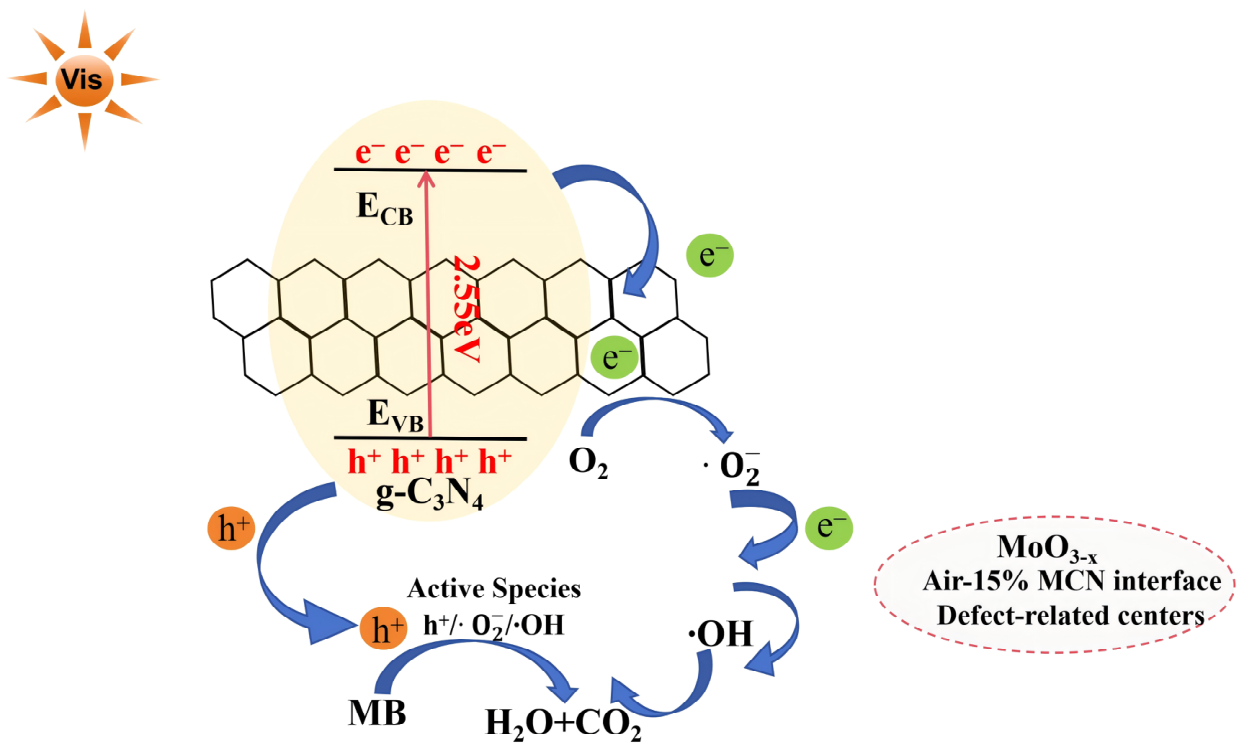
Based on the above structural, spectroscopic, and photoelectrochemical results, air treatment is considered to induce phase evolution of the Mo-containing component and reconstruct the interfacial contact with g-C3N4, thereby facilitating interfacial charge separation and transfer. Under visible light irradiation, the reconstructed MoO3−x/g-C3N4 interface may promote more efficient migration of photogenerated carriers to the surface active sites. The transferred electrons can react with dissolved O2 to generate ·O2, while the holes participate in the direct oxidation of MB; the generated reactive oxygen species may also contribute to the formation of ·OH. Accordingly, h+,·O2, and ·OH are considered to be the major active species involved in the degradation process. Combined with the band-structure analysis and active-species results, a possible interfacial charge-transfer pathway may be involved in this system. However, the currently available evidence is still insufficient to rigorously distinguish a strict S-scheme mechanism from other interfacial charge-transfer modes. Therefore, the mechanism is discussed here more conservatively as a plausible interfacial charge-transfer model.
As illustrated in Figure 9, the defect-related centers generated after air annealing play a dual role in the photocatalytic process. On the one hand, they can act as additional charge-capturing and transfer-mediating sites, thereby facilitating interfacial carrier separation. On the other hand, they may also promote the adsorption and activation of O2, which is favorable for reactive oxygen species generation. Accordingly, the superior visible-light photocatalytic performance of Air-15% MCN can be reasonably attributed to the synergistic effect of atmosphere-induced phase transformation, defect-related center formation, and enhanced interfacial charge transfer, which together accelerate radical generation and interfacial reaction kinetics, ultimately leading to highly efficient degradation of MB.

4. Conclusions

In this work, a MoS2/g-C3N4 composite system was employed as the precursor, and the phase composition of Mo species together with the interfacial defect environment was controllably tuned by thermal treatment under different atmospheres. On this basis, a correlation among atmosphere, structure/defects, charge dynamics, and photocatalytic performance was established. The results show that the as-sonicated MCN samples exhibit only limited improvement in the visible-light degradation of methylene blue (MB), among which the 15% loading sample performs best, relatively, with a degradation efficiency of about 42% within 60 min. In contrast, heat treatment at 400 °C under N2 results in only a minor performance change, whereas treatment at 400 °C in air significantly enhances the activity, leading to nearly 100% MB degradation within 60 min and a much higher pseudo-first-order rate constant.
Structural characterization reveals that air annealing induces the oxidation of MoS2 and its transformation into MoO3 (or MoO3−x). The XRD and Mo 3d XPS results consistently confirm the phase/valence evolution dominated by Mo–O species. Meanwhile, the increase in the high-binding-energy component in the O 1s spectrum together with the EPR defect signal suggests the presence of more abundant defect-related centers in the air-treated sample. Although Air-15% MCN does not possess the largest specific surface area, it exhibits an enhanced transient photocurrent response, reduced interfacial charge-transfer resistance, and faster carrier dynamics, indicating that air treatment mainly improves the effective utilization of photogenerated carriers through strengthened interfacial coupling and charge transfer.
Based on these results, a possible interfacial charge-transfer pathway may be involved at the g-C3N4/MoO3−x interface, which is beneficial for oxygen activation and pollutant oxidation. However, the currently available evidence is still insufficient to rigorously confirm a strict S-scheme mechanism, and further direct band-alignment analysis or in situ validation is still required. Overall, this study demonstrates that atmosphere-induced phase transformation is an effective strategy for regulating phase composition, defect-related centers, and interfacial charge-transfer behavior in Mo-based/g-C3N4 systems, and provides useful guidance for the design of high-performance visible-light photocatalysts.

Supplementary Materials

The following supporting information can be downloaded at: https://www.mdpi.com/article/10.3390/catal16050395/s1, Figure S1: Photograph of the photocatalytic setup used in this work, showing the 500 W xenon lamp, irradiation arrangement, and the cylindrical jacketed glass reactor with continuous magnetic stirring and external water circulation for cooling.

Author Contributions

Conceptualization, G.J.; methodology, Y.J. and X.L.; validation, Y.J., X.L. and G.J.; formal analysis, Y.J.; investigation, Y.J.; resources, G.J.; data curation, Y.J.; writing—original draft preparation, Y.J.; writing—review and editing, G.J. and X.L.; visualization, Y.J.; supervision, G.J.; project administration, G.J.; funding acquisition, G.J. All authors have read and agreed to the published version of the manuscript.

Funding

The authors acknowledge the support of the Opening Project of State Key Laboratory of Urban Water Resources & Environment, Harbin Institute of Technology (HCK202113), Key Laboratory of Inorganic Functional Materials and Devices, Chinese Academy of Sciences (Grant No. KLIFMD202307), Fund of State Key Laboratory of Crystal Materials, Shandong University (KF2402) and State Key Lab of Advanced Metals and Materials (2020-Z02).

Data Availability Statement

The data presented in this study are available from the corresponding author upon reasonable request.

Acknowledgments

The authors would like to thank Wang Lei for his support in testing the absorptive properties of the materials.

Conflicts of Interest

The authors declare no conflict of interest.

References

  1. Ganesan, S.; Kokulnathan, T.; Sumathi, S.; Palaniappan, A. Efficient photocatalytic degradation of textile dye pollutants using thermally exfoliated graphitic carbon nitride (TE-g-C3N4). Sci. Rep. 2024, 14, 2284. [Google Scholar] [CrossRef]
  2. Salehi, G.; Bagherzadeh, M.; Abazari, R.; Hajilo, M.; Taherinia, D. Visible Light-Driven Photocatalytic Degradation of Methylene Blue Dye Using a Highly Efficient Mg-Al LDH@g-C3N4@Ag3PO4 Nanocomposite. ACS Omega 2024, 9, 4581–4593. [Google Scholar] [CrossRef]
  3. Aljuaid, A.; Almehmadi, M.; Alsaiari, A.A.; Allahyani, M.; Abdulaziz, O.; Alsharif, A.; Alsaiari, J.A.; Saih, M.; Alotaibi, R.T.; Khan, I. g-C3N4 Based Photocatalyst for the Efficient Photodegradation of Toxic Methyl Orange Dye: Recent Modifications and Future Perspectives. Molecules 2023, 28, 3199. [Google Scholar] [CrossRef]
  4. Guo, R.T.; Wang, J.; Bi, Z.X.; Chen, X.; Hu, X.; Pan, W.G. Recent advances and perspectives of g-C3N4-based materials for photocatalytic dyes degradation. Chemosphere 2022, 295, 133834. [Google Scholar] [CrossRef]
  5. Wang, X.; Maeda, K.; Thomas, A.; Takanabe, K.; Xin, G.; Carlsson, J.M.; Domen, K.; Antonietti, M. A metal-free polymeric photocatalyst for hydrogen production from water under visible light. Nat. Mater. 2009, 8, 76–80. [Google Scholar] [CrossRef]
  6. Wang, X.; Blechert, S.; Antonietti, M. Polymeric Graphitic Carbon Nitride for Heterogeneous Photocatalysis. ACS Catal. 2012, 2, 1596–1606. [Google Scholar] [CrossRef]
  7. Masih, D.; Ma, Y.; Rohani, S. Graphitic C3N4 based noble-metal-free photocatalyst systems: A review. Appl. Catal. B Environ. 2017, 206, 556–588. [Google Scholar] [CrossRef]
  8. Cao, S.; Low, J.; Yu, J.; Jaroniec, M. Polymeric photocatalysts based on graphitic carbon nitride. Adv. Mater. 2015, 27, 2150–2176. [Google Scholar] [CrossRef] [PubMed]
  9. Kumar, N.; Kumari, M.; Ismael, M.; Tahir, M.; Sharma, R.K.; Kumari, K.; Koduru, J.R.; Singh, P. Graphitic carbon nitride (g-C3N4)-assisted materials for the detection and remediation of hazardous gases and VOCs. Environ. Res. 2023, 231, 116149. [Google Scholar] [CrossRef] [PubMed]
  10. Alaghmandfard, A.; Ghandi, K. A Comprehensive Review of Graphitic Carbon Nitride (g-C3N4)-Metal Oxide-Based Nanocomposites: Potential for Photocatalysis and Sensing. Nanomaterials 2022, 12, 294. [Google Scholar] [CrossRef]
  11. Ruan, Y.; Hu, Y.; Cheng, H. Recent Progress in g-C3N4-Based Photocatalysts for Organic Pollutant Degradation: Strategies to Improve Photocatalytic Activity. Catalysts 2025, 15, 148. [Google Scholar] [CrossRef]
  12. Xu, D.; Cai, H.; Li, D.; Chen, F.; Han, S.; Chen, X.; Li, Z.; He, Z.; Chen, Z.; He, J.; et al. Recent Advances in Graphitic Carbon Nitride-Based Materials in the Photocatalytic Degradation of Emerging Contaminants. Inorganics 2025, 13, 319. [Google Scholar] [CrossRef]
  13. Xu, Q.; Zhang, L.; Cheng, B.; Fan, J.; Yu, J. S-Scheme Heterojunction Photocatalyst. Chem 2020, 6, 1543–1559. [Google Scholar] [CrossRef]
  14. Li, F.; Zhu, G.; Jiang, J.; Yang, L.; Deng, F.; Arramel; Li, X. A review of updated S-scheme heterojunction photocatalysts. J. Mater. Sci. Technol. 2024, 177, 142–180. [Google Scholar] [CrossRef]
  15. Ng, B.J.; Putri, L.K.; Kong, X.Y.; Teh, Y.W.; Pasbakhsh, P.; Chai, S.P. Z-Scheme Photocatalytic Systems for Solar Water Splitting. Adv. Sci. 2020, 7, 1903171. [Google Scholar] [CrossRef]
  16. Liao, G.; Li, C.; Liu, S.-Y.; Fang, B.; Yang, H. Z-scheme systems: From fundamental principles to characterization, synthesis, and photocatalytic fuel-conversion applications. Phys. Rep. 2022, 983, 1–41. [Google Scholar] [CrossRef]
  17. Liu, D.; Chen, S.; Li, R.; Peng, T. Review of Z-Scheme Heterojunctions for Photocatalytic Energy Conversion. Acta Phys.-Chim. Sin. 2020, 37, 2010017. [Google Scholar] [CrossRef]
  18. Imgharn, A.; Sun, T.; Nicolle, J.; Naciri, Y.; Hsini, A.; Albourine, A.; Ania, C. A Simple Approach to Prepare a C3N4/MoO3 Heterojunction with Improved Photocatalytic Performance for the Degradation of Methylparaben. Catalysts 2024, 14, 170. [Google Scholar] [CrossRef]
  19. Huang, L.; Xu, H.; Zhang, R.; Cheng, X.; Xia, J.; Xu, Y.; Li, H. Synthesis and characterization of g-C3N4/MoO3 photocatalyst with improved visible-light photoactivity. Appl. Surf. Sci. 2013, 283, 25–32. [Google Scholar] [CrossRef]
  20. Ye, J.; Beagan, M.A.; Guo, S.R.; Hayat, A.; Orooji, Y. Synergistic Effects in Copolymerized Carbon Nitride/MoO3 Heterojunction Composites for Efficient Visible-Light-Driven Photocatalysis. EcoMat 2025, 7, e70015. [Google Scholar] [CrossRef]
  21. Liu, L.; Huang, J.; Yu, H.; Wan, J.; Liu, L.; Yi, K.; Zhang, W.; Zhang, C. Construction of MoO3 nanopaticles/g-C3N4 nanosheets 0D/2D heterojuntion photocatalysts for enhanced photocatalytic degradation of antibiotic pollutant. Chemosphere 2021, 282, 131049. [Google Scholar] [CrossRef]
  22. Sivakumar, S.; Daniel Thangadurai, T.; Manjubaashini, N.; Nataraj, D. Two-dimensional z-type MoS2/g-C3N4 semiconductor heterojunction nanocomposites for industrial methylene blue dye degradation under daylight. Colloids Surf. A Physicochem. Eng. Asp. 2022, 654, 130090. [Google Scholar] [CrossRef]
  23. Lian, X.; Pelicano, C.M.; Huang, Z.; Yi, X.; Savateev, A.; Antonietti, M. Rational Design of TaON/Potassium Poly(Heptazine Imide) Heterostructure for Multifunctional Environmental Remediation. Adv. Funct. Mater. 2024, 34, 2403653. [Google Scholar] [CrossRef]
  24. Lei, Y.; Bao, Q.; Lin, F.; Zhang, J.; Zhang, Y.; Wu, Y.; Lv, L.; Ding, L. Synergistic construction of g-C3N4/MoS2/rGO ternary nanocomposite for enhanced photocatalytic degradation under visible light. BMC Chem. 2025, 19, 282. [Google Scholar] [CrossRef] [PubMed]
  25. Frankcombe, T.J.; Liu, Y. Interpretation of Oxygen 1s X-ray Photoelectron Spectroscopy of ZnO. Chem. Mater. 2023, 35, 5468–5474. [Google Scholar] [CrossRef]
  26. Bouddouch, A.; Amaterz, E.; Bakiz, B.; Taoufyq, A.; Guinneton, F.; Villain, S.; Gavarri, J.-R.; Valmalette, J.-C.; Benlhachemi, A. Phase Transformation, Photocatalytic and Photoluminescent Properties of BiPO4 Catalysts Prepared by Solid-State Reaction: Degradation of Rhodamine B. Minerals 2021, 11, 1007. [Google Scholar] [CrossRef]
  27. Ismael, M. Environmental remediation and sustainable energy generation via photocatalytic technology using rare earth metals modified g-C3N4: A review. J. Alloys Compd. 2023, 931, 167469. [Google Scholar] [CrossRef]
  28. de Castro, I.A.; Datta, R.S.; Ou, J.Z.; Castellanos-Gomez, A.; Sriram, S.; Daeneke, T.; Kalantar-Zadeh, K. Molybdenum Oxides—From Fundamentals to Functionality. Adv. Mater. 2017, 29, 1701619. [Google Scholar] [CrossRef]
  29. Li, Z.; Zhang, Z.; Dong, Z.; Wu, Y.; Liu, J.; Cheng, Z.; Liu, Y.; Wang, Y.; Zheng, Z.; Cao, X.; et al. Synthesis of MoS2/P-g-C3N4 nanocomposites with enhanced visible-light photocatalytic activity for the removal of uranium (VI). J. Solid State Chem. 2021, 302, 122305. [Google Scholar] [CrossRef]
  30. Zhang, L.; Jin, Z.; Tsubaki, N. Activating and optimizing the MoS2@MoO3 S-scheme heterojunction catalyst through interface engineering to form a sulfur-rich surface for photocatalyst hydrogen evolution. Chem. Eng. J. 2022, 438, 135238. [Google Scholar] [CrossRef]
  31. Reidy, K.; Mortelmans, W.; Jo, S.S.; Penn, A.N.; Foucher, A.C.; Liu, Z.; Cai, T.; Wang, B.; Ross, F.M.; Jaramillo, R. Atomic-Scale Mechanisms of MoS2 Oxidation for Kinetic Control of MoS2/MoO3 Interfaces. Nano Lett. 2023, 23, 5894–5901. [Google Scholar] [CrossRef]
  32. Bortoti, A.A.; Gavanski, A.d.F.; Velazquez, Y.R.; Galli, A.; de Castro, E.G. Facile and low cost oxidative conversion of MoS2 in α-MoO3: Synthesis, characterization and application. J. Solid State Chem. 2017, 252, 111–118. [Google Scholar] [CrossRef]
  33. Benedoue, S.A.; Ndi, J.N.; Ge, M.; Tian, Z.; Dantio Nguela, C.B.; Tong, H.; Lo Presti, A.; Antonietti, M.; Ngomo, H.M.; Pelicano, C.M. Controllable Acid Activation of Sulfur-Doped Carbon Nitride Enables Enhancement in Photocatalytic Indigo Carmine Degradation Performance. ACS Sustain. Chem. Eng. 2024, 12, 16809–16816. [Google Scholar] [CrossRef]
  34. Wang, L.; Wu, J.; Wang, X.; Fu, S. Defect engineering of MoS2-based materials as supercapacitors electrode: A mini review. J. Alloys Compd. 2023, 959, 170548. [Google Scholar] [CrossRef]
  35. Li, J.; Liu, E.; Ma, Y.; Hu, X.; Wan, J.; Sun, L.; Fan, J. Synthesis of MoS2/g-C3N4 nanosheets as 2D heterojunction photocatalysts with enhanced visible light activity. Appl. Surf. Sci. 2016, 364, 694–702. [Google Scholar] [CrossRef]
  36. Szoszkiewicz, R. Local Interactions of Atmospheric Oxygen with MoS2 Crystals. Materials 2021, 14, 5979. [Google Scholar] [CrossRef] [PubMed]
  37. Sharma, P.; Kumar, A.; Sharma, G.; Wang, T.; Dhiman, P.; Stadler, F.J. Recent advances in oxygen vacancies rich Z-scheme and S-scheme heterojunctions for water treatment and hydrogen production. Inorg. Chem. Commun. 2024, 161, 112112. [Google Scholar] [CrossRef]
  38. Wang, J.; Mueller, D.N.; Crumlin, E.J. Recommended strategies for quantifying oxygen vacancies with X-ray photoelectron spectroscopy. J. Eur. Ceram. Soc. 2024, 44, 116709. [Google Scholar] [CrossRef]
  39. Xue, S.; Wu, C.; Pu, S.; Hou, Y.; Tong, T.; Yang, G.; Qin, Z.; Wang, Z.; Bao, J. Direct Z-Scheme charge transfer in heterostructured MoO3/g-C3N4 photocatalysts and the generation of active radicals in photocatalytic dye degradations. Environ. Pollut. 2019, 250, 338–345. [Google Scholar] [CrossRef]
  40. Zhu, W.; Kamali, A.R. Thermal oxidation of MoS2 into defective crystalline MoO3 with enhanced Li-ion storage kinetics. J. Alloys Compd. 2023, 968, 171823. [Google Scholar] [CrossRef]
  41. Adhikari, S.; Kim, D.-H. Heterojunction C3N4/MoO3 microcomposite for highly efficient photocatalytic oxidation of Rhodamine B. Appl. Surf. Sci. 2020, 511, 145595. [Google Scholar] [CrossRef]
Figure 1. Schematic illustration of the preparation process of the MoO3−x/g-C3N4 composite photocatalysts.
Catalysts 16 00395 g001
Figure 2. (a) XRD patterns of 15% MCN, N2-15% MCN, and Air-15% MCN, together with the standard diffraction card of MoO3; (b) FT-IR spectra of the as-prepared composites with different MoS2 contents and the heat-treated samples under different atmospheres/temperatures.
Catalysts 16 00395 g002
Figure 3. SEM images of (a) MoS2, (b) g-C3N4, (c) 15% MCN, and (d) Air-15% MCN.
Catalysts 16 00395 g003
Figure 4. TEM, HRTEM, and STEM-EDS mapping images of Air-15% MCN. (a,b) TEM images; (c,d) HRTEM images of the interfacial region; (e) STEM image; (fi) corresponding elemental mapping images of C, N, Mo, and O, respectively.
Catalysts 16 00395 g004
Figure 5. High-resolution XPS spectra of 15% MCN, N2-15% MCN, Air-15% MCN: (a) C 1s, (b) N 1s, and (c) Mo 3d spectra; high-resolution spectra of Air-15% MCN: (d) O 1s and (e) S 2p.
Catalysts 16 00395 g005
Figure 6. EPR spectrum of Air-15% MCN.
Catalysts 16 00395 g006
Figure 7. (a) UV–vis diffuse reflectance spectra, (b) Tauc plots, (c) valence-band XPS spectrum of Air-15% MCN, (d) N2 adsorption–desorption isotherms and BET specific surface areas, (e) PL spectra, (f) transient photocurrent responses, (g) TRPL decay spectra, and (h) EIS Nyquist plots of the corresponding samples.
Catalysts 16 00395 g007
Figure 8. Photocatalytic degradation performance of MB over the corresponding samples: (a) C/C0 versus reaction time under dark adsorption and visible light irradiation; (b) pseudo-first-order kinetic fitting curves; (c) degradation efficiencies after 60 min reaction; (d) cycling stability of the catalyst.
Catalysts 16 00395 g008
Figure 9. Proposed photocatalytic charge-transfer model for MB degradation over Air-15% MCN under visible light irradiation.
Catalysts 16 00395 g009
Disclaimer/Publisher’s Note: The statements, opinions and data contained in all publications are solely those of the individual author(s) and contributor(s) and not of MDPI and/or the editor(s). MDPI and/or the editor(s) disclaim responsibility for any injury to people or property resulting from any ideas, methods, instructions or products referred to in the content.