Article

Tailoring the Band Gap of ZIF-8 via Cobalt Doping for Enhanced Visible-Light Photocatalysis and Hydrogen Evolution
by
Ahmed Eldarder Taha
1,
Mohamed El-Gaby
2,
Abu Bakr A. A. M. El-Adasy
1,
Hussain Almohiy
3,
Mohamed Saad
3,
Yasser A. M. Ismail
4,* and
Abdelaziz M. Aboraia
5,*
1
Department of Chemistry, Faculty of Science, Al-Azhar University, Assiut Branch, Assiut 71524, Egypt
2
Department of Chemistry, Faculty of Science, Al-Azhar University, Cairo Branch, Cairo 11884, Egypt
3
Department of Radiological Science, Faculty of Applied Medical Science, King Khalid University, Abha P.O. Box 9004, Saudi Arabia
4
Department of Physics, Faculty of Science, Islamic University of Madinah, Madinah 42351, Saudi Arabia
5
Physics Department, Faculty of Science, Al-Azhar University, Assiut Branch, Assiut 71524, Egypt
*
Authors to whom correspondence should be addressed.
Catalysts 2026, 16(2), 176; https://doi.org/10.3390/catal16020176
Submission received: 16 January 2026 / Revised: 29 January 2026 / Accepted: 3 February 2026 / Published: 10 February 2026
(This article belongs to the Special Issue 15th Anniversary of Catalysts—Recent Advances in Photocatalysis)

Abstract

Metal–organic frameworks (MOFs), particularly Zeolitic Imidazolate Framework-8 (ZIF-8), are promising photocatalysts; however, their practical application is limited by a wide band gap (~3.85 eV), which restricts light absorption mainly to the ultraviolet region. This limitation was addressed by synthesizing a series of cobalt-doped ZIF-8 materials, Co(x)ZIF-8 (x = 0, 2.5, 5, 7.5, and 10 wt%), using a cost-effective aqueous synthesis route. Structural and compositional analyses using X-ray diffraction (XRD), Fourier-transform infrared spectroscopy (FTIR), and energy-dispersive X-ray spectroscopy (EDS) confirmed the formation of phase-pure ZIF-8 topology, with no significant change in nanoparticle morphology upon the partial substitution of Zn2+ by Co2+ ions within the framework. UV–Vis diffuse reflectance and Tauc plot analysis revealed a systematic and substantial reduction in the optical band gap (Eg) with increasing Co content, indicating enhanced visible-light absorption capability. All Co(x)ZIF-8 samples exhibited superior photocatalytic activity compared to pristine ZIF-8 under light irradiation. Among them, Co(2.5)ZIF-8 displayed the highest apparent reaction rate constant for pollutant degradation, while Co(5)ZIF-8 achieved the highest overall degradation efficiency (~87%) after 40 min. The enhanced photocatalytic performance is attributed to the synergistic effects of band-gap narrowing and the presence of Co2+ ions, which act as effective charge-trapping centers and suppress electron–hole recombination. Electrochemical measurements further demonstrated that Co(5)ZIF-8 exhibits the highest current density (most negative J) at large negative potentials (e.g., J ≈ −0.105 A cm−2 at E = −2.0 V), indicating superior intrinsic catalytic activity. These findings highlight cobalt-doped ZIF-8 as a highly tunable and efficient photocatalyst with strong potential for environmental remediation applications.

1. Introduction

Metal–organic frameworks (MOFs) were the subject of interest in photocatalysis because of their structural and functional characteristics, such as high surface area, controllable pore structure, and chemical stability [1,2,3,4]. Of particular interest amongst MOFs are zeolitic imidazolate structures, including ZIF-8 and ZIF-67. ZIF-8 consists of zinc ions and 2-methylimidazole linkers, and has a high specific surface area, high crystallinity, and high adsorption capacity, but its wide band gap (3.052 eV) is a limitation because it absorbs light in the ultraviolet range only, and its intrinsic photocatalytic activity is low [5,6,7], By contrast, structurally related ZIF-67, in which the metal is replaced with cobalt ions rather than zinc, has a reduced band gap (1.982.9 eV) and better light absorption in the UV to the near-infrared (creating better photocatalytic performance [4,8,9].
It has been demonstrated that the doping of ZIF-8 with cobalt ions can make significant changes to the structural, morphological, and optical properties of ZIF-8 that are of great significance in photocatalytic applications [4,10]. Cobalt-doped ZIF-8 is found to be in the cubic form, and the intensity of the peaks varies as cobalt content increases, which indicates that there are modifications in the crystal structure [11]. The size of crystals becomes large with low cobalt doping (2 percent) and larger in the event of high cobalt concentration, since this disrupts the lattice [12]. Optical analysis shows that cobalt doping decreases optical transmittance and increases the absorption coefficient, indicating enhanced light absorption potential [1]. Also, cobalt doping raises the energy band gap of ZIF-8 to 3.37 eV and results in the material being more applicable in high-energy light applications [1]. The disorder of the structure reduces, and the quality of the material becomes higher, as shown by the lower Urbach energy, higher refractive index, and increase in dielectric constants with an increase in cobalt content [13].
Not only does the addition of cobalt to ZIF-8 change its physical characteristics, but it also boosts its photocatalytic activity [14,15]. Thin films of cobalt-doped ZIF-8 have increased photocatalytic content and a higher level of photodetectors, and the highest extinction coefficient was observed at a 10 percent level of cobalt doping [16,17,18]. MOFs like ZIF-67 are cobalt centers that enable a high rate of photogenerated pairs, consisting of an electron and hole, to be separated and migrate efficiently, which is key to their high photocatalytic activity [19,20]. In addition, cobalt-doped ZIF-8 shows a stronger CO2 and H2 uptake and a higher rate of catalysis of CO2 conversion than pure ZIF-8 and ZIF-67, which emphasizes the positive interaction between mixed-metal frameworks [21,22]. Cobalt is also essential to aid in electron transfers and the catalysis of CO2 reduction because ZIF-8 on its own does not have a strong co-catalytic effect in these reactions [6].
Although ZIF-8 exhibits excellent chemical and thermal stability, its large band gap and poor exciton generation efficiency hinder its photocatalytic applications. ZIF-67, with cobalt at its center, exhibits high light absorption and photocatalytic capabilities due to its smaller band gap and dynamic charge carriers. Cobalt-doped ZIF-8, which combines the structural capabilities of ZIF-8 with the optical and catalytic properties of cobalt, has emerged as a strong contender in the photocatalytic and optoelectronic fields and is currently under investigation as a promising direction for future applications.
The primary aim of this work is to overcome the inherent limitation of ZIF-8 as a photocatalyst—its wide band gap and poor visible-light absorption—by structurally incorporating cobalt Co2+ ions into the framework lattice. Specifically, we aim to synthesize a series of Co-doped ZIF-8 materials Co (x) ZIF-8 via a facile aqueous method to systematically tune the optical band gap and enhance light absorption in the visible spectrum. The ultimate goal is to evaluate the concentration-dependent effect of Co doping on the material’s photocatalytic performance, identify the optimal Co loading that maximizes both the reaction rate and degradation efficiency, and elucidate the underlying mechanism responsible for the superior charge separation and degradation capability under light irradiation.

2. Results and Discussion

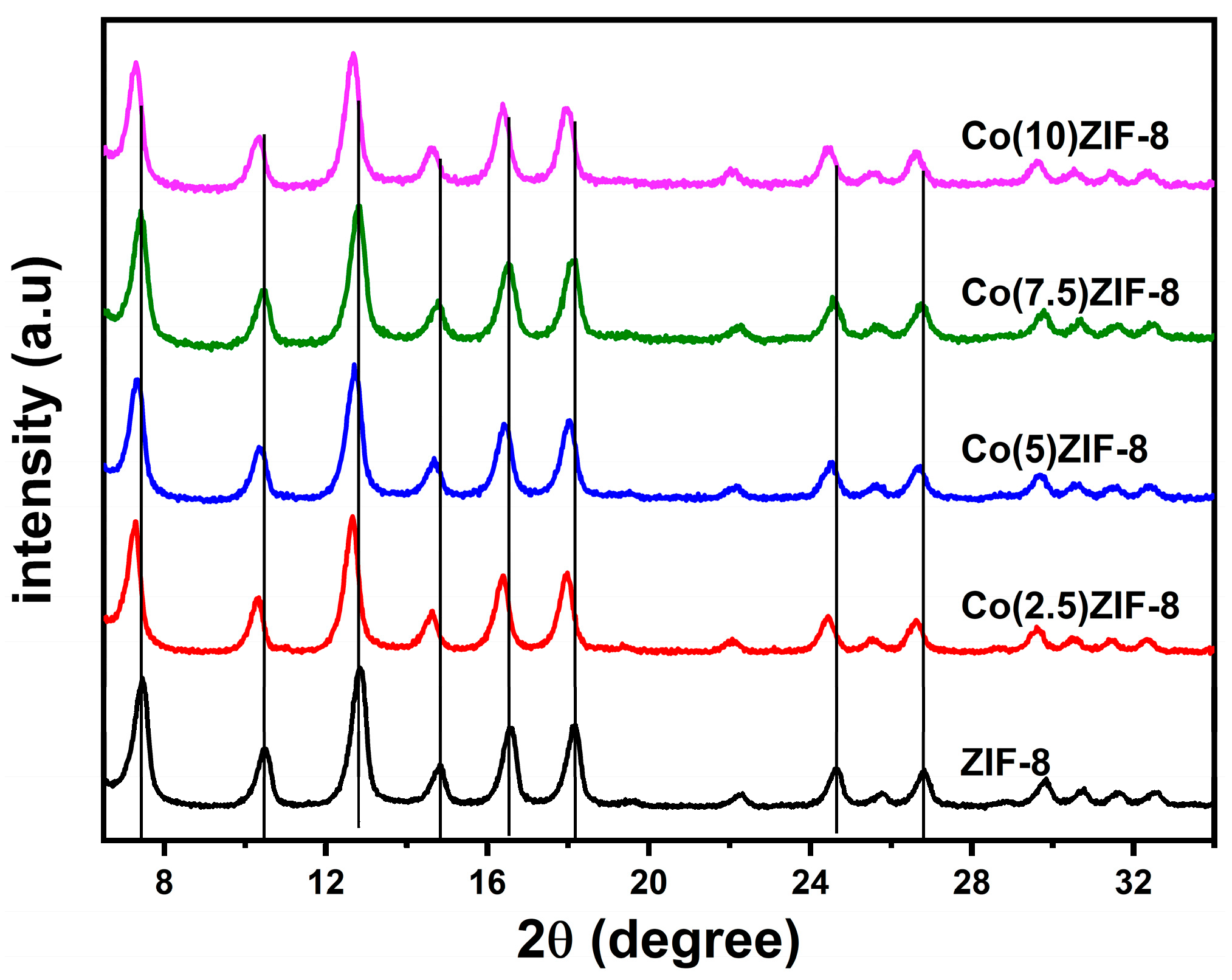
Figure 1 shows the X-ray diffraction (XRD) patterns of pristine ZIF-8 and Co(x)ZIF-8 samples with different cobalt doping levels (x = 0, 2.5, 5, 7.5, and 10 wt%). All synthesized materials exhibit sharp and intense diffraction peaks that match well with the characteristic reflections of the ZIF-8 structure, confirming the successful formation of the zeolitic imidazolate framework. The main diffraction peaks located at 2θ values of approximately 7.4°, 10.5°, 12.9°, 14.8°, 16.6°, and 18.1° correspond to the expected ZIF-8 crystalline planes. Notably, the structural integrity of the ZIF-8 framework is preserved in all cobalt-doped samples, as evidenced by the unchanged peak positions. Moreover, the absence of additional diffraction peaks associated with crystalline cobalt-containing phases (such as CoO or Co3O4) indicates that cobalt ions are successfully incorporated into the ZIF-8 framework—most likely by substituting Zn2+ sites—rather than forming segregated secondary phases. This observation confirms the formation of phase-pure cobalt-substituted ZIF-8 materials, even at the highest doping level of 10 wt%.
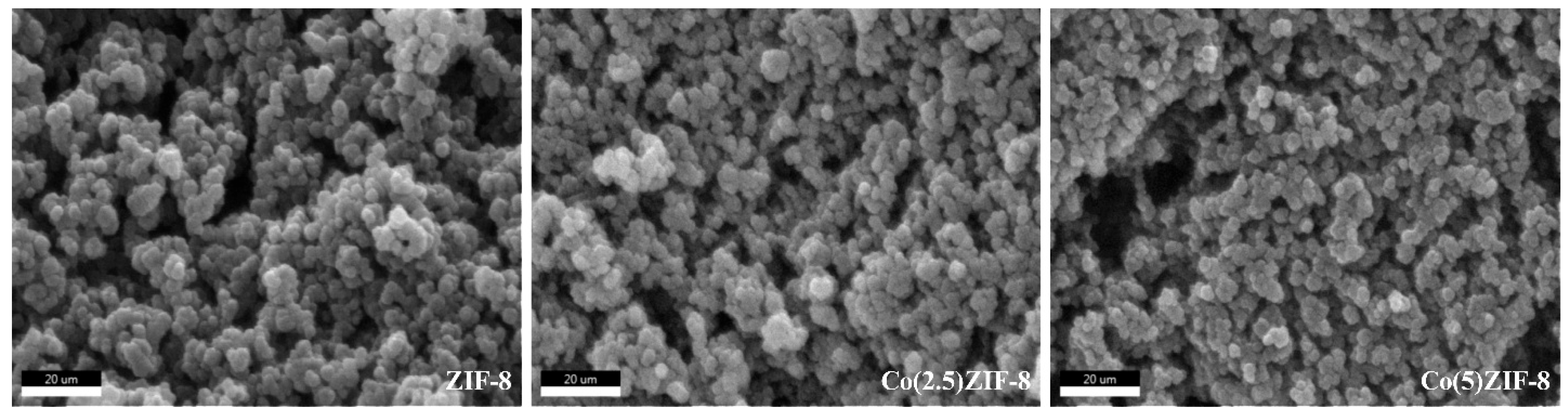
Figure 2 presents scanning electron microscopy (SEM) images of pristine ZIF-8 and cobalt-doped ZIF-8 samples, denoted as Co(2.5)ZIF-8 and Co(5)ZIF-8. SEM analysis reveals that all samples consist of homogeneous, quasi-spherical nanoparticles that aggregate to form a porous microstructure. A direct comparison of the images shows that cobalt doping at 2.5 wt% and 5 wt% does not induce any significant changes in particle morphology or size distribution. This morphological consistency suggests that cobalt ions are successfully incorporated into the ZIF-8 framework lattice without disrupting the crystal growth mechanism that governs particle shape and size.
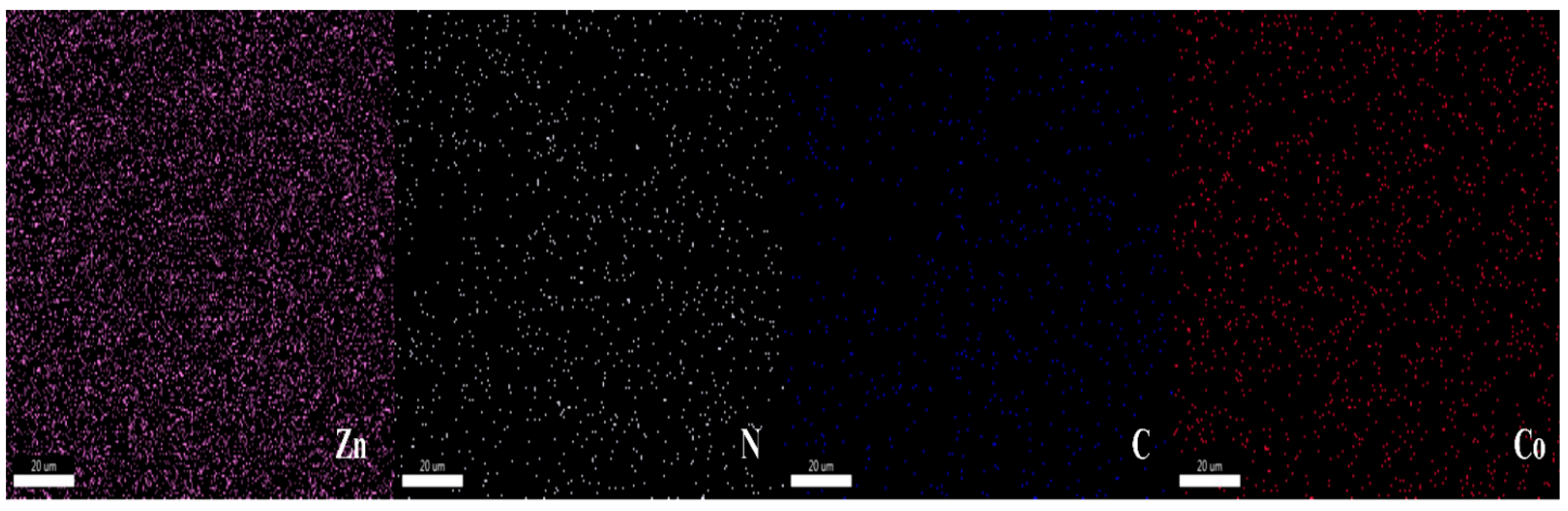
Figure 3 shows the energy-dispersive X-ray spectroscopy (EDS) elemental mapping of cobalt-doped ZIF-8 (Co–ZIF-8). The elemental maps confirm the presence and spatial distribution of the main framework constituents, including zinc (Zn), nitrogen (N), and carbon (C). Importantly, the cobalt (Co) map reveals a highly homogeneous distribution throughout the entire scanned area. The spatial overlap of the Co signal with those of Zn, N, and C indicates the successful incorporation and uniform dispersion of cobalt ions within the ZIF-8 framework. Moreover, the absence of localized Co-rich regions suggests that cobalt is effectively inserted into the ZIF-8 lattice rather than forming segregated cobalt-based phases. This observation further supports the XRD results, confirming that no macroscopic cobalt-containing impurities are present.
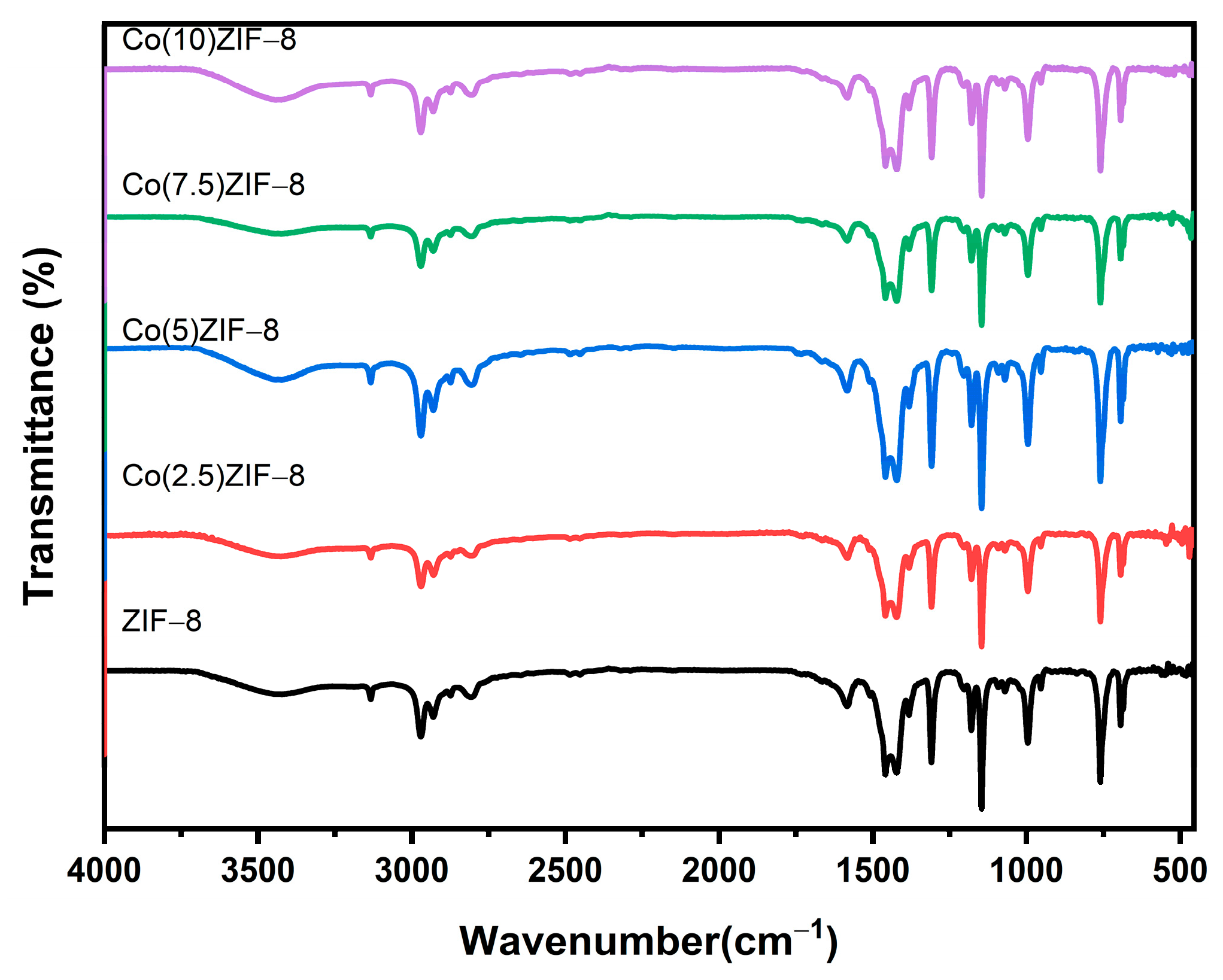
Figure 4 presents the FTIR spectra of pristine ZIF-8 and cobalt-doped Co(x)ZIF-8 samples. All spectra exhibit the characteristic absorption bands associated with the 2-methylimidazole linker and the ZIF-8 framework, confirming successful framework formation. The bands observed in the 2800–3150 cm−1 region are attributed to C–H stretching vibrations. The most diagnostic features of the ZIF-8 structure appear in the fingerprint region below 1600 cm−1, which corresponds to the characteristic vibrational modes of the 2-methylimidazole linkers and the metal–nitrogen (M–N) coordination. The sharp and intense bands between 1580 and 1350 cm−1 are assigned to C=N and C=C stretching vibrations within the imidazole ring. Prominent bands below 1300 cm−1 arise from in-plane and out-of-plane bending modes of the imidazole ring, as well as C–N stretching vibrations. The absorption bands in the 1300–900 cm−1 range are commonly associated with ring vibrations and C–H bending modes of the methyl group. The broad absorption features below 700 cm−1 are attributed to Zn–N or Co–N stretching and bending vibrations, confirming the formation of the metal–organic framework. Importantly, the preservation of all characteristic vibrational bands upon cobalt doping indicates that Co2+ substitution occurs without altering the chemical bonding of the organic linker or inducing framework degradation. This result corroborates the XRD analysis and confirms the structural integrity of the cobalt-doped ZIF-8 materials.
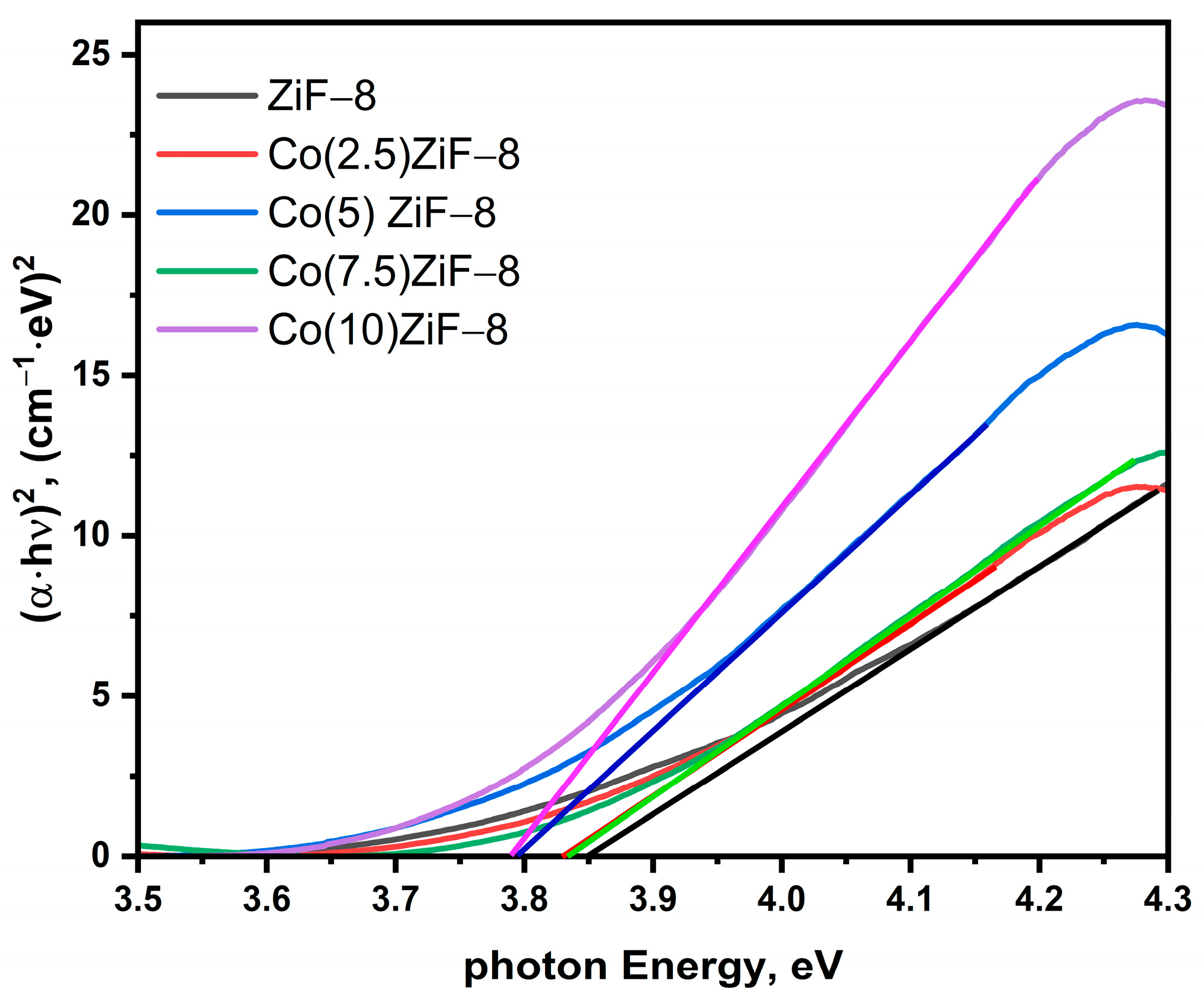
Figure 5 shows the Tauc plots derived from UV–Vis spectra used to determine the optical band gap (Eg) of pristine ZIF-8 and Co(x)ZIF-8 catalysts. The band gap values were estimated by extrapolating the linear region of the (αhν)2 versus photon energy (hν) plots to the energy axis. The results clearly demonstrate that cobalt incorporation has a pronounced effect on the optical properties of ZIF-8. Pristine ZIF-8 exhibits the largest band gap (black trace), which is characteristic of a wide-band-gap semiconductor. Upon cobalt doping, a distinct red shift in the absorption edge is observed, leading to a systematic reduction in the optical band gap. The Eg value progressively decreases with increasing Co content, reaching its minimum for the Co(10)ZIF-8 sample (purple trace). This band-gap narrowing is attributed to the introduction of new electronic states within the ZIF-8 band structure arising from Co2+ substitution, which enhances visible-light absorption. Notably, the reduction in band gap directly correlates with the improved photocatalytic performance of the Co-doped ZIF-8 materials.
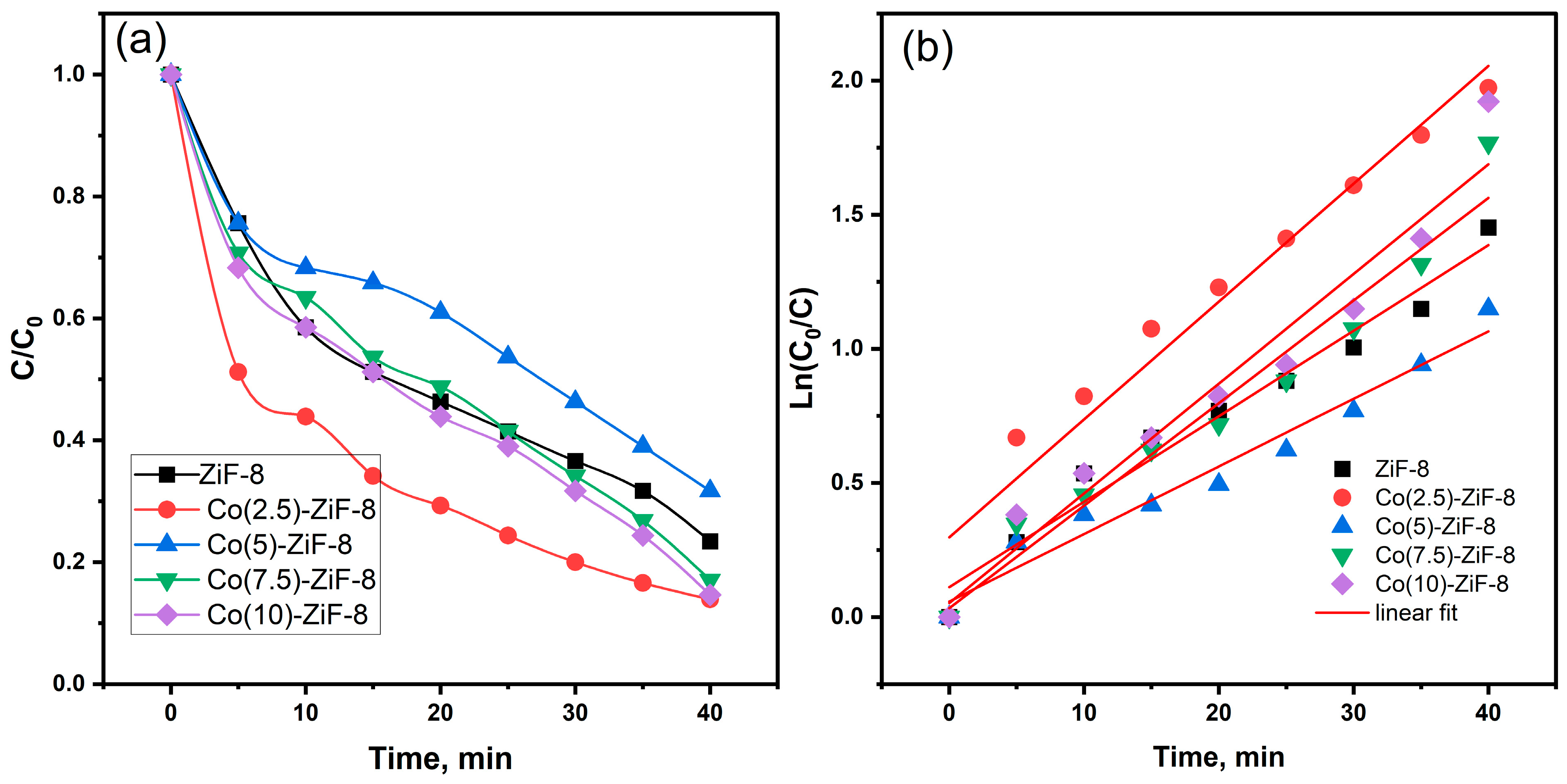
Figure 6 illustrates the photocatalytic performance of pristine ZIF-8 and Co(x)ZIF-8 catalysts under light irradiation. In Figure 6a, the degradation efficiency is presented as the normalized pollutant concentration (C/C0) versus irradiation time. All Co-doped ZIF-8 samples exhibit higher photocatalytic activity than pristine ZIF-8, with the Co(2.5)ZIF-8 sample showing the highest activity, reaching a C/C0 value of 0.15 after 40 min. Increasing the cobalt content beyond this level, as in Co(5)ZIF-8 and more highly doped samples, leads to a reduction in photocatalytic efficiency, indicating the presence of an optimal cobalt doping concentration. The photocatalytic kinetics were further analyzed using a pseudo-first-order model, where Ln(C0/C) is plotted as a function of time, as shown in Figure 6b. The high linearity of these plots confirms that the degradation process follows pseudo-first-order kinetics. Consistent with the degradation profiles, the Co(2.5)ZIF-8 catalyst exhibits the highest apparent reaction rate constant, as evidenced by the steepest slope, confirming its superior photocatalytic performance. The enhanced activity is attributed to the synergistic effect of band-gap narrowing (Figure 5) and an optimal cobalt concentration, which promotes efficient charge separation while avoiding excessive recombination centers. While Co(2.5)ZIF-8 exhibits faster initial kinetics due to optimal charge separation with minimal recombination centers, Co(5)ZIF-8 shows higher overall degradation efficiency because of a better balance between visible-light absorption and charge carrier lifetime. The slight decrease in efficiency at higher Co loadings may be due to increased recombination sites.
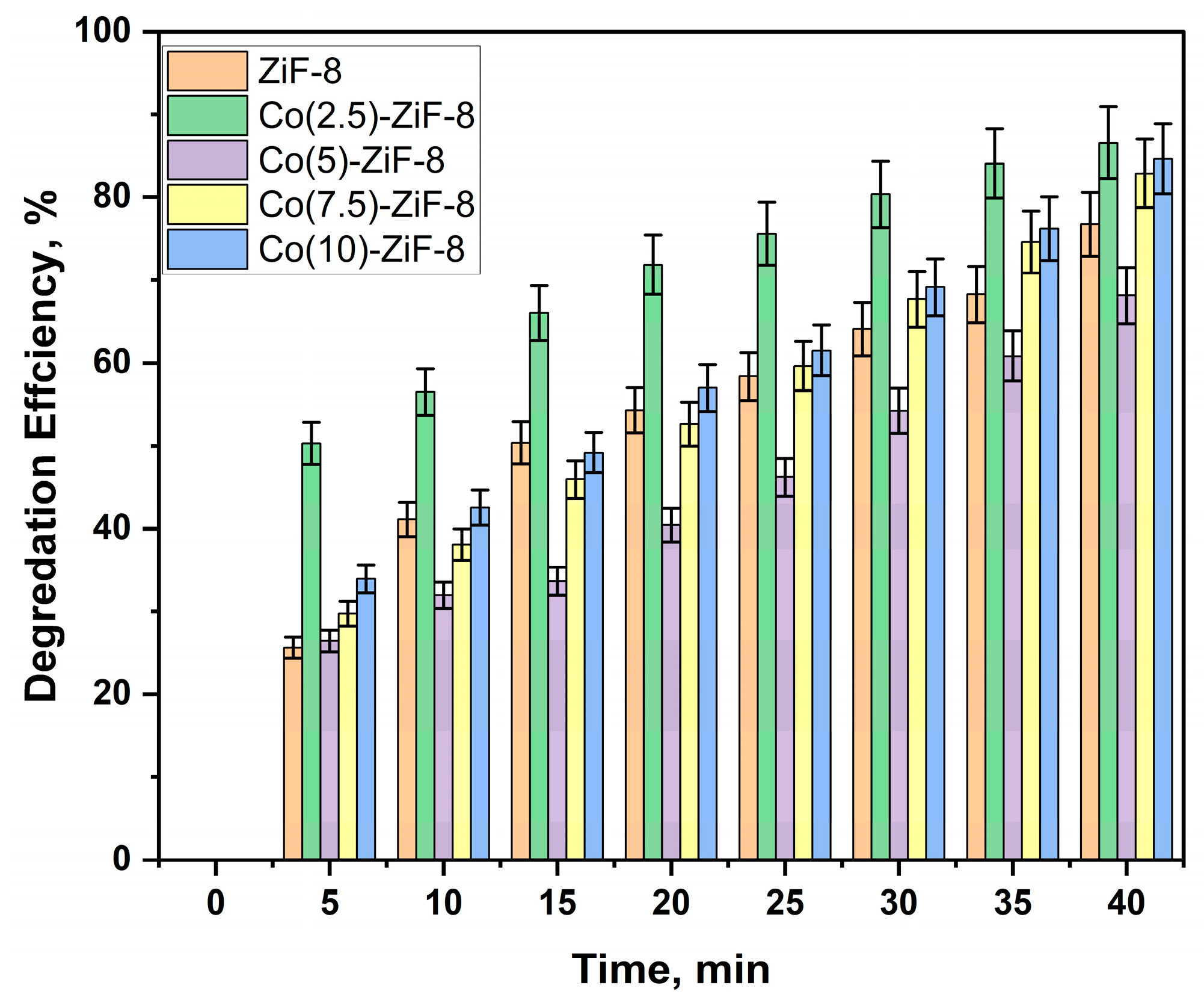
Figure 7 presents the time-dependent photocatalytic degradation efficiency of the pollutant using pristine ZIF-8 and Co(x)ZIF-8 catalysts over a 40 min irradiation period. The results clearly demonstrate that photocatalytic activity is significantly enhanced upon the incorporation of cobalt into the ZIF-8 framework. All Co(x)ZIF-8 samples exhibit superior degradation efficiency compared with pristine ZIF-8 (orange bars) at all irradiation times. The photocatalytic performance strongly depends on the cobalt loading, reaching an optimum for the Co(5)ZIF-8 sample. Specifically, Co(5)ZIF-8 (green bars) achieves the highest degradation efficiency of approximately 87% after 40 min of irradiation. Further increases in cobalt content, as in Co(7.5)ZIF-8 and Co(10)ZIF-8, lead to a slight decline in efficiency. This behavior indicates that an optimal doping level of 5 wt% provides the best balance between enhanced visible-light absorption, resulting from band-gap narrowing, and efficient charge separation, thereby minimizing electron–hole recombination. Excessive cobalt doping likely introduces additional recombination centers, which offsets the benefits of a reduced band gap and leads to diminished photocatalytic performance.
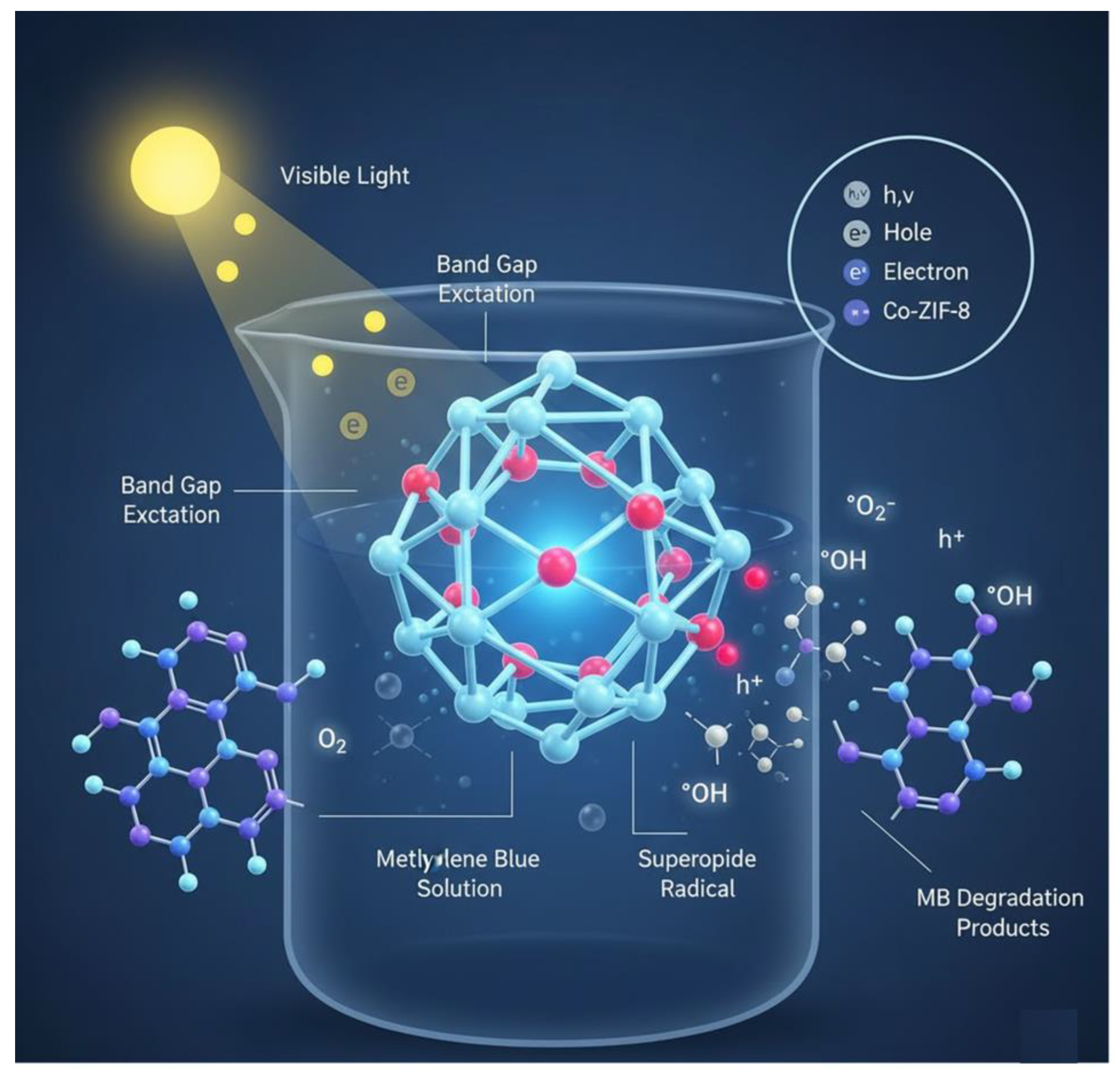
The photocatalytic degradation mechanism of Methylene Blue MB using the cobalt-doped ZIF-8 process is as follows.
The Co-ZIF-8 photocatalyst particle is irradiated by visible light (hv). Co2+ doping successfully reduced the band gap of ZIF-8 (as shown in the Tauc plot analysis), enabling it to absorb visible light more effectively than pure ZIF-8. Upon light absorption, the electrons in the valence band (VB) are excited to the conduction band (CB), generating photogenerated electron–hole pairs (e and h+). The Co2+ ions act as charge-trapping centers or transfer bridges, which is the key role of the dopant. They are theorized to capture the photogenerated electrons, thereby retarding the recombination of e/h+ pairs and prolonging the lifetime of the charge carriers. This improved charge separation directly leads to enhanced photocatalytic efficiency. The separated electrons and holes then initiate redox reactions with species present in the aqueous solution. In the electron pathway (e), the electrons in the conduction band (or trapped by Co2+) react with dissolved oxygen (O2) to produce highly reactive superoxide radicals ( . O 2 ):
e + O 2 . O 2
  • Hole Pathway (h+): The positive holes in the valence band react with water (H2O) or hydroxyl ions (OH) adsorbed on the catalyst surface to produce potent hydroxyl radicals (.OH):
h + + H 2 O . O H + H +
h + + O H . O H
  • The highly reactive species (.OH and . O 2 ) are the primary agents responsible for the degradation.
  • These radicals attack the adsorbed Methylene Blue (MB) molecules, leading to the cleavage of their chromophore structures and eventual mineralization into simpler, less harmful degradation products (CO2, H2O, and inorganic ions) [23].
The schematic effectively summarizes that the enhanced photocatalytic activity of Co-ZIF-8 for MB degradation is due to the synergistic effects of visible-light absorption (from the reduced band gap) and efficient charge separation (mediated by the Co2+ dopant), as shown in Figure 8.
  • Hydrogen Evolution Performance of Co-Modified ZIF-8 Composites
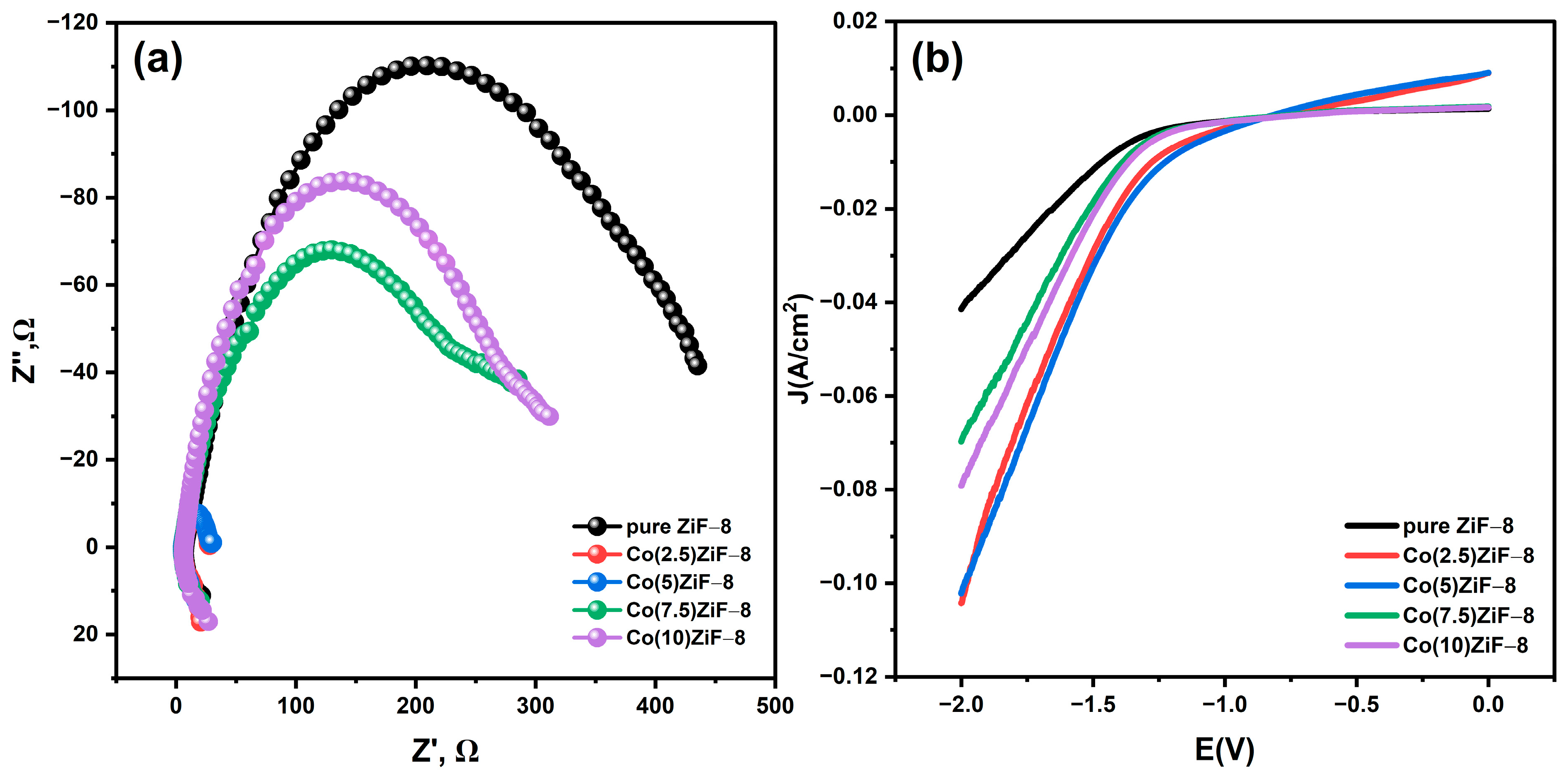
Figure 9a is a Nyquist plot derived from Electrochemical Impedance Spectroscopy (EIS) measurements for pure ZIF-8 and the series of cobalt-modified Co(x)ZIF-8 composites. The Nyquist plot displays the imaginary component of the impedance (Z’’) versus the real component of the impedance (Z’) across a range of frequencies. In electrocatalysis, the diameter of the high-frequency semicircle is primarily used to estimate the charge transfer resistance (Rct) at the electrode–electrolyte interface. A smaller semicircle diameter indicates faster charge transfer kinetics and, consequently, better electrocatalytic performance.
  • Quantitative Analysis of Charge Transfer Resistance (Rct)
The charge transfer resistance (Rct) can be estimated by the difference between the high-frequency intercept and the low-frequency intercept of the semicircle on the Z’ axis (Table 1).
The catalytic activity is strongly dependent on the amount of cobalt incorporated into the ZIF-8 framework. The performance significantly improves from pure ZIF-8 to Co(2.5)ZIF-8 (red line) and further to Co(5)ZIF-8 (blue line), as demonstrated in Figure 9b. Co(5)ZIF-8 exhibits the highest current density (most negative J) at large negative potentials (e.g., at E = −2.0 V, J ~ −0.105 A/cm2), suggesting it has the highest intrinsic catalytic activity or the most abundant active sites under these conditions. A further increase in Co loading to Co7.5ZIF-8 (green line) and Co(10)ZIF-8 (purple line) leads to a decrease in performance compared to Co(5)ZIF-8. Specifically, the curves for Co(7.5)ZIF-8 and Co(10)ZIF-8 are shifted back towards the less active pure ZIF-8, showing lower current densities at highly negative potentials. This indicates that Co(5)ZIF-8 is the optimal composition, as demonstrated in Figure 9b.

3. Experimental Techniques

An adapted synthesis route was employed for the preparation of ZIF-8, in which triethylamine was used as a regulating agent. Zinc nitrate hexahydrate (Loba Co., Mumbai, India) and 2-methylimidazole (Loba Co., Mumbai, India) were dissolved in demineralized water, mixed, aged, washed, and dried to obtain the final product. This procedure compares favorably with conventional methods that typically require organic solvents and elevated temperatures, offering advantages in terms of safety, cost, and environmental impact without compromising crystal quality. The resulting white precipitate was washed sequentially with three 0.03 L portions of demineralized water, followed by two portions of methanol of the same volume. The product was then dried at 60 °C for 6 h to yield ZIF-8. Using the same synthetic protocol, Co-doped ZIF-8 samples were prepared with cobalt loadings of 0, 2.5, 5, 7.5, and 10 wt%, employing Co(NO3)2·6H2O as the cobalt precursor.
The synthesized ZIF-8 and Co-doped ZIF-8 materials were comprehensively characterized. Structural analysis was performed using X-ray diffraction (XRD, Fringe benchtop, LANScientific, Suzhou, China). The morphology and elemental composition were examined by field-emission scanning electron microscopy coupled with energy-dispersive X-ray spectroscopy (FESEM/EDS, JEOL, Akishima, Japan). Optical properties were investigated using a Jasco V-670 UV–visible spectrophotometer (Hachioji, Japan). The photocatalytic was performed on MB with a concentration of 10 mg/L under a 300 W Xe lamp with a 420 nm cutoff filter and an intensity of 100 mW/cm2.

4. Conclusions

In summary, we demonstrated the facile and effective synthesis of cobalt-doped ZIF-8 (Co(x)ZIF-8) materials using an environmentally friendly, aqueous-based method. Structural characterization confirms the high phase purity and structural integrity of the ZIF-8 framework across all cobalt doping levels, with Co2+ ions being isomorphously incorporated into Zn2+ sites without disrupting the framework structure. The optical properties are significantly improved, as evidenced by a continuous red shift in the absorption edge and a corresponding reduction in the optical band gap, which are essential for efficient visible-light utilization. Photocatalytic evaluation reveals that cobalt doping markedly enhances pollutant degradation efficiency, with optimal performance observed at doping levels between 2.5 and 5 wt%. Notably, the Co(2.5)ZIF-8 sample exhibits the highest apparent reaction rate, while the Co(5)ZIF-8 catalyst achieves the maximum degradation efficiency of approximately 87% after 40 min of irradiation. This enhanced photocatalytic activity is attributed to the synergistic effects of band-gap narrowing and the efficient separation of photogenerated charge carriers facilitated by the Co2+ dopant. Electrochemical measurements further support these findings, as Co(5)ZIF-8 displays the highest current density (most negative J) at large negative potentials (e.g., J ≈ −0.105 A cm−2 at E = −2.0 V), indicating superior intrinsic catalytic activity. Overall, this work provides a straightforward and scalable strategy for tailoring the electronic and optical properties of metal–organic frameworks, enabling the development of highly efficient visible-light-driven photocatalysts for environmental remediation.

Author Contributions

Conceptualization, A.E.T., M.E.-G., A.B.A.A.M.E.-A., H.A., Y.A.M.I. and A.M.A.; Methodology, A.E.T., M.E.-G., A.B.A.A.M.E.-A. and H.A.; Validation, A.E.T., M.E.-G., A.B.A.A.M.E.-A., H.A. and A.M.A.; Formal analysis, H.A., M.S. and A.M.A.; Investigation, A.E.T. and Y.A.M.I.; Resources, A.E.T. and Y.A.M.I.; Data curation, M.E.-G., H.A., Y.A.M.I. and A.M.A.; Writing—original draft, M.E.-G., H.A. and Y.A.M.I.; Writing—review & editing, A.B.A.A.M.E.-A., M.S. and A.M.A.; Visualization, A.M.A.; Supervision, A.B.A.A.M.E.-A., M.S. and A.M.A. All authors have read and agreed to the published version of the manuscript.

Funding

The authors extend their appreciation to the Deanship of Scientific Research at King Khalid University for funding this work through a large group Research Project under grant number RGP2/244/46.

Data Availability Statement

The data presented in this study are available on request from the corresponding author.

Acknowledgments

The authors extend their appreciation to the Deanship of Scientific Research at King Khalid University for funding this work through a large group Research Project under grant number RGP2/244/46.

Conflicts of Interest

The authors declare no conflict of interest.

References

  1. Alkallas, F.H.; Trabelsi, A.B.G.; Alraddadi, S.; Hassan, A.; Ali, A.S.; Aboraia, A.M. Influence of cobalt doping on the structural, morphological, and optical properties of ZIF-8 thin films. Opt. Mater. 2025, 167, 117364. [Google Scholar] [CrossRef]
  2. Yan, S.; Bi, X.; Qian, Y.; Zhang, J.; Wang, J.; Yu, Y. ZIF-67 Modified Bi12O17Br2 for Advanced Visible-Light Photocatalysis via S-Scheme Heterojunction. J. Solid State Chem. 2025, 353, 125706. [Google Scholar] [CrossRef]
  3. Yu, Y.; Tao, Y.; Yan, S. Efficient photocatalytic activity over α-MnS/ZIF-67 pn junction: Revealing the synergistic effects of exposed crystal facets and built-in electric field mechanism. Surf. Interfaces 2024, 55, 105395. [Google Scholar] [CrossRef]
  4. Taheri, M.; Enge, T.G.; Tsuzuki, T. Water stability of cobalt doped ZIF-8: A quantitative study using optical analyses. Mater. Today Chem. 2020, 16, 100231. [Google Scholar] [CrossRef]
  5. Kumar, A.; Rana, S.; Sharma, G.; Dhiman, P.; Shekh, M.I.; Stadler, F.J. Recent advances in zeolitic imidazole frameworks based photocatalysts for organic pollutant degradation and clean energy production. J. Environ. Chem. Eng. 2023, 11, 110770. [Google Scholar] [CrossRef]
  6. Qin, J.; Wang, S.; Wang, X. Visible-light reduction CO2 with dodecahedral zeolitic imidazolate framework ZIF-67 as an efficient co-catalyst. Appl. Catal. B Environ. 2017, 209, 476–482. [Google Scholar] [CrossRef]
  7. Mengting, Z.; Duan, L.; Zhao, Y.; Song, Y.; Xia, S.; Gikas, P.; Othman, M.H.D.; Kurniawan, T.A. Fabrication, characterization, and application of BiOI@ ZIF-8 nanocomposite for enhanced photocatalytic degradation of acetaminophen from aqueous solutions under UV-vis irradiation. J. Environ. Manag. 2023, 345, 118772. [Google Scholar] [CrossRef] [PubMed]
  8. Mirhosseini, H.; Mostafavi, A.; Shamspur, T. Fabrication of ZIF-8/LaFeO3 nanocomposite for photocatalytic degradation of sulfamethoxazole in aqueous solution under visible light. Inorg. Chem. Commun. 2025, 178, 114598. [Google Scholar] [CrossRef]
  9. Yao, L.; Yu, Y.; Xu, X.; Du, Z.; Yang, T.; Hu, J.; Huang, H. In-situ construction of WS2/ZIF-8 composites with an electron-rich interface for enhancing nitrogen photofixation. J. Colloid Interface Sci. 2024, 654, 189–200. [Google Scholar] [CrossRef]
  10. Menon, S.; Dutta, S.; Madaboosi, N.; Sai, V.V.R. Cobalt-doped ZIF-8 nanoparticle-decorated fiber optic sensor for copper ion detection. ACS Appl. Nano Mater. 2023, 7, 18346–18356. [Google Scholar] [CrossRef]
  11. Zareba, J.K.; Nyk, M.; Samoc, M. Co/ZIF-8 heterometallic nanoparticles: Control of nanocrystal size and properties by a mixed-metal approach. Cryst. Growth Des. 2016, 16, 6419–6425. [Google Scholar] [CrossRef]
  12. Kumar, Y.; Sahai, A.; Olive-Méndez, S.F.; Goswami, N.; Agarwal, V. Morphological transformations in cobalt doped zinc oxide nanostructures: Effect of doping concentration. Ceram. Int. 2016, 42, 5184–5194. [Google Scholar] [CrossRef]
  13. Daniel-Umeri, R.A.; Osiele, M.O.; Emumejaiye, K.; Ikpeseni, S.C. Effect of Bimetallic Doping on the Optoelectronic Properties of Zeolitic Imidazolate Framework-8 (ZIF-8). NIPES-J. Sci. Technol. Res. 2025, 7, 23–32. [Google Scholar] [CrossRef]
  14. Zhang, Y.; Li, Q.; Liu, C.; Shan, X.; Chen, X.; Dai, W.; Fu, X. The promoted effect of a metal-organic frameworks (ZIF-8) on Au/TiO2 for CO oxidation at room temperature both in dark and under visible light irradiation. Appl. Catal. B Environ. 2018, 224, 283–294. [Google Scholar] [CrossRef]
  15. Vadivel, S.; Muthuraj, A.; Anbazhagan, M.; Abdul samad, S.; Arumugam, R. A novel CoMoO4 enwrapped ZIF-8 nanocomposite with enhanced visible light photocatalytic activity. Environ. Pollut. 2023, 336, 122450. [Google Scholar] [CrossRef] [PubMed]
  16. Galán-González, A.; Sivan, A.K.; Hernández-Ferrer, J.; Bowen, L.; Di Mario, L.; Martelli, F.; Benito, A.M.; Maser, W.K.; Chaudhry, M.U.; Gallant, A.; et al. Cobalt-doped ZnO nanorods coated with nanoscale metal–organic framework shells for water-splitting photoanodes. ACS Appl. Nano Mater. 2020, 3, 7781–7788. [Google Scholar] [CrossRef] [PubMed]
  17. Tian, F.; Cerro, A.M.; Mosier, A.M.; Wayment-Steele, H.K.; Shine, R.S.; Park, A.; Webster, E.R.; Johnson, L.E.; Johal, M.S.; Benz, L. Surface and stability characterization of a nanoporous ZIF-8 thin film. J. Phys. Chem. C 2014, 118, 14449–14456. [Google Scholar] [CrossRef]
  18. Perrot, V.; Roussey, A.; Benayad, A.; Veillerot, M.; Mariolle, D.; Solé-Daura, A.; Mellot-Draznieks, C.; Ricoul, F.; Canivet, J.; Quadrelli, E.A.; et al. ZIF-8 thin films by a vapor-phase process: Limits to growth. Nanoscale 2023, 15, 7115–7125. [Google Scholar] [CrossRef] [PubMed]
  19. Ejsmont, A.; Jankowska, A.; Goscianska, J. Insight into the photocatalytic activity of cobalt-based metal–organic frameworks and their composites. Catalysts 2022, 12, 110. [Google Scholar] [CrossRef]
  20. Li, Y.; Jin, Z.; Zhao, T. Performance of ZIF-67–Derived fold polyhedrons for enhanced photocatalytic hydrogen evolution. Chem. Eng. J. 2020, 382, 123051. [Google Scholar] [CrossRef]
  21. Jadhav, H.S.; Bandal, H.A.; Ramakrishna, S.; Kim, H. Critical review, recent updates on zeolitic imidazolate framework-67 (ZIF-67) and its derivatives for electrochemical water splitting. Adv. Mater. 2022, 34, 2107072. [Google Scholar] [CrossRef] [PubMed]
  22. Tan, J.; Zhang, X.; Lu, Y.; Li, X.; Huang, Y. Role of interface of metal–organic frameworks and their composites in persulfate-based advanced oxidation process for water purification. Langmuir 2023, 40, 21–38. [Google Scholar] [CrossRef] [PubMed]
  23. Huang, A.; Zhou, T.; Zhang, J.; Zhang, Y.; Wu, Y.; Wang, Y.; Luo, W. Competing CO and HCOOH Pathways in CO2 Electroreduction. ChemCatChem 2024, 16, e202400504. [Google Scholar] [CrossRef]
Figure 1. X-ray diffraction (XRD) patterns of pristine ZIF-8 and Co-doped ZIF-8 samples with varying cobalt concentrations.
Catalysts 16 00176 g001
Figure 2. Field-emission scanning electron microscopy (FESEM) images of pristine ZIF-8 and Co-doped ZIF-8 samples with 2.5 and 5 wt% Co.
Catalysts 16 00176 g002
Figure 3. Energy-dispersive X-ray spectroscopy (EDS) elemental maps of Co-doped ZIF-8, showing the spatial distribution of Zn, Co, C, and N.
Catalysts 16 00176 g003
Figure 4. Fourier-transform infrared (FTIR) spectra of pristine ZIF-8 and Co-doped ZIF-8 samples with varying cobalt contents.
Catalysts 16 00176 g004
Figure 5. Tauc plots obtained from UV–Vis spectroscopy showing (αhν)2 versus photon energy (hν) for pristine ZIF-8 and Co-doped ZIF-8 with different cobalt concentrations.
Catalysts 16 00176 g005
Figure 6. (a) Time-dependent photocatalytic degradation efficiency and (b) corresponding pseudo-first-order kinetic analysis for pristine ZIF-8 and Co(x)ZIF-8 catalysts.
Catalysts 16 00176 g006
Figure 7. Time-dependent photocatalytic degradation efficiency of the pollutant over 40 min using pristine ZIF-8 and Co(x)ZIF-8 catalysts.
Catalysts 16 00176 g007
Figure 8. Schematic illustration of the proposed photocatalytic degradation mechanism of Methylene Blue (MB) using the cobalt-doped ZIF-8 material under visible light irradiation.
Catalysts 16 00176 g008
Figure 9. (a) Electrochemical impedance spectroscopy (EIS) and (b) hydrogen evolution performance of pristine ZIF-8 and Co-doped ZIF-8 with different cobalt concentrations.
Catalysts 16 00176 g009
Table 1. Charge transfer resistance (Rct) values derived from Nyquist plot fittings for the synthesized photocatalysts.
SamplesRctInterpretation
ZiF-8~450 − 25 = 425Highest Rct, confirming the poorest kinetics.
Co(2.5)ZiF-8~30 − 20 = 10Significantly Reduced
Co(5)ZiF-8~25 − 20 = 5Lowest Rct, indicating the fastest kinetics.
Co(7.5)ZiF-8~160 − 20 = 140Increased Rct compared to Co(5)ZIF-8.
Co(10)ZiF-8~300 − 30 = 270Significantly higher Rct than the optimal sample.
Disclaimer/Publisher’s Note: The statements, opinions and data contained in all publications are solely those of the individual author(s) and contributor(s) and not of MDPI and/or the editor(s). MDPI and/or the editor(s) disclaim responsibility for any injury to people or property resulting from any ideas, methods, instructions or products referred to in the content.