Review

Research Progress on Novel Semiconductor Photocatalysts for Degrading VOCs

1
State Key Laboratory of Deep Coal Safety Mining and Environmental Protection, Anhui University of Science and Technology, Huainan 232001, China
2
School of Earth and Environment, Anhui University of Science and Technology, Huainan 232001, China
3
School of Materials Science and Engineering, Anhui University of Science and Technology, Huainan 232001, China
*
Authors to whom correspondence should be addressed.
Catalysts 2026, 16(4), 356; https://doi.org/10.3390/catal16040356
Submission received: 2 March 2026 / Revised: 11 April 2026 / Accepted: 12 April 2026 / Published: 15 April 2026

Abstract

Volatile organic compounds (VOCs) pose significant health risks. Photocatalytic oxidation offers a promising route for VOC purification under ambient conditions. Based on a review of over 80 studies, this article critically evaluates research progress on four semiconductor photocatalyst systems (TiO2-based, g-C3N4-based, bismuth-based oxides, and MOFs) for VOC degradation. Unlike traditional descriptive reviews, this work establishes a quality-based filtering framework to distinguish studies reporting standardized photochemical parameters from those that do not. The analysis reveals a fundamental problem: the vast majority of reviewed studies lack essential parameters (incident photon flux, apparent quantum yield, or rigorous dark adsorption equilibrium), rendering cross-study comparisons invalid. Most literature relies on non-standardized metrics such as conversion percentages or rate constants per catalyst mass. While some high-quality studies report AQY, these remain a small fraction of the literature. Within individual studies under identical conditions, modification strategies enhance activity relative to controls, but relative efficiency (ζr) values are meaningful only within the same study and cannot be compared across setups. This review thus serves a dual purpose: to summarize modification strategies and to critically expose the lack of standardization. Future research must adopt unified reporting standards (photon flux, AQY, benchmarks under identical conditions) to transform the field into a reproducible, cumulative science.

1. Introduction

With the acceleration of industrialization and urbanization, the emission of volatile organic compounds (VOCs) has become an increasingly severe issue [1,2]. These volatile organic pollutants (such as aldehydes and aromatic hydrocarbons) [3], which are prone to volatilization at room temperature, not only pose a direct threat to human health [4] but also participate in photochemical reactions, exacerbating atmospheric compound pollution [5]. To address this challenge, the development of efficient and green purification technologies is crucial.
Among various treatment technologies, photocatalytic oxidation technology has demonstrated broad application prospects due to its advantages of mild reaction conditions, low energy consumption, direct utilization of solar energy, and complete mineralization of VOCs into harmless products such as CO2 and H2O [6]. The core of this technology lies in semiconductor photocatalysts. The fundamental mechanism is as follows: when the catalyst absorbs photons with energy higher than its band gap (Eg), valence band electrons are excited to the conduction band, forming highly reactive electron–hole pairs [7,8]. These charge carriers migrate to the catalyst surface, driving a series of redox reactions: holes (h+) or derived hydroxyl radicals (•OH) can directly oxidize and decompose VOC molecules, while electrons (e) typically react with oxygen to generate reactive oxygen species such as superoxide radicals (•O2−) that participate in the degradation process [9]. Therefore, the performance of the catalyst is critically dependent on the separation and migration efficiency of photogenerated charge carriers, which can be optimized through material design and surface/interface engineering [10].
However, a critical issue persists in current photocatalysis research: most studies compare catalytic activity based solely on reaction rates per unit catalyst mass, without considering the number of photons driving the reaction, making scientific comparisons across different studies difficult. Hoque and Guzman emphasized that scientific comparison of photocatalytic activity requires reporting standardized parameters such as photon flux, spectral irradiance, and apparent quantum yield (AQY) [11]; Wang et al. similarly stressed that activity comparisons without reported photon flux lack scientific validity [12]. Additionally, photocatalytic degradation experiments must reach adsorption–desorption equilibrium under dark conditions before light irradiation to eliminate adsorption interference—particularly for MOFs and other high-surface-area materials, where adsorption-induced concentration decreases can significantly exceed photocatalytic contributions.
Unlike traditional descriptive reviews, this work introduces a quality-based filtering framework to distinguish studies that report standardized photochemical parameters (e.g., photon flux, apparent quantum yield, AQY) from those that do not. Based on a systematic examination of over 80 studies, the vast majority of reviewed studies lack such essential parameters, relying instead on non-standardized metrics like conversion percentages or rate constants per catalyst mass. Consequently, most of the reported “high efficiencies” in the VOC photocatalysis literature cannot be scientifically compared across studies—a direct consequence of widely varying reactor designs, light sources, photon fluxes, humidity levels, and the pervasive absence of key reporting parameters. Notably, while some high-quality studies do report AQY or detailed quantum efficiency calculations, these represent a small fraction of the literature. Therefore, the aim of this review is not to rank catalyst performance across studies (an impossible task under non-uniform conditions), but rather: (1) to catalog the modification strategies employed within each catalyst family and their reported within-study effects; (2) to critically expose the pervasive lack of standardized reporting; and (3) to propose a concrete reporting framework for future research. The central message is that only by adopting unified reporting standards can the field of photocatalytic VOC degradation transition from a collection of incomparable case studies toward reproducible, cumulative science.

2. Standardized Evaluation Methods for Photocatalytic Efficiency

2.1. Standardization Strategies and the Proper Use of ζr

Evaluating photocatalytic efficiency is central to assessing catalyst performance. However, a fundamental issue persists: most studies compare activity solely based on reaction rates per unit catalyst mass, overlooking the number of photons driving the reaction. This approach is scientifically flawed because photocatalytic reactions are photon-driven processes, and the reaction rate is proportional to the photon flux absorbed by the catalyst [13]. Without accounting for photon flux, results from different light sources and reactor configurations become incomparable.
To address this, the photochemistry community has developed two mainstream standardization strategies. The first is direct measurement of apparent quantum yield (AQY)—the ratio of molecules converted per unit time to the incident photon flux. This metric directly reflects the catalyst’s photon utilization efficiency and represents the intrinsic activity. However, AQY determination requires precise instrumentation, and only a few studies have reported this parameter [14]. The second strategy is relative photocatalytic efficiency (ζr)—comparing the test catalyst with a standard reference material under identical experimental conditions [15]. For reference materials, Degussa P25 TiO2 is widely recognized as a benchmark due to its stability and extensive research base [16]. Another common reference is ST01 (pure anatase, high surface area), though most reviewed studies did not use it.
It is critical to clarify the proper use of ζr in this review. Following Serpone et al. [13], ζr is meaningful only when comparing catalysts under strictly identical experimental conditions (same reactor, light source, photon flux, geometry, and VOC concentration). In the present work, ζr values cited from individual studies are reported exclusively as within-study indicators of how a given modification strategy improves upon its own control. Under no circumstances should ζr values from different studies be compared directly against each other, as differences in light sources, reactor geometries, and operating conditions render such comparisons photochemically invalid.

2.2. A Quality-Filtering Framework and Future Directions

To address the lack of photochemical standardization, this review adopts a three-tier quality framework. Tier I studies report at least one of the essential photochemical parameters (incident photon flux or apparent quantum yield, AQY), with some reporting both; these serve as exemplary benchmarks for the field. Tier II studies report degradation rates under well-defined conditions with dark adsorption equilibrium, but lack photon flux or AQY; these are treated as qualitative case studies of modification strategies, not quantitative evidence for performance ranking. Tier III studies lack essential parameters (e.g., no dark equilibrium, unspecified light intensity) and are excluded from quantitative discussion. Among the over 80 studies reviewed, only a small number qualify as Tier I, while the majority fall into Tier II.
Based on this analysis, the following recommendations are made for future research: (1) systematically report light source characteristics (type, spectral distribution), incident photon flux, catalyst mass, reactor geometry, initial VOC concentration, flow rate, temperature, and humidity; (2) calculate AQY or within-study ζr against a clearly specified benchmark (preferably P25 or ST01 under identical conditions); (3) always verify dark adsorption equilibrium before irradiation, especially for high-surface-area materials like MOFs. Only through such standardized reporting can the field move beyond incomparable case studies toward reproducible science.
To make this filtering framework operational, this review presents two summary tables. Table 1 compiles all Tier I studies identified across the four catalyst families, reporting their key photochemical parameters (photon flux, AQY/QY) and experimental conditions. These studies serve as benchmarks for what rigorous reporting should look like. Table 2 summarizes the qualitative trends observed from Tier II studies. Unlike Table 1, Table 2 does not enable cross-study comparison; rather, it illustrates the types of modifications being explored and the direction of within-study effects, which can inform hypothesis generation but not quantitative conclusions.

3. TiO2-Based Catalysts

TiO2 has been widely applied in photocatalysis due to its high photocatalytic activity, strong chemical stability, low preparation cost, non-toxicity, and environmental friendliness, making it the most extensively studied and technologically mature semiconductor photocatalyst. However, pure TiO2 still has inherent limitations, such as limited ultraviolet light absorption, weak adsorption capacity, and high photogenerated electron–hole recombination rate, which restrict its practical applications [51]. To address these issues, modification techniques such as ionic doping and surface modification are commonly employed to enhance its photocatalytic activity and broaden its light absorption range [52].

3.1. TiO2-Based Tier I Studies with Standardized Reporting

Among the TiO2-based literature, six studies report both incident photon flux (or equivalent radiometric quantities) and apparent quantum yield (AQY) or quantum yield (QY), meeting the Tier I criteria. These serve as benchmarks for the field, demonstrating that rigorous photochemical reporting is feasible.
Deng et al. [17] reported amorphous titania nanofilms for formaldehyde mineralization. Using a 254 nm UV lamp with an incident photon flux of 1.26 mW/cm2 in a single-pass continuous flow reactor, they achieved an AQY of 60.4%, demonstrating that non-crystalline TiO2 can exhibit high activity due to abundant unsaturated surface sites. Lim et al. [18] developed N-doped TiO2 for formaldehyde (100 ppm) degradation; under a 365 nm UV lamp (0.82 mW/cm2), they reported an AQY of 2.97 × 10⁻² molecules photon−1 and a within-study ζr of 1.32 relative to P25, with N-TiO2 achieving complete removal versus 69.2% for pure TiO2 and 75.9% for P25. He et al. [19] constructed a Schottky junction and oxygen-vacancy-driven charge separation system using Na/Pd-modified TiO2 for toluene degradation, providing mechanistic insights with full reporting of photon flux and quantum yield. Hua et al. [20] designed an S-scheme ZnSn(OH)6/TiO2 heterojunction for benzene (1 ppm) oxidation; under a 1 W UV-A LED (0.0125 W/cm2, λ_max = 370 nm), the composite achieved 100% removal within 90 min, with an AQY of 6.08 × 10⁻³% (MAQY = 6.08 × 10⁻⁴ molecule photon−1 g−1), and in situ DRIFTS revealed intermediates (phenolate, acetate, maleate, methylene).
Lim et al. [21] developed Pt/N-co-doped TiO2 as both a photocatalyst and a light-free catalytic adsorbent for gaseous formaldehyde, reporting incident photon flux and quantum efficiency to quantitatively evaluate the dual functionality. Maitlo et al. [22] constructed an inverted p-n S-scheme Ag2O/TiO2 heterojunction (AT-4) for benzene (1 ppm) degradation; using four UV-A lamps (total 32 W, λ_max = 352 nm, incident power 0.050 W on catalyst surface), the AT-4 achieved 94.4% removal under dynamic flow, with an AQY of 0.061% (MAQY = 0.12 molecule photon−1 g−1). The internal electric field at the p-n interface facilitates directional charge migration and enhances •O2 and •OH generation; intermediates identified (ortho-/para-phenolate, benzoquinone, acetate, maleate) confirm complete mineralization.
These six Tier I studies demonstrate that rigorous photochemical reporting including incident photon flux and AQY is achievable for TiO2-based photocatalysts. They provide valuable benchmarks for the field, covering a range of modification strategies such as N doping, amorphous structures, Schottky junctions, and S-scheme heterojunctions. The detailed reporting of experimental conditions and quantum efficiencies in these studies serves as a model for future work.

3.2. Ion Doping: Qualitative Trends from TiO2 Tier II Studies

The majority of TiO2 doping studies fall into Tier II, lacking photon flux or AQY reporting. While their reported degradation rates are not comparable across different experimental setups, a critical synthesis of their findings reveals several consistent trends.
Trend 1: Transition metal doping enhances light absorption and suppresses recombination. Transition metals (e.g., Sn, Cd, Pr, W, Fe, Mn) introduce impurity energy levels within the TiO2 bandgap, extending light absorption to the visible region and creating electron-trapping sites that suppress charge recombination [53]. However, excessive doping may introduce additional recombination centers or reduce surface area. For formaldehyde removal, Shen et al. [30] prepared Sn-doped NaYF4/Sn@TiO2 heterostructure catalysts, which exhibited higher degradation efficiency than pure TiO2, attributed to the synergy between Sn doping and upconversion luminescence. Ángeles-Beltrán et al. [54] found that in Cd-doped chitosan composites, Cd enhanced TiO2 particle dispersion, increased reaction contact area, and promoted oxygen vacancy formation, thereby optimizing charge transfer pathways; however, Cd doping also reduced the specific surface area, limiting adsorption capacity. Cordeiro et al. [55] developed Pr-doped TiO2 for bisphenol A degradation; Pr doping significantly improved BPA adsorption and carrier separation efficiency, achieving better degradation performance than unmodified TiO2, although it did not substantially broaden the light absorption range.
Trend 2: Non-metal doping narrows the bandgap and extends visible absorption. By mixing the p-states of non-metals (e.g., N, S) with O 2p states, non-metal doping effectively narrows the bandgap of TiO2, extending absorption into the visible region while suppressing carrier recombination. For instance, Narindri Rara Winayu et al. [31] prepared graphene-co-doped S,N-modified TiO2 via hydrothermal method. Within that study, S,N co-doping enhanced visible-light absorption and carrier separation; graphene, with its high conductivity, rapidly transferred photogenerated electrons and suppressed recombination, while its wrinkled structure increased specific surface area.
Trend 3: Comparative screening of multiple dopants and phase control. Comparing multiple dopants under identical conditions helps identify the most promising material. Wang et al. [56] achieved precise phase control (anatase/rutile) of Mn-doped TiO2 by adjusting the Mn/Ti molar ratio using a solvothermal–calcination method (Figure 1). For toluene degradation, Ly et al. [32] systematically evaluated W-, Fe-, and Mn-doped TiO2 (0.5 wt%) and found that W doping exhibited the highest activity and good stability. Cheng et al. [57] synthesized six transition-metal-doped TiO2 samples; among them, V-doped samples showed the highest activity, followed by Fe-doped samples. Given the toxicity of vanadium compounds, Fe-based doping was proposed as a greener alternative.
The qualitative patterns observed across Tier II doping studies in terms of enhanced light absorption and suppressed recombination are consistent, but the magnitude of improvement varies widely depending on dopant type, concentration, preparation method, and crystal phase. Crucially, without photon flux normalization or AQY reporting, it is impossible to determine whether reported differences in degradation rates reflect genuine differences in intrinsic activity or simply differences in experimental conditions (e.g., light intensity, reactor geometry). Thus, the current literature on ion-doped TiO2 for VOC degradation can only inform directional guidance for catalyst design, not quantitative performance ranking.

3.3. Surface Modification: Qualitative Trends from TiO2 Tier II Studies

Surface modification strategies complement ion doping by enhancing adsorption capacity, providing active sites, and improving charge transfer [58,59]. The following trends emerge from Tier II studies.
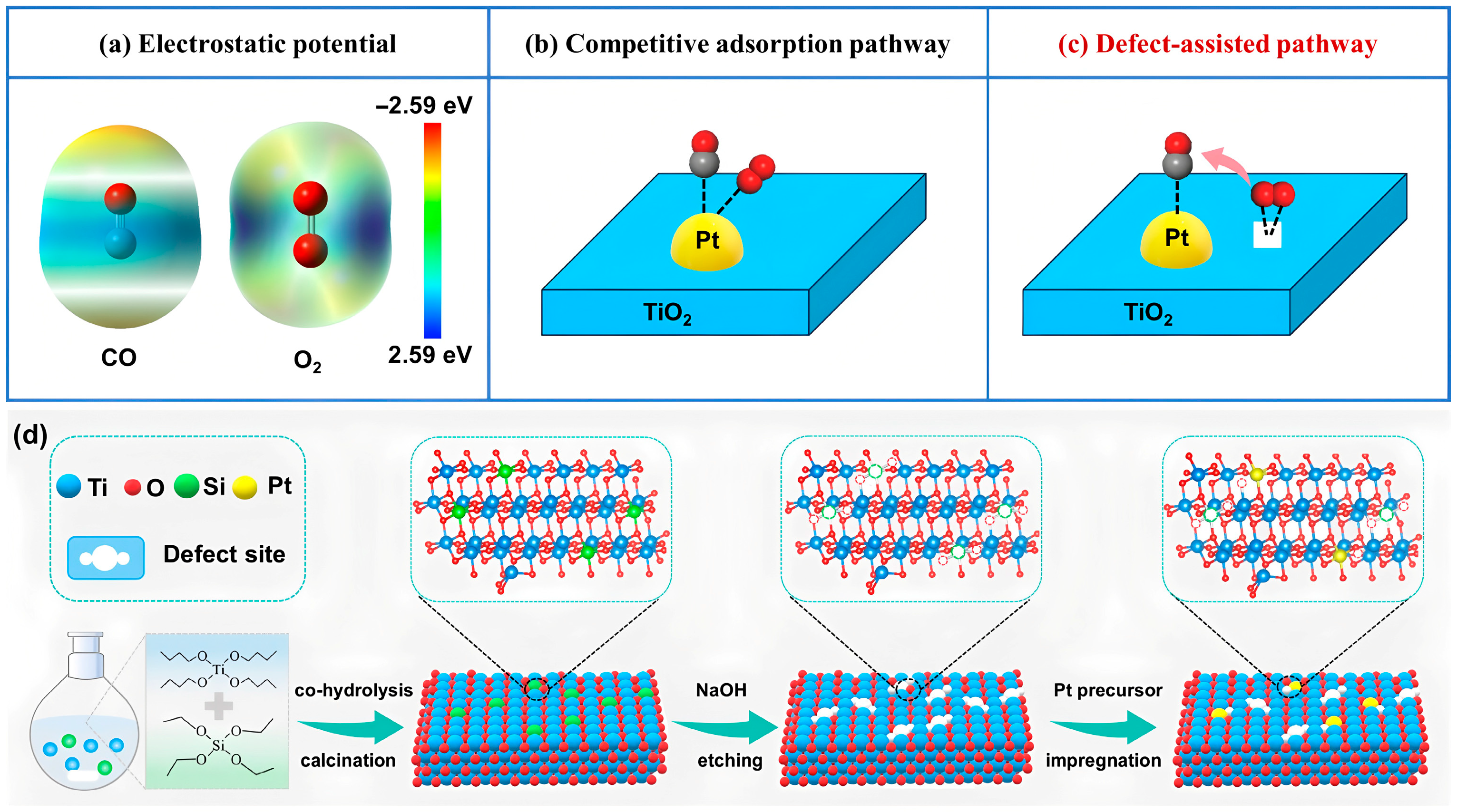
Trend 1: Oxygen vacancy engineering suppresses recombination and enhances adsorption. Oxygen vacancies introduce mid-gap states that act as electron-trapping centers, suppressing carrier recombination while simultaneously enhancing reactant adsorption and activation through unsaturated coordination sites. Dong et al. [33] introduced oxygen vacancies into TiO2 via hydrothermal treatment; the oxygen-vacancy-modified catalyst achieved substantially higher toluene removal compared to P25, with improved mineralization rate and stability. Ai et al. [60] designed a MoS2/TiO2 heterojunction that synergistically regulates oxygen/sulfur vacancies and activates lattice oxygen for sulfur-containing VOC degradation. Zou et al. [61] constructed a Pt/Ti-D catalyst with high-density oxygen vacancies by chemical etching, demonstrating that defect-assisted O2 activation reduces the energy barrier and accelerates interfacial charge transfer (Figure 2).
Trend 2: Noble metal modification leverages Schottky barriers and plasmonic effects. Noble metals (Pd-Au, Pt) form Schottky barriers at the metal–TiO2 interface, trapping photogenerated electrons and extending charge carrier lifetimes, while also providing alternative reaction pathways [62]. K. R. G. et al. [63] developed a catalyst with Pd-Au nanoparticles partially embedded in TiO2 carriers; this structure increased interfacial perimeter and enhanced catalytic activity compared to conventional surface loading. Chi et al. [64] fabricated inverse-opal-structured Pt/TiO2–MnOx photothermal catalysts that significantly boosted visible–near-infrared light absorption and gas adsorption surface area, achieving high toluene degradation.
Trend 3: Composite formation and surface functionalization introduce additional active sites. Materials such as zeolites, quantum dots, or phosphate groups introduce additional adsorption sites, improve charge separation through heterointerface bonding, or modify surface electronic properties. Xu et al. [34] prepared hierarchical ZSM-5 and constructed TiO2/hierarchical ZSM-5 composites via ball milling; the Ti–O–Si bonds formed between components improved charge separation, delivering enhanced toluene degradation compared to pure TiO2. Zhou et al. [35] loaded TiO2 quantum dots onto anatase TiO2 surfaces, inducing upward band bending and promoting charge separation, achieving high mineralization efficiency. Qiao et al. [65] modified TiO2 with phosphate, revealing that PO43− interacts with surface hydroxyl groups to promote •O2 generation and suppress electron–hole recombination. Wang et al. [36] modified TiO2 with carbon and cyanide groups, effectively reducing agglomeration and increasing specific surface area and active sites; CN doping even enabled visible-light activity.
Trend 4: External field synergy (photothermal and plasma-assisted) enables deeper mineralization. Combining photocatalysis with thermal or plasma-induced activation improves energy efficiency and mineralization depth. Huang et al. [66] investigated Cu- and Mn-doped TiO2; Cu/TiO2 demonstrated optimal toluene degradation due to favorable band structure and thermal catalytic activity. Chen et al. [67] developed a Z-type CuxO/Ag/SrTiO3 heterojunction where Ag nanoparticles serve as both electron transfer bridges and thermal catalytic centers. Liu et al. [68] combined non-thermal plasma with Pt/TiO2, where high-energy electrons rapidly disrupt toluene molecular structures while the catalyst provides adsorption sites and accelerates redox cycling.
Surface modification strategies such as oxygen vacancies, noble metals, composites, and external field synergy undoubtedly enhance TiO2 performance within individual studies. However, the diversity of experimental setups across these Tier II studies (different light sources, different VOC concentrations, different humidity levels, different reactor types) makes it impossible to compare the relative effectiveness of, say, oxygen vacancy engineering versus noble metal loading. Furthermore, most studies do not report catalyst stability or mineralization by-products, leaving important practical concerns unaddressed. Future work on surface modification should prioritize not only performance enhancement but also standardized testing protocols that allow meaningful inter-laboratory comparison.

4. g-C3N4-Based Catalysts

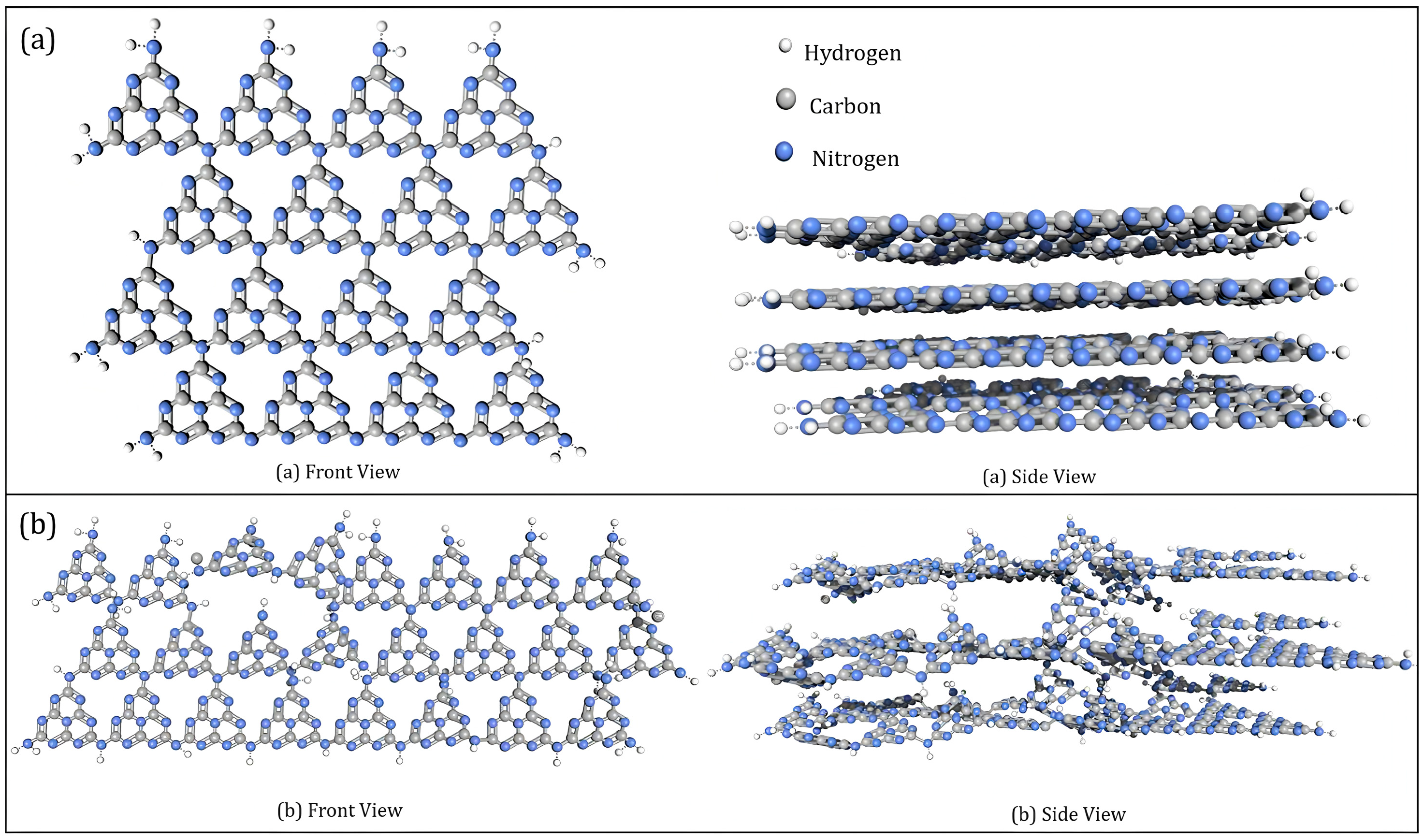
g-C3N4, a non-metallic two-dimensional conjugated semiconductor, has been widely applied in photocatalysis due to its stable structure, unique electronic properties, and environmental compatibility. Studies indicate that g-C3N4-based materials exhibit controllable characteristics, strong chemical and thermal stability in graphite-like phases, broad applicability, and high efficiency. They demonstrate outstanding performance in CO2 reduction, hydrogen production, organic pollutant degradation, and heavy metal reduction, while offering advantages such as low cost, environmental friendliness, and absence of heavy metal hazards. However, several limitations exist. Firstly, g-C3N4 primarily absorbs ultraviolet light with poor absorption of visible and infrared light [69]. Secondly, the rapid electron–hole recombination in g-C3N4 prevents the generated electrons and holes from effectively participating in redox processes under light exposure [70]. Additionally, compared to other photocatalytic materials, g-C3N4’s limited specific surface area restricts its application in organic pollutant decomposition [71]. To address these issues, modification strategies such as metal decoration, heterostructure construction, and functionalization are commonly employed to broaden the light absorption range, enhance charge separation, and improve surface reaction performance [72,73]. Figure 3 illustrates the interlayer stacking structure of g-C3N4. Highly crystalline g-C3N4 exhibits a sharp (002) diffraction peak at 2θ = 27.4°, corresponding to an interlayer period of approximately 0.326 nm, while amorphous g-C3N4 shows no distinct diffraction peak. This structural tunability—from ordered to disordered layer stacking—directly affects charge carrier mobility, surface reactivity, and photocatalytic performance. The modification strategies discussed below all aim to optimize these structural and electronic properties.
It is important to note that, unless otherwise specified, all studies cited in this section achieved adsorption–desorption equilibrium under dark conditions prior to light irradiation, ensuring that reported degradation reflects photocatalytic activity rather than physical adsorption. However, as established in Section 2, the vast majority of these studies (Tier II) do not report incident photon flux or AQY. Therefore, they can only inform qualitative trends regarding modification strategies, not quantitative performance rankings across different experimental setups. The following subsections first highlight the Tier I studies that meet standardization criteria, then summarize qualitative patterns observed across Tier II studies.

4.1. g-C3N4-Based Tier I Studies with Standardized Reporting

Among the g-C3N4-based literature, three studies report both incident photon flux (or equivalent radiometric quantities) and apparent quantum yield (AQY) or quantum yield (QY), meeting the Tier I criteria. These serve as benchmarks for the field.
Li et al. [23] constructed an alkalinized g-C3N4 photocatalyst for solid–gas-interfacial Fenton reaction. Using a Xe lamp with a 420 nm bandpass filter, they reported an incident photon flux of 0.45 mW/cm2 and achieved an apparent quantum yield (AQY) of 49% at 420 nm for pollutant degradation, demonstrating that surface alkalinization dramatically enhances exciton dissociation and charge separation. In another Tier I study, Muñoz-Batista et al. [24] developed CeO2-TiO2/g-C3N4 ternary photocatalysts for toluene degradation. They employed four fluorescent daylight lamps (6 W each, UV content 3%) simulating sunlight (emission lines at 410, 440, 540, and 580 nm) as well as UV lamps (maximum at ca. 350 nm). Through rigorous radiative transfer modeling, they calculated the local superficial rate of photon absorption (e(a,s)) and reported quantum yield values under both UV and sunlight-type illumination: for the optimal 1 wt% g-C3N4/CeTi sample, the quantum yield under UV was 12.5 × 10⁻⁴% and under sunlight 3.1 × 10⁻⁴%. This work exemplifies the level of experimental detail—including photon flux measurement, radiative transfer equation solving, and selectivity correction—required for meaningful quantum yield determination. Additionally, Cho et al. [25] developed a graphitic carbon nitride/titanium dioxide composite for gaseous formaldehyde degradation and constructed a portable photocatalytic air purification system, reporting incident photon flux and quantum efficiency to demonstrate the superior mineralization potential of the composite under visible light.
These three Tier I studies provide valuable benchmarks for g-C3N4-based photocatalysis. They cover key modification strategies including surface alkalinization, ternary heterojunction construction, and composite formation with TiO2. Together, these studies exemplify the level of experimental detail including photon flux measurement, radiative transfer modeling, and quantum yield calculation required for meaningful performance evaluation and serve as models for future work.

4.2. Metal Decoration and Heterojunctions: Qualitative Trends from g-C3N4 Tier II Studies

The majority of g-C3N4 modification studies fall into Tier II, lacking photon flux or AQY reporting. Collectively, they indicate several qualitative trends regarding metal decoration, heterojunction construction, and surface/interface engineering. As shown in Figure 3, the interlayer stacking of g-C3N4 can be controlled between highly crystalline and amorphous states, providing a structural basis for these modifications.
Trend 1: Metal decoration introduces electron-capturing centers. Metals such as Ni and K act as electron traps, suppressing photogenerated electron–hole recombination and modulating the band structure to extend visible-light absorption [75]. Metal decoration has been shown to effectively modulate the electronic structure of g-C3N4. Narindri et al. [37] developed a nickel-modified g-C3N4 photocatalyst (0.1 wt% Ni) via thermal shrinkage; Ni acted as an electron-capturing center, suppressing recombination, accelerating charge separation, and broadening the visible-light response, leading to enhanced styrene removal compared to pristine g-C3N4. Fu et al. [38] demonstrated that K doping narrows the bandgap of g-C3N4 and promotes bulk carrier separation; combining K-doped g-C3N4 with BiOCl nanosheets further optimized photogenerated carrier transfer, resulting in substantially higher toluene degradation compared to pristine g-C3N4.
Trend 2: Heterojunction construction creates internal electric fields for charge separation. Constructing heterojunctions between g-C3N4 and another semiconductor generates an interface electric field that drives spatial charge separation, reduces recombination, and often extends light absorption. Cong et al. [39] developed a CdS@g-C3N4 heterojunction (mass ratio 0.2) via microwave-assisted sol–gel processing; the heterojunction exhibited broader wavelength absorption, with CdS facilitating bandgap modulation and charge separation, enabling complete toluene degradation under visible light far outperforming pure CdS. Bai et al. [40] designed an AC@g-C3N4/MnOx Z-scheme heterojunction for acetaldehyde removal; the Z-scheme mechanism enhanced the reductive power of photogenerated electrons to produce more •O2, while the synergistic adsorption–photocatalysis effect of activated carbon led to higher removal efficiency and good long-term stability relative to pure g-C3N4.
Trend 3: Surface and interface engineering further improves VOC affinity and charge transfer. Functional group modification of g-C3N4 can increase its affinity for VOCs and serve as charge transfer bridges to reduce recombination [76]. Beyond conventional systems, biomass-derived composite carriers offer an environmentally sustainable route. Cheng et al. [41] prepared straw-derived carbon aerogels loaded with g-C3N4 (CAGH) via hydrothermal synthesis combined with water-assisted calcination; the uniform distribution of g-C3N4 on the carbon aerogel exposed numerous adsorption sites and broadened the photonic response range, leading to improved VOC removal performance.
The modification strategies discussed, including metal decoration, heterojunction formation, and surface engineering, aim to optimize the structural and electronic properties of g-C3N4. Within individual studies, each approach consistently enhances photocatalytic performance by broadening light absorption, promoting charge separation, reducing recombination, and improving adsorption. The absence of standardized photochemical metrics (photon flux, AQY) across most studies prevents quantitative comparison of the effectiveness of different modification strategies. Adopting the reporting practices exemplified by the Tier I studies in Section 4.1 would greatly benefit the field.

5. Bismuth-Based Oxides

Bismuth oxides are a promising photocatalytic material in the field of photocatalysis, characterized by their non-toxicity, visible-light responsiveness, and abundant reserves [77]. The layered structure of bismuth-based oxide photocatalysts provides more active sites for the photocatalytic degradation of pollutants, significantly enhancing their photocatalytic activity [78]. However, challenges remain including limited visible-light utilization, carrier recombination, and stacking issues in two-dimensional structures.
It is important to note that, unless otherwise specified, all studies cited in this section achieved adsorption–desorption equilibrium under dark conditions prior to light irradiation, ensuring that reported degradation reflects photocatalytic activity rather than physical adsorption. As established in Section 2, the vast majority of these studies (Tier II) do not report incident photon flux or AQY. Therefore, they can only inform qualitative trends, not quantitative cross-study comparisons.

5.1. Bismuth-Based Tier I Studies with Standardized Reporting

Bismuth-based oxides have emerged as promising photocatalysts for VOC degradation due to their unique layered structures, visible-light responsiveness, and abundant active sites. However, the lack of standardized photochemical parameters, such as incident photon flux and apparent quantum yield (AQY), has hindered meaningful cross-study comparisons and the rational design of high-performance materials.
Early work by Amano et al. [26] demonstrated that crystalline Bi2WO6 (russellite) exhibits remarkable visible-light activity for the complete mineralization of gaseous acetaldehyde (2000 ppm), whereas amorphous Bi2WO6 is nearly inactive. Using visible light (λ > 400 nm) and measuring the action spectrum, they reported an AQY of approximately 8% at 400 nm. The superior activity of the crystalline sample was attributed to the significantly prolonged lifetime of photogenerated charge carriers, as confirmed by time-resolved infrared absorption spectroscopy. This work provided early evidence that crystallization dramatically reduces electron–hole recombination and enhances photocatalytic efficiency, setting a benchmark for bismuth-based photocatalysts under visible light. More recently, Zhang et al. [27] met the Tier I criteria by reporting both incident photon flux and quantum yield for BiOCl with controlled surface defects (BiOCl-R) in the degradation of toluene (5 ppm) under UV light. Their study reported an incident photon flux of 0.076 W and a quantum yield of 1.04 × 10⁻³, demonstrating that surface defect engineering enhances charge separation and activity.
These Tier I studies provide benchmarks for bismuth-based photocatalysis, demonstrating the value of reporting incident photon flux and AQY. The work on crystalline Bi2WO6 illustrates how crystallization dramatically reduces electron–hole recombination and enhances visible-light activity, while the study on BiOCl with controlled surface defects shows how defect engineering can improve charge separation. Both studies exemplify the use of action spectrum analysis and quantum yield measurement to establish structure–activity relationships, offering a template for future investigations.

5.2. Self-Doping and Microstructure: Qualitative Trends from Bismuth-Based Tier II Studies

The majority of bismuth-based oxide studies fall into Tier II, lacking photon flux or AQY reporting. While their reported degradation rates are not comparable across different setups, they collectively indicate several qualitative trends regarding self-doping, microstructural design, and heterojunction construction.
Trend 1: Bi self-doping enhances visible-light absorption and charge separation. Introducing Bi0 species acts as electron acceptors and extends visible-light absorption through surface plasmon effects [79]. Guo et al. [42] prepared a type II Bi2O3/Bi/TiO2 heterojunction with an embedded Bi interlayer via stepwise hydrothermal synthesis. The Bi interlayer broadened the photoreactive range of TiO2, promoted active species generation, and prevented active site blockage by intermediates, leading to excellent photocatalytic activity and stability for toluene degradation compared to pure TiO2.
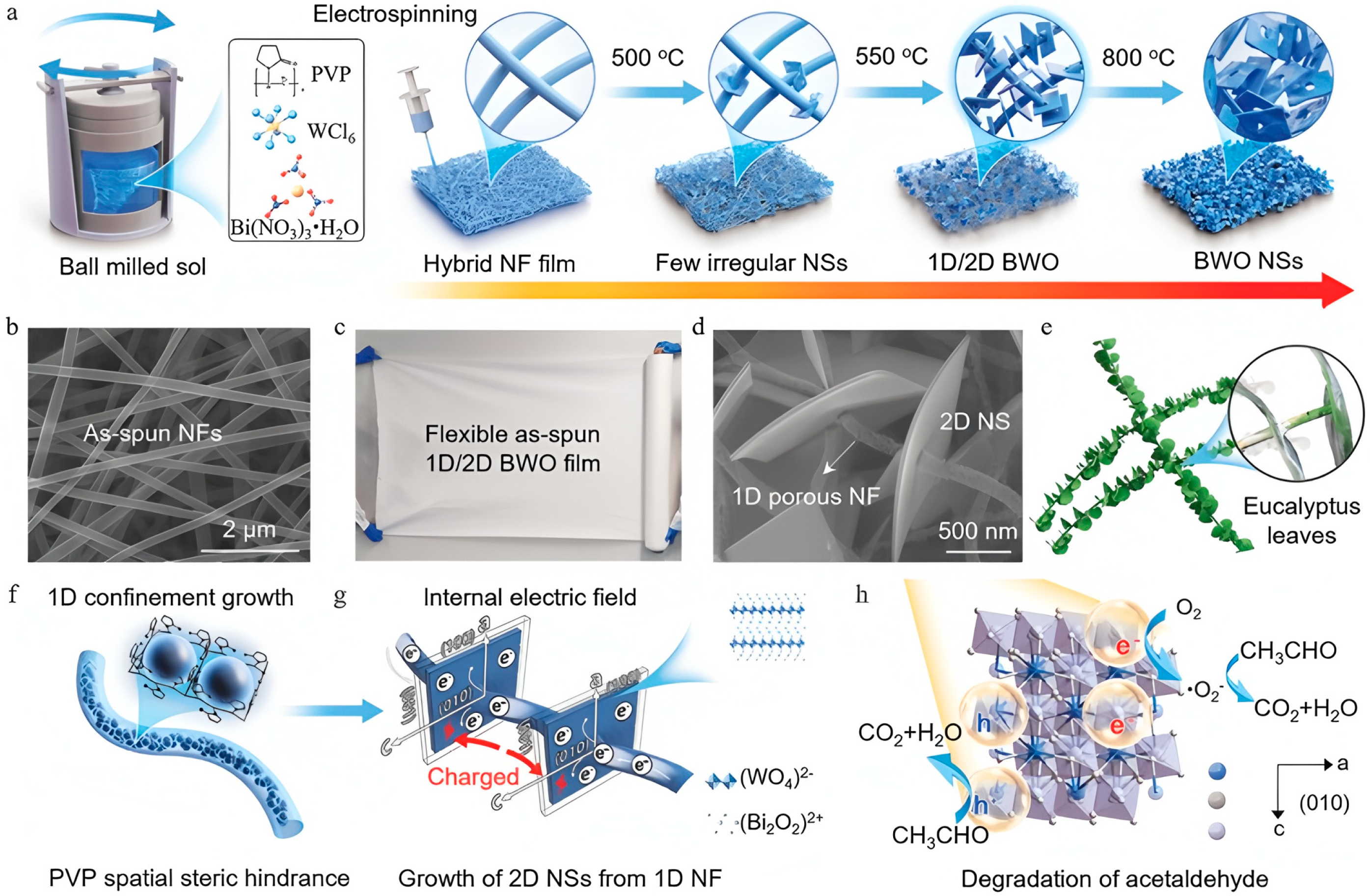
Trend 2: Microstructural design resolves nanosheet stacking and exposes active facets. Constructing 1D/2D or 0D/1D/2D hierarchical architectures increases accessible active sites, exposes high-activity crystal planes, and improves light harvesting [80]. To address the stacking issue of two-dimensional nanosheets, Chen et al. [43] developed a flexible Bi2WO6 (BWO) thin film structure via electrospinning followed by calcination, featuring a 1D nanofiber/2D nanowire interpenetrating network (Figure 4); this unique architecture resolved the stacking problem and selectively exposed {010} crystal planes with high hole oxidation performance, enabling rapid acetaldehyde degradation and excellent stability over multiple cycles. Building on this, Chen et al. [44] further transformed the 1D/2D BWO structure under H2/Ar reduction, reducing Bi3+ to Bi0 to form a dynamically evolving 0D/1D/2D Bi-BWO metal-defect system, achieving faster acetaldehyde degradation compared to conventional 1D/2D BWO.
Trend 3: S-type heterojunction construction promotes interfacial charge separation while preserving redox potential. The staggered band alignment in S-type heterojunctions facilitates recombination of useless carriers while retaining more powerful electrons and holes on opposite sides [81]. Kong et al. [82] introduced Pt and Bi into Bi2WO6/CeO2, creating an S-type heterojunction that promoted interfacial charge separation and enhanced redox capacity, leading to increased photocatalytic reaction rates. Borjigin et al. [45] developed an S-type CuBi2O4/CeO2−x heterojunction with abundant oxygen vacancies; interfacial synergy generated more superoxide and hydroxyl radicals, achieving high toluene degradation and CO2 yield with stable cycling performance compared to pure CeO2. Wu et al. [46] prepared a Bi2MoO6/WO3 S-type heterojunction for formaldehyde degradation. Within the same study, significantly reduced interfacial charge transfer resistance led to enhanced degradation efficiency for high-concentration formaldehyde compared to pure Bi2MoO6.
In summary, self-doping (e.g., Bi), microstructural engineering (e.g., 1D/2D, 0D/1D/2D architectures), and S-type heterojunction construction consistently enhance the photocatalytic performance of bismuth-based oxides within individual studies by improving light absorption, charge separation, and surface reactivity. However, the near-absence of Tier I studies, with only one identified, severely limits quantitative understanding. Future research on bismuth-based oxides should prioritize reporting incident photon flux and calculating AQY.

6. Metal–Organic Frameworks (MOFs)

Metal–organic frameworks (MOFs) have garnered significant attention in the field of photocatalysis due to their tunable pore structures and exceptionally high specific surface areas. However, conventional MOFs commonly exhibit limitations such as narrow light response ranges, slow charge transfer rates, and suboptimal stability, which hinder their practical applications [83]. Through strategies like ligand functionalization, structural derivatization, and composite construction, MOFs can be effectively modified to regulate their band structures, enhance light absorption, and improve charge separation, thereby significantly boosting their photocatalytic performance [84,85].
It is important to note that, unless otherwise specified, all studies cited in this section achieved adsorption–desorption equilibrium under dark conditions prior to light irradiation. This experimental practice is particularly critical for MOFs due to their exceptionally high specific surface areas, where adsorption-induced concentration decreases can significantly exceed photocatalytic contributions. Strict dark equilibrium ensures that reported degradation rates accurately represent photocatalytic activity rather than adsorption effects. As established in Section 2, the vast majority of these studies (Tier II) do not report incident photon flux or AQY. Therefore, they can only inform qualitative trends, not quantitative cross-study comparisons.

6.1. MOF-Based Tier I Studies with Standardized Reporting

Metal–organic frameworks (MOFs) have garnered significant attention in photocatalysis due to their tunable pore structures, exceptionally high specific surface areas, and the ability to integrate light-harvesting organic linkers with metal-oxo clusters. However, conventional MOFs often suffer from narrow light response ranges, slow charge transfer rates, and limited stability, which hinder their practical applications. Moreover, the lack of standardized photochemical reporting, particularly incident photon flux and apparent quantum yield, has severely limited cross-study comparisons and the rational design of MOF-based photocatalysts for VOC degradation.
Among MOF-based literature, Yang et al. [28] met the Tier I criteria by reporting both incident photon flux and apparent quantum efficiency. They constructed a CeO2-chelated Ce-MOF isogenous S-scheme heterojunction for acetaldehyde purification. Using a Xe lamp with a 420 nm bandpass filter and an incident photon flux of 100 mW/cm2, they achieved an apparent quantum efficiency (AQE) of 7.15% at 420 nm. This work demonstrates that isogenous heterojunction design can achieve efficient exciton dissociation and charge separation, providing a quantitative benchmark for MOF-based photocatalysis. More recently, Lu et al. [29] constructed a mediator-assisted hybridized step (MAH-S)-scheme heterojunction by combining Ag-doped WO3 (AW) with an amine-functionalized NH2-MIL-125 (M), denoted as AWM-10, for the mineralization of gaseous formaldehyde (5 ppm) in a portable air purifier. Under a 1 W UV-LED (λ_max = 370 nm), AWM-10 achieved 100% removal of FA with a clean air delivery rate of 11.48 L·min−1 and an apparent quantum yield (AQY) of 0.238%. The enhanced performance is attributed to the dual role of Ag nanoparticles: they act as an electron mediator to facilitate directional charge separation and as a plasmonic photosensitizer to generate hot electrons, extending light absorption and boosting charge carrier density. The complete mineralization pathway from HCHO to CO2 was confirmed by in situ DRIFTS and GC-FID analysis.
These Tier I studies provide quantitative benchmarks for MOF-based photocatalysis. The work on CeO2/Ce-MOF isogenous S-scheme heterojunction demonstrates that isogenous heterojunction design can achieve efficient exciton dissociation and charge separation. The study on Ag-WO3/NH2-MIL-125 MAH-S heterojunction shows that even for high-surface-area, adsorption-sensitive materials, rigorous reporting of photon flux and AQY is feasible. Both works highlight the critical importance of verifying dark adsorption equilibrium and measuring quantum efficiency to distinguish true photocatalysis from adsorption effects.

6.2. Ligand Functionalization and Composites: Qualitative Trends from MOF-Based Tier II Studies

The majority of MOF studies fall into Tier II, lacking photon flux or AQY reporting. While their reported degradation rates and ζr values are not comparable across different experimental setups, they collectively indicate several qualitative trends regarding ligand functionalization, heterojunction construction, and composite formation.
Trend 1: Ligand functionalization modulates electronic structure and enhances VOC capture. Introducing donor or acceptor groups (e.g., NH2, Fc-CHO) narrows the bandgap, extends light absorption, enhances “ligand-to-metal” charge transfer, and improves VOC capture through specific interactions [47,86]. Yang et al. [87] synthesized NH2-functionalized MIL-125 with varying degrees of modification via solvothermal method; NH2 functionalization broadened the light absorption range and optimized charge separation pathways, leading to enhanced degradation of o-xylene and acetaldehyde compared to unmodified MIL-125. The NH2 groups act as adsorption sites via H bonding for o-xylene and Lewis acid–base interactions for acetaldehyde, while also facilitating ROS generation. Yu et al. [48] employed ferrocenecarboxaldehyde (Fc-CHO) for post-synthetic modification of reo-NH2-UiO-66; functional group introduction introduced Fe-OH and cyclopentadienyl rings as new adsorption sites, enhancing LMCT, electron–hole separation, and ROS generation, while π-π stacking promoted toluene ring-opening.
Trend 2: MOF-derived materials and heterojunctions combine high surface area with conductivity. MOF-derived metal oxides and heterojunctions leverage the high surface area of MOFs and the conductivity of functional materials (e.g., graphene, TiO2) to form efficient interfacial charge transfer pathways. Uppara et al. [88] synthesized MOF-derived Ce-Cu oxides via solvothermal synthesis; compared with pure phase oxides, the derived material exhibited narrower band gap, higher specific surface area, and better visible-light absorption, leading to enhanced pollutant degradation [89]. Shah et al. [49] developed a highly conductive, defect-rich nanohybrid material by bridging NH2-MIL-125 with 3D graphene through an amino-ionic liquid strategy (IL-3DGr/NM(Ti)); this created abundant coordinatively unsaturated sites and oxygen vacancies, with activity increasing with relative humidity up to 80%, and excellent stability. Wang et al. [50] constructed a Z-type heterojunction (Zr10Ti1-U6N-300@TiO2) using bimetallic MOF derivatives and TiO2; through efficient interfacial charge separation, the material maintained stable toluene removal and selectivity over extended operation.
Trend 3: Plasma-assisted systems create synergistic degradation cascades. Coupling non-thermal plasma with MOF-derived catalysts leverages non-selective active species from plasma and specific active sites on the catalyst surface. Lu et al. [90] achieved significant synergistic effects by combining La2O3-CeO2 catalysts (with MOF precursors) with pulsed plasma. Within their study, non-selective active species generated by plasma interacted with specific active sites on the catalyst surface, forming an efficient degradation cascade that completely mineralized pollutants while reducing harmful by-products.
Ligand functionalization, MOF-derived heterojunctions, and plasma-assisted systems consistently enhance MOF photocatalytic performance within individual studies by broadening light absorption, improving charge transfer, and creating synergistic effects. The exceptionally high surface areas of MOFs make dark adsorption equilibrium particularly critical; future research must ensure rigorous dark equilibrium protocols. The field urgently needs standardized reporting of photon flux and AQY to enable meaningful quantitative comparison across studies.

7. Conclusions

This review critically assesses the state of photocatalytic VOC degradation across four catalyst families. The most significant finding is not a performance ranking but a methodological crisis: among over 80 studies surveyed, the vast majority lack essential photochemical parameters—incident photon flux, apparent quantum yield (AQY), or rigorous dark adsorption equilibrium. Consequently, most published work consists of non-comparable case studies. Within individual studies under identical conditions, modification strategies (doping, heterojunctions, surface engineering) consistently enhance activity relative to controls. However, without standardized metrics, any claim of superior performance based solely on degradation percentages or mass-based rate constants is scientifically unverifiable across different reactors, light sources, or laboratories.
Only a handful of Tier I studies report photon flux and AQY, proving that rigorous standardization is feasible but far from routine. These exemplars provide genuine benchmarks, yet they remain exceptional. Moreover, most studies are conducted under simplified, single-component, steady-state conditions that ignore real-world VOC mixtures, humidity fluctuations, and temperature variations. Few identify degradation intermediates or assess by-product toxicity.
To advance the field, future research must adopt unified reporting standards as a minimum requirement: (1) systematically report light source characteristics, incident photon flux, reactor geometry, and operating conditions; (2) always verify dark adsorption equilibrium; (3) calculate AQY or within-study ζr against a clear benchmark (e.g., P25 under identical conditions). Literature evaluations should explicitly distinguish standardized (Tier I) from non-standardized (Tier II) studies, treating the latter as qualitative, hypothesis-generating observations rather than quantitative evidence. Mechanistic studies using operando characterization and engineering evaluations under realistic, long-term, multi-component conditions are urgently needed. Only through such a cultural shift from performance advocacy to reproducible, photochemically rigorous science can photocatalytic VOC degradation mature into a credible technology for environmental protection.

Author Contributions

Conceptualization, X.-J.F.; methodology, X.-J.F. and X.S.; software, X.S., H.-Y.Z., C.-H.H. and Q.-B.Y.; validation, X.S., X.-J.F., H.-Y.Z. and C.-H.H.; formal analysis, H.-Y.Z., X.S. and X.-J.F.; investigation, X.-J.F., Q.-B.Y., H.-Y.Z. and X.-J.F.; resources, X.-J.F.; data curation, X.S., H.-Y.Z., C.-H.H., Q.-B.Y. and X.-J.F.; writing—original draft preparation, X.S., H.-Y.Z. and C.-H.H.; writing—review and editing, X.-J.F. and C.-H.H.; visualization, H.-Y.Z., Q.-B.Y. and C.-H.H.; supervision, X.-J.F.; project administration, X.-J.F.; funding acquisition, X.-J.F. All authors have read and agreed to the published version of the manuscript.

Funding

This work was financially supported by the Jianghuai Talents Program (Wan Zu Ban Zi [2025]16); the Shandong Provincial Key Research and Development Program (2021CXG011206); the Bonanza and Precision Mining, Guizhou Provincial Academician Expert Workstation (KXJZ [2024]003).

Data Availability Statement

The original contributions presented in this study are included in the article. Further inquiries can be directed to the corresponding authors.

Conflicts of Interest

The authors declare no conflicts of interest.

References

  1. Zheng, G.; Wei, K.; Kang, X.; Fan, W.; Ma, N.L.; Verma, M.; Ng, H.S.; Ge, S. A new attempt to control volatile organic compounds (VOCs) pollution—Modification technology of biomass for adsorption of VOCs gas. Environ. Pollut. 2023, 336, 122451. [Google Scholar] [CrossRef]
  2. Zhang, X.; Chen, D.; Liang, C.; Shen, B. Water poisoning and resistance in catalytic oxidation of VOCs from industrial flue gas. Fuel Process. Technol. 2025, 273, 108231. [Google Scholar] [CrossRef]
  3. Wang, L.; Liu, Q.; Wang, B.; Yang, Y.; Tang, L.; Dai, J.; Cheng, X.; Peng, Y.; Du, G.; Gao, W. Br-Doped CuO NPs@Wood for Photocatalytic Degrading Organic Dyes and VOCs. ACS Appl. Mater. Interfaces 2025, 17, 63384–63398. [Google Scholar] [CrossRef]
  4. Alibekov, A.; Bahetnur, Y.; Yessenbayeva, K.; Baimatova, N.; Lee, W. Severe health risks from ambient volatile organic compounds (VOCs) in a Central Asian city: Source attribution and probabilistic risk assessment. Atmos. Environ. X 2025, 28, 100378. [Google Scholar] [CrossRef]
  5. Liu, H.; Zhang, M.; Shi, J.; Shan, H.; Cheng, R.; He, X.; Tan, K.; Shao, L.; Zuo, S.; Yang, P. Regulating the properties of TiO2-WO3 solid acid catalysts for catalytic oxidation of chlorine and sulfur-containing VOCs. J. Phys. Chem. Solids 2026, 209, 113273. [Google Scholar] [CrossRef]
  6. Ya, Z.; Zhang, S.; Xu, D.; Wang, H.; Li, M. Coupling Plastic Upgrading and Photocatalysis: Catalytic Mechanisms and Design Principles. ACS Catal. 2025, 15, 5339–5369. [Google Scholar] [CrossRef]
  7. Wu, Y.; Liu, Y.; Shen, Z.; Zhang, Y.; Zhang, K.; Chai, X.; Song, M. High performance S-scheme Bi2MoO6/MoS2 for photocatalytic VOCs degradation: Mechanism and strategies. J. Environ. Chem. Eng. 2026, 14, 121354. [Google Scholar] [CrossRef]
  8. Yang, X.; Wang, D. Photocatalysis: From Fundamental Principles to Materials and Applications. ACS Appl. Energy Mater. 2018, 1, 6657–6693. [Google Scholar] [CrossRef]
  9. Huang, J.; Feng, X.; Bi, F.; Huang, G.; Rao, R.; Qiao, R.; Zhang, X. Strategic defect engineering in TiO2 catalysts through electron beam irradiation: Unraveling enhanced photocatalytic pathways for multicomponent VOCs degradation. Sep. Purif. Technol. 2025, 359, 130804. [Google Scholar] [CrossRef]
  10. Luo, Y.; Wang, X.; Gao, F.; Jiang, L.; Wang, D.; Pan, H. From Single Atom Photocatalysts to Synergistic Photocatalysts: Design Principles and Applications. Adv. Funct. Mater. 2024, 35, 2418427. [Google Scholar] [CrossRef]
  11. Hoque, M.A.; Guzman, M.I. Photocatalytic Activity: Experimental Features to Report in Heterogeneous Photocatalysis. Materials 2018, 11, 1990. [Google Scholar] [CrossRef] [PubMed]
  12. Wang, C.; Rabani, J.; Bahnemann, D.W.; Dohrmann, J.K. Photonic Efficiency and Quantum Yield of Formaldehyde Formation from Methanol in the Presence of Various TiO2 Photocatalysts. J. Photochem. Photobiol. A 2002, 148, 169–176. [Google Scholar] [CrossRef]
  13. Serpone, N.; Sauvé, G.; Koch, R.; Tahiri, H.; Pichat, P.; Piccinini, P.; Pelizzetti, E.; Hidaka, H. Standardization Protocol of Process Efficiencies and Activation Parameters in Heterogeneous Photocatalysis: Relative Photonic Efficiencies ζr. J. Photochem. Photobiol. A 1996, 94, 191–203. [Google Scholar] [CrossRef]
  14. Qureshi, M.; Takanabe, K. Insights on Measuring and Reporting Heterogeneous Photocatalysis: Efficiency Definitions and Setup Examples. Chem. Mater. 2016, 29, 158–167. [Google Scholar] [CrossRef]
  15. Braslavsky, S.E.; Braun, A.M.; Cassano, A.E.; Emeline, A.V.; Litter, M.I.; Palmisano, L.; Parmon, V.N.; Serpone, N. Glossary of terms used in photocatalysis and radiation catalysis (IUPAC Recommendations 2011). Pure Appl. Chem. 2011, 83, 931–1014. [Google Scholar] [CrossRef]
  16. Ohtani, B. Photocatalysis A to Z—What we know and what we do not know in a scientific sense. J. Photochem. Photobiol. C Photochem. Rev. 2010, 11, 157–178. [Google Scholar] [CrossRef]
  17. Deng, X.; Zhu, X.; Sun, Z.; Li, X.; Liu, J.; Shi, C.; Zhu, A. Exceptional activity for photocatalytic mineralization of formaldehyde over amorphous titania nanofilms. Chem. Eng. J. 2016, 306, 1001–1009. [Google Scholar] [CrossRef]
  18. Lim, D.-H.; Ali Maitlo, H.; Younis, S.A.; Kim, K.-H. The practical utility of nitrogen doped TiO2 as a photocatalyst for the oxidative removal of gaseous formaldehyde. Mater. Today Nano 2024, 27, 100499. [Google Scholar] [CrossRef]
  19. He, X.; Zhang, J.; Vikrant, K.; Boukhvalov, D.W.; Kim, K.H. Schottky junction- and oxygen vacancy-driven charge separation for enhanced photocatalytic degradation of toluene over sodium- and palladium-modified titanium dioxide. J. Colloid Interface Sci. 2026, 704, 139453. [Google Scholar] [CrossRef] [PubMed]
  20. Hua, Y.; Vikrant, K.; Lim, D.H.; Chen, C.; Lu, Z.; Lu, Y.; Kim, K.H. Design, performance, and charge transfer insights into step-scheme zinc hydroxystannate/titanium dioxide heterostructures for enhanced photocatalytic oxidation of gaseous benzene. J. Hazard Mater. 2025, 499, 140134. [Google Scholar] [CrossRef]
  21. Lim, D.H.; Maitlo, H.A.; Younis, S.A.; Boukhvalov, D.W.; Kim, K.H.; Lee, J. Platinum/nitrogen-co-doped TiO2 as photocatalyst and light-free catalytic adsorbent for gaseous formaldehyde. J. Colloid Interface Sci. 2026, 702, 138895. [Google Scholar] [CrossRef]
  22. Maitlo, H.A.; Chen, C.; Lu, Z.; Kim, K.H. Mechanism and performance of a p-n Ag2O/TiO2 S-scheme heterojunction for photocatalytic oxidation of gaseous benzene. J. Hazard Mater. 2026, 503, 141126. [Google Scholar] [CrossRef]
  23. Li, Y.; Ouyang, S.; Xu, H.; Wang, X.; Bi, Y.; Zhang, Y.; Ye, J. Constructing Solid-Gas-Interfacial Fenton Reaction over Alkalinized-C3N4 Photocatalyst to Achieve Apparent Quantum Yield of 49% at 420 nm. J. Am. Chem. Soc. 2016, 138, 13289–13297. [Google Scholar] [CrossRef]
  24. Muñoz-Batista, M.J.; Fernández-García, M.; Kubacka, A. Promotion of CeO2–TiO2 photoactivity by g-C3N4: Ultraviolet and visible light elimination of toluene. Appl. Catal. B Environ. 2015, 164, 261–270. [Google Scholar] [CrossRef]
  25. Cho, M.-S.; Younis, S.A.; Lee, C.S.; Li, X.; Kim, K.-H. The superior mineralization potential of a graphitic carbon nitride/titanium dioxide composite and its application in the construction of a portable photocatalytic air purification system against gaseous formaldehyde. J. Mater. Chem. A 2024, 12, 32239–32258. [Google Scholar] [CrossRef]
  26. Amano, F.; Yamakata, A.; Nogami, K.; Osawa, M.; Ohtani, B. Visible Light Responsive Pristine Metal Oxide Photocatalyst: Enhancement of Activity by Crystallization under Hydrothermal Treatment. J. Am. Chem. Soc. 2008, 130, 17650–17651. [Google Scholar] [CrossRef] [PubMed]
  27. Zhang, J.; Vikrant, K.; Yeon, C.; Lee, C.W.; Kim, K.H. The practical feasibility of bismuth oxyhalide semiconductors with controlled surface defects in photocatalytic degradation of toluene in air. J. Colloid Interface Sci. 2025, 683, 90–100. [Google Scholar] [CrossRef]
  28. Yang, H.; Jia, L.; Zhang, Q.; Yuan, S.; Ohno, T.; Xu, B. Efficient Exciton Dissociation on Ceria Chelated Cerium-Based MOF Isogenous S-Scheme Photocatalyst for Acetaldehyde Purification. Small 2024, 20, e2308743. [Google Scholar] [CrossRef]
  29. Lu, Y.; Younis, S.A.; Kim, K.H. Photocatalytic mineralization of gaseous formaldehyde over silver-doped metal oxide/MOF heterostructure with a mediator-assisted hybridized step (MAH-S)-scheme charge configuration. J. Hazard Mater. 2026, 501, 140208. [Google Scholar] [CrossRef]
  30. Shen, Y.; Pang, H.; Wang, J.; Yan, Q.; Zhang, S. Sn doping and upconversion luminescence synergistically modified TiO2 for efficient degradation of formaldehyde and VOCs from wood-based panels. Constr. Build. Mater. 2025, 495, 143628. [Google Scholar] [CrossRef]
  31. Narindri Rara Winayu, B.; Tsai, Y.-Y.; Chu, H. Enhancement of formaldehyde removal by graphene, S, and N doping on TiO2 nanocomposite photocatalyst. J. Phys. Chem. Solids 2022, 170, 110961. [Google Scholar] [CrossRef]
  32. Ly, H.N.; Parasuraman, V.; Lee, H.; Sheraz, M.; Anus, A.; Lee, W.R.; Kim, S. Enhancing air treatment through controlled fabrication of transition metal-doped titanium dioxide nanocomposites for photocatalytic toluene degradation. Chemosphere 2024, 351, 141261. [Google Scholar] [CrossRef]
  33. Dong, H.; Shao, Q.; Ji, Y.; Bai, W.; Zhang, J.; Long, C. Oxygen Vacancies Enhance Water-Driven Activation of Surface Lattice Oxygen on TiO2 for Efficient Photocatalytic Oxidation of Toluene. ACS EST Eng. 2025, 5, 2994–3006. [Google Scholar] [CrossRef]
  34. Xu, L.; Guo, P.; Xu, J.; Shen, B.; Zhao, Z. Regulation of TiO2/ZSM-5 catalyst for enhanced photocatalytic toluene oxidation: Intensified light absorption, charge separation and toluene adsorption. Colloids Surf. A Physicochem. Eng. Asp. 2024, 690, 133832. [Google Scholar] [CrossRef]
  35. Zhou, L.; Shen, Z.; Wang, S.; Gao, J.; Tang, L.; Li, J.; Dong, Y.; Wang, Z.; Lyu, J. Construction of quantum-scale catalytic regions on anatase TiO2 nanoparticles by loading TiO2 quantum dots for the photocatalytic degradation of VOCs. Ceram. Int. 2021, 47, 21090–21098. [Google Scholar] [CrossRef]
  36. Wang, D.; Tian, H.; Zhu, J.; Lu, Z.; He, Z.; Song, S. Enhanced photocatalytic degradation of toluene on surface C- and CN-modified TiO2 microspheres. Appl. Surf. Sci. 2024, 673, 160862. [Google Scholar] [CrossRef]
  37. Narindri Rara Winayu, B.; Chen, Y.-L.; Chu, H. Promotion in styrene removal through visible light driven photocatalytic oxidation over Ni coated g-C3N4. Appl. Catal. A Gen. 2025, 705, 120444. [Google Scholar] [CrossRef]
  38. Fu, F.; Yang, J.; Xu, H.; Li, Y.; Cao, S.; Da, K.; Chen, W.; Fan, X. Enhancing the photocatalytic performance of the g-C3N4/BiOCl heterojunction in gaseous toluene degradation via K+ decoration in g-C3N4. Chem. Eng. Sci. 2023, 276, 118793. [Google Scholar] [CrossRef]
  39. Cong, X.; Li, A.; Guo, F.; Qin, H.; Zhang, X.; Wang, W.; Xu, W. Construction of CdS@g–C3N4 heterojunction photocatalyst for highly efficient degradation of gaseous toluene. Sci. Total Environ. 2024, 913, 169777. [Google Scholar] [CrossRef]
  40. Bai, Z.; Wang, C.; Pei, J.; He, J.; Liu, J. Constructing Z-scheme heterojunction of AC@g-C3N4/MnOx for effective removal of acetaldehyde in building environment. Build. Environ. 2025, 280, 113137. [Google Scholar] [CrossRef]
  41. Cheng, C.; Jing, H.; Ji, H.; Li, Y.; Ma, L.; Hao, J. Bioderived carbon aerogels loaded with g-C3N4 and their high Efficacy removing volatile organic compounds (VOCs). J. Colloid Interface Sci. 2025, 678, 1112–1121. [Google Scholar] [CrossRef] [PubMed]
  42. Guo, L.; Liao, H.; Han, S.; Li, D.; Wang, B.; Shen, J.; Dai, W.; Wang, X.; Zhang, Z.; Xi, H. Embedding Bi sandwich structure Bi2O3/Bi/TiO2 photocatalyst for enhancing the durable degradation of toluene. J. Environ. Sci. 2025, 163, 145–153. [Google Scholar] [CrossRef]
  43. Chen, Y.; Zhang, L.; Chen, S.; Sun, S.; Cheng, H.; Li, S.; Yu, J.; Ding, B.; Yan, J. Synthesis of Heteromorphic Bi2WO6 Films with an Interpenetrate 1D/2D Network Structure for Efficient and Stable Photocatalytic Degradation of VOCs. Adv. Mater. 2024, 36, 2407400. [Google Scholar] [CrossRef]
  44. Chen, Y.; Chen, S.; Zhang, L.; Sun, S.; Gao, P.; Zhu, W.; Shen, J.; Yan, J. Constructing 0D Bismuth-Metal Nanosphere Networks on 1D/2D Bi2WO6 Heteromorphic Junctions for Efficient Photocatalytic Degradation of Acetaldehyde. Adv. Mater. 2025, 38, e13684. [Google Scholar] [CrossRef]
  45. Borjigin, B.; Ding, L.; Liu, C.; Li, H.; Wang, X. Assembling an S-type heterojunction comprising vacancy-rich CeO2-x and CuBi2O4 for improved photocatalytic oxidation of gaseous toluene. Chem. Eng. J. 2024, 485, 149995. [Google Scholar] [CrossRef]
  46. Wu, Y.; Liu, Y.; Shen, Z.; Song, M. S-scheme heterojunction Bi2MoO6/WO3 toward efficient photocatalytic oxidation of indoor gaseous formaldehyde under indoor temperature, humidity and sunlight irradiation conditions. Build. Environ. 2025, 282, 113297. [Google Scholar] [CrossRef]
  47. Wang, H.; Pan, Y.; Li, Z.; Cheng, Y.; Luo, Y.; Li, F.; Yu, C. Synergistic effect between amino functional group and graphene oxide in selective photocatalytic CO2 reduction to formic acid. J. Alloys Compd. 2025, 1010, 177481. [Google Scholar] [CrossRef]
  48. Yu, J.; Wang, X.; Yang, S.; Xie, X.; Sun, J. Modulating the local electron distribution of reo-NH2-UiO-66 through Fc-CHO functionalization for the effective photodegradation of single and mixed VOCs. Chem. Eng. J. 2025, 521, 166932. [Google Scholar] [CrossRef]
  49. Shah, S.J.; Luan, X.; Yu, X.; Su, W.; Wang, Y.; Zhao, Z.; Zhao, Z. Construction of 3D-graphene/NH2-MIL-125 nanohybrids via amino-ionic liquid dual-mode bonding for advanced acetaldehyde photodegradation under high humidity. J. Colloid Interface Sci. 2024, 663, 491–507. [Google Scholar] [CrossRef]
  50. Wang, J.; Yang, C.; Ye, D.; Hu, Y. The mechanism of effective photocatalytic degradation of toluene by Zr/Ti bimetallic metal-organic framework derivatives loaded with TiO2. Appl. Catal. B Environ. Energy 2025, 361, 124635. [Google Scholar] [CrossRef]
  51. Lee, J.-Y.; Hsu, J.-C.; Pien, K.-C.; Sun, Y.-S.; Wu, H.-Y. Photocatalytic properties of C, N-doped TiO2 films prepared via ion-assisted RF magnetron sputtering. Opt. Mater. 2025, 164, 117061. [Google Scholar] [CrossRef]
  52. Chen, J.; Chen, L.; Wang, X.; Sun, J.; Chen, A.; Xie, X. Er single atoms decorated TiO2 and Er3+ ions modified TiO2 for photocatalytic oxidation of mixed VOCs. Appl. Surf. Sci. 2022, 596, 153655. [Google Scholar] [CrossRef]
  53. Li, S.; Liu, H.; Hu, X.; Fang, Y.; Cao, X.; Chen, Q. Selective activation of dioxygen to singlet oxygen over La-Si co-doped TiO2 microspheres for photocatalytic degradation of formaldehyde. J. Environ. Sci. 2025, 151, 594–607. [Google Scholar] [CrossRef]
  54. Ángeles-Beltrán, D.; Chavez-Esquivel, G.; Tavizón-Pozos, J.A.; Suárez-Toriello, V.A.; Santolalla-Vargas, C.E.; Aguilar-Martínez, O. Photocatalytic degradation of phenol using cadmium-TiO2/chitosan hybrid catalysts. Mater. Res. Express 2025, 12, 065901. [Google Scholar] [CrossRef]
  55. Cordeiro, D.S.; Cassio, F.L.; Ciccotti, L.; Hewer, T.L.R.; Corio, P.; Freire, R.S. Photocatalytic activity of Pr-modified TiO2 for the degradation of bisphenol A. SN Appl. Sci. 2021, 3, 258. [Google Scholar] [CrossRef]
  56. Wang, K.; Gao, X.; Sendeku, M.G.; Yuan, B.; Zhang, Y.; Liu, Y.; Yang, Y.; Ju, L.; Wang, F.; Sun, X. Phase and Composition Engineering of Mn-Doped TiO2 for Hydrogen Peroxide Synthesis through Ion-Mediated Water Oxidation. ACS Catal. 2025, 15, 4229–4238. [Google Scholar] [CrossRef]
  57. Cheng, R.; Zhang, M.; Zhou, P.; Ye, N.; Yang, P. Study on the synergistic effect of transition metal doped TiO2 composite catalysts in the catalytic degradation of VOCs. Surf. Interfaces 2025, 62, 106205. [Google Scholar] [CrossRef]
  58. Nawaz, M.N.; Zhang, Z.; Yuan, W.; Khan, S.B. Photocatalytic enhancement of TiO2 through silver, gold, and platinum doping. Energy Nexus 2025, 19, 100495. [Google Scholar] [CrossRef]
  59. Song, S.; Xiang, J.; Kang, H.; Yang, F. Enhanced Photocatalytic Oxidative Coupling of Methane over Metal-Loaded TiO2 Nanowires. Molecules 2025, 30, 206. [Google Scholar] [CrossRef]
  60. Ai, T.; Yang, Y.; Lu, J.; Yang, X.; Pei, Z.; Xu, Z.; Song, T.; Zhu, W.; He, S.; Luo, Y. Synergistically constructing dual oxygen/sulfur vacancies and activating lattice oxygen in MoS2/TiO2 via heterointerface charge transfer for catalytic degradation of sulfur-containing VOCs. Chem. Eng. J. 2025, 507, 160574. [Google Scholar] [CrossRef]
  61. Zou, Y.; Li, X.; Zhao, Y.; Liu, X.; Xie, S.; Liu, F.; Zhu, T. Boosting Oxygen Activation via Defect Engineering to Regulate CO Oxidation Pathway over Pt/TiO2 Catalysts. ACS Catal. 2025, 15, 6346–6360. [Google Scholar] [CrossRef]
  62. Liu, L.; Xue, Z.; Gao, T.; Zhao, Q.; Sun, Y.; Wu, Y. Photocatalytic degradation performance of Ag-modified flexible TiO2 nanofiber film. Opt. Mater. 2025, 160, 116720. [Google Scholar] [CrossRef]
  63. Lim, K.R.G.; Kaiser, S.K. Partial PdAu nanoparticle embedding into TiO2 support accentuates catalytic contributions from the Au/TiO2 interface. Proc. Natl. Acad. Sci. USA 2024, 122, e2422628122. [Google Scholar] [CrossRef]
  64. Chi, Z.; Liu, Z.; Liu, W.; Cai, J.; Zhang, Y.; Dai, Y.; Zhang, J.; Ye, Z.; Tian, B. Inverse opal structured Pt/TiO2–MnOy photothermocatalysts for enhanced toluene degradation activity. J. Mater. Chem. A 2024, 12, 32913–32924. [Google Scholar] [CrossRef]
  65. Qiao, Q.; Chen, Y.; Wang, Y.; Ren, Y.; Cao, J.; Huang, F.; Bian, Z. Surface modification of phosphate ion to promote photocatalytic recovery of precious metals. Chin. Chem. Lett. 2023, 34, 107394. [Google Scholar] [CrossRef]
  66. Huang, W.; Wang, W.; Li, K.-X.; Bai, Y.; Hu, Z.; Ye, Q. Photothermal synergistic effect of M/TiO2 nanofiber catalysts prepared by electrospinning in removing VOCs. J. Environ. Chem. Eng. 2025, 13, 116261. [Google Scholar] [CrossRef]
  67. Chen, J.; Guo, X.; Lang, L.; Yin, X.; Wang, A.; Rui, Z. Multifunctional Z-scheme CuxO/Ag/SrTiO3 heterojunction for photothermocatalytic VOCs degradation and antibiosis. Appl. Surf. Sci. 2023, 618, 153275. [Google Scholar] [CrossRef]
  68. Liu, Y.; Li, W.; Omidkar, A.; Li, Z.; Song, H. Synergistic catalytic performance of toluene degradation based on non-thermal plasma with Pt-TiO2. J. Environ. Chem. Eng. 2025, 13, 118767. [Google Scholar] [CrossRef]
  69. Fang, W.; Wu, D.; Dai, W.; Wang, S.; Hu, B.; Chen, G.; Yu, S. Versatile properties of g-C3N4-based materials and their photocatalytic applications. Desalination 2025, 614, 119194. [Google Scholar] [CrossRef]
  70. Li, P.; Hu, Y.; Lu, D.; Wu, J.; Lv, Y. Study on g-C3N4/BiVO4 Binary Composite Photocatalytic Materials. Micromachines 2023, 14, 639. [Google Scholar] [CrossRef] [PubMed]
  71. Li, A.; Cong, X.; Qin, H.; Xu, W.; Zhang, X.; Wang, W.; Guo, F. Experiments and DFT investigation of microwave-assisted sol–gel method prepared S-doped g-C3N4 for enhanced photocatalytic degradation of gaseous toluene. New J. Chem. 2023, 47, 3910–3920. [Google Scholar] [CrossRef]
  72. Alauddin; Rehman, Z.U.; Bilal, M.; Jrar, J.A.; Asghar, Z.; Yang, X.; Khan, M.A.; Ali, S.; Ismail, P.M.; Hou, J.H. Surface modification of Cl-doped g-C3N4 interconnected porous nanosheets for photocatalytic applications. Int. J. Hydrogen Energy 2025, 127, 801–812. [Google Scholar] [CrossRef]
  73. Chen, H.; Fan, Z.; Zhang, Z.-C.; Guo, J.; Wang, C.-C. Synthesis and modification of g-C3N4 semiconductor catalysts for photocatalytic hydrogen evolution: A review. Prog. Nat. Sci. Mater. Int. 2025, 35, 449–468. [Google Scholar] [CrossRef]
  74. Saman, F.; Se Ling, C.H.; Ayub, A.; Rafeny, N.H.B.; Mahadi, A.H.; Subagyo, R.; Nugraha, R.E.; Prasetyoko, D.; Bahruji, H. Review on synthesis and modification of g-C3N4 for photocatalytic H2 production. Int. J. Hydrogen Energy 2024, 77, 1090–1116. [Google Scholar] [CrossRef]
  75. Rizwan, M.; Zada, A.; Azizi, S.; Fazil, P.; Naeem, M.; Murtaza, G.; Ibrahim, N.A.; Basher, N.S.; Liu, Z.; Eisa, M.H. Role of metal and non-metal dopants in modulating g-C3N4 for photocatalytic applications. Int. J. Hydrogen Energy 2025, 97, 1126–1152. [Google Scholar] [CrossRef]
  76. Liu, S.; Li, D.; Sun, H.; Ang, H.M.; Tadé, M.O.; Wang, S. Oxygen functional groups in graphitic carbon nitride for enhanced photocatalysis. J. Colloid Interface Sci. 2016, 468, 176–182. [Google Scholar] [CrossRef] [PubMed]
  77. Ashraf, A.; Faisal, M.R.; Naeem, M.; Aadil, M.; Arshad, J.Z.; Nosheen, F.; Ilyas, M.I.; Islam, M.S.; Habila, M.A.; Raza, M.A. Visible Light-Driven Photocatalytic Degradation of Levofloxacin by Silver and Vanadium Co-Doped Bismuth Oxide: Structural, Optical, and Optoelectronic Properties. Chem. Afr. 2025, 8, 4567–4582. [Google Scholar] [CrossRef]
  78. Liu, Z.; Qian, M.; Cheng, X.; Liu, Z. Recent Advances in the Photocatalytic Degradation of Phenol over Bi-Based Oxide Catalysts. Processes 2024, 12, 1799. [Google Scholar] [CrossRef]
  79. Jia, Y.; Shi, J.; Han, Z.; Liu, X.; Wang, Y.; Song, Y.; Liu, Y.-G.; Zhang, R.; Zhang, H.; Jiang, H.-Y. Efficient Photocatalytic Degradation of Highly Concentrated Perfluorooctanoic Acid by Bi Self-Doped Bi2MoO6. Langmuir 2025, 41, 13459–13467. [Google Scholar] [CrossRef]
  80. Xue, Q.; Qiao, Y.; Li, B.; Du, P.; Liu, Q.; Yan, Y.; Li, R.; Dang, Y.; Zhou, Y. Constructing a p–n heterojunction between Bi2WO6 and Co3O4 for enhanced photothermocatalytic degradation of toluene. New J. Chem. 2026, 50, 1273–1284. [Google Scholar] [CrossRef]
  81. Zhan, X.; Ding, C.; Zhao, Q.; Fang, Y. S-scheme TiO2/Bi2WO6 heterojunction for enhanced photocatalytic selective oxidation of toluene. Opt. Mater. 2024, 155, 115860. [Google Scholar] [CrossRef]
  82. Kong, J.; Tang, M.; Luo, Y.; Song, S.; Xiang, Z.; Guo, Y.; Zhang, W.; Li, G.; An, T. Pyroelectric Pt-supported S-scheme heterojunction catalyst for effective photocatalytic degradation of VOCs containing soot driven by visible light. Appl. Catal. B Environ. Energy 2025, 365, 124858. [Google Scholar] [CrossRef]
  83. Zhang, C.; Wu, Y.; Li, D.; Jiang, H.-L. Recent advances in MOF composites for photocatalysis. Chem. Sci. 2025, 16, 13149–13172. [Google Scholar] [CrossRef] [PubMed]
  84. Qureshi, W.A.; Haider, S.N.-U.-Z.; Qaiser, M.A.; Khan, S.; Wang, W.; Ali, R.N.; Ali, A.; Naveed, A.; Abdurahman, M.H.; Khan, M.U.; et al. Breakthrough in plasmonic enhanced MOFs: Design, synthesis, and catalytic mechanisms for various photocatalytic applications. Environ. Res. 2025, 277, 121257. [Google Scholar] [CrossRef]
  85. Nazir, M.A.; Ullah, S.; Arshad, M.; Javed, M.S.; Shaaban, I.A.; Iqbal, R.; Ahmad, A.; Karim, M.R.; Shah, S.S.A. MOFs-derived metal sulfides and their composite for photocatalysis. Sol. Energy 2025, 292, 113452. [Google Scholar] [CrossRef]
  86. Zhang, Y.; Chen, J.; Buren, T.; Li, Z.; Zhang, X.; Ma, S.; Wei, J.; Bi, F.; Zhang, X. Electron beam irradiation defective UiO-66 supported noble metal catalysts for binary VOCs removal: Insight into the synergistic degradation mechanism of mutual promotion. Sep. Purif. Technol. 2026, 380, 135236. [Google Scholar] [CrossRef]
  87. Yang, S.; Yu, J.; Lu, G.; Song, G.; Shi, G.; Wang, Y.; Xie, X.; Yuan, H.; Ren, X.; Sun, J. Effect of NH2-functionalization of MIL-125 on photocatalytic degradation of o-xylene and acetaldehyde. Chem. Eng. J. 2024, 498, 155251. [Google Scholar] [CrossRef]
  88. Uppara, H.P.; Goud, A.T.; atrey, A.; Diksha, K.; Urs, J.; Kumar, S.; Puttaswamy, C.T.; Palla, V.C.S. Fabrication of MOF-derived Ce–Cu nanofibers for ameliorating photo-catalytic properties. J. Porous Mater. 2025, 32, 1179–1196. [Google Scholar] [CrossRef]
  89. Wei, W.; Qin, L.; Jing, T.; Ling, G.; Zhang, P. Out of the misty forest of MOF composite heterojunctions: A new cognitive guide. Coord. Chem. Rev. 2026, 547, 217112. [Google Scholar] [CrossRef]
  90. Lu, J.; Li, J.; Hu, Z.; Feng, J.; Zong, K.; Zhu, J.; Wang, W.; Gao, E.; Wu, Z.; Yao, S.; et al. Elucidating synergistic mechanism of pulsed plasma coupled with La2O3-CeO2 catalyst for enhanced degradation of multicomponent VOCs from printing and dyeing emissions. Sep. Purif. Technol. 2026, 380, 135350. [Google Scholar] [CrossRef]
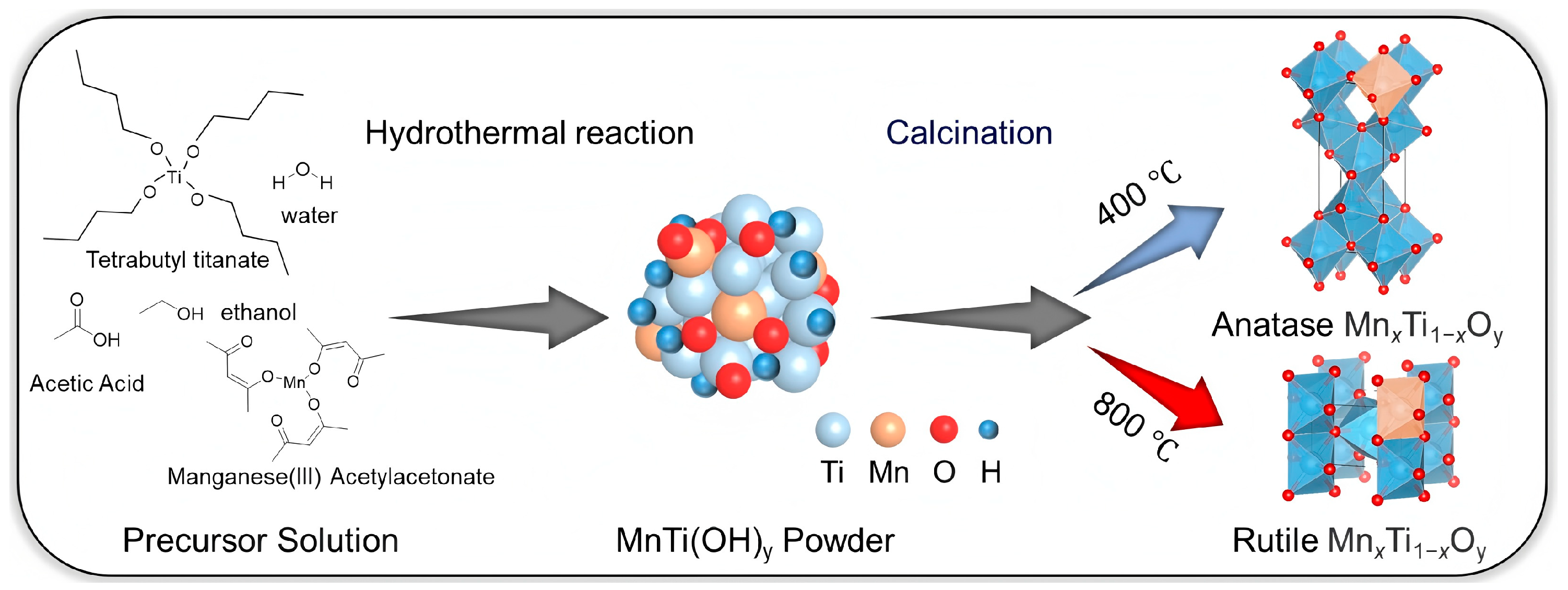
Figure 1. Schematic for the synthesis of anatase (A-MnxTi1−xOᵧ) and rutile (R-MnxTi1−xOᵧ) phases. Prepared via solvothermal–calcination method: solvothermal reaction at 160 °C for 12 h, followed by calcination at 500 °C for 2 h. Precise phase control of anatase and rutile was achieved by adjusting the Mn/Ti molar ratio (0.05–0.2). (Reprinted/adapted with permission from reference [56]).
Catalysts 16 00356 g001
Figure 2. Oxygen-vacancy-assisted O2 activation and CO oxidation mechanism over Pt/Ti-D catalysts. (a) Electrostatic potential energy distribution of CO and O2 molecules (red regions: electron-rich; blue regions: electron-deficient); CO preferentially adsorbs on Pt sites (electron-rich region), while O2 tends to adsorb near oxygen vacancies (electron-deficient region). (b) Schematic diagram of CO and O2 competitive adsorption on Pt sites. (c) Defect-assisted O2 adsorption activation mechanism: oxygen vacancies reduce the O2 activation energy barrier from 2.48 eV to 0.38 eV, facilitating O2 dissociation. (d) Schematic illustration of the synthesis process for the Pt/Ti-D catalyst, involving NaOH chemical etching of Ti-Si composite oxides. (Reprinted/adapted with permission from reference [61]).
Catalysts 16 00356 g002
Figure 3. Illustration of C3N4 layers with different interlayer stacking: (a) highly crystalline g-C3N4; (b) amorphous g-C3N4 structure. Scale bars indicate lattice spacing. The highly crystalline sample exhibits a sharp (002) diffraction peak at 2θ = 27.4°, corresponding to an interlayer stacking period of approximately 0.326 nm; the amorphous sample shows no distinct diffraction peak. Structural models are based on XRD refinement results and DFT calculations. (Reprinted/adapted with permission from reference [74]).
Catalysts 16 00356 g003
Figure 4. Synthesis strategy and photocatalytic mechanism of biomimetic interpenetrating 1D/2D Bi2WO6 films. (a) Synthesis process: fabrication of an interpenetrating network structure composed of 1D nanofibers and 2D nanowires via electrospinning followed by calcination, resolving the stacking issue of 2D nanosheets. (b) Under light excitation, this unique structure promotes charge separation and selectively exposes crystal planes with high hole oxidation performance, enabling rapid degradation of acetaldehyde. (c) Photographs of the as-spun NFs and flexible film. (d) SEM image of the 1D/2D structure. (e) Photograph of eucalyptus leaves for comparison; (f,g) Schematic of multiscale confinement and electrostatic forces. (h) Illustration of the enhanced photocatalytic degradation mechanism. (Reprinted/adapted with permission from reference [43]).
Catalysts 16 00356 g004
Table 1. Summary of Tier I studies reporting incident photon flux or apparent quantum yield (AQY) for VOC degradation.
Catalyst (Modification)Target VOC (Conc.)Light SourcePhoton Flux & Quantum YieldReactor TypeRef.
Amorphous titania nanofilm (AM-RT)Formaldehyde (54 ± 1 ppm)UV lamp (254 nm)Photon flux: 1.26 mW/cm2; AQY: 60.4%Single-pass continuous flow[17]
N-doped TiO2 (N/Ti = 1)Formaldehyde (100 ppm)UV-A (32 W lamp)AQY: 1.72 × 10⁻² molecules photon−1Packed-bed tubular[18]
Na,Pd-modified TiO2 (Schottky + O vacancy)Toluene (4 ppm)4 × 8 W UV lamps (λ_max = 254 nm, total 32 W)Photon flux: 0.038 W (incident power on catalyst); AQY: 0.130%Continuous flow (tubular fixed-bed)[19]
ZnSn(OH)6/TiO2 S-scheme heterojunction (ZST)Benzene (1 ppm)UV-A LED (1 W, λ_max = 370 nm)Photon flux: 0.0125 W/cm2; AQY: 6.08 × 10⁻³%Portable (chamber, 24.5 L, circulating)[20]
Pt/N-co-doped TiO2 (1 wt% Pt, N/Ti = 1)Formaldehyde (200 ppm)UV-A lamp (365 nm, 32 W)AQY: 5.58%Tubular fixed-bed (continuous flow)[21]
Ag2O/TiO2 p-n S-scheme heterojunction (AT-4)Benzene (1 ppm)UV-A LED (λ_max = 352 nm, total 32 W, incident power 0.050 W)Photon flux: 0.050 W; AQY: 0.061%Continuous flow (tubular fixed-bed)[22]
Alkalinized g-C3N4 (K-doped + OH-grafted + Fe3+)Isopropanol300 W Xe lamp with cutoff filter (λ > 400 nm); AQY at 420 ± 16 nmPhoton flux: 0.45 mW/cm2; AQY: 49% at 420 nmBatch (plate-type, solid–gas)[23]
CeO2-TiO2/g-C3N4 ternaryToluene4 × 6 W daylight (410–580 nm) + UV (~350 nm)AQY: UV 12.5 × 10⁻⁴%, sunlight 3.1 × 10⁻⁴%Batch (flat plate)[24]
g-C3N4/TiO2 composite (CNT-0.02)Formaldehyde (5 ppm)Low-power UV-A LED (1 W, λ_max = 370 nm)QY: 2.74 × 10⁻³ molecules photon−1Portable (chamber, 17 L, circulating)[25]
Crystalline Bi2WO6 (russellite)Acetaldehyde (2000 ppm)Visible light (λ > 400 nm); action spectrum measuredAQY: 8% at 400 nmBatch (gas–solid)[26]
BiOCl with surface defects (BiOCl-R)Toluene (5 ppm)4 × 8 W UV lamps (total 32 W)Photon flux: 0.076 W (incident power on catalyst); QY: 1.04 × 10⁻³ molecules photon−1Continuous flow (tubular fixed-bed)[27]
CeO2/Ce-MOF isogenous S-scheme heterojunctionAcetaldehyde (200 ppm)300 W Xe lamp with 420 nm cutoff filter; intensity 100 mW/cm2Photon flux: 100 mW/cm2; AQE: 7.15% at 420 nmBatch (500 mL Tedlar bag)[28]
Ag-WO3/NH2-MIL-125 MAH-S heterojunction (AWM-10)Formaldehyde (5 ppm)1 W UV-LED (λ_max = 370 nm)AQY: 0.238%Portable (chamber, 17 L, circulating)[29]
Note: All studies listed in this table meet the Tier I criteria by reporting at least one of the essential photochemical parameters (incident photon flux or AQY/QY); some report both. The reported values are as originally presented in each study. Due to differences in experimental conditions (light sources, reactor geometries, VOC concentrations, etc.), direct quantitative comparison across different studies is not recommended. This table serves to illustrate the current state of standardized reporting in the literature.
Table 2. Qualitative trends from Tier II studies (non-standardized reporting).
Catalyst (Modification)Target VOC (Conc.)Light Source (λ)Reactor TypeQualitative Observation (Within-Study Enhancement)Ref.
Sn-doped NaYF4/Sn@TiO2Formaldehyde, TVOCs500 W xenon lampSealed circulating chamber (1 m3)Enhanced formaldehyde and TVOC removal compared to pure TiO2; improvement attributed to Sn doping and upconversion luminescence synergy[30]
Graphene/S,N-co-doped TiO2 (0.1 wt% rGO/S0.05N0.1TiO2)Formaldehyde (1 ppm)Fluorescent lamp (10 W, 360–700 nm, peak 436 nm)Continuous flow (pyrex tube coating)Outperformed other tested compositions under fluorescent light; optimal at 20% RH; enhanced visible-light absorption and electron transfer due to S,N co-doping and graphene[31]
W-doped TiO2 (0.5 wt%)Toluene (10 ppm)UV lamp (352 nm, 8 W)Continuous flow (plug flow, coated on glass slides)Highest degradation efficiency among W, Fe, Mn dopants under identical UV conditions; stable for extended operation[32]
Oxygen-vacancy-enriched TiO2 (hydrothermally treated)Toluene (20 ppm)300 W Xe lampContinuous flow (fixed-bed, glass slides)Significantly higher removal and mineralization compared to P25; improved stability and lattice oxygen activation via water-driven Ti–O bond weakening[33]
TiO2/hierarchical ZSM-5 (TZ-2)Toluene (60 ppm)300 W Xe lamp (simulated sunlight)Batch (500 mL, sealed)Enhanced degradation compared to bare TiO2 and TiO2/commercial ZSM-5; Ti–O–Si bond formation narrows bandgap and improves charge separation[34]
TiO2 quantum dots loaded on anatase TiO2 nanoparticles (TiO2-QD1)Toluene (20 mg/m3)150 W UV lamp (254 nm)Batch (sealed, 0.216 m3)Higher reaction rate and mineralization efficiency than bare TiO2; QD loading induces upward band bending and promotes charge separation[35]
Surface C-modified TiO2 (THF-50-TiO2) and surface CN-modified TiO2 (PY-1-TiO2)Toluene (800 ppm)300 W high-pressure Hg lamp (UV)Batch (300 mL, stainless steel)Surface C or CN modification enhances charge separation and extends light absorption; both modified catalysts outperform unmodified TiO2, with CN doping enabling visible-light activity[36]
Ni-modified g-C3N4 (0.1 wt% Ni)Styrene (2 ppm)Fluorescent lamp (10 W, visible, light intensity 36.5 μE/m2/s)Continuous flow (annular photoreactor, catalyst coated on inner tube)Ni acts as electron trap, suppressing recombination and enhancing charge separation; optimal Ni loading improves visible-light absorption and surface area[37]
K-doped g-C3N4/BiOCl heterojunction (KCN1/BOC)Toluene (30 ppm)350 W Xe lamp (simulated solar light)Batch (Teflon bag, 2.5 L, quartz window)K+ intercalation creates electron transfer channels; p-n heterojunction with Z-scheme enhances charge separation; main ROS are •O2 > •OH > h+[38]
CdS@g-C3N4 (0.2) (CdS nanoparticles on g-C3N4 via microwave-assisted sol–gel)Gaseous toluene (200 ppm, 30% RH)Visible light (20 W Xe lamp)500 mL homemade gas-phase photocatalytic reactorHeterojunction broadens light absorption and improves charge separation, significantly outperforming pure CdS[39]
AC@g-C3N4/MnOx (AC12.5%@g-C3N4/MnOx) (activated carbon, g-C3N4, and MnOx composite, Z-scheme heterojunction)Acetaldehyde (3.5 mg/m3)UV light (254 nm mercury lamp)Continuous flow system (0.5 L/min, 50% RH, 20 °C)Z-scheme mechanism enhances O2 generation; AC adsorption–photocatalysis synergy gives higher removal and good long-term stability[40]
CAGH (straw-derived carbon aerogel with in situ loaded honeycomb/2D-filament g-C3N4H2O-N2-450-3h)Gaseous toluene (1000 mg/m3 ≈ 250 ppm)Visible light (435 nm)2 L quartz round-bottom flask or custom reactorLine-surface binding mode enhances loading and exposes active sites; good cyclic stability[41]
Bi2O3/Bi/TiO2 (sandwich structure with Bi embedded at heterojunction interface, 1 wt% Bi)Gaseous toluene (300 ppm, 80% RH optimal)UV light (4 × 4 W, 254 nm)Continuous flow quartz tube reactor (10 mL/min)Bi acts as electron-withdrawal mediator; sandwich structure prevents intermediate poisoning; sustained ROS generation gives excellent durability[42]
1D/2D Bi2WO6 (electrospun biomimetic eucalyptus-leaf structure with interpenetrating nanofibers and nanosheets, exposing {010} facets)Gaseous acetaldehydeVisible light (300 W Xe lamp, >420 nm)Closed quartz reactor1D/2D network prevents nanosheet stacking; enhanced charge separation and abundant oxygen vacancies lead to full degradation and excellent stability[43]
0D/1D/2D Bi-BWO-250 (Bi0 nanosphere networks selectively grown on 1D/2D BWO heteromorphic junctions via H2/Ar reduction)Gaseous acetaldehydeVisible light (300 W Xe lamp, >420 nm)Closed quartz reactor (evacuation system)Synergistic effect of Bi0 network and oxygen vacancies enhances charge separation and extends light absorption (bandgap 2.21 eV)[44]
CuBi2O4/CeO2−x (CC15, S-type heterojunction, rich oxygen vacancies)Gaseous toluene (1800 ppm)Full spectrum (300 W Xe lamp)100 mL square batch reactor with gas circulation (80 °C)S-scheme heterojunction and oxygen vacancies enhance charge separation and ROS (•O2, •OH) generation; strong interfacial interaction gives outstanding reusability[45]
Bi2MoO6/WO3-3 (S-scheme heterojunction, WO3 nano-blocks anchored on Bi2MoO6 nanoflower spheres)Gaseous formaldehyde (600 ppm)Simulated sunlight (300 W Xe lamp)Closed quartz reactor with fan circulation (25 °C, 40% RH)S-scheme promotes charge separation and generates •O2 and •OH; effective for multiple VOCs; good humidity resistance and stability[46]
NH2-MIL-125 (N100, 100% NH2-functionalized Ti-MOF)Gaseous o-xylene (25 ppm for photocatalysis)Visible light (Xe lamp, λ > 420 nm)Continuous flow gas–solid dynamic system (40% RH)NH2 groups act as adsorption sites (H bonding for o-xylene, Lewis acid–base for acetaldehyde); enhanced ROS generation due to easier photoexcitation and suppressed recombination[47]
Fc-CHO/NU-2 & Fc-CHO/NU-3 (ferrocene carboxaldehyde-functionalized reo-NH2-UiO-66 via Schiff–base reaction)Gaseous toluene (20 ppm) & acetaldehyde (200 ppm); also mixed VOCsVisible light (Xe lamp, λ > 420 nm)Fixed-bed flow reactor (N2 carrier gas, 40% RH)Fc-CHO introduces Fe-OH and cyclopentadienyl rings as new adsorption sites; enhances LMCT, electron–hole separation, and ROS generation; π-π stacking promotes toluene ring-opening[48]
IL-3DGr/NM(Ti) (amino-ionic liquid-bridged 3D-graphene/NH2-MIL-125 nanohybrids; 5 µmol IL)Gaseous acetaldehyde (300 ppm)Visible light (Xe lamp)350 mL quartz-lined glass jar (static air, 80 RH%)IL bridging creates abundant coordinatively unsaturated sites and oxygen vacancies; activity increases with RH up to 80%; excellent stability[49]
Zr10Ti1-U6N-300@TiO2 (bimetallic MOF derivative calcined at 300 °C, then loaded with TiO2 via hydrothermal method)Gaseous tolueneUV–vis lightDynamic flow reactor (360 min)Z-scheme heterojunction between MOF derivative and TiO2 enhances charge separation; more oxygen vacancies and Lewis acid sites than references[50]
Note: All studies listed achieved dark adsorption equilibrium. The “Qualitative Trend” column uses comparative language (e.g., “higher,” “enhanced,” “outperformed”) to describe within-study performance improvements, without reporting specific numerical values. These observations are valid only within each individual study under its own experimental conditions and cannot be used for cross-study performance ranking. This table aims to illustrate the types of modification strategies and the general trends of improvement observed within individual studies.
Disclaimer/Publisher’s Note: The statements, opinions and data contained in all publications are solely those of the individual author(s) and contributor(s) and not of MDPI and/or the editor(s). MDPI and/or the editor(s) disclaim responsibility for any injury to people or property resulting from any ideas, methods, instructions or products referred to in the content.