Article

Low-Temperature Oxidative Dehydrogenation of n-Butene over Oleate-Mediated ZnFe2O4 Catalysts

1
College of Chemical Engineering and Technology, Tianshui Normal University, Tianshui 741001, China
2
Key Laboratory of Advanced Optoelectronic Functional Materials of Gasu Province, Tianshui Normal University, Tianshui 741001, China
3
Western Australian School of Mines, Curtin University, Kalgoorlie, WA 6430, Australia
4
School of Science, The Royal Melbourne Institute of Technology (RMIT), Melbourne, VIC 3000, Australia
5
School of Chemistry and Chemical Engineering, Inner Mongolia University of Science & Technology, Baotou 014010, China
*
Authors to whom correspondence should be addressed.
These authors contributed equally to this work.
Catalysts 2026, 16(3), 250; https://doi.org/10.3390/catal16030250
Submission received: 14 January 2026 / Revised: 27 February 2026 / Accepted: 5 March 2026 / Published: 7 March 2026

Abstract

Traditional oxidative dehydrogenation of n-butene has typically required relatively high operating temperatures (400–500 °C), which has driven increasing interest in the development of catalysts capable of delivering high activity at lower temperatures. In this study, zinc ferrite (ZnFe2O4-ST) was successfully synthesized via hydrothermal hydrolysis of Zn–Fe oleate and demonstrated remarkable catalytic performance for the oxidative dehydrogenation of n-butene under mild conditions. At 300 °C, ZnFe2O4-ST achieved a conversion of 72.9% with 92.1% selectivity toward 1,3-butadiene, a result that, to the best of our knowledge, ranks among the best reported in the literature. By contrast, ZnFe2O4 prepared by conventional coprecipitation (17.2% conversion with 91.3% selectivity) and sol-gel (10.1% conversion with 86.4% selectivity) methods showed much lower activities, highlighting the critical influence of synthesis strategy on catalytic performance. To better understand the origin of these differences, a detailed structural and physicochemical characterization was undertaken using X-ray diffraction (XRD), thermogravimetric analysis (TGA), transmission electron microscopy (TEM), N2 adsorption–desorption, X-ray photoelectron spectroscopy (XPS), H2-temperature-programmed reduction (H2-TPR), temperature-programmed re-oxidation (TPRO), and NH3-temperature-programmed desorption (NH3-TPD). These analyses revealed that the as-synthesized ZnFe2O4-ST possessed a significantly smaller average particle size, a larger specific surface area, and superior reducibility compared with the other samples. These properties are believed to be the key factors underpinning its outstanding catalytic behavior and provide important insights into the design of efficient low-temperature catalysts for selective oxidative dehydrogenation.

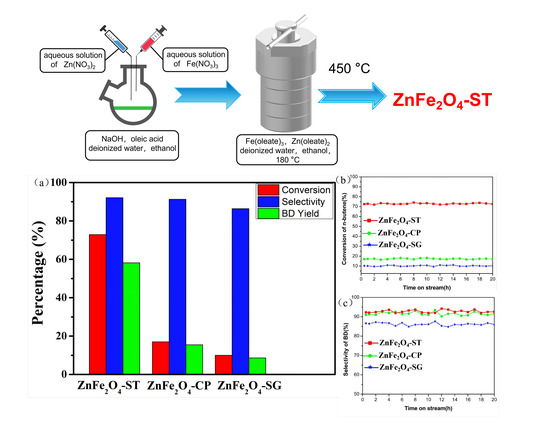
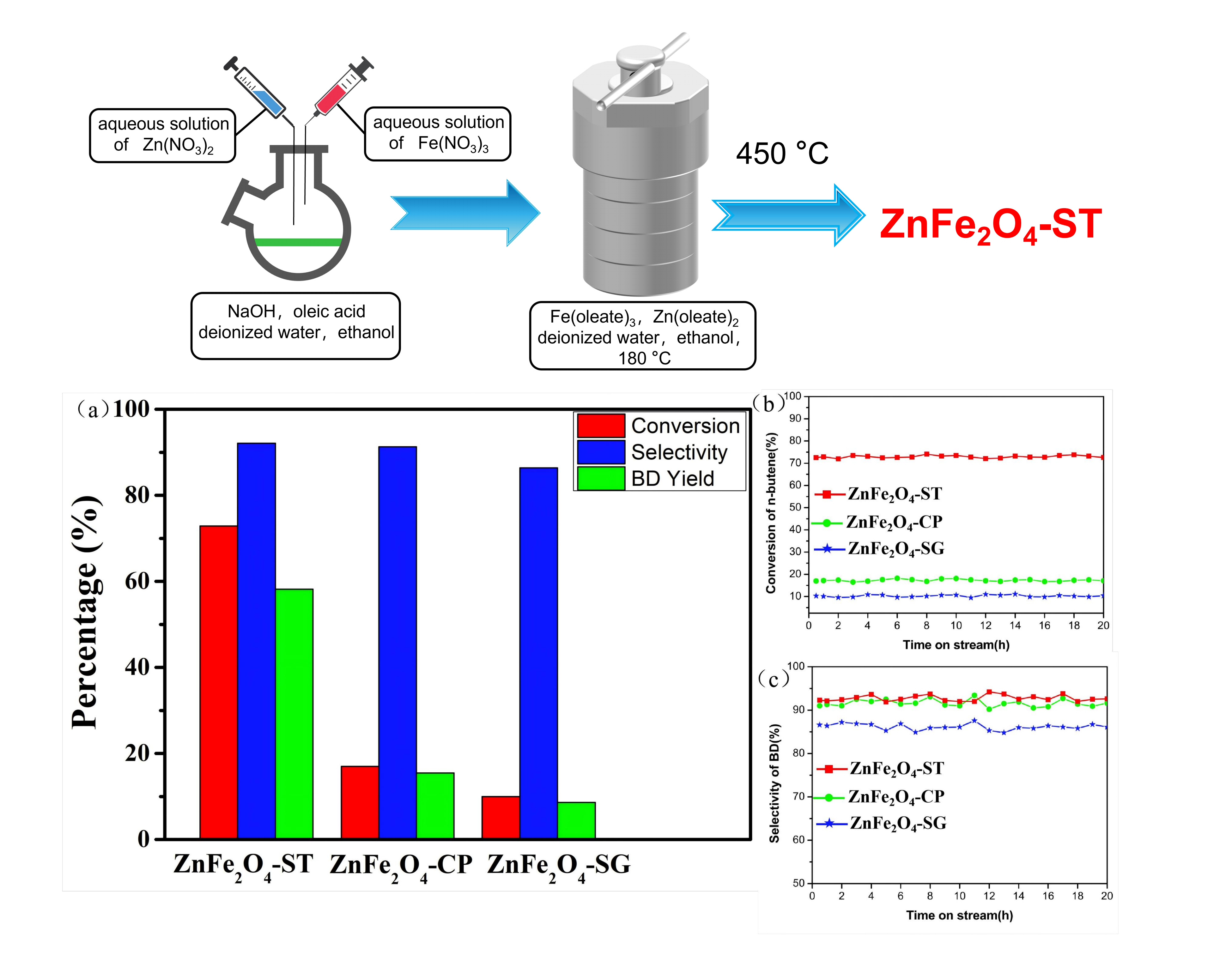
Graphical Abstract

1. Introduction

1,3-Butadiene (BD) has attracted much attention in the past decades for its wide applications in the production of poly-butadiene rubber, styrene butadiene rubber, and acrylonitrile–butadiene–styrene [1,2]. Traditionally, BD is produced as a byproduct of ethylene production from steam cracking. As the lightweight development of the ethylene industry, BD obtained through steam cracking is obviously decreased [3,4]. Consequently, oxidative dehydrogenation (ODH) of n-butene for BD has regained much attention.
Many efforts have been made to investigate the efficient catalysts for ODH of n-butene. The best catalysts are based on V-containing catalysts [5], manganese oxide molecular sieve [6], Cu-Mo-based catalysts [7], Bi-Mo-based catalysts [8,9,10,11], Fe-based catalysts [12,13,14,15,16,17], Pd-based catalysts [1,18], and Pt-based catalysts [19]. Fe-based spinel has typically been used in practical industry since the 1970s due to its high activity, easy scale-up and low cost [20,21]. However, traditional ODH of n-butene reaction on Fe-based spinel prepared by the coprecipitation method is operated at relatively high temperatures (400–500 °C) [22]. As ODH of n-butene is an exothermic process (Equation (1)), the reaction is favored at a low working temperature. In addition, higher BD selectivity could be achieved at low temperature. ODH of n-butene on metal ferrite spinel catalyst proceeds via the Mars–van Krevelen mechanism [23,24,25], which involves a redox cycle of lattice oxygen in the catalyst. Therefore, the effective activation of molecular O2 and the high reactivity of surface lattice oxygen are crucial for enhancing catalytic performance.
n - C 4 H 8 + 1 / 2   O 2 C 4 H 6 + H 2 O   Δ H 298.15 = 132   kJ   mol 1
Nanoparticles have been utilized for decades as catalysts in petroleum processing, pollutant removal and energy conversion [26,27,28,29,30]; the majority of the industrial catalysts are high-surface-area solids onto which an active component is dispersed in the form of small particles. Compared with the bulk phase, it can be seen that the catalytic performance is sensitive to the particle size because the surface structure and electronic properties can change greatly in this size range. In the Fischer–Tropsch reaction for fuels from synthesis gas, the adsorption heat of CO and the activation energy for CO dissociation both change with the increasing size of Ni particles [31]. Nanoparticles of vanadia supported on oxides are active catalysts for the ODH of alkanes to olefins. It has been shown that the activity per atom of V increases with the increasing size of the vanadia particles. The investigation on electronic properties of dispersed vanadia indicates that this trend is related to the reduction in the ease of O-to-V electron transfer, and hence to the ease of reduction of the vanadia by adsorbed alkane molecules, which is the critical first step in the ODH. Therefore, it is desirable to develop a facile method with narrower nanoparticle size distribution. The promising method in this direction is the hydrothermal synthesis utilizing fatty acids [32,33].
In this work, stoichiometric zinc ferrite was synthesized via a facile hydrothermal method (from zinc-iron oleate by using simple solvent (ethanol and water) with no other promoters or modifiers, ZnFe2O4-ST), sol-gel (ZnFe2O4-SG) and co-precipitation (ZnFe2O4-CP) methods. The low-temperature catalytic activity of the as-prepared ZnFe2O4 samples was evaluated through ODH of n-butene by using a fixed-bed system. Various characterizations such as X-ray diffraction (XRD), thermogravimetric analysis (TGA), transmission electron microscopy (TEM), N2 adsorption–desorption, X-ray photoelectron spectroscopy (XPS), H2-temperature-programmed reduction (H2-TPR), temperature-programmed re-oxidation (TPRO), and NH3-temperature-programmed desorption (NH3-TPD) were employed to discuss the relationship between the catalytic activity and the structure of the catalysts.

2. Results and Discussion

2.1. Synthesis and Characterization of ZnFe2O4-Oleic Acid-Coated Nanoparticles

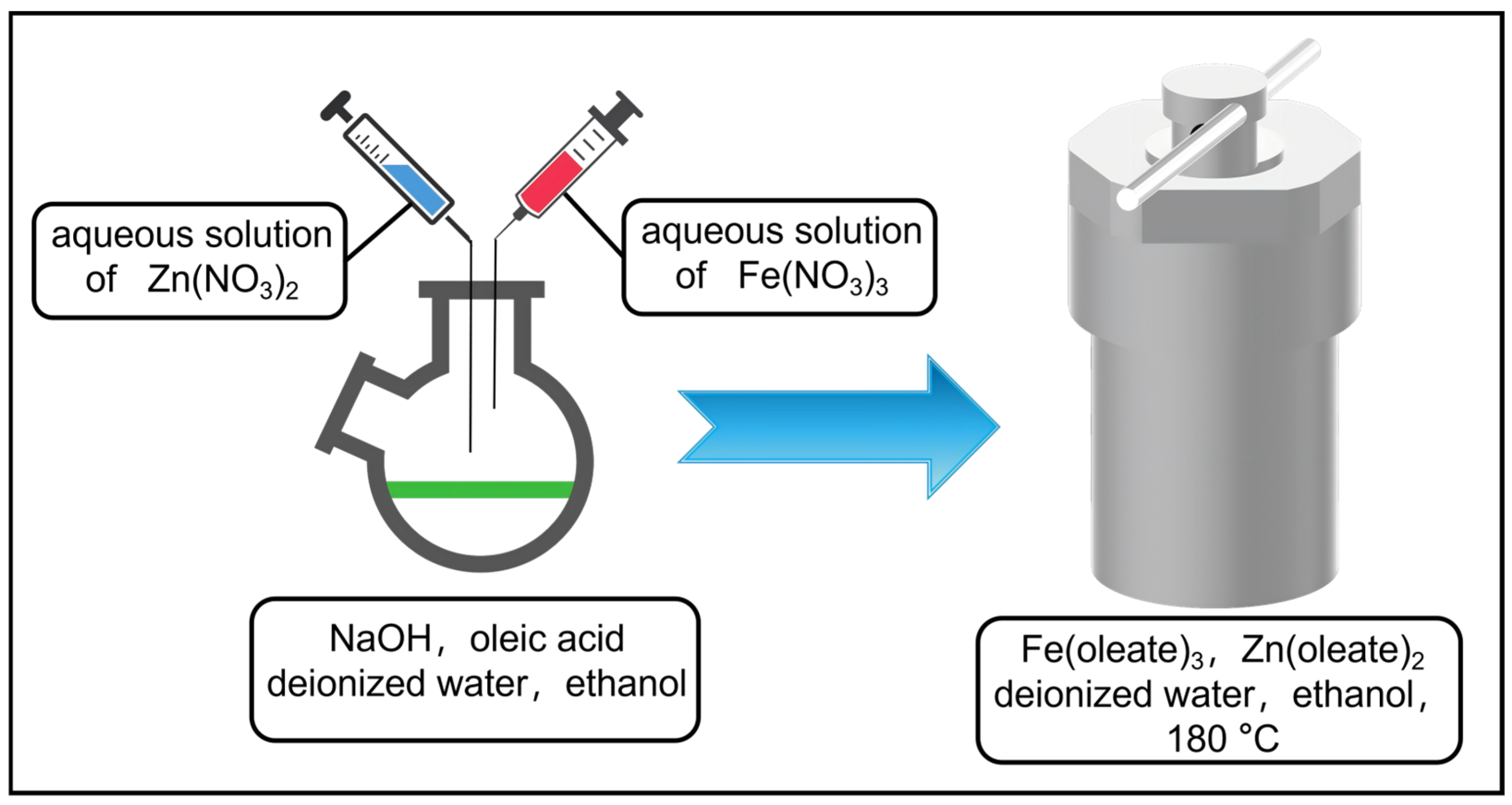
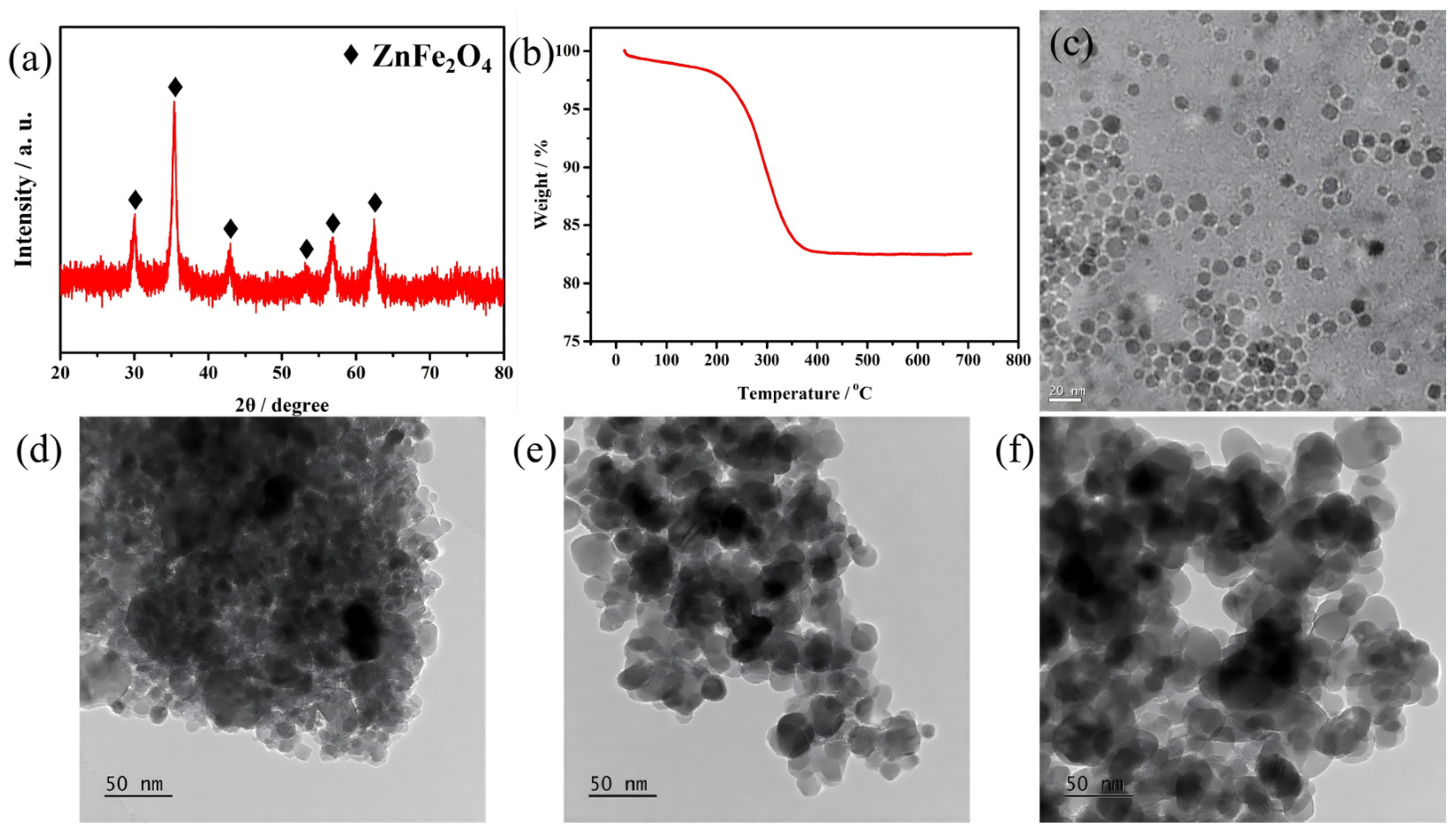
As reported in the Experimental section, nearly monodisperse ZnFe2O4-oleic acid-coated nanoparticles were obtained by hydrothermal hydrolysis of zinc-iron oleates (Figure 1). Figure 2a shows the XRD pattern of the ZnFe2O4-oleic acid-coated nanoparticles, and only the diffraction patterns arising from a cubic ZnFe2O4 spinel phase (Powder Diffraction File (PDF): 22–1012) was observed. The average crystallite size was calculated using the Scherrer equation (Equation (2)) [34], and it was estimated to be 9.1 nm.
τ = K λ β cos θ
where τ is the mean size of crystal particles, K is dimensionless shape factor, λ is the X-ray wavelength, β is the line broadening at half the maximum intensity, and θ is the Bragg angle.
TEM image of the ZnFe2O4-oleic acid-coated nanoparticles at scale of 20 nm is depicted in Figure 2c. As can be seen, the nanoparticles were of well-separated spheroidal morphology. The mean particle size obtained from TEM image was approximately 7.5 nm, which was similar to their crystallite size obtained from the XRD result. It indicated that the nanoparticles were of high crystallinity. Thermal gravimetric analysis of the ZnFe2O4-oleic acid-coated particles was shown in Figure 2b. It was notable that oleic acid was decomposed below 450 °C, as expected. Hence, the nanoparticles were calcined at 450 °C for 3 h in static air to remove the coated oleic acid, and ZnFe2O4-ST particles were obtained.

2.2. Catalytic Performance of ZnFe2O4-ST, ZnFe2O4-CP, and ZnFe2O4-SG

2.2.1. Effect of Catalyst Preparation Methods

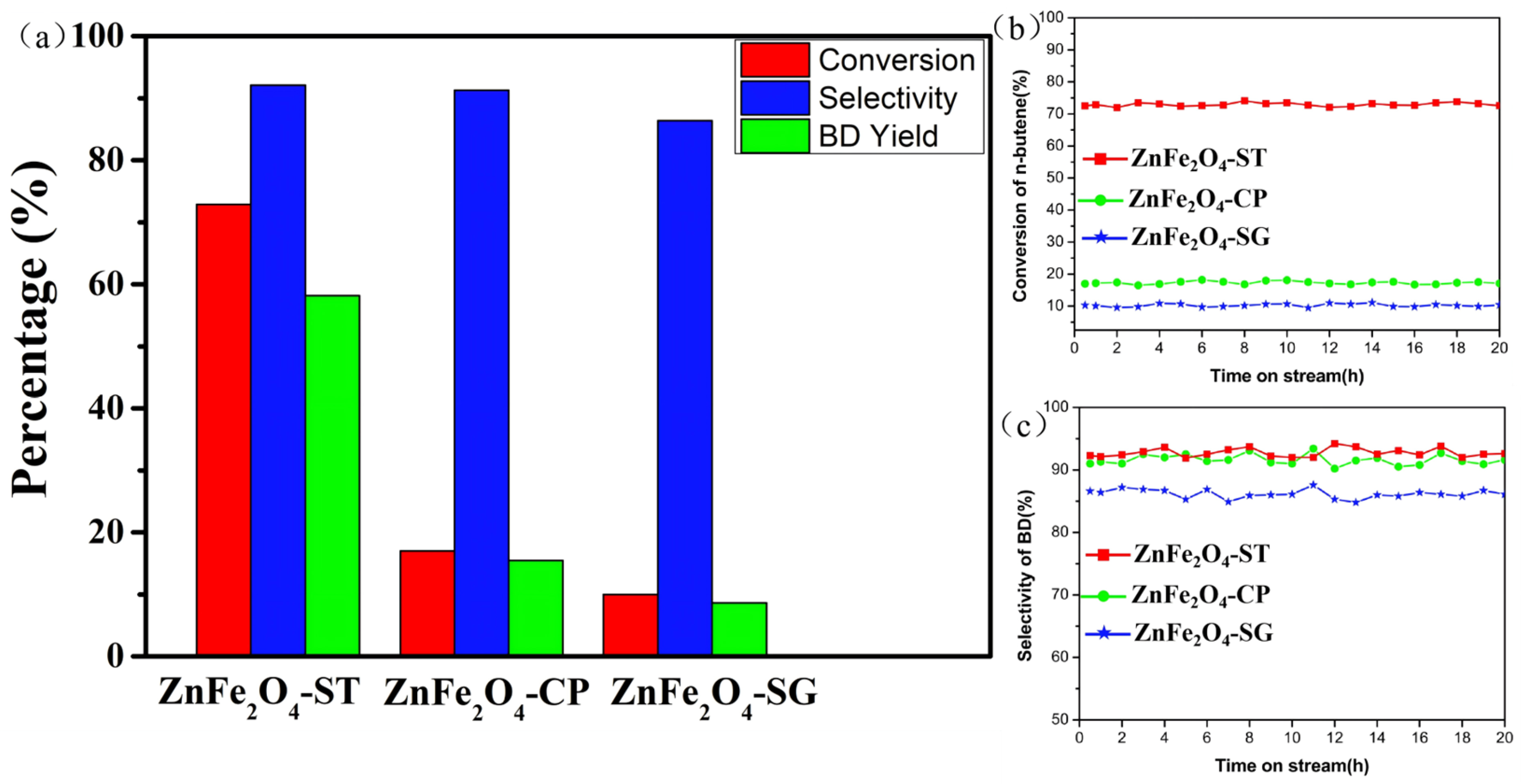
Catalytic activity evaluation for ODH of n-butene over ZnFe2O4 prepared by solvothermal (ZnFe2O4-ST), co-precipitation (ZnFe2O4-CP), and sol-gel (ZnFe2O4-SG) methods was carried out at a low temperature of 300 °C. Figure 3a showed the steady-state catalytic performance of ZnFe2O4-X (X = HT, SG, and CP) after 1 h reaction. Two features were evident in the activity evaluations. Firstly, ZnFe2O4-ST exhibited much higher n-butene conversion (Equation (5)) at 72.9% than ZnFe2O4 synthesized by co-precipitation (17.2%) and sol-gel (10.1%) methods. To the best of our knowledge, this result of ZnFe2O4-ST ranked among the best reported in the literature. Secondly, the selectivity of BD (Equation (6)) was also decreased in the order of ZnFe2O4-ST (92.1%) > ZnFe2O4-CP (91.3%) > ZnFe2O4-SG (86.4%). Hence, ZnFe2O4-ST exhibited much superior low-temperature catalytic performance.
To assess the stability of the catalysts, the long-term stability tests of the ZnFe2O4-ST, ZnFe2O4-CP, and ZnFe2O4-SG catalysts were carried out in the ODH of n-butene at 300 °C. As can be seen in Figure 3b,c, the conversion of n-butene and the selectivity to BD were all almost constant, indicating the catalysts exhibited very stable catalytic performance.

2.2.2. Effect of Reaction Temperature

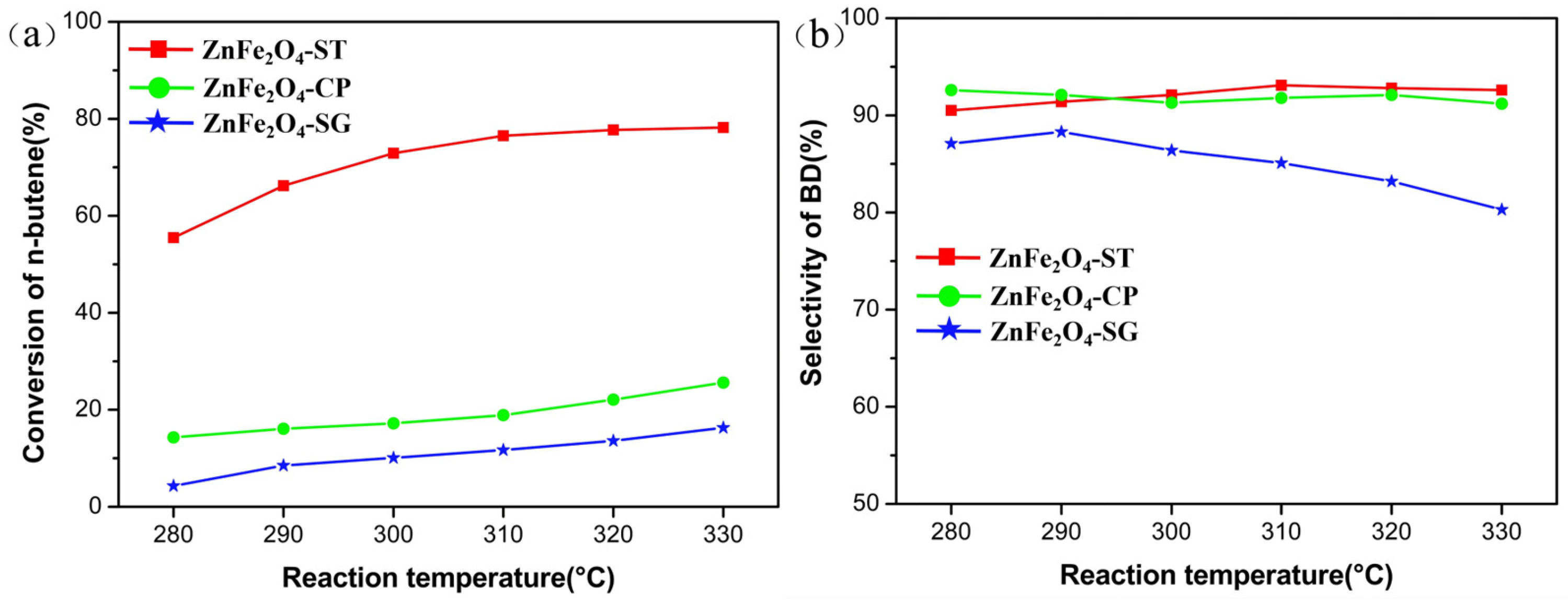
To investigate the effect of reaction temperature, ODH of n-butene on ZnFe2O4-ST ZnFe2O4-CP, and ZnFe2O4-SG were conducted at temperatures ranging from 280 to 330 °C. The n-butene conversion was all increased with the increase in temperature for the three ZnFe2O4 catalysts (Figure 4a), while the BD selectivity only had a slightly changes (Figure 4b). For ZnFe2O4-ST, when the reaction temperature reached 330 °C, a higher conversion of n-butene (78.2%) and BD selectivity (92.6%) results were obtained. Even at the lower temperature of 280 °C, ZnFe2O4-ST exhibited a conversion of 55.5% with BD selectivity of 90.5%, indicating excellent low-temperature catalytic activity.
To obtain insights into the structural origins of the observed excellent catalytic performance on ZnFe2O4-ST, we characterized the catalysts by several methods.

2.3. Characterizations of the ZnFe2O4-ST, ZnFe2O4-CP, and ZnFe2O4-SG

TEM images of the catalysts at scale of 50 nm were shown in Figure 2d–f. A nanoparticle aggregation structure of ZnFe2O4-ST, ZnFe2O4-CP, and ZnFe2O4-SG were observed in the TEM images.
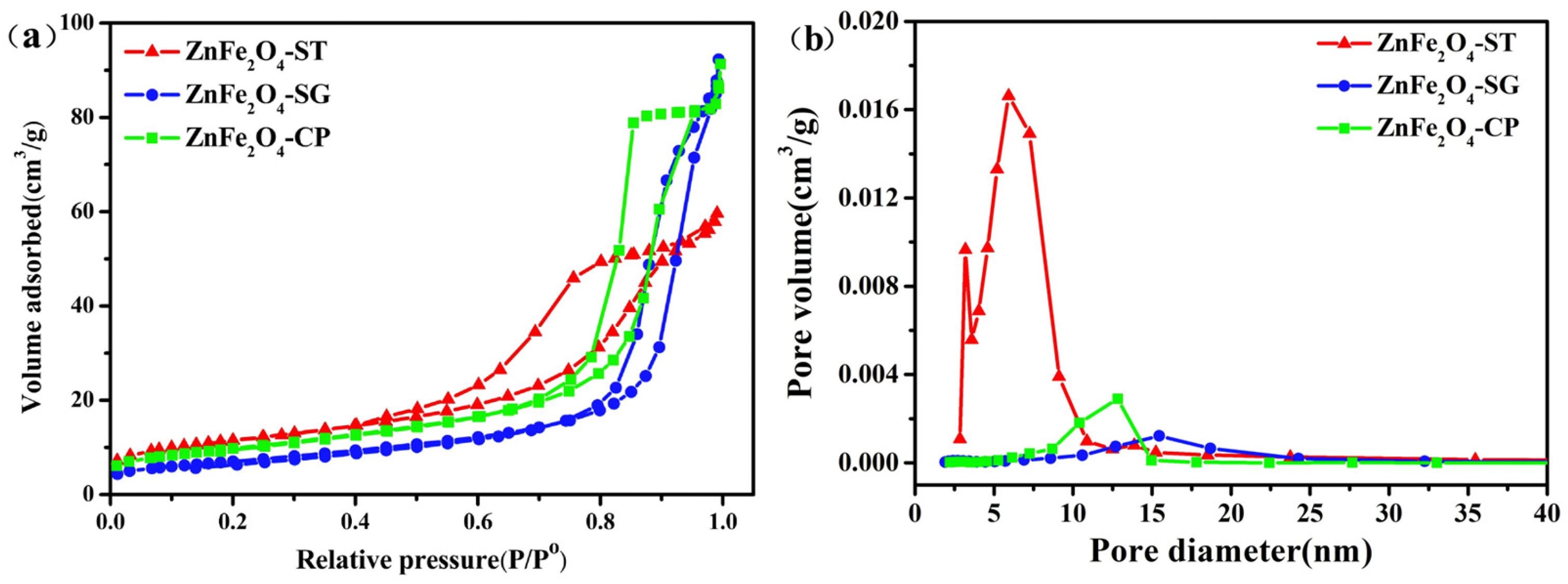
For heterogeneous catalysis, the reaction usually occurs on the surface of the catalyst; consequently, the amount of catalytic surface area is vital for the availability of the catalytic sites. As a result, the use of a larger specific surface area catalyst is advanced to improve the catalytic activity [35,36]. The nitrogen adsorption–desorption isotherms were performed to demonstrate the pore structure and pore size distribution of the catalysts (Figure 5). The values of specific surface area, pore volumes and average pore diameter of ZnFe2O4-ST, ZnFe2O4-SG and ZnFe2O4-CP are shown in Table 1. As can be seen, the type IV hysteresis loop was displayed in the N2 sorption isotherm of all the ZnFe2O4 catalysts prepared by different methods (Figure 5a), which corresponded to the mesoporous structure. ZnFe2O4-ST possessed BET surface areas of 42 m2 g−1, which was larger than ZnFe2O4-CP (33 m2 g−1) and ZnFe2O4-SG (25 m2 g−1) (Table 1). The BJH average pore sizes of ZnFe2O4-ST, ZnFe2O4-CP and ZnFe2O4-SG were 6.8, 11.2 and 16.7 nm (Figure 5b), respectively.
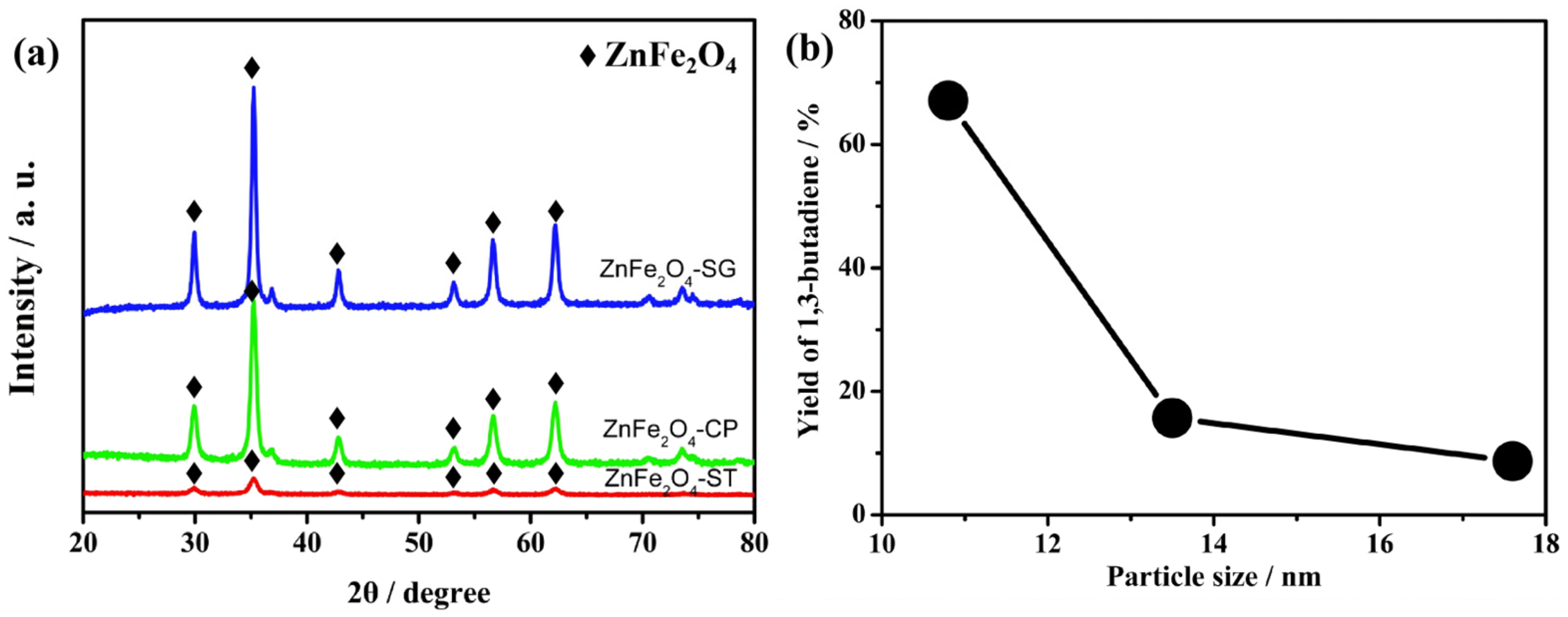
Figure 6a showed XRD patterns of the prepared catalysts. It was noted that only cubic zinc ferrite spinel phase (PDF: 22–1012) was observed in ZnFe2O4-ST, ZnFe2O4-CP and ZnFe2O4-SG, and no visible peaks corresponding to FeOx and ZnO were detected. The average crystallite size of ZnFe2O4-ST was about 10.8 nm, which was slightly larger than oleic acid-coated ZnFe2O4 (9.1 nm), indicating that during the coated oleic acid decomposition process the crystallite size does not vary significantly. The crystallite sizes of ZnFe2O4-CP and ZnFe2O4-SG obtained from the XRD profiles were approximately 13.5 and 17.6 nm, respectively, which were larger than ZnFe2O4-ST.
Based on the analysis of BET and XRD results, we reasoned that the size of ZnFe2O4 nanoparticles was pivotal to their catalytic properties, and the catalytic activity was declined with the increase in particle size (Figure 6b). To further understand the size-dependent catalytic activity, XPS and H2-TPR analysis were conducted.
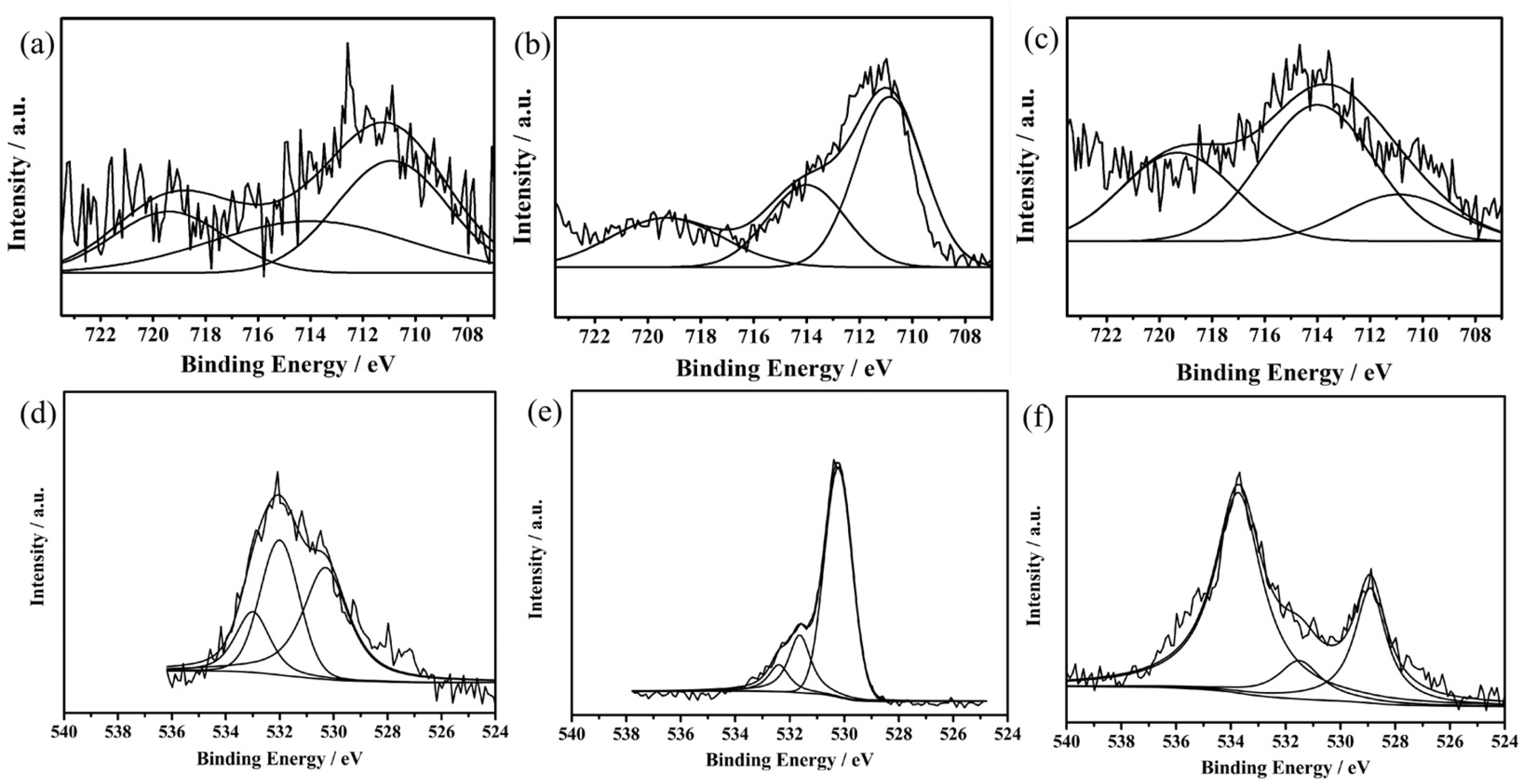
It was generally known that the ODH of n-butene followed the Mars–van Krevelen mechanism, and the reducibility of the catalyst was reported to be one of the crucial factors to the catalytic performance [22]. In the XPS spectrum of ZnFe2O4-ST, ZnFe2O4-CP and ZnFe2O4-SG (Figure 7a–c), a satellite peak (Fesat3+ 2p3/2) around 719.3 eV could be observed, suggesting that all Fe cations of ZnFe2O4 catalysts were Fe3+ [37]. A peak around 710.9 eV was attributed to the Fe3+ cations located at the octahedral site (FeO3+ 2p3/2) in the ZnFe2O4, while a peak around 714.0 eV was assigned the Fe3+ cations located at the tetrahedral site (FeT3+ 2p3/2) in the ZnFe2O4. To clarify the redox properties of the catalysts with different particle size, XPS and H2-TPR analysis were performed. XPS experiments were often used to investigate the oxygen mobility of the catalyst [38,39]. Figure 7d–f presents the XPS results of O 1s in different samples. According to the deconvolution of the O 1s spectra, three peaks (denoted as OI, OII, and OIII with the increasement of the binding energy) were observed in the catalysts, and the surface oxygen species compositions were calculated and are summarized in Table 2. As reported in previous studies [40,41], OI with the binding energy ranging from 529.2 to 530.2 eV was attributed to the oxygen species strongly bonded to the metal component in the catalyst, and OIII with the binding energy of 532.6 to 533.5 eV might be assigned to the surface adsorbed oxygen. But only the OII (531.4–532.0 eV) reflected the oxygen mobility of zinc ferrite catalyst. The corresponding concentrations of OII in ZnFe2O4-ST was estimated to be 41%, whereas those in ZnFe2O4-CP and ZnFe2O4-SG were approximately 19% and 11%, respectively. Obviously, the ZnFe2O4-ST sample possessed richer Type-II oxygen species on the surface than the other samples.
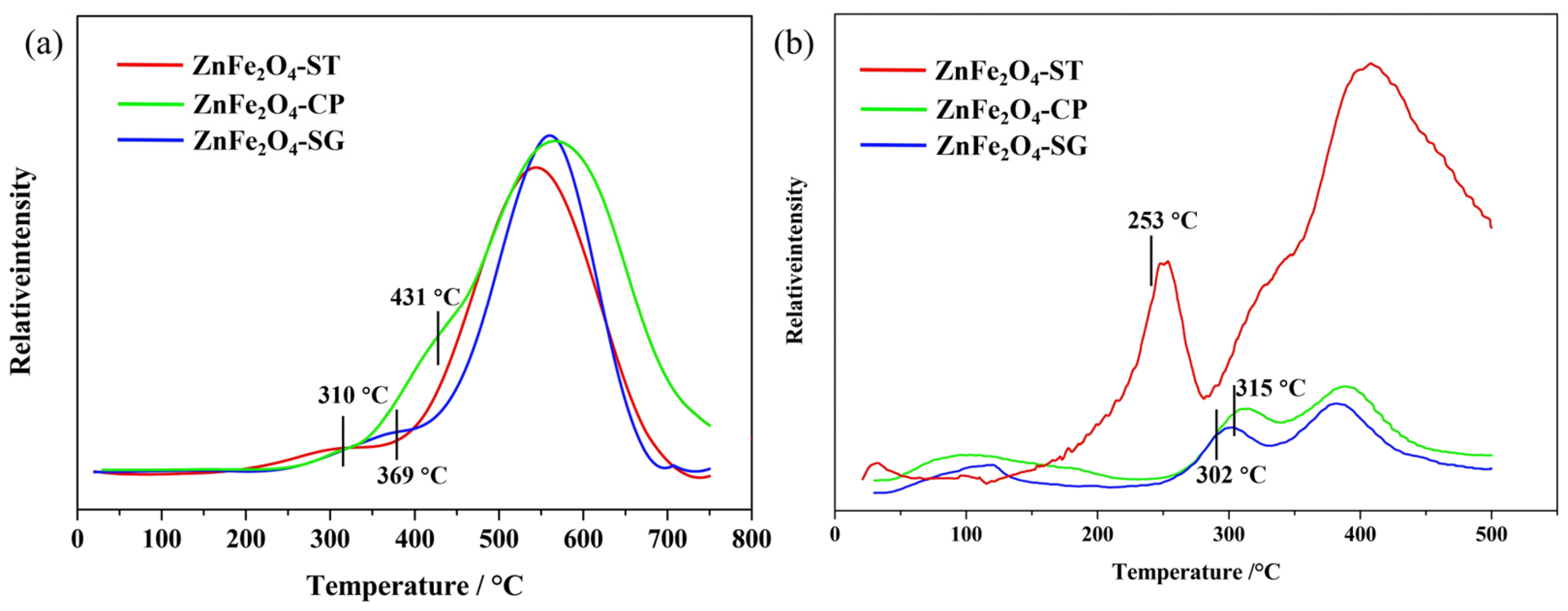
H2-TPR and TPRO were effective characterization approaches used to test the reducibility of catalysts [42,43]. Figure 8a displayed the H2-TPR profiles of the different spinel samples, and two main peaks were observed for the three catalysts. Generally, ZnO could not be reduced at a temperature below 750 °C. The reduction peak at low temperature was attributed to the reduction of ZnFe2O4 to Fe3O4, and the high temperature peak could be corresponded to the further reduction of Fe3O4 to FeO, and finally to metal Fe [44]. It seemed that in the H2-TPR profiles the second and third peaks were overlapped. As shown in Figure 8a, the low temperature peak with its maximum for ZnFe2O4-ST (310 °C) was lower than that for ZnFe2O4-CP (431 °C) and ZnFe2O4-SG (369 °C). Following the H2-TPR analysis, the above samples were treated with flowing O2 to perform the TPRO experiments. Figure 8b presented the results obtained during TPRO runs. As discussed in the previous paper [45], the peak in the low-temperature region (200–350 °C) of the TPRO profile indicated the capacity of oxygen mobility, which was an index for the oxygen mobility of the catalyst. The lower temperature of the low temperature peak suggested higher oxygen mobility. It can be seen that the low temperature peak with its maximum over ZnFe2O4-ST (253 °C) was also lower than that of ZnFe2O4-CP (315 °C) and ZnFe2O4-SG (302 °C). The observation of H2-TPR and TPRO analysis confirmed that ZnFe2O4-ST with smaller particle size could facilitate the better reducibility and oxygen mobility [46,47,48].
Based on the combined XPS, H2-TPR, and TPRO results, it indicated that ZnFe2O4-ST with smaller particle size had better reducibility than ZnFe2O4-CP and ZnFe2O4-SG. The catalytic activity declined with the decrease in the reducibility of the catalyst.
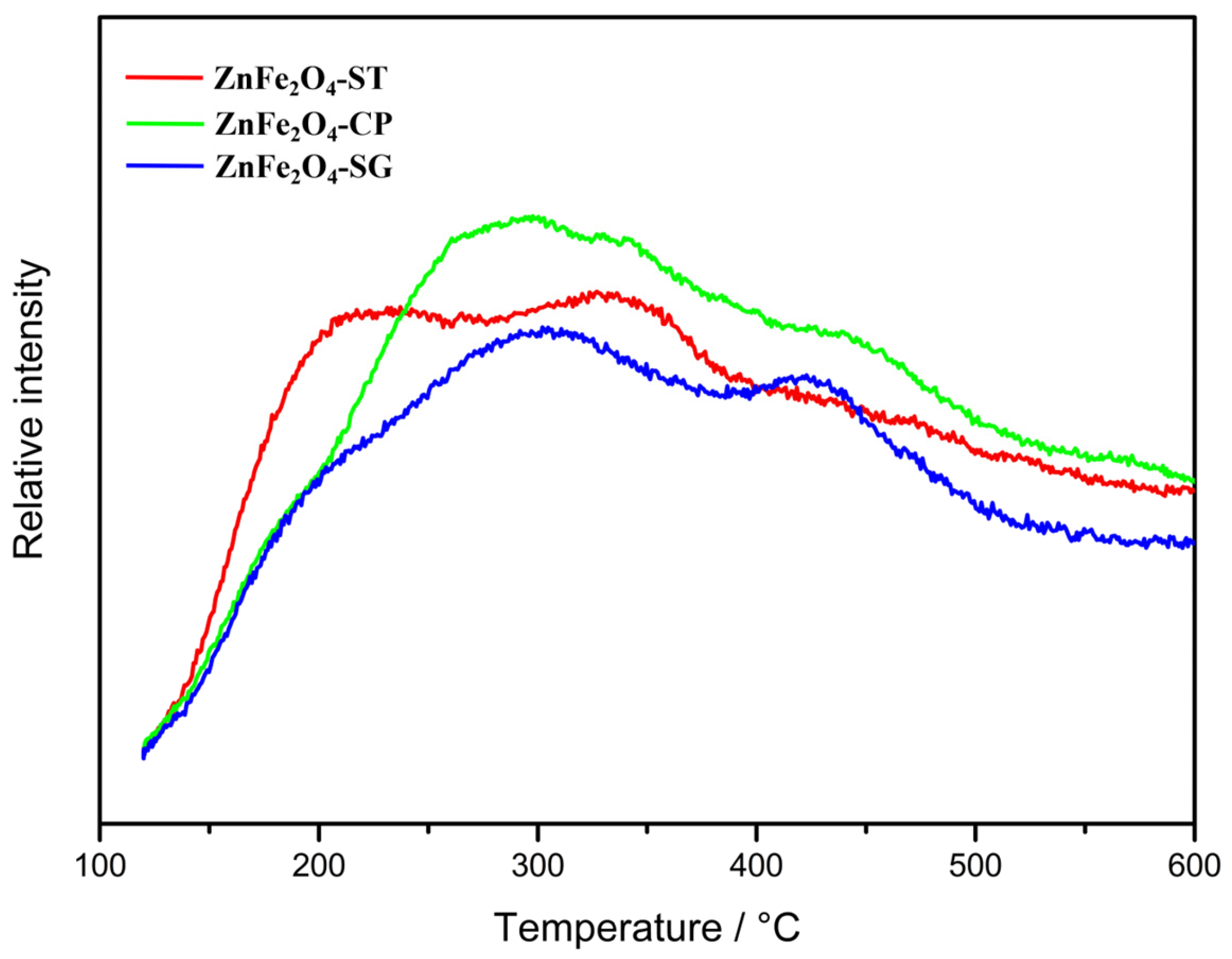
In order to investigate the effect of surface acidity on the catalytic performance of ZnFe2O4 spinel catalysts, NH3-TPD analysis were conducted. It was noted that for all the ZnFe2O4 catalysts, two main peaks were obtained between 200 and 500 °C (Figure 9). The ZnFe2O4 catalysts exhibited a significant difference in acid strength (peak temperature) and a slight difference in total acidity (peak area) with the ZnFe2O4 of different preparation methods. The yield for BD was related to the acid strength of ZnFe2O4 catalysts. Consequently, it was expected that the ZnFe2O4 catalyst with a weak acid strength was favorable for the reaction of the ODH of n-butene. In conclusion, the surface acidity of ZnFe2O4 catalysts played a key role in the catalytic performance.

3. Materials and Methods

3.1. Experimental Materials

All chemicals were of analytical grade and were used as received without further purification. Their purity, suppliers and applications are listed in Table 3.

3.2. Catalyst Synthesis

3.2.1. ZnFe2O4-ST

The synthesis of ZnFe2O4-ST was via hydrothermal method. In a typical synthesis, NaOH (66 mmol) was dissolved in 15 mL of deionized water to obtain solution A. Oleic acid (68 mmol) was dissolved in 20 mL of ethanol to obtain solution B. Then, solution B was added to solution A to create a transparent solution. A total of 16 mmol of Fe(NO3)3 and 8 mmol of Zn(NO3)2 were dissolved in 10 mL of deionized water, and it was added into the above solution. After stirring, 20 mL of hexane was added, and the solution was separated to two phases: upper black organic phase and lower water phase. This mixture was then boiled under reflux condenser for one hour to complete the following reactions, Equations (3) and (4).
3 Na ( oleate ) + Fe ( NO 3 ) 3 Fe ( oleate ) 3 + 3 NaNO 3 ,
2 Na ( oleate ) + Zn ( NO 3 ) 2 Zn ( oleate ) 2 + 2 NaNO 3 ,
Subsequently, this mixture was cooled, and the water phase was removed. Deionized water (20 mL), ethanol (5 mL) and hexane (5 mL) were then added to the organic phase, and this mixture was heated to reflux for one hour. After the washing step was done three times, the mixture was heated at 85 °C to evaporate the hexane. The product was moved into a Teflon-lined autoclave. Then, 30 mL of ethanol and 60 mL of deionized water were added, and it was kept at 180 °C for 13 h.
Afterwards, the liquid phase was discarded, and the nanoparticles were collected by magnet. The following purification process was done twice; the nanoparticles were first dispersed in 10 mL of hexane. Ethanol (10 mL) was added to wash and precipitate the nanoparticles. After washing, the nanoparticles were re-dispersed in hexane and denoted as oleic acid-coated ZnFe2O4 nanoparticles. Finally, they were precipitated by ethanol, dried at 80 °C overnight and calcined at 450 °C for 3 h, denoted as ZnFe2O4-ST.

3.2.2. ZnFe2O4-SG

ZnFe2O4-SG was synthesized by sol-gel method. In a typical synthesis, Zn(NO3)2·6H2O (8 mmol), Fe(NO3)3·9H2O (16 mmol) and citric acid (28.8 mmol) were dissolved in deionized water (25 mL), and a brown homogeneous solution was formed. Then it was heated at 80 °C until a viscous and gel-like sample was formed. The combustion reaction was ignited at about 170 °C. After the combustion, the reaction vessel was cooled. Finally, the product powder was calcined in air at 450 °C for 3 h with the heating rates of 2 °C min−1 and denoted as ZnFe2O4-SG.

3.2.3. ZnFe2O4-CP

ZnFe2O4-CP was synthesized by co-precipitation method. In a typical synthesis, Zn(NO3)2·6H2O (8 mmol) and Fe(NO3)3·9H2O (16 mmol) were dissolved in deionized water. Then, the above solution and NaOH solution (3 mol L−1) were added dropwise to deionized water for co-precipitation with stirring, and the pH of the mixed solution was precisely controlled at ca. 9. After the resulting solution was stirred for 2 h, it was aged for 12 h at room temperature. The resulting precipitates were filtrated and washed several times with deionized water and dried at 80 °C overnight. Subsequently, the resulting powders were calcined at 450 °C for 3 h in air and denoted as ZnFe2O4-CP.

3.3. Catalyst Characterization

XRD measurements were performed with a ShimadzuXD-3D X-ray diffractometer (Shimadzu Corporation, Kyoto, Japan) with Cu Ka radiation from 10 to 80°. Transmission electron microscopy (TEM) was obtained using a Tecnai-G2-F30 field emission transmission electron microscope (FEI Company, Hillsboro, OR, USA). TGA was conducted using a Zetzsch Sta 449F3 (NETZSCH Group, Selb, Germany) in a continuous flow of air from room temperature to 700 °C. BET specific surface areas were measured on a Micromeritics ASAP2020 analyzer (Micromeritics Instrument Corporation, Norcross, GA, USA) under N2. Prior to measurement, the catalysts were degassed at 200 °C for 5 h. X-ray photoelectron (XPS) spectroscopy analyses were performed with a VG ESCALAB210 (VG Scientific, St Leonards-on-Sea, UK) instrument with a mono-chromatic X-ray source of Mg Ka ( = 1253.6 eV). The binding energies were calibrated versus adventitious carbon (C1s reference peak at 284.8 eV).
H2-TPR, TPRO and NH3-TPD experiments were carried out on a ChemBET Pulsar (Anton Paar GmbH, Ashland, VA, USA) TPR/temperature-programmed desorption (TPD) automated chemisorption analyzer with a thermal conductivity detector (TCD). In the H2-TPR analysis, prior to the reduction of the sample, catalyst was first pretreated in air (30 mL min−1) at 450 °C for 1 h. Thereafter, 10 vol% H2/Ar (30 mL min−1) was introduced as a reducing agent, and the catalyst was analyzed from room temperature to 750 °C with a ramp rate of 10 °C min−1. Then, it was cooled to room temperature in He flow (30 mL min−1). Subsequently, TPRO experiments were performed in flowing 2 vol% O2/He (30 mL min−1) from room temperature to 500 °C at 10 °C min−1.
In the NH3-TPD measurements, the catalyst (70 mg) was loaded in a quartz reactor and pretreated in air (30 mL min−1) at 450 °C for 1 h. Then, it was cooled down to 120 °C, followed by He flow (30 mL min−1) to purge the residual gaseous and weakly adsorbed oxygen. Subsequently, the catalyst was exposed to NH3 at 120 °C for 1 h, followed by placing it under He flow (30 mL min−1) for 1 h to remove the physically adsorbed NH3. Finally, the sample was heated by a temperature ramp at a rate of 10 °C min−1 in the He (30 mL min−1).

3.4. ODH of n-Butene

The ODH of n-butene was evaluated under quasi-steady-state conditions in a vertical fixed-bed quartz tubular reactor. Each catalyst (0.6 mL, 1.02 g, 40–60 mesh) and quartz powder (1.4 mL, 2.24 g, 40–60 mesh) were installed in the reactor. Before the reaction, the catalyst was pre-treated with air (12.38 mL min−1) and water stream (48.0 mL min−1) at 400 °C for one hour. Following this, the catalyst was cooled under flowing air to 100 °C. The reactant C4-raffinate gas mixture (trans-2-butene (56.7%) + cis-2-butene (36.1%) + 1-butene (3.8%) + n-butane (3%) + BD (0.4%)) was then passed through the reactor with total gas flow rate of 66.2 mL min−1 and the GHSV (gas hourly space velocity) of 400 h−1 on the basis of n-butene. The feed composition was fixed at n-butene:oxygen:steam = 1:0.65:12, and the reaction temperatures were varied in the range of 280–330 °C. Online analyses were performed by gas chromatograph (GC) analysis (one thermal conductivity detector and one flame ionization detector). The catalytic performance was evaluated by the following equations:
c o n v e r s i o n   ( X n-butene ) = A b u t a × f b u t a + A C O 2 × f C O 2 / 4 A b u t a × f b u t a + A i s o m e r s × f i s o m e r s + A C O 2 × f C O 2 / 4 + A n-butene × f n-butene × 100 %
s e l e c t i v i t y   ( S 1,3-butadiene ) = A b u t a × f b u t a A b u t a × f b u t a + A C O 2 × f C O 2 / 4 × 100 %
where Abuta, A i s o m e r s , A C O 2 , and A n-butene represent the chromatographic peak areas of 1,3-butadiene, isomerization products, CO2, and n-butene, respectively, and f represents the correction factor for each species.

4. Conclusions and Outlook

In this work, a series of zinc ferrite spinel ODH of n-butene catalysts were synthesized by different strategies. The influence of different preparation methods on the low-temperature ODH of n-butene was carefully investigated. The result showed that the catalyst synthesized by hydrothermal hydrolysis of Zn-Fe oleate strategy exhibited excellent catalytic performance at low temperature, to the best of our knowledge, which ranks among the best reported in the literature. The smaller particle size of ZnFe2O4-ST significantly improved reducibility and oxygen mobility, resulting in remarkable catalytic performance. XPS, H2-TPR and TPRO results also confirmed that the as-synthesized ZnFe2O4-ST has excellent redox properties, which was one of the crucial factors to the catalytic performance in the ODH of n-butene. NH3-TPD analysis indicated that the ZnFe2O4 catalyst with a weak acid strength was favorable for the reaction of the ODH of n-butene. Furthermore, this work emphasizes the importance of the particle size for catalytic reactions and provides a research strategy for mixed metal oxide catalysts in n-butene ODH and other similar reactions.

Author Contributions

Conceptualization, B.Y.; methodology, B.Y. and R.Y.; validation, R.Y., L.D. and H.X.; formal analysis, B.Y., R.Y., L.D., H.X. and S.Q.; investigation, B.Y., L.D. and H.X.; resources, R.Y., H.Y., Z.L. and G.Z.; writing—original draft preparation, B.Y.; writing—review and editing, H.Y., Z.L. and G.Z.; visualization, B.Y. and S.Q.; supervision, B.Y., H.Y. and G.Z.; project administration, B.Y.; funding acquisition, R.Y., H.Y. and Z.L. All authors have read and agreed to the published version of the manuscript.

Funding

This research was funded by the industry support program of colleges and universities in Gansu province (No. 2023CYZC-60, No. 2022CYZC-58), the TSNU Research and Innovation Team Project (No. TDZ2024-03), the Gansu Provincial Basic Research Innovation Group Project (No. 24JRRE001), and the Provincial Key Research and Development Project for Ecological Civilization Construction of Gansu (No. 25YFFE001), the Ministry of Science, Technological Development and Innovation of the Republic of Serbia (No. 451-03-136/2025-03/200042), and the European Union’s Horizon Europe call HORIZON-WIDERA-2023-ACCESS-02 (No. 101159570, Twinn4MicroUp).

Data Availability Statement

The data will be made available upon request.

Conflicts of Interest

The authors declare no conflicts of interest.

Abbreviations

The following abbreviations are used in this manuscript:
TEMTransmission Electron Microscopy
TGAThermogravimetric Analysis
XRDX-ray Diffraction
XPSX-ray Photoelectron Spectroscopy
H2-TPRH2-Temperature Programmed Reduction
BD1,3-Butadiene
ODHOxidative Dehydrogenation
TGAThermal Gravimetric Analysis
TPDTemperature-Programmed Desorption
TCDThermal Conductivity Detector
GCGas Chromatograph
PDFPowder Diffraction File

References

  1. Furukawa, S.; Endo, M.; Komatsu, T. Bifunctional catalytic system effective for oxidative dehydrogenation of 1-butene and n-butane using Pd-based intermetallic compounds. ACS Catal. 2014, 4, 3533–3542. [Google Scholar] [CrossRef]
  2. Zeng, T.; Sun, G.; Miao, C.; Yan, G.; Ye, Y.; Yang, W.; Sautet, P. Stabilizing oxidative dehydrogenation active sites at high temperature with steam: ZnFe2O4-catalyzed oxidative dehydrogenation of 1-butene to 1,3-butadiene. ACS Catal. 2020, 10, 12888–12897. [Google Scholar] [CrossRef]
  3. Im, J.; Choi, M. Physicochemical stabilization of Pt against sintering for a dehydrogenation catalyst with high activity, selectivity, and durability. ACS Catal. 2016, 6, 2819–2826. [Google Scholar] [CrossRef]
  4. Searles, K.; Chan, K.W.; Mendes Burak, J.A.; Zemlyanov, D.; Safonova, O.; Copéret, C. Highly productive propane dehydrogenation catalyst using silica-supported Ga–Pt nanoparticles generated from single-sites. J. Am. Chem. Soc. 2018, 140, 11674–11679. [Google Scholar] [CrossRef] [PubMed]
  5. López Nieto, J.M.; Concepción, P.; Dejoz, A.; Knözinger, H.; Melo, F.; Vázquez, M.I. Selective oxidation of n-butane and butenes over vanadium-containing catalysts. J. Catal. 2000, 189, 147–157. [Google Scholar]
  6. Krishnan, V.V.; Suib, S.L. Oxidative dehydrogenation of 1-butene over manganese oxide octahedral molecular sieves. J. Catal. 1999, 184, 305–315. [Google Scholar] [CrossRef]
  7. Tiwari, P.N.; Alkhazov, T.G.; Adzamov, K.U.; Khanmamedova, A.K. Effect of aluminium oxide on the properties of Cu–Mo catalyst in the oxidative dehydrogenation of butene-1 to butadiene. J. Catal. 1989, 120, 278–281. [Google Scholar] [CrossRef]
  8. Jung, J.C.; Kim, H.; Kim, Y.S.; Chung, Y.M.; Kim, T.J.; Lee, S.J.; Oh, S.H.; Song, I.K. Catalytic performance of bismuth molybdate catalysts in the oxidative dehydrogenation of C4 raffinate-3 to 1,3-butadiene. Appl. Catal. A 2007, 317, 244–249. [Google Scholar] [CrossRef]
  9. Zhai, Z.; Wang, X.; Licht, R.; Bell, A.T. Selective oxidation and oxidative dehydrogenation of hydrocarbons on bismuth vanadium molybdenum oxide. J. Catal. 2015, 325, 87–100. [Google Scholar] [CrossRef]
  10. Zhao, Q.; Hou, X.; Liu, X.; Chong, M.; Cheng, D.; Chen, F.; Zhan, X. Facet-dependent oxygen mobility and reaction pathways for oxidative dehydrogenation of 1-butene over Bi2MoO6. ACS Catal. 2024, 14, 3543–3555. [Google Scholar] [CrossRef]
  11. Liu, B.; Wan, C.; Zhao, Q.; Zhou, J.; Wang, J.; Liu, X.; Chong, M.; Cheng, D.; Chen, F. Grain boundary-rich Bi2WO6 catalysts enable synergistic activation of molecular and lattice oxygen for oxidative dehydrogenation of 1-butene. ACS Catal. 2025, 15, 15050–15059. [Google Scholar]
  12. Rennard, R.J.; Kehl, W.L. Oxidative dehydrogenation of butenes over ferrite catalysts. J. Catal. 1971, 21, 282–293. [Google Scholar] [CrossRef]
  13. Gibson, M.A.; Hightower, J.W. Oxidative dehydrogenation of butenes over magnesium ferrite: Catalyst deactivation studies. J. Catal. 1976, 41, 431–439. [Google Scholar] [CrossRef]
  14. Zhang, M.; Lan, R.; Liu, J.; Chen, X.; Zhou, W. Phase cooperation between the ZnFe2O4 and α-Fe2O3 phases of ferrite catalysts in the oxidative dehydrogenation of n-butenes. J. Catal. 1992, 88, 637–644. [Google Scholar]
  15. Kiyokawa, T.; Ikenaga, N. Oxidative dehydrogenation of but-1-ene with lattice oxygen in ferrite catalysts. Appl. Catal. A 2017, 536, 97–103. [Google Scholar]
  16. Li, X.; Cheng, D.; Zhao, Z.; Chen, F.; Gong, J. Temperature-induced deactivation mechanism of ZnFe2O4 for oxidative dehydrogenation of 1-butene. React. Chem. Eng. 2017, 2, 215–225. [Google Scholar]
  17. Yang, B.; Liu, L.; Zou, G.; Luo, X.; Zhu, H.; Xu, S. The roles of ZnFe2O4 and α-Fe2O3 in the biphasic catalyst for the oxidative dehydrogenation of n-butene. J. Catal. 2020, 381, 70–77. [Google Scholar]
  18. Golunski, S.E.; Walker, A.P. Mechanism of Low-temperature oxydehydrogenation of 1-butene to 1,3-butadiene over a novel Pd–Fe–O catalyst. J. Catal. 2001, 204, 209–218. [Google Scholar] [CrossRef]
  19. Yan, W.; Kouk, Q.Y.; Tan, S.; Luo, J.; Liu, Y. Effects of Pt0-PtOx particle size on 1-butene oxidative dehydrogenation to 1,3-butadiene using CO2 as soft oxidant. J. CO2 Util. 2016, 15, 154–159. [Google Scholar] [CrossRef]
  20. Black, C.; Currie, G.; Whiston, K.; Sproules, S.; Jackson, S.D. Oxidative dehydrogenation of 1-butene to 1,3-butadiene over metal ferrite catalysts. Top. Catal. 2021, 64, 907–915. [Google Scholar] [CrossRef]
  21. Gao, X.; Qiang, L.; Huang, X.; Dong, F.; Han, W.; Li, Q.; Tang, Z. Weakening Fe-O bonds through magnetron sputtering technology to enhance the catalytic performance for the oxidative dehydrogenation of 1-butene with CO2. Catal. Sci. Technol. 2015, 15, 6847–6864. [Google Scholar] [CrossRef]
  22. Hong, E.; Park, J.H.; Shin, C.H. Oxidative dehydrogenation of n-butenes to 1,3-butadiene over bismuth molybdate and ferrite catalysts: A review. Catal. Surv. Asia 2016, 20, 23–33. [Google Scholar] [CrossRef]
  23. Lee, H.; Jung, J.C.; Kim, H.; Chung, Y.M.; Kim, T.J.; Lee, S.J.; Oh, S.H.; Kim, Y.S.; Song, I.K. Oxidative dehydrogenation of n-butene to 1,3-butadiene over ZnMeIIIFeO4 catalysts: Effect of trivalent metal (Me III). Catal. Lett. 2009, 131, 344–349. [Google Scholar] [CrossRef]
  24. Chung, Y.M.; Kwon, Y.T.; Kim, T.J.; Lee, S.J.; Oh, S.H. Factors affect on the reaction performance of the oxidative dehydrogenation of n-butene to 1,3-butadiene over Zn-ferrite catalysts. Catal. Lett. 2009, 130, 417–423. [Google Scholar] [CrossRef]
  25. Lee, H.; Jung, J.C.; Song, I.K. Oxidative dehydrogenation of n-butene to 1,3-butadiene over sulfated ZnFe2O4 catalyst. Catal. Lett. 2009, 133, 321–327. [Google Scholar] [CrossRef]
  26. Roucoux, A.; Schulz, J.; Patin, H. Reduced transition metal colloids:  a novel family of reusable catalysts. Chem. Rev. 2002, 102, 3757–3778. [Google Scholar] [CrossRef]
  27. Bell, A.T. The impact of nanoscience on heterogeneous catalysis. Science 2003, 299, 1688–1691. [Google Scholar] [CrossRef]
  28. Burda, C.; Chen, X.; Narayanan, R.; El-Sayed, M.A. Chemistry and properties of nanocrystals of different shapes. Chem. Rev. 2005, 105, 1025–1102. [Google Scholar] [CrossRef]
  29. Kung, M.C.; Davis, R.J.; Kung, H.H. Understanding Au-catalyzed low-temperature CO oxidation. J. Phys. Chem. C 2007, 111, 11767–11775. [Google Scholar] [CrossRef]
  30. Zhou, X.; Xu, W.; Liu, G.; Panda, D.; Chen, P. Size-dependent catalytic activity and dynamics of gold nanoparticles at the single-molecule level. J. Am. Chem. Soc. 2010, 132, 138–146. [Google Scholar] [CrossRef]
  31. Ellis, P.R.; Enache, D.I.; James, D.W.; Jones, D.S.; Kelly, G.J. A robust and precious metal-free high performance cobalt fischer-tropsch catalyst. Nat. Catal. 2019, 2, 623–631. [Google Scholar] [CrossRef]
  32. Wang, X.; Zhuang, J.; Peng, Q.; Li, Y. A general strategy for nanocrystal synthesis. Nature 2005, 437, 121–124. [Google Scholar] [CrossRef] [PubMed]
  33. Pang, X.; Zhao, L.; Han, W.; Xin, X.; Lin, Z. A general and robust strategy for the synthesis of nearly monodisperse colloidal nanocrystals. Nat. Nanotechnol. 2013, 8, 426–431. [Google Scholar] [CrossRef] [PubMed]
  34. Dong, L.; Wu, C.; Ling, H.; Shi, J.; Williams, P.T.; Huang, J. Promoting hydrogen production and minimizing catalyst deactivation from the pyrolysis-catalytic steam reforming of biomass on nanosized NiZnAlOx catalysts. Fuel 2017, 188, 610–620. [Google Scholar] [CrossRef]
  35. Parlett, C.M.A.; Wilson, K.; Lee, A.F. Hierarchical porous materials: Catalytic applications. Chem. Soc. Rev. 2013, 42, 3876–3893. [Google Scholar] [CrossRef]
  36. Wang, Y.; Arandiyan, H.; Scott, J.; Bagheri, A.; Dai, H.; Amal, R. Recent advances in ordered meso/macroporous metal oxides for heterogeneous catalysis: A review. J. Mater. Chem. A 2017, 5, 8825–8846. [Google Scholar] [CrossRef]
  37. Lee, H.; Jung, J.C.; Kim, H.; Chung, Y.M.; Kim, T.J.; Lee, S.J.; Oh, S.H. Effect of divalent metal component (MeII) on the catalytic performance of MeIIFe2O4 catalysts in the oxidative dehydrogenation of n-butene to 1,3-butadiene. Catal. Lett. 2008, 124, 364–368. [Google Scholar] [CrossRef]
  38. Dai, H.X.; Ng, C.F.; Au, C.T. Perovskite-type halo-oxide La1−xSrxFeO3−δXσ (X=F, Cl) catalysts selective for the oxidation of ethane to ethene. J. Catal. 2000, 189, 52–62. [Google Scholar] [CrossRef]
  39. Royer, S.; Duprez, D.; Kaliaguine, S. Oxygen mobility in LaCoO3 perovskites. Catal. Today 2006, 112, 99–102. [Google Scholar] [CrossRef]
  40. Jung, J.C.; Lee, H.; Kim, H.; Park, S.; Chung, Y.M.; Kim, T.J.; Lee, S.J.; Oh, S.H.; Kim, Y.S.; Song, I.K. Effect of calcination temperature on the catalytic performance of Co9Fe3Bi1Mo12O51 in the oxidative dehydrogenation of n-butene to 1,3-butadiene. Catal. Commun. 2008, 9, 2059–2062. [Google Scholar] [CrossRef]
  41. Jung, J.C.; Lee, H.; Kim, H.; Chung, Y.M.; Kim, T.J.; Lee, S.J.; Oh, S.H.; Kim, Y.S.; Song, I.K. Effect of pH in the preparation of Ni9Fe3Bi1Mo12O51 for oxidative dehydrogenation of n-butene to 1,3-butadiene: Correlation between catalytic performance and oxygen mobility of Ni9Fe3Bi1Mo12O51. Catal. Commun. 2008, 9, 943–949. [Google Scholar]
  42. Yang, D.; Wang, L.; Sun, Y.; Zhou, K. Synthesis of one-dimensional Ce1−xYxO2−x/2 (0 ≤ x ≤ 1) solid solutions and their catalytic properties: The role of oxygen vacancies. J. Phys. Chem. C 2010, 114, 8926–8932. [Google Scholar] [CrossRef]
  43. Yin, F.; Ji, S.; Chen, B.; Zhao, L.; Liu, H.; Li, C. Preparation and characterization of LaFe1−xMgxO3/Al2O3/FeCrAl: Catalytic properties in methane combustion. Appl. Catal. B 2006, 66, 265–273. [Google Scholar] [CrossRef]
  44. Liang, M.; Kang, W.; Xie, K. Comparison of reduction behavior of Fe2O3, ZnO and ZnFe2O4 by TPR technique. J. Nat. Gas Chem. 2009, 18, 110–113. [Google Scholar] [CrossRef]
  45. Wan, C.; Cheng, D.; Chen, F.; Zhan, X. Effects of zirconium content on the catalytic performance of BiMoZrx in the oxidative dehydrogenation of 1-butene to 1,3-butadiene. J. Chem. Technol. Biotechnol. 2016, 91, 353–358. [Google Scholar]
  46. Wang, L.; Tang, Z.; Yan, W.; Yang, H.; Wang, Q.; Chen, S. Porous carbon-supported gold nanoparticles for oxygen reduction reaction: Effects of nanoparticle size. ACS Appl. Mater. Interfaces 2016, 8, 20635–20641. [Google Scholar] [CrossRef]
  47. Kizling, M.; Dzwonek, M.; Wieckowska, A.; Bilewicz, R. Gold nanoparticles in bioelectrocatalysis—The role of nanoparticle size. Curr. Opin. Electrochem. 2018, 12, 113–120. [Google Scholar] [CrossRef]
  48. Zhang, Y.; Liu, R.; Zhang, S.; Li, M. Functionalization of gold-pincer nanocluster for asymmetric catalysis. J. Am. Chem. Soc. 2025, 147, 34079–34088. [Google Scholar] [CrossRef] [PubMed]
Figure 1. The schematic illustration of the preparation of the ZnFe2O4-oleic acid-coated nanoparticles.
Catalysts 16 00250 g001
Figure 2. (a) XRD pattern, and (b) TGA curve of ZnFe2O4-oleic acid-coated nanoparticles. TEM micrographs of (c) ZnFe2O4-oleic acid-coated, (d) ZnFe2O4-ST, (e) ZnFe2O4-CP, (f) ZnFe2O4-SG.
Catalysts 16 00250 g002
Figure 3. (a) Catalytic performance of ZnFe2O4-ST, ZnFe2O4-CP, and ZnFe2O4-SG in the ODH of n-butene at 300 °C after a 1 h reaction. Long-term stability tests of ZnFe2O4-ST, ZnFe2O4-CP, and ZnFe2O4-SG in the ODH of n-butene at 300 °C: (b) conversion of n-butene, (c) selectivity of BD.
Catalysts 16 00250 g003
Figure 4. Catalytic performance of ZnFe2O4-ST, ZnFe2O4-CP, and ZnFe2O4-SG catalysts as a function of reaction temperature in the ODH of 1-butene after a 1 h reaction: (a) conversion of n-butene, (b) selectivity of BD.
Catalysts 16 00250 g004
Figure 5. (a) N2 adsorption–desorption isotherms, and (b) pore size distributions of ZnFe2O4 with different preparation methods.
Catalysts 16 00250 g005
Figure 6. (a) X-ray diffraction patterns of ZnFe2O4 with different preparation methods, (b) plots of the activity in the ODH of n-butene at 300 °C vs. particle size of ZnFe2O4 with different preparation methods.
Catalysts 16 00250 g006
Figure 7. Fe3+ 2p3/2 XPS spectra of ZnFe2O4 catalysts with different preparation methods: (a) ZnFe2O4-ST, (b) ZnFe2O4-CP, (c) ZnFe2O4-SG. O 1s XPS spectra of ZnFe2O4 with different preparation methods: (d) ZnFe2O4-ST, (e) ZnFe2O4-CP, (f) ZnFe2O4-SG.
Catalysts 16 00250 g007
Figure 8. (a) H2-TPR, and (b) TPRO profiles of ZnFe2O4 with different preparation methods.
Catalysts 16 00250 g008
Figure 9. NH3-TPD profiles of ZnFe2O4 catalysts with different preparation methods.
Catalysts 16 00250 g009
Table 1. BET surface morphology results of ZnFe2O4 with different preparation methods.
CatalystsBET Surface Area
(m2 g−1)
Pore Volumes
(cm3 g−1)
Average Pore
Diameter (nm)
ZnFe2O4-ST420.096.8
ZnFe2O4-CP330.1311.2
ZnFe2O4-SG250.1416.7
Table 2. Binding energies and the OII content of O 1s in the ZnFe2O4 with different preparation methods determined by XPS.
CatalystsBinding Energy (eV) of O 1s
OIOIIOIIIOII/(OI + OII + OIII) (%)
ZnFe2O4-ST530.2532.0532.941
ZnFe2O4-CP530.1531.6532.619
ZnFe2O4-SG529.2531.4533.511
Table 3. Chemicals used in the present work, their purity, suppliers and applications.
ChemicalsPurity (%)SupplierApplication
NaOH≥96Sinopharm Chemical (Shanghai, China) Catalyst Preparation
Oleic acid90%Sigma Aldrich
(St. Louis, MO, USA)
Catalyst Preparation
Ethanol99.5Shanghai Aladdin (Shanghai, China)Catalyst Preparation
Fe(NO3)3·9H2O98Sinopharm Chemical (Shanghai, China)Catalyst Preparation
Zn(NO3)2·6H2O99Sinopharm Chemical (Shanghai, China)Catalyst Preparation
Hexane≥97Shanghai Aladdin
(Shanghai, China)
Catalyst Preparation
Citric acid99%Sigma Aldrich
(St. Louis, MO, USA)
Catalyst Preparation
C4-raffinate gas mixturetrans-2-butene (56.7%) + cis-2-butene (36.1%) + 1-butene (3.8%) + n-butane (3%) + BD (0.4%)Dalian Date Gas
(Dalian, China)
ODH of n-butene
Air99.99%Dalian Date Gas
(Dalian, China)
ODH of n-butene
Disclaimer/Publisher’s Note: The statements, opinions and data contained in all publications are solely those of the individual author(s) and contributor(s) and not of MDPI and/or the editor(s). MDPI and/or the editor(s) disclaim responsibility for any injury to people or property resulting from any ideas, methods, instructions or products referred to in the content.