Article

Nickel Catalysts Supported on SiO2-CeO2 Mixed Oxides for Methane Dry Reforming

by
Carla Calabrese
,
Valeria La Parola
*,
Giuseppe Pantaleo
and
Leonarda Francesca Liotta
*
Institute for the Study of Nanostructured Materials (ISMN), National Research Council (CNR), Via Ugo La Malfa 153, 90146 Palermo, Italy
*
Authors to whom correspondence should be addressed.
Catalysts 2026, 16(3), 231; https://doi.org/10.3390/catal16030231
Submission received: 11 January 2026 / Revised: 10 February 2026 / Accepted: 26 February 2026 / Published: 3 March 2026

Abstract

Nickel-supported catalysts over SiO2-CeO2 mixed oxides were investigated as catalysts for syngas production via dry reforming of methane. SiO2-CeO2 supports were optimized by varying the preparation method and ceria loading with the aim of stabilizing nickel nanoparticles, enhancing the catalytic performance, and improving the resistance to coke formation under high-temperature reforming conditions. To investigate the effect of support composition, SiO2-CeO2 mixed oxides with ceria contents ranging from 5 to 30 wt% were prepared using two synthesis routes: sol–gel and wetness impregnation methods. A nickel loading of 5 wt% was deposited on the resulting supports. The catalysts were characterized by XRD, N2 physisorption, temperature-programmed reduction (TPR), and Raman spectroscopy. Catalytic activity tests were carried out over reduced catalysts in an H2-He stream at 750 °C, using a feed mixture containing 15 vol% CH4 and 15 vol% CO2 in He. The effect of temperature on catalytic performance was evaluated in the range of 450–750 °C. Thermogravimetric, XRD and Raman analyses of spent catalysts were used to assess carbon deposition and the nature of crystalline phases. The results highlight the role of CeO2 content and preparation method in determining nickel dispersion, reducibility, catalytic performance in DRM, and coke resistance.

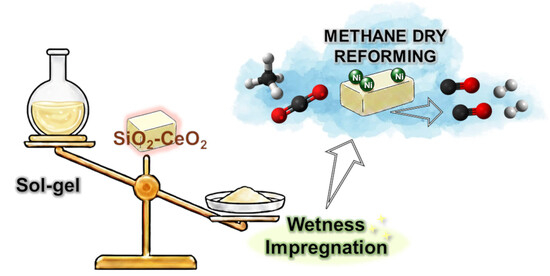
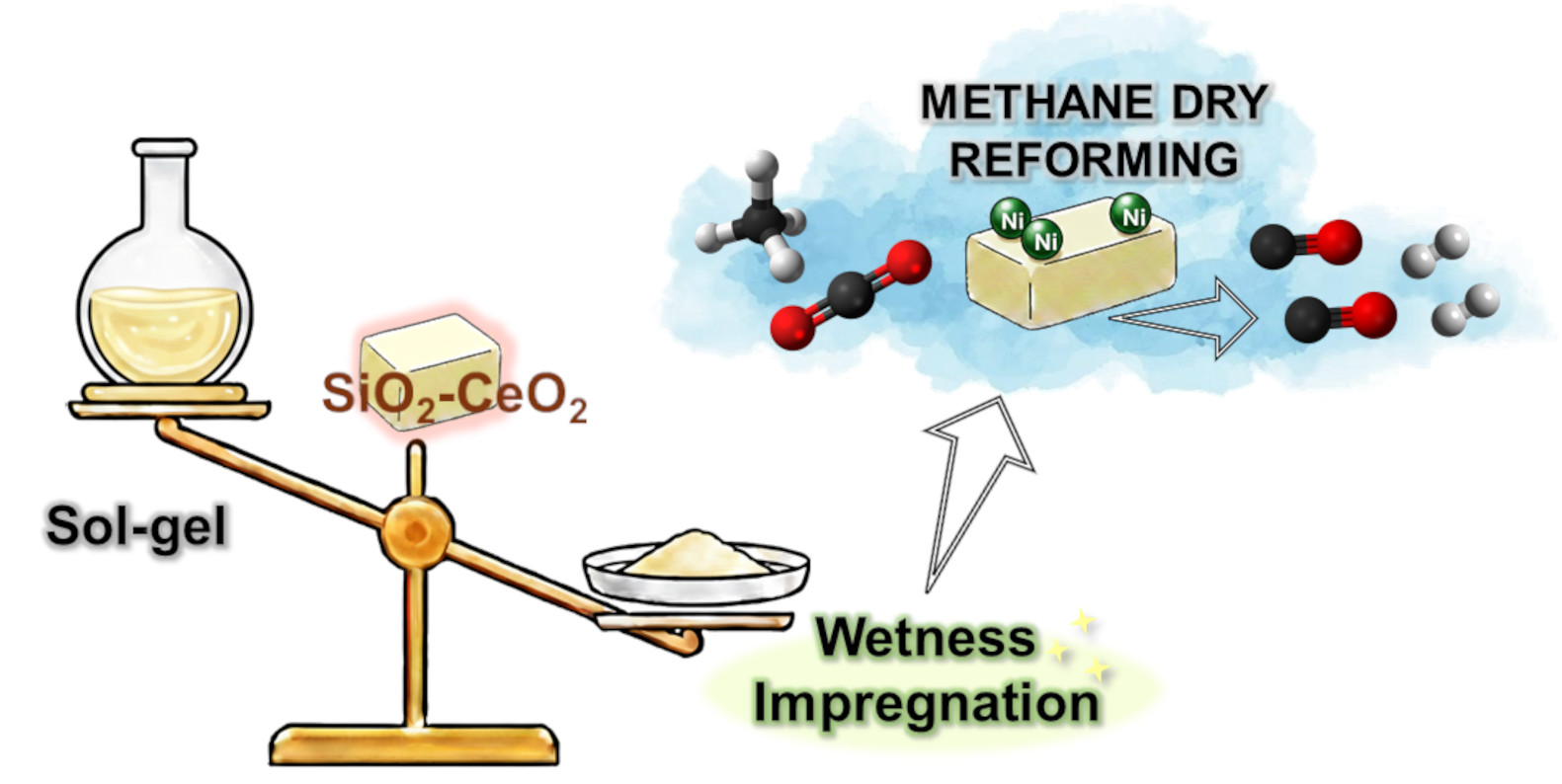
Graphical Abstract

1. Introduction

Greenhouse gas emissions from fossil fuel combustion and industrial processes have emerged as a primary driver of the current environmental crisis. The increasing atmospheric concentration of pollutants such as carbon dioxide and methane is resulting in pronounced climate change. Addressing this crisis requires a transition to low-carbon energy systems combined with coordinated international policy efforts to ensure long-term environmental sustainability [1]. This challenge has motivated the development of catalytic technologies designed to convert greenhouse gases into valuable chemical feedstocks. In this context, dry reforming of methane (DRM: CH4 + CO2 → 2H2 + 2CO) has attracted growing attention because it simultaneously consumes CH4 and CO2 to produce synthesis gas (CO + H2), a key intermediate for downstream processes such as Fischer–Tropsch synthesis, methanol synthesis, and hydrocarbon upgrading [2,3]. However, practical implementation of DRM faces significant challenges, including high temperatures required to activate stable reactants and catalyst deactivation through carbon deposition and metal sintering [4,5].
Nickel-based catalysts are widely regarded as the most economical and industrially viable materials for DRM, offering high intrinsic activity for C–H bond activation at a significantly lower cost than noble metals such as Ru, Rh, or Pt [6]. Nevertheless, their application remains limited by rapid deactivation caused by carbon formation [7], growth and agglomeration of Ni nanoparticles, and interactions leading to inactive phases. To mitigate these issues, the development of advanced materials that can stabilize Ni particles, improve reducibility, and enhance coke resistance has become a key research focus [8,9,10]. Among the reported catalytic systems for methane dry reforming, CeO2 has emerged as a promising support for Ni active sites, owing to its excellent redox properties and oxygen storage capacity which promote the removal of carbon deposits, enhance catalyst stability, and mitigate coke formation [11,12,13]. The Ce3+/Ce4+ redox cycle enables lattice oxygen to participate in the oxidation of CH4, generating oxygen-deficient CeO2−x species that can be reoxidized by CO2, thus preserving the catalytic performance and extending the lifetime of the Ni/CeO2 catalytic system.
Hybrid SiO2-CeO2 mixed oxides represent a particularly attractive support for Ni-based catalysts [14,15,16]. Silica provides high surface area, thermal stability, and well-controlled porosity [17,18], while ceria contributes oxygen mobility and redox activity that facilitate carbon oxidation and CO2 activation [19]. The combination of these two oxides can therefore enhance nickel dispersion, strengthen metal–support interactions, and improve resistance to carbon deposition during DRM [20,21]. Importantly, both the ceria content and the support synthesis method significantly influence the physicochemical properties of SiO2-CeO2 systems, affecting parameters such as surface area, degree of Ni–support interaction, oxygen vacancy concentration, and reducibility [22,23,24].
In this study, we systematically investigate the influence of CeO2 content (5–30 wt%) and the support synthesis method (sol–gel vs. wetness impregnation) on the structural, textural, and catalytic properties of Ni/SiO2-CeO2 catalysts for methane dry reforming. SiO2-CeO2 composites were prepared using either the sol–gel route or wetness impregnation, followed by incorporation of nickel via wetness impregnation. Comprehensive physicochemical characterization, including X-ray diffraction (XRD), N2 physisorption, and H2 temperature-programmed reduction (H2-TPR), was performed to elucidate structural evolution, porosity, and reducibility. Catalytic performance was evaluated between 450 and 800 °C using a CH4/CO2 mixture, and spent catalysts were examined by thermogravimetric analysis (TG) and XRD to evaluate carbon deposition and phase stability. By correlating preparation methods, ceria content, and reaction performance, this work provides new insights into the design of Ni-based catalysts with enhanced coke resistance and improved stability for DRM.

2. Results and Discussion

SiO2-CeO2 mixed oxides (denoted as SiCe) were developed as supports for Ni-based catalysts to be used in syngas production via methane reforming with carbon dioxide. These SiCe supports were designed to stabilize dispersed Ni nanoparticles, providing enhanced catalytic activity and improved resistance to coke formation during the high-temperature reforming process.
SiCe powders were synthesized using two distinct strategies: the sol–gel method (SiCe5-30-SG) and the wetness impregnation method (SiCe5,30-WI).
To investigate the influence of the support composition, four SiCe materials with ceria contents of 5, 10, 20, and 30 wt% were synthesized using the sol–gel method. A pure SiO2 support was also prepared using both methods as a reference material, and as the reference support for the synthesis of two additional SiCe samples with CeO2 contents of 5 and 30% by the wetness impregnation method (SiCe5-WI, SiCe30-WI).
The supported Ni catalysts (5 wt%), prepared by wetness impregnation of SiCe powders, were labeled as NiSi, NiSiCe5-SG, NiSiCe10-SG, NiSiCe20-SG, NiSiCe30-SG, NiSiCe5-WI, and NiSiCe30-WI.
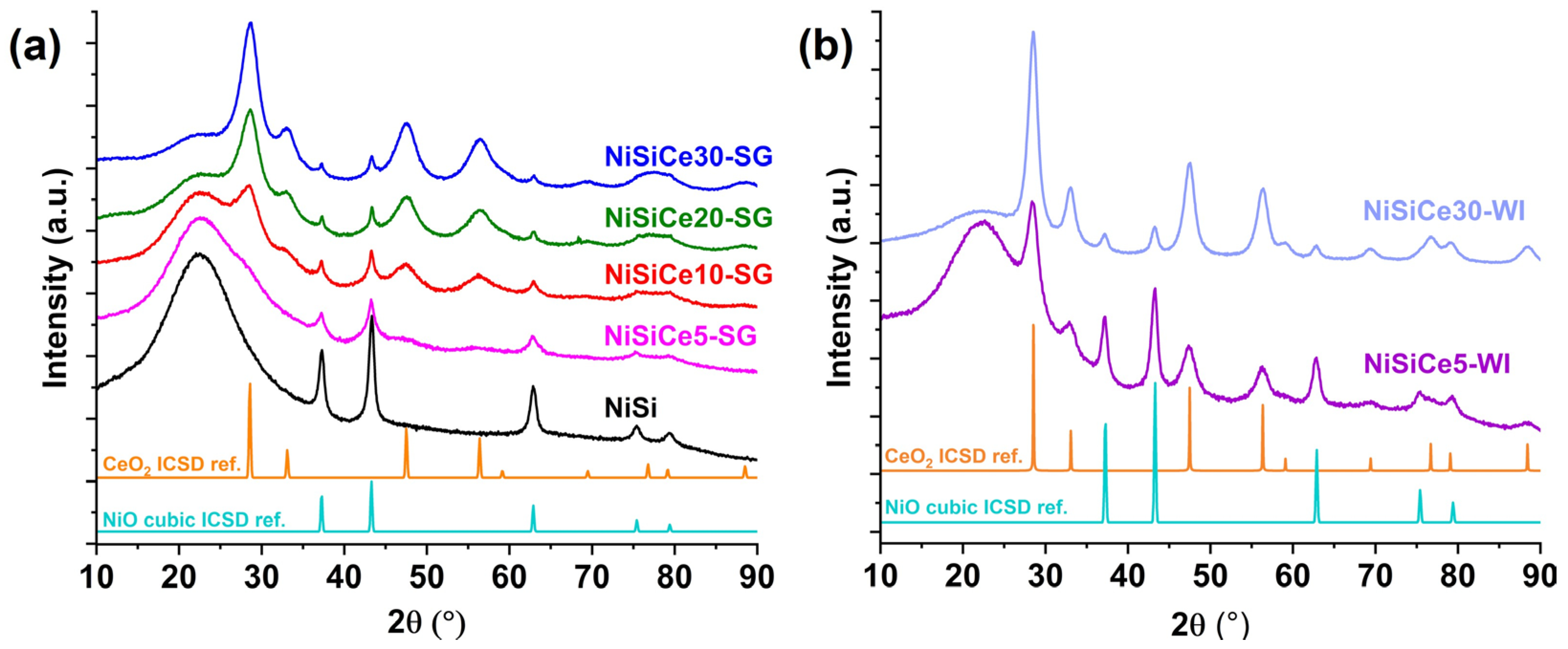
Ni catalysts were analyzed by X-ray powder diffraction (Figure 1) to investigate their structural properties. The recorded patterns of most samples display the characteristic reflections of CeO2 at 28.5°, 33.0°, 47.5°, and 56.3° 2θ, assigned to the (111), (200), (220), and (311) planes of its fluorite-type cubic structure (ICSD No. 28753, space group Fm–3m).
In contrast, when the sol–gel method was applied to prepare the material with the lowest CeO2 content, NiSiCe5-SG, the corresponding XRD pattern shows barely visible CeO2 diffractions, suggesting the presence of ceria as highly dispersed phase and fine nanometric domains embedded within the amorphous silica network. XRD patterns of the calcined catalysts clearly display NiO reflections consistent with ICSD reference No. 24018. The primary NiO peaks are detected at 37.2°, 43.3°, and 62.9° 2θ, corresponding to the (111), (200), and (220) planes, respectively. Interestingly, as the ceria content increases, these peaks become less intense and broader, indicating that NiO particles are more finely dispersed on the supports with higher CeO2 loadings.
NiO mean crystal sizes were calculated using the Scherrer equation, and the values are listed in Table 1. An effect of the catalyst composition on structural properties was observed. NiSi, without ceria, exhibits the largest NiO crystallite size (22.7 nm). With incorporation of CeO2 into the silica matrix, a systematic reduction in NiO crystallite size was observed. At low ceria loadings (NiSiCe5-SG and NiSiCe10-SG), the mean NiO particle size decreases to about 17.0–16.6 nm and further to 15.7 nm for NiSiCe20-SG. The smallest NiO crystallites (11.8 nm) were obtained for NiSiCe30-SG. This progressive decrease in NiO crystallite size suggests that ceria effectively inhibits NiO crystal growth, likely because of strengthened metal–support interactions and enhanced dispersion of Ni species promoted by CeO2. A similar effect was also abserved for the wetness-impregnated samples, NiSiCe5-WI, and NiSiCe30-WI, showing smaller and better dispersed NiO crystallites at higher CeO2 loadings.
N2 physisorption measurements were performed on both the supports and the investigated catalysts to evaluate their textural properties, including specific surface area (SSA), pore volume, and mean pore size (Table 1).
Specific surface area (SSA) of the catalysts differs significantly based on CeO2 content and preparation method. The silica-supported catalyst (NiSi) has a high surface area of 242 m2/g, a pore volume of 0.50 cm3/g, and a mean pore diameter of 16.4 nm. When CeO2 is incorporated using the sol–gel method, there is a notable impact on the textural properties compared to the pure silica oxide. At low CeO2 content (SiCe5-SG), SSA increases to 359 m2/g, while pore volume decreases significantly to 0.30 cm3/g, and the mean pore diameter drops to 2.8 nm. This suggests the formation of a finer pore structure, likely due to the well-dispersed ceria within the silica matrix. When the CeO2 content is increased further (SiCe10-30-SG), there is a gradual decrease in surface area and pore volume, accompanied by a slight increase in pore diameter ranging between 2.9 and 4.0 nm. This observation likely indicates a modification of the pore structure or aggregation of the CeO2 particles. Upon Ni deposition, all the silica–ceria oxides prepared by the sol–gel method undergo a significant decrease in specific surface area and pore volume, reflecting partial pore filling and the formation of NiO crystallites on the surface.
Catalysts prepared by wetness impregnation (NiSiCe5-WI and NiSiCe30-WI) and their supports (SiCe5-WI and SiCe30-WI), while exhibiting slightly lower SSA values than pure silica and NiSi, retain higher pore volumes (0.48–0.57 cm3 g−1) and larger pore sizes (14.4–17.7 nm) compared with the sol–gel samples. Moreover, it can be inferred that NiO particles interact preferentially with surface ceria rather than with silica, as the surface area of the WI catalysts is not strongly affected by nickel deposition.
Overall, based on the results reported so far, it is evident that the preparation method plays a significant role in the dispersion of CeO2 and in the resulting textural properties of Ni/SiO2–CeO2 catalysts.
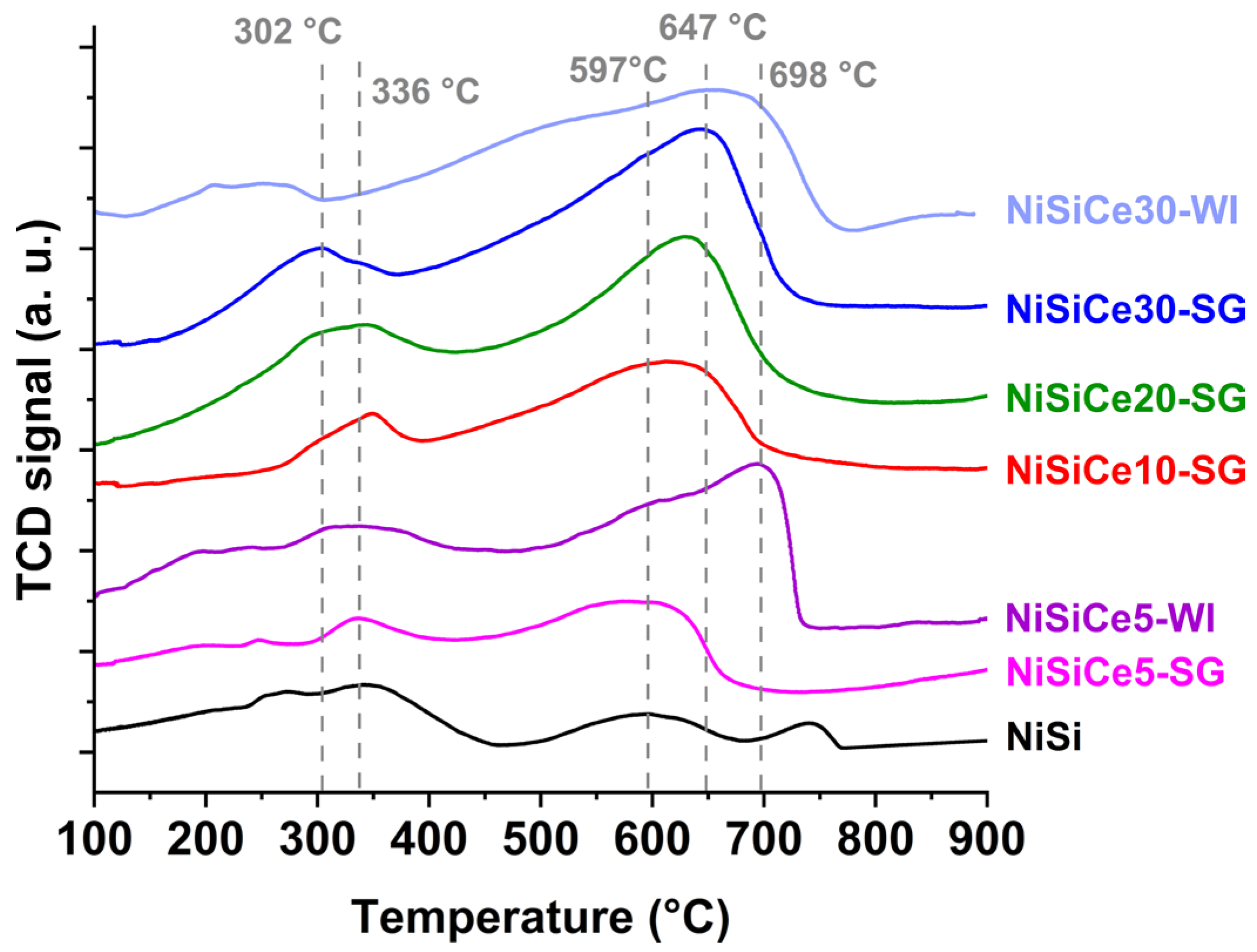
Hydrogen temperature-programmed reduction (H2-TPR) analysis was performed on the Ni-supported catalysts to investigate the effect of ceria content on their reducibility and Ni-support interactions.
The observed features can be attributed to the reduction of Ni2+ to metallic Ni and of Ce4+ to Ce3+ (Figure 2), as confirmed by experimental H2 consumption values (20–35 mL g−1). These values are consistent with the theoretical hydrogen consumption required for complete reduction of Ni2+ to Ni0 (20.5 mL g−1) and for the reduction of Ce4+ to Ce3+, which is almost complete at ceria loadings ≤10 wt%.
NiO particles with moderate interaction with the support are reduced in the range of 300–400 °C, whereas the reduction of NiO that is strongly interacting with the support occurs at higher temperatures. The TPR profile of NiSi shows broad asymmetric peaks centered at ~350 °C and ~600 °C, along with a further consumption at ~750 °C. The low-temperature reduction corresponds to large NiO crystallites with weak interaction with the support, more characteristic of bulk NiO, whereas the high-temperature features can be ascribed to the reduction in small NiO particles strongly interacting with silica [24,25].
CeO2-containing catalysts display additional reduction features between 400 and 700 °C, which can be assigned to the reduction in surface and bulk ceria (Ce4+ → Ce3+). By comparing the reduction profiles of the NiSiCe-SG series with those of the NiSiCe-WI catalysts, it is evident that the high-temperature reduction peak is shifted to lower values. This finding supports the occurrence of a strong metal–support interaction in the SG series, which promotes the reduction in bulk ceria at lower temperatures.
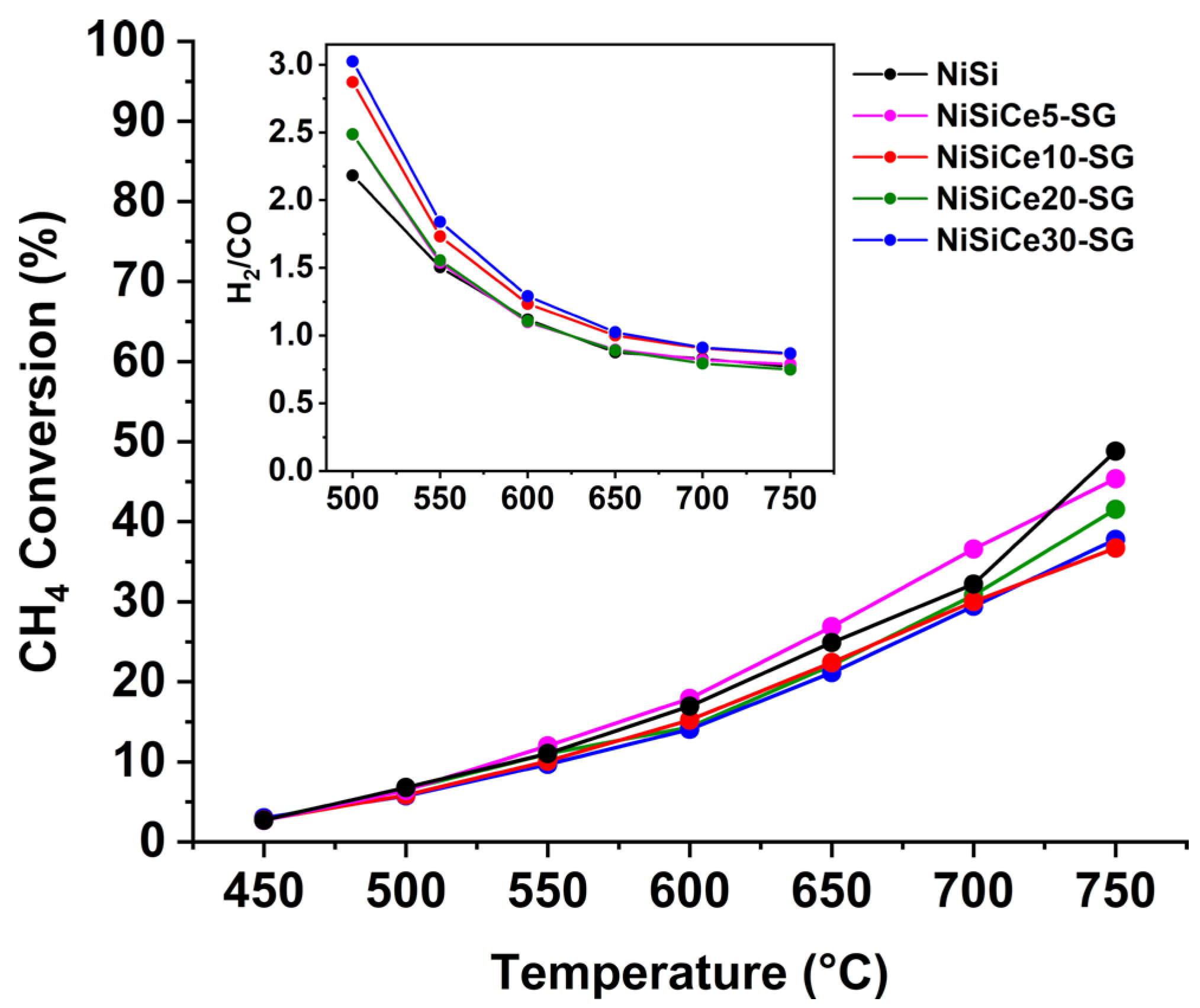
The catalytic activity of NiSiCe(5-30)-SG catalysts was evaluated in the dry reforming of methane (DRM) reaction under temperature-gradient conditions ranging from 450 to 750 °C (Figure 3). Results indicate an increase in CH4 conversion in the following order: NiSi > NiSiCe5-SG > NiSiCe20-SG > NiSiCe30-SG > NiSiCe10-SG.
The relatively high activity of NiSi can be attributed to the presence of NiO particles with weak interaction with the support. Among the NiSiCe-SG samples, the material with the lowest CeO2 content, NiSiCe5-SG, performs slightly better than other catalysts. This could likely be attributed to the combination of well-dispersed ceria domains and moderately interacting NiO species.
As CeO2 content increases beyond 10 wt%, catalytic activity decreases. This trend can be attributed to stronger Ni–support interactions induced by ceria, which lead to the formation of highly stabilized and less reactive NiO species. These factors can limit the amount of active Ni0 available on the surface of the catalyst under reaction conditions.
Overall, the results reported so far suggest that the catalytic performance of the NiSiCe(5-30)-SG series is influenced by the ceria content, which affects NiO particle size, reducibility and the extent of Ni–support interaction.
Figure 3 (inset) shows H2/CO molecular ratio values as a function of temperature in the range 500–750 °C. H2/CO values decreased with increasing temperature, dropping from above 2 at 500 °C to approximately 1–0.8 in the 650–750 °C range. The temperature-dependent evolution of the H2/CO ratio can be attributed to side reactions during the DRM test [6]. Specifically, the exothermic Boudouard reaction (2CO C + CO2), which is favored at lower temperatures, leads to CO consumption, and thus contributes to the higher H2/CO ratio. In contrast, endothermic reactions such as the reverse Boudouard and the reverse water–gas shift (RWGS) reaction (CO2 + H2  CO + H2O) enhance CO formation at higher temperatures, thereby reducing the H2/CO molar ratio [6,25,26].
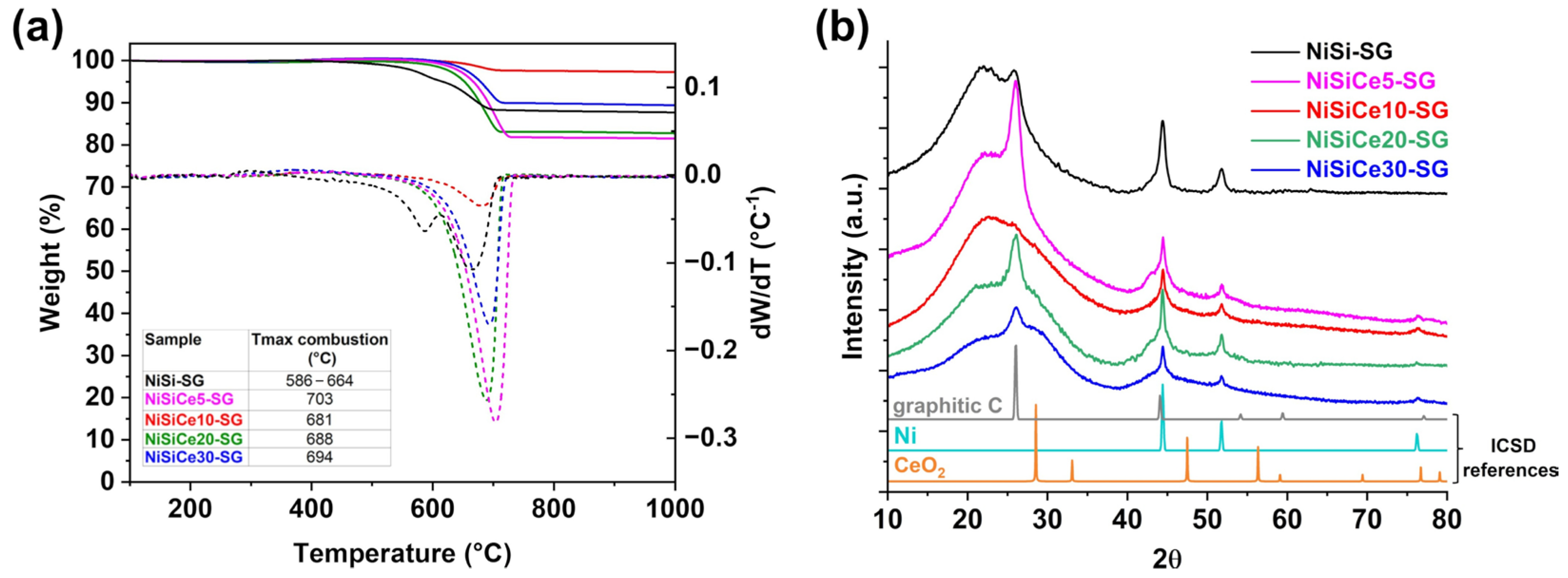
After the DRM reaction, spent catalysts were characterized by TGA and XRD analyses. The extent of carbon deposition on spent NiSi and NiSiCe (5-30)-SG catalysts was determined by thermogravimetric (TG) analysis, as shown in Figure 4a. The weight losses associated with carbon oxidation occurred between ~600–720 °C and ranged from approximately 18.5 wt% for NiSiCe5-SG to 2.8 wt% for the least active NiSiCe10-SG.
TG analysis of the spent NiSi catalyst revealed the coexistence of different carbon species (e.g., amorphous and graphitic carbon), as evidenced by its DTG profile showing two oxidation peaks centered at 586 and 703 °C.
The formation of graphitic carbon on NiSiCe (5-30)-SG catalysts after DRM was further confirmed by XRD analysis (Figure 4b), which shows a diffraction peak at 26.5° (2θ). In addition, Ni0 was clearly detected in spent samples, identified by the (111), (200), and (220) reflections at 2θ = 44.4°, 51.8°, and 76.3°, respectively. The calculated mean particle size of metallic nickel was in the range 25–14 nm, with the largest size for NiSi that decreased progressively with the ceria content. NiSiCe5-SG, NiSiCe10-SG and NiSiCe20-SG exhibited average particle size equal to 19–18 nm, while NiSiCe30-SG was characterized by the smallest size, 14 nm. This trend is in agreement with the previous one observed for NiO (see Table 1), with only a slight increase in the size of metallic Ni.
The absence of CeO2 diffraction peaks after DRM was observed for all samples and has also been reported in the literature for Ni/SiO2–CeO2 catalysts [27,28]. This result was ascribed to the catalyst reduction pre-treatment at 750 °C under 5% H2/He, carried out before the DRM test. The reducing atmosphere induced Ce4+ → Ce3+ reduction and the formation of oxygen vacancies, disrupting the long-range crystallinity of the fluorite structure.
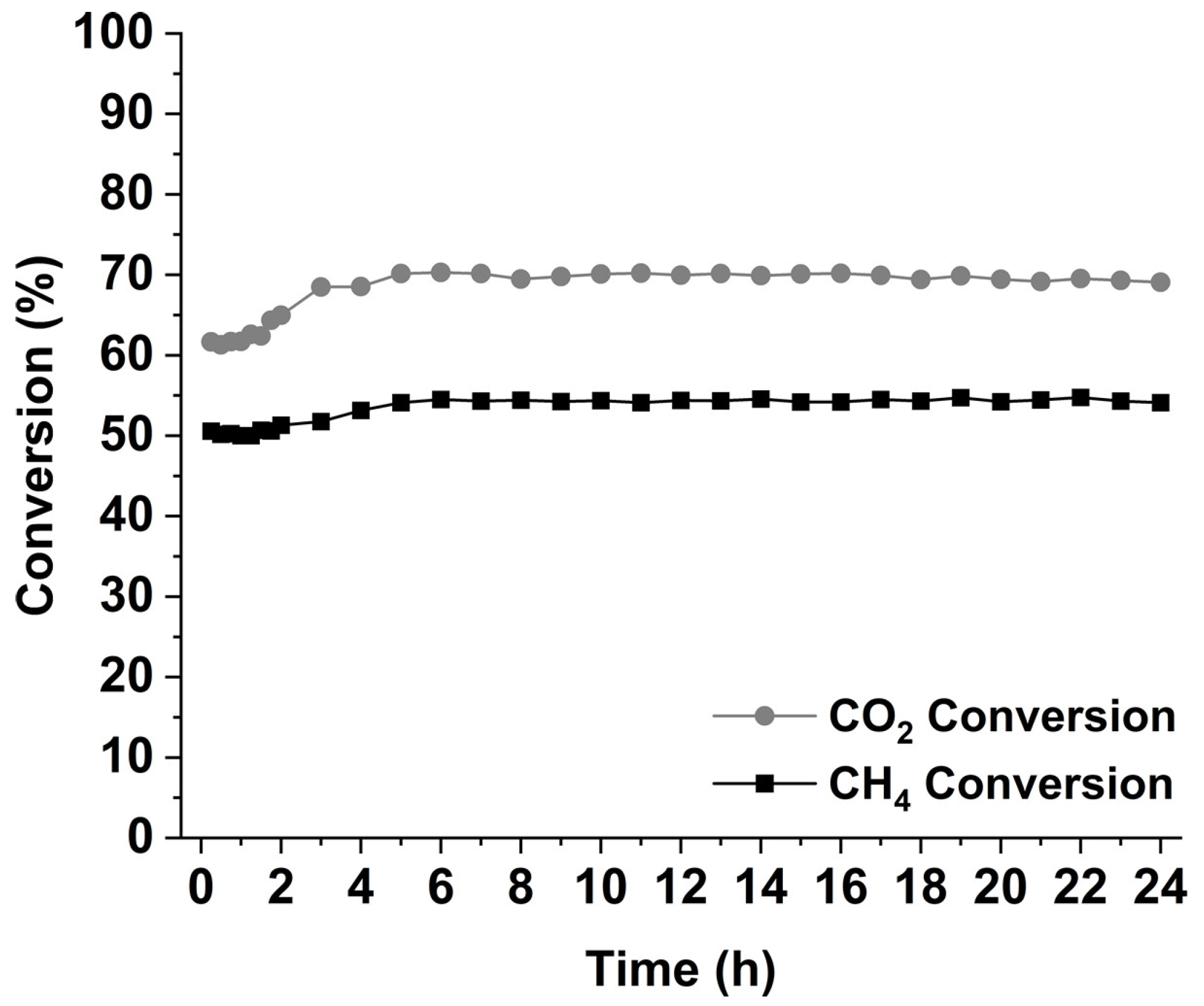
A long-term stability test was conducted at 700 °C for 24 h over NiSi taken as a reference catalyst. As shown in Figure 5, both CH4 and CO2 conversions exhibit a slight increase during the initial hours on stream, followed by stable values over the entire 24 h time-on-stream test. CO2 conversion values were higher than those recorded for CH4. This behavior is consistent with the literature and can be explained by the occurrence of the reverse water–gas shift reaction (RWGS: CO2 + H2  CO + H2O) [25].
CO2 conversion rapidly reaches approximately 70% and remains essentially constant thereafter, indicating steady catalytic performance. Likewise, CH4 conversion increases to about 55% in the early stage of the reaction and subsequently stabilizes, with no evidence of deactivation. The absence of any progressive decline in conversion for either reactant points to good catalyst stability under investigated conditions and is consistent with the limited carbon deposition observed during the temperature-gradient test.
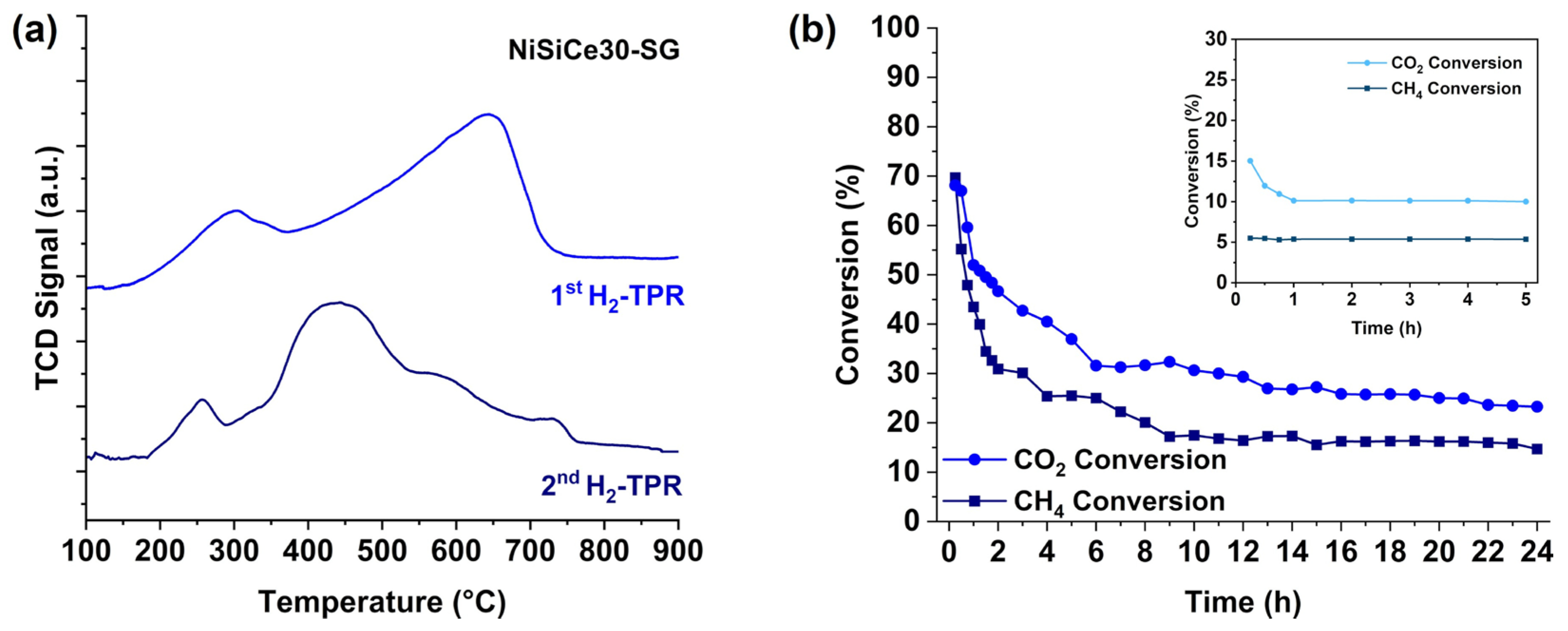
In order to verify the hypothesis that NiSiCe-SG catalysts exhibit lower activity than the corresponding NiSi sample due to the strong Ni-CeO2 interaction, the catalyst with the highest ceria content, NiSiCe30-SG, was subjected to a redox treatment (TPR-TPO-TPR). Specifically, after the first TPR, the sample was oxidized from room temperature up to 600 °C (hold time 1 h) using a 5% O2/He mixture (v/v, 30 mL/min), then cooled to room temperature under helium and, finally, a second TPR was performed. This procedure was carried out to investigate changes in the reducibility of the oxidized Ni species. In Figure 6a, the second reduction profile was compared with the first one, already shown in Figure 2. An evident change in the second reduction profile of NiSiCe30-SG was registered in comparison with the first TPR. After the redox treatment (TPR-TPO-TPR), the second H2-TPR profile shifts the main reduction feature toward lower temperatures, with the maximum now centered at around 450–500 °C, and a narrower distribution of reduction peaks. This trend suggests a partial weakening of the metal–support interaction and an increased fraction of more easily reducible Ni2+ and Ce4+ species formed upon reoxidation. The enhanced reducibility, observed in the second TPR, indicates that the redox cycling likely promotes changes at the Ni-CeO2 interface, which may affect the catalytic performance of the NiSiCe30-SG. Based on the results reported so far, a fresh portion of the NiSiCe30-SG catalyst was subjected to the first reduction at 750 °C for 1 h under 5% H2/He, then, after cooling to room temperature under inert gas, the sample was oxidized at 600 °C for 1 h, and again reduced at 750 °C for 1 h. The long-term stability test was then carried out at 700 °C for 24 h (Figure 6b). Both reactants, CH4 and CO2, exhibit relatively high initial conversions, followed by a rapid decline during the first few hours on stream. CO2 conversion decreases sharply from its initial value (68%) to approximately 40–45% within the first 2–3 h, whereas CH4 conversion shows an even more pronounced early drop, falling from 70% to 30% over the same period.
The initially high activity indicates that the second reduction treatment is beneficial for the reorganization of Ni active sites, which are likely more dispersed and thus more accessible on the catalyst surface. However, the catalyst undergoes rapid deactivation within the first few hours on stream, probably due to modifications of the active sites, such as metal sintering, which affect CH4 activation more severely than CO2. After this transient period, both conversion curves gradually approach a quasi-steady state. Between approximately 6 and 24 h on stream, CO2 conversion stabilizes at around 23–27%, while CH4 conversion levels off at lower values, ca. 14–17%. Throughout the entire test, CO2 conversion remains consistently higher than that of CH4, in agreement with previous observations (see Figure 5). In Figure 6b (inset), the CH4 and CO2 conversion profiles recorded at 700 °C over the same NiSiCe30-SG catalyst after a single reduction treatment at 750 °C are shown during the first 5 h of the reaction. This observation confirms the poor catalytic activity previously observed under temperature-gradient conditions (see Figure 3). In this case, CO2 conversion decreases modestly from ~15% to ~10% within the first hour and then remains nearly constant, whereas CH4 conversion stays close to ~5% over the entire 5 h interval.
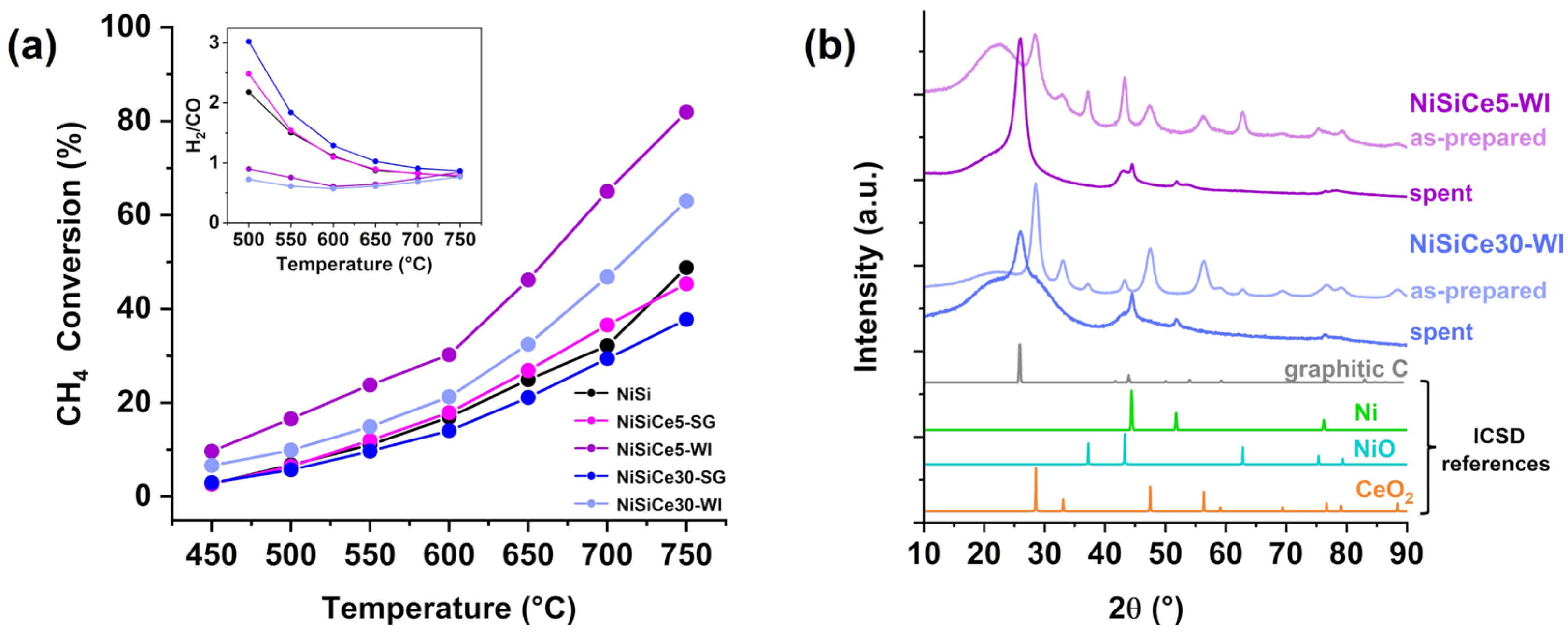
The influence of the support synthesis method on catalytic performance was evaluated for NiSiCe5-WI and NiSiCe30-WI catalysts by performing temperature-gradient tests between 450 °C and 750 °C. For reference, the catalytic results of the corresponding sol–gel (SG) samples (Figure 3) are included in Figure 7a, providing a comprehensive comparison of all catalysts prepared from SiCe supports with 5 wt% and 30 wt% ceria. Both NiSiCe5-WI and NiSiCe30-WI exhibit higher CH4 conversions than NiSi and NiSiCe(5-30)-SG samples, with NiSiCe5-WI achieving the highest conversion. H2/CO ratios for both NiSiCe-WI catalysts lie between 0.7 and 0.8 in the 500–700 °C range, remaining lower than those of the SG samples. At 750 °C, the curves intersect those of NiSi and NiSiCe-SG samples at a H2/CO ratio equal to 1 (see inset, Figure 7a).
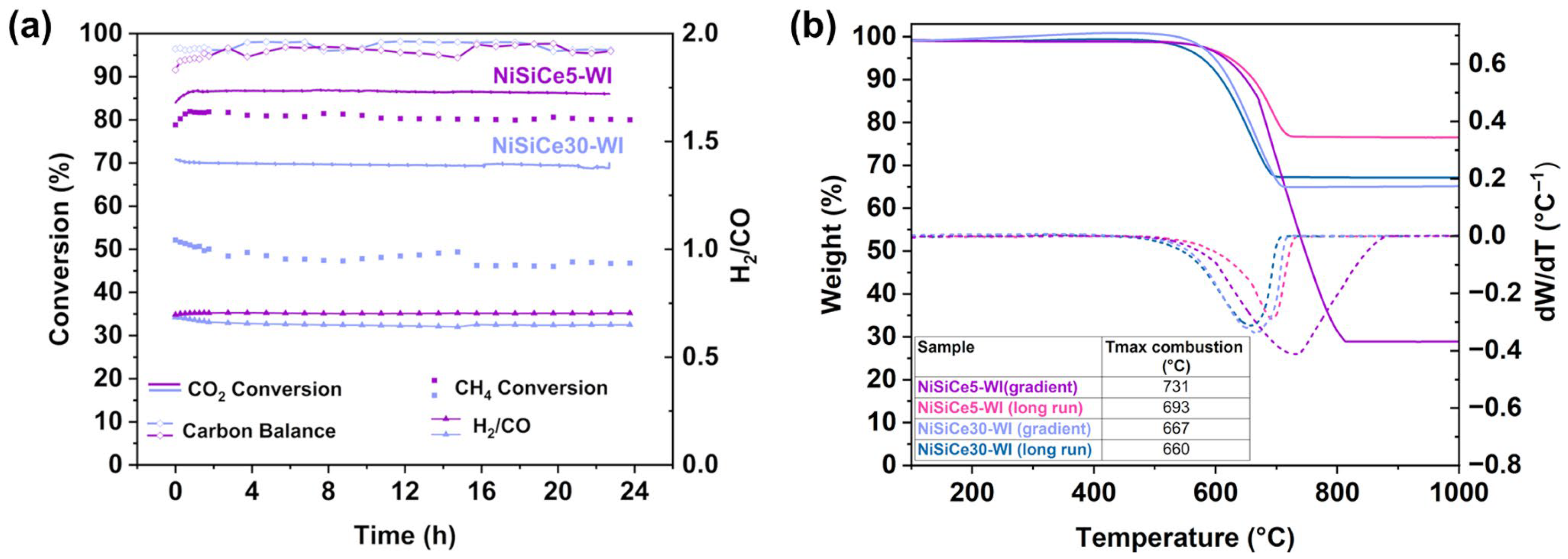
Spent NiSiCe5-WI and NiSiCe30-WI catalysts were subsequently characterized by XRD and TG analyses, which revealed the presence of carbon deposits (Figure 7b and Figure 8b). XRD patterns displayed main diffraction peaks of graphitic carbon partially overlapping with those of metallic Ni, especially for the spent NiSiCe5-WI, while CeO2 diffraction peaks were not detected, in agreement with previous findings. The average particle size of metallic Ni was estimated equal to 15 nm in the case of spent NiSiCe30-WI.
Based on these findings, NiSiCe5-WI and NiSiCe30-WI were tested in DRM at 700 °C for 24 h (Figure 8a) using a feed of 45% CH4, 45% CO2 and 10% N2 in order to assess the catalysts stability in realistic conditions. NiSiCe5-WI exhibited the highest activity, achieving CH4 and CO2 conversions of 80% and 85%, respectively, and a H2/CO ratio of 0.7. CH4 conversion values for NiSiCe5-WI exceed those obtained under temperature-gradient conditions by 14% (Figure 7a), indicating that NiSiCe5-WI performs efficiently at 700 °C in long-term conditions. During the long-run DRM test, NiSiCe30-WI retained almost the same CH4 conversion as the corresponding catalytic test performed under temperature-gradient conditions. Both catalysts showed a carbon balance higher than 95% during all the analyzed time range.
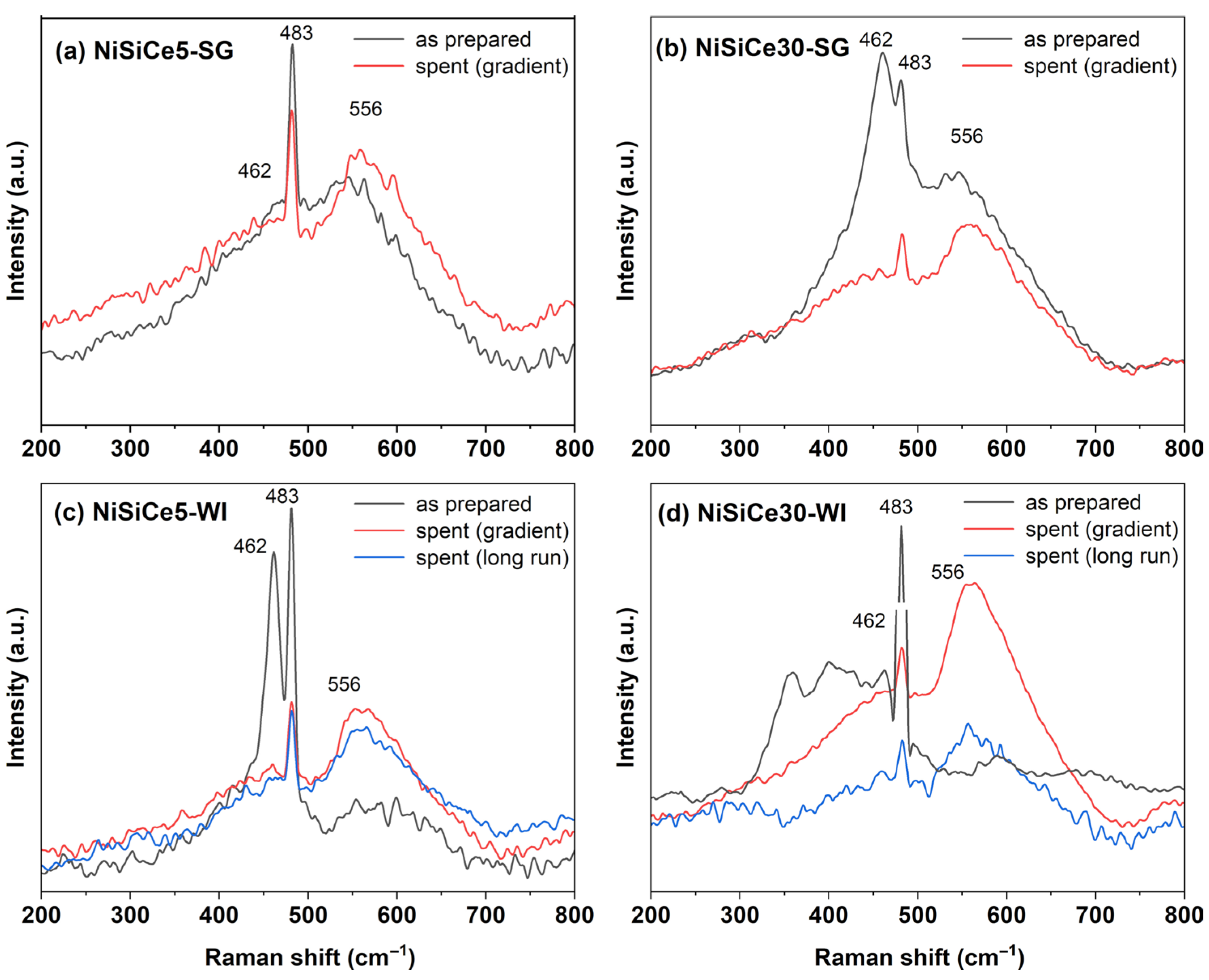
Raman spectra of the as-prepared and spent NiSiCe5,30-SG and NiSiCe5,30-WI catalysts were recorded to investigate additional structural features (Figure 9), complementing XRD findings. For all samples, the resulting spectra exhibit a peak centered at 483 cm−1, which is ascribed to the stretching vibration of Si-O-Si bonds [29].
For spent catalysts, the intensity of this peak is markedly reduced, suggesting partial coverage or blockage of the silica framework. This effect could likely be caused by carbon deposition formed during the DRM reaction, which can hinder the detection of Si–O–Si vibrations and may also affect the structural integrity and accessibility of the active sites. The F2g vibration mode of the CeO2 fluorite structure was clearly detected at ~462 cm−1 for the as-prepared NiSiCe5-WI and NiSiCe30-SG. The sharper peak observed for the as-prepared NiSiCe5-WI is consistent with its higher crystallinity [30], which can be attributed to the synthesis method. In contrast, the F2g peak was not detected in the NiSiCe5-SG analog, reflecting the highly dispersed and poorly crystalline nature of CeO2 resulting from the sol–gel synthesis of the SiCe5-SG support.
Consistently with XRD analysis, the characteristic F2g Raman mode of CeO2 is not clearly detected in spent catalysts after DRM, which may be attributed to the combined effects of carbon deposition and a reduction in the long-range order of ceria domains during the reaction. The D1 bands observed in the 500–600 cm−1 range are ascribed bulk oxygen vacancies (Ov−b) in the ceria fluorite structure [31]. These bands reflect the presence of local structural defects in CeO2, which are likely related to the presence of Ce3+ species. Moreover, the D1 band of the spent catalysts appears more pronounced than in the corresponding as-prepared samples, indicating that DRM conditions induce additional oxygen vacancies and structural disorder. Qualitatively, while the F2g band of CeO2 reflects the long-range fluorite order, the relative prominence of the D1 band in the spent samples suggests an increase in defect density. Among the catalysts studied, NiSiCe5 WI exhibits the strongest D1 signal, consistent with a higher concentration of bulk oxygen vacancies, which may contribute to its superior catalytic performance [32].
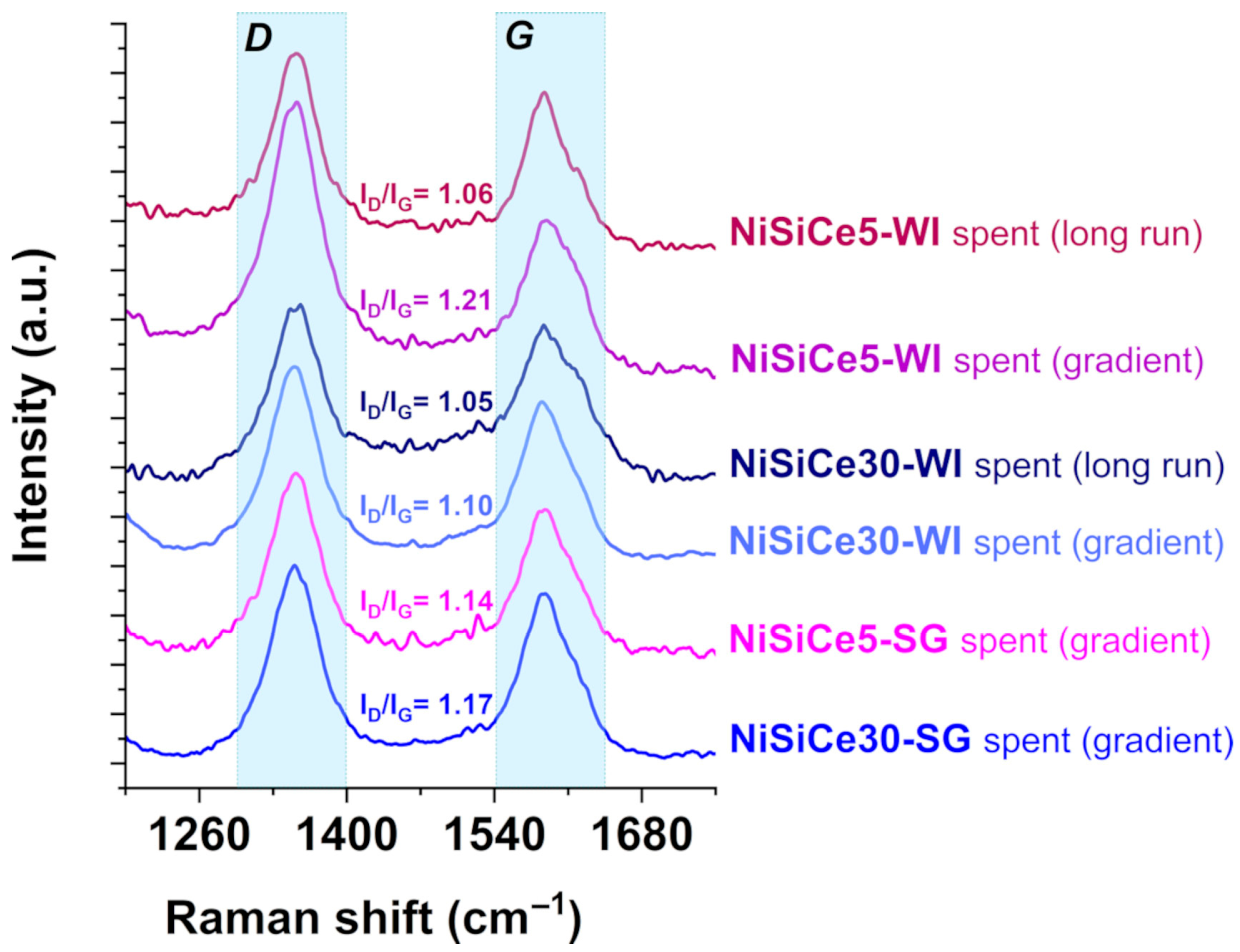
Raman spectroscopy was also employed to elucidate the nature and structural order of carbon deposits on spent catalysts after DRM, focusing on the 1260–1680 cm−1 Raman shift range (Figure 10). Spectra of the spent catalysts exhibit the characteristic G band at ~1588 cm−1 associated with the E2g vibration of sp2 carbon, and the D band at ~1309–1352 cm−1 which becomes active in the presence of defects or structural disorder. The ID/IG ratio was calculated to assess the degree of disorder versus graphitization in the deposited carbon, as it is widely used to quantify the structural quality of sp2 carbon materials [33,34].
Higher values denote a more defective carbon network, whereas lower ratios indicate increased ordering. The catalysts recovered after the temperature-gradient test exhibit ID/IG values of NiSiCe5-WI (1.21) > NiSiCe30-SG (1.17) > NiSiCe5-SG (1.14) > NiSiCe30-WI (1.10), indicating that NiSiCe30-WI accumulates the most graphitized carbon. After the long-term stability test, the ID/IG values converge (1.06 for NiSiCe5-WI and 1.05 for NiSiCe30-WI), suggesting that extended operation promotes the formation of similarly ordered carbon species.

3. Materials and Methods

3.1. Synthesis Procedures of Si-SG, SiCe(5-30)-SG, SiCe(5-30)-WI and the Corresponding Ni-Based Powders

Pure SiO2 (Si-SG) and SiO2-CeO2 mixed oxides (SiCe(5-30)-SG) were prepared via the sol–gel method. For the synthesis of pure SiO2, TEOS (11 mL) was first dissolved in 8.5 mL of ethanol under magnetic stirring at room temperature. To this solution, 8 mL of an acetic acid solution (pH = 6) was added dropwise under continuous stirring. The resulting mixture was then heated to 45 °C for 1 h and subsequently to 80 °C for an additional hour. After heating, the sol was cooled to room temperature and kept overnight to promote gelation. The resulting gel was manually crushed at 80 °C and dried at 100 °C overnight. The dried material was then ground and calcined at 450 °C for 4 h (2 °C min−1).
SiCe(5-30)-SG materials were prepared following the same procedure, adding the appropriate amounts of cerium (III) nitrate (Ce(NO3)3·6H2O) as the cerium oxide precursor to the silica sol solution to obtain final ceria loadings of 5%, 10%, 20%, and 30% (w/w).
SiCe5-WI and SiCe30-WI were prepared by sequential wetness impregnation of the pure Si-SG with an aqueous solution of cerium nitrate. The resulting materials were dried at 100 °C and calcined at 450 °C with a heating rate of 2 °C min−1 for 4 h.
All Ni-containing catalysts, based on both the unmodified and Ce-modified supports, were synthesized by sequential wetness impregnation using an aqueous solution of Ni(NO3)2·6H2O. Nominal nickel loading was 5 wt%. Catalyst samples were dried at 100 °C and calcined under static conditions at 600 °C with a heating rate of 2 °C min−1 for 4 h (as-prepared samples).

3.2. Characterization of the Materials

Specific surface areas and pore volumes were determined from N2 adsorption–desorption isotherms measured at −196 °C using an ASAP 2020 instrument (Micromeritics, Norcross, GA, USA). Prior to analysis, the samples were degassed at 250 °C for 2 h. Surface areas were calculated using the Brunauer–Emmett–Teller (BET) method over the relative pressure range 0.05–0.30 (P/P0). Pore volumes and pore size distributions were obtained from the desorption branch using the Barrett–Joyner–Halenda (BJH) method.
Powder X-ray diffraction (XRD) patterns were collected on a D5000 diffractometer (Bruker AXS, Karlsruhe, Germany) using Ni-filtered Cu Kα radiation. Data were recorded over the 2θ range 10–90° with a step size of 0.05°. Phase identification was performed using the ICSD database (Inorganic Crystal Structure Database, version 5.5.0), and crystallite sizes were calculated using the Scherrer equation applied to the main reflections [35].
Hydrogen temperature-programmed reduction (H2-TPR) was conducted using an Autochem 2910 system (Micromeritics, Norcross, GA, USA) equipped with a TCD detector. Samples (0.10 g) were pretreated in 5% O2/He (30 mL min−1) by heating to 400 °C at 10 °C min−1 and holding for 30 min. After cooling to room temperature under He flow (30 mL min−1), reduction was carried out in 5% H2/Ar (30 mL min−1) up to 900 °C at 10 °C min−1. H2 consumption was quantified by integration of the TPR peaks using a calibration curve obtained from different H2/Ar gas mixtures. The uncertainty in hydrogen consumption measurements was ±2%. Consecutive temperature-programmed reduction/temperature-programmed oxidation (TPR/TPO) and subsequent TPR experiments were conducted by oxidizing the previously reduced sample at 600 °C for 1 h with 5% O2/He (30 mL min−1), followed by cooling to room temperature under He flow. A subsequent TPR run was then performed under identical conditions as above described.
Raman spectra of the powders were recorded using a Thermo Fisher Scientific (Waltham, MA, USA) DXR3 Raman spectrometer with a 532 nm excitation laser and a laser power of 0.2 mW.

3.3. DRM Catalytic Tests

The dry reforming of the methane (DRM) reaction was performed in a fixed-bed quartz reactor (inner diameter: 12 mm) operating at atmospheric pressure. Catalytic tests were conducted as a function of the temperature, in the temperature range 450–750 °C, using 50 °C increments. Tests were also carried out at 700 °C for 24 h of time-on-stream (TOS) to evaluate the stability in catalytic conversion.
Typically, for each catalytic, 100 mg of test catalyst (sieved to 180–250 µm) was diluted to 1:2 with inert SiC and loaded into the reactor. Prior to reaction, each catalyst was treated in 5% O2/He (v/v, 50 mL min−1) at 350 °C for 30 min to clean the surface and ensure reproducible starting conditions. After cooling to room temperature, the sample was reduced at 750 °C (heating rate of 10 °C min−1) under 5% H2/He (v/v, 30 mL min−1) and held at this temperature for 1 h. The feed mixture consisted of 10% CH4, 10% CO2, and N2 as balance, introduced at a total flow rate of 100 mL min−1 (STP), corresponding to a gas hourly space velocity (GHSV) of 60,000 mL g−1 h−1. For two selected catalysts, NiSiCe5-WI and NiSiCe30-WI, a concentrated feed containing 45% CH4, 45% CO2 and 10% N2 was used for performing 24 h long-run DRM tests at 700 °C to assess the catalysts stability in realistic conditions.
The inlet and outlet streams were analyzed online by an Agilent 7890B gas chromatograph (Agilent Technologies, Santa Clara, CA, USA) equipped with a DB-1 capillary column and a molecular sieve column, using flame ionization (FID) and thermal conductivity (TCD) detectors to monitor CH4, CO2, CO, and H2. Water formed during reaction was condensed at the reactor outlet.
Methane, carbon dioxide conversions (XCH4 and XCO2) and carbon balance were calculated using the following equations, where CH4in, CO2in and CH4out, CO2out, H2out and COout denote inlet and outlet concentrations (ppm), respectively:
XCH4 = 100 × (CH4in − CH4out)/CH4in
XCO2 =100 × (CO2in − CO2out)/CO2in
Carbon balance = 100 × (CH4out + CO2out + COout)/(CH4in + CO2in)

4. Conclusions

Nickel catalysts supported on SiO2-CeO2 mixed oxides were investigated for methane dry reforming (DRM), focusing on effects of ceria loading and the support synthesis method on Ni dispersion, reducibility, catalytic activity, and carbon resistance. Results show that both support composition and preparation method strongly influence the structure–performance relationships of Ni-based catalysts. For sol–gel-derived supports, increasing CeO2 (5–30 wt%) enhanced NiO dispersion and reduced metallic Ni crystallite size, indicating metal–support interactions. At high loadings, however, such effect was detrimental to the catalytic activity, likely due to the low reactivity of Ni species strongly stabilized by ceria.
The sol–gel-derived Ni/SiO2 catalyst under temperature-gradient tests performed slightly better than NiSiCe10-30-SG samples and exhibited good stability at 700 °C, maintaining constant CH4 and CO2 conversions over 24 h. This observation proves the benefit of weak-to-moderate metal–support interactions for stabilizing active Ni0 sites. Redox cycling of the high-ceria NiSiCe30-SG catalyst temporarily improved reducibility and initial activity but resulted in rapid deactivation, likely due to Ni sintering or structural changes. A comparison of wetness-impregnated catalysts revealed a strong preparation effect: while these catalysts preserved silica texture and exhibited higher activity and very high initial conversions, they suffered from increased carbon deposition, particularly ordered graphitic carbon.
Overall, optimal Ni/SiO2-CeO2 catalysts for DRM require careful tuning of the ceria content and synthesis method. NiSiCe5-WI exhibits the best CH4 and CO2 conversion values at 700 °C for 24 h of time-on-stream thanks to the high concentration of bulk oxygen vacancies and a balanced metal–support interaction, highlighting the beneficial effect of the wetness impregnation method.

Author Contributions

Conceptualization, C.C., V.L.P., G.P. and L.F.L.; methodology, C.C., V.L.P., G.P. and L.F.L.; software, C.C. and V.L.P.; validation, C.C., V.L.P., G.P. and L.F.L.; formal analysis, C.C., V.L.P., G.P. and L.F.L.; investigation C.C., V.L.P., G.P. and L.F.L.; data curation, C.C., V.L.P., G.P. and L.F.L.; writing—original draft preparation, C.C. and L.F.L.; writing—review and editing, C.C., V.L.P., G.P. and L.F.L.; visualization, C.C., V.L.P., G.P. and L.F.L.; funding acquisition, L.F.L. All authors have read and agreed to the published version of the manuscript.

Funding

The Projects “Accordo di programma per la regolamentazione dei rapporti in relazione allo svolgimento di attività di ricerca nell’ambito del piano nazionale di ripresa e resilienza (PNRR)—missione 2 “rivoluzione verde e transizione ecologica”—componente 2 “energia rinnovabile, idrogeno, rete e mobilità sostenibile”—investimento 3.5 “ricerca e sviluppo sull’idrogeno”—AdP ENEA CNR (CUP B93C22000630006) and Programma di Ricerca e Innovazione dal titolo “NEST—Network 4 Energy Sustainable Transition”, (Partenariato Esteso—PE0000021, CUP B53C22004060006) are acknowledged for financial support.

Data Availability Statement

The original contributions presented in this study are included in the article. Further inquiries can be directed to the corresponding authors.

Acknowledgments

The authors are thankful to Francesco Giordano (CNR-ISMN) for performing XRD analyses and to Nunzio Galli (CNR-ISMN) for performing N2 physisorption measurements.

Conflicts of Interest

The authors declare no conflicts of interest.

References

  1. Gholami, Z.; Gholami, F.; Šimek, J.; Svobodová, K.; Vakili, M. Hydrogen production for a decarbonized future: A review of production technologies. J. Ind. Eng. Chem. 2026, 153, 240–278. [Google Scholar] [CrossRef]
  2. Wittich, K.; Krämer, M.; Bottke, N.; Schunk, S.A. Catalytic Dry Reforming of Methane: Insights from Model Systems. ChemCatChem 2020, 12, 2130–2147. [Google Scholar] [CrossRef]
  3. Agún, B.; Abánades, A. Comprehensive review on dry reforming of methane: Challenges and potential for greenhouse gas mitigation. Int. J. Hydrogen Energy 2025, 103, 395–414. [Google Scholar] [CrossRef]
  4. Nguyen, D.L.T.; Vy Tran, A.; Vo, D.-V.N.; Tran Nguyen, H.; Rajamohan, N.; Trinh, T.H.; Nguyen, T.L.; Le, Q.V.; Nguyen, T.M. Methane dry reforming: A catalyst challenge awaits. J. Ind. Eng. Chem. 2024, 140, 169–189. [Google Scholar] [CrossRef]
  5. Osazuwa, O.U.; Ng, K.H. An overview on the carbon deposited during dry reforming of methane (DRM): Its formation, deposition, identification, and quantification. Results Eng. 2025, 25, 104328. [Google Scholar] [CrossRef]
  6. Wang, Z.; Mei, Z.; Wang, L.; Wu, Q.; Xia, C.; Li, S.; Wang, T.; Liu, C. Insight into the activity of Ni-based thermal catalysts for dry reforming of methane. J. Mater. Chem. A 2024, 12, 24802–24838. [Google Scholar] [CrossRef]
  7. Xu, Z.; Park, E.D. Recent Advances in Coke Management for Dry Reforming of Methane over Ni-Based Catalysts. Catalysts 2024, 14, 176. [Google Scholar] [CrossRef]
  8. Zhu, H.; Chen, H.; Zhang, M.; Liang, C.; Duan, L. Recent advances in promoting dry reforming of methane using nickel-based catalysts. Catal. Sci. Technol. 2024, 14, 1712–1729. [Google Scholar] [CrossRef]
  9. Shi, Y.; Tian, X.; Deng, Z.; Shi, W.; Fan, W.; Wang, F. Review and Outlook of Confined Ni Catalysts for the Dry Reforming of Methane Reaction. Energy Fuels 2024, 38, 1633–1656. [Google Scholar] [CrossRef]
  10. Chen, C.; Wei, J.; Lu, Y.; Duyar, M.S.; Huang, Y.; Lin, L.; Ye, R. Confinement effects over Ni-based catalysts for methane dry reforming. Catal. Sci. Technol. 2023, 13, 6089–6101. [Google Scholar] [CrossRef]
  11. Montini, T.; Melchionna, M.; Monai, M.; Fornasiero, P. Fundamentals and Catalytic Applications of CeO2-Based Materials. Chem. Rev. 2016, 116, 5987–6041. [Google Scholar] [CrossRef]
  12. Teh, L.P.; Setiabudi, H.D.; Timmiati, S.N.; Aziz, M.A.A.; Annuar, N.H.R.; Ruslan, N.N. Recent progress in ceria-based catalysts for the dry reforming of methane: A review. Chem. Eng. Sci. 2021, 242, 116606. [Google Scholar] [CrossRef]
  13. Niu, Y.; Zheng, X.; Guo, B.; Liu, H.; Jin, Y.; Niu, J. Particle size tuning of Ni/CeO2 catalysts and their performance in methane dry reforming reaction. Gas Sci. Eng. 2026, 145, 205790. [Google Scholar] [CrossRef]
  14. Janlon, J.; Chatsuwan, N.; Kongparakul, S.; Ratthiwal, J.; Fong, Y.Y.; Reubroycharoen, P.; Chanlek, N.; Tran, T.T.V.; Samart, C. Highly stable Ni-based catalysts supported on silica nanofibers for the dry reforming of methane with CO2-rich feedstock. J. Energy Inst. 2025, 123, 102313. [Google Scholar] [CrossRef]
  15. Zhang, Y.; Liu, J.; Zhang, G.; Zhang, X.; Wang, Y.; Zhao, Y.; Li, G. Ni/MSS@CeO2 sandwich catalysts for methane dry reforming: The role of reduction on oxygen vacancies. J. Colloid Interface Sci. 2025, 694, 137712. [Google Scholar] [CrossRef] [PubMed]
  16. Li, Y.; Li, Z.; Wang, N.; Zha, Y.; Zheng, K.; Xu, Y.; Liu, B.; Liu, X. Strong activity-based volcano-type relationship for dry reforming of methane through modulating Ni-CeO2 interaction over Ni/CeO2-SiO2 catalysts. Chem Catal. 2025, 5, 101189. [Google Scholar] [CrossRef]
  17. Cherevotan, A.; Ray, B.; Churipard, S.R.; Kaur, K.; Gautam, U.K.; Vinod, C.P.; Peter, S.C. Influence of support textural property on CO2 to methane activity of Ni/SiO2 catalysts. Appl. Catal. B Environ. 2022, 317, 121692. [Google Scholar] [CrossRef]
  18. Zhang, Y.; Zhang, G.; Liu, J.; Li, T.; Wang, Y.; Zhao, Y.; Li, G.; Zhang, Y. Dry reforming of methane over Ni/SiO2 catalysts: Role of support structure properties. Fuel 2023, 340, 127490. [Google Scholar] [CrossRef]
  19. Gao, S.; Li, Y.; Guo, W.; Ding, X.; Zheng, L.; Wu, L.; Yan, H.; Wang, Y. Morphology effect of ceria support with hierarchical structure on the catalytic performance for nickel-based catalysts in dry reforming of methane. Mol. Catal. 2022, 533, 112766. [Google Scholar] [CrossRef]
  20. Han, K.; Xu, S.; Wang, Y.; Wang, S.; Zhao, L.; Kambonde, J.; Yu, H.; Shi, W.; Wang, F. Confining Ni and ceria in silica shell as synergistic multifunctional catalyst for methane dry reforming reaction. J. Power Sources 2021, 506, 230232. [Google Scholar] [CrossRef]
  21. Liu, Z.; Grinter, D.C.; Lustemberg, P.G.; Nguyen-Phan, T.-D.; Zhou, Y.; Luo, S.; Waluyo, I.; Crumlin, E.J.; Stacchiola, D.J.; Zhou, J.; et al. Dry Reforming of Methane on a Highly-Active Ni-CeO2 Catalyst: Effects of Metal-Support Interactions on C–H Bond Breaking. Angew. Chem. Int. Ed. 2016, 55, 7455–7459. [Google Scholar] [CrossRef]
  22. Li, B.; Yuan, X.; Li, B.; Wang, X. Ceria-modified nickel supported on porous silica as highly active and stable catalyst for dry reforming of methane. Fuel 2021, 301, 121027. [Google Scholar] [CrossRef]
  23. Zhou, Q.; Fu, X.; Hui Lim, K.; Li, Z.; Liao, M.; Lu, J.; Liu, F.; Kawi, S. Complete confinement of Ce/Ni within SiO2 nanotube with high oxygen vacancy concentration for CO2 methane reforming. Fuel 2022, 325, 124819. [Google Scholar] [CrossRef]
  24. Grabchenko, M.V.; Dorofeeva, N.V.; Svetlichnyi, V.A.; Larichev, Y.V.; La Parola, V.; Liotta, L.F.; Kulinich, S.A.; Vodyankina, O.V. Ni-Based SBA-15 Catalysts Modified with CeMnOx for CO2 Valorization via Dry Reforming of Methane: Effect of Composition on Modulating Activity and H2/CO Ratio. Nanomaterials 2023, 13, 2641. [Google Scholar] [CrossRef] [PubMed]
  25. La Parola, V.; Liotta, L.F.; Pantaleo, G.; Testa, M.L.; Venezia, A.M. CO2 reforming of CH4 over Ni supported on SiO2 modified by TiO2 and ZrO2: Effect of the support synthesis procedure. Appl. Catal. A Gen. 2022, 642, 118704. [Google Scholar] [CrossRef]
  26. Ali, S.; Khader, M.M.; Almarri, M.J.; Abdelmoneim, A.G. Ni-based nano-catalysts for the dry reforming of methane. Catal. Today 2020, 343, 26–37. [Google Scholar] [CrossRef]
  27. Taufiq-Yap, Y.H.; Sudarno; Rashid, U.; Zainal, Z. CeO2–SiO2 supported nickel catalysts for dry reforming of methane toward syngas production. Appl. Catal. A Gen. 2013, 468, 359–369. [Google Scholar] [CrossRef]
  28. Sudarno; Razali, S.M.; Asikin-Mijan, N.; Sivasangar, S.; Taufiq-Yap, Y.H. Enhanced dry reforming toward hydrogen production over Ni/CeO2SiO2 via different catalyst synthesis routes. Int. J. Hydrogen Energy 2019, 44, 20738–20750. [Google Scholar] [CrossRef]
  29. Peszke, J.; Dulski, M.; Nowak, A.; Balin, K.; Zubko, M.; Sułowicz, S.; Nowak, B.; Piotrowska-Seget, Z.; Talik, E.; Wojtyniak, M.; et al. Unique properties of silver and copper silica-based nanocomposites as antimicrobial agents. RSC Adv. 2017, 7, 28092–28104. [Google Scholar] [CrossRef]
  30. Kosacki, I.; Suzuki, T.; Anderson, H.U.; Colomban, P. Raman scattering and lattice defects in nanocrystalline CeO2 thin films. Solid State Ion. 2002, 149, 99–105. [Google Scholar] [CrossRef]
  31. Grabchenko, M.V.; Mamontov, G.V.; Zaikovskii, V.I.; La Parola, V.; Liotta, L.F.; Vodyankina, O.V. Design of Ag-CeO2/SiO2 catalyst for oxidative dehydrogenation of ethanol: Control of Ag–CeO2 interfacial interaction. Catal. Today 2019, 333, 2–9. [Google Scholar] [CrossRef]
  32. Dong, F.; Meng, Y.; Han, W.; Zhao, H.; Tang, Z. Morphology effects on surface chemical properties and lattice defects of Cu/CeO2 catalysts applied for low-temperature CO oxidation. Sci. Rep. 2019, 9, 12056. [Google Scholar] [CrossRef] [PubMed]
  33. Zhang, C.C.; Hartlaub, S.; Petrovic, I.; Yilmaz, B. Raman Spectroscopy Characterization of Amorphous Coke Generated in Industrial Processes. ACS Omega 2022, 7, 2565–2570. [Google Scholar] [CrossRef] [PubMed]
  34. Szybowicz, M.; Nowicka, A.B.; Dychalska, A. Chapter 1—Characterization of Carbon Nanomaterials by Raman Spectroscopy. In Characterization of Nanomaterials; Mohan Bhagyaraj, S., Oluwafemi, O.S., Kalarikkal, N., Thomas, S., Eds.; Woodhead Publishing: Cambridge, UK, 2018; pp. 1–36. [Google Scholar]
  35. Gil, S.; Garcia-Vargas, J.M.; Liotta, L.F.; Pantaleo, G.; Ousmane, M.; Retailleau, L.; Giroir-Fendler, A. Catalytic Oxidation of Propene over Pd Catalysts Supported on CeO2, TiO2, Al2O3 and M/Al2O3 Oxides (M = Ce, Ti, Fe, Mn). Catalysts 2015, 5, 671–689. [Google Scholar] [CrossRef]
Figure 1. XRD patterns of as-prepared catalysts: (a) NiSi and NiSiCe(5-30)-SG, (b) NiSiCe(5,30)-WI along with CeO2 ICSD reference (No. 28753) and NiO ICSD reference (No. 24018).
Catalysts 16 00231 g001
Figure 2. H2-TPR profiles of Ni-based catalysts.
Catalysts 16 00231 g002
Figure 3. DRM results for NiSi and NiSiCe5-30-SG catalysts: CH4 conversion and H2/CO molecular ratio (inset) as a function of temperature between 450 and 750 °C.
Catalysts 16 00231 g003
Figure 4. Characterization of NiSi and NiSiCe(5-30)-SG spent catalysts: (a) Thermogravimetric analyses (TGA, solid lines) and differential thermogravimetric analyses (DTG, dotted lines) profiles; (b) XRD patterns of the spent NiSi and NiSiCe(5-30)-SG, ICSD references (metallic Ni No. 125689, CeO2 No. 28753, graphitic C No. 145395).
Catalysts 16 00231 g004
Figure 5. DRM long-run test at 700 °C for NiSi catalyst.
Catalysts 16 00231 g005
Figure 6. (a) First and second H2-TPR profiles of NiSiCe30-SG recorded in consecutive TPR/TPO/TPR experiments; (b) DRM long-run tests at 700 °C of NiSiCe30-SG after a complete redox cycle (reduction at 750 °C, reoxidation at 600 °C, second reduction at 750 °C). Inset: DRM test at 700 °C of the NiSiCe30-SG after only one reduction at 750 °C.
Catalysts 16 00231 g006
Figure 7. (a) DRM results (CH4 conversion and H2/CO ratio) as a function of temperature between 450 and 750 °C for NiSiCe5,30WI and NiSiCe5,30SG; (b) XRD patterns of the as-prepared and spent NiSiCe5-WI and NiSiCe30-WI, ICSD references (metallic Ni No. 125689, CeO2 No. 28753, graphitic C No. 53781).
Catalysts 16 00231 g007
Figure 8. (a) DRM long-run tests at 700 °C for Ni-SiCe5-WI and NiSiCe30-WI; (b) Thermogravimetric analyses (TGA, solid lines) and differential thermogravimetric analyses (DTG, dotted lines) profiles of spent Ni-SiCe5-WI and NiSiCe30-WI after gradient and long-run tests.
Catalysts 16 00231 g008
Figure 9. (a) Raman spectra of the as-prepared and spent catalysts: (a) NiSiCe5-SG, (b) NiSiCe30-SG, (c) NiSiCe5-WI, (d) NiSiCe30-WI.
Catalysts 16 00231 g009
Figure 10. Raman spectra of the spent catalysts after DRM tests.
Catalysts 16 00231 g010
Table 1. Specific surface area, pore volume, pore size, and crystal size of the supports and investigated catalysts.
SampleSSA (m2/g)Pore Volume (cm3g−1)BJH Mean Pore Size (nm)NiO Crystal Size 1 (nm)
Si-SG3060.6810.4-
NiSi2420.5016.422.7
SiCe5-SG3590.302.8-
NiSiCe5-SG3100.162.717.0
SiCe10-SG3040.203.3-
NiSiCe10-SG2300.122.916.6
SiCe20-SG2900.154.0-
NiSiCe20-SG1490.103.115.7
SiCe30-SG2630.152.7-
NiSiCe30-SG1630.124.211.8
SiCe5-WI2750.5716.2-
NiSiCe5-WI2350.4817.719.0
SiCe30-WI2400.5314.4-
NiSiCe30-WI2280.5214.911.0
1 Calculated by Scherrer equation.
Disclaimer/Publisher’s Note: The statements, opinions and data contained in all publications are solely those of the individual author(s) and contributor(s) and not of MDPI and/or the editor(s). MDPI and/or the editor(s) disclaim responsibility for any injury to people or property resulting from any ideas, methods, instructions or products referred to in the content.