Article

Heck Coupling of 10,10′-Dibromo-9,9′-bianthracene with Para-Substituted Styrenes—Evaluation of the Reaction as a Method for Synthesising Polyunsaturated Bianthracene Derivatives


by
Anna Chojnacka
1,
Szymon Rogalski
1,
Agnieszka Czapik
1,
Angelika Mieszczanin
2,
Stanisław Krompiec
3 and
Cezary Pietraszuk
1,*
1
Faculty of Chemistry, Adam Mickiewicz University, Uniwersytetu Poznańskiego 8, 61-614 Poznań, Poland
2
Department of Chemical Organic Technology and Petrochemistry, Faculty of Chemistry, Silesian University of Technology, Krzywoustego 4, 44-100 Gliwice, Poland
3
Institute of Chemistry, University of Silesia in Katowice, Szkolna 9, 40-006 Katowice, Poland
*
Author to whom correspondence should be addressed.
Catalysts 2026, 16(3), 222; https://doi.org/10.3390/catal16030222
Submission received: 21 December 2025 / Revised: 24 January 2026 / Accepted: 4 February 2026 / Published: 2 March 2026
(This article belongs to the Special Issue Advances in Transition Metal Catalysis, 2nd Edition)

Abstract

10,10′-dibromo-9,9′-bianthracene undergoes efficient Heck coupling with a series of para-substituted styrenes in the presence of a simple palladium-based catalytic system. The reaction proceeds with complete regio- and stereoselectivity. The disadvantage of this method is the minor competitive catalytic hydrodebromination.

Graphical Abstract

1. Introduction

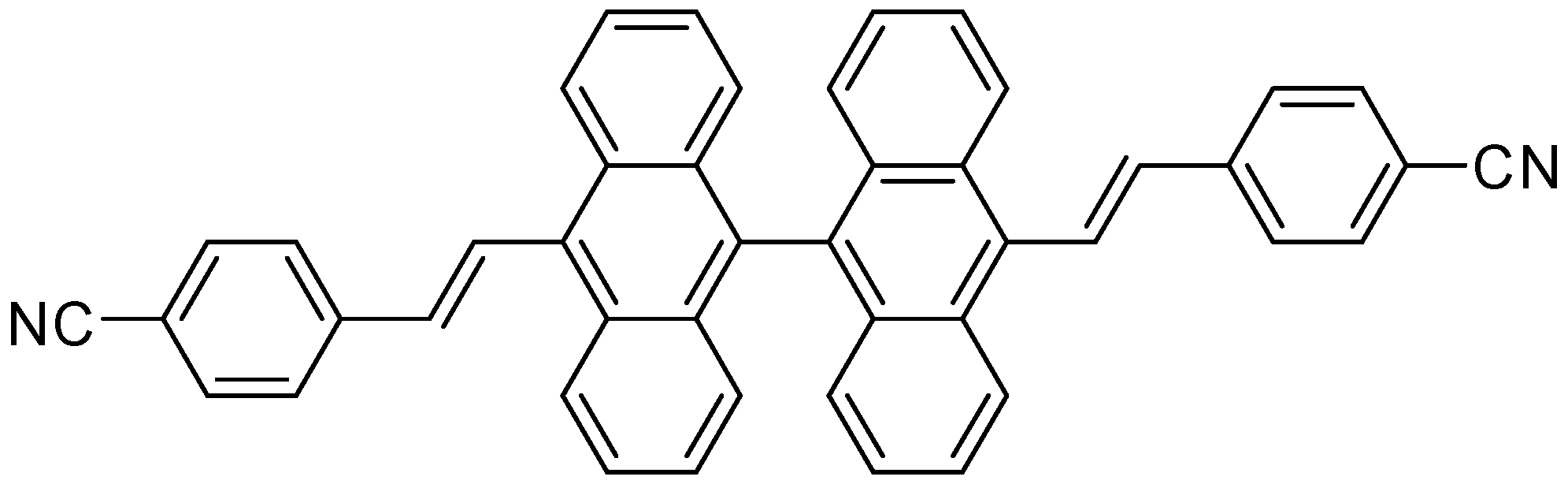
Anthracene is an important aromatic hydrocarbon consisting of three linearly connected benzene rings. Due to their system of conjugated π bonds, anthracene derivatives have interesting photochemical and photophysical properties [1,2]. These important properties make them suitable for use in advanced materials, such as organic light-emitting diodes (OLEDs) [3,4], organic field-effect transistors (OFETs) [5], and other types of materials [6,7]. Although the available results emphasise the importance of the bianthryl skeleton [8,9,10,11], bianthracenes have received relatively little attention. The vast majority of known bianthracene derivatives are aryl derivatives. Only a few 2-arylvinylic derivatives have been documented in the scientific literature (see Figure 1). The patent literature [12] identifies the compound in Figure 1 as an example of a material with electroluminescent properties. However, no data on its synthesis has been provided.
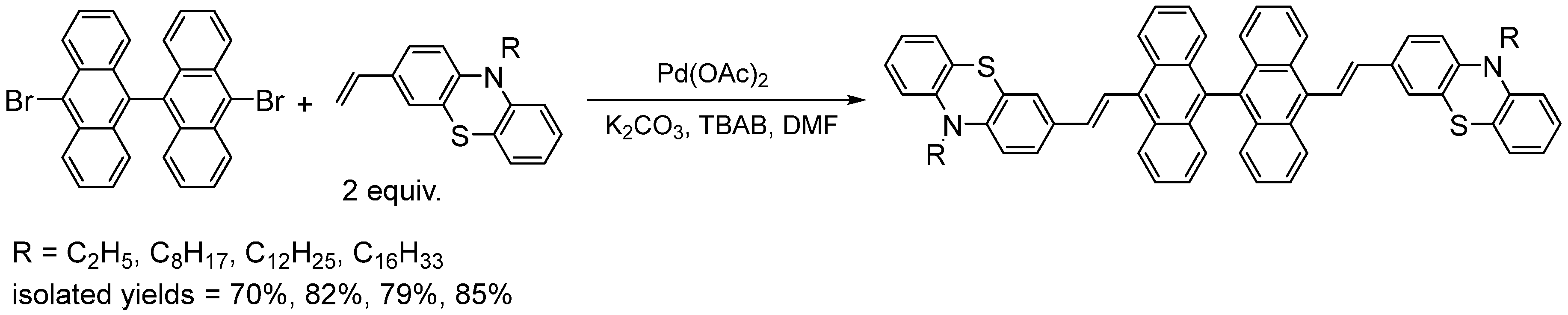
In 2015, Xue and Lu investigated the luminescent properties of a series of 9,9′-bianthracene derivatives that had been functionalised with phenothiazynyl groups. They obtained four compounds that differed in the length of the alkyl chains at the nitrogen atoms [13]. These compounds exhibit strong fluorescence both in solution and in the solid state. Additionally, the molecules exhibit distinct, reproducible and reversible mechanochromism. The compounds were synthesised via Heck coupling of 10,10′-dibromo-9,9′-bianthracene and vinyl derivatives of phenothiazine (Scheme 1).
Recently, Yu reported the synthesis of a p-vinylpyridine-functionalised 9,9′-bianthracene derivative using Heck coupling (see Scheme 2) [14].
These literature results encouraged us to develop procedures for the highly efficient and selective coupling of 10,10′-dibromo-9,9′-bianthracene with styrenes. This article describes our search for an effective catalytic procedure for synthesising a series of 10,10′-bis((E)-2-arylvinyl)-9,9′-bianthracenes via Heck coupling of 10,10′-dibromo-9,9′-bianthracene with various styrene derivatives. This procedure enables the selective synthesis of novel bianthracene structures. The resulting polyunsaturated products have potential applications in organic electronics.

2. Results and Discussion

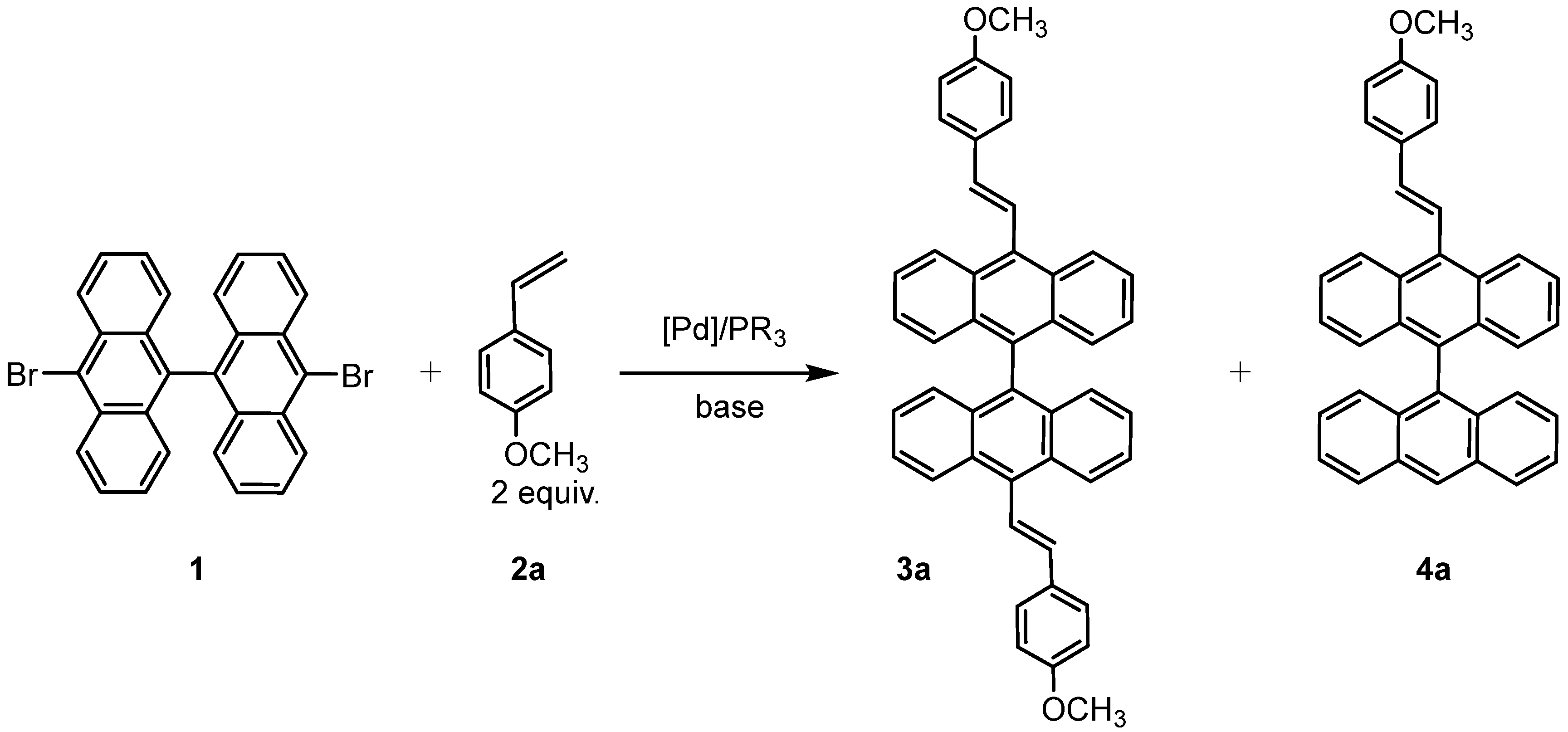
We started our research by repeating the synthesis process outlined by Yu [14]. Unfortunately, we achieved an isolation efficiency of only 45%. Therefore, the first stage of our research was to determine the optimal catalytic conditions for the reaction, including the palladium catalyst, phosphine ligand, base, solvent, temperature and reaction time. We selected the Heck coupling of 10,10′-dibromo-9,9′-bianthracene with 4-methoxystyrene as the test reaction. We started the tests using the catalytic systems commonly employed in Heck coupling. A series of commercially available palladium complexes, such as [PdCl2(PPh3)2], [Pd2(dba)3]/PPh3, [Pd(PPh3)4], and [RuCl2(IPr)(3-chloropyridine)] (PEPPSI-IPr), were tested. Additionally, palladium salts with Buchwald phosphine ligands, such as Pd(OAc)2/XPhos, were applied. Treatment of 10,10′-dibromo-9,9′-bisanthracene with 4-methoxystyrene in the presence of the aforementioned palladium complexes and NEt3 as a base at 80 °C in MeCN led to the formation of two coupling products, as shown in Scheme 3.
The initial reactions were performed at 80 °C for 24 h (Table 1) and afforded only moderate yields (38–58%) of the disubstituted product 3a. The accompanying product formed in lower yield was identified as the monosubstituted, protodebrominated compound 4a.
To minimise the protodebromination of the substrate, the reactions were carried out under strictly anhydrous conditions in the presence of dried molecular sieves to eliminate any residual moisture. However, we were unable to eliminate the debromination side reaction completely and still observed the formation of 4–10% of the monosubstituted product 4a. The best results were obtained when the reaction was catalysed with 5 mol% of Pd(OAc)2 and two equivalents of the Buchwald phosphine ligand (XPhos), yielding product 3a with a yield of 58%. Other phosphine-based catalysts, such as Pd(PPh3)4 and PdCl2(PPh3)2, also exhibited moderate to good activity. By contrast, the less active PEPPSI-IPr catalyst produced the desired product at only 38% yield, with a significant amount (10%) of by-product 4a. Our continuing research on finding conditions for highly efficient and selective reactions has led us to focus on investigating the effects of solvent, temperature, and base (Table 2).
Changing the solvent from acetonitrile to toluene and increasing the temperature to 110 °C resulted in a noticeable improvement in the yield of product 3a. For Pd–phosphine complex-based catalytic systems, the yield increased from 40 to 52% in MeCN to 60–70% in toluene (Table 2, entries 3–5) with a comparable amount of monosubstituted product 4a, which remained at a moderate level of 4–5%. A further significant increase in the yield of the desired product 3a was achieved by using the high-boiling solvent DMF and increasing the temperature to 140 °C. Under these conditions, the use of [Pd(PPh3)4] in combination with mild inorganic bases (K2CO3, K3PO4) yielded 3a in 76–80% yield. In contrast, the use of the strong base KOtBu resulted in a decrease in the yield and selectivity of the process (entry 9). The desired product 3a was accompanied by an increased amount of by-product 4a (12%). Further significant improvement in both yield and selectivity was observed when Buchwald phosphine XPhos was applied. The Pd(OAc)2/XPhos system in the presence of K2CO3 provided the disubstituted product 3a in up to 96% yield (isolated yield = 86%), with only 3% of the by-product 4a. Similarly, high efficiency was observed for the [Pd2(dba)3]/XPhos system (93%). By contrast, other Buchwald ligands such as SPhos and RuPhos were less effective, resulting in significantly lower yields (43–52%) of 3a. Excellent results were obtained using bicoordinate [Pd(PtBu3)2] in the presence of Cy2NMe as a base. The reaction produced 3a in 92% yield, along with 3% of 4a. Finally, we investigated the possibility of reducing the catalyst loading (entries 17–19). Halving the concentration of Pd(OAc)2/XPhos to 2.5 and 5 mol% resulted in only a slight decrease in yield to 88%. Reducing the catalyst load further to 1 mol% resulted in a significant decrease in catalytic activity, down to 58% (entry 18). The prolongation of the reaction time to 48 h furnished only a partial compensation for the reduction in catalyst concentration. A yield of 72% was obtained (entry 19). To reduce the amount of the protodebrominated product (4a), TBAB (tetrabutylammonium bromide) was added to the reaction mixture (Table 2, entry 20), and the temperature of the reaction was lowered to 100 °C. As a result of the reaction, a slight reduction in the yield of product 3a (86%) and the formation of 4% of monosubstituted product 4a were observed. In contrast, the use of Ag2CO3 at 140 °C (entry 21) led to a significant decrease in the yield of 3a to 62%, and an increased formation of 4a (9%). Moreover, the combined use of K2CO3 together with 1 equiv. of Ag2CO3 (entry 22) resulted in the formation of 3a with moderate yield (84%) accompanied by a reduced amount of 4a (5%). To understand the effect of moisture, the reaction was performed with extra water added (10 µL). Under these conditions an increase in the yield of by-product 4a (13%) was observed, while the yield of 3a remained high (81%) (entry 23). Unexpectedly, performing the reaction in aerobic conditions (entry 24) did not affect the reaction performance. The process afforded a high yield of 3a (92%) with only a slightly increased amount of 4a (6%). Finally, the study of the course of the reaction over a period of 24 h with monitoring of the composition of the reaction system was done by an 1H NMR spectroscopy (Figures S1 and S2, Supplementary data). Performed experiment showed slow gradual formation of the hydrodebromination product 4a during the reaction course.
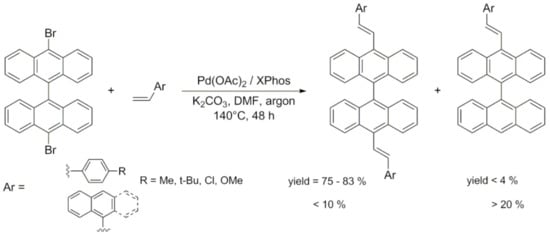
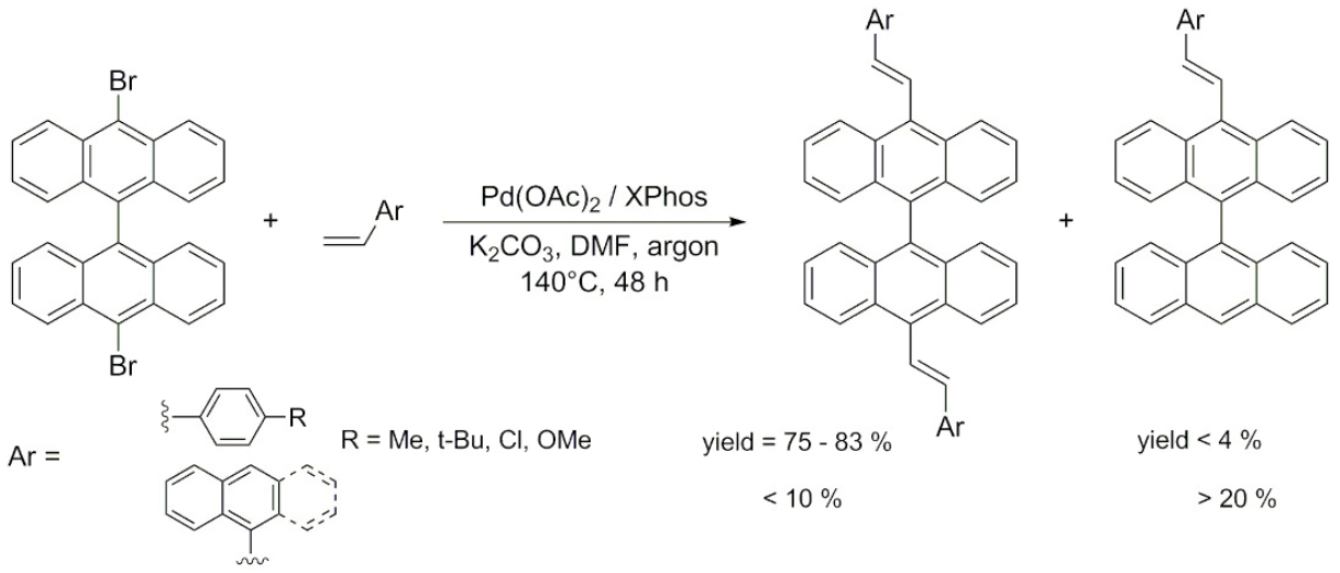
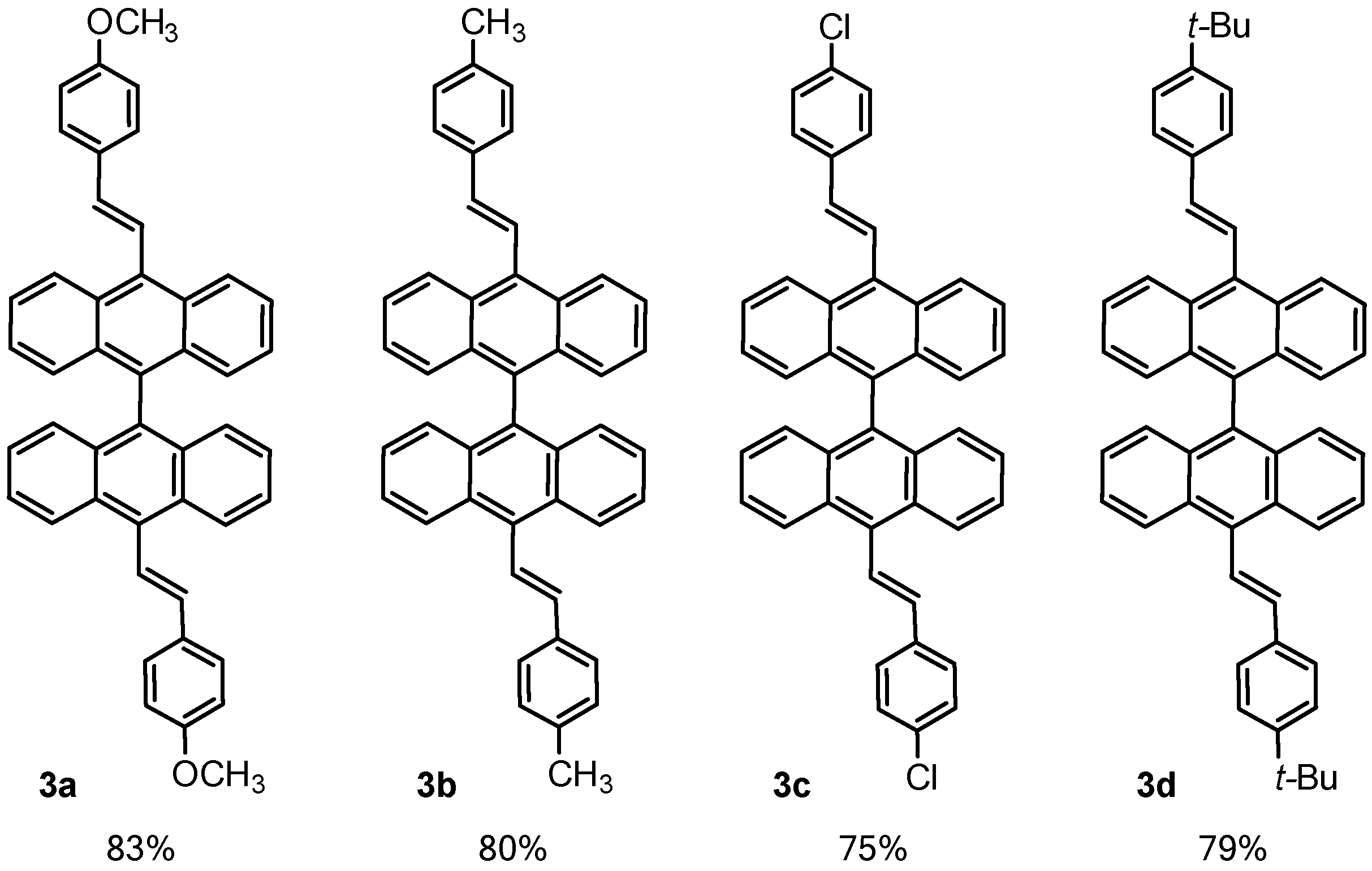
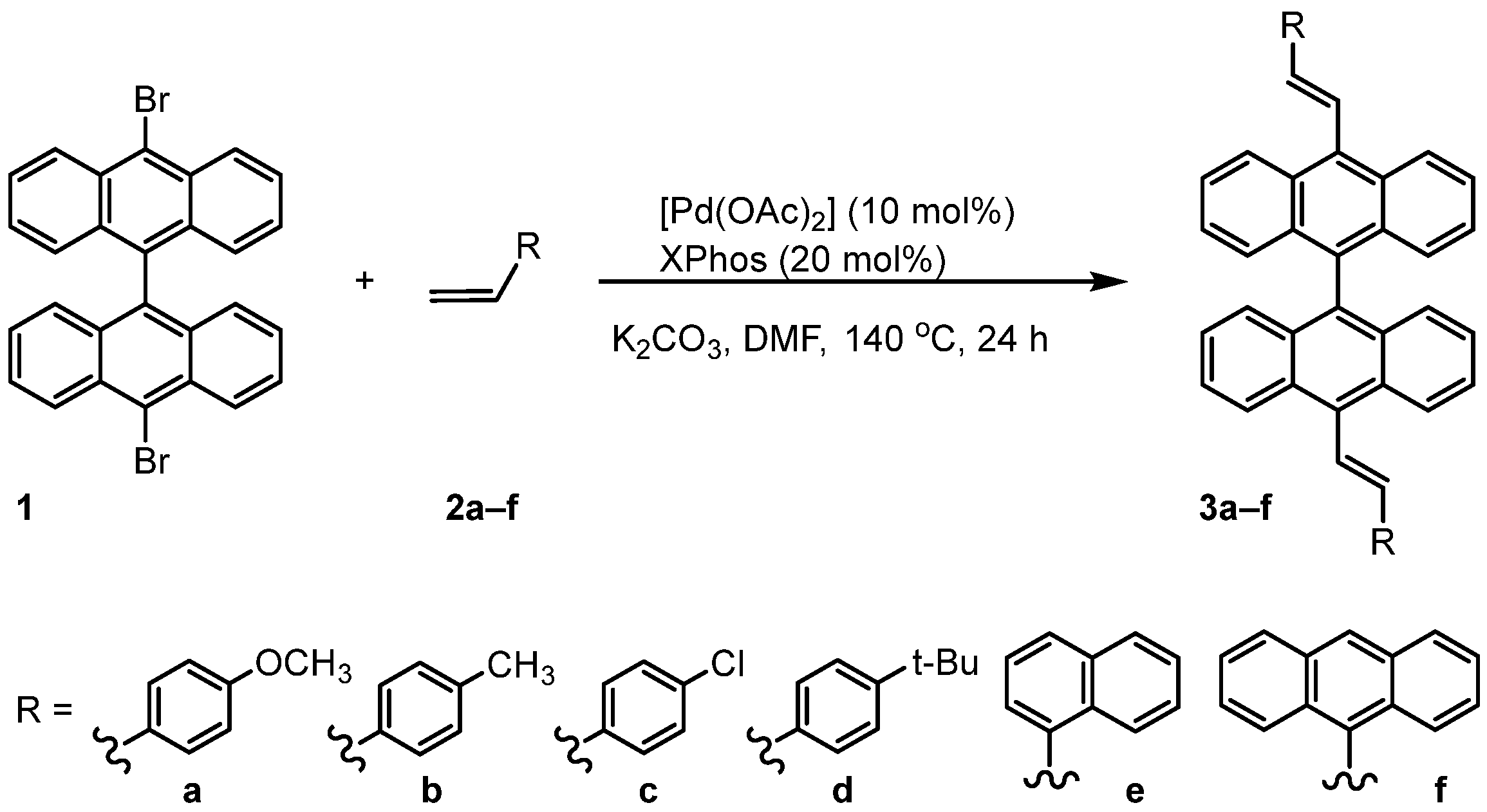
Having determined the optimal conditions, Heck cross-coupling of 10,10′-dibromo-9,9′-bianthracene (1) with a series of vinylarenes (2a2f) was investigated (Scheme 4). The cross-coupling of 1 with styrenes (2a2d) led to the highly efficient and selective formation of compounds 3a3d (Figure 2). However, all attempts to synthesise cross-coupling product using vinylanthracene or vinylnaphthalene failed. Only unreacted substrates and hydrodebrominated bianthracenes were observed in the post-reaction mixtures.
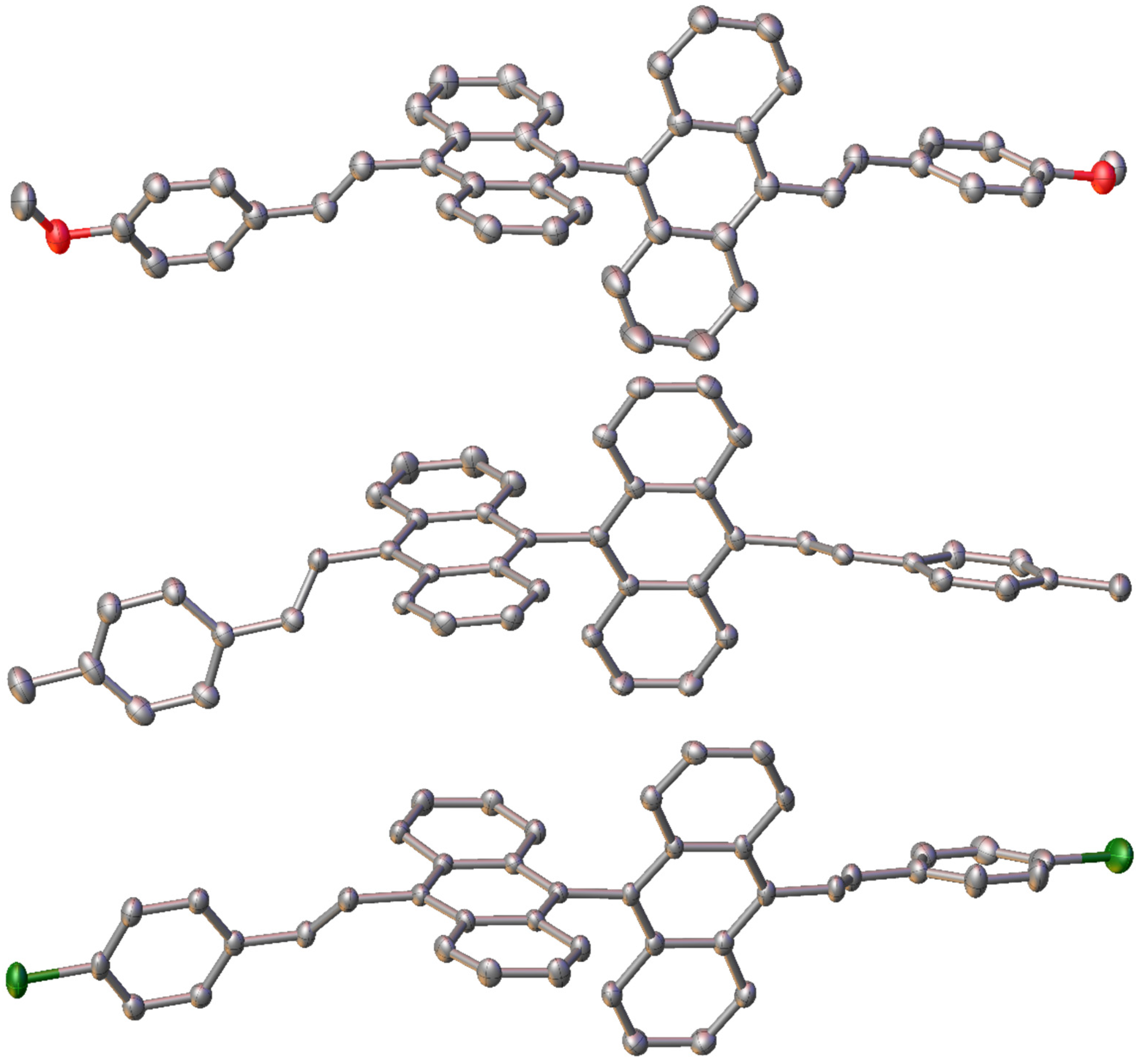
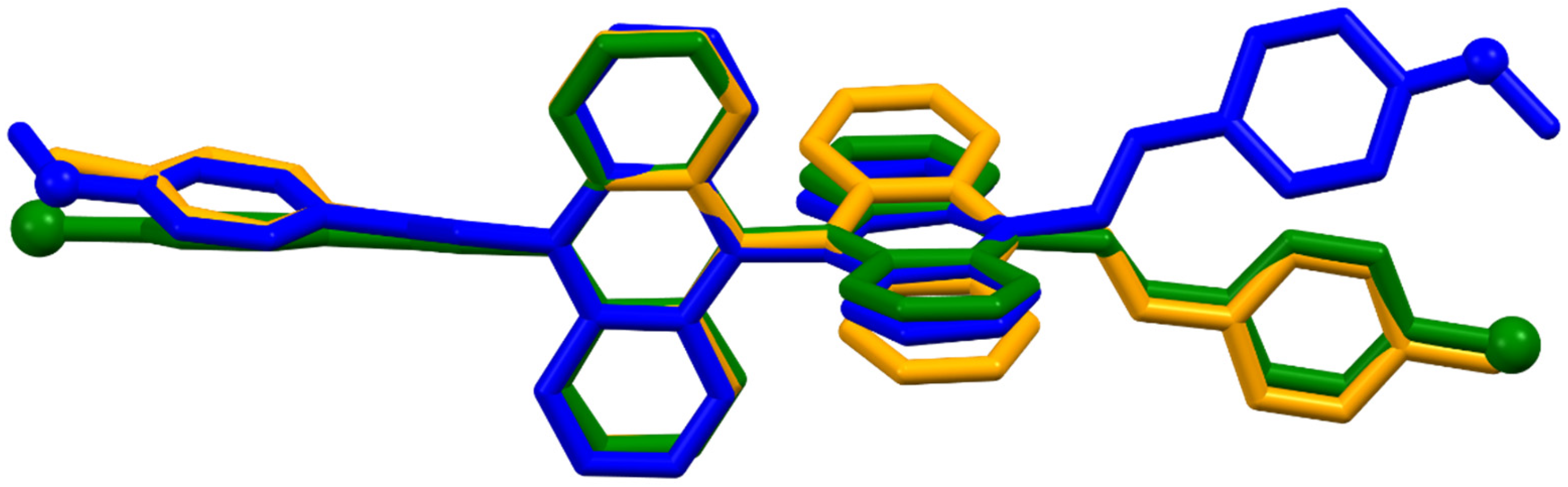
For products 3a3c, single crystals suitable for X-ray studies were obtained. The crystal structures are shown in Figure 3. Moreover, Figure 4 shows an overlay of the structures.
In the solid state, the molecular geometry is largely invariant across the series, irrespective of the nature of the substituent. Any observed geometric differences therefore arise primarily from intermolecular interactions rather than from intrinsic molecular structural variations. To quantify these effects, the dihedral angles between the phenyl substituent and the anthracene core were compared. The highest degree of asymmetry is observed for derivative 3a, with dihedral angles of 66.2° and 89.4°. In compound 3b, the corresponding angles are more similar, measuring 85.1° and 70.8°. Derivative 3c exhibits the highest symmetry, with nearly identical angles of 81.9° and 82.7°.
The crystal structures of all three derivatives are based on dimeric structural motifs stabilised by C–H···π interactions between adjacent anthracene units (Figures S4–S6). The distance between the hydrogen atom at the ring edge and the anthracene π-plane ranges from 2.58 to 2.99 Å, depending on the derivative, with the shortest contact observed for 3b. Additional stabilisation of the dimers arises from edge-to-face interactions between phenyl rings and in the case of 3a, from C–H···O hydrogen bonding (C–H···O = 2.66 Å). Both the phenyl rings and anthracene moieties engage in a network of successive edge-to-face interactions that collectively stabilise the three-dimensional crystal lattice. Furthermore, in the crystal structures of 3a and 3c, face-to-face π···π interactions between parallel anthracene fragments also contribute to lattice stabilisation.
All three crystal structures incorporate solvent molecules trapped within the host framework (Figures S4–S6). In derivative 3b, approximately 32% of the unit-cell volume is accessible to solvent molecules, with cyclohexane located in cavities and tetrahydrofuran (THF) occupying intermolecular channels. For 3c, solvent-accessible voids account for 24% of the unit-cell volume; the crystal contains one cyclohexane molecule encapsulated within an intermolecular cavity and one THF molecule per asymmetric unit residing in channels. In contrast, the crystal structure of 3a provides only 8.6% of the unit-cell volume for solvent inclusion, accommodating a single cyclohexane molecule confined within a structural void between host molecules.

3. Materials and Methods

3.1. General Methods and Chemicals

Commercially available reagents were used during the research. 10,10′-dibromo-9,9′-bis-anthracene (98%) was purchased from Ambeed, Inc. (Buffalo Grove, IL, USA), 4-methoxystyrene (98%) was purchased from Angene International Limited (Hong Kong, China), diethyl ether and anhydrous N,N-dimethylformamide were purchased from Honeywell International Inc. (Morristown, NJ, USA), 2-dicyclohexylphosphino-2′,4′,6′-triisopropylbiphenyl (X-Phos) (97%) was purchased from Ark Pharm (Arlington Heights, IL, USA), dichloromethane and hexane (95%) were purchased from chemsolve® (WITKO, Poland) toluene was purchased from Stanlab (Lublin, Poland), deuterated chloroform (99.6% isotopic purity) was purchased from TCI Chemicals (Tokyo, Japan), argon (99.999% purity) was purchased from Linde Gas (Pullach, Germany). Molecular sieves, silica gel, celite, 4-methylstyrene, 4-chlorostyrene, 4-tert-butylstyrene), potassium carbonate were purchased from Sigma-Aldrich (now Merck, Darmstadt, Germany). Styrenes were dried over CaH2 and distilled under vacuum prior to use. The syntheses of the compounds were carried out in an inert gas atmosphere (argon) using a vacuum-gas line and standard Schlenk techniques. 1H NMR and 13C NMR spectroscopic spectra were recorded using a Bruker Biospin (Karlsruhe, Germany) Avance 600 MHz spectrometer at frequencies of 600 MHz and 151.2 MHz, respectively, at T = 298 K. Samples for measurements were prepared in 5 mm diameter NMR tubes. Deuterated chloroform CDCl3 was used as a solvent.

3.2. Methods

3.2.1. Representative Procedure of the Catalytic Test

In a typical catalytic test a 10 mL Schlenk flask equipped with a magnetic stirrer was charged with 0.1 g of previously dried 4 Å molecular sieves, 0.1 g of 10,10′-dibromo-9,9′-bianthracene (0.2 mmol), 0.08 g of K2CO3 (0.6 mmol), 2.2 mg of Pd(OAc)2 (0.01 mmol), 9.5 mg (0.02 mmol) of XPhos, and 0.01 g of 1,3,5-trimethoxybenzene as an internal standard. The Schenk flask has been evacuated using Schlenk line techniques and filled with argon. Then, 0.06 mL of 4-methoxystyrene (2.2 equivalents) and 4 mL of dimethylformamide (DMF) were added under an inert atmosphere. The reaction mixture has been intensively stirred, and 0.1 mL sample was taken for NMR analysis. The Schlenk flask was placed in an oil bath and the reaction mixture was heated at 140 °C for 24 h. After this time, the mixture was cooled to room temperature, and the solvent was evaporated in vacuo. The resulting solid was dried under reduced pressure. To identify the components of the post-reaction mixture 1H NMR analysis was performed.

3.2.2. Synthesis of 10,10′-bis((E)-4-Methoxystyryl)-9,9′-bianthracene (3a)

A 50 mL Schlenk flask equipped with a magnetic stirrer was charged with 0.2 g (0.4 mmol) of 10,10′-dibromo-9,9′-bianthracene, 1.2 mmol of K2CO3, 0.02 mmol of palladium acetate Pd(OAc)2, 0.04 mmol of 2-dicyclohexylphosphino-2′,4′,6′-triisopropylbiphenyl (X-Phos) and 0.1 g of previously dried 4 Å molecular sieves. The flask was connected to a vacuum gas line, after which the contents were dried for one hour. Next, 0.9 mmol of 4-methoxystyrene and 5 mL of anhydrous dimethylformamide (DMF) were added under an inert gas atmosphere. The mixture was heated in a closed system at 140 °C, in an oxygen-free and anhydrous atmosphere for 24 h. After this time, the mixture was cooled to 22 °C and concentrated to 1 mL volume. The separated precipitate was filtered through a layer of celite and washed successively with 5 mL of hexane and 5 mL of diethyl ether. The crude product was purified by column chromatography on silica gel using hexane: methylene chloride mixture in a ratio of 10:1 as eluent. The isolated product was dried in vacuum for 2 h. Finally, 10,10′-bis((E)-4-methoxystyryl)-9,9′-bianthracene was obtained with an 83% of isolated yield (0.2 g). 1H NMR (600 MHz, CDCl3) δ 8.53 (m, J = 8.9 Hz, 4H, anthracene), 7.96 (d, J = 16.5 Hz, 2H, -CH=CH-), 7.73–7.69 (m, 4H, Ar), 7.44 (m, 4H, anthracene), 7.18–7.13 (m, 8H, anthracene), 7.08 (d, J = 16.5 Hz, 2H, -CH=CH-), 7.06–7.03 (m, 4H, Ar), 3.92 (s, 6H, OCH3). 13C NMR (151 MHz, CDCl3) δ 159.70, 137.17, 133.93, 133.00, 131.51, 130.26, 129.66, 127.89, 127.36, 126.44, 125.58, 125.24, 122.84, 114.33, 55.46; HRMS (ESI+): calc for [C46H34O2]+: 618.2559; found: 618.2546.

3.2.3. Synthesis of 10,10′-bis((E)-4-Methylstyryl)-9,9′-bianthracene (3b)

A 50 mL Schlenk flask equipped with a magnetic stirrer was charged with 0.2 g (0.4 mmol) of 10,10′-dibromo-9,9′-bianthracene, 1.2 mmol of K2CO3, 0.02 mmol of palladium acetate Pd(OAc)2, 0.04 mmol of X-Phos and 0.1 g of previously dried 4 Å molecular sieves. Then, the Schlenk flask was connected to a vacuum-gas line and the contents were dried for 1 h. Next, 0.9 mmol of 4-methoxystyrene and 5 mL of anhydrous dimethylformamide (DMF) were added under an inert gas atmosphere. The mixture was heated in a closed system at 140 °C, in an oxygen-free and anhydrous atmosphere for 24 h. After this time, the mixture was cooled to 22 °C and concentrated to 1 mL volume. The separated precipitate was filtered through a layer of celite and washed successively with 5 mL of hexane and 5 mL of diethyl ether. The crude product was purified by column chromatography on silica gel using hexane: methylene chloride mixture in a ratio of 20:1 as eluent. The isolated product was dried in vacuum for 2 h. Finally, 10,10′-bis((E)-4-methylstyryl)-9,9′-bianthracene was obtained with an isolation yield of 80% (0.18 g). 1H NMR (600 MHz, CDCl3) δ 8.54 (d, J = 8.9 Hz, 4H, anthracene), 8.06 (d, J = 16.5, 2H, -CH=CH-), 7.68 (d, J = 7.6 Hz, 4H, Ar), 7.48–7.42 (m, 4H, anthracene), 7.33 (d, J = 7.6 Hz, 4H, Ar), 7.21–7.15 (m, 8H, anthracene), 7.12 (d, J = 16.5 Hz, 2H, -CH=CH-), 2.47 (s, 6H, CH3). 13C NMR (151 MHz, CDCl3) δ 138.07, 137.63, 134.62, 133.81, 133.09, 131.49, 129.63, 129.60, 127.35, 126.59, 126.41, 125.60, 125.29, 124.07, 21.35; HRMS (ESI+): calc for [C46H34O2]+: 586.2661; found: 586.2548.

3.2.4. Synthesis of 10,10′-bis((E)-4-Chlorostyryl)-9,9′-bianthracene (3c)

A 100 mL Schlenk flask equipped with a magnetic stirrer was charged with 0.51 g (1.0 mmol) of 10,10′-dibromo-9,9′-bianthracene, 3.0 mmol of K2CO3, 0.05 mmol of palladium acetate Pd(OAc)2, 0.1 mmol of X-Phos and 0.2 g of dried 4Å molecular sieves. The Schlenk flask was then connected to a vacuum-gas line and the contents were dried for 1 h. Next, 2.2 mmol of 4-chlorostyrene and 12 mL of anhydrous dimethylformamide (DMF) were added in an inert gas atmosphere. The reaction mixture was heated in a closed system at 140 °C, in an oxygen-free and anhydrous atmosphere for 24 h. After this time, the mixture was cooled to 22 °C and evaporated in vacuo. The crude product was isolated from the solid residue by column chromatography on silica gel using a 10:1 hexane: dichloromethane mixture as eluent. The isolated product was dried in vacuo for 2 h. Finally, 10,10′-bis((E)-4-chlorostyryl)-9,9′-bianthracene was obtained with the yield of 75% (0.46 g). 1H NMR (400 MHz, CDCl3) δ 8.50–8.48 (m, 4H, anthracene), 8.08 (d, J = 16.6 Hz, 2H, -CH=CH-), 7.71–7.69 (m, 4H, Ar), 7.49–7.47 (m, 4H, Ar), 7.47–7.41 (m, 4H, anthracene), 7.18–7.15 (m, 8H, anthracene), 7.09 (d, J = 16.6 Hz, 2H, -CH=CH-). 13C NMR (151 MHz, CDCl3) δ 136.48, 135.80, 133.79, 133.36, 133.19, 131.44, 129.57, 129.07, 127.85, 127.37, 126.19, 125.78, 125.70, 125.51; HRMS (ESI+): calc for [C46H34O2]+: 626.1568; found: 626.1564.

3.2.5. Synthesis of 10,10′-bis((E)-4-tert-butylstyryl)-9,9′-bianthracene (3d)

A 100 mL Schlenk flask equipped with a magnetic stirrer was charged with 0.51 g (1.0 mmol) of 10,10′-dibromo-9,9′-bianthracene, 3.0 mmol of K2CO3, 0.05 mmol of palladium acetate Pd(OAc)2, 0.1 mmol of X-Phos and 0.2 g of dried 4Å molecular sieves. The Schlenk flask was then connected to a vacuum-gas line and the contents were dried for 1 h. After this time, 2.2 mmol of 4-(ttert-butyl)styrene and 12 mL of anhydrous dimethylformamide (DMF) were added in an inert gas atmosphere. The reaction mixture was heated in a closed system at 140 °C, in a strictly oxygen-free and anhydrous atmosphere for 24 h. After this time, the mixture was cooled to 22 °C and evaporated in vacuo. The crude product was isolated from the solid residue by column chromatography on silica gel using a 10:1 hexane:dichloromethane mixture as eluent. The isolated product was dried under vacuum for 2 h. Finally, 10,10′-bis((E)-4-(tert-butyl)styryl)-9,9′-bianthracene was obtained with the yield of 79% (0.53 g). 1H NMR (400 MHz, CDCl3) δ 8.53 (dt, J = 8.9, 1.0 Hz, 4H, anthracene), 8.07 (d, J = 16.6 Hz, 2H, -CH=CH-), 7.74–7.72 (m, 4H, Ar), 7.56–7.72 (m, 4H, Ar), 7.43 (ddd, J = 8.9, 5.2, 2.4 Hz, 4H, anthracene), 7.19–7.15 (m, 8H, anthracene), 7.12 (d, J = 16.6 Hz, 2H, -CH=CH-), 1.39 (s, 18H, t-Bu). 13C NMR (151 MHz, CDCl3) δ 151.38, 137.51, 134.61, 133.83, 133.11, 131.48, 129.64, 127.35, 126.43, 126.41, 125.85, 125.60, 125.28, 124.32, 34.76, 31.36; HRMS (ESI+): calc for [C46H34O2]+: 670.3600; found: 670.3581.

3.2.6. Single Crystal X-Ray Crystallography

The diffraction data for the crystal of 3a was collected at 130 K with an Oxford Diffraction SuperNova diffractometer (Oxford Diffraction Ltd., Yarnton, Oxfordshire, England) using Cu Kα radiation (λ = 1.54184 Å) equipped with mirror monochromator. The intensity data were collected and processed using CrysAlis PRO software (Rigaku OD Yarnton, Oxfordshire, England), version 1.171.43.143a). For crystals 3b and 3c the diffraction data were collected at 100 K with an D8 QUEST system equipped with a Microfocus source Incoatec ImS DII (Bruker AXS, Karlsruhe, Germany) (Cu, λ = 1.54184 Å). The frames were integrated with the Bruker SAINT software package using a narrow-frame algorithm (Bruker AXS LLC (Karlsruhe, Germany), 2019; SAINT V8.40B). Data were corrected for absorption effects using the Multi-Scan method (SADABS) [15].
All crystal structures were solved by direct methods with the program SHELXT 2018/2 [16] and refined by full-matrix least-squares method on F2 with SHELXL 2018/3 [17]. The carbon-bound hydrogen atoms were refined as riding on their carriers and their displacement parameters were set equal to 1.5 Ueq(C) for the methyl groups and 1.2 Ueq(C) for the remaining H atoms.
A summary of the crystallographic data and refinement details are given in the Supplementary Materials. Molecular graphics were generated with Olex2 v.1.3 [18] and Mercury 2024.3.1 software [19].

4. Conclusions

The Heck coupling of 10,10′-dibromo-9,9′-bianthracene and styrene derivatives is an effective method for synthesising 10,10′-bis((E)-2-aryl-vinyl)-9,9′-bianthracenes. Four compounds not described in the literature were synthesised in good yields (83%, 80%, 75% and 79%, respectively) as a result of Heck cross-coupling of 10,10′-dibromo-9,9′-bianthracene with 4-methoxy-, 4-methyl-, 4-chloro- and 4-tert-butylstyrene. This process allows for the highly selective formation of new bianthracene structures, providing convenient access to materials with potential applications in organic electronics. The disadvantage of the method is the undesirable minor competitive hydrodehalogenation. The scope of the process can be extended to allow coupling of 10,10′-dibromo-9,9′-bianthracene with a variety of vinyl derivatives.

Supplementary Materials

The following supporting information can be downloaded at: https://www.mdpi.com/article/10.3390/catal16030222/s1, Figure S1. Coupling of 10,10′-dibromo-9,9′-bianthracene (1) with 4-methoxystyrene (2a). Figure S2. Coupling of 10,10′-dibromo-9,9′-bianthracene (1) with 4-methoxystyrene (2a). Table S1. Selected crystal data and structure refinement details for 3a, 3b and 3c. Figure S3. Molecular structure and atoms numbering scheme of compound 3a. Figure S4. Molecular structure and atoms numbering scheme of compound 3b. Figure S5. Molecular structure and atoms numbering scheme of compound 3c. Figure S6. (a) Molecular packing in crystal structure of 3a, the space available for solvent molecules marked with blue surface (hydrogen atoms are omitted for clarity); and (b) dimeric subunit stabilized by edge–to–face aromatic interactions. Figure S7. (a) Molecular packing in crystal structure of 3b, the space available for solvent molecules marked with blue surface (hydrogen atoms are omitted for clarity); and (b) dimeric subunit stabilized by edge–to–face aromatic interactions. Figure S8. (a) Molecular packing in crystal structure of 3c, the space available for solvent molecules marked with blue surface (hydrogen atoms are omitted for clarity); and (b) dimeric subunit stabilized by edge – to – face aromatic interactions.

Author Contributions

Conceptualization, S.K. and C.P.; methodology, A.C. (Anna Chojnacka), S.R. and C.P.; formal analysis, A.C. (Anna Chojnacka), S.R. and C.P.; investigation, A.C. (Anna Chojnacka), S.R., A.C. (Agnieszka Czapik) and A.M.; resources, S.R. and C.P.; data curation, A.C. (Anna Chojnacka), S.R., A.C. (Agnieszka Czapik) and C.P.; writing—original draft, A.C. (Anna Chojnacka), S.R., A.C. (Agnieszka Czapik) and C.P.; writing—review and editing, C.P.; visualisation, A.C. (Anna Chojnacka), S.R., A.C. (Agnieszka Czapik) and C.P.; supervision, S.K. and C.P.; project administration, C.P.; funding acquisition, S.K. and C.P. All authors have read and agreed to the published version of the manuscript.

Funding

This work was supported by the National Science Centre of Poland, Projects No. 2019/33/B/ST4/00962 and 2019/35/B/ST4/00115. Moreover, A.C. (Agnieszka Chojnacka), S.R., A.C. (Agnieszka Czapik) and C.P. acknowledge the financial support of the Faculty of Chemistry, Adam Mickiewicz University, Poznan, from the funds awarded by the Ministry of Education and Science in the form of a subsidy for the maintenance and development of research potential in 2024 and 2025.

Data Availability Statement

All experimental data are contained in the article and Supplementary Materials. CCDC 2517448–2517450 contains the supplementary crystallographic data of this paper. These data can be obtained free of charge via www.ccdc.cam.ac.uk/data_request/cif (accessed on 24 January 2026), or by emailing data_request@ccdc.cam.ac.uk, or by contacting The Cambridge Crystallographic Data Centre, 12 Union Road, Cambridge CB2 1EZ, UK; fax: +44 1223 336033.

Conflicts of Interest

The authors declare no conflicts of interest.

References

  1. Becker, H.-D. Unimolecular Photochemistry of Anthracenes. Chem. Rev. 1993, 93, 145–172. [Google Scholar] [CrossRef]
  2. Kastrati, A.; Oswald, F.; Scalabre, A.; Fromm, K.M. Photophysical Properties of Anthracene Derivatives. Photochem 2023, 3, 227–273. [Google Scholar] [CrossRef]
  3. Huang, J.; Su, J.-H.; Tian, H.J. The development of anthracene derivatives for organic light-emitting diodes. J. Mater. Chem. 2012, 22, 10977–10989. [Google Scholar] [CrossRef]
  4. Słodek, A.; Filapek, M.; Schab-Balcerzak, E.; Grucela, M.; Kotowicz, S.; Janeczek, H.; Smolarek, K.; Mackowski, S.; Malecki, J.G.; Jedrzejowska, A.; et al. Highly Luminescence Anthracene Derivatives as Promising Materials for OLED Applications. Eur. J. Org. Chem. 2016, 2016, 4020–4031. [Google Scholar] [CrossRef]
  5. Chen, M.; Yan, L.; Zhao, Y.; Murtaza, I.; Meng, H.; Huang, W.J. Anthracene-based semiconductors for organic field-effect transistors. Mater. Chem. C 2018, 6, 7416–7444. [Google Scholar] [CrossRef]
  6. Kaur, N.; Kaur, B. Recent development in anthracene possessing chemosensors for cations and anions. Microchem. J. 2020, 158, 105131. [Google Scholar] [CrossRef]
  7. Van Damme, J.; Du Prez, F. Anthracene-containing polymers toward high-end applications. Prog. Polym. Sci. 2018, 82, 92–119. [Google Scholar] [CrossRef]
  8. Natarajan, P.; Schmittel, M. Photoluminescence, Redox Properties, and Electrogenerated Chemiluminescence of Twisted 9,9′-Bianthryls. J. Org. Chem. 2013, 78, 10383–10394. [Google Scholar] [CrossRef]
  9. Li, Z.; Gan, G.; Ling, Z.; Guo, K.; Si, C.; Lu, X.; Wang, H.; Wei, B.; Hao, Y. Easily available, low-cost 9,9′-bianthracene derivatives as efficient blue hosts and deep-blue emitters in OLEDs. Org. Electron. 2019, 66, 24–31. [Google Scholar] [CrossRef]
  10. Zhang, P.; Dou, W.; Ju, Z.; Yang, L.; Tang, X.; Liu, W.; Wu, Y. A 9,9′-bianthracene-cored molecule enjoying twisted intramolecular charge transfer to enhance radiative-excitons generation for highly efficient deep-blue OLEDs. Org. Electron. 2013, 14, 915–925. [Google Scholar] [CrossRef]
  11. Li, J.-F.; Chang, W.-L.; Tao, C.-L.; Ou, G.-P.; Zhang, F.-J. Synthesis, Characterization of 9, 9′-Bianthracene and Fabrication of 9,9′-Bianthracene Field-Effect Transistors. Chin. Phys. Lett. 2008, 25, 4476–4479. [Google Scholar]
  12. Hiroshi, K.; Yoshiyuki, S.; Taketoshi, Y.; Kazuaki, N.; Noriko, U.; Yasushi, O. Electroluminescent Material and Electroluminescent Element. European Patent Application No. EP 1 731 586 A2, 23 December 1999. [Google Scholar]
  13. Xue, P.; Yao, B.; Liu, X.; Sun, J.; Gong, P.; Zhang, Z.; Qian, C.; Zhang, Y.; Lu, R. Reversible mechanochromic luminescence of phenothiazine-based 10,10′-bianthracene derivatives with different lengths of alkyl chains. J. Mater. Chem. C 2015, 3, 1018–1025. [Google Scholar] [CrossRef]
  14. Liu, L.; Liao, Y.; Li, L.; Ma, H.; Shi, H.; Yu, W. Supramolecular Host−Guest System That Realizes Adaptive Selection of the Guest through Ligand Regulation. Inorg. Chem. 2025, 64, 4345–4354. [Google Scholar] [CrossRef] [PubMed]
  15. Krause, L.; Herbst-Irmer, R.; Sheldrick, G.M.; Stalke, D. Comparison of silver and molybdenum microfocus X-ray sources for single-crystal structure determination. J. Appl. Crystallogr. 2015, 48, 3–10. [Google Scholar] [CrossRef] [PubMed]
  16. Sheldrick, G.M. SHELXT—Integrated space-group and crystal-structure determination. Acta Crystallogr. Sect. A Found. Crystallogr. 2015, 71, 3–8. [Google Scholar] [CrossRef] [PubMed]
  17. Sheldrick, G.M. Crystal structure refinement with SHELXL. Acta Crystallogr. Sect. C Struct. Chem. 2015, 71, 33–38. [Google Scholar] [CrossRef] [PubMed]
  18. Dolomanov, O.V.; Bourhis, L.J.; Gildea, R.J.; Howard, J.A.K.; Puschmann, H. OLEX2: A complete structure solution, refinement and analysis program. J. Appl. Crystallogr. 2009, 42, 339–341. [Google Scholar] [CrossRef]
  19. Macrae, C.F.; Sovago, I.; Cottrell, S.J.; Galek, P.T.; McCabe, P.; Pidcock, E.; Platings, M.; Shields, G.P.; Stevens, J.S.; Towler, M.; et al. Mercury 4.0: From visualization to analysis, design and prediction. J. Appl. Crystallogr. 2020, 53, 226–235. [Google Scholar] [CrossRef] [PubMed]
Figure 1. 10,10′-functionalised 9,9′-bianthracene with electroluminescent properties.
Catalysts 16 00222 g001
Scheme 1. Synthesis of vinylphenothiazyne functionalized 9,9′-bianthracenes.
Catalysts 16 00222 sch001
Scheme 2. Heck coupling of 10,10′-dibromo-9,9′-bianthracene with 4-vinylpyridine.
Catalysts 16 00222 sch002
Scheme 3. Coupling of 10,10′-dibromo-9,9′-bianthracene (1) with 4-methoxystyrene (2a).
Catalysts 16 00222 sch003
Scheme 4. Heck coupling of 10,10′-dibromo-9,9′-bianthracene with vinylarene derivatives.
Catalysts 16 00222 sch004
Figure 2. Scope of the reaction. The numbers indicate isolated yields.
Catalysts 16 00222 g002
Figure 3. Perspective view of compounds 3a (top), 3b (middle), and 3c (bottom). Displacement ellipsoids are drawn at the 30% probability level. Hydrogen atoms and solvent molecules are omitted for clarity.
Catalysts 16 00222 g003
Figure 4. An overlay of structures 3a (blue), 3b (yellow), and 3c (green).
Catalysts 16 00222 g004
Table 1. Coupling of 10,10′-dibromo-9,9′-bianthracene (1) with 4-methoxystyrene (2a). Optimisation of the catalyst.
EntryCatalyst/AdditiveMol %Time
[h]
Yield 3a
[%]
Yield 4a
B [%]
1 [PdCl2(PPh3)2]524427
2 [Pd(PPh3)4]524455
3 [Pd(PPh3)4]548524
4 [Pd2(dba)3]/PPh35/1024404
5Pd(OAc)2524217
6Pd(OAc)2/X-Phos5/1024585
7PEPPSI-IPr5243810
Reaction conditions: [1]:[2a] = 1:2, NEt3, MeCN, 80 °C, argon, molecular sieves.
Table 2. Coupling of 10,10′-dibromo-9,9′-bianthracene (1) with 4-methoxystyrene (2a). Optimisation of the reaction conditions.
Catalyst/AdditiveMol %BaseTemp.
[°C]
Yield 3a
[%]
Yield 4a
[%]
1 [PdCl2(PPh3)2]5NEt36535 a7 a
2 [Pd(PPh3)4]5NEt36539 a6 a
3 [PdCl2(PPh3)2]5NEt311060 b5 b
4 [Pd(PPh3)4]5EtNiPr211064 b4 b
5 [Pd(PPh3)4]5K3PO411070 b5 b
6 [PdCl2(PPh3)2]5K2CO3140556
7 [Pd(PPh3)4]5K3PO4140765
8 [Pd(PPh3)4]5K2CO3140805
9 [Pd(PPh3)4]5KOtBu1405812
10Pd(OAc)2/X-Phos5/10Cy2NMe140845
11 [Pd(t-Bu3P)2]5Cy2NMe140923
12Pd(OAc)2/X-Phos5/10K2CO314096 (86)3
13PdCl2/X-Phos5/10K2CO3140894
14Pd(OAc)2/S-Phos5/10K2CO3140528
15 [Pd2(dba)3]/X-Phos5/10K2CO314093 (82)4
16Pd(OAc)2/Ru-Phos5/10K2CO3140435
17Pd(OAc)2/X-Phos2.5/5K2CO3140885
18Pd(OAc)2/X-Phos1/2K2CO3140588
19Pd(OAc)2/X-Phos1/2K2CO314072 c7 c
20Pd(OAc)2/X-Phos/TBAB5/10/5K2CO3100864
21Pd(OAc)2/X-Phos5/10Ag2CO3140629
22Pd(OAc)2/X-Phos/Ag2CO35/10K2CO3140845
23Pd(OAc)2/X-Phos b5/10K2CO314081 d13 d
24Pd(OAc)2/X-Phos5/10K2CO314092 e6 e
Reaction conditions: argon, molecular sieves, DMF, 24 h, yields based on 1H NMR; isolated yields in parenthesis; (a) THF was used as solvent; (b) toluene was used as solvent; (c) 48 h; (d) 10 µL of H2O was added; (e) air.
Disclaimer/Publisher’s Note: The statements, opinions and data contained in all publications are solely those of the individual author(s) and contributor(s) and not of MDPI and/or the editor(s). MDPI and/or the editor(s) disclaim responsibility for any injury to people or property resulting from any ideas, methods, instructions or products referred to in the content.