Review

Transition Metal-Catalyzed Ternary Polymerization of Olefins

State Key Laboratory of Advanced Fiber Materials, College of Materials Science and Engineering, Donghua University, Shanghai 201620, China
*
Authors to whom correspondence should be addressed.
Catalysts 2026, 16(3), 224; https://doi.org/10.3390/catal16030224
Submission received: 30 December 2025 / Revised: 20 January 2026 / Accepted: 2 February 2026 / Published: 2 March 2026
(This article belongs to the Special Issue Feature Review Papers on Catalysis in Organic and Polymer Chemistry)

Abstract

Polyolefins are widely used polymers, with an annual global production of hundreds of millions of tons. Because they are the simplest hydrocarbon polymers, their intrinsic non-polar properties limit further applications. Coordination–insertion copolymerization of an olefin with other monomers, mediated by transition metal catalysts, is the most efficient way to synthesize polar and multi-functionalized polyolefins with enhanced material performance. Previous reviews have primarily focused on the structural design of a specific catalyst or on binary copolymerization of an olefin with a particular comonomer. However, the transition-metal-catalyzed ternary coordination–insertion polymerization of olefin monomers remains scarce. In this contribution, early transition-metal catalysts, such as Ti, Zr, Hf, and V, are employed for the terpolymerization of all-hydrocarbon or non-polar monomers to access advanced polyolefin materials with high performance. By contrast, late transition metal catalysts based on Ni and Pd, as well as rare-earth metal catalysts ligated by Sc and Y, enable the terpolymerization of olefins with a variety of heteroatom-containing monomers. Their strong tolerance empowers the development of polyolefins with multiple functionalities, thereby distinguishing these systems. The catalyst structure, catalytic process, and mechanism studies are summarized, along with the microstructure and functionality of the polymerization products, by classifying the types of termonomers employed.

1. Introduction

Polyolefins, such as polyethylene and propylene, are widely used polymeric materials with massive global production [1]. However, these conventional hydrocarbon materials also exhibit significant shortcomings and lack functional diversity due to their simple molecular structures and intrinsic nonpolar nature [2]. To address these shortcomings, several technologies have been developed to achieve multi-functionalization and enhance the performance of polyolefin materials. For instance, free-radical polymerization is a standard method for preparing olefin copolymers from ethylene and other olefin monomers [3]. Commercially available products include ethylene-ethyl vinyl acetate copolymer (EVA) and ethylene-vinyl alcohol copolymer (EVOH). Nevertheless, free radical polymerization has limitations, including limited types of comonomers, poor control over polymer microstructures, and the need for harsh conditions, such as high temperature and high pressure. Alternatively, post-modification of polymers enables the introduction of various functionalized groups and additives into polyolefins, thereby significantly broadening the range of polar groups and enhancing multi-functionality [4]. Despite this advantage, the reactive pathway may lead to side reactions on the polymer chain, such as chain scission and crosslinking. Additionally, compatibility issues between the additives and the polymer matrix arise from differences in their interfacial properties. This may lead to agglomeration and migration of functional components during the use of polymer materials, resulting in short-lived functional modification.
Coordination–insertion polymerization has been a predominant approach for producing bulk polyolefin products, such as high-density polyethylene and isotactic polypropylene [5,6,7]. Using organometallic catalysts, researchers have controlled the microstructure. This included controlling molecular weight, distribution, branching degree, and thermal properties such as glass transition temperature (Tg) and melting point (Tm) [8]. Ziegler–Natta catalysts, developed in the 1950s and awarded the Nobel Prize in Chemistry in 1963, enabled the polymerization of ethylene, propylene, and α-olefins. These catalysts were successfully industrialized and now dominate industrial polyolefin production [9,10]. Subsequently, well-defined metallocene catalysts demonstrated high catalytic activity, improved thermal stability, and greater control over polymer microstructure [11,12]. Researchers then replace the traditional cyclopentadienyl ligands and early transition metals. This led to the development of robust late-transition-metal and non-metallocene catalysts, such as salicylaldimine and α-diimine catalysts [13,14]. One key advantage of these well-defined transition-metal catalysts is their ability to copolymerize olefins with other monomers. This produces commercially available copolymers, including the ethylene-propylene copolymers, polyolefin elastomers, and cyclic olefin copolymers. Thus, coordination–insertion copolymerization of an olefin and another monomer allows easy control of the copolymer microstructures and material properties. This can be achieved by modifying the comonomer structures, contents, sequence distributions, and the transition-metal catalysts employed [15,16]. As a result, coordination–insertion polymerization is regarded as the most promising approach for developing advanced polyolefin materials.
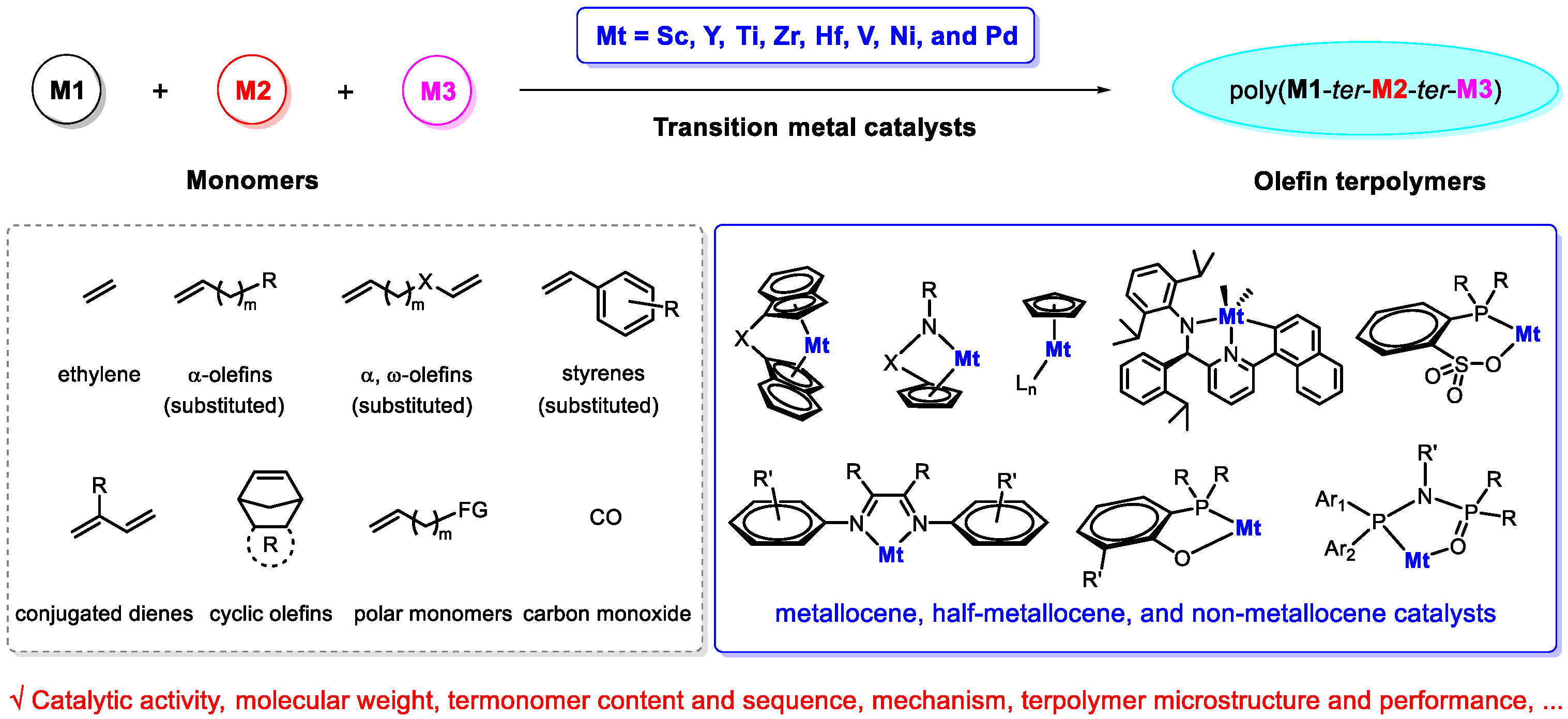
A vast majority of the current review studies on the preparation of polyolefin materials via coordination polymerization focus on the development of new catalyst structures and the improvement of catalytic activity, copolymerization capacity, thermal stability, polar tolerance and other properties, or on the binary random/block polymerization of bulk olefins such as ethylene and propylene with specific comonomers to develop high-performance and multi-functional polyolefin materials [17,18,19,20,21,22,23,24,25,26,27,28,29,30,31,32,33]. Review of the ternary polymerization of various olefins catalyzed by transition-metal catalysts is scarce. Possible reasons include that, compared with olefin homopolymerization and binary polymerization, ternary polymerization places greater demands on catalytic performance, requiring more rigorous screening of the catalyst structure employed. Moreover, additional side reactions may occur during ternary polymerization. The complicated single-site active centers can exhibit markedly different reactivity toward a given comonomer, making it challenging to regulate the coordination–insertion polymerization process, polymer microstructures, and material properties as intended. Nevertheless, several excellent catalytic systems based on early transition metals (Ti, Zr, Hf, V, etc.) have been reported to achieve terpolymerization and to synthesize advanced polyolefin materials with high performance. Late transition-metal catalysts based on Ni and Pd, and rare-earth metal catalysts ligated by Sc and Y, can catalyze the terpolymerization of olefins with different polar, heteroatom-containing monomers due to their strong tolerance, enabling the development of polyolefins with multiple functions and facilitating post-modification strategies for the polymer products. In the present review and as shown in Figure 1, the catalytic processes, including structure–activity relationships and mechanisms of catalysts, as well as the microstructure and functionality, such as polarity, stimuli-responsiveness, self-healing, and degradability of the polymerization products, have been discussed by classifying the types of comonomers used in the terpolymerizations. This review covers the literature from 2011 up to the end of 2025.

2. Ternary Polymerization of All-Hydrocarbon/Non-Polar Olefins

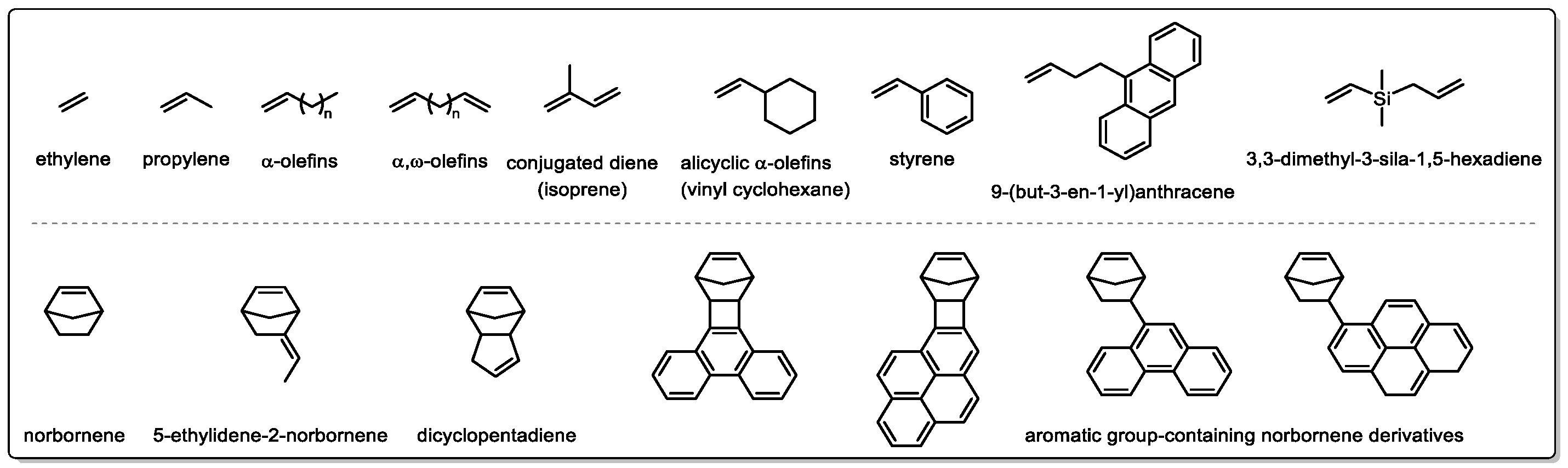
Early transition-metal-based homogeneous single-site catalysts exhibit several key features, including extremely high catalytic activity, the ability to copolymerize a wide range of all-hydrocarbon olefin monomers, and the capacity to synthesize copolymers with controllable molecular weight, polymer dispersion index, and uniform composition. Moreover, some of them exhibit living character, making them ideal candidates for the synthesis of copolymers with tailored polymer microstructures. Therefore, the terpolymerizations of non-polar olefin monomers are mainly carried out by well-defined early transition metal catalysts, including metallocene and non-metallocene catalysts. The monomers applied in this section, as shown in Figure 2, include not only bulk products such as ethylene, propylene, and α-olefins, but also conjugated and non-conjugated dienes, styrene, and cyclic allyl compounds, cyclic olefins, as well as the olefins substituted with unsaturated bonds and conjugated aromatic groups.
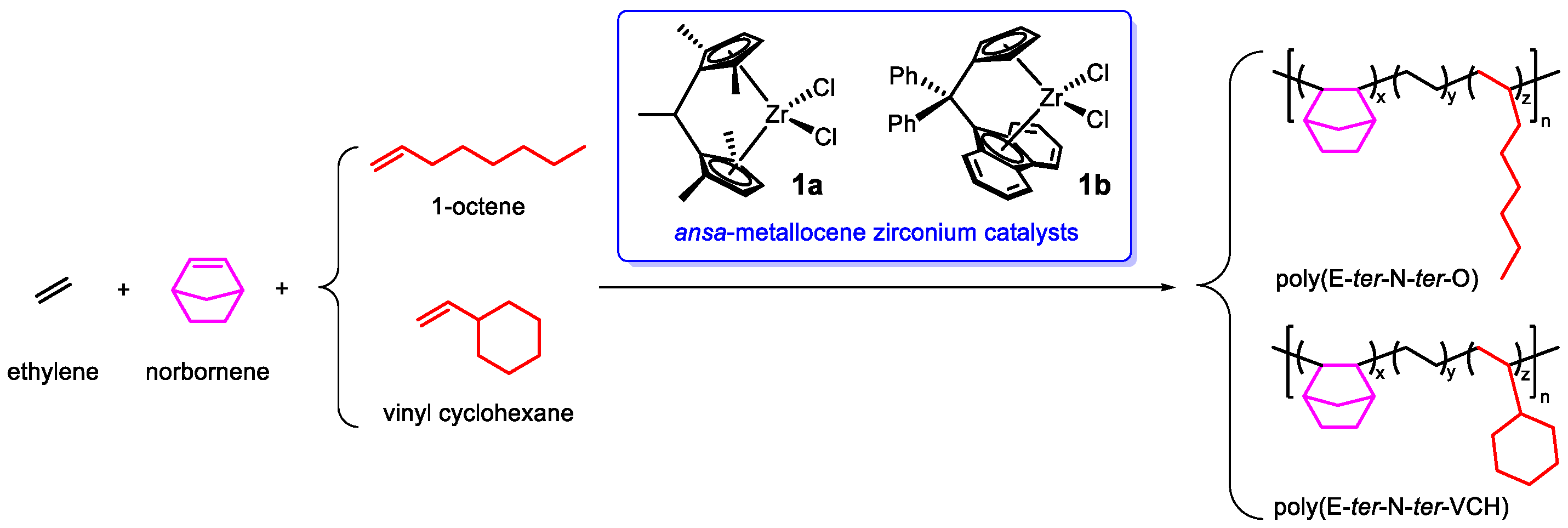
In 2011, Tritto and coworkers reported the ternary polymerization of ethylene and norbornene with linear 1-octene or sterically demanding vinyl cyclohexene (VCH) to prepare modified cyclic olefin copolymers (COCs), poly(E-ter-N-ter-O) and poly(E-ter-N-ter-VCH), respectively, with metallocene zirconium catalysts 1a and 1b (Scheme 1) [34]. It was found that although the incorporation of a third monomer leads to a decrease in the polymer molecular weight (16–163 kg mol−1) compared to the ethylene-norbornene copolymers (160–784 kg mol−1), the glass transition temperature (Tg) values can be adjusted within the range of 74–162 °C when the termonomer contents change from 1 to 5 mol%.
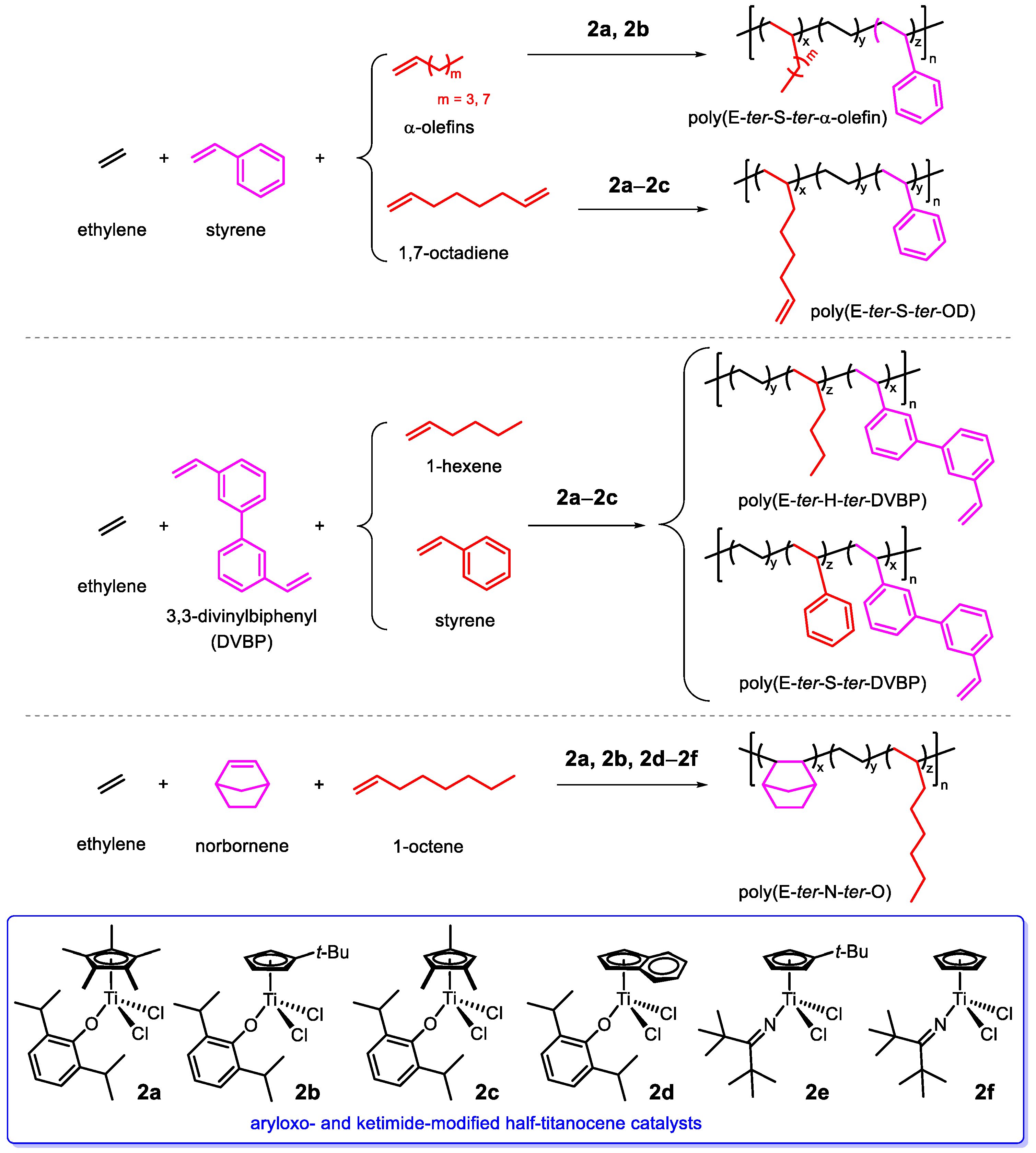
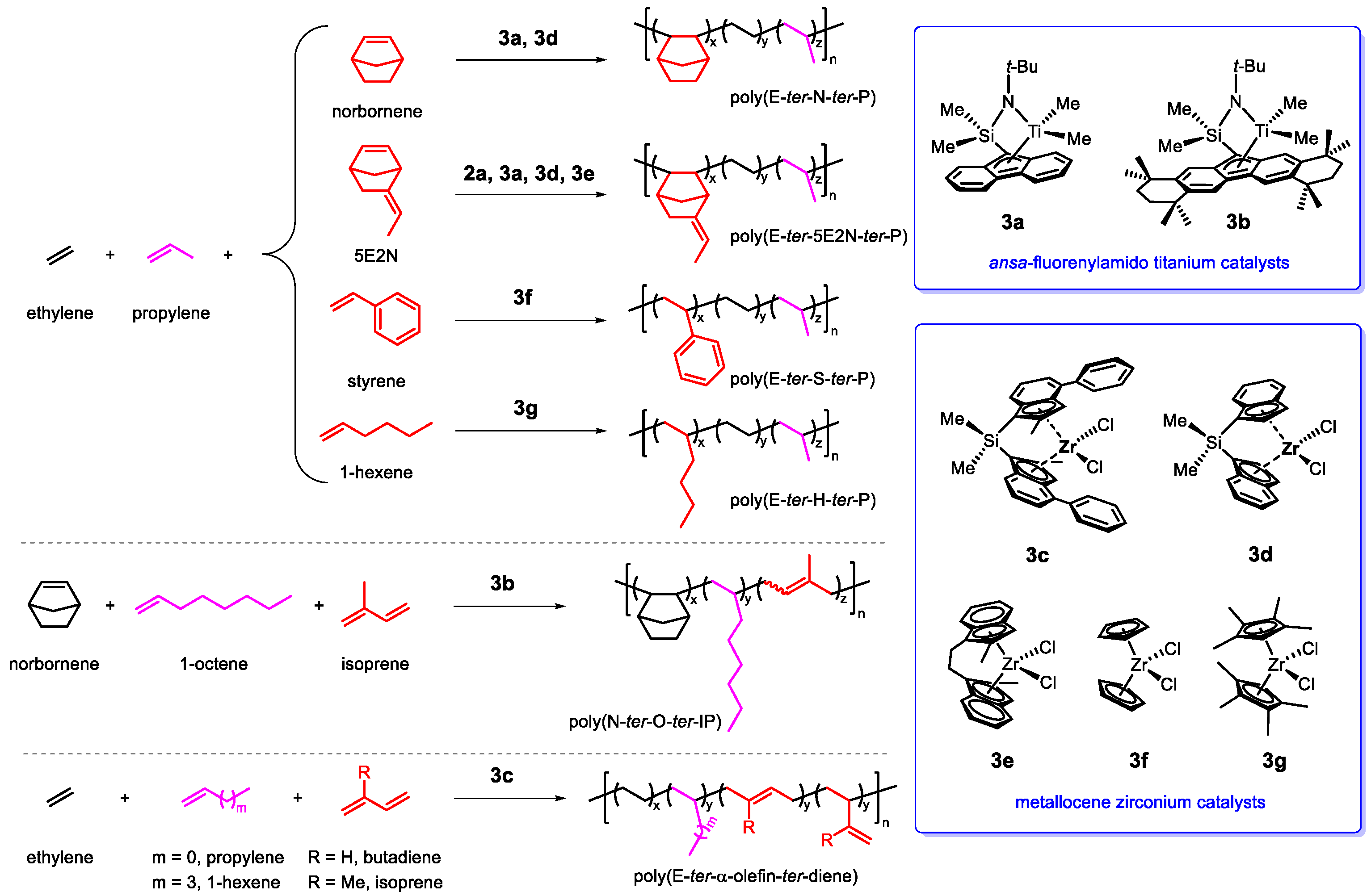
Since 2013, Nomura’s group has reported a series of studies on ternary ethylene copolymerization using different aryloxo- and ketimide-modified half-titanocene catalysts (Scheme 2). The survey of the ethylene and styrene with α-olefins catalyzed by 2a and 2b revealed that the kind of cocatalysts used in the terpolymerization exert significant influence on the catalytic activity, in which the borate cocatalyst system generally give higher activity than the MAO system while the two systems maintaining similar molecular weight (Mn = 199–537 kg mol−1), PDI (1.95–2.51), and comonomers incorporations [35]. Polymer microstructure analysis indicates the absence of styrene-co-α-olefin repeat units due to steric hindrance conflict between the two monomers. The terpolymerization of ethylene and styrene with p-methylstyrene (p-MS) catalyzed by 2a and 2b and the terpolymerization of ethylene and styrene with 1,7-octadiene (OD) catalyzed by 2a2c also give negligible signals of the styrene-co-p-MS and styrene-co-OD units, because of the same reason, to produce amorphous terpolymers, in which the pendant olefinic double bonds, without cyclization during the polymerization, can seek further functionalization [36]. The terpolymerization of ethylene and DVB with 1-hexene or styrene was also achieved using 2a2c, yielding poly(E-ter-DVB-ter-1-hexene) and poly(E-ter-DVB-ter-St) with DVBP contents of 1.7–6.5 mol%. The residual olefinic double bonds of the DVBP monomer were partially initiated to graft polystyrene chains via an anionic process [37]. Both the aryloxo-modified (2a, 2b, and 2d) and ketimide-modified half-titanocene catalysts (2e and 2f) can terpolymerize ethylene and norbornene with 1-octene to produce COCs with high 1-octene contents (up to 13.5 mol%), high molecular weights (Mn of up to 442 kg mol−1), and tunable Tg values (23–153 °C) [38]. Note that the activity and the molecular weight of the terpolymer obtained by 2e and 2f are higher than those of 2a, 2b, and 2d, due to their less β-H elimination reaction. Catalyst 2f was reported as the most active catalyst (with an activity of up to 97,700 kg mol−1 h−1) among the transition metal catalysts in preparing the poly(E-ter-N-ter-1-hexene).
Ethylene and propylene copolymer is known as an industrially important synthetic rubber (EPR) with excellent chemical and environmental resistance due to its saturated structure. The introduction of a third cyclic unit or cross-linkable group, such as norbornene and 5-ethylidene-2-norbornene (5E2N), can further improve its physical and mechanical properties. Shiono and coworkers demonstrated the terpolymerization of ethylene and propylene with norbornene or 5E2N catalyzed by ansa-dimethylsilylene(fluorenyl)(amido)dimethyltitanium catalyst 3a to produce a terpolymer with precisely controllable polymer microstructure (Scheme 3) [39]. The catalytic system was found, for the first time, to exhibit higher reactivity toward propylene than toward ethylene due to its more open η3-coordination site compared to other η5-coordinated constrained geometry catalysts (CGC), thereby making it easier to control E content in the terpolymer. There is no N-co-P sequence in the terpolymers due to the predominant insertion of E. The Tg values of the terpolymer increase linearly (25–198 °C) with the N content (9–58 mol%) regardless of the E/P content. Catalyst 3d facilitates the synthesis of poly(E-ter-P-ter-N) with low N content (1.1–9.1 mol%) to reveal the terpolymer microstructures, which were equipped with an isotactic polypropylene segment, a discrete ethylene unit, and a unique ethylene-norbornene sequence, respectively [40].
The titanium catalyst 2a and zirconium catalysts 3d and 3e are also efficient for the terpolymerization of ethylene, propylene, and 5E2N. The type of cocatalyst used in the catalytic system of 2a significantly affects the active species generated, thereby influencing activity, molecular weight, and polymer properties. In this regard, both the use of modified methylaluminoxane (MMAO) and the combination of triisobutylaluminum (TIBA) with Ph3CB(C6F5)4 have been reported to yield high activity (up to 62 kg mol−1 h−1 atm−1) [41]. Methylaluminoxane-activated 3d exhibited higher activity (2740–4150 kg mol−1 h−1) than that of the borate-activated catalyst (1700–2750 kg mol−1 h−1), while the two systems maintained similar molecular weights within the range of 261–671 kg mol−1 [42]. Similarly, the structure of the isobutylaluminum aryloxide activator also significantly affects the behavior of catalyst 3e, in which a bulky substituent on the para position of the aryloxide motif can increase molecular weight but at the cost of reduced activity and termonomer content [43]. Al-Harthi and coworkers also reported the synthesis of poly(E-ter-P-ter-St) and poly(E-ter-P-ter-H) catalyzed by metallocene zirconium catalysts 3f and 3g, respectively. The introduction of styrene as the termonomer increased activity by two times compared to the copolymerization of ethylene and propylene, while the introduction of 1-hexene also increased the productivity of the terpolymerization. The thermal properties and thermal degradation behavior of these terpolymers have been studied intensively [44,45].
The metallocene titanium and zirconium catalysts also qualified for terpolymerization with conjugated dienes, such as 1,3-butadiene and isoprene. Shiono’s group also reported an active ansa-fluorenylamido titanium catalyst 3b for the efficient terpolymerization of norbornene and 1-octene with isoprene (IP) to produce terpolymers with high isoprene incorporation up to 7 mol% and mainly 1,4-insertion [46]. The activity is higher than that reported for catalysts in similar reactions, and the products exhibit reasonable Tg values (168–185 °C) and a narrow PDI (1.5–2.1). Metallocene zirconium catalyst 3c promotes the terpolymerization of ethylene, propylene/1-hexene, and dienes. Introducing propylene or 1-hexene into the copolymerization of ethylene and dienes reactivates a stable π-allyl species formed by the 1,4-insertion of diene, which is significantly important for its high activity and high molecular weight [47].
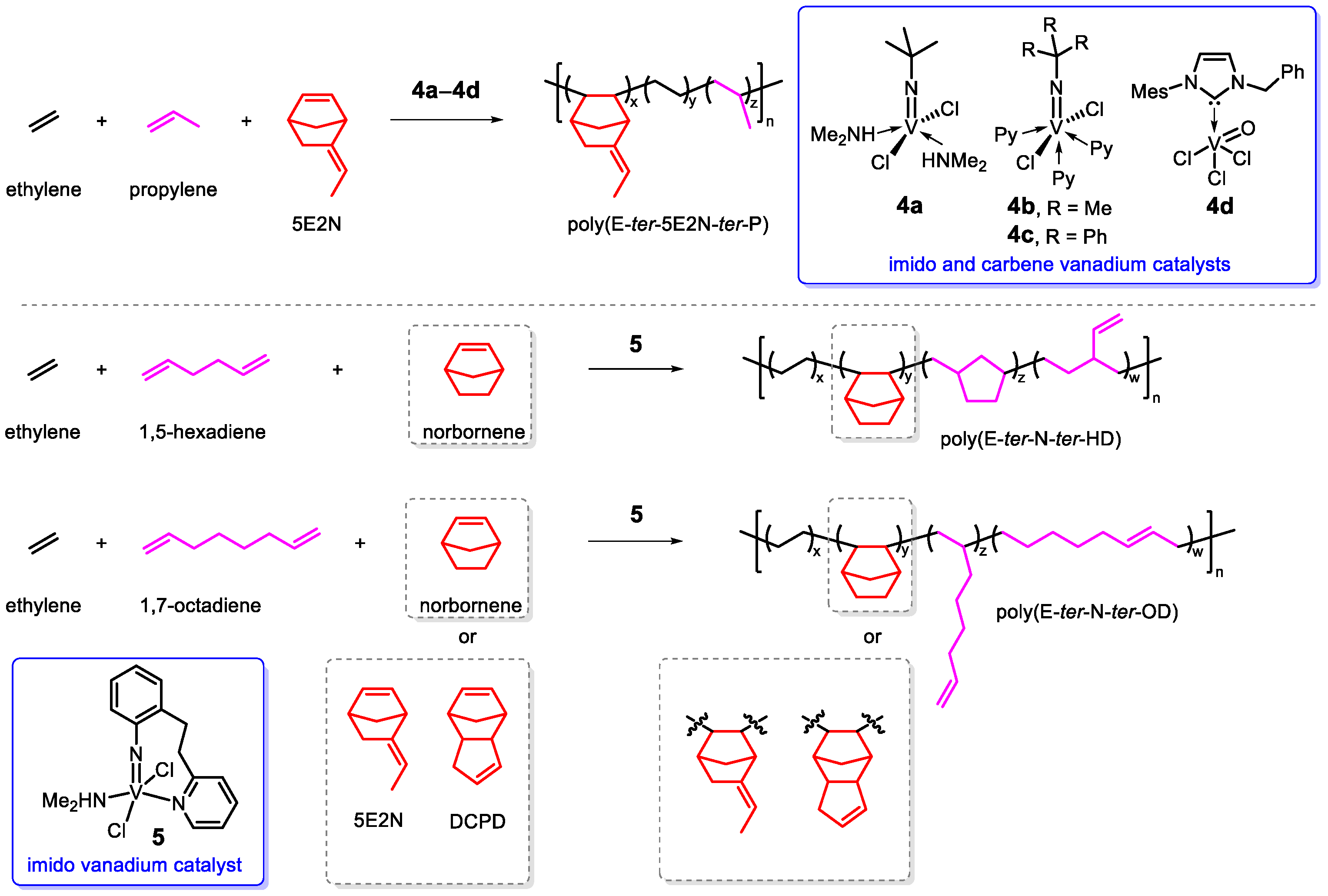
The vanadium complexes bearing different imido substituents and coligands, upon activation with Et2AlCl and using ETA as the reoxidant, were also efficient catalysts for the synthesis of EPDM via the terpolymerization of ethylene, propylene, and 5E2N (Scheme 4). Both 4b and 4c are more active than 4a in the same terpolymerization, producing high-ethylene EPDM (E > 80 mol%) with high molecular weight and unimodal, reasonably narrow PDI (1.9–2.0) [48]. The terpolymer products were confirmed to be a mixture of gradient terpolymers with multiblocks, in which the comonomers are segmented because a continuous ethylene supply was used in a semibatch process. N-heterocyclic carbene (NHC)-based vanadium catalyst 4d promoted the synthesis of ultra-high-molecular-weight EPDM (Mw = 384–1580 kg mol−1) with activity (80–265 kg mol−1 h−1), narrow PDI (2.0–3.2), and controllable 5E2N content within 1.4–12.5 mol% when the terpolymerizations were conducted at −4 °C. The produced terpolymers then undergo post-modification via the reactive C=C double bond to introduce a polar epoxy group (up to 11.2 mol%), which can be equivalently transferred to a carbonyl group, thereby demonstrating enhanced hydrophilicity [49].
A chelated vanadium catalyst 5 to catalyze the terpolymerizations of ethylene and 1,5-hexadiene (HD) with different cyclic olefin monomers, including norbornene, 5E2N, and DCPD [50]. Poly(E-ter-N-ter-HD) with isolated cyclic units in-chain, and pendant unsaturated double bonds were prepared. As a result, 1,2- and 2,1-insertion of 1,5-hexadiene were achieved, with molecular weight (Mw) up to 200 kg mol−1 and adjustable Tg values from −29 °C to 4 °C. Interestingly, the terpolymerizations of ethylene and 1,7-octadiene (OD) with cyclic olefin monomers afford Poly(E-ter-N-ter-OD) with terminal unsaturated long branches and internal unsaturated linear main chains. The unsaturated terpolymer can also be functionalized by post-modification of the terminal C=C bond, such as via thiolene addition.
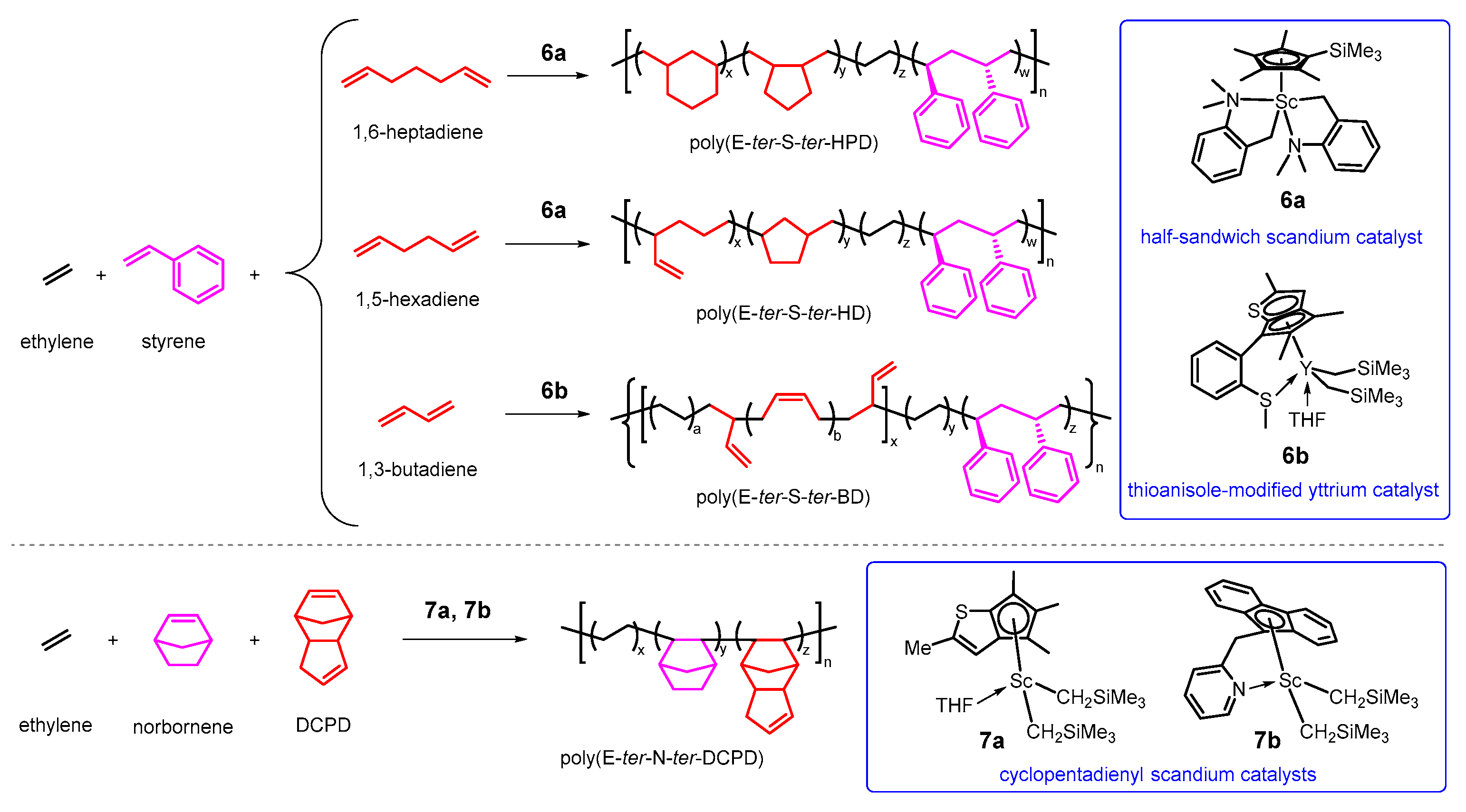
Half-sandwich scandium catalyst 6a enabled, for the first time, the cycloterpolymerization of ethylene and styrene with α, ω-olefins to form terpolymers containing both saturated cyclic units and aromatic rings, which were also defined by the α, ω-olefin monomer structures employed (Scheme 5) [51,52]. Poly(E-ter-S-ter-HPD) obtained from 6a features, six- and five-member rings (HPD content: 8–52 mol%), as well as a syndiotactic polystyrene block (15–83 mol%), exhibits a high Tm of approximately 250 °C. No HPD-St sequence was formed during the terpolymerization because of the bulkiness of the two monomers. A five-member ring structure in the main chain (12–26 mol%) together with a small amount of vinyl branch (ca. 1.0 mol%) was observed in Poly(E-ter-S-ter-HD), which also contains 49–66 mol% of ethylene and 7–38 mol% of styrene. The terpolymers exhibit two sets of Tm values at 100–119 °C and 206–241 °C, which can be attributed to the polyethylene and syndiotactic polystyrene blocks, respectively.
Ternary coordination copolymerization of ethylene, styrene, and 1,3-butadiene was first achieved using a thioanisole-modified CGC yttrium catalyst 6b. Owing to its unique structure, this catalyst effectively couples high activity and stereoselectivity in styrene polymerization with good copolymerization capacity with ethylene and 1,3-butadiene. The resulting poly(E-ter-S-ter-BD) features a high BD content (54.6–85.2 mol%), with mainly 1,4-units (ca. 80%), as well as comparable contents of ethylene segments (12.8–27.9 mol%) and syndiotactic styrene sequences (1.5–27.7 mol%). This is attributed to the higher reactivity of BD relative to the other two monomers. The multiblock microstructure of the terpolymer affords it microphase separation and excellent compatibility when blended with other rubber materials, such as SBR, leading to enhanced tensile strength, elongation at break, and rolling resistance [53].
Cyclopentadienyl scandium catalysts 7a and 7b are highly active (1270–1860 kg mol−1 h−1 bar−1) in the terpolymerization of ethylene, norbornene and DCPD to generate poly(E-ter-N-ter-DCPD) with moderate molecular weight (Mn = 49–136 kg mol−1), narrow PDI (1.7–2.3), and adjustable cyclic monomer contents from 47.4 to 59.8 mol%, in which the NB contents are 17.7–42.4 mol% and the DCPD contents are 8.8–38.6 mol%, respectively [54]. It is extraordinary that the highest cyclic monomer content exceeds 50 mol%, suggesting the existence of a continuous NB-DCPD sequence that has never been observed in a similar rare earth metal-catalyzed binary and ternary copolymerization systems. The high cyclic monomer content gives the terpolymers high Tg values up to 163 °C, while cleavage of the unsaturated C=C bond of the DCPD unit and the introduction of an OH group further increase the Tg to 202 °C, with an improved hydrophilicity of the material.
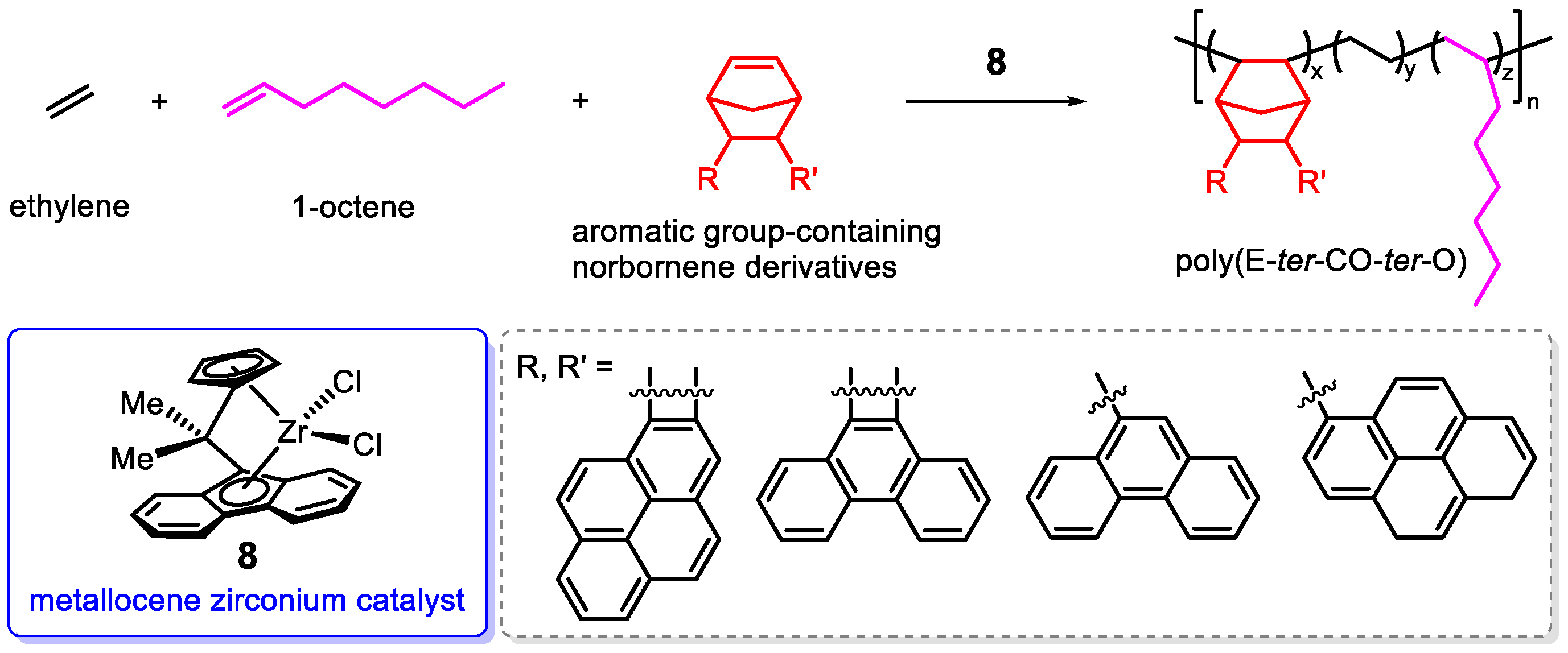
Assuming that the installation of aromatic groups would increase the polymer’s refractive index and that the introduction of long branches could improve the melt processing, Jian and coworkers conducted the terpolymerization of ethylene, 1-octene, and high refractive index norbornene-based monomers (Scheme 6) [55]. The metallocene zirconium catalyst 8 exhibited high activity (above 1000 kg mol−1 h−1) and excellent copolymerization ability. Indeed, the obtained terpolymers exhibit higher refractive indices (1.627–1.675) at 589 nm than the commercially available COCs, whereas their Tg values (63–184 °C) are comparable to those of the latter. The detailed polymer microstructure, together with the thermal, optical, and mechanical properties, has been studied.
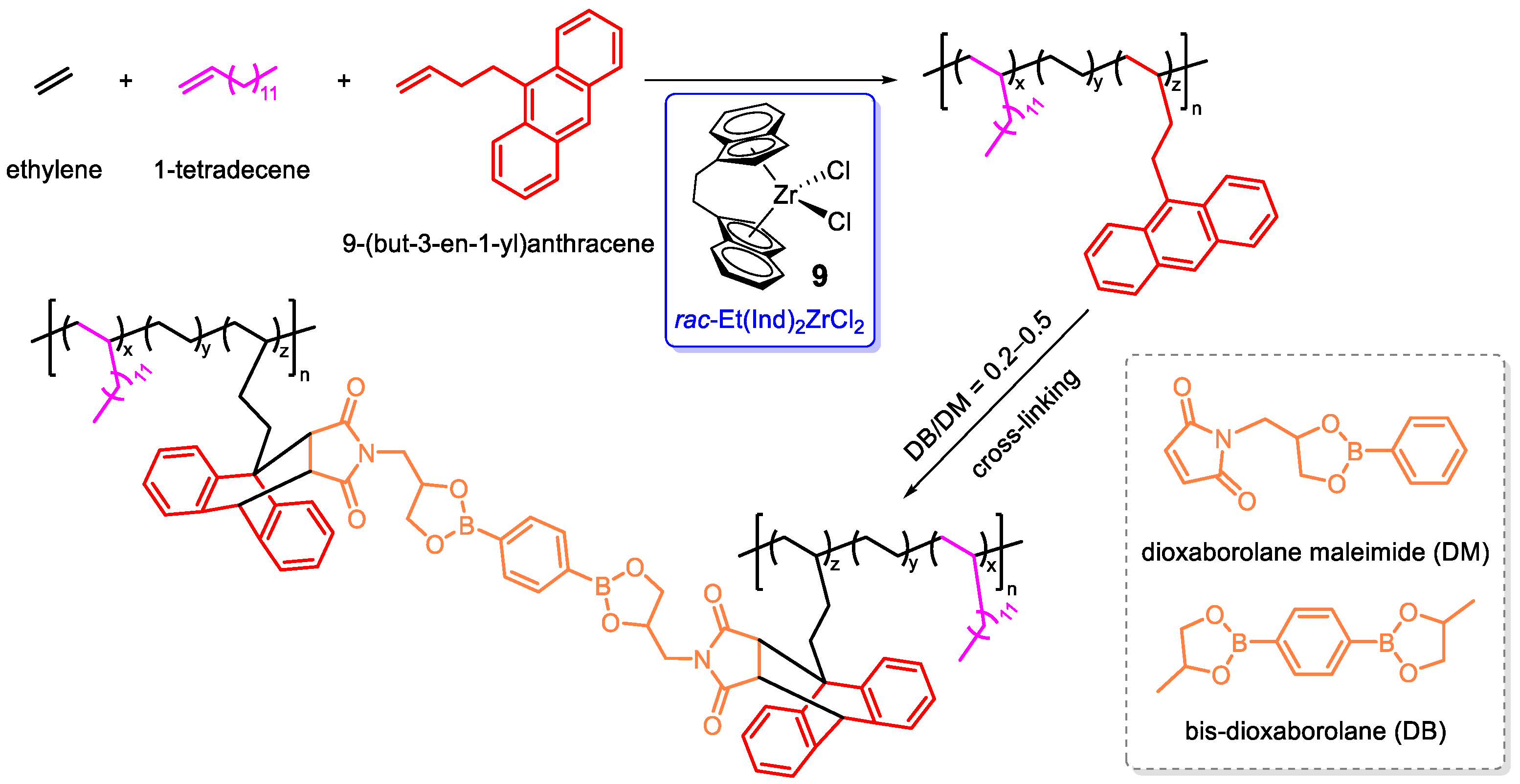
Polyolefin elastomers (POEs) composed of crystalline polyethylene segments (the hard block) and randomly distributed higher α-olefin sequences (the soft block) exhibit good mechanical strength and elasticity and are more attractive than natural and synthetic rubber materials due to their thermoplasticity and reprocessability. Recently, Li and coworkers reported a terpolymerization of ethylene, 1-tetradecene, and 9-(but-3-en-1-yl)anthracene (BA) catalyzed by rac-Et(Ind)2ZrCl2 catalyst 9 with the activity maintained above 8000 kg mol−1 h−1 (Scheme 7) [56]. The obtained poly(E-ter-1-tetradecene-ter-BA) was first grafted with dioxaborolane maleimide (DM) through D-A reaction. It was then cross-linked in the presence of bis-dioxaborolane (DB) to form eversible cross-linking through internal boronic ester bonds between the pendant anthracene groups, in which the crosslinking density can be adjusted by varying the BA contents (0.7–2.4 mol%) of the terpolymers and also changing the DM/DB ratio (0.2–0.5), respectively. These POE vitrimers have been shown to achieve a good balance between overall mechanical properties and processing performance, including processability and heat and chemical resistance.
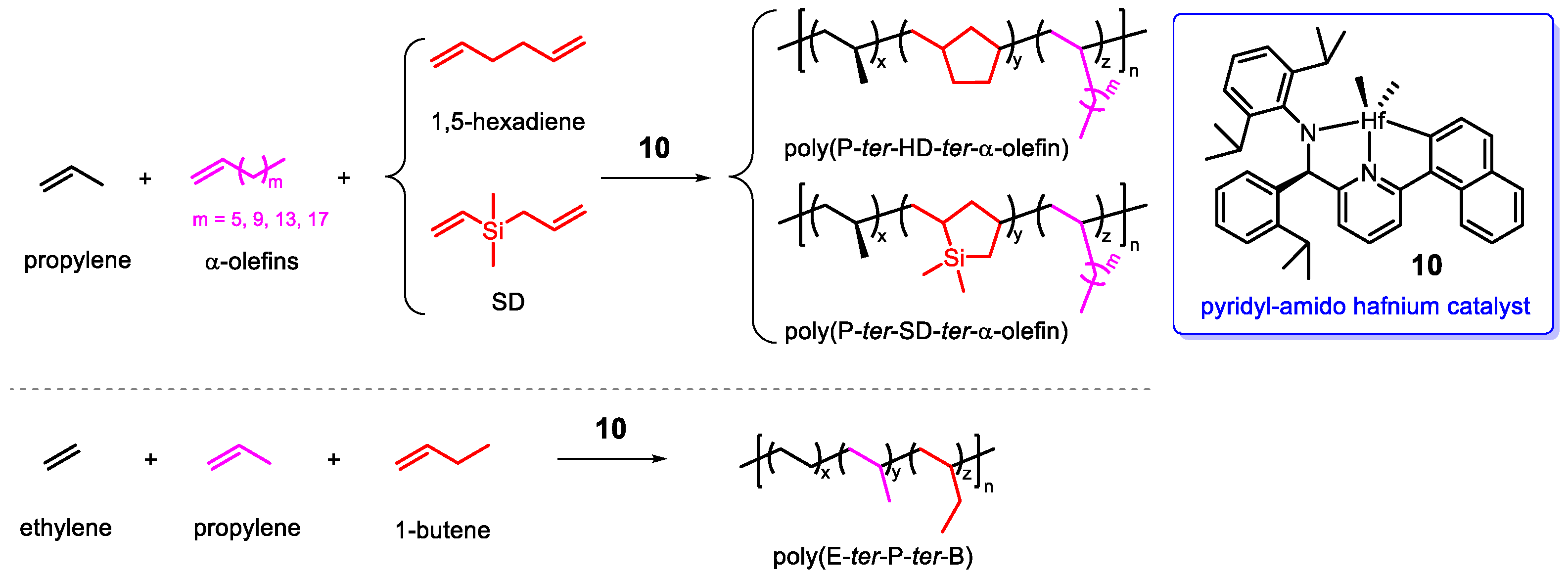
The same group also conducted the terpolymerization of propylene, α-olefins, and α, ω-olefins with pyridyl-amido hafnium catalyst 10 to synthesize a new kind of propylene-based thermoplastic elastomer (TPE) containing a five-membered cyclic structure and long-chain branches in one pot (Scheme 8) [57]. Catalyst 10 exhibited high efficiency in producing terpolymers by varying both the type and concentration of the two comonomers in the feed. The products generally feature high melting points (Tm = 75.4–126.2 °C) and low glass transition temperatures (Tg = −13.7–0.9 °C), along with high molecular weight and a narrow PDI. Poly(P-ter-HD-ter-DO) exhibits excellent mechanical properties. It shows a tensile strength of 26 MPa, a high elongation at break of 1360%, an outstanding toughness of 153 MJ m−3, and a remarkably high elastic strain recovery of up to 94%, representing the best performance among all current propylene- and α-olefin-containing elastomers. This work demonstrates the possibility of synthesizing high-performance elastomer materials by rationally adjusting the contents and sequences of crystalline segments, cyclic structures, and long branches, thereby effectively addressing the trade-off between tensile strength and elastic recovery. More recently, catalyst 10 was also used to synthesize a terpolymer from ethylene, propylene, and 1-butene. The enhanced mechanical properties, compared to those of ethylene-propylene and propylene-butene copolymers, demonstrate the synergistic effect of the introduced termonomers in developing advanced polypropylene-based materials [58].

3. Ternary Polymerization of Olefins with a Polar Monomer

The introduction of a tiny amount of polar functional groups into the non-polar polyolefin backbone can significantly improve adhesion, dye retention, printability, compatibility, and other material properties. The direct coordination copolymerization of an olefin with polar monomers is the simplest and most effective method for synthesizing polar-functionalized polyolefins. Early transition-metal catalysts, such as Ti, Zr, and Hf, are easily poisoned by polar functional groups because of their inherent oxygen affinity. Nevertheless, with appropriate synthetic strategies, a few early transition-metal catalysts have enabled the direct copolymerization of ethylene with polar monomers, and these studies have been summarized in previous reviews. This review first focuses on the terpolymerization of polar monomers catalyzed by early transition-metal catalysts. In contrast, late transition-metal catalysts, such as Ni and Pd, with high electron saturation, exhibit strong tolerance toward heteroatoms and can catalyze the direct copolymerization of olefins and polar monomers without the need for protective masking reagents. Recently, numerous catalysts designed rationally, polar monomers with innovative structures, and polyolefin materials with new functions have been explored. The late-transition-metal-catalyzed terpolymerization of olefins with polar heteroatoms, carbon monoxide, and functional groups is also summarized here, which is of great significance for the precise preparation of advanced polyolefin materials.
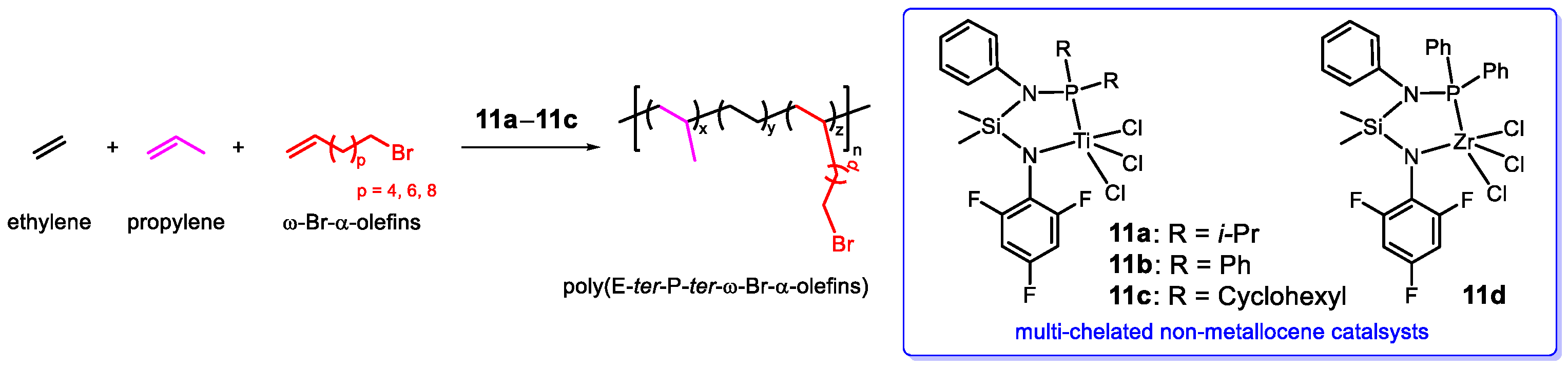
Multi-chelated non-metallocene titanium catalysts 11a11c were synthesized and applied to the terpolymerization of ethylene, propylene, and ω-Br-α-olefins (Scheme 9) [59]. Catalyst 11a is more active than 11b and 11c under consistent conditions, with the highest activity of 621 kg mol−1 h−1 observed in the terpolymerization with 11-bromo-1-undecylene. Both catalytic activity and molecular weight increase with the number of methylene groups between the olefin double bond and the Br atom, suggesting a weaker poisoning effect and less backbiting. Polar incorporation can be controlled within the range of 1.02–2.49 mol% by varying the types and concentrations of polar monomers in the feed. Zirconium catalyst 11d was active for the terpolymerization of ethylene, propylene, and higher α-olefins (1-hexene, 1-octene, and 1-decene) with activities up to 104 kg mol−1 h−1 and α-olefin incorporations within the range of 1.2–16.3 mol%, respectively. Although this efficiency has been reported, the terpolymerization involving a polar monomer has not yet been described with the same catalyst [60].
The addition of antioxidant stabilizers, such as BHT, to polyolefins can improve stability. However, the stabilizer may be lost from the polymer matrix due to weak interactions. Losio and coworkers studied the terpolymerizations of ethylene and BHT-containing cyclic olefins with 1-hexene and norbornene, respectively, catalyzed by 9, to synthesize BHT-based terpolymers with BHT contents below 1 mol% (Scheme 10) [61]. The polymer products are used as macromolecular antioxidants, blended with commercially available LLDPE and COC materials, and exhibit good solubility in common solvents, excellent compatibility due to structural similarity, and long-term thermal stability without releasing molecular antioxidant groups.
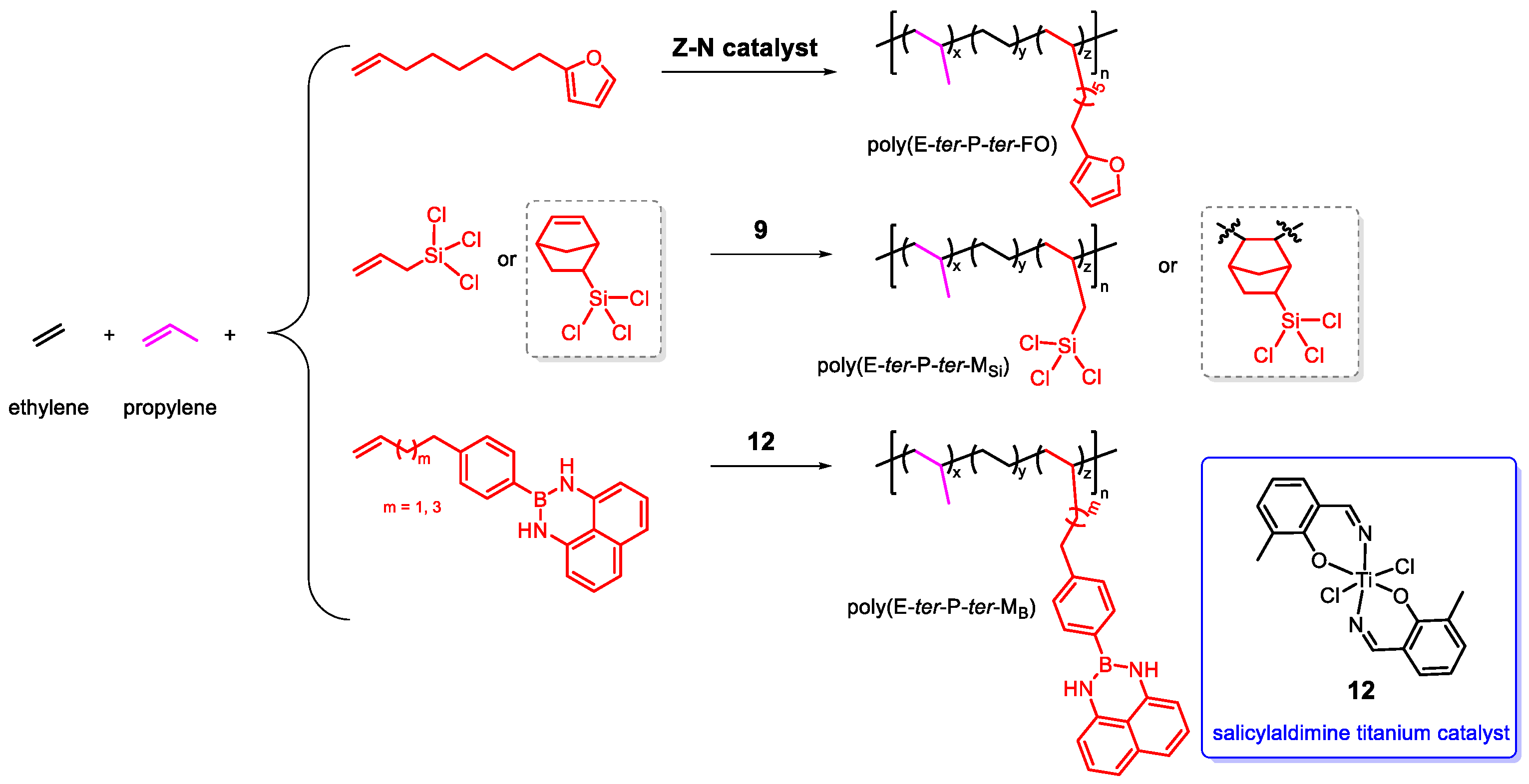
Li and coworkers introduced polar functionalized groups into EPR chains through the terpolymerization of ethylene and propylene with α-olefin- and norbornene-based polar monomers (Scheme 11) [62,63]. Poly(E-ter-P-ter-FO) was synthesized using a typical Z-N catalyst with moderate activity (260–390 kg mol−1 h−1) and adjustable FO contents of 1.1–9.7 mol%. It subsequently undergoes a Diels–Alder reaction between the furan groups and the bismaleimide, forming crosslinks in the terpolymer. The products exhibit thermoreversible behavior, undergoing de-crosslinking above 110 °C and below 85 °C. Chlorosilane- (0.71–4.68 mol%) and methoxysilane-functionalized (0.11–0.45 mol%) terpolymers were polymerized by metallocene catalyst 9 with a high activity of 3910–4940 kg mol−1 h−1. This catalyst was used to prepare EPR/SiO2 composites in situ by adding a SiO2-dispersed solution during polymerization. The installation of trichlorosilane groups significantly enhanced the compatibility of the polymer and SiO2 particles. The SiO2 content in the polymer reached up to 85 wt%, with uniform dispersion, a level that is difficult to achieve via physical blending. Both techniques reinforce EPR’s mechanical properties, such as strength and modulus.
In 2024, Tanaka and Shiono reported the synthesis of a reversible cross-linking EPR material through the terpolymerization of ethylene, propylene, and an alkenylboronic acid comonomer, catalyzed by salicylaldimine titanium catalysts 12. The resulting terpolymers have Mn of 137–491 kg mol−1 and incorporate 0.10–0.74 mol% of the boron-containing termonomer. The terpolymers undergo post-modification with acidified methanol and heating at 80 °C to form cross-linked structures, yielding improved mechanical properties compared with conventionally sulfur-vulcanized EPDM. De-crosslinking is achieved by alcoholysis with a chelating reagent, such as N-methyl diethanolamine, affording the terpolymer good solubility in common solvents [64].
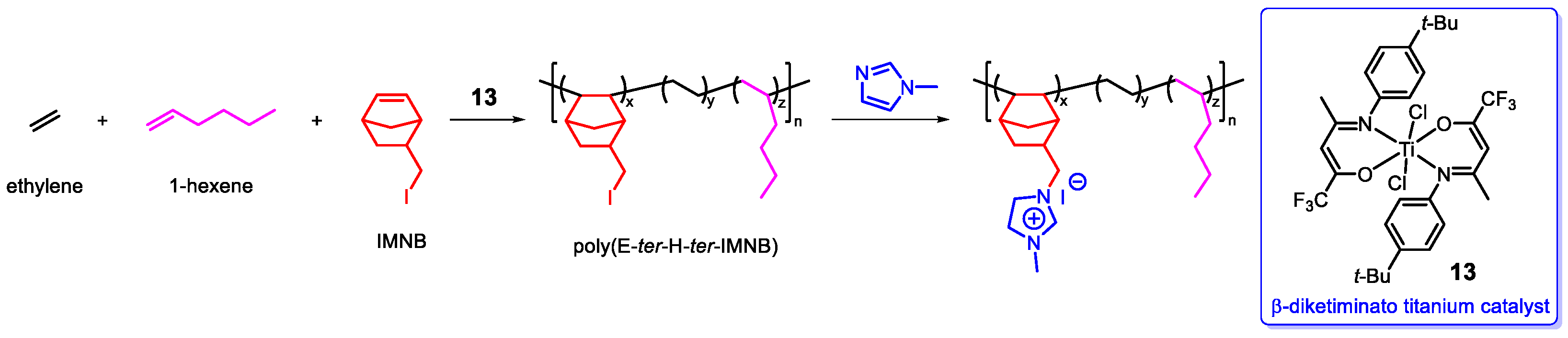
Li and coworkers conducted terpolymerization of ethylene, 1-hexene, and 5-iodomethyl-2-norbornene with a β-diketiminato titanium catalyst 13, which exhibited high activity (6890–8210 kg mol−1 h−1 MPa−1) and strong tolerance toward iodine (Scheme 12) [65]. The IMNB and HE contents can be regulated within 3.6–7.4 mol% and 14.7–21.2 mol%, respectively. At the same time, the Tm of the terpolymer decreased from 66.4 °C to 50.1 °C, and the Tm was not determined when the total comonomer content reached 27.9 mol%. The poly(E-ter-H-ter-IMNB) was then converted into polymeric ionomers by reacting with N-methylimidazole, followed by ion exchange with various anionic salts. Due to the existence of a dual-cross-linking network and the effect of different counter anion types, these thermoplastic elastomers demonstrate excellent mechanical properties, including stress-at-break values of (5.4–13.7 MPa), strain-at-break values of (432–624%), and elastic recovery of up to 96%, respectively.
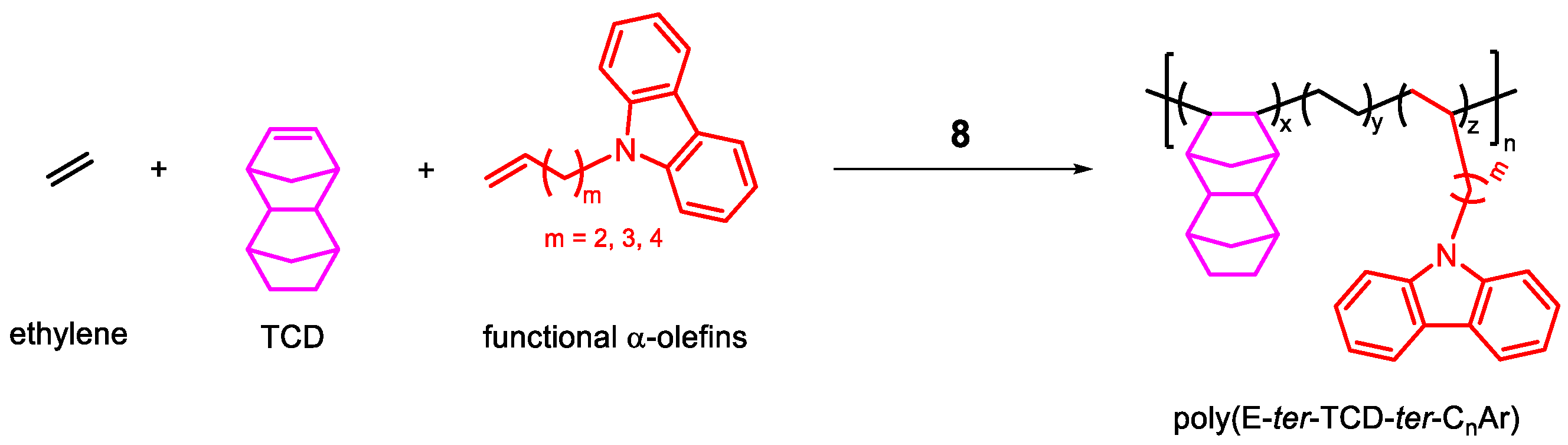
A high-refractive-index carbazole group was incorporated into the COC polymer chain through the terpolymerization of ethylene, TCD, and CnAr to develop COT with enhanced properties by metallocene catalyst 8 (Scheme 13) [66]. The catalytic activity remained in the order of 105 kg−1 mol−1 h−1 under varying total monomer concentration, comonomer ratio, and methylene length between the olefin double bond and the carbazole group. The high TCD content of 26.3–35.8 mol% resulted in high Tg values (115–167 °C) for the terpolymer. The effective incorporation of the carbazole-based monomer improved the refractive index to 1.550–1.569 and maintained excellent transparency (93–95% transmittance), making it a promising optical material.
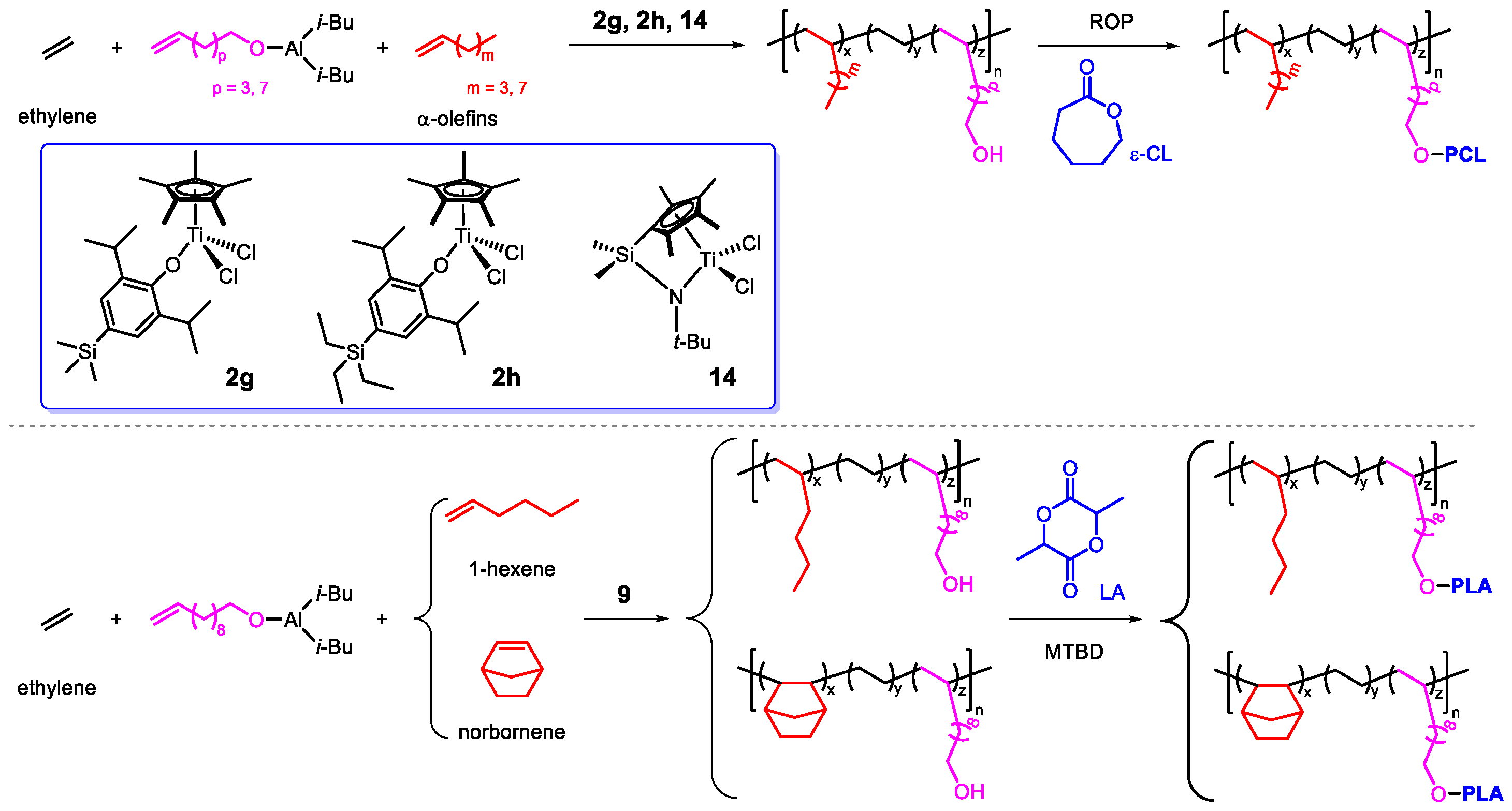
Nomura and coworkers developed aryloxo-modified half-titanocene catalysts 2g and 2h with SiMe3 and SiEt3 para-substituents for the terpolymerization of ethylene and α-olefins with 1-alkenes bearing a terminal hydroxy group (protected by aluminumalkyl) (Scheme 14) [67]. Both catalysts 2g and 2h outperform the other half-titanocene catalysts and the CGC-titanium catalyst in terms of catalytic activity, thermal stability, tolerance to polar monomers, and molecular weight, owing to the stabilizing effect of silicon-containing substituents on the active species. This work demonstrates the first synthesis of high-molecular-weight (Mn of up to 141 kg mol−1) OH-functionalized ethylene copolymers with adjustable OH contents (3.0–2.5 mol%) by the Group 4 transition metal catalysts. Poly(ethylene-ter-DC-ter-(DC-OH)-graft-poly(CL) with high molecular weights (243–274 kg mol−1) and narrow PDI (1.70–1.77) was then prepared through the ring-opening polymerization (ROP) of ɛ-caprolactone (CL) from the pendant OH groups. Li and coworkers also reported the synthesis of graft copolymers by combining the coordination terpolymerization of ethylene, 10-undecen-1-ol, and 1-hexene/norbornene, followed by the ROP of L-lactide (L-LA) initiated by a MTBD catalyst from the terminal hydroxyl groups [68]. The OH contents of the obtained LLDPEOH and COCOH products, in the first stage, were 4.5–5.4 mol%, and the PLA contents in the graft copolymers were controlled at 63–89 mol%, with the PLA blocks bearing molecular weights of 2–3 kg mol−1. The products serve as efficient toughening agents for commercial PLA, and the polymer blends exhibited improved strength and toughness while maintaining other excellent material properties, such as good transparency.
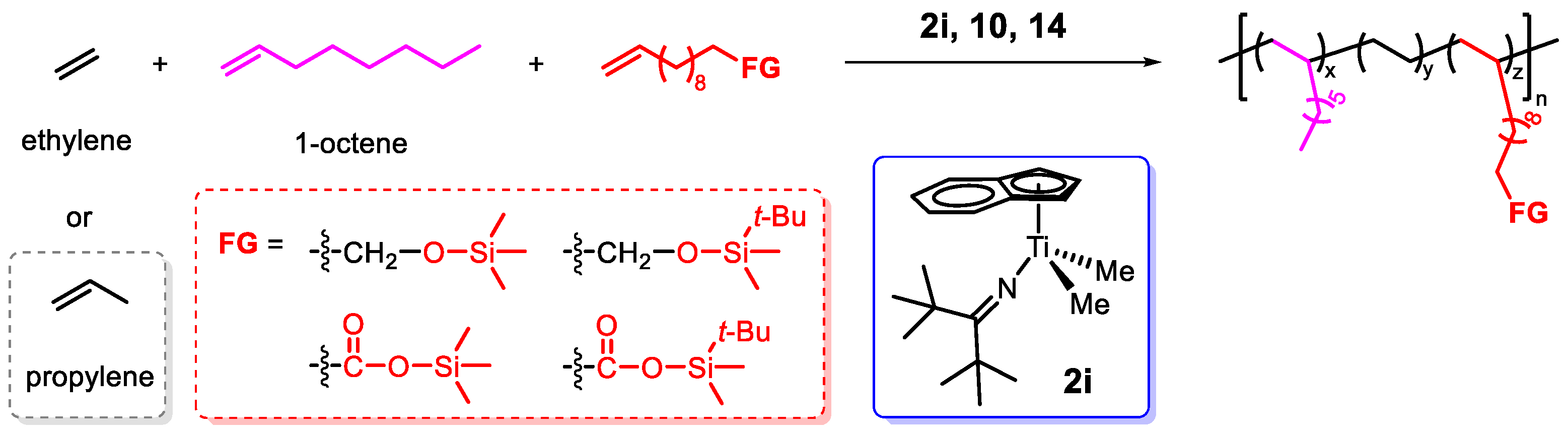
To synthesize polar-functionalized POEs with higher molecular weights and controllable incorporation of polar groups, Chen and coworkers developed a silane protection strategy, superior to the conventional protective aluminum reagent, for the terpolymerization of ethylene/propylene and 1-octene with Si- and O-containing polar monomers (Scheme 15) [69]. Catalyst 2i is more effective in the nominated terpolymerizations than catalysts 10 and 14; the highest activity of 2i reached 10,800 kg mol−1 h−1, yielding terpolymers with molecular weights up to 438 kg mol−1 and reasonable incorporation of the polar monomer at 0.7–2.7 mol%. Both the activity and molecular weight are higher than those of the terpolymers obtained by a similar terpolymerization using polar monomers protected with triisobutylaluminum, demonstrating great potential for practical production.
With the prospect that rare earth metals present good tolerance toward polar functional groups, pyridyl-metallocene yttrium catalyst 15 was selected for the heteroatom-assisted tercopolymerization of polar ortho-alkoxystyrene (oAOS), isoprene (IP), and butadiene (BD) by Cui and coworkers (Scheme 16) [70]. This is the first report of successful synthesis of polar functionalized poly(oAOS-ter-IP-ter-BD)s with high oAOS contents (5.6–62.5 mol%), high molecular weight (Mn = 94–250 kg mol−1), and relatively narrow PDI (1.1–1.4). Polymer microstructure analysis and kinetic studies revealed that these terpolymers have high syndio- and cis-1,4-regioregularity, including gradient poly(oMOS-ter-IP-ter-BD) and random poly(oEOS-ter-IP-ter-BD), respectively, due to the different steric hindrance effects of the two monomers.
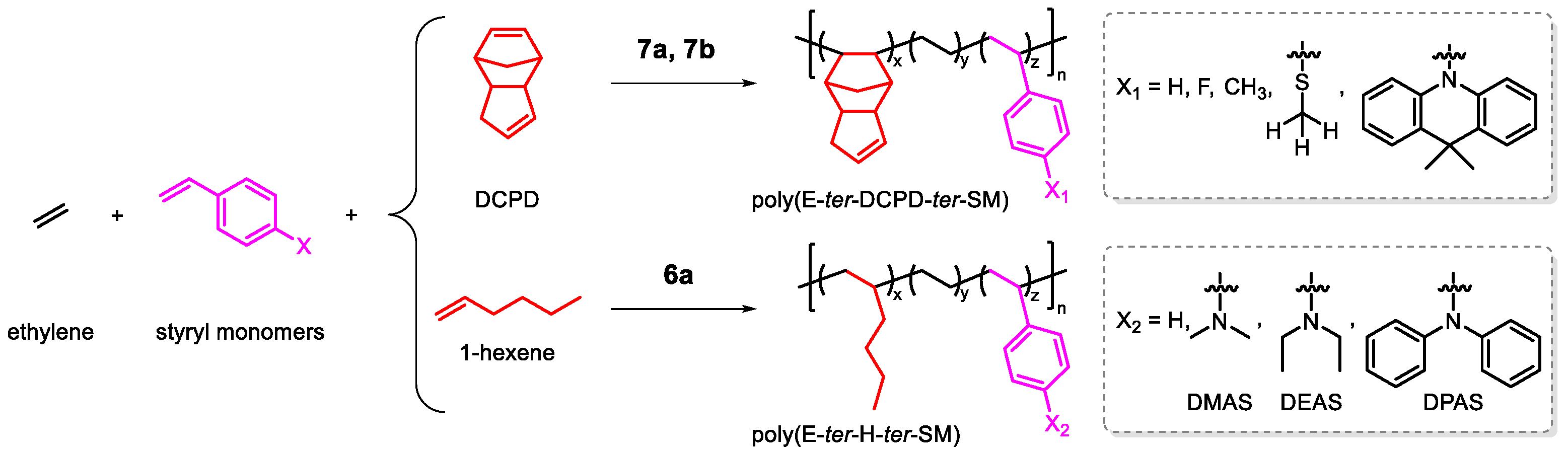
The same group recently reported the terpolymerization of ethylene and DCPD with differently substituted styrene to synthesize a new type of COC material, followed by post-modification of the remaining unsaturated double bonds (Scheme 17) [71]. Both scandium complexes 7a and 7b yield styryl-monomer-rich terpolymers upon installation of an electron-donating substituent. At the same time, higher DCPD contents (26.6–28.4 mol%) than that of the styryl monomer (7.0–13.0 mol%) can be observed when an electron-withdrawing substituted monomer, such as styrene-F and styrene-p-(9,9-dimethyl-9,10-dihydroacridinyl), is used. The terpolymer microstructures depend on the comonomer concentration, in which the high DCPD and styryl monomer concentration afford a high-Tg-terpolymer with DCPD-(E)y-DCPD and discrete styrene-F sequences, while a low comonomer concentration gives styrene-F-(E)x-styrene-F units that contribute to low Tg values. Catalyst 6a is also active for the terpolymerization of ethylene (E) and 1-hexene (H) with styrene (St) or styrene derivatives (DMAS, DEAS, and DPAS). Both the activities of E-H-DMAS terpolymerization (1720–2550 kg mol−1 h−1) and E-H-DEAS terpolymerization (1404–2280 kg mol−1 h−1) are lower than those of E-H-St terpolymerization (3684–4780 kg mol−1 h−1) due to the interaction of the amine group with the central metal. At the same time, a higher activity (5020–5730 kg mol−1 h−1) was observed in the terpolymerization of ethylene, 1-hexene, and DPAS. Similarly, there is no continuous H-H, St-St, or St-H sequence in the terpolymer, indicating a uniform and random dispersion of the diffident monomers [72].
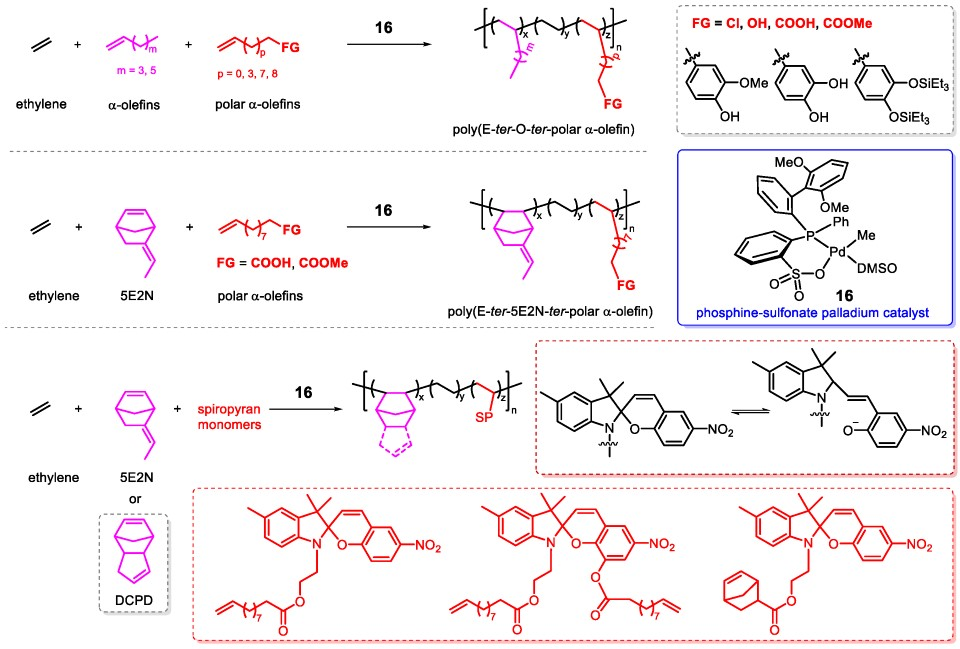
Late transition metal catalysts based on nickel and palladium have great potential for the direct synthesis of polar functionalized polyolefins due to their strong tolerance toward polar substituents. Phosphine sulfonate palladium catalyst stands out due to its high catalytic activity, good copolymerization capacity with a broad scope of olefin monomers, and the ability to produce linear polyethylene with polar functional groups inserted in the main chain. Chen and coworkers reported a series of terpolymerizations involving ethylene, α-olefins, cyclic olefins, polar, and multifunctional monomers using the nominated catalyst (Scheme 18) [73,74,75,76]. Catalyst 16 terpolymerized ethylene, 1-octene, and long-chain-branch α-olefin with terminal COOH/COOMe/Cl groups with moderate activity of ca. 100 kg mol−1 h−1 to produce terpolymers with molecular weights of 22–133 kg mol−1 and polar monomer incorporation of 0.7–1.4 mol%, respectively. The terpolymers exhibited enhanced tensile properties and surface polarity. The same catalyst was then used for the synthesis of terpolymers from ethylene, ENB, and COOH/COOMe-substituted 1-decene with significantly improved ENB content (5.7–22.3 mol%), polar monomer incorporation (up to 2.6 mol%), and terpolymer molecular weight (up to 1760 kg mol−1 h−1). The introduction of long branches (with terminal polar groups) and cyclic structures (with unsaturated) reduces the crystallinity of polyethylene, and the addition of iron ions in the polymeric matrix forms iron-carboxylate interactions that can be regulated under UV light, affording polar-functionalized, cross-linkable, self-healing, and photoresponsive materials. The terpolymerization of ethylene with 1-hexene and bioresourced catechol-functionalized monomers, incorporating various metal ions, yielded polyolefin products with improved mechanical properties and dynamic behavior that enable self-healing. Similarly, the installation of spiropyran (SP) on the polyolefin chain through the terpolymerization of ethylene, DCPD/ENB, and SP-based termonomer with different patterns (alkyl chain, double olefin bonds, and cyclic structure) generated light, heat, and force-responsive materials via the stimulus-responsive function of the intramolecular SP group.

4. Ternary Polymerization of an Olefin with Two Polar/Functionalized Monomers

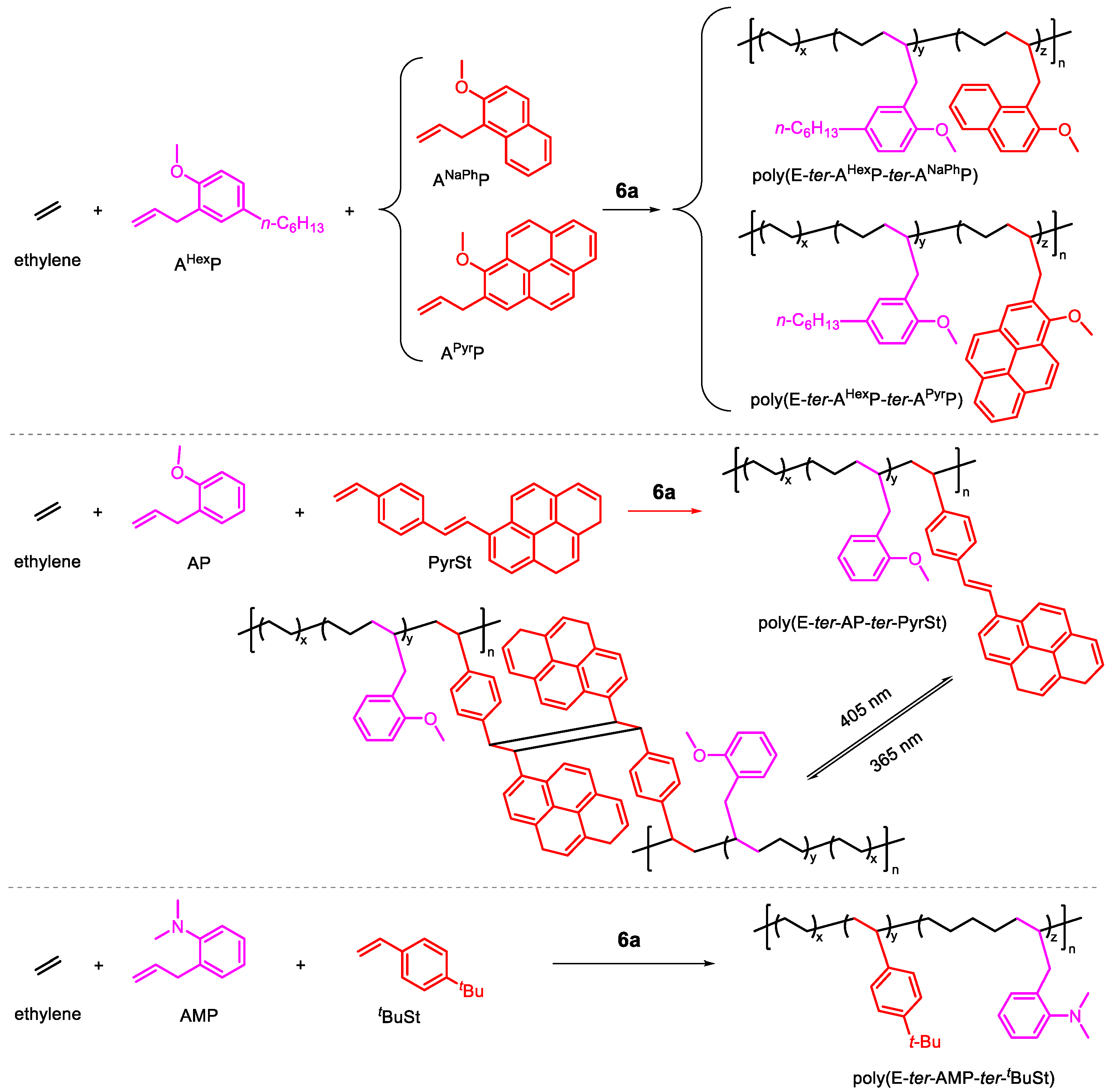
The first example of the effective terpolymerization of a non-polar olefin with two different polar functionalized olefin monomers was achieved by Hou and coworkers with the use of half-sandwich scandium catalyst 6a (Scheme 19) [77]. This affords a series of terpolymers with precisely controllable sequence distribution, excellent strength and elasticity, and, most importantly, self-healing functionality. The terpolymerization of ethylene with two substitute allyl benzene monomers, the AHexP and ANaPhP/APyrP, affords multi-block poly(E-ter-AHexP-ter-ANaPhP/APyrP) with a short crystalline polyethylene block, a soft block containing alternating E-AHexP sequence, and a hard block with alternating E-ANaPhP/APyrP sequence, respectively. Similarly, the terpolymer obtained from ethylene, AP, and 4-[2-(1-pyrenyl)ethyl]styrene (Pyr) comprises multiple blocks with a short polyethylene chain, an E-alt-AP sequence, and discrete Pyr units, demonstrating excellent tensile and fluorescent properties [78]. Moreover, the unsaturated C=C double bond between the styrene and pyrene moieties in the product can undergo a photoinitiated [2 + 2] cycloaddition to form a reversible cross-link. When AMP, equipped with a slightly bulky NMe2 group on the ortho position, was used as the polar monomer, the terpolymerization of ethylene, 4-tert-butylstyrene, and AMP generates a distinguishing multi-block terpolymer with continuous polyethylene segments, continuous polystyrene segments, and alternating sequences consisting of AMP and two ethylene units [79]. Mechanism studies revealed that the self-healing of the above terpolymers originates from a nanophase-separated structure comprising crystalline or amorphous (high Tg) hard segments dispersed in a flexible, low-Tg matrix.
Catalyst 17a and 17b with different substituents on the phosphine have also been used for the terpolymerization of ethylene, 2-vinylfuran, and carbic anhydride (CA) to synthesize an unusual telechelic terpolymer with CA units inserted in-chain and the VF mainly distributed at the chain ends (Scheme 20) [80]. Both experimental studies and DFT calculations have verified the detailed mechanism.
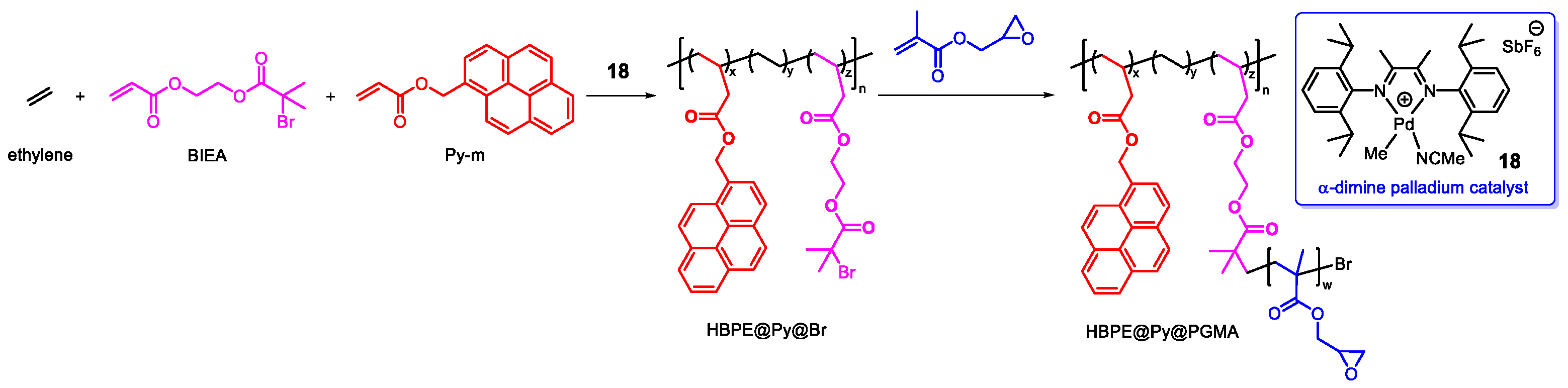
Xu and coworkers reported the synthesis of fluorescent polyethylene from the terpolymerization of ethylene with two substituted acrylate monomers, BIEA and Py-m, catalyzed by α-dimine palladium catalyst 18, followed by the graft polymerization of GMA through the terminal Br atom via the atomic transfer radical polymerization (ARTP) method (Scheme 21) [81]. The obtained terpolymers, HBPE@Py@Br and HBPE@Py@PGMA, have molecular weights of 12.4 kg mol−1 and 47.5 kg mol−1, respectively, and the Py content was fixed at 0.8 per 100 ethylene units. The installation of PGMA block onto terpolymers renders them well-dispersible in matrices such as epoxy resin, ethylene-vinyl acetate copolymer, poly(methyl methacrylate), and polystyrene, and they exhibit strong fluorescence even at extremely low pyrene concentrations (0.05–0.20 wt%) in the blending systems.

5. Ternary Polymerization of Olefins with Carbon Monoxide

The carbonylative polymerization of ethylene with carbon monoxide (CO) has been an attractive approach, as it not only enables effective utilization of C1 resources but also offers new insights into the synthesis of aliphatic polyester (carbonyl-functionalized polyethylene) with photodegradable properties. The early attempts on the synthesis of carbonyl-functionalized polyethylene rely on free radical pathways, which gives copolymer with very high ethylene contents and high branches, exhibiting a low Tm and poor mechanical properties [82]. The subsequent development of coordination polymerization technique allowed precise control toward the CO content, sequential distribution, and copolymer branches. Since CO, similar to the polar groups, poisons the transition metal center easily, coordination copolymerization of olefins with carbon monoxide requires a catalyst with strongly tolerant transition metal catalysts. Bidentate phosphine palladium complexes, due to their strong tolerance and good copolymerization capacity, have been reported by Drent and coworker to copolymerize ethylene with CO, which produces linear and alternating polyketone and realizing industrialization [83,84].
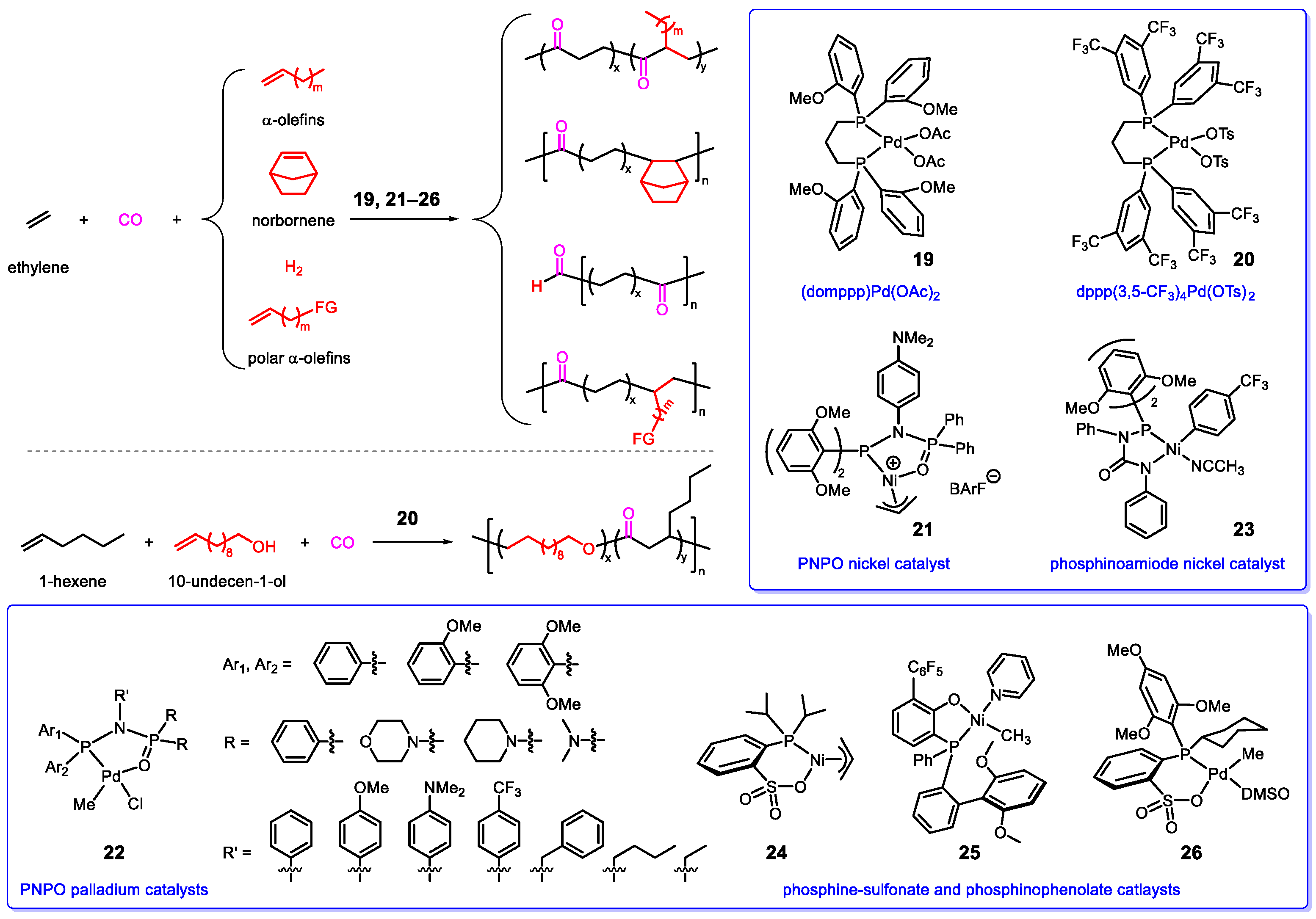
Recently, the incorporation of a third olefin monomer, such as propylene, norbornene, or polar α-olefin monomers, has emerged to regulate polymer properties further and develop new environmentally friendly polymeric materials (Scheme 22). The (domppp)Pd(OAc)2 catalyst 19, in the presence of glycine betaine hydrochloride to form stable Pd nanosalts, was applied for the terpolymerization of ethylene and CO with propylene or 1-hexene, representing the first example of antifouling polyketones (Tm value ca. 230 °C) that was synthesized without any heterogeneous seeds [85]. The dppp(3,5-CF3)4Pd(OTS)2 catalyst 20 can catalyze the terpolymerization of 1-hexene and CO with bifunctional α, ω-alkenols, such as 10-undecen-1-ol, to produce branched polyketoesters [86]. The terpolymer molecular weights can be adjusted from 1.1 to 18.9 kg mol−1 by varying the comonomer ratio, while maintaining very low crystallinity. The material can also become amorphous. A family of N, O, and P hybrid ligands has been developed for the synthesis of palladium and nickel catalysts used in the terpolymerization of ethylene and CO with α-olefins. PNPO catalysts exhibited a higher preference for the third olefin monomer compared to the conventional dppp-type catalysts. The PNPO nickel catalyst 21 terpolymerized ethylene and Co with propylene to give an alternating terpolymer with a productivity of 545 gPK (gNi)−1 with a typical propylene incorporation at 4.0 mol% [87], while the PNPO palladium catalyst 22 produced similar terpolymers with activities of 11.6–65.6 gPK mol−1 h−1 and propylene contents of 3.3–5.9 mol% [88]. Phosphinoamidate nickel catalyst 23 is efficient for the ethylene copolymerization with CO, of which the activity is up to 12,000 gPK (gNi)−1 [89]. However, the introduction of propylene as the third monomer significantly reduced productivity (350–5680 gPK−1 (gNi−1)) and increased its incorporation (3.8–18.3 mol%). A remarkably high productivity of ca. 20,000 gPK (gNi)−1 was achieved by phosphine-sulfonate nickel catalyst 24 towards the terpolymerization of ethylene and CO with propylene, due to the installation of strong electronic-donating iPr substituents on the phosphorus moiety [90]. In addition to these highly crystalline carbonyl-functionalized polyethylenes, other types of the third monomer have also been introduced into the terpolymerizations. Norbornene was introduced via terpolymerization with ethylene and CO using phosphinophenolate nickel catalyst 25, thereby tuning the crystallinity of the terpolymers, which exhibited significantly reduced Tm values at ca. 125 °C with NB and CO contents of 0.5–3.3 mol% and 0.7–1.4 mol%, respectively [91]. Phosphine-sulfonate palladium complex 26 catalyzed the terpolymerization of ethylene and CO with various polar monomers, including acrylates, acrylic acid, vinyl ethers, vinyl acetate, and acrylonitrile, to produce photodegradable polar-functionalized polyethylenes [92]. Later, the introduction of H2 as an inducer of chain-transfer reactions in the copolymerization of ethylene and CO, mediated by the same catalyst, affords an extraordinary aldehyde-end-capped polyethylene with in-chain ketones [93].

6. Conclusions and Outlook

To conclude, the ternary coordination–insertion polymerization of olefin monomers catalyzed by transition-metal catalysts over the past fifteen years is summarized here. All-hydrocarbon/non-polar olefin monomers, including ethylene, propylene, (substituted) α-olefins, conjugated and non-conjugated dienes, styrene, and cyclic olefins, are terpolymerized mainly by well-defined early transition metal metallocene and non-metallocene catalysts. It achieved significant improvements in the mechanical, thermal, and other properties of the terpolymers, yielding high-performance polyolefin materials, including advanced elastomers and cycloolefin copolymers. Late transition-metal catalysts based on Ni and Pd, together with rare-earth metal catalysts bearing Sc and Y centers, generally exhibit strong tolerance toward terpolymerization with heteroatom-containing monomers. Not only polar-modified polymer products but also versatile polyolefins with antioxidant, fluorescent, stimuli-responsive, self-healing, cross-linkable, reprocessable, degradable, and other functional properties have been successfully developed.
As the most promising approach for developing advanced polyolefin materials, coordination-insertion polymerization will continue to be the subject of in-depth study. Promising research directions include the design and synthesis of novel transition-metal catalysts with high activity, high stability, strong tolerance, and, most importantly, high copolymerization ability. In addition, the dual design of unique functionalized olefin monomers, combined with new regulatory techniques for the polymerization process, will endow materials with improved performance and additional functionality. Mechanism studies of complex active species in multicomponent polymerizations will help researchers better understand the polymerization catalysis and design more effective catalytic systems and products. Moreover, combining coordination polymerization with other polymerization methods, such as post-modification via ionic polymerization, radical polymerization, and other techniques, will further push beyond the limits of coordination-insertion polymerization, enabling the development of more advanced polyolefin-based composites.

Author Contributions

Writing—original draft preparation, Y.F.; writing—review, L.C. and J.S.; writing—review and editing, M.L. and Z.C.; supervision, Z.C.; funding acquisition, M.L. and Z.C. All authors have read and agreed to the published version of the manuscript.

Funding

This work was supported by the Fundamental Research Funds for the Central Universities (2232024D-04) and the National Natural Science Foundation of China (52473002, 22571039).

Data Availability Statement

No new data were created or analyzed in this study. Data sharing is not applicable to this article.

Acknowledgments

Special thanks to Tianyou Li from Shanghai Yejing Chemical Technology Co., Ltd. for the helpful discussion.

Conflicts of Interest

The authors declare no conflicts of interest. The funders had no role in study design, data collection and analysis, decision to publish, or preparation of the manuscript.

References

  1. Stürzel, M.; Mihan, S.; Mülhaupt, R. From Multisite Polymerization Catalysis to Sustainable Materials and All-Polyolefin Composites. Chem. Rev. 2016, 116, 1398–1433. [Google Scholar] [CrossRef]
  2. Millet, H.; Vangheluwe, P.; Block, C.; Sevenster, A.; Garcia, L.; Antonopoulos, R. Plastics and the Environment; Harrison, R.M., Hester, R.E., Eds.; The Royal Society of Chemistry: London, UK, 2018; pp. 1–20. [Google Scholar] [CrossRef]
  3. Hero, D.; Kali, G. Free- and reversible deactivation radical (co)polymerization of isobutylene in water under environmentally benign conditions. Eur. Polym. J. 2021, 147, 110336. [Google Scholar] [CrossRef]
  4. Boaen, N.K.; Hillmyer, M.A. Post-polymerization functionalization of polyolefins. Chem. Soc. Rev. 2005, 34, 267–275. [Google Scholar] [CrossRef]
  5. Gahleitner, M.; Resconi, L.; Doshev, P. Heterogeneous Ziegler-Natta, metallocene, and post-metallocene catalysis: Successes and challenges in industrial application. MRS Bull. 2013, 38, 229–233. [Google Scholar] [CrossRef]
  6. Walsh, D.J.; Hyatt, M.G.; Miller, S.A.; Guironnet, D. Recent trends in catalytic polymerizations. ACS Catal. 2019, 9, 11153–11188. [Google Scholar] [CrossRef]
  7. Chen, C. Designing catalysts for olefin polymerization and copolymerization: Beyond electronic and steric tuning. Nat. Rev. Chem. 2018, 2, 6–14. [Google Scholar] [CrossRef]
  8. Tan, C.; Chen, M.; Chen, C. Catalyst + X Strategies for Ttransition Metal-catalyzed Olefin-polar Monomer Copolymerization. Trends Chem. 2023, 5, 147–159. [Google Scholar] [CrossRef]
  9. Piovano, A.; Wada, T.; Amodio, A.; Takasao, G.; Ikeda, T.; Zhu, D.; Terano, M.; Chammingkwan, P.; Groppo, E.; Taniike, T. Formation of Highly Active Ziegler−Natta Catalysts Clarified by a Multifaceted Characterization Approach. ACS Catal. 2021, 11, 13782–13796. [Google Scholar] [CrossRef]
  10. Kumawat, J.; Gupta, V.K. Fundamental aspects of heterogeneous Ziegler−Natta olefin polymerization catalysis: An experimental and computational overview. Polym. Chem. 2020, 11, 6107–6128. [Google Scholar] [CrossRef]
  11. Tritto, I.; Boggioni, L.; Ferro, D.R. Metallocene catalyzed ethene- and propene co-norbornene polymerization: Mechanisms from a detailed microstructural analysis. Coord. Chem. Rev. 2006, 250, 212–241. [Google Scholar] [CrossRef]
  12. Resconi, L.; Cavallo, L.; Fait, A.; Piemontesi, F. Selectivity in Propene Polymerization with Metallocene Catalysts. Chem. Rev. 2000, 100, 1253–1346. [Google Scholar] [CrossRef] [PubMed]
  13. Baier, M.C.; Zuideveld, M.A.; Mecking, S. Post-metallocenes in the industrial production of polyolefins. Angew. Chem. Int. Ed. 2014, 53, 9722–9744. [Google Scholar] [CrossRef] [PubMed]
  14. Wang, C.; Li, X.; Chen, S.; Shan, T. Advances in High-Temperature Non-Metallocene Catalysts for Polyolefin Elastomers. Materials 2025, 18, 1334. [Google Scholar] [CrossRef] [PubMed]
  15. Tan, C.; Chen, M.; Zou, C.; Chen, C. Potentially Practical Catalytic Systems for Olefin-Polar Monomer Coordination Copolymerization. CCS Chem. 2024, 6, 882–897. [Google Scholar] [CrossRef]
  16. Tan, C.; Zou, C.; Chen, C. Material Properties of Functional Polyethylenes from Transition-Metal-Catalyzed Ethylene-Polar Monomer Copolymerization. Macromolecules 2023, 56, 2388–2396. [Google Scholar] [CrossRef]
  17. Chen, J.; Gao, Y.; Marks, T.J. Early Transition Metal Catalysis for Olefin-Polar Monomer Copolymerization. Angew. Chem. Int. Ed. 2020, 59, 14726–14735. [Google Scholar] [CrossRef]
  18. Wang, C.; Luo, G.; Nishiura, M.; Song, G.; Yamamoto, A.; Luo, Y.; Hou, Z. Heteroatom-assisted olefin polymerization by rare-earth metal catalysts. Sci. Adv. 2017, 3, e1701011. [Google Scholar] [CrossRef]
  19. Luckham, S.L.J.; Nozaki, K. Toward the Copolymerization of Propylene with Polar Comonomers. Acc. Chem. Res. 2020, 54, 344–355. [Google Scholar] [CrossRef]
  20. Nakano, R.; Chung, L.W.; Watanabe, Y.; Okuno, Y.; Okumura, Y.; Ito, S.; Morokuma, K.; Nozaki, K. Elucidating the Key Role of Phosphine−Sulfonate Ligands in Palladium-Catalyzed Ethylene Polymerization: Effect of Ligand Structure on the Molecular Weight and Linearity of Polyethylene. ACS Catal. 2016, 6, 6101–6113. [Google Scholar] [CrossRef]
  21. Carrow, B.P.; Nozaki, K. Transition-Metal-Catalyzed Functional Polyolefin Synthesis: Effecting Control through Chelating Ancillary Ligand Design and Mechanistic Insights. Macromolecules 2014, 47, 2541–2555. [Google Scholar] [CrossRef]
  22. Guo, L.; Dai, S.; Sui, X.; Chen, C. Palladium and Nickel Catalyzed Chain Walking Olefin Polymerization and Copolymerization. ACS Catal. 2015, 6, 428–441. [Google Scholar] [CrossRef]
  23. Tan, C.; Si, G.; Zou, C.; Chen, C. Functional Polyolefins and Composites. Angew. Chem. Int. Ed. 2025, 64, e202424529. [Google Scholar] [CrossRef] [PubMed]
  24. Wang, F.; Chen, C. A continuing legend: The Brookhart-type α-diimine nickel and palladium catalysts. Polym. Chem. 2019, 10, 2354–2369. [Google Scholar] [CrossRef]
  25. Zhang, Y.; Zhang, Y.; Hu, X.; Wang, C.; Jian, Z. Advances on Controlled Chain Walking and Suppression of Chain Transfer in Catalytic Olefin Polymerization. ACS Catal. 2022, 12, 14304–14320. [Google Scholar] [CrossRef]
  26. Li, K.; Mu, H.; Jian, Z. Aqueous Catalytic Olefin Polymerization with Nickel and Palladium Catalysts. Chem. Eur. J. 2025, 31, e202404797. [Google Scholar] [CrossRef]
  27. Mu, H.; Zhou, G.; Hu, X.; Jian, Z. Recent advances in nickel mediated copolymerization of olefin with polar monomers. Coord. Chem. Rev. 2021, 435, 213802. [Google Scholar] [CrossRef]
  28. Zhou, G.; Cui, L.; Mu, H.; Jian, Z. Custom-made polar monomers utilized in nickel and palladium promoted olefin copolymerization. Polym. Chem. 2021, 12, 3878–3892. [Google Scholar] [CrossRef]
  29. Mahmood, Q.; Hu, Z.; Ren, G.; Sun, W.-H. Recent advances in nickel Catalysis for thermoplastic polyethylene elastomers: Synthesis strategies, properties, and future perspectives. Coord. Chem. Rev. 2025, 541, 216833. [Google Scholar] [CrossRef]
  30. Suo, H.; Solan, G.A.; Ma, Y.; Sun, W.-H. Developments in compartmentalized bimetallic transition metal ethylene polymerization catalysts. Coord. Chem. Rev. 2018, 372, 101–116. [Google Scholar] [CrossRef]
  31. Wang, W.; Qu, S.; Li, X.; Chen, J.; Guo, Z.; Sun, W.-H. Transition metal complex catalysts promoting copolymers of cycloolefin with propylene/higher olefins. Coord. Chem. Rev. 2023, 494, 215351. [Google Scholar] [CrossRef]
  32. Wang, Y.; Lai, J.; Gou, Q.; Gao, R.; Zheng, G.; Zhang, R.; Song, Z.; Yue, Q.; Guo, Z. Development of well-defined olefin block (co)polymers achieved by late transition metal catalysts: Catalyst, synthesis and characterization. Coord. Chem. Rev. 2025, 522, 216195. [Google Scholar] [CrossRef]
  33. Wu, R.; Klingler Wu, W.; Stieglitz, L.; Gaan, S.; Rieger, B.; Heuberger, M. Recent advances on α-diimine Ni and Pd complexes for catalyzed ethylene (Co)polymerization: A comprehensive review. Coord. Chem. Rev. 2023, 474, 214844. [Google Scholar] [CrossRef]
  34. Marconi, R.; Boggioni, L.; Ravasio, A.; Di Colo, F.; Tritto, I.; Stehling, U.M. Terpolymerization of Linear and Alicyclic α-Olefins with Norbornene and Ethylene by ansa-Metallocene Catalysts. Macromolecules 2011, 44, 795–804. [Google Scholar] [CrossRef]
  35. Apisuk, W.; Suzuki, N.; Kim, H.J.; Kim, D.H.; Kitiyanan, B.; Nomura, K. Efficient terpolymerization of ethylene and styrene with α-olefins by aryloxo-modified half-titanocene-based catalysts and cocatalyst systems. J. Polym. Sci. Part A Polym. Chem. 2013, 51, 2565–2574. [Google Scholar] [CrossRef]
  36. Apisuk, W.; Nomura, K. Efficient Terpolymerization of Ethylene and Styrene with 1,7-Octadiene by Aryloxo Modified Half-Titanocenes–Cocatalyst Systems: Efficient Introduction of the Reactive Functionality. Macromol. Chem. Phys. 2014, 215, 1785–1791. [Google Scholar] [CrossRef]
  37. Apisuk, W.; Kitiyanan, B.; Joon Kim, H.; Hyun Kim, D.; Nomura, K. Introduction of reactive functionality by the incorporation of divinylbiphenyl in ethylene copolymerization with styrene or 1-hexene using aryloxo-modified half-titanocenes and MAO catalysts. J. Polym. Sci. Part A Polym. Chem. 2013, 51, 2581–2587. [Google Scholar] [CrossRef]
  38. Boggioni, L.; Harakawa, H.; Losio, S.; Nomura, K.; Tritto, I. Synthesis of ethylene-norbornene-1-octene terpolymers with high 1-octene contents, molar masses, and tunable Tg values, in high yields using half-titanocene catalysts. Polym. Chem. 2021, 12, 4372–4383. [Google Scholar] [CrossRef]
  39. Tanaka, R.; Kamei, I.; Cai, Z.; Nakayama, Y.; Shiono, T. Ethylene-propylene copolymerization behavior of ansa-dimethylsilylene(fluorenyl)(amido)dimethyltitanium complex: Application to ethylene-propylene-diene or ethylene-propylene-norbornene terpolymers. J. Polym. Sci. Part A Polym. Chem. 2014, 53, 685–691. [Google Scholar] [CrossRef]
  40. Fernández-Delgado, S.; García-Peñas, A.; Serrano, D.; Cerrada, M.L.; Gómez-Elvira, J.M. Detailed microstructure analysis through monomeric insertion modes of poly(propylene-co-norbornene) copolymers and poly(propylene-co-ethylene-co-norbornene) terpolymers with low norbornene contents. Polym. Test. 2023, 124, 108081. [Google Scholar] [CrossRef]
  41. Faingol’d, E.E.; Saratovskikh, S.L.; Zhukov, S.A.; Panin, A.N.; Zharkov, I.V.; Babkina, O.N.; Lashmanov, N.N.; Bravaya, N.M. Ethylene/Propylene Copolymerization and Their Terpolymerization with 5-Ethylidene-2-norbornene over Catalytic Systems Based on Half-Sandwich Titanium Complexes with Organoaluminum and Organoboron Activators. Petrol. Chem. 2024, 64, 500–510. [Google Scholar] [CrossRef]
  42. Chen, Q.; Sun, Y.; He, X. Effect of Borate Co-Catalyst on Ethylene-Propylene Binary/Ternary Copoly-Merization with Bisindenyl Zirconocene. Macromol. Chem. Phys. 2025, 226, e00140. [Google Scholar] [CrossRef]
  43. Faingol’d, E.E.; Saratovskikh, S.L.; Panin, A.N.; Babkina, O.N.; Zharkov, I.V.; Kapasharov, A.T.; Bubnova, M.L.; Shilov, G.V.; Bravaya, N.M. Synthesis and Properties of Ethylene/propylene and Ethylene/propylene/5-ethylidene-2-norbornene Copolymers Obtained on Rac-Et(2-MeInd)2ZrMe2/Isobutylaluminium Aryloxide Catalytic Systems. Polymers 2023, 15, 487. [Google Scholar] [CrossRef] [PubMed]
  44. Mazhar, H.; Shehzad, F.; Hong, S.-G.; Al-Harthi, M.A. Thermal Degradation Kinetics Analysis of Ethylene-Propylene Copolymer and EP-1-Hexene Terpolymer. Polymers 2022, 14, 634. [Google Scholar] [CrossRef] [PubMed]
  45. Bahar, M.K.; Mazhar, H.; Khan, W.U.; Al-Harthi, M.A. Thermal behaviour and crystallization analysis of ethylene-propylene (EP) copolymer and EP-styrene terpolymer. Can. J. Chem. Eng. 2023, 101, 5291–5299. [Google Scholar] [CrossRef]
  46. Tanaka, R.; Matsuzaki, R.; Nakayama, Y.; Shiono, T. Synthesis of highly thermostable norbornene-isoprene-1-octene terpolymer with titanium catalyst. J. Polym. Sci. Part A Polym. Chem. 2017, 55, 2136–2140. [Google Scholar] [CrossRef]
  47. Ali, A.; Moradian, J.M.; Naveed, A.; Uz-Zaman Haider, S.N.; Lu, J.; Shah, S.S.A.; Ahmed Keerio, H.; Ahmad Qureshi, W.; Naz, H.; Wahab, R.; et al. Capability of isoprene and butadiene as comonomers under metallocene catalysis: Activating active sites with the addition of 1-hexene and propylene. J. Catal. 2024, 438, 115729. [Google Scholar] [CrossRef]
  48. Leone, G.; Zanchin, G.; Di Girolamo, R.; De Stefano, F.; Lorber, C.; De Rosa, C.; Ricci, G.; Bertini, F. Semibatch Terpolymerization of Ethylene, Propylene, and 5-Ethylidene-2-norbornene: Heterogeneous High-Ethylene EPDM Thermoplastic Elastomers. Macromolecules 2020, 53, 5881–5894. [Google Scholar] [CrossRef]
  49. Cheng, P.; Wang, Y.; Zha, H.; Xing, G.; Zhang, S.; Wu, Y. Synthesis and characterization of ultra-high-molecular-weight ethylene–propylene polar elastomers with high functional degree. Clean Energy 2025, 9, 149–158. [Google Scholar] [CrossRef]
  50. Palucci, B.; Zanchin, G.; Ricci, G.; Vendier, L.; Lorber, C.; Leone, G. Vanadium-Catalyzed Terpolymerization of α, ω-Dienes with Ethylene and Cyclic Olefins: Ready Access to Polar-Functionalized Polyolefins. Macromolecules 2021, 54, 10700–10711. [Google Scholar] [CrossRef]
  51. Guo, F.; Nishiura, M.; Koshino, H.; Hou, Z. Cycloterpolymerization of 1,6-Heptadiene with Ethylene and Styrene Catalyzed by a THF-Free Half-Sandwich Scandium Complex. Macromolecules 2011, 44, 2400–2403. [Google Scholar] [CrossRef]
  52. Guo, F.; Nishiura, M.; Koshino, H.; Hou, Z. Scandium-Catalyzed Cyclocopolymerization of 1,5-Hexadiene with Styrene and Ethylene: Efficient Synthesis of Cyclopolyolefins Containing Syndiotactic Styrene-Styrene Sequences and Methylene-1,3-cyclopentane Units. Macromolecules 2011, 44, 6335–6344. [Google Scholar] [CrossRef]
  53. Sun, B.; Wu, C.; Cui, D. Coordination Terpolymerization of Ethylene, Butadiene, and Styrene Using Thioanisole-Modified Rare-Earth Catalysts. Macromolecules 2025, 58, 12528–12538. [Google Scholar] [CrossRef]
  54. Wang, L.; Dong, S.; Tian, H.; Gong, G.; Wang, B.; Wu, C.; Cui, D. Terpolymerization of ethylene, norbornene and dicyclopentadiene catalyzed by modified cyclopentadienyl scandium complexes. Polym. Chem. 2023, 14, 3110–3116. [Google Scholar] [CrossRef]
  55. Zhao, Y.; Cui, L.; Zhang, Y.; Jian, Z. High-refractive-index ethylene/cyclic olefin/octene terpolymers with high optical transparency. Polymer 2025, 322, 128147. [Google Scholar] [CrossRef]
  56. Yang, F.; Pan, L.; Ma, Z.; Lou, Y.; Li, Y.; Li, Y. Highly elastic, strong, and reprocessable cross-linked polyolefin elastomers enabled by boronic ester bonds. Polym. Chem. 2020, 11, 3285–3295. [Google Scholar] [CrossRef]
  57. Mao, X.; Pu, M.; Liu, Y.; Ma, Z.; Pan, L.; Li, Y. Robust cyclic olefin thermoplastic elastomer with excellent mechanical and thermal performance. Chem. Eng. J. 2025, 519, 165489. [Google Scholar] [CrossRef]
  58. Shao, P.; Liu, X.; Gao, H.; Liao, Y.; Pan, L.; Li, Y.; Ma, Z. Influences of ethylene and butene Co-units on crystallization of polypropylene copolymers and terpolymers. Polymer 2025, 337, 128933. [Google Scholar] [CrossRef]
  59. Wang, J.; He, L.; Nan, F.; Wang, F.; Li, H.; Wang, J.; Liu, D.; Lei, M.; Li, L.; Huang, Q.; et al. Investigation on terpolymer of ethylene/propylene/ω-bromo-α-olefins catalyzed by titanium complexes. J. Mater. Sci. 2017, 52, 5981–5991. [Google Scholar] [CrossRef]
  60. Zhao, X.; Li, H.; Liu, J.; Wang, K.; Zhang, S.; Dou, T.; Li, J.; Yu, J.; Li, H.; Wang, J.; et al. One-Step Synthesis of Multi-Block Copolymers of Isotactic Polypropylene (iPP) and Theoretical Studies on the Regioselectivity and Stereoselectivity of Polypropylene. J. Polym. Sci. 2025, 63, 1407–1418. [Google Scholar] [CrossRef]
  61. Losio, S.; Tritto, I.; Boggioni, L.; Mancini, G.; Luciano, G.; Tofani, L.; Viglianisi, C.; Menichetti, S.; Sacchi, M.C.; Stagnaro, P. Fully consistent terpolymeric non-releasing antioxidant additives for long lasting polyolefin packaging materials. Polym. Degrad. Stabil. 2017, 144, 167–175. [Google Scholar] [CrossRef]
  62. Wang, A.; Niu, H.; He, Z.; Li, Y. Thermoreversible cross-linking of ethylene/propylene copolymer rubbers. Polym. Chem. 2017, 8, 4494–4502. [Google Scholar] [CrossRef]
  63. Jing, Y.; Niu, H.; Li, Y. Improved ethylene-propylene rubber/silica interface via in-situ polymerization. Polymer 2019, 172, 117–125. [Google Scholar] [CrossRef]
  64. Bando, Y.; Kihara, S.-I.; Fujii, H.; Nakayama, Y.; Shiono, T.; Tanaka, R. Commodity Rubber Material with Reversible Cross-linking Ability: Application of Boroxine Cross-links to Ethylene-Propylene Rubber. Macromolecules 2024, 57, 7565–7574. [Google Scholar] [CrossRef]
  65. Zhang, J.; Mao, X.; Ma, Z.; Pan, L.; Wang, B.; Li, Y. High-Performance Polyethylene-Ionomer-Based Thermoplastic Elastomers Exhibiting Counteranion-Mediated Mechanical Properties. Macromolecules 2023, 56, 4219–4230. [Google Scholar] [CrossRef]
  66. Zhao, Y.; Zhang, Y.; Cui, L.; Jian, Z. Cyclic Olefin Terpolymers with High Refractive Index and High Optical Transparency. ACS Macro Lett. 2023, 12, 395–400. [Google Scholar] [CrossRef]
  67. Kitphaitun, S.; Yan, Q.; Nomura, K. The Effect of SiMe3 and SiEt3Para Substituents for High Activity and Introduction of a Hydroxy Group in Ethylene Copolymerization Catalyzed by Phenoxide-Modified Half-Titanocenes. Angew. Chem. Int. Ed. 2020, 59, 23072–23076. [Google Scholar] [CrossRef]
  68. Cai, H.; Cheng, Y.; Zhang, Z.; Pan, L.; Zhang, K.; Li, Y. Toughening poly(lactic acid) with novel polyolefin-graft-poly(lactic acid) copolymers maintaining high transparency and stiffness. Giant 2024, 18, 2666–5425. [Google Scholar] [CrossRef]
  69. Wang, Q.; Chen, M.; Zou, C.; Chen, C. Direct Synthesis of Polar-Functionalized Polyolefin Elastomers. Angew. Chem. Int. Ed. 2025, 64, e202423814. [Google Scholar] [CrossRef]
  70. Zhong, Y.; Wang, B.; Cui, D. The yttrium-catalyzed heteroatom-assisted terpolymerization of ortho-alkoxystyrene, isoprene and butadiene with high regio- and stereoselectivity. Polym. Chem. 2021, 12, 4576–4582. [Google Scholar] [CrossRef]
  71. Dong, S.; Duan, X.; Nan, T.; Lin, C.; Liu, B.; Cui, D. Substituent Effect of Styryl Monomers on Composition and Property Enhancement of Dicyclopentadiene-Based Cycloolefin Copolymers. Macromolecules 2023, 56, 8912–8919. [Google Scholar] [CrossRef]
  72. Mu, X.; Leng, X.; Liu, C.; Yao, Q.; Li, Y. Terpolymerization of Ethylene with Hexene and Styrene Derivatives by Half-Sandwich Scandium Catalyst. Polymers 2024, 16, 2290. [Google Scholar] [CrossRef] [PubMed]
  73. Na, Y.; Dai, S.; Chen, C. Direct Synthesis of Polar-Functionalized Linear Low-Density Polyethylene (LLDPE) and Low-Density Polyethylene (LDPE). Macromolecules 2018, 51, 4040–4048. [Google Scholar] [CrossRef]
  74. Na, Y.; Chen, C. Catechol-Functionalized Polyolefins. Angew. Chem. Int. Ed. 2020, 59, 7953–7959. [Google Scholar] [CrossRef] [PubMed]
  75. Zou, C.; Chen, C. Polar-Functionalized, Crosslinkable, Self-Healing, and Photoresponsive Polyolefins. Angew. Chem. Int. Ed. 2019, 59, 395–402. [Google Scholar] [CrossRef]
  76. Qu, W.; Bi, Z.; Zou, C.; Chen, C. Light, Heat, and Force-Responsive Polyolefins. Adv. Sci. 2023, 11, 2307568. [Google Scholar] [CrossRef]
  77. Yang, Y.; Wang, H.; Huang, L.; Nishiura, M.; Higaki, Y.; Hou, Z. Terpolymerization of Ethylene and Two Different Methoxyaryl-Substituted Propylenes by Scandium Catalyst Makes Tough and Fast Self-Healing Elastomers. Angew. Chem. Int. Ed. 2021, 60, 26192–26198. [Google Scholar] [CrossRef]
  78. Huang, L.; Yang, Y.; Shao, J.; Xiong, G.; Wang, H.; Nishiura, M.; Hou, Z. Synthesis of Tough and Fluorescent Self-Healing Elastomers by Scandium-Catalyzed Terpolymerization of Pyrenylethenylstyrene, Ethylene, and Anisylpropylene. J. Am. Chem. Soc. 2024, 146, 2718–2727. [Google Scholar] [CrossRef]
  79. Zhang, H.; Huang, L.; Wu, X.; Chi, M.; Wang, H.; Nishiura, M.; Higaki, Y.; Murahashi, T.; Hou, Z. Synthesis of Self-Healing Elastomers by Scandium-Catalyzed Terpolymerization of Ethylene, Styrene, and Dimethylaminophenyl-Substituted Propylene. Macromolecules 2024, 57, 7219–7226. [Google Scholar] [CrossRef]
  80. Jian, Z.; Falivene, L.; Boffa, G.; Sánchez, S.O.; Caporaso, L.; Grassi, A.; Mecking, S. Direct Synthesis of Telechelic Polyethylene by Selective Insertion Polymerization. Angew. Chem. Int. Ed. 2016, 55, 14378–14383. [Google Scholar] [CrossRef]
  81. Song, J.; He, J.; Hu, J.; Ma, J.; Jiang, H.; Hu, S.; Ye, H.; Xu, L. A Universal Strategy for Producing Fluorescent Polymers Based on Designer Hyperbranched Polyethylene Ternary Copolymers. Macromolecules 2022, 55, 2085–2095. [Google Scholar] [CrossRef]
  82. Brubaker, M.M.; Coffman, D.D.; Hoehn, H.H. Synthesis and characterization of ethylene/carbon monoxide copolymers, a new class of polyketones. J. Am. Chem. Soc. 1952, 74, 1509−1515. [Google Scholar] [CrossRef]
  83. Drent, E.; Budzelaar, P.H.M. Palladium-Catalyzed Alternating Copolymerization of Alkenes and Carbon Monoxide. Chem. Rev. 1996, 96, 663−681. [Google Scholar] [CrossRef] [PubMed]
  84. Sommazzi, A.; Garbassi, F. Olefin-carbon monoxide copolymers. Prog. Polym. Sci. 1997, 22, 1547−1605. [Google Scholar] [CrossRef]
  85. Lim, Y.N.; Noh, H.-W.; Cheong, Y.-J.; Kang, S.Y.; Lee, B.Y.; Son, S.U.; Jang, H.-Y. Self-Organized Nanosalts of Pd(II)-Ammonium-Tethered Carboxylic Acid for the Synthesis of Antifouling Polyketones. ACS Sustain. Chem. Eng. 2017, 5, 9657–9661. [Google Scholar] [CrossRef]
  86. Lo, S.-Y.; Folster, C.P.; Harkins, R.P.; Anderson, R.J.; Lien, Y.-L.; Chiu, H.-C.; Carpenter, A.E.; Tonks, I.A. Carbonylative Co- and Terpolymerizations of 10-Undecen-1-ol: A Route to Polyketoesters with Tunable Compositions. ACS Catal. 2022, 12, 14629–14636. [Google Scholar] [CrossRef]
  87. Chen, S.Y.; Ren, B.H.; Li, S.H.; Song, Y.H.; Jiao, S.; Zou, C.; Chen, C.; Lu, X.B.; Liu, Y. Cationic P, O-Coordinated Nickel(II) Catalysts for Carbonylative Polymerization of Ethylene: Unexpected Productivity via Subtle Electronic Variation. Angew. Chem. Int. Ed. 2022, 61, e202204126. [Google Scholar] [CrossRef]
  88. Li, S.-H.; Chen, S.-Y.; Lu, X.-B.; Liu, Y. Favorable Propylene-Incorporated Terpolymerization of Ethylene with CO Mediated by Cationic [P,O]-Pd and Ni Complexes. Inorg. Chem. 2023, 62, 2228–2235. [Google Scholar] [CrossRef]
  89. Zhu, L.; Li, J.; Chen, W.-Y.; Ziegler, C.J.; Takahashi, K.; Nozaki, K.; Jia, L. Aliphatic Polyketones from Alternating Copolymerization of CO and Olefins: Phosphinoamidate Nickel Catalyst, Polymerization Study, Mechanical Properties and Degradations. ACS Appl. Polym. Mater. 2024, 6, 9829–9836. [Google Scholar] [CrossRef]
  90. Jiao, S.; Zhang, W.-L.; Fan, M.-M.; Li, S.-H.; Chen, S.-Y.; Lu, X.-B.; Liu, Y. Scalable Nickel Catalysts for Carbonylative Terpolymerization of Ethylene/α-Olefin with High Efficiency. J. Am. Chem. Soc. 2024, 146, 34560–34567. [Google Scholar] [CrossRef]
  91. De Stefano, F.; Baur, M.; De Rosa, C.; Mecking, S. Keto-Polyethylenes with Controlled Crystallinity and Materials Properties from Catalytic Ethylene-CO-Norbornene Terpolymerization. Macromolecules 2024, 57, 1072–1079. [Google Scholar] [CrossRef]
  92. Wang, C.; Xia, J.; Zhang, Y.; Hu, X.; Jian, Z. Photodegradable polar-functionalized polyethylenes. Natl Sci. Rev. 2023, 10, nwad039. [Google Scholar] [CrossRef]
  93. Song, C.; Yang, D.; Wang, C.; Tang, Z.; Long, Y.; Zhang, Y.; Jian, Z. Aldehyde End-Capped Degradable Polyethylenes from Hydrogen-Controlled Ethylene/CO Copolymerization. Angew. Chem. Int. Ed. 2024, 63, e202410885. [Google Scholar] [CrossRef]
Figure 1. Catalytic systems for transition metal-catalyzed ternary polymerization of olefins.
Catalysts 16 00224 g001
Figure 2. All-hydrocarbon/non-polar monomers are used in the terpolymerizations.
Catalysts 16 00224 g002
Scheme 1. Terpolymerization of ethylene, norbornene, with 1-octene and vinyl cyclohexene catalyzed by 1a and 1b.
Catalysts 16 00224 sch001
Scheme 2. Terpolymerization behaviors of catalysts 2a2f.
Catalysts 16 00224 sch002
Scheme 3. Terpolymerization behaviors of catalysts 2a and 3a3g.
Catalysts 16 00224 sch003
Scheme 4. Terpolymerization of ethylene, α-olefins, and cyclic olefins by 4a4d and 5.
Catalysts 16 00224 sch004
Scheme 5. Terpolymerization behaviors of scandium catalysts 6a, 6b, 7a and 7b.
Catalysts 16 00224 sch005
Scheme 6. Terpolymerization of ethylene, 1-octene, and high-refractive-index norbornene-based monomers catalyzed by 8.
Catalysts 16 00224 sch006
Scheme 7. Synthesis of cross-linkable polyolefin elastomers catalyzed by 9.
Catalysts 16 00224 sch007
Scheme 8. Terpolymerization of ethylene, α-olefins, and α, ω-olefins catalyzed by 10.
Catalysts 16 00224 sch008
Scheme 9. Terpolymerization of ethylene, propylene, and ω-Br-α-olefins catalyzed by 11a11c.
Catalysts 16 00224 sch009
Scheme 10. Synthesis of antioxidant polyolefins catalyzed by 9.
Catalysts 16 00224 sch010
Scheme 11. Terpolymerization of ethylene and propylene with substituted α-olefins/cyclic olefins catalyzed by Z-N catalyst, 9, and 12.
Catalysts 16 00224 sch011
Scheme 12. Synthesis of polymeric ionomers by catalyst 13.
Catalysts 16 00224 sch012
Scheme 13. Terpolymerization of ethylene, TCD, and functional α-olefins catalyzed by 8.
Catalysts 16 00224 sch013
Scheme 14. Synthesis of polyolefin graft polymers with PCL and PLA by catalysts 2g, 2h, 9, and 14.
Catalysts 16 00224 sch014
Scheme 15. Synthesis of polar-functionalized POEs catalyzed by 2i, 10, and 14.
Catalysts 16 00224 sch015
Scheme 16. Terpolymerization of 1,3-butadiene, isoprene, and ortho-alkoxystyrene catalyzed by 15.
Catalysts 16 00224 sch016
Scheme 17. Terpolymerization of ethylene, DCPD, and styryl monomers catalyzed by 6a, 7a, and 7b.
Catalysts 16 00224 sch017
Scheme 18. Terpolymerization behaviors of the late transition metal catalyst 16.
Catalysts 16 00224 sch018
Scheme 19. Terpolymerization of a non-polar olefin with two different polar/functionalized olefin monomers catalyzed by 6a.
Catalysts 16 00224 sch019
Scheme 20. Terpolymerization of ethylene, 2-vinylfuran, and CA catalyzed by 17a and 17b.
Catalysts 16 00224 sch020
Scheme 21. Synthesis of fluorescent polyethylene by catalyst 18.
Catalysts 16 00224 sch021
Scheme 22. Carbonylative polymerization of olefins with carbon monoxide catalyzed by 1926.
Catalysts 16 00224 sch022
Disclaimer/Publisher’s Note: The statements, opinions and data contained in all publications are solely those of the individual author(s) and contributor(s) and not of MDPI and/or the editor(s). MDPI and/or the editor(s) disclaim responsibility for any injury to people or property resulting from any ideas, methods, instructions or products referred to in the content.