Review

Modified Half-Titanocenes as Polymerization Catalysts: Basic Concept, Displayed Promising Characteristics and Some Mechanistic Insights


Department of Chemistry, Tokyo Metropolitan University, Hachioji 1920397, Tokyo, Japan
*
Author to whom correspondence should be addressed.
Catalysts 2026, 16(3), 221; https://doi.org/10.3390/catal16030221
Submission received: 27 January 2026 / Revised: 11 February 2026 / Accepted: 17 February 2026 / Published: 1 March 2026
(This article belongs to the Section Catalysis in Organic and Polymer Chemistry)

Abstract

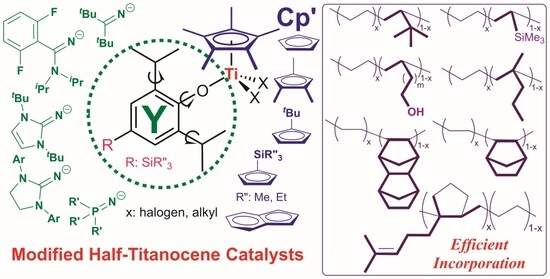
Development of new polymers that cannot be achieved by using conventional catalysts has been the central research objective, and copolymerization is an effective strategy to modify the materials’ (thermal, physical, mechanical and electronic) properties. Modified half-titanocenes, Cp’TiX2(Y) (Cp’ = cyclopentadienyl, X = Cl, Me, etc, Y = anionic donor such as phenoxide, ketimide, amidinate, etc.), are known to be effective catalysts. This review introduces several selected efforts for efficient synthesis of ethylene copolymers containing cyclic olefins, biobased conjugated dienes, and disubstituted α-olefins, including the effect of cocatalysts. Moreover, here we introduce an analysis using XAS (X-ray absorption spectroscopy), which has been recognized as a powerful method providing direct information on the catalytically active species, such as coordination numbers and the distances of the coordinated atoms as well as oxidation state and the geometry of the metal centre in catalyst solution.

Graphical Abstract

1. Introduction

Polyolefins [linear high-density polyethylene (HDPE), linear low-density polyethylene (LLDPE), low-density polyethylene (LDPE), and isotactic polypropylene (PP)] are the dominant commodity thermoplastics, accounting for over 50% of global plastic production in the world; the growth of the world production has still been observed especially in Asia [1]. Transition-metal-catalyzed olefin coordination insertion polymerization is the key technology for the industrial production [2,3,4,5,6,7,8]. The development of new polymers that cannot be achieved by using conventional catalysts (such as Ziegler–Natta, metallocene catalysts) has been considered as the central research objective [2,3,4,5,6,9,10,11,12,13,14,15,16,17,18,19,20,21,22,23]. Copolymerization has been taken into consideration as an effective strategy, because the thermal, physical, mechanical and electronic properties of the resulting copolymers can be modified by the individual components, incorporating two (or three) monomer units [4,6,14,15,16,17]. Design and development of the molecular catalysts that display high activity with better comonomer incorporation has thus been the pivotal challenge [2,3,4,5,6,7,8,9,10,11,12,13,14,15,16,17,18,19,20,21,22,23].
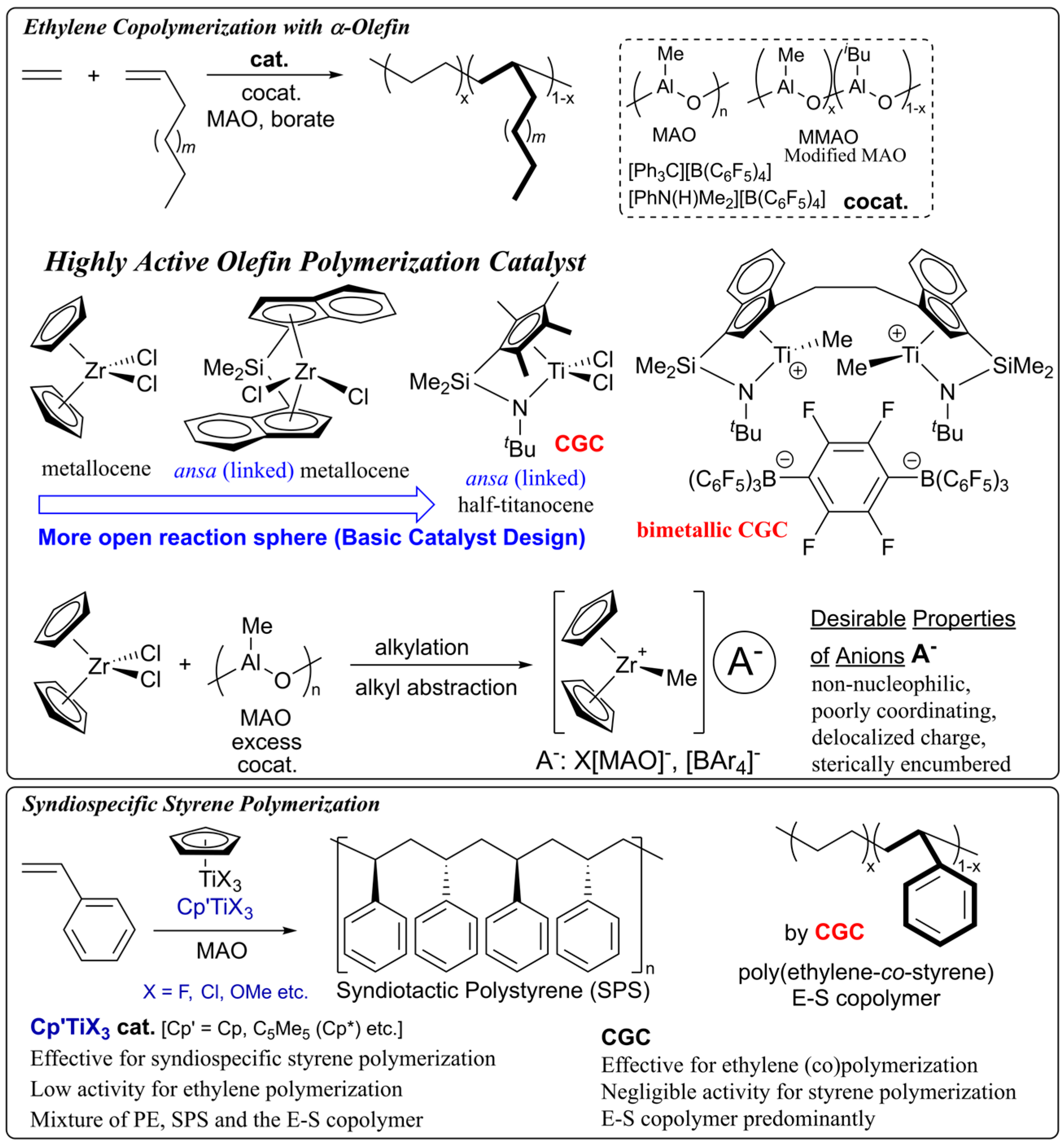
Discovery of metallocene catalysts (called single-site catalysts), bearing two cyclopentadienyl (Cp’) ligands of type Cp’2MX2 (M = Ti, Zr, Hf; X = halogen, etc.), marked an importance point in catalyst design, since the resultant copolymer possesses uniform composition with controlled molecular weight due to the formation of single active species in the catalytic polymerization [5,9,10,11,12]. The fact displayed a different feature in the copolymerization using the Ziegler–Natta catalysts (called multi-site catalysts), which generate several catalytically active species in situ; as a result, Ziegler–Natta catalysts afford the copolymer with multiple compositions [5,9,10,11,12]. The high oxidation state cationic alkyl species, Cp’2M+R (R = alkyl), formed by treating with borate or methylaluminoxane (MAO) through alkyl abstraction, has been proposed as the active species in this catalysis (Scheme 1) [5,9,10,11,12,13,14,15,16,17,24,25,26,27]. In this catalysis, the nature of the active species, such as basic geometry and electronic and steric bulk of the ligand sets, directly affects the catalytic activity, stereo specificity, and the comonomer incorporation in the copolymerization.
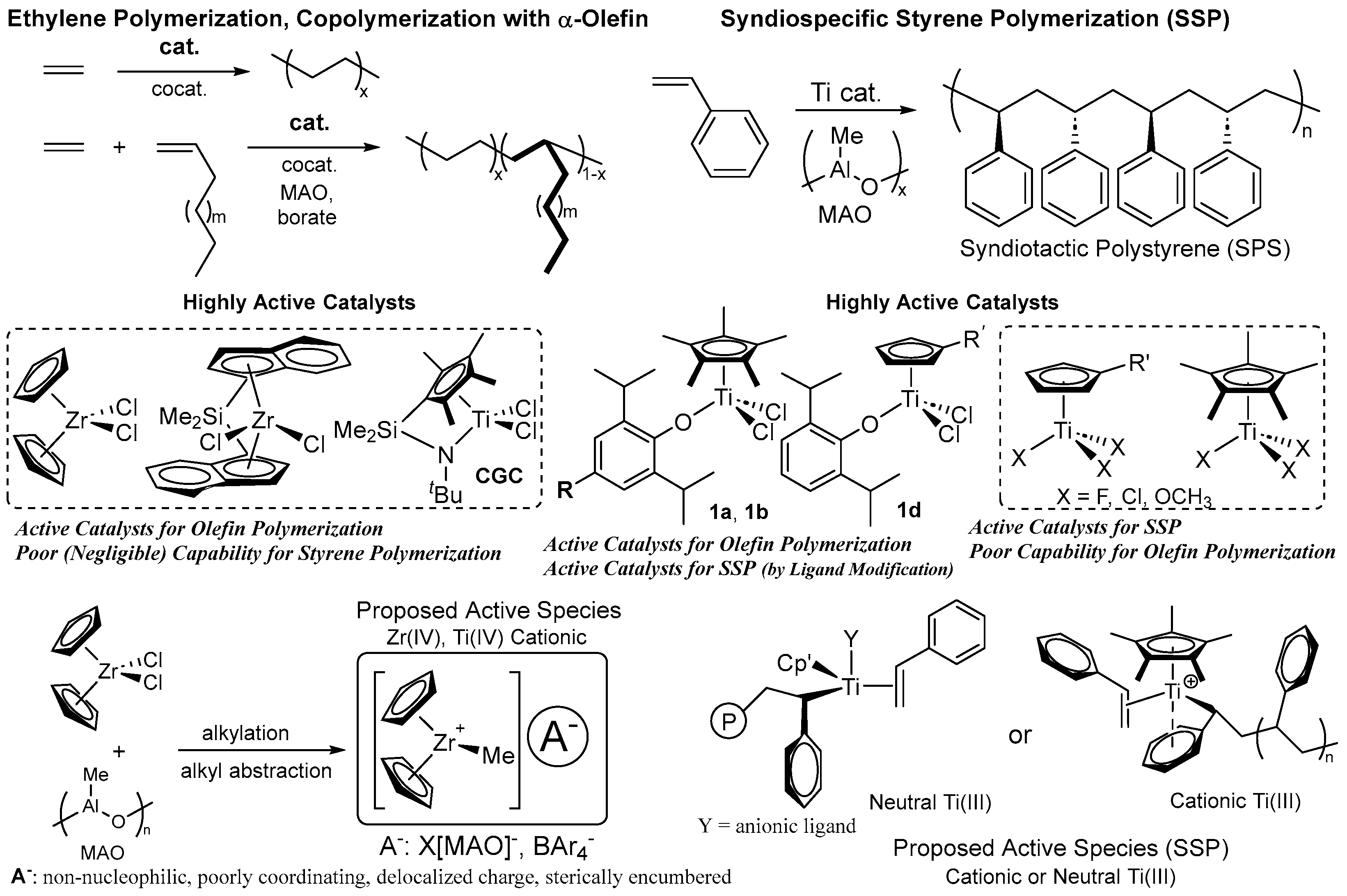
It is widely recognized in ethylene copolymerization with α-olefin that bridged (ansa, linked) metallocene catalysts generally showed better α-olefin incorporation than the unbridged analogues; the fact was explained as due to the different coordination environment imposed by the bridging framework (Scheme 1) [5,9,10,11,12,13,14,15,16,17,28,29]. Accordingly, linked (ansa, bridged) half-titanocenes exemplified as constrained geometry catalyst (CGC), [Me2Si(C5Me4)(NtBu)]TiCl2 [12,13,28,29,30,31,32,33], exhibit enhanced ability in α-olefin incorporation in the copolymerization. Interestingly, CGC exhibited styrene incorporation in the ethylene copolymerization, although the incorporation level typically remained below 50 mol% [33,34,35]. This limitation was later overcome by the bimetallic system (bimetallic CGC, Scheme 1), which enabled synthesis of the copolymer with high styrene content (76 mol%) [21,22,36,37].
In contrast, it has been widely known that ordinary half-titanocenes containing one Cp’ of type Cp’TiX3 are effective catalysts for the synthesis of syndiotactic polystyrene (SPS, Scheme 1) that is inaccessible by conventional radical or ionic (anionic, cationic) polymerization [38,39,40]. However, these Cp’TiX3 catalysts generally display low catalytic activity for olefin polymerization, and the (attempted) ethylene/styrene copolymerization yielded a mixture of polyethylene, SPS, and the copolymer in small amounts [34,41]. The behaviour displays the sharp contrast from the facts that CGC and ordinary metallocene catalysts showed the negligible catalytic activities [34,36,37]. Moreover, as described above, CGC predominantly produces the ethylene/styrene copolymers [33,34,35,36,37]; these facts led to an assumption that the active species in olefin polymerization differ from those in the syndiospecific styrene polymerization, as described in detail below.
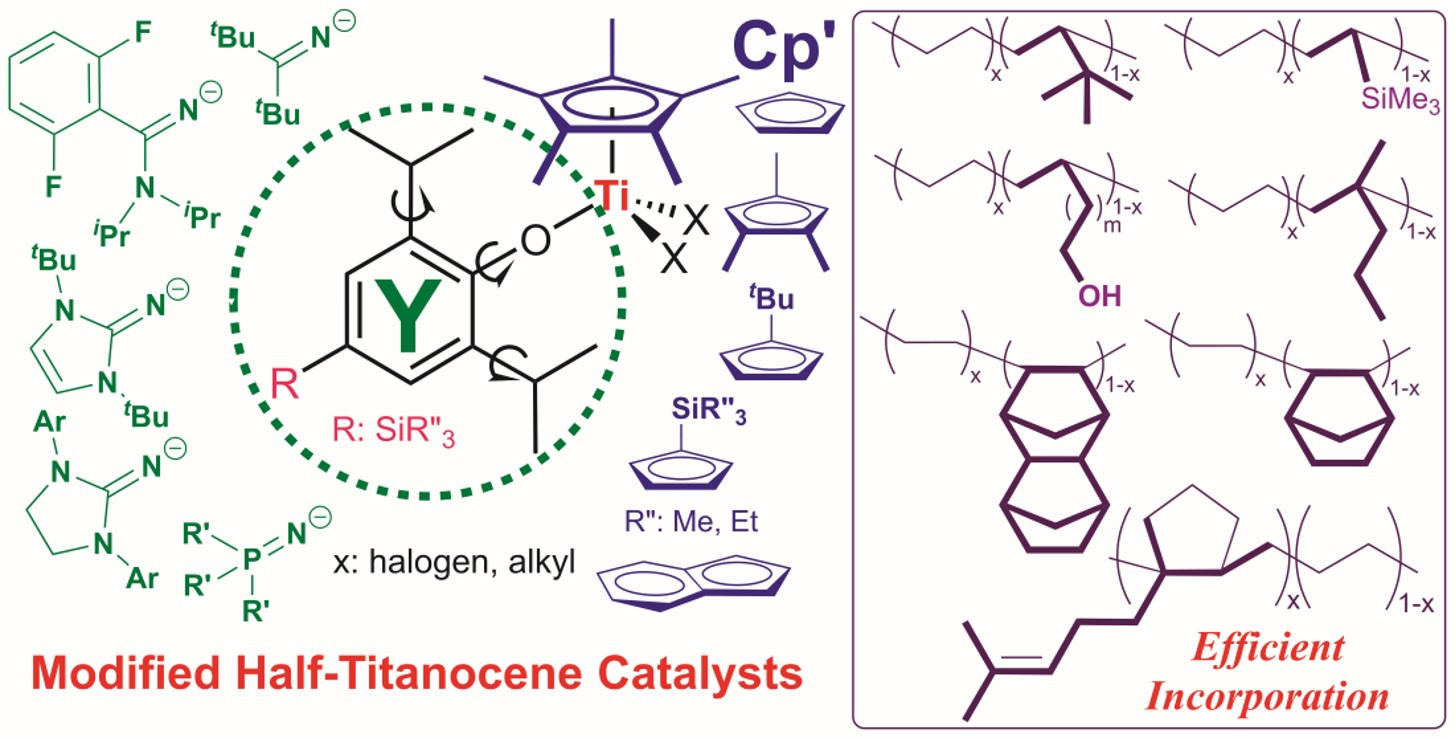
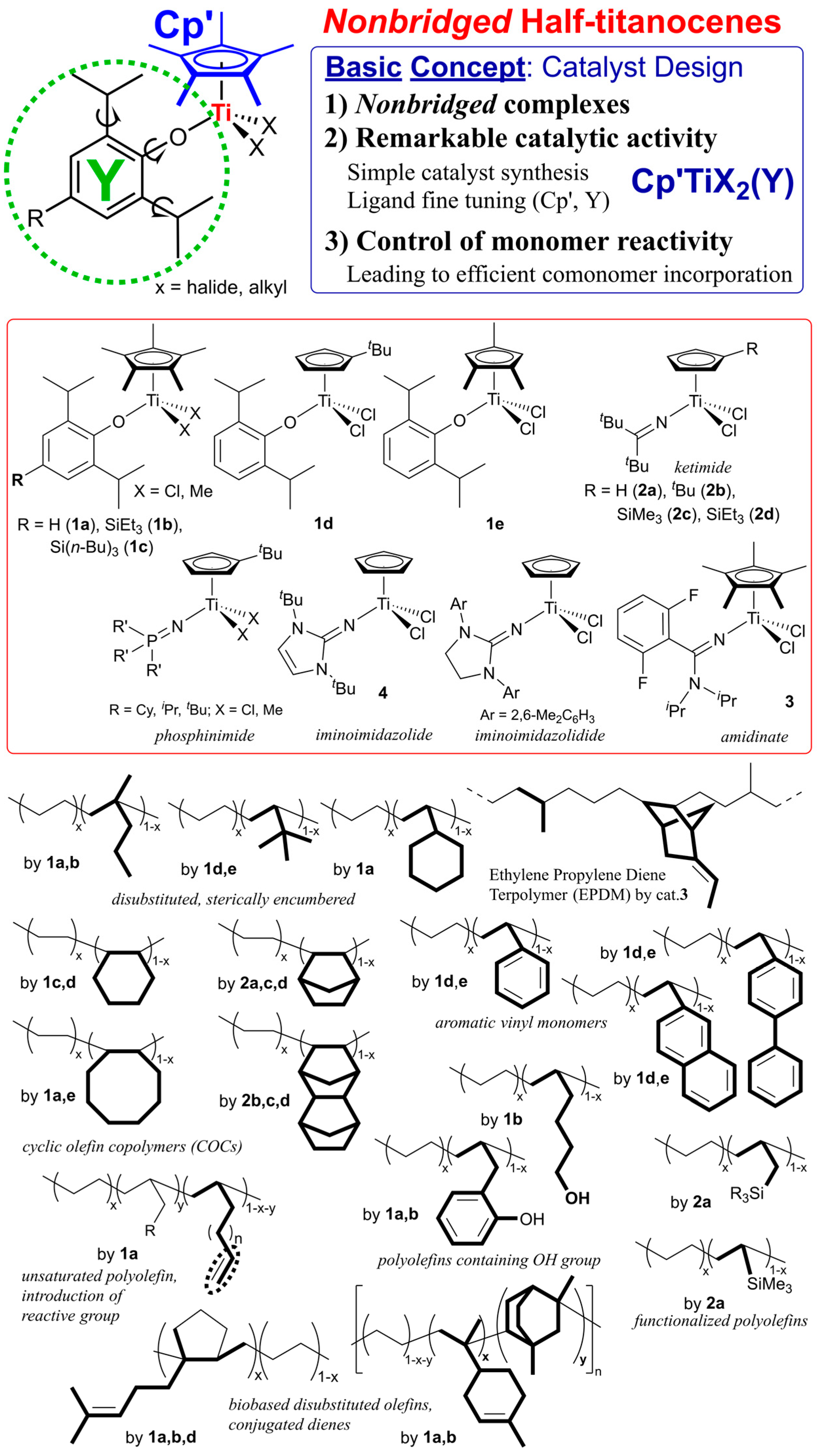
It is well known that modified half-titanocenes featuring anionic donor ligands, Cp’TiX2(Y) (Scheme 2, Y = phenoxide, ketimide, amidinate, phosphinimide, iminoimidazolide, iminoimidazolidide, etc.) [6,14,15,16,17], first introduced by our team [42,43], display remarkably distinctive catalytic properties, particularly in the copolymerization of ethylene (or propylene, α-olefin) with sterically encumbered olefins, cyclic olefins, and with aromatic vinyl monomers (Scheme 2) [14,15,16,17]. The phenoxide (1) [42,43,44,45] and the ketimide (2) [46,47,48,49,50,51,52] catalysts have proven distinctively effective for synthesis of new (co)polymers [6,14,15,16,17]; it has become clear that effective catalyst for the targeted (co)polymerization can be finely tuned through modification of cyclopentadienyl (Cp’) and the anionic donor (Y) ligands. Later, the η1-amidinate analogue (3) [4,53,54,55] enabled industrial-scale production of ethylene propylene diene terpolymer (EPDM) [4], such as chlorine-free synthetic rubber, without deep cooling, characteristic of conventional (Ziegler type) vanadium-based catalyst systems, therefore highlighting the practical significance of this catalyst platform [37]. Moreover, interestingly, the phenoxide catalysts exhibit remarkable activities for SSP [56,57] and exclusively afford ethylene/styrene copolymers in copolymerization [56,58]. Moreover, these catalysts enabled the synthesis of a series of ethylene copolymers with other aromatic vinyl monomers (Scheme 2) [59]. The observed characteristics are quite different from those observed by metallocene and linked half-titanocene catalysts.
This review thus introduces several selected recent efforts for synthesis of ethylene copolymers containing cyclic olefins [60,61,62,63,64,65,66,67,68], biobased conjugated dienes [69,70], disubstituted α-olefins [44,71,72,73,74], including the effect of cocatalysts [75]. Moreover, here we also introduce analysis results by synchrotron XAS (X-ray absorption spectroscopy) [27,76,77], which has been recognized as useful to obtain information not only of valence (oxidation state) and the basic structure (geometry) through XANES (X-ray Absorption Near Edge Structure), but also number of coordination atoms and the distance to the cantered metal through EXAFS (Extended X-ray Absorption Fine Structure) analysis.

2. Efficient Synthesis of Cyclic Olefin Copolymers (COCs)

Certain amorphous cyclic olefin copolymers (COCs) are polymeric materials with high transparency in the UV-vis region, thermal resistance (possessing high glass transition temperature, Tg), humidity resistance (negligible water absorption), low dielectric constants, and dimensional stability [78,79,80,81,82,83,84,85,86], such as commercialized as TOPAS® [87] and APEL® [88], ethylene-based copolymers with norbornene (NBE) and tetracyclododecene (TCD, a mixture of isomers, mostly endo-exo form), respectively, for optical lenses and films for medical applications. There have been an extensive number of reports for ethylene/NBE copolymerization using group 4 transition metal complexes, including metallocenes [89,90,91,92,93,94,95], bridged half-metallocenes (so-called constrained geometry type) [96,97,98,99], modified non-bridged half-metallocenes [60,61,62,63], and the others called post-metallocene catalysts [100,101,102,103,104,105]. However, reports for the efficient synthesis of high molar mass, the ethylene/NBE copolymers possessing high Tg values (high NBE contents), with efficient and random NBE incorporation remain scarce [61,63]. Moreover, vanadium-based catalyst systems, such as VOCl3 or VO(OEt)Cl2, together with EtAlCl2·Et2AlCl cocatalyst, which have been employed in the commercial production of ethylene/TCD copolymers, require deep-cooling conditions because of the limited thermal stability of these catalyst systems [106]. The efficient synthesis of high molar mass ethylene/TCD copolymers have still been limited by the ketimide analogue [63,64], whereas copolymerization employing conventional metallocene catalysts [107,108,109,110] and the known linked half-titanocene catalyst (CGC) [64] generally suffers from low catalytic activity and/or inefficient TCD incorporation. The catalyst development for synthesis of high molecular weight COCs possessing high glass transition temperature maintaining promising optical properties (birefringence, with low water absorption, dielectric constants, and dimensional stability) has been an attractive subject [78,79,80,81,82,83,84,85,86].
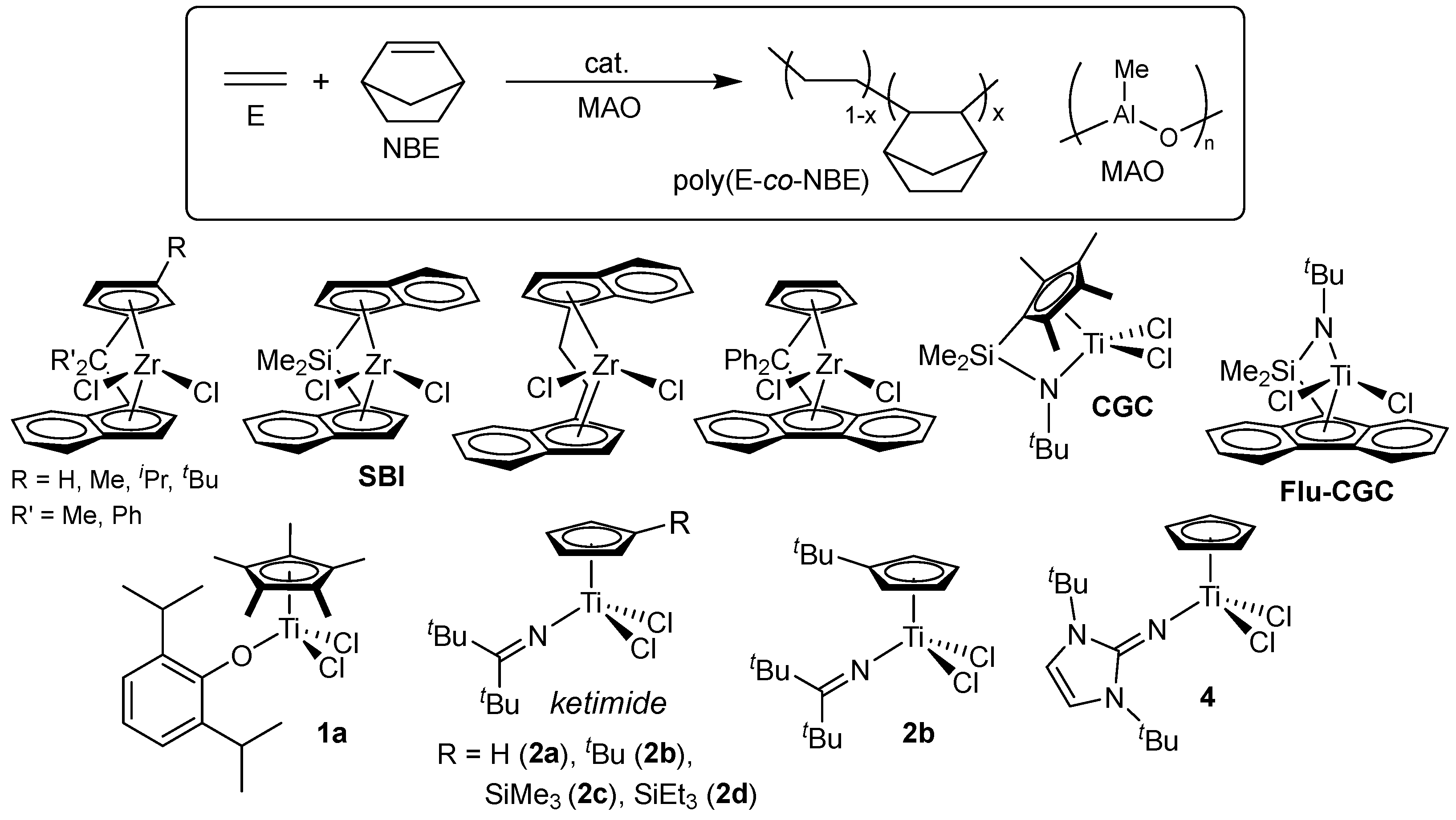
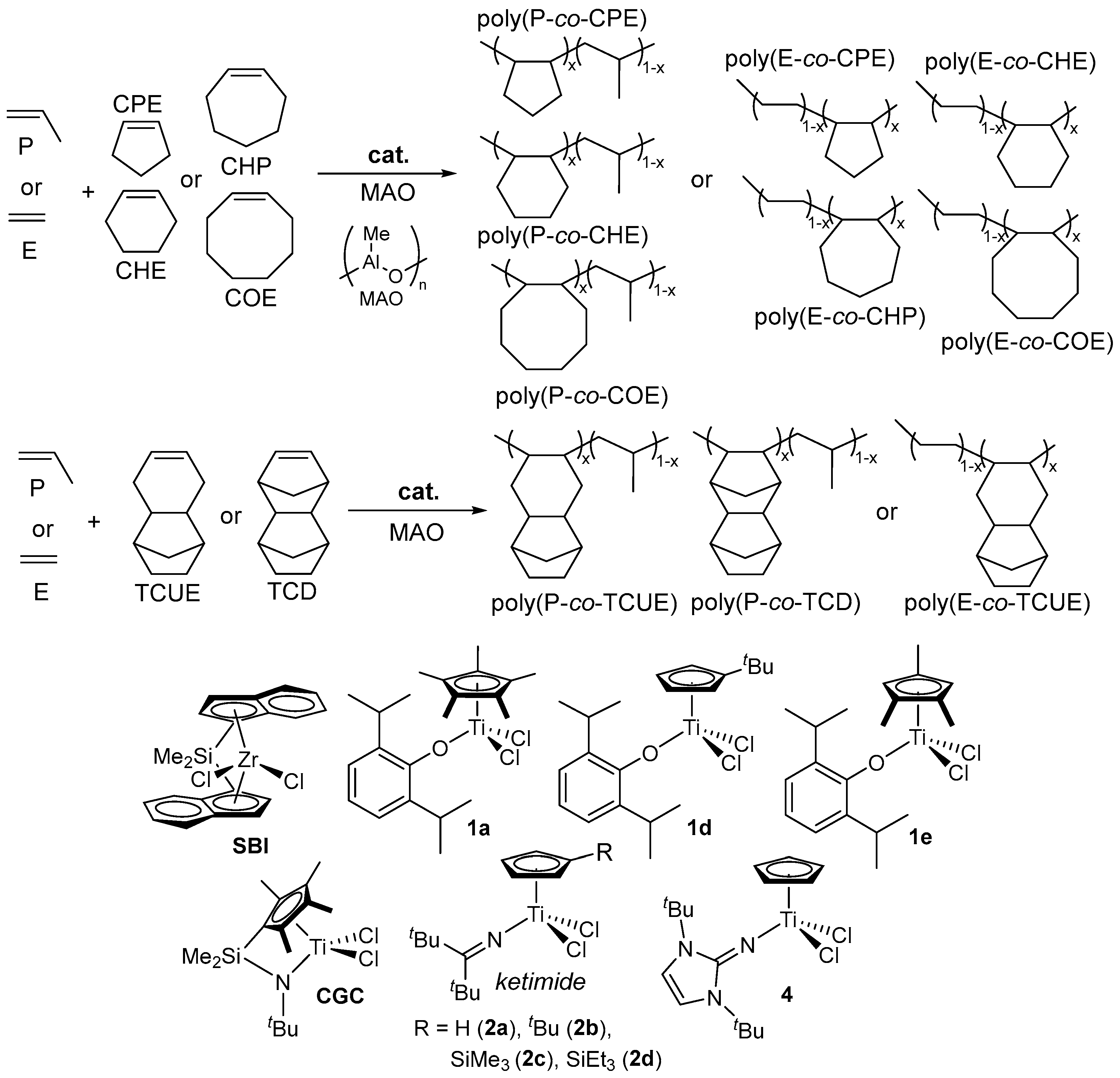
As described above, ethylene/NBE copolymers are known to be commercialized as COC, such as TOPAS® [87], using metallocene–MAO catalysts (Scheme 3). In general, the copolymerization by ordinary metallocenes (SBI-Zr) and linked half-titanocene catalysts (CGC) afforded amorphous poly(ethylene-co-NBE)s with uniform compositions possessing a sole glass transition temperature (Tg) by DSC thermograms [79,80,81,82,83,84,85]. However, both the activity and the Mn values in the resultant copolymers decreased upon increase in the NBE/ethylene feed molar ratios (increasing the NBE concentration charged and/or lowering ethylene pressure) [89,90,91,92,93,94,95,96,97,98,99], as exemplified in Table 1 [61,82]. The fluorenyl-substituted CGC (Flu-CGC) enables living NBE polymerization in the presence of dried MAO or MMAO (obtained as white solid by removal of AlMe3 and AliBu3 from the commercially available samples) with much improved NBE incorporation [99]; the resultant copolymers with α-olefins (1-octene, 1-decene, and 1-dodecene) possessed gradient NBE incorporation (monomer sequences in the copolymers) due to different reactivity between two monomers [6,84].
The ketimide-modified half-titanocene, CpTiCl2(N=CtBu2) (2a, Scheme 3) first demonstrated efficient synthesis of ethylene random copolymers with high NBE contents possessing high Mn values (Table 1) [61]. The activities (productivities) did not change significantly even over 30 min and increased at elevated temperature (60 °C); the copolymerization conducted at 80 °C did not show a significant decrease in the activity [61]. In contrast to the observation in the copolymerization using the metallocene, CGCs, the activity by 2a–MAO catalyst increased upon increase in the initial NBE feed concentration, the catalyst afforded the high molar mass copolymers [61]; Al cocatalyst (MAO, MMAOs) does not significantly affect the activity and the NBE incorporation. Therefore, this catalysis method using 2a gave the high molar mass copolymers with high NBE contents (58.8–73.5 mol%, Table 1) with uniform compositions [61]. Previous computational studies revealed that monomer coordination to a cationic titanium species [Cp’Ti(2-alkyl-norborny)(Y)]+ is the rate-determining step in the copolymerization, since a linear correlation between the coordination energy of ethylene and the catalytic activity was seen [15,61]. Moreover, a good correlation between coordination energy after NBE insertion and the NBE contents under the same conditions was also observed [61], suggesting that the NBE incorporation is governed by the coordination preference of NBE and ethylene to the cationic alkyl species [15,61].
A linear correlation between the Tg values and the NBE content in the copolymers was demonstrated even at high NBE contents, strongly suggesting the NBE random incorporation. The random NBE incorporation was also demonstrated by their microstructural analyses of the copolymers (by 13C NMR spectra), consisting of NBE isolated, alternating, repeat incorporation without stereoregularity [6,61,63,80,82].
The imidazolin-2-iminato modified half-titanocene, CpTiCl2[1,3-tBu2(CHN)2C=N] (4), also exhibited promising capabilities in the copolymerization, probably due to the strong σ-donating nature. The catalyst (4) showed high catalytic activity affording high molar mass copolymers with efficient NBE incorporation as well as uniform composition [65]. The activities by 4 were rather low compared to the ketimide analogue (2a) and further ligand modification might be required, suggesting that the anionic donor ligand plays an important role in both the catalytic activity and the NBE incorporation.
More recently, as summarized in Table 1, improved catalytic activities and NBE incorporation from the above ketimide catalyst (2a) could be achieved by the introduction of trialkylsilyl group on the cyclopentadienyl fragment, (RC5H4)TiCl2(N=CtBu2) [R = SiMe3 (2c) SiEt3 (2d)]. These catalysts displayed remarkable activities (25700–91400 kg-polymer/mol-Ti·h) in the copolymerization at 50 °C to afford high molar mass copolymers with high NBE contents (NBE 36.2–72.7 mol%) possessing high Tg value (238 °C) [63]. The observed results show unique contrast to those in copolymerization using the tert-BuC5H4 analogue (2b, Table 1).
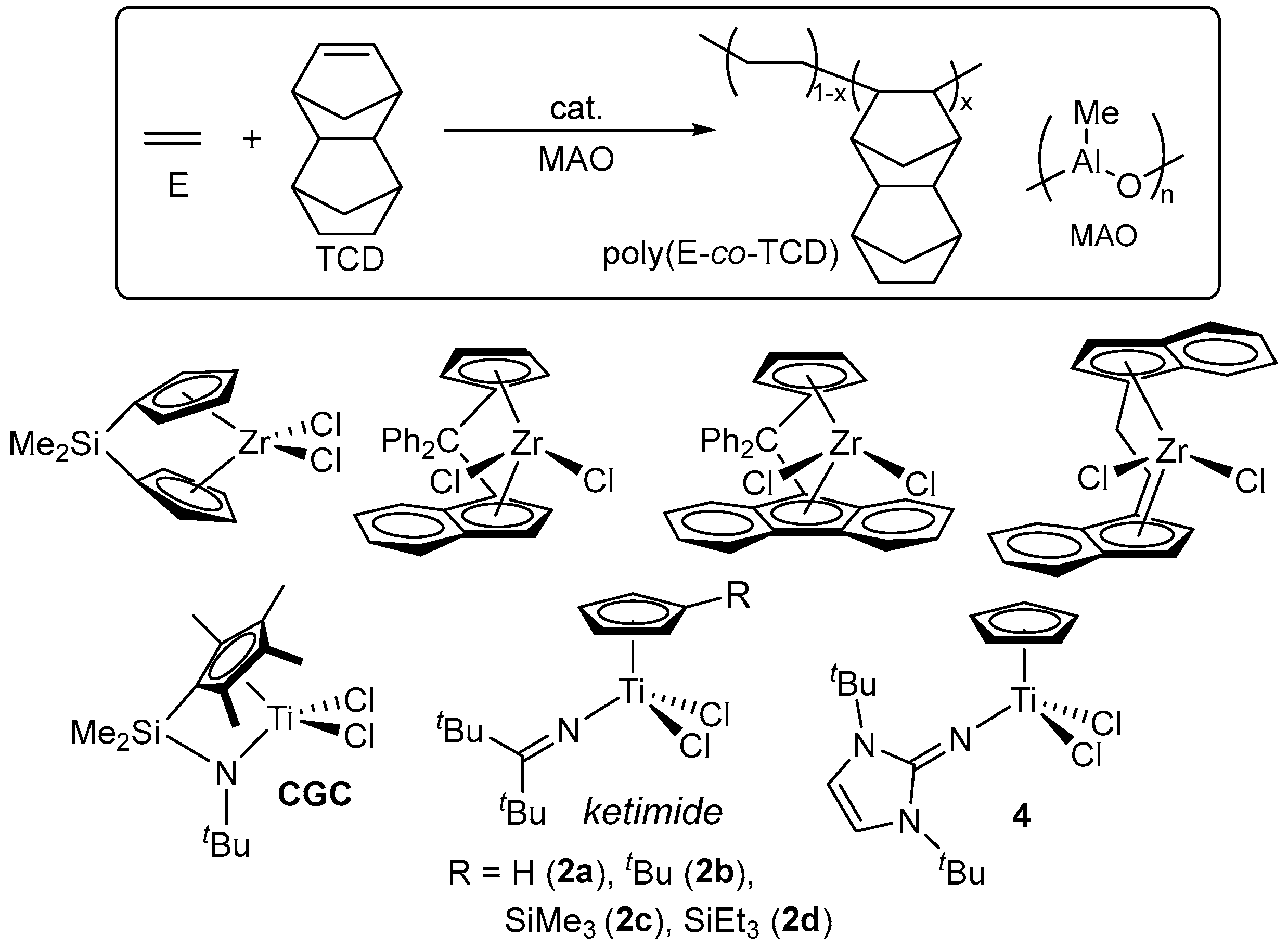
As described above, ethylene/TCD copolymers are known to be commercialized COC, as APEL® [88], which have been produced using vanadium-based catalyst systems (VOCl3–EtAlCl2·Et2AlCl, etc.) under deep-cooling conditions [106]. It seemed that the conventional (metallocene, linked half-titanocene) catalysts face difficulty for synthesis of the high molar mass ethylene/TCD copolymers at moderate temperature (>50 °C, Scheme 4) [107,108,109,110].
The ketimide-modified half-titanocene, (tBuC5H4)TiCl2(N=CtBu2) (2b), demonstrated synthesis of the copolymers with remarkable activities (43700 kg-polymer/mol-Ti·h) to afford the copolymers possessing high Tg values (108–203 °C) with uniform compositions (Scheme 4, Table 2) [64]. The Cp analogue (2a) showed lower catalytic activity than 2b, and the Mn value in the resultant copolymer was low compared to that prepared by 2b under the same conditions; modification of cyclopentadienyl fragment thus plays a key role [64]. The imidazolin-2-iminato analogue (4) also displayed a rather low capability for the copolymerization [64]. Thus, the ketimide analogues seem to be promising for synthesis for COCs.
More recently, as seen in the ethylene/NBE copolymerization, the catalyst capability could be improved by the introduction of trialkylsilyl group on the cyclopentadienyl fragment, (RC5H4)TiCl2(N=CtBu2) [R = SiMe3 (2c) SiEt3 (2d), Table 2] [63]. In particular, the SiEt3 analogue (2d) showed higher catalytic activities at 50 °C, affording the high molecular weight copolymers with uniform composition possessing sole Tg values. The TCD contents in the copolymer increased with increase in the TCD concentration charged (as well as lowering the ethylene pressure), and these catalysts (2c,d) demonstrated synthesis of the copolymers with TCD content higher than 50 mol% (Tg = 255 °C, TCD 52.3 mol%) [63]. The results clearly indicate that further improvement in the catalyst capability can be achieved by the ligand modification.
Basic structure (size, strain, etc.) in cyclic olefin directly affects not only the efficiency of cyclic olefin incorporation in the (ethylene) copolymerization, but also the properties in the resultant COCs (thermal and tensile properties, dielectric constant, etc.) [6,84]. As described in the introduction, limited number of reports were known for successful synthesis of (rather high molar mass) amorphous ethylene copolymers with so-called low-strained cyclic olefins such as cyclohexene (CHE) [66,68], cycloheptene (CHP) [66,67], and cis-cyclooctene (COE) [66,67]. Recently, as shown in Scheme 5, synthesis of a series of amorphous ethylene and propylene copolymers with CPE, CHE, CHP, COE, tricyclo[6.2.1.0(2,7)]undeca-4-ene (TCUE), and with TCD, was demonstrated [66,67]. Linear relationships between the Tg values and the cyclic olefin contents were demonstrated in all cases. These results thus strongly suggest that Tg values were affected by the cyclic structure in COCs (except the copolymers with CPE, COE). The Tg values in the propylene copolymers in the region of low cyclic olefin contents (up to 25 mol%) seemed rather high compared to those in the ethylene copolymers [66]. This is due to rather high Tg value in the atactic polypropylene.
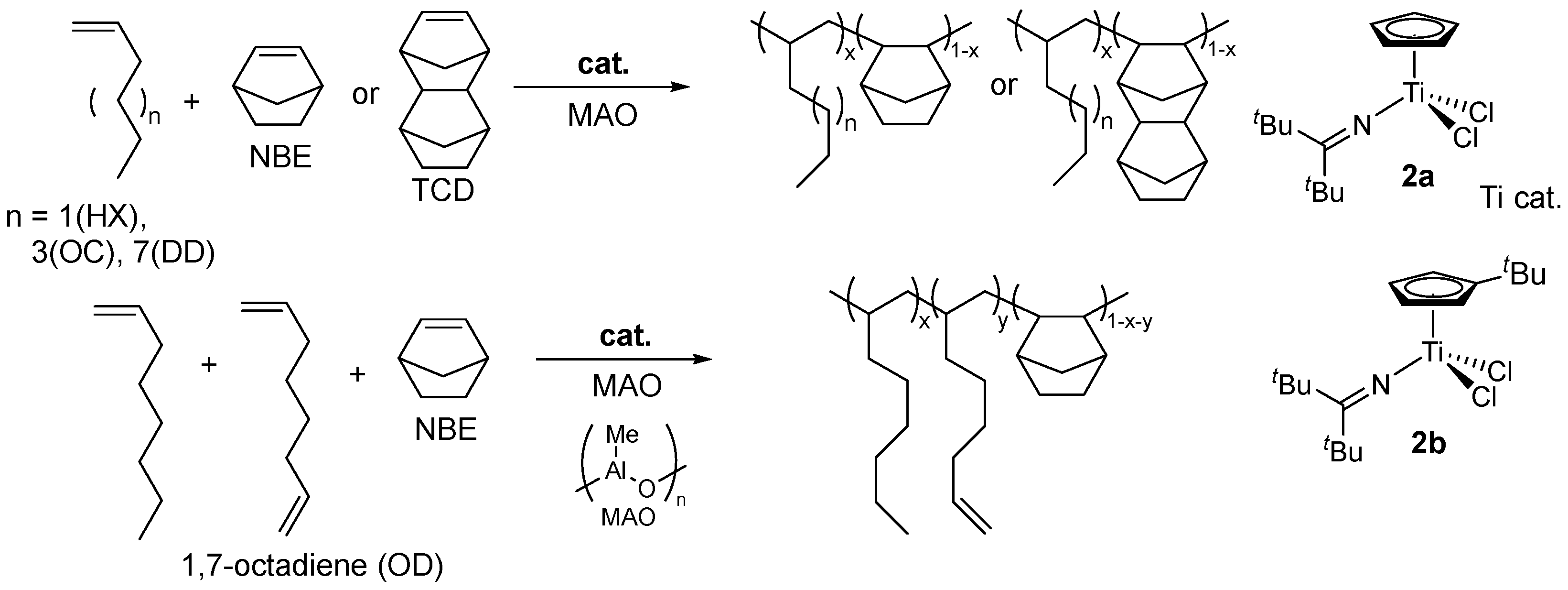
The cyclic olefin copolymers of norbornene (NBE) or tetracyclododecene (TCD) with various linear α-olefins, such as 1-hexane (HX), 1-octane (OC), and 1-dodecene (DD), using ketimide half-titanocene catalysts Cp’TiCl2(N=CtBu2) [Cp’ = or Cp (2a), tBuC5H4 (2b)] (Scheme 6) [65]. The Cp analogue (2a) exhibited superior activity to the tBuC5H4 derivative (2b), exhibiting over 10 times higher activity and more efficient comonomer incorporation under the same conditions. While these half-titanocene catalysts successfully produced high molecular weight TCD/α-olefins copolymers [65], the conventional metallocene and Flu-CGC failed to synthesize the high molecular weight copolymers, yielding only low molecular weight oligomers [111,112,113,114].
A critical finding in this copolymer system is the linear relationship observed between the cyclic olefin content and glass transition temperature across all synthesized polymers. Copolymers with TCD exhibited higher Tg values than their NBE counterparts at equivalent cyclic olefin concentrations (exceeding 200 °C). The Tg values are further influenced by the α-olefins chain length, decreasing in the order of 1-hexene > 1-octene > 1-dodecene. Additionally, the reactive functionality was demonstrated by introducing the incorporation of 1,7-octadiene (OD), which adds terminal olefinic double bonds to the side chains. In this term, the tBuC5H4 analogue (2b) proved more suitable than Cp analogue (2a) because the latter caused unwanted isomerization of the terminal double bonds into internal olefins [65].

3. Ethylene Copolymerization with Sterically Encumbered Olefins

Ethylene copolymerization with 1,1-disubstituted α-olefins such as isobutene (IB), 2-methyl-1-pentene (2M1P) has rarely been reported in metal-catalyzed olefin coordination insertion polymerization [115]; these monomers have long been regarded as “traditionally unreactive” in this field. However, these ethylene copolymers are expected to show enhanced weather resistance compared with conventional ethylene/α-olefin copolymers, because of the absence of reactive tertiary C–H bonds in the polymer backbone, which are removed by oxidative or UV-induced degradation. For instance, the ethylene/IB copolymerization using [Et(indenyl)2]ZrCl2 gave the copolymer with low (<2.8 mol%) IB content even under large excess IB concentration conditions (charge molar ratio of ethylene/IB = 1/4000) [116].
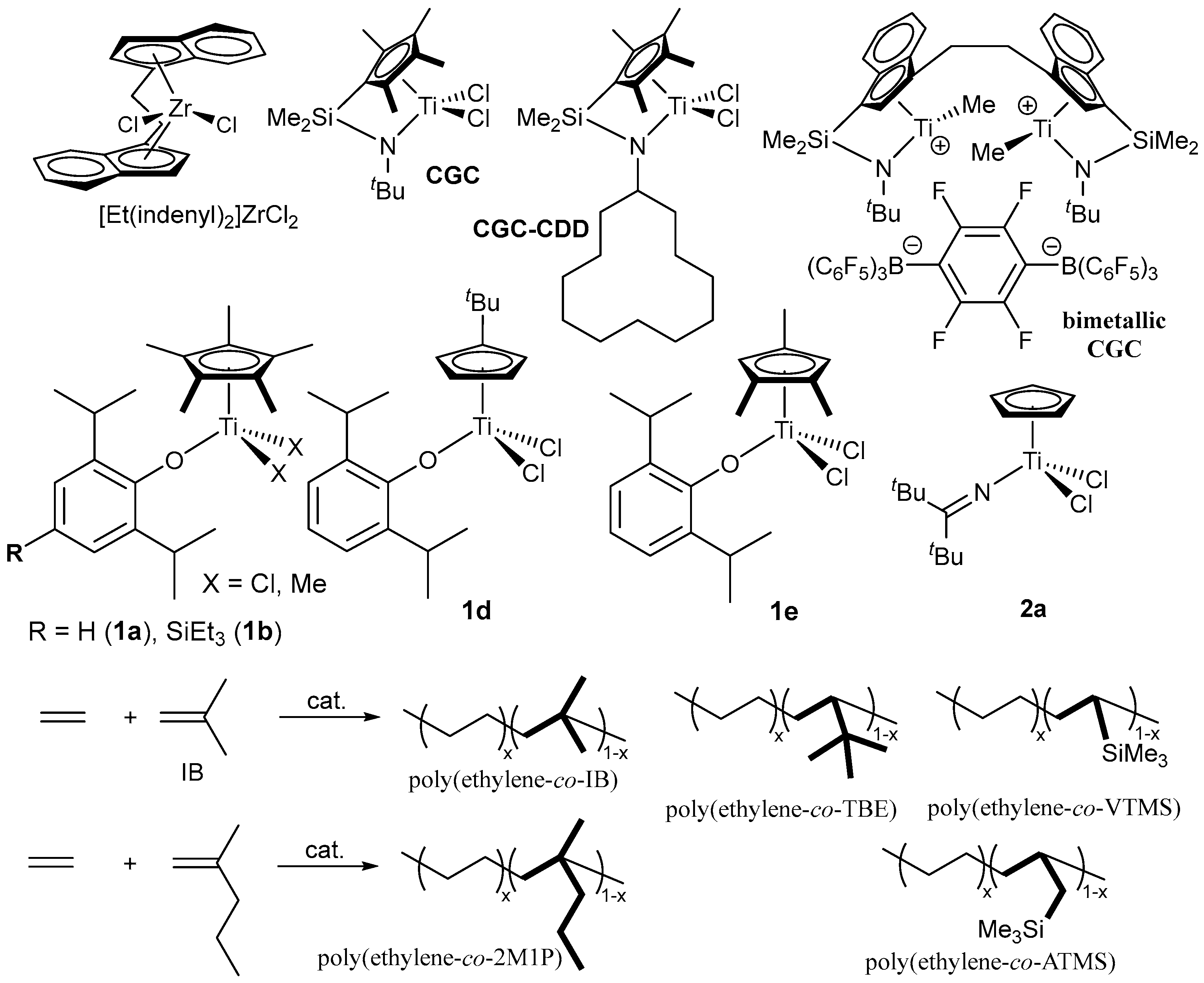
Ordinary CGC showed negligible IB incorporation in the ethylene copolymerization; the IB incorporation was much improved by using cyclododecylamide analogue (CGC-CDD, Scheme 7) [117]; the fluorenyl analogue (Flu-CGC-CDD, Scheme 7) later showed IB incorporation [118]. However, the copolymerization with 2M1P by CGC-CDD afforded the polymer possessing large PDI (polydispersity index, Mw/Mn = 5.90) [117]. The bimetallic CGC consisting of dinuclear catalyst and dianionic borate catalyst system (Scheme 7) showed improved IB incorporation from the mononuclear CGC (IB 3.1 mol% vs. 15.2 mol%: ethylene 1 atm, IB 1.3 M, 24 °C), but showed low activity and the obtained polymer possessed rather large PDI (Mw/Mn = 3.67) [119,120]. The catalyst system incorporated methylenecyclopentene and methylenecyclohexene in the ethylene copolymerization. The attempted copolymerization with 2-methyl-2-butene gave the copolymer by incorporation as 2-methyl-1-butene formed by olefin isomerization [120]. Reports for synthesis of high molar mass ethylene copolymers with 1,1-disubstituted α-olefins (except IB) have still remained scarce.
Synthesis of ethylene/2M1P copolymers was achieved by the phenoxide-modified half-titanocene catalyst with rather efficient 2M1P incorporation (1a, Mn = 3.30–13.0 × 10⁴, Mw/Mn = 1.70–1.90) [71,73]. As summarized in the selected data in Table 3, 2M1P content in the resultant copolymer increased upon increasing upon increase in the 2M1P concentration and charged or lowering ethylene pressure (6 → 4 atm) with decrease in the activity [71,73]. The resultant copolymers possessed uniform compositions confirmed by DSC thermograms and their microstructural analysis by 13C NMR spectra revealed that 2M1P was incorporated in an isolated and/or alternating manner (without repeat insertions). Use of the tert-BuC5H4 analogue (1c) led to decrease in both the activity and the 2M1P incorporation explained as due to the steric bulk [71,73]. Later, the activity by the SiEt3 analogue (1b) increased at elevated temperature (up to 80 °C) [75]. In contrast, the Cp–ketimide analogue (2a) showed poor 2M1P incorporation, suggesting that the nature of anionic donor ligand (as well as steric bulk on Cp’) affects the comonomer incorporation. Moreover, as described above, CGC also showed poor 2M1P incorporation under the same conditions.
The Cp*–phenoxide analogue (1a) also showed efficient VCH incorporation in the ethylene copolymerization [72], whereas incorporation of branched (γ-disubstituted) α-olefins in the copolymerization using the conventional catalysts seemed difficult [72]. However, as summarized in Table 3, 1a showed negligible tert-butyl ethylene incorporation, and showed rather poor VTMS incorporation compared to the Cp–ketimide analogue (2a), CGC; the VTMS incorporation was improved by using the tert-BuC5H4 analogue (1c) but the resultant copolymer possessed rather low Mn values compared with those prepared by 2a [121]. Synthesis of ethylene copolymers with tert-butyl ethylene (TBE) was achieved by the tert-BuC5H4 analogue (1d) and the 1,2,4-Me3C5H2 analogue (1e); the observed effect on Cp’ was the same as that in the ethylene copolymerization with cyclohexane [68].

Effect of Borate Cocatalysts Toward Activity, Comonomer Incorporation in Alkane Solvent

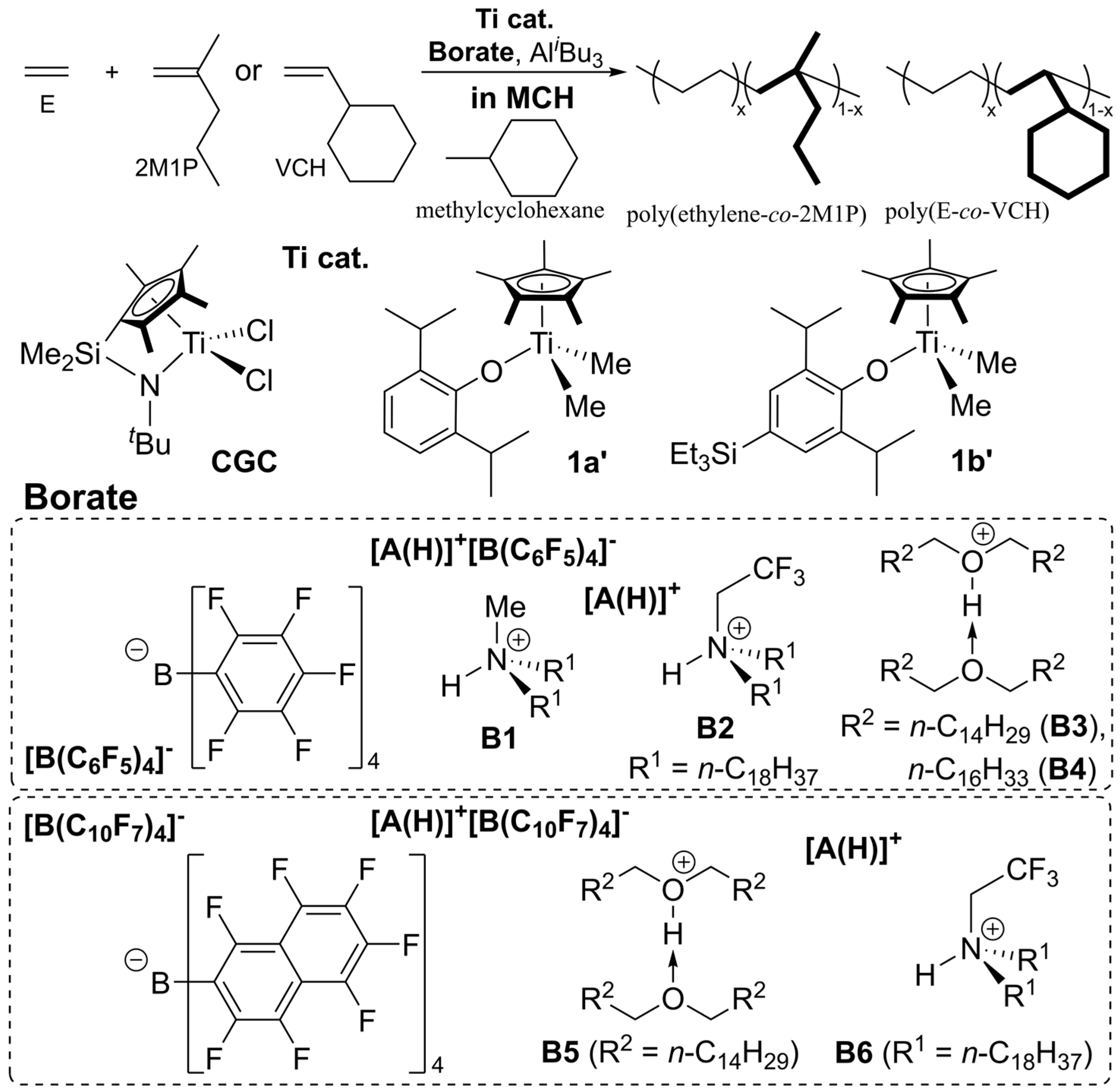
Recently, it has been recognized that solvent coordination (toluene vs. alkane) in addition to catalyst–cocatalyst interaction (nuclearity effect) affect both the catalytic activity and comonomer incorporation in olefin polymerization [75,122,123]. For instance, as summarized in Table 4, [Me2Si(C5Me4)(NtBu)]TiCl2 (CGC), Cp*TiMe2(O-2,6-iPr2-4-RC6H2) [R = H (1a’), SiEt3 (1b’)]–borate, [A(H)]+[BAr4] (Ar = C6F5 or C10F7, B1B6 in Scheme 8) catalyst systems conducted in methylcyclohexane (MCH) exhibited better comonomer incorporation than those conducted in toluene (in the presence of MAO, borate cocatalysts) in the ethylene copolymerization with 2M1P, 1-dodecene, VCH [75].
The activity by CGC in the E/2M1P (co)polymerization (ethylene 4 atm, 25 °C) in MCH was affected by the borate cocatalyst employed and increased in the order: activity = 149 kg-polymer/mol-Ti·h (B1) < 768 (B6) < 2660 (B5) < 3770 (B2) < 6810 (B3). Interestingly, CGCB3 catalyst system in MCH afforded the copolymer (2M1P 0.4 mol%, by DSC thermogram and 13C NMR spectrum), whereas CGC—MAO catalyst system in toluene showed negligible 2M1P incorporation under the same conditions [75]. It seems that the 2M1P incorporations (estimated by the Tm values) were also affected by the borate cocatalyst employed. Similarly, the activities by 1a’ and 1b’ were affected by the borate cocatalyst employed, and 1b’B5 catalyst system showed the highest activity (5060 kg-polymer/mol-Ti·h) and the resultant copolymer possessed higher 2M1P content than that conducted in toluene by 1b’—MAO catalyst system (6.0 mol% vs. 3.1 mol%) [75]. In contrast, 1b’B1 catalyst system showed low activity affording the polymer with two compositions estimated by DSC thermograms. It should be noted that the 2M1P incorporation was affected by the borate cocatalyst employed: B5 showed better 2M1P incorporation than B3. It was shown that conducting these copolymerizations in MCH in the presence of borate cocatalysts (B2B6) showed better 2M1P incorporation than that conducting in toluene in the presence of MAO [75].
Moreover, the activity by CGC conducted in MCH was affected by the borate cocatalyst employed. CGCB5 catalyst system in MCH exhibited higher catalytic activity and better VCH incorporation than CGC—MAO catalyst system in toluene [75]. Note that no significant differences in the VCH contents in the copolymers were observed when these polymerizations using CGC—borate catalyst systems were conducted in toluene; the VCH incorporation was thus affected by the solvent (toluene vs. MCH). The results thus suggest that the observed difference in MCH would be due to a weak cation—anion interaction without coordination of toluene (and amine or ether, exhibited A formed after treatment of CGC with borate) to the assumed cationic alkyl species [122,123,124]. Non-coordinating oxonium ion, especially HO+(n-C14H29)2·O(n-C14H29)2 (B5) containing long alkyl chains, was preferred over the ammonium salts (probably due to poor coordination ability of O(n-C14H29)2 to the assumed cationic species) [75]. As expected for better anion delocalization (BAr4), perfluorinated naphthyl borate, B(C10F7)4, showed higher activity than B(C6F5)4.

4. Synthesis of Biobased Polyolefins: Copolymerization of Biobased Conjugated Dienes

Development of functional polymers from renewable feedstocks has been an important subject in circular economy [125,126,127,128,129,130,131,132]. Cyclic monoterpenes consisting of two isoprene units as formula of C10H16 shown in Scheme 9 can be considered as promising monomers obtained from the abundant plant oil [133,134]. However, the successful synthesis by coordination insertion polymerization has been scarce until recently [69,135], whereas there are the reports by ionic (cationic, radical) polymerization.
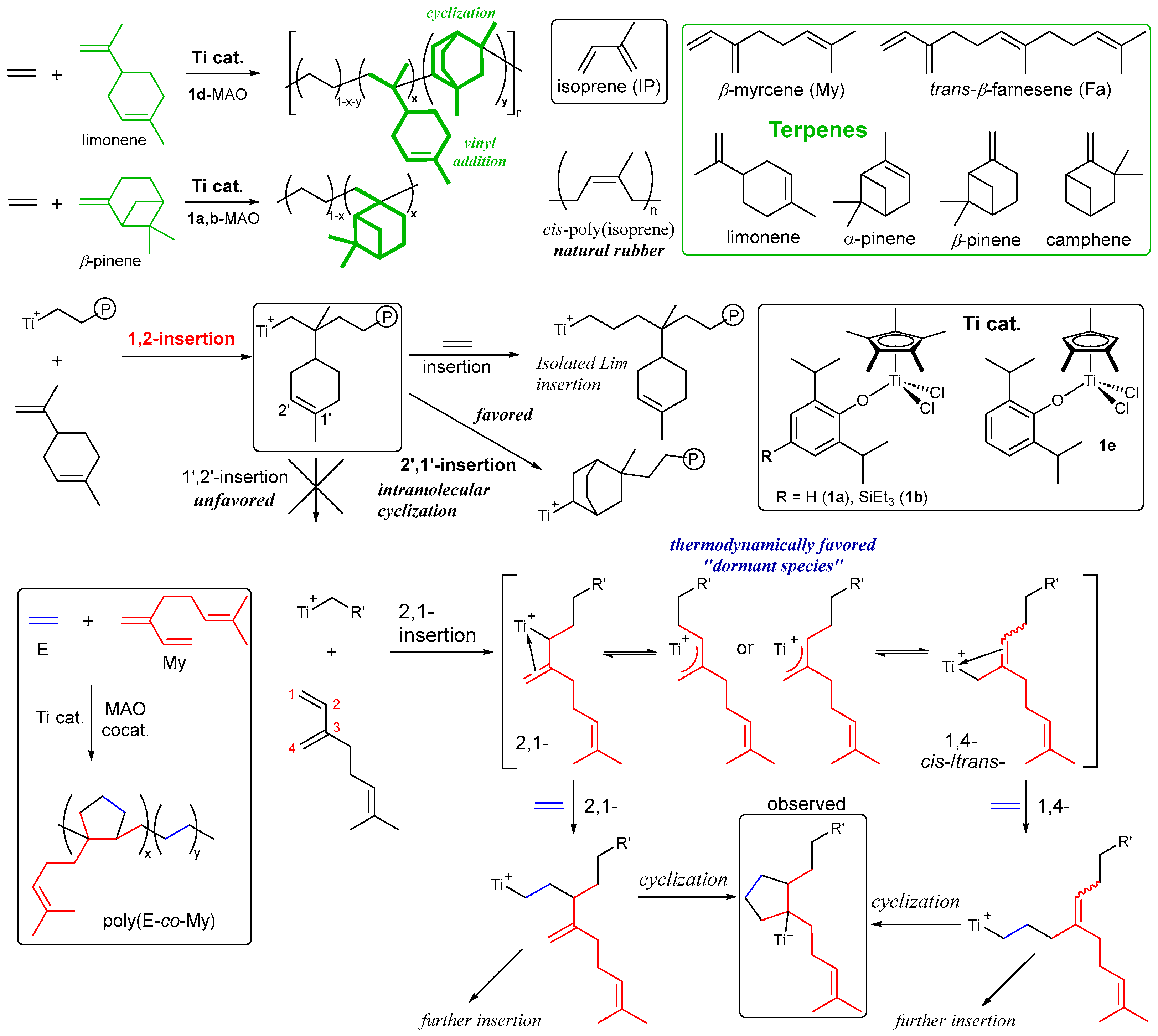
(1,2,4-Me3C5H2)TiCl2(O-2,6-iPr2C6H3) (1e) enabled synthesis of ethylene/limonene copolymers possessing rather high molecular weights (Mn = 4.00–12.6 × 10⁴) with unimodal molecular weight distributions [135]. As observed in the ethylene/2M1P copolymerization (Table 3), increase in the limonene concentration led to decrease in the activity and the Mn value in the copolymer, while simultaneously increasing the limonene content in the copolymer. In contrast, the Cp* analogues (1a,b) showed less efficient limonene incorporation and CGC showed the negligible incorporation. Microstructural analysis revealed resonances consistent with 1,2-limonene insertion followed by cyclization, favouring a 2’,1’-insertion (than 1’,2’-insertion) pathway (Scheme 9) [135].
The Cp* analogues (1a,b)–MAO catalyst gave high molar mass poly(ethylene-co-β-pinene)s (Mn = 2.10–22.4 × 10⁴) possessing unimodal molecular weight distributions (Mw/Mn = 1.53–2.32). The activity was influenced by the β-pinene concentration charged, ethylene pressure, Al/Ti molar ratio and the temperature. The 1,2,4-Me3C5H2 analogue (1e) showed low activities compared with 1a,b, affording the copolymers possessing rather low Mn values [135]. The attempted copolymerization by CGC gave polymers with negligible β-pinene incorporation.
β-Myrcene (myrcene, My), a promising biobased linear terpene, has been polymerized by radical or anionic polymerization and reports concerning the metal-catalyzed ethylene copolymerization have been limited by scandium catalysts [136] or half-titanocene catalysts [69], whereas there are reports for the styrene/My copolymerization [137,138,139,140,141,142,143]. The scandium catalysts, however, afforded copolymers possessing multi-block microstructures, expressed as poly(E-bl-My), possessing melting temperature of polyethylene segment (133 °C, My 9 mol%) [136]. Phenoxide-modified Cp* analogues (1a,b) demonstrated synthesis of high molar mass (semicrystalline or amorphous) random ethylene/My copolymers with efficient My incorporation [69]. The microstructural analysis using 13C NMR spectra of the resultant (unsaturated) copolymers and the saturated copolymers prepared by olefin hydrogenation. The analysis data revealed that the copolymers possessed cyclopentane units containing My pendant arm (-CH2CH=CMe2), which are presumably formed by 2,1- or 1,4-My insertion and subsequent cyclization after ethylene insertion (Scheme 9) [69]. In general, formation of ƞ3-allyl intermediate, considered as dormant, disturbs proceeding further olefin insertion. In this catalysis, the subsequent cyclization enabled to proceed the copolymerization with random My incorporation. The elongation (tensile strain) at break increased with increasing the My contents accompanied with decrease in the tensile stress (strength); the copolymer showed promising elastic behaviours as biobased elastomers [69]. The catalysts also enabled synthesis of ethylene/isoprene copolymers possessing cyclopentane and cyclohexane units [70].

5. Analysis of Catalytically Active Species Through XAS (X-Ray Absorption Spectra)

5.1. Introduction: XAS for Analysis of Catalytically Active Species

Identification of catalytically active species and the reaction chemistry are prerequisite not only for clear understanding of the catalysis mechanism, but also for catalyst design through the structural and electronic insight. Single crystal X-ray diffraction analysis provides structural information of the proposed intermediate(s) in solid state, although such species are often (sometimes) required by certain stabilization for isolation and the information is limited to be in solid state. Mechanistic studies are also supported by reaction chemistry, stoichiometric and/or catalytic reactions, using model complexes (and the isolated species in the catalytic reaction) and computational studies. However, we often observed that the isolated species exhibit apparently low catalytic activities or are inactive due to required stabilization for the isolation and/or isolated species which are indeed dormant in the catalysis cycle.
Nuclear magnetic resonance (NMR) spectroscopy is the principal technique for characterization of diamagnetic inorganic and organometallic compounds in (partially) deuterated solvent. Electron spin resonance (ESR) spectroscopy has been a powerful method for analysis of the paramagnetic species that exhibit negligible or broadened NMR signals [144,145]. However, these methods still provide limited access for the obtainment of real/clear structural information (image) in catalysis solutions. Moreover, ESR often lacks quantitative analysis/reliability [144,145,146], and a possibility of co-presence of “ESR silent” species cannot be excluded. For example, vanadium(III) species with 3d2 electron configuration (S = 1, triplet, S = spin quantum number) are ESR silent due to an interaction between the two unpaired electrons, while vanadium(IV) dimers coupled antiferromagnetically also become ESR-silent through spin–orbit coupling (SOC) [146,147].
Analysis by XAS (X-ray absorption spectroscopy), XANES (XANES = X-ray Absorption Near Edge Structure) and EXAFS (EXAFS = Extended X-ray Absorption Fine Structure), performed at synchrotron facilities provides information of not only oxidation state and the basic geometry around the metal centre (by XANES), but also kind of atoms and the distances connected (coordinated) to the metal centre (by EXAFS). More recently, we see growth in the number of reports identifying homogeneous, molecular catalysis through XAS analysis [27,76,148,149,150,151,152,153,154,155,156,157,158,159], whereas the methods are common in heterogeneous catalysis [160,161,162,163,164]. The methods are recognized as a useful analysis method especially of catalysis research with early transition metals, as exemplified in analysis of paramagnetic vanadium(III) species and titanium(III) species that cannot be observed, especially by NMR spectroscopy [27,76,148,149,153,154,158].
Although we need to use the appropriate synchrotron facility (e.g., SPring-8, BL01B1 beamline), we do not need any specified apparatus, and the sample preparations are possible on site in the drybox. Moreover, we demonstrated good reproducibility (in the independent runs even conducted during the different beam times) and no severe X-ray radiation damages during data acquisition were observed [27,76]. Herein, we first describe basics in XAS analysis for uninitiated researchers and introduce selected results in analysis of catalytically active species in olefin polymerization and syndiospecific styrene polymerization using half-titanocene catalysts.

5.2. Basics in XANES Spectra

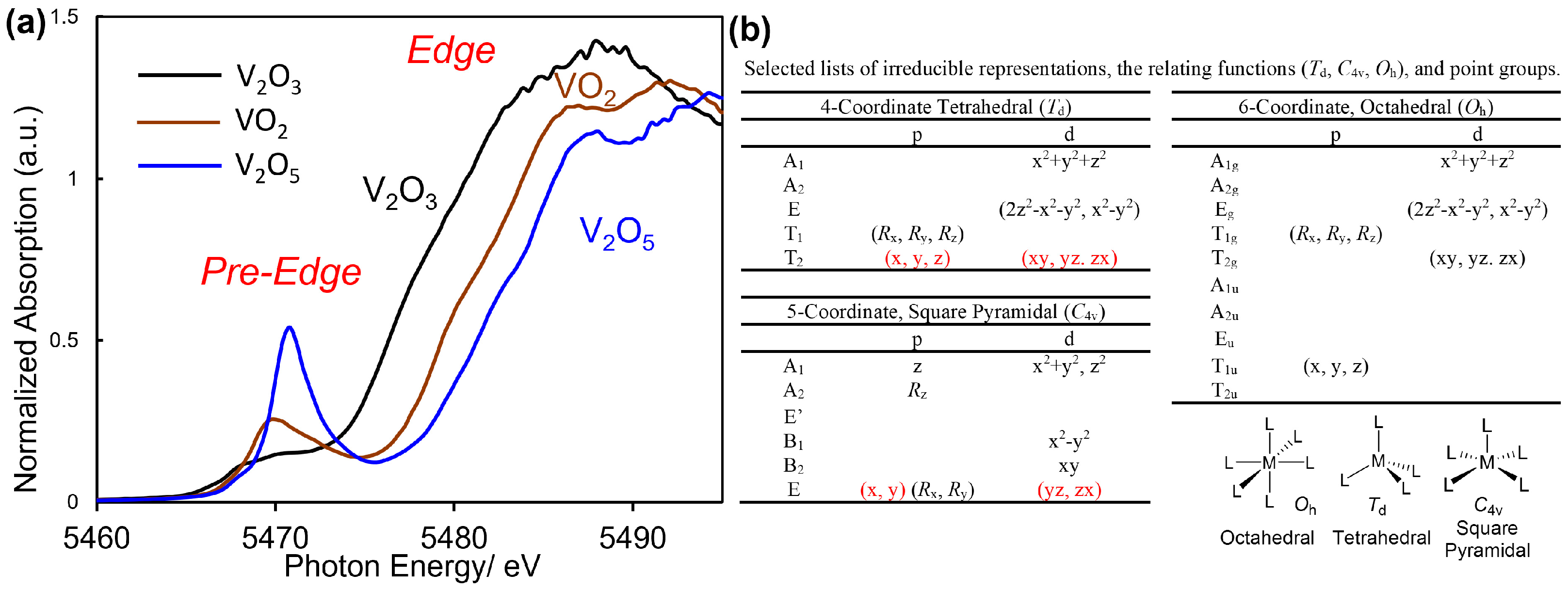
It has been known that pre-edge peak intensity and edge absorption (exemplified in Figure 1) in XANES spectra are influenced by the oxidation state and the basic geometry around the centred metal [27,148,149,160,161,162,163,164,165,166,167,168,169,170,171,172,173]. For basic introduction, V-K edge XANES spectra of vanadium oxides with various oxidation states are shown in Figure 1a [174]. The basic geometries [octahedral (Oh), square pyramidal (C4v), tetrahedral (Td)] and their selected irreducible and relating functions and point groups are also placed in the figure. Pre-edge absorption is known to provide information about basic (local) geometry around the metal centre reflected by s → d transitions (quadrupole transition); dipole transition (s → p) is also considered depending on degree of p–d orbital hybridization [166,169,175,176]. For instance, complexes with Td and C4v symmetries display higher pre-edge peak intensity than those in Oh symmetry. The observed difference can be explained as due to a difference in the possibility of a p–d orbital hybridization, realized from a table in irreducible representations and the relating functions in the complexes with these symmetries (Figure 1b).
The complex with tetrahedral geometry (Td) leads to an increase in the degree of electric dipole transition of a 1s electron to the p–d hybridized orbital [166,169,175,176]. This is because px, py, pz orbitals and dxy, dyz, dzx orbitals in Td symmetry (or px, py orbitals and dyz, dzx orbitals in C4v symmetry) belong to the irreducible representation, leading to formation of a p–d hybridized orbital with increased electric dipole transition of a 1s electron occurring with the hybridized orbital [169,176]. However, no irreducible representations containing d and p orbitals are present for the complexes with octahedral geometry (Oh point group). Therefore, the intensity of the pre-edge peak is generally weak because only the relatively weak quadrupole transition (s → d transition) is allowed, while the dipole transition (s → p) is forbidden; distortion of the symmetry (symmetry breaking), however, enables p–d hybridization that allows the dipole transition. Therefore, simple prediction of the pre-edge peak intensity could be possible without theoretical calculations by using the character tables of group theory. V2O3 and V2O4 also fold a distorted octahedral geometry around vanadium, whereas V5+ ions in V2O5 fold distorted tetragonal pyramid [27,148,149,174]. Observed pre-edge peaks [at 5468.4 and 5469.8 eV (V2O3), 5470.0 eV (VO2), 5470.8 eV in V2O5] are, as described above, generally assigned as due to a transition from 1s to 3d + 4p [166,169,175,176].
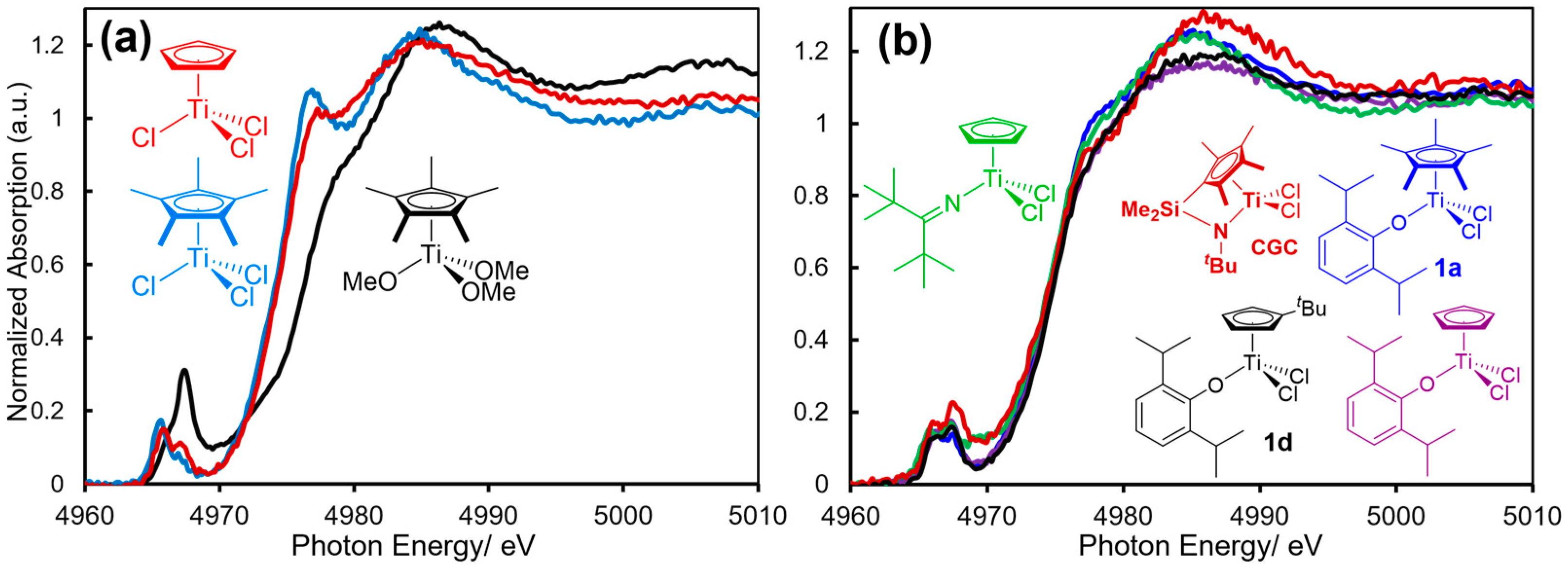
Figure 2a shows Ti K-edge XANES spectra in toluene for CpTiCl3, Cp*TiX3 (X = OCH3, Cl) measured at 25 °C (Ti K-edge 4.97 keV, through use of synchrotron radiation at SPring-8, BL01B1 beamline). These spectra show rather strong pre-edge absorption at 4965–4967 eV due to tetrahedral geometry around titanium, as described above. Rather strong absorption bands called shoulder-edge at 4977.0 eV in Cp*TiCl3 and CpTiCl3, whereas no such absorption was seen in Cp*Ti(OCH3)3; the absorption was due to presence of Ti–Cl bond, known as a shakedown peak assigned to the metal 1s to 4p coupled with the ligand to metal charge transfer (LMCT) [170,171,172,173]. No significant differences in the spectra were seen between CpTiCl3 and Cp*TiCl3 because of the similar geometry and number of chloride ligands around titanium.
Figure 2b shows Ti K-edge XANES spectra in toluene solution (at 25 °C, conc. 50 μmol-Ti/mL) for Cp’TiCl2(O-2,6-iPr2C6H3) [Cp’ = Cp, tBuC5H4 (1d), Cp* (1a)], CpTiCl2(N=CtBu2) (2a), and [Me2Si(C5Me4)(NtBu)]TiCl2 (CGC) [27]. The XANES spectrum of 1a shows strong pre-edge absorptions at 4966.2 and 4967.6 eV and these are similar to those in the dimethyl complex, Cp’TiMe2(O-2,6-iPr2C6H3) (1a’), which showed at 4966.1 and 4967.7 eV. As described above, these are generally considered as due to a transition from 1s to 3d + 4p [166,169,175,176]. Moreover, as described above, 1a shows an absorption maximum at 4978.0 eV (called as shoulder-edge) ascribed to the presence of a Ti–Cl bond [76,170,171,172,173]. Interestingly, as described above, positions of the edge peak (absorption) and the intensities in the half-titanocenes chosen in Figure 2b are close, whereas CGC shows rather high intensity at the pre-edge absorption at 4967.6 eV. Moreover, the spectra in toluene solution were highly analogous to those measured in solid (tablets with boron nitride) [76], strongly suggesting that these are Ti(IV) complexes with (a distorted) tetrahedral geometry in solid and solution [76].

5.3. XAS Analysis for Exploring Active Species in Olefin Polymerization and Syndiospecific Styrene Polymerization (SSP) by Half-Titanocene Catalysts

The high oxidation state group 4 cationic metal-alkyl species, Cp’2M+R (R = alkyl) or Cp’M+(Y)R (Y = anionic ancillary donor), formed from the dialkyl analogues by reaction with borate or MAO through alkyl abstraction, play an essential role as the catalytically active species in this catalysis cycle (Scheme 10) [5,9,10,11,12,13,14,15,16,17,24,25,26,27]. However, effective catalysts for olefin polymerization (especially metallocene, linked half-titanocene) display poor (negligible) capability for synthesis of syndiotactic polystyrene (SPS) [34,36,37,38,39]. In contrast, half-titanocene catalysts, Cp’TiX3 (X = F, Cl, OMe, etc.), enable high catalytic activities for syndiospecific styrene polymerization (SSP) [38,39,40], whereas these catalysts exhibited low catalytic activities for ethylene polymerization and afforded a mixture of polyethylene, SPS and the copolymer, poly(ethylene-co-styrene) [34,41]. It has thus been recognized that the active species between olefin polymerization and SSP are different. The oxidation state of the active species in the SSP had thus been proposed as cationic Ti(III) species [177,178,179] or neutral Ti(III) species [56,57,180,181]. However, these mechanistic studies lacked “direct evidence” until recently, especially from the catalyst solution in the presence of styrene and MAO.
As described above, XANES (XANES = X-ray Absorption Near Edge Structure) and EXAFS (EXAFS = Extended X-ray Absorption Fine Structure) analyses provide direct information on not only oxidation state and the basic geometry around the metal centre (by XANES), but also kind of atoms and the distances connected (coordinated) to the metal centre (by EXAFS). Therefore, here we introduce a summary of the mechanistic studies reported recently [27,76].
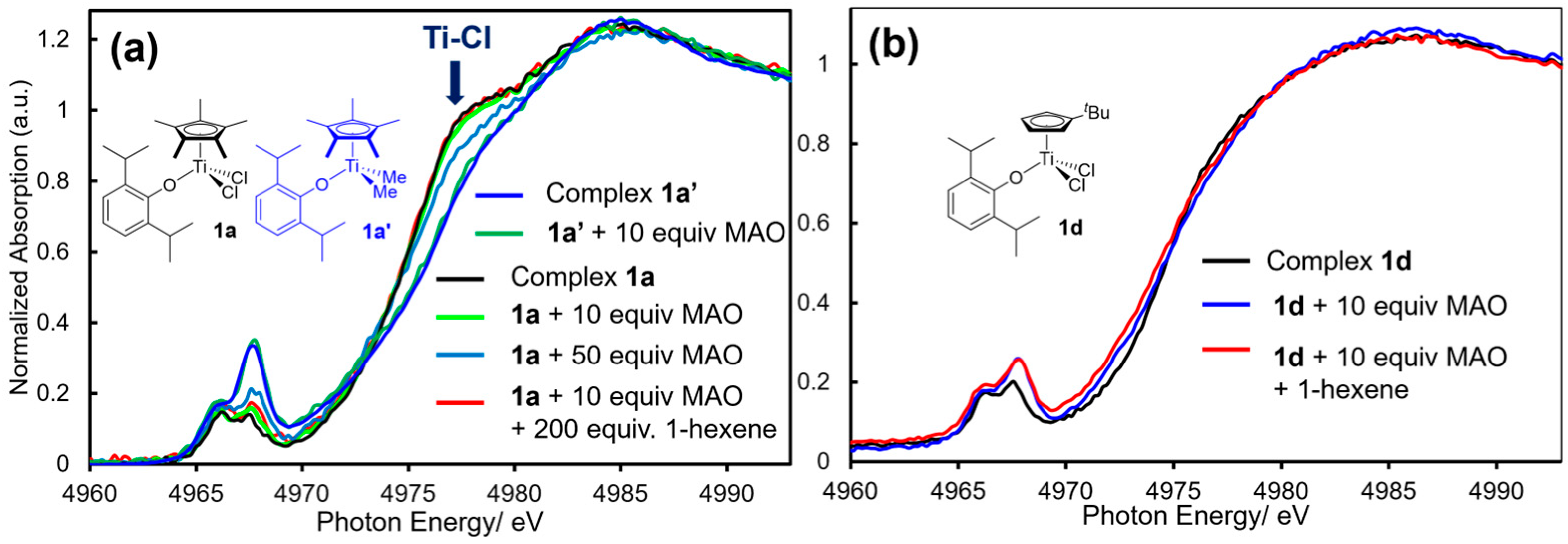
Figure 3a shows the XANES spectra for the phenoxide-modified half-titanocene dichloride (1a) and dimethyl complexes (1a’), and the catalyst solution in the presence of MAO and 1-hexene, exhibiting catalytic activities for 1-hexene polymerisation in situ [27,76]. These complexes (1a,1a’) exhibit high catalytic activities for ethylene polymerization [14,15,16,17,42,43,44], α-olefin polymerization [182], and ethylene copolymerization with various monomers (as described above) [14,15,16,17,42,43,44].
As shown in Figure 3a, the pre-edge peak positions and edge absorption of 1a [4966.2 and 4967.6 eV (pre-edge), 4978.0 eV (shoulder-edge)] did not change upon addition of MAO, whereas intensity in the shoulder edge absorption in 1a, ascribed to Ti–Cl bond, decreased upon addition of MAO (especially 50 equiv) [76]. No apparent changes in the spectra were observed even upon addition of excess 1-hexene (200 equiv). Moreover, the spectra did not change when the dimethyl complex (1a’) was added with MAO (10 equiv). These results strongly suggest that the oxidation state as well as basic geometry around titanium is preserved under these conditions, even in the addition of MAO and 1-hexene (excess amounts). Similarly, as shown in Figure 3b, no significant differences in the XANES spectra were seen when the 1d was treated with d-MAO and 1-hexene [76]. These results also suggest the same possibility that major species formed as Ti(IV) species upon addition of MAO.
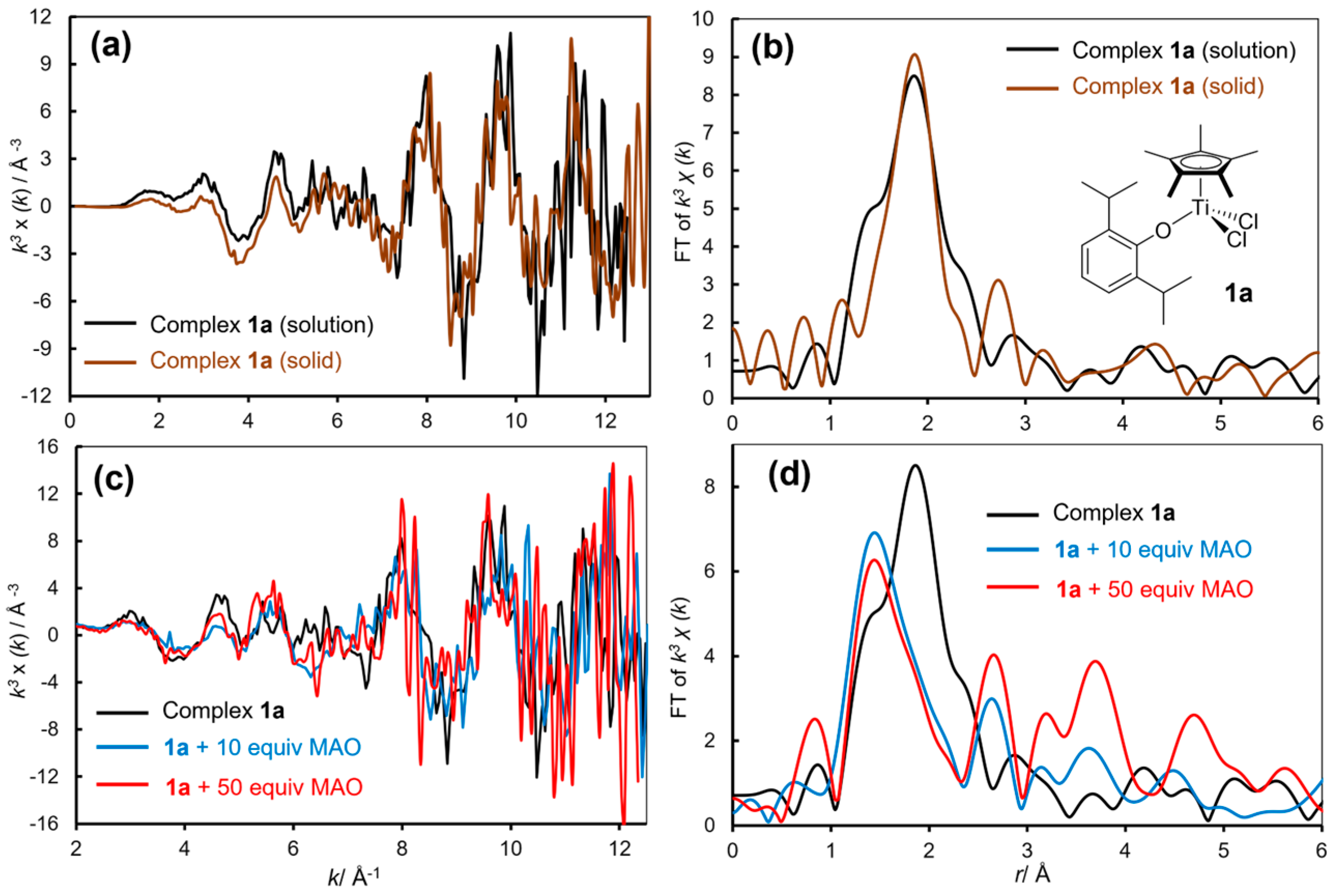
Although no significant changes in the XANES spectra were observed, the corresponding EXAFS spectra, shown in Figure 4 [oscillations (left) and the FT-EXAFS spectra (right)], provide a clearer image of the information in the reactions. The XANES spectra for Cp*TiCl2(OAr) (1a) and the catalyst solution in the presence of MAO (10 and 50 equiv) showed no distinct spectral changes in toluene solution and in solid state (in solid, disc with boron nitride) measured at 25 °C (Figure 4a,b). The summary of coordination number (C.N., number of prescribed atom, such as O, C and Cl, coordinated to metal) and the distance (Å) in the atoms connected to titanium analyzed through the curve fitting are summarized in Table 5 [76].
The Ti–C (on Cp’ coordinated) and Ti–O (phenoxide) bonds were preserved even after treating 1a with MAO (10 and 50 equiv). In contrast, C.N. of Ti–Cl decreased by treating with MAO (Figure 4d, Table 5), clearly indicating that the Ti–Cl bonds were reacted (dissociated) with MAO (alkylation). Since separation of Ti–C and Ti–O bonds seemed difficult (distances are close) in the analysis, the observed increase in the C.N. of Ti–O bond upon addition of MAO could be explained as due to a subsequent formation of Ti–C bond [76]. These data also suggest that the Ti–Cl bonds in 1a were reacted with MAO without dissociation of the Ti–O bond to form dimethyl complexes; the data support that the Ti(IV)-alkyl species play a role in this catalysis [14,15,16,17,76].
As described above, the oxidation state of the active species in the SSP has been proposed as cationic or neutral Ti(III) species, Cp’Ti+(R)(styrene) [177,178,179] or Cp’Ti(R)(Y)(styrene) [56,57,180,181] (Scheme 10). The cationic Ti(III) species were proposed based on the results in ESR measurement [177], reaction chemistry (formation of SPS) [179], and theoretical support [178]. The neutral Ti(III) species were proposed based on the results of (i) polymerization data (ligand effect, anionic donor) [56,57], (ii) step (co)polymerization [181], and (iii) theoretical support [180]. However, until recently, there was no “direct evidence” from the catalyst solution containing MAO and styrene [27,76,183].
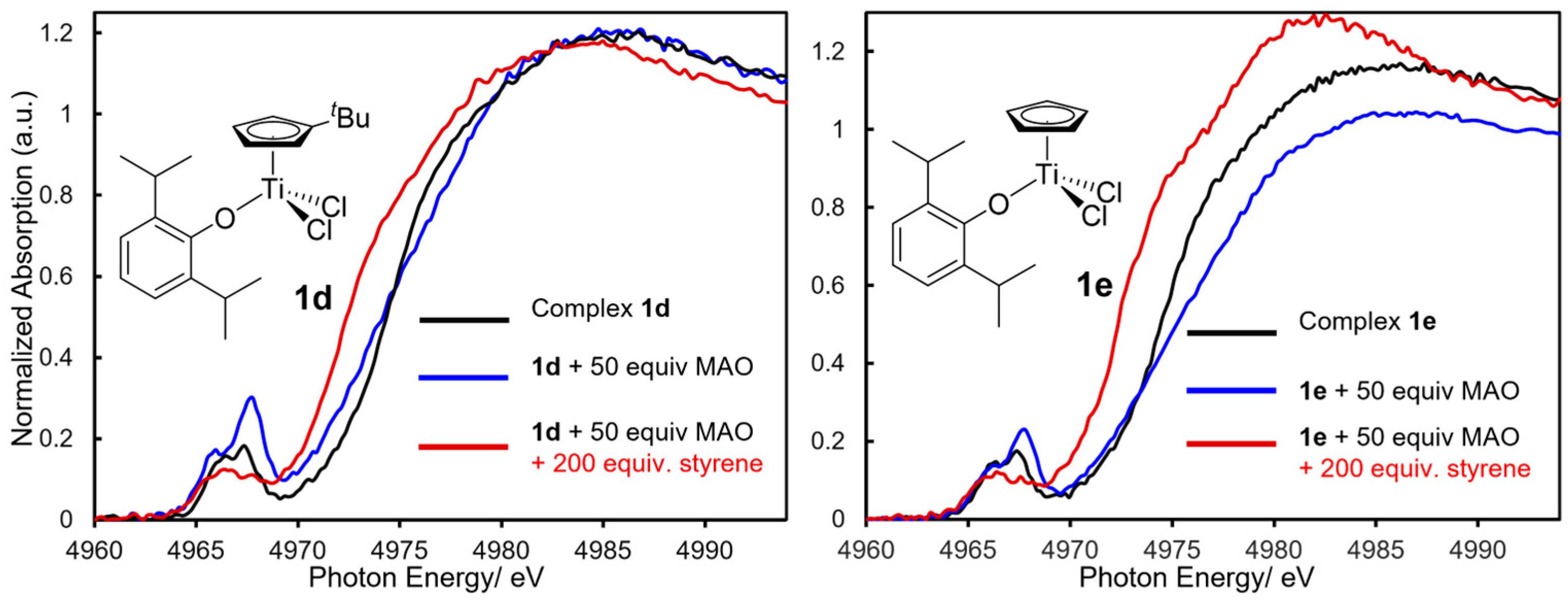
Figure 5 shows Ti K-edge XANES spectra (in toluene at 25 °C) for Cp’TiCl2(OAr) [Cp’ = tBuC5H4 (1d, left), Cp (1e, right)], and the spectra of solutions containing 1d or 1e and MAO (50 equiv), styrene (200 equv), which produce SPS in situ. The XANES spectrum of 1d shows pre-edge absorptions (4966.5, 4967.5 eV) and a shoulder-edge absorption (4977.9 eV, presence of Ti–Cl bond) [27,170,171,172,173]. Addition of MAO (50 equiv) did not lead to significant spectral changes, except a decrease in the intensity of the shoulder-edge absorption in 1d which was observed, suggesting dissociation of Ti–Cl bond by alkylation [76].
In contrast, noteworthy, styrene addition (200 equiv) into the solution (1d and MAO 50 equiv) led to the clear low energy shift (2.2 eV on the basis of the inflection point) in the edge absorption accompanied with decrease in intensities of two pre-edge peaks. The results thus strongly suggest that complex 1d was reduced by addition of styrene (not by MAO). Moreover, the low energy shift in the edge absorption was observed upon increase in the amount of styrene charged (100→200 equiv) [76]. Moreover, as shown in Figure 5 (right), the solution containing 1e showed the similar change when 200 equiv of styrene and 50 equiv of MAO were added into a toluene solution, which also produced SPS in situ [57]. These analysis data strongly suggest a formation of Ti(III) species from Ti(IV), derived from 1d, accompanied with the structural changes upon addition of styrene.
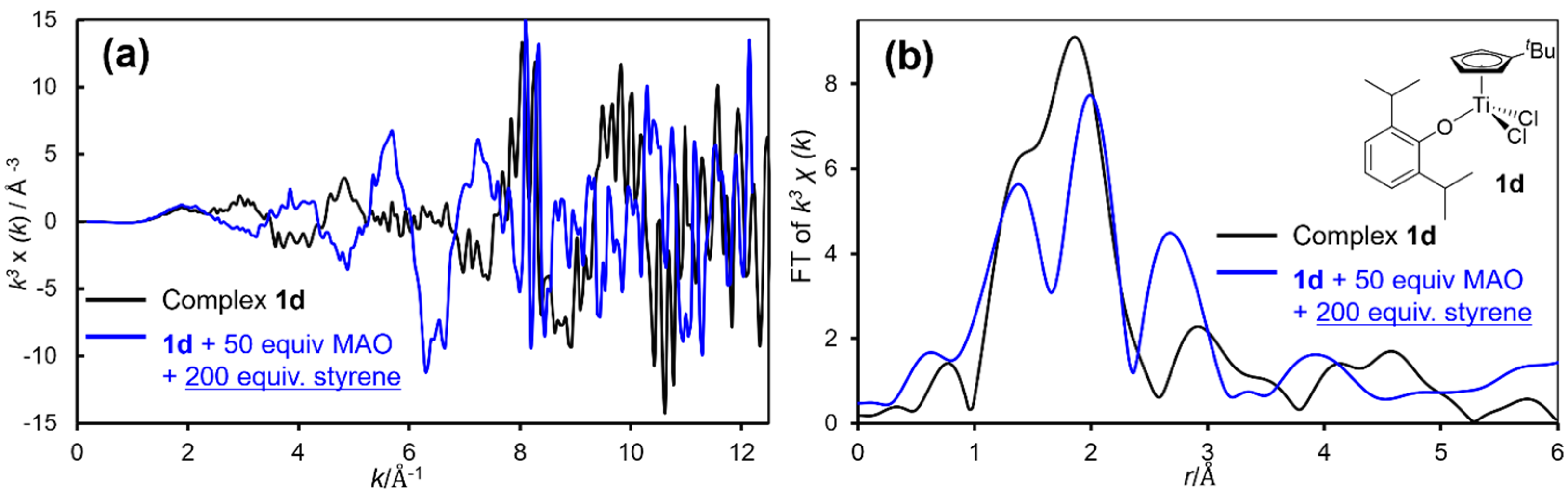
Figure 6 shows EXAFS oscillations and the FT-EXAFS spectra (in toluene at 25 °C) for (tBuC5H4)TiCl2(OAr) (1d), and the solution with addition of 50 equiv of MAO and excess (200 equiv) styrene; as shown in Figure 5 (XANES spectra), the solution showed a significant changes in the oxidation state upon addition of styrene. The analysis data by curve fitting are summarized in Table 6 [76].
Apparent change in the EXAFS oscillations from a toluene solution of 1d to the solution with addition of MAO and styrene strongly suggest certain structural change (accompanied with change in the oxidation state). As observed by 1a, C.N. of Ti–Cl diminished along with observation of new Ti–C bond which is formed by methylation with MAO, whereas C.N. and bond lengths in Ti–C bonds corresponding to Cp’ were unchanged before/after the reaction. Importantly, the Ti–O bond (corresponding to phenoxide ligand) remained even after reaction of 1d with MAO and styrene (200 equiv). The analysis data clearly demonstrate formation of the catalytically active species for SSP bearing Ti–O bond accompanied with reduction, strongly suggesting generating the phenoxide species (tBuC5H4)Ti(R)(OAr) [or CpTi(R)(OAr)] in the solution [27,76]. The result is a good agreement with our previous assumption on the basis of two-step ethylene/styrene (co)polymerization (Scheme 11) [181] as well as the effect of anionic donor ligand in SSP [57] that the neutral Ti(III) species containing phenoxide ligand thus plays a role for the SSP [181].
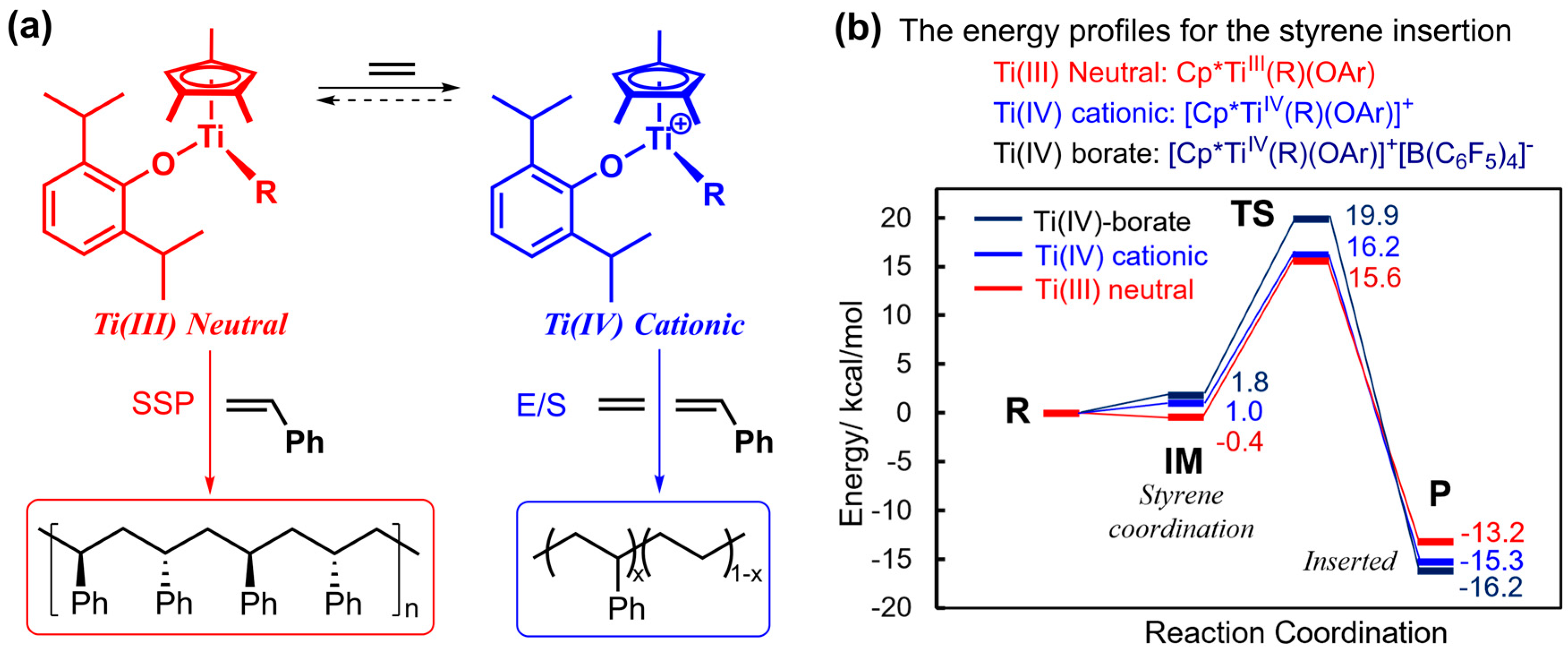
Moreover, the proposed catalytically active species based on XAS analysis as well as step ethylene/styrene (co)polymerization (Scheme 11a) was further supported by theoretical calculation [27,76,183]. DFT calculation was conducted for syndiospecific styrene insertion step of the three possible models of the active species containing the phenoxide ligand, neutral Ti(III), cationic Ti(IV), and Ti(IV)–B(C6F5)4 catalysts (shown in Scheme 11b). The calculation was conducted from the Ti catalysts containing the phenylpropyl group, as a model of polystyrene in chain-propagation step (R; styrene + Ti, zero), and the styrene coordinated models (IM), and inserted model (P) in which styrene was inserted to the phenylpropyl moiety [76]. As shown in Scheme 11b, the results clearly indicate that the neutral Ti(III) catalyst exhibits the lower activation energy than the others, thus strongly supporting the above mechanism. The computational analysis also led to a conclusion that the neutral Ti(III) species containing the phenoxide ligand is a more efficient and plausible catalyst model; formation of the Ti(III) species, proposed in Scheme 11, is a key to promoting the SSP in an efficient manner [76]. Further DFT calculation results revealed that the neutral Ti(III) active species has high selectivity in SSP; the orientation of styrene (si-/h-/re-) insertions is related to the stereoselectivity of polystyrene. The spin density analysis indicated the neutral Ti(III) centre promotes an electron transfer from the polymeric chain to the incoming styrene [183].

6. Concluding Remarks and Outlook

Olefin polymerization by group 4 transition metal catalysts has been the key technology for production of polyolefins, commodity plastics in our daily life. Development of new polymers that cannot be achieved by using conventional catalysts has been the central research objective and copolymerization is an effective strategy. In this reviewing article, modified half-titanocenes, Cp’TiX2(Y) (Y = anionic donor such as phenoxide, ketimide, amidinate, etc.) [6,14,15,16,17], contributed a significant effort for efficient, exclusive synthesis of ethylene copolymers containing cyclic olefins (COCs) [60,61,62,63,64,65,66,67,68], biobased conjugated dienes [69,70], disubstituted α-olefins [44,71,72,73,74],aromatic vinyl monomers [34,41,56,58,59], ethylene/α-olefin copolymers containing hydroxy group [44], etc. More recently, we realized that the catalysts containing unsymmetric iminoimidazolide ligands exhibited promising capabilities for synthesis of COCs [184]. Moreover, modification of phenoxide para-position enhanced the activity in ethylene polymerization and the copolymerization with α-olefin [45]. It is thus clear that, as introduced herein, the catalysts of this type are highly suited to synthesis of new copolymers with monomers that cannot be incorporated by the conventional catalysts such as metallocene, linked half-titanocenes (called constrained geometry type). These results thus strongly suggest that the catalysts of this type will continue to contribute to the development of new polyolefins.
Moreover, this manuscript introduces an analysis of catalytically active species through XAS (X-ray absorption spectroscopy). The XAS analysis provides information on the oxidation state, basic geometry around the cantered metal, ligand coordinated and their distances (electronic natures) in solution. However, as described previously [27], combined results on spectroscopic analysis (solution XAS, NMR, ESR, and crystallographic), reaction chemistry, and computational analysis should provide a clear image of the catalysis mechanism including the nature of the catalytically active species. We highly hope that the analysis method can be used for more research in the near future for better understanding of the catalysis cycle.

Author Contributions

Conceptualization, supervision, project administration, funding acquisition, data curation, K.N.; writing—original draft preparation, visualization, K.N. and K.J.; writing—review and editing, K.N. All authors have read and agreed to the published version of the manuscript.

Funding

The projects by KN were partly supported by Grant-in-Aid for Scientific Research from the Japan Society for the Promotion of Science (JSPS, Nos. 13555253, 18350055, 21350054, 24350049, 15H03812, 15K14225, 18H01982, 18K18981, 19KK0139, 21H01942, 25K01583), Grant-in-Aid for Scientific Research on Innovative Areas (No. 26105003, “3D Active-Site Science”) from The Ministry of Education, Culture, Sports, Science and Technology (MEXT), Japan. The synchrotron XAFS analysis was performed at the SPring-8 beam lines of BL01B1 with the approval of Japan Synchrotron Radiation Research Institute (JASRI, 2017A1512, 2018A1245, 2019A1233, 2020A0618, 2021A1435, 2021B1594, 2022A1276, 2022B1669, 2023A1765).

Data Availability Statement

Data on studies by authors are available from the corresponding author upon reasonable requests.

Acknowledgments

KN thanks to S. Kikkawa and S. Yamazoe (Tokyo Metropolitan University, TMU) for big support in XAS analysis, and N. Nakatani (TMU) for support in computational analysis. KJ expresses Tokyo Metropolitan government (Tokyo Global Partner Scholarship Program) for pre-doctoral fellowship.

Conflicts of Interest

The authors declare no conflicts of interest.

References

  1. Plastics Europe. Plastics the Fast Facts 2025. Available online: https://plasticseurope.org/knowledge-hub/plastics-the-fast-facts-2025/ (accessed on 16 February 2026).
  2. Baier, M.C.; Zuideveld, M.A.; Mecking, S. Post-metallocenes in the industrial production of polyolefins. Angew. Chem. Int. Ed. 2014, 53, 9722–9744. [Google Scholar] [CrossRef] [PubMed]
  3. Stürzel, M.; Mihan, S.; Mülhaupt, R. From multisite polymerization catalysis to sustainable materials and all-polyolefin composites. Chem. Rev. 2016, 116, 1398–1433. [Google Scholar] [CrossRef]
  4. van Doremaele, G.; van Duin, M.; Valla, M.; Berthoud, A. On the development of titanium κ1-amidinate complexes, commercialized as keltan ACETM technology, enabling the production of an unprecedented large variety of EPDM polymer structures. J. Polym. Sci. Part A Polym. Chem. 2017, 55, 2877–2891. [Google Scholar] [CrossRef]
  5. Hoff, R. (Ed.) Handbook of Transition Metal Polymerization Catalysts, 2nd ed.; John Wiley & Sons, Inc.: Hoboken, NJ, USA, 2018. [Google Scholar] [CrossRef]
  6. Nomura, K.; Kitphaitun, S. Catalysis for a Sustainable Environment: Reactions, Processes and Applied Technologies; Pombeiro, A.J.L., Sutradhar, M., Alegria, E.C.B.A., Eds.; John Wiley & Sons, Ltd.: Chichester, UK, 2024; pp. 323–338. [Google Scholar] [CrossRef]
  7. Tan, C.; Zhou, C.; Chen, C. Material properties of functional polyethylenes from transition-metal-catalyzed ethylene–polar monomer copolymerization. Macromolecules 2022, 55, 1910–1922. [Google Scholar] [CrossRef]
  8. Chen, C. Designing catalysts for olefin polymerization and copolymerization: Beyond electronic and steric tuning. Nat. Rev. Chem. 2018, 2, 6–14. [Google Scholar] [CrossRef]
  9. Brintzinger, H.H.; Fischer, D.; Mülhaupt, R.; Rieger, B.; Waymouth, R.M. Stereospecific olefin polymerization with chiral metallocene catalysts. Angew. Chem. Int. Ed. Engl. 1995, 34, 1143–1170. [Google Scholar] [CrossRef]
  10. Kaminsky, W. New polymers by metallocene catalysis. Macromol. Chem. Phys. 1996, 197, 3907–3945. [Google Scholar] [CrossRef]
  11. Kaminsky, W.; Arndt, M. Metallocenes for polymer catalysis. Adv. Polym. Sci. 1997, 127, 143–187. [Google Scholar] [CrossRef]
  12. Suhm, J.; Heinemann, J.; Wörner, C.; Müller, P.; Stricker, F.; Kressler, J.; Okuda, J.; Mülhaupt, R. Novel polyolefin materials via catalysis and reactive processing. Macromol. Symp. 1998, 129, 1–28. [Google Scholar] [CrossRef]
  13. McKnight, A.L.; Waymouth, R.M. Group 4 ansa-cyclopentadienyl-amido catalysts for olefin polymerization. Chem. Rev. 1998, 98, 2587–2598. [Google Scholar] [CrossRef] [PubMed]
  14. Nomura, K.; Liu, J.; Padmanabhan, S.; Kitiyanan, B. Nonbridged half-metallocenes containing anionic ancillary donor ligands: New promising candidates as catalysts for precise olefin polymerization. J. Mol. Catal. A Chem. 2007, 267, 1–29. [Google Scholar] [CrossRef]
  15. Nomura, K. Half-titanocenes containing anionic ancillary donor ligands as promising new catalysts for precise olefin polymerization. Dalton Trans. 2009, 8811–8823. [Google Scholar] [CrossRef]
  16. Nomura, K.; Liu, J. Half-titanocenes for precise olefinpolymerisation: Effects of ligand substituents and some mechanistic aspects. Dalton Trans. 2011, 40, 7666–7682. [Google Scholar] [CrossRef] [PubMed]
  17. Nomura, K.; Liu, J. Organometallic Reactions and Polymerisation; Osakada, K., Ed.; The Lecture Notes in Chemistry; Springer: Berlin, Germany, 2014; Volume 85, pp. 51–88. [Google Scholar]
  18. Britovsek, G.J.P.; Gibson, V.C.; Wass, D.F. The search for new-generation olefin polymerization catalysts: Life beyond metallocenes. Angew. Chem. Int. Ed. Engl. 1999, 38, 428–447. [Google Scholar] [CrossRef]
  19. Gibson, V.C.; Spitzmesser, S.K. Advances in non-metallocene olefin polymerization catalysis. Chem. Rev. 2003, 103, 283–316. [Google Scholar] [CrossRef]
  20. Coates, G.W.; Hustad, P.D.; Reinartz, S. Catalysts for the living insertion polymerization of alkenes: Access to new polyolefin architectures using Ziegler-Natta chemistry. Angew. Chem. Int. Ed. 2002, 41, 2236–2257. [Google Scholar] [CrossRef]
  21. Delferro, M.; Marks, T.J. Multinuclear olefin polymerization catalysts. Chem. Rev. 2011, 111, 2450–2485. [Google Scholar] [CrossRef]
  22. McInnis, J.P.; Delferro, M.; Marks, T.J. Multinuclear group 4 catalysis: Olefin polymerization pathways modified by strong metal–metal cooperative effects. Acc. Chem. Res. 2014, 47, 2545–2557. [Google Scholar] [CrossRef]
  23. Valente, A.; Mortreux, A.; Visseaux, M.; Zinck, P. Coordinative chain transfer polymerization. Chem. Rev. 2013, 113, 3836–3857. [Google Scholar] [CrossRef]
  24. Macchioni, A. Ion pairing in transition-metal organometallic chemistry. Chem. Rev. 2005, 105, 2039–2074. [Google Scholar] [CrossRef]
  25. Bochmann, M. The chemistry of catalyst activation: The case of group 4 polymerization catalysts. Organometallics 2010, 29, 4711–4740. [Google Scholar] [CrossRef]
  26. Kaminsky, W. Discovery of methylaluminoxane as cocatalyst for olefin polymerization. Macromolecules 2012, 45, 3289–3297. [Google Scholar] [CrossRef]
  27. Yi, J.; Nakatani, N.; Nomura, K. Solution XANES and EXAFS analysis of active species of titanium, vanadium complex catalysts in ethylene polymerisation/dimerisation and syndiospecific styrene polymerization. Dalton Trans. 2020, 49, 8008–8028. [Google Scholar] [CrossRef]
  28. Suhm, J.; Schneider, M.J.; Mülhaupt, R. Influence of metallocene structures on ethene copolymerization with 1-butene and 1-octene. J. Mol. Catal. A Chem. 1998, 128, 215–227. [Google Scholar] [CrossRef]
  29. Suhm, J.; Schneider, M.J.; Mülhaupt, R. Temperature dependence of copolymerization parameters in ethene/1-octene copolymerization using homogeneous rac-Me2Si(2-MeBenz[e]Ind)2ZrCl2/MAO catalyst. J. Polym. Sci. A 1997, 35, 735–740. [Google Scholar] [CrossRef]
  30. Canich, J.A.M.; Hlatky, G.G.; Turner, H.W. Optical System for Collecting Distance Information Within a Field. U.S. Patent 5,422,236, 5 June 2018. [Google Scholar]
  31. Canich, J.A.M. Process for Preparing Supported Metallocene Catalyst Systems. U.S. Patent 5,026,798, 25 June 1991. [Google Scholar]
  32. Stevens, J.C.; Timmers, F.J.; Wilson, D.R.; Schmidt, G.F.; Nickias, P.N.; Rosen, R.K.; Knight, G.W.; Lai, S.-Y. Constrained Geometry Addition Polymerization Catalysts, Processes for Their Preparation, Precursors Therefor, Methods of Use, and Novel Polymers Formed Therewith. European Patent Applications EP 416,815 A2, 13 August 1997. [Google Scholar]
  33. Stevens, J.C.; Neithamer, D.R. Process for the Preparation of Supported Transition Metal Catalyst Components. European Patent Applications EP 418,022 A2, 22 March 1995. [Google Scholar]
  34. Nomura, K. Syndiotactic Polystyrene: Synthesis, Characterization, Processing, and Applications; Schellenberg, J., Ed.; John Wiley & Sons, Inc.: Hoboken, NJ, USA, 2010; pp. 60–91. [Google Scholar]
  35. Arriola, D.J.; Bokota, M.; Campbell, R.E., Jr.; Klosin, J.; LaPointe, R.E.; Redwine, O.D.; Shankar, R.B.; Timmers, F.J.; Abboud, K.A. Penultimate effect in ethylene−styrene copolymerization and the discovery of highly active ethylene−styrene catalysts with increased styrene reactivity. J. Am. Chem. Soc. 2007, 129, 7065–7076. [Google Scholar] [CrossRef]
  36. Guo, N.; Li, L.; Marks, T.J. Bimetallic catalysis for styrene homopolymerization and ethylene−styrene copolymerization: Exceptional comonomer selectivity and insertion regiochemistry. J. Am. Chem. Soc. 2004, 126, 6542–6543. [Google Scholar] [CrossRef]
  37. Guo, N.; Stern, C.L.; Marks, T.J. Bimetallic effects in homopolymerization of styrene and copolymerization of ethylene and styrenic comonomers:  Scope, kinetics, and mechanism. J. Am. Chem. Soc. 2008, 130, 2246–2261. [Google Scholar] [CrossRef] [PubMed]
  38. Tomotsu, N.; Ishihara, N. Novel catalysts for syndiospecific polymerization of styrene. Catal. Surv. Jpn. 1997, 1, 89–110. [Google Scholar] [CrossRef]
  39. Tomotsu, N.; Ishihara, N.; Newman, T.H.; Malanga, M.T. Syndiospecific polymerization of styrene. J. Mol. Catal. A 1998, 128, 167–190. [Google Scholar] [CrossRef]
  40. Schellenberg, J. Recent transition metal catalysts for syndiotactic polystyrene. Prog. Polym. Sci. 2009, 34, 688–718. [Google Scholar] [CrossRef]
  41. Zhang, H.; Nomura, K. Living copolymerization of ethylene with styrene catalyzed by (cyclopentadienyl)(ketimide)titanium(IV) complex−MAO catalyst system:  Effect of anionic ancillary donor ligand. Macromolecules 2006, 39, 5266–5274. [Google Scholar] [CrossRef]
  42. Nomura, K.; Naga, N.; Miki, M.; Yanagi, K.; Imai, A. Synthesis of various non-bridged Cp-aryloxy titanium(IV) complexes of the type CpTi(OAr)X2, and the catalytic alkene polymerization: Important role of substituents on both aryloxy and cyclopentadienyl groups. Organometallics 1998, 17, 2152–2154. [Google Scholar] [CrossRef]
  43. Nomura, K.; Naga, N.; Miki, M.; Yanagi, K. Olefin polymerization by (cyclopentadienyl)(aryloxy)titanium(IV) complexes–cocatalyst system. Macromolecules 1998, 31, 7588–7597. [Google Scholar] [CrossRef]
  44. Kitphaitun, S.; Yan, Q.; Nomura, K. Effect of SiMe3, SiEt3 para-substituents for exhibiting high activity, introduction of hydroxy group in ethylene copolymerization catalyzed by phenoxide-modified half-titanocenes. Angew. Chem. Int. Ed. 2020, 59, 23072–23076. [Google Scholar] [CrossRef] [PubMed]
  45. Gao, J.; Sun, W.-H.; Nomura, K. Synthesis of new phenoxide modified half-titanocene catalysts for ethylene polymerization. Catalysts 2025, 15, 840. [Google Scholar] [CrossRef]
  46. Zhang, S.; Piers, W.E.; Gao, X.; Parvez, M. The mechanism of methane elimination in B(C6F5)3-initiated monocyclopentadienyl-ketimide titanium and related olefin polymerization catalysts. J. Am. Chem. Soc. 2000, 122, 5499–5509. [Google Scholar] [CrossRef]
  47. McMeeking, J.; Gao, X.; Spence, R.E.v.H.; Brown, S.J.; Jerermic, D. Supported Catalyst System for Olefin Polymerization. U.S. Patent 6,114,481, 5 September 2000. [Google Scholar]
  48. Nomura, K.; Fujita, K.; Fujiki, M. Effects of cyclopentadienyl fragment in ethylene, 1-hexene, and styrene polymerizations catalyzed by half-titanocenes containing ketimide ligand of the type, Cp′TiCl2(NCtBu2). Catal. Commun. 2004, 5, 413–417. [Google Scholar] [CrossRef]
  49. Nomura, K.; Fujita, K.; Fujiki, M. Olefin polymerization by (cyclopentadienyl)(ketimide)titanium(IV) complexes of the type, Cp′TiCl2(NCtBu2)-methylaluminoxane (MAO) catalyst systems. J. Mol. Catal. A 2004, 220, 133–144. [Google Scholar] [CrossRef]
  50. Dias, A.R.; Duarte, M.T.; Fernandes, A.C.; Fernandes, S.; Marques, M.M.; Martins, A.M.; da Silva, J.F.; Rodrigues, S.S. Titanium ketimide complexes as α-olefin homo- and copolymerisation catalysts: X-ray diffraction structures of [TiCp(NCtBu2)Cl2] (Cp=Ind, Cp*). J. Organomet. Chem. 2004, 689, 203–213. [Google Scholar] [CrossRef]
  51. Martins, A.M.; Marques, M.M.; Ascenso, J.R.; Dias, A.R.; Duarte, M.T.; Fernandes, A.C.; Fernandes, S.; Ferreira, M.J.; Matos, I.; Oliveira, M.C.; et al. Titanium and zirconium ketimide complexes: Synthesis and ethylene polymerisation catalysis. Organomet. Chem. 2005, 690, 874–884. [Google Scholar] [CrossRef]
  52. Ferreira, M.J.; Martins, A.M. Group 4 ketimide complexes: Synthesis, reactivity and catalytic applications. Coord. Chem. Rev. 2006, 250, 118–132. [Google Scholar] [CrossRef]
  53. Ijpeij, E.G.; Zuideveld, M.A.; Arts, H.J.; van der Burgt, F.; van Doremaele, G.H.J. Process for the Preparation of a Metal-Organic Compound Comprising a Spectator Ligand. WO Patent 2007,031,295, 22 March 2007. [Google Scholar]
  54. Ijpeij, E.G.; Windmuller, P.J.H.; Arts, H.J.; van der Burgt, F.; van Doremaele, G.H.J.; Zuideveld, M.A. Polymerization Catalysts Comprising Amidine Ligands. WO Patent 2005,090,418, 29 September 2005. [Google Scholar]
  55. Ijpeij, E.G.; Coussens, B.; Zuideveld, M.A.; van Doremaele, G.H.J.; Mountford, P.; Lutzc, M.; Spek, A.L. Synthesis, solid state and DFT structure and olefin polymerization capability of a unique base-free dimeric methyl titanium dication. Chem. Commun. 2010, 46, 3339–3341. [Google Scholar] [CrossRef]
  56. Nomura, K.; Komatsu, T.; Imanishi, Y. Syndiospecific styrene polymerization and efficient ethylene/styrene copolymerization catalyzed by (cyclopentadienyl)(aryloxy)titanium(IV) complexes−MAO system. Macromolecules 2000, 33, 8122–8124. [Google Scholar] [CrossRef]
  57. Byun, D.J.; Fudo, A.; Tanaka, A.; Fujiki, M.; Nomura, K. Effect of cyclopentadienyl and anionic ancillary ligand in syndiospecific styrene polymerization catalyzed by nonbridged half-titanocenes containing aryloxo, amide, and anilide ligands:  Cocatalyst systems. Macromolecules 2004, 37, 5520−5530. [Google Scholar] [CrossRef]
  58. Nomura, K.; Okumura, H.; Komatsu, T.; Naga, N. Ethylene/styrene copolymerization by various (cyclopentadienyl)(aryloxy)titanium(IV) complexes−MAO catalyst systems. Macromolecules 2002, 35, 5388−5395. [Google Scholar] [CrossRef]
  59. Aoki, H.; Nomura, K. Synthesis of amorphous ethylene copolymers with 2-vinylnaphthalene, 4-vinylbiphenyl and 1-(4-vinylphenyl)naphthalene. Macromolecules 2021, 54, 83−93. [Google Scholar] [CrossRef]
  60. Nomura, K.; Tsubota, M.; Fujiki, M. Efficient ethylene/norbornene copolymerization by (Aryloxo)(indenyl)titanium(IV) complexes−MAO catalyst system. Macromolecules 2003, 36, 3797–3799. [Google Scholar] [CrossRef]
  61. Nomura, K.; Wang, W.; Fujiki, M.; Liu, J. Notable norbornene (NBE) incorporation in ethylene–NBE copolymerization catalysed by nonbridged half-titanocenes: Better correlation between NBE incorporation and coordination energy. Chem. Commun. 2006, 2659–2661. [Google Scholar] [CrossRef] [PubMed]
  62. Apisuk, W.; Trambitas, A.G.; Kitiyanan, B.; Tamm, M.; Nomura, K. Efficient ethylene/norbornene copolymerization by half-titanocenes containing imidazolin-2-iminato ligands and MAO catalyst systems. J. Polym. Sci. Part A Polym. Chem. 2013, 51, 2575–2580. [Google Scholar] [CrossRef]
  63. Kawatsu, M.; Fujioka, T.; Losio, S.; Tritto, I.; Nomura, K. (Trialkylsilyl-cyclopentadienyl)titanium(IV) dichloride complexes containing ketimide ligands, Cp′TiCl2(N=CtBu2) (Cp′ = Me3SiC5H4, Et3SiC5H4), as efficient catalysts for ethylene copolymerisation with norbornene and tetracyclododecene. Catal. Sci. Technol. 2024, 15, 2757–2765. [Google Scholar] [CrossRef]
  64. Apisuk, W.; Ito, H.; Nomura, K. Efficient synthesis of cyclic olefin copolymers with high glass transition temperatures by ethylene copolymerization with tetracyclododecene using (tert-BuC5H4)TiCl2(N=CtBu2)–MAO Catalyst. J. Polym. Sci. Part A Polym. Chem. 2016, 54, 2662–2667. [Google Scholar] [CrossRef]
  65. Zhao, W.; Nomura, K. Copolymerizations of norbornene and tetracyclododecene with α-olefins by half-titanocene catalysts: Efficient synthesis of highly transparent, thermal resistance polymers. Macromolecules 2016, 49, 59–70. [Google Scholar] [CrossRef]
  66. Okabe, M.; Nomura, K. Propylene/cyclic olefin copolymers with cyclopentene, cyclohexene, cyclooctene, tricyclo [6.2.1.0(2,7)]undeca-4-ene, and tetracyclododecene: The synthesis and effect of cyclic structure on thermal properties. Macromolecules 2023, 56, 81–91. [Google Scholar] [CrossRef]
  67. Harakawa, H.; Okabe, M.; Nomura, K. The synthesis of cyclic olefin copolymers (COCs) by ethylene copolymerisations with cyclooctene, cycloheptene, and with tricyclo [6.2.1.0(2,7)]undeca-4-ene: The effect of cyclic monomer structures on thermal properties. Polym. Chem. 2020, 11, 5590–5600. [Google Scholar] [CrossRef]
  68. Wang, W.; Fujiki, M.; Nomura, K. Copolymerization of ethylene with cyclohexene (CHE) catalyzed by nonbridged half-titanocenes containing aryloxo ligand:  Notable effect of both cyclopentadienyl and anionic donor ligand for efficient CHE incorporation. J. Am. Chem. Soc. 2005, 127, 4582–4583. [Google Scholar] [CrossRef] [PubMed]
  69. Kitphaitun, S.; Chaimongkolkunasin, S.; Manit, J.; Makino, R.; Kadota, J.; Hirano, H.; Nomura, K. Ethylene/myrcene copolymers as new bio-based elastomers prepared by coordination polymerization using titanium catalysts. Macromolecules 2021, 54, 10049–10058. [Google Scholar] [CrossRef]
  70. Guo, L.; Makino, R.; Shimoyama, D.; Kadota, J.; Hirano, H.; Nomura, K. Synthesis of ethylene/isoprene copolymers containing cyclopentane/cyclohexane units as unique elastomers by half-titanocene catalysts. Macromolecules 2023, 56, 899–914. [Google Scholar] [CrossRef]
  71. Nomura, K.; Itagaki, K.; Fujiki, M. Efficient incorporation of 2-methyl-1-pentene in copolymerization of ethylene with 2-methyl-1-pentene catalyzed by nonbridged half-titanocenes. Macromolecules 2005, 38, 2053–2055. [Google Scholar] [CrossRef]
  72. Nomura, K.; Itagaki, K. Efficient incorporation of vinylcylohexane in ethylene/vinylcyclohexane copolymerization catalyzed by nonbridged half-titanocenes. Macromolecules 2005, 38, 8121–8123. [Google Scholar] [CrossRef]
  73. Itagaki, K.; Fujiki, M.; Nomura, K. Effect of cyclopentadienyl and anionic donor ligands on monomer reactivities in copolymerization of ethylene with 2-methyl-1-pentene by nonbridged half-titanocenes−cocatalyst systems. Macromolecules 2007, 40, 6489–6499. [Google Scholar] [CrossRef]
  74. Khan, F.Z.; Kakinuki, K.; Nomura, K. Copolymerization of ethylene with tert-butylethylene using nonbridged half-titanocene-cocatalyst systems. Macromolecules 2009, 42, 3767–3773. [Google Scholar] [CrossRef]
  75. Kitphaitun, S.; Fujimoto, T.; Ochi, Y.; Nomura, K. Effect of borate cocatalysts toward activity and comonomer incorporation in ethylene copolymerization by half-titanocene catalysts in methylcyclohexane. ACS Org. Inorg. Au 2022, 2, 386–391. [Google Scholar] [CrossRef]
  76. Nomura, K.; Izawa, I.; Yi, J.; Nakatani, N.; Aoki, H.; Ina, T.; Mitsudome, T.; Tomotsu, N.; Yamazoe, S. Solution XAS analysis for exploring active species in syndiospecific styrene polymerization and 1-hexene polymerization using half-titanocene–MAO catalysts: Significant changes in the oxidation state in the presence of styrene. Organometallics 2019, 38, 4497–4507. [Google Scholar] [CrossRef]
  77. Sun, Z.; Unruean, P.; Aoki, H.; Kitiyanan, B.; Nomura, K. Phenoxide-modified half-titanocenes supported on star-shaped ROMP polymers as efficient catalyst precursors for ethylene copolymerization. Organometallics 2020, 39, 2998–3009. [Google Scholar] [CrossRef]
  78. Cherdron, H.; Brekner, M.-J.; Osan, F. Cycloolefin-copolymere: Eine neue klasse transparenter thermoplaste. Angew. Makromol. Chem. 1994, 223, 121–133. [Google Scholar] [CrossRef]
  79. Tritto, I.; Boggioni, L.; Ferro, D.R. Metallocene catalyzed ethene- and propene-co-norbornene polymerization: Mechanisms from a detailed microstructural analysis. Coord. Chem. Rev. 2006, 250, 212–241. [Google Scholar] [CrossRef]
  80. Nomura, K. Nonbridged half-titanocenes containing anionic ancillary donor ligands: Promising new catalysts for precise synthesis of cyclic olefin copolymers (COCs). Chin. J. Polym. Sci. 2008, 26, 513–523. [Google Scholar] [CrossRef]
  81. Li, X.; Hou, Z. Organometallic catalysts for copolymerization of cyclic olefins. Coord. Chem. Rev. 2008, 252, 1842–1869. [Google Scholar] [CrossRef]
  82. Zhao, W.; Nomura, K. Design of efficient molecular catalysts for synthesis of cyclic olefin copolymers (COC) by copolymerization of ethylene and α-olefins with norbornene or tetracyclododecene. Catalysts 2016, 6, 175. [Google Scholar] [CrossRef]
  83. Boggioni, L.; Tritto, I. State of the art of cyclic olefin polymers. MRS Bull. 2013, 38, 245–251. [Google Scholar] [CrossRef]
  84. Nomura, K. Development of half-titanocene catalysts for synthesis of cyclic olefin copolymers. Polyolefin J. 2023, 10, 59–70. [Google Scholar] [CrossRef]
  85. Wang, W.; Qu, S.; Li, X.; Chen, J.; Guo, Z.; Sun, W.-H. Transition metal complex catalysts promoting copolymers of cycloolefin with propylene/higher olefins. Coord. Chem. Rev. 2023, 494, 215351. [Google Scholar] [CrossRef]
  86. Zhao, Y.; Zhang, J.; Zhang, Y.; Cui, L.; Chi, Y.; Jian, Z. Advances in high refractive index cycloolefin-containing polymeric materials. Macromolecules 2025, 58, 10949–10962. [Google Scholar] [CrossRef]
  87. Polyplastics. Topas: High-Performance Cyclic Olefin Copolymer. Available online: https://www.polyplastics.com/en/product/topas.vm (accessed on 16 February 2026).
  88. Mitsui Chemicals. ApelTM Cyclic Olefin Copolymer. Available online: https://jp.mitsuichemicals.com/en/special/apel/ (accessed on 16 February 2026).
  89. Ruchatz, D.; Fink, G. Ethene-norbornene copolymerization using homogeneous metallocene and half-sandwich catalysts: Kinetics and relationships between catalyst structure and polymer structure: 1. Kinetics of the ethene-norbornene copolymerization using the [(isopropylidene)(η5-inden-1-ylidene-η5-cyclopentadienyl)]zirconium dichloride/methylaluminoxane catalyst. Macromolecules 1998, 31, 4669–4673. [Google Scholar] [CrossRef]
  90. Ruchatz, D.; Fink, G. Ethene−norbornene copolymerization using homogenous metallocene and half-sandwich catalysts:  Kinetics and relationships between catalyst structure and polymer structure: 2. Comparative study of different metallocene- and half-sandwich/methylaluminoxane catalysts and analysis of the copolymers by 13C nuclear magnetic resonance spectroscopy. Macromolecules 1998, 31, 4674–4680. [Google Scholar] [CrossRef]
  91. Arndt, M.; Beulich, I. C1-Symmetric metallocenes for olefin polymerisation, 1. Catalytic performance of [Me2C(3-tertBuCp)(Flu)]ZrCl2 in ethene/norbornene copolymerisation. Macromol. Chem. Phys. 1998, 199, 1221–1232. [Google Scholar] [CrossRef]
  92. Provasoli, A.; Ferro, D.R.; Tritto, I.; Boggioni, L. The conformational characteristics of ethylene-norbornene copolymers and their influence on the 13C NMR spectra. Macromolecules 1999, 32, 6697–6706. [Google Scholar] [CrossRef]
  93. Tritto, I.; Marestin, C.; Boggioni, L.; Zetta, L.; Provasoli, A.; Ferro, D.R. Ethylene-norbornene copolymer microstructure: Assessment and advances based on assignments of 13C NMR spectra. Macromolecules 2000, 33, 8931–8944. [Google Scholar] [CrossRef]
  94. Tritto, I.; Marestin, C.; Boggioni, L.; Brintzinger, H.H.; Ferro, D.R. Stereoregular and stereoirregular alternating ethylene-norbornene copolymers. Macromolecules 2001, 34, 5770–5777. [Google Scholar] [CrossRef]
  95. Tritto, I.; Boggioni, L.; Ferro, D.R. Alternating isotactic ethylene−norbornene copolymers by C1-symmetric metallocenes:  Determination of the copolymerization parameters and mechanistic considerations on the basis of pentad analysis. Macromolecules 2004, 37, 9681–9693. [Google Scholar] [CrossRef]
  96. Harrington, B.A.; Crowther, D.J. Stereoregular, alternating ethylene–norbornene copolymers from monocyclopentadienyl catalysts activated with non-coordinating discrete anions. J. Mol. Catal. A Chem. 1998, 128, 79–84. [Google Scholar] [CrossRef]
  97. McKnight, A.L.; Waymouth, R.M. Ethylene/norbornene copolymerizations with titanium CpA catalysts. Macromolecules 1999, 32, 2816–2825. [Google Scholar] [CrossRef]
  98. Thorshaug, K.; Mendichi, R.; Tritto, I.; Trinkle, S.; Friedrich, C.; Mülhaupt, R. Poly(ethene-co-norbornene) obtained with a constrained geometry catalyst. A study of reaction kinetics and copolymer properties. Macromolecules 2002, 35, 2903–2911. [Google Scholar] [CrossRef]
  99. Hasan, T.; Ikeda, T.; Shiono, T. Ethene−norbornene copolymer with high norbornene content produced by ansa-fluorenylamidodimethyltitanium complex using a suitable activator. Macromolecules 2004, 37, 8503–8509. [Google Scholar] [CrossRef]
  100. Altamura, P.; Grassi, A. Crystalline alternating sequences identified in ethylene-co-norbornene polymers produced by the (η5-C2B9H11)Zr(NEt2)2(NHEt2)-AliBu3 catalyst. Macromolecules 2001, 34, 9197–9200. [Google Scholar] [CrossRef]
  101. Yoshida, Y.; Mohri, J.; Ishii, S.; Mitani, M.; Saito, J.; Matsui, S.; Makio, H.; Nakano, T.; Tanaka, H.; Onda, M.; et al. Living copolymerization of ethylene with norbornene catalyzed by bis(pyrrolide−imine) titanium complexes with MAO. J. Am. Chem. Soc. 2004, 126, 12023–12032. [Google Scholar] [CrossRef] [PubMed]
  102. Li, X.-F.; Dai, K.; Ye, W.-P.; Pan, L.; Li, Y.-S. New titanium complexes with two β-enaminoketonato chelate ligands: Syntheses, structures, and olefin polymerization activities. Organometallics 2004, 23, 1223–1230. [Google Scholar] [CrossRef]
  103. Marconi, R.; Ravasio, A.; Boggioni, L.; Tritto, I. Silyl-terminated ethylene-co-norbornene copolymers by organotitanium-based catalysts. Macromol. Rapid Commun. 2009, 30, 39–44. [Google Scholar] [CrossRef] [PubMed]
  104. He, L.P.; Liu, J.L.; Li, Y.G.; Liu, S.R.; Li, Y.S. High-temperature living copolymerization of ethylene with norbornene by titanium complexes bearing bidentate [O, P] ligands. Macromolecules 2009, 42, 8566–8570. [Google Scholar] [CrossRef]
  105. Yang, X.H.; Wang, Z.; Sun, X.L.; Tang, Y. Synthesis, characterization, and catalytic behaviours of β-carbonylenamine-derived [ONS]TiCl3 complexes in ethylene homo- and copolymerization. Dalton Trans. 2009, 8945–8954. [Google Scholar] [CrossRef]
  106. Kuwamura, H.; Yoshimoto, S.; Koga, N. Production of Cyclic Olefin Copolymers. JP Patent 2001-106730, 20 April 2021. [Google Scholar]
  107. Kaminsky, W.; Bark, A. Copolymerization of ethene and dimethanooctahydronaphthalene with aluminoxane containing catalysts. Polym. Int. 1992, 28, 251–253. [Google Scholar] [CrossRef]
  108. Kaminsky, W.; Engehausen, R.; Kopf, J. A tailor-made metallocene for the copolymerization of ethene with bulky cycloalkenes. Angew. Chem. Int. Ed. Engl. 1995, 34, 2273–2275. [Google Scholar] [CrossRef]
  109. Goodall, B.L.; McIntosh, L.H.; Rhodes, L.F. New catalysts for the polymerization of cyclic olefins. Macromol. Symp. 1995, 89, 421–432. [Google Scholar] [CrossRef]
  110. Donner, M.; Fernandes, M.; Kaminsky, W. Synthesis of copolymers with sterically hindered and polar monomers. Macromol. Symp. 2006, 236, 193–202. [Google Scholar] [CrossRef]
  111. Hasan, T.; Ikeda, T.; Shiono, T. Random Copolymerization of propene and norbornene with ansa-fluorenylamidodimethyltitanium-based catalysts. Macromolecules 2005, 38, 1071–1074. [Google Scholar] [CrossRef]
  112. Cai, Z.; Nakayama, Y.; Shiono, T. Living random copolymerization of propylene and norbornene with ansa-fluorenylamidodimethyltitanium complex: Synthesis of novel syndiotactic polypropylene-b-poly(propylene-ran-norbornene). Macromolecules 2006, 39, 2031–2033. [Google Scholar] [CrossRef]
  113. Shiono, T.; Sugimoto, M.; Hasan, T.; Cai, Z.; Ikeda, T. Random copolymerization of norbornene with higher 1-alkene with ansa-fluorenylamidodimethyltitanium catalyst. Macromolecules 2008, 41, 8292–8294. [Google Scholar] [CrossRef]
  114. Cai, Z.; Harada, R.; Nakayama, Y.; Shiono, T. Highly active living random copolymerization of norbornene and 1-alkene with ansa-fluorenylamidodimethyltitanium derivative: Substituent effects on fluorenyl ligand. Macromolecules 2010, 43, 4527–4531. [Google Scholar] [CrossRef]
  115. Pino, P.; Giannini, U.; Porri, L. Encyclopedia of Polymer Science and Engineering, 2nd ed.; Mark, H.F., Bikales, N.M., Overberger, C.C., Menges, G., Eds.; Wiley-Interscience: New York, NY, USA, 1987; Volume 8, pp. 155–179. [Google Scholar]
  116. Kaminsky, W.; Bark, A.; Spiehl, R.; Möller-Linderhof, N.; Niedoba, S. Transition Metals and Organometallics as Catalysts for Olefin Polymerization; Kaminsky, W., Sinn, H., Eds.; Springer: Berlin, Germany, 1988; pp. 291–301. [Google Scholar]
  117. Shaffer, T.D.; Canich, J.A.M.; Squire, K.R. metallocene-catalyzed copolymerization of ethylene and isobutylene to substantially alternating copolymers. Macromolecules 1998, 31, 5145–5147. [Google Scholar] [CrossRef] [PubMed]
  118. Nakayama, Y.; Sogo, Y.; Cai, Z.; Shiono, T. Copolymerization of ethylene with 1,1-disubstituted olefins catalyzed by ansa-(fluorenyl)(cyclododecylamido)dimethyltitanium complexes. J. Polym. Sci. Part A Polym. Chem. 2013, 51, 1223–1229. [Google Scholar] [CrossRef]
  119. Li, H.; Li, L.; Marks, T.J.; Liable-Sands, L.; Rheingold, A.L. Catalyst/cocatalyst nuclearity effects in single-site olefin polymerization. significantly enhanced 1-octene and isobutene comonomer enchainment in ethylene polymerizations mediated by binuclear catalysts and cocatalysts. J. Am. Chem. Soc. 2003, 125, 10788–10789. [Google Scholar] [CrossRef]
  120. Li, H.; Li, L.; Schwartz, D.J.; Metz, M.V.; Marks, T.J.; Liable-Sands, L.; Rheingold, A.L. Coordination copolymerization of severely encumbered isoalkenes with ethylene: Enhanced enchainment mediated by binuclear catalysts and cocatalysts. J. Am. Chem. Soc. 2005, 127, 14756–14768. [Google Scholar] [CrossRef] [PubMed]
  121. Nomura, K.; Kakinuki, K.; Fujiki, M.; Itagaki, K. Direct precise functional group introduction into polyolefins: Efficient incorporation of vinyltrialkylsilanes in ethylene copolymerizations by nonbridged half-titanocenes. Macromolecules 2008, 41, 8974–8976. [Google Scholar] [CrossRef]
  122. Gao, Y.; Chen, J.; Wang, Y.; Pickens, D.B.; Motta, A.; Wang, Q.J.; Chung, Y.-W.; Lohr, T.L.; Marks, T.J. Highly branched polyethylene oligomers via group IV-catalysed polymerization in very nonpolar media. Nat. Catal. 2019, 2, 236–242. [Google Scholar] [CrossRef]
  123. Sian, L.; Dall’Anese, A.; Macchioni, A.; Tensi, L.; Busico, V.; Cipullo, R.; Goryunov, G.P.; Uborsky, D.; Voskoboynikov, A.Z.; Ehm, C.; et al. Role of solvent coordination on the structure and dynamics of ansa-zirconocenium ion pairs in aromatic hydrocarbons. Organometallics 2022, 41, 547–560. [Google Scholar] [CrossRef]
  124. Baumann, R.; Davis, W.M.; Schrock, R.R. Synthesis of titanium and zirconium complexes that contain the tridentate diamido ligand, [((t-Bu-d6)N-o-C6H4)2O]2- ([NON]2-) and the living polymerization of 1-hexene by activated [NON]ZrMe2. J. Am. Chem. Soc. 1997, 119, 3830–3831. [Google Scholar] [CrossRef]
  125. Gandini, A. Polymers from renewable resources: A challenge for the future of macromolecular materials. Macromolecules 2008, 41, 9491–9504. [Google Scholar] [CrossRef]
  126. Coates, G.W.; Hillmyer, M.A. A virtual issue of Macromolecules: Polymers from renewable resources. Macromolecules 2009, 42, 7987–7989. [Google Scholar] [CrossRef]
  127. Yao, K.; Tang, C. Controlled polymerization of next-generation renewable monomers and beyond. Macromolecules 2013, 46, 1689–1712. [Google Scholar] [CrossRef]
  128. Satoh, K. Controlled/living polymerization of renewable vinyl monomers into bio-based polymers. Polym. J. 2015, 47, 527–536. [Google Scholar] [CrossRef]
  129. Wang, Z.; Yuan, L.; Tang, C. Sustainable elastomers from renewable biomass. Acc. Chem. Res. 2017, 50, 1762–1773. [Google Scholar] [CrossRef] [PubMed]
  130. Gandini, A.; Lacerda, T.M. (Eds.) Polymers from Plant Oils, 2nd ed.; John Wiley & Sons, Inc.: Hoboken, NJ, USA; Scrivener Publishing LLC: Beverly, MA, USA, 2019. [Google Scholar]
  131. Fagnani, D.E.; Tami, J.L.; Copley, G.; Clemons, M.N.; Getzler, Y.D.Y.L.; McNeil, A.J. 100th Anniversary of macromolecular science viewpoint: Redefining sustainable polymers. ACS Macro Lett. 2021, 10, 41–53. [Google Scholar] [CrossRef]
  132. Haque, F.M.; Ishibashi, J.S.A.A.; Lidston, C.A.L.L.; Shao, H.; Bates, F.S.; Chang, A.B.; Coates, G.W.; Cramer, C.J.; Dauenhauer, P.J.; Dichtel, W.R.; et al. Defining the macromolecules of tomorrow through synergistic sustainable polymer research. Chem. Rev. 2022, 122, 6322–6373. [Google Scholar] [CrossRef]
  133. Wilbon, P.A.; Chu, F.; Tang, C. Progress in renewable polymers from natural terpenes, terpenoids, and rosin. Macromol. Rapid Comm. 2013, 34, 8–37. [Google Scholar] [CrossRef]
  134. Thomsett, M.R.; Storr, T.E.; Monaphan, O.R.; Stockman, R.A.; Howdle, S.M. Progress in the synthesis of sustainable polymers from terpenes and terpenoids. Green Mater. 2016, 4, 115–134. [Google Scholar] [CrossRef]
  135. Kawamura, K.; Nomura, K. Ethylene copolymerization with limonene and β-pinene: New bio-based polyolefins prepared by coordination polymerization. Macromolecules 2021, 54, 4693–4703. [Google Scholar] [CrossRef]
  136. Ren, X.; Guo, F.; Fu, H.; Song, Y.; Li, Y.; Hou, Z. Scandium-catalyzed copolymerization of myrcene with ethylene and propylene: Convenient syntheses of versatile functionalized polyolefins. Polym. Chem. 2018, 9, 1223–1233. [Google Scholar] [CrossRef]
  137. Georges, S.; Touré, A.O.; Visseaux, M.; Zinck, P. Coordinative chain transfer copolymerization and terpolymerization of conjugated dienes. Macromolecules 2014, 47, 4538–4547. [Google Scholar] [CrossRef]
  138. Liu, B.; Li, L.; Sun, G.; Liu, D.; Li, S.; Cui, D. Isoselective 3,4-(co)polymerization of bio-renewable myrcene using NSN-ligated rare-earth metal precursor: An approach to a new elastomer. Chem. Commun. 2015, 51, 1039–1041. [Google Scholar] [CrossRef]
  139. Naddeo, M.; Buonerba, A.; Luciano, E.; Grassi, A.; Proto, A.; Capacchione, C. Stereoselective polymerization of biosourced terpenes β-myrcene and β-ocimene and their copolymerization with styrene promoted by titanium catalysts. Polymer 2017, 131, 151–159. [Google Scholar] [CrossRef]
  140. Laur, E.; Welle, A.; Vantomme, A.; Brusson, J.-M.; Carpentier, J.-F.; Kirillov, E. Stereoselective copolymerization of styrene with terpenes catalyzed by an ansa-lanthanidocene catalyst: Access to new syndiotactic polystyrene-based materials. Catalysts 2017, 7, 361. [Google Scholar] [CrossRef]
  141. Li, W.; Zhao, J.; Zhang, X.; Gong, D. Capability of PN3-type cobalt complexes toward selective (co-)polymerization of myrcene, butadiene, and isoprene: Access to biosourced polymers. Ind. Eng. Chem. Res. 2019, 58, 2792–2800. [Google Scholar] [CrossRef]
  142. González-Zapata, J.L.; Enríquez-Medrano, F.J.; López González, H.R.; Revilla-Vázquez, J.; Carrizales, R.M.; Georgouvelas, D.; Valencia, L.; Díaz de León Gómez, R.E. Introducing random bio-terpene segments to high cis-polybutadiene: Making elastomeric materials more sustainable. RSC Adv. 2020, 10, 44096–44102. [Google Scholar] [CrossRef]
  143. Lamparelli, D.H.; Paradiso, V.; Monica, F.D.; Proto, A.; Guerra, S.; Giannini, L.; Capacchione, C. Toward more sustainable elastomers: Stereoselective copolymerization of linear terpenes with butadiene. Macromolecules 2020, 53, 1665–1673. [Google Scholar] [CrossRef]
  144. Talsi, E.; Bryliakov, K. Application of EPR and NMR Spectroscopy in Homogeneous Catalysis; CRC Press, Taylor & Francis: Boca Raton, FL, USA, 2017. [Google Scholar]
  145. Goswami, M.; Chirila, A.; Rebreyend, C.; de Bruin, B. EPR spectroscopy as a tool in homogeneous catalysis research. Top. Catal. 2015, 58, 719–750. [Google Scholar] [CrossRef]
  146. Boča, R. Zero-field splitting in metal complexes. Coord. Chem. Rev. 2004, 248, 757–815. [Google Scholar] [CrossRef]
  147. Krzystek, J.; Ozarowski, A.; Telser, J.; Crans, D.C. High-frequency and -field electron paramagnetic resonance of vanadium(IV, III, and II) complexes. Coord. Chem. Rev. 2015, 301–302, 123–133. [Google Scholar] [CrossRef]
  148. Nomura, K.; Mitsudome, T.; Yamazoe, S. Direct observation of catalytically active species in reaction solution by x-ray absorption spectroscopy (XAS). Jpn. J. Appl. Phys. 2019, 58, 100502. [Google Scholar] [CrossRef]
  149. Nomura, K. Solution x-ray absorption spectroscopy (XAS) for analysis of catalytically active species in reactions with ethylene by homogeneous (imido)vanadium(V) complexes–Al cocatalyst systems. Catalysts 2019, 9, 1016. [Google Scholar] [CrossRef]
  150. Bartlett, S.A.; Moulin, J.; Tromp, M.; Reid, G.; Dent, A.J.; Cibin, G.; McGuinness, D.S.; Evans, J. Activation of [CrCl3{R-SN(H)S-R}] catalysts for selective trimerization of ethene: A freeze-quench Cr K-edge XAFS study. ACS Catal. 2014, 4, 4201–4204. [Google Scholar] [CrossRef]
  151. Takaya, H.; Nakajima, S.; Nakagawa, N.; Isozaki, K.; Iwamoto, T.; Imayoshi, R.; Gower, N.J.; Adak, L.; Hatakeyama, T.; Honma, T.; et al. Investigation of Organoiron Catalysis in Kumada–Tamao–Corriu-Type Cross-Coupling Reaction Assisted by Solution-Phase X-ray Absorption Spectroscopy. Bull. Chem. Soc. Jpn. 2015, 88, 410–418. [Google Scholar] [CrossRef]
  152. Nomura, K.; Mitsudome, T.; Igarashi, A.; Nagai, G.; Tsutsumi, K.; Ina, T.; Omiya, T.; Takaya, H.; Yamazoe, S. Synthesis of (adamantylimido)vanadium(V) dimethyl complex containing (2-anilidomethyl)pyridine ligand and selected reactions: Exploring the oxidation state of the catalytically active species in ethylene dimerization. Organometallics 2017, 36, 530–542. [Google Scholar] [CrossRef]
  153. Nagai, G.; Mitsudome, T.; Tsutsumi, K.; Sueki, S.; Ina, T.; Tamm, M.; Nomura, K. Effect of Al cocatalyst in ethylene and ethylene/norbornene (co)polymerization by (imido)vanadium dichloride complexes containing anionic N-heterocyclic carbenes having weakly coordinating borate moiety. J. Jpn. Petrol. Inst. 2017, 60, 256–262. [Google Scholar] [CrossRef]
  154. Nomura, K.; Oshima, M.; Mitsudome, T.; Harakawa, H.; Hao, P.; Tsutsumi, K.; Nagai, G.; Ina, T.; Takaya, H.; Sun, W.-H.; et al. Synthesis and structural analysis of (imido)vanadium dichloride complexes containing 2-(2′-benz-imidazolyl)pyridine ligands: Effect of al cocatalyst for efficient ethylene (co)polymerization. ACS Omega 2017, 2, 8660−8673. [Google Scholar] [CrossRef]
  155. Nomura, K.; Tsutsumi, K.; Nagai, G.; Omiya, T.; Ina, T.; Yamazoe, S.; Mitsudome, T.S. Solution XAS analysis of various (imido)vanadium(V) dichloride complexes containing monodentate anionic ancillary donor ligands: Effect of aluminium cocatalyst in ethylene/norbornene (co)polymerization. J. Jpn. Petrol. Inst. 2018, 61, 282−287. [Google Scholar] [CrossRef]
  156. Kuboki, M.; Nomura, K. (Arylimido)niobium(V) complexes containing 2-pyridylmethylanilido ligand as catalyst precursors for ethylene dimerization that proceeds via cationic Nb(V) species. Organometallics 2019, 38, 1544−1559. [Google Scholar] [CrossRef]
  157. Hirano, M.; Sano, K.; Kanazawa, Y.; Komine, N.; Maeno, Z.; Mitsudome, T.; Takaya, H. Mechanistic insights on pd/cu-catalyzed dehydrogenative coupling of dimethyl phthalate. ACS Catal. 2018, 8, 5827−5841. [Google Scholar] [CrossRef]
  158. Nomura, K.; Nagai, G.; Izawa, I.; Mitsudome, T.; Tamm, M.; Yamazoe, S. XAS analysis of reactions of (arylimido)vanadium(v) dichloride complexes containing anionic NHC that contains a weakly coordinating B(C6F5)3 moiety (WCA-NHC) or phenoxide ligands with Al alkyls: A Potential ethylene polymerization catalyst with WCA-NHC ligands. ACS Omega 2019, 4, 18833−18845. [Google Scholar] [CrossRef]
  159. Agata, R.; Takaya, H.; Matsuda, H.; Nakatani, N.; Takeuchi, K.; Iwamoto, T.; Hatakeyama, T.; Nakamura, N. Iron-catalyzed cross coupling of aryl chlorides with alkyl grignard reagents: Synthetic scope and FeII/FeIV Mechanism supported by x-ray absorption spectroscopy and density functional theory calculations. Bull. Chem. Soc. Jpn. 2019, 92, 381−390. [Google Scholar] [CrossRef]
  160. Thomas, J.M.; Sankar, G.J. The role of XAFS in the in situ and ex situ elucidation of active sites in designed solid catalysts. Synch. Rad. 2001, 8, 55−60. [Google Scholar] [CrossRef] [PubMed]
  161. Dent, A.J. Development of time-resolved XAFS instrumentation for quick EXAFS and energy-dispersive EXAFS measurements on catalyst systems. Top. Catal. 2002, 18, 27−35. [Google Scholar] [CrossRef]
  162. Thomas, J.M.; Catlow, C.R.A.; Sankar, G. Determining the structure of active sites, transition states and intermediates in heterogeneously catalysed reactions. Chem. Commun. 2002, 24, 2921−2925. [Google Scholar] [CrossRef]
  163. Bare, S.R.; Ressler, T. Chapter 6 characterization of catalysts in reactive atmospheres by X-ray absorption spectroscopy. Adv. Catal. 2009, 52, 339−465. [Google Scholar] [CrossRef]
  164. Iwasawa, Y.; Asakura, K.; Tada, M. (Eds.) XAFS Techniques for Catalysts, Nanomaterials, and Surfaces; Springer: Cham, Switzerland, 2017. [Google Scholar]
  165. Srivastava, U.C.; Nigam, H.L. X-ray absorption edge-structure of compounds of some transition elements. Coord. Chem. Rev. 1973, 9, 275–310. [Google Scholar] [CrossRef]
  166. Wong, J.; Lytle, F.W.; Messmer, R.P.; Maylotte, D.H. K-edge absorption spectra of selected vanadium compounds. Phys. Rev. B 1984, 30, 5596−5610. [Google Scholar] [CrossRef]
  167. Wu, Z.; Xian, D.C.; Natoli, C.R.; Marceli, A.; Paris, E.; Mottana, A. Symmetry dependence of x-ray absorption near-edge structure at the metal edge of transition metal compounds. Appl. Phys. Lett. 2001, 79, 1918−1920. [Google Scholar] [CrossRef]
  168. Rehr, J.J.; Ankudinov, A.L. Progress in the theory and interpretation of XANES. Coord. Chem. Rev. 2005, 249, 131−140. [Google Scholar] [CrossRef]
  169. Yamamoto, T. Assignment of pre-edge peaks in K-edge x-ray absorption spectra of 3d transition metal compounds: Electric dipole or quadrupole? X-Ray Spectrom. 2008, 37, 572−584. [Google Scholar] [CrossRef]
  170. Glatzel, P.; Smolentsev, G.; Bunker, G. The electronic structure in 3d transition metal complexes: Can we measure oxidation states? J. Phys. Conf. Ser. 2009, 190, 012046. [Google Scholar] [CrossRef]
  171. Yi, J.; Nakatani, N.; Nomura, K.; Hada, M. Time-dependent DFT study of the K-edge spectra of vanadium and titanium complexes: Effects of chloride ligands on pre-edge features. Phys. Chem. Chem. Phys. 2020, 22, 674−682. [Google Scholar] [CrossRef]
  172. Yokoyama, T.; Kosugi, N.; Kuroda, H. Polarized xanes spectra of CuCl2 · 2H2O: Further evidence for shake-down phenomena. Chem. Phys. 1986, 103, 101−109. [Google Scholar] [CrossRef]
  173. Bair, R.A.; Goddard, W.A., III. Ab initio studies of the x-ray absorption edge in copper complexes: I. Atomic Cu2+ and Cu(II)Cl2. Phys. Rev. B 1980, 22, 2767−2776. [Google Scholar] [CrossRef]
  174. Hu, P.; Hu, P.; Vu, T.D.; Li, M.; Wang, S.; Ke, Y.; Zeng, X.; Mai, L.; Long, Y. Vanadium oxide: Phase diagrams, structures, synthesis, and applications. Chem. Rev. 2023, 123, 4353−4415. [Google Scholar] [CrossRef]
  175. Asakura, H.; Shishido, T.; Yamazoe, S.; Teramura, K.; Tanaka, T. Structural analysis of group V, VI, and VII metal compounds by XAFS. J. Phys. Chem. C 2011, 115, 23653−23663. [Google Scholar] [CrossRef]
  176. Yamamoto, T. What is the origin of pre-edge peaks in K-edge XANES spectra of 3d transition metals: Electric dipole or quadrupole? Adv. X-Ray Chem. Anal. Jpn. 2007, 38, 45−65. [Google Scholar]
  177. Grassi, A.; Zambelli, A.; Laschi, F. Reductive decomposition of cationic half-titanocene(IV) complexes, precursors of the active species in syndiospecific styrene polymerization. Organometallics 1996, 15, 480−482. [Google Scholar] [CrossRef]
  178. Minieri, G.; Corradini, P.; Guerra, G.; Zambelli, A.; Cavallo, L. A theoretical study of syndiospecific styrene polymerization with Cp-based and Cp-free titanium catalysts: 2. Mechanism of chain-end stereocontrol. Macromolecules 2001, 34, 5379−5385. [Google Scholar] [CrossRef]
  179. Mahanthappa, M.K.; Waymouth, R.M. Titanium-mediated syndiospecific styrene polymerizations: Role of oxidation state. J. Am. Chem. Soc. 2001, 123, 12093−12094. [Google Scholar] [CrossRef]
  180. Tomotsu, N.; Shozaki, H.; Aida, M.; Takeuchi, M.; Yokota, K.; Aoyama, Y.; Ikeuchi, S.; Inoue, T. Future Technology for Polyolefin and Olefin Polymerization Catalysis; Terano, M., Shiono, T., Eds.; Technology and Education Publishers: Tokyo, Japan, 2002; pp. 49–54. [Google Scholar]
  181. Zhang, H.; Byun, D.-J.; Nomura, K. Tuning the active species from syndiospecific styrene polymerisation to ethylene/styrene copolymerisation by (aryloxo)(cyclopentadienyl)titanium complexes–MAO catalysts. Dalton Trans. 2007, 1802–1806. [Google Scholar] [CrossRef]
  182. Nomura, K.; Komatsu, T.; Imanishi, Y. Polymerization of 1-hexene, 1-octene catalyzed by Cp′TiCl2(O-2,6-iPr2C6H3)–MAO system: Unexpected increase of the catalytic activity for ethylene/1-hexene copolymerization by (1,3-tBu2C5H3)TiCl2(O-2,6-iPr2C6H3)–MAO catalyst system. J. Mol. Catal. A Chem. 2000, 152, 249–252. [Google Scholar] [CrossRef]
  183. Yi, J.; Nakatani, N.; Tomotsu, N.; Nomura, K.; Hada, M. Theoretical study of reaction mechanism for half-titanocene-catalyzed styrene polymerization, ethylene polymerization, and styrene-ethylene copolymerization: Roles of the neutral Ti(III) and the cationic Ti(IV) species. Organometallics 2021, 40, 643–653. [Google Scholar] [CrossRef]
  184. Jantawan, K.; Groth, L.; Frank, R.; Chatchaipaiboon, K.; Tamm, M.; Nomura, K. Half-titanocenes bearing unsymmetric imidazolin-2-iminato ligand that exhibit efficient cyclic olefin incorporation in ethylene copolymerization. ACS Polym. Au, 2026; in press. [Google Scholar] [CrossRef]
Scheme 1. Group 4 transition metal complex catalysts for olefin polymerization and syndiospecific styrene polymerization (SSP).
Catalysts 16 00221 sch001
Scheme 2. Nonbridged half-titanocenes: Basic catalyst design and selected examples of catalysts and copolymers.
Catalysts 16 00221 sch002
Scheme 3. Ethylene copolymerization with norbornene (NBE).
Catalysts 16 00221 sch003
Scheme 4. Catalysts reported for ethylene copolymerization with tetracyclododecene (TCD).
Catalysts 16 00221 sch004
Scheme 5. Propylene or ethylene copolymerization with (low-strained) cyclic olefins [66,67,68].
Catalysts 16 00221 sch005
Scheme 6. Copolymerization of norbornene (NBE), tetracyclododecene (TCD), with α-olefin (1-hexene, 1-octene, 1-dodecene, 1,7-octadiene) [65].
Catalysts 16 00221 sch006
Scheme 7. Ethylene copolymerization with α-olefins containing steric bulk [71,72,73,74,75,116,117,118,119,120,121].
Catalysts 16 00221 sch007
Scheme 8. Effect of borate cocatalysts (B1B6) in Ethylene copolymerization with 2-methyl-1-pentene (2M1P), vinylcyclohexane (VCH) by [Me2Si(C5Me4)(NtBu)]TiCl2 (CGC), Cp*TiMe2(O-2,6-iPr2-4-R’C6H2) [R’ = H (1a’), SiEt3 (1b’)] in methylcyclohexane (MCH) [75].
Catalysts 16 00221 sch008
Scheme 9. Synthesis of biobased ethylene copolymers with limonene, β-pinene, and myrcene [69].
Catalysts 16 00221 sch009
Figure 1. (a) V K-edge spectra (5.46 keV, by using synchrotron radiation at SPring-8, BL01B1 beamline) for vanadium oxides with various oxidation states, (b) selected irreducible and relating functions and point groups in octahedral, square pyramidal and tetrahedral complexes [27,148].
Catalysts 16 00221 g001
Figure 2. The solution-phase Ti K-edge XANES spectra (in toluene at 25 °C, Ti K-edge 4.97 keV, through the use of synchrotron radiation at SPring-8, BL01B1 beamline) for (a) CpTiCl3, Cp*TiX3 (X = OCH3, Cl), and (b) Cp’TiCl2(O-2,6-iPr2C6H3) [Cp’ = Cp, tBuC5H4 (1d), Cp* (1a)], CpTiCl2(N=CtBu2) (2a), and [Me2Si(C5Me4)(NtBu)]TiCl2 (CGC) [27,76].
Catalysts 16 00221 g002
Scheme 10. Proposed catalytically active species in olefin polymerization and syndiospecific styrene polymerisation (SSP).
Catalysts 16 00221 sch010
Figure 3. Ti K-edge XANES spectra (in toluene at 25 °C) for (a) Cp*TiX2(O-2,6-iPr2C6H3) [X = Cl (1a), Me (1a’)] or (b) (tBuC5H4)TiCl2(O-2,6-iPr2C6H3) (1d), and the spectra upon addition of MAO, and 1-hexene [76].
Catalysts 16 00221 g003
Figure 4. Ti K-edge (a) EXAFS oscillations and (b) FT-EXAFS spectra for Cp*TiCl2(OAr) (1a, in toluene or solid), and (c) EXAFS oscillations and (d) FT-EXAFS spectra by treating 1a with MAO (10 or 50 equiv, in toluene at 25 °C) [76].
Catalysts 16 00221 g004
Figure 5. Ti K-edge XANES spectra (in toluene at 25 °C) for Cp’TiCl2(O-2,6-iPr2C6H3) [Cp’ = tBuC5H4 (1d), Cp (1e)], and the spectra for the catalyst solutions with addition of MAO, styrene [76].
Catalysts 16 00221 g005
Figure 6. Ti K-edge (in toluene at 25 °C) (a) EXAFS oscillations and (b) FT-EXAFS spectra for (tBuC5H4)TiCl2(OAr) (1d) upon addition of MAO (50 equiv) and styrene (200 equiv) [76].
Catalysts 16 00221 g006
Scheme 11. (a) Proposed active species for syndiospecific styrene polymerization (SSP) confirmed by two-step copolymerization, XAS analysis [76,181]. (b) The energy profiles for styrene insertion to assumed three species containing phenoxide ligand [76].
Catalysts 16 00221 sch011
Table 1. Ethylene (E) copolymerization with norbornene (NBE) by [Me2Si(indenyl)2]ZrCl2 (SBI), [Me2Si(C5Me4)(NtBu)]TiCl2 (CGC), Cp’TiCl2(N = CtBu2) [Cp’ = Cp (2a), tBuC5H4 (2b), Me3SiC5H4 (2c), Et3SiC5H4 (2d)], and CpTiCl2[1,3-tBu2(CHN)2C = N] (4)–MAO catalysts (in toluene, ethylene 2 or 4 atm, 10 min) [61,62,63] a.
Cat. (μmol)Temp.
/°C
E
/atm
NBE b
/M
Activity cMnd
×10−4
Mw/
Mn d
Tge
/°C
NBE f
/mol%
SBI (0.10)2540.228,90023.12.02 10.8
SBI (0.10)2541.0486022.92.37 29.5
CGC (0.50)2540.2246021.11.88 9.6
CGC (0.50)2541.0200012.82.15 26.5
2a (0.02)8041.0133,00033.82.34 61.7
2a (0.02)6041.0194,00047.52.20 51.2
2a (0.02)4041.048,90062.02.37 45.9
2a (0.02)2541.040,20071.92.9 40.7
2a (0.02) g2541.059,70061.32.18 41.0
2a (0.01) h2522.590,00032.32.09 58.8
2a (0.01) h2525.085,80034.02.00 65.8
2a (0.01) h25210.031,50044.42.01 73.5
2b (0.01) i2541.068,40062.42.8 38.2
2b (0.10) i2545.015,00017.52.05 52.7
2c (0.02) i2541.028,30079.51.8299.636.2
2c (0.05) i5026.032,70055.22.0423872.7 j
2d (0.01) i2541.049,80082.92.0694.137.5 j
2d (0.01) i5041.091,4001101.9411342.1 j
4 (0.20)2541.061801082.5 31.4
4 (0.20)8041.0578080.02.35 36.9
a Conditions: Toluene + NBE total 50 mL, d-MAO 0.5–3.0 mmol. b Initial NBE feed conc. (mmol/mL). c Activity in kg-polymer/mol-M·h (M = Ti, Zr). d GPC data in o-dichlorobenzene vs. PS stds. e By DSC thermograms. f NBE content (mol%) estimated by 13C NMR spectra. g Time 30 min. h Toluene + NBE total 10 mL. i Toluene + NBE total 30 mL. j Estimated on the basis of the plots of Tg and NBE content.
Table 2. Ethylene copolymerization with tetracyclododecene (TCD) by Me2Si(C5Me4)(NtBu)]TiCl2 (CGC), Cp’TiCl2(N=CtBu2) [Cp’ = Cp (2a), tBuC5H4 (2b), Me3SiC5H4 (2c), Et3SiC5H4 (2d)]–MAO catalysts (in toluene, ethylene 4 or 6 atm, 10 min) [63,64] a.
Cat. (μmol)E
/atm
TCD b
/M
Temp.
/°C
Activity cMnd
×10−5
Mw
/Mnd
Tge
/°C
TCD f
/mol%
CGC (0.05)61.02513,90014.31.5856
2a (0.80)62.02516501.921.41150
2b (0.02)61.02543,7005.881.6010825.6
2b (0.02)62.02523,9006.381.5015332.8
2b (0.02)62.04027,8006.431.6717033.5 g
2b (0.02)62.06033,3006.531.7217735.3
2b (0.02)63.02516,8006.431.6117133.6 g
2b (0.02)64.06022,4006.081.6120336.7
2c (0.02)61.02533,40017.32.0310223.7 g
2c (0.05)64.02577106.412.0320242.5 g
2c (0.10)44.05025603.901.9525552.3 g
2d (0.02)61.02555,9007.291.8811926.9 g
2d (0.04)64.02515,7005.402.4120341.9
2d (0.10)42.05095505.761.5318638.3
2d (0.20)43.05077903.981.7223448.3 g
2d (0.10)44.05037902.791.7924450.3 g
a Polymerization conditions: Toluene and TCD total 30 mL, d-MAO 3.0 mmol. b Initial TCD concentration in mmol/mL. c Activity = kg-polymer/mol-Ti·h. d GPC data in o-dichlorobenzene vs. PS standards. e By DSC thermograms. f TCD content (mol%) estimated by 13C NMR spectra. g Estimated based on the plots of Tg and TCD content.
Table 3. Ethylene (E) copolymerization with 2-methyl-1-pentene (2M1P), tert-butylethylene (TBE), and with vinyltrimethylsilane (VTMS) by Cp’TiCl2(OAr) [OAr = O-2,6-iPr2C6H3, Cp’ = Cp* (1a), tBuC5H4 (1d)], CpTiCl2(N=CtBu2) (2a), [Me2Si(C5Me4)(NtBu)]TiCl2 (CGC)–MAO catalysts (in toluene at 25 °C, 10 min) a.
Cat. (μmol)E/atmComonomer/M bActivity cMnd× 10−4Mw/Mn dCont. e/mol%
1a (0.10)4----1210040.03.70
1a (0.50)62M1P1.35 698013.01.70
1a (0.50) f62M1P1.35 846012.02.10 3.3
1a (0.50) f62M1P2.70 576010.01.80 5.7
1a (0.50) f42M1P1.35 42406.502.00 5.0
1a (0.50) f42M1P2.70 26804.901.60 9.4
1d (2.0)62M1P1.35 5735.802.00
2a (0.20)62M1P-1910053.02.10
2a (0.20)62M1P1.35 1010043.02.00
2a (0.20)62M1P2.70 696034.01.80 0.3
CGC (1.0) g62M1P2.70 184012.02.40 0.3
CGC (1.0) g42M1P1.35 14209.702.50
CGC (1.0) g42M1P2.70 13207.402.40 0.4
1a (0.20)6TBE1.291410015.52.00trace
1a (0.50)6VTMS1.15187030.51.905.1
1d (1.0)6TBE2.58331011.72.501.3
1d (1.0) h4TBE1.6020208.172.403.3
1d (2.0) h2TBE1.609187.272.104.4
1d (2.0) h2TBE3.907564.042.006.8
1d (0.20)6VTMS 1.15921.412.8013.6
2a (0.20)6TBE 1.29783071.11.90trace
2a (0.20)6TBE 2.58600068.71.90trace
2a (1.0)6VTMS 1.15373057.32.3011.9
2a (1.0)4VTMS 1.15156042.22.3018.7
CGC (0.25)6TBE 1.29302032.02.00none
CGC (0.25)6VTMS 1.15228036.72.5010.4
a Conditions: Comonomer + toluene total 30 mL, d-MAO 3.0 mmol. b Initial comonomer feed conc. (mmol/mL). c Activity in kg-polymer/mol-Ti·h. d GPC data in o-dichlorobenzene vs. polystyrene standards. e Comonomer content (mol%) estimated by 13C NMR spectra. f MAO 4.5 mmol. g Polymerization 6 min. h TBE + toluene total 10 mL.
Table 4. Ethylene copolymerization with 2-methyl-1-pentene (2M1P) or vinylcyclohexane (VCH) by [Me2Si(C5Me4)(NtBu)]TiCl2 (CGC), Cp*TiMe2(O-2,6-iPr2-4-R’-C6H2) [R = H (1a’), SiEt3 (1b’)]—borate cocatalyst systems [at 25 °C, ethylene 4 atm, 10 min (2M1P); ethylene 6 atm 6 min (VCH)] a.
Cat.
(µmol)
SolventAl Cocat.BorateComonomerActivity bMnc
×10−4
Mw/
Mn c
Tm d
/°C
cont. e
/mol%
CGC (1.0)MCHAliBu3 fB12M1P1496.883.09131
CGC (1.0)MCHAliBu3 fB22M1P377038.95.88122
CGC (1.0)MCHAliBu3 fB32M1P681044.96.421200.4
CGC (1.0)MCHAliBu3 fB52M1P266032.05.66122
CGC (1.0)MCHAliBu3 fB62M1P76826.15.23126
CGC (0.1)tolueneMAO---2M1P509032.43.66129trace
1a’ (1.0)MCHAliBu3B32M1P42106.281.9399.05.5
1a’ (1.0)MCHAliBu3B42M1P12807.871.8496.9, 122
1a’ (1.0)MCHAliBu3B52M1P42605.761.7693.66.8
1a’ (1.0)MCHAliBu3B62M1P18704.931.8994.5
1a’ (0.05)tolueneMAO---2M1P11,2008.412.251112.6
1b’ (1.0)MCHAliBu3B12M1P5477.042.4799.5, 121
1b’ (1.0)MCHAliBu3B22M1P26803.821.9698.7
1b’ (1.0)MCHAliBu3B32M1P40404.111.901015.0
1b’ (1.0)MCHAliBu3B42M1P39803.212.4198.4
1b’ (1.0)MCHAliBu3B52M1P50605.411.8497.96.0
1b’ (0.05)tolueneMAO---2M1P18,6008.342.051093.1
CGC (0.05)MCHAliBu3B2VCH16,8007.701.7087.58.8
CGC (0.05)MCHAliBu3B3VCH44,0006.311.6586.09.0
CGC (0.05)MCHAliBu3B4VCH10,6005.931.7587.08.7
CGC (0.05)MCHAliBu3B5VCH69,0008.651.9881.49.7
CGC (0.05)tolueneMAO---VCH39,40021.43.3892.56.0
CGC (0.05)tolueneAliBu3B1VCH109010.82.2898.6
CGC (0.05)tolueneAliBu3B2VCH16,50013.02.3096.35.6
CGC (0.05)tolueneAliBu3B3VCH14,10013.12.5996.95.6
CGC (0.05)tolueneAliBu3B4VCH21,1008.552.2197.05.4
CGC (0.05)tolueneAliBu3B5VCH31,00013.83.0794.25.8
1b’ (0.01)tolueneMAO---VCH224,00017.52.43(−15.1)24.1
a Conditions: 2-Methyl-1-pentene (2M1P) 5.0 mL (1.35 M) or vinylcyclohexane (VCH) 5.0 mL (1.22 M), 2M1P (or VCH) + methylcyclohexane (MCH) or toluene total 30.0 mL, AliBu3 [0.55 mmol/L hexane, Al/Ti = 1000 (molar ratio)] or MAO 3.0 mmol, borate (borate/Ti molar ratio = 1.0). b Activity = kg-polymer/mol-Ti·h. c GPC data in o-dichlorobenzene vs. polystyrene standards (Mn in g/mol). d By DSC thermograms. e 2M1P or VCH content (mol%) estimated by 13C NMR spectra. f Al/Ti = 500, molar ratio.
Table 5. Summary of analysis data (by curve fitting) for toluene solution of Cp*TiCl2(O-2,6-iPr2C6H3) (1a), and 1a treated with MAO (10 and 50 equiv) [76].
Atom aCp*TiCl2(OAr) (1a)1a + 10 Equiv MAO e1a + 50 equiv MAO e
C.N. br (Å) cD.W. dC.N. br (Å) cD.W. dC.N. br (Å) cD.W. d
O1.3(1)1.803(6)0.0013(10)2.3(2)1.81(1)0.0035 (12)3.4(6)1.87(1)0.0059(25)
C4.7(9)2.42(1)0.0030(19)5.5(9)2.13(2)0.0047(22)4.5(9)2.14(1)0.0040(30)
Cl2.4(3)2.269(7)0.0047(13)0.9(3)2.18(3)0.0062(49)
a Atom: Neighbour atom. b C.N.: coordination number. c r: bond length. d D.W.: Debye-Waller factor. e For analysis, fixed ΔE values were used. R factors = 11.4%, 14.8%, and 12.9%, respectively, for complex 1a, 1a treated with MAO (10 equiv, 50 equiv).
Table 6. Summary of analysis data (by curve fitting) for toluene solution of (tBuC5H4)TiCl2(O-2,6-iPr2C6H3) (1d), and 1d with addition of MAO (50 equiv) and styrene (200 equiv) at 25 °C [76].
Atom a(tBuC5H4)TiCl2(OAr) e (1d)1d + 50 Equiv MAO + 200 Equiv Styrene e
C.N. br (Å) cD.W. dC.N. br (Å) cD.W. d
O1.3 (1)1.76 (1)0.0010 (5)0.7 (4)1.80 (2)0.0064 (54)
Cl1.7 (1)2.25 (1)0.0012 (4)---------
C15.2 (9)2.41 (2)0.0055 (45)5.2 (3)2.40 (1)0.0040 (15)
C2---------1.3 (6)1.95 (3)0.0034 (28)
a Atom: neighbour atom. b C.N.: coordination number. c r: bond length. d D.W.: Debye-Waller factor. e For analysis, fixed ΔE values were used. R factors = 10.7%, 7.5%, respectively, for complex 1d, 1d treated with MAO and styrene.
Disclaimer/Publisher’s Note: The statements, opinions and data contained in all publications are solely those of the individual author(s) and contributor(s) and not of MDPI and/or the editor(s). MDPI and/or the editor(s) disclaim responsibility for any injury to people or property resulting from any ideas, methods, instructions or products referred to in the content.