Article

Turning the Structure and HMF Hydrogenation Activity of Ni-PS Catalyst via Calcination Temperature

1
School of Chemical Engineering, Beijing University of Chemical Technology, Beijing 100029, China
2
Synfuels China Technology Co., Ltd., Beijing 101407, China
*
Author to whom correspondence should be addressed.
Catalysts 2026, 16(3), 214; https://doi.org/10.3390/catal16030214
Submission received: 30 January 2026 / Revised: 17 February 2026 / Accepted: 19 February 2026 / Published: 28 February 2026

Abstract

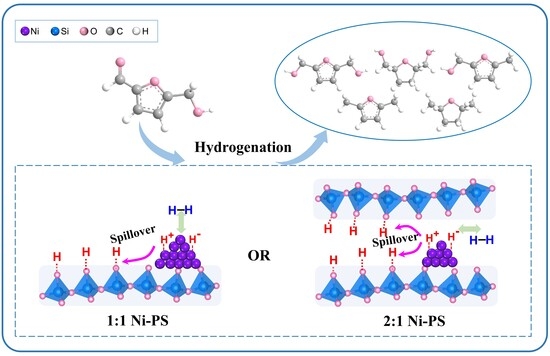
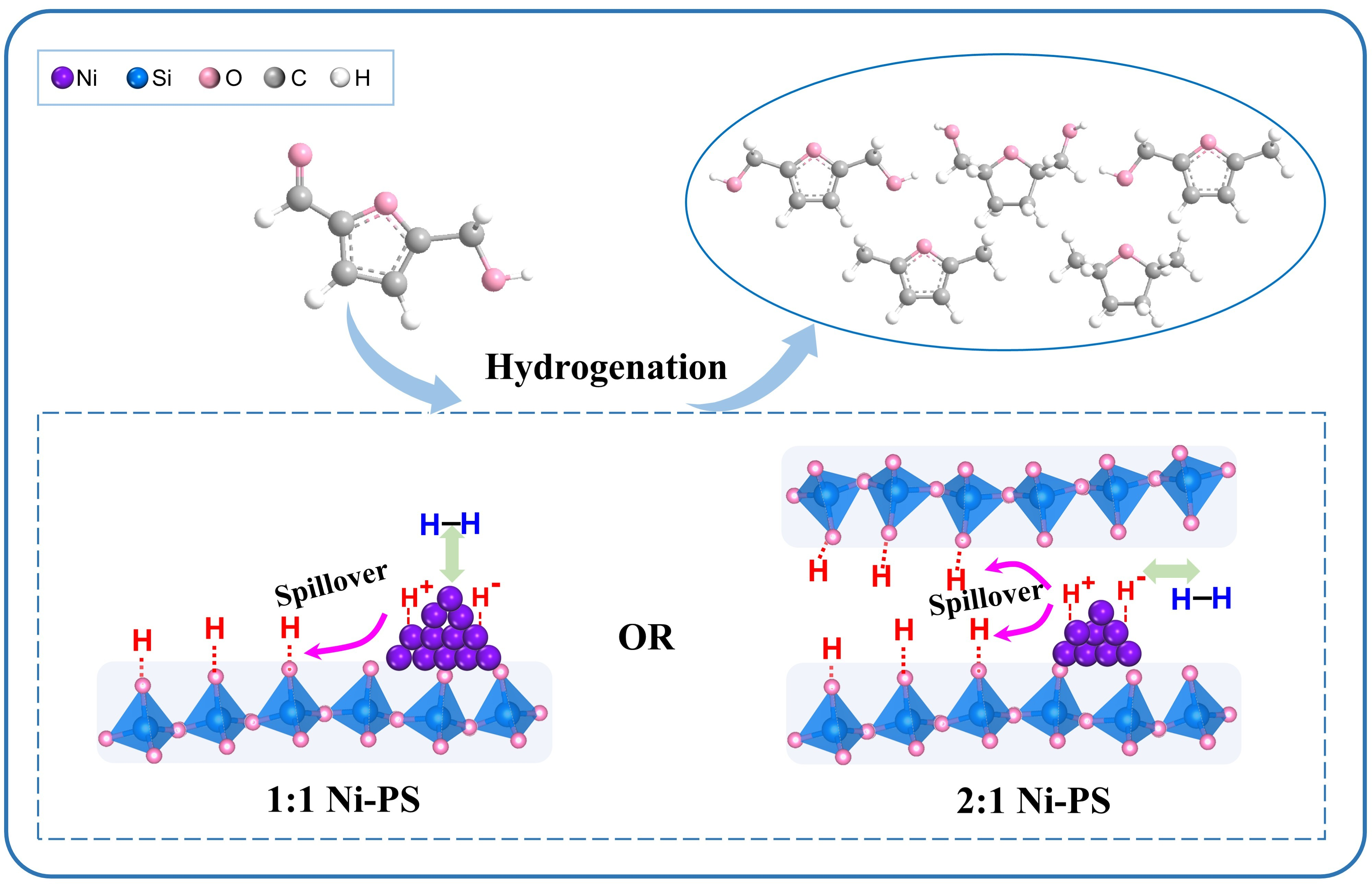
A series of nickel phyllosilicate catalysts (Ni-PS-T, where T represents the calcination temperature in °C) were synthesized via he ammonia-evaporation method and calcined at different temperatures to investigate their performance in the hydrogenation of 5-hydroxymethylfurfural (HMF). Characterization by Fourier transform infrared spectroscopy (FT-IR), X-ray diffraction (XRD), X-ray photoelectron spectroscopy (XPS), and transmission electron microscopy (TEM) revealed that increasing the calcination temperature (300–1100 °C) triggered a phase evolution from the 1:1-type (tetrahedral-octahedral) to the 2:1-type (tetrahedral-octahedral-tetrahedral) Ni-PS, eventually leading to phase separation into NiO and SiO2. The content of the 2:1-type crystalline phase, H2 adsorption capacity, and C=O hydrogenation activity of HMF all exhibited a volcano-shaped trend with calcination temperature. Under the conditions of 100 °C and 2.5 MPa H2, Ni-PS-800 enabled HMF hydrogenation with a conversion of 90% and a selectivity of 84% to 2,5-dihydroxymethylfuran (DHMF), in which the catalyst exhibited good stability during five consecutive HMF hydrogenation cycles. The enhanced catalytic performance of Ni-PS-800 is attributed to its high 2:1-type phase fraction, which promotes a pronounced hydrogen-spillover effect and significantly enhances the intrinsic activity for C=O hydrogenation.

Graphical Abstract

1. Introduction

The 5-hydroxymethylfurfural (HMF) obtained through the hydrolysis-dehydration of lignocellulose is an important biomass platform compound. Its unique molecular structure, including highly reactive chemical groups such as C=C, C=O, and C-OH, makes it suitable for the preparation of various high-value-added chemicals through chemical reactions such as oxidation, hydrogenation/hydrogenolysis, hydration, and amination [1,2,3,4,5,6,7]. Among them, 2,5-dihydroxymethylfuran (DHMF) obtained through selective hydrogenation of the C=O bond in HMF can serve as a key monomer for the preparation of high-performance biomass-based degradable plastics [8,9]. During hydrogenation of HMF, the resulting DHMF can undergo further conversion to 2,5-dihydroxymethyltetrahydrofuran (DHMTHF) and 2,5-dimethylfuran (DMF) via hydrogenation of the furanic C=C bond and hydrogenolysis of the C-O bond [10,11]. Therefore, the development of catalysts for highly selective C=O hydrogenation of HMF to DHMF has attracted extensive attention.
Currently, various catalysts have been developed for the catalytic hydrogenation of HMF, including supported noble metal catalysts (e.g., Ru/ZrO2-SiO2 [12], Pt/C [13], Ir/TiO2 [14], Au/Al2O3 [15]) and co-precipitated non-noble metal catalysts (e.g., Cu/SiO2 [16], Co/SiO2 [17]). The 5 wt.% Ru/C catalyst developed by Sera et al. [18] is capable of efficiently converting HMF to DHMF under 100 °C and 5 MPa, resulting in complete HMF conversion and a high DHMF yield of 88%. Despite their high catalytic performance, the substantial cost of noble metal catalysts poses a significant barrier to their industrial-scale application [19]. Zhu et al. [20] reported a co-precipitated Cu-ZnO catalyst, which achieved complete conversion of HMF and a 99% yield of DHMF at 110 °C and 1.5 MPa. Zhong et al. [21] employed a co-precipitated Ni/Mg6Al4Ox catalyst for HMF hydrogenation under the conditions of 80 °C and 4 MPa, achieving a 75% yield of DHMF.
Therefore, co-precipitated HMF hydrogenation catalysts, which combine low cost with high activity, have become a prominent research focus. However, during co-precipitation, metal cations rapidly react with anions such as OH or CO32− to form corresponding metal hydroxide or carbonate phases, which deposit within the pores of the support (e.g., silica or alumina). As a result, the metal precursors and the support remain largely phase-separated in the final catalysts. Subsequent high-temperature pretreatments, such as calcination and reduction, further induce sintering and growth of the active metal particles, leading to diminished catalytic activity and poor stability [22,23,24].
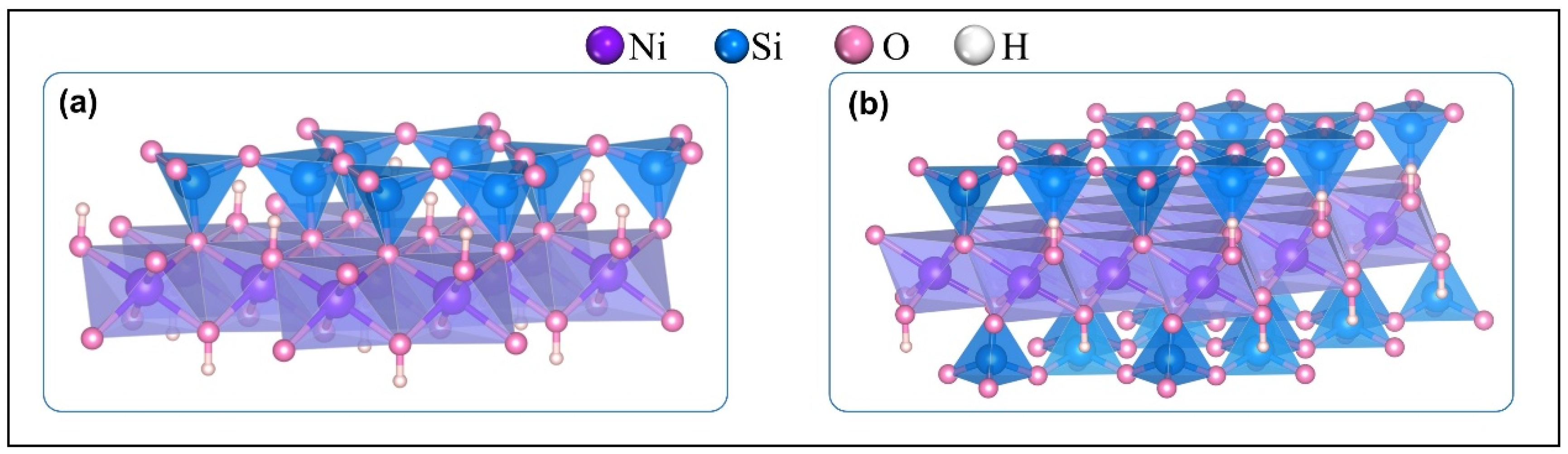
The construction of metal phyllosilicates has emerged as a robust solution to overcome the inherent limitations of co-precipitated catalysts, primarily their weak metal-support interactions and tendency toward thermal sintering. In distinct contrast to the loose physical mixture characteristic of co-precipitation systems, phyllosilicate structures exhibit intrinsic, stable chemical bonding between the metallic species and the support framework. As shown in Figure 1, nickel phyllosilicate catalyst (Ni-PS) has a two-dimensional layered structure where SiO4 tetrahedral sheets and NiO6 octahedral sheets are interlinked via Si-O-Ni bonds, ensuring atomic-level dispersion of Ni and structural integrity [25,26,27]. These strong bonds confer remarkable thermal stability even under high calcination temperatures; the Ni-PS structure resists collapse and avoids forming large NiO particles [28,29]. Consequently, Ni-PS catalysts exhibit superior activity, high stability, and broad application potential. For instance, Shesterkina et al. [30] employed a urea-assisted deposition-precipitation strategy to synthesize nickel phyllosilicates, which substantiated that this unique architecture effectively mitigates the sintering of Ni nanoparticles. This structural advantage endows the catalyst with exceptional cyclic stability and a styrene selectivity exceeding 90% during the selective hydrogenation of phenylacetylene. Jiang and colleagues [31] utilized the ammonia evaporation method to synthesize nickel phyllosilicates that delivered a conversion of 53.2% and a primary amine selectivity of 96.2% during the reductive amination of alcohols. Such results notably outperform the efficiency of catalysts prepared via conventional impregnation. Furthermore, by precisely regulating the phase composition through a hydrothermal approach, Zhang et al. [32] successfully tuned the interfacial interactions between the nickel species and the support, a strategy that ultimately resulted in a high furfurylamine yield of 94.2% during the reductive amination of furfural.
Currently, there are relatively few research reports on the catalytic conversion of HMF to high-value-added chemicals using Ni-PS catalysts. Wang et al. [35] researched the performance of Ni-PS as a catalyst for the selective catalytic hydrogenation of HMF to DHMTHF. Under the conditions of 100 °C and 1.5 MPa H2, the conversion of HMF and the selectivity to BHMTHF reached 100% and 90.4%, respectively, and the catalyst could be stably reused at least seven times. Our earlier study [25] reveals that the layered nickel silicate (Ni-PS) catalyst, a bifunctional material with metallic and acidic sites, efficiently catalyzes the conversion of HMF to 2,5-dimethyltetrahydrofuran under mild conditions. The hydrogenation/hydrogenolysis activity of the Ni-PS catalyst for HMF was three times higher than that of Ni/SiO2 prepared by the impregnation method.
However, there is currently no literature report that systematically elucidates the structure–activity relationship between the Ni-PS crystal phase and catalytic performance. A typical Ni-PS catalyst was synthesized via the ammonia evaporation method in this study to investigate in detail the influence of calcination temperature on its structure and HMF hydrogenation activity. Modern characterization techniques such as XRD, FT-IR, XPS, hydrogen temperature programmed desorption (H2-TPD), and TEM were employed to examine the evolution process of the crystal phase structure of Ni-PS with varying calcination temperatures. It was preliminarily demonstrated that an appropriate increase in calcination temperature facilitated the phase transformation of layered nickel phyllosilicate (Ni-PS) from a 1:1 to a 2:1 crystal structure, which exhibited higher activity for HMF hydrogenation. This work provides valuable guidance for the structural regulation of nickel phyllosilicate and the design of efficient HMF hydrogenation catalysts.

2. Results and Discussion

2.1. Characterization of Texture Properties of Catalysts

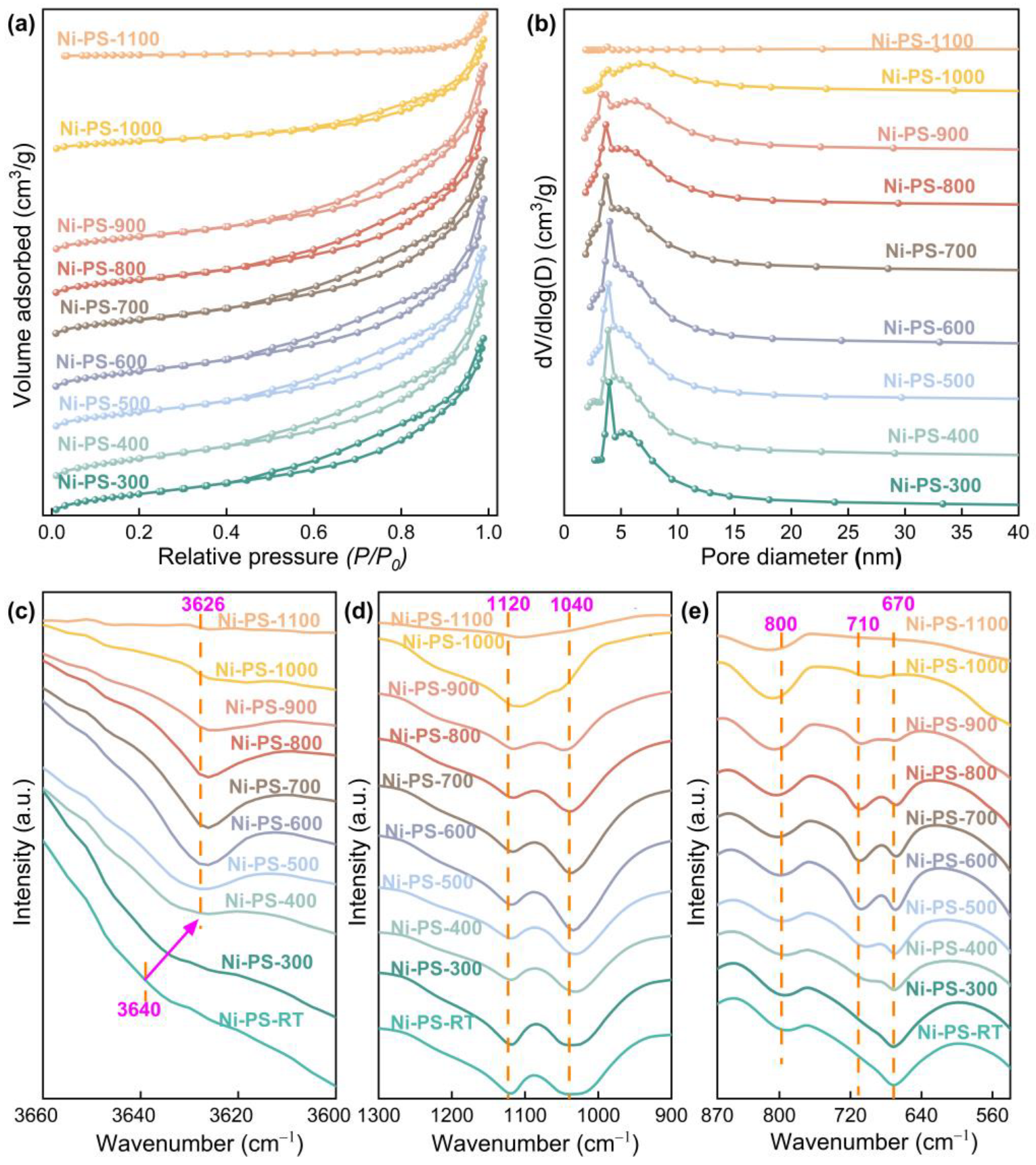
The N2 adsorption–desorption curves and pore size distribution of Ni-PS-T catalysts are shown in Figure 2a,b. The Ni-PS-300 low-temperature calcinated catalyst exhibits a typical type IV adsorption isotherm with an H3-type hysteresis loop. This indicates that the Ni-PS-300 catalyst possesses a typical layered-mesoporous structure [26,35]. As the calcination temperature gradually increases, the shape of the hysteresis loop shows no significant changes. However, when the calcination temperature exceeds 900 °C, the hysteresis loop shape alters markedly, with the hysteresis loop of the Ni-PS-1100 catalyst completely disappearing, indicating the complete collapse of the catalyst’s layered-mesoporous structure. As shown in Figure 2b, the Ni-PS-300 catalyst displays a broad pore size distribution (0–15 nm), likely attributable to secondary stacking pores from disordered tubular nickel phyllosilicate aggregation. A distinct sharp peak at 3–5 nm is also observed, representing tubular pores formed by the curling of layered nickel silicate. The pore size distribution at 3–5 nm exhibited negligible variation with progressively higher calcination temperatures (<900 °C); however, a distinct shrinkage of the sharp peak in this range was observed for the Ni-PS-900 catalyst. In addition, the pore size distribution peak of the Ni-PS-1100 catalyst at 0–15 nm completely disappears, reflecting complete collapse of the pore structure of the catalyst.
Table 1 details the textural properties of the Ni-PS-T series catalysts calcined at different temperatures. As shown in the table, the Ni-PS-300 catalyst shows a high SBET value of 387.9 m2/g. However, the Ni-PS-400 catalyst obtained by calcination at 400 °C exhibited a significantly increased SBET of 443.0 m2/g, along with a notable increase in both its microporous and external surface areas. This suggests that elevating the calcination temperature may promote the phase transformation of nickel phyllosilicate, thereby altering its textural properties. With increasing calcination temperature, the SBET and micropore SBET of Ni-PS-T catalysts decrease slowly, until temperatures exceed 900 °C, where a rapid reduction occurs as the nickel phyllosilicate nanotubular pores decompose. The Ni-PS-1100 catalyst exhibits an extremely low specific surface area of only 27.9 m2/g. This, combined with the complete disappearance of its micropore SBET, clearly demonstrates the occurrence of a complete structural collapse.

2.2. Fourier-Transform Infrared (FT-IR) Spectra of the Catalysts

The FT-IR spectra reveal multiple characteristic peaks for Ni-PS-T catalysts, which can be assigned to chemical groups associated with nickel phyllosilicate and amorphous silica, in accordance with literature reports (Table S1). Specifically, the absorption peaks at 800 cm−1 and 1120 cm−1 are attributed to the symmetric and asymmetric Si-O-Si stretching vibrations of amorphous SiO2, respectively [36,37]. In contrast, the peak at 1040 cm−1 originates from the asymmetric Si-O-Si stretching vibration within the SiO4 tetrahedral sheets of the nickel phyllosilicate [38]. Therefore, the relative ratio of I1040/I1120 was employed to analyze the phase changes of SiO2 and nickel phyllosilicate during the calcination process. As shown in Figure 2c, the peak intensities at 1040 cm−1 and 1120 cm−1 are similar in both the uncalcined sample and the Ni-PS-300 catalyst, indicating the coexistence of nickel phyllosilicate and amorphous silica. With increasing calcination temperature, the I1040/1120 ratio gradually rises and reaches a maximum for the Ni-PS-700 catalyst, suggesting the highest relative content of nickel phyllosilicate at this stage. This trend implies that the calcination process promotes further reaction of amorphous silica to form the nickel phyllosilicate phase. Upon further elevation of the calcination temperature, the I1040/1120 ratio declines markedly. For the Ni-PS-1100 catalyst, no peak was observed at 1040 cm−1, indicating the complete structural collapse of nickel phyllosilicate under high-temperature calcination.
Additionally, as shown in Figure 2d,e, the Ni-PS-RT and Ni-PS-300 catalyst exhibit two absorption peaks that appear at 3640 cm−1 and 670 cm−1, corresponding to the υOH stretching and δOH bending vibrations of hydroxyl groups in the NiO6 octahedral layer of 1:1-type nickel phyllosilicate, respectively [25]. However, after calcination at 400–900 °C, the 3640 cm−1 peak shifts to 3626 cm−1, which is attributed to the υOH stretching vibration of isolated hydroxyl groups in the NiO6 octahedral layer of 2:1-type Ni-PS [37]. Simultaneously, the characteristic single peak at 670 cm−1 for the 1:1-type Ni-PS evolves into a doublet at 670 and 710 cm−1. The peak at 710 cm−1 is characteristic of the 2:1-type Ni-PS, corresponding to the δOH bending vibration of hydroxyl groups in the NiO6 octahedral layer of the 2:1 nickel phyllosilicate [34,39]. As the calcination temperature increases further, the relative intensity of the 710 cm−1 peak gradually rises. When the temperature exceeds 600 °C, the intensity of the 710 cm−1 peak in the catalysts becomes significantly higher than that of the 670 cm−1 peak. However, after the calcination temperature surpasses 900 °C, the intensities of both peaks gradually weaken until they eventually disappear.
According to literature reports, the I710/I1120 ratio can be used to analyze the relative content of 2:1-type nickel phyllosilicate (Ni-PS) in catalysts. As listed in Table S2, the effect of calcination temperature on the I710/I1120 ratio shows a “volcano-type” trend, where the ratio first increases and then decreases with rising temperature. This indicates that appropriately increasing the calcination temperature can effectively promote the reaction between amorphous silica and 1:1-type Ni-PS, leading to the formation of the more structurally stable 2:1-type Ni-PS phase. Conversely, excessively high calcination temperatures cause the collapse of the nickel phyllosilicate structure.

2.3. X-Ray Diffraction (XRD)

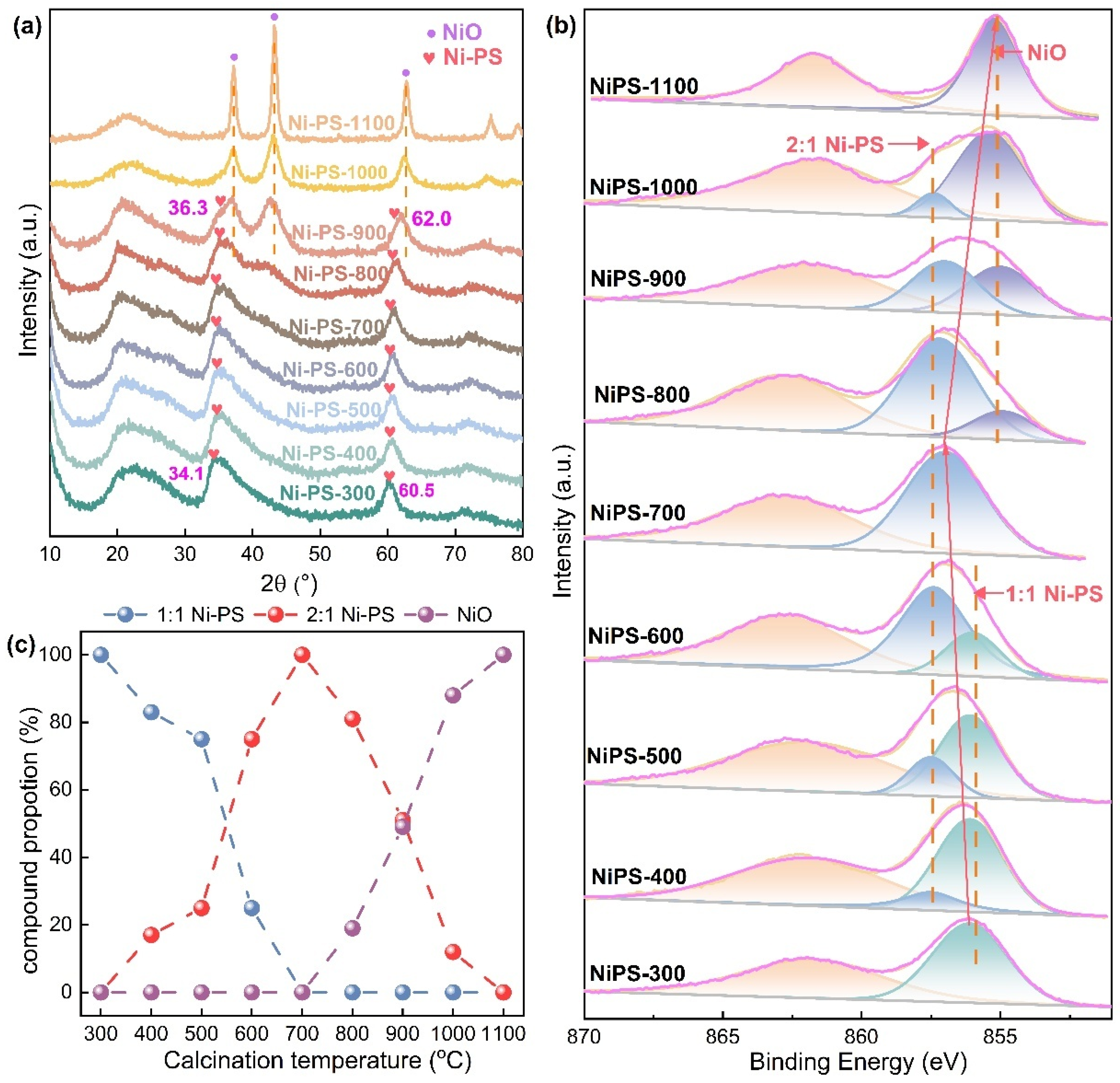
Figure 3a presents the XRD patterns of Ni-PS-T catalysts before reduction. A broad and diffuse peak in the 2θ range of 20–26°, attributable to amorphous SiO2, is observed in all samples [40]. The pattern for the Ni-PS-300 catalyst shows two diffraction peaks at approximately 2θ ≈ 34.1° and 60.5°, matching the characteristic reflections of nickel phyllosilicate (PDF#49-1859) [41]. With increasing calcination temperature, these two peaks progressively shift to higher angles, eventually stabilizing at about 36.3° and 62.0°. This systematic shift to higher 2θ values indicates a gradual structural evolution or phase transformation within the nickel phyllosilicate induced by higher temperatures [42]. However, the characteristic diffraction peaks of the crystalline NiO phase (PDF#44-1159) emerged at 2θ = 37.3°, 43.3°, 62.9°, and 75.4° in the XRD pattern of the Ni-PS-800 catalyst [43]. With a further increase in temperature, these NiO peaks grew progressively more intense and sharper. Ultimately, in the Ni-PS-1100 catalyst, the complete disappearance of nickel phyllosilicate peaks in the XRD pattern confirms the full transformation of the phase into crystalline NiO.
The XRD patterns of Ni-PS-T catalysts after reduction at 700 °C (Figure S1) indicate a complete phase transformation, as the original diffraction features vanish and are superseded by peaks at 2θ = 44.5°, 51.8°, and 76.4°, assignable to metallic nickel (PDF#70-1849) [44]. The nickel crystallite sizes calculated via the Scherrer formula (see Table 2) exhibit a clear trend: they maintain a small and nearly constant value around 4.5 nm for calcination temperatures ≤800 °C but undergo a pronounced increase at higher calcination temperatures, reaching 7.4 nm for Ni-PS-1100. This trend suggests that calcination above 800 °C promotes growth or sintering of nickel crystallites during the subsequent reduction process.

2.4. Catalyst X-Ray Photoelectron Spectroscopy (XPS)

The chemical state of nickel species in the Ni-PS-T series samples were also investigated by XPS (Figure 3b). All XPS spectra of the samples showed a double-peak structure, among which the peak located in the range of 859.0–867.0 eV is attributed to satellite peaks, originating from electron shock excitation effect. In addition, the main peak located at 852.5–859.0 eV can be used for the qualitative and quantitative analysis of nickel species in catalysts. According to literature reports, the binding energy of the Ni 2p3/2 orbit in different nickel compounds exhibits significant differences. Specifically, the binding energy of this orbital in the 1:1-type Ni-PS and 2:1-type Ni-PS is 856.2 eV and 857.2 eV, respectively. Meanwhile, it is 854.3 eV in the NiO phase [42,45,46,47].
Peak deconvolution of the main XPS feature clearly reveals the significant influence of calcination temperature on the phase evolution of nickel species in Ni-PS-T catalysts. As shown in Figure 3c, the primary phase of the Ni-PS-300 catalyst is identified as 1:1-type nickel phyllosilicate. With increasing calcination temperature, the content of the 1:1-type phase gradually decreases, while the proportion of the 2:1-type phase correspondingly rises. At calcination temperature exceeding 700 °C, the 1:1-type Ni-PS is no longer detectable, and the sample becomes predominantly composed of 2:1-type Ni-PS. Notably, a small amount of the NiO phase is observed for the Ni-PS-800 catalyst. With a further increase in calcination temperature, the content of the 2:1-type Ni-PS phase gradually diminishes, while that of NiO increases substantially. Ultimately, NiO becomes the dominant phase in the Ni-PS-1100 catalyst. These XPS results collectively demonstrate a sequential phase evolution in Ni-PS-T catalysts: from 1:1-type to 2:1-type nickel phyllosilicate, and finally to NiO, as the calcination temperature increases.

2.5. TEM Analysis of the Catalyst

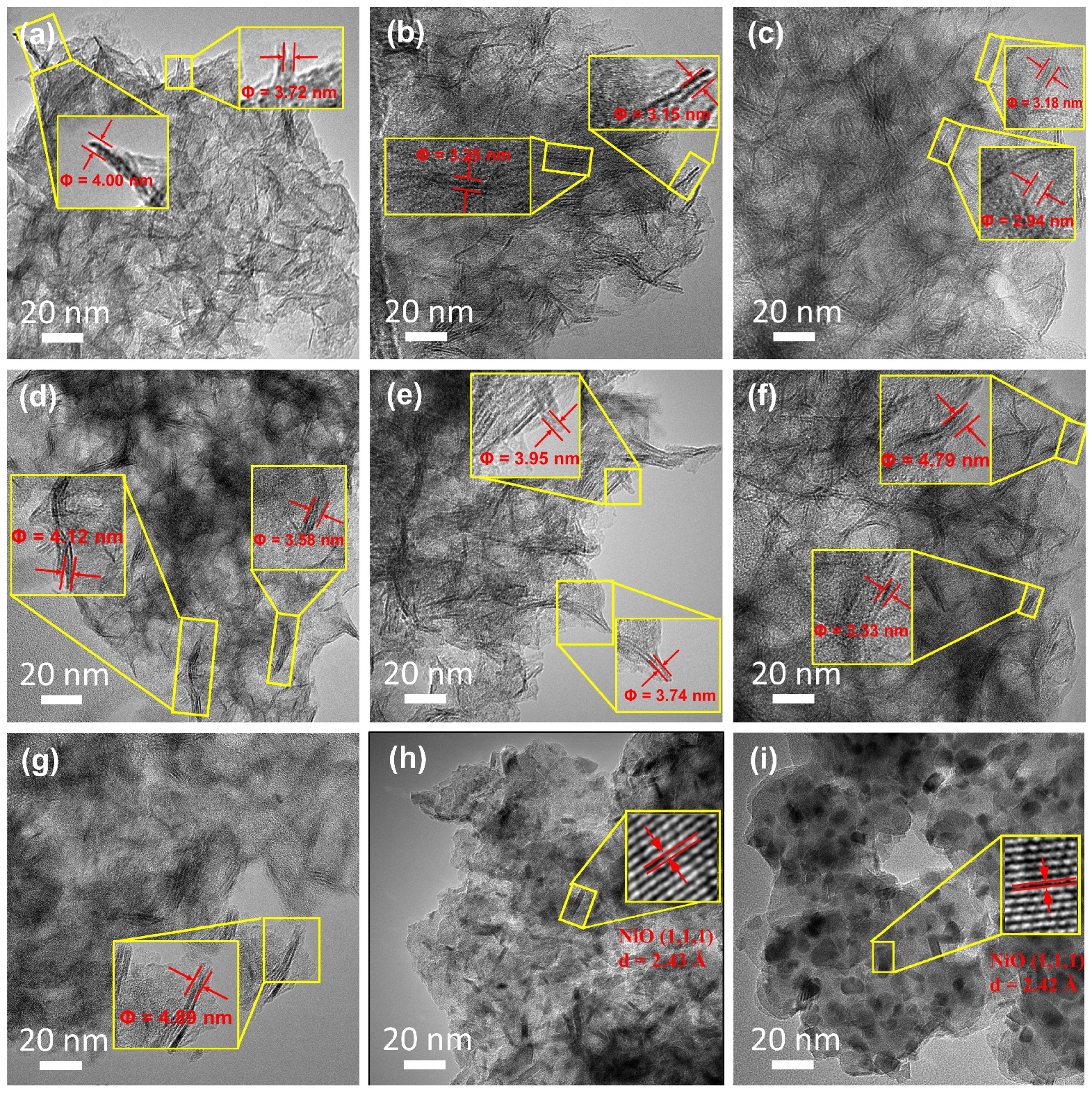
Figure 4 shows the TEM images of the Ni-PS-T series catalysts before reduction. As shown in the figure, the nickel phyllosilicate phase exhibits a typical fibrous tubular structure [48,49] with a tube diameter of approximately 3 to 5 nm. Nickel phyllosilicate demonstrates excellent thermal stability, with its fibrous tubular structure remaining clearly observable in the Ni-PS-900 catalyst even after calcination at 900 °C. In contrast, calcination at 1100 °C completely disrupts this morphology in the Ni-PS-T sample, whose TEM image instead reveals well-defined lattice fringes corresponding to the (111) planes of NiO. Following reduction at 700 °C (Figure S2), the fibrous tubular architecture collapses completely, yielding a composite system of metallic nickel nanoparticles dispersed on silica. The particle sizes obtained from TEM statistical analysis are listed in Table 2, and the nickel particle sizes derived from TEM are in good agreement with the XRD analysis results.

2.6. Thermogravimetric Analysis (TGA) of the Catalyst

Figure S3 displays the TG-DTG curve of the Ni-PS-T under a nitrogen atmosphere. As depicted, the thermal decomposition of the Ni-PS catalyst within the range of 50~1200 °C can be divided into three stages: (1) 50–150 °C: mass loss of approximately 9.4% occurs, with a sharp peak appearing at 58 °C on the DTG curve, corresponding to the removal of physically adsorbed water; (2) 150–700 °C: weight loss of about 6.0% is observed, primarily attributed to the elimination of hydroxyl groups and bound water. This process is accompanied by transformation of nickel phyllosilicate from the 1:1-type toward the 2:1-type [50]; (3) 700–1000 °C: the catalyst loses approximately 1.6% of its mass, resulting from collapse of the nickel phyllosilicate framework along with removal of residual hydroxyl groups and the formation of NiO.

2.7. Hydrogen Temperature-Programmed Reduction (H2-TPR) of the Catalyst

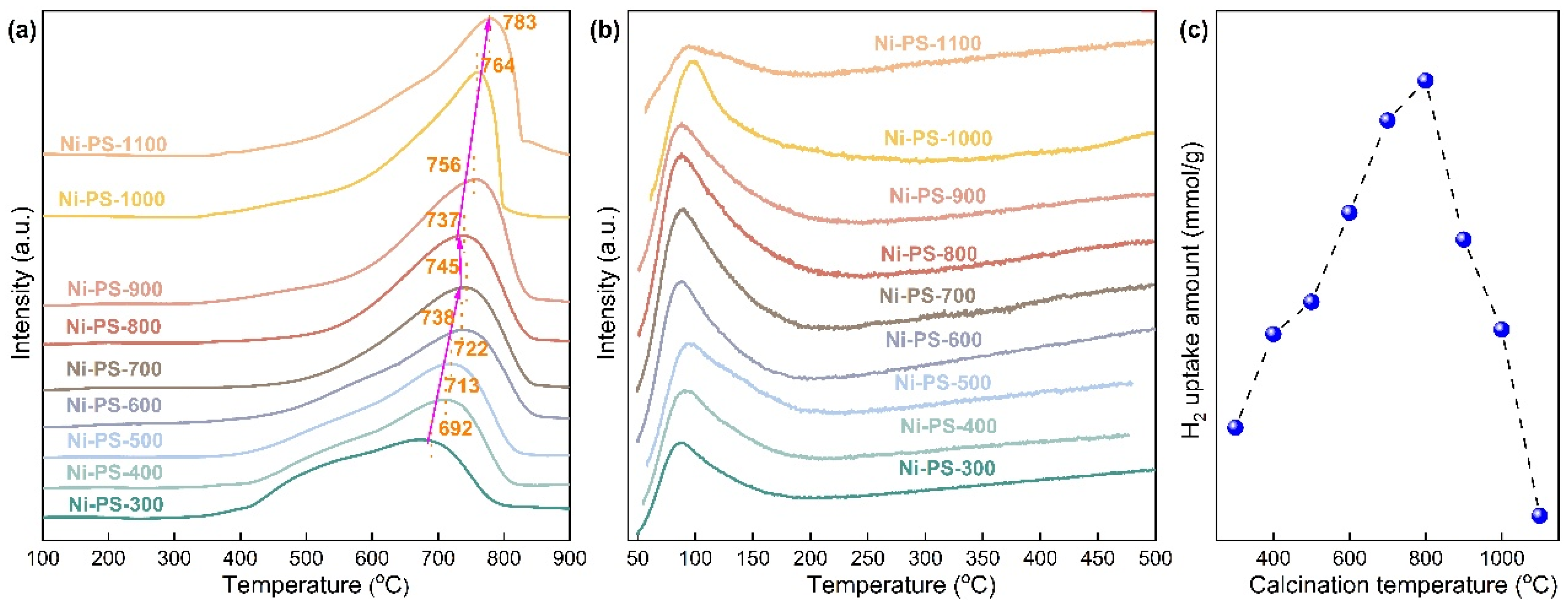
Reduction behavior of Ni-PS-T catalysts was investigated by H2-TPR technology. As illustrated in Figure 5a, the calcination temperature markedly influences their reducibility. With increasing calcination temperature, the reduction peak shifts to higher temperatures. For instance, Ni-PS-300 and Ni-PS-700 exhibit reduction peaks at 692 °C and 742 °C, respectively. Combined with prior XPS and FT-IR analyses, a moderate rise in calcination temperature promotes the transformation from 1:1-type Ni-PS to a sandwich-structured 2:1-type Ni-PS where NiO6 octahedra are interlayered between two SiO4 tetrahedral sheets, thereby enhancing reduction resistance [47,51,52]. Accordingly, reduction temperature increases with calcination temperature. However, the Ni-PS-800 catalyst shows a lowered reduction peak at 737 °C, which can be attributed to the partial destruction of 2:1-type Ni-PS, resulting in the formation of NiO species that have a weaker interaction with the support. When calcination temperature exceeds 900 °C, the reduction peak shifts back to higher temperatures, reaching 783 °C for Ni-PS-1100. XRD and XPS results indicate that excessively high temperatures completely disrupt the layered 2:1-type Ni-PS structure and promote NiO crystallite growth, which again hinders reduction.

2.8. Hydrogen Temperature-Programmed Desorption (H2-TPD)

H2-TPD profiles of Ni-PS-T catalysts are shown in Figure 5b. All samples exhibit a broad desorption peak between 80 and 180 °C, which is attributed to the desorption of hydrogen atoms from catalyst surfaces. The hydrogen uptake was quantified using an external standard method, and the results are presented in Figure 5c. The hydrogen adsorption capacity of Ni-PS-T catalysts shows a classic volcanic trend with increasing calcination temperature, first rising and then declining. The Ni-PS-300 catalyst, prepared at a low calcination temperature, shows a relatively low uptake of only 121.8 μmol/g. As calcination temperature increases, adsorption capacity rises markedly, reaching a maximum of 290.7 μmol/g for Ni-PS-800—approximately 2.4 times that of Ni-PS-300. However, with further increase in calcination temperature, the hydrogen uptake drops sharply; for Ni-PS-1100, it declines to only 79.9 μmol/g.
However, the metallic nickel particle sizes estimated from hydrogen uptake show significant discrepancies compared to those determined by XRD and TEM (Table 2). At calcination temperatures below 800 °C, the particle sizes measured by XRD and TEM remain relatively constant at approximately 4.5 nm. In contrast, the sizes estimated from hydrogen adsorption exhibit a clear decreasing trend with increasing calcination temperature. For example, the nickel particle size of Ni-PS-800 calculated from hydrogen adsorption is 2.13 nm, which is considerably smaller than the actual sizes measured by XRD and TEM. This discrepancy implies the occurrence of hydrogen spillover on Ni-PS-800: hydrogen atoms dissociated on Ni0 sites migrate to the silica support, leading to an overestimated H2 uptake attributable solely to nickel. Consequently, estimating particle size based exclusively on H2 adsorption data is prone to substantial error.

2.9. Hydrogenation Performance and Stability of Ni-PS-T for HMF

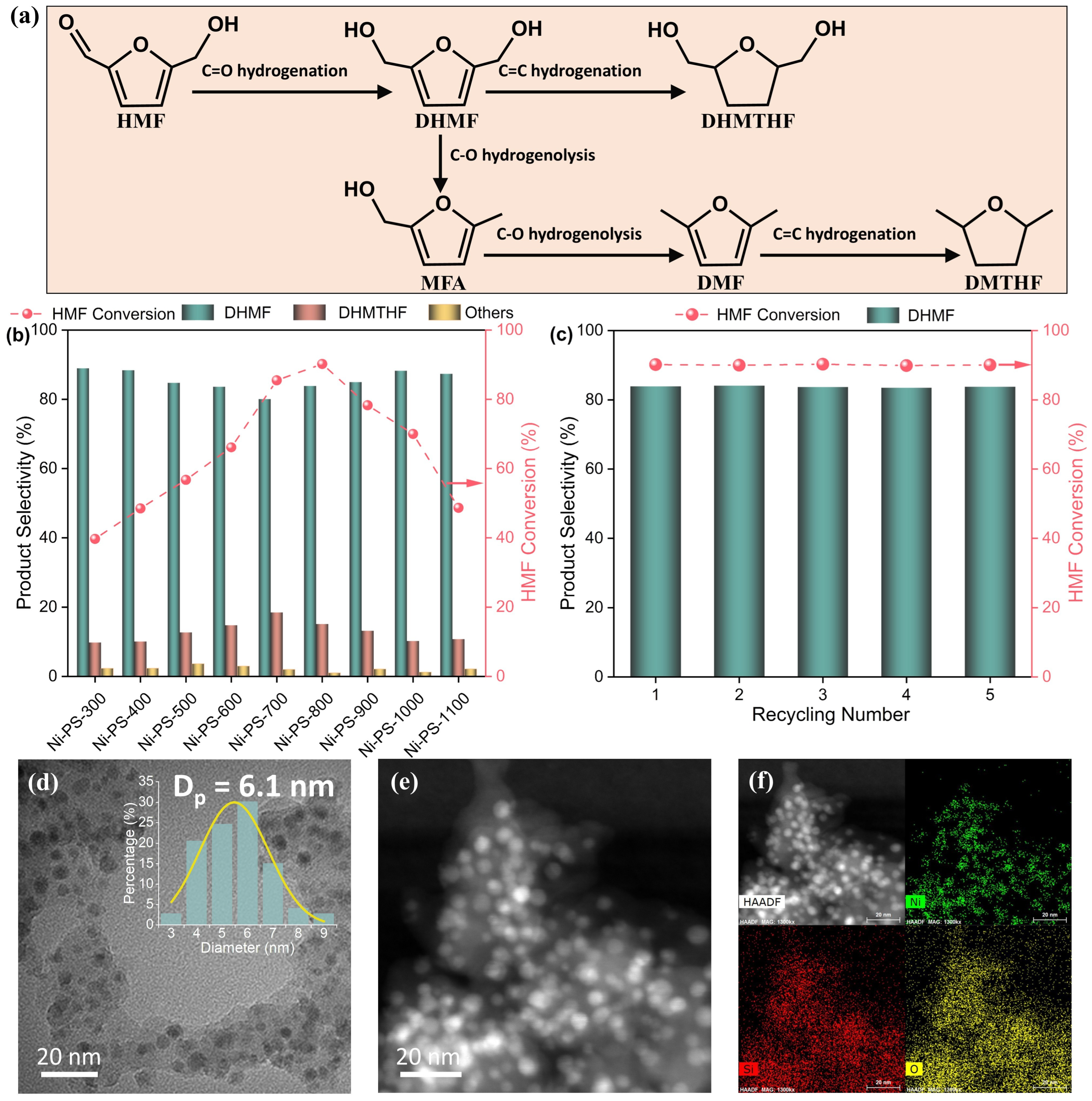
The catalytic performance of Ni-PS-T catalysts for HMF hydrogenation was evaluated at 100 °C and 2.5 MPa (Figure 6). The results show that the activity of the Ni-PS-T catalysts for the hydrogenation of HMF to DHMF also exhibit a volcano-shape relationship with the calcination temperature, first increasing and then decreasing. The Ni-PS-300 catalyst, prepared at a low calcination temperature, showed limited activity with an HMF conversion of only about 40%. Conversion improved markedly with higher calcination temperature, reaching a maximum of 90% over Ni-PS-800—2.3 times that of Ni-PS-300. Further temperature increase led to a sharp decline in activity. Notably, the conversion of the Ni-PS-1100 catalyst was only 48%. Combined with the H2-TPD results (Figure 5), it can be seen that the hydrogenation ability of Ni-PS-T catalysts is positively correlated with their hydrogen adsorption capacity, meaning that a stronger catalytic hydrogen dissociation ability corresponds to higher hydrogenation activity.
In addition, DHMF selectivity displayed an inverse volcano-shape relationship with calcination temperature, first decreasing and then increasing. This trend can be explained by the enhanced hydrogenation capability of the catalysts, which promotes further hydrogenation of the furan ring to yield DHMTHF, as illustrated in Figure 6b.
In addition, the highly active Ni-PS-800 catalyst also showed good stability. Figure 6c illustrates that over five consecutive HMF hydrogenation cycles, HMF conversion remained stable at approximately 90%, with DHMF selectivity consistently above 80%. Furthermore, as shown in Figure 6d–f, nickel and silicon elements remained evenly dispersed after reaction, and the size of the metallic nickel particles showed no significant change (6.1 nm).

2.10. Understanding the Structure–Reactivity Relationship of Catalysts

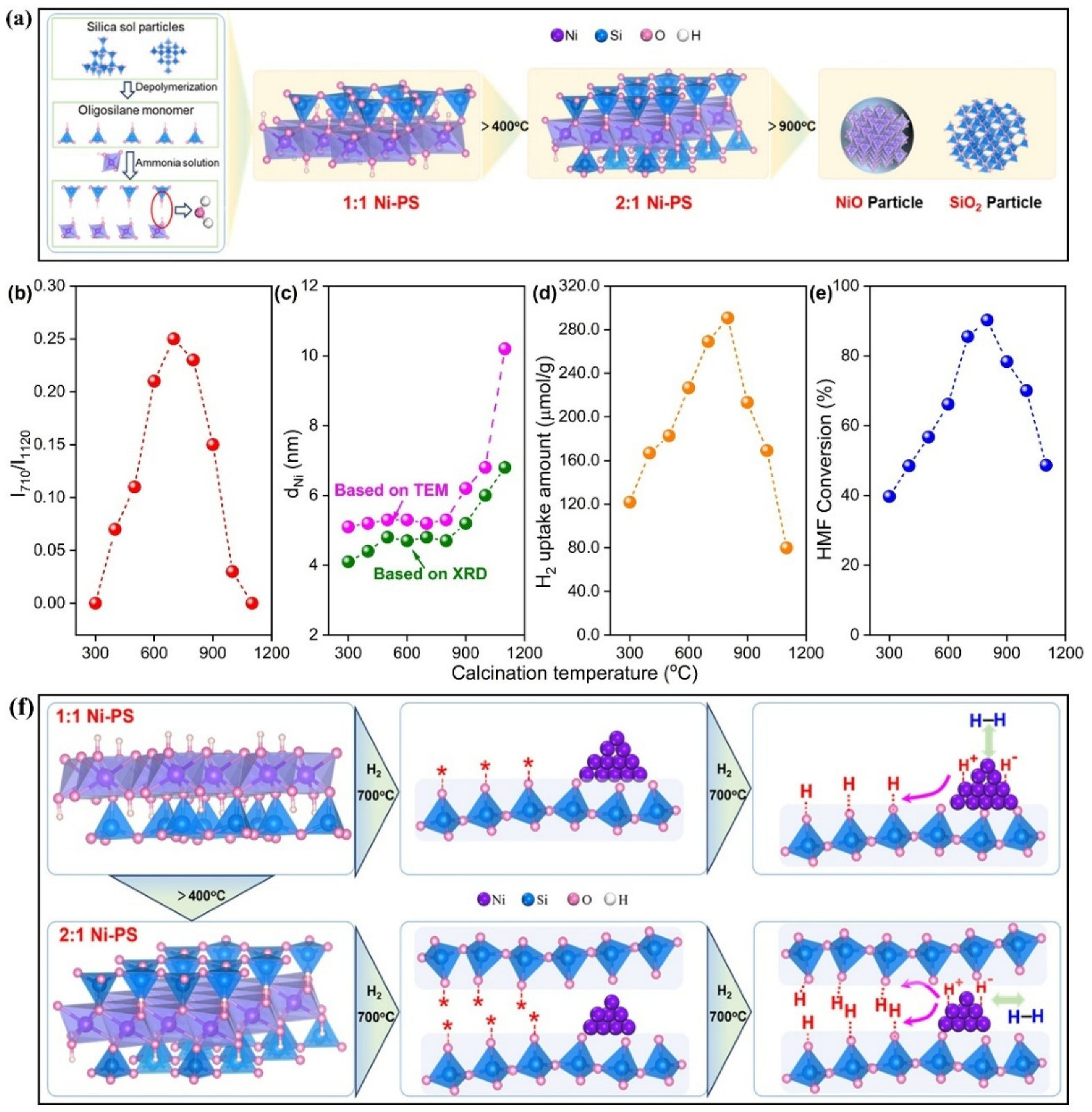
Characterization results such as FT-IR, XRD, XPS, and TG indicate that using nickel nitrate as the nickel source and alkaline silica sol as the silicon source during the ammonia distillation at 90 °C leads to the self-assembly of SiO4 tetrahedra and NiO6 octahedra, forming a 1:1-type nanotubular nickel phyllosilicate. With increasing calcination temperature, Ni-PS-T catalysts undergo a “secondary self-assembly” process of converting into a 2:1-type lamellar nickel silicate phase. At higher temperatures (>900 °C), however, the phyllosilicate structure collapses, resulting in the formation of a nickel oxide phase (Figure 7a). In summary, the relative content of the 2:1-type nickel phyllosilicate phase follows a volcano-shape pattern with calcination temperature, first rising and then declining. Furthermore, both the hydrogen adsorption capacity and hydrogenation activity of Ni-PS-T catalysts also display a typical volcano-shape relationship with calcination temperature (Figure 7d,e). These results demonstrate that the relative content of the 2:1-type nickel phyllosilicate phase is a key factor governing the HMF hydrogenation performance of Ni-PS-T catalysts.
Although nickel particle size is typically a crucial factor in determining catalyst activity, no significant positive correlation between particle size and HMF conversion is observed for the Ni-PS-T catalyst. As shown in Figure 7c, within the calcination temperature range of 300–800 °C, the size of metallic nickel particles remains almost constant at approximately 5 nm, yet the HMF hydrogenation activity of Ni-PS-800 is 2.3 times higher than that of Ni-PS-300. However, when the calcination temperature exceeds 800 °C, the nickel particle size increases markedly with calcination temperature. For instance, the Ni-PS-1100 catalyst exhibits nickel particles of 10.2 nm—twice the size of those in Ni-PS-800—while its conversion drops to 48%, about 50% lower than that of Ni-PS-800. This indicates that, within the 800–1100 °C calcination range, nickel particle size likely becomes the decisive factor governing the hydrogenation performance of the catalysts.
In the calcination range of 300–800 °C, the nonlinear relationship between metallic Ni particle size and catalyst hydrogenation activity may be attributed to hydrogen spillover. As illustrated in Figure 7f, during H2 reduction, the NiO6 octahedral layers in the lamellar nickel phyllosilicate structure are reduced to form metallic Ni particles, while the Ni-O-Si bonds linking NiO6 octahedra and SiO4 tetrahedra break, generating SiO4 tetrahedral layers rich in Si-O active sites. These Si-O sites can act as acceptors, binding with highly active hydrogen species (e.g., H+/H) generated from H2 dissociation on the Ni surface, thereby initiating hydrogen spillover. This process leads to a much larger number of hydrogen atoms desorbed from the catalyst surface than the number of exposed Ni metal centers. In the 2:1-type Ni-PS structure, the NiO6 layer is sandwiched between two SiO4 tetrahedral layers; upon reduction, the resulting Si-O acceptor sites are significantly more abundant than in the 1:1-type structure. This likely explains the positive correlation observed between the hydrogen uptake capacity of Ni-PS-T catalysts and their 2:1-type Ni-PS content.
When calcination temperature exceeds 800 °C, the SiO4 tetrahedral layers undergo structural collapse, converting into low-activity amorphous silica. This transformation drastically reduces the number of Si-O active sites and suppresses the hydrogen spillover effect. As a result, with increasing calcination temperature, the area of the H2-TPD desorption peak decreases significantly. In other words, above 800 °C, hydrogen spillover is largely eliminated, and catalytic activity becomes primarily governed by the size of the metallic particles.
In summary, the superior performance of the 2:1-type Ni-PS catalyst is intrinsically driven by the structural reconstruction during the reduction stage. Specifically, the experimentally observed breaking of Ni-O-Si bonds and the generation of Si-O acceptors correspond to the formation of local nickel vacancies and silica lattice distortions. This unique layered architecture with a 2:1-type ratio, rich in surface defect sites, acts as a bridge for active species and significantly promotes hydrogen spillover. This is in line with recent non-thermal plasma catalysis work highlighting defect-rich layered structures that create electronically distinct sites (with possible quantum-related contributions) and promote high turnover [53,54]. Furthermore, such a strategy of regulating spillover via phase evolution resonates with broader catalytic systems, including balancing carbon deposition in methane reforming [55], enhancing selectivity in hydrodesulfurization [56], and suppressing side reactions in water-gas shift [57].

3. Experimental Section

3.1. Materials

Nickel nitrate (Ni(NO3)2·6H2O, 99%, Aladdin reagent Co., Ltd. (Shanghai, China), CAS: 13478-00-7); Colloidal silica sol (30 wt.% SiO2, Haiyang Chemical Co., Ltd. (Qingdao, China), CAS: 112926-00-8); Ammonium hydroxide (26~28 wt.% NH3·H2O, Innochem Co., Ltd. (Beijing, China), CAS: 1336-21-6); 5-Hydroxymethylfurfural (HMF, 99%, TCI Co., Ltd. (Shanghai, China), CAS: 67-47-0); 2,5-Dihydroxymethylfuran (DHMF, >98%, TCI Co., Ltd. (Shanghai, China), CAS: 1883-75-6); Tetrahydrofuran (THF, 99.9%, ANPEL Co., Ltd. (Shanghai, China), CAS: 109-99-9); 5-Methyl-2-furanmethanol (5-MFA, 97%, CAS: 3857-25-8); 2,5-Dimethylfuran (DMF, 99%, CAS: 625-86-5); and 2,5-Dimethoxytetrahydrofuran (DMTHF, >98%, CAS: 1003-38-9) were purchased from Macklin Co., Ltd. (Shanghai, China); with 2,5-Dihydroxymethyl tetrahydrofuran (DHMTHF, 98%, CAS: 2144-40-3) obtained from Sinopharm Co., Ltd. (Shanghai, China).

3.2. Catalyst Preparation

A 35% (35 wt% NiO) Ni-PS catalyst was prepared by the ammonia-evaporation method. First, 6.8 g of Ni(NO3)2·6H2O was dissolved in 50 mL of deionized water at room temperature. The resulting solution was then added to 2.4 g of aqueous ammonia to form a nickel-ammine solution. Separately, 10.8 g of silica sol, which had been diluted with 50 mL of deionized water, was introduced dropwise to the nickel-ammine precursor and stirred continuously for 12 h. The obtained mixture was then heated at 80 °C in a water bath until the pH stabilized at 8–9. After ammonia evaporation, the suspension was separated by vacuum filtration, rinsed thoroughly with deionized water, and dried overnight at 120 °C. The catalyst powder was calcined in a muffle furnace for 2 h at the specified temperatures, with the resulting samples labeled as Ni-PS-T (T = 300–1100 °C), and the un-calcined Ni-PS catalyst referred to as Ni-PS-RT.

3.3. Catalyst Characterization

The crystallinity of the catalyst was characterized by X-ray diffraction (XRD) on a Bruker D8 Advance diffractometer (Berlin, Germany) using Cu Kα radiation (λ = 0.154 nm) operated at 40 mA and 40 kV, with diffraction patterns collected over a 2θ range of 10–80° at a step size of 0.04° and a scanning rate of 0.2° s−1. The crystallite size of Ni species was calculated using the Scherrer equation.
The specific surface area, pore volume, and pore size were characterized by low-temperature N2 adsorption–desorption using a Micromeritics ASAP 2020 analyzer (Norcross, GA, USA) with the Brunauer–Emmett–Teller (BET) method. Before testing, the samples were degassed at 90 °C for 1 h and then at 300 °C for 8 h to eliminate the weakly adsorbed species on the catalyst surface. Subsequently, the samples were cooled with liquid nitrogen and maintained at −196 °C, followed by a N2 physical adsorption experiment.
Fourier transform infrared (FTIR) spectra were recorded on a Bruker VERTEX 70 spectrometer. The samples were mixed with KBr at a mass ratio of 1:150 and pressed into pellets with which spectra were collected over 400–4000 cm−1 at a resolution of 4 cm−1.
X-ray photoelectron spectra (XPS) were performed on a VG MultiLab 2000 spectrometer (Newcastle Upon Tyne, UK) using Mg Kα X-ray source radiation with a pass energy of 20 eV. The binding energies of all elements were calibrated by referencing the C1s peak of free carbon (284.8 eV).
The H2 temperature programmed reduction (H2-TPR) experiment was carried out on a Micromeritics AutoChem 2920. Approximately 150 mg of sample was loaded into a U-shaped tube and pretreated under flowing Ar at 200 °C for 1 h to remove surface-adsorbed species. After cooling to 50 °C, the gas was switched to a 10 vol.% H2/Ar mixture once the baseline had stabilized, and the sample was then heated to 900 °C at 10 °C/min while recording H2 consumption during reduction. In addition, H2 temperature programmed desorption (H2-TPD) was also performed on the Micromeritics AutoChem 2920. After reduction, 150 mg of sample was purged under an inert atmosphere to remove weakly adsorbed hydrogen and then heated to 500 °C at 10 °C/min, with the H2 signal recorded by a thermal conductivity detector (TCD).
The high-temperature structural stability of the catalysts was evaluated by thermogravimetric analysis (TGA) using a Mettler Toledo TGA/DSC-1 thermal analyzer. Approximately 5 mg of catalyst was heated from room temperature to 1200 °C in air at a rate of 10 °C/min, while the sample mass change with increasing temperature was recorded by computer.
The microstructure and metal cluster particles of the samples were observed by transmission electron microscopy (TEM) using a JEOL JEM-2100F system. The catalyst samples were dispersed in ethanol, and a few drops of the suspension were deposited onto a copper grid and dried under an infrared lamp, with the deposition-drying step repeated 5~6 times prior to imaging. Elemental mapping and line-scan profiles were acquired in the EDS mode.

3.4. Catalyst Performance Evaluation

Before conducting the catalytic tests for HMF hydrogenation, the Ni-PS-T catalyst was reduced at 700 °C for 2 h under a 10 vol.% H2/N2 atmosphere. The catalytic performance was then evaluated in a 100 mL Parr autoclave (manufactured by Yanzheng Experimental Instrument Co., Ltd., Shanghai, China), with 0.5 g of the reduced catalyst, 5 g of HMF, and 45 mL of THF loaded into the reactor. Subsequently, the reactor was purged with H2 5–6 times to remove air before being pressurized with H2 to 2.5 MPa and then heated to 100 °C and maintained for several hours to carry out the reaction. After the reaction, the reactor was cooled to room temperature and depressurized slowly. In the catalyst recycling tests, the spent catalyst was separated from the reaction mixture by centrifugation and washed three times with THF. The recovered catalyst was then calcined in air for 2 h and reused in the next cycle following the same procedure as described above.
The liquid-phase products were analyzed using an Agilent 6890 gas chromatograph equipped with an HP-INNOWAX capillary column to quantify HMF, DHMF, DHMTHF, 5-MFA, DMF, and DMTHF. HMF conversion and product selectivity were calculated using the calibration area-normalization method, and the corresponding equations are given as follows:
(a)
Calibration peak area of each component
A i = A i f i
A i : GC peak area of i component;
f i : response correction factor of component i (obtained from calibration with standard solutions).
(b)
Sum of corrected peak areas of all components
A t o t = A i
(c)
HMF conversion (XHMF):
X HMF = ( 1 A i A tot ) × 100 %
(d)
Product selectivity (Spro):
S pro = A k A tot × 100 %
(e)
Product yield (Ypro):
Y pro = S pro × X HMF × 100 %

4. Conclusions

In this work, a nanotubular-lamellar nickel phyllosilicate precursor was synthesized via an ammonia-distillation method, whose structure and HMF hydrogenation activity can be effectively tuned by calcination temperature. The as-synthesized material corresponds to a 1:1-type nickel phyllosilicate (Ni-PS). At appropriate calcination temperatures, it transforms through a “secondary self-assembly” process into a 2:1-type Ni-PS phase, which exhibits a stable layered architecture that collapses only above 800 °C to yield NiO and amorphous SiO2. Accordingly, as the calcination temperature increases from 300 °C to 1100 °C, the phase of Ni-PS-T catalysts evolves sequentially from 1:1-type to 2:1-type Ni-PS crystals, and finally to structurally decomposed nickel oxide and silica.
The relative content of the 2:1-type phase, the hydrogen uptake capacity, and the catalytic activity for C=O bond hydrogenation all display a distinct volcano-type dependence on calcination temperature, increasing initially and then decreasing. At 100 °C and 2.5 MPa, the Ni-PS-800 catalyst achieved a 90% HMF conversion, which was 2.3 times and 1.9 times higher than the Ni-PS-300 and Ni-PS-1100 catalysts respectively, with a DHMF selectivity of 84%. These results demonstrate that the abundance of the 2:1-type nickel phyllosilicate is a decisive factor governing the HMF hydrogenation performance of the Ni-PS-T catalysts. Notably, catalysts enriched with the 2:1-type phase (e.g., Ni-PS-800) exhibit a pronounced hydrogen-spillover effect, which accounts for their intrinsically superior activity in C=O hydrogenation.

Supplementary Materials

The following supporting information can be downloaded at: https://www.mdpi.com/article/10.3390/catal16030214/s1, Table S1: Assignment of infrared characteristic bands of Ni-PS catalysts; Table S2: I1040/I1120 and I710/I1120 ratios derived from the FT-IR spectra of Ni-PS-T catalysts; Figure S1: XRD patterns of reduced Ni-PS-T catalysts; Figure S2. TEM images and particle size distributions of reduced Ni-PS-T catalysts: (a) Ni-PS-300; (b) Ni-PS-400; (c) Ni-PS-500; (d) Ni-PS-600; (e) Ni-PS-700; (f) Ni-PS-800; (g) Ni-PS-900; (h) Ni-PS-1000; and (i) Ni-PS-1100; Figure S3: TG-DTG curves of Ni-PS catalysts; Figure S4. HMF hydrogenation performance of Ni-PS-800 under (a) different reaction times, (b) temperatures, and (c) H2 pressures. General reaction conditions: 0.5 g catalyst, 5.0 g HMF, 50.0 mL THF, 373 K, 2.5 MPa H2, 5h.

Author Contributions

Methodology, Y.H. and G.D.; validation, Y.H. and L.D.; formal analysis, Y.H. and G.D.; investigation, Y.H. and N.G.; data curation, Y.H., N.G., L.D. and G.D.; writing—original draft, Y.H.; writing—review and editing, Y.H., N.G., L.D., Y.Y., Y.Z., J.S., Y.L., S.L. and G.D.; visualization, Y.H., N.G. and G.D.; supervision, G.D.; project administration, G.D.; funding acquisition, G.D. All authors have read and agreed to the published version of the manuscript.

Funding

We acknowledge support from the Joint Fund of the National Natural Science Foundation of China (Joint Fund for Regional Innovation and Development) (No. U24A20491).

Data Availability Statement

Data are contained within the article and Supplementary Materials.

Acknowledgments

We appreciate the support in the form of characterization equipment and an experimental platform from Synfuels China Technology Co., Ltd.

Conflicts of Interest

N.G., L.D., S.L., Y.Y., Y.Z., Y.L., J.S. and G.D. were employed by the company Synfuels China Technology Co., Ltd. The remaining authors declare that the research was conducted in the absence of any commercial or financial relationships that could be construed as a potential conflict of interest.

References

  1. Wang, Z.; Xia, S.; Wang, X.; Fan, Y.; Zhao, K.; Wang, S.; Zhao, Z.; Zheng, A. Catalytic production of 5-hydroxymethylfurfural from lignocellulosic biomass: Recent advances, challenges and opportunities. Renew. Sustain. Energy Rev. 2024, 196, 114332–114369. [Google Scholar] [CrossRef]
  2. Wang, Y.; Wang, H.; Kong, X.; Zhu, Y. Catalytic Conversion of 5-Hydroxymethylfurfural to High-Value Derivatives by Selective Activation of C−O, C=O, and C=C Bonds. ChemSusChem 2022, 15, e202200421. [Google Scholar] [CrossRef]
  3. Zhang, J.; Bo, S.; Liao, W.; Yang, K.; Su, T.; Lü, H.; Zhu, Z. Zeolitic framework Sn boosts the 2,5-dimethylfuran selectivity for the hydrodeoxygenation of 5-hydroxymethylfurfural over Co/Sn-Beta catalyst. Chem. Eng. J. 2024, 484, 149511–149526. [Google Scholar] [CrossRef]
  4. Kumar, R.; Lee, H.H.; Chen, E.; Du, Y.P.; Lin, C.Y.; Prasanseang, W.; Solos, T.; Choojun, K.; Sooknoi, T.; Xie, R.K.; et al. Facile synthesis of the atomically dispersed hydrotalcite oxide supported copper catalysts for the selective hydrogenation of 5-hydroxymethylfurfural into 2,5-bis(hydroxymethyl)furan. Appl. Catal. B Environ. 2023, 329, 122547–122558. [Google Scholar] [CrossRef]
  5. Jiang, Z.; Zeng, Y.; Hu, D.; Guo, R.; Yan, K.; Luque, R. Chemical transformations of 5-hydroxymethylfurfural into highly added value products: Present and future. Green Chem. 2023, 25, 871–892. [Google Scholar] [CrossRef]
  6. Guo, Y.; Liu, B.; Zhang, J.; Wang, G.; Pan, C.; Zhao, H.; Wang, C.; Yu, F.; Dong, Y.; Zhu, Y. Perylene imide supermolecule promote oxygen to superoxide radical for ultrafast photo-oxidation of 5-hydroxymethylfurfural. Appl. Catal. B Environ. 2024, 340, 123217–123226. [Google Scholar] [CrossRef]
  7. Zhang, S.; Yang, Y.; Chu, G.; Wang, S.; Wang, C.; Zhang, Y.; Zhang, L.; Mei, J. Surface chemistry regulation on particle-support interaction of ruthenium and Cr-Fe oxides for selective oxidation of 5-hydroxymethylfurfural. Chem. Eng. J. 2023, 474, 145670–145681. [Google Scholar] [CrossRef]
  8. Jae, J.; Mahmoud, E.; Lobo, R.F.; Vlachos, D.G. Cascade of Liquid-Phase Catalytic Transfer Hydrogenation and Etherification of 5-Hydroxymethylfurfural to Potential Biodiesel Components over Lewis Acid Zeolites. ChemCatChem 2014, 6, 508–513. [Google Scholar] [CrossRef]
  9. Han, J.; Kim, Y.H.; Jung, B.Y.; Hwang, S.H.; Jegal, J.; Kim, J.W.; Lee, Y.S. Highly Selective Catalytic Hydrogenation and Etherification of 5-Hydroxymethyl-2-furaldehyde to 2,5-Bis(alkoxymethyl)furans for Potential Biodiesel Production. Synlett 2017, 28, 2299–2302. [Google Scholar] [CrossRef]
  10. Hu, L.; Xu, J.; Zhou, S.; He, A.; Tang, X.; Lin, L.; Xu, J.; Zhao, Y. Catalytic Advances in the Production and Application of Biomass-Derived 2,5-Dihydroxymethylfuran. ACS Catal. 2018, 8, 2959–2980. [Google Scholar] [CrossRef]
  11. Zhang, C.; Lv, X.; Zhang, X.; Huo, S.; Song, H.; Guan, Y.; Gao, X. Progress in Selective Conversion of 5-Hydroxymethylfurfural to DHMF and DMF. ChemistrySelect 2022, 7, e202201255. [Google Scholar] [CrossRef]
  12. Chen, J.; Lu, F.; Zhang, J.; Yu, W.; Wang, F.; Gao, J.; Xu, J. Immobilized Ru Clusters in Nanosized Mesoporous Zirconium Silica for the Aqueous Hydrogenation of Furan Derivatives at Room Temperature. ChemCatChem 2013, 5, 2822–2826. [Google Scholar] [CrossRef]
  13. Balakrishnan, M.; Sacia, E.R.; Bell, A.T. Etherification and reductive etherification of 5-(hydroxymethyl)furfural: 5-(alkoxymethyl)furfurals and 2,5-bis(alkoxymethyl)furans as potential bio-diesel candidates. Green Chem. 2012, 14, 1626–1634. [Google Scholar] [CrossRef]
  14. Cai, H.; Li, C.; Wang, A.; Zhang, T. Biomass into chemicals: One-pot production of furan-based diols from carbohydrates via tandem reactions. Catal. Today 2014, 234, 59–65. [Google Scholar] [CrossRef]
  15. Ohyama, J.; Esaki, A.; Yamamoto, Y.; Arai, S.; Satsuma, A. Selective hydrogenation of 2-hydroxymethyl-5-furfural to 2,5-bis(hydroxymethyl)furan over gold sub-nano clusters. RSC Adv. 2013, 3, 1033–1036. [Google Scholar] [CrossRef]
  16. Cao, Q.; Liang, W.; Guan, J.; Wang, L.; Qu, Q.; Zhang, X.; Wang, X.; Mu, X. Catalytic synthesis of 2,5-bis-methoxymethylfuran: A promising cetane number improver for diesel. Appl. Catal. A-Gen. 2014, 481, 49–53. [Google Scholar] [CrossRef]
  17. Lilga, M.A.; Hallen, R.T.; Werpy, T.A.; White, J.F.; Holladay, J.E.; Frye, J.G., Jr.; Zacher, A.H. Hydroxymethylfurfural Reduction Methods and Methods of Producing Furandimethanol. U.S. Patent 7,994,347, 3 June 2011. Available online: https://patents.google.com/patent/US8742144B2/en (accessed on 1 November 2025).
  18. Fulignati, S.; Antonetti, C.; Licursi, D.; Pieraccioni, M.; Wilbers, E.; Heeres, H.J.; Raspolli Galletti, A.M. Insight into the hydrogenation of pure and crude HMF to furan diols using Ru/C as catalyst. Appl. Catal. A-Gen. 2019, 578, 122–133. [Google Scholar] [CrossRef]
  19. Gao, Z.; Li, C.; Fan, G.; Yang, L.; Li, F. Nitrogen-doped carbon-decorated copper catalyst for highly efficient transfer hydrogenolysis of 5-hydroxymethylfurfural to convertibly produce 2,5-dimethylfuran or 2,5-dimethyltetrahydrofuran. Appl. Catal. B Environ. 2018, 226, 522–533. [Google Scholar] [CrossRef]
  20. Zhu, Y.; Kong, X.; Zheng, H.; Ding, G.; Zhu, Y.; Li, Y.W. Efficient synthesis of 2,5-dihydroxymethylfuran and 2,5-dimethylfuran from 5-hydroxymethylfurfural using mineral-derived Cu catalysts as versatile catalysts. Catal. Sci. Technol. 2015, 5, 4208–4217. [Google Scholar] [CrossRef]
  21. Zhong, F.; Ge, X.; Sun, W.; Du, W.; Sang, K.; Yao, C.; Cao, Y.; Chen, W.; Qian, G.; Duan, X.; et al. Total hydrogenation of hydroxymethylfurfural via hydrothermally stable Ni catalysts and the mechanistic study. Chem. Eng. J. 2023, 455, 140536–140547. [Google Scholar] [CrossRef]
  22. Yang, E.h.; Kim, N.Y.; Noh, Y.S.; Lim, S.S.; Jung, J.S.; Lee, J.S.; Hong, G.H.; Moon, D.J. Steam CO2 reforming of methane over La1−xCexNiO3 perovskite catalysts. Int. J. Hydrogen Energy 2015, 40, 11831–11839. [Google Scholar] [CrossRef]
  23. Aziz, M.; Jalil, A.; Triwahyono, S.; Mukti, R.; Taufiq-Yap, Y.; Sazegar, M. Highly active Ni-promoted mesostructured silica nanoparticles for CO2 methanation. Appl. Catal. B Environ. 2014, 147, 359–368. [Google Scholar] [CrossRef]
  24. Wu, H.; Chang, Y.; Wu, J.; Lin, J.; Lin, I.; Chen, C. Methanation of CO2 and reverse water gas shift reactions on Ni/SiO2 catalysts: The influence of particle size on selectivity and reaction pathway. Catal. Sci. Technol. 2015, 5, 4154–4163. [Google Scholar] [CrossRef]
  25. Kong, X.; Zhu, Y.; Zheng, H.; Li, X.; Zhu, Y.; Li, Y. Ni Nanoparticles Inlaid Nickel Phyllosilicate as a Metal-Acid Bifunctional Catalyst for Low-Temperature Hydrogenolysis Reactions. ACS Catal. 2015, 5, 5914–5920. [Google Scholar] [CrossRef]
  26. Dong, H.; Liu, Q. Three-Dimensional Networked Ni-Phyllosilicate Catalyst for CO2 Methanation: Achieving High Dispersion and Enhanced Stability at High Ni Loadings. ACS Sustain. Chem. Eng. 2020, 8, 6753–6766. [Google Scholar] [CrossRef]
  27. Yang, Y.; Liang, Q.; Li, J.; Zhuan, Y.; He, Y.; Bai, B.; Wang, X. Ni3Si2O5(OH)4 multi-walled nanotubes with tunable magnetic properties and their application as anode materials for lithium batteries. Nano Res. 2011, 4, 882–890. [Google Scholar] [CrossRef]
  28. Kim, B.; Kim, J.S.; Kim, H.; Park, I.; Seong, W.M.; Kang, K. Amorphous multinary phyllosilicate catalysts for electrochemical water oxidation. J. Mater. Chem. A 2019, 7, 18380–18387. [Google Scholar] [CrossRef]
  29. Bian, Z.; Kawi, S. Preparation, characterization and catalytic application of phyllosilicate: A review. Catal. Today 2020, 339, 3–23. [Google Scholar] [CrossRef]
  30. Shesterkina, A.A.; Vikanova, K.V.; Zhuravleva, V.S.; Kustov, A.L.; Davshan, N.A.; Mishin, I.V.; Strekalova, A.A.; Kustov, L.M. A novel catalyst based on nickel phyllosilicate for the selective hydrogenation of unsaturated compounds. Mol. Catal. 2023, 547, 113341. [Google Scholar] [CrossRef]
  31. Jiang, Q.; Rao, S.; Yang, Z.; Fu, X.; Chen, W.; Ye, L.; Yuan, Y. Nickel phyllosilicate derived metal-acid bifunctional Ni/SiO2 catalysts for selective reductive amination of alcohols. Appl. Catal. A-Gen. 2025, 701, 120310. [Google Scholar] [CrossRef]
  32. Zhang, J.; Wei, L.; Wang, Y.; Huang, L.; Zhao, W.; Zhu, Y.; Xiong, J. Reductive amination of furfural to furfurylamine with high selectivity: Effect of phase type of the nickel phyllosilicate precursor. New J. Chem. 2025, 49, 13979–13990. [Google Scholar] [CrossRef]
  33. Sivaiah, M.V.; Petit, S.; Barrault, J.; Batiot-Dupeyrat, C.; Valange, S. CO2 reforming of CH4 over Ni-containing phyllosilicates as catalyst precursors. Catal. Today 2010, 157, 397–403. [Google Scholar] [CrossRef]
  34. Ye, R.P.; Gong, W.; Sun, Z.; Sheng, Q.; Shi, X.; Wang, T.; Yao, Y.; Razink, J.J.; Lin, L.; Zhou, Z.; et al. Enhanced stability of Ni/SiO2 catalyst for CO2 methanation: Derived from nickel phyllosilicate with strong metal-support interactions. Energy 2019, 188, 116059. [Google Scholar] [CrossRef]
  35. Wang, M.; Qian, X.; Xie, L.; Fang, H.; Ye, L.; Duan, X.; Yuan, Y. Synthesis of a Ni Phyllosilicate with Controlled Morphology for Deep Hydrogenation of Polycyclic Aromatic Hydrocarbons. ACS Sustain. Chem. Eng. 2018, 7, 1989–1997. [Google Scholar] [CrossRef]
  36. Zhang, C.; Yue, H.; Huang, Z.; Li, S.; Wu, G.; Ma, X.; Gong, J. Hydrogen Production via Steam Reforming of Ethanol on Phyllosilicate-Derived Ni/SiO2: Enhanced Metal-Support Interaction and Catalytic Stability. ACS Sustain. Chem. Eng. 2013, 1, 161–173. [Google Scholar] [CrossRef]
  37. Gabrovska, M.; Krstić, J.; Tzvetkov, P.; Tenchev, K.; Shopska, M.; Vukelić, N.; Jovanović, D. Effect of the support and the reduction temperature on the formation of metallic nickel phase in Ni/silica gel precursors of vegetable oil hydrogenation catalysts. Russ. J. Phys. Chem. A 2011, 85, 2392–2398. [Google Scholar] [CrossRef]
  38. Ren, H.; Cheng, J.; Fang, H.; Zhong, F.; Chen, C.; Lin, L.; Luo, Y.; Au, C.; Jiang, L.; Lin, X. Phyllosilicate-derived Ni catalysts with small nanoparticle size and strong metal-support interaction for efficient and robust decomposition of ammonia. Appl. Catal. A-Gen. 2023, 664, 119344–119354. [Google Scholar] [CrossRef]
  39. Wang, X.; Zhu, S.; Wang, S.; Wang, J.; Fan, W.; Lv, Y. Ni nanoparticles entrapped in nickel phyllosilicate for selective hydrogenation of guaiacol to 2-methoxycyclohexanol. Appl. Catal. A-Gen. 2018, 568, 231–241. [Google Scholar] [CrossRef]
  40. Luo, W.; Lyu, Y.; Gong, L.; Du, H.; Jiang, M.; Ding, Y. Alcohol-treated SiO2 as the support of Ir-Re/SiO2 catalysts for glycerol hydrogenolysis. Chin. J. Catal. 2016, 37, 2009–2017. [Google Scholar] [CrossRef]
  41. Zhang, G.; Liu, J.; Xu, Y.; Sun, Y. Ordered mesoporous Ni/Silica-carbon as an efficient and stable catalyst for CO2 reforming of methane. Int. J. Hydrogen Energy 2019, 44, 4809–4920. [Google Scholar] [CrossRef]
  42. Soghrati, E.; Ong, T.K.C.; Poh, C.K.; Kawi, S.; Borgna, A. Zeolite–supported nickel phyllosilicate catalyst for CO hydrogenolysis of cyclic ethers and polyols. Appl. Catal. B Environ. 2018, 235, 130–142. [Google Scholar] [CrossRef]
  43. Li, Q.; Liang, C.; Lu, X.; Tong, Y.; Li, G. Ni@NiO core–shell nanoparticle tube arrays with enhanced supercapacitor performance. J. Mater. Chem. A 2015, 3, 6432–6439. [Google Scholar] [CrossRef]
  44. Guo, W.; Li, G.; Zheng, Y.; Li, K.; Guo, L. Influence of La2O3 addition on activity and coke formation over Ni/SiO2 for acetic acid steam reforming. Int. J. Hydrogen Energy 2022, 47, 3633–3643. [Google Scholar] [CrossRef]
  45. Yan, L.; Liu, X.; Deng, J.; Fu, Y. Molybdenum modified nickel phyllosilicates as a high performance bifunctional catalyst for deoxygenation of methyl palmitate to alkanes under mild conditions. Green Chem. 2017, 19, 4600–4609. [Google Scholar] [CrossRef]
  46. Li, Z.; Jiang, B.; Wang, Z.; Kawi, S. High carbon resistant Ni@Ni phyllosilicate@SiO2 core shell hollow sphere catalysts for low temperature CH4 dry reforming. J. CO2 Util. 2018, 27, 238–246. [Google Scholar] [CrossRef]
  47. Lehmann, T.; Wolff, T.; Hamel, C.; Veit, P.; Garke, B.; Seidel-Morgenstern, A. Physico-chemical characterization of Ni/MCM-41 synthesized by a template ion exchange approach. Microporous Mesoporous Mater. 2012, 151, 113–125. [Google Scholar] [CrossRef]
  48. Shesterkina, A.; Vikanova, K.; Kostyukhin, E.; Strekalova, A.; Shuvalova, E.; Kapustin, G.; Salmi, T. Microwave Synthesis of Copper Phyllosilicates as Effective Catalysts for Hydrogenation of C≡C Bonds. Molecules 2022, 27, 988. [Google Scholar] [CrossRef]
  49. Ashok, J.; Bian, Z.; Wang, Z.; Kawi, S. Ni-phyllosilicate structure derived Ni–SiO2–MgO catalysts for bi-reforming applications: Acidity, basicity and thermal stability. Catal. Sci. Technol. 2018, 8, 1730–1742. [Google Scholar] [CrossRef]
  50. Burattin, P.; Che, M.; Louis, C. Metal Particle Size in Ni/SiO2 Materials Prepared by Deposition-Precipitation:  Influence of the Nature of the Ni(II) Phase and of Its Interaction with the Support. J. Phys. Chem. B. 1999, 103, 6171–6178. [Google Scholar] [CrossRef]
  51. Lu, K.; Li, Z.; Hai, C.; Li, J.; Liu, C.L.; Dong, W.S. One-pot selective hydroconversion of levulinic acid to 2-methyltetrahydrofuran catalyzed by Ni-based catalysts derived from phyllosilicates. Sustain. Energy Fuels 2022, 6, 3425–3434. [Google Scholar] [CrossRef]
  52. Yang, M.; Jin, P.; Fan, Y.; Huang, C.; Zhang, N.; Weng, W.; Chen, M.; Wan, H. Ammonia-assisted synthesis towards a phyllosilicate-derived highly-dispersed and long-lived Ni/SiO2 catalyst. Catal. Sci. Technol. 2015, 5, 5095–5099. [Google Scholar] [CrossRef]
  53. Akay, G. Green Ammonia, Nitric Acid, Advanced Fertilizer and Electricity Production with In Situ CO2 Capture and Utilization by Integrated Intensified Nonthermal Plasma Catalytic Processes: A Technology Transfer Review for Distributed Biorefineries. Catalysts 2025, 15, 105. [Google Scholar] [CrossRef]
  54. Akay, G. Plasma Generating—Chemical Looping Catalyst Synthesis by Microwave Plasma Shock for Nitrogen Fixation from Air and Hydrogen Production from Water for Agriculture and Energy Technologies in Global Warming Prevention. Catalysts 2020, 10, 152. [Google Scholar] [CrossRef]
  55. Liu, Z.; Qiao, L.; Zong, S.; Cheng, J.; Cao, X.; Gao, Y.; Zhou, Z.; Yao, Y. Reconstructing active sites of Ni/SiO2 for dry reforming methane via modulating Ni phyllosilicate structure. Fuel 2025, 409, 137916. [Google Scholar] [CrossRef]
  56. Huang, G.; Sun, Z.; Yu, Z.; Liu, Y.-Y.; Wang, Y.; Wang, W.; Wang, A.; Hu, Y. Supported Ni2P catalysts derived from nickel phyllosilicate with enhanced hydrodesulfurization performance. J. Catal. 2023, 419, 37–48. [Google Scholar] [CrossRef]
  57. Lyu, J.; Tian, Y.; Zhang, Y.; Wu, P.; Pan, Y.; Ding, T.; Song, S.; Li, X. Hydrogen reverse spillover eliminating methanation over efficient Pt-Ni catalysts for the water–gas shift reaction. Catal. Sci. Technol. 2022, 12, 4675–4678. [Google Scholar] [CrossRef]
Figure 1. Crystal structure models of Ni-PS: (a) 1:1-type Ni-PS and (b) 2:1-type Ni-PS [33,34].
Catalysts 16 00214 g001
Figure 2. (a) N2 adsorption–desorption isotherms and (b) pore size distributions of Ni-PS-T catalysts. FT-IR spectra in selected regions: (c) 3600–3660 cm−1, (d) 900–1300 cm−1, and (e) 570–870 cm−1 of Ni-PS-T catalysts.
Catalysts 16 00214 g002
Figure 3. (a) XRD patterns of calcined Ni-PS-T catalysts. (b) Ni 2p XPS spectra and (c) relative content of different nickel species of Ni-PS-T catalysts.
Catalysts 16 00214 g003
Figure 4. TEM images of Ni-PS-T catalysts: (a) Ni-PS-300; (b) Ni-PS-400; (c) Ni-PS-500; (d) Ni-PS-600; (e) Ni-PS-700; (f) Ni-PS-800; (g) Ni-PS-900; (h) Ni-PS-1000; and (i) Ni-PS-1100.
Catalysts 16 00214 g004
Figure 5. (a) H2-TPR profiles of Ni-PS-T catalysts. (b) H2-TPD profiles and (c) hydrogen uptake of Ni-PS-T catalysts.
Catalysts 16 00214 g005
Figure 6. (a) Schematic reaction pathways for HMF hydrogenation to DHMF and associated side reactions. (b) Catalytic performance of Ni-PS-T catalysts. (c) Recyclability of Ni-PS-800 catalyst in HMF hydrogenation. (d,e) TEM images and corresponding particle size distribution, and (f) HAADF-STEM image with EDS elemental mapping of Ni, Si, and O for spent Ni-PS-800 catalyst. Reaction conditions: 0.5 g catalyst, 5.0 g HMF, 50.0 mL THF, 373 K, 2.5 MPa H2, 5 h.
Catalysts 16 00214 g006
Figure 7. (a) Schematic illustration of Ni-PS-T catalysts structure evolution during calcination. (be) Correlations between structural parameters of Ni-PS-T catalysts and their HMF hydrogenation performance. (f) Schematic illustration of hydrogen spillover mechanism over Ni-PS-T catalysts.
Catalysts 16 00214 g007
Table 1. Catalysts textural properties of the calcined Ni-PS-T catalysts.
CatalystsSBET a
(m2/g)
VP a
(cm3/g)
dP a
(nm)
TotalMicroExternal
Ni-PS-300387.946.7341.20.808.9
Ni-PS-400443.059.5383.50.909.0
Ni-PS-500377.341.3336.00.869.4
Ni-PS-600358.735.5323.20.829.3
Ni-PS-700335.029.8305.20.789.1
Ni-PS-800311.925.4286.50.8010.0
Ni-PS-900242.110.5231.60.8010.5
Ni-PS-1000160.72.3158.40.4712.4
Ni-PS-110027.9-27.90.1527.7
a Determined through N2 adsorption–desorption analysis.
Table 2. Metallic properties of the reduced Ni-PS-T catalysts.
dNicrystal a
(nm)
dNi b
(nm)
H2 Uptake c
(μmol/g)
dNi-(H2-TPD) d
(nm)
4.35.08121.84.55
4.45.21166.93.44
4.85.30182.73.34
4.75.27226.62.61
4.85.16269.12.32
4.75.24290.72.13
5.26.24213.32.93
6.26.77169.13.51
7.410.4279.97.33
a Crystallite size of the metal was estimated from XRD patterns of the reduced samples using the Scherrer formula. b Mean metal particle diameter was obtained by analyzing TEM micrographs of the reduced catalysts. c H2 uptake, calculated from H2-TPD results. d dNi-(H2-TPD), calculated from H2-TPD results.
Disclaimer/Publisher’s Note: The statements, opinions and data contained in all publications are solely those of the individual author(s) and contributor(s) and not of MDPI and/or the editor(s). MDPI and/or the editor(s) disclaim responsibility for any injury to people or property resulting from any ideas, methods, instructions or products referred to in the content.